Advanced Analytical Framework for Pyrolysis Product Characterization and Emission Profiling in Mixed Plastic Waste: Implications for Recycling Strategy

Abstract
1. Introduction
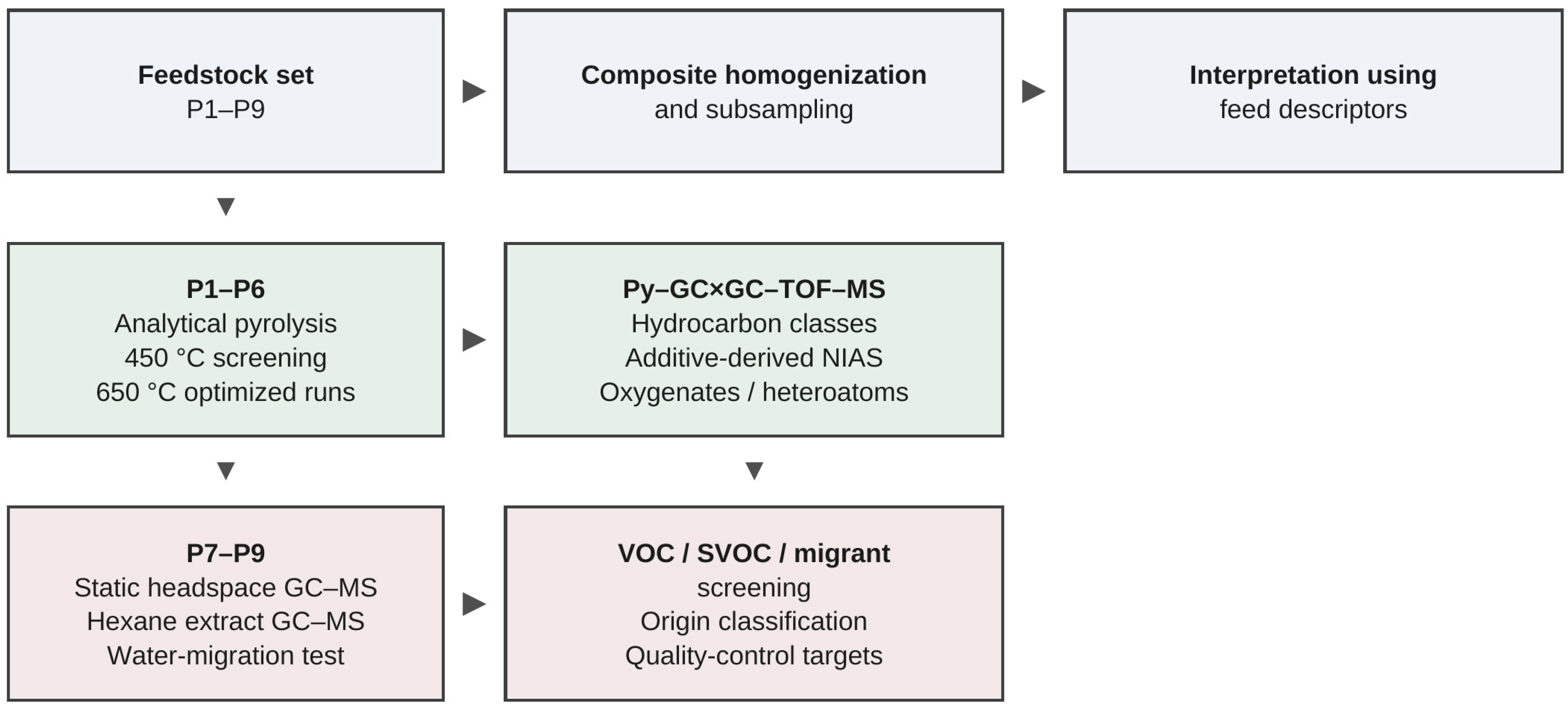
2. Materials and Methods
2.1. Plastic Samples and Pyrolysis Procedure
2.2. GC×GC–TOF–MS Analysis of Pyrolysis Oils
2.3. VOC and SVOC Analysis (Headspace and Leachate GC–MS)
2.4. Data Interpretation and Literature Comparison
3. Results and Discussion
3.1. GC×GC–TOF–MS Analysis of Pyrolysis Oils (Samples P1–P6)
3.1.1. Effect of Pyrolysis Temperature on Pyrolysis Oil Composition (450 °C vs. 650 °C)
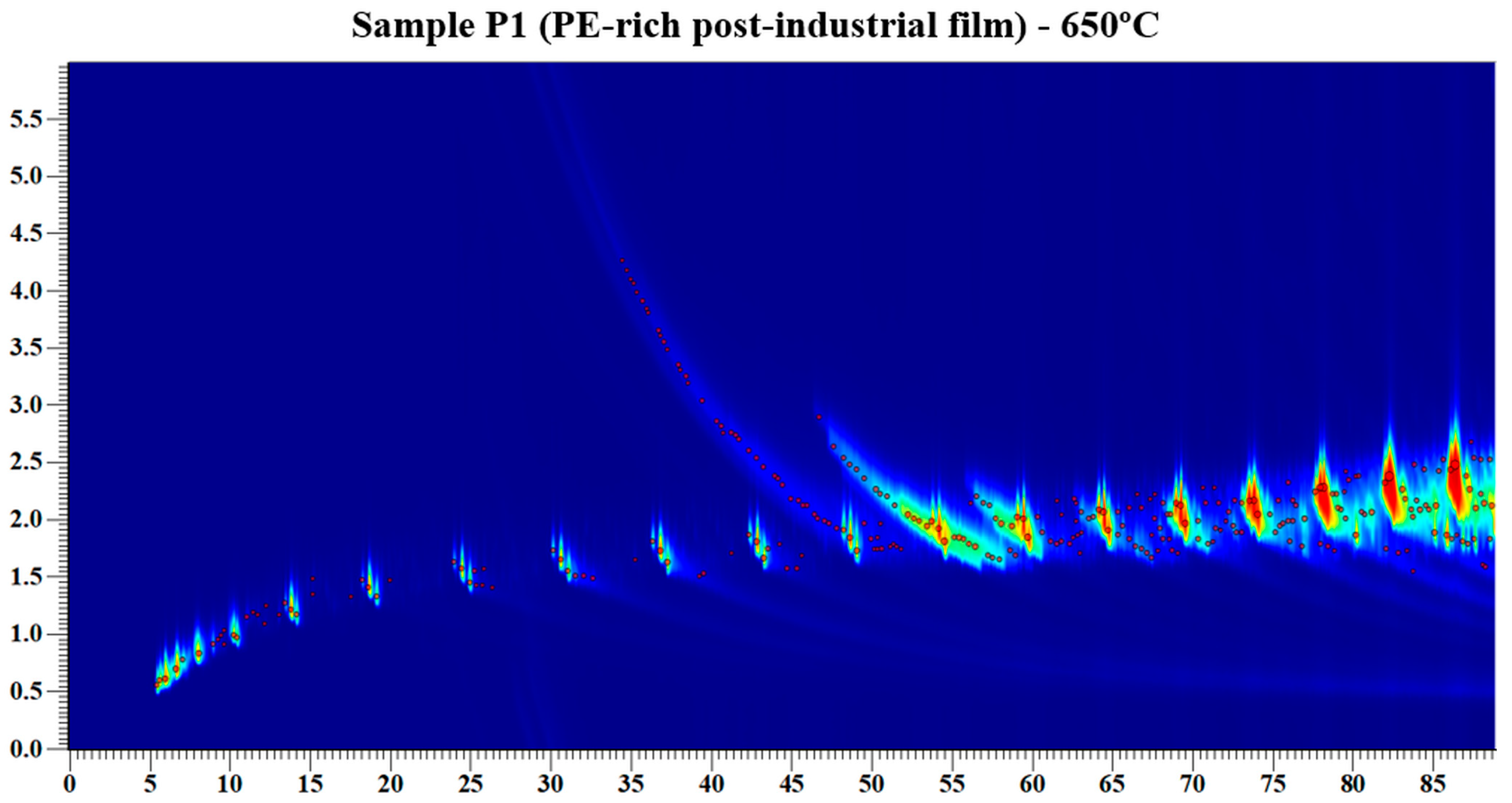
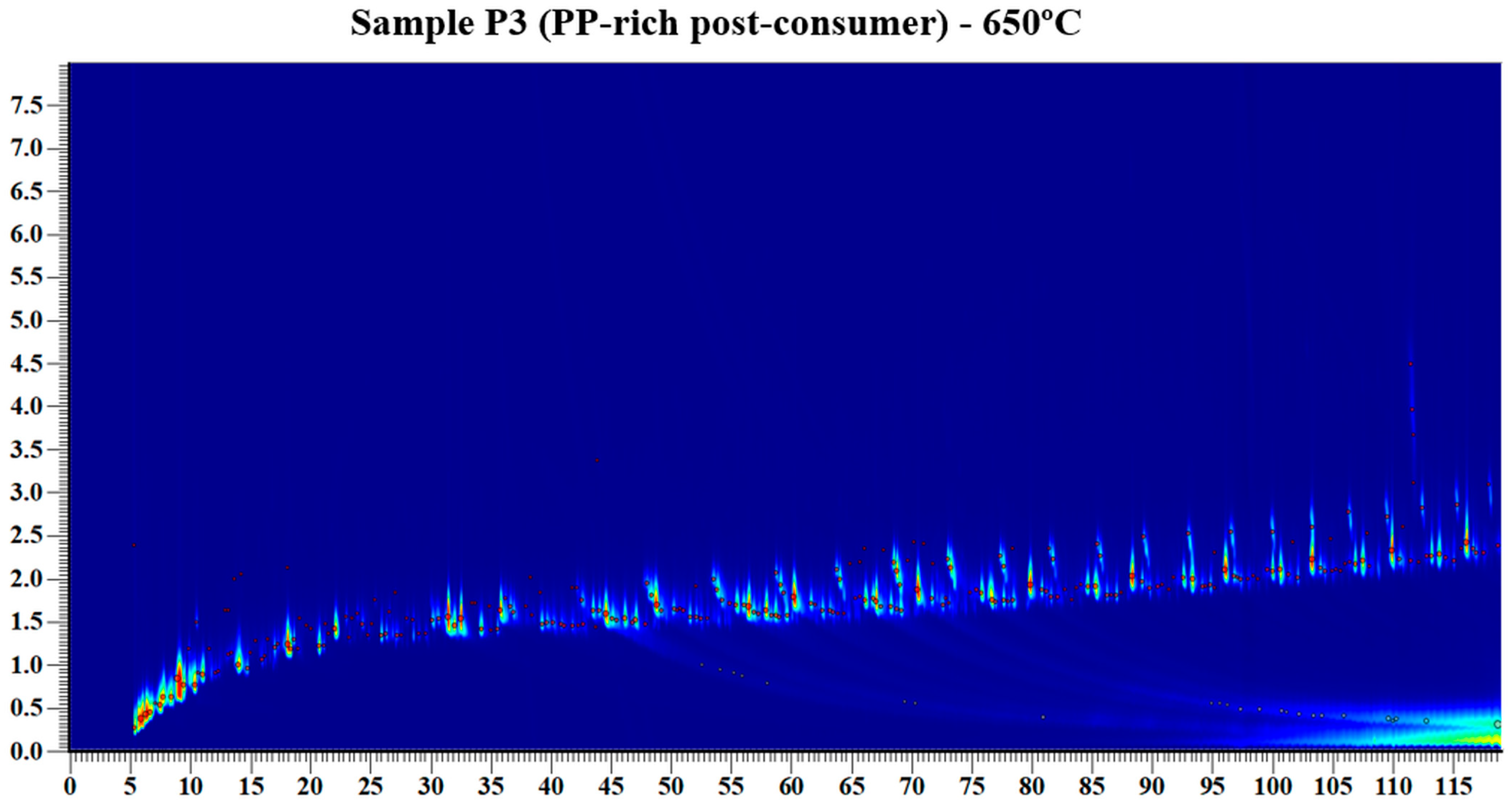
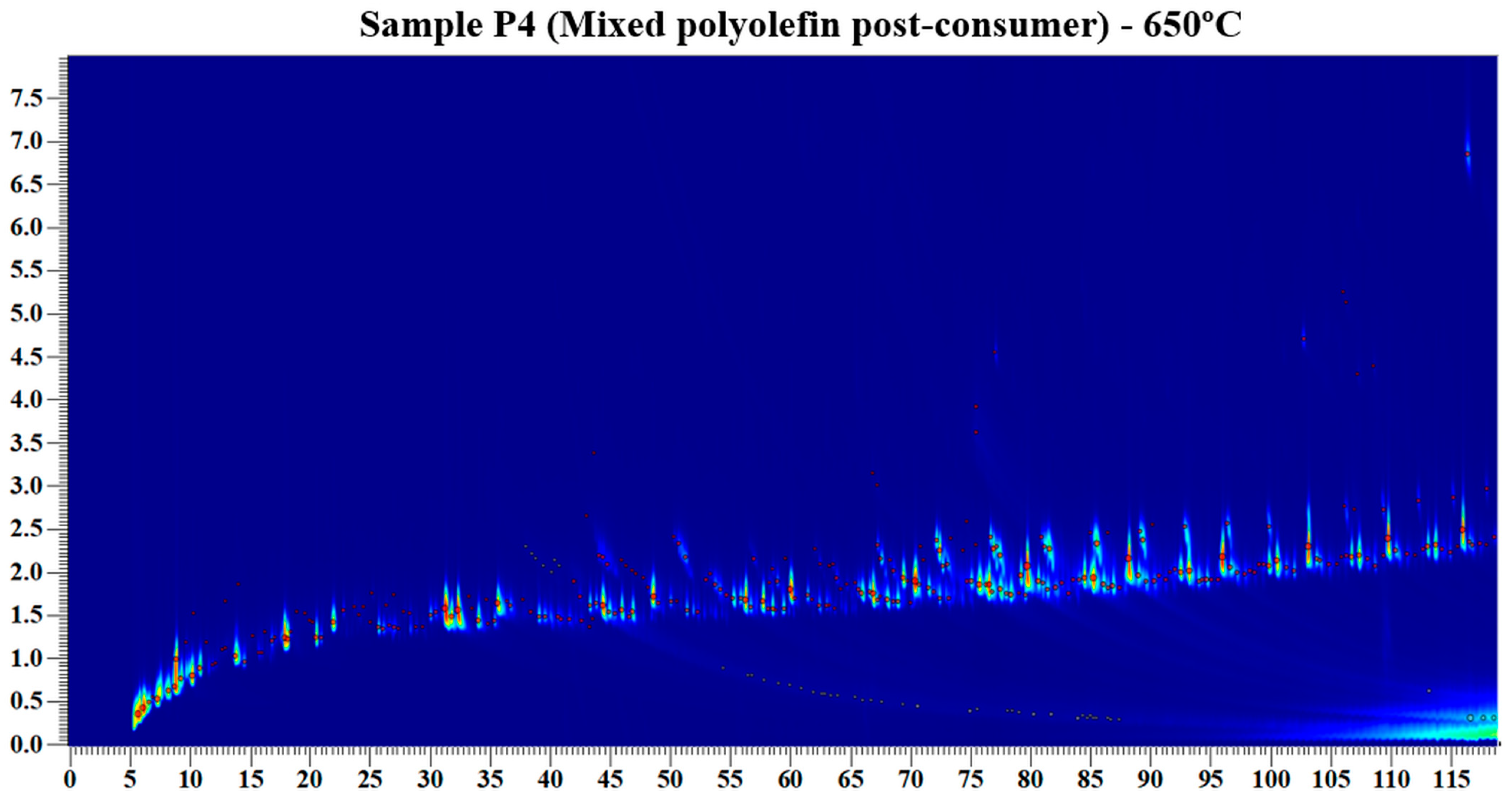
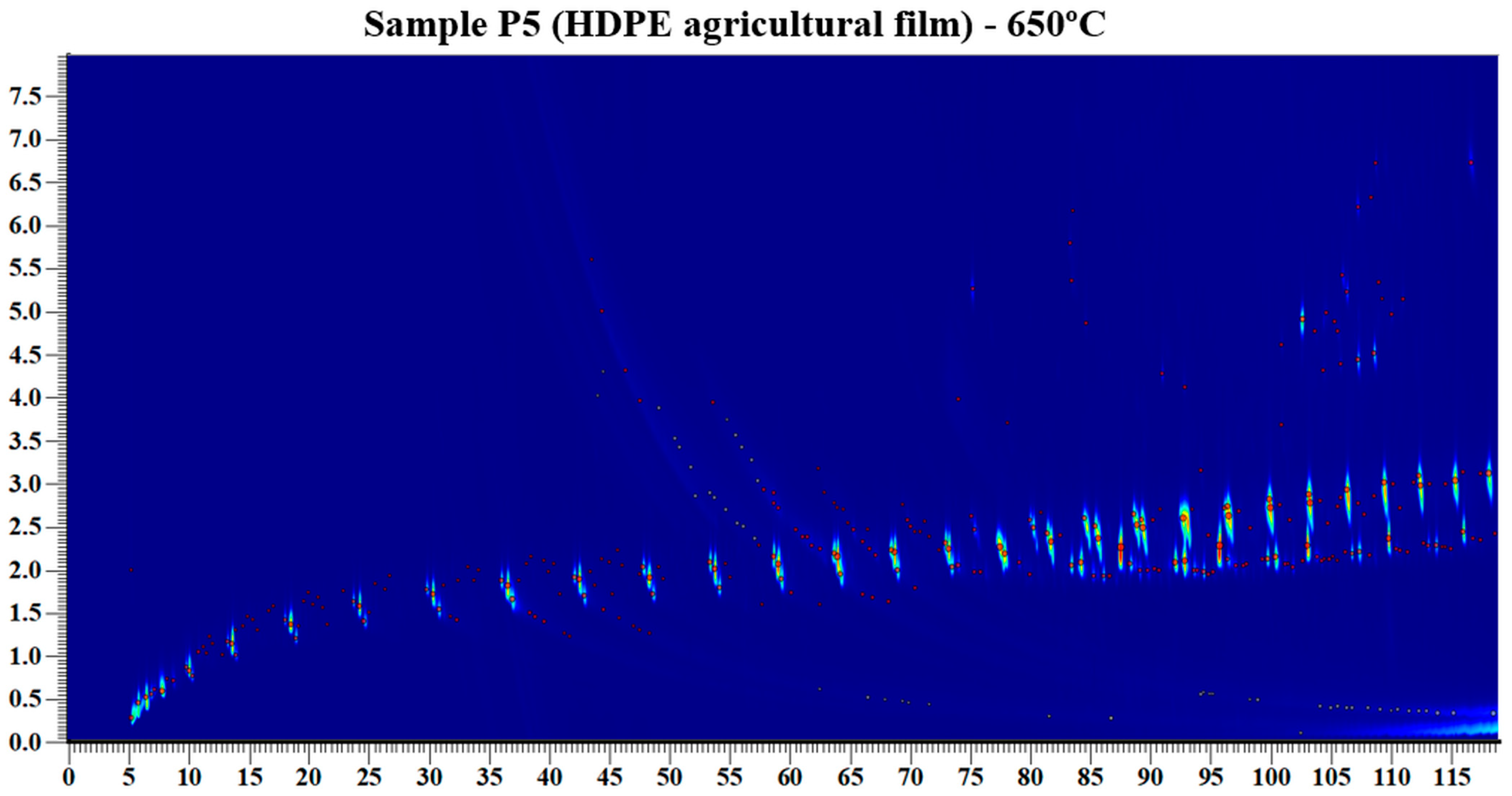
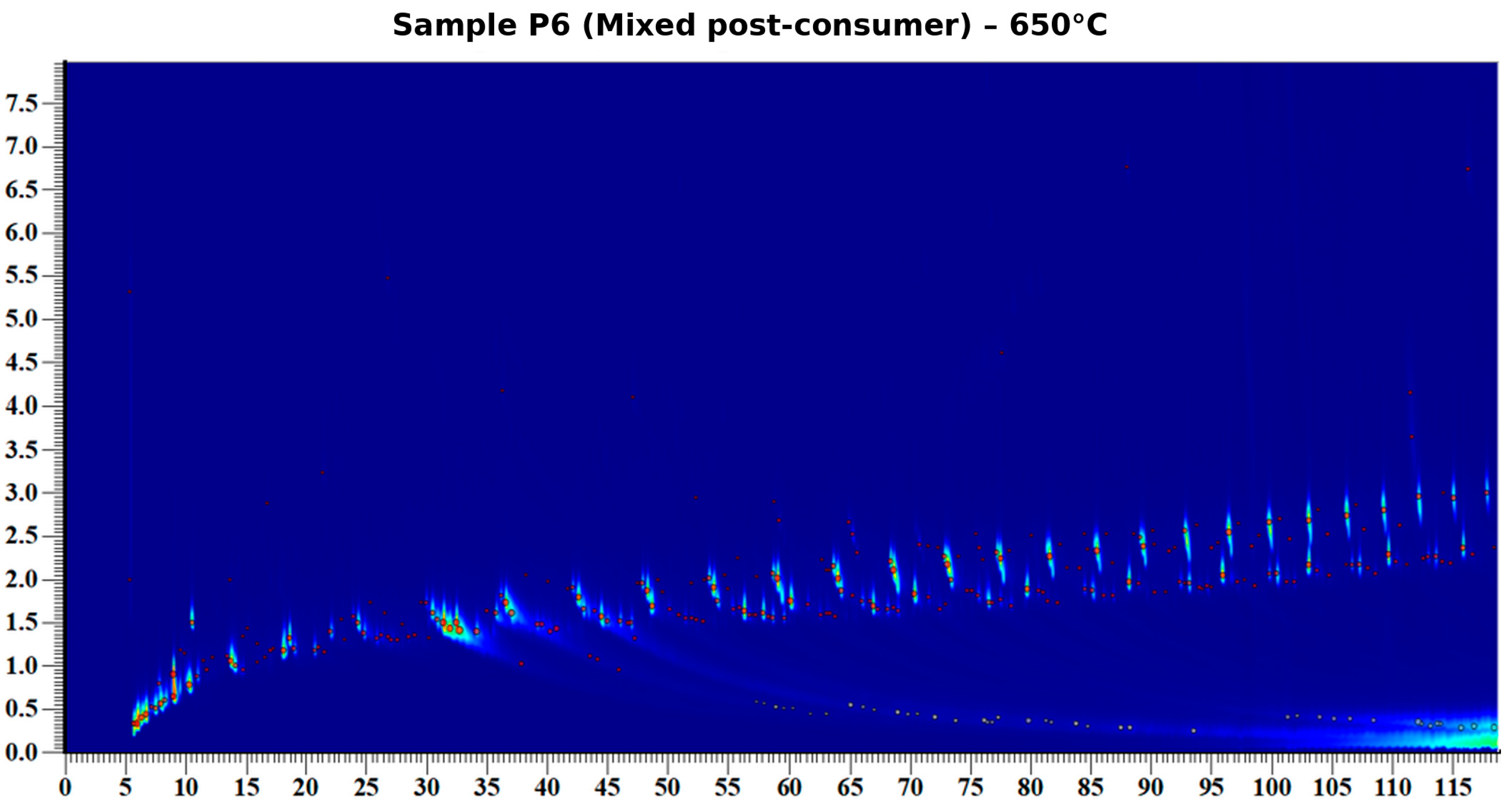
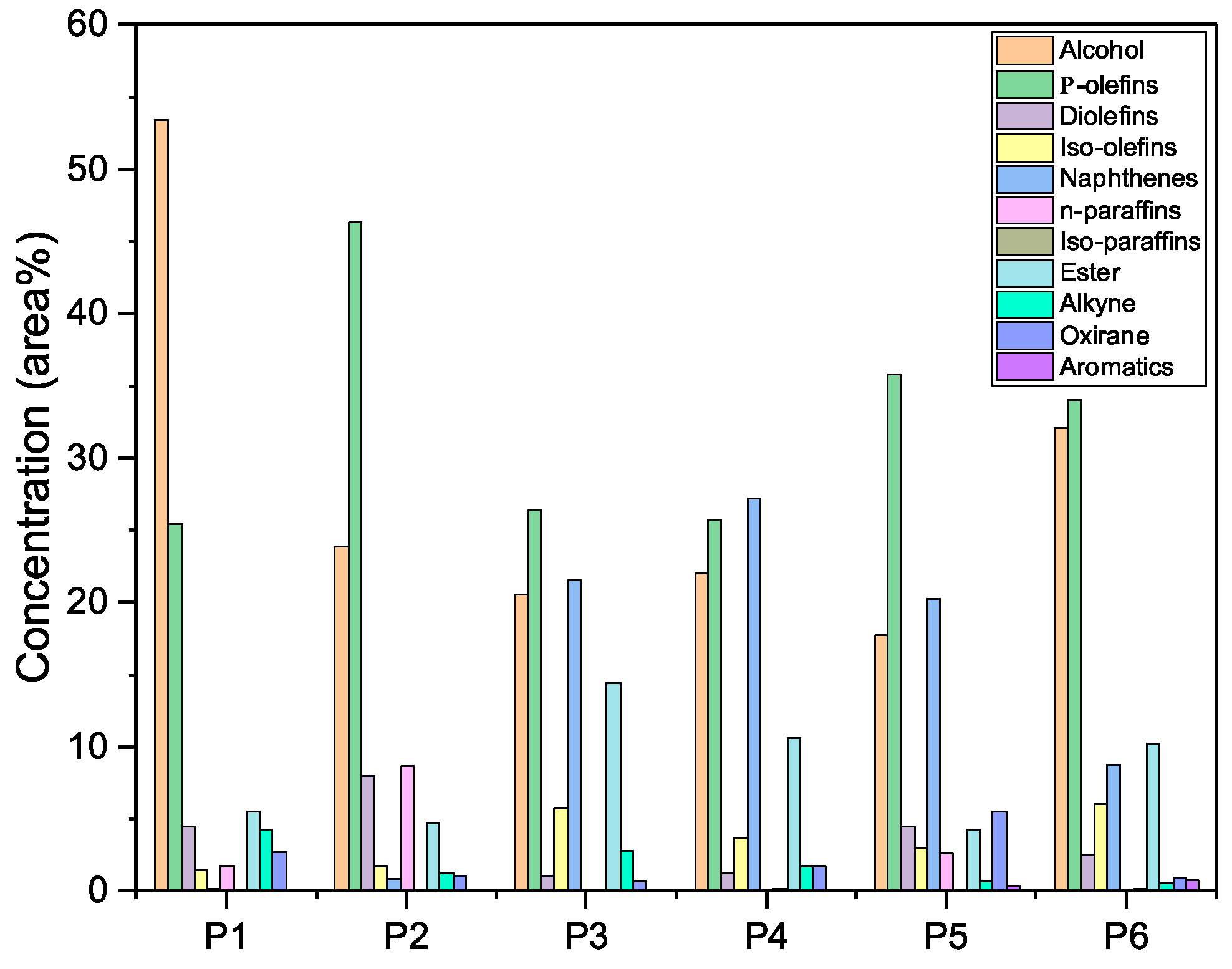
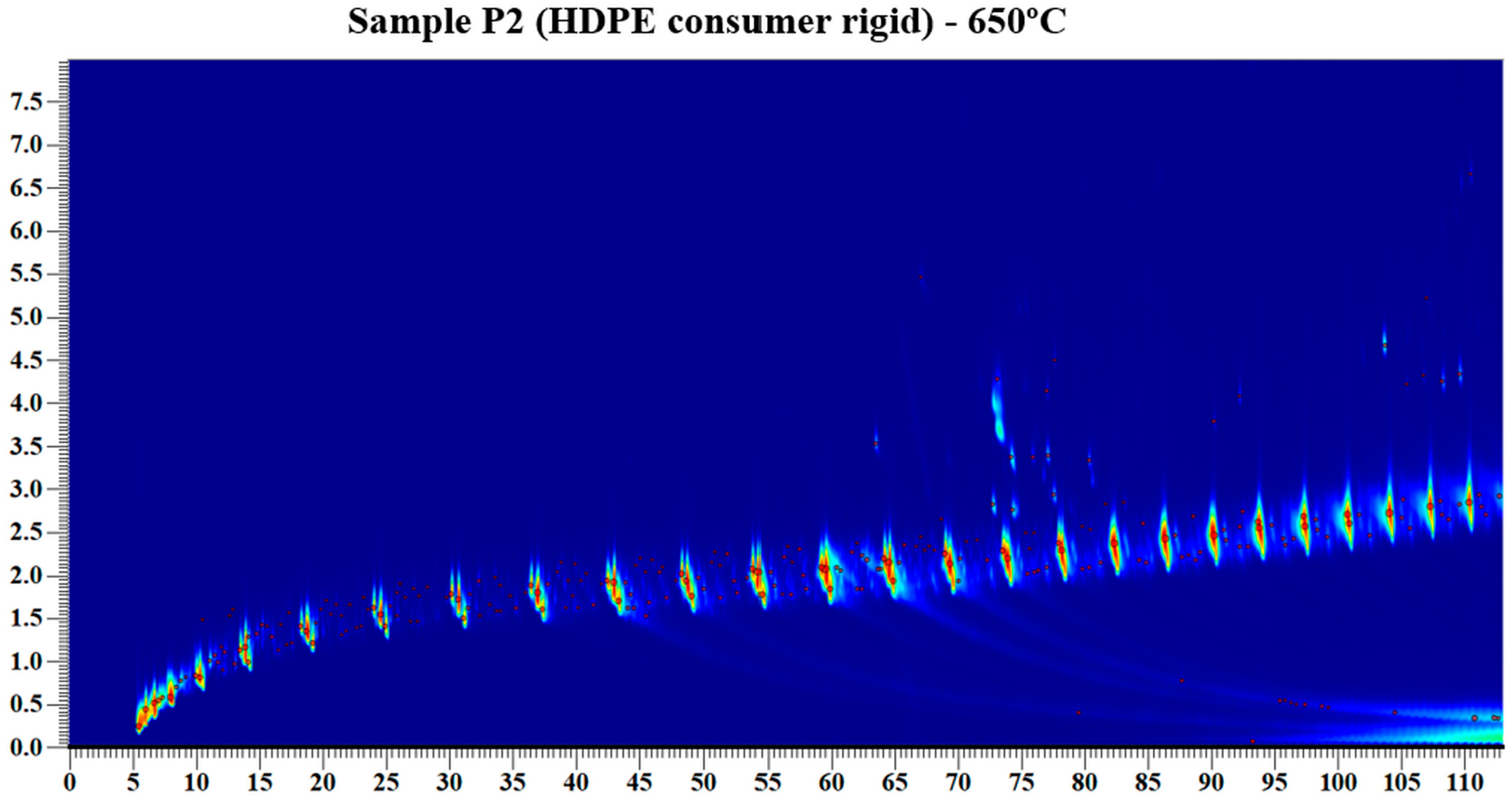
3.1.2. Overview of Pyrolysis Oil Composition at 650 °C
3.1.3. Reproducibility Assessment and Cross-Study Comparison
3.1.4. Broader Differences Between Samples at 650 °C (Effect of Feedstock)
3.2. VOC and Volatile, Semi-Volatile, and Migrating Organic Compounds
Volatile and Semi-Volatile Organic Compounds (VOCs and SVOCs)
3.3. Method Limitations and Total Contaminant Load Assessment
4. Conclusions
Supplementary Materials
Author Contributions
Funding
Institutional Review Board Statement
Data Availability Statement
Acknowledgments
Conflicts of Interest
Nomenclature
| FT-IR | Fourier Transform Infrared Spectroscopy |
| DSC | Differential Scanning Calorimetry |
| TGA | Thermal Gravimetric Analysis |
| CCD | Charge-Coupled Device |
| NIAS | Non-Intentionally Added Substances |
| LDPE | Low-Density Polyethylene |
| HDPE | High-Density Polyethylene |
| PP | Polypropylene |
| PVC | Polyvinyl Chloride |
| UV | Ultraviolet |
| PBDEs | Polybrominated Diphenyl Ethers |
| PFAS | Perfluoroalkyl Substances |
| POPs | Persistent Organic Pollutants |
| SCCPs | Short-Chain Chlorinated Paraffins |
| PCBs | Polychlorinated Biphenyls |
| REACH | Registration, Evaluation, Authorization, and Restriction of Chemicals |
| UNEP | United Nations Environment Programme |
| Py–GC×GC–TOF–MS | Pyrolysis coupled with Comprehensive Two-Dimensional Gas Chromatography Time-of-Flight Mass Spectrometry |
| GC | Gas Chromatography |
| TOF-MS | Time-of-Flight Mass Spectrometry |
| GC×GC | Comprehensive Two-Dimensional Gas Chromatography |
| CDS | Chemical Delivery Systems (specific to the Pyroprobe 6150 model) |
| HP-5MS UI | High-Performance 5% Phenyl Methylpolysiloxane Ultra Inert |
| BPX-50 | Biphenyl Polysilphenylenesiloxane (mid-polar column) |
| EI+ | Electron Ionization (Positive Mode) |
| NIST | National Institute of Standards and Technology |
| EPA | Environmental Protection Agency |
| NIH | National Institutes of Health |
| m/z | Mass-to-Charge Ratio |
| Hz | Hertz |
| GCImageTM | Gas Chromatography Image (software) |
| eV | Electron Volt |
References
- United States Food and Drug Administration (FDA). Chemistry Guidance for Recycled Plastics in Food Packaging. In FDA Guidance Document; United States Food and Drug Administration: Silver Spring, MD, USA, 2023. [Google Scholar]
- Saxena, S. Pyrolysis and Beyond: Sustainable Valorization of Plastic Waste. Appl. Energy Combust. Sci. 2024, 21, 100311. [Google Scholar] [CrossRef]
- Almroth, B.C. Scientists found hundreds of toxic chemicals in recycled plastics. ScienceDaily. 2023. Available online: https://www.sciencedaily.com/releases/2023/11/231110112511.htm (accessed on 30 January 2026).
- Almroth, B.C.; Carmona, E.; Chukwuone, N.; Dey, T.; Slunge, D.; Backhaus, T.; Karlsson, T. Addressing the toxic chemicals problem in plastics recycling. Camb. Prism. Plast. 2025, 3, e3. [Google Scholar] [CrossRef]
- Geueke, B.; Groh, K.; Muncke, J. Food packaging in the circular economy: Overview of chemical safety aspects for commonly used materials. J. Clean. Prod. 2018, 193, 491–505. [Google Scholar] [CrossRef]
- Geueke, B.; Phelps, D.W.; Parkinson, L.V.; Muncke, J. Hazardous chemicals in recycled and reusable plastic food packaging. Camb. Prism. Plast. 2023, 1, e7. [Google Scholar] [CrossRef]
- Groh, K.J.; Backhaus, T.; Carney-Almroth, B.; Geueke, B.; Inostroza, P.A.; Lennquist, A.; Leslie, H.A.; Maffini, M.; Slunge, D.; Trasande, L.; et al. Overview of known plastic packaging-associated chemicals and their hazards. Sci. Total Environ. 2019, 651, 3253–3268. [Google Scholar] [CrossRef]
- Groh, K.J.; Geueke, B.; Martin, O.; Maffini, M.; Muncke, J. Overview of intentionally used food contact chemicals and their hazards. Environ. Int. 2021, 150, 106225. [Google Scholar] [CrossRef]
- Hahladakis, J.N.; Velis, C.A.; Weber, R.; Iacovidou, E.; Purnell, P. An overview of chemical additives present in plastics: Migration, release, fate and environmental impact during their use, disposal and recycling. J. Hazard. Mater. 2018, 344, 179–199. [Google Scholar] [CrossRef]
- Jones, K.C. Persistent organic pollutants (POPs) and related chemicals in the global environment: Some personal reflections. Environ. Sci. Technol. 2021, 55, 9400–9412. [Google Scholar] [CrossRef]
- Weber, R.; Ashta, N.M.; Aurisano, N.; Wang, Z.; Outters, M.; De Miguel, K.; Schlummer, M.; Blepp, M.; Wiesinger, H.; Andrade, H.; et al. Chemicals in Plastics—A Technical Report; United Nations Environment Programme and Secretariat of the Basel, Rotterdam and Stockholm Conventions: Geneva, Switzerland, 2023. [Google Scholar]
- Spring, M.; Schröder, P.; Popovici, A.; O’Meara, N.; Corsi, I.; Aliani, S.; Boodhoo, K.; Gobin, J.; Godoy-Faúndez, A.; Kahru, A.; et al. Effective progress and implementation of the INC-5 plastics treaty through scientific guidance. Nat. Sustain. 2025, 8, 728–730. [Google Scholar] [CrossRef]
- Aanesen, M.; Ahi, J.C.; Abate, T.G.; Khan, F.R.; de Vries, F.P.; Kite-Powell, H.; Beaumont, N.J. Insights from international environmental legislation and protocols for the global plastic treaty. Sci. Rep. 2024, 14, 2750. [Google Scholar] [CrossRef]
- Farrelly, T.; Brander, S.; Thompson, R.; Almroth, B.C. Independent science key to breaking stalemates in global plastics treaty negotiations. Camb. Prism. Plast. 2025, 3, e6. [Google Scholar] [CrossRef]
- Farrelly, T.; Gammage, T.; Carney Almroth, B.; Thompson, R. Global plastics treaty needs trusted science. Science 2024, 384, 281. [Google Scholar] [CrossRef]
- Vince, J.; Carney Almroth, B.; De Miranda Grilli, N.; Dwivedi, V.; Stöfen-O’Brien, A.; Beyer, J. The Zero Draft Plastics Treaty: Gaps and challenges. Camb. Prism. Plast. 2024, 2, e24. [Google Scholar] [CrossRef]
- Chen, A.; Saxena, S.; Samaras, V.G.; Dally, B. A Tiered Multi-Technique Decision-Support Framework for Contaminant Screening and Recycling-Route Assignment of Mixed Plastic Waste. Polymers 2026, 18, 1256. [Google Scholar] [CrossRef]
- European Commission. Regulation (EU) 2025/40 of the European Parliament and of the Council on packaging and packaging waste. Off. J. Eur. Union 2025, L 40, 1–149. [Google Scholar]
- European Food Safety Authority (EFSA). Note for Guidance For the Preparation of an Application for the Safety Assessment of a Substance to be used in Plastic Food Contact Materials. EFSA J. 2021, 6, 21r. [Google Scholar]
- Hochegger, A.; Gollner, T.; Gadermaier, B.; Gruber, S.; Baumgartner, S.; Malachova, A. One-dimensional and comprehensive two-dimensional gas chromatographic approaches for the characterization of post-consumer recycled plastic materials. Anal. Bioanal. Chem. 2023, 415, 2447–2457. [Google Scholar] [CrossRef] [PubMed]
- Toraman, H.E.; Dijkmans, T.; Djokic, M.R.; Van Geem, K.M.; Marin, G.B. Detailed compositional characterization of plastic waste pyrolysis oil by comprehensive two-dimensional gas-chromatography coupled to multiple detectors. J. Chromatogr. A 2014, 1359, 237–246. [Google Scholar] [CrossRef]
- Ong, H.-T.; Samsudin, H.; Soto-Valdez, H. Migration of endocrine-disrupting chemicals into food from plastic packaging materials: An overview of chemical risk assessment, techniques to monitor migration, and international regulations. Crit. Rev. Food Sci. Nutr. 2022, 62, 957–979. [Google Scholar] [CrossRef]
- Radhakrishnan, H.; Mohammed, A.A.B.A.; Coffman, I.; Bai, X. Influence of Functional Additives, Fillers, and Pigments on Thermal and Catalytic Pyrolysis of Polyethylene for Waste Plastics Upcycling. Green Chem. 2025, 27, 5861–5882. [Google Scholar] [CrossRef]
- Staub, C. Study: E-Plastics Additives Present in Home Goods. Plast. Recycl. Update 2024. Available online: https://resource-recycling.com/plastics/2024/12/04/study-e-plastics-additives-present-in-home-goods/ (accessed on 1 January 2026).
- Wiesinger, H.; Wang, Z.; Hellweg, S. Deep dive into plastic monomers, additives, and processing aids. Environ. Sci. Technol. 2021, 55, 9339–9351. [Google Scholar] [CrossRef]
- Horodytska, O.; Cabanes, A.; Fullana, A. Non-intentionally added substances (NIAS) in recycled plastics. Chemosphere 2020, 251, 126373. [Google Scholar] [CrossRef] [PubMed]
- Beccaria, M.; Piparo, M.; Zou, Y.; Stefanuto, P.-H.; Purcaro, G.; Mendes Siqueira, A.L.; Maniquet, A.; Giusti, P.; Focant, J.-F. Analysis of mixed plastic pyrolysis oil by comprehensive two-dimensional gas chromatography coupled with low- and high-resolution time-of-flight mass spectrometry with the support of soft ionization. Talanta 2023, 252, 123799. [Google Scholar] [CrossRef] [PubMed]
- Dao Thi, H.; Djokic, M.R.; Van Geem, K.M. Detailed group-type characterization of plastic-waste pyrolysis oils: By comprehensive two-dimensional gas chromatography including linear, branched, and di-olefins. Separations 2021, 8, 103. [Google Scholar] [CrossRef]
- Kusenberg, M.; Roosen, M.; Zayoud, A.; Djokic, M.R.; Dao Thi, H.; De Meester, S.; Ragaert, K.; Kresovic, U.; Van Geem, K.M. Assessing the feasibility of chemical recycling via steam cracking of untreated plastic waste pyrolysis oils: Feedstock impurities, product yields and coke formation. Waste Manag. 2022, 141, 104–114. [Google Scholar] [CrossRef]
- Wu, S.; Wu, X.; Li, H.; Li, D.; Zheng, J.; Lin, Q.-B.; Nerin, C.; Zhong, H.; Dong, B. The characterization and influence factors of semi-volatile compounds from mechanically recycled polyethylene terephthalate (rPET) by combining GC × GC-TOFMS and chemometrics. J. Hazard. Mater. 2022, 439, 129583. [Google Scholar] [CrossRef]
- Rung, C.; Welle, F.; Gruner, A.; Springer, A.; Steinmetz, Z.; Munoz, K. Identification and Evaluation of (Non-) Intentionally Added Substances in Post-Consumer Recyclates and Their Toxicological Classification. Recycling 2023, 8, 24. [Google Scholar] [CrossRef]
- Khan, R.; Perez, B.A.; Toraman, H.E. Comparative analysis of additive decomposition using one-dimensional and two-dimensional GC with FID/TOF-MS. J. Anal. Appl. Pyrolysis 2024, 177, 106298. [Google Scholar]
- Turner, A.; Filella, M. Hazardous metal additives in plastics and their environmental impacts. Environ. Int. 2021, 156, 106622. [Google Scholar] [CrossRef]
- Gao, P.; Hu, Z.; Sheng, Y.; Pan, W.; Ding, L.; Tang, L.; Chen, X.; Wang, F. Pyrolysis of municipal plastic waste: Chlorine distribution and formation of organic chlorinated compounds. J. Hazard. Mater. 2023, 441, 129849. [Google Scholar] [CrossRef]
- Strien, J.R.J.; Genuino, H.C.; van Eijk, M.C.P.; Deuss, P.J.; Heeres, H.J. Pyrolysis of Polyolefin-Enriched Mixed Plastic Waste Streams: Effects of Pretreatments and Presence of PVC. Energy Fuels 2023, 37, 10424–10437. [Google Scholar]
- Xayachak, T.; Haque, N.; Parthasarathy, R.; King, S.; Emami, N.; Lau, D.; Pramanik, B.K. Pyrolysis for plastic waste management: An engineering perspective. J. Environ. Chem. Eng. 2022, 10, 108865. [Google Scholar] [CrossRef]
- Scheirs, J.; Kaminsky, W. Feedstock Recycling and Pyrolysis of Waste Plastics: Converting Waste Plastics into Diesel and Other Fuels; John Wiley & Sons: Chichester, UK, 2006. [Google Scholar]
- Lopez, G.; Artetxe, M.; Amutio, M.; Bilbao, J.; Olazar, M. Thermochemical routes for the valorization of waste polyolefinic plastics to produce fuels and chemicals. A review. Renew. Sustain. Energy Rev. 2017, 73, 346–368. [Google Scholar] [CrossRef]
- Mastral, F.J.; Esperanza, E.; García, P.; Juste, M. Pyrolysis of high-density polyethylene in a fluidised bed reactor. Influence of the temperature and residence time. J. Anal. Appl. Pyrolysis 2002, 63, 1–15. [Google Scholar] [CrossRef]
- Jung, S.-H.; Cho, M.-H.; Kang, B.-S.; Kim, J.-S. Pyrolysis of a fraction of waste polypropylene and polyethylene for the recovery of BTX aromatics using a fluidized bed reactor. Fuel Process. Technol. 2010, 91, 277–284. [Google Scholar] [CrossRef]
- Ahmad, I.; Khan, M.I.; Khan, H.; Ishaq, M.; Tariq, R.; Gul, K.; Ahmad, W. Pyrolysis Study of Polypropylene and Polyethylene Into Premium Oil Products. Int. J. Green. Energy 2015, 12, 663–671. [Google Scholar] [CrossRef]
- Onwudili, J.A.; Insura, N.; Williams, P.T. Composition of products from the pyrolysis of polyethylene and polystyrene in a closed batch reactor: Effects of temperature and residence time. J. Anal. Appl. Pyrolysis 2009, 86, 293–303. [Google Scholar] [CrossRef]
- Akoueson, F.; Chbib, C.; Monchy, S.; Paul-Pont, I.; Doyen, P.; Dehaut, A.; Duflos, G. Identification and quantification of plastic additives using pyrolysis-GC/MS: A review. Sci. Total Environ. 2021, 773, 145073. [Google Scholar] [CrossRef]
- Chen, Y.; Li, H.; Huang, H.; Zhang, B.; Ye, Z.; Yu, X.; Shentu, X. Recent advances in non-targeted screening of compounds in plastic-based/paper-based food contact materials. Foods 2023, 12, 4135. [Google Scholar] [CrossRef] [PubMed]
- He, Y.-J.; Qin, Y.; Zhang, T.-L.; Zhu, Y.-Y.; Wang, Z.-J.; Zhou, Z.-S.; Xie, T.-Z.; Luo, X.-D. Migration of (non-) intentionally added substances and microplastics from microwavable plastic food containers. J. Hazard. Mater. 2023, 455, 131512. [Google Scholar] [CrossRef] [PubMed]
- Ureel, Y.; Chacón-Patiño, M.L.; Kusenberg, M.; Ginzburg, A.; Rodgers, R.P.; Sabbe, M.K.; Van Geem, K.M. Detailed Characterization of Plastic Pyrolysis Oils and Their Contaminants by FT-ICR MS and GC × GC. In Proceedings of the 2024 Spring Meeting and 20th Global Congress on Process Safety, New Orleans, LA, USA, 24–28 March 2024. [Google Scholar]
- Cuthbertson, A.A.; Lincoln, C.; Miscall, J.; Stanley, L.M.; Maurya, A.K.; Asundi, A.S.; Tassone, C.J.; Rorrer, N.A.; Beckham, G.T. Characterization of polymer properties and identification of additives in commercially available bio-based and conventional food packaging materials. Polym. Test. 2022, 116, 107803. [Google Scholar]
- Zou, L.; Xu, R.; Wang, H.; Wang, Z.; Sun, Y.; Li, M. Chemical recycling of polyolefins: A closed-loop cycle of waste to olefins. Natl. Sci. Rev. 2024, 11, nwad207. [Google Scholar] [CrossRef] [PubMed]
- Saha, B.; Vedachalam, S.; Dalai, A.K.; Saxena, S.; Dally, B.; Roberts, W.L. Review on production of liquid fuel from plastic wastes through thermal and catalytic degradation. J. Energy Inst. 2024, 114, 101661. [Google Scholar] [CrossRef]
- National Institute of Standard and Technology. NIST 23 Tandem Mass Spectral Libraries; National Institute of Standard and Technology: Gaithersburg, MD, USA, 2023.
- Auersvald, M.; Šiman, M.; Vozka, P.; Straka, P. Quantitative determination of olefins in pyrolysis oils from waste plastics and tires using selective adsorption by Ag–SiO2 followed by GC×GC-FID. Talanta 2025, 281, 126792. [Google Scholar] [CrossRef]
- Strien, J.R.J.; Genuino, H.C.; van Eijk, M.C.P.; Deuss, P.J.; Heeres, H.J. Pyrolysis of Polyolefin-Enriched Mixed Plastic Waste Streams: Effects of Pretreatments and Presence of Hydrogen during Pyrolysis. Energy Fuels 2024, 39, 686–698. [Google Scholar] [CrossRef]
- Núñez, S.S.; Moltó, J.; Conesa, J.A.; Fullana, A. Heavy metals, PAHs and POPs in recycled polyethylene samples of agricultural, post-commercial, post-industrial and post-consumer origin. Waste Manag. 2022, 144, 113–121. [Google Scholar] [CrossRef]
- Kato, L.S.; Conte, C.A., Jr. Safety of plastic food packaging: The challenges about non-intentionally added substances (NIAS) discovery, identification and risk assessment. Polymers 2021, 13, 2077. [Google Scholar] [CrossRef] [PubMed]





| Sample | Dominant Polymer(s) | Key Feed Descriptors (FTIR, TGA, Source Category) | Analysis Route |
|---|---|---|---|
| P1 | LDPE/HDPE blend | PE-rich blend (LDPE + HDPE by FTIR); ash/residue < 1 wt% (TGA); no carbonyl index elevation; negligible inorganic filler. Post-industrial packaging film. | Py–GC×GC–TOF–MS |
| P2 | HDPE | HDPE dominant (FTIR); mildly oxidized (carbonyl band present); CaCO3/ash ≈ 6–7 wt% (TGA residue); elevated non-volatile residue relative to clean PE. Post-consumer rigid packaging. | Py–GC×GC–TOF–MS |
| P3 | PP | Isotactic PP (FTIR); ash/residue < 2 wt% (TGA); single-step degradation near 460 °C; no measurable oxidation. Post-industrial injection-molding scrap. | Py–GC×GC–TOF–MS |
| P4 | PP | Isotactic PP (FTIR); ash/residue < 2 wt% (TGA); minimal oxidation or filler signatures. Post-industrial packaging trim. | Py–GC×GC–TOF–MS |
| P5 | HDPE film | HDPE film (FTIR); most strongly oxidized sample (highest carbonyl index); CaCO3/ash ≈ 10 wt% (TGA residue); elevated non-volatile residue. Post-consumer agricultural film. | Py–GC×GC–TOF–MS |
| P6 | LDPE/HDPE/PP blend | PE/PP blend (FTIR shows both CH2 and CH3 signatures); ash/residue ≈ 2–3 wt%; slight oxidation; low inorganic content. Post-consumer mixed-stream sort. | Py–GC×GC–TOF–MS |
| P7 | LDPE/HDPE | PE-rich recycled article (FTIR: LDPE/HDPE); mild oxidation (low carbonyl); low-to-moderate Ca-based filler (≈3–5 wt% ash). Post-consumer household packaging. | VOC/SVOC/migration |
| P8 | HDPE | HDPE-rich recycled article (FTIR); mild oxidation; moderate Ca-based filler (≈5–7 wt% ash). Post-consumer rigid container. | VOC/SVOC/migration |
| P9 | HDPE/PP mix | Mixed HDPE/PP article (FTIR shows both PE and PP bands); slight unsaturation/oxidation; low inorganic content (<2 wt% ash). Post-consumer mixed packaging. | VOC/SVOC/migration |
| Name | Mass (mg) Before Pyrolysis | Mass (mg) After Pyrolysis | Temperature (°C) |
|---|---|---|---|
| P1_450 | 5.517 | 5.544 | 450 |
| P2_450 | 4.582 | 4.611 | 450 |
| P3_450 | 4.27 | 4.36 | 450 |
| P4_450 | 4.029 | 4.027 | 450 |
| P5_450 | 3.992 | 4.032 | 450 |
| P6_450 | 4.464 | 4.495 | 450 |
| P1_650 | 2.611 | 1.452 | 650 |
| P2_650 | 2.085 | 0.274 | 650 |
| P3_650 | 2.577 | 0.477 | 650 |
| P4_650 | 2.409 | 0.395 | 650 |
| P5_650 | 2.083 | 0.596 | 650 |
| P6_650 | 2.121 | 0.389 | 650 |
| Compound | P1 | P2 | P3 | P4 | P5 | P6 |
|---|---|---|---|---|---|---|
| Alcohols | ||||||
| 1-Decanol, 2-hexyl- | 35.63 | 13.22 | 2.5 | 4.56 | 17.14 | |
| 1-Eicosanol | 5.61 | 2.1 | 13.42 | 7.92 | ||
| n-Nonadecanol-1 | 3.16 | 3.37 | ||||
| 2-Hexyl-1-octanol | 2.75 | 3.16 | 5.12 | |||
| 2-Ethyl-1-dodecanol | 2.24 | |||||
| 11-Dodecen-1-ol, 2,4,6-trimethyl-, | 2.36 | 2.85 | ||||
| 11-Hexadecen-1-ol, (Z)- | 2.36 | |||||
| 1-Octanol, 2-butyl- | 2.16 | 2.37 | ||||
| 2-Isopropyl-5-methyl-1-heptanol | 6.08 | 7.9 | 3.76 | |||
| n-Heptadecanol-1 | 2.54 | |||||
| Tricosan-2-ol | 12.12 | 13.97 | ||||
| Olefins | ||||||
| 1-Docosene | 9.04 | 5.45 | 4.76 | |||
| 1,19-Eicosadiene | 4.27 | 9.31 | 9.44 | 2.99 | ||
| 1-Tetracosene | 2.95 | 3.13 | 2.19 | 11 | 2.23 | |
| 1-Nonadecene | 2.85 | 3.77 | 8.77 | 2.47 | ||
| 1-Heptadecene | 4.21 | |||||
| 1-Hexacosene | 8.77 | 3.25 | ||||
| 2,4-Dimethyl-1-heptene | 2.36 | |||||
| Cetene | 2.89 | |||||
| Nonacos-1-ene | 16.65 | 18.67 | 10.47 | |||
| Pentacos-1-ene | 3.3 | |||||
| Esters | ||||||
| Oxalic acid, allyl octadecyl ester | 2.4 | 11.92 | 3.11 | 9 | ||
| Carbonic acid, eicosyl vinyl ester | 9.15 | 9.03 | 8.1 | |||
| Oxalic acid, allyl hexadecyl ester | 4.95 | |||||
| Oxalic acid, allyl tridecyl ester | 6.07 | |||||
| Alkenal | ||||||
| cis-4-Decenal | 2.89 | |||||
| E-15-Heptadecenal | 3.34 | |||||
| Cycloparaffins | ||||||
| Cyclotetradecane, 1,7,11-trimethyl-4-(1-methylethyl)- | 15.78 | 10.8 | ||||
| Paraffins | ||||||
| Nonadecane | 3.05 | 2.78 | ||||
| Alkyne | ||||||
| 1-Octadecyne | 4.19 | 4.72 |
| Category | Concentration (Area %) | |||||
|---|---|---|---|---|---|---|
| Category | P1 | P2 | P3 | P4 | P5 | P6 |
| Alcohol | 53.52 | 23.92 | 20.59 | 22.12 | 17.75 | 32.09 |
| α-olefines | 25.5 | 46.34 | 26.49 | 25.8 | 35.82 | 34.08 |
| Diolefins | 4.57 | 8 | 1.11 | 1.31 | 4.53 | 2.54 |
| Iso-olefins | 1.51 | 1.83 | 5.75 | 3.73 | 3.03 | 6.07 |
| Naphthenes | 0.27 | 0.94 | 21.56 | 27.29 | 20.34 | 8.8 |
| n-paraffins | 1.8 | 8.67 | 2.64 | |||
| Iso-paraffins | 0.19 | 0.21 | ||||
| Ester | 5.59 | 4.79 | 14.47 | 10.7 | 4.28 | 10.27 |
| Alkyne | 4.31 | 1.34 | 2.9 | 1.81 | 0.72 | 0.64 |
| Oxirane | 2.73 | 1.08 | 0.68 | 1.8 | 5.61 | 0.99 |
| Aromatics | 0.06 | 0.11 | 0.09 | 0.45 | 0.85 | |
| Si | 2.45 | 0.11 | ||||
| Cyclic alcohols | 5.7 | 3.03 | 0.47 | 1 | ||
| Ether | 0.34 | 0.99 | 2.25 | 2.36 | ||
| Compound Name | Peak Intensity | Classification | ||||
|---|---|---|---|---|---|---|
| Compound Name | P7 | P8 | P9 | Type | Possible Origin | Odorants |
| Hydrocarbons | ||||||
| 10-Heneicosene (c,t) | 1 | PD | Polymer degradation | |||
| 1-Dodecene | 1 | PD | Polymer degradation | |||
| 1-Nonadecene | 2 | PD | Polymer degradation | |||
| 1-Tetradecene | 1 | 3 | PD | Polymer degradation | ||
| 2,4-Dimethyl-1-heptene | 1 | 2 | 1 | C | Polymer degradation | Strong pungent plastic odor |
| 3-Dpdecene | 1 | PD | Polymer degradation | |||
| 3-Eicosene, (E)- | 1 | PD | Polymer degradation | |||
| Cetene | 1 | 3 | PD | Polymer degradation | ||
| Decane | 1 | 1 | PD | Polymer degradation | ||
| Decane, 4-methyl- | 1 | PD | Polymer degradation | |||
| Dodecane | 1 | 3 | PD | Polymer degradation | ||
| Dodecane, 2,7,10-trimethyl- | 3 | PD | Polymer degradation | |||
| Eicosane, 2-methyl- | 1 | PD | Polymer degradation | |||
| Heptacosane | 1 | PD | Polymer degradation | |||
| Heptadecane, 2,6,10,15-tetramethyl- | 1 | AD | Lubricant | |||
| Heptadecane, 4-methyl- | 1 | PD | Polymer degradation | |||
| Heptane, 2,3-dimethyl- | 1 | C | Processing aid | |||
| Heptane, 2,4-dimethyl- | 3 | C | Processing aid | |||
| Heptane, 4-methyl- | 1 | PD | Polymer degradation | |||
| Hexadecane | 1 | 1 | PD | Polymer degradation | ||
| Hexadecane, 2,6,11,15-tetramethyl- | 1 | AD | Lubricant | |||
| Hexane, 2,3,5-trimethyl- | 1 | C | Processing aid | |||
| Nonadecane | 2 | 1 | PD | Polymer degradation | ||
| Octadecane, 2-methyl- | 1 | 1 | 1 | PD | Processing aid | |
| Octane | 1 | PD | Polymer degradation | |||
| Octane, 4-methyl- | 2 | PD | Polymer degradation | |||
| Tetradecane | 2 | 1 | 2 | PD | Polymer degradation | |
| Tridecane | 1 | PD | Polymer degradation | |||
| Undecane | 1 | 3 | PD | Polymer degradation | ||
| Undecane, 4-methyl- | 1 | PD | Polymer degradation | |||
| α-Methylstyrene | 3 | 2 | 2 | PD | Polymer degradation | |
| Tetradecane, 4-methyl- | 1 | PD | Polymer degradation | |||
| Alcohols | ||||||
| 1-Decanol, 2-hexyl- | 1 | C | Daily chemical products-related | |||
| 1-Butanol | 1 | C | Cosmetics | |||
| 1-Octanol, 2,7-dimethyl- | 2 | C | Cosmetics/Industrial Solvent | Camphor-like odor | ||
| 1-Octanol, 2-butyl- | 1 | C | Daily chemical products related | |||
| 2,2-dimethylphenylmethanol | 1 | 1 | C | Daily chemical products-related | ||
| 2-Hexyl-1-octanol | 1 | C | Flavor and fragrance agent | |||
| 2-Undecanethiol, 2-methyl- | 1 | C | Daily chemical products-related | Pungent and garlic-like odor | ||
| Cyclobutanol | 1 | 1 | 1 | C | Daily chemical products-related | |
| Aldehydes and Ketones | ||||||
| 2-Pentenal, 2-methyl- | 1 | C | Flavor and fragrance agent | |||
| Decanal | 1 | PD or C | Cosmetics | |||
| Heptanal | 1 | PD or C | Flavor and fragrance agent | |||
| Hexanal | 1 | PD or C | Flavor and fragrance agent | |||
| Nonanal | 1 | PD or C | Cosmetics | |||
| Octanal | 1 | PD or C | Cosmetics | |||
| Pentanal | 1 | 1 | PD or C | Flavor and fragrance agent | ||
| 2-Heptanone, 4,6-dimethyl- | 1 | C | Daily chemical products-related | |||
| 2-Heptanone, 4-methyl- | 1 | C | Flavor and fragrance agent | |||
| Acetophenone | 1 | 1 | 1 | C | Daily chemical products-related | |
| Cyclopentanone, 2-(1-methylpropyl)- | 1 | C | Daily chemical products-related | |||
| Others | ||||||
| 1-Propanol, 2-amino-, (±)- | 1 | C | Industrial solvent/Adhesive | |||
| 2,3-Epoxybutane | 1 | 1 | C | Pharmaceutical-related | ||
| 2,6-Di-tert-butylbenzoquinone | 1 | AD | Oxidation phosphite additives | |||
| 2,6-di-tert-butyl-4-ethylphenol | 1 | AD | Antioxidant | |||
| 2-Aminononadecane | 1 | 1 | 1 | C | Lubricant additive | Mild amine odor |
| 2-Bromo dodecane | 1 | AD | Plasticizer intermediate | |||
| 2-Butanamine, 3-methyl- | 1 | C | Pharmaceutical-related | Strong fishy odor | ||
| 2-Ethylacrolein | 1 | C | Processing aid | Pungent and acrid odor | ||
| 2-Octanamine | 1 | C | Daily chemical products related | |||
| 2-Pentanamine, 4-methyl- | 1 | 1 | C | Daily chemical products-related | ||
| 3-(Prop-2-enoyloxy)dodecane | 1 | C | Flavor and fragrance agent | |||
| 3,3-Dimethyl-4-methylamino-butan-2-one | 1 | 1 | C | Daily chemical products-related | ||
| 3,5-di-tert-Butyl-4-hydroxybenzaldehyde | 1 | AD | Irganox 1076 oligomer | |||
| Benzene, (1-methoxy-1-methylethyl)- | 1 | C | Daily chemical products-related | |||
| Benzene, 1,3-bis(1,1-dimethylethyl)- | 1 | 1 | 1 | C | Processing aid | |
| Benzene, 1,3-bis(1-methylethenyl)- | 1 | C | Processing aid | |||
| Benzene, 1-ethynyl-4-methyl- | 1 | C | Processing aid | |||
| Butanal, 3-hydroxy- | 1 | C | Daily chemical products-related | |||
| Caprolactam | 2 | PD | Processing aid | |||
| Cis-bicyclo [4.2.0]octane | 1 | 1 | C | Processing aid | ||
| Cyclotrisiloxane, hexamethyl- | 1 | 1 | C | Cosmetics/Lubricant | ||
| Ethanone, 1-(2,3-dihydro-1H-inden-5-yl)- | 1 | C | Daily chemical products-related | Pungent odor | ||
| Ethyne, fluoro- | 1 | C | Processing aid | |||
| Furan, 2,5-dihydro-2,5-dimethyl- | - | 1 | C | Processing aid | ||
| Hexacosyl acetate | 1 | C | Flavor and fragrance agent | |||
| Hydroxylamine, O-decyl | 1 | 1 | C | Processing aid | Ammonia-like odor | |
| N-dl-Alanylglycine | 1 | C | Pharmaceutical/Food related | |||
| n-Hexylmethylamine | 1 | 1 | C | Processing aid | ||
| Pentanamide | C | Pharmaceutical-related | ||||
| Phenol, 2-(3-hydroxy-3-methyl-1-butenyl)-, (Z)- | 1 | C | Daily chemical products-related | |||
| Phenol, 2,4-bis(1,1-dimethylethyl)- | 1 | 1 | AD | Antioxidant | ||
| Propanamide | C | Pharmaceutical-related | ||||
| R-(-)-Cyclohexylethylamine | 1 | 1 | 1 | C | Processing aid | Strong ammonia-like odor |
| sec-Butylamine | 1 | C | Processing aid | |||
| Compound Name | Peak Intensity | Classification | |||
|---|---|---|---|---|---|
| Compound Name | P7 | P8 | P9 | Type | Possible Origin |
| Hydrocarbons | |||||
| Cetene | 1 | 2 | PD | ||
| Decane, 4-methyl- | 1 | PD | |||
| Dodecane | 2 | PD | |||
| Dodecane, 2,6,10-trimethyl- | 1 | C | Cosmetic-related | ||
| Dodecane, 2,6,11-trimethyl- | 2 | C | Cosmetic-related | ||
| Eicosane | 2 | PD | |||
| Heptacosane | 3 | 2 | PD | ||
| Heptadecane, 2,6,10,15-tertamethyl- | 1 | C | Processing aid | ||
| Hexadecane | 1 | 1 | PD | ||
| Hexadecane, 2,6,10,14-tetramethyl- | 1 | C | Processing aid | ||
| Octadecane | 1 | 1 | PD | ||
| Octadecane, 3-ethyl-5-(2-ethylbutyl)- | 1 | C | Processing aid | ||
| Octadecane, 6-methyl- | 1 | 1 | PD | ||
| Octane, 4-methyl- | 1 | PD | |||
| Pentadecane | 2 | PD | |||
| Pentadecane, 3-methyl- | 1 | PD | |||
| Tetradecane | 1 | 1 | PD | ||
| Tetradecane, 2,6,10-trimethyl- | 1 | 2 | C | Cosmetic- or pharmaceutical-related | |
| Undecane | 2 | PD | |||
| Undecane, 4-methyl- | 2 | PD | |||
| 1-Nonadecene | 2 | 3 | PD | ||
| 1-Octadecene | 3 | PD | |||
| 1-Pentadecene,2-methyl- | 1 | PD | |||
| 17-Pentatriacontene | 1 | 2 | 1 | AD | Lubricant |
| Esters | |||||
| 1-Propene-1,2,3-tricarboxylic acid, tributyl ester | 3 | 2 | 1 | AD | Plasticizer |
| 9-Octadecenoic acid (Z)-, tetradecyl ester | 1 | C | - | ||
| Decanedioic acid, bis(2,2,6,6- tetramethyl-4-piperidinyl) ester | 2 | C | Pharmaceutical-related | ||
| Hexadecanoic acid, 1-(hydroxymethyl) -1,2-ethanediyl ester | 1 | C | Cosmetic-related or lubricant | ||
| Hexadecanoic acid, butyl ester | 1 | 1 | C | Daily chemical products-related | |
| Isopropyl myristate | 1 | C | Cosmetic-related | ||
| Octadecanoic acid, 2-hydroxy-1,3-propanediyl ester | 3 | 1 | C | Cosmetic-related | |
| Octadecanoic acid, 4-hydroxy-, methyl ester | 1 | C | Daily chemical products-related | ||
| Octadecanoic acid, butyl ester | 2 | 2 | C | Daily chemical products-related | |
| Oleic acid, 3-(octadecyloxy)propyl ester | 2 | 1 | C | Cosmetic-related | |
| Oleic acid, eicosyl ester | 1 | 1 | C | Cosmetic-related | |
| Oxalic acid, ethyl 2-isopropylphenyl ester | 2 | AD | Plasticizer | ||
| Trichloroacetic acid, pentadecyl ester | 1 | A | Plasticizer | ||
| Alcohols | |||||
| 1,4:3,6-Dianhydro-α-d-glucopyranose | 1 | C | Food-related | ||
| 1-Dodecanol, 3,7,11-trimethyl- | 1 | C | Daily chemical products-related | ||
| 1-Eicosanol | 2 | C | Daily chemical products-related | ||
| 1-Hexadecanol, 2-methyl- | 1 | 2 | 1 | C | Daily chemical products-related |
| 1-Octanol, 2,2-dimethyl- | 1 | AD | Plasticizer | ||
| 2,2,6,6-Tetramethyl-4-piperidinol | 1 | C | Pharmaceutical-related | ||
| 2-Hexadecanol | 1 | AD | Lubricant | ||
| 2-Methyl-E,E-3,13-Octadecadien-1-ol | 1 | C | Pharmaceutical-related | ||
| 3-Hexadecanol | 1 | C | Cosmetic-related or surfactant | ||
| 3-Isopropyl-6,7-dimethyltricyclo [4.4.0.0(2,8)] decane-9,10-diol | 1 | AD | Plasticizer or flame retardant | ||
| Behenic alcohol | 2 | 1 | C | Cosmetic-related or lubricant | |
| Ethanol, 2-(octadecyloxy)- | 1 | 2 | C | Cosmetic-related or lubricant | |
| Ethyl iso-allocholate | 1 | 1 | 1 | C | Pharmaceutical-related |
| n-Tetracosanol-1 | 2 | 2 | C | Pharmaceutical-related | |
| Octacosanol | 1 | 2 | C | Pharmaceutical-related | |
| tert-Hexadecanethiol | 1 | 1 | C | Processing aid | |
| α-N-Normethadol | 1 | C | Pharmaceutical-related | ||
| Benzene derivatives | |||||
| 1,3-Benzenedicarboxylic acid, bis(2-ethylhexyl) ester | 1 | A | Plasticizer | ||
| 1,3-Diacetylbenzene | 1 | C | Pharmaceutical-related | ||
| 1,4-Benzenediol, 2,6-bis(1,1-dimethylethyl)- | 1 | A | Antioxidant | ||
| 3,5-di-tert-Butyl-4-hydroxyacetophenone | 1 | 1 | A | Antioxidant and stabilizer | |
| 4[h]-Pyridone, 1-benzyl-3,5-dichloro-2,6-dimethyl- | 1 | C | Pesticide | ||
| Benzene, 1,1′-(1,1,2,2-tetramethyl-1,2-ethanediyl)bis- | 2 | C | Processing aid | ||
| Benzene, 1,3-bis(1,1-dimethylethyl)- | 1 | AD | Antioxidant | ||
| Benzeneethanol, α-methyl-3-(1-methylethyl)- | 1 | C | Daily chemical products-related | ||
| Benzenepropanoic acid, 3,5-bis(1,1-dimethyl ethyl)-4-hydroxy-, octadecyl ester | 3 | C | Pharmaceutical-related | ||
| Benzenmethanol, a,a-dimethyl- | 1 | C | Processing aid | ||
| Benzestrol | 1 | C | Pharmaceutical-related | ||
| Diisooctyl phthalate | 1 | 2 | A | Plasticizer | |
| Phenol, 2,4-bis(1,1-dimethylethyl)- | 1 | 2 | 1 | AD | Antioxidant |
| Phenol, 2,6-bis(1,1-dimethylethyl)-4-ethyl- | 1 | AD | Antioxidant | ||
| Phenol, 2,6-di-tert-butyl-4-ethyl- | 1 | AD | Antioxidant | ||
| Phenol, 2-methyl-4-(1,1,3,3-tetramethylbutyl)- | 2 | AD | Antioxidant | ||
| Phenol, 4-(1,1,3,3-tetramethylbutyl)- | 1 | AD | Antioxidant or stabilizer | ||
| Phenol, 4-(1,1-dimethylpropyl)- | 1 | C | Pharmaceutical-related | ||
| Phthalic acid, butyl tetradecyl ester | 1 | A | Plasticizer | ||
| p-Octylacetophenone | 1 | C | Cosmetic-related | ||
| γ-Chlorobutyrophenone | 1 | C | Surfactant | ||
| Acids, Aldehydes, Amides, Ketones | |||||
| Octadecanoic acid | 2 | C | Daily chemical products-related | ||
| cis-13-Eicosenoic acid | 1 | C | Food-related | ||
| n-Hexadecanoic acid | 1 | 1 | C | Daily chemical products-related | |
| Pterin-6-carboxylic acid | 1 | C | Pharmaceutical-related | ||
| 10-Octadecenal | 1 | C | Daily chemical products-related | ||
| 5-Octadecenal | 1 | 1 | C | Daily chemical products-related | |
| 8-Octadecenal | 1 | C | Daily chemical products-related | ||
| E-15-Heptadecenal | 3 | C | Food-related | ||
| 13-Docosenamide, (Z)- | 1 | 3 | C | Daily chemical products-related | |
| Cis-11-Eicosenamide | 1 | C | Lubricant | ||
| 2,2,7,7Tetramethyltricyclo [6.2.1.0(1,6)] undec-4-en-3-one | 1 | C | Pharmaceutical-related | ||
| 2-Pentanone, 4-hydroxy-4-methyl- | 2 | C | - | ||
| 7,9-Di-tert-butyl-1-oxaspiro(4,5)deca-6,9-diene-2,8-dione | 1 | 2 | 1 | AD | Antioxidant degradation product |
| Others | |||||
| 2-Bromo dodecane | 1 | AD | Plasticizer | ||
| 2-Trifluoroacetoxytridecane | 1 | A | Plasticizer | ||
| Caprolactam | 3 | 1 | PD | Polyamide contaminant/degradation product | |
| Octadecanal, 2-bromo- | 1 | 1 | 1 | AD | Plasticizer or lubricant |
| Octasiloxane, 1,1,3,3,5,5,7,7,9,9,11, 11,13,13,15,15-hexadecamethyl- | 1 | A | Lubricant | ||
| Octatriacontyl pentafluoropropionate | 1 | 1 | C | Surfactant or lubricant, toxic | |
| Silane, diethylheptyloxyoctadecyloxy- | 1 | 3 | 2 | Processing aid | |
| Triallyl isocyanurate | 1 | AD | Flame retardant or plasticizer | ||
| Tributyl acetylcitrate | 1 | 3 | A | Plasticizer | |
| Compound Name | Peak Intensity | Possible Origin | ||
|---|---|---|---|---|
| Compound Name | P7 | P8 | P9 | |
| Benzene derivatives | ||||
| 1,2-Dimethoxy-4-(1-methoxy-1-propenyl)benzene | 1 | Pharmaceutical-related | ||
| 2,4-Dimethyl-5,6-dimethoxy-8-aminoquinoline | 1 | Pharmaceutical-related | ||
| 3,5-di-tert-Butyl-4-hydroxycinnamic acid | 2 | Antioxidant and stabilizer | ||
| Benzenesulfonamide, N-ethyl-2-methyl- | 1 | Sweetener in food industry | ||
| Benzyl alcohol, α,α-dimethyl-p-isopropyl- | 2 | Cosmetic- or Pharmaceutical-related | ||
| Ethanone, 1,1′-(1,4-phenylene)bis- | 1 | Plasticizer or UV absorber | ||
| Phenol, 2,6-bis(1,1-dimethylethyl)- | 1 | 1 | Antioxidant | |
| p-Octylacetophenone | 2 | 2 | Food industry | |
| Acids, Alcohols, Esters, Ketones | ||||
| Dimethylmuconic acid | 1 | Pharmaceutical-related | ||
| 1-(3-Methoxymethyl-2,4,6-trimethylphenyl)ethanol | 1 | |||
| 1,4:3,6-Dianhydro-α-d-glucopyranose | 2 | Food-related | ||
| Dibutyl itaconate | 1 | Plasticizer | ||
| Furan, 2-[(2-ethoxy-3,4-dimethyl-2-cyclohexen-1-ylidene)methyl]- | 1 | Cosmetic- or food-related | ||
| 2,5-Cyclohexadiene-1,4-dione, 2,6-bis (1,1-dimethylethyl)- | 1 | 1 | Pharmaceutical-related | |
| 2,5-di-tert-Butyl-1,4-benzoquinone | 1 | 1 | Stabilizer | |
| 7,9-Di-tert-butyl-1-oxaspiro(4,5)deca-6,9- diene-2,8-dione | 3 | 3 | Antioxidant degradation product | |
| Others | ||||
| 4-Piperidinol, 2,2,6,6-tetramethyl- | 1 | 3 | Processing aid | |
| Caprolactam | 3 | 2 | 2 | Polyamide contaminant/degradation product |
| Cyclobarbital | 1 | Pharmaceutical-related | ||
| Hexasiloxane, 1,1,3,3,5,5,7,7,9,9,11,11-dodecamethyl- | 1 | 1 | 1 | Plasticizer |
| l-Guanidinosuccinimide | 1 | Pharmaceutical-related | ||
| Morpholinomethyl urea i | 1 | Corrosion inhibitor or flame retardant | ||
| Octasiloxane, 1,1,3,3,5,5,7,7,9,9,11,11,13,13,15,15-hexadecamethyl- | 1 | 1 | 1 | Plasticizer or lubricant |
| Pregn-5-ene-3,11,20-trione, cyclic 3,20-bis (1,2-ethanediyl acetal) | 1 | Pharmaceutical-related | ||
| Sample | Main Analytical Flags | Main Implication | Indicative Routing/Pretreatment |
|---|---|---|---|
| P1 | PE-rich stream; negligible ash/filler; no clear oxidation; hydrocarbon-dominant pyrolysis fingerprint with minimal oxygenates | Relatively straightforward polyolefin stream | Mechanical recycling is favored where product-quality specifications are met; chemical recycling is also technically feasible |
| P2 | Mildly oxidized HDPE; CaCO3/ash ~6–7 wt%; low-level oxygenated species in pyrolysis products | Oxidation and filler burden may reduce product quality relative to cleaner PE streams | Pretreatment and/or downstream upgrading may be more important than for cleaner PE-rich feeds |
| P3 | Clean PP; low inorganic burden; branched hydrocarbon-rich pyrolysis fingerprint | Low-contaminant PP-rich stream | Strong candidate for mechanical recycling; chemical recycling also remains feasible |
| P4 | Clean PP; minimal oxidation/filler signatures; product fingerprint similar to P3 | Low-contaminant PP-rich stream | Strong candidate for mechanical recycling; chemical recycling also remains feasible |
| P5 | Most strongly oxidized PE sample; CaCO3/ash ~10 wt%; persistent low-level oxygenated NIASs | Highest upgrading burden among the pyrolyzed samples | Stronger candidate for chemical recycling or lower-sensitivity applications; downstream upgrading is likely to be more important |
| P6 | Mixed PE/PP feed; slight oxidation; low inorganic content; hybrid pyrolysis fingerprint | Mixed-polymer character may complicate closed-loop mechanical recycling | Chemical recycling may provide a more robust routing option than direct closed-loop reuse |
| P7 | PE-rich recycled article; caprolactam at high intensity (nylon-6 cross-contamination marker); diverse VOC/SVOC/migrant profile | Prior-use contamination signatures remain relevant | Reuse decisions should be application-specific and supported by decontamination and screening |
| P8 | PE-rich recycled article; moderate filler burden; antioxidant-degradation signatures in extractable/migrating fractions | Additive-related residues remain relevant for end use | Non-sensitive reuse may be feasible after QA/QC; sensitive uses require additional scrutiny |
| P9 | Mixed HDPE/PP article; low inorganic content; cross-contamination markers such as caprolactam | Mixed-polymer behavior and NIAS markers remain relevant | Final routing should depend on separation feasibility, intended use, and additional quality screening |
Disclaimer/Publisher’s Note: The statements, opinions and data contained in all publications are solely those of the individual author(s) and contributor(s) and not of MDPI and/or the editor(s). MDPI and/or the editor(s) disclaim responsibility for any injury to people or property resulting from any ideas, methods, instructions or products referred to in the content. |
© 2026 by the authors. Licensee MDPI, Basel, Switzerland. This article is an open access article distributed under the terms and conditions of the Creative Commons Attribution (CC BY) license.
Share and Cite
Chen, A.; Saxena, S.; Samaras, V.G.; Dally, B. Advanced Analytical Framework for Pyrolysis Product Characterization and Emission Profiling in Mixed Plastic Waste: Implications for Recycling Strategy. Polymers 2026, 18, 1381. https://doi.org/10.3390/polym18111381
Chen A, Saxena S, Samaras VG, Dally B. Advanced Analytical Framework for Pyrolysis Product Characterization and Emission Profiling in Mixed Plastic Waste: Implications for Recycling Strategy. Polymers. 2026; 18(11):1381. https://doi.org/10.3390/polym18111381
Chicago/Turabian StyleChen, Aiping, Saumitra Saxena, Vasileios G. Samaras, and Bassam Dally. 2026. "Advanced Analytical Framework for Pyrolysis Product Characterization and Emission Profiling in Mixed Plastic Waste: Implications for Recycling Strategy" Polymers 18, no. 11: 1381. https://doi.org/10.3390/polym18111381
APA StyleChen, A., Saxena, S., Samaras, V. G., & Dally, B. (2026). Advanced Analytical Framework for Pyrolysis Product Characterization and Emission Profiling in Mixed Plastic Waste: Implications for Recycling Strategy. Polymers, 18(11), 1381. https://doi.org/10.3390/polym18111381