Improved Viscoelastic Numerical Simulation and In Situ Dynamic FBG Sensing of Interfacial Curing Stress Concentration in Epoxy Insulation Materials

 , , ,
, , ,  , and
, and
Abstract
1. Introduction
2. Improvement of the Curing Stress Calculation Model for Epoxy Resin Based on the Thermoelastic Stiffness Factor
2.1. Generation Mechanism of Curing Stress in Epoxy Resin
- (1)
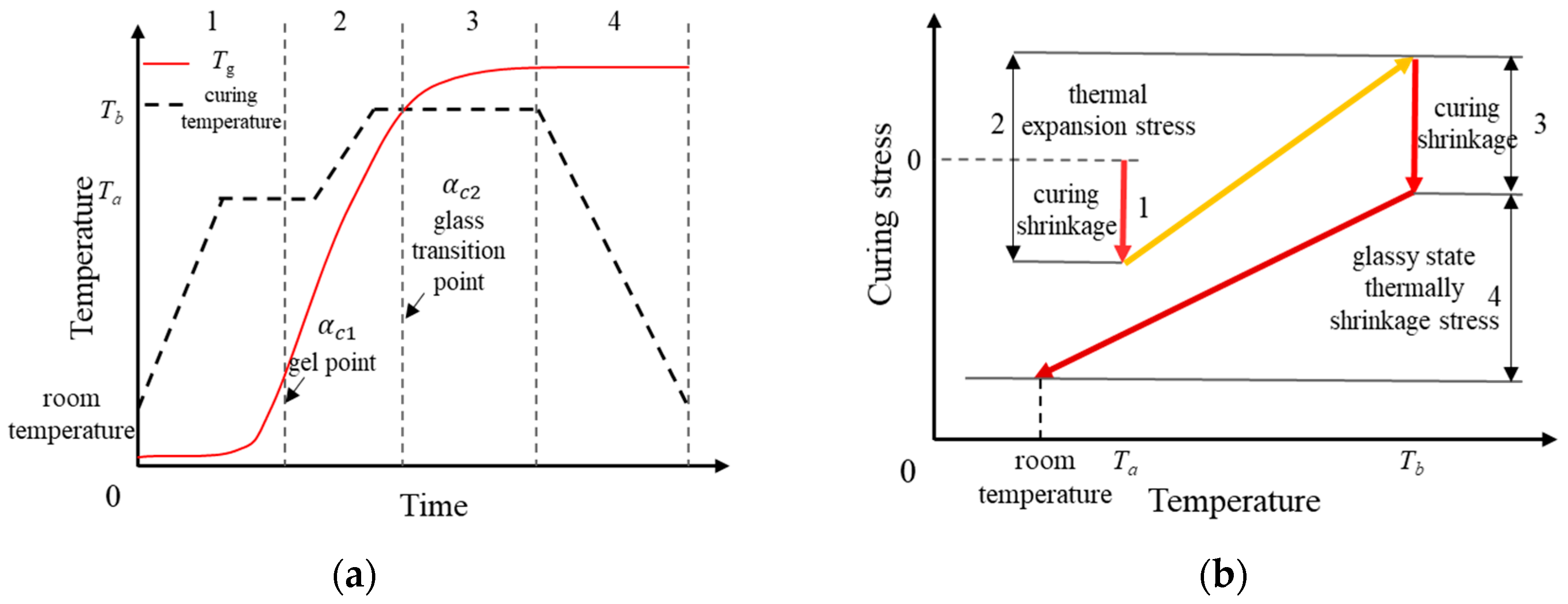
- Flow stage (also known as the pre-gelation stage): In this stage, the resin exhibits a low viscosity and behaves as a liquid (viscous flow state). Under vacuum pressure, air within the epoxy resin layer is evacuated. As the temperature rises, the degree of cure (DOC) of the resin increases, leading to higher viscosity and gradually reduced fluidity until flow ceases at the gel point. Although curing shrinkage and thermal expansion occur during this stage, the liquid state (viscous flow state) of the resin results in negligible mechanical transfer capabilities. Since the shear modulus is nearly zero, any strain induced by volumetric changes is instantaneously relaxed through the free flow of the fluid, thereby preventing the accumulation of macroscopic residual stress within the material. Consequently, the curing stress of the epoxy resin does not exhibit significant variation prior to the gel point. However, some studies indicate that considerable interaction forces may exist between the mold and the resin material, resulting in significant stress prior to the gel point of the epoxy material [14].
- (2)
- Gelation-vitrification stage: The processing temperature in this stage is higher than the glass transition temperature (Tg) of the resin, and the composite material is in a rubbery state. As the temperature continues to rise, the curing reaction accelerates, and the DOC deepens. This stage is the primary interval for the curing reaction. Notably, near the vitrification point, the viscoelasticity of the resin becomes pronounced, and the majority of the curing shrinkage occurs during this period. Due to the low modulus of the resin, the curing shrinkage strain and thermal expansion generated in this stage do not induce significant curing stress, but they substantially affect the material deformation after curing [15].
- (3)
- Post-vitrification holding stage: Vitrification is reached when the Tg of the resin equals the processing temperature. Subsequently, as Tg further increases and exceeds the processing temperature, the composite enters the glassy state. During this stage, the change in the DOC is minimal, and the curing shrinkage strain is negligible; therefore, its contribution to the curing stress can be ignored [16].
- (4)
- Cooling stage: In this stage, the material is in the glassy state, and the curing reaction of the resin is essentially complete. Due to the mismatch in the coefficient of thermal expansion (CTE) between the mold and the component, as well as among different layers, the cooling process contributes significantly to the formation of residual curing stress [17].
2.2. Cure Kinetics and Mechanical Constitutive Models of Epoxy Resin
2.3. Improvement of the Curing Mechanical Constitutive Equation of Epoxy Resin Based on Thermoelastic Stiffness
3. Multi-Physics Simulation of the Epoxy Resin Curing Process
3.1. Parameter Settings
3.2. Simulation Results and Analysis of Temperature and Degree of Cure
3.3. Analysis of Curing Stress Simulation Results
4. Strain Detection in Epoxy Resin Based on FBG Sensors
4.1. Measurement Principle of FBG
4.2. In Situ Measurement Experiment of the Curing Process
- The epoxy resin was preheated in a 60 °C water bath for 20 min. Subsequently, the curing agent was added according to the specified ratio, and the mixture was mechanically stirred at 450 rpm at 60 °C for 30 min. The catalyst was then introduced, followed by an additional 30 min of stirring.
- The stirred epoxy resin matrix was placed in a vacuum drying oven at 60 °C for 30 min to undergo degassing.
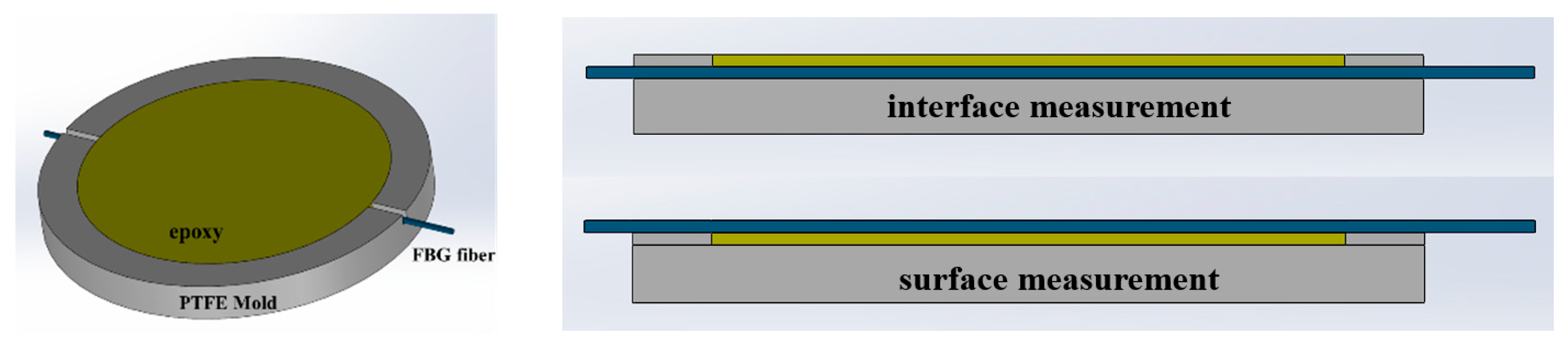
- A pre-slotted mold, previously coated with a release agent, was preheated at 80 °C for 30 min. The degassed epoxy resin was then poured into the mold. Simultaneously, the FBG sensors were embedded at the bottom and top of the mold, respectively. The diameter of the bare FBG optical fiber is approximately 150 μm. Compared to the macroscopic dimensions of the epoxy resin and the PTFE mold (80 mm), the thickness perturbation introduced by the sensor is entirely negligible. Furthermore, to secure the optical fiber at the bottom of the mold, pre-fabricated slots are introduced at both ends of the mold to route the measurement fiber. The fiber is then firmly anchored using an adhesive, ensuring that it is precisely positioned at the physical interface between the epoxy resin and the mold. The assembly diagram is shown in Figure 8.
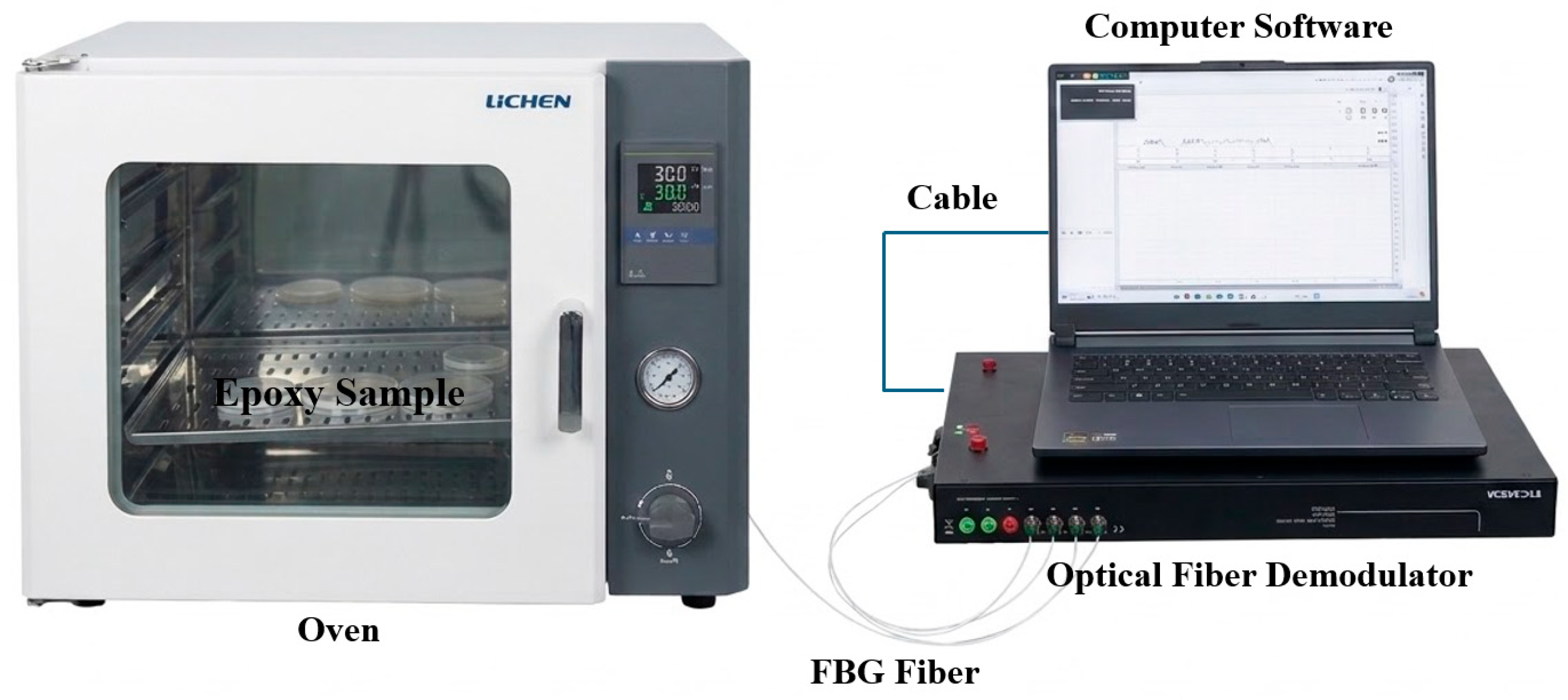
- The potted mold was placed into a programmable oven, and the optical fibers were routed out and connected to the interrogator. The curing process proceeded according to the predefined temperature profile. Because FBG sensors are sensitive to both strain and temperature, an independent temperature-sensing optical fiber was placed in the oven to decouple the temperature from the measurement results of the embedded fibers. After curing was complete and the system had cooled to room temperature, the measurement data were collected. The experimental setup is illustrated in Figure 9.
4.3. Analysis of Measurement Results
5. Conclusions
- (1)
- Breaking through the theoretical limitations of traditional constitutive models, this study innovatively proposes a multi-physics coupled simulation framework incorporating a thermoelastic factor. Traditional linear elastic models fail to accurately characterize the abrupt stiffness transitions of polymer materials during state changes. Therefore, this paper profoundly reveals the underlying coupling mechanisms among curing kinetics, heat conduction, and viscoelastic mechanical behaviors. This framework not only achieves high-fidelity predictions of the spatiotemporal evolution of curing deformation and interfacial stress in epoxy resins but also provides a reliable, novel methodology for analyzing the mechanical responses of composite insulation structures under complex thermal boundaries.
- (2)
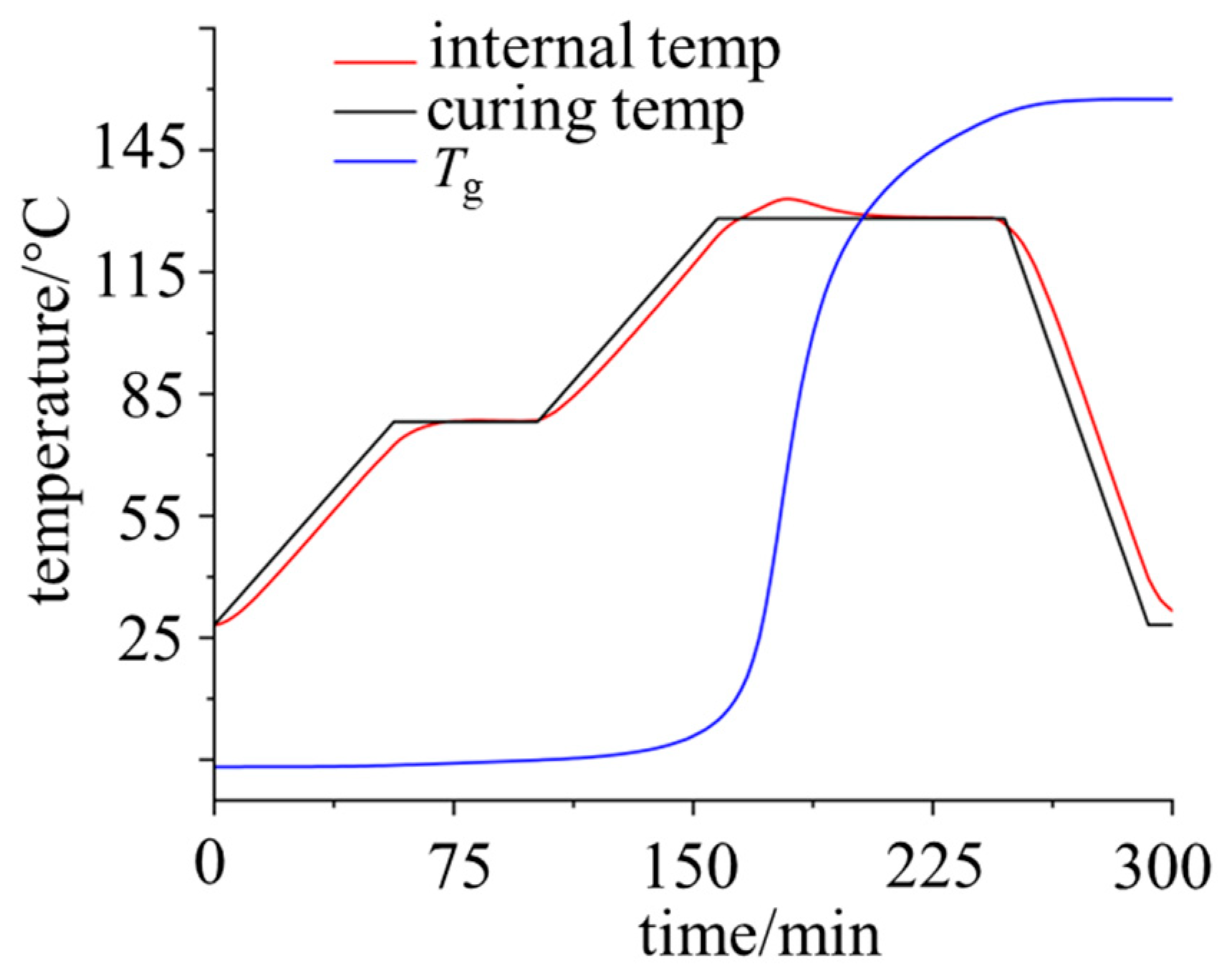
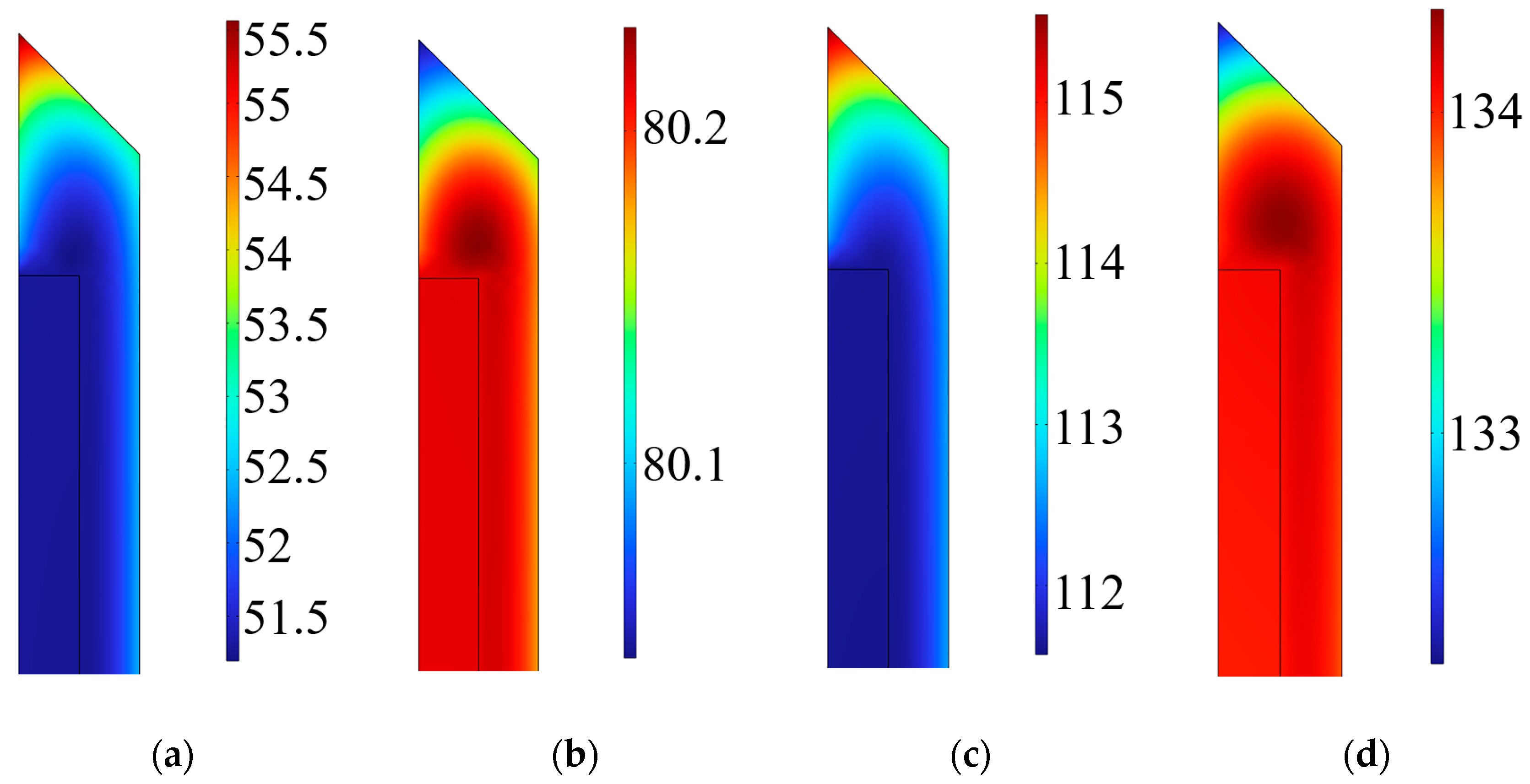
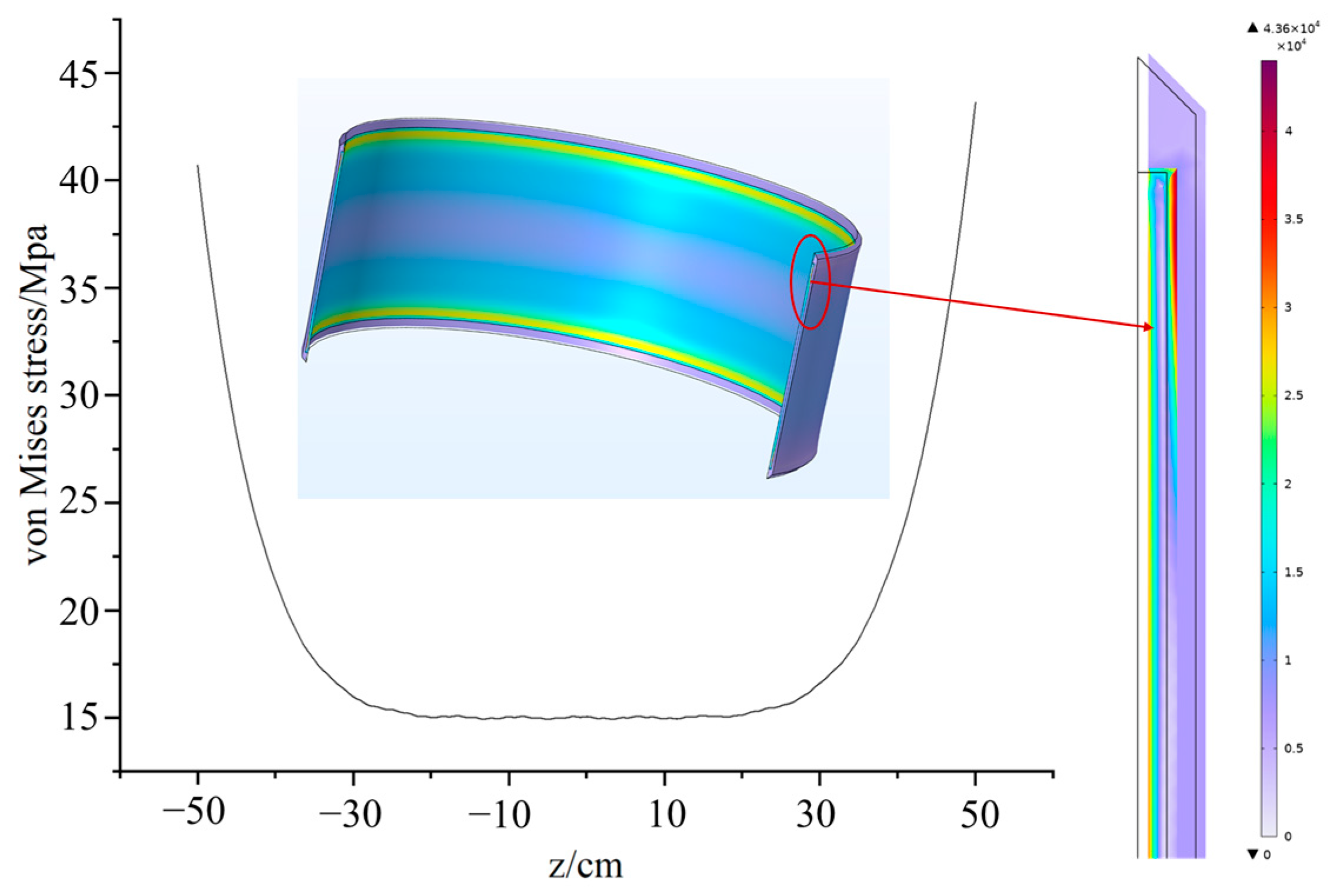
- This study quantitatively resolves the stress surge mechanism dominated by thermo-mechanical coupling during the curing process, accurately pinpointing the mechanical weak links of the insulation structures in dry-type cylindrical power equipment. The analysis indicates that the competition between internal exothermic reactions and external heat conduction leads to significant heat accumulation and curing hysteresis effects. Particularly, after the material transitions beyond the rubbery state, the chemical shrinkage dominated by strong structural constraints becomes the core driving force for the explosive growth of stress. Under the combined effects of rigid boundaries and the mismatch in the coefficients of thermal expansion (CTE) of the materials, an extreme stress value of up to 43.617 MPa is generated at the interface. This finding provides explicit theoretical guidance at the mechanistic level for the structural optimization and curing process improvement of high-voltage power equipment, such as dry-type reactors.
- (3)
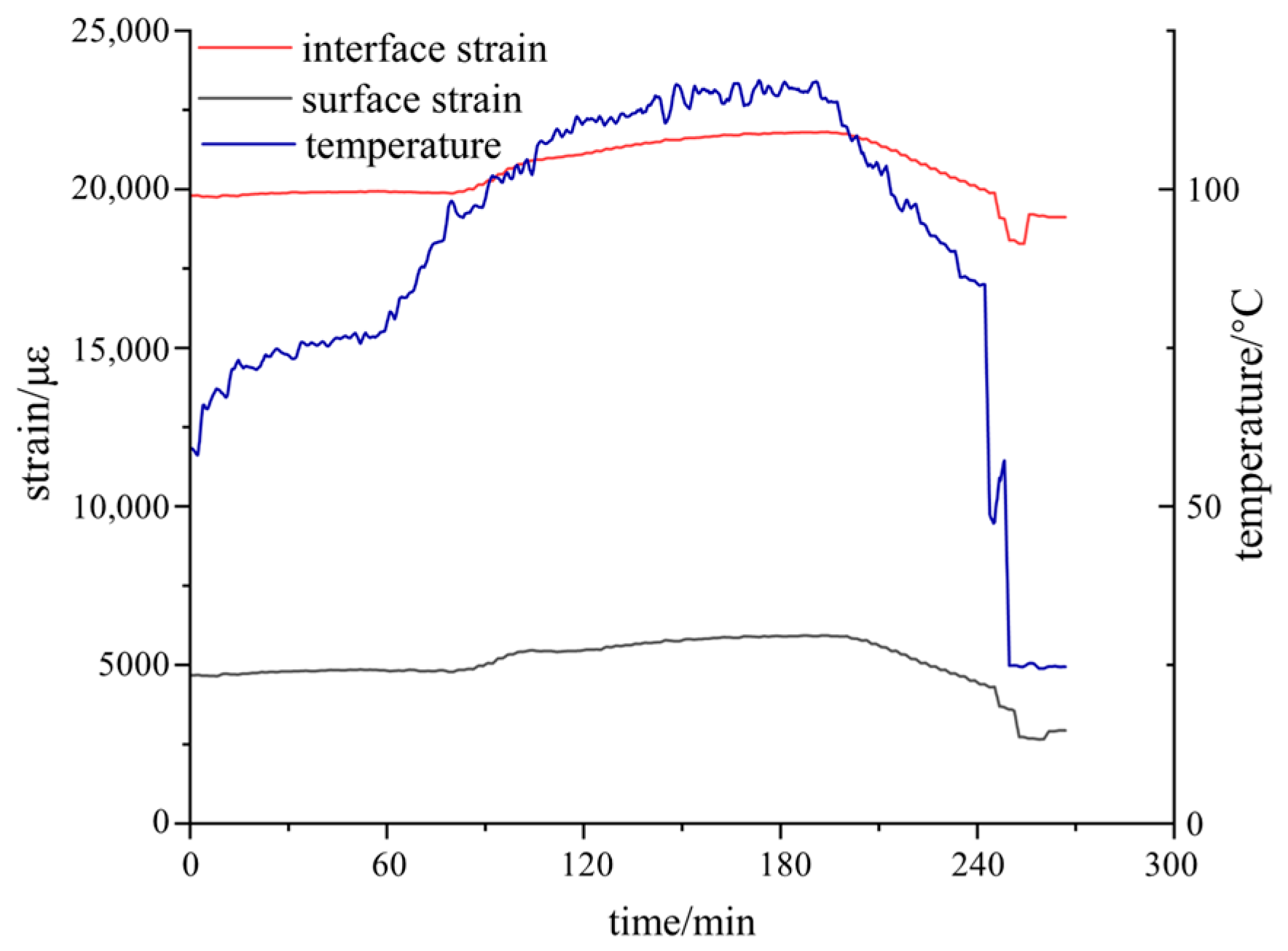
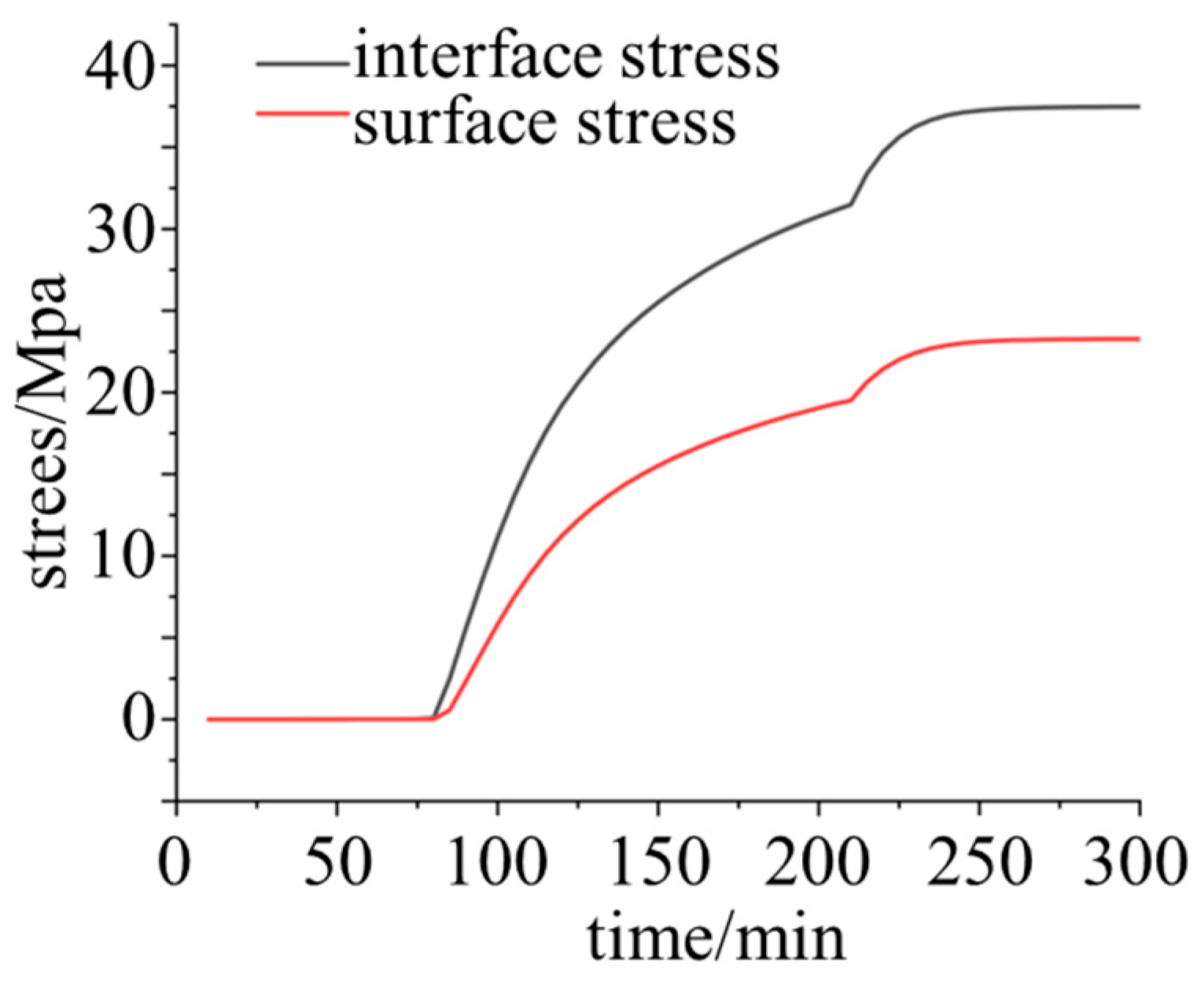
- The research confirms the central role of thermodynamic evolution in stress redistribution and establishes an engineering application paradigm that combines in situ monitoring with high-fidelity simulation. By utilizing a self-constructed embedded FBG sensing system, the precise in situ decoupling of temperature and strain under complex multi-field environments was successfully achieved. The extreme interfacial strain measured in the experiment (approximately 19,800 με) not only corroborates the accuracy of the proposed multi-physics coupled model but also intuitively exposes the severe risk of interfacial stress concentration in multi-layer composite structures. These research outcomes provide highly promising technical support for the non-destructive evaluation, process design optimization, and long-term operating condition early-warning of large-scale epoxy-cast solid insulation equipment.
Author Contributions
Funding
Institutional Review Board Statement
Data Availability Statement
Conflicts of Interest
References
- Lokanathan, M.; Acharya, P.V.; Ouroua, A.; Strank, S.M.; Hebner, R.E.; Bahadur, V. Review of Nanocomposite Dielectric Materials with High Thermal Conductivity. Proc. IEEE 2021, 109, 1364–1397. [Google Scholar] [CrossRef]
- Wu, Z.; Lin, B.; Fan, J.; Zhao, J.; Zhang, Q.; Li, L. Effect of Dielectric Relaxation of Epoxy Resin on Dielectric Loss of Medium-Frequency Transformer. IEEE Trans. Dielectr. Electr. Insul. 2022, 29, 1651–1658. [Google Scholar] [CrossRef]
- Jin, F.-L.; Li, X.; Park, S.-J. Synthesis and Application of Epoxy Resins: A Review. J. Ind. Eng. Chem. 2015, 29, 1–11. [Google Scholar] [CrossRef]
- Shengtao, L.; Mingru, L. Development of Epoxy Resin with Superior Breakdown Strength: A Review. iEnergy 2024, 3, 82–95. [Google Scholar] [CrossRef]
- Li, Q.; Weinell, C.E.; Kiil, S. Curing-Induced Internal Stress in Epoxy Coatings: Effects of Epoxy Binder, Curing Agent, Filler, Initial Solvent Concentration, Curing Temperature, and Relative Humidity. Prog. Org. Coat. 2022, 173, 107175. [Google Scholar] [CrossRef]
- Fu, Y.; Gao, X.; Yao, X. Mesoscopic Simulation on Curing Deformation and Residual Stresses of 3D Braided Composites. Compos. Struct. 2020, 246, 112387. [Google Scholar] [CrossRef]
- Miao, Y.; Li, J.; Gong, Z.; Xu, J.; He, K.; Peng, J.; Cui, Y. Study on the Effect of Cure Cycle on the Process Induced Deformation of Cap Shaped Stiffened Composite Panels. Appl. Compos. Mater. 2013, 20, 709–718. [Google Scholar] [CrossRef]
- Ledru, Y.; Bernhart, G.; Piquet, R.; Schmidt, F.; Michel, L. Coupled Visco-Mechanical and Diffusion Void Growth Modelling during Composite Curing. Compos. Sci. Technol. 2010, 70, 2139–2145. [Google Scholar] [CrossRef]
- Gerritzen, J.; Müller-Pabel, M.; Müller, J.; Gröger, B.; Lorenz, N.; Hopmann, C.; Gude, M. Development of a High-Fidelity Framework to Describe the Process-Dependent Viscoelasticity of a Fast-Curing Epoxy Matrix Resin Including Testing, Modelling, Calibration and Validation. Polymers 2022, 14, 3647. [Google Scholar] [CrossRef]
- Cheng, S.; Tong, Y.; Li, G.; Gao, J.; Yue, T. An Innovative Semi-Surrogate Model Approach for Numerical Simulation of CO2 Bubble Reaction in Alkanolamine Solutions: Balancing Computational Efficiency and Accuracy. Powder Technol. 2025, 464, 121274. [Google Scholar] [CrossRef]
- Bogettit, A.; Gillespie, J. Process-Induced Stress and Deformation in Thick-Section Thermoset Composite Laminates. Composites 1992, 23, 463. [Google Scholar]
- Baran, I.; Cinar, K.; Ersoy, N.; Akkerman, R.; Hattel, J. A Review on the Mechanical Modeling of Composite Manufacturing Processes. Arch. Comput. Methods Eng. 2017, 24, 365–395. [Google Scholar] [CrossRef]
- Magnus, J.; Anders, J. Prediction of Shape Distortions Part I. FE-Implementation of a Path Dependent Constitutive Model. Compos. Part A Appl. Sci. Manuf. 2004, 35, 711–721. [Google Scholar] [CrossRef]
- Sorrentino, L.; Marchetti, M.; Bellini, C.; Delfini, A.; Del Sette, F. Manufacture of High Performance Isogrid Structure by Robotic Filament Winding—ScienceDirect. Compos. Struct. 2017, 164, 43–50. [Google Scholar] [CrossRef]
- Ersoy, N.; Potter, K.; Wisnom, M.R.; Clegg, M.J. Development of Spring-in Angle during Cure of a Thermosetting Composite. Compos. Part A Appl. Sci. Manuf. 2005, 36, 1701–1706. [Google Scholar] [CrossRef]
- Wang, C.; Zhou, G.; Sun, Q.; Chen, C.; Zhang, Z.; Li, H.; Peng, Z. Numerical Simulation of the Interfacial Stress between Epoxy Resin and Metal Conductor of Power Equipment during Epoxy Curing. High Volt. 2022, 7, 903–915. [Google Scholar] [CrossRef]
- Salomi, A.; Garstka, T.; Potter, K.; Greco, K.; Maffezzoli, A. Spring-in angle as molding distortion for thermoplastic matrix composite. Compos. Sci. Technol. 2008, 68, 3047–3054. [Google Scholar] [CrossRef]
- Johnston, A.; Vaziri, R.; Poursartip, A. A Plane Strain Model for Process-Induced Deformation of Laminated Composite Structures. J. Compos. Mater. 2001, 35, 1435–1469. [Google Scholar] [CrossRef]
- Prasatya, P.; BMcKenna, G.; LSimon, S. A Viscoelastic Model for Predicting Isotropic Residual Stresses in Thermosetting Materials: Effects of Processing Parameters. J. Compos. Mater. 2001, 35, 826–848. [Google Scholar] [CrossRef]
- Ding, A.; Li, S.; Zu, L.; Wang, J. High temperature behaviour of glass-vinyl ester stack liner. Plast. Rubber Compos. 2015, 44, 423–434. [Google Scholar] [CrossRef]
- He, Y.; Yuan, M.; Li, Q.; Tang, L.; Yang, W.; Ping, Y.; He, H.; Deng, B. Feasibility Study of Mechanical Stress Wave Detection in Power Semiconductor Devices Using Bare FBG Sensors. IEEE Sens. J. 2025, 25, 39849–39857. [Google Scholar] [CrossRef]
- Guo, K.; Wu, H.; Liang, Y.; Su, M.; Wang, H.; Chu, R.; Zhou, F.; Liu, Y. Highly Birefringent FBG Based on Femtosecond Laser-Induced Cladding Stress Region for Temperature and Strain Decoupling. Photonics 2025, 12, 502. [Google Scholar] [CrossRef]







| Parameter | Value |
|---|---|
| m | 2.75 |
| n | 3.9 |
| ΔE1 | 7.07 × 10⁴ J/mol |
| ΔE2 | 6.71 × 10⁴ J/mol |
| A1 | 9.64 × 10⁶ 1/s |
| A2 | 1.36 × 10³ 1/s |
| ΔH | 402 J/g |
| ρ0 | 1108.9 kg/m3 |
| ρ1 | 1168.7 kg/m3 |
| Cp0 | 1763 J/(kg·K) |
| Cp1 | 1171 J/(kg·K) |
| k0 | 0.16 W/(m·K) |
| k1 | 0.22 W/(m·K) |
| Parameter | Value |
|---|---|
| 9.5 Mpa | |
| 9.5 × 10³ Mpa | |
| Tg0 | −47.78 °C |
| Tg∞ | 84.03 °C |
| αc1 | 1.09 × 10⁻⁵ 1/K |
| αc2 | 3.15 × 10⁻⁵ 1/K |
| Parameter | Value (mm) |
|---|---|
| Winding inner diameter | 500 |
| Winding thickness | 5 |
| Insulation outer diameter | 510 |
| Insulation thickness | 5 |
| Encapsulation height | 1000 |
| Encapsulation chamfer | 10 |
Disclaimer/Publisher’s Note: The statements, opinions and data contained in all publications are solely those of the individual author(s) and contributor(s) and not of MDPI and/or the editor(s). MDPI and/or the editor(s) disclaim responsibility for any injury to people or property resulting from any ideas, methods, instructions or products referred to in the content. |
© 2026 by the authors. Licensee MDPI, Basel, Switzerland. This article is an open access article distributed under the terms and conditions of the Creative Commons Attribution (CC BY) license.
Share and Cite
Li, Z.; Han, Z.; Zhang, X.; Xu, Y.; Zou, L.; Huang, K.; Ren, H. Improved Viscoelastic Numerical Simulation and In Situ Dynamic FBG Sensing of Interfacial Curing Stress Concentration in Epoxy Insulation Materials. Polymers 2026, 18, 1232. https://doi.org/10.3390/polym18101232
Li Z, Han Z, Zhang X, Xu Y, Zou L, Huang K, Ren H. Improved Viscoelastic Numerical Simulation and In Situ Dynamic FBG Sensing of Interfacial Curing Stress Concentration in Epoxy Insulation Materials. Polymers. 2026; 18(10):1232. https://doi.org/10.3390/polym18101232
Chicago/Turabian StyleLi, Zhen, Zhiyun Han, Xinkai Zhang, Yizhou Xu, Liang Zou, Kejie Huang, and Hanwen Ren. 2026. "Improved Viscoelastic Numerical Simulation and In Situ Dynamic FBG Sensing of Interfacial Curing Stress Concentration in Epoxy Insulation Materials" Polymers 18, no. 10: 1232. https://doi.org/10.3390/polym18101232
APA StyleLi, Z., Han, Z., Zhang, X., Xu, Y., Zou, L., Huang, K., & Ren, H. (2026). Improved Viscoelastic Numerical Simulation and In Situ Dynamic FBG Sensing of Interfacial Curing Stress Concentration in Epoxy Insulation Materials. Polymers, 18(10), 1232. https://doi.org/10.3390/polym18101232