Chelating, Reducing, and Adsorbing Agents in Geopolymers for Heavy Metals Stabilization from Galvanic Sludge




Abstract
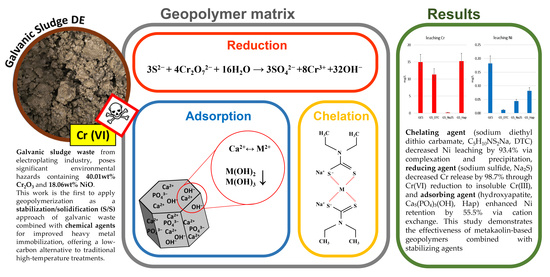
1. Introduction
- Dissolution: In alkaline media, SiO2 and Al2O3 dissolve into Si(OH)4 and Al(OH)4−, as OH− breaks Si–O–Si and Al–O–Si bonds in the precursors [16,17]. Solid-state 27Al MAS NMR revealed that alkali activation of metakaolin promotes the conversion of octahedral [Al(VI)] and pentahedral [Al(V)] species into tetrahedral [Al(IV)] units. While pristine metakaolin contains comparable amounts of Al(IV), Al(V), and Al(VI), reacted products are dominated by Al(IV), charge-balanced by alkali cations [10].
- Polycondensation: Reactive monomers condense into ≡Si–O–Al≡ and Si–O–Si linkages with water release:Si(OH)4 + Al(OH)4− → ≡T–O–T≡ + H2O (T=Si or Al−(IV))
- Solidification: Final consolidation occurs as water is partially expelled, yielding a dense matrix [10].
- Physical Encapsulation (Solidification):This involves the physical entrapment of heavy metal ions within the dense, compact, cross-linked, three-dimensional structure (framework) of the amorphous geopolymer gel [17]. This structural barrier restricts the movement and leaching potential of the contaminants. Due to the dense and compact nature of the geopolymers, they create a barrier that restricts the movement of contaminants [17,18].
- Precipitation:Geopolymerization occurs in a highly alkaline environment (typically pH > 11), which promotes the formation of insoluble metal compounds, such as hydroxides, carbonates, or phosphates. This significantly reduces the solubility and mobility of the heavy metals within the matrix. Pb and Cr have been observed to precipitate as metal hydroxides (Pb(OH)2 and Cr(OH)3) in the alkaline environment [17,18,20].
- Ion Exchange:The aluminosilicate framework contains tetrahedrally coordinated aluminum ions (Al3+), which create a negative charge on the [Al(OH)4]− units. To maintain charge neutrality, positively charged heavy metal cations (such as Pb2+, Cd2+ and Cu2+) can be incorporated into the structure by replacing the charge-balancing alkali cations (Na+ or K+) [18,20,21].
- Isomorphic Substitution:
- Coordination Bonds/Chemical Complexation:Some metal ions (e.g., Cu2+ and Zn2+) can form coordination bonds with functional groups present in the geopolymer structure [18,19,20,22]. Specifically, they interact with the oxygen atoms of the non-condensed silanol (-Si-OH) and aluminol (-Al-OH) groups, resulting in a stable metal–hydroxyl complex.
2. Materials and Methods
3. Results
3.1. Assessing the Impact of DE and Chemical Agents on Geopolymerization
3.2. Role of Chelating, Reducing, and Adsorbent Agents on Heavy Metal Leaching DE-Geopolymers

4. Conclusions
Supplementary Materials
Author Contributions
Funding
Institutional Review Board Statement
Data Availability Statement
Conflicts of Interest
References
- Pérez-Villarejo, L.; Martínez-Martínez, S.; Carrasco-Hurtado, B.; Eliche-Quesada, D.; Ureña-Nieto, C.; Sánchez-Soto, P.J. Valorization and Inertization of Galvanic Sludge Waste in Clay Bricks. Appl. Clay Sci. 2015, 105–106, 89–99. [Google Scholar] [CrossRef] [Scilit]
- Silva, J.E.; Paiva, A.P.; Soares, D.; Labrincha, A.; Castro, F. Solvent Extraction Applied to the Recovery of Heavy Metals from Galvanic Sludge. J. Hazard. Mater. 2005, 120, 113–118. [Google Scholar] [CrossRef] [Scilit] [PubMed]
- Silva, J.; Soares, D.; Paiva, A.; Labrincha, J.; Castro, F. Leaching Behaviour of a Galvanic Sludge in Sulphuric Acid and Ammoniacal Media. J. Hazard. Mater. 2005, 121, 195–202. [Google Scholar] [CrossRef] [Scilit] [PubMed]
- Magalhães, J. Effect of Experimental Variables on the Inertization of Galvanic Sludges in Clay-Based Ceramics. J. Hazard. Mater. 2004, 106, 139–147. [Google Scholar] [CrossRef] [Scilit]
- Rossini, G.; Bernardes, A. Galvanic Sludge Metals Recovery by Pyrometallurgical and Hydrometallurgical Treatment. J. Hazard. Mater. 2006, 131, 210–216. [Google Scholar] [CrossRef] [Scilit]
- Hills, C.D.; Pollard, S.J.T. The Influence of Interference Effects on the Mechanical, Microstructural and Fixation Characteristics of Cement-Solidified Hazardous Waste Forms. J. Hazard. Mater. 1997, 52, 171–191. [Google Scholar] [CrossRef] [Scilit]
- Luz, C.; Rocha, J.; Cheriaf, M.; Pera, J. Use of Sulfoaluminate Cement and Bottom Ash in the Solidification/Stabilization of Galvanic Sludge. J. Hazard. Mater. 2006, 136, 837–845. [Google Scholar] [CrossRef] [Scilit]
- Garcia-Valles, M.; Avila, G.; Martinez, S.; Terradas, R.; Nogués, J.M. Heavy Metal-Rich Wastes Sequester in Mineral Phases through a Glass–Ceramic Process. Chemosphere 2007, 68, 1946–1953. [Google Scholar] [CrossRef] [Scilit]
- Turner, L.K.; Collins, F.G. Carbon Dioxide Equivalent (CO2-e) Emissions: A Comparison between Geopolymer and OPC Cement Concrete. Constr. Build. Mater. 2013, 43, 125–130. [Google Scholar] [CrossRef] [Scilit]
- Duxson, P.; Mallicoat, S.W.; Lukey, G.C.; Kriven, W.M.; Van Deventer, J.S.J. The Effect of Alkali and Si/Al Ratio on the Development of Mechanical Properties of Metakaolin-Based Geopolymers. Colloids Surf. A Physicochem. Eng. Asp. 2007, 292, 8–20. [Google Scholar] [CrossRef] [Scilit]
- Duxson, P.; Fernández-Jiménez, A.; Provis, J.L.; Lukey, G.C.; Palomo, A.; Van Deventer, J.S.J. Geopolymer Technology: The Current State of the Art. J. Mater. Sci 2007, 42, 2917–2933. [Google Scholar] [CrossRef] [Scilit]
- Nath, P.; Sarker, P.K. Effect of GGBFS on Setting, Workability and Early Strength Properties of Fly Ash Geopolymer Concrete Cured in Ambient Condition. Constr. Build. Mater. 2014, 66, 163–171. [Google Scholar] [CrossRef] [Scilit]
- Amran, Y.H.M.; Alyousef, R.; Alabduljabbar, H.; El-Zeadani, M. Clean Production and Properties of Geopolymer Concrete; A Review. J. Clean. Prod. 2020, 251, 119679. [Google Scholar] [CrossRef] [Scilit]
- McLellan, B.C.; Williams, R.P.; Lay, J.; Van Riessen, A.; Corder, G.D. Costs and Carbon Emissions for Geopolymer Pastes in Comparison to Ordinary Portland Cement. J. Clean. Prod. 2011, 19, 1080–1090. [Google Scholar] [CrossRef] [Scilit]
- Siva Shankari, S.V.; Sivasakthi, M. A State-of-the-Art Review on Effectiveness of Geopolymer Technology Toward Dye Degradation, Heavy Metal Encapsulation and Its Future Prospects on Environmental Remediation. Environ. Qual. Manag. 2025, 34, e70054. [Google Scholar] [CrossRef] [Scilit]
- Khale, D.; Chaudhary, R. Mechanism of Geopolymerization and Factors Influencing Its Development: A Review. J. Mater. Sci. 2007, 42, 729–746. [Google Scholar] [CrossRef] [Scilit]
- Tian, Q.; Bai, Y.; Pan, Y.; Chen, C.; Yao, S.; Sasaki, K.; Zhang, H. Application of Geopolymer in Stabilization/Solidification of Hazardous Pollutants: A Review. Molecules 2022, 27, 4570. [Google Scholar] [CrossRef] [Scilit]
- Genua, F.; Lancellotti, I.; Leonelli, C. Geopolymer-Based Stabilization of Heavy Metals, the Role of Chemical Agents in Encapsulation and Adsorption: Review. Polymers 2025, 17, 670. [Google Scholar] [CrossRef] [Scilit]
- Vu, T.H.; Gowripalan, N. Mechanisms of Heavy Metal Immobilisation Using Geopolymerisation Techniques—A Review. ACT 2018, 16, 124–135. [Google Scholar] [CrossRef] [Scilit]
- El-Eswed, B.I.; Aldagag, O.M.; Khalili, F.I. Efficiency and Mechanism of Stabilization/Solidification of Pb(II), Cd(II), Cu(II), Th(IV) and U(VI) in Metakaolin Based Geopolymers. Appl. Clay Sci. 2017, 140, 148–156. [Google Scholar] [CrossRef] [Scilit]
- Provis, J.L. Immobilisation of Toxic Wastes in Geopolymers. In Geopolymers; Elsevier: Amsterdam, The Netherlands, 2009; pp. 421–440. ISBN 978-1-84569-449-4. [Google Scholar]
- Giorgetti, M.; Berrettoni, M.; Aquilanti, G.; Boldrini, G.; Lancellotti, I.; Leonelli, C. The Coordination Core and Charge of Chromium in Metakaolin-Geopolymers as Revealed by X-Ray Absorption Spectroscopy. Mater. Lett. 2020, 270, 127741. [Google Scholar] [CrossRef] [Scilit]
- Jiang, J.; Luo, H.; Wang, S.; Ou, X.; Su, J.; Lyu, Z.; Chen, J.; Wei, D. Synthesis of Tailing Slurry-Based Geopolymers for the Highly Efficient Immobilization of Heavy Metals: Behavior and Mechanism. Appl. Clay Sci. 2024, 247, 107199. [Google Scholar] [CrossRef] [Scilit]
- Zhang, B.; Yu, T.; Deng, L.; Li, Y.; Guo, H.; Zhou, J.; Li, L.; Peng, Y. Ion-Adsorption Type Rare Earth Tailings for Preparation of Alkali-Based Geopolymer with Capacity for Heavy Metals Immobilization. Cem. Concr. Compos. 2022, 134, 104768. [Google Scholar] [CrossRef] [Scilit]
- Guo, X.; Zhang, L.; Huang, J.; Shi, H. Detoxification and Solidification of Heavy Metal of Chromium Using Fly Ash-Based Geopolymer with Chemical Agents. Constr. Build. Mater. 2017, 151, 394–404. [Google Scholar] [CrossRef] [Scilit]
- Sun, T.; Chen, J.; Lei, X.; Zhou, C. Detoxification and Immobilization of Chromite Ore Processing Residue with Metakaolin-Based Geopolymer. J. Environ. Chem. Eng. 2014, 2, 304–309. [Google Scholar] [CrossRef] [Scilit]
- Chen, J.; Wang, Y.; Wang, H.; Zhou, S.; Wu, H.; Lei, X. Detoxification/Immobilization of Hexavalent Chromium Using Metakaolin-Based Geopolymer Coupled with Ferrous Chloride. J. Environ. Chem. Eng. 2016, 4, 2084–2089. [Google Scholar] [CrossRef] [Scilit]
- Chen, J.; Wang, Y.; Zhou, S.; Lei, X. Reduction/Immobilization Processes of Hexavalent Chromium Using Metakaolin-Based Geopolymer. J. Environ. Chem. Eng. 2017, 5, 373–380. [Google Scholar] [CrossRef] [Scilit]
- Zhang, J.; Provis, J.L.; Feng, D.; Van Deventer, J.S.J. The Role of Sulfide in the Immobilization of Cr(VI) in Fly Ash Geopolymers. Cem. Concr. Res. 2008, 38, 681–688. [Google Scholar] [CrossRef] [Scilit]
- Arokiasamy, P.; Abdullah, M.M.A.B.; Arifi, E.; Razak, R.A.; Rojviriya, C.; Mydin, M.A.O.; Sandu, A.V.; Yaacob, N.A.; Mohamed, R. Hydroxyapatite Incorporated Geopolymer Porous Adsorbent for Efficient Removal of Copper Ions and Ciprofloxacin. J. Am. Ceram. Soc. 2025, 108, e20618. [Google Scholar] [CrossRef] [Scilit]
- Billah, R.E.K.; Khan, M.A.; Park, Y.-K.; Am, A.; Majdoubi, H.; Haddaji, Y.; Jeon, B.-H. A Comparative Study on Hexavalent Chromium Adsorption onto Chitosan and Chitosan-Based Composites. Polymers 2021, 13, 3427. [Google Scholar] [CrossRef] [Scilit]
- Genua, F.; Giovini, M.; Santoni, E.; Berrettoni, M.; Lancellotti, I.; Leonelli, C. Factors Affecting Consolidation in Geopolymers for Stabilization of Galvanic Sludge. Materials 2025, 18, 3015. [Google Scholar] [CrossRef] [Scilit] [PubMed]
- Russo, R.E.; Santoni, E.; Fattobene, M.; Giovini, M.; Genua, F.; Leonelli, C.; Lancellotti, I.; Herrero, A.; Berrettoni, M. Design of Experiments Approach for Efficient Heavy Metals Stabilization Using Metakaolin-Based Geopolymers. Molecules 2025, 30, 3235. [Google Scholar] [CrossRef] [Scilit]
- BS EN 12457–2:2004; Characterisation of Waste. Leaching. Compliance Test for Leaching of Granular Waste Materials and Sludges. British Standards Institution (BSI): London, UK, 2004.
- Lancellotti, I.; Kamseu, E.; Michelazzi, M.; Barbieri, L.; Corradi, A.; Leonelli, C. Chemical Stability of Geopolymers Containing Municipal Solid Waste Incinerator Fly Ash. Waste Manag. 2010, 30, 673–679. [Google Scholar] [CrossRef] [Scilit]
- Ryu, G.S.; Lee, Y.B.; Koh, K.T.; Chung, Y.S. The Mechanical Properties of Fly Ash-Based Geopolymer Concrete with Alkaline Activators. Constr. Build. Mater. 2013, 47, 409–418. [Google Scholar] [CrossRef] [Scilit]
- Lee, W.K.W.; Van Deventer, J.S.J. Use of Infrared Spectroscopy to Study Geopolymerization of Heterogeneous Amorphous Aluminosilicates. Langmuir 2003, 19, 8726–8734. [Google Scholar] [CrossRef] [Scilit]
- Wan, Q.; Rao, F.; Song, S.; García, R.E.; Estrella, R.M.; Patiño, C.L.; Zhang, Y. Geopolymerization Reaction, Microstructure and Simulation of Metakaolin-Based Geopolymers at Extended Si/Al Ratios. Cem. Concr. Compos. 2017, 79, 45–52. [Google Scholar] [CrossRef] [Scilit]
- Wang, T.; Rao, F.; Yang, L.; Jiang, K.; Lin, N.; Mo, L. Influence of Wastes and Synthesis Conditions on the Compressive Strength, Setting Time and Gels of Waste-Based Geopolymers. Gels 2024, 10, 700. [Google Scholar] [CrossRef] [Scilit]
- Fan, C.; Wang, B.; Ai, H.; Qi, Y.; Liu, Z. A Comparative Study on Solidification/Stabilization Characteristics of Coal Fly Ash-Based Geopolymer and Portland Cement on Heavy Metals in MSWI Fly Ash. J. Clean. Prod. 2021, 319, 128790. [Google Scholar] [CrossRef] [Scilit]
- Boldrini, G.; Sgarlata, C.; Lancellotti, I.; Barbieri, L.; Giorgetti, M.; Ciabocco, M.; Zamponi, S.; Berrettoni, M.; Leonelli, C. Efficient chemical stabilization of tannery wastewater pollutants in a single step process: Geopolymerization. Sustain. Environ. Res. 2021, 31, 33. [Google Scholar] [CrossRef] [Scilit]
- Khan, M.d.N.I.; Fackler Jnr, J.P.; Murray, H.H.; Heinrich, D.D.; Campana, C. Structure of the Beta Form of Bis(Diethyldithiocarbamato)Nickel(II). Acta Crystallogr. C Cryst. Struct. Commun. 1987, 43, 1917–1919. [Google Scholar] [CrossRef] [Scilit]
- Labuda, J.; Skatuloková, M.; Németh, M.; Gergely, S. Formation and Stability of Diethyldithiocarbamate Complexes. Chem. Zvesti 1984, 38, 597–605. [Google Scholar]
- Tumolo, M.; Ancona, V.; De Paola, D.; Losacco, D.; Campanale, C.; Massarelli, C.; Uricchio, V.F. Chromium Pollution in European Water, Sources, Health Risk, and Remediation Strategies: An Overview. Int. J. Environ. Res. Public Health 2020, 17, 5438. [Google Scholar] [CrossRef] [Scilit]
- Ferri, M.; Campisi, S.; Gervasini, A. Nickel and Cobalt Adsorption on Hydroxyapatite: A Study for the de-Metalation of Electronic Industrial Wastewaters. Adsorption 2019, 25, 649–660. [Google Scholar] [CrossRef] [Scilit]



| Sample Name | MK [g] | NaOH Pellets [g] | Na-Silicate [g] | DE [g] | H2O [g] | DTC [g] | Na2S [g] | Hap [g] |
|---|---|---|---|---|---|---|---|---|
| G0 | 70 | 9.8 | 70 | / | 14 | / | / | / |
| G5 | 70 | 9.8 | 70 | 3.5 | 14 | / | / | / |
| G5_DTC | 70 | 9.8 | 70 | 3.5 | 14 | 1.05 | / | / |
| G5_Na2S | 70 | 9.8 | 70 | 3.5 | 14 | / | 1.05 | / |
| G5_Hap | 70 | 9.8 | 70 | 3.5 | 14 | / | / | 1.05 |
| Sample Name | Bulk Density (ρb) (g/cm3) | True Density (ρt) (g/cm3) | Total Porosity (%) |
|---|---|---|---|
| G0 | 1.3963 ± 0.0024 | 2.0412 ± 0.0015 | 31.59 |
| G5 | 1.4063 ± 0.0026 | 2.0870 ± 0.0009 | 32.62 |
| G5_DTC | 1.4180 ± 0.0030 | 1.9972 ± 0.0021 | 29.00 |
| G5_Na2S | 1.4133 ± 0.0048 | 2.0861 ± 0.0009 | 32.25 |
| G5_Hap | 1.4040 ± 0.0019 | 2.0606 ± 0.0018 | 31.86 |
| Sample | Cr (%) | Ni (%) |
|---|---|---|
| G5 | 0 | 0 |
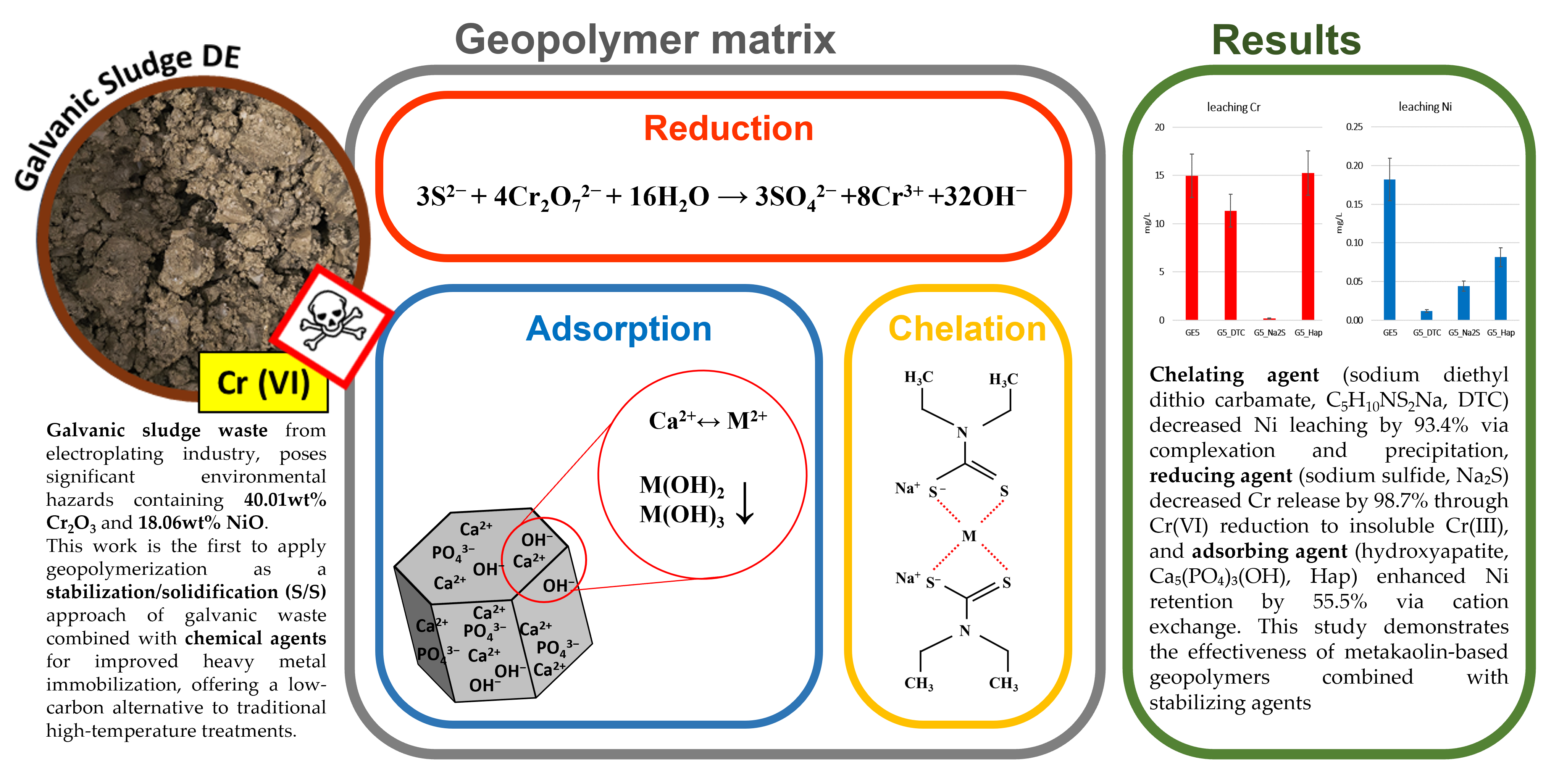
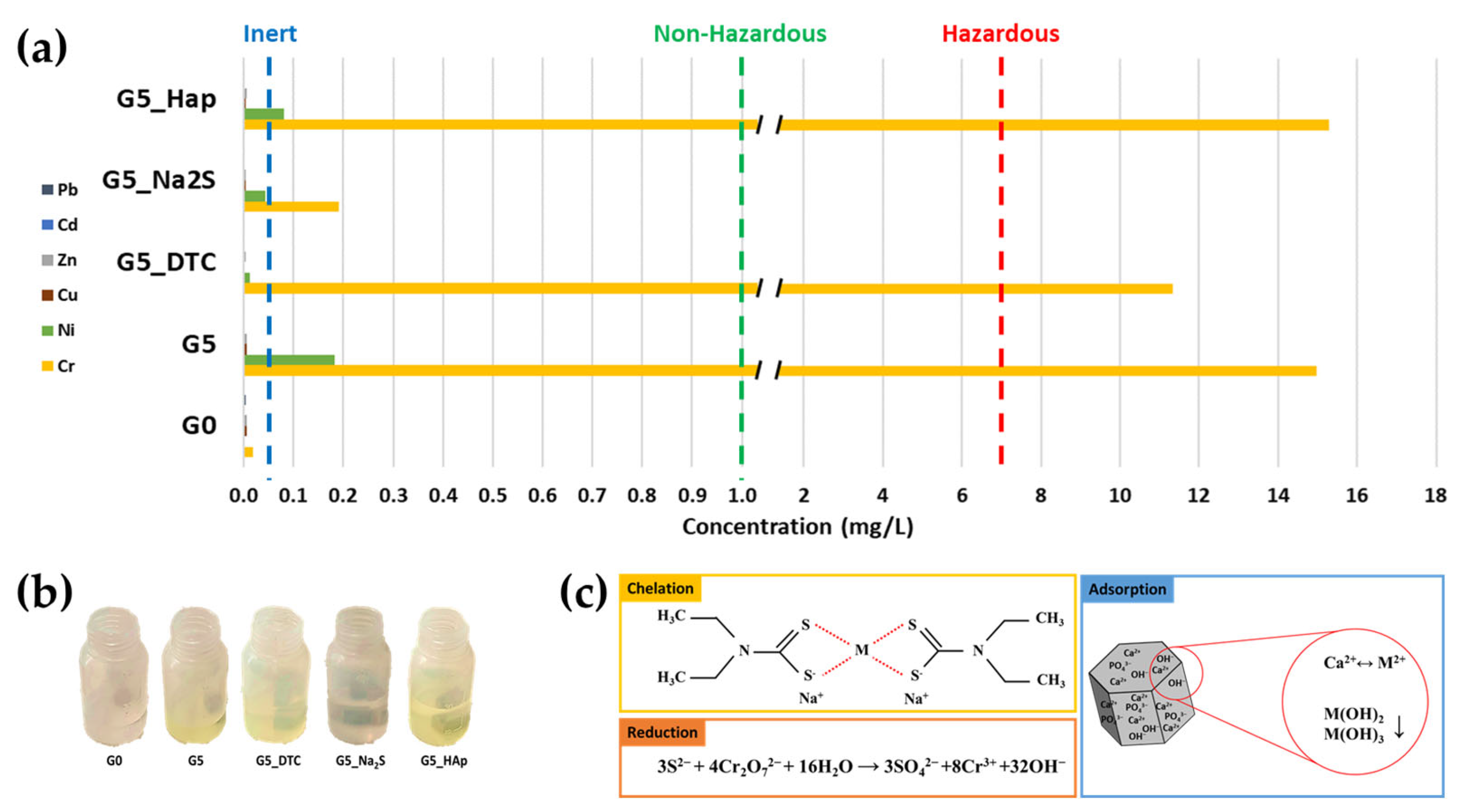
| G5_DTC | −24.3 | −93.5 |
| G5_Na2S | −98.7 | −75.9 |
| G5_Hap | +2.1 | −55.3 |
Disclaimer/Publisher’s Note: The statements, opinions and data contained in all publications are solely those of the individual author(s) and contributor(s) and not of MDPI and/or the editor(s). MDPI and/or the editor(s) disclaim responsibility for any injury to people or property resulting from any ideas, methods, instructions or products referred to in the content. |
© 2025 by the authors. Licensee MDPI, Basel, Switzerland. This article is an open access article distributed under the terms and conditions of the Creative Commons Attribution (CC BY) license.
Share and Cite
Genua, F.; Giovini, M.; Leonelli, C.; Lancellotti, I. Chelating, Reducing, and Adsorbing Agents in Geopolymers for Heavy Metals Stabilization from Galvanic Sludge. Polymers 2026, 18, 28. https://doi.org/10.3390/polym18010028
Genua F, Giovini M, Leonelli C, Lancellotti I. Chelating, Reducing, and Adsorbing Agents in Geopolymers for Heavy Metals Stabilization from Galvanic Sludge. Polymers. 2026; 18(1):28. https://doi.org/10.3390/polym18010028
Chicago/Turabian StyleGenua, Francesco, Mattia Giovini, Cristina Leonelli, and Isabella Lancellotti. 2026. "Chelating, Reducing, and Adsorbing Agents in Geopolymers for Heavy Metals Stabilization from Galvanic Sludge" Polymers 18, no. 1: 28. https://doi.org/10.3390/polym18010028
APA StyleGenua, F., Giovini, M., Leonelli, C., & Lancellotti, I. (2026). Chelating, Reducing, and Adsorbing Agents in Geopolymers for Heavy Metals Stabilization from Galvanic Sludge. Polymers, 18(1), 28. https://doi.org/10.3390/polym18010028