Gamma Irradiation Resistance of Four Elastomers for Nuclear Sealing Applications

Abstract
1. Introduction
2. Experimental
2.1. Materials and Instruments
2.1.1. Rubber Materials and Formulations
2.1.2. Instruments
2.2. Experimental Procedure
2.2.1. Preparation of Rubber Samples
2.2.2. Sample Irradiation
2.2.3. Density Measurement
2.2.4. Water Vapor Permeability Test
2.2.5. Gas Permeability Test
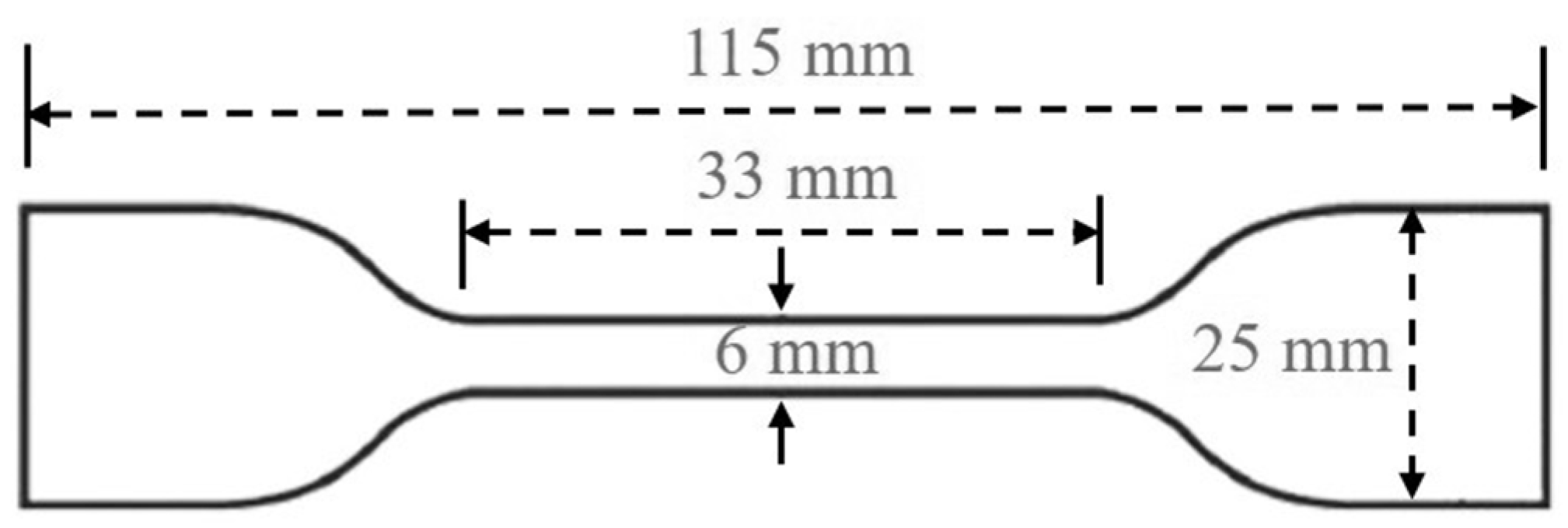
2.2.6. Mechanical Test
2.2.7. FT-IR Spectroscopy
2.2.8. Thermal Property Test
2.2.9. Equilibrium Swelling Test
3. Results and Discussion
3.1. Changes in Macroscopic Physical Properties
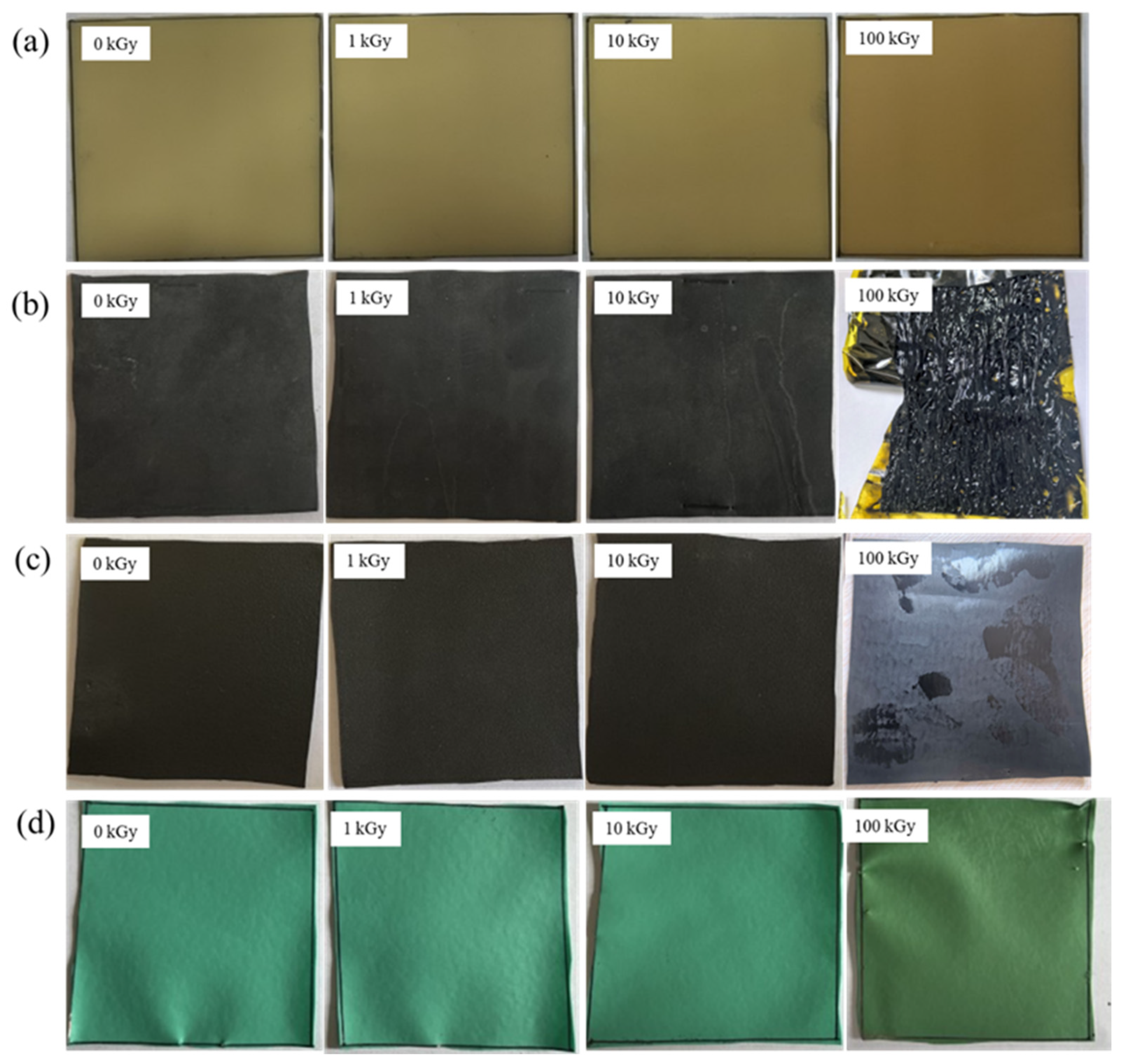
3.1.1. Visual Changes
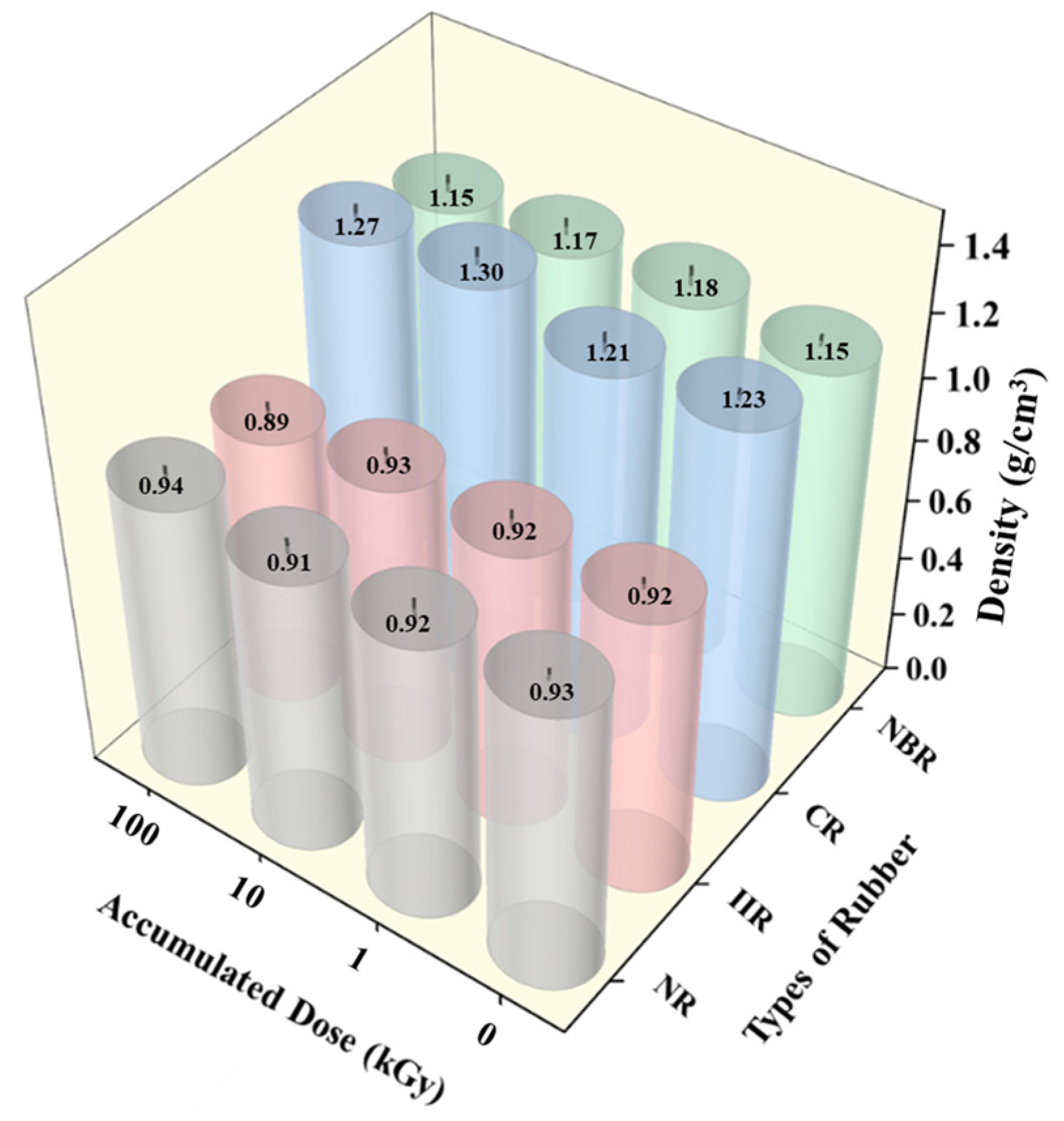
3.1.2. Density Changes
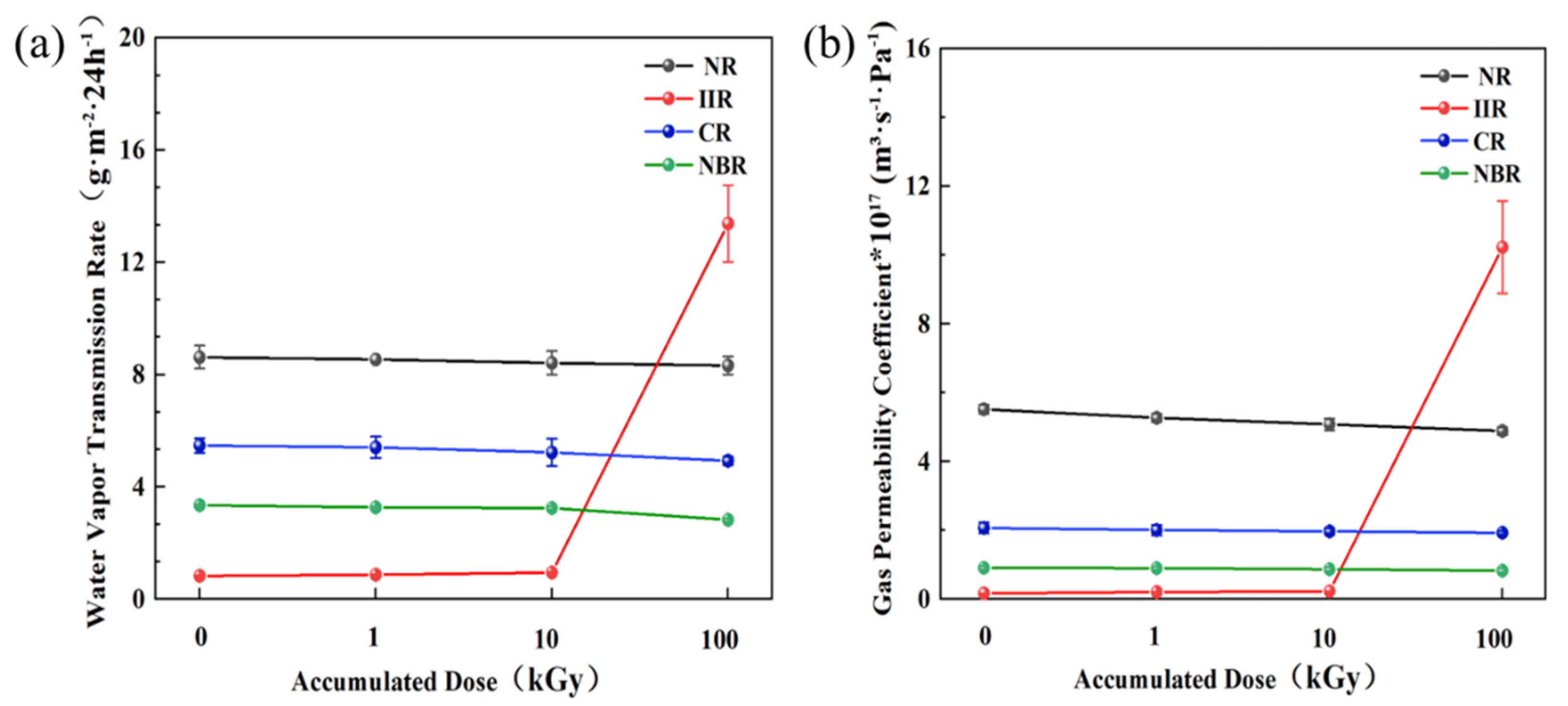
3.1.3. Effect of Irradiation on Water Vapor and Gas Permeability
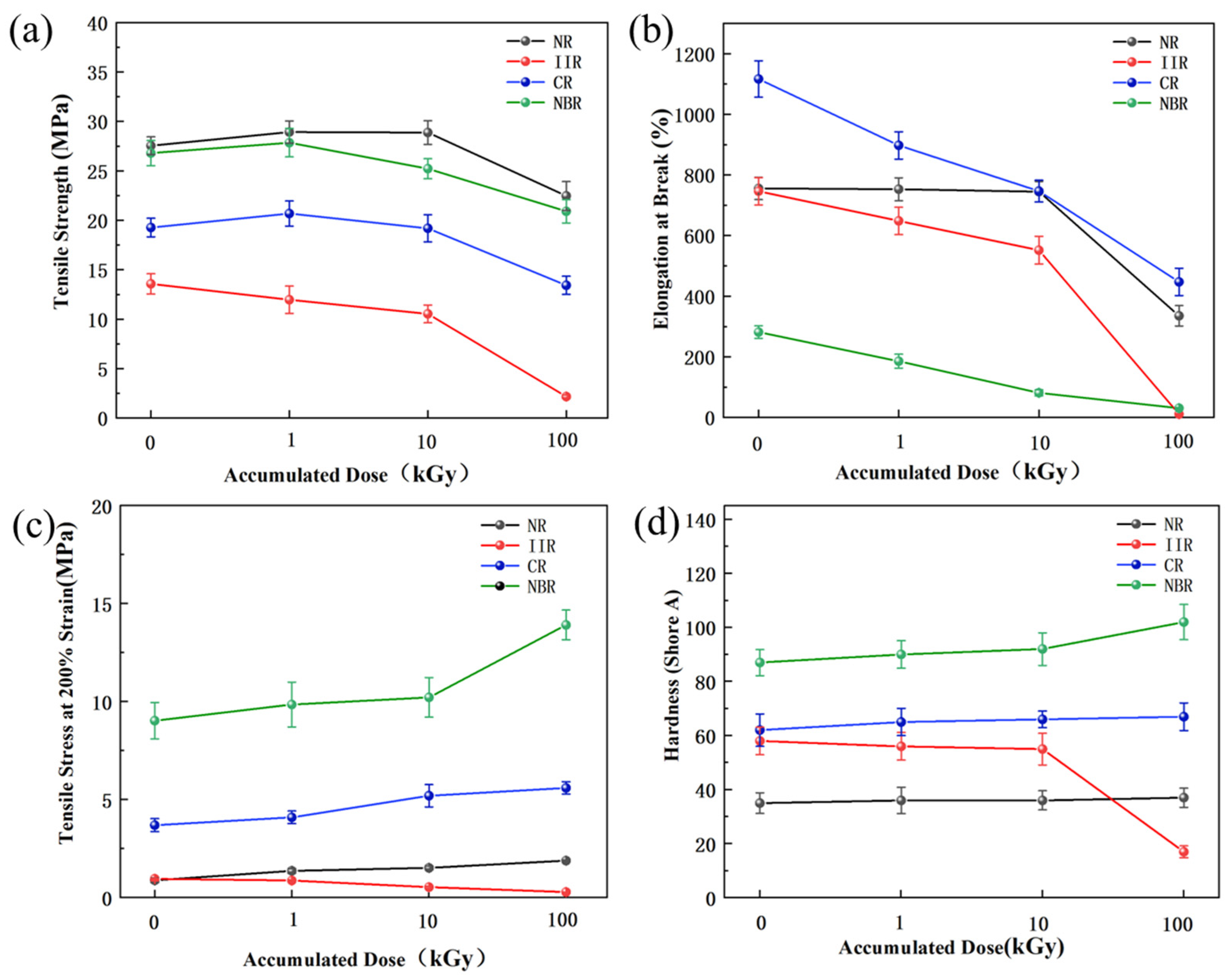
3.2. Evolution of Mechanical Properties
3.3. Analysis of Chemical Structure and Thermal Properties
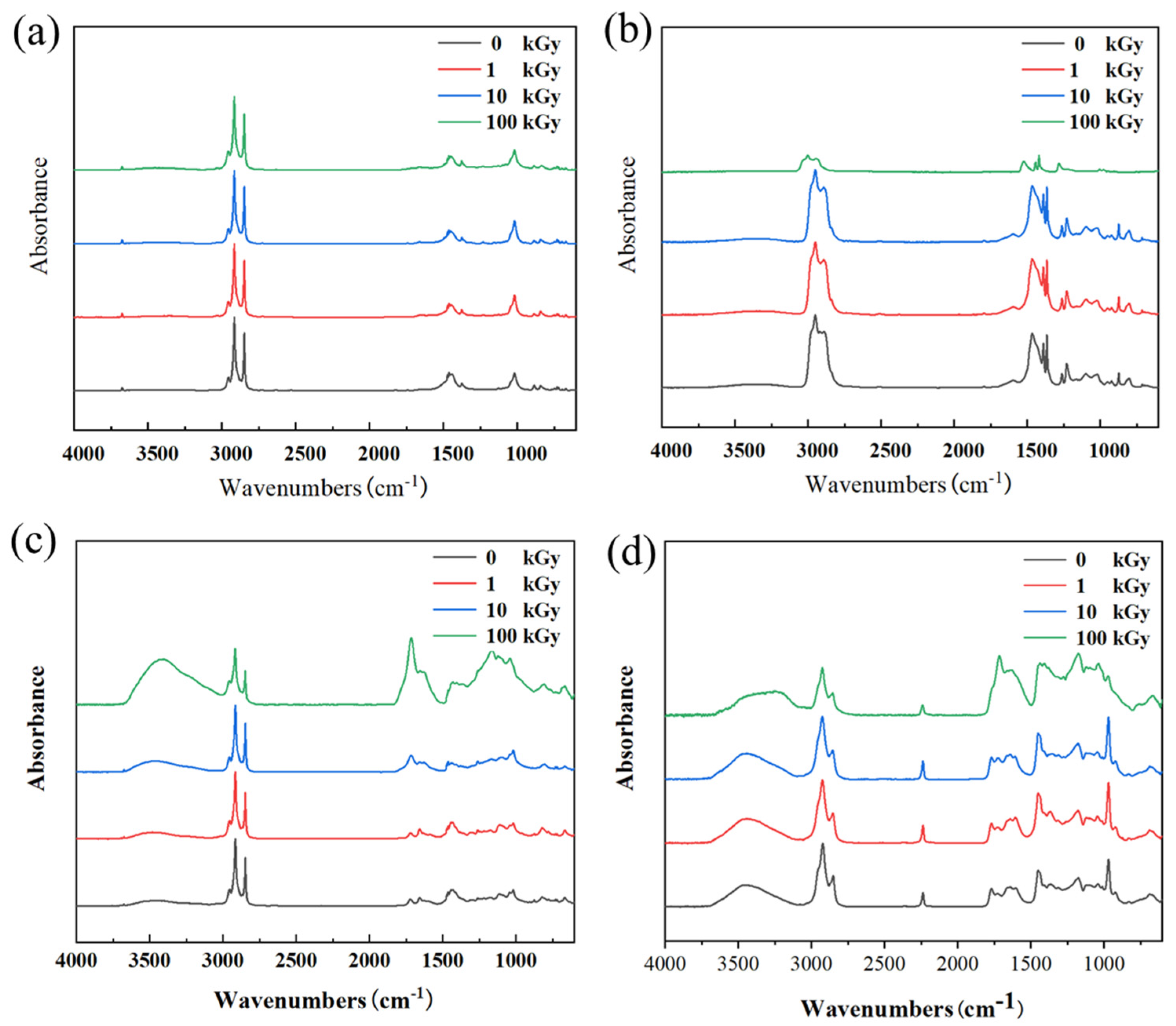
3.3.1. Effect of Irradiation on Molecular Structure
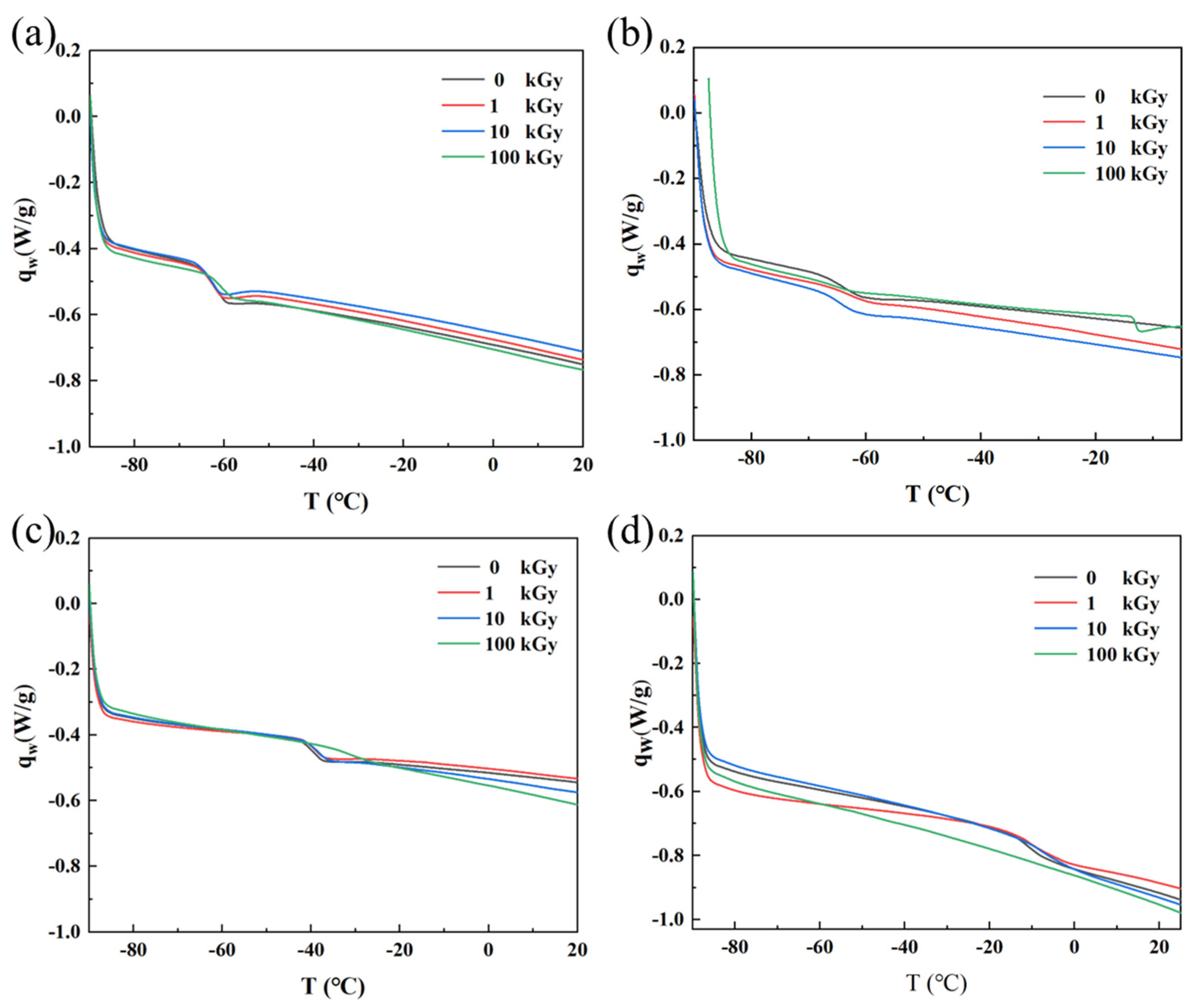
3.3.2. Thermal Characterization
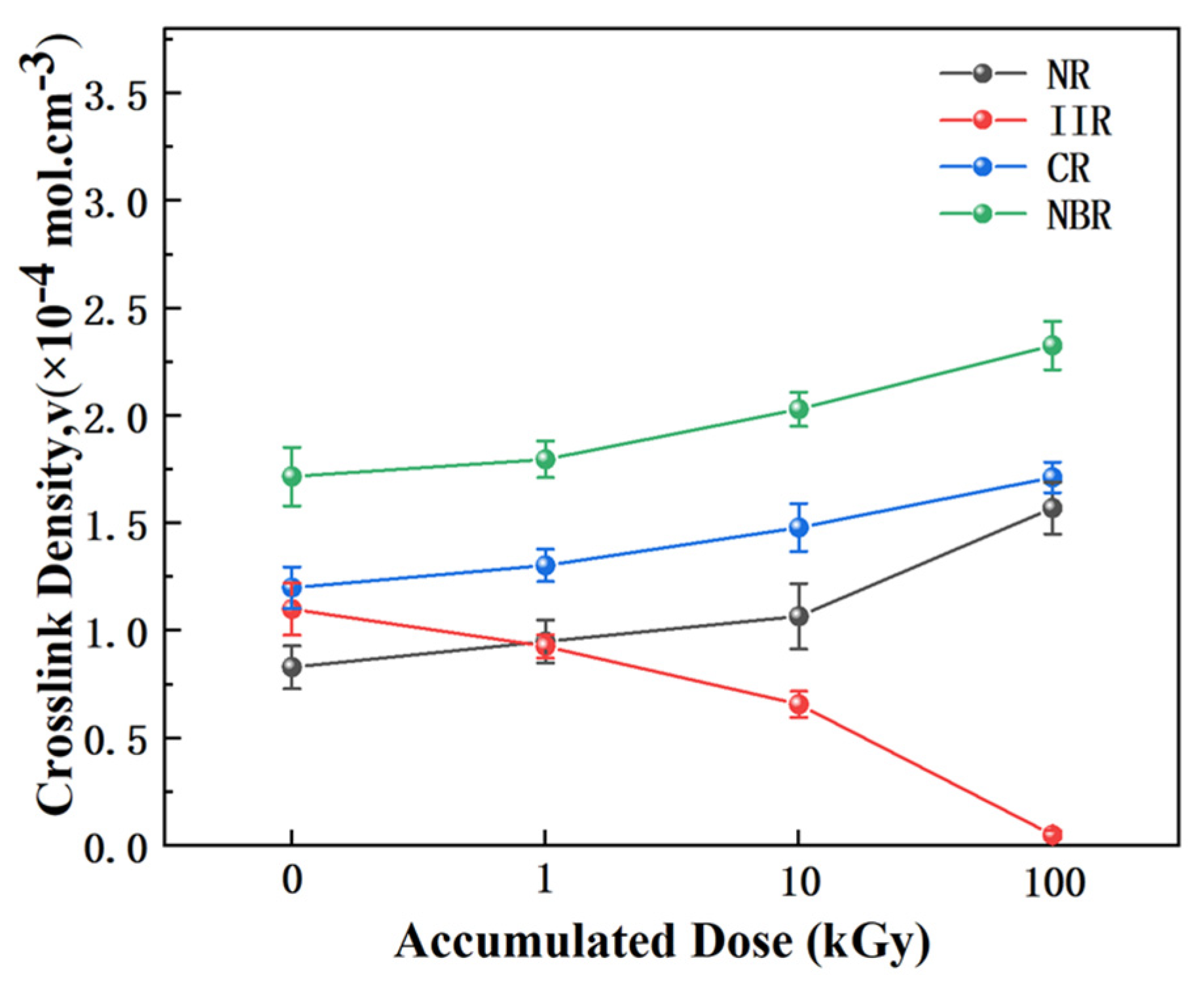
3.4. Crosslink Density Analysis by Equilibrium Swelling
3.5. Comprehensive Discussion
4. Conclusions
- The radiation damage mechanism of rubber materials is intrinsically linked to their main-chain molecular structure. This study demonstrates that unsaturated rubbers (NR, CR, NBR) are dominated by cross-linking reactions under gamma irradiation, whereas the saturated rubber (IIR) primarily undergoes main-chain scission as its degradation pathway. This fundamental difference dictates the macroscopic performance evolution in a radiation environment: cross-linking leads to material hardening and reduced elongation, while chain scission results in softening or even fluidization.
- Within the 0–100 kGy cumulative dose range, the four elastomers exhibit significant divergence in their overall radiation resistance, ranked as follows: NR > CR > NBR > IIR. NR displays the optimal stability; its irradiation primarily induces “clean” cross-linking without introducing significant oxidative or polar groups, thereby maintaining high stability in both mechanical properties and Tg. Conversely, IIR is highly sensitive to radiation, suffering severe main-chain scission that leads to a loss of solid form and a complete failure of mechanical and barrier properties at the 100 kGy dose.
- CR and NBR possess intermediate radiation resistance. While both are dominated by cross-linking, their performance degradation is accompanied by significant secondary chemical reactions. The degradation of CR involves dehydrochlorination and oxidation, whereas NBR exhibits severe free-radical oxidative degradation, leading to the formation of oxygen-containing functional groups that cause material hardening and embrittlement. Consequently, for material selection in nuclear applications, NR is the preferred choice for maintaining flexibility and durability in medium-to-high dose environments, while the suitability of CR and NBR must be strictly evaluated based on their specific oxidative degradation thresholds.
Author Contributions
Funding
Data Availability Statement
Conflicts of Interest
References
- Lee, Y.; Choi, Y.Y.; Yang, M.; Jin, Y.W.; Seong, K.M. Risk perception of radiation emergency medical staff on low-dose radiation exposure: Knowledge is a critical factor. J. Environ. Radioact. 2021, 227, 106502. [Google Scholar] [CrossRef]
- Kim, S.; Lee, H.Y.; Song, J.S. A study on characteristics and internal exposure evaluation of radioactive aerosols during pipe cutting in decommissioning of nuclear power plant. Nucl. Eng. Technol. 2018, 50, 1088–1098. [Google Scholar] [CrossRef]
- Ohira, T.; Takahashi, H.; Yasumura, S.; Ohtsuru, A.; Midorikawa, S.; Suzuki, S.; Matsuzuka, T.; Shimura, H.; Ishikawa, T.; Sakai, A.; et al. Associations between childhood thyroid cancer and external radiation dose after the fukushima daiichi nuclear power plant accident. Epidemiology 2018, 29, 32–34. [Google Scholar] [CrossRef]
- Wu, S.; Zhang, W.; Yang, Y. Progress in flexible and wearable lead-free polymer composites for Radiation Protection. Polymers 2024, 16, 3274. [Google Scholar] [CrossRef]
- Chang, Q.; Guo, S.; Zhang, X. Radiation shielding polymer composites: Ray-interaction mechanism, structural design, manufacture and biomedical applications. Mater. Des. 2023, 233, 112253. [Google Scholar] [CrossRef]
- Hao, F.; Zhou, W.; Gao, Y. Recent advances in nuclear radiation protective clothing materials. Mater. Express 2021, 11, 1255–1268. [Google Scholar] [CrossRef]
- Yuan, S.; Li, S.; Zhu, J.; Tang, Y. Additive manufacturing of polymeric composites from material processing to structural design. Compos. Part B Eng. 2021, 219, 108903. [Google Scholar] [CrossRef]
- Elsafi, M.; El-Nahal, M.A.; Mohamed, A.; Ahmed, F.; Sayyed, M.I.; Saleh, I. Development of gloves and protective jackets from ionizing radiation made of silicone rubber using nano-bismuth and tin oxides. Silicon 2023, 15, 7885–7892. [Google Scholar] [CrossRef]
- Li, H.; Yan, L.; Zhou, J.; Wang, Y.; Liao, X.; Shi, B. Flexible and wearable functional materials for ionizing radiation protection: A perspective review. Chem. Eng. J. 2024, 487, 150583. [Google Scholar] [CrossRef]
- Wu, S.; Bao, J.; Gao, Y.; Hu, W.; Lu, Z. Review on flexible radiation-protective clothing materials. J. Mater. Sci. 2024, 59, 8109–8133. [Google Scholar] [CrossRef]
- Du, X.; Jiang, S.; Zhao, Q.; Zhu, M.; Wang, H.; Wang, C.; He, A.; Ye, X.; Zhao, B. Studies on aging behavior and degradation mechanism of raw EPDM rubber under γ-Ray irradiation. J. Compos. Biodegrad. Polym. 2023, 11, 29–33. [Google Scholar]
- Dou, R.; Zhang, Y.; Huang, Z.; Liu, Q.; Huang, W.; Meng, X.; Chen, H. Study on the aging behavior and mechanism of nitrile rubber composites in combined radiation-thermal environments. J. Anal. Appl. Pyrolysis 2024, 184, 106865. [Google Scholar] [CrossRef]
- Zeng, C.; Kang, Q.; Duan, Z.; Qin, B.; Feng, X.; Lu, H.; Lin, Y. Development of polymer composites in radiation shielding applications: A review. J. Inorg. Organomet. Polym. Mater. 2023, 33, 2191–2239. [Google Scholar] [CrossRef]
- Bagheri, S.; Khalafi, H.; Tohidifar, M.R.; Bagheri, S. Thermoplastic and thermoset polymer matrix composites reinforced with bismuth oxide as radiation shielding materials. Compos. Part B Eng. 2024, 278, 111443. [Google Scholar] [CrossRef]
- Kalkornsuranee, E.; Intom, S.; Lehma, N.; Johns, J.; Kothan, S.; Sengloyluan, K.; Chaiphaksa, W.; Kaewkhao, J. Mechanical and gamma radiation shielding properties of natural rubber composites: Effects of bismuth oxide (Bi2O3) and lead oxide (PbO). Mater. Res. Innov. 2020, 26, 8–15. [Google Scholar] [CrossRef]
- Li, Y.; Liu, F.; Liu, X.; Li, L.; Kang, Z.; He, Y. Study on performance of new flexible shielding materials and first demonstration application in CPR nuclear power plant. In Proceedings of the International Conference on Nuclear Engineering, Online, 8–12 August 2022. [Google Scholar]
- Erkoyuncu, İ.; Demirkol, İ.; Akman, F.; Dilsiz, K.; Kaçal, M.; Polat, H. A detailed investigation of gamma and neutron shielding capabilities of concrete doped with bronze and boron carbide. Radiat. Phys. Chem. 2024, 215, 111358. [Google Scholar] [CrossRef]
- Nam, H.; Nam, J.; Yoo, J.; Kim, S.; Kang, K. Radiation-induced degradation of butyl rubber: Impact on protection against chemical warfare agents. Radiat. Phys. Chem. 2025, 237, 113089. [Google Scholar] [CrossRef]
- Lee, J.; Yadav, A.; Antia, M.; Zaffino, V.; Flitsiyan, E.; Chernyak, L.; Salzman, J.; Meyler, B.; Ahn, S.; Ren, F.; et al. Low dose 60Co gamma-irradiation effects on electronic carrier transport and DC characteristics of AlGaN/GaN high-electron-mobility transistors. Radiat. Eff. Defects Solids 2017, 172, 250–256. [Google Scholar] [CrossRef]
- Salama, E.; El-Khateeb, S.A. The effect of gamma irradiation on the electrical and mechanical properties of bismuth carbonate-silicone rubber. Radiat. Eff. Defects Solids 2022, 177, 327–337. [Google Scholar] [CrossRef]
- Wang, X.; Yang, K.; Zhang, P. Evaluation of the aging coefficient and the aging lifetime of carbon black-filled styrene-isoprene-butadiene rubber after thermal-oxidative aging. Compos. Sci. Technol. 2022, 220, 109258. [Google Scholar] [CrossRef]
- Wu, Z.; Zhen, C.; Huang, C.; Wang, X.; Wang, X. A Study on the effects of multiple factors on the irradiation aging of EPDM composites: Experimental and machine learning approaches. J. Appl. Polym. Sci. 2025, 143, e57955. [Google Scholar] [CrossRef]
- Zaghdoudi, M.; Kömmling, A.; Jaunich, M.; Wolff, D. Scission, cross-linking, and physical relaxation during thermal degradation of elastomers. Polymers 2019, 11, 1280. [Google Scholar] [CrossRef] [PubMed]
- Lou, W.; Xie, C.; Guan, X. Understanding radiation-thermal aging of polydimethylsiloxane rubber through molecular dynamics simulation. Npj Mater. Degrad. 2022, 6, 84. [Google Scholar] [CrossRef]
- Luo, R.; Kang, D.; Huang, C.; Yan, T.; Li, P.; Ren, H.; Zhang, Z. Mechanical properties, radiation resistance performances, and mechanism insights of nitrile butadiene rubber irradiated with high-dose gamma rays. Polymers 2023, 15, 3723. [Google Scholar] [CrossRef]
- Hanada, S.; Miyamoto, M.; Hirai, N.; Yang, L.; Ohki, Y. Experimental investigation of the degradation mechanism of silicone rubber exposed to heat and gamma rays. High Volt. 2017, 2, 92–101. [Google Scholar] [CrossRef]
- Marinović-Cincović, M.; Marković, G.; Samaržija-Jovanović, S.; Budinski-Simendić, J.; Jovanović, V. The influence of γ radiation on the properties of elastomers based on ethylene propylene diene terpolymer and chlorosulfonated polyethylene rubber. J. Thermoplast. Compos. Mater. 2013, 28, 1361–1372. [Google Scholar] [CrossRef]
- Xiao, Y.; Zhang, F.; Wei, R.; Qin, D.; Tang, Z.; Bao, Y.; Cai, Z. Influence of γ-irradiation dose on the mechanical and tribological properties of fluoroelastomer. Polym. Eng. Sci. 2024, 64, 5186–5197. [Google Scholar] [CrossRef]
- GB/T 1037-2021; Plastics—Determination of Water Vapor Transmission Rate. Standardization Administration of the People’s Republic of China: Beijing, China, 2021.
- GB/T 7755.1-2018; Plastics—Determination of Tensile Properties. Standardization Administration of the People’s Republic of China: Beijing, China, 2018.
- GB/T 528-2009; Rubber, Vulcanized or Thermoplastic-Determination of Tensile Stress-Strain Properties. Standardization Administration of the People’s Republic of China: Beijing, China, 2009.
- GB/T 29611-2013; Determination of Tensile Properties of Plastics—Part 1: General Principles. Standardization Administration of the People’s Republic of China: Beijing, China, 2013.
- Masoud, T.; Eesaee, M.; Hassanipour, M.; Elkoun, S.; David, E.; Nguyen-Tri, P. Thermal aging behavior and lifetime prediction of industrial elastomeric compounds based on styrene–butadiene rubber. Polym. Eng. Sci. 2025, 65, 3226–3246. [Google Scholar] [CrossRef]
- Gillen, K.T.; Bernstein, R.; Clough, R.L.; Celina, M. Lifetime predictions for semi-crystalline cable insulation materials: I. Mechanical properties and oxygen consumption measurements on EPR materials. Polym. Degrad. Stabil. 2006, 91, 2146–2156. [Google Scholar] [CrossRef]
- Celina, M.; Gillen, K.T.; Wise, J.; Clough, R. Anomalous aging phenomena in a crosslinked polyolefin cable insulation. Radiat. Phys. Chem. 1996, 48, 613–626. [Google Scholar] [CrossRef]
- Sheehan, C.J.; Bisio, A.L. Polymer/Solvent interaction parameters. Rubber Chem. Technol. 1966, 39, 149–192. [Google Scholar] [CrossRef]



| Rubber Type | Function | NR | IIR | CR | NBR |
|---|---|---|---|---|---|
| Polymer | Matrix | 100 | 100 | 100 | 100 |
| Carbon Black N330 | Reinforcement | - | 50 | 40 | - |
| Silica SiO2 | Reinforcement | 40 | - | - | 40 |
| CaCO3 | Filling | 20 | - | - | 20 |
| ZnO | Activator | 5 | 5 | 5 | 5 |
| Stearic Acid | Activator | 2 | 2 | 0.5 | 1 |
| Sulfur | Curing Agent | 2.5 | - | - | 1.5 |
| Accelerator CBS | Accelerator | 1.2 | - | - | - |
| Resin SP-1045 | Curing Agent | - | 7 | - | - |
| MgO | Curing Stabilizer | - | - | 4 | |
| Antioxidant TMQ | Antioxidation | 1.5 | 1.5 | 1.5 | 1.5 |
| Antioxidant 6PPD | Antiozonant | 1 | 1 | 1 | 1 |
| Phthalocyanine Green | Colorant | - | - | - | 0.25 |
| Polyethylene Glycol PEG-4000 | Silica Dispersant | 3 | - | - | 3 |
| Paraffin Oil | Plasticizer | 5 | 5 | 5 | 5 |
| Silane Coupling Agent Si69 | Tackifier | 1 | - | - | - |
| Rubber Type | 0 kGy | 1 kGy | 10 kGy | 100 kGy |
|---|---|---|---|---|
| NR | −61.54 °C | −62.18 °C | −61.92 °C | −60.60 °C |
| IIR | −63.93 °C | −63.19 °C | −64.75 °C | −65.92 °C |
| CR | −39.24 °C | −39.14 °C | −38.53 °C | −31.48 °C |
| NBR | −10.78 °C | −11.19 °C | −8.15 °C | −7.47 °C |
Disclaimer/Publisher’s Note: The statements, opinions and data contained in all publications are solely those of the individual author(s) and contributor(s) and not of MDPI and/or the editor(s). MDPI and/or the editor(s) disclaim responsibility for any injury to people or property resulting from any ideas, methods, instructions or products referred to in the content. |
© 2025 by the authors. Licensee MDPI, Basel, Switzerland. This article is an open access article distributed under the terms and conditions of the Creative Commons Attribution (CC BY) license.
Share and Cite
Du, X.; Miao, C.; Sun, Q.; Shi, H.; Han, H.; Chu, L.; Zhang, G.; Pang, H. Gamma Irradiation Resistance of Four Elastomers for Nuclear Sealing Applications. Polymers 2026, 18, 114. https://doi.org/10.3390/polym18010114
Du X, Miao C, Sun Q, Shi H, Han H, Chu L, Zhang G, Pang H. Gamma Irradiation Resistance of Four Elastomers for Nuclear Sealing Applications. Polymers. 2026; 18(1):114. https://doi.org/10.3390/polym18010114
Chicago/Turabian StyleDu, Xiaohui, Caixia Miao, Qi Sun, Haijiang Shi, Hongchen Han, Lili Chu, Guanghui Zhang, and Hongchao Pang. 2026. "Gamma Irradiation Resistance of Four Elastomers for Nuclear Sealing Applications" Polymers 18, no. 1: 114. https://doi.org/10.3390/polym18010114
APA StyleDu, X., Miao, C., Sun, Q., Shi, H., Han, H., Chu, L., Zhang, G., & Pang, H. (2026). Gamma Irradiation Resistance of Four Elastomers for Nuclear Sealing Applications. Polymers, 18(1), 114. https://doi.org/10.3390/polym18010114