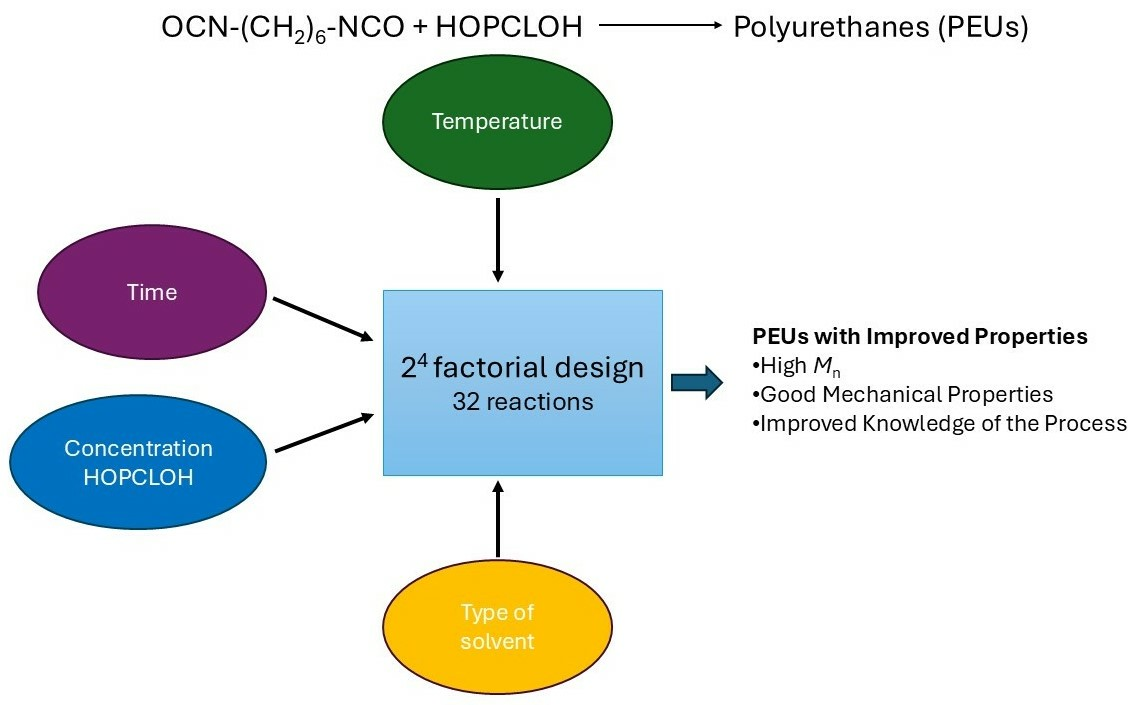
Experimental Design (24) to Improve the Reaction Conditions of Non-Segmented Poly(ester-urethanes) (PEUs) Derived from α,ω-Hydroxy Telechelic Poly(ε-caprolactone) (HOPCLOH)


 ,
,  , ,
, , Abstract
Share and Cite
Maldonado-Estudillo, J.; Navarro Crespo, R.; Marcos-Fernández, Á.; Caputto, M.D.d.D.; Cruz-Jiménez, G.; Báez, J.E. Experimental Design (24) to Improve the Reaction Conditions of Non-Segmented Poly(ester-urethanes) (PEUs) Derived from α,ω-Hydroxy Telechelic Poly(ε-caprolactone) (HOPCLOH). Polymers 2025, 17, 668. https://doi.org/10.3390/polym17050668
Maldonado-Estudillo J, Navarro Crespo R, Marcos-Fernández Á, Caputto MDdD, Cruz-Jiménez G, Báez JE. Experimental Design (24) to Improve the Reaction Conditions of Non-Segmented Poly(ester-urethanes) (PEUs) Derived from α,ω-Hydroxy Telechelic Poly(ε-caprolactone) (HOPCLOH). Polymers. 2025; 17(5):668. https://doi.org/10.3390/polym17050668
Chicago/Turabian StyleMaldonado-Estudillo, Jaime, Rodrigo Navarro Crespo, Ángel Marcos-Fernández, María Dolores de Dios Caputto, Gustavo Cruz-Jiménez, and José E. Báez. 2025. "Experimental Design (24) to Improve the Reaction Conditions of Non-Segmented Poly(ester-urethanes) (PEUs) Derived from α,ω-Hydroxy Telechelic Poly(ε-caprolactone) (HOPCLOH)" Polymers 17, no. 5: 668. https://doi.org/10.3390/polym17050668
APA StyleMaldonado-Estudillo, J., Navarro Crespo, R., Marcos-Fernández, Á., Caputto, M. D. d. D., Cruz-Jiménez, G., & Báez, J. E. (2025). Experimental Design (24) to Improve the Reaction Conditions of Non-Segmented Poly(ester-urethanes) (PEUs) Derived from α,ω-Hydroxy Telechelic Poly(ε-caprolactone) (HOPCLOH). Polymers, 17(5), 668. https://doi.org/10.3390/polym17050668