Article

Carbon Footprint of Plastic Bags and Polystyrene Dishes vs. Starch-Based Biodegradable Packaging in Amazonian Settlements


by
Johanna Garavito
1,2,
Néstor C. Posada
1,2,
Clara P. Peña-Venegas
2 and
Diego A. Castellanos
1,*
1
Food Packaging and Shelf Life Laboratory, Instituto de Ciencia y Tecnología de Alimentos, Universidad Nacional de Colombia, Carrera 30 Número 45-03, Bogotá 111321, Colombia
2
Instituto Amazónico de Investigaciones Científicas–SINCHI, Avenida Vásquez Cobo Calle 15/16, Leticia 910001, Colombia
*
Author to whom correspondence should be addressed.
Polymers 2025, 17(24), 3242; https://doi.org/10.3390/polym17243242
Submission received: 4 November 2025 / Revised: 1 December 2025 / Accepted: 4 December 2025 / Published: 5 December 2025
(This article belongs to the Special Issue Applications of Biopolymer-Based Composites in Food Technology)

Abstract

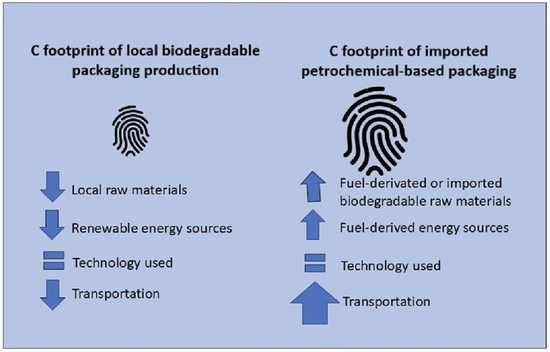
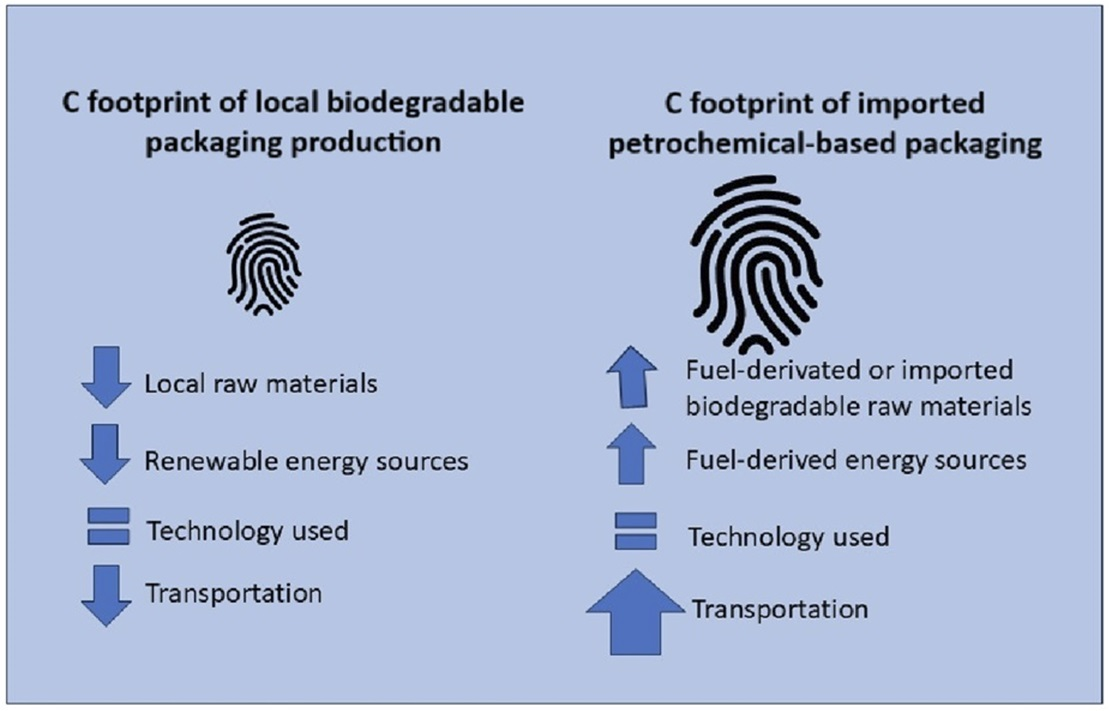
C footprint is a feature used to search the integral life cycle of a product to predict its environmental impact. The packaging industry is changing rapidly to the production of biodegradable products to mitigate the negative environmental consequences of the use of single-use packages. It is thought that biodegradable packages should be more sustainable than traditional plastics due to the sources of the raw materials used to produce them, but this is not always true and depends on the issues considered, the methodology, and the scale analyzed. Limited research includes case studies from developing countries where waste management is less efficient and where the environmental impacts of single-use packaging can be more significant. This paper evaluates the C footprint of bags and dishes made from traditional or local biodegradable sources in an Amazonian settlement of Colombia, such as thermoplastic cassava starch and powdered plantain leaves, to evaluate the impact of locally made biodegradable packaging vs. imported petrochemical ones. Results show that using local raw materials and in situ production reduces the C footprint of biodegradable packages, considering that the energy source for production and transport are important contributors to the C footprint beyond the raw materials used, with ratios that can be between 0.1 and 7 times more kg CO2 eq generated per functional unit.
Keywords: single-use packaging; sustainability; biodegradability; carbon emission; plastic waste single-use packaging; sustainability; biodegradability; carbon emission; plastic waste
Graphical Abstract