Article

Effects of Silicone Rubber on Rheological Properties and Aging Characteristics of Asphalt Binder

1
Shaanxi Coal Chemical Industry Technology Research Institute Co., Ltd., Xi’an 710100, China
2
Tianjin Transportation Research Institute, Tianjin 300060, China
3
School of Materials Science and Engineering, Chang’an University, Xi’an 710018, China
*
Authors to whom correspondence should be addressed.
Polymers 2024, 16(13), 1903; https://doi.org/10.3390/polym16131903
Submission received: 19 May 2024 / Revised: 28 June 2024 / Accepted: 29 June 2024 / Published: 2 July 2024

Abstract

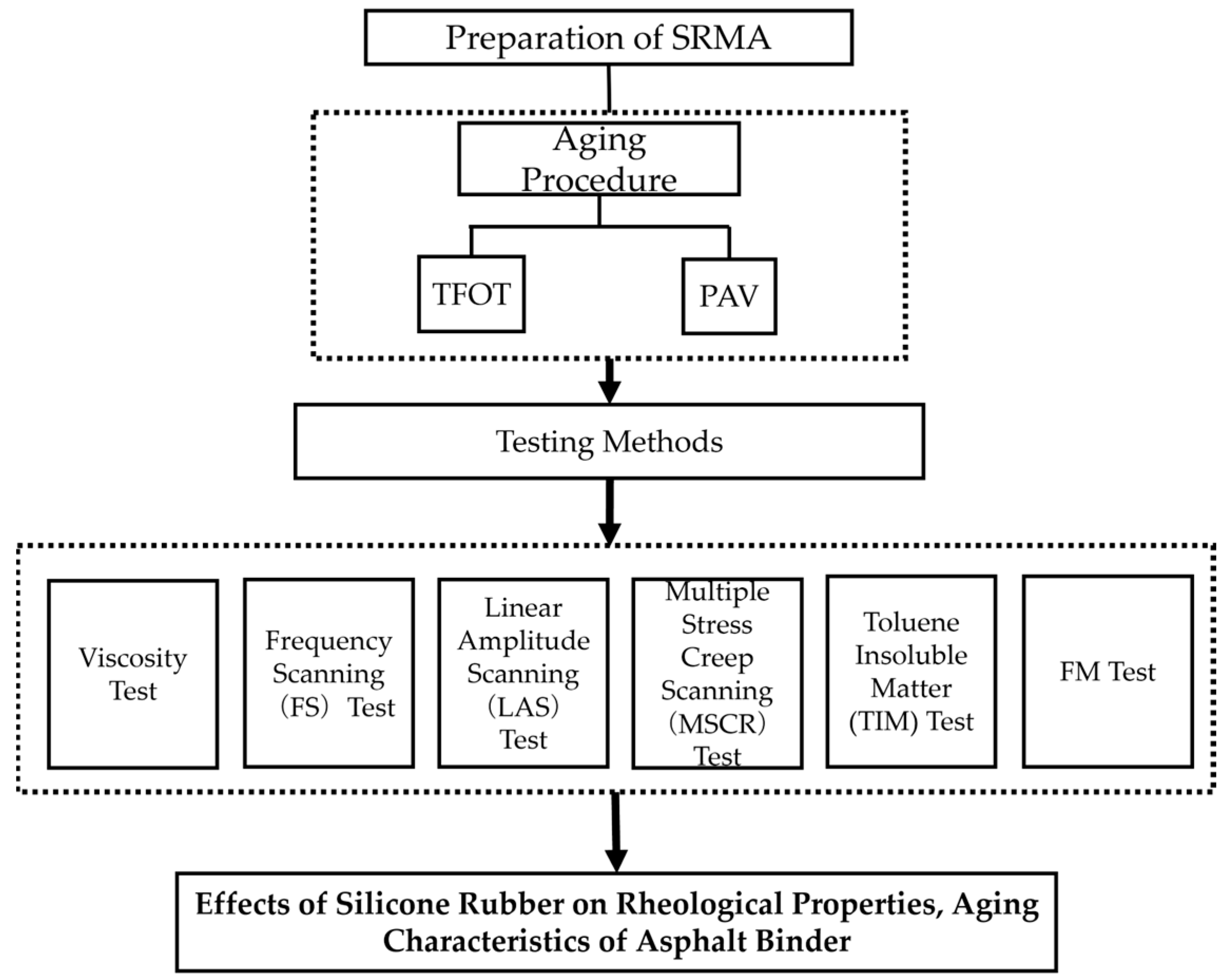
Silicone rubber (SR) is a kind of polymer insulation material with excellent performance. With the service life of silicone rubber products reaching the limit, how to dispose of waste silicone rubber is an urgent problem to be solved. In this paper, silicone rubber-modified asphalt binder (SRMA) was prepared by SR and 90# base asphalt binder. The simulated short-term aging and long-term aging tests of SRMA were carried out using the thin film oven aging test (TFOT) and pressure aging vessel test (PAV). The rotary viscosity test and dynamic shear rheological test (DSR) were applied to the rheological properties of SRMA before and after aging. The degradation degree and chemical composition changes of SR were explored by the toluene insoluble matter test, Fourier transform infrared spectroscopy (FTIR), and a Fluorescence microscope (FM). The results demonstrate that SR can significantly affect the aging resistance, fatigue life, and high-temperature stability of SRMA. As the content of SR rose, the elastic component in SRMA increased, leading to a nice performance in stability at high temperatures and fatigue resistance. However, excessive content (14%wt and 16%wt) had a negative influence on the performance of SRMA. So, the optimal content was speculated to be between 12% and 14%. Furthermore, SR and asphalt binder would be aged and degraded together in the aging process, and this phenomenon was more obvious during long-term aging.
Keywords: silicone rubber; rheological properties; high-temperature stability; toluene insoluble test silicone rubber; rheological properties; high-temperature stability; toluene insoluble test