Structural Geometry Variation of 1,4-Naphthalene-Based Co-Polymers to Tune the Device Performance of PVK-Host-Based OLEDs
 ,
,  ,
,  ,
, 
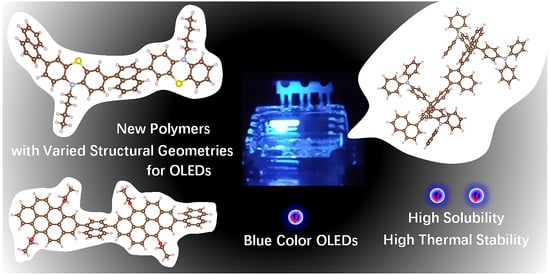
Abstract
Share and Cite
Liu, Q.; Moghe, D.; Sardar, G.; Manzhos, S.; Bottle, S.E.; Kyaw, A.K.K.; Kabra, D.; Sonar, P. Structural Geometry Variation of 1,4-Naphthalene-Based Co-Polymers to Tune the Device Performance of PVK-Host-Based OLEDs. Polymers 2021, 13, 2914. https://doi.org/10.3390/polym13172914
Liu Q, Moghe D, Sardar G, Manzhos S, Bottle SE, Kyaw AKK, Kabra D, Sonar P. Structural Geometry Variation of 1,4-Naphthalene-Based Co-Polymers to Tune the Device Performance of PVK-Host-Based OLEDs. Polymers. 2021; 13(17):2914. https://doi.org/10.3390/polym13172914
Chicago/Turabian StyleLiu, Qian, Dhanashree Moghe, Gopa Sardar, Sergei Manzhos, Steven E. Bottle, Aung Ko Ko Kyaw, Dinesh Kabra, and Prashant Sonar. 2021. "Structural Geometry Variation of 1,4-Naphthalene-Based Co-Polymers to Tune the Device Performance of PVK-Host-Based OLEDs" Polymers 13, no. 17: 2914. https://doi.org/10.3390/polym13172914
APA StyleLiu, Q., Moghe, D., Sardar, G., Manzhos, S., Bottle, S. E., Kyaw, A. K. K., Kabra, D., & Sonar, P. (2021). Structural Geometry Variation of 1,4-Naphthalene-Based Co-Polymers to Tune the Device Performance of PVK-Host-Based OLEDs. Polymers, 13(17), 2914. https://doi.org/10.3390/polym13172914