A Branched Polyelectrolyte Complex Enables Efficient Flame Retardant and Excellent Robustness for Wood/Polymer Composites

 and
and 
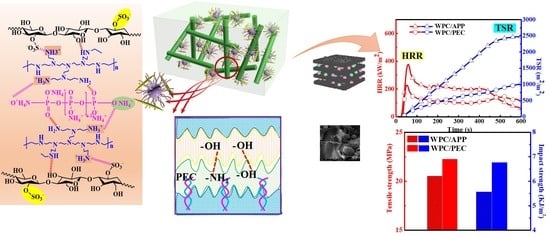
Abstract
1. Introduction
2. Materials and Methods
2.1. Materials
2.2. Fabrication of PEC
2.3. Fabrication of WPCs
2.4. Characterization
3. Results
3.1. Characterization of PEC
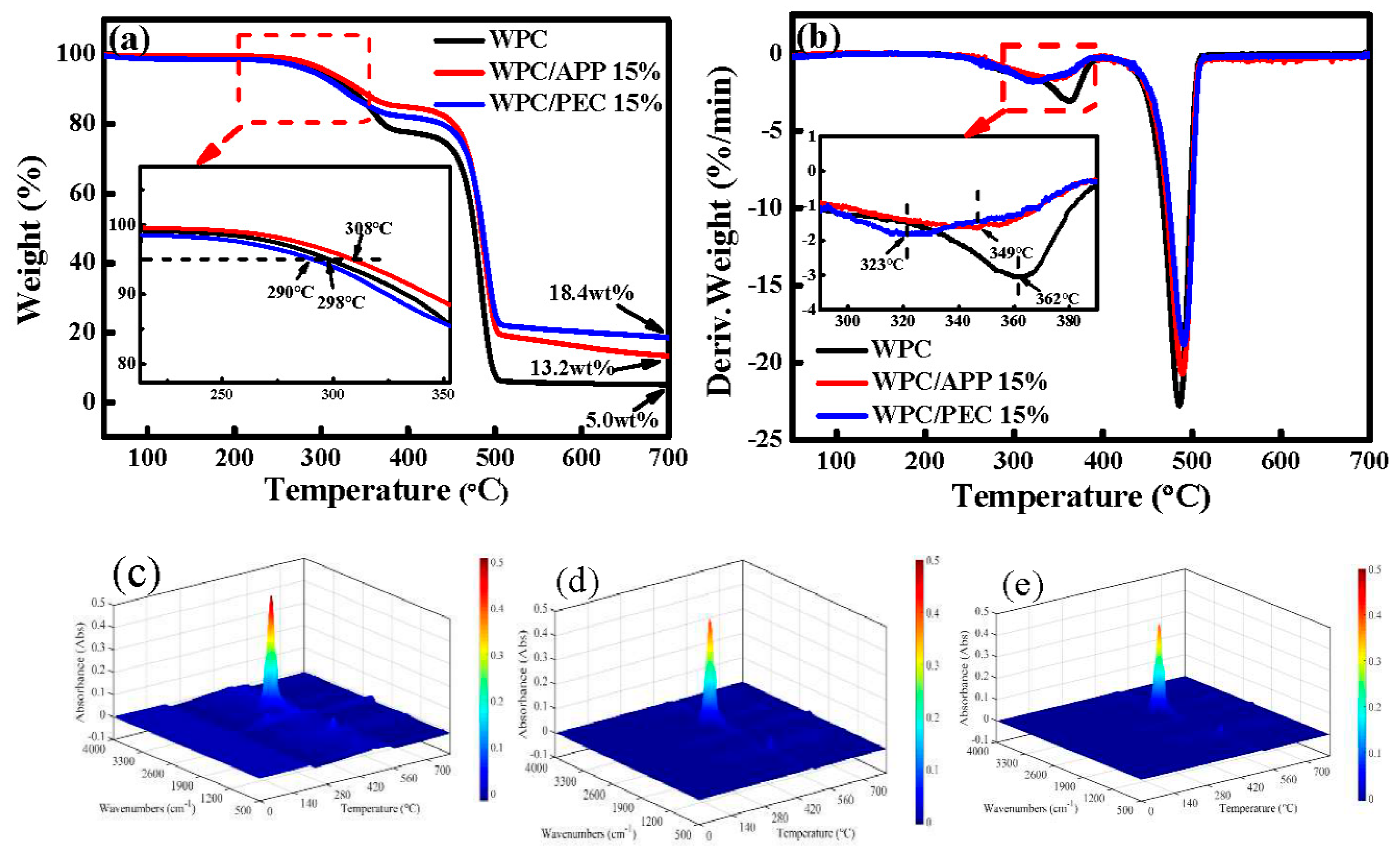
3.2. Flame Retardancy of WPC/PEC Composites
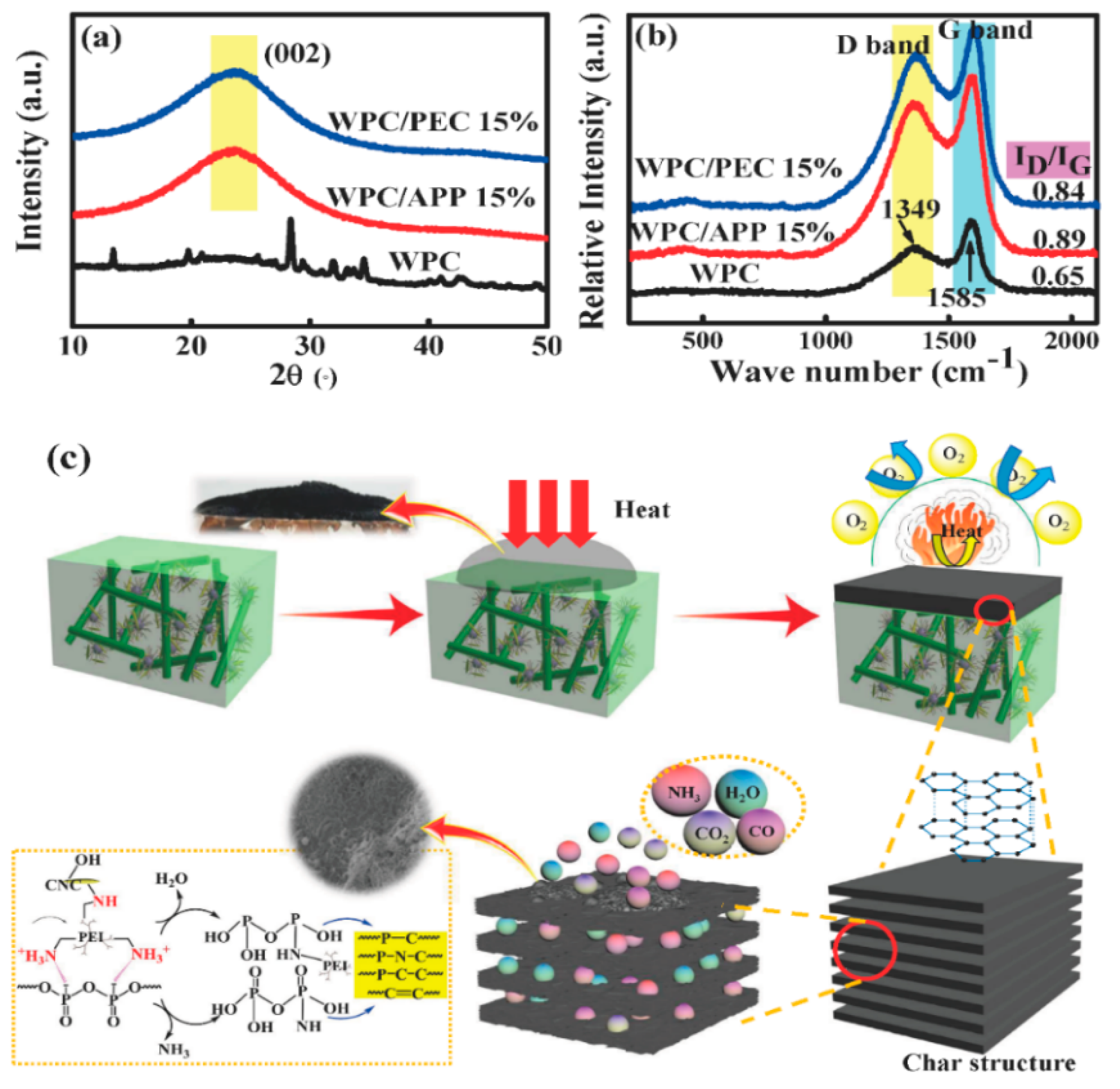
3.3. Flame Retardancy Mechanism
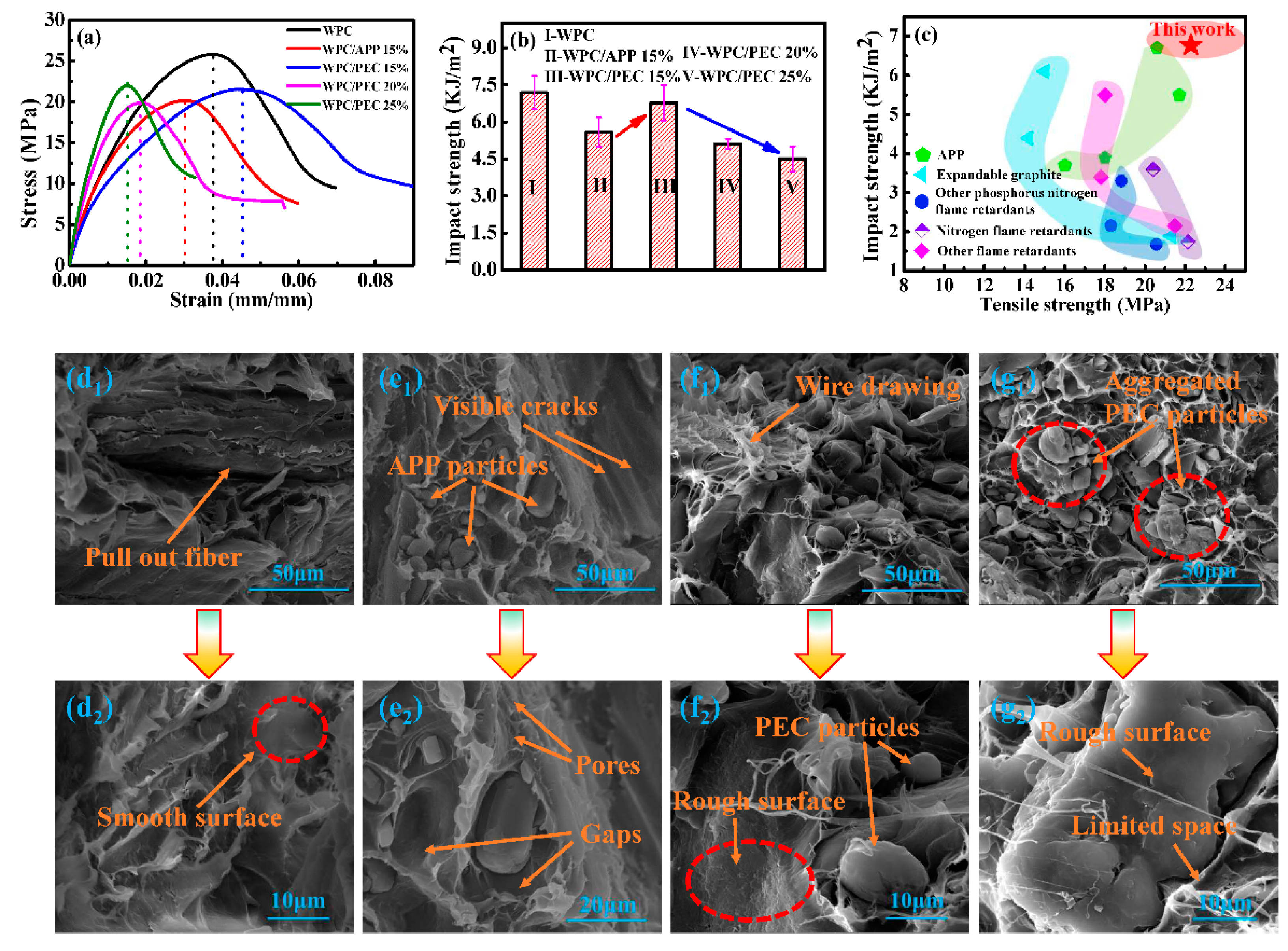
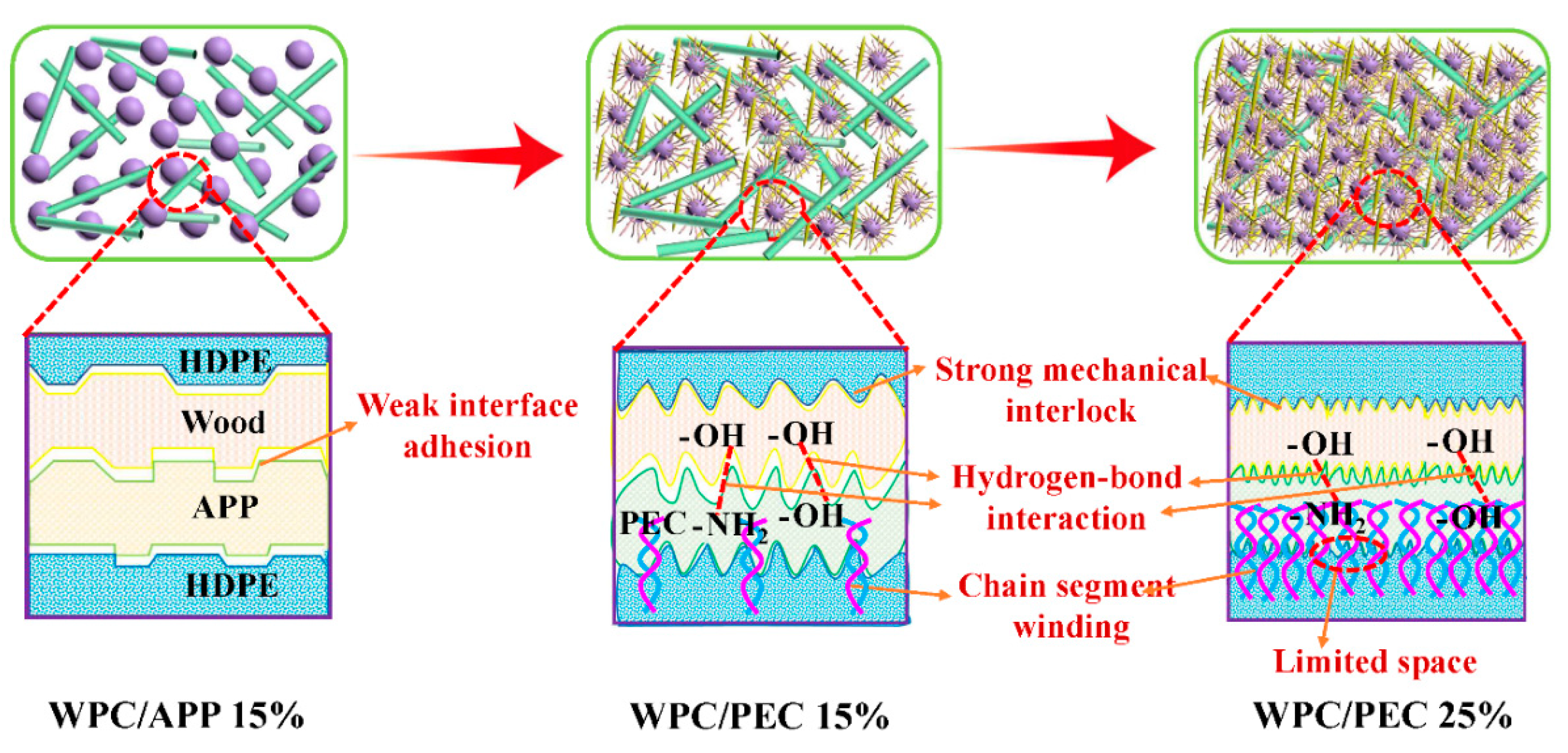
3.4. Mechanical Properties of WPC/PEC Composites
4. Conclusions
Supplementary Materials
Author Contributions
Funding
Acknowledgments
Conflicts of Interest
References
- Ashori, A. Wood-plastic composites as promising green-composites for automotive industries! Bioresour. Technol. 2008, 99, 4661–4667. [Google Scholar] [CrossRef] [Scilit] [PubMed]
- Li, B.; He, J. Investigation of mechanical property, flame retardancy and thermal degradation of LLDPE-wood-fibre composites. Polym. Degrad. Stab. 2004, 83, 241–246. [Google Scholar] [CrossRef] [Scilit]
- Stark, N.M.; White, R.H.; Mueller, S.A.; Osswald, T.A. Evaluation of various fire retardants for use in wood flour-polyethylene composites. Polym. Degrad. Stab. 2010, 95, 1903–1910. [Google Scholar] [CrossRef] [Scilit]
- Pan, M.; Mei, C.; Du, J.; Li, G. Synergistic effect of nano silicon dioxide and ammonium polyphosphate on flame retardancy of wood fiber-polyethylene composites. Compos. Part A Appl. Sci. Manuf. 2014, 66, 128–134. [Google Scholar] [CrossRef] [Scilit]
- Wang, W.; Peng, Y.; Chen, H.; Gao, Q.; Li, J.; Zhang, W. Surface microencapsulated ammonium polyphosphate with beta-cyclodextrin and its application in wood-flour/polypropylene composites. Polym. Compos. 2017, 38, 2312–2320. [Google Scholar] [CrossRef] [Scilit]
- Xu, B.; Deng, C.; Li, Y.; Lu, P.; Zhao, P.; Wang, Y. Novel amino glycerin decorated ammonium polyphosphate for the highly-efficient intumescent flame retardance of wood flour/polypropylene composite via simultaneous interfacial and bulk charring. Compos. Part B Eng. 2019, 172, 636–648. [Google Scholar] [CrossRef] [Scilit]
- Priftis, D.; Laugel, N.; Tirrell, M. Thermodynamic characterization of polypeptide complex coacervation. Langmuir 2012, 28, 15947–15957. [Google Scholar] [CrossRef] [Scilit] [PubMed]
- Li, Y.; Mannen, S.; Morgan, A.B.; Chang, S.; Yang, Y.; Condon, B.; Grunlan, J.C. Intumescent all-polymer multilayer nanocoating capable of extinguishing flame on fabric. Adv. Mater. 2011, 23, 3926–3931. [Google Scholar] [CrossRef] [Scilit] [PubMed]
- Zhang, T.; Yan, H.; Shen, L.; Fang, Z.; Zhang, X.; Wang, J.; Zhang, B. Chitosan/phytic acid polyelectrolyte complex: A green and renewable intumescent flame retardant system for ethylene-vinyl acetate copolymer. Ind. Eng. Chem. Res. 2014, 53, 19199–19207. [Google Scholar] [CrossRef] [Scilit]
- Jing, J.; Zhang, Y.; Tang, X.; Zhou, Y.; Li, X.; Kandola, B.K.; Fang, Z. Layer by layer deposition of polyethylenimine and bio-based polyphosphate on ammonium polyphosphate: A novel hybrid for simultaneously improving the flame retardancy and toughness of polylactic acid. Polymer 2017, 108, 361–371. [Google Scholar] [CrossRef] [Scilit]
- Ding, C.; Pan, M.; Chen, H.; Zhang, S.; Mei, C. An anionic polyelectrolyte hybrid for wood-polyethylene composites with high strength and fire safety via self-assembly. Constr. Build. Mater. 2020, 248, 118661. [Google Scholar] [CrossRef] [Scilit]
- Trache, D.; Thakur, V.K.; Boukherroub, R. Cellulose nanocrystals/graphene hybrids-a promising new class of materials for advanced applications. Nanomaterials 2020, 10, 1523. [Google Scholar] [CrossRef] [Scilit]
- Shao, Z.; Deng, C.; Tan, Y.; Li, Y.; Chen, M.; Chen, L.; Wang, Y. Ammonium polyphosphate chemically-modified with ethanolamine as an efficient intumescent flame retardant for polypropylene. J. Mater. Chem. A 2014, 2, 13955–13965. [Google Scholar] [CrossRef] [Scilit]
- Bras, M.L.; Bourbigot, S. The Use of Intumescence. Fire Retardancy of Polymers, 2nd ed.; Bras, M.L., Camino, G., Bourbigot, S., Delobel, R., Eds.; The Royal Society of Chemistry: Tyne and Wear, UK, 1998; pp. 64–75. [Google Scholar]
- Han, J.; Zhou, C.; Wu, Y.; Liu, F.; Wu, Q. Self-assembling behavior of cellulose nanoparticles during freeze-drying: Effect of suspension concentration, particle size, crystal structure, and surface charge. Biomacromolecules 2013, 14, 1529–1540. [Google Scholar] [CrossRef] [Scilit]
- Chen, Z.; Xu, W.; Jin, L.; Zha, J.; Tao, T.; Lin, Y.; Wang, Z. Synthesis of amine-functionalized Fe3O4@C nanoparticles for lipase immobilization. J. Mater. Chem. A 2014, 2, 18339–18444. [Google Scholar] [CrossRef] [Scilit]
- Shi, X.; Xu, Y.; Long, J.; Zhao, Q.; Ding, X.; Chen, L.; Wang, Y. Layer-by-layer assembled flame-retardant architecture toward high-performance carbon fiber composite. Chem. Eng. J. 2018, 353, 550–558. [Google Scholar] [CrossRef] [Scilit]
- Li, X.; Xie, H.; Lin, J.; Xie, W.; Ma, X. Characterization and biodegradation of chitosan-alginate polyelectrolyte complexes. Polym. Degrad. Stabil. 2009, 94, 1–6. [Google Scholar] [CrossRef] [Scilit]
- Yan, Y.; Chen, L.; Jian, R.; Kong, S.; Wang, Y. Intumescence: An effect way to flame retardance and smoke suppression for polystryene. Polym. Degrad. Stabil. 2012, 97, 1423–1431. [Google Scholar] [CrossRef] [Scilit]
- Yao, F.; Wu, Q.; Lei, Y.; Guo, W.; Xu, Y. Thermal decomposition kinetics of natural fibers: Activation energy with dynamic thermogravimetric analysis. Polym. Degrad. Stabil. 2008, 93, 90–98. [Google Scholar] [CrossRef] [Scilit]
- Xiong, Z.; Zhang, Y.; Du, X.; Song, P.; Fang, Z. Green and scalable fabrication of core-shell biobased flame retardants for reducing flammability of polylactic acid. ACS Sustain. Chem. Eng. 2019, 7, 8954–8963. [Google Scholar] [CrossRef] [Scilit]
- Wu, K.; Zhang, Y.; Hu, W.; Lian, J.; Yuan, H. Influence of ammonium polyphosphate microencapsulation on flame retardancy, thermal degradation and crystal structure of polypropylene composite. Compos. Sci. Technol. 2013, 81, 17–23. [Google Scholar] [CrossRef] [Scilit]
- Liu, L.; Qian, M.; Song, P.; Huang, G.; Yu, Y.; Fu, S. Fabrication of green lignin-based flame retardants for enhancing the thermal and fire retardancy properties of polypropylene/wood composites. ACS Sustain. Chem. Eng. 2016, 4, 2422–2431. [Google Scholar] [CrossRef] [Scilit]
- Kalali, E.N.; Zhang, L.; Shabestari, M.E.; Jeremy, C.; Wang, D. Flame-retardant wood polymer composites (WPCs) as potential fire safe bio-based materials for building products: Preparation, flammability and mechanical properties. Fire Saf. J. 2019, 107, 210–216. [Google Scholar] [CrossRef] [Scilit]
- Gu, J.; Zhang, G.; Dong, S.; Zhang, Q.; Kong, J. Study on preparation and fire-retardant mechanism analysis of intumescent flame-retardant coatings. Surf. Coat. Technol. 2007, 201, 7835–7841. [Google Scholar] [CrossRef] [Scilit]
- Zhao, G.; Du, J.; Chen, W.; Pan, M.; Chen, D. Preparation and thermostability of cellulose nanocrystals and nanofibrils from two sources of biomass: Rice straw and poplar wood. Cellulose 2019, 26, 8625–8643. [Google Scholar] [CrossRef] [Scilit]
- Abu Bakar, M.B.; Ishak, Z.M.; Taib, R.M.; Rozman, H.D.; Jani, S.M. Flammability and mechanical properties of wood flour-filled polypropylene composites. J. Appl. Polym. Sci. 2010, 116, 2714–2722. [Google Scholar]
- Bai, G.; Guo, C.; Li, L. Synergistic effect of intumescent flame retardant and expandable graphite on mechanical and flame-retardant properties of wood flour-polypropylene composites. Constr. Build. Mater. 2014, 50, 148–153. [Google Scholar] [CrossRef] [Scilit]
- Li, K.; Kuan, C.; Kuan, H.; Chen, C.; Liu, T.; Chiang, C. Preparation, characterization, and flame retardance of high-density polyethylene/sulfur-free expandable graphite composites. High. Perform. Polym. 2014, 26, 798–809. [Google Scholar] [CrossRef] [Scilit]
- Cavdar, A.D.; Torun, S.B.; Ertas, M.; Mengeloglu, F. Ammonium zeolite and ammonium phosphate applied as fire retardants for microcrystalline cellulose filled thermoplastic composites. Fire Saf. J. 2019, 107, 202–209. [Google Scholar] [CrossRef] [Scilit]
- Wang, Y.; Liu, C.; Lai, J.; Lu, C.; Wu, X.; Cai, Y.; Gu, L.; Yang, L.; Zhang, G.; Shi, G. Soy protein and halloysite nanotubes-assisted preparation of environmentally friendly intumescent flame retardant for poly(butylene succinate). Polym. Test. 2020, 81, 106174. [Google Scholar] [CrossRef] [Scilit]
- Liang, C.; Yang, B.; Wang, D.; Chen, J.; Huang, Y.; Chen, Z.; Miao, J.; Qian, J.; Xia, R.; Tu, Y.; et al. Investigation of the properties of polystyrene-based wood plastic composites: Effects of the flame retardant loading and magnetic fields. J. Polym. Eng. 2019, 39, 704–715. [Google Scholar] [CrossRef] [Scilit]
- Tian, S.; He, H.; Yu, P.; Zhou, L.; Luo, Y.; Jia, D. Sustainable utilization of waste printed circuit boards powders in HDPE-wood composites: Synergistic effects of multicomponents on structure and properties. J. Clean. Prod. 2017, 164, 840–847. [Google Scholar] [CrossRef] [Scilit]
- Dong, W.; He, M.; Wang, H.; Ren, F.; Zhang, J.; Zhao, X.; Li, Y. PLLA/ABS blends compatibilized by reactive comb polymers: Double T-g depression and significantly improved toughness. ACS Sustain. Chem. Eng. 2015, 3, 2542–2550. [Google Scholar] [CrossRef] [Scilit]



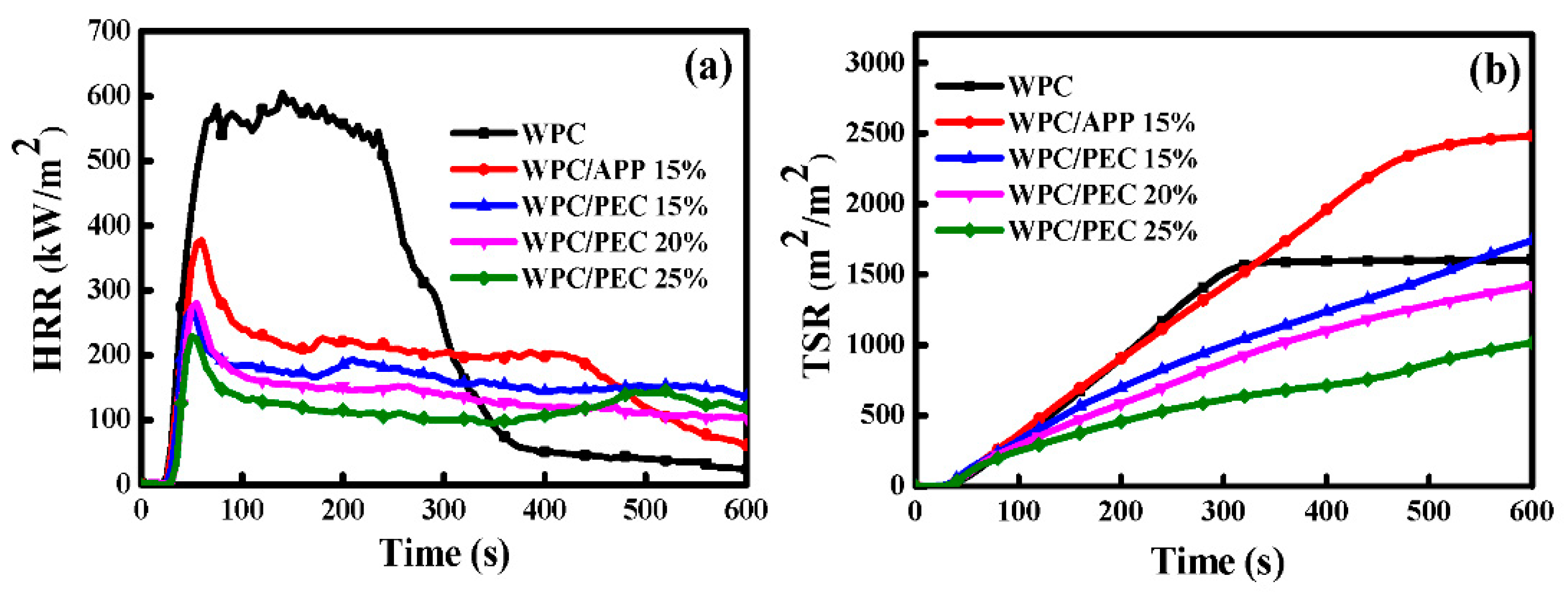
| Samples | LOI (%) | UL-94 (3.2 mm) | Average HRR | Peak HRR | THR | TTI | SEA | TSR | MLR | |
|---|---|---|---|---|---|---|---|---|---|---|
| Rating | Dripping | (kW/m2) | (kW/m2) | (MJ/m2) | (s) | (m2/kg) | (m2/m2) | (mg/s) | ||
| WPC | 19.8 (0.15) | NR | No | 261.56 (15.5) | 621.58 (23.0) | 147.7 (5.0) | 20.5 (0.7) | 330.57 (89.1) | 1381.9 (308.3) | 63.6 (0.8) |
| WPC/APP 15% | 23.9 (0.37) | NR | No | 109.55 (0.6) | 373.92 (5.2) | 128.7 (0.7) | 22.5 (0.7) | 616.93 (159.2) | 2626.1 (469.0) | 32.3 (2.6) |
| WPC/PEC 15% | 24.4 (0.17) | NR | No | 102.11 (3.6) | 279.68 (11.9) | 119.9 (4.2) | 22.5 (0.7) | 470.20 (54.6) | 1897.8 (209.2) | 30.4 (0.005) |
| WPC/PEC 20% | 26.6 (0.15) | V-1 | No | 81.89 (8.6) | 283.90 (4.9) | 145.2 (15.5) | 27.0 (4.2) | 448.61 (0.8) | 2323.5 (289.8) | 25.75 (3.1) |
| WPC/PEC 25% | 28.7 (0.21) | V-0 | No | 84.11 (0.1) | 235.85 (9.8) | 148.9 (0.2) | 28.5 (0.7) | 256.85 (57.6) | 1313.78 (238.5) | 25.55 (1.1) |
Publisher’s Note: MDPI stays neutral with regard to jurisdictional claims in published maps and institutional affiliations. |
© 2020 by the authors. Licensee MDPI, Basel, Switzerland. This article is an open access article distributed under the terms and conditions of the Creative Commons Attribution (CC BY) license (http://creativecommons.org/licenses/by/4.0/).
Share and Cite
Huang, Y.; Zhang, S.; Chen, H.; Ding, C.; Xuan, Y.; Pan, M.; Mei, C. A Branched Polyelectrolyte Complex Enables Efficient Flame Retardant and Excellent Robustness for Wood/Polymer Composites. Polymers 2020, 12, 2438. https://doi.org/10.3390/polym12112438
Huang Y, Zhang S, Chen H, Ding C, Xuan Y, Pan M, Mei C. A Branched Polyelectrolyte Complex Enables Efficient Flame Retardant and Excellent Robustness for Wood/Polymer Composites. Polymers. 2020; 12(11):2438. https://doi.org/10.3390/polym12112438
Chicago/Turabian StyleHuang, Yanping, Shuai Zhang, He Chen, Chunxiang Ding, Yan Xuan, Mingzhu Pan, and Changtong Mei. 2020. "A Branched Polyelectrolyte Complex Enables Efficient Flame Retardant and Excellent Robustness for Wood/Polymer Composites" Polymers 12, no. 11: 2438. https://doi.org/10.3390/polym12112438
APA StyleHuang, Y., Zhang, S., Chen, H., Ding, C., Xuan, Y., Pan, M., & Mei, C. (2020). A Branched Polyelectrolyte Complex Enables Efficient Flame Retardant and Excellent Robustness for Wood/Polymer Composites. Polymers, 12(11), 2438. https://doi.org/10.3390/polym12112438