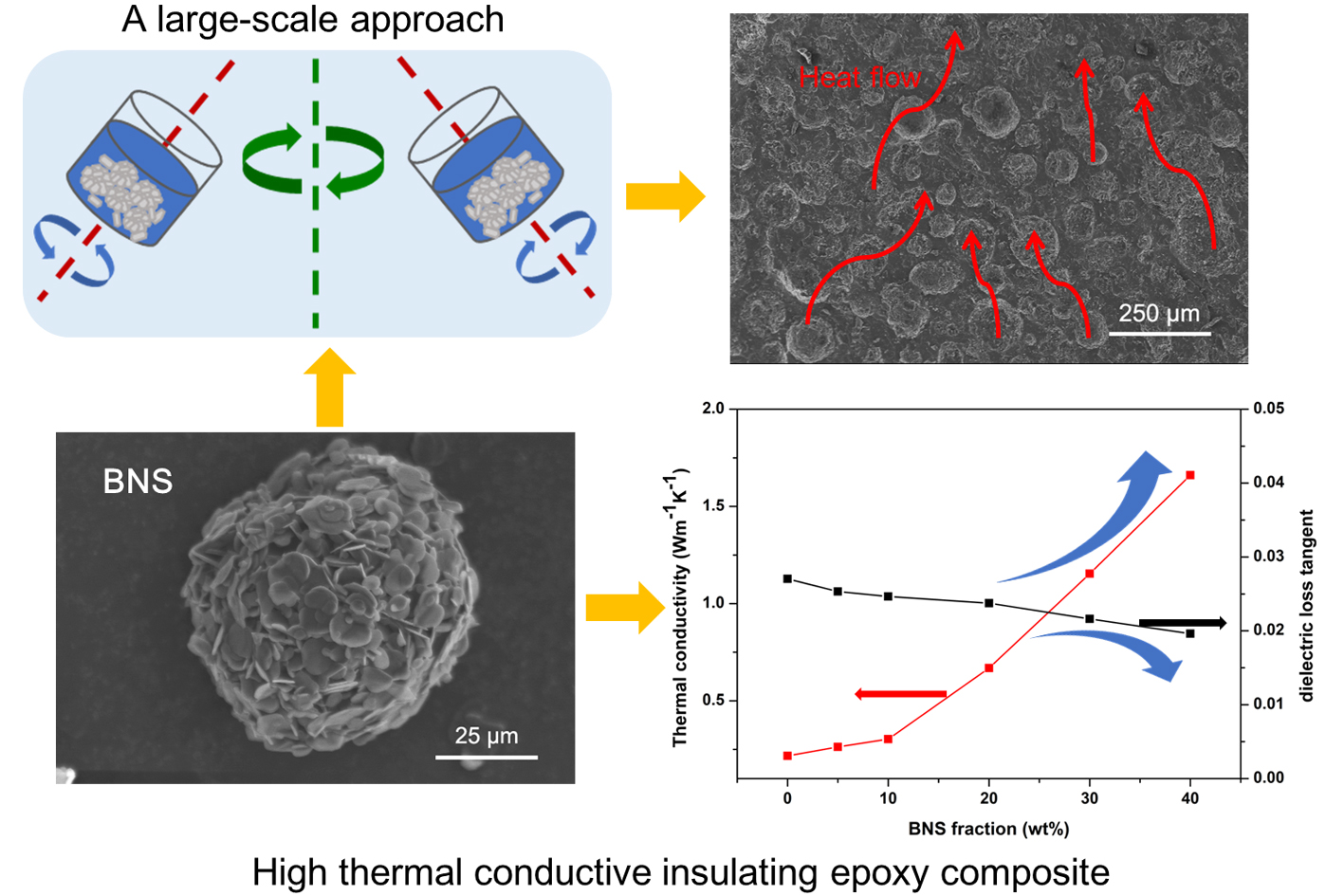
Optimization of Boron Nitride Sphere Loading in Epoxy: Enhanced Thermal Conductivity and Excellent Electrical Insulation

Abstract
1. Introduction
2. Materials and Methods
2.1. Materials and Characterizations
2.2. Fabrication of Epoxy/BNS Composites
3. Results and Discussion
3.1. Fundamental Physical Properties and Morphology Analysis
3.2. Thermal Conductivity
3.3. Linear Thermal Expansion
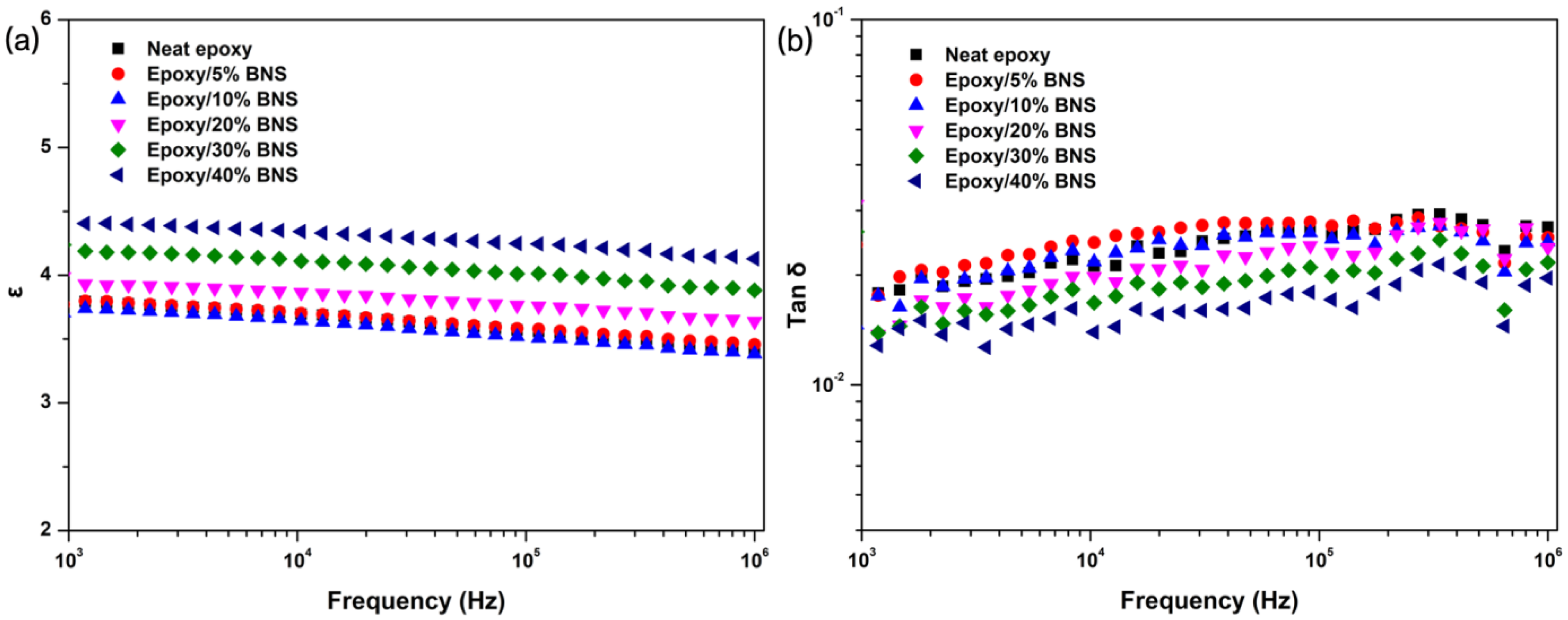
3.4. Dielectric Properties
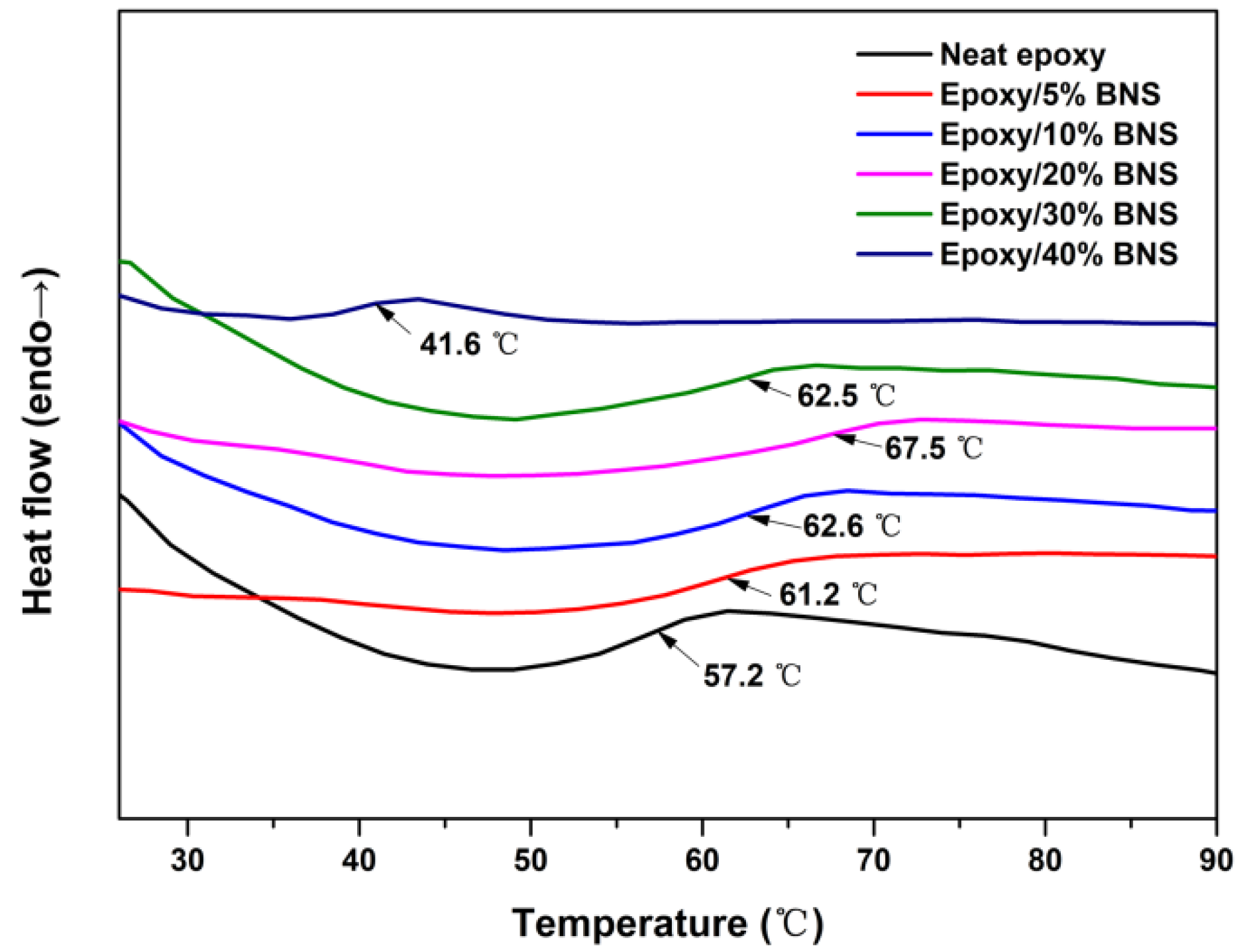
3.5. DSC Measurements
4. Conclusions
Supplementary Materials
Author Contributions
Funding
Acknowledgments
Conflicts of Interest
References
- Li, Q.; Chen, L.; Gadinski, M.R.; Zhang, S.; Zhang, G.; Li, H.U.; Iagodkine, E.; Haque, A.; Chen, L.Q.; Jackson, T.N.; et al. Flexible high-temperature dielectric materials from polymer nanocomposites. Nature 2015, 523, 576–579. [Google Scholar] [CrossRef] [PubMed]
- Cherney, E.A. Silicone rubber dielectrics modified by inorganic fillers for outdoor high voltage insulation applications. IEEE Trans. Dielectr. Electr. Insul. 2005, 12, 1108–1115. [Google Scholar] [CrossRef]
- Iyer, G.; Gorur, R.S.; Richert, R.; Krivda, A.; Schmidt, L.E. Dielectric properties of epoxy based nanocomposites for high voltage insulation. IEEE Trans. Dielectr. Electr. Insul. 2011, 18, 659–666. [Google Scholar] [CrossRef]
- Chen, J.; Huang, X.; Sun, B.; Jiang, P. Highly thermally conductive yet electrically insulating polymer/boron nitride nanosheets nanocomposite films for improved thermal management capability. ACS Nano 2019, 13, 337–345. [Google Scholar] [CrossRef] [PubMed]
- Cho, E.C.; Huang, J.H.; Li, C.P.; Chang-Jian, C.W.; Lee, K.C.; Hsiao, Y.S.; Huang, J.H. Graphene-based thermoplastic composites and their application for LED thermal management. Carbon 2016, 102, 66–73. [Google Scholar] [CrossRef]
- Moore, A.L.; Shi, L. Emerging challenges and materials for thermal management of electronics. Mater. Today 2014, 17, 163–174. [Google Scholar] [CrossRef]
- Dimits, A.M.; Bateman, G.; Beer, M.A.; Cohen, B.I.; Dorland, W.; Hammett, G.W.; Kim, C.; Kinsey, J.E.; Kotschenreuther, M.; Kritz, A.H.; et al. Comparisons and physics basis of tokamak transport models and turbulence simulations. Phys. Plasmas 2000, 7, 969–983. [Google Scholar] [CrossRef]
- Post, R.F. Controlled fusion research—An application of the physics of high temperature plasmas. Rev. Mod. Phys. 1956, 28, 338–362. [Google Scholar] [CrossRef]
- Wu, Z.; Li, J.; Zhang, H.; Huang, R.; Li, L. Study on thermal properties of radiation-resistant epoxy composite. Cryogenics 2012, 52, 632–635. [Google Scholar] [CrossRef]
- Fabian, P.E.; Bauer-McDaniel, T.S.; Reed, R.P. Low temperature thermal properties of composite insulation systems. Cryogenics 1995, 35, 719–722. [Google Scholar] [CrossRef]
- Prokopec, R.; Humer, K.; Maix, R.K.; Fillunger, H.; Weber, H.W. Characterization of advanced cyanate ester/epoxy insulation systems before and after reactor irradiation. Fusion Eng. Des. 2010, 85, 227–233. [Google Scholar] [CrossRef]
- Bittner-Rohrhofer, K.; Humer, K.; Wang, Z.D.; Weber, H.W.; Fabian, P.E.; Munshi, N.A. Radiation hardness of newly developed ITER relevant insulation systems. Fusion Eng. Des. 2003, 66–68, 1209–1213. [Google Scholar] [CrossRef]
- Han, Z.; Fina, A. Thermal conductivity of carbon nanotubes and their polymer nanocomposites: A review. Prog. Polym. Sci. 2011, 36, 914–944. [Google Scholar] [CrossRef]
- Shen, Z.; Feng, J. Highly thermally conductive composite films based on nanofibrillated cellulose in situ coated with a small amount of silver nanoparticles. ACS Appl. Mater. Interfaces 2018, 10, 24193–24200. [Google Scholar] [CrossRef] [PubMed]
- Bard, S.; Schönl, F.; Demleitner, M.; Altstädt, V. Copper and Nickel Coating of Carbon Fiber for Thermally and Electrically Conductive Fiber Reinforced Composites. Polymers 2019, 11, 823. [Google Scholar] [CrossRef] [PubMed]
- Hong, J.P.; Yoon, S.W.; Hwang, T.; Oh, J.S.; Hong, S.C.; Lee, Y.; Nam, J.D. High thermal conductivity epoxy composites with bimodal distribution of aluminum nitride and boron nitride fillers. Thermochim. Acta 2012, 537, 70–75. [Google Scholar] [CrossRef]
- Guo, Y.; Lyu, Z.; Yang, X.; Lu, Y.; Ruan, K.; Wu, Y.; Kong, J.; Gu, J. Enhanced thermal conductivities and decreased thermal resistances of functionalized boron nitride/polyimide composites. Compos. Part. B 2019, 164, 732–739. [Google Scholar] [CrossRef]
- Song, H.; Kim, B.G.; Kim, Y.S.; Bae, Y.S.; Kim, J.; Yoo, Y. Synergistic Effects of Various Ceramic Fillers on Thermally Conductive Polyimide Composite Films and Their Model Predictions. Polymers 2019, 11, 484. [Google Scholar] [CrossRef] [PubMed]
- Wang, X.; Yu, Z.; Bian, H.; Wu, W.; Xiao, H.; Dai, H. Thermally Conductive and Electrical Insulation BNNS/CNF Aerogel Nano-Paper. Polymers 2019, 11, 660. [Google Scholar] [CrossRef]
- Hong, H.; Kim, J.U.; Kim, T. Effective Assembly of Nano-Ceramic Materials for High and Anisotropic Thermal Conductivity in a Polymer Composite. Polymers 2017, 9, 413. [Google Scholar] [CrossRef]
- Akatsuka, M.; Takezawa, Y. Study of high thermal conductive epoxy resins containing controlled high-order structures. J. Appl. Polym. Sci. 2003, 89, 2464–2467. [Google Scholar] [CrossRef]
- Chen, H.; Ginzburg, V.V.; Yang, J.; Yang, Y.; Liu, W.; Huang, Y.; Du, L.; Chen, B. Thermal conductivity of polymer-based composites: Fundamentals and applications. Prog. Polym. Sci. 2016, 59, 41–85. [Google Scholar] [CrossRef]
- Yang, S.; Li, W.; Bai, S.; Wang, Q. Fabrication of morphologically cntrolled composites with high thermal conductivity and dielectric performance from aluminum nanoflake and recycled plastic package. ACS Appl. Mater. Interfaces 2019, 11, 3388–3399. [Google Scholar] [CrossRef] [PubMed]
- Kim, K.; Kim, J. Exfoliated boron nitride nanosheet/MWCNT hybrid composite for thermal conductive material via epoxy wetting. Compos. Part. B 2018, 140, 9–15. [Google Scholar] [CrossRef]
- Isarn, I.; Gamardella, F.; Fernàndez-Francos, X.; Serra, À.; Ferrando, F. Thermal Conductive Composites Prepared by Addition of Several Ceramic Fillers to Thermally Cationic Curing Cycloaliphatic Epoxy Resins. Polymers 2019, 11, 138. [Google Scholar] [CrossRef] [PubMed]
- Su, Z.; Wang, H.; He, J.; Guo, Y.; Qu, Q.; Tian, X. Fabrication of thermal conductivity enhanced polymer composites by constructing an oriented Three-dimensional staggered interconnected network of boron nitride platelets and carbon nanotubes. ACS Appl. Mater. Interfaces 2018, 10, 36342–36351. [Google Scholar] [CrossRef] [PubMed]
- Peng, L.; Xu, Z.; Liu, Z.; Guo, Y.; Li, P.; Gao, C. Ultrahigh Thermal Conductive yet Superflexible Graphene Films. Adv. Mater. 2017, 29, 1700589. [Google Scholar] [CrossRef] [PubMed]
- Yao, Y.; Sun, J.; Zeng, X.; Sun, R.; Xu, J.B.; Wong, C.P. Construction of 3D skeleton for polymer composites achieving a high thermal conductivity. Small 2018, 14, e1704044. [Google Scholar] [CrossRef]
- Che, J.; Jing, M.; Liu, D.; Wang, K.; Fu, Q. Largely enhanced thermal conductivity of HDPE/boron nitride/carbon nanotubes ternary composites via filler network-network synergy and orientation. Compos. Part. A 2018, 112, 32–39. [Google Scholar] [CrossRef]
- Golberg, D.; Bando, Y.; Huang, Y.; Terao, T.; Mitome, M.; Tang, C.; Zhi, C. Boron Nitride Nanotubes and Nanosheets. ACS Nano 2010, 4, 2979–2993. [Google Scholar] [CrossRef]
- Mitchell, N.; Bessette, D.; Gallix, R.; Jong, C.; Knaster, J.; Libeyre, P.; Sborchia, C.; Simon, F. The ITER magnet system. IEEE Trans. Appl. Supercon. 2008, 18, 435–440. [Google Scholar] [CrossRef]
- Zhang, C.; Huang, R.; Wang, Y.; Wu, Z.; Guo, S.; Zhang, H.; Li, J.; Huang, C.; Wang, W.; Li, L. Aminopropyltrimethoxysilane-functionalized boron nitride nanotube based epoxy nanocomposites with simultaneous high thermal conductivity and excellent electrical insulation. J. Mater. Chem. A 2018, 6, 20663–20668. [Google Scholar] [CrossRef]
- Jo, I.; Pettes, M.T.; Kim, J.; Watanabe, K.; Taniguchi, T.; Yao, Z.; Shi, L. Thermal Conductivity and Phonon Transport in Suspended Few-Layer Hexagonal Boron Nitride. Nano Lett. 2013, 13, 550–554. [Google Scholar] [CrossRef]
- Paszkowicz, W.; Pelka, J.B.; Knapp, M.; Szyszko, T.; Podsiadlo, S. Lattice parameters and anisotropic thermal expansion of hexagonal boron nitride in the 10–297.5°K temperature range. Appl. Phys. A 2002, 75, 431–435. [Google Scholar] [CrossRef]
- Sun, J.J.; Wang, D.; Yao, Y.M.; Zeng, X.L.; Pan, G.R.; Huang, Y.; Hu, J.T.; Sun, R.; Xu, J.B.; Wong, C.P. Boron nitride microsphere/epoxy composites with enhanced thermal conductivity. High Volt. 2017, 2, 147–153. [Google Scholar] [CrossRef]
- Kim, K.; Kim, M.; Kim, J. Thermal and mechanical properties of epoxy composites with a binary particle filler system consisting of aggregated and whisker type boron nitride particles. Compos. Sci. Technol. 2014, 103, 72–77. [Google Scholar] [CrossRef]
- Mai, V.D.; Lee, D.I.; Park, J.H.; Lee, D.S. Rheological Properties and Thermal Conductivity of Epoxy Resins Filled with a Mixture of Alumina and Boron Nitride. Polymers 2019, 11, 597. [Google Scholar] [CrossRef]
- Luo, T.; Lloyd, J.R. Enhancement of thermal energy transport across graphene/graphite and polymer interfaces: A molecular dynamics study. Adv. Funct. Mater. 2012, 22, 2495–2502. [Google Scholar] [CrossRef]
- Gu, J.; Zhang, Q.; Dang, J.; Xie, C. Thermal conductivity epoxy resin composites filled with boron nitride. Polym. Adv. Technol. 2012, 23, 1025–1028. [Google Scholar] [CrossRef]
- Yung, K.C.; Zhu, B.L.; Wu, J.; Yue, T.M.; Xie, C.S. Effect of AlN content on the performance of brominated epoxy resin for printed circuit board substrate. J. Polym. Sci. Part B 2007, 45, 1662–1674. [Google Scholar] [CrossRef]
- Agari, Y.; Ueda, A.; Nagai, S. Thermal conductivity of a polymer composite. J. Appl. Polym. Sci. 1993, 49, 1625–1634. [Google Scholar] [CrossRef]
- Chen, J.; Huang, X.; Zhu, Y.; Jiang, P. Cellulose Nanofiber Supported 3D Interconnected BN Nanosheets for Epoxy Nanocomposites with Ultrahigh Thermal Management Capability. Adv. Funct. Mater. 2017, 27, 1604754. [Google Scholar] [CrossRef]
- Agari, Y.; Uno, T. Thermal conductivity of polymer filled with carbon materials: Effect of conductive particle chains on thermal conductivity. J. Appl. Polym. Sci. 1985, 30, 2225–2235. [Google Scholar] [CrossRef]
- Droval, G.; Feller, J.F.; Salagnac, P.; Glouannec, P. Thermal conductivity enhancement of electrically insulating syndiotactic poly (styrene) matrix for diphasic conductive polymer composites. Polym. Adv. Technol. 2006, 17, 732–745. [Google Scholar] [CrossRef]
- Hill, R.F.; Supancic, P.H. Thermal conductivity of platelet-filled polymer composites. J. Am. Ceram. Soc. 2002, 85, 851–857. [Google Scholar] [CrossRef]
- Mateti, S.; Yang, K.; Liu, X.; Huang, S.; Wang, J.; Li, L.H.; Hodgson, P.; Zhou, M.; He, J.; Chen, Y. Bulk Hexagonal Boron Nitride with a Quasi-Isotropic Thermal Conductivity. Adv. Funct. Mater. 2018, 28, 1707556. [Google Scholar] [CrossRef]
- Lin, Z.; Liu, Y.; Raghavan, S.; Moon, K.; Sitaraman, S.K.; Wong, C. Magnetic Alignment of Hexagonal Boron Nitride Platelets in Polymer Matrix: Toward High Performance Anisotropic Polymer Composites for Electronic Encapsulation. ACS Appl. Mater. Interfaces 2013, 5, 7633–7640. [Google Scholar] [CrossRef]
- Wu, H.; Kessler, M.R. Multifunctional Cyanate Ester Nanocomposites Reinforced by Hexagonal Boron Nitride after Noncovalent Biomimetic Functionalization. ACS Appl. Mater. Interfaces 2015, 7, 5915–5926. [Google Scholar] [CrossRef]
- Goertzen, W.K.; Kessler, M.R. Thermal expansion of fumed silica/cyanate ester nanocomposites. J. Appl. Polym. Sci. 2008, 109, 647–653. [Google Scholar] [CrossRef]
- Gu, J.; Zhang, Q.; Dang, J.; Yin, C.; Chen, S. Preparation and properties of polystyrene/SiCw/SiCp thermal conductivity composites. J. Appl. Polym. Sci. 2012, 124, 132–137. [Google Scholar] [CrossRef]
- Gao, Y.; Gu, A.; Jiao, Y.; Yang, Y.; Liang, G.; Hu, J.; Yao, W.; Yuan, L. High-performance hexagonal boron nitride/bismaleimide composites with high thermal conductivity, low coefficient of thermal expansion, and low dielectric loss. Polym. Adv. Technol. 2012, 23, 919–928. [Google Scholar] [CrossRef]
- Fambri, L.; Kesenci, K.; Migliaresi, C. Characterization of modulus and glass transition phenomena in poly (L-lactide)/hydroxyapatite composites. Polym. Compos. 2003, 24, 100–108. [Google Scholar] [CrossRef]
- Sun, Y.; Zhang, Z.; Moon, K.S.; Wong, C.P. Glass transition and relaxation behavior of epoxy nanocomposites. J. Polym. Sci. Part. B 2004, 42, 3849–3858. [Google Scholar] [CrossRef]
- Gosnell, R.B.; Levine, H.H. Some Effects of Structure on a Polymer’s Performance as a Cryogenic Adhesive. J. Macromol. Sci. Part. A 1969, 3, 1381–1393. [Google Scholar] [CrossRef]

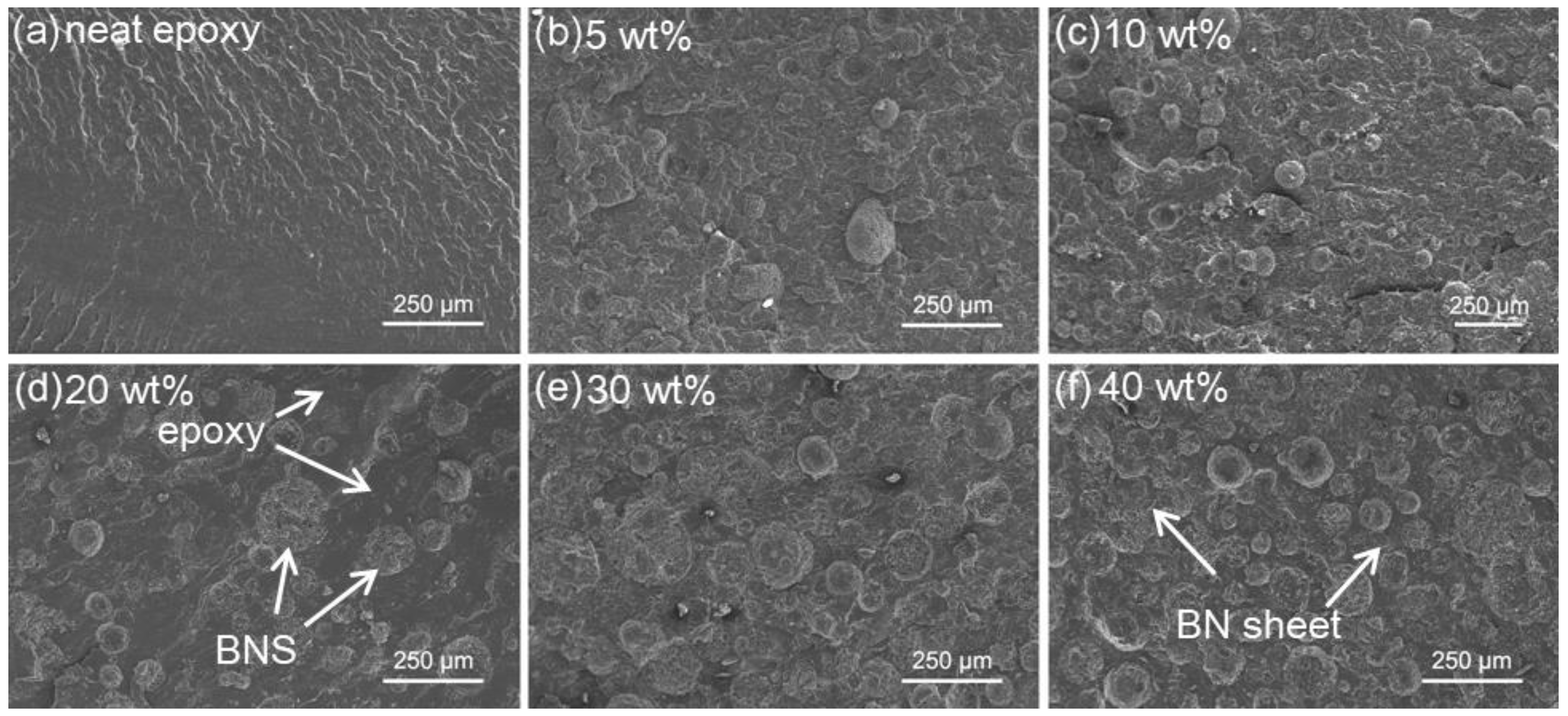
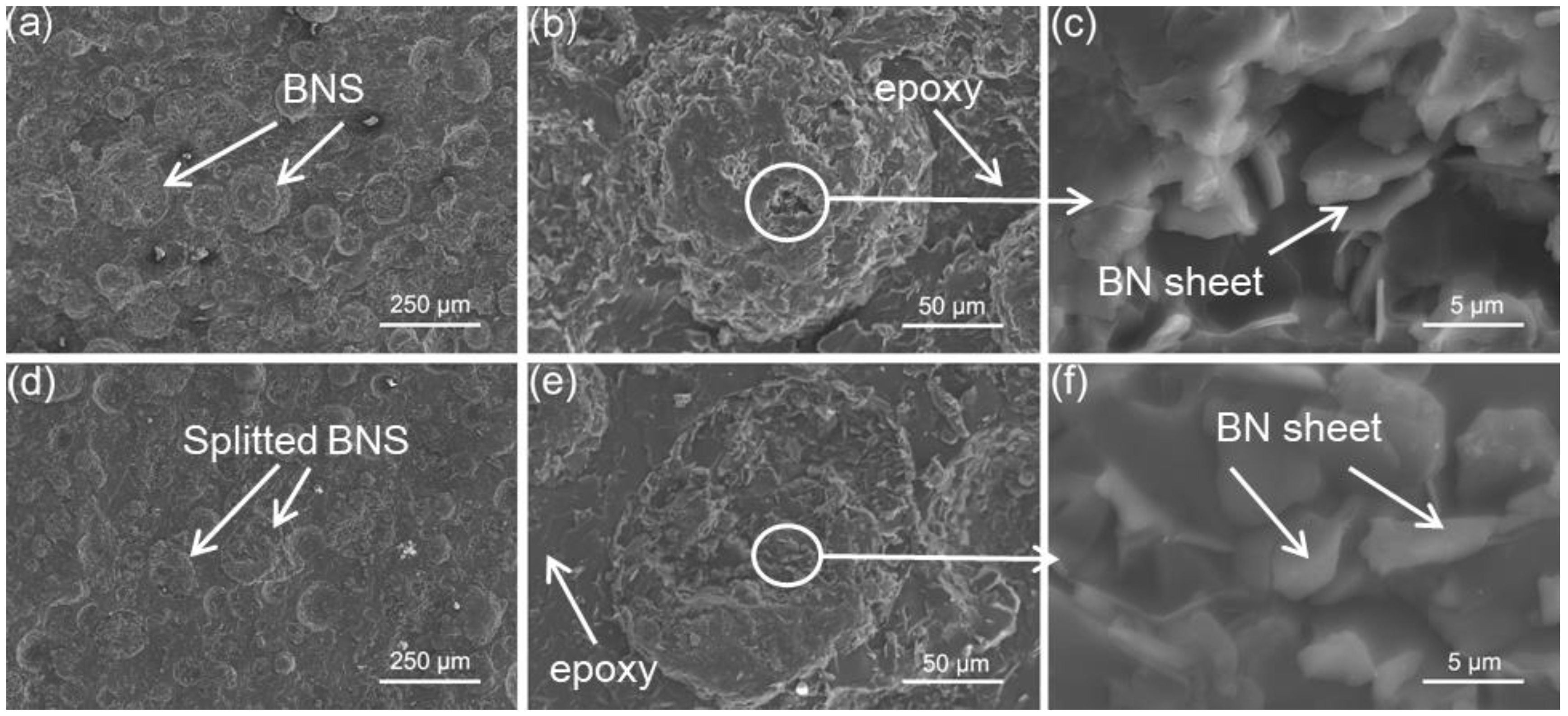
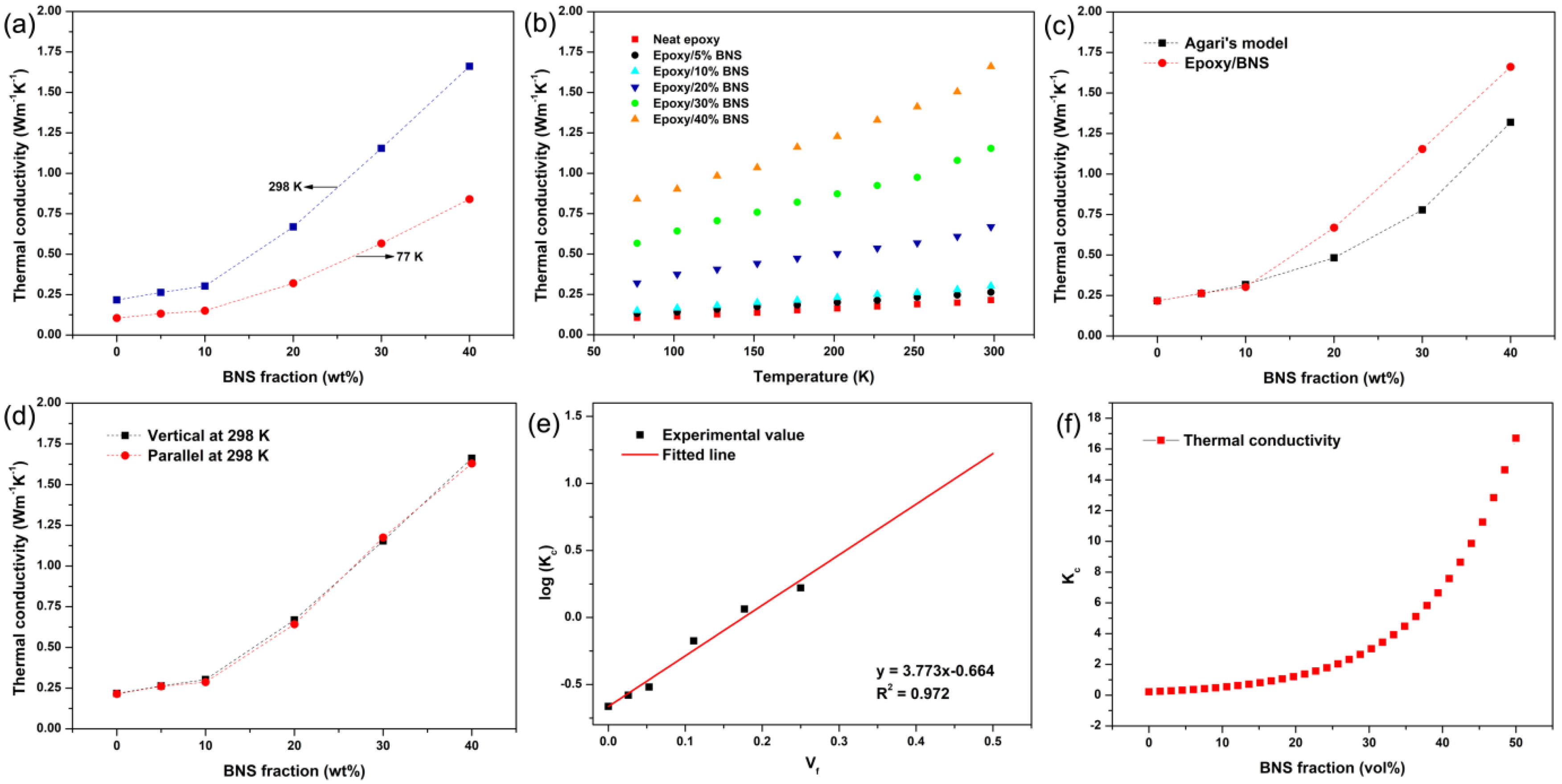
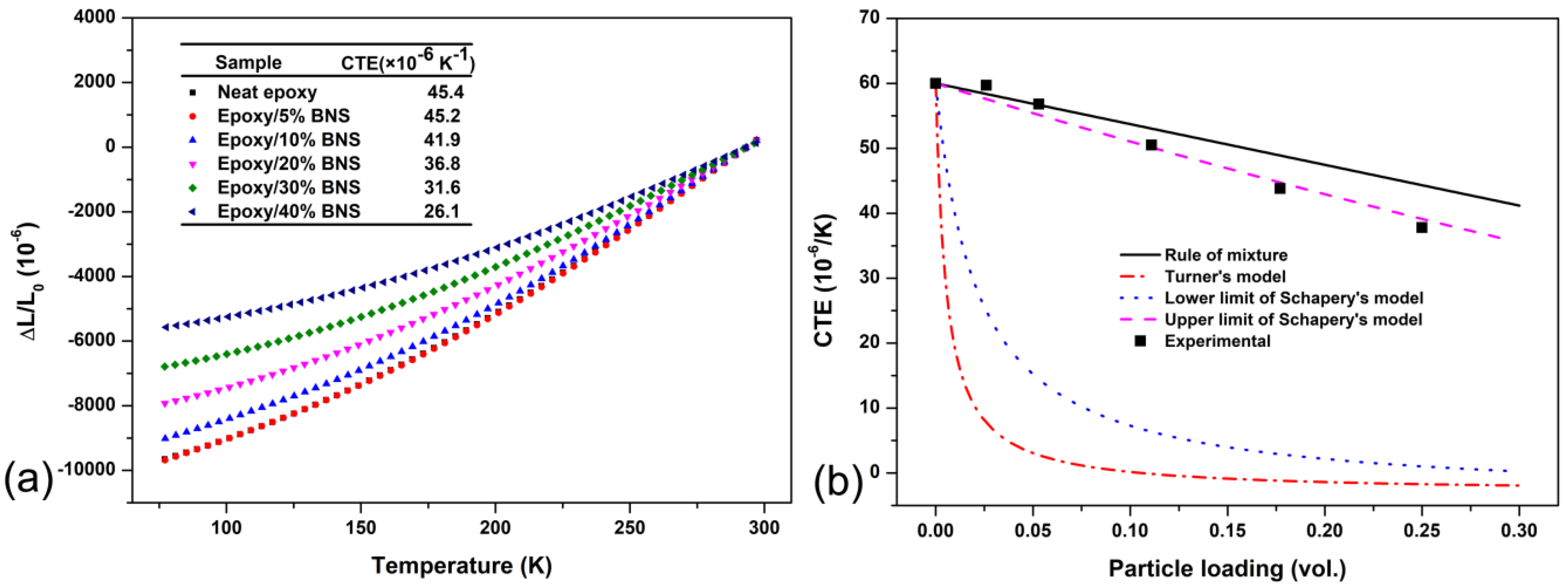

| BNS (wt %) | BNS (vol %) | ρ(gcm−1) 1 | Calculated (W·m−1·K−1) 2 | Experimental (W·m−1·K−1) 3 |
|---|---|---|---|---|
| 0 | 0 | 1.133 | 0.217 | 0.217 |
| 5 | 2.6 | 1.139 | 0.274 | 0.263 |
| 10 | 5.3 | 1.142 | 0.322 | 0.303 |
| 20 | 11.1 | 1.289 | 0.494 | 0.668 |
| 30 | 17.7 | 1.314 | 0.806 | 1.154 |
| 40 | 25 | 1.404 | 1.385 | 1.661 |
© 2019 by the authors. Licensee MDPI, Basel, Switzerland. This article is an open access article distributed under the terms and conditions of the Creative Commons Attribution (CC BY) license (http://creativecommons.org/licenses/by/4.0/).
Share and Cite
Zhang, H.; Huang, R.; Li, Y.; Li, H.; Wu, Z.; Huang, J.; Yu, B.; Gao, X.; Li, J.; Li, L. Optimization of Boron Nitride Sphere Loading in Epoxy: Enhanced Thermal Conductivity and Excellent Electrical Insulation. Polymers 2019, 11, 1335. https://doi.org/10.3390/polym11081335
Zhang H, Huang R, Li Y, Li H, Wu Z, Huang J, Yu B, Gao X, Li J, Li L. Optimization of Boron Nitride Sphere Loading in Epoxy: Enhanced Thermal Conductivity and Excellent Electrical Insulation. Polymers. 2019; 11(8):1335. https://doi.org/10.3390/polym11081335
Chicago/Turabian StyleZhang, Hua, Rongjin Huang, Yong Li, Hongbo Li, Zhixiong Wu, Jianjun Huang, Bin Yu, Xiang Gao, Jiangang Li, and Laifeng Li. 2019. "Optimization of Boron Nitride Sphere Loading in Epoxy: Enhanced Thermal Conductivity and Excellent Electrical Insulation" Polymers 11, no. 8: 1335. https://doi.org/10.3390/polym11081335
APA StyleZhang, H., Huang, R., Li, Y., Li, H., Wu, Z., Huang, J., Yu, B., Gao, X., Li, J., & Li, L. (2019). Optimization of Boron Nitride Sphere Loading in Epoxy: Enhanced Thermal Conductivity and Excellent Electrical Insulation. Polymers, 11(8), 1335. https://doi.org/10.3390/polym11081335