

Nuclear Quadrupole Resonance Spectroscopy: Tautomerism and Structure of Functional Azoles


Abstract
:1. Introduction
2. The Structure and Tautomerism of Substituted Azoles
2.1. Chlorinated Five-Membered Azoles
2.2. Chloro-Containing Benzazoles
3. Conclusions
Conflicts of Interest
References
- Stefaniak, L.; Kamienski, B.; Webb, G.A.; Larina, L.I.; Lopyrev, V.A.; Voronkov, M.G. Investigation of benzimidazoles. VII. A 13C and 15N NMR study of some nitrobenzimidazolones. Bull. Pol. Acad. Sci. Chem. 1991, 39, 317–319. [Google Scholar]
- Starikova, O.V.; Dolgushin, G.V.; Larina, L.I.; Komarova, T.N.; Lopyrev, V.A. Synthesis of new stable carbenes from the corresponding 1,3-dialkylimidazolium and benzimidazolium salts. Arkivoc 2003, 13, 119–124. [Google Scholar]
- Starikova, V.V.; Dolgushin, G.V.; Larina, L.I.; Ushakov, P.E.; Komarova, T.N.; Lopyrev, V.A. Synthesis of 1,3-dialkylimidazolium and 1,3-dialkylbenz-imidazolium salts. Russ. J. Org. Chem. 2003, 39, 1467–1470. [Google Scholar] [CrossRef]
- Titova, I.A.; Vakulskaya, T.I.; Larina, L.I.; Mizandrontsev, M.I.; Volkov, V.A.; Dolgushin, G.V.; Lopyrev, V.A. Vicarious nucleophilic C-amination of nitrobenzene and 5- and 6-nitro-1-methylbenzimidazoles. Russ. J. Org. Chem. 2005, 41, 1306–1315. [Google Scholar] [CrossRef]
- Komarova, T.N.; Larina, L.I.; Abramova, E.V.; Dolgushin, G.V. Synthesis and structure of silylsubstitued imidazol-2-ylidenes and their precursors. Russ. J. Gen. Chem. 2007, 77, 1089–1092. [Google Scholar] [CrossRef]
- Yaroshenko, T.I.; Nakhmanovich, A.S.; Larina, L.I.; Elokhina, V.N.; Amosova, S.V. Interaction of benzimidazole-2-thione with propargyl bromide and 1,3-dibromopropyne. Chem. Heterocycl. Chem. 2008, 44, 1129–1134. [Google Scholar] [CrossRef]
- Vakulskaya, T.I.; Larina, L.I.; Protsuk, N.I.; Lopyrev, V.A. Tautomerism of 3-nitro-1,2,4-triazole-5-one radical anions. Magn. Reson. Chem. 2009, 47, 716–719. [Google Scholar] [CrossRef]
- Larina, L.I.; Rozinov, V.G.; Dmitrichenko, M.Y.; Eskova, L.A. NMR investigation of chlorophosphorylation products of N-vinylazoles. Magn. Reson. Chem. 2009, 47, 149–157. [Google Scholar] [CrossRef]
- Larina, L.I.; Milata, V. 1H, 13C and 15N NMR spectroscopy and tautomerism of nitrobenzotriazoles. Magn. Reson. Chem. 2009, 47, 142–148. [Google Scholar] [CrossRef]
- Myachina, G.F.; Ermakova, T.G.; Kuznetsova, N.P.; Sultangareev, R.G.; Larina, L.I.; Klyba, L.V.; Suchanov, G.T.; Trofimov, B.A. Optimization of the synthesis of 2-phenyl-1,2,3-triazole. Chem. Heterocycl. Compd. 2010, 46, 79–81. [Google Scholar] [CrossRef]
- Larina, L.I.; Rozinov, V.G.; Rudyakova, E.V.; Savosik, V.A.; Levkovskaya, G.G.; Dmitrichenko, M.Y.; Bidusenko, I.A. Reaction of phosphorus pentachloride with N-vinylimidazole and N-vinylbenzimidazole. Russ. J. Gen. Chem. 2010, 80, 374–375. [Google Scholar] [CrossRef]
- Bella, M.; Milata, V.; Larina, L.I. 2-Amino-x-nitrobenzimidazoles as precursors of food borne carcinogens: A new approach to IQ synthesis. J. Heterocycl. Chem. 2012, 49, 293–296. [Google Scholar] [CrossRef]
- Yarosh, N.O.; Zhilitskaya, L.V.; Shagun, L.G.; Dorofeev, I.A.; Larina, L.I.; Voronkov, M.G. Alkylation of 2-methylimidazole with iodomethyl ketones of the aliphatic, aromatic, and heteroaromatic series. Russ. J. Org. Chem. 2013, 49, 475–477. [Google Scholar] [CrossRef]
- Shagun, L.G.; Dorofeev, I.A.; Yarosh, N.O.; Zhilitskaya, L.V.; Larina, L.I.; Voronkov, M.G. Alkylation of C- and N-aminotriazoles with α-iodoketones. Russ. J. Org. Chem. 2013, 49, 1676–1679. [Google Scholar] [CrossRef]
- Voronkov, M.G.; Yarosh, N.O.; Zhilitskaya, L.V.; Shagun, L.G.; Dorofeev, I.A.; Larina, L.I. Ketoalkylation of 2,4-dihydro-3H-1,2,4-triazol-3-one in dimethylsulfoxide. Russ. J. Gen. Chem. 2013, 83, 2340–2342. [Google Scholar] [CrossRef]
- Voronkov, M.G.; Shagun, L.G.; Dorofeev, I.A.; Zhilitskaya, L.V.; Yarosh, N.O.; Larina, L.I. Unusual reaction of 3-amino-1,2,4-triazole with 1,3-diiodpropan-2-one. Russ. Chem. Bull. 2014, 63, 2554–2556. [Google Scholar]
- Shagun, L.G.; Dorofeev, I.A.; Klyba, L.V.; Larina, L.I.; Yarosh, N.O.; Zhilitskaya, L.V.; Sanzheeva, E.R. Synthesis of the first organylcyclosiloxane containing a benzimidazole fragment in the cycle. Russ. J. Org. Chem. 2014, 50, 1377–1379. [Google Scholar] [CrossRef]
- Medvedeva, A.S.; Demina, M.M.; Konkova, T.V.; Wu, C.Z.; Larina, L.I. Synthesis of 4-triaklylsilyl(germyl)-1H-1,2,3-triazolcarbaldehyde oximes. Chem. Heterocycl. Compd. 2014, 50, 967–971. [Google Scholar] [CrossRef]
- Popov, A.V.; Rudyakova, E.V.; Larina, L.I.; Kobelevskaya, V.A.; Levkovskaya, G.G. Ratio of 1,3- and 1,5-dialkyl-substituted pyrazoles obtained from chlorovinyl alkyl ketones and alkylhydrazines, 3(5)-pyrazoles and alkyl bromides. Russ. J. Org. Chem. 2014, 50, 1650–1662. [Google Scholar] [CrossRef]
- Shagun, L.G.; Dorofeev, I.A.; Zhilitskaya, L.V.; Yarosh, N.O.; Larina, L.I. Synthesis of the first siloxane derivatives of triazoles. Chem. Heterocycl. Compd. 2014, 50, 1332–1337. [Google Scholar] [CrossRef]
- Shagun, L.G.; Dorofeev, I.A.; Zhilitskaya, L.V.; Larina, L.I.; Yarosh, N.O. One-pot synthesis of disulfide-tethered ionic liquids by the reaction between 4H-1,2,4-triazole-3-thiol and α-iodoketones. Mendeleev Commun. 2015, 25, 334–335. [Google Scholar] [CrossRef]
- Shagun, L.G.; Dorofeev, I.A.; Zhilitskaya, L.V.; Yarosh, N.O.; Larina, L.I. Unusual reaction of triazole derivatives with 1-(iodomethyl)-1,1,3,3,3-pentamethyldisiloxane. Russ. Chem. Bull. 2015, 64, 2261–2264. (In Russian) [Google Scholar] [CrossRef]
- Zhilitskaya, L.V.; Yarosh, N.O.; Shagun, L.G.; Dorofeev, I.A.; Larina, L.I. Alkylation of imidazole and benzimidazole derivatives with 1-(iodomethyl)-1,1,3,3,3-pentamethyldisiloxane—A new method for the preparation of organocyclosiloxane iodides. Chem. Heterocycl. Compd. 2015, 51, 381–384. [Google Scholar] [CrossRef]
- Annenkov, V.М.; Palshin, V.A.; Verkhozina, O.N.; Larina, L.I.; Danilivtseva, E.N. Composite nanoparticles: A new way to siliceous materials and a model of biosilica synthesis. Mater. Chem. Phys. 2015, 165, 227–234. [Google Scholar] [CrossRef]
- Yarosh, N.O.; Zhilitskaya, L.V.; Shagun, L.G.; Larina, L.I.; Dorofeev, I.A. The synthesis of the first acetylenic silyl derivatives of 2-methylimidazole and benzimisazole. Russ. J. Gen. Chem. 2015, 85, 2304–2308. [Google Scholar] [CrossRef]
- Yarosh, N.O.; Zhilitskaya, L.V.; Shagun, L.G.; Dorofeev, I.A.; Larina, L.I.; Klyba, L.V. Solvent- and base-free synthesis of 2-methylimidazolium 1,3-bis(silylalkanes) salts. Mendeleev Commun. 2016, 26, 426–428. [Google Scholar] [CrossRef]
- Medvedeva, A.S.; Demina, M.M.; Vu, T.D.; Andreev, M.V.; Shaglaeva, N.S.; Larina, L.I. β-Cyclodextrin-catalyzed three-component synthesis of 4,5-disubstituted 1,2,3-(NH)-triazoles from propynals, trimethylsilyl azide and malononitrile in water. Mendeleev Commun. 2016, 26, 326–328. [Google Scholar] [CrossRef]
- Yarosh, N.O.; Zhilitskaya, L.V.; Shagun, L.G.; Dorofeev, I.A.; Larina, L.I.; Klyba, L.V. Interaction of benzimidazole and benzotriazole with iodomethyl(-4-[iodomethyl(dimethyl)sylil]butyl)-dimethylsilane. Russ. J. Org. Chem. 2016, 52, 1229–1232. (In Russian) [Google Scholar] [CrossRef]
- Vchislo, N.V.; Verochkina, E.A.; Larina, L.I.; Vashchenko, A.V.; Chuvashev, Y.A. The reaction of 2-alkenals with o-phenylenediamine: A route to benzimidazoles and quinoxalines. Mendeleev Commun. 2017, 27, 166–168. [Google Scholar] [CrossRef]
- Popov, A.V.; Kobelevskaya, V.A.; Larina, L.I.; Levkovskaya, G.G. Synthesis of 3-(5-chloropyrazol-3-yl)propenals, basic precursors of new pyrazole derivatives. Mendeleev Commun. 2017, 27, 178–183. [Google Scholar] [CrossRef]
- Andreev, M.V.; Medvedeva, A.S.; Larina, L.I.; Demina, M.M. Synthesis of 5-aminoisoxazoles from 3-trimethylsilyl-2-propynamides. Mendeleev Commun. 2017, 27, 175–177. [Google Scholar] [CrossRef]
- Shagun, L.G.; Dorofeev, I.A.; Zhilitskaya, L.V.; Yarosh, N.O.; Larina, L.I. Synthesis of annelated heterocyclic systems based on 2-mercaptoimidazoline and α-iodoketones. Chem. Heterocycl. Compd. 2017, 53, 920–923. [Google Scholar] [CrossRef]
- Zhilitskaya, L.V.; Yarosh, N.O.; Shagun, L.G.; Dorofeev, I.A.; Larina, L.I. Siloxane derivatives of 2-mercaptobenzothiazole. Mendeleev Commun. 2017, 27, 352–355. [Google Scholar] [CrossRef]
- Tikhonov, N.I.; Khutsishvili, S.S.; Larina, L.I.; Pozdnyakov, A.S.; Emelyanov, A.I.; Prozorova, G.F.; Vashchenko, A.V.; Vakul’skaya, T.I. Silver polymer complexes as precursors of nanocomposites based on polymers of 1-vinyl-1,2,4-triazole. J. Mol. Struct. 2019, 1180, 272–279. [Google Scholar] [CrossRef]
- Popov, A.V.; Kobelevskaya, V.A.; Larina, L.I.; Rozentsveig, I.B. Synthesis of poly-functionalized pyrazoles under Vilsmeier-Haack reaction conditions. ARKIVOC 2019, 2017. [Google Scholar] [CrossRef]
- Shagun, L.G.; Dorofeev, I.A.; Zhilitskaya, L.V.; Yarosh, N.O.; Larina, L.I. Synthesis of triiodides of imidazoles and benzimidazoles. Russ. J. Org. Chem. 2019, 55, 1229–1232. (In Russian) [Google Scholar]
- Larina, L.I.; Lopyrev, V.A. Nitroazoles: Synthesis, Structure and Applications; Springer: New York, NY, USA, 2009; 446p. [Google Scholar]
- Larina, L.I. Tautomerism and Structure of Azoles: Nuclear Magnetic Resonance Spectroscopy. Adv. Heterocycl. Chem. 2018, 124, 233–321. [Google Scholar]
- Larina, L.I.; Lopyrev, V.A.; Voronkov, M.G. Methods of nitroazoles synthesis. Russ. J. Org. Chem. 1994, 30, 1141–1179. [Google Scholar]
- Lopyrev, V.A.; Larina, L.I.; Voronkov, M.G. Nitration of Azoles. Rev. Heteroatom Chem. 1994, 11, 27–64. [Google Scholar]
- Larina, L.I.; Lopyrev, V.A. Synthesis of nitrobenzazoles. Part 1. In Targets in Heterocyclic Systems—Chemistry and Properties; Attanasi, O.A., Spinelli, D., Eds.; Italian Society Chemistry: Rome, Italy, 2005; Volume 9, pp. 327–365. [Google Scholar]
- Larina, L.I.; Titova, I.A.; Lopyrev, V.A. Synthesis of nitrobenzazoles. Part 2. In Targets in Heterocyclic Systems—Chemistry and Properties; Attanasi, O.A., Spinelli, D., Eds.; Italian Society Chemistry: Rome, Italy, 2006; Volume 10, pp. 321–359. [Google Scholar]
- Larina, L.I.; Lopyrev, V.A. Nuclear Magnetic Resonance of Nitroazoles. In Topics in Heterocyclic Systems—Synthesis, Reactions and Properties; Attanasi, O.A., Spinelli, D., Eds.; Research Signpost: Trivandrum, India, 1996; Volume 1, pp. 187–237. [Google Scholar]
- Larina, L.I.; Lopyrev, V.A.; Klyba, L.V.; Bochkarev, V.N. Mass Spectrometry of Nitroazoles. In Targets in Heterocyclic Systems. Chemistry and Properties; Attanasi, O.A., Spinelli, D., Eds.; Italian Society Chemistry: Rome, Italy, 1998; Volume 2, pp. 443–470. [Google Scholar]
- Lopyrev, V.A.; Larina, L.I.; Vakulskaya, T.I. Quantitative estimation of electronic substituent effects in five-membered, nitrogen-containing aromatic heterocycles. Russ. Chem. Rev. 1986, 55, 411–425. [Google Scholar] [CrossRef]
- Larina, L.I. NMR Spectroscopy and Structure of Substituted Azoles. Ph.D. Thesis, Irkutsk Institute of Chemistry, Russian Academy of Science, Irkutsk, Russia, 2003; 285p. (In Russian). [Google Scholar]
- Pozharskii, A.F.; Soldatenko, A.T.; Katritzky, A.R. Why nature prefers heterocycles. In Heterocycles in Life and Society: An Introduction to Heterocyclic Chemistry and Biochemistry, Medicine and Agriculture, 2nd ed.; John Wiley & Sons Ltd.: West Sussex, UK, 2011; 382p. [Google Scholar]
- Anusevicius, Z.; Soffers, A.E.M.F.; Cenas, N.; Sarlauskas, J.; Segura-Aguilar, J.; Rietjens, I.M.C.M. Quantitative structure activity relationships for the electron transfer reactions of Anabaena PCC7119 ferredoxin-NADP(+) oxidoreductase with nitrobenzene and nitrobenzimidazolone derivatives: Mechanistic implications. FEBS Lett. 1999, 450, 44–48. [Google Scholar] [CrossRef]
- Demirayak, S.; Kayagil, I.; Yurttas, L. Microwave supported synthesis of some novel 1,3-diarylpyrazino[1,2-a]benzimidazole derivatives and investigation of their anticancer activities. Eur. J. Med. Chem. 2011, 46, 411–416. [Google Scholar] [CrossRef] [PubMed]
- Canada, J.; Claramunt, R.M.; De Mendoza, J.; Elguero, J. On the possibility of chlorotropy in aromatic azoles: The case of 1,2,3-triazoles and benzotriazoles. Heterocycles 1985, 23, 2225–2228. [Google Scholar]
- Gallagher, T.C.; Sasse, M.J.; Storr, R.C. Fragmentation of N-chlorotriazoles. J. Chem. Soc. Chem. Commun. 1979, 9, 419–420. [Google Scholar] [CrossRef]
- De Rosa, M.; Canudas, N.; Arnold, D. Chlorotropy of 1-chlorobenzimidazole. J. Org. Chem. 2013, 78, 7264–7267. [Google Scholar] [CrossRef] [PubMed]
- De Rosa, M.; Alonso, T.; Ledia, J. Studies of the mechanism of chlorination of indoles. Detection of N-chloroindole and 3-chloro-3H-indole as intermediates. J. Org. Chem. 1978, 43, 2637–2643. [Google Scholar] [CrossRef]
- Jeffrey, G.A.; Ruble, J.R.; Yates, J.H. Neutron diffraction at 15 and 120 K and ab initio molecular-orbital studies of the molecular structure of 1,2,4-triazole. Acta Crystallogr. B 1983, 39, 388–394. [Google Scholar] [CrossRef]
- Fuhmann, P.; Karitsansky, T.; Luger, P. Experimental electron density study of 1,2,4-triazole at 15 K. A Comparison with ab initio calculations. Zeitschrift Kristallographie 1997, 212, 213–220. [Google Scholar]
- Ramsden, C.A. The influence of aza-substitution on azole aromaticity. Tetrahedron 2010, 66, 2695–2699. [Google Scholar] [CrossRef]
- Claramunt, R.M.; Sanz, D.; Alkorta, I.; Elguero, J.; Foces-Foces, C.; Llamas-Saiz, A.L. Ab initio study of azolides: Energetic and spectroscopic properties. J. Heterocycl. Chem. 2001, 38, 443–450. [Google Scholar] [CrossRef]
- Alkorta, I.; Elguero, J. A density functional theoretical study of the influence of cavities and water molecules on tautomerism: The case of pyridones and 1,2,4-triazoles linked to crown ethers and esters. J. Heterocycl. Chem. 2001, 38, 1387–1391. [Google Scholar] [CrossRef]
- Curtis, A.D.M.; Jennings, N. Comprehensive Heterocyclic Chemistry III: A Review of the Literature 1995–2007; Katritzky, A.R., Ramsden, C.A., Scriven, E.F.V., Taylor, R.J.K., Eds.; Elsevier: Oxford, UK, 2008; Volume 5, 160p. [Google Scholar]
- Elguero, J.; Katritzky, A.R.; Denisko, O.V. Ptototropic Tautomerism of Heterocycles: Heteroaromatic Tautomerism—General Overview and Methodology. Adv. Heterocycl. Chem. 2000, 76, 2–86. [Google Scholar]
- Minkin, V.I.; Garnovskii, A.D.; Elguero, J.; Katritzky, A.R.; Denisko, O.V. Tautomerism of Heterocycles: Five-Membered Rings with Two or More Heteroatoms. Adv. Heterocycl. Chem. 2000, 76, 159–323. [Google Scholar]
- Bojarska-Olejnik, E.; Stefaniak, L.; Witanowski, M.; Webb, G.A. 15N NMR investigation of prototropic equilibria of some triazoles. Bull. Pol. Acad. Sci. Chem. 1987, 35, 85–90. [Google Scholar]
- Creagh, L.D.; Trutt, P. Nuclear Magnetic Resonance studies of triazoles. 1. Tautomerism of 1,2,4-triazole. J. Org. Chem. 1968, 33, 2956–2957. [Google Scholar] [CrossRef]
- Bojarska-Olejnik, E.; Stefaniak, L.; Witanowski, M.; Webb, G.A. 15N NMR Investigation of the tautomeric equilibria of some 1,2,4-triazoles and related compounds. Magn. Reson. Chem. 1986, 24, 911–914. [Google Scholar] [CrossRef]
- Jaszunski, M.; Mikkelsen, K.V.; Rizzo, A.; Witanowski, M. A Study of the nitrogen NMR spectra of azoles and their solvent dependence. J. Phys. Chem. A 2000, 104, 1466–1473. [Google Scholar] [CrossRef]
- Aberhaim, D.; Diez-Barra, E.; de la Hoz, A.; Loupy, A.; Sanchez-Migallon, A. Selective alkylation of 1,2,4-triazole and benzotriazole in the absence of solvent. Heterocycles 1994, 38, 793–803. [Google Scholar]
- Vasiliev, A.D.; Astakhov, A.M.; Golubtsova, L.A.; Kruglyakova, L.A.; Stepanov, R.S. 3-Nitro-1-nitromethyl-1H-1,2,4-triazole. Acta Crystallogr. Sect. C 2000, 56, 999–1000. [Google Scholar] [CrossRef]
- Dolgushin, G.V.; Lazarev, I.M.; Larina, L.I.; Lopyrev, V.A.; Voronkov, M.G. A 35Cl NQR and MNDO Study of 3,5-dichloro-1,2,4-triazole and Its Ionic Forms. Zeitschrift Naturforschung A 1994, 49, 167–170. [Google Scholar] [CrossRef]
- Dolgushin, G.V.; Lazarev, I.M.; Larina, L.I.; Lopyrev, V.A.; Voronkov, M.G. A 35Cl NQR and MNDO study of 3,5-dichloro-1,2,4-triazole and its Ionic Forms. In Proceedings of the XII International Symposium on Nuclear Quadrupole Resonance Spectroscopy, Zurich, Switzerland, 19–23 July 1993. [Google Scholar]
- Makarskii, V.V.; Voronkov, M.G.; Feshin, V.P.; Lopyrev, V.A.; Berestennikov, N.I.; Shibanova, E.F.; Volkova, L.I. Molecular structure of 1,2,4-triazole. Doklady AN SSSR 1975, 220, 101–104. [Google Scholar]
- Starova, G.A.; Frank-Kamenetskaya, O.V.; Makarskii, V.V. Molecular and crystal structure of 3,5-dichloro-1H-1,2,4-triazole. Kristallografiya 1990, 35, 769–771. (In Russian) [Google Scholar]
- Garcia, M.A.; Lopez, C.; Peters, O.; Claramunt, R.M.; Klein, O.; Schagen, D.; Limbach, H.H.; Foces-Foces, C.; Elguero, J. Triple proton transfer in crystalline 3,5-dibromo-1H-1,2,4-triazole and 3,5-dicloro-1H-1,2,4-triazole studies by variable-temperature 15N NMR and ab initio calculations. Magn. Reson. Chem. 2000, 38, 604–614. [Google Scholar] [CrossRef]
- Garcia, M.L.S.; Smith, J.A.S.; Bavin, P.M.G.; Ganellin, C.R. 14N and 2H Quadrupole Double Resonance in substituted imidazoles. J. Chem. Soc. Perkin Trans. 1983, 9, 1391–1399. [Google Scholar] [CrossRef]
- Licht, H.H.; Ritter, H.; Bircher, H.R.; Bigler, P. Tautomerism in Nitrotriazoles: Structure investigation by combined 1H, 13C and 15N NMR spectroscopy. Magn. Reson. Chem. 1998, 36, 343–350. [Google Scholar] [CrossRef]
- Bojarska-Olejnik, E.; Stefaniak, L.; Witanowski, M.; Hamdi, B.T.; Webb, G.A. Application of 15N NMR to study of tautomeric in some monocyclic triazoles. Magn. Reson. Chem. 1985, 23, 166–169. [Google Scholar] [CrossRef]
- Kofman, T.P. 5-Amino-1,2,4-triazole and its derivatives. Russ. J. Org. Chem. 2002, 38, 1231–1243. [Google Scholar] [CrossRef]
- Sorescu, D.C.; Bennett, C.M.; Thompson, D.L. Theoretical Studies of the Structure, Tautomerism, and Vibrational Spectra of 3-Amino-5-nitro-1,2,4-triazole. J. Phys. Chem. A 1998, 102, 10348–10357. [Google Scholar] [CrossRef]
- Pevzner, M.S.; Fedorova, E.Y.; Shokhor, I.N.; Bagal, L.I. Heterocyclic nitrocompounds. IX. Dipole moments of 3(5)-nitro-1,2,4-triazoles. Chem. Heterocycl. Compd. 1971, 2, 275–278. (In Russian) [Google Scholar]
- Bojarska-Olejnik, E.; Stefaniak, L.; Witanowski, M.; Webb, G.A. A 15N NMR Study on Some 3-Methylthio-1,2,4-Triazoles and Related Compounds. Bull. Pol. Acad. Sci. Chem. 1986, 34, 289–293. [Google Scholar]
- Vokin, A.I.; Sherstyannikova, L.V.; Krivoruchka, I.G.; Abzaeva, K.A.; Lopyrev, V.A.; Turchaninov, V.K. Solvatochromism of heteroaromatic compounds: XV. 3-Nitro-1,2,4-triazol-5one. Russ. J. Gen. Chem. 2002, 72, 456–459. [Google Scholar] [CrossRef]
- Makarskii, V.V.; Starova, G.A.; Frank-Kamenetskaya, O.V.; Lopyrev, V.A. Molecular structure of 3-amino-1,2,4-triazole. Chem. Heterocycl. Compd. 1977, 8, 1138–1139. (In Russian) [Google Scholar] [CrossRef]
- Starova, G.A.; Frank-Kamenetskaya, O.V.; Makarskii, V.V.; Lopyrev, V.A. Crystal and molecular structure of 5-amino-1H-1,2,4-triazole. Kristallografiya 1978, 23, 849–851. (In Russian) [Google Scholar]
- Dolgushin, G.V.; Larina, L.I.; Nikitin, P.A.; Lopyrev, V.A. 35Cl NQR spectra and the structure of chloro-containing benzimidazole derivatives. Russ. J. Gen. Chem. 1996, 66, 1889–1893. [Google Scholar]
- Nikitin, P.A.; Lazarev, I.M.; Dolgushin, G.V. Refinement of the Townes-Dailey theory. MNDO calculation of 35CI NQR frequencies. Mendeleev Commun. 1995, 5, 13–14. [Google Scholar] [CrossRef]
- Dolgushin, G.V.; Lazarev, I.M.; Nikitin, P.A.; Larina, L.I.; Voronkov, M.G. A Cl-35 NQR and MNDO Investigation of inorganic and organic chlorine compounds. In Fifteenth Austin Symposium on Molecular Structure; University of Texas: Austin, TX, USA, 1994; p. 113. [Google Scholar]
- Lucken, E.A.C. Nuclear Quadrupole Coupling Constants; Academic Press: New York, NY, USA, 1969. [Google Scholar]
- Dolgushin, G.V.; Lazarev, I.M.; Nikitin, P.A.; Larina, L.I. 35Cl NQR of the N-Cl Bond and the Modified Townes-Daily Theory. Zeitschrift Naturforschung A 1996, 51, 544–548. [Google Scholar] [CrossRef]
- Dolgushin, G.V.; Lazarev, I.M.; Nikitin, P.A.; Larina, L.I.; Voronkov, M.G. A 35Cl NQR and MNDO Investigation of Inorganic and Organic Chlorine Compounds. NQI Newsl. 1994, 1, 37. [Google Scholar]
- Dolgushin, G.V.; Lazarev, I.M.; Nikitin, P.A.; Larina, L.I. 35Cl NQR and Quantum Chemistry. N-Cl Bond. NQI Newsl. 1995, 1, 3–4. [Google Scholar]
- Dolgushin, G.V.; Lazarev, I.M.; Nikitin, P.A.; Larina, L.I. 35Cl NQR of the N-Cl bond and modified Townes-Dailey Theory. In Proceedings of the XIIIth International Symposium on Nuclear Quadrupole Interactions, Providence, RI, USA, 23–28 July 1995; p. 25. [Google Scholar]
- Dolgushin, G.V.; Lazarev, I.M.; Nikitin, P.A.; Larina, L.I. 35Cl NQR and quantum chemistry. N-Cl bond. In Proceedings of the Fourth International Conference on Heteroatom Chemistry, Seoul, Korea, 30 July–4 August 1995; p. 161. [Google Scholar]
- Benassi, R.; Lazzeretti, P.; Schenetti, L.; Taddei, F.; Vivarelli, P. NMR study of tautomerism in substituted 2-chlorobenzimidazoles. Tetrahedron Lett. 1971, 12, 3299–3300. [Google Scholar] [CrossRef]
- Claramunt, R.M.; Lopez, C.; Alkorta, I.; Elguero, J.; Yang, R.; Schulman, S. The tautomerism of omeprazole in solution: 1H and 13C NMR study. Magn. Reson. Chem. 2006, 42, 712–714. [Google Scholar] [CrossRef]
- Latosinska, J.N.; Seliger, J.; Nogaj, B. Electron density distribution in 2-nitro-5-methylimidazole derivatives studied by NMR-NQR double resonance. Magn. Reson. Chem. 1999, 37, 878–880. [Google Scholar] [CrossRef]
- Latosinska, J.N.; Koput, J. Analysis of the NQR parameters in 2-nitro-5-methylimidazole derivatives by quantum chemical calculations. Phys. Chem. Chem. Phys. 2000, 2, 145–150. [Google Scholar] [CrossRef]
- Pirnat, J.; Luznik, J.; Jazbinsek, V.; Zagar, V.; Seliger, J.; Klapotke, T.M.; Trontel, Z. 14N NQR in the tetrazole family. Chem. Phys. 2009, 364, 98–104. [Google Scholar] [CrossRef]
- Seliger, J.; Zagar, V.; Latosinska, J.N. 14N NQR, 1H NMR and DFT/QTAIM study of hydrogen bonding and polymorphism in selected solid 1,3,4-thiadiazole derivatives. Phys. Chem. Chem. Phys. 2010, 12, 13007–13019. [Google Scholar] [CrossRef] [PubMed]
- Latosinska, J.N. Thermodinamic stability of indazole studied by NMR-NQR spectroscopy and ab initio calculations. Magn. Reson. Chem. 2000, 38, 192–196. [Google Scholar] [CrossRef]
- Latosinska, J.N.; Latosinska, M.; Seliger, J.; Zagar, V.; Maurin, J.K.; Orzeszko, A.; Kazimierczuk, Z. Structural study of selected polyhalogenated benzimidazoles (Protein Kinase CK2 Inhibitors) by nuclear quadrupole double resonance, X-ray, and density functional theory. J. Phys. Chem. A 2010, 114, 563–575. [Google Scholar] [CrossRef] [PubMed]
- Seliger, J.; Zagar, V. Crystallization of an amorphous solid studied by nuclear quadrupole double resonance. Chem. Phys. 2013, 421, 44–48. [Google Scholar] [CrossRef]
- Seliger, J.; Zagar, V. Hydrogen bonds in co-crystals and salts of 2-amino-4,6-dimethylpyrimidine and carboxylic acids studied by nuclear quadrupole resonance. J. Phys. Chem. B 2013, 117, 6946–6956. [Google Scholar] [CrossRef] [PubMed]
- Seliger, J.; Zagar, V. Tautomerism and possible polymorphism in solid hydroxypyridines and pyridones studied by 14N NQR. J. Phys. Chem. B 2013, 117, 1653–1658. [Google Scholar] [CrossRef] [PubMed]
- Latosinska, J.N.; Seliger, J.; Grechishkin, V.; Spychala, J. Studies of the electronic structureof 4-N-cytosine derivatives by NMR-NQR double resonance spectroscopy. Magn. Reson. Chem. 1999, 37, 881–884. [Google Scholar] [CrossRef]
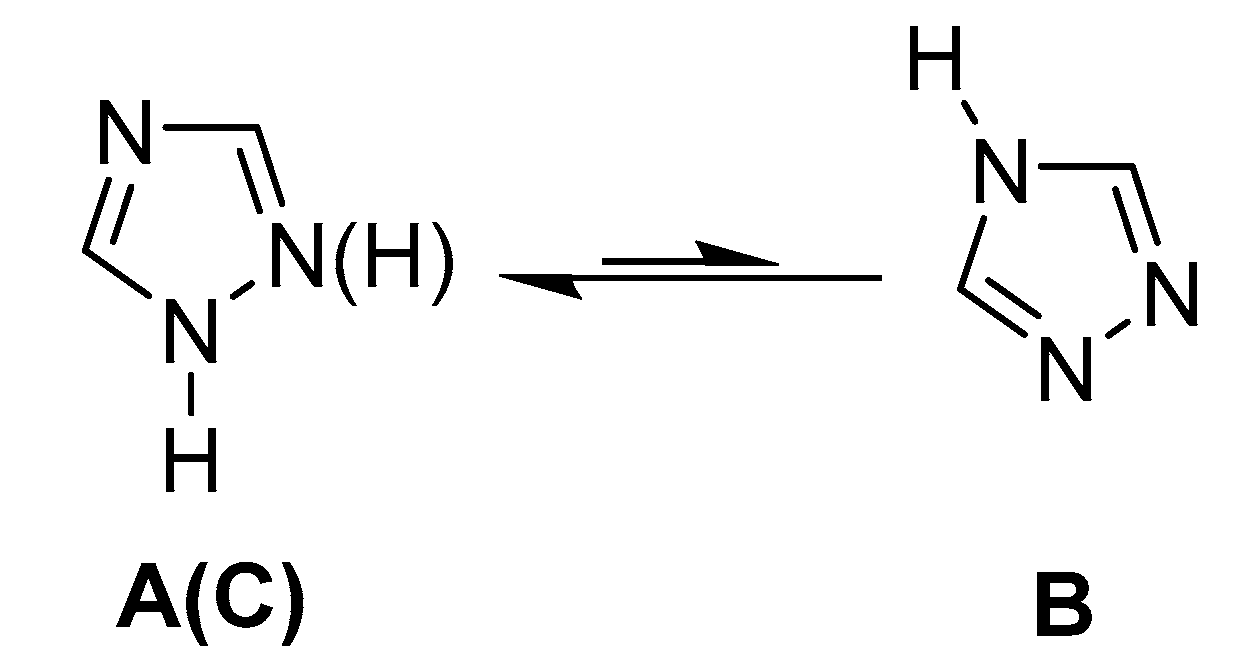
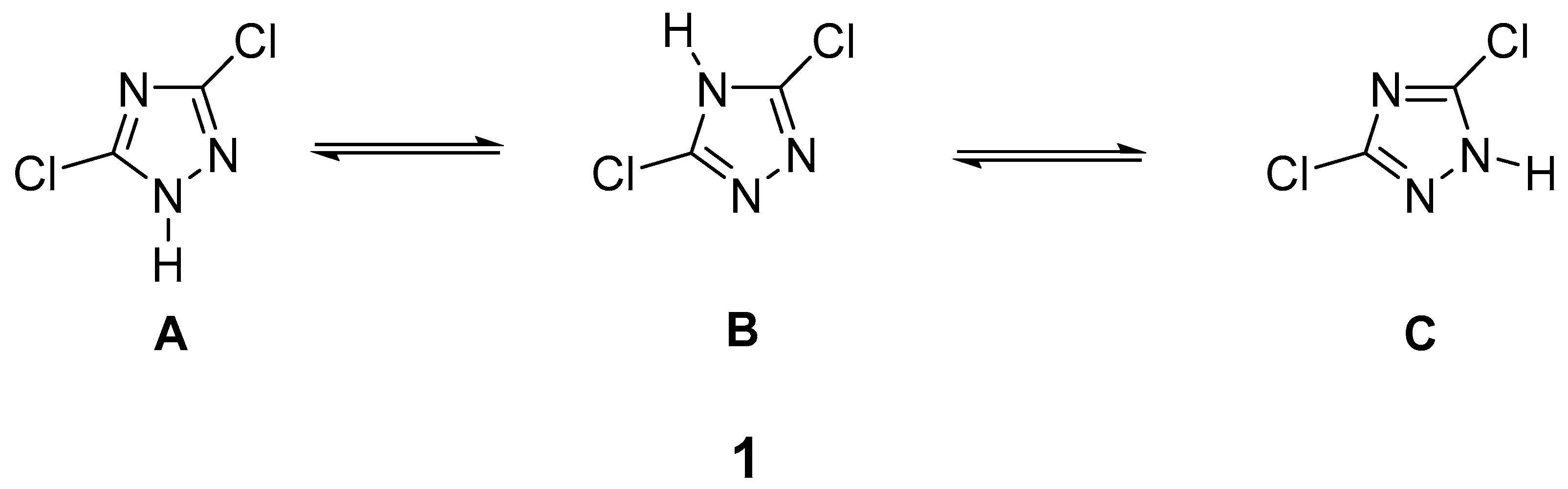
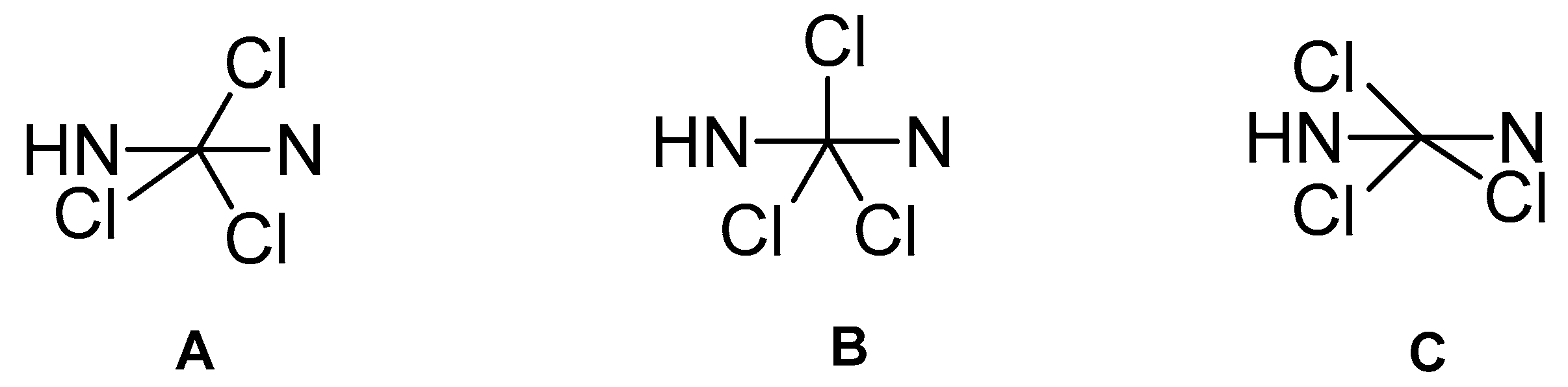
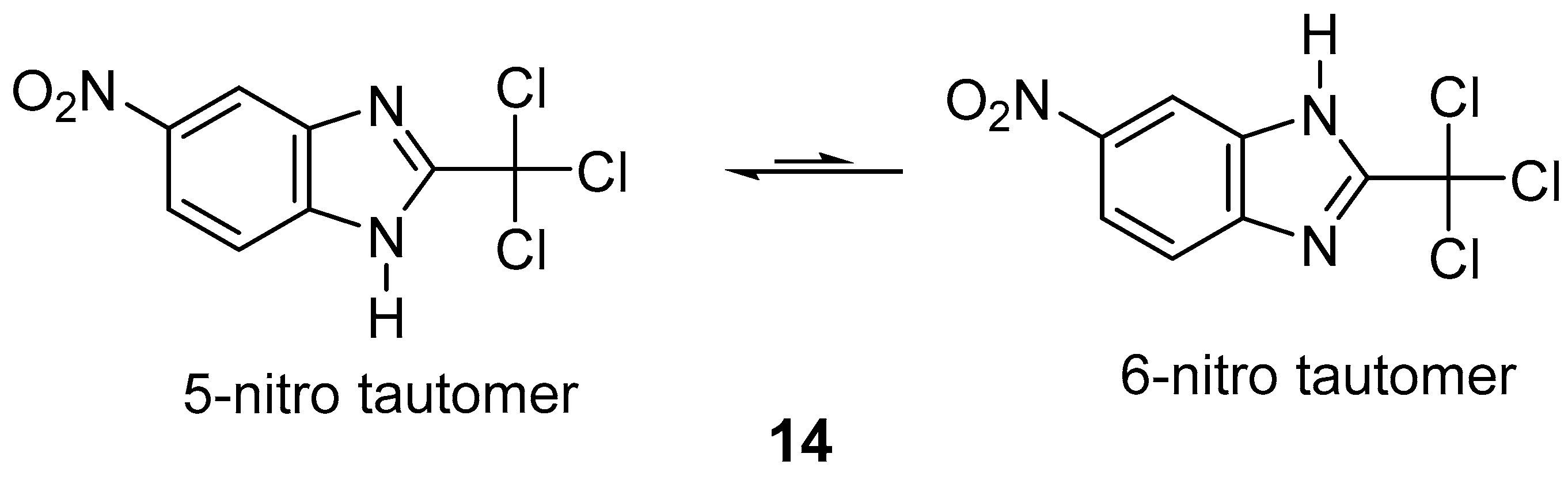
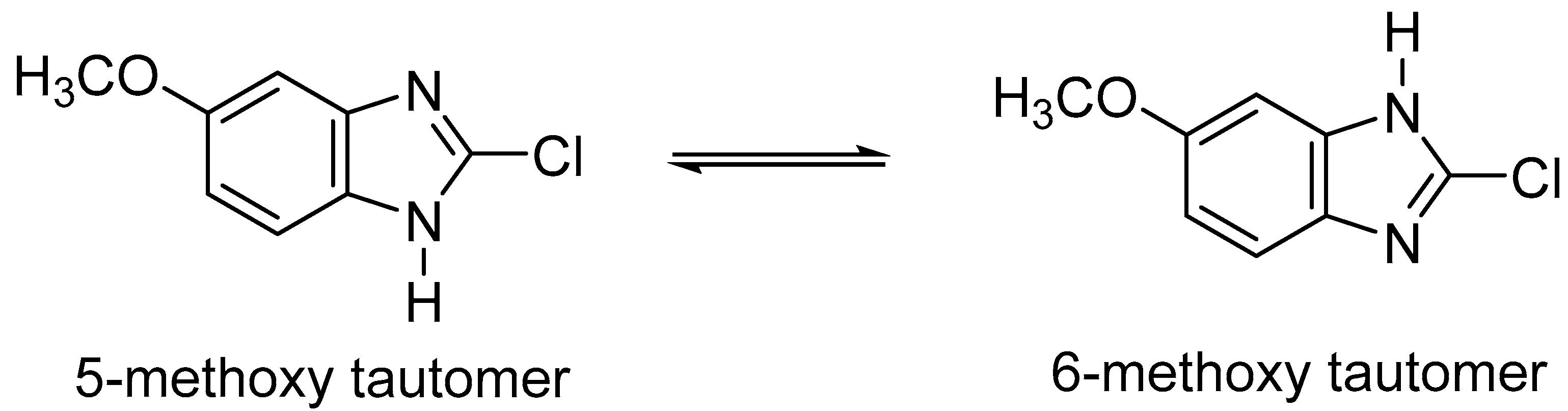

| Compound | Structure | ν, MHz | s/n |
|---|---|---|---|
| 1 |  | 37.322 | 8 |
| 38.085 | 22 | ||
| 38.203 | 15 | ||
| 38.899 | 17 | ||
| 2 |  | 36.791 | 8 |
| 37.120 | 5 | ||
| 38.014 | 9 | ||
| 3 |  | 38.916 | 15 |
| 39.744 | 15 | ||
| 19.452 | 4 | ||
| 19.657 | 4 | ||
| 4 | 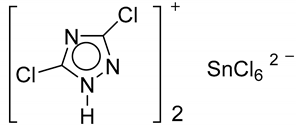 | 40.734 | 10 |
| 41.608 | 11 | ||
| 16.040 | 3 | ||
| 16.312 | 2 | ||
| 17.776 | 6 | ||
| 5 |  | 40.526 | 20 |
| 41.408 | 20 | ||
| 6 | 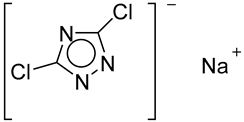 | 35.491 | 11 |
| 35.629 | 5 | ||
| 36.111 | 4 | ||
| 7 |  | 35.034 | 8 |
| 8 |  | 36.720 | 9 |
| 36.924 | 8 | ||
| 9 |  | 36.172 | 11 |
| 37.409 | 12 | ||
| 10 | 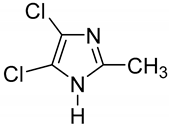 | 36.070 | 10 |
| 37.394 | |||
| 11 | 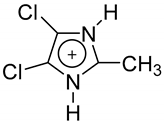 | 39.025 | 7 |
| 12 | 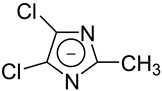 | 34.716 | 8 |
| Compound | Structure | ν, MHz | s/n |
|---|---|---|---|
| 13 |  | 40.174 | 7 |
| 39.848 | 8 | ||
| 39.728 | 6 | ||
| 39.642 | 7 | ||
| 39.516 | 7 | ||
| 39.136 | 8 | ||
| 14 |  | 40.574 | 11 |
| 39.724 | 19 | ||
| 15 |  | 37.445 | 33 |
| 37.253 | 35 | ||
| 16 | 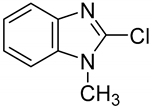 | 36.296 | 10 |
| 17 |  | 39.618 | 7 |
| 18 |  | 37.740 | 8 |
| Method | 5-Nitro Tautomer | 6-Nitro Tautomer | |||||||
|---|---|---|---|---|---|---|---|---|---|
| φ | 0 | 180 | 0 | 180 | |||||
| TD | MTD | TD | MTD | TD | MTD | TD | MTD | ||
| AM1 | H | 56.487 | 56.126 | 57.097 | 56.780 | ||||
| ν | 50.452 | 45.650 | 51.557 | 46.481 | 50.496 | 45.724 | 51.535 | 46.524 | |
| 50.443 | 45.646 | 49.179 | 44.666 | 50.502 | 45.729 | 49.107 | 44.657 | ||
| 48.425 | 43.957 | 48.719 | 44.304 | 48.558 | 44.098 | 49.098 | 44.657 | ||
| PM3 | H | 20.300 | 20.437 | 20.786 | 21.066 | ||||
| ν | 54.414 | 46.961 | 55.666 | 47.542 | 54.512 | 47.105 | 55.734 | 47.624 | |
| 54.370 | 46.977 | 52.419 | 45.642 | 54.460 | 47.109 | 52.541 | 45.865 | ||
| 51.477 | 44.691 | 52.384 | 45.743 | 51.629 | 44.885 | 52.445 | 45.775 | ||
© 2019 by the author. Licensee MDPI, Basel, Switzerland. This article is an open access article distributed under the terms and conditions of the Creative Commons Attribution (CC BY) license (http://creativecommons.org/licenses/by/4.0/).
Share and Cite
Larina, L.I. Nuclear Quadrupole Resonance Spectroscopy: Tautomerism and Structure of Functional Azoles. Crystals 2019, 9, 366. https://doi.org/10.3390/cryst9070366
Larina LI. Nuclear Quadrupole Resonance Spectroscopy: Tautomerism and Structure of Functional Azoles. Crystals. 2019; 9(7):366. https://doi.org/10.3390/cryst9070366
Chicago/Turabian StyleLarina, Lyudmila I. 2019. "Nuclear Quadrupole Resonance Spectroscopy: Tautomerism and Structure of Functional Azoles" Crystals 9, no. 7: 366. https://doi.org/10.3390/cryst9070366
APA StyleLarina, L. I. (2019). Nuclear Quadrupole Resonance Spectroscopy: Tautomerism and Structure of Functional Azoles. Crystals, 9(7), 366. https://doi.org/10.3390/cryst9070366

