Article

Structural Characterization, Hirshfeld Surface Analysis, Thermal Behavior and Optical Bandgap of N,N′-bis(Phosphonomethyl)pyromellitimide


1
Department of Chemistry, Biochemistry and Physics, St. Mary’s University, San Antonio, TX 78228, USA
2
Department of Chemistry, University of Texas at San Antonio, San Antonio, TX 78249, USA
*
Author to whom correspondence should be addressed.
Crystals 2026, 16(8), 506; https://doi.org/10.3390/cryst16080506 (registering DOI)
Submission received: 19 June 2026 / Revised: 21 July 2026 / Accepted: 27 July 2026 / Published: 1 August 2026
(This article belongs to the Section Organic Crystalline Materials)

Abstract

The condensation reaction of pyromellitic dianhydride and (aminomethyl)phosphonic acid in imidazole yielded N,N′-bis(phosphonomethyl)pyromellitimide ([(H2O3P)CH2-(C10H2N2O4)-CH2(PO3H2)]∙2H2O). Recrystallization of this compound from deionized water, by placing the solution in a desiccator to allow slow diffusion of HCl, afforded suitable single crystals for X-ray crystallographic studies. The compound crystallizes in the monoclinic space group P21/n. The flexible methylene phosphonic acid groups appended to both nitrogen termini adopt a trans configuration. The phosphonate and carbonyl groups (acceptors: P=O and C=O), together with water molecules [donor: O(6)—H∙∙∙O], participate in an extensive network of hydrogen-bonding interactions. Two of the phosphonate groups are protonated as P—OH (donors) and interact with oxygen atoms of neighboring phosphonate groups and water molecules. Hirshfeld surface analysis and associated two-dimensional fingerprint plots indicate that O∙∙∙H/H∙∙∙O (56.1%) contacts are the primary contributors to the crystal packing, followed by H∙∙∙H (16.3%) and C∙∙∙O/O∙∙∙C (13.4%) interactions. No significant π–π interactions were observed. The direct optical bandgap value, estimated from the Tauc plot, is 3.24 eV, indicating semiconducting behavior. The compound also exhibits thermal stability up to ~270 °C. These properties suggest that this compound may be a promising candidate for future investigation in organic electronic and optoelectronic materials.

1. Introduction

Owing to their unique electrochemical and photochemical behavior, aromatic diimides have emerged as an important and versatile family of compounds [1,2,3,4,5]. In general, they serve as excellent building blocks for the assembly of coordination polymers and metal–organic frameworks (MOFs), particularly when the imide nitrogen atoms bear pyridyl, phosphonic acid, sulfonic acid, or carboxylic acid substituents [1,4,6]. Compounds derived from benzene, naphthalene, and perylene backbones are especially attractive owing to the multiple opportunities for chemical modification of either the imide nitrogen atoms or the aromatic ring system.
Functionalization of these aromatic backbones with ethyl phosphonic acid groups yields ligands such as N,N′-bis(2-phosphonoethyl)-pyromellitimide (PPMI), N,N′-bis(2-phosphonoethyl)-1,4,5,8-naphthalenediimide (PNDI) and N,N′-bis(2-phosphonoethyl)-3,4,9,10-perylenediimide (PPDI), as shown in Scheme 1 [7]. These ligands are water-soluble and exhibit strong binding affinity toward metal surfaces. Most early studies focused on the development of highly stable self-assembled thin films based on zinc and zirconium phosphonate chemistry [7,8,9,10,11].
More recently, two pillared lamellar compounds were synthesized from N,N′-bis(2-phosphonoethyl)-1,4,5,8-naphthalenediimide and zinc nitrate in the presence of water or N,N-dimethylformamide (DMF) as solvent [12]. Only the crystal structure of the hydrated compound was reported using powder X-ray diffraction data. Nitrogen adsorption measurements revealed that the DMF-containing material exhibits higher porosity than the corresponding hydrated compound. In a related study, an ammonium naphthalenediimide salt was prepared using sodium hydroxide and ammonium chloride [13]. This material displays proton conduction behavior, with a crossover from the Grotthuss mechanism at low temperature to the Vehicle mechanism at higher temperature. Champness and co-workers reported the role of diverse intermolecular interactions, notably charge assisted hydrogen bonding, in amidinium⋯phosphonate frameworks derived from N,N′-bis(2-phosphonobenzyl)-1,4,5,8-naphthalenediimide [14].
Motivated by these studies, our group investigated the intermolecular hydrogen bonding and π─π stacking interactions in N,N′-bis(phosphonomethyl)-1,4,5,8-naphthalenediimide. Both the phosphonic acid groups and coordinated water molecules function as hydrogen-bond donors and acceptors, thereby contributing to the stability of the crystal packing and the overall supramolecular architecture [15,16,17,18,19,20,21,22]. Such compounds are promising building blocks for the design of n-type semiconductors owing to their planarity, extended π−electron delocalization, and enhanced intermolecular charge transfer [23]. More broadly, n-type semiconductors are of significant interest for applications in electronic and optoelectronic devices [2,24,25]. The planar naphthalene core offers a combination of advantageous optical absorption characteristics with effective π-electron delocalization and efficient pathways for charge migration between neighboring molecules [26,27]. In a related study, significant birefringence was observed in the hydrogen-bonded self-assembled crystal of the same compound [28].
Several literature reports on pyromellitimide focus on derivatives appended with pyridine for the preparation of crystalline materials [29,30,31,32,33]. Its phosphonate-substituted derivative (PPMI) is colorless and monomeric in solution, forming highly uniform films, as evidenced by the linear correlation observed in optical ellipsometry [7]. However, the absorption spectra are of poor quality, with absorption occurring at shorter wavelengths where scattering is most pronounced. A recent study examined the preparation of dual-imide and triple-imide films with different deposition sequences of PPDI, PNDI, and PPMI to synergistically probe absorption across the entire UV–visible–NIR region (200–1100 nm) [34]. The use of pyromellitic acid as a precursor represents a novel extension of aromatic diimide chemistry. In the present study, we explore the intermolecular hydrogen-bonding interactions and optical properties of pyromellitimide. We report the synthesis, nuclear magnetic spectroscopy, crystal structure, Hirshfeld surface analysis, infrared spectrum, UV–vis spectroscopy, bandgap determination, thermogravimetric analysis, and differential scanning calorimetry of N,N′-bis(phosphonomethyl)pyromellitimide.

2. Materials and Methods

2.1. Materials

Materials: All reagents and solvents, including pyromellitic dianhydride (>97%, Tokyo Chemical Industry, Portland, OR, USA), (aminomethyl)phosphonic acid (98%, Epsilon Chimie, Guipavas, France), sodium hydroxide pellets (>97%, Fisher chemical, Pittsburgh, PA, USA), ethanol (≥99.5%, Sigma-Aldrich, St. Louis, MO, USA), anhydrous imidazole (>99%, Sigma-Aldrich, St. Louis, MO, USA), anhydrous N,N′-dimethylformamide (99.8%, Sigma-Aldrich, St. Louis, MO, USA), and hydrochloric acid (37%, Sigma-Aldrich, St. Louis, MO, USA) were purchased from commercial sources and used as supplied. Distilled water was used in all the syntheses.

2.2. Synthesis of N,N′-Bis(Phosphonomethyl)Pyromellitimide ([(H2O3P)CH2-(C10H2N2O4)-CH2(PO3H2)]∙2H2O)

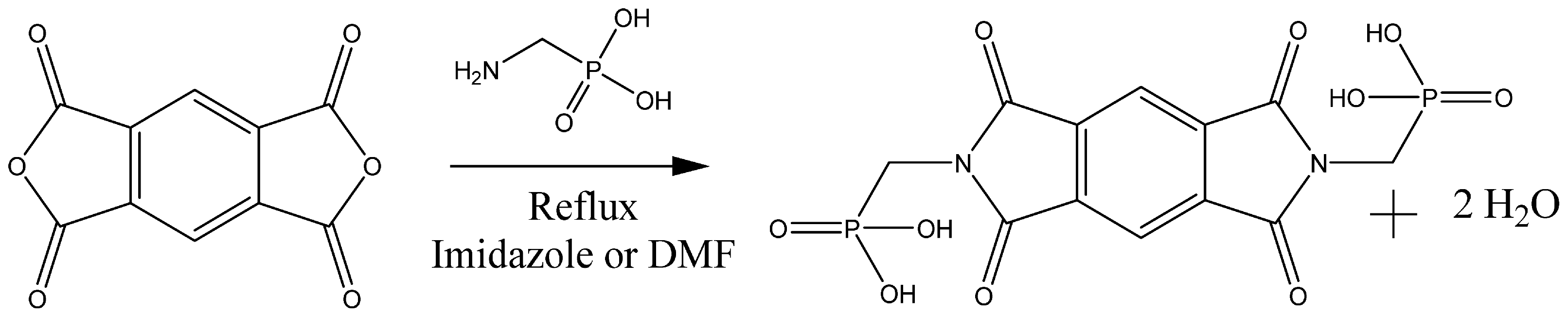
N,N′-bis(phosphonomethyl)pyromellitimide ([(H2O3P)CH2-(C10H2N2O4)-CH2(PO3H2)]∙2H2O) was synthesized by combining pyromellitic dianhydride (0.3489 g, 1.6 mmol) and (aminomethyl)phosphonic acid (0.3562 g, 3.2 mmol) in imidazole (1.0025 g, 14.7 mmol), which served as the reaction medium, in a pear-shaped flask (Scheme 2). The mixture was refluxed under a nitrogen atmosphere at 130 °C for 30 min. After cooling, the solid mixture was dissolved with 20.0 mL of a 1:1 (v/v) 2 M HCl–ethanol solution. The resulting clear colorless solid was washed with 20.0 mL of the same solution and then cold ethanol to afford 0.2944 g (42% yield) of crude product. Recrystallization was achieved by dissolving the crude material in 40.0 mL of deionized water using 3.0 mL of 0.2 M NaOH. The resulting solution was then placed in a desiccator containing concentrated HCl, allowing slow diffusion of HCl over a period of one week. Clear, colorless crystals of PPMI, as shown in Figure S1 of the Supporting Information, were isolated in a yield of 0.1419 g (20% yield) [7,35].
In an alternative procedure, the same reactants were refluxed in 35.0 mL dimethylformamide at 130 °C for 24 h. Upon cooling, the precipitated solid was recovered by gravity filtration and washed successively with deionized water (30.0 mL) and cold ethanol (20.0 mL) to remove residual impurities. This method afforded 0.4359 g (62% yield) of a white crystalline powder. The crude product was recrystallized by dissolving the materials in deionized water supplemented with 0.20 M NaOH, followed by slow diffusion of concentrated HCl in a desiccator over two weeks. The purified product was isolated as a white crystalline powder in a yield of 0.2259 g (32% yield). 1H NMR [Dimethyl sulfoxide (DMSO)-d6]: δ (ppm) = 8.28 (s, 2H, Ar), 3.86 (d, 4H, N−CH2−P); 2.51 (s, DMSO-d6). 13C NMR (DMSO-d6): δ (ppm) = 165.50, 137.44, 117.83, 40.21 (DMSO-d6), 37.39, 36.21. (See Figures S2 and S3 in the Supporting Information).

2.3. Single-Crystal X-Ray Diffraction (SCXRD) and Refinement

Single-crystal X-ray diffraction data were acquired on a crystal mounted on a cryoloop and centered in the X-ray beam of a Rigaku XtaLAB Synergy-S diffractometer equipped with a PhotonJet-S Cu 50 W microfocus X-ray source and a HyPix-6000HE detector (Rigaku Americas, The Woodlands, TX, USA). Data collection was conducted at 100 K, and the resulting datasets were processed with CrysAlisPro (version 1.171.40.63a). Empirical absorption corrections were applied using spherical harmonics through the SCALE3 ABSPACK scaling procedure. Crystal structures were obtained from the diffraction data and subsequently refined using the SHELXTL-2018 crystallographic package within the Olex2 v1.5 platform [36,37]. All non-hydrogen atoms, including phosphorus, oxygen, nitrogen, and carbon, were located from the difference electron-density map and refined anisotropically. Hydrogen atoms attached to carbon and oxygen atoms were placed at calculated positions and refined using either riding or rotating-group models. Their isotropic displacement parameters, [Uiso(H)], were constrained to 1.2Ueq of the bonded carbon atom or 1.5Ueq of the bonded oxygen atom. Crystal structure illustrations were prepared using CrystalMaker for Windows (version 11.5.1) [38]. Selected crystallographic data and refinement results are presented in Table 1, with supplementary crystallographic information reported in Table S1 of the Supporting Information.

2.4. Powder X-Ray Diffraction Pattern

The powder X-ray diffraction pattern of the bulk crystalline sample from imidazole-based synthesis was collected at room temperature using a Bruker D8 Advance diffractometer equipped with a Lynxeye detector and Cu Kα radiation (λ = 1.5405) (Bruker AXS LLC, Madison, WI, USA). The diffraction pattern was acquired over a 2-theta range of 5–50° (see Figure S4). The experimental pattern was compared with a simulated pattern generated from the crystallographic information file (CIF) using CCDC Mercury 2026.1.1 software to verify the phase purity of the bulk material.

2.5. Infrared and UV–Visible Spectroscopy

The infrared (IR) spectrum of N,N′-bis(phosphonomethyl)pyromellitimide was obtained from single crystals using a Bruker ALPHA FT-IR spectrometer equipped with an attenuated total reflectance (ATR) platinum objective (Bruker Optics Inc., Billerica, MA, USA). The spectrum was recorded over the range of 400–4000 cm−1, and the resulting spectrum is presented in Figure S5.
Solid-state UV-Vis spectroscopy was performed at room temperature on a single crystal using a Craic Technologies QDI 2010 UV/Vis/NIR microspectrophotometer (CRAIC Technologies, Inc., San Dimas, CA, USA) over the range of 200–450 nm. For comparison, the UV-Vis absorption spectrum of the same compound in aqueous solution was recorded using a Shimadzu UV-2401(PC) double-beam UV-VIS spectrophotometer (Shimadzu Corporation, Kyoto, Japan).

2.6. Thermal Analysis

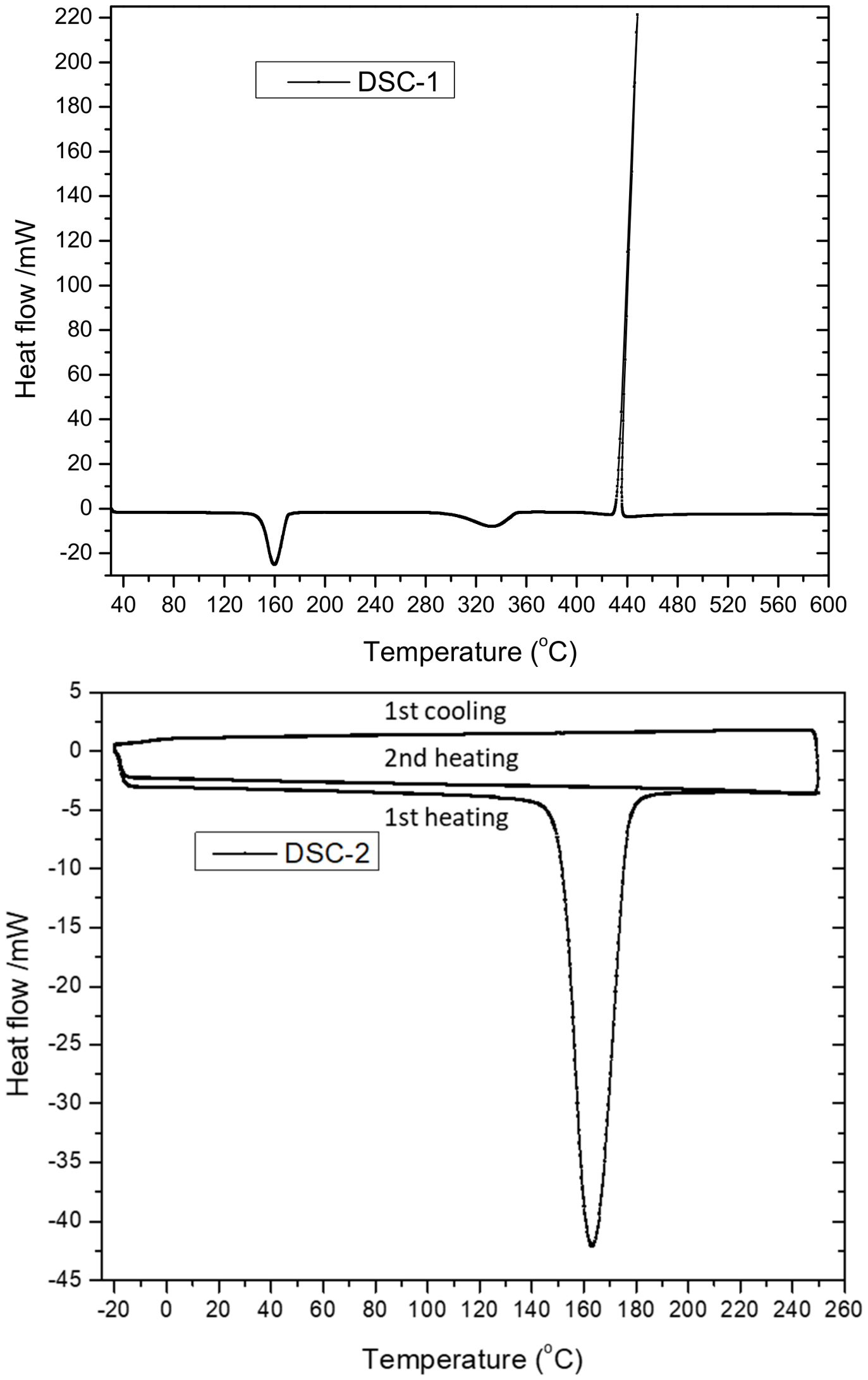
The thermalgravimetric analysis (TGA) of the compound was performed using a Netzsch TG209 F1 Iris thermal analyzer (NETZSCH-Gerätebau GmbH, Selb, Germany), while differential scanning calorimetry (DSC) measurements were conducted using a Mettler Toledo DSC 3+ STARe system (Mettler-Toledo, Columbus, OH, USA). Approximately 17 mg of the sample was placed in an alumina crucible and heated from 18 to 900 °C at a rate of 5 °C/min under a continuous nitrogen flow of 60 mL/min. For DSC measurements, 7.4 mg of the sample was placed in an aluminum crucible and heated from 30 to 600 °C at a rate of 10 °C/min under a continuous nitrogen flow of 30 mL/min. In a second DSC measurement, 6.5 mg of the sample was subjected to a heat–cool–heat cycle between −20 and 250 °C. Heating and cooling rates of 20 and 10 °C/min, respectively, were employed under the same nitrogen flow conditions.

3. Results and Discussion

3.1. Synthesis

The compound was prepared using a modified literature procedure involving the condensation of pyromellitic dianhydride and (aminomethyl)phosphonic acid in imidazole as the solvent [7]. Although the reaction can also be carried out in DMF, it requires 24 hours of reflux, whereas a greener process in imidazole is completed within 30 min. Despite the lower yield obtained in imidazole, better-quality crystals suitable for X-ray diffraction analysis were isolated under these conditions. To our knowledge, this represents the first reported crystal structure of a phosphonate-based pyromellitic diimide ligand. This apparent absence in crystal structure is likely due to their generally poor solubility in aqueous and organic solvents [39]. All structural and physicochemical characterizations reported herein were performed on crystals obtained from the imidazole-based synthesis.

3.2. Description of the Structure of [(H2O3P)CH2-(C10H2N2O4)-CH2(PO3H2)]∙2H2O

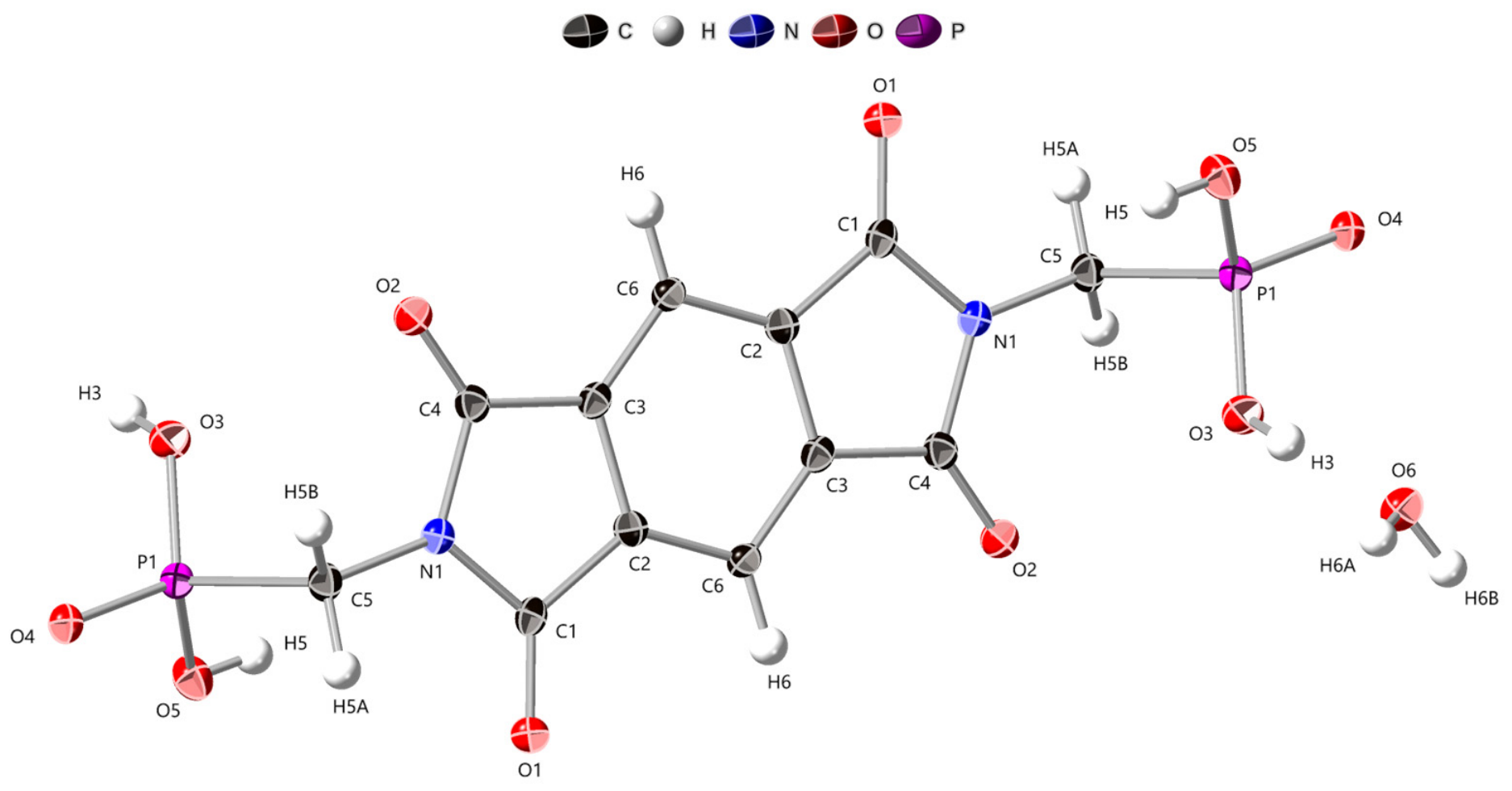
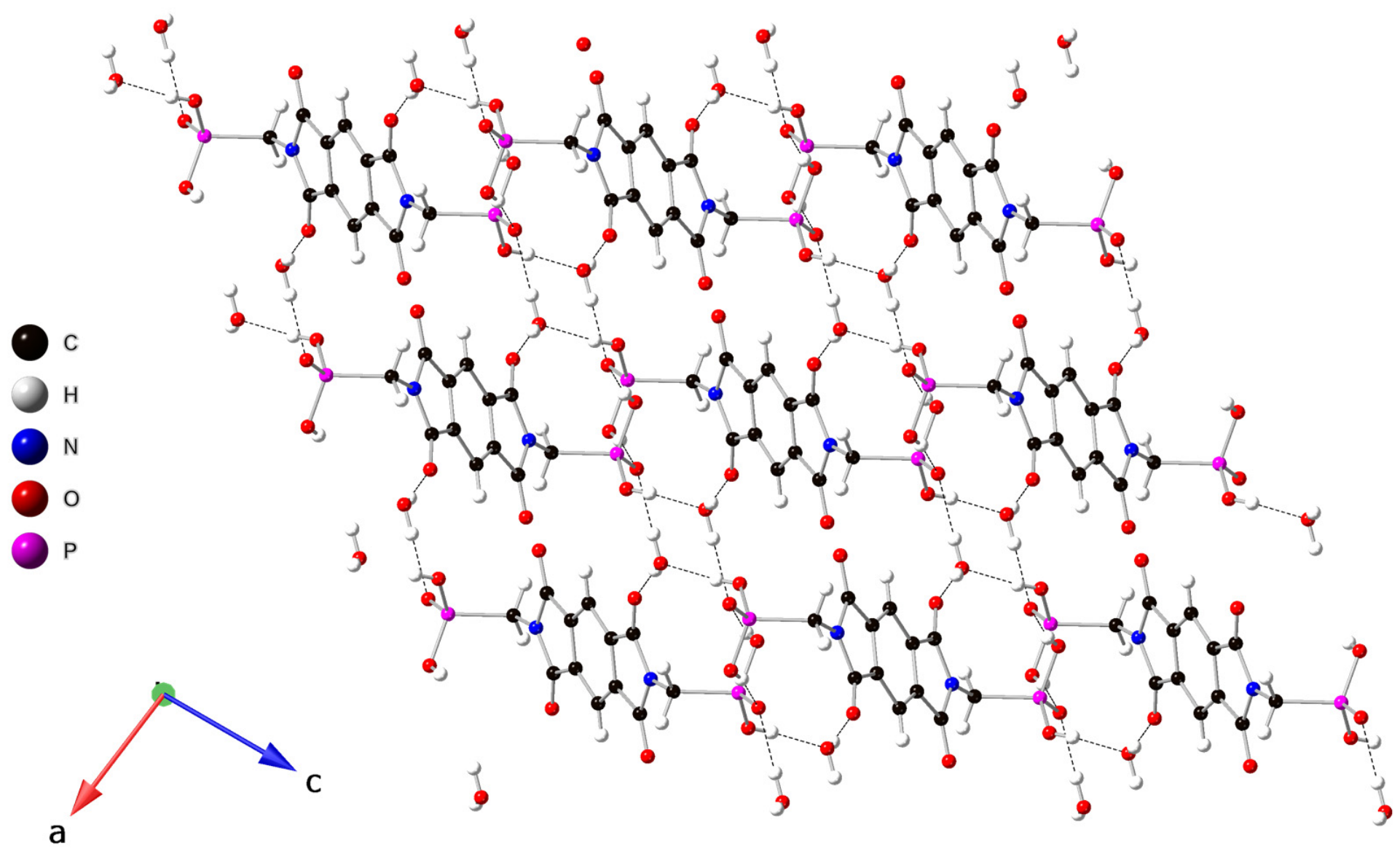
The structure of [(H2O3P)CH2-(C10H2N2O4)-CH2(PO3H2)]∙2H2O crystallizes in a monoclinic space group P21/n (Table 1). The asymmetric unit of the title compound contains one-half of a fully protonated N,N′-bis(phosphonomethyl)pyromellitimide and one water molecule both lying on an inversion center. The unit comprises 14 non-hydrogen and 7 hydrogen atoms as depicted in Figure 1. The two terminal methylene phosphonic acid substituents (–CH2PO3H2) are positioned in a trans configuration, with the –CH2PO3H2 units inclined at 113.03(11)° relative to the pyromellitimide core (Figure 1 and Figure 2).
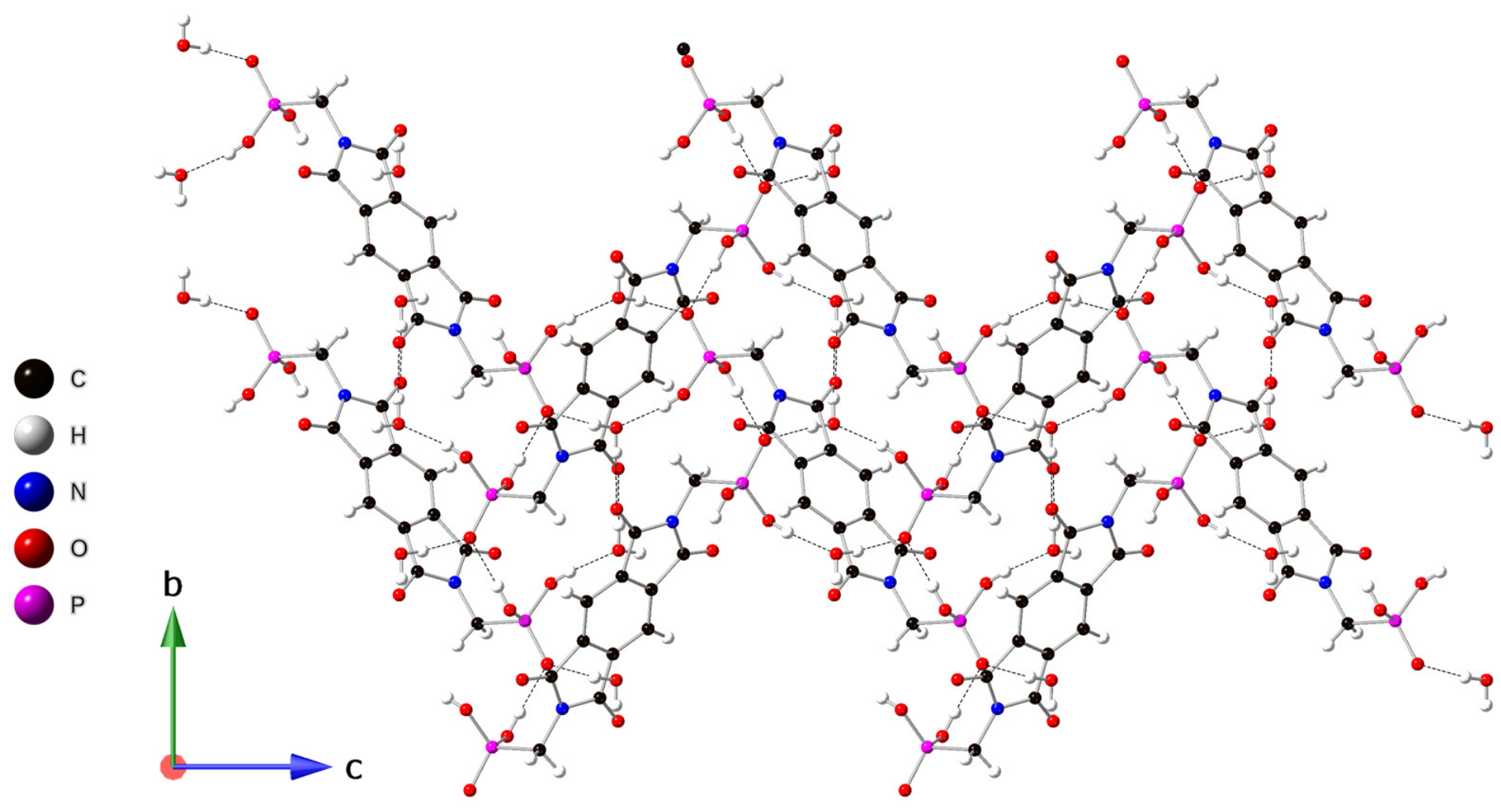
The hydrogen bonding network plays an important role in the overall crystal packing, interacting through a network of four hydrogen bonds. The hydrogen bonding geometry and angles are provided in Table 2. These involve the P=O, P–OH, and C=O groups from the ligand, and the coordinated water molecules as shown in Figure 2 and Figure 3. The phosphonic acid groups are protonated, similar to the common protonation reported in N,N′-bis(phosphonomethyl)-1,4,5,8-naphthalenediimide when co-crystallized with neutral species (water), expected for charge balance consideration [23].
Two of the phosphonate oxygen atoms are protonated, forming P—OH groups that act as hydrogen-bond donors. This assignment is supported by the longer P—O bond distances of 1.5305(13) Å and 1.5525(13) Å. The shorter P—O bond length of 1.4953(12) Å is consistent with a non-protonated phosphoryl oxygen atom (P=O) and functions as a hydrogen-bond acceptor. The phosphonate groups are involved in both intra- and intermolecular O—H‧‧‧O hydrogen-bonding interactions with neighboring phosphoryl oxygen atoms and lattice water molecules, respectively. In addition, the co-crystallized water molecules function as both hydrogen-bond donors and acceptors, forming an extended network of O‧‧‧H‧‧‧O interactions with phosphonate (P=O) and imide carbonyl (C=O) groups (see Table 2).

3.3. Hirshfeld Surface Analysis

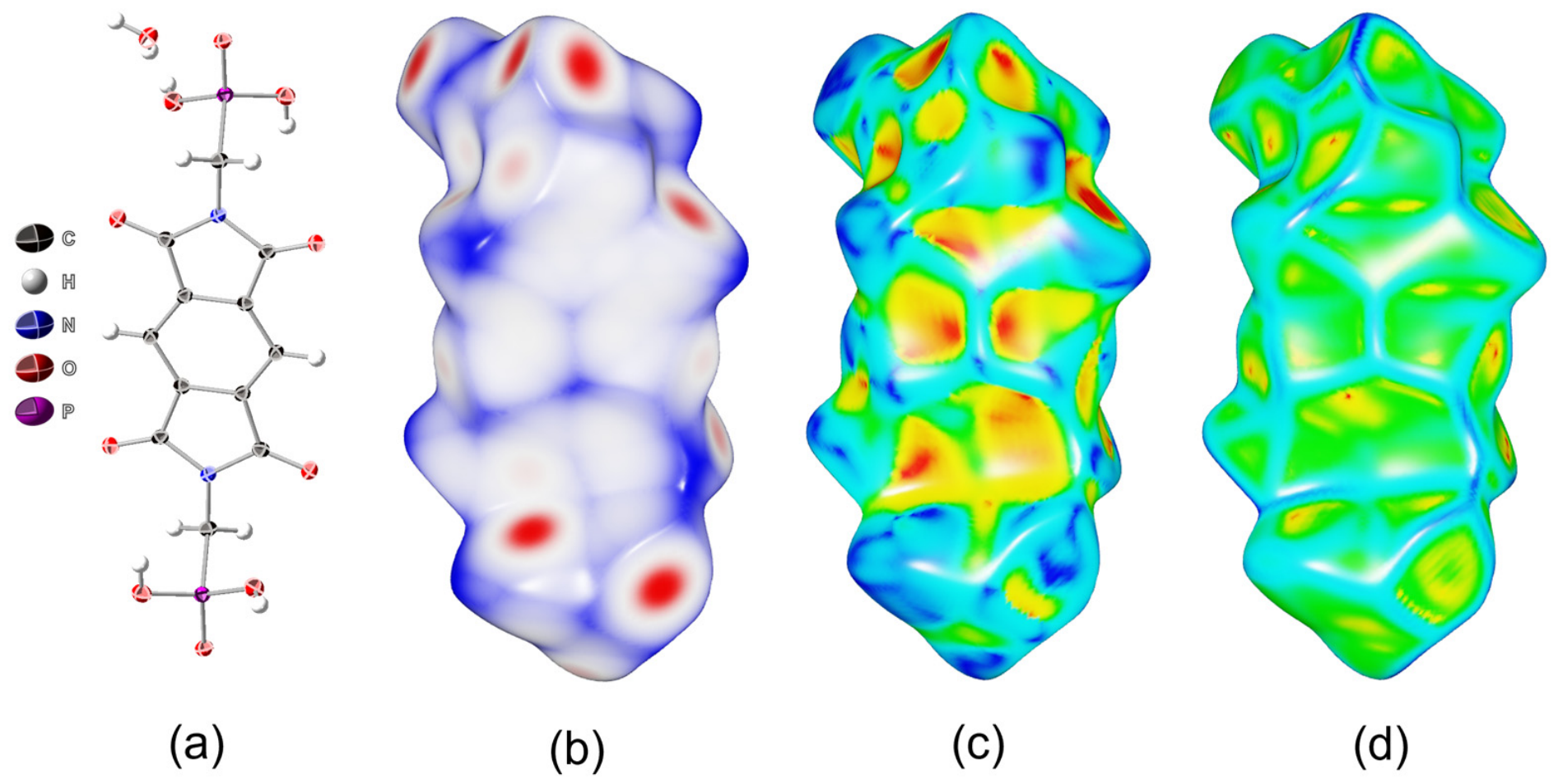
Hirshfeld surface analysis of the crystal structure of N,N′-bis(phosphonomethyl)pyromellitimide was performed using CrystalExplorer (version 25.09) to examine the hydrogen-bonding and intermolecular interactions [40,41]. Mapping the Hirshfeld surfaces over dnorm highlights variations in intermolecular contacts derived from the nearest external (de) and internal (di) atomic separations relative to the molecular surface, as shown in Figure 4b. The conspicuous red regions on the Hirshfeld surfaces mapped over dnorm indicate strong hydrogen-bonding interactions, including P=O‧‧‧H, P—OH‧‧‧O, C=O‧‧‧H, and O(water)—H‧‧‧O contacts. These interactions occur at distances shorter than the combined van der Waals radii of the participating atoms. White and blue regions indicate progressively weaker intermolecular contacts, occurring at distances near or beyond the van der Waals threshold [42].
Shape-index mapping serves as a valuable tool for assessing the presence of π–π interactions. However, the shape index in Figure 4c lacks the characteristic red and blue complementary “bow-ties” patterns associated with aromatic stacking, indicating the absence of significant π-π stacking [42,43,44,45,46]. In the curvedness map (Figure 4d), the extended flat green regions suggest planarity within the benzene ring. Overall, the Hirshfeld surface analysis confirms the presence of strong intermolecular interactions, with no detectable contribution from π–π stacking.
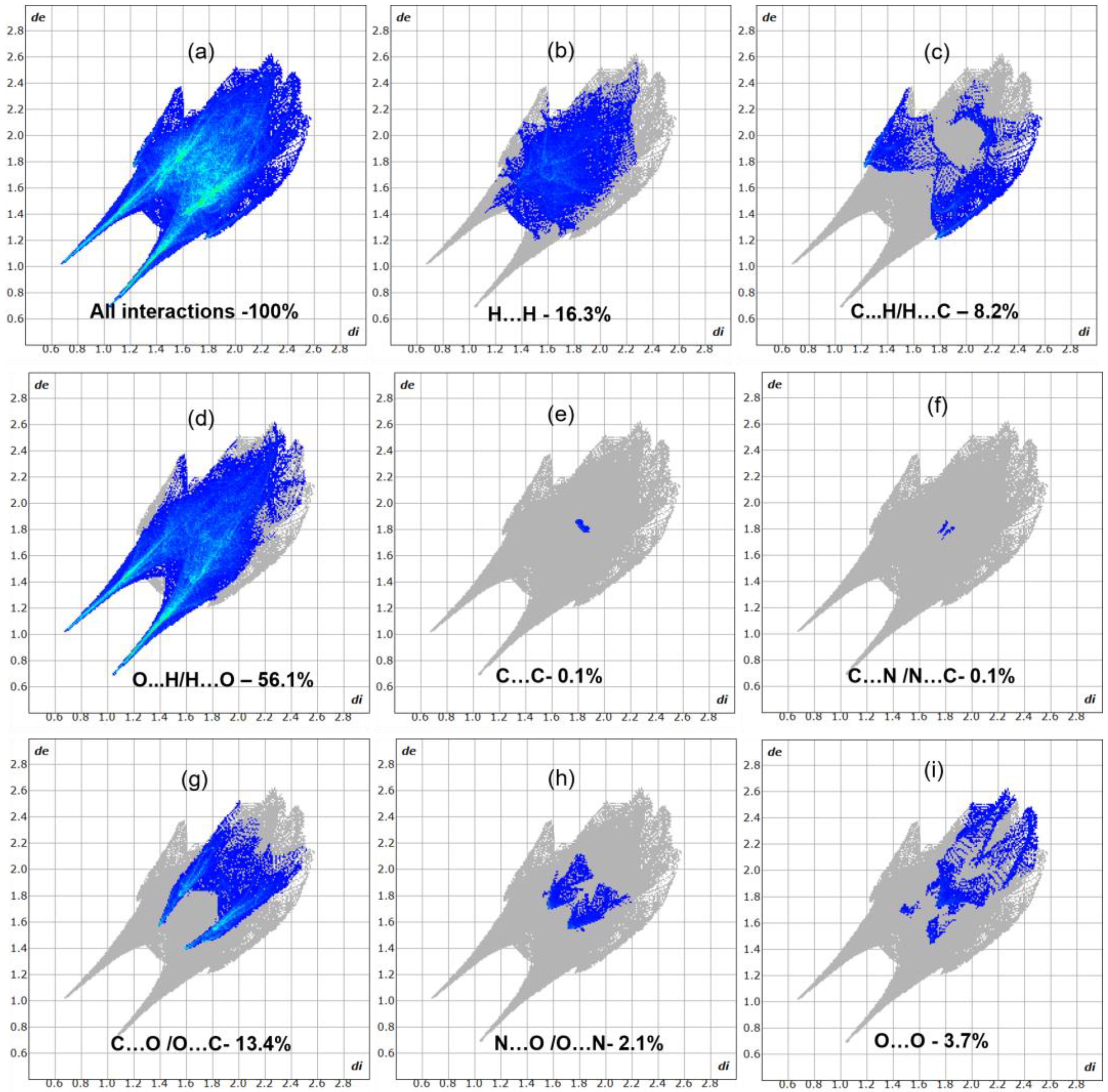
The two-dimensional fingerprint plots for N,N′-bis(phosphonomethyl)pyromellitimide are depicted in Figure 5. These plots quantify the relative contributions of specific intermolecular contacts to the overall Hirshfeld surface area [47]. The largest contribution arises from O∙∙∙H/H∙∙∙O interactions, which account for 56.1% of the surface and reflect the extensive hydrogen-bonding network present in the crystal structure. Additional contributions originate from H∙∙∙H (16.3%), C∙∙∙O/O∙∙∙C (13.4%), and C∙∙∙H/H∙∙∙C (8.2%) interactions. Notably, C∙∙∙C interactions contribute only 0.1% of the total surface area, indicating negligible π-π stacking between the planar benzene cores, in agreement with the shape-index and curvedness mappings.

3.4. Infrared and UV–Visible Spectroscopy

The infrared (IR) spectrum of N,N′-bis(phosphonomethyl)pyromellitimide (Figure S5 and Table S2) shows a well-resolved O–H stretching band at approximately 3475 cm−1, confirming the presence of water. The C−H stretching vibrations of aliphatic CH2 groups appear at 2935 and 2980 cm–1, while the aromatic C–H stretching bands are observed at 3056 and 3108 cm−1. The characteristic symmetric and asymmetric C=O stretching vibrations occur at 1704 and 1777 cm–1, respectively. In addition, the characteristic imide C-N-C stretching band is observed at 1384 cm−1, and the symmetric and asymmetric P−O and P=O stretching vibrations are located in the 1042–946 cm−1 region. The bands observed between 679 and 871 cm−1 are attributed to O–P–O bending and P–C stretching modes [12,23,28,48,49].
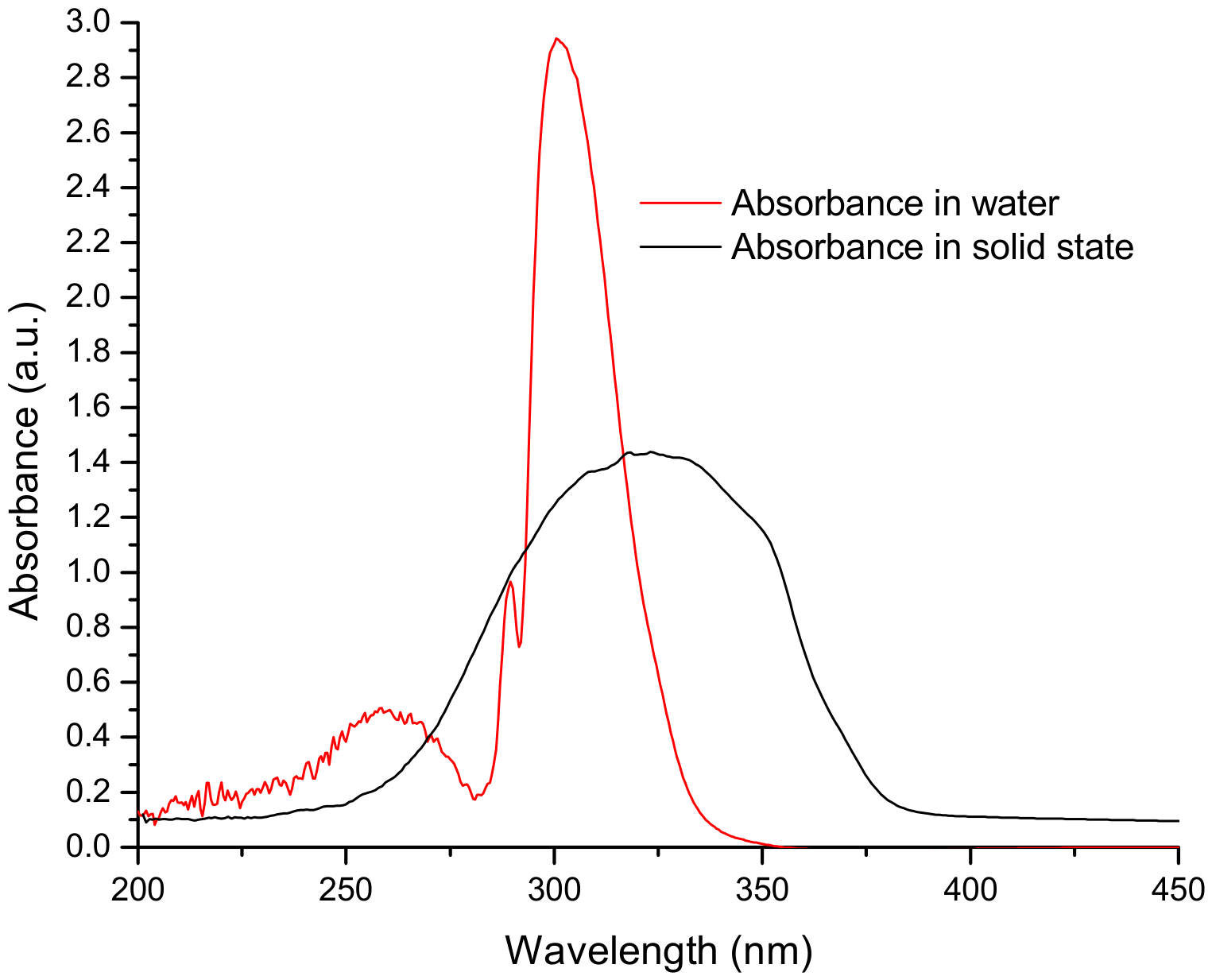
The UV-Vis spectra of N,N′-bis(phosphonomethyl)pyromellitimide in the solid state and in aqueous solution are shown in Figure 6. In solid state, the compound exhibits broad absorption band spanning 250–390 nm, with a maximum absorption (λmax) at 329 nm. In aqueous solution, the absorption band ranges from 228 to 355 nm, featuring a well-resolved peak at 301 nm, a shoulder at 289 nm, and an additional broad band between 228 and 281 nm, with a λmax at 259 nm [7,49].

3.5. Optical Bandgap Measurement

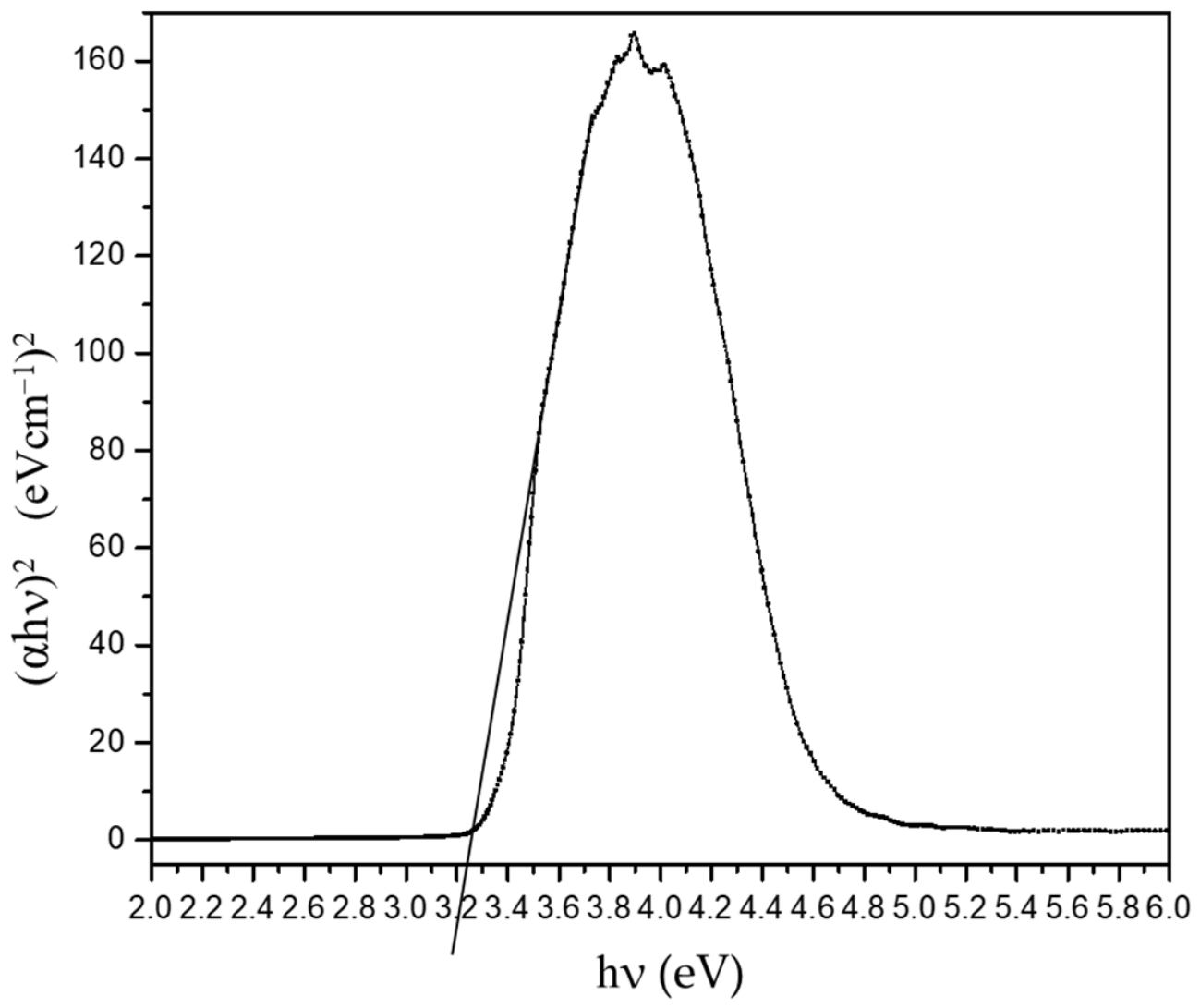
The optical bandgap of N,N′-bis(phosphonomethyl)pyromellitimide was estimated using a Tauc analysis (see Figure 7) derived from the solid-state UV-Vis absorption spectrum shown in Figure 6 [50,51,52]. Both direct and indirect transition models were examined and yielded comparable bandgap energies within experimental error. Therefore, only the direct-transition Tauc plot is presented and discussed for clarity. The bandgap energy was determined by extrapolating the linear portion of the (αhν)2 versus (hν) plot, in which α represents the absorption coefficient, h is Planck’s constant, and ν corresponds to the photon frequency. From this analysis, an optical bandgap value of 3.24 eV was obtained. This value is slightly higher than those reported for related pyromellitic diimide derivatives, which range from 2.76 to 2.99 eV [53,54,55,56]. The increased bandgap energy may be attributed to structural factors, particularly the relatively long centroid-to-centroid separation of 7.765(1) Å between the benzene rings. Such a separation is consistent with the absence of significant π−π interactions, as also indicated by the Hirshfeld surface analysis. A contrasting behavior was observed in our previous study of N,N′-bis(phosphonomethyl)-1,4,5,8-naphthalenediimide, where a lower bandgap energy and enhanced semiconducting behavior were attributed to stronger π–π interactions and a well-aligned stacking geometry [23]. These observations underscore the important role of π–π interactions on the electronic properties of diimide-based materials and their role in modulating the bandgap energies of such systems [57,58].

3.6. Thermal Behavior

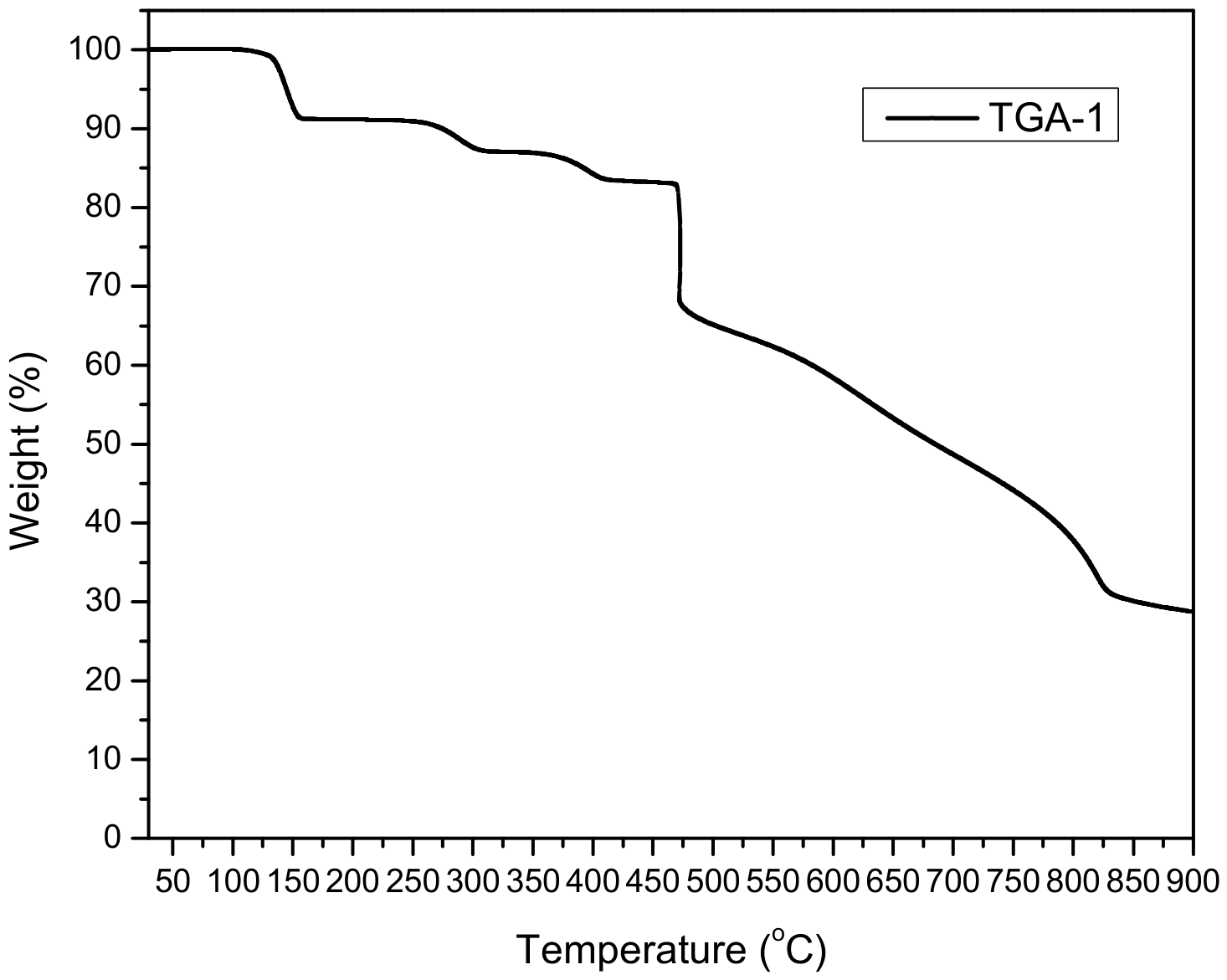
The thermogravimetric analysis (TGA) result is presented in Figure 8 [23,58]. The TGA curve shows an initial weight loss between 133 and 157 °C, corresponding to the loss of co-crystallized water molecules. This mass loss represents about 9% of the total sample mass and accounts for approximately 8.2% of water molecules present in the asymmetric unit. A second weight-loss step occurs in the 270–315 °C range (~3%), which is attributed to the melting and onset of decomposition of N-methyl phosphonic acid (–NCH2PO3H2) groups. A third weight-loss stage is observed between 370 and 415 °C (~3%), corresponding to further decomposition of the N-methyl phosphonic acid groups. Since the N-methyl phosphonic acid groups constitute approximately 49.5% of the mass of the asymmetric unit, the combined 6% mass loss observed during the second and third decomposition stages is consistent with partial decomposition of these moieties. This value is also comparable to the theoretical nitrogen content of the molecule (6.4 wt%), suggesting that nitrogen-containing fragments may be released during these thermal events. This is followed by a more pronounced weight loss in the 470–480 °C range (~16%), associated with continued degradation of the remaining N-methyl phosphonic acid moieties. The final weight loss, occurring between 480 and 900 °C (~48%), is attributed to the decomposition of the aromatic benzene core. This assignment is consistent with the molecular composition of the compound, as the combined mass contributions of the co-crystallized water molecules and N-methyl phosphonic acid groups account for approximately 57.7% of the asymmetric unit.
The differential scanning calorimetry (DSC) results are presented in Figure 9. The DSC-1 curve (top) exhibits an endothermic event between 145 and 170 °C, corresponding to the loss of the co-crystalized water molecules observed in the TGA curve. A second endothermic transition between 300 and 354 °C is assigned to the melting process. An exothermic peak centered at 448 °C is attributed to the complete thermal decomposition of the ligand. In the second study, an endothermic process is observed between 145 and 180 °C in the first heating curve, whereas no transitions are detected during the cooling or second heating curves [56,58].

4. Conclusions

In summary, an n-type organic semiconductor was successfully synthesized and crystallized via slow vapor diffusion of HCl into aqueous solution. Structural analysis reveals that the supramolecular self-assembly is governed by an extensive hydrogen-bonding network involving the—PO3H2 group and coordinated water molecules, as revealed by Hirshfeld surface analysis. These interactions play a critical role in stabilizing the crystal packing and defining the overall supramolecular architecture [59].
Optical characterization based on Tauc plot analysis of the UV-vis absorption data indicates a direct bandgap of 3.24 eV, consistent with semiconducting behavior. Thermal analysis demonstrates that the material retains stability up to approximately 270 °C, further supporting its potential for practical applications. The presence of phosphonate moieties enhances water solubility and binding affinity to metallic surfaces. Furthermore, the relatively short-wavelength absorption, which renders the material more transparent in the visible region compared to naphthalene and perylene analogues, suggests potential for future investigation in solution-processed transparent optoelectronic devices.
Future work will focus on rationally tuning the crystal packing to enhance π–π interactions through strategic variation in the appended terminal groups, as well as investigating the role of organic co-crystallization in modulating structural and electronic properties [6,60].

Supplementary Materials

The following supporting information can be downloaded at: https://www.mdpi.com/article/10.3390/cryst16080506/s1, Table S1: Selected interatomic distances (Å) and angles (deg); Figure S1: Crystal image of compound; Figure S2: 1H-NMR; Figure S3: 13C-NMR; Figure S4: Powder X-ray diffraction pattern; Figure S5: Infrared spectrum; Table S2: Selected infrared wavenumbers (cm−1) and corresponding assignments.

Author Contributions

Conceptualization, P.O.A.; formal analysis, P.O.A. and H.D.A.; investigation, K.V.M., J.L.P., K.C., C.P., K.R., E.M.O., J.S.S. and P.O.A.; resources, P.O.A.; writing—original draft preparation, P.O.A.; writing—review and editing, P.O.A.; visualization, P.O.A.; supervision, P.O.A.; project administration, P.O.A.; funding acquisition, P.O.A. All authors have read and agreed to the published version of the manuscript.

Funding

Financial support for this research was provided by the Welch Foundation Departmental Research Grant Program (U-0047) and the Internal Faculty Research Grant Program (IFRG) through the Office of Sponsored Projects, Academic Research, and Compliance (SPARC).

Data Availability Statement

CCDC deposition numbers: 2563509 contain the supplementary crystallographic data for this paper. These data can be obtained free of charge from the Cambridge Crystallographic Data Center via https://www.ccdc.cam.ac.uk/structures/ (accessed on 20 July 2026).

Acknowledgments

The authors express their sincere appreciation to Peter C. Burns for his support and for making the research facilities at the University of Notre Dame available for this project. They further acknowledge Daniel J. Wherritt for providing access to the NMR facilities at The University of Texas at San Antonio.

Conflicts of Interest

The authors declare no conflicts of interest.

Abbreviations

The following abbreviations are used in this manuscript:
DMFN,N-dimethylformamide
DMSODimethyl sulfoxide
PPMIN,N′-bis(2-phosphonoethyl)-pyromellitimide
PNDIN,N′-bis(2-phosphonoethyl)-1,4,5,8-naphthalenediimide
PPDIN,N′-bis(2-phosphonoethyl)-3,4,9,10-perylenediimide

References

  1. Zhou, Y.; Han, L. Recent Advances in Naphthalenediimide-Based Metal-Organic Frameworks: Structures and Applications. Coord. Chem. Rev. 2021, 430, 213665. [Google Scholar] [CrossRef]
  2. Al Kobaisi, M.; Bhosale, S.V.; Latham, K.; Raynor, A.M.; Bhosale, S.V. Functional Naphthalene Diimides: Synthesis, Properties, and Applications. Chem. Rev. 2016, 116, 11685–11796. [Google Scholar] [CrossRef] [PubMed]
  3. Paz, F.A.A.; Klinowski, J.; Vilela, S.M.F.; Tome, J.P.C.; Cavaleiro, J.A.S.; Rocha, J. Ligand Design for Functional Metal–Organic Frameworks. Chem. Soc. Rev. 2012, 41, 1088–1110. [Google Scholar] [CrossRef] [PubMed]
  4. Pan, M.; Lin, X.-M.; Li, G.-B.; Su, C.-Y. Progress in the Study of Metal–Organic Materials Applying Naphthalene Diimide (NDI) Ligands. Coord. Chem. Rev. 2011, 255, 1921–1936. [Google Scholar] [CrossRef]
  5. Bhosale, S.V.; Jani, C.H.; Langford, S.J. Chemistry of Naphthalene Diimides. Chem. Soc. Rev. 2008, 37, 331–342. [Google Scholar] [CrossRef] [PubMed]
  6. Barooah, N.; Baruah, J.B. Effect of Phenyl Group on the Self Assembly of N, N′-Bis-(2-Phenylglycinyl) Pyromellitic Diimide with Aromatic Hydrocarbons. J. Mol. Struct. 2008, 872, 205–211. [Google Scholar] [CrossRef]
  7. Marcon, R.O.; Brochsztain, S. Characterization of Self-Assembled Thin Films of Zirconium Phosphonate/Aromatic Diimides. Thin Solid Films 2005, 492, 30–34. [Google Scholar] [CrossRef]
  8. Marcon, R.O.; Bonvent, J.-J.; Brochsztain, S. Radical Anions and Dianions of Naphthalenediimides Generated within Layer-by-Layer Zirconium Phosphonate Thin Films. Langmuir 2022, 38, 2153–2161. [Google Scholar] [CrossRef] [PubMed]
  9. Tosco, B.; Melo, B.P.-A.V.; Hermida Merino, D.; Rey, J.F.Q.; Brochsztain, S. Layer-by-Layer Naphthalenediimide/Zn Phosphonate Hybrid Films Grown from Aqueous Solutions by a Simple Deposition Technique. Langmuir 2021, 37, 2494–2502. [Google Scholar] [CrossRef] [PubMed]
  10. Marcon, R.O.; dos Santos, J.G.; Figueiredo, K.M.; Brochsztain, S. Characterization of a Novel Water-Soluble 3,4,9,10-Perylenetetracarboxylic Diimide in Solution and in Self-Assembled Zirconium Phosphonate Thin Films. Langmuir 2006, 22, 1680–1687. [Google Scholar] [CrossRef] [PubMed]
  11. Brochsztain, S.; Rodrigues, M.A.; Demets, G.J.F.; Politi, M.J. Stabilization of Naphthalene-1,8:4,5-Dicarboximide Radicals in Zirconium Phosphonate Solid Materials and Thin Films. J. Mater. Chem. 2002, 12, 1250–1255. [Google Scholar] [CrossRef]
  12. Melo, B.P.-A.V.; Gregório Junior, D.F.; de Oliveira, M.T.; de Jesus Trindade, F.; van de Streek, J.; Ferreira, F.F.; Brochsztain, S. Synthesis and Characterization of Two Novel Naphthalenediimide/Zinc Phosphonate Crystalline Materials Precipitated from Different Solvents. ACS Omega 2023, 9, 1748–1756. [Google Scholar] [CrossRef] [PubMed]
  13. Ide, R.; Kawasaki, A.; Takeda, T.; Dekura, S.; Hoshino, N.; Matsuda, W.; Seki, S.; Akutagawa, T. Proton Conduction Crossover and Pyrophosphate Bond Formation Of −PO3H Substituted Naphtalenediimide Salts. J. Phys. Chem. C 2023, 127, 16709–16720. [Google Scholar] [CrossRef]
  14. Almuhana, A.R.Y.; Griffin, S.L.; Champness, N.R. Amidinium⋯Phosphonate Charge Assisted Hydrogen-Bonded Organic Frameworks: Influence of Diverse Intermolecular Interactions. CrystEngComm 2024, 26, 4643–4648. [Google Scholar] [CrossRef]
  15. Braga, D. Inorganic Crystal Engineering: A Personal Perspective. J. Chem. Soc. Dalton Trans. 2000, 29, 3705–3713. [Google Scholar] [CrossRef]
  16. Bruckmann, J.; Krüger, C.; Lehmann, C.W.; Leitner, W.; Rust, J.; Six, C. Ethylenebis(Phosphonic Acid). Acta Crystallogr. Sect. C Cryst. Struct. Commun. 1999, 55, 695–696. [Google Scholar] [CrossRef]
  17. Matczak-Jon, E.; Sawka-Dobrowolska, W.; Kafarski, P.; Videnova-Adrabińska, V. Molecular Organization and Solution Properties of N-Substituted Aminomethane-1,1-Diphosphonic Acids. New J. Chem. 2001, 25, 1447–1457. [Google Scholar] [CrossRef]
  18. Aragoni, M.C.; Arca, M.; Blake, A.J.; Lippolis, V.; Schröder, M.; Wilson, C. 4-Methoxyphenylphosphonic Acid: Reactivity of Lawesson’s Reagent. Acta Crystallogr. Sect. C Cryst. Struct. Commun. 2002, 58, o260–o262. [Google Scholar] [CrossRef] [PubMed]
  19. Mahmoudkhani, A.H.; Langer, V. Phenylphosphonic Acid as a Building Block for Two-Dimensional Hydrogen-Bonded Supramolecular Arrays. J. Mol. Struct. 2002, 609, 97–108. [Google Scholar] [CrossRef]
  20. Fernandez, D.; Vega, D. Head-to-Head Dimers in the Zwitterion of 1-Hydroxy-3-(Pyrrolidin-1-Yl)Propylidene-1,1-Bisphosphonic Acid (EB 1053). Acta Crystallogr. Sect. C Cryst. Struct. Commun. 2003, 59, o228–o230. [Google Scholar] [CrossRef] [PubMed]
  21. Matczak-Jon, E.; Videnova-Adrabińska, V.; Burzyńska, A.; Kafarski, P.; Lis, T. Solid-State Molecular Organization and Solution Behavior of Methane-1,1-Diphosphonic Acid Derivatives of Heterocyclic Amines: The Role of the Topochemical Ring Modification and the Intramolecular Hydrogen Bonds in Monosubstituted Piperid-1-Ylmethane-1,1-Diphosphonic Acids. Chem. A Eur. J. 2005, 11, 2357–2372. [Google Scholar] [CrossRef] [PubMed]
  22. Giba, I.S.; Tolstoy, P.M. Self-Assembly of Hydrogen-Bonded Cage Tetramers of Phosphonic Acid. Symmetry 2021, 13, 258. [Google Scholar] [CrossRef]
  23. Medina, K.V.; Pinedo, J.L.; Hernandez, K.P.; Ramirez, J.I.; Preti, C.; Bourmas, D.; Rosas, K.; Flores, R.A.; Soriano, J.S.; Arman, H.D. Structural Diversity, Thermal, and Semiconducting Characteristics of Two N,N′-Bis (Phosphonomethyl)-1,4,5,8-Naphthalenediimide-Based Compounds. Crystals 2025, 15, 1061. [Google Scholar] [CrossRef]
  24. Zhou, N.; Facchetti, A. Naphthalenediimide (NDI) Polymers for All-Polymer Photovoltaics. Mater. Today 2018, 21, 377–390. [Google Scholar] [CrossRef]
  25. Giovannitti, A.; Nielsen, C.B.; Sbircea, D.-T.; Inal, S.; Donahue, M.; Niazi, M.R.; Hanifi, D.A.; Amassian, A.; Malliaras, G.G.; Rivnay, J. N-Type Organic Electrochemical Transistors with Stability in Water. Nat. Commun. 2016, 7, 13066. [Google Scholar] [CrossRef] [PubMed]
  26. Yu, S.; Kousseff, C.J.; Nielsen, C.B. N-Type Semiconductors for Organic Electrochemical Transistor Applications. Synth. Met. 2023, 293, 117295. [Google Scholar] [CrossRef]
  27. Sommer, M. Conjugated Polymers Based on Naphthalene Diimide for Organic Electronics. J. Mater. Chem. C 2014, 2, 3088–3098. [Google Scholar] [CrossRef]
  28. Sun, Y.; Sha, H.; Li, Y.; Yan, Y.; Huang, W.; Ouyang, T.; Qin, L.; Zhang, S.; Huang, H.; Li, Q. Giant Birefringence Induced by Intermolecular Aromatic Interactions in Hydrogen-Bonded Organic Frameworks. Adv. Mater. 2025, 37, e09171. [Google Scholar] [CrossRef] [PubMed]
  29. He, X.; Lu, X.-P.; Ju, Z.-F.; Li, C.-J.; Zhang, Q.-K.; Li, M.-X. Syntheses, Structures, and Photoluminescent Properties of Ten Metal–Organic Frameworks Constructed by a Flexible Tetracarboxylate Ligand. CrystEngComm 2013, 15, 2731–2744. [Google Scholar] [CrossRef]
  30. Trivedi, D.R.; Fujiki, Y.; Fujita, N.; Shinkai, S.; Sada, K. Crystal Engineering Approach to Design Colorimetric Indicator Array to Discriminate Positional Isomers of Aromatic Organic Molecules. Chem. Asian J. 2009, 4, 254–261. [Google Scholar] [CrossRef] [PubMed]
  31. Neels, A.; Mantero, D.G.; Stoeckli-Evans, H. Solid-State Synthesis of New Diimide Compounds: A Two-Step Reaction Followed by X-Ray Powder Diffraction. Cryst. Growth Des. 2008, 8, 1147–1153. [Google Scholar] [CrossRef]
  32. Dinolfo, P.H.; Williams, M.E.; Stern, C.L.; Hupp, J.T. Rhenium-Based Molecular Rectangles as Frameworks for Ligand-Centered Mixed Valency and Optical Electron Transfer. J. Am. Chem. Soc. 2004, 126, 12989–13001. [Google Scholar] [CrossRef] [PubMed]
  33. Flamigni, L.; Johnston, M.R.; Giribabu, L. Photoinduced Electron Transfer in Bisporphyrin–Diimide Complexes. Chem. A Eur. J. 2002, 8, 3938–3947. [Google Scholar] [CrossRef] [PubMed]
  34. de Oliveira Marcon, R.; Bonvent, J.-J.; Brochsztain, S. Stabilization of Free Radicals in Layer-by-Layer Nanoarchitectures Containing Multiple Arylenediimides. Dye. Pigment. 2022, 198, 109948. [Google Scholar] [CrossRef]
  35. Medina, K.V.; Adelani, P.O. Synthesis of Phosphonate-Based Diimide Ligands. B.S. Honors Program Theses and Research Projects. 12. Bachelor’s Thesis, St. Mary’s University, San Antonio, TX, USA, 2022. [Google Scholar]
  36. Sheldrick, G. A Short History of SHELX. Acta Crystallogr. Sect. A 2008, 64, 112–122. [Google Scholar] [CrossRef] [PubMed]
  37. Dolomanov, O.V.; Bourhis, L.J.; Gildea, R.J.; Howard, J.A.K.; Puschmann, H. OLEX2: A Complete Structure Solution, Refinement and Analysis Program. J. Appl. Crystallogr. 2009, 42, 339–341. [Google Scholar] [CrossRef]
  38. Palmer, D. CrystalMaker for Windows; CrystalMaker Software Ltd.: Oxfordshire, UK, 2009. [Google Scholar]
  39. Gagnon, K.J.; Perry, H.P.; Clearfield, A. Conventional and Unconventional Metal–Organic Frameworks Based on Phosphonate Ligands: MOFs and UMOFs. Chem. Rev. 2011, 112, 1034–1054. [Google Scholar] [CrossRef] [PubMed]
  40. Spackman, P.R.; Turner, M.J.; McKinnon, J.J.; Wolff, S.K.; Grimwood, D.J.; Jayatilaka, D.; Spackman, M.A. CrystalExplorer: A Program for Hirshfeld Surface Analysis, Visualization and Quantitative Analysis of Molecular Crystals. J. Appl. Crystallogr. 2021, 54, 1006–1011. [Google Scholar] [CrossRef] [PubMed]
  41. Spackman, M.A.; Jayatilaka, D. Hirshfeld Surface Analysis. CrystEngComm 2009, 11, 19–32. [Google Scholar] [CrossRef]
  42. Komissarova, E.A.; Dominskiy, D.I.; Zhulanov, V.E.; Abashev, G.G.; Siddiqui, A.; Singh, S.P.; Sosorev, A.Y.; Paraschuk, D.Y. Unraveling the Unusual Effect of Fluorination on Crystal Packing in an Organic Semiconductor. Phys. Chem. Chem. Phys. 2020, 22, 1665–1673. [Google Scholar] [CrossRef] [PubMed]
  43. Mirocki, A.; Lopresti, M. The Role of the Solvent Molecule in the Crystal Packing Arrangements of Hydrated Salts Formed by Ethacridine and Fluorobenzoic Acids. Acta Crystallogr. Sect. B Struct. Sci. 2025, 81, 395–406. [Google Scholar] [CrossRef] [PubMed]
  44. Bakheit, A.H.; Abuelizz, H.A.; Al-Salahi, R. Hirshfeld Surface Analysis and Density Functional Theory Calculations of 2-Benzyloxy-1,2,4-Triazolo[1,5-a] Quinazolin-5(4H)-One: A Comprehensive Study on Crystal Structure, Intermolecular Interactions, and Electronic Properties. Crystals 2023, 13, 1410. [Google Scholar] [CrossRef]
  45. Yeşilbağ, S.; Çınar, E.B.; Dege, N.; Ağar, E.; Saif, E. Crystal Structure and Hirshfeld Surface Analysis of Dimethyl 3,3′-{[(1E,2E)-Ethane-1,2-Diylidene]Bis(Azanylylidene)}Bis(4-Methylbenzoate). Acta Crystallogr. Sect. E Crystallogr. Commun. 2022, 78, 340–345. [Google Scholar] [CrossRef] [PubMed]
  46. Tan, S.L.; Jotani, M.M.; Tiekink, E.R.T. Utilizing Hirshfeld Surface Calculations, Non-Covalent Interaction (NCI) Plots and the Calculation of Interaction Energies in the Analysis of Molecular Packing. Acta Crystallogr. Sect. E Crystallogr. Commun. 2019, 75, 308–318. [Google Scholar] [CrossRef] [PubMed]
  47. Spackman, M.A.; McKinnon, J.J. Fingerprinting Intermolecular Interactions in Molecular Crystals. CrystEngComm 2002, 4, 378–392. [Google Scholar] [CrossRef]
  48. Chlebosz, D.; Goldeman, W.; Janus, K.; Szuster, M.; Kiersnowski, A. Synthesis, Solution, and Solid State Properties of Homological Dialkylated Naphthalene Diimides—A Systematic Review of Molecules for next-Generation Organic Electronics. Molecules 2023, 28, 2940. [Google Scholar] [CrossRef] [PubMed]
  49. Trindade, F.J.; Rey, J.F.Q.; Brochsztain, S. Modification of Molecular Sieves MCM-41 and SBA-15 with Covalently Grafted Pyromellitimide and 1, 4, 5, 8-Naphthalenediimide. J. Colloid Interface Sci. 2012, 368, 34–40. [Google Scholar] [PubMed]
  50. Jubu, P.R.; Yam, F.K.; Igba, V.M.; Beh, K.P. Tauc-Plot Scale and Extrapolation Effect on Bandgap Estimation from UV–Vis–NIR Data–a Case Study of β-Ga2O3. J. Solid State Chem. 2020, 290, 121576. [Google Scholar] [CrossRef]
  51. Viezbicke, B.D.; Patel, S.; Davis, B.E.; Birnie, D.P., III. Evaluation of the Tauc Method for Optical Absorption Edge Determination: ZnO Thin Films as a Model System. Phys. Status Solidi B 2015, 252, 1700–1710. [Google Scholar] [CrossRef]
  52. Tauc, J.; Grigorovici, R.; Vancu, A. Optical Properties and Electronic Structure of Amorphous Germanium. Phys. Status Solidi B 1966, 15, 627–637. [Google Scholar] [CrossRef]
  53. Li, Z.; Bi, X.; Gao, H.; Fan, Q.; Dong, Y.; Li, R.; Feng, Y.; Liu, J. Large Segment Bandgap, Steric Hindrance Structure and Organic Semiconductor Filler Collaborative Designs for Superior High-Temperature Energy Storage of Aromatic Polymers. Adv. Funct. Mater. 2026, 36, e24852. [Google Scholar] [CrossRef]
  54. Chu, S.; Wang, X.; Yang, L.; Zhang, H.; Xiao, R.; Wang, Y.; Zou, Z. Band Structure Engineering of a Polyimide Photocatalyst towards Enhanced Water Splitting. Energy Adv. 2023, 2, 556–564. [Google Scholar] [CrossRef]
  55. Komissarova, E.A.; Zhulanov, V.E.; Mokrushin, I.G.; Vasyanin, A.N.; Shklyaeva, E.V.; Abashev, G.G. Synthesis and Study of N,N′-Disubstituted Derivatives of Pyromellitic Diimide. Russ. Chem. Bull. 2020, 69, 1944–1948. [Google Scholar] [CrossRef]
  56. Palai, A.K.; Kim, S.; Shim, H.; Cho, S.; Kumar, A.; Kwon, J.; Park, S.-U.; Pyo, S. N-Type Small Aromatic Core Diimides Flanked with Electron Donating Thienylethyl Moieties and Electrical Responses in Organic Devices. RSC Adv. 2014, 4, 41476–41482. [Google Scholar] [CrossRef]
  57. Dharmarwardana, M.; Otten, B.M.; Ghimire, M.M.; Arimilli, B.S.; Williams, C.M.; Boateng, S.; Lu, Z.; McCandless, G.T.; Gassensmith, J.J.; Omary, M.A. Strong π-Stacking Causes Unusually Large Anisotropic Thermal Expansion and Thermochromism. Proc. Natl. Acad. Sci. USA 2021, 118, e2106572118. [Google Scholar] [CrossRef] [PubMed]
  58. Zheng, Q.; Huang, J.; Sarjeant, A.; Katz, H.E. Pyromellitic Diimides: Minimal Cores for High Mobility n-Channel Transistor Semiconductors. J. Am. Chem. Soc. 2008, 130, 14410–14411. [Google Scholar] [CrossRef] [PubMed]
  59. Aakeröy, C.B.; Champness, N.R.; Janiak, C. Recent Advances in Crystal Engineering. CrystEngComm 2010, 12, 22–43. [Google Scholar] [CrossRef]
  60. Barooah, N.; Sarma, R.J.; Baruah, J.B. Solid-State Hydrogen Bonded Assembly of N, N′-Bis (Glycinyl)-Pyromellitic Diimide with Aromatic Guests. CrystEngComm 2006, 8, 608–615. [Google Scholar] [CrossRef]
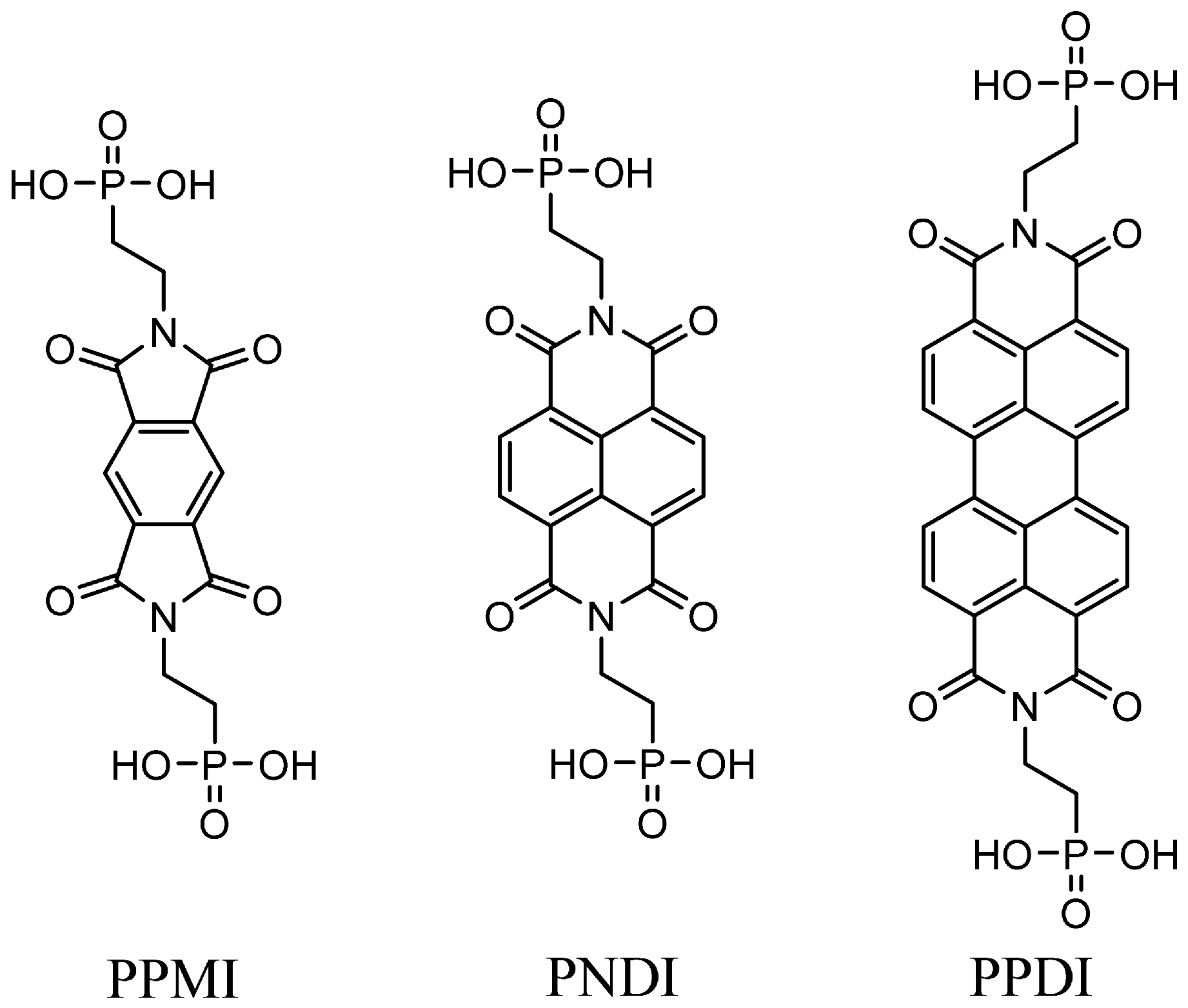
Scheme 1. Phosphonate-substituted diimide ligands: N,N′-bis(2-phosphonoethyl)-pyromellitimide (PPMI), N,N′-bis(2-phosphonoethyl)-1,4,5,8-naphthalenediimide (PNDI), and N,N′-bis(2-phosphonoethyl)-3,4,9,10-perylenediimide (PPDI).
Crystals 16 00506 sch001
Scheme 2. Synthetic route for N,N′-bis(phosphonomethyl)pyromellitimide.
Crystals 16 00506 sch002
Figure 1. Formula unit of N,N′-bis(phosphonomethyl)pyromellitimide with anisotropic displacement ellipsoids shown at the 50% probability level for non-hydrogen atoms.
Crystals 16 00506 g001
Figure 2. Packing diagram viewed along the a-axis, illustrating the intermolecular hydrogen-bonding network (dashed lines) and overall packing architecture of N,N′-bis(phosphonomethyl)pyromellitimide.
Crystals 16 00506 g002
Figure 3. Ball-and-stick illustration of the crystal packing along the b-axis, showing the hydrogen-bonded networks (dashed lines) of N,N′-bis(phosphonomethyl)pyromellitimide.
Crystals 16 00506 g003
Figure 4. Hirshfeld surface analysis of N,N′-bis(phosphonomethyl)pyromellitimide showing (a) the molecular structure together with mappings of (b) dnorm, (c) shape index, and (d) curvedness.
Crystals 16 00506 g004
Figure 5. Two-dimensional fingerprint plots of the major contacts in N,N′-bis(phosphonomethyl)pyromellitimide with (a) overall interactions and (bi) individual interatomic contacts. Legend: gray regions indicate no contribution, while blue, green, and red represent low, moderate, and high contributions, respectively.
Crystals 16 00506 g005
Figure 6. Comparison of the solid-state and aqueous-phase UV-Vis spectra of N,N′-bis(phosphonomethyl)pyromellitimide.
Crystals 16 00506 g006
Figure 7. Tauc plot of N,N′-bis(phosphonomethyl)pyromellitimide derived from solid-state UV–Vis spectroscopic data, used to estimate the optical bandgap energy.
Crystals 16 00506 g007
Figure 8. Thermogravimetric analysis of N,N′-bis(phosphonomethyl)pyromellitimide.
Crystals 16 00506 g008
Figure 9. Differential scanning calorimetry of N,N′-bis(phosphonomethyl)pyromellitimide for DSC−1: sample heated from 30 to 600 °C (top) and DSC−2: sample first heating (−20 to 250 °C), cooling, and second heating curves (bottom).
Crystals 16 00506 g009
Table 1. Selected Crystallographic Data for [(H2O3P)CH2-(C10H2N2O4)-CH2(PO3H2)]∙2H2O.
CompoundC12H10N2O10P2·2(H2O)
Formula Mass440.19
Color and Habitclear colorless, plate
Space GroupMonoclinic, P21/n
a (Å)8.1652 (1)
b (Å)7.7651 (1)
c (Å)13.5116 (2)
α (°)90
β (°)97.441 (1)
γ (°)90
V (Å)849.47 (2)
Z2
T (K)100
λ (Å)1.54184
ρcalcd (g cm−3)1.721
μ (Mo Kα) (mm−1)3.024
R(F) for Fo2 > 2σ (Fo2)a0.032
wR(Fo2)b0.083
R a ( F ) = Σ | | F o | | F c | | / Σ | F o | . R b ( F o 2 ) = [ Σ w ( F o 2 F c 2 ) 2 / Σ w ( F o 4 ) ] 1 / 2 .
Table 2. Geometries (Å) and Angles (°) of Hydrogen bonds for [(H2O3P)CH2-(C10H2N2O4)-CH2(PO3H2)]∙2H2O.
D—H∙∙∙A (Å)D—H (Å)H∙∙∙A (Å)D∙∙∙A (Å)D—H∙∙∙A (˚)
O(5)—H(5)∙∙∙O(4) i0.841.742.5656(17)168.6
O(6)—H(6A)∙∙∙O(1) i0.82(3)1.98(3)2.7826(19)167(2)
O(6)—H(6B)∙∙∙O(4) ii0.84(3)1.91(3)2.7475(18)173(2)
O(3)—H(3)∙∙∙O(6)0.79(2)1.69(2)2.4781(18)172(2)
Symmetry codes: (i) −x + 3/2, y − 1/2, −z + 3/2; (ii) −x + 1, −y + 1, −z + 1.
Disclaimer/Publisher’s Note: The statements, opinions and data contained in all publications are solely those of the individual author(s) and contributor(s) and not of MDPI and/or the editor(s). MDPI and/or the editor(s) disclaim responsibility for any injury to people or property resulting from any ideas, methods, instructions or products referred to in the content.