3.2. Analysis of Liquidity and Setting Time
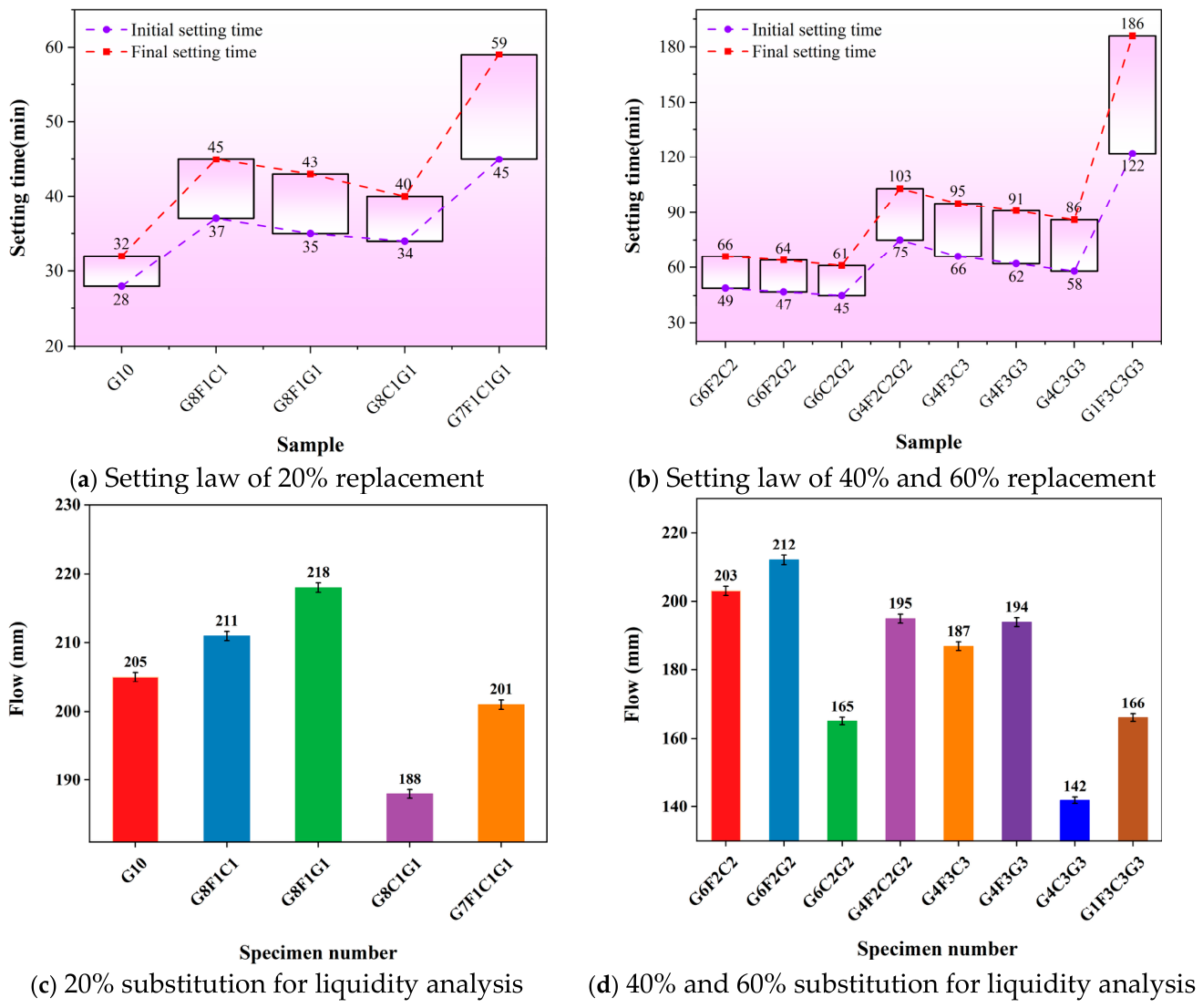
The setting times and fluidity values for all AAS pastes are presented in
Figure 2. The reference mixture G10 exhibited extremely rapid setting, with initial and final setting times of merely 28 min and 32 min, respectively, and a fluidity of 205 mm. As a high-calcium aluminosilicate glassy material, GBFS typically contains over 36% CaO by mass (
Table 1) and possesses an exceptionally high vitreous phase fraction. Its disordered atomic structure lacks long-range crystalline order, rendering the silicon-oxygen and aluminum-oxygen bonds within the glass network thermodynamically metastable [
15]. Upon contact with a highly alkaline activator such as NaOH, the particle surfaces of GBFS undergo rapid congruent dissolution, releasing substantial quantities of Ca
2+, [SiO
4]
4−, and [AlO
4]
5− into the pore solution within an extremely short timeframe [
37]. This explosive ion release drives the liquid phase to a state of supersaturation almost instantaneously. The resulting supersaturated ionic environment promptly triggers both homogeneous and heterogeneous nucleation, leading to the massive precipitation of calcium aluminosilicate hydrate (CASH) gels on particle surfaces and within interparticle voids [
22]. These gels develop into an extensively crosslinked percolating network that rapidly binds the dispersed GBFS particles into a continuous solid skeleton. Concurrently, the exothermic nature of the rapid gel formation further accelerates the reaction kinetics, establishing a positive feedback loop that intensifies the rate of structural buildup, such that the paste attains its final set within only tens of minutes [
16]. This high-speed nucleation, precipitation, and percolation process, synergistically driven by the highly reactive calcium-rich precursor and the strong alkaline activator, constitutes the fundamental microscopic mechanism responsible for the characteristic flash setting of AAS. While such ultrafast setting facilitates early demolding and contributes to rapid strength development, it severely curtails the workable time window for placement, thereby constraining the applicability of the material in cast-in-place and large-volume construction scenarios.
3.2.1. Effects of Solid Waste Incorporation on Setting Behavior
The incorporation of coal-based solid wastes uniformly prolonged both the initial and final setting times relative to the G10 reference, with the degree of retardation governed by the type and total dosage of the substituent materials. At a 20% total replacement level, all binary mixtures exhibited moderate retardation. The G8F1C1, G8F1G1, and G8C1G1 formulations recorded initial setting times of 37, 35, and 34 min, and final setting times of 45, 43, and 40 min, respectively. Among these, G8F1C1 yielded the longest setting times, whereas G8C1G1 was the least retarded. This trend aligns with the relative reactivity of the substituting wastes. GS appears to contribute reactive components that partially compensate for the dilution of GBFS, whereas CG, being the most inert, exerts a more pronounced retarding effect [
1]. At higher replacement levels, the retardation became progressively more conspicuous. At 40% total substitution, the initial setting times ranged from 45 to 49 min and the final setting times from 61 to 66 min. The G6F2C2 again exhibited the longest setting times, whereas the G6C2G2 showed the shortest. At 60% substitution, the initial and final setting times further extended to ranges of 58 to 66 min and 86 to 95 min, respectively, indicating a progressive deceleration of the alkali-activated reaction. The ternary mixture G7F1C1G1, corresponding to 30% substitution, displayed initial and final setting times of 45 and 59 min. These values lie intermediate between those of G8F1C1 and G6F2C2, consistent with its intermediate replacement level. The most extreme retardation was recorded for G1F3C3G3 at 90% substitution, where the initial and final setting times reached 122 and 186 min, respectively. These times are more than four and six times longer than those of the G10 reference. This substantial prolongation reflects the severe dilution of the reactive GBFS fraction, leaving only 10% of the calcium-rich precursor to drive the alkali-activated reaction. Under such conditions, the concentrations of Ca
2+ and other ionic species in the pore solution are insufficient to trigger rapid supersaturation and precipitation, resulting in a sluggish setting process that approaches the setting behavior of ordinary Portland cement pastes [
7].
3.2.2. Effects of Solid Waste Incorporation on Fluidity
The fluidity results exhibited a more complex pattern, with certain mixtures showing improved flowability while others suffered significant reductions. G10 presented a fluidity of 205 mm. The FA-GS mixture G8F1G1 achieved the highest fluidity of 218 mm, followed by G8F1C1 (211 mm), whereas G8C1G1 (188 mm) showed a marked decrease. This order can be rationalized by the particle morphology and water demand of the individual wastes: FA consists of smooth, spherical particles that exert a “ball-bearing” effect, reducing inter-particle friction and enhancing flowability. GS, with its fine particle size and porous carbonaceous structure, may contribute to internal lubrication by releasing entrapped water, though its high specific surface area also competes for free water. CG, in contrast, possesses a layered, irregular morphology with high surface roughness and significant microporosity, which adsorbs substantial free water and increases the yield stress of the paste, thereby deteriorating fluidity [
11]. As substitution levels increase, the fluidity trends become clearly divergent. The G6F2G2 retains the highest fluidity at 212 mm, while the G6C2G2 plummets to 165 mm (20% below G10 and 22% below G6F2G2). The intermediate G6F2C2 reaches 203 mm. Among the 40% substitution systems, G4F3G3 gives 194 mm, whereas G4C3G3 drops sharply to 142 mm (the lowest), and G4F3C3 shows 187 mm. Ternary mixtures show moderate values. G4F2C2G2 (40% substitution) yields 195 mm, and even the high replacement G1F3C3G3 (90%) gives 166 mm, still higher than several CG dominant binaries, highlighting that FA and GS partially counteract the detrimental effect of CG.
3.2.3. Interplay Between Setting Time and Fluidity
The coordinated evolution of setting time, fluidity, and compressive strength in these alkali-activated binders originates from the synergistic interplay among multiple coal-based solid wastes and the GBFS host, rather than from any isolated component feature. During the early dissolution stage, the rapid release of Ca
2+ from GBFS encounters aluminate and silicate oligomers continuously supplied by the gradual breakdown of FA and GS glassy networks. These oligomers capture part of the calcium ions into metastable soluble precursor clusters, thereby lowering the ionic supersaturation peak and delaying the percolation threshold of the primary calcium aluminosilicate hydrate gel network [
17]. Simultaneously, the residual carbonaceous particles dispersed by GS in the blend provide abundant heterogeneous nucleation substrates that reduce the thermodynamic barrier for gel precipitation and guide a spatially refined distribution of nuclei [
3]. This coupled modulation, where FA supplies the retarding complexing species and GS offers the nucleating templates, prevents flash set while maintaining a high density of growth sites, resulting in a controllable extension of setting time that is neither excessive nor uncontrolled [
22]. The same synergistic pattern directly governs fluidity through particle-level geometric cooperation. The spherical particles of FA act as physical rollers that decorate the irregular surfaces of GS grains and the angular GBFS particles, alleviating direct interparticle friction. This ball bearing effect is amplified by the improvement in overall packing density achieved through the multi-component particle size distribution, which releases part of the water otherwise immobilized in interstitial voids and converts it into lubricating free water [
1]. Consequently, the G8F1G1 achieves high flowability without any increase in mixing water dosage, a condition that is essential for producing a dense and homogeneous hardened matrix. The strength development further reflects the positive chemical and microstructural synergy inherited from the fresh state. In the early age, the uniformly distributed gel network, formed under controlled nucleation kinetics, avoids the localized defects and microcracks typical of ultra-fast-setting systems, providing an adequate initial load-bearing skeleton [
8]. As curing proceeds, the sustained dissolution of FA and GS maintains an alkaline environment and releases mobile Si and Al species that react with the remaining GBFS grains and with the initial gel phase [
18]. This prolonged secondary-gel infilling densifies the interfacial zones and transforms the pore structure toward finer gel pores [
5]. The fine carbon particles from GS serve as microreinforcements that deflect cracks, enhancing the fracture toughness of the matrix [
4]. The interplay between the latent pozzolanic supply from FA and the template-assisted gel growth enabled by GS leads to a highly interconnected and homogeneous microstructure, which explains why the FA GS GBFS ternary combination yields the maximum measured fluidity and the highest 28-day strength. When CG is introduced into the blend, this multi-waste synergistic mechanism is disrupted. The highly crystalline and inert nature of CG prevents it from participating in the ionic exchange and complexation processes that regulate nucleation, so the calcium concentration remains unbalanced and the setting is excessively retarded [
23]. At the particle scale, the platy and porous CG grains break the optimized packing order, absorb mixing water into intraparticle voids, and create mechanical interlocking that increases internal friction [
36]. This reduces flowability and introduces capillary porosity after hardening. The resulting weak interfaces between the inert CG particles and the binding gel act as stress concentrators and flaw initiators, compromising the mechanical integrity even at extended curing ages [
14]. The negative effects of CG cannot be compensated by the beneficial FA GS synergy unless the CG dosage is kept very low. Therefore, the FA-GS system achieves a holistic balance by merging ionic sequestering, heterogeneous nucleation, and particle packing optimization into a single cooperative process, whereas CG disrupts this balance, imposing a diluent role that degrades workability, setting control, and strength simultaneously.
3.3. Analysis of XRD
As shown in
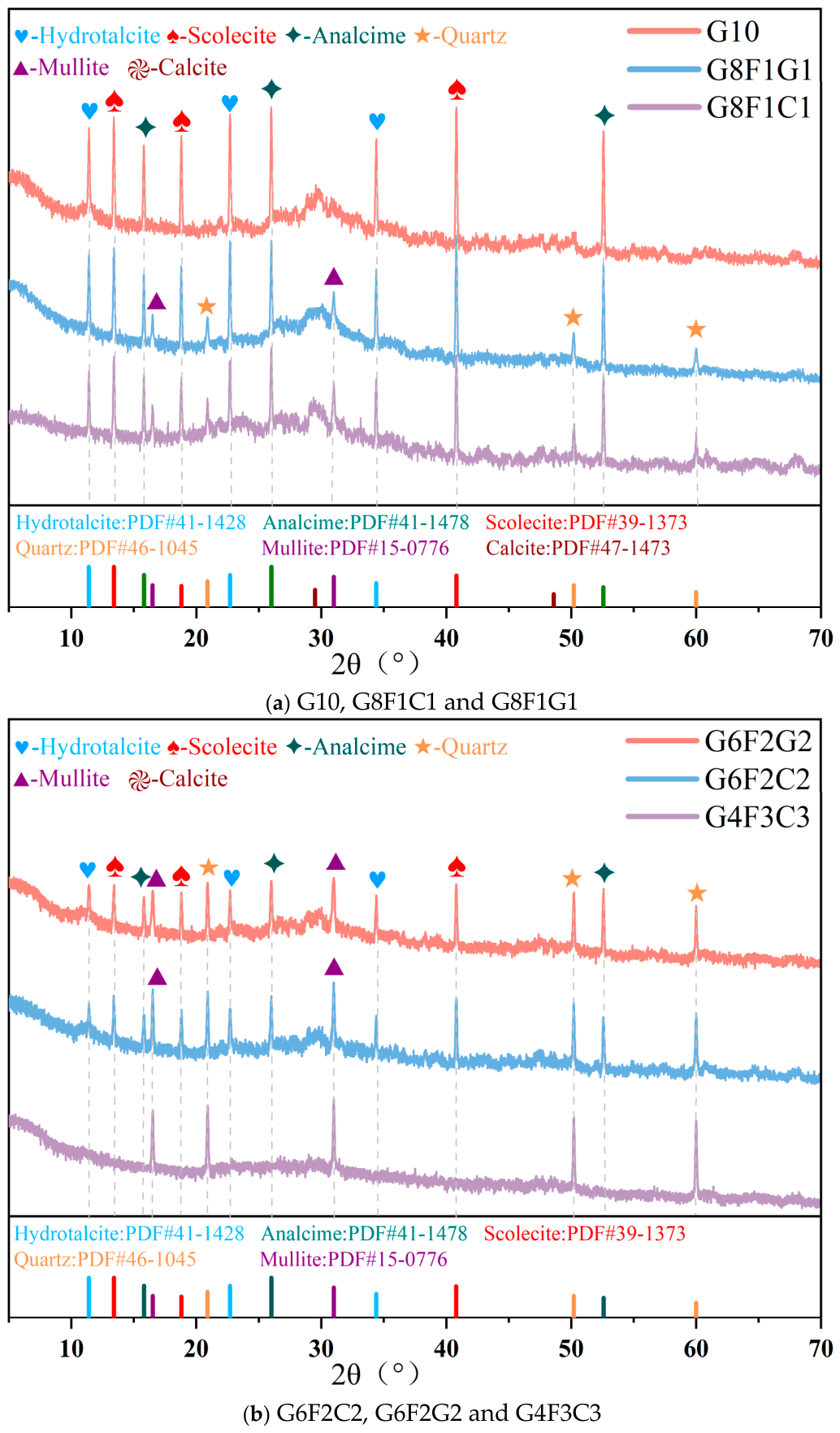
Figure 3a, X-ray diffraction analysis of the G10 reveals a broad diffuse halo centered approximately between 25° and 40° (2θ), a feature characteristic of the poorly ordered calcium aluminosilicate hydrate (C-A-S-H) gel that constitutes the primary binding phase. The absence of sharp crystalline reflections indicates that the reaction products are predominantly amorphous and that the alkali activation proceeds via a dissolution and reprecipitation mechanism yielding a structurally disordered gel network. The X-ray diffraction pattern of G10 exhibits a series of low intensity yet clearly discernible Bragg reflections that are superimposed on the amorphous background. These peaks are identified as hydrotalcite (LDH, PDF#41-1428, 11.4°, 22.7°, 34.4°), analcime (PDF#41-1478, 15.8°, 26°, 52.8°), and scolecite (PDF#39-1373, 13.4°, 18.8°, 40.8°) phases. The hydrotalcite phase manifests characteristic basal reflections at approximately 11.4°, 22.7° and 34.4° 2θ, consistent with a layered double hydroxide structure. The analcime phase contributes diffraction signals near 15.8°, 26° and 52.8° 2θ, indicative of a tectosilicate framework with narrow channel systems. The scolecite phase further confirms the presence of a fibrous zeolite with a fully crosslinked aluminosilicate network. The simultaneous appearance of these crystalline hydration products, coexisting with the massive C-A-S-H gel, provides direct mineralogical evidence that the polycondensation reaction has proceeded to a highly advanced stage. The formation of well-ordered zeolitic and hydrotalcite frameworks requires extensive reorganization of silicate and aluminate tetrahedra into dense, rigid three-dimensional structures, a process that can only occur when the dissolution of GBFS is explosive and the reprecipitation kinetics are exceptionally rapid [
7]. This extensive polycondensation densifies the binding matrix and establishes a continuous percolated network at very early ages, which directly accounts for the ultra-fast setting and the rapid compressive strength development observed in the G10 reference paste [
8]. The coexistence of amorphous C-A-S-H gel and nanocrystalline zeolitic products thus reflects a reaction path in which the initial gel precipitates are almost immediately reinforced by crystalline nodes, resulting in a composite microstructure with high early stiffness and load-bearing capacity.
3.3.1. Analysis of Binary Substitution Systems
In the G8F1C1, the X-ray diffraction pattern displays pronounced deviations from that of the G10. The broad diffuse halo attributed to the C-A-S-H gel persists but exhibits a noticeable reduction in integrated intensity, signaling a diminished volume fraction of the amorphous binding phase. More critically, the characteristic reflections of hydrotalcite, analcime, and scolecite, which were distinctly present in G10, were markedly attenuated, providing direct evidence that the polycondensation process has been substantially retarded. Concurrently, sharp diffraction peaks arising from unreacted crystalline impurities become increasingly prominent. The quartz (PDF#46-1045, 20.9°, 50.2°, 60°) reflection at approximately 20.9°, 50.2°, and 60° 2θ intensifies, and a new set of peaks corresponding to mullite (PDF#15-0076, 16.5°, 31°), a principal crystalline constituent of coal gangue, emerges near 16.5° and 31°. The enhanced relative intensity of these inert crystalline phases reflects the dilution of the reactive GBFS fraction and the accumulation of passive particles introduced by the substituents. The attenuation of the secondary crystalline hydration products, coupled with the persistence of residual quartz and mullite, demonstrates that the extensive structural reorganization into dense three-dimensional frameworks is severely hindered. This mineralogical evidence directly accounts for the prolonged setting times and the reduction in early compressive strength observed in the G8F1C1.
The G8F1G1 system presented a distinctly different mineralogical picture. The integrated intensity of the C-A-S-H diffuse halo remained fully comparable to that of G10, confirming that the total quantity of the amorphous binding phase was undiminished. However, the reflections corresponding to hydrotalcite, analcime, and scolecite were attenuated, and no new crystalline impurity peaks emerged. This specific XRD pattern pointed to a reaction path where the formation of the strength-bearing C-A-S-H gel was efficiently sustained, while the subsequent transformation of this gel into ordered crystalline frameworks was selectively suppressed. The retained amorphous halo explained why the 28-day compressive strength showed no statistical loss, as the load-bearing gel network achieved an equivalent volumetric density. The fading of the scolecite and hydrotalcite reflections explained the prolonged setting, because in the absence of a percolating network of rigid crystalline nodes that would rapidly stitch the primary particles together, the macroscopic structural buildup relied solely on the progressive interconnection of the amorphous gel phase [
12]. This gel-continuous percolation required a longer time to establish a space spanning network, thereby delaying both the initial and final set without compromising the ultimate degree of connectivity. Moreover, the enhanced inert crystal peak from quartz and mullite appeared to indicate that the FA and GS combination did not introduce passive filler particles that would create weak interfaces or stress concentrations. The paste hardened into a homogeneous, purely gel-bound microstructure, which was intrinsically tougher and less defect sensitive than the composite matrix of G8F1C1. The moderate deceleration of the crystallization step, coupled with the uncompromised yield of amorphous C-A-S-H, thus defined the kinetically modulated synergy captured by the XRD pattern, enabling an optimal balance between extended workability and fully retained mechanical performance.
As shown in
Figure 3b, at the 40% total substitution level, both the G6F2C2 and the G6F2G2 displayed X-ray diffraction patterns that diverged substantially from that of the G10, with the changes reflecting the pronounced macroscopic retardation and strength decline. In both systems, the broad diffuse halo arising from the C-A-S-H gel exhibited a notable reduction in integrated intensity compared to G8F1C1 and the G8F1G1, providing direct evidence that the overall volumetric yield of the amorphous binding phase was diminished. This attenuation of the primary gel signal was accompanied by the notable reduction of the characteristic reflections assigned to hydrotalcite, analcime, and scolecite, which had been distinctly visible in the G10 pattern. The loss of these crystalline hydration products signals that the polycondensation process failed to advance to the stage of generating rigid three-dimensionally ordered frameworks, a condition that directly explains the substantially prolonged setting times, because the rapid percolation driven by interlocking crystalline nodes could no longer occur and the macroscopic structural buildup relied entirely on the slow progressive connection of the remaining gel fraction. However, the two mixtures differed markedly in the intensity of inert crystalline peaks inherited from the precursor wastes, and this difference underpinned the observed strength hierarchy. In the G6F2C2 pattern, sharp reflections from quartz at approximately 20.9°, 50.2° and 60° and from mullite at near 16.5° and 31° became strongly dominant, overwhelming the diminished C-A-S-H halo. The prominence of these inert crystalline phases demonstrates that a large fraction of the solid volume consisted of unreactive CG particles that did not contribute to gel formation, thereby diluting the effective binder content and introducing numerous weak, discontinuity-prone interfaces [
20]. By contrast, G6F2G2 exhibited only a slight enhancement of both the quartz and mullite reflections. The amorphous halo, although reduced relative to G10, retained a higher integrated intensity than that of G6F2C2, indicating that the FA and GS combination continued to sustain a greater production of C-A-S-H gel through their synergistic interaction, even at the elevated 40% replacement. The absence of extensive inert crystalline contamination meant that the paste hardened into a more homogeneous gel-bound microstructure with fewer built-in stress concentrators. The strength loss common to both systems originated from the depleted C-A-S-H gel fraction, which was a direct consequence of the reduced availability of reactive calcium from the diluted GBFS. The additional penalty suffered by G6F2C2 was imposed by the abundance of inert quartz and mullite, which acted as passive inclusions that disrupted the continuity of the gel network and lowered the load-bearing efficiency. In G6F2G2, the interference from inert phases was minimal, and the FA and GS synergy partially compensated for the calcium dilution by promoting a more uniform spatial distribution of the available gel and by providing nucleation sites that refined the microstructure. Nevertheless, the fading of all crystalline hydration products in both systems confirmed that the kinetic modulation of the reaction was shifted too far toward retardation, suppressing the formation of the reinforcing crystalline nodes and forcing the percolation to occur through a slow gel-only mechanism, which adequately extended workability but could not restore early or late strength to the level of the low substitution FA and GS binary system.
At the 60% total substitution level, the X-ray diffraction patterns of the G4F3C3 and G4F3G3 pastes underwent a fundamental transformation that distinguished them qualitatively from all lower replacement systems. The broad diffuse halo characteristic of C-A-S-H gel, which had remained clearly identifiable even in the G6F2G2 mixture, faded into a weak, almost featureless hump barely emerging above the background. This near disappearance of the amorphous gel signal indicates that the precipitation of the primary binding phase was severely curtailed, rather than merely reduced. Simultaneously, the sharp reflections of hydrotalcite, analcime, and scolecite were completely undetectable, confirming that neither the amorphous gel network nor its crystalline derivatives formed in any structurally meaningful quantity. In the G4F3C3 pattern, the diffraction trace was overwhelmingly dominated by intense, narrow peaks of quartz and mullite, the inert crystalline phases inherited from the CG. The G4F3G3 pattern similarly showed strong quartz and mullite diffraction peaks, and the residual amorphous halo exhibited a marginally higher intensity than that of G4F3C3. Both patterns depicted a solid matrix in which crystalline impurity phases constituted the dominant X-ray scattering volume, while the strength-bearing gel phase was reduced to a minor, disconnected fraction. These XRD features explain the dramatic prolongation of setting times and the sharp decline in compressive strength at 60% substitution. The setting behavior was no longer governed by the percolation of a continuous gel network, a mechanism that had operated even in the gel only systems at lower substitution levels. Instead, with the GBFS fraction diminished to 40% and the Ca
2+ flux critically depleted, the pore solution could not achieve the supersaturation threshold necessary for massive homogeneous nucleation and growth of C-A-S-H [
2]. Precipitation occurred only at sparse, widely separated sites, producing isolated gel patches that were incapable of spanning the interparticle distances within the time frame of the setting measurement [
10]. The macroscopic stiffening recorded as setting was therefore attributable to a secondary process, the gradual accumulation of fine reaction products at particle contacts combined with the physical packing consolidation of the abundant inert grains. This transition from a chemically driven percolation to a packing dominated pseudoset explains the extreme retardation.
The mechanical performance similarly reflected the collapse of the gel binding skeleton. In G4F3C3 (
Figure 3c), the dominance of crystalline quartz and mullite signified that the paste hardened into a granular composite where the vast majority of solid particles were nonreactive, angular CG grains. The sparse C-A-S-H gel acted merely as a weak, discontinuous binder that provided only localized adhesion, while the load transfer relied largely on friction and mechanical interlocking among the inert particles [
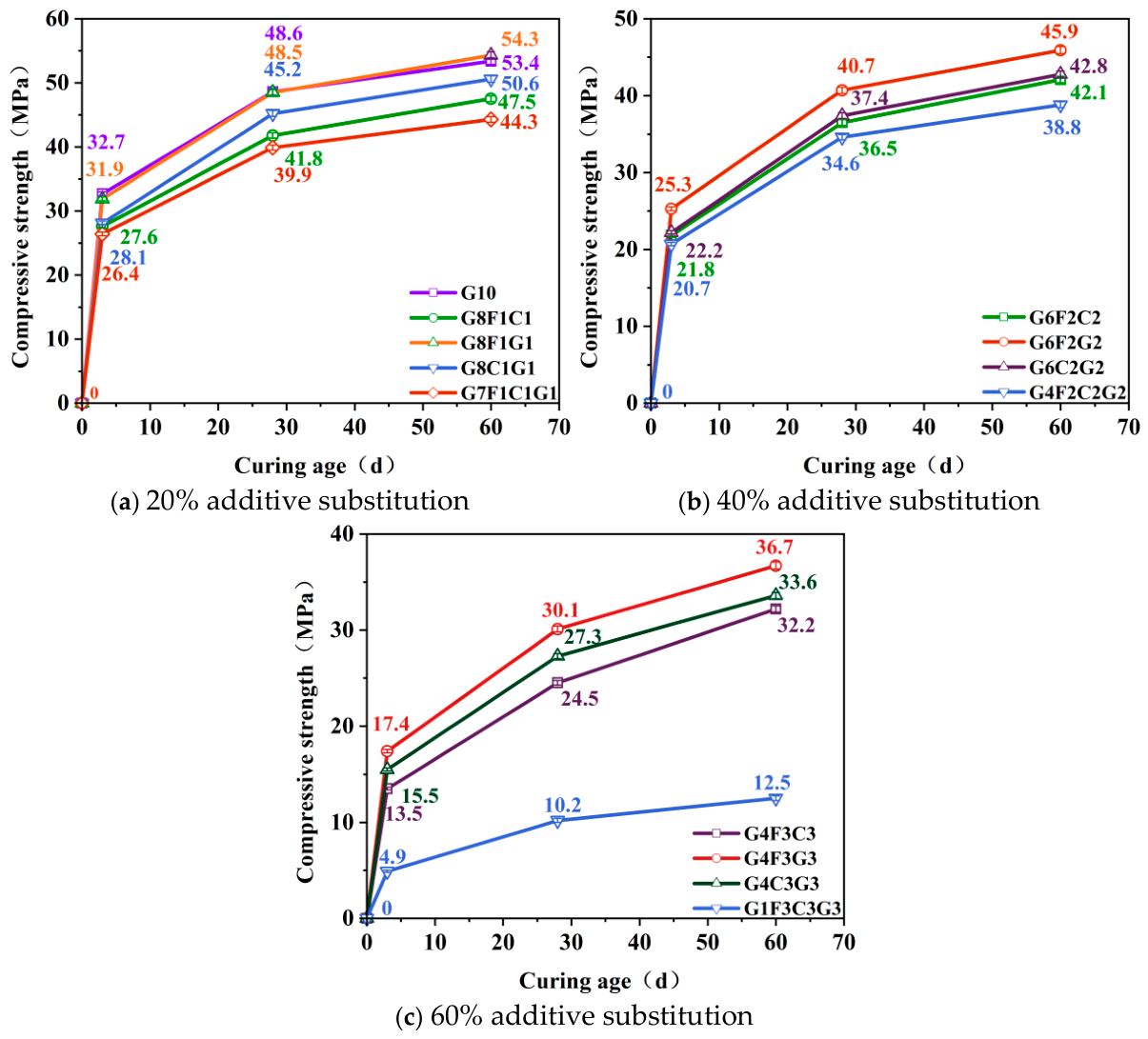
7]. The numerous weak interfaces between the gel patches and the crystalline grain surfaces acted as preexisting flaws, leading to premature failure under load and the measured strength of 24.5 MPa. In G4F3G3, the residual glassy phases in GS and the pozzolanic potential of FA continued to sustain a minimal level of supplementary gel formation, which gave rise to a modestly more connected microstructure and a 28-day strength of 30.1 MPa [
11]. Even so, the gel volume was far below the threshold required for a continuous load-bearing network, so the strength fell to nearly half of the G10 value. The XRD signature of a gel-depleted, impurity-rich assemblage thus captures the mechanistic essence of the high substitution regime, where the synergistic interplay between FA and GS or FA and CG could no longer compensate for the catastrophic loss of reactive calcium, and the system degenerated into a weakly bonded granular bed with greatly extended setting and severely compromised mechanical integrity.
3.3.2. Analysis of Ternary Substitution Systems
As shown in
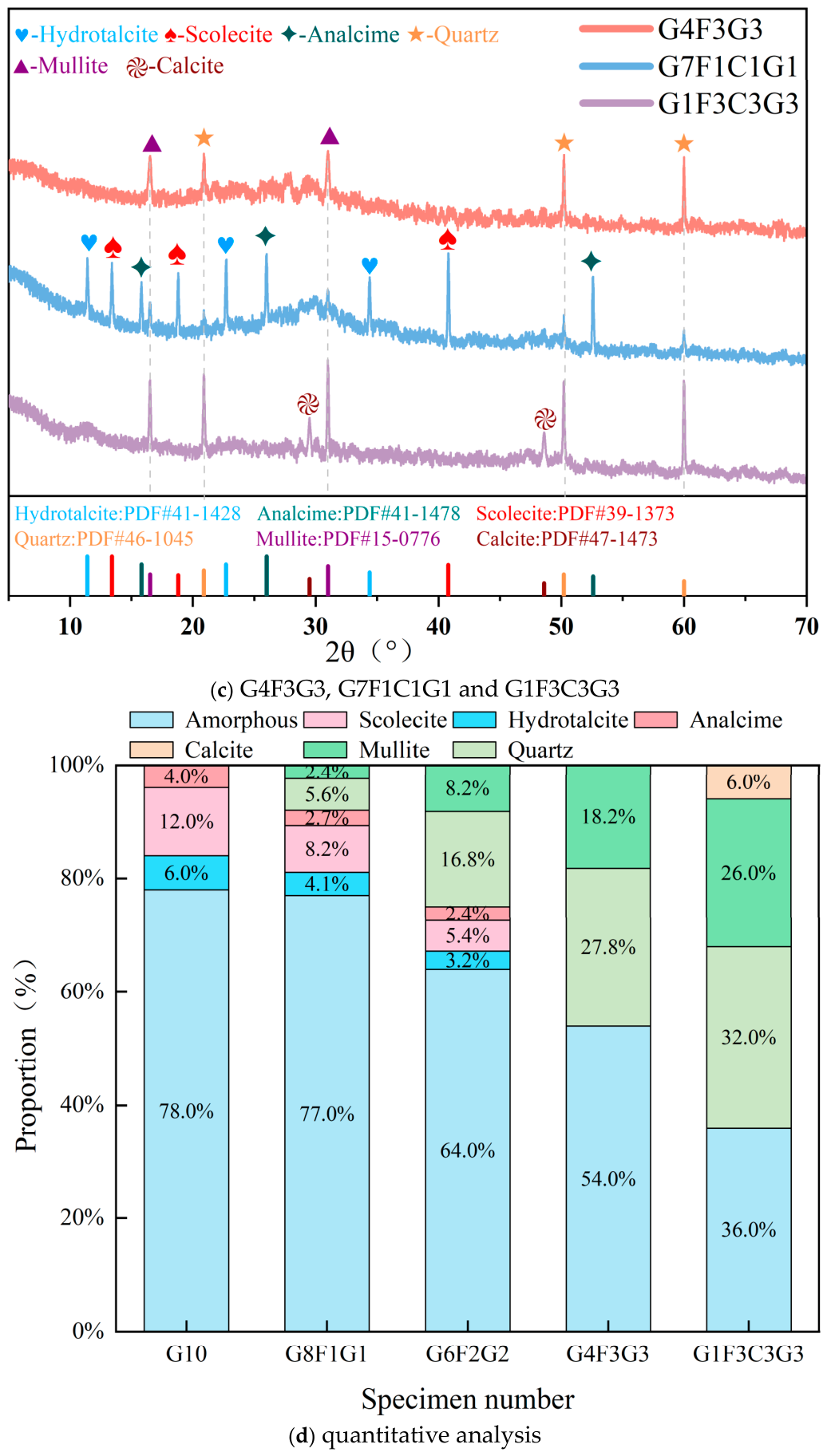
Figure 3c, the ternary mixture G7F1C1G1 produced an X-ray diffraction pattern that differed in subtle but mechanistically significant ways from the previously discussed binary systems. The broad diffuse halo of C-A-S-H gel remained clearly observable, yet its integrated intensity registered a perceptible decrease relative to that of the G8F1G1, signaling that the total volume of the amorphous binding phase was modestly diminished. The reflections assigned to hydrotalcite, analcime, and scolecite, already substantially attenuated in G8F1G1, underwent a further decrease in intensity in the G7F1C1G1. At the same time, weak but unambiguous diffraction peaks corresponding to quartz at approximately 20.9°, 50.2°, and 60° and mullite at approximately 16.5° and 31° emerged. These crystalline impurity signals, absent in G8F1G1, originated exclusively from the coal gangue fraction. The inert quartz and mullite grains introduced by CG occupied volume without contributing to gel formation, thereby diluting the effective binder fraction and creating weak, discontinuity-prone interfaces. Moreover, these crystalline surfaces interfered with the heterogeneous nucleation function of GS, locally suppressing the formation of gel at the very sites that would otherwise refine the spatial distribution of the binding network [
5]. The gel that did form was consequently less interconnected and required a longer time to achieve space-spanning percolation, directly accounting for the additional setting delay. The strength penalty arose from the combination of a reduced gel volume and the abundant stress concentrators presented by the unreacted crystalline inclusions, which fragmented the load transfer paths [
5].
At the 90% substitution level, the G1F3C3G3 paste presented an XRD pattern that signaled a near-total collapse of the chemically bonded structure. The broad amorphous halo characteristic of C-A-S-H gel virtually disappeared, leaving a featureless background that confirmed the absence of any structurally significant quantity of the binding phase. The crystalline reflections of hydrotalcite, analcime, and scolecite were completely undetectable. Conversely, the diffraction pattern was mainly dominated by strong quartz and mullite reflections, with additional weak calcite (PDF#47-1473, 29.5°, 48.6°) peaks, all of which jointly contributed to the principal X-ray scattering intensity. No new crystalline products were observed, indicating that neither the GBFS nor the coal-based wastes underwent any appreciable alkali-activated reaction. Consequently, the vast majority of the solid constituents remained as unreacted, passive particles. The hardening process that was recorded as setting was no longer a chemical percolation of reaction products but a physical consolidation of a granular bed, driven primarily by water evaporation and particle packing. The feeble compressive strength originated from frictional interlocking and from isolated patches of gel that precipitated sparsely at the few remaining reactive GBFS grain surfaces, forming a discontinuous, poorly adhesive skeleton that failed at very low loads [
13]. The XRD signature of a gel-depleted, impurity-saturated assemblage thus captured the mechanistic essence of this extreme dilution regime, where the synergistic potential of the coal-based wastes was entirely nullified by the catastrophic deficiency of reactive calcium, and the material degenerated into a weakly coherent granular composite.
3.3.3. Quantitative Analysis
As shown in
Figure 3d, quantitative phase analysis conducted via Rietveld refinement of the X-ray diffraction data revealed a systematic evolution of the amorphous and crystalline phase fractions that directly governed the macroscopic setting behavior and compressive strength development of the pastes. In the G10 reference, the amorphous content reached approximately 78 wt.%, representing the sum of the C-A-S-H gel and a small residual fraction of unreacted GBFS glass. The crystalline fraction comprised scolecite (12 wt.%), hydrotalcite (6 wt.%), and analcime (4 wt.%). This phase assemblage indicated that the alkali activation of GBFS proceeded with high efficiency, which converted the majority of the precursor into binding gel and yielded a rigid, well-connected matrix in which crystalline nodes further reinforced the percolated amorphous network.
Upon replacing 20% of the GBFS with FA and GS in the G8F1G1 mixture, the total amorphous content remained virtually unchanged at approximately 77 wt.%, confirming that the synergistic dissolution of FA and GS compensated for the diluted GBFS fraction. The critical quantitative difference lay in the redistribution of crystalline species. The combined fraction of scolecite, hydrotalcite, and analcime decreased to 15 wt.%, while the total content of quartz and mullite rose to 8 wt.%. The preserved amorphous volume fraction explained why the 28-day strength showed no statistical loss, because the load-bearing gel network occupied an equivalent volumetric density. The quantitative depletion of the nanocrystalline zeolitic and hydrotalcite phases explained the extended setting times, since the rapid percolation previously facilitated by these interlocking crystalline nodes was eliminated, and the macroscopic stiffening had to rely exclusively on the progressive connectivity of the amorphous gel, a process that required a longer duration to achieve space-spanning percolation.
As the substitution level rose to 40% in G6F2G2, the amorphous fraction declined measurably to 64 wt.%, while the quartz and mullite content grew to 25 wt.%. The volumetric deficit of the C-A-S-H gel, amounting to a 14 wt.% loss relative to G10, translated into a lower density of load-bearing struts and an increased nanoporosity within the gel phase. The further prolongation of setting times reflected the fact that a smaller volume of gel required a higher degree of internal connectivity to achieve macroscopic percolation, a condition that was met only after extended reaction time. At the 60% substitution in G4F3G3, the amorphous content fell sharply to 54 wt.%, while quartz and mullite became the dominant crystalline phase at 46 wt.%. The gel volume was now critically depleted, such that the percolation threshold was barely attainable within the measured setting window. The 28-day strength of 30.1 MPa corresponded to a gel volume fraction insufficient to encapsulate all inert particles, leaving a microstructure with abundant gel-free interstices that acted as stress concentrators.
The ternary mixture G1F3C3G3, with 90% total substitution, presented a fundamentally different quantitative profile. The amorphous fraction collapsed to 36 wt.%, and the crystalline fraction was dominated by quartz (32 wt.%) and mullite (26 wt.%), with minor calcite (6 wt.%) and no detectable scolecite, hydrotalcite, and analcime phases. The amorphous gel volume was far below the critical threshold required for continuous connectivity, so the measured strength of 10.2 MPa arose predominantly from frictional interlocking among the angular inert grains, supplemented by isolated gel bridges that failed at low stress [
11]. The extreme setting retardation to over 120 min initial set was a consequence of the absence of a chemically driven percolation event. Stiffening was recorded only when water evaporation and particle sedimentation brought the inert grains into close contact. The quantitative phase data thus demonstrated that the amorphous gel fraction served as the master variable governing both the setting kinetics and the mechanical performance, and that the critical threshold for a functional load-bearing network lay above approximately 65 wt.% amorphous content in these alkali-activated systems [
22]. Below this threshold, the material transitioned from a reaction-bonded ceramic into a weakly cemented granular bed, with all the attendant losses in workability control and structural integrity.
3.4. Analysis of SEM
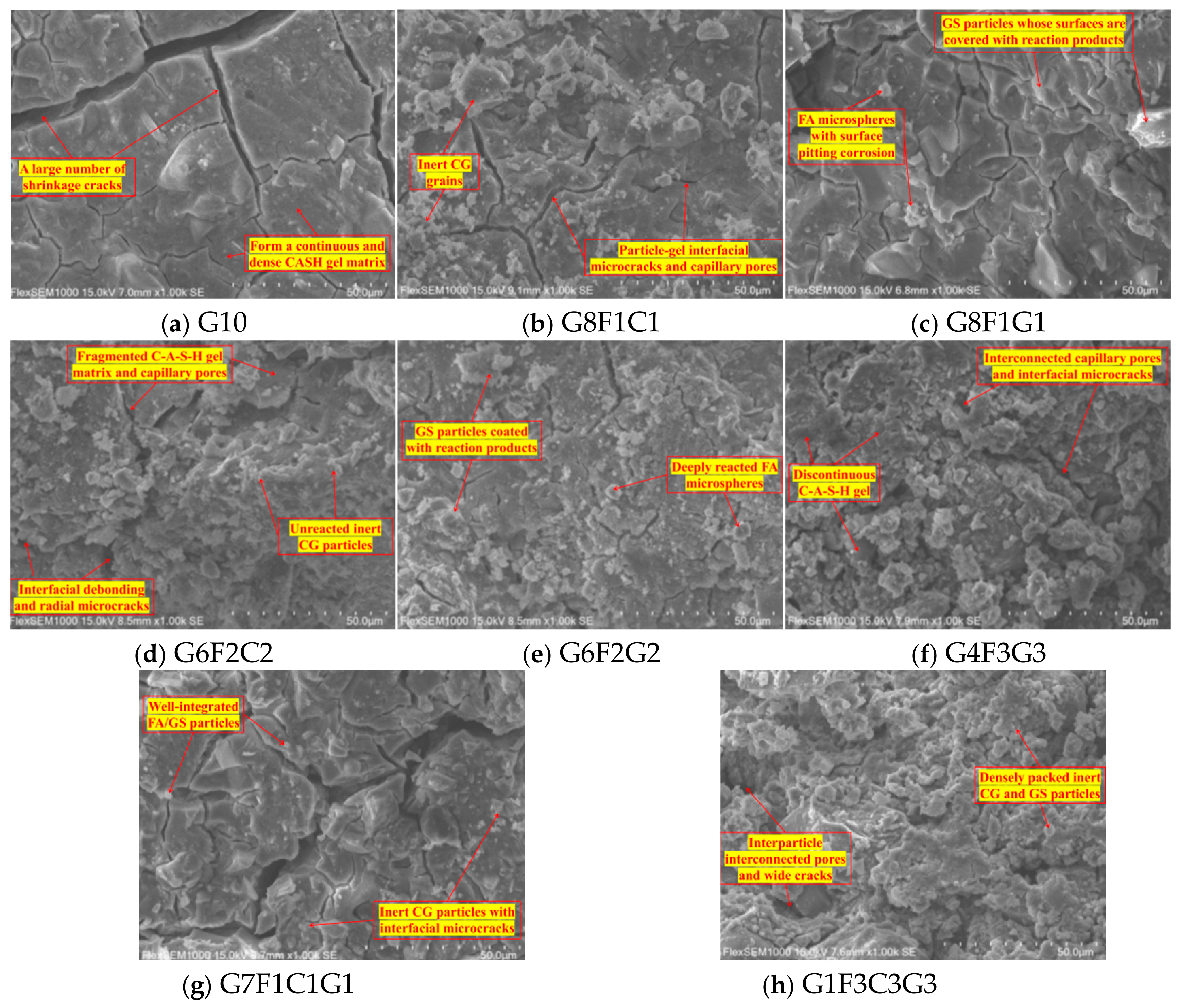
As shown in
Figure 4, SEM analysis of the G10 revealed a highly densified and homogeneous microstructure. The entire field of view was dominated by a continuous, massive CASH gel matrix with virtually no discernible particle boundaries. Residual unreacted GBFS grains were only sporadically observed and their surfaces appeared heavily corroded, indicative of extensive dissolution and participation in the polycondensation reaction. The gel phase exhibited a smooth, compact morphology with only sparse, isolated gel pores of submicron dimensions. Numerous drying shrinkage microcracks were observed throughout the matrix, features that severely compromised the overall microstructural compactness. However, the development of these cracks was itself a characteristic signature of the highly extensive polycondensation reaction, reflecting the substantial volumetric contraction that accompanied the rapid and pervasive formation of the gel network.
The G8F1C1 introduced pronounced microstructural heterogeneity. Large, angular CG particles with clean, smooth surfaces were distributed throughout the matrix, indicating negligible dissolution and no participation in gel formation. The interfaces between these inert CG grains and the surrounding C-A-S-H gel were decorated with prominent circumferential microcracks and connected capillary pores, features that act as preferential pathways for crack propagation. FA spheres were partially embedded but their surfaces showed only mild etching, reflecting limited pozzolanic reaction. The gel matrix itself, although locally dense, was interrupted by these inert inclusions and the associated interfacial voids, resulting in a discontinuous load-bearing skeleton. This heterogeneous microstructure accounts for the prolonged setting time, as the percolation path was obstructed by inert particles, and for the reduced compressive strength, which was governed by the weak interfaces that failed prematurely under stress.
In contrast, the G8F1G1 displayed a microstructure that closely resembled that of G10 in terms of overall denseness and uniformity. The C-A-S-H gel formed a continuous, tightly packed matrix that fully enveloped the FA spheres and the fine GS particles. The residual GS grains, with their irregular but porous texture, were intimately bonded to the gel, and their surfaces appeared coated with reaction products, suggesting that they served as effective nucleation and growth sites. The FA spheres exhibited surface pitting and were tightly integrated into the gel, with no surrounding gaps. The porous carbonaceous particles of GS were embedded within the gel without causing microcracking, and the overall pore population consisted predominantly of fine, well-distributed gel pores. The homogeneous and defect-scarce microstructure directly supports the uncompromised 28-day strength, as the load-bearing gel network maintained a volumetric density equivalent to G10, while the absence of rapid setting-inducing crystalline nodes prolonged the setting time through a gel-continuous percolation mechanism.
Raising the CG and FA content to 20% each in the G6F2C2 mixture significantly exacerbated the microstructural deficiencies. The abundance of angular CG grains created extensive interfacial debonding, and wide microcracks radiated from these inert particles into the gel matrix. The gel phase appeared fragmented, forming isolated patches rather than a continuous network, and the unreacted CG particles were often in direct contact with each other, forming load-bearing columns of nonreactive grains separated by weak gel bridges. Capillary porosity was greatly increased, and the gel fraction was visibly lower. These features explain the pronounced strength loss to 36.5 MPa, as the effective load-bearing volume was drastically reduced by the inert inclusions and the associated interfacial flaws, while the setting was further delayed because the gel patches required excessive time to connect across the dense network of inert obstacles.
The G6F2G2 retained a substantially more continuous and denser gel matrix compared to G6F2C2. Although the total gel volume was visibly reduced relative to G8F1G1, the remaining C-A-S-H gel formed a well-interconnected network that thoroughly coated the FA and GS particles. The FA spheres were deeply reacted and bonded, and the GS particles appeared to refine the gel texture, producing a fine-grained, homogeneous appearance. Microcracks were rare and the porosity, while higher than in G10, was dominated by small gel pores rather than large capillary voids. This microstructure supports the measured 40.7 MPa strength, as the continuous gel network effectively transferred load with minimal stress concentration points, and the extended setting was a consequence of the slower buildup of this gel network without the accelerating effect of crystalline nodes.
At 30% FA and 30% GS replacement in G4F3G3, the SEM images revealed a clear dilution of the gel phase. The C-A-S-H matrix no longer formed a fully continuous mass. Unreacted and partially reacted FA and GS particles became more prominent, and the gel frequently appeared as thin, web-like bridges connecting these particles. The pore structure shifted toward larger interconnected capillary pores, and microcracks were occasionally observed at the interfaces between the gel and the larger unreacted grains. The overall microstructural uniformity was degraded, with alternating dense gel clusters and porous, gel-lean regions. This observation correlates with the strength drop to 30.1 MPa, because the load-bearing skeleton became discontinuous and weak links dominated the mechanical response, while the setting time was further prolonged due to the extended period needed for the limited gel to bridge the interparticle gaps.
The ternary G7F1C1G1 exhibited a microstructure that combined the beneficial features of the G8F1G1 system with the detrimental effects of CG incorporation. The gel matrix was generally continuous but was locally disrupted by the presence of CG grains, which created interfacial microcracks and adjacent capillary voids. The FA and GS particles were well integrated into the gel, similar to their behavior in G8F1G1, suggesting that the FA and GS synergy remained partially operative. However, the inert CG inclusions acted as stress-concentrating defects that interrupted the otherwise homogeneous gel network. This mixed microstructure explains the intermediate strength of 39.9 MPa, as the load-bearing capacity was compromised by the CG-initiated flaws, and the setting time was prolonged beyond that of G8F1G1 because the percolation path was lengthened by the need to bypass the inert obstacles.
In the extreme case of G1F3C3G3 with 90% total substitution, the microstructure underwent a fundamental transformation. The field of view was dominated by densely packed, angular CG particles and irregular GS grains, with only trace amounts of gel-like substance observed as isolated, disconnected clusters at occasional grain contacts. The vast majority of particle surfaces were clean and showed no evidence of dissolution or gel precipitation. Massive intergranular pores and wide, continuous cracks pervaded the structure, indicating the near absence of a binding phase. The microstructural image was that of a mechanically compacted granular bed rather than a chemically bonded cementitious composite. This microscopic picture directly accounts for the extremely low compressive strength of 10.2 MPa, which originated from frictional interlocking rather than cohesive bonding, and for the extreme setting retardation to over 120 min, which reflected the time required for water evaporation and particle repacking rather than a gel-driven percolation process.
In summary, the SEM observations demonstrate that the microstructural evolution from a dense, continuous gel network to a loosely consolidated granular assembly is systematically governed by the synergistic interplay between FA and GS, and by the disruptive role of CG. The combination of FA and GS promoted the formation of a homogeneous, defect-scarce gel matrix through sustained pozzolanic supply and heterogeneous nucleation, preserving strength while moderating setting. The introduction of CG created inert, weakly bonded interfaces that generated microcracks and capillary porosity, disrupting the gel continuity and accelerating performance degradation. At high total substitution levels, the gel volume became insufficient to encapsulate the inert particles, and the microstructure transitioned into a granular skeleton with minimal cohesion, explaining the collapse of both workability control and mechanical integrity.