1. Introduction
In recent years, with the rapid development of ultrashort and ultraintense laser technology, laser–electron interactions under strong-field conditions have become an important research topic in modern laser physics and strong-field physics. A high-intensity laser field can drive free electrons into relativistic motion, leading to the generation of high-frequency and short-pulse radiation. Such radiation mechanisms have potential applications in compact high-frequency light sources, ultrafast diagnostics, and detection techniques with high spatial and temporal resolution [
1,
2,
3,
4,
5,
6]. When the laser field strength reaches the relativistic regime, the motion of electrons in the electromagnetic field exhibits pronounced nonlinear characteristics, and the corresponding radiation process can no longer be adequately described by conventional linear Thomson scattering theory. Under such conditions, the radiation emitted by electrons driven by a strong laser field is generally classified as relativistic nonlinear Thomson scattering (RNTS). Compared with linear scattering, RNTS is usually accompanied by typical nonlinear effects, such as harmonic enhancement, spectral broadening, and the evolution of angular distribution structures [
7,
8,
9]. Therefore, investigating the effects of laser field parameters and initial electron energy on RNTS radiation is of great significance for understanding strong-field laser–electron interaction mechanisms.
Previous studies have shown that, during the interaction between relativistic electrons and intense laser fields, the initial electron energy and laser intensity parameter play important roles in determining the spectral structure, angular distribution, and directivity of the scattered radiation [
10]. For instance, Esarey et al. systematically investigated the physical mechanism of high-energy radiation generated from the interaction between relativistic electrons and intense laser fields, and pointed out that the electron Lorentz factor determines not only the energy range of the scattered photons, but also the spectral broadening and radiation directivity [
11,
12]. Subsequently, Sarri et al. obtained high-brightness MeV-class γ-ray beams through the interaction between relativistic electron beams and high-intensity lasers by combining experiments with numerical simulations, demonstrating that the initial electron energy has a significant influence on the radiation energy range and spectral structure [
13]. In addition, Chi et al. studied the polarization characteristics of X-rays generated by nonlinear Thomson scattering, showing that variations in electron energy and laser field parameters jointly affect the radiation polarization and spatial structure [
14]. These studies indicate that the initial electron energy and laser intensity parameter are key physical quantities governing the radiation characteristics in strong-field scattering processes.
Although substantial progress has been made in nonlinear Thomson scattering in recent years [
15,
16], several issues still require further investigation. Existing studies have mostly discussed the effects of laser intensity or electron energy on radiation characteristics from the perspective of a single parameter [
17], such as the modulation of harmonic structures and radiation intensity by the laser amplitude parameter, or the influence of the initial electron energy on the scattered photon energy range and radiation directivity. However, in realistic strong-field interactions, the laser amplitude and initial electron energy often jointly determine the relativistic dynamics of electrons and further affect the formation and evolution of the emitted radiation. At present, systematic studies on RNTS radiation characteristics under the coupled variation in the laser amplitude parameter
and the initial electron Lorentz factor
remain relatively limited. Moreover, the intrinsic connection between electron trajectory evolution and the radiation spectrum, angular distribution, and temporal structure still needs to be further clarified.
This work investigates the cross-collision process between a tightly focused circularly polarized laser pulse and a high-energy electron, with emphasis on the synergistic modulation of RNTS radiation by the laser amplitude parameter and the initial electron relativistic factor . By employing a tightly focused circularly polarized Gaussian laser field model including high-order nonparaxial corrections, we systematically study the variations in electron trajectories, radiation angular distributions, spectral structures, and time-domain radiation characteristics under different and . This study helps reveal the parameter-dependent mechanism of high-energy electron radiation in strong laser fields and provides theoretical guidance for the optimization of tunable ultrafast X/γ-ray sources and attosecond radiation sources.
2. Theory and Formula
Before presenting the subsequent derivations, it is useful to clarify the normalization adopted in this work. All spatial variables are normalized to , while time is normalized to . In the calculations, the laser wavelength is taken as = 1 μm, and the speed of light is = 2.998 × 10⁸ m/s.
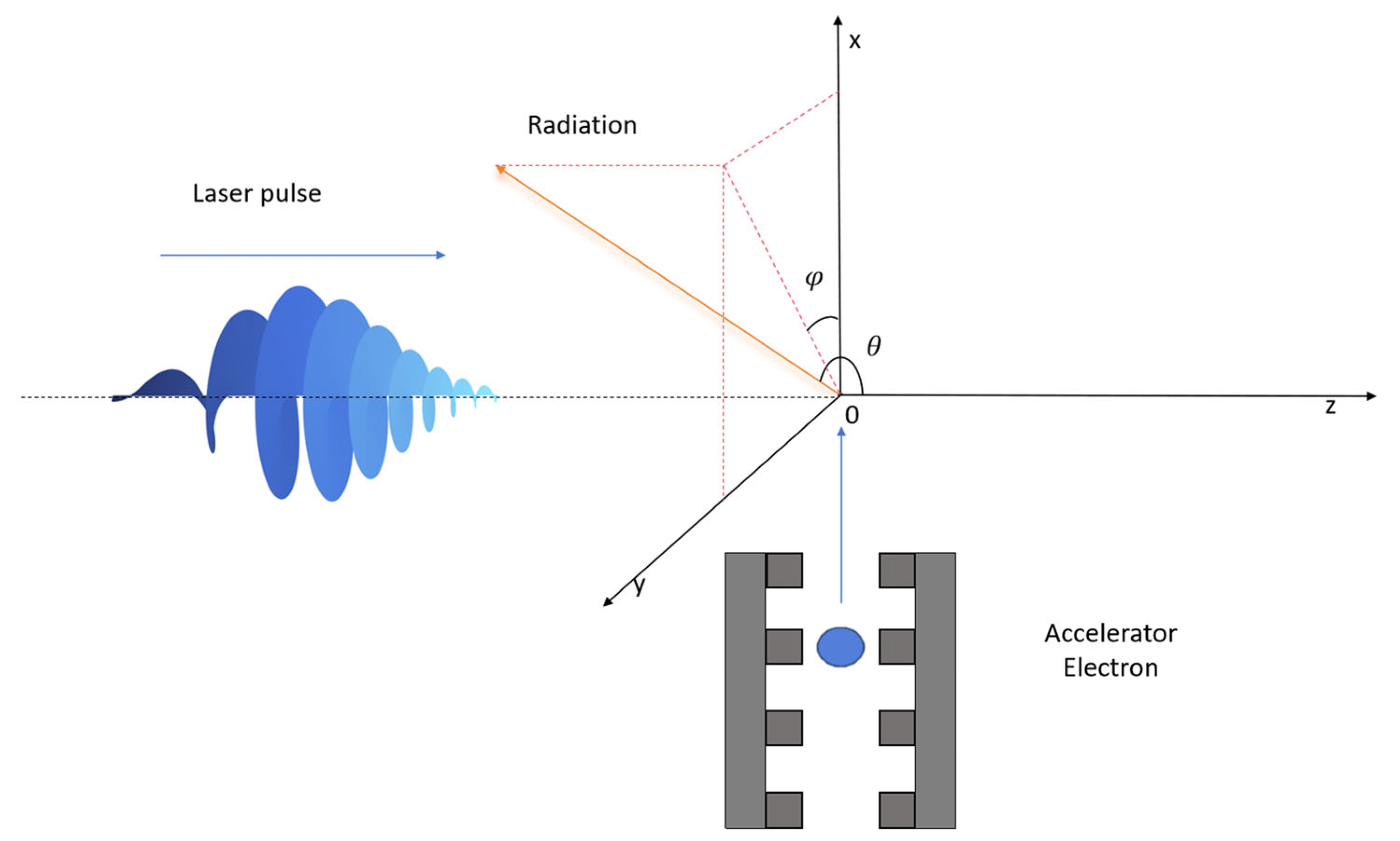
The configuration of the cross-collision relativistic nonlinear Thomson scattering (RNTS) process is schematically shown in
Figure 1. In the case of a tightly focused Gaussian beam, it is convenient to express the electromagnetic fields in terms of the vector potential
. Accordingly, the electric field
and magnetic field
, both governed by Maxwell’s equations, can be obtained from
[
18]:
The dielectric constant is denoted by
ε. When the Lorentz gauge condition is imposed, the vector potential
A follows the inhomogeneous wave equation:
For a vacuum environment, the current density
J vanishes, and the equation is therefore reduced to:
2.1. Gaussian Laser Field Model
In the case of tightly focused relativistic laser pulses, the paraxial approximation is no longer adequate. Strong focusing gives rise to non-negligible longitudinal fields and higher-order transverse terms, which cannot be ignored. These non-paraxial features have been discussed in a number of Thomson and Compton scattering studies, particularly for interactions between intense linearly polarized lasers and electrons or plasmas. As a result, higher-order field corrections must be taken into account to properly describe the electromagnetic structure in the nonlinear Thomson scattering regime [
19,
20,
21,
22].
These non-paraxial effects significantly influence the electron dynamics, particularly its longitudinal acceleration and transverse drift motion, and consequently affect the angular distribution of the emitted radiation analyzed in
Section 3.
Under the Cartesian coordinate framework, a circularly polarized laser may be described as the superposition of two mutually perpendicular linearly polarized components with a phase shift of π/2. These components are polarized along the x- and y-directions, respectively. Accordingly, the electromagnetic field of the circularly polarized laser can be formulated as .
To improve the clarity of the analysis, the high-order field expansion is first introduced for a linearly polarized Gaussian beam based on the formulations of Yousef et al. [
23] and Barton [
24]. Similar corrected-field descriptions have also been used in recent studies of relativistic nonlinear Thomson scattering in ultra-tightly focused circularly polarized laser pulses [
25]. The circularly polarized field considered in this study is subsequently obtained by combining two orthogonal linearly polarized components with a relative phase shift of π/2, thereby retaining all non-paraxial contributions [
26].
In this model, the Gaussian laser pulse is described by several key parameters, including the focal spot size 2
(μm), the pulse length L (μm), and the laser intensity I (W/cm
2). The normalized field envelope is given by:
Here,
represents the normalized electric-field amplitude. The quantity
denotes the normalized peak amplitude,
is the beam radius at the axial position z, and
is the Rayleigh length. In addition, the longitudinal phase variable and transverse radial coordinate are defined as
and
, sequentially.
The laser strength is characterized by the normalized amplitude , defined as , where is the peak electric-field strength. This dimensionless parameter measures the relativistic intensity of the laser field and plays a key role in determining the electron quiver motion as well as the resulting nonlinear radiation behavior. In practical units, it can be written as .
As the beam waist w0 becomes comparable to the laser wavelength, the diffraction parameter ε = 1/() can no longer be neglected. In this regime, both longitudinal field components and higher-order transverse terms reach magnitudes comparable to the leading paraxial contribution. To accurately capture the properties of tightly focused beams, the electromagnetic field should therefore be expanded in terms of ε.
In the case of tightly focused beams [
23,
24], it is necessary to include higher-order contributions related to the diffraction parameter
in the field description. The electromagnetic field of a linearly polarized Gaussian beam along the
x-axis was first derived by Yousef et al. [
23], and later extended to the y-polarized case by Barton [
24] and Zhang [
26] based on symmetry considerations. With the Gaussian beam profile and the wave equation taken into account, the electric field
E = (E
x,E
y,E
z) can be expressed as a fifth-order expansion:
2.2. Magnetic Field Components and Phase Relations
The associated magnetic field components of the Gaussian beam are given by:
Here,
, and
. For strongly focused beams (
< 4 μm), retaining terms up to the fifth order in ε is sufficient to achieve an accurate description of the electromagnetic field [
23]. The auxiliary functions are defined as follows:
In this expression, the phase term is written as
. The term
is associated with the wavefront curvature, where
denotes the corresponding radius of curvature. The Gouy phase
introduces an additional phase shift of
during propagation from z = −∞ to z = +∞.
2.3. Relativistic Electron Motion
The dynamics of an electron, characterized by a rest mass of
and charge of
, in the presence of the laser field are governed by the relativistic Lorentz equations:
In this formulation, the total energy is expressed as
, where the Lorentz factor is given by
. The corresponding momentum is
, with
. These equations are solved numerically using the Runge–Kutta–Fehlberg (RKF89) algorithm, which enables the calculation of the electron’s position, velocity, and acceleration during its interaction with the laser field.
2.4. Ponderomotive Force Analysis
The averaged force experienced by the electron can be described within the framework of the ponderomotive potential model [
27,
28]. In this approach, the ponderomotive force is defined as the gradient of a slowly varying effective potential:
The quantity
characterizes the normalized amplitude of the electromagnetic field. Within the first-order approximation, the ponderomotive force components along the three directions scale proportionally as:
These results indicate that the longitudinal component of the ponderomotive force dominates in the vicinity of the focal region, whereas the transverse components primarily drive the radial motion of the electron.
Since the radiated power is directly governed by the electron acceleration, the spectral properties of the emitted radiation can be obtained from the time-dependent electron dynamics.
In the RNTS regime, the imbalance between the longitudinal and transverse ponderomotive forces leads to electron drift and deformation of its trajectory, which in turn influences the peak emission angles as well as the temporal structure of the resulting attosecond pulses discussed in
Section 3.
2.5. Radiation Power and Frequency Spectrum
The emission of electromagnetic radiation from an accelerated relativistic electron can be described within the framework of classical electrodynamics. The corresponding instantaneous power radiated per unit solid angle is expressed as [
29]:
The unit vector
specifies the observation direction. The angles
and
correspond to the polar and azimuthal coordinates, respectively. The interaction time between the electron and the laser pulse is denoted by
, while the optical path difference between the emission point and the observer is approximated as
.
To analyze the radiation in the frequency domain, the time-dependent acceleration is transformed using a Fourier integral. The radiated energy per unit frequency and per unit solid angle can then be expressed as [
29]:
The observation frequency is denoted by
, while
represents the fundamental frequency of the incident laser. The harmonic order is defined as
. The quantity
characterizes the frequency–angular distribution of the emitted radiation, describing how the radiated energy is distributed over both frequency and solid angle.
By numerically solving Equations (14)–(19) and using the electron trajectory obtained from the RKF89 algorithm, the spatiotemporal evolution and spectral features of the emitted high-order radiation can be evaluated. These results provide the theoretical foundation for the subsequent analysis of angular distributions, frequency spectra, and attosecond pulse structures in the NITS process.
In the following analysis, the normalized laser amplitude and the initial electron energy are treated as the key parameters governing the electron dynamics and the resulting nonlinear radiation characteristics.
3. Results and Discussion
In this study, we numerically examine nonlinear Thomson scattering from a high-energy single electron colliding transversely with a tightly focused circularly polarized Gaussian laser pulse. The calculation is performed in a three-dimensional Cartesian coordinate system. The laser propagates along the positive
z-axis, and the electron is injected along the positive
x-axis, so that the main interaction occurs near the focal region. For convenience, the spatial coordinates are normalized by
. The electron is initially placed at
, which corresponds to the physical position
. This initial distance allows the electron to propagate freely before reaching the strong-field region, and avoids an artificial dependence on the starting point. The laser is circularly polarized, with the polarization factor set to δ = 1. The normalized pulse length is set to
, which corresponds to a physical pulse length of
under the normalization
. The corresponding physical pulse duration is therefore
. In all simulations, the beam waist is fixed at
, giving
. Under this condition, the electron remains within the effective focal region long enough for a clear laser–electron interaction to develop. The main parameters considered here are the laser amplitude
and the initial relativistic factor
of the electron. The value of
is set from 4 to 12, covering cases with different oscillation strengths and radiation intensities. The initial electron factor
is varied from 10 to 50, corresponding to an initial kinetic-energy range of about 4.6–25.0 MeV. This range is used to examine how the incident electron energy changes the radiation direction, spectral extension, and temporal structure. The chosen parameters remain in the regime where a classical treatment is appropriate. The simulation parameters used in this work are summarized in
Table 1. The electron motion is obtained by solving the Lorentz equations, and the emitted radiation is evaluated with the Liénard–Wiechert radiation formula, which describes the radiation behavior of the accelerated electron in the present cross-collision geometry [
7,
30].
3.1. Electron Trajectories
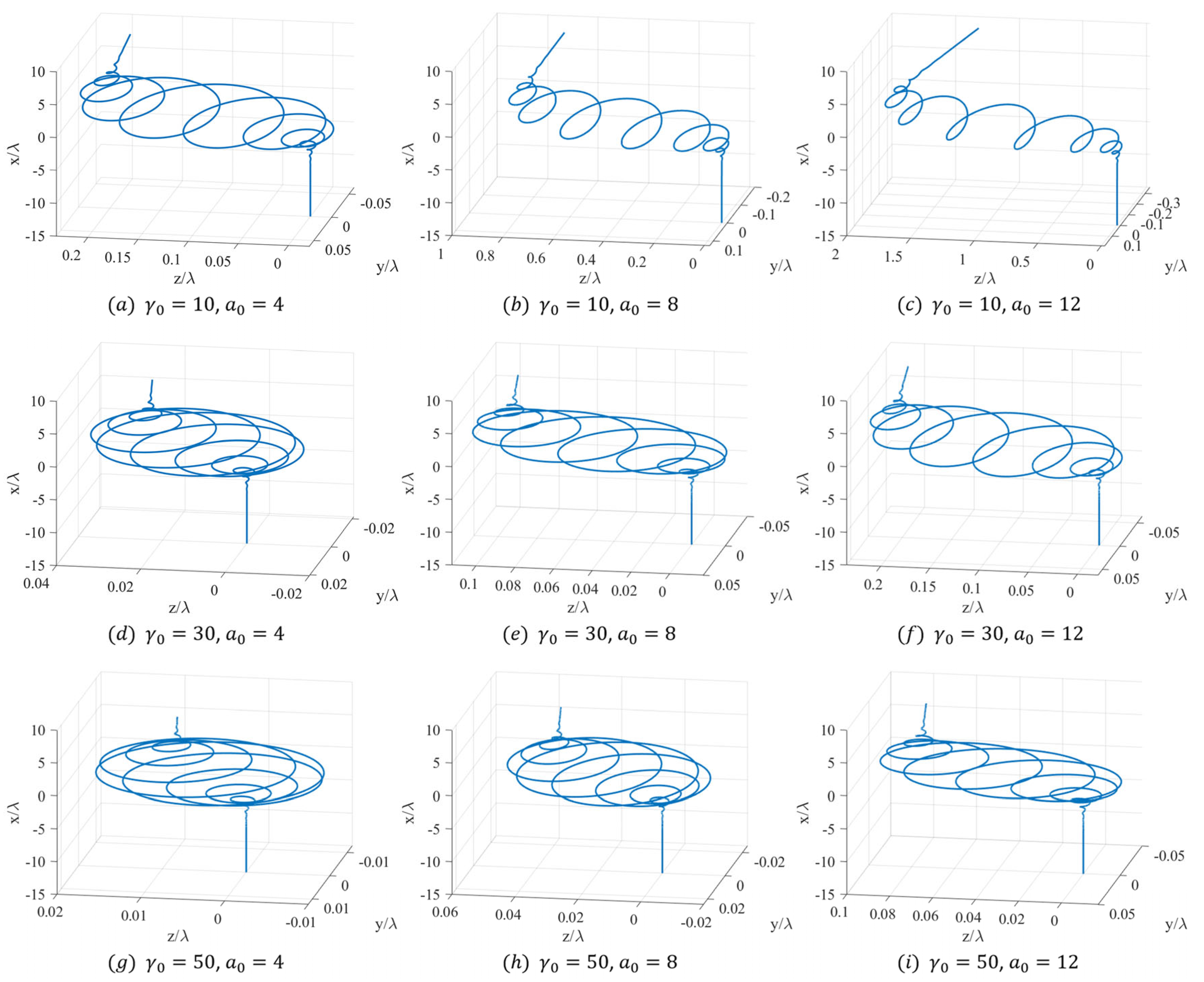
In the three-dimensional Cartesian coordinate system adopted here, the x-axis is taken as the initial propagation direction of the electron, the y-axis is the other transverse direction, and the z-axis is the laser propagation direction. In the cross-collision geometry, the electron enters the tightly focused circularly polarized laser field from the transverse direction, and its motion is then determined by the relativistic Lorentz force, . The calculated trajectories show clear changes under different combinations of and . Some trajectories are strongly bent after the interaction, while others remain close to the original propagation direction. The electron motion is therefore not governed by the laser amplitude or the initial energy alone. It is set by the balance between the field-driven transverse motion and the initial relativistic momentum of the electron.
The laser amplitude
directly measures the strength of the laser field. As shown in
Figure 2, a larger
gives a stronger electromagnetic force, so the electron experiences stronger transverse oscillation and larger trajectory deflection. This effect is most visible at low
. In this region, the initial relativistic inertia is not large enough to keep the electron moving along its original direction, and the laser field can drive it away more easily. The trajectory then shows obvious bending and a wider spatial spread. At higher
, increasing
still enhances the local oscillation of the electron, but the global trajectory is less affected. The role of
is therefore limited by the initial electron energy.
The initial relativistic factor has a more direct influence on the collimation of the electron trajectory. Since the electron momentum satisfies , a larger means a larger initial momentum, making the propagation direction harder to change under the same laser field. In the low-energy case, such as , the electron still undergoes strong deflection and oscillation after entering the laser field. As increases to the intermediate range, the bending of the trajectory is reduced. When reaches 50, the electron mainly keeps its initial propagation direction, with only weak transverse perturbations. The trajectory becomes nearly straight. Increasing therefore strengthens the relativistic inertia and suppresses the laser-induced deflection.
The trajectory response can therefore be understood as a competition between laser driving and relativistic inertia. The former becomes more pronounced at larger , whereas the latter suppresses the global trajectory deflection as increases. This competition explains why the trajectory becomes progressively less sensitive to in the high-energy cases.
3.2. Spatial Angular Power Distribution of Electron Radiation
This section analyzes how and affect the spatial angular power distribution of the emitted radiation. The angular distribution gives the radiated power observed in different directions, so it is directly related to the directionality and collimation of the radiation.
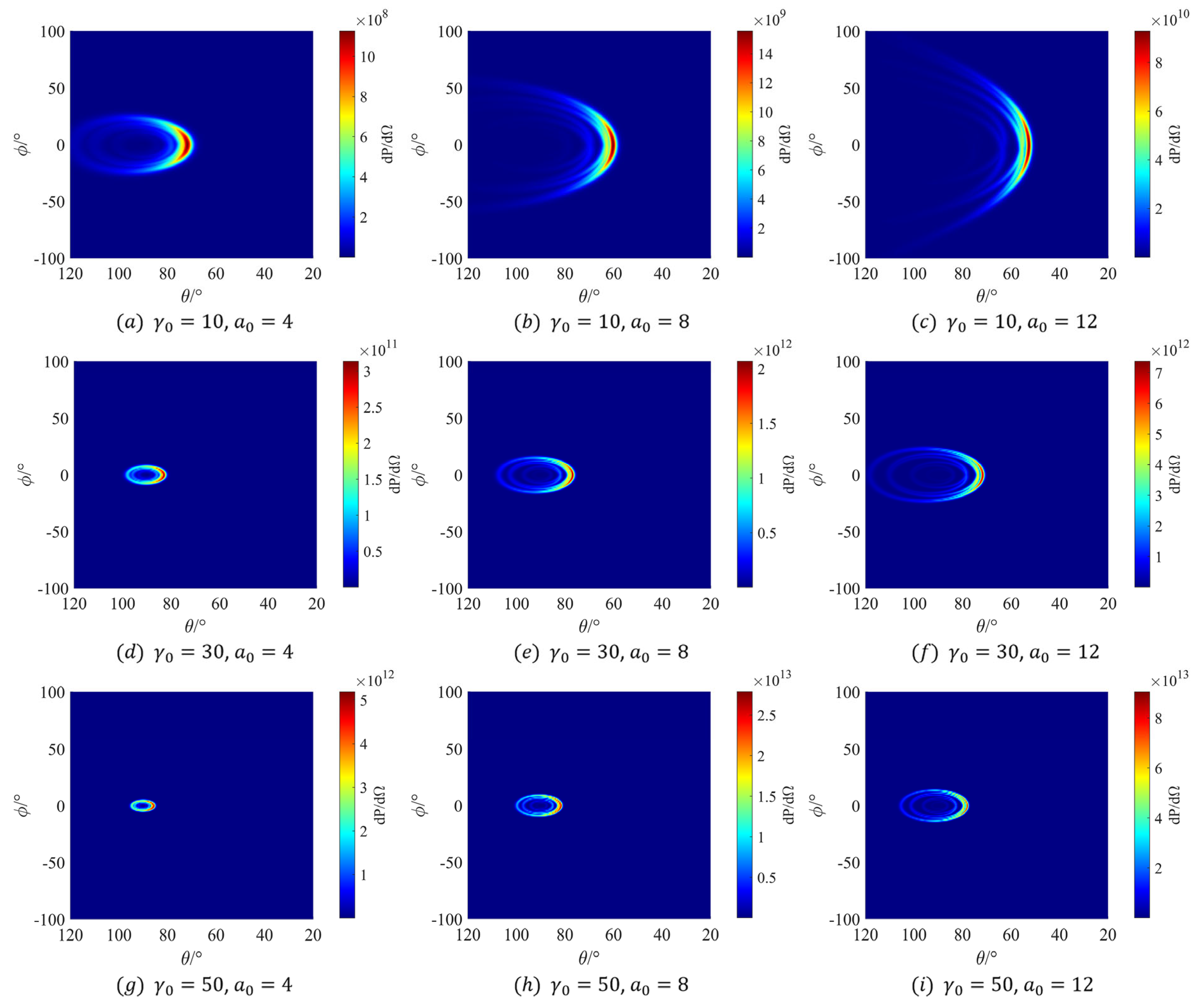
In
Figure 3, the two-dimensional projections are calculated for nine parameter combinations, with
and
. The radiation is mainly confined to a limited angular region and forms an open-arc-like pattern. The structure extends more strongly along the θ-direction, while it remains approximately symmetric around
. The angular opening and concentration of this pattern change with the parameter combination.
At , varying produces pronounced changes in the extent and shape of the open-arc structure. At and 50, the radiation patterns become generally more compact, and the differences among the three laser amplitudes are reduced. This transition indicates that laser-driven angular reshaping is more evident at low electron energy, whereas relativistic directional confinement becomes increasingly important at higher . Since the apparent two-dimensional extent does not directly quantify the cumulative spread along the polar-angle direction, the parameter is introduced below.
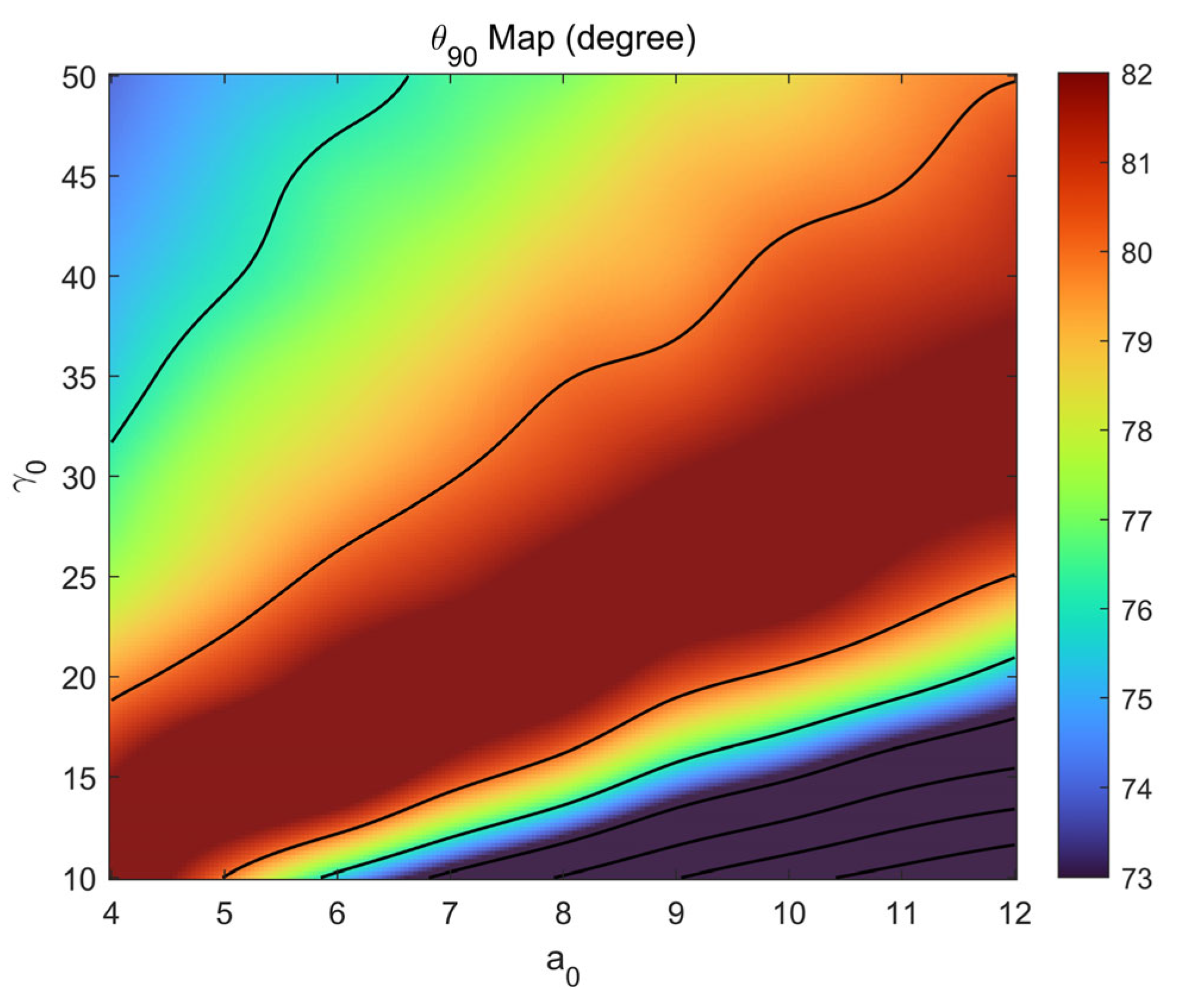
To describe the polar-angle distribution more quantitatively, the cumulative polar-angle parameter is introduced. It denotes the polar-angle range required for the cumulative radiated power, integrated along the θ-direction, to reach 90% of the total radiated power. A smaller means that most of the radiation is accumulated within a narrower polar-angle range, corresponding to stronger concentration in the θ-direction. A larger means that a wider angular range is needed to contain 90% of the radiation, indicating a more extended distribution.
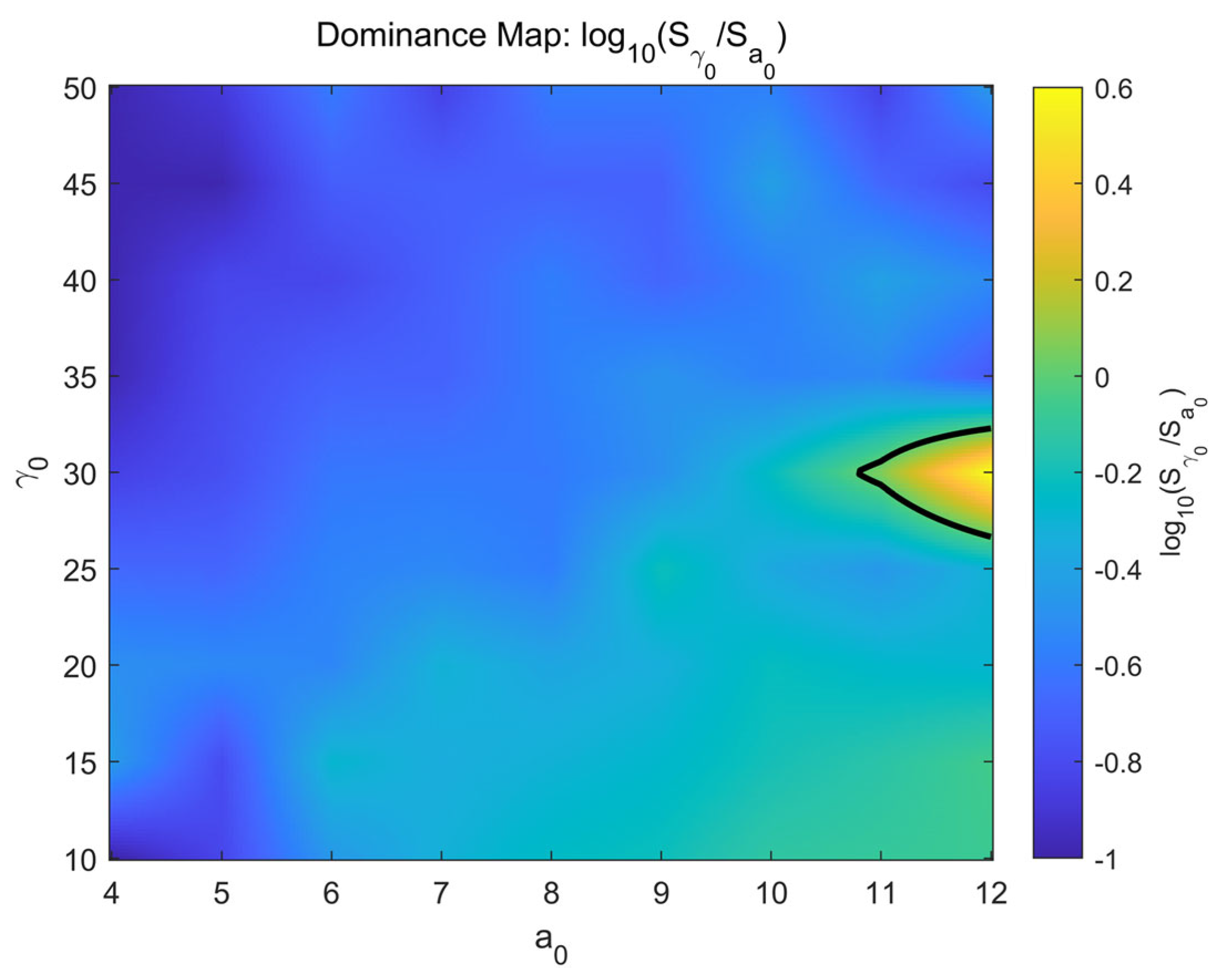
As shown in
Figure 4, the
map shows clear regional variation rather than a simple monotonic dependence on either
or
. Regions with larger
require a wider θ-range to accumulate 90% of the total radiated power, which means that the radiation is more broadly distributed in the polar direction. Regions with smaller
correspond to stronger angular concentration. The bending and tilting of the black contour lines also show that the cumulative angular distribution is not determined by a single parameter. It is shaped by the coupled effect of
and
.
To further provide quantitative support for the angular-distribution analysis, representative
values were extracted from the numerical data, as summarized in
Table 2. Here,
is defined as
= 12) −
= 4), which directly measures the change in the polar-angle range containing 90% of the total radiated power when the laser amplitude increases from 4 to 12.
As shown in
Table 2,
varies from
to
in the selected representative cases. At
, increasing
from 4 to 12 reduces
from
to
, corresponding to
. In contrast, at
and 50,
increases by
over the same
range. The change in the sign of
shows that the effect of
on the angular distribution depends on the initial electron energy, rather than following the same monotonic trend throughout the parameter range.
This behavior can be understood as a competition between laser-driven angular reshaping and relativistic directional confinement. To examine which parameter plays the dominant role in different regions of the
–
parameter space, a sensitivity-based dominance criterion is introduced in
Figure 5.
Figure 5 shows the distribution of the dominance criterion
in the
–
parameter space. The black solid contour marks
, namely
. When
, the angular distribution is more sensitive to
, whereas when
, it is more sensitive to
. Accordingly, the region inside the black contour corresponds to a
-dominated regime, while the region outside the contour is mainly
-dominated. Most of the investigated parameter space lies in the
-dominated regime. Only in a localized region with relatively large
and intermediate
does the influence of
become stronger, indicating a local shift in the dominant mechanism.
3.3. Time-Domain Spectra and Frequency Spectra
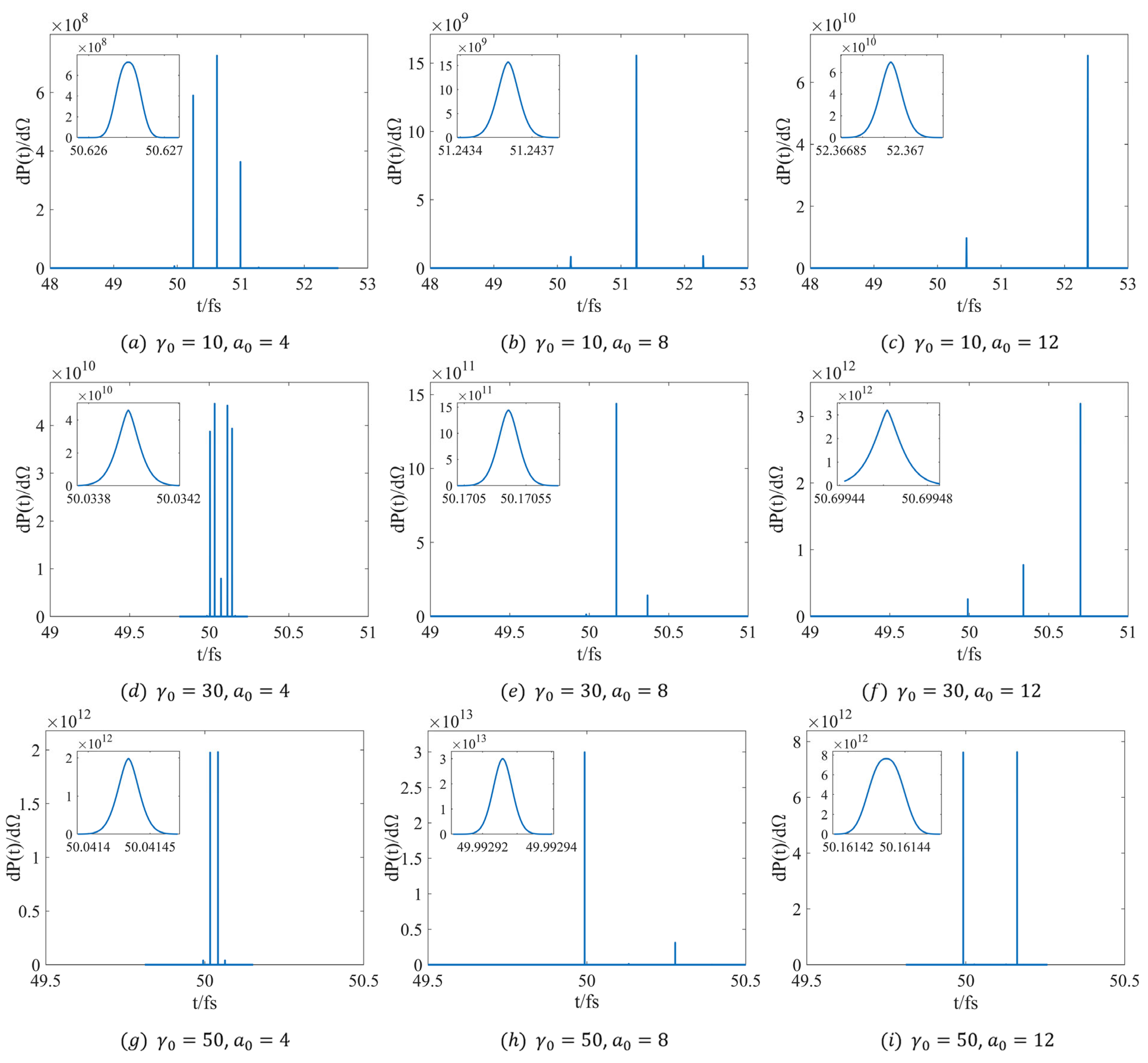
Different values of and also modify the temporal structure of the radiation. For each parameter combination, the time-domain radiation profile is obtained from the instantaneous radiated power per unit solid angle as a function of time. This allows the peak intensity, pulse width, and local peak structure to be compared directly.
Figure 6 shows that both the peak intensity and the local temporal profile depend on the parameter combination. Increasing
generally enhances the main radiation peak and, in some cases, introduces additional shoulder-like or oscillatory structures. At higher
, the radiation becomes more strongly localized around the main peak.
In the high- cases, the characteristic intervals around the main peak reach the sub-attosecond regime and, for some parameter combinations, approach the zeptosecond scale. Meanwhile, a larger may enhance both the peak intensity and the local modulation of the temporal profile. These results show that the temporal structure is jointly affected by and . The corresponding frequency spectra are examined below to determine whether the temporal compression is accompanied by spectral broadening.
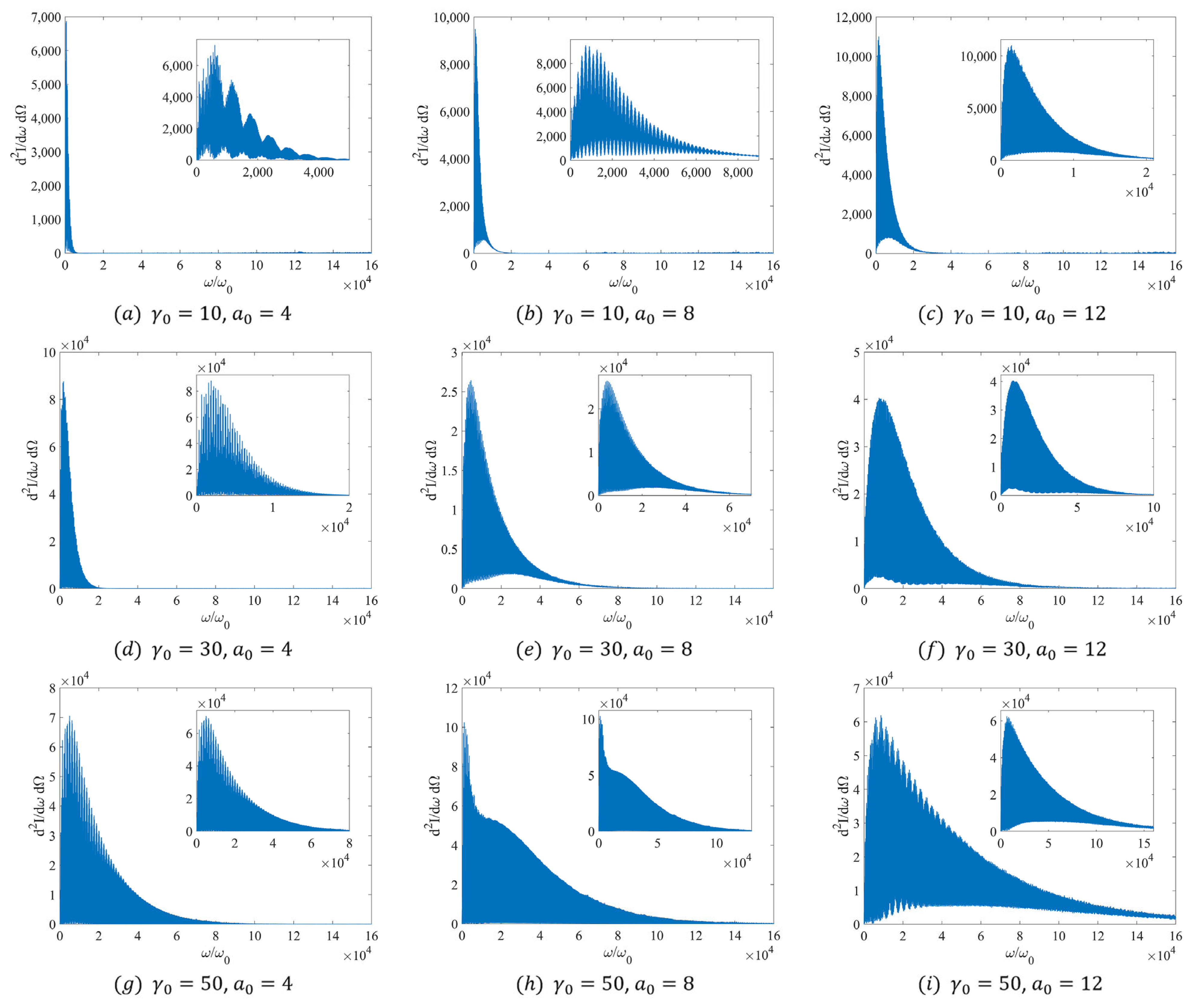
The corresponding frequency-domain spectra are shown in
Figure 7 for the same
and
combinations. A unified frequency range is used in the main panels, while the vertical scales are adjusted separately because of the large differences in spectral intensity. The insets display the detailed peak structures and high-frequency cutoff behavior.
Comparison of the three rows in
Figure 7 reveals a clear extension of the spectral content toward higher frequencies as
increases. For
, most of the radiated energy remains in the low-frequency region, although a larger
broadens the spectrum and makes the oscillatory peaks more distinct. At
, the high-frequency components become more evident, especially for
and 12. Within the investigated range, the extension is most pronounced in the
cases, where a long high-frequency tail appears at
.
A similar tendency is seen in the time-domain results: cases with more localized temporal peaks generally exhibit a wider spectral range. The temporal compression and spectral extension therefore evolve in parallel under the combined variation of and .
4. Conclusions
This work investigates relativistic nonlinear Thomson scattering (RNTS) driven by a tightly focused circularly polarized Gaussian laser pulse colliding transversely with a high-energy electron. The focus is placed on two key parameters: the laser amplitude and the initial relativistic factor of the electron . The electron motion is obtained by numerically solving the equations of motion, and the spatial angular power distribution, time-domain radiation profile, and frequency spectrum are then calculated from the radiation formulas. These results are used to examine how the electron dynamics are connected with the radiation structures under different parameter combinations.
The results show that and regulate the radiation process in different ways. A larger strengthens the nonlinear oscillation and instantaneous acceleration of the electron in the laser field, leading to higher radiation intensity and broader spectra. A larger , by contrast, increases the relativistic inertia of the electron, making the electron motion more directional and further affecting the angular concentration and temporal compression of the emitted radiation. Quantitatively, the extracted values vary from 56.5° to 84.0° within the investigated parameter range, showing that the polar-angle range containing 90% of the radiated power can be changed by 27.5°. For the representative cases, increasing from 4 to 12 changes by −27.5° at , while the corresponding change is +6.0° at and . These numerical results confirm that the radiation directionality is not controlled by a single parameter, but by the coupled modulation of laser-driven transverse motion and relativistic directional behavior. Under the joint action of and , the electron trajectory, radiation directionality, temporal structure, and spectral range all show clear parameter dependence.
These results indicate that the matching between laser amplitude and initial electron energy is important for optimizing RNTS radiation. By adjusting and , one can balance radiation intensity, collimation, pulse duration, and spectral bandwidth. The present study provides a theoretical reference for designing high-brightness, directional, broadband attosecond radiation sources and ultrafast X-/γ-ray sources. Future work may include electron-beam energy spread, beam divergence, laser-focusing imperfections, and radiation reaction, which would make the model closer to realistic experimental conditions.