
Article

Microstructural Evolution and Phase Formation in Nanocrystalline Ti0.8V0.2C Powder During High-Energy Mechanical Alloying

1
Laboratory of Useful Materials, National Institute of Research and Physicochemical Analysis, Technopole Sidi Thabet, Ariana 2020, Tunisia
2
Department of Metallurgical and Materials Engineering, Zonguldak Bülent Ecevit University, Zonguldak 67100, Türkiye
3
Department of Chemistry, College of Science, Qassim University, Buraydah 51452, Saudi Arabia
*
Author to whom correspondence should be addressed.
Crystals 2026, 16(7), 459; https://doi.org/10.3390/cryst16070459
Submission received: 10 June 2026 / Revised: 2 July 2026 / Accepted: 7 July 2026 / Published: 14 July 2026

Abstract

A nanostructured Ti0.8V0.2C solid solution carbide was successfully synthesized via high-energy mechanical alloying (MA) of elemental Ti, V, and C powders for 20 h in a planetary ball mill under argon atmosphere. Phase evolution and microstructural transformation were tracked using XRD, SEM/EDX, and TEM. Progressive alloying resulted in continuous refinement of the carbide structure, where the crystallite size was reduced to ~11–15 nm and the lattice microstrain increased up to 0.93 % after 20 h of MA. TEM observations confirmed the formation of highly dispersed nanocrystalline Ti0.8V0.2C solid-solution carbide particles with sizes of 15–20 nm. This work demonstrates the effectiveness of MA in generating a novel Ti–V-based nanocarbide solid solution and highlights the critical role of milling duration in tailoring structural refinement and defect accumulation at the nanoscale.

1. Introduction

Nanostructured transition-metal carbides are crucial for high-temperature applications, wear-resistant coatings, and cutting tools [1]. The hardness, thermal stability, and chemical resistance of titanium carbide (TiC), a NaCl-type carbide with a melting temperature exceeding 3000 °C, make it valuable [2]. In addition, TiC exhibits excellent compatibility with several transition metals, enabling the formation of substitutional solid solutions that provide an effective route for tailoring its structural and mechanical properties. By alloying TiC with transition metals, mechanical and functional properties can be improved by adjusting lattice parameters, defects, and microstructure [3]. The Ti1−xVxC solid solution is particularly interesting because vanadium substitution specifically influences lattice spacing, defect generation, diffusion, and phase stability. Furthermore, the incorporation of V into the TiC network should improve hardness, wear resistance, thermal stability, and microstructural stability through solid-solution strengthening while preserving the NaCl-type crystal structure. The Ti0.8V0.2C composition was selected because it provides a moderate level of vanadium substitution that promotes the formation of a homogeneous (Ti,V)C solid solution without destabilizing the carbide phase, making it suitable for studying the effect of V on phase evolution during mechanical alloying. In our previous works [4,5,6,7], various (Ti,Cr)C nanocarbides, with significant microstructural properties, were successfully prepared by mechanical alloying. Through repeated welding and fracture, high-energy mechanical alloying (MA) creates such metastable nanostructures, resulting in refined crystallites and supersaturated solid solutions [8]. MA involves certain drawbacks like contamination from milling media and long processing times. Ti + C mixes may generate nanocrystalline TiC with lattice strains of several percent and crystallite sizes of 10–20 nm thanks to severe plastic deformation and high defect density [4]; however, MA parameters like ball-to-powder ratio, milling time, and speed have a significant impact on the result [8]. The adaptability of MA is demonstrated by recent studies: Dusza et al. [9] created virtually full-density (HfTaZrNb)C carbide via MA followed by spark plasma sintering, resulting in a material with a high density of 99.9 % and an average grain size of approximately 12 µm. Hossein-Zadeh et al. [10] obtained V8C7 nanoparticles after 24 h. They revealed that the milling lead to a decrease in the particle size and an increase in the micro-strain of vanadium carbide. Kovalev et al. [11] produced high-entropy (TiZrHfTaNb)C carbide using high-energy ball milling for 45 min, which demonstrated thermal stability up to 1200 °C for 6 h.
The phase-formation mechanisms and microstructural evolution of Ti–V–C under high-energy MA, including V dissolution kinetics, lattice parameter changes, microstrain development, crystallite refinement, secondary phase formation, and the effects of defects and lattice distortion, are still unknown despite these advancements. Furthermore, although previous studies have mainly focused on the synthesis of Ti–V–C carbides, a systematic understanding of the structural evolution and solid solution formation of Ti0.8V0.2C during mechanical alloying remains limited. In order to shed light on the controlled synthesis of sophisticated nanostructured carbides, this study examines the solid-solution formation and time-dependent structural evolution of nanocrystalline Ti0.8V0.2C.

2. Materials and Methods

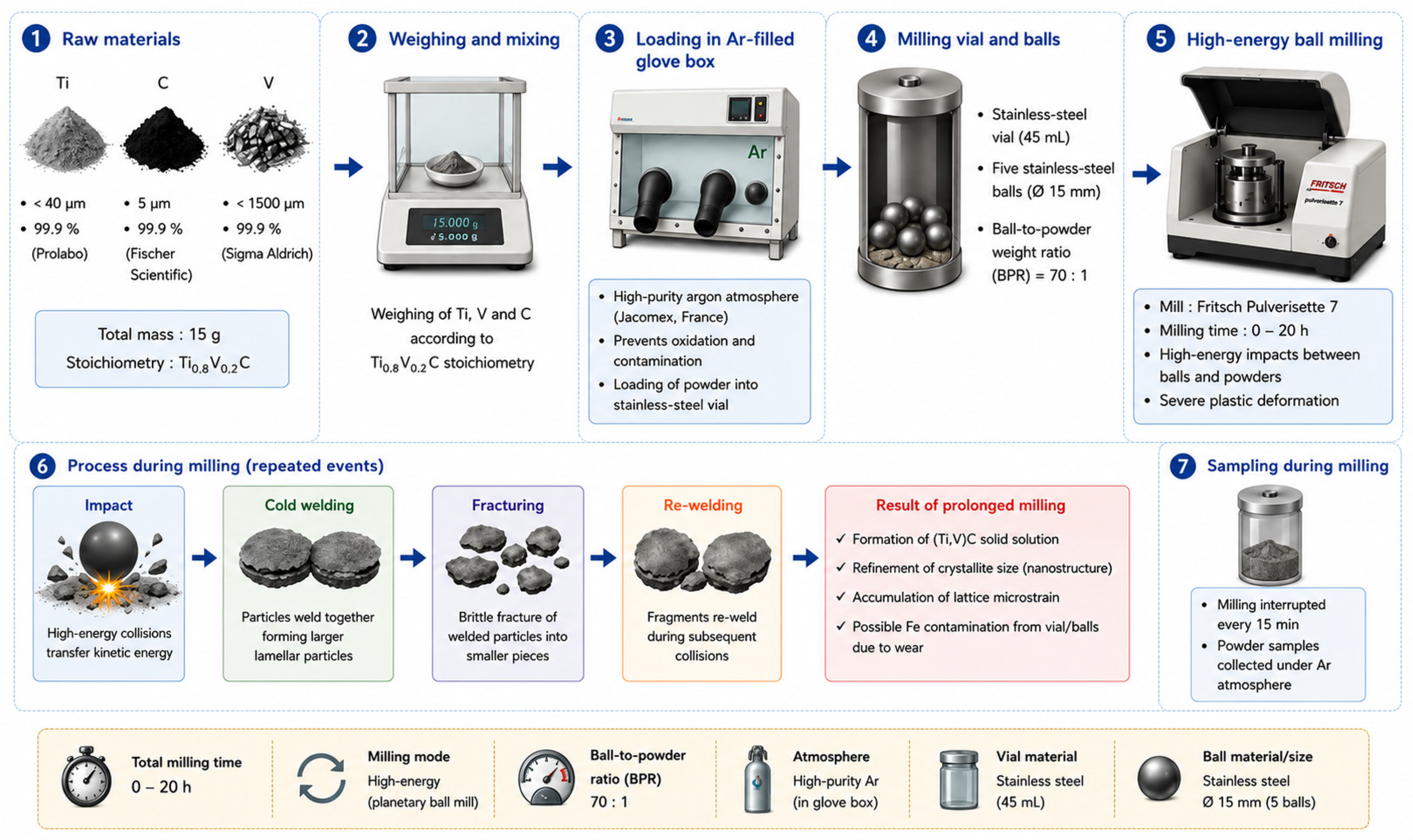
A mixture of elemental titanium (<40 μm, 99.9 %, Prolabo, Mikulov, Czech Republic), carbon (5 μm, 99.9 %, Fischer Scientific, Waltham, MA, USA), and vanadium (<1500 μm, 99.9 %, Sigma Aldrich, Saint Louis, MO, USA), with a total mass of 15 g, was loaded into a 45 mL stainless-steel vial with five 15 mm stainless-steel balls inside an argon-filled glove box (Jacomex, Dagneux, France). Mechanical alloying was carried out using a Fritsch Pulverisette 7 ball mill (Fritsch GmbH, Idar-Oberstein, Germany) for up to 20 h. Milling was interrupted every 15 min to collect powder samples under argon. A ball-to-powder weight ratio (BPR) of 70:1 was employed. Figure 1 (OpenAI, GPT-5.5 has been used in the paper to generate Figure 1) shows a schematic of the high-energy mechanical alloying process used in this study. During milling, repeated cycles of impact, cold welding, fracturing, and rewelding promoted the formation of solid solutions, crystallite refinement, and microstructural evolution. Powder samples were periodically collected under argon for further characterization.
X-ray diffraction (XRD) was used to analyze the phase evolution using a Bruker D8 Advance diffractometer (Bruker AXS GmbH, Karlsruhe, Germany) equipped with CuKα radiation (λ = 0.15406 nm) and operated at 40 kV and 40 mA. Step scan data (step size of 0.015° and counting duration of 30 s) of the un-milled and milled samples were recorded over the whole angular range of 20–80° (2θ) for a thorough X-ray line profile examination. FullProf (Version 7.80) was employed for Rietveld analysis to refine microstructural parameters [12]. The crystallite size and the microstrain of the crystal lattice were determined by Rietveld refinement of the X-ray diffraction diagrams. During this refinement, the broadening of the diffraction peaks was modeled by independently considering the contributions of the finite size of the crystallites and the microstrain of the lattice, thus allowing these two parameters to be refined simultaneously. The morphology of the samples was investigated using a Quanta 200 environmental scanning electron microscope (SEM) (FEI Company, Hillsboro, OR, USA) coupled with an energy-dispersive X-ray spectroscopy (EDX) detector (EDAX Inc., Mahwah, NJ, USA). Moreover, the crystallite size and surface structure of the milled powders were observed using a FEI Tecnai G2 transmission electron microscope (TEM) (FEI Company, Hillsboro, OR, USA) operated at 200 kV.

3. Results and Discussion

3.1. XRD Study

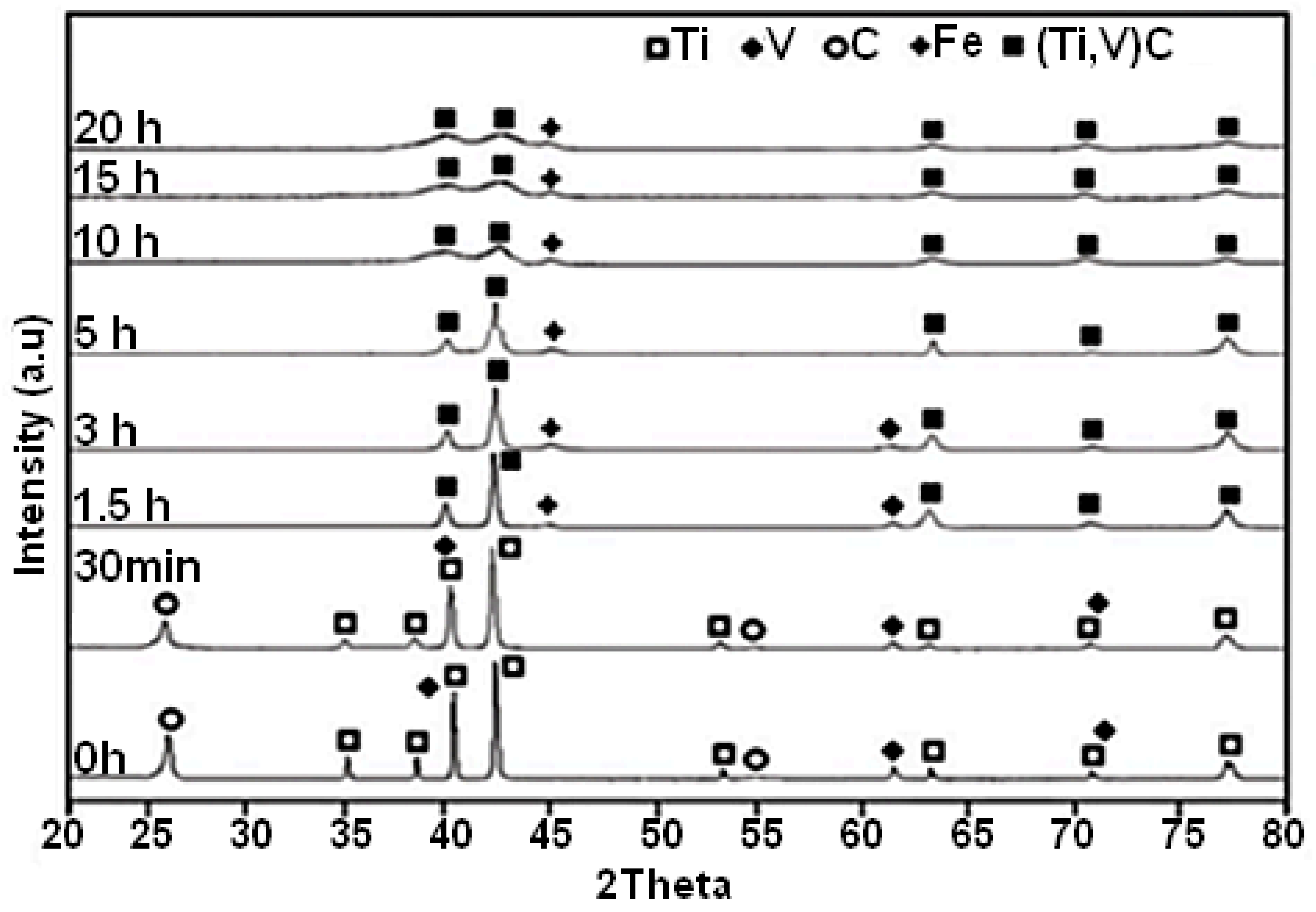
The XRD patterns that correlate to the gradual phase transformation that occurs during mechanical alloying of the Ti, V, and C powder mixture are shown in Figure 2. All of the diffraction peaks at 0 h only match the initial elemental phases, indicating that no reaction occurs before milling. The diffraction peaks of titanium are indexed to hexagonal α-Ti (P63/mmc) structure, while the vanadium powder (Im-3m) exhibits the characteristic body-centered (bcc) reflections corresponding to the (110), (200), and (211) planes at approximately 42.2°, 61.3°, and 73.2°, respectively, in the 0 h and 30 min patterns. The Ti and V peaks widen and weaken after 30 to 90 min of milling, indicating rapid refining and interdiffusion, while the graphite peaks vanish after 1.5 h because of carbon incorporation [13]. At this point, weak (Ti,V)C reflections show up, indicating the beginning of carbide production. The elemental peaks disappear and the (Ti,V)C phase takes over between 3and 5 h, indicating rapid solid-solution development. Only the cubic (Ti,V)C phase persists for extended durations (10–20 h), with increasing peak broadening indicating ongoing microstrain accumulation and grain refining, which is consistent with significant deformation during MA. After the complete formation of the (Ti,V)C phase (~5 h), continuous milling primarily promotes significant plastic deformation rather than further phase transformation. Repeated particle fragmentation and welding, along with the accumulation of dislocations and the formation of new grain boundaries, are responsible for the continuous refinement of crystallites and the development of micro-deformations during prolonged mechanical alloying. A minor contamination from the steel milling tools is shown by a weak Fe (110) peak at about 44.7°. All things considered, a single-phase nanocrystalline (Ti,V)C carbide forms quickly (~5 h), with prolonged milling mostly improving microstructural refinement. The progressive development of the (Ti,V)C solid solution during milling is confirmed by Table 1. The refinement quality values are in the range of 10.4 to 2.2, indicating a good refinement quality and, consequently, validity of the structural model with a good choice of the line profile functions. Three phases remain at 1.5 h: residual V (9.42 wt%), cubic (Ti,V)C (85.36 wt%), and minimal Fe contamination (5.22 wt%). The carbide proportion increases to 88.67 %within 3 h, while V falls below 6.67 %, indicating that elemental vanadium is being used rapidly. With the exception of the stable Fe contamination from milling abrasion, the system remains basically single-phase for 10–20 h. After 5 h, only (Ti,V)C and a minor Fe portion remain. Improved Ti–V homogeneity and rising strain/defect density are reflected in the lattice parameter’s minor reduction from ~4.3020(1)Å (1.5 h) to ~4.2830(1)Å (20 h). Good refining quality is confirmed by the χ2 values (~1–2 after 3 h). With the exception of a small amount of Fe contamination, the Rietveld data demonstrate that a nanocrystalline (Ti,V)C solid solution forms rapidly (<5 h) with extended milling primarily improving grain refinement and lattice distortion without producing additional secondary phases.
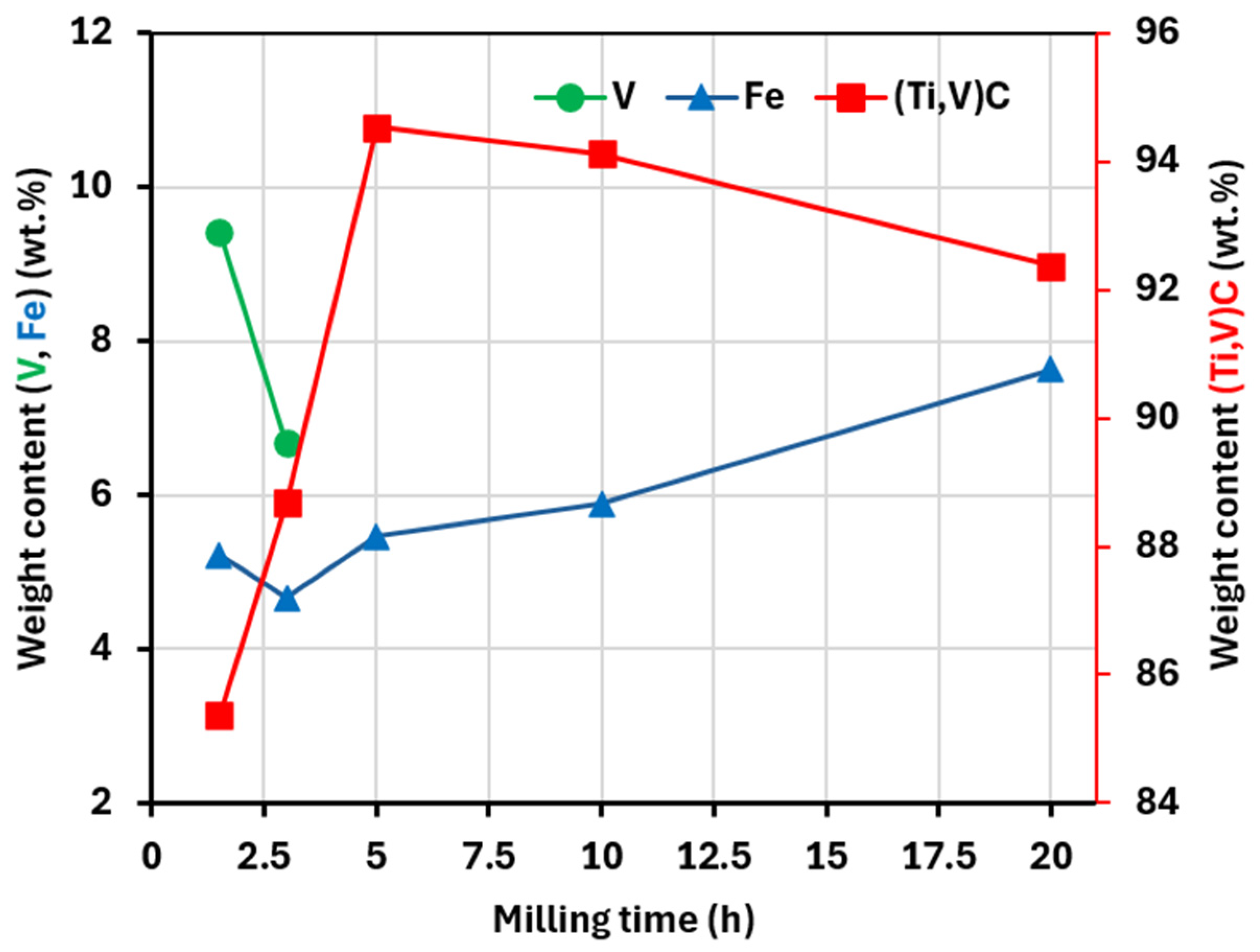
The weight content of the phases was determined by applying the FullProf program fit to the XRD pattern. Figure 3 illustrates the variation in the weight proportions of the phases as a function of MA time. Notably, the weight fraction of the V phase decreased from 9.42 to 56.67 % as the MA time increased from 1.5 to 3 h. This reduction in the vanadium weight proportion facilitated the formation of the Ti(V,C) solid solution. After 1.5 h of MA, we noticed iron contamination due to wear on the milling vial and high-carbon steel balls. Additionally, the weight content of iron increased from 5.22 to 7.63 % as the MA time extended from 1.5 to 20 h. Conversely, the weight fraction of the (Ti,V)C phase rose from 85.36 % after 1.5 h of MA to 92.37 % after 20 h of MA.
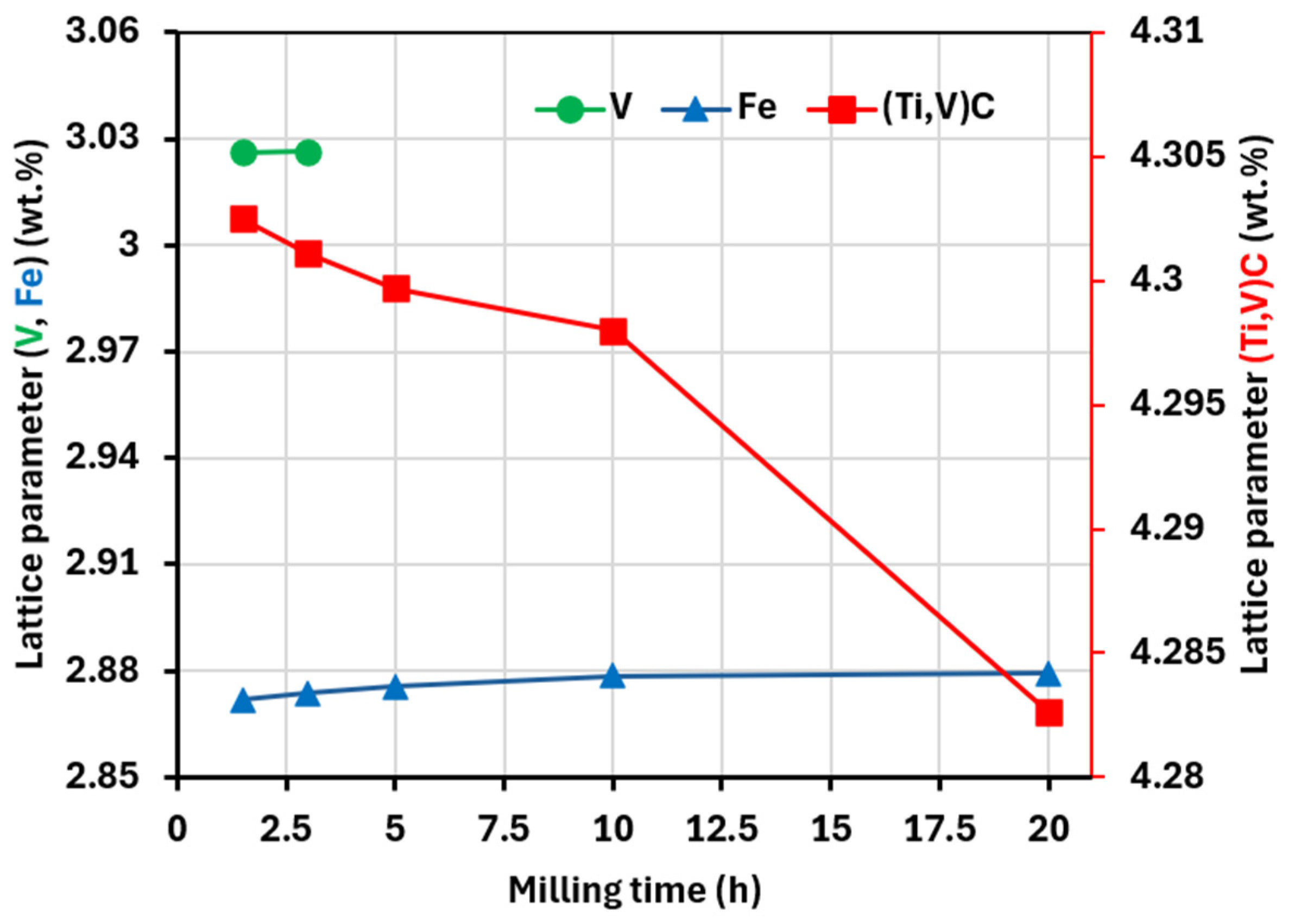
As illustrated in Figure 4, the lattice parameter of the (Ti,V)C phase demonstrated a consistent decrease with increasing MA time, ultimately reaching 4.2826 Å after 20 h. This decrease in the lattice parameter can be attributed to the gradual replacement of titanium atoms with vanadium within the carbide structure, resulting in the formation of a (Ti,V)C solid solution. The observed lattice contraction is likely a result of compressive stresses generated during the MA process, which facilitate atomic-level mixing and alloying of the constituent elements. These structural changes highlight the effectiveness of MA in promoting solid-state reactions and producing nanostructured materials with tailored compositions and properties [14].
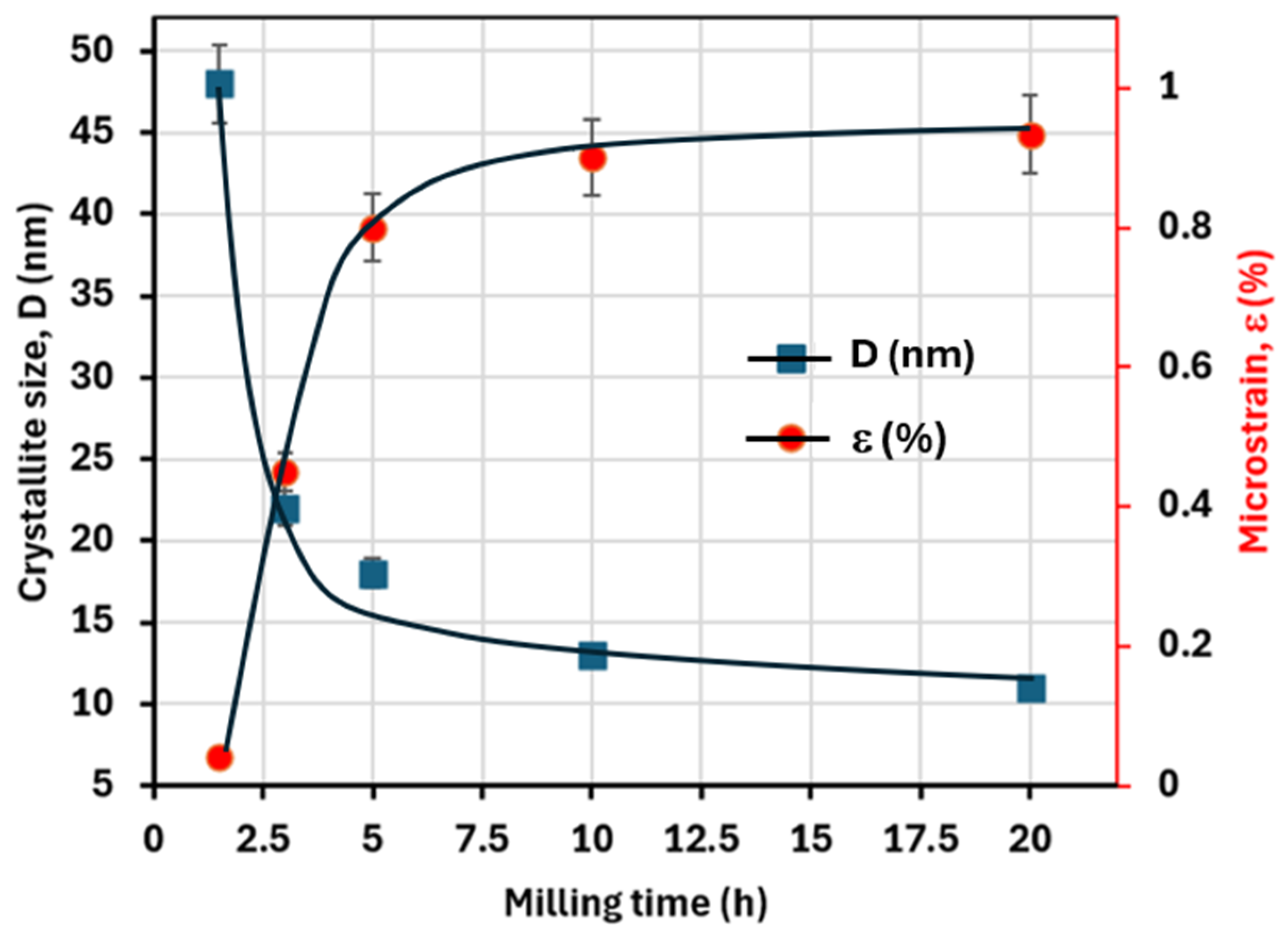
Figure 5 shows the change in the mean microstrain and mean crystallite size of the Ti0.8V0.2C solid-solution carbide as a function of milling time. By increasing the MA time from 1.5 to 20 h, the mean microstrain increased from 0.041 to 0.933 %, while the mean crystallite size of the (Ti,V)C phase rapidly decreased from 48 to 11 nm. These findings are attributed to the fracture of the initial powder particles during milling, as well as the inherent brittleness of the carbide [15].

3.2. TEM Study

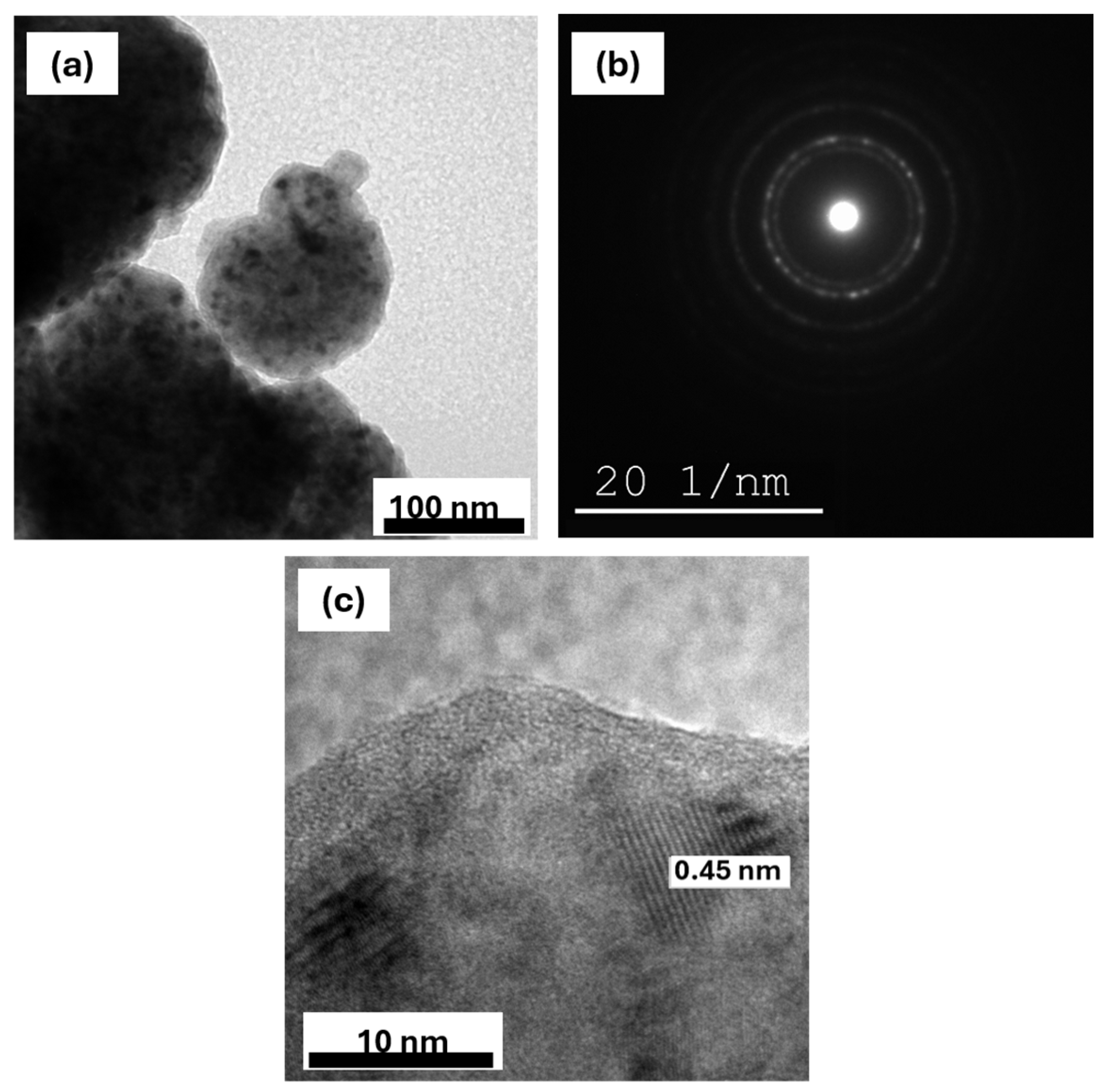
The bright-field TEM images and SAED pattern of the TiVC powder after 20 h of MA provide essential information about both the microstructure and crystalline nature of the material. The agglomerated powders observed in Figure 6a exhibit irregular morphologies, which is typical for mechanically alloyed materials due to the repeated fracturing and cold-welding processes during milling. The nanosized dimensions of these particles, ranging from 15 to 20 nm, indicate the effectiveness of the MA process in reducing the particle size and potentially enhancing the material’s properties. This particles size is in good agreement with the average crystallite size of approximately 11 nm determined by Rietveld refinement of the XRD data. The slightly larger size observed by TEM is expected because TEM measures the physical particle size, whereas XRD determines the size of coherently diffracting crystallites. The polycrystalline nature of the TiVC solid-solution carbide particles was confirmed by the well-defined rings in the SAED pattern shown in Figure 6b. This polycrystallinity was caused by severe plastic deformation and repeated fragmentation during the MA process, resulting in the formation of numerous small crystallites within each particle. As seen in Figure 6c, the measured interplanar spacing of 0.45 nm, corresponding to the (111) plane of the Ti0.8V0.2C solid-solution carbide phase, suggests the successful formation of the desired solid solution. This observation indicates that the MA process effectively combines titanium, vanadium, and carbon precursors to form a homogeneous TiVC phase with the intended stoichiometry.

3.3. SEM/EDX Study

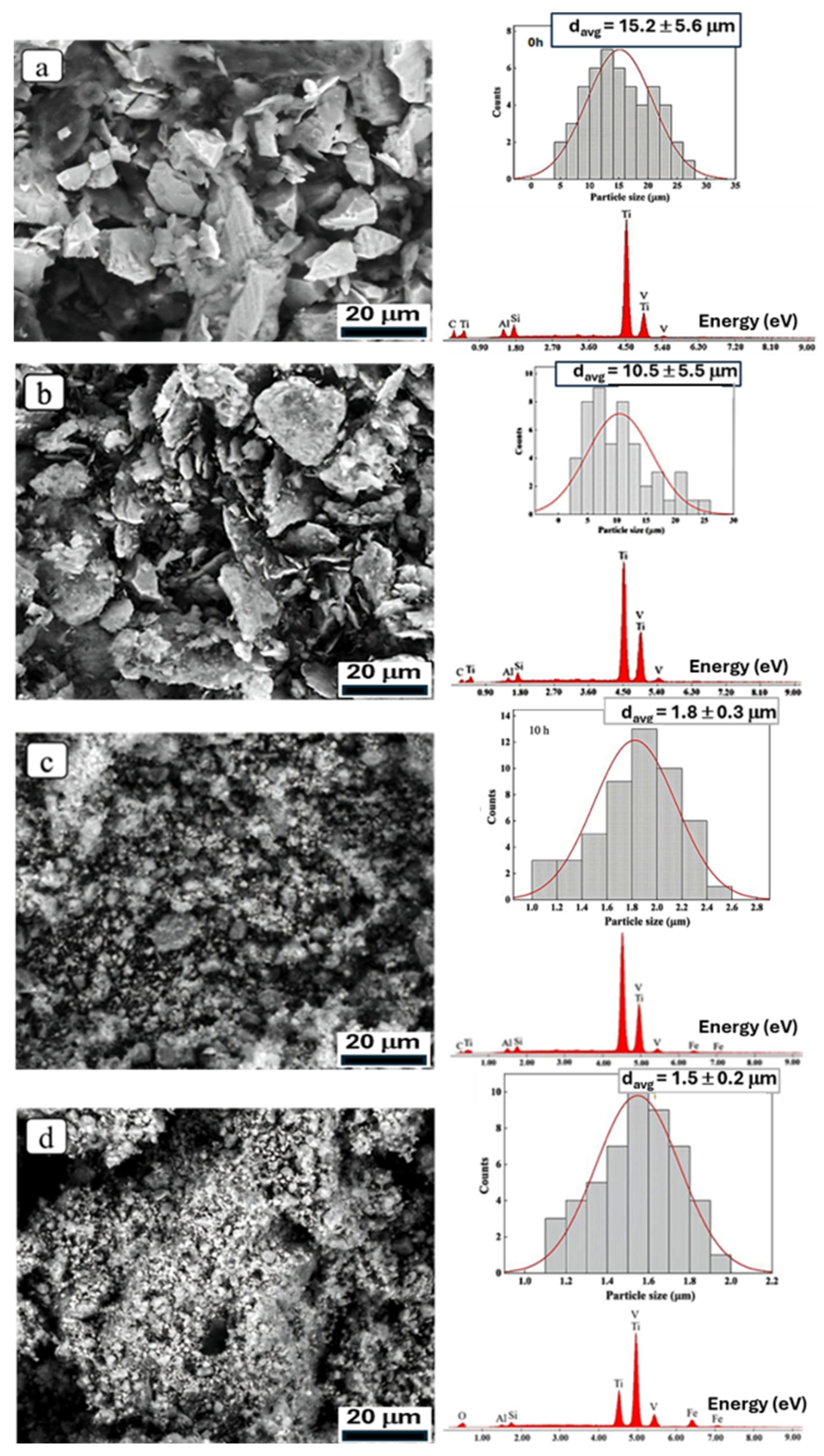
SEM images, EDX spectra, and particle-size histograms of the blended Ti0.8V0.2C mixture powders at 0, 3, 10, and 20 h of MA are given in Figure 7. The particle size histograms correspond to the experimentally measured size distribution of the blended starting powder mixture and not to the individual elemental powders. Therefore, the average particle size obtained for the initial mixture (15.2 μm) reflects the overall particle-size distribution of the Ti–V–C blend, whereas the previously reported particle size of vanadium (<1500 μm) corresponds to the supplier’s maximum particle size specification. Particles in un-milled powders were irregular (Figure 7a), but after 3 h of MA, plastic deformation caused the particles to flatten (Figure 7b). Repeated welding, fracturing, and rewelding during extended milling up to 20 h resulted in homogenous agglomerates with an average size of ~1.5 µm (Figure 7c,d). Ti, V, and C were consistently confirmed by EDX, with minor Al and Si. Fe and O peaks emerged after 20 h of MA, which were ascribed to surface pollution and wear on the milling media. The TEM, HRTEM, and SAED observations provide direct confirmation of the nanocrystalline Ti0.8V0.2C solid solution phase formed after 20 h of mechanical alloying. These results complement the XRD and Rietveld refinement analyses by revealing the nanoscale crystallinity and confirming the polycrystalline nature of the synthesized carbide. Combined with the SEM and EDX analyses performed at different milling stages, these findings provide a comprehensive description of the microstructural evolution and phase formation during the mechanical process.

4. Conclusions

Nanocrystalline Ti0.8V0.2C solid-solution carbide was effectively synthesized by high-energy mechanical alloying of powdered Ti, V, and C. Within 5 h, a predominantcubic (Ti,V)C solid solution rapidly developed, and the gradual decrease in lattice parameter confirmed the structural evolution during alloying. Extended milling for 20 h produced homogeneous, fine powders while refining crystallites to 11 nm (15–20 nm by TEM) and increasing microstrain to ~0.93 %. Minor Fe contamination originating from wear of the milling media was also detected after prolonged milling. The resulting nanostructured TiVC is a very attractive option for cutting tools and high-performance applications since it combines improved microstructural characteristics with regulated composition.
The successful synthesis of nanocrystalline Ti0.8V0.2C powder by high-energy mechanical alloying provides a promising precursor for the fabrication of advanced structural and wear resistant materials. Owing to the well-established characteristics of transition metal carbides, Ti0.8V0.2C is expected to be suitable for applications requiring high hardness, good thermal stability, and excellent wear resistance. Future work will focus on powder consolidation and the evaluation of its mechanical and functional properties to establish a comprehensive structure property relationship.

Author Contributions

Conceptualization, M.M., B.A. and M.K.; methodology, M.M., B.A., A.M. and M.K.; software, M.M. and B.A.; validation, M.M., B.A., A.M. and M.K.; investigation, M.M. and B.A.; resources, M.M. and B.A.; data curation, M.M.; writing—original draft preparation, M.M., B.A., A.M. and M.K.; review and editing, M.M., B.A., A.M. and M.K.; visualization, M.M., B.A. and M.K.; supervision, M.K.; project administration, M.M. All authors have read and agreed to the published version of the manuscript.

Funding

This research received no external funding.

Data Availability Statement

The original contributions presented in this study are included in the article. Further inquiries can be directed to the corresponding author.

Acknowledgments

This research was undertaken in National Institute of Research and Physicochemical Analysis, Tunisia, in collaboration with Zonguldak Bulent Ecevit University, Türkiye, and Qassim University, Saudi Arabia. The authors would like to thank the MDPI editorial office for their support throughout the publishing and review process.

Conflicts of Interest

The authors declare no conflicts of interest.

Abbreviations

The following abbreviations are used in this manuscript:
MAMechanical Alloying
XRDX-Ray Diffraction
SEMScanning Electron Microscopy
EDXEnergy-Dispersive X-ray Spectroscopy
TEMTransmission Electron Microscopy
TiCTitanium Carbide
SAEDSelected Area Electron Diffraction

References

  1. Dvornik, M.I.; Zaytsev, A.V. Research of surfaces and interfaces increasing during planetary ball milling of nanostructures tungsten carbide/cobalt powder. Int. J. Refact. Met. Hard Mater. 2013, 36, 271–277. [Google Scholar] [CrossRef] [Scilit]
  2. Bonis, A.D.; Santagata, A.; Galasso, A.; Laurita, A.; Teghil, R. Formation of titanium carbide (TiC) and TiC@C core-shell nanostructures by ultra-short laser ablation of titanium carbide and metallic titanium in liquid. J. Colloid Interface Sci. 2017, 489, 76–84. [Google Scholar] [CrossRef] [Scilit] [PubMed]
  3. Rasander, M.; Lewin, E.; Wilhelmsson, O.; Sanyal, B.; Klintenberg, M.; Eriksson, O.; Jansson, U. Carbon release by selective alloying of transition metal carbides. J. Phys. Condens. Matter. 2011, 23, 355401. [Google Scholar] [CrossRef] [Scilit] [PubMed]
  4. Mhadhbi, M.; Polkowski, W. Synthesis and characterization of mechanically alloyed nanostructured (Ti,Cr)C carbide for cutting tools application. Crystals 2022, 12, 1280. [Google Scholar] [CrossRef] [Scilit]
  5. Mhadhbi, M.; Dağ, İ.; Avar, B.; Khitouni, M.; Bousnina, M.; Schoenstein, F.; Jouini, N. Manufacturing of novel nanostructured TiCrC carbides using mechanical alloying and spark plasma sintering. Metals 2023, 13, 1040. [Google Scholar] [CrossRef] [Scilit]
  6. Mhadhbi, M.; Avar, B. Microstructural and morphological studies of TiCrCnano powders produced by mechanical alloying. Inorg. Chem. Commun. 2024, 169, 113068. [Google Scholar] [CrossRef] [Scilit]
  7. Mhadhbi, M. Microstructural and mechanical properties of spark plasma sintered TiCrCnano carbide for tools application. Nanotechnology 2026, 37, 015704. [Google Scholar] [CrossRef] [Scilit] [PubMed]
  8. Suryanarayana, C. Mechanical alloying: A critical review. Mater. Res. Lett. 2022, 10, 619–647. [Google Scholar] [CrossRef] [Scilit]
  9. Dusza, J.; Švec, P.; Girman, V.; Sedlák, R.; Castle, E.G.; Csanádi, T.; Kovalčíková, A.; Reece, M.J. Microstructure of (Hf-Ta-Zr-Nb)C high-entropy carbide at micro and nano/atomic level. J. Eur. Ceram. Soc. 2018, 38, 4303–4307. [Google Scholar] [CrossRef] [Scilit]
  10. Hossein-Zadeh, M.; Razavi, M.; Safa, M.; Abdollahi, A.; Mirzaee, O. Synthesis and structural evolution of vanadium carbide in nano scale during mechanical alloying. J. King Saud Univ. Eng. Sci. 2016, 28, 207–212. [Google Scholar] [CrossRef] [Scilit]
  11. Kovalev, D.Y.; Kochetov, N.A.; Chuev, I.I. Fabrication of high-entropy carbide (TiZrHfTaNb)C by high-energy ball milling. Ceram. Int. 2021, 47, 32626–32633. [Google Scholar] [CrossRef] [Scilit]
  12. Rietveld, H.M. A profile refinement method for nuclear and magnetic structures. J. Appl. Crystallogr. 1969, 2, 65–71. [Google Scholar] [CrossRef] [Scilit]
  13. Wu, N.Q.; Lin, S.; Wu, J.M.; Lu, Z.Z. Mechanosynthesis mechanism of TiC powders. J. Mater. Sci. Technol. 1998, 14, 287–291. [Google Scholar] [CrossRef]
  14. Ghosh, B.; Pradhan, S.K. Microstructure characterization of nanocrystalline TiC synthesized by mechanical alloying. Mater. Chem. Phys. 2010, 120, 537–545. [Google Scholar] [CrossRef] [Scilit]
  15. Rahaei, M.B.; Rad, R.Y.; Kazemzadeh, A.; Ebadzadeh, T. Mechanochemical synthesis of nano TiC powder by mechanical milling of titanium and graphite powders. Powder Technol. 2012, 217, 369–376. [Google Scholar] [CrossRef] [Scilit]
Figure 1. Schematic illustration of the high-energy mechanical alloying (HEMA) process used for the synthesis of nanocrystalline Ti0.8V0.2C. The blue arrows indicate the chronological sequence of the processing steps, while the colored boxes distinguish the different stages of the HEMA process.
Crystals 16 00459 g001
Figure 2. XRD patterns of the Ti0.8V0.2C mixture powders as a function of MA times.
Crystals 16 00459 g002
Figure 3. Changes in the weight content of various phases with milling time.
Crystals 16 00459 g003
Figure 4. Variation in the lattice parameter of the Ti0.8V0.2C mixture powders with milling time.
Crystals 16 00459 g004
Figure 5. Variation in the mean microstrain and mean crystallite size of the Ti0.8V0.2C mixture powders with milling time.
Crystals 16 00459 g005
Figure 6. TEM images (a,b) and SAED pattern (c) of the Ti0.8V0.2C mixture powders MA for 20 h.
Crystals 16 00459 g006
Figure 7. SEM images, EDX spectra, and particle size distributions of the Ti0.8V0.2C mixture powders as a function of selected MA times: (a) 0 h, (b) 3 h, (c) 10 h, and (d) 20 h.
Crystals 16 00459 g007
Table 1. Refined microstructural parameters of the Ti0.8V0.2C mixture powders.
Time (h)PhaseSpace GroupLattice Parameter (Å)
±0.0001 Å
wt (%)
±0.65 %
<D> nm
±5 nm
Χ2
1.5(Ti,V)CFm-3ma = 4.302585.364810.4
VIm-3ma = 3.02619.4215
FeIm-3ma = 2.87195.2223
3(Ti,V)CFm-3ma = 4.301188.67221.22
VIm-3ma = 3.02656.6710
FeIm-3ma = 2.87364.6621
5(Ti,V)CFm-3ma = 4.299794.54181.32
FeIm-3ma = 2.87555.4617
10(Ti,V)CFm-3ma = 4.298094.12132.1
FeIm-3ma = 2.87865.8815
20(Ti,V)CFm-3ma = 4.282692.37112.2
FeIm-3ma = 2.87927.6312
Disclaimer/Publisher’s Note: The statements, opinions and data contained in all publications are solely those of the individual author(s) and contributor(s) and not of MDPI and/or the editor(s). MDPI and/or the editor(s) disclaim responsibility for any injury to people or property resulting from any ideas, methods, instructions or products referred to in the content.