Article

Alkaline-Earth-Site Confinement Enables 98% Quantum Yield Orange Emission in Mn-Doped Cadmium Halide


State Key Laboratory of Featured Metal Materials and Life-Cycle Safety for Composite Structures, School of Resources, Environments and Materials, Guangxi University, Nanning 530004, China
*
Author to whom correspondence should be addressed.
Crystals 2026, 16(7), 458; https://doi.org/10.3390/cryst16070458
Submission received: 3 June 2026 / Revised: 2 July 2026 / Accepted: 5 July 2026 / Published: 14 July 2026
(This article belongs to the Section Hybrid and Composite Crystalline Materials)

Abstract

The luminescence efficiency of Mn2+-doped metal halides is often limited by concentration quenching caused by Mn-Mn interactions. In this work, the alkaline-earth cadmium chloride BaCd2Cl6·6H2O:Mn2+ was synthesized via a mechanical grinding method. The three-dimensional network framework of this compound effectively isolates Mn2+ ions with a Mn-Mn separation of 4.87 Å, thereby suppressing concentration quenching. Under 254 nm ultraviolet excitation, the sample exhibits efficient orange emission centered at 588 nm with a photoluminescence quantum yield (PLQY) as high as 98%. Temperature-dependent photoluminescence studies reveal that the optimal emission temperature of this system is 320 K, demonstrating good thermal stability. This work achieves, for the first time, near-unity Mn2+ luminescence efficiency in a Ba-site alkaline-earth cadmium halide system, demonstrating that alkaline-earth-site confinement provides an effective strategy for achieving highly efficient Mn-doped halide luminescence.

1. Introduction

All-inorganic halide perovskites have attracted sustained attention in the fields of luminescence and optoelectronics due to their high defect tolerance, tunable electronic structures, and excellent optical responses [1,2,3]. In these materials, different metal ions and halide coordination units together determine the crystal structure, local coordination environment, and electronic-band characteristics. The coexistence of ionic and partial covalent bonding endows the lattice with considerable structural flexibility. This flexibility favors lattice occupation and functional doping by transition-metal ions.
In recent years, transition-metal doping has shifted from defect passivation to creating luminescent and magnetic functional centers. Among them, Mn2+ is representative. Its 3d5 electronic configuration, characteristic 4T1 → 6A1 transition, and strong sensitivity to local crystal fields, lattice distortion, and magnetic interactions make it ideal for studying luminescence and coupling effects in halides [4,5]. In CsPbX3 nanocrystals, Mn2+ doping produces efficient orange-red emission. Co-doping with ions such as Yb3+ and Zr4+ can further suppress nonradiative recombination and greatly enhance photoluminescence quantum yield (PLQY) [6,7,8,9]. In the two-dimensional layered compound (CH3NH3)2MnCl4, the magnetic arrangement of MnCl6 octahedra has been reported to influence d-d transition emission, with ferromagnetic and antiferromagnetic interactions showing different effects on luminescence behavior [10].
In Cd-based halides such as CsCdX3, Mn2+ luminescence is influenced not only by the local crystal field, but also by octahedral connectivity, Mn-Mn separation, and energy-coupling processes involving self-trapped excitons [11,12,13,14]. Recent studies have further shown that spin arrangement and energy migration can significantly affect the PLQY of Mn2+ halides. In one-dimensional halides, local structural changes induced by Mn2+ doping can directly regulate the emission process [15,16]. These findings indicate that the luminescence of Mn2+ is governed by the combined effects of local coordination, lattice geometry, and intersite interactions, rather than by a single crystal-field effect alone. Although Mn2+-doped halides have made significant progress, most studies focus on frameworks built from alkali-metal ions such as Cs+ and Rb+. In contrast, reports on Mn2+-doped alkaline-earth-containing Cd-based halides remain scarce. Consequently, the influence of alkaline-earth-site frameworks on the local coordination environment and luminescence behavior of Mn2+ ions has not yet been systematically investigated. Table 1 summarizes the structural characteristics and luminescence performance of representative Mn-doped Cd-based halides reported to date. It can be seen that although high photoluminescence efficiencies have been achieved in several Cd-based halides with different structural dimensionalities, studies on three-dimensional alkaline-earth-containing Cd-based halides remain very limited.
Motivated by this knowledge gap, we selected Ba2+ as a structure-regulating ion to construct a Mn2+-doped three-dimensional Cd-based halide, BaCd2Cl6·6H2O. Powder samples of BaCd2Cl6·6H2O:Mn2+ were successfully prepared via a mechanical grinding method. Structural analysis reveals that the compound features a three-dimensional network framework in which CdCl6 octahedra are interconnected in all three dimensions. The relatively large nearest-neighbor Cd-Cd distance (~4.87 Å) provides a spatially separated substitution environment for Mn2+ ions, thereby suppressing Mn-Mn interactions and concentration quenching. As a result, the material exhibits efficient orange emission centered at 588 nm with a PLQY as high as 98%. Furthermore, temperature-dependent photoluminescence and magnetic measurements were systematically performed to investigate the electron–phonon coupling characteristics and local magnetic interactions of this system. This work demonstrates the potential of three-dimensional alkaline-earth metal halides for achieving highly efficient Mn2+ luminescence and provides new insights into the design of high-performance luminescent materials.

2. Materials and Methods

2.1. Materials

Manganese chloride (MnCl2, 99.9%) and barium chloride dihydrate (BaCl2·2H2O, 99.9%) were purchased from Shanghai Aladdin Biochemical Technology Co. (Shanghai and China) Cadmium chloride hemihydrate (CdCl2·5/2H2O, 98%) was purchased from Macklin Biochemical Co., Ltd. (Shanghai, China). All chemicals were used as received without further purification.

2.2. Synthesis

The preparation of the BaCd2−2xMn2xCl6·6H2O (x = 0.01–0.2) series samples employed a solid-state mechanical grinding method. Powder samples of BaCd2−2xMn2xCl6·6H2O were prepared by reacting anhydrous BaCl2·2H2O (99.9%), CdCl2·5/2H2O (98%), and MnCl2 (99.9%) in appropriate stoichiometric ratios. The weighed precursor mixture was subjected to continuous, thorough mechanical grinding within an agate mortar housed in a nitrogen glove box. The grinding process lasted a total of 40 min. Upon completion, a uniform white powder was obtained, representing the target product BaCd2−2xMn2xCl6·6H2O. This was sealed and stored within the glove box for subsequent characterization and testing.

3. Results

3.1. Structure and Composition

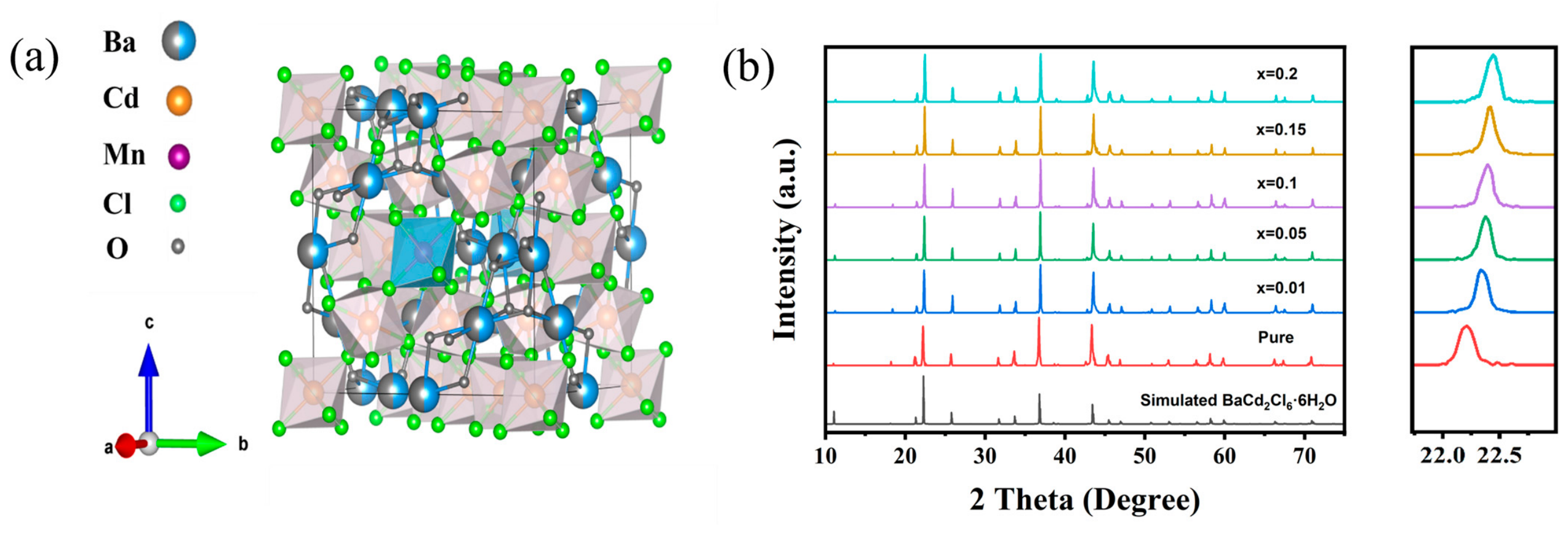
Figure 1a shows a schematic atomic diagram of the crystal structure of BaCd2−2xMn2xCl6·6H2O. The compound features a three-dimensional network framework: Cd2+ ions coordinate with six Cl ions to form CdCl6 octahedra, which are interconnected through corner-sharing in all three dimensions, constructing a spatially extended three-dimensional skeleton. Ba2+ ions are located in the channels or voids of the three-dimensional skeleton and stabilize the overall structure through coordination with Cl ions and O atoms. The formation of this three-dimensional structure is mainly attributed to the large ionic radius of Ba2+ (~1.49 Å) and its flexible coordination geometry requirements, allowing CdCl6 octahedra to connect freely in the x, y, and z directions. The distance between adjacent Cd sites is approximately 4.87 Å, providing a relatively separated substitution environment for Mn2+ ions. To more intuitively illustrate the geometric arrangement of Mn-related sites, a simplified structural diagram containing only the Cd/Mn sites is presented in Figure S1. As shown in Figure S1, the Mn (Cd) sites in the Ba-based lattice are uniformly distributed in three-dimensional space, with an equal spacing of 4.87 Å between adjacent Cd sites. Such a structural arrangement is expected to favor the spatial separation of Mn2+ ions after substitution, thereby reducing the probability of Mn-Mn pair formation and suppressing energy migration as well as concentration quenching.
Figure 1b shows the XRD patterns and magnified diffraction profiles of undoped BaCd2Cl6·6H2O and samples with different Mn2+ doping concentrations (x = 0.01, 0.05, 0.1, 0.15, 0.2). For BaCd2Cl6·6H2O, the experimental diffraction peaks of the undoped sample agree well with the pattern simulated based on the structural model, indicating high purity and successful formation of the target phase. After Mn2+ doping, the main diffraction peaks of all doped samples remain essentially unchanged compared to the undoped sample, with no appearance of new diffraction peaks or peak splitting, indicating that the introduction of Mn2+ does not alter the basic crystal structure and that Mn2+ substitutes for Cd2+ sites. A closer inspection of the magnified patterns reveals that the diffraction peaks shift slightly toward higher angles with increasing Mn2+ concentration. According to Bragg’s law, an increase in diffraction angle θ corresponds to a decrease in interplanar spacing d, so this peak shift indicates lattice contraction. Considering that Mn2+ and Cd2+ have the same divalent charge state, both readily form chloride-coordinated octahedra, and the ionic radius of Mn2+ (0.80 Å) is smaller than that of Cd2+ (0.95 Å), the gradual substitution of Cd2+ by Mn2+ leads to a decrease in unit cell parameters, thereby causing the observed high-angle shift of diffraction peaks [19,20]. The diffraction patterns of the precursor materials are clearly different from those of the final products, further confirming the successful formation of the target phase. To further verify the successful incorporation of Mn2+ into the BaCd2Cl6·6H2O lattice, ICP-OES and XPS measurements were performed. As summarized in Table S1, the actual Mn contents determined by ICP-OES agree well with the nominal doping concentrations over the entire composition range, indicating efficient Mn incorporation during the mechanical grinding process. Figure S2 shows the Mn 2p XPS spectrum, which confirms that Mn is predominantly present in the +2 oxidation state, supporting the substitution of Cd2+ by Mn2+ in the host lattice.
To further examine the elemental distribution and microstructure of the sample, SEM-EDS characterization was performed on the x = 0.15 sample. Figure S3 shows the SEM image and elemental mapping of the sample. The SEM image reveals that the sample exhibits irregular crystal morphology with relatively smooth particle surfaces and clear edges, indicating good crystallinity. The EDS elemental mapping results show that barium (Ba), cadmium (Cd), chlorine (Cl), and manganese (Mn) are uniformly distributed within the selected region, without any local enrichment or segregation of any element. This indicates that Mn2+ ions are homogeneously dispersed throughout the crystal grains rather than aggregating on particle surfaces or forming Mn-rich secondary phases, further confirming that Mn2+ has successfully entered the Cd sites of the host lattice. The EDS results further confirm the elemental composition and the homogeneous distribution of Mn throughout the sample. The results show that the atomic ratio of Ba:(Cd+Mn):Cl is approximately 1:2:6, consistent with the theoretical stoichiometry of BaCd2Cl6·6H2O.

3.2. Optical Properties

To investigate the luminescence behavior of BaCd2Cl6·6H2O:Mn2+, the photoluminescence spectrum of the undoped host was first measured. Figure S4 shows the PL result of undoped BaCd2Cl6·6H2O. It can be seen that the undoped host exhibits nearly negligible luminescence at room temperature, indicating that its intrinsic visible emission is extremely weak. Therefore, the strong visible emission observed after Mn2+ doping is mainly associated with the introduction of Mn-related luminescence centers rather than from an enhancement of the intrinsic host emission. To further exclude possible contributions from precursor materials, the photoluminescence spectra of BaCl2·2H2O and CdCl2·2.5H2O were measured under identical excitation conditions. Figure S4 shows that no emission bands are observed in the orange-red region (around 588 nm), indicating that the characteristic Mn-related emission does not originate from the precursor components. A weak and broad emission band around 400 nm is observed for all precursor samples. Considering the nearly identical peak positions and spectral profiles, this emission is attributed to defect-related states or background responses under ultraviolet excitation rather than intrinsic luminescence of the precursor materials.
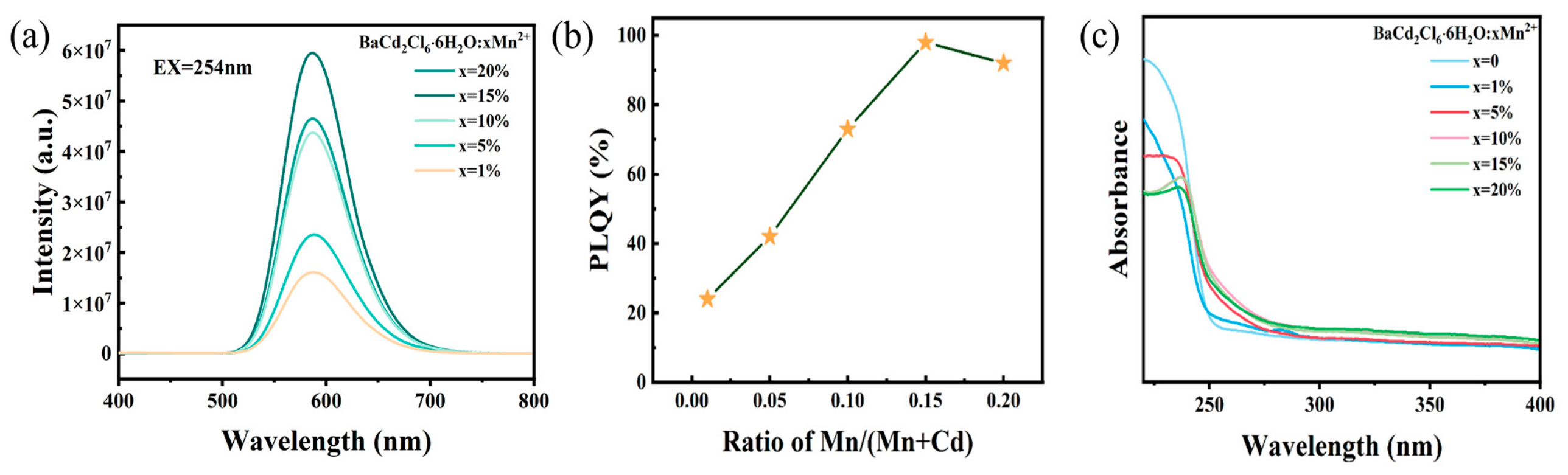
Figure 2a presents the room-temperature PL spectra of BaCd2Cl6·6H2O:x%Mn2+ samples under 254 nm excitation with different Mn2+ doping concentrations. After Mn doping, the system displays markedly enhanced broadband emission, indicating that the introduction of Mn2+ enables efficient radiative emission channels. The main emission of the Ba-based host is centered at 588 nm. Under different Mn doping concentrations, the emission peak position remains essentially unchanged and does not show any obvious shift with increasing Mn content. As shown in Figure 2a, the PL intensity first increases and then decreases with increasing Mn2+ concentration, reaching its maximum at 15% Mn. The PLQY values shown in Figure 2b exhibit the same trend and reach a maximum at a Mn concentration of 15%. Specifically, an absolute PLQY of 98.58% was obtained for the Ba-based system using an integrating sphere, as detailed in Figure S6. These results indicate that the system exhibits pronounced concentration-dependent luminescence behavior. In the low-to-intermediate Mn concentration range, increasing Mn2+ content increases the number of Mn-related emissive centers and is accompanied by enhanced emission intensity, suggesting more efficient population of the Mn2+ emitting states. At higher doping levels, the decrease in PL intensity is consistent with concentration quenching. Considering the reduced average Mn-Mn separation at higher Mn concentrations, enhanced Mn-related interactions are expected to increase the probability of nonradiative relaxation. Further consideration of the peak position and intensity evolution shows that, although the emission intensity varies significantly with Mn content, the emission peak position remains essentially unchanged under different Mn doping concentrations. This suggests that the Mn-related emissive centers formed in the system are located in relatively well-defined and stable local environments. Therefore, variation in Mn concentration mainly affects the number of emissive centers and the interactions among Mn2+ ions, while the local coordination environment of the emissive centers remains essentially unchanged [10,12,15,21].
The emission center of the Ba-based system at 588 nm should be understood in conjunction with its structural characteristics. The Ba-based host adopts a three-dimensional structure with an equidistant distribution of octahedra, which directly leads to a different distribution mode of Mn2+ ions in the lattice. In the Ba-based system, the Mn-Mn separation is 4.87 Å, and this larger distance weakens Mn-Mn coupling, so Mn2+ ions are more likely to remain as relatively isolated Mn ions in the lattice, and the luminescence is mainly dominated by isolated Mn2+ centers [15,22]. This is consistent with recent studies showing that the luminescence behavior of Mn-based halides is strongly governed by the local coordination environment, Mn-Mn distance, and magnetic coupling interactions [1,9,10,12,23]. For the Ba-based system, because its luminescence is mainly dominated by isolated Mn2+ centers, the emission energy is mainly determined by the local environment of a single [MnCl6]4− octahedron, so the main emission peak remains near 588 nm and does not change significantly with doping concentration. In addition, the luminescence enhancement in this system is also related to the ionic confinement effect arising from localized structural units. For halide systems composed of localized structural units, excited states are more easily confined within a limited space, which is more favorable for the generation of broadband visible emission. After Mn doping, localized Mn luminescence centers, local magnetic environments, and the finite-scale structural confinement jointly reinforce this localization process, facilitating energy transfer from Cd-Cl charge-transfer states to Mn-related emissive centers and increasing the probability of radiative recombination [7,16,17,20,22,24].
Figure 2c shows the absorption spectra of the corresponding samples. All samples exhibit strong broadband absorption in the ultraviolet region (approximately 230–350 nm), which is mainly attributed to Cd-Cl charge-transfer transitions. With increasing Mn2+ doping concentration, the absorption edge shifts slightly toward longer wavelengths. No obvious Mn2+ d-d transition absorption peaks are observed in the visible region (400–700 nm), indicating that under 254 nm excitation, the dominant excitation process is not direct d-d excitation of Mn2+, but rather excitation of Cd-Cl charge-transfer states, followed by energy transfer from these excited states to the 4T1 level of Mn2+, ultimately producing d-d emission [6,8,16].
Figure S7 shows the PL excitation (PLE) spectrum profiles of the Ba-based system. It can be seen that the effective excitation is mainly concentrated in the ultraviolet region, and the overall shape and variation trend of the excitation spectrum remain essentially similar under different Mn doping concentrations. Combined with the absorption spectra in Figure 2c, the strong absorption is also mainly located near the ultraviolet band edge. These results suggest that the dominant excitation process in the Mn-doped system is largely associated with the charge-transfer band near the band edge, rather than being dominated by individual Mn2+ d-d transitions. In the undoped sample, this absorption mainly arises from Cd-Cl charge transfer. After Mn doping, the original Cd-Cl charge-transfer excitation process may be modified, with possible involvement of Mn-Cl-related states. Therefore, although this high-absorption region may contain some contribution from Mn2+ d-d transitions, their contribution appears to be relatively weak under the present excitation conditions. The excitation process is mainly governed by high-energy absorption processes, whereas the final visible emission can be attributed to energy transfer from these excited states to Mn-related emissive centers [7,20].
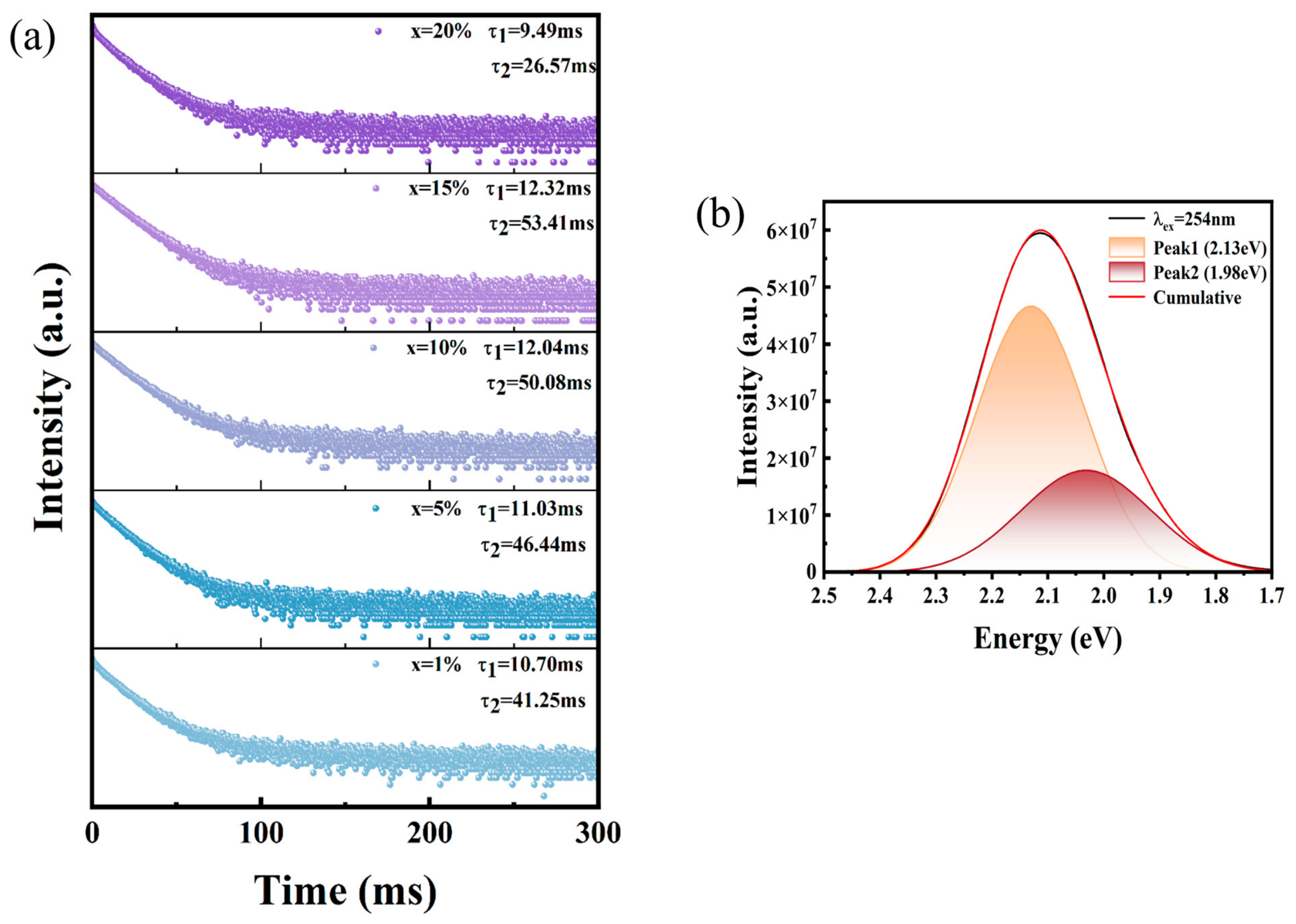
Figure 3a shows the time-resolved photoluminescence decay curves of BaCd2Cl6·6H2O:x%Mn2+ recorded by monitoring the dominant Mn2+ emission at 588 nm under 254 nm excitation. All decay profiles can be well fitted by a biexponential function I ( t ) = A 1 e t / τ 1 + A 2 e t / τ 2 , indicating that at least two major relaxation channels contribute to the monitored 588 nm emission. For the Ba-based system, the lifetimes reach their maxima at 15% Mn2+, with τ1 = 12.04 ms and τ2 = 50.08 ms. This evolution is consistent with the concentration dependence of the PL intensity and PLQY, both of which also reach their maxima at 15% Mn, indicating that the radiative process is most favorable near this doping level. In the low-to-intermediate Mn concentration range, the initial increase in lifetimes indicates that Mn incorporation progressively establishes more effective emissive centers and favors radiative relaxation. Once the Mn concentration exceeds 15%, both lifetime components begin to decrease, indicating the onset of concentration-dependent quenching [10,12,15,25]. Since undoped BaCd2Cl6·6H2O shows nearly negligible room-temperature luminescence, the observed millisecond-scale decay is mainly associated with Mn-related emitting states rather than with intrinsic host emission. The overall lifetime evolution of the Ba-based system is directly correlated with the PL and PLQY maxima at 15% Mn, which is consistent with the picture that the Ba lattice is mainly dominated by single-Mn-ion emission. Although a certain Mn-Mn magnetic interaction cannot be completely excluded, the large Mn-Mn separation (4.87 Å) makes strongly coupled Mn-pair emission unlikely to dominate. Therefore, the dominant millisecond-scale decay is reasonably attributed to single-Mn-related emission, while the second decay component may reflect an additional, weaker relaxation channel in the lattice [3,4,16,26]. The decrease in lifetime at higher Mn concentration can be understood together with the reduction in PL intensity and PLQY. When the Mn content exceeds 15%, the density of Mn-related centers in the lattice increases significantly, and the interaction among Mn centers becomes stronger. Although the dominant emission is mainly associated with isolated Mn2+ centers, higher Mn concentration still introduces stronger Mn-related interaction, lattice distortion, and more evident phonon scattering, which together reduce both lifetime and emission intensity. This synchronous decrease is consistent with concentration-dependent quenching behavior.
Further insight into the emitting states can be obtained from the Gaussian deconvolution performed in the energy scale shown in Figure 3b. The emission spectrum of BaCd2Cl6·6H2O:15%Mn2+ can be well resolved into two symmetric components centered at 2.13 and 1.98 eV, corresponding to approximately 583 and 627 nm, respectively, indicating that the observed broadband luminescence contains at least two overlapping emission contributions [27,28]. The dominant component at 2.13 eV (≈583 nm) agrees well with the overall PL maximum and can therefore be attributed to the 4T1 → 6A1 d-d radiative transition of isolated Mn2+ ions in [MnCl6]4− octahedra, which is consistent with the conclusion that Mn2+ ions mainly exist as isolated centers in the Ba lattice. For the weaker low-energy component at 1.98 eV (≈627 nm), considering that although the Ba-based three-dimensional structure has a relatively large Mn-Mn separation, a small number of adjacent Mn2+ pairs may still exist (as will be discussed in the magnetic section later, local ferromagnetic interactions are suggested to exist in this system), and the undoped host shows negligible luminescence at room temperature, this component is more likely to originate from emission of a small number of Mn-Mn pairs rather than from self-trapped excitons of the pure host [18,29,30].
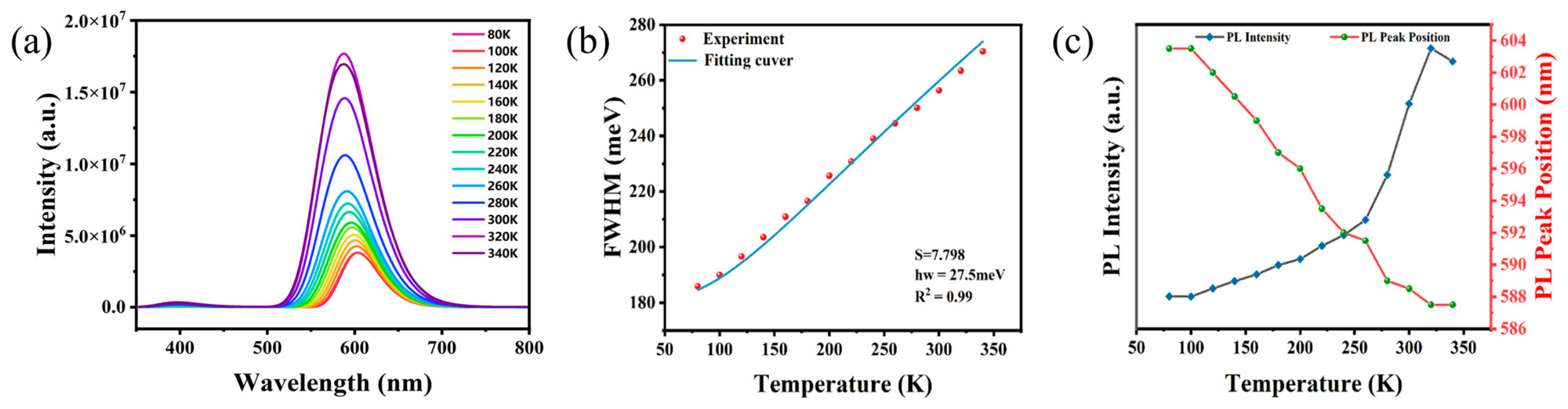
To further investigate the luminescence mechanism of BaCd2Cl6·6H2O:Mn2+, temperature-dependent PL spectra of the 15% Mn2+-doped sample were measured, as shown in Figure 4a. Over the entire measured temperature range, no temperature-induced new major emission band appears, and the PL spectra always retain one dominant broadband emission at different temperatures, indicating that the system possesses strong thermal structural stability. However, the emission peak position, intensity, and bandwidth all show clear temperature dependence. As shown in Figure 4a, the emission maximum monotonically blue-shifts with increasing temperature, while the emission bandwidth continuously increases. This behavior is different from the band-edge luminescence redshift caused by band-gap contraction in ordinary semiconductors and is instead more similar to the blue-shift behavior observed in metal halide systems, which is generally attributed to the rising electron–phonon coupling due to lattice expansion, including the contributions of both acoustic phonons and optical longitudinal phonons [31,32,33]. As temperature increases, lattice vibrations are progressively strengthened, and the coupling between the local emissive centers and lattice vibrations also increases, thus correlating with a shift of the emission band toward higher energy and simultaneous broadening.
The temperature dependence of the full width at half maximum can be fitted using the equation F W H M = 2.36 S ω p h o n o n c o t h ω p h o n o n 2 K b T , where S is the electron–phonon coupling parameter, ħωphonon is the phonon frequency, and Kb is the Boltzmann constant. The fitting results in Figure 4b show that for the Ba-based system, S = 7.798 and ħωphonon = 27.5 meV. The emission intensity of this system does not simply decrease with increasing temperature as in ordinary covalent compounds, but instead shows a clear increase–decrease profile, as shown in Figure 4c. This behavior is consistent with a thermally activated emission process followed by temperature quenching [34]. For the Ba system, the PL intensity gradually increases from low temperature and reaches a maximum at about 320 K. This observation suggests that, within a certain temperature range, increasing temperature may facilitate phonon-assisted processes associated with localized emissive states while simultaneously enhancing nonradiative relaxation. With increasing temperature, enhanced electron–phonon coupling is expected to influence the relaxation dynamics of the emissive states, which may contribute to the observed increase in PL intensity. When the temperature reaches 320 K, the emission intensity reaches a maximum, which may correspond to an optimal balance between radiative and nonradiative processes in the lattice. At higher temperatures, enhanced lattice vibrations are expected to increase the probability of nonradiative relaxation, resulting in the gradual decrease in PL intensity characteristic of thermal quenching. The PL intensity reaches its maximum at approximately 320 K, indicating that the present system maintains efficient luminescence around room temperature and exhibits good thermal stability [31,32].
The phonon information derived from the temperature-dependent PL fitting has a direct correspondence with the Raman spectra. Figure S8 shows the Raman spectra of the undoped and 15% Mn2+-doped Ba systems to analyze the effect of Mn2+ substitution on vibrational properties. The undoped sample exhibits multiple Raman modes at about 88, 119, 133, 161, 219, 321, 405, and 555 cm−1. After Mn doping, the strongest peak at 219 cm−1 remains nearly unchanged, whereas the relative intensities and peak shapes of several low-frequency modes are modified, while the high-frequency multiphonon-like profile is still preserved. These results indicate that the introduction of Mn2+ does not significantly alter the main structural framework of the system, and especially that the dominant vibrational modes related to the host octahedral framework remain stable; however, Mn2+ substitution clearly modifies the local vibrational environment so that some vibration modes more sensitive to local coordination undergo changes in intensity or peak position. The strongest Raman peak at 219 cm−1 is reasonably assigned to the dominant Cd-Cl stretching vibration, while the lower-frequency vibration modes are associated with lattice vibrations of the octahedral framework [20,35]. The fitted ħωphonon value of 27.5 meV, converted into wavenumber, is about 221.8 cm−1, which is very close to the strongest high-frequency Raman mode at 219 cm−1. This indicates that the key phonons governing the blue shift of the emission peak, the increase in FWHM, and the evolution of PL intensity are closely related to the dominant high-frequency octahedral vibration mode observed in the Raman spectrum. The high-frequency characteristic peaks in the Raman spectrum (321, 405, and 555 cm−1) suggest that the system may involve multiphonon scattering processes arising from combination modes or overtone modes [3,4,16]. These high-frequency modes can be understood as higher-order vibrations, combination modes, or overtones, reflecting a clear anharmonic oscillator behavior. This feature indicates strong electronic–vibrational coupling in the local structural units and that two or more low-energy phonon modes may combine to form higher-energy Raman modes through combination or overtone processes. For a chloride system containing such local structural units, this multiphonon effect suggests that the emissive state is closely related to strong electron–phonon coupling within localized structural units [36,37,38]. In the Ba system, although the strongest Raman mode remains stable, the weakened Raman intensity and the preserved multiphonon features still indicate that Mn doping introduces a significant local coupling effect into the lattice.

3.3. Magnetic Properties

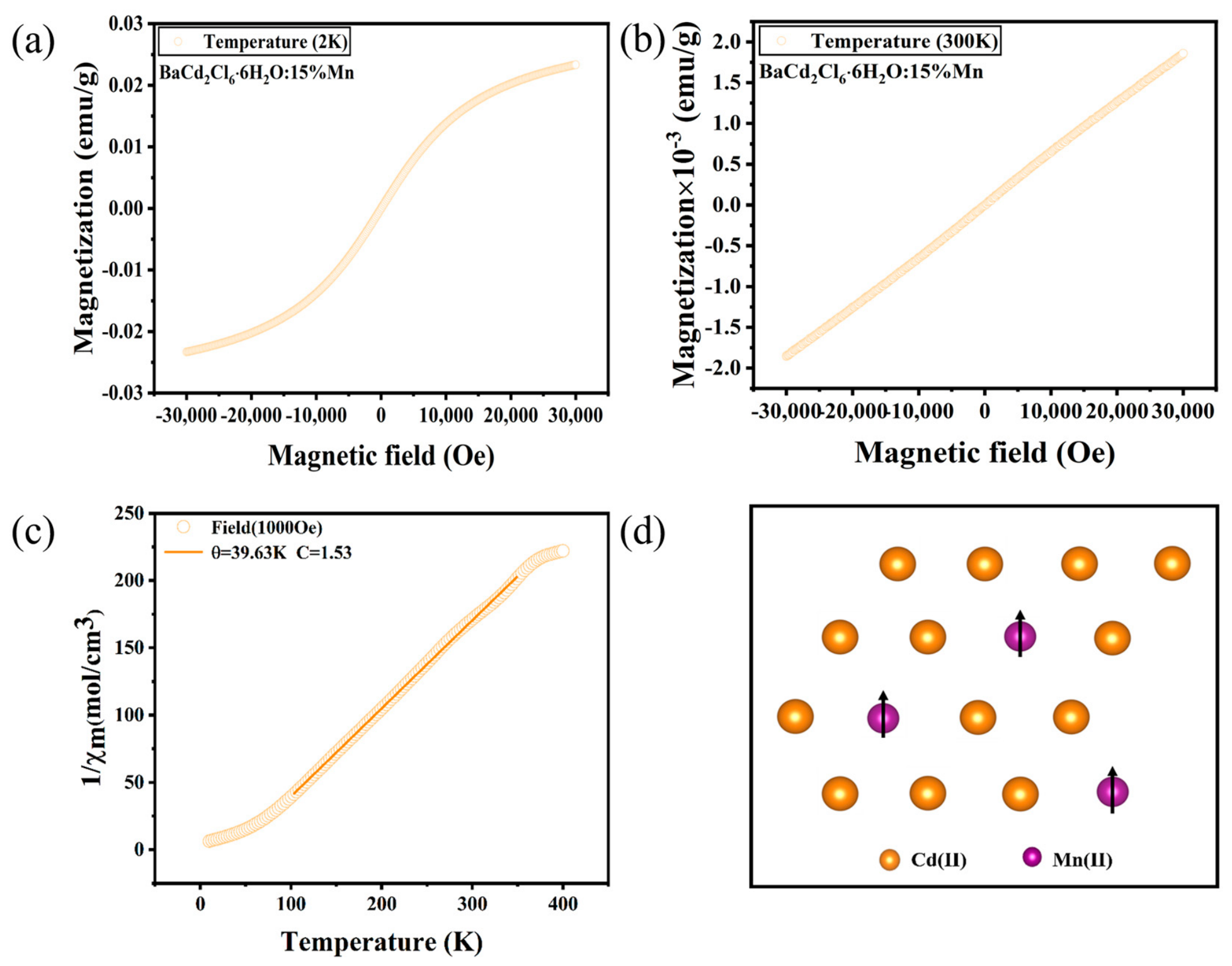
The magnetic properties of BaCd2Cl6·6H2O:15%Mn2+ were investigated by field-dependent magnetization and temperature-dependent magnetic susceptibility measurements, as shown in Figure 5a–c. At 2 K, the sample exhibits a nonlinear M-H curve, indicating the presence of magnetic coupling contributions beyond a purely paramagnetic response. The overall magnetic response remains weak, which is consistent with the dilute magnetic character of this Mn-doped chloride. At 300 K, the M-H curve becomes nearly linear, indicating that the paramagnetic background dominates [12].
The Curie–Weiss fitting of the 1/χ-T curve gives a Curie–Weiss temperature of +39.63 K, suggesting weak ferromagnetic exchange interactions between neighboring Mn2+ ions [22,39]. Considering the relatively small magnetization, these interactions are likely limited to local magnetic correlations rather than dominant magnetic coupling throughout the lattice [10,12]. The spin distribution scheme in Figure 5d shows that Mn ions in the Ba-based lattice are spatially separated and mainly exist as isolated centers. The relatively large Mn-Mn separation effectively suppresses strong magnetic coupling and energy migration between Mn2+ ions, thereby reducing nonradiative recombination channels. This magnetic behavior is consistent with the high PLQY of 98% and the isolated-Mn2+-center-dominated luminescence characteristics of the Ba-based system [15,40].

4. Conclusions

In summary, the three-dimensional Mn distribution and the relatively large Mn-Mn separation (4.87 Å) in BaCd2Cl6·6H2O:Mn2+ effectively suppress strong interactions between Mn ions and stabilize single-Mn-ion-dominated emission, resulting in efficient orange emission at 588 nm with a photoluminescence quantum yield as high as 98%. Temperature-dependent luminescence and Raman analyses consistently indicate that the emission process in this system is strongly influenced by electron–phonon coupling and thermally activated relaxation dynamics, with an optimal emission temperature of about 320 K, which is above room temperature, demonstrating good thermal stability. Overall, this work establishes a clear correlation between lattice dimensionality, Mn-Mn separation, and emissive-center characteristics, demonstrating that alkaline-earth-site confinement provides an effective strategy for regulating emission color and efficiency in Mn-doped metal halides.

Supplementary Materials

The following supporting information can be downloaded at: https://www.mdpi.com/article/10.3390/cryst16070458/s1, Figure S1: Simplified structural diagrams of BaCd2Cl6·6H2O:Mn2+ containing only the Cd/Mn sites; Table S1: ICP-OES analysis of the actual Mn contents in BaCd2−2xMn2xCl6·6H2O samples with different nominal Mn concentrations; Figure S2: XPS spectra of BaCd2−2xMn2xCl6·6H2O (x = 0.15); Figure S3: SEM image, elemental mapping, and EDS spectrum of BaCd2−2xMn2xCl6·6H2O (x = 0.15), demonstrating the homogeneous distribution of Ba, Cd, Mn, and Cl elements throughout the sample; Figure S4: PL, PLE spectra of BaCd2Cl6·6H2O; Figure S5: Photoluminescence spectra of BaCl2·2H2O and CdCl2·2.5H2O measured under identical excitation conditions (λex = 254 nm). The spectra are normalized to their maximum intensity for comparison; Figure S6: Absolute photoluminescence quantum yield (PLQY) measurement of BaCd2−2xMn2xCl6·6H2O (x = 0.15). (a) Spectra collected from the PTFE reference (blank) and the sample under identical integrating-sphere measurement conditions. (b) Difference spectrum (sample − reference); Figure S7: PLE profiles of BaCd2−2xMn2xCl6·6H2O(x = 0.01, 0.05, 0.1, 0.15, 0.2) under λem = 588 nm; Figure S8: The Raman spectra of undoped BaCd2Cl6·6H2O and Mn2+-doped BaCd2−2xMn2xCl6·6H2O (x = 0.15).

Author Contributions

Conceptualization, D.L. and B.Z.; methodology, D.L. and T.H.; validation, T.H., B.Z. and D.L.; formal analysis, D.L.; investigation, S.G.; resources, Y.Z.; data curation, D.L.; writing—original draft preparation, D.L.; writing—review and editing, B.Z. and T.H.; visualization, T.H.; supervision, B.Z.; project administration, B.Z.; funding acquisition, B.Z. All authors have read and agreed to the published version of the manuscript.

Funding

This research was funded by the Guangxi Natural Science Foundation, grant number 2025GXNSFDA02850007.

Data Availability Statement

The raw data supporting the conclusions of this article will be made available by the authors on request.

Conflicts of Interest

The authors declare no conflicts of interest.

References

  1. Zhang, Y.Q.; Tu, D.T.; Wang, L.P.; Li, C.L.; Liu, Y.H.; Chen, X.Y. Transition metal ion-doped cesium lead halide perovskite nanocrystals: Doping strategies and luminescence design. Mater. Chem. Front. 2023, 8, 192–209. [Google Scholar] [CrossRef] [Scilit]
  2. Zhang, C.X.; Ding, S.S.; Liu, G.L.; He, D.X.; Chen, P.; Wu, W.Q.; Wang, L.Z. Metal-doping for perovskite optoelectronic applications. Mater. Today 2025, 89, 172–191. [Google Scholar] [CrossRef] [Scilit]
  3. Li, M.Z.; Xia, Z.G. Recent progress of zero-dimensional luminescent metal halides. Chem. Soc. Rev. 2021, 50, 2626–2662. [Google Scholar] [CrossRef] [Scilit] [PubMed]
  4. Pradhan, N. Mn-Doped Semiconductor Nanocrystals: 25 Years and Beyond. J. Phys. Chem. Lett. 2019, 10, 2574–2577. [Google Scholar] [CrossRef] [Scilit] [PubMed]
  5. Liu, G.F.; Zhang, S.; Liu, Y.Y.; Xuan, F.H.; Teng, B.; Ji, S.H. Achieving Ultralong Red Afterglow Emission in Mn2+-Doped NH4CdCl3 Hybrid Perovskite Through Trap State Modulation. Adv. Opt. Mater. 2025, 13, 2402858. [Google Scholar] [CrossRef] [Scilit]
  6. Fang, X.C.; Chen, Z.; Leung, M.H.M.; Zheng, B.; Wang, L.W.; An, M.; Asakura, Y.; Yamauchi, Y.; Yuan, Z.H. Photo-Induced Synthesis of Ytterbium and Manganese-Doped CsPbCl3 Nanocrystals for Visible to Near-Infrared Photoluminescence with Negative Thermal Quenching. Adv. Sci. 2025, 12, 2408927. [Google Scholar] [CrossRef] [Scilit] [PubMed]
  7. Xing, G.; Cui, E.; Yuan, X.; Wang, B.; Chen, J.; Zhao, Y.; Tang, J.; Liu, J. Charge compensation via tetravalent doping for high-efficiency Mn2+-activated inorganic double perovskites toward high-resolution X-Ray imaging. Inorg. Chem. Front. 2025, 12, 8741–8749. [Google Scholar] [CrossRef] [Scilit]
  8. Gu, Z.W.; Xing, K.; Cao, S.; Zou, B.S.; Zhao, J.L. Boosting photoluminescence efficiency and stability of Mn2+-doped CsPbCl3 perovskite nanocrystals via europium ion codoping. J. Rare Earths 2025, 43, 1835–1843. [Google Scholar] [CrossRef] [Scilit]
  9. Xing, K.; Cao, S.; Song, Y.S.; Chen, M.Y.; Gu, Z.W.; Li, Q.Y.; Han, X.X.; Zou, B.S.; Zhao, J.L. Enhancing exciton-to-Mn2+ energy transfer and emission efficiency in Mn2+-doped CsPbCl3 perovskite nanocrystals via CaCl2 post-treatment. Appl. Surf. Sci. 2024, 673, 160887. [Google Scholar] [CrossRef] [Scilit]
  10. Zhang, K.; Kang, E.; Huang, R.; Li, L.; Wang, Y.; Zhao, H.; Hagiwara, M.; Ma, Y.; Han, Y. Effect of Mn–Mn Magnetic Ordering on Photoluminescence in 2D Layered Hybrid Perovskite (CH3NH3)2MnCl4. Adv. Opt. Mater. 2024, 12, 2400936. [Google Scholar] [CrossRef] [Scilit]
  11. Jia, W.Y.; Wei, Q.L.; Ge, S.G.; Peng, C.Y.; Huang, T.; Yao, S.F.; Tian, Y.; Chang, T.; Zeng, R.S.; Zou, B.S. Polaronic Magnetic Excitons and Photoluminescence in Mn2+-Doped CsCdBr3 Metal Halides. J. Phys. Chem. C 2021, 125, 18031–18039. [Google Scholar] [CrossRef] [Scilit]
  12. Jia, W.Y.; Wei, Q.L.; Yao, S.F.; Ge, S.G.; Peng, C.Y.; Wang, L.S.; Zhong, X.C.; Peng, H.; Zou, B.S. Magnetic coupling for highly efficient and tunable emission in CsCdX3: Mn perovskites. J. Lumin. 2023, 257, 119657. [Google Scholar] [CrossRef] [Scilit]
  13. Zhang, Y.; Zhou, L.; Li, D.; Li, H.; Zhang, L.; Shen, W.; Li, M.; He, R. Realizing Efficient Emission in Three-Dimensional CsCdCl3 Single Crystals by Introducing Separated Emitting Centers. Inorg. Chem. 2022, 61, 17902–17910. [Google Scholar] [CrossRef] [Scilit] [PubMed]
  14. Zhang, A.; Zhou, X.; Gu, R.; Xia, Z. Efficient energy transfer from self-trapped excitons to Mn2+ dopants in CsCdCl3:Mn2+ perovskite nanocrystals. Int. J. Miner. Metall. Mater. 2024, 31, 1456–1461. [Google Scholar] [CrossRef] [Scilit]
  15. Zhu, X.L.; Yan, X.H.; Kang, E.Z.; Han, Y.B.; Yin, C.L.; Ye, S. Suppressing Energy Migration via Antiparallel Spin Alignment in One-Dimensional Mn2+ Halide Magnets with High Luminescence Efficiency. Angew. Chem.-Int. Ed. 2025, 64, e202417218. [Google Scholar] [CrossRef] [Scilit] [PubMed]
  16. Ahmad, F.; Lassoued, M.S.; Chen, W.P.; Gou, G.Y.; Zheng, Y.Z. Effect of Mn2+ Doping on the Photoluminescence of Hybrid One-Dimensional Lead Halide Post-Perovskites. ACS Appl. Mater. Interfaces 2024, 16, 31067–31075. [Google Scholar] [CrossRef] [Scilit] [PubMed]
  17. He, B.; Ke, B.; Yang, C.Z.; Chen, Y.J.; Zhong, X.C.; Li, W.J.; Zou, B.S. Efficient and Stable Red-Orange Emission from Polaronic Magnetic Excitons in Mn (II)-Doped 0D All-Inorganic Rb4CdCl6. Adv. Opt. Mater. 2025, 13, 2402624. [Google Scholar] [CrossRef] [Scilit]
  18. Gao, Y.L.; Han, X.X.; Wei, Q.L.; Chang, T.; Chen, Y.J.; Zou, B.S.; Cao, S.; Zhao, J.L.; Zeng, R.S. Efficient Orange Emission in Mn2+-Doped Cs3Cd2Cl7 Perovskites with Excellent Stability. J. Phys. Chem. Lett. 2022, 13, 7177–7184. [Google Scholar] [CrossRef] [Scilit] [PubMed]
  19. Zeng, M.; Wang, R.; Zeng, X.; Ke, D.X.; Wei, L.J.; Wang, H.; Cen, Y.R.; Li, G.; Locardi, F.; Artizzu, F.; et al. Pb2+ and Mn2+ Codoped Cs2CdCl4 Nanocrystals with Tunable Emission. ACS Appl. Nano Mater. 2025, 8, 1471–1478. [Google Scholar] [CrossRef] [Scilit]
  20. Huang, Y.X.; Pan, Y.X.; Guo, S.T.; Peng, C.D.; Lian, H.Z.; Lin, J. Large Spectral Shift of Mn2+ Emission Due to the Shrinkage of the Crystalline Host Lattice of the Hexagonal CsCdCl3 Crystals and Phase Transition. Inorg. Chem. 2022, 61, 8356–8365. [Google Scholar] [CrossRef] [Scilit] [PubMed]
  21. Wang, C.Y.; Li, Y.C.; Deng, Z.T. Emission-tunable manganese(ii) halides: Structure-property relationships and functional applications. Chem. Sci. 2025, 16, 15796–15814. [Google Scholar] [CrossRef] [Scilit] [PubMed]
  22. Mugiraneza, S.; Hallas, A.M. Tutorial: A beginner’s guide to interpreting magnetic susceptibility data with the Curie-Weiss law. Commun. Phys. 2022, 5, 95. [Google Scholar] [CrossRef] [Scilit]
  23. Su, B.B.; Zhou, G.J.; Huang, J.L.; Song, E.H.; Nag, A.; Xia, Z.G. Mn2+-Doped Metal Halide Perovskites: Structure, Photoluminescence, and Application. Laser Photon. Rev. 2021, 15, 2000334. [Google Scholar] [CrossRef] [Scilit]
  24. Magdaleno, A.J.; Kshirsagar, A.S.; Meléndez, M.; Kuruppu, U.M.; Suurmond, J.J.; Cutler, M.M.; Frising, M.; Seitz, M.; Delgado-Buscalioni, R.; Gangishetty, M.K.; et al. Role of Exciton Diffusion in the Efficiency of Mn Dopant Emission in Two-Dimensional Perovskites. ACS Nanosci. Au 2024, 5, 29–36. [Google Scholar] [CrossRef] [Scilit] [PubMed]
  25. Hidayatova, L.; Mi, C.J.; Akhmedov, N.G.; Liu, Y.; Shafiq, A.K.; Afshari, H.; Mohamed-Raseek, N.; Popy, D.A.; Xiang, S.S.; Chen, Y.C.; et al. Efficient Mn2+ Doping in Non-Stoichiometric Cesium Lead Bromide Perovskite Quantum Dots. J. Am. Chem. Soc. 2025, 147, 35069–35080. [Google Scholar] [CrossRef] [Scilit] [PubMed]
  26. Ji, S.H.; Liu, Z.X.; Zhao, L.J.; Zhao, K.; Tan, H.M.; Wang, J.; Zhao, J.L.; Zheng, J.J.; Yuan, X. Controlled Photoluminescence Lifetimes and Quantum Efficiencies in Mn-Doped Two-Dimensional Perovskite via A-Site Cation Engineering. J. Phys. Chem. C 2023, 127, 21313–21320. [Google Scholar] [CrossRef] [Scilit]
  27. Cheng, Y.; Li, J.P.; Zhang, L.X.; Xie, Y.T.; Liu, Y.Y.; Wu, M.; Yue, C.Y.; Gong, L.K.; Gong, Z.L.; Lei, X.W. Manganese-Doped Low-Dimensional Cadmium Halide for Excitation-Dependent Multicolor Emitting. Inorg. Chem. 2025, 64, 22182–22192. [Google Scholar] [CrossRef] [Scilit] [PubMed]
  28. Yin, W.H.; Ba, H.Q.; Song, H.; Han, L.L.; Yang, X.X.; Liu, Z.C. Realizing color tunable longpersistent luminescence in Mn2+-Doped Cs3Cd2Cl7. J. Alloys Compd. 2025, 1036, 181949. [Google Scholar] [CrossRef] [Scilit]
  29. Lu, M.H.; Shen, X.D.; Ke, B.; Huang, T.; Xu, O.; Kong, L.H.; Zhong, X.C.; Zou, B.S. Magnetic coupling interaction-related photoluminescence behaviors in all-inorganic manganese chloride perovskites. Mater. Today Chem. 2024, 38, 102043. [Google Scholar] [CrossRef] [Scilit]
  30. Rao, J.H.; Qin, W.H.; Lava, J.; Chen, J.S.; Mao, X.; Wang, M.S.; Zhang, R.L. Mn(II)-Doped Two-Dimensional Cd Chloride Perovskites with Near-Unity Orange Emission for White Light-Emitting Diodes. Inorg. Chem. 2025, 64, 13830–13836. [Google Scholar] [CrossRef] [Scilit] [PubMed]
  31. Sarkar, S.; Kamath, N.S.; Gayen, K.; Pal, S.K. Exciton-phonon coupling in quasi-two-dimensional Ruddlesden-Popper perovskites: Impact of a mixed-phase structure. Nanoscale 2025, 17, 10771–10783. [Google Scholar] [CrossRef] [Scilit] [PubMed]
  32. Nonato, A.; Rodríguez-Hernández, J.S.; Abreu, D.S.; Soares, C.C.S.; Gómez, M.A.P.; García-Fernández, A.; Señaris-Rodríguez, M.A.; Andújar, M.S.; Ayala, A.P.; da Silva, R.X.; et al. Strong Electron-Phonon Coupling and Lattice Dynamics in One-Dimensional (CH3)2NH2 PbI3 Hybrid Perovskite. Chem. Mater. 2025, 37, 1013–1026. [Google Scholar] [CrossRef] [Scilit]
  33. Li, J.P.; Li, P.; Yuan, L.; Wang, L.X.; Sun, J.H.; Gong, Z.L.; Lei, X.W.; Yue, C.Y. Temperature-Dependent Dual Fluorescence and Phosphorescence of Low-Dimensional Hybrid Cadmium Halides. Inorg. Chem. 2025, 64, 14343–14351. [Google Scholar] [CrossRef] [Scilit] [PubMed]
  34. Panda, D.P.; Swain, D.; Raghunathan, R.; Sundaresan, A. Negative Thermal Quenching and Self-Trapped Exciton Emission in (R/S-C3H10ON)MnCl3. Chem. Mater. 2024, 36, 5698–5708. [Google Scholar] [CrossRef] [Scilit]
  35. Yang, R.T.; Ji, H.F.; Zhao, D.B.; Zhang, F.; Ji, X.Z.; Wang, M.; Zhang, M.Y.; Jia, M.C.; Chen, X.; Liu, Y.; et al. Modulation of trap distribution by optimizing Mn2+ doping in CsCdCl3 crystals toward enhanced afterglow performance. Appl. Phys. Lett. 2024, 124, 091904. [Google Scholar] [CrossRef] [Scilit]
  36. Buizza, L.R.V.; Herz, L.M. Polarons and Charge Localization in Metal-Halide Semiconductors for Photovoltaic and Light-Emitting Devices. Adv. Mater. 2021, 33, 2007057. [Google Scholar] [CrossRef] [Scilit] [PubMed]
  37. Liang, Y.; Jiang, Y.J.; Du, K.Z.; Lin, Y.P.; Ma, X.Y.; Qiu, D.P.; Wang, Z.Y.; Hou, Y.L.; Wei, X.D.; Zhang, Q. A High-Rigidity Organic-Inorganic Metal Halide Hybrid Enabling Reversible and Enhanced Self-Trapped Exciton Emission under High Pressure. Nano Lett. 2023, 23, 7599–7606. [Google Scholar] [CrossRef] [Scilit] [PubMed]
  38. Panda, D.P.; Swain, D.; Chaudhary, M.; Mishra, S.; Bhutani, G.; De, A.K.; Waghmare, U.V.; Sundaresan, A. Electron–Phonon Coupling Mediated Self-Trapped-Exciton Emission and Internal Quantum Confinement in Highly Luminescent Zero-Dimensional (Guanidinium)6Mn3X12 (X = Cl and Br). Inorg. Chem. 2022, 61, 17026–17036. [Google Scholar] [CrossRef] [Scilit] [PubMed]
  39. Chen, Z.W.; Wang, C.M.; Xue, J.; Chen, J.; Mao, L.L.; Liu, H.L.; Lu, H.P. Observation of Ferromagnetism in Dilute Magnetic Halide Perovskite Semiconductors. Nano Lett. 2024, 24, 3125–3132. [Google Scholar] [CrossRef] [Scilit] [PubMed]
  40. Sajedi, M.; Luo, C.; Siemensmeyer, K.; Krivenkov, M.; Chen, K.; Taylor, J.M.; Flatken, M.A.; Radu, F.; Rader, O. Search for ferromagnetism in Mn-doped lead halide perovskites. Commun. Phys. 2023, 6, 80. [Google Scholar] [CrossRef] [Scilit]
Figure 1. (a) Crystal structure of BaCd2−2xMn2xCl6·6H2O; (b) XRD and magnified diffractograms of BaCd2Cl6·6H2O and BaCd2−2xMn2xCl6·6H2O (x = 0.01, 0.05, 0.1, 0.15, 0.2).
Crystals 16 00458 g001
Figure 2. (a) PL spectrum of BaCd2Cl6·6H2O:x% Mn2+; (b) PLQY values of BaCd2Cl6·6H2O:x% Mn2+; (c) Absorption spectra of BaCd2Cl6·6H2O:x% Mn2+.
Crystals 16 00458 g002
Figure 3. (a) TRPL spectra of BaCd2Cl6·6H2O:x% Mn2+; (b) Gaussian deconvolution of the room-temperature PL spectrum of BaCd2Cl6·6H2O:x% Mn2+ performed in the energy scale. The emission band can be resolved into two Gaussian components centered at 2.13 and 1.98 eV.
Crystals 16 00458 g003
Figure 4. (a) Temperature-dependent PL spectra of BaCd2Cl6·6H2O:15% Mn2+; (b) Fitting results of the relationship between the photoluminescence intensity of BaCd2Cl6·6H2O:15% Mn2+ and temperature, FWHM with temperature; (c) PL peak position and PL Intensity of BaCd2Cl6·6H2O:15% Mn2+ emission.
Crystals 16 00458 g004
Figure 5. (ac) The magnetic properties of BaCd2Cl6·6H2O:15% Mn2+; (d) Schematic showing the arrangement of magnetic spins in the lattice of BaCd2Cl6·6H2O:15% Mn2+.The black arrows indicate the spin orientation of Mn2+ ions.
Crystals 16 00458 g005
Table 1. Comparison of the structural and luminescence properties of representative Mn2+-doped Cd-based halides.
Host CompositionDimensionalityOptimal Mn Contentλem (nm)LifetimePLQY (%)Thermal StabilityRef.
CsCdBr3:Mn1D10%~605~18 ms[11]
CsCdCl3:Mn2+ single crystal3D15%59544.8 ms98.4%[13]
CsCdCl3:Mn1D10%590~13 ms~51Anti-thermal quenching (300–440 K)[16]
Rb4CdCl6:Mn2+0D20%608~24 ms88.96%emission maintained over a wide temperature range[17]
Cs3Cd2Cl7:Mn2+2D5%59516.8 ms91.4%~85% PL retained at 373 K[18]
BaCd2Cl6·6H2O:Mn3D15%58850.08 ms98.58320 KThis work
Disclaimer/Publisher’s Note: The statements, opinions and data contained in all publications are solely those of the individual author(s) and contributor(s) and not of MDPI and/or the editor(s). MDPI and/or the editor(s) disclaim responsibility for any injury to people or property resulting from any ideas, methods, instructions or products referred to in the content.