Article

Study on the Electromechanical Coupling Properties and Tuning Mechanisms of Ta-Doped Lithium Niobate Crystals Based on First-Principles Calculations


1
College of Electric and Information Engineering, North Minzu University, Wenchang Road 204, Yinchuan 750021, China
2
Key Laboratory of Physics and Photoelectric Information Functional Materials Sciences and Technology, North Minzu University, Wenchang Road 204, Yinchuan 750021, China
3
Microelectronics and Solid-State Electronics Device Research Center, North Minzu University, Yinchuan 750021, China
4
School of Materials Science and Engineering, Zhengzhou University, Zhengzhou 450001, China
5
Ningxia Ju Jing Yuan Crystal Technology Company Limited, Shizuishan 753000, China
6
School of Materials Science and Engineering, North Minzu University, Yinchuan 750021, China
7
Ningxia Research Center of Silicon Target and Silicon-Carbon Negative Materials Engineering Technology, Yinchuan 750021, China
*
Author to whom correspondence should be addressed.
Crystals 2026, 16(7), 457; https://doi.org/10.3390/cryst16070457
Submission received: 18 June 2026 / Revised: 4 July 2026 / Accepted: 11 July 2026 / Published: 13 July 2026
(This article belongs to the Section Inorganic Crystalline Materials)

Abstract

This study investigates the effects of Ta doping on the elastic, dielectric, piezoelectric, and electromechanical coupling properties of lithium niobate (LiNbO3, LN) crystals using first-principles calculations. The results show that isovalent substitution of Nb5+ by Ta5+ maintains mechanical stability in all doped systems. Ta incorporation enhances the overall stiffness and deformation resistance, while strengthening ionic displacement polarization and the piezoelectric stress response. The piezoelectric strain constant d33 and electromechanical coupling coefficient k33 exhibit different optimal doping concentrations. d33 reaches 9.548 pC/N at 10% Ta doping, corresponding to a 13.6% improvement over intrinsic LN, whereas k33 reaches a maximum of 0.2569 at 3.33% Ta doping and remains high in the 3.33–6.67% range. This separation originates from the competition among polarization enhancement, elastic stiffness hardening, and nonlinear dielectric growth. Enhanced ionic polarization promotes d33, while excessive dielectric energy storage and increased stiffness suppress effective electromechanical energy conversion. These results reveal the microscopic mechanism governing composition-dependent electromechanical tuning in Ta-doped LN crystals. Accordingly, 10% Ta is suitable for improving strain sensitivity, whereas 3.33–6.67% Ta is preferable for optimizing energy conversion efficiency in LN-based sensors, actuators, transducers, and resonators.

1. Introduction

Lithium niobate (LiNbO3, LN), as a typical trigonal ferroelectric crystal, with its excellent electro-optic effect, nonlinear optical properties, piezoelectric and thermoelectric performance, is widely used in core devices such as optical modulators, surface acoustic wave filters, second harmonic generators, non-volatile memory and piezoelectric sensing actuators, and is known as “optical silicon”, being one of the indispensable core functional materials in the integrated optoelectronics and microelectromechanical systems fields at present [1,2]. Over the past few decades, research on its structural characteristics, physical properties, and device applications has achieved fruitful results [3]. From a crystallographic perspective, LN is stable at room temperature in a trigonal ferroelectric phase with the space group R3c (No. 161), exhibiting an inherent spontaneous polarization along the c-axis. Upon heating above the Curie temperature (~1480 K), the crystal undergoes a ferroelectric-to-paraelectric phase transition, transforming into a centrosymmetric paraelectric phase, accompanied by the disappearance of its spontaneous polarization [4,5]. This inherent polarization configuration along a specific crystal axis is not only the physical foundation for its excellent piezoelectric and nonlinear optical effects, but also determines the high anisotropy of its macroscopic force–electric response. However, as the application scenarios of LN-based devices continue to expand, the structural and physical property tuning degrees of freedom for single-component intrinsic LN crystals are limited, making it difficult for their overall performance to fully meet the demands of high-performance functional devices requiring coordinated optimization across multiple parameters.
To overcome the above performance bottlenecks, further regulation and optimization of the performance of LN crystals have become an important research hotspot at present. As an effective means to regulate the microstructure and macroscopic physical properties of LN crystals and enhance overall device performance, elemental doping has become an important research direction in this field. However, among numerous doping systems, finding a doping element that can effectively regulate the physical properties of the material without causing severe lattice distortion or introducing excessive defects is the key to achieving crystal performance optimization. Among them, lithium tantalate (LiTaO3, LT) crystals and LN crystals have the same crystal structure (R3c space group), and Ta5+ and Nb5+ have the same oxidation state and similar ionic radii. By isovalently substituting Nb ions in the crystal lattice with Ta ions, the material properties can be effectively regulated without destroying the charge balance and macroscopic symmetry of the crystal [6,7]. In recent years, the research on new dual perovskite functional materials has attracted much attention. Lithium niobate tantalate (Li2NbTaO6, LNT) is one of the representatives. By adjusting the precise composition ratio of Ta and Nb ions, the performance advantages of LT crystals and LN crystals can be effectively integrated, compensating for the inherent deficiencies of a single-component material and achieving the synergistic improvement and optimization of multiple properties [8,9]. For LN, LT, and their solid-solution systems, many first-principles studies have evaluated their fundamental physical properties. These studies have confirmed the structural stability and wide-bandgap characteristics of these systems and have revealed the influence of the Nb/Ta compositional ratio on the band structure, phonon behavior, mechanical properties, and optical response [10,11,12,13]. However, most existing studies have mainly focused on reporting computational results for electronic, optical, and mechanical properties, as well as comparing the macroscopic properties of different LN-, LT-, and LNT-based systems. Systematic discussion is still lacking regarding the intrinsic correlations among elastic stiffness, dielectric response, piezoelectric stress constants, piezoelectric strain constants, and electromechanical coupling coefficients in Ta-doped LN crystals. In particular, the piezoelectric strain constant and electromechanical coupling coefficient are governed by different combinations of elastic, dielectric, and polarization responses, and therefore their optimal doping concentrations may not be identical. Nevertheless, the coupled evolution and competing mechanisms among these physical quantities remain insufficiently understood. Therefore, it is necessary to clarify the regulation mechanism of Ta doping on the electromechanical coupling performance of LN crystals from multiple perspectives, including microscopic structure, elastic response, dielectric polarization, and piezoelectric coupling.
Based on this, this paper adopts the first-principles calculation method based on density functional theory (DFT) to systematically study the elastic properties, dielectric response, and piezoelectric characteristics of LN crystals under different Ta doping concentrations. The paper focuses on exploring the synergistic regulation mechanism of Ta doping on the piezoelectric stress constant e33 and elastic stiffness C33, revealing the competition between these two physical effects on the regulation of the piezoelectric strain constant d33, and ultimately deducing the evolution characteristics of the macroscopic electromechanical coupling coefficient k33. The research conclusions of this paper not only help to clarify the intrinsic mechanism of Ta doping on the electro-physical coupling performance and energy conversion efficiency of LN crystals at the microscopic level, but also provide a theoretical basis for the composition optimization and device design of next-generation high-performance LN-based piezoelectric functional materials.

2. Calculation Methods and Models

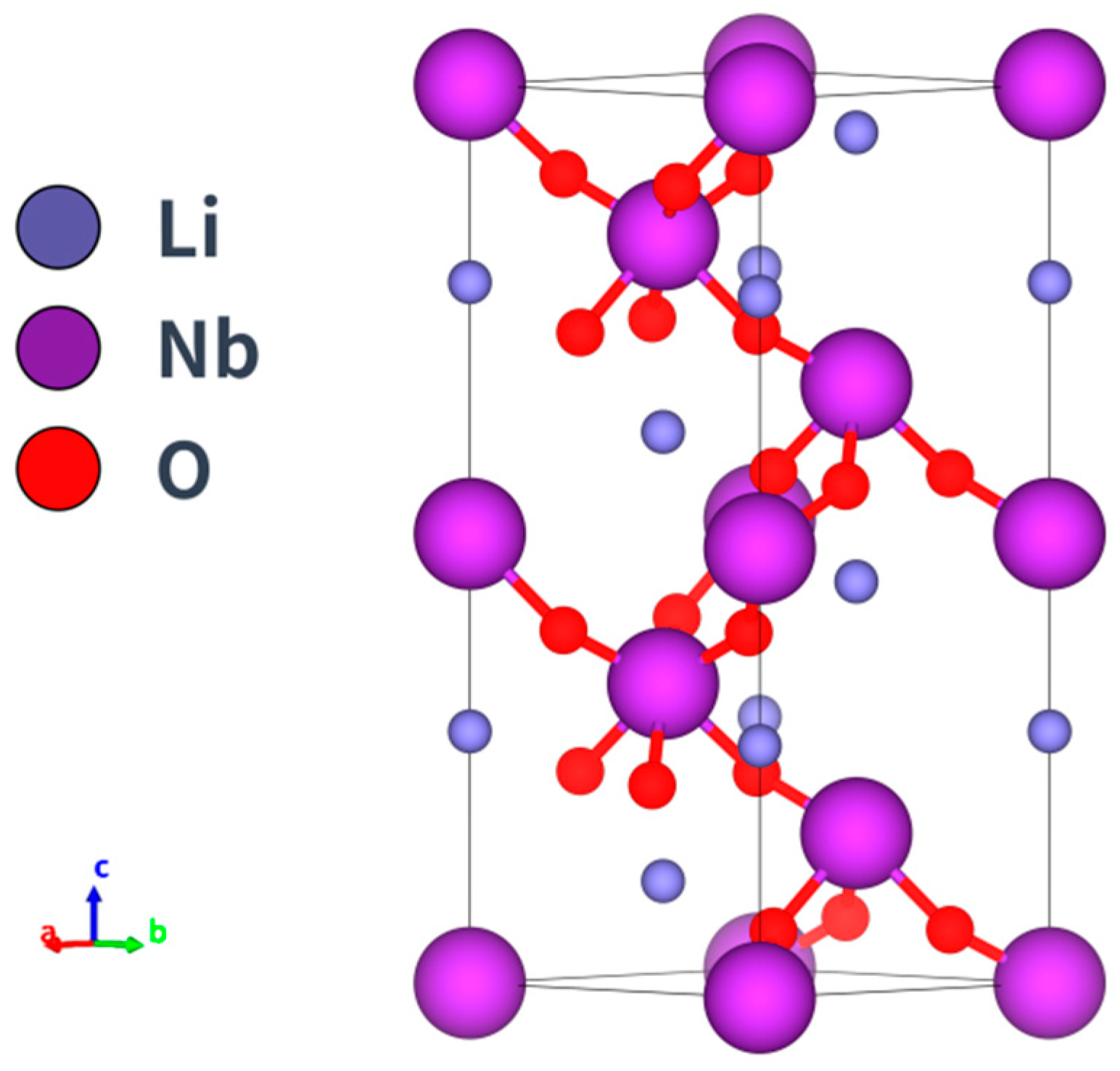
The first-principles calculations in this paper are all based on Density Functional Theory (DFT) and are executed using the Vienna Ab initio Simulation Package (VASP 6.1.0) [14,15]. The interaction between valence electrons and ions is described by the Projector Augmented Wave (PAW) method [16]. The exchange–correlation functional is selected as the (Perdew–Burke–Ernzerhof, PBE) functional within the Generalized Gradient Approximation (GGA) framework [16,17]. This paper takes the LN trigonal single crystal with the space group R3c (No. 161) as the prototype. It constructs the initial crystal model using the reported unit cell parameters a = b = 5.1483 Å, c = 13.8631 Å, α = β = 90°, γ = 120° [18]. Its structure is shown in Figure 1. Before constructing the doped models, the intrinsic LN unit cell was first fully optimized and then used as the parent structure for constructing the subsequent Ta-doped models. In LN, the site occupancy of dopant ions is strongly affected by dopant concentration, ionic radius, and valence state. In particular, lower-valence dopants tend to occupy Li-related sites, whereas dopants with valence states close to or higher than Nb5+, such as Ta5+, are generally expected to preferentially substitute Nb sites [19]. Therefore, in the present work, Ta doping was modeled by the isovalent substitution of Nb atoms with Ta atoms, corresponding to a charge-neutral substitutional model in LNT solid solutions. For each target Ta doping concentration, the number of Nb atoms replaced by Ta atoms was determined according to the corresponding doping ratio. The Ta atoms were then arranged on the Nb sublattice using the special quasirandom structure (SQS) approach implemented in ATOMKIT, so that the local Nb/Ta configurational disorder within the finite supercell could better approximate the random distribution of Ta atoms in real LNT solid solutions. LNT mixed crystal models with varying Ta doping concentrations were constructed by isovalently substituting Ta ions for Nb ions at their corresponding lattice sites. All initial crystal structures were generated using the VESTA Ver. 3.90.5a, 64-bit Edition software package [20] and the ATOMKIT software (Studio Version 2.0.0), in which the SQS-based Nb/Ta occupation configurations were constructed, followed by three-dimensional visualization and structural verification. The valence electron configurations of each element are set as: Li: 2s1, Nb: 4d45s1, Ta: 5d36s2, O: 2s22p4. To strictly avoid numerical aliasing and basis set truncation errors, the plane wave cutoff energy is set to 500 eV, and the calculation accuracy PREC is set to Accurate. The Brillouin zone integration is sampled using the Monkhorst–Pack scheme for k-point grids [21]. The energy convergence threshold for each element’s self-consistent iteration is set to 1 × 10⁻⁶ eV/atom, and the electron occupation adopts the Gaussian broadening scheme with a broadening coefficient of 0.05 eV to accelerate self-consistent convergence. All systems undergo full degree-of-freedom geometric relaxation until the force between adjacent ions converges, thereby obtaining thermodynamically stable ground-state structures. Based on the optimized stable structure, this paper uses the VASPKIT Standard Edition 1.5.1 program [22,23] to calculate the single-crystal elastic stiffness constants and macroscopic mechanical performance parameters of the polycrystalline system. Meanwhile, based on density functional perturbation theory (DFPT) [24], the dielectric tensor and piezoelectric stress constant of all systems were calculated. The piezoelectric strain constant d33 was then derived from the coupling relationship between piezoelectric stress constant and elastic stiffness constant, and the modulation mechanism of Ta doping on the properties of LN crystals was systematically investigated.

3. Results and Discussion

3.1. Elasticity and Mechanical Properties

Elastic constants are fundamental mechanical quantities of solid materials. Through the generalized Hooke’s law, they quantitatively describe the elastic response of crystals to external stress, determine the propagation characteristics of elastic waves in the medium, and serve as an important basis for deriving macroscopic mechanical properties [25]. For anisotropic crystals, the constitutive relationship between stress and strain can be described by the generalized Hooke’s law as σij = Cijklεkl, where σij is the second-order stress tensor, εkl is the second-order strain tensor, and Cijkl is the fourth-order elastic stiffness tensor. Due to the fact that both the intrinsic LN crystals and the Ta-doped LNT mixed crystal system in this study belong to the trigonal space group R3c (No. 161), corresponding to the 3 m point group symmetry, the elements of the non-zero elastic constant matrix are strictly limited by the crystal symmetry. Therefore, the independent elastic stiffness constants of the system are reduced to 6, namely C11, C12, C13, C14, C33, and C44, and also include a dependent constant C66 determined by symmetry, which satisfies C66 = (C11C12)/2. The elastic constant matrix extracted through first-principles calculations in this paper also perfectly verifies this symmetry feature. The mechanical stability of the crystal structure can be strictly determined by the Born elastic stability criterion. For crystals in the trigonal space group R3c, the following mechanical stability criteria need to be satisfied [26]:
C 44 > 0
C 11 > C 12
C 13 2 < 0.5 C 33 ( C 11 + C 12 )
C 14 2 < 1 2 C 44 C 11 C 12 C 44 C 66
The elastic constants of all the systems in this article are calculated based on the energy-strain method, and the elastic constants are calculated for the specified crystal space group using VASPKIT. With the thermodynamically stable unit cell after sufficient relaxation as the initial structure, VASPKIT automatically identifies the symmetry of the R3c space group of the crystal and applies multiple sets of uniform strains (with strain amplitudes set at ±0.5%, ±1%, and ±1.5%) to each set of strained structures. Static self-consistent calculations are performed for each set of strained structures to obtain the total energy of the system. The relationship between the total energy of the system and the strain is fitted by a quadratic function, and combined with the analytical relationship between elastic strain energy and elastic constants, the complete elastic stiffness constant matrix is finally solved, obtaining the calculation results of the elastic stiffness constants for the LN crystal and different Ta-doped concentration LNT mixed crystal systems, as shown in Table 1. From Table 1, the calculated second-order elastic constants of intrinsic LN crystals in this work are in good agreement with previous theoretical results [11,27]. The deviations from the available experimental values [28] fall within the reasonable error range of the Generalized Gradient Approximation (GGA) functional, which confirms the reliability of our computational method. It can be seen that the elastic constants of all LNT mixed crystal systems at different doping concentrations strictly satisfy the Born mechanical stability criterion of the trigonal crystal system, confirming that the equivalent substitution of Ta ions does not destroy the original lattice stability, and all doping systems are in a mechanically stable structure. From the perspective of doping regulation rules, as the Ta doping concentration increases, the elastic constants of the system show significant evolutionary characteristics. The axial stiffness constant C11 of the basal plane shows a monotonic increasing trend with the increase in doping concentration, significantly increasing from 181.9 GPa of the intrinsic LN crystal to 217.7 GPa of the 16.67% doping system. It is notable that the principal axis stiffness C33 slightly decreases (to 217.9 GPa) at a slight doping (3.33%), then continuously increases with the increase in concentration to the final 253.9 GPa. This overall strengthening trend indicates that Ta doping can effectively enhance the compressive resistance of the crystal along the a-b basal plane and the c-axis direction. The shear stiffness constants C44 and C66 also show a monotonic increasing pattern, with C44 increasing from 46.8 GPa to 80.3 GPa, and C66 increasing from 57.7 GPa to 82.3 GPa, fully demonstrating the significant optimization effect of Ta doping on the crystal’s shear deformation resistance. In addition, the elastic constants representing the coupling effect of lateral deformation show different change behaviors. C12 decreases continuously from 66.6 GPa to 53.1 GPa with the increase in Ta doping concentration, and C14 gradually decreases from 14.5 GPa, even reaching a negative value of −4.3 GPa at 16.67% doping concentration. In comparison, C13 steadily increases from 57.5 GPa to 75.1 GPa. The changes in the macroscopic mechanical responses and their microscopic physical mechanisms stem from the lattice bonding environment reconstruction caused by the equivalent substitution of Ta5+ for Nb5+. Due to the higher bond energy of Ta-O bonds than Nb-O bonds, as the Ta doping concentration increases, the average chemical bond strength within the system increases, resulting in a simultaneous enhancement of axial and shear stiffness on a macroscopic scale. Moreover, all doping systems always maintain the characteristic of C33 > C11 and C66 > C44, indicating that although Ta doping changes the absolute values of each stiffness component, it does not change the intrinsic mechanical uniaxial anisotropy of the LN crystal.
Based on the elastic stiffness constants of single crystals, the macroscopic mechanical property parameters of polycrystalline materials can be calculated using the Voigt–Reuss–Hill (VRH) approximation method, including bulk modulus B, shear modulus G, Young’s modulus E, and Poisson’s ratio ν. These parameters are the core indicators for characterizing the macroscopic mechanical properties of materials [29]. Among them, the bulk modulus B represents the material’s ability to resist uniform hydrostatic compression, with a higher value indicating stronger compressive resistance of the material. The shear modulus G represents the material’s ability to resist shear deformation, and it is directly proportional to the hardness of the material [30,31]. Based on the Voigt–Reuss–Hill approximation [29], the bulk modulus B and shear modulus G can be obtained, and their expressions are as follows:
B = B V + B R / 2
G = G V + G R / 2
Among them, the upper and lower bounds of the bulk modulus of polycrystals, BV and BR, are respectively given by the Voigt model [32] and the Reuss model [33]; similarly, the upper and lower bounds of the shear modulus, GV and GR, can also be calculated using these two methods:
B V = 2 C 11 + C 12 + 2 C 13 + C 33 / 9
B R = C 33 C 11 + C 12 2 C 13 2 C 11 + C 12 + 2 C 33 4 C 13
G V = 2 C 11 + C 33 C 12 2 C 13 / 15 + 2 C 44 + C 66 / 5
G R = 2 C 44 C 66 C 11 + C 12 C 33 2 C 13 2 15 B V C 44 C 66 + C 11 + C 12 C 33 2 C 13 2 C 44 + C 66
The Young’s modulus E is used to measure the material’s ability to resist elastic stretching or compression deformation in a single direction, and it is an important parameter for evaluating the stiffness of a structure. The Poisson ratio ν describes the lateral strain response characteristics during axial loading, and its value is often used to determine the ductility of the material. Generally, ν < 0.26 often indicates brittle characteristics, while higher ν typically corresponds to better toughness [34,35]. The Young’s modulus E and Poisson ratio ν can be expressed by the following equation [36]:
E = 9 B G 3 B + G
ν = 3 B 2 G 2 3 B + G
Based on the single-crystal elastic stiffness constants obtained previously, using the above Voigt–Reuss–Hill approximation method and theoretical formulas, this paper systematically calculated the macroscopic mechanical property parameters of the intrinsic LN crystal and the mixed crystal system with different Ta concentrations. The results are shown in Table 2. From the results, the mechanical parameters of intrinsic LN calculated in this work are in excellent agreement with previously published theoretical results [11], which verifies the reliability of our computational method. It can be seen that as the Ta doping concentration increases, the bulk modulus, shear modulus, and Young’s modulus of the system all show a significant monotonically increasing trend. This confirms that Ta doping has a very significant optimization effect on improving the hardness, overall stiffness, and mechanical strength of the LN crystal. Based on the Pugh criterion, the brittleness and toughness of the material can be quantitatively determined. When the B/G ratio of the material is greater than 1.75, the material shows a toughness characteristic; when the B/G ratio is less than 1.75, the material shows a brittle characteristic [35]. From Table 2, the B/G ratio of the intrinsic LN crystal is 1.94, which is greater than the critical value of 1.75, showing typical toughness characteristics. As the Ta doping concentration increases, the B/G ratio of the system continuously decreases. In the 6.67% doping system, it has dropped to 1.73, which is below the critical threshold. As the doping concentration further increases, the B/G ratio continuously decreases to 1.498 in the 16.67% doping system. This indicates that Ta doping causes the LN crystal to transform from toughness to brittleness gradually. This change is completely consistent with the evolution law of Poisson’s ratio—the Poisson’s ratio of the system decreases monotonically from 0.28 of the intrinsic LN crystal to 0.227 in the 16.67% doping system, further confirming the physical essence of the enhancement of material covalent bond characteristics and the weakening of macroscopic toughness. Although doping causes a slight reduction in toughness, the absolute modulus of all systems remains at a high level, fully ensuring its structural stability in engineering applications.
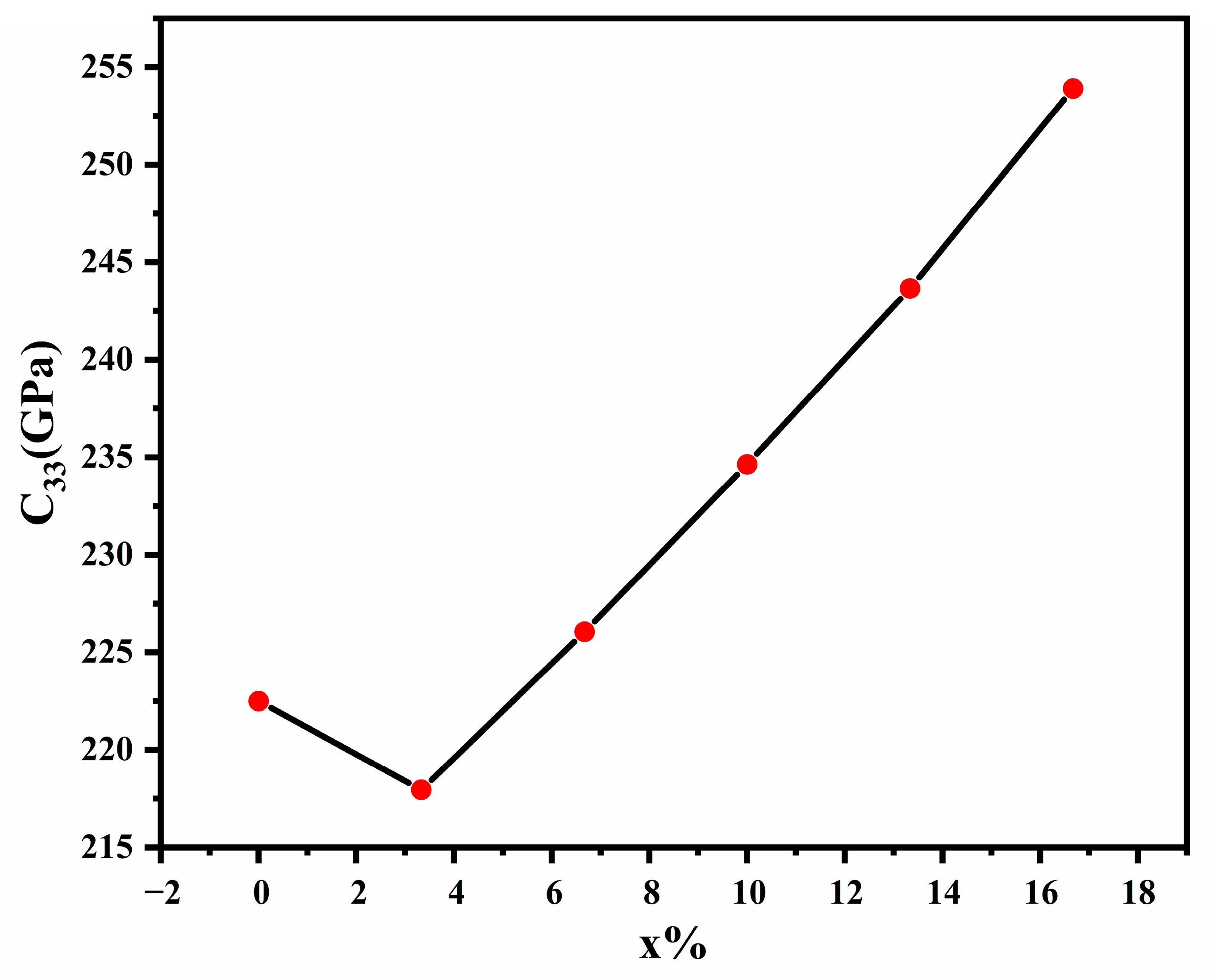
To explore the force–electric coupling mechanism of this system, considering the highly anisotropic piezoelectric properties of the single crystal spindle, the elastic constant matrix obtained by the above energy–strain method was used to extract and plot the variation curve of the elastic stiffness component C33 along the c-axis with the Ta doping concentration, as shown in Figure 2. From Figure 2, it can be seen that C33 shows a clear two-stage evolution law with the Ta doping concentration. When the Ta doping concentration is 3.33%, C33 slightly decreases from the intrinsic LN’s 222.5 GPa to 217.9 GPa, showing a slight drop. This phenomenon is due to the slight local lattice distortion introduced by Ta ions replacing Nb ions in the lattice under low doping concentration, resulting in a slight adjustment of the average bond length in the c-axis direction, and a slight decrease in the average chemical bond strength of the system along the c-axis. When the Ta doping concentration exceeds 3.33%, C33 shows a perfect linear monotonic increase trend with the doping concentration increase, from 226.1 GPa at a 6.67% doping concentration to 253.9 GPa at a 16.67% doping concentration, with an increase of 14.1% compared to the intrinsic LN. The microscopic mechanism of this evolution law stems from the intrinsic bond energy difference between Ta-O bonds and Nb-O bonds. The bond energy of Ta-O bonds is significantly higher than that of Nb-O bonds. As the Ta doping concentration increases, the proportion of Ta-O bonds in the lattice continuously increases. The average chemical bond strength along the c-axis direction of the crystal continuously improves, ultimately manifesting as the linear monotonic enhancement of C33, indicating that Ta doping can significantly enhance the axial stiffness and compressive deformation resistance of the LN crystal along the optical axis direction, laying a structural foundation for further improving the force–electric coupling response in the z-axis direction.

3.2. Dielectric Properties

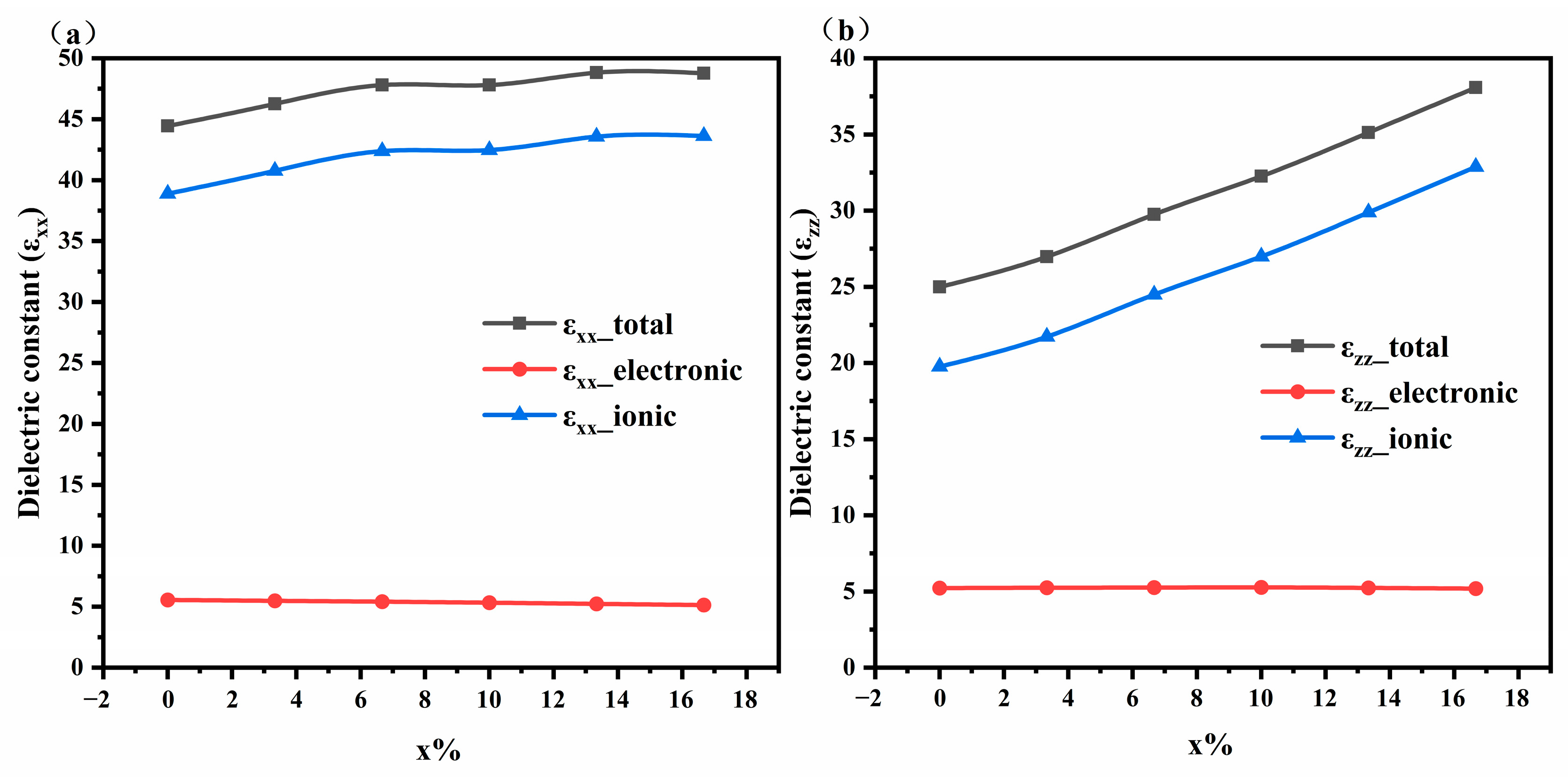
To deeply explore the microscopic mechanism of the dielectric response of the system, this paper uses the aforementioned density functional perturbation theory (DFPT) to calculate the static dielectric constant tensors of the intrinsic LN crystal and the LNT mixed crystal systems with different Ta doping concentrations, and rigorously decouples the total dielectric constant into the contributions of electronic polarization and ionic displacement polarization. Considering the symmetry constraint of the trigonal crystal system, which makes specific directions within the basal plane equivalent, this paper focuses on extracting and plotting the evolution curves of the dielectric constant along the x-axis and z-axis with the doping concentration, as shown in Figure 3. From Figure 3, it can be seen that all systems exhibit significant dielectric anisotropy, which is highly consistent with the typical uniaxial ferroelectric configuration of LN crystals, and the dielectric numerical calculation results of the intrinsic LN crystal are highly consistent with the existing literature reports [37]. From the perspective of the polarization component, the contribution proportion of electronic polarization to the total dielectric constant is extremely low, and it only undergoes a very slight fluctuation with the increase in Ta doping concentration. This phenomenon confirms that Ta substitution has a limited effect on the high-frequency electron cloud distortion. In contrast, ionic displacement polarization constitutes the main source of the dielectric response of the system. As the Ta doping concentration continuously increases, the ionic polarization rate and total dielectric constant of each system show a significant monotonically increasing trend. It is worth noting that the dielectric increase along the polarization optical axis z direction is much greater than that in the basal plane x direction. From the microscopic dynamics perspective, this polarization enhancement effect is mainly attributed to the introduction of Ta5+ effectively reducing the potential barrier for the relative displacement of c-axis cations in the local lattice, thereby significantly releasing the ionic displacement polarization potential of the lattice. The significant jump in dielectric properties along the c-axis will profoundly affect the macroscopic force–electric coupling behavior of the material. Particularly, for the most core longitudinal piezoelectric property of LN crystals, the macroscopic evolution of the piezoelectric strain constant d33 will be subject to the competition and synergy regulation of two physical mechanisms. On the one hand, Ta doping leads to a significant increase in the c-axis elastic stiffness constant C33, which reduces the axial elastic flexibility of the material, thereby exerting a mechanical negative inhibition on d33. On the other hand, the significant increase in the dielectric constant along the c-axis indicates that the strain-induced ionic polarization response is greatly enhanced, which will significantly increase the piezoelectric stress constant e33 and thus have a positive electrical promotion on d33. Therefore, the evolution path of the final piezoelectric response d33 of the Ta-doped system will be determined by the competitive results of the above stiffness hardening and polarization enhancement effects.

3.3. Piezoelectric Properties

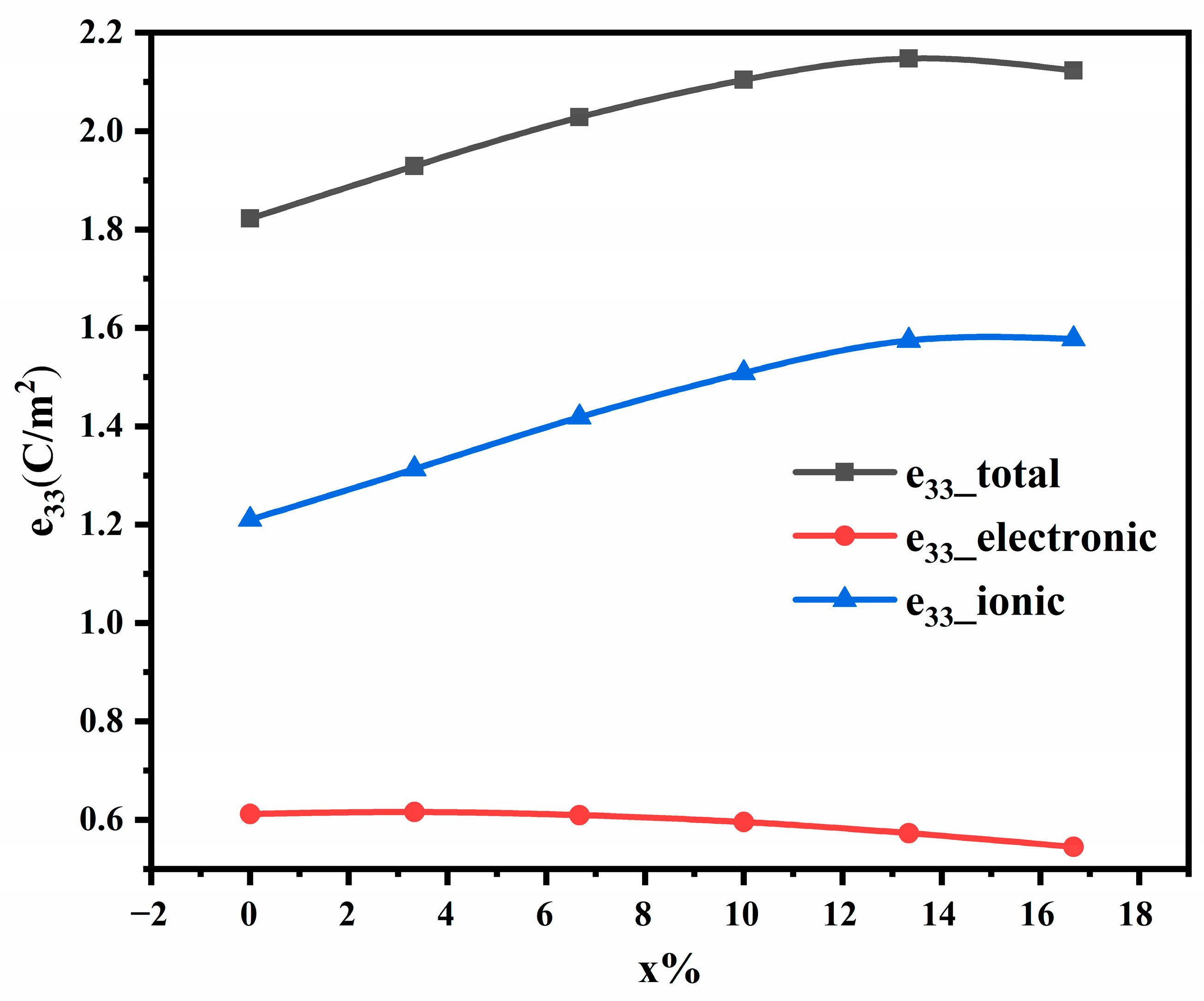
The piezoelectric stress constant e33 is used to characterize the material’s ability to generate a polarization response under strain, and it is a core parameter determining the piezoelectric performance. It is also a fundamental parameter for calculating the piezoelectric strain constant d33. Based on the density functional perturbation theory (DFPT), the longitudinal piezoelectric stress constant e33 of the LNT mixed crystal system along the c-axis was calculated at different Ta doping concentrations, and it was decomposed into electronic and ionic contributions. The results are shown in Figure 4. From Figure 4, it can be seen that the piezoelectric stress constant e33 of the intrinsic LN crystal is mainly contributed by the ionic contribution, accounting for 66.4%. In comparison, the electronic contribution only accounts for 33.6%. The calculated e33 value of LN in this study is 1.82 C/m2, which is in excellent agreement with previously reported experimental measurements and first-principles calculations [13,38,39], thereby verifying the reliability of the present calculation method. This indicates that the origin of the piezoelectric effect of the LN crystal is the relative displacement of anions and cations caused by lattice strain, which is completely consistent with the ferroelectric polarization characteristic of the LN crystal. As the Ta doping concentration increases, the total piezoelectric stress constant e33 of the system shows an evolution pattern of significant increase first and then a slight decline. When the doping concentration reaches 13.33%, the total e33 reaches a peak of 2.148 C/m2. When the doping concentration is 16.67%, e33 slightly decreases to 2.123 C/m2, but it is still higher than that of the intrinsic LN crystal. Overall, Ta doping significantly enhances the longitudinal piezoelectric stress response ability of the LN crystal. The electronic contribution only shows a slight decrease with the increase in doping concentration. In contrast, the ionic contribution continuously increases from 1.211 C/m2 of the intrinsic LN crystal to 1.577 C/m2 of the 16.67% doping system, which is the core source of the increase in e33. The microscopic mechanism is that Ta doping changes the local bonding environment of the oxygen octahedron, reduces the potential barrier for c-axis displacement of cations. This local symmetry and bonding adjustment enable the lattice to generate a stronger ionic displacement polarization when subjected to the same external strain, ultimately resulting in a significant jump in the piezoelectric stress constant e33 on a macroscopic scale.
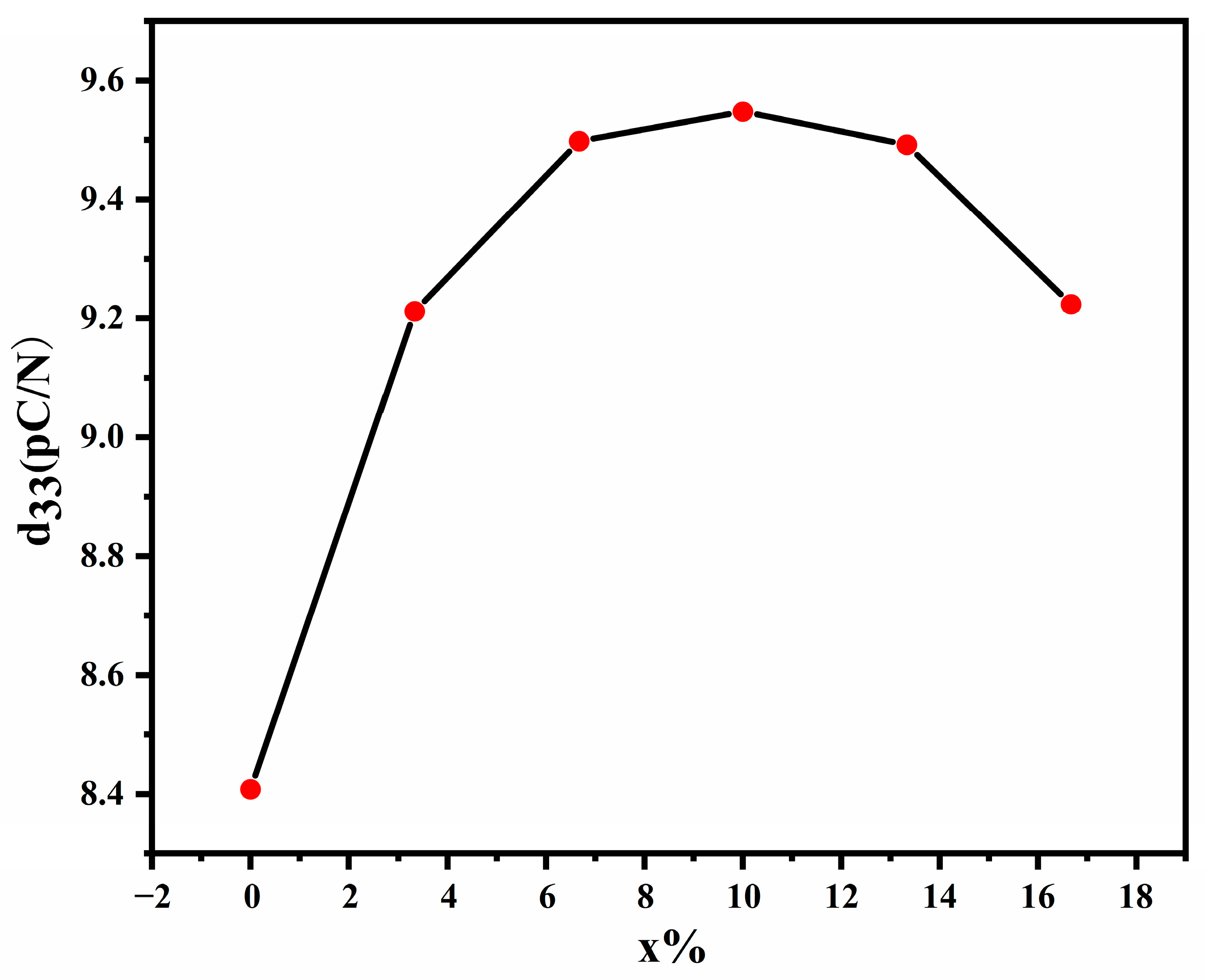
Since LN crystals belong to the 3 m point group, with the z-axis serving as the unique polarization axis, the longitudinal piezoelectric response d33 and its corresponding electromechanical coupling coefficient k33 can directly reflect the strain–electric-field coupling efficiency along the polarization direction. These parameters are closely related to the performance of thickness-extensional modes, longitudinal vibration modes, and certain high-frequency resonators and sensors. Therefore, d33 and k33 can be used as key parameters for evaluating the effect of Ta doping on the piezoelectric performance of LN crystals [40,41,42,43]. For trigonal crystals in the 3 m point group, the piezoelectric strain coefficient matrix [d] satisfies the tensor relationship [d] = [e][S] [44], where [S] is the inverse of the elastic stiffness matrix [C]. Based on first-principles full-tensor coupling calculations, this study extracted the longitudinal piezoelectric strain coefficient d33 of the LNT system at different Ta doping concentrations, and the results are shown in Figure 5. As shown in Figure 5, the calculated d33 value of the intrinsic LN crystal is 8.408 pC/N, which is of the same order of magnitude as the experimentally reported value of approximately 6.0 pC/N for room-temperature LiNbO3 single crystals along the polarization axis [45]. This agreement indicates that the calculated results are reasonable and can be used to analyze the relative tuning trend of Ta doping on the piezoelectric response of LN crystals. As the Ta doping concentration increases, d33 displays a non-monotonic evolution—first rising and then slightly decreasing. At a doping level of 10%, d33 reaches its peak value of 9.548 pC/N, representing a significant enhancement of 13.6% compared to the intrinsic crystal. Notably, even when the doping concentration further increases to 16.67%, d33 decreases to 9.224 pC/N, yet still maintains a remarkable increase of 9.7% over the intrinsic value. This non-monotonic behavior reflects the underlying physical competition between enhanced polarization response and increased resistance to deformation within the material. Among the theoretical contributions to d33, the dominant term e33S33 plays a decisive role. Since the longitudinal compliance S33 is negatively correlated with the longitudinal elastic stiffness C33, the macroscopic piezoelectric response of the system is fundamentally governed by the interplay between polarization enhancement and stiffness hardening. Overall, the equivalent substitution of Ta atoms effectively tunes and significantly enhances the overall performance of LN crystals across a broad concentration range. In particular, doping at approximately 10% achieves maximum longitudinal piezoelectric strain response and electromechanical conversion efficiency without compromising mechanical stability. Even at high doping levels, the system maintains excellent piezoelectric sensitivity while substantially increasing compressive stiffness. These findings not only clarify the electromechanical coupling mechanism of LN crystals from a microscopic full-tensor perspective but also provide rigorous theoretical guidance for the compositional optimization of next-generation high-stiffness, high-sensitivity piezoelectric sensing and actuating devices.

3.4. Electromechanical Coupling Coefficient

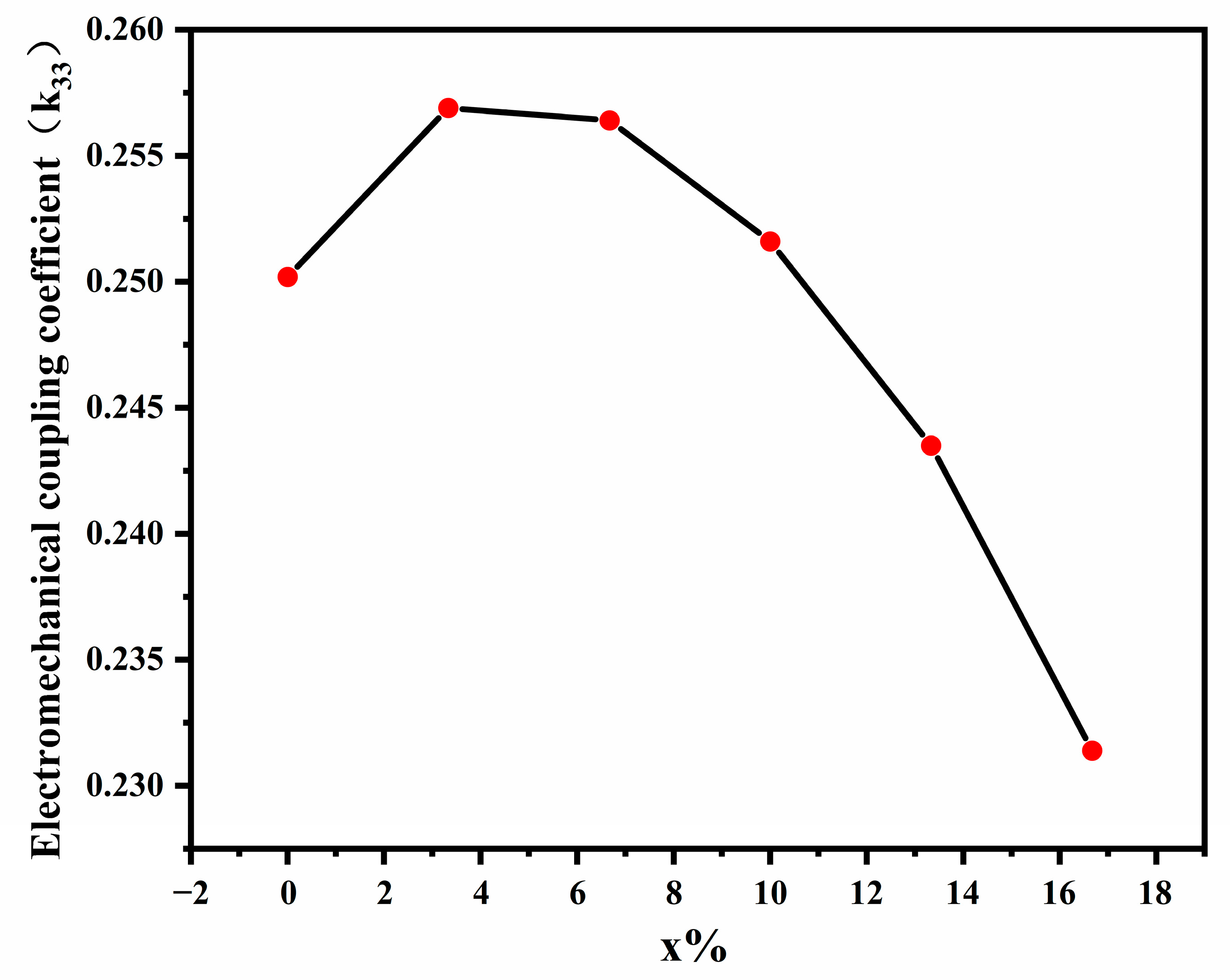
The electromechanical coupling coefficient k33 is a key performance indicator for evaluating the efficiency of energy conversion between mechanical and electrical energy in piezoelectric materials in the longitudinal operating mode [46]. To quantitatively reveal the influence of Ta doping on the actual energy conversion efficiency of the system, based on the piezoelectric strain constant d33, the absolute dielectric constant obtained by multiplying the relative dielectric constant by the vacuum permittivity (ε0), and the elastic compliance constant S33 obtained by inverting the elastic stiffness tensor, this paper strictly solved the longitudinal electromechanical coupling coefficient of each system according to the relationship formula k 33 2 = d 33 2 / S 33 E ε 33 T [47]. The evolution law of k33 with Ta doping concentration is shown in Figure 6. From Figure 6, the theoretically calculated electromechanical coupling coefficient for the intrinsic LN crystal is 0.2502. As the Ta doping concentration increases, k33 does not exhibit an evolution synchronous with the piezoelectric strain constant d33; instead, it reaches its peak at a significantly lower concentration. At a low doping concentration of 3.33%, k33 reaches its maximum value of 0.2569 and remains above 0.256 within the concentration range of 3.33% to 6.67%, achieving a notable improvement compared to the intrinsic state. As the doping concentration further increases, the k33 curve turns downward, showing a monotonically decreasing trend and falling to 0.2314 at a concentration of 16.67%. At the low doping level of 3.33%, the introduction of a small amount of Ta ions causes a slight distortion and softening of the local lattice, maximizing the longitudinal elastic compliance constant S33. Consequently, the resistance of the lattice to polarization displacement under an external field is minimized, and the mechanical-to-electrical energy conversion is highly efficient, thereby generating the peak in k33. However, as the Ta doping concentration continues to increase, although the stronger Ta-O bonds continuously enhance the intrinsic piezoelectric polarization response of the material, the absolute dielectric constant of the system undergoes a more pronounced nonlinear growth. This rapid increase in the dielectric constant significantly enhances the material’s capacity to store reactive electrostatic energy. A large amount of the input electrical energy is preferentially converted into capacitive electrostatic field energy stored within the crystal, failing to effectively participate in the mechanical work process. This ultimately masks the benefits of the enhanced polarization and leads to a continuous decline in the macroscopic electromechanical coupling efficiency.
In conclusion, although Ta doping can effectively enhance the absolute deformation sensitivity of LN crystals within a wide range of compositions, in order to achieve the optimal energy conversion efficiency of the device, it is necessary to strictly control the negative losses caused by the dielectric energy storage effect. This study demonstrates, from a microscopic computational perspective, that a low Ta-doping range of 3.33–6.67% can achieve an optimal physical balance among polarization enhancement, elastic compliance, and dielectric response, thereby leading to superior overall electromechanical performance. These findings provide valuable compositional-window guidance for the design of next-generation high-efficiency LN-based piezoelectric transducers, resonators, and sensors.

4. Conclusions

This study systematically investigates the effects of Ta doping on the structural stability, elastic properties, dielectric response, piezoelectric properties, and electromechanical coupling behavior of LN crystals based on first-principles calculations. The results show that upon isovalent substitution of Nb5+ by Ta5+, all doped systems satisfy the Born mechanical stability criteria for trigonal crystals, indicating that Ta doping does not disrupt the basic structural stability of LN crystals. As the Ta doping concentration increases, the bulk modulus, shear modulus, and Young’s modulus generally increase, suggesting that strengthened Ta–O bonding enhances the crystal stiffness and resistance to deformation. Meanwhile, the B/G ratio and Poisson’s ratio decrease, indicating an enhanced brittle tendency of the doped systems. The dielectric and piezoelectric results show that Ta doping mainly enhances the piezoelectric stress response by strengthening ionic displacement polarization, but it also causes elastic stiffness hardening and reduces axial elastic compliance. Therefore, the variation in d33 is not determined solely by polarization enhancement, but is jointly governed by enhanced ionic displacement polarization and elastic hardening. The longitudinal piezoelectric strain constant d33 reaches its maximum value of 9.548 pC/N at 10% Ta doping, which is 13.6% higher than that of intrinsic LN, indicating that moderate Ta doping is more favorable for improving piezoelectric strain sensitivity. In contrast, the electromechanical coupling coefficient k33 reaches its peak value of 0.2569 at 3.33% Ta doping and remains at a high level within the 3.33–6.67% doping range, indicating that the optimal doping concentrations for d33 and k33 are not identical. This difference arises because high-concentration Ta doping can continue to enhance ionic polarization and e33, whereas elastic stiffness hardening and the nonlinear increase in dielectric constant weaken the effective electromechanical energy conversion efficiency. Therefore, the performance optimization of Ta-doped LN crystals should be guided by specific device requirements. This study reveals the competing relationship among elastic hardening, dielectric enhancement, and ionic displacement polarization; clarifies the microscopic mechanism responsible for the separation of the optimal doping concentrations for d33 and k33; and provides a theoretical basis for the compositional design and device optimization of LN-based piezoelectric functional crystals.

Author Contributions

J.L.: Writing—review and editing, Writing—original draft, Formal analysis, Data curation. X.X.: Methodology, Funding acquisition, Conceptualization. H.Z. (Han Zhang): Investigation. X.H.: Data curation. J.C.: Investigation. Y.H.: Formal analysis, Data curation. Y.Z.: Investigation. S.L.: Investigation. H.Z. (Huan Zhang): Formal analysis. L.M.: Investigation. C.Y.: Investigation. J.W.: Methodology, Funding acquisition. X.Z.: Methodology, Funding acquisition, Conceptualization. Y.Y.: Investigation. All authors have read and agreed to the published version of the manuscript.

Funding

This work was supported by the Scientific research project of Ningxia Education Department (NYG2024067), the Ningxia Key Natural Science Foundation project (2023AAC02045), the National Natural Science Foundation of China (61965001), the Fundamental Research Funds for the Central Universities, North Minzu University (2021KJCX07), High-Level Talent Project (Natural Science) of North Minzu University (2025BG207), the Ningxia Province Key Research and Development Program (2018BEE03015, 2021BEE03005, and 2022BFE02009), the Natural Science Foundation of Ningxia (2019AAC03103, and 2026AAC030336), and the Ningxia first-class discipline and scientific research projects (electronic science and technology, No. NXYLXK2017A07-DKPD2023C10 and DKPD2023D01).

Data Availability Statement

The original contributions presented in this study are included in the article.

Acknowledgments

The authors thank the Key Laboratory of North Minzu University (Physics and Photoelectric Information Functional Materials Sciences and Technology), the Ningxia Acousto-optic Crystals Industrialization Innovation Team, and the Ningxia New Solid Electronic Materials and Devices Research and Development Innovation Team (2020CXTDLX12).

Conflicts of Interest

Authors Shuaijie Liang, Xuefeng Zhang and Yong Yang were employed by the company Ningxia Ju Jing Yuan Crystal Technology Company Limited. The remaining authors declare that the research was conducted in the absence of any commercial or financial relationships that could be construed as a potential conflict of interest.

References

  1. Wong, K.K. (Ed.) Properties of Lithium Niobate; INSPEC/Institution of Electrical Engineers: London, UK, 2002. [Google Scholar]
  2. Gopalan, V.; Dierolf, V.; Scrymgeour, D.A. Defect–domain wall interactions in trigonal ferroelectrics. Annu. Rev. Mater. Res. 2007, 37, 449–489. [Google Scholar] [CrossRef] [Scilit]
  3. He, X.; Xue, D.; Kitamura, K. Defects and domain engineering of lithium niobate crystals. Mater. Sci. Eng. B 2005, 120, 27–31. [Google Scholar] [CrossRef] [Scilit]
  4. Boukhtouta, M.; Megdoud, Y.; Benlamari, S.; Meradji, H.; Chouahda, Z.; Ahmed, R.; Ghemid, S.; Abu-Jafar, M.; Syrotyuk, S.; Rai, D.P.; et al. Predictions on structural, electronic, optical and thermal properties of lithium niobate via first-principle computations. Philos. Mag. 2020, 100, 1150–1171. [Google Scholar] [CrossRef] [Scilit]
  5. Sánchez-Dena, O.; Fierro-Ruiz, C.D.; Villalobos-Mendoza, S.D.; Carrillo Flores, D.M.; Elizalde-Galindo, J.T.; Farías, R. Lithium niobate single crystals and powders reviewed—Part I. Crystals 2020, 10, 973. [Google Scholar] [CrossRef] [Scilit]
  6. Lines, M.E.; Glass, A.M. Principles and Applications of Ferroelectrics and Related Materials; Oxford University Press: Oxford, UK, 2001. [Google Scholar]
  7. Roshchupkin, D.; Emelin, E.; Plotitcyna, O.; Rashid, F.; Irzhak, D.; Karandashev, V.; Orlova, T.; Targonskaya, N.; Sakharov, S.; Mololkin, A.; et al. Single crystals of ferroelectric lithium niobate–tantalate LiNb1−xTaxO3 solid solutions for high-temperature sensor and actuator applications. Acta Crystallogr. Sect. B Struct. Sci. Cryst. Eng. Mater. 2020, 76, 1071–1076. [Google Scholar] [CrossRef] [Scilit] [PubMed]
  8. Bernhardt, F.; Pfeiffer, F.A.; Schug, F.; Sanna, S.; Pfannstiel, A.; Hehemann, T.; Imlau, M.; Ganschow, S. Ground- and excited-state properties of LiNb1−xTaxO3 solid solutions. Phys. Rev. Mater. 2024, 8, 054403. [Google Scholar] [CrossRef] [Scilit]
  9. Bartasyte, A.; Margueron, S.; Glazer, A.M.; Simon, E.; Gregora, I.; Huband, S.; Thomas, P.A. Vibrational modes and overlap matrix of LiNb1−xTaxO3 mixed crystals. Phys. Rev. B 2019, 99, 094306. [Google Scholar] [CrossRef] [Scilit]
  10. Pradhan, D.; Swain, R.; Biswal, S.K.; Kumar, J. Unraveling the electronic, vibrational, thermodynamic, optical and piezoelectric properties of LiNbO3, LiTaO3 and Li2NbTaO6 from first-principles calculations. J. Phys. Chem. Solids 2025, 207, 112879. [Google Scholar] [CrossRef] [Scilit]
  11. Acar, F.; Şimşek, Ş. Electronic, optical and mechanical properties of Ta doped LiNbO3: Ab initio calculation. Cumhur. Sci. J. 2025, 46, 152–161. [Google Scholar] [CrossRef] [Scilit]
  12. Bernhardt, F.; Gharat, S.; Kapp, A.; Pfeiffer, F.; Buschbeck, R.; Hempel, F.; Pashkin, O.; Kehr, S.C.; Rüsing, M.; Sanna, S.; et al. Lattice dynamics of LiNb1−xTaxO3 solid solutions: Theory and experiment. Phys. Status Solidi A 2025, 222, 2300968. [Google Scholar] [CrossRef] [Scilit]
  13. Leng, J.; Tang, G.; Chen, K.; Xue, D. Lattice engineering of LiNb1−xTaxO3 solid solutions: Comprehensive exploration of the structural, electronic, optical, piezoelectric, and mechanical properties. Next Mater. 2026, 11, 101829. [Google Scholar] [CrossRef] [Scilit]
  14. Kresse, G.; Hafner, J. Ab initio molecular dynamics for open-shell transition metals. Phys. Rev. B 1993, 48, 13115–13118. [Google Scholar] [CrossRef] [Scilit] [PubMed]
  15. Kresse, G.; Furthmüller, J. Efficient iterative schemes for ab initio total-energy calculations using a plane-wave basis set. Phys. Rev. B 1996, 54, 11169–11186. [Google Scholar] [CrossRef] [Scilit] [PubMed]
  16. Blöchl, P.E. Projector augmented-wave method. Phys. Rev. B 1994, 50, 17953–17979. [Google Scholar] [CrossRef] [Scilit] [PubMed]
  17. Perdew, J.P.; Burke, K.; Ernzerhof, M. Generalized gradient approximation made simple. Phys. Rev. Lett. 1996, 77, 3865–3868. [Google Scholar] [CrossRef] [Scilit] [PubMed]
  18. Abrahams, S.C.; Hamilton, W.C.; Reddy, J.M. Ferroelectric lithium niobate. 4. Single crystal neutron diffraction study at 24 °C. J. Phys. Chem. Solids 1966, 27, 1013–1018. [Google Scholar] [CrossRef] [Scilit]
  19. Sánchez-Dena, O.; Villalobos-Mendoza, S.D.; Farías, R.; Fierro-Ruiz, C.D. Lithium niobate single crystals and powders reviewed—Part II. Crystals 2020, 10, 990. [Google Scholar] [CrossRef] [Scilit]
  20. Momma, K.; Izumi, F. VESTA 3 for three-dimensional visualization of crystal, volumetric and morphology data. J. Appl. Crystallogr. 2011, 44, 1272–1276. [Google Scholar] [CrossRef] [Scilit]
  21. Monkhorst, H.J.; Pack, J.D. Special points for Brillouin-zone integrations. Phys. Rev. B 1976, 13, 5188–5192. [Google Scholar] [CrossRef] [Scilit]
  22. Geng, W.T.; Liu, Y.C.; Xu, N.; Tang, G.; Kawazoe, Y.; Wang, V. Empowering materials science with VASPKIT: A toolkit for high-throughput computing and analysis using VASP code. Nat. Protoc. 2025, 20, 3143–3169. [Google Scholar] [CrossRef] [Scilit] [PubMed]
  23. Wang, V.; Xu, N.; Liu, J.C.; Tang, G.; Geng, W.T. VASPKIT: A user-friendly interface facilitating high-throughput computing and analysis using VASP code. Comput. Phys. Commun. 2021, 267, 108033. [Google Scholar] [CrossRef] [Scilit]
  24. Gonze, X.; Lee, C. Dynamical matrices, Born effective charges, dielectric permittivity tensors, and interatomic force constants from density-functional perturbation theory. Phys. Rev. B 1997, 55, 10355–10368. [Google Scholar] [CrossRef] [Scilit]
  25. Kittel, C.; McEuen, P. Introduction to Solid State Physics; John Wiley & Sons: Hoboken, NJ, USA, 2018. [Google Scholar]
  26. Mouhat, F.; Coudert, F.X. Necessary and sufficient elastic stability conditions in various crystal systems. Phys. Rev. B 2014, 90, 224104. [Google Scholar] [CrossRef] [Scilit]
  27. Philip, T.; Menon, C.S.; Indulekha, K. Higher order elastic constants, Grüneisen parameters and lattice thermal expansion of lithium niobate. E-J. Chem. 2006, 3, 122–133. [Google Scholar] [CrossRef] [Scilit]
  28. Kovacs, G.; Anhorn, M.; Engan, H.E.; Visintini, G.; Ruppel, C.C.W. Improved material constants for LiNbO3 and LiTaO3. In Proceedings of the IEEE Symposium on Ultrasonics, Honolulu, HI, USA, 4–7 December 1990; pp. 435–438. [Google Scholar]
  29. Hill, R. The elastic behaviour of a crystalline aggregate. Proc. Phys. Soc. A 1952, 65, 349–354. [Google Scholar] [CrossRef] [Scilit]
  30. Teter, D.M. Computational alchemy: The search for new superhard materials. MRS Bull. 1998, 23, 22–27. [Google Scholar] [CrossRef] [Scilit]
  31. Chen, X.Q.; Niu, H.; Li, D.; Li, Y. Modeling hardness of polycrystalline materials and bulk metallic glasses. Intermetallics 2011, 19, 1275–1281. [Google Scholar] [CrossRef] [Scilit]
  32. Voigt, W. Lehrbuch der Kristallphysik; B.G. Teubner: Leipzig, Germany, 1910. [Google Scholar]
  33. Reuss, A. Berechnung der Fließgrenze von Mischkristallen auf Grund der Plastizitätsbedingung für Einkristalle. Z. Angew. Math. Mech. 1929, 9, 49–58. [Google Scholar] [CrossRef] [Scilit]
  34. Greaves, G.N.; Greer, A.L.; Lakes, R.S.; Rouxel, T. Poisson’s ratio and modern materials. Nat. Mater. 2011, 10, 823–837. [Google Scholar] [CrossRef] [Scilit] [PubMed]
  35. Pugh, S.F. XCII. Relations between the elastic moduli and the plastic properties of polycrystalline pure metals. Philos. Mag. 1954, 45, 823–843. [Google Scholar] [CrossRef] [Scilit]
  36. Jia, G.Z.; Yang, L.J. Ab initio calculations for properties of Ti2AlN and Cr2AlC. Phys. B 2010, 405, 4561–4564. [Google Scholar] [CrossRef] [Scilit]
  37. Veithen, M.; Ghosez, P. First-principles study of the dielectric and dynamical properties of lithium niobate. Phys. Rev. B 2002, 65, 214302. [Google Scholar] [CrossRef] [Scilit]
  38. Kushibiki, J.; Takanaga, I.; Arakawa, M.; Sannomiya, T. Accurate measurements of the acoustical physical constants of LiNbO3 and LiTaO3 single crystals. IEEE Trans. Ultrason. Ferroelectr. Freq. Control 1999, 46, 1315–1323. [Google Scholar] [CrossRef] [Scilit] [PubMed]
  39. Gao, X. Theoretical Study on Intrinsic Defects in Lithium Niobate Crystals and Their Influence Mechanisms on Piezoelectric and Electrical Properties. PhD Thesis, Shandong University, Jinan, China, 2024. [Google Scholar]
  40. Weis, R.S.; Gaylord, T.K. Lithium niobate: Summary of physical properties and crystal structure. Appl. Phys. A 1985, 37, 191–203. [Google Scholar] [CrossRef] [Scilit]
  41. ANSI/IEEE Std 176-1987; IEEE Standard on Piezoelectricity. IEEE: New York, NY, USA, 1988.
  42. Auld, B.A. Acoustic Fields and Waves in Solids, Vols. I–II; Wiley: New York, NY, USA, 1973. [Google Scholar]
  43. Hashimoto, K. Surface Acoustic Wave Devices in Telecommunications: Modelling and Simulation; Springer: Berlin/Heidelberg, Germany, 2000. [Google Scholar] [CrossRef] [Scilit]
  44. Nakamura, K.; Higuchi, S.; Ohnuma, T. Density functional perturbation theory to predict piezoelectric properties. In Perturbation Methods with Applications in Science and Engineering; Bakırtaş, İ., Ed.; IntechOpen: London, UK, 2018; pp. 2–7. [Google Scholar] [CrossRef] [Scilit]
  45. Smith, R.T.; Welsh, F.S. Temperature dependence of the elastic, piezoelectric, and dielectric constants of lithium tantalate and lithium niobate. J. Appl. Phys. 1971, 42, 2219–2230. [Google Scholar] [CrossRef] [Scilit]
  46. Yan, Y.; Geng, L.D.; Liu, H.; Leng, H.; Li, X.; Wang, Y.U.; Priya, S. Near-ideal electromechanical coupling in textured piezoelectric ceramics. Nat. Commun. 2022, 13, 3565. [Google Scholar] [CrossRef] [Scilit] [PubMed]
  47. Bell, A.J. A classical mechanics model for the interpretation of piezoelectric property data. J. Appl. Phys. 2015, 118, 224103. [Google Scholar] [CrossRef] [Scilit]
Figure 1. Schematic diagram of the LN crystal structure.
Crystals 16 00457 g001
Figure 2. Elastic constant C33 of LN crystals after doping with different concentrations of Ta.
Crystals 16 00457 g002
Figure 3. Dielectric constants of LN crystals after doping with different concentrations of Ta (a) εxx; (b) εzz.
Crystals 16 00457 g003
Figure 4. The piezoelectric stress constant e33 of LN crystals after doping with different concentrations of Ta.
Crystals 16 00457 g004
Figure 5. The piezoelectric strain constant d33 of LN crystals after doping with different concentrations of Ta.
Crystals 16 00457 g005
Figure 6. The electromechanical coupling coefficient k33 of LN crystals after doping with different concentrations of Ta.
Crystals 16 00457 g006
Table 1. Elastic constants (GPa) of LN crystals with different Ta doping concentrations.
SystemDoping%C11C12C13C14C33C44C66Work
Pristine-LN-184.558.960.517.5220.139.762.7Theor. [11]
Pristine-LN-198.954.767.37.8233.770.472.1Theor. [27]
Pristine-LN-198.454.765.17.9227.959.7 Exp. [28]
Pristine-LN-181.966.657.514.5222.546.857.7This work
Ta-LN3.33186.960.163.011.3217.950.263.4This work
Ta-LN6.67194.058.765.67.9226.156.667.7This work
Ta-LN10202.056.868.54.0234.664.472.6This work
Ta-LN13.33208.955.271.80.07243.771.876.9This work
Ta-LN16.67217.753.175.1−4.3253.980.382.3This work
Table 2. Bulk modulus B (GPa), shear modulus G (GPa), Young’s modulus E (GPa), Poisson’s ratio ν, and B/G ratio of LN crystals with different Ta doping concentrations.
SystemDoping%BGEνB/GWork
Pristine-LN-105.153.9138.10.2811.950Theor. [11]
Pristine-LN-105.354.4139.20.2801.940This work
Ta-LN3.33106.858.2147.70.2701.840This work
Ta-LN6.67110.163.6160.00.2581.730This work
Ta-LN10113.669.6173.40.2461.630This work
Ta-LN13.33117.174.8185.10.2371.565This work
Ta-LN16.67121.080.8198.20.2271.498This work
Disclaimer/Publisher’s Note: The statements, opinions and data contained in all publications are solely those of the individual author(s) and contributor(s) and not of MDPI and/or the editor(s). MDPI and/or the editor(s) disclaim responsibility for any injury to people or property resulting from any ideas, methods, instructions or products referred to in the content.