Article

Compositional Characterization and Color Genesis of Precious Coral Based on Multi-Spectroscopic Techniques

by
Yushu Yang
,
Ying Guo
*,
Zhe Hu
and
Jiayang Han
School of Gemology, China University of Geosciences, Beijing 100083, China
*
Author to whom correspondence should be addressed.
Crystals 2026, 16(6), 374; https://doi.org/10.3390/cryst16060374
Submission received: 18 April 2026 / Revised: 20 May 2026 / Accepted: 22 May 2026 / Published: 2 June 2026

Abstract

The color origin of precious coral, a highly valued biogenic polycrystalline gemstone, has long remained elusive. In this study, an integrated approach employing spectrophotometry, Raman, FTIR, and UV-Vis spectroscopy, coupled with Spearman correlation analysis, was utilized to investigate a color-graded series of precious coral samples ranging from white to red. The results demonstrate that the calcareous composition of the samples tested in our study consists exclusively of calcite. The actual chromophores are identified as a blend of multiple distinct polyene species, characterized by Raman shifts at 1126 and 1515 cm−1, with density functional theory (DFT) calculations determining the number of conjugated (C=C) bonds in the polyene chain to be 10–11. Inherently exhibiting a red-orange hue, the progressive accumulation of these polyenes drives a systematic color transition from orange to red. Both absorption bands at 314 nm and 532 nm in the UV-Vis spectra are attributed to the polyene pigment molecules. Specifically, the broad 532 nm band is dominated by π-π* electronic transitions, while the 314 nm band likely arises from terminal benzene rings and their derivatives. As the pigment concentration increases, this band exhibits pronounced broadening and an increase in absorbance, accompanied by a redshift in the maximum absorption peak. This spectral evolution leads to an intensified absorption in the yellow-orange region, elucidating the intrinsic mechanism underlying the color transition of precious coral from orange to red with increasing pigment content. This work lays a solid foundation for the non-destructive identification of precious corals and future research on their color genesis.

1. Introduction

Precious coral, a highly valued biogenic gemstone [1], exhibits a continuous spectrum of hues—spanning a gradual transition from white, pink, and orange to red—rather than being confined solely to red. Its utilization by humans dates back over 7000 years [2]. Across diverse civilizations, including ancient Greek, Roman, Christian, Buddhist, and Islamic cultures, precious coral has held profound significance, historically endowed with auspicious connotations such as protection, sanctity, wisdom, and prosperity [3].
Precious coral is the colonial skeleton of certain species within the Coralliidae family, primarily composed of an inorganic phase (calcium carbonate) and an organic matrix comprising carbohydrates, lipids, proteins, and pigments such as carotenoids and polyenes [4], with common species including Corallium rubrum [5,6,7], Corallium japonicum [8,9,10], and Corallium elatius [11]. In terms of biomineralization, corals can be classified into calcite and aragonite types based on their calcareous skeletal composition. Early academic consensus generally held that white corals belonged to the aragonite type, whereas red corals belonged to the calcite type. However, subsequent in-depth studies have demonstrated the limitations of this view, revealing that many red corals are actually aragonitic, while numerous white corals are calcitic [12,13]. The inorganic phase of corals, whether composed of calcite or aragonite, is not determined by color but rather by their biological species.
The origin of the vibrant red color in precious coral has long been a focal point in academic research, with investigative approaches primarily falling into two categories: ex situ pigment extraction and in situ spectral analysis. Regarding pigment extraction, in 1972, Fox et al. attempted extractions from various corals; however, due to the tight binding between the pigments and the organic matrix, none of the organic solvents tested achieved effective separation [14]. Cvejic et al. reported the successful extraction of precious coral pigments, identifying them as canthaxanthin in 2007 [15], though this conclusion failed to gain widespread acceptance in the scientific community [16]. Despite the controversy surrounding their assertion that canthaxanthin is the principal pigment, this study did confirm the actual presence of canthaxanthin within precious coral. Subsequently, Bracco et al. made further extraction attempts in 2016, but the low extraction efficiency yielded pigment quantities insufficient for subsequent molecular structural characterization and identification [17].
Compared to the challenges inherent in ex situ extraction, in situ spectral techniques—particularly Raman spectroscopy—have achieved substantial progress in elucidating the coloration mechanisms of precious coral. As early as the 1980s, Merlin’s team investigated the Raman spectra of various carotenoids [18], and subsequent research extended to the actual coloring pigments in precious corals, ultimately identifying them as polyene pigments [19].
Following this, advancements unfolded in two main dimensions. In practical application, Karampelas and Smith established Raman spectroscopy as an effective, non-destructive tool for identifying precious corals [20,21]. Subsequently, Fürst’s team utilized Raman spectroscopy to identify precious corals in artifacts from the Iron Age [22]. Furthermore, Yang et al. conducted comparative analyses on commercial varieties such as Corallium rubrum, Corallium japonicum, Corallium elatius, observing consistent Raman peak positions across these samples. They postulated that different species within the Coralliidae family might share the same class of coloring pigments [23]. On a theoretical level, scholars including Kupka, Bergamonti, and Brambilla introduced DFT to simulate the Raman spectra of precious corals, deducing that the carbon-carbon double bond (C=C) conjugated chain length of this polyene pigment is approximately 9 to 12 units [13,24,25,26]. Additionally, the applicability of Raman spectroscopy extends beyond precious corals, playing an irreplaceable role in the study of shells [27,28,29] and pearls [30,31].
Compared to the extensive application of Raman spectroscopy in studying precious coral pigments, the utilization of infrared (IR) and ultraviolet-visible (UV-Vis) spectroscopies remains relatively limited in this field. In previous studies, IR spectroscopy has predominantly focused on the calcareous skeleton of precious corals [32,33], whereas UV-Vis spectroscopy has primarily been employed to quantify polyene pigments in other domains [34].
A comprehensive review of existing in situ spectroscopic studies on precious coral, despite their fruitful outcomes, reveals several notable deficiencies. Firstly, previous research has been confined to discrete color samples, failing to utilize samples with a continuous color gradient, making it difficult to establish a rigorous correspondence between polyene spectral signals and pigment content, thereby precluding conclusive correlations. Furthermore, in terms of pigment-related research, color characterization has predominantly relied on visual assessments. This approach is not only susceptible to interference from ambient lighting and observer subjectivity but also lacks quantifiability, rendering the documentation and expression of color highly ambiguous.
In light of these limitations, the present study selected a suite of precious coral samples encompassing a continuous color gradient from white to deep red. A systematic investigation was conducted using an integrated approach comprising Raman, FTIR, and UV-Vis spectroscopies. Simultaneously, colorimetric analysis was introduced to precisely quantify the macroscopic color data, with colorimetry increasingly utilized in gemstone studies in recent years [35,36,37], and Spearman’s correlation coefficients were employed to evaluate the relationships among these parameters. This study aims to establish a multidimensional correlation among color, pigment molecules, and spectral characteristics. Ultimately, it seeks to definitively confirm the intrinsic links between the Raman signals (and their corresponding pigment molecules) and the color of precious coral and to elucidate the genesis of its broad color spectrum through a spectroscopic lens.

2. Materials and Methods

2.1. Materials

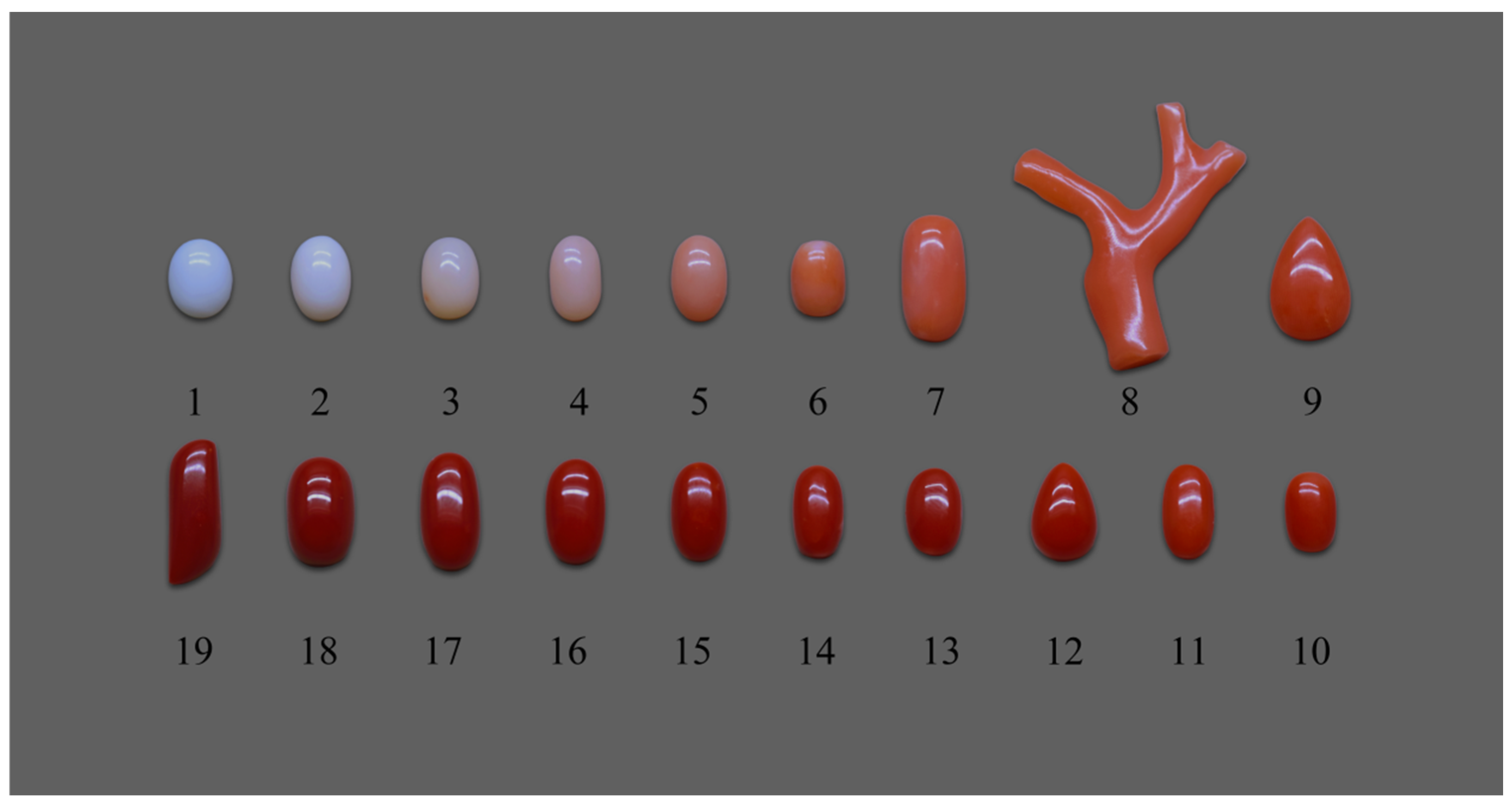
The samples used in this study comprised 19 precious corals sourced from the Pacific Ocean. They exhibited diverse morphologies, including oval, teardrop, branching, and irregular massive forms. The surfaces were polished to a similar cabochon finish, displaying a bright vitreous luster to facilitate subsequent experiments, and the samples ranged from translucent to semi-transparent. Their colors spanned a complete gradient from white to deep red, and the samples were sequentially numbered from 1 to 19 in order of increasing color depth. Physical photographs of the samples are presented in Figure 1. Samples 1 and 2 are Corallium konojoi [11], 3 and 4 are Corallium secundum [38], 5–9 are Corallium regale, and 10–19 are Corallium japonicum.

2.2. Experimental Methods and Instrumentation

2.2.1. Spectrophotometry

Color measurements were performed in the School of Gemmology, China University of Geosciences (Beijing), using an X-Rite SP62 integrating sphere spectrophotometer (X-Rite, Incorporated., Grand Rapids, MI, USA). The measurement conditions were set as follows: a D65 standard illuminant, the specular component excluded (SCE) mode, a 2° observer viewing angle, and a measurement spot diameter of 4 mm. The single measurement time was 2.5 s, with a wavelength sampling interval of 10 nm over an acquisition range of 400–700 nm. To minimize errors, each sample was measured three times, and the average value was calculated. An N6 neutral gray background was used for the tests, and the color data were recorded and exported in the CIE 1976 L*a*b* uniform color space.

2.2.2. CIE 1976 L*a*b* Uniform Color Space

The CIE 1976 L*a*b* color space exhibits excellent visual uniformity [39]. This system is composed of the lightness index L* and the chromaticity coordinates a* and b*. Specifically, L* represents lightness; a* represents the red-green axis (+a* indicates red, while −a* indicates green); and b* represents the yellow-blue axis (+b* indicates yellow, while −b* indicates blue). Based on these parameters, the chroma C* and hue angle h° can be further derived from the a* and b* values using the following formulas [40]:
C = a 2 + b 2
h ° = arctan b a

2.2.3. Raman Spectroscopy

Raman spectroscopy was performed at the laboratory of the School of Gemmology, China University of Geosciences (Beijing). The measurements were conducted using a LabRAM HR Evolution micro-Raman spectrometer (Horiba Jobin Yvon, Longjumeau, Essonne, France). The experimental parameters were set as follows: a 532 nm Ar+ ion laser was utilized as the excitation source, with a 50X/0.50 objective, a 600 lines/mm grating, and a confocal slit diameter of 100 μm. The collection time was 5 s with 3 accumulations; a single point on the uniform color area of the front surface was selected for testing per sample, and the laser power ranged from 3.2% to 100%. The spectral acquisition range was 100–4000 cm−1, and the laser spot diameter was 1298 nm (calculated value).

2.2.4. Fourier Transform Infrared (FTIR) Spectroscopy

FTIR measurements were performed at the laboratory of the School of Gemmology, China University of Geosciences (Beijing), using a Tensor 27 spectrometer (Bruker Corporation., Karlsruhe, Germany). Data were collected in reflectance mode with a spectral resolution of 4 cm−1 over the range of 400–4000 cm−1. For a single acquisition, the scanning time was 32 s, the aperture was set to 2 mm (which could be well accommodated by the sample surface), and the scanning speed was 10 Hz.

2.2.5. Ultraviolet-Visible (UV-Vis) Spectroscopy

UV-Vis measurements were conducted at the laboratory of the School of Gemmology, China University of Geosciences (Beijing), using a UV-3600 spectrophotometer (Shimadzu Corporation, Kyoto, Japan). Data were collected in reflectance mode over a spectral scanning range of 200–900 nm. The instrumental parameters were set as follows: a slit width of 20 nm, with a sampling interval of 0.5 nm, and the medium-speed scanning mode was employed; the overall front surface of each sample was tested once. The raw spectral data were processed using the Kubelka-Munk function. A slit width of 20 nm was adopted to increase the light throughput, thereby smoothing the spectral curve and suppressing excessive noise. Although this setting leads to a certain degree of resolution reduction, it remains within an acceptable range and does not compromise the reliability of the experimental results.

3. Results

3.1. Color Analysis

The fundamental color-forming mechanism of an object is essentially the interaction between light and matter: upon illumination, the object selectively absorbs specific wavelengths of light, while the remaining wavelengths are reflected and stimulate the human visual system, thereby generating the perception of color.
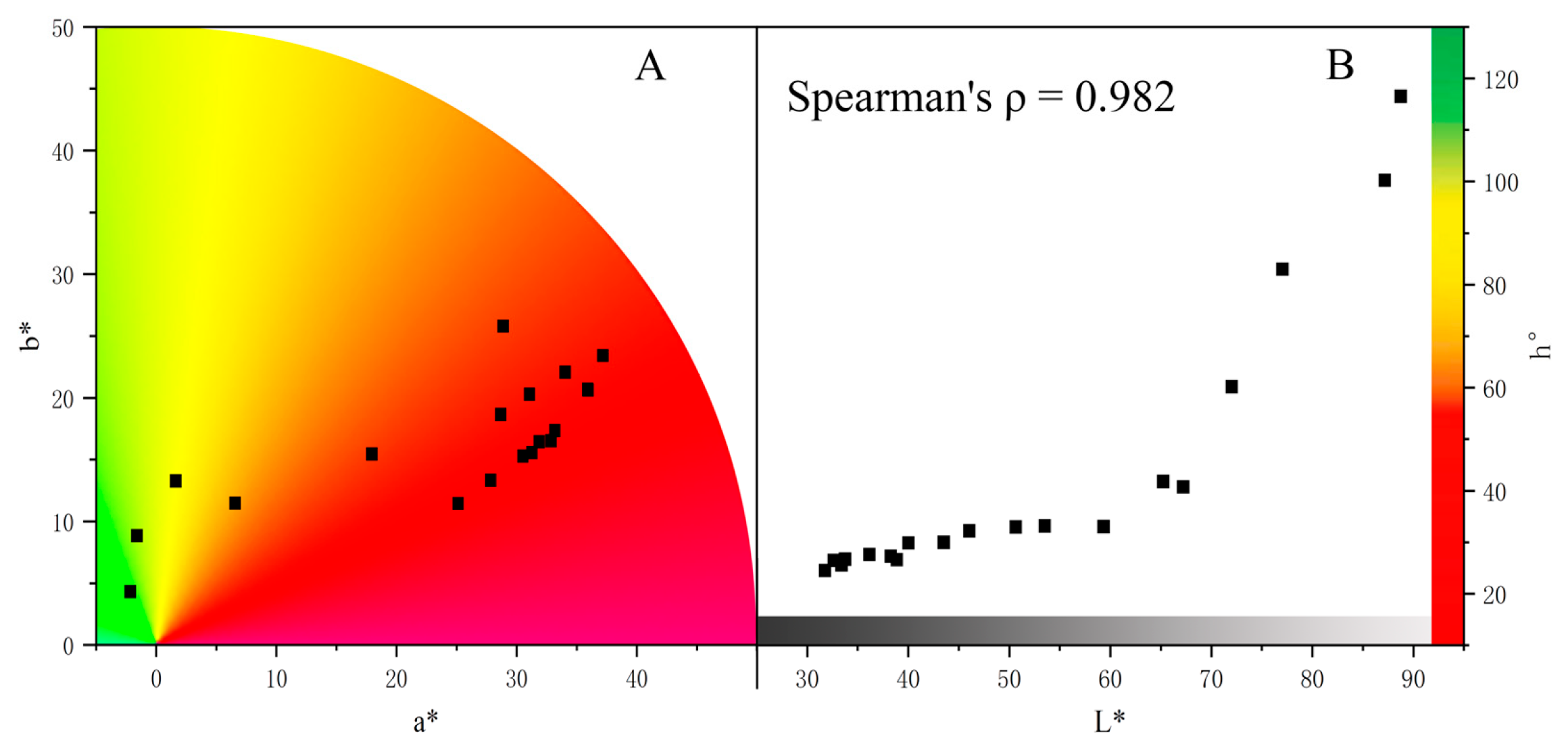
Under the D65 standard illuminant, the color parameters of the 19 precious coral samples are distributed as follows: the red-green chromaticity index a* ranges from −2.15 to 37.17, and the yellow-blue chromaticity index b* ranges from 4.31 to 25.80. Their projections on the a*b* plane are illustrated in Figure 2A. The lightness index L* varies from 31.95 to 88.64, falling within the medium-to-high lightness range. The chroma C* spans from 4.82 to 43.93, with higher values indicating greater color saturation. Additionally, the hue angle h° ranges from 24.49° to 116.51°.
As shown in Figure 2A, the chromaticity coordinates of the vast majority of precious coral samples fall within the first quadrant of the a*b* plane (i.e., the red-yellow color region). Only samples No. 1 and No. 2 deviate from this region, distributed in the yellow-green color region. These two samples appear white, and their a* values are negative due to an extremely low content of organic pigments. The a* values of all other samples are positive.
The lightness (L*) of the samples is inversely associated with pigment content: lower pigment content shifts the samples towards white with a barely perceptible yellowish-green tint, yielding higher L* values, whereas higher pigment content results in deeper coloration and lower L* values. Consequently, L* can serve as an indirect negative indicator for quantifying pigment content. Figure 2B illustrates the correlation between L* and h° for Samples 1–19. The results reveal a significant positive correlation (Spearman’s ρ = 0.982, p = 7.74 × 10⁻¹⁴, n = 19). This robust correlation demonstrates that as pigment content increases and the color deepens, the hue angle decreases progressively, driving a hue shift along the green–yellow–red trajectory.

3.2. Raman Spectroscopy

Based on the inelastic scattering (Raman scattering) of monochromatic light by matter, Raman spectroscopy sensitively captures molecular vibrational and rotational information. It serves as a powerful tool for elucidating chemical compositions and molecular structures and has been widely validated as an effective approach for authenticating precious corals and probing their internal organic components [20]. To further elucidate the material composition of the samples, Raman spectral analyses were conducted on all 19 precious coral specimens.
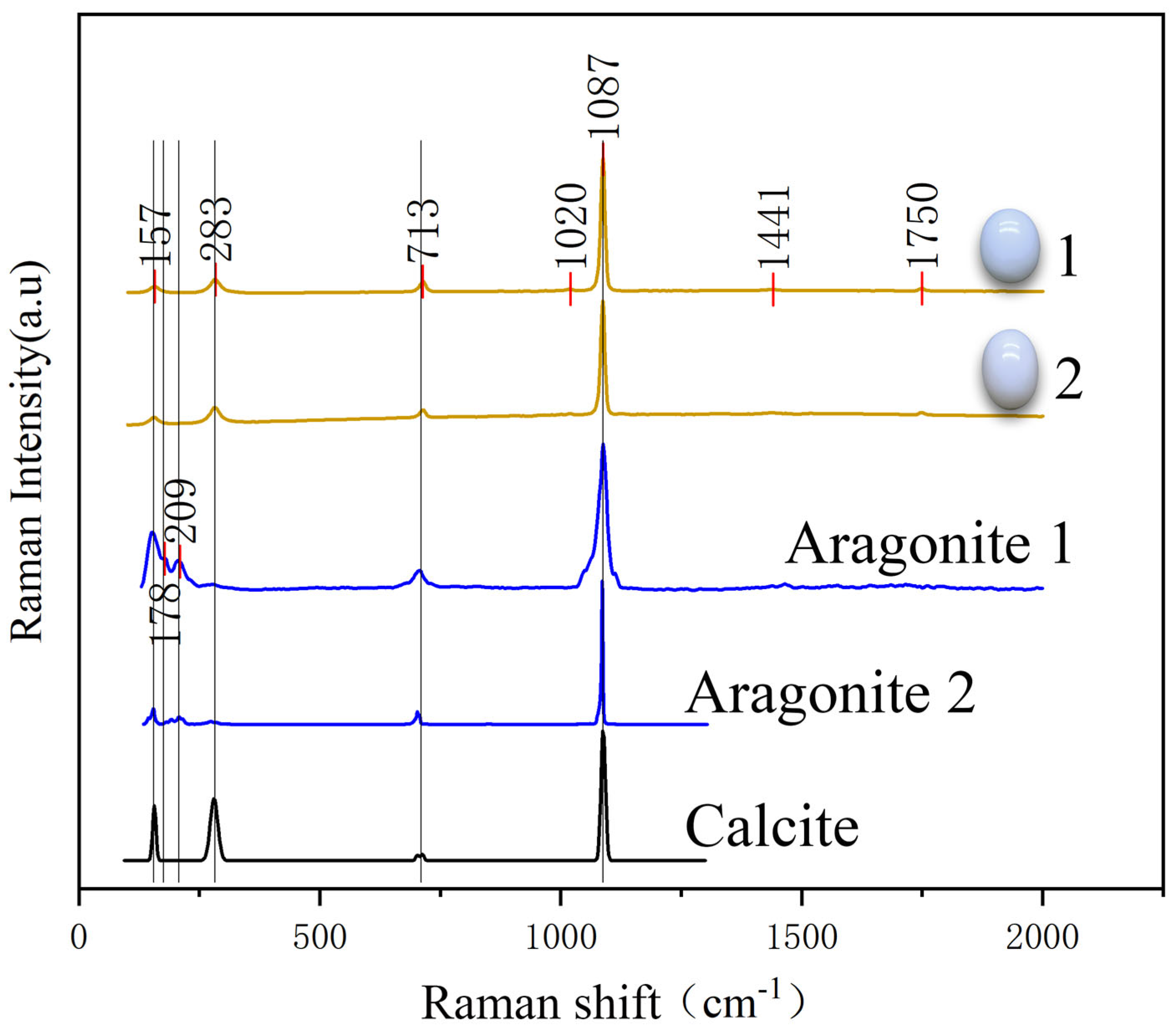
The Raman spectra of the two white samples (No. 1 and No. 2), the two aragonites, and a calcite sample are compared in Figure 3.
As shown in Figure 3, the Raman spectra of the two white samples (No. 1 and No. 2) exhibit exclusively the characteristic signals of their calcareous skeletons. Comparison with the Raman spectra of inorganic minerals reveals the absence of aragonite characteristic peaks at 178 and 209 cm−1 in their spectra. Conversely, the Raman shifts at 157, 283, 715, and 1087 cm−1 perfectly match the characteristic peaks of calcite.
The Raman spectral peaks of samples No. 1 and No. 2 are assigned as follows: the weak peaks located at 157 and 283 cm−1 are attributed to the translational and rotational vibrations of the calcite lattice, respectively; the signal at 1020 cm−1 indicates the presence of bicarbonate ions (HCO3). Furthermore, a series of peaks at 713, 1087, 1441, and 1750 cm−1 all originate from the internal vibrations of carbonate ions (CO32−), corresponding sequentially to the in-plane bending vibration, symmetric stretching vibration, asymmetric stretching vibration, and the second overtone of the out-of-plane bending vibration [24].
Theoretically, Raman signal intensity is positively correlated with analyte concentration; however, due to interference from complex external factors—such as laser power, integration time, sample surface polish, and laser incidence angle—the absolute intensity of spectra is unsuitable for the accurate quantification of substance concentrations. Nevertheless, calcite accounts for up to 98% [41] of the mineral composition of precious coral (approximating a pure phase), meaning its concentration can be treated as a constant. Leveraging this characteristic, the present study utilized the characteristic Raman signal of calcite as an internal standard. By calculating the ratio of the characteristic peak intensity of the target analytes to the reference peak intensity of calcite (i.e., the relative intensity), the errors arising from fluctuations in testing conditions were effectively eliminated, thereby enabling the semi-quantitative analysis of the internal components of precious coral.
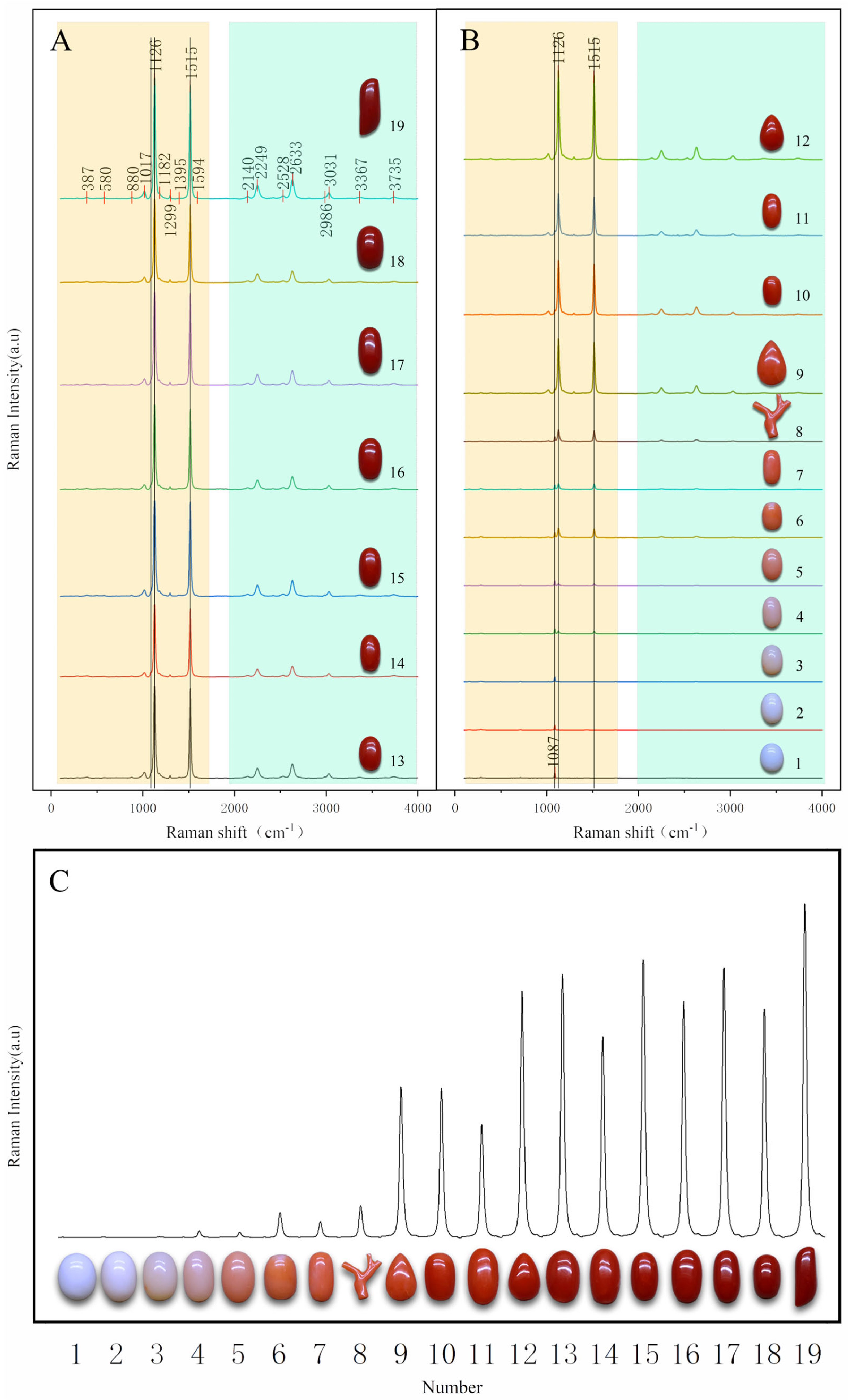
Using the strongest characteristic peak of calcite at 1087 cm−1 as an internal standard, the Raman spectra of samples No. 1–19 were normalized, and the results are presented in Figure 4. Following this treatment, the absolute intensities of all other characteristic peaks were converted into relative intensities referenced to calcite.
The 1087 cm−1 peak was selected as the internal standard in this study. The reasons are as follows: the 1020 cm−1 peak is overlapped by the 1017 cm−1 peak of polyene pigments and thus cannot be used; the 283 cm−1 peak is also unsuitable as its intensity is affected by the angle between the laser polarization direction and the coral growth direction. Furthermore, polyene pigments resonate with the 532 nm laser, yielding extremely strong Raman signals; in contrast, the calcite peaks at 154, 715, 1441, and 1750 cm−1 are too weak to be distinguished from the baseline, making them unqualified as internal standards. As the strongest peak of calcite, the 1087 cm−1 peak is the optimal choice for an internal standard. However, this internal standard is not flawless: as shown in Figure 4A,B (samples 9–19), the 1087 cm−1 peak is located close to the strongest polyene pigment peak at 1126 cm−1, and the edge of the latter overlaps with the 1087 cm−1 peak, resulting in an additive enhancement of the 1087 cm−1 peak intensity. This enhancement leads to an underestimation of the polyene signal intensity to some extent, thereby introducing errors.
The Raman characteristic peak positions of the polyene pigments are shown in Figure 4A,B, and the assignments are as follows:
The fundamental vibration peaks (the yellow region in Figure 4, 387–1584 cm−1) are specifically assigned as follows: the peak at 1017 cm−13) originates from the rocking vibration of (–CH3) and is spectrally overlapping with the 1120 cm−1 peak of calcite; the peaks at 1126 cm−12) and 1515 cm−11) correspond to the stretching vibrations of (C–C) and (C=C), respectively [19]; and the peak at 1299 cm−14) is attributed to the in-plane rocking vibration of the H atoms in (C–H) [25]. Additionally, polyene pigment signals were also observed at 387, 580, 880, 1182, 1395, 1594, and 2986 cm−1, although their exact vibrational modes remain to be further confirmed.
In the high-wavenumber region (the green region in Figure 4, 2140–3735 cm−1), with the exception of 2986 cm−1, all other peaks are combination bands of the fundamental peaks. These specifically include the combination bands at 2140 cm−12 + ν3), 2249 cm−1 (2ν2), 2528 cm−11 + ν3), 2633 cm−11 + ν2), 3031 cm−1 (2ν1 or 3ν3 and their degenerate peaks), 3367 cm−11 + ν2 + ν3), and 3735 cm−11 + 2ν2) [19].
The normalized spectra (Figure 4) clearly illustrate the dynamic evolution of the polyene Raman signals with increasing color depth. In the virtually pigment-free white samples (No. 1 and No. 2), only the characteristic calcite peak at 1087 cm−1 is present. Weak polyene signals begin to emerge in the light pink samples (No. 3–5), with intensities lower than that of the 1087 cm−1 calcite peak. As the sample color transitions to orange-red (No. 6–8) and further to red-to-dark-red (No. 9–19), the polyene Raman signals exhibit a remarkable increase (Figure 4C). Not only do they vastly exceed the intensity of the 1087 cm−1 calcite peak, but in samples No. 9–19, they also alter the spectral profile: the intense principal peak at 1126 cm−1 envelops the 1087 cm−1 peak, reducing it to a shoulder peak.
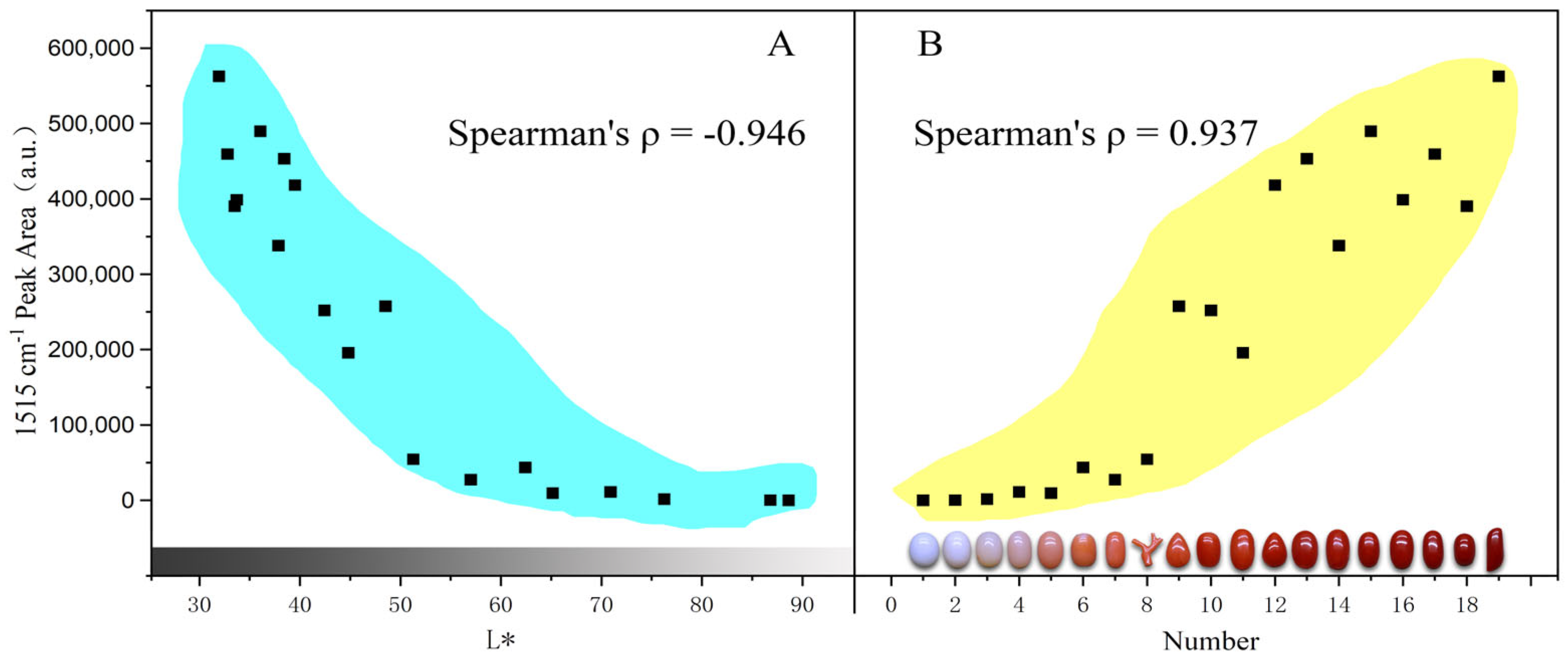
Relying solely on visual inspection to estimate spectral signal intensity is inherently imprecise; moreover, the visual perception of color is susceptible to external environmental factors, such as the spectral power distribution of the light source, illumination intensity, and the brightness and color of the observation background. To eliminate the bias associated with subjective visual assessments of spectral intensity and color variation and to derive more objective conclusions, this study utilized the integrated intensity of the characteristic polyene peak at 1515 cm−1 as the indicator of polyene concentration. Concurrently, the instrumentally measured lightness index (L*) and the visual ranking of color depth were jointly employed as indicators of pigment concentration in the precious coral. Correlation analyses were then performed between the integrated intensity of the 1515 cm−1 peak and the visual ranking as well as the L* values, with the results presented in Figure 5.
The statistical analysis (Figure 5A,B) reveals a highly significant negative correlation with the lightness value L* (Spearman’s ρ = −0.946, p = 1.02 × 10⁻⁹, n = 19), as well as a highly significant positive correlation between the integrated intensity of the characteristic polyene peak at 1515 cm−1 and the visual ranking (Spearman’s ρ = 0.937, p = 3.54 × 10⁻⁹, n = 19). These two highly significant correlations—one positive and one negative—validate the feasibility of using the lightness value (L*) measured by a spectrophotometer as a substitute for the visually perceived color depth to inversely indicate pigment content.
As can be seen from Figure 5A,B, the distribution of samples with high 1515 cm−1 peak intensities is more scattered than that of samples with low intensities, which is precisely caused by the interference of the 1126 cm−1 peak with the 1087 cm−1 internal standard peak. Nevertheless, the Spearman correlation coefficient remains exceptionally high, indicating an extremely strong correlation and demonstrating that the conclusions of this study remain reliable.

3.3. Infrared Spectroscopy

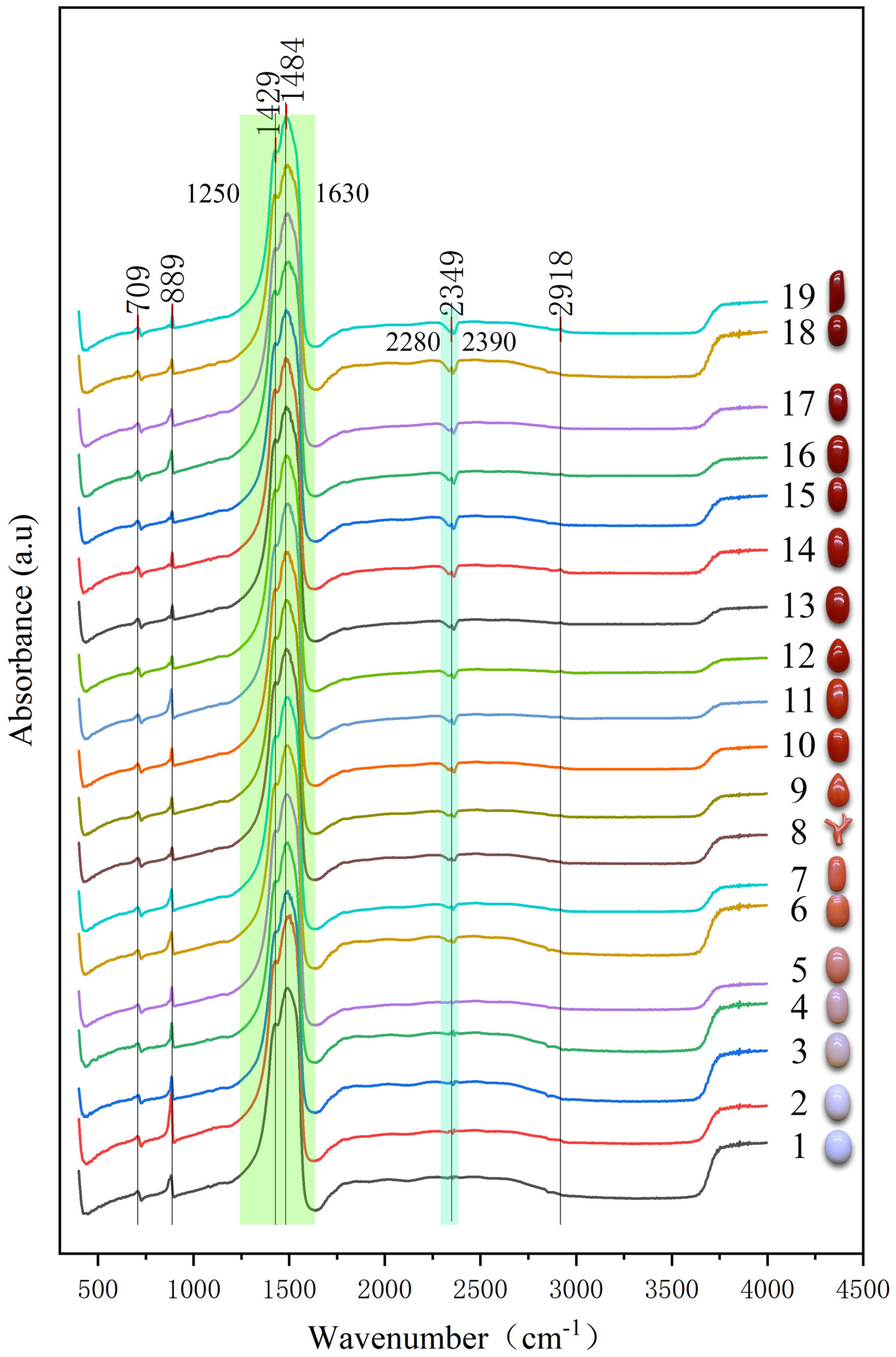
IR spectroscopy achieves material analysis based on the selective absorption of infrared light by molecules during vibrational energy level transitions. Many vibrational modes that are restricted or exhibit weak signals in Raman spectroscopy often show strong responses in IR spectroscopy, making the two techniques highly complementary in research. In this study, reflection-based IR spectra of coral samples No. 1–19 were collected over the range of 400–4000 cm−1. To effectively eliminate the interference of physical factors—such as sample surface roughness and test coverage area—on the absolute spectral intensity, the intensity of the peak maximum at 1484 cm−1 within the characteristic calcite absorption band (1250–1630 cm−1) was utilized as an internal standard for normalization. The results are presented in Figure 6.
Although the 1484 cm−1 peak is the optimal choice as an internal standard, it remains subject to potential interference: this band may overlap with organic characteristic peaks (C–H bending and C=O stretching vibrations). Such spectral superposition leads to varying degrees of overestimation of the apparent peak height at 1484 cm−1, thereby introducing measurement errors.
As shown in Figure 6, the IR spectra of samples No. 1–19 clearly exhibit the characteristic absorptions of both calcite and organic matter. Specifically, the fundamental vibration peaks of calcite are assigned as follows: the peaks at 709 cm−1 and 889 cm−1 correspond to the in-plane and out-of-plane bending vibrations of (CO32−), respectively, while the broad absorption band at 1250–1630 cm−1 (the green region) is attributed to the asymmetric stretching vibration of (CO32−) [12].
In the FTIR spectra (Figure 6), the broad absorption band of calcite in the 1250–1630 cm−1 range exhibits splitting, resolving into two distinct peaks at 1429 cm−1 and 1484 cm−1, accompanied by a slight splitting phenomenon at the 889 cm−1 peak. Fundamentally, this peak splitting reflects lattice distortion, which is hypothesized to arise from the synergistic effects of two mechanisms. First is the ionic substitution effect. Some calcite in precious corals is high-Mg calcite, where Mg2+ substitutes for Ca2+ in the crystal lattice, causing local lattice distortion. This results in a shift in the absorption peaks of this high-Mg calcite and their splitting from the absorption peaks of the other low-Mg calcite. Second is biomineralization regulation: the crystallization process of coral calcite is controlled by an organic matrix; the presence and regulatory role of these organics lead to varying degrees of crystal defects or distortions, which subsequently trigger further splitting of the IR absorption peaks.
Mg2+ substitution plays a dominant role in the splitting of the 889 cm−1 peak, whereas the influence of organic matter is the primary factor for the splitting of the 1250–1630 cm−1 absorption band. Floquet et al. pointed out that the peak position of red coral near 880 cm−1 is similar to that of high-Mg calcite but differs slightly from that of low-Mg calcite; furthermore, the peak profile of red coral near 1400 cm−1 differs significantly from both high- and low-Mg calcite and exhibits a shoulder peak absent in both [41].
In the organic signal region, the characteristic absorption at 2918 cm−1 is assigned to the (C–H) stretching vibration. This vibration is ubiquitous across various organic compounds, including carbohydrates, lipids, and proteins, rather than being a specific signal of polyene pigments; thus, it cannot indicate their content. The very weak correlation between the integrated intensity of the 2918 cm−1 peak and the sample lightness value L* (Spearman’s ρ = −0.309, p = 0.20, n = 19) further corroborates this inference. Additionally, a highly anomalous concave structure appears in the 2280–2390 cm−1 range (the blue region) of the spectra, within which a signal peak is located at 2349 cm−1.
Additionally, despite careful examination, no signals associated with coloration were identified in the IR reflection spectra. This is because the characteristic (C–C) and (C=C) bonds of the polyene pigments in precious coral are both conjugated and centrosymmetric: this structure is Raman-active and significantly enhanced by the resonance effect, so much so that the primary calcite peak at 1087 cm−1 appears as a shoulder peak. Conversely, in the IR spectrum, this symmetry renders the vibrations IR-inactive, resulting in extremely weak signals. Consequently, they are either obscured by the broad absorption band at 1250–1630 cm−1 (as seen with the 1515 cm−1 peak) or undetectable due to instrument sensitivity limitations against the intense calcite matrix background (as with the 1126 cm−1 peak).

3.4. Ultraviolet-Visible Spectroscopy

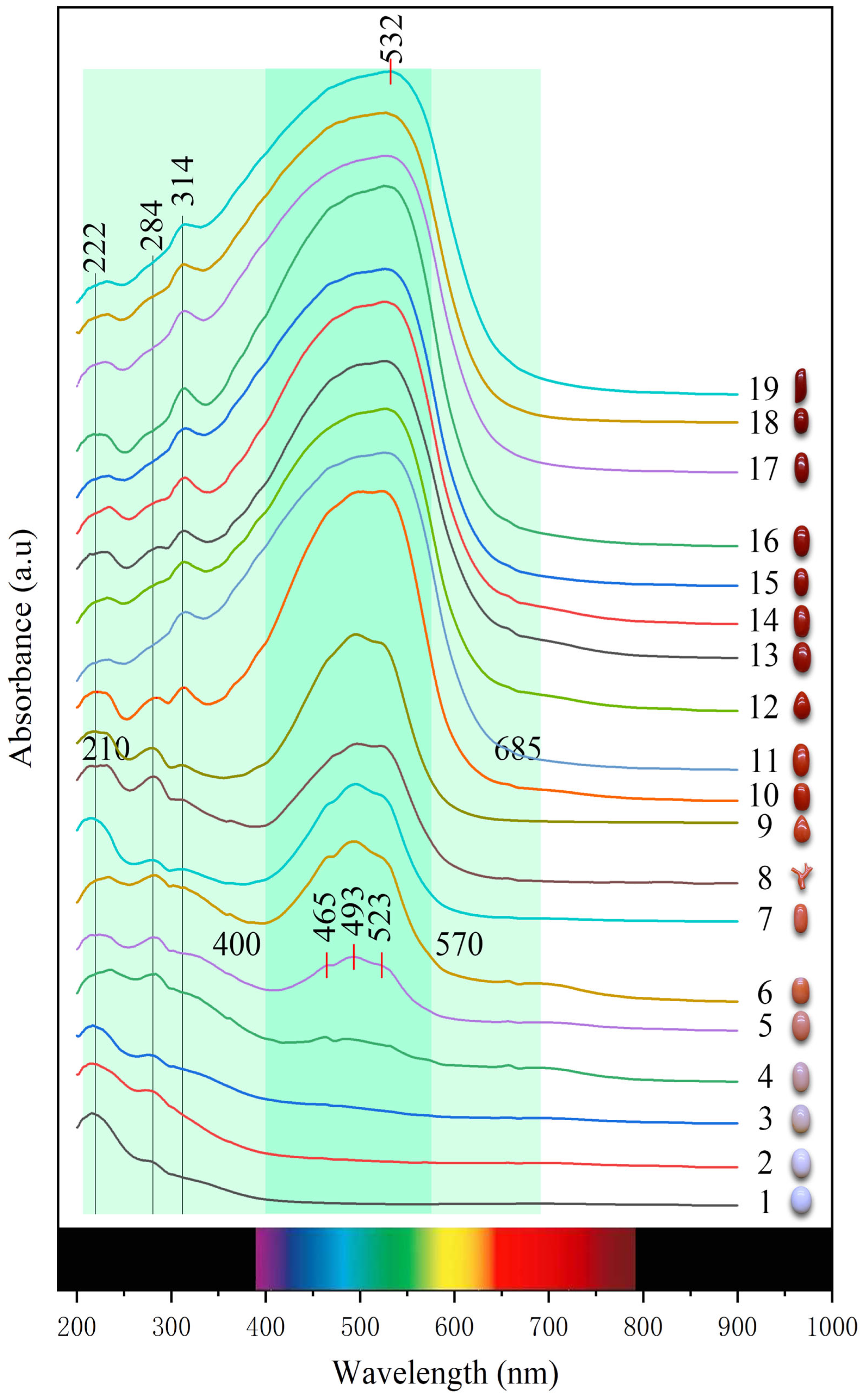
UV-Vis spectroscopy analyzes material composition based on the absorption of ultraviolet and visible light during electronic energy level transitions within molecules or ions. Unlike infrared spectroscopy, which focuses on vibrational energy level transitions, UV-Vis spectroscopy reflects the electronic transition behavior within a substance; thus, the two techniques are highly complementary in molecular characterization. To further elucidate the coloration mechanism of precious coral from the perspective of electronic transitions, UV-Vis spectra of samples No. 1–19 were acquired, and the results are presented in Figure 7.
As shown in Figure 7, the UV-Vis spectra of the precious coral can be divided into two regions: ultraviolet and visible. In the deep ultraviolet region, all 19 samples exhibit a consistent characteristic absorption at 222 nm. In the deep-to-mid ultraviolet range, the light-colored samples (Nos. 1–10 and 13) show a distinct absorption around 284 nm, whereas this signal is not observed in the dark-colored samples (Nos. 11, 12 and 14–19).
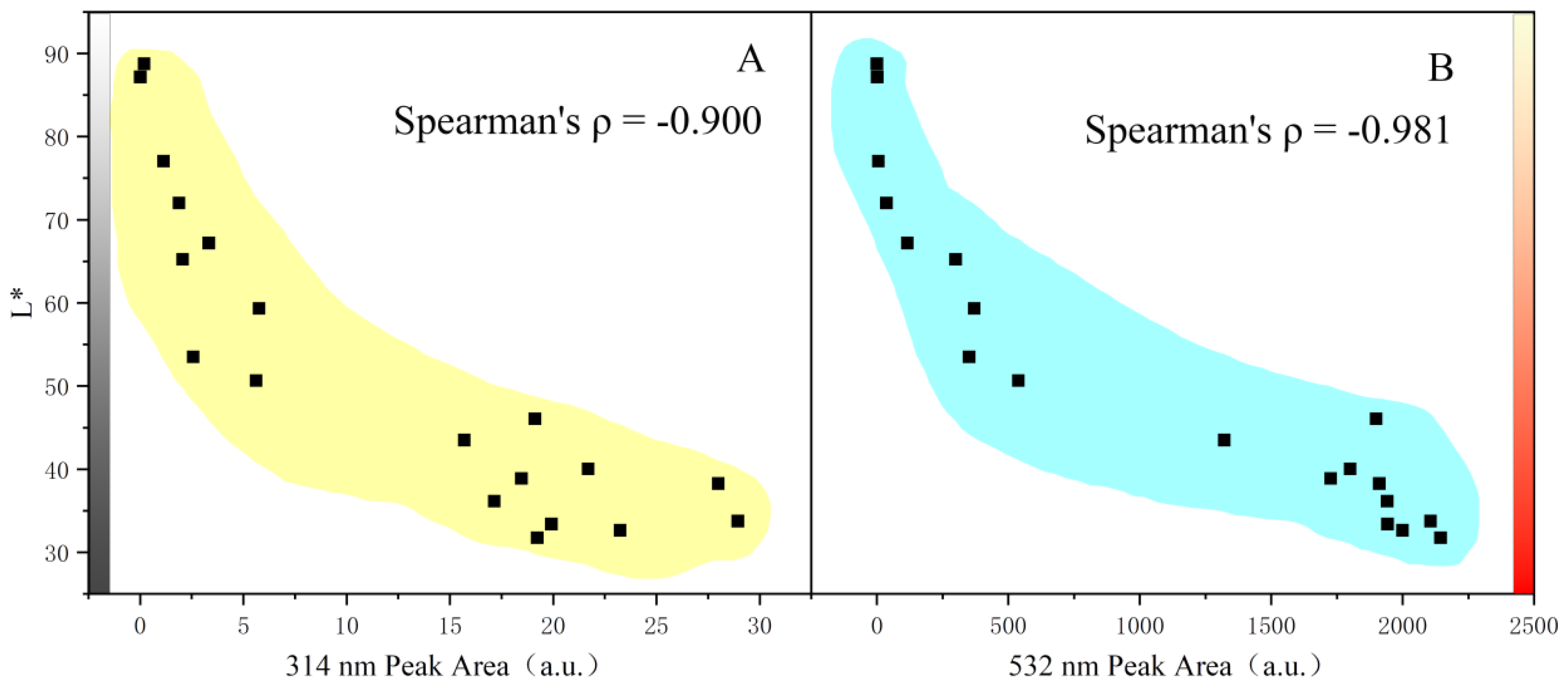
In the mid-to-near ultraviolet range, the absorption band centered at 314 nm exhibits an extremely regular correlation with the color of the samples: this band shows no characteristic response in the white samples (Nos. 1–2), appears as a gentle and weak absorption in the light yellow-orange samples (Nos. 3–6), manifests as a slight protruding absorption in the light red samples (Nos. 7–10), and significantly intensifies again in the red to dark red samples (Nos. 10–19). By projecting the integrated intensity of the 314 nm absorption peak against the parameter L*—which serves as an inverse indicator of pigment concentration—to generate Figure 8A, a highly significant negative correlation was found between the two (Spearman’s ρ = −0.900, p = 1.55 × 10⁻⁷, n = 19).
In the visible light region, as the sample color deepens, a broad absorption band with its maximum at 532 nm appears (the green region in the Figure 7). Its evolution is highly consistent with the color change: samples No. 1–2 show no characteristic absorption in this range, resulting in total reflection of visible light and appearing white. In samples No. 3–10, the absorption band in the 400–570 nm range emerges and gradually intensifies (the darker green region in the Figure 7) as the color deepens. Within this band, three characteristic absorption peaks can be resolved at 465, 493, and 523 nm (Nos. 5–10), although the maximum absorption point is not yet 532 nm but 493 nm. This spectral region covers the violet, blue, and green light zones; its selective absorption causes the red-orange light to be reflected, which gives the samples their orange-red hue. By the stage of the red to dark red samples (No. 11–19), the absorption band further broadens to the 210–685 nm range, where the three previously distinct peaks overlap and merge, while the absorption maximum undergoes a redshift to 532 nm. Due to the limited resolution, the merging of the three peaks may occur later than we estimated. At this point, the visible light outside the red wavelength range is completely absorbed, accompanied by concurrent absorption in the ultraviolet region, and the sample hue shifts entirely from orange-red to red.
By projecting the integrated intensity of the 532 nm absorption band against the parameter L*, which serves as an inverse indicator of pigment concentration, Figure 8B was generated. The two parameters exhibit a highly significant negative correlation (Spearman’s ρ = −0.981, p = 1.73 × 10⁻¹³, n = 19).
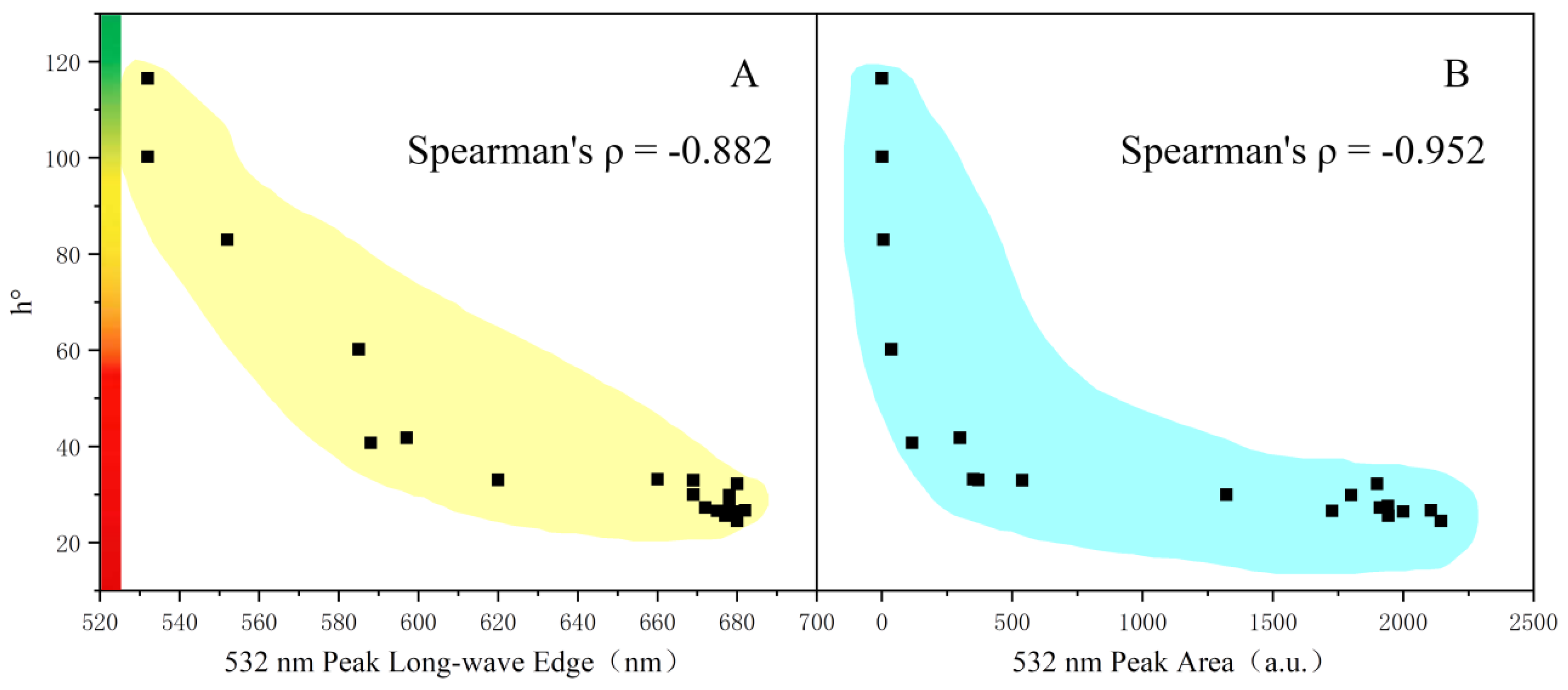
To illustrate the enhancement and broadening of the 532 nm absorption band alongside the hue variation, the 532 nm band intensity and its long-wavelength absorption edge were plotted against the hue angle (h°) to generate Figure 9.
As shown in Figure 9, the sample hue exhibits a highly significant negative correlation with both the long-wavelength edge position and the peak intensity of the 532 nm absorption band (Spearman’s ρ = −0.882, p = 6.08 × 10⁻⁷, n = 19 and Spearman’s ρ = −0.952, p = 3.24 × 10⁻¹⁰, n = 19, respectively); that is, the enhancement and broadening of the 532 nm band correspond to a decrease in hue.

4. Discussion

Based on the colors of Samples No. 1 and No. 2, which contain extremely low pigment levels, it can be inferred that in the complete absence of pigment, precious coral would exhibit a white hue with an extremely faint yellowish-green tint (imperceptible to the naked eye). This result represents the characterization of the precious coral matrix in the CIE1976 L*a*b* color space and is strictly limited to Samples No. 1 and 2. Furthermore, the observation that increasing pigment content decreases the hue value, driving a color transition from orange to red, indicates that the intrinsic color of the pigment in precious coral is red.
In the Raman spectra, Samples 1 and 2 exhibit patterns identical to calcite, while in the FTIR spectra, all samples display calcite signatures. Neither the characteristic peaks of aragonite (around 1085 cm−1) nor the in-plane bending vibration peaks of vaterite (around 745 cm−1) were detected [33]. This cross-validation of Raman and FTIR results further conclusively confirms that the calcareous skeletons of the 19 precious coral specimens across 4 species tested in our study—regardless of being white or red—are compositionally uniform, consisting exclusively of calcite. This definitively rules out the presence of aragonite or vaterite, delivering a robust refutation of the conventional assertion that “white corals are aragonite, while red corals are calcite.” However, whether the calcareous composition of all precious corals is calcite remains to be confirmed by subsequent testing of all species.
In the Raman spectra (Figure 4), the visual color demonstrates a synchronous variation with the microscopic signal intensity of polyenes. The integrated intensity of the characteristic peak at 1515 cm−1—representing polyene concentration—shows a highly significant correlation with both the lightness value (L*) and the visual color ranking sequence, which represent pigment concentration (Spearman’s |ρ| > 0.930). This high degree of statistical consistency explicitly demonstrates that the concentration gradient of polyene substances in precious coral strictly corresponds to its pigment concentration. Consequently, it is conclusively confirmed that this polyene substance acts as the color-inducing pigment of precious coral, thereby substantially bolstering the reliability of previous conclusions [16,19,20].
The (C–C) and (C=C) stretching vibration peaks of the polyene pigments in precious coral are located at 1126 cm−12) and 1515 cm−11), respectively. According to the DFT calculation formulas proposed by Bergamonti et al. (2013) [25]:
ν 1 = 258.5 N + 160 · 10 3
ν 2 = 192 N + 160 · 10 3
where N represents the number of C=C bonds in the polyene chain, the calculated values are N = 10.63 from Equation (3) and N = 10.52 from Equation (4), indicating that the number of C=C units in the polyene pigment chain is between 10 and 11. This result is in excellent agreement with the values of 10–12 and 11–12 reported by Kupka et al. (2010) [24] and (2016) [13], respectively, and the numerical discrepancies are attributed to the different formula models employed.
The color origin of polyene compounds lies in the conjugated system within their molecular backbone, which consists of alternating carbon-carbon single (C-C) and double (C=C) bonds. The π-electron delocalization effect induced by this system significantly reduces the energy gap required for the π-π* transition, causing a shift in the absorbed light wavelength towards longer wavelengths (a bathochromic shift, or red shift) [42]. Once the absorption band enters the visible light region, selective absorption occurs, and the complementary color is perceived; the optical mechanism underlying the red coloration of precious coral follows exactly this principle.
In Figure 6, a concave feature appears in the 2280–2390 cm−1 region (blue area). Natkaniec-Nowak et al. also captured this anomalous spectral band in previous research but did not provide an in-depth analysis [43]. Observing Figure 6 from bottom to top, the depth of this concavity appears to increase with pigment content, superficially suggesting a signal arising from the vibration of a specific functional group within the polyene pigments of the precious coral.
However, subsequent in-depth tracing revealed that this anomalous concavity actually originates from the vibrational absorption interference of CO2 within the experimental environment (2280–2390 cm−1). The illusion that the concavity “deepens with color intensity” is, in fact, an artifact caused by the testing sequence. Because the samples were analyzed strictly in sequential order from white to red, the CO2 concentration in the enclosed testing space gradually accumulated due to the operator’s respiration as the testing time increased, thereby causing a continuous enhancement of this absorption signal. Therefore, this spectral band has no relevance to the polyene pigments in precious coral and is purely an environmental background interference. Subtracting the background prior to each measurement eliminates this interference absorption band.
In the UV-Vis spectra (Figure 8), the absorption peak at 222 nm was observed in all samples (Nos. 1–19), indicating that it is unrelated to the polyene pigments in precious coral. Instead, it should be attributed to the absorption of other coral components, likely arising from peptide bonds or aromatic residues, and its specific assignment warrants further investigation. Additionally, the 284 nm absorption peak is present exclusively in light-colored samples but absent in dark-colored ones, likely attributable to ketones, aldehydes, or aromatic compounds.
The parameter L*, which inversely represents pigment concentration, shows a highly significant negative correlation with the intensities of the absorption bands at 314 nm and 532 nm (Spearman’s |ρ| > 0.900)—equivalently, pigment concentration exhibits a significant positive correlation with the intensities of these two bands. This demonstrates that both absorption bands are attributed to electronic energy level transitions of the polyene pigments within the precious coral, with the 532 nm band specifically corresponding to the π-π* electronic transition and the 314 nm absorption likely arising from electronic transitions of benzene rings and their derivatives contained in the terminal groups of the polyene pigments.
As observed in Figure 9, the intensification and long-wavelength broadening of the 532 nm absorption band are accompanied by a decrease in the hue of the samples. This result reveals the intrinsic mechanism by which the hue of precious coral changes with pigment concentration: as the pigment concentration increases, the 532 nm absorption band undergoes significant enhancement and broadening, which in turn intensifies the absorption in the yellow-orange light region. This intensified absorption reduces the hue value, ultimately driving the color evolution from yellow-orange to red. This spectral pattern explains the phenomenon described earlier (Figure 2B), where the hue decreases as pigment concentration rises.
Concomitant with the enhancement and broadening of the 532 nm absorption band, its absorption maximum undergoes a significant long-wavelength shift (redshifting from 493 nm to 532 nm). Such a peak shift cannot be explained by the concentration change in a single pigment, indicating that there are at least two color-inducing pigments within the precious coral: one with a main absorption peak at 493 nm and another at 532 nm, whose enrichment dominates the long-wavelength broadening of the absorption band. While further elucidating the intrinsic mechanism of the hue variation in precious coral, this finding also corroborates previous assertions by scholars that the pigments in precious coral are not of a single type [23,24]. However, the Raman spectra in Figure 4A,B reveal that the characteristic peaks of the polyene pigments at 1126 cm−12) and 1515 cm−11) exhibit only intensity variations without any peak shifts. Given that the peak positions are directly correlated with the number of (C=C) bonds in the polyene chain, it can be deduced that the polyene chain lengths of these pigments are identical. Consequently, their structural differences likely arise from terminal groups, side substituents, or cis-trans isomerism.
The conclusion that the pigment types in precious coral are not singular is corroborated by the previous findings of Yang Yushu’s team and Kupka’s team. The difference lies in the methodology: Yang Yushu’s team deduced this conclusion based on the differences in the hue of various precious corals [23], whereas Kupka’s team verified it through Raman spectroscopy; the present study [24], however, arrived at this conclusion via UV-Vis spectroscopy. These research approaches are complementary, and their mutual corroboration further enhances the reliability of this inference.
The redshift in the absorption maximum in the 532 nm band may also require considering two other potential causes. One is the solvatochromic effect, where the pigment type is singular, but changes in the matrix (i.e., the components other than pigments in precious coral) occur; this environmental change can also induce a shift in the absorption peak. The other is the aggregation effect, where the pigment type remains singular but its concentration increases, and the close molecular packing leads to a redshift in the absorption peak due to electronic coupling. However, the probabilities of both possibilities are low: on the one hand, the matrix compositions of the same precious coral species are similar, making it difficult to induce a significant solvatochromic effect; on the other hand, the actual content of polyene pigments is extremely low, insufficient to produce an aggregation effect.
In this study, the color, FTIR, Raman, and UV-Vis spectra of precious corals spanning a white-to-red color gradient were systematically collected and analyzed to determine their inorganic composition. The results conclusively demonstrate that polyene pigments act as the color-inducing agents in precious corals and elucidate the intrinsic mechanism driving the hue transition with increasing pigment concentration. Furthermore, corroborative evidence was obtained indicating that the pigment composition in red corals is not singular. These findings lay a solid foundation for the identification and authentication of precious corals, as well as for further in-depth research into their color genesis.

5. Conclusions

  • The hue of precious coral exhibits a regular shift from orange-red to red as the internal polyene pigment content increases.
  • Cross-validation by Raman spectral characteristic peaks (e.g., 157, 283, 715, 1087, 1441, and 1750 cm−1) and infrared spectral characteristic peaks (e.g., 709, 889, and 1250–1630 cm−1) definitively confirms that the calcareous skeletons of precious coral samples tested in our study are composed exclusively of calcite, refuting the conventional assertion that white corals are aragonite while red corals are calcite.
  • The intensity of the characteristic Raman peak at 1515 cm−1 for polyene substances exhibits a significant correlation with pigment concentration (as characterized by L* and color; Spearman’s |ρ| > 0.930), confirming that this polyene substance is the color-inducing pigment in precious coral. DFT calculations reveal that the number of conjugated (C=C) bonds in its polyene chain is 10 to 11. Furthermore, other unassigned signal peaks at 387, 580, 880, 1182, 1395, 1594, and 2986 cm−1 also carry structural information about this pigment.
  • In the UV-Vis spectra, both the 314 nm and 532 nm absorption bands originate from electronic transitions within the polyene pigments. Notably, the broad 532 nm absorption band is dominated by π-π* electronic transitions, while the 314 nm band likely arises from terminal benzene rings and their derivatives. As the pigment concentration increases, this band exhibits significant broadening and enhancement, accompanied by a synchronous redshift of its absorption maximum. This results in intensified absorption in the yellow-orange light region, elucidating the intrinsic mechanism driving the hue evolution of precious coral from orange to red with increasing pigment concentration. Furthermore, the redshift in the main peak provides additional evidence that the polyene pigments in precious coral are not of a single type; although solvatochromic or aggregation effects also need to be taken into consideration, the likelihood of either mechanism is relatively low.

Supplementary Materials

The following supporting information can be downloaded at: https://doi.org/10.6084/m9.figshare.32404389 accessed on 18 May 2026. File S1: Raw Raman spectral data. File S2: Raw UV-Vis spectral data. File S3: Raw FTIR spectral data. File S4: Raw color data.

Author Contributions

Conceptualization, Y.Y., Y.G., Z.H. and J.H.; methodology, Y.Y.; software, Z.H.; validation, Y.Y., Y.G. and J.H.; formal analysis, Y.G.; investigation, Y.Y.; resources, Y.Y.; data curation, Y.Y.; writing—original draft preparation, Y.Y.; writing—review and editing, Y.Y. and J.H.; visualization, Y.Y.; supervision, Y.G.; project administration, Y.G. All authors have read and agreed to the published version of the manuscript.

Funding

This research does not receive any external funding.

Data Availability Statement

The original contributions presented in this study are publicly available. The datasets generated and analyzed during the current study are provided as Supplementary Materials and are available in the Figshare repository at the following link: https://doi.org/10.6084/m9.figshare.32404389.

Acknowledgments

We would like to express our gratitude to the laboratory and all the staff at the School of Gemology, China University of Geosciences (Beijing). We are deeply grateful to Yuan Ye and Liu Kang for their invaluable guidance and to Ruoshui Hu, Pengyu Liu, Ying Yan, and Qing Ai for their assistance. The manuscript text was rephrased and grammar-checked using DeepSeek-V4 and Zhipu Qingyan to improve clarity and language flow. All scientific content, interpretations, data analysis, and conclusions were developed entirely by the authors. The authors acknowledge the use of the RRUFF Database (https://rruff.info accessed on 18 May 2026) for providing mineral spectral data, with the Raman spectral data of inorganic calcite and aragonite in this paper sourced from this website.

Conflicts of Interest

The authors declare no conflicts of interest.

Abbreviations

The following abbreviations are used in this manuscript:
FTIRFourier Transform Infrared Spectroscopy
UV-VisUltraviolet-Visible Spectroscopy

References

  1. Kennedy, L.; Brigida, C. Italian precious coral. Gems Gemol. 2023, 59, 106–107. [Google Scholar]
  2. Borrello, M.A.; Bosch, J.; De Grossi Mazzorin, J.; Estrada Martín, A.; Esteve, X. Les parures néolithiques en corail (Corallium rubrum L.) d’Europe occidentale. Riv. Sci. Preist. 2012, LXII, 33–66. [Google Scholar] [CrossRef]
  3. Tsounis, G.; Rossi, S.; Grigg, R.W.; Santangelo, G.; Bramanti, L.; Gili, J.M. The Exploitation and Conservation of Precious Corals. Oceanogr. Mar. Biol. Annu. Rev. 2010, 48, 161–210. [Google Scholar] [CrossRef]
  4. Ganot Philippe, L.G.; Frédéric, M.; Laurent, P.; Denis, A.; Sylvie, T. An alternative and effective method for extracting skeletal organic matrix adapted to the red coral Corallium rubrum. Biol. Open 2022, 11, bio059536. [Google Scholar] [CrossRef]
  5. Loentgen, G.; Parks, S.K.; Allemand, D.; Tambutté, S.; Ganot, P. Polyp dimorphism in the Mediterranean Red Coral Corallium rubrum: Siphonozooids are precursors to autozooids. Front. Mar. Sci. 2025, 12, 1512361. [Google Scholar] [CrossRef]
  6. Pasquale, V.; Sandulli, R.; Chianese, E.; Lettino, A.; Sanz-Montero, M.E.; Jarwar, M.A.; Dumontet, S. Carbonatogenic Bacteria from Corallium rubrum Colonies. Minerals 2025, 15, 839. [Google Scholar] [CrossRef]
  7. Ganot, P.; Rausch, T.; Fritz, M.H.-Y.; Zoccola, D.; Wang, X.; Aranda, M.; Benes, V.; Allemand, D.; Tambutté, S. Genome sequence of the Mediterranean red coral Corallium rubrum. BMC Res. Notes 2024, 17, 375. [Google Scholar] [CrossRef]
  8. Kise, H.; Iguchi, A.; Iguchi, A.; Saito, N.; Yoshioka, Y.; Uda, K.; Suzuki, T.; Nagano, A.J.; Nagano, A.J.; Suzuki, A.; et al. Genetic population structure of the precious coral Corallium japonicum in the Northwest Pacific. Front. Mar. Sci. 2023, 10, 1052033. [Google Scholar] [CrossRef]
  9. Pepino, M.M.C.; Manalili, S.E.; Sekida, S.; Mezaki, T.; Okumura, T.; Kubota, S. Gene expression profiles of Japanese precious coral Corallium japonicum during gametogenesis. PeerJ 2024, 12, e17182. [Google Scholar] [CrossRef]
  10. Nozomu Iwasaki, H.H.; Tamenori, Y.; Kikunaga, M.; Yoshimura, T.; Sawai, H. Synchrotron µ-XRF mapping analysis of trace elements in in-situ cultured Japanese red coral, Corallium japonicum. PeerJ 2022, 10, e13931. [Google Scholar] [CrossRef] [PubMed]
  11. Yamada, M.; Suzuki, A.; Iwasaki, N. Growth rate estimation by 210Pb chronology in precious corals collected off the southern coast of Japan. Front. Mar. Sci. 2023, 10, 1091594. [Google Scholar] [CrossRef]
  12. Urmos, J.; Sharma, S.K.; Mackenzie, F.T. Characterization of some biogenic carbonates with Raman spectroscopy. Am. Mineral. 1991, 76, 641–646. [Google Scholar]
  13. Kupka, T.; Buczek, A.; Broda, M.; Szostak, R.; Lin, H.; Fan, L.; Wrzalik, R.; Stobinski, L. Modeling red coral (Corallium rubrum) and African snail (Helixia aspersa) shell pigments: Raman spectroscopy versus DFT studies. J. Raman Spectrosc. 2016, 47, 908–916. [Google Scholar] [CrossRef]
  14. Fox, D.L. Pigmented calcareous skeletons of some corals. Comp. Biochem. Physiol. Part B Biochem. Mol. Biol. 1972, 43, 919–927. [Google Scholar] [CrossRef]
  15. Cvejic, J.; Tambutté, S.; Lotto, S.; Mikov, M.; Slacanin, I.; Allemand, D. Determination of canthaxanthin in the red coral (Corallium rubrum) from Marseille by HPLC combined with UV and MS detection. Mar. Biol. 2007, 152, 855–862. [Google Scholar] [CrossRef]
  16. Fritsch, E.; Karampelas, S. Comment on Determination of carotenoid as the purple pigment in Gorgonia ventalina sclerites using Raman spectroscopy. Spectrochim. Acta Part A Mol. Biomol. Spectrosc. 2008, 71, 1627. [Google Scholar] [CrossRef]
  17. Bracco, S.; Fumagalli, P.; Fusi, P.; Santambrogio, C.; Rolandi, V.; Brajkovic, A. Identification of the chromophores in Corallium rubrum gem quality corals by HPLC/UV, ESI-MS and 1H NMR spectroscopy. Period. Mineral. 2016, 85, 83–93. [Google Scholar] [CrossRef]
  18. Merlin, J.C. Resonance Raman spectroscopy of carotenoids and carotenoid-containing systems. Pure Appl. Chem. 1985, 57, 785–792. [Google Scholar] [CrossRef]
  19. Merlin, J.C.; Delé-Dubois, M.L. Resonance Raman characterization of polyacetylenic pigments in the calcareous skeleton. Comp. Biochem. Physiol. Part B Biochem. Mol. Biol. 1986, 84, 97–103. [Google Scholar] [CrossRef]
  20. Smith, C.P.; McClure, S.F.; Eaton-Magana, S.; Kondo, D.M. Pink-to-Red Coral: A Guide to Determining Origin of Color. Gems Gemol. 2007, 43, 4–15. [Google Scholar] [CrossRef]
  21. Metiyier, B.; Karampelas, S.; Rondeau, B.; Andouche, A.; Fritsch, E. Identification of the Endangered Pink-to-Red Stylaster Corals by Raman Spectroscopy. Gems Gemol. 2009, 45, 48–52. [Google Scholar] [CrossRef]
  22. Fürst, S.; Müller, K.; Gianni, L.; Paris, C.; Bellot-Gurlet, L.; Pare, C.F.E.; Reiche, I. Raman investigations to identify Corallium rubrum in iron age jewelry and ornaments. Minerals 2016, 6, 56. [Google Scholar] [CrossRef]
  23. Yang, Y.; Guo, Y.; Zhang, Y.; Zou, Y.; Wei, J.; Liang, L. Contribution of coral composition to color red in the uniform color space CIE 1976L*a*b. Desalination Water Treat. 2019, 168, 384–393. [Google Scholar] [CrossRef]
  24. Kupka, T.; Lin, H.; Stobinski, L.; Chen, C.; Liou, W.; Wrzalik, R.; Flisak, Z. Experimental and theoretical studies on corals. I. Toward understanding the origin of color in precious red corals from Raman and IR spectroscopies and DFT calculations. J. Raman Spectrosc. 2010, 41, 651–658. [Google Scholar] [CrossRef]
  25. Bergamonti, L.; Bersani, D.; Mantovan, S.; Lottici, P.P. Micro-Raman investigation of pigments and carbonate phases in corals and molluscan shells. Eur. J. Mineral. 2013, 25, 845–853. [Google Scholar] [CrossRef]
  26. Brambilla, L.; Tommasini, M.; Zerbi, G.; Stradi, R. Raman spectroscopy of polyconjugated molecules with electronic and mechanical confinement: The spectrum of Corallium rubrum. J. Raman Spectrosc. 2012, 43, 1449–1458. [Google Scholar] [CrossRef]
  27. Ishikawa, M.; Kagi, H.; Sasaki, T.; Endo, K. Chemical basis of molluscan shell colors revealed with in situ micro-Raman spectroscopy. J. Raman Spectrosc. 2019, 50, 1700–1711. [Google Scholar] [CrossRef]
  28. Fernández-Manteca, M.G.; García García, B.; Gómez-Galdós, C.; Mirapeix, J.; Arniz-Mateos, R.; García-Escárzaga, A.; Gutiérrez-Zugasti, I.; Algorri, J.F.; López-Higuera, J.M.; Ocampo-Sosa, A.A.; et al. Structural Pattern Analysis in Patella vulgata Shells Using Raman Imaging. Appl. Sci. 2025, 15, 5180. [Google Scholar] [CrossRef]
  29. Oikawa, K.; Takayanagi, H.; Fujioka, H.; Takizawa, M.; Arakane, M.; Kouketsu, Y.; Charoentitirat, T.; Hara, H.; Yamamoto, K.; Abe, O.; et al. New screening method for well-preserved brachiopod shells and shell portions for paleoenvironmental analysis: Raman spectroscopy. Prog. Earth Planet. Sci. 2026, 13, 23. [Google Scholar] [CrossRef]
  30. Fang, S.; Yan, X.; Kong, Y.; Zheng, T.; Zhu, P.; Sun, Q.; Zhou, Y.; Yan, J. Dynamic UV-Vis Diffuse Reflection and Raman Spectral Characteristics of Seawater-Cultured Golden Pearls. Laser Optoelectron. Prog. 2022, 59, 1930004. [Google Scholar] [CrossRef]
  31. Gao, J.; Zhang, J.; Wu, W.; Yen, C.K.; Su, W. Polarized Raman spectroscopy reveals unaligned orientation in pearls. J. Raman Spectrosc. 2023, 54, 371–378. [Google Scholar] [CrossRef]
  32. Iwasaki, N.; Hasegawa, H.; Suzuki, A.; Moriwaki, T.; Ikemoto, Y. Structural Analysis of Precious Coral Carbonate Layers Using Synchrotron Radiation-infrared Rays. Bunseki Kagaku 2014, 63, 593–602. [Google Scholar] [CrossRef][Green Version]
  33. Vongsavat, V.; Winotai, P.; Meejoo, S. Phase transitions of natural corals monitored by ESR spectroscopy. Nucl. Instrum. Methods Phys. Res. Sect. B Beam Interact. Mater. At. 2006, 243, 167–173. [Google Scholar] [CrossRef]
  34. Ghasemi, J.B.; Khani, S.; Piravi-Vanak, Z. Development of a Computer Vision System for the Classification of Olive Oil Samples with Different Harvesting Years and Estimation of Chlorophyll and Carotenoid Contents: A Comparison of the Proposed Method’s Efficiency with Uv-Vis Spectroscopy. J. Food Compos. Anal. 2024, 129, 106078. [Google Scholar] [CrossRef]
  35. Hu, J.; Li, P.; Yang, Y.; Yang, L.; Wang, N.; Guo, Y. Chemical Controls on the Green Coloration of the Novel Gem Quartzite “Feizhoucui”: A CIE L*a*b* Colorimetric Study. Crystals 2026, 16, 145. [Google Scholar] [CrossRef]
  36. Chen, X.; Guo, Y.; Gao, M. Study on the Chromogenic Mechanism of Blue Kyanite from Coronel Murta, Minas Gerais, Brazil. Crystals 2025, 15, 302. [Google Scholar] [CrossRef]
  37. Liu, K.; Tang, J.; Guo, Y. Colorimetric Properties and Classification of “Tang yu”. Crystals 2025, 15, 817. [Google Scholar] [CrossRef]
  38. Waller, R.G.; Baco, A.R. Reproductive Morphology of Three Species of Deep-water Precious Corals from the Hawaiian Archipelago: Gerardia sp., Corallium secundum, and Corallium lauuense. Bull. Mar. Sci. 2007, 81, 533–542. [Google Scholar]
  39. Mahy, M.; Eycken, L.V.; Oosterlinck, A. Evaluation of Uniform Color Spaces Developed after the Adoption of CIELAB and CIELUV. Color Res. Appl. 1994, 19, 105–121. [Google Scholar] [CrossRef]
  40. ISO/CIE 11664-4:2019; Colorimetry—Part 4: CIE 1976 L*a*b* Colour Space. ISO: Geneva, Switzerland, 2019.
  41. Floquet, N.; Vielzeuf, D.; Ferry, D.; Ricolleau, A.; Heresanu, V.; Perrin, J.; Laporte, D.; Fitch, A. Thermally Induced Modifications and Phase Transformations of Red Coral Mg-Calcite Skeletons from Infrared Spectroscopy and High Resolution Synchrotron Powder Diffraction Analyses. Cryst. Growth Des. 2015, 15, 3690–3706. [Google Scholar] [CrossRef]
  42. Britton, G. Structure and properties of carotenoids in relation to function. FASEB J. 1995, 9, 1551–1558. [Google Scholar] [CrossRef] [PubMed]
  43. Natkeniec-Nowak, L.; Dumanska-Slowik, M.; Fijal, J.; Krawczyk, A. Application of mineralogical methods to the investigation of some gem-quality corals. J. Gemmol. 2010, 31, 226–234. [Google Scholar] [CrossRef]
Figure 1. Photographs of the precious coral samples used in this study, numbered 1–19 in order of increasing color depth.
Crystals 16 00374 g001
Figure 2. (A) Projections of a* and b* for samples 1–19; (B) Projection of lightness (L*) and hue angle (h°) for Samples 1–19.
Crystals 16 00374 g002
Figure 3. Raman spectra of white precious coral, aragonite, and calcite. The brownish-yellow, blue, and black lines correspond to white precious coral, aragonite, and calcite, respectively.
Crystals 16 00374 g003
Figure 4. (A) Normalized Raman spectra of the precious coral samples (Nos. 13–19), (B) normalized Raman spectra of the precious coral samples (Nos. 1–12), (C) comparison of peak intensities at 1515 cm−1 (Nos. 1–19). Note: The separation into subplots between samples 12 and 13 is intended to allow clear observation of each Raman spectrum, avoiding overlap and crowding.
Crystals 16 00374 g004
Figure 5. Projections of the 1515 cm−1 peak intensity against (A) the L* value and (B) the visual ranking. The yellow and blue regions indicate the contours of the projected points.
Crystals 16 00374 g005
Figure 6. Normalized IR spectra of the precious coral samples (Nos. 1–19).
Crystals 16 00374 g006
Figure 7. UV-Vis spectra of the precious coral samples (Nos. 1–19).
Crystals 16 00374 g007
Figure 8. (A) Projection of L* versus the peak intensity at 314 nm; (B) Projection of L* versus the peak intensity at 532 nm. The black-to-white gradient bar on the left indicates the variation in lightness, and the red-to-yellow gradient bar on the right represents the change in sample color. The yellow and blue regions indicate the contours of the projected points.
Crystals 16 00374 g008
Figure 9. (A) Projection of h° versus the 532 nm peak intensity; (B) Projection of h° versus the long-wavelength edge position of the 532 nm peak. The yellow and blue regions indicate the contours of the projected points, while the color bar represents the variation in hue.
Crystals 16 00374 g009
Disclaimer/Publisher’s Note: The statements, opinions and data contained in all publications are solely those of the individual author(s) and contributor(s) and not of MDPI and/or the editor(s). MDPI and/or the editor(s) disclaim responsibility for any injury to people or property resulting from any ideas, methods, instructions or products referred to in the content.