Article

Semiconductor–Conductor Transition Analysis by Low-Frequency Impedance in Ultrasonically Synthesized Al-Doped Sodium Tantalate


1
Faculty of Physics, West University of Timisoara, Bd. V. Parvan No. 4, 300223 Timisoara, Romania
2
National Institute for Research and Development in Electrochemistry and Condensed Matter (INCEMC), Dr. A.P. Podeanu Str. No. 144, 300569 Timisoara, Romania
3
Institute for Advanced Environmental Research, West University of Timisoara (ICAM-WUT), Oituz Str., No.4, 300086 Timisoara, Romania
*
Authors to whom correspondence should be addressed.
Crystals 2026, 16(5), 306; https://doi.org/10.3390/cryst16050306
Submission received: 19 March 2026 / Revised: 21 April 2026 / Accepted: 25 April 2026 / Published: 4 May 2026
(This article belongs to the Section Inorganic Crystalline Materials)

Abstract

An aluminum-doped NaTaO3 perovskite sample was prepared by the ultrasonic method, employing an immersed sonotrode, followed by thermal treatment at 600 °C for 6 h in air. X-ray diffraction analysis reveals a biphasic system with relatively low crystallinity, consisting of a dominant NaTaO3 perovskite phase and a secondary Na2Ta4O11 phase. Optical investigations indicate a reduced band gap energy of 3.77 eV compared to undoped NaTaO3 (4 eV), suggesting enhanced absorption toward the infrared region and improved photocatalytic potential. Fourier Transform Infrared FTIR Spectroscopy highlights the emergence of a distinct absorption band at 670 cm−1, attributed to Ta–O and Al–O stretching vibrations, evidencing successful incorporation of Al dopants. Complex impedance analysis over the frequency and temperature ranges of (20 Hz–2 MHz) and (29–100) °C identifies, for the first time, the semiconductor–conductor transition temperature at 58 °C. Nyquist analysis further supports the coexistence of grain and grain boundary contributions, modeled via equivalent R and CPE parallel circuits. Conductivity studies confirm obedience to Jonscher’s universal law, with a change in σDC slope near 54 °C, corroborating semiconductor–conductor transition behavior. Dielectric measurements similarly indicate a relaxation process linked to interfacial polarization, with a transition temperature of (~54 °C). Overall, the ultrasonic synthesis route uniquely enables a biphasic structure that facilitates the observation of a low-temperature semiconductor-to-conductor transition, absent in analogous single-phase materials obtained via sol–gel methods.

1. Introduction

The group of compounds with the generic formula ABO3, where A and B are cations and oxygen O is an anion, is known as perovskite oxides. They have been extensively studied in the recent years due to their simple crystalline structure and various properties (electrical, magnetic, optical, etc.) [1,2], as well as their potential applications in different areas, such as: catalytic and photovoltaics [3,4], solar cells [5,6], electronic and memory devices [7,8] supercapacitors and sensors [9] and energy conversion [10]. The ability to obtain perovskite materials with nanometer-scale particle sizes has recently encouraged researchers to identify new ceramic materials that could serve as energy sources, such as thermoelectric generators, and could represent an alternative to lead-based perovskite systems with thermoelectric properties [11,12]. In this regard, studies have shown that the most promising compounds in the category of functional ceramic materials [13] are based on niobium and tantalum oxides. In the category of tantalates, sodium tantalate (NaTaO3) represents a feasible alternative to lead-based compounds, with it being considered a perovskite material with thermoelectric potential [14]. In addition to these properties, NaTaO3 also exhibits photocatalytic properties [15]. Moreover, in Refs. [16,17], the authors show that by doping metal cations or anions onto the NaTaO3 structure, the visible light response of the NaTaO3 photocatalyst is improved due to the reduction in the optical band gap below 4 eV [15,18]. The theoretical study of the electronic and structural characteristics of the NaTaO3 compound shows the presence of a structural phase transition with a decrease in temperature [19,20]. At the same time, doping with metal ions (Fe, Mn, Co, Cu, Ag) leads to modification of the electronic structure of the NaTaO3 compound [21,22], which modifies its optical and electrical properties. In other references, the authors investigate the dielectric relaxation and conduction mechanism in calcium copper titanate codoped with Sr and Zn [23] and in strontium gadolinium niobate perovskite oxide [24]. On the other hand, in Ref. [25], the authors analyzed the electrical conductivity and electrical modulus based on impedance spectroscopy in the range (4 Hz–8 MHz). In our paper [26], the electrical band gap energy of the two samples was determined using electrical resistivity measurements at temperatures over the range (30–150) °C for undoped and Ag-doped NaTaO3 materials synthesized by the sol–gel method.
The structural, electrical, optical, and magnetic properties of perovskite materials, as well as their possible applications, depend greatly on the synthesis process and doping of the perovskite material. Several methods are known for the synthesis of perovskite oxides, such as the sol–gel method [27], combustion synthesis [28], hydrothermal and solvothermal synthesis [29], microwave-assisted hydrothermal synthesis [30] and the co-precipitation method [31].
Recently, our group studied the AC conductivity of NaTaO3 ceramic materials doped with Cu and Al metal ions and prepared by the sol–gel method [32]. Unlike this study, in that paper, we prepared a sample of sodium tantalate (NaTaO3) doped with Al metal ions using the ultrasonic method with the sonotrode immersed in the reaction medium, followed by heat treatment at 600 °C, which was developed for the first time by our group [22]. The aim was to investigate comparatively the effect of the synthesis and Al doping method of the NaTaO3 compound on the electrical conductivity (σ) and complex dielectric permittivity (ε) of the sample, based on complex impedance measurements in the range of 20 Hz–2 MHz and at different temperatures between (29 and 100) °C. The electrical conductivity was investigated based on the VRH and CBH models, and the dielectric behavior of the sample was explained in terms of Maxwell–Wagner interfacial relaxation. Nyquist plots (–Z″ versus Z′) of the complex impedance were constructed for each temperature, and the results were analyzed by fitting the experimental data to an equivalent circuit given by the combination of two parallel circuits, R//CPE. For the first time, the transition temperature from semiconductor-like to conductor-like behavior of the sample was identified based on the temperature dependence of the time relaxation, DC conductivity, and dielectric constant of the sample. At the same time, the use of the ultrasonic method in the preparation of the aluminum-doped NaTaO3 sample uniquely resulted in a biphasic system, highlighting an electrical transition at low temperature, unlike the single-phase counterpart derived from the sol–gel method [32].

2. Materials and Methods

2.1. Synthesis of Sample

For the synthesis of an Al-doped sodium tantalate (NaTaO3) ceramic material, the following precursors were used: tantalum ethoxide (Ta(OC2H5)5), sodium hydroxide (NaOH), and aluminum nitrate (Al(NO3)3), all of analytical grade. The synthesis procedure was as follows: First, 1 mL of tantalum ethoxide was added to 50 mL of bidistilled water under continuous magnetic stirring. Then, 0.0375 g of aluminum nitrate was introduced, and the precipitation of the material was carried out by adding aqueous sodium hydroxide solution (2 M NaOH) until the pH reached 13. The resulting solution was subjected to ultrasonic treatment for 15 min using a Sonics Vibra-Cell sonotrode immersed in the reaction medium, with the following operating parameters: 80% amplitude and pulse mode 10 s ON/5 s OFF. The obtained precipitate was filtered and washed with bidistilled water until neutral pH, then heat-treated at 600 °C for 6 h. Using this ultrasonic-assisted method, first developed by our group [22], an Al-doped NaTaO3 powder was obtained (denoted as sample US-Al).

2.2. Characterization

The X-ray diffraction pattern of the prepared US-Al sample was recorded using an Advance Bruker-AXS D8 diffractometer (Bruker Optics Inc, Billerica, MA, USA) with CuKα radiation (λ = 1.5406 Å, and Zr filter on the diffracted beam, 40 kV and 40 mA), set to operate in constant scan mode in the range 10° ≤ 2θ ≤ 85°. The width and position of the diffraction peaks were determined using the evaluation software in the DIFFRACPLUS 12.0, software Version 16.0 package. A scanning electron microscope (SEM), model FEI Inspect S, from FEI Company PANalitical (Almelo, Netherlands), was used for the morphological analysis of the sample. This microscope can also perform elemental analysis and generate elemental maps of a sample using its energy-dispersive X-ray (EDX) analysis capability. Diffuse reflection spectra were recorded by ultraviolet–visible light diffusion spectrometry (UV–VIS) to estimate the band gap energy of the obtained material, using a UV-VIS Spectrophotometer type DRUV-VIS Lambda 950 Perkin-Elmer (Waltham, MA, USA), which operates in the wavelength range of (200–2500) nm. Using a Shimadzu Prestige-21 spectrometer, Kyoto, Japan, in the range of 400–4000 cm−1, the Fourier Transform Infrared Spectroscopy (FTIR) spectrum was obtained for the US-Al sample. The identification of the absorption bands was carried out using existing data from the literature [33]. Based on the complex impedance measurements in the frequency range 20 Hz–2 MHz and at different temperatures between (30 and 100) °C, the electrical resistivity/conductivity was determined. The measurements were performed using an LCR meter Agilent E-4980-A type (Keysight Technologies, Santa Clara, CA, USA), in conjunction with a laboratory experimental setup [34], like ASTM D150-98 [35].

3. Results and Discussion

3.1. Structural and Morphological Characterization

3.1.1. XRD Analysis

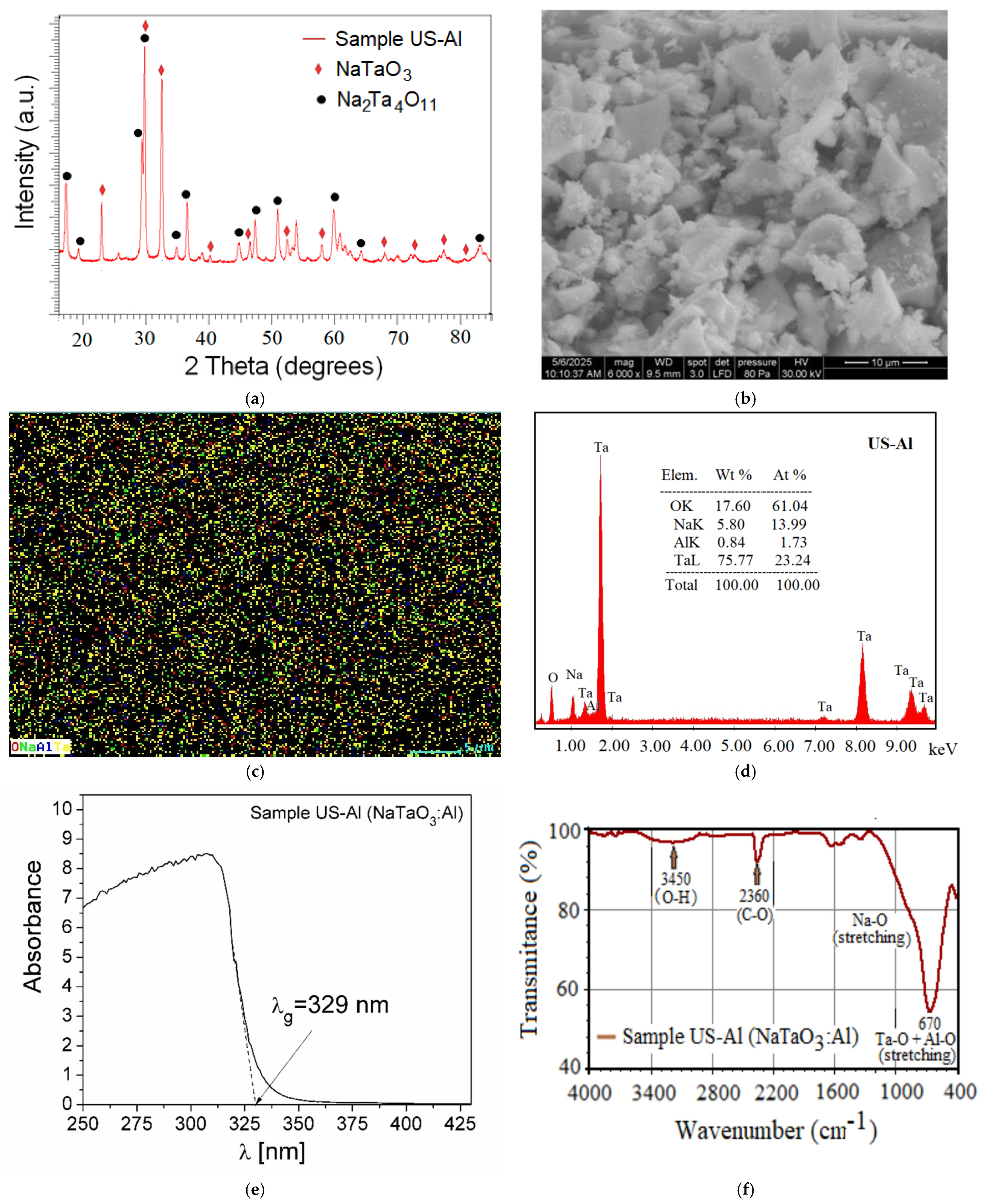
The X-ray diffraction pattern of the sodium tantalate sample doped with Al metal ions (sample US-Al) is shown in Figure 1a.
As can be seen in Figure 1a, the XRD pattern of the NaTaO3 sample doped with Al ions, obtained by the ultrasonic method (US-Al), exhibits relatively low crystallinity, with two phases present: the main perovskite phase NaTaO3 and a secondary phase identified as Na2Ta4O11 (natrotantite), according to JCPDS card no. 38-0463. From the X-ray diffraction data, the average crystallite size was calculated using the Scherrer equation based on the broadening of diffraction peaks, specifically the full width at half maximum (FWHM, β), after correcting for the instrumental contribution and subtracting the Kα2 component. For the investigated sample (US-Al), crystallite size estimation was performed on several diffraction maxima exhibiting sufficient broadening to allow accurate FWHM determination, namely, the (006), (012), (104), (119), and (115) reflections. Crystallite size analysis revealed that the Na2Ta4O11 phase has an average size of 26.6 nm, while the NaTaO3 phase has a noticeably larger size of 39.1 nm, suggesting distinct nucleation and growth mechanisms for the two crystalline phases.

3.1.2. Scanning Electron Microscopy

In Figure 1b–d, the SEM images, the EDX spectrum, element quantification, and mapping of the Al-doped NaTaO3 ceramic material synthesized by the ultrasonic method are presented. The SEM micrograph of the Al-doped NaTaO3 sample (Figure 1b) reveals a highly agglomerated microstructure composed of irregular, plate-like particles with rough surfaces and sharp fracture edges. The grain size distribution appears relatively broad, ranging from submicron dimensions to several micrometers, as estimated from the scale bar. In Figure 1c, the elemental mapping analysis demonstrates the presence and uniform spatial distribution of Na, Ta, O, and Al across the analyzed area. No evidence of elemental segregation or Al-rich clusters is observed at the micrometer scale. The homogeneous distribution of aluminum suggests its successful incorporation into the NaTaO3 matrix rather than the formation of secondary phases. This compositional uniformity is consistent with the absence of distinct morphological contrasts observed in the corresponding SEM image. The EDX spectrum (Figure 1d) further verifies the elemental composition of the sample, displaying characteristic peaks corresponding to Na, Ta, O, and Al. Quantitative analysis indicates that the measured elemental ratios are close to the nominal composition within the experimental uncertainty inherent to EDX measurements. The detection of aluminum, together with its uniform distribution revealed by elemental mapping, confirms the effective doping of the NaTaO3 perovskite structure.

3.1.3. UV-VIS Spectroscopic Analysis

Figure 1e shows the UV-VIS absorption spectrum of the Al-doped sodium tantalate (NaTaO3) sample. From Figure 1e, the wavelength end of the absorption range was determined, λg, corresponding to sample NaTaO3 doped with aluminum ions, as the intersection point between the tangent to the linear portion of the absorption spectrum and the wavelength axis; the obtained value is λg = 329 nm. The optical bandgap energy (Eg) of the sample can be computed [36,37] with the relation:
E g ( e V ) = 1240 λ g ( n m )
Considering Equation (1) and the λg value determined from Figure 1e, the value obtained for the optical bandgap energy is Eg = 3.77 eV for sample NaTaO3 doped with aluminum ions. The obtained result shows that by doping the sodium tantalate ceramic material (NaTaO3) with Al metal ions, the value of the optical band gap energy decreases to 3.77 eV from 4 eV [18] (for undoped NaTaO3). This decrease in Eg energy compared to that of undoped NaTaO3 indicates an increase in the mobility of the carriers and also an improvement in the absorption in the infrared domain, making the NaTaO3 material doped with Al metal cations useful for photocatalysis, as also shown by other authors [38,39].

3.1.4. FT-IR Analysis

Figure 1f shows the FTIR spectrum of the Al-doped sodium tantalate (NaTaO3) sample (sample US-Al). As shown in [40,41], the FTIR absorption spectrum of a NaTaO3 sample exhibits a main absorption band centered around (1100–1200) cm−1, attributed to stretching vibrations of the Na-O functional group, as well as three distinct (weaker) absorption bands centered between (500 and 700) cm−1, indicating vibrational excitation. The presence of Al dopant ions in the structure of NaTaO3 prepared by the ultrasonic method (US-Al, Figure 1f) causes a significant decrease, up to disappearance, in the share of the main absorption band (Na-O), accompanied by the appearance of a strong absorption band at 670 cm−1, attributed to the excitation of vibrations (stretching) of the Ta-O and Al- O groups, with a much higher share of the latter. An explanation for the appearance of this band could be a symmetric combination of the Ta-O and Al-O stretching modes in the TaO6 octahedra [40,41]. At the same time, from Figure 1f, it is observed that the characteristic peak corresponding to C−O stretching is present at 2360 cm−1, like the value corresponding to the undoped NaTaO3 sample [40]. By doping the NaTaO3 sample with Al metal ions (US-Al sample, Figure 1f), it is observed that the IR band corresponding to the O−H vibrations of the water adsorbed on the surface shifts to lower values (3150 cm−1) compared to the IR band corresponding to an undoped NaTaO3 sample [40,41], which is present between (3200 and 3300) cm−1.

3.2. Impedance Spectra and Equivalent Circuit

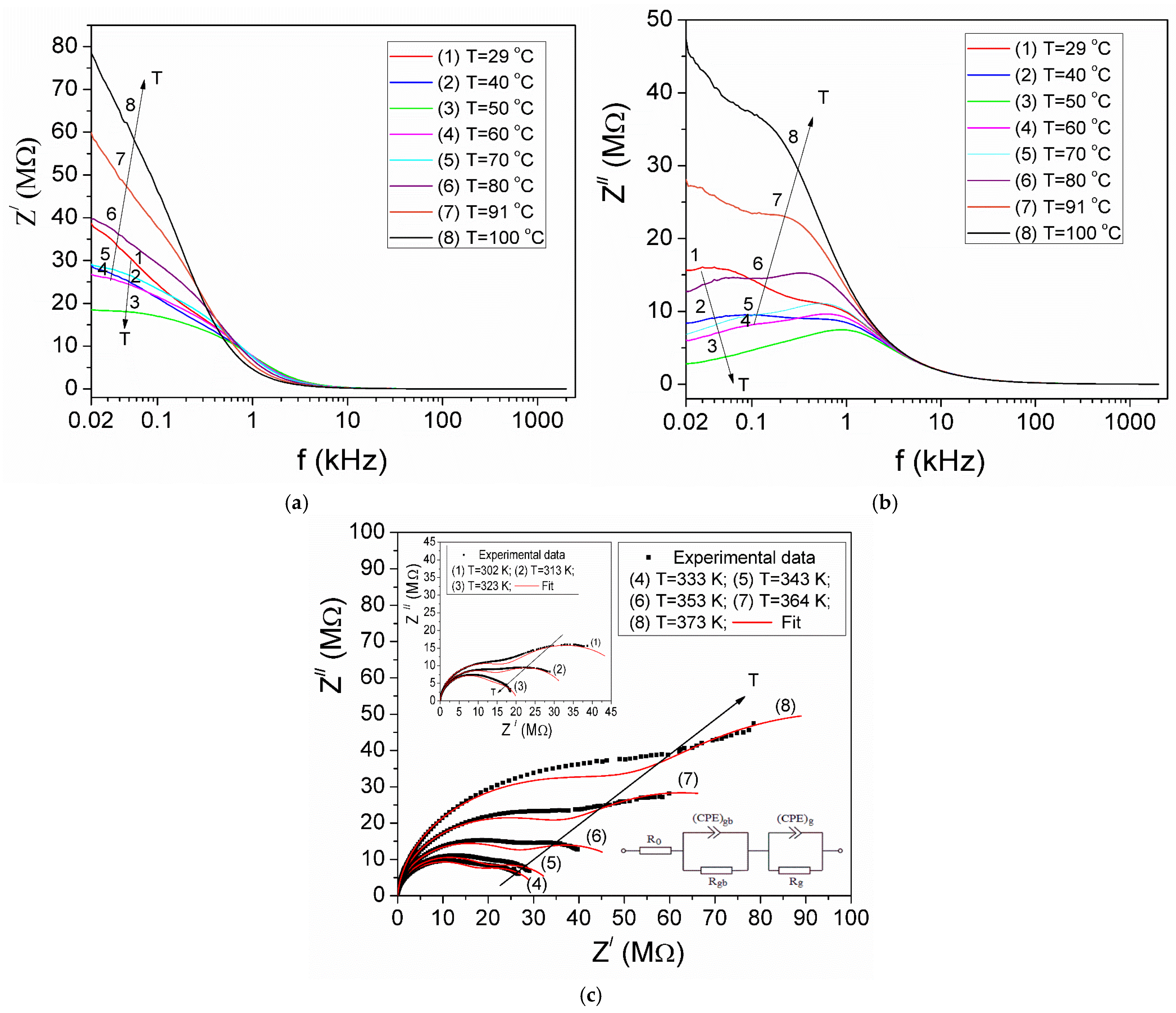
Figure 2a,b show the frequency dependence of the real Z′ and imaginary Z″ components of the complex impedance, in the range 20 Hz–2 MHz, at different temperatures T, between (29 and 100) °C, as well as the Nyquist diagrams (Figure 2c) of the sample at different temperatures.
As shown in Figure 2a, the real component Z′ decreases with increasing frequency (f) at each constant temperature (T). At low frequencies (up to approximately 1 kHz), the Z′ values decrease as the temperature rises from 29 °C to 50 °C; however, beyond 50 °C, Z′ begins to increase as the temperature reaches 100 °C. At high frequencies (above 10 kHz), the Z′ curves overlap for all temperatures. Figure 2b shows that at each constant temperature, the imaginary component Z′′ exhibits two maxima: one at low frequencies (on the order of tens of Hz) and the second at higher frequencies (on the order of hundreds of Hz). The peak frequencies, fmax,1(Z) and fmax,2(Z), shift toward higher values as the temperature increases from 29 °C to approximately 50 °C, while the Z′′ values decrease. Conversely, as the temperature increases from 50 °C to 100 °C, these two frequencies shift back toward lower values while the Z′′ values increase.
The presence of two maxima in the Al-doped NaTaO3 sample synthesized via the ultrasonic method (US-Al) can be correlated with the two phases identified by XRD analysis: the primary perovskite phase (NaTaO3) and a secondary phase (Na2Ta4O11, natrotantite) (see Figure 1a). This secondary phase can generate charge traps and regions of varying conductivity; the boundary between these two phases acts as a barrier, influencing the low-frequency dielectric response through Maxwell–Wagner interfacial relaxation [42]. These results differ from those reported in a recent study of an Al-doped NaTaO3 sample prepared by the sol–gel method, which exhibited only a single perovskite phase [32]. For that sample [32], the Z′′ component presented only one maximum at frequencies near 1 kHz. Consequently, we can consider that the second maximum observed in Figure 2b at frequency fmax,2(Z) can be attributed to the main NaTaO3 perovskite phase.
Figure 2c shows the Nyquist plots (–Z″ versus Z′) of the Al-doped NaTaO3 (US-Al) sample at various temperatures within the frequency range of 20 Hz–2 MHz. As observed in Figure 2c, all impedance spectra exhibit two semicircular arcs, indicating non-Debye relaxation [43]. This behavior may be attributed to the two phases present in the sample, as well as the contributions from grains and grain boundaries [41,44]. Additionally, the decrease in arc radii with increasing temperature indicates semiconducting behavior, which is particularly evident between 29 °C and approximately 60 °C (see inset of Figure 2c).
Furthermore, as shown in Figure 2b, the presence of the maxima of imaginary component (Z′′), fmax,1(Z) and fmax,2(Z), correlates with the existence of an electrical relaxation process in the Al-doped sodium tantalate sample [45,46], due to the presence of charge carriers in the sample [44,47]. Using the experimental values for fmax,1(Z) and fmax,2(Z) in Figure 2b and Debye’s theory [48], 2πfmaxτ(Z) = 1, the relaxation times τ1(Z) and τ2(Z)—corresponding to the relaxation processes of each phase (see Figure 1)—can be determined for each temperature (T). Assuming an Arrhenius-type dependence for the relaxation time τ(Z):
τ ( Z ) = τ 0 exp Δ E r e l a x k T
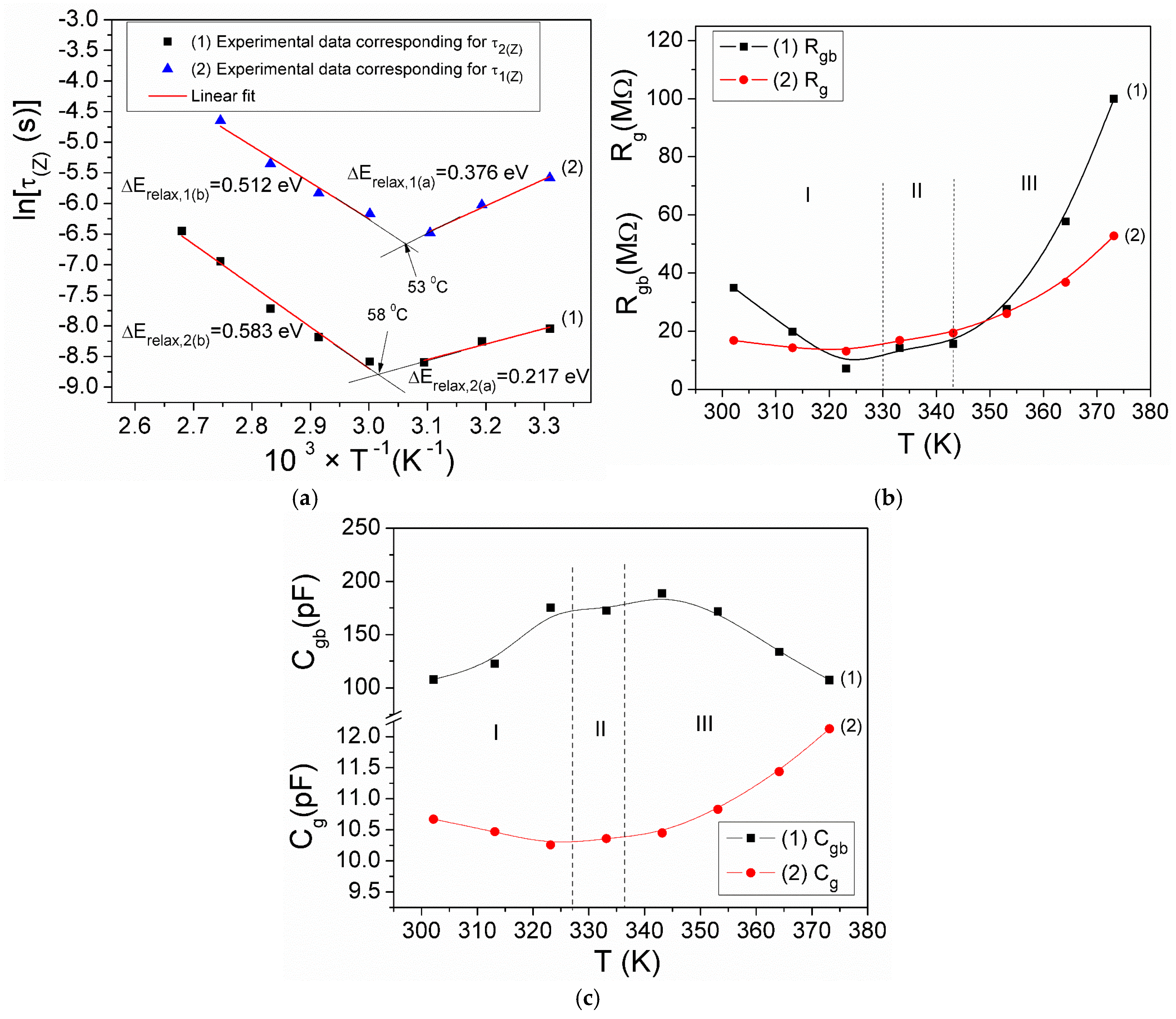
In Figure 3a, the dependence lnτ(Z)(1/T) is shown.
In Equation (2), τ0 represents the pre-exponential factor of the relaxation time; k is the Boltzmann constant, and ΔErelax. is the barrier energy between the localized states [47,49].
The linear fits of the experimental dependencies, lnτ1(Z) vs. (T−1) and lnτ2(Z) vs. (T−1), shown in Figure 3a, present two different slopes, corresponding to the two temperature ranges: below and above 53 °C for τ1 and below and above 58 °C for τ2. These variations in τ with temperature can be associated with two distinct electrical conductivity regimes of the sample [50]. Furthermore, the activation energies (ΔErelax) for these temperature ranges were determined from the Arrhenius fits (Equation (2)). For τ1 (secondary phase), the values obtained were ΔErelax.(1) = 0.376 eV (below 53 °C) and ΔErelax.(2) = 0.512 eV (above 53 °C). For τ2 (main perovskite phase), the values were ΔErelax.(1) = 0.217 eV (below 58 °C) and ΔErelax.(2) = 0.583 eV (above 58 °C). Consequently, for the Al-doped NaTaO3 sample prepared by the ultrasonic method (US-Al), the temperature range of 50–60 °C—where the change in activation energy occurs—represents a transition from semiconductor-type to conductor-type behavior. We will justify this result in what follows.
An analysis of the impedance spectra in Figure 2c was performed by fitting/modeling the experimental data with an equivalent electrical circuit [43,51]. This circuit consists of two parallel circuits in series, representing the contributions of the grains and grain boundaries, along with a negligible series resistance (Ro) corresponding to the electrode interface, which is not accounted for in conventional RC models [44]. The grain circuit comprises a parallel combination of Rg and (CPE)g, while the grain boundary circuit consists of Rgb and (CPE)gb (see Figure 2c). Here, CPE denotes a constant phase element, indicating a deviation from the ideal Debye model [52,53]. The impedance of the CPE, for the grains and grain boundaries [44,54], at each temperature is given by the following equation [55]:
Z C P E = Q 1 i 2 π f n   ,   ( i = 1 )
where Q and n are parameters of the impedance of CPE. It should be noted that the exponent n varies between 0 and 1 when the CPE changes from ideal resistor behavior (n = 0) to perfect capacitor behavior (n = 1). In Table 1, the values of the parameters R0, Rg, Rgb, Q, and n are indicated, obtained by fitting the experimental data of the Nyquist plots, Z′′(Z′) of the sample for each temperature from Figure 2c, with the equivalent electrical circuit from the inset of Figure 2c.
From Table 1, it is observed that the ng values of the grains are closer to unity (between 0.95 and 0.97) than those of the grain boundaries, ngb (0.89–0.95), which indicates that the grains behave like ideal capacitors more than the grain boundaries. This result could be associated with the heterogeneity in the material studied, as observed in the SEM-EDX analysis (Figure 1b–d). Also, from Table 1, the thermal variation throughout the temperature range of Rg and Rgb values, extracted from Nyquist plot fitting, was obtained, as presented in Figure 3b,c.
As shown in Figure 3b, the temperature dependence of both the grain resistance (Rg) and the grain boundary resistance (Rgb) can be divided into three distinct regions. In region I, Rg and Rgb decrease as the temperature rises up to approximately 325–330 K. This is followed by a plateau in region II (330–340 K), where Rg and Rgb remain approximately constant. Finally, in region III, Rg and Rgb increase with further temperature rises. This thermal behavior suggests that the plateau (region II) represents a phase transition, during which the Al-doped sodium tantalate perovskite transitions from a semiconductor phase to a conductor phase, consistent with the trends shown in Figure 3a. Similar phase transitions have been reported by other authors [54,55,56] for various perovskite materials.
As shown in paper [57], the capacitance of constant phase element CPE can be computed with the relation:
C = R 1 n Q 1 / n
where the value of n < 1 (see Table 1) represents the deviation from the ideal Debye behavior, for which n = 1. From Table 1, by knowing the corresponding R, Q, and n values and using relation (4), we determined the grain boundary capacitance (Cgb) and the grain capacitance (Cg) for each temperature, and in Figure 3c the temperature dependence of these capacitances is shown.
As can be observed in Figure 3c, the temperature dependence of both the grain capacitance (Cg) and the grain boundary capacitance (Cgb) can be divided into three regions, similar to the temperature dependence of the Rg and Rgb resistances in Figure 3b. In the first region (I), Cg decreases while Cgb increases with temperature up to approximately 325 K. This is followed by a plateau in region II (325–336) K, where both Cg and Cgb remain nearly constant. Finally, in region III, Cg increases and Cgb decreases with rising temperature (see Figure 3c). As a result, the plateau regions (region II) in Figure 3b,c are nearly identical and represent the semiconductor-to-conductor phase transition of the aluminum-doped NaTaO3 perovskite material. This transition temperature range aligns with the complex impedance measurements shown in Figure 3a and the data presented further below.

3.3. DC Conductivity and Complex Dielectric Permittivity

An important way to study the macroscopic movement of charge carriers through the investigated material is to evaluate its electrical conductivity using the Z′ and Z′′ values of the complex impedance and the relation:
σ = Z Z 2 + Z 2 d A
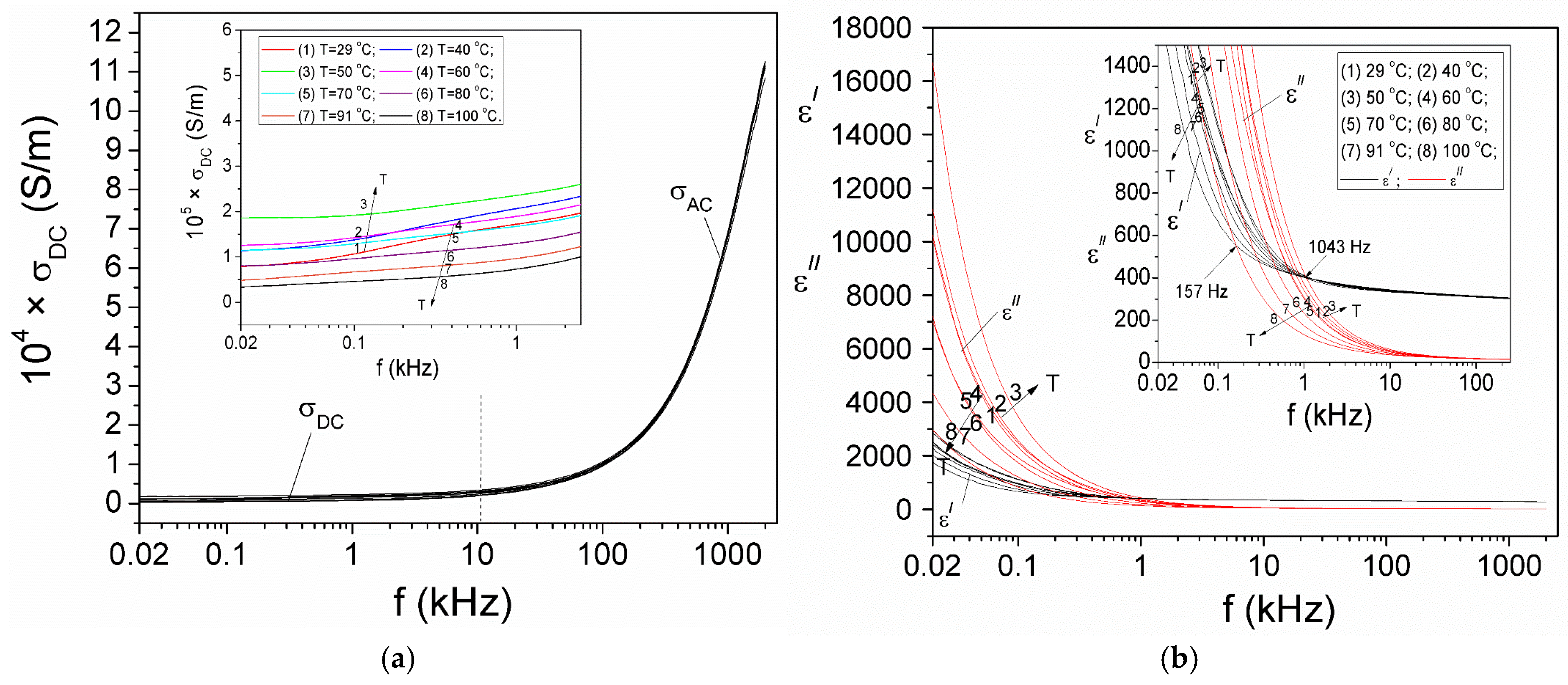
where d and A are the thickness of the sample and its cross-sectional area. In Figure 4a, the frequency dependence of the conductivity σ of the aluminum-doped sodium tantalate (US-Al sample) over the frequency range (20 Hz–2 MHz) and at different temperatures between (29 and 100) °C is shown.
The low-frequency plateau observed at all investigated temperatures (see Figure 4a) is attributed to the contribution of static conductivity (σDC), while the high-frequency dispersion is associated with dynamic conductivity (σAC) [58]. The identification of the appropriate conductivity mechanism from the investigated sample (US-Al) can be done based on the analysis of the frequency spectra in Figure 4a and Jonscher’s universal power law [59,60]:
σ ( ω , T ) = σ D C ( ω , T ) + σ A C ( ω , T )
and
σ A C ( ω , T ) = A 0 ( T ) ω n ( T )
In these relations, ω represents the angular frequency, and the coefficient A0 and exponent n are constants that depend on the temperature and the intrinsic properties of the sample material under study [60,61].
Based on the Z′ and Z″ values of the complex impedance in Figure 2a,b, the real (ε′) and imaginary (ε″) components of the complex dielectric permittivity at different frequencies between 20 Hz and 2 MHz and different temperatures between (29 and 100) °C for the investigated sample were determined with relations (8) and (9). The results are shown in Figure 4b.
ε = 1 ω ε 0 Z Z 2 + Z 2 d A
where ε0 is the dielectric permittivity of the free space.
As shown in Figure 4b, both the real (ε′) and imaginary (ε″) components of the complex dielectric permittivity gradually decrease with frequency across the entire range for all temperatures. At the low-frequency limit (20 Hz), ε′ values are high—ranging from 1600 to 2800, depending on temperature—before decreasing as frequency increases. This behavior aligns with Koop’s phenomenological theory [62,63] and Maxwell–Wagner interfacial polarization, a process involving electron exchange between ions of the same molecule [64]. An electric field applied to the material acts on the positive and negative charges, leading to the creation of a large number of dipoles [63,65]. The high dielectric constant at low frequencies is explained by the fact that the dipoles can easily follow the quasi-static field at these frequencies. By increasing frequency, an increasingly smaller number of dipoles can follow the oscillations of the electric field so that the dielectric constant ε′ decreases. At the same time, at a certain frequency, the value of ε′ can increase by increasing the temperature, which suggests the presence of thermally activated charge carriers. Also, from Figure 4b, it is observed that the values of the ε″ component are much higher than those of the ε′ component, varying between 3000 and 16,300 depending on the temperature. This behavior at low frequencies shows that the conduction losses are higher than those due to dielectric relaxation [66]. Increasing the frequency, the values of the ε″ component decrease for all investigated temperatures, so that at frequencies between 157 Hz and 1043 Hz, they become smaller than those of the ε′ component, as observed in the inset of Figure 4b. This indicates that for frequencies above those between 157 Hz and 1043 Hz, dielectric relaxation losses become important [66].
Considering the Debye equation [66] for the imaginary component ε″, the following relationship can be written:
ε ( ω ) = ε c o n d ( ω ) + ε r e l ( ω ) = σ D C 2 π f ε 0 + ε r e l ( ω )
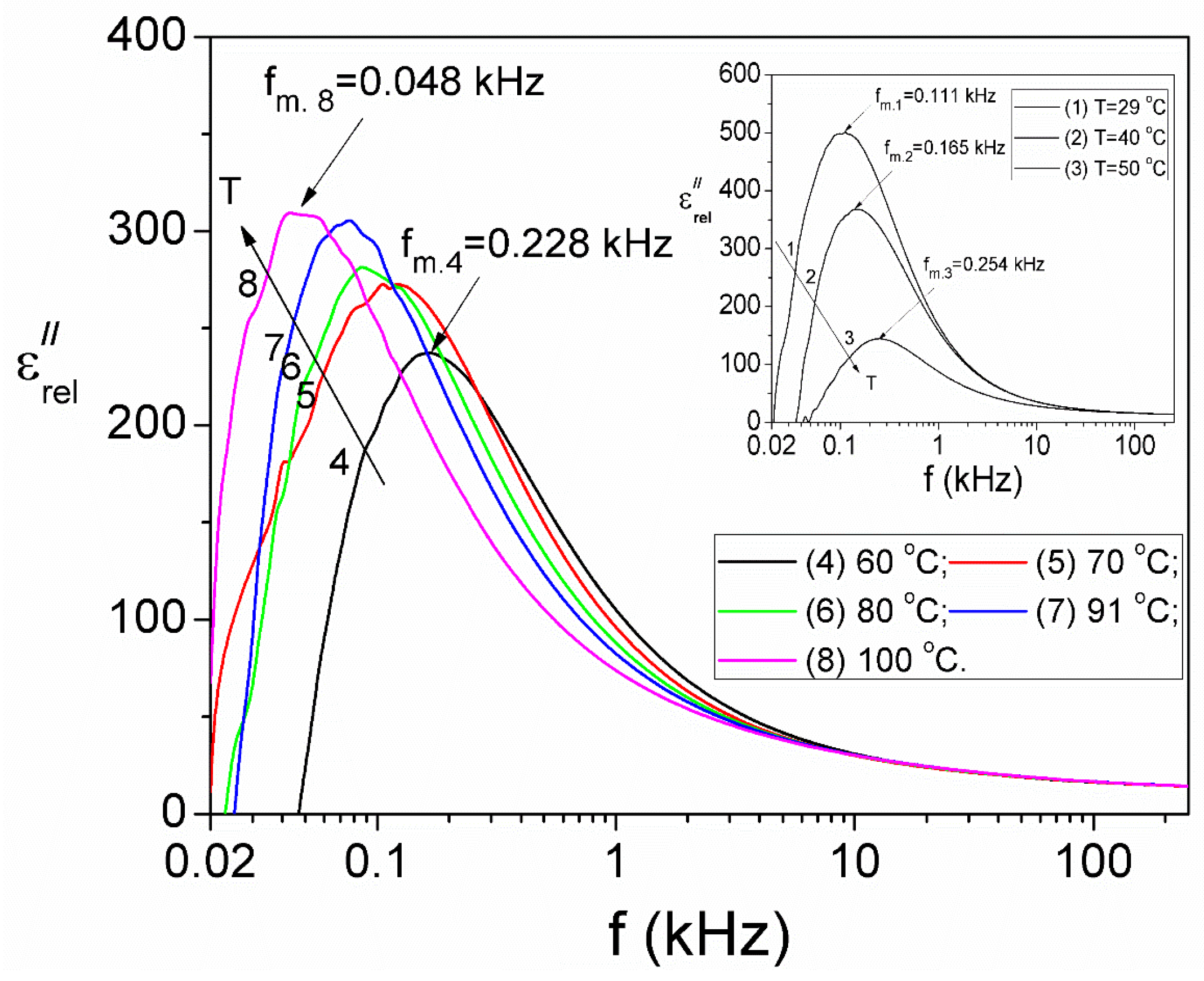
In Equation (10), σDC/2πfε0 represents the conduction losses (ε″cond) and (ε″rel) the dielectric relaxation losses. Considering the σDC values of the static conductivity (Figure 4a) and the total values of the ε″ component (Figure 4b) at all investigated temperatures, the dielectric relaxation losses (ε″rel) were determined from Equation (10) by eliminating the conduction losses. The results are presented in Figure 5.
As can be seen in Figure 5, ε″rel exhibits a maximum at frequency fm for each temperature T, which indicates the existence of a relaxation process attributed to interfacial relaxation [59,60,61].

3.4. Identifying the Transition Temperature

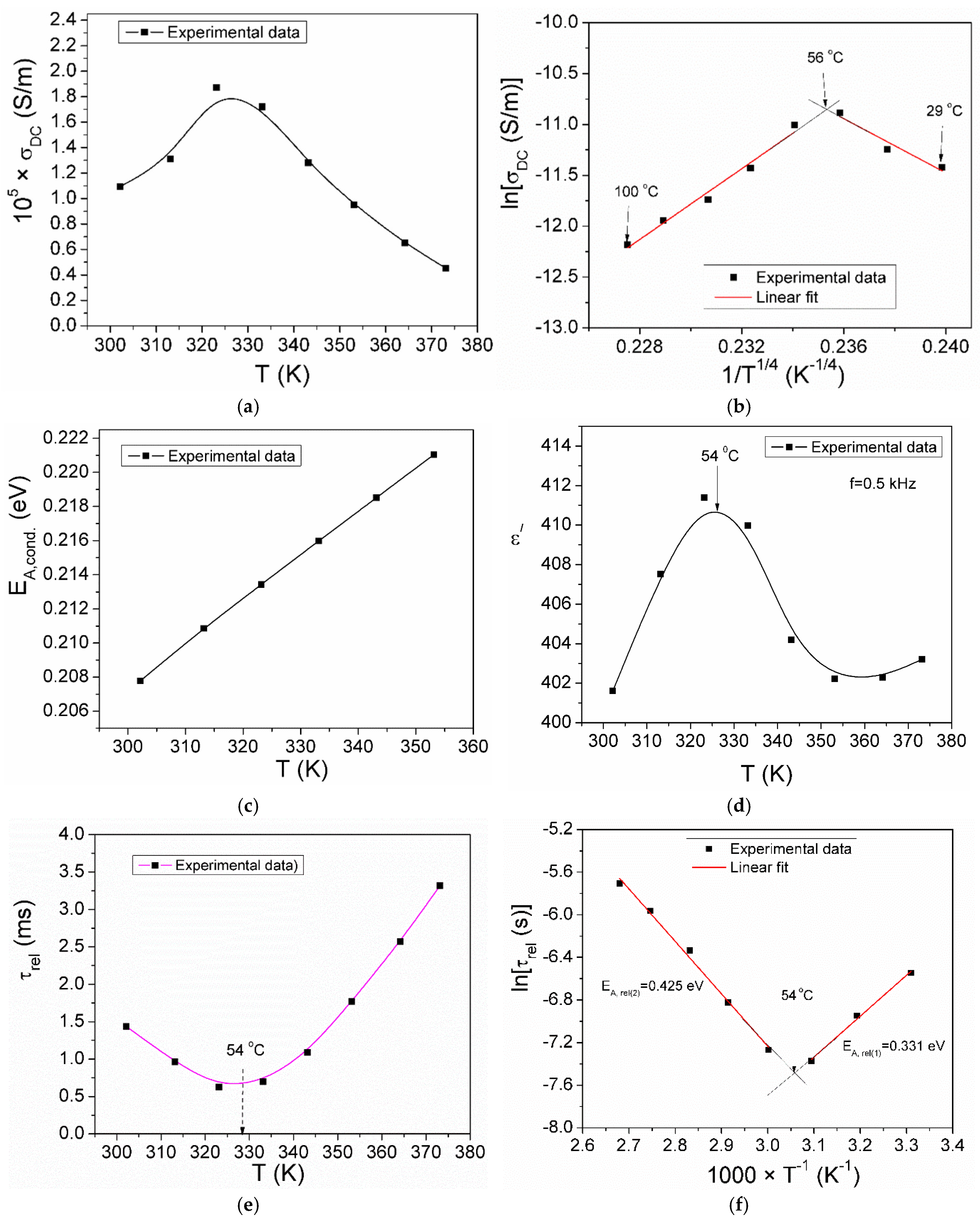
Considering the inset of Figure 4a, which shows the frequency and temperature dependence of the static conductivity σDC from low frequencies (20 Hz–1200 Hz), by fitting with a straight line, the values of σDC were determined at each temperature T. In Figure 6a, the dependence of σDC(T) of the aluminum-doped sodium tantalate sample (US-Al) is shown.
As can be seen in Figure 6a, by increasing the temperature to approximately (50–60) °C, the conductivity σDC increases, then it starts to decrease by increasing the temperature to 100 °C. As a result, in the low-temperature range (below 60 °C), the increase in the conductivity σDC indicates semiconductor-like behavior of the analyzed sample. In other words, it can be said that near the temperature of (50–60) °C, there is a transition from a semiconductor-like behavior to a conductor-like behavior of the sample (above 60 °C) when σDC decreases [32]. The behavior of the Al-doped NaTaO3 sample in Figure 6a in the temperature range up to (50–60) °C is in agreement with Mott’s VRH theory [47].
As a result, considering the VRH model, by doping the NaTaO3 sample with Al ions, with increasing temperature, the hopping distance of charge carriers between localized states decreases [32], which determines the increase in the static conductivity of the investigated sample with temperature. At the same time, it can be said that the phase boundary acts as a barrier between the low-conductivity and high-conductivity regions.
According to the VRH model, conductivity σDC is given by the relation:
σ D C = σ 0 exp B T 1 / 4
where σ0 is the pre-exponential factor of conductivity and B is given by the relation:
B = 4 E A , c o n d k T 3 / 4
In Equation (12), EA,cond represents the thermal activation energy of static conductivity. In Figure 6b, the dependence ln(σDC)(1/T1/4) is presented according to the VRH model (Equation (11)). By fitting the experimental dependence in Figure 6b with a straight line, it is found that the conductivity slope changes at a temperature of 56 °C, which is the transition temperature from semiconductor-type behavior to a conductor-type behavior. This result is like the experimental dependence, lnτ(Z)(1/T), in Figure 3a, which shows two different slopes at (50–60) °C, associated with two ranges of different electrical conductivities of the sample.
Knowing the slope B of the fit corresponding to the temperature range (29–56) °C (B = 132.96394) in which the sample behaves like a semiconductor (see Figure 6b), from Equation (12), the thermal activation energy of conduction, EA,cond, over this temperature range was determined. As a result, Figure 6c shows the temperature dependence EA,cond(T) for the US-Al sample in the temperature range below 60 °C, in which the investigated sample behaves like a semiconductor.
From Figure 6c, it is observed that EA,cond increases linearly with increasing temperature in the range in which the sample behaves like a semiconductor, which means that the electrical conduction in the sample can be explained by the process of charge carriers hopping between the localized states [47], according to Mott’s VRH model. The value of EA,cond for the aluminum-doped sodium tantalate sample increases from approximately 0.208 eV to 0.222 eV, correlating very well with the result obtained from electrical relaxation measurements for the barrier energy between the localized states, ΔErelax.2(a) = 0.217 eV, as shown in Figure 3a, Section 3.2. This value corresponds to the temperature range of (29–60) °C, in which the sample behaves as a semiconductor, and is correlated with the main perovskite phase NaTaO3 of the investigated sample, being similar to the values indicated by other authors for similar perovskite samples with semiconductor behavior [32,44,61]. It should be noted that this value (0.217 eV) represents the average value of the thermal conduction activation energy, EA,cond, corresponding to the investigated temperature range of (29–56) °C in Figure 6c, which justifies the interpretation of the fact that ΔErelax represents the barrier energy necessary for charge carrier hopping between localized states.
The identification of the semiconductor-to-conductor transition temperature of the aluminum-doped NaTaO3 sample can also be supported by the analysis of the dielectric permittivity with temperature. In this regard, Figure 6d presents the temperature variation in the real component ε′ at f = 0.5 kHz, corresponding to the low-frequency plateau (see Figure 4b) attributed to the static conductivity contribution.
From Figure 6d, it is observed that by increasing the temperature, ε′ increases and reaches a maximum at a temperature of 54 °C, after which it starts to decrease with a further increase in temperature towards 100 °C. The temperature of 54 °C at which ε′ changes its direction of variation can be attributed to the transition temperature [67] from semiconductor-type behavior to conductive behavior of the sample. The value obtained is very close to the value obtained both from static conductivity measurements (56 °C) (see Figure 6b) and complex impedance measurements (58 °C) (see Figure 3a). On the other hand, as previously shown in Figure 5, the imaginary component ε″rel, due to dielectric relaxation, has a maximum at frequency fm and at each temperature T, which indicates the existence of a relaxation process attributed to interfacial relaxation [59,60,61], characterized by the relaxation time τrel. From the experimental values of fm (Figure 5) and the Debye equation [48], the relaxation time τrel was determined, and in Figure 6e, the temperature dependence of τrel for the investigated sample, US-Al, is presented.
The variation in the relaxation time τrel with temperature in Figure 6e indicates a decrease up to a temperature close to 54 °C, followed by an increase in τrel with increasing temperature up to 100°C, which indicates that τrel has an Arrhenius-type behavior of the form of Equation (2) at temperatures up to 54 °C. The linear fit of the experimental dependence lnτrel(1/T), considering Arrhenius-type dependence (Figure 6f), presents two different slopes, corresponding to two temperature ranges, namely, below 54 °C and above 54 °C, which are associated with different electrical conductivities of the sample in these temperature ranges. Also, from the fit slope, the activation energy of the dielectric relaxation process EA,rel for the two temperature ranges can be determined. The values obtained are (EA,rel)1 = 0.331 eV and (EA,rel)2 = 0.425 eV, in agreement with the value obtained by other authors for similar perovskite samples [68,69]. Consequently, the temperature of 54 °C, where changes in the activation energy of relaxation (type of conductivity) occur, represents the transition temperature from semiconductor-type behavior to conductor-type behavior of the sample. The value obtained for the transition temperature (54 °C) is very close to that obtained from complex impedance measurements (58 °C) (see Figure 3a), or from static electrical conductivity measurements (56 °C) (see Figure 6b), the real component of permittivity and dielectric relaxation time (54 °C) (see Figure 6d,f).

4. Conclusions

Aluminum-doped NaTaO3 perovskite (US-Al), synthesized by an ultrasonic method, exhibits relatively low crystallinity and comprises two phases: the main perovskite phase, NaTaO3, and a secondary phase identified as Na2Ta4O11 (natrotantite). The optical bandgap of the US-Al sample is 3.77 eV, which is lower than that of the undoped NaTaO3 perovskite (4 eV), suggesting enhanced infrared absorption and improved photocatalytic potential. For the first time in an FT-IR spectrum, a strong absorption band was identified at 670 cm−1, attributed to Ta-O and Al-O stretching vibrations induced by Al incorporation.
In the frequency range (20 Hz–2 MHz) and at different temperatures between (29 and 100) °C, the imaginary component Z″ presents two maxima, indicating the hopping of charge carriers between localized states with relaxation times τ1 and τ2. The analysis of τ(T) yields barrier energies between the localized states of 0.217 eV (below 58 °C) and 0.583 eV (above 58 °C), corresponding to two conductivity regimes. Therefore, a transition at ~58 °C is highlighted, marking a change from semiconducting to conducting behavior of the sample.
The fitting of the experimental data Z′′(Z′) for each temperature shows two semicircular arcs associated with the coexisting phases and the contributions of the grains and grain boundaries. The fitting was performed using two parallel equivalent circuits (R//CPE) corresponding to the grains and grain boundaries, respectively, and confirms this interpretation. These temperature-dependent grain (Rg) and grain boundary (Rgb) resistances show a plateau between 330 and 340 K, consistent with a phase transition region that encompasses the identified transition temperature.
The conductivity spectrum σ(f) follows the universal Jonscher law at all temperatures. The static conductivity σDC(T) shows a change in slope near 56 °C, further supporting the semiconductor–conductor transition. The dielectric analysis of the ε′ and ε″ components, after eliminating conduction losses, indicates interfacial polarization and dielectric relaxation with relaxation time τrel. The temperature dependence of the ε′ component at 0.5 kHz shows a change in the direction of variation in ε′ at ~54 °C. At the same time, the τrel(T) analysis highlights that at the same temperature (~54 °C), a change in the activation energy of the dielectric relaxation process occurs, corresponding to two conductivity regimes. As a result, the temperature of 54 °C can be attributed to the semiconductor–conductor transition temperature of the sample, in close agreement with values obtained from conductivity (56 °C) and impedance (58 °C) analyses.
Overall, the ultrasonic synthesis route uniquely produces a two-phase system that enables the observation of a low-temperature semiconductor-to-conductor transition, a phenomenon not present in single-phase materials prepared by the sol–gel method.

Author Contributions

Conceptualization, I.M., C.N.M. and P.S.; methodology, I.M., P.S. and M.O.B.; measurements, M.O.B., P.S. and I.M.; validation, C.N.M., M.O.B. and I.M.; formal analysis, C.N.M. and M.O.B.; investigation, I.M., C.N.M. and M.O.B.; writing—original draft preparation, I.M., M.O.B. and P.S.; writing—review and editing, I.M., C.N.M. and M.O.B.; visualization, C.N.M. and M.O.B.; supervision, M.O.B. and I.M. All authors have read and agreed to the published version of the manuscript.

Funding

This research received no external funding.

Data Availability Statement

The data presented in this study are available upon request from the corresponding authors.

Conflicts of Interest

The authors declare no conflicts of interest.

Abbreviations

The following abbreviations are used in this manuscript:
US-AlUltrasonic Aluminum
VRHVariable Range Hopping

References

  1. Butt, M.K.; Yaseen, M.; Bhatti, I.A.; Iqbal, J.; Misbah; Murtaza, A.; Iqbal, M.; AL-Anazy, M.; Alhossainy, M.H.; Laref, A. A DFT study of structural, magnetic, elastic and optoelectronic properties of lanthanide based XAlO3 (X = Nd, Gd) compounds. J. Mater. Res. Technol. 2020, 9, 16488–16496. [Google Scholar] [CrossRef]
  2. Tayari, F.; Teixeira, S.S.; Graca, M.P.F.; Nassar, K.I. A Comprehensive Review of Recent Advances in Perovskite Materials: Electrical, Dielectric, and Magnetic Properties. Inorganics 2025, 13, 67. [Google Scholar] [CrossRef]
  3. Liu, Y.; Wang, W.; Xu, X.; Veder, J.P.M.; Shao, Z. Recent advances in anion-doped metal oxides for catalytic applications. J. Mat. Chem. A 2019, 7, 7280–7300. [Google Scholar] [CrossRef]
  4. Dastgeer, G.; Zulfiqar, M.W.; Nisar, S.; Zulfiqar, R.; Imran, M.; Panchanan, S.; Dutta, S.; Akbar, K.; Vomiero, A.; Wang, Z. Emerging Role of 2D Materials in Photovoltaics: Efficiency Enhancement and Future Perspectives. Nano-Micro Lett. 2026, 18, 32. [Google Scholar] [CrossRef]
  5. Bati, A.S.R.; Zhong, Y.L.; Burn, P.L.; Nazeeruddin, M.K.; Shaw, P.E.; Batmunkh, M. Next-generation applications for integrated perovskite solar cells. Commun. Mater. 2023, 4, 2. [Google Scholar] [CrossRef]
  6. Dastgeer, G.; Nisar, S.; Zulfiqar, M.W.; Eom, J.; Imran, M.; Akbar, K. A review on recent progress and challenges in high-efficiency perovskite solar cells. Nano Energy 2024, 132, 110401. [Google Scholar] [CrossRef]
  7. Park, Y.; Lee, J.S. Metal Halide Perovskite-Based Memristors for Emerging Memory Applications. J. Phys. Chem. Lett. 2022, 13, 5638–5647. [Google Scholar] [CrossRef]
  8. Riaz, S.; Yaseen, M.; Butt, M.K.; Mubashir, S.; Iqbal, J.; Altowyan, A.S.; Dahshan, A.; Murtaza, A.; Iqbal, M.; Laref, A. Physical characteristics of NaTaO3 under pressure for electronic devices. Mat. Sci. Sem. Process. 2021, 133, 105976. [Google Scholar] [CrossRef]
  9. Deshmukh, V.; Harini, H.; Nagaswarupa, H.; Naik, R.; Ravikumar, C. Development of novel Co3+ doped LaMnO3 perovskite electrodes for supercapacitors and sensors: Mechanism of electrochemical energy storage and oxygen intercalation. J. Energy Storage 2023, 68, 107805. [Google Scholar] [CrossRef]
  10. Sun, C.; Alonso, J.A.; Bian, J. Recent Advances in Perovskite-Type Oxides for Energy Conversion and Storage Applications. Adv. Energy Mater. 2020, 11, 2000459. [Google Scholar] [CrossRef]
  11. Archana; Sharma, R.; Revathi, V.; Srivastava, V. Thermoelectric and optoelectronic features of C- and N- doped CsZnBr3 halide perovskite for use in spin filter and energy efficient devices. Opt. Laser Technol. 2025, 181, 111833. [Google Scholar] [CrossRef]
  12. Aslam, M.; Waseem, Z.; Jamil, M.; Manzoor, M.; Zatsepin, A.; Almeer, R.; Kumar, Y.A.; Sharma, R. Effect of Anion on Optoelectronic and Thermoelectric Properties Cubic Double Perovskites A2(Sr, Ba)WMgO6 for Low-Cost Energy Technologies: A Computational Simulation Study. J. Inorg. Organomet. Polym. Mater. 2025, 35, 2440–2455. [Google Scholar] [CrossRef]
  13. Sauerwein, F.; Dömer, N.; Hehemann, T.; Huesmann, M.; Ganschow, S.; Imlau, M. Lithium Niobate Tantalate Solid Solutions Probed by Luminescence Spectroscopy. Crystals 2026, 16, 1. [Google Scholar] [CrossRef]
  14. Wunderlich, W.; Mori, T.; Sologub, O. SPS-sintered NaTaO3–Fe2O3 composite exhibits enhanced Seebeck coefficient and electric current. Mater. Renew. Sustain. Energy 2014, 3, 21. [Google Scholar] [CrossRef]
  15. Kanhere, P.; Chen, Z. A review on visible light active perovskite based photocatalysts. Molecules 2014, 19, 19995–20022. [Google Scholar] [CrossRef] [PubMed]
  16. Kang, H.W.; Park, S.B. Water photolysis by NaTaO3-composite prepared by spray pyrolysis. Adv. Powder Technol. 2010, 21, 106–110. [Google Scholar] [CrossRef]
  17. Li, F.F.; Liu, D.R.; Gao, G.M.; Xue, B.; Jiang, Y.S. Improved visible-light photocatalytic activity of NaTaO3 with perovskite-like structure via sulfur anion doping. Appl. Catal. B Environ. Energy 2015, 166–167, 104–111. [Google Scholar] [CrossRef]
  18. Liu, Y.L.; Yang, C.L.; Wang, M.S.; Ma, X.G.; Yi, Y.G. Te-doped perovskite NaTaO3 as a promising photocatalytic material for hydrogen production from water splitting driven by visible light. Mater. Res. Bull. 2018, 107, 125–131. [Google Scholar] [CrossRef]
  19. Portugal, G.R.; Arantes, J.T. Structural and electronic properties of NaTaO3 cubic nanowires. Phys. Chem. Chem. Phys. 2020, 22, 7250–7258. [Google Scholar] [CrossRef] [PubMed]
  20. Kennedy, B.J.; Prodjosantoso, A.K.; Howard, C.J. Powder neutron diffraction study of the high temperature phase transitions in NaTaO3. J. Phys. Condens. Matter 1999, 11, 6319. [Google Scholar] [CrossRef]
  21. Zhou, X.; Shi, J.; Li, C. Effect of Metal Doping on Electronic Structure and Visible Light Absorption of SrTiO3 and NaTaO3 (Metal = Mn, Fe, and Co). Phys. Chem. C 2011, 115, 8305–8311. [Google Scholar] [CrossRef]
  22. Sfirloaga, P.; Marin, C.N.; Malaescu, I.; Vlazan, P. The electrical performance of ceramics materials with perovskite structure doped with metallic ions. Ceram. Int. 2016, 42, 18960–18964. [Google Scholar] [CrossRef]
  23. Cheng, P.; Li, S.; Zhang, L.; Li, J. Characterization of intrinsic donor defects in ZnO ceramics by dielectric spectroscopy. Appl. Phys. Lett. 2008, 93, 012902. [Google Scholar] [CrossRef]
  24. Kumar, P.; Sharma, A.K.; Singh, B.P.; Sinha, T.P.; Singh, N.K. Dielectric Relaxation in Complex Perovskite Oxide Sr(Gd0.5Nb0.5)O3. Mat. Sci. Appl. 2012, 3, 369–376. [Google Scholar] [CrossRef]
  25. Dhifallah, N.; Hehlen, B.; Khemakhem, H. Electrical conductivity and impedance spectroscopy studies of ceramic (Ba0.8Sr0.2)Ti0.95(Zn1/3Nb2/3)0.05O3 doped with Bi2O3. Solid State Commun. 2022, 358, 115003. [Google Scholar] [CrossRef]
  26. Sfirloaga, P.; Miron, I.; Malaescu, I.; Marin, C.N.; Ianasi, C.; Vlazan, P. Structural and physical properties of undoped and Ag-doped NaTaO3 synthesized at low temperature. Mater. Sci. Semicond. Process. 2015, 39, 721–725. [Google Scholar] [CrossRef]
  27. Navas, D.; Fuentes, S.; Castro-Alvarez, A.; Chavez-Angel, E. Review on Sol-Gel Synthesis of Perovskite and Oxide Nanomaterials. Gels 2021, 7, 275. [Google Scholar] [CrossRef]
  28. Li, Y.; Yao, S.; Wen, W.; Xue, L.; Yan, Y. Sol–gel combustion synthesis and visible light-driven photocatalytic property of perovskite LaNiO3. J. Alloys Compd. 2010, 491, 560–564. [Google Scholar] [CrossRef]
  29. Walton, R. Perovskite Oxides Prepared by Hydrothermal and Solvothermal Synthesis: A Review of Crystallization, Chemistry and Compositions. Chem. Eur. J. 2020, 26, 9041–9069. [Google Scholar]
  30. Shi, J.; Liu, G.; Wang, N.; Li, C. Microwave-assisted hydrothermal synthesis of perovskite NaTaO3 nanocrystals and their photocatalytic properties. J. Mater. Chem. 2012, 22, 18808–18813. [Google Scholar] [CrossRef]
  31. Tien, N.A.; Almjasheva, O.V.; Mittova, I.Y.; Stognei, O.V.; Soldatenko, S.A. Synthesis and magnetic properties of YFeO3 nanocrystals. Inorg. Mater. 2009, 45, 1304–1308. [Google Scholar] [CrossRef]
  32. Malaescu, I.; Sfirloaga, P.; Marin, C.N. Experimental Investigations of the AC-Conductivity in NaTaO3 Ceramic Materials Doped with Cu and Al Metal Ions. Metals 2024, 14, 793. [Google Scholar] [CrossRef]
  33. Griffiths, P.; de Hasseth, J.A. Fourier Transform Infrared Spectrometry, 2nd ed.; Wiley-Blackwell Inc.: Hoboken, NJ, USA, 2007. [Google Scholar]
  34. Lungu, A.; Malaescu, I.; Marin, C.N.; Vlazan, P.; Sfirloaga, P. The electrical properties of manganese ferrite powders prepared by two different methods. Phys. B Condens. Matter 2015, 462, 80–85. [Google Scholar] [CrossRef]
  35. ASTM D150-98; Standard Test Methods for AC Loss Characteristics and Permittivity (Dielectric Constant) of Solid Electrical Insulation. ASTM: West Conshohocken, PA, USA, 2017.
  36. Lin, W.H.; Cheng, C.; Hu, C.C.; Teng, H. NaTaO3 photocatalysts of different crystalline structures for water splitting into H2 and O2. Appl. Phys. Lett. 2006, 89, 211904. [Google Scholar] [CrossRef]
  37. Zhao, Y.X.; Liu, D.R.; Li, F.F.; Yang, D.F.; Jiang, Y.S. Preparation, characterization and photocatalytic activity of N-doped NaTaO3 nanocubes. Powder Technol. 2011, 214, 155–160. [Google Scholar] [CrossRef]
  38. Onishi, H. Sodium Tantalate Photocatalysts Doped with Metal Cations: Why Are They Active for Water Splitting? Chem. Sus. Chem. 2019, 12, 1825–1834. [Google Scholar] [CrossRef]
  39. Shanker, V.; Samal, S.L.; Pradhan, G.K.; Narayana, C.; Ganguli, A.K. Nanocrystalline NaNbO3 and NaTaO3: Rietveld Studies, Raman Spectroscopy and Dielectric Properties. Solid State Sci. 2009, 11, 562–569. [Google Scholar] [CrossRef]
  40. Farooq, U.; Ahmed, J.; Alshehri, S.M.; Ahmad, T. High-Surface-Area Sodium Tantalate Nanoparticles with Enhanced Photocatalytic and Electrical Properties Prepared through Polymeric Citrate Precursor Route. ACS Omega 2019, 4, 19408–19419. [Google Scholar] [CrossRef]
  41. Gharbi, I.; Oueslati, A.; Ates, A.; Mahmoud, A.; Zaghrioui, M.; Gargouri, M. Investigation of structural, morphological, and electrical conductivity study for understanding transport mechanisms of perovskite CH3NH3HgCl3. RSC Adv. 2023, 13, 10036–10050. [Google Scholar] [CrossRef]
  42. Prodromakis, T.; Papavassiliou, C. Engineering the Maxwell–Wagner polarization effect. Appl. Surf. Sci. 2009, 255, 6989–6994. [Google Scholar] [CrossRef]
  43. Badapanda, T.; Sarangi, S.; Behera, B.; Anwar, S. Structural and impedance spectroscopy study of Samarium modified Barium Zirconium Titanate ceramic prepared by mechanochemical route. Curr. Appl. Phys. 2014, 14, 1192–1200. [Google Scholar] [CrossRef]
  44. Rani, S.; Ahlawat, N.; Punia, R.; Sangwan, K.M.; Rani, S. Dielectric relaxation and conduction mechanism of complex perovskite Ca0.90Sr0.10Cu3Ti3.95Zn0.05O12 ceramic. Ceram. Int. 2018, 44, 5996–6001. [Google Scholar] [CrossRef]
  45. ben Gzaiel, M.; Garoui, I.; Almutairi, F.N.; Mbarek, I.; Oueslati, A. Lead-Free halide perovskites for optoelectronic application: Investigation of structural, optical, electric and dielectric behaviors. Opt. Mater. 2024, 154, 115664. [Google Scholar] [CrossRef]
  46. Mohanty, S.; Choudharyn, R.N.P.; Padhee, R.; Parida, B.N. Dielectric and impedance spectroscopy of BiFeO3–NaTaO3 multiferroics. Ceram. Int. 2014, 40, 9017–9025. [Google Scholar] [CrossRef]
  47. Mott, N.F.; Davis, E.A. Electronic Processes in Non-Crystalline Materials; Clarendon: Oxford, UK, 1979. [Google Scholar]
  48. Debye, P. Polar Molecules; Chemical Catalog Company Inc.: New York, NY, USA, 1929. [Google Scholar]
  49. Malaescu, I.; Lungu, A.; Marin, C.N.; Sfirloaga, P.; Vlazan, P.; Brindusoiu, S.; Poienar, M. Temperature dependence of the dynamic electrical properties of Cu1+xMn1-xO2 (x = 0 and 0.06) crednerite materials. Ceram. Int. 2018, 44, 11610–11616. [Google Scholar] [CrossRef]
  50. Zahrin, A.; Azhar, N.A.; Ibrahim, N.; Mohamed, Z. Structural, Magnetic, and Electrical Properties and Magnetoresistance of Monovalent K-Substituted La0.7Ba0.3−xKxMnO3 (x = 0 and 0.04) Manganite. Condens. Matter 2022, 7, 51. [Google Scholar] [CrossRef]
  51. Sen, S.; Choudhary, R.N.P.; Tarafdar, A.; Pramanik, P. Impedance spectroscopy study of strontium modified lead zirconate titanate ceramics. J. Appl. Phys. 2006, 99, 124114. [Google Scholar] [CrossRef]
  52. Mesrar, M.; Elbasset, A.; Echatoui, N.S.; Abdi, F.; Lamcharfi, T. Studies of Structural, Dielectric, and Impedance Spectroscopy of KBT-Modified Sodium Bismuth Titanate Lead-Free Ceramics. ACS Omega 2022, 7, 37142–37163. [Google Scholar] [CrossRef]
  53. Macdonaled, J.R. Note on the parameterization of the constant-phase admittance element. Solid State Ion. 1984, 13, 147. [Google Scholar] [CrossRef]
  54. Sahoo, A.; Paul, T.; Pal, P.; Makani, N.H.; Ghosh, A.; Banerjee, R. Dielectric Relaxation Mechanism in the Phase-Transition Region of a Chiral Hybrid Perovskite and Its Piezoelectric-Energy-Harvesting Properties. Phys. Rev. Appl. 2023, 20, 034024. [Google Scholar] [CrossRef]
  55. Liu, J.; Duan, C.G.; Mei, W.N.; Smith, R.W.; Hardy, J.R. Dielectric properties and Maxwell-Wagner relaxation of compounds ACu3Ti4O12 (A = Ca, Bi2/3, Y2/3, La2/3). J. Appl. Phys. 2005, 98, 093703. [Google Scholar] [CrossRef]
  56. He, G.C.; Shi, L.; Hua, Y.; Zhu, X.-L. The phonon scattering mechanism and its effect on temperature dependent thermal and thermoelectric properties of the silver nanowire. Phys. Chem. Chem. Phys. 2022, 24, 3059–3065. [Google Scholar] [CrossRef]
  57. Rani, S.; Ahlawat, N.; Sangwan, K.M.; Rani, S.; Punia, R.; Malik, J. Structural investigation and giant dielectric response of CaCu3Ti4O12 ceramic by Nd/Zr co-doping for energy storage applications. J. Mater. Sci. Mater. Electron. 2018, 29, 10825–10833. [Google Scholar] [CrossRef]
  58. Karray, M.; Nasri, S.; Mendil, R.; Kammoun, I.; Mahmoud, A.; Oueslati, A. Studies on structural and ionic conductivity of Li2NiP2O7, ECS. J. Solid. State Sci. Techn. 2023, 12, 113011. [Google Scholar] [CrossRef]
  59. Ben Bechir, M.; Karoui, K.; Tabellout, M.; Guidara, K.; Ben Rhaiem, A. Alternative current conduction mechanism of organic inorganic compound [N(CH3)3H]2CuCl4. J. Appl. Phys. 2014, 20, 115. [Google Scholar] [CrossRef]
  60. Jonscher, A.K. Universal Relaxation Law, 1st ed.; Chelsea Dielectric Press: London, UK, 1996; pp. 198–200. [Google Scholar]
  61. Ali, H.; Karim, S.; Rafiq, M.A.; Maaz, K.; Rahman, A.U.; Nisar, A.; Ahmad, M. Electrical conduction mechanism in ZnS nanoparticles. J. Alloys Compd. 2014, 612, 64–68. [Google Scholar] [CrossRef]
  62. Koops, C.G. On the dispersion of resistivity and dielectric constant of some semiconductors at audio frequencies. Phys. Rev. 1951, 83, 121. [Google Scholar] [CrossRef]
  63. Sengupta, P.; Sadhukhan, P.; Ray, A.; Ray, R.; Bhattacharyya, S. Temperature and frequency dependent dielectric response of C3H7NH3PbI3: A new hybrid perovskite. J. Appl. Phys. 2020, 127, 204103. [Google Scholar] [CrossRef]
  64. Ahmad, M.; Rafiq, M.A.; Rasool, K.; Imran, Z.; Hasan, M.M. Dielectric and transport properties of bismuth sulfide prepared by solid state reaction method. J. Appl. Phys. 2013, 113, 043704. [Google Scholar] [CrossRef]
  65. Pradhan, D.K.; Misra, P.; Puli, V.S.; Sahoo, S.; Pradhan, D.K.; Katiyar, R.S. Study on structural, dielectic and transport properties Ni0.65Zn0.35Fe2O4. J. Appl. Phys. 2014, 115, 243904. [Google Scholar] [CrossRef]
  66. Scaife, B.K.P. Principles of Dielectrics; Clarendon Press: Oxford, UK, 1998. [Google Scholar]
  67. Liu, L.; Shi, D.; Yanmin, H.; Wu, S.; Chen, X.; Fang, L.; Hu, C. Quantitative description of the diffuse fphase transition of BNT-NKN ceramics. Ferroelectrics 2012, 432, 65. [Google Scholar] [CrossRef]
  68. Hassen, A.B.; Rhouma, F.I.H.; Daoudi, M.; Dhahri, J.; Zaidi, M.; Abdelmoulae, N. Influence of defect on the electrical and optical properties of A-site non-stoichiometry Ca0.67La0.22Ti0.9Cr0.1O3 (CLT0.9Cr0.1) perovskite. RSC Adv. 2019, 9, 19285–19296. [Google Scholar] [CrossRef] [PubMed]
  69. Kumar, N.; Dutta, A.; Prasad, S.; Sinha, T.P. Dielectric relaxation of complex perovskite Sm(Ni1/2Zr1/2)O3. Phys. B 2010, 405, 4413–4417. [Google Scholar] [CrossRef]
Figure 1. The XRD pattern for the US-Al sample (a); an SEM image (b); element mapping (c); EDX spectrum (d); the diffuse reflection spectrum (e) and FT-IR spectrum for the US-Al sample (f).
Crystals 16 00306 g001
Figure 2. Frequency dependence of the Z′ (a) and Z″ (b) components of the complex impedance at different temperatures of the sample US-Al. (c) Nyquist diagrams of the US-Al sample at different temperatures. The inset shows the equivalent circuit used to fit the data, where R0, Rg and Rgb are the contributions due to the electrode interface (R0), the grain (Rg) and the grain boundary (Rgb), and (CPE)g and (CPE)gb represent the constant phase element (CPE) corresponding to the grain (CPE)g and grain boundary (CPE)gb, respectively.
Crystals 16 00306 g002
Figure 3. lnτ(Z) (T−1) plots for aluminum-doped sodium tantalate material (a); the temperature dependence of the resistances Rg and Rgb (b) and of the capacitances Cg and Cgb (c) extracted from fitting the data. Region II is the phase transition region.
Crystals 16 00306 g003
Figure 4. (a) The frequency dependence of the electrical conductivity of the US-Al sample at different temperatures (the inset shows the variation in the DC component of the conductivity with frequency and temperature, in the low-frequency range between 20 Hz and 1200 Hz). (b) The frequency dependence of the real (ε′) and imaginary (ε″) components of the complex permittivity of the US-Al sample at different temperatures (the inset shows the variation in ε′ and ε″ with frequency and temperature, around the frequencies at which the two components intersect).
Crystals 16 00306 g004
Figure 5. Frequency dependence of the imaginary component (ε″rel) of the complex dielectric permittivity, due to dielectric relaxation, at different temperatures for the aluminum-doped sodium tantalate sample.
Crystals 16 00306 g005
Figure 6. (a) The temperature dependence σDC(T) of the static conductivity of the US-Al sample; (b) the dependence ln(σDC)(1/T1/4) for the investigated sample; (c) variation in the thermal activation energy of electrical conduction with temperature, EA,cond (T), for the US-Al sample; (d) temperature dependence of the real component ε′ of complex permittivity at fixed frequency 0.5 kHz; (e) temperature dependence of the relaxation time (τrel) due to the dielectric relaxation and (f) the ln(τrel)(1/T) plots for the US-Al sample.
Crystals 16 00306 g006
Table 1. The parameters obtained by fitting the experimental data of the Nyquist plots at different temperatures, using the equivalent circuit from the inset of Figure 2c.
T (°C)R0 (Ω)Rgb (MΩ)Rg (MΩ)QgbngbQgng
291.0434 × 10−1234.94316.7931.9062 × 10−100.897871.35 × 10−110.97274
401.0322 × 10−1219.74114.2712.3125 × 10−100.894621.351 × 10−110.97106
509.8438 × 10−137.152213.1083.3726 × 10−100.90211.3437 × 10−110.96735
601.1649 × 10−1214.17616.8083.1193 × 10−100.901391.3938 × 10−110.96559
701.1444 × 10−1215.58219.3723.3134 × 10−100.903321.4235 × 10−110.96363
801.0571 × 10−1227.58626.0082.7085 × 10−100.914911.496 × 10−110.96047
911.0491 × 10−1257.73236.841.8453 × 10−100.933651.6008 × 10−110.95674
1008.9193 × 10−1310052.7391.3167 × 10−100.954671.7301 × 10−110.9517
Disclaimer/Publisher’s Note: The statements, opinions and data contained in all publications are solely those of the individual author(s) and contributor(s) and not of MDPI and/or the editor(s). MDPI and/or the editor(s) disclaim responsibility for any injury to people or property resulting from any ideas, methods, instructions or products referred to in the content.