Article

Low-Temperature Sintering and Piezoelectric Properties of Pb(Fe2/3W1/3)O3-Doped 0.7Pb(Zr0.46Ti0.54)O3–0.1Pb(Zn1/3Nb2/3)O3–0.2Pb(Ni1/3Nb2/3)O3 Ceramics for Free-Standing Silver-Electrode Co-Fired Multilayer Piezoelectric Devices


Key Laboratory of Advanced Ceramics and Machining Technology of Ministry of Education, School of Materials Science and Engineering, Tianjin University, Tianjin 300072, China
*
Authors to whom correspondence should be addressed.
Crystals 2026, 16(5), 294; https://doi.org/10.3390/cryst16050294
Submission received: 7 April 2026 / Revised: 27 April 2026 / Accepted: 28 April 2026 / Published: 29 April 2026
(This article belongs to the Section Polycrystalline Ceramics)

Abstract

In this study, the sintering behavior and electrical properties of 0.7Pb(Zr0.46Ti0.54)O3 (PZT)–0.1Pb(Zn1/3Nb2/3)O3 (PZN)–0.2Pb(Ni1/3Nb2/3)O3 (PNN) piezoelectric ceramics with different Pb(Fe2/3W1/3)O3 (PFW) doping contents were investigated to obtain a formulation that can be co-fired with silver (Ag) electrodes below 900 °C for multilayer ceramics. PFW was introduced as a sintering aid, which effectively reduced the sintering temperature of the ceramics from 1200 °C to 850 °C. The sample with x = 0.12 exhibited the largest average grain size of 1.72 μm, achieving excellent comprehensive properties with piezoelectric constant (d33) = 477 pC/N, planar electromechanical coupling factor (kp) = 0.68, dielectric loss tangent (tanδ) = 0.0154, and relative density of 98.2%. Furthermore, the feasibility of fabricating piezoelectric actuators based on this optimized composition was verified. Multilayer piezoelectric devices were prepared via screen printing combined with a carbon-based sacrificial layer method. No obvious interdiffusion was observed at the interface between the Ag internal electrodes and the ceramic matrix. The 9-layer device attained a high d33 = 1470 pC/N and produced a large displacement of 5.5 μm (corresponding to a strain = 1.83%) with a voltage of 500 V. The thickness of the multilayer piezoelectric film was approximately 0.3 mm. Through this, the feasibility of manufacturing a multilayered actuator with an Ag electrode was confirmed through the composition of 0.58PZT–0.1PZN–0.2PNN–0.12PFW.

1. Introduction

Piezoelectric ceramics enable reversible conversion between mechanical and electrical energy and have been widely applied in piezoelectric actuators, fluid injection valves, automotive fuel injectors, ultrasonic motors, and piezoelectric transformers [1,2]. Multilayer piezoelectric ceramic devices adopt a parallel architecture of alternately stacked piezoelectric ceramic layers and internal electrodes, which superimposes and amplifies piezoelectric responses under the same driving voltage while reducing operating voltage, making them core components in micro-electro-mechanical systems (MEMS), precision actuators, and microsensors [3,4,5].
With electronic devices trending toward miniaturization, high integration, and low power consumption, these multilayer devices have attracted growing attention [6].
Ag and silver–palladium (Ag–Pd) alloys are preferred internal electrodes for their excellent conductivity [7,8]. However, conventional PZT-based ceramics require sintering temperatures above 1200 °C, far exceeding the melting point of Ag (961 °C), creating critical challenges for co-firing [9]. Thus, developing low-temperature sinterable (≤900 °C) PZT-based ceramics compatible with Ag electrodes is a key issue.
At present, incorporating low-melting-point sintering additives has become a mainstream strategy to realize low-temperature sintering of PZT-based ceramics [10,11,12,13]. For example, Hong et al. doped 0.7 wt% LiBiO2 into PZT–PZNN ceramics, reducing the sintering temperature to 900 °C with a d33 of 602 pC/N [14]. Zhang et al. used composite sintering aids (Li2CO3, Bi2O3, CuO, Sm2O3) to sinter PZT–PZNN at 960 °C, achieving a d33 of ~550 pC/N and kp of ~0.7 [13].
Screen printing and tape casting are primary forming methods for PZT multilayer device green bodies [8,10,15,16,17,18,19]. Tape casting is dominant due to its maturity and low-temperature co-fired ceramics compatibility, but its green tape thickness (tens to hundreds of micrometers) cannot meet microdevice requirements [14,20]. In contrast, screen printing offers superior thickness control and MEMS compatibility. Wang et al. fabricated an 11-layer device with a single-layer thickness of 45 μm via screen printing, which exhibited a strain of 0.66% under an electric field of 4 kV/mm [8].
However, screen-printed piezoelectric devices are usually substrate-constrained, leading to degraded electrical performance [8]. Main strategies for self-supported PZT thick films include carbon-based, organic-based, and mineral-based sacrificial layers [21], with the carbon-based method favored for its simplicity and no need for post-etching.
The quaternary PZT–PZN–PNN ceramic is attractive for its low dielectric constant, high piezoelectricity, and low dielectric loss [22,23,24], but its 1200 °C sintering temperature prohibits co-firing with Ag electrodes. PFW is a low-melting-point perovskite sintering aid, but research on its influence on the properties of PZT–PZN–PNN piezoelectric ceramics remains insufficient.
Accordingly, this work focuses on (0.7 − x)PZT–0.1PZN–0.2PNN–xPFW quinary ceramics. We investigated the influence of PFW on sintering behavior, crystal structure, microstructure, and electrical properties, identifying the optimal composition for dense sintering at 850 °C. Self-supporting multilayer devices were fabricated via screen printing with a carbon-based sacrificial layer, verifying its compatibility with Ag electrodes during co-firing.

2. Materials and Methods

2.1. Fabrication of Bulk Ceramics

Quinary piezoelectric ceramics with the nominal composition (0.7 − x)PZT–0.1PZN–0.2PNN–xPFW were fabricated via a two-step solid-state reaction method and liquid-phase-assisted sintering. A quaternary reference ceramic 0.7PZT–0.1PZN–0.2PNN without PFW was prepared under identical conditions for comparison.
High-purity commercial oxide powders (Nb2O5, ZnO, ZrO2, Ni2O3, Fe2O3, WO3, Pb3O4, TiO2; purity ≥ 99.99%) were used as raw materials. Firstly, a portion of the B-site oxides, including Nb2O5, ZnO, ZrO2, Ni2O3, Fe2O3 and WO3, were ball-milled in deionized water at a rotation speed of 750 r/min for 4 h, dried, and pre-calcined at 1000 °C for 2 h to form B-site precursors. Subsequently, Pb3O4 and TiO2 were added into the above precursors. The mixture was re-milled at 750 r/min for 4 h, dried, and calcined at 750 °C for 2 h. Finally, a further milling process was conducted at 900 r/min for 8 h to adjust the particle size.
The powder was granulated with 6 wt.% polyvinyl alcohol (PVA) and uniaxially pressed at 200 MPa into green disks (Φ10 mm, 2.5 mm thick). The green bodies were first heated at a rate of 1 °C/min to 550 °C and held for 15 min to burn out the binder, then ramped to the target sintering temperature at a rate of 7 °C/min and sintered for 4 h. Polished samples (2 mm thick) were screen-printed with Ag electrodes, fired at 850 °C for 20 min, and poled in silicone oil at 120 °C under a DC electric field of 3 kV/mm for 15 min, followed by aging for 24 h before testing.

2.2. Fabrication of Multilayer Piezoceramic Devices

Multilayer piezoelectric devices were fabricated via screen printing with a carbon-based sacrificial layer for self-supporting structure. The piezoelectric slurry was prepared by mixing 0.58PZT–0.1PZN–0.2PNN–0.12PFW powder (x = 0.12) with an organic vehicle (ethyl cellulose:terpineol = 1:10, mass ratio) at a mass ratio of 5:2, followed by magnetic stirring at 70 °C and ultrasonic dispersion for 10 min. The sacrificial layer slurry was formulated from the same organic vehicle, carbon black, and pre-synthesized PZT powder at a mass ratio of 15:1:3. Commercial E1058 Ag paste was used for internal electrodes, which is compatible with sintering temperatures of 800–900 °C.
Layer-by-layer screen printing was performed on 10 × 15 mm Al2O3 substrate. Firstly, the sacrificial layer with a size of 10 × 15 mm was printed. Next, the bottom Ag electrode (8 × 9 mm) was printed atop the sacrificial layer. Then, each piezoelectric layer (10 × 10 mm, ~30 μm thick) was printed in sequence, and an Ag electrode pattern (8 × 9 mm) was covered on the surface of every piezoelectric layer. All Ag electrodes were designed with a 1 mm reserved margin from the edges of the underlying piezoelectric layer so as to prevent interlayer electrical short-circuiting in the multilayer stacked structure. The multilayer green bodies were sintered via a two-step profile: slowly heated to 500 °C at a rate of 0.5 °C/min and held for 1 h for debinding, then heated to the target sintering temperature at a rate of 7 °C/min and held for 2 h. During sintering, the green bodies were buried in PZT powder to prevent deformation. The devices were poled in silicone oil at 120 °C under a DC electric field of 10 kV/mm for 15 min and aged for 24 h before testing.

2.3. Characterization and Performance Testing

The sintered density was measured by the Archimedes method using a BSA2245-CW electronic balance (Sartorius Scientific Instruments Co., Ltd., Beijing, China). The crystal phase structure was analyzed by X-ray diffraction (XRD) using a Bruker D8 Advanced diffractometer (Bruker AXS GmbH, Karlsruhe, Germany; software: Diffrac.EVA v4.2) with a 2θ scanning range of 20–90° and a step size of 0.02°. The microstructure and elemental diffusion were characterized by scanning electron microscopy (SEM) using a Hitachi S-4800 instrument (Hitachi High-Technologies Corporation, Tokyo, Japan) equipped with an energy-dispersive X-ray spectroscopy (EDS) system (Oxford X-MAX20, Oxford Instruments plc, Abingdon, UK; software: Aztec v4.4). The dielectric properties were tested using an XC2810A inductance–capacitance–resistance (LCR) meter (Xingchuang Instrument Co., Ltd., Changzhou, China) at room temperature and 1 kHz. D33 was measured with a ZJ-2 quasi-static piezoelectric meter (Institute of Acoustics, Chinese Academy of Sciences, Beijing, China). The P–E hysteresis loops were collected via a WS-2000 ferroelectric tester (Radiant Technologies, Inc., Albuquerque, NM, USA; software: aixPlorer v3.0) at a frequency of 1 Hz. The mechanical quality factor (Qm) and kp were determined by the resonance-antiresonance method using a Keysight E4990A impedance analyzer (Keysight Technologies, Santa Rosa, CA, USA) with a frequency range of 20 Hz~10 MHz. The corresponding calculation formulas are as follows:
k p 2 = 2.55 f p f s f s
Q m = 1 4 π ( C 0 + C 1 ) R 1 ( f p f s )
where f s and f p are the series resonant frequency and parallel resonant frequency, C 0 is the static capacitance measured at 1 kHz, C 1 is the dynamic capacitance and R 1 is the equivalent resistance.

3. Results and Discussion

3.1. Phase Structure and Microstructure of Bulk Ceramics

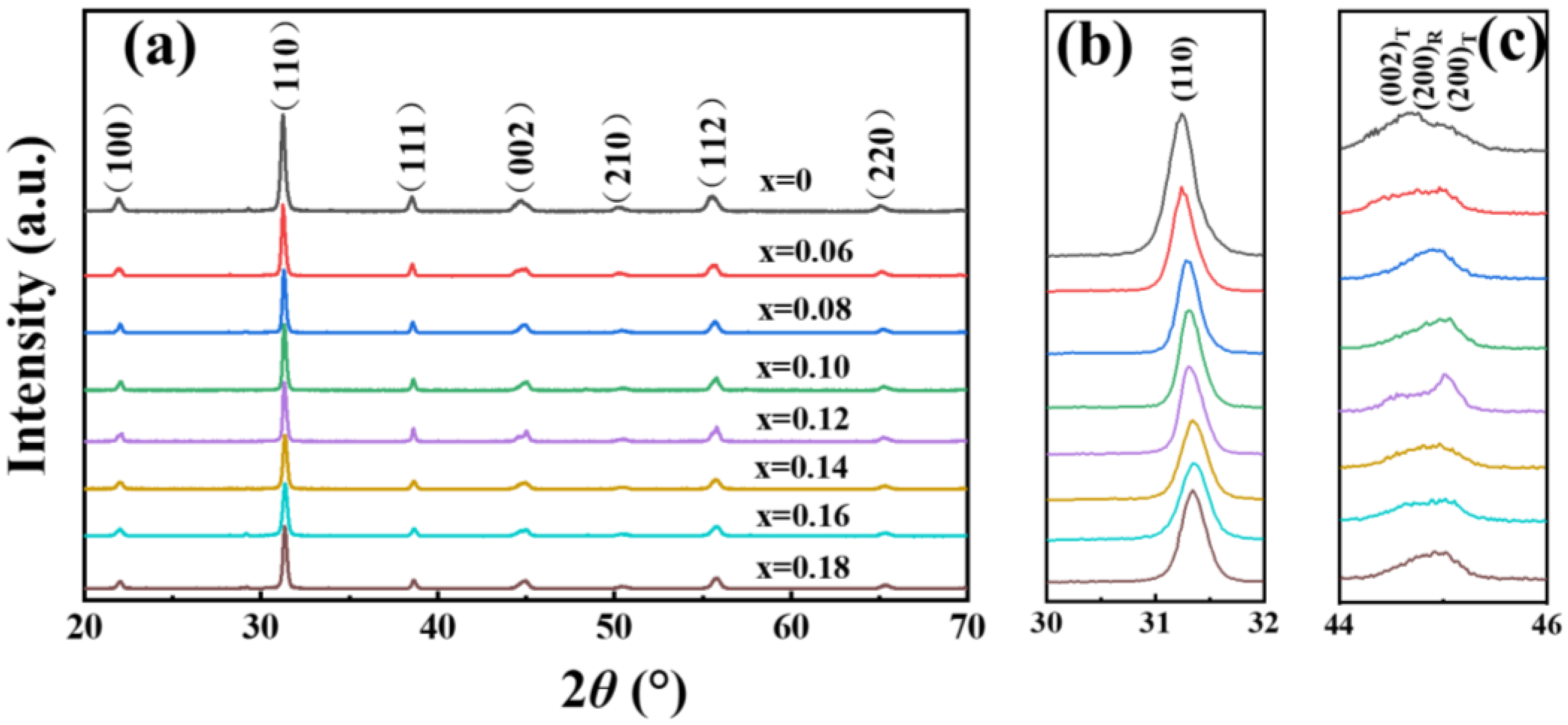
Figure 1 shows the XRD patterns of PZT–PZN–PNN ceramics with different PFW contents sintered at 850 °C for 4 h. All the marked peaks belong to the perovskite phase, and no obvious secondary phase peaks were observed. This can be attributed to the two-step synthesis method adopted in this work: by implementing the separate synthesis of niobium oxide and lead oxide during the process, the formation of the lead niobate (PbNb2O6) secondary phase is effectively avoided.
Figure 1b shows the enlarged XRD patterns in the 2θ range of 30–32°. It can be observed that with the addition of PFW, the full width at half maximum (FWHM) of the (110) diffraction peak of the ceramics decreases to a certain extent, indicating improved crystallinity of the samples. Meanwhile, as the PFW content increases, the (110) peak shifts toward the higher 2θ region by approximately 0.4°. From the perspective of ionic radii, W6+ and Fe3+ ions (r(W6+) = 0.74 Å and r(Fe3+) = 0.63 Å) are considered to occupy the B-site of the ABO3 perovskite structure due to their appropriate ionic radii [25]. Notably, their ionic radii are smaller than that of Zr4+ (0.79 Å), thus resulting in a reduction in unit cell size.
Figure 1c shows the enlarged XRD patterns in the 2θ range of 44–46°. It can be observed that all samples exhibit a certain degree of broadening in the (002) or (200) characteristic diffraction peaks, indicating that all samples are located near the morphotropic phase boundary (MPB) region. Furthermore, the diffraction peak of the x = 0.12 sample shows a typical feature of broadening and moderate splitting, corresponding to a state where the content ratio of tetragonal (T) and rhombohedral (R) phases is relatively close.
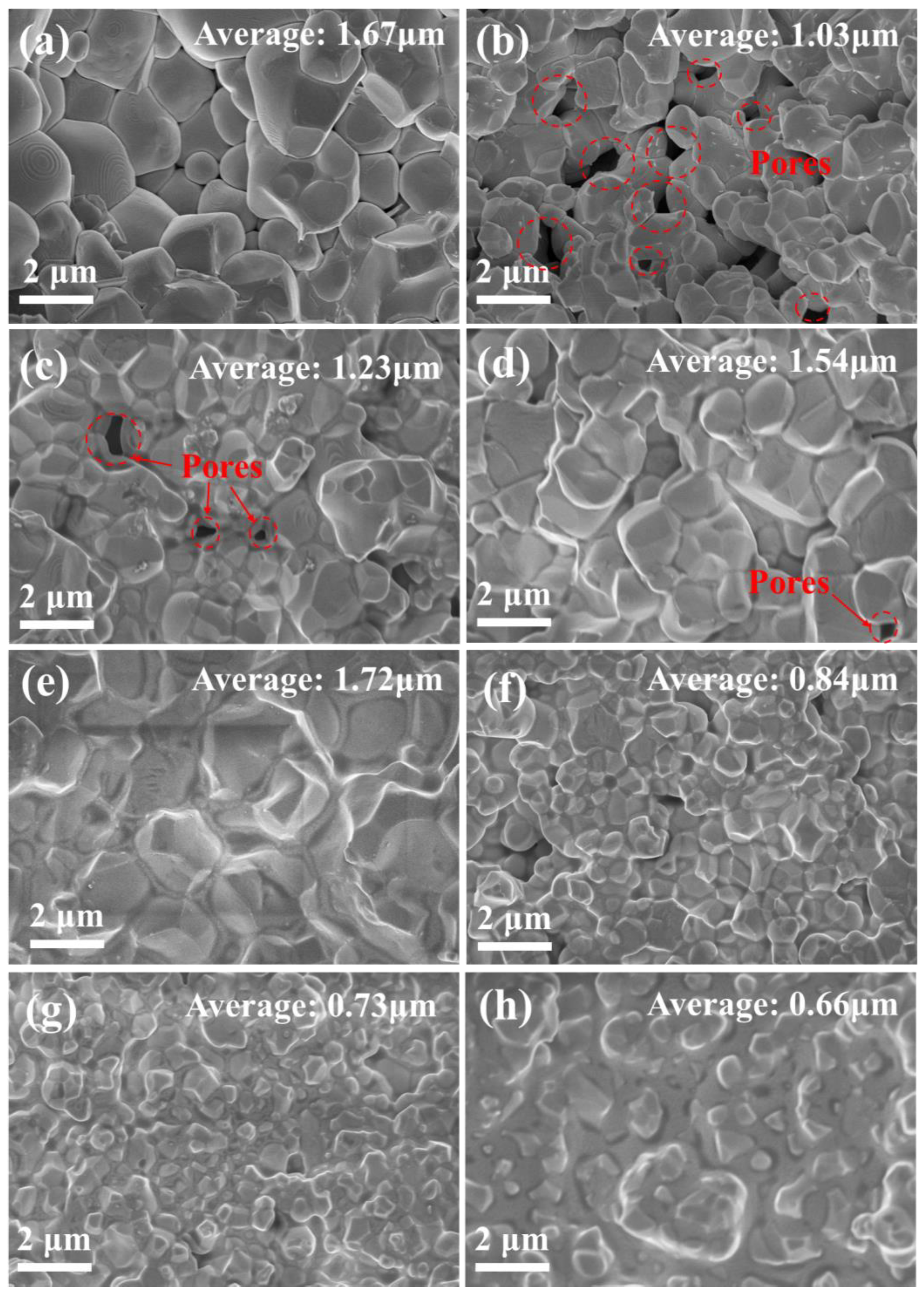
Figure 2a,b show the microstructures of pure PZT–PZN–PNN piezoelectric ceramics. At a sintering temperature of 1200 °C, the pure PZT–PZN–PNN ceramic exhibits uniform diamond-shaped grains with almost no pores. In contrast, when sintered at 850 °C, cubic grains with different sizes can be observed around the grain boundaries, together with some pores. This result indicates insufficient grain growth caused by the low sintering temperature.
After adding the PFW sintering additive, as shown in Figure 2c, the number of pores is significantly reduced, though some segregated particles still exist at the grain boundaries. At this composition, the liquid phase content remains insufficient, leading to local inhomogeneity in the ceramic. With a further increase in PFW content, the number of pores gradually diminishes. When x = 0.12 (as shown in Figure 2e), all pores disappear, and grain growth is most thorough at this point, with the average grain size reaching 1.72 μm.
However, as the amount of liquid phase further increases, the average grain size decreases to below 1 μm, as shown in Figure 2f–h. With increasing liquid phase content, the grain size continues to decline, and the proportion of grain boundaries gradually rises. This may be ascribed to the insufficient driving force for grain boundary migration at low sintering temperature, which prevents sufficient grain growth and causes the excess liquid phase to remain at the grain boundaries.
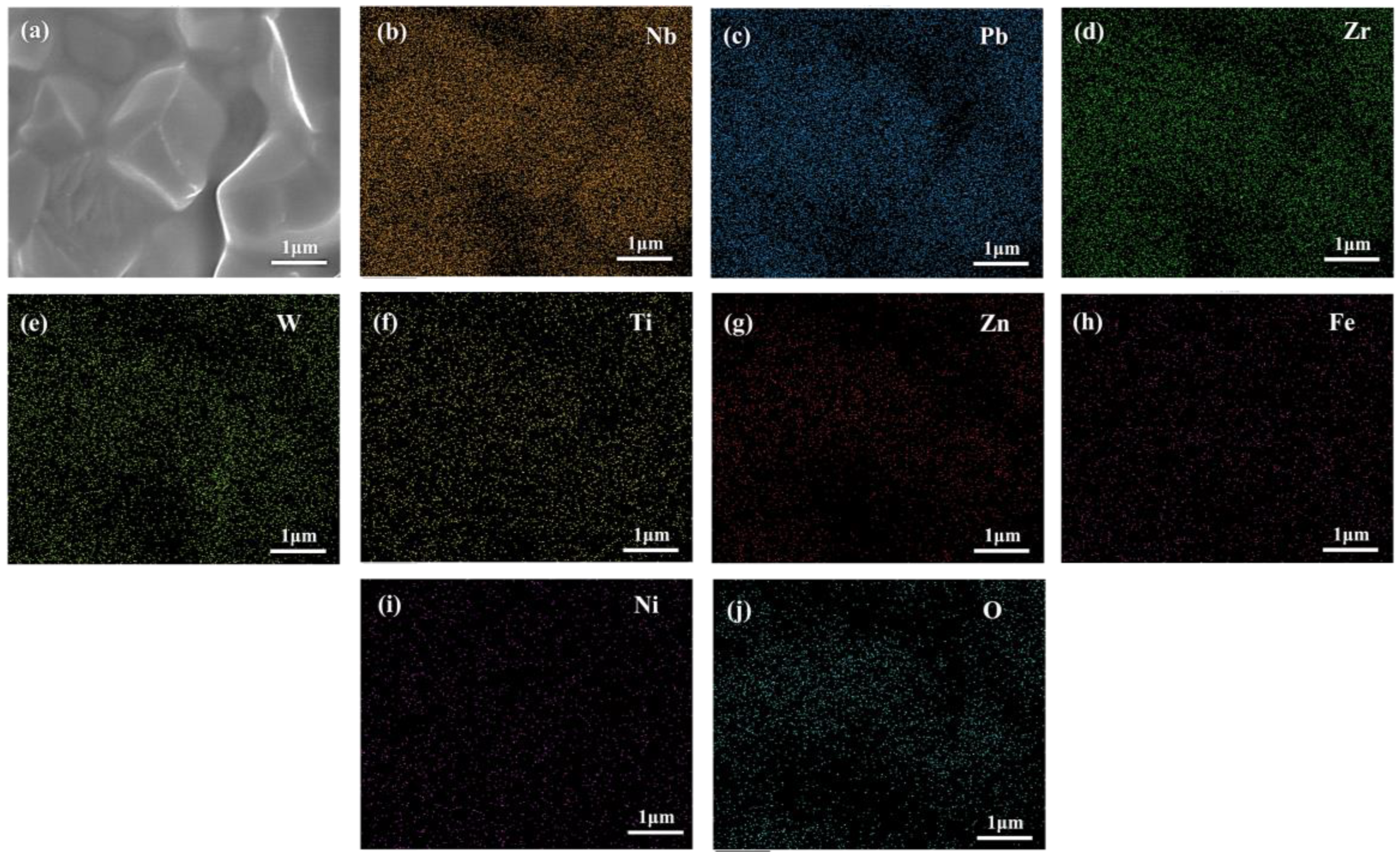
Figure 3a shows the SEM image of the 0.58PZT–0.1PZN–0.2PNN–0.12PFW ceramic sintered at 850 °C, and the corresponding EDS elemental mapping images (Figure 3b–j) illustrate the distribution of Nb, Pb, Zr, W, Ti, Zn, Fe, Ni, and O. All constituent elements are uniformly distributed within the ceramic. In particular, the doped W and Fe elements exhibit no obvious elemental segregation. This result is consistent with the single-phase characteristic revealed by XRD analysis.
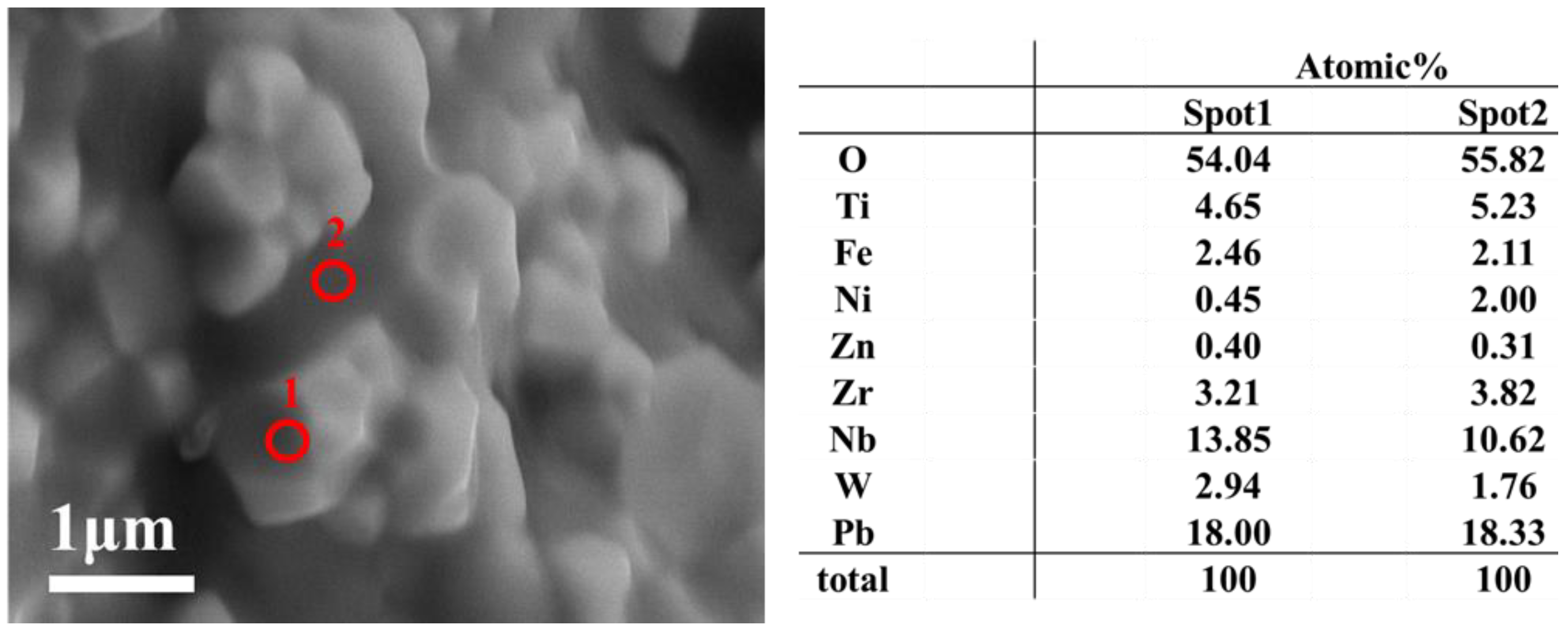
Figure 4 shows the EDS analysis results of the sample shown in Figure 2h, with a chemical composition of 0.52PZT–0.1PZN–0.2PNN–0.18PFW. It can be observed that the grains are extensively wrapped by the liquid phase. Quantitative elemental analysis at the grain interior (Point 1) and grain boundary (Point 2) reveals that their chemical compositions are highly similar. W and Fe elements are detected at both positions. This phenomenon can be attributed to PFW forming a solid solution with the PZT–PZN–PNN ceramic matrix at low temperatures [25].
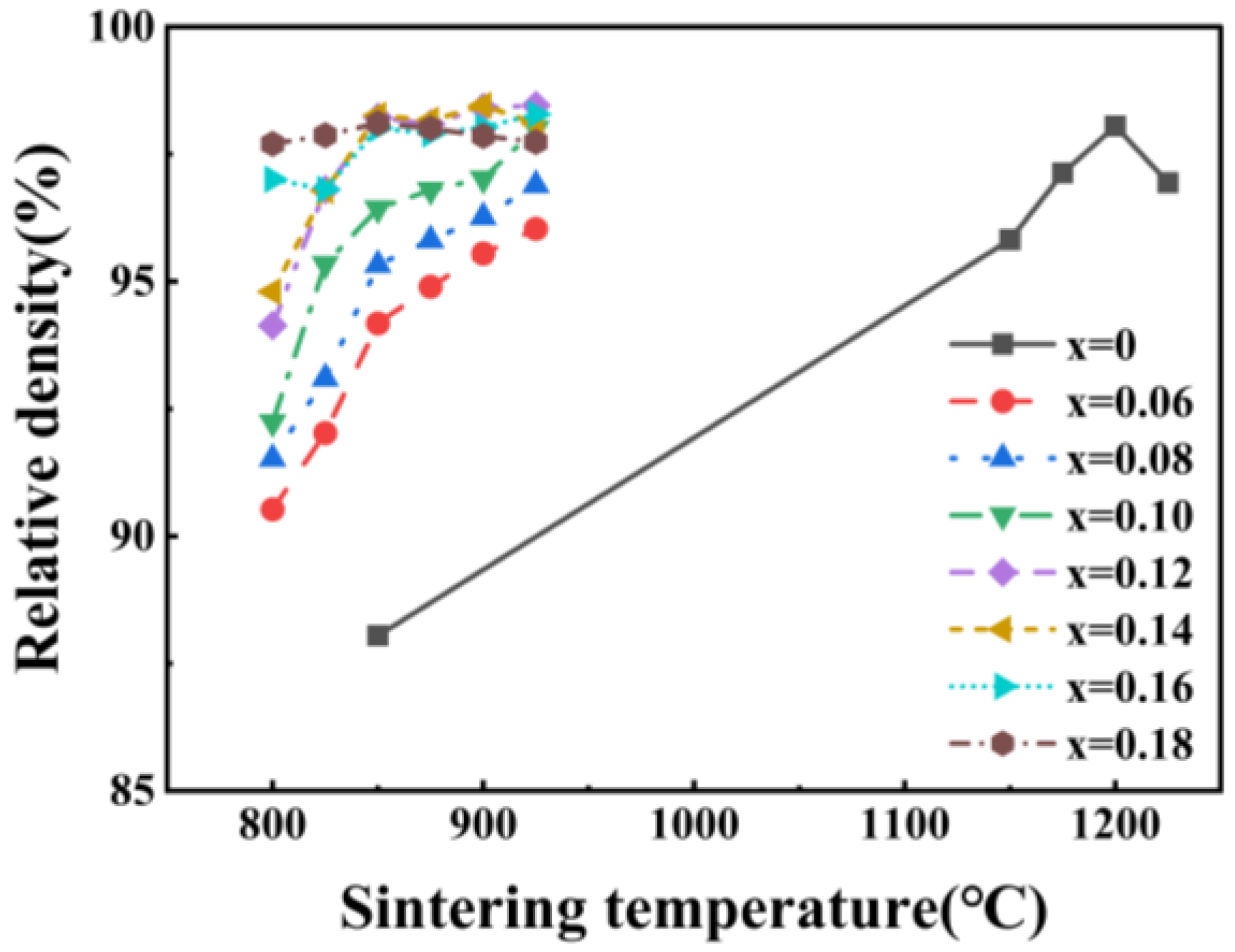
Figure 5 illustrates the influences of both sintering temperature and PFW content on the relative density of PZT–PZN–PNN ceramics sintered for 4 h. In the undoped sample, the relative density of the ceramics increases initially and then declines as sintering temperature increases, reaching a maximum of 98.05% at 1200 °C.
For low-PFW doping contents of x = 0.06–0.10, the relative density gradually increases with rising sintering temperature from 800 °C to 925 °C. In the medium doping range of x = 0.12–0.16, the relative density of the ceramics first increases and then remains nearly constant with further elevated sintering temperature. Specifically, the sample with x = 0.12 reaches a relative density of 98.2% at 850 °C, and its relative densities at 875, 900 and 925 °C are measured to be 98.1%, 98.4% and 98.5%, respectively. These results demonstrate that the relative density is only slightly affected by sintering temperatures above 850 °C. It can therefore be concluded that the optimum sintering temperature for the sample doped with 12 mol% PFW is approximately 850 °C. Such a low sintering temperature is mainly attributed to liquid-phase sintering. As indicated by the relevant phase diagram, a liquid phase can be formed between PFW and PbO at temperatures as low as 690 °C [26]. For high-PFW doping contents of x = 0.18, the relative density of the sintered samples remains nearly constant throughout the entire temperature range of 800 °C to 925 °C.

3.2. Electrical Properties

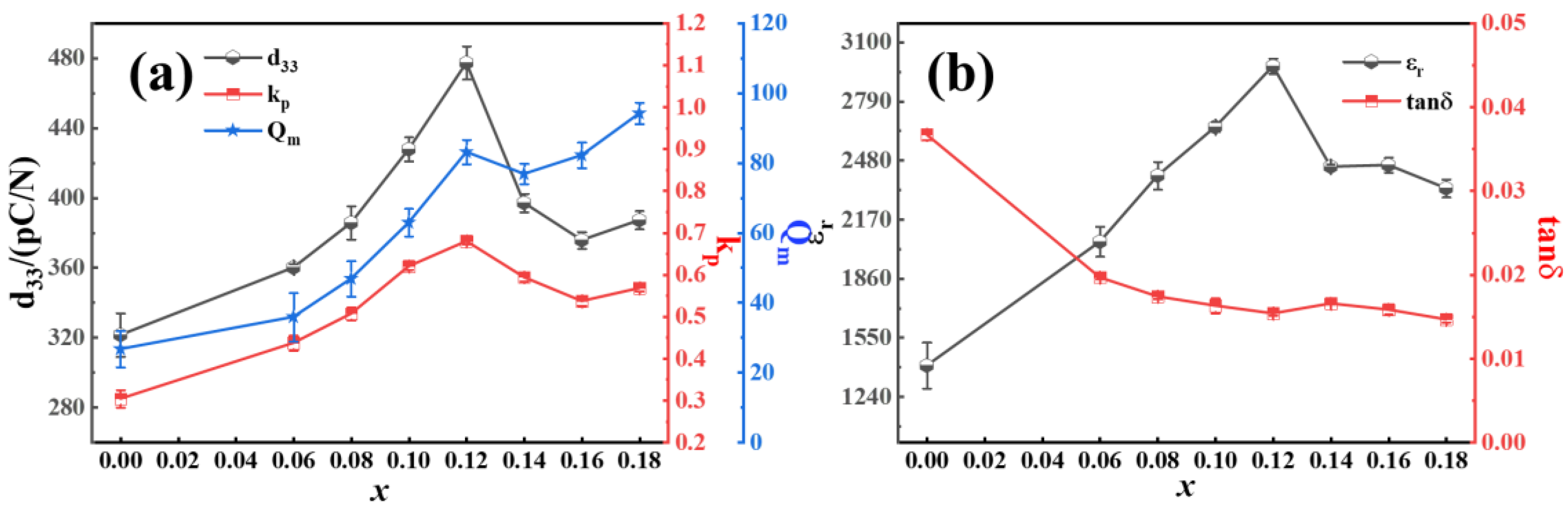
The d33, kp, relative dielectric constant (εr), mechanical quality factor (Qm), and tanδ of (0.7 − x)PZT–0.1PZN–0.2PNN–xPFW ceramics with different PFW contents (sintered at 850 °C) were tested, and the results are summarized in Figure 6.
As can be observed, upon the addition of PFW, the piezoelectric and dielectric properties of the ceramics, including d33, kp, Qm, and εr, are significantly enhanced and accompanied by a marked reduction in the tanδ. With increasing PFW content, both d33 and εr first rise gradually, reaching their maximum values at x = 0.12 (d33 = 477pC/N, εr = 2980). A further increase in PFW content beyond 12 mol% leads to a gradual decrease in both parameters.
For compositions with x < 0.14, the improvement in piezoelectric and dielectric properties is primarily attributed to the liquid phase formed during sintering, which facilitates particle rearrangement, enhances the relative density of the ceramics, and promotes grain growth. It is well established that larger grains can accommodate larger domain sizes, which in turn gives rise to enhanced electrical performance. As the PFW content continues to increase, the average grain size decreases sharply to below 1 μm, resulting in a concurrent decline in electrical properties—a trend that closely mirrors the variation in grain size.
Furthermore, the addition of PFW induces a rapid reduction in tanδ to below 0.02, which is likely attributed to the efficient elimination of pores during liquid-phase sintering.
Overall, the ceramic sample with x = 0.12 exhibits the optimal comprehensive electrical properties, with kp = 0.68, Qm = 83, d33 = 477pC/N, εr = 2980, and a low dielectric loss tanδ = 0.0154.
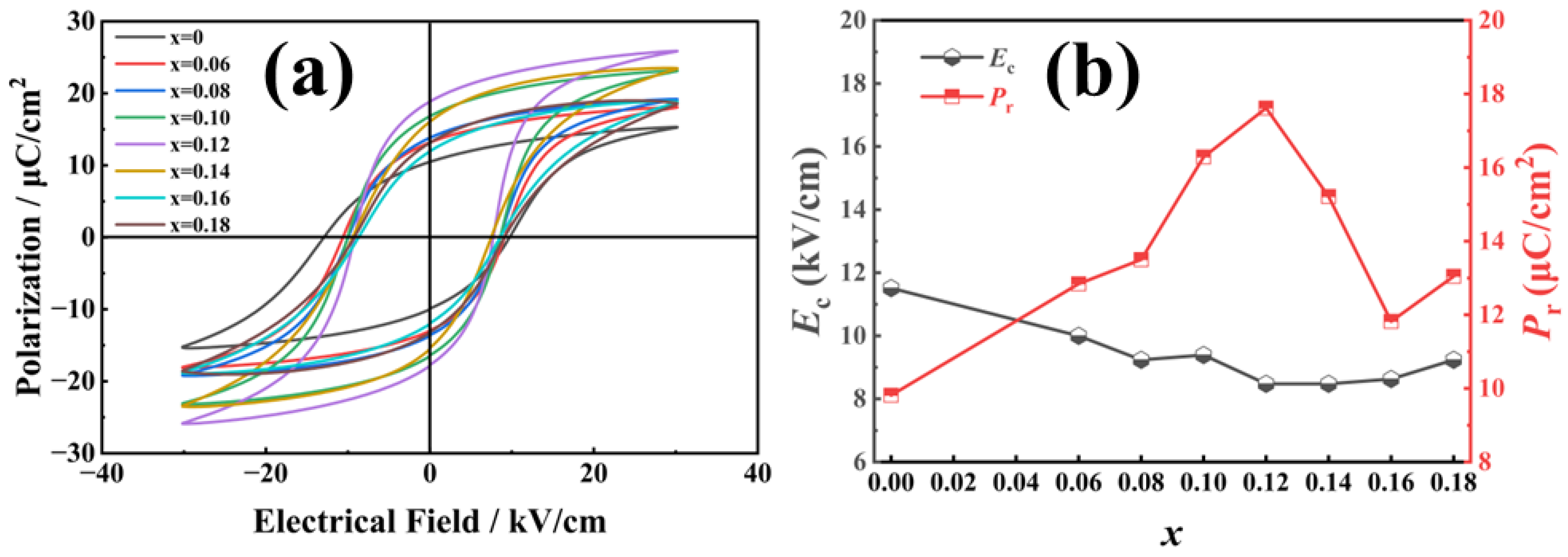
Figure 7a shows the P–E hysteresis loops of (0.7 − x)PZT–0.1PZN–0.2PNN–xPFW ceramics sintered at 850 °C. The corresponding remnant polarization (Pr) and coercive field (Ec) as functions of PFW content are plotted in Figure 7b.
All samples are polarized to saturation under a maximum applied electric field of 30 kV/cm. It can be seen that Ec first decreases and then increases with increasing PFW content, reaching a minimum value of 8.5 kV/cm at x = 0.12. The remnant polarization Pr first increases and then decreases with increasing PFW content, achieving a maximum value of 17.6 μC/cm2 at x = 0.12.
For x < 0.10, liquid-phase sintering promotes the elimination of pores and increases the effective volume fraction of grains in the ceramics, leading to an increase in Pr. In the range of x < 0.14, the liquid phase facilitates sufficient and uniform grain growth, which further increases Pr. As the PFW content further increases, the excess liquid phase cannot be incorporated into the lattice during the late sintering stage and remains at the grain boundaries. Such disordered amorphous structures cannot form ferroelectric domains, thus resulting in a decrease in Pr.
Notably, the ceramics prepared in this study exhibit the lowest sintering temperature among the reported counterparts [10,13,14,27,28,29]. In addition, from the perspective of energy conservation, low-temperature sintering can effectively reduce power consumption during the sintering process in large-scale industrial production, which is conducive to green and low-cost manufacturing of piezoelectric ceramic devices.

3.3. Multilayer Piezoelectric Device

In this work, 12 mol% PFW-doped PZT–PZN–PNN ceramics were used to fabricate parallel-structured multilayer ceramic devices with five, seven, and nine ceramic layers, respectively. A carbon-based sacrificial layer and the alternating parallel architecture of ceramic layers and Ag electrodes were prepared via screen printing.
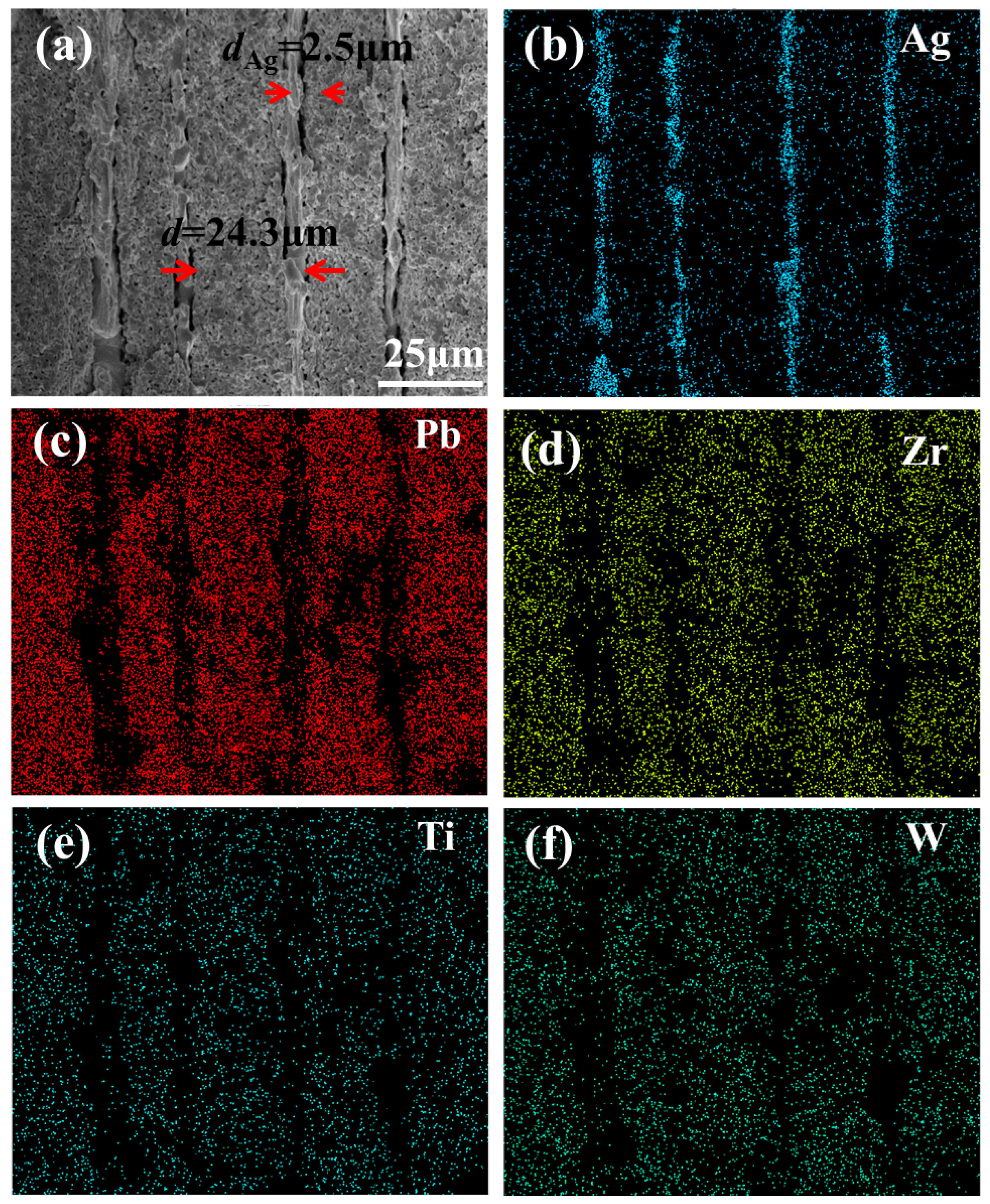
Figure 8 shows the cross-sectional morphology and corresponding EDS elemental mapping images of the sintered multilayer device. As presented in Figure 8a, the thickness of a single ceramic layer is approximately 25 μm, and the thickness of the Ag electrode layer is about 2.5 μm. As shown in the Ag elemental mapping (Figure 8b), no obvious diffusion of Ag from the electrode into the ceramic layers is observed. The Pb element detected in the Ag electrode region in Figure 8c originates from the PZT–PZN–PNN ceramic powder added to the Ag paste, which is used to adjust the sintering shrinkage matching between the electrode and the ceramic layers. The sintering temperature adopted in this work is 850 °C, which is much lower than the melting point of Ag (961 °C), fundamentally suppressing the diffusion behavior of Ag and thus avoiding significant Ag diffusion. In conclusion, this ceramic composition can be co-fired with Ag electrodes for the fabrication of multilayer piezoelectric ceramic devices.
The electrical properties of parallel-connected multilayer thick-film piezoelectric devices based on 0.58PZT–0.1PZN–0.2PNN–0.12PFW ceramics with different numbers of layers are summarized in Table 1. In the parallel configuration, each ceramic layer can generate charge independently under external excitation, resulting in d33 and Pr values that are proportional to the number of layers. The 9-layered sample achieves a d33 value as high as 1470 pC/N, approximately three times that of the same-composition bulk ceramic, demonstrating that the multilayer structure is an effective strategy to obtain high piezoelectric response. Even the single-layer thick film sintered at a low temperature of 850 °C still exhibits a d33 value of 176 pC/N. Furthermore, the relative permittivity ε33T0 of the multilayer samples decreases with increasing layer number, accompanied by a slight increase in dielectric loss tanδ, which is attributed to the pore structure formed by the burnout of organic binders and additives during sintering.
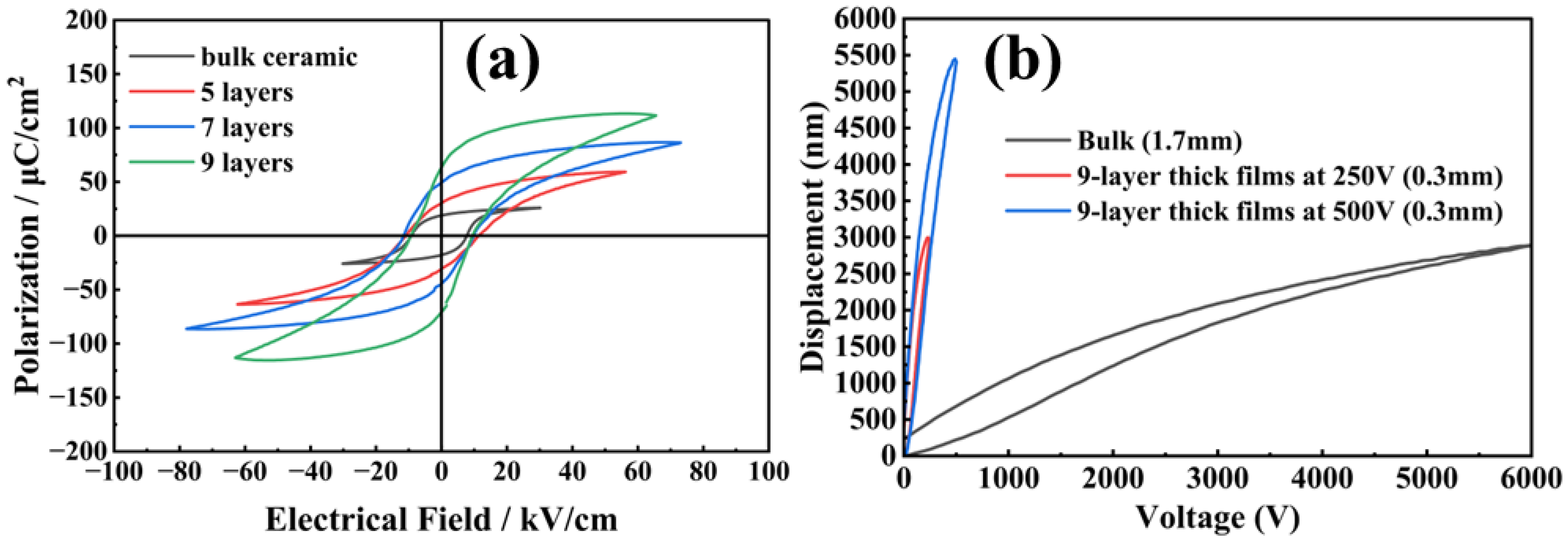
Figure 9a shows the P–E hysteresis loops of the multilayer thick films with different layer numbers and the bulk ceramic sintered at 850 °C. All curves of multilayer samples exhibit an asymmetric shape accompanied by an internal bias field. Defect dipoles are inevitably generated during the formation of the PZT–PZN–PNN–PFW solid solution and the polarization aging process. It has been reported that the reorientation of defect dipoles after aging accounts for the occurrence of such asymmetric P–E loops [30]. Furthermore, the coercive field of the multilayer ceramic films showed no obvious change with the increase in the number of parallel layers, which is because the self-supporting structure relieves the substrate’s constraint on the ceramic films.
Figure 9b presents the unipolar displacement–voltage curves of the 9-layer thick films and the bulk ceramic counterpart. The thickness of the bulk ceramic sample is 2 mm, while that of the optimized 9-layer multilayer device is merely approximately 300 μm. When a driving voltage of 250 V is applied, the displacement of the multilayer thick film reaches the same level as that of the bulk ceramic with the identical formula. As the voltage further increases to 500 V, the multilayer film exhibits a remarkable displacement of about 5.5 μm, corresponding to a large strain of 1.83%. These results clearly verify the feasibility of driving this multilayer piezoelectric device under low operating voltages.

4. Conclusions

This study investigated the effect of PFW doping content on the crystal structure, micromorphology and piezoelectric properties of PZT–PZN–PNN piezoelectric ceramics, with the core objective of screening out the optimal composition that enables low-temperature sintering and is suitable for fabricating piezoelectric actuators with Ag electrodes.
The experimental results demonstrate that PFW doping can effectively reduce the sintering temperature of the ceramic system, lowering that of 0.7PZT–0.1PZN–0.2PNN ceramics from 1200 °C to 850 °C. With the increase in PFW doping content, the porosity of the ceramics decreases significantly and the grains grow gradually, with the sample at x = 0.12 exhibiting the optimal crystallinity. The ceramic with x = 0.12 sintered at 850 °C attains a relative density of 98.2%, along with the optimal piezoelectric and dielectric performance: d33 = 477 pC/N, kp = 0.68 and tanδ = 0.0154.
Performance tests on the fabricated multilayer piezoelectric devices show that the 9-layer ceramic thick film device achieves a displacement of approximately 3.0 μm under a voltage of 250 V, which matches that of the bulk ceramic driven at 6000 V. When the driving voltage is increased to 500 V, the displacement of the 9-layer device reaches 5.5 μm, corresponding to a large strain of 1.83%. In addition, cross-sectional SEM characterization of the devices confirms no obvious diffusion of Ag electrodes after sintering, indicating that the optimized ceramic composition realizes good low-temperature co-firing compatibility with Ag electrodes. Moreover, high-performance multilayer piezoelectric ceramic devices with the advantage of miniaturization can be fabricated via the self-supporting process using this composition.

Author Contributions

Conceptualization, N.Y. and W.M.; methodology, N.Y. and W.M.; software, W.M.; validation, H.S. and S.Y.; formal analysis, N.Y.; investigation, N.Y. and Z.Z.; resources, W.M.; data curation, N.Y., H.Z. and J.H.; writing—original draft preparation, N.Y.; writing—review and editing, N.Y. and W.M.; visualization, N.Y., H.Z. and J.H.; supervision, W.M.; project administration, W.M.; funding acquisition, W.M. All authors have read and agreed to the published version of the manuscript.

Funding

This research received no external funding.

Data Availability Statement

The original contributions presented in the study are included in the article; further inquiries can be directed to the corresponding authors.

Acknowledgments

During the preparation of this manuscript, the authors used Doubao AI Assistant (Version 13.0.0, ByteDance Inc., Beijing, China) to polish and refine the English expression of the abstract section. The authors have reviewed and edited the output and take full responsibility for the content of this publication.

Conflicts of Interest

The authors declare no conflict of interest.

References

  1. Liao, J.; Tang, Z.; Zhang, H.; Yan, X.; Zhang, Y. Advances in mechanical energy harvesting using piezoelectric ceramics. Mater. Sci. Semicond. Process. 2026, 206, 110431. [Google Scholar] [CrossRef]
  2. Xu, G.; Liu, M.; Long, M.; Shan, L.; Lu, Y.; Wang, C.; Li, F. Enhanced piezoelectric and energy harvesting performance of monophase NaNbO3-based ceramics doped with BaAlO2.5. Chem. Eng. J. 2025, 520, 166047. [Google Scholar] [CrossRef]
  3. He, X.; Xu, Y.; Wu, J.; Liang, X.; Wang, G.; Huang, H.; Sun, X.; Lu, Y.; Ju, D.; Dong, S. Maximizing Power Density and Lifespan of Magneto-Mechano-Electric Generator via Optimizing the Selection of Piezoelectric Ceramic Plate. Small 2025, 21, e05332. [Google Scholar] [CrossRef] [PubMed]
  4. Liu, J.; Zhang, D.; Yan, Y.; Li, Z.; Li, F.; Yang, S. Piezoelectric Ceramic Hardening Through Defect Distribution Optimization in Multicomponent Systems. Adv. Funct. Mater. 2025, 35, 2413130. [Google Scholar] [CrossRef]
  5. Zheng, K.; Xie, N.; Deng, Y.; Febbo, M.; Broeckmann, C.; Liu, P. A review on lead-free piezoelectric ceramic sensors for sustainable and intelligent applications. Chem. Eng. J. 2026, 528, 172363. [Google Scholar] [CrossRef]
  6. Liu, Y.; Shi, X.; Yang, W.; Ruan, X.; Man, Z.; Zheng, L.; Li, G. A high-power piezoelectric ceramic with great electrical properties and temperature stability. J. Alloys Compd. 2024, 1007, 176362. [Google Scholar] [CrossRef]
  7. Shinichiro, K.; Hiroyuki, H.; Hideki, I.; Masahiko, K.; Akira, A.; Suetake, O.; Noriyuki, K. Potassium Sodium Niobate-Based Lead-Free Piezoelectric Multilayer Ceramics Co-Fired with Nickel Electrodes. Materials 2015, 8, 7423. [Google Scholar]
  8. Wang, M.; Ma, W.; Peng, C.; Chen, N.; Guo, Y. Enhanced electrical properties of co-firing 0.7Pb(Zr0.46Ti0.54)O3-0.1Pb(Zn1/3Nb2/3)O3-0.2Pb(Ni1/3Nb2/3)O3 multilayer thick films prepared by screen-printing method. Mater. Lett. 2015, 159, 68–71. [Google Scholar] [CrossRef]
  9. Gurdal, A.E.; Tuncdemir, S.; Uchino, K.; Randall, C.A. Low temperature co-fired multilayer piezoelectric transformers for high power applications. Mater. Des. 2017, 132, 512–517. [Google Scholar] [CrossRef]
  10. Gao, X.; Jin, H.; Xin, B.; Wang, M.; Dong, S.; Xu, Z.; Li, F. Low temperature sintering of Li2CO3 added Pb(Ni1/3Nb2/3)-Pb(Zr,Ti)O3 ceramics with high piezoelectric properties. J. Alloys Compd. 2022, 892, 162132. [Google Scholar] [CrossRef]
  11. Mao, W.; Xu, Q.; Huang, D.; Sun, H.; Zhang, F.; Xie, X. Low-Temperature Sintering Properties of Bi2O3 Doped PZT-5H Piezoelectric Ceramics. J. Electron. Mater. 2023, 52, 3334–3342. [Google Scholar] [CrossRef]
  12. Zhang, J.; Chen, Y.; Guo, Y.; Liu, Q.; Zhu, Y.; Zeng, F. Low-temperature co-fired PNN-PZT-based multilayer piezoelectric actuator with low cost and high reliability. J. Eur. Ceram. Soc. 2024, 44, 116744. [Google Scholar] [CrossRef]
  13. Zhang, J.; Guo, Y.; Liu, Q.; Zeng, F. Low-temperature co-fired PZNN-PZT multilayer piezoelectric ceramics with excellent electrical and bending properties. J. Sci. Adv. Mater. Devices 2023, 8, 100640. [Google Scholar] [CrossRef]
  14. Hong, S.C.; Kim, S.Y.; Yeo, D.H. Effect of LiBiO2 on low-temperature sintering of PZT-PZNN ceramics. J. Korean Ceram. Soc. 2022, 59, 638–646. [Google Scholar] [CrossRef]
  15. Chen, H.; Xing, J.; Xi, J.; Pu, T.; Liu, H.; Zhu, J. Origin of high piezoelectricity in low-temperature sintering PZT-based relaxor ferroelectric ceramics—ScienceDirect. J. Alloys Compd. 2020, 860, 157930. [Google Scholar] [CrossRef]
  16. Lin, Z.; Zhu, Z.; Yao, Z.; Zhang, H.; Hao, H.; Cao, M.; Liu, H. Piezoelectric Response and Cycling Fatigue Resistance of Low-Temperature Sintered PZT-Based Ceramics. Materials 2023, 16, 1679. [Google Scholar] [CrossRef]
  17. Nakajima, T.; Kitanaka, Y. Printing Formation of Flexible (001)-Oriented PZT Films on Plastic Substrates. Materials 2023, 16, 2116. [Google Scholar] [CrossRef]
  18. Wang, D.; Zhao, K.; Yuan, Y.; Wang, Z.; Zong, H.; Zhang, X.; Liang, J. Fabrication and Characterization of a Microscale Piezoelectric Vibrator Based on Electrohydrodynamic Jet Printed PZT Thick Film. Micromachines 2021, 12, 524. [Google Scholar] [CrossRef]
  19. Zhou, J.; Guan, T.; Wen, Z. Low temperature co-fired shear-type piezoelectric metamaterial stacks in d36 mode for torsional actuation. Ceram. Int. 2025, 51, 58426–58434. [Google Scholar] [CrossRef]
  20. Chen, J.; Du, Z.Z.; Yang, Y.T.; Hu, H. The electrical properties of low-temperature sintered 0.07Pb(Sb1/2Nb1/2)O3-0.93 Pb(Zr,Ti)O3 multilayer piezoceramic actuator. Ceram. Int. 2021, 47, 15195–15201. [Google Scholar] [CrossRef]
  21. Debéda, H.; Rua-Taborda, M.I.; Santawitee, O.; Grall, S.; Elissalde, C. The Role of Sacrificial and/or Protective Layers to Improve the Sintering of Electroactive Ceramics: Application to Piezoelectric PZT-Printed Thick Films for MEMS. Ceramics 2020, 3, 453–475. [Google Scholar] [CrossRef]
  22. Chao, X.; Yang, L.; Pan, H. Fabrication, temperature stability and characteristics of Pb(ZrxTiy)O3-Pb(Zn1/3Nb2/3)O3-Pb(Ni1/3Nb2/3)O3 piezoelectric ceramics bimorph. Ceram. Int. 2012, 38, 3377–3382. [Google Scholar] [CrossRef]
  23. Feng, X.; Xu, J.; Xu, X. Enhanced piezoelectric energy harvesting performance of PZT-PZN-PNN piezoceramic via microstructure texturing strategy. Ceram. Int. 2025, 51, 52900–52909. [Google Scholar] [CrossRef]
  24. Ngamjarurojana, A.; Ural, S.; Park, S.H.; Ananta, S.; Yimnirun, R.; Uchino, K. Piezoelectric properties of low temperature sintering in Pb(Zr,Ti)O3-Pb(Zn,Ni)1/3Nb2/3O3 ceramics for piezoelectric transformer applications. Ceram. Int. 2008, 34, 705–708. [Google Scholar] [CrossRef]
  25. Ma, J.; Ma, W.; Li, Q.; Meng, X.; Niu, B.; Guo, Y. Low-temperature sintering and piezoelectric properties of Pb(Fe2/3W1/3)O3-added Pb(Zn1/3Nb2/3)O3-Pb(Ni1/3Nb2/3)O3-Pb(Zr, Ti)O3 ceramics. J. Mater. Sci. Mater. Electron. 2014, 25, 3695–3702. [Google Scholar] [CrossRef]
  26. Ye, Z.-G.; Schmid, H. Growth from high temperature solution and characterization of Pb(Fe2/3W1/3)O3 single crystals. J. Cryst. Growth 1996, 167, 628–637. [Google Scholar] [CrossRef]
  27. Gu, W.; Zhao, B.; Yang, B.; Cai, Z.; Shang, X.; Zhou, T.; Guo, J. Achieving superior electrical properties of PZT-PNN piezoelectric ceramics through low-temperature sintering with PbO-CuO eutectic additives. J. Eur. Ceram. Soc. 2022, 42, 3831–3840. [Google Scholar] [CrossRef]
  28. Kim, B.S.; Ji, J.H.; Koh, J.H. Improved strain and transduction values of low-temperature sintered CuO-doped PZT-PZNN soft piezoelectric materials for energy harvester applications. Ceram. Int. 2021, 47, 6683–6690. [Google Scholar] [CrossRef]
  29. Gu, C.; Peng, W.; Shi, L. Superior piezoelectric and mechanical properties in low-temperature sintered PNN-PZT ceramics via compositional design. Ceram. Int. 2025, 51, 58902–58910. [Google Scholar] [CrossRef]
  30. Gao, J.; Ma, W.; Yang, Y.; Guo, J.; Zhao, H.; Ma, M. The free-standing multilayer thick films of 0.7Pb(Zr0.46Ti0.54)O3-0.1Pb(Zn1/3Nb2/3)O3-0.2Pb(Ni1/3Nb2/3)O3 with low co-fired temperature. J. Mater. Sci. Mater. Electron. 2018, 29, 11664–11671. [Google Scholar] [CrossRef]
Figure 1. XRD patterns of (0.7 − x)PZT–0.1PZN–0.2PNN–xPFW ceramics and enlarged views of characteristic 2θ ranges: (a) full XRD patterns; (b) enlarged view in 30–32°; (c) enlarged view in 44–46°.
Crystals 16 00294 g001
Figure 2. SEM images of PZT–PZN–PNN ceramics and (0.7 − x)PZT–0.1PZN–0.2PNN–xPFW ceramics: (a) PZT–PZN–PNN sintered at 1200 °C for 4 h; (b) PZT–PZN–PNN sintered at 850 °C for 4 h; (ch) (0.7 − x)PZT–0.1PZN–0.2PNN–xPFW ceramics with x = 0.08, 0.10, 0.12, 0.14, 0.16, 0.18, sintered at 850 °C for 4 h.
Crystals 16 00294 g002
Figure 3. (a) SEM image and (bj) EDS elemental mapping of the 0.58PZT–0.1PZN–0.2PNN–0.12PFW ceramic sintered at 850 °C for 4 h.
Crystals 16 00294 g003
Figure 4. SEM–EDS results of 0.52PZT–0.1PZN–0.2PNN–0.18PFW ceramic at a magnification of 20,000× (1: grain interior; 2: grain boundary).
Crystals 16 00294 g004
Figure 5. Variation in relative density of (0.7 − x)PZT–0.1PZN–0.2PNN–xPFW ceramics with sintering temperature and PFW content.
Crystals 16 00294 g005
Figure 6. Electrical properties of (0.7 − x)PZT–0.1PZN–0.2PNN–xPFW ceramics sintered at 850 °C for 4 h: (a) d33, kp, Qm; (b) εr and tanδ.
Crystals 16 00294 g006
Figure 7. (a) P–E hysteresis loops; (b) Ec and Pr of (0.7 − x)PZT–0.1PZN–0.2PNN–xPFW ceramics sintered at 850 °C for 4 h with x from 0 to 0.18.
Crystals 16 00294 g007
Figure 8. (a) SEM micrograph (with marked Ag electrode thickness dAg = 2.5 μm and ceramic layer thickness d = 24.3 μm) and (bf) corresponding EDS elemental mapping images (Ag, Pb, Zr, Ti, W) of the multilayer piezoelectric device with Ag internal electrodes, co-fired at 850 °C with the composition of 0.58PZT–0.1PZN–0.2PNN–0.12PFW.
Crystals 16 00294 g008
Figure 9. (a) P–E hysteresis loops of the bulk ceramic and 5-layer, 7-layer, 9-layer 0.58PZT-0.1PZN-0.2PNN-0.12PFW thick films; (b) unipolar displacement–voltage curves of the bulk ceramic (2 mm) and 9-layer thick films (0.3 mm) measured at 250 V and 500 V.
Crystals 16 00294 g009
Table 1. Electrical properties of 0.58PZT–0.1PZN–0.2PNN–0.12PFW thick films with different layers sintered at 850 °C.
Layersε33T0tan δ d33 (pC·N−1)Pr (μC·cm−2)Ec (kV·cm−1)g33 (mV·m/N)
19380.0203176--21.2
58750.024185028.811.0109.5
78510.0253118045.010.9156.0
98200.0263147072.611.1203.7
Disclaimer/Publisher’s Note: The statements, opinions and data contained in all publications are solely those of the individual author(s) and contributor(s) and not of MDPI and/or the editor(s). MDPI and/or the editor(s) disclaim responsibility for any injury to people or property resulting from any ideas, methods, instructions or products referred to in the content.