Article

Large-Size Barium Nitrate Crystal Growth and Large-Energy, High-Efficiency Raman Frequency Conversion to Yellow–Orange Waveband

State Key Laboratory of Crystal Materials, Shandong University, Jinan 250100, China
*
Authors to whom correspondence should be addressed.
Crystals 2026, 16(3), 198; https://doi.org/10.3390/cryst16030198
Submission received: 6 February 2026 / Revised: 6 March 2026 / Accepted: 11 March 2026 / Published: 13 March 2026
(This article belongs to the Section Crystal Engineering)

Abstract

Stimulated Raman scattering (SRS) with Raman crystals is widely recognized as an effective technical approach for achieving high-efficiency lasers at specific wavelengths. However, due to crystal size limitations, it is challenging to generate large-energy Raman lasers while simultaneously considering the laser damage threshold of optical components. To overcome this limitation, in this paper we describe the successful fabrication of a large-aperture barium nitrate Raman gain medium using the directional template growth technique. Employing this large-aperture Raman medium and a 532 nm pulse laser as the excitation source, a large-energy, high-efficiency yellow–orange waveband laser system was constructed. When injected with 886.7 mJ pump energy at 532 nm, the Raman laser achieved a maximum output energy of 556.2 mJ, corresponding to an optical-to-optical conversion efficiency of 62.7%. This represents a significant advancement in single-pulse energy for barium nitrate Raman lasers. Large-energy yellow–orange wavelength lasers have applications in the clinical treatment of skin diseases and microfluidic chip manufacturing.

1. Introduction

As a cornerstone of modern science and industry, laser technology has consistently pursued new wavelengths, larger energy levels, and higher power outputs in its development [1,2,3]. Among the numerous laser wavelength bands, the yellow–orange band holds irreplaceable application value due to its unique physical properties. This laser wavelength falls within the human-eye visible sensitivity range and matches the absorption peaks of numerous atoms and molecules [4]. Consequently, it is in urgent demand in fields such as remote sensing [5], biomedicine (e.g., photodynamic therapy, ophthalmic treatments) [6,7], and Raman spectroscopy [8,9]. However, directly generating high-energy, high-power, and high beam quality yellow–orange lasers presents significant technical challenges. While traditional dye lasers [10] and optical parametric oscillators (OPOs) [11] can achieve output in this wavelength band, they face bottlenecks such as high system complexity, low conversion efficiency, and thermal management challenges. Obtaining yellow–orange light through nonlinear frequency conversion methods, such as frequency doubling [12], involves complex systems, with conversion efficiency constrained by phase-matching conditions. Therefore, developing an efficient, stable, and high-energy output yellow–orange laser source has become a significant research focus in this field.
Among the various techniques for extending laser wavelengths, stimulated Raman scattering (SRS) represents a highly attractive approach. SRS is a third-order nonlinear optical process that shifts the frequency of the pump laser down by a specific Raman shift (corresponding to the vibrational energy levels of molecules in the gain medium), thereby generating new laser wavelengths. Compared to second order nonlinear processes such as frequency doubling, SRS offers significant advantages including no phase matching requirement, a broad gain bandwidth, and low demands on the pump source [13,14,15]. By carefully selecting the Raman gain medium and designing the resonator cavity, efficient and compact Raman laser output can be achieved, particularly for wavelengths that are difficult to obtain through direct emission or simple nonlinear conversion. Crystalline Raman lasers have emerged as an important approach for generating yellow–orange waveband light sources [16].
The key to obtaining new laser wavelengths with large energy and high efficiency through stimulated Raman scattering lies in the Raman gain medium. An ideal Raman gain medium should exhibit a high Raman gain coefficient, a broad transmission band, a high damage threshold, excellent thermomechanical properties, and the capability to grow large size single crystals with superior quality. Among numerous Raman crystals, barium nitrate crystals are widely recognized as a highly promising Raman medium. Its strongest Raman vibrational mode is located at approximately 1047 cm−1 [17], exhibiting not only an exceptionally high Raman gain coefficient (about three times that of commonly used potassium gadolinium tungstate (KGW) crystals) [18] and an extremely narrow Raman linewidth, but also outstanding light transmission properties across the visible to near-infrared spectrum. This establishes a crucial foundation for achieving large energy, high power laser output.
However, a long-standing bottleneck has hindered the full realization of the performance advantages of barium nitrate crystals in Raman lasers: the difficulty in growing large-sized, high-quality crystals. Due to the narrow metastable region of barium nitrate solutions and the difficulty in controlling the stability of the growth interface, sufficiently large single crystals with good optical homogeneity are difficult to obtain [19,20]. The small crystal size severely limits the pump energy that can be accommodated and the Raman light power that can be generated. This has resulted in Raman lasers based on barium nitrate crystals remaining in a state of low energy and low efficiency for an extended period, with their potential to generate large energy yellow–orange laser pulses remaining largely untapped.
Therefore, this work focuses on addressing key challenges from growing large-sized barium nitrate crystals to achieving large energy yellow–orange laser output. A large-sized cylindrical barium nitrate single crystal with a diameter of 30 mm and a height of 57 mm was successfully grown via the directional template growth method. A series of performance characterization tests were used to characterize the quality of the crystal. The Raman gain element with cross-sectional dimensions of approximately 20 mm × 20 mm were successfully fabricated. Then, employing the second harmonic generated by a pulsed electro-optically Q-switched Nd: YAG laser as the pump source and with the barium nitrate crystal as the core gain medium, a large energy nanosecond pulse yellow–orange laser was designed and constructed. Finally, when the pump energy was applied at 886.7 mJ, the system output yellow–orange laser energy reached 556.2 mJ, corresponding to an optical-to-optical conversion efficiency of 62.7%. This work demonstrates for the first time that large-sized barium nitrate crystals can achieve large energy Raman laser output, offering promising technical reserves for the development of major engineering projects such as sodium guide star astronomical observation.

2. Crystal Growth

Barium nitrate crystals are water-soluble. Experiments indicate that barium nitrate exhibits a positive solubility temperature coefficient, meaning its solubility increases with rising temperature [21]. Therefore, the aqueous solution cooling method is commonly employed for growing barium nitrate single crystals [22]. The fundamental principle of crystal growth using the solution cooling method is to utilize the relatively large positive solubility temperature coefficient of the substance. The temperature is gradually lowered during the crystal growth process, causing the solute to continuously precipitate and grow onto the crystal [23].
High-purity barium nitrate powder (99.99%, Aladdin) was employed as the starting material. The mass of barium nitrate powder and the volume of deionized water required to prepare the saturated growth solution were calculated based on the solubility curve of barium nitrate crystals [21]. The mass of barium nitrate powder was approximately 628.4 g, and the volume of deionized water was 4700 mL. The high-purity barium nitrate powder was dissolved in deionized water. The mixture was heated in a water bath at a constant temperature of 70 °C and continuously stirred with a stirrer for approximately 24 h to ensure complete homogenization, ultimately yielding a saturated aqueous solution. Subsequently, the solution was filtered using a two-stage filtration system with micron-sized pore membranes. The filtered solution was then placed in a thermostatically controlled water bath at 70 °C for approximately 48 h to achieve homogenization and stabilization. After the solution stabilized, the system was slowly cooled to approach the saturation temperature (~45 °C) using a temperature controller with an accuracy of 0.02 °C. A seed crystal (typically 10 mm × 10 mm × 5 mm in dimension) was then introduced and securely mounted on a crystal holder. The crystal holder was rotated at a controlled rate of approximately 35 rpm via a motor-driven system. The solution is cooled at a rate of 0.1~0.3 °C·day−1 to maintain supersaturation, allowing crystals to grow slowly. Upon completion of the growth cycle, 13 weeks later, the crystal was carefully removed from the solution. It is essential to ensure the ambient temperature remains close to the solution temperature during this process to minimize thermal stress. Three cylindrical barium nitrate crystals were successfully grown, one of which was processed into the Raman gain element used in this study.
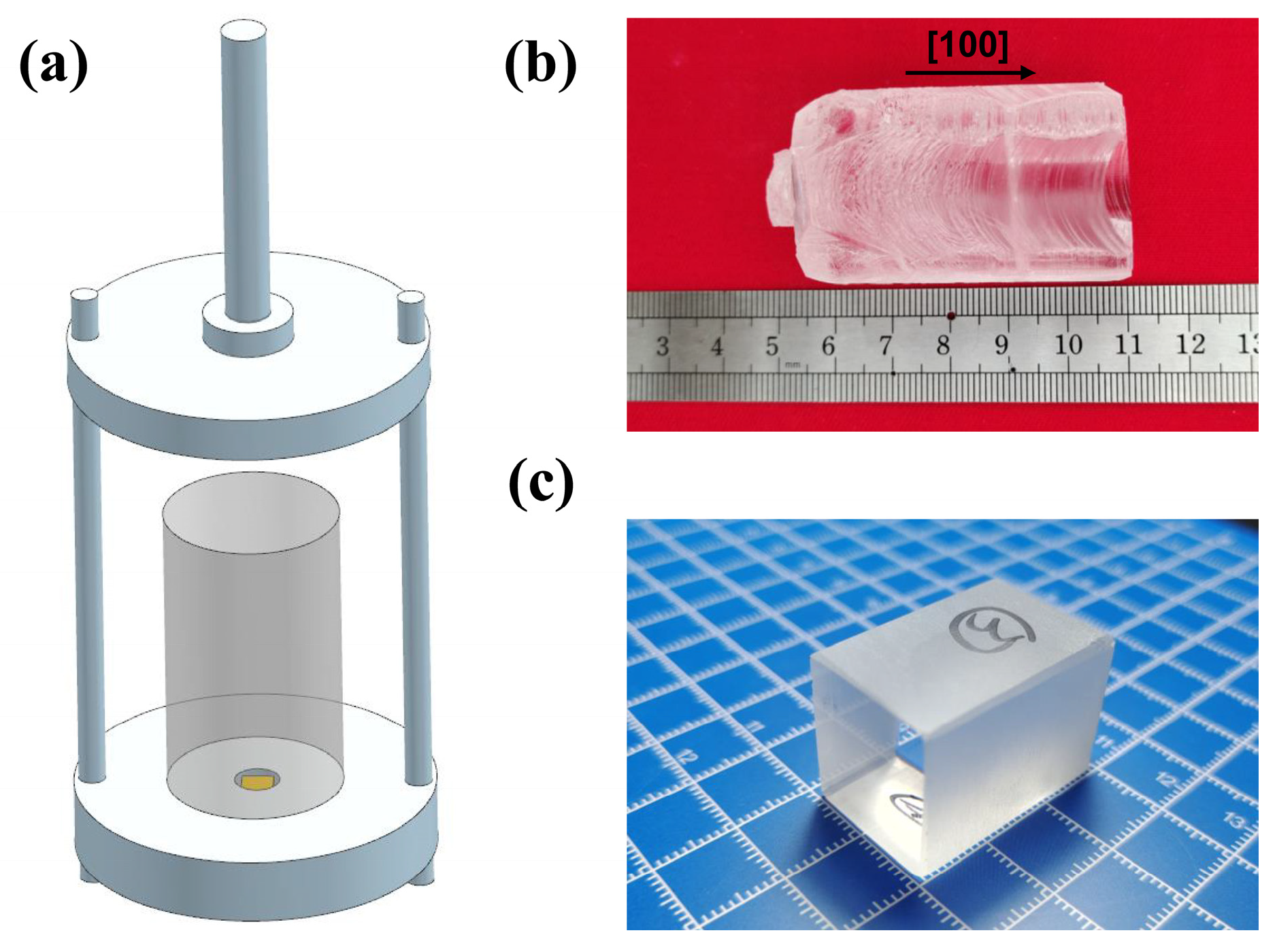
Barium nitrate crystals belong to the cubic crystal system and typically exhibit a combination of cubic and octahedral habits [24]. This natural habit results in low material utilization when cutting the as-grown barium nitrate crystals into Raman gain elements with desired orientations and dimensions. To address this limitation and improve crystal processing efficiency, regular-shaped barium nitrate single crystals were grown using the directional template growth method. A glass tube with an inner diameter of 30 mm is secured to a custom-made crystal holder. A circular recess at the center of the base plate is designed to hold the seed crystal. The directional template growth apparatus is shown in Figure 1a. The physical constraints promoted crystal growth along the tube direction, ultimately yielding a cylindrical barium nitrate single crystal with a diameter of 30 mm and a height of approximately 57 mm, as shown in Figure 1b. Subsequently, a barium nitrate Raman gain element with a cross-section of approximately 20 mm × 20 mm was successfully fabricated using this growth method. The two end faces of the crystal are polished and uncoated. Figure 1c shows a photo of the Raman gain element. This represents a 2~4 fold increase in the achievable aperture compared to the 5~10 mm elements feasible from conventional, unconstrained crystals.

3. Characterization of Crystal Properties

3.1. Crystal Crystallinity

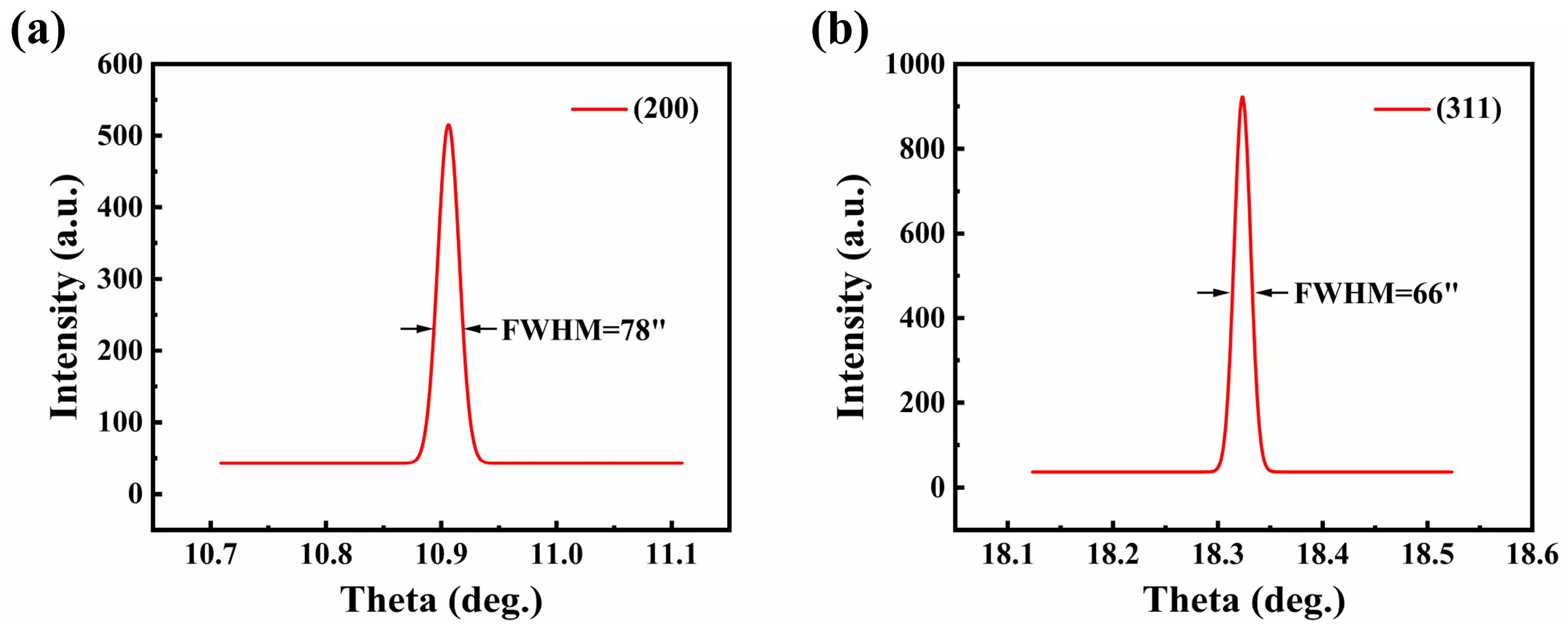
To evaluate the crystallinity and optical properties of large-sized barium nitrate crystals, relevant characterization was performed. The crystalline quality of barium nitrate single crystals was evaluated by measuring the rocking curves of different diffraction planes. The rocking curve analysis was performed using a high-resolution X-ray diffractometer (D8 Discover, Bruker Corporation, Billerica, MA, USA) equipped with a Cu-Kα radiation source (λ = 1.5406 Å), with a scan step of 0.001°. All test samples were surface-polished wafers mounted on a high-precision goniometer.
The results of the high-resolution X-ray diffraction rocking curve test are shown in Figure 2. The figure shows that the rocking curves for the (200) and (311) diffraction planes of the barium nitrate crystals exhibit excellent symmetry. The full width at half maximum (FWHM) for the two curves was 78″ and 66″, respectively. In the experiment, test points were taken at different positions in the center and at the edges of each sample. The similar FWHM of the fitted peaks indicates good crystal homogeneity. It can be concluded that the crystal exhibits high crystallinity, making it suitable for high-performance devices.

3.2. Transmission Spectrum

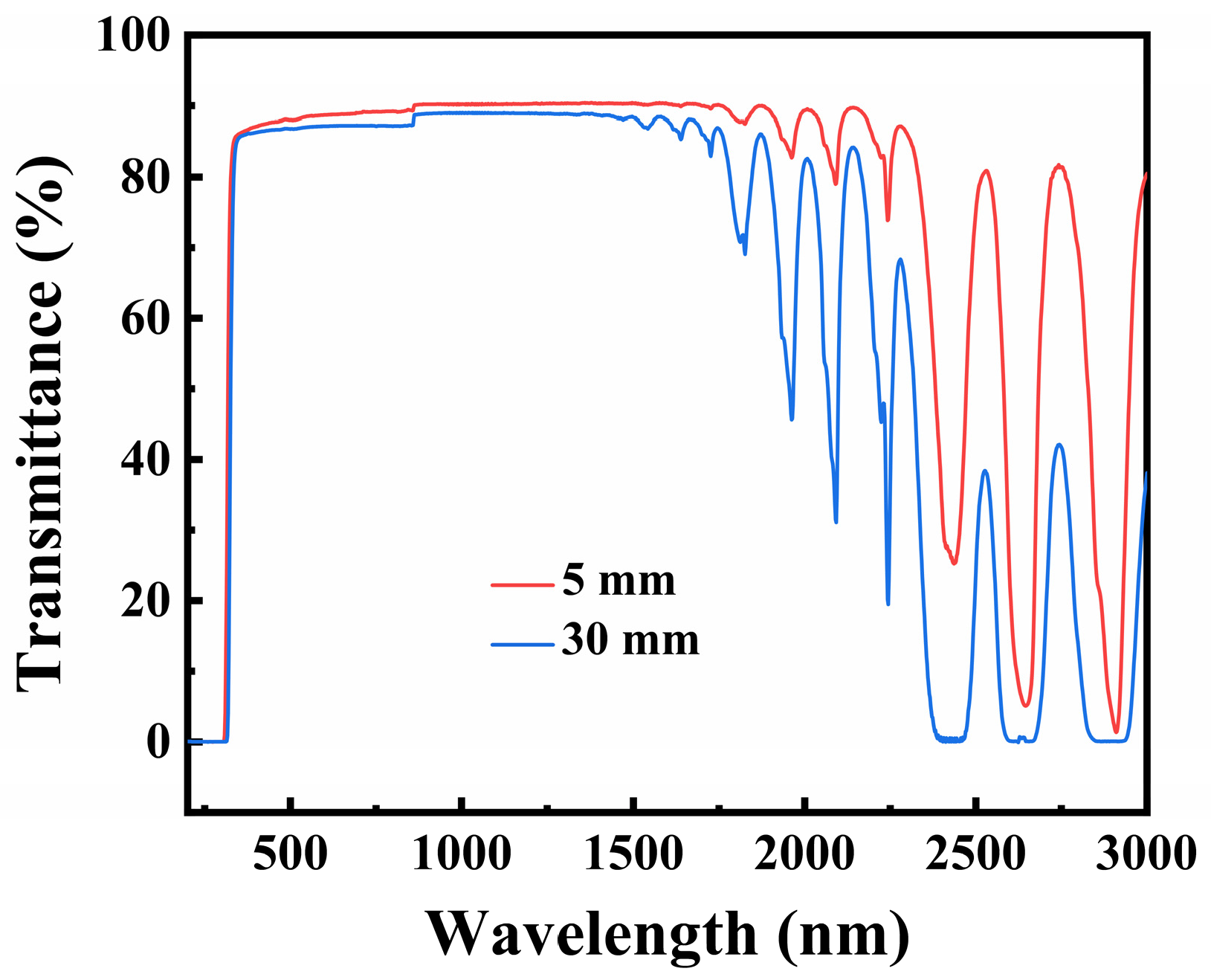
The optical transmittance characteristics of the crystal across ultraviolet, visible, and near-infrared wavelengths were evaluated using a high-precision UV-Vis-NIR spectrophotometer (Lambda 1050, PerkinElmer, Inc., Shelton, CT, USA). The transmittance spectra in the range of 200~3000 nm were measured with a resolution of 2 nm. The polished crystal wafer is placed in the sample beam path, while the reference beam path maintains ambient air as the baseline standard to correct for instrument drift and environmental interference. The barium nitrate crystals were mechanically polished to optical grade but remained uncoated. Based on the refractive index of barium nitrate (n ≈ 1.55~1.60 in the visible range), the theoretical single-surface Fresnel reflection loss can be estimated. For n = 1.57, this yields R ≈ 4.9% per surface, corresponding to a total transmission loss of approximately 9.8% for the two uncoated surfaces (neglecting absorption).
Figure 3 shows the transmission spectra of barium nitrate crystals of different thicknesses. The transmission spectra indicate that barium nitrate crystals exhibit a transmission range from approximately 340 to 1800 nm. The sharp drop of transmittance at shorter wavelengths indicates the intrinsic absorption edge of barium nitrate. The ultraviolet cutoff wavelength, where transmittance drops to 10% of its maximum value, is approximately 310 nm. At the transmission range, the maximum transmittance of the 5 mm sample is approximately 90%, indicating that the crystals exhibit excellent optical quality. For a 30 mm thick sample, the maximum transmittance is approximately 88.9%. The transmittance of the 30 mm sample is slightly lower than that of the 5 mm sample, indicating that barium nitrate crystals exhibit minor intrinsic absorption. Nevertheless, both the 5 mm and 30 mm thick samples exhibit transmittance values between 85% and 89% in the visible light spectrum, fully meeting the optical transparency requirements for materials used in optical experiments.

3.3. Raman Spectroscopy

Raman spectroscopy measurements were performed using a confocal micro-Raman spectroscopy system (iHR550, HORIBA, Ltd., Kyoto, Japan) to identify the characteristic vibrational modes of the barium nitrate lattice. A 633 nm helium–neon laser (2 mW) served as the excitation source. Spectra were acquired over the range of 100~2200 cm−1 with a spectral resolution of approximately 1 cm−1. All measurements were performed at room temperature using a backscatter geometry configuration.
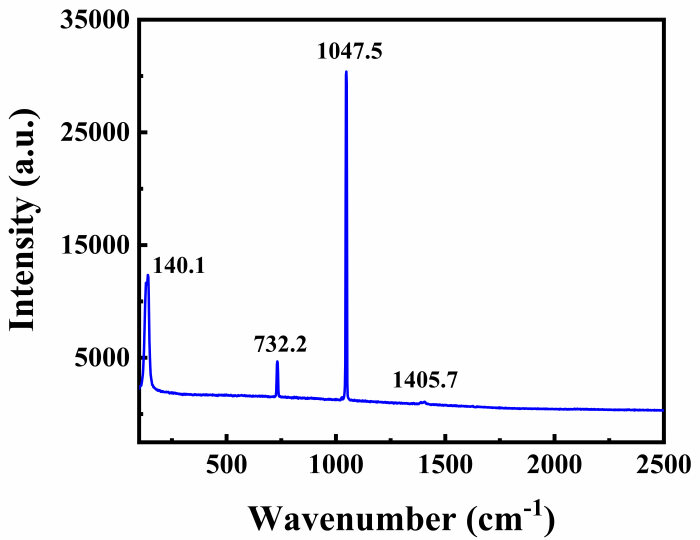
The room-temperature Raman spectroscopy analysis was performed on the as-grown barium nitrate crystals. As illustrated in Figure 4, the Raman spectrum of the barium nitrate crystals exhibits a very strong characteristic peak at 1047 cm−1, corresponding to its dominant vibrational mode, along with several weaker vibrational modes observed in other spectral regions. The barium nitrate crystal belongs to the cubic crystal system with the space group Pa-3 [25]. According to factor group analysis, the internal vibration modes within the nitrate ion belong to the D3h point group in the free ion state, which exhibits four fundamental vibration modes: ν1 (symmetric stretching), ν2 (out-of-plane bending), ν3 (asymmetric stretching), and ν4 (in-plane bending) [26,27]. Upon incorporation into the crystal lattice, the point group symmetry of the nitrate ion is reduced, leading to the splitting of its vibrational modes.
The Raman spectrum obtained from the experiment shows a most prominent peak at 1047 cm−1, which is sharp, highly intense, and exhibits a relatively narrow full width at half maximum. This peak is assigned to the ν1 symmetric stretching mode of the nitrate ion. The elevated frequency and sharp line shape demonstrate the strong covalent nature of the N-O bonds, as well as the highly ordered and uniform local environment of nitrate ions within the crystal structure. A medium-intensity peak observed around 720 cm−1 can be assigned to the crystal field splitting component of the ν4 in-plane bending vibrational mode. A very weak peak observed around 1400 cm−1 may originate from the ν3 asymmetric stretching mode. The vibrational mode, which is inherently infrared-active in free ions, gains weak Raman activity through symmetry reduction within the crystalline lattice. The exceptionally low intensity of this peak forms a stark contrast with the dominant ν1 symmetric stretching peak at 1047 cm−1. The broad peaks in the low-frequency region correspond to lattice vibrational modes (external modes), which involve the translational motions between Ba2+ and NO3 ions, as well as the rotational or librational modes of nitrate groups. All characteristic peaks in the Raman spectrum of barium nitrate crystals can be assigned. The sharp spectral features with well-resolved characteristic peaks and the absence of conspicuous impurity signals indicate that the grown barium nitrate crystals possess both high phase purity and excellent crystallinity—attributes that are crucial for achieving reduced threshold energy and enhanced conversion efficiency in laser device applications.

4. Large Energy Yellow–Orange Laser Output

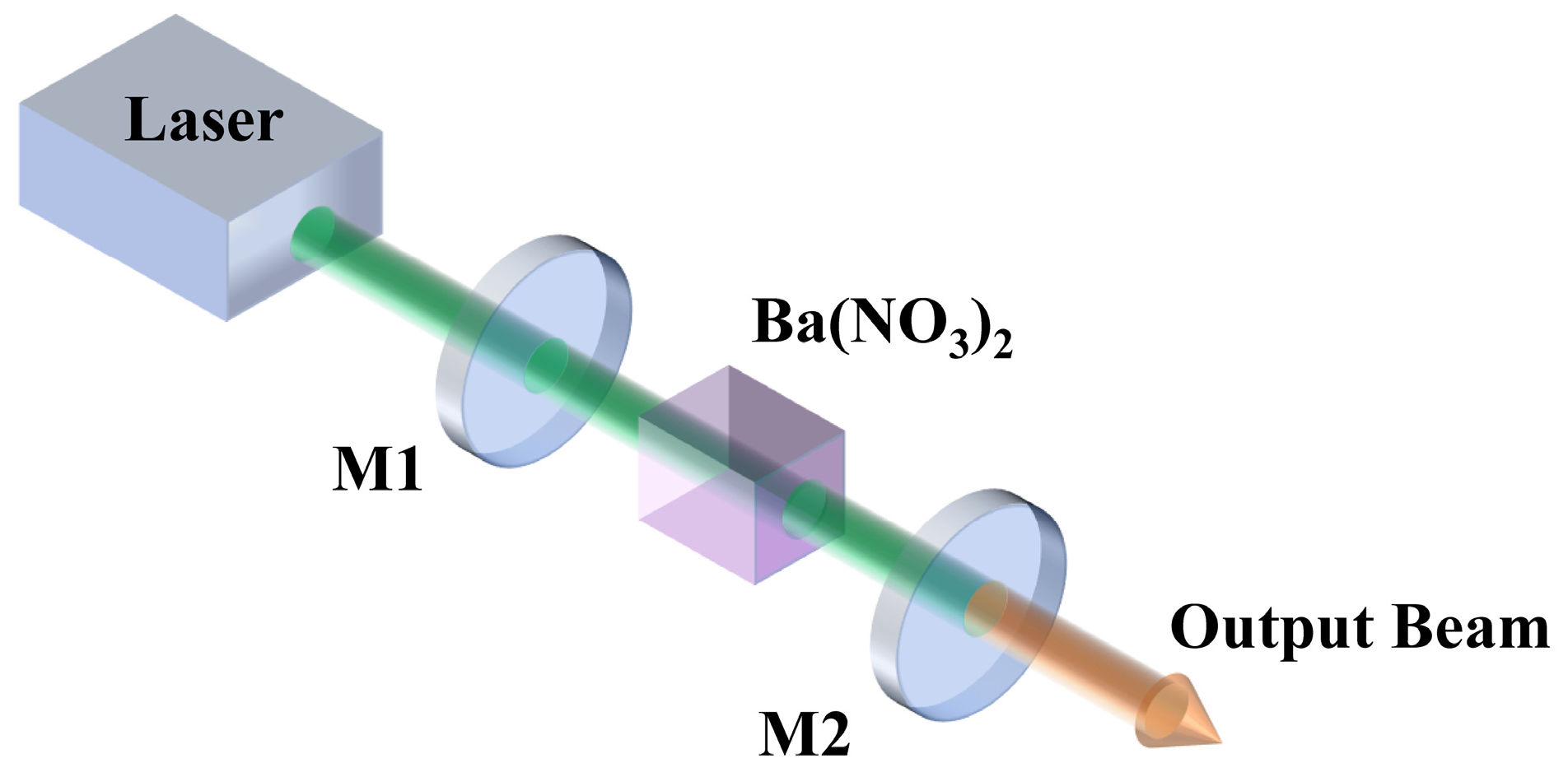
To obtain a large energy yellow–orange laser, a barium nitrate crystal grown by the directional template method was processed into a large-aperture Raman gain element (20 mm × 20 mm × 30 mm), and a nanosecond-pulsed yellow–orange laser was constructed. The schematic diagram of the experimental setup is shown in Figure 5. A pulsed electro-optically Q-switched Nd: YAG laser was employed to generate the second harmonic as the pump source. The pulse width was approximately 10 ns, with a repetition rate of 1 Hz and a beam diameter of about 10 mm. The maximum output energy of the second harmonic could reach up to 1 J, with a beam quality factor of 2. The Raman oscillator cavity consisted of two plane mirrors, M1 and M2, with the barium nitrate Raman gain element placed at the center of the cavity. The M1 and M2 were placed close to both ends of the barium nitrate crystal, and the resonator length was approximately 40 mm. Input mirror M1 exhibited high transmission (HT, T > 99%) at 532 nm while demonstrating high reflection (HR, R > 90%) over the 560~680 nm range. Output mirror M2 was designed to provide high reflection (HR, R > 90%) at 532 nm and high transmission (HT, T > 98%) between 560 nm and 640 nm.
In the experiment, an optical spectrum analyzer (HR4000, Ocean Optics, Inc., Dunedin, FL, USA) was employed to measure the SRS spectra generated by the 532 nm pumped barium nitrate crystal. The pump energy and output pulse energy were recorded using an energy meter (Ophir Centauri, Ophir Optronics Solutions Ltd., Jerusalem, Israel) equipped with a measurement probe (PE50BF-DIF-C, Ophir Optronics Solutions Ltd., Jerusalem, Israel).
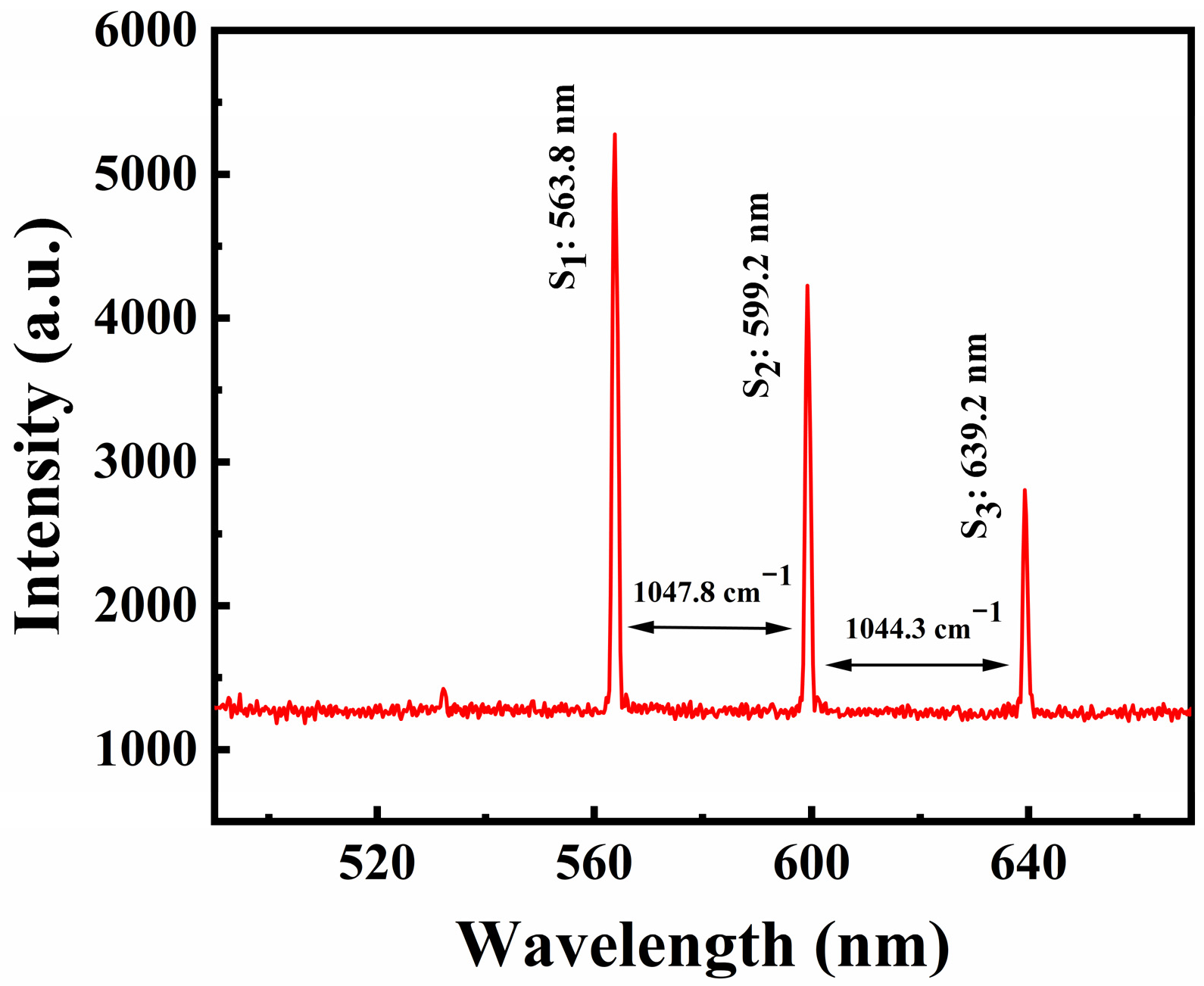
The spectrum in Figure 6 was measured at the output of the Raman resonator using a custom-designed Q-switched Nd: YAG laser (Zolix Lasers, Beijing, China), 532 nm, 10 ns. The peak pump power was approximately 71.1 MW. The spectrum shows multiple Stokes laser components within the yellow–orange spectral region, including first-order Stokes (S1: 563.8 nm), second-order Stokes (S2: 599.2 nm), and third-order Stokes (S3: 639.2 nm). The frequency shifts between adjacent Stokes orders were calculated to be 1047.8 cm−1 and 1044.3 cm−1, which are in excellent agreement with the theoretical reference value [17].
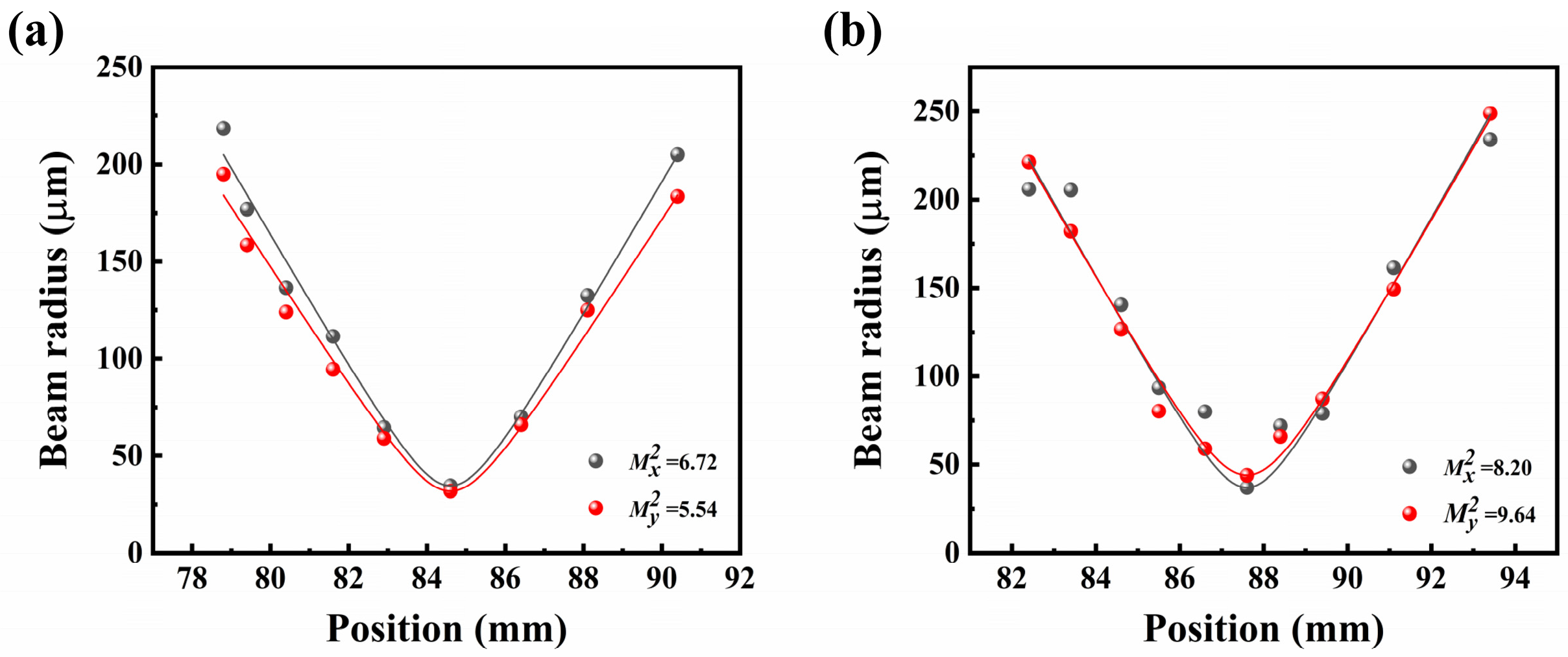
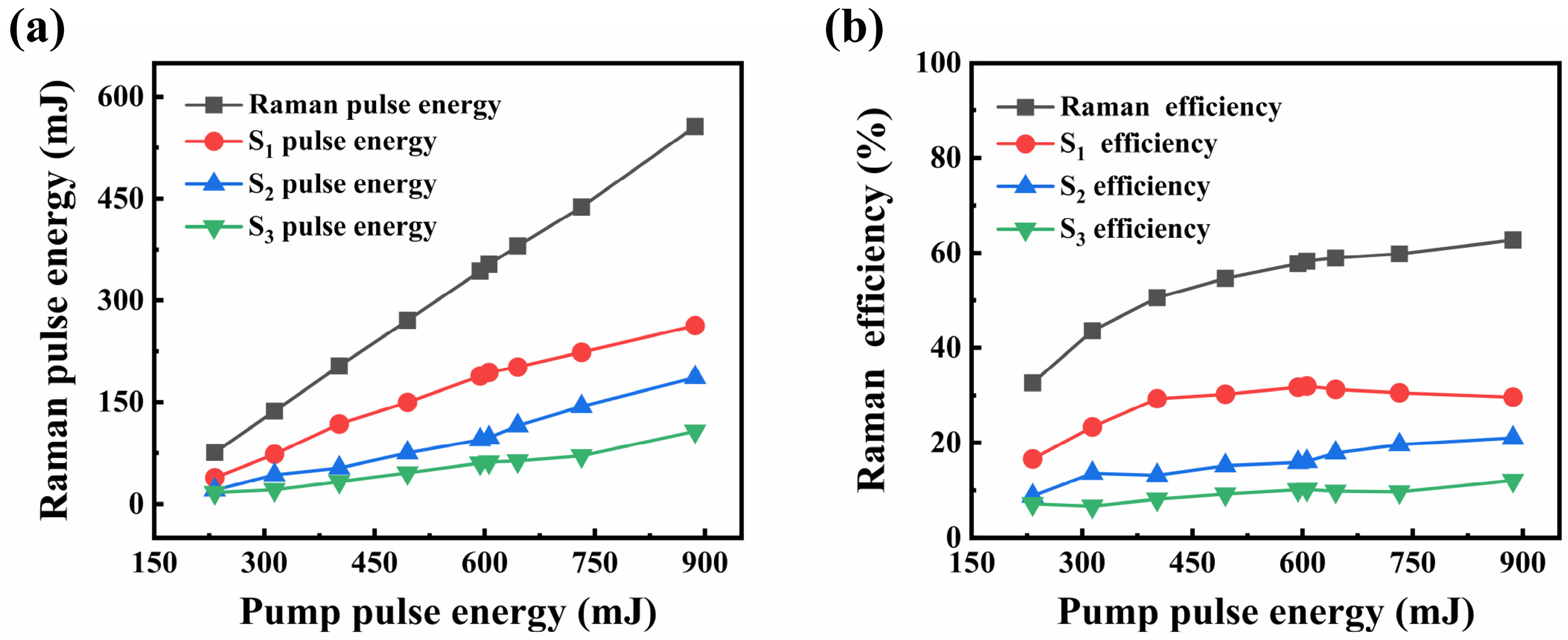
Although barium nitrate-based Raman gain elements with 5~8 mm clear apertures have achieved high efficiency Raman laser output in previous studies, the generated beam diameter remains typically constrained to approximately 5 mm. The small beam area imposes a stringent constraint on the allowable pulse energy to maintain the fluence below the damage threshold of optical coatings, consequently limiting the maximum output energy of such systems. This study employs a large-aperture Raman gain element, enabling the fundamental-frequency light to maintain its original beam diameter when illuminating the gain medium. This not only facilitates setup simplification but also permits higher pump laser input power. The relationship between the output energy of Raman pulse laser and the 532 nm pumping laser energy is plotted in Figure 7. The Stokes laser pulses were generated only when the 532 nm energy exceeds 130 mJ and the corresponding pump threshold power density was 16.6 MW/cm2. As can be seen from Figure 7a, the output energy of the multi-order Stokes laser increases with increasing pump pulse energy. When the pump energy was 886.7 mJ, the maximum energy of the Raman laser reached 556.2 mJ. The Raman efficiency, defined as the conversion efficiency from pump pulse (532 nm) to Raman pulse light, was approximately 62.7%. Then, two filters were used to separate the Stokes lasers of different orders. The first-order Stokes (S1: 563.8 nm) and second-order Stokes (S2: 599.2 nm) pulse energy at a pump energy of 886.7 mJ were 262.8 mJ and 186.3 mJ, respectively. The corresponding conversion efficiency from the pump laser to the first- and second-order Stokes lasers were approximately 29.6% and 21%. The total Raman energy, first-order Stokes energy, and second-order Stokes energy were all accurately measured. Spectral analysis confirmed that the Raman light contains first-order, second-order, and third-order Stokes components. Therefore, the third-order Stokes energy is obtained by subtracting the first- and second-order energies from the total Raman energy. The third-order Stokes energy is 107.1 mJ, with an efficiency of 12.1%. Figure 7b shows that the first-order Stokes conversion efficiency tends to saturate when pump energy exceeds ~600 mJ. This observation can be explained by the increased conversion of the first-order Stokes laser to the second-order Stokes laser. In Table 1, we listed a comparison of Raman output characteristics among common Raman crystals. The maximum single-pulse Raman laser output energy achieved in this study is only second to the highest single-pulse energy record realized by Lv, X.L. et al. in KGW crystals [28]. Nevertheless, this is the highest single-pulse Raman output energy realized in barium nitrate crystals. Meanwhile, the optical-to-optical conversion efficiency achieved in this study is remarkable. For unit crystal length, the conversion efficiency reached 2.09%/mm, which is higher than other Raman crystals and also surpasses our previous reports [24]. The beam quality factor of the Stokes output beam was measured. As shown in Figure 8, the beam quality factor of the first-order Stokes light is 6.72, while that of the second-order Stokes light is 9.64. Stokes beam quality degradation is primarily associated with mode distortion induced by high-power laser-pumped SRS, beam competition, and thermal effects leading to beam distortion [29,30,31,32]. Although beam quality degrades, this is a concession made in pursuit of high-power laser output. In future application research, it may be necessary to balance these factors or explore potential solutions.

5. Conclusions

In this study, significant progress was achieved in the growth and application of large-size Ba(NO3)2 crystals. Using the directional template growth method, a large-aperture Ba(NO3)2 Raman gain element was successfully prepared. Systematic characterization results confirmed that the obtained crystals exhibited high crystallinity and optical quality. A nanosecond-pulsed yellow–orange laser system was designed and constructed using this large-aperture Ba(NO3)2 gain medium. By employing the second harmonic of a pulsed electro-optically Q-switched Nd: YAG laser as the pump source, a yellow–orange laser output energy of 556.2 mJ was achieved under an injected pump energy of 886.7 mJ, corresponding to an optical-to-optical conversion efficiency of 62.7%. This output energy represents the highest reported single-pulse energy level to date for Ba(NO3)2-based Raman laser. This breakthrough not only demonstrates the application potential of barium nitrate crystals in high-energy Raman laser systems but also establishes critical material and technological groundwork for the development of next-generation high-energy yellow–orange laser sources.

Author Contributions

Methodology, X.L.; data curation, X.L.; validation, X.L., P.Y. and G.L.; formal analysis, X.L.; investigation, X.L.; conceptualization, X.L. and Z.W.; resources, H.R. and X.S.; writing—original draft preparation, X.L.; writing—review and editing, X.L. and Z.W.; visualization, X.L.; supervision, H.R., P.Y. and G.L.; project administration, X.X.; funding acquisition, X.S. All authors have read and agreed to the published version of the manuscript.

Funding

This research was funded by the Taishan Scholars Program of Shandong Province (No. tstp20231207), Natural Science Foundation of Shandong Province (ZR2023ZD02), Natural Science Foundation of Shandong Province (ZR2022QE113), Youth Foundation of Shandong Natural Science Foundation of China (ZR2024QA170), and Shandong Postdoctoral Science Foundation (SDZZ-ZR-202501354).

Data Availability Statement

The original contributions presented in this study are included in the article. Further inquiries can be directed to the corresponding author.

Conflicts of Interest

The authors declare no conflicts of interest.

References

  1. Kling, M.F.; Menoni, C.S.; Geddes, C.; Galvanauskas, A.; Albert, F.; Kiani, L.; Chini, M.; Baker, L.R.; Nelson, K.A.; Young, L.; et al. Roadmap on basic research needs for laser technology. J. Opt. 2024, 27, 013002. [Google Scholar] [CrossRef]
  2. Supradeepa, V.R.; Feng, Y.; Nicholson, J.W. Raman fiber lasers. J. Opt. 2017, 19, 023001. [Google Scholar] [CrossRef]
  3. Reid, D.T.; Heyl, C.M.; Thomson, R.R.; Trebino, R.; Steinmeyer, G.; Fielding, H.H.; Holzwarth, R.; Zhang, Z.; Del’Haye, P.; Südmeyer, T.; et al. Roadmap on ultrafast optics. J. Opt. 2016, 18, 093006. [Google Scholar] [CrossRef]
  4. Jones, K.J. Progress in Na laser guide star adaptive optics and lessons learned. In Proceedings of the Laser Beam Shaping XVII, San Diego, CA, USA, 28 August–1 September 2016; Proceedings of SPIE; SPIE: Bellingham, WA, USA, 2016; Volume 9950, p. 995011. [Google Scholar]
  5. Xia, Y.; Cheng, X.; Wang, Z.; Liu, L.; Yang, Y.; Du, L.; Jiao, J.; Wang, J.; Zheng, H.; Li, Y.; et al. Design of a Data Acquisition, Correction and Retrieval of Na Doppler Lidar for Diurnal Measurement of Temperature and Wind in the Mesosphere and Lower Thermosphere Region. Remote Sens. 2023, 15, 5140. [Google Scholar] [CrossRef]
  6. Levinson, J.D.; Hubbard, G.B. 577-nm Yellow Laser Photocoagulation for Coats Disease. Retina 2016, 36, 1388–1394. [Google Scholar] [CrossRef]
  7. Kim, J.Y.; Park, H.S.; Kim, S.Y. Short-term efficacy of subthreshold micropulse yellow laser (577-nm) photocoagulation for chronic central serous chorioretinopathy. Graefe’s Arch. Clin. Exp. Ophthalmol. 2015, 253, 2129–2135. [Google Scholar] [CrossRef]
  8. Haynes, C.L.; Van Duyne, R.P. Plasmon-Sampled Surface-Enhanced Raman Excitation Spectroscopy. J. Phys. Chem. B 2003, 107, 7426–7433. [Google Scholar] [CrossRef]
  9. Garcia-Bucio, M.A.; Maynez-Rojas, M.Á.; Casanova-González, E.; Cárcamo-Vega, J.J.; Ruvalcaba-Sil, J.L.; Mitrani, A. Raman and surface-enhanced Raman spectroscopy for the analysis of Mexican yellow dyestuff. J. Raman Spectrosc. 2019, 50, 1546–1554. [Google Scholar] [CrossRef]
  10. Duarte, F.J.; Piper, J.A. Narrow linewidth, high prf copper laser-pumped dye-laser oscillators. Appl. Opt. 1984, 23, 1391–1394. [Google Scholar] [CrossRef]
  11. Gu, C.; Hu, M.; Fan, J.; Song, Y.; Liu, B.; Wang, C. High-power, dual-wavelength femtosecond LiB3O5 optical parametric oscillator pumped by fiber laser. Opt. Lett. 2014, 39, 3896–3899. [Google Scholar] [CrossRef]
  12. Sun, B.; Ding, X.; Jiang, P.; Bai, Y.; Yu, X.; Liu, Y.; Wang, J.; Zhao, L.; Li, T.; Jiang, G.; et al. 13.7-W 588-nm Yellow Laser Generation by Frequency Doubling of 885-nm Side-Pumped Nd: YAG-YVO4 Intracavity Raman Laser. IEEE Photonics J. 2020, 12, 1501607. [Google Scholar] [CrossRef]
  13. Sirleto, L.; Ferrara, M.A. Fiber Amplifiers and Fiber Lasers Based on Stimulated Raman Scattering: A Review. Micromachines 2020, 11, 247. [Google Scholar] [CrossRef] [PubMed]
  14. Huang, M.; Sun, S.; Saini, T.S.; Fu, Q.; Xu, L.; Wu, D.; Ren, H.; Shen, L.; Hawkins, T.W.; Ballato, J.; et al. Raman amplification at 2.2 μm in silicon core fibers with prospects for extended mid-infrared source generation. Light Sci. Appl. 2023, 12, 209. [Google Scholar] [CrossRef] [PubMed]
  15. Rong, H.; Xu, S.; Kuo, Y.-H.; Sih, V.; Cohen, O.; Raday, O.; Paniccia, M. Low-threshold continuous-wave Raman silicon laser. Nat. Photonics 2007, 1, 232–237. [Google Scholar] [CrossRef]
  16. Jiang, P.; Ding, X.; Guo, J.; Zhang, H.; Qi, H.; Shang, Y.; Song, Z.; Wang, W.; Wang, C.; Liu, G.; et al. Research progress of crystalline Raman yellow lasers. Opt. Laser Technol. 2024, 169, 110072. [Google Scholar] [CrossRef]
  17. Zverev, P.G.; Jia, W.; Liu, H.; Basiev, T.T. Vibrational dynamic of the Raman-active mode in barium nitrate crystal. Opt. Lett. 1995, 20, 2378–2380. [Google Scholar] [CrossRef]
  18. Pask, H.M. The design and operation of solid-state Raman lasers. Prog. Quantum Electron. 2003, 27, 3–56. [Google Scholar] [CrossRef]
  19. Maiwa, K.; Tsukamoto, K.; Sunagawa, I. Growth induced lattice defects in Ba(NO3)2 crystals. J. Cryst. Growth 1987, 82, 611–620. [Google Scholar] [CrossRef]
  20. Onuma, K.; Tsukamoto, K.; Sunagawa, I. Role of buoyancy driven convection in aqueous solution growth; A case study of Ba(NO3)2 crystal. J. Cryst. Growth 1988, 89, 177–188. [Google Scholar] [CrossRef]
  21. Chen, W.; Liu, D.; Zhang, C.; Wu, L.; Xie, A. Larger Ba(NO3)2/Sr(NO3)2 crystal growth and solubility determination. Mater. Res. Bull. 2004, 39, 309–316. [Google Scholar] [CrossRef]
  22. Zverev, P.G.; Basiev, T.T.; Osiko, V.V.; Kulkov, A.M.; Voitsekhovskii, V.N.; Yakobson, V.E. Physical, chemical and optical properties of barium nitrate Raman crystal. Opt. Mater. 1999, 11, 315–334. [Google Scholar] [CrossRef]
  23. Feigelson, R.S. Crystal Growth through the Ages: A Historical Perspective. In Handbook of Crystal Growth, 2nd ed.; Elsevier: Amsterdam, The Netherlands, 2015; pp. 1–83. [Google Scholar] [CrossRef]
  24. Lin, X.J.; Ren, H.K.; Wang, Z.P.; Li, Y.; Sun, X.; Xu, X.G. Yellow-orange and ultraviolet laser generation based on stimulated Raman scattering of barium nitrate crystal. Opt. Laser Technol. 2025, 186, 112697. [Google Scholar] [CrossRef]
  25. Nowotny, H.; Heger, G. Structure Refinement of Strontium Nitrate, Sr(NO3)2, and Barium Nitrate, Ba(NO3)2. Acta Cryst. 1983, 39, 652–956. [Google Scholar] [CrossRef]
  26. Bishop, J.L.; King, S.J.; Lane, M.D.; Brown, A.J.; Lafuente, B.; Hiroi, T.; Roberts, R.; Swayze, G.A.; Lin, J.F.; Sánchez Román, M. Spectral Properties of Anhydrous Carbonates and Nitrates. Earth Space Sci. 2021, 8, e2021EA001844. [Google Scholar] [CrossRef]
  27. Brooker, M.H.; Irish, D.E. Crystalline-field effects on the infrared and Raman spectra of powdered alkali-metal, silver, and thallous nitrates. Can. J. Chem. 1970, 48, 1183–1197. [Google Scholar] [CrossRef]
  28. Lv, X.L.; Chen, J.C.; Peng, Y.J.; Long, Y.B.; Liu, G.T.; Leng, Y.X. Investigation of high-energy extracavity Raman laser oscillator and single-pass Raman generator based on potassium gadolinium tungstate (KGW) crystal. Opt. Laser Technol. 2021, 140, 107023. [Google Scholar] [CrossRef]
  29. Hejaz, K.; Shayganmanesh, M.; Rezaei-Nasirabad, R.; Roohforouz, A.; Azizi, S.; Abedinajafi, A.; Vatani, V. Modal instability induced by stimulated Raman scattering in high-power Yb-doped fiber amplifiers. Opt. Lett. 2017, 42, 5274–5277. [Google Scholar] [CrossRef]
  30. Tian, X.; Rao, B.; Wang, M.; Xi, X.; Li, Z.; Chen, Z.; Xiao, H.; Ma, P.; Wang, Z. Brightness enhancement on a narrow-linewidth fiber Bragg grating-based master oscillator power amplification fiber laser. High Power Laser Sci. Eng. 2024, 12, e44. [Google Scholar] [CrossRef]
  31. Hao, X.; Fan, C.; Li, Y.; Pan, Z.; Leng, J.; Yao, T.; Lei, B.; Zhou, P. Brightness enhancement on random-distributed-feedback Raman fiber lasers pumped by multimode diodes. High Power Laser Sci. Eng. 2024, 12, e29. [Google Scholar] [CrossRef]
  32. Zhang, F.; Li, P.; Chen, Y.; Chen, H.; Zheng, H.; Wang, K.; Ding, J.; Wang, Y.; Lu, Z.; Bai, Z. Coupled thermal dynamics and performance degradation in high-power continuous-wave diamond Raman lasers. Diam. Relat. Mater. 2025, 159, 112887. [Google Scholar] [CrossRef]
  33. Williams, R.J.; Kitzler, O.; Bai, Z.; Sarang, S.; Jasbeer, H.; McKay, A.; Antipov, S.; Sabella, A.; Lux, O.; Spence, D.J.; et al. High Power Diamond Raman Lasers. IEEE J. Sel. Top. Quantum Electron. 2018, 24, 1602214. [Google Scholar] [CrossRef]
  34. Deng, J.; Lin, J.; Huang, J.; Zheng, H.; Li, J.; Shi, F.; Dai, S.; Weng, W.; Kang, Z.; Jiang, X.; et al. High peak power first, second, and third order Stokes pulses based on intracavity self-stimulated Raman scattering lasers. Chin. Opt. Lett. 2010, 8, 293–295. [Google Scholar] [CrossRef]
  35. Hao, J.J.; Tu, W.; Zong, N.; Shen, Y.; Zhang, S.J.; Bo, Y.; Peng, Q.J.; Xu, Z.Y. Coaxial Multi-Wavelength Generation in YVO4 Crystal with Stimulated Raman Scattering Excited by a Picosecond-Pulsed 1064 Laser. Chin. Phys. Lett. 2020, 37, 044202. [Google Scholar] [CrossRef]
  36. Zhang, L.; Zhu, H.Y.; Sun, Y.L.; Duan, Y.M.; Qi, Z.Q.; Ruan, X.K.; Cheng, M.Y. Diode-end-pumped passively Q-switched Nd:YAP/YVO4 laser at 1.2 μm. J. Infrared Millim. Waves 2020, 39, 786–790. [Google Scholar] [CrossRef]
  37. Wang, C.; Cong, Z.; Liu, Z.; Zhang, X.; Wang, Q.; Wei, W.; Li, L.; Zhang, Y.; Wang, W.; Wu, Z.; et al. Theoretical and experimental investigation of an efficient pulsed barium tungstate Raman amplifier at 1180nm. Opt. Commun. 2014, 313, 80–84. [Google Scholar] [CrossRef]
  38. Liu, Z.; Rao, H.; Cong, Z.; Xue, F.; Gao, X.; Wang, S.; Tan, W.; Guan, C.; Zhang, X. Single-Frequency BaWO4 Raman MOPA at 1178 nm with 100-ns Pulse Pump. Crystals 2019, 9, 185. [Google Scholar] [CrossRef]
  39. Fang, C.Q.; Yu, G.L.; Ding, J.Y.; Li, B.B.; Li, G.L.; Zhou, J.; Zhu, X.L.; Wei, W. High-Efficiency and High-Pulse-Energy 1197 nm Laser Based on Stimulated Raman Scattering. Chin. J. Lasers 2021, 48, 2001001. [Google Scholar] [CrossRef]
Figure 1. (a) Schematic of Ba(NO3)2 crystal directional template growth holder; (b) As-grown crystal photograph; (c) Raman gain element photograph.
Crystals 16 00198 g001
Figure 2. X-ray diffraction rocking curves of the barium nitrate crystal for the (a) (200), (b) (311) crystallographic planes.
Crystals 16 00198 g002
Figure 3. Transmission spectra of the Ba(NO3)2 crystal with different thicknesses.
Crystals 16 00198 g003
Figure 4. The room-temperature Raman spectrum of Ba(NO3)2 crystals.
Crystals 16 00198 g004
Figure 5. Experimental setup of yellow–orange laser generation.
Crystals 16 00198 g005
Figure 6. Output spectrum of barium nitrate Raman resonator.
Crystals 16 00198 g006
Figure 7. Raman output energy (a) and conversion efficiency (b) of the large-aperture Ba(NO3)2 Raman gain element.
Crystals 16 00198 g007
Figure 8. (a) First-order Stokes beam quality factor; (b) second-order Stokes beam quality factor.
Crystals 16 00198 g008
Table 1. Comparison of Raman output characteristics among common Raman crystals.
Raman CrystalPump Wavelength
(nm)
Crystal Size
(mm)
Maximum Raman Pulse Energy (mJ)Conversion EfficiencySource
Diamond10642 × 29.724.5%[33]
KGd(WO4)21067Φ3.5 × 625410.7%[34]
KGd(WO4)2106410 × 10 × 7067624.1%[28]
YVO410645 × 5 × 402.7735.7%[35]
YVO410803 × 3 × 300.02287.7%[36]
BaWO410647 × 7 × 87.871.535.8%[37]
BaWO410627 × 7 × 87.87.713.3%[38]
Ba(NO3)210648 × 8 × 3013746.6%[39]
Ba(NO3)25329 × 9 × 4078.468.3%[24]
Ba(NO3)253220 × 20 × 30556.262.7%This study
Disclaimer/Publisher’s Note: The statements, opinions and data contained in all publications are solely those of the individual author(s) and contributor(s) and not of MDPI and/or the editor(s). MDPI and/or the editor(s) disclaim responsibility for any injury to people or property resulting from any ideas, methods, instructions or products referred to in the content.