


Abstract
This study systematically investigated the static recrystallization behavior and microstructural evolution of cold-rolled Ti-2Al-2.5Zr alloy tubes subjected to isothermal annealing at 650–800 °C. Electron backscatter diffraction (EBSD), optical microscopy, and microhardness testing were used to analyze recrystallization kinetics, grain size, grain boundary character, texture evolution, and strain energy release under different annealing temperatures and times. The results show that with increasing annealing temperature, the recrystallization incubation time is significantly shortened and the recrystallization rate increases nonlinearly; the times required for full recrystallization at 650, 700, 750, and 800 °C are 480 min, 25 min, 20 min, and 15 min, respectively. Compared with the other annealing temperatures, annealing at 700 °C yields finer, more uniform equiaxed grains and lower texture intensity, while at higher temperatures, recrystallization and recovery proceed too rapidly, which is unfavorable for fine control of the microstructure. After completion of recrystallization, the alloy microhardness stabilizes at approximately 200 HV. Based on the Avrami kinetics model, the recrystallization activation energy of the Ti-2Al-2.5Zr alloy tubes was calculated to be approximately 303.9 kJ/mol, providing a theoretical basis for optimizing the annealing process.
1. Introduction
As a near-α titanium alloy, Ti-2Al-2.5Zr alloy is widely used in key piping systems and structural components in the nuclear, aerospace, and chemical industries due to its good strength at both room and elevated temperatures and its excellent corrosion resistance [1,2,3]. In practical production, thick-walled Ti-2Al-2.5Zr alloy tubes usually undergo plastic deformation processes such as cold rolling and drawing to achieve the required dimensions and shapes. However, the high density of dislocations and lattice distortions introduced during processing leads to work hardening, which reduces ductility and may alter surface condition and microstructural characteristics, thereby threatening service reliability [4,5,6,7]. Therefore, subsequent annealing treatment is a critical process step for adjusting the microstructure, restoring plasticity, and obtaining optimal comprehensive properties.
The core mechanisms during the annealing of titanium alloys are static recovery and static recrystallization, with key steps involving the rearrangement of defects such as dislocations and the nucleation and growth of equiaxed grains. During recrystallization, the deformed microstructure with high stored energy transforms into low-energy, distortion-free equiaxed grains, thereby eliminating work hardening and significantly affecting texture, anisotropy, and mechanical properties. Therefore, an in-depth investigation of the static recrystallization behavior of Ti-2Al-2.5Zr alloy tubes, including their recrystallization kinetics, microstructural evolution, and optimal processing window, is of great theoretical and engineering significance for establishing scientific heat-treatment schedules and achieving precise control of microstructure and properties.
Extensive studies have been conducted on the recrystallization behavior of titanium alloy plates and bars such as TA15 and TC18 [8,9,10,11]. Zhai et al. [12] investigated the effects of annealing temperature on the microstructure and mechanical properties of Ti-0.3Mo-0.8Ni titanium alloy, examining the evolution of the α and β phases during annealing in the single-phase and dual-phase regions. Their results showed that with increasing annealing temperature, the alloy strength increased while ductility decreased. Chen et al. [13] studied the interaction mechanisms between phase transformation and static recrystallization under different annealing temperatures. Annealing temperature was found to significantly alter the type of phase transformation and the recrystallization mechanism, thereby determining the final microstructural morphology and grain size. Due to the special strain distribution and geometric constraints induced by cold working in thick-walled tubes, the recrystallization behavior of plates and bars cannot be directly extrapolated to cold-rolled Ti-2Al-2.5Zr alloy thick-walled tubes. After cold rolling, the dislocation density, stored energy, and grain boundary characteristics of tubes exhibit pronounced anisotropy, leading to unique evolution paths in nucleation sites, growth kinetics, and phase-transformation coupling behavior. Moreover, existing studies remain insufficient in quantitatively correlating annealing parameters, microstructural evolution, and mechanical properties.
Therefore, this work focuses on cold-rolled Ti-2Al-2.5Zr thick-walled alloy tubes and systematically investigates the kinetic characteristics and microstructural evolution of static recrystallization under isothermal annealing at 650–800 °C. The effects of annealing temperature and time on recrystallized fraction, grain nucleation and growth behaviors, phase boundaries and texture evolution, and micromechanical properties are specifically examined. EBSD, optical microscopy, and microhardness testing were employed in combination with Avrami equation fitting and quantitative kinetic analysis to reveal the dominant mechanisms of static recrystallization in the tubes [14,15]. The aim was to determine the processing window for achieving fine and uniform recrystallized microstructures and calculate the recrystallization activation energy [16,17]. The results provide both a theoretical basis and engineering data support for optimizing heat treatment processes for Ti-2Al-2.5Zr alloy tubes.
2. Materials and Methods
The materials used in this work were cold-rolled Ti-2Al-2.5Zr alloy tubes with dimensions of φ12 × 3 mm, and the pre-deformation amount was 59%. The alloy tubes used in this study were mainly composed of the α phase. EBSD results showed that the β-phase content did not exceed 0.02%, and, therefore, the β phase was not considered in the microstructural analysis during annealing, with the alloy treated as an α-type titanium alloy.
The specimens were cut by wire electrical discharge machining into samples with dimensions of φ12 × 3 × 4 mm. The alloy samples were annealed at different temperatures for various durations, followed by EBSD characterization. The recrystallization progress was evaluated based on the EBSD results. Subsequently, representative samples corresponding to different recrystallization stages at each temperature were selected for further analysis. All annealing experiments were performed in a KSL-1200X muffle furnace (Hefei Kejing Materials Technology Co., Ltd., Hefei, China). Due to the small size of the specimens, each sample was first placed into a curved crucible (China) with dimensions of φ26 × 21 mm and then introduced into a muffle furnace preheated to the designated annealing temperature. Timing commenced once the furnace temperature re-stabilized at the target value. After holding for the prescribed duration, the samples were removed from the furnace, followed by air cooling after annealing. After annealing, the specimens were ultrasonically cleaned to remove surface contaminants. The surface oxide layer was removed using 60 # coarse sandpaper. The specimens were then mechanically ground using 180 #, 400 #, 800 #, 1500 #, and 2000 # sandpapers in sequence. Electrolytic polishing was subsequently carried out using an electrolyte composed of perchloric acid and acetic acid at a volume ratio of 1:9. Finally, the polished specimens were etched with Kroll’s reagent to reveal the grain boundaries. Optical microstructural observations were performed using an AE2000MET inverted metallurgical microscope (Chongqing Aotu Optical Instrument Co., Ltd., Chongqing, China). The hardness values of the samples under different annealing conditions were measured using a Vickers hardness tester (China). To eliminate potential data randomness, the hardness values presented in the experimental results represent averaged data. For each sample, seven indentation points were measured. After excluding the maximum and minimum values, the average of the remaining five measurements was taken as the final hardness value. Detailed microstructural information was obtained by EBSD characterization.
3. Results
3.1. Microstructural Characteristics of the Rolled Ti-2Al-2.5Zr Alloy Tubes
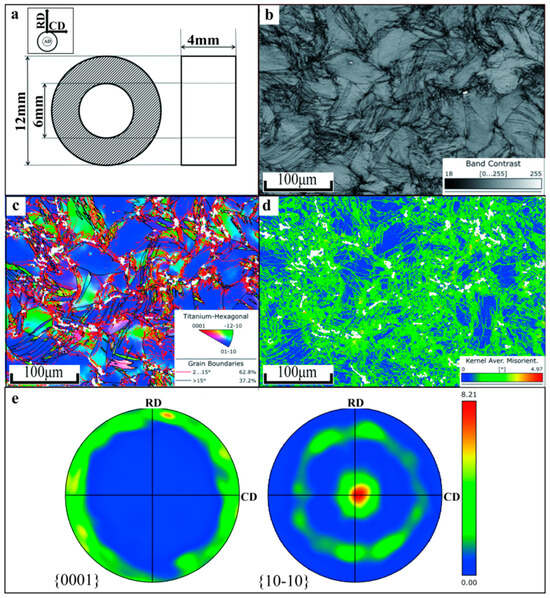
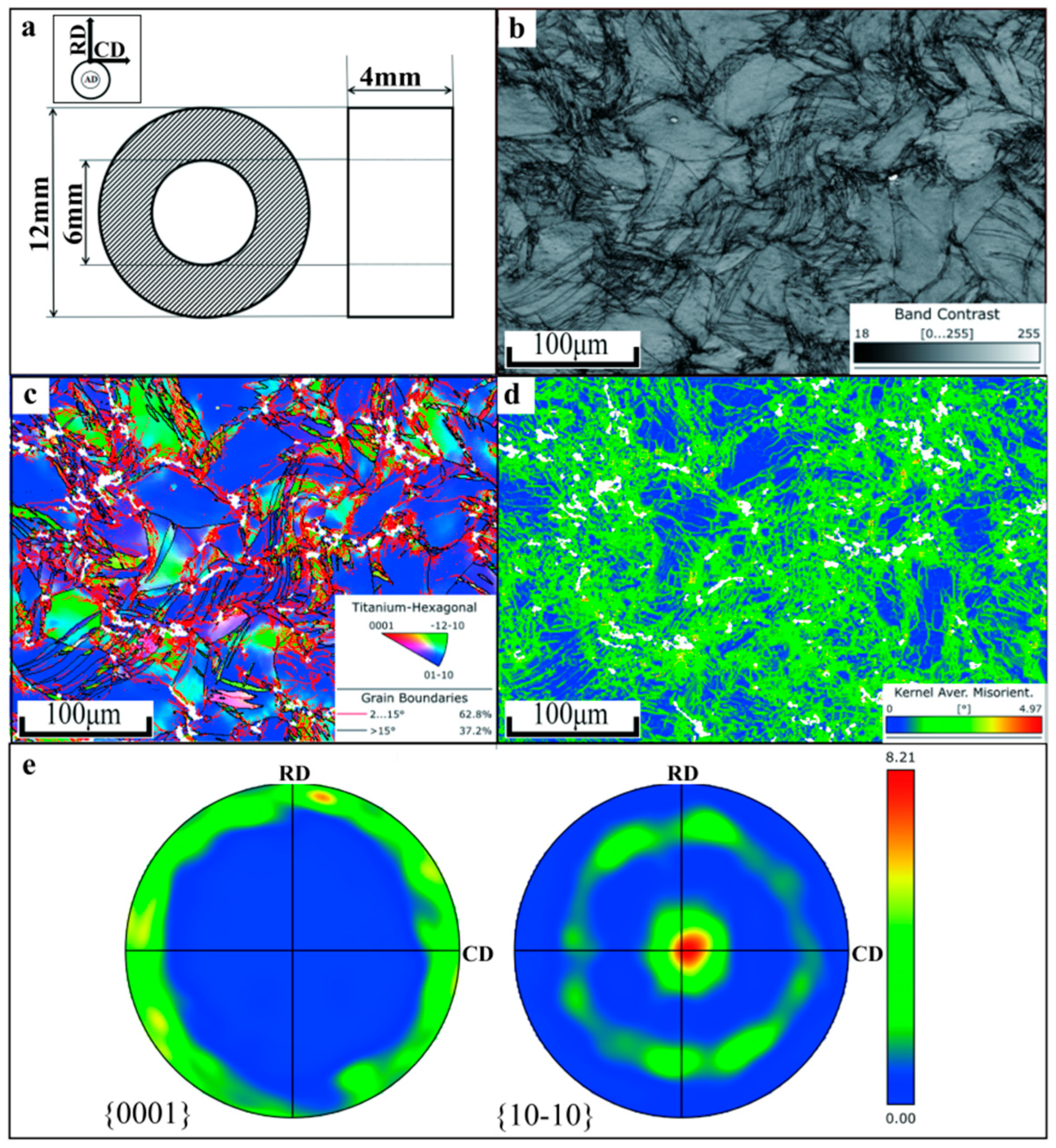
Figure 1 shows the schematic of the Ti-2Al-2.5Zr alloy tube sample dimensions and the EBSD characterization results of the rolled alloy tubes. As indicated by the band contrast (BC) map in Figure 1b and the inverse pole figure (IPF) combined with the grain boundary (GB) map in Figure 1c, the alloy contained a large number of fragmented grains and deformation twins, with non-uniform grain shapes and sizes. In the BC map, numerous dense black stripe regions represent stress concentration zones, which originated from severe lattice distortion in the rolled alloy, including dislocations, subgrain boundaries, and deformation bands. The fraction of low-angle grain boundaries was 62.8%, and these boundaries were mainly distributed within subgrain boundaries and deformation bands. Figure 1d shows the kernel average misorientation (KAM) map, from which a peak KAM value of 4.97° was calculated. Most regions exhibited relatively high KAM values, indicating pronounced internal stress concentration zones within the alloy. These regions corresponded to the low-angle grain boundary areas shown in Figure 1c, further confirming the microstructural heterogeneity of the alloy. The rolled-state tube microstructure contained partially polygonized grains. As shown in Figure 1c, twins divided by grain boundaries were observed inside the alloy, indicating that some deformed grains were formed by the segmentation of polygonized grains under external stress. The pole figure (PF) in Figure 1e shows that the normals of most {10-10} crystal planes were nearly perpendicular to the plane defined by the rolling direction (RD) and the circumferential direction (CD). This indicates the presence of a strong preferred orientation, namely, a typical <10-10>∥ axis direction (AD) texture. The peak texture intensity reached 8.21, the volume fraction of the texture was 3.54%, and the texture orientation exhibited a slight deviation from the AD direction.
Figure 1.
Schematic of the specimen and initial microstructural characteristics. (a) Schematic diagram of the specimen. (b) BC map of the rolled state. (c) IPF combined with GB map of the rolled state. (d) KAM map of the rolled state. (e) PF of the rolled-state Ti-2Al-2.5Zr alloy tube.
3.2. Microstructural and Property Differences of the Alloy Under Annealing at Different Temperatures
The grain orientation spread (GOS) map quantitatively describes the deviation of the crystallographic orientations of all measured points within an individual grain from the average orientation of that grain. During recrystallization annealing, the GOS value could be used to determine the recrystallization state of grains. Generally, grains with GOS values lower than 2° were identified as recrystallized grains, and the fully recrystallized state was strictly defined when the fraction of recrystallized grains exceeded 95% [18,19,20]. Grains with a GOS value within 10 are shown in the figure, and the GOS score calculation has taken into account grains with a GOS value above 10. In this study, the annealing temperatures of the Ti-2Al-2.5Zr alloy tubes were 650 °C, 700 °C, 750 °C, and 800 °C. The corresponding times required to reach complete recrystallization were 480 min, 25 min, 20 min, and 15 min, respectively. Throughout the recrystallization annealing process, the grain size continuously increased and eventually stabilized; however, under annealing at 700 °C, the alloy consistently exhibited the smallest grain size at all stages. The average grain sizes at complete recrystallization were 11.3 μm, 9.9 μm, 13.4 μm, and 14.3 μm, respectively. Throughout all stages of recrystallization annealing, the alloy annealed at 700 °C consistently exhibited the smallest grain size.
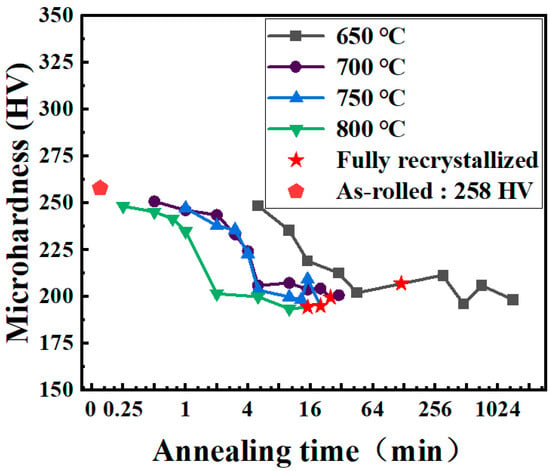
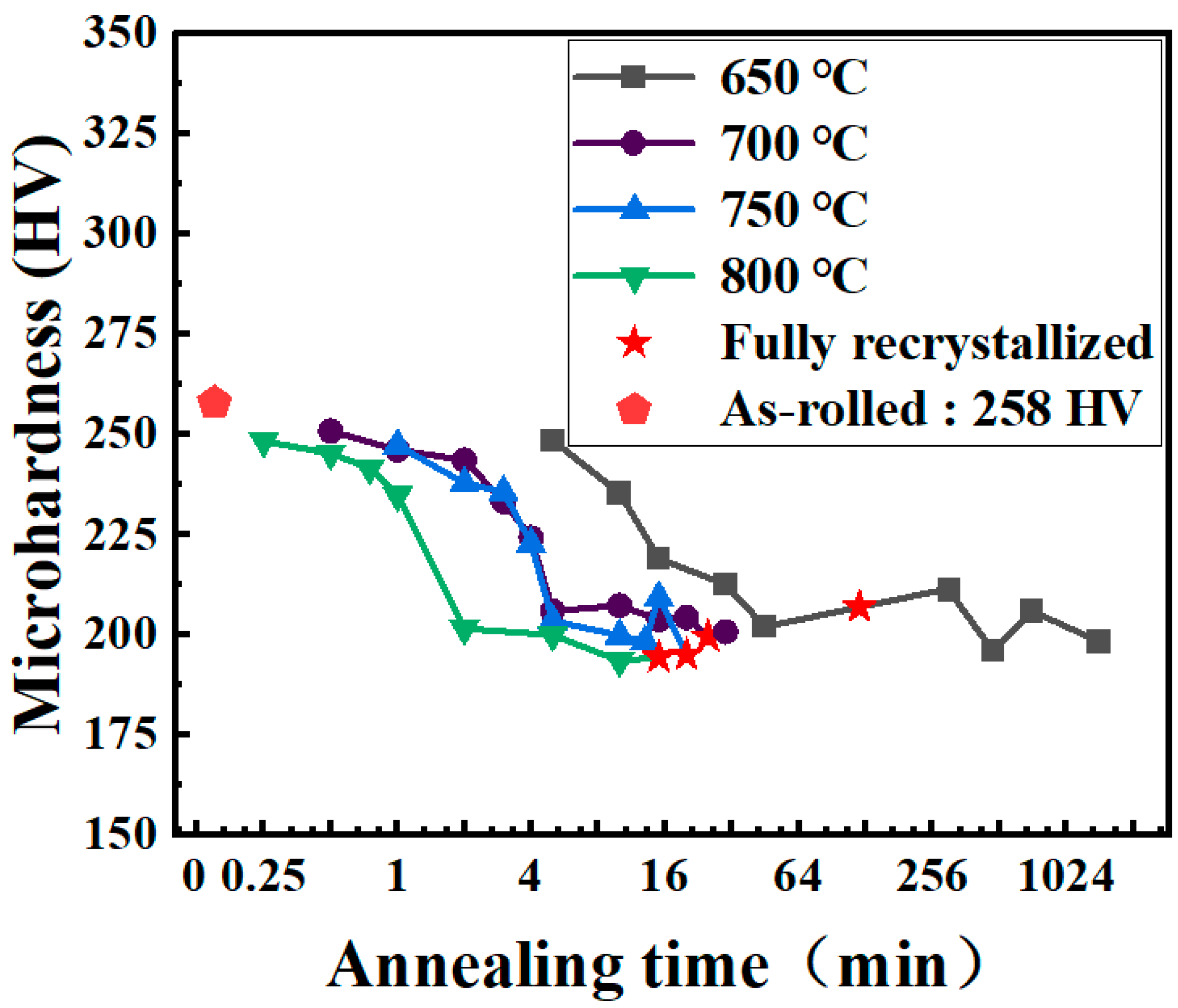
Figure 2 presents the evolution of microhardness of the Ti-2Al-2.5Zr alloy tubes during annealing at different temperatures. At the initial stage of annealing, the microhardness of the alloy decreased slowly. With increasing annealing time, the degree of recrystallization continuously increased, resulting in a more pronounced reduction in hardness. When complete recrystallization was achieved at each annealing temperature, the microhardness of the Ti-2Al-2.5Zr alloy tubes stabilized at 200 ± 5 HV. The microhardness values of the alloy at complete recrystallization were essentially at the same level for all annealing temperatures.
Figure 2.
Microhardness variation of Ti-2Al-2.5Zr alloy tubes during annealing at different temperatures.
3.3. Microstructural Evolution Under Different Annealing Temperatures
3.3.1. Microstructural Evolution of the Alloy During Annealing at 650 °C
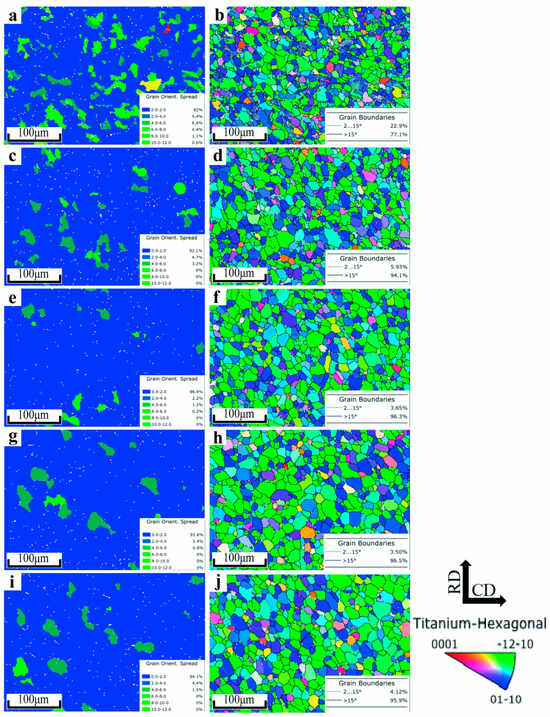
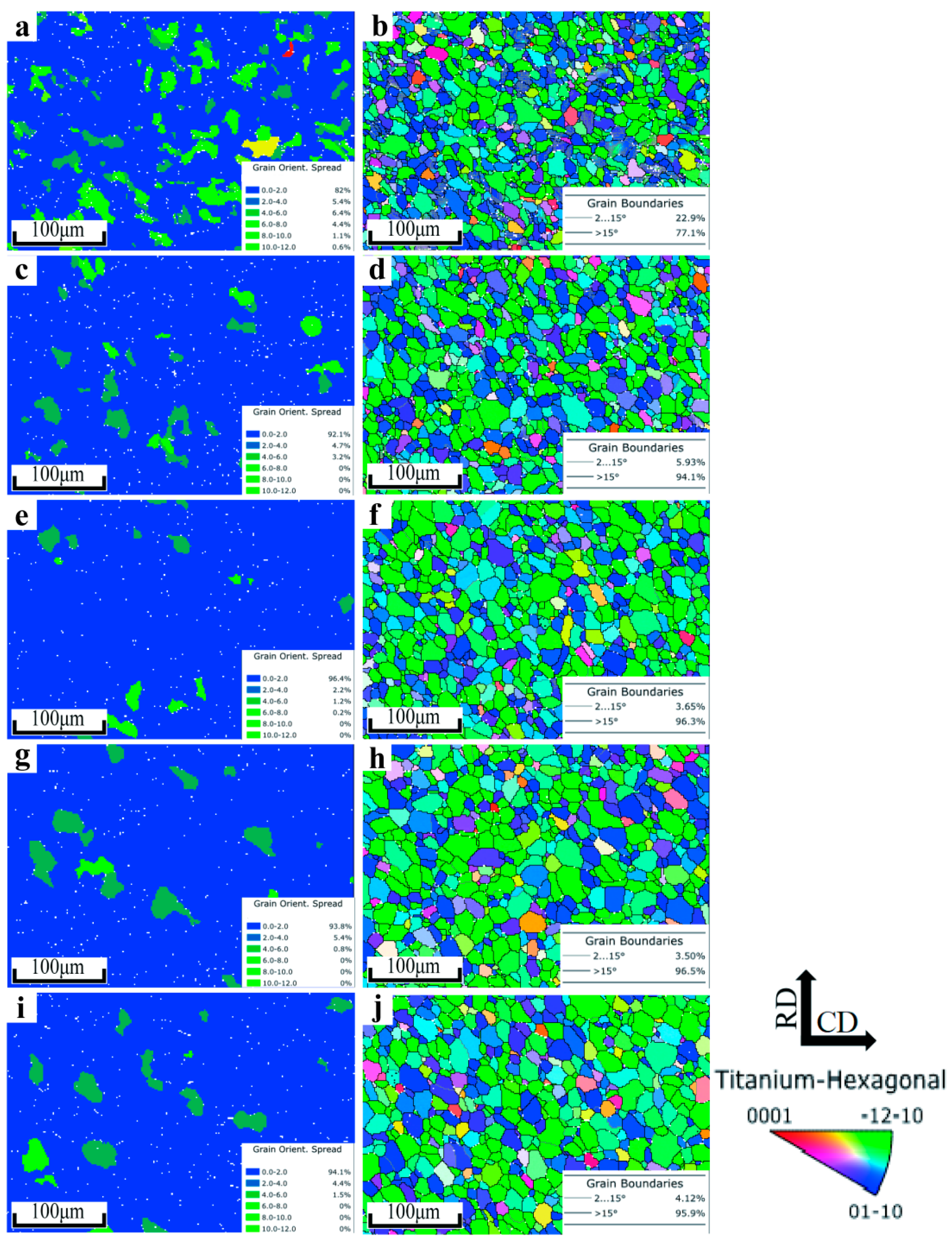
Figure 3 shows the GOS maps and IPF + GB maps of Ti-2Al-2.5Zr alloy tubes annealed at 650 °C for different times. As shown in Figure 3, with increasing annealing time, deformed grains were gradually replaced by equiaxed grains, and the fraction of recrystallized grains continuously increased. When annealed for 480 min, the recrystallized grain fraction reached 95.4%, indicating that complete recrystallization had been achieved. With further extension of the holding time, the recrystallized fraction remained essentially unchanged. The IPF + GB maps show that after annealing for 2 h, the alloy was not yet fully recrystallized and still contained a considerable proportion of substructures. At this stage, low-angle grain boundaries (LAGBs) dominated the internal microstructure of the alloy. When the annealing time was increased to 5–8 h, the fraction of high-angle grain boundaries (HAGBs) rose to 96.3%. A large number of low-angle grain boundaries or subgrain boundaries transformed into HAGBs through dislocation absorption or boundary coalescence, leading to a significant increase in the degree of recrystallization. During annealing from 8 h to 12 h, the alloy became fully recrystallized, and the internal strain within grains continued to decrease. The fraction of HAGBs increased slowly to about 96.3–96.5%, while the fraction of LAGBs decreased to approximately 3.5%. When the annealing time was extended from 12 h to 24 h, the alloy entered the grain growth stage. Correspondingly, the fraction of LAGBs increased slightly.
Figure 3.
GOS maps and IPF + GB maps of Ti-2Al-2.5Zr alloy tubes annealed at 650 °C for different times: (a,b) 120 min; (c,d) 300 min; (e,f) 480 min; (g,h) 720 min; (i,j) 1440 min. The left column shows the GOS maps and the right column shows the IPF + GB maps.
3.3.2. Microstructural Evolution of the Alloy During Annealing at 700 °C
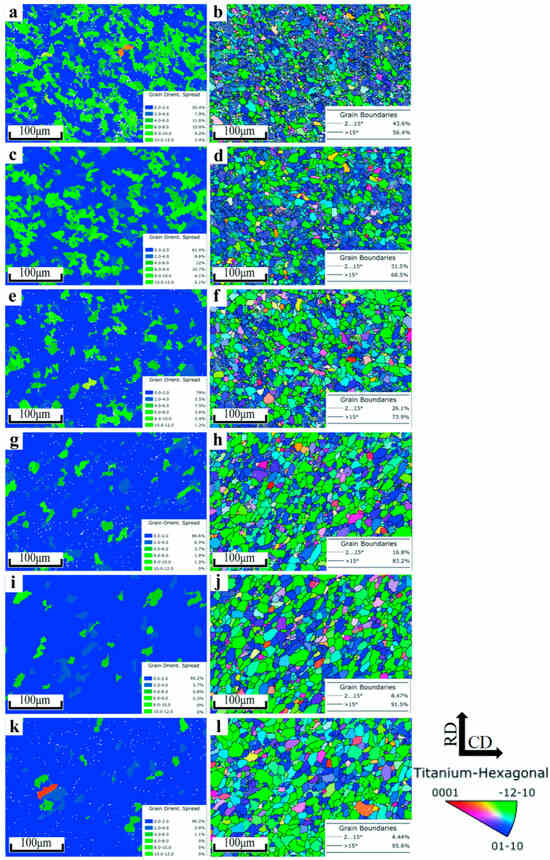
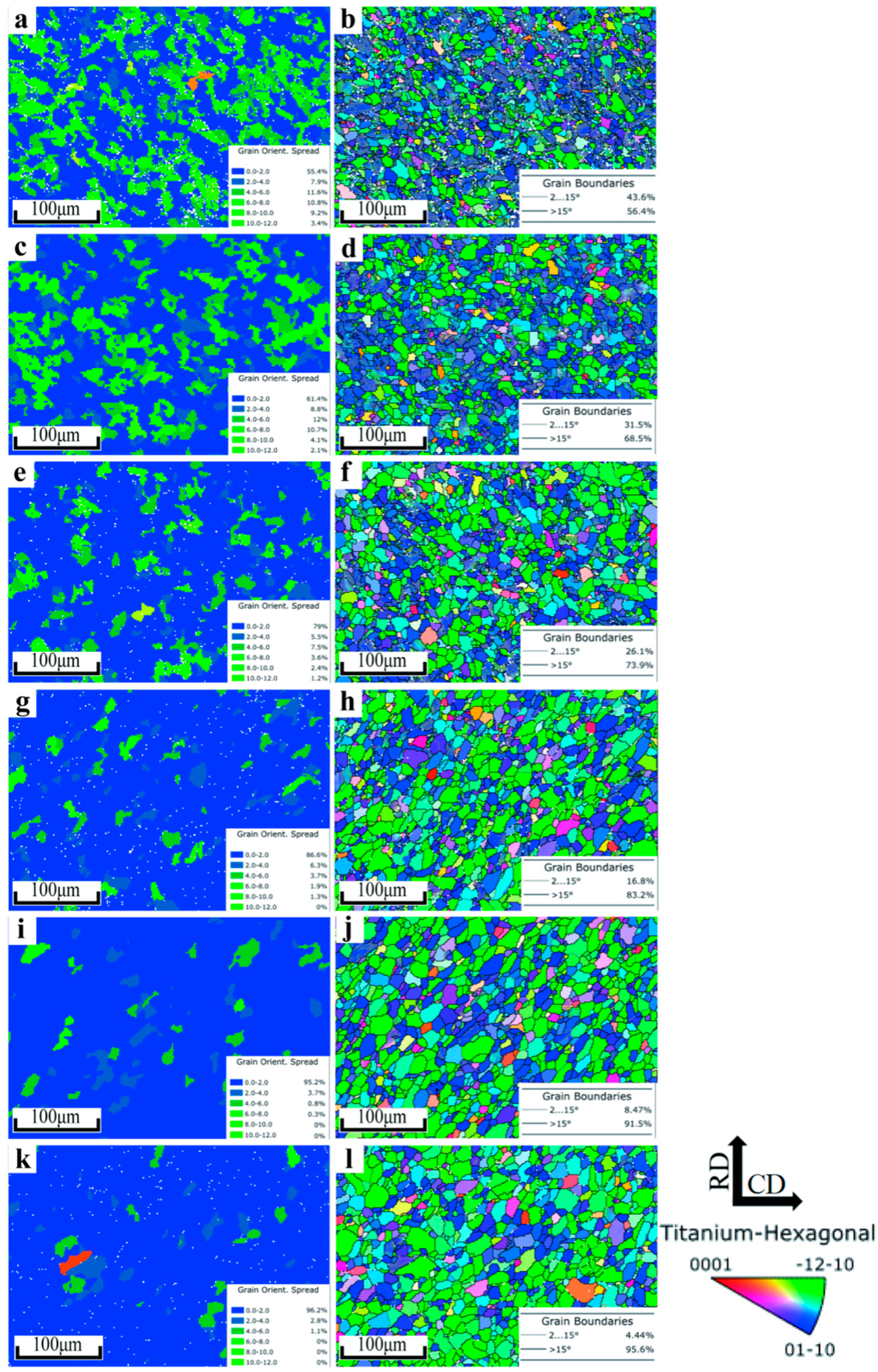
Figure 4 shows the GOS maps and IPF + GB maps of Ti-2Al-2.5Zr alloy tubes annealed at 700 °C for different times. The figure indicates that during annealing for 5–10 min at 700 °C, the fraction of HAGBs increased slowly from 56.4% to 68.5%, while the fraction of LAGBs remained high. Between 10 and 20 min of annealing, the HAGBs fraction rose sharply from 68.5% at 10 min to 83.2% at 20 min. As shown in Figure 4i,j, after 25 min of annealing, the fraction of grains with orientation differences less than 2° reached 95.2%, indicating that the alloy had fully recrystallized at this stage. The color distribution in the IPF maps showed that the grain orientations were more uniform, and the HAGB fraction reached 91.5% at 25 min. Extending the holding time to 30 min led the alloy into the grain growth stage, with the proportions of high-angle and low-angle grain boundaries remaining essentially stable.
Figure 4.
GOS maps and IPF + GB maps of Ti-2Al-2.5Zr alloy tubes annealed at 700 °C for different times: (a,b) 5 min; (c,d) 10 min; (e,f) 15 min; (g,h) 20 min; (i,j) 25 min; (k,l) 30 min. The left column shows the GOS maps and the right column shows the IPF + GB maps.
3.3.3. Microstructural Evolution of the Alloy During Annealing at 750 °C
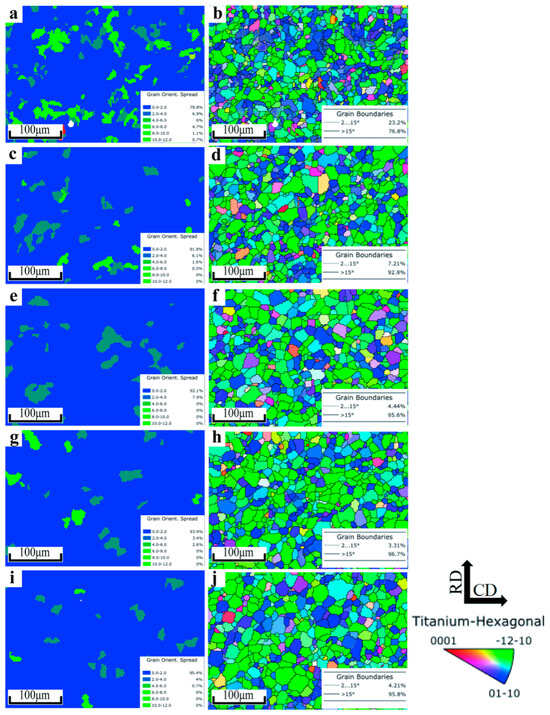
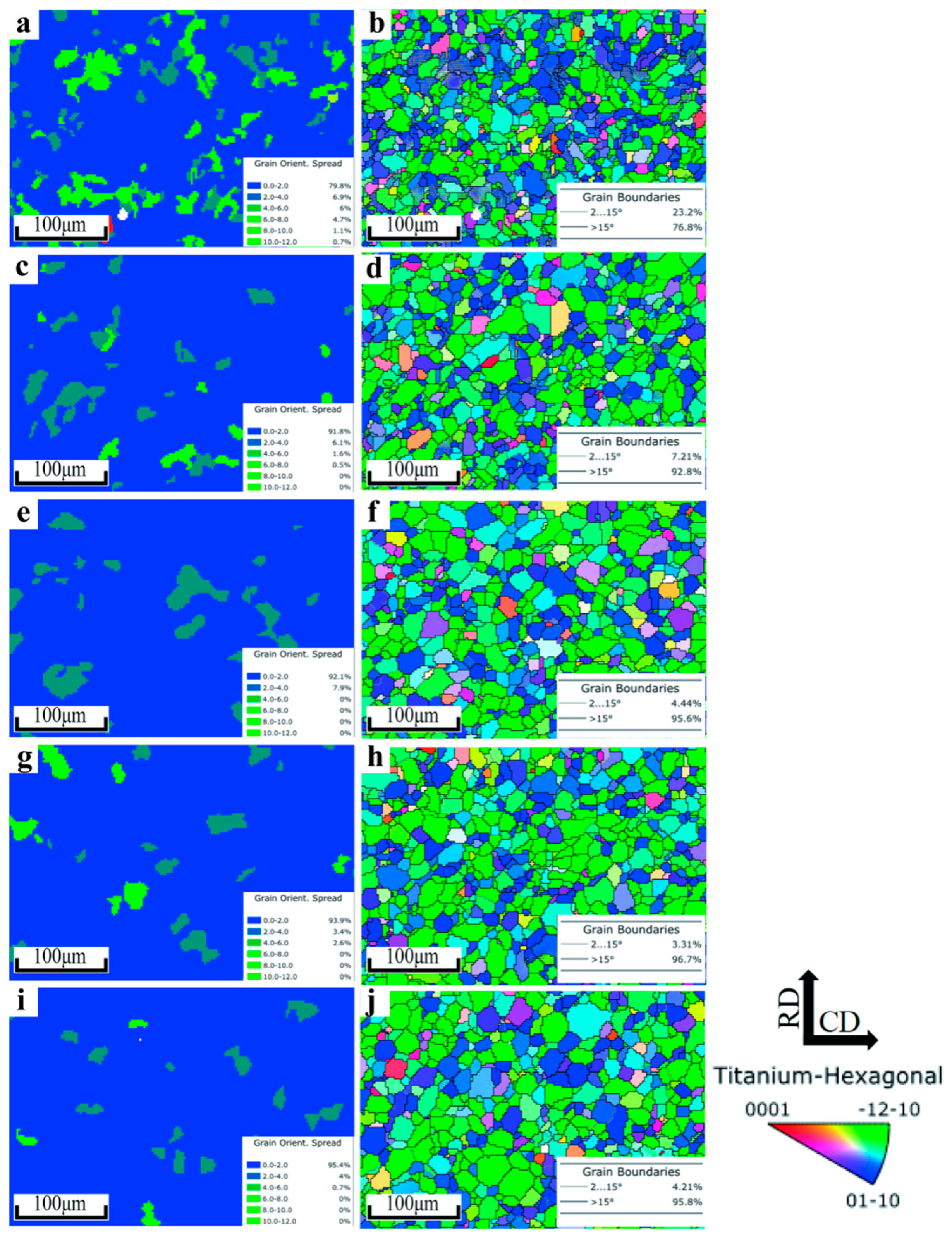
Figure 5 shows the GOS maps and IPF + GB maps of Ti-2Al-2.5Zr alloy tubes annealed at 750 °C for different times. At this temperature, the initial recrystallization rate was faster, with the fraction of grains exhibiting GOS values of less than 2° increasing significantly from 79.8% to 91.8% during 5–10 min of annealing. Corresponding to Figure 5b,d, the uniformity of grain orientation also improved significantly during this stage. Extending the annealing time further, the recrystallization progressed more slowly between 10 and 20 min. After 20 min of annealing, the fraction of recrystallized grains reached 95.4%, indicating that the alloy was fully recrystallized, with no significant difference in grain size. Compared with the 480 min required for complete recrystallization at 650 °C, annealing at 700 °C required only 25 min, increasing the recrystallization rate by nearly 20 times. At 750 °C, the complete recrystallization time was only 5 min shorter than that at 700 °C, indicating that the effect of temperature on the recrystallization rate was nonlinear.
Figure 5.
GOS maps and IPF + GB maps of Ti-2Al-2.5Zr alloy tubes annealed at 750 °C for different times: (a,b) 5 min; (c,d) 10 min; (e,f) 13 min; (g,h) 15 min; (i,j) 20 min. The left column shows the GOS maps and the right column shows the IPF + GB maps.
3.3.4. Microstructural Evolution of the Alloy During Annealing at 800 °C
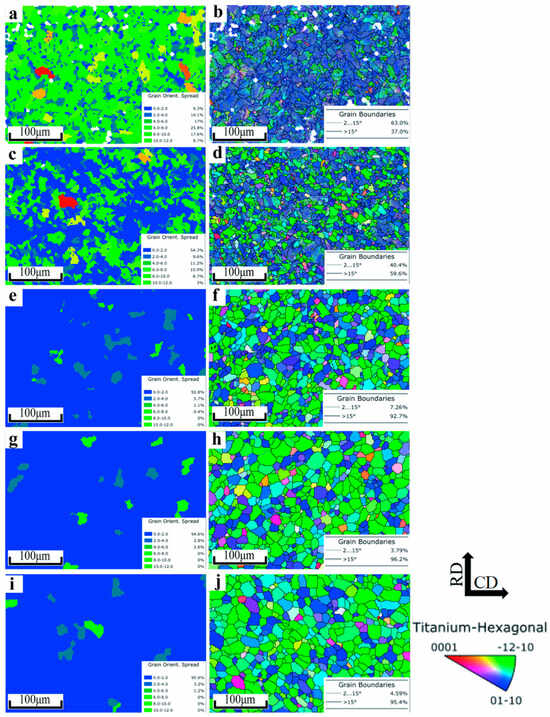
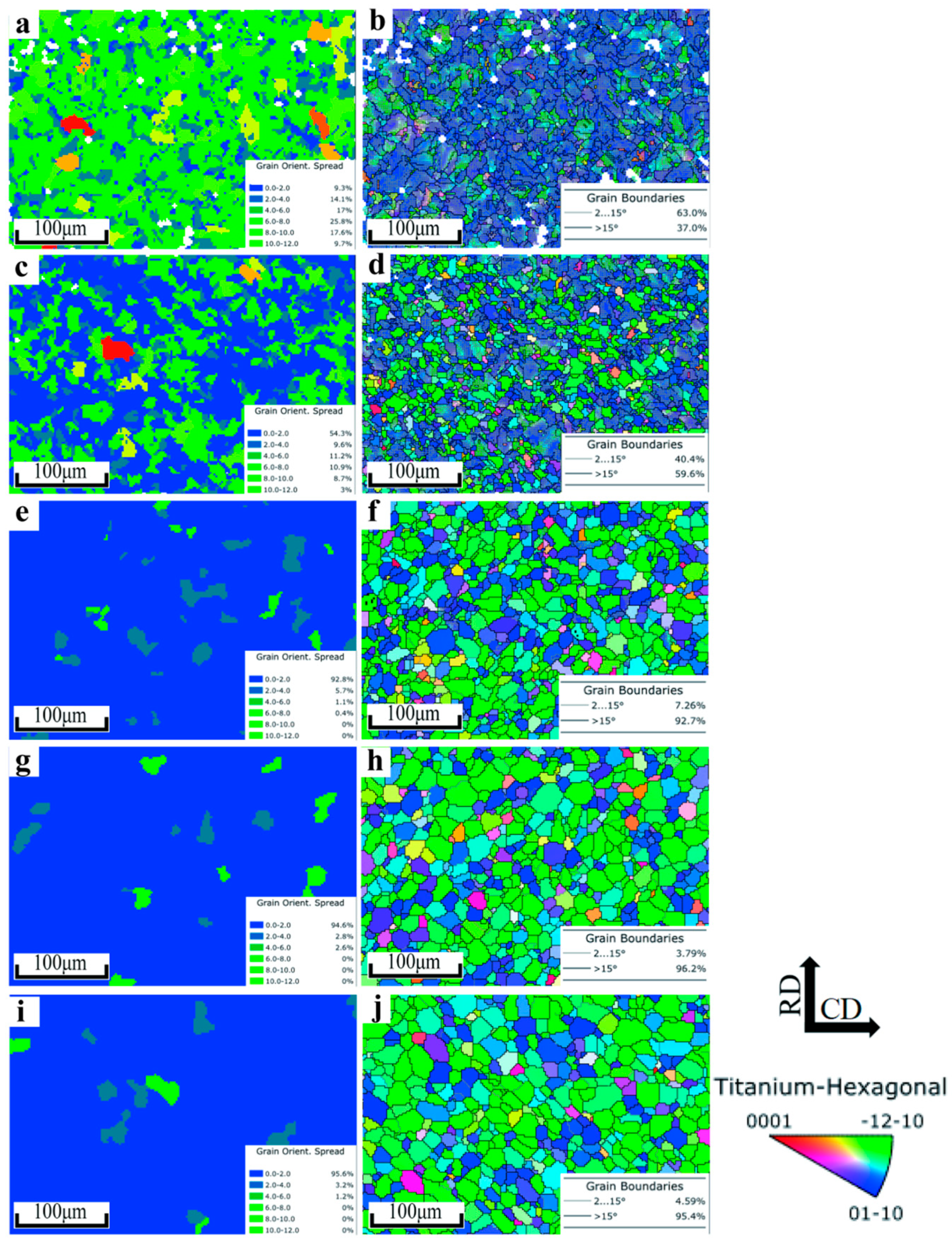
Figure 6 shows the GOS maps and IPF + GB maps of Ti-2Al-2.5Zr alloy tubes annealed at 800 °C for different times. At this temperature, the recrystallization nucleation stage was very short. As shown in Figure 6a,c, during 1 min and 2 min of annealing at 800 °C, the fraction of recrystallized grains increased from 9.3% to 54.3%, and the HAGB fraction rose rapidly from 37.0% to 59.6%. When the annealing time was extended to 5 min, the degree of recrystallization reached 92.8% and the HAGB fraction reached 92.7%, indicating that the recrystallization process was essentially complete, with grain orientation uniformity greatly improved compared to the initial 1–2 min stage. Between 10 and 15 min, the degree of recrystallization increased slowly, and, after 15 min, the fraction of recrystallized grains reached 95.6%, indicating full recrystallization of the alloy.
Figure 6.
GOS maps and IPF + GB maps of Ti-2Al-2.5Zr alloy tubes annealed at 800 °C for different times: (a,b) 1 min; (c,d) 2 min; (e,f) 5 min; (g,h) 10 min; (i,j) 15 min. The left column shows the GOS maps and the right column shows the IPF + GB maps.
As shown in Figure 4, the fractions of HAGBs after annealing for 5, 10, 15, 20, 25, and 30 min at 700 °C were 56.4%, 68.5%, 73.9%, 83.2%, 91.5%, and 95.6%, respectively. The corresponding recrystallized fractions were 55.4%, 61.4%, 79.0%, 86.6%, 95.2%, and 96.2%, exhibiting a consistent increasing trend. Meanwhile, the average grain sizes at these annealing times were 8.5 μm, 8.8 μm, 9.3 μm, 9.8 μm, 9.9 μm, and 10.0 μm, respectively. As the GOS values approached a low and stable level, the driving force for grain boundary migration correspondingly decreased, leading to stabilization of the grain size.
The interrelationship among grain size, grain boundary fraction, and GOS was also verified across the entire annealing temperature range of 650–800 °C, further supporting the quantitative consistency of the proposed mechanism.
3.4. Texture Evolution of the Alloy During Annealing at 650–800 °C
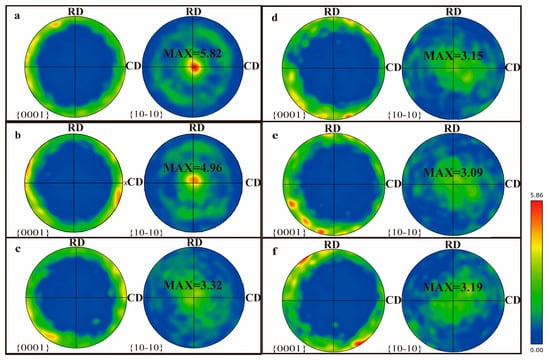
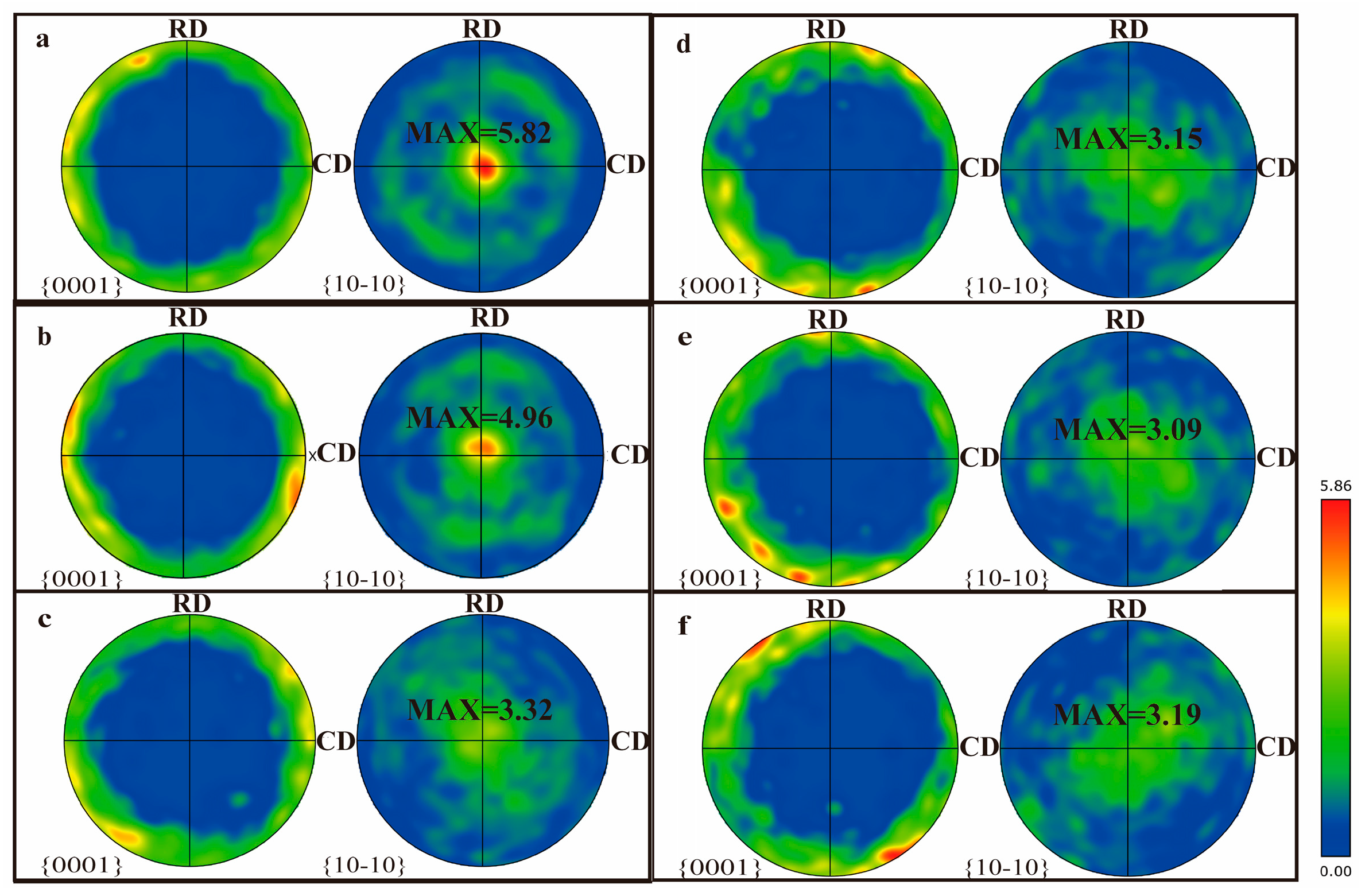
Figure 7 shows the pole figures (PF) of the alloy annealed at 700 °C for different times. The {0001}∥ RD texture exhibited no significant changes throughout the annealing process. At the initial stage of annealing, the alloy still exhibited a strong <10-10>∥ AD texture, but compared with the rolled state (Figure 1e), with a peak intensity of 8.21, the texture intensity peak decreased to 5.82 after 5 min of annealing. After further annealing for 15 min, the distribution of high-density peaks broadened significantly, and the texture intensity peak decreased further to 3.32. After 20 min of annealing, the texture intensity peak decreased slowly to 3.15, and with further extension of the annealing time, the texture distribution remained basically stable, with minimal intensity changes. The texture volume fractions corresponding to annealing times of 5, 10, 15, 20, 25, and 30 min were 2.66%, 2.61%, 0.88%, 0.70%, 0.50%, and 0.58%, respectively, consistent with the pattern presented in Figure 7. This indicates that recrystallization annealing significantly reduces the <10-10>∥ AD texture of Ti-2Al-2.5Zr alloy tubes. As recrystallization annealing progresses, the internal microstructural uniformity continuously improves, although the <10-10>∥ AD texture cannot be completely eliminated.
Figure 7.
Pole figures (PF) of Ti-2Al-2.5Zr alloy tubes annealed at 700 °C for different times: (a) 5 min; (b) 10 min; (c) 15 min; (d) 20 min; (e) 25 min; (f) 30 min.
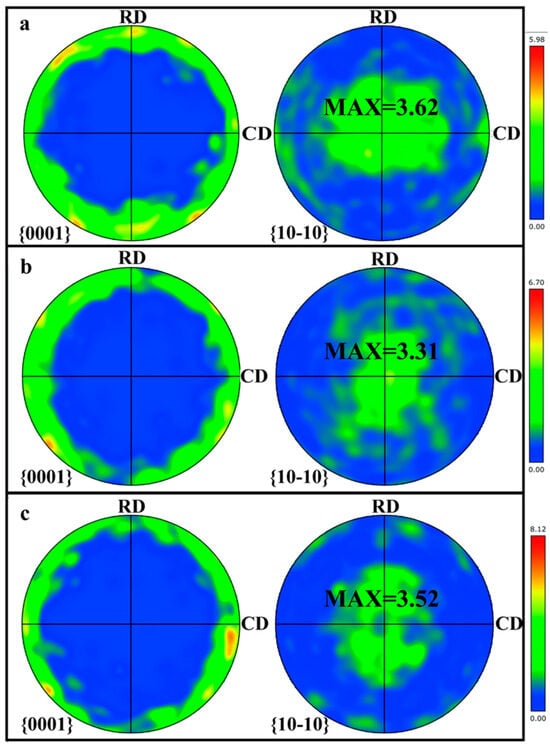
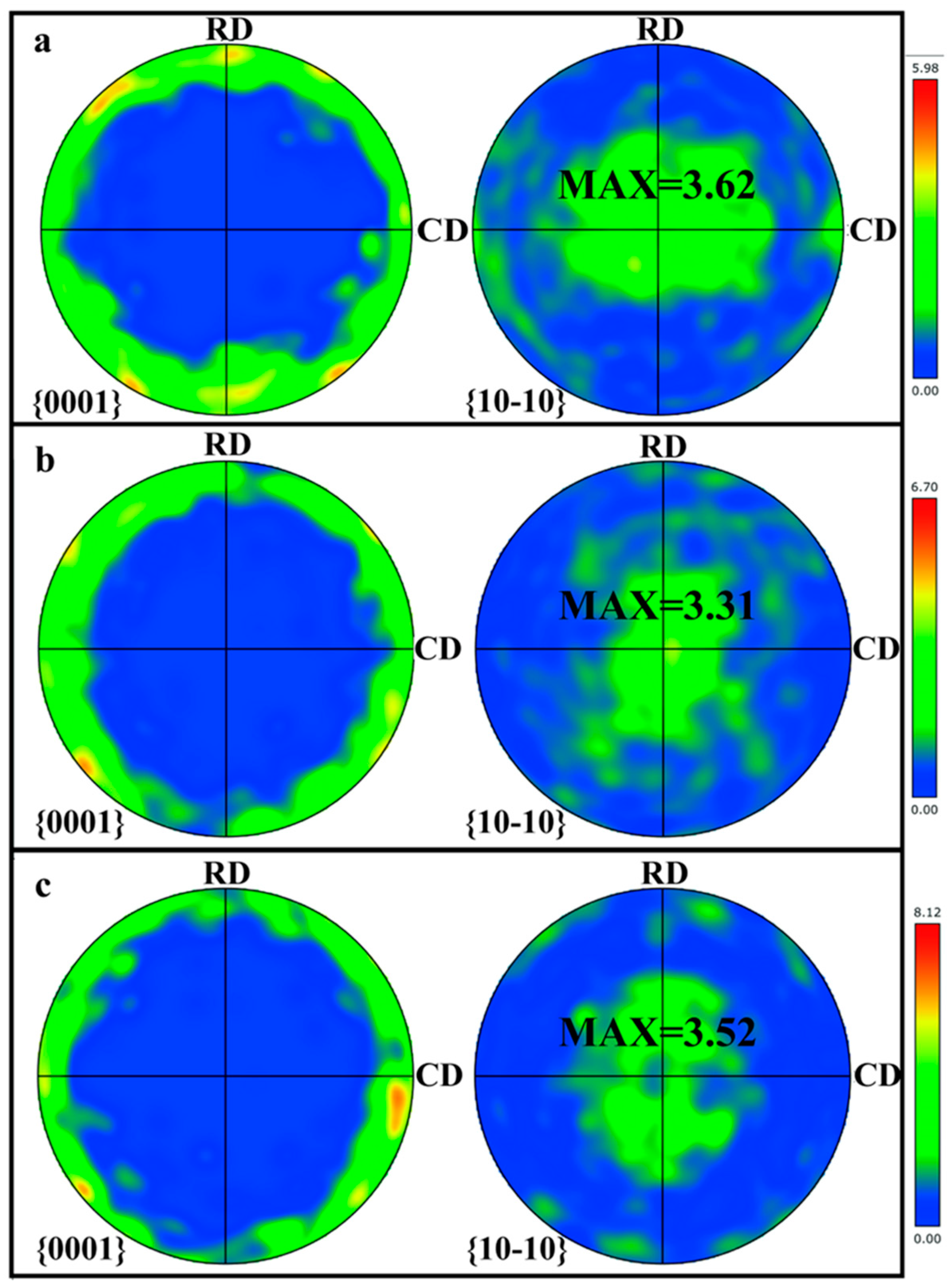
Figure 8 represents the PF of Ti-2Al-2.5Zr alloy tubes after complete recrystallization at 650 °C, 750 °C, and 800 °C. During annealing at 650–800 °C, the texture evolution of the alloy showed similar trends, with the {0001}∥ RD texture remaining essentially unchanged and the intensity of the {10-10}∥ AD texture decreasing gradually with increasing annealing time. As shown in Figure 7 and Figure 8, complete recrystallization at 700 °C exhibited a smaller texture intensity peak compared to other temperatures, suggesting that annealing at 700 °C was more favorable for homogenizing the microstructure.
Figure 8.
Pole figures (PF) of Ti-2Al-2.5Zr alloy tubes after complete recrystallization at different temperatures: (a) 650 °C, 480 min; (b) 750 °C, 20 min; (c) 800 °C, 15 min.
4. Discussion
4.1. Stored Energy Variation During Annealing at 650–800 °C
The driving force for recrystallization of Ti-2Al-2.5Zr alloy tubes during annealing originates from the deformation stored energy introduced during the tube rolling process [21,22,23]. To further analyze the changes in deformation stored energy at different annealing stages, the evolution of internal substructures during recrystallization annealing was examined using KAM maps.
KAM reflects the local plastic strain or dislocation density by calculating the average misorientation between a given measurement point and its neighboring points. Since geometrically necessary dislocations (GNDs) are the primary carriers responsible for non-uniform lattice curvature or rotation, thereby generating orientation gradients, there exists a direct theoretical correlation between the KAM value and GND density. The corresponding relationship is expressed as follows:
where θ is the local misorientation (derived from KAM), μ is the EBSD step size, and b is the Burgers vector of α-Ti. According to Equation (1), the GND density is inversely proportional to the step size. In the present study, a step size of 0.2 μm was selected. For Ti-2Al-2.5Zr alloy, this corresponded to a high-resolution scan, which enabled effective characterization of local strain gradients within subgrains, near grain boundaries, and along twin boundaries. The angular resolution of an EBSD system is typically in the range of 0.5–1.0°; the influence of noise on the absolute values of EBSD statistical data is difficult to completely eliminate. Accordingly, in the GND analysis, we primarily focused on the relative evolution trends and spatial distribution characteristics of GND density under different annealing conditions, rather than on the precise calibration of absolute values.
During annealing at 700 °C, the local misorientation θ values of the alloy after 5, 10, 15, 20, 25, and 30 min were determined to be: 0.42°, 0.38°, 0.24°, 0.18°, 0.15°, and 0.17°. It can be observed that the overall KAM exhibited a decreasing trend with increasing annealing time. According to Equation (1), the GND density was directly proportional to the KAM value; therefore, the GND density correspondingly decreased as the annealing time was prolonged.
KAM maps could therefore be directly used to visualize the spatial distribution of GNDs, and the KAM values could be quantitatively converted into GND density using the above equation. The underlying rationale is that higher KAM values indicate larger local orientation gradients, which generally correspond to higher GND densities. For example, in studies of ultrasonic vibration-assisted tensile deformation of TA1 titanium alloy, it was observed that the application of ultrasonic vibration led to a reduction in KAM values, accompanied by a corresponding decrease in the calculated GND density, jointly explaining the reduced deformation resistance at the microscopic scale [24]. Similarly, in laser powder bed fusion-fabricated 316L stainless steel, samples exhibiting higher KAM values were also reported to possess higher GND densities [25].
Figure 9 shows the KAM maps of Ti-2Al-2.5Zr alloy tubes annealed at 700 °C for different times. During annealing for 5–15 min, most regions still exhibited relatively high KAM values, indicating that the high-density dislocations introduced by cold working were not effectively released, with severe dislocation entanglement, resulting in high strain and high stored energy that continued to provide a significant driving force for subsequent recrystallization. During annealing for 15–20 min, a large number of dislocations inside the alloy were annihilated and rearranged, and the fraction of low-strain regions (0–1°) increased to 93.5%, leading to rapid release of stored energy and quick improvement of microstructural uniformity, forming numerous recrystallization nuclei. The growth of existing recrystallization nuclei occurred simultaneously with the formation of new nuclei. During annealing for 20–25 min, the recrystallization process was essentially complete, with regions in the 0–1° KAM range reaching 90%, indicating that stored energy was largely released. The alloy reached a thermodynamically and structurally stable state, with grains slowly growing through boundary migration. After 30 min of annealing, the alloy entered the grain growth stage, and the microstructure was basically stable.
Figure 9.
KAM maps of Ti-2Al-2.5Zr alloy tubes annealed at 700 °C for different times: (a) 5 min; (b) 10 min; (c) 15 min; (d) 20 min; (e) 25 min; (f) 30 min.
During annealing at 700 °C, the KAM peak value remained unchanged significantly, which may have been due to the high nucleation rate and growth rate of recrystallized grains. The rapid growth of recrystallized grains caused the dislocations and strain inside the alloy to have insufficient time to be released, and some dislocations and strains were incorporated into the recrystallized grains. As a result, the alloy maintained relatively high KAM peak values throughout all stages of recrystallization until complete recrystallization.
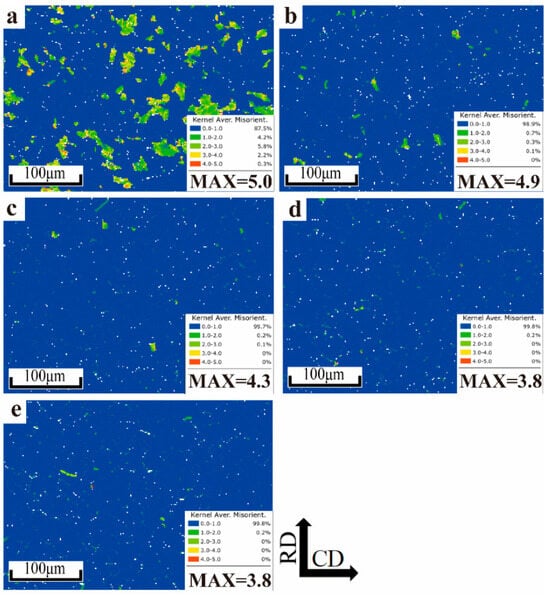
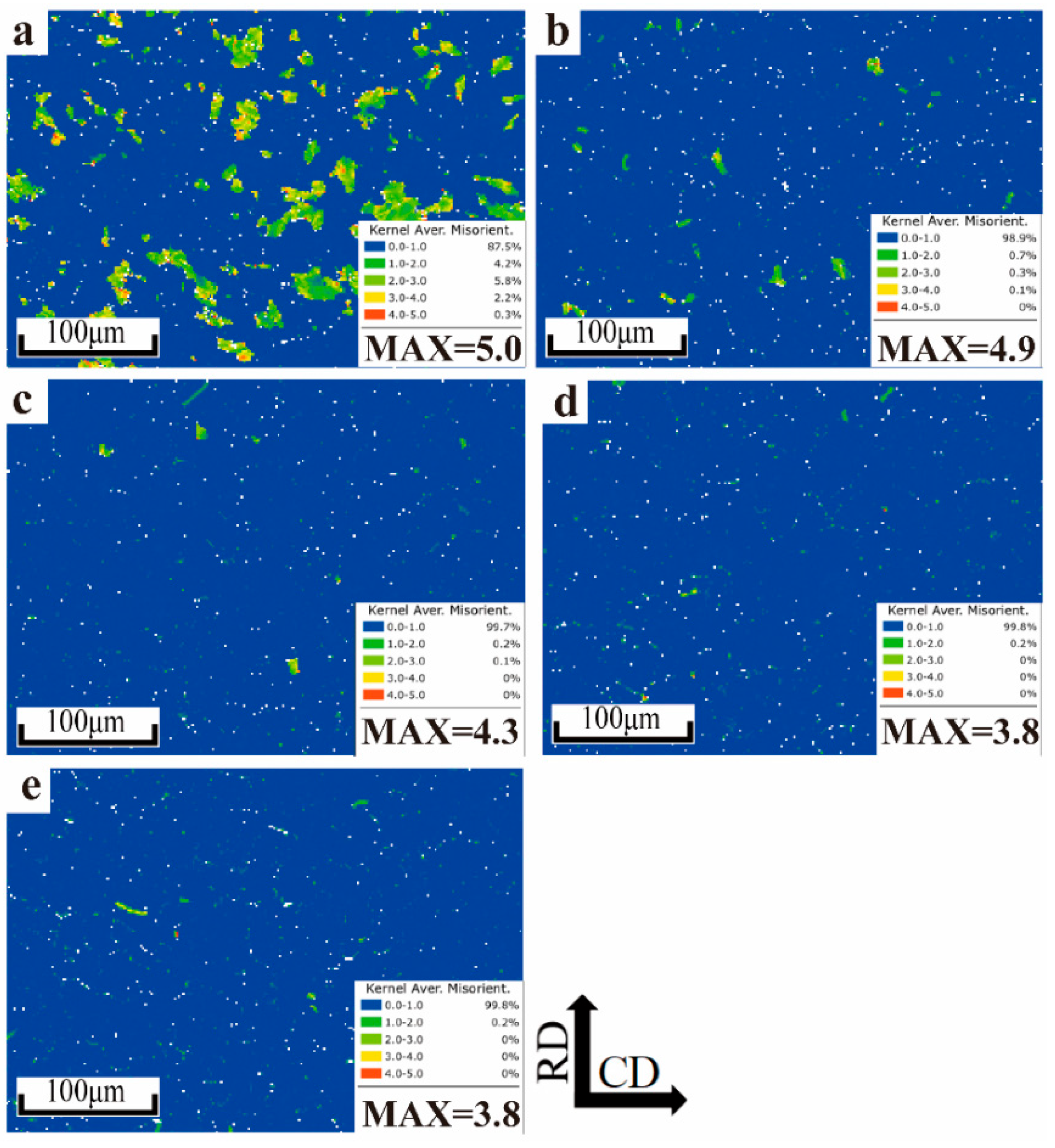
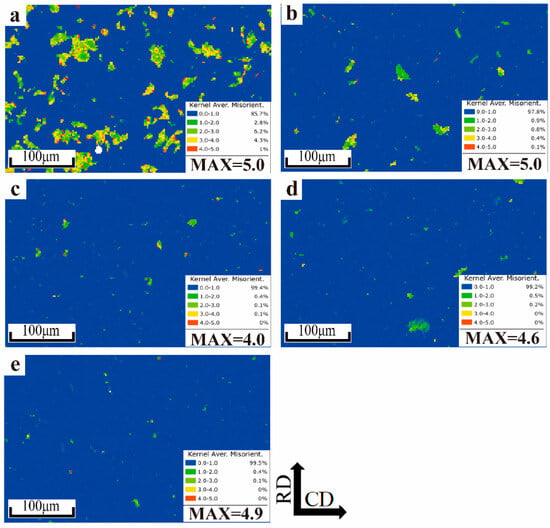
From the KAM maps at 650 °C for different annealing times (Figure 10), it can be seen that with increasing annealing time, the overall high-KAM regions of the alloy decreased significantly. Unlike annealing at 700 °C, where the KAM peak remained nearly constant, the KAM values at 650 °C changed noticeably. During annealing from 120 min to 300 min, the KAM peak decreased slightly from 5.0° to 4.9°, indicating that the release of local strain was relatively slow in the initial stage. From 300 to 480 min, the KAM peak dropped significantly from 4.9° to 4.3°, indicating rapid dislocation annihilation and rearrangement. At 300 min, the fraction of low-strain regions reached 98.9%, showing that the internal strain release was essentially complete. During annealing from 480 to 720 min, the alloy was fully recrystallized, but the KAM peak continued to decrease to 3.8°, indicating that the strain within the grains continued to diminish after recrystallization. From 720 min to 1440 min, the alloy entered the grain growth stage, and the overall KAM distribution remained basically stable. Ti-2Al-2.5Zr alloy tubes annealed at 650 °C for 480–720 min achieved a stable microstructure with low stored energy, representing a fully recrystallized state. Prolonged annealing beyond this time may lead to abnormal grain growth, decreased microstructural uniformity, and increased anisotropy [26,27].
Figure 10.
KAM maps of Ti-2Al-2.5Zr alloy tubes annealed at 650 °C for different times: (a) 120 min; (b) 300 min; (c) 480 min; (d) 720 min; (e) 1440 min.
Figure 11 is the KAM maps of Ti-2Al-2.5Zr alloy tubes annealed at 750 °C for different times. At 750 °C, recrystallization of the Ti-2Al-2.5Zr alloy tubes was essentially complete at 15 min, and the process reached a stable state at 20 min. As shown in Figure 11b,c, the KAM peak of the alloy decreased significantly to 4.0 during this stage, indicating that the remaining local strains inside the alloy were rapidly released. As shown in Figure 11d, the KAM peak increased to 4.6 and showed a continuing upward trend, which may have been due to the high temperature causing rapid completion of recrystallization. Some grains entered abnormal growth at 15 min, and further extension of annealing time may have compromised the uniformity of grain distribution, introducing new dislocations and strain [28].
Figure 11.
KAM maps of Ti-2Al-2.5Zr alloy tubes annealed at 750 °C for different times: (a) 5 min; (b) 10 min; (c) 13 min; (d) 15 min; (e) 20 min.
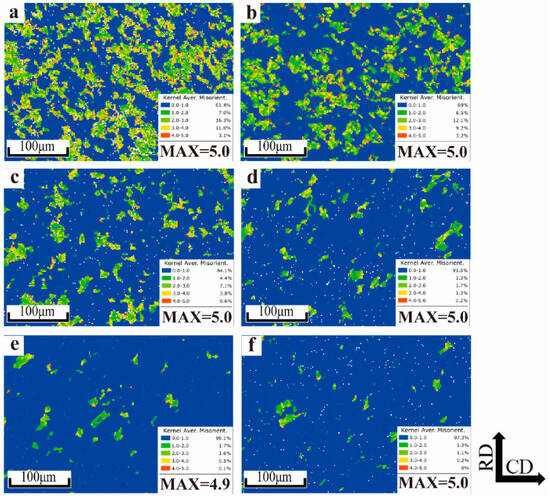
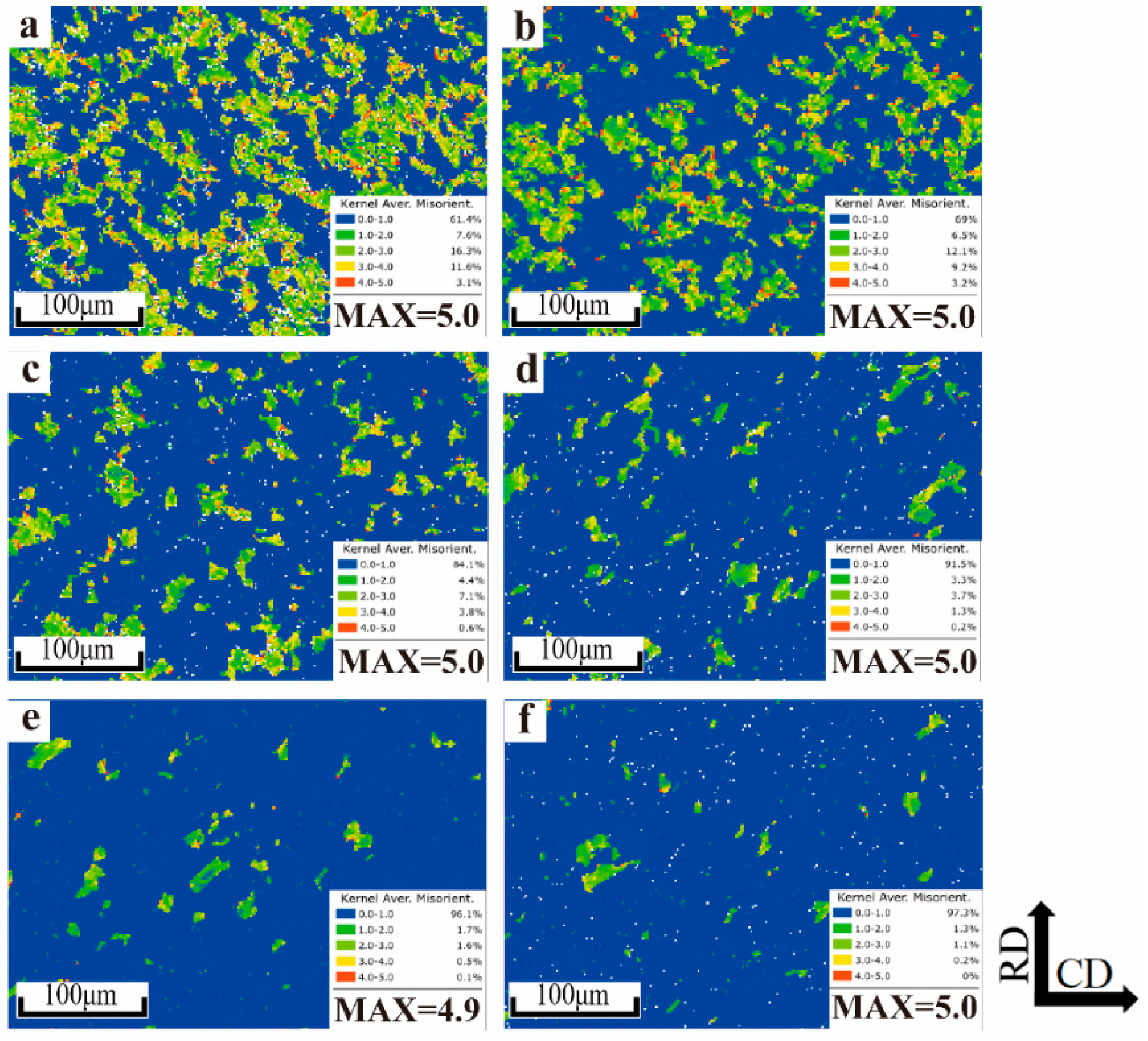
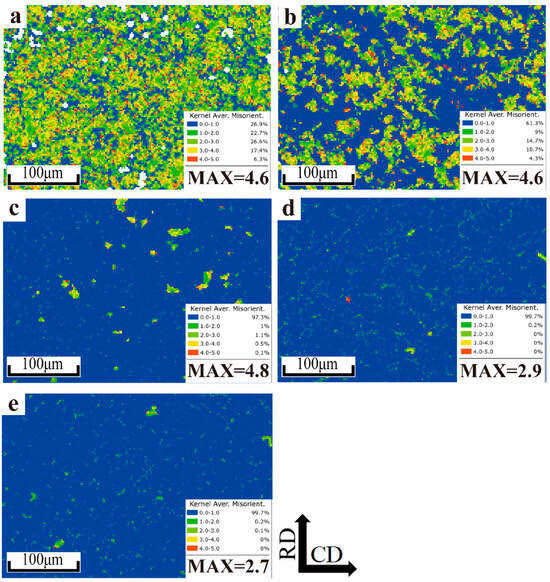
Figure 12 shows the KAM maps of Ti-2Al-2.5Zr alloy tubes annealed at 800 °C for different times. During annealing from 1–5 min, the fraction of low-strain regions rapidly increased from 26.9% to 97.3%, and the overall KAM level decreased significantly, while the KAM peak showed no great change, indicating that a few stress concentration areas remained even as large amounts of strain were released. Different from KAM evolution at other annealing temperatures, the KAM peak at 800 °C exhibited both stable and rapidly decreasing stages. By 20 min, the KAM peak dropped from 4.6° at the initial stage to 2.7° due to the high-temperature thermodynamic driving force enabling static recovery and recrystallization to occur almost simultaneously. The high temperature provided sufficient energy for dislocation climb and annihilation, allowing the local strains inside new grains to be rapidly eliminated, leaving the alloy with a low defect level.
Figure 12.
KAM maps of Ti-2Al-2.5Zr alloy tubes annealed at 800 °C for different times: (a) 1 min; (b) 2 min; (c) 5 min; (d) 10 min; (e) 15 min.
4.2. Microstructural Evolution Characteristics and Recrystallization Mechanisms
The alloy investigated in this study was a single-phase material, and no second-phase particles were observed during annealing; therefore, the particle-stimulated nucleation (PSN) mechanism could be excluded. Consequently, the texture evolution of the alloy was likely associated with continuous recrystallization (CDRX) and twin-assisted nucleation.
Taking the results at 700 °C as a representative example for mechanistic analysis, the fraction of HAGBs increased steadily throughout the entire recrystallization process. As shown in Figure 4, the HAGB fractions after annealing for 5, 10, 15, 20, 25, and 30 min were 56.4%, 68.5%, 73.9%, 83.2%, 91.5%, and 95.6%, respectively. Meanwhile, Figure 7 indicates that no abrupt change in texture occurred during annealing, and Figure 9 demonstrates that the overall strain distribution in the alloy was relatively homogeneous and gradually decreased with increasing annealing time. These characteristics are consistent with the features of continuous recrystallization, in which subgrain rotation and progressive transformation of low-angle boundaries into high-angle boundaries dominate the microstructural evolution. In addition, a gradual reduction in twin boundaries was observed during annealing.
In summary, continuous recrystallization plays a dominant role during the recrystallization annealing of Ti-2Al-2.5Zr alloy tubes, while twin-assisted nucleation may also contribute to the overall recrystallization process.
The alloy annealed at 700 °C exhibited the smallest grain size. At this temperature, the nucleation rate and grain growth rate may have reached a dynamic balance that was favorable for the formation of a fine-grained microstructure [29]. The final grain size was determined by two competing dynamic processes: the nucleation of new grains and the growth of existing grains [30]. An optimal minimum grain size is typically achieved within a temperature range where the nucleation rate is sufficiently high while the grain growth rate remains relatively moderate.
At approximately 700 °C, the stored deformation energy within the material was adequate to drive the formation of a large number of recrystallization nuclei. Grain growth itself is a thermally activated process, and its activation energy may vary across different temperature regimes. The temperature of around 700 °C may correspond to a transitional region where the grain growth mechanism changes or where multiple inhibitory effects are still operative, which is beneficial for maintaining a refined grain structure.
In some alloys, such as Mg–Gd alloys, temperatures above 673 K (approximately 400 °C) can already trigger rapid recrystallization, resulting in equiaxed fine grains. The elevated nucleation rate directly leads to a denser grain distribution, thereby establishing the foundation for achieving smaller grain sizes. In Mg–Gd alloys, within the lower temperature range of 573–623 K, grain growth is controlled by lattice self-diffusion with relatively high activation energy, resulting in restricted grain coarsening [31].
4.3. Recrystallization Kinetics of Ti-2Al-2.5Zr Alloy Tubes
Johnson and Mehl proposed the Johnson–Mehl equation under the assumptions of uniform nucleation, spherical nuclei, and constant nucleation rate (N) and growth rate (G). However, during isothermal recrystallization, the nucleation rate decays exponentially with time. Therefore, the Avrami equation is commonly used to describe the recrystallization process [14,32,33,34], with the recrystallized volume fraction φ expressed as
In the equation, t represents the recrystallization annealing time, which can be obtained from experimental data. B and K are material-related constants that can be determined through calculation. The Avrami exponent K serves as a bridge linking macroscopic phase transformation kinetics with the underlying microscopic nucleation and growth mechanisms [35,36,37]. It reflects whether nuclei form instantaneously or continuously during the transformation process, as well as whether grain growth proceeds in a needle-like, plate-like, or equiaxed manner.
The exponent K can be expressed as the sum of two components:
where a represents the nucleation mode, with a = 0 corresponding to site-saturated (instantaneous) nucleation and a = 1 corresponding to sporadic (continuous) nucleation; b represents the dimensionality of crystal growth, where b = 1 corresponds to one-dimensional (fiber-like) growth, b = 2 to two-dimensional (plate-like) growth, and b = 3 to three-dimensional (spherical or equiaxed) growth.
Meanwhile, the Avrami exponent also reflects whether grain growth is controlled by interface migration or diffusion. The value of K may range from 1 to 6, depending on the specific transformation mechanism. When K = 1 or 2, this typically indicates one- or two-dimensional growth, possibly accompanied by diffusion-controlled kinetics. When K ≈ 3, this is generally considered characteristic of three-dimensional spherical grain growth, often associated with either homogeneous or heterogeneous nucleation. Values of K greater than 3 or non-integer values suggest more complex recrystallization or crystallization mechanisms. By taking the logarithm of Equation (2), it can be transformed as follows:
Using the recrystallization experimental data at different annealing times and temperatures, a lgln(1/(1 − φ)) versus lg t plot was constructed, where the slope of the line represented the K value and the intercept represented lgB. The K values obtained for annealing at 650 °C, 700 °C, 750 °C, and 800 °C were 0.0065, 0.0198, 1.348, and 6.823, respectively. The results indicate that the kinetic coefficient K increased with increasing annealing temperature. The relatively low K values may be related to non-random nucleation sites in the alloy. During heating and holding, nucleation preferentially occurs in stress-concentrated regions. No second-phase precipitation was observed in the experimental alloy, so the main nucleation sites were twins and grain boundaries.
Recrystallization activation energy serves as an important reference for designing heat treatment processes. Materials with low recrystallization activation energy can undergo recrystallization at lower heat treatment temperatures, whereas those with high activation energy require higher temperatures to achieve recrystallization. The recrystallization activation energy can be determined from the recrystallization temperature, time, and the volume fraction corresponding to complete recrystallization [32,33,34]. Using this method yields a definite value for the recrystallization activation energy. The annealing holding time is proportional to the recrystallization rate, v, which can be expressed as
The recrystallization rate is inversely proportional to the time t required to form a certain recrystallized volume fraction φ and can therefore be expressed as
In this equation, A and M are constants, Q is the recrystallization activation energy, R is the gas constant, and T is the thermodynamic temperature. The recrystallization activation energy can be determined from the ratio of times required to achieve the same recrystallized fraction at different temperatures. From Equation (6), it follows that
When the recrystallized volume fraction reached 95% during annealing at 650 °C and 750 °C, the required times were 480 min and 10 min, respectively. The calculated recrystallization activation energy Q of the Ti-2Al-2.5Zr alloy tubes was 303.9 kJ/mol.
5. Conclusions
This study systematically investigated the isothermal recrystallization behavior of cold-rolled Ti-2Al-2.5Zr alloy tubes in the temperature range of 650–800 °C. The main conclusions are as follows:
- (1)
- The cold-rolled Ti-2Al-2.5Zr alloy tubes contained a large number of deformed grains and substructures, with a high fraction of low-angle grain boundaries and significant stored strain energy, forming a pronounced <10-10>∥ AD rolling texture that provided the primary driving force for subsequent static recrystallization.
- (2)
- During annealing at 650–800 °C, the Ti-2Al-2.5Zr alloy tubes underwent typical static recrystallization. The recrystallization rate increased significantly with temperature but exhibited a nonlinear trend; the time required for complete recrystallization decreased from 480 min at 650 °C to 15 min at 800 °C.
- (3)
- During recrystallization, low-angle grain boundaries transformed into high-angle grain boundaries, and equiaxed grains gradually nucleated and grew. When annealing at 700 °C, the microstructure exhibited the smallest grain size, the most uniform distribution, and the lowest texture intensity.
- (4)
- Recrystallization annealing significantly weakened the <10-10>∥ AD texture and eliminated work hardening. The microhardness stabilized at approximately 200 HV after complete recrystallization. Based on the Avrami model, the recrystallization activation energy of the alloy tubes was calculated to be approximately 303.9 kJ/mol. Annealing near 700 °C was therefore considered optimal for achieving a synergistic microstructure and property optimization.
Author Contributions
Methodology, X.H.; validation, W.F.; investigation, W.F.; resources, J.W. and Q.X.; data curation, W.F.; writing—original draft preparation, W.F.; writing—review and editing, X.H. and W.F.; funding acquisition, J.W. and Q.X. All authors have read and agreed to the published version of the manuscript.
Funding
This research was financially supported by the National Key Research and Development Program of China (grant no. 2023YFB3710705) and the Nuclear Power Institute of China Fund Project (no. WDZC2023040204).
Data Availability Statement
The original contributions presented in this study are included in the article. Further inquiries can be directed to the corresponding authors.
Acknowledgments
The author is sincerely grateful to all co-authors for their invaluable theoretical contributions and steadfast support throughout this work.
Conflicts of Interest
The authors declare no conflicts of interest.
References
- Li, M.; Wang, S.; Yu, J.; Chen, G. Isothermal and thermomechanical fatigue behavior of Ti-2Al-2.5Zr titanium alloy. Int. J. Fatigue 2023, 177, 107923. [Google Scholar] [CrossRef] [Scilit]
- Prasad, K.; Parlikar, C.; Das, D. Isothermal and thermomechanical fatigue behavior of aluminide coated near α titanium alloy. Int. J. Fatigue 2016, 92, 107–115. [Google Scholar] [CrossRef] [Scilit]
- Prasad, K.; Sarkar, R.; Kumar, V.; Rao, K.B.S.; Sundararaman, M. Influence of test temperature on cyclic deformation behavior of a near α titanium alloy. Mater. Sci. Eng. A 2016, 662, 373–384. [Google Scholar] [CrossRef] [Scilit]
- Cai, W.H.; Li, Z.; Lv, K.Q.; Zhang, L. Effect of Different Cold Rolling Reduction on the Microstructure and Mechanical Properties of Ti-3573 Titanium Alloy. Mater. Sci. Forum 2021, 1026, 14–18. [Google Scholar] [CrossRef] [Scilit]
- Dan, A.; Angelescu, M.L.; Serban, N.; Cojocaru, E.M.; Zarnescu-Ivan, N.; Cojocaru, V.D.; Galbinasu, B.M. Evolution of Microstructural and Mechanical Properties during Cold-Rolling Deformation of a Biocompatible Ti-Nb-Zr-Ta Alloy. Materials 2022, 15, 3580. [Google Scholar] [CrossRef] [Scilit]
- Cheng, J.; Li, J.; Yu, S.; Du, Z.; Zhang, X.; Zhang, W.; Gai, J.; Wang, H.; Song, H.; Yu, Z. Cold Rolling Deformation Characteristic of a Biomedical Beta Type Ti–25Nb–3Zr–2Sn–3Mo Alloy Plate and Its Influence on α Precipitated Phases and Room Temperature Mechanical Properties During Aging Treatment. Front. Bioeng. Biotechnol. 2020, 8, 598529. [Google Scholar] [CrossRef] [Scilit] [PubMed]
- Cojocaru, V.D.; Dan, A.; Șerban, N.; Cojocaru, E.M.; Zărnescu-Ivan, N.; Gălbinașu, B.M. Effect of Cold-Rolling Deformation on the Microstructural and Mechanical Properties of a Biocompatible Ti-Nb-Zr-Ta-Sn-Fe Alloy. Materials 2024, 17, 2312. [Google Scholar] [CrossRef] [Scilit] [PubMed]
- Wang, X.; Liu, T.; Zhang, R.; Jin, H.; Zhao, X.; Wu, W.; Cheng, J. Texture evolution related to static recrystallization during annealing of TA15 alloy tube formed by flow forming. J. Mater. Res. Technol. 2023, 24, 5769–5781. [Google Scholar] [CrossRef] [Scilit]
- Li, B.; Fan, J.; Zhang, W.; Zhao, J.; Zhao, D.; Tao, H.; Hao, X.; Wang, F.; Jiang, P.; Kou, H.; et al. Texture evolution and anisotropy of TA18 titanium alloy strip under rolling and heat treatment conditions. J. Mater. Res. Technol. 2024, 34, 1582–1590. [Google Scholar] [CrossRef] [Scilit]
- Zhang, S.; Zhang, Y.; Qi, J.; Zou, Z.; Qian, Y. Effect of Heat Treatment on the Microstructure and Mechanical Properties of Additive Manufactured Ti-6.5Al-2Zr-1Mo-1V Alloy. Materials 2022, 16, 160. [Google Scholar] [CrossRef] [Scilit]
- He, B.; Sun, J.; Ren, Y.; Li, C.; Yang, G.; Li, X.; Ni, J. Effect of heat treatment on microstructure and mechanical properties of laser-deposited Ti65 near-alpha titanium alloy. J. Mater. Res. 2022, 37, 1464–1474. [Google Scholar] [CrossRef] [Scilit]
- Zhai, X.; Xie, W.; Zhang, M.; Lin, L.; Wang, Y.; Bai, X. Microstructure and mechanical properties of annealed Ti-0.3Mo-0.8Ni titanium alloy. J. Phys. Conf. Ser. 2025, 2954, 012089. [Google Scholar] [CrossRef] [Scilit]
- Chen, Y.; Wang, K.; Ren, Z. Interaction between phase transformation and static recrystallization during annealing of rolled TC18 titanium alloy. J. Mater. Sci. Technol. 2024, 202, 1–15. [Google Scholar] [CrossRef] [Scilit]
- Sadi, S.; Hanna, A.; Baudin, T.; Helbert, A.-L.; Brisset, F.; Bradai, D.; Azzeddine, H. Evaluation of static recrystallization and grain growth kinetics of hot-rolled AZ31 alloy. J. Met. Mater. Miner. 2022, 32, 12–26. [Google Scholar] [CrossRef] [Scilit]
- Shen, W.; Zhang, C.; Zhang, L.; Xu, Q.; Cui, Y.; Xu, Y. A modified Avrami equation for kinetics of static recrystallization of Nb-V microalloyed steel: Experiments and numerical simulation. Vacuum 2018, 150, 116–123. [Google Scholar] [CrossRef] [Scilit]
- Peng, C.H.; Chang, H.; Hu, R.; Fan, J.K.; Bo, G.H.; Fu, H.Z. Static Recrystallization Kinetics of Haynes230 Superalloy. J. Aeronaut. Mater. 2011, 31, 8–12. [Google Scholar] [CrossRef]
- Kahrıman, F.; Zeren, M. Determination of Activation Energy for Static Recrystallization in Al-Mg-Si Alloys with Different Zr Contents. Key Eng. Mater. 2023, 951, 33–46. [Google Scholar] [CrossRef] [Scilit]
- Zong, Y.; Wen, D.; Liu, Z.; Shan, D. γ-Phase transformation, dynamic recrystallization and texture of a forged TiAl-based alloy based on plane strain compression at elevated temperature. Mater. Des. 2016, 91, 321–330. [Google Scholar] [CrossRef] [Scilit]
- Liu, G.; Li, T.; Wang, X.; Guo, R.; Misra, R.; Wang, Z.; Wang, G. Effect of alloying additions on work hardening, dynamic recrystallization, and mechanical properties of Ti–44Al–5Nb–1Mo alloys during direct hot-pack rolling. Mater. Sci. Eng. A 2020, 773, 138838. [Google Scholar] [CrossRef] [Scilit]
- Wei, B.; Tang, B.; Huang, X.; Du, L.; Zhu, L.; Chen, X.; Li, J. Microstructure evolution and recrystallization of Ti-44.5Al-3.8Nb-1Mo-0.2B alloy with different initial microstructure during hot pack rolling. Mater. Des. 2022, 223, 111138. [Google Scholar] [CrossRef] [Scilit]
- Li, Z.; Wu, Y.; Xie, Z.; Kong, C.; Yu, H. Grain Growth Mechanism of Lamellar-Structure High-Purity Nickel via Cold Rolling and Cryorolling during Annealing. Materials 2021, 14, 4025. [Google Scholar] [CrossRef] [Scilit]
- Kannan, A.R.; Tariq, H.M.R.; Ishtiaq, M.; Baek, H.-S.; Chaudhry, U.M.; Jun, T.-S. Impact of Post-Annealing Treatment on the Microstructure, Recrystallization and Mechanical Behavior of Hot-Rolled Mg-Al-Zn-Ca Alloy. Materials 2025, 18, 4897. [Google Scholar] [CrossRef] [Scilit] [PubMed]
- Park, S.-J.; Muraishi, S. Influence of Residual Stress around Constituent Particles on Recrystallization and Grain Growth in Al-Mn-Based Alloy during Annealing. Materials 2021, 14, 1701. [Google Scholar] [CrossRef] [Scilit]
- Liu, Y.; Wang, C.; Zeng, H.; Liu, X.; Song, X.; Zhang, Z.; Liu, S.; Li, J. Mechanical Response and Microstructure Evolution of TA1 Titanium Under Normal Ultrasonic Vibration Processing. Materials 2025, 18, 1712. [Google Scholar] [CrossRef] [Scilit]
- Zhang, S.; Wu, X.; Wang, Z.; Jiang, M.; Huang, G.; Peng, X.; Yang, C.; Zhu, J.; Huang, K. Microstructural and Mechanical Property Variations in 316L Stainless Steel Fabricated by Laser Powder Bed Fusion Under High-Density Processing Conditions. Materials 2025, 18, 3899. [Google Scholar] [CrossRef] [Scilit]
- Huang, D.; Lian, Z.; Zhao, Z. Isothermal β grain growth kinetics and mechanical properties of Ti-351 titanium alloy. Mater. Today Commun. 2024, 40, 109896. [Google Scholar] [CrossRef] [Scilit]
- Zhang, Y.; Chen, L.; Liu, S.; Wang, S.; Jin, M.; Cai, X.; Zhang, S. Revealing abnormal coarse grain growth mechanisms of Ti-10V-2Fe-3Al alloy die forging during solid solution treatment in α+β two-phase region. Mater. Sci. Eng. A 2025, 929, 148059. [Google Scholar] [CrossRef] [Scilit]
- Sun, T.; Liu, T.; Jiang, M.; Huang, P.; Yang, X.; Hu, X. Effects of Annealing Temperature on the Microstructure and Mechanical Properties of Asymmetrically Rolled Ultra-Thin Ti-6Al-4V. Materials 2025, 18, 5436. [Google Scholar] [CrossRef] [Scilit]
- Youssef, M.; El-Shenawy, E.H.; Khair-Eldeen, W.; Adachi, T.; Nofal, A.; Hassan, M.A. The Influences of Nb Microalloying and Grain Refinement Thermal Cycling on Microstructure and Tribological Properties of Armox 500T. Materials 2023, 16, 7485. [Google Scholar] [CrossRef] [Scilit]
- Zhou, T.; Wang, C.; Wang, C.; Cao, W.; Chen, Z. Strong Interactions between Austenite and the Matrix of Medium-Mn Steel during Intercritical Annealing. Materials 2020, 13, 3366. [Google Scholar] [CrossRef] [Scilit]
- Rai, B.; Bencherifa, I.; Solas, D.; Brisset, F.; Baudin, T.; Azzeddine, H. Microstructure evolution and kinetics of recrystallization and grain growth of hot-rolled Mg-Gd alloy. Micron 2026, 203, 104000. [Google Scholar] [CrossRef] [Scilit]
- Lin, Y.C.; Chen, M.S.; Zhong, J. Static recrystallization behaviors of deformed 42CrMo steel. J. Cent. South Univ. 2009, 40, 411–416. [Google Scholar]
- Yang, B.; Zhang, Y.; Sun, H.; Li, M.; Zhao, H.; Xiong, S. Softening and Recrystallization of Cu-Ag Alloy for Cu Cladding Al Contact Wire. Spec. Cast. Nonferr. Alloys 2009, 29, 991–993. [Google Scholar]
- Chen, J.-H.; Wu, H.; Zhang, W.; Zhao, D.-W. Study on Static Recrystallization of HSLA Q390 Steel. J. Iron Steel Res. 2010, 22, 45–47, 63. [Google Scholar]
- Huang, T.; Zhou, C. Surface Diffusion-Controlled Jonhson–Mehl–Avrami–Kolmogorov Model for Hydrogenation of Mg-based Alloys. J. Phys. Chem. C 2023, 127, 13900–13910. [Google Scholar] [CrossRef] [Scilit]
- Sun, N.; Liu, X.; Lu, K. An explanation to the anomalous avrami exponent. Scr. Mater. 1996, 34, 1201–1207. [Google Scholar] [CrossRef] [Scilit]
- Widmer, R.N.; Lampronti, G.I.; Casati, N.; Farsang, S.; Bennett, T.D.; Redfern, S.A.T. X-ray radiation-induced amorphization of metal–organic frameworks. Phys. Chem. Chem. Phys. 2019, 21, 12389–12395. [Google Scholar] [CrossRef] [Scilit]
Disclaimer/Publisher’s Note: The statements, opinions and data contained in all publications are solely those of the individual author(s) and contributor(s) and not of MDPI and/or the editor(s). MDPI and/or the editor(s) disclaim responsibility for any injury to people or property resulting from any ideas, methods, instructions or products referred to in the content. |
© 2026 by the authors. Licensee MDPI, Basel, Switzerland. This article is an open access article distributed under the terms and conditions of the Creative Commons Attribution (CC BY) license.