Abstract
The mechanical behavior of metallic core–shell nanoparticles is critical for their use as reinforcement particles and additive manufacturing feedstocks, yet their deformation mechanisms remain incompletely understood. This study employs molecular dynamics simulations to investigate the compressive response of a Cu-core/Al-shell nanoparticle and compares it with solid Cu, solid Al, and a hollow Al shell of the same size under uniaxial loading along ⟨100⟩, ⟨110⟩, ⟨111⟩, and ⟨112⟩ directions. The single-material nanoparticles show strong anisotropy: solid Cu exhibits orientation-dependent transitions from dislocation slip to deformation twinning, while introducing a void to form a hollow Al shell reduces stiffness and strength, confines plasticity to the shell wall, and suppresses extended load-bearing twins. The Cu–Al core–shell nanoparticle combines these behaviors in an orientation-dependent manner. Under ⟨110⟩ and ⟨112⟩ loading, deformation is largely shell-dominated, whereas ⟨100⟩ and ⟨111⟩ loading more strongly activates the Cu core. Mechanistically, ⟨100⟩ is characterized by Shockley partial activity and junction/lock formation in the Al shell coupled with twinning in the Cu core; ⟨110⟩ shows primarily shell partials with limited core involvement; ⟨111⟩ promotes partial-dislocation activity in both shell and core; and ⟨112⟩ produces localized, twin-dominated bands in the Al shell with shell-thickness-dependent twin extension into the Cu core. These trends are rationalized using Schmid factor considerations for slip and partial/twinning shear, together with the effects of faceted free surfaces and the Cu–Al interface. The core–shell geometry enables two concurrent interface-mediated pathways, i.e., (i) stress transfer and reduced cross-interface transmission and (ii) circumferential bypass within the shell, which together yield only slight flow-stress increases over solid Al while markedly reducing stress serrations compared with both solid Cu and solid Al. Across all orientations, the core–shell structures also exhibit delayed yielding (higher yield strain) relative to solid Cu, indicating enhanced ductility. The results provide an atomistic basis for designing Cu–Al core–shell nanoparticles for robust particle-based processing and additive manufacturing feedstock, and for informing multiscale models with mechanism-resolved, orientation-dependent inputs.
1. Introduction
Metallic nanoparticles (NPs) are key components in catalysis, energy storage, nanoelectronics, biomedical devices, and as strengthening agents in structural composites, where their mechanical response directly impacts performance and reliability. At these small length scales, defect-free crystals can sustain stresses approaching the theoretical strength, and plasticity is governed by surface-mediated dislocation nucleation and other nanoscale mechanisms rather than by conventional bulk dislocation networks or grain boundaries [1,2]. Comprehensive reviews on nanoparticle mechanics and modeling emphasize how size, shape, surface structure, crystallographic orientation, and defect content jointly control strength and deformation modes, and highlight the central role of atomistic simulations in resolving these effects [1,2]. In situ mechanical tests combined with MD or other atomistic methods on individual metallic nanoparticles, including Cu, Al, Pt, Pd, refractory alloys, and high-entropy alloys (HEAs), have revealed extremely high flow stresses, strong size and orientation effects, and diverse plasticity mechanisms such as partial-dislocation slip, twinning, amorphization, and history-dependent behavior [3,4,5,6,7,8,9,10].
Core–shell nanoparticles add an architectural design handle by combining two materials within a single particle and by tuning core and shell dimensions. Atomistic simulations of metallic core–shell and functionally graded nanospheres of Ag/Au under compression have shown that elastic modulus, yield strength, and the post-yield behavior can be modulated by varying shell thickness [11]. In Si–SiC core–shell nanoparticles, large-scale MD simulations revealed purely ductile deformation (without fracture) up to ~500 Å diameter and showed that plasticity can be confined either in the core or in the shell depending on shell thickness; at a critical shell-to-diameter ratio, stress concentration is minimized and yielding is markedly delayed [12]. MD nanoindentation of metallic Al-Si core–shell nanospheres also highlights interface-controlled, source-limited plasticity, where core radius and shell thickness shift the stress for first dislocation nucleation and the extent of core involvement during deformation [13]. Similar design concepts have been explored in HEA core–shell nanoparticles, where a ductile FCC shell combined with a stronger B2 core offers tunable stiffness and strength through phase-structured core–shell architectures [14]. In parallel, simulations of metallic core–shell particles under irradiation indicate that core–shell interfaces can act as sinks for point defects and thus enhance radiation resistance [15]. These studies collectively demonstrate that core–shell architectures enable precise, geometry- and composition-based control over nanoscale mechanical behavior.
Among metals, aluminum and copper have been the subjects of extensive atomistic work and serve as canonical systems for understanding nanoparticle mechanics. For Al nanospheres, MD studies under indentation or uniaxial compression show that plasticity initiates by emission of Shockley partial dislocations from contact edges, sometimes forming transient stacking-fault pyramids, and that the incipient yield stress is strongly influenced by the local surface structure rather than particle size alone [9,10]. For Cu nanoparticles, MD simulations reveal a strongly anisotropic response: the load–displacement behavior and dominant deformation mechanisms under ⟨100⟩, ⟨110⟩, ⟨111⟩, or ⟨112⟩ loading directions differ markedly, with extended partial dislocations, dislocation networks, or deformation twins appearing depending on orientation [6,7]. In parallel, several atomistic studies on Al–Cu nanostructures and layered composites have demonstrated that introducing Cu into Al at the nanoscale, whether as layers, inclusions, or more complex nanostructures, can significantly increase strength and alter the balance between slip and twinning, with the Al–Cu interface acting as a key site for plasticity initiation and a barrier to dislocation transmission [16,17]. From a processing perspective, MD simulations of Cu-Al and Ti-Al core–shell nanoparticles under rapid heating and cooling, mimicking selective laser melting conditions, have demonstrated that melting, interdiffusion, and solidification are highly sensitive to core–shell geometry and interface structure, and have highlighted Cu-Al core–shell NPs as promising additive manufacturing (AM) feedstock [18]. These results make Al–Cu-based core–shell particles natural candidates for lightweight structural materials and additive manufacturing feedstock, where an Al-rich phase can provide low density and good processability, while a Cu-rich phase acts as a nanoscale load-bearing and strengthening element.
Despite this body of work on single-metal nanoparticles and on Al–Cu nanostructures more broadly, there remains a clear gap regarding the mechanical behavior of Cu-Al core–shell nanoparticles. In this work, we address this gap using large-scale MD simulations of Cu-Al core–shell nanoparticles subjected to uniaxial compression along four crystallographic directions, ⟨100⟩, ⟨110⟩, ⟨111⟩, and ⟨112⟩, at low temperature and a strain rate chosen to minimize rate effects. By directly comparing the load–displacement and stress–strain responses, dislocation structures, and twinning behaviors of the core–shell particles with those of pure Cu and pure Al nanoparticles of the same size, we quantify how the core–shell architecture, free surface, and the Cu–Al interface control yielding and post-yield deformation. The present study thus provides the first detailed atomistic picture of anisotropic compression in Cu-Al core–shell nanoparticles, with implications for the design of core–shell feedstocks for additive manufacturing and other nanoparticle-based structural materials. Furthermore, the resulting mechanism-resolved, orientation-dependent dataset also offers a practical foundation for multiscale modeling, where higher-scale descriptions (e.g., dislocation dynamics, crystal plasticity and continuum formulations) rely on physically informed assumptions about the active carriers of plasticity, such as dominant slip systems, dislocation/twin activity, and whether deformation localizes in the core, the shell, or both [19].
2. Modeling Details
Molecular dynamics calculations were carried out with LAMMPS [20] using the Al–Cu embedded-atom potential [21]. This potential reproduces the elastic moduli, energies of pure metals, lattice parameters and their intermetallic phases. It has also been tested for the generalized stacking fault energies of copper embedded within aluminum. Additionally, several other studies have been conducted using this potential to accurately show the deformation mechanisms in Al and Cu [16,18,22,23].
For all nanoparticle types, a sphere with radius of 80 Å was made and then modified based on the material. For copper and aluminum, the lattice constants used was 3.615 Å and 4.05 Å respectively. For Aluminum shell, a 42 Å radius sphere was deleted from the center of the aluminum nanoparticle. For Cu-Al core–shell particles, a 42 Å radius sphere was deleted from the center of the aluminum nanoparticle and filled with a 40 Å radius sphere of copper. Table 1 summarizes the number of atoms in each system after construction.
Table 1.
Number of atoms in each geometry type.
To ensure the reliability of the interatomic potential and the taken approach to make the geometry in this work, the interface energy was calculated using a “3-system” reference-state subtraction, via [24]:
where is the potential energy of the Cu/Al model, EAl Shell is the potential energy of the Al shell, and Ecu core is the potential energy of the Cu core, and Aint is the area of the interface between Cu core and Al shell. The core/shell model and the models for the individual materials were all relaxed at 300 K for 20 ps and then cooled down to 10 K for another 20 ps. The interface energy was calculated as −2.19 . It is also convenient to use the work of adhesion that is negative of the interface energy. The interface energy is negative, showing that the interface has resulted in lower total energy; therefore, it is potentially favorable, leading to a more stable configuration. As a rough consistency check, the work of adhesion is typically in the order of the sum of the free-surface energies of the two materials (for comparable orientations). For example, reported (flat) surface energies are and , giving a combined scale of , which is consistent with our computed [25]. It should be emphasized that the calculated value is an effective quantity for a curved, faceted nanoscale interface, rather than a single planar, perfectly oriented interfacial energy that is commonly reported in the literature.
After initial construction, each model was energy-minimized using a conjugate-gradient algorithm. Each model then was equilibrated for 20 ps at 10 K in the NVT ensemble, using timestep of 1 fs. Quasi-static compression was then applied by two rigid planar indenters with a force constant of 1000 that advanced symmetrically toward the particle at 1 , corresponding to a nominal strain rate of ~108 s−1. This strain rate is repeatedly used in various MD analyses for uniaxial loading on metallic nanostructures [26,27]. The total displacement was set at 40 Å that corresponds to the strain of 0.25. The simulation cell employed non-periodic boundaries so that free surfaces could expand without atoms leaving the box. To prevent spurious rigid-body rotation during loading, the total angular momentum of the nanoparticle was periodically set to zero (every 0.01 ps). As a result, the nanoparticle orientation relative to the loading axis remained fixed, and the observed deformation mechanisms are attributable to mechanical deformation under the prescribed crystallographic loading direction rather than rigid-body reorientation. Forces on the indenters were recorded continuously to obtain load–displacement curves.
To verify that the loading response is not sensitive to the specific initial configuration of the models, additional initial states were generated by performing structural relaxation/annealing at 300 K, in addition to the baseline relaxation at 10 K. After relaxation at the elevated temperature, each configuration was quenched to 10 K, and all subsequent indentation/loading simulations were performed at 10 K using the identical geometry, loading direction, and indentation protocol. This approach isolates the effect of initial structural variability while maintaining identical loading temperature and conditions for direct comparison.
All nanoparticles were evaluated under compression along four distinct crystallographic orientations, that are ⟨100⟩, ⟨110⟩, ⟨111⟩, and ⟨112⟩. To achieve this, each equilibrated particle was rotated in the simulation to align the desired loading axis while keeping the indenter planes normal to the loading axis.
To observe the deformation mechanisms, atomic snapshots were generated in Ovito [28]. Various parameters such as atomic positions, centro-symmetry parameters, total energy per atom, and particle type are used to show the deformation mechanisms. Dislocations were also generated using Dislocation Extraction Algorithm (DXA) analysis in Ovito (Version 3.12.3).
Throughout this work, contact stresses were calculated and compared across the different cases. The contact stress was obtained by dividing the indenter force by the instantaneous contact area between the nanoparticle and the flat indenter, computed using the method described in [11].
3. Results and Discussion
To investigate the mechanical behavior of Cu-Al core–shell nanoparticles, we analyze the load–displacement and stress–strain responses under compression for each loading direction and correlate these with atomistic snapshots of the key deformation events. Before examining the core–shell systems, we first summarize the deformation mechanisms of the single-material reference nanoparticles (solid Cu and hollow Al shell), which establishes a baseline for interpreting the core–shell response. We then transition to a detailed examination of the Cu-Al core–shell nanoparticles and connect their mechanical behavior to the underlying atomic-scale deformation mechanisms.
Simulations using initial structures relaxed at 300 K produced the same mechanical response and the same dominant deformation mechanisms as the baseline case, indicating that the reported conclusions are not sensitive to the initial conditions.
3.1. Solid Copper Nanoparticle
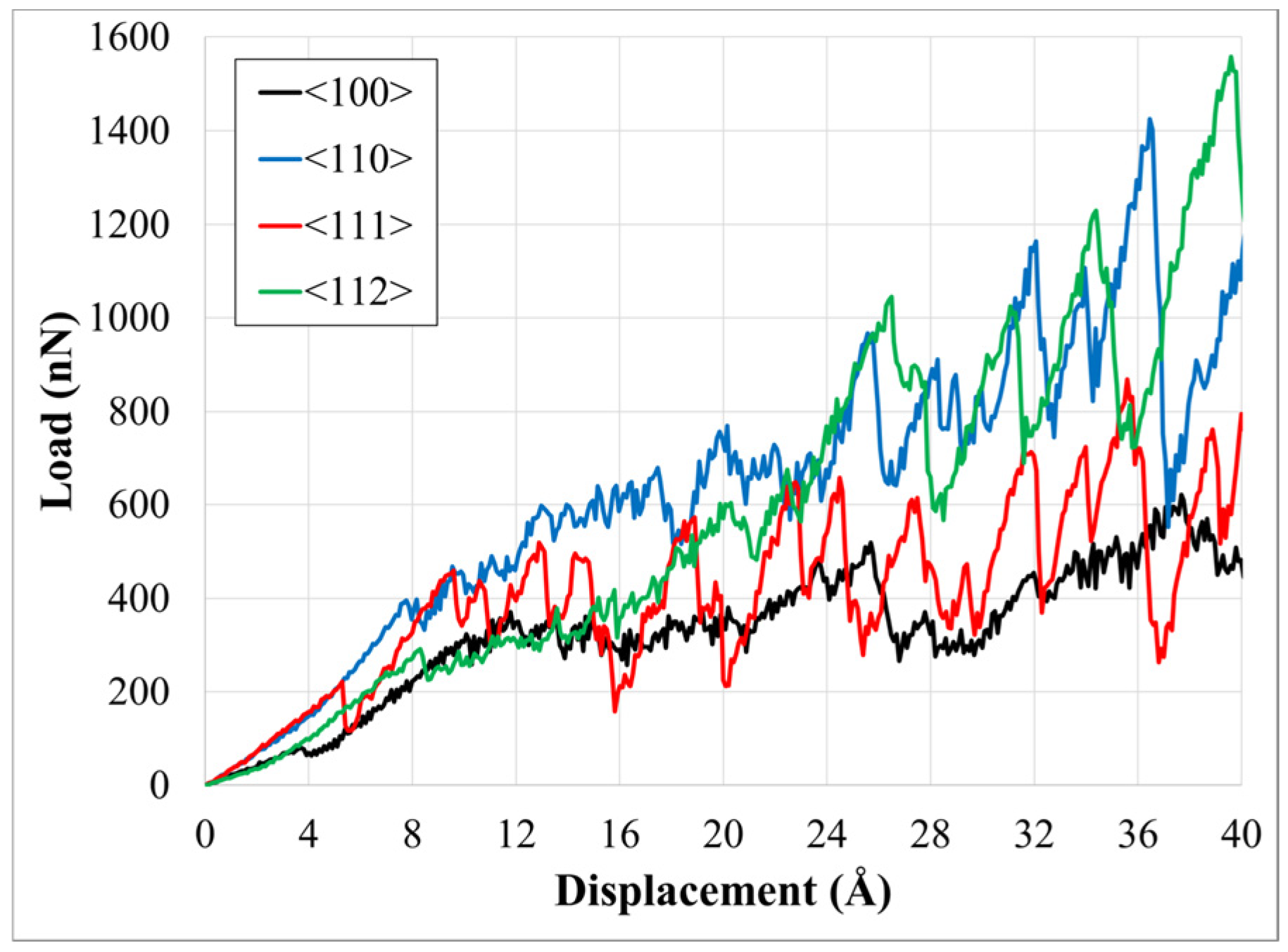
The solid Cu nanoparticle exhibits a pronounced anisotropic response to compression, consistent with previous atomistic and experimental studies on nanoscale single-crystal Cu [6,7,29,30]. Figure 1 shows the load–displacement (L-D) curves for compression along the ⟨100⟩, ⟨110⟩, ⟨111⟩, and ⟨112⟩ axes. Here, angle brackets ⟨hkl⟩ denote the entire family of symmetry-equivalent crystallographic directions, indicating that the reported mechanical behavior, such as load–displacement curves and deformation mechanisms are representative of all directions within each family. In all orientations, the initial response is nearly linear and elastic, followed by a first pop-in event (load-drop) marking the first onset of dislocation nucleation, though this is not necessarily the inception of plasticity. For FCC {111}⟨110⟩ slip, the maximum Schmid factor is identical for ⟨100⟩, ⟨110⟩, and ⟨112⟩ (), and these orientations show comparable inception loads. Loading along ⟨111⟩, however, has a lower maximum Schmid factor ( and therefore, in theory, it requires a noticeably higher load before the first major plasticity event. Though, in practice, the faceted surface morphology of the nanoparticles also influences the onset behavior. For the ⟨100⟩ and ⟨111⟩ cases, the second load-drop is more representative of the true onset of sustained plasticity, and the first pop-in is primarily associated with localized effects of surface steps and the formation of relatively stable dislocation locks before widespread plastic flow develops. These mechanisms will be discussed in detail for each loading direction later in this work. After plasticity initiates, the L-D curves diverge significantly. Under ⟨100⟩ loading, eight {111}⟨110⟩ slip systems share the same Schmid factor (), enabling plastic deformation to be distributed among many simultaneously active systems. Dislocations nucleate and glide on multiple {111} planes, producing relatively smooth flow with modest serrations and a gradual increase in load with displacement. In contrast, for ⟨110⟩, ⟨111⟩, and ⟨112⟩ loading, only a smaller subset of slip systems is strongly stressed (four for ⟨110⟩, three for ⟨111⟩, and several systems with average Schmid factors for ⟨112⟩). Consequently, deformation proceeds through more intermittent bursts confined to specific planes, as mobile dislocations nucleate, traverse the particle, and annihilate at free surfaces, producing pronounced load-drops. Between these bursts, the load rises steadily as the particle becomes temporarily dislocation-starved.
Figure 1.
Load–displacement (L-D) curves for a Cu nanoparticle compressed along various orientations.
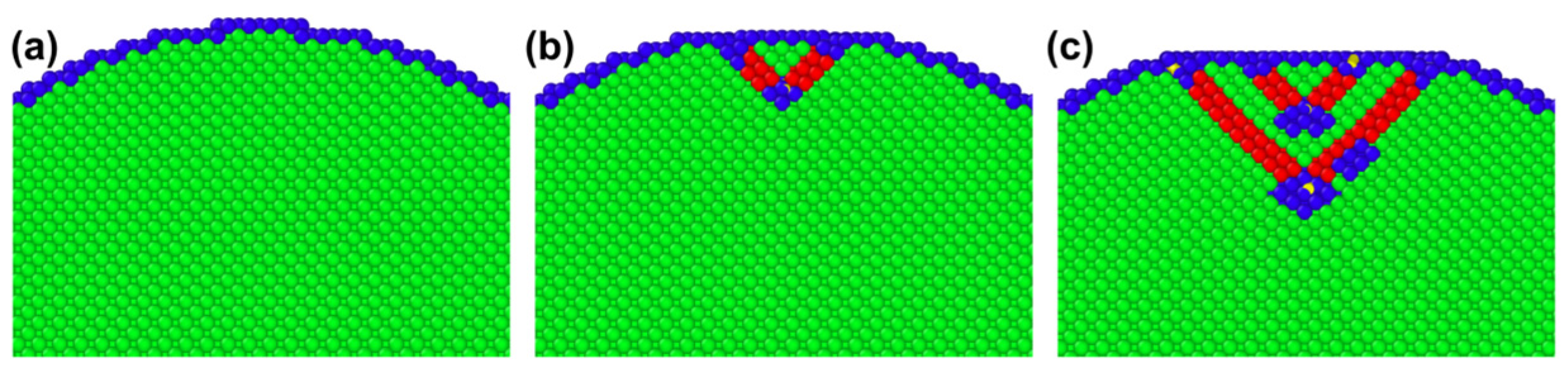
Under ⟨100⟩ compression, the Cu nanoparticle exhibits the lowest load at the inception of plasticity and the least post-yield hardening among all orientations. Plasticity first initiates at a displacement of δ = 3.8 Å, when the initial dislocations are emitted from the indented surface (Figure 2a). At this stage, a small pyramid-shaped defect forms beneath the indenter, where partial dislocations react to form a sessile Hirth junction dislocation . Immediately following this first defect formation, the L-D curve shows a sharp increase in slope (from to ). This apparent stiffening arises from the geometric relation between the nanoparticle’s planar facets and the flat indenters, as shown in Figure 3a–c. The facets that are initially in contact with the indenter are small, so the applied load is concentrated over a limited area. The high local stress at the facet corners (atomic steps) triggers rapid dislocation nucleation. As compression proceeds, the contact area expands as larger facets come in contact with the planar indenters, effectively distributing the load over a broader surface and causing the steep rise in load prior to the next dislocation event. With continued deformation, a second set of surface steps becomes sufficiently stressed, leading to a second load-drop, marking the true onset of sustained plasticity at δ = 10.31 Å (Figure 2b and Figure 3c). This transition reflects the shift from isolated dislocation emission to continuous dislocation activity across multiple {111} planes. As mentioned in Section 1, the angular momentum of the model was set to zero to prevent their rigid body rotation during loading. Therefore, the observed deformation mechanisms were only the results of the mechanical loading, while the models were not allowed to rotate.
Figure 2.
Atomic snapshots showing deformation mechanisms in a solid Cu nanoparticle loaded along the ⟨100⟩ direction at displacements (a) 4.23 Å, (b) 10.31 Å, (c) 16.18 Å, (d) 20.78 Å, (e) 20.78 Å, (f) 26.58 Å, (g) 26.68 Å, and (h) 40 Å. Snapshots in (a–d) and (f–g) share the same coordinate system shown in (a). Atoms are colored by their centro-symmetry parameter (CSP), ranging from 2 (blue) to 14 (red). Surface atoms and atoms with CSP < 2 were removed to highlight internal defects. Dislocation lines are shown, with colors indicating dislocation character: blue for perfect (1/2⟨110⟩), green for Shockley partial (1/6⟨112⟩), magenta for stair-rod (1/6⟨110⟩), yellow for Hirth (1/3⟨100⟩), and teal for Frank (1/3⟨111⟩). This dislocation color scheme is used consistently throughout the figures in this work.
Figure 3.
Atomic snapshots of the solid Cu nanoparticle showing (a) the undeformed configuration before loading along ⟨100⟩ direction, (b) the configuration at a displacement of 4.23 Å, where partial dislocations nucleate from the corners of the top surface step, producing a small load-drop in the load–displacement curve, and (c) the configuration at a displacement of 10.31 Å, where a second set of partial dislocations nucleates from the next surface step, marking the actual inception of plasticity.
Beyond δ = 11 Å, additional glissile dislocation loops nucleate and glide outward along {111} planes. Between δ = 16 Å and 25 Å, the load exhibits an overall increasing trend with intermittent drops. These drops correspond to the activation of new dislocation loops; however, part of the rising trend also originates from the geometric evolution of the contact: as compression proceeds, a larger fraction of the nanoparticle surface comes into contact with the flat indenters, increasing the number of load-bearing atoms and thereby contributing to the apparent load increase independent of hardening. As dislocation activity intensifies, localized shear promotes the formation of deformation twins, further elevating the load up to δ = 25 Å (Figure 2c–e). At δ = 25 Å, a sudden and larger load-drop occurs, terminating near δ = 26.7 Å. Atomic snapshots confirm that this drop is caused by the rapid propagation of multiple newly nucleated dislocation loops (Figure 2f,g). Following this event, interactions between gliding dislocations and the developing twin boundaries produce a more gradual rise in load from δ = 26.7 Å to δ = 37 Å, again influenced both by defect-mediated strengthening and by the continuous growth of the contact area with increasing indentation depth. By δ = 40 Å (Figure 2h), several well-developed twins are present, and active dislocations continue to interact with these twin interfaces.
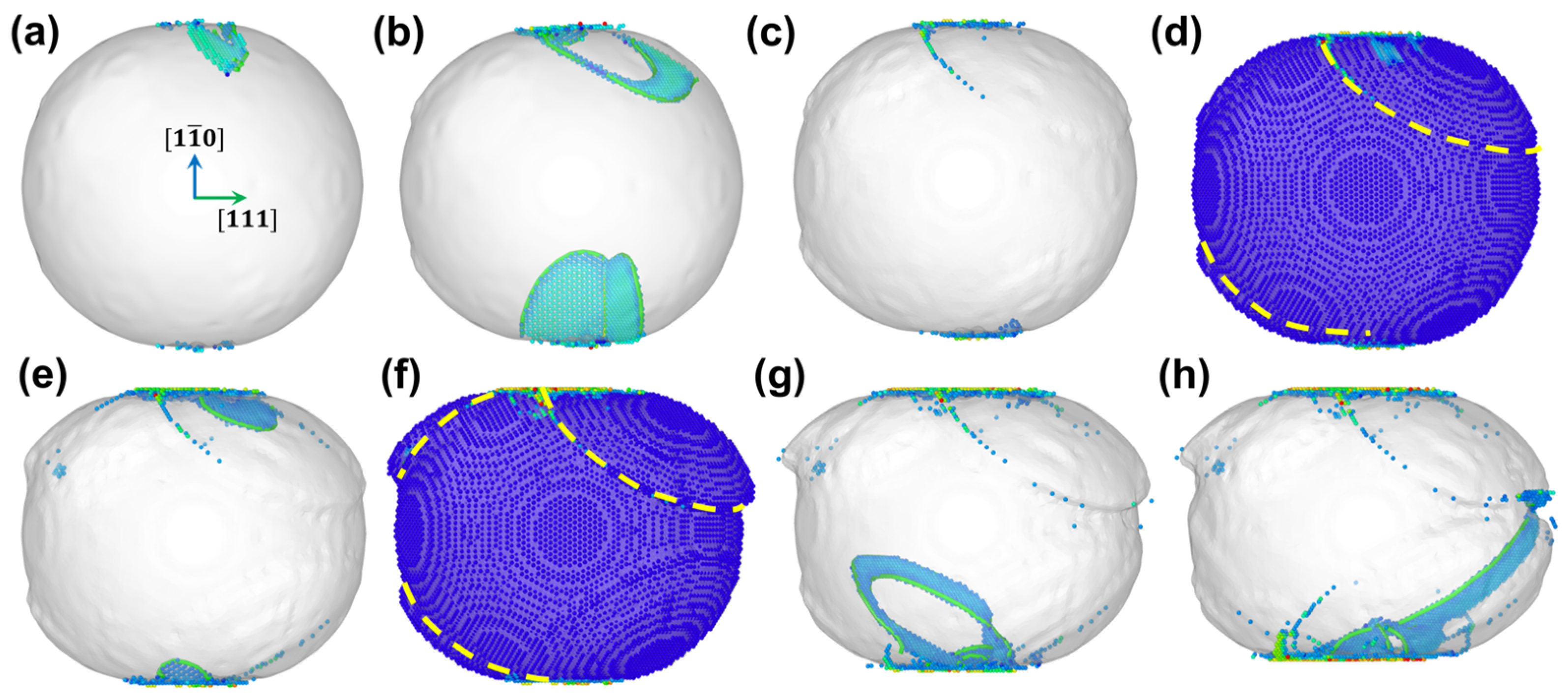
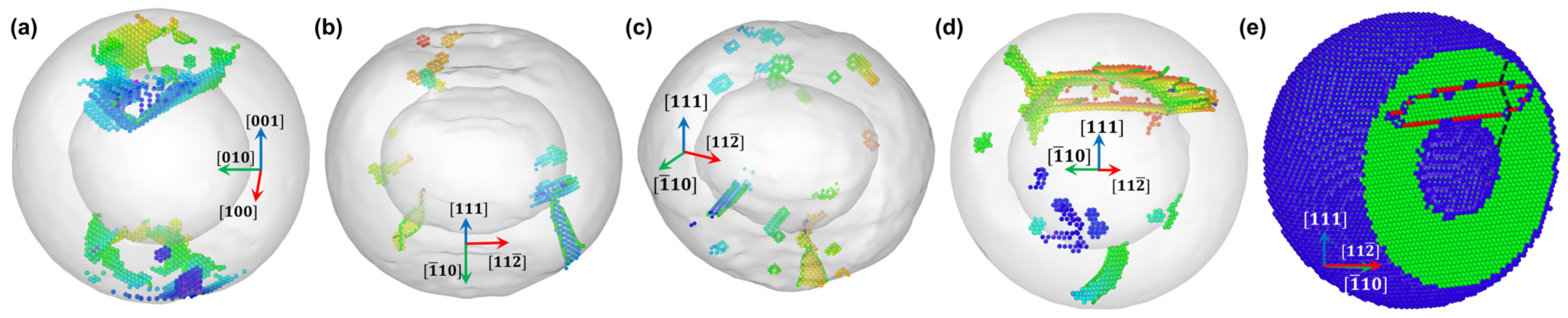
For loading along the ⟨110⟩ direction, the Cu nanoparticle exhibits markedly different behavior compared with the ⟨100⟩ case. Under ⟨110⟩ compression, the dominant deformation mechanisms are the nucleation and propagation of Shockley partial dislocations from the contact region between the particle and the planar indenter (Figure 4a,b). These partials glide on successive {111} planes, producing gradual shearing of the particle. Interactions among partials on different planes lead to the formation of sessile Hirth dislocations. As these dislocations reach and annihilate at the free surface, they generate substantial surface shear, clearly visible at δ = 17.5 Å and δ = 26.36 Å (Figure 4c–f). Figure 4g,h show the deformation mechanisms at critical points on the L-D curve corresponding to major load-drops at δ = 32.76 Å and δ = 37.16 Å. The pronounced shear band that forms at δ = 32.76 Å leads to the largest load-drop observed, occurring at δ = 36.45 Å.
Figure 4.
Atomic snapshots showing deformation mechanisms for a Cu solid particle loaded along direction, at displacements (a) 8.37 Å, (b) 13.36 Å, (c) 16.14 Å, (d) 17.47 Å (surface atoms removed), (e) 25.77 Å, (f) 26.67 Å (surface atoms removed), (g) 32.47 Å, and (h) 37.17 Å. Atoms are colored by their centro-symmetry parameter (CSP), ranging from 2 (blue) to 14 (red). Surface atoms and atoms with CSP < 2 were removed to highlight internal defects. Sheared regions on the particle surface are indicated with dashed lines. The coordinate system shown in (a) is used for all snapshots, while direction is normal to the page. For dislocation types, refer to the caption of Figure 2.
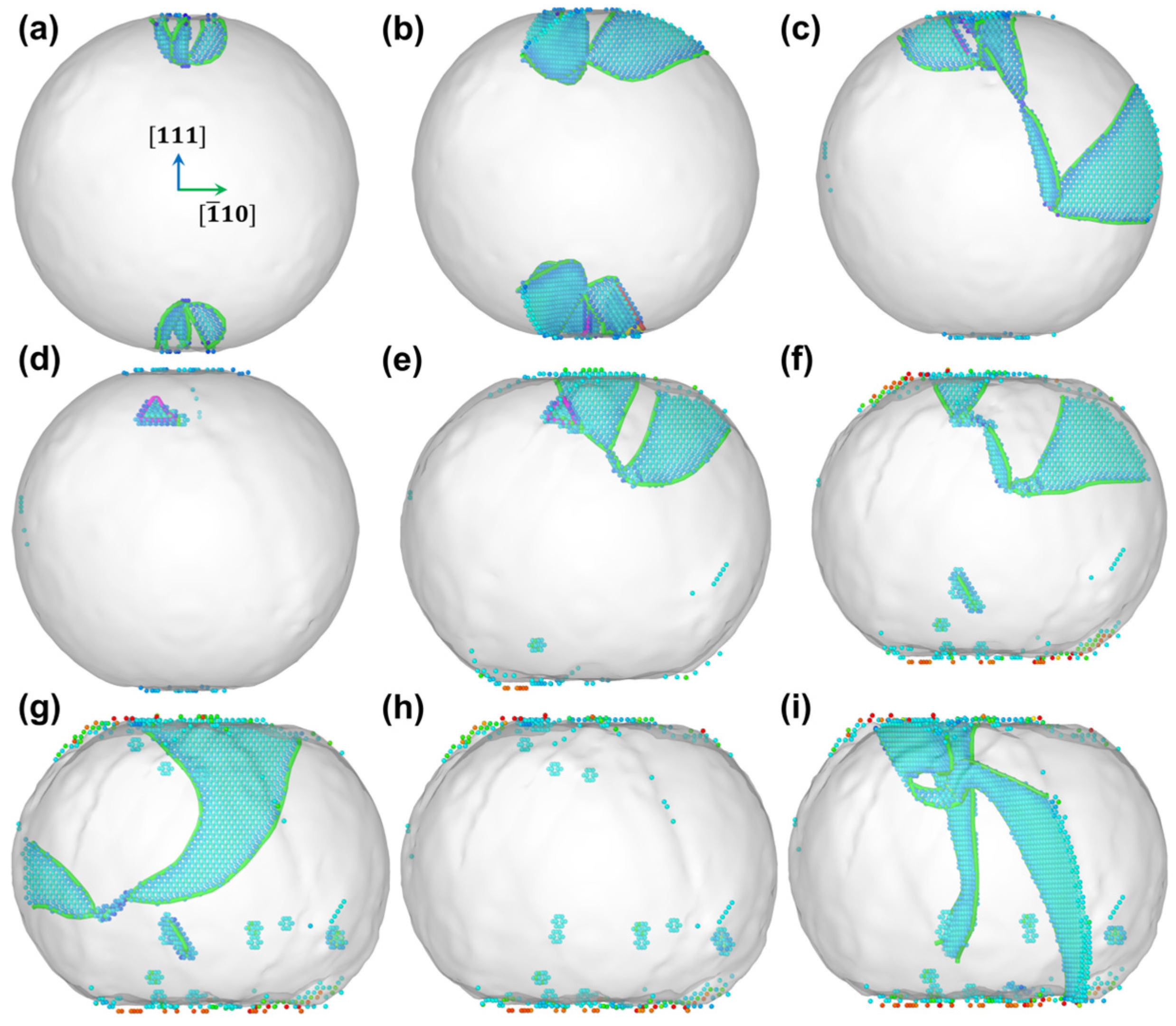
Under ⟨111⟩ loading, the second load-drop is taken as the true onset of plasticity. The first drop occurs at δ = 5.28 Å, but the nucleated dislocations remain localized and effectively locked until δ = 9.58 Å (Figure 5a–c), where the second drop appears. As noted earlier, the particle exhibits increased stiffness after the first drop, a further indication that deformation remains predominantly elastic. Like the ⟨110⟩ case, the dominant deformation mechanisms involve the nucleation and glide of Shockley partial dislocations from the contact region across {111} planes. Dislocation interactions lead to the formation of defects such as stacking-fault tetrahedra (SFTs) and vacancy clusters (Figure 5d–i). The SFTs are metastable and persist for several increments of deformation before being destroyed by successive partial dislocations passing through them [27], as shown in Figure 5e–g. In addition, the high geometric symmetry of the ⟨111⟩ loading direction promotes activation of many symmetrically equivalent {111}⟨110⟩ slip systems, which redistributes shear and produces a more complex defect topology.
Figure 5.
Atomic snapshots showing deformation mechanisms for a Cu solid particle loaded along direction, at displacements (a) 5.28 Å, (b) 9.58 Å, (c) 10.89 Å, (d) 12.89 Å, (e) 24.39 Å, (f) 29.00 Å, (g) 34.09 Å, (h) 34.29 Å, and (i) 36.69 Å. Atoms are colored by their centro-symmetry parameter (CSP), ranging from 2 (blue) to 14 (red). Surface atoms and atoms with CSP < 2 were removed to highlight internal defects. The coordinate system shown in (a) is used for all snapshots, while direction is normal to the page. For dislocation types, refer to the caption of Figure 2.
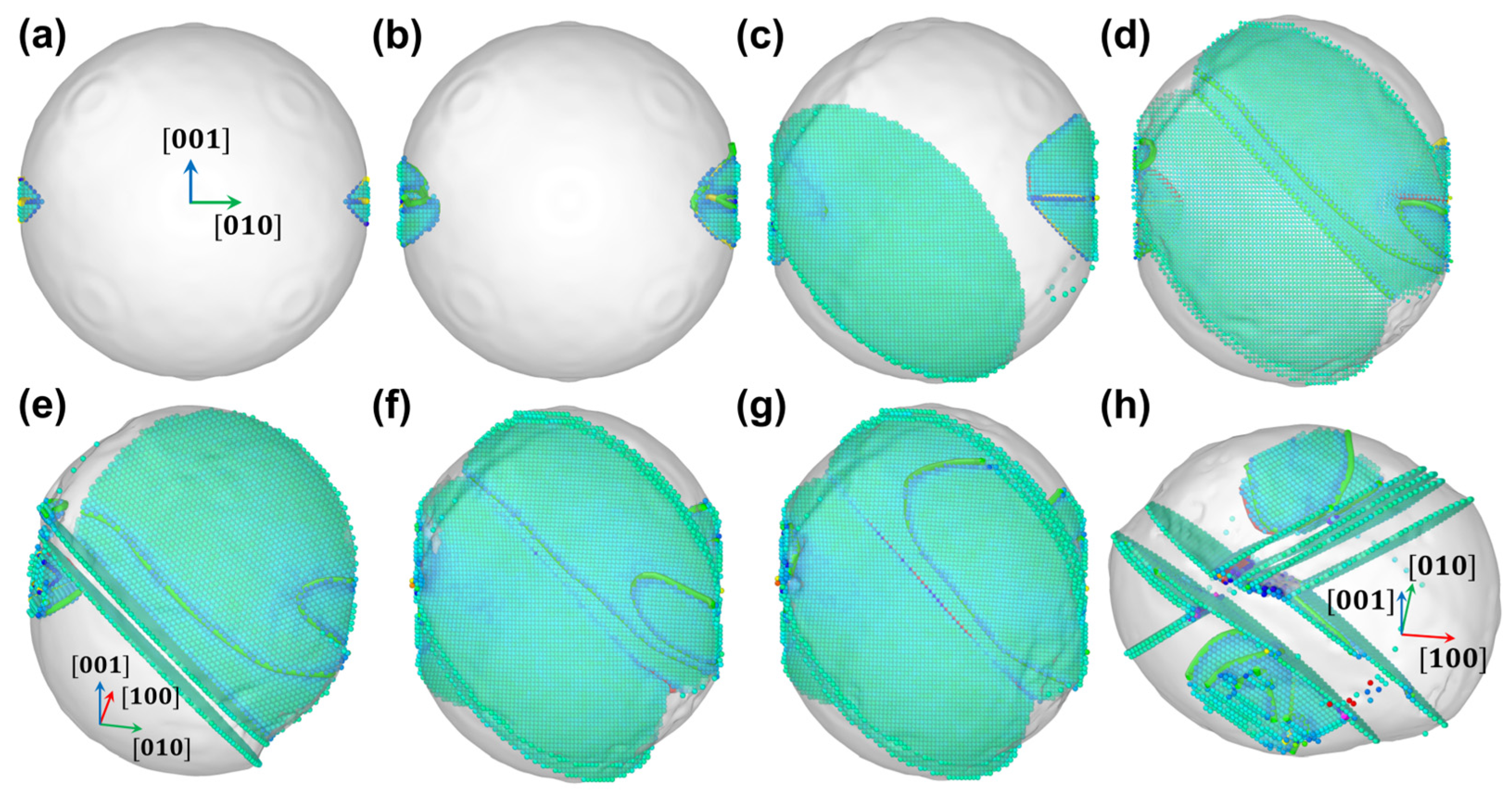
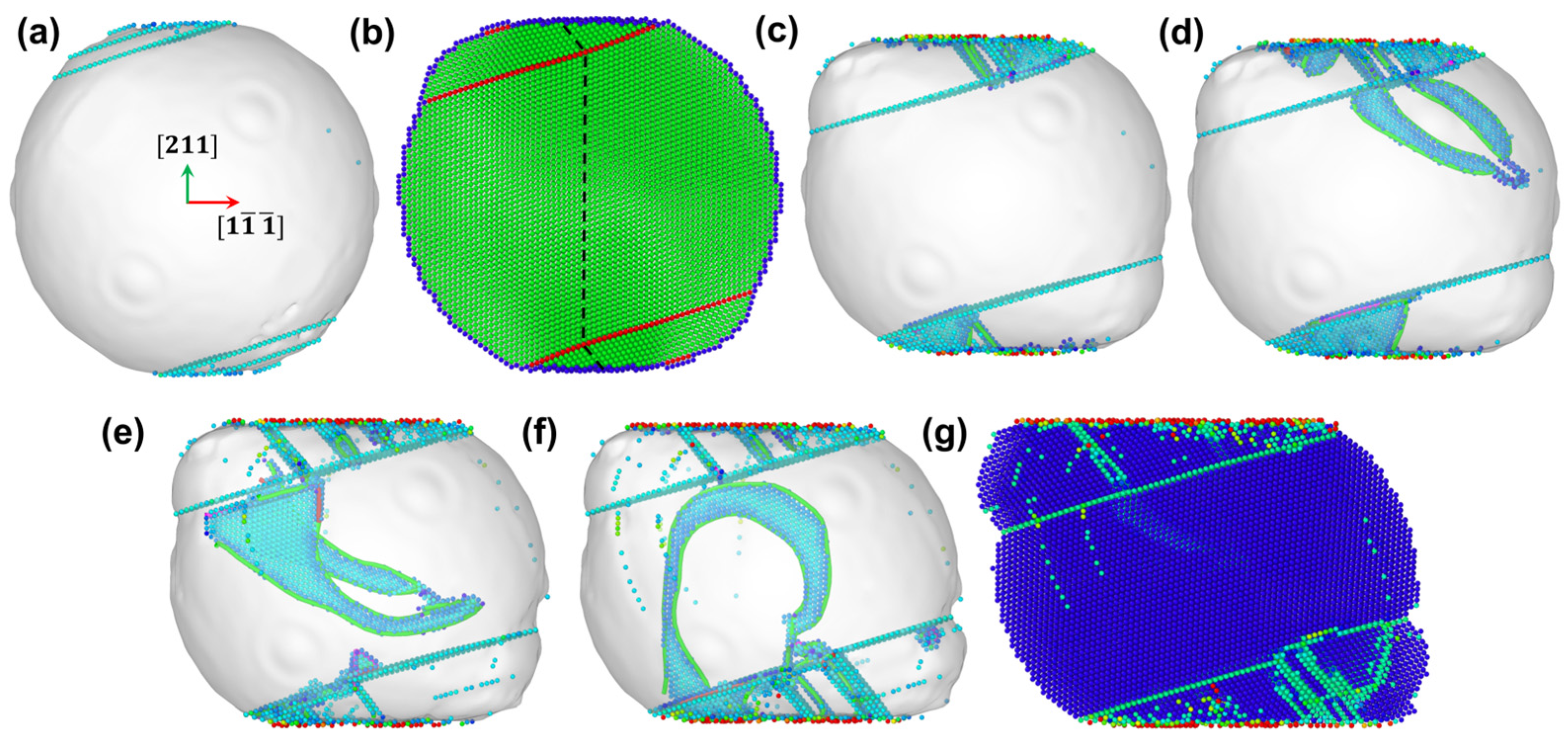
Under ⟨112⟩ loading, the Cu nanoparticle exhibits the most prolonged load increase among all orientations, extending up to δ = 26 Å. The first major plastic event occurs relatively late, at δ = 8.3 Å, when Shockley partial dislocations nucleate from stepped contact surfaces on {111} planes (Figure 6a). In contrast with the ⟨110⟩ and ⟨111⟩ cases, where partials glide across the particle and escape to free surfaces, these early partials rapidly initiate deformation twinning. Parallel coherent twin boundaries develop beneath each indenter on opposite sides of the particle, and from this point forward the mechanical response is dominated by the nucleation, propagation, and interaction of these twin boundaries. Figure 6b shows a well-developed twin at δ = 14 Å.
Figure 6.
Atomic snapshots showing deformation mechanisms in a solid Cu nanoparticle loaded along the direction, at displacements (a) 8.7 Å, (b) 14 Å, (c) 26.4 Å, (d) 26.6 Å, (e) 31.48 Å, (f) 35.1 Å, and (g) 40 Å. Except for (b), atoms are colored by their centro-symmetry parameter (CSP), ranging from 2 (blue) to 14 (red). Atoms in (b) are colored according to their structure type (green is FCC, red is HCP, and blue is non-crystalline). The read lines in (b) show twin planes and the dashed line shows mirrored planes of atoms that are result of the twinning. The coordinate system shown in (a) is used for all snapshots, and the direction is normal to the page. For dislocation types, refer to the caption of Figure 2.
The load–displacement curve shows a continuous rise in load from the onset of plasticity up to δ = 26.48 Å. Throughout this stage, multiple dislocations nucleate from the contact surfaces; however, these dislocations are quickly trapped by the growing twin boundaries, preventing their escape to the free surface and thereby producing the monotonic load increase (Figure 6c). Although the overall trend is upward, small intermittent drops appear, each corresponding to the nucleation of a new dislocation loop. The first major load-drop occurs when a dislocation loop bursts into the twinning region and disrupts the established twin structure (Figure 6d). Subsequent deformation follows a similar pattern: the load increases as the twin boundaries continue to carry shear, followed by additional large drops each time newly nucleated dislocation loops penetrate the twinning planes (Figure 6e,f). Atomic snapshots further show that the particle undergoes significant shear along the twin planes, while occasional surface steps also form due to the annihilation of dislocation loops at the free surface (Figure 6g).
Although both the ⟨100⟩ and ⟨112⟩ orientations in solid Cu exhibit twinning-dominated plasticity, their hardening behaviors differ markedly. Under ⟨112⟩ loading, only a few widely spaced twin boundaries form early in the deformation process. These twin boundaries act as strong, persistent barriers to dislocation motion, forcing dislocations to accumulate and interact rather than glide freely, which results in a sustained increase in load and a much higher apparent work-hardening rate, which is clear from the diverging trends in the two L-D curves. In contrast, ⟨100⟩ loading generates numerous closely spaced twins that accommodate shear more readily. Because these twins do not severely impede subsequent dislocation glide, additional hardening after the initial twin formation remains relatively weak.
These trends for solid Cu nanoparticles are consistent with previous MD studies of nanoparticle compression. For example, Bian et al. [7] showed that the ⟨112⟩ orientation is dominated by deformation twinning with pronounced hardening, while the ⟨110⟩ and ⟨111⟩ orientations deform primarily by dislocation slip with much lower hardening. Their study, however, did not examine the ⟨100⟩ orientation. By including all four major crystallographic directions, i.e., ⟨100⟩, ⟨110⟩, ⟨111⟩, and ⟨112⟩, the present work provides a more comprehensive and unified picture of the anisotropic deformation mechanisms governing solid Cu nanoparticles.
3.2. Hollow Aluminum Nanoshell vs. Solid Aluminum Nanoparticle
The compressive response of the hollow aluminum shell nanoparticle is next examined and compared with that of an equivalent solid Al particle. Although an isolated Al nanoshell is not a physically practical structure, it is included here to clarify the role of the Al shell in governing the mechanical behavior of the Cu-Al core–shell system; nevertheless, applications of hollow metallic nanoparticles have been reported in areas such as catalysis and dye-sensitized solar cells [31]. Under compression, the solid Al nanoparticle exhibits FCC-type dislocation-mediated plasticity broadly similar to that of Cu, but Al’s much higher stacking-fault energy makes extended stacking faults and deformation twinning less likely, favoring dislocation slip (and cross-slip) as the dominant mechanism [32,33]. To avoid redundancy, the full deformation sequence of the solid Al particle is not detailed here; instead, its response serves as a baseline for interpreting the behavior of the hollow Al shell and, subsequently, the Cu-Al core–shell nanoparticle.
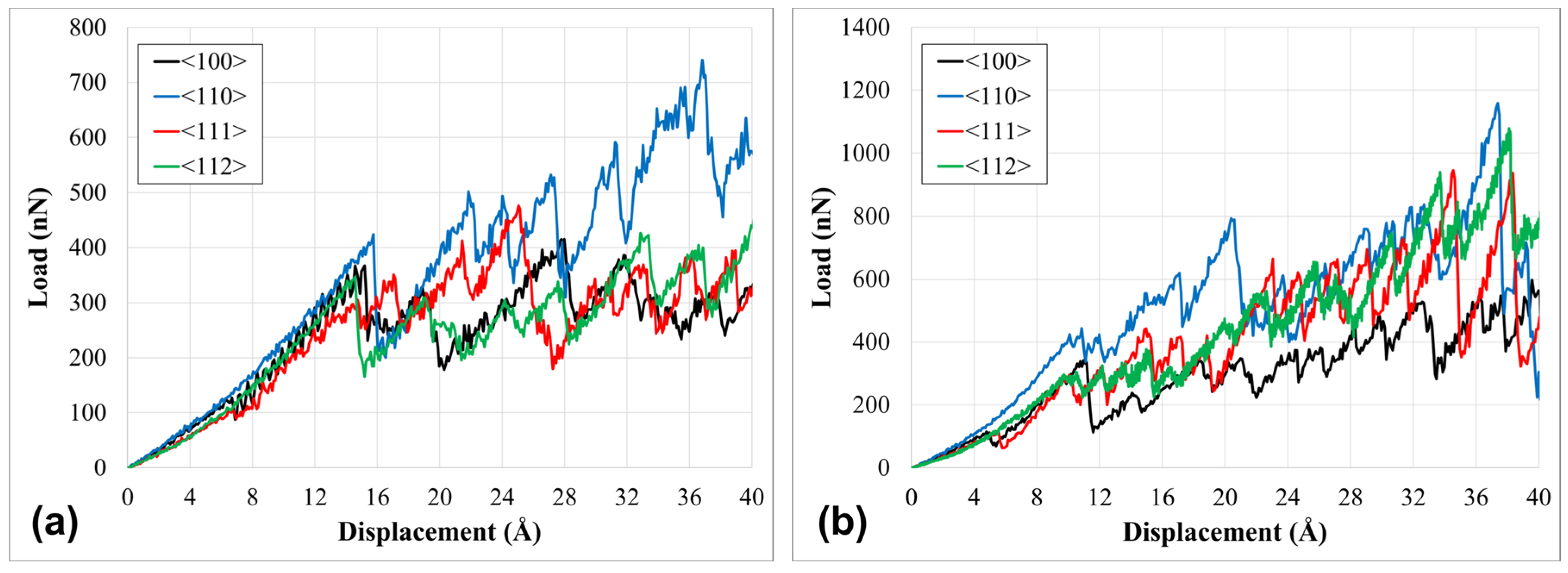
Figure 7a,b show representative load–displacement curves for a hollow Al shell and solid Al nanoparticle, respectively, compressed along various crystallographic orientations. In all orientations, the presence of the central cavity makes the Al shell more compliant and mechanically weaker than the solid particle. The peak loads sustained by the shell are lower, and the onset of plasticity is delayed. This delay arises because the hollow geometry allows the shell to undergo inward bending during the early stages of compression, enabling the structure to accommodate part of the imposed deformation elastically before dislocation activity becomes necessary.
Figure 7.
Load–displacement (L-D) curves for (a) Al shell and (b) Al solid particles compressed along various orientations.
Figure 8a–d shows the dominant deformation mechanisms in the Al shell at a displacement of 28 Å for the four loading orientations. After yielding, both the solid Al particle and the hollow Al shell deform primarily by slip on {111} planes through the nucleation and glide of Shockley partial dislocations. However, the presence of a void in the shell introduces important differences in how these defects propagate. In the shell geometry, Shockley partials still nucleate from the contact edges beneath the indenters and glide on {111} planes, but, unlike in a solid particle, each dislocation segment is confined to the shell wall and cannot traverse the entire particle diameter. Under ⟨100⟩ compression, the Al shell shows an almost monotonic increase in load up to the inception of plasticity. Plasticity first localizes directly beneath the indenters, but once yielding begins, the loading in ⟨100⟩ orientation can activate eight symmetrically equivalent {111}⟨110⟩ slip systems with identical Schmid factors (). This large family of equally stressed systems leads to substantial and continuous dislocation activity throughout the shell at all subsequent displacements (Figure 8a). Under ⟨110⟩ loading, the shell reaches the highest load at the onset of plasticity among the four orientations. This occurs because only four slip systems have the maximum Schmid factor in this orientation, making the shell more source-limited prior to the first nucleation event. Once plasticity begins, however, the absence of a solid core prevents dislocations from transmitting across the particle; segments loop within the shell wall and then annihilate at the inner and outer surfaces. Like ⟨110⟩ loading, loading in ⟨111⟩ produces extensive dislocation activity inside the shell, with dislocations nucleating from both the inner and outer surfaces and annihilating on the opposite surfaces, leaving vacancy clusters and other point defects behind (Figure 8b,c). Analysis of the atomic snapshots further shows that the ⟨110⟩ orientation exhibits more pronounced source-starved deformation, leading to a more rapid rise in load between major dislocation bursts. In contrast, during ⟨111⟩ loading, dislocations tend to remain within the shell wall for longer periods while new segments continue to nucleate and propagate, resulting in a different post-yield evolution.
Figure 8.
Atomic snapshots showing deformation mechanisms in an Al-shell nanoparticle loaded along (a) , (b) , (c) , (d) directions at a displacement of 28 Å. Atoms are colored by their spatial coordinates: (a) z position (−49 Å to 49 Å), (b) z position (−46 Å to 50 Å), (c) x position (−61 Å to 59 Å), and (d) x position (−65 Å to 65 Å). Each configuration is rotated to provide the clearest view of the dominant deformation mechanisms at this displacement. (e) Snapshot of the same Al shell shown in (d), highlighting the formed twin (indicated by dashed lines). Surface atoms are removed, atoms are colored by structure type (green: FCC; red: HCP; blue: non-crystalline), and the particle is sliced at 40 Å from the center to expose the twin. The orientation in (e) differs from that in (d) to provide a clearer view of the twin. For dislocation types, refer to the caption of Figure 2.
The most pronounced difference between the solid and hollow Al particles occurs under ⟨112⟩ loading. In a solid Al nanoparticle, compression along ⟨112⟩ can activate deformation twinning, even though Al has a high stacking-fault energy. When twins do form, they act as strong barriers to dislocation motion, similar to the behavior observed in the Cu ⟨112⟩ case. This leads to a rapid rise in load once the twin boundaries develop. In the hollow Al shell, however, any emerging twin boundary is interrupted by the central void. As a result, true deformation twins cannot span the particle. Only short twin segments may nucleate, and these quickly terminate at the inner surface, as shown in Figure 8d,e. Figure 8e shows the sliced particle to provide a clearer view of the formed twin segment. Because these short twin segments do not evolve into stable, load-bearing twin boundaries, twinning as a strengthening mechanism is effectively suppressed. Dislocations in the shell therefore move more freely without encountering extended obstacles. As a result, the ⟨112⟩ shell exhibits a much flatter post-yield response compared with the solid ⟨112⟩ particle, which shows a steep load increase due to twin formation. This contrast highlights how the presence of a void removes one of the strengthening pathways that would otherwise operate in the ⟨112⟩ orientation.
3.3. Cu-Al Core–Shell Nanoparticle
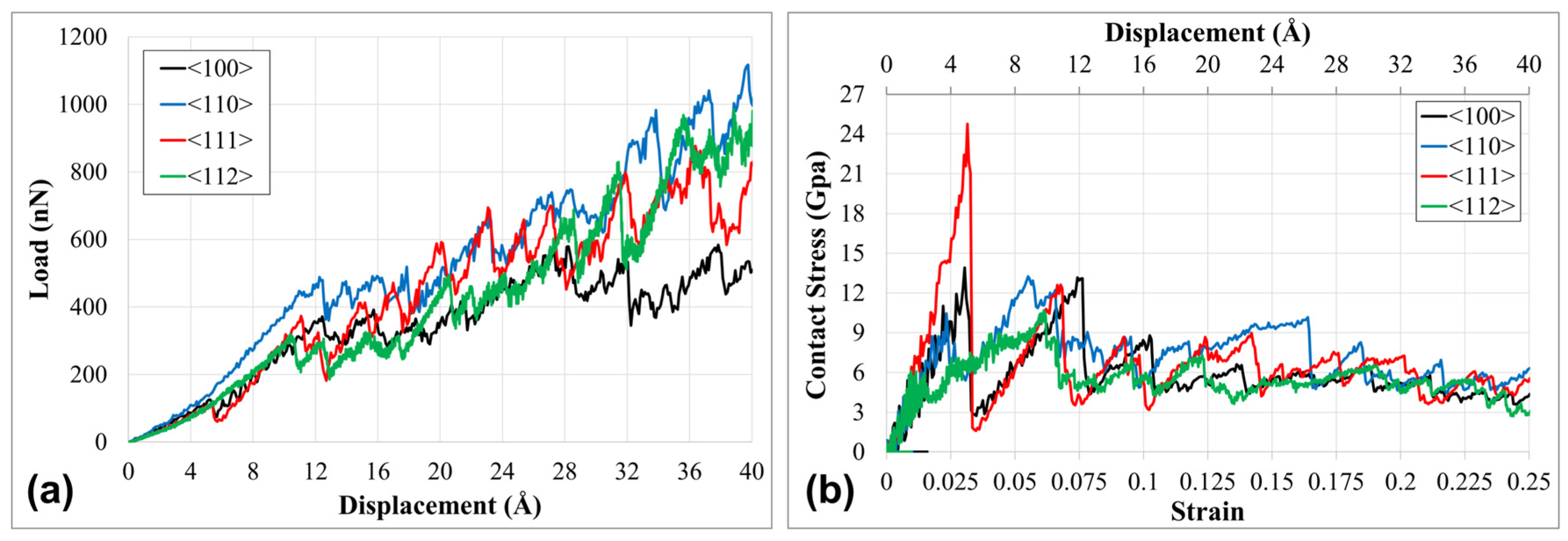
The Cu-Al core–shell nanoparticle exhibits a complex deformation response governed by the interaction between the Al shell and the Cu core. Figure 9a presents the L-D curves for the core–shell particle compressed along the ⟨100⟩, ⟨110⟩, ⟨111⟩, and ⟨112⟩ directions. The overall anisotropy resembles that of the single-material nanoparticles, although the Cu–Al interface modifies the active deformation mechanisms and the resulting mechanical response. While load–displacement (L-D) curves reveal the timing of plastic events, they do not accurately reflect material hardening because the load increases not only from the intrinsic response of the material but also from the growing contact area as indentation progresses. To separate these effects and evaluate the true material behavior, stress–strain curves are also required. Figure 9b shows the stress–strain curves for loading in the various directions. The corresponding displacements are also shown to compare the main events such as inception of plasticity with those presented in Figure 9a.
Figure 9.
(a) Load–Displacement Curves and (b) Stress–Strain curves for core–shell nanoparticles compressed along various orientations.
Across all orientations, the core–shell stress–strain curves show only weak, intermittent hardening. After yielding at the end of the elastic regime, the contact stress remains close to its post-yield level, and all orientations exhibit an overall softening trend beyond ~12 Å displacement (≈0.075 strain), interrupted by brief hardening episodes. This limited strain-hardening response contrasts with typical bulk behavior. The specific plastic events and their underlying deformation mechanisms for each loading direction are discussed later in this section.
Later, we also compare these stress–strain responses with those of the individual single-material nanoparticles (solid Cu and solid Al) and show that although the core–shell particles exhibit limited hardening, they still differ noticeably from their single-material counterparts.
To understand the mechanical response of the core–shell particle, we examine the atomistic deformation mechanisms for each loading orientation.
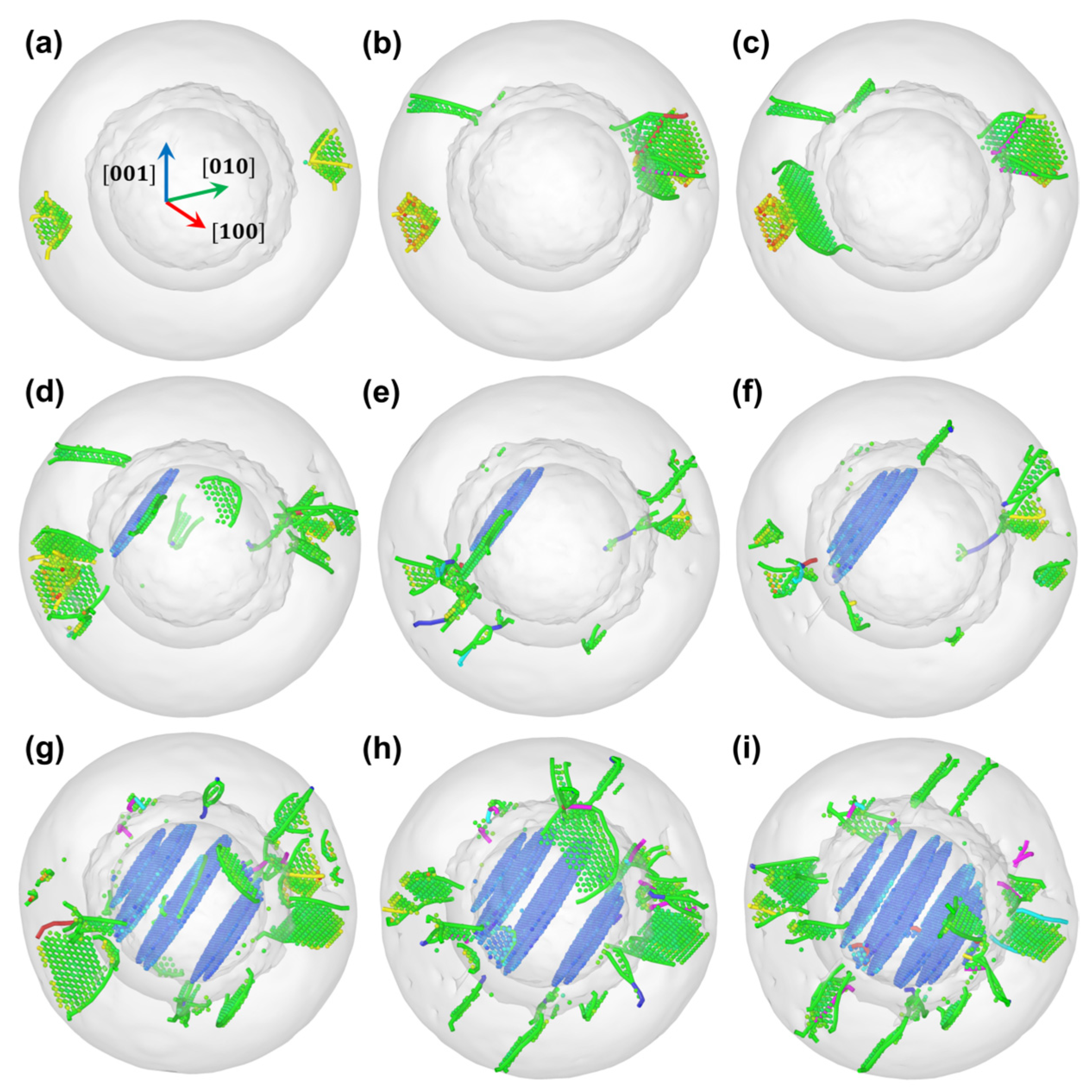
Under ⟨100⟩ loading, the deformation of the core–shell nanoparticle is governed by the coupled mechanical response of the Al shell and the Cu core. Figure 10 shows atomistic snapshots at selected displacements. Atoms are colored by their total energy, which highlights defects in the Cu core (primarily blue) and in the Al shell (primarily green/yellow). To provide a clearer view of the active deformation mechanisms, perfect lattice atoms, atoms at the free surface, and those at the core–shell interface are removed. Dislocations are also identified using DXA analysis in OVITO.
Figure 10.
Atomic snapshots showing deformation mechanisms for core–shell nanoparticle loaded along the direction, at displacements (a) 5.56 Å, (b) 12.74 Å, (c) 13.14 Å, (d) 16.33 Å, (e) 19.54 Å, (f) 21.74 Å, (g) 28.33 Å, (h) 29.12 Å, and (i) 32.23 Å. Atoms are colored by their total energy, ranging from −3.59 eV (blue) to −3.07 eV (red). The same coordinate system shown in (a) is used for all snapshots. To visualize internal defects, surface atoms and one atomic layer on each side of the core–shell interface were removed. For dislocation types, refer to the caption of Figure 2.
The first noticeable load-drop at δ = 5.56 Å (Figure 10a) corresponds to the nucleation of several Shockley partial dislocations locks (with Burgers vector shown as green lines) beneath the planar indenter. These partials originate at the particle–indenter contact, react with one another, and form dislocation locks (with Burgers vector shown as yellow lines) that suppress further propagation. As a result, the particle deforms almost elastically until δ = 12.74 Å (Figure 10b), when new dislocations begin to emanate from these locks and additional dislocations nucleate within the Al shell, still without penetrating the Cu core. This produces a distinct load-drop, followed by continued propagation at δ = 13.14 Å (Figure 10c). The stages at δ = 16.33 and 19.54 Å (Figure 10d,e) are characterized by ongoing nucleation and glide of dislocations within the Al shell. At δ = 16.33 Å, the first deformation twin nucleates inside the Cu core, generating a sharp decrease in load. A second twin boundary forms at δ = 21.74 Å (Figure 10f), again coinciding with a noticeable load-drop. After this event, the Cu core remains relatively inactive until δ = 28.33 Å (Figure 10g), when multiple new twin systems develop in the core, accompanied by intensified dislocation activity in the Al shell. This process continues at δ = 29.12 Å (Figure 10h). Notably, once this major twinning sequence begins, the rising trend in the load–displacement curve largely terminates. The largest drop in the curve occurs at δ = 32.23 Å (Figure 10i), where several twin boundaries develop in the Cu core alongside a dense dislocation network in the Al shell. Although the twin planes in copper do not always directly extend from the shell dislocations, their nucleation is clearly influenced by shell activity. For example, the first twin in Figure 10d aligns with a prominent dislocation band in the Al shell. Overall, under ⟨100⟩ loading, the dominant deformation mechanisms involve repeated dislocation nucleation and glide in the Al shell and intermittent twinning in the Cu core. Each twinning event corresponds to a distinct drop in the load–displacement curve, while the shell accommodates most of the plasticity between core-dominated events.
Although Schmid-factor estimates cannot uniquely predict defect nucleation under planar indentation, they provide useful crystallographic context for the pronounced junction/lock formation and subsequent Cu-core twinning observed under ⟨100⟩ loading. For FCC slip under ⟨100⟩ loading, the maximum Schmid factor is , and a relatively large subset of symmetry-equivalent systems attains near-maximum resolved shear stress. Also, for Shockley-partial/twinning shear , the corresponding , again with multiple strongly driven partial systems. This broad set of highly stressed systems increases the likelihood of intersecting partial activity and junction formation, consistent with the DXA-observed Shockley partial reactions that produce sessile locks beneath the indenter in the Al shell (Figure 10a–c). In FCC crystals, deformation twinning develops through sequential emission of Shockley partials on successive planes and is therefore sensitive to source-limited nucleation and local stress concentrations [34]. Here, the shell lock locally suppresses glide and concentrates stress, promoting stress transfer into the confined Cu core and enabling the first Cu twin to nucleate near the tip/aligned region of the shell lock/dislocation band (Figure 10d). Notably, the same lock-assisted pathway is also observed in the corresponding single solid Cu nanoparticle under ⟨100⟩ loading, where the first coherent twin initiates from a junction/lock (Figure 2c), supporting that this nucleation mechanism is intrinsic to Cu under ⟨100⟩ when strong local stress localization develops.
The deformation response for differs sharply from that of loading. Whereas the case shows repeated twinning in the Cu core and a more saturated load–displacement response, loading produces an almost monotonic increase in load with displacement. Figure 11 presents atomic snapshots colored by the total energy per atom. These snapshots show that plastic deformation is dominated by activity in the Al shell, with only minimal involvement of the Cu core.
Figure 11.
Atomic snapshots showing deformation mechanisms for a core–shell nanoparticle loaded along the direction, at displacements (a) 12.86 Å, (b) 15.85 Å, (c) 23.36 Å, (d) 30.55 Å, and (e) 34.45 Å. Atoms are colored by their total energy, ranging from −3.62 (blue) to −3.18 (red). The same coordinate system shown in (a) is used for all snapshots. To visualize internal defects, surface atoms and one atomic layer on each side of the core–shell interface were removed. For dislocation types, refer to the caption of Figure 2.
Plasticity initiates at δ = 12.86 Å, where Shockley partial dislocations with Burgers vector nucleate near the interface and react to form full dislocations (Figure 11a). By δ = 15.85 Å, additional Shockley partials nucleate directly from the interface into the Al shell (Figure 11b). Although small defect clusters begin to appear inside the Cu core around this stage, they do not influence the macroscopic response, and the major drops in the load–displacement curve are consistently linked to dislocation nucleation and glide within the Al shell. With increasing displacement, multiple additional load-drops occur, yet none of these events correspond to significant activity in the core (Figure 11c–e). This behavior contrasts strongly with the ⟨100⟩ case, where the Cu core undergoes intermittent twinning and plays a central role in producing large load-drops. Under ⟨110⟩ loading, the Cu core remains largely inactive. Instead of serving as a source of deformation, the copper primarily acts as a mechanical barrier that confines and redirects dislocations within the Al shell. This results in a more gradual and slightly increasing stress–strain trend for ⟨110⟩ loading, in contrast to the softening response and lower stresses observed for ⟨100⟩ loading (see Figure 9b).
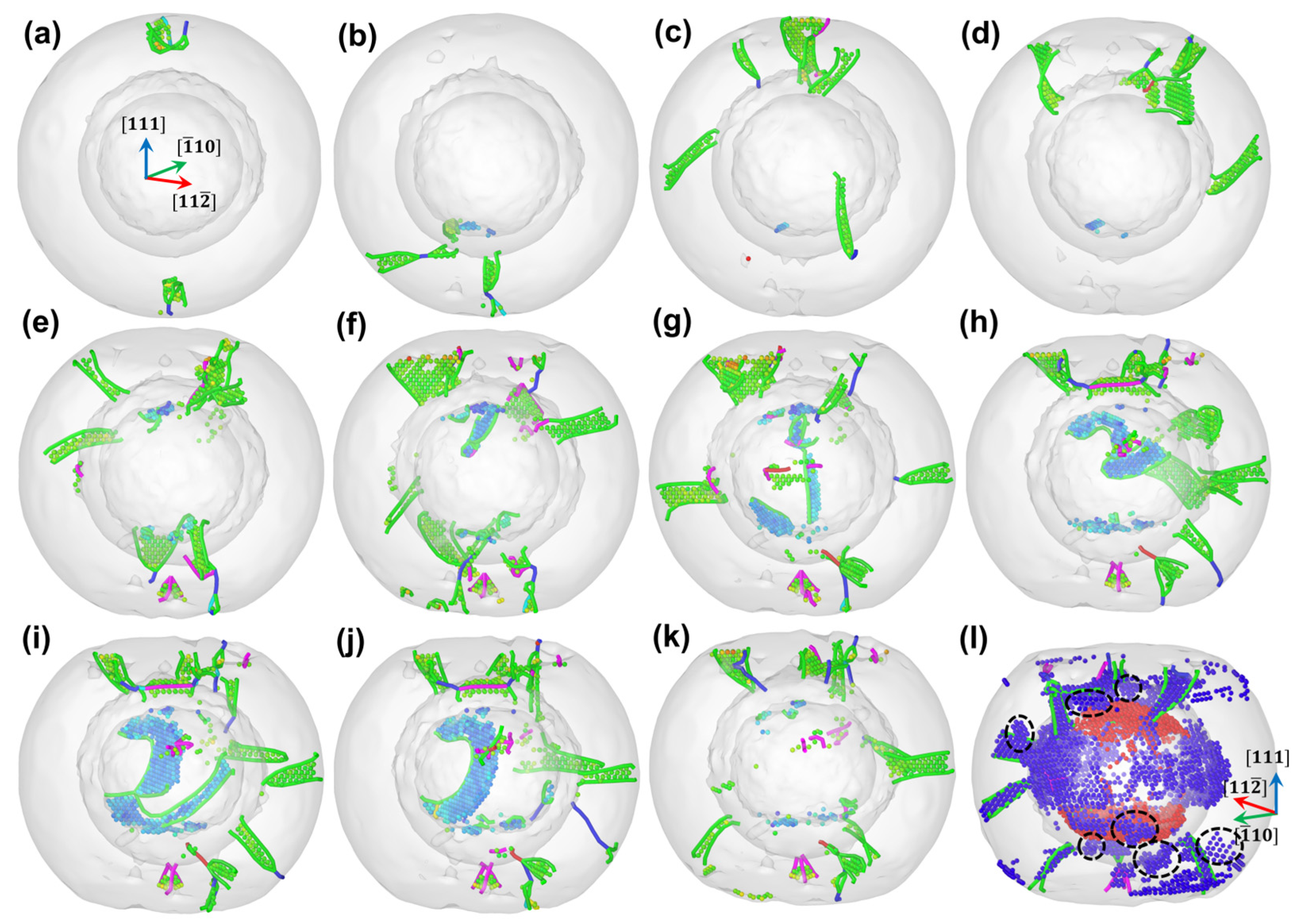
Figure 12 presents atomic snapshots of the deformation mechanisms in the core–shell nanoparticle under ⟨111⟩ loading. The overall response resembles that observed for the ⟨110⟩ case, but with an important distinction, i.e., ⟨111⟩ loading produces noticeably more dislocation activity inside the Cu core.
Figure 12.
Atomic snapshots showing deformation mechanisms in the core–shell nanoparticle loaded along the ⟨111⟩ direction at displacements (a) 5.7 Å, (b) 12.71 Å, (c) 17.59 Å, (d) 21.19 Å, (e) 28.1 Å, (f) 31.9 Å, (g) 32.8 Å, (h) 38.3 Å, (i) 38.38 Å, (j) 38.48 Å, and (k) 42.2 Å. Atoms are colored by their total energy, ranging from −3.60 eV (blue) to −3.12 eV (red). (l) Snapshot of the same particle at the displacement shown in (k), highlighting point defects in the Al shell (indicated by dashed ovals). In (a–k), point defects are removed to improve visualization of dislocation structures. In (l), atoms belonging to all structure types are shown, while perfect lattice atoms, surface atoms, and interface atoms are removed to emphasize the distribution of point defects. Most of the Cu atoms visible in (l) (shown in red) correspond to interface atoms rather than point defects. For dislocation types, refer to the caption of Figure 2.
This trend is consistent with the crystallographic dependence of resolved shear stress in FCC crystals. Although the indentation stress state is not purely uniaxial, a Schmid-factor analysis for the FCC {111}⟨110⟩ slip family offers a useful first-order framework. Under ideal uniaxial loading, the maximum Schmid factor is 0.408 for ⟨110⟩ and it is 0.272 for ⟨111⟩. Thus, ⟨110⟩ can provide a higher peak resolved shear on the most favorably oriented systems. However, ⟨111⟩ loading distributes the resolved shear more broadly across a larger number of symmetry-equivalent slip systems (multiple systems carry similar nonzero resolved shear), which promotes multi-slip once plasticity initiates. In a nanoparticle indentation setting, where the local stress field is highly multiaxial and surface nucleation is dominant, this broader distribution can facilitate more spatially distributed dislocation activity and increase the likelihood that dislocation processes extend into the Cu core. By contrast, ⟨110⟩ loading concentrates deformation onto a smaller subset of highly stressed systems, and plasticity can be accommodated more locally which can reduce the extent of sustained core involvement.
In case of loading in ⟨111⟩ direction, the earliest defect activity appears at δ = 5.7 Å (Figure 12a), where several Shockley partials nucleate at the indenter–particle contact and react to form dislocation locks. Similar to the ⟨100⟩ loading case, this initial defect formation alters the apparent stiffness but still corresponds to elastic deformation. The first clear onset of plasticity occurs at δ = 11–12.71 Å (Figure 12b), where multiple partial dislocations nucleate and propagate within the Al shell. Subsequent load-drops at δ = 17.59 Å and δ = 21.19 Å (Figure 12c,d) also arise from intensified dislocation activity confined to the shell. A major transition occurs between δ = 27 and 28.1 Å (Figure 12e), where the first dislocations nucleate inside the Cu core, producing a significant load-drop. Core activity continues over δ = 28.1–31.9 Å (Figure 12e,f), during which core dislocations glide toward the Cu–Al interface. From δ = 28 Å to 38.48 Å (Figure 12g–j), this sustained involvement of the core is accompanied by a noticeable reduction in the slope of the load–displacement curve, reflecting a transition toward softening. By δ = 42.2 Å (Figure 12k), most of the dislocations in the core have annihilated at the interface. This evolution is consistent with the stress–strain response (Figure 9b), where the initially modest hardening rate observed up to δ = 21 Å transitions into a softer, gradually declining trend once plasticity spreads into the core. A further important observation concerns the distribution of point defects. While the Al shell develops a high density of vacancy clusters and other point defects, the Cu core contains very few such defects (Figure 12l).
Although ⟨100⟩ and ⟨110⟩ have the same maximum Schmid factor for FCC slip (), the deformation response is controlled by how many slip/partial systems are strongly driven and whether localized sources/junctions form. Under ⟨100⟩, a larger population of and systems carries near-maximum resolved shear, promoting intersecting activity and junction/lock formation. Being consistent with this, both the core–shell particle and the single solid Cu nanoparticle show lock-assisted twin initiation under ⟨100⟩. Under ⟨110⟩, far fewer systems are highly stressed and partial driving is concentrated into a small subset, which reduces the formation of the localized, lock-driven conditions that help sustain twin thickening. Moreover, for ⟨111⟩ loading the peak resolved shear stress on the most favorably oriented (and associated partial) systems is lower, i.e., the maximum Schmid-factor driving is reduced ( under ideal uniaxial loading). Consequently, ⟨110⟩ and ⟨111⟩ remain dominated by dislocation-mediated plasticity without the pronounced Cu-twinning sequence observed for ⟨100⟩.
The core–shell nanoparticle compressed along the ⟨112⟩ direction exhibits a deformation mode dominated by twinning in the Al shell. This behavior is consistent with the twinning observed in the Al shell model (see Section 3.2) and in single-material Cu and Al nanoparticles (see Section 3.1) under ⟨112⟩ loading.
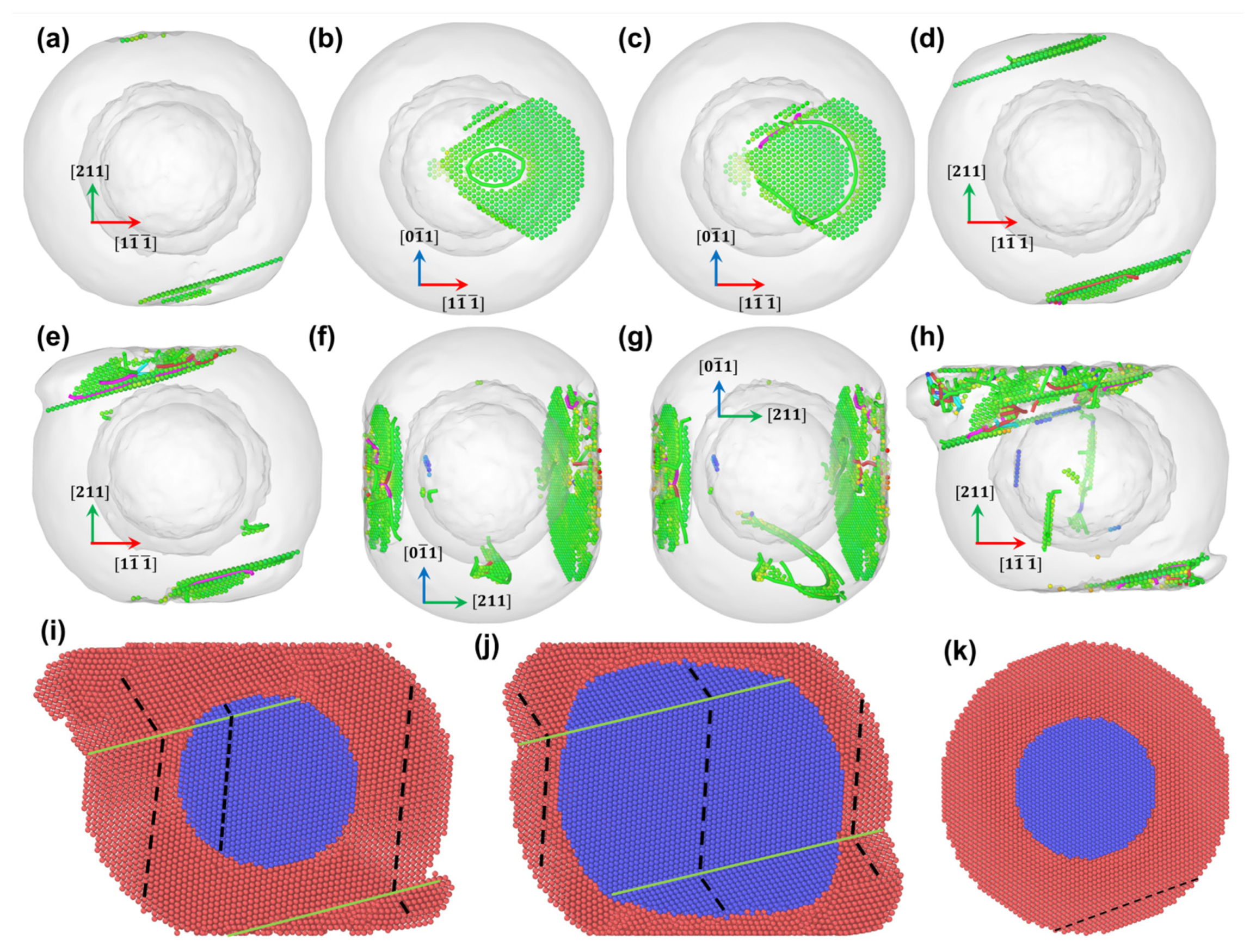
Figure 13a–i show atomic snapshots of the deformation mechanisms that govern the mechanical response of the core–shell nanoparticles compressed along ⟨112⟩ direction. The first load-drop corresponds to the formation of a primary twin boundary initiated by a partial dislocation beneath the indenter. As shown in Figure 13a–c, a 1/6⟨112⟩ Shockley partial loop nucleates just under the planar indenter, propagates through the Al shell, and leaves behind a coherent twin boundary. At δ = 12.9 Å (Figure 13d), a second twin boundary forms on the opposite side of the particle beneath the indenter. Between this point and δ = 21 Å (Figure 13e), the load increases steadily, consistent with the rising stress observed in the corresponding stress–strain curve (Figure 9b). At δ = 21 Å, a sudden load-drop occurs due to the nucleation and propagation of several dislocations directly beneath the indenter. These dislocations are quickly blocked by the existing twin boundaries, which leads to another period of load increase up to δ = 31.53 Å. At δ = 31.53 Å (Figure 13f), a new dislocation source becomes active within the Al shell between the two twin boundaries, producing a large drop in both load and stress. This behavior continues at δ = 31.56 Å (Figure 13g), where dislocations generated inside the shell are no longer effectively blocked by the twin boundaries and can propagate toward the free surface. After these dislocations annihilate at the outer surface, the particle becomes temporarily source-starved, and the load/stress again increase with displacement/strain. At larger displacements, additional dislocation sources and new twin boundaries activate, creating a more saturated deformation regime (Figure 13h). The twin boundary shown in Figure 13h,i remains almost entirely confined to the Al shell and it only minimally extends into the Cu core. To examine whether this behavior is intrinsic to Cu-Al core–shell nanoparticles under ⟨112⟩ loading, a second model with a thinner Al shell (thickness = 20 Å) was also analyzed. The corresponding snapshot (Figure 13j) reveals that in this configuration the twin boundary becomes continuous from the Al shell into the Cu core, meaning that the twin penetrates into copper at essentially the same location. This indicates that twinning is the dominant deformation mechanism when the core–shell particles are loaded along ⟨112⟩. The extent of Cu-core involvement in this twinning event, however, depends on the Al shell thickness. By contrast, we do not expect shell thickness to have a comparable effect for the other loading orientations, since the small and double-sized particles exhibit very similar deformation mechanisms despite their different shell thicknesses.
Figure 13.
Atomic snapshots showing deformation mechanisms for a core–shell nanoparticle loaded along the direction, at displacements (a) 10.78 Å, (b) 10.81 Å, (c) 10.82 Å, (d) 12.9 Å, (e) 21 Å, (f) 31.53 Å, (g) 31.56 Å, and (h) 36.97 Å. Atoms are colored by their total energy, ranging from −3.55 eV (blue) to −3.16 eV (red). Each snapshot is rotated to provide a clear view of deformation mechanisms. Coordinate axes are shown for each configuration, with the third axis normal to the page. For dislocation types, refer to the caption of Figure 2. Snapshots (i,j) show twinning for the particle at the displacement shown in (h) and for a second particle with a thinner Al shell (20 Å shell, 60 Å radius core), respectively. Atoms in (i,j) are colored by element type (blue: Cu, red: Al). Twin boundaries are indicated with solid lines, and dashed lines mark changes in lattice-plane orientation associated with twinning. Surface steps are shown on the sectioned particle before the start of the loading at (k). The dashed line shows (111) plane.
Under ⟨112⟩ loading, the pronounced localization and twin-dominated response can be interpreted by combining the mechanism of FCC twinning with crystallographic driving forces and source-limited nanoscale nucleation. As mentioned earlier for ⟨100⟩ loading, deformation twinning develops through successive emission of Shockley partial dislocations with Burgers vector gliding on {111} planes [34]. Each emitted partial leaves behind a stacking fault, and repeated partial activity on adjacent {111} planes progressively thickens the faulted region into a coherent twin band. From a crystallographic perspective, a Schmid-factor estimate provides useful guidance on where shear tends to concentrate: even though the stress state beneath a planar indenter is multiaxial and spatially heterogeneous, ⟨112⟩ loading generally biases the resolved shear toward only a small subset of symmetry-equivalent {111} systems, so plasticity is expected to concentrate on one preferred {111} plane (or a symmetry-equivalent pair) rather than being distributed among many competing planes [7].
However, the twin plane observed in the snapshots is not necessarily the plane with the maximum Schmid factor. At the nanoscale, plasticity is often source-limited, meaning that the dominant mechanism is controlled by which sites can most readily nucleate partials, not solely by the global resolved-shear ranking. In the present ⟨112⟩ simulations, the activated twin initiates on a {111} plane that has a relatively low nominal resolved shear (that is clear due to a high angle between [211] orientation and the activated twin shown in Figure 13a), yet it intersects a pronounced {111}-aligned surface step/ledge (see Figure 13k). This surface step acts as a strong local stress concentrator and an efficient surface-mediated source for partials, effectively lowering the nucleation barrier and allowing that lower-Schmid plane to dominate the response. Once partial emission begins repeatedly on the step-selected plane, the mechanism of FCC twinning naturally amplifies the localization: continued partial activity rapidly thickens the faulted region into an extended coherent twin band, matching the deformation sequence in the snapshots.
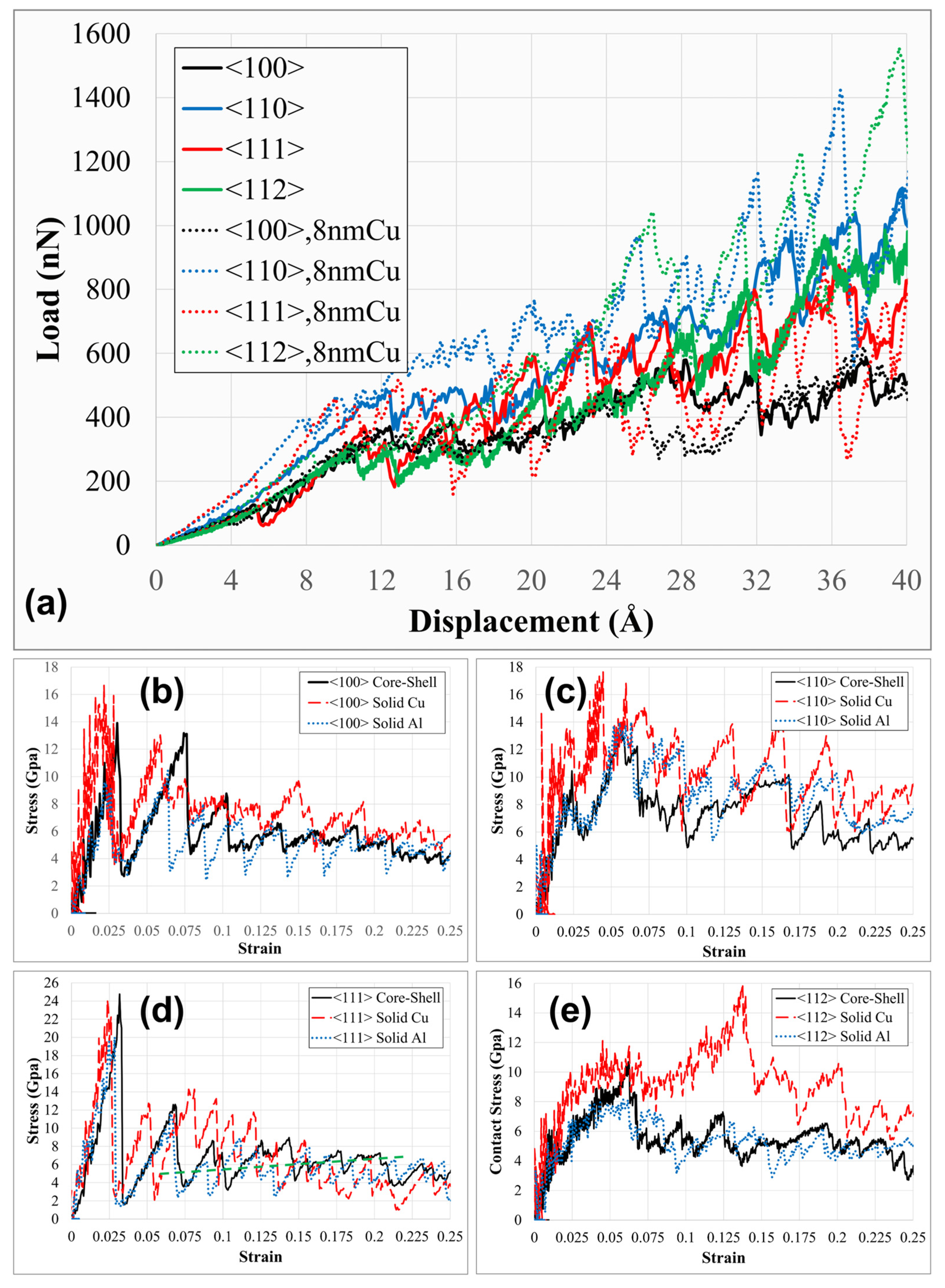
It is instructive to compare the behavior of the core–shell particles with those of their monolithic counterparts. Figure 14a shows the load–displacement curves for the core–shell and solid Cu particles, and Figure 14b–e present the corresponding stress–strain responses for the core–shell, solid copper, and solid aluminum particles across each loading orientation. Solid Al is used for comparison rather than the hollow shell because, as in the core–shell configuration, the presence of the Cu core eliminates the geometric effects associated with a cavity, making the shell behave more like bulk Al than like a hollow sphere. Overall, the mechanical response of the core–shell structures most closely resembles that of solid aluminum. This is expected because, as demonstrated in the preceding sections, plastic deformation in every orientation is dominated by activity within the Al component.
Figure 14.
(a) Load–Displacement curves for core–shell and solid copper particles along different loading directions, and (b–e) Stress–Strain curves comparing mechanical behavior of core–shell, solid copper, and solid Al for uniform compression along , , , and , respectively. In (d), the dashed line highlights the slight hardening observed in the core–shell nanoparticle under direction.
A consistent and noteworthy feature is that the core–shell particles exhibit much smaller load- and stress-drops than either solid Cu or solid Al for all orientations, particularly after yielding that corresponds to strain of ~0.075 for all the loading directions. This reduction in serration magnitude originates from the Cu–Al interface, which acts as an effective barrier to dislocation motion. The interface limits the rapid transmission of dislocations across the particle, thereby suppressing the large stress drops that typically accompany sudden dislocation avalanche events in monolithic nanoparticles.
An important exception to the generally “Al-like” behavior appears under ⟨100⟩ loading (Figure 14b). In this orientation, the core–shell response departs significantly from that of solid Al, particularly near the large stress-drop at ε ≈ 0.075. As discussed in Section 3.3, the Cu core is much more actively involved under ⟨100⟩ loading than in the other orientations, causing the core–shell curve to follow the solid Cu response rather than the Al response. For ⟨100⟩, the core–shell particle consistently lies above solid Al.
From a classical interface-strengthening perspective, one might expect pronounced strain hardening in the core–shell system, similar to the Nb–NbC composites where the metal–ceramic interface produces strong hardening with strain [35,36]. In contrast, the Cu–Al core–shell nanoparticles studied here show only limited additional hardening compared with their monolithic counterparts. This behavior likely has two main origins. First, the geometry and dislocation–interface interactions differ fundamentally from those in nanolaminate structures, as in layered systems, dislocations repeatedly strike the interface and are strongly impeded, whereas in core–shell particles many dislocations can glide around the interface instead of being arrested by it. Second, the Cu-Al system consists of two metals with similar crystal structures and broadly comparable mechanical character, unlike Nb/NbC, where both the material type and crystal structure differ sharply across the interface, leading to much stronger dislocation confinement and hardening.
For some orientations, such as ⟨100⟩, the overall response is dominated by softening, although the softening rate is noticeably reduced in the core–shell particle compared with solid Al. Under ⟨110⟩ loading, the core–shell and solid Al stress–strain curves are similar, and both lie below that of solid Cu, yet the core–shell particle consistently exhibits smaller stress drops because the interface constrains dislocation motion (Figure 14c). A noticeable hardening between ε ≈ 0.1 and 0.17 (displacement of 15 Å to 26 Å) is worth mentioning. This behavior results from minimal involvement of the Cu core in deformation over this strain range, as indicated by the atomic snapshots in Figure 11b,c. A significant drop in stress at the strain of 0.17 is due to the formation of a stacking fault in the Cu core (see Figure 11d). For ⟨111⟩, the core–shell response rises above that of solid Cu for strains larger than 0.15 and shows a modest hardening regime between ε ≈ 0.075 and 0.2 shown by a dashed line (Figure 14d), consistent with the increased dislocation activity noted earlier for this orientation (Figure 12). For ⟨112⟩ loading, the dominant deformation mechanism is twinning in the Al shell, leading to a response very similar to that of the solid Al particle. The apparent hardening observed for the solid Cu particle under this loading direction arises from interactions between dislocations and twin boundaries that form early in the deformation (Figure 6a–c). Once dislocations transmit through the twins (Figure 6d), the particle exhibits pronounced softening. Across all orientations, the core–shell structures also exhibit delayed yielding (higher yield strain) relative to solid Cu, indicating enhanced ductility compared with single-material copper nanoparticles.
Although a systematic investigation of particle-size effects is beyond the scope of the present study and will be addressed in a dedicated follow-on work, we performed an additional validation simulation on a size-doubled Cu(core)/Al(shell) nanoparticle, in which both the core diameter and the overall particle diameter were doubled (Cu core diameter 160 Å and core/shell outer diameter 320 Å). All other conditions were kept the same, including the crystallographic orientations, relaxation protocol, loading configuration, and loading temperature. The size-doubled model exhibited the same orientation-dependent load–displacement response and the same dominant deformation mechanisms as the baseline particle. This validation supports that the main conclusions reported here are robust and not specific to the particular diameter selected for detailed analysis. Additional results are provided in the Supplementary Materials for this work.

4. Conclusions
Molecular dynamics simulations were used to investigate the compressive deformation of 80 Å radius Cu-Al core–shell nanoparticles and compare their responses with those of solid Cu, solid Al, and a hollow Al shell under ⟨100⟩, ⟨110⟩, ⟨111⟩ and ⟨112⟩ loading. For the core–shell system, additional simulations with different initial conditions, i.e., configurations relaxed at 10 K or annealed at 300 K and then quenched to 10 K, showed that the mechanical response and dominant deformation mechanisms are insensitive to the initial state within the range examined. The single-material reference particles confirm the strong crystallographic anisotropy of nanoscale FCC metals: solid Cu shows twinning-dominated deformation in ⟨100⟩ and ⟨112⟩ loading directions, whereas ⟨110⟩ and ⟨111⟩ deform mainly by dislocation glide. Solid Al behaves similarly in terms of slip geometry but, consistent with its higher stacking-fault energy, deforms almost entirely by dislocation slip with only limited twinning. Introducing a central void to form a hollow Al shell reduces stiffness and strength, confines plasticity to the shell wall, and suppresses long, load-bearing twins.
The core–shell particle exhibits pronounced anisotropy under ⟨100⟩, ⟨110⟩, ⟨111⟩, and ⟨112⟩ loading, but across all orientations its stress–strain response is characterized by weak, intermittent hardening and a post-yield softening. Relative to monolithic particles, a consistent signature of the core–shell architecture is the strong suppression of load/stress serrations as the magnitudes of the load/stress drops are markedly smaller than in both solid Cu and solid Al, particularly after yielding.
Mechanistically, the deformation is primarily shell-controlled, with the extent of Cu-core participation depending on loading direction. Under ⟨100⟩ loading, intersecting Shockley-partial activity in the Al shell promotes junction/lock formation beneath the indenter, leading to strong local stress localization and stress transfer into the Cu core. This triggers intermittent deformation twinning in the core, with twinning events producing distinct load/stress drops. Under ⟨110⟩ loading, plasticity is dominated by Shockley partials and associated full dislocations in the Al shell, while the Cu core remains largely inactive and acts mainly to confine and redirect shell defects. Under ⟨111⟩ loading, deformation remains broadly dislocation-mediated but involves noticeably greater core dislocation activity than ⟨110⟩, consistent with a more distributed activation of slip in the nanoparticle stress field once plasticity initiates. Under ⟨112⟩ loading, deformation localizes into a twin-dominated band in the Al shell; the extent of twin continuity toward/into the Cu core is sensitive to shell thickness, whereas the dominant mechanisms for the other orientations remain robust across the particle sizes examined.
These trends reflect the combined roles of crystallographic driving (Schmid-factor guidance), faceted surface/source effects, and interface effect, providing an atomistic foundation for Cu-Al core–shell nanoparticle design and multiscale modeling.
Supplementary Materials
The following supporting information can be downloaded at: https://www.mdpi.com/article/10.3390/cryst16030186/s1, Figure S1: Load-Displacement Curves for (a) 8 nm/16 nm (diameters) and (b) 16 nm/32 nm (diameters) Cu/Al core/shell nanoparticles; Figure S2: Atomic snapshots showing deformation mechanisms in a double-sized (16 nm diameter core, 32 nm diameter shell) core-shell Cu-Al nanoparticles at 43 Å deformation for (a) ⟨100⟩, (b) ⟨110⟩, (c) ⟨111⟩, (d) ⟨112⟩. For ⟨100⟩, ⟨111⟩, and ⟨112⟩, atoms are colored according to the atomic potential energy, and for ⟨110⟩, atoms are colored according to the particle type (blue color for Al and red color for Cu).
Author Contributions
P.T.: methodology, software, validation, formal analysis, investigation, data curation, and writing—original draft. M.Z.: methodology, formal analysis, investigation, and conceptualization. I.S.: conceptualization, methodology, writing—original draft, writing—review and editing, and supervision. All authors have read and agreed to the published version of the manuscript.
Funding
This research received no external funding.
Data Availability Statement
Source data files are available from the corresponding author upon request.
Acknowledgments
We thank the GAEA and Metis high-performance computing support staff at NIU for their support of this project.
Conflicts of Interest
The authors declare no conflicts of interest.
Abbreviations
The following abbreviations are used in this manuscript:
| AM | Additive Manufacturing |
| CSP | Centro-symmetry parameter |
| DXA | Dislocation Extraction Algorithm |
| FCC | Face-centered cubic |
| HCP | Hexagonal close-packed |
| HEA | High-entropy alloy |
| LAMMPS | Large-scale Atomic/Molecular Massively Parallel Simulator |
| MD | Molecular dynamics |
| NVT | Constant number–volume–temperature ensemble |
| SFTs | Stacking-fault tetrahedra |
References
- Guo, D.; Xie, G.; Luo, J. Mechanical Properties of Nanoparticles: Basics and Applications. J. Phys. Appl. Phys. 2013, 47, 013001. [Google Scholar] [CrossRef]
- Amodeo, J.; Pizzagalli, L. Modeling the mechanical properties of nanoparticles: A review. Comptes Rendus Phys. 2021, 22, 35–66. [Google Scholar] [CrossRef]
- Padilla Espinosa, I.M.; Azadehranjbar, S.; Ding, R.; Baker, A.J.; Jacobs, T.D.B.; Martini, A. Platinum Nanoparticle Compression: Combining in Situ TEM and Atomistic Modeling. Appl. Phys. Lett. 2022, 120, 013101. [Google Scholar] [CrossRef]
- Pizzagalli, L.; Godet, J.; Durinck, J.; Brochard, S.; Furstoss, J.; Valencia, F. Twinning and Amorphization as Plasticity Mechanisms in Ultra Small Tungsten Nanoparticles. Comput. Mater. Sci. 2025, 258, 114077. [Google Scholar] [CrossRef]
- Cartellone, F.A.; Amigo, N.; Roco, F.R.; Deluigi, O.R.; Valencia, F.J.; Bringa, E.M. Compression of Refractory High-Entropy Alloy Nanoparticles: Size and Short-Range Order Effects. Int. J. Refract. Met. Hard Mater. 2026, 134, 107498. [Google Scholar] [CrossRef]
- Liang, Z.; Magar, N.T.; Koju, R.K.; Chesser, I.; Zimmerman, J.; Mishin, Y.; Rabkin, E. Ultimate Compressive Strength and Severe Plastic Deformation of Equilibrated Single-Crystalline Copper Nanoparticles. Acta Mater. 2024, 276, 120101. [Google Scholar] [CrossRef]
- Bian, J.; Zhang, H.; Niu, X.; Wang, G. Anisotropic Deformation in the Compressions of Single Crystalline Copper Nanoparticles. Crystals 2018, 8, 116. [Google Scholar] [CrossRef]
- Bian, J.; Yuan, W.; Yang, L.; Ding, Y.; Yu, X.; Shao, Z.; Zhang, H.; Wang, G. Influence of Planar Defects on the Mechanical Behaviors of Spherical Metallic Nanoparticles. Phys. Scr. 2024, 100, 015921. [Google Scholar] [CrossRef]
- Bel Haj Salah, S.; Gerard, C.; Pizzagalli, L. Influence of Surface Atomic Structure on the Mechanical Response of Aluminum Nanospheres under Compression. Comput. Mater. Sci. 2017, 129, 273–278. [Google Scholar] [CrossRef]
- Chen, C.; Zhao, L.; Liu, Y. Size Effect on the Mechanical Responses of Aluminum Nanoparticles under Indentation: A Molecular Dynamics Study. Tribol. Int. 2023, 177, 107959. [Google Scholar] [CrossRef]
- Malakar, P.; Anan, M.A.R.; Islam, M.; Thakur, M.S.H.; Mojumder, S. Atomistic Study of Coreshell and Functionally Graded Nanospheres under Compressive Loading. Int. J. Mech. Sci. 2022, 226, 107367. [Google Scholar] [CrossRef]
- Kilymis, D.; Gérard, C.; Pizzagalli, L. Ductile Deformation of Core-Shell Si-SiC Nanoparticles Controlled by Shell Thickness. Acta Mater. 2019, 164, 560–567. [Google Scholar] [CrossRef]
- Santhapuram, R.R.; Spearot, D.E.; Nair, A.K. Mechanical Behavior of Core–Shell Nanostructures. J. Mater. Sci. 2020, 55, 4303–4310. [Google Scholar] [CrossRef]
- Bian, J.; Yuan, W.; Ni, N.; Shao, Z.; Wang, G. Tunable Mechanical Properties of High-Entropy Alloy Nanoparticles with Core-Shell Structure. Mater. Today Commun. 2025, 49, 113839. [Google Scholar] [CrossRef]
- Tramontina, D.R.; Deluigi, O.R.; Pinzón, R.; Rojas-Nunez, J.; Valencia, F.J.; Pasianot, R.C.; Baltazar, S.E.; Gonzalez, R.I.; Bringa, E.M. Probing Radiation Resistance in Simulated Metallic Core–Shell Nanoparticles. Comput. Mater. Sci. 2023, 227, 112304. [Google Scholar] [CrossRef]
- Krasnikov, V.S.; Mayer, A.E. Initiation and Mechanisms of Plasticity in Bimetallic Al-Cu Composite. Metals 2023, 13, 102. [Google Scholar] [CrossRef]
- Mojumder, S.; Rakib, T.; Motalab, M. Atomistic Study of Hardening Mechanism in Al-Cu Nanostructure. J. Nanopart. Res. 2019, 21, 88. [Google Scholar] [CrossRef]
- Rahmani, F.; Jeon, J.; Jiang, S.; Nouranian, S. Melting and Solidification Behavior of Cu/Al and Ti/Al Bimetallic Core/Shell Nanoparticles during Additive Manufacturing by Molecular Dynamics Simulation. J. Nanopart. Res. 2018, 20, 133. [Google Scholar] [CrossRef]
- van der Giessen, E.; Schultz, P.A.; Bertin, N.; Bulatov, V.V.; Cai, W.; Csányi, G.; Foiles, S.M.; Geers, M.G.D.; González, C.; Hütter, M.; et al. Roadmap on Multiscale Materials Modeling. Model. Simul. Mater. Sci. Eng. 2020, 28, 043001. [Google Scholar] [CrossRef]
- Thompson, A.P.; Aktulga, H.M.; Berger, R.; Bolintineanu, D.S.; Brown, W.M.; Crozier, P.S.; in ’t Veld, P.J.; Kohlmeyer, A.; Moore, S.G.; Nguyen, T.D.; et al. LAMMPS—A Flexible Simulation Tool for Particle-Based Materials Modeling at the Atomic, Meso, and Continuum Scales. Comput. Phys. Commun. 2022, 271, 108171. [Google Scholar] [CrossRef]
- Apostol, F.; Mishin, Y. Interatomic Potential for the Al-Cu System. Phys. Rev. B 2011, 83, 054116. [Google Scholar] [CrossRef]
- Yanilkin, A.V.; Krasnikov, V.S.; Kuksin, A.Y.; Mayer, A.E. Dynamics and Kinetics of Dislocations in Al and Al–Cu Alloy under Dynamic Loading. Int. J. Plast. 2014, 55, 94–107. [Google Scholar] [CrossRef]
- Pogorelko, V.V.; Mayer, A.E. Influence of Copper Inclusions on the Strength of Aluminum Matrix at High-Rate Tension. Mater. Sci. Eng. A 2015, 642, 351–359. [Google Scholar] [CrossRef]
- Bodlos, R.; Fotopoulos, V.; Spitaler, J.; Shluger, A.L.; Romaner, L. Energies and Structures of Cu/Nb and Cu/W Interfaces from Density Functional Theory and Semi-Empirical Calculations. Materialia 2022, 21, 101362. [Google Scholar] [CrossRef]
- Lee, J.-Y.; Punkkinen, M.P.J.; Schönecker, S.; Nabi, Z.; Kádas, K.; Zólyomi, V.; Koo, Y.M.; Hu, Q.-M.; Ahuja, R.; Johansson, B.; et al. The Surface Energy and Stress of Metals. Surf. Sci. 2018, 674, 51–68. [Google Scholar] [CrossRef]
- Salehinia, I.; Bahr, D.F. Crystal Orientation Effect on Dislocation Nucleation and Multiplication in FCC Single Crystal under Uniaxial Loading. Int. J. Plast. 2014, 52, 133–146. [Google Scholar] [CrossRef]
- Salehinia, I.; Bahr, D.F. Inception of Plasticity in Copper Single Crystal in Presence of Stacking Fault Tetrahedra. Mater. Sci. Technol. 2012, 28, 1141–1146. [Google Scholar] [CrossRef]
- Stukowski, A. Visualization and Analysis of Atomistic Simulation Data with OVITO–the Open Visualization Tool. Model. Simul. Mater. Sci. Eng. 2009, 18, 015012. [Google Scholar] [CrossRef]
- Bian, J.-J.; Wang, G.-F. Atomistic Deformation Mechanisms in Copper Nanoparticles. J. Comput. Theor. Nanosci. 2013, 10, 2299–2303. [Google Scholar] [CrossRef]
- Gao, Y.; Wang, H.; Zhao, J.; Sun, C.; Wang, F. Anisotropic and Temperature Effects on Mechanical Properties of Copper Nanowires under Tensile Loading. Comput. Mater. Sci. 2011, 50, 3032–3037. [Google Scholar] [CrossRef]
- Jiang, C.; Mo, Y.; Wang, H.; Li, R.; Huang, M.; Jiang, S. Molecular Dynamics Simulation of the Production of Hollow Silver Nanoparticles under Ultrafast Laser Irradiation. Comput. Mater. Sci. 2021, 196, 110545. [Google Scholar] [CrossRef]
- Tang, X.; Guo, Y.; Gao, Y. Molecular Dynamics Simulations of the Nanoindentation for Aluminum and Copper. Comput. Mater. Contin. 2011, 23, 1–8. [Google Scholar] [CrossRef]
- Muzyk, M.; Pakieła, Z.; Kurzydłowski, K.J. Generalized Stacking Fault Energies of Aluminum Alloys–Density Functional Theory Calculations. Metals 2018, 8, 823. [Google Scholar] [CrossRef]
- Liu, J.; Niu, R.; Gu, J.; Liu, Y.; Ni, S.; Cairney, J.; Song, M.; Mai, Y.-W.; Zhu, T.; Liao, X. Effects of Twinning Configurations on the Mechanical Performance of Small-Scale FCC Metallic Materials. Acta Mater. 2026, 306, 121880. [Google Scholar] [CrossRef]
- Salehinia, I.; Shao, S.; Wang, J.; Zbib, H.M. Interface Structure and the Inception of Plasticity in Nb/NbC Nanolayered Composites. Acta Mater. 2015, 86, 331–340. [Google Scholar] [CrossRef]
- Salehinia, I.; Wang, J.; Bahr, D.F.; Zbib, H.M. Molecular Dynamics Simulations of Plastic Deformation in Nb/NbC Multilayers. Int. J. Plast. 2014, 59, 119–132. [Google Scholar] [CrossRef]
Disclaimer/Publisher’s Note: The statements, opinions and data contained in all publications are solely those of the individual author(s) and contributor(s) and not of MDPI and/or the editor(s). MDPI and/or the editor(s) disclaim responsibility for any injury to people or property resulting from any ideas, methods, instructions or products referred to in the content. |
© 2026 by the authors. Licensee MDPI, Basel, Switzerland. This article is an open access article distributed under the terms and conditions of the Creative Commons Attribution (CC BY) license.