Article

Effect of Mechanical Alloying Time on the Structural and Phase State of BN–C–Ti–Al Composites as Structural Prerequisites for Hydrogen Storage


1
“Institute of Atomic Energy” Republican State Enterprise, National Nuclear Center, Republic of Kazakhstan (RSE NNC RK), Kurchatov 071100, Kazakhstan
2
Center of Excellence “VERITAS”, D. Serikbayev East Kazakhstan Technical University, Ust-Kamenogorsk 070004, Kazakhstan
3
International School of Engineering, D. Serikbayev East Kazakhstan Technical University, Ust-Kamenogorsk 070004, Kazakhstan
*
Author to whom correspondence should be addressed.
Crystals 2026, 16(3), 155; https://doi.org/10.3390/cryst16030155
Submission received: 4 February 2026 / Revised: 18 February 2026 / Accepted: 20 February 2026 / Published: 24 February 2026
(This article belongs to the Section Hybrid and Composite Crystalline Materials)

Abstract

Boron nitride is considered a promising material for solid-state hydrogen storage due to its high thermal and chemical stability up to ~1000 °C, depending on the atmosphere, as well as its ability to form defect-rich structures with enhanced sorption activity. Despite the growing interest in modified BN systems, systematic studies on the effect of multicomponent modification induced by the addition of carbon, titanium, and aluminum on the structural and phase evolution of boron nitride during high-energy mechanical alloying remain limited to date. In this work, the structural-phase and morphological changes in boron nitride-based composites modified by the addition of carbon, titanium, and aluminum, synthesized by high-energy mechanical alloying, were investigated. The structural state and morphology of the materials were analyzed using X-ray diffraction, scanning electron microscopy, particle size analysis, and thermal analysis. It is shown that mechanical alloying leads to a progressive breakdown of the layered hexagonal BN structure and the formation of an amorphous-like, defect-rich state without the formation of new crystalline phases. The main stage of amorphization occurs within 30–60 min, after which structural disordering reaches saturation. Increasing the mechanical alloying time to 120 min does not result in significant changes in the phase state; however, it is accompanied by a reduction in agglomeration and the formation of a more homogeneous powder morphology, characterized by narrower particle size distributions, smoother particle surfaces, and more uniform spatial dispersion of components. It was established that the nature of the added component significantly influences the kinetics of structural transformations: carbon accelerates amorphization, titanium intensifies fragmentation and defect accumulation, whereas aluminum exhibits a stabilizing effect. In multicomponent BN–C–Ti–Al systems, a synergistic combination of these effects is observed, leading to the formation of metastable, partially amorphous structures. Based on a comprehensive analysis of structural and morphological data, the optimal mechanical alloying time was determined to be 120 min, providing a saturated amorphous-like structural state combined with improved microstructural homogeneity. The obtained defect-rich boron nitride structures can be considered a promising basis for further studies in the field of solid-state hydrogen storage.

1. Introduction

Hydrogen energy is considered one of the key directions in the development of renewable energy sources. The main challenge for its practical implementation remains the creation of safe, high-capacity, and reversible hydrogen storage systems [1,2,3]. Traditional methods, such as storage in compressed gas or cryogenic form, are characterized by high energy consumption and operational risks. In this regard, special attention is focused on solid materials capable of efficiently adsorbing and releasing hydrogen under moderate temperatures and pressures [4]. One of the most promising materials is boron nitride (BN), which exhibits high thermal and chemical stability, mechanical strength, and low density, making it suitable for operation under harsh conditions [5]. Nanostructured forms of BN (nanosheets, nanotubes, porous structures) demonstrate a high specific surface area and the presence of active sites that contribute to an increased adsorption capacity [6,7]. According to the review by Lale et al. [8], BN is capable of adsorbing hydrogen through both physical and chemical sorption mechanisms, while the efficiency of the process is determined by the morphology and defectiveness of the material. In recent years, BN has attracted significant attention from researchers due to its high chemical stability, mechanical strength, thermal resistance, and unique electronic structure [9]. Theoretical calculations indicate that BN-based structures are capable of exhibiting high theoretical hydrogen storage capacities when purposefully doped or decorated with active centers [10,11,12]. However, most available studies are predominantly theoretical in nature, while experimental data on practical modification routes for BN and their effects on sorption properties remain limited.
High-energy mechanical alloying (MA) in planetary ball mills is a well-established method for producing nanostructured and metastable phases through intensive plastic deformation, defect accumulation, and solid-state interactions [13,14]. For boron nitride-based systems, mechanical processing disrupts the layered structure of h-BN, increases defect density, and alters powder morphology, with the final state being critically dependent on MA parameters such as rotation speed and processing duration [14,15]. Studies on various material systems have shown that increasing milling time generally reduces crystallite sizes and improves phase distribution until a dynamic equilibrium between fragmentation and agglomeration is reached [16,17,18]. For refractory covalent materials like BN, high-energy regimes are essential to achieve the desired level of defectiveness and homogeneity [19,20,21]. The efficiency of mechanical alloying is determined not only by processing duration and rotation speed but also by the degree of filling of the milling vessel. Discrete element method simulations [22,23] have shown that a filling degree in the range of 60–70% provides optimal mixing and energy transfer while preventing particle segregation. Thus, the synthesis of homogeneous nanostructured powders requires coordinated optimization of both kinetic and geometric process parameters.
The introduction of alloying elements (C, Ti, Al) is considered a promising approach to enhance the sorption activity of BN: substitution or incorporation of these atoms forms additional adsorption sites and modifies the electrochemical potential of the surface, reducing the energy barriers for H2 adsorption/desorption [24,25]. Carbon doping creates H2 chemisorption centers and increases electrical conductivity [26], while titanium, owing to its transition d orbitals, provides strong binding of hydrogen molecules [27,28]. During prolonged high-energy milling, Ti is capable of interacting with BN to form TiN or TiB2, illustrating the ability of mechanical alloying to induce chemical reactions between Ti and BN and to form new phase constituents [29]. Zhang et al. [30] showed that the addition of BN to an Al matrix increases the strength and thermal stability of the material, while Meng et al. [31] noted that uniform distribution of BN and Al particles is achieved specifically through mechanical alloying. This suggests that, due to its plasticity and tendency to form thin interlayers at particle boundaries, Al stabilizes the morphology in BN systems and prevents the formation of excessively large agglomerates.
Along with MA, successful examples of BN modification have also been achieved by other methods: DFT calculations show that substitution of a B atom with Al facilitates H2 adsorption on BN sheets, while carbon-doped BN cages have been predicted as promising hydrogen sorption materials [32]. Seif and Azizi [33] demonstrated that carbon substitution in BN nanosheets and control of the system charge enhance the adsorption energy, enabling the retention of up to four H2 molecules per active site. Chen et al. [34] investigated BN nanostructures doped with carbon and modified with transition metals (including Ti) and showed a significant increase in hydrogen storage capacity. Similar approaches to structural modification are also applied in the development of wear-resistant materials and surface hardening techniques [35,36,37]. In the work of Mananghaya et al. [38], Ti-decorated BN nanotubes were modeled, where the achievement of >7 wt.% H2 storage with structural stability was theoretically confirmed. In addition, experimentally synthesized BN/C nanostructures exhibit improved gas sorption properties, including CO2 capture, confirming the effectiveness of carbon doping [39]. Both theoretical and experimental studies confirm the important role of structural defects. Jhi and Kwon [40] showed that vacancies and electron-deficient regions in BN significantly increase the H2 binding energy, while Alfalasi et al. [41] investigated the influence of vacancies in BN monolayers on hydrogen and metal ion storage capability. Sayhan and Kinal [42] theoretically confirmed the possibility of reversible H2 adsorption in BN nanocages, and in [43], the authors demonstrated that BN substrates modified with Ni nanoparticles significantly enhance the desorption kinetics of MgH2.
Based on the literature review, key factors influencing the hydrogen sorption ability of BN include specific surface area, pore volume, and the presence of structural defects. To enhance these characteristics, two main strategies are proposed: (i) increasing the surface area and pore volume through mechanical processing, and (ii) the addition of elements such as C, Al, and Ti to create additional adsorption sites. However, systematic experimental studies on the combined effect of these added components and high-energy MA parameters on the structural evolution of BN remain limited. Therefore, the aim of this work is to establish the influence of high-energy mechanical alloying time and the nature of alloying elements (C, Ti, Al) on the structural-phase state, morphology, and thermal stability of boron nitride–based composites. Particular attention is paid to the formation of nanostructured and amorphous regions, as well as the transformation of crystalline phases during milling. This approach aims to establish a relationship between the alloying strategy, processing conditions, and the formation of defect-rich states, which are key structural prerequisites for potential hydrogen adsorption capacity.

2. Materials and Methods

Elemental powders of BN (purity > 99.9%, particle size < 50 μm), C (purity > 99.9%, particle size < 90 nm), Al (purity > 99.9%, particle size < 90 nm), and Ti (purity > 99.9%, particle size < 50 μm) were used as starting materials. All powders were supplied by Hebei Suoyi New Material Technology Co., Ltd. (Handan City, Hebei Province, China).
Initial powder mixtures with nominal compositions BN91C9, BN94C6, BN93Ti7, BN96Ti4, BN97Al3, BN96Al4, BN87C6Al3Ti4, and BN80C9Al4Ti7 (at%) were subjected to high-energy milling in a planetary ball mill (Fritsch Pulverisette 7 premium line, Fritsch GmbH, Idar-Oberstein, Germany). The ball-to-powder mass ratio was 15:1. Steel balls with a diameter of 5 mm were used as the milling media, and the volume of the milling jars was 45 mL. Milling was carried out for 15, 30, 60, and 120 min at a rotational speed of 1000 rpm under an inert argon atmosphere. Loading and unloading of the powder mixtures were performed in a vacuum glove box to prevent oxidation. To reduce agglomeration during milling, a small amount of stearic acid (2 wt% relative to the powder mass) was added. The choice of stearic acid was based on the report of Shi et al. [44], who noted that its addition reduces diffusion and prevents cold welding of particles by forming a thin isolating film on their surface. For comparison, powder mixing was also carried out for 10 min at a rotational speed of 200 rpm without the addition of stearic acid.
The crystalline structure of the milled powders was examined using an X-ray diffractometer (X’Pert PRO, Malvern Panalytical Empyrean, Almelo, The Netherlands) equipped with a Cu anode X-ray source (CuKα1 radiation, λ = 1.5406 Å). Diffraction patterns were recorded in the 2θ range of 20–90° at an accelerating voltage of 45 kV and a tube current of 40 mA. The scanning step size was 0.02°, with a counting time of 1.5 s per step. A fixed divergence slit of 1/2°, a divergence slit–to–focus distance of 91 mm, a fixed incident mask of 15 mm, and an antiscattering slit of 2° were used. All measurements were performed at room temperature (25 °C). Diffraction data were processed using HighScore Plus software (version 4.9a, 2021). Phase identification was carried out using the COD (2021) and ICSD (2012) databases.
Morphological analysis was performed using a TESCAN MIRA LMS scanning electron microscope (TESCAN, Brno, Czech Republic) operated in backscattered electron (BSE) mode at an accelerating voltage of 20 kV.
Particle size distribution of the milled powders was determined using a Fritsch Analysette 22 NEXT laser diffraction particle size analyzer (Fritsch GmbH, Idar-Oberstein, Germany). The results are reported as volume-based particle size distributions, and particle size calculations were performed using the Fraunhofer scattering model.
The evolution of material properties under high-temperature cyclic loading, as well as the determination of optimal sorption temperatures, was investigated by simultaneous thermal analysis combining differential scanning calorimetry (DSC) and thermogravimetric analysis (TGA) using a TGA/DSC 2 system (METTLER Toledo). Measurements were carried out in an air atmosphere with linear heating of the samples up to 500 °C at a heating rate of 10 °C/min. Air atmosphere was chosen due to its accessibility for initial thermal stability screening and detection of residual organics.

3. Results and Discussion

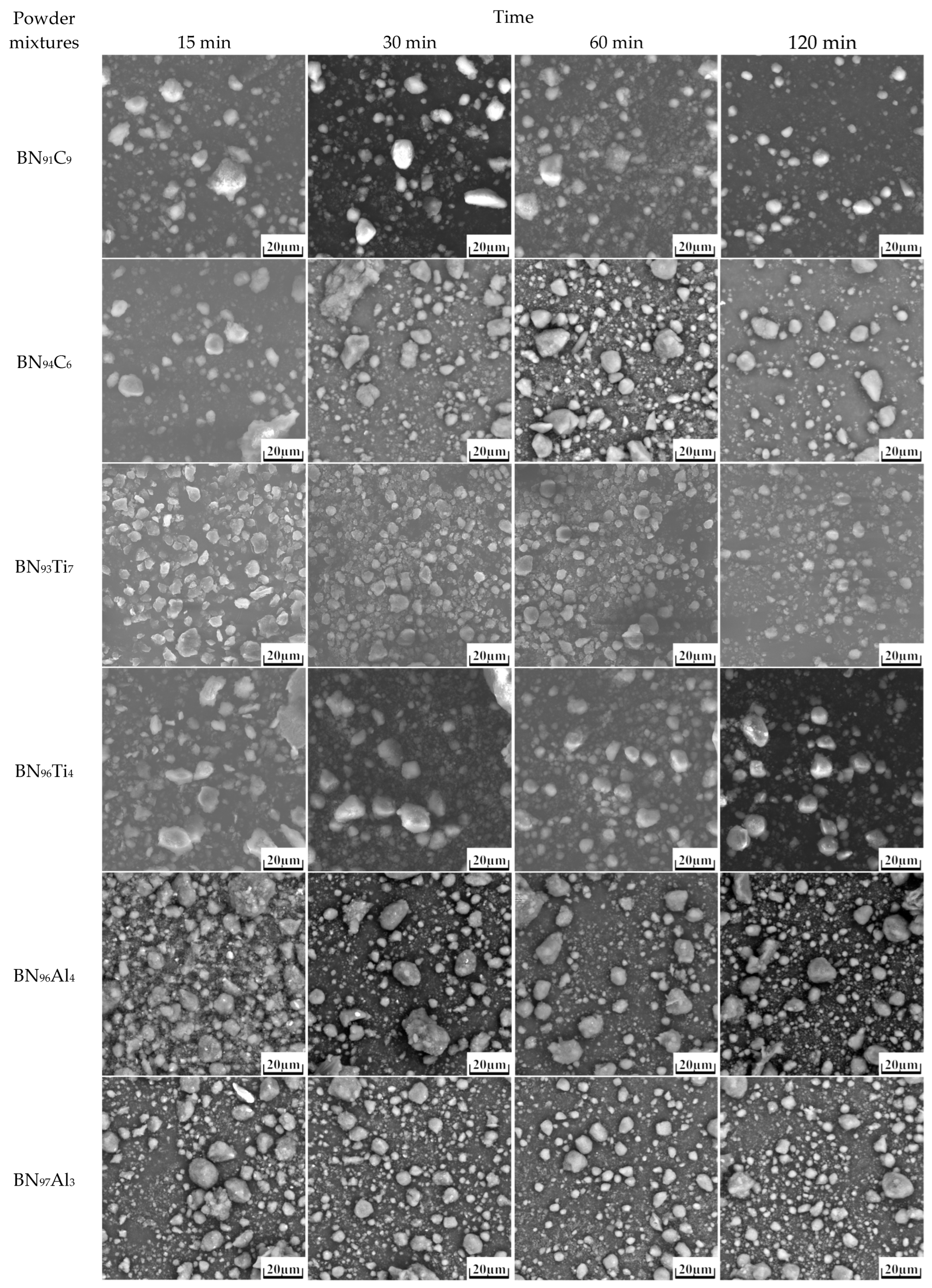
Figure 1 shows the morphology of powder mixtures with different compositions after mechanical alloying. Boron nitride is a dielectric material with high electrical insulating capability; therefore, during SEM observation, charge accumulation occurs on the particle surfaces, resulting in reduced image contrast and sharpness. Nevertheless, the main morphological features of the investigated samples are clearly distinguishable.
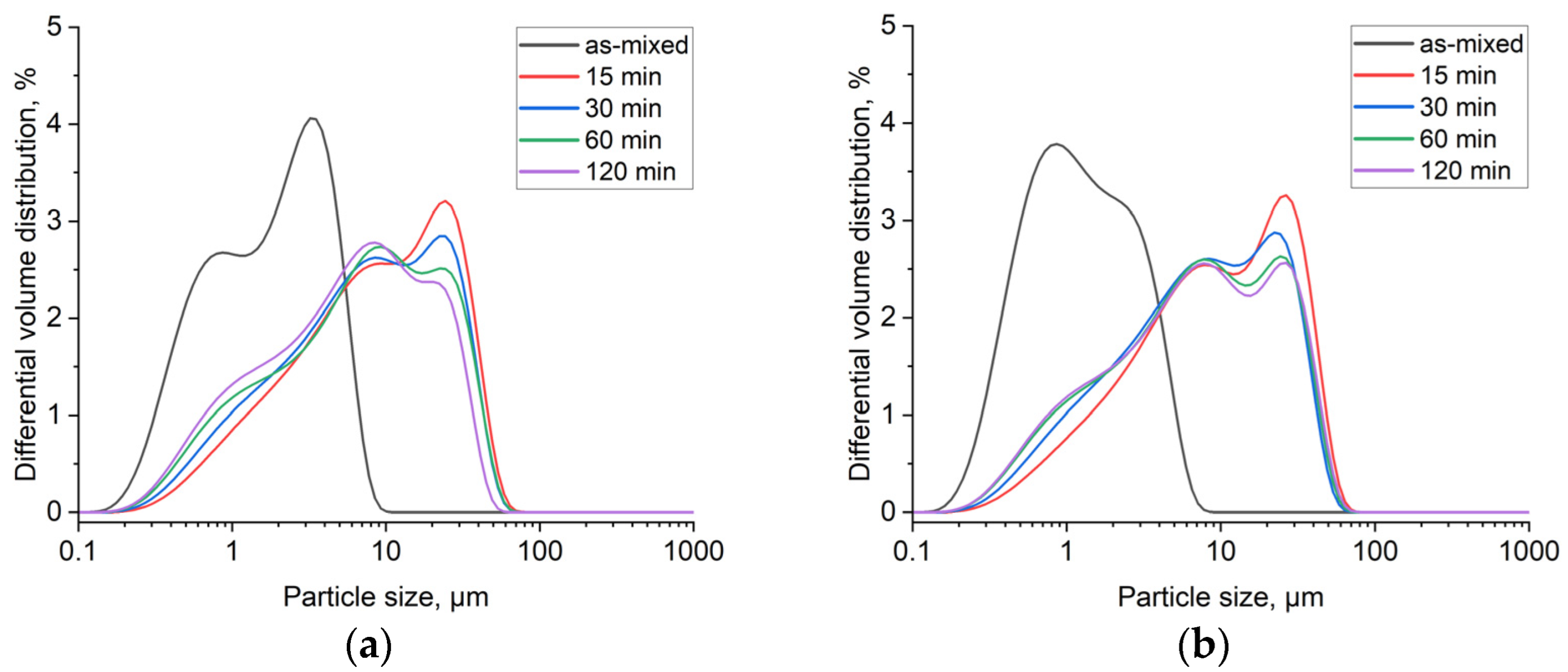
BN particles modified by the addition of carbon exhibit predominantly irregular, near-spherical shapes and a pronounced tendency toward agglomeration. Surface regions with signs of plastic deformation are observed, which is characteristic of intensive mechanical alloying processes. With increasing milling time, coarsening followed by partial breakdown of the aggregates occurs, as confirmed by the data in Table 1: the average particle size of BN91C9 increases from 2.62 μm to 7.42 μm after 30 min of mechanical alloying and then decreases to 3.49 μm after 120 min. A similar trend is observed for BN94C6 (2.75 → 8.91 → 4.58 μm). The particle size distribution (Figure 2) is bimodal, with a predominance of fractions in the 3–9 μm range, reflecting the competition between agglomeration and fragmentation processes. Thus, carbon addition promotes the formation of dense agglomerates and a heterogeneous microstructure with a developed surface.
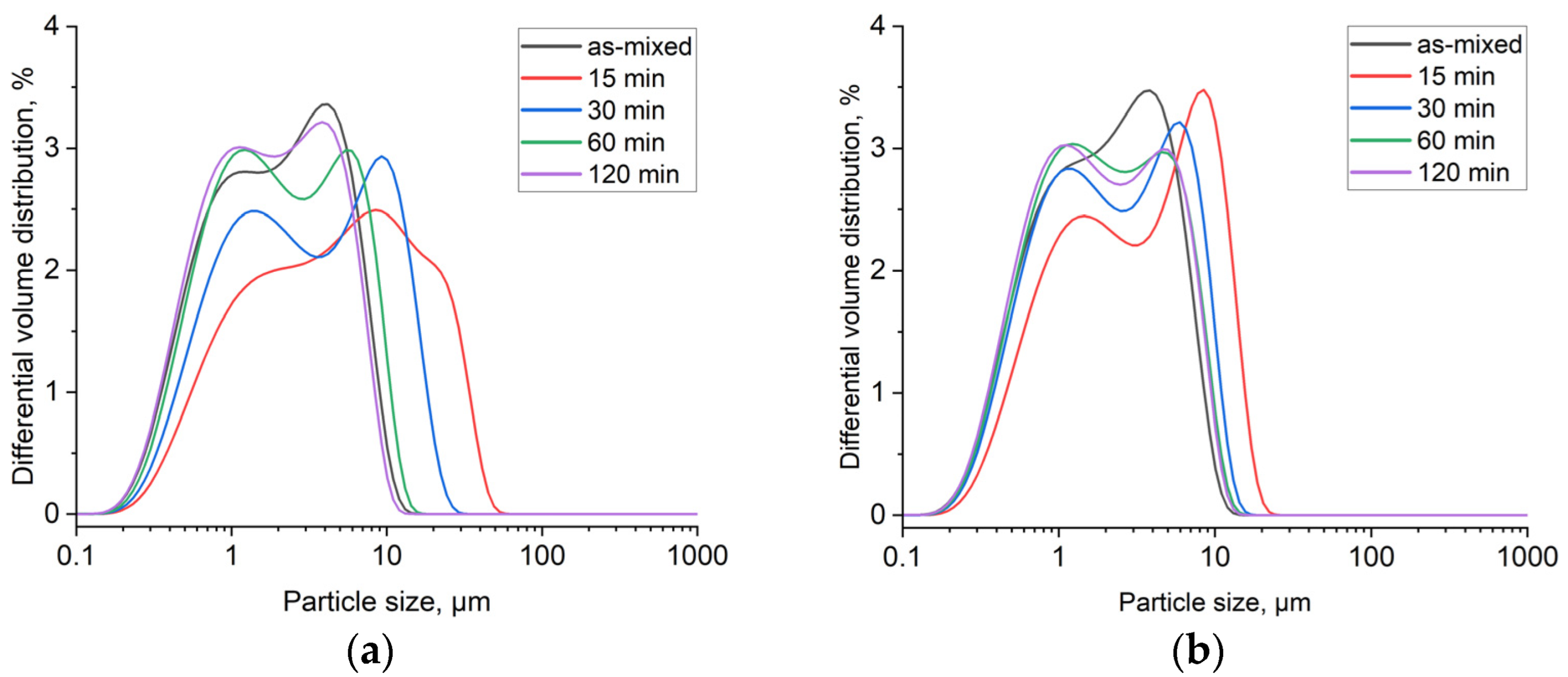
The addition of titanium leads to a noticeable change in both morphology and granulometric composition of the powders. The particles acquire a more angular shape and exhibit pronounced refinement compared to carbon-containing systems. The surface becomes rough, with cracks and protrusions, indicating a more intense mechanochemical effect. The average particle size of BN93Ti7 decreases from 8.42 μm to 2.52 μm with increasing mechanical alloying time up to 120 min, while for BN96Ti4 it stabilizes at approximately 2.8 μm already after 60 min of mechanical alloying. The particle size distribution (Figure 3) gradually narrows, indicating the formation of a more homogeneous fine-grained structure. Therefore, titanium addition intensifies fragmentation processes and promotes the formation of a defect-rich surface, potentially capable of active interaction with a gaseous environment upon subsequent thermal activation.
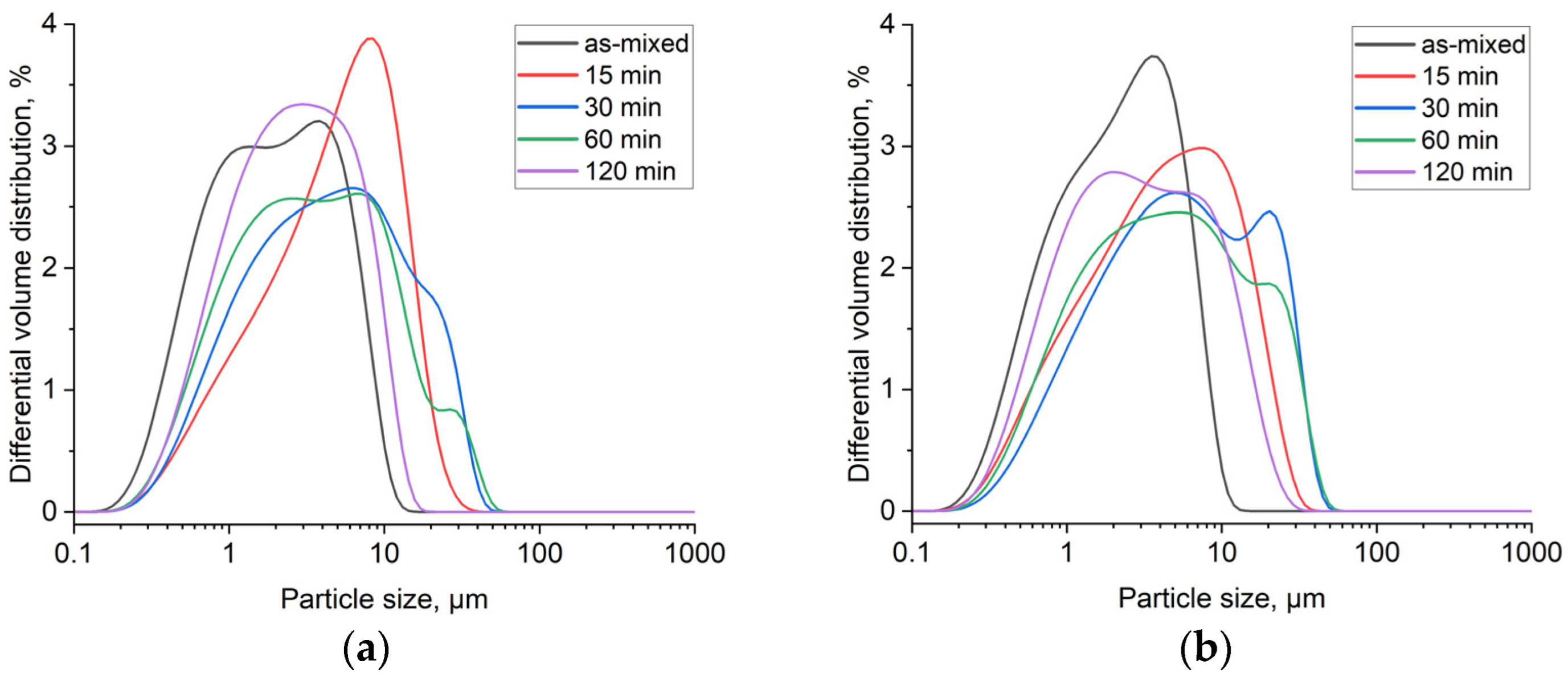
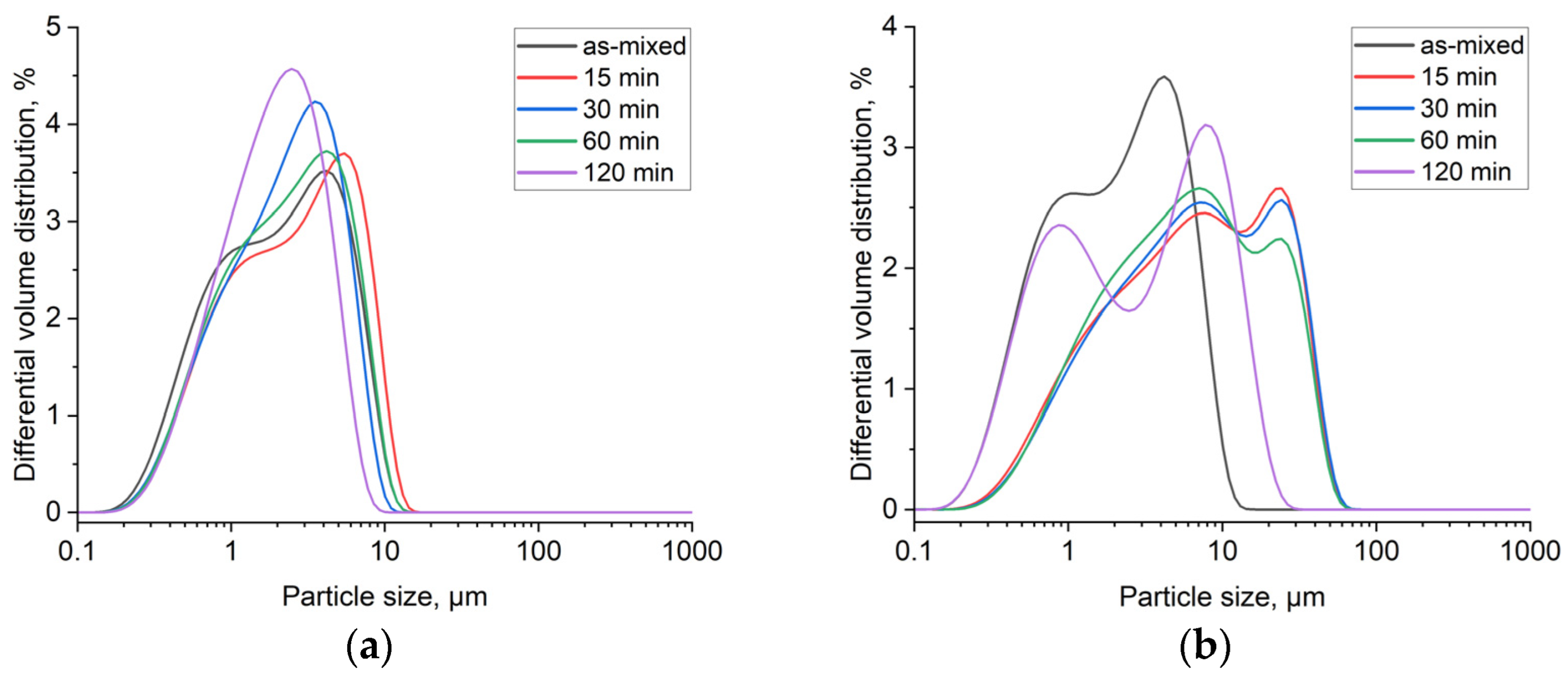
SEM images of aluminum-containing samples reveal smoother particle contours and a more rounded particle shape. This behavior is attributed to the lubricating effect of aluminum, which reduces interparticle friction during mechanical alloying. According to Table 1, the BN97Al3 sample exhibits particle coarsening at the initial stages (up to 30 min), with the average particle size increasing from 3.04 to 11.26 μm as a result of cold welding. Upon further milling up to 120 min, the particle size decreases to 4.97 μm due to the destruction of agglomerates. In contrast, cold welding is almost not observed in the BN96Al4 sample, and the milling process proceeds more uniformly: the average particle size gradually decreases from 2.96 to 2.25 μm. This indicates more effective dispersion without a pronounced coarsening stage. The particle size distribution (Figure 4) confirms a reduction in polydispersity and a shift in the dominant fraction toward smaller sizes with increasing aluminum content. The significant difference between BN97Al3 and BN96Al4 with a change in aluminum content of only 1 at.% is likely associated with a threshold effect in the surface distribution of Al. At 3 at.% aluminum does not fully cover the particle surfaces, promoting localized cold welding and agglomeration, whereas at 4 at.% a more uniform surface coverage is formed, reducing interparticle friction and preventing particle adhesion. Similar threshold effects, in which even minor changes in elemental composition lead to a transition from agglomeration to stable dispersion and a drastic change in powder morphology, have been reported previously [31]. Thus, reaching a critical level of aluminum surface coverage ensures a transition from agglomeration to stable dispersion and the formation of a homogeneous fine-grained structure.
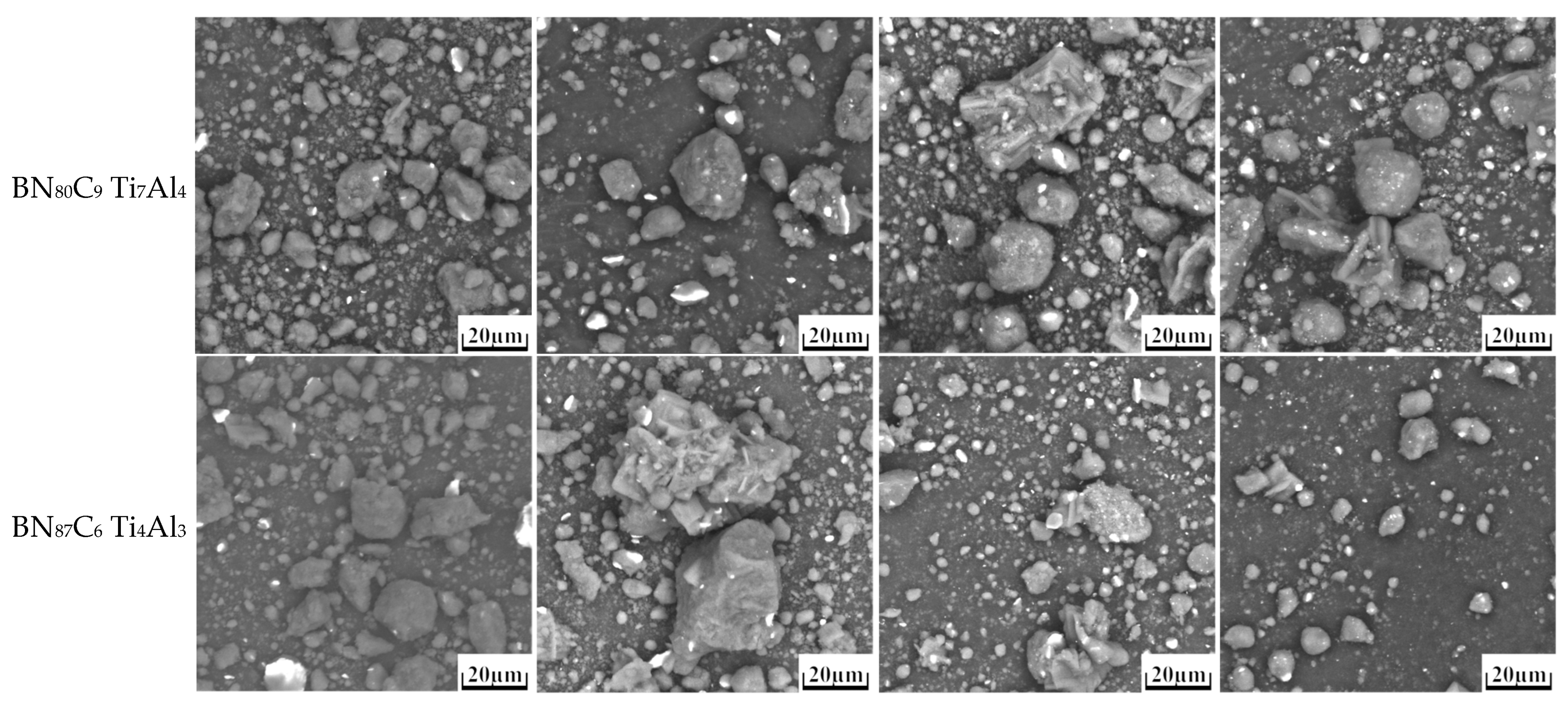
Multicomponent modification with carbon, titanium, and aluminum exerts a synergistic effect on structural formation. The particles predominantly exhibit irregular, smoothly granular shapes with signs of coarsening and agglomeration, especially at the early stages of mechanical alloying. The particle surfaces are heterogeneous, comprising both dense fused regions and areas with signs of plastic deformation (Figure 1). In some cases, a layered particle structure and traces of cleavage along slip planes are observed, which may be associated with a non-uniform distribution of ductile elements (Al, Ti) within the BN matrix. According to Table 1, in the initially mixed state these powders have small particle sizes (BN80C9Al4Ti7: 2.05 μm; BN87C6Al3Ti4: 1.63 μm); however, already after 15 min of mechanical alloying, a sharp coarsening occurs, with particle sizes increasing to 13.42 and 14.17 μm, respectively. With further increases in mechanical alloying time, the particle size changes only slightly, remaining within the range of 9–12 μm, which indicates the establishment of a dynamic equilibrium between agglomeration and fragmentation processes. The particle size distribution (Figure 5) remains moderately polydisperse, with a tendency toward slight narrowing upon prolonged alloying. Thus, multicomponent systems are characterized by an agglomerated morphology governed by the interaction of C, Al, and Ti components, while particle sizes stabilize after reaching an equilibrium structure.
Overall, for all investigated compositions, the microstructure closest to homogeneity is formed at a mechanical alloying time of 120 min. At the same time, despite the overall structural homogenization, a small number of agglomerates remain in the powders.
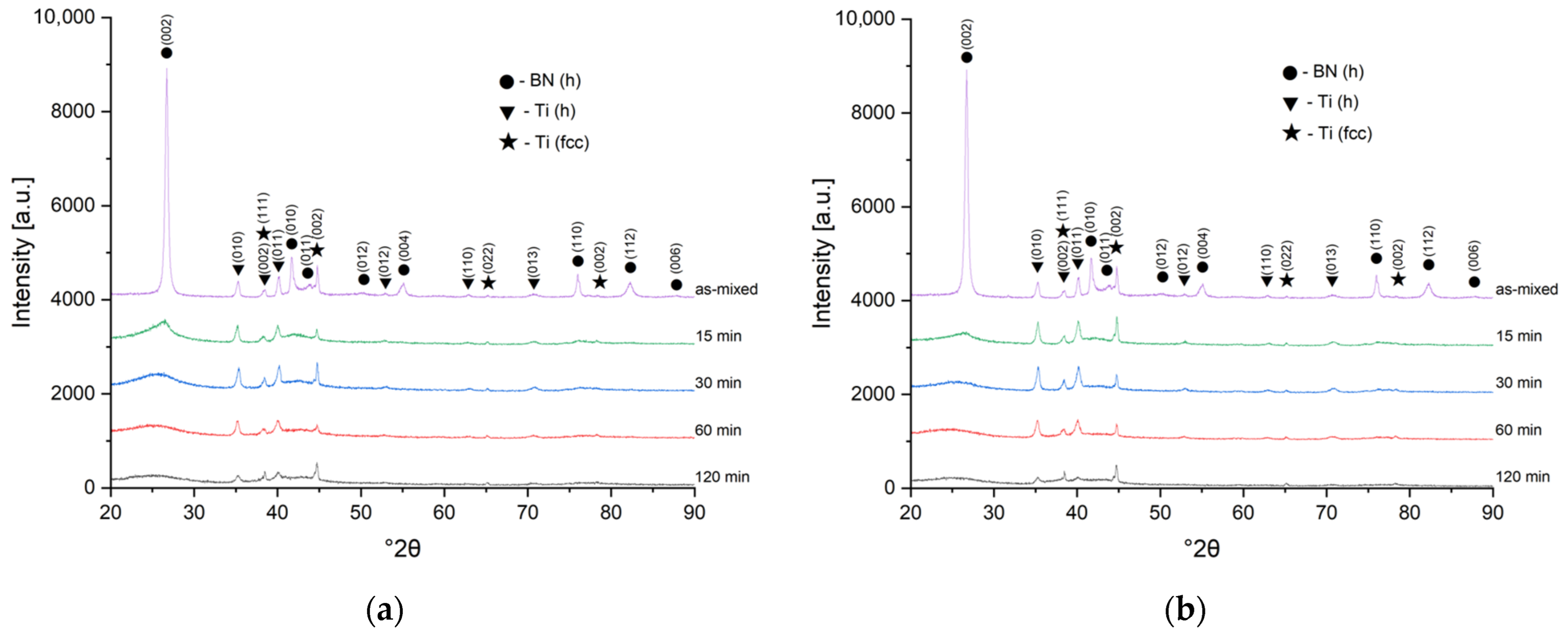
Figure 6 presents the X-ray diffraction pattern of the BN96Ti4 powder mixture after mixing and mechanical alloying at different milling times. In the initial state (after mixing), the diffraction pattern exhibits intense reflections corresponding to hexagonal boron nitride (h-BN) and metallic titanium in two modifications—hexagonal α (hcp-Ti) and metastable face-centered cubic (fcc-Ti). The presence of the metastable fcc phase after mixing is attributed to its prior existence in the initial titanium powder, where it was likely formed due to the specifics of its production, which promoted stabilization of the cubic structure.
Already after 15 min of mechanical alloying, the intensity of all h-BN diffraction peaks sharply decreases, with only the main (002) peak and two less intense peaks, (010) and (110), remaining. These residual peaks show a pronounced decrease in intensity and significant broadening, indicating an increase in lattice microstrain, accumulation of structural defects, and a reduction in crystallite size. With further milling up to 30 min, all boron nitride peaks disappear, and a weak diffuse halo appears in place of the main (002) peak in the 2θ ≈ 21–30° range (centered at ~26°), which indicates the destruction of the layered h-BN structure and a transition to an amorphous-like state. Upon increasing the mechanical alloying time to 120 min, the halo becomes broader, indicating nearly complete amorphization of boron nitride.
Alongside the changes in boron nitride, the evolution of the titanium phases is also observed. The diffraction peaks of α-Ti gradually decrease in intensity and broaden. The peaks of the metastable fcc-Ti also decrease in intensity and broaden, albeit to a lesser extent, which may be attributed to the relative stability of the cubic structure under a high defect density. Thus, the introduction of titanium enhances the plastic deformation of the system and promotes the amorphization of BN due to increased local mechanochemical stresses and efficient energy transfer during collisions. In the BN93Ti7 sample, a similar pattern is observed; however, due to the higher titanium content, its diffraction peaks exhibit slightly higher intensity, while the h-BN reflections are lower in intensity, consistent with the increased fraction of the metallic phase.
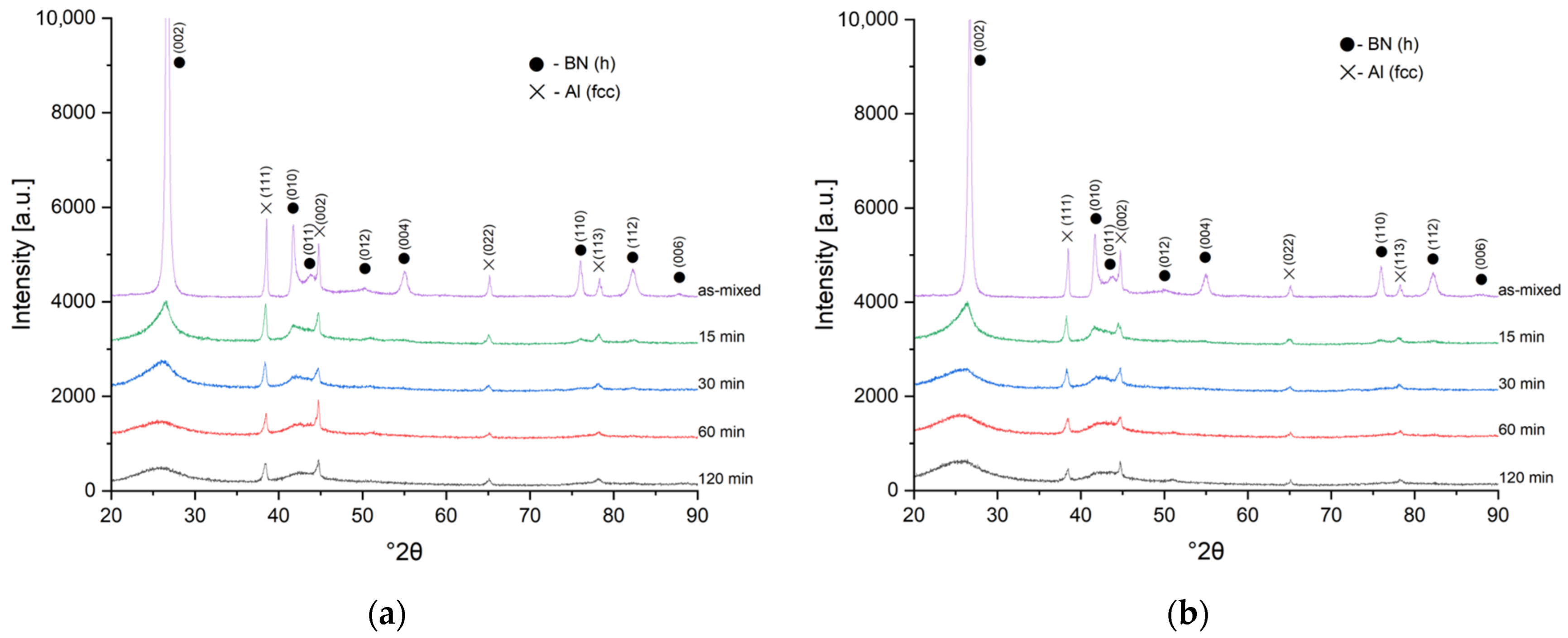
In BN–Al systems (BN96Al4, BN97Al3), the general behavior of boron nitride is preserved; however, the amorphization process proceeds significantly more slowly (Figure 7). Even after 30 min of mechanical alloying, residual h-BN peaks are still observed, while a diffuse halo forms only at longer processing times (≥60 min). At the same time, the aluminum phase remains partially crystalline even after 120 min of milling. Such retardation of amorphization is most likely associated with the high plasticity of aluminum, which reduces local impact stresses and mechanochemical activity in the BN–Al system, thereby confirming its stabilizing effect on the BN structure.
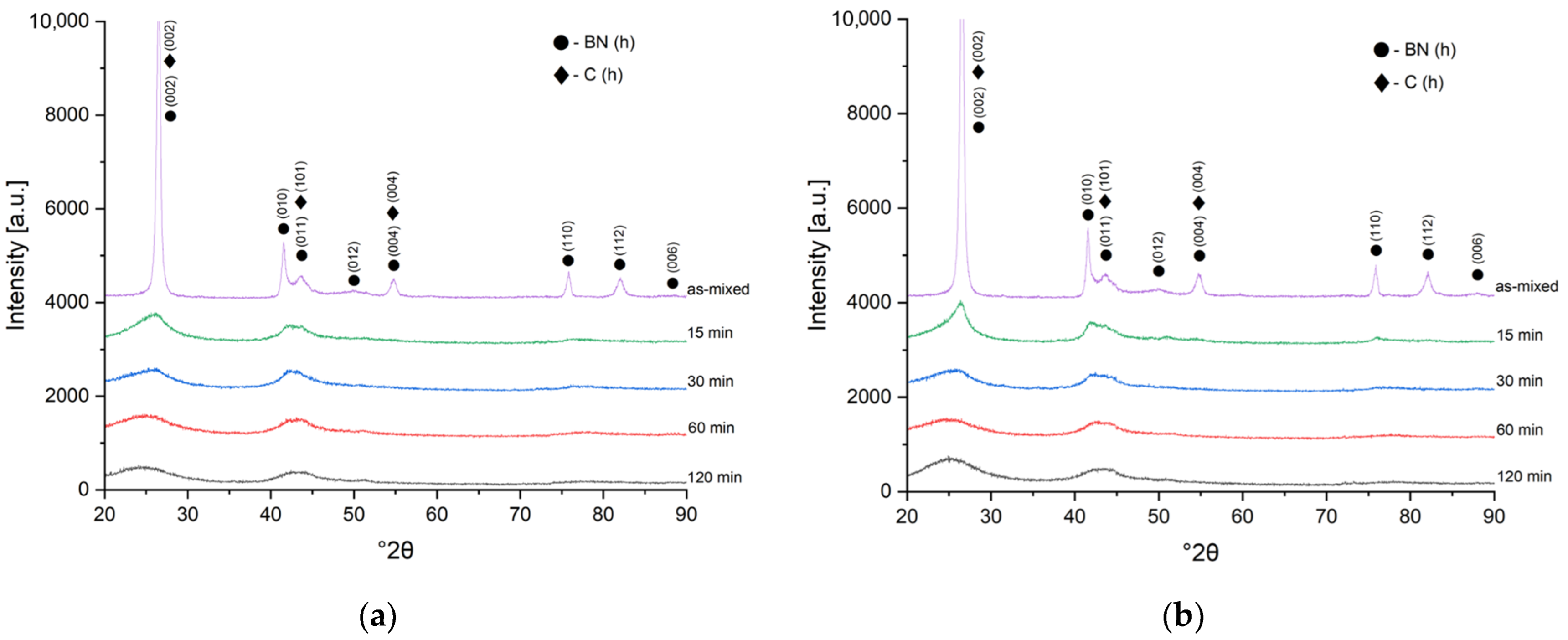
For the BN94C6 powder mixture (Figure 8), similar behavior is observed; however, in this case, amorphization proceeds most rapidly. In the initial state, the diffraction pattern shows peaks corresponding to h-BN and h-C. Due to the similarity of their structures, the main reflections (002) and (101) nearly overlap, which makes their distinction difficult. Already after 15 min of mechanical alloying, the crystalline peaks disappear and broad halos are formed, indicating a transition of the system into a semi-amorphous state. With further increases in processing time, these halos become more pronounced: one is located in the ≈20–30° range, corresponding to the overlap of the BN and C (002) peaks, and the other in the ≈40–46° range, where the BN (010), (011), and C (101) reflections overlap. The intensification of these diffuse maxima reflects the destruction of the initial crystalline lattices and the formation of an amorphous-like structure without the formation of new phases. The rapid amorphization in this system is explained by the structural similarity and high brittleness of the BN and C components, which facilitate the breakdown of the crystalline lattice under mechanical impact. For the BN91C9 sample, the intensity of the carbon-related peaks is noticeably higher compared to BN94C6, reflecting the increased carbon content. As a result, in BN91C9, broad halos form earlier and reach higher intensity. This accelerated transition is attributed to the higher proportion of brittle carbon, which promotes a more efficient disruption of the crystalline lattice under mechanical alloying, while still maintaining the absence of new crystalline phases.
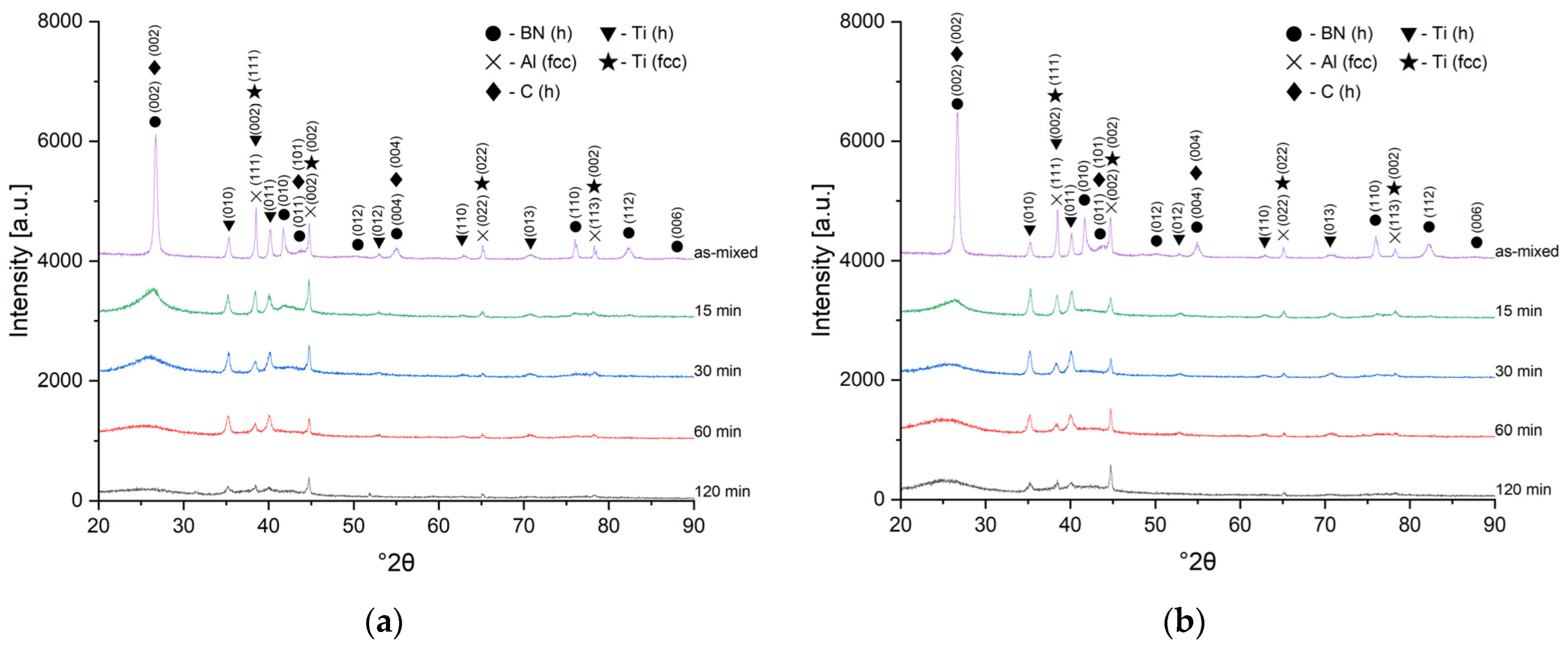
In the multicomponent BN–C–Al–Ti systems (Figure 9), at the initial stage, i.e., after mixing, diffraction peaks corresponding to BN (h), Ti (h), C (h), Al (fcc), and Ti (fcc) are observed. With increasing alloying time, broadening and a decrease in the intensity of all peaks are observed, reflecting an increase in defect density and a reduction in the size of coherent scattering domains. After 60–120 min of processing, the diffraction peaks of the initial phases become weakly distinguishable, indicating partial amorphization. With increasing mechanical alloying time, broadening of the h-BN halo peak is observed, indicating partial disruption of crystalline order and an increase in microstrain. Despite these structural changes, the appearance of new crystalline reflections is not detected, indicating the absence of the formation of separate phases. Similar results were obtained in [45], where it was shown that the formation of Ti–B compounds requires significantly longer mechanical processing or subsequent high-temperature heat treatment. Among the investigated compositions, the least pronounced amorphization is observed for BN80C9Al4Ti7, most likely due to the higher aluminum content, which in the investigated systems reaches a maximum of 4 at.% Al and, consequently, increased plasticity of the mixture, ensuring efficient transfer of mechanical energy. In the BN87C6Al3Ti4 sample, this process proceeds slightly faster.
Thus, the results of X-ray phase analysis indicate that in all the investigated systems (BN–C, BN–Ti, BN–Al, and BN–C–Al–Ti), no formation of new crystalline phases was detected within the detection limits of conventional X-ray diffraction. The main process taking place during mechanical alloying causes the destruction of the initial layered structure of boron nitride and its transition to an amorphous-like state. Partial amorphization of BN is accompanied by the accumulation of structural defects, the formation of boron- and nitrogen-deficient centers, as well as local distortions of the crystalline lattice. According to the literature data [46,47], such defective states lead to an increased density of active sites for hydrogen molecule binding and a reduction in the adsorption energy barrier, which can potentially contribute to improved sorption properties of the material. The obtained results demonstrate the high phase stability of boron nitride even in the presence of chemically active metals (Ti and Al) and allow the formed structures to be considered as a metastable defective state, in which BN retains chemical inertness while simultaneously acquiring a developed defect structure favorable for hydrogen sorption. At the same time, metal oxide phases capable of reducing the hydrogen sorption activity of the material, such as TiO2 or Al2O3, were not detected within the detection limit of X-ray diffraction.
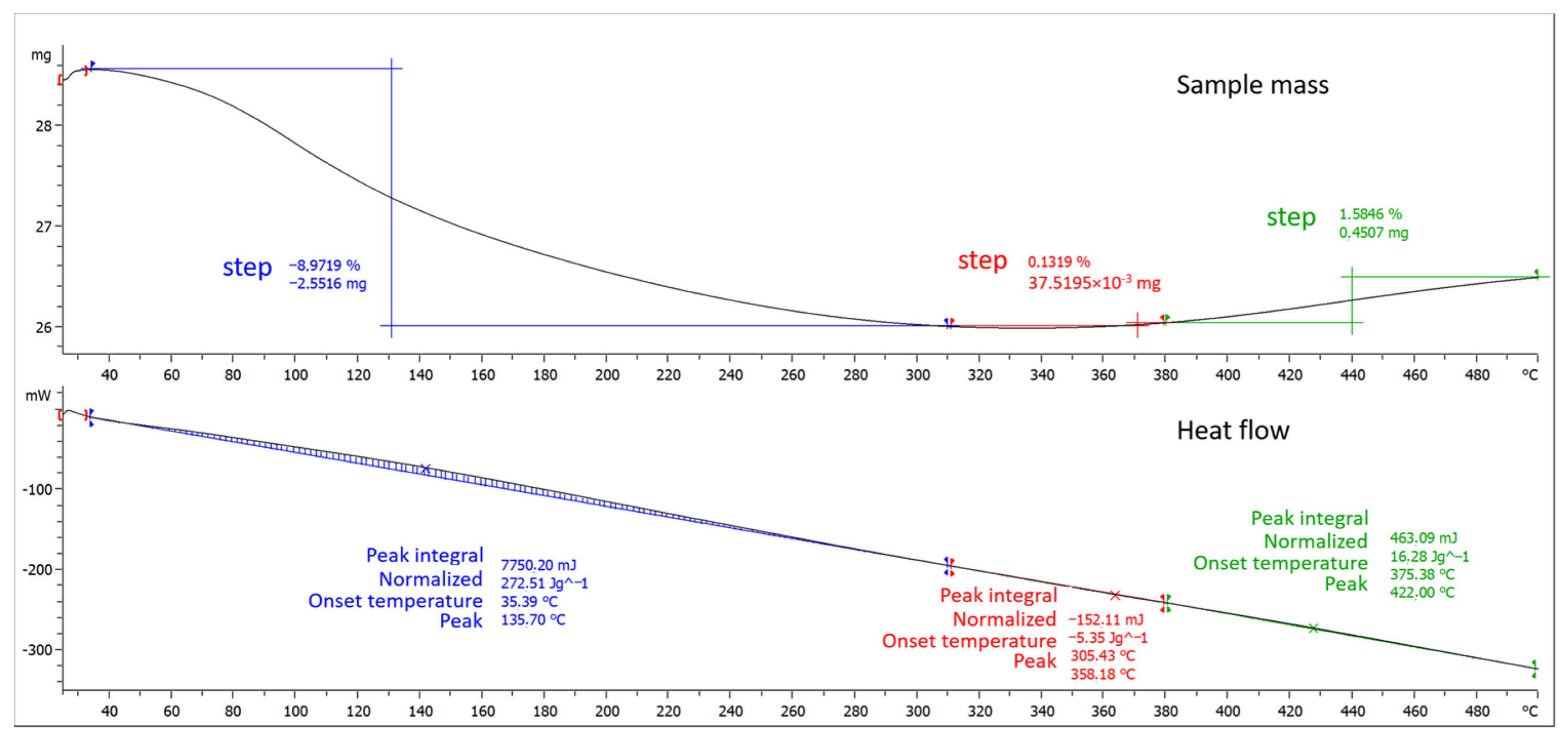
Figure 10 shows that, for the BN87Al3C6Ti4 sample, the TGA curve in the low-temperature region up to 120 °C exhibits the main mass loss of approximately 8.97%, which is attributed to the removal of physically adsorbed moisture and residual volatile components. This process is accompanied by a pronounced endothermic effect on the DSC curve, with a maximum at 135 °C, confirming its dehydration-related nature. In the temperature range of 300–360 °C, a minor mass decrease (~0.13%) is observed, accompanied by a weak thermal effect on the DSC curve. This stage may be associated with structural relaxation of the material, decomposition of unstable intermediate species, or the completion of degassing processes. Upon further heating in the range of 375–450 °C, an increase in sample mass (~1.58%) is recorded on the TGA curve, indicating the occurrence of oxidative processes and oxygen uptake. This stage correlates with an exothermic effect on the DSC curve, with a maximum at 422 °C, and can be attributed to the formation of stable aluminum and titanium oxide phases (Al2O3 and TiO2). At temperatures above 450–500 °C, no significant changes in mass or heat flow are observed, indicating the formation of a thermally stable residue and confirming the high thermal stability [48,49] of the BN87Al3C6Ti4 multicomponent material [50,51,52].
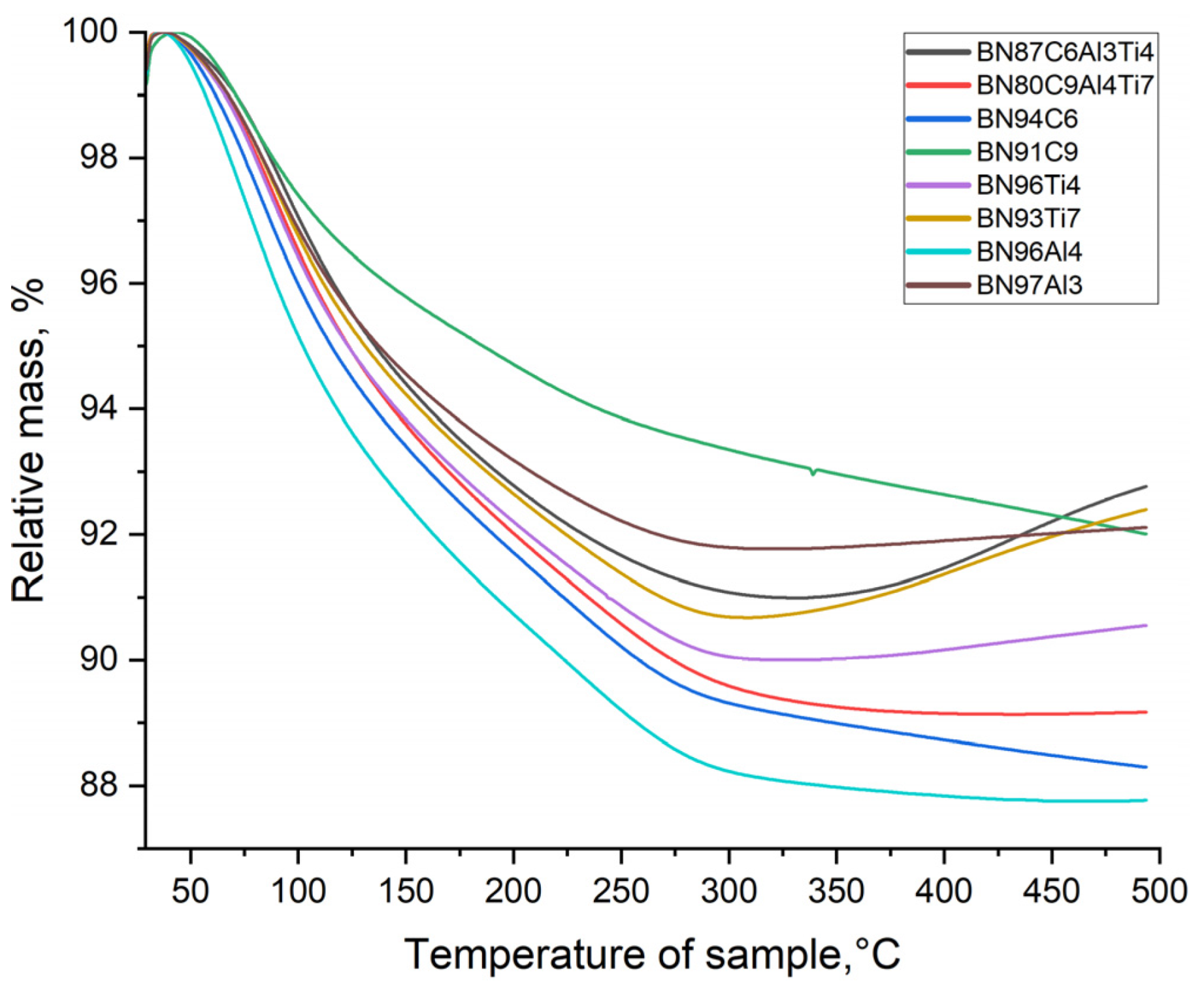
According to the TGA results, all investigated samples exhibit a gradual decrease in relative mass with increasing temperature, without sharp jumps or distinct mass-loss steps (Figure 11). This indicates the absence of stages of intensive decomposition or evaporation of components. The total mass losses range from approximately 7.1% to 11.5%, reflecting the high thermal stability of the materials. Minimal mass changes are observed for the BN91C9 (−7.15%) and BN93Ti7 (−7.17%) samples, whereas larger losses are characteristic of BN96Al4 (−11.54%) and BN80Al4C9Ti7 (−10.47%). The main mass decrease occurs in the 150–500 °C range, which is likely associated with desorption of physically adsorbed moisture, removal of residual organic compounds (e.g., stearic acid used during mechanical alloying), as well as degassing or mild surface oxidation of particles. The absence of pronounced mass-loss stages indicates that these processes proceed uniformly and are not accompanied by changes in the phase composition of the material.
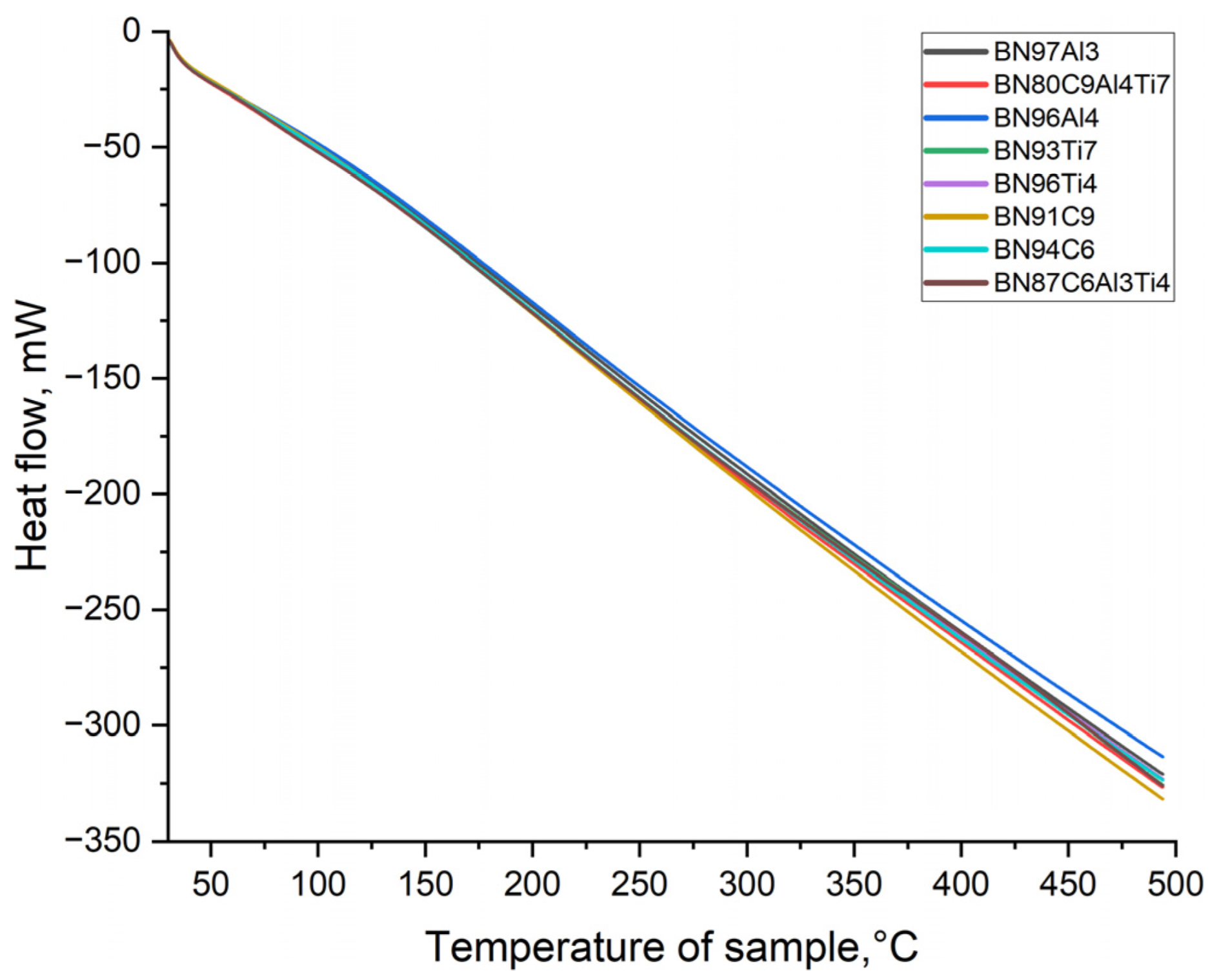
As shown in Figure 12, the DSC curves for all investigated samples exhibit a similar character: a gradual and almost linear decrease in heat flow from approximately −5 mW at 30–50 °C to around −330 mW at 500 °C. The absence of pronounced endothermic or exothermic peaks indicates that no phase transformations, melting, or decomposition of components occur within this temperature range. The gradual decrease in heat flow corresponds to weak endothermic processes, such as dehydration, removal of residual organic impurities, and relaxation of the defect structure formed during mechanical alloying. For samples containing aluminum and titanium (BN96Al4, BN97Al3, BN96Ti4, BN80Al4C9Ti7), a more pronounced shift in heat flow is observed, which is consistent with their relatively larger mass losses according to TGA data. This may be associated with increased surface chemical activity and possible surface oxidation processes.
Thus, collectively, the results of X-ray phase analysis, electron microscopy, as well as thermogravimetric and calorimetric studies demonstrate a consistent picture of the structural evolution of BN–C–Al–Ti powder mixtures during mechanical alloying performed at room temperature. The obtained results provide a solid basis for formulating the main conclusions of the work.

4. Conclusions

It has been established that high-energy mechanical alloying of boron nitride-based composites modified by the addition of carbon, titanium, and aluminum leads to progressive destruction of the layered hexagonal BN structure and the formation of an amorphous-like, defect-rich state. In all investigated systems, no new crystalline phases were observed during mechanical alloying, indicating the high phase stability of BN even in the presence of active alloying elements. X-ray structural analysis revealed that the main stage of BN amorphization occurs within 30–60 min of mechanical alloying, as evidenced by the disappearance of characteristic h-BN reflections and the formation of broad diffuse halos. Further extension of the milling time up to 120 min does not result in significant changes in the diffraction patterns, indicating saturation of structural disorder at the long-range order level. At the same time, morphological analysis showed that microstructural evolution of the powders continues even after the X-ray structural saturation is reached. Increasing the mechanical alloying time to 120 min reduces particle agglomeration and promotes a more uniform size distribution. This behavior reflects the establishment of a dynamic equilibrium between cold welding and fragmentation processes and demonstrates that morphological evolution continues even after structural saturation detected by XRD. This highlights the need for a comprehensive evaluation of the optimal mechanical alloying conditions, taking into account both the phase state and morphology. It was demonstrated that the nature of structural changes strongly depends on the type of alloying element. Carbon promotes rapid amorphization due to structural similarity and the brittleness of the components in the BN–C system. The introduction of titanium intensifies fragmentation and defect accumulation processes through more efficient mechanical energy transfer during milling. In contrast, aluminum exhibits a stabilizing effect, slowing BN amorphization due to its high plasticity and lubricating effect, which reduces local impact stresses during milling. In multicomponent BN–C–Ti–Al systems, these effects act synergistically, leading to the formation of metastable, partially amorphous structures with enhanced structural homogeneity during prolonged alloying. Thermal analysis results confirm the high thermal stability of the obtained composites up to 500 °C. The observed mass losses are primarily associated with surface degassing, removal of residual organic impurities, and relaxation of the defect structure and are not related to phase transformations or decomposition of the components. Based on the combined analysis of structural, morphological, and thermal data, a mechanical alloying time of 120 min was determined to be optimal for the investigated systems. At this processing duration, a saturated amorphous-like structural state is achieved in combination with reduced particle agglomeration and increased powder homogeneity. The resulting defect-rich boron nitride structures provide favorable conditions for an increased density of active adsorption sites and can be considered a promising structural basis for further studies in the field of solid-state hydrogen storage.

Author Contributions

Conceptualization, N.M., D.Y. and S.Z.; methodology, D.Y. and S.Z.; software, N.M.; validation, D.Y., N.M. and S.Z.; formal analysis, N.M. and S.Z.; investigation, N.M., S.Z., G.Y., Y.D., D.Y. and A.U.; resources, D.Y. and G.Y.; data curation, N.M., A.U. and S.Z.; writing—original draft preparation, N.M., D.Y. and S.Z.; writing—review and editing, D.Y. and S.Z.; visualization, N.M.; supervision, D.Y. and Y.D.; project administration, D.Y. All authors have read and agreed to the published version of the manuscript.

Funding

This research was funded by the Science Committee of the Ministry of Science and Higher Education of the Republic of Kazakhstan (Grant No. AP22784686).

Data Availability Statement

The original contributions presented in this study are included in the article. Further inquiries can be directed to the corresponding author.

Conflicts of Interest

The authors declare no conflicts of interest.

References

  1. Mahfuz, M.H.; Kamyar, A.; Afshar, O.; Sarraf, M.; Anisur, M.R.; Kibria, M.A.; Saidur, R.; Metselaar, I. Exergetic analysis of a solar thermal power system with PCM storage. Energy Convers. Manag. 2014, 78, 486–492. [Google Scholar] [CrossRef]
  2. Jain, R.K.; Jain, A.; Jain, I.P. Effect of La-content on the hydrogenation properties of the Ce1−xLaxNi3Cr2 (x = 0.2, 0.4, 0.6, 0.8, 1) alloys. Int. J. Hydrogen Energy 2012, 37, 3683–3688. [Google Scholar] [CrossRef]
  3. Pang, S.; Masjuki, H.; Kalam, M.; Hazrat, M. Liquid absorption and solid adsorption system for household, industrial and automobile applications: A review. Renew. Sustain. Energy Rev. 2013, 28, 836–847. [Google Scholar] [CrossRef]
  4. Kovalskii, A.M.; Manakhov, A.; Afanasev, P.; Popov, Z. Hydrogen storage ability of hexagonal boron nitride. Front. Mater. 2024, 11, 1375977. [Google Scholar] [CrossRef]
  5. Yazdi, R.; Kashani-Bozorg, S.F. Formation of TiN/TiB2/TiAl nanocomposite by mechanical alloying of a powder mixture of Ti-Al-Bn. Int. J. Mod. Phys. Conf. Ser. 2012, 5, 581–588. [Google Scholar] [CrossRef]
  6. Li, W.; Jiang, L.; Jiang, W.; Wu, Y.; Guo, X.; Li, Z.; Yuan, H.; Luo, M. Recent advances of boron nitride nanosheets in hydrogen storage application. J. Mater. Res. Technol. 2023, 26, 2028–2042. [Google Scholar] [CrossRef]
  7. Jhi, S.-H.; Louie, S.G. Activated boron nitride nanotubes: A potential material for room-temperature hydrogen storage. Phys. Rev. B 2006, 74, 155424. [Google Scholar] [CrossRef]
  8. Lale, A.; Bernard, S.; Demirci, U.B. Boron Nitride for Hydrogen Storage. ChemPlusChem 2018, 83, 893–903. [Google Scholar] [CrossRef] [PubMed]
  9. Emanet, M.; Sen, Ö.; Taşkin, I.Ç.; Çulha, M. Synthesis, functionalization, and bioapplications of two-dimensional boron nitride nanomaterials. Front. Bioeng. Biotechnol. 2019, 7, 363. [Google Scholar] [CrossRef]
  10. Wang, J.; Ma, F.; Sun, M. Graphene, hexagonal boron nitride, and their heterostructures: Properties and applications. RSC Adv. 2017, 7, 16801–16822. [Google Scholar] [CrossRef]
  11. Pakdel, A.; Zhi, C.; Bando, Y.; Golberg, D. Low-dimensional boron nitride nanomaterials. Mater. Today 2012, 15, 256–265. [Google Scholar] [CrossRef]
  12. Weng, Q.; Wang, X.; Wang, X.; Bando, Y.; Golberg, D. Functionalized hexagonal boron nitride nanomaterials: Emerging properties and applications. Chem. Soc. Rev. 2016, 45, 3989–4012. [Google Scholar] [CrossRef] [PubMed]
  13. Tabiyeva, Y.; Yerbolat, D.; Zakerov, S.; Dauletkhanov, Y.; Urkunbay, A.; Sagymbekova, E.; Kantay, N. Effect of Titanium Content and Mechanical Alloying Time on the Formation of Nanocrystalline Solid Solutions in the Ni–Al–Ti System. Crystals 2026, 16, 71. [Google Scholar] [CrossRef]
  14. Suryanarayana, C. Mechanical Alloying and Milling. Prog. Mater. Sci. 2001, 46, 1–184. [Google Scholar] [CrossRef]
  15. Yakin, A. Synthesis of boron-based alloys and compounds by mechanical alloying: A review. Mater. Today Commun. 2023, 37, 1006980. [Google Scholar] [CrossRef]
  16. Aubakirova, D.; Sagymbekova, E.; Kozhakhmetov, Y.; Kowalewski, P.; Dauletkhanov, Y.; Yerbolat, D.; Urkunbay, A. Structural and Functional Enhancement of Ni–Ti–Cu Shape Memory Alloys via Combined Powder Metallurgy Techniques. Open Eng. 2025, 15, 208–211. [Google Scholar] [CrossRef]
  17. Aubakirova, D.; Sagymbekova, E.; Kozhakhmetov, Y.; Dauletkhanov, Y.; Urkunbay, A.; Yerbolat, D.; Kowalewski, P.; Tabiyeva, Y. Evolution of the Structural and Phase Composition of Ni–Ti–Cu Alloy Produced via Spark Plasma Sintering After Aging. Crystals 2025, 15, 939. [Google Scholar] [CrossRef]
  18. Toozandehjani, M.; Matori, K.A.; Ostovan, F.; Aziz, S.A.; Mamat, M.S. Effect of Milling Time on the Microstructure, Physical and Mechanical Properties of Al-Al2O3 Nanocomposite Synthesized by Ball Milling and Powder Metallurgy. Materials 2017, 10, 1232. [Google Scholar] [CrossRef]
  19. Lee, J.H.; Kwon, J.H.; Kim, T.H.; Choi, W.I. Impact of planetary ball mills on corn stover characteristics and enzymatic digestibility depending on grinding ball properties. Bioresour. Technol. 2017, 241, 1094–1100. [Google Scholar] [CrossRef]
  20. Bashirom, N.; Mohd Arif, N.I. Effect of milling speed on the synthesis of in-situ Cu-25 vol.% WC nanocomposite by mechanical alloying. J. Teknol. 2012, 59, 229–233. [Google Scholar] [CrossRef]
  21. Namba, S.; Takagaki, A.; Jimura, K.; Hayashi, S.; Kikuchi, R.; Oyama, S.T. Effects of ball-milling treatment on physicochemical properties and solid base activity of hexagonal boron nitrides. Catal. Sci. Technol. 2019, 9, 302–309. [Google Scholar] [CrossRef]
  22. Broseghini, M.; Gelisio, L.; D’Incau, M.; Azanza Ricardo, C.L.; Pugno, N.M.; Scardi, P. Modeling of the planetary ball-milling process: The case study of ceramic powders. J. Eur. Ceram. Soc. 2016, 36, 2205–2212. [Google Scholar] [CrossRef]
  23. Mhadhbi, M.; Avar, B. Discrete Element Method Simulation of Filling Level in Planetary Ball Mill. WSEAS Trans. Syst. 2024, 23, 282–287. [Google Scholar] [CrossRef]
  24. Kozhakhmetov, Y.; Kurbanbekov, S.; Mukhamedova, N.; Urkunbay, A.; Kizatov, A.; Bayatanova, L.; Nurdillayeva, R.; Baltabayeva, D. Boron-Based Compounds for Solid-State Hydrogen Storage: A Review. Crystals 2025, 15, 536. [Google Scholar] [CrossRef]
  25. Kozhakhmetov, Y.; Tabiyeva, Y.; Mukhamedova, N.; Urkunbay, A.; Aidarova, M.; Kizatov, A.; Sagymbekova, E. A Study of the Sorption Properties and Changes in the Structure and State of the Ti-25Al-25Nb (at.%) Alloy System Under Thermocyclic Loading. Crystals 2025, 15, 173. [Google Scholar] [CrossRef]
  26. Yu, S.; Wang, X.; Pang, H.; Zhang, R.; Song, W.; Fu, D.; Hayat, T.; Wang, X. Boron nitride-based materials for the removal of pollutants from aqueous solutions: A review. Chem. Eng. J. 2018, 333, 343–360. [Google Scholar] [CrossRef]
  27. Rai, D.P.; Chettri, B.; Kumar, P.K. Hydrogen Storage in Bilayer Hexagonal Boron Nitride: A First-Principles Study. ACS Omega 2021, 6, 30362–30370. [Google Scholar] [CrossRef]
  28. Ding, Z.H.; Yao, B.; Qiu, L.X.; Bai, S.; Guo, X.; Xue, Y.; Wang, W.; Zhou, X.; Su, W. Formation of titanium nitride by mechanical milling and isothermal annealing of titanium and boron nitride. J. Alloys Compd. 2005, 389, 133–138. [Google Scholar] [CrossRef]
  29. Carenco, S.; Portehault, D.; Boissière, C.; Mézailles, N.; Sanchez, C. Nanoscaled metal borides and phosphides: Recent developments and perspectives. Chem. Rev. 2013, 113, 7981–8065. [Google Scholar] [CrossRef]
  30. Zhang, Z.; Zeng, Q.; Wang, N.; Wang, L.; Wu, Q.; Li, X.; Tang, J. Influence of nano-BN inclusion and mechanism involved on aluminium-copper alloy. Sci. Rep. 2024, 14, 6372. [Google Scholar] [CrossRef]
  31. Meng, Q.; Chen, C.; Araby, S.; Cai, R.; Yang, X.; Li, P.; Wang, W. Highly ductile and mechanically strong Al-alloy/boron nitride nanosheet composites manufactured by laser additive manufacturing. J. Manuf. Process. 2023, 89, 384–396. [Google Scholar] [CrossRef]
  32. Wu, H.Y.; Fan, X.F.; Kuo, J.L.; Shen, Z.X.; Feng, Y.P. Carbon-doped boron nitride cages as competitive candidates for hydrogen storage materials. Chem. Commun. 2010, 46, 3162–3164. [Google Scholar] [CrossRef]
  33. Seif, A.; Azizi, K. A new strategy for hydrogen storage using BN nanosheets: Simultaneous effects of doping and charge modulation. RSC Adv. 2016, 6, 58458–58468. [Google Scholar] [CrossRef]
  34. Chen, M.; Zhao, Y.J.; Zhang, S.B. Transition-metal dispersion on carbon-doped boron nitride nanostructures: Applications for high-capacity hydrogen storage. Phys. Rev. B 2012, 86, 045459. [Google Scholar] [CrossRef]
  35. Rakhadilov, B.; Kozhanova, R.; Baizhan, D.; Zhurerova, L.; Yerbolatova, G.; Kalitova, A.; Zhanuzakova, L. Influence of Plasma Electrolytic Hardening Modes on the Structure and Properties of 65G Steel. Eurasian J. Phys. Funct. Mater. 2021, 5, 209–211. [Google Scholar] [CrossRef]
  36. Popova, N.A.; Nikonenko, E.L.; Tabieva, E.E.; Uazyrkhanova, G.K. Structure and Phase Composition of Ferritic–Pearlitic Steel Surface after Electrolytic Plasma Quenching. Russ. Phys. J. 2020, 63, 791–796. [Google Scholar] [CrossRef]
  37. Kurbanbekov, S.; Kozhakhmetov, Y.; Skakov, M.; Seitov, B.; Aidarova, M.; Tabiyeva, Y. Properties, Advantages, and Prospects of Using Cobalt-Free Composites Based on Tungsten Carbide in Industry. Materials 2025, 18, 129. [Google Scholar] [CrossRef]
  38. Mananghaya, M.R.; Santos, G.N.; Yu, D. Hydrogen adsorption of Ti-decorated boron nitride nanotube: A density functional based tight binding molecular dynamics study. Adsorption 2018, 24, 659–667. [Google Scholar] [CrossRef]
  39. Mighri, R.; Turani-I-Belloto, K.; Demirci, U.B.; Alauzun, J.G. Nanostructured carbon-doped boron nitride for CO2 capture applications. Nanomaterials 2023, 13, 2389. [Google Scholar] [CrossRef]
  40. Jhi, S.-H.; Kwon, Y.-K. Hydrogen adsorption on boron nitride nanotubes: A path to room-temperature hydrogen storage. Phys. Rev. B 2004, 69, 245407. [Google Scholar] [CrossRef]
  41. Alfalasi, W.; Othman, W.; Hussain, T.; Tit, N. Vacancy-Induced Boron Nitride Monolayers as Multifunctional Materials for Metal Ion Batteries and Hydrogen Storage Applications. arXiv 2024, arXiv:2407.13224. [Google Scholar]
  42. Sayhan, S.; Kinal, A. Computational Investigation of Hydrogen Storage Capacity of Boron Nitride Nanocages by Newly Developed PM7 Method. Asian J. Chem. 2015, 27, 667–670. [Google Scholar] [CrossRef]
  43. Jia, Z.; Zhao, B.; Zhao, Y.; Liu, B.; Yuan, J.; Zhang, J.; Zhu, Y.; Wu, Y.; Li, L. Boron nitride-supported nickel nanoparticles as catalysts for enhancing the hydrogen storage properties of MgH2. J. Alloys Compd. 2022, 927, 166853. [Google Scholar] [CrossRef]
  44. Shi, J.; Zheng, A.; Lin, Z.; Chen, R.; Zheng, J.; Cao, Z. Effect of Process Control Agent on Alloying and Mechanical Behavior of L21 Phase Ni–Ti–Al Alloys. Mater. Sci. Eng. A 2018, 740, 130–136. [Google Scholar] [CrossRef]
  45. Oghenevweta, J.E.; Wexler, D.; Calka, A. Sequence of phase evolution during mechanically induced self-propagating reaction synthesis of TiB and TiB2 via magnetically controlled ball milling of titanium and boron powders. Alloys Compd. 2017, 701, 380–391. [Google Scholar] [CrossRef]
  46. Huang, J.Y.; Yasuda, H.; Mori, H. HRTEM and EELS studies on the amorphization of hexagonal boron nitride induced by ball milling. J. Am. Ceram. Soc. 2000, 83, 403–409. [Google Scholar] [CrossRef]
  47. Shevlin, S.A.; Guo, Z.X. Hydrogen sorption in defective hexagonal BN sheets and BN nanotubes. Phys. Rev. B 2007, 76, 024104. [Google Scholar] [CrossRef]
  48. Abilev, M.; Yerbolat, D.; Skakov, M.; Zhilkashinova, A.; Pavlov, A.; Gert, S.; Zhambakin, D.; Kantay, N.; Zhilkashinova, A. Structure and Properties of Composite 6YSZ-Al2O3-HfO2 Ceramics Depending on the Sintering Mode. J. Mater. Eng. Perform. 2025, 34, 12247–12255. [Google Scholar] [CrossRef]
  49. Abilev, M.; Yerbolat, D.; Skakov, M.; Zhilkashinova, A.; Pavlov, A.; Karpov, I. Influence of Y2O3 Content and Sintering Temperature on Microstructure and Mechanical Properties of YSZ Ceramics. Crystals 2025, 15, 1002. [Google Scholar] [CrossRef]
  50. Losic, D.; Farivar, F.; Yap, P.L. Refining and Validating Thermogravimetric Analysis (TGA) for Robust Characterization and Quality Assurance of Graphene-Related Two-Dimensional Materials (GR2Ms). C 2024, 10, 30. [Google Scholar] [CrossRef]
  51. Losic, D.; Farivar, F.; Yap, P.L.; Karami, A. Accounting carbonaceous counterfeits in graphene materials using the thermogravimetric analysis (TGA) approach. Anal. Chem. 2021, 93, 11859–11867. [Google Scholar] [CrossRef] [PubMed]
  52. Wesolowski, M. Methods of Thermal Analysis as Fast and Reliable Tools for Identification and Quantification of Active Ingredients in Commercially Available Drug Products. Pharmaceutics 2025, 17, 1099. [Google Scholar] [CrossRef] [PubMed]
Figure 1. SEM images of powder mixtures after mechanical alloying (SEM magnification: ×2000).
Crystals 16 00155 g001aCrystals 16 00155 g001b
Figure 2. Particle size distribution of powder mixtures after mechanical alloying: (a) BN91C9; (b) BN94C6.
Crystals 16 00155 g002
Figure 3. Particle size distribution of powder mixtures after mechanical alloying: (a) BN93Ti7; (b) BN96Ti4.
Crystals 16 00155 g003
Figure 4. Particle size distribution of powder mixtures after mechanical alloying: (a) BN96Al4; (b) BN97Al3.
Crystals 16 00155 g004
Figure 5. Particle size distribution of powder mixtures after mechanical alloying: (a) BN80C9Ti7Al4; (b) BN87C6Ti4Al3.
Crystals 16 00155 g005
Figure 6. X-ray diffraction patterns of the powder mixtures (a) BN96Ti4 and (b) BN93Ti7 after different mechanical alloying times.
Crystals 16 00155 g006
Figure 7. X-ray diffraction patterns of the powder mixtures (a) BN96Al4 and (b) BN97Al3 after different mechanical alloying times.
Crystals 16 00155 g007
Figure 8. X-ray diffraction patterns of the powder mixtures (a) BN94C6 and (b) BN91C9 after different mechanical alloying times.
Crystals 16 00155 g008
Figure 9. X-ray diffraction patterns of the powder mixtures (a) BN80C9Al4Ti7 and (b) BN87C6Al3Ti4 after different mechanical alloying times.
Crystals 16 00155 g009
Figure 10. Thermogravimetric analysis (TGA) and differential scanning calorimetry (DSC) curves of the BN87Al3C6Ti4 powder mixture after mechanical alloying for 120 min.
Crystals 16 00155 g010
Figure 11. Thermogravimetric analysis (TGA) curves of BN–C–Al–Ti powder mixtures subjected to mechanical alloying after 120 min, recorded in air atmosphere at a heating rate of 10 °C/min.
Crystals 16 00155 g011
Figure 12. Differential scanning calorimetry (DSC) curves of BN–C–Al–Ti powder mixtures subjected to mechanical alloying after 120 min.
Crystals 16 00155 g012
Table 1. Average particle size of powder mixtures after mechanical alloying.
Powder MixturesAs-Mixed [µm]15 min [µm]30 min [µm]60 min [µm]120 min [µm]
BN91C92.624 ± 0.02736.428 ± 0.50557.417 ± 0.22496.026 ± 0.17383.493 ± 0.0965
BN94C62.749 ± 0.15236.159 ± 0.17428.914 ± 0.08857.936 ± 0.44944.583 ± 0.1473
BN93Ti72.876 ± 0.11928.415 ± 0.10444.961 ± 0.18273.079 ± 0.09312.518 ± 0.1178
BN96Ti42.704 ± 0.12094.625 ± 0.08343.235 ± 0.01092.848 ± 0.10572.782 ± 0.1048
BN96Al42.961 ± 0.17543.412 ± 0.04162.754 ± 0.05392.978 ± 0.00912.252 ± 0.0314
BN97Al33.035 ± 0.169411.006 ± 0.249811.262 ± 0.39639.787 ± 0.30194.969 ± 0.2238
BN80C9 Ti7Al42.047 ± 0.149213.421 ± 0.856411.974 ± 0.426911.352 ± 0.26279.482 ± 0.1461
BN87C6 Ti4Al31.632 ± 0.126414.167 ± 0.268411.658 ± 0.224511.639 ± 0.302511.760 ± 0.3648
Disclaimer/Publisher’s Note: The statements, opinions and data contained in all publications are solely those of the individual author(s) and contributor(s) and not of MDPI and/or the editor(s). MDPI and/or the editor(s) disclaim responsibility for any injury to people or property resulting from any ideas, methods, instructions or products referred to in the content.