
Article

Rational Design of α-MoO3 Nanoflowers over Co3O4 Nanowire Arrays with Enhanced Active Site Exposure for High-Performance Water Oxidation

School of Chemical Engineering, Yeungnam University, Gyeongsan 38541, Gyeongsanbuk-do, Republic of Korea
*
Author to whom correspondence should be addressed.
Crystals 2026, 16(2), 133; https://doi.org/10.3390/cryst16020133
Submission received: 2 January 2026 / Revised: 8 February 2026 / Accepted: 10 February 2026 / Published: 12 February 2026
(This article belongs to the Special Issue Advances in Electrocatalyst Materials)

Abstract

Developing effectual, stable, and earth-abundant electrocatalysts for the oxygen evolution reaction (OER) remains pivotal for advancing sustainable hydrogen production via electrochemical water splitting. Herein, we report the rational design of Co3O4 nanowire arrays hierarchically decorated with α-MoO3 nanoflowers (Co3O4@α-MoO3) grown directly on nickel foam via a scalable hydrothermal strategy. By optimizing MoO3 loading, the Co3O4@α-MoO3-2 heterostructure achieves an ultralow overpotential of 209 mV at 10 mA cm−2, a Tafel slope of 60 mV dec−1, and superior charge-transfer kinetics in 1 M KOH. Comprehensive analysis reveals that the synergistic interfacial coupling enhances electronic conductivity, exposes abundant active sites (ECSA = 1106.50 cm2), and optimizes OER intermediate adsorption through mixed valence Co/Mo centers and oxygen defects. This work elucidates morphology–composition synergy in oxide heterostructures, offering a blueprint for high-performance OER electrocatalysts.

1. Introduction

The ever-increasing global energy demand, coupled with the alarming environmental impacts of fossil fuel overuse, has spurred intensive efforts toward establishing sustainable and eco-friendly energy conversion technologies [1,2]. In response, researchers worldwide are striving to construct a new energy infrastructure capable of supporting the large-scale deployment of renewable energy sources. Within this transition, electrocatalytic water splitting has occurred as a promising pathway for integrating renewable electricity into chemical energy carriers. In particular, the oxygen evolution reaction (OER) anodic half-reaction during water electrolysis plays a pivotal role in this process and has, thus, become a central focus of modern energy research [3,4]. The efficiency of OER directly influences the overall performance of electrochemical systems for hydrogen production and renewable energy storage. Despite its crucial importance, the OER is intrinsically complex and kinetically sluggish, as it encompasses a demanding four-electron transfer process to produce a single O2 molecule [5,6]. This multistep reaction entails the formation and transformation of various oxygenated intermediates, which require overcoming substantial energy barriers. Consequently, a noteworthy overpotential is typically needed to drive the reaction at practical rates. These kinetic bottlenecks render OER the rate-determining step in overall water splitting and pose a major challenge to achieving scalable and energy-efficient hydrogen generation. To overcome these confines, considerable attention has been devoted to designing cost-effective and high-performance electrocatalysts. In particular, transition-metal-based oxides have gained prominence due to their earth abundance, tunable electronic structures, and favorable catalytic properties. Among these, cobalt- and molybdenum-based oxides have emerged as highly promising candidates for OER applications [7,8,9]. Their composite structures often exhibit synergistic effects that optimize the adsorption and desorption of oxygen intermediates, facilitate faster charge transport, and maintain structural integrity under harsh oxidative environments. Such cooperative interactions between cobalt and molybdenum species enable reduced overpotentials, enhanced catalytic efficiency, and long-term operational stability, highlighting their potential as next-generation oxygen evolution electrocatalysts for sustainable energy conversion systems [10].
Cobalt-based materials rank amongst the most promising earth-abundant alternatives for constructing effective and robust oxygen evolution reaction (OER) electrocatalysts, driven by their intrinsic redox activity and operational robustness in alkaline electrolytes [11]. These electroactive Co compounds deliver water oxidation at moderate overpotentials with good stability, positioning them as viable substitutes for scarce noble-metal benchmarks. Spinel Co3O4, in particular, has been widely validated as a superior OER catalyst due to its high intrinsic activity and corrosion resistance under harsh anodic conditions [12]. To elevate its performance further, extensive research has focused on nanoscale morphology engineering, such as nanowires, nanosheets, and octahedra, which unlock abundant active sites, enhance mass transport of reactive species (H2O, OH, O2), and circumvent the inherent low electronic conductivity of bulk oxides [13,14]. For example, hydrothermally synthesized octahedral Co3O4 particles exhibit an OER overpotential of 301 mV at 10 mA cm−2, while defect-rich, carbon-doped Co3O4 nanosheets achieve 250 mV, illustrating the transformative impact of structural optimization [1,15]. Molybdenum oxides (MoO3) manifest in five polymorphs, with orthorhombic α-MoO3, monoclinic β-MoO3, and hexagonal h-MoO3 being the most studied for their distinct layered architectures and reactivity [16,17,18]. Among other phases, α-phases have demonstrated versatility across energy storage, catalysis, and sensing applications, leveraging Mo’s variable oxidation states (e.g., MoO, MoO2, MoO3) and associated electronic/structural tunability to enable efficient electrocatalytic processes [19]. The α-orthorhombic MoO3 phase, built from double layers of edge-sharing MoO6 octahedra, exhibits superior thermodynamic stability, electrochemical resilience, and oxygen-handling capability, making it particularly suited for OER and related redox reactions [20,21,22]. Recent progress includes Ni-doped α-MoO3, which overcomes activity–stability trade-offs to achieve an OER overpotential of 340 mV at 10 mA cm−2, and hydrothermally derived MoO3/NiFe-LDH heterostructures delivering an impressive 212 mV under 1 M KOH conditions, underscoring MoO3’s synergistic potential in hybrid electrocatalysts [23,24].
Despite these advances, challenges persist in achieving optimal Co3O4-MoO3 synergy, including compositional homogeneity, interfacial electronic coupling, and long-term stability under operational conditions. Herein, we report the rational design and synthesis of Co3O4 nanowire arrays hierarchically decorated with α-MoO3 nanoflowers (Co3O4@α-MoO3), where controlled MoO3 loading yields an optimized heterostructure (Co3O4@α-MoO3-2) that delivers an exceptionally low OER overpotential of 209 mV at 10 mA cm−2, a Tafel slope of 60 mV dec−1, and robust stability over 5000 cycles and 24 h chronopotentiometry. Comprehensive physicochemical characterization, including XRD, XPS, SEM/EDX, and electrochemical metrics, elucidates structure–activity relationships: uniform elemental dispersion, mixed-valence Co/Mo sites, enriched surface oxygen defects, and porous 3D architecture collectively facilitate rapid charge transfer, optimal OER intermediate adsorption, and maximized active-site utilization.

2. Experimental Section

2.1. Chemicals

Cobalt nitrate hexahydrate (Co(NO3)2·6H2O), ammonium heptamolybdate tetrahydrate ((NH4)6Mo7O24·4H2O), and urea (CO(NH2)2) were gained from Sigma-Aldrich (St. Louis, MO, USA). Ethanol (C2H5OH, 94.5%) was attained from Duksan Chemicals (Ansan-si, Gyeonggi-do, Republic of Korea), while potassium hydroxide (KOH, ≥85%) was provided by Daejung Chemicals & Metals (Siheung-si, Gyeonggi-do, Republic of Korea). Nickel foam (NF) substrates were acquired from NARA Cell-Tech Corporation (Seoul, Republic of Korea). All reagents were employed as established without further purification, with deionized (DI) water used throughout the experiments to sustain reproducibility and experimental integrity.

2.2. Synthesis of Molybdenum Trioxide (MoO3)

MoO3 was synthesized via thermal decomposition of 0.5 g (NH4)6Mo7O24·4H2O at 450 °C for 2 h under ambient air conditions, yielding the phase-pure orthorhombic polymorph [25].

2.3. Synthesis of Co3O4@α-MoO3 Composite

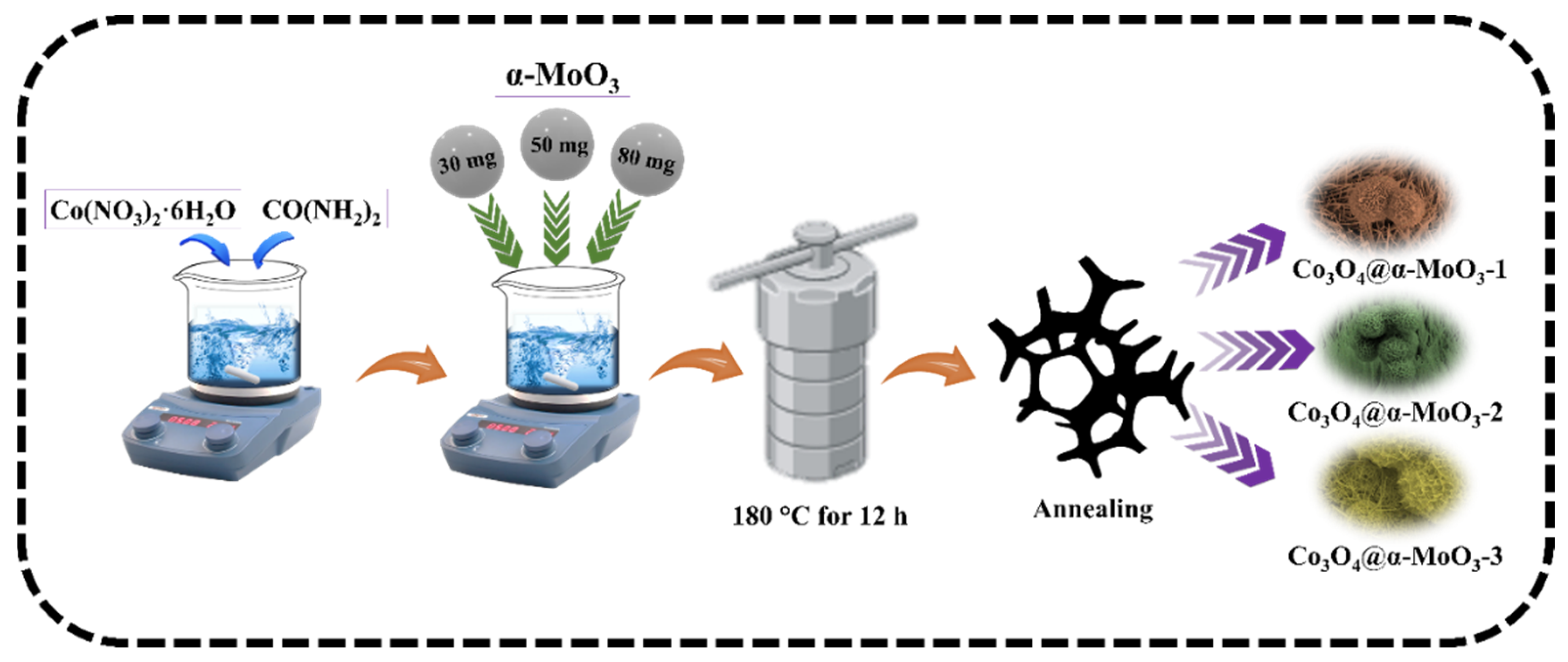
The Co3O4@α-MoO3 heterostructures were fabricated via a facile hydrothermal method directly on nickel foam (NF) substrates (Figure 1) to ensure strong adhesion and enhanced conductivity. A homogeneous precursor solution was prepared by dissolving 0.05 M Co(NO3)2·6H2O in 40 mL deionized (DI) water, followed by ultrasonication for 10 min. Subsequently, 0.05 M urea was added with supplementary 10 min ultrasonication to promote even dispersion. The pre-synthesized α-MoO3 was then incorporated at varying loadings (30, 50, and 80 mg) to yield the compositions Co3O4@α-MoO3-1, Co3O4@α-MoO3-2, and Co3O4@α-MoO3-3, respectively. After vigorous stirring for 1 h, cleaned NF pieces were immersed in the mixture within a Teflon-lined stainless-steel autoclave. A hydrothermal reaction proceeded at 180 °C for 12 h, enabling in situ nucleation and oriented growth of the nanowire–nanoflower hybrid directly on the NF scaffold. The resultant samples were retrieved, thoroughly rinsed with DI water and ethanol, and dried overnight at 60 °C, followed by annealing at 450 °C for 2 h in air to crystallize the phases and strengthen interfacial bonding.

2.4. Material Characterization

The phase purity, crystallinity, surface interaction, and microstructure of the synthesized Co3O4@α-MoO3 composites were systematically investigated using state-of-the-art analytical techniques. Powder X-ray diffraction (XRD) forms were noted on an X’Pert Pro diffractometer (Cu Kα radiation, λ = 1.5418 Å) to unequivocally identify crystalline phases and assess structural integrity. X-ray photoelectron spectroscopy (XPS) measurements were conducted using a Thermo Scientific K-α spectrometer to probe the elemental configuration, oxidation states, and bonding configurations at the atomic level. Field-emission scanning electron microscopy (FESEM) on a HITACHI S-4800 instrument, integrated with energy-dispersive X-ray spectroscopy (EDX), provided high-resolution morphological insights and spatially determined elemental distribution maps.

2.5. Electrochemical Analysis

All electrochemical evaluations were accomplished by a BioLogic VSP-300 workstation (France) in a standard three-electrode cell. The electrolyte consisted of a 1.0 M KOH solution (pH ≈ 13.9). Working electrodes were prepared by direct growth of Co3O4@α-MoO3 on pre-cleaned NF substrates, which underwent sequential ultrasonication in deionized water, acetone, and ethanol (20 min each), followed by overnight drying at 60 °C to confirm a contaminant-free surface. The nickel foam working electrode had a geometric area of 1 cm × 1 cm, and the total masses loaded on the nickel foam for Co3O4, α-MoO3, Co3O4@α-MoO3-1, Co3O4@α-MoO3-2, and Co3O4@α-MoO3-3 were 3.5, 3.48, 4.1, 3.43, and 3.49, respectively. The Hg/HgO electrode served as the reference, and a Pt plate acted as the counter electrode. Prior to collecting LSV data, the working electrode was electrochemically activated by performing 100 cyclic voltammetry (CV) cycles in the potential window of 0 to 0.4 V at a scan rate of 50 mV s−1. Before the activation process, the electrolyte was thoroughly stirred, and gas bubbles adhering to the electrode surface were removed to ensure reliable and stable electrochemical measurements. All electrochemical experiments were conducted at room temperature under identical conditions.
Linear sweep voltammetry (LSV) curves were recorded at 5 mV s−1, with potentials converted to the reversible hydrogen electrode (RHE) scale via the following:
ERHE = EHg/HgO + E°Hg/HgO + 0.0591 × (pH)
where E°Hg/HgO signifies the standard potential (0.098 V) for the Hg/HgO electrode in 1.0 M KOH.
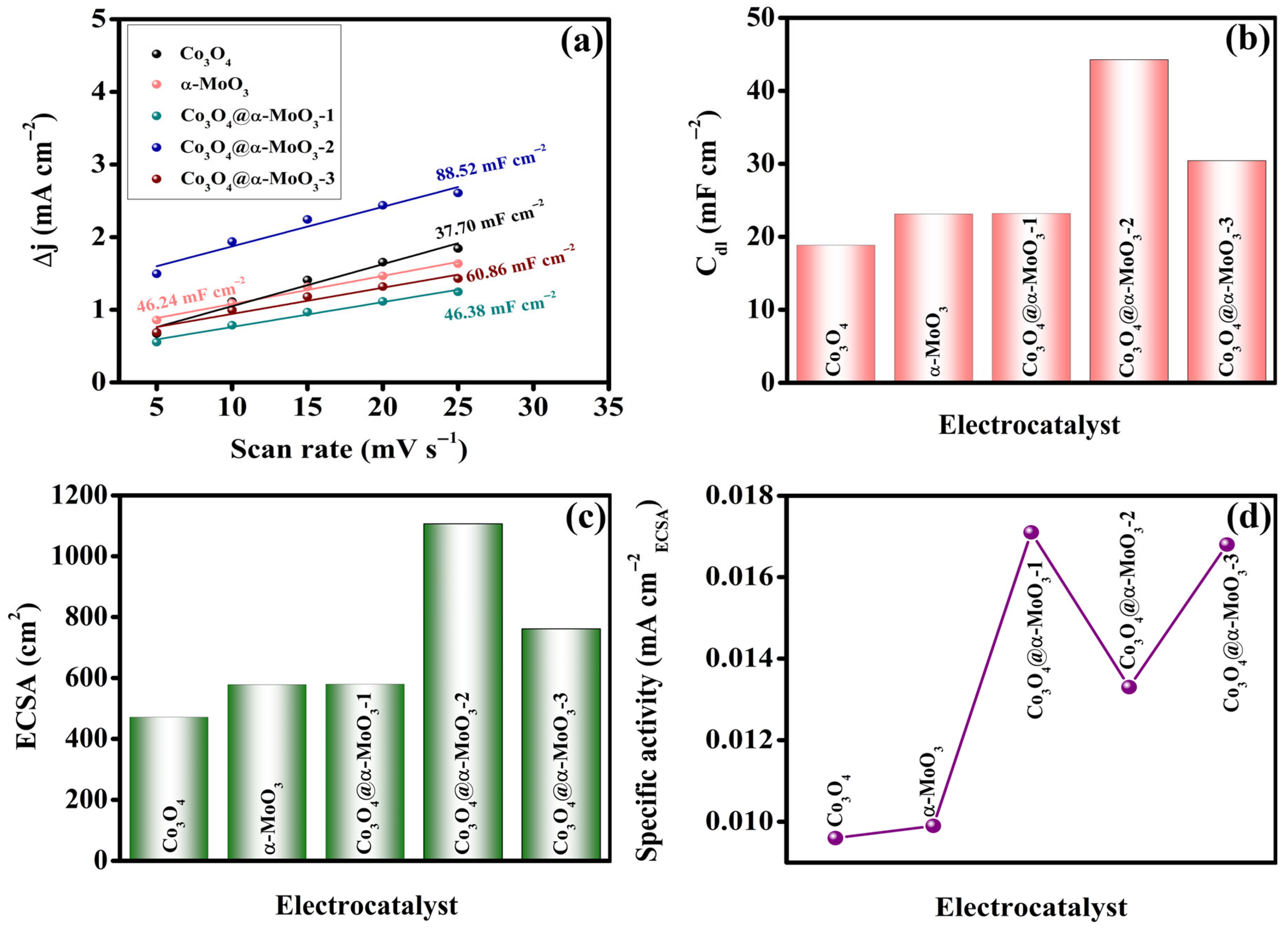
The electrochemical double-layer capacitance (Cdl) and electrochemically active surface area (ECSA) were determined from CV scans in the non-faradaic region (0.1–0.2 V vs. Hg/HgO) at scan rates of 5, 10, 20, 40, and 80 mV s−1. The electrochemically active surface area (ECSA) was subsequently estimated using a specific capacitance value (Cs) of 0.040 mF cm−2 [26,27]:
C d l = [ J a J c ] 2
E C S A = C d l C s
Electrochemical impedance spectroscopy (EIS) measurements were performed in the frequency range of 100 kHz to 0.1 Hz using an AC amplitude of 10 mV to investigate the interfacial charge-transfer characteristics. Durability assessments involved accelerated cycling tests comprising 5000 continuous CV cycles at 50 mV s−1 scan rate, with comparative analyses of LSV profiles recorded pre- and post-cycling. Chronopotentiometry (CP) measurements at a fixed current density were used to further evaluate long-term stability.

3. Results and Discussion

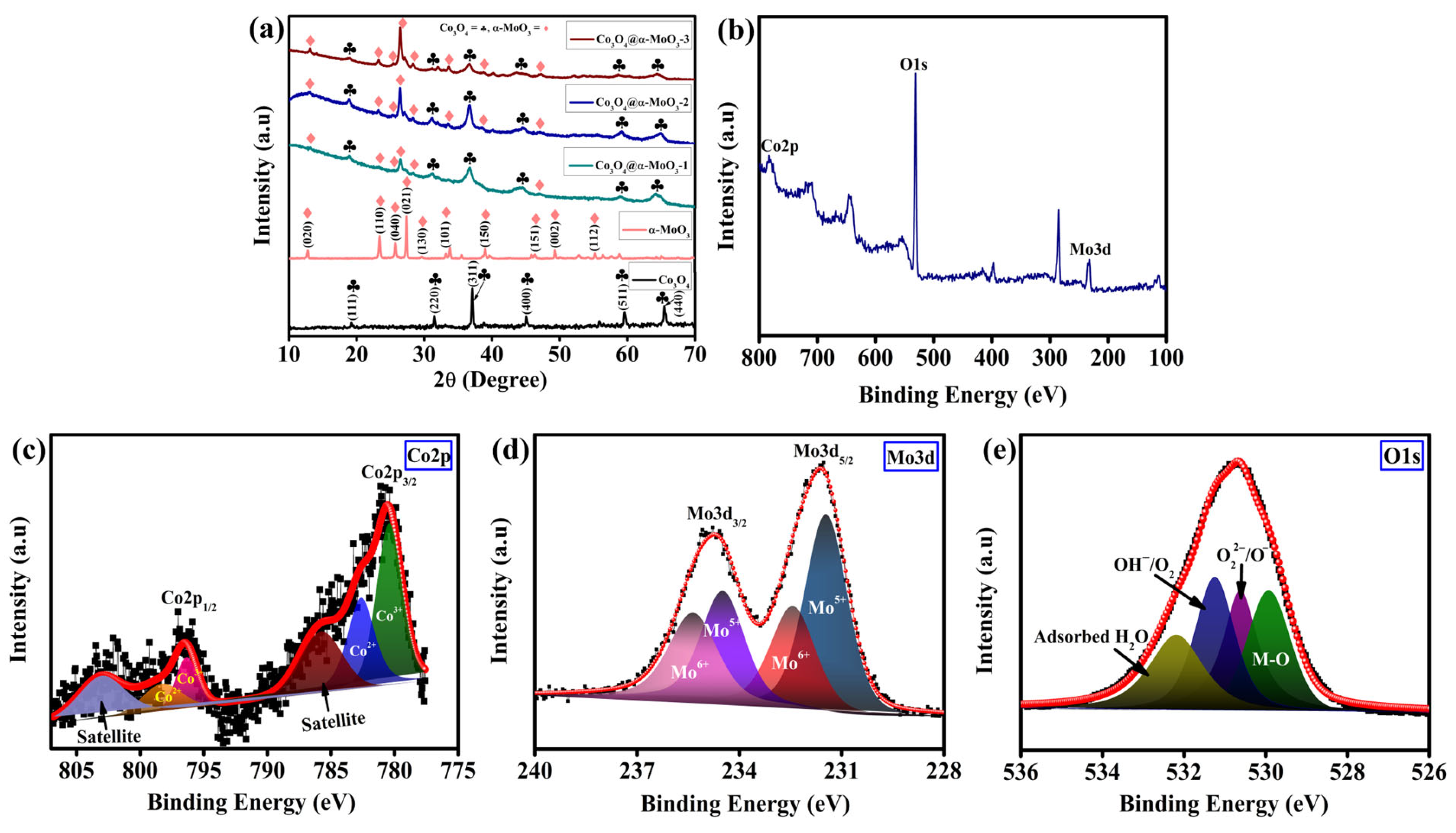
The X-ray diffraction (XRD) patterns of the pristine Co3O4, α-MoO3, and Co3O4@α-MoO3 series presented in Figure 2a provide key information on the crystalline phases of the composites. For pristine Co3O4 material, diffraction peaks appear at 19.2°, 31.4°, 36.9°, 44.8°, 59.5°, and 65.4°, which can be indexed to the (111), (220), (311), (400), (511), and (440) planes of the cubic phase, in good agreement with the standard JCPDS card No. 00-043-1003, which confirms the formation of phase-pure Co3O4 without detectable impurity phases [1,15,28]. Pristine α-MoO3 exhibits peaks at 12.7°, 23.3°, 25.7°, 27.3°, 29.6°, 33.2°, 39.0°, 46.3°, 49.2°, and 55.2° corresponding to the (020), (110), (040), (021), (130), (101), (150), (151), (002), and (112) planes, which are consistent with the orthorhombic α-MoO3 phase (JCPDS No. 00-035-0609) [29,30]. The simultaneous presence of well-resolved Co3O4 and α-MoO3 reflections, together with the sharpness of the peaks, indicates high crystallinity and successful construction of Co3O4@α-MoO3 heterostructures. Moreover, a progressive reduction in the relative intensity of the Co3O4 diffraction peaks with increasing α-MoO3 content is observed, suggesting strong structural coupling and intimate interfacial integration between the two phases. This attenuation of Co3O4 peak intensity can be attributed to the effective anchoring and partial coverage of Co3O4 by α-MoO3, further supporting the successful formation of the composite architecture favorable for enhanced electrocatalytic performance.
To elucidate the valence states and local bonding environments of the material, an X-ray photoelectron spectroscopy (XPS) examination was carried out. The XPS survey spectrum of the Co3O4@α-MoO3-2 heterostructure (Figure 2b) confirms the coexistence of cobalt (Co), molybdenum (Mo), and oxygen (O), providing evidence of the successful formation of the mixed-metal oxide architecture. The high-resolution Co2p spectrum shown in Figure 2c demonstrates two main peaks at 780.3 and 795.8 eV, which agree with the Co2p3/2 and Co2p1/2 components, respectively, characteristic of Co-based oxides. Deconvolution of the Co2p region yields two spin–orbit doublets at approximately 780.4 and 795.9 eV, which are attributed to the Co3+ class, whereas the features at around 782.5 and 797.8 eV are associated with Co2+, demonstrating the coexistence of mixed-valence cobalt, which is beneficial for redox-mediated electrocatalysis [10,11,31]. Two additional satellite peaks appearing at 786.3 eV and 802.9 eV are characteristic features of oxidized cobalt species, indicating successful oxidation of the material during synthesis. The Mo3d core-level spectrum (Figure 2d) exhibits a spin–orbit doublet with peaks at 231.4 and 234.5 eV, equivalent to Mo3d5/2 and Mo3d3/2 of higher-valent Mo (nominally Mo5+), while additional peaks at 232.4 and 235.3 eV are indexed to Mo 3d5/2 and Mo 3d3/2 of Mo6+, indicating the presence of mixed Mo oxidation states within the α-MoO3 framework [32,33]. The O1s spectrum of Co3O4@α-MoO3-2 (Figure 2e) can be deconvoluted into four distinct components: a binding-energy peak at 529.0 eV associated with lattice oxygen in metal-oxygen (M-O) bonds, a component at -530.4 eV ascribed to highly oxidative oxygen species such as O22−/O, a contribution at 531.4 eV consistent to surface hydroxyl groups or chemisorbed oxygen (OH/O2), and a binding-energy feature at 532.5 eV assigned to physiosorbed molecular water (H2O). The abundance of surface oxygen species and hydroxyl-related signals suggests rich surface chemistry and defect-mediated oxygen functionality, which are expected to facilitate oxygen-related redox processes and contribute positively to the overall electrocatalytic activity [28,34,35,36].
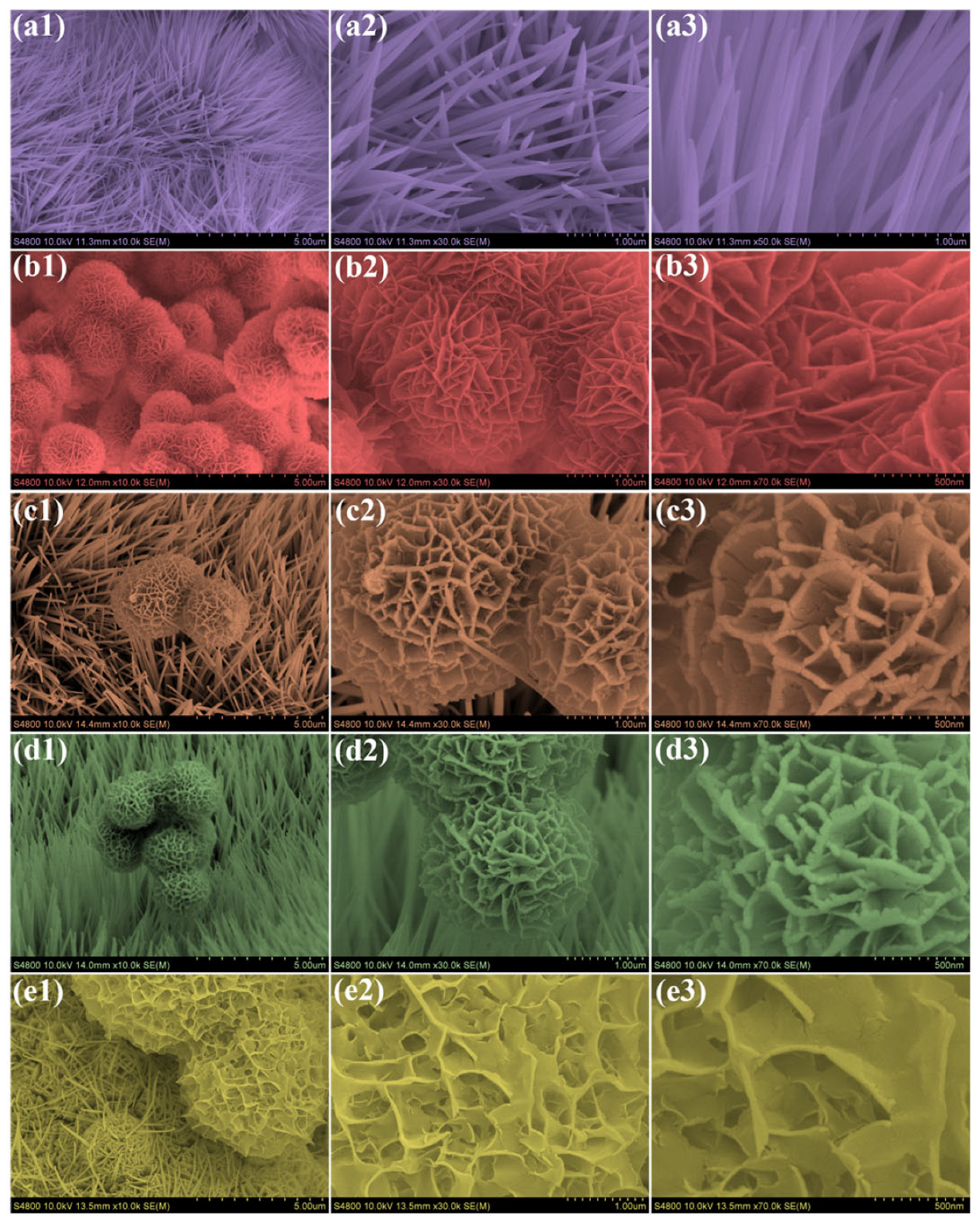
The scanning electron microscopy (SEM) images in Figure 3 disclose distinct morphological features across the Co3O4@α-MoO3 series, highlighting the influence of MoO3 loading on the hierarchical architecture and correlating directly with their OER performance. Figure 3(a1–a3) present SEM images of pristine Co3O4, which exhibit the one-dimensional nanowire arrays, while α-MoO3 (Figure 3(b1–b3)) forms characteristic nanoflower structures composed of interconnected nanosheets. At the lower MoO3 content in Co3O4@α-MoO3-1 (Figure 3(c1–c3)), the nanowire arrays remain well-defined and vertically oriented, with α-MoO3 nanoflowers sparsely decorating the surface. The SEM images displayed in Figure 3(d1–d3) showcase the optimal morphology of Co3O4@α-MoO3-2, featuring densely packed nanoflowers fully integrated with the nanowire backbone, forming a highly interconnected 3D network with exceptional porosity. The Co3O4 nanowires maintain an average diameter of ~70–90 nm, while the α-MoO3 nanoflower decoration maximizes surface roughness and electrochemically active area, facilitating superior ion diffusion, charge transfer, and active-site utilization. In the case of Co3O4@α-MoO3-3, at higher MoO3 loading (Figure 3(e1–e3)), the nanoflowers become excessively dense and partially coalesced, leading to non-uniform growth of the Co3O4 nanowires with irregular spacing and partial interment.
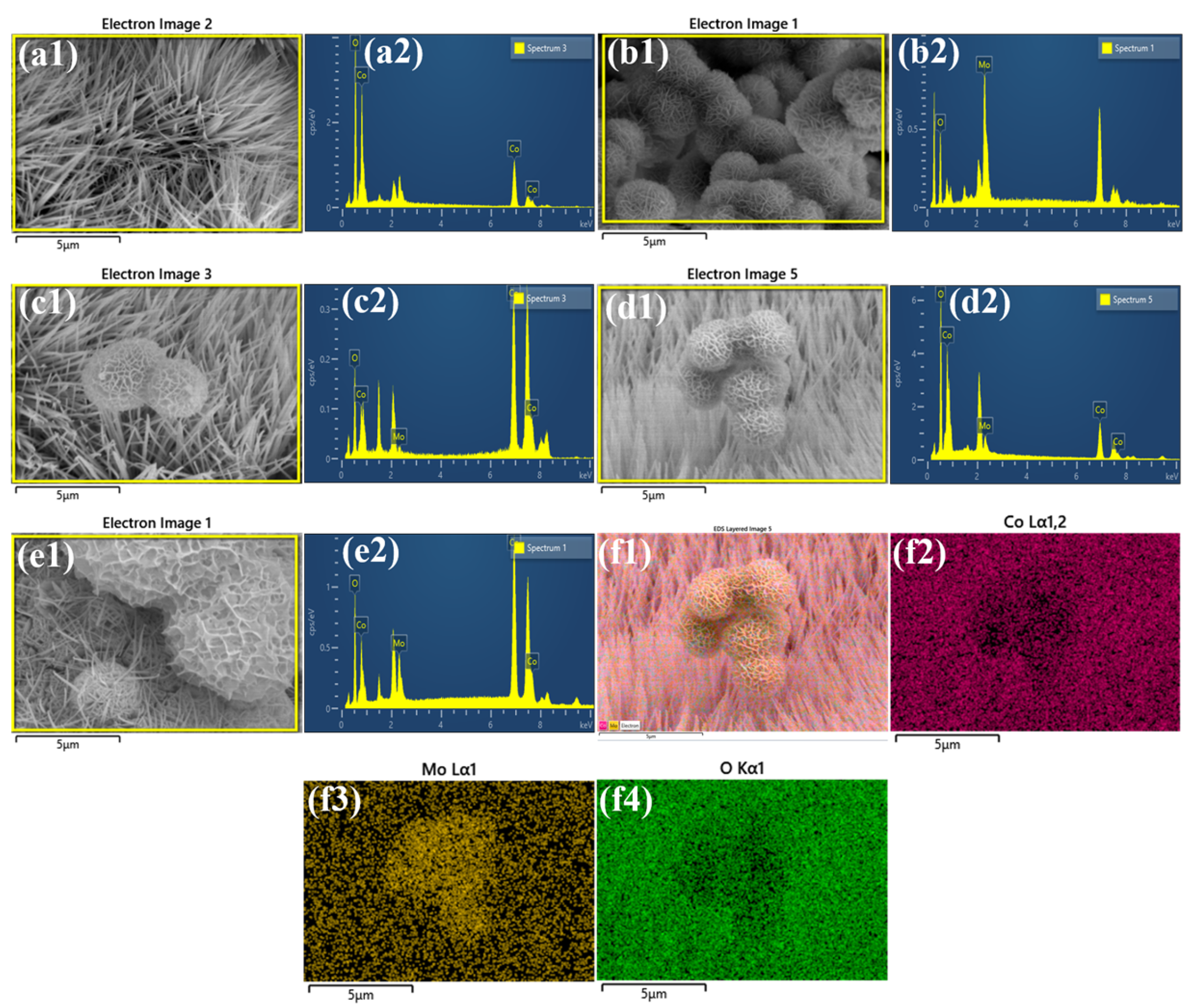
The elemental composition and spatial distribution within the Co3O4@α-MoO3 electrocatalysts were investigated by energy-dispersive X-ray spectroscopy (EDX), which provides local and semi-quantitative compositional information from the analyzed regions. The EDX results mainly serve to confirm the presence of Co, Mo, and O, to compare their relative variations among different samples, and to verify their spatial homogeneity within the heterostructures. Figure 4(a1,a2,b1,b2) shows the EDAX data of Co3O4 and α-MoO3, which includes the Co (63.97 wt%) and O (36.03 wt%) for Co3O4, and the Mo (46.16 wt%) and O (53.84 wt%) for α-MoO3. For Co3O4@α-MoO3-1 (Figure 4(c1,c2)), the locally measured composition includes 84.15 wt% Co, 1.41 wt% Mo, and 14.44 wt% O, indicating a relatively low Mo signal in the selected area, consistent with its sparse MoO3 decoration observed in SEM images. The Co3O4@α-MoO3-2 sample (Figure 4(d1,d2)) exhibits locally measured values of 65.42 wt% Co, 5.04 wt% Mo, and 29.54 wt% O, suggesting a comparatively higher and more uniformly distributed Mo presence in the analyzed region. Similarly, Co3O4@α-MoO3-3 (Figure 4(e1,e2)) includes 73.19 wt% Co, 8.15 wt% Mo, and 18.66 wt% O, reflecting a further increase in the local Mo signal. These results indicate a relative trend of increasing Mo content from Co3O4@α-MoO3-1 to Co3O4@α-MoO3-3, which qualitatively correlates with the morphological evolution and electrochemical performance of the catalysts. Furthermore, elemental mapping of Co3O4@α-MoO3-2 (Figure 4(f1–f4)) demonstrates a uniform spatial distribution of Co, Mo, and O across the examined regions, providing evidence of homogeneous phase dispersion and intimate interfacial contact between Co3O4 and α-MoO3. Such local compositional uniformity is beneficial for ensuring consistent electrochemical behavior, as it minimizes localized heterogeneities that could otherwise lead to uneven catalytic activity or accelerated degradation during OER operation.
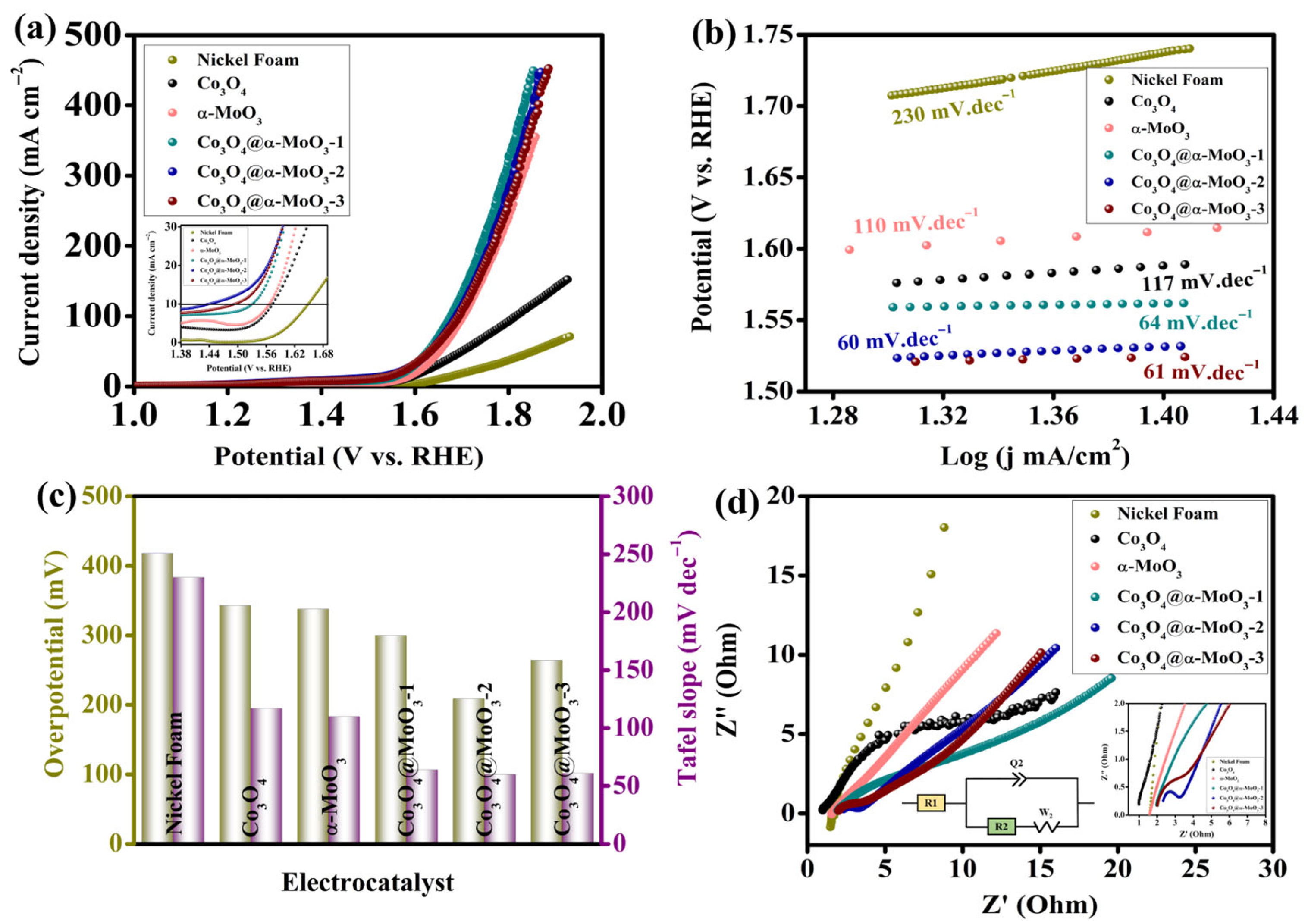
The OER performance of the prepared samples was systematically evaluated in a 1.0 M KOH aqueous electrolyte using a conventional three-electrode configuration. Detailed procedures concerning electrode preparation, assembly, and electrochemical measurements are provided in the Experimental Section. All potentials were converted to the RHE scale. The comparative OER polarization curves and corresponding analyses for pristine NF, Co3O4, α-MoO3, and Co3O4@α-MoO3 series are presented in Figure 5. As shown in Figure 5a, the Co3O4@α-MoO3-2 catalyst exhibits markedly enhanced OER activity, delivering a small overpotential of 209 mV at a current density of 10 mA cm−2. In contrast, higher overpotentials were recorded for pristine NF (418 mV), Co3O4 (343 mV), α-MoO3 (338 mV), Co3O4@α-MoO3-1 (300 mV), and Co3O4@α-MoO3-3 (264 mV) under similar experimental circumstances. To minimize the influence of capacitive currents, the OER performance of all electrodes was compared at a higher current density of 20 mA cm−2. The corresponding overpotentials were determined to be 477, 384, 372, 346, 333, and 338 mV for NF, Co3O4, α-MoO3, Co3O4@α-MoO3-1, Co3O4@α-MoO3-2, and Co3O4@α-MoO3-3, respectively. This pronounced improvement in catalytic efficiency for Co3O4@α-MoO3-2 can be ascribed to the optimized incorporation of MoO3, which promotes synergistic interactions between Co3O4 and α-MoO3, effectively enhancing active site exposure and accelerating charge transfer processes. The strong correlation between MoO3 content and electrocatalytic performance suggests that compositional tuning plays a crucial role in modulating OER activity. The presence of Mo-O units tunes the adsorption free energies of OH*, O*, and OOH* toward an optimal range, reducing the overpotential [23]. To elucidate the effect of catalyst composition on reaction kinetics, Tafel slope analysis was performed (Figure 5b). The determined Tafel slopes for pristine NF, Co3O4, α-MoO3, Co3O4@α-MoO3-1, Co3O4@α-MoO3-2, and Co3O4@α-MoO3-3 are 230, 117, 110, 64, 60, and 61 mV dec−1, respectively. Notably, Co3O4@α-MoO3-2 exhibits the lowest Tafel slope, demonstrating superior charge transfer kinetics and more favorable reaction dynamics, consistent with its minimal overpotential, as shown in Figure 5c. These results imply that the rate-determining step (RDS) of the OER process on Co3O4@α-MoO3-2 likely involves the transformation of adsorbed -O species into -OOH intermediates, indicative of an efficient reaction pathway [37]. Electrochemical impedance spectroscopy (EIS) was further employed to gain insight into the interfacial charge transfer behavior (Figure 5d). The obtained Nyquist plots were tailored using an equivalent circuit model, and the corresponding charge transfer resistance (Rct) values were extracted. The Rct values for pristine NF, Co3O4, α-MoO3, Co3O4@α-MoO3-1, Co3O4@α-MoO3-2, and Co3O4@α-MoO3-3 were calculated as 5.44, 3.53, 2.95, 2.04, 1.13, and 1.76 Ω, respectively, confirming a significant reduction in interfacial resistance upon MoO3 incorporation. The remarkably low Rct of Co3O4@α-MoO3-2 signifies an enhanced electron transport capability and an accelerated charge transfer process across the electrode–electrolyte interface, both of which are critical for attaining efficient OER kinetics.
Figure 6 presents an inclusive assessment of the CV responses of Co3O4@α-MoO3 electrocatalysts with different metal ratios, verified at various scan rates, together with the plots of current density as a function of scan rate. To quantify the ECSA and correlate it with catalytic site availability, the double-layer capacitance (Cdl) was extracted from non-faradaic CV measurements acquired at different scan rates. The slopes obtained by linearly fitting the difference in current density (j) versus scan rate (Figure 6a) yielded the Cdl values for each electrocatalyst, as shown in Figure 6b. The calculated Cdl values for Co3O4, α-MoO3, Co3O4@α-MoO3-1, Co3O4@α-MoO3-2, and Co3O4@α-MoO3-3 are 18.85, 23.12, 23.19, 44.26, and 30.43 mF cm−2, respectively. Using these Cdl values and a standard specific capacitance for a flat surface, the corresponding ECSA values were estimated to be 471.25, 578.0, 579.75, 1106.50, and 760.75 cm2, for Co3O4, α-MoO3, Co3O4@α-MoO3-1, Co3O4@α-MoO3-2, and Co3O4@α-MoO3-3, respectively, as summarized in Figure 6c. Among all compositions, Co3O4@α-MoO3-2 exhibits the uppermost Cdl and ECSA, signifying an extensive rise in electrochemically accessible active sites arising from the optimized incorporation of α-MoO3. The ECSA normalized specific activity is presented in Figure 6d. The calculated specific activities for pristine Co3O4, α-MoO3, Co3O4@α-MoO3-1, Co3O4@α-MoO3-2, and Co3O4@α-MoO3-3 are 0.0096, 0.0099, 0.0171, 0.0133, and 0.0168 mA cm−2ECSA, respectively. Although Co3O4@α-MoO3-2 exhibits the lowest overpotential and the highest geometric activity, its ECSA-normalized specific activity is lower than that of other samples. This indicates that the performance enhancement primarily originates from the substantially increased electrochemically accessible surface area (ECSA) and improved charge transport, rather than a dramatic increase in intrinsic activity per active site. Additionally, ECSA estimated from Cdl may be influenced by surface roughness and capacitive effects, which can affect the absolute values of specific activity. The enlarged effective surface area enhances charge carrier accessibility and enables a greater density of active centers to participate in the interfacial reactions, thereby providing a strong structural and kinetic basis for the superior OER performance of Co3O4@α-MoO3-2.
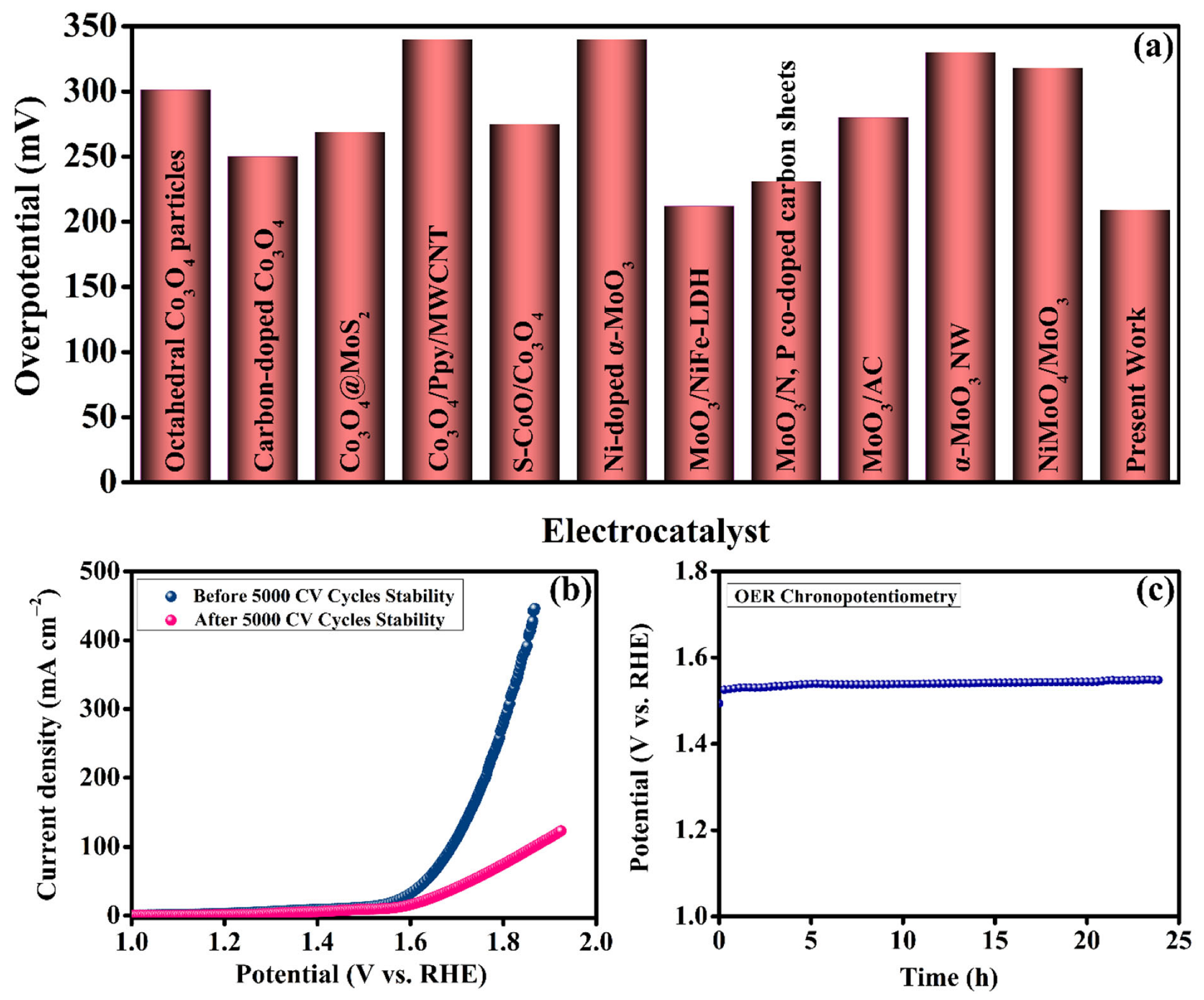
A comparative evaluation of the overpotential values for Co3O4@α-MoO3-2 and earlier reported OER electrocatalysts is obtainable in Figure 7a and Table 1, highlighting its high competitiveness among state-of-the-art catalysts. In particular, Co3O4@α-MoO3-2 delivers comparable or even superior OER activity relative to many benchmark materials, underscoring the effectiveness of the compositional and structural design strategy. This outstanding performance is principally attributed to the synergistic coupling between the Co3O4 and α-MoO3 phases within the composite, which collectively promotes augmented electronic conductivity, improves density of catalytically accessible active sites and accelerates reaction kinetics at the electrode–electrolyte interface. In addition to activity, long-term electrochemical durability is essential for assessing the practical viability of OER electrocatalysts. To assess the cycling stability of Co3O4@α-MoO3-2, CV measurements were conducted for 5000 cycles in an alkaline electrolyte, and the corresponding polarization curves recorded before and after cycling are shown in Figure 7b. Notably, the Co3O4@α-MoO3-2 electrode preserves an overpotential of 309 mV at 10 mA cm−2 after 5000 cycles, exhibiting only minimal deviation from its initial performance. The slight performance loss observed can be explained by possible structural reconstruction, surface oxidation, or partial blockage of active sites by oxygenated species formed during prolonged cycling, phenomena frequently reported for OER catalysts subjected to harsh operational protocols [38,39]. To further validate the robustness of the catalyst under a practical steady-state environment, chronopotentiometric analysis was performed at a constant current density of 10 mA cm−2 for 24 h, as illustrated in Figure 7c. The potential-time profile during chronopotentiometry remains moderately stable over the entire 24 h period, signifying sustained catalytic activity and steady charge transport during continuous operation. Taken together, these findings demonstrate that while aggressive CV cycling can induce measurable yet limited degradation, the Co3O4@α-MoO3-2 electrocatalyst retains reasonable operational stability under constant-current OER conditions.

4. Conclusions

This study successfully demonstrates that controlled integration of α-MoO3 nanoflowers with Co3O4 nanowire arrays yields a highly efficient and durable OER electrocatalyst, with the optimized Co3O4@α-MoO3-2 composition setting new performance benchmarks through synergistic electronic modulation and structural engineering. The low overpotential (209 mV @ 10 mA cm−2), favorable Tafel slope (60 mV dec−1), expanded ECSA (1106.50 cm2), and reasonable stability underscore the power of heterostructure design in overcoming kinetic and transport limitations inherent to single-phase oxides. Key insights include the role of uniform-phase dispersion, mixed oxidation states (Co2+/Co3+, Mo5+/Mo6+), and hierarchical porosity in facilitating rapid charge transfer and optimal *OH/*O/*OOH binding. These findings lead the way for scalable, non-noble OER platforms in practical electrolyzers, with broader implications in renewable energy conversion.

Author Contributions

Conceptualization, M.B.; Methodology, M.B.; Investigation, M.B.; Writing—original draft, M.B.; Review and editing, A.A.P.; Supervision, C.-W.J.; Writing—review and editing, C.-W.J.; Project administration, C.-W.J.; Funding acquisition, C.-W.J. All authors have read and agreed to the published version of the manuscript.

Funding

This research did not receive any specific grant from funding agencies in the public, commercial, or not-for-profit sectors.

Data Availability Statement

The data presented in this study are available on request from the corresponding author, due to privacy or ethical restrictions. (Please specify the reason for restriction, e.g., the data are not publicly available due to privacy or ethical restrictions.).

Conflicts of Interest

The authors declare no conflicts of interest.

References

  1. Yan, D.; Chen, R.; Xiao, Z.; Wang, S. Engineering the electronic structure of Co3O4 by carbon-doping for efficient overall water splitting. Electrochim. Acta 2019, 303, 316–322. [Google Scholar] [CrossRef]
  2. Hong, T.; Liu, Z.; Zheng, X.; Zhang, J.; Yan, L. Efficient photoelectrochemical water splitting over Co3O4 and Co3O4/Ag composite structure. Appl. Catal. B Environ. 2017, 202, 454–459. [Google Scholar] [CrossRef]
  3. Ahmed, I.; Biswas, R.; Patil, R.A.; Halder, K.K.; Singh, H.; Banerjee, B.; Kumar, B.; Ma, Y.-R.; Haldar, K.K. Graphitic carbon nitride composites with MoO3-decorated Co3O4 nanorods as catalysts for oxygen and hydrogen evolution. ACS Appl. Nano Mater. 2021, 4, 12672–12681. [Google Scholar] [CrossRef]
  4. Wang, Z.; Liu, H.; Ge, R.; Ren, X.; Ren, J.; Yang, D.; Zhang, L.; Sun, X. Phosphorus-doped Co3O4 nanowire array: A highly efficient bifunctional electrocatalyst for overall water splitting. Acs Catal. 2018, 8, 2236–2241. [Google Scholar] [CrossRef]
  5. Yin, Q.; Tan, J.M.; Besson, C.; Geletii, Y.V.; Musaev, D.G.; Kuznetsov, A.E.; Luo, Z.; Hardcastle, K.I.; Hill, C.L. A fast soluble carbon-free molecular water oxidation catalyst based on abundant metals. Science 2010, 328, 342–345. [Google Scholar] [CrossRef]
  6. Xie, L.; Zhang, R.; Cui, L.; Liu, D.; Hao, S.; Ma, Y.; Du, G.; Asiri, A.M.; Sun, X. High-performance electrolytic oxygen evolution in neutral media catalyzed by a cobalt phosphate nanoarray. Angew. Chem. Int. Ed. 2017, 56, 1064–1068. [Google Scholar] [CrossRef]
  7. Koza, J.A.; He, Z.; Miller, A.S.; Switzer, J.A. Electrodeposition of Crystalline Co3O4-A Catalyst for the Oxygen Evolution Reaction. Chem. Mater. 2012, 24, 3567–3573. [Google Scholar] [CrossRef]
  8. Park, J.-Y.; So, I.; Kim, N.-I. Enhancement of Bifunctional Activity of Modified Carbon Nanotube Supported Cobalt Oxide Catalysts. In Electrochemical Society Meeting Abstracts; The Electrochemical Society: Pennington, NJ, USA, 2015; p. 2210. [Google Scholar]
  9. Jeon, H.S.; Jee, M.S.; Kim, H.; Ahn, S.J.; Hwang, Y.J.; Min, B.K. Simple chemical solution deposition of Co3O4 thin film electrocatalyst for oxygen evolution reaction. ACS Appl. Mater. Interfaces 2015, 7, 24550–24555. [Google Scholar] [CrossRef]
  10. Wagh, K.S.; Mane, S.M.; Teli, A.M.; Shin, J.C.; Lee, J. Recent advancements in Co3O4-based composites for enhanced electrocatalytic water splitting. Micromachines 2024, 15, 1450. [Google Scholar] [CrossRef]
  11. Li, L.; Tian, T.; Jiang, J.; Ai, L. Hierarchically porous Co3O4 architectures with honeycomb-like structures for efficient oxygen generation from electrochemical water splitting. J. Power Sources 2015, 294, 103–111. [Google Scholar] [CrossRef]
  12. Deng, X.; Tüysüz, H. Cobalt-oxide-based materials as water oxidation catalyst: Recent progress and challenges. ACS Catal. 2014, 4, 3701–3714. [Google Scholar] [CrossRef]
  13. Zheng, Y.; Jiao, Y.; Jaroniec, M.; Qiao, S.Z. Advancing the electrochemistry of the hydrogen-evolution reaction through combining experiment and theory. Angew. Chem. Int. Ed. 2015, 54, 52–65. [Google Scholar] [CrossRef] [PubMed]
  14. Faber, M.S.; Jin, S. Earth-abundant inorganic electrocatalysts and their nanostructures for energy conversion applications. Energy Environ. Sci. 2014, 7, 3519–3542. [Google Scholar] [CrossRef]
  15. Wu, K.; Shen, D.; Meng, Q.; Wang, J. Octahedral Co3O4 particles with high electrochemical surface area as electrocatalyst for water splitting. Electrochim. Acta 2018, 288, 82–90. [Google Scholar] [CrossRef]
  16. Carrasco, J.; Illas, F.; Bromley, S.T. Ultralow-density nanocage-based metal-oxide polymorphs. Phys. Rev. Lett. 2007, 99, 235502. [Google Scholar] [CrossRef]
  17. Swathi, S.; Ravi, G.; Yuvakkumar, R.; Hong, S.; Babu, E.S.; Velauthapillai, D.; Kumar, P. Water-splitting application of orthorhombic molybdite α-MoO3 nanorods. Ceram. Int. 2020, 46, 23218–23222. [Google Scholar] [CrossRef]
  18. Farid, G.; Amade-Rovira, R.; Ospina, R.; Bertran-Serra, E. Surface modification of silicon nanowires via drop-casting for high-performance Li-ion battery electrodes: SiNWs decorated with molybdenum oxide nanoparticles. J. Energy Storage 2024, 78, 110104. [Google Scholar] [CrossRef]
  19. Ashraf, I.; Ahmad, S.; Rizwan, S.; Iqbal, M. Fabrication of Ti3C2@ MoO3 nanocomposite as an electrode material for highly efficient and durable water splitting system. Fuel 2021, 299, 120928. [Google Scholar] [CrossRef]
  20. Hu, H.; Deng, C.; Xu, J.; Zhang, K.; Sun, M. Metastable h-MoO3 and stable α-MoO3 microstructures: Controllable synthesis, growth mechanism and their enhanced photocatalytic activity. J. Exp. Nanosci. 2015, 10, 1336–1346. [Google Scholar] [CrossRef]
  21. Kwak, D.; Wang, M.; Koski, K.J.; Zhang, L.; Sokol, H.; Maric, R.; Lei, Y. Molybdenum trioxide (α-MoO3) nanoribbons for ultrasensitive ammonia (NH3) gas detection: Integrated experimental and density functional theory simulation studies. ACS Appl. Mater. Interfaces 2019, 11, 10697–10706. [Google Scholar] [CrossRef]
  22. Mandal, B.; Das, M.; Htay, M.T.; Mukherjee, S. Architecture tailoring of MoO3 nanostructures for superior ethanol sensing performance. Mater. Res. Bull. 2019, 109, 281–290. [Google Scholar] [CrossRef]
  23. Verma, A.K.; Atif, S.; Padhy, A.; Choksi, T.S.; Barpanda, P.; Govind Rajan, A. Robust Oxygen Evolution on Ni-Doped MoO3: Overcoming Activity–Stability Trade-Off in Alkaline Water Splitting. Chem Bio Eng. 2025, 2, 241–252. [Google Scholar] [CrossRef] [PubMed]
  24. Jiang, H.; Yu, Y.; Duan, X.; Chen, P.; Wang, S.; Qiu, X.; Ye, L.; Tu, X. Heterostructured MoO3 anchored defect-rich NiFe-LDH/NF as a robust self-supporting electrocatalyst for overall water splitting. Small 2024, 20, 2307797. [Google Scholar] [CrossRef] [PubMed]
  25. Muralikrishna, S.; Manjunath, K.; Samrat, D.; Reddy, V.; Ramakrishnappa, T.; Nagaraju, D.H. Hydrothermal synthesis of 2D MoS2 nanosheets for electrocatalytic hydrogen evolution reaction. RSC Adv. 2015, 5, 89389–89396. [Google Scholar] [CrossRef]
  26. Arumugam, B.; Siddharthan, E.E.; Mannu, P.; Thapa, R.; Dong, C.-L.; Jeffery, A.A.; Kim, S.-C. Regulating the electronic structure of CoMoO4 via La doping for efficient and durable electrochemical water splitting reactions. J. Mater. Chem. A 2025, 13, 6749–6767. [Google Scholar] [CrossRef]
  27. Tan, Y.; Li, Q.; Che, Q.; Chen, X.; Xu, X.; Chen, Y. Improving activity of Ni3P/Mn hybrid film via electrochemical tuning for water splitting under simulated industrial environment. Electrochim. Acta 2019, 324, 134897. [Google Scholar] [CrossRef]
  28. Jayaseelan, S.S.; Bhuvanendran, N.; Xu, Q.; Su, H. Co3O4 nanoparticles decorated Polypyrrole/carbon nanocomposite as efficient bi-functional electrocatalyst for electrochemical water splitting. Int. J. Hydrogen Energy 2020, 45, 4587–4595. [Google Scholar] [CrossRef]
  29. Rani, B.J.; Ravi, G.; Yuvakkumar, R.; Ameen, F.; AlNadhari, S.; Hong, S. Fabrication and electrochemical OER activity of Ag doped MoO3 nanorods. Mater. Sci. Semicond. Process. 2020, 107, 104818. [Google Scholar] [CrossRef]
  30. Elkholy, A.E.; Duignan, T.T.; Sun, X.; Zhao, X.S. Stable α-MoO3 electrode with a widened electrochemical potential window for aqueous electrochemical capacitors. ACS Appl. Energy Mater. 2021, 4, 3210–3220. [Google Scholar] [CrossRef]
  31. Zhu, Y.P.; Ma, T.Y.; Jaroniec, M.; Qiao, S.Z. Self-templating synthesis of hollow Co3O4 microtube arrays for highly efficient water electrolysis. Angew. Chem. Int. Ed. 2017, 56, 1324–1328. [Google Scholar] [CrossRef]
  32. Luo, Z.; Miao, R.; Huan, T.D.; Mosa, I.M.; Poyraz, A.S.; Zhong, W.; Cloud, J.E.; Kriz, D.A.; Thanneeru, S.; He, J. Mesoporous MoO3–x material as an efficient electrocatalyst for hydrogen evolution reactions. Adv. Energy Mater. 2016, 6, 1600528. [Google Scholar] [CrossRef]
  33. Cheng, H.; Kamegawa, T.; Mori, K.; Yamashita, H. Surfactant-free nonaqueous synthesis of plasmonic molybdenum oxide nanosheets with enhanced catalytic activity for hydrogen generation from ammonia borane under visible light. Angew. Chem. Int. Ed. 2014, 53, 2910–2914. [Google Scholar] [CrossRef] [PubMed]
  34. Cheng, G.; Kou, T.; Zhang, J.; Si, C.; Gao, H.; Zhang, Z. O22-/O-functionalized oxygen-deficient Co3O4 nanorods as high performance supercapacitor electrodes and electrocatalysts towards water splitting. Nano Energy 2017, 38, 155–166. [Google Scholar] [CrossRef]
  35. Sun, T.; Liu, P.; Zhang, Y.; Chen, Z.; Zhang, C.; Guo, X.; Ma, C.; Gao, Y.; Zhang, S. Boosting the electrochemical water splitting on Co3O4 through surface decoration of epitaxial S-doped CoO layers. Chem. Eng. J. 2020, 390, 124591. [Google Scholar] [CrossRef]
  36. Li, T.; Wan, W.; Cao, Y.; Xu, J.; Chai, H. Co2P2O7@MoO3/NF composite electrocatalysts by different phosphorus sources for efficient oxygen evolution reaction and overall water splitting. Colloid Interface Sci. Commun. 2023, 55, 100727. [Google Scholar] [CrossRef]
  37. Zhai, Y.; Ren, X.; Sun, Y.; Li, D.; Wang, B.; Liu, S.F. Synergistic effect of multiple vacancies to induce lattice oxygen redox in NiFe-layered double hydroxide OER catalysts. Appl. Catal. B Environ. 2023, 323, 122091. [Google Scholar] [CrossRef]
  38. Bhosale, M.; Baby, N.; Magdum, S.S.; Murugan, N.; Kim, Y.A.; Thangarasu, S.; Oh, T.-H. Hierarchical nanoassembly of Ni3S2-MoS2 interconnected with CeO2 as a highly remarkable hybrid electrocatalyst for enhancing water oxidation and energy storage. J. Energy Storage 2024, 80, 110301. [Google Scholar] [CrossRef]
  39. Vo, T.-G.; Hidalgo, S.D.S.; Chiang, C.-Y. Controllable electrodeposition of binary metal films from deep eutectic solvent as an efficient and durable catalyst for the oxygen evolution reaction. Dalton Trans. 2019, 48, 14748–14757. [Google Scholar] [CrossRef]
  40. Liu, J.; Wang, J.; Zhang, B.; Ruan, Y.; Wan, H.; Ji, X.; Xu, K.; Zha, D.; Miao, L.; Jiang, J. Mutually beneficial Co3O4@ MoS2 heterostructures as a highly efficient bifunctional catalyst for electrochemical overall water splitting. J. Mater. Chem. A 2018, 6, 2067–2072. [Google Scholar] [CrossRef]
  41. Guo, P.; Liu, G.; Yin, J.; Hu, H.; Li, E.; Meng, Y.; Gao, H.; Wang, W.; Li, Z. Synthesis of MoO3/N, P co-doped carbon for electrochemical water splitting. Fuel 2024, 355, 129476. [Google Scholar] [CrossRef]
  42. Sekar, S.; Yun, J.-S.; Park, S.; Kim, D.Y.; Lee, Y.; Lee, S. Excellent Bifunctional Water Electrolysis Activities of α-MoO3/AC Nanocomposites. Int. J. Energy Res. 2024, 2024, 3167699. [Google Scholar] [CrossRef]
  43. Scalese, S.; Tringali, F.; Lo Mastro, A.; La Manna, S.; Mineo, G.; Russo, A.; Scuderi, M.; Miritello, M.; Franzò, G.; Mirabella, S. Thermally evaporated MoO3 nanowires as oxygen evolution reaction catalysts for water splitting applications. ACS Appl. Nano Mater. 2023, 6, 22947–22955. [Google Scholar] [CrossRef]
  44. Dabir, M.; Masoudpanah, S.; Mamizadeh, M. Ultrathin needle-like NiMoO4/MoO3 heterostructure for supercapacitor and overall water splitting applications. J. Energy Storage 2024, 82, 110542. [Google Scholar] [CrossRef]
Figure 1. Schematic design of synthesis of Co3O4@α-MoO3 composites.
Crystals 16 00133 g001
Figure 2. (a) XRD graph of pristine Co3O4, α-MoO3, and all the composites; (b) XPS survey spectra, and high-resolution XPS spectra of (c) Co2p, (d) Mo3d. (e) O 1s of Co3O4@α-MoO3-2 composite.
Crystals 16 00133 g002
Figure 3. Scanning electron microscopic images of (a1a3) Co3O4, (b1b3) α-MoO3, and (c1c3) Co3O4@α-MoO3-1, (d1d3) Co3O4@α-MoO3-2, and (e1e3) Co3O4@α-MoO3-3.
Crystals 16 00133 g003
Figure 4. Elemental analysis of (a1,a2) Co3O4, (b1,b2) α-MoO3, (c1,c2) Co3O4@α-MoO3-1, (d1,d2) Co3O4@α-MoO3-2, and (e1,e2) Co3O4@α-MoO3-3, and EDAX mapping data of (f1f4) Co3O4@α-MoO3-2.
Crystals 16 00133 g004
Figure 5. OER activity of as-developed electrocatalyst, including (a) LSV curve at 5 mV s1; (b) Tafel plot; (c) OER activity at 10 mA cm2 and Tafel slope results, and (d) EIS spectra (inset: expanded EIS spectra and equivalent circuit).
Crystals 16 00133 g005
Figure 6. (a) 2Cdl, (b) Cdl, (c) ECSA, and (d), specific activity of all the electrocatalysts.
Crystals 16 00133 g006
Figure 7. (a) Comparative OER overpotential results with other reported electrocatalysts; (b) before and after 5000 CV cycles polarization curve; (c) chronopotentiometry of Co3O4@α-MoO3-2.
Crystals 16 00133 g007
Table 1. Comparison of the present electrocatalyst OER performance result with other reported electrocatalysts.
ElectrocatalystsOverpotential (mV@10 mA cm−2)References
Carbon-doped Co3O4250[1]
Octahedral Co3O4 particles301.2 [15]
Co3O4/Ppy/MWCNT340[28]
S-CoO/Co3O4275[35]
Co3O4@MoS2269[40]
Ni-doped α-MoO3340[23]
MoO3/NiFe-LDH212[24]
MoO3/N, P co-doped carbon sheets231[41]
MoO3/AC280[42]
α-MoO3 NWs330[43]
NiMoO4/MoO3318[44]
Co3O4@α-MoO3-2209Present work
Disclaimer/Publisher’s Note: The statements, opinions and data contained in all publications are solely those of the individual author(s) and contributor(s) and not of MDPI and/or the editor(s). MDPI and/or the editor(s) disclaim responsibility for any injury to people or property resulting from any ideas, methods, instructions or products referred to in the content.