1. Introduction
Cu is a cornerstone engineering material in applications where high electrical and thermal transport are simultaneously required, including electronic packaging, power transmission hardware, heat dissipation units, and electromechanical actuator components in the automotive sector [
1,
2,
3]. Despite its excellent conductivity and formability, the relatively low hardness and poor wear resistance of pure Cu, together with limited high-temperature mechanical stability, restrict its reliability in service conditions involving sliding contact, repetitive loading, or elevated interfacial temperatures. These limitations have accelerated the development of copper matrix composites (CMCs) in which secondary phases are introduced to enhance microstructural stability and tribo-mechanical performance while retaining acceptable conductivity.
In this context, a broad spectrum of reinforcements ranging from ceramic particulates (Al
2O
3, TiC, SiC) to intermetallics (Ni–Sn, Ni–Fe) and carbon-based phases (graphite, CNTs, graphene, GO/rGO) has been integrated into Cu matrices to improve wear resistance, strength, and contact stability, particularly for low-contact-resistance electrical components and tribologically loaded interfaces [
4,
5,
6]. Among carbonaceous reinforcements, graphene oxide (GO) and reduced graphene oxide (rGO) are of special interest due to their two-dimensional lamellar geometry, high elastic modulus, large specific surface area, and intrinsically low shear strength, which collectively promote efficient load transfer and facilitate the formation of protective tribofilms under sliding [
5,
6,
7]. While oxygen-containing functional groups on GO can enhance interfacial interactions with Cu through chemical affinity and van der Waals forces, rGO owing to the partially restored sp
2 carbon network provides improved electronic/thermal transport pathways and thus supports the design of multifunctional Cu-based composites [
8,
9].
However, the practical performance of GO/rGO-reinforced CMCs is strongly governed by dispersion quality. The high surface energy and strong π–π interactions of graphene-derived sheets promote agglomeration, which becomes particularly severe at moderate-to-high reinforcement fractions (often >2–3 wt.%), leading to microstructural discontinuities, local porosity, stress concentration sites, and a net deterioration in mechanical and tribological response [
10,
11,
12]. Therefore, achieving stable dispersion at low addition levels, while simultaneously stabilizing the matrix microstructure, remains a central processing–structure challenge.
In parallel with carbon-based reinforcements, refractory metal additions have been explored as a route to improve high-temperature stability and microstructural robustness of Cu. Hafnium (Hf) is a compelling candidate due to its high melting temperature (~2233 °C), strong affinity for oxygen, and tendency to contribute to microstructural stabilization via fine-scale reaction products and precipitate-assisted strengthening, depending on processing history and impurity levels [
10,
11,
12,
13,
14]. The introduction of Hf has been associated with improved resistance to plastic deformation, grain boundary stabilization, and enhanced wear performance through mechanisms such as dispersion/precipitation strengthening, interfacial “cleaning” effects, and the formation of stable Hf–O related phases that can act as hard load-bearing constituents during sliding [
10,
11,
12,
13,
14]. Importantly, the oxygen-scavenging capability of Hf suggests a potentially beneficial coupling with GO/rGO: by modifying the oxygen chemistry in the system and altering interfacial energetics, Hf may indirectly facilitate a more stable distribution of graphene-derived sheets, enabling a robust hybrid (GO/rGO + Hf) reinforcement architecture. Despite this strong mechanistic rationale, systematic investigations on GO/rGO–Hf hybrid reinforced Cu systems remain limited.
Beyond reinforcement selection, the final performance of Cu-based composites is critically dependent on the processing route, because densification, interfacial integrity, reinforcement distribution, and residual defect populations are all process-controlled. In the present work, a powder metallurgy route was intentionally adopted to enable low-temperature consolidation and to promote a more controllable incorporation of rGO, while limiting melt-related oxidation and segregation effects. Within this framework, the key parameters that govern the resulting property set are (i) the efficiency of powder mixing and deagglomeration, (ii) compaction pressure and green density, and (iii) sintering temperature, time, and atmosphere, which together determine interparticle neck growth, porosity evolution, and the continuity of electrical pathways.
From a tribological perspective, GO/rGO additions to Cu have been widely reported to reduce the coefficient of friction (often by ~25–50%) via the formation of lamellar, shearable tribofilms that lower interfacial temperature and mitigate three-body abrasion, thereby decreasing wear volume [
15,
16,
17,
18,
19]. Hf addition, on the other hand, can enhance surface hardness, improve oxide film stability, and suppress matrix deformation factors that may increase the durability and continuity of graphene-derived tribofilms under sustained sliding [
15,
20,
21]. Consequently, hybrid reinforcement using GO/rGO and Hf within a single Cu matrix offers a plausible route to simultaneously achieve (i) stable, multilayer tribofilm formation at the contact interface and (ii) enhanced microstructural stability and load-bearing capability in the bulk, while maintaining functional transport properties.
Despite the extensive body of work on GO/rGO-reinforced Cu composites, comprehensive studies that systematically evaluate Hf-assisted hybrid reinforcement processed by powder metallurgy remain scarce. In this study, Cu, Cu–Hf, and Cu–Hf–rGO composites were produced via powder metallurgy and comparatively assessed in terms of microstructure (SEM/EDS and XRD), electrical conductivity, hardness, and room-temperature dry-sliding response. By elucidating the synergistic effects arising from the combination of graphene-derived reinforcements and Hf-driven matrix stabilization, this work aims to provide a materials design framework for Cu-based electrically functional components exposed to coupled mechanical and tribological loading.
2. Materials and Method
2.1. Materials and Sample Preparation
In this study, atomized Cu powder with a purity of ≥99.7% and an average particle size in the range of 45–63 µm, and Hf metal powder with a commercial purity higher than 99%, were supplied by Nanografi (Ankara, Turkey). rGO, characterized by a reduced surface oxygen content, was procured from Anbiokim Doruk (Elazığ, Turkey). According to the supplier’s specifications, the rGO exhibits a multilayered lamellar morphology with a specific surface area in the range of 400–700 m2/g.
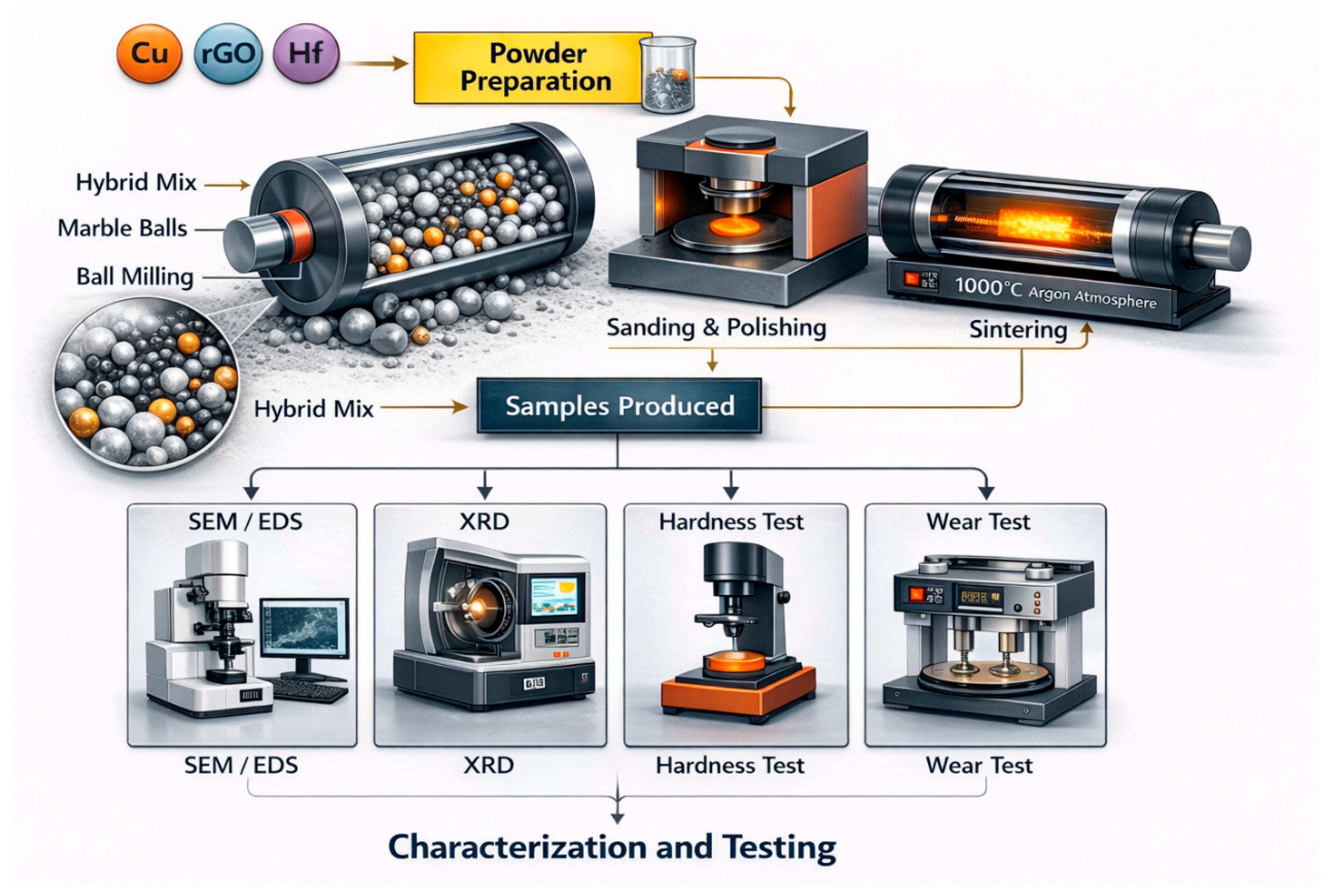
The weight fractions of Hf and rGO are designed to be in the range of 1–5% and 1–2%, respectively, and both phases are simultaneously dispersed in the Cu matrix in the hybrid reinforced composites. The general production process and production and analysis flow chart are shown schematically in
Figure 1 and
Figure 2.
The selection of reinforcement contents was guided by (i) dispersion/processing limits and (ii) an effect-size requirement for the mass-loss metric in the planned wear tests. Hf was examined at 1, 3, and 5 wt.% to span a practical strengthening window while limiting excessive heterogeneity, whereas rGO was restricted to 1 and 2 wt.% to avoid agglomeration-driven porosity and microstructural discontinuities in sintered Cu. To ensure that the compositional steps yield tribological differences that are distinguishable from measurement uncertainty, an effect-size criterion was adopted: , where Δm = |m̄_Cu − m̄_comp| is the difference between the mean mass loss of pristine Cu and the mean mass loss of the reinforced composite under identical test conditions, and is the standard deviation associated with the mass-loss measurements (n = 3). Because the observed mass-loss differences in this work are on the order of 10−2–10−1 g, they are also far above the balance readability (1 × 10⁻⁴ g), ensuring that the selected reinforcement steps produce a clearly resolvable contrast in wear performance.
The Cu, Hf and rGO powders were weighed with analytical precision according to the compositions given in
Table 1. Achieving a homogeneous distribution of the powders was considered critical, particularly due to the strong agglomeration tendency of nanoscale rGO sheets. Mixing was therefore carried out using an alumina-coated planetary ball mill at a rotational speed of 150 rpm for 8 h. An alcohol-based liquid medium was employed to reduce the effective surface energy of the powders and to suppress rGO agglomeration. Throughout the mixing process, a ball-to-powder weight ratio of 10:1 was maintained, and a low-energy milling regime was applied to preserve the layered structure of rGO.
Considering the high melting temperature of Hf (~2233 °C) and its tendency to interact with the Cu matrix via diffusion, periodic interruptions were introduced every 30 min during milling to prevent excessive temperature rise. After mixing, the flowability of the composite powders was evaluated in accordance with ASTM B213, and all powder mixtures were confirmed to exhibit suitable flow characteristics for subsequent compaction [
21,
22,
23].
The homogenized powders were compacted by uniaxial cold pressing in accordance with ASTM B925 [
21,
22,
23]. Pressing was performed using a stainless steel die with a diameter of 10 mm under pressures in the range of 500–600 MPa. Prior to powder loading, the die walls were coated with a thin Zn-stearate layer to reduce friction and minimize the risk of lamination defects during compaction.
The resulting green compacts were inspected for porosity and geometric integrity, and no cracking, surface delamination, or layering was observed. Green densities were determined using the Archimedes principle in accordance with ASTM B962 [
21,
22,
23].
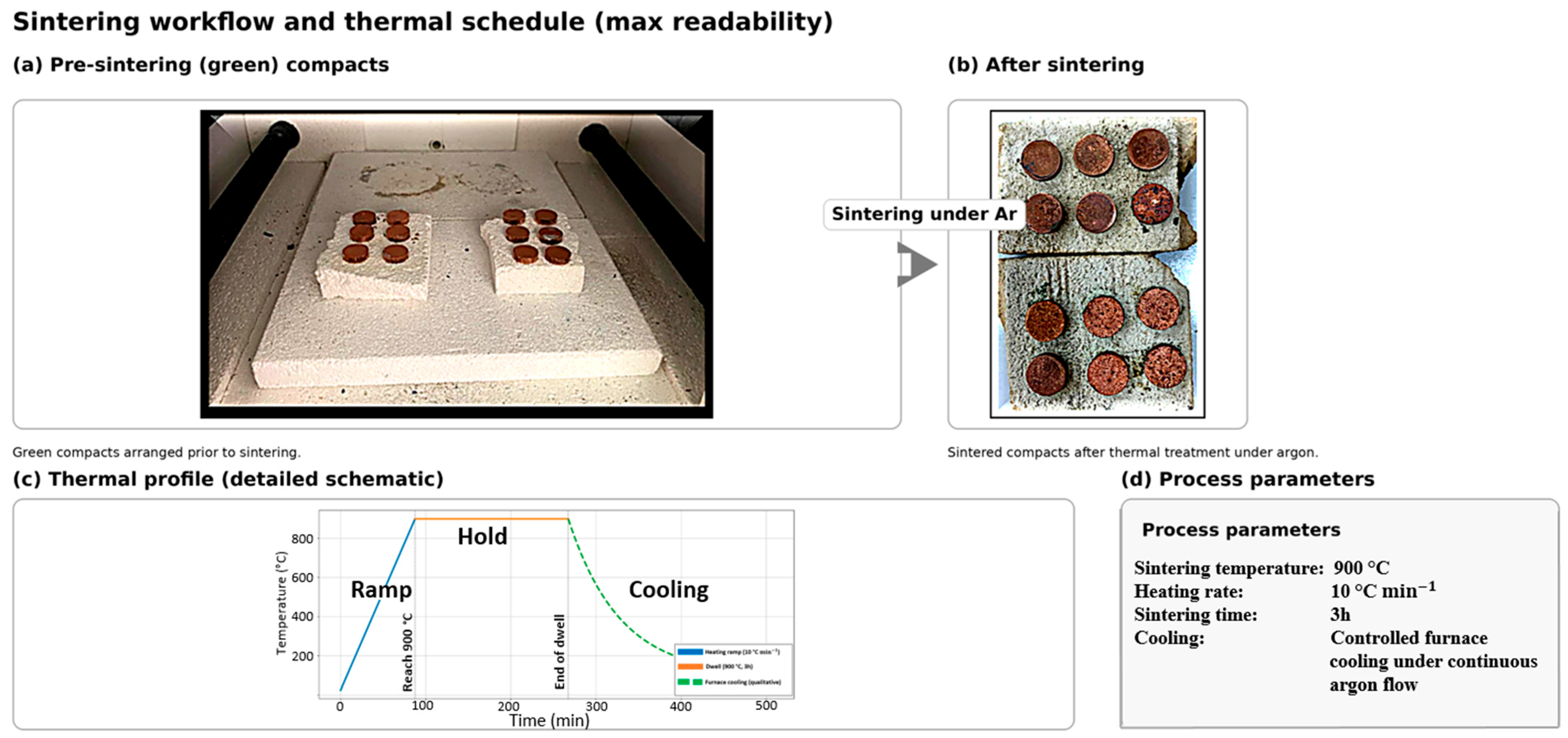
The compacted samples were subsequently sintered in a continuous tube furnace under a flowing argon atmosphere. The argon environment was selected to prevent oxidation of both Cu and Hf and to protect the carbon-based reinforcement. The sintering parameters were selected based on values recommended in the literature for Cu-based composites and are summarized in
Figure 2. For rGO-containing samples, the oxygen concentration was continuously maintained below 10 ppm to avoid oxidation or degradation of the carbon layers.
During sintering, diffusion of Hf within the Cu matrix, segregation at grain boundaries, and the formation of microstructurally hard phases are expected phenomena. After sintering, all samples were macroscopically examined in terms of dimensional stability, surface integrity, and color uniformity, confirming that structural integrity was preserved throughout all processing steps.
2.2. Characterization of the Samples
2.2.1. Microstructural Characterization: SEM/EDS and XRD
Following the sintering process, the specimens were mounted in Bakelite and prepared using conventional metallographic procedures, including sequential grinding with SiC papers and diamond polishing. The polished surfaces were cleaned with alcohol and air-dried prior to characterization. Microstructural examination was performed using a Zeiss EVO MA10 scanning electron microscope (SEM) (Zeiss, Oberkochen, Germany) coupled with energy-dispersive X-ray spectroscopy (EDS) to assess the overall microstructural uniformity and identify features relevant to the hybrid reinforcement concept, such as the Cu matrix morphology, rGO dispersion state, spatial distribution of Hf, and residual porosity levels. Representative regions were imaged at low magnification to evaluate homogeneity and at higher magnification to inspect local interfacial features and potential clustering within reinforcement-containing areas.
EDS was utilized for elemental mapping, as well as point and area analyses, to verify Hf distribution and locate carbon-rich regions associated with rGO within the Cu matrix. Specifically, EDS mapping was employed to screen for locally enriched regions indicative of segregation or reaction-related products and to evaluate the dispersion quality of the hybrid reinforcements at the microstructural scale [
22,
23]. Phase constitution and post-sintering phase stability were investigated via X-ray diffraction (XRD) using a PANalytical Empyrean diffractometer (Malvern Panalytical, Almelo, The Netherlands) to identify the crystalline phases present and to detect potential oxidation or Hf- and carbon-related reaction products. The XRD patterns were recorded over a 2θ scanning range of 10–90° with a continuous scanning speed of 5°/min. The XRD results were interpreted in conjunction with SEM/EDS observations to establish robust processing–microstructure–property correlations.
2.2.2. Hardness and Tribological Characterization
Vickers hardness measurements were carried out using a Vickers hardness tester (Onalkon, Bursa, Turkey) to quantify the indentation resistance of the sintered composites. All measurements were performed under a load of 0.3 kgf and the hardness values are therefore reported as HV0.30. For each specimen, at least five indentations were placed at different locations, and the reported value represents the arithmetic mean ± standard deviation. The hardness results were subsequently used as a mechanical indicator to support the interpretation of wear performance.
Tribological behavior was evaluated under dry sliding conditions using an ELKİMAK pin-on-disc tribometer (ELKİMAK, Elaziğ, Turkey) in accordance with ASTM G99. Tests were performed in a ball-on-disc configuration using a 316L stainless-steel counterbody with a diameter of 5 mm. All friction and wear data reported in this study were obtained under a single, fixed condition in order to ensure direct comparability among the compositions: normal load 10 N, sliding speed 50 mm/s (0.05 m/s), and total sliding distance 1000 m. COF was continuously recorded throughout the test as a function of sliding distance/time, enabling assessment of frictional stability and the evolution of the sliding interface.
To quantify the contact severity in terms of pressure and contact area, the initial contact conditions were estimated using Hertzian elastic contact mechanics for a sphere-on-flat geometry. The Hertz contact radius a is given by [
24]: Key test conditions and the corresponding Hertzian contact estimates are summarized in
Table 2.
where F is the normal load, R is the ball radius (2.5 mm), and E* is the reduced modulus.
Using representative elastic properties for 316L stainless steel () and Cu-based composites (), the reduced modulus is . For , the calculated Hertz contact radius is , yielding an initial contact area .
Accordingly, the mean contact pressure is p_mean = F/A ≈ 0.83 GPa, and the maximum Hertz pressure is
. These values describe the initial elastic contact state; during the run-in stage and wear-track development, the effective contact area can evolve and the apparent average pressure may decrease as the track widens [
24].
Wear was quantified by mass loss. Before and after testing, specimens were cleaned to remove loosely adhered debris, and mass changes were measured using an analytical balance with a readability of . After the tests, the wear tracks were examined to support mechanism-based interpretation of the tribological response. Surface topography was evaluated using the roughness parameters and , and wear-track morphology was assessed to identify the dominant wear features and mechanisms for each material system. These post-wear analyses were used to establish consistent correlations among microstructure, hardness, friction behavior, and wear resistance.
2.2.3. Determination of Wear Rate Based on Mass Loss
Dry sliding wear tests were conducted using a pin-on-disc tribometer to quantify the wear resistance and frictional response of the Cu-based composites under controlled contact conditions. During the experimental procedure, each specimen was loaded against a rotating counter face under a constant normal load of 10 N at a sliding speed of 50 mm/s. The coefficient of friction (COF) was continuously recorded throughout the total sliding distance of 1000 m.
Wear was quantified by mass loss using an analytical balance with a precision of 10
−4 g, determined by the mass difference before and after the sliding process. To ensure measurement accuracy, all specimens were ultrasonically cleaned in an alcohol-based solution to remove loosely adhered debris prior to weighing. The specific wear rate
was calculated by normalizing the volumetric loss derived from the mass loss and measured density against the applied normal load and the total sliding distance:
where V is the volume loss (mm
3), F is the applied normal load (N), and S is the total sliding distance (m). Accordingly, k is reported in units of mm
3/(N·m).
Following the tribological tests, the worn surfaces were characterized via scanning electron microscopy (SEM) to investigate surface damage characteristics, such as the extent of plastic deformation and the formation of rGO-derived tribofilms.
2.2.4. Electrical Conductivity
In order to reliably evaluate the effect of Hf and rGO reinforcements on the electrical transport behavior of the Cu matrix, the electrical conductivity of the composite samples was characterized using the four-point probe method. This technique was selected because it effectively minimizes common sources of measurement error encountered in metal matrix composites, such as contact resistance at the probe sample interface, variations in probe contact force, and the influence of surface oxide layers. The operating principle of the four-point probe method is based on supplying an electrical current through the outer probes while measuring the voltage drop exclusively through the inner probes; as a result, parasitic resistances associated with current injection are excluded from the measurement.
For clearer comparison with industry practice, the measured conductivity values were additionally converted to the International Annealed Copper Standard (IACS). The conversion was performed using , where 5.8 × 10⁷ S/m at 20 °C corresponds to 100% IACS.
Prior to electrical measurements, all samples were lightly ground to achieve a flat and uniform surface in order to eliminate the influence of surface roughness on conductivity values. Surface cleaning was performed by ultrasonic treatment in an acetone–alcohol solution to remove adsorbed contaminants, oils, and residual oxides. The samples were then positioned under a standardized probe head with a fixed probe spacing (typically 1 mm), and the contact force was kept constant for all measurements. During testing, a low but stable direct current (I) was supplied by a current source, while the voltage difference (V) between the inner probes was recorded using a high-resolution digital electrometer.
The measured current–voltage data were used to analytically calculate the sheet resistance (R
s). According to the four-point probe method, the sheet resistance is given by [
25]:
The volumetric electrical conductivity (σ) was subsequently determined by relating the sheet resistance to the sample thickness (t), as expressed by [
26]:
This approach allows the intrinsic electrical transport behavior of each sample to be determined independently of surface and interfacial measurement artifacts. Owing to its high electron mobility and partially restored sp
2 carbon network, rGO is expected to enhance electrical conductivity by introducing additional conductive pathways within the Cu matrix. In contrast, the incorporation of Hf a refractory metal may increase electron scattering within the matrix, potentially leading to a reduction in electrical conductivity. Consequently, in hybrid-reinforced systems (Hf + rGO), the balance between these competing effects becomes a critical factor governing the overall electrical performance of the composite [
27,
28].
To assess the influence of sintering quality, matrix–reinforcement interfacial integrity, and residual porosity on electrical transport behavior, at least five repeated measurements were performed for each sample, and the reported conductivity values represent the average of these measurements.
2.2.5. AFM and LFM Analysis
Atomic force microscopy (AFM) was utilized to characterize the nanoscale surface topography of the Cu–Hf and Cu–Hf–rGO composites, with a specific focus on roughness evolution and surface features associated with the hybrid reinforcement. The analyses were performed using an ezAFM system (NanoMagnetics Instruments Ltd., Oxford, UK). Dynamic mode imaging was carried out using a PPP-NCLR cantilever (NANOSENSORS™, NanoWorld AG, Neuchâtel, Switzerland) to obtain high-resolution surface height profiles. Measurements were conducted on mechanically polished and post-wear surfaces over a scan area of 10 × 10 µm2. From the resulting height data, the arithmetic mean roughness (Ra), root mean square roughness (Rq), and maximum peak-to-valley height (Rt) were calculated.
To correlate nanoscale surface modifications with tribological performance, additional AFM scans were acquired from representative regions of the wear tracks following dry sliding tests. These post-wear measurements were used to evaluate the nanoscale morphology of the worn surfaces and to assess the continuity and heterogeneity of carbon-rich tribofilm features associated with rGO, including localized film disruption and surface damage patterns. Lateral force microscopy (LFM) was employed to probe spatial variations in local shear response on the same surfaces; LFM maps were acquired using a PPP-EFM cantilever with a lower spring constant (NANOSENSORS™, NanoWorld AG, Neuchâtel, Switzerland) to qualitatively compare lateral-force contrast and identify low-shear domains consistent with rGO-related sliding features.
While no specific ASTM standard exists for AFM, the procedures followed in this study align with the best practices recommended in ISO 18125 and ISO/TS 21362 [
29,
30,
31], which are established references for nanoscale mechanical surface analysis. Furthermore, AFM phase-contrast imaging provided complementary qualitative data regarding local variations in the mechanical response across the surface. The combined AFM and LFM results were interpreted in conjunction with SEM/EDS observations and macroscopic wear data to support comprehensive processing–microstructure–property correlations [
29,
30,
31].
3. Results and Discussion
3.1. Characterization
In this study, SEM and EDX (point analysis and elemental mapping) analyses were conducted to discuss the microstructural characteristics of the fabricated Cu-Hf and Cu–Hf–rGO hybrid composites, the distribution behavior of the reinforcement phases within the matrix, possible interfacial interactions, and the reflection of sintering-induced microstructural heterogeneities on macroscopic properties. The images presented in
Figure 3 demonstrate that the continuity of the matrix and the compact structure after sintering are preserved in the pure Cu sample, whereas the addition of reinforcement phases leads to the emergence of pronounced contrast differences, second-phase-like regions, and lamellar morphologies indicative of carbon layers within the matrix. While the relatively homogeneous tonal distribution observed in pure Cu indicates limited compositional variation and a more consistent microstructural character, the increased contrast diversity in Hf and rGO-reinforced Cu samples suggests enhanced phase distribution effects and/or topographical influences, as well as a possible increase in local density (porosity) variations. Therefore, SEM observations were interpreted in conjunction with and consistently supported by the EDX mapping results.
SEM images of rGO-containing composites reveal that graphene-derived sheets extend throughout the Cu matrix, exhibiting locally wavy (“wrinkled”) and multilayered lamellar morphologies. This structure is significant from two main perspectives: (i) the wrinkled geometry of rGO can enhance mechanical interlocking with the Cu matrix, thereby supporting load transfer at the interface; and (ii) the presence of a layered carbon phase can facilitate the formation of a transfer layer/tribofilm on the surface under sliding contact conditions due to its low shear resistance, contributing to a reduction in the friction coefficient and an improvement in wear resistance. However, it is well known that rGO tends to agglomerate owing to its high specific surface area and surface energy; thus, a critical issue for maintaining microstructural continuity is whether rGO forms clustered “island-like” regions within the matrix. In the hybrid samples shown in
Figure 3, rGO does not exhibit intense accumulation in a single region but instead forms lamellar regions distributed throughout the matrix, indicating that the selected mixing–compaction–sintering parameters were able to control rGO dispersion to a certain extent. The literature similarly reports that graphene-derived reinforcements enhance mechanical interlocking within Cu matrices through wrinkled lamellar morphologies, thereby strengthening interfacial bonding [
32,
33].
SEM observations of Hf-reinforced samples indicate the presence of fine, dispersed contrast regions within the Cu matrix, exhibiting characteristics of a “second phase.” Considering the high affinity of Hf for oxygen, it is plausible that even trace levels of oxygen-despite controlled sintering atmospheres may react with Hf to promote the formation of Hf–O-based products (e.g., HfO
2-like phases). However, since direct crystallographic phase identification cannot be achieved solely by SEM/EDX, these regions are interpreted here as “indicators of Hf-related reaction products/precipitates.” The microstructural effects of such fine and dispersed phases can be discussed through three main mechanisms. First, their localization at grain boundaries or intergranular regions may induce a pinning (Zener-type) effect that restricts grain growth and enhances grain boundary stability after sintering. Second, they may contribute to localized matrix hardening, limiting plastic deformation and thereby improving the load-bearing capacity of the surface, particularly under wear conditions. Third, the oxygen-scavenging tendency of Hf may indirectly protect rGO sheets against oxidative degradation or stabilize the interfacial chemistry. The contribution of Hf additions to hardness enhancement and oxide film stabilization has also been reported in the literature [
34,
35].
EDX elemental mapping results corroborate the compositional counterparts of the morphological regions observed in SEM. In the hybrid samples, the carbon (C) signal does not behave merely as superficial contamination but exhibits continuity across specific regions throughout the microstructure, supporting the effective integration of rGO into the matrix. The continuity observed in the C maps is particularly important as it indicates that rGO is located not only on the surface but also within the interior of the sintered structure, suggesting that rGO can modify composite behavior through volumetric microstructural contributions rather than solely surface effects. The oxygen (O) signal, although of low intensity, remains detectable, indicating that rGO despite being in a reduced form is not entirely oxygen-free and/or that local oxygen enrichment associated with the oxidation tendency of Hf may be present. Given that the oxygen signal in EDX can be influenced by surface oxides, specimen preparation residues, and adsorbed species, these findings are interpreted not as definitive phase identification but rather as supporting data indicating the potential role of oxygen in the microstructure. This approach is consistent with literature reports in which oxygen signals are frequently observed in graphene oxide–based Cu composites [
36,
37].
The EDX signals corresponding to Hf become more pronounced in certain regions particularly at grain boundaries and in localized areas in contact with rGO suggesting that Hf may exhibit preferential localization behavior at the microscale rather than forming a homogeneous solid solution. Such preferential localization can be associated with diffusion kinetics, interfacial energies, and local reactions occurring during sintering. The more intense detection of Hf in regions where it contacts rGO sheets strengthens the possibility that Hf may provide an “interfacial/bridging” stabilization effect at the Cu–rGO interface. The literature reports that the weak bonding energy at the Cu–graphene interface constitutes a critical limitation, and that interfacial engineering using elements such as Ti, Cr and Ni can enhance graphene–Cu bonding, leading to improvements in both electrical conductivity and mechanical strength [
20,
38]. In this context, the interfacial behavior of Hf may be considered one of the fundamental components of potential synergy in the hybrid-reinforced system.
When evaluating the possible macroscopic implications of the microstructural findings, the lamellar morphology of rGO and its relatively continuous distribution within the matrix provide a favorable basis for reducing the friction coefficient and ensuring the continuity of tribofilm formation. The fine and dispersed second-phase/reaction product indicators associated with Hf, on the other hand, offer the potential to enhance wear resistance through matrix hardening and grain boundary stabilization, while also contributing to the durability of rGO-derived tribofilms/transfer layers. Nevertheless, with increasing reinforcement content, the possibility of more pronounced local heterogeneities in the microstructure such as rGO clustering or Hf enrichment should not be overlooked. Such heterogeneities may increase scatter in hardness distribution and limit electrical conductivity by acting as electron scattering centers. Accordingly, the triad of “dispersion quality–interfacial stability–possible oxide/precipitate formation” emerges as a set of key microstructural parameters jointly governing the hardness, wear, and electrical conductivity performance of the hybrid composites.
In conclusion, SEM and EDX analyses demonstrate that rGO is integrated into the Cu matrix while preserving its layered character, and that Hf addition contributes to microstructural stabilization and potential interfacial strengthening through second-phase/reaction product indicators within the matrix. These findings indicate that the hybrid reinforcement strategy offers synergistic performance potential not through a single mechanism, but through the simultaneous action of multiple mechanisms, including load transfer, tribofilm formation, grain boundary stabilization, and interfacial engineering. The microstructural evidence presented in
Figure 3 thus provides a direct basis for interpreting the hardness, wear rate, and electrical conductivity results reported in the subsequent sections of this study.
3.2. XRD Results
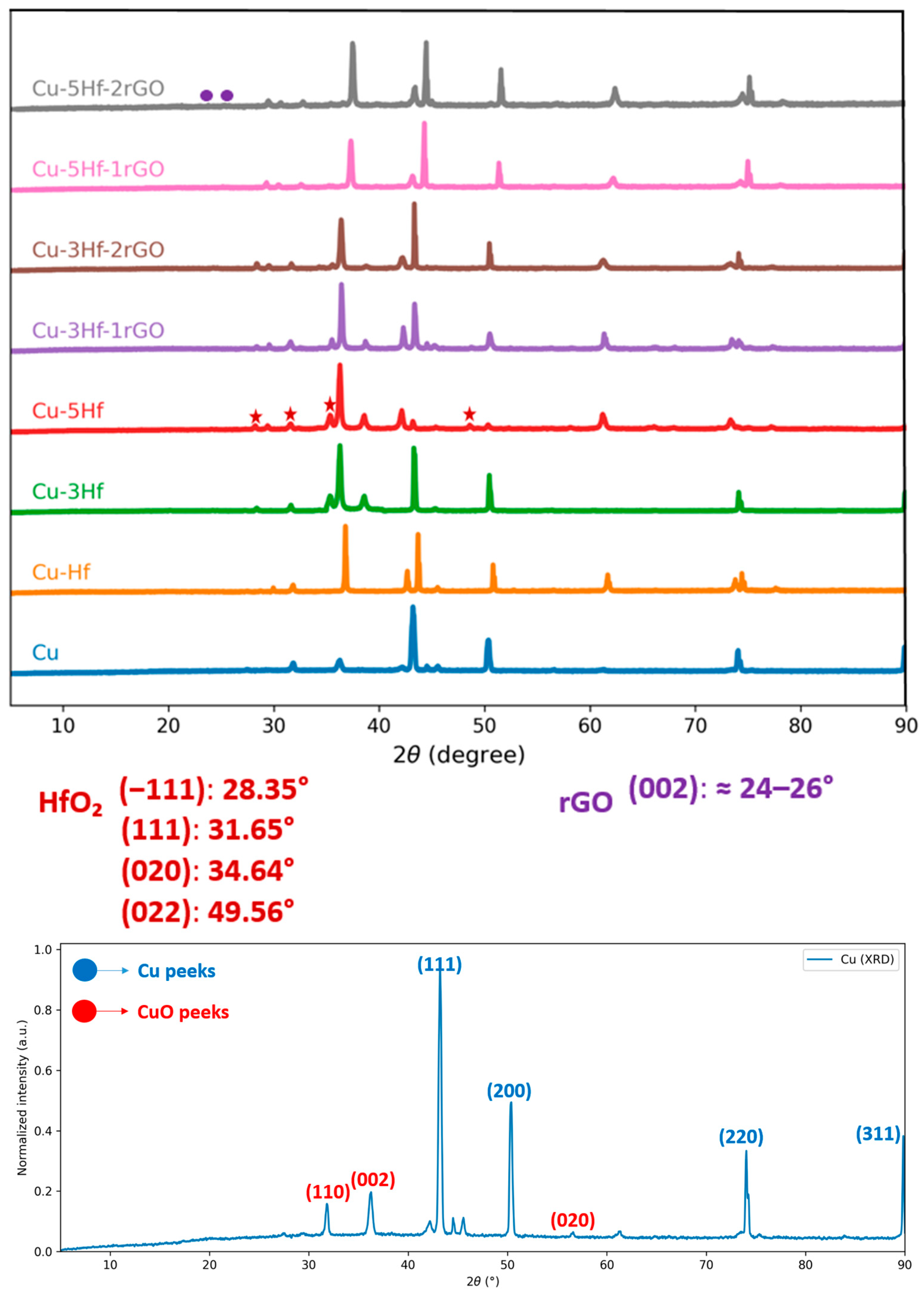
XRD analyses were performed to determine the post-sintering phase constitution, to verify the crystallographic integrity of the Cu matrix, and to assess whether the introduction of Hf and rGO promotes the formation of detectable reaction products in the Cu–Hf–rGO hybrid composites. Because sintering involves simultaneous diffusion, oxide evolution, and interfacial reconfiguration, XRD provides a crucial crystallographic “checkpoint” that complements SEM/EDS observations. In particular, XRD enables evaluation of three central issues that govern the functional properties of Cu-based composites: retention of the FCC Cu matrix, emergence of secondary phases (especially oxides or intermetallics), and changes in diffraction peak profiles that reflect microstrain and crystallite refinement. The resulting diffractograms are compiled in
Figure 4.
Across all compositions, the diffraction patterns are dominated by reflections corresponding to face-centered cubic (FCC) Cu. The pristine Cu sample shows strong and sharp peaks indexed to the (111), (200), and (220) planes, indicating that the Cu lattice remains structurally intact after sintering and that the processing conditions did not induce major phase transformations or extensive oxidation that would measurably degrade crystallinity [
32,
33]. The high intensity and narrow appearance of the Cu peaks are consistent with a well-developed crystalline matrix in which the dominant phase fraction is Cu and where no additional phases appear in sufficient volume fraction to significantly disrupt the diffractogram. This observation is important because Cu-based powder compacts are prone to surface oxidation at the powder stage and to oxide persistence at interparticle contacts; preservation of a clean, crystalline Cu signature implies that the protective atmosphere and thermal schedule were adequate to prevent extensive bulk oxidation and catastrophic phase change [
32,
33].
In Hf-containing samples, the positions of the main Cu reflections do not exhibit an obvious systematic peak shift relative to pristine Cu. The absence of an evident peak shift suggests that Hf does not enter the Cu lattice as a substantial solid solution under the present sintering conditions, at least not to a degree that produces a measurable lattice parameter change by conventional XRD. This interpretation is consistent with the limited solubility of Hf in Cu and the thermodynamic tendency of refractory elements to remain as separate phases or to segregate locally rather than forming high-solubility substitutional solutions in Cu under typical powder metallurgy thermal profiles [
34,
35]. However, even in the absence of a resolvable peak shift, changes in peak intensity and peak breadth provide meaningful information about microstructural evolution.
Specifically, the Hf-containing diffractograms show a relative reduction in the intensity of Cu peaks and a tendency toward slight peak broadening. Peak broadening, typically quantified via the full width at half maximum (FWHM), can arise from a reduction in coherent diffraction domain size (crystallite refinement) and/or an increase in lattice microstrain. In sintered composites, microstrain may develop due to thermal expansion mismatch between phases, local composition gradients near interfaces, and the accumulation of residual stresses around reinforcement-rich regions. Given that Hf is a refractory element with markedly different thermophysical properties from Cu, local mismatch stresses and interface-driven strain fields are plausible, particularly if Hf is present as fine microdomains or forms nanoscale reaction products at grain boundaries or interparticle necks. Such microstrain effects are not merely crystallographic curiosities; they are closely linked to strengthening, as microstrain and defect density increase the resistance to dislocation motion, thereby contributing to higher hardness and improved wear resistance. Similar relationships between peak broadening, microstrain, and mechanical strengthening have been reported in the literature for Cu-based systems and related composite/strengthened microstructures [
34,
35]. Therefore, the broadening of Cu peaks in Hf-containing samples is consistent with the microstructural stabilization and hardening trends observed in hardness and tribological results.
Another key feature in the Hf-containing patterns is the emergence of weak, low-intensity extra reflections. These weak peaks suggest that minor secondary phases or reaction products may form during sintering. Considering the strong oxygen affinity of Hf, the most plausible candidates for such secondary phases are Hf–O related products (e.g., HfO
2-like phases), which can form even when oxygen is present at trace levels in the powder, furnace atmosphere, or surface adsorbates. The low intensity of these reflections and their partial overlap with strong Cu peaks indicate that the corresponding phase fraction is limited and possibly close to the detection threshold of laboratory XRD. Consequently, these reflections should be interpreted as indirect evidence of minor Hf-related secondary phase formation rather than definitive proof of a specific oxide. In multi-phase metal-matrix composites, this interpretive caution is standard practice, and phase attribution is most reliable when XRD is evaluated alongside SEM/EDS compositional mapping and localized analyses [
36,
37]. In this study, the SEM/EDS evidence of Hf-rich regions and the presence of oxygen signals in specific microstructural domains provide supportive context for the oxide-related interpretation, while recognizing that EDS cannot by itself confirm crystallographic identity [
36,
37].
For rGO-reinforced and hybrid (Hf + rGO) samples, the characteristic (002) reflection associated with graphitic carbon is not clearly resolved as a sharp and distinct peak. This absence is not unexpected and can be explained by several mutually reinforcing factors. The rGO content is relatively low (≤2.0 wt.%), and XRD sensitivity to low-volume-fraction phases is limited when the matrix peaks are intense. In addition, rGO is structurally distinct from highly crystalline graphite; it typically contains defects, residual oxygen functionality, and stacking disorder that broaden and weaken diffraction features, often yielding an amorphous-like contribution rather than a strong (002) graphite peak. Moreover, when rGO is well dispersed within a metallic matrix, the long-range stacking order required for a strong (002) reflection can be limited, especially if the sheets are wrinkled, folded, or fragmented during mixing and consolidation. Finally, any weak carbon-related diffraction contribution may be masked by the high-intensity FCC Cu peaks in the same angular range. These explanations are consistent with literature reports on GO/rGO-reinforced Cu composites, where graphene-related peaks are frequently absent or poorly resolved in XRD patterns despite clear microstructural evidence from SEM/EDS, Raman or AFM that graphene-derived phases are present [
36,
37,
38]. Accordingly, in the present system, rGO presence is more reliably verified through microstructural and surface-sensitive techniques rather than XRD alone [
36,
37,
38].
A particularly informative observation is that the hybrid-reinforced samples exhibit more pronounced changes in Cu peak profiles than samples containing only Hf or only rGO. The combined presence of Hf and rGO increases the interfacial complexity of the system and can introduce a more heterogeneous residual stress state in the Cu matrix. Grain-boundary pinning effects associated with Hf-rich microdomains and local strain fields introduced by lamellar carbon phases can act simultaneously, producing a broader distribution of microstrain and local crystallite refinement. This interpretation is consistent with the observed relative decrease in peak intensity and the enhanced tendency toward peak broadening in hybrid samples, suggesting that hybrid reinforcement modifies the Cu matrix through multiple interacting microstructural mechanisms rather than a single reinforcement pathway [
35,
36,
37]. Importantly, this microstrain/interfacial-stress interpretation aligns with the hybrid system’s enhanced hardness and improved wear behavior, where matrix stabilization and a film-assisted sliding regime jointly contribute to performance.
Equally important is what the XRD patterns do not show: there is no clear evidence for the formation of dominant Cu–Hf intermetallic compounds in the sintered products. If large-volume-fraction intermetallics were present, additional strong reflections would be expected and the diffractograms would deviate substantially from the Cu-dominated signature. The apparent absence of such intermetallic peaks implies that the selected sintering parameters and protective atmosphere limited extensive Cu–Hf intermetallic formation. This outcome is particularly relevant for electrical functionality, because the formation of substantial intermetallic fractions in Cu-based systems typically introduces strong electron scattering and/or low-conductivity phases that can severely degrade electrical conductivity. The preservation of a Cu-dominant phase constitution therefore supports the broader materials design objective of maintaining functional conductivity while introducing reinforcement-driven mechanical and tribological improvements [
20,
38].
Overall, the XRD analyses confirm that the primary FCC Cu matrix remains the dominant crystalline phase in the Cu–Hf–rGO composites after sintering. Hf addition introduces subtle but meaningful modifications to Cu peak profiles, manifested as relative intensity changes and mild peak broadening consistent with microstrain development and potential crystallite refinement, and it may produce minor secondary phase signatures plausibly associated with Hf–O related products. The rGO phase does not yield a strong, distinct diffraction peak, which is consistent with its low content, structural disorder, and masking by intense Cu reflections, as widely reported in GO/rGO-reinforced Cu systems [
36,
37,
38]. When interpreted together with SEM/EDS and AFM results, these findings indicate that hybrid reinforcement stabilizes and modifies the microstructure without compromising the crystallographic integrity of the Cu matrix. This crystallographic stability provides a structural foundation for the observed improvements in hardness, wear resistance, friction stability, and the composition-dependent electrical conductivity trends discussed in subsequent sections [
32,
33,
34,
35,
36,
37,
38].
3.3. Electrical Conductivity Results of Hybrid Composites
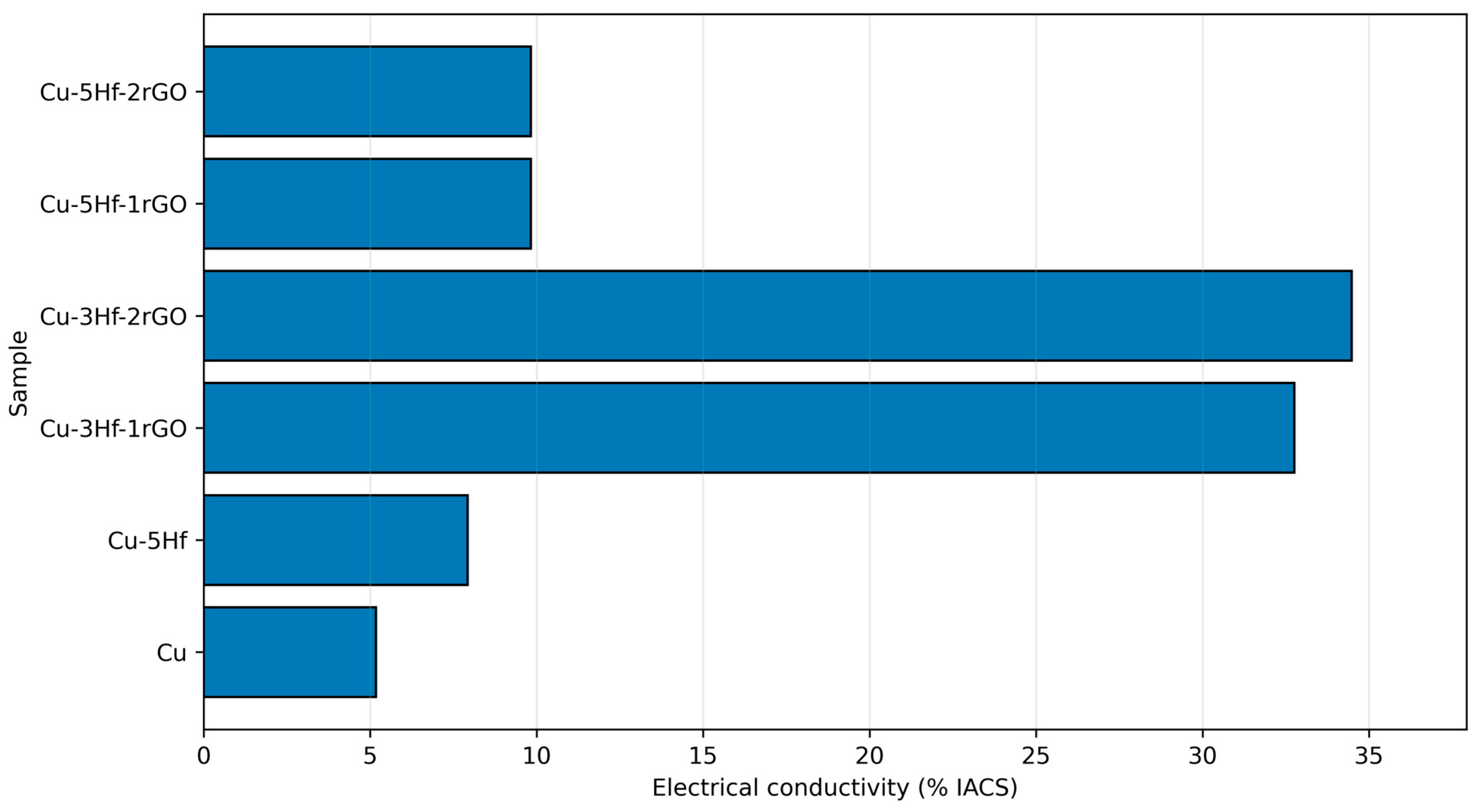
The electrical conductivity of the sintered pristine Cu sample is approximately 3.0 × 10
6 S/m (~5.2% IACS), as shown in
Figure 5. Although this value is substantially lower than the intrinsic conductivity of fully dense bulk Cu, such a reduction is expected in sintered systems. Incomplete densification leads to pores that interrupt current paths, and oxide remnants at particle boundaries increase interfacial resistance. Furthermore, the high density of grain boundaries and interparticle interfaces in sintered microstructures increases electron scattering. Similar conductivity suppression in powder-metallurgy-processed Cu has been widely reported and is generally attributed to microstructural discontinuities rather than fundamental changes in the Cu lattice itself [
39,
40].
Upon the addition of Hf at 5.0 wt.% (Cu–5Hf), conductivity increases to approximately 4.6 × 10
6 S/m (~7.9% IACS). At first sight, this may appear counterintuitive, because refractory-metal additions and solute/precipitate effects typically increase electron scattering and reduce conductivity in dense alloys. However, in sintered Cu-based composites the dominant controlling parameter is frequently the degree of electrical connectivity across interparticle necks rather than classical solid-solution scattering alone. Hafnium has a strong oxygen affinity, and even trace oxygen in the powder/sintering environment can lead to oxide formation at particle boundaries. In this context, Hf may function as an oxygen scavenger during sintering, reducing the thickness or continuity of oxide films at Cu–Cu contacts and facilitating cleaner metallic neck growth. Improved neck continuity reduces contact resistance and increases the effective conducting cross-section, which can outweigh the additional scattering introduced by Hf-related interfaces at this composition level. Comparable behavior has been reported in Cu systems containing oxygen-active elements, where conductivity improvements were attributed to enhanced sintering efficiency and better interparticle electrical continuity [
39,
40,
41,
42].
Introducing rGO into the 5.0 wt.% Hf matrix further increases conductivity to approximately 5.7 × 10
6 S/m (~9.8% IACS) for both Cu–5Hf–1rGO and Cu–5Hf–2rGO. This improvement indicates that rGO can contribute positively to charge transport when its dispersion is sufficiently homogeneous and when it acts as a conductive bridge across microstructural discontinuities. Reduced graphene oxide contains a partially restored sp
2 carbon network, which can support high carrier mobility along the basal planes. When rGO sheets are distributed in a way that links adjacent Cu regions and assists percolative connectivity through the microstructure, a net conductivity enhancement can occur even in the presence of additional interfaces. In sintered compacts, where pores and imperfect interparticle contacts are common, such “bridging” behavior can be particularly effective [
39,
40,
41,
42].
However, the conductivity response at higher Hf content should be interpreted with caution because Hf introduces competing effects that become increasingly influential as its fraction increases. While Hf can improve interparticle connectivity through oxygen scavenging and neck-cleaning at moderate levels, increasing Hf content also increases the density of heterophase interfaces, potential Hf-rich/oxide-like regions, and localized compositional heterogeneity. These features can act as electron-scattering centers and, in some configurations, as barriers that locally disrupt metallic conduction pathways. Moreover, if Hf promotes the formation of stable Hf–O related products, even in small quantities, such phases are likely to be electrically insulating relative to Cu and can contribute to conductivity reduction by blocking current paths or increasing interfacial resistance. Therefore, at elevated Hf levels the balance can shift from “connectivity improvement” toward “interface-controlled scattering and blockage,” limiting the conductivity gain that rGO can provide in a high-Hf matrix. The observation that Cu–5Hf–1rGO and Cu–5Hf–2rGO converge at the same conductivity level suggests that additional rGO beyond 1 wt.% does not translate into further conductivity improvement in the 5 wt.% Hf matrix, likely because the transport becomes constrained by Hf-related interfaces/heterogeneities and not by the availability of additional conductive carbon pathways [
39,
40,
41,
42].
The most pronounced conductivity enhancement occurs in the Cu–3Hf–rGO hybrid composites. Specifically, conductivities of approximately 1.9 × 10
7 S/m (~32.8% IACS) for Cu–3Hf–1rGO and 2.0 × 10
7 S/m (~34.5% IACS) for Cu–3Hf–2rGO are obtained, representing a substantial improvement relative to both pristine Cu and the 5 wt.% Hf-based systems. This indicates the presence of an optimal hybrid reinforcement window in which the competing mechanisms governing electrical transport reach a favorable balance. At moderate Hf content, oxygen scavenging and grain-boundary stabilization can improve densification and interparticle neck quality without excessively increasing interface density or promoting extensive secondary phase formation. Under these conditions, rGO can more effectively operate as a conductive bridging phase and contribute to a more continuous percolative network across microstructural discontinuities [
39,
40,
41,
42].
The superiority of the Cu–3Hf–rGO compositions can be rationalized by considering the microstructure–transport interplay. SEM/EDX observations indicate relatively uniform rGO distribution without severe agglomeration and limited development of Hf-rich localized regions. In such a microstructural configuration, rGO is more likely to function as a conductive pathway enhancer rather than as an interfacial barrier. This interpretation is consistent with previous findings in Cu–graphene systems, where well-dispersed graphene-derived phases maintained or improved conductivity, whereas agglomerated or poorly distributed graphene tended to disrupt metallic continuity and degrade transport [
15,
43,
44]. The results therefore suggest that the conductivity response is not governed by a simple rule based on the intrinsic conductivity of the reinforcements, but by the degree to which reinforcements modify the connectivity of the Cu conduction network.
The effect of increasing Hf content can thus be summarized as a competition between beneficial and detrimental transport contributions. At moderate levels, Hf can enhance effective conductivity in sintered systems by improving neck quality, reducing oxide-related contact resistance, and stabilizing microstructural connectivity. As Hf content increases further, the rising interface density, the increased probability of Hf-rich or oxide-like regions, and stronger interfacial scattering begin to dominate, reducing the marginal benefit of rGO and limiting conductivity gains. This explains why Cu–5Hf-based hybrids exhibit lower conductivity than the Cu–3Hf-based hybrids, despite containing a nominally similar rGO fraction. In other words, excessive refractory-metal content can shift the system into an interface-limited transport regime, where scattering and local current-path disruption outweigh densification-related benefits.
Overall, the electrical conductivity results demonstrate that the transport behavior of Cu–Hf–rGO hybrid composites cannot be interpreted as a linear superposition of the individual effects of Hf and rGO. Instead, it emerges from a complex interplay among microstructural continuity, porosity, oxide chemistry, interface density and reinforcement dispersion quality [
15,
45,
46]. The Cu–3Hf–rGO compositions provide the most favorable balance between microstructural stabilization and electronic transport, making them promising candidates for applications that require improved tribo-mechanical performance while retaining relatively high electrical conductivity.
3.4. Hardness and Tribology
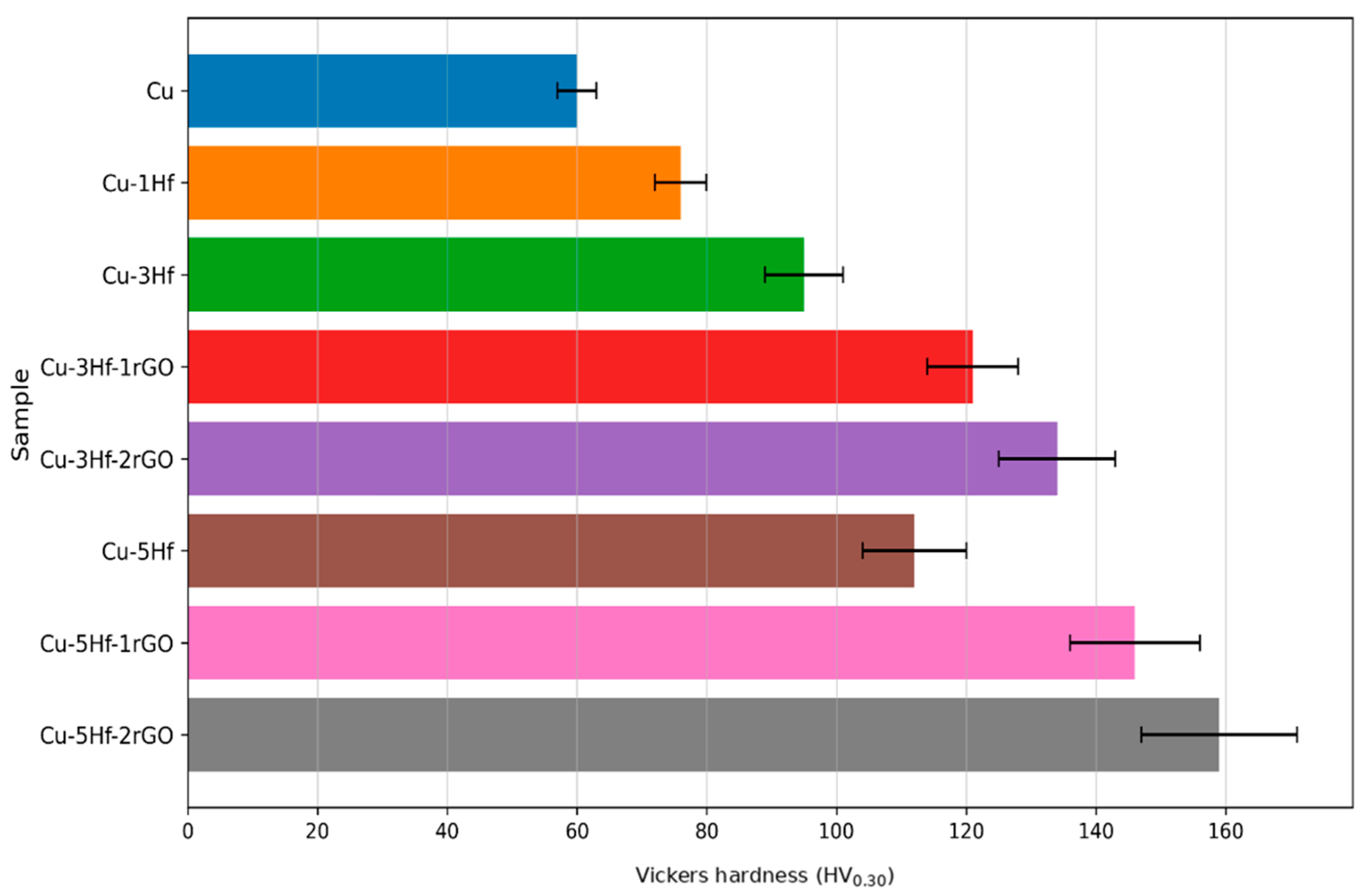
The Vickers hardness results obtained for the Cu–Hf and Cu–Hf–rGO composites (
Figure 6) demonstrate that both Hf addition and rGO reinforcement markedly enhance the resistance of the Cu matrix against localized plastic deformation, and that the combined (hybrid) reinforcement produces the highest strengthening response. The measured hardness of the pristine Cu compact is 60 ± 3 HV
0.30, which is consistent with the intrinsically low hardness of Cu and the further softening effect that can arise in powder-metallurgy compacts due to residual porosity, incomplete interparticle neck growth, and the presence of interfacial oxides that reduce effective load-bearing cross-section at the indentation scale. Even after sintering, Cu typically maintains high ductility and a relatively low critical stress for dislocation glide, which facilitates indentation-driven plasticity and therefore yields lower HV values than those observed in reinforced systems [
47,
48].
A systematic increase in hardness is observed with increasing Hf fraction, from 76 ± 4 HV0.30 (Cu–1Hf) to 95 ± 6 HV0.30 (Cu–3Hf) and 112 ± 8 HV0.30 (Cu–5Hf). This monotonic trend indicates that Hf contributes an effective strengthening contribution despite its limited solubility in Cu under typical processing routes. The hardness improvement is best interpreted as the combined outcome of microstructural strengthening mechanisms rather than a single solid-solution effect [
49]. From a micromechanical standpoint, Hf can impede dislocation motion by generating local lattice strain fields resulting from atomic size mismatch between Cu and Hf. These misfit strain fields increase the stress required for dislocations to bypass solute-rich regions or Hf-associated micro domains and thereby raise the indentation hardness. In addition, the high melting temperature and chemical stability of Hf support microstructural stabilization during sintering, particularly through restricting grain boundary mobility. If Hf exhibits preferential segregation to boundaries or forms fine Hf-rich/oxide-related dispersions at or near grain boundaries, a pinning effect may occur that suppresses grain growth. Such grain refinement contributes to hardness through the Hall–Petch effect, where smaller grains increase the barrier density against dislocation motion. These effects are fully consistent with the observed steady hardness increase across the Cu–Hf series and align with strengthening trends reported for Cu alloys and Cu-based composites containing oxygen-active or refractory elements [
49,
50,
51].
The introduction of rGO produces a further and more pronounced increase in hardness, confirming that graphene-derived reinforcement provides a distinct strengthening channel that complements the role of Hf. In the Cu–3Hf matrix, adding rGO increases hardness to 121 ± 7 HV
0.30 for Cu–3Hf–1rGO and to 134 ± 9 HV
0.30 for Cu–3Hf–2rGO. In the Cu–5Hf matrix, rGO addition raises hardness to 146 ± 10 HV
0.30 for Cu–5Hf–1rGO and to 159 ± 12 HV
0.30 for Cu–5Hf–2rGO, which represents the maximum value among all compositions. These increases cannot be attributed solely to the presence of a “hard phase” in a conventional sense; rGO functions as a high-modulus, two-dimensional reinforcement with an exceptionally high specific surface area, and therefore affects deformation through interfacial and geometrical effects that are particularly influential at the indentation length scale [
52,
53,
54].
Several concurrent mechanisms can account for the rGO-driven hardness increase. The most fundamental is load transfer, whereby a fraction of the applied indentation load is borne by stiff rGO regions when interfacial bonding and mechanical interlocking are sufficiently effective. The lamellar morphology of rGO promotes large interfacial contact area with the matrix, and even when chemical bonding is limited, strong interfacial friction and mechanical anchoring can provide effective stress transfer under local loading. In parallel, rGO sheets and rGO-rich regions act as strong obstacles to dislocation glide. Dislocations interacting with a nanoscale reinforcement are forced to bow and bypass it, which introduces an Orowan-type strengthening component. This mechanism becomes increasingly important as the reinforcement spacing decreases and as dispersion becomes more homogeneous. Moreover, rGO can promote grain refinement by providing heterogeneous nucleation sites and by restricting grain boundary mobility during sintering, leading to an additional Hall–Petch contribution. At the indentation scale, the combined effects of load transfer, dislocation blocking, and possible grain refinement manifest as a substantial increase in hardness [
51].
The most important observation from
Figure 6 is that the hybrid systems show a stronger hardness response than expected from a simple additive strengthening assumption. The increase from 112 ± 8 HV
0.30 in Cu–5Hf to 159 ± 12 HV
0.30 in Cu–5Hf–2rGO indicates that rGO reinforcement becomes more effective when introduced into an Hf-strengthened matrix. This synergy can be rationalized by considering the stability of the near-surface deformation zone. In a relatively soft Cu matrix, local indentation and tribological loading promote extensive plastic flow that can disrupt reinforcement continuity and reduce the effective contribution of nanoscale reinforcements. When the matrix is stiffened and stabilized by Hf, the depth and intensity of plastic deformation are reduced, which allows rGO sheets and rGO-derived micro domains to remain mechanically active and to participate more efficiently in load transfer and deformation restriction [
53,
54,
55]. Additionally, Hf has a strong affinity for oxygen and can modify local oxygen chemistry; this may indirectly influence the interfacial condition between Cu and rGO by reducing detrimental oxide-related discontinuities at interparticle contacts and potentially improving microstructural connectivity. While direct proof of such chemical effects requires dedicated interfacial spectroscopy, the observed mechanical synergy is consistent with a hybrid architecture in which Hf stabilizes the substrate and rGO enhances interfacial and nanoscale strengthening [
55].
The scatter in hardness values provides additional information on microstructural uniformity and reinforcement distribution. The relatively limited standard deviations for Cu and the low-to-moderate reinforcement levels suggest that the measurements are reproducible across different indent locations and that the microstructure is reasonably homogeneous at the scale probed by HV
0.30 indentation. A moderate increase in standard deviation for the highly reinforced hybrid samples is expected, because local variations in rGO dispersion, the presence of locally enriched Hf-related micro domains, and residual porosity gradients can cause indentation-to-indentation variability. This behavior is not indicative of poor reliability; rather, it reflects the intrinsic heterogeneity introduced when combining micron-scale powder metallurgy microstructures with nanoscale reinforcements. For a rigorous structure–property linkage, these hardness results should be interpreted together with the SEM/EDS evidence for reinforcement distribution and with porosity observations, since both factors strongly influence local indentation response [
55,
56].
From a tribological perspective, the hardness improvements provide a direct mechanistic basis for enhanced wear resistance. In dry sliding, lower hardness promotes a rapid increase in real contact area through plasticity, encourages junction growth and adhesive transfer, and accelerates the generation of wear debris that contributes to abrasive ploughing. Increasing hardness suppresses these processes by limiting subsurface plastic deformation and reducing the tendency for adhesive junction formation. Consequently, the progressively higher hardness values from Cu to Cu–Hf to Cu–Hf–rGO are expected to correlate with decreasing wear loss and improved friction stability, particularly when the hardening effect is coupled with the solid-lubrication capability of rGO. The highest hardness obtained for Cu–5Hf–2rGO (159 ± 12 HV
0.30) therefore suggests that this composition should exhibit the strongest resistance to deformation-driven wear mechanisms. This expectation is consistent with the subsequent tribological results, where the hybrid system demonstrates improved wear performance and a more stable sliding response [
55,
56,
57].
In summary, the hardness results confirm that Hf addition systematically strengthens the Cu matrix through deformation-restricting mechanisms associated with lattice strain fields and microstructural stabilization, while rGO provides an additional nanoscale reinforcement channel through load transfer, dislocation blocking, and potential grain refinement. The hybrid Cu–Hf–rGO compositions exhibit the highest hardness values, indicating synergistic strengthening in which matrix stabilization by Hf enhances the effectiveness of rGO as a functional reinforcement. These findings establish a robust mechanical foundation for interpreting the friction and wear trends discussed in the following section [
55,
56,
57].
3.5. Wear Tests
The tribological performance of the composites is strongly influenced by several factors, including reinforcement content, matrix–reinforcement interfacial bonding quality, sintering density, and applied load conditions. Consequently, the results of the wear tests provide critical insight into the expected performance of the composites under realistic operating conditions.
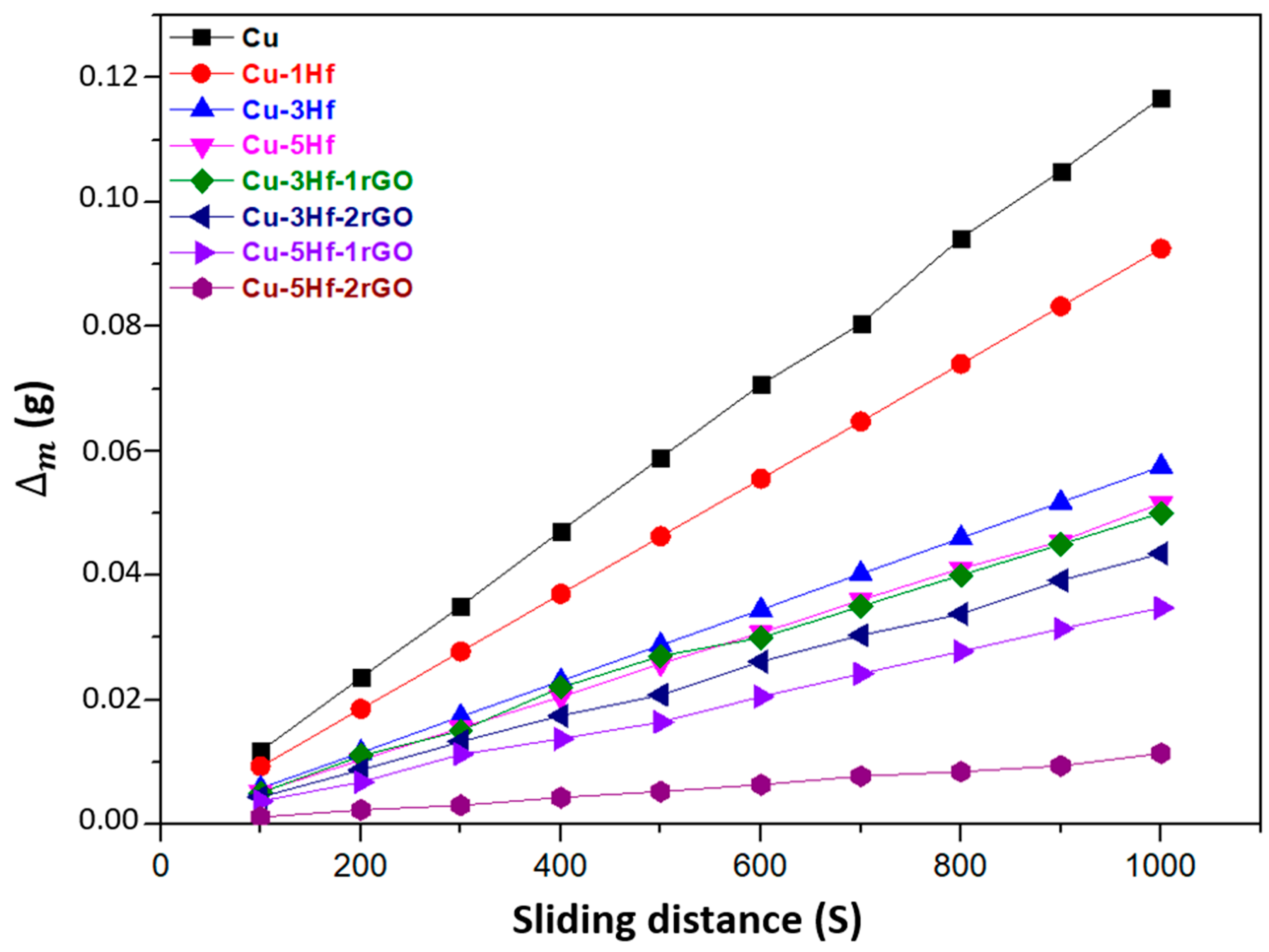
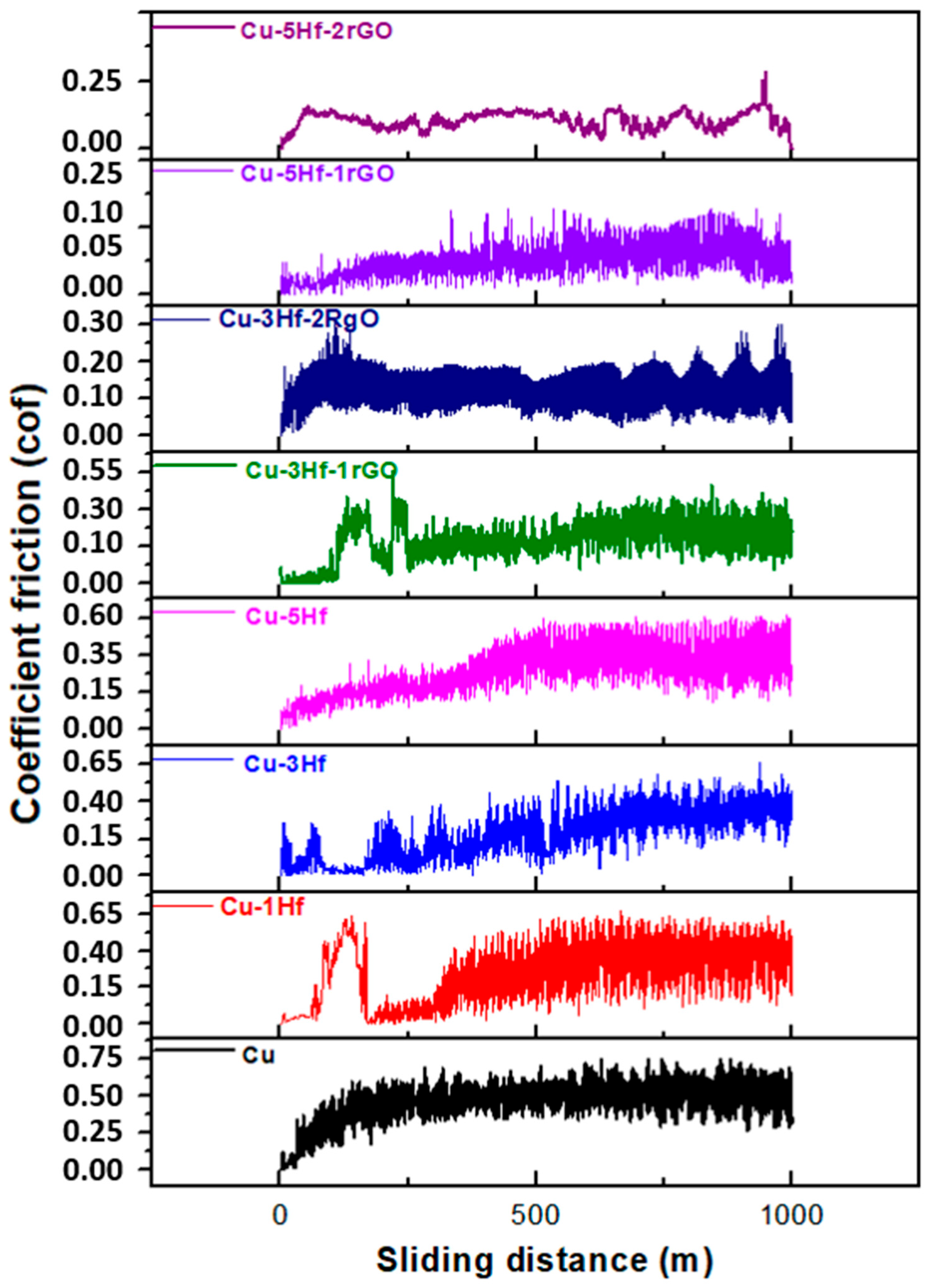
The dry sliding wear behavior of the Cu, Cu–Hf, and Cu–Hf–rGO composites was evaluated through the mass loss–sliding distance relationship (
Figure 7) and the evolution of the coefficient of friction (COF) (
Figure 8). To ensure data reproducibility and statistical reliability, the wear tests were repeated three times for each composition under identical contact conditions (10 N normal load, 50 mm/s sliding speed) against a 316L stainless steel counterface. The mass loss values presented in
Figure 7 represent the arithmetic mean ± standard deviation of these three independent measurements. The results clearly demonstrate that the tribological response changes systematically with composition and that hybrid reinforcement stabilizes the system toward lower wear and more reproducible frictional behavior. The approximately linear increase in mass loss with sliding distance for all compositions in
Figure 7 indicates that the experiments were conducted predominantly in a steady-state wear regime, following the initial transient. Nevertheless, the markedly different slopes among the curves reveal strong compositional control over the mass loss per unit distance and therefore over the relative wear resistance under identical test conditions.
Pure Cu exhibits the steepest mass-loss slope and reaches a mass loss of approximately 0.12 g at 1000 m (
Figure 7). This behavior is consistent with the low hardness and high ductility of Cu, which promote a rapid increase in real contact area through asperity flattening and near-surface plastic flow. Under dry sliding, these conditions favor the formation and growth of adhesive junctions at micro contacts, followed by junction rupture and material transfer. The detached fragments contribute directly to mass loss and may also become entrapped within the contact as third-body debris, intensifying abrasive micro-ploughing and micro-cutting. Overall, this sliding-wear evolution indicates an adhesion-dominated regime in pristine Cu, where repeated micro-welding and rupture events control both the high wear rate and the instability of friction. The COF signal of pristine Cu displays large-amplitude fluctuations (
Figure 8), which is characteristic of stick–slip behavior, an unstable transfer layer, and repeated adhesion–fracture–re-adhesion cycles. Such large fluctuations therefore imply that no continuous protective tribolayer can be sustained, and friction is governed primarily by transient metal–metal interactions rather than a stable film-controlled interface [
48,
49].
With Hf addition (Cu–1Hf, Cu–3Hf, Cu–5Hf), the mass loss decreases systematically and the slopes of the mass loss–distance curves become significantly lower than that of pristine Cu (
Figure 7). When interpreted together with the hardness results (
Figure 6), this trend supports a primarily mechanical explanation: Hf strengthens the Cu matrix, limits subsurface plastic deformation, and suppresses the growth of adhesive junctions, thereby reducing the likelihood of large material pull-out events and decreasing the intensity of third-body abrasion. Beyond simple hardening, Hf may also contribute to microstructural stabilization through its distribution behavior and possible formation of fine Hf-related micro domains, which can enhance the durability of load-bearing micro-asperities during sliding. Consequently, the tribological evolution suggests a mechanistic shift from severe adhesive wear toward a more controlled mixed regime (reduced adhesion with milder abrasion/oxide-assisted stabilization), consistent with the lower wear slopes and more regular COF traces. The COF traces of the Hf-containing samples are generally more regular than that of pristine Cu (
Figure 8), indicating that the contact becomes less dominated by severe adhesion–fracture events and gradually transitions toward a more stable friction regime. The early-stage COF rises observed in some Hf-containing samples are consistent with the run-in period, during which asperity truncation, geometric conformity development, and initial transfer/oxide layer nucleation occur before the system reaches a more stable steady state.
A more pronounced change in tribological behavior is observed when rGO is incorporated into Hf-containing matrices. In
Figure 7, the hybrid compositions, particularly Cu–5Hf–1rGO and Cu–5Hf–2rGO, exhibit the lowest mass loss across the entire sliding distance range. At 1000 m, the mass loss of Cu–5Hf–2rGO remains close to 0.01 g, representing an improvement approaching one order of magnitude relative to pristine Cu. Such a substantial enhancement cannot be attributed solely to the hardness increase; instead, it indicates a qualitative shift in the dominant interfacial mechanism. The key factor is the ability of rGO, owing to its lamellar structure, to facilitate the formation of a low-shear carbon-rich transfer film (tribofilm) at the sliding interface. Once a sufficiently continuous tribofilm develops, the sliding interface transitions from direct metal–metal contact to film–metal or film–film contact, reducing the effective interfacial shear strength and often lowering flash temperature. At the same time, the tribofilm redistributes load over a larger area, suppresses local stress concentrations, and limits subsurface plasticity, thereby decreasing the probability of severe detachment and groove formation. Therefore, the observed course of friction and wear indicates a transition to a film-controlled sliding regime in the hybrid systems, where interface chemistry/tribofilm continuity becomes the primary governor of wear rather than bulk plasticity alone. Literature reports consistently indicate that graphene-derived phases can markedly reduce friction and wear in Cu-based systems through such shear-friendly tribofilm mechanisms, and the present trends are fully consistent with that framework [
49,
50,
51,
52].
The COF profiles provide further evidence for the stability of the hybrid mechanism. In
Figure 8, the hybrid samples not only exhibit lower fluctuation amplitudes than pristine Cu but also reach a stable friction regime more rapidly. The COF signals of Cu–5Hf–1rGO and Cu–5Hf–2rGO oscillate within a narrower band and show reduced frictional noise over long sliding distances. This behavior indicates that the transfer layer is more continuous and persistent, i.e., friction is stabilized by tribofilm-mediated shear rather than by intermittent stick–slip cycles. When tribofilm continuity is maintained, third-body abrasion is weakened, abrupt shear transitions become less frequent, and friction becomes more reproducible. Conversely, poor rGO dispersion or insufficient film continuity would be expected to cause intermittent COF spikes and increased wear due to local stress concentrations at agglomerates and discontinuous film regions. The combined mass loss and COF trends observed for the hybrid samples therefore imply that rGO is active at the interface and that film-controlled sliding becomes increasingly dominant [
49,
50,
51,
52].
The improvement achieved through combined Hf and rGO reinforcement is best described as synergistic rather than additive. Hf primarily enhances substrate load-bearing capability and restricts subsurface plastic deformation, which helps preserve the integrity of interfacial films by reducing tearing and debris generation. rGO primarily reduces the interfacial shear strength by enabling lamellar shear and promoting a carbon-rich tribofilm. Together, these effects establish a tribological architecture that can be described as a mechanically stable substrate supporting a low-shear interfacial layer. This configuration simultaneously reduces friction variability and suppresses wear loss. The fact that Cu–5Hf–2rGO exhibits both the lowest mass loss (
Figure 7) and the most stable COF behavior (
Figure 8) suggests that this composition lies near an optimal hybrid reinforcement window in which tribofilm continuity is sufficient and substrate stabilization is maximized without introducing excessive brittleness or detrimental interfacial discontinuities [
49,
50,
51,
52].
3.6. Post-Wear SEM and EDX Analyses
Post-wear SEM and EDX characterization constitutes a critical analytical step for elucidating the underlying tribological mechanisms in Cu-based composites, as it provides direct microstructural evidence explaining why certain compositions exhibit lower wear rates and more stable frictional behavior. While mass loss measurements and COF curves quantitatively describe the macroscopic tribological response, surface morphology and elemental distribution analyses reveal the governing mechanisms responsible for these trends. Accordingly, the primary objective of this section is to correlate the wear and friction behaviors presented in
Figure 7 and
Figure 8 with the surface-level microstructural evidence shown in
Figure 9; to distinguish between adhesive, abrasive, and oxidative wear contributions; and to determine whether the combined presence of Hf and rGO promotes the formation of a multiphase protective tribofilm. Previous studies have reported that graphene-derived reinforcements can form low-shear-strength transfer films due to their lamellar structure, while metals with high oxygen affinity, such as Hf, can enhance tribological performance by stabilizing tribo-chemically formed oxide layers. However, the key factor governing tribological effectiveness is not merely the presence of such films, but their continuity, load-bearing capacity, and resistance to disruption under sliding conditions [
53,
54,
55,
56,
57,
58].
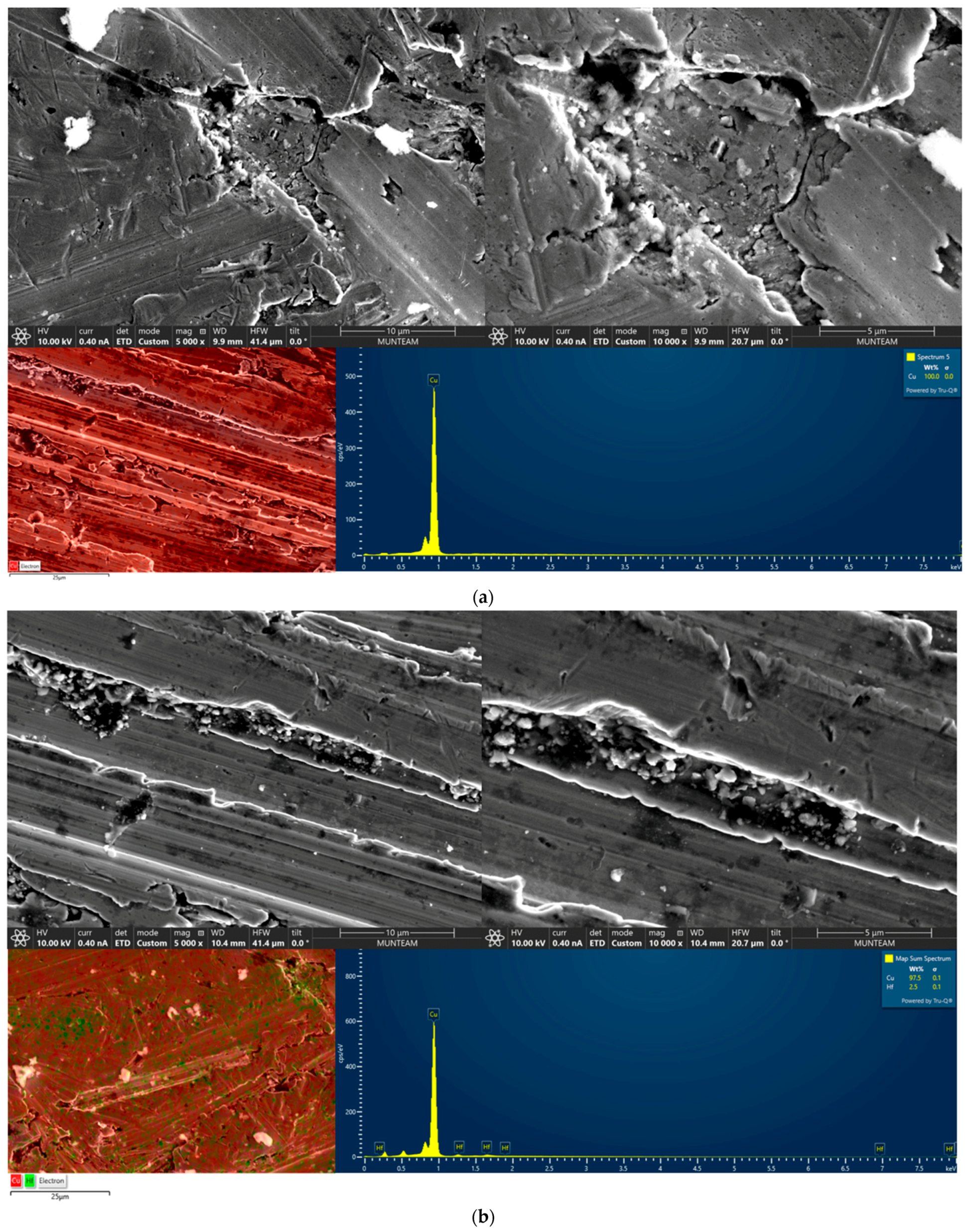
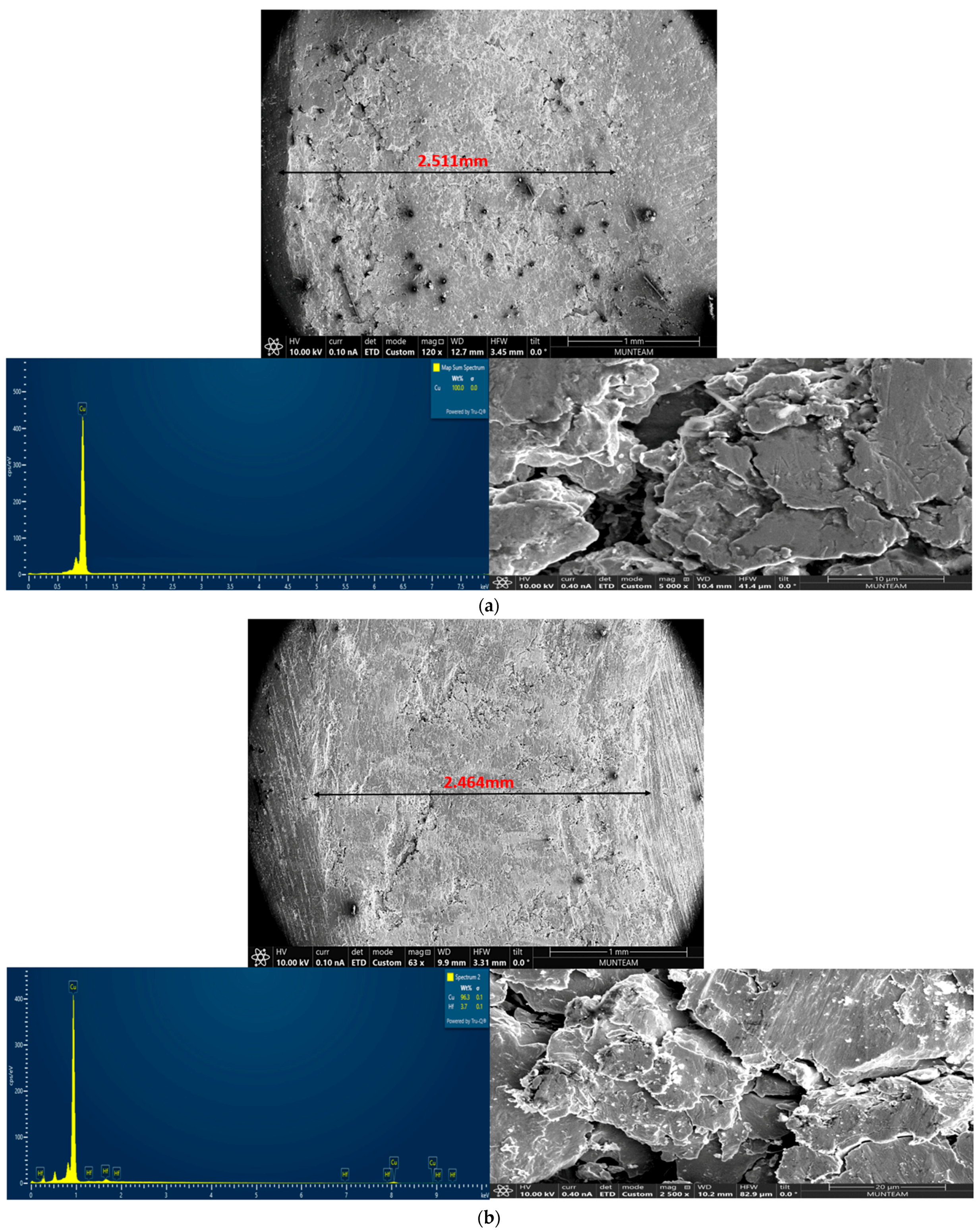
The primary indicators expected for adhesive wear are distinctly observed on the worn surface of the pure Cu sample (
Figure 9a). The high mass loss and unstable COF profile noted earlier have direct morphological counterparts in this micrograph.
Figure 9a reveals deep grooves extending parallel to the sliding direction, extensive metallic smear regions, and localized “pile-up–tearing” features, all of which indicate that metal–metal adhesive interactions dominate over a significant portion of the contact. In such surfaces, two processes typically operate simultaneously: (i) micro-welding (junction formation) and rupture at asperity contact points, accompanied by material transfer; and (ii) detached fragments entering the interface as third bodies, deepening grooves through ploughing and micro-cutting mechanisms [
55,
56,
57,
58]. The broad-band fluctuations observed in the COF signal (stick–slip behavior) represent the dynamic signature of these repeated adhesion–rupture cycles. The fact that the corresponding EDX spectrum (inset in
Figure 9a) predominantly shows a Cu signal, while the carbon signal remains discontinuous or very weak, supports the absence of a stable carbonaceous film during sliding. Furthermore, the oxygen signal present only locally and at low intensity suggests that oxidative wear in pure Cu occurs not through the formation of a protective, continuous oxide film, but rather via irregular oxide islands, implying insufficient surface protection. These microstructural evidences are consistent with the high wear loss exhibited by pure Cu due to its low hardness and strong susceptibility to adhesive wear.
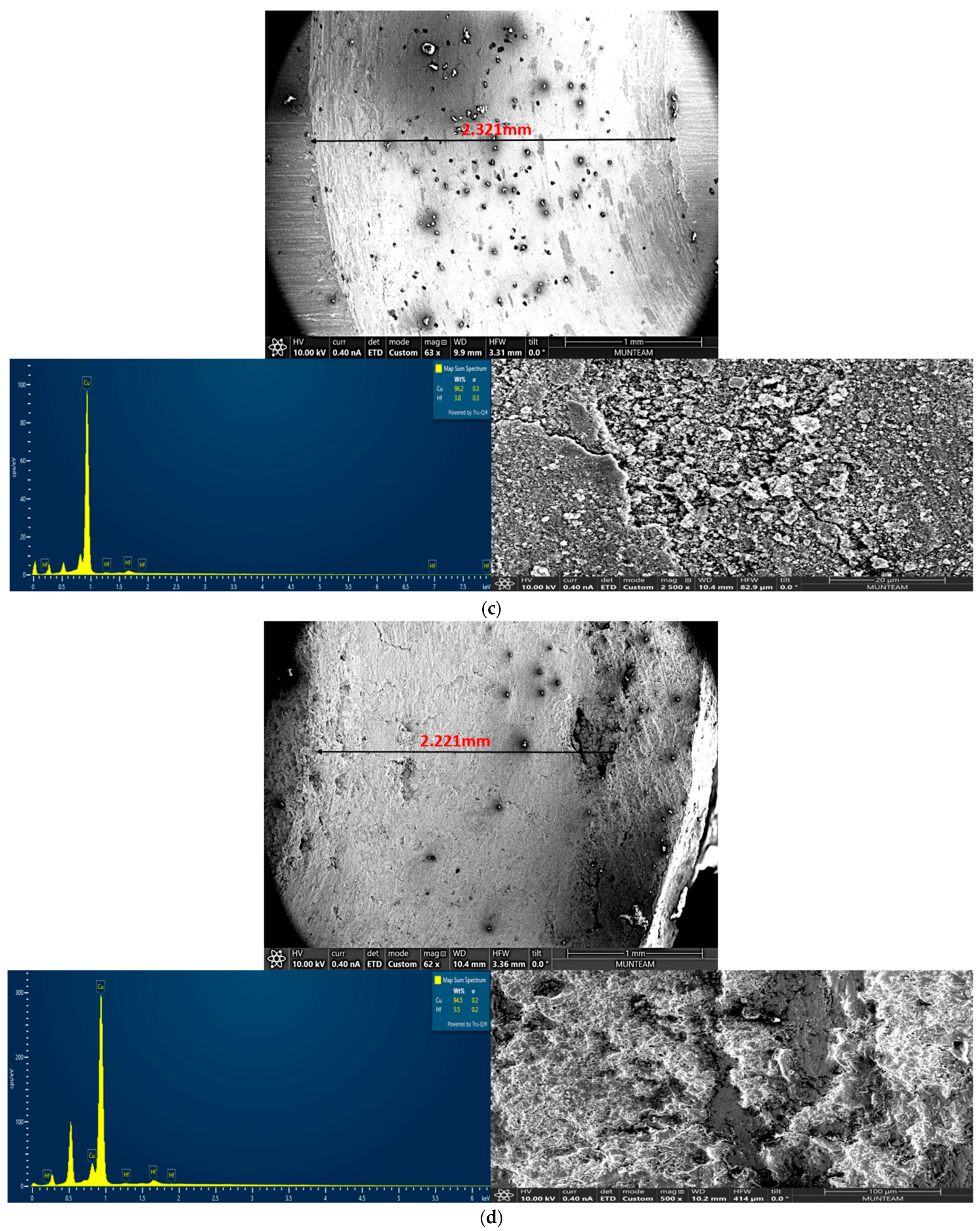
For Hf-containing (rGO-free) composites, the post-wear surface evolves toward a more “load-bearing” character, as seen in
Figure 9b–d. Increased hardness restricts plastic flow, reduces subsurface deformation volume, and lowers the tendency for adhesive rupture. In the SEM micrographs of Cu–1Hf (
Figure 9b) and Cu–3Hf (
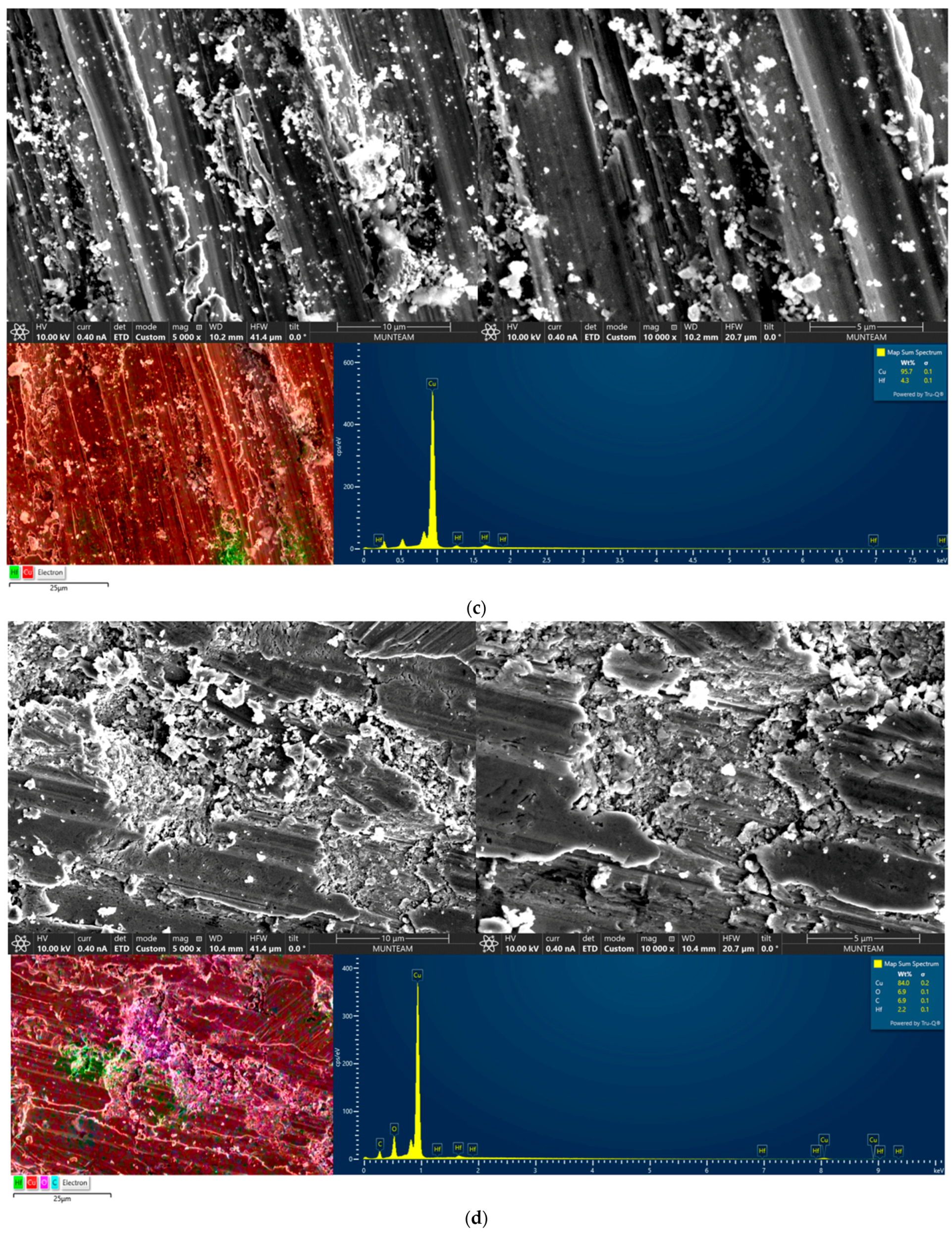
Figure 9c), this manifests as shallower grooves compared to pure Cu, smaller smear regions, and more pronounced micro-grooving, indicating a transition to abrasive wear. As the Hf content increases to 5.0 wt.% (
Figure 9d), debris size is reduced, and a finer third-body layer is formed. The concentration of Hf signals within the wear track or along its edges in the EDX insets (
Figure 9b–d) suggests that Hf is not merely a passive filler but participates actively in the surface chemistry. In particular, due to the high oxygen affinity of Hf, regions where Hf and O signals are detected together may indicate the presence of “Hf–O-enriched regions.” Such regions are consistent with wear-limiting mechanisms reported in the literature, where oxide film stabilization plays a key role [
15,
57,
58].
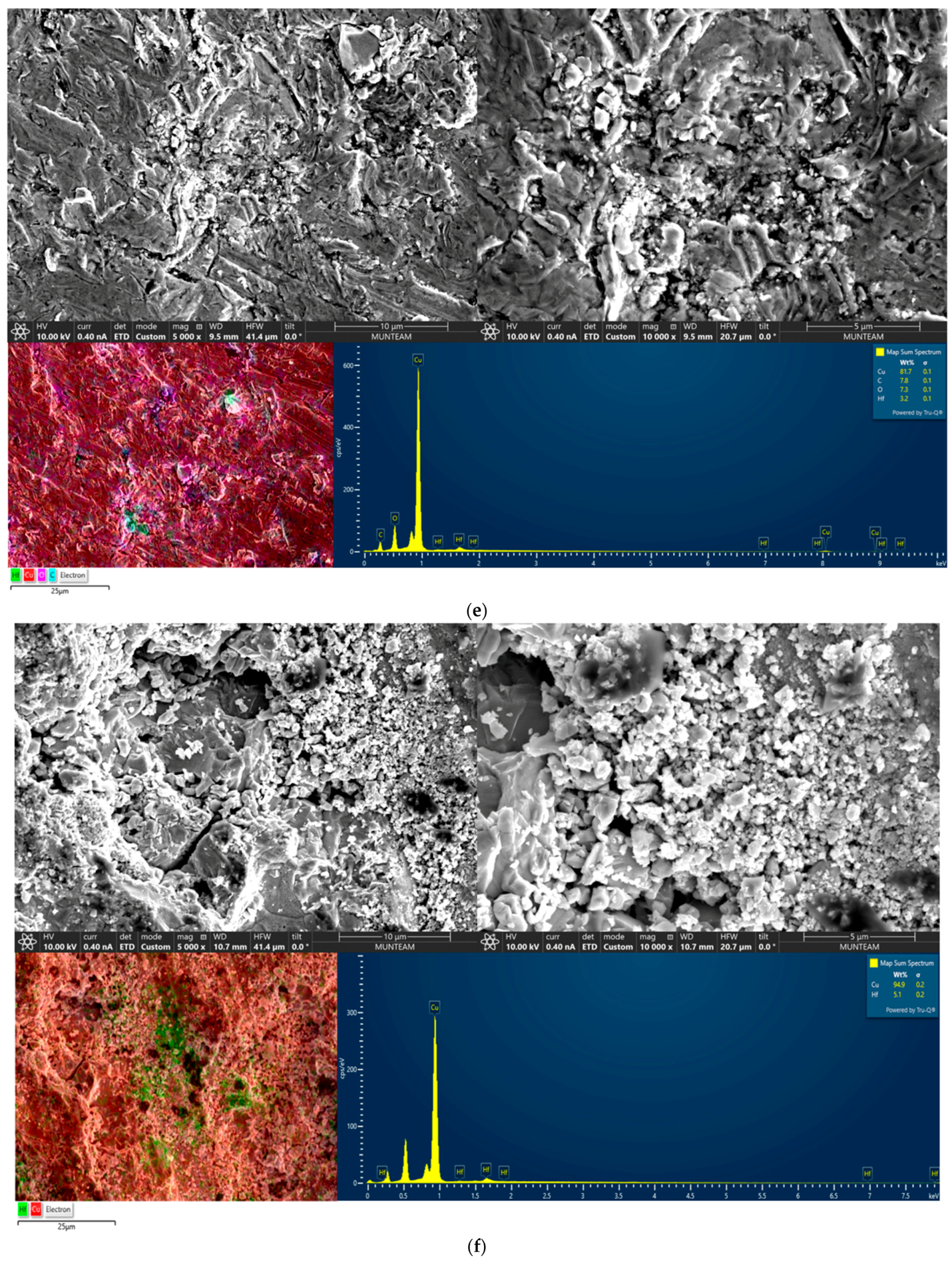
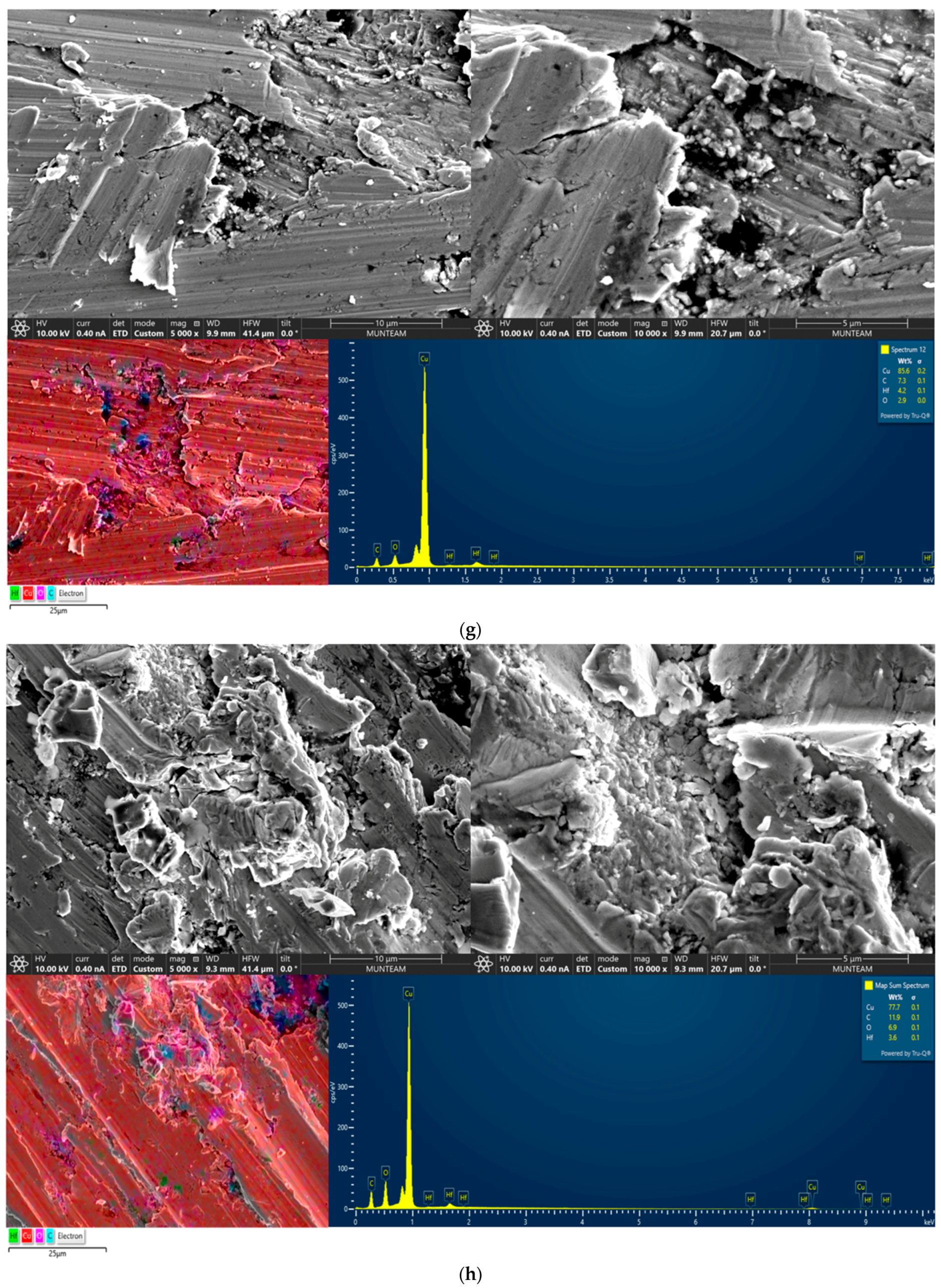
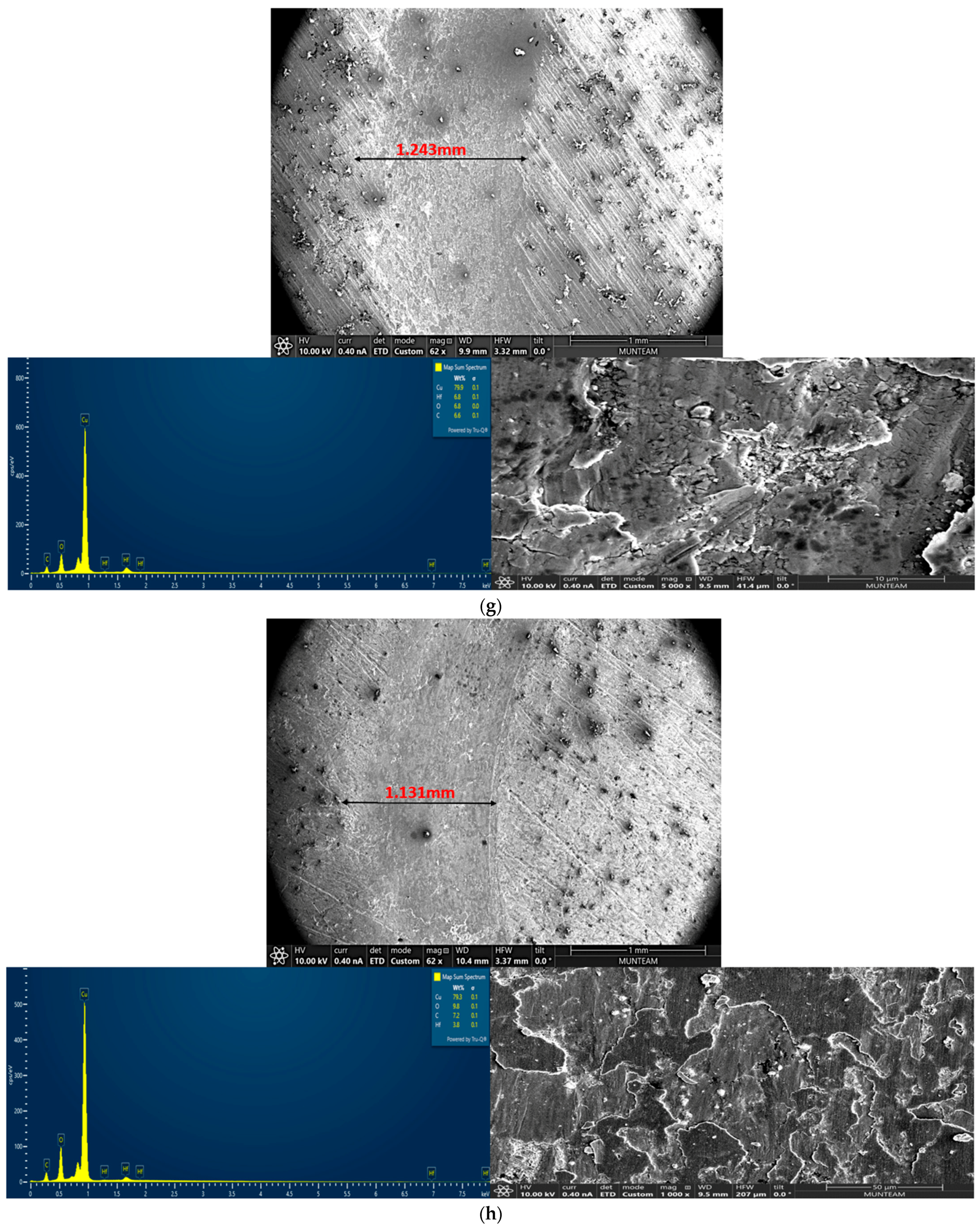
In Hf–rGO hybrid composites, the most critical outcome of post-wear SEM/EDX analysis is the development of a multicomponent tribofilm architecture, clearly visible in
Figure 9e–h. The lowest mass loss observed in
Figure 7 and the most stable COF profiles in
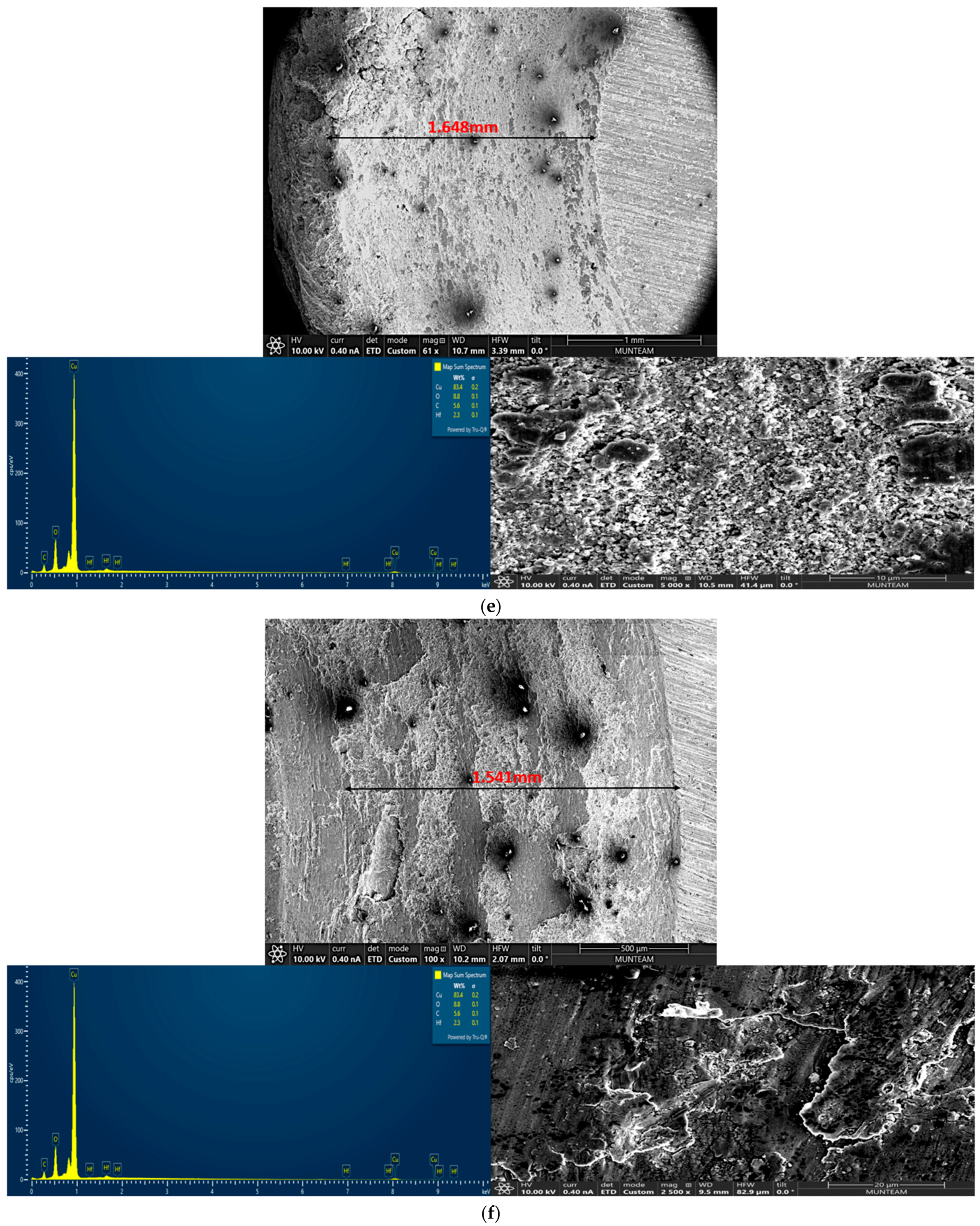
Figure 8 suggest that the hybrid system most effectively transitions to a film-controlled sliding regime. The SEM morphologies of Cu–3Hf–1rGO (
Figure 9e) and Cu–3Hf–2rGO (
Figure 9f) show largely suppressed deep grooves and a more homogeneous surface appearance compared to the binary alloys. Darker, coating-like upper-layer textures (indicated by arrows in
Figure 9f) correspond to carbon-rich tribofilms. This mechanism is most developed in the 5.0 wt.% Hf series; Cu–5Hf–2rGO (
Figure 9h) exhibits a uniformly polished topography with shallow micro-grooves, indicating that tearing features along the sliding direction are minimized. In the corresponding EDX mapping (inset in
Figure 9h), the signature of the hybrid system is characterized by carbon signals spreading over large areas of the wear track, accompanied by Hf signals localized in specific micro-regions or beneath/within the film. This correlation suggests that Hf-rich, oxygen-associated protective components (oxide-like species) operate synergistically with the low-shear carbonaceous transfer film [
53,
54,
55,
56,
57,
58,
59,
60,
61]. Importantly, the mechanistic interpretation is that Hf–O-enriched tribochemical regions form a multiphase tribofilm together with a carbon-based transfer layer. In such an architecture, Hf-rich components act as load-bearing “hard sublayers,” while the carbonaceous lamellar film functions as a lubricious “upper layer” that reduces interfacial shear resistance [
15,
53,
54].
In conclusion, the post-wear SEM/EDX findings in
Figure 9 demonstrate that adhesive wear and severe plastic deformation dominate in pure Cu (
Figure 9a); that Hf addition promotes a transition to mild abrasive wear (
Figure 9b–d); and that in the Hf–rGO hybrid system (
Figure 9e–h), the combined effects of matrix hardening and stabilization of a multicomponent tribofilm effectively suppress metal–metal contact. These observations establish a coherent “evidence chain” linking the low mass loss and stabilized COF behavior at the mechanistic level, consistent with the tribological superiority of hybrid metal–carbon reinforced Cu composites.
3.7. Post-Wear AFM and LFM Analyses
AFM and LFM were employed to interrogate the post-wear surface integrity of pristine Cu and the hybrid Cu–5Hf–2rGO composite at the nanometer scale. AFM provides a three-dimensional representation of wear-induced topographic evolution by resolving height fluctuations associated with asperity deformation, local ploughing traces, pile-up/smearing, and micro-pit development [
62,
63,
64,
65]. Complementarily, LFM captures the torsional response of the cantilever during scanning and therefore offers a sensitive probe of nanoscale frictional resistance and lateral force heterogeneity along the scan line [
50,
66,
67]. The combined AFM–LFM methodology is particularly informative for Cu-based tribosystems because the wear of ductile Cu under dry sliding is commonly governed by a coupled adhesive–abrasive regime, whereas graphene-derived reinforcements can shift the interfacial shear toward a more film-controlled and low-shear sliding mode. The representative AFM maps and roughness parameter outputs are presented in
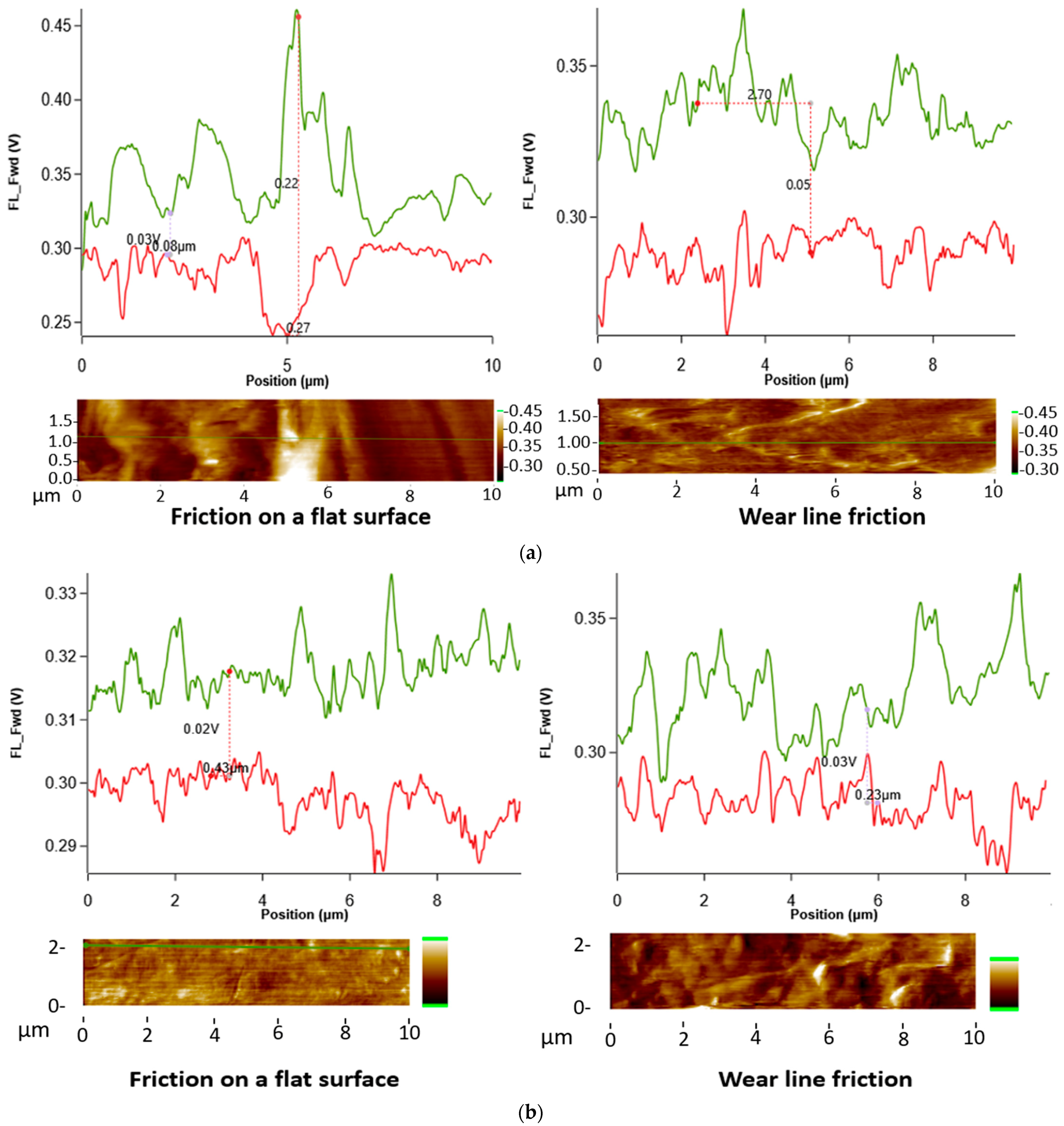
Figure 10a,b, while the corresponding LFM maps and forward/retrace lateral force profiles are shown in
Figure 11a,b. A consolidated quantitative comparison of key AFM roughness descriptors and LFM response is provided in
Table 3. Notably, AFM and LFM characterizations were intentionally performed on the two compositional extremes in terms of tribological performance i.e., the best- and worst-performing specimens based on the wear results in order to capture the limiting post-wear surface states and to elucidate the underlying nanoscale mechanisms responsible for the observed macroscopic trends [
50,
67,
68].
3.7.1. AFM Topography and Quantitative Roughness Descriptors
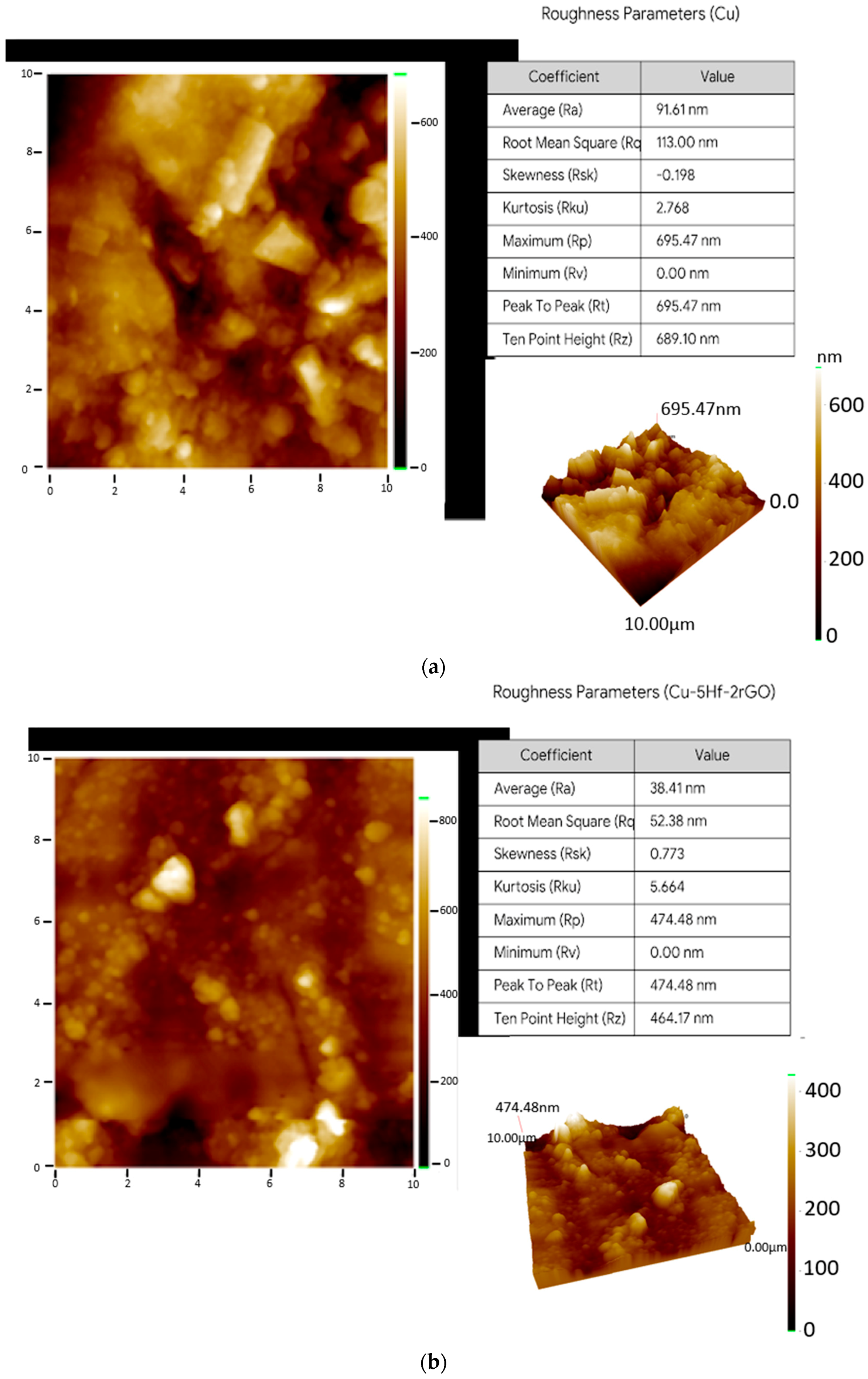
Representative post-wear AFM height maps together with the instrument-generated roughness parameter outputs are shown in
Figure 10a for pristine Cu and
Figure 10b for the hybrid Cu–5Hf–2rGO composite. The worn Cu surface exhibits pronounced height fluctuations and a spatially heterogeneous asperity field, reflecting substantial surface destabilization after dry sliding. This topographic response is consistent with the tribological behavior of ductile Cu, where the contact stresses are accommodated primarily through near-surface plastic flow [
62,
63,
64,
65]. Under repeated sliding, adhesive junctions form at local asperity contacts and subsequently rupture, producing material transfer and generating wear debris. The detached debris can re-enter the sliding interface as a third body, intensifying abrasive micro-ploughing and creating groove-like depressions [
62,
63,
64,
65]. The combined effect of plastic pile-up, smear-like flow, and debris-driven abrasion results in a roughened and non-uniform surface morphology, which is captured by the broad height distribution visible in
Figure 10a.
In contrast, the Cu–5Hf–2rGO surface in
Figure 10b exhibits a visibly more uniform height distribution and a reduced peak-to-valley amplitude. The lower topographic variability indicates that the hybrid reinforcement improves the resistance of the near-surface region to wear-induced deformation and morphological amplification during sliding. The improvement can be rationalized by the complementary roles of the reinforcement phases. Hafnium-containing regions increase the local load-bearing capability of the matrix and reduce the extent of severe plastic flow beneath the contact [
68,
69,
70]. Simultaneously, rGO contributes a lamellar, low-shear-strength phase that favors film-assisted sliding and reduces the effective interfacial shear strength. In such a configuration, the surface becomes less susceptible to extensive pile-up and deep groove formation, and the post-wear topography stabilizes toward a smoother state.
The quantitative AFM roughness metrics extracted from the representative scans strongly support these observations. For pristine Cu (
Figure 10a), the average roughness and RMS roughness are Ra = 91.61 nm and Rq = 113.00 nm, respectively. For Cu–5Hf–2rGO (
Figure 10b), these values decrease to Ra = 38.41 nm and Rq = 52.38 nm. The reductions correspond to approximately 58% lower Ra and 54% lower Rq, demonstrating a substantial suppression of post-wear surface roughening in the hybrid system. The simultaneous decrease in both Ra and Rq is mechanistically meaningful because Ra captures the mean absolute height deviation, whereas Rq weighs extreme deviations more strongly and is therefore more sensitive to sporadic high-amplitude asperities and localized damage events [
50,
62,
63,
64,
65,
66,
67,
68,
69,
70,
71,
72]. The observed reductions indicate that Cu–5Hf–2rGO not only lowers the average level of roughness but also mitigates rare but severe topographic excursions associated with gouging, micro-cutting, or adhesive pull-out.
Additional height descriptors further confirm that the hybrid composite suppresses topographic extremes that typically govern real-contact stress concentration. The maximum peak height decreases from Rp = 695.47 nm for Cu to Rp = 474.48 nm for Cu–5Hf–2rGO, while the overall peak-to-peak amplitude decreases from Rt = 695.47 nm to Rt = 474.48 nm (
Figure 10). Similarly, the ten-point height decreases from Rz = 689.10 nm to Rz = 464.17 nm. Lower Rp, Rt, and Rz values imply fewer highly protruding asperities and a reduced intensity of peak-dominated contact events. From a tribological perspective, this reduction is significant because sharp, high asperities tend to elevate local contact pressure, accelerate adhesive junction formation, and enhance abrasive ploughing by entrapped debris. Therefore, the AFM metrics collectively indicate that Cu–5Hf–2rGO maintains a mechanically more stable surface architecture after wear.
Higher-order statistical descriptors provide additional insight into the nature of the height distribution and the dominant wear morphology. Pristine Cu exhibits a slightly negative skewness (Rsk = −0.198), which suggests a weak tendency toward valley-dominated features. Such a tendency is consistent with groove formation and micro-pitting induced by debris-mediated abrasion and local adhesive pull-out events, where material removal contributes to negative-height excursions. The kurtosis of Cu (Rku = 2.768) indicates a moderately broad distribution without pronounced peakedness, suggesting that the surface height variations are distributed over a relatively wide area rather than concentrated into a small number of sharp maxima [
73,
74].
In contrast, Cu–5Hf–2rGO displays a positive skewness (Rsk = +0.773) together with a substantially higher kurtosis (Rku = 5.664) (
Figure 10b). This combination indicates a more peak-dominated and more sharply “peaked” height distribution, in which fewer but more pronounced local maxima contribute to the surface statistics. Importantly, within hybrid metal–graphene composite systems, such localized maxima should not automatically be interpreted as detrimental. Instead, they can represent mechanically stable, load-bearing micro-domains embedded in a smoother background. These micro-domains may arise from locally hardened regions influenced by Hf-related strengthening and/or rGO-associated surface features that persist after sliding. In tribological terms, the emergence of stable load-bearing asperity islands, combined with a reduced interfacial shear strength due to rGO, is compatible with a controlled load partitioning regime. This regime can suppress widespread ductile smearing and reduce the propagation of deep grooves, ultimately contributing to improved post-wear surface integrity.
3.7.2. LFM Mapping and Nanoscale Frictional Response
The post-wear LFM maps and the corresponding forward/retrace lateral force (torsion) profiles are presented in
Figure 11a for pristine Cu and
Figure 11b for Cu–5Hf–2rGO. LFM is particularly informative in the present context because it probes the lateral resistance encountered by the AFM tip during raster scanning and therefore provides a nanoscale analogue of frictional behavior [
50,
66,
67]. The recorded lateral signal arises primarily from cantilever torsion induced by interfacial shear forces acting at the tip–surface junction [
66]. Consequently, LFM is highly sensitive to local variations in shear strength and energy dissipation at the interface, which can originate from spatial differences in near-surface mechanical response, tribofilm continuity, debris distribution, adhesion, and chemical heterogeneity developed during sliding [
50,
63,
64,
65,
66,
67,
68]. Unlike purely topographic imaging, LFM emphasizes the functional tribological state of the surface, capturing whether the scanned regions behave as high-shear metal–metal contact patches or as low-shear film-covered domains [
50,
68,
75].
In pristine Cu (
Figure 11a), the forward and retrace lateral force traces exhibit a comparatively larger separation and more pronounced fluctuations along the scan line. This behavior indicates higher lateral resistance and a less stable shear interface at the nanoscale. Such a response is consistent with a post-wear Cu surface dominated by adhesive contributions and intermittent stick–slip-like events [
11,
54,
69,
70,
71,
72,
73,
74,
75,
76,
77,
78].
In ductile Cu, junction formation at contacting asperities and subsequent rupture during sliding can produce localized regions with high adhesion and high shear strength. When the AFM tip traverses these heterogeneous regions, the cantilever experiences abrupt increases in torsional loading, which appear as fluctuations or spikes in the lateral signal. In addition, wear debris retained on the surface or embedded in the near-surface layer can act as an abrasive third body, producing intermittent ploughing or scratching events that further amplify lateral force variability [
54]. The cumulative effect is a frictionally noisy surface where the interfacial shear condition varies strongly over short length scales, resulting in larger trace–retrace separation and enhanced signal scatter.
In contrast, Cu–5Hf–2rGO (
Figure 11b) exhibits a substantially more stable LFM response, characterized by reduced separation between forward and retrace traces and lower-amplitude fluctuations across the scan length. This indicates that the hybrid surface presents a lower and more uniform nanoscale shear resistance to the AFM tip. The quantitative LFM metric reported as LFM Diff in
Table 3, which represents a trace–retrace differential signal (instrumental mV units), decreases from approximately ~50 mV for Cu to ~30 mV for Cu–5Hf–2rGO, corresponding to an approximate 40% reduction. Because LFM output is generally reported in instrumental units unless a dedicated lateral calibration is performed, the most rigorous interpretation is comparative rather than absolute. Within this comparative framework, the reduced LFM Diff for the hybrid composite demonstrates a consistently lower lateral-force response and a more homogeneous frictional landscape at the nanoscale [
50,
67].
The observed reduction in lateral resistance for Cu–5Hf–2rGO can be mechanistically rationalized by the synergistic action of the rGO and Hf reinforcements in controlling the post-wear interfacial state. The rGO phase, due to its two-dimensional lamellar structure and intrinsically low shear strength along basal planes, promotes shear accommodation through interlayer sliding and facilitates the formation and retention of carbonaceous tribofilm regions. Such film-covered areas reduce the effective interfacial shear strength experienced by the tip and minimize adhesive contributions by replacing direct metal–metal contact with film-mediated sliding. In parallel, Hf contributes by strengthening and stabilizing the matrix, increasing the load-bearing capacity of the near-surface region and limiting subsurface plastic flow. This mechanical stabilization is critical because severe plastic deformation and surface tearing tend to disrupt nascent tribofilms and generate loose debris, both of which increase frictional heterogeneity. By suppressing excessive deformation and stabilizing the substrate beneath the sliding interface, Hf indirectly supports the continuity and durability of rGO-derived low-shear regions [
50,
67].
As a result, the hybrid surface evolves toward a tribological state in which the scanned interface is dominated by more continuous, low-shear domains and reduced third-body abrasion activity. This is reflected in the LFM maps as more uniform contrast and in the line profiles as reduced torsional excursions and smaller forward/retrace separation (
Figure 11b). Importantly, the LFM findings are consistent with the AFM roughness trends reported in
Figure 10 and summarized in
Table 3, where the hybrid composite exhibits significantly reduced roughness and reduced topographic extremes. A smoother, mechanically stabilized surface is less prone to generating asperity-scale stress concentrations and debris, which further contributes to the observed reduction in nanoscale frictional resistance [
50,
68,
75].
Overall, the LFM results provide nanoscale evidence that Cu–5Hf–2rGO undergoes a transition from a frictionally unstable, adhesion- and debris-influenced shear regime (pristine Cu) to a more stable and uniform shear regime dominated by film-assisted sliding. The reduced LFM Diff and lower signal variability demonstrate that the hybrid reinforcement decreases local energy dissipation during sliding at the nanoscale, supporting the macroscopic tribological improvements observed for the Cu–5Hf–2rGO composite [
68,
76,
77].
3.7.3. Surface–Friction Interplay in Hybrid Structures
Integrating AFM and LFM results yields a coherent structure–tribology relationship that explains the superior post-wear surface integrity of Cu–5Hf–2rGO. Pristine Cu exhibits higher roughness (Ra and Rq in
Figure 10a; summarized in
Table 3) and higher lateral-force variability (LFM behavior in
Figure 11a), indicating extensive plastic deformation and a frictional response dominated by adhesive–abrasive interactions [
54,
77,
79]. In contrast, Cu–5Hf–2rGO exhibits a substantially smoother topography (
Figure 10b) together with a lower and more stable nanoscale frictional response (
Figure 11b), demonstrating that hybrid reinforcement fundamentally alters the post-wear interfacial state [
50,
66,
67].
A detailed examination of
Table 3 provides quantitative support for this coupled interpretation. First, the AFM roughness values confirm that hybrid reinforcement strongly suppresses wear-induced height fluctuations. The average roughness decreases from the Cu reference level to the Cu–5Hf–2rGO level, indicating that the post-wear surface of the hybrid composite experiences a markedly lower amplitude of nanoscale height deviations. This trend is not limited to mean roughness, because the RMS roughness follows the same direction, which is significant since RMS metrics are more sensitive to rare but severe surface excursions [
50,
63,
64,
65,
66,
67,
68,
69,
70,
71,
72]. In practical tribological terms, a simultaneous reduction in both Ra and Rq indicates that the hybrid surface is not only globally smoother but also less prone to isolated high-amplitude asperity events that typically act as stress concentrators and promote further damage evolution.
Second, the extreme-height descriptors reported in
Table 3 (and observed in
Figure 10) reinforce the conclusion that the hybrid surface is mechanically more stable after sliding. The reduction in peak-related and peak-to-peak descriptors implies that Cu–5Hf–2rGO develops fewer pronounced asperities and limits the magnitude of peak-to-valley excursions that are associated with severe ploughing, debris indentation, and adhesive tearing [
54,
77,
79]. This reduction is important because asperity-scale extremes tend to govern the local contact pressure distribution and strongly influence the probability of adhesive junction formation and abrasive micro-cutting. Therefore, the systematic decrease in these parameters indicates that the hybrid composite reduces the intensity of the most damaging micro-contact events [
73].
Third,
Table 3 documents a clear reduction in the LFM metric (LFM Diff), which quantifies the trace–retrace differential lateral signal recorded during scanning. The reduction in LFM Diff from Cu to Cu–5Hf–2rGO signifies a lower lateral resistance at the tip–surface junction and, critically, a more stable and homogeneous shear response at the nanoscale. Because the LFM signal is reported in instrumental units (mV) unless lateral calibration is performed, the strongest and most defensible interpretation is comparative. Within that comparative framework, the reduced LFM Diff indicates that the hybrid surface dissipates less energy through interfacial shear and exhibits fewer abrupt frictional transitions along the scan line. This is consistent w ith a surface that is less dominated by adhesive patches and third-body abrasion and more dominated by stable, low-shear sliding domains [
50,
66,
67].
When the AFM and LFM components of
Table 3 are interpreted together, a consistent mechanistic picture emerges. In pristine Cu, large roughness values and elevated LFM response are mutually reinforcing indicators of a deformation-driven wear regime. Extensive plastic flow and debris-mediated ploughing generate a rough surface with strong height heterogeneity; this roughness, in turn, increases the likelihood of high local stresses and adhesive junction formation, producing a frictionally noisy surface state with large lateral-force fluctuations. In Cu–5Hf–2rGO, the concurrent decrease in roughness metrics and LFM Diff indicates that the interfacial state has shifted toward a controlled regime where surface deformation is suppressed and shear is accommodated more efficiently. In this regime, rGO contributes low-shear pathways and film-assisted sliding behavior, while Hf improves the load-bearing capacity and stabilizes the substrate, limiting subsurface plastic flow that would otherwise disrupt tribofilm continuity and generate debris [
50,
68,
79]. The quantitative trends summarized in
Table 3 therefore provide a direct nanoscale explanation for the macroscopic tribological improvements: reduced post-wear roughness reflects suppressed damage accumulation, and reduced LFM response reflects reduced nanoscale frictional resistance and enhanced shear stability.
Overall, the coupled AFM–LFM dataset demonstrates that Cu–5Hf–2rGO does not simply “improve roughness” or “reduce friction” independently; rather, it stabilizes the near-surface mechanical state and promotes a film-assisted low-shear interface, leading to a smoother post-wear morphology and a lower, more stable nanoscale frictional response. These outcomes provide a mechanistically grounded link between micro/nanoscale surface evolution and the superior macroscopic tribological performance of the hybrid composite [
50,
66,
67,
68,
77,
78,
79].
4. Conclusions
The results clearly demonstrate that the tribological response changes systematically with composition and that hybrid reinforcement stabilizes the system toward lower wear and more reproducible sliding behaviour. The Cu–Hf and Cu–Hf–rGO composites were successfully fabricated via a powder metallurgy route aimed at overcoming the intrinsic trade-off in copper, namely high electrical conductivity combined with limited hardness and poor dry-sliding wear resistance, through a hybrid reinforcement strategy. Microstructural observations support a consistent hybrid architecture in which Hf primarily strengthens and stabilizes the load-bearing Cu matrix, whereas rGO contributes a lamellar low-shear component that promotes film-assisted sliding and the development of a carbonaceous transfer layer.
The principal novelty of this study is the demonstration of a clear Hf–rGO synergy in sintered Cu, in which a defined composition window enables simultaneous improvement of electrical conductivity and tribological performance, despite the common expectation that reinforcement additions can compromise conductivity in conductive metals. The hybrid composites yield substantial tribo-mechanical improvements while maintaining, and under an optimal reinforcement window markedly enhancing, the effective electrical conductivity of sintered Cu.
For improved comparability with engineering practice, the conductivity results are also interpreted in terms of the International Annealed Copper Standard (IACS), where 100% IACS corresponds to approximately 58 MS/m at 20 °C. Conductivity increases from approximately 3.0 × 10⁶ S/m for pure Cu (about 5.2% IACS) to about 4.6 × 10⁶ S/m at 5.0 wt.% Hf (about 7.9% IACS). The most pronounced enhancement is obtained at moderate Hf contents, where Cu–3Hf–1rGO and Cu–3Hf–2rGO reach approximately 1.9 × 10⁷ S/m and 2.0 × 10⁷ S/m, corresponding to roughly 32.8% and 34.5% IACS, respectively. Accordingly, for applications in which electrical functionality is the primary requirement but improved wear resistance is also needed, Cu–3Hf–1rGO and Cu–3Hf–2rGO can be recommended as the most balanced formulations based on the present dataset.
Hardness (HV0.30) increases systematically from 60 ± 3 HV0.30 for pristine Cu to 112 ± 8 HV0.30 for Cu–5Hf and reaches a maximum of 159 ± 12 HV0.30 for Cu–5Hf–2rGO, indicating that the mechanical effectiveness of rGO is amplified when introduced into an Hf-stiffened and stabilized Cu matrix. When maximum hardness and minimum wear are prioritized over peak conductivity, Cu–5Hf–2rGO represents the most practically favorable formulation among the investigated compositions.
Under dry-sliding conditions, pristine Cu exhibits a mass loss of approximately 0.12 g at 1000 m, whereas the most reinforced hybrid compositions display markedly reduced wear, with Cu–5Hf–2rGO showing the lowest loss reported, about 0.01 g at 1000 m, corresponding to a significant improvement. Nanoscale post-wear characterization directly confirms improved surface integrity, with Ra and Rq decreasing from 91.61 nm and 113.00 nm for Cu to 38.41 nm and 52.38 nm for Cu–5Hf–2rGO, indicating a smoother and more homogeneous low-shear sliding response. Post-wear surface morphology and chemistry are consistent with a multi-component tribofilm mechanism, where pristine Cu is dominated by adhesive wear and severe plastic deformation, rGO-containing systems promote a carbon-based transfer layer, and the Hf–rGO hybrid facilitates a more stable tribofilm that suppresses direct metal-to-metal contact and stabilizes frictional behavior.
Overall, the findings establish a unified structure–property framework for Cu–Hf–rGO hybrids. Hf enhances load-bearing capacity and subsurface stability, while rGO supports transfer-layer formation and low-shear sliding. Consequently, these materials represent promising candidates for electrically functional components subjected to frictional loading, including electromechanical contact elements, switching and contact surfaces, and conductive parts requiring improved service life under wear-sensitive conditions.
The present study is complete in establishing a processing route, a composition–property map within the investigated reinforcement levels, and a mechanistic interpretation of the dominant wear responses. Further research is warranted to validate industrial applicability and long-term reliability, with particular emphasis on the influence of porosity and densification on electrical conductivity and IACS values, the clarification of interfacial bonding and tribofilm chemistry using higher-resolution characterization techniques such as TEM, XPS, or Raman spectroscopy, and the evaluation of performance under application-relevant electrical contact conditions including contact resistance stability, thermal cycling, oxidation, and arc or spark exposure. Additional process optimization focused on scalable rGO dispersion control and refinement of sintering parameters is also recommended to enhance reproducibility and component-level performance.