Next Article in Journal
RETRACTED: Hamza et al. Chemical Characterization of Taif Rose (Rosa damascena Mill var. trigentipetala) Waste Methanolic Extract and Its Hepatoprotective and Antioxidant Effects Against Cadmium Chloride (CdCl2)-Induced Hepatotoxicity and Potential Anticancer Activities Against Liver Cancer Cells (HepG2). Crystals 2022, 12, 460
Article

Dual-Soft-Template-Assisted PEG-CTAB Surface Regulation of Co3V2O8 Toward Superior Water Oxidation


School of Chemical Engineering, Yeungnam University, 280 Daehak-ro, Gyeongsan 712-749, Republic of Korea
*
Author to whom correspondence should be addressed.
Crystals 2026, 16(1), 34; https://doi.org/10.3390/cryst16010034
Submission received: 11 December 2025 / Revised: 24 December 2025 / Accepted: 30 December 2025 / Published: 30 December 2025
(This article belongs to the Special Issue Advances in Electrocatalyst Materials)

Abstract

The electrochemical water splitting process represents a promising and sustainable route for generating high-purity hydrogen with minimal environmental impact. The development of efficient and economically viable electrocatalysts is crucial for enhancing the kinetics of the oxygen evolution reaction (OER), which is a major bottleneck in overall water splitting. In this study, a Co3V2O8/PEG-CTAB electrocatalyst was synthesized and systematically evaluated for its OER activity in alkaline conditions. The nanosheet-like architecture of the PEG-CTAB-assisted Co3V2O8 electrocatalyst facilitates effective interfacial contact, thereby improving charge transport and catalytic accessibility. Among the examined compositions, the Co3V2O8/PEG-CTAB catalyst exhibited superior OER performance, requiring a low overpotential of 298 mV to deliver a current density of 10 mA cm−2 and displaying a Tafel slope of 90 mV dec−1 in 1 M KOH. Furthermore, the catalyst demonstrated outstanding durability, retaining its electrocatalytic activity after 5000 consecutive CV cycles and prolonged chronopotentiometric testing. The Co3V2O8/PEG-CTAB || Pt-C asymmetric cell required a cell voltage of 1.83 V to reach the threshold current density, confirming its ability to efficiently sustain overall water splitting under alkaline conditions. The enhanced performance is attributed to the synergistic effect of the electrocatalyst, which promotes active site exposure and structural stability. These findings highlight the potential of the Co3V2O8/PEG-CTAB system as a cost-effective and robust electrocatalyst for practical water oxidation applications.

1. Introduction

The increasing global energy crisis and growing environmental challenges have intensified the search for efficient and sustainable energy conversion and storage systems. Among the various technologies under exploration, electrocatalytic water splitting and metal–air batteries stand out as particularly promising solutions [1,2,3,4]. Water splitting is especially attractive because the hydrogen and oxygen it produces can be used to store intermittent renewable energy derived from natural sources such as sunlight and tidal forces [5]. This process involves two key half-reactions, the hydrogen evolution reaction (HER) at the cathode and the oxygen evolution reaction (OER) at the anode [6]. However, the overall efficiency of water electrolysis is often limited by the inherently slow OER kinetics, making it the major hold-up in practical applications [7]. To address this challenge, substantial research efforts have focused on developing highly active OER electrocatalysts. Although noble metal oxides like IrO2 and RuO2 are regarded as the most efficient OER catalysts, their high cost and limited availability hinder widespread industrial use [8,9]. Therefore, designing and synthesizing cost-effective, high-performance OER catalysts from earth-abundant elements has become an urgent and important research priority.
In recent years, non-precious metal-based OER catalysts have attracted considerable attention, with transition-metal materials showing particularly promising potential for further development [10,11]. Among these, various transition-metal oxides, hydroxides, oxyhydroxides, chalcogenides, and their mixed phases, especially those incorporating cobalt and vanadium, have been widely explored for electrocatalytic OER applications [12,13,14,15]. Vanadium plays a crucial role in enhancing catalytic performance by accelerating charge transfer and boosting intrinsic OER activity, making V-based materials highly desirable for designing efficient electrocatalysts [16,17]. Several studies have demonstrated the advantages of integrating vanadium into catalyst architectures. For instance, Co/VN nanosheets synthesized via ammonia nitridation of Co2V2O7 have shown outstanding OER activity [15]. Beyond nitrides, Co3V2O8 has emerged as a versatile inorganic functional material with applications spanning magnetic devices [18], supercapacitors [19], lithium-ion battery electrodes [20], and catalysis [21]. Wang et al. reported that multi-layered Co3V2O8 nanosheets outperform their single-phase counterparts due to the synergistic interactions between the metal species, which contribute to enhanced electrical conductivity and improved structural stability [20]. Luo et al. demonstrated that the binary metal oxide Co3V2O8 delivers superior OER catalytic performance compared to the single-metal oxides Co3O4 and V2O5. The enhancement was attributed to its favorable pore structure (5.2 nm), lower crystallinity, and larger specific surface area (122.8 m2 g−1), all of which collectively promote more efficient catalytic activity [22].
Co3V2O8 can be synthesized through several approaches, including hydrothermal synthesis, co-precipitation, and electrodeposition. Among these, hydrothermal synthesis is the most commonly employed method because it offers mild reaction conditions, a simple operating procedure, and excellent control over material morphology [23]. The introduction of surfactants plays a key role in regulating nucleation and growth processes. Surfactants help prevent particle agglomeration through steric hindrance, thereby providing better control over the final microscopic morphology. Poly(ethylene glycol) (PEG) is widely employed as a structure-directing and surface-modifying agent in nanomaterial synthesis due to its ability to regulate particle size and morphology. During crystal growth, PEG can suppress uncontrolled nucleation and aggregation by providing steric stabilization, thereby enabling more uniform particle dispersion and controlled growth behavior [24,25]. In a related study, Parveen et al. demonstrated that the incorporation of PEG in combination with graphene quantum dots (GQDs) significantly enhanced the electrochemical characteristics of Mg-ZnFe2O4-based materials. The resulting GQDs@PEG@Mg-ZnFe2O4 ternary nanohybrid exhibited improved catalytic activity, delivering a reduced overpotential of 349 mV at a current density of 10 mA cm−2 [26]. In a related investigation, Ma et al. reported the synthesis of CuCoO2 nanosheets through a PEG-assisted polyol approach, in which the solvent composition was systematically tuned by varying the ratio of PEG-400 to deionized water. Electrochemical evaluation revealed that the resulting nanoscale CuCoO2 nanosheets exhibited notable OER activity, requiring an overpotential of 378 mV to achieve a current density of 10 mA cm−2 [27]. One widely used surfactant is cetyltrimethylammonium bromide (CTAB), a cationic molecule with a long hydrocarbon chain and a single polar head group. CTAB effectively reduces surface energy, stabilizes certain crystal facets, and facilitates the formation of various well-defined morphologies. Nickel carbonate (NiCO3) was produced employing a co-precipitation technique with the addition of a surfactant such as CTAB, which exhibited an overpotential of 354 mV for NiCO3@0.2 M CTAB [28].
Here, nanostructured Co3V2O8/PEG-CTAB electrocatalysts were synthesized and systematically evaluated for OER activity in alkaline media. Spectroscopic analyses confirmed the formation of a nanosheet-like architecture, facilitating efficient interfacial contact and charge transfer. The Co3V2O8/PEG-CTAB electrocatalyst exhibited excellent electrochemical properties, achieving a low overpotential of 298 mV at 10 mA cm−2 and a Tafel slope of 90 mV.dec−1, indicating superior OER kinetics. In addition, long-term stability was validated through extended cyclic voltammetry and chronopotentiometry, demonstrating sustained activity over repeated cycling. These findings underscore the potential of Co3V2O8/PEG-CTAB as a durable and efficient electrocatalyst for alkaline water oxidation applications.

2. Experimental Section

2.1. Materials

Cobalt nitrate hexahydrate (Co(NO3)2·6H2O), ammonium metavanadate (NH4VO3), poly(ethylene glycol) (PEG, average Mn 20,000 chain length (PEG-20000)), hexadecyltrimethylammonium bromide (CTAB, CH3(CH2)15N(Br)(CH3)3, ≥99%), polyvinylidene fluoride (PVDF), and ammonium hydroxide (NH4OH, 25 wt%) were purchased from Sigma-Aldrich (St. Louis, MO, USA) and used as received without further purification. Potassium hydroxide (KOH, >85%) was supplied by DaeJung Chemicals & Metals, Gyeonggi-do, Republic of Korea. Acetylene black (99.9+%) was obtained from Thermo Scientific, Seoul, Republic of Korea. The carbon cloth utilized in this study was acquired from NARA Cell-Tech Corporation, Seoul, Republic of Korea. Deionized (DI) water was used throughout all syntheses and washing steps.

2.2. Synthesis of Co3V2O8 and Surfactant-Modified Variants

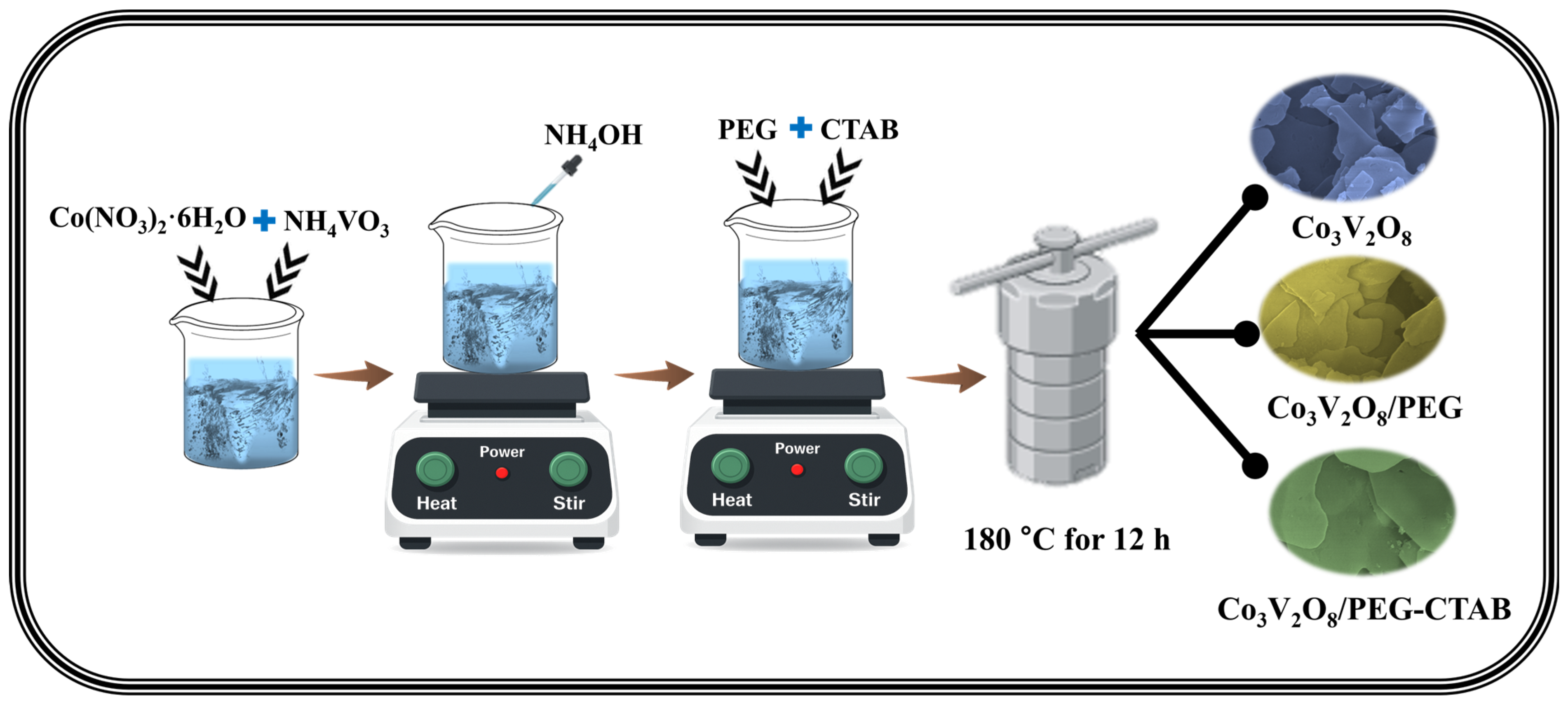
Co3V2O8 nanostructures were synthesized via a hydrothermal strategy. Initially, 0.023 g of Co(NO3)2·6H2O and 0.006 g of NH4VO3 were dissolved in 40 mL of deionized water under continuous stirring, and the pH of the resulting solution was adjusted to approximately 9 using NH4OH to promote controlled hydrolysis and the formation of Co-V precursor species. Surface modulation was achieved through the introduction of organic surfactants into the reaction medium. For the Co3V2O8/PEG sample, 0.1 g of PEG was added prior to pH adjustment to regulate nucleation, suppress agglomeration, and guide the evolution of the nanostructure morphology. In the Co3V2O8/PEG-CTAB system, 0.1 g of PEG and 0.1 g of CTAB were simultaneously incorporated to couple steric stabilization, thereby promoting a more porous architecture and uniform distribution. The resulting precursor solutions were transferred into a 100 mL Teflon-lined stainless-steel autoclave and subjected to hydrothermal treatment at 180 °C for 12 h. After cooling to room temperature, the precipitated products were collected, thoroughly washed with deionized water and ethanol, and dried at 60 °C. The dried precursors were subsequently annealed in air at 400 °C for 2 h to transform them into crystalline Co3V2O8. A schematic representation of the synthesis procedure is provided in Figure 1, highlighting the stepwise formation of the nanostructures and the surfactant-assisted morphological evolution.

2.3. Material Characterization

The structural characteristics of the synthesized nanomaterials were comprehensively investigated using complementary physicochemical techniques. X-ray diffraction (XRD, X’Pert Pro, Cu Kα radiation, Almelo, The Netherlands) was employed to analyze the crystalline structure and phase purity of the samples. The surface chemical composition and oxidation states of the constituent elements were examined by X-ray photoelectron spectroscopy (XPS, Thermo Scientific K-Alpha, Cheshire, UK analysis system), providing insights into the electronic environment and surface chemistry of the electrocatalysts. In addition, the surface morphology, and microstructural features were characterized by field-emission scanning electron microscopy (Fe-SEM, HITACHI S-4800, Tokyo, Japan) coupled with energy-dispersive X-ray (EDX) analysis, which also enabled elemental composition analysis and spatially resolved elemental mapping to confirm homogeneous distribution of the elements within the nanostructures.

2.4. Electrochemical Analysis

Electrochemical measurements were performed by a WBCS3000 battery cycler, Gières, France in a three-electrode configuration. The working electrode was prepared by coating the electrocatalyst onto carbon cloth (CC), which was first pre-treated by sequential sonication in 1 M HCl, deionized water, and ethanol for 20 min each, followed by drying at 70 °C overnight. The catalyst ink was formulated with an 80:10:10 weight ratio of active material, PVDF binder, and acetylene black, using N-methyl-2-pyrrolidone (NMP) as the dispersing solvent. The resulting slurry was uniformly applied to pre-treated 1 × 1 cm2 CC and dried at 60 °C overnight to ensure good adhesion and electrical contact. All electrochemical measurements were performed in a standard three-electrode configuration, where the prepared samples coated on carbon cloth served as the working electrode, a Hg/HgO electrode acted as the reference, and a platinum plate was used as the counter electrode. Linear sweep voltammetry (LSV) was carried out in 1.0 M KOH at a scan rate of 5 mV s−1 to examine the electrocatalytic performance of the prepared materials. Electrochemical impedance spectroscopy (EIS) was conducted over a frequency range from 100 kHz to 0.1 Hz with an applied AC perturbation voltage of 10 mV to examine interfacial properties and determine charge transfer resistances.
Cyclic voltammetry (CV) was conducted in the non-Faradaic region over a potential window of 0.1–0.2 V at scan rates of 5, 10, 15, 20, and 25 mV s−1 to determine the double-layer capacitance. The electrochemically active surface area (ECSA) was subsequently assessed from the slope of the plot of capacitive current versus scan rate using the following relation [29]:
E C S A = C d l C s
where Cdl is the double-layer capacitance obtained from CV, and Cs is the specific capacitance of a smooth surface of the same material, which is reported to be 0.040 mF cm−2 [30,31]. Linear sweep voltammetry (LSV) was employed to evaluate the OER overpotential, using a scan rate of 5 mV s−1 over a potential window from 0 to 1 V. All measurements were recorded vs. Hg/HgO reference electrode, and the potentials were subsequently converted to the reversible hydrogen electrode (RHE) scale according to the Nernst relation:
ERHE = EHg/HgO + E°Hg/HgO + 0.0591 × (pH)
where E°Hg/HgO is the standard potential of the Hg/HgO reference electrode, and the pH of 1 M KOH is approximately 13.9. LSV measurements were further used to assess the stability of the optimized electrocatalyst by comparing polarization curves obtained before and after 5000 CV cycles, and chronopotentiometry (CP) measurements were conducted at a constant current density of 10 mA cm−2, thereby providing insight into the retention of OER activity under prolonged operation.

3. Result and Discussion

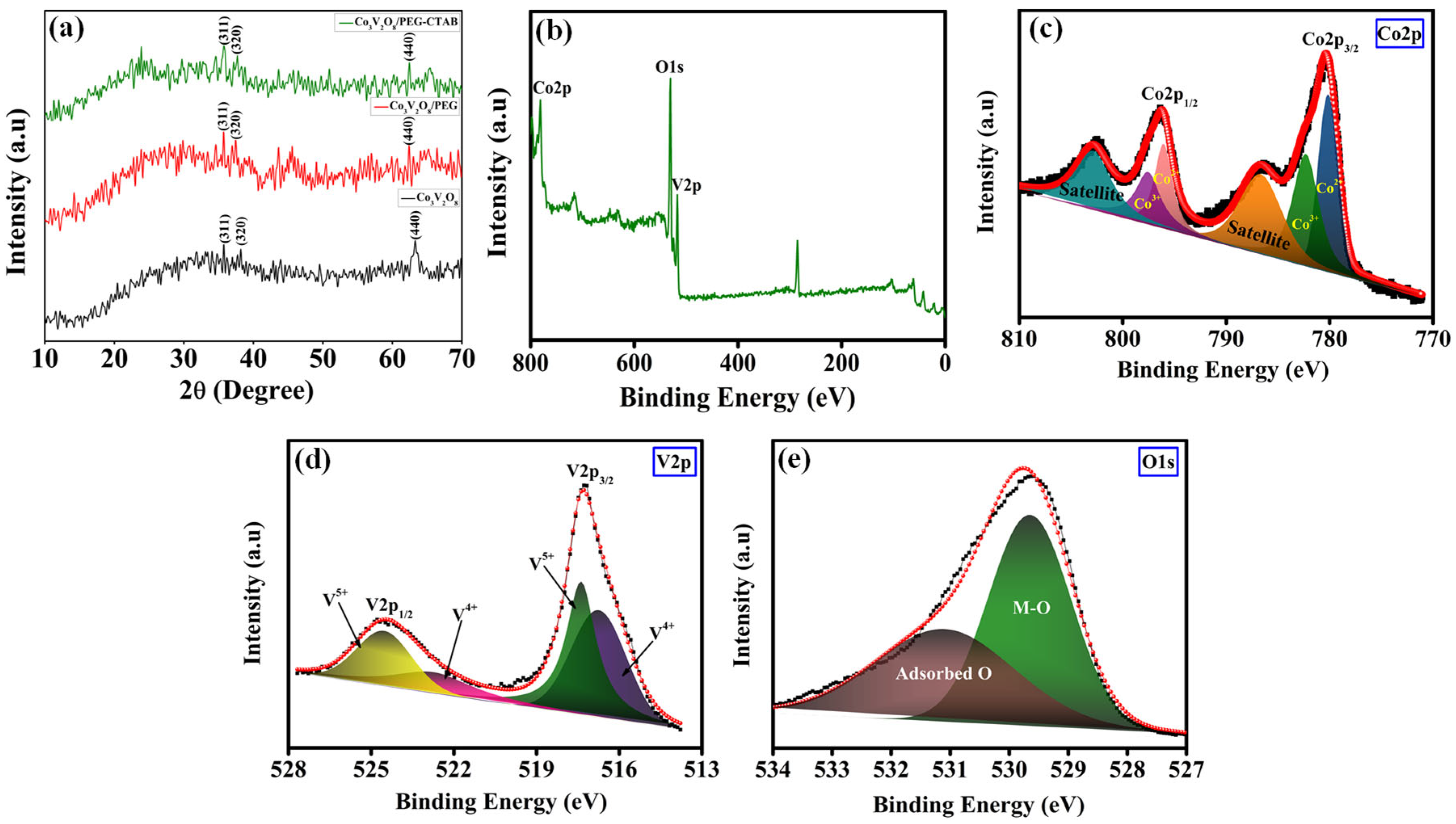
The crystallinity, structural integrity, and phase composition of the synthesized materials were meticulously investigated through X-ray diffraction (XRD) analysis. Figure 2a displays the XRD patterns of Co3V2O8, Co3V2O8/PEG, and Co3V2O8/PEG-CTAB. For the pristine Co3V2O8 sample, weak but discernible diffraction maxima can be observed at approximately 35.7°, 38.1°, and 63.2°, which can be tentatively assigned to the (311), (320), and (440) planes of cubic Co3V2O8 (JCPDS No. 01-016-0675) [32]. Upon incorporation of PEG and CTAB, the overall diffraction profiles remain similar, suggesting that the basic Co3V2O8 phase is preserved. The Co3V2O8/PEG and Co3V2O8/PEG-CTAB samples exhibit slight variations in peak intensity and peak breadth compared to pristine Co3V2O8. These changes are indicative of altered nucleation and growth behavior rather than the formation of new crystalline phases. The lattice spacing for prominent planes was calculated using Bragg’s law:
nλ = 2dsinθ
where d is the interplanar spacing, λ the X-ray wavelength, and θ the Bragg angle [32,33]. The pristine Co3V2O8 exhibits a d-spacing of 2.51 Å for the (311) plane, while the Co3V2O8/PEG and Co3V2O8/PEG-CTAB display a slightly reduced spacing of 2.50 Å for the same reflection. The XRD findings underscore the successful fabrication and phase stability of the developed materials.
The surface elemental composition and oxidation states of cobalt, vanadium, and oxygen in the PEG-CTAB-assisted Co3V2O8 were elucidated by X-ray photoelectron spectroscopy (XPS). The full XPS survey spectrum (Figure 2b) confirms the presence of cobalt (Co), vanadium (V), and oxygen (O) elements within the material. Figure 2c shows that the high-resolution Co 2p spectrum exhibits two spin–orbit doublets corresponding to mixed cobalt oxidation states. The binding energy components centered at approximately 780.1 eV (Co 2p3/2) and 796.1 eV (Co 2p1/2) are attributed to Co2+ species, whereas the peaks located at around 781.8 eV and 797.5 eV can be assigned to Co3+ states. The coexistence of Co2+ and Co3+ indicates a mixed-valence cobalt environment in the Co3V2O8-based materials [34,35]. Two additional satellite peaks observed at 785.9 eV and 802.8 eV are indicative of successful oxidation during synthesis. In Figure 2d, the V2p spectra revealed the existence of two double peaks at 516.1/523.1 eV and 517.5/524.1 eV. These peaks corresponded to V4+ and V5+ [32,36]. These peaks are allocated with the V 2p3/2 and V 2p1/2 transitions and confirm the coexistence of multiple vanadium valence states. Such mixed-valence vanadium sites are known to enhance redox activity in catalytic applications. Meanwhile, the O1s XPS spectrum of Co3V2O8/PEG-CTAB is presented in Figure 2e, and the peaks located at 529.5 and 531.4 eV of the obtained electrocatalysts are ascribed to metal–oxygen (M-O) bonds and adsorbed oxygen [36]. The oxygen environment reinforces the formation of well-structured metal oxide networks in the PEG-CTAB-assisted Co3V2O8 matrix.
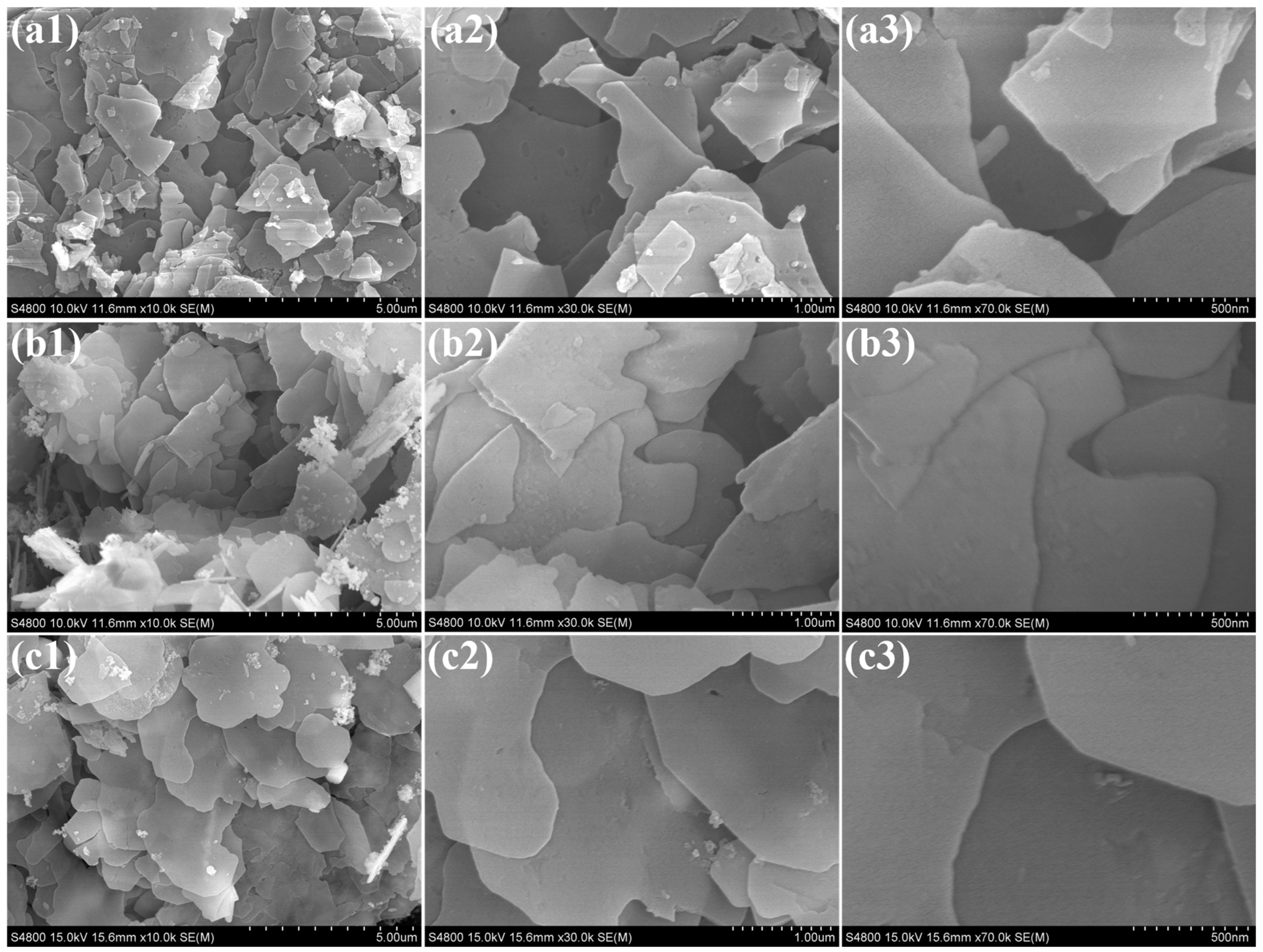
The morphological features of the synthesized electrocatalysts were systematically examined by field-emission scanning electron microscopy (FE-SEM), as presented in Figure 3(a1–a3,b1–b3,c1–c3) for Co3V2O8, Co3V2O8/PEG, and Co3V2O8/PEG-CTAB, respectively. Figure 3(a1–a3) depict Co3V2O8 nanostructures, revealing densely packed nanosheets with irregular edges and coarse surfaces. The sheet-like morphology is discernible at higher magnifications, suggesting effective nucleation and growth under hydrothermal conditions. The Co3V2O8/PEG sample as shown in Figure 3(b1–b3) exhibits a similar nanosheet-based architecture, indicating that the introduction of PEG does not alter the overall morphological motif of the material. The nanosheets remain closely assembled, and no distinct secondary morphologies are observed. On the other hand, subtle variations in surface texture and stacking can be seen. The FE-SEM images of Co3V2O8/PEG-CTAB (Figure 3(c1–c3)) also show a nanosheet-like structure comparable to that of the other samples. The nanosheets form an interconnected network with visible intersheet spaces, suggesting the presence of an open architecture. However, given the limitations of SEM imaging, no quantitative claims regarding nanosheet thickness, uniformity, or porosity are made. The observed morphological similarities across the samples indicate that PEG and CTAB primarily influence surface and interfacial characteristics rather than inducing drastic changes in macroscopic morphology.
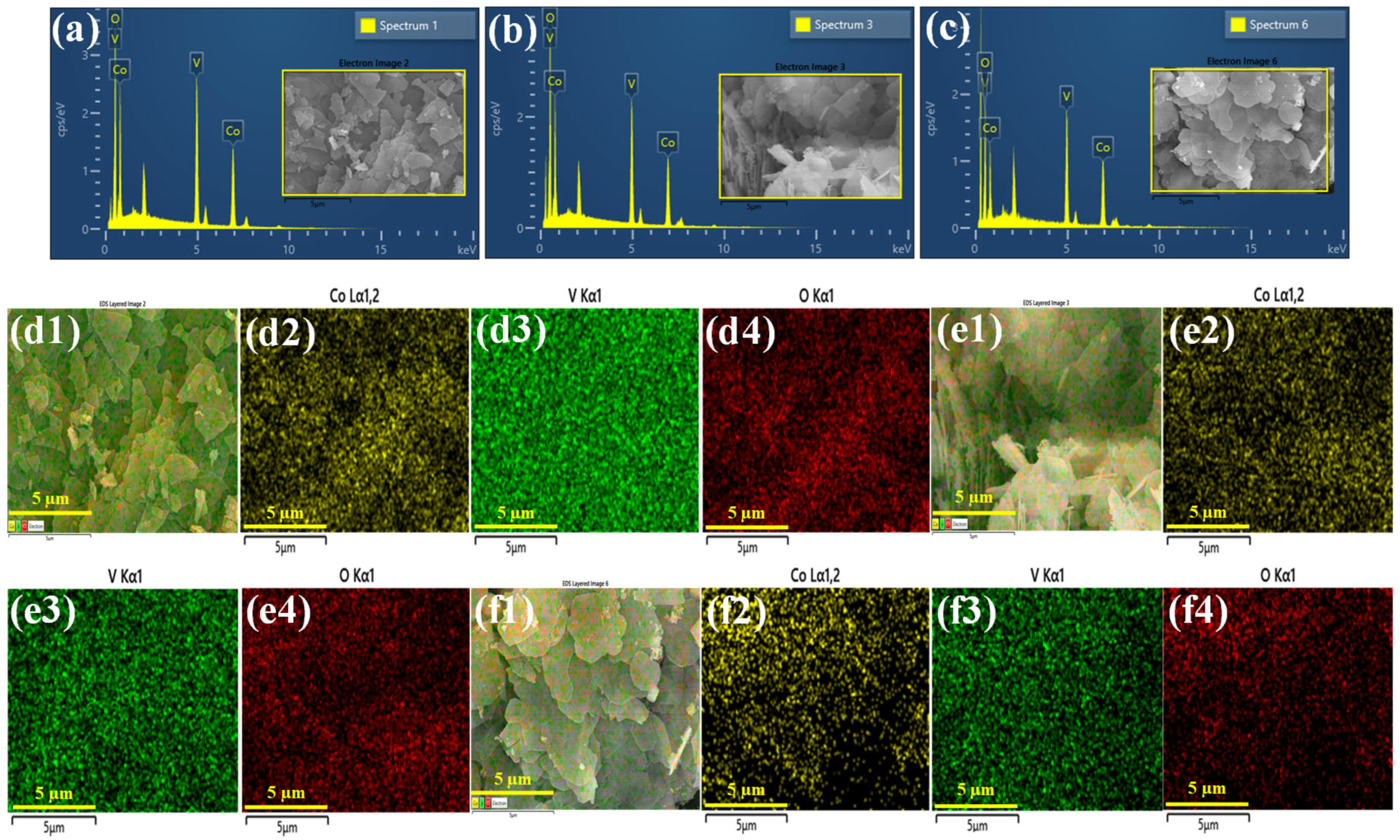
Elemental configuration and homogeneous distribution within the electrocatalysts were comprehensively investigated using energy-dispersive X-ray spectroscopy (EDAX). The pristine Co3V2O8 sample (Figure 4a) exhibited elemental contents of 43.77 wt% Co, 30.65 wt% V, and 25.58 wt% O. For the Co3V2O8/PEG (Figure 4b), the corresponding elemental contents are 42.49 wt% Co, 29.41 wt% V, and 28.10 wt% O, while the Co3V2O8/PEG-CTAB sample (Figure 4c) shows values of 48.43 wt% Co, 31.42 wt% V, and 20.15 wt% O. Across all samples, Co, V, and O remain the dominant detected elements, indicating preservation of the cobalt vanadate framework after surface modification. Elemental mapping of Co, V, and O for all samples (Figure 4(d1–d4,e1–e4,f1–f4)) reveals a relatively uniform spatial distribution of these elements throughout the examined regions, suggesting homogeneous dispersion of the cobalt vanadate phase within each material. Such compositional uniformity is beneficial for maintaining consistent electrochemical behavior by minimizing localized compositional heterogeneity across the electrode surface.
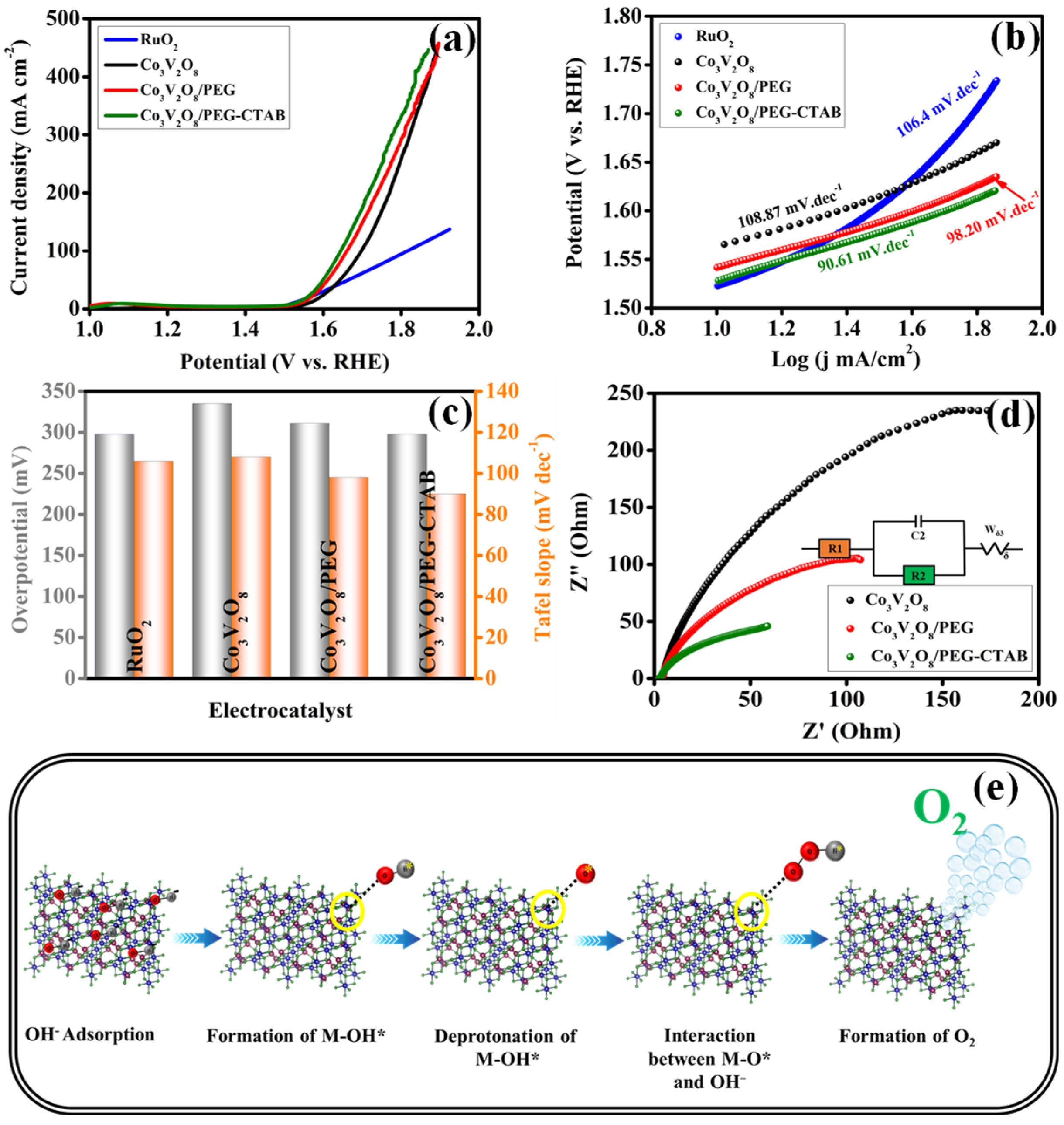
The catalytic activity toward the oxygen evolution reaction (OER) in alkaline media is typically evaluated through the measurement of oxygen generation. Among the key performance indicators, the overpotential at a defined current density serves as a critical parameter, directly reflecting the intrinsic catalytic efficiency of electrocatalysts. Hence, comprehensive electrochemical characterization was conducted to assess the OER behavior of the as-synthesized materials. As shown in Figure 5a, the Co3V2O8/PEG-CTAB catalyst exhibited outstanding OER performance, achieving an overpotential of 298 mV at a current density of 10 mA cm−2. In contrast, commercial RuO2, pristine Co3V2O8, and Co3V2O8/PEG required overpotentials of 298, 335, and 311 mV, respectively, under identical conditions (Figure 5c). The enhanced activity of Co3V2O8/PEG-CTAB can be attributed to the incorporation of CTAB, which modulates surface structure and improves the catalyst–electrolyte interface, facilitating more efficient charge transport and catalytic turnover [28,37]. A comprehensive assessment of the electrocatalytic performance of Co3V2O8/PEG-CTAB with other reported standard catalysts is presented in Table 1. To gain further insight into the reaction kinetics, Tafel analyses were performed, as displayed in Figure 5b. The obtained Tafel slope values for commercial RuO2, Co3V2O8, Co3V2O8/PEG, and Co3V2O8/PEG-CTAB were 106, 108, 98, and 90 mV dec−1, respectively, confirming that the CTAB exhibits faster reaction kinetics and more favorable charge transfer properties. This trend is consistent with the lower overpotential observed in LSV measurements. In alkaline electrolyte, the OER generally proceeds through a sequence of four proton-coupled electron transfer steps occurring at the catalytically active metal site (denoted as M) shown in Figure 5e. These elementary steps collectively govern the kinetics of oxygen generation and are strongly influenced by the nature of the catalyst surface. Previous studies have established that the magnitude of the Tafel slope can provide valuable insight into the rate-determining step (RDS) of the OER process [38,39]. A Tafel slope close to 120 mV dec−1 is commonly associated with a reaction pathway in which the initial adsorption of hydroxide ions is the kinetically limiting step [40]:
M + OH → M-OH + e
When lower Tafel slope values are observed, the RDS is generally shifted to subsequent oxidation steps involving surface-bound intermediates. In particular, the formation of metal-oxo species or the further oxidation of these intermediates to hydroperoxo species may become kinetically controlling, as described by the following reactions:
M-OH* + OH → M-O* + H2O(l) + e
M-O* + OH → M-OOH* + e
The catalytic cycle is completed by oxygen evolution and regeneration of the active site:
M-OOH* + OH → M + O2(g) + H2O(l) + e
For the Co3V2O8/PEG-CTAB electrocatalyst, a Tafel slope of 90 mV dec−1 is obtained, indicating enhanced reaction kinetics compared to catalysts limited by hydroxide adsorption [41]. This value suggests that the rate-determining step is most likely associated with the conversion of surface metal-oxo (M-O) species to hydroperoxo (M-OOH) intermediates, consistent with an adsorbate evolution mechanism (AEM) in alkaline media. Electrochemical impedance spectroscopy (EIS) was further employed to evaluate charge transfer characteristics during OER, as illustrated in Figure 5d. The Nyquist plots were fitted using an equivalent circuit model, revealing charge transfer resistance (Rct) values of 176.7, 112.03, and 45.97 Ω for Co3V2O8, Co3V2O8/PEG, and Co3V2O8/PEG-CTAB, respectively. The substantially reduced Rct in the Co3V2O8/PEG-CTAB system indicates a more rapid electron transport process at the electrode–electrolyte interface, which is crucial for achieving superior OER performance.
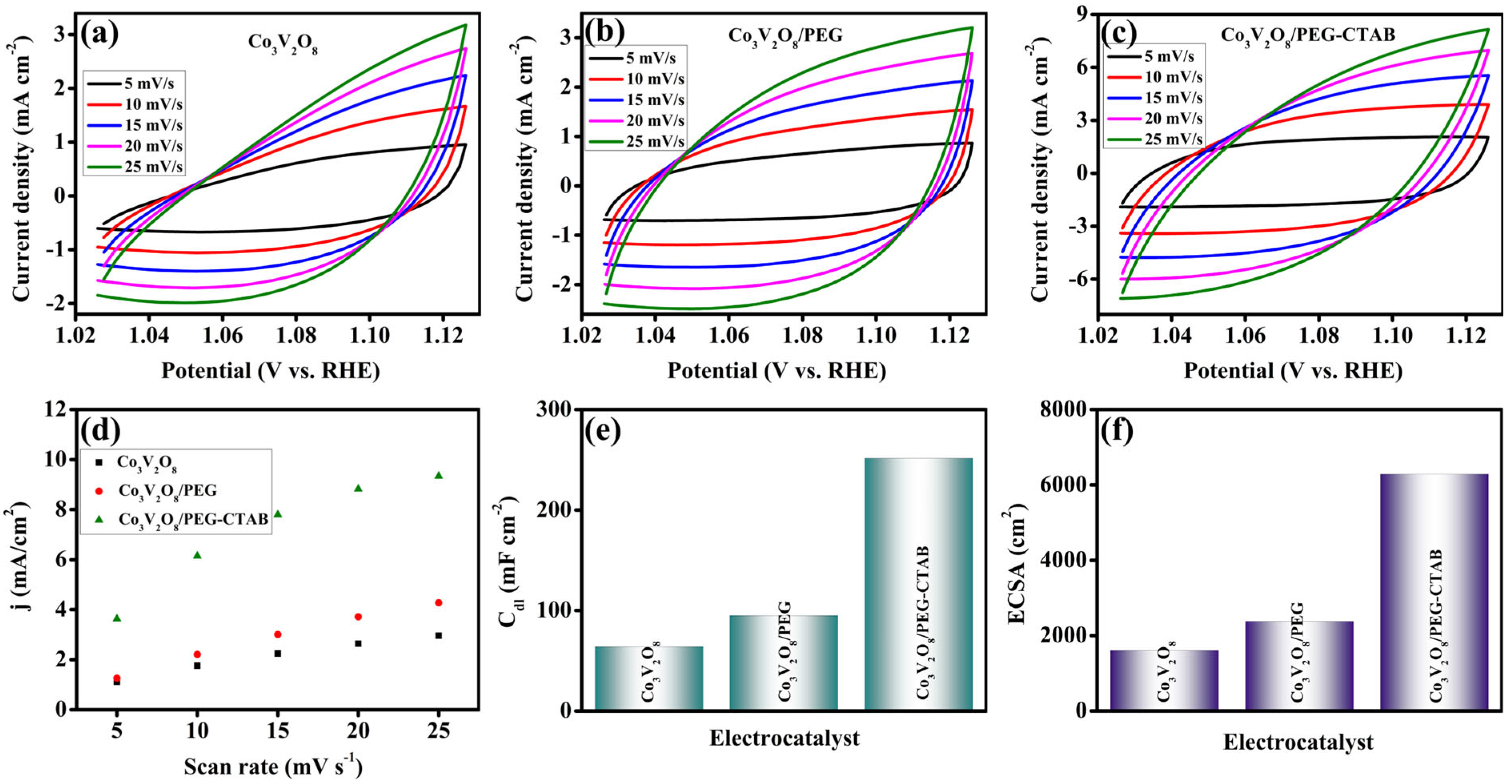
The electrochemical characteristics of the synthesized catalysts were further investigated through cyclic voltammetry (CV). Figure 6a–c display the CV curves of Co3V2O8, Co3V2O8/PEG, and Co3V2O8/PEG-CTAB recorded at varying scan rates, along with the corresponding plots of current density versus potential. The observed increase in current response with the rise in scan rate confirms the typical capacitive behavior and indicates that the electrochemical activity of the catalysts is strongly dependent on the scan rate. To gain deeper insight into the relationship between catalytic performance and the number of active sites, the electrochemically active surface area (ECSA) was projected from the 2Cdl and Cdl as depicted in Figure 6d,e. The Cdl values determined for Co3V2O8, Co3V2O8/PEG, and Co3V2O8/PEG-CTAB were 64.10, 95.14, and 251.50 mF cm−2, respectively. Correspondingly, the calculated ECSA values were 1602.62, 2378.62, and 6287.50 cm2 for the respective samples, as illustrated in Figure 6f. The remarkable increase in Cdl and ECSA upon the incorporation of CTAB suggests the generation of a larger number of active electrochemical sites, which significantly enhances the accessibility of the catalytic surface. This improved electroactive surface area directly contributes to the superior OER activity of the Co3V2O8/PEG-CTAB electrocatalyst, validating its efficient structural and interfacial modulation [42].
Table 1. Comparison of present electrocatalyst OER performance result with other reported electrocatalysts.
ElectrocatalystOverpotential (mV @ 10 mA cm−2)CdlRef.
Co3V2O8 nanoparticles359-[22]
Co3V2O851071.4 μF cm−2[43]
Co3V2O8-1 h37615.3 mF cm−2[44]
GQDs@PEG@Mg-ZnFe2O4349-[26]
Ni@CCO23781.52 mF cm−2[27]
NiCO3@0.2 M CTAB354-[28]
CT@Zn/NMO-rGO296-[37]
Co3V2O8/PEG-CTAB298251.50 mF cm−2Present work
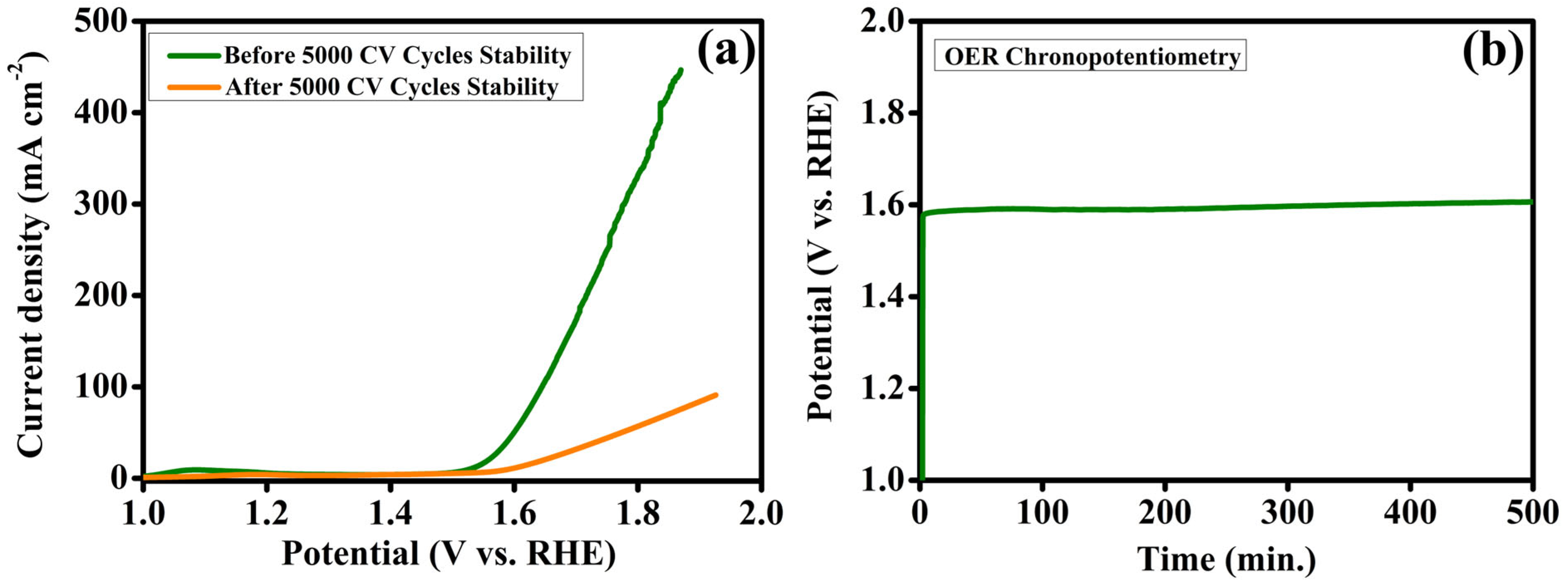
To evaluate the durability of the catalyst under electrochemical stress, cyclic voltammetry (CV) was performed for 5000 continuous cycles. As shown in Figure 7a, the Co3V2O8/PEG-CTAB electrocatalyst exhibits a noticeable shift in the polarization curve after cycling, indicating partial performance degradation under these accelerated conditions. The overpotential required to reach 10 mA cm−2 increased to 362 mV compared to the initial value, reflecting changes at the catalyst–electrolyte interface during prolonged potential cycling. Such degradation may arise from surface oxidation, structural reconstruction, or partial blockage of active sites due to oxygen-containing species, phenomena that are commonly observed during aggressive cycling tests [45,46]. To further assess the stability of the catalyst under steady-state operating conditions, chronopotentiometric measurements were carried out at a constant current density of 10 mA cm−2 for 500 min, as shown in Figure 7b. In contrast to the CV cycling results, the potential–time profile remains relatively stable throughout the test, indicating sustained catalytic activity and stable charge transport during continuous operation. These results suggest that while accelerated CV cycling induces measurable degradation, the Co3V2O8/PEG-CTAB electrocatalyst maintains acceptable operational stability under constant-current OER conditions.
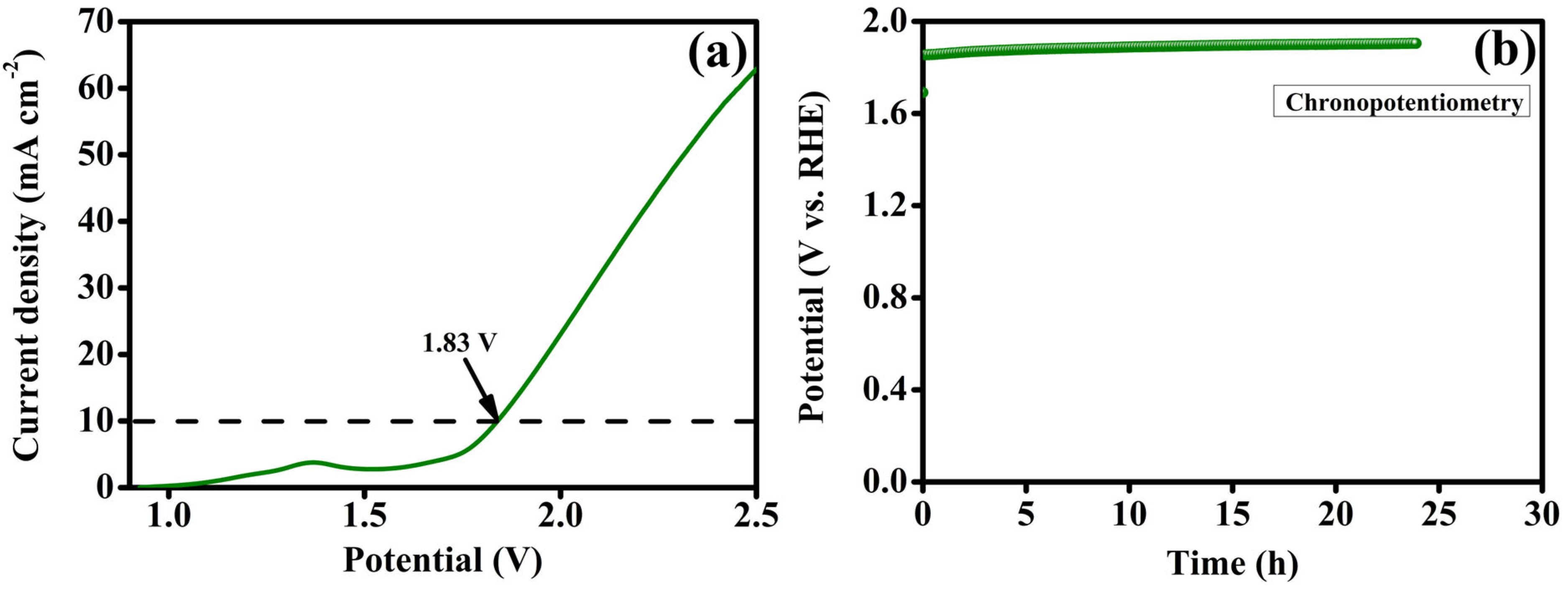
Based on the preceding electrochemical analyses, the Co3V2O8/PEG-CTAB catalyst was identified as the most active OER electrocatalyst among the investigated samples. Consequently, a two-electrode overall water splitting device was assembled using Co3V2O8/PEG-CTAB as the anode and Pt-C as the cathode (Co3V2O8/PEG-CTAB || Pt-C) in 1.0 M KOH to further evaluate its practical performance. The Co3V2O8/PEG-CTAB catalyst delivered promising activity for overall water splitting, particularly for the oxygen evolution half-reaction, requiring a cell voltage of 1.83 V to achieve a current density of 10 mA cm−2 (Figure 8a). The long-term durability of the Co3V2O8/PEG-CTAB-based electrolyzer was assessed by chronopotentiometry at a constant current density of 10 mA cm−2, as shown in Figure 8b. The potential remained nearly stable over 24 h of continuous operation, with only a slight increase relative to the initial chronopotentiometric profile, indicating minimal degradation. This excellent stability confirms the high durability of the Co3V2O8/PEG-CTAB || Pt-C configuration and its ability to sustain efficient overall water splitting performance over prolonged operational periods, highlighting its promise for practical alkaline electrolyzer applications.

4. Conclusions

In conclusion, this study demonstrates a facile and effective approach for the synthesis of nanostructured Co3V2O8 electrocatalysts through PEG- and CTAB-assisted surface engineering, yielding a highly interconnected morphology optimized for the OER. The electrocatalysts were fabricated via a hydrothermal method, and extensive spectroscopic analyses revealed that CTAB incorporation plays a pivotal role in modulating the nanosheet architecture of Co3V2O8/PEG. Among the examined materials, Co3V2O8/PEG-CTAB displayed superior electrochemical OER performance in alkaline media, achieving an overpotential of 298 mV at a current density of 10 mA cm−2 and a Tafel slope of 90 mV dec−1. Comparatively, pristine Co3V2O8 and Co3V2O8/PEG required higher overpotentials of 335 and 311 mV, respectively, under identical conditions. Notably, the Co3V2O8/PEG-CTAB || Pt-C configuration operated at a cell voltage of only 1.83 V to achieve the desired current density, evidencing its robust catalytic activity for overall water splitting. The remarkable enhancement in electrocatalytic performance was primarily attributed to increased active surface area and synergistic effects among the electrocatalyst components, which promote rapid electron transfer and extensive active site exposure. Overall, these findings underscore the importance of precise compositional and morphological optimization in electrocatalyst design, paving the way for the development of next-generation, highly stable, and efficient metal-based OER electrocatalysts suitable for sustainable energy conversion applications.

Author Contributions

M.B.: Conceptualization, Methodology, Investigation, Writing—Original Draft; A.A.P.: Review and Editing; C.-W.J.: Supervision, Writing—Review and Editing, Project Administration, Funding Acquisition. All authors have read and agreed to the published version of the manuscript.

Funding

This research received no external funding.

Data Availability Statement

The data presented in this study are available on request from the corresponding author due to privacy.

Conflicts of Interest

The authors declare no conflicts of interest.

References

  1. Jayabharathi, J.; Thanikachalam, V.; Thiruvengadam, D.; Umapathy, K.; Muthamildevi, M.; Karthikeyan, B. A review on recent development of robust electrocatalysts enable unlocking efficiency of water splitting. Int. J. Hydrogen Energy 2025, 102, 1432–1460. [Google Scholar] [CrossRef] [Scilit]
  2. Chen, T.-W.; Anushya, G.; Chen, S.-M.; Kalimuthu, P.; Mariyappan, V.; Gajendran, P.; Ramachandran, R. Recent advances in nanoscale based electrocatalysts for metal-air battery, fuel cell and water-splitting applications: An overview. Materials 2022, 15, 458. [Google Scholar] [CrossRef] [Scilit] [PubMed]
  3. Dresselhaus, M.S.; Thomas, I. Alternative energy technologies. Nature 2001, 414, 332–337. [Google Scholar] [CrossRef] [Scilit] [PubMed]
  4. Kazemi, A.; Manteghi, F.; Tehrani, Z. Metal electrocatalysts for hydrogen production in water splitting. ACS Omega 2024, 9, 7310–7335. [Google Scholar] [CrossRef] [Scilit]
  5. Cook, T.R.; Dogutan, D.K.; Reece, S.Y.; Surendranath, Y.; Teets, T.S.; Nocera, D.G. Solar energy supply and storage for the legacy and nonlegacy worlds. Chem. Rev. 2010, 110, 6474–6502. [Google Scholar] [CrossRef] [Scilit]
  6. Li, J.; Meng, X.; Zhang, Z.; Song, M.; Zeng, H. Bifunctional electrocatalysts based on nano-fan-shaped NiCoP for hydrogen evolution and urea oxidation reactions. J. Electroanal. Chem. 2025, 997, 119489. [Google Scholar] [CrossRef] [Scilit]
  7. Suntivich, J.; May, K.J.; Gasteiger, H.A.; Goodenough, J.B.; Shao-Horn, Y. A perovskite oxide optimized for oxygen evolution catalysis from molecular orbital principles. Science 2011, 334, 1383–1385. [Google Scholar] [CrossRef] [Scilit]
  8. Bu, L.; Zhang, N.; Guo, S.; Zhang, X.; Li, J.; Yao, J.; Wu, T.; Lu, G.; Ma, J.-Y.; Su, D. Biaxially strained PtPb/Pt core/shell nanoplate boosts oxygen reduction catalysis. Science 2016, 354, 1410–1414. [Google Scholar] [CrossRef] [Scilit]
  9. Seo, M.H.; Choi, S.M.; Kim, H.J.; Kim, W.B. The graphene-supported Pd and Pt catalysts for highly active oxygen reduction reaction in an alkaline condition. Electrochem. Commun. 2011, 13, 182–185. [Google Scholar] [CrossRef] [Scilit]
  10. Hunter, B.M.; Blakemore, J.D.; Deimund, M.; Gray, H.B.; Winkler, J.R.; Müller, A.M. Highly active mixed-metal nanosheet water oxidation catalysts made by pulsed-laser ablation in liquids. J. Am. Chem. Soc. 2014, 136, 13118–13121. [Google Scholar] [CrossRef] [Scilit]
  11. Yuan, C.; Wu, H.B.; Xie, Y.; Lou, X.W. Mixed transition-metal oxides: Design, synthesis, and energy-related applications. Angew. Chem. Int. Ed. 2014, 53, 1488–1504. [Google Scholar] [CrossRef] [Scilit] [PubMed]
  12. Dou, S.; Li, X.; Tao, L.; Huo, J.; Wang, S. Cobalt nanoparticle-embedded carbon nanotube/porous carbon hybrid derived from MOF-encapsulated Co3O4 for oxygen electrocatalysis. Chem. Commun. 2016, 52, 9727–9730. [Google Scholar] [CrossRef] [Scilit] [PubMed]
  13. Muthurasu, A.; Chae, S.-H.; Kim, T.; Mukhiya, T.; Kim, H.Y. Template-Assisted fabrication of ZnO/Co3O4 one-dimensional metal–organic framework array decorated with amorphous iron oxide/hydroxide nanoparticles as an efficient electrocatalyst for the oxygen evolution reaction. Energy Fuels 2020, 34, 7716–7725. [Google Scholar] [CrossRef] [Scilit]
  14. Fan, H.; Huang, J.; Chen, G.; Chen, W.; Zhang, R.; Chu, S.; Wang, X.; Li, C.; Ostrikov, K.K. Hollow Ni–V–Mo chalcogenide nanopetals as bifunctional electrocatalyst for overall water splitting. ACS Sustain. Chem. Eng. 2018, 7, 1622–1632. [Google Scholar] [CrossRef] [Scilit]
  15. Peng, X.; Wang, L.; Hu, L.; Li, Y.; Gao, B.; Song, H.; Huang, C.; Zhang, X.; Fu, J.; Huo, K. In situ segregation of cobalt nanoparticles on VN nanosheets via nitriding of Co2V2O7 nanosheets as efficient oxygen evolution reaction electrocatalysts. Nano Energy 2017, 34, 1–7. [Google Scholar] [CrossRef] [Scilit]
  16. Tao, B.X.; Li, X.L.; Ye, C.; Zhang, Q.; Deng, Y.H.; Han, L.; Li, L.J.; Luo, H.Q.; Li, N.B. One-step hydrothermal synthesis of cobalt–vanadium based nanocomposites as bifunctional catalysts for overall water splitting. Nanoscale 2019, 11, 18238–18245. [Google Scholar] [CrossRef] [Scilit]
  17. Wei, R.; Bu, X.; Gao, W.; Villaos, R.A.B.; Macam, G.; Huang, Z.-Q.; Lan, C.; Chuang, F.-C.; Qu, Y.; Ho, J.C. Engineering surface structure of spinel oxides via high-valent vanadium doping for remarkably enhanced electrocatalytic oxygen evolution reaction. ACS Appl. Mater. Interfaces 2019, 11, 33012–33021. [Google Scholar] [CrossRef] [Scilit]
  18. Wilson, N.; Petrenko, O.; Balakrishnan, G. Magnetic phase diagrams of the Kagomé staircase compounds Co3V2O8 and Ni3V2O8. J. Phys. Condens. Matter 2007, 19, 145257. [Google Scholar] [CrossRef] [Scilit]
  19. Teng, Y.; Li, Y.; Yu, D.; Meng, Y.n.; Wu, Y.; Zhao, X.; Liu, X. The Microwave-Assisted Hydrothermal Synthesis of CoV2O6 and Co3V2O8 with Morphology Tuning by pH Adjustments for Supercapacitor Applications. ChemistrySelect 2019, 4, 956–962. [Google Scholar] [CrossRef] [Scilit]
  20. Yang, G.; Cui, H.; Yang, G.; Wang, C. Self-assembly of Co3V2O8 multilayered nanosheets: Controllable synthesis, excellent Li-storage properties, and investigation of electrochemical mechanism. ACS Nano 2014, 8, 4474–4487. [Google Scholar] [CrossRef] [Scilit]
  21. Zhao, Y.; Liu, Y.; Du, X.; Han, R.; Ding, Y. Hexagonal assembly of Co3V2O8 nanoparticles acting as an efficient catalyst for visible light-driven water oxidation. J. Mater. Chem. A 2014, 2, 19308–19314. [Google Scholar] [CrossRef] [Scilit]
  22. Xing, M.; Kong, L.-B.; Liu, M.-C.; Liu, L.-Y.; Kang, L.; Luo, Y.-C. Cobalt vanadate as highly active, stable, noble metal-free oxygen evolution electrocatalyst. J. Mater. Chem. A 2014, 2, 18435–18443. [Google Scholar] [CrossRef] [Scilit]
  23. Li, M.; Zhang, H.; Chen, M.; Wang, J.; Duan, J.; Ma, S.; Liang, K.; Ma, J. CTAB-Assisted Hydrothermal Synthesis of CoFeMo Layered Double Hydroxides for Efficient Oxygen Evolution Reactions. Chem.–Asian J. 2025, 20, e202401688. [Google Scholar] [CrossRef] [Scilit] [PubMed]
  24. Amate, R.U.; Morankar, P.J.; Teli, A.M.; Beknalkar, S.A.; Chavan, G.T.; Ahir, N.A.; Dalavi, D.S.; Jeon, C.-W. Versatile electrochromic energy storage smart window utilizing surfactant-assisted niobium oxide thin films. Chem. Eng. J. 2024, 484, 149556. [Google Scholar] [CrossRef] [Scilit]
  25. Hariharan, V.; Radhakrishnan, S.; Parthibavarman, M.; Dhilipkumar, R.; Sekar, C. Synthesis of polyethylene glycol (PEG) assisted tungsten oxide (WO3) nanoparticles for l-dopa bio-sensing applications. Talanta 2011, 85, 2166–2174. [Google Scholar] [CrossRef] [Scilit]
  26. Perveen, S.; Hafeez, S.; Khan, M.Z.; Ul-Hamid, A.; Azad, F. Electrochemical and dielectric analysis of multifunctional GQDs@ PEG@ Mg-ZnFe2O4 ternary nanohybrid for low-frequency electronics, water splitting, and sustainable energy storage applications. J. Alloys Compd. 2024, 995, 174746. [Google Scholar] [CrossRef] [Scilit]
  27. Ma, S.; Bai, J.; Sun, L.; Zhao, L.; Tan, H.; Liu, L.; Peng, Z.; Zhao, X.; Xiong, D. Investigation of polyethylene glycol (PEG) assisted solvothermal synthesis of CuCoO2 nanosheets for efficient oxygen evolution reaction. Dalton Trans. 2023, 52, 13750–13757. [Google Scholar] [CrossRef] [Scilit]
  28. Swathi, S.; Yuvakkumar, R.; Ravi, G.; Senthil, T.; Pannipara, M.; Al-Sehemi, A.G.; Velauthapillai, D. CTAB cationic surfactant assisted NiCO3 electrocatalyst for electrochemical water splitting applications. ECS J. Solid State Sci. Technol. 2021, 10, 061006. [Google Scholar] [CrossRef] [Scilit]
  29. Arumugam, B.; Siddharthan, E.E.; Mannu, P.; Thapa, R.; Dong, C.-L.; Jeffery, A.A.; Kim, S.-C. Regulating the electronic structure of CoMoO 4 via La doping for efficient and durable electrochemical water splitting reactions. J. Mater. Chem. A 2025, 13, 6749–6767. [Google Scholar] [CrossRef] [Scilit]
  30. Guo, J.; Wei, Z.; Wang, K.; Zhang, H. Synergistic coupling of CoFe-layered double hydroxide nanosheet arrays with reduced graphene oxide modified Ni foam for highly efficient oxygen evolution reaction and hydrogen evolution reaction. Int. J. Hydrogen Energy 2021, 46, 27529–27542. [Google Scholar] [CrossRef] [Scilit]
  31. Wang, P.; Yu, Y.; Yan, Y.; Qin, B.; Ye, Z.; Zhong, W.; Cai, W.; Zheng, X. N plasma assisted Fe doped NiCo nanosheet arrays for alkaline electrocatalytic oxygen evolution. J. Alloys Compd. 2023, 941, 168954. [Google Scholar] [CrossRef] [Scilit]
  32. Yuan, H.; Wang, S.; Ma, Z.; Kundu, M.; Tang, B.; Li, J.; Wang, X. Oxygen vacancies engineered self-supported B doped Co3O4 nanowires as an efficient multifunctional catalyst for electrochemical water splitting and hydrolysis of sodium borohydride. Chem. Eng. J. 2021, 404, 126474. [Google Scholar] [CrossRef] [Scilit]
  33. Bhosale, M.; Murugan, N.; Kim, Y.A.; Thangarasu, S.; Oh, T.H. Interface Engineering of Network-Like 1D/2D (NHCNT/Ni─MOF) Hybrid Nanoarchitecture for Electrocatalytic Water Splitting. Small Methods 2025, 9, 2401492. [Google Scholar] [CrossRef] [Scilit] [PubMed]
  34. Feng, Y.; Xi, J.; Lin, Z.; Lin, Z.; Yan, W.; Yuan, Y.; Guo, S. Combining Ultrafine Co3V2O8 Nanoparticles and Hollow Carbon Spheres for Lithium Storage Applications. ACS Appl. Nano Mater. 2024, 7, 22534–22544. [Google Scholar] [CrossRef] [Scilit]
  35. Jin, D.; Lee, S.H.; Lee, Y.; Lee, C.; Kim, M.H. Noble-metal-free single-phase Co3V2O8 with the structural integrity of nanofibers for the selective detection of ascorbic acid. CrystEngComm 2022, 24, 6739–6746. [Google Scholar] [CrossRef] [Scilit]
  36. Gao, M.; Huang, Z.; Wang, L.; Li, H.; Ruan, C.; Sadeq, R.; Isimjan, T.T.; Yang, X. Synergistic Co-N/VN dual sites in N-doped Co3V2O8 nanosheets: Pioneering high-efficiency bifunctional electrolysis for high-current water splitting. J. Colloid Interface Sci. 2024, 658, 739–747. [Google Scholar] [CrossRef] [Scilit]
  37. Dhas, S.D.; Kim, G.; Thonge, P.N.; Patil, A.M.; Mendhe, A.C.; Batool, R.; Kim, D. Enhanced electrochemical performance of CTAB-assisted Zn-doped perovskite NiMnO3 nanocrystals on reduced graphene oxide for supercapacitors and oxygen evolution reactions. J. Mater. Chem. A 2025, 13, 3735–3748. [Google Scholar] [CrossRef] [Scilit]
  38. Li, C.; Baek, J.-B. The promise of hydrogen production from alkaline anion exchange membrane electrolyzers. Nano Energy 2021, 87, 106162. [Google Scholar] [CrossRef] [Scilit]
  39. Yao, S.; Wei, H.; Zhang, Y.; Zhang, X.; Wang, Y.; Liu, J.; Tan, H.H.; Xie, T.; Wu, Y. Controlled growth of porous oxygen-deficient NiCo2O4 nanobelts as high-efficiency electrocatalysts for oxygen evolution reaction. Catal. Sci. Technol. 2021, 11, 264–271. [Google Scholar] [CrossRef] [Scilit]
  40. Kauffman, D.R.; Alfonso, D.; Tafen, D.N.; Lekse, J.; Wang, C.; Deng, X.; Lee, J.; Jang, H.; Lee, J.-S.; Kumar, S. Electrocatalytic oxygen evolution with an atomically precise nickel catalyst. ACS Catal. 2016, 6, 1225–1234. [Google Scholar] [CrossRef] [Scilit]
  41. Zhai, Y.; Ren, X.; Sun, Y.; Li, D.; Wang, B.; Liu, S.F. Synergistic effect of multiple vacancies to induce lattice oxygen redox in NiFe-layered double hydroxide OER catalysts. Appl. Catal. B Environ. 2023, 323, 122091. [Google Scholar] [CrossRef] [Scilit]
  42. Hanan, A.; Shu, D.; Aftab, U.; Cao, D.; Laghari, A.J.; Solangi, M.Y.; Abro, M.I.; Nafady, A.; Vigolo, B.; Tahira, A. Co2FeO4@ rGO composite: Towards trifunctional water splitting in alkaline media. Int. J. Hydrogen Energy 2022, 47, 33919–33937. [Google Scholar] [CrossRef] [Scilit]
  43. Mondal, A.; Ganguli, S.; Inta, H.R.; Mahalingam, V. Influence of vanadate structure on electrochemical surface reconstruction and OER performance of CoV2O6 and Co3V2O8. ACS Appl. Energy Mater. 2021, 4, 5381–5387. [Google Scholar] [CrossRef] [Scilit]
  44. Li, L.; Lin, X.; Hu, Q. Oxygen vacancies promoting the electrocatalytic activity of dual-shelled Co3V2O8 hollow sphere catalyst for efficient oxygen evolution. Dalton Trans. 2025, 54, 7838–7842. [Google Scholar] [CrossRef] [Scilit]
  45. Bhosale, M.; Baby, N.; Magdum, S.S.; Murugan, N.; Kim, Y.A.; Thangarasu, S.; Oh, T.-H. Hierarchical nanoassembly of Ni3S2-MoS2 interconnected with CeO2 as a highly remarkable hybrid electrocatalyst for enhancing water oxidation and energy storage. J. Energy Storage 2024, 80, 110301. [Google Scholar] [CrossRef] [Scilit]
  46. Vo, T.-G.; Hidalgo, S.D.S.; Chiang, C.-Y. Controllable electrodeposition of binary metal films from deep eutectic solvent as an efficient and durable catalyst for the oxygen evolution reaction. Dalton Trans. 2019, 48, 14748–14757. [Google Scholar] [CrossRef] [Scilit]
Figure 1. Schematic illustration of synthesis of Co3V2O8/PEG-CTAB.
Crystals 16 00034 g001
Figure 2. (a) XRD spectra of all the electrocatalysts, (b) XPS survey spectra, and high-resolution XPS spectra of (c) Co2p, (d) V2p, and (e) O1s of Co3V2O8/PEG-CTAB.
Crystals 16 00034 g002
Figure 3. FE-SEM images of (a1a3) Co3V2O8, (b1b3) Co3V2O8/PEG, and (c1c3) Co3V2O8/PEG-CTAB.
Crystals 16 00034 g003
Figure 4. Elemental analysis of (a) Co3V2O8, (b) Co3V2O8/PEG, and (c) Co3V2O8/PEG-CTAB, and EDAX mapping data of (d1d4) Co3V2O8, (e1e4) Co3V2O8/PEG, and (f1f4) Co3V2O8/PEG-CTAB.
Crystals 16 00034 g004
Figure 5. OER performance of RuO2 and as prepared electrocatalyst contain (a) LSV curve at 5 mV s−1, (b) resulting Tafel slopes, (c) OER performance at 10 mA cm−2 and Tafel slope results, (d) EIS spectra, and (e) possible reaction mechanism towards OER.
Crystals 16 00034 g005
Figure 6. Cyclic voltammetry analysis at different scan rate (a) Co3V2O8, (b) Co3V2O8/PEG, and (c) Co3V2O8/PEG-CTAB, (d) 2Cdl graph, (e) Cdl graph, and (f) ECSA graph of all the electrocatalysts.
Crystals 16 00034 g006
Figure 7. (a) LSV curves of Co3V2O8/PEG-CTAB before and after 5000 CV cycles and (b) chronopotentiometry analysis.
Crystals 16 00034 g007
Figure 8. (a) Polarization curve and (b) chronopotentiometry analysis of the Co3V2O8/PEG-CTAB || Pt-C asymmetric two-electrode system.
Crystals 16 00034 g008
Disclaimer/Publisher’s Note: The statements, opinions and data contained in all publications are solely those of the individual author(s) and contributor(s) and not of MDPI and/or the editor(s). MDPI and/or the editor(s) disclaim responsibility for any injury to people or property resulting from any ideas, methods, instructions or products referred to in the content.