Article

Pinless Friction Stir Spot Welding of Pure Copper: Process, Microstructure, and Mechanical Properties


1
College of Mechanical and Electrical Engineering, Huangshan University, Huangshan 245041, China
2
Department of Materials Science, Kharkiv Polytechnic Institute, National Technical University, 61002 Kharkiv, Ukraine
*
Author to whom correspondence should be addressed.
Crystals 2025, 15(9), 804; https://doi.org/10.3390/cryst15090804
Submission received: 29 August 2025 / Revised: 10 September 2025 / Accepted: 10 September 2025 / Published: 12 September 2025
(This article belongs to the Special Issue Metallurgy-Processing-Properties Relationship of Metallic Materials)

Abstract

Pure copper joints (PCJs) were fabricated using pinless friction stir spot welding (P-FSSW), a solid-state welding technique, to investigate the influence of plunge depth, rotational speed, and dwell time on PCJ performance. Thermal cycles under different welding parameters were recorded, while the microstructure at various locations within the welded zone was characterized using electron backscatter diffraction (EBSD). The microhardness and tensile–shear force (T-SF) of the PCJs were evaluated, and the fracture types together with fracture evolution were analyzed. The experimental results reveal that, under the combined effect of thermal cycles and mechanical stirring, subgrains in the welded zone transformed into recrystallized grains, whereas intense material flow contributed to an increased fraction of deformed grains. At the Hook region and the interface between the upper and lower sheets, grains were tightly bonded, resulting in effective metallurgical joining. Higher microhardness values were observed in the stir zone (SZ), whereas lower values appeared in the heat-affected zone beneath the interface. With increasing plunge depth, rotational speed, and dwell time, the T-SF of the PCJs first increased and then decreased, achieving a relatively high value at a plunge depth of 0.4 mm, a rotational speed of 1500 rpm, and a dwell time of 9 s. The fracture types of the PCJs were shear fracture and plug fracture, with the Hook region identified as the weakest zone.

1. Introduction

Pure copper, owing to its unique physicochemical properties such as high electrical and thermal conductivity, is widely utilized in fields including new energy vehicles, aerospace, and power and energy systems, with typical applications in battery tabs, high-power motor windings, and high-efficiency heat exchangers [1,2,3]. With the rapid development of next-generation high-efficiency energy and electrification equipment, the demand for high-quality welding of pure copper structural components has been steadily increasing. However, due to its high thermal conductivity and high coefficient of thermal expansion, pure copper is highly susceptible to defects such as coarse microstructures, hot cracks, and porosity during conventional fusion welding processes [4,5], which in turn deteriorates the joint strength and service reliability. The emergence of friction stir spot welding (FSSW) has provided a promising solution for the efficient and high-quality welding of pure copper [6]. FSSW is derived from friction stir welding, and its fundamental principle is to utilize the frictional heat and mechanical stirring induced by a rotating tool to promote plastic material flow, thereby forming solid-state bonding within the weld zone [7,8]. In FSSW, the peak temperature during welding remains below the melting point of the material, which effectively eliminates melting-related defects that commonly occur in fusion welding [9]. Compared with other spot welding techniques, FSSW offers significant advantages in terms of joint integrity and performance consistency [10], along with the benefits of low energy consumption, environmental friendliness, and broad applicability. Nevertheless, conventional FSSW relies on a pin-equipped tool that plunges into the specimen, which often induces defects such as keyholes and penetration of the lower sheet when applied to thin sheets. These issues compromise the strength and stability of the welded joints [11,12,13]. To address this limitation, researchers have developed pinless friction stir spot welding (P-FSSW), in which a pinless tool rotates on the surface of the specimen while applying axial pressure, generating frictional heat and inducing plastic material flow to achieve local metallurgical bonding between the upper and lower sheets. This method avoids the keyhole defect associated with the pin, while offering a simple and efficient welding process that demonstrates excellent application potential for thin-sheet welding [14,15,16].
In recent years, extensive research has been conducted on the process mechanisms and joint properties of P-FSSW. Regarding similar-material welding, Gülçimen et al. investigated P-FSSW of AA7075-T6 aluminum alloy and examined the effects of welding parameters on joint performance. Their results revealed that welds produced at low rotational speed, high plunge depth, and prolonged dwell time exhibited superior tensile–shear force (T-SF). Furthermore, the T-SF of the joints was found to be closely associated with the Hook morphology and the effective spot width [17]. Yu et al. designed four types of pinless tools and explored the influence of end-face groove geometry on the performance of AA6061-T6 aluminum alloy joints. They analyzed the effects of end-face groove features under various welding parameters on the microstructure and mechanical properties of the joints, and concluded that end-face grooves enhanced material flow, thereby exerting a pronounced effect on the T-SF of the joints [18]. Fan et al. performed P-FSSW on 2198-T8 Al–Li alloy and, based on numerical simulation and EBSD techniques, elucidated the material flow mechanisms during welding and discussed their impact on interfacial bonding. Their study emphasized that plastic deformation and recrystallization of the material play critical roles in achieving effective interfacial bonding [19]. With respect to dissimilar-material welding, Rashkovets et al. employed P-FSSW to join AA2024 aluminum alloy and AISI 304 stainless steel, investigating the influence of rotational speed and tool force on the microstructure and microhardness. Using numerical simulation, they revealed the evolution of temperature fields and material flow during welding [20]. Tognoli et al. reported on P-FSSW of CW004A copper and AA1050A aluminum alloy, with particular emphasis on the fatigue failure behavior of the joints. Their findings indicated that optimizing process parameters to regulate the interface can effectively enhance the fatigue performance of the welds [21]. Vaneghi et al. conducted P-FSSW of AA2024 aluminum alloy and pure copper, examining the effects of rotational speed and dwell time on the microstructure and mechanical properties of the joints, with a particular focus on the formation of intermetallic compounds at the interface. Their study demonstrated that increasing rotational speed and dwell time promoted the growth of intermetallic compounds [22]. In addition, Rashkovets et al. investigated P-FSSW of AA2024-T3 and AA6082-T6 aluminum alloys, exploring the effect of rotational speed on joint performance. They reported that rotational speed significantly influenced material flow and microstructural evolution through variations in heat input, thereby affecting joint properties. The highest T-SF of the joints was achieved at 2000 rpm [23]. Furthermore, P-FSSW has also been applied to Mg–steel welding, where the results demonstrated that the technique not only enables reliable bonding but also yields joints with favorable mechanical performance [24,25]. Overall, welding parameters exert a direct and critical influence on the performance of P-FSSW joints, and the dependence on process parameters varies with different material systems.
The aforementioned studies provide valuable insights into the welding mechanisms and joint properties of P-FSSW; however, existing research has predominantly focused on aluminum alloys and dissimilar alloy systems, while investigations on pure copper joints (PCJs) remain relatively limited. Owing to the high thermal conductivity and pronounced strength–plasticity of pure copper, the thermo-mechanical coupling behavior during welding is considerably more complex, and the influence of process parameters on PCJ properties has not yet been fully elucidated. Consequently, it is necessary to conduct a systematic study of P-FSSW in pure copper. In this work, P-FSSW was performed on 1 mm thick pure copper sheets. The effects of plunge depth (PD), rotational speed (RS), and dwell time (DT) on PCJ properties were investigated. Microstructural variations within the PCJs were analyzed using EBSD, while the tensile shear properties and fracture types of the PCJs were examined. The objective of this study is to clarify the correlations between welding parameters and PCJ properties, thereby providing both theoretical and practical guidance for achieving high-quality welding of pure copper.

2. Materials and Methods

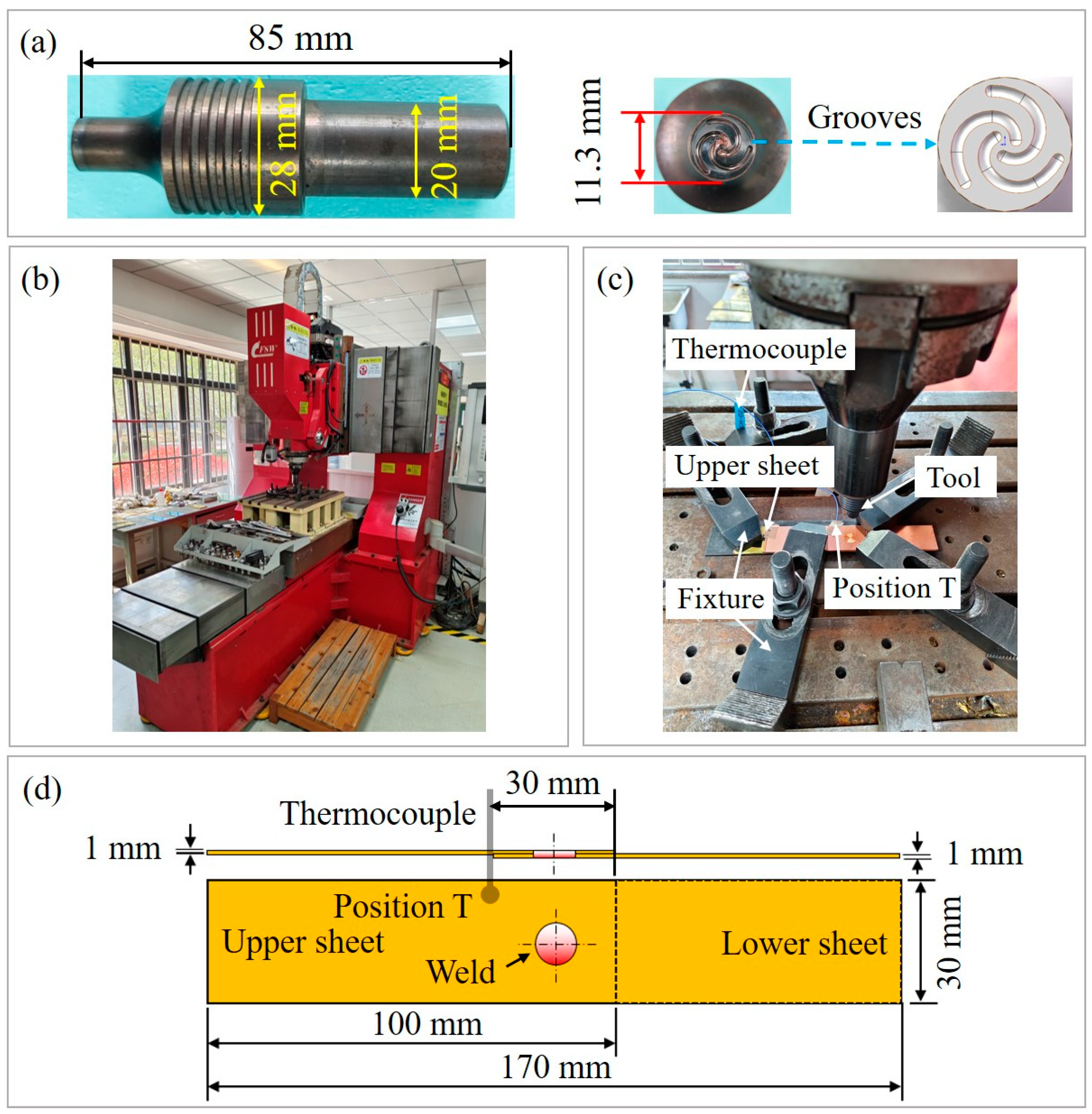
The experimental material used was T1 pure copper (Chinese National Standard, equivalent to ASTM C11000). Its chemical composition is listed in Table 1, and the specimen geometry is shown in Figure 1d. The lap joint area between the upper and lower sheets was 30 × 30 mm. The pinless tool, depicted in Figure 1a, was fabricated from H13 steel with a shoulder diameter of 11.3 mm. Three Fibonacci spiral grooves with a depth of 0.5 mm were machined on the tool’s end surface, following the design principle described in Ref. [26]. Welding experiments were performed on a dedicated friction stir welding machine supplied by Beijing FSW Technology Co., Ltd. (Beijing, China), as shown in Figure 1b,c. To monitor the thermal cycles during welding, a thermocouple was embedded at Position T (see Figure 1c,d) on the upper sheet, and temperature data were recorded using a digital temperature acquisition system.
For P-FSSW, the PD, RS, and DT are highly sensitive to the joint formation process and mechanical performance [27]. Therefore, the present study primarily focuses on elucidating the influence of these three parameters on the PCJ properties. A total of 12 welding trials were conducted, covering a range of PDs from 0.2 mm to 0.5 mm, RSs from 900 rpm to 1700 rpm, and DTs from 3 s to 12 s, as summarized in Table 2. In all experiments, the plunge rate was kept constant at 10 mm/min.
To clearly characterize the surface morphology of the PCJs, a VHX-X1 3D microscope manufactured by Keyence (Osaka, Japan) was employed to capture representative surface features. For cross-sectional observation and microhardness testing, the welded specimens were sectioned at the center of the PCJs using a wire-cut electrical discharge machine. The cut surfaces were subsequently ground with 320-grit, 600-grit, and 1000-grit SiC sandpapers in sequence. For cross-sectional metallographic observation, electrolytic polishing was performed using an electropolisher with parameters of 1 A, 30 V, and 12 s, and a polishing solution composed of CH3OH and HNO3 (4:1 by volume). The polished surfaces were then examined using an optical microscope. The preparation procedure for EBSD samples was identical to that for the cross-sectional specimens. EBSD analysis of specific regions was conducted using a scanning electron microscope (SEM) equipped with an Oxford Instruments EBSD detector. For microhardness testing, the surfaces polished with sandpapers were further polished using a metallographic polishing machine to ensure clarity of indentation profiles. Vickers microhardness measurements were subsequently carried out with a load of 300 g and a dwell time of 10 s. The load-bearing capacity of the PCJs was evaluated using a universal tensile testing machine at a crosshead speed of 1.5 mm/min. Each tensile test was repeated three times to minimize experimental errors.

3. Results and Discussion

3.1. Thermal Cycle

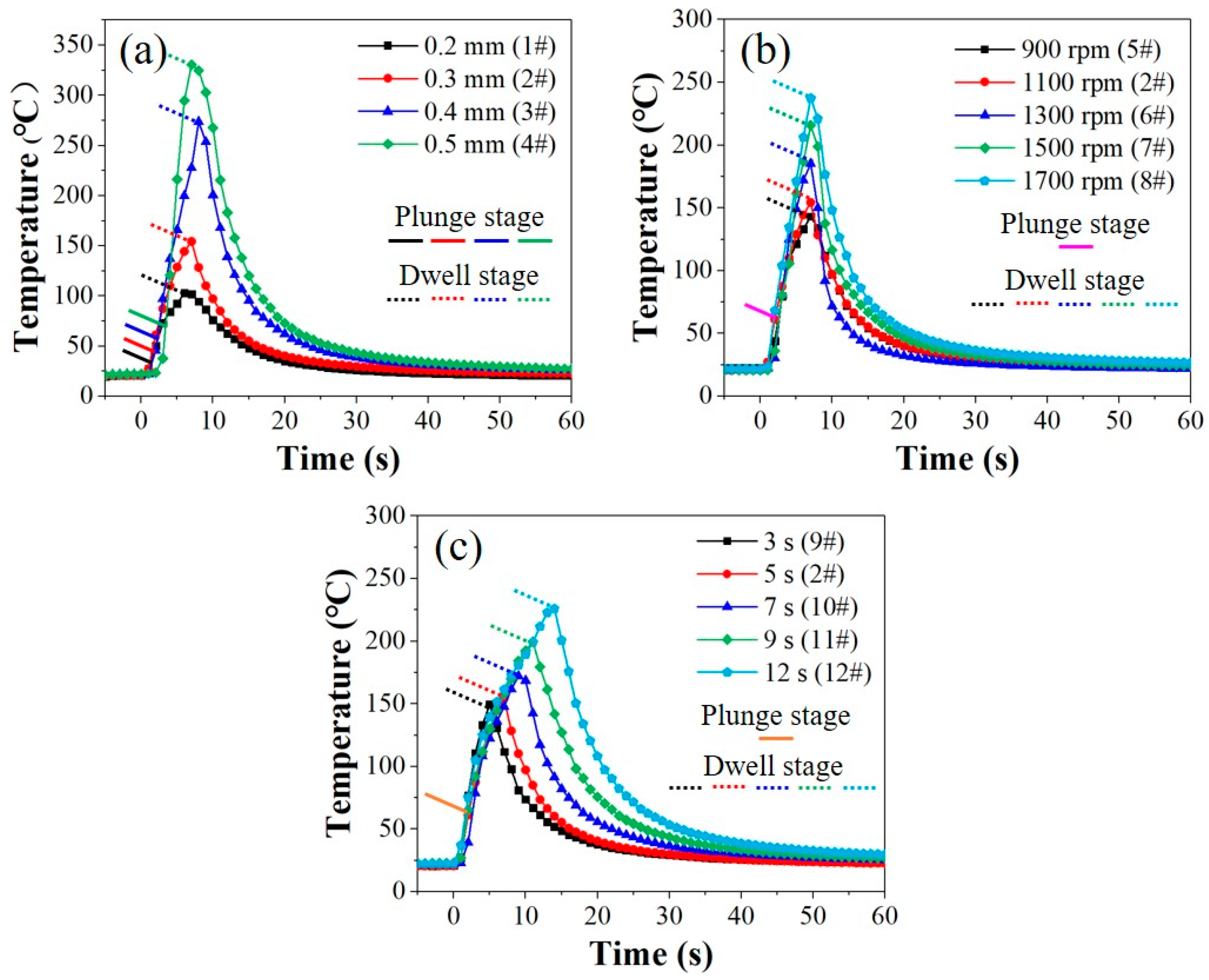
Figure 2 presents the thermal cycles under different welding parameters. It can be observed that during the welding process, the temperature generally exhibits an initial increase followed by a subsequent decrease. The temperature rise occurs mainly during the plunge and dwell stages, as shown in Figure 2a–c (the solid lines indicate the boundaries of the plunge stage, while the dashed lines indicate the boundaries of the dwell stage). In these stages, due to the continuous rotation of the tool combined with the applied axial pressure, frictional heat is generated in the welding zone. Simultaneously, the mechanical stirring of the tool induces plastic deformation of the material, further contributing to heat generation, which results in a continuous temperature increase. With increasing PD, RS, and DT, the peak temperature during welding also increases progressively. A larger PD enhances both the tool–material contact area and the applied axial pressure, while intensifying plastic deformation, thereby elevating the welding temperature. Higher RS raises the shear rate and plastic deformation between the tool and the material, leading to a further increase in peak temperature. Longer DT extends the overall welding duration, resulting in greater heat input and heat accumulation in the welding zone, thus significantly increasing the peak temperature. The highest peak temperature, 331 °C, was recorded at a PD of 0.5 mm, while the lowest peak temperature, 103 °C, occurred at a PD of 0.2 mm. These findings indicate that the peak temperature is particularly sensitive to PD.

3.2. Macromorphology

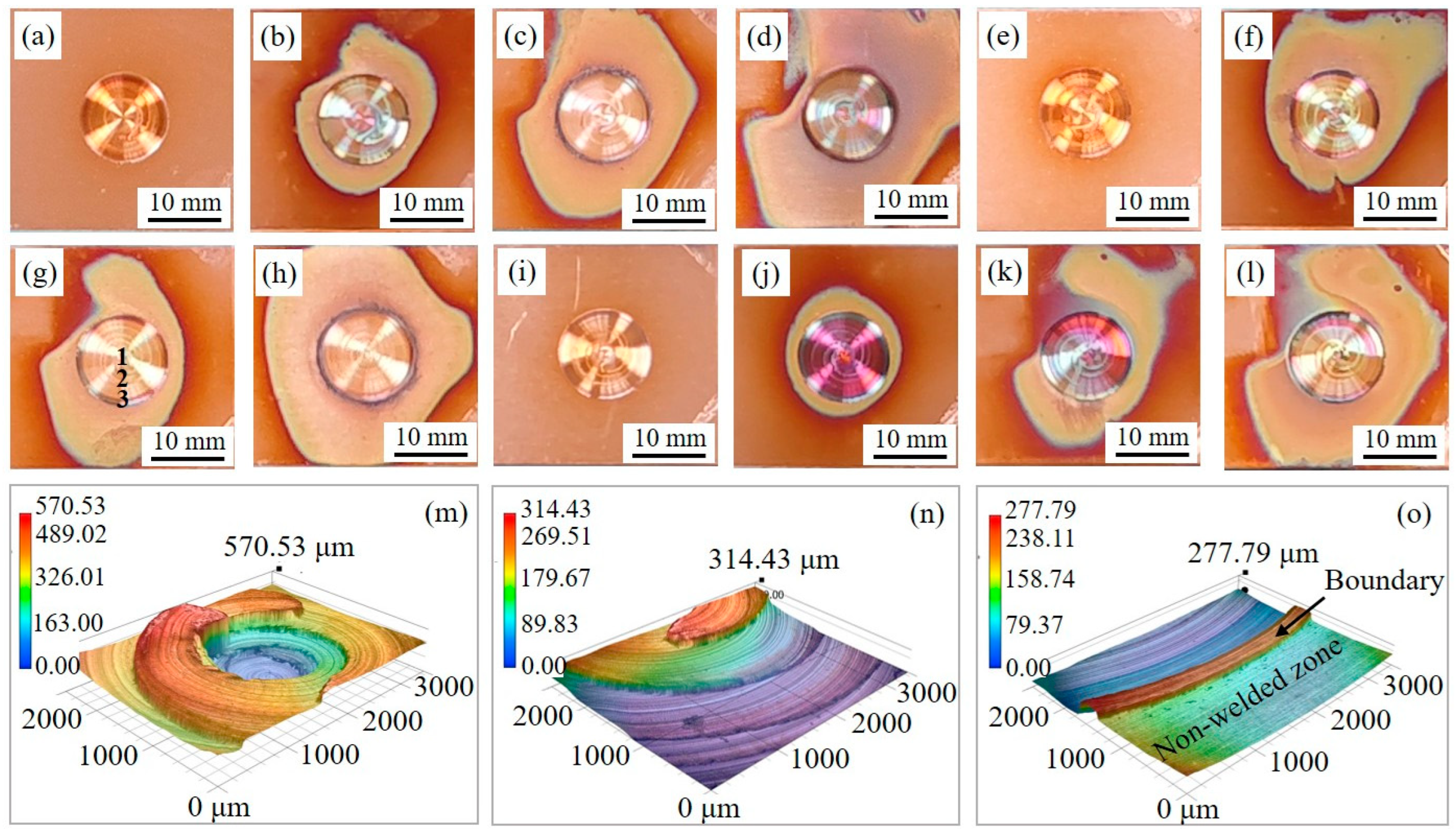
Figure 3a–l present the photographs of the PCJs obtained under different welding parameters. It can be observed that successful welding of the pure copper sheets was achieved under all parameter conditions, and the PCJs exhibited similar macroscopic surface morphologies. Figure 3m–o show the 3D surface morphologies at different positions of specimen 7. A spiral ring-like feature was observed at the PCJ center (Figure 3m), which is primarily attributed to the material flow induced by the grooves on the tool shoulder. From the center towards the periphery of the PCJ, the surface height gradually decreases (Figure 3n). A distinct arc-shaped boundary was formed between the welded and the unwelded regions, with the welded zone being lower in height compared to the unwelded zone (Figure 3o).
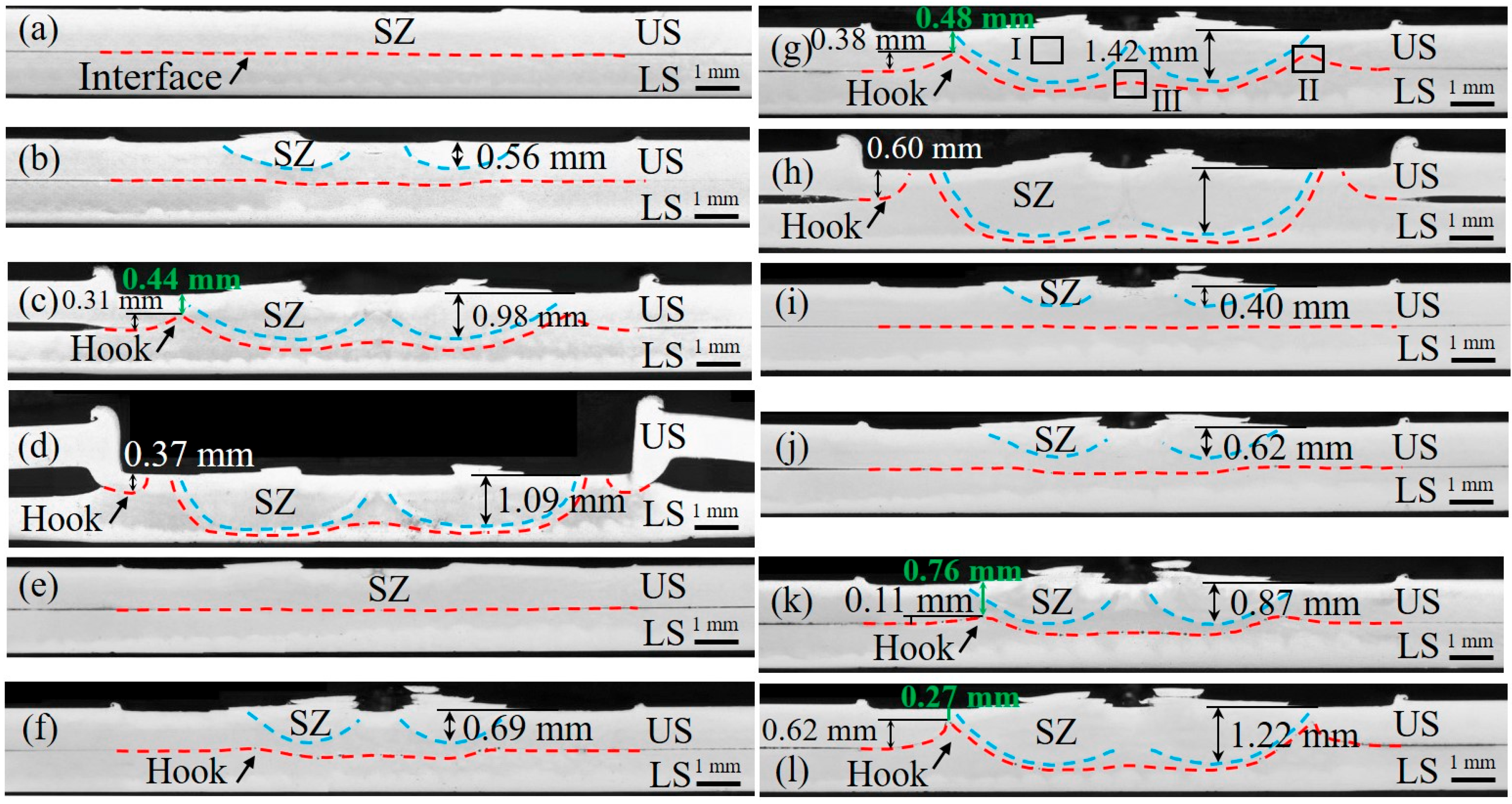
Figure 4 shows the cross-sectional morphologies of the PCJs obtained under various welding parameters. Under the mechanical stirring action of the tool, the materials between the upper sheet (US) and the lower sheet (LS) underwent non-uniform plastic flow, resulting in different degrees of interfacial bending and the formation of a distinct “interface line”, as indicated by the red dashed lines in Figure 4. Due to the discontinuity of this interface line, upward-bending Hooks were formed at both ends of the stir zone (SZ). It is generally believed that a moderate Hook contributes to improving the mechanical interlocking between the US and LS; however, excessive Hook formation intensifies the discontinuity of the interface line, which can adversely affect the bonding quality between the two sheets [28,29]. As shown in Figure 4a–d, with increasing PD, the degree of interfacial bending gradually increased, indicating enhanced material flow between the US and LS. The PD also promoted the increase in Hook height, reaching 0.37 mm at a plunge depth of 0.5 mm. At this point, the excessive PD caused the Hook to detach from the central interface line. From Figure 4b,e–h, it can be observed that the bending of the interface line increased progressively with increasing RS, which can be ascribed to the intensification of the mechanical stirring effect. At 900 rpm and 1100 rpm, the Hook feature was relatively inconspicuous. As the RS further increased, the Hook height increased, reaching 0.60 mm at 1700 rpm, where intense stirring caused the Hook to separate entirely from the interface line. Similarly, as shown in Figure 4b,i–l, prolonging the DT led to gradual increases in both interfacial bending and Hook height, primarily because the extended welding duration facilitated greater plastic material flow. When the DT reached 12 s, the Hook height increased to 0.62 mm.
The SZ is the region directly subjected to the stirring action of the tool, where the material flow is most intense. As observed in Figure 4, the SZ (marked by blue dashed lines) exhibited symmetrical characteristics on both sides of the PCJ and was located above the interface line. With the increase in PD, RS, and DT, the height of the SZ increased progressively, and its lateral extent expanded. The variations in SZ size directly affected the bending morphology of the interface line.

3.3. Microstructure

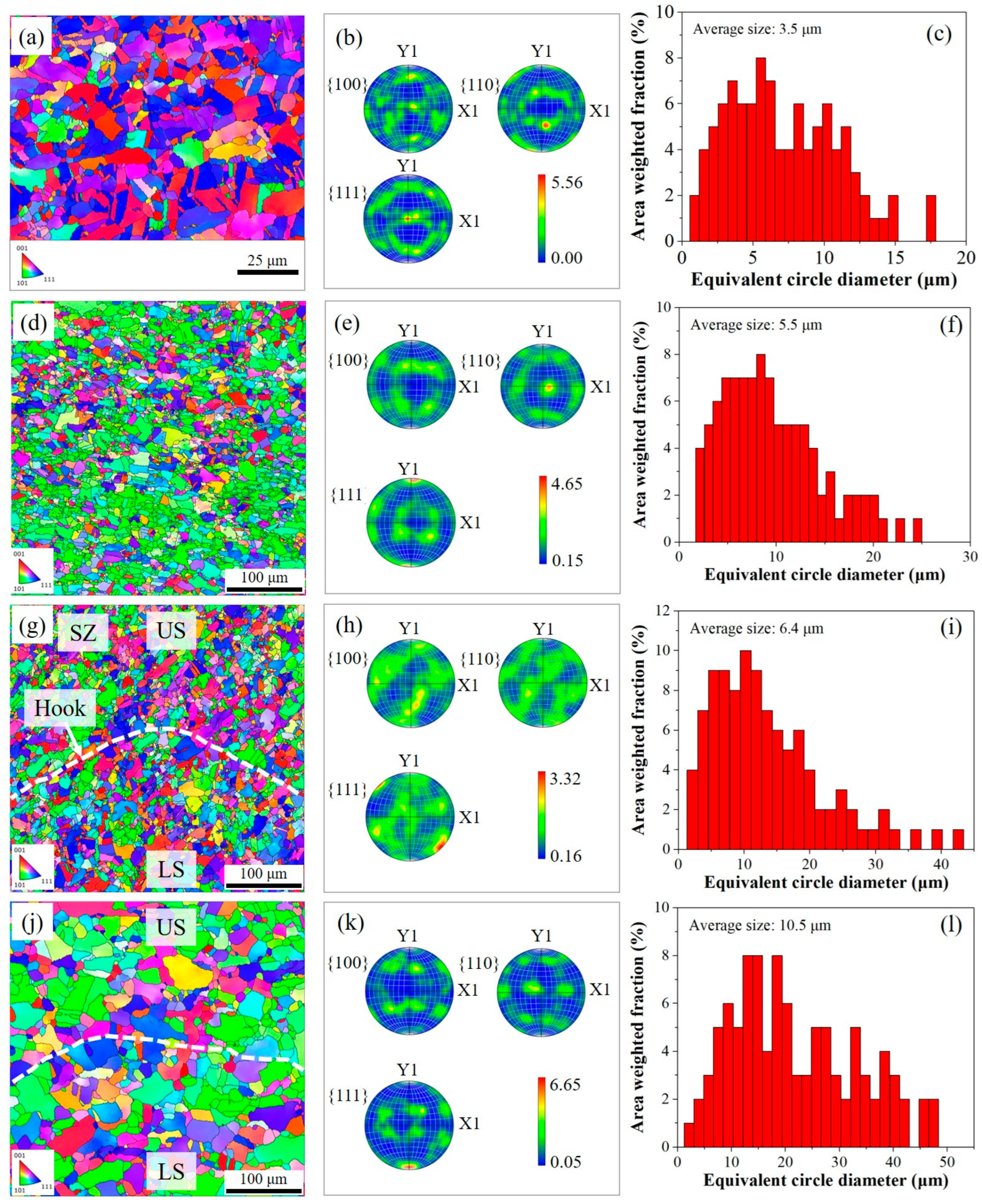
To elucidate the microstructural variations within the PCJs, EBSD analysis was conducted on the characteristic regions of specimen 7. The observation locations are indicated in Figure 4g (Regions I, II, and III), and the EBSD results are presented in Figure 5 and Figure 6.
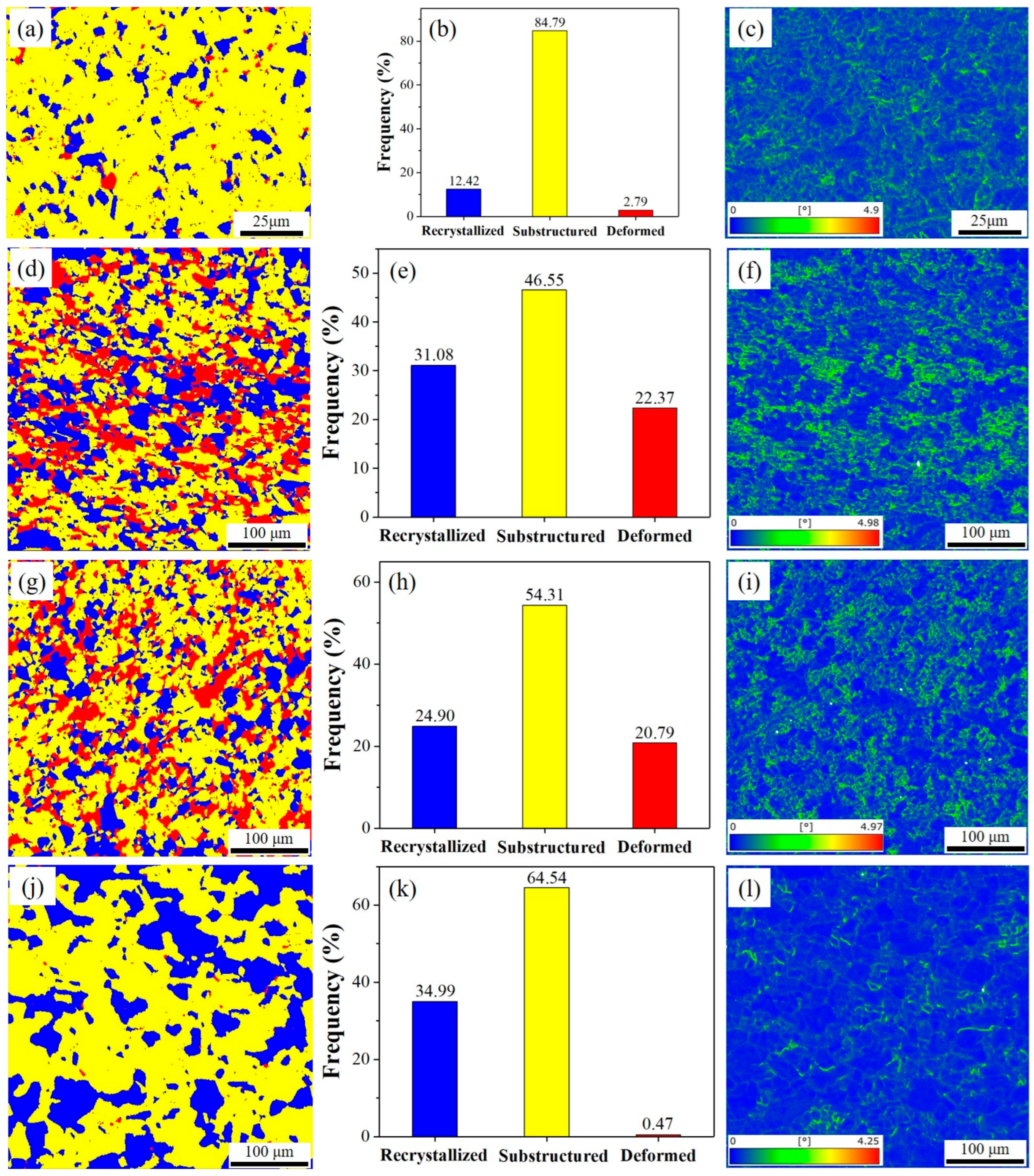
As shown in Figure 5a–c, the base material (BM) exhibits an average grain size of 3.5 μm, with distinct rolling characteristics. In terms of grain types, subgrains dominate, accounting for 84.79%, followed by recrystallized grains, while deformed grains contribute only 2.79%, as shown in Figure 6a,b. From Figure 5d–l, it can be seen that the average grain sizes in Regions I, II, and III are 5.5 μm, 6.4 μm, and 10.5 μm, respectively, all larger than that of the BM. Although subgrains remain predominant in the welded regions, their fraction decreases compared with the BM, whereas recrystallized grains increase significantly (Figure 6d,e,g,h,j,k). This can be attributed to the high temperature and severe plastic deformation during welding, which promoted the transformation of subgrains into recrystallized grains, thereby increasing their fraction [30]. However, due to the elevated temperature in the weld region—particularly with the prolonged dwell time—the grains experienced sufficient growth, leading to markedly coarsened recrystallized grains and, consequently, larger average grain sizes compared with the BM.
As shown in Figure 6e, the fraction of deformed grains in the SZ reaches 22.37%, significantly higher than in the BM, indicating intense plastic deformation, which is further corroborated by the Kernel Average Misorientation (KAM) map (Figure 6f). KAM characterizes the degree of plastic deformation homogenization, where larger KAM values indicate more severe plastic deformation [31,32]. Near the Hook, deformed grains account for 20.79%, accompanied by high KAM values, suggesting vigorous material flow in this region (Figure 6h,i). Region III, located at the weld center, experiences the weakest mechanical stirring, with microstructural evolution predominantly governed by high temperature. Consequently, this region exhibits the most pronounced grain coarsening, the highest recrystallized grain fraction, and the weakest KAM intensity (Figure 5j and Figure 6k,l). As illustrated in Figure 5g, the grains at the Hook line exhibit dense bonding, with no obvious defects observed between the US and LS. This indicates that, under the combined action of tool stirring and material plastic flow, the materials from the US and LS were sufficiently extruded and interlaced at the Hook, thereby achieving effective metallurgical bonding. Furthermore, in Region III, where material flow is relatively weak, the extent of plastic deformation is limited. Nevertheless, owing to the elevated temperature and axial force during welding, the interface between the US and LS still underwent sufficient thermal diffusion, leading to the formation of continuous grains along the interface and demonstrating effective metallurgical bonding, as shown in Figure 5j.

3.4. Microhardness

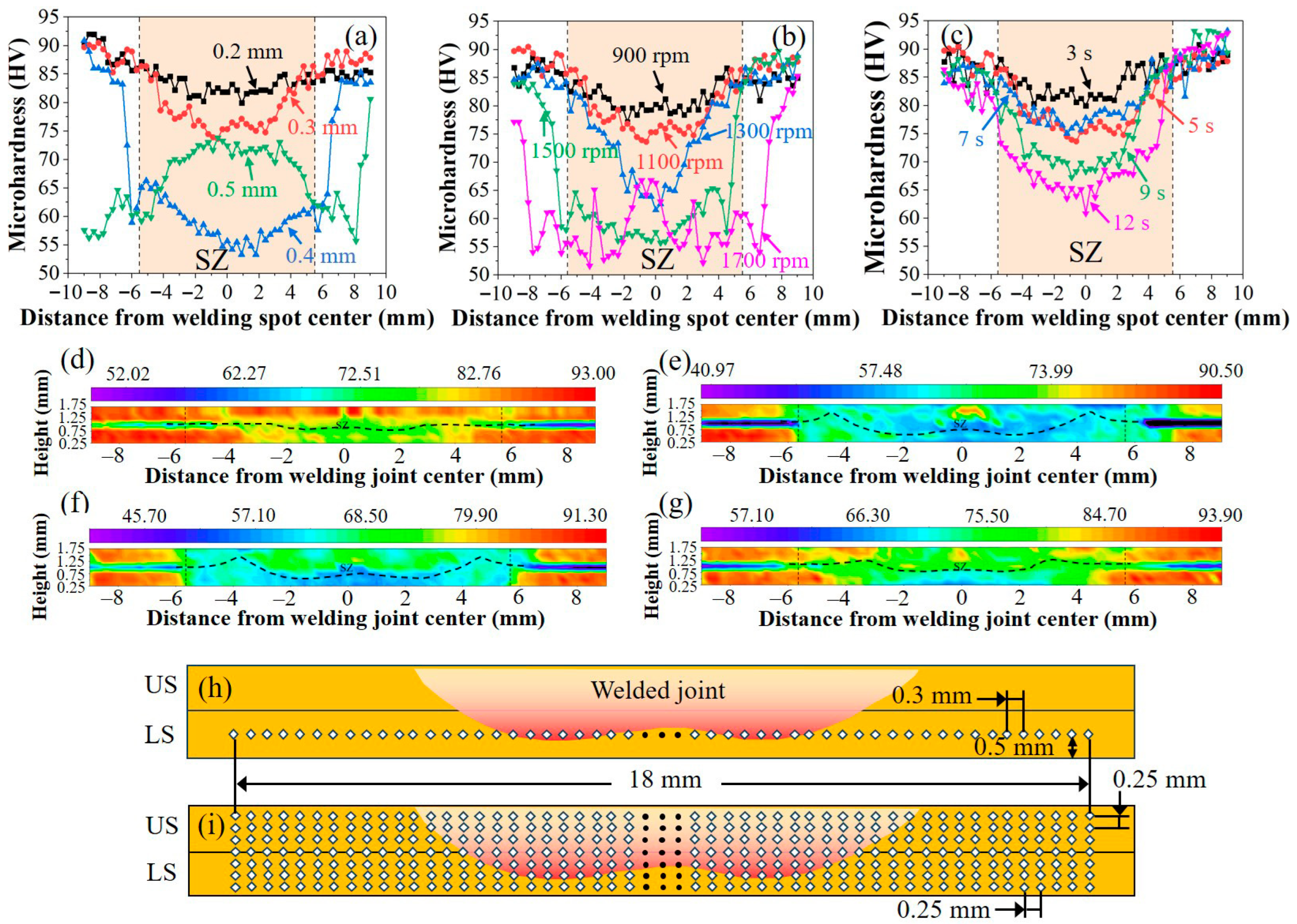
Figure 7 presents the microhardness distributions under different welding parameters. As shown in Figure 7a–c, except for specimens 4 and 8, the microhardness within the SZ generally follows a similar trend, gradually decreasing from the SZ boundary toward the center of the PCJ. This behavior can be attributed to the limited material flow at the center of the LS. Under the influence of continuous heat input, grain coarsening occurs, resulting in lower microhardness values at the PCJ center. With increasing PD, RS, and DT, the overall microhardness exhibits a decreasing trend, which is primarily ascribed to the elevated heat input during welding. For specimens 4 and 8, however, the microhardness at the center of the LS shows an increasing trend, which is associated with the spatial distribution of the SZ. As illustrated in Figure 4d,h, the SZ extends over a larger region and approaches the bottom surface of the LS, such that the microhardness test points in the center are located within the SZ. According to Figure 5, the SZ exhibits relatively fine grain structures. Based on the Hall–Petch relationship, smaller grain size leads to higher microhardness [33,34], thereby accounting for the increased microhardness values observed in the center of the LS in specimens 4 and 8.
As shown in Figure 7d–g, the microhardness inside the PCJs is significantly lower than that outside the PCJs, primarily due to grain coarsening in the welded region. Within the PCJs, the lowest microhardness values are located in the heat-affected zone at the bottom center, while the highest values are found in the SZ. In addition, relatively low microhardness is also observed at the interface outside the Hook region. Since this area is distant from the SZ and only weakly affected by tool stirring, the bonding quality of the material is reduced.

3.5. Tensile–Shear Force

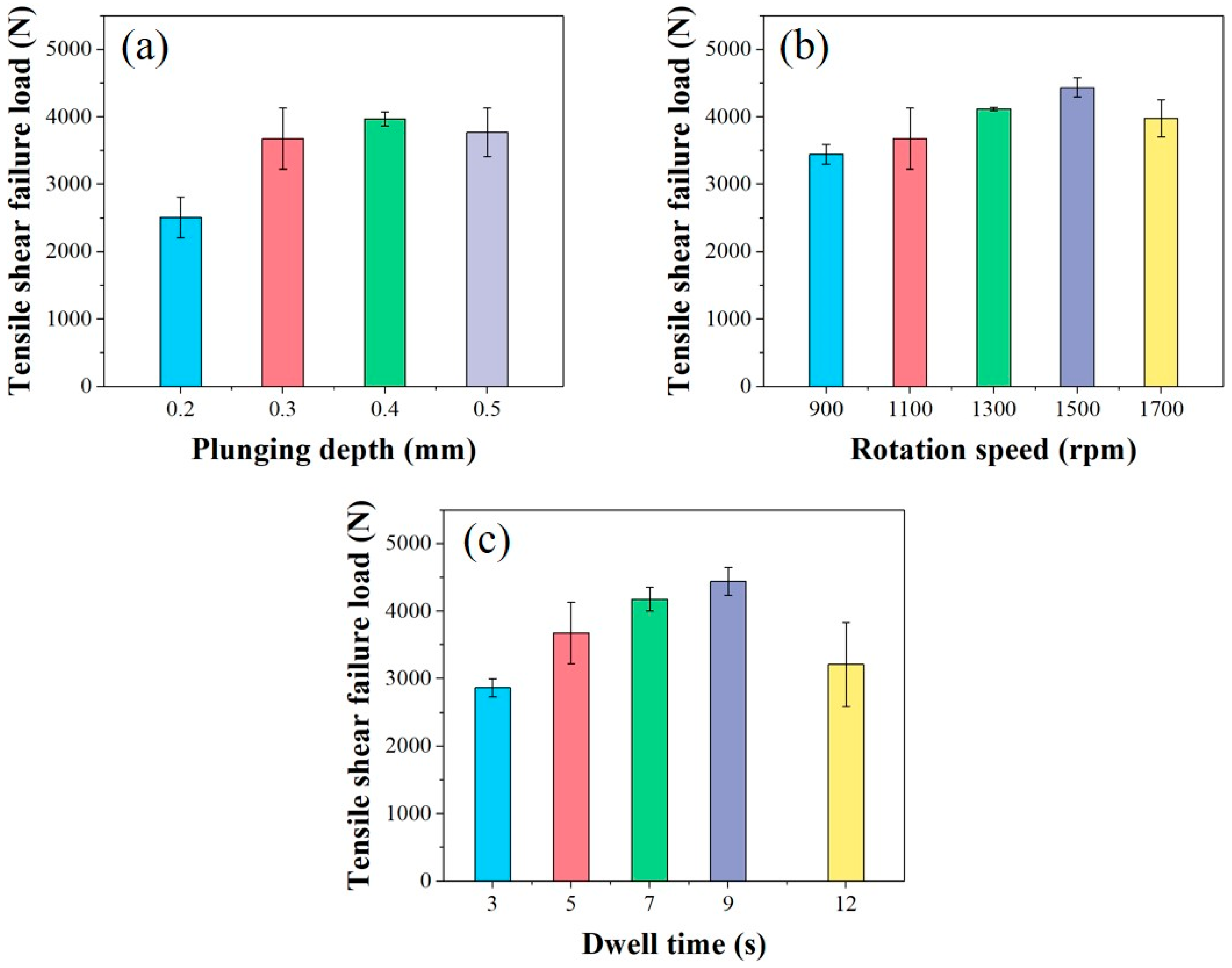
Figure 8 shows the T-SFs obtained under different welding parameters. It can be observed that with the increase in PD, RS, and DT, the T-SF of the PCJs first increases and then decreases. The higher T-SFs were recorded under a DT of 9 s and an RS of 1500 rpm, reaching 4441.7 N and 4436.7 N, respectively. In contrast, the lowest T-SF of only 2510.1 N was obtained at a PD of 0.2 mm.
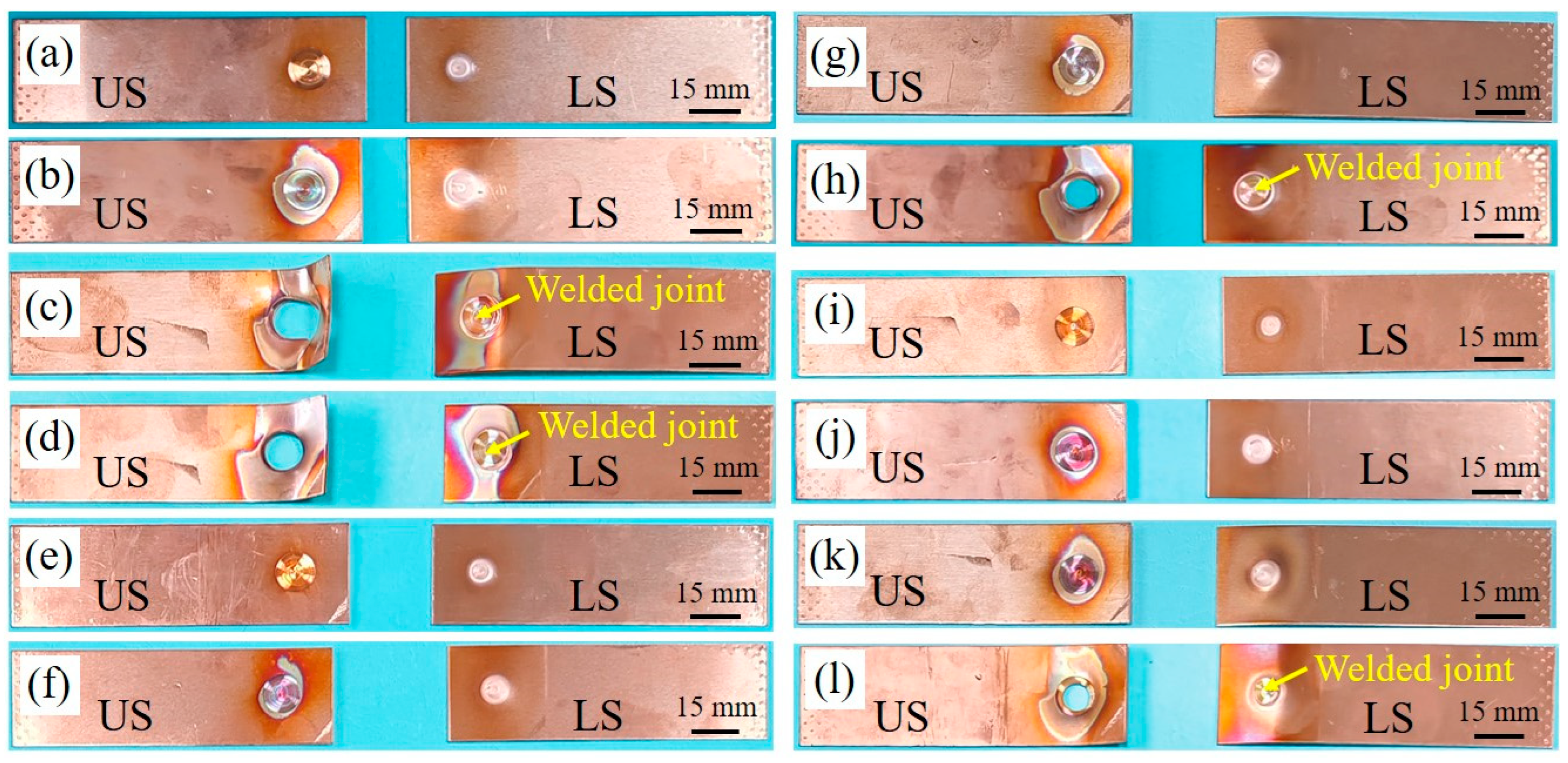
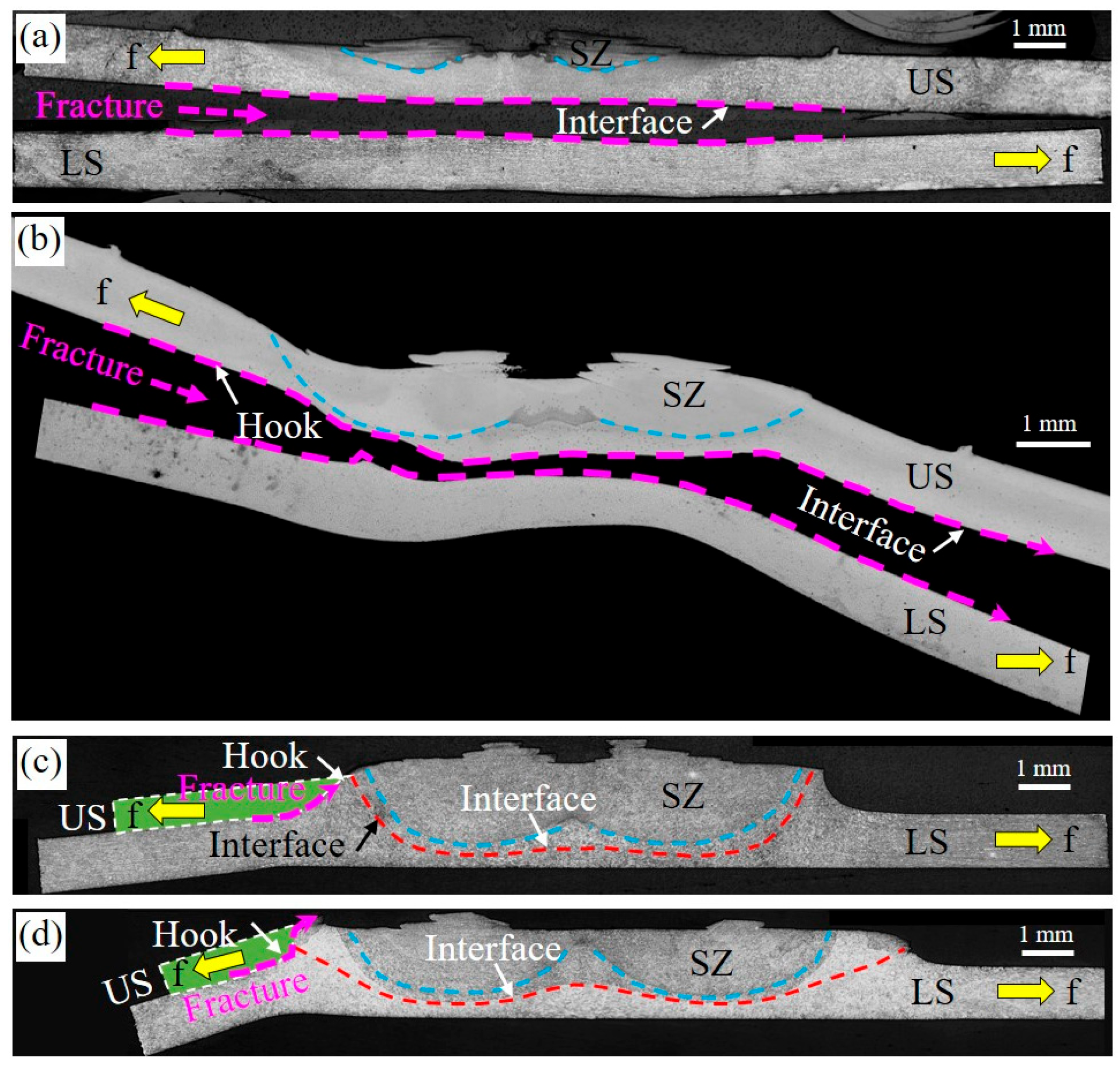
The fracture pictures of the PCJs under different welding parameters are shown in Figure 9. Two fracture types can be identified in the PCJs, namely shear fracture (Figure 9a,b,e–g,i–k) and plug fracture (Figure 9c,d,h,l), which are consistent with the fracture behaviors reported for aluminum alloys [35]. Previous studies have demonstrated that fracture type is closely related to the morphology and size of the Hook feature [36,37,38]. During the tensile process, large stress and strain are concentrated on the tensile side at the bottom of the US, which facilitates the fracture initiation in this region [39,40]. As shown in Figure 4, the tensile side of the US overlaps with the outer side of the Hook, leading to fracture initiation at the outer region of the Hook (i.e., the starting end of the interfacial boundary).
As illustrated in Figure 10a,b, under the shear fracture, fracture initiates at the left starting end of the interface (tensile side of the Hook) and propagates along the interface between the US and the LS, ultimately resulting in complete separation of the sheets. In contrast, in the plug fracture, fracture still initiates at the left starting end of the interface but exhibits two different evolution paths. The first path extends along the isolated Hook and finally causes fracture through the top of the US, as shown in Figure 10c. The second path initially extends along the Hook; however, upon reaching the Hook’s highest point, the fracture diverts toward the top surface of the US rather than continuing along the Hook, as illustrated in Figure 10d. This fracture behavior is associated not only with the bending moment generated between the US and LS [41], but also with the microhardness distribution near the Hook. As shown in Figure 7e, the relatively low microhardness at the Hook tip facilitates fracture evolution toward the softer upper surface [42]. Moreover, Figure 4c indicates that the short distance between the Hook tip and the upper surface further promotes such evolution. In contrast, for specimen 11, where the Hook tip exhibits higher microhardness and a greater distance from the upper surface, fracture consistently extends along the interface, as shown in Figure 4k, Figure 7g and Figure 10b. After the fracture penetrates through the sheet thickness, it continues to extend circumferentially along the weld, ultimately leading to the complete separation of the US from the PCJ. Overall, the specimens exhibit higher T-SF under the shear fracture, which is primarily attributed to the mechanical interlocking effect formed by the Hook between the US and LS.
For pure copper P-FSSW joints, the load-bearing capacity primarily depends on the interfacial bonding quality, with the Hook morphology playing a decisive role in determining the effectiveness of joint formation. This finding is consistent with previous studies on aluminum alloys and Al–Li alloys [31,43], indicating that the Hook is a critical factor influencing joint performance across different material systems. An appropriate Hook height can promote the formation of an effective mechanical interlock between the US and LS, thereby enhancing the T-SF of the PCJ. Consequently, the regulation of the Hook is a key research focus in P-FSSW. As evidenced by Figure 4, Figure 8 and Figure 9, when the Hook height is relatively low, the mechanical interlocking effect is limited. Conversely, an excessively high Hook reduces the distance between its tip and the US surface, thereby weakening the PCJ’s load-bearing capacity. Moreover, to achieve sound interfacial bonding quality, it is essential to suppress complete separation of the Hook from the interface, as such detachment would compromise its mechanical interlocking function. It should also be noted that, owing to the tool kinematics inherent in P-FSSW, the sheet thickness in the weld region tends to be reduced (local indentation), resulting in a thickness smaller than the original combined thickness of the US and LS. This thinning effect becomes more pronounced with increasing PD and more intense material flow, as illustrated in Figure 4d,h. The thinning not only limits the effective thickness of the weld region but also exacerbates the separation of the Hook from the interface. Thus, regulating the Hook requires a delicate balance between enhancing mechanical interlocking and mitigating the adverse effects of thinning.
Future research will concentrate on the precise control of the Hook, which may be achieved by optimizing process parameters, designing multi-stage plunge paths, and introducing advanced groove structures to tailor material flow behavior, thereby further improving interfacial bonding quality of P-FSSW joints.

4. Conclusions

This study conducted an investigation on P-FSSW of pure copper, focusing on the effects of PD, RS, and DT on the joint properties. The key conclusions are as follows:
(1) With increasing PD, RS, and DT, the peak temperature during the welding process gradually increases, among which PD exhibits the highest sensitivity to welding temperature. Larger PD, higher RS, and longer DT result in greater Hook bending and deeper SZ. However, excessive PD and RS induce separation between the Hook and the interface.
(2) Due to the influence of thermal cycle, the grain size in the welded region is coarser than that of the BM, with subgrains as the predominant grain type. The thermo-mechanical coupling during welding promotes recrystallization. Intense plastic flow in the SZ and Hook region leads to a high fraction of deformed grains. Under axial pressure and thermal diffusion, the grains at the Hook and interface are tightly bonded, resulting in a good interfacial bonding quality.
(3) The highest microhardness within the PCJs is observed in the SZ, while the lowest microhardness appears in the heat-affected zone at the bottom of the interface. With increasing PD, RS, and DT, the T-SF of the PCJs first increases and then decreases. The maximum T-SF is achieved at a PD of 0.4 mm, an RS of 1500 rpm, and a DT of 9 s. The fracture types of the PCJs are characterized as shear fracture and plug fracture. The regulation of Hook morphology to enhance its mechanical interlocking effect will constitute a key focus of future research.

Author Contributions

Conceptualization, X.G. and I.K.; methodology, X.Z.; software, X.G.; formal analysis, H.W.; investigation, Z.S.; resources, H.W.; writing—original draft preparation, X.Z.; writing—review and editing, X.G. and I.K.; visualization, Z.S.; supervision, I.K. and H.W. All authors have read and agreed to the published version of the manuscript.

Funding

This work was supported by the National Natural Science Foundation of China (Grant No. 52575498, preliminary research), the Key Research Project of Natural Science in Anhui Higher Education Institutions (Grant No. 2022AH051947), the Anhui Province Excellent Young Teacher Cultivation Project (Grant No. YQYB2024066), the Open Research Project of Anhui Simulation Design and Modern Manufacture Engineering Technology Research Center (Grant No. SGCZXYB2302), the Research Project of Huangshan University (Grant No. HSXYSSD006), and the Undergraduate Scientific and Technological Innovation Research Project of Huangshan University (Grant No. XSKY202414).

Data Availability Statement

Data will be made available on request.

Acknowledgments

The authors sincerely thank the Anhui Simulation Design and Modern Manufacturing Engineering Technology Research Center for granting access to the welding and testing facilities.

Conflicts of Interest

The authors declare no conflicts of interest.

Abbreviations

The following abbreviations are used in this manuscript:
FSSWFriction stir spot welding
P-FSSWPinless friction stir spot welding
PCJPure copper joint
EBSDElectron backscatter diffraction
T-SFTensile–shear force
SZStir zone
PDPlunge depth
RSRotational speed
DTDwell time
PRPlunge rate
USUpper sheet
LSLower sheet
BMBase material
KAMKernel Average Misorientation

References

  1. Palanivel, R. A contemporary review of the advancements in joining technologies for battery applications. Mater. Technol. 2023, 57, 275–281. [Google Scholar] [CrossRef]
  2. Sampaio, R.F.V.; Pragana, J.P.M.; Bragança, I.M.F.; Silva, C.M.A.; Martins, P.A.F. Thermo-electrical performance of hybrid busbars: An experimental and numerical investigation. Proc. Inst. Mech. Eng. Part L J. Mater. Des. Appl. 2022, 237, 70–80. [Google Scholar] [CrossRef]
  3. Ólafsson, D.; Vilaça, P.; Vesanko, J. Multiphysical characterization of FSW of aluminum electrical busbars with copper ends. Weld. World 2020, 64, 59–71. [Google Scholar] [CrossRef]
  4. Beygi, R.; Carbas, R.J.C.; Marques, E.A.S.; Barbosa, A.Q.; Kasaei, M.M.; da Silva, L.F.M. Mechanism of toughness enhancement of brittle fracture by intermittent η-intermetallic in Al/Cu joint made by FSW. Mat. Sci. Eng. A 2024, 890, 145907. [Google Scholar] [CrossRef]
  5. Ge, X.; Kolupaev, I.N.; Jiang, D.; Song, W.; Wang, H. Influence of rotational speed on the microstructure and mechanical properties of refill friction stir spot welded pure copper. Crystals 2025, 15, 268. [Google Scholar] [CrossRef]
  6. Özgül, H.G.; Dedeoğlu, O. Investigations of the mechanical and microstructural effects of pinless tool geometry on friction stir spot welding process. Trans. Indian Inst. Met. 2020, 73, 2281–2289. [Google Scholar] [CrossRef]
  7. Zhang, P.; Zhao, S.; Zhang, C.; Chen, Z.; Zhang, J.; Fei, L.; Dong, P. Microstructure and mechanical properties of probeless friction stir extrusion joined joints of 6061-T6 aluminum alloy to Q235 steel. Int. J. Adv. Manuf. Tech. 2022, 119, 3029–3043. [Google Scholar] [CrossRef]
  8. Dell’Avvocato, G.; Rashkovets, M.; Mancini, E.; Contuzzi, N.; Casalino, G.; Palumbo, D.; Galietti, U. Innovative non-destructive thermographic evaluation of mechanical properties in dissimilar aluminium probeless friction stir spot welded (P-FSSW) joints. Eng. Fail. Anal. 2025, 177, 109675. [Google Scholar] [CrossRef]
  9. Mehrez, S.; Paidar, M.; Cooke, K.; Vignesh, R.V.; Ojo, O.O.; Babaei, B. A comparative study on weld characteristics of AA5083-H112 to AA6061-T6 sheets produced by MFSC and FSSW processes. Vacuum 2021, 190, 110298. [Google Scholar] [CrossRef]
  10. Zhang, B.; Liu, J.; Sun, Y.; Liu, Q. On the fatigue resistance assessment of friction stir welded joints affected by heat input. Eng. Fail. Anal. 2024, 161, 108262. [Google Scholar] [CrossRef]
  11. Casalino, G. Recent achievements in rotary, linear and friction stir welding of metals alloys. Metals 2020, 10, 80. [Google Scholar] [CrossRef]
  12. Li, W.; Li, J.; Zhang, Z.; Gao, D.; Wang, W.; Dong, C. Improving mechanical properties of pinless friction stir spot welded joints by eliminating hook defect. Mater. Des. (1980–2015) 2014, 62, 247–254. [Google Scholar] [CrossRef]
  13. Alaeibehmand, S.; Mirsalehi, S.E.; Ranjbarnodeh, E. Pinless FSSW of DP600/Zn/AA6061 dissimilar joints. J. Mater. Res. Technol. 2021, 15, 996–1006. [Google Scholar] [CrossRef]
  14. Bakavos, D.; Prangnell, P.B. Effect of reduced or zero pin length and anvil insulation on friction stir spot welding thin gauge 6111 automotive sheet. Sci. Technol. Weld. Join. 2009, 14, 443–456. [Google Scholar] [CrossRef]
  15. Bakavos, D.; Chen, Y.; Babout, L.; Prangnell, P. Material interactions in a novel pinless tool approach to friction stir spot welding thin aluminum sheet. Metall. Mater. Trans. A 2011, 42, 1266–1282. [Google Scholar] [CrossRef]
  16. Tozaki, Y.; Uematsu, Y.; Tokaji, K. A newly developed tool without probe for friction stir spot welding and its performance. J. Mater. Process. Technol. 2010, 210, 844–851. [Google Scholar] [CrossRef]
  17. Gülçimen Çakan, B.; Tunçel, O.; Tutar, M. Friction stir spot weldability of AA7075-T6 sheets with a pinless tool providing enhanced stirring effect. JOM 2025, 77, 389–399. [Google Scholar] [CrossRef]
  18. Yu, G.; Chen, X.; Zitao, W.; Zhang, G.; Chen, Y. Effect of tool groove features on the microstructure and tensile-shear mechanical performances of probeless friction stir spot welds. Int. J. Adv. Manuf. Tech. 2022, 121, 1837–1850. [Google Scholar] [CrossRef]
  19. Fan, W.; Yang, X.; Su, Y.; Ma, T.; Chu, Q.; Xu, H.; Guo, Z.; Ma, S.; Meng, T.; Li, W. Investigation of material flow mechanisms and interface bonding in probeless friction stir spot welding of 2198-T8 aluminum-lithium alloy. Mater. Charact. 2025, 227, 115266. [Google Scholar] [CrossRef]
  20. Rashkovets, M.; Contuzzi, N.; Casalino, G. Modeling of probeless friction stir spot welding of AA2024/AISI304 steel lap joint. Materials 2022, 15, 8205. [Google Scholar] [CrossRef]
  21. Tognoli, E.; Schricker, K.; Bassoli, E.; Bergmann, J.P. Influence of the eutectic interface on the fatigue behaviour of friction stir spot welds of aluminum with copper. Int. J. Fatigue 2025, 194, 108834. [Google Scholar] [CrossRef]
  22. Vaneghi, A.H.; Bagheri, B.; Shamsipur, A.; Mirsalehi, S.E.; Abdollahzadeh, A. Investigations into the formation of intermetallic compounds during pinless friction stir spot welding of AA2024-Zn-pure copper dissimilar joints. Weld. World 2022, 66, 2351–2369. [Google Scholar] [CrossRef]
  23. Rashkovets, M.; Dell’Avvocato, G.; Contuzzi, N.; Palumbo, D.; Galietti, U.; Casalino, G. On the role of rotational speed in P-FSSW dissimilar aluminum alloys lap weld. Weld. World 2025, 69, 2095–2107. [Google Scholar] [CrossRef]
  24. Li, T.; Ding, H.; Li, R.; Qi, K.; Liu, Z.; Zhang, X.; Zhao, Y.; Qiao, L. Hole inhibition mechanisms of Mg/Steel lap joint by pinless friction stir spot welding. J. Iron. Steel Res. Int. 2025, 32, 1085–1101. [Google Scholar] [CrossRef]
  25. Li, T.; Xie, X.; Xu, J.; Li, R.; Qi, K.; Zhang, X.; Yue, H.; Zhao, Y.; Qiao, L. Research on AZ31 Mg alloy/22MnB5 steel pinless friction stir spot welding process and interfacial temperature field simulation. J. Mater. Res. Technol. 2023, 26, 3710–3725. [Google Scholar] [CrossRef]
  26. Ge, X.; Kolupaev, I.N.; Jiang, D.; Wang, H. Investigation on the welded joint properties of pinless friction stir spot welding of copper under different tool grooves. Ferroelectrics 2024, 618, 2339–2354. [Google Scholar] [CrossRef]
  27. Suryanarayanan, R.; Sridhar, V. Process parameter optimisation in pinless friction stir spot welding of dissimilar aluminium alloys using multi-start algorithm. Proc. Inst. Mech. Eng. Part C J. Mech. Eng. Sci. 2020, 234, 4101–4115. [Google Scholar] [CrossRef]
  28. Meng, T.; Yang, X.; Su, Y.; Ma, S.; Xu, H.; Guo, Z.; Ma, T.; Li, W. Formation mechanism and failure behavior in synergistic double-sided probeless friction stir spot welded joints of 6061 aluminum alloy. Mater. Charact. 2025, 219, 114631. [Google Scholar] [CrossRef]
  29. Li, W.Y.; Chu, Q.; Yang, X.W.; Shen, J.J.; Vairis, A.; Wang, W.B. Microstructure and morphology evolution of probeless friction stir spot welded joints of aluminum alloy. J. Mater. Process. Technol. 2018, 252, 69–80. [Google Scholar] [CrossRef]
  30. Li, G.H.; Zhou, L.; Luo, S.F.; Dong, F.B.; Guo, N. Quality improvement of bobbin tool friction stir welds in Mg-Zn-Zr alloy by adjusting tool geometry. J. Mater. Process. Technol. 2020, 282, 116685. [Google Scholar] [CrossRef]
  31. Fan, W.; Chu, Q.; Yang, X.; Li, W.; Zou, Y.; Hao, S. Microstructure and mechanical properties of probeless friction stir spot welded Al-Li alloy joints via fast electric pulse treatment: A comparative study. Mater. Charact. 2023, 205, 113276. [Google Scholar] [CrossRef]
  32. Zhou, G.; Huang, T.; Su, L.; Huang, Q.; Wu, S.; Zhang, B. The microstructure and mechanical properties of deposited alcusc alloy wall structures fabricated by WAAM with FSP assistance. Thin-Walled Struct. 2025, 209, 112954. [Google Scholar] [CrossRef]
  33. Sun, Q.; Di, H.S.; Li, J.C.; Wu, B.Q.; Misra, R.D.K. A comparative study of the microstructure and properties of 800Mpa microalloyed C-Mn steel welded joints by laser and gas metal arc welding. Mat. Sci. Eng. A 2016, 669, 150–158. [Google Scholar] [CrossRef]
  34. Choi, I.; Kim, Y.; Wang, Y.M.; Ramamurty, U.; Jang, J. Nanoindentation behavior of nanotwinned Cu: Influence of indenter angle on hardness, strain rate sensitivity and activation volume. Acta Mater. 2013, 61, 7313–7323. [Google Scholar] [CrossRef]
  35. Yu, G.; Chen, X.; Wu, Z.; Chen, Y.; Zhang, G. Analysis of microstructure and mechanical properties of probeless friction stir spot welding joint in AA6061-T6 aluminum thin plate. J. Jilin Univ. (Eng. Technol. Ed.) 2023, 53, 1338–1344. [Google Scholar] [CrossRef]
  36. Cao, J.Y.; Wang, M.; Kong, L.; Guo, L.J. Hook formation and mechanical properties of friction spot welding in alloy 6061-T6. J. Mater. Process. Technol. 2016, 230, 254–262. [Google Scholar] [CrossRef]
  37. Silva, B.H.; Zepon, G.; Bolfarini, C.; dos Santos, J.F. Refill friction stir spot welding of AA6082-T6 alloy: Hook defect formation and its influence on the mechanical properties and fracture behavior. Mat. Sci. Eng. A 2020, 773, 138724. [Google Scholar] [CrossRef]
  38. Xu, R.Z.; Ni, D.R.; Yang, Q.; Liu, C.Z.; Ma, Z.Y. Pinless friction stir spot welding of Mg–3Al–1Zn alloy with Zn interlayer. J. Mater. Sci. Technol. 2016, 32, 76–88. [Google Scholar] [CrossRef]
  39. Wang, X.; Ahn, J.; Kaboglu, C.; Yu, L.; Blackman, B.R.K. Characterisation of composite-titanium alloy hybrid joints using digital image correlation. Compos. Struct. 2016, 140, 702–711. [Google Scholar] [CrossRef]
  40. Plaine, A.H.; Suhuddin, U.F.H.; Alcântara, N.G.; dos Santos, J.F. Microstructure and mechanical behavior of friction spot welded AA6181-T4/Ti6Al4V dissimilar joints. Int. J. Adv. Manuf. Tech. 2017, 92, 3703–3714. [Google Scholar] [CrossRef]
  41. Rosendo, T.; Tier, M.; Mazzaferro, J.; Mazzaferro, C.; Strohaecker, T.R.; Dos Santos, J.F. Mechanical performance of AA6181 refill friction spot welds under lap shear tensile loading. Fatigue Fract. Eng. Mater. Struct. 2015, 38, 1443–1455. [Google Scholar] [CrossRef]
  42. Wang, Y.; Li, P.; Jiang, H.; Yang, K.; Wu, X.; Meng, Q.; Ji, S. Mechanical properties and fracture behavior of the refill friction stir spot welding dissimilar aluminum alloy joints. Trans. Indian Inst. Met. 2024, 77, 3821–3828. [Google Scholar] [CrossRef]
  43. Cao, J.; Zhang, J.; Xing, Y.; Yang, F.; Zhang, X.; Xia, P.; Ma, X. Experimental and numerical investigation of a novel pinless friction stir spot welding for Al 1060 sheets. Int. J. Adv. Manuf. Tech. 2024, 134, 2537–2546. [Google Scholar] [CrossRef]
Figure 1. P-FSSW experimental equipment: (a) pinless tool; (b) welding equipment; (c) specimen installation diagram; (d) specimen dimensions and thermocouple position.
Crystals 15 00804 g001
Figure 2. Thermal cycles under different welding parameters: (a) PD; (b) RS; (c) DT.
Crystals 15 00804 g002
Figure 3. PCJ morphologies under different welding parameters: (al) specimens 1–12; (m) 3D morphology at position 1 of specimen 7; (n) 3D morphology at position 2 of specimen 7; (o) 3D morphology at position 3 of specimen 7.
Crystals 15 00804 g003
Figure 4. Cross-sectional morphologies of PCJs under different welding parameters: (a) specimen 1; (b) specimen 2; (c) specimen 3; (d) specimen 4; (e) specimen 5; (f) specimen 6; (g) specimen 7; (h) specimen 8; (i) specimen 9; (j) specimen 10; (k) specimen 11; (l) specimen 12.
Crystals 15 00804 g004
Figure 5. Representative microstructures of specimen 7: (ac) base material; (df) Region I; (gi) Region II; (jl) Region III.
Crystals 15 00804 g005
Figure 6. Recrystallization and KAM maps of the representative regions of specimen 7: (ac) BM; (df) Region I; (gi) Region II; (jl) Region III.
Crystals 15 00804 g006
Figure 7. Microhardness distributions under different welding parameters: (a) microhardness at different PDs; (b) microhardness at different RSs; (c) microhardness at different DTs; (d) microhardness contour map of specimen 2; (e) microhardness contour map of specimen 3; (f) microhardness contour map of specimen 7; (g) microhardness contour map of specimen 11; (h) microhardness measurement positions for (ac); (i) microhardness measurement positions for (dg).
Crystals 15 00804 g007
Figure 8. Tensile test results under different welding parameters: (a) T-SFs at different PDs; (b) T-SFs at different RSs; (c) T-SFs at different DTs.
Crystals 15 00804 g008
Figure 9. Fracture photographs of the PCJs under various welding parameters: (a) specimen 1; (b) specimen 2; (c) specimen 3; (d) specimen 4; (e) specimen 5; (f) specimen 6; (g) specimen 7; (h) specimen 8; (i) specimen 9; (j) specimen 10; (k) specimen 11; (l) specimen 12.
Crystals 15 00804 g009
Figure 10. Fracture diagrams of the PCJs: (a,b) shear fracture, (a) specimen 9, (b) specimen 11; (c,d) plug fracture, (c) specimen 8, (d) specimen 3.
Crystals 15 00804 g010
Table 1. Chemical composition of pure copper (wt.%).
Cu + AgSbAsBiSPbFeBal
99.900.0020.0020.0010.0050.0050.0050.08
Table 2. Welding parameters for P-FSSW experiments.
No.PD (mm)RS (rpm)DT (s)
10.211005
20.311005
30.411005
40.511005
50.39005
60.313005
70.315005
80.317005
90.311003
100.311007
110.311009
120.3110012
Disclaimer/Publisher’s Note: The statements, opinions and data contained in all publications are solely those of the individual author(s) and contributor(s) and not of MDPI and/or the editor(s). MDPI and/or the editor(s) disclaim responsibility for any injury to people or property resulting from any ideas, methods, instructions or products referred to in the content.