
Article

Wide-Temperature-Range Optical Thermometry Based on Yb3+,Er3+:CaYAlO4 Phosphor

1
School of Electronic, Electrical Engineering and Physics, Fujian University of Technology, Fuzhou 350117, China
2
College of Physics and Energy, Fujian Normal University, Fuzhou 350117, China
*
Author to whom correspondence should be addressed.
Crystals 2025, 15(12), 1055; https://doi.org/10.3390/cryst15121055
Submission received: 13 November 2025 / Revised: 2 December 2025 / Accepted: 9 December 2025 / Published: 12 December 2025

Abstract

In order to meet the demand for new optical temperature-sensing materials with high sensitivity and a wide application temperature range, Yb3+/Er3+: CaYAlO4 phosphor with excellent physical and chemical stability and thermal conductivity was studied for the first time. Yb3+/Er3+: CaYAlO4 phosphors have been synthesized by the high-temperature solid-state method. Under 980 nm excitation, three characteristic emission bands peaking at 528, 549 and 665 nm were observed which are attributed to the transitions 2H11/2, 4S3/2 and 4F9/2 to 4I15/2, respectively. The temperature-sensing behaviors of the phosphor were investigated using the luminescence intensity ratio technique based on both the TCL (2H11/2/4S3/2) and NTCL (4F9/2/4S3/2, 2H11/2/4F9/2) model over a wide temperature range of 163–700 K. The maximum relative sensitivities of TCLs (2H11/2/4S3/2), NTCLs (4F9/2/4S3/2) and NTCLs (2H11/2/4F9/2) were 3.69% K−1, 0.443% K−1 and 3.86% K−1 at 163 K, 275 K and 163 K, while the maximum absolute sensitivities were 4.04 × 10⁻³ K−1, 15.2 × 10⁻³ K−1 and 7.81 × 10⁻⁴ K−1 at 499 K, 499 K and 247 K, respectively. Results suggest that Yb3+/Er3+: CaYAlO4 phosphor is a promising temperature-measuring material with advanced optical sensing capabilities over a wide temperature range.

1. Introduction

Recently, The optical thermometer has been found to be a remote alternative to traditional thermometers for its non-contact feature, fast response, high spatial resolution, long-term stability and reliable performance even in harsh surroundings [1,2,3]. Among the technologies for achieving temperature measurement, the Fluorescence Intensity Ratio (FIR) technique, characterized by the intensity ratio of two specific emission bands, has garnered significant attention. FIR can minimize the effects of spectral loss and excitation power fluctuations, thereby achieving high accuracy in temperature measurement [4,5]. In particular, many efforts are currently being made on the upconversion (UC) luminescent temperature-sensing materials based on Er3+/Yb3+, Tm3+/Yb3+, Er3+/Ho3+/Yb3+, etc., systems [4,6,7]. This type of upconversion photoluminescence has many practical applications. For example, the excitation wavelength 980 nm lies in the biological window [8], thus it possesses strong tissue penetration and causes no damage to the tissue, which is especially attractive in biomedical fields [9,10]. It also can be applied in infrared detectors [11], fingerprint identification [12], anti-counterfeit technology [13], etc. However, temperature sensing which can cover a wide temperature range and retain relatively high sensitivity is still an unsolved problem [6].
The matrix that provides the crystal field environment for doping ions is the main factor determining the performance of temperature-sensing materials. A good matrix which can be used in a wide temperature range should have high physical and chemical stability and good thermal conductivity. CaYAlO4 (CYA) belongs to the tetragonal K2NiF4 structure. It has good mechanical strength with a density of 4.64 g/cm3 and excellent thermal conductivity (3.3 W/m/K along the c-axis and 3.7 W/m/K along the a-axis [14]). As an oxide-based aluminate, CYA has good stability, anti-moisture property and radiation resistance which can endure harsh environments like high temperature and pressure. In particular, for the UC luminescence, CYA possesses special advantages due to its relatively low phonon energy [15] and strong upconversion luminescence. Low phonon energy can help to reduce the possibility of non-radiative transitions, thus minimizing quenching phenomena and enhancing upconversion emission. The previous literature reported that the non-radiative relaxations of the optical excitations of the rare earth ions in this crystal were relatively week [16] and intense UC luminescence was observed in CYA [17,18].
Among the lanthanide ions, Er3+ is a typically chosen ion, for it has abundant energy levels, which can provide various wavelength emissions. In this work, the Er3+ ion was chosen as a luminous center and Yb3+ ion as a sensitizer. By using a commercial 980 nm laser diode for pumping, the Yb3+ ion can enhance the upconversion luminescence of the Er3+ ion through efficient energy transfer [11]. The FIR technique is generally implemented through two thermally coupled energy levels (TCLs), which follow the Boltzmann distribution law with an energy gap of around 200–2000 cm−1 [19]. The sensitivity is constrained by the energy level gap. Compared with TCLs, non-thermally coupled energy levels (NTCLs) are not confined by Δ E . By flexibly adopting energy levels which could have originated from single or double emission centers, NTCLs become an effective way to enhance sensitivity. Thus, both TCLs and NTCLs were studied here to investigate the relationship between sensitivity and the coupled energy levels chosen.
The optical thermometer based on this series of host (ABAlO4) is rare [6,20]. Yuqiang Li et al. analyzed the temperature sensing of Tm3+/Yb3+CaGdAlO4 from 173 K to 823 K based on FIR693/801 and FWHM801 [6]. Ana Martinovic built a thermometric Judd–Ofelt model for Dy3+:CaYAlO4 and evaluated its sensing performances for luminescence thermometry [20]. R.V. Perrella et al. reported broadened band C-telecom and the intense upconversion emission of Er3+/Yb3+ co-doped CaYAlO4 [18]. However, to the best of our knowledge, there is no report on the temperature-sensing performance of Yb3+/Er3+:CYA phosphor. Herein, the Yb3+/Er3+:CYA phosphor was synthesized by the classical solid-state reaction. The temperature-dependent emission spectra of Yb3+/Er3+:CYA were conducted in a wide temperature range from 163 K to 700 K excited by 980 nm. The FIRs of both TCLs (2H11/2/4S3/2) and NTCLs (4F9/2 /4S3/2, 2H11/2/4F9/2) were studied, and the absolute and relative sensitivities as a function of temperature were calculated. Yb3+/Er3+:CYA phosphor has been shown to have good temperature-sensing performance over a wide temperature range.

2. Experimental Section

10at%Yb3+,4at%Er3+:CYA phosphor was synthesized by the high-temperature solid-state reaction. It is known that the concentrations of activators (Er3+ and Yb3+) and their relative ratio significantly influence the UPC mechanisms in Er3+/Yb3+ co-doped systems, thus changing the values of FIRs and their sensing performance. The change in Er3+ concentration will induce a change inof the crystal field surrounding the Er3+ion, thus evoking the a variation inof the optical transition rate of Er3+. Too high a concentration leads to a serious decrease in the FIR529/551 value and the concentration quenching phenomenon [21]. We utilized a dopant ion concentration that was found to be effective through our previous experience. By effective energy transfer, the Yb3+ ion can markedly enhance the upconversion luminescence and increase the maximum sensing sensitivity [22,23]. Typically, the concentrations of sensitizer reach 10at%, and for the activator, a level about 4at% works well [24,25]. The starting chemicals were Al2O3 (A.R. grade), Y2O3 (4 N purity), Er2O3 (4 N purity), Yb2O3 (4 N purity) and CaCO3 (A.R. grade). They were weighed according to the stoichiometric composition.
Before calcination at 1400 °C for 24 h, all chemicals were thoroughly ground and converted into pellets under a mechanical pressure of 50 MPa. And then, the procedure of grinding and sintering was repeated. The phases of the as-prepared power were examined using a power X-ray diffractometer (XRD) (SCXmini) (Rigaku Corporation, Tokyo, Japan), which was operating at 3 kv and 15 mA with CuKa1 (1.5406 Å) radiation in the continuous scanning mode. The 2θ ranged from 10 to 70° in a step of 0.02° with a count time of 1 s. The upconversion photoluminescence spectra at different temperatures were recorded by a steady-state lifetime spectrofluorometer (FLS920) (Edinburgh Instruments Ltd., Livingston, UK) excited by a 980 nm laser diode with emission slit size of 0.5 nm, power of 1000 mw, detection sensitivity (≤50 cps), integration time of 0.1 s and step of 0.5 nm. The temperature of the sample was controlled in real time by temperature control components of the spectrofluorometer FLS920 (Edinburgh Instruments Ltd., Livingston, UK) with 0.1 °C accuracy.

3. Results and Discussions

The diffraction peaks of X-rays of the synthesized Yb3+/Er3+:CYA are presented in Figure 1. Compared with theoretical JCPDS chart no. 13-0493, no other obvious diffraction peaks were detected. The result shows that the obtained phase is CYA without other impurity phases. The structural refinement of Yb3+/Er3+:CYA was performed using the Fullprof software (version: January 2006) to further investigate its phase and structural information. The obtained lattice parameter was a = b = 3.6485 Å and c = 11.8768 Å, which is close to the literature value from the standard card. The Chi2 factor was 4.96. The unicellular structure is also given in Figure 1. As it is shown, CYA crystallizes in the perovskite phase with a tetragonal K2NiF4 structure, belonging to the space group I4/mmm. The centered Al3+ is surrounded by six adjacent oxygen ions to form an AlO6 octahedron, and the Ca2+ and Y3+ ions distribute randomly in the nine coordinated sites. When Yb3+ and Er3+ ions are doped in CYA, owing to the similar radius, Yb3+ (ionic radius = 0.985 Å) and Er3+ (ionic radius = 1.030 Å) can successfully be incorporated at the Y3+ sites. The diffraction peaks of the doped CYA are in good agreement with the standard pattern of JCPDS chart no. 13-0493, which indicates doping of Yb3+and Er3+ without changing the intrinsic crystal structure.
As our previous study reported, the diffraction intensity is stronger and the crystallinity is better when CYA is sintered by the solid-state (SS) reaction route than by the citrate sol–gel method. The CYA particles prepared by the SS method are presented as irregular and nonuniform agglomerated blocks, with size varying from around 927 nm to 9.51 µm [26]. The agglomeration of particles is beneficial to achieve intense luminescent properties while preventing the diffusion of incident light [21].
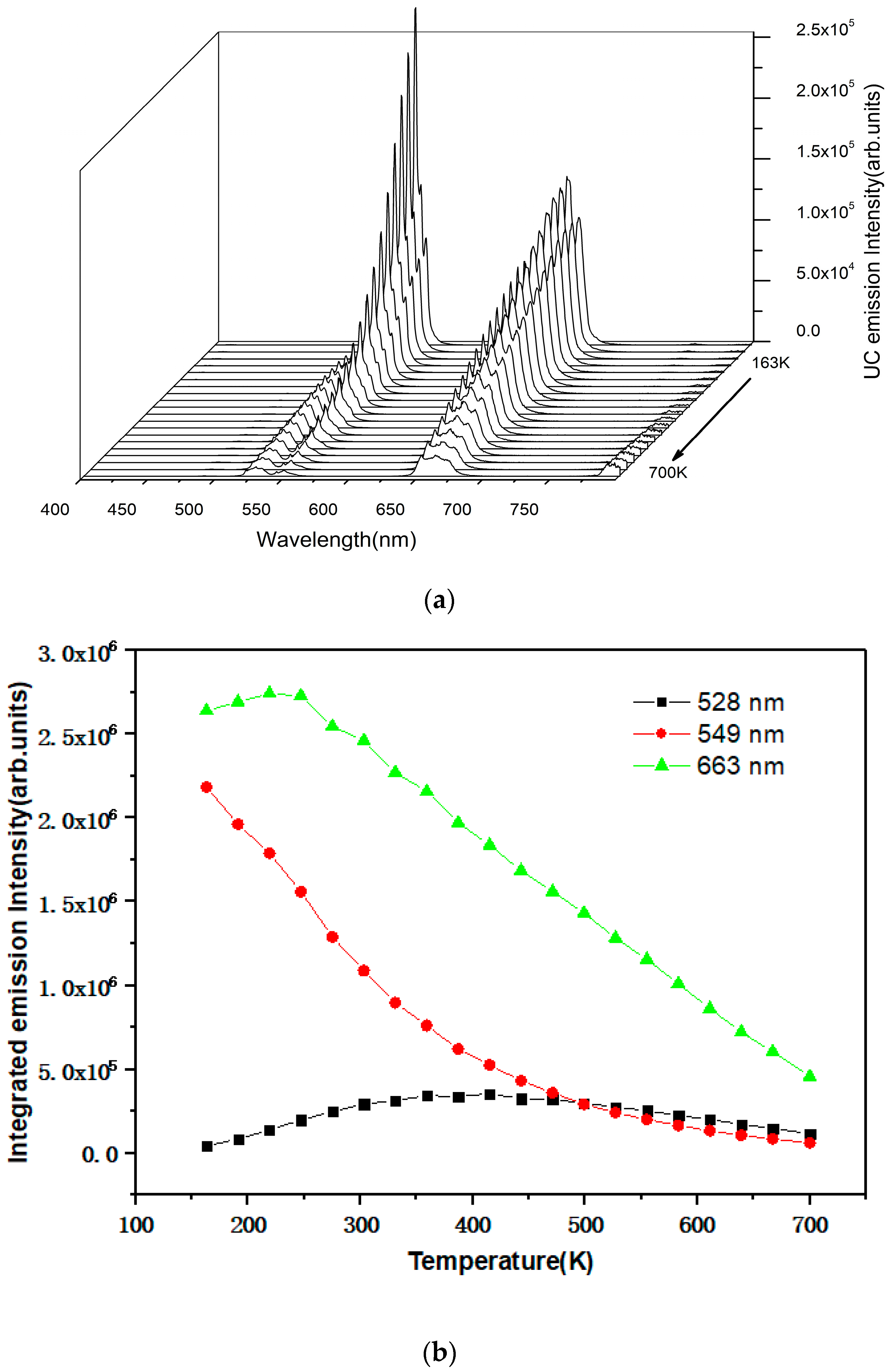
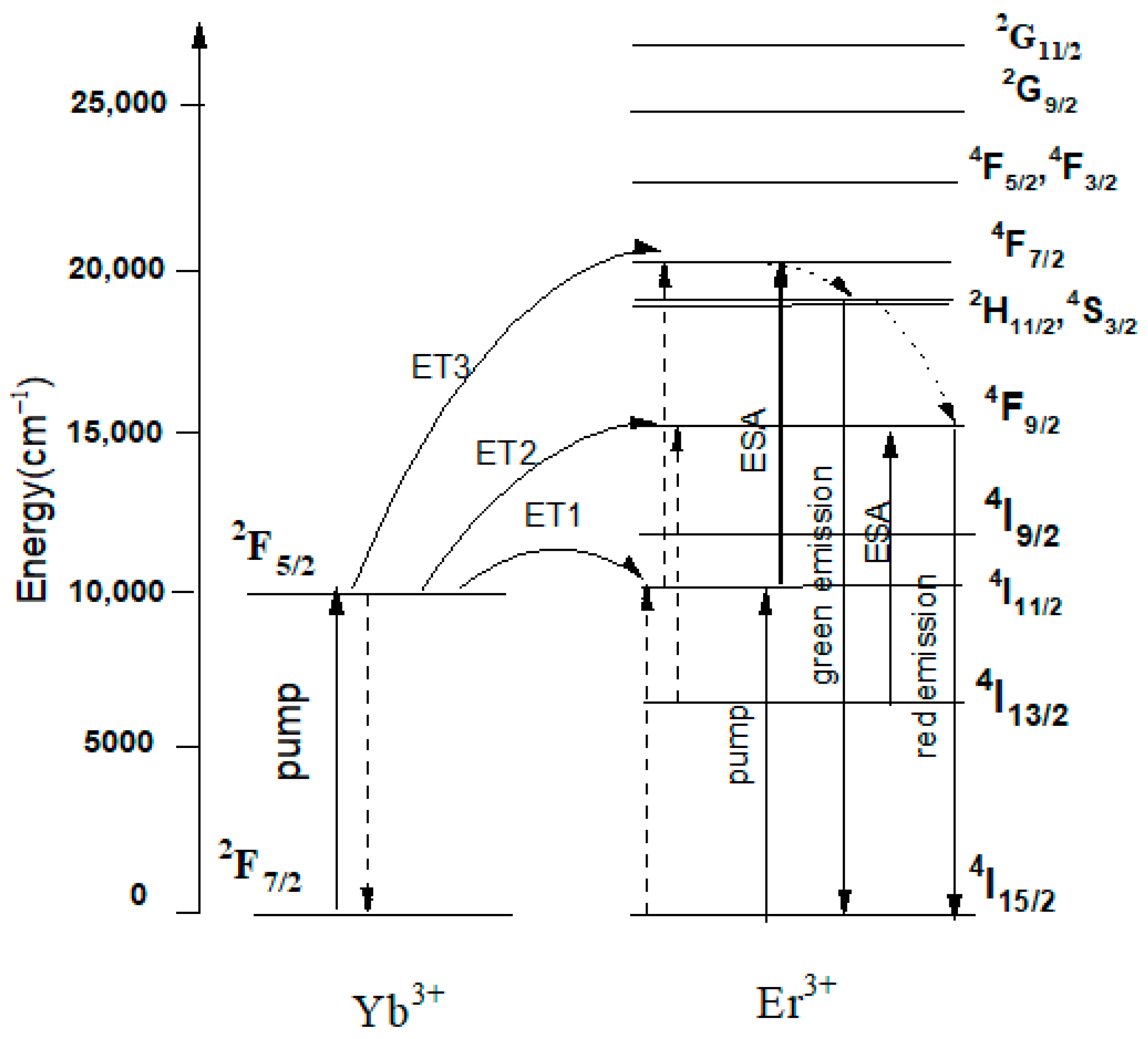
Excited by at 980 nm, the temperature-dependent upconversion spectra based on Yb3+/Er3+:CYA phosphor in a wide range of 163–700 K were tested and are given in Figure 2a. It is found that the phosphors have two visible green emissions, which are centered at 528 nm and 549 nm, and one red emission centered at 663 nm. The green emissions correspond to Er3+:2H11/24I15/2 (528 nm) and 4S3/24I15/2 (549 nm, respectively, and the red emission is caused by the transition Er3+:4F9/24I15/2. Figure 3 shows the mechanisms for these upconversion emissions.
Pumped at 980 nm, both Yb3+ and Er3+ ions can absorb incident energy and be excited to the upper level. But due to the large absorption cross-section and much higher doping concentration, the absorption of the Yb3+ ion dominates. Then the process of energy transfer from the Yb3+ to Er3+ ions plays a significant role in the UC emission. There are three ET (energy transfer) processes occur, ET1: 2F5/2 (Yb3+) + 4I15/2 (Er3+) → 2F7/2 (Yb3+) + 4I11/2 (Er3+), ET2: 2F5/2 (Yb3+) + 4I13/2 (Er3+) → 2F7/2 (Yb3+) + 4F9/2 (Er3+), and ET3: 2F5/2 (Yb3+) + 4 I11/2 (Er3+) → 2F7/2 (Yb3+) + 4F7/2 (Er3+), as shown in Figure 3.
First, the population accumulates in the Er3+:4I11/2 level by ground- state absorption (GSA) and ET1. Some ions in this level gets non-radiative relaxation and transition to the 4I13/2 level; the others help in accumulating the 4F7/2 level by excited -state absorption (ESA) and ET3. The population of the 4F7/2 level rapidly non-radiatively decays to the 2H11/2 and 4S3/2 levels. Then the 2H11/2 and 4S3/2 levels are partially depopulated radiatively and generate green emissions corresponding to 2H11/24I15/2 and 4S3/24I15/2 transitions. The rest relax to the lower 4F9/2 level. The ions in the 4F9/2 level can also be accumulated by ET2 and ESA from the 4I13/2 level. Finally, the population of the 4F9/2 level radiatively decay to the 4I15/2 level and emit red light.
It is noticed from Figure 2a that the spectral position of the three emission bands negligibly changes with temperature in the range of 163–700 K. But temperature has a considerable influence on the intensity of these emission bands. To make it clearer, the integrated intensities of the three emissions centered at 528 nm, 549 nm and 663 nm were calculated and are presented in Figure 2b. When the temperature is increased from 163 K to 415 K, the intensity of the 549 nm emission decreases, whereas the intensity of the 528 nm emission increases. This is due to the thermalization processes occurring between the 2H11/2 and 4S3/2 levels. As the temperature rises, through phonon-assisted thermal excitation, more ions are accumulated in the 2H11/2 level, which results in the increase of in the 528 nm emission (2H11/24I15/2) and the decrease of in 549 nm (4S3/24I15/2). When the temperature exceeds 415 K, the intensity of the 528 nm emission starts to decrease;, this is probably because of the increasing possibility of non-radiative relaxations. When the temperature goes up, ions in the upper level are more likely to relax to lower levels. We can find this phenomenon in Figure 2a, where the emission around 791 nm begins to appear when the temperature exceeds 400 K. This non-radiative relaxation and competition mechanism results in the change inof the intensity of the 528 nm emission trend at around 415 K. For the 663 nm emission (4F9/24I15/2), it generally shows a decreasing trend with increasing temperature, which is also due to non-radiative transition. The slight increase in the initial small part of the curve probably results from population accumulation from the upper 4S3/2 level when the temperature is increased from 163 K to 247 K.
First, the FIRs between the emissions of 2H11/2 and 4S3/2 were studied for analyzing the temperature-sensing performance of Yb3+,Er3+: CaYAlO4 phosphor. 2H11/2 and 4S3/2 are two typical thermally coupled levels with a small energy gap, thus the population of the two levels follow Boltzmann-type population distribution. The intensity of the ratio can be expressed by the following formula [27]:
F I R = I H I S = g H σ H ω H g S σ S ω S exp ( Δ E k B T ) = C exp ( Δ E k B T )
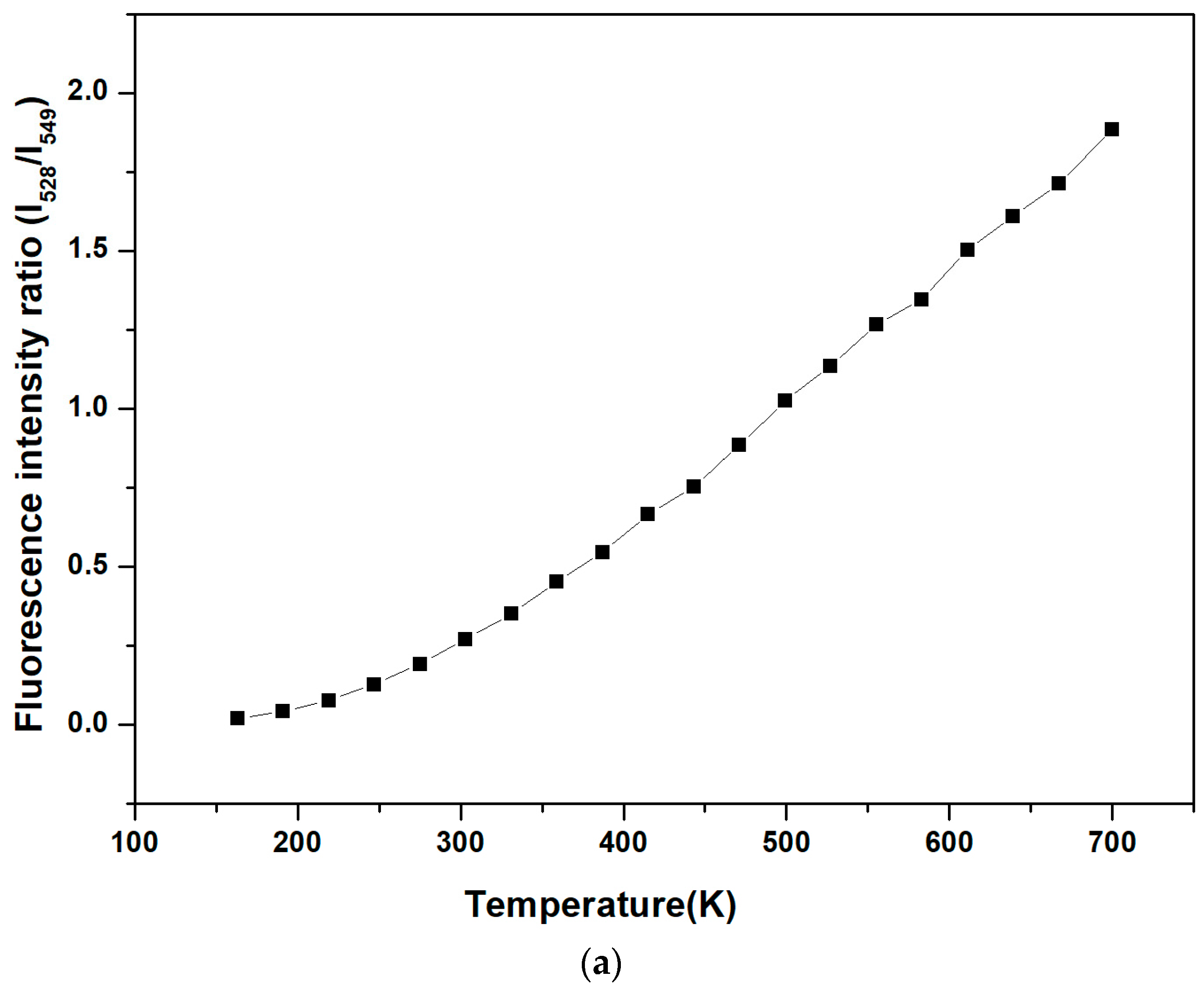
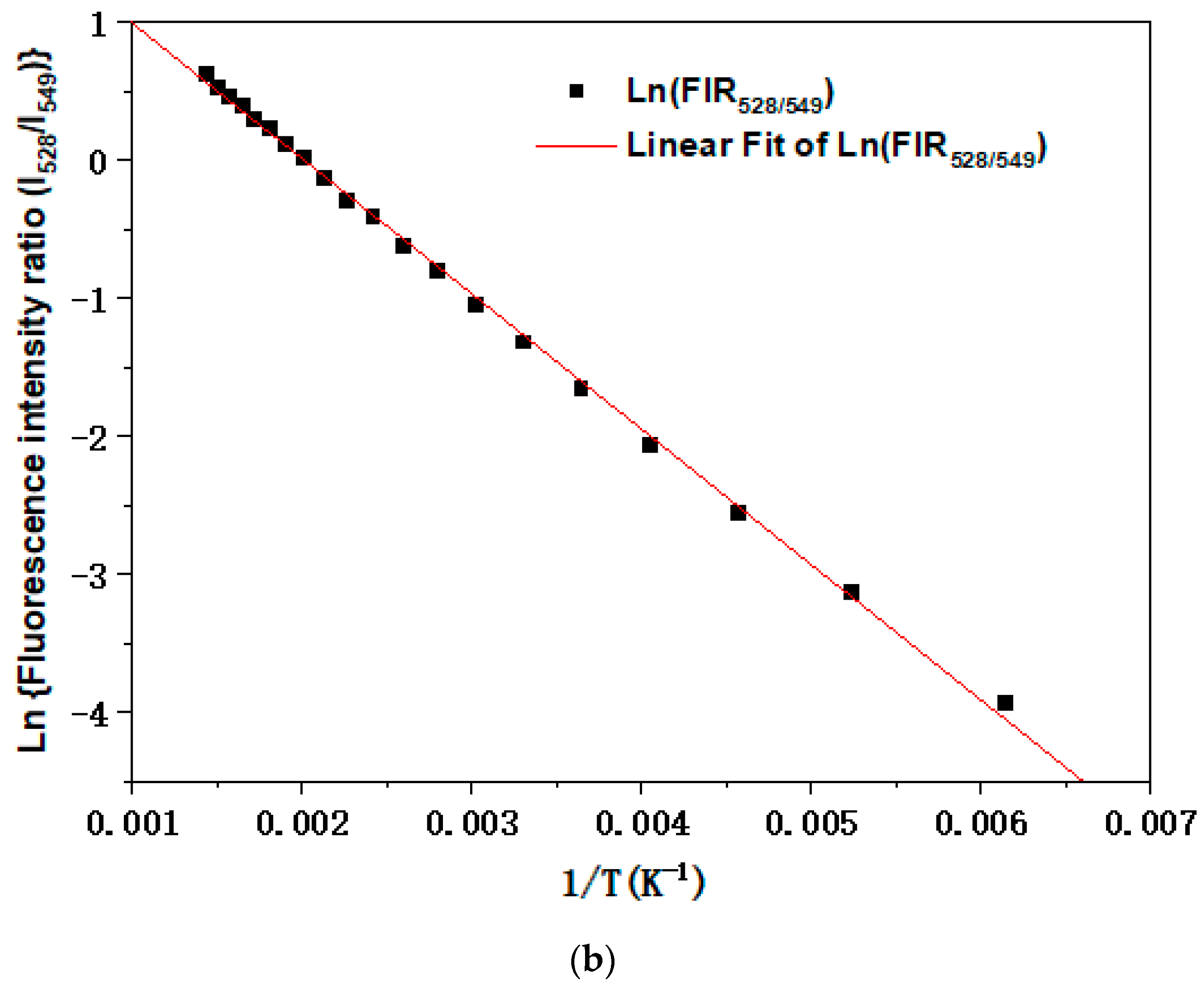
where I H (higher level) and I S (lower level) represent the integrated intensities of two thermally coupled levels; g , σ and ω are the radiative transition probability, the degeneracy and the angular frequency of relevant transition, respectively; Δ E is the energy difference between the two TCLs; C is a proportionality constant; and k B and T are Boltzmann’s constant and absolute temperature, respectively. The calculated FIR values of 528 nm to 549 nm are shown in Figure 4a, and the logarithmic plot for FIR528/549 versus inverse of temperature is also given in Figure 4b. It is observed that in the temperature range 163–700 K, the experiment values fit very well with Equation (1). The fitting value of Δ E / k B is −980.32, and the proportionality constant C is 7.185. The energy gap Δ E was deduced to be 681.3 cm−1,which aligns with the experiment-determined value 724 cm−1.
The sensor sensitivity S is of vital importance to evaluate the practical application of temperature-sensing materials. It contains two sensitivities: absolute sensitivity S a and relative sensitivity S r . The absolute sensitivity demonstrates the change in the FIR with temperature change, and the relative sensitivity is the normalized change in the FIR with temperature variation, as shown in the following equations [6,18].
S a = d F I R d T
S r = 1 F I R d F I R d T × 100 %
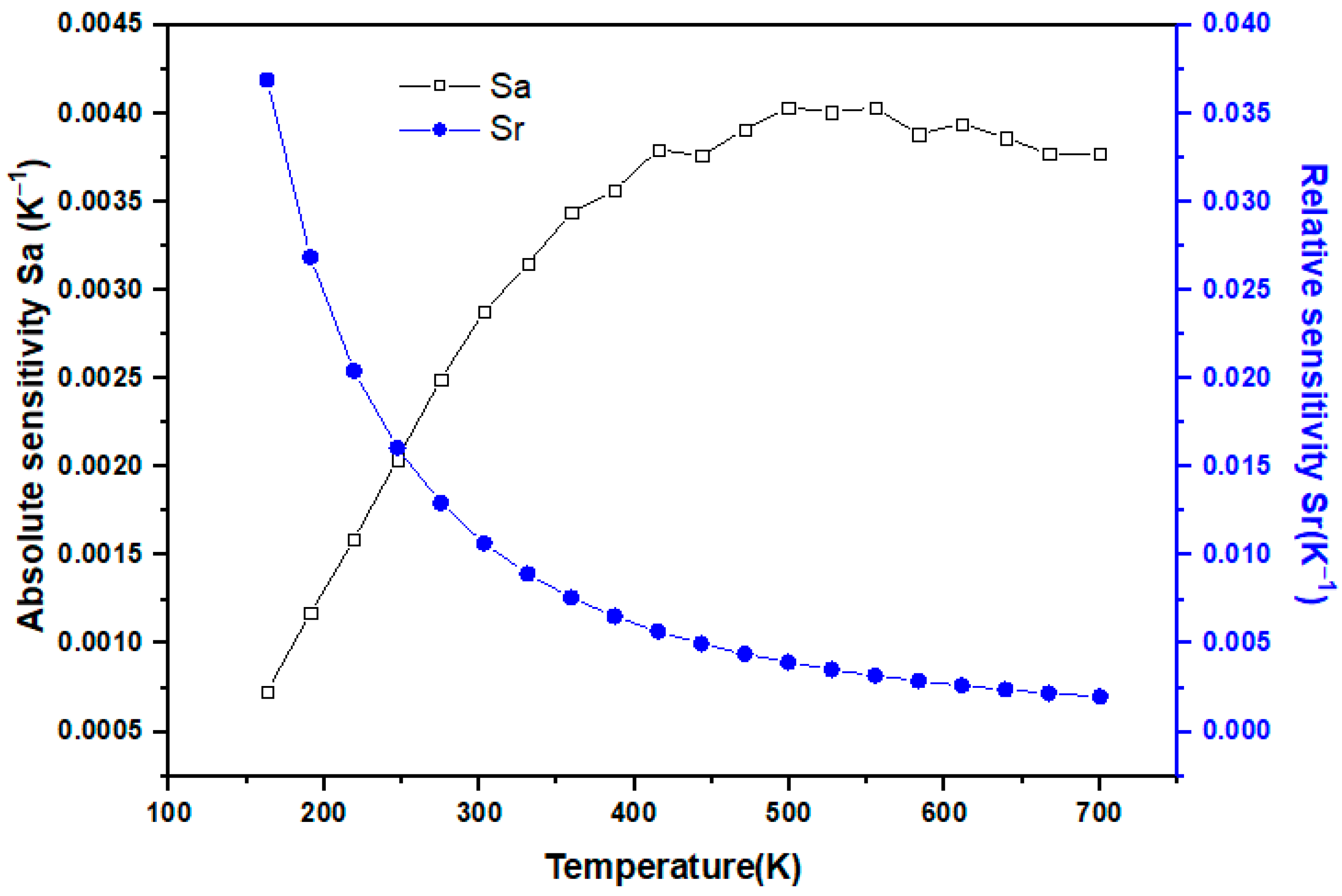
Figure 5 illustrates the S a and S r values for FIR528/549 within the range of 163–700 K. It is observed that S a and S r exhibit contrasting trends with the increase in temperature. When the temperature is increased from 163 K to 415 K, the S a value first increases and then maintains a relatively high value in the range of 3.76 × 10⁻³ K−1 to 4.04 × 10⁻³ K−1. The maximal value of S a is at 499 K. The maximum S a can also be obtained by theoretical calculation. When d S a d T = 0 , T = Δ E 2 k B , the temperature corresponding to the maximum S a can be deduced to be 490 K, which is consistent with the experiment data. The highest value of S r is 3.69%.K−1 at 163 K.
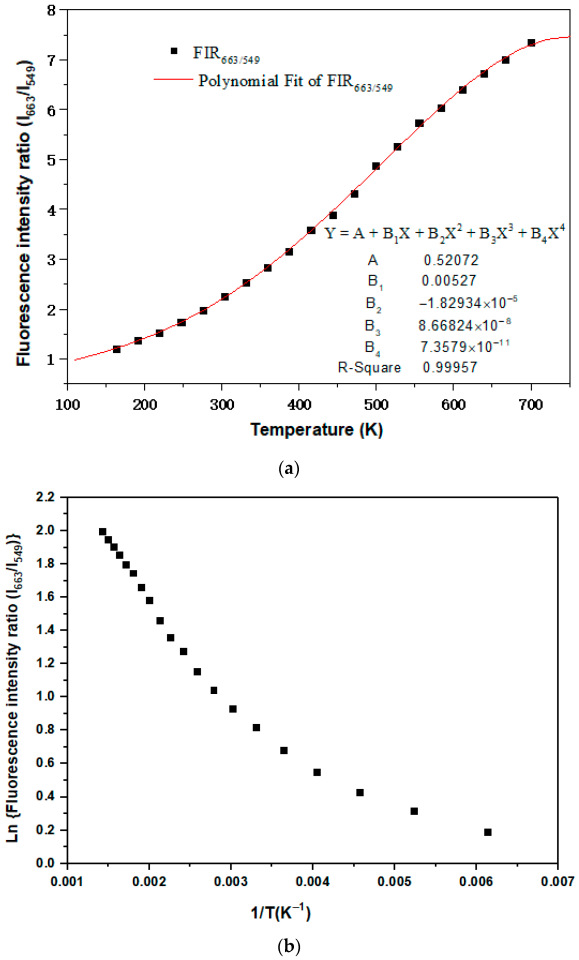
The temperature- sensing performance using FIR528/663 and FIR663/549 have also been investigated. The 528 nm (2H11/24I15/2), 549 nm (4S3/24I15/2) and 663 nm (4F9/24I15/2) emissions correspond to the transition from the 2H11/2, 4S3/2 and 4F9/2 levels. Due to the large energy difference, the 2H11/2 and 4F9/2 levels are non-thermally coupled and so are the 4F9/2 and 4S3/2 levels. For example, as shown in Figure 6b, the logarithm of FIR663/549 as a function of temperature apparently no longer exhibits a linear relationship like TCLs. The FIR values of NTCLs can be fitted by the following equation [28]:
F I R = I 1 I 2 = A + B 1 T + B 2 T 2 + B 3 T 3 + B 4 T 4
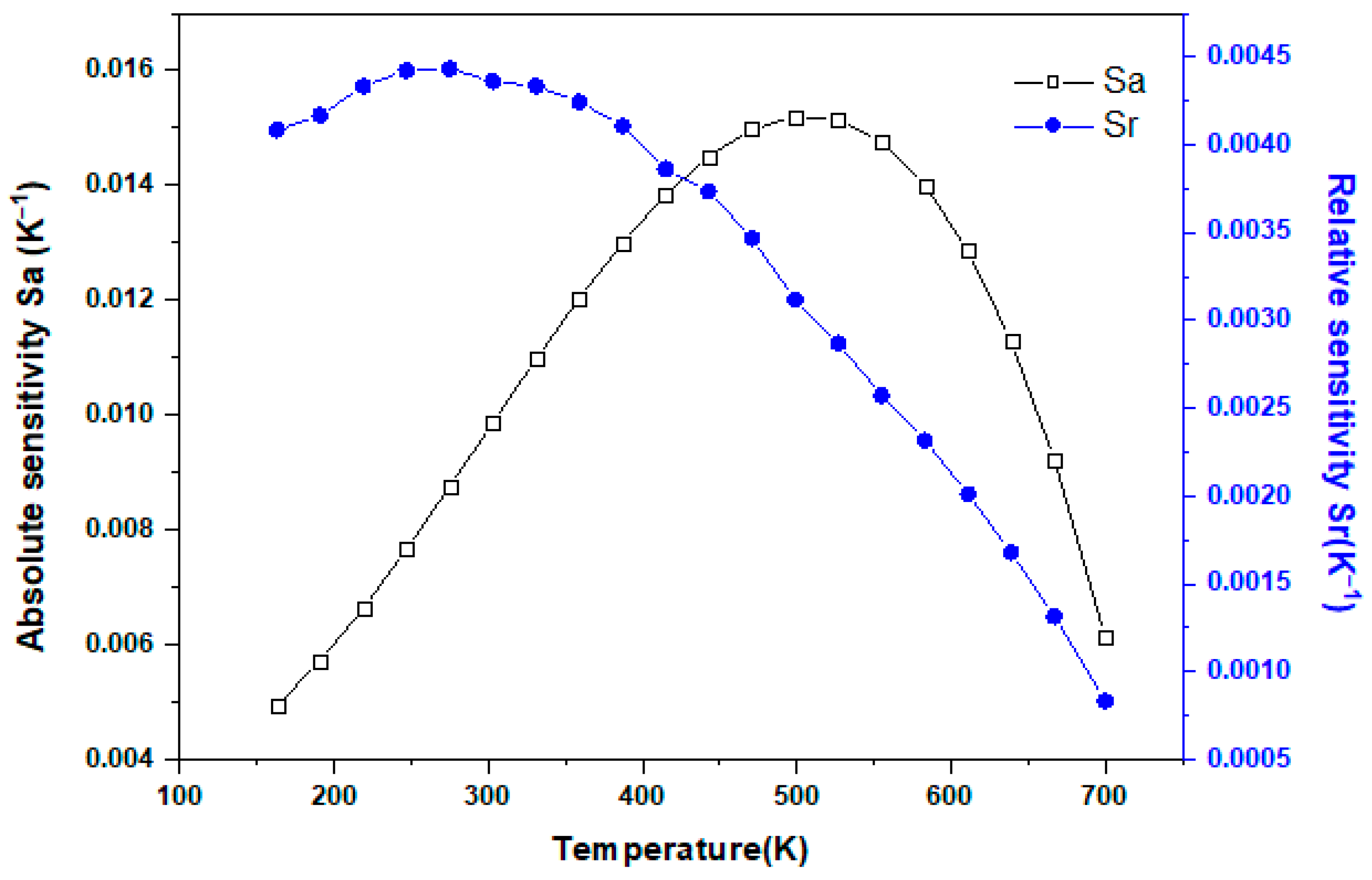
where A , B 1 , B 2 , B 3 and B 4 are fitting parameters of the polynomial. Then the values of S a and S r can be obtained by Equations (2) and (3) as mentioned before. Figure 6a exhibits the temperature dependence of FIR663/549 from 163 K to 700 K. The fitting parameters are also displayed in Figure 6a with a fitting degree higher than 0.999. Figure 7 presents the calculated S a and S r values as a function of temperature. As the temperature goes up, both S a and S r increase first and then decline. The maximum of S a and S r are 15.2 × 10⁻³ K−1 at 499 K and 0.443% K−1 at 275 K, respectively.
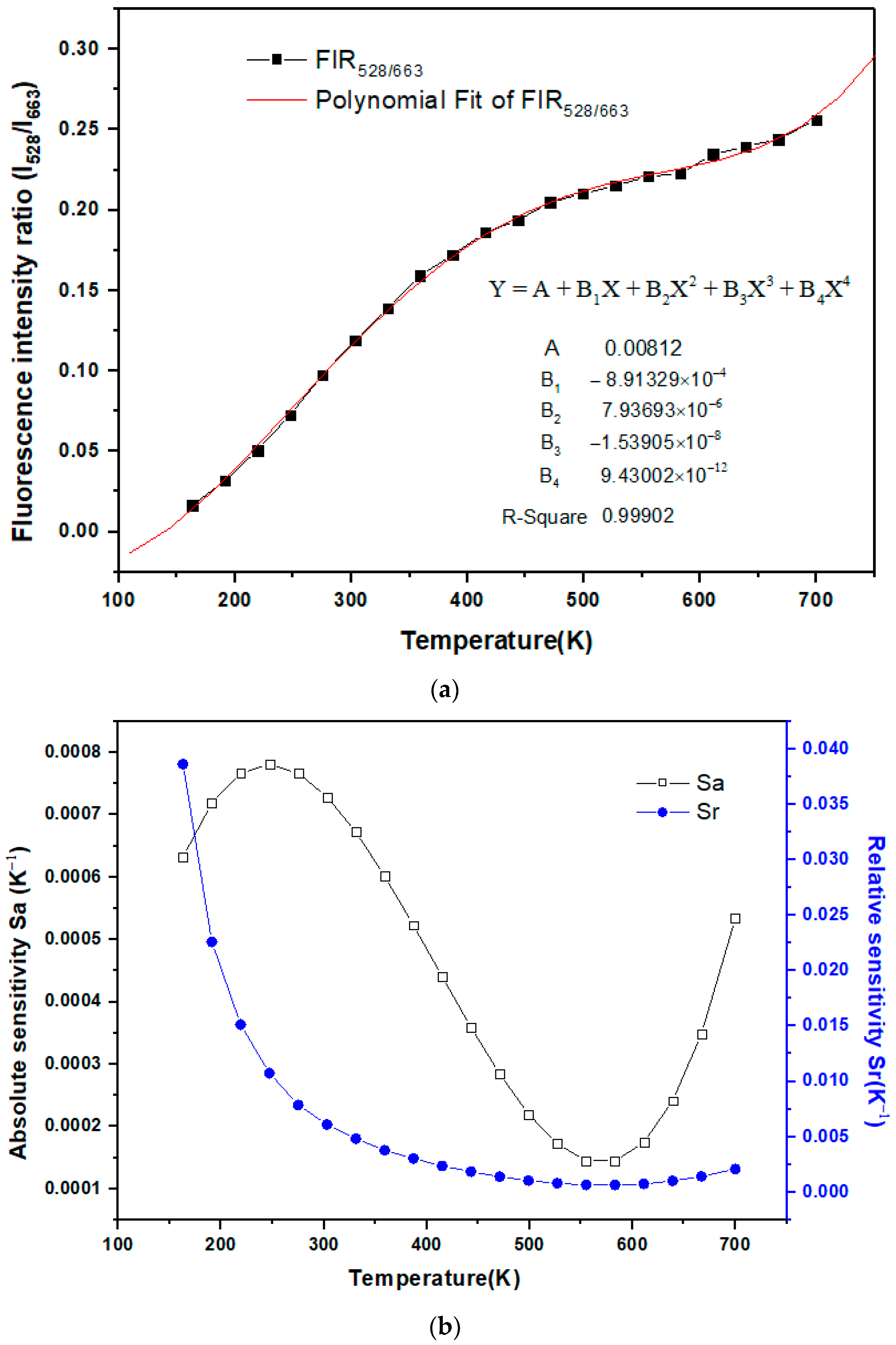
As for FIR528/663, the luminescence intensity ratio values were also calculated and are shown in Figure 8a, together with the fitting parameters. The S a and S r curves of FIR528/663 are present in Figure 8b. It is observed that the value of S a first increases and reaches a maximum value of 7.81 × 10⁻⁴ K−1 at 247 K and then decreases to a minimum value of 1.44 × 10⁻⁴ K−1. S r decreases with increasing temperature and its maximum value is 3.83% K−1 at 163 K.
Table 1 and Table 2 provide a comparison of the thermometric performance of representative phosphors based on TCLs and NTCLs from the relevant literature, respectively. From Table 1, it is observed that the S a and S r values of Yb3+,Er3+:CYA are comparable to or even higher than many UC temperature-sensing materials based on TCLs with similar doping systems. Compared with the same series of Yb3+,Er3+,Ho3+:CYA in our previous work [17], Yb3+,Er3+:CYA also has higher S r and S a values. This is because when triple-doping a Ho3+ ion, as the Ho3+:5S2,5F4 is slightly lower than the Er3+:2H11/2 level, energy transfers from the 2H11/2 to the 5S2,5F4 level, which leads to a decrease of in the 528 nm emission. In addition, the 550 nm emission also comes from Ho3+:5S2,5F45I8. These This finally results in the change inof sensitivity. To meet the requirements of wide-range temperature sensing, especially at high temperatures, Table 1 also lists several temperature-sensing materials working at high temperatures. As it is shown, Yb3+,Er3+:CYA has comparable S a value to that of traditional Yb3+,Er3+:Al2O3 and close S a , higher S r values than the sensitivities of α-SiAlON ceramic.
From Table 2, it can be seen that the FIR528/663 of Yb3+,Er3+:CYA has a high S r value but a low S a value, which probably comes from the large difference in intensity between the 528 nm and 663 nm emissions. In contrast, the FIR663/549 of Yb3+,Er3+:CYA has a more superior S a value than FIR528/663 and many other reported temperature-sensing materials listed in Table 2. Compared with Yb3+,Er3+,Ho3+:CYA, the maximum S r and S a values for FIR663/549 are lower in Yb3+,Er3+:CYA, while the S a values for FIR528/663 are slightly higher. This is due to the changing upconversion mechanisms by triple-doping Ho3+ion. The 550 nm emission is mainly contributed by Ho3+ in this case. Compared with the S a value of TCLs in Yb3+,Er3+:CYA, the S a value of NTCLs (4F9/2 /4S3/2) is higher, which is due to the increase in sensitivity resulting from a larger Δ E . It is worth mentioning that in the wide temperature range around 350–650 K, both the FIR528/549 and FIR663/549 of Yb3+,Er3+:CYA have relative high S a values. There is even a high sensitivity value platform for FIR528/549. To summarize, FIR technology based on TCLs (2H11/2/4S3/2) and NTCLs (4F9/2/4S3/2) of Yb3+, Er3+: CaYAlO4 provides a favorable possibility for temperature sensing which can work in a wide temperature range with high relative and absolute sensitivities.

4. Conclusions

The Yb3+,Er3+: CaYAlO4 phosphor was successfully synthesized by the conventional solid-phase method. Excited by at 980 nm, the upconversion luminescence spectra over a wide temperature range of 163–700 K were investigated. Three emission bands centered at 528, 549 and 663 nm were observed, which were associated with the transitions of 2H11/24I15/2,4S3/24I15/2 and 4F9/24I15/2, respectively. The temperature-sensing characteristics of Yb3+,Er3+:CaYAlO4 were explored using both TCL and NTCL methods. The maximum relative sensitivities of TCLs (2H11/2/4S3/2), NTCLs (4F9/2/4S3/2) and NTCLs (2H11/2/4F9/2) were 3.69% K−1, 0.443% K−1 and 3.86% K−1 at 163 K, 275 K and 163 K, while the maximum absolute sensitivities were 4.04 × 10⁻³ K−1, 15.2 × 10⁻³ K−1 and 7.81 × 10⁻⁴ K−1 at 499 K, 499 K and 247 K respectively. Results show that FIR technology based on TCLs (2H11/2/4S3/2) and NTCLs (4F9/2/4S3/2) of Yb3+,Er3+: CaYAlO4 is promising for temperature sensing over a wide temperature range. The excellent thermal stability, high sensitivity value and especially the wide temperature resistance make Yb3+,Er3+:CYA a promising optical thermometry material for practical application.

Author Contributions

Conceptualization and writing—original draft: S.L.; data collection and writing—reviewing: S.Y.; methodology and investigation: Z.F. All authors have read and agreed to the published version of the manuscript.

Funding

This work was funded by the Natural Science Foundation of Fujian Province of China (No. 2024J01840, 2022J01951) and Nature fund Projects of Education Department of Fujian Province (JA15338, JA15354).

Data Availability Statement

All relevant data are within the paper and the data are available from the corresponding author on reasonable request.

Acknowledgments

We would like to express our sincere gratitude to Chaoyang Tu for his insightful guidance and help in the research.

Conflicts of Interest

The authors declare no conflicts of interest.

References

  1. Li, Z.; Zhou, D.; Jensen, L.R.; Qiu, J.; Zhang, Y.; Yue, Y. Er3+-Yb3+ions doped fluoroaluminosilicate glass-ceramics as a temperature-sensing material. J. Am. Ceram. Soc. 2021, 104, 4471–4478. [Google Scholar] [CrossRef]
  2. Dong, B.; Cao, B.; He, Y.; Liu, Z.; Feng, Z. Temperature sensing and in vivo imaging by molybdenum sensitized visible upconversion luminescence of rare earth oxides. Adv. Mater. 2012, 24, 1987–1993. [Google Scholar] [CrossRef]
  3. Zhong, J.; Chen, D.; Peng, Y.; Lu, Y.; Chen, X.; Li, X.; Ji, Z. A review on nanostructured glass ceramics for promising application in optical thermometry. J. Alloys Compd. 2018, 763, 34–48. [Google Scholar] [CrossRef]
  4. Wang, R.; Shen, Y.; Zhou, H.; Wang, J.; Zhu, K.; Ye, L.; Yu, X.; Zhang, J.; Wang, L.-G. Upconversion luminescence and thermal sensing properties of LuYO3: Er3+/Yb3+ phosphor. J. Lumin. 2024, 275, 120799. [Google Scholar] [CrossRef]
  5. Li, L.J.; Chen, J.; Peng, X.; Xu, S.; Wei, R.; Guo, H. Energy transfer and luminescent properties of Lu2WO6:Bi3+,Eu3+ red emission phorphor. Ceram. Int. 2023, 49, 25806–25814. [Google Scholar] [CrossRef]
  6. Li, Y.; Yang, J.; Wang, M.; Zhu, Y.; Zhu, H.; Yan, D.; Liu, C.; Xu, C.; Liu, Y. Tm3+/Yb3+ codoped CaGdAlO4 phosphors for wide-range optical temperature sensing. J. Lumin. 2022, 248, 118935. [Google Scholar] [CrossRef]
  7. Kshetri, Y.K.; Chaudhary, B.; Kim, T.-H.; Kim, H.S.; Lee, S.W. Yb/Er/Ho-α--SiAlON ceramics for high-temperature optical thermometry. J. Eur. Ceram. Soc. 2021, 41, 2400–2406. [Google Scholar] [CrossRef]
  8. Bedamati, S.; Behera, M.; Kumar, R.A.; Shwetabh, K.; Kumar, K. Sodium yttrium fluoride doped with Er3+ ions for thermally and non-thermally coupled nano-thermometry and IR detection application. J. Mol. Liq. 2024, 411, 125685. [Google Scholar] [CrossRef]
  9. Zhang, J.; Ji, B.; Chen, G.; Hua, Z. Upconversion luminescence and discussion of sensitivity improvement for optical temperature sensing application. Inorg. Chem. 2018, 57, 5038–5047. [Google Scholar] [CrossRef] [PubMed]
  10. Zhai, Y.; Yang, X.; Wang, F.; Li, Z.; Ding, G.; Qiu, Z.; Wang, Y.; Zhou, Y.; Han, S.T. Infrared-sensitive memory based on direct-grown MoS2-Upconversion-Nanoparticle heterostructure. Adv. Mater. 2018, 30, 1803563. [Google Scholar] [CrossRef]
  11. Shuai, P.; Guo, Q.; Liao, L.; Su, K.; Ding, J.; An, N.; Mei, L.; Woźny, P.; Runowski, M. Preparation and sensing performance study in ultra-wide temperature range of K3LuF6:Er3+,Yb3+ up-converting luminescent materials with cryolite structure. Ceram. Int. 2024, 50, 30879–30886. [Google Scholar] [CrossRef]
  12. Prabakaran, E.; Pillay, K. Nanomaterials for latent fingerprint detection: A review. J. Mater. Res. Technol. 2021, 12, 1856–1885. [Google Scholar] [CrossRef]
  13. Yan, H.; Feng, L.; Yu, Y.; Li, R.; Ao, Z. Temperature-dependent upconversion luminescence of YVO4:Yb3+/Er3+/Ho3+phosphors for multimodal optical anti-counterfeiting and temperature sensing applications. Ceram. Int. 2024, 51, 10618–10627. [Google Scholar] [CrossRef]
  14. Li, D.Z.; Xu, X.D.; Cheng, S.S.; Zhou, D.H.; Wu, F.; Zhao, Z.W.; Xia, C.T.; Xu, J.; Zhang, J.; Zhu, H.M.; et al. Erratum to: Polarized spectral prperties of Nd3+ ions in CaYAlO4 crystal. Apply Phys. B 2010, 101, 485. [Google Scholar] [CrossRef][Green Version]
  15. Hutchinson, J.A.; Verdun, H.R.; Chai, B.H.T.; Zandi, B.; Merkle, L.D. Spectroscopic evaluation of CaYAlO4 doped with trivalent Er3+,Tm3+,Yb3+ and Ho3+ for eyesafe laser application. Opt. Mater. 1994, 3, 287–306. [Google Scholar] [CrossRef]
  16. Souriau, J.C.; Borel, C.; Wyon, C.; Li, C.; Moncorgé, R. Spectroscopic properties and fluorescence dynamics of Er3+ and Yb3+ in CaYAlO4. J. Lumin. 1994, 59, 349–359. [Google Scholar] [CrossRef]
  17. Lu, S.; Yao, S.; Chen, Q.; Bai, Y. Intense red upconversion emission and energy transfer in Yb3+/Ho3+/Er3+:CaYAlO4. J. Lumin. 2018, 166, 36–39. [Google Scholar] [CrossRef]
  18. Perrella, R.V.; Schiavon, M.A.; Pecoraro, E.; Ribeiro, S.; Ferrari, J. Broadened band C-telecom and intense upconversion emission of Er3+/Yb3+ co-doped CaYAlO4 luminecent material obtained by an easy route. J. Lumin. 2016, 178, 226–233. [Google Scholar] [CrossRef]
  19. Zhao, Y.; Wang, X.; Zhang, Y.; Li, Y.; Yao, X. Optical temperature sensing of up-conversion luminescent materials: Fundamentals and process. J. Alloys Compd. 2020, 817, 152691. [Google Scholar] [CrossRef]
  20. Martinovic, A.; Milicevic, B.; Perisa, J.; Ristić, Z.; Stojadinović, S.; Dramićanin, M.D.; Ćirić, A. Thermometric Judd-Ofelt model for Dy3+ ion tested in CaYAlO4 host and evaluation of its sensing performances for luminescence thermometry. Phys. B Condens. Matter 2024, 666, 415096. [Google Scholar] [CrossRef]
  21. Li, X.; Wang, X.; Zhong, H.; Cheng, L.; Xu, S.; Sun, J.; Zhang, J.; Li, X.; Tong, L.; Chen, B. Effects of Er3+concentration on down-/up-conversion luminescence and temperature sensing properties in NaGdTiO4:Er3+/Yb3+phosphors. Ceram. Int. 2016, 42, 14710–14715. [Google Scholar] [CrossRef]
  22. Pisarski, W.A.; Janek, J.; Pisarska, J.; Lisiecki, R.; Ryba-Romanowski, W. Influence of temperature on up-conversion luminescene in Er3+/Yb3+ doubly doped lead-free fluorogermanate glasses for optical sensing. Sens. Actuators B 2017, 253, 85–91. [Google Scholar] [CrossRef]
  23. Liu, S.; Gao, D.; Wang, L.; Song, W.; Zhang, Z.; Wang, S.; Zhu, Y.; Zhang, Q. Experimental optimization design synthesis for up-conversion luminescence performance in SrBi4Ti4O15:Er3+/Yb3+ red-green phosphors. J. Opt. Soc. Am. B 2024, 41, 798. [Google Scholar] [CrossRef]
  24. Nair, G.B.; Tamboli, S.; Dhoble, S.J.; Swart, H.C. LaOF:Yb3+,Er3+upconversionnanophosphors operating at low laser powers for nanothermometry applications. ACS Appl. Nano Mater. 2023, 6, 15255–15265. [Google Scholar] [CrossRef]
  25. Zhao, Y.; Wang, X.; Hu, R.; Zhang, Y.; Li, Y.; Yao, X. Improved temperature sensing performance based on stark sublevels of Er3+/Yb3+ co-doped tungstate-molybdate up-conversion phosphors. Mater. Res. Bull. 2020, 131, 110959. [Google Scholar] [CrossRef]
  26. Yao, S.; Lv, S.; Feng, Z. Synthesis and photoluminescent properties of Dy3+: CaYAlO4 phosphors. Appl. Phys. A 2021, 127, 773. [Google Scholar] [CrossRef]
  27. Lu, H.; Meng, R.; Hao, H.; Bai, Y.; Gao, Y.; Song, Y.; Wang, Y.; Zhang, X. Stark sublevels of Er3+_Yb3+ codoped Gd2(WO4)3 phosphor for enhancing the sensitivity of a luminescent thermometer. RSC Adv. 2016, 6, 57667. [Google Scholar] [CrossRef]
  28. Liu, G.; Fu, L.; Gao, Z.; Yang, X.; Fu, Z.; Wang, Z.; Yang, Y. Investigation into the temperature sensing behavior of Yb3+ sensitized Er3+ doped Y2O3, YAG and LaAlO3 phosphors. RSC Adv. 2015, 5, 51820–51827. [Google Scholar] [CrossRef]
  29. Gong, H.; Peng, X.; Ashraf, G.A.; Hu, F.; Wei, R.; Guo, H. Dual-mode optical thermometry based on transparent NaY2F7:Er3+,Yb3+ glass-ceramics. Ceram. Int. 2022, 48, 4023–4030. [Google Scholar] [CrossRef]
  30. Dong, B.; Liu, D.P.; Wang, X.J.; Yang, T.; Miao, S.M.; Li, C.R. Optical thermometry through infrared excited green upconversion emissions in Er3+-Yb3+ codoped Al2O3. Appl. Phys. Lett. 2007, 90, 181117. [Google Scholar] [CrossRef]
  31. Feng, Z.; Lin, L.; Wang, Z.; Zheng, Z. Low temperature sensing behavior of upconversion luminescence in Er3+/Yb3+ codoped PLZT transparent ceramic. Opt. Commun. 2017, 399, 40–41. [Google Scholar] [CrossRef]
  32. Shwetabh, K.; Mishra, N.K.; Kumar, K. NIR activated Er3+/Yb3+ doped LiYF4 upconverting nanocrystals for photothermal treatment, optical thermometry, latent fingerprint detection and security ink applications. Mater. Sci. Semicond. Process. 2023, 167, 107806. [Google Scholar] [CrossRef]
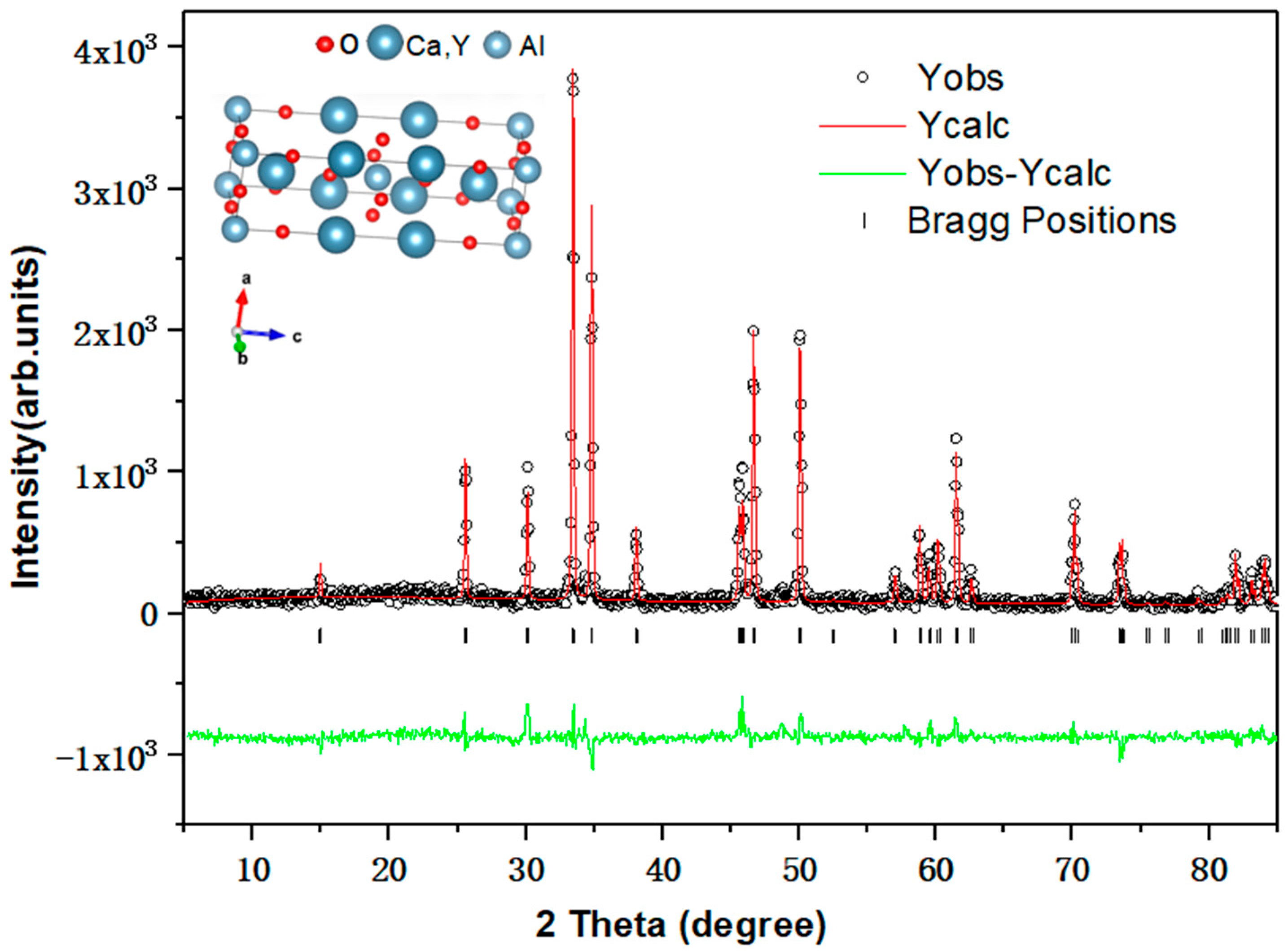
Figure 1. Rietveld refinement profiles of the XRD pattern of Yb3+/Er3+:CYA phosphor.
Crystals 15 01055 g001
Figure 2. (a) Temperature-dependent UC emission spectra of Yb3+/Er3+: CaYAlO4 excited by at 980 nm in the T-range from 163 to 700 K. (b) Integrated emission intensities of emission bands centered at 528 nm, 549 nm and 663 nm.
Crystals 15 01055 g002
Figure 3. Energy level diagram and transitions of Yb3+/Er3+: CaYAlO4 phosphor under 980 nm excitation.
Crystals 15 01055 g003
Figure 4. Temperature dependence of (a) FIR528/549 and (b) the logarithm of FIR528/549 in the range of 163 K to 700 K.
Crystals 15 01055 g004aCrystals 15 01055 g004b
Figure 5. Sa and Sr values of FIR528/549 as a function of temperature.
Crystals 15 01055 g005
Figure 6. Temperature dependence of (a) FIR663/549 and (b) the logarithm of FIR663/549 in the range of 163 K to 700 K.
Crystals 15 01055 g006
Figure 7. Sa and Sr values of FIR663/549 as a function of temperature.
Crystals 15 01055 g007
Figure 8. (a) FIR528/663 as a function of temperature in the range of 163 K to 700 K; (b) S a and S r based on 2H11/2 and 4F9/2 levels as a function of temperature.
Crystals 15 01055 g008
Table 1. Comparison of optical parameters based on TCLs of various UC temperature-sensing materials.
CompoundsTransitions Studied for Temperature SensingTemperature Range (K)Sr-Max (% per K)Sa-Max (% per K)References
NaY2F7:Yb3+,Er3+ Er3+:2H11/24I15/2,
4S3/24I15/2
323–5631.00 (323 K)0.36 (563 K)[29]
Al2O3:Yb3+,Er3+Er3+:2H11/24I15/2,
4S3/24I15/2
295–9730.51 (770 K)[30]
PLZT:Yb3+,Er3+Er3+:2H11/24I15/2,
4S3/24I15/2
140–3200.059 (320 K)[31]
YAG:Yb3+,Er3+Er3+:2H11/24I15/2,
4S3/24I15/2
298–5730.17 (404 K)[32]
NaYF4:Er3+Er3+:2H11/24I15/2,
4S3/24I15/2
300–5400.92 (300 K)0.348 (420 K)[8]
α-SiAlON
ceramic:Yb3+,Er3+,Ho3+
Er3+:2H11/24I15/2,
4S3/24I15/2
298–10231.1 (298 K)0.592 (298 K)[7]
CYA:Yb3+,Er3+,Ho3+Er3+:2H11/24I15/2,
4S3/24I15/2,Ho3+:5S2,5F45I8
163–7004.49 (163 K)0.24 (611 K)[17]
CYA:Yb3+,Er3+Er3+:2H11/24I15/2,
4S3/24I15/2
163–7003.69 (163 K)0.404 (415 K)this work
Table 2. Comparison of optical parameters based on NTCLs of various UC temperature-sensing materials.
CompoundsTransitions Studied for Temperature SensingTemperature Range (K)Sr-Max (% per K)Sa-Max (% per K)References
NaYF4:Er3+Er3+:2H11/24I15/2,
4F9/24I15/2
300–5400.584 (440 K)0.262 (540 K)[8]
YVO4:Yb3+,Er3+,Ho3+Ho3+:5F55I8, Er3+: 2H11/24I15/2, 4S3/24I15/2373–5731.47 (373 K)0.50 (373 K)[13]
PLZT:Yb3+,Er3+Er3+:2H11/24I15/2,
4F9/24I15/2
140–3200.2184 (320 K)[31]
LiYF4:Yb3+,Er3+Er3+:2H11/24I15/2,
4F9/24I15/2
300–5000.90[32]
α-SiAlON ceramic:Yb3+,Er3+,Ho3+Er3+:4F9/24I15/2,
4S3/24I15/2
298–8730.345 (329 K)1.08 (385 K)[7]
CYA:Yb3+,Er3+,Ho3+Er3+:4F9/24I15/2, Ho3+:5F55I8
Er3+:4S3/24I15/2
163–7002.72 (191 K)2.34 (583 K)[17]
CYA:Yb3+,Er3+,Ho3+Er3+:2H11/24I15/2,
4F9/24I15/2, Ho3+:5F55I8
163–7001.77 (191 K)0.031 (331 K)[17]
CYA:Yb3+,Er3+Er3+:4F9/24I15/2,
4S3/24I15/2
163–7000.443 (275 K)1.52 (499 K)this work
CYA:Yb3+,Er3+Er3+:2H11/24I15/2,
4F9/24I15/2
163–7003.86 (163 K)0.08 (247 K)this work
Disclaimer/Publisher’s Note: The statements, opinions and data contained in all publications are solely those of the individual author(s) and contributor(s) and not of MDPI and/or the editor(s). MDPI and/or the editor(s) disclaim responsibility for any injury to people or property resulting from any ideas, methods, instructions or products referred to in the content.