Article

The Pressure Response of Bulk and Two−Dimensional MoS2 Crystals Studied by Raman and Photoluminescence Spectroscopy: Dimensionality and Pressure Transmitting Medium Effects


by
Niki Sorogas
1,
Krystallis Tersis
1,
Antonios Michail
2,
Sotirios Ves
1,
Konstantinos Papagelis
1,2,
Dimitrios Christofilos
3 and
John Arvanitidis
1,*
1
Physics Department, Aristotle University of Thessaloniki, 54124 Thessaloniki, Greece
2
Institute of Accelerating Systems and Applications, National Kapodistrian University of Athens, 15784 Athens, Greece
3
School of Chemical Engineering & Laboratory of Physics, Faculty of Engineering, Aristotle University of Thessaloniki, 54124 Thessaloniki, Greece
*
Author to whom correspondence should be addressed.
Crystals 2025, 15(12), 1056; https://doi.org/10.3390/cryst15121056
Submission received: 6 November 2025 / Revised: 3 December 2025 / Accepted: 10 December 2025 / Published: 12 December 2025
(This article belongs to the Special Issue Recent Advances in Graphene and Other Two-Dimensional Materials)

Abstract

The pressure response of bulk and two−dimensional (2D) MoS2 crystals (monolayer, bilayer, and many–layered), directly transferred to the diamond surface of the diamond anvil cell (DAC) used for high−pressure application, is examined by means of Raman and photoluminescence (PL) spectroscopy. For the high–pressure experiments of 2D MoS2, the Daphne 7474 oil and the 4:1 methanol–ethanol mixture are alternatively used as pressure-transmitting media (PTM), while the former is also used as PTM in the case of bulk MoS2. Characteristic differences are observed in the pressure evolution of the Raman spectral profile and the pressure coefficients of the peak frequencies between the bulk and the 2D MoS2 crystals of various thicknesses, which also depend on the PTM used. These observations, along with the pressure evolution of the PL spectrum of 2D MoS2, are ascribed to the different stress conditions in each case (hydrostatic vs. uniaxial compression perpendicular to the MoS2 layers), the adhesion of the 2D MoS2 crystals on the diamond anvil, as well as the nature of the particular PTM used and its interaction with the studied system.

Graphical Abstract

1. Introduction

Molybdenum disulfide (MoS2) is an important member of the transition metal dichalcogenides (TMDs) family with the general formula MX2 (where M is a transition metal, such as Mo, W, Ti, Zr, Hf, Nb or Ta, and X a chalcogen, such as S, Se or Te), having a wide range of current and potential applications both in its bulk and two–dimensional (2D) variant [1,2,3,4,5,6]. In the bulk form, it exhibits different structural polytypes (trigonal–T, hexagonal–H, and rhombohedral–R), with the most common one being the hexagonal 2H due to its stability [1,2,7,8]. It consists of triple atomic layers (S–Mo–S) with strong covalent bonding between Mo and S atoms. Each Mo atom is surrounded by six S atoms in a trigonal prismatic coordination around Mo, with the S atoms in the upper layer located directly above those of the lower layer. These MoS2 layers are stacked along the c–axis with weak van der Waals interlayer interactions, facilitating their easy mechanical separation into 2D sheets [1,2,7,8,9].
The 2D MoS2 crystals have attracted intense scientific interest due to their remarkable mechanical and electronic properties, including a thickness−dependent energy bandgap [1,2,10,11,12]. Namely, the bulk and few–layered (FL) hexagonal MoS2 have an indirect energy gap of 1.2–1.6 eV, which turns into a direct one of 1.8–1.9 eV in the case of monolayer (1L) MoS2 [12,13]. This indirect–to–direct bandgap transition causes the dramatic photoluminescence (PL) signal increase in the visible spectral region for 1L MoS2 [2,12,14], while the bandgap can be tuned by mechanical strain and pressure application [15,16,17]. Apart from being an effective technique to modify the lattice and electronic structure of bulk and 2D materials, pressure application also enables the continuous increase in the interaction between a 2D system and its environment, thus constituting a method of choice to investigate such effects [18].
Because of their extreme sensitivity and ease of application, optical spectroscopic techniques are versatile tools for scientific investigations in the 2D materials field, both at ambient and high–pressure conditions. Therefore, apart from their common use for identifying the samples thickness at ambient conditions (see Section 3.2), there are several reports in the literature during the last decade dealing with the study of the pressure response of 2D MoS2 crystals by means of PL and/or Raman spectroscopy [16,19,20,21,22,23,24,25,26,27,28,29]. These reports provided different results—contradictory in some cases—regarding the pressure evolution of the PL and the Raman peak energies and their interpretation. This is mainly due to the different conditions of the studied 2D crystals inside the diamond anvil cells (DACs) used for high pressure application, deposited on different substrates, usually on thinned SiO2/Si, or even directly on the diamond anvil of the DAC (to eliminate the contribution of the additional substrate in the pressure response of the crystals) and different fluids as pressure transmitting media (PTM). Moreover, in some cases, the reported pressure coefficients of the Raman peak frequencies were extracted from the corresponding frequency vs. pressure data up to very high pressures (20–30 GPa), assuming a linear dependence. Additionally, for some of the PTMs used, the deviation from linearity is further enhanced because of the solidification of the PTM at much lower pressures, causing non-hydrostatic conditions inside the DAC.
Here, we report on a systematic high–pressure study of bulk and 2D MoS2 crystals of various thicknesses, deposited directly on the diamond anvil of the DAC (the so–called ‘substrate–free’ 2D crystals), by means of Raman spectroscopy, alternatively using two different fluids as PTM in the case of the 2D crystals. In contrast to previous works that often extended to much higher pressures, our analysis is restricted to the low–to–moderate pressure regime, using only data collected before the solidification of the PTM and before the onset of structural/electronic transitions, so as to obtain reliable pressure coefficients and to unveil the effects of dimensionality, 2D crystal–substrate adhesion and PTM properties on the Raman response. The pressure evolution of the PL peaks of monolayer and bilayer MoS2 is also examined under carefully controlled excitation conditions, with the laser power kept as low as possible and the signal averaged over a scanned area to minimize sample heating. Our approach reveals non–trivial layer– and PTM–dependent trends and is expected to shed light on the pressure response of 2D MoS2 systems, contributing to a clearer interpretation of the existing literature.

2. Materials and Methods

The bulk hexagonal 2H–MoS2 crystals (purity > 99.9%) used in the present work were purchased from HQ Graphene (Groningen, the Netherlands). The 2D (single– and few–layered) MoS2 crystals were grown by chemical vapor deposition (CVD) on SiO2/Si substrates, through the reaction between sulfur vapors and pre–deposited sodium molybdate (Na2MoO4) in solution at high temperature (800 °C) and atmospheric pressure. The concentration of the precursor Na2MoO4 solution was 10 mg·mL−1, yielding a continuous MoS2 film with single–, bi–, and few–layered domains epitaxially fabricated on the substrate. Further details can be found in the corresponding article by Michail et al. [30].
Raman and PL spectra were collected in the backscattering geometry by a LabRAM HR spectrometer equipped with a DuoScanTM mapping system (HORIBA, Kyoto, Japan). The excitation laser beam (λexc = 514 nm) of a diode–pumped solid-state laser (Cobolt FandangoTM, HÜBNER Photonics, Kassel, Germany) was focused on the sample by means of a 50× super long working distance objective (focusing spot diameter: ~2 μm). The elastically scattered light is eliminated by means of an appropriate edge filter. The laser power was set either to 1 mW (Raman measurements) or 10 and 100 μW (PL measurements), to minimize any laser–heating effects. To further reduce the heating of the samples by the excitation laser beam in the case of the PL measurements, the signal from the studied sample was averaged by continuously scanning a square area of 5 × 5 μm2, taking advantage of the DuoScanTM mapping system.
High pressure was generated by means of a gas membrane-type diamond anvil cell (DAC, Almax–easyLab, Diksmuide, Belgium) using a ~100 μm–thick drilled (~150 μm hole diameter) stainless steel gasket. Pressure was calibrated using the ruby fluorescence method [31,32]. To eliminate the effect of the SiO2/Si substrate on the pressure response of the 2D MoS2, the crystals were transferred directly onto the diamond anvil of the DAC (‘substrate–free’ 2D MoS2 crystals), utilizing the ‘surface–energy’ assisted methodology with polydimethylsiloxane (PDMS) stamps [33]. The experimental setup and schematic representations of the diamond anvil cell and the crystalline structures of the studied 2D MoS2 (monolayer—1L, bilayer—2L, and many–layered—mL [34,35]) are depicted in Figure S1 in the Supplementary Materials. In this study, two different fluids served as a pressure-transmitting medium to ensure hydrostaticity inside the sample chamber. Firstly, the high viscosity, non–polar Daphne 7474 oil, comprising large–sized molecules and solidifying above 3.7 GPa [36,37]. In order to exclude any sample–related strain and doping effects on the high–pressure response of the Raman spectrum, two different experiments were conducted in this case. Secondly, the low viscosity, polar 4:1 methanol–ethanol mixture, comprising small molecules with a solidification pressure of 10.4 GPa [38,39]. The choice of these two fluids was based not only on their distinct properties and hydrostatic behavior but also on their availability, ease of application, and widespread use (especially the alcohol mixture) for high−pressure experiments.

3. Results and Discussion

3.1. High-Pressure Raman Study of Bulk MoS2

Firstly, we have examined, during the same experiment, the pressure response of the Raman spectrum of two bulk hexagonal MoS2 crystals with slightly different orientations with respect to the incident excitation laser beam (bulk1 and bulk2 crystals in Figure 1a, where representative Raman spectra at various pressures are illustrated), utilizing Daphne 7474 oil as PTM. It is well–known that the number and the symmetry of the Raman active modes depend on the number of layers comprising the MoS2 crystal (bulk, even– or odd–numbered few–layered and monolayer) and the corresponding point/space group symmetry [40,41]. The hexagonal bulk 2H–MoS2, belonging to the P63/mmc space group (D6h point group symmetry) [41,42], has four Raman active modes at the Γ point of the Brillouin zone with symmetries E1g, E2g ( E 2 g 1 and E 2 g 2 ) and A1g [43,44]. Except for the E 2 g 2 mode, which is assigned to relative displacements of two adjacent rigid MoS2 layers (it appears at very low frequency, below 40 cm−1, and is inaccessible due to the edge filter cut–off used in the present study), the other Raman modes are associated with intralayer vibrations [41,45]. The E1g mode (in–plane motion of the S atoms) at ~287 cm−1 is symmetry forbidden in the backscattering geometry perpendicular to the MoS2 layers and appears only in the case of different crystal orientations with respect to the incident laser beam (bulk2 crystal in Figure 1a). Hence, the Raman spectrum of bulk MoS2 is dominated by the E 2 g 1 (in–plane motions of the S and Mo atoms to opposite directions) and the A1g mode (out–of–plane motions of the S atoms) at ~384 and ~409 cm−1, respectively [41,43,44]. Furthermore, a weak second-order Raman band, marked as 2LA in Figure 1a, also appears in the spectra in the frequency range 440–475 cm−1 [46].
With increasing pressure, the observed first-order Raman peaks shift to higher frequencies, reflecting the bond hardening upon volume reduction. At the same time, pressure application also causes the reversible gradual intensity attenuation and moderate broadening of the in–plane E 2 g 1 with respect to the out–of–plane A1g Raman peak, without the appearance of any additional Raman peak (Figure 1a). The pressure evolution of the Raman peak frequencies for the two bulk MoS2 crystals is illustrated in Figure 1b. All these pressure dependencies are quite smooth in the whole pressure range investigated (up to ~8 GPa) and fully reversible upon pressure release (solid symbols in the Figure). Note that previous Raman studies of bulk MoS2 up to much higher pressures have shown the appearance of a new band on the high frequency side of the in–plane mode and/or changes in the pressure coefficients for both first–order Raman peak frequencies for P > 15 GPa [47,48,49,50]. These observations have been attributed to the beginning of a structural phase transition from 2Hc to 2Ha, caused by the interlayer sliding upon compression as suggested by the corresponding synchrotron XRD explorations for P > 20 GPa [51,52]. However, as expected, the experimental data presented in the current work do not show such anomalies because of the much lower pressure range investigated.
Above the solidification pressure of the Daphne 7474 oil (~4 GPa) [36], the frequency vs. pressure data is somewhat different (more pronounced for the in–plane). E 2 g 1 mode) between the two bulk crystals (up and down triangles in the Figure). This deviation reflects the gradual development of non−hydrostatic pressure components in the sample chamber inside the DAC after the solidification of the PTM used [36]. Therefore, only data obtained up to 4 GPa were used for further analysis. The linear fit of the data yields the values of 2.1, 1.9, and 3.7 cm−1GPa−1 for the pressure coefficients of the E1g, E 2 g 1 and A1g modes, respectively. The larger pressure coefficient for the out–of–plane mode compared to those of the in–plane ones suggests that the compression of MoS2 on the c–axis is more effective compared to that of the a–axis [22,29]. Noticeably, the data for the main E 2 g 1 and A1g Raman peaks are better fitted by parabolic (sublinear) functions, resulting in linear pressure coefficient values of 2.0 and 4.1 cm−1GPa−1, respectively. This sublinear behavior is more pronounced for the out–of–plane A1g mode, reflecting the important role of the much weaker van der Waals interlayer interactions compared to the strong intralayer covalent bonds in the pressure response of bulk MoS2. The linear pressure coefficients obtained in this work using Daphne 7474 as PTM are lying closer to the upper limit of the corresponding values in the existing literature for bulk MoS2 using different PTM (4:1 methanol–ethanol mixture, Silicone oil, NaCl, KBr, or Ar); 1.5–1.8 cm−1GPa−1 for the E1g, 1.3–1.9 cm−1GPa−1 for the E 2 g 1 and 2.6–4.0 cm−1GPa−1 for the A1g mode, respectively [27,47,48,49,50,53,54].

3.2. Raman and PL Spectra of 2D MoS2 at Ambient Pressure

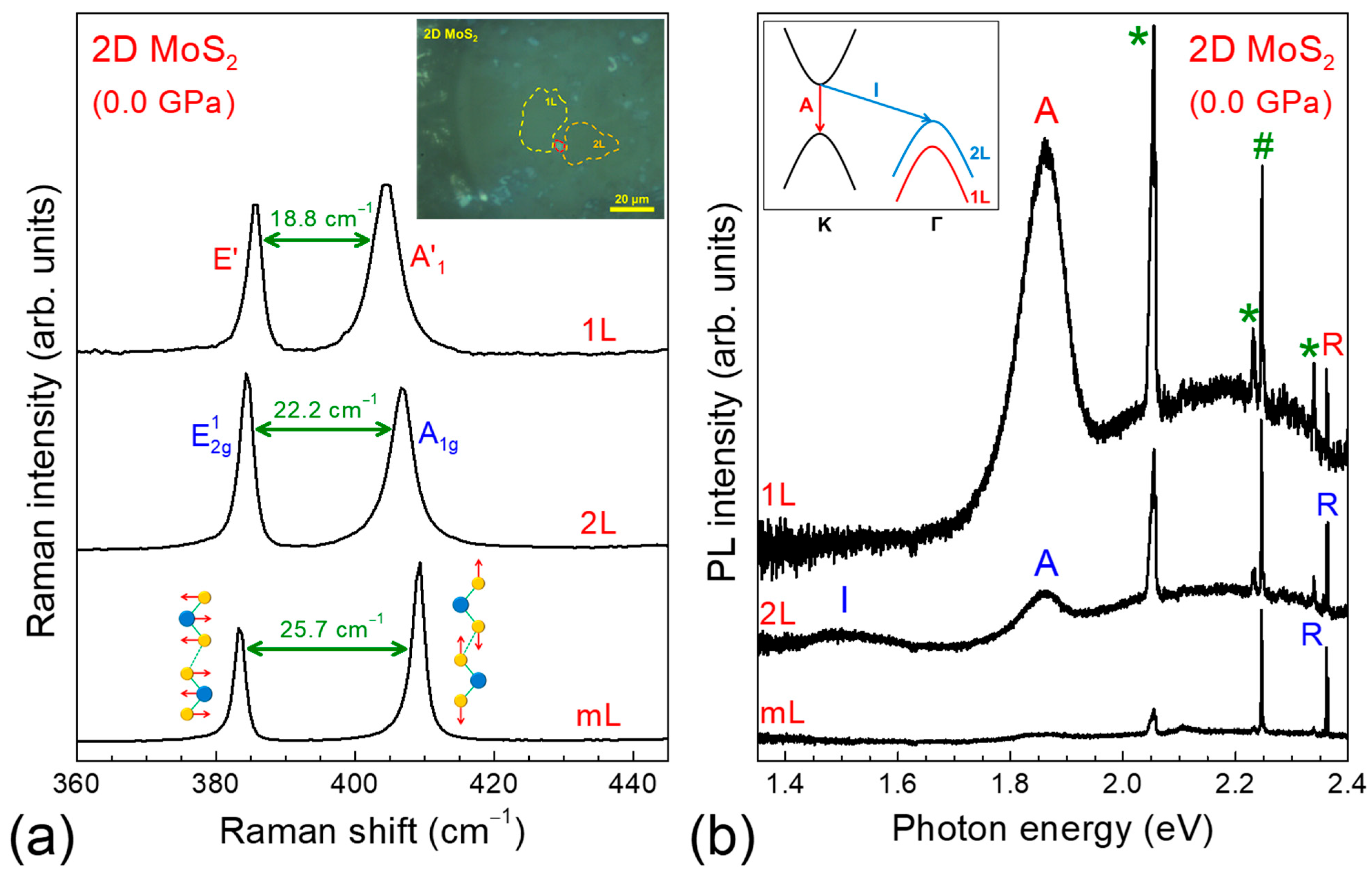
Unlike bulk and even–numbered few–layer (FL) MoS2, odd–numbered FL and 1L MoS2 possess the P 6 ¯ m 2 space group (D3h point group symmetry) due to the lack of inversion symmetry. Hence, the symmetry of the Raman active modes E1g, E 2 g 1 and A1g becomes E’’, E’ and A 1 , respectively, with identical Raman tensors because of the correlation between D3h and D6h [40,41,55]. Noticeably, as the number of layers in 2D MoS2 crystals decreases, the frequency difference (Δω) between the out–of–plane A1g  ( A 1 ) and the main in–plane E 2 g 1 (E’) mode also decreases [40,41,44,56]. This Δω separation decrease is caused by the simultaneous redshift (frequency downshift) of the out–of–plane and blueshift (frequency upshift) of the in–plane mode with decreasing number of layers comprising a 2D MoS2 crystal. The redshift of the A1g  ( A 1 ) mode is attributed to the reduced restoring forces on the S atoms, resulting from the lesser interlayer interactions with decreasing number of layers [40,44]. On the other hand, it has been shown that the ‘anomalous’ blueshift of the E 2 g 1 (E’) mode arises from the strengthening of the surface force constants for the Mo–S intralayer interactions due to the loss of neighbors in adjacent layers in the case of 2D MoS2 [40,57]. Apparently, the particular Δω separation value can be exploited for the thickness determination of a 2D MoS2 crystal. Figure 2a illustrates representative Raman spectra of the ‘substrate–free’ 2D MoS2 sample inside the loaded DAC and prior to pressure application (nearly ambient pressure), as obtained from the three different areas shown in the optical image depicted in the inset of the Figure. The corresponding Δω values are also given in the Figure. Taking into account the corresponding literature data [41,43,56], the three areas examined can be identified as many–layered (mL), bilayer (2L), and 1L MoS2.
Typical PL spectra obtained from the three aforementioned sample areas are illustrated in Figure 2b. The indirect–to–direct bandgap transition on going from 2L to 1L MoS2 is clearly reflected in the PL spectral profile and signal intensity, being compatible with the assignment of the various sample regions to specific 2D MoS2 crystals on the basis of the corresponding Raman spectra. In the 2L MoS2, two rather weak bands appear in the spectrum. The lower energy broad one at ~1.52 eV, marked by ‘I’, is attributed to the indirect K to Γ point transition, while the higher energy band of excitonic origin at ~1.86 eV, labeled as ‘A’, results from the direct interband transition between the conduction band (CB) and the top of the valence band (VB) at the K point of the Brillouin zone (inset in the Figure) [19]. On the other hand, only a significantly strong excitonic A–band appears in the PL spectrum of 1L MoS2 at a similar energy to that of the 2L and in agreement with the literature data [19,58].

3.3. High-Pressure Raman and PL Study of 2D MoS2

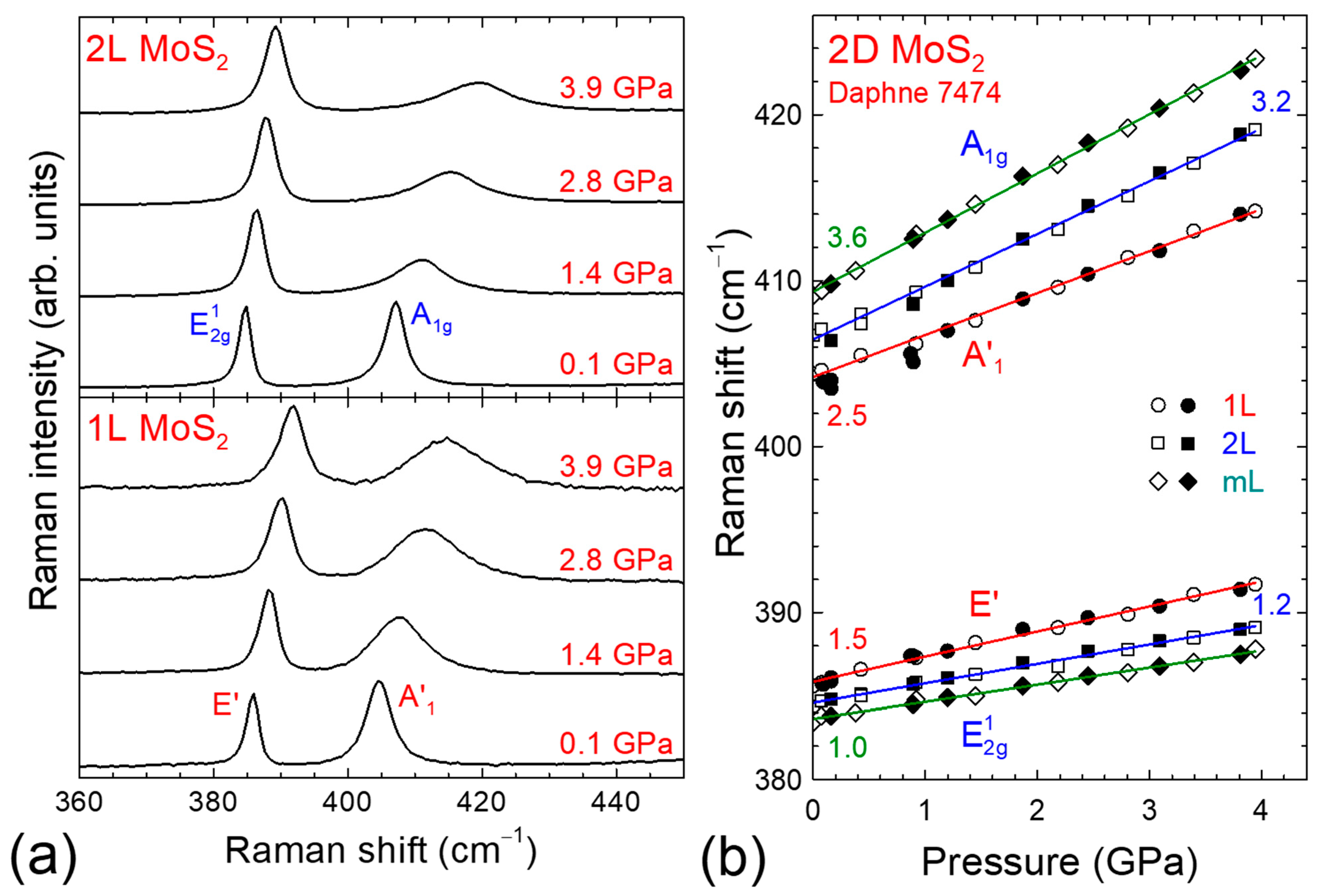
Next, we studied, using again Daphne 7474 as PTM, the pressure response of the Raman spectra obtained from the three different regions of the ‘substrate–free’ 2D MoS2 sample shown in the inset of Figure 2a, corresponding to 1L, 2L, and mL MoS2. Representative Raman spectra of 1L (bottom panel) and 2L (top panel) MoS2 crystals at various pressures up to 4 GPa, where the PTM still provides good hydrostatic conditions, are illustrated in Figure 3a. Similarly to the case of the bulk crystals, both the in–plane (E’ or E 2 g 1 ) and the out–of–plane ( A 1 or A1g) Raman peaks of the 2D MoS2 crystals gradually shift to higher frequencies with increasing pressure. Contrary to the pressure evolution of the Raman spectral profile for bulk MoS2, pressure application on 1L and 2L crystals causes a significant broadening and peak height decrease in the out–of–plane peak, indicating the gradual deformation of the crystals upon compression. This behavior, different from that of the bulk MoS2, is an indication of the presence of non–hydrostatic compression components on the ‘substrate–free’ 1L and 2L crystals and their good adhesion to the diamond surface of the DAC (vide infra).
As it can also be inferred from the same Figure, there is no apparent splitting of the two first–order Raman peaks up to the highest pressure attained in our experiments, contrary to the cases of uniaxial strain application along the MoS2 layer(s), resulting in the splitting of the doubly degenerate E’/ E 2 g 1 mode, or to the presence of regions with stronger and weaker layer–substrate interaction that can also cause the splitting of the A 1 /A1g Raman peak [24,59,60,61]. In our case, the absence of splitting of the Raman peaks suggests that there is no significant differentiation in the in–plane strain and the MoS2 layer–substrate interaction. Upon pressure release, only a partial recovery of the width and peak height of the out–of–plane peak in 1L and 2L MoS2 takes place (Figure S2 in the Supplementary Materials), while pressure application has more detrimental effects and stronger irreversibility in the case of 2L MoS2, possibly due to the additional presence of the interlayer coupling. On the other hand, pressure application on mL MoS2 using Daphne 7474 as PTM does not have any profound effect on the overall Raman spectral profile (Figure S3 in the Supplementary Materials).
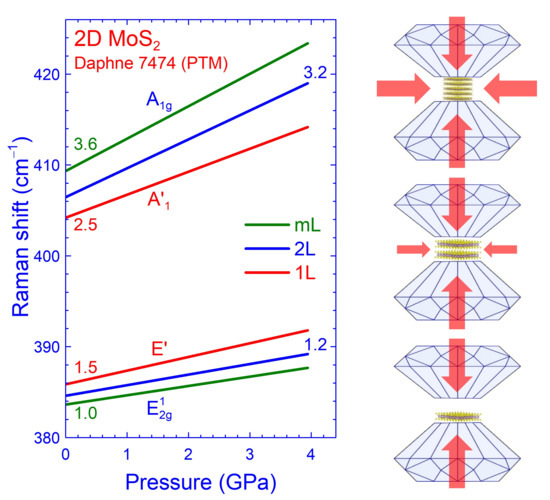
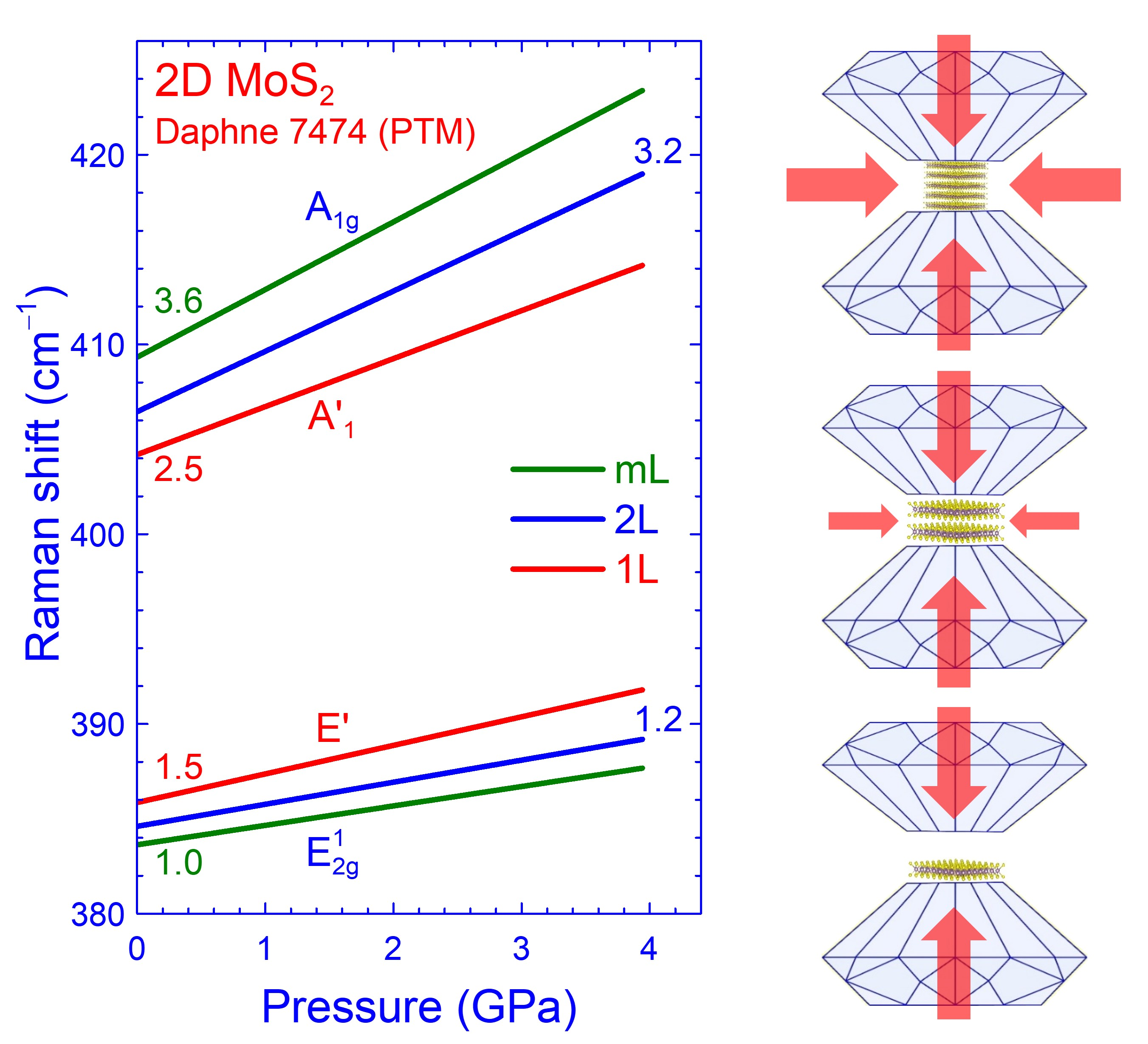
The pressure dependencies of the frequencies of the two Raman peaks observed for each of the three ‘substrate–free’ 2D MoS2 crystals (1L, 2L, and mL) are illustrated in Figure 3b. All of them are quasi–linear and reversible, precluding the occurrence of any structural and/or electronic phase transition up to 4 GPa. The pressure coefficients of the Raman peak frequencies are smaller than those of the corresponding modes in the bulk crystals and increase with increasing number of layers for the out–of–plane mode (2.5, 3.2 and 3.6 cm−1GPa−1 for 1L, 2L and mL MoS2, respectively), whereas they decrease for the in–plane mode (1.5, 1.2 and 1.0 cm−1GPa−1 for 1L, 2L and mL MoS2, respectively). To understand the observed behavior, one should consider the stress/strain situation of the studied 2D samples inside the DAC, taking into account the nature of the PTM used, as well as the adhesion of the sample on the substrate, associated with their relative sliding [33,62].
In the case of the 2D MoS2 crystals stuck on the diamond surface, pressure acts more or less—depending on their thickness—such as a piston along the c–axis, resulting in a predominantly uniaxial compression of the samples. Under these circumstances, the hydrostatic stress component acting on the sample (σH) is lower than that measured by the ruby gauge (PR) [63,64]. Assuming pure uniaxial stress perpendicular to the sample surface with perfect adhesion on the highly stiff diamond, the hydrostatic part of the applied pressure is (Section S1 in the Supplementary Materials) [63,64,65,66]:
σ H = ( 2 C 13 + C 33 ) 3 C 33 P R
A rough estimation of σH can be obtained using Equation (1), the experimental bulk MoS2 values for the elastic constants C13 and C33 [67], keeping in mind that this is not accurate for 1L MoS2 because of the absence of weak van der Waals interlayer interactions [33]. Remarkably, this substitution yields σH = 0.63PR, in very good agreement with the reduced linear pressure coefficients for the Raman peak frequencies of 1L (Figure 3b) with respect to those of the bulk crystals (Figure 1b).
As the number of layers increases, going from 1L to 2L and eventually to mL in the 2D MoS2 crystals, the pressure will be applied more and more hydrostatically on the samples. This leads to an increase in the σH/PR ratio and could explain the gradual increase in the pressure coefficient of the out–of–plane A1g mode frequency observed in Figure 3b with increasing number of layers. On the other hand, the increase in the number of layers comprising a 2D MoS2 crystal is also expected to cause its unbinding from the substrate due to the increase in its bending modulus [24,68,69]. The reduced adhesion of the sample to the substrate promotes their relative sliding, leading to a decrease in the pressure coefficient of the in–plane E 2 g 1 mode frequency as long as pressure is applied predominantly perpendicular to the MoS2 layers.
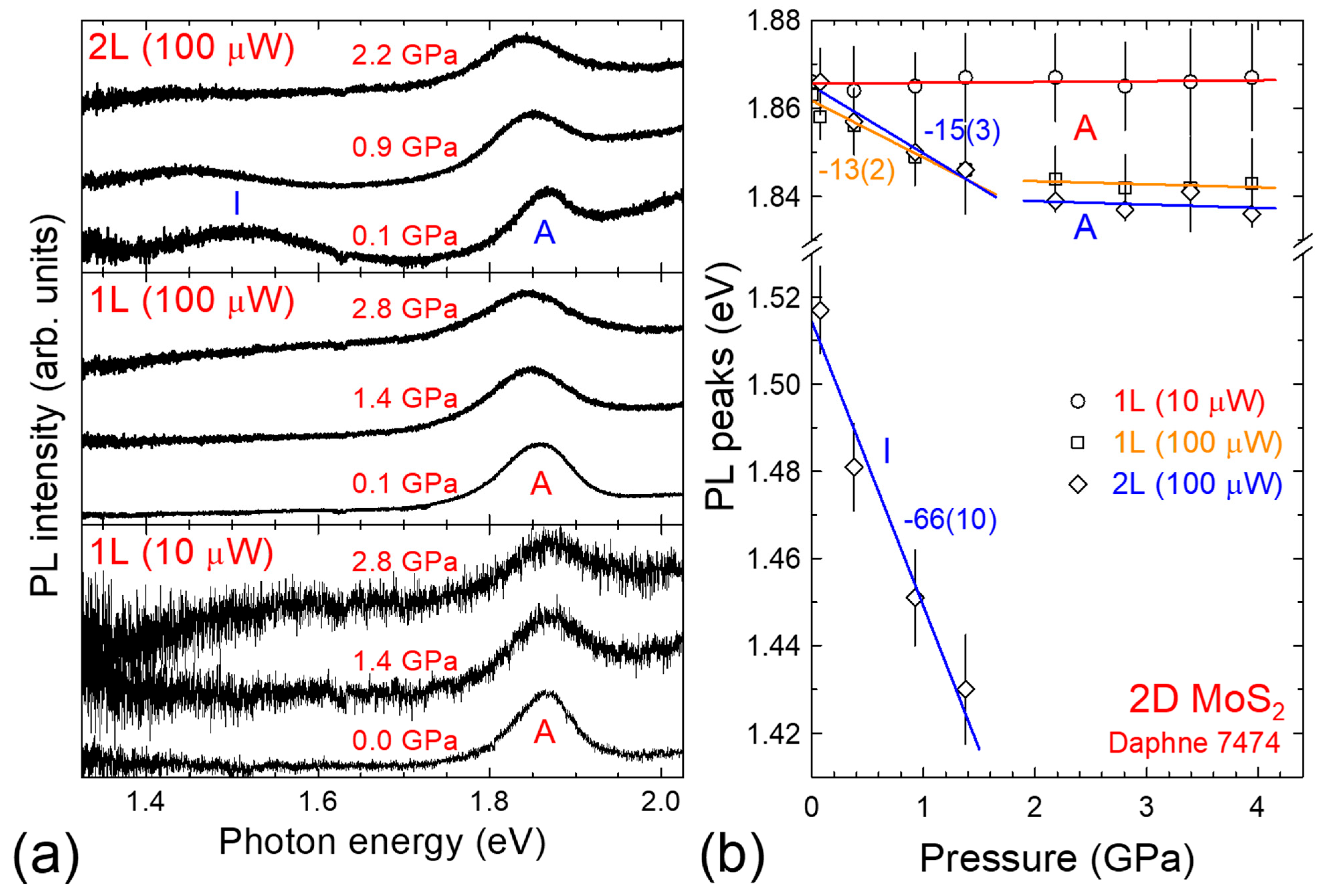
The pressure evolution of the PL peak energies in 1L and 2L ‘substrate–free’ MoS2 crystals is also examined, reducing as much as possible the heating of the samples by the excitation laser beam (see Section 2). We stress that the pressure evolution of the PL spectrum is generally expected to be more complicated than that of the Raman peaks. Apart from the exact strain conditions of the sample in the DAC, it is affected by the different pressure dependence of the VB and the CB and their splitting, the possible electronic transitions, the presence of pressure–induced defects, and the sample heating by the excitation beam. As can be inferred from Figure 4, with 100 μW excitation power, the PL bands for both 1L and 2L shift initially with pressure (up to ~1.5 GPa) to lower energies at a rate of 13–15 meV∙GPa−1 for the A– and ~66 meV∙GPa−1 for the I–band, respectively. Subsequently, the position of the A–band for both 2D crystals remains nearly constant with further pressure increase up to ~4 GPa (the solidification pressure of Daphne 7474 used as PTM), while the weak I–band cannot be followed above 1.5 GPa because of its broad lineshape and its further intensity reduction with pressure.
In the case of the 2L MoS2, the red shift in the I–band is compatible with the corresponding literature, where the decrease in the Γ–K energy gap is attributed to the large band splitting at the Γ point due to the interlayer electronic coupling upon compression [19,28,29,70]. On the other hand, the overall pressure evolution of the A–band in 2L MoS2 deviates from the corresponding findings by Dou et al. and Li et al. [19,28]. Dou et al. used thinned SiO2/Si substrates to support 2L MoS2 inside the DAC, a 4:1 methanol–ethanol mixture as PTM, and much higher laser power for excitation compared to the present study (~20 times). They reported a blueshift of the A–band up to 1.5 GPa and a redshift at higher pressures, and they ascribed this discontinuity to a pressure–induced modification from a direct interband Κ–Κ to an indirect interband Λ–Κ transition at ~1.5 GPa [19]. On the contrary, Li et al. studied ‘substrate–free’ 2L MoS2 with Ar or He as PTM and laser power ~10 times higher than the one used here [28]. They reported a continuous redshift of the A–band up to ~6 GPa at a much smaller rate (−1.6 meV∙GPa−1), accompanied by an intensity decrease. At higher pressures, they observed an increase in the redshift rate (–3.8 meV∙GPa−1), which they attributed to the same direct–to–indirect electronic transition reported by Dou et al. at ~1.5 GPa [19,28].
In the case of the 10 μW excitation power, which is more than two orders of magnitude lower than that typically used in the literature so far [16,19,20,21,24,25,28], the A–band for 1L MoS2 does not practically shift with pressure in the whole pressure range investigated (0–4 GPa). Despite the special precautions taken in the present study, already using 100 μW for excitation (much lower power compared to that in the literature, and beam scanning on the sample), the different pressure response of the PL peak energy for the 10 μW laser power underlines its extreme sensitivity to the sample heating. The increase in pressure causes only the strong intensity reduction of this band, in agreement with other literature reports [19,20,25]. This intensity suppression could be ascribed to the pressure–induced intralayer hybridization between Mo d orbitals and the S p orbitals that could eventually lead to a crossover from direct to indirect transition at higher pressures and/or the pressure–induced increase in defects, as proposed in the literature [19,20,21,71]. The latter possibility is also compatible with the gradual deformation of the 1L and 2L MoS2 crystals upon compression, inferred from the strong broadening and peak height decrease in the out–of–plane Raman peak (vide supra).
The essentially zero pressure shift in the A–band energy in ‘substrate–free’ 1L MoS2 is in contrast to what was earlier reported in the literature for 1L MoS2 on SiO2/Si substrates [19,20,21,25] or transferred to the diamond anvil of the DAC using Ar or He as PTM [28]. In these studies, a rather strong blueshift of the A–band up to 4 GPa (the maximum pressure attained in our experiments) with rates 20–50 meV∙GPa−1 was observed. Intriguingly, Fu et al. reported an alteration from blueshift to redshift (−15.3 meV∙GPa−1) above ~2 GPa for the PL peak of 1L MoS2 on SiO2/Si with Silicone oil as PTM, which they attributed to a Κ–Λ crossover in the CB [25]. The pressure–induced blueshift of the A–band in 1L MoS2 has been ascribed to the fact that both the VB and the CB mainly originate from the dx2–y2, dz2 orbitals of Mo and the px, py orbitals of S, which may move away from the Fermi level by compression, leading to an increase in the energy band gap [28,72]. However, in these studies, either the substrate determines the strain of 1L MoS2 upon compression, and hence the response of the PL peak energy [19,20,21,25], or the small–sized molecules of Ar and He allow for a more efficient lateral compression of the ‘substrate-free’ sample [28]. Our work reveals that uniaxial stress application—according to the high–pressure Raman data—up to 4 GPa in ‘substrate–free’ 1L MoS2 with minimum sample heating does not practically affect the A–band energy.
The results of the present study are better correlated with the findings of Francisco–López et al., who studied the pressure response of the A and B excitons in ‘substrate–free’ 1L WSe2 in comparison with that encapsulated into hexagonal boron nitride layers [33]. They observed that upon compression, the A and B exciton energies for the former sample decrease with rates −3.1 and −1.3 meV∙GPa−1, respectively, whereas for the latter sample, they increase with rates 3.5 and 3.8 meV∙GPa−1, respectively. They have ascribed these contradictory results to the essentially uniaxial stress situation, with the compressive stress component in the direction perpendicular to the plane of the ‘substrate–free’ WSe2, with respect to the hydrostatic compression of the substantially thicker encapsulated sample [33]. In this context, Zhao et al. investigated the pressure response of ‘substrate–free’ 2D InSe crystals of various thicknesses [73]. They reported that for N > 20 layers of InSe, the lattice is compressed in all directions, and the intralayer compression leads to widening of the band gap, resulting in the blue shift in PL. In contrast, for N ≤ 15, they observed a redshift of PL, which is also attributed to the predominantly uniaxial interlayer compression because of the high strain resistance along the InSe–diamond interface [73].

3.4. The Effect of the Pressure Transmitting Medium

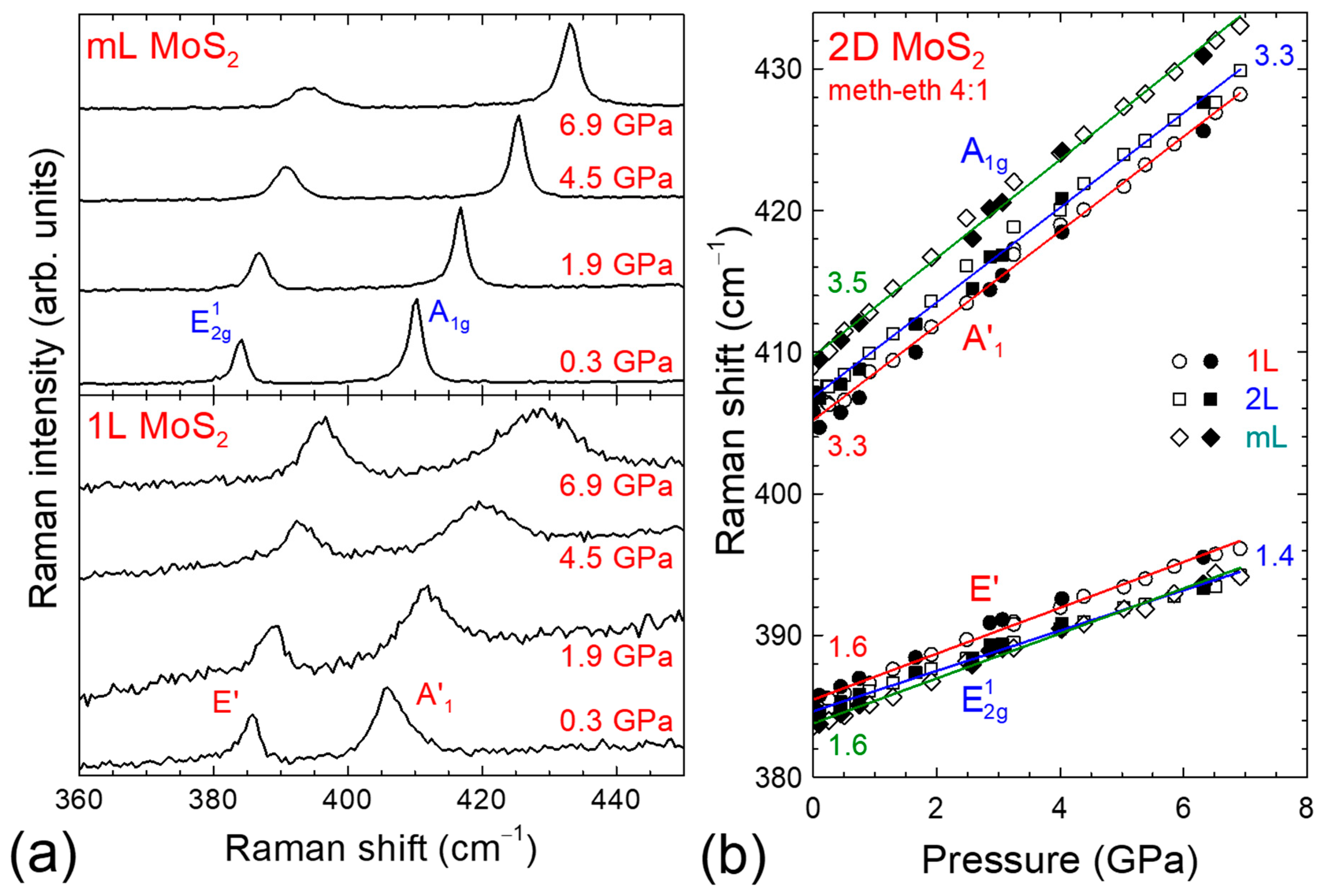
The aforementioned findings concerning the pressure evolution of the Raman spectral profile and the pressure coefficients of the Raman peak frequencies of ‘substrate–free’ 2D MoS2 crystals (1L, 2L and mL) using Daphne 7474 as PTM have been further confirmed by another, independent high–pressure experiment (Run 2) on different 2D crystals (different local strain and doping [74]). Indeed, from this second experiment, very similar results to those of the first experiment are obtained (Figures S3 and S4 in the Supplementary Materials). In order to investigate the effect of the PTM on the observed behavior, we have also studied the pressure response of ‘substrate–free’ 2D MoS2 crystals by Raman spectroscopy using the 4:1 methanol–ethanol mixture as PTM. Representative Raman spectra of 1L (bottom panel) and mL (top panel) MoS2 crystals at various pressures up to 7 GPa are illustrated in Figure 5a.
In this case, pressure application on 1L and 2L causes a considerably smaller broadening and relative peak height decrease in the out–of–plane A 1 or A1g peak, while the pressure evolution of the Raman spectral profile for mL MoS2 is very similar to that of the bulk crystals (gradual intensity attenuation and moderate broadening of the in–plane E 2 g 1 with respect to the out–of–plane A1g Raman peak). Moreover, as can be inferred from Figure 5b, the pressure coefficients for the corresponding modes are similar, independently of the sample thickness (1L, 2L, or mL).
Overall, the high–pressure Raman results for the studied 2D MoS2 samples using the alcohol mixture as PTM, the molecules of which are much smaller compared to those of Daphne 7474 [75] and can even penetrate with pressure the space between the sample and the diamond anvil [24], along with its polar nature that could lead to its stronger interaction with the samples [69], imply the more hydrostatic pressure conditions in this case. Thus, it is evident that the choice of PTM is crucial for the pressure response of ‘substrate–free’ 2D MoS2 systems. Note, however, that for 2D systems on a substrate, the nature of the PTM does not appear to detectably affect its pressure response, at least in the hydrostatic pressure regime of the PTM [62]. Instead, in that case, the strain transferred from the substrate to the 2D material upon compression plays the dominant role [62,69,76].

4. Conclusions

In conclusion, we have presented our detailed high–pressure Raman and PL studies of bulk (three–dimensional, 3D) and ‘substrate–free’ 2D MoS2 crystals using two different PTM in their hydrostatic pressure range. In the case of the Daphne 7474 PTM, apart from the different pressure evolution of the Raman spectral profile compared to that of the bulk, a considerable reduction in the pressure coefficients of the Raman peak frequencies in the ‘substrate–free’ 2D MoS2 crystals is observed. Intriguingly, as the number of the MoS2 layers comprising the 2D crystals increases, the pressure coefficient for the out–of–plane mode frequency increases, gradually approaching the corresponding value for the bulk, whereas for the in–plane mode it decreases on going from 1L to 2L and eventually to mL MoS2. Furthermore, minimizing the sample heating effects, the PL peak energy in 1L MoS2 appears to be pressure independent up to 4 GPa (close to the solidification pressure of the PTM). On the other hand, in the case of the alcohol mixture PTM, both the pressure evolution of the Raman spectral profile and the pressure coefficients of the Raman peak frequencies are more similar to those of the bulk, regardless of the number of layers comprising the ‘substrate–free’ 2D MoS2 crystals. The present experimental findings and deviations can be understood in terms of the degree of uniaxial or hydrostatic stress application on going from 2D to 3D MoS2 crystals, the degree of adhesion of the 2D crystals on the diamond surface of the high–pressure cell, as well as the properties of the PTM. It would also be interesting to extend the methodology of this study to other important—in terms of their potential applications—2D systems and/or their heterostructures, as long as 1L to FL sheets with satisfactory Raman and/or PL signal can be isolated and successfully transferred to the diamond anvil of the high–pressure cell.

Supplementary Materials

The following supporting information can be downloaded at: https://www.mdpi.com/article/10.3390/cryst15121056/s1, Figure S1: From left to right: the experimental setup, the diamond anvil cell and the crystalline structures of the studied 2D MoS2 (monolayer—1L, bilayer—2L and many–layered—mL [34,35]); Figure S2: Representative Raman spectra of monolayer (1L) and bilayer (2L) MoS2 crystals at various pressures upon decompression and using the Daphne 7474 oil as PTM; Figure S3: Representative Raman spectra of many–layered (mL) MoS2 crystals at various pressures obtained during two different high–pressure experiments (Run one and Run two) using Daphne 7474 oil as pressure transmitting medium; Figure S4: (a) Representative Raman spectra of monolayer (1L) and bilayer (2L) MoS2 crystals at various pressures during the second high–pressure experiment (Run 2) using the Daphne 7474 oil as pressure transmitting medium. (b) Frequencies of the E 2 g 1 (E′ for 1L) and A1g ( A 1 for 1L) Raman peaks of 2D MoS2 crystals as a function of pressure. Circles, squares, and rhombi denote data obtained from 1L, 2L, and many–layered (mL) MoS2 crystals, respectively. Red, blue, and green lines through the experimental data for 1L, 2L, and mL MoS2, respectively, are their linear least–squares fits, while numbers refer to the pressure coefficients of the corresponding Raman peak frequencies in cm−1GPa−1; Section S1: Estimation of the hydrostatic part of the uniaxially applied stress.

Author Contributions

Conceptualization, N.S., S.V., K.P., D.C. and J.A.; methodology, N.S., A.M. and J.A.; investigation, N.S., K.T., A.M. and J.A.; formal analysis, N.S., K.T., S.V., K.P., D.C. and J.A.; writing—original draft preparation, N.S. and J.A.; writing—review and editing, S.V., K.P., D.C. and J.A.; supervision, J.A.; funding acquisition, N.S. All authors have read and agreed to the published version of the manuscript.

Funding

This research is a part of the doctoral thesis of N.S., the implementation of which was co–financed by Greece and the European Union (European Social Fund–ESF) through the Operational Program “Human Resources Development, Education and Lifelong Learning” in the context of the Act “Enhancing Human Resources Research Potential by undertaking a Doctoral Research” Sub–action 2: IKY Scholarship Program for PhD candidates in the Greek Universities.

Data Availability Statement

The original contributions presented in this study are included in the article/Supplementary Materials. Further inquiries can be directed to the corresponding author.

Acknowledgments

Support by the funding organizations is gratefully acknowledged (N.S.). The authors also acknowledge the Center of Interdisciplinary Research and Innovation of the Aristotle University of Thessaloniki (CIRI–AUTH) for access to the Raman and PL instrumentation. The research project “2DHeteroThM” implemented within the framework of the H.F.R.I call “3rd Call for H.F.R.I.’s Research Projects to Support Faculty Members and Researchers” (Lateral heterostructures of two-dimensional transition metal dichalcogenides: synthesis and thermomechanical properties, H.F.R.I. Project Number: 26296), is also acknowledged (K.P. and A.M.).

Conflicts of Interest

The authors declare no conflicts of interest.

Abbreviations

The following abbreviations are used in this manuscript:
2DTwo−dimensional
DACDiamond anvil cell
PLPhotoluminescence
PTMPressure-transmitting medium
TMDTransition metal dichalcogenide
FLFew−layered
1LMonolayer
CVDChemical vapor deposition
PDMSPolydimethylsiloxane
mLMany–layered
2LBilayer
CBConduction band
VBValence band
3DThree−dimensional

References

  1. He, Z.; Que, W. Molybdenum disulfide nanomaterials: Structures, properties, synthesis and recent progress on hydrogen evolution reaction. Appl. Mater. Today 2016, 3, 23–56. [Google Scholar] [CrossRef]
  2. Samy, O.; Zeng, S.; Birowosuto, M.D.; El Moutaouakil, A. A Review on MoS2 properties, synthesis, sensing applications and challenges. Crystals 2021, 11, 355. [Google Scholar] [CrossRef]
  3. Khaleghi, M.; Chaji, M.; Pishbin, F.; Sillanpää, M.; Sheibani, S. A review of molybdenum disulfide–based 3D printed structures for biomedical applications. J. Mater. Res. Technol. 2024, 32, 1630–1646. [Google Scholar] [CrossRef]
  4. Pinto, F.M.; de Conti, M.C.M.D.; Pereira, W.S.; Sczancoski, J.C.; Medina, M.; Corradini, P.G.; de Brito, J.F.; Nogueira, A.E.; Góes, M.S.; Ferreira, O.P.; et al. Recent advances in layered MX2-based materials (M = Mo, W and X = S, Se, Te) for emerging optoelectronic and photo(electro)catalytic applications. Catalysts 2024, 14, 388. [Google Scholar] [CrossRef]
  5. Dhingra, A.; Kumar, R.; Thakur, O.P.; Pandey, R. Advancements in fabrication, polymorph diversity, heterostructure excitation dynamics, and multifunctional applications of leading 2D-transition metal dichalcogenides. J. Ind. Eng. Chem. 2025, 151, 40–74. [Google Scholar] [CrossRef]
  6. Alowakennu, M.; Khan, M.M.; Abdulwahab, K.O. Recent progress in photocatalytic applications of metals- and non-metals-doped MoS2. Mater. Sci. Semicond. Process. 2026, 201, 110082. [Google Scholar] [CrossRef]
  7. Benavente, E.; Santa Ana, M.A.; Mendizábal, F.; González, G. Intercalation chemistry of molybdenum disulfide. Coord. Chem. Rev. 2002, 224, 87–109. [Google Scholar] [CrossRef]
  8. Krishnan, U.; Kaur, M.; Singh, K.; Kumar, M.; Kumar, A. A synoptic review of MoS2: Synthesis to applications. Superlattices Microstruct. 2019, 128, 274–297. [Google Scholar] [CrossRef]
  9. Mounet, N.; Gibertini, M.; Schwaller, P.; Campi, D.; Merkys, A.; Marrazzo, A.; Sohier, T.; Castelli, I.E.; Cepellotti, A.; Pizzi, G.; et al. Two–dimensional materials from high–throughput computational exfoliation of experimentally known compounds. Nat. Nanotechnol. 2018, 13, 246–252. [Google Scholar] [CrossRef] [PubMed]
  10. Castellanos–Gomez, A.; Poot, M.; Steele, G.A.; van der Zant, H.S.J.; Agraït, N.; Rubio–Bollinger, G. Elastic properties of freely suspended MoS2 nanosheets. Adv. Mater. 2012, 24, 772–775. [Google Scholar] [CrossRef] [PubMed]
  11. Radisavljevic, B.; Radenovic, A.; Brivio, J.; Giacometti, V.; Kis, A. Single–layer MoS2 transistors. Nat. Nanotechnol. 2011, 6, 147–150. [Google Scholar] [CrossRef]
  12. Mak, K.F.; Lee, C.; Hone, J.; Shan, J.; Heinz, T.F. Atomically thin MoS2: A new direct–gap semiconductor. Phys. Rev. Lett. 2010, 105, 136805. [Google Scholar] [CrossRef]
  13. Kumar, V.P.; Panda, D.K. Review–Next generation 2D material molybdenum disulfide (MoS2): Properties, applications and challenges. ECS J. Solid State Sci. Technol. 2022, 11, 033012. [Google Scholar] [CrossRef]
  14. Venkata Subbaiah, Y.P.; Saji, K.J.; Tiwari, A. Atomically thin MoS2: A versatile nongraphene 2D material. Adv. Funct. Mater. 2016, 26, 2046–2069. [Google Scholar] [CrossRef]
  15. Blundo, E.; Cappelluti, E.; Felici, M.; Pettinari, G.; Polimeni, A. Strain–tuning of the electronic, optical, and vibrational properties of two–dimensional crystals. Appl. Phys. Rev. 2021, 8, 021318. [Google Scholar] [CrossRef]
  16. Pimenta Martins, L.G.; Carvalho, B.R.; Occhialini, C.A.; Neme, N.P.; Park, J.-H.; Song, Q.; Venezuela, P.; Mazzoni, M.S.C.; Matos, M.J.S.; Kong, J.; et al. Electronic band tuning and multivalley Raman scattering in monolayer transition metal dichalcogenides at high pressures. ACS Nano 2022, 16, 8064–8075. [Google Scholar] [CrossRef] [PubMed]
  17. Pimenta Martins, L.G.; Comin, R.; Matos, M.J.S.; Mazzoni, M.S.C.; Neves, B.R.A.; Yankowitz, M. High–pressure studies of atomically thin van der Waals materials. Appl. Phys. Rev. 2023, 10, 011313. [Google Scholar] [CrossRef]
  18. San-Miguel, A. Nanomaterials under high–pressure. Chem. Soc. Rev. 2006, 35, 876–889. [Google Scholar] [CrossRef] [PubMed]
  19. Dou, X.; Ding, K.; Jiang, D.; Sun, B. Tuning and identification of interband transitions in monolayer and bilayer molybdenum disulfide using hydrostatic pressure. ACS Nano 2014, 8, 7458–7464. [Google Scholar] [CrossRef]
  20. Li, F.; Yan, Y.; Han, B.; Li, L.; Huang, X.; Yao, M.; Gong, Y.; Jin, X.; Liu, B.; Zhu, C.; et al. Pressure confinement effect in MoS2 monolayers. Nanoscale 2015, 7, 9075–9082. [Google Scholar] [CrossRef]
  21. Nayak, A.P.; Pandey, T.; Voiry, D.; Liu, J.; Moran, S.T.; Sharma, A.; Tan, C.; Chen, C.-H.; Li, L.-J.; Chhowalla, M.; et al. Pressure–dependent optical and vibrational properties of monolayer molybdenum disulfide. Nano Lett. 2015, 15, 346–353. [Google Scholar] [CrossRef]
  22. Yan, Y.; Li, F.; Gong, Y.; Yao, M.; Huang, X.; Fu, X.; Han, B.; Zhou, Q.; Cui, T. Interlayer coupling affected structural stability in ultrathin MoS2: An investigation by high pressure Raman spectroscopy. J. Phys. Chem. C 2016, 120, 24992–24998. [Google Scholar] [CrossRef]
  23. Li, X.; Li, J.; Wang, K.; Wang, X.; Wang, S.; Chu, X.; Xu, M.; Fang, X.; Wei, Z.; Zhai, Y.; et al. Pressure and temperature-dependent Raman spectra of MoS2 film. Appl. Phys. Lett. 2016, 109, 242101. [Google Scholar] [CrossRef]
  24. Alencar, R.S.; Saboia, K.D.A.; Machon, D.; Montagnac, G.; Meunier, V.; Ferreira, O.P.; San-Miguel, A.; Souza Filho, A.G. Atomic-layered MoS2 on SiO2 under high pressure: Bimodal adhesion and biaxial strain effects. Phys. Rev. Mater. 2017, 1, 024002. [Google Scholar] [CrossRef]
  25. Fu, L.; Wan, Y.; Tang, N.; Ding, Y.-M.; Gao, J.; Yu, J.; Guan, H.; Zhang, K.; Wang, W.; Zhang, C.; et al. K–Λ crossover transition in the conduction band of monolayer MoS2 under hydrostatic pressure. Sci. Adv. 2017, 3, e1700162. [Google Scholar] [CrossRef]
  26. Yang, M.; Cheng, X.; Li, Y.; Ren, Y.; Liu, M.; Qi, Z. Anharmonicity of monolayer MoS2, MoSe2, and WSe2: A Raman study under high pressure and elevated temperature. Appl. Phys. Lett. 2017, 110, 093108. [Google Scholar] [CrossRef]
  27. Cheng, X.; Li, Y.; Shang, J.; Hu, C.; Ren, Y.; Liu, M.; Qi, Z. Thickness–dependent phase transition and optical behavior of MoS2 films under high pressure. Nano Res. 2018, 11, 855–863. [Google Scholar] [CrossRef]
  28. Li, C.; Liu, Y.; Yang, Q.; Zheng, Q.; Yan, Z.; Han, J.; Lin, J.; Wang, S.; Qi, J.; Liu, Y.; et al. Tuning of optical behavior in monolayer and bilayer molybdenum disulfide using hydrostatic pressure. J. Phys. Chem. Lett. 2022, 13, 161–167. [Google Scholar] [CrossRef]
  29. Qiao, W.; Sun, H.; Fan, X.; Jin, M.; Liu, H.; Tang, T.; Xiong, L.; Niu, B.; Li, X.; Wang, G. Interlayer coupling and pressure engineering in bilayer MoS2. Crystals 2022, 12, 693. [Google Scholar] [CrossRef]
  30. Michail, A.; Parthenios, J.N.; Anestopoulos, D.; Galiotis, C.; Christian, M.; Ortolani, L.; Morandi, V.; Papagelis, K. Controllable, eco–friendly, synthesis of highly crystalline 2D–MoS2 and clarification of the role of growth–induced strain. 2D Mater. 2018, 5, 035035. [Google Scholar] [CrossRef]
  31. Mao, H.K.; Xu, J.; Bell, P.M. Calibration of the ruby pressure gauge to 800 kbar under quasi–hydrostatic conditions. J. Geophys. Res. 1986, 91, 4673–4676. [Google Scholar] [CrossRef]
  32. Mujica, A.; Rubio, A.; Muñoz, A.; Needs, R.J. High–pressure phases of group–IV, III–V, and II–VI compounds. Rev. Mod. Phys. 2003, 75, 863–912. [Google Scholar] [CrossRef]
  33. Francisco-López, A.; Han, B.; Lagarde, D.; Marie, X.; Urbaszek, B.; Robert, C.; Goñi, A.R. On the impact of the stress situation on the optical properties of WSe2 monolayers under high pressure. Pap. Phys. 2019, 11, 110005. [Google Scholar] [CrossRef]
  34. Bronsema, K.D.; de Boer, J.L.; Jellinek, F. On the structure of molybdenum diselenide and disulfide. Z. Anorg. Allg. Chem. 1986, 540, 15–17. [Google Scholar] [CrossRef]
  35. Momma, K.; Izumi, F. VESTA 3 for three-dimensional visualization of crystal, volumetric and morphology data. J. Appl. Crystallogr. 2011, 44, 1272–1276. [Google Scholar] [CrossRef]
  36. Murata, K.; Yokogawa, K.; Yoshino, H.; Klotz, S.; Munsch, P.; Irizawa, A.; Nishiyama, M.; Iizuka, K.; Nanba, T.; Okada, T.; et al. Pressure transmitting medium Daphne 7474 solidifying at 3.7 GPa at room temperature. Rev. Sci. Instrum. 2008, 79, 085101. [Google Scholar] [CrossRef] [PubMed]
  37. Sasaki, S.; Kato, S.; Kume, T.; Shimizu, H.; Okada, T.; Aoyama, S.; Kusuyama, F.; Murata, K. Elastic properties of new–pressure transmitting medium Daphne 7474 under high pressure. Jpn. J. Appl. Phys. 2010, 49, 106702. [Google Scholar] [CrossRef]
  38. Piermarini, G.J.; Block, S.; Barnett, J.S. Hydrostatic limits in liquids and solids to 100 kbar. J. Appl. Phys. 1973, 44, 5377–5382. [Google Scholar] [CrossRef]
  39. Jayaraman, A. Diamond anvil cell and high–pressure physical investigations. Rev. Mod. Phys. 1983, 55, 65–108. [Google Scholar] [CrossRef]
  40. Molina-Sánchez, A.; Hummer, K.; Wirtz, L. Vibrational and optical properties of MoS2: From monolayer to bulk. Surf. Sci. Rep. 2015, 70, 554–586. [Google Scholar] [CrossRef]
  41. Zhang, X.; Qiao, X.-F.; Shi, W.; Wu, J.-B.; Jiang, D.-S.; Tan, P.-H. Phonon and Raman scattering of two–dimensional transition metal dichalcogenides from monolayer, multilayer to bulk material. Chem. Soc. Rev. 2015, 44, 2757–2785. [Google Scholar] [CrossRef]
  42. Livneh, T.; Spanier, J.E. A comprehensive multiphonon spectral analysis in MoS2. 2D Mater. 2015, 2, 035003. [Google Scholar] [CrossRef]
  43. Li, H.; Zhang, Q.; Yap, C.C.R.; Tay, B.K.; Edwin, T.H.T.; Olivier, A.; Baillargeat, D. From Bulk to Monolayer MoS2: Evolution of Raman Scattering. Adv. Funct. Mater. 2012, 22, 1385–1390. [Google Scholar] [CrossRef]
  44. Chakraborty, B.; Matte, H.S.S.R.; Sood, A.K.; Rao, C.N.R. Layer–dependent resonant Raman scattering of a few layer MoS2. J. Raman Spectrosc. 2013, 44, 92–96. [Google Scholar] [CrossRef]
  45. Aguiar Sousa, J.H.; Araújo, B.S.; Ferreira, R.S.; San–Miguel, A.; Alencar, R.S.; Filho, A.G.S. Pressure tuning resonance Raman scattering in monolayer, trilayer, and many–layer molybdenum disulfide. ACS Appl. Nano Mater. 2022, 5, 14464–14469. [Google Scholar] [CrossRef]
  46. Carvalho, B.R.; Pimenta, M.A. Resonance Raman spectroscopy in semiconducting transition–metal dichalcogenides: Basic properties and perspectives. 2D Mater. 2020, 7, 042001. [Google Scholar] [CrossRef]
  47. Livneh, T.; Eran Sterer, E. Resonant Raman scattering at exciton states tuned by pressure and temperature in 2H–MoS2. Phys. Rev. B 2010, 81, 195209. [Google Scholar] [CrossRef]
  48. Jiang, J.-J.; Li, H.-P.; Dai, L.-D.; Hu, H.-Y.; Zhao, C.-S. Raman scattering of 2H–MoS2 at simultaneous high temperature and high pressure (up to 600 K and 18.5 GPa). AIP Adv. 2016, 6, 035214. [Google Scholar] [CrossRef]
  49. Shen, P.; Li, Q.; Zhang, H.; Liu, R.; Liu, B.; Yang, X.; Dong, Q.; Cui, T.; Liu, B. Raman and IR spectroscopic characterization of molybdenum disulfide under quasi–hydrostatic and non–hydrostatic conditions. Phys. Status Solidi B 2017, 254, 1600798. [Google Scholar] [CrossRef]
  50. Tang, C.; Liang, L.; Zhu, X.; Liu, W.; Yang, Q.; Zhou, X.; Yan, L.; Tan, W.; Lu, M.; Lu, M. Theoretical and experimental Raman study of molybdenum disulfide. J. Phys. Chem. Solids 2021, 156, 110154. [Google Scholar] [CrossRef]
  51. Aksoy, R.; Ma, Y.; Selvi, E.; Chyu, M.C.; Ertas, A.; White, A. X–ray diffraction study of molybdenum disulfide to 38.8 GPa. J. Phys. Chem. Solids 2006, 67, 1914–1917. [Google Scholar] [CrossRef]
  52. Bandaru, N.; Kumar, R.S.; Sneed, D.; Tschauner, O.; Baker, J.; Antonio, D.; Luo, S.-N.; Hartmann, T.; Zhao, Y.; Venkat, R. Effect of pressure and temperature on structural stability of MoS2. J. Phys. Chem. C 2014, 118, 3230–3235. [Google Scholar] [CrossRef]
  53. Bagnall, A.G.; Liang, W.Y.; Marseglia, E.A.; Welber, B. Raman studies of MoS2 at high pressure. Phys. B+C 1980, 99, 343–346. [Google Scholar] [CrossRef]
  54. Sugai, S.; Ueda, T. High–pressure Raman spectroscopy in the layered materials 2H–MoS2, 2H–MoSe2, and 2H–MoTe2. Phys. Rev. B 1982, 26, 6554–6558. [Google Scholar] [CrossRef]
  55. Pimenta, M.A.; del Corro, E.; Carvalho, B.R.; Fantini, C.; Malard, L.M. Comparative study of Raman spectroscopy in graphene and MoS2-type transition metal dichalcogenides. Acc. Chem. Res. 2015, 48, 41–47. [Google Scholar] [CrossRef]
  56. Lee, C.; Yan, H.; Brus, L.E.; Heinz, T.F.; Hone, J.; Ryu, S. Anomalous lattice vibrations of single- and few-layer MoS2. ACS Nano 2010, 4, 2695–2700. [Google Scholar] [CrossRef]
  57. Luo, X.; Zhao, Y.; Zhang, J.; Xiong, Q.; Quek, S.Y. Anomalous frequency trends in MoS2 thin films attributed to surface effects. Phys. Rev. B 2013, 88, 075320. [Google Scholar] [CrossRef]
  58. Scheuschner, N.; Ochedowski, O.; Kaulitz, A.-M.; Gillen, R.; Schleberger, M.; Maultzsch, J. Photoluminescence of freestanding single– and few–layer MoS2. Phys. Rev. B 2014, 89, 125406. [Google Scholar] [CrossRef]
  59. Wang, Y.; Cong, C.; Qiu, C.; Yu, T. Raman spectroscopy study of lattice vibration and crystallographic orientation of monolayer MoS2 under uniaxial strain. Small 2013, 9, 2857–2861. [Google Scholar] [CrossRef]
  60. Rodríguez, Á.; Çakıroğlu, O.; Li, H.; Carrascoso, F.; Mompean, F.; Garcia-Hernandez, M.; Munuera, C.; Castellanos-Gomez, A. Improved strain transfer efficiency in large-area two-dimensional MoS2 obtained by gold-assisted exfoliation. J. Phys. Chem. Lett. 2024, 15, 6355–6362. [Google Scholar] [CrossRef]
  61. He, X.; Montakim Tareq, A.; Qi, K.; Conti, Y.; Tung, V.; Chiang, N. High-resolution distance dependence interrogation of scanning ion conductance microscopic tip-enhanced Raman spectroscopy enabled by two-dimensional molybdenum disulfide substrates. Nano Lett. 2024, 24, 13805–13810. [Google Scholar] [CrossRef] [PubMed]
  62. Filintoglou, K.; Papadopoulos, N.; Arvanitidis, J.; Christofilos, D.; Frank, O.; Kalbac, M.; Parthenios, J.; Kalosakas, G.; Galiotis, C.; Papagelis, K. Raman spectroscopy of graphene at high pressure: Effects of the substrate and the pressure transmitting media. Phys. Rev. B 2013, 88, 045418. [Google Scholar] [CrossRef]
  63. Ves, S.; Cardona, M. A new application of the diamond anvil cell: Measurements under uniaxial stress. Solid State Commun. 1981, 38, 1109–1112. [Google Scholar] [CrossRef]
  64. Blacha, A.; Ves, S.; Cardona, M. Effects of uniaxial strain on the exciton spectra of CuCl, CuBr, and CuI. Phys. Rev. B 1983, 27, 6346–6362. [Google Scholar] [CrossRef]
  65. Nye, J.F. Physical Properties of Crystals: Their Representation by Tensors and Matrices; Oxford University Press: Oxford, UK, 1985. [Google Scholar]
  66. Anastassakis, E.; Cardona, M. Phonons, strains, and pressure in semiconductors. Semicond. Semimet. 1998, 55, 117–233. [Google Scholar] [CrossRef]
  67. Feldman, J. Elastic constants of 2H–MoS2 and 2H–NbSe2 extracted from measured dispersion curves and linear compressibilities. J. Phys. Chem. Solids 1976, 37, 1141–1144. [Google Scholar] [CrossRef]
  68. Pierre-Louis, O. Adhesion of membranes and filaments on rippled surfaces. Phys. Rev. E 2008, 78, 021603. [Google Scholar] [CrossRef] [PubMed]
  69. Nicolle, J.; Machon, D.; Poncharal, P.; Pierre-Louis, O.; San-Miguel, A. Pressure–mediated doping in graphene. Nano Lett. 2011, 11, 3564–3568. [Google Scholar] [CrossRef] [PubMed]
  70. Webb, A.W.; Feldman, J.L.; Skelton, E.F.; Towle, L.C.; Liu, C.Y.; Spain, I.L. High pressure investigations of MoS2. J. Phys. Chem. Solids 1976, 37, 329–335. [Google Scholar] [CrossRef]
  71. Conley, H.; Wang, B.; Ziegler, J.; Haglund, R.F.; Pantelides, S.T.; Bolotin, K.I. Bandgap engineering of strained monolayer and bilayer MoS2. Nano Lett. 2013, 13, 3626–3630. [Google Scholar] [CrossRef] [PubMed]
  72. Fan, X.; Chang, C.-H.; Zheng, W.; Kuo, J.-L.; Singh, D.J. The electronic properties of single–layer and multilayer MoS2 under high pressure. J. Phys. Chem. C 2015, 119, 10189–10196. [Google Scholar] [CrossRef]
  73. Zhao, L.; Jiang, Y.; Li, C.; Liang, Y.; Wei, Z.; Wei, X.; Zhang, Q. Probing anisotropic deformation and near–infrared emission tuning in thin–layered InSe crystal under high pressure. Nano Lett. 2023, 23, 3493–3500. [Google Scholar] [CrossRef]
  74. Michail, A.; Delikoukos, N.; Parthenios, J.; Galiotis, C.; Papagelis, K. Optical detection of strain and doping inhomogeneities in single layer MoS2. Appl. Phys. Lett. 2016, 108, 173102. [Google Scholar] [CrossRef]
  75. Murata, K.; Goto, K.; Klotz, S.; Bhoi, D.; Béneut, K.; Uwatoko, Y.; Yoshino, H.; Aoki, S. A new pressure medium, Daphne 7676, with solidification pressure of 5 GPa at 300 K and low melting point of around 110 K at ambient pressure. High Press. Res. 2025, 45, 151–161. [Google Scholar] [CrossRef]
  76. Proctor, J.E.; Gregoryanz, E.; Novoselov, K.S.; Lotya, M.; Coleman, J.N.; Halsall, M.P. High–pressure Raman spectroscopy of graphene. Phys. Rev. B 2009, 80, 073408. [Google Scholar] [CrossRef]
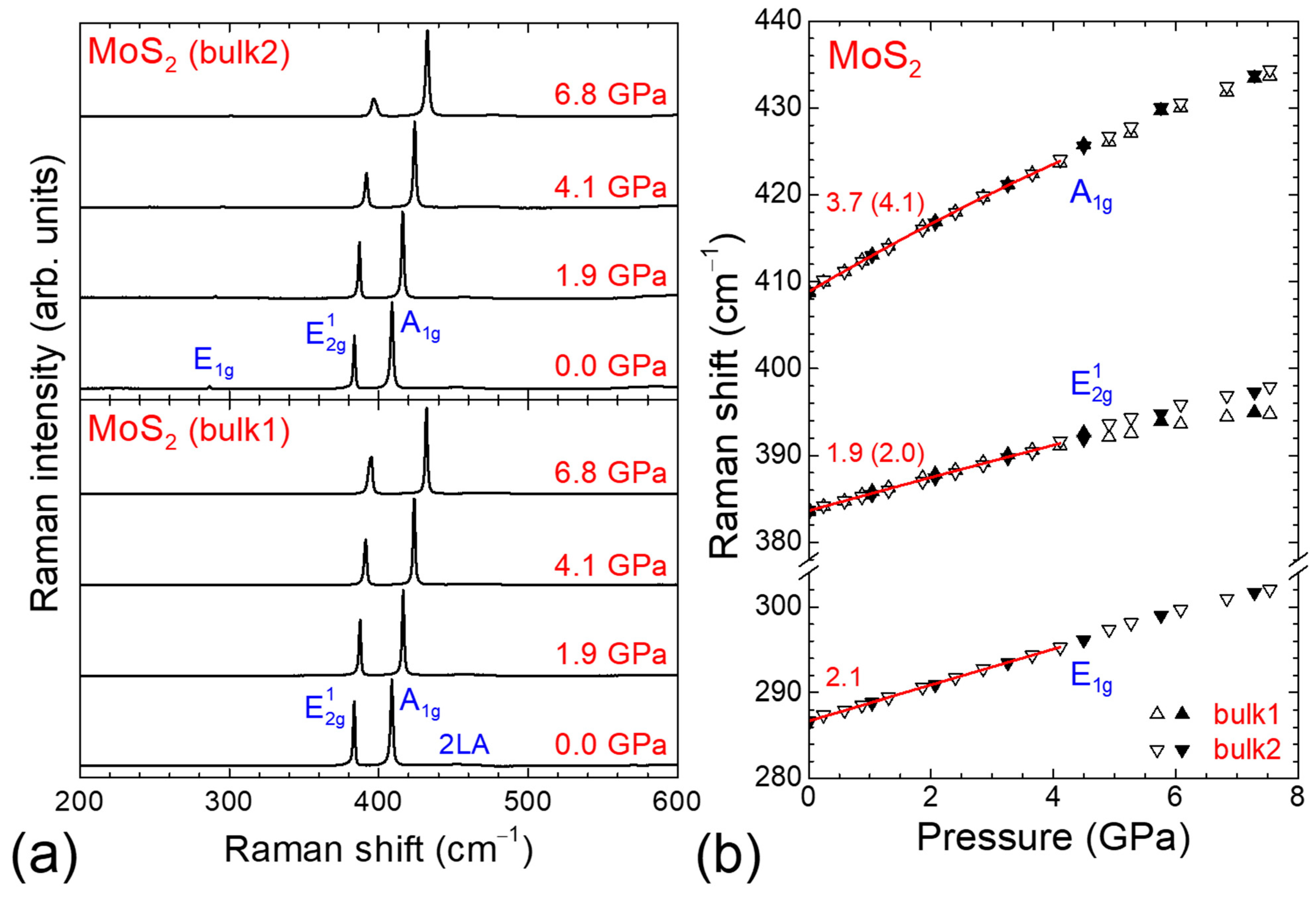
Figure 1. (a) Representative Raman spectra of bulk MoS2, obtained from two crystals (bulk1 and bulk2) having slightly different orientations with respect to the incident excitation beam, at various pressures using the Daphne 7474 oil as pressure-transmitting medium (PTM). (b) Frequencies of the Raman active modes of the studied MoS2 crystals as a function of pressure. Up (down) triangles represent data obtained from the bulk1 (bulk2) crystal, open (solid) symbols correspond to data obtained upon pressure increase (decrease), red lines through the experimental data are their linear or parabolic least–squares fits, while numbers refer to the linear pressure coefficients of the corresponding Raman peak frequencies. The linear pressure coefficients of the parabolic fits are given in parentheses.
Crystals 15 01056 g001
Figure 2. (a) Representative Raman spectra of many–layered (mL), bilayer (2L), and monolayer (1L) MoS2 crystals inside the diamond anvil cell (DAC) prior to pressure application (0 GPa). In each case, the frequency separation (Δω) between the E 2 g 1 (E′ for 1L) and A1g ( A 1 for 1L) Raman peaks are indicated. A sketch of the E 2 g 1 and the A1g phonon modes are also illustrated, where the blue (orange) circles represent the Mo (S) atoms. Inset: Optical image of the studied 1L (yellow dashed line), 2L (orange dashed line), and mL (red dashed line) crystals inside the DAC. (b) Typical photoluminescence (PL) spectra of mL, 2L, and 1L MoS2 inside the DAC at nearly ambient pressure. The intensity of each spectrum was normalized to the intensity of the corresponding Raman peaks (R). Raman peaks indicated by asterisks and hash marks originate from the Daphne 7474 oil (PTM) and the diamond (DAC), respectively. Inset: Schematic diagram showing the energy band structures for 1L and 2L MoS2 around the K and Γ points of the Brillouin zone and the interband transitions corresponding to the A and I peaks in the PL spectra.
Crystals 15 01056 g002
Figure 3. (a) Representative Raman spectra of monolayer (1L) and bilayer (2L) MoS2 crystals at various pressures using the Daphne 7474 oil as PTM. (b) Frequencies of the E 2 g 1 (E′ for 1L) and A1g ( A 1 for 1L) Raman peaks of 2D MoS2 crystals as a function of pressure. Circles, squares, and rhombi denote data obtained from 1L, 2L, and many–layered (mL) MoS2 crystals, respectively. Open (solid) symbols correspond to data obtained upon pressure increase (decrease). Red, blue and green lines through the experimental data for 1L, 2L and mL MoS2, respectively, are their linear least–square fits, while numbers refer to the pressure coefficients of the corresponding Raman peak frequencies in cm−1GPa−1.
Crystals 15 01056 g003
Figure 4. (a) Representative photoluminescence (PL) spectra of monolayer (1L) and bilayer (2L) MoS2 crystals at various pressures using the Daphne 7474 oil as PTM. Two different laser powers, 10 (1L and 2L) and 100 μW (2L), were used for excitation. (b) PL peak energies as a function of pressure for 1L (A peak) and 2L (I and A peak) MoS2. Circles, squares, and rhombi denote data obtained from 1L (10 μW), 1L (100 μW), and 2L (100 μW) MoS2 crystals, respectively. Red, orange, and blue lines through the experimental data for 1L (10 μW), 1L (100 μW), and 2L (100 μW) MoS2, respectively, are their linear least–squares fits, while numbers refer to the pressure coefficients of the corresponding PL peak energies in meV∙GPa−1.
Crystals 15 01056 g004
Figure 5. (a) Representative Raman spectra of monolayer (1L) and many–layered (mL) MoS2 crystals at various pressures using the 4:1 methanol–ethanol mixture as PTM. (b) Frequencies of the E 2 g 1 (E′ for 1L) and A1g ( A 1 for 1L) Raman peaks of 2D MoS2 crystals as a function of pressure. Circles, squares, and rhombi denote data obtained from 1L, bilayer (2L), and mL MoS2 crystals, respectively. Open (solid) symbols correspond to data obtained upon pressure increase (decrease). Red, blue and green lines through the experimental data for 1L, 2L and mL MoS2, respectively, are their linear least–square fits, while numbers refer to the pressure coefficients of the corresponding Raman peak frequencies in cm−1GPa−1.
Crystals 15 01056 g005
Disclaimer/Publisher’s Note: The statements, opinions and data contained in all publications are solely those of the individual author(s) and contributor(s) and not of MDPI and/or the editor(s). MDPI and/or the editor(s) disclaim responsibility for any injury to people or property resulting from any ideas, methods, instructions or products referred to in the content.