3.1. Compressive Strength Development
The compressive strength of the mortar was measured following the standard UNE-EN 196-1 [
40] at 7, 28, and 90 days of hydration.
Table 4,
Table 5,
Table 6 and
Table 7 show the results of the mortar strengths.
At early hydration ages, such as 7 d, it can be observed how the compressive strengths of mortars with natural diatoms (N), 5%, 10%, and 15% (N5, N15, and N20) are lower than the value of the reference mortar (REF) being the value of this at 7 days of 41.03 MPa, while for N5, N15, and N20 it is 37.12 MPa, 37.18 MPa, and 33.07 MPa, respectively. At 28 days of hydration, N5, N15, and N20 values are still lower than the results obtained for REF, 50.22 MPa. Meanwhile, the values of N5, N15, and N20 are 45.72 MPa, 48.10 MPa, and 45.07 MPa, respectively. At 90 days, it can be observed that diatoms have a pozzolanic character that generates an increase in mechanical properties to 52.72 MPa, 56.88 MPa, and 52.40 MPa for N5, N15, and N20, with the N15 value being identical to that obtained by REF of 50.22 MPa.
For all mixtures with beer diatoms (B), from 5% to 15%, the mechanical properties cannot be measured because the material, once cured, cannot be de-molded.
Mortars with recycled diatoms from wine (W) at 7 days show a compressive strength of 31.95 MPa, 33.20 MPa, and 30.88 MPa for W5, W15, and W20, respectively. This resistance is lower than the value of 41.03 MPa of REF. The mechanical properties continue to grow continuously during the hydration of the material, reaching 28 days, 41.50 MPa, 42.40 MPa, and 39.01 MPa for W5, W15, and W20, respectively. These values increase slightly until 90 days, when they reach 41.50 MPa, 42.40 MPa, and 39.01 MPa for W5, W15 and W20, respectively.
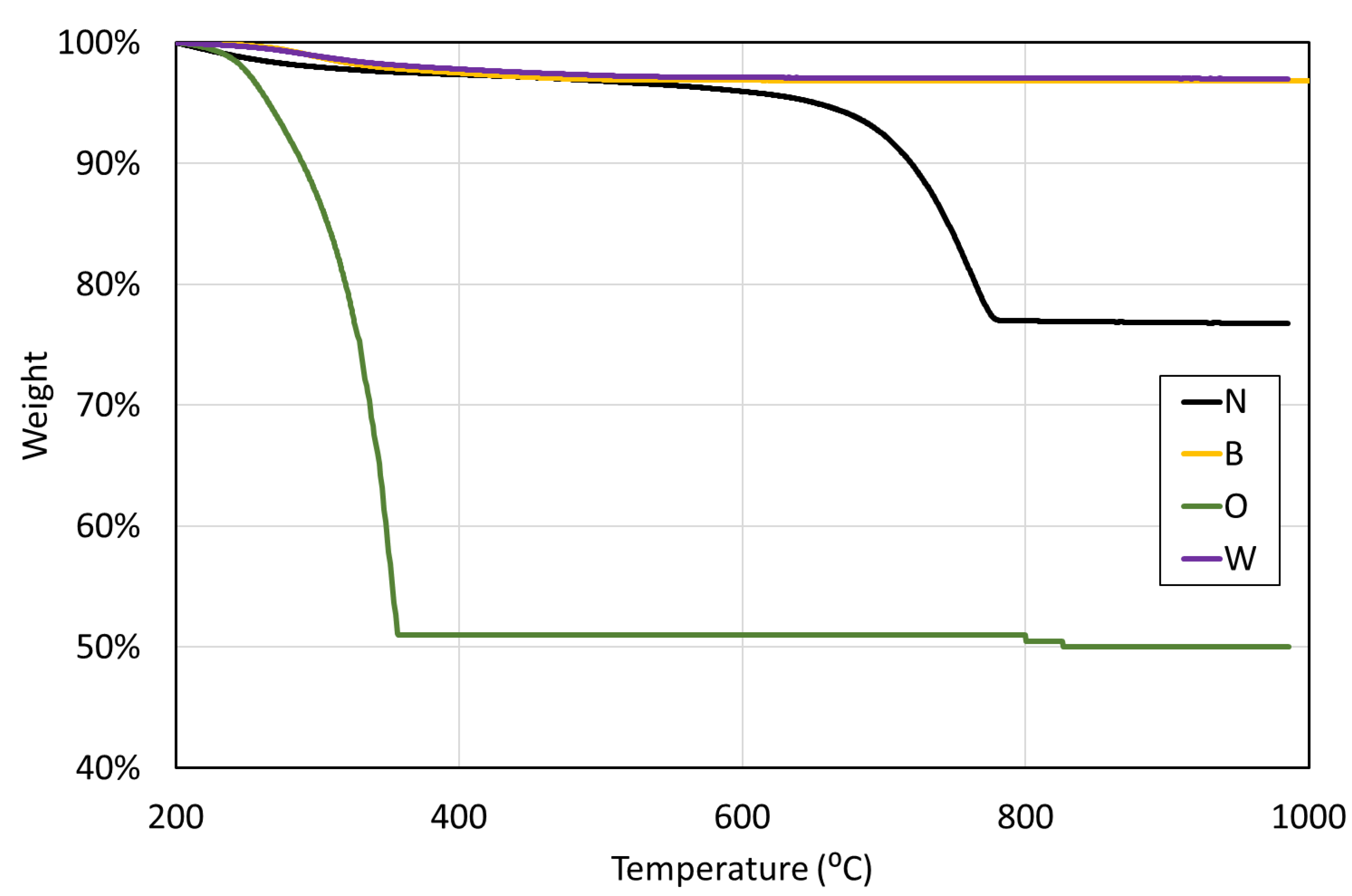
Mortars with diatoms from oil (O) at 7 days show a very low compressive strength, with values of 2.70 MPa, 2.69 MPa, and 2.36 MPa for O5, O15, and O20, respectively. The main reason for these resistances is because of the high percentage of LOI, as can be seen in
Table 1, present in the chemical composition of the diatom, see
Table 1, where it is 51.15%. A high organic material content interferes with chemical hydration reactions that occur between water and cement components, delaying the development of the phases necessary for concrete to reach initial stiffness. This inhibits setting times, prolonging the time required for concrete to move from a plastic to a solid state and affecting its early strength.
During the hydration of the material, at 28 days, low values are observed compared with natural diatoms and recycled diatoms, since 16.90 MPa, 15.80 MPa, and 14.52 MPa are reached for O5, O15, and O20, respectively. These values increase slightly until 90 days, when they reach 21.77 MPa, 20.35 MPa, and 18.10 MPa for O5, O15, and O20, respectively.
The compressive strengths achieved via calcination at 500 °C and 900 °C are shown in
Table 5 and
Table 6. Mortars with natural diatoms calcined at 500 °C and 900 °C, N500 and N900, show a higher compressive strength at 7 days when the percentage of substitution is 5%, 40.63 MPa, and 39.23 MPa for N5-500 and N5-900, respectively. As the hydration time increases, compressive strengths grow to 59.53 MPa and 60.63 MPa at 90 days of hydration for N5-500 and N5-900, respectively. The increase in the percentage of replacement of clinker by activated natural diatoms means that the mechanical properties are lower throughout the hydration time studied, reaching 90 days, 55.53 MPa, and 53.08 MPa for N20-500 and N20-900.
Table 5 and
Table 6 show the compressive strength values of recycled diatoms from beer, wine, and oil. It can be observed that by comparing them with the mechanical properties of the uncalcined recycled diatoms, it is possible to measure the mechanical properties of beer diatoms (B-500 and B-900). Obtaining values higher than the reference and similar to N5-500 and N5-900, reaching 59.60 MPa and 59.80 MPa, respectively, at 90 days. Samples with oil diatoms show considerable improvement once calcined, both at 500 °C and 900 °C. It reaches O5-500 and O5-900 after seven days of hydration, 39.10 MPa and 37.10 MPa. As with other recycled diatoms, the values of the resistances decrease with increasing percentage of substitution. Over the hydration period, O5-500 and O5-900 increase their compressive strengths at 90 days to reach 56.45 MPa and 57.52 MPa, respectively.
The samples with wine diatoms showed a higher value when undergoing calcination at both temperatures, reaching values of 54.50 MPa and 57.52 MPa at 90 days of hydration for W5-500 and W5-900, respectively.
Table 7 summarizes the compressive strength values of various cement mixtures with different types of diatoms and the addition of quicklime (QL), evaluated at 7, 28, and 90 days of curing. A complete study of the compressive strength of recycled diatoms from oil (O-QL) and beer (B-QL) has been carried out since they have the worst mechanical strength values. On the other hand, for natural diatoms (N-QL) and those from the wine industry (W-QL), a control dosage (N15-QL and W15-QL) is carried out to compare with the mechanical properties obtained in
Table 4.
The reference sample (REF-QL) without diatom substitution showed the highest resistance at all ages, reaching 45.70 MPa at 90 days. On the other hand, the addition of natural diatoms (N15-QL) reduced the initial strength, but a significant improvement was observed over time, achieving a strength of 43.15 MPa at 90 days, which is close to the baseline. Calcined diatoms (W15-QL) also exhibited good resistance development capacity, reaching 39.05 MPa at 90 days. This suggests that the use of natural or calcined diatoms can maintain adequate strength in cementitious mixtures modified with quicklime.
In contrast, samples that incorporated beer residues (B-QL) showed the lowest resistance values, in particular the B20-QL sample, which reached only 20.74 MPa at 90 days. This indicates that the addition of beer residues negatively affects the material’s ability to develop strength. In addition, samples with diatoms from other sources (O-QL) showed a progressive decrease in resistance as the percentage of substitution increased, with the O5-QL sample being the best-performing within this series. In general, the results show that the substitution of cement by diatoms, depending on their origin and treatment, has a significant impact on mechanical properties, with natural and calcined diatoms being the most viable options to maintain an acceptable resistance over time.
Therefore, the addition of quicklime does not manage to add pozzolanic activity in the dosages studied. As shown in
Table 7, the recycled diatoms that show the worst uncalcined performance are those from wine and oil; therefore, the results are compared with the B-500 and O-500 samples. It is observed that the 7-day compression values are 20% higher for B5-500, B15-500, and B20-500 than for B5-QL, B15-QL, and B20-QL, respectively, since each of the specimens reaches 17.26 MPa, 16.20 MPa, and 14.97 MPa. While after 90 days of hydration, the values are 16.67% lower for B5-QL, B15-QL, and B20-QL than for B5-500, B15-500, and B20-500.
This trend is reflected in the samples with diatoms from the oil since, comparing the values of compressive strength at 7 days, the results are 20% higher for O5-500, O15-500, and O20-500 than for O5-QL, O15-QL, and O20-QL, respectively, since each of the specimens reaches 17.26 MPa, 16.20 MPa, and 14.97 MPa. While, at 90 days of hydration, the values are 16.67% lower for O5-QL, O15-QL, and O20-QL than for O5-500, O15-500, and O20-500.
3.2. Water Demand
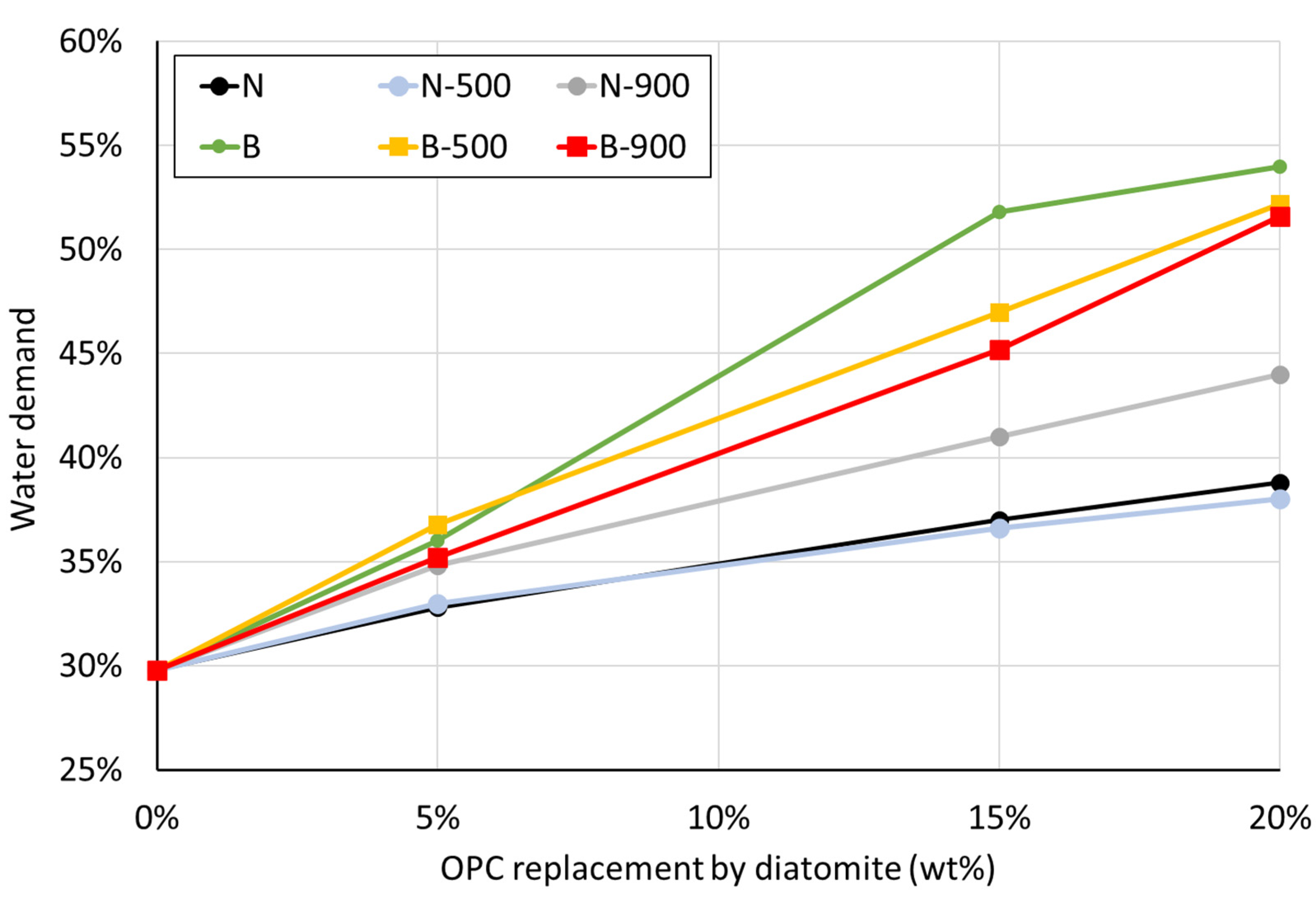
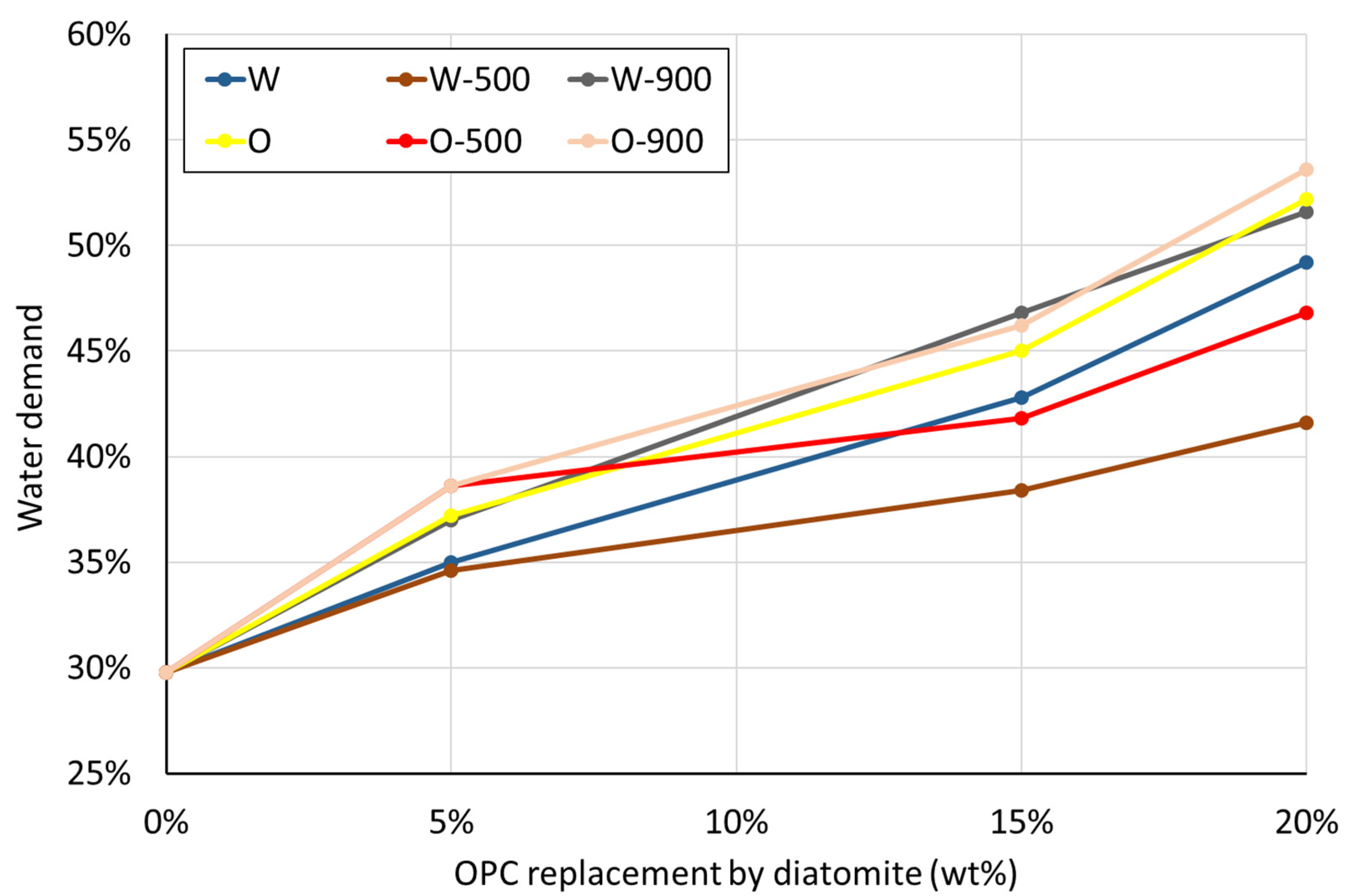
Figure 5 and
Figure 6 show that, in all dosages, with both diatoms, the demand for water increases.
In
Figure 5, it can be seen as the percentage of natural diatoms and beer increased, an increase in the amount of water required was observed.
Focusing on the results obtained by the natural diatom, N, both uncalcined and calcined at 500 °C and 900 °C, it is observed that there is a greater demand for water in N-900. Whereas, for beer diatom, B, heat treatment does not have the same result.
Comparing the series, the N series (natural diatomite) has the lowest water demand, which indicates that, at the same percentage of substitution, this series is less demanding in terms of water content. In contrast, the B-500 and B-900 series (derived from beer waste) show increased demand for water at all substitution levels, with the B-900 series revealing a steeper increase.
Figure 6 shows the evolution of water demand, replacing OPK with Wine (W) and Oil (O) diatoms. The replacement of OPK by diatoms provokes an increment in the amount of water required.
It is observed that at low replacement levels (5%), mixtures show a similar water demand, over 30%, regardless of heat treatment; however, with greater replacement, heat-treated samples begin to show a higher demand for water compared with untreated samples. The curves corresponding to the samples without heat treatment show the lowest water demand throughout the range, while those treated at 500 °C and 900 °C exhibit progressively increasing behavior.
In samples heat-treated at 900 °C, W-900 and O-900 reach the highest water demand, exceeding 55%. This suggests that heat treatments at high temperatures modify the microstructure of the diatom particles, increasing their absorption capacity.
3.3. Setting Time
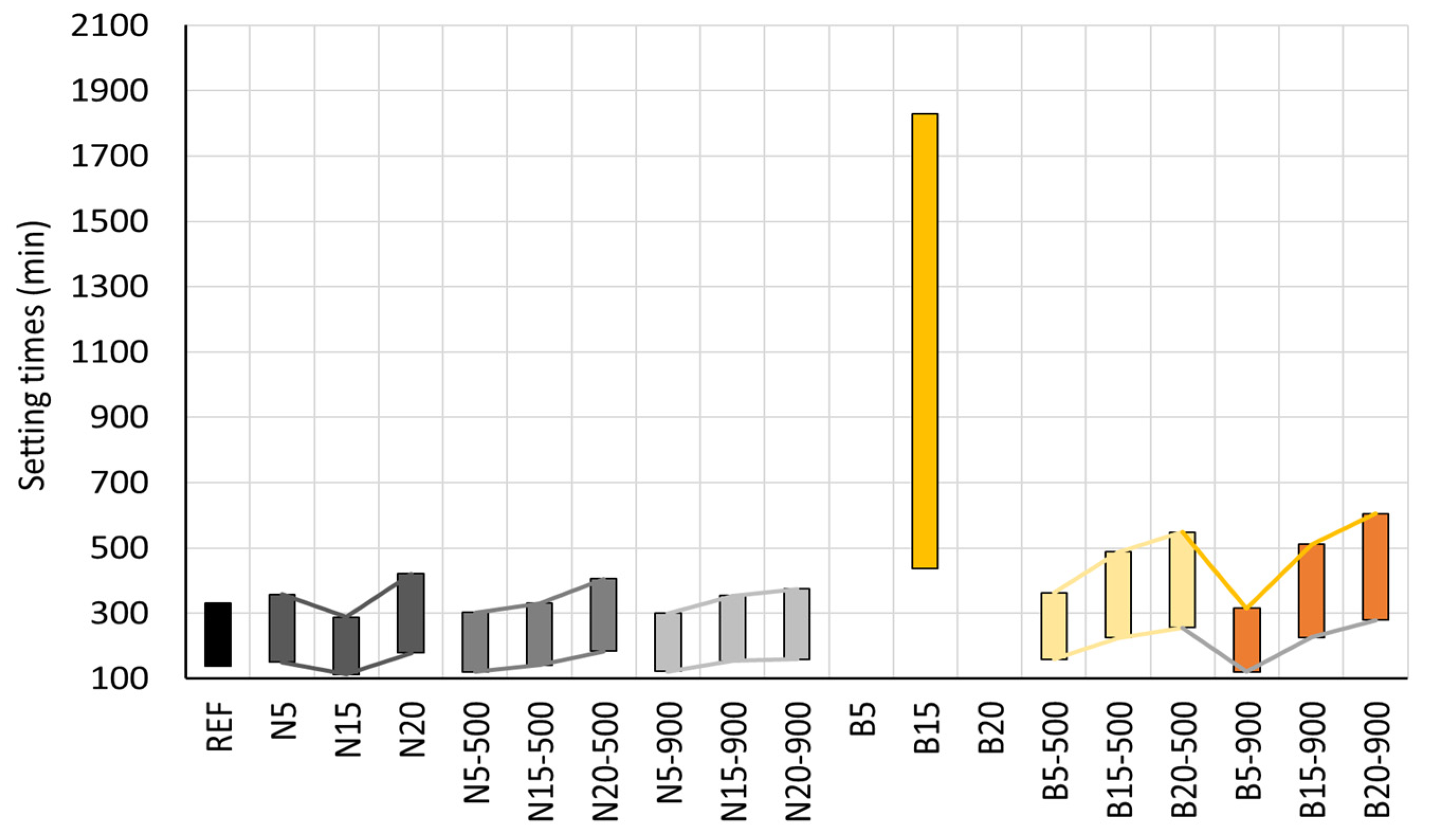
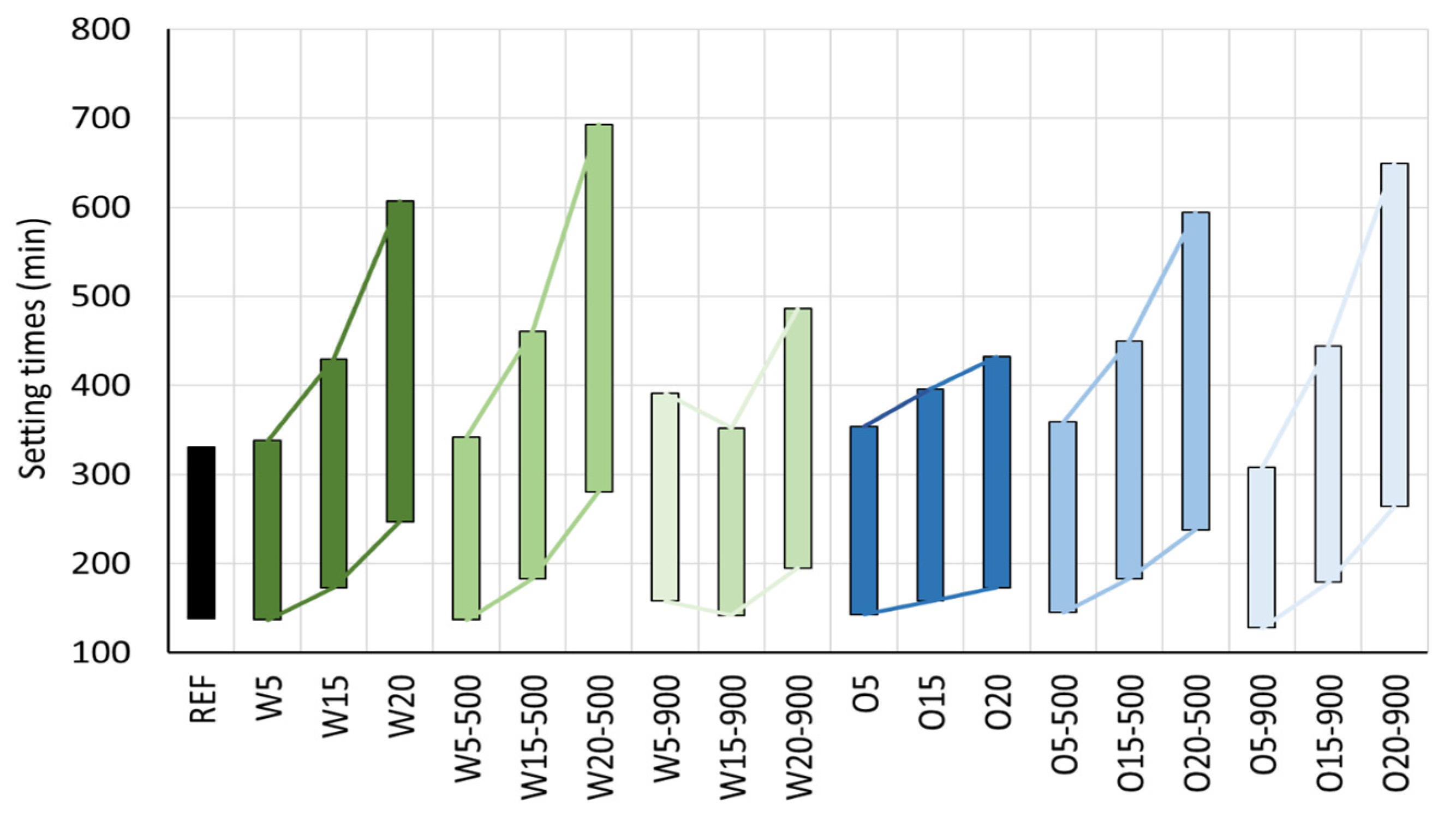
Figure 7 and
Figure 8 show the setting times of the different formulations used according to the origin of the diatom, natural, and recycled ones, according to the proportion of the substitution material and the heat treatment.
Figure 7 shows the setting time evolution of different formulations according to the origin of the diatom (Natural, N, and Beer, B). The results show that the reference material (REF) has a shorter setting time, with a value close to 150 min. On the other hand, formulations with diatoms show an increase in setting times as the percentage of substitution increases.
Mixtures with natural diatoms, N (N5, N15, and N20), show a trend in setting times with increasing proportions of diatoms. The variability in the setting times of the N15 sample is remarkable, which presents a wide distribution, which suggests a lower consistency in the setting behavior for this formulation. Heat treatment variations (N5-500, N15-500, N20-500, N5-900, etc.) indicate that by increasing the treatment temperature to 500 °C and 900 °C, setting times are significantly lengthened, with N20-900 recording the longest times.
On the other hand, formulations with diatoms from beer, B (B5, B15, and B20), which are represented with a yellow color scheme, follow a similar trend to the N series, showing longer setting times as the proportion of diatomite and the heat treatment temperature increases. B20-900 has one of the longest setting times, indicating that the most intense heat treatments prolong the setting process.
However, diatoms from beers without chemical treatment had problems performing the setting time test. Samples B5 and B20 could not be measured because they did not harden, as in the mechanical properties section, while for B15, the start of setting is at 437 min; therefore, it is necessary to carry out heat treatment for samples that use diatoms from the brewing industry.
Figure 8 shows that mixtures with low levels of OPK replacement by diatoms (W5 and O5) do not present important variations, while for a 20% replacement, the setting times increase considerably. Samples treated at 500 °C reduce setting times compared with untreated samples, while samples treated at 900 °C show much longer setting times, some close to 700 min (W20-500).





 ,
,