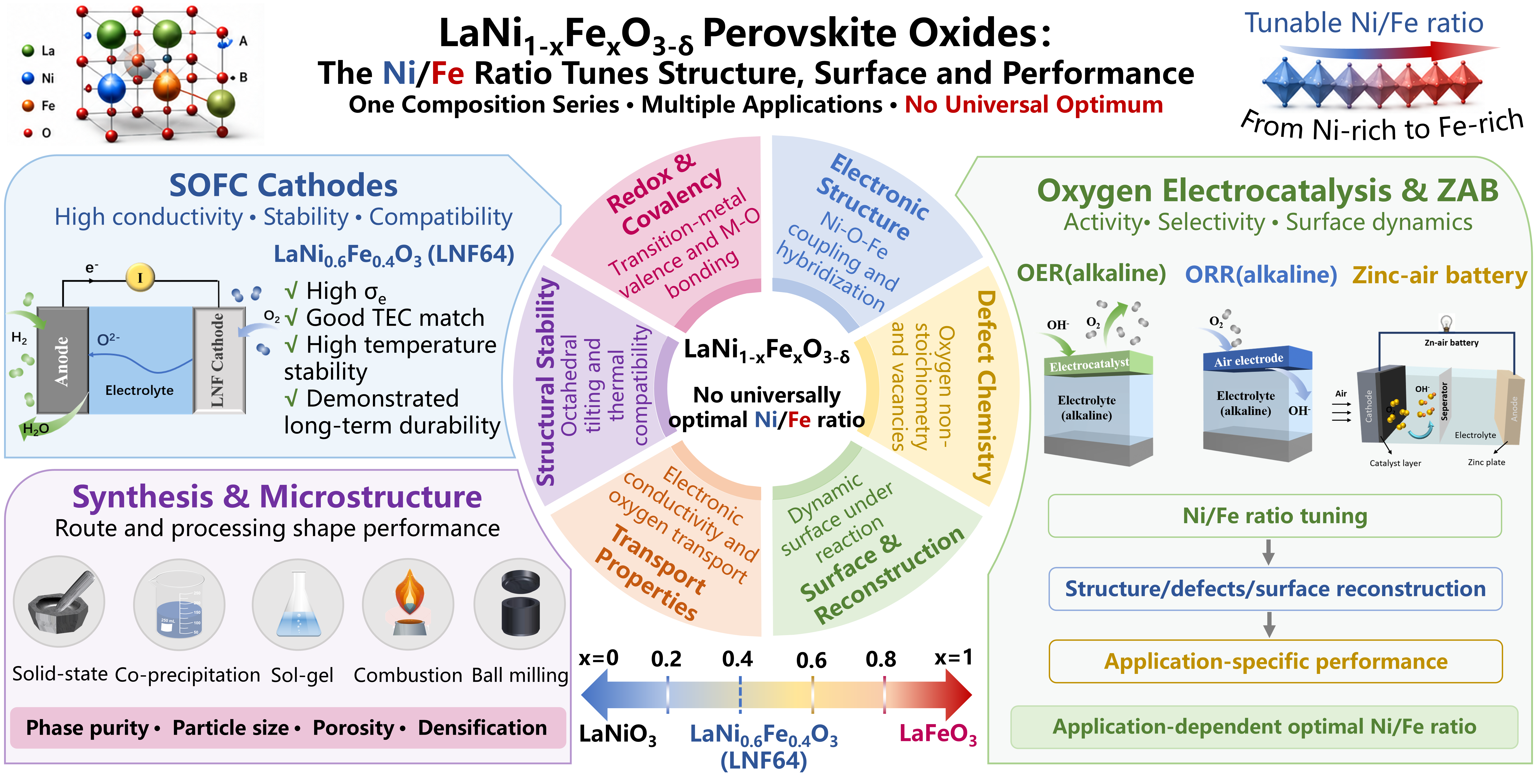
Recent Progress in LaNi1-xFexO3-δ Perovskite Oxides for SOFC Cathodes and Energy Catalysis: The Role of the Ni/Fe Ratio

 , , , , ,
  and
and
Abstract
1. Introduction
2. Synthesis Strategies and Their Influence on LaNi1-xFexO3-δ Properties
3. LNF for SOFC Cathodes: Role of the Ni/Fe Ratio
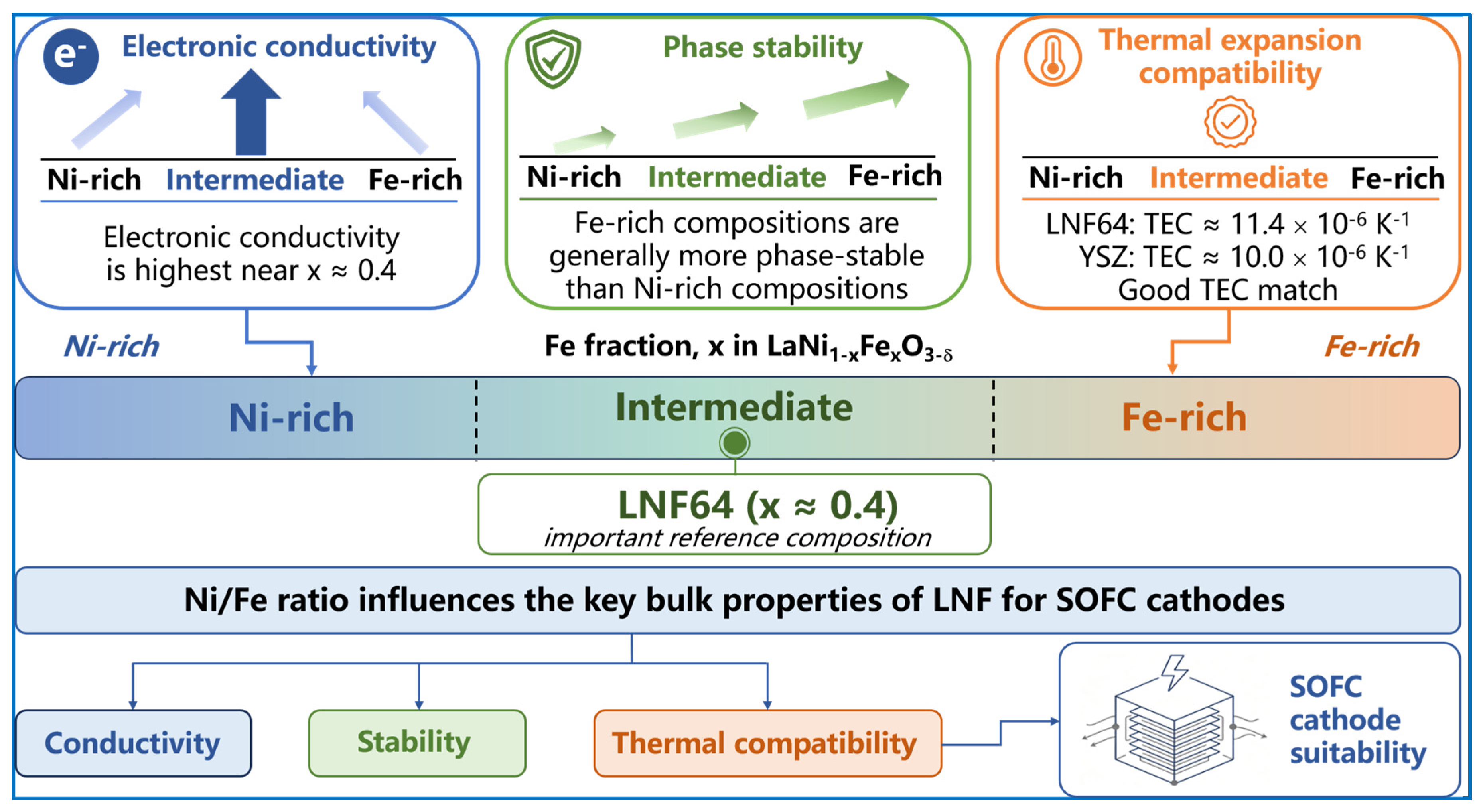
3.1. Intrinsic Properties of LNF Cathode Materials
3.2. Electrochemical Performance and Electrolyte Compatibility of LNF64
3.3. Chromium Tolerance and Long-Term Durability
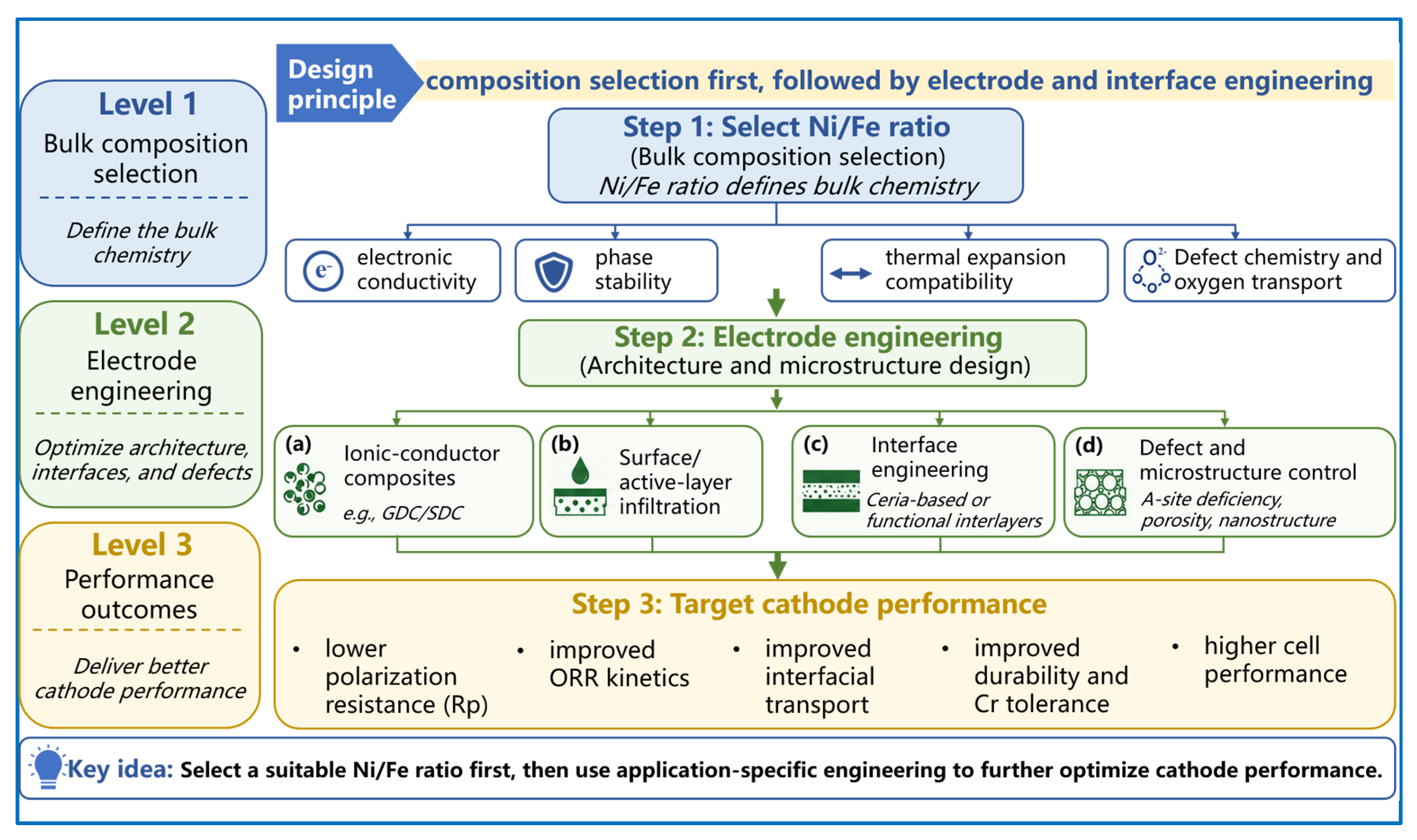
3.4. Electrode Engineering Beyond the Ni/Fe Ratio
4. Oxygen Evolution Reaction Electrocatalysis
5. Other Applications of LNF
5.1. Pseudocapacitive Energy Storage
5.2. Photocatalysis
5.3. Thermocatalytic and Chemical-Looping Applications
6. Challenges and Perspectives
7. Conclusions
Author Contributions
Funding
Institutional Review Board Statement
Informed Consent Statement
Data Availability Statement
Conflicts of Interest
References
- Arandiyan, H.; Mofarah, S.S.; Sorrell, C.C.; Doustkhah, E.; Sajjadi, B.; Hao, D.; Wang, Y.; Sun, H.; Ni, B.-J.; Rezaei, M.; et al. Defect Engineering of Oxide Perovskites for Catalysis and Energy Storage: Synthesis of Chemistry and Materials Science. Chem. Soc. Rev. 2021, 50, 10116–10211. [Google Scholar] [CrossRef] [Scilit] [PubMed]
- Humayun, M.; Li, Z.; Israr, M.; Khan, A.; Luo, W.; Wang, C.; Shao, Z. Perovskite Type ABO3 Oxides in Photocatalysis, Electrocatalysis, and Solid Oxide Fuel Cells: State of the Art and Future Prospects. Chem. Rev. 2025, 125, 3165–3241. [Google Scholar] [CrossRef] [Scilit] [PubMed]
- Lim, T.; Jo, K.; Lee, H. Oxygen Vacancy and Valence Band Structure of Ba0.5Sr0.5Fe1−xCuxO3−δ (x = 0–0.15) with Enhanced ORR Activity for IT-SOFCs. Materials 2023, 16, 3231. [Google Scholar] [CrossRef] [Scilit] [PubMed]
- Kubo, N.M.; Moreno Fernández, H.; Efthimiopoulos, I.; Novalic, L.; Rabe, M.; Hofmann, J.P.; Palkovits, R. High Surface Area Mixed Lanthanum Nickelate/Ferrates (LaNi1−xFexO3) via Modified Carbon Templating Coated on Nickel in Alkaline OER. Nanoscale 2026, 18, 6542–6553. [Google Scholar] [CrossRef] [Scilit] [PubMed]
- Chiba, R. An Investigation of LaNi1−xFexO3 as a Cathode Material for Solid Oxide Fuel Cells. Solid State Ion. 1999, 124, 281–288. [Google Scholar] [CrossRef] [Scilit]
- Timrov, I.; Agrawal, P.; Zhang, X.; Erat, S.; Liu, R.; Braun, A.; Cococcioni, M.; Calandra, M.; Marzari, N.; Passerone, D. Electronic Structure of Pristine and Ni-Substituted LaFeO3 from near Edge X-Ray Absorption Fine Structure Experiments and First-Principles Simulations. Phys. Rev. Res. 2020, 2, 033265. [Google Scholar] [CrossRef] [Scilit]
- Zhen, Y.D.; Tok, A.I.Y.; Jiang, S.P.; Boey, F.Y.C. La(Ni,Fe)O3 as a Cathode Material with High Tolerance to Chromium Poisoning for Solid Oxide Fuel Cells. J. Power Sources 2007, 170, 61–66. [Google Scholar] [CrossRef] [Scilit]
- Yoshida, Y.; Komatsu, T.; Chiba, R.; Yokoo, M.; Hayashi, K.; Orui, H.; Arai, H. Durability of Anode-Supported SOFCs Stack Using La(Ni,Fe)O3 Cathode. ECS Trans. 2009, 25, 421–428. [Google Scholar] [CrossRef] [Scilit]
- Harrison, C.M.; Slater, P.R.; Steinberger-Wilckens, R. Lanthanum Nickelates and Their Application in Solid Oxide Cells—The LaNi1-xFexO3 System and Other ABO3-Type Nickelates. Solid State Ion. 2021, 373, 115799. [Google Scholar] [CrossRef] [Scilit]
- Zhang, D.; Song, Y.; Du, Z.; Wang, L.; Li, Y.; Goodenough, J.B. Active LaNi1−xFexO3 Bifunctional Catalysts for Air Cathodes in Alkaline Media. J. Mater. Chem. A 2015, 3, 9421–9426. [Google Scholar] [CrossRef] [Scilit]
- An, L.; Li, J.; Sun, Y.; Zhu, J.; Seow, J.Z.Y.; Zhang, H.; Zhang, N.; Xi, P.; Xu, Z.J.; Yan, C.-H. Deciphering Water Oxidation Catalysts: The Dominant Role of Surface Chemistry over Reconstruction Degree in Activity Promotion. Nano-Micro Lett. 2025, 17, 70. [Google Scholar] [CrossRef] [Scilit] [PubMed]
- Gozzo, C.B.; Soares, M.R.S.; Sczancoski, J.C.; Nogueira, I.C.; Leite, E.R. Investigation of the Electrocatalytic Performance for Oxygen Evolution Reaction of Fe-Doped Lanthanum Nickelate Deposited on Pyrolytic Graphite Sheets. Int. J. Hydrogen Energy 2019, 44, 21659–21672. [Google Scholar] [CrossRef] [Scilit]
- Wang, L.; Adiga, P.; Zhao, J.; Samarakoon, W.S.; Stoerzinger, K.A.; Spurgeon, S.R.; Matthews, B.E.; Bowden, M.E.; Sushko, P.V.; Kaspar, T.C.; et al. Understanding the Electronic Structure Evolution of Epitaxial LaNi1–xFexO3 Thin Films for Water Oxidation. Nano Lett. 2021, 21, 8324–8331. [Google Scholar] [CrossRef] [Scilit] [PubMed]
- Wang, Q.; Wang, H.; Qi, S.; Su, Z.; Chen, K.; Yu, X.; Xie, A.; Luo, S. Coral-Like LaNixFe1−xO3 Perovskite Catalyst for High-Performance Oxygen Evolution Reaction. J. Electrochem. Soc. 2022, 169, 026508. [Google Scholar] [CrossRef] [Scilit]
- Yun, T.G.; Heo, Y.; Bin Bae, H.; Chung, S.-Y. Elucidating Intrinsic Contribution of D-Orbital States to Oxygen Evolution Electrocatalysis in Oxides. Nat. Commun. 2021, 12, 824. [Google Scholar] [CrossRef] [Scilit] [PubMed]
- Yu, N.; Liu, H.-J.; Cao, Y.-N.; Wang, Q.-Y.; Ma, Y.; Yu, J.-F.; Hu, H.; Chai, Y.-M.; Dong, B. Dynamic Equilibrium of External Fe3+ to Effectively Construct Catalytic Surface of Perovskite LaNi1−xFexO3 for Water Oxidation. Colloids Surf. A Physicochem. Eng. Asp. 2022, 654, 130042. [Google Scholar] [CrossRef] [Scilit]
- Liu, J.; Jia, E.; Stoerzinger, K.A.; Wang, L.; Wang, Y.; Yang, Z.; Shen, D.; Engelhard, M.H.; Bowden, M.E.; Zhu, Z.; et al. Dynamic Lattice Oxygen Participation on Perovskite LaNiO3 during Oxygen Evolution Reaction. J. Phys. Chem. C 2020, 124, 15386–15390. [Google Scholar] [CrossRef] [Scilit]
- Alexander, C.T.; Forslund, R.P.; Johnston, K.P.; Stevenson, K.J. Tuning Redox Transitions via the Inductive Effect in LaNi1–xFexO3−δ Perovskites for High-Power Asymmetric and Symmetric Pseudocapacitors. ACS Appl. Energy Mater. 2019, 2, 6558–6568. [Google Scholar] [CrossRef] [Scilit]
- Zeng, L.; Peng, T.; Sun, H.; Yang, J.; Li, Y.; Qin, Y. Fe-Doped LaNi1-xFexO3 Perovskite Oxides for Enhanced Visible-Light-Driven Photocatalytic Activity. J. Solid State Chem. 2021, 297, 122033. [Google Scholar] [CrossRef] [Scilit]
- Bao, J.; Quan, W.; Ning, Y.; Wang, H.; Wei, Q.; Huang, L.; Zhang, W.; Ma, Y.; Hu, X.; Tian, H. Efficient Visible-Light-Driven Tetracycline Degradation and Cr(VI) Reduction over a LaNi1–xFexO3 (0 ≤ x ≤ 1)/g-C3N4 Type-II Heterojunction Photocatalyst. Inorg. Chem. 2023, 62, 1086–1094. [Google Scholar] [CrossRef] [Scilit] [PubMed]
- Jahangiri, A.; Aghabozorg, H.; Pahlavanzadeh, H. Effects of Fe Substitutions by Ni in La–Ni–O Perovskite-Type Oxides in Reforming of Methane with CO2 and O2. Int. J. Hydrogen Energy 2013, 38, 10407–10416. [Google Scholar] [CrossRef] [Scilit]
- Coronado-Delgadillo, E.A.; Pazo-Carballo, C.; Seguel-Rebolledo, J.; Pinto-Neira, J.; Flores, M.; Larkin, C.; Majumder, D.; Papaioannou, E.I.; García-García, F.R.; Escalona, N. Glycerol Dry Reforming on Ni–Fe Bimetallic Catalysts Exsolved from LaNi1-XFeXO3 Perovskites: Catalytic Activity and Resistance to Carbon Deposition. J. Phys. Energy 2026, 8, 015024. [Google Scholar] [CrossRef] [Scilit]
- Cui, X.; Wu, T.; Cao, J.-P.; Tang, W.; Yang, F.-L.; Zhu, B.-A.; Wang, Z. Mechanism for Catalytic Cracking of Coal Tar over Fresh and Reduced LaNi1-xFexO3 Perovskite. Fuel 2021, 288, 119683. [Google Scholar] [CrossRef] [Scilit]
- Yao, W.; Wu, X.; Lin, Y.; Yang, X.; Wei, G.; Huang, Z.; Chen, L.; Zhang, S.; Zhang, Y.; Xie, J. A Novel Cascade High Purity Hydrogen Production via Chemical Looping Reforming of Landfill Gas with LaFe1-xNixO3 Perovskite Oxygen Carrier. Sep. Purif. Technol. 2025, 361, 131223. [Google Scholar] [CrossRef] [Scilit]
- Zhang, Y.; Li, H.; Jiang, Y.; Dai, L.; Fu, P.; Li, Z. Hydrogen by Glycerol Chemical Looping Reforming over Fe-Based Oxygen Carriers Derived from LaNi1−xFexO3-λ Perovskite. J. Environ. Chem. Eng. 2023, 11, 110941. [Google Scholar] [CrossRef] [Scilit]
- Sangsubun, C.; Chaiburi, C.; Maneelok, S. LaNi(1−x)FexO3 Perovskite Catalysts Prepared by High-Energy Ball Milling for Efficient Air Cathodes in Alkaline Fuel Cells. RSC Adv. 2026, 16, 1879–1887. [Google Scholar] [CrossRef] [Scilit] [PubMed]
- Bevilacqua, M.; Montini, T.; Tavagnacco, C.; Vicario, G.; Fornasiero, P.; Graziani, M. Influence of Synthesis Route on Morphology and Electrical Properties of LaNi0.6Fe0.4O3. Solid State Ion. 2006, 177, 2957–2965. [Google Scholar] [CrossRef] [Scilit]
- Pikalova, E.Y.; Bogdanovich, N.M.; Kolchugin, A.A.; Ananyev, M.V.; Pankratov, A.A. Influence of the Synthesis Method on the Electrochemical Properties of Bilayer Electrodes Based on La2NiO4+δ and LaNi0.6Fe0.4O3−δ. Solid State Ion. 2016, 288, 36–42. [Google Scholar] [CrossRef] [Scilit]
- Huang, B.; Zhu, X.; Nie, H.; Niu, Y.; Li, Y.; Cheng, N. Comparison of the Electrochemical Properties of Impregnated and Functionally Gradient LaNi0.6Fe0.4O3–Gd0.2Ce0.8O2 Composite Cathodes for Solid Oxide Fuel Cell. J. Power Sources 2013, 235, 20–28. [Google Scholar] [CrossRef] [Scilit]
- Budiman, R.A.; Hashimoto, S.; Fujimaki, Y.; Nakamura, T.; Yashiro, K.; Amezawa, K.; Kawada, T. Evaluation of Electrochemical Properties of LaNi0.6Fe0.4O3−–Ce0.9Gd0.1O1.95 Composite as Air Electrode for SOFC. Solid State Ion. 2019, 332, 70–76, Erratum in Solid State Ion. 2019, 363, 115608. https://doi.org/10.1016/j.ssi.2021.115608. [Google Scholar] [CrossRef] [Scilit]
- Mei, W.; Wang, H.; Li, W.; Zhou, J.; Sun, X.; Zhao, H.; Wang, S. Enhanced and Stable Strontium and Cobalt Free A-Site Deficient La1-xNi0.6Fe0.4O3 (X = 0, 0.02, 0.04, 0.06, 0.08) Cathodes for Intermediate Temperature Solid Oxide Fuel Cells. Int. J. Hydrogen Energy 2021, 46, 36436–36444. [Google Scholar] [CrossRef] [Scilit]
- Wu, J.; Zhang, L.; Huang, Z.; Zhang, G.; Wang, Y.; Wang, X.; Ding, X.; Li, Y.; Xie, G. Effect of Ni and Fe Doping Levels on the Nano Core–Shell Structure La2Ni2–xFexO6@CeO2 Double Perovskite Type Composite Catalysts for Dry Reforming of Methane Performance. ACS Appl. Mater. Interfaces 2025, 17, 37987–38003. [Google Scholar] [CrossRef] [Scilit] [PubMed]
- Bevilacqua, M.; Montini, T.; Tavagnacco, C.; Fonda, E.; Fornasiero, P.; Graziani, M. Preparation, Characterization, and Electrochemical Properties of Pure and Composite LaNi0.6Fe0.4O3-Based Cathodes for IT-SOFC. Chem. Mater. 2007, 19, 5926–5936. [Google Scholar] [CrossRef] [Scilit]
- Niwa, E.; Uematsu, C.; Hashimoto, T. Evaluation of Specific Surface Area and Pore Size Distribution of LaNi0.6Fe0.4O3 Ceramics Prepared Using Pechini Method by N2 Adsorption Method—Optimization of Sintering Temperature as Cathode Material of Solid Oxide Fuel Cells. J. Am. Ceram. Soc. 2012, 95, 3802–3806. [Google Scholar] [CrossRef] [Scilit]
- Li, S.; Sun, X.; Wen, Z.; Sun, J. A New Candidate as the Cathode Material for Intermediate and Low Temperature SOFCs. Rare Met. 2006, 25, 213–217. [Google Scholar] [CrossRef] [Scilit]
- Solovyev, A.A.; Shipilova, A.V.; Rabotkin, S.V.; Bogdanovich, N.M.; Pikalova, E.Y. Study of the Efficiency of Composite LaNi0.6Fe0.4O3-Based Cathodes in Intermediate-Temperature Anode-Supported SOFCs. Int. J. Hydrogen Energy 2023, 48, 22594–22609. [Google Scholar] [CrossRef] [Scilit]
- Zhang, L.; Ping Jiang, S.; Siang Cheng, C.; Zhang, Y. Synthesis and Performance of (La0.75Sr0.25)1−x(Cr0.5Mn0.5)O3 Cathode Powders of Solid Oxide Fuel Cells by Gel-Casting Technique. J. Electrochem. Soc. 2007, 154, B577. [Google Scholar] [CrossRef] [Scilit]
- Jiang, S.P.; Zhang, L.; Zhang, Y. Lanthanum Strontium Manganese Chromite Cathode and Anode Synthesized by Gel-Casting for Solid Oxide Fuel Cells. J. Mater. Chem. 2007, 17, 2627. [Google Scholar] [CrossRef] [Scilit]
- Jiang, S.P.; Zhang, L.; Cheng, C.S.; Zhang, L. Development of (La0.75Sr0.25)(Cr0.5Mn0.5)O3 Cathodes of Solid Oxide Fuel Cells by Gelcasting Technique. ECS Trans. 2007, 7, 1081–1088. [Google Scholar] [CrossRef] [Scilit]
- Zhang, L.; Zhang, Y.; Zhen, Y.D.; Jiang, S.P. Lanthanum Strontium Manganite Powders Synthesized by Gel-Casting for Solid Oxide Fuel Cell Cathode Materials. J. Am. Ceram. Soc. 2007, 90, 1406–1411. [Google Scholar] [CrossRef] [Scilit]
- Cheng, C.; Zhang, L.; Zhang, Y.; Jiang, S. Synthesis of LaCoO3 Nano-Powders by Aqueous Gel-Casting for Intermediate Temperature Solid Oxide Fuel Cells. Solid State Ion. 2008, 179, 282–289. [Google Scholar] [CrossRef] [Scilit]
- Jiang, S.P.; Zhang, L.; He, H.Q.; Yap, R.K.; Xiang, Y. Synthesis and Characterization of Lanthanum Silicate Apatite by Gel-Casting Route as Electrolytes for Solid Oxide Fuel Cells. J. Power Sources 2009, 189, 972–981. [Google Scholar] [CrossRef] [Scilit]
- Zhang, L.; He, H.Q.; Wu, H.; Li, C.-Z.; Jiang, S.P. Synthesis and Characterization of Doped La9ASi6O26.5 (A = Ca, Sr, Ba) Oxyapatite Electrolyte by a Water-Based Gel-Casting Route. Int. J. Hydrogen Energy 2011, 36, 6862–6874. [Google Scholar] [CrossRef] [Scilit]
- Niwa, E.; Uematsu, C.; Mizusaki, J.; Hashimoto, T. Electrical Conductivity and Defect Structure of LaNi1-XFexO3-δ. ECS Trans. 2013, 57, 2133–2140. [Google Scholar] [CrossRef] [Scilit]
- Sereda, V.V.; Tsvetkov, D.S.; Ivanov, I.L.; Zuev, A.Y. Oxygen Nonstoichiometry, Defect Structure and Related Properties of LaNi0.6Fe0.4O3−δ. J. Mater. Chem. A 2015, 3, 6028–6037. [Google Scholar] [CrossRef] [Scilit]
- Niwa, E.; Uematsu, C.; Mizusaki, J.; Hashimoto, T. Oxygen Nonstoichiometry and Electrical Conductivity of LaNi0.6Fe0.4O3−δ at High Temperatures under Various Oxygen Partial Pressures. Solid State Ion. 2015, 274, 119–122. [Google Scholar] [CrossRef] [Scilit]
- Orui, H.; Watanabe, K.; Chiba, R.; Arakawa, M. Application of LaNi (Fe) O3 as SOFC Cathode. J. Electrochem. Soc. 2004, 151, A1412–A1417. [Google Scholar] [CrossRef] [Scilit]
- Lee, S.; Bevilacqua, M.; Fornasiero, P.; Vohs, J.M.; Gorte, R.J. Solid Oxide Fuel Cell Cathodes Prepared by Infiltration of LaNi0.6Fe0.4O3 and La0.91Sr0.09Ni0.6Fe0.4O3 in Porous Yttria-Stabilized Zirconia. J. Power Sources 2009, 193, 747–753. [Google Scholar] [CrossRef] [Scilit]
- Tang, H.; Gong, Z.; Wu, Y.; Jin, Z.; Liu, W. Electrochemical Performance of Nanostructured LNF Infiltrated onto LNO Cathode for BaZr0.1Ce0.7Y0.2O3-δ-Based Solid Oxide Fuel Cell. Int. J. Hydrogen Energy 2018, 43, 19749–19756. [Google Scholar] [CrossRef] [Scilit]
- Tang, H.; Jin, Z.; Wu, Y.; Liu, W.; Bi, L. Cobalt-Free Nanofiber Cathodes for Proton Conducting Solid Oxide Fuel Cells. Electrochem. Commun. 2019, 100, 108–112. [Google Scholar] [CrossRef] [Scilit]
- Komatsu, T.; Yoshida, Y.; Watanabe, K.; Chiba, R.; Taguchi, H.; Orui, H.; Arai, H. Degradation Behavior of Anode-Supported Solid Oxide Fuel Cell Using LNF Cathode as Function of Current Load. J. Power Sources 2010, 195, 5601–5605. [Google Scholar] [CrossRef] [Scilit]
- Pikalova, E.; Bogdanovich, N.; Kolchugin, A.; Shubin, K.; Ermakova, L.; Eremeev, N.; Farlenkov, A.; Khrustov, A.; Filonova, E.; Sadykov, V. Development of Composite LaNi0.6Fe0.4O3-δ-Based Air Electrodes for Solid Oxide Fuel Cells with a Thin-Film Bilayer Electrolyte. Int. J. Hydrogen Energy 2021, 46, 16947–16964. [Google Scholar] [CrossRef] [Scilit]
- Pikalova, E.; Bogdanovich, N.; Kolchugin, A.; Ermakova, L.; Khrustov, A.; Farlenkov, A.; Bronin, D. Methods to Increase Electrochemical Activity of Lanthanum Nickelate-Ferrite Electrodes for Intermediate and Low Temperature SOFCs. Int. J. Hydrogen Energy 2021, 46, 35923–35937. [Google Scholar] [CrossRef] [Scilit]
- Ding, X.; Ding, L.; Wang, L.; Zhu, W.; Hua, G.; Liu, H.; Gao, Z.; Yuan, G. Improved Electrochemical Activity and Stability of LaNi0.6Fe0.4O3-δ Cathodes Achieved by an in-Situ Reaction. Electrochim. Acta 2017, 236, 378–383. [Google Scholar] [CrossRef] [Scilit]
- Taguchi, H.; Chiba, R.; Komatsu, T.; Orui, H.; Watanabe, K.; Hayashi, K. LNF SOFC Cathodes with Active Layer Using Pr6O11 or Pr-Doped CeO2. J. Power Sources 2013, 241, 768–775. [Google Scholar] [CrossRef] [Scilit]
- Chiba, R.; Komatsu, T.; Orui, H.; Taguchi, H.; Nozawa, K.; Arai, H. SOFC Cathodes Composed of LaNi0.6Fe0.4O3 and Pr-Doped CeO2. Electrochem. Solid-State Lett. 2009, 12, B69. [Google Scholar] [CrossRef] [Scilit]
- Molin, S.; Jasinski, P.Z. Improved Performance of LaNi0.6Fe0.4O3 Solid Oxide Fuel Cell Cathode by Application of a Thin Interface Cathode Functional Layer. Mater. Lett. 2017, 189, 252–255. [Google Scholar] [CrossRef] [Scilit]
- Singh, R.N.; Jain, A.N.; Tiwari, S.K.; Poillerat, G.; Chartier, P. Physicochemical and Electrocatalytic Properties of LaNiO3 Prepared by a Low-Temperature Route for Anode Application in Alkaline Water Electrolysis. J. Appl. Electrochem. 1995, 25, 1133–1138. [Google Scholar] [CrossRef] [Scilit]
- Wang, H.; Wang, J.; Pi, Y.; Shao, Q.; Tan, Y.; Huang, X. Double Perovskite LaFexNi1−xO3 Nanorods Enable Efficient Oxygen Evolution Electrocatalysis. Angew. Chem. Int. Ed. 2019, 58, 2316–2320. [Google Scholar] [CrossRef] [Scilit] [PubMed]
- Pan, Y.; Xu, X.; Zhong, Y.; Ge, L.; Chen, Y.; Veder, J.-P.M.; Guan, D.; O’Hayre, R.; Li, M.; Wang, G.; et al. Direct Evidence of Boosted Oxygen Evolution over Perovskite by Enhanced Lattice Oxygen Participation. Nat. Commun. 2020, 11, 2002. [Google Scholar] [CrossRef] [Scilit] [PubMed]



| Material | Synthesis Route | Key Condition | Main Observation | Ref. |
|---|---|---|---|---|
| LNF64 | GNP | Sintering behavior | Lower phase homogeneity; ~30% porosity at ~1250 °C | [27] |
| LNF64 | Gel–citrate | Solution route | Good phase homogeneity; poorer densification; ~30% porosity at ~1150 °C | [27] |
| LNF64 | Co-precipitation | Precipitation followed by calcination | Good phase homogeneity; easier sintering; ~30% porosity at ~1070 °C | [27] |
| LNF64 | Co-precipitation | Calcination/thermal treatment | Local structure, microstructure, and electrochemical behavior depended on thermal processing | [33] |
| LNF64 | Pechini method | Sintering-temperature variation | Pore-size maxima of ~2.5 and ~250 nm at 900 °C; pore volume decreased with increasing sintering temperature | [34] |
| LNF64 | Two-step ceramic route (SSR); GNP; modified Pechini | Different thermal treatments | Pechini gave single-phase LNF at the lowest synthesis temperature and the highest BET surface area (6.50 vs. 1.50–1.57 m2 g−1) | [28] |
| LNF64 | Ceramic solid-state route; modified Pechini | Solid-state oxide processing vs. nitrate-based solution route | Pechini-derived powder showed a higher specific surface area (5.5 vs. 1.6 m2 g−1) | [36] |
| LaNi1-xFexO3 | High-energy ball milling | 800 °C calcination; 1000 °C sintering | LNF64: ~50–400 nm after calcination and ~100–600 nm after sintering; particle agglomeration observed | [26] |
| LSCM | Water-based gel-casting | Oxide/carbonate slurry | Shorter diffusion distance; lower phase-formation temperature | [37,38,39] |
| LSM | Gel-casting | Slurry route | Lower phase-formation temperature; improved electrode microstructure and electrochemical performance | [40] |
| LaCoO3 | Nitrate-based gel-casting | Solution-derived precursor | Nanopowders, ~31–60 nm | [41] |
| Lanthanum silicate apatite | Gel-casting | Gel-casting; sintering | Improved phase formation, sinterability, ionic conductivity | [42,43] |
| LNF Composition | Electrode/Cell Strategy | Temperature (°C) | Representative Result | Ref. |
|---|---|---|---|---|
| LaNi1-xFexO3 x = 0–1 | Bulk property screening | 800 (conductivity); 30–1000 (TEC) | Maximum conductivity ≈580 S cm−1 at x = 0.4; TEC ≈ 11.4 × 10⁻⁶ K−1 for LNF64 | [5] |
| LaNi1-xFexO3 x = 0.4–0.8 | Cathode composition screening | 450–650 | LNF28: 497 mW cm−2 at 650 °C; LNF46: 227 mW cm−2 at 450 °C | [35] |
| LNF64 | LNF/SASZ cathode | 800 | Maximum power density 1.56 W cm−2 after optimized processing/preloading | [47] |
| LNF64-SDC | Composite cathode | — | Lower area-specific resistance than single-phase LNF; extended electrochemically active region | [33] |
| LNF64–GDC | Composite cathode | 650–850 | Best performance near 50:50 LNF:GDC among the tested compositions | [30] |
| GDC-infiltrated LNF64 | GDC-infiltrated cathode | 750 | Rp ≈ 0.115 Ω cm2 | [29] |
| La0.94Ni0.6Fe0.4O3 | A-site deficiency | 750 | Rp ≈ 0.61 Ω cm2; peak power ≈ 0.37 W cm−2 | [31] |
| LNF64/LNO | Nanostructured infiltrated H-SOFC cathode | 700 | Rp ≈ 0.027 Ω cm2; peak power ≈ 969 mW cm−2 | [49] |
| LNF64 nanofiber | H-SOFC cathode | 700 | Rp ≈0.128 Ω cm2; peak power ≈551 mW cm−2 | [50] |
| LNF46 | Fe–Cr interconnect exposure | 900 | Higher Cr-poisoning tolerance than LSM | [7] |
| LNF64 | Anode-supported cell/metallic interconnect | — | Stable operation up to 10,000 h; later-stage degradation ≈ 0.5% per 1000 h | [8] |
| Composition Range | Synthesis/Catalyst Form | Best Reported Composition | Representative OER Performance | Ref. |
|---|---|---|---|---|
| LaNi1-xFexO3, x = 0, 0.25, 0.50 | Low-temperature precursor route | LaNi0.75Fe0.25O3 | η100 = 395 mV; LaNiO3: 428 mV; LaNi0.5Fe0.5O3: 437 mV | [58] |
| LaNi1-xFexO3, x = 0–0.9 | Co-precipitation | LaNi0.4Fe0.6O3 | η10 = 439 mV; Tafel = 52 mV dec−1 | [12] |
| LaNi1-xFexO3 thin films | Epitaxial thin films | LaNi0.625Fe0.375O3 | η ≈ 330 mV at 0.05 mA cm−2 (oxide area basis); Tafel ≈ 60 mV dec−1 | [13] |
| LaNixFe1-xO3, x = 0, 0.3, 0.5, 0.7, 0.8, 1.0 | Sol–gel | LaNi0.8Fe0.2O3 | η10 = 391 mV; Tafel = 102.8 mV dec−1 | [14] |
| LaNi1-xFexO3, x = 0.1, 0.2, 0.5 | Nanorods | LaNi0.8Fe0.2O3 | η10 = 302 mV; Tafel = 50 mV dec−1 | [59] |
| LaNi1-xFexO3, x = 0–1 | Perovskite powders/reconstructed surface | LaNi0.9Fe0.1O3 | Highest intrinsic activity before and after reconstruction | [11] |
| LaNiO3 + Fe incorporation | Electrochemical Fe incorporation | Dynamic Ni–Fe surface | η10 ≈ 340 mV | [16] |
| LaNi1-xFexO3, x = 0, 0.25, 0.50, 0.75, and 1.00 | Carbon templating | No clear single optimum | Representative OER; performance: Similar η10 (~330–340 mV) among Fe-containing compositions. | [4] |
| Application | Material/Composition Range | Preferred Composition | Representative Performance | Ref. |
|---|---|---|---|---|
| Pseudocapacitive energy storage | LaNi1-xFexO3-δ, x = 0, 0.15, 0.55 | LaNi0.45Fe0.55O3 | 4.3 Wh kg−1 at 250,000 W kg−1 for the symmetric LNF55/LNF55 device; 19.5 Wh kg−1 at 394 W kg−1 for asymmetric BM-SFO/LNF55 device | [18] |
| Visible-light photocatalysis | LaNi1-xFexO3, x = 0, 0.05, 0.10, 0.15, 0.20, and 1.0 | LaNi0.95Fe0.05O3 | 98.89% methyl-orange degradation after 120 min | [19] |
| Heterojunction photocatalysis | LaNi1-xFexO3, x = 0–1 | LaNi0.8Fe0.2O3/g-C3N4 | 86.1% TC removal in 120 min; 98.2% Cr(VI) removal in 60 min | [20] |
| Methane reforming with CO2/O2 | LaNi1-xFexO3 | Ni-rich compositions | Higher Ni content favored reduction and methane-reforming activity | [21] |
| Glycerol dry reforming/exsolution | LaNi1-xFexO3, x = 0–1 | LaNi0.5Fe0.5O3 (LNF55) | Highest performance; steady-state glycerol consumption rate ≈ 3× that of LaNiO3 without co-fed CO2 and ≈1.7× at CO2/glycerol = 1 | [22] |
| Coal-tar cracking | LaNi1-xFexO3-δ | LaNi0.8Fe0.2O3 | Gas yield 34.8 mmol gcoal−1; H2 yield 20.9 mmol gcoal−1, tar 0.05%; carbon deposition 10.9% | [23] |
| Dry reforming of methane * | La2Ni2-xFexO6@CeO2 | La2Ni1.6Fe0.4O6@CeO2 | CH4 conversion 93.12%; CO2 conversion 89.95%; H2/CO ≈ 1.0; <10% conversion loss over 41 h | [32] |
| Glycerol chemical-looping reforming | LaNi1-xFexO3-δ | LaNi0.1Fe0.9O3-δ | H2 selectivity ≈ 91%; ≈90% after 10 cycles | [25] |
| Chemical-looping reforming/H2 production | LaNi1-xFexO3-δ, x = 0–0.8 | LaNi0.2Fe0.8O3 | CH4 conversion ≈ 87.2%; CO2 conversion ≈ 94.9%; syngas selectivity ≈ 99%; H2 purity ≈ 98.9% | [24] |
| Targeted Application | Representative Ni/Fe Composition or Trend | Representative Synthesis/Processing | Key Composition-Dependent Properties | Practical Design Consideration | Ref. |
|---|---|---|---|---|---|
| SOFC cathodes | LNF64 as an important reference composition; preferred ratio may shift with operating temperature | Co-precipitation, Pechini/gel–citrate, GNP, solid-state routes; followed by electrode/interface engineering | Electronic conductivity, phase stability, thermal compatibility, oxygen transport | Select a composition balancing conductivity and stability; subsequently optimize ionic transport, microstructure, and electrode/electrolyte interface | [5,27,29,30,31] |
| OER electrocatalysis | No single optimum; reported preferred compositions range from Ni-rich LNF91/LNF82 to intermediate or more Fe-rich compositions | Co-precipitation, sol–gel, thin-film growth, nanostructuring; electrochemical surface reconstruction during operation | Ni/Fe valence, metal–oxygen covalency, electronic states, oxygen-defect chemistry, surface reconstruction | Ni/Fe ratio should be optimized together with morphology and the operating surface state rather than treated as an isolated variable | [11,12,13,14,15,16,17,59] |
| Pseudocapacitive energy storage | LaNi0.45Fe0.55O3-δ | Pechini synthesis followed by controlled reduction | Relative potentials of Ni2+/Ni3+ and Fe3+/Fe4+ redox processes; surface anion-redox behavior | Optimize the Ni/Fe ratio to separate complementary redox processes rather than simply maximize conductivity | [18] |
| Visible-light photocatalysis | LaNi0.95Fe0.05O3 for the reported single-phase series; LNF82 used for heterojunction engineering | Sol–gel synthesis; subsequent coupling with g-C3N4 | Oxygen-vacancy-related defects, particle characteristics, lattice distortion, carrier recombination | Limited Fe substitution can provide a favorable defect concentration; after composition selection, heterojunction engineering can further improve charge separation | [19,20] |
| Reforming/exsolution catalysis | Ni-rich compositions or intermediate LNF55, depending on reaction conditions | Reduction under reforming conditions; in situ formation/exsolution of Ni or Ni–Fe active particles | Reducibility, hydrocarbon activation, active-metal formation, carbon resistance | Higher Ni generally facilitates reduction and fuel activation, but the active state and resistance to carbon formation must be considered simultaneously | [21,22] |
| Coal-tar cracking | LaNi0.8Fe0.2O3 | Retention of the fresh perovskite state rather than prior reduction | Lattice-oxygen transfer, tar oxidation, structural stability, carbon formation | Retaining the perovskite lattice can be more important than maximizing metallic Ni formation when lattice oxygen participates directly in the reaction | [23] |
| Chemical-looping reforming/H2 production | Fe-rich LNF with limited Ni substitution, e.g., LNF19 and LNF28 | Sol–gel-derived oxygen carriers; repeated reduction/reoxidation cycles | Reversible lattice-oxygen transfer, reducibility, carbon resistance, cyclic stability | A relatively Fe-rich matrix with moderate Ni provides a favorable balance between reaction activity and reversible oxygen-transfer stability | [24,25] |
Disclaimer/Publisher’s Note: The statements, opinions and data contained in all publications are solely those of the individual author(s) and contributor(s) and not of MDPI and/or the editor(s). MDPI and/or the editor(s) disclaim responsibility for any injury to people or property resulting from any ideas, methods, instructions or products referred to in the content. |
© 2026 by the authors. Licensee MDPI, Basel, Switzerland. This article is an open access article distributed under the terms and conditions of the Creative Commons Attribution (CC BY) license.
Share and Cite
Jiang, Z.; Lin, Y.; Li, X.; Deng, Z.; Han, S.; Wang, Y.; Guan, C.; Du, X.; Xiao, G.; Wang, J.; et al. Recent Progress in LaNi1-xFexO3-δ Perovskite Oxides for SOFC Cathodes and Energy Catalysis: The Role of the Ni/Fe Ratio. Catalysts 2026, 16, 841. https://doi.org/10.3390/catal16090841
Jiang Z, Lin Y, Li X, Deng Z, Han S, Wang Y, Guan C, Du X, Xiao G, Wang J, et al. Recent Progress in LaNi1-xFexO3-δ Perovskite Oxides for SOFC Cathodes and Energy Catalysis: The Role of the Ni/Fe Ratio. Catalysts. 2026; 16(9):841. https://doi.org/10.3390/catal16090841
Chicago/Turabian StyleJiang, Zhirui, Youchen Lin, Xinyi Li, Zhihua Deng, Song Han, Yuqi Wang, Chengzhi Guan, Xianlong Du, Guoping Xiao, Jianqiang Wang, and et al. 2026. "Recent Progress in LaNi1-xFexO3-δ Perovskite Oxides for SOFC Cathodes and Energy Catalysis: The Role of the Ni/Fe Ratio" Catalysts 16, no. 9: 841. https://doi.org/10.3390/catal16090841
APA StyleJiang, Z., Lin, Y., Li, X., Deng, Z., Han, S., Wang, Y., Guan, C., Du, X., Xiao, G., Wang, J., Chan, S. H., & Zhang, L. (2026). Recent Progress in LaNi1-xFexO3-δ Perovskite Oxides for SOFC Cathodes and Energy Catalysis: The Role of the Ni/Fe Ratio. Catalysts, 16(9), 841. https://doi.org/10.3390/catal16090841