Review

Hydrotalcite-Derived Mixed Metal Oxides as Catalyst Precursors for Methanol, Ethanol and Toluene Oxidation

by
Magdalena Jabłońska
Department of Inorganic and Analytical Chemistry, Faculty of Chemistry, University of Łódź, Tamka 12, 91-403 Łódź, Poland
Catalysts 2026, 16(9), 774; https://doi.org/10.3390/catal16090774
Submission received: 11 August 2026 / Revised: 20 August 2026 / Accepted: 22 August 2026 / Published: 26 August 2026

Abstract

One of the most serious threats linked to the development of civilization is the growing amount of human-generated pollution released into the environment. These include volatile organic compounds (VOCs), a significant group of air pollutants found in all urban and industrial regions. They are characterized by high volatility, reactivity, and toxicity, which contribute to declining health in living organisms and to the formation of tropospheric ozone and photochemical smog. In this review, the sources of selected alcohols (i.e., methanol, ethanol) and toluene as the representative VOCs are discussed. Furthermore, the oxidation of these VOCs is reviewed over an important class of catalysts, which are multicomponent hydrotalcite-derived mixed metal oxides. The discussion about structure–property activity correlations is followed by a review of the most active and selective catalyst for each model molecule. Finally, the reaction mechanisms are discussed in the view of the existing literature, followed by the outcome. This review provides useful guidance for the rational design and development of advanced metal oxide catalysts for VOCs degradation, with particular relevance to practical industrial applications.

1. Introduction

Volatile organic compounds (VOCs) are organic compounds having a vapor pressure of no less than 0.01 kPa at 293.15 K or having similar volatility under specific conditions of use. This term covers many types of chemical compounds, the most numerous of which are (i) hydrocarbons (paraffins, olefins, aromatic hydrocarbons), (ii) organic oxide compounds (alcohols, ketones, acids, esters), and (iii) halogenated organic compounds (chlorine-, bromo-, and iodine derivatives). The type and characteristics of VOCs depend on their emission source. Alcohols and aldehydes are common pollutants, and methanol and ethanol are used in gasoline and as industrial solvents. Alcohol engines emit unburned methanol and ethanol plus formaldehyde and acetaldehyde as partial oxidation products. Finally, formic acid and acetic acid are partial oxidation products of alcohols and aldehydes. Because CO is a product of the decomposition of most of these VOCs, its oxidation is frequently also studied next to model VOCs [1,2].
VOCs are recognized as major air pollutants, and many countries have already implemented legislation to limit their emissions. These regulations aim to protect both environmental quality and public health by setting emission limits and promoting cleaner technologies. Environmental regulations are imposing increasingly strict emission limits to reduce VOC emissions into the atmosphere. In the European Union, Council Directive 1999/13/EC sets binding limits on VOC emissions from industrial activities that use organic solvents and requires measures to reduce solvent use and replace high-VOC products with lower-VOC alternatives. Member states also must register and authorize installations and report on VOCs reductions [3]. The EU also adopted Directive 2004/42/EC, which restricts the VOC content in paints, varnishes, and vehicle refinishing products sold in the internal market to lower the amount of VOCs released during use [4]. In the United States, the Clean Air Act (CAA) empowers the Environmental Protection Agency (EPA) to regulate outdoor VOC emissions because they contribute to ground-level ozone (smog). Under this law, the EPA sets standards for VOC content in products like architectural coatings and other consumer items to reduce their impact on air quality [5].
VOC emissions are linked to numerous industrial processes. In addition to major emission sources like the petroleum industry, there are numerous local sources—such as painting, printing, and laundry—that release VOCs at lower concentrations. Table 1 gives both the source and the specific VOCs typically emitted, which is useful for research or environmental studies.
VOCs are acknowledged as significant contributors to human health and air pollution. Some of them exhibit toxic, narcotic, or carcinogenic properties. Table 2 presents how the most common indoor VOCs accumulate and affect human health. Exposure to VOCs can cause short-term effects such as eye, nose, and throat irritation, headaches, dizziness, and nausea. Long-term or chronic exposure may lead to more serious health problems, including neurological effects, respiratory issues, organ damage, and even cancer. Vulnerable populations, such as children, the elderly, and people with pre-existing conditions, are at higher risk. Managing indoor air quality and limiting VOC sources can significantly reduce these health risks [6,7]. VOCs have significant environmental impacts. They contribute to the formation of ground-level ozone (VOC(g) + NOx(g) + O2(g) + ⟶ O3(g) + other products(g)) and photochemical smog, which can harm plants, reduce air quality, and affect ecosystems. VOCs also participate in chemical reactions in the atmosphere that produce secondary organic aerosols, contributing to air pollution and climate effects. Additionally, some VOCs persist in the environment, contaminating soil and water, which can disrupt ecosystems and wildlife. Overall, VOC emissions play a major role in air pollution and environmental degradation [6,8,9].
Therefore, reducing VOC emissions is highly desirable to protect both human health and the environment. Thus, in this review, there is a focus on various methods of VOC removal, followed by the application of transition metal-containing hydrotalcite-derived mixed metal oxides over model VOCs such as alcohols (methanol and ethanol) and toluene. This is followed by the discussion regarding reaction mechanisms and final remarks concerning the development of catalysts based on multicomponent metal oxides.

2. Removal of VOCs

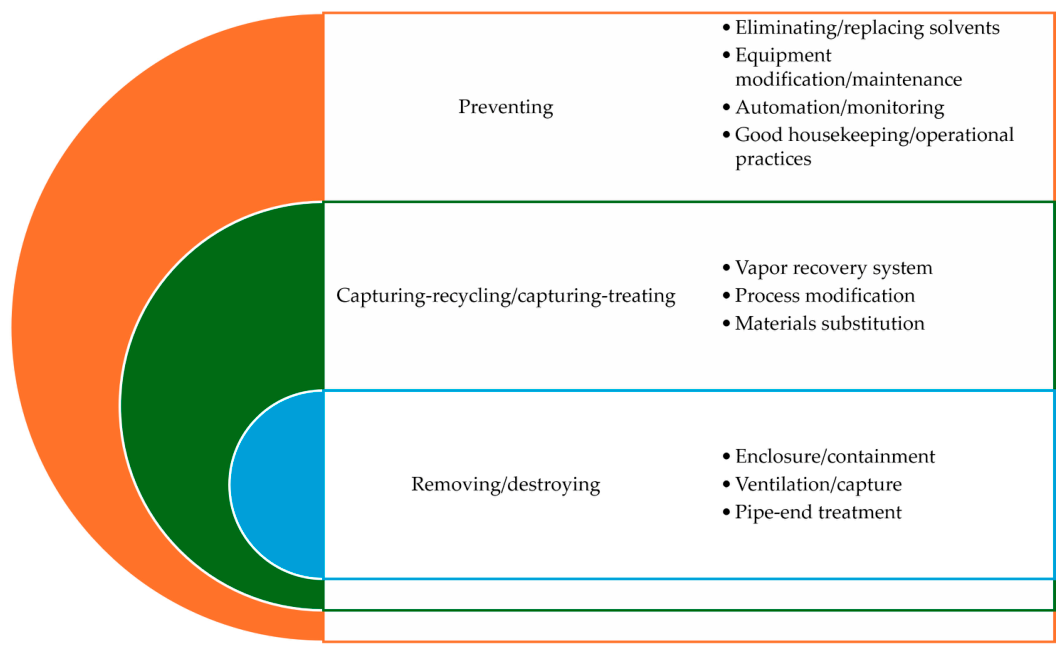
Controlling VOC emissions at their sources is the most effective approach, while removing VOCs already released into the environment remains a critical and challenging task. Some VOC emissions can be reduced by eliminating or replacing the use of solvents. However, when eliminating solvents is not feasible, the only alternative is to treat the effluents before releasing them into the atmosphere. Measures to prevent and reduce VOCs emission in production processes, from an ecological efficiency perspective, include removing the VOCs from the process entirely, capturing and recycling the emitted vapors back into the process, capturing and treating the vapors, and destroying VOCs in exhaust gases (Figure 1).
Pipe-end treatment, which focuses on the removal or degradation of environmental VOCs, has led to the development and application of various technologies. These include condensation, membrane separation, adsorption, absorption, combustion, catalytic oxidation, low-temperature plasma treatment, and biological purification. The methods for reducing VOCs emission by separating them from waste gases or by destruction are the following:
1. Condensation is typically used to pre-treat VOCs from gases before final purification. Typical recovery efficiencies range from 50% to 90%, except for cryogenic cooling (which significantly exceeds 90%). The process is carried out in diaphragm condensers or by using a cold liquid spray to cool the gases [9,10,11].
2. Membrane separation can be used to separate gases and vapors, including the removal and/or recovery of VOCs. Combined compression and condensation systems, combined with membrane separation, can be used to remove many VOCs [12,13,14].
3. Absorption involves capturing VOCs with an absorbent in scrubbers. The best results are obtained when using mineral oils with low vapor pressures for absorption. This method is rarely used due to difficulties in recovering the absorbed compounds [15,16,17].
4. Adsorption is a highly effective method that utilizes various types of adsorbents: molecular sieves, zeolites, activated carbon, and organic polymers. The advantage of sorption methods is the relatively simple recovery of adsorbed compounds. The disadvantage is low selectivity. Compound removal efficiency is 50–95%. Gases must be pre-cleaned to remove aerosols, dust, and polymerizable substances, regardless of the adsorbent used [18,19,20].
5. Low-temperature plasma (LTP) treatment is an advanced technology used to remove VOCs from air streams. In this process, plasma—a partially ionized gas containing energetic electrons, ions, and radicals—is generated at near-ambient temperatures. These reactive species break down VOCs molecules into simpler, often harmless products such as carbon dioxide, water, and other small molecules [21,22].
6. Oxidation.
Thermal and catalytic combustion is not a separation method, but rather the destruction of organic compounds, which is characterized by high VOC destruction efficiency. Due to the lower temperature, it is significantly cheaper than burning VOCs in gases. The disadvantage of this method is the omission of VOC recovery and the need for additional gas purification when the burned compounds contain halogens, sulfur, nitrogen, phosphorus, or metals. Catalyst selection plays a significant role in these processes [23,24].
Biological oxidation involves the adsorption of VOCs from air, followed by the oxidation of the pollutant by heterotrophic aerobic microorganisms. The air purification process is carried out in bioscrubbers, bifilters (peat, soil), or three-phase bioreactors. Water serves as the adsorption medium, and VOC oxidation occurs in a bed inhabited by active microorganisms [25,26,27].
Thermal incineration is the most widely used method for removing VOCs from industrial air streams. Thermal incinerators operate at higher temperatures (700–1200 °C) compared to catalytic units (400–500 °C). Additionally, thermal incineration often requires diluted mental fuel to maintain a flame in dilute VOC waste streams (less than 1000 ppm). It should also be noted that these pollutants originate from diverse industrial sectors and vary widely depending on operating conditions, which differ significantly in terms of component types, flow rates, and concentrations. However, it requires very high temperatures, typically above 1000 °C, which necessitates additional fuel and the use of heat-resistant materials; it can also lead to the formation of harmful by-products such as NOx. Cost analyses indicate that thermal incineration is most suitable for processes with high flow rates or high VOC concentration. Catalytic incineration is a widely used method for pollution control.
Catalytic incineration of VOCs is preferred over thermal incineration because it achieves high VOC destruction at lower temperature, leading to lower energy use, fewer emissions, and reduced operating costs, making it more sustainable for many industrial applications. Numerous catalysts have been extensively studied for the complete oxidation of VOCs [28,29,30]; however, catalyst deactivation during VOC oxidation remains a significant challenge [31,32]. Currently, a key focus in VOC oxidation research is the development of low-cost transition metal catalysts that exhibit high activity and selectivity [1]. Research on the heterogeneous catalytic oxidation of low-concentration VOCs in air focuses on identifying active catalysts that produce environmentally benign products at lower temperatures, ideally H2O and CO2. Another important characteristic of these catalysts is their ability to simultaneously remove all contaminants present in the stream (e.g., [33,34]).
The most commonly used catalysts for VOC abatement are noble metals (Pt, Pd, and Rh) and transition metal oxides (Mn2O3, CuO, Co2O3, NiO, Cr2O3, V2O5) dispersed on high specific surface area supports such as (mesoporous) alumina, silica, and titania, zeolites or on ceramic or metallic monoliths [35,36,37,38,39,40,41,42,43]. The support material is a crucial factor in developing an efficient catalyst system, significantly influencing the dispersion of the active component on its surface. The catalytic activity of nanoparticles is strongly determined by their microscopic structure, the presence of co-adsorbed species, and the nature of metal–support interactions. In many instances, the distinctive reactivity of these surfaces is ascribed to the concurrent existence of multiple active sites [44,45,46,47].
Noble metal catalysts are highly active at lower temperatures and are effective for diluting VOC streams, while transition metal oxides offer thermal stability and cost advantages for industrial applications. Catalyst activity depends on the type and dispersion of the active metal, particle size, support interactions, and the presence of promoters or poisons. Many commercial catalysts use nanoparticle structures, which provide multiple active sites and enhanced reactivity. Additives such as ceria or zirconia are sometimes included to improve oxygen storage and durability. These catalysts are typically manufactured as pellets or coated monoliths to maximize surface area and facilitate efficient VOC oxidation to CO2 and H2O [48,49]. However, the results indicated that the activity of commercial catalysts in laboratory-scale investigations differs from the specifications provided by the catalyst supplier [50]. There are numerous commercial-based catalysts, e.g., catalysts offered by Clariant such as EnviCatTM VOC [51], BASF—VOCat™ and Camet™ [52], etc. Furthermore, it is important to evaluate the catalytic activity not only in the oxidation of a single organic compound in an air stream but also in the oxidation of multicomponent mixtures. The effectiveness of a catalyst in practical use depends not only on its activity but also on its thermal stability and resistance to deactivation by poisons. Catalyst deactivation in the oxidation of VOCs occurs for several key reasons [31,38,53,54]:
  • Poisoning: Certain compounds in the gas stream, like sulfur- or chlorine-containing species, bind strongly to the active sites of the catalyst, blocking them and reducing activity;
  • Sintering/thermal degradation: High temperatures during oxidation can cause the catalyst’s metal particles or support structure to agglomerate or collapse, lowering the specific surface area and active sites;
  • Carbon deposition (coking): VOCs can decompose on the catalyst surface to form carbonaceous deposits that physically block active sites;
  • Structural changes: oxidation reactions can alter the chemical or crystal structure of the catalyst, reducing its effectiveness over time;
  • Moisture: Some catalysts are sensitive to water vapor, which can lead to hydrolysis or leaching of active components.
Thus, even a highly active catalyst can lose efficiency quickly in VOC oxidation because the reaction environment is harsh, containing heat, reactive intermediates, and possible poisons. Clearly, catalytic oxidation of trace amounts of VOCs in air is more cost-effective when conducted at lower temperatures. Achieving this requires VOC oxidation catalysts that exhibit high activity, excellent selectivity, low activation energy, and long-term durability. Furthermore, a fundamental understanding of catalytic oxidation mechanisms is valuable for developing effective methods to use catalysts in controlling air pollution.
In the present review, these challenges are addressed over hydrotalcite-derived mixed metal oxides for alcohols (methanol and ethanol) and toluene. Methanol and ethanol are commonly released from industrial solvent processes and as unburned fuels from mobile sources. Acetaldehyde, a partial oxidation product, is frequently emitted from ethanol-fueled engines. Similarly, formic acid and acetic acid are partial oxidation products of methanol and ethanol, respectively. Toluene was chosen as a third probe molecule for catalytic oxidation because it is commonly found in industrial exhausts and has a high photochemical ozone creation potential (POCP) [55,56]. Nevertheless, hydrotalcite-like compounds were broadly investigated in the incineration of other VOCs, such as methane [57], acetone and acetaldehyde [58,59], benzene [60,61,62,63], etc.

3. Hydrotalcite-Derived Mixed Metal Oxides

Hydrotalcite-like compounds (HTs), which belong to the group of layered double hydroxides (LDHs), are made up of positively charged metal hydroxide layers that are separated by interlayer anions and water molecules. The layers are composed of metal cations present in at least two distinct oxidation states. The chemical composition of hydrotalcite-like compounds can be expressed by the general formula of [M2+1−xM3+x(OH)2]x+[Anx/n · yH2O]x, where M2+ and M3+ denote divalent and trivalent metal ions, An represents an anion with a charge of n-, and the value of x typically ranges from about 0.25 to 0.33 [64,65]. Their structure resembles that of brucite, Mg(OH)2, in which each Mg2+ ion is octahedrally coordinated by six OH ions, and the octahedra share edges to form continuous, infinite sheets. The sheets are stacked atop one another and are held together by weak interactions through hydrogen bonding. In hydrotalcite-like compounds, the isomorphous substitution of M2+/M3+ ions in the octahedral sites of the hydroxide layers generates a net positive charge, which is balanced by interlayer anions and water molecules [66,67]. Co-precipitation is the most used method for preparing hydrotalcite materials because it is simple, quick, cost-effective, and operates under mild conditions [68,69,70]. Additionally, many mixed oxide catalysts can be produced through the controlled decomposition of such compounds. The diverse chemical compositions and physico-chemical properties of synthetic LDHs enable a wide range of applications for these materials. The calcined materials exhibit a high specific surface area, strong basicity, homogenous metal dispersion in the precursor matrix (which cannot be achieved using other preparative techniques), and resistance to sintering. After calcination, the material typically restores its hydrotalcite structure through a rehydration and reconstruction process commonly referred to as the memory effect [71,72].
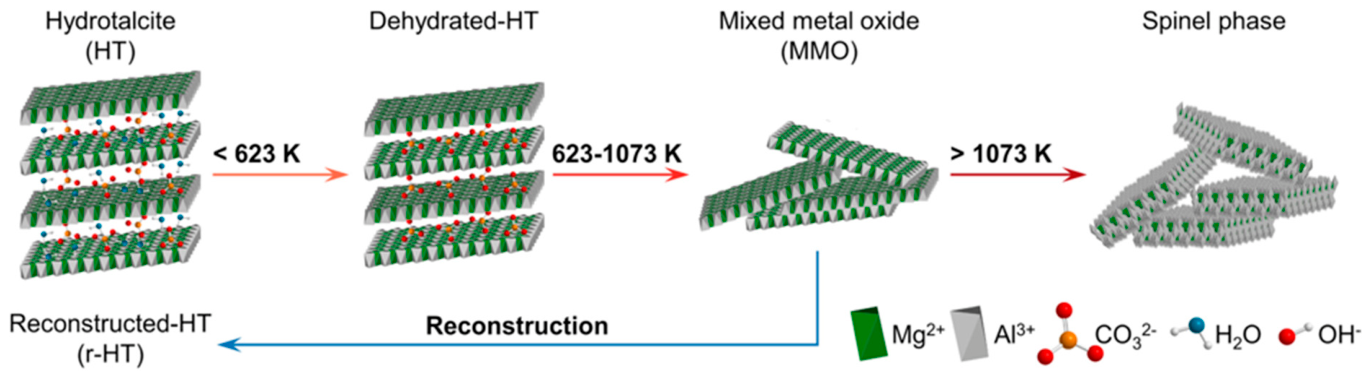
Hydrotalcite-like compounds, whether in their as-prepared form or after high-temperature calcination, have been utilized in a wide range of practical applications. They are frequently employed as catalysts or catalyst precursors, ion exchangers, adsorbents, polymer stabilizers, gas sensors, and more [65,73,74,75]. Moreover, there is significant interest in using calcined hydrotalcites (oxides) as catalysts for environmental applications, such as NH3 oxidation, NH3 decomposition, NOx reduction with ammonia, or N2O decomposition [76,77,78,79]. Many hydrotalcite-like compounds are employed in heterogeneous catalysis as precursors for mixed oxide catalysts, whose catalytic performance is highly influenced by the method of thermal treatment (Figure 2). Therefore, the thermal behavior of hydrotalcite-like compounds is studied in detail, as the nature of the precursors can significantly influence the final composition of more complex oxide mixtures (e.g., [80,81]). The catalytic activity of hydrotalcites primarily depends on the M2+/M3+ ratio, the types of cations in the structure, the nature of the compensating anions, and, among other factors, the activation temperature. The combined use of different metallic phases can produce a synergistic or cooperative effect, often enhancing catalytic properties. Using metallic mixtures with rare-earth promoters (also incorporated into the hydrotalcite during their reconstruction) can improve the oxygen storage capacity of the solids, thereby enhancing their oxidation activity. Various LDH-derived mixed oxides have been reported as catalysts for the complete oxidation of VOCs, commonly using alcohols (methanol, ethanol) or toluene as model compounds. Furthermore, the activity of hydrotalcite-derived mixed metal oxides is correlated with the phases involved.

3.1. Oxidation of Methanol and Ethanol

Methanol is commonly used as a representative VOC in oxidation studies due to its simple chemical structure [83,84]. CH3OH oxidation produces a variety of products, such as formaldehyde, methyl formate and CO2, depending on the catalyst type and operating conditions [85,86]. Ignition curves are the most used method for evaluating catalytic activity in studies of the complete oxidation of VOCs. Table 3 gathers the results of the alcohol oxidation over hydrotalcite-derived mixed metal oxides. If not specified in the respective studies, the T50 and T90, which refer to the temperature reach of 50% and 90% of the total oxidation of alcohol, were estimated from the graphics. Many catalysts were provided with the scope of the studies, while only data for one or two of the most representative examples were gathered in Table 3. Mostly, the catalytic oxidation of alcohols, either individually or in mixtures, is presented for several materials, with particular attention given to the formation of by-products.
The studies of methanol oxidation over hydrotalcite-based catalysts are scarcer compared to other VOCs. For example, catalysts derived from hydrotalcite-based Cu-Mg-Al, Co-Mg-Al, and Cu-Co-Mg-Al oxide systems were tested for the total oxidation of mono-carbon VOCs, including methane, methanol, and formic acid. Both the calcination temperature (700, 800 °C) of the hydrotalcite precursors and the doping of the catalysts with a K promoter (0.09, 0.9 and 2.0 wt.-%) influenced their catalytic activity. CO2 and H2O were the only detected products of methane and methanol oxidation, whereas the conversion of formic acid also produced hydrogen. The catalytic activity of the samples, containing 0.9 wt.% and 2.0 wt., was nearly identical. K doping enhanced the activity of Cu-Mg-Al and Cu-Co-Mg-Al, likely by increasing the low-temperature reducibility of copper oxide but it did not affect Co-Mg-Al [87]. In the following studies, the hydrotalcite-derived (Cu, Mn)-Mg-Al mixed metal oxides were investigated for methanol incineration. In contrast, copper or manganese species supported on Al2O3 and MgO showed much lower activity compared to catalysts derived from hydrotalcites. The catalytic activity of hydrotalcite-derived mixed metal oxides was enhanced by depositing a small amount of Pd species (0.5 wt.%) [88].
Ethanol promotes the formation of aldehydes, which can lead to irritation, shortness of breath, mucous membrane irritation, and chest tightness [104]. C2H5OH is a major indoor pollutant released from various materials and often accumulates in airtight buildings [105]. Ethanol is also extensively utilized in the chemical industry and as a fuel additive, reflecting its strong demand in the global market. Therefore, developing efficient systems to remove C2H5OH and its derivatives from automobile exhaust, industrial emissions, and indoor environments is a crucial societal challenge. Ethanol, now widely used as a renewable biofuel for buses and cars, was selected as a model VOC for catalytic experiments. The selectivity of deep oxidation catalysts is crucial, as the reaction by-product can often be more harmful than the original VOCs. Concentrations of harmful compounds at high VOC conversion are particularly important. In the case of ethanol oxidation, such by-products can include acetaldehyde, acetic acid, ethylene, ethyl acetate, acetone, diethyl ether, and carbon monoxide. The formation of by-products depends on the properties of the catalyst and reaction conditions.
Bahranowski et al. [89] investigated the Cr-containing hydrotalcite-like materials calcined at 600 °C and found that they exhibited high catalytic activity for the complete oxidation of toluene and ethanol. Among them, Cu-Cr samples with a n(Cu):n(Cr) ratio of two, composed of copper oxide and copper chromite, reached 50% conversion of toluene and C2H5OH at temperatures of 45 and 15 °C, respectively, lower than the reference commercial catalysts. Catalytic investigations using a mechanical mixture of CuO and CuCr2O4 demonstrated that the use of a hydrotalcite-like precursor is essential for achieving optimal VOC conversion. Toluene oxidation proceeded directly to CO2, whereas in the case of ethanol, acetaldehyde formed as a partially oxidized intermediate. The main products of C2H5OH oxidation over all the catalysts investigated were acetaldehyde and CO2, while carbon monoxide was detected only in trace amounts.
Kovanda et al. [90] reported calcined Co-Mn-Al (n(Co)/n(Mn)/n(Al) molar ratios of 4/2/0, 4/1.5/0.5, 4/1/1, 4/0.5/1.5, and 4/0/2) hydrotalcite-like compounds as catalysts for C2H5OH incineration. Mg-containing materials, i.e., Co-Mg-Mn (2/2/2), Co-Mg-Mn-Al (2/2/1/1), and Co-Mg-Al (2/2/2), were also investigated. They reported that hydrotalcite synthesis was unsuccessful in systems containing only Co and Mn (n(Cu)/n(Mn) = 4/2), otherwise stated that a high (Co + Mn) content was essential for achieving complete C2H5OH conversion at lower temperatures. The high activity of the Co-containing catalysts were attributed to an optimal content of reducible components.
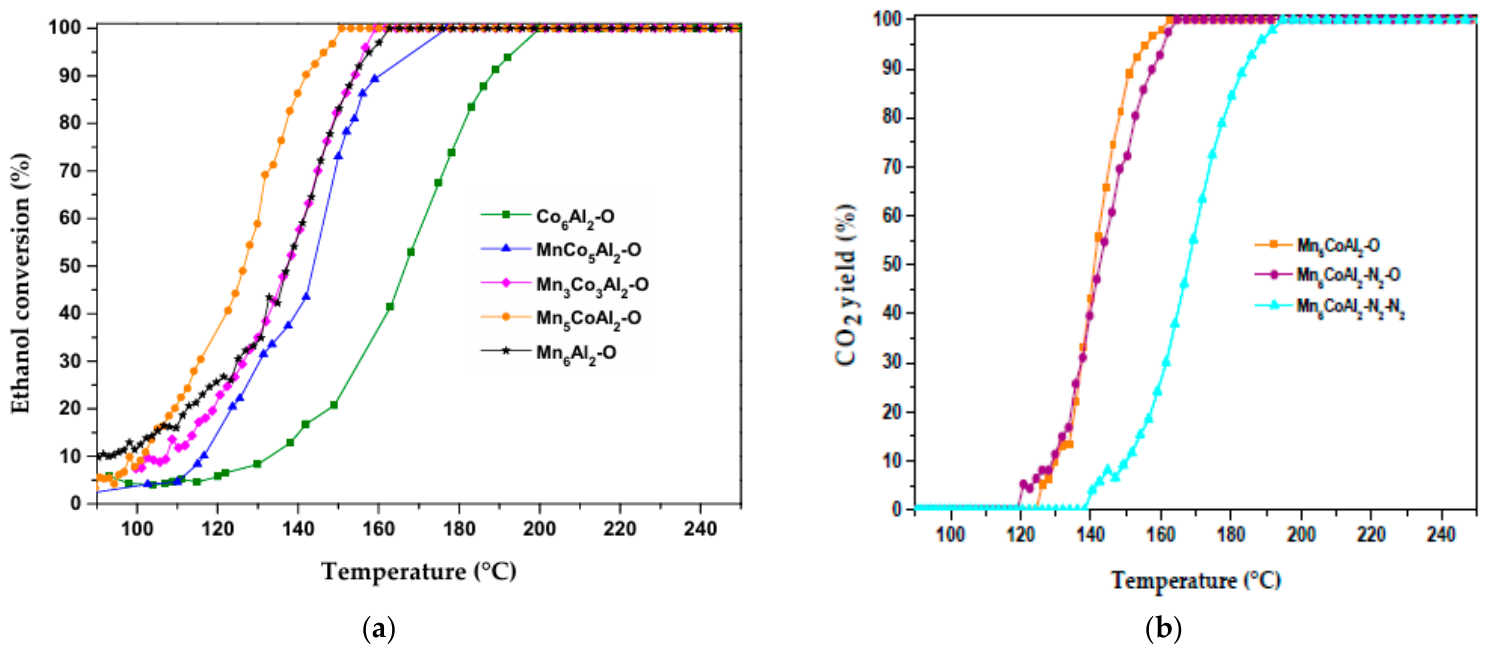
A Co-Mn-Mg-Al catalyst series was compared to Cu-containing samples, in which the n(Mn)/n(Co) or n(Mn)/n(Cu) ratios in the solids were varied from 0.05 to 0.5 [91]. The highest n(Mn)/n(Co) ratio shows the best catalytic activity. The observed behavior in the ethanol oxidation reaction was attributed to the formation of amorphous phases and redox cycles arising from cooperative interactions between the active species. The catalysts were evaluated for the total oxidation of three VOCs, ethanol, toluene, and butanol, with the ease of oxidation following the order: butanol < ethanol < toluene. The catalytic activity of manganese-modified mixed oxides depended on the redox properties of the Mn4+/Mn3+ system present on the oxide surface, which was likely influenced by the amount of manganese used in the synthesis as well as the presence of another metal capable of promoting redox cycles. Acetaldehyde was not detected in the chromatographic analysis, and the only oxidation products were CO2 and H2O, (allowing the results to be evaluated based on the conversion of ethanol to CO2). The formation of by-products depends on both the chemical structure of the compound and the properties of the catalyst. The addition of small amounts of copper species can prevent manganese oxide from adopting a crystalline structure, and promote the formation of oxygen vacancies and the mixed Cu1.5Mn1.5O4 phase with enhanced reducibility, thereby improving catalytic activity in C2H5OH combustion in the series of Mn-Cu-type oxides [92,106]. Also, the catalytic activity of MnCoAl oxides depended on both the n(Mn)/n(Co) ratio and the gas environment applied during their synthesis and heat treatment strategies [93]. The formation of Mn2CoO4 spinel and Mn5O8 layered phases enhanced the redox properties and increased the number of active sites in the MnCoAl oxides (Figure 3a). Employing an N2 atmosphere during material preparation was an effective strategy to inhibit the formation of unwanted phases in the hydrotalcite precursors and their derived oxides. This further enhanced the complete conversion of ethanol to CO2 over the obtained oxides. The CO2 yield curves indicate that air-calcined binary oxides synthesized under a nitrogen atmosphere (Mn6Al2-N2-O, Figure 3b) achieved complete ethanol conversion to carbon dioxide at the lowest temperature. C2H5OH conversion was significantly enhanced after completely replacing cobalt with manganese species. The temperature required for full C2H5OH conversion (T100) decreased by 38 °C, shifting from 200 °C for Co6Al2-O to 162 °C for Mn6Al2-O. At low temperatures, acetaldehyde was the predominant product, with yields ranging from 500 to 700 ppm over MnxCo(6−x)Al2-O catalysts. At higher temperatures, CO2 became the main product.
The ternary mixed oxides containing Mn species were more active than the binary Cu-Mn, Co-Mn, and Ni-Mn systems, as well as the ternary catalysts containing Al, among mixed metal oxides of n(M2+)/n(M3+) with a molar ratio of two (M2+ = Cu, Co, Ni, Cu-Ni, Cu-Co, and Co-Ni; M3+ = Mn or Al) [94]. Acetaldehyde was the main by-product of ethanol oxidation. Catalysts containing Al species produced lower amounts of acetaldehyde compared to those containing Mn species. The Cu-Ni-Mn sample exhibited the highest activity among the investigated mixed oxides, achieving nearly complete conversion (90% at 154 °C) to CO2 and H2O. In comparison, the same level of conversion was reached at 173 °C and 181 °C for the Cu-Co-Mn and Co-Ni-Mn catalysts, respectively.
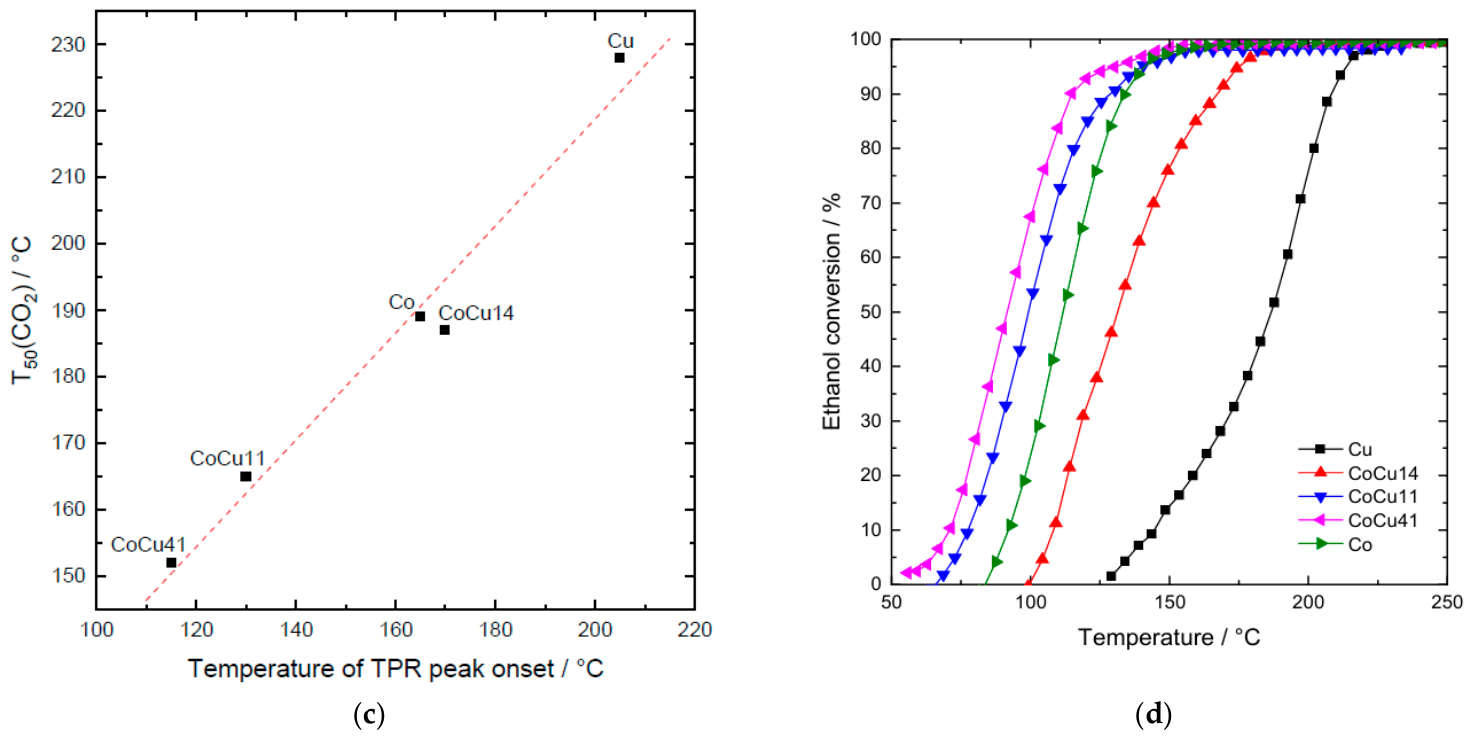
The Co-Cu oxide catalyst with a n(Co)/n(Cu) molar ratio of 4/1 demonstrated the highest activity in gas-phase C2H5OH oxidation, achieving the lowest T50 (91 °C) and T90 (159 °C), corresponding to conversion to CO2, respectively. This enhanced activity and selectivity were attributed to the presence of finely dispersed CuO particles on the surface of Co3O4. Additionally, a strong correlation was previously observed between the position of the first reduction peak in H2-TPR measurements and the T50 value during C2H5OH oxidation (Figure 3c,d) [95]. Pérez et al. [96] combined the co-precipitation with reconstruction in the presence of chelates [Ce-EDTA] and/or [Pr-EDTA]. They linked the highest catalytic activity to increased oxygen storage capacity and enhanced reducibility in solids containing rare-earth elements (Ce-Pr), as well as to improvements in specific surface area. Moreover, the high selectivity toward CO2—the main product of total oxidation—indicated that solids modified with Cu and/or Co species and promoted with rare-earth elements were highly effective catalysts for C2H5OH oxidation, highlighting a cooperative interaction among the metals. The presence of Ce species, either alone or in combination with Pr, on the catalyst surface significantly promoted complete conversion in all cases below 270 °C. The concentrations of combustion by-products (such as ethanol, acetaldehyde, and acetic acid, among others) did not exceed 2%.
Studies related to the modified hydrotalcite-derived mixed metal oxides, either with noble metals or alkali metals, are scarce for the oxidation of alcohols (e.g., [97,98]). For example, the catalytic activity of the Co-Mn-Al mixed oxide catalyst (n(Co)/n(Mn)/n(Al) molar ratio of 4/1/1) modified with different potassium loadings (0–3 wt.-%) was investigated for the total oxidation of toluene and ethanol [98]. The highest conversion in C7H8 oxidation was achieved with the catalyst containing approximately 1 wt.-% of K species, with no detectable reaction by-products other than CO2 and H2O. The highest activity in toluene oxidation was obtained with the catalyst containing approximately 1 wt.-% K, whereas in C2H5OH oxidation, the activity gradually increased with increasing potassium content up to 3 wt.-%. Potassium species in the Co4MnAl mixed oxides influenced the formation of acetaldehyde during ethanol oxidation, with its concentration increasing as the potassium content increased. No reaction by-products were detected during C7H8 oxidation.
Structured cobalt oxide catalysts supported on stainless steel meshes were readily prepared via hydrothermal synthesis under mild conditions [99,107], while the mixed oxides supported on stainless steel meshes were prepared by calcining carbonate precursors that crystallized on the supports during hydrothermal treatment. The supports were immersed in aqueous solutions of Co and Mn nitrates in the presence of hydrolyzing urea. The exceptional activity of the catalyst with a n(Co)/n(Mn) ratio of 0.5 was ascribed to a synergistic effect arising from a high concentration of oxygen vacancies and enhanced redox properties. Due to the formation of a thin film of the active phase and, consequently, the minimal influence of internal diffusion limitations, this catalyst exhibited higher activity (48 to 114 times higher catalytic activity) in C2H5OH oxidation than pelletized commercial Co3O4 (despite containing 50 times less cobalt oxide). Acetaldehyde was identified as the primary by-product of C2H5OH oxidation across all supported catalysts. The highest concentrations of acetaldehyde were observed between 217 and 243 °C, ranging from 485 to 619 ppm [99].
Relatively broad studies concern structured hydrotalcite-derived mixed metal oxides [100,101,102], prepared by calcining the precursor deposited on Al2O3/Al supports (anodized aluminum foil). The precursors were deposited onto the supports under hydrothermal conditions at 140 °C using aqueous solutions of Ni, Co, Cu, and Mn nitrates. M2+-(Mn)-Al (M2+ = Ni, Co, Ni-Co, Ni-Cu, and Co-Cu) with only small amounts of Mn species were obtained. Increasing the pH of the deposition solution promoted the formation of hydrotalcite-like phases. After heating at 500 °C, spinel-type and/or NiO-type oxide phases were identified in the supported mixed oxides. Among the supported catalysts, the Ni-Cu-(Mn)-Al mixed oxide showed the highest activity for the total oxidation of C2H5OH. Increasing the pH of the solutions used during hydrothermal deposition of the hydrotaclite-like precursors enhanced both the catalytic activity and selectivity of the supported mixed oxides. However, controlling the preparation conditions (i.e., pH) led to higher loads of active components and improved catalytic activity. The mixed oxides deposited on Al2O3/Al supports at pH 8.5 showed a slight shift in the reduction maxima toward lower temperatures, likely due to the higher Mn species content in these samples. Acetaldehyde was the main reaction by-product identified in the reaction mixture, while acetic acid, ethyl acetate, and ethylene were either not detected or were present only in negligible amounts (ethylene). Increasing the solution pH during hydrothermal deposition of the precursors improved both the catalytic activity and selectivity of the supported mixed oxides.
The combination of three transition metal cations (Cu, Co, or Ni) with Mn can increase the concentration of lattice defects and modify oxygen vacancies in mixed oxides derived from co-precipitated precursors, likely due to differences in ionic radii. The activity of the investigated mixed oxides showed a linear dependence on the amount of easily reducible species (reduced between 25 and 500 °C) as well as on the quantity of oxygen adsorbed on the catalyst surface. Mn-based hydrotalcite-like compounds with a n(Mn)/n(Mg)/n(Al) ratio of 1/5/2 were synthesized and applied as catalysts for the simultaneous oxidation of C2H5OH, CH3CHO, and C4H10S [108]. The removal efficiencies for the three gaseous pollutants reached 100% for durations of 420, 450, and 360 min, respectively. Meanwhile, the breakthrough capacity for VOCs was 426 mg g−1. Mn3+/Mn2+ redox pairs and oxygen vacancies served as active sites for C2H5OH/CH3CHO and C4H10S, respectively. The oxidation of C4H10S produced CH3CHO and elemental sulfur. The elemental sulfur was further oxidized to sulfuric acid at elevated temperatures, which led to the consumption of active Mn3+/Mn2+ sites and accelerated catalyst deactivation. The experimental findings have been consistent with theoretical results, providing a mechanistic basis for the simultaneous catalytic removal of sulfur-containing VOCs.
Summarizing, C2H5OH oxidation as a model volatile organic compound over hydrotalcite-derived mixed metal oxides is an important catalytic process for air pollution abatement and for understanding oxidation mechanisms on redox-active surfaces. Hydrotalcite-like compounds are commonly used as precursors to prepare calcined highly dispersed mixed metal oxides. Upon thermal decomposition, hydrotalcite-like compounds form porous, high specific surface area oxides with well-mixed cations (e.g., Mg-Al, Co-Al, Cu-Mn, Cu-Ce systems). This intimate mixing led to strong metal–metal interactions, abundant oxygen vacancies, and enhanced redox properties, all of which are beneficial for VOC oxidation. Key advantages of these catalysts include the high dispersion of active sites, tunable acidity/basicity, improved thermal stability, and resistance to deactivation. Activity is typically evaluated in terms of light-off temperature, conversion efficiency, and selectivity toward complete oxidation to CO2 and H2O. These materials are therefore promising for the low-temperature catalytic combustion of C2H5OH and other oxygenated VOCs in environmental applications. They are frequently reported to show better activity and repeatability of catalytic cycles, demonstrating their efficiency compared to commercially available catalysts [103].

3.2. Oxidation of Toluene

Studies on BTEX (benzene, toluene, ethylbenzene, and xylenes) oxidation, particularly toluene, have been widely reported in the literature [109,110,111]. C7H8 was chosen as a probe molecule for VOC oxidation because it is commonly found in industrial exhaust and has a POCP of 63.7 [56]. Toluene is widely used as a solvent in chemical and processing industries, and controlling its emissions into the atmosphere is becoming increasingly important [112,113]. C7H8, a typical VOC pollutant, has been linked to various human health issues due to its neurotoxic and carcinogenic effects [114]. Therefore, developing effective strategies to remove toluene is essential. Mainly Mn-containing hydrotacite-derived mixed metal oxides are investigated for the oxidation of C7H8 (e.g., [115,116]). T50 and T90 values, corresponding to the temperatures required to achieve 50% and 90% conversion to CO2, respectively, are used to compare the catalytic activity of the oxides (Table 4).
Mixed metal oxides derived from X6Al2 hydrotalcites, calcined at 500 °C (where X = Fe, Cu, Zn, Ni, Co, Mn, or Mg), were investigated for the total oxidation of C7H8 and CO [118]. Among the materials studied, the Mn6Al2-HT catalyst exhibited the highest activity for C7H8 oxidation, achieving 50% conversion (T50) at 249 °C. Upon complete conversion, only CO2 and H2O were detected as final products (with trace amounts (a few ppm) of benzene for all samples during the initial stages of toluene oxidation). The catalytic activity followed a decreasing order: Mn6Al2-HT500 > Co6Al2-HT500 = Cu6Al2-HT500 > Fe6Al2-HT500 > Ni6Al2-HT500 >> Zn6Al2-HT500 > Mg6Al2-HT500. This trend was attributed primarily to differences in reducibility and the presence of active metallic phases within the catalysts.
A series of Mg-Mn-Al ternary hydrotalcite-like compounds, with a n(Mg+Mn)/n(Al) atomic ratio of approximately three and n(Mg)/n(Mn) atomic ratios ranging from 3/0 to 0/3, were synthesized via a co-precipitation method [115]. The as-synthesized samples can be used as catalysts for the liquid-phase oxidation of C7H8, selectively producing benzaldehyde and benzoic acid, with small amounts of benzyl alcohol detected. The experiments over as-synthesized materials revealed that MgAl-LDHs, in the absence of Mn, showed no activity for C7H8 oxidation. Both the toluene conversion rate and the selectivity toward benzoic acid increased with increasing Mn content in the samples. Mn species present in the hydrotalcite-like phase exhibited higher catalytic activity for C7H8 oxidation, rather than samples containing crystalline phases of Mn(OH)2 and MnCO3. In another approach, Co-(Mg)-Al hydrotalcite-type materials (n(M2+)/n(M3+) molar ratio of 3.0, n(Co2+)/n(Mg2+) ratios of 0.5 or 2.0) were synthesized for the complete oxidation of C7H8 [120]. The catalytic activity of these materials depended on Co species loading. The most efficient catalyst (n(Co)/n(Al) = 3/1, Co6Al2HT(500)) achieved the complete conversion of toluene to CO2 and H2O at around 300 °C. The activity of the cobalt-containing catalysts was related to crystallite size and the relative amounts of cobalt spinel and cobalt aluminate phases. Smaller crystallites with a higher proportion of Co3O4 showed higher activity due to improved reducibility. A small amount of carbonaceous deposits formed during the catalytic experiment, mainly including styrene, benzaldehyde and acetophenone [120]. Further studies confirmed significantly higher activity than the same catalyst, which was not synthesized via a hydrotalcite-like phase [139]. Also, Co-Al hydrotalcite precursors were synthesized via constant-pH co-precipitation by varying the precipitation temperature (30–70 °C) and the n(Co)/n(Al) molar ratio (2–5) [121]. The sample synthesized at 70 °C with a n(Co)/n(Al) ratio of three was the most efficient catalyst for C7H8 combustion (50% conversion at 257 °C). The only products were CO2 and H2O, except for the CoAl2-70 sample, for which trace amounts of benzene were observed (1–2 ppm at 400–450 °C). The ratios of Co3+/Co2+ and lattice oxygen to adsorbed (electrophilic) oxygen in the resulting mixed oxides increased with the temperature used during precursor co-precipitation.
Co- and Mn-rich mixed oxides (calcined at 500 °C) were investigated while maintaining a constant Al species content to optimize their activity in C7H8 oxidation [122]. When toluene conversion was complete, only CO2 and H2O were detected as products. However, under incomplete conversion conditions, benzene was also formed, ca., 50 ppm during the catalytic experiments. The highest benzene formation occurs at 240–350 °C, depending on the catalyst used and the extent of C7H8 conversion. The catalytic activity follows the decreasing order: Co2Mn4Al2HT(500) = Mn6Al2HT(500) > Co4Mn2Al2HT(500) > Co6Al2HT(500) = Mn6Al2OH(500) >> Co6Al2OH (500). Again a direct relationship was observed between the reducibility of the mixed oxide species and their reactivity in C7H8 oxidation. Mn6Al2HT(500) and Co2Mn4Al2HT(500) consumed the same amount of hydrogen and exhibited identical catalytic activity. Higher catalytic activity in C7H8 oxidation was observed for Mn-rich samples, particularly for Co2Mn4Al2HT(500) due to its superior reducibility, as the material consisted of a mixture of nanocrystallites of Co-spinel, Mn5O8, and CoMnO3 phases.
The calcination temperature has a significant impact on the catalytic activity of hydrotalcite-derived Co1.5Mn1.5Al mixed metal oxides. As the calcination temperature increased, catalytic activity decreased. This is evidenced by the rise in T90 values from 240 °C for Co1.5Mn1.5Al-500 to 250 °C for Co1.5Mn1.5Al-600 and 270 °C for Co1.5Mn1.5Al-700. The Co1.5Mn1.5Al-500 catalyst demonstrated excellent stability under dry conditions, maintaining C7H8 conversion above 90% at 240 °C over a period of 100 h. However, the presence of water vapor adversely affected its activity. When 10 vol.-% of H2O was introduced into the system, the C7H8 conversion decreased noticeably, dropping from 92% to 83% [123]. Similar results were reported over Cu1.5Mn1.5Al1 (calcined at 500 °C) in the presence of 10 vol.-% H2O in the feed containing both toluene and ethyl acetate [125]. Conversion of both reactants decreased significantly after 10 h of passing H2O. Catalyst deactivation is a major challenge in catalytic oxidation processes, as catalysts can readily lose activity due to the adsorption of H2O and intermediate species.
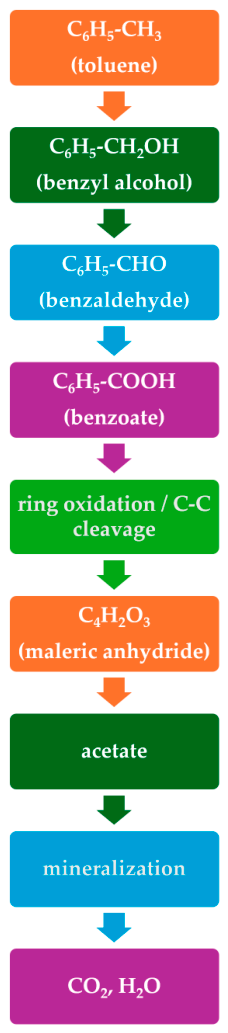
Otherwise, CuMn (n(Cu)/n(Mn) = 3/1) demonstrated excellent stability and durability, maintaining its performance even in the presence of 20 vol.-% H2O [117]. The synergistic interaction between copper and manganese species (Mn3+ + Cu2+ ⟶ Mn4+ + Cu+) enhanced the mobility of lattice oxygen, thereby promoting catalytic activation. Catalytic oxidation likely proceeded via the following pathway: toluene ⟶ benzyl alcohol ⟶ benzaldehyde ⟶ benzoate ⟶ maleic anhydride ⟶ acetate. Among these steps, the transformation of surface benzoate was identified as the rate-determining step in C7H8 oxidation. A similar conclusion was reported by other researchers (e.g., [140]).
Co-Mn-Mg-Al oxides were synthesized using auto-combustion and co-precipitation methods. The composition was controlled with fixed molar ratios of n(Co + Mn + Mg)/n(Al) = 3.0, n(Co + Mn)/n(Mg) = 1.0, and n(Co)/n(Mn) = 0.5. The oxides prepared by the co-precipitation method exhibited the highest activity for the oxidation of the VOC mixture, attributed to enhanced oxygen mobility and an improved ability to promote redox processes within the material structure. The catalytic activity of the oxides was evaluated in the total oxidation of a mixture containing 250 ppm toluene and 250 ppm 2-propanol. The oxidation of the toluene and 2-propanol mixture was not fully selective toward CO2, as acetone and propene were formed as reaction intermediates. Again, the catalytic properties of the materials were directly dependent on their redox behavior and oxygen mobility [126].
Furthermore, Co species supported on hydrotalcite-derived mixed metal oxides obtained by using the memory effect of MgAl were investigated in oxidation of C7H8 [127]. The Mg-Al sample was calcined at temperatures ranging from 500 to 900 °C and subsequently immersed in an aqueous cobalt nitrate solution to regenerate a surface hydrotalcite-like phase. The highest activity in oxidation of C7H8 was achieved with cobalt species supported on hydrotalcites calcined at 700 °C, while the activity was summarized according to the decreasing activity order: Co/Mg-Al(700)500 > Co/Mg-Al(800)500 = Co/Mg-Al(900)500 > Co/Mg-Al(600)500 > Co/Mg-Al(500)500 > Mg-Al(700) [127]. They attributed the higher activity of the second group of catalysts to a better dispersion of cobalt species. CO2 and H2O were the only products detected at full conversion.
The most active catalyst (full C7H8 conversion into CO2 at about 300 °C) was obtained from MnCuAl hydrotalcites (n(Cu)/n(Mn)/n(Al) = 3.0/3.0/1.0) after calcination at 450 °C. Compared to other hydrotalcite-derived materials, i.e., MnZnAl (calcined at 450 and 600 °C), and MnCuAl calcined at 600 °C, it exhibited a light-off temperature below 260 °C. All catalysts were selective toward only CO2. The catalytic experiments were conducted at a higher space velocity than in other studies, while still achieving one of the lowest reported light-off temperatures [116]. Conversions of C7H8 to CO2 were reported to vary over materials prepared with varied the influence of the synthesis pH, as follows: CuMn(pH = 6) < CuMn(7) < CuMn(8) < CuMn(9) [141].
CuxCo4-xMnAl mixed metal oxides with varying n(Cu)/n(Co) molar ratios were synthesized via thermal decomposition of LDH precursors [130]. The synergistic interactions among copper, cobalt, and manganese species in the Cu-Co-Mn-Al system promoted electron transfer, which enhanced both the reducibility and oxygen mobility of the catalysts. A higher concentration of Mn3+ species facilitated the formation of reactive lattice oxygen, which played a key role in the catalytic oxidation of C7H8. Among the studied materials, the Cu2Co2MnAl mixed oxide exhibited the highest catalytic activity across the entire temperature range, achieving complete C7H8 conversion at 250 °C and a T90 value of 235 °C. This superior activity was attributed to catalyst’s more complex phase composition, which indicated stronger synergistic interactions between Cu, Co, and Mn species. Furthermore, Cu2Co2MnAl possessed the highest content of Mn3+ and lattice oxygen among the catalysts examined, both of which contributed significantly to its enhanced catalytic efficiency.
Kovanda et al. [131] reported high catalytic activity of hydrotalcite-derived Cu-Mg-Al (n(Cu)/n(Mg)/n(Al) = 0/4/2, 1/3/2, 2/2/2, 3/1/2, and 4/0/2) oxide systems calcined at 450 °C. The activity of the studied catalysts increased with increasing copper species loading and, as suggested by the authors, this behavior was related to the presence of easily reducible copper species. In addition, hydrotalcite-like materials containing copper, along with other transition metals, have also been reported as effective precursors of active catalysts for VOC combustion (e.g., [59,142,143,144]).

3.2.1. Noble Metal-Based Catalysts

Pd-containing catalysts are highly effective for VOC oxidation due to their strong ability to activate oxygen and operate at relatively low temperatures. The active phase is typically PdO, which participates in redox cycles between Pd0 and PdO during the reaction (e.g., [145,146,147]). Pd-containing hydrotalcite-derived mixed metal oxides were the most widely investigated for the oxidation of C7H8 (e.g., [148]). The hydrotalcite-like sample hydroxide [Mg0.75Al0.25(OH)2]0.25+[PdCl2(OH)2]2−0.125−x x (CO3)x2−·nH2O was synthesized via the co-precipitation of the corresponding chlorides (MgCl2, AlCl3, and H2PdCl4) using freshly boiled water under a nitrogen atmosphere [132]. Palladium species were introduced as the [PdCl2(OH)2]2− complex, formed through partial substitution of Cl by OH. This modified hydrotalcites were less stable (destruction at about 350 °C) than the conventional Mg-Al hydrotalcites without Pd species (ca. 410 °C), as their decomposition occurred at a lower temperature. Otherwise, the Pd-containing hydrotalcite calcined at 290 °C showed the highest C7H8 conversion when compared to a conventional palladium-containing catalyst, i.e., Pd/Al2O3. Furthermore, a series of Pd/Co3AlO catalysts derived from hydrotalcite-like compounds was prepared and investigated. The Co-Al hydrotalcite precursor phases were prepared by the co-precipitation method, and Pd active species were introduced using different approaches, namely impregnation (IMP), thermal combustion method (TCB), wet ion exchange (WIE), or direct incorporation during the co-precipitation stage (COP) [133]. The activities of all synthesized catalysts followed the decreasing order: Pd/Co3AlO (COP) > Pd/Co3AlO (WIE) ≥ Pd/Co3AlO (IMP) > Pd/Co3AlO (TCB). For Pd/Co3AlO (COP) catalyst, the C7H8 ignition temperature and complete conversion temperature were 190 °C and 230 °C, respectively. Enhanced catalytic activity of the hydrotalcite-derived Pd/Co3AlO catalysts was attributed to their high specific surface area, small mean crystallite size of the support, and highly dispersed PdO particles. Also in this case, the activity was positively correlated with catalyst reducibility and the concentration of oxygen vacancies. Stability tests indicated that all Pd/Co3AlO catalysts show no significant deactivation, and some even exhibit improved activity during the reaction due to the formation of metallic Pd. Benzene was the only organic by-product observed for all catalysts, below 400 °C. The Pd/Co3AlO catalysts investigated in this study exhibited stable activity for C7H8 oxidation at 240 °C over more than 80 h, except during the initial few hours of operation.

3.2.2. Modern Synthesis Methods

Rationally designed hydrotalcite-like compounds with 3D hierarchical hollow structures have attracted considerable interest in catalytic oxidation, owing to the complex architecture and composition of their shells. Co-precipitation is the most widely used and reliable method for synthesizing hydrotalcites applied for VOC oxidation. However, it was shown frequently that other more sophisticated preparation precursor procedures led to more active catalysts for oxidation of C7H8, e.g., reconstruction method [129], auto-combustion [119], microwave-assisted synthesis, and ultrasound-assisted synthesis [135,149], etc.
For instance, Cu6Al2 mixed metal oxides were prepared using three different synthesis routes: conventional co-precipitation (CP), microwave-assisted synthesis (MW), and ultrasound-assisted synthesis (US). The solid obtained through MW showed the highest catalytic activity among the three samples in the reactions studied, surpassing those prepared by co-precipitation and ultrasound-assisted methods [135]. The catalytic activity followed the decreasing order, CuAlMW500 > CuAlUS500 > CuAlCT500, indicating that the microwave-treated sample exhibits the highest activity, followed by the ultrasound-treated sample, while the co-precipitated material showed the lowest activity. This material proved strong potential for industrial applications, particularly due to its reduced synthesis time and improved catalytic activity in the presence of VOCs and CO in gas mixtures. Upon complete conversion, CO2 and H2O were the only products detected. However, at the initial stage of toluene conversion for all samples, trace amounts (a few ppm) of benzene were also observed. Based on the T50 values for C7H8, the catalytic activity follows the order: CuAlMW500 (mixture) > CuAlUS500 (mixture) > CuAlMW500 (alone) > CuAlUS500 (alone) > CuAlCT500 (mixture) = CuAlCT500 (alone); mixture of toluene on carbon monoxide.
Compared to conventional co-precipitation, the catalytic conversion of toluene over Mn-Zr mixed oxides prepared via the reverse microemulsion method was significantly higher, even when the catalysts have identical chemical compositions for C7H8 oxidation [136]. This concerns Mn0.4Zr0.6 synthesized by the microemulsion method and calcined at 450 °C. Specifically, Mn0.4Zr0.6 achieved 99% toluene conversion at 270 °C, whereas Mn0.4Zr0.6-CP reached only 95% conversion at 290 °C. The enhanced dispersion of the active phase achieved through the microemulsion preparation method played a key role in significantly higher catalytic activity over the resulting mixed oxides. The catalytic activity of the Mn0.5Zr0.5 catalyst was evaluated as a function of time on stream. C7H8 conversion remained stable at approximately 95% over a 26 h. This result indicated that the Mn0.5Zr0.5 catalyst prepared via the microemulsion method exhibited relevant catalytic stability under the reaction conditions. In another series of catalysts, Fe-Mn, Co-Mn, and Cu-Mn mixed oxides were also synthesized via the reverse microemulsion method. Among them, the Mn0.67Cu0.33 catalyst (33 mol.-% Cu) achieved complete C7H8 oxidation at 220 °C, a temperature comparable to that of widely investigated Pd-based catalysts for this reaction. When the Mn content was increased to 50 mol.-%, the temperature required for total conversion rised to 260 °C.
Napruszewska et al. [137] proposed a strategy for designing combustion catalysts in which catalytically active oxide nanoparticles, prepared via the inverse microemulsion method, were confined within randomly oriented clay layers. Mn-Al (n(Mn)/n(Al) = 3/1) hydrotalcite-like compounds were employed as precursors of the active phase, while synthetic smectite Laponite RD was used as the clay component in either its sodium form (Na-L) or as an organoclay modified through exchange with cetyltrimethylammonium (CTA) cations (CTA-L). The extent of clay exfoliation was significantly greater in materials derived from CTA-L compared to those prepared using Na-L, indicating that organoclay modification enhanced the dispersion and delamination of the clay structure in the resulting catalysts. In MnAl(im)/CTA-L samples, the MnOx phase evolved into well-ordered, slightly oxygen-rich Mn3O4 nanocrystals. In contrast, MnAl(im)/Na-L materials formed less structurally ordered MnOx particles with a broader size distribution and an average manganese oxidation state that was significantly higher than that of Mn3O4. The relatively less abundant but more easily reducible Mn4+ species present in organoclay-based composites were mainly associated with oxygen-rich surfaces of Mn3O4 crystallites. In contrast, the less reducible Mn species observed in Na-L-derived catalysts were likely located within an amorphous phase with MnO2-like stoichiometry. CO2 and H2O were identified as the sole reaction products. The results confirmed the advantage of the proposed catalyst design strategy, which involved trapping MnAl(im) hydrotalcite nanoparticles between clay layers. Composites based on Na-L were found to be more susceptible to thermal degradation, showing a loss of activity when the calcination temperature increased from 450 °C to 600 °C.
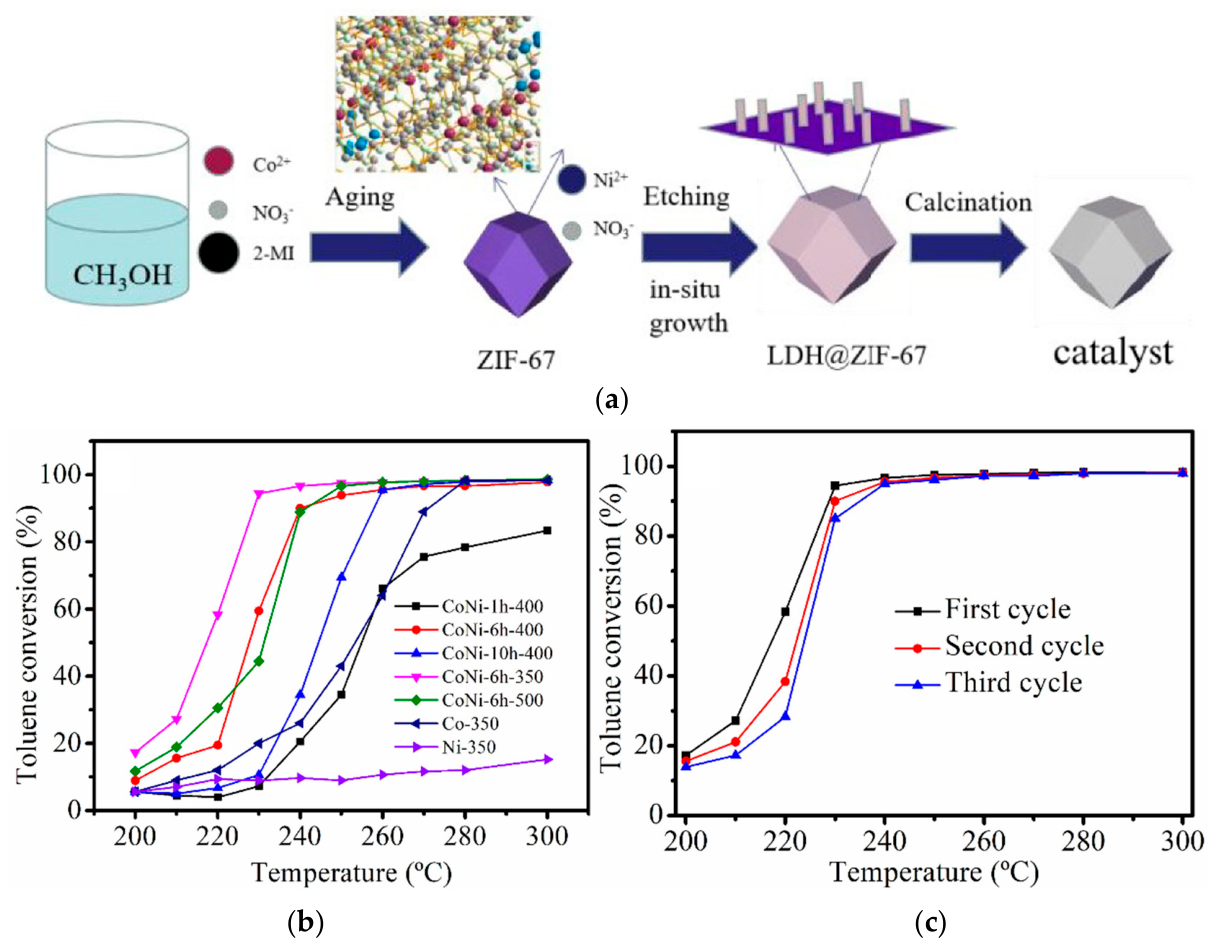
Wang et al. [61] reported a simple two-step method for constructing a 3D hierarchical NiCo2O4/NiO nanocage. This synthetic strategy involved a partial in situ transformation of ZIF-67 (zeolitic imidazolate framework-67) into Co-Ni LDH yolk–shell structures via ethanol etching, followed by a structure-preserving transformation from Co-Ni LDH@ZIF-67 into a biphasic nanocage through calcination (Figure 4a). The reaction time and calcination temperature significantly influenced the textural and catalytic properties. Thus, CoNi-yh-T with varied reaction time and calcination temperature were evaluated. The CoNi-6h-350 sample exhibited significantly higher activity, achieving 90% C7H8 conversion (T90) at 229 °C under a high space velocity (WHSV = 60 L h−1 g−1), compared to other catalysts (T90 > 240 °C, Figure 4b). The enhanced catalytic activity was attributed to abundant surface high-valence Co species generated by the unique hierarchical nanostructure, along with adsorbed oxygen species and a high density of medium-strength surface acid sites. As the reaction proceeds, the CO2 output increased and the carbon balance reached 97%, with no by-products detected except for a minimal amount of CO. The excellent activity of the CoNi-6h-350 catalyst was attributed to its retained hollow structure, high specific surface area, abundant adsorbed oxygen species, numerous medium-strength acid sites, and improved low-temperature reducibility resulting from a strong synergistic effect. The CoNi-6h-350 sample was repeatedly used three times under identical experimental conditions to evaluate the reproducibility of the catalyst in the continuous catalytic oxidation of C7H8, Figure 4c). The toluene conversion in the third cycle changes slightly, confirming that the catalyst exhibits excellent reproducibility.
A hierarchical Co2+2.8Co3+1-layered double hydroxide nanostructure was constructed via a facile topochemical transformation route under a dynamic oxygen atmosphere. A possible formation mechanism for the assembly of primary LDH nanosheets into three-dimensional self-assembled nanostructures was proposed based on interactions between organic molecules and LDH crystals [138]. Among them, the Co-CoO nanocatalyst exhibited the highest abundance of surface-adsorbed oxygen species, superior low-temperature reducibility, and the highest activity of surface Lewis acid sites. This was attributed to the high concentration of surface Co3+ species, resulting in the highest catalytic activity (T99(benzene) = 210 °C and T99(toluene) = 220 °C at WHSV = 60 L h−1 g−1).
Hierarchical core–shell Al2O3@Pd-CoAlO (Pd-CoAlO-Al) microspheres have been successfully prepared and applied for C7H8 combustion [134]. The core–shell AlOOH@CoAl-LDHs (CoAl-LDHs/Al) microsphere precursor was successfully prepared by first synthesizing AlOOH microspheres, followed by the in situ growth of 2D CoAl-LDH nanosheets on their surface. Furthermore, Pd nanoparticles (NPs) were immobilized on CoAl LDH precursors (CoAl-LDHs-X, X = S and Al) via an in situ redox method to obtain Pd-CoAl-LDHs-X. These precursors were then calcined at 600 °C in air to yield the corresponding spinel oxide microspheres, namely CoAlO, Al2O3@CoAlO, Pd-CoAlO, and Al2O3@Pd-CoAlO (CoAlO-S, CoAlO-Al, Pd-CoAlO-S, and Pd-CoAlO-Al). Benzoate species were the main intermediate formed during the reaction. Lifetime experiments were conducted on Pd-CoAlO/Al catalysts over a 48 h on-stream reaction at 190 and 220 °C to evaluate catalyst stability, also in the presence of 5.5 vol.-% water vapor. This result suggested that water vapor slightly reduced catalytic efficiency at 220 °C due to competitive adsorption between C7H8 and H2O on the active sites.
Flower-like Co3−xMnxO4 (x = 0.75, 1.0, and 1.5) mixed metal oxides were successfully synthesized using a controlled, template-free hydrothermal method [124]. The Co-rich sample exhibited significantly enhanced activity, with the 3D dandelion-like Co2.25Mn0.75O4 catalyst showing the highest C7H8 oxidation rate and achieving 100% conversion at 239 °C. C7H8 was sequentially oxidized into benzyl radicals, benzaldehyde, benzene, oxalic acid, and ultimately CO2 and H2O. The strong interaction between Co and Mn species, together with a high concentration of surface oxygen species and abundant oxygen vacancies, effectively accounts for the enhanced catalytic activity and thermal stability of the 3D flower-like Co3−xMnxO4 spinel catalysts.

3.2.3. VOC Mixtures and Non-Thermal Plasma Conditions

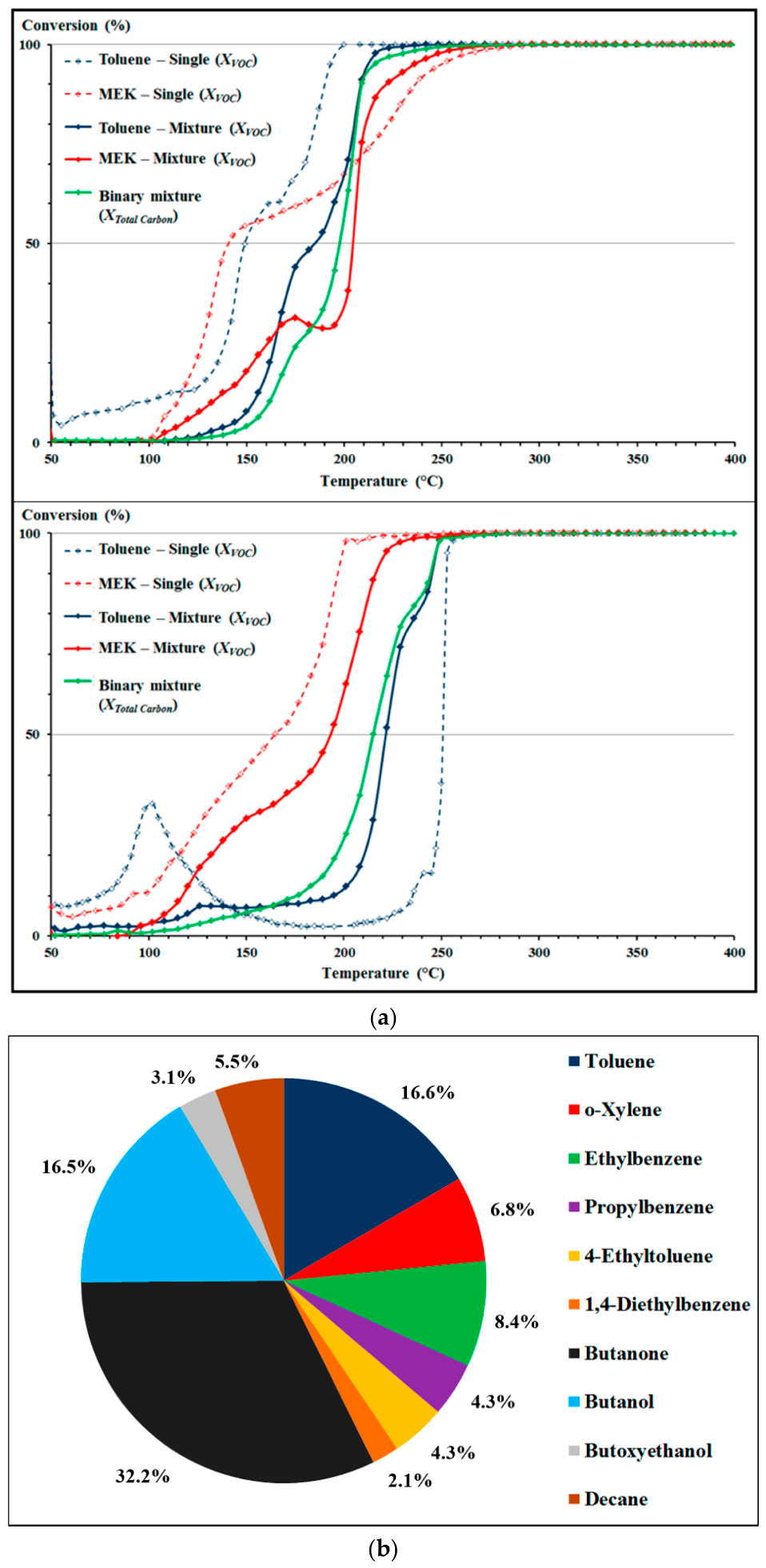
C7H8 serves as an ideal model VOCs for studying oxidation processes due to its representative structure and well-understood chemistry. Catalytic oxidation offers an efficient and environmentally friendly method for VOC removal, with ongoing research focused on developing more active, stable, and cost-effective catalysts. However, industrial applications required investigation under mixture compositions. Such studies are scarcely investigated over hydrotalcite-derived mixed metal oxides. CoAlCe mixed oxides were investigated and compared to selected palladium-based catalysts reported in the literature (namely Pd/α-Al2O3, Pd/HY, Pd/CeO2, and Pd/γ-Al2O3) for the total oxidation of toluene, butanone, and mixtures of VOCs, including MEK/toluene and industrial VOC blends [128]. The CoAlCe (n(Co)/n(Al)/n(Ce) = 6/1.2/0.8) mixed oxide demonstrated catalytic activity comparable to that of Pd/CeO2 and Pd/γ-Al2O3 systems, highlighting its potential as a cost-effective alternative to palladium-based catalysts for VOC abatement. Although the CoAlCe catalyst shows slightly lower activity when evaluated solely based on T50 and T100 values, it produced significantly lower benzene emissions. Taking this important factor into account, CoAlCe can be considered one of the most promising catalysts among those studied (Figure 5a). To simulate industrial VOC emissions, a representative liquid mixture was prepared consisting of six aromatic compounds (toluene, o-xylene, ethylbenzene, propylbenzene, 4-ethylbenzene, and 1,4-diethylbenzene), three oxygenated compounds (butanone, butanol, and butoxyethanol), and one paraffin (decane). Each component was present at a concentration of 10 vol.-% in the liquid phase. The liquid feed was introduced via a saturator, which temperature was adjusted to achieve a concentration of 7000 ppm carbon equivalent (ppm eq. C) in an air flow of 100 cm3 min−1. Figure 5b presents the resulting gas-phase composition, determined by micro gas chromatography.
Future work should focus on the development of efficient catalytic systems capable of oxidizing a wide range of VOCs at significantly lower temperatures. Such studies should examine how different VOCs interact during oxidation, since mixtures can compete for active sites or influence reaction pathways. A key challenge is maintaining high efficiency when treating complex, real-world VOC mixtures rather than single compounds. Overall, the goal is to design robust catalysts that can handle diverse emissions in industrial and environmental applications.
Non-thermal plasma (NTP) is an effective technology for VOC removal that operates at near-ambient temperatures using energetic electrons to generate reactive species. These species, such as radicals (•OH, •O) and ozone, initiate the oxidation and decomposition of VOC molecules into simpler compounds. Unlike conventional thermal methods, NTP does not require high temperatures, making it energy-efficient for dilute VOC stream. However, incomplete oxidation can lead to by-products like CO or partially oxidized organics. To improve performance, NTP is often combined with catalysts (plasma–catalysis systems), enhancing mineralization to CO2 and H2O. Overall, NTP is a promising method for air purification, though challenges remain in energy efficiency and by-product control [150,151,152]. In recent years, NTP has attracted considerable attention as a promising technology for the degradation of VOCs under ambient temperature and pressure conditions. This can be attributed to its high degradation efficiency, rapid reaction rate, and enhanced activity. In addition, manganese-based hydrotalcite-like compounds with compositions of MMn-LDHs (M = Ni, Co, Fe) have been employed to investigate their strong synergistic interaction with plasma technology for the degradation of VOCs [153]. Non-thermal plasma was generated using a dielectric barrier discharge (DBD) reactor. The experimental results demonstrated that the post-non-thermal plasma (post-NTP) catalytic system significantly enhanced C7H8 degradation efficiency and CO2 balance, while effectively suppressing the formation of by-products (e.g., NOx, carbonaceous species, and other oxygenated intermediates) compared to the NTP-alone system. NiMn-LDHs exhibited the highest activity in the post-NTP–catalytic system, achieving a C7H8 degradation rate of 96%, a CO2 selectivity of 57%, a carbon balance of 80%, and an energy efficiency of 3.19 g kWh−1 at a specific energy density (SED) of 930.45 J L−1. The findings indicated that plasma discharge generated a substantial amount of free radicals and reactive species, thereby enhancing the decomposition of C7H8. Subsequently, the remaining toluene and intermediate products were adsorbed onto the catalyst surface, where they further reacted with abundant hydroxyl radicals and activated metal species, ultimately decomposing into CO2 and H2O. Additionally, the interaction of ozone with hydrotalcite-like compounds promoted the generation of reactive oxygen species, thereby accelerating the decomposition of organic intermediates, enhancing CO2 formation, and improving C7H8 mineralization. The findings of this work provided valuable theoretical support for the plasma–catalytic degradation of VOCs. Moreover, by-products such as NOx and O3 were analyzed and compared between the NTP-alone and plasma–catalytic systems.

3.3. Reaction Mechanisms

As mentioned above, various VOCs are involved and have a direct impact on atmospheric chemistry. Although the catalytic oxidation of VOCs has been widely studied, establishing a universal correlation and a single reaction mechanism remains challenging due to variations in pollutant properties and reaction conditions. According to Palazzolo and Tichenor [154], an increase in molecular weight corresponds to greater difficulty in oxidizing VOCs. This trend is consistent with the order proposed for oxidation ease: alcohols < aldehydes < aromatics < ketones < acetates < alkanes. Depending on the partial reaction order, several mechanisms have been proposed for VOC oxidation. These include the Langmuir–Hinshelwood (L-H) mechanism, where the rate-determining step involves a surface reaction between two adsorbed species on similar active sites; the Eley–Rideal (E-R) mechanism, in which the key step is the reaction between an adsorbed species and a molecule in the gas phase; and the Mars-van Krevelen (MvK) mechanism, a redox pathway in which VOC molecules react with lattice oxygen at redox-active sites. The latter mechanism has been widely applied to describe the oxidation of organic compounds (e.g., [155,156]). According to the Mars-van Krevelen mechanism, the oxidation rate of VOCs can be expressed by as follows [157]:
r V O C = k O 2 k V O C P V O C P O 2 γ k V O C P V O C + k O 2 P O 2
where r V O C —reaction rate, mol m−3 s−1; P V O C —partial pressure of the VOCs; P O 2 —partial pressure of oxygen; k V O C —rate constant of VOCs oxidation; k O 2 —rate constant of catalysts re-oxidation; γ—the stoichiometry coefficient of O2 in the oxidation.
Similarly, the kinetics are given for Langmuir–Hinshelwood (L-H) and Eley–Ridel mechanisms and can be found in the literature (e.g., [158,159]).
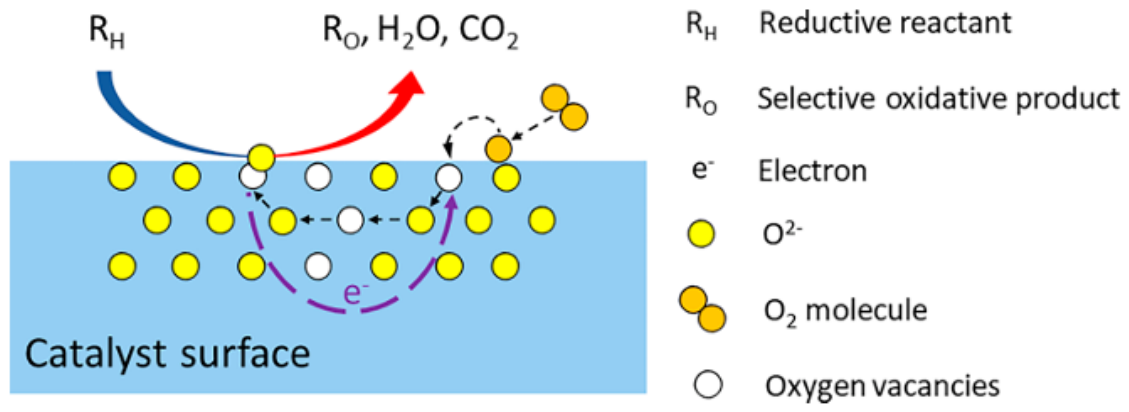
The Mars-van Krevelen (MvK) mechanism is a common pathway used to explain how solid catalysts, including hydrotalcite-derived materials, oxidize VOCs. First, in the catalytic mechanism for VOC oxidation over CuxCo4-xMnAl-MMO, a greater number of active sites and reactive species were produced due to the synergistic redox interactions among Co3+/Co2+, Mn4+/Mn3+, and Cu2+/Cu+ [130]. Second, strong interactions among Mn, Co, and Cu species are crucial for maintaining the redox cycles (Co3+ + Mn3+ ⇌ Co2+ + Mn4+; Cu2+ + Mn3+ ⇌ Cu+ + Mn4+), thereby promoting electron transfer and enhancing catalytic oxidation activity. Third, lattice oxygen plays a vital role in the VOC oxidation process: surface reactive oxygen species are consumed during the oxidation of organics and are subsequently replenished by lattice oxygen. Additionally, gas-phase oxygen (O2) can be adsorbed and activated at oxygen vacancies, forming reactive oxygen species that assisted in restoring depleted lattice oxygen and sustaining catalytic activity (Figure 6).
Similarly, strong interactions promote the redox cycle Mn3+ + Cu2+ ⇌ Mn4+ + Cu+ for CuMn composite oxide catalysts derived from CuMn-LDH precursor for C7H8 oxidation [117]. For the CMO-400 catalyst (CuMn-LDH calcined at 400 °C), both gaseous oxygen and lattice oxygen from the surface participated in the reaction. The active oxygen species are identified as free oxygen (O), which can directly take part in the oxidation of C7H8. Afterward, the depleted free oxygen is primarily replenished by adsorbed oxygen, which facilitates the catalyst’s subsequent re-oxidation cycle. Notably, a higher amount of adsorbed oxygen (Oads) is expected to enhance the utilization efficiency of oxygen species. Herein, the surface reaction pathway for C7H8 oxidation over the CMO-400 catalyst proceeded through consecutive steps. Toluene interacts with gas-phase oxygen, followed by sequential transformation along the pathway: toluene ⟶ benzyl alcohol ⟶ benzaldehyde ⟶ benzoate/benzoic acid ⟶ maleic anhydride ⟶ acetate (Figure 7). Ultimately, these toxic VOCs are fully oxidized into H2O and CO2. Considering the relatively slow oxidation rate of benzoic acid, it can be inferred that the cleavage of the aromatic ring is the rate-determining step. In another studies, Hou et al. [125] upon introduction of O2, toluene and surface intermediates undergo ring-opening reactions followed by deep mineralization. Toluene oxidation proceeds sequentially through benzyl alcohol, benzaldehyde, benzoic acid, and maleic anhydride, which are ultimately fully converted into CO2 and H2O. To verify the promoting effect of ethyl acetate, it was introduced into the reaction system while the C7H8 stream remained on, enabling the coexistence of gaseous ethyl acetate and toluene-derived intermediates on the catalyst surface. Upon introduction of ethyl acetate, the bands associated with maleic anhydride, a key intermediate in C7H8 oxidation, rapidly diminished. This observation is consistent with the experimental results obtained when both VOCs were introduced simultaneously, providing direct and convincing evidence of the catalytic promotion of C7H8 oxidation by ethyl acetate.

4. Conclusions

Metal oxide catalysts offer several advantages, making them attractive alternatives to expensive noble metal catalysts. Despite the above advances in the catalytic oxidation mechanisms of VOCs, there remain many essential challenges in understanding their reaction mechanisms, particularly for complex VOCs. In this review, multicomponent hydrotalcite-derived mixed metal oxides were evaluated for the oxidation of alcohols (methanol, ethanol) and toluene. The available literature on VOC oxidation has systematically investigated model exhaust streams in which VOC concentration and flow rate are carefully controlled; however, only a limited number of studies have focused on VOC mixture. To better approximate industrial conditions, it is necessary to investigate more complex mixtures (i.e., 10–50 compounds). However, due to the complexity of the processes occurring during the oxidation of mixtures, predicting catalyst behavior is difficult, and experimental validation is required. Catalysts can also be easily deactivated by the adsorption of water vapor and other intermediate species. Therefore, the development of highly resistant catalysts is essential to reduce operating costs and improve VOC removal efficiency. Plasma-based VOC abatement is an effective room-temperature oxidation technology that utilizes highly reactive species generated in the discharge to convert VOCs into intermediate oxygenated compounds and, ultimately, CO2 and H2O. While high conversion can be achieved, plasma alone may suffer from incomplete mineralization and by-product formation. The introduction of catalysts significantly enhances performance by improving selectivity, promoting full oxidation, and reducing undesirable intermediates, leading to more efficient and stable VOCs removal.
In the future, laboratory experiments should be supported by machine learning models that can be applied to analyze large experimental datasets to predict LDH-derived catalysts for VOC removal, without extensive trial-and-error experiments. In process optimization, it is necessary to develop model relationships between operating parameters (temperature, gas composition, humidity, plasma power, etc.) and VOC conversion efficiency. This enables the rapid optimization of catalytic and plasma`catalytic systems, improving degradation efficiency and energy utilization.

Funding

This research received no external funding.

Data Availability Statement

No data available to share for this review.

Acknowledgments

During the preparation of this manuscript, the author used an artificial intelligence–based language editing tool to improve the clarity and style of the text. Following the use of this tool, the author thoroughly reviewed and revised the manuscript and take full responsibility for the final content.

Conflicts of Interest

The author declares no conflict of interest.

References

  1. Mozaffar, A.; Zhang, Y.-L. Atmospheric volatile organic compounds (VOCs) in China: A Review. Curr. Pollut. Rep. 2020, 6, 250–263. [Google Scholar] [CrossRef] [Scilit]
  2. Kansal, A. Sources and reactivity of NMHCs and VOCs in the atmosphere: A review. J. Hazard. Mater. 2009, 166, 17–26. [Google Scholar] [CrossRef] [Scilit] [PubMed]
  3. Reducing the emission of volatile organic compounds|EUR-Lex. Available online: https://eur-lex.europa.eu (accessed on 3 April 2026).
  4. Dyrektywa—2004/42—EN—EUR-Lex H Europa. EU. Available online: https://eur-lex.europa.eu/legal-content/PL/ALL/?uri=CELEX:32004L0042 (accessed on 3 April 2026).
  5. Does EPA regulate volatile organic compounds (VOCs) in household products?|US EPA. Available online: https://www.epa.gov (accessed on 3 April 2026).
  6. Zhou, X.; Zhou, X.; Wang, C.; Zhou, H. Environmental and human health impacts of volatile organic compounds: A perspective review. Chemosphere 2023, 313, 137489. [Google Scholar] [CrossRef] [Scilit] [PubMed]
  7. Jalal, A.H.; Alam, F.; Roychoudhury, S.; Umasankar, Y.; Pala, N.; Bhansali, S. Prospects and challenges of volatile organic compound sensors in human healthcare. ACS Sens. 2018, 3, 1246–1263. [Google Scholar] [CrossRef] [Scilit] [PubMed]
  8. David, E.; Niculescu, V.-C. Volatile organic compounds (VOCs) as environmental pollutants: Occurrence and mitigation using nanomaterials. Int. J. Environ. Res. Public Health 2021, 18, 13147. [Google Scholar] [CrossRef] [Scilit] [PubMed]
  9. Chen, D.; Xu, Y.; Xu, J.; Lian, M.; Zhang, W.; Wu, W.; Wu, M.; Zhao, J. The vertical distribution of VOCs and their impact on the environment: A review. Atmosphere 2022, 13, 1940. [Google Scholar] [CrossRef] [Scilit]
  10. Lin, Y.-C.; Chang, F.-T.; Bai, H.; Pei, B.-S. Control of VOCs emissions by condenser pre-treatment in a semiconductor fab. J. Hazard. Mater. 2005, 120, 9–14. [Google Scholar] [CrossRef] [Scilit] [PubMed]
  11. Wang, H.; Guo, H.; Zhao, Y.; Dong, X.; Gong, M. Thermodynamic analysis of a petroleum volatile organic compounds (VOCs) condensation recovery system combined with mixed-refrigerant refrigeration. Int. J. Refrig. 2020, 116, 23–35. [Google Scholar] [CrossRef] [Scilit]
  12. Gan, G.; Fan, S.; Li, X.; Zhang, Z.; Hao, Z. Adsorption and membrane separation for removal and recovery of volatile organic compounds. J. Environ. Sci. 2023, 123, 96–115. [Google Scholar] [CrossRef] [Scilit] [PubMed]
  13. Zhang, L.; Weng, H.; Chen, H.; Gao, C. Remove volatile organic compounds (VOCs) with membrane separation techniques. J. Environ. Sci. 2002, 14, 181–187. [Google Scholar]
  14. Everaert, K.; Degrève, J.; Baeyens, J. VOC-air separations using gas membranes. J. Chem. Technol. Biotechnol. Int. Res. Process Environ. Clean. Technol. 2003, 78, 294–297. [Google Scholar] [CrossRef] [Scilit]
  15. Wu, L.; Zhu, Y.; Yuan, J.; Guo, X.; Zhang, Q. Advances in adsorption, absorption, and catalytic materials for VOCs generated in typical industries. Energies 2024, 17, 1861. [Google Scholar] [CrossRef] [Scilit]
  16. Makoś-Chełstowska, P. VOCs absorption from gas streams using deep eutectic solvents-a review. J. Hazard. Mater. 2023, 448, 130957. [Google Scholar] [CrossRef] [Scilit] [PubMed]
  17. Biard, P.-F. Volatile organic compounds absorption in non-aqueous solvents: A critical review based on hydrodynamics and mass transfer considerations. Chem. Eng. J. 2025, 512, 162413. [Google Scholar] [CrossRef] [Scilit]
  18. Li, X.; Zhang, L.; Yang, Z.; Wang, P.; Yan, Y.; Ran, J. Adsorption materials for volatile organic compounds (VOCs) and the key factors for VOCs adsorption process: A review. Sep. Purif. Technol. 2020, 235, 116213. [Google Scholar] [CrossRef] [Scilit]
  19. Pui, W.K.; Yusoff, R.; Aroua, M.K. A review on activated carbon adsorption for volatile organic compounds (VOCs). Rev. Chem. Eng. 2019, 35, 649–668. [Google Scholar] [CrossRef] [Scilit]
  20. Zhu, L.; Shen, D.; Luo, K.H. A critical review on VOCs adsorption by different porous materials: Species, mechanisms and modification methods. J. Hazard. Mater. 2020, 389, 122102. [Google Scholar] [CrossRef] [Scilit] [PubMed]
  21. Chang, Z.; Wang, C.; Zhang, G. Progress in degradation of volatile organic compounds based on low-temperature plasma technology. Plasma Process. Polym. 2020, 17, 1900131. [Google Scholar] [CrossRef] [Scilit]
  22. Gong, X.; Xiong, X.; Peng, Y.; Yang, C.; Zhang, S.; Fang, X.; Zhang, X. Low-temperature plasma ionization source for the online detection of indoor volatile organic compounds. Talanta 2011, 85, 2458–2462. [Google Scholar] [CrossRef] [Scilit] [PubMed]
  23. Li, K.; Luo, X. Research progress on catalytic combustion of volatile organic compounds in industrial waste gas. Catalysts 2023, 13, 268. [Google Scholar] [CrossRef] [Scilit]
  24. He, X.; Dong, F.; Han, W.; Tang, Z.; Ding, Y. Recent advances and future challenges in the catalytic combustion of light hydrocarbon VOCs. J. Mater. Chem. A 2024, 12, 7470–7507. [Google Scholar] [CrossRef] [Scilit]
  25. Padhi, S.K.; Gokhale, S. Biological oxidation of gaseous VOCs—Rotating biological contactor a promising and eco-friendly technique. J. Environ. Chem. Eng. 2014, 2, 2085–2102. [Google Scholar] [CrossRef] [Scilit]
  26. Meena, M.; Sonigra, P.; Yadav, G. Biological-based methods for the removal of volatile organic compounds (VOCs) and heavy metals. Environ. Sci. Pollut. Res. 2021, 28, 2485–2508. [Google Scholar] [CrossRef] [Scilit] [PubMed]
  27. Zhang, S.; You, J.; Kennes, C.; Cheng, Z.; Ye, J.; Chen, D.; Chen, J.; Wang, L. Current advances of VOCs degradation by bioelectrochemical systems: A review. Chem. Eng. J. 2018, 334, 2625–2637. [Google Scholar] [CrossRef] [Scilit]
  28. Shan, C.; Wang, Y.; Li, J.; Zhao, Q.; Han, R.; Liu, C.; Liu, Q. Recent advances of VOCs catalytic oxidation over spinel oxides: Catalyst design and reaction mechanism. Environ. Sci. Technol. 2023, 57, 9495–9514. [Google Scholar] [CrossRef] [Scilit] [PubMed]
  29. Liu, R.; Wu, H.; Shi, J.; Xu, X.; Zhao, D.; Ng, Y.H.; Zhang, M.; Liu, S.; Ding, H. Recent progress on catalysts for catalytic oxidation of volatile organic compounds: A review. Catal. Sci. Technol. 2022, 12, 6945–6991. [Google Scholar] [CrossRef] [Scilit]
  30. Zhao, R.; Wang, H.; Zhao, D.; Liu, R.; Liu, S.; Fu, J.; Zhang, Y.; Ding, H. Review on catalytic oxidation of VOCs at ambient temperature. Int. J. Mol. Sci. 2022, 23, 13739. [Google Scholar] [CrossRef] [Scilit] [PubMed]
  31. Deng, J.; Hu, X.; Klaver, A.J.; Liu, J.; Liu, B.; Bai, L.; Xie, M.; Zhang, D. Catalyst deactivation in the abatement of atmospheric pollutants: Origin, resistance, and regeneration. Chem. Rev. 2025, 125, 11260–11357. [Google Scholar] [CrossRef] [Scilit] [PubMed]
  32. Ma, Y.; Lai, J.; Lin, X.; Zhang, H.; Du, H.; Long, J.; Yan, J.; Li, X. Implication of operation time on low-temperature catalytic oxidation of chloroaromatic organics over VOx/TiO2 catalysts: Deactivation mechanism analysis. J. Clean. Prod. 2022, 372, 133477. [Google Scholar] [CrossRef] [Scilit]
  33. Aguero, F.N.; Barbero, B.P.; Gambaro, L.; Cadús, L.E. Catalytic combustion of volatile organic compounds in binary mixtures over MnOx/Al2O3 catalyst. Appl. Catal. B Environ. 2009, 91, 108–112. [Google Scholar] [CrossRef] [Scilit]
  34. Li, S.; Lin, Y.; Liu, G.; Shi, C. Research status of volatile organic compound (VOC) removal technology and prospect of new strategies: A review. Environ. Sci. Process Impacts 2023, 25, 727–740. [Google Scholar] [CrossRef] [Scilit] [PubMed]
  35. Tidahy, H.L.; Hosseni, M.; Siffert, S.; Cousin, R.; Lamonier, J.-F.; Aboukaïs, A.; Su, B.-L.; Giraudon, J.-M.; Leclercq, G. Nanostructured macro-mesoporous zirconia impregnated by noble metal for catalytic total oxidation of toluene. Catal. Today 2008, 137, 335–339. [Google Scholar] [CrossRef] [Scilit]
  36. Tsoncheva, T.; Ivanova, L.; Minchev, C.; Fröba, M. Cobalt-modified mesoporous MgO, ZrO2, and CeO2 oxides as catalysts for methanol decomposition. J. Colloid Interface Sci. 2009, 333, 277–284. [Google Scholar] [CrossRef] [Scilit] [PubMed]
  37. Álvarez-Galván, M.C.; la Peña O’Shea, V.A.; Fierro, J.L.G.; Arias, P.L. Alumina-supported manganese-and manganese-palladium oxide catalysts for VOCs combustion. Catal. Commun. 2003, 4, 223–228. [Google Scholar] [CrossRef] [Scilit]
  38. Tidahy, H.L.; Siffert, S.; Lamonier, J.-F.; Cousin, R.; Zhilinskaya, E.A.; Aboukaïs, A.; Su, B.-L.; Canet, X.; De Weireld, G.; Frère, M.; et al. Influence of the exchanged cation in Pd/BEA and Pd/FAU zeolites for catalytic oxidation of VOCs. Appl. Catal. B Environ. 2007, 70, 377–383. [Google Scholar] [CrossRef] [Scilit]
  39. Tidahy, H.L.; Siffert, S.; Lamonier, J.-F.; Zhilinskaya, E.A.; Aboukaïs, A.; Yuan, Z.-Y.; Vantomme, A.; Su, B.-L.; Canet, X.; De Weireld, G.; et al. New Pd/hierarchical macro-mesoporous ZrO2, TiO2 and ZrO2-TiO2 catalysts for VOCs total oxidation. Appl. Catal. A Gen. 2006, 310, 61–69. [Google Scholar] [CrossRef] [Scilit]
  40. Toloza-Blanco, L.; Góra-Marek, K.; Tarach, K.A.; Sobalska, J.; Martínez-Triguero, J.; Plá-Hernandez, A.; Palomares, A.E. Catalytic oxidation of volatile organic compounds with Mn-zeolites. Catal. Today 2024, 432, 114570. [Google Scholar] [CrossRef] [Scilit]
  41. Lin, W.; Zhu, Y.X.; Wu, N.Z.; Xie, Y.C.; Murwani, I.; Kemnitz, E. Total oxidation of methane at low temperature over Pd/TiO2/Al2O3: Effects of the support and residual chlorine ions. Appl. Catal. B Environ. 2004, 50, 59–66. [Google Scholar] [CrossRef] [Scilit]
  42. Narui, K.; Furuta, K.; Yata, H.; Nishida, A.; Kohtoku, Y.; Matsuzaki, T. Catalytic activity of PdO/ZrO2 catalyst for methane combustion. Catal. Today 1998, 45, 173–178. [Google Scholar] [CrossRef] [Scilit]
  43. Okumura, K.; Kobayashi, T.; Tanaka, H.; Niwa, M. Toluene combustion over palladium supported on various metal oxide supports. Appl. Catal. B Environ. 2003, 44, 325–331. [Google Scholar] [CrossRef] [Scilit]
  44. Schauermann, S.; Hoffmann, J.; Johánek, V.; Hartmann, J.; Libuda, J.; Freund, H.-J. Catalytic activity and poisoning of specific sites on supported metal nanoparticles. Angew. Chem. Int. Ed. 2002, 41, 2532–2535. [Google Scholar] [CrossRef] [Scilit] [PubMed]
  45. Rupprechter, G.; Hayek, K.; Hofmeister, H. Electron microscopy of thin-film model catalysts: Activation of alumina-supported rhodium nanoparticles. J. Catal. 1998, 173, 409–422. [Google Scholar] [CrossRef] [Scilit]
  46. Bertarione, S.; Scarano, D.; Zecchina, A.; Johánek, V.; Hoffmann, J.; Schauermann, S.; Libuda, J.; Rupprechter, G.; Freund, H.-J. Surface reactivity of Pd nanoparticles supported on polycrystalline substrates as compared to thin film model catalysts: Infrared study of CH3OH adsorption. J. Catal. 2004, 223, 64–73. [Google Scholar] [CrossRef] [Scilit]
  47. Jiang, Z.; Li, Y.; Tang, Z.; Yuan, D.; Lin, F. Strong metal-support interactions in catalytic oxidation of vocs: Mechanistic Insights, support engineering Strategies, and emerging catalyst design paradigms. Environ. Sci. Technol. 2025, 59, 19644–19666. [Google Scholar] [CrossRef] [Scilit] [PubMed]
  48. Yi, J.; Liu, J.; Gao, B.; Bo, L.; Cao, L.; Sillanpää, M. The comprehensive review of catalysts for catalytic oxidation of volatile organic compounds. J. Environ. Chem. Eng. 2025, 13, 115691. [Google Scholar] [CrossRef] [Scilit]
  49. Zhang, M.; Liu, L.; Ding, L.; Fang, N.; Chu, Y. Modulating surface properties of catalysts to promote the oxidation of multi-component VOCs. J. Environ. Chem. Eng. 2025, 13, 118118. [Google Scholar] [CrossRef] [Scilit]
  50. Matějová, L.; Topka, P.; Jirátová, K.; Šolcová, O. Total oxidation of model volatile organic compounds over some commercial catalysts. Appl. Catal. A Gen. 2012, 443, 40–49. [Google Scholar] [CrossRef] [Scilit]
  51. Available online: https://www.clariant.com/en/Solutions/Products/2019/07/22/08/50/EnviCat-VOC (accessed on 3 April 2026).
  52. Available online: https://chemical-catalysts-and-adsorbents.basf.com/dam/jcr%3A2a03a1a8-8333-4ef3-a2a6-a160a4db818a/basf/chemical-catalysts-and-adsorbents/Stationary-Emissions-Control/BF-10243-VOC-Abatement_Catalyst.pdf?vid=tEIh8L3KSrxks5xhrr_ubqZYvJ4wdbe9&utm_source=chatg (accessed on 3 April 2026).
  53. Bedia, J.; Rosas, J.M.; Rodríguez-Mirasol, J.; Cordero, T. Pd supported on mesoporous activated carbons with high oxidation resistance as catalysts for toluene oxidation. Appl. Catal. B Environ. 2010, 94, 8–18. [Google Scholar] [CrossRef] [Scilit]
  54. Shao, Q.; Xiao, H.; Gao, L.; Chen, H.; Long, C. A pilot-scale study on performance and deactivation mechanism of MnOx supported on Y zeolite for ozone catalytic oxidation of VOCs at low temperature. Chem. Eng. Res. Des. 2025, 218, 421–427. [Google Scholar] [CrossRef] [Scilit]
  55. Derwent, R.G.; Jenkin, M.E.; Saunders, S.M. Photochemical ozone creation potentials for a large number of reactive hydrocarbons under European conditions. Atmos. Environ. 1996, 30, 181–199. [Google Scholar] [CrossRef] [Scilit]
  56. Derwent, R.G.; Jenkin, M.E.; Saunders, S.M.; Pilling, M.J. Photochemical ozone creation potentials for organic compounds in northwest Europe calculated with a master chemical mechanism. Atmos. Environ. 1998, 32, 2429–2441. [Google Scholar] [CrossRef] [Scilit]
  57. Jirátová, K.; Čuba, P.; Kovanda, F.; Hilaire, L.; Pitchon, V. Preparation and characterisation of activated Ni(Mn)/Mg/Al hydrotalcites for combustion catalysis. Catal. Today 2002, 76, 43–53. [Google Scholar] [CrossRef] [Scilit]
  58. Zhao, Q.; Ge, Y.; Fu, K.; Ji, N.; Song, C.; Liu, Q. Oxidation of acetone over Co-based catalysts derived from hierarchical layer hydrotalcite: Influence of Co/Al molar ratios and calcination temperatures. Chemosphere 2018, 204, 257–266. [Google Scholar] [CrossRef] [Scilit] [PubMed]
  59. Sun, Y.; Li, N.; Xing, X.; Zhang, X.; Zhang, Z.; Wang, G.; Cheng, J.; Hao, Z. Catalytic oxidation performances of typical oxygenated volatile organic compounds (acetone and acetaldehyde) over MAlO (M = Mn, Co, Ni, Fe) hydrotalcite-derived oxides. Catal. Today 2019, 327, 389–397. [Google Scholar] [CrossRef] [Scilit]
  60. Li, S.; Wang, H.; Li, W.; Wu, X.; Tang, W.; Chen, Y. Effect of Cu substitution on promoted benzene oxidation over porous CuCo-based catalysts derived from layered double hydroxide with resistance of water vapor. Appl. Catal. B Environ. 2015, 166, 260–269. [Google Scholar] [CrossRef] [Scilit]
  61. Wang, D.; Li, S.; Du, Y.; Wu, X.; Chen, Y. Self-templating synthesis of 3D hierarchical NiCo2O4@ NiO nanocage from hydrotalcites for toluene oxidation. Catalysts 2019, 9, 352. [Google Scholar] [CrossRef] [Scilit]
  62. Mo, S.; Li, S.; Li, W.; Li, J.; Chen, J.; Chen, Y. Excellent low temperature performance for total benzene oxidation over mesoporous CoMnAl composited oxides from hydrotalcites. J. Mater. Chem. A 2016, 4, 8113–8122. [Google Scholar] [CrossRef] [Scilit]
  63. Wan, C.; Wei, X.; Cai, G.; Li, D.; Zhan, Y.; Xiao, Y.; Jiang, L. Hydrotalcite-derived aluminum-doped cobalt oxides for catalytic benzene combustion: Effect of calcination atmosphere. Mol. Catal. 2022, 520, 112160. [Google Scholar] [CrossRef] [Scilit]
  64. Zhang, X.; Wei, T. Hydrotalcite-derived layered metal oxide/sulfide cathode materials for sodium-ion batteries: Progress and perspectives. Mater. Res. Express 2026, 13, 072001. [Google Scholar] [CrossRef] [Scilit]
  65. Sharma, A.; Kumari, S.; Sharma, S.; Singh, T.; Kumar, S.; Thakur, A.; Bhatia, S.K.; Sharma, A.K. Layered double hydroxides: An insight into the role of hydrotalcite-type anionic clays in energy and environmental applications with current progress and recent prospects. Mater. Today Sustain 2023, 22, 100399. [Google Scholar] [CrossRef] [Scilit]
  66. Vaccari, A. Preparation and catalytic properties of cationic and anionic clays. Catal. Today 1998, 41, 53–71. [Google Scholar] [CrossRef] [Scilit]
  67. Reichle, J.; Ward, M. Teaching discriminative use of an encoding electronic communication device and signing exact English to a moderately handicapped child. Lang. Speech Hear Serv. Sch. 1985, 16, 58–63. [Google Scholar] [CrossRef] [Scilit]
  68. Misra, C.; Perrotta, A.J. Composition and properties of synthetic hydrotalcites. Clays Clay Min. 1992, 40, 145–150. [Google Scholar] [CrossRef] [Scilit]
  69. Zhao, R.; Yin, C.; Zhao, H.; Liu, C. Synthesis, characterization, and application of hydotalcites in hydrodesulfurization of FCC gasoline. Fuel Process. Technol. 2003, 81, 201–209. [Google Scholar] [CrossRef] [Scilit]
  70. Zulkifli, M.; Pungot, N.H.; Tajuddin, N.A.; Aluwi, M.; Jumali, N.S.; Shaameri, Z. A short review on the influence of the preparation method on the physicochemical properties of Mg/Al hydrotalcite for glucose isomerization. Malays. J. Anal. Sci. 2022, 26, 191–201. [Google Scholar]
  71. Valdivieso-Vera, D.A.; Guerrero-Pérez, M.O. Groups IV, V and VI metal oxide-containing hydrotalcite catalysts: State of the art on their catalytic applications. Catal. Today 2024, 442, 114935. [Google Scholar] [CrossRef] [Scilit]
  72. Debecker, D.P.; Gaigneaux, E.M.; Busca, G. Exploring, tuning, and exploiting the basicity of hy-drotalcites for applications in heterogeneous catalysis. Chem.–Eur. J. 2009, 15, 3920–3935. [Google Scholar] [CrossRef] [Scilit] [PubMed]
  73. Zakaria, S.A.; Ahmadi, S.H.; Amini, M.H. CeO2/Ni-Al layered double hydroxide composite as a gas sensor for volatile organic compounds detection. Mater. Today Commun. 2024, 40, 109677. [Google Scholar] [CrossRef] [Scilit]
  74. Yuan, T.; Hashimoto, K.; Tazaki, A.; Hasegawa, M.; Kurniasari, F.; Ohta, C.; Aoki, M.; Ohgami, N.; Kato, M. Potential application of a hydrotalcite-like compound for reduction of toxicity to aquatic organisms via rapid and efficient removal of hydrogen sulfide. J. Environ. Manag. 2022, 321, 115861. [Google Scholar] [CrossRef] [Scilit] [PubMed]
  75. Suescum-Morales, D.; Jiménez, J.R.; Fernández-Rodríguez, J.M. Review of the application of hydrotalcite as CO2 sinks for climate change mitigation. ChemEngineering 2022, 6, 50. [Google Scholar] [CrossRef] [Scilit]
  76. Jabłońska, M.; Palkovits, R. Nitrogen oxide removal over hydrotalcite-derived mixed metal oxides. Catal. Sci. Technol. 2016, 6, 49–72. [Google Scholar] [CrossRef] [Scilit]
  77. Jabłońska, M.; Mollá Robles, A. A comparative mini-review on transition metal oxides applied for the selective catalytic ammonia oxidation (NH3-SCO). Materials 2022, 15, 4770. [Google Scholar] [CrossRef] [Scilit] [PubMed]
  78. Zang, P.; Liu, J.; He, Y.; Zhang, G.; Li, G.; Wang, Y.; Lv, Y. LDH-derived preparation of CuMgFe layered double oxides for NH3-SCR and CO oxidation reactions: Performance study and synergistic mechanism. Chem. Eng. J. 2022, 446, 137414. [Google Scholar] [CrossRef] [Scilit]
  79. Szymaszek-Wawryca, A.; Summa, P.; Duraczyńska, D.; Díaz, U.; Motak, M. Hydrotalcite-modified clinoptilolite as the catalyst for selective catalytic reduction of NO with ammonia (NH3-SCR). Materials 2022, 15, 7884. [Google Scholar] [CrossRef] [Scilit] [PubMed]
  80. Jabłońska, M.; Chmielarz, L.; Węgrzyn, A.; Guzik, K.; Piwowarska, Z.; Witkowski, S.; Walton, R.I.; Dunne, P.W.; Kovanda, F. Thermal transformations of Cu-Mg (Zn)-Al (Fe) hydrotalcite-like materials into metal oxide systems and their catalytic activity in selective oxidation of ammonia to dinitrogen. J. Therm. Anal. Calorim. 2013, 114, 731–747. [Google Scholar] [CrossRef] [Scilit]
  81. Ausavasukhi, A.; Krukrathok, N.; Singthaisong, P. Thermal transformation of copper incorporated hydrotalcite-derived oxides and their catalytic activity for ethanol dehydrogenation. J. Ind. Eng. Chem. 2023, 117, 371–385. [Google Scholar] [CrossRef] [Scilit]
  82. Coumans, F.J.A.G.; Mitchell, S.; Schütz, J.; Medlock, J.; Pérez-Ramírez, J. Hydrotalcite-derived mixed oxides for the synthesis of a key vitamin A intermediate reducing waste. ACS Omega 2018, 3, 15293–15301. [Google Scholar] [CrossRef] [Scilit] [PubMed]
  83. Hinz, A.; Larsson, P.-O.; Skårman, B.; Andersson, A. Platinum on alumina, titania, and magnesia supports for the combustion of methanol in a waste gas with trace amount of ammonia. Appl. Catal. B Environ. 2001, 34, 161–178. [Google Scholar] [CrossRef] [Scilit]
  84. Forzatti, P.; Tronconi, E.; Elmi, A.S.; Busca, G. Methanol oxidation over vanadia-based catalysts. Appl. Catal. A Gen. 1997, 157, 387–408. [Google Scholar] [CrossRef] [Scilit]
  85. Chantaravitoon, P.; Chavadej, S.; Schwank, J. Temperature-programmed desorption of methanol and oxidation of methanol on Pt-Sn/Al2O3 catalysts. Chem. Eng. J. 2004, 97, 161–171. [Google Scholar] [CrossRef] [Scilit]
  86. Ga, M.; Ga, I.; Grzybowska, B. O-xylene oxidation on the V2O5-TiO2 oxide system: I. Dependence of catalytic properties on the modification of TiO2. Appl. Catal. 1984, 10, 87–100. [Google Scholar]
  87. Chmielarz, L.; Piwowarska, Z.; Rutkowska, M.; Wojciechowska, M.; Dudek, B.; Witkowski, S.; Michalik, M. Total oxidation of selected mono-carbon VOCs over hydrotalcite originated metal oxide catalysts. Catal. Commun. 2012, 17, 118–125. [Google Scholar] [CrossRef] [Scilit]
  88. Jabłońska, M.; Chmielarz, L.; Węgrzyn, A.; Góra-Marek, K.; Piwowarska, Z.; Witkowski, S.; Bidzińska, E.; Kuśtrowski, P.; Wach, A.; Majda, D. Hydrotalcite derived (Cu, Mn)-Mg-Al metal oxide systems doped with palladium as catalysts for low-temperature methanol incineration. Appl. Clay Sci. 2015, 114, 273–282. [Google Scholar] [CrossRef] [Scilit]
  89. Bahranowski, K.; Bielańska, E.; Janik, R.; Machej, T.; Serwicka, E.M. LDH-derived catalysts for complete oxidation of volatile organic compounds. Clay Miner. 1999, 34, 67–77. [Google Scholar] [CrossRef] [Scilit]
  90. Kovanda, F.; Rojka, T.; Dobešová, J.; Machovič, V.; Bezdička, P.; Obalová, L.; Jirátová, K.; Grygar, T. Mixed oxides obtained from Co and Mn containing layered double hydroxides: Preparation, characterization, and catalytic properties. J. Solid State Chem. 2006, 179, 812–823. [Google Scholar] [CrossRef] [Scilit]
  91. Aguilera, D.A.; Perez, A.; Molina, R.; Moreno, S. Cu-Mn and Co-Mn catalysts synthesized from hydrotalcites and their use in the oxidation of VOCs. Appl. Catal. B Environ. 2011, 104, 144–150. [Google Scholar] [CrossRef] [Scilit]
  92. Morales, M.R.; Barbero, B.P.; Cadús, L.E. Total oxidation of ethanol and propane over Mn-Cu mixed oxide catalysts. Appl. Catal. B Environ. 2006, 67, 229–236. [Google Scholar] [CrossRef] [Scilit]
  93. Tannous, M.; Bounoukta, C.E.; Siffert, S.; Poupin, C.; Cousin, R. Total catalytic oxidation of ethanol over MnCoAl mixed oxides derived from layered double hydroxides: Effect of the metal ratio and the synthesis atmosphere conditions. Catalysts 2023, 13, 1316. [Google Scholar] [CrossRef] [Scilit]
  94. Jirátová, K.; Kovanda, F.; Ludvíková, J.; Balabánová, J.; Klempa, J. Total oxidation of ethanol over layered double hydroxide-related mixed oxide catalysts: Effect of cation composition. Catal. Today 2016, 277, 61–67. [Google Scholar] [CrossRef] [Scilit]
  95. Kupková, K.; Topka, P.; Balabánová, J.; Koštejn, M.; Jirátová, K.; Giraudon, J.-M.; Lamonier, J.-F.; Maixner, J.; Kovanda, F. Cobalt-copper oxide catalysts for VOC abatement: Effect of Co: Cu ratio on performance in ethanol oxidation. Catalysts 2023, 13, 107. [Google Scholar] [CrossRef] [Scilit]
  96. Pérez, A.; Montes, M.; Molina, R.; Moreno, S. Cooperative effect of Ce and Pr in the catalytic combustion of ethanol in mixed Cu/CoMgAl oxides obtained from hydrotalcites. Appl. Catal. A Gen. 2011, 408, 96–104. [Google Scholar] [CrossRef] [Scilit]
  97. Rochard, G.; Genty, E.; Giraudon, J.-M.; Poupin, C.; Lamonier, J.-F.; Siffert, S.; La Parola, V.; Liotta, L.F.; Cousin, R. Synthesis of Gold Nanoparticles over CoAl Mixed Oxide for Ethanol Oxidation Reaction. Molecules 2024, 29, 2285. [Google Scholar] [CrossRef] [Scilit] [PubMed]
  98. Jirátová, K.; Mikulová, J.; Klempa, J.; Grygar, T.; Bastl, Z.; Kovanda, F. Modification of Co-Mn-Al mixed oxide with potassium and its effect on deep oxidation of VOC. Appl. Catal. A Gen. 2009, 361, 106–116. [Google Scholar] [CrossRef] [Scilit]
  99. Topka, P.; Jirátová, K.; Dvořáková, M.; Balabánová, J.; Koštejn, M.; Kovanda, F. Hydrothermal deposition as a novel method for the preparation of Co-Mn mixed oxide catalysts supported on stainless steel meshes: Application to VOC oxidation. Environ. Sci. Pollut. Res. 2022, 29, 5172–5183. [Google Scholar] [CrossRef] [Scilit] [PubMed]
  100. Kovanda, F.; Jirátová, K. Supported layered double hydroxide-related mixed oxides and their application in the total oxidation of volatile organic compounds. Appl. Clay Sci. 2011, 53, 305–316. [Google Scholar] [CrossRef] [Scilit]
  101. Ludvíková, J.; Jirátová, K.; Kovanda, F. Mixed oxides of transition metals as catalysts for total ethanol oxidation. Chem. Pap. 2012, 66, 589–597. [Google Scholar] [CrossRef] [Scilit]
  102. Kovanda, F.; Jirátová, K. Supported mixed oxide catalysts for the total oxidation of volatile organic compounds. Catal. Today 2011, 176, 110–115. [Google Scholar] [CrossRef] [Scilit]
  103. El Khawaja, R.; Rochard, G.; Genty, E.; Poupin, C.; Siffert, S.; Cousin, R. Optimization of Mn-Mg-Al mixed oxides composition on their activity towards the total oxidation of aromatic and oxygenated VOCs. Eur. J. Inorg. Chem. 2023, 26, e202300213. [Google Scholar] [CrossRef] [Scilit]
  104. Eskandar, K. The Toxic Truth: How Alcohol Harms the Body from Head to Toe. J. Fac. Médecine 2025, 9, 1103–1112. [Google Scholar]
  105. Craig, N.; Pilcher, N.; Forster, A.M.; Kennedy, C. Ethanol-driven building fungus colonisation:“Whisky Black” in urban built environments. Int. J. Build. Pathol. Adapt 2023, 41, 238–257. [Google Scholar] [CrossRef] [Scilit]
  106. Morales, M.R.; Barbero, B.P.; Cadus, L.E. Evaluation and characterization of Mn-Cu mixed oxide catalysts for ethanol total oxidation: Influence of copper content. Fuel 2008, 87, 1177–1186. [Google Scholar] [CrossRef] [Scilit]
  107. Topka, P.; Dvořráková, M.; Kšírová, P.; Perekrestov, R.; Čada, M.; Balabánová, J.; Koštejn, M.; Jirátová, K.; Kovanda, F. Structured cobalt oxide catalysts for VOC abatement: The effect of preparation method. Environ. Sci. Pollut. Res. 2020, 27, 7608–7617. [Google Scholar] [CrossRef] [Scilit] [PubMed]
  108. Zhu, T.; Song, X.; Li, T.; Hu, J.; Qi, K.; Gao, P.; Cui, R.; Tang, Z. Simultaneous catalytic removal of complex sulfur-containing VOCs over Mn-based hydrotalcite-like compounds: Active sites and oxidation mechanism. Sep. Purif. Technol. 2024, 339, 126694. [Google Scholar] [CrossRef] [Scilit]
  109. El-Hashemy, M.A.; Ali, H.M. Characterization of BTEX group of VOCs and inhalation risks in indoor microenvironments at small enterprises. Sci. Total Environ. 2018, 645, 974–983. [Google Scholar] [CrossRef] [Scilit] [PubMed]
  110. Das, A.; Giri, B.S.; Manjunatha, R. Systematic review on benzene, toluene, ethylbenzene, and xylene (BTEX) emissions; health impact assessment; and detection techniques in oil and natural gas operations. Environ. Sci. Pollut. Res. 2025, 32, 1–22. [Google Scholar] [CrossRef] [Scilit] [PubMed]
  111. Lim, S.K.; Shin, H.S.; Yoon, K.S.; Kwack, S.J.; Um, Y.M.; Hyeon, J.H.; Kwak, H.M.; Kim, J.Y.; Kim, T.H.; Kim, Y.J.; et al. Risk assessment of volatile organic compounds benzene, toluene, ethylbenzene, and xylene (BTEX) in consumer products. J. Toxicol. Environ. Health Part A 2014, 77, 1502–1521. [Google Scholar] [CrossRef] [Scilit] [PubMed]
  112. Palacio, L.A.; Silva, J.M.; Ribeiro, F.R.; Ribeiro, M.F. Catalytic oxidation of volatile organic compounds with a new precursor type copper vanadate. Catal. Today 2008, 133, 502–508. [Google Scholar] [CrossRef] [Scilit]
  113. Chien, C.-C.; Chuang, W.-P.; Huang, T.-J. Effect of heat-treatment conditions on CuCrγ-alumina catalyst for carbon monoxide and propene oxidation. Appl. Catal. A Gen. 1995, 131, 73–87. [Google Scholar] [CrossRef] [Scilit]
  114. El-Hagrasy, A.M.A.; Karrout, R.H.; Mcguinness, A.L.; Albutain, T.Z.A.M.; Khalifa, D.; Khalil, F.M.H.A.; Tawash, E.; Alaradi, M. Investigating the general effects of different types of toluene exposure on the health of workers: An integrative review of the literature. BMJ Public Health 2025, 3, e001046. [Google Scholar] [CrossRef] [Scilit] [PubMed]
  115. Velu, S.; Shah, N.; Jyothi, T.M.; Sivasanker, S. Effect of manganese substitution on the physicochemical properties and catalytic toluene oxidation activities of Mg-Al layered double hydroxides. Microporous Mesoporous Mater. 1999, 33, 61–75. [Google Scholar] [CrossRef] [Scilit]
  116. Palacio, L.A.; Velásquez, J.; Echavarría, A.; Faro, A.; Ribeiro, F.R.; Ribeiro, M.F. Total oxidation of toluene over calcined trimetallic hydrotalcites type catalysts. J. Hazard. Mater. 2010, 177, 407–413. [Google Scholar] [CrossRef] [Scilit] [PubMed]
  117. Xu, C.; Dong, S.; Chen, T.; Liu, H.; Zou, X.; Ji, M.; Han, Z.; Shu, D.; Wang, C.; Chen, D. Low-temperature catalytic performance of toluene oxidation over Cu-Mn oxide catalysts derived from LDH precursor. Fuel 2023, 347, 128401. [Google Scholar] [CrossRef] [Scilit]
  118. Genty, E.; Cousin, R.; Capelle, S.; Gennequin, C.; Siffert, S. Catalytic oxidation of toluene and CO over nanocatalysts derived from hydrotalcite-like compounds (X62+ Al23+): Effect of the bivalent cation. Eur. J. Inorg. Chem. 2012, 2012, 2802–2811. [Google Scholar] [CrossRef] [Scilit]
  119. Castaño, M.H.; Molina, R.; Moreno, S. Cooperative effect of the Co-Mn mixed oxides for the catalytic oxidation of VOCs: Influence of the synthesis method. Appl. Catal. A Gen. 2015, 492, 48–59. [Google Scholar] [CrossRef] [Scilit]
  120. Gennequin, C.; Siffert, S.; Cousin, R.; Aboukaïs, A. Co-Mg-Al hydrotalcite precursors for catalytic total oxidation of volatile organic compounds. Top. Catal. 2009, 52, 482–491. [Google Scholar] [CrossRef] [Scilit]
  121. Białas, A.; Mazur, M.; Natkański, P.; Dudek, B.; Kozak, M.; Wach, A.; Kuśtrowski, P. Hydrotalcite-derived cobalt-aluminum mixed oxide catalysts for toluene combustion. Appl. Surf. Sci. 2016, 362, 297–303. [Google Scholar] [CrossRef] [Scilit]
  122. Lamonier, J.-F.; Boutoundou, A.-B.; Gennequin, C.; Pérez-Zurita, M.J.; Siffert, S.; Aboukais, A. Catalytic removal of toluene in air over Co-Mn-Al nano-oxides synthesized by hydrotalcite route. Catal. Lett. 2007, 118, 165–172. [Google Scholar] [CrossRef] [Scilit]
  123. Xin, Y.; Zhang, H.; Liu, J.; Wang, J.; An, X.; Wu, X. Achieving deep oxidation of toluene over CoMnOx catalyst: Insight into the collaboration of Co3O4 and MnOx via layered double hydroxides (LDHs) precursor template. J. Environ. Chem. Eng. 2024, 12, 113127. [Google Scholar] [CrossRef] [Scilit]
  124. Wang, Y.; Arandiyan, H.; Liu, Y.; Liang, Y.; Peng, Y.; Bartlett, S.; Dai, H.; Rostamnia, S.; Li, J. Template-free scalable synthesis of flower-like Co3-xMnxO4 spinel catalysts for toluene oxidation. ChemCatChem 2018, 10, 3429–3434. [Google Scholar] [CrossRef] [Scilit]
  125. Hou, J.; Ji, H.; Shi, X.; Wu, X. Catalytic oxidation of toluene and ethyl acetate on CuMnAlOx catalysts: Synergistic promotion effect and the interaction mechanism. Sep. Purif. Technol. 2026, 394, 137378. [Google Scholar] [CrossRef] [Scilit]
  126. Castaño, M.H.; Molina, R.; Moreno, S. Oxygen storage capacity and oxygen mobility of Co-Mn-Mg-Al mixed oxides and their relation in the VOC oxidation reaction. Catalysts 2015, 5, 905–925. [Google Scholar] [CrossRef] [Scilit]
  127. Gennequin, C.; Barakat, T.; Tidahy, H.L.; Cousin, R.; Lamonier, J.-F.; Aboukaïs, A.; Siffert, S. Use and observation of the hydrotalcite “memory effect” for VOC oxidation. Catal. Today 2010, 157, 191–197. [Google Scholar] [CrossRef] [Scilit]
  128. Brunet, J.; Genty, E.; Barroo, C.; Cazier, F.; Poupin, C.; Siffert, S.; Thomas, D.; De Weireld, G.; de Bocarmé, T.; Cousin, R. The CoAlCeO mixed oxide: An alternative to palladium-based catalysts for total oxidation of industrial VOCs. Catalysts 2018, 8, 64. [Google Scholar] [CrossRef] [Scilit]
  129. Pérez, A.; Molina, R.; Moreno, S. Enhanced VOC oxidation over Ce/CoMgAl mixed oxides using a reconstruction method with EDTA precursors. Appl. Catal. A Gen. 2014, 477, 109–116. [Google Scholar] [CrossRef] [Scilit]
  130. Li, W.; Yang, S.; Wang, K.; Tu, S.; Lu, M.; Wu, P. Evaluation of the physiochemical properties and catalytic performance of CuCoMnAl mixed oxides derived from layered double hydroxides precursors with different mole ratios of Cu/Co on the oxidation of toluene. React. Kinet. Mech. Catal. 2019, 128, 965–977. [Google Scholar] [CrossRef] [Scilit]
  131. Kovanda, F.; Jirátová, K.; Rymeš, J.; Koloušek, D. Characterization of activated Cu/Mg/Al hydrotalcites and their catalytic activity in toluene combustion. Appl. Clay Sci. 2001, 18, 71–80. [Google Scholar] [CrossRef] [Scilit]
  132. Carpentier, J.; Lamonier, J.F.; Siffert, S.; Zhilinskaya, E.A.; Aboukaïs, A. Characterisation of Mg/Al hydrotalcite with interlayer palladium complex for catalytic oxidation of toluene. Appl. Catal. A Gen. 2002, 234, 91–101. [Google Scholar] [CrossRef] [Scilit]
  133. Li, P.; He, C.; Cheng, J.; Ma, C.Y.; Dou, B.J.; Hao, Z.P. Catalytic oxidation of toluene over Pd/Co3AlO catalysts derived from hydrotalcite-like compounds: Effects of preparation methods. Appl. Catal. B Environ. 2011, 101, 570–579. [Google Scholar] [CrossRef] [Scilit]
  134. Zhao, S.; Hu, F.; Li, J. Hierarchical core--shell Al2O3@ Pd-CoAlO microspheres for low-temperature toluene combustion. Acs Catal. 2016, 6, 3433–3441. [Google Scholar]
  135. Genty, E.; Tidahy, H.L.; Danjou, P.E.; Poupin, C.; Siffert, S.; Cousin, R. Influence of Preparation Method for CuAl Mixed Oxide Issued from LDH for Total Oxidation of VOC. ChemCatChem 2025, 17, e00350. [Google Scholar] [CrossRef] [Scilit]
  136. Li, W.B.; Chu, W.B.; Zhuang, M.; Hua, J. Catalytic oxidation of toluene on Mn--containing mixed oxides prepared in reverse microemulsions. Catal. Today 2004, 93, 205–209. [Google Scholar] [CrossRef] [Scilit]
  137. Napruszewska, B.D.; Michalik-Zym, A.; Dula, R.; Bielańska, E.; Rojek, W.; Machej, T.; Socha, R.P.; Lityńska-Dobrzyńska, L.; Bahranowski, K.; Serwicka, E.M. Composites derived from exfoliated Laponite and Mn-Al hydrotalcite prepared in inverse microemulsion: A new strategy for design of robust VOCs combustion catalysts. Appl. Catal. B Environ. 2017, 211, 46–56. [Google Scholar] [CrossRef] [Scilit]
  138. Mo, S.; Li, S.; Li, J.; Deng, Y.; Peng, S.; Chen, J.; Chen, Y. Rich surface Co (III) ions-enhanced Co nanocatalyst benzene/toluene oxidation performance derived from Co II Co III layered double hydroxide. Nanoscale 2016, 8, 15763–15773. [Google Scholar] [CrossRef] [Scilit] [PubMed]
  139. Gennequin, C.; Kouassi, S.; Tidahy, L.; Cousin, R.; Lamonier, J.-F.; Garcon, G.; Shirali, P.; Cazier, F.; Aboukaïs, A.; Siffert, S. Co-Mg-Al oxides issued of hydrotalcite precursors for total oxidation of volatile organic compounds. Identification and toxicological impact of the by-products. Comptes Rendus Chim. 2010, 13, 494–501. [Google Scholar] [CrossRef] [Scilit]
  140. Wang, X.; Zhang, Y.; Hao, Z.; Zhang, Y. High-efficiency palladium/halloysite nanotubes catalyst for toluene catalytic oxidation: Characterization, performance and reaction mechanism. Appl. Clay Sci. 2023, 234, 106842. [Google Scholar] [CrossRef] [Scilit]
  141. Zimowska, M.; Michalik-Zym, A.; Janik, R.; Machej, T.; Gurgul, J.; Socha, R.P.; Podobiński, J.; Serwicka, E.M. Catalytic combustion of toluene over mixed Cu-Mn oxides. Catal. Today 2007, 119, 321–326. [Google Scholar] [CrossRef] [Scilit]
  142. Mrad, R.; Cousin, R.; Saliba, N.A.; Tidahy, L.; Siffert, S. Degradation of VOCs and NOx over Mg(Cu)-AlFe mixed oxides derived from hydrotalcite-like compounds. Comptes Rendus Chim. 2015, 18, 351–357. [Google Scholar] [CrossRef] [Scilit]
  143. Xing, X.; Li, N.; Cheng, J.; Sun, Y.; Wang, G.; Zhang, Z.; Xu, H.; He, C.; Hao, Z. Hydrotalcite-Derived CuxMg3-xAlO Oxides for Catalytic Degradation of n-Butylamine with Low Concentration NO and Pollutant-Destruction Mechanism. Ind. Eng. Chem. Res. 2019, 58, 9362–9371. [Google Scholar] [CrossRef] [Scilit]
  144. Dib, H.; El Khawaja, R.; Rochard, G.; Poupin, C.; Siffert, S.; Cousin, R. CuAlCe oxides issued from layered double hydroxide precursors for ethanol and toluene total oxidation. Catalysts 2020, 10, 870. [Google Scholar] [CrossRef] [Scilit]
  145. Song, S.; Zhang, S.; Zhang, X.; Verma, P.; Wen, M. Advances in catalytic oxidation of volatile organic compounds over Pd-supported catalysts: Recent trends and challenges. Front Mater. 2020, 7, 595667. [Google Scholar] [CrossRef] [Scilit]
  146. Bi, F.; Wei, J.; Gao, B.; Liu, N.; Xu, J.; Liu, B.; Huang, Y.; Zhang, X. New insight into the antagonism mechanism between binary VOCs during their degradation over Pd/ZrO2 catalysts. Acs Es&T Eng. 2024, 4, 1346–1355. [Google Scholar] [CrossRef] [Scilit]
  147. Jabłońska, M.; Król, A.; Kukulska-Zając, E.; Tarach, K.; Girman, V.; Chmielarz, L.; Góra-Marek, K. Zeolites Y modified with palladium as effective catalysts for low-temperature methanol incineration. Appl. Catal. B Environ. 2015, 166, 353–365. [Google Scholar] [CrossRef] [Scilit]
  148. Zhao, S.; Li, K.; Jiang, S.; Li, J. Pd-Co based spinel oxides derived from pd nanoparticles immobilized on layered double hydroxides for toluene combustion. Appl. Catal. B Environ. 2016, 181, 236–248. [Google Scholar] [CrossRef] [Scilit]
  149. Genty, E.; Brunet, J.; Poupin, C.; Casale, S.; Capelle, S.; Massiani, P.; Siffert, S.; Cousin, R. Co-Al mixed oxides prepared via LDH route using microwaves or ultrasound: Application for catalytic toluene total oxidation. Catalysts 2015, 5, 851–867. [Google Scholar] [CrossRef] [Scilit]
  150. Li, G.; Xi, J.; Chen, Y.; Cai, J. A review of the effect of magnetic field on volatile organic compounds degradation by non-thermal plasma. Int. J. Environ. Sci. Technol. 2026, 23, 141. [Google Scholar] [CrossRef] [Scilit]
  151. Hosseini, H. A brief review of progress in zeolite-catalyzed non-thermal plasma processes: Applications, mechanisms, challenges, and prospective developments. J. Ind. Eng. Chem. 2025, 150, 177–183. [Google Scholar] [CrossRef] [Scilit]
  152. Vazquez, T.; Lavrikova, A.; Wiedermann, D.; Babic, J.; Palko, M.; Palko, M.; Machala, Z. Non-thermal plasma coupled with photocatalysis for indoor air treatment at high air flow rates: Effects on VOCs and bio-aerosols. J. Electrostat 2025, 138, 104160. [Google Scholar] [CrossRef] [Scilit]
  153. Sun, H.; Zang, X.; Wang, H.; Li, Z.; Wang, W.; Gu, A.; Ye, Z.; Zhao, S. Efficient catalytic degradation of VOCs using Mn-based hydrotalcite-like compounds coupled with non-thermal plasma. J. Environ. Chem. Eng. 2023, 11, 111321. [Google Scholar] [CrossRef] [Scilit]
  154. Tichenor, B.A.; Palazzolo, M.A. Destruction of volatile organic compounds via catalytic incineration. Environ. Prog. 1987, 6, 172–176. [Google Scholar] [CrossRef] [Scilit]
  155. Liotta, L.F. Catalytic oxidation of volatile organic compounds on supported noble metals. Appl. Catal. B Environ. 2010, 100, 403–412. [Google Scholar] [CrossRef] [Scilit]
  156. Ashraf, N.; Abghoui, Y. Investigating the Mars-van Krevelen mechanism for CO capture on the surface of carbides. Molecules 2025, 30, 3637. [Google Scholar] [CrossRef] [Scilit] [PubMed]
  157. Ordóñez, S.; Bello, L.; Sastre, H.; Rosal, R.; Díez, F.V. Kinetics of the deep oxidation of benzene, toluene, n-hexane and their binary mixtures over a platinum on γ-alumina catalyst. Appl. Catal. B Environ. 2002, 38, 139–149. [Google Scholar] [CrossRef] [Scilit]
  158. Everaert, K.; Baeyens, J. Catalytic combustion of volatile organic compounds. J. Hazard. Mater. 2004, 109, 113–139. [Google Scholar] [CrossRef] [Scilit] [PubMed]
  159. Behar, S.; Gómez-Mendoza, N.-A.; Gómez-García, M.-Á.; Świerczyński, D.; Quignard, F.; Tanchoux, N. Study and modelling of kinetics of the oxidation of VOC catalyzed by nanosized Cu-Mn spinels prepared via an alginate route. Appl. Catal. A Gen. 2015, 504, 203–210. [Google Scholar] [CrossRef] [Scilit]
  160. Pan, Z.-Z.; Li, Y.; Zhao, Y.; Zhang, C.; Chen, H. Bulk phase charge transfer in focus—And in sequential along with surface steps. Catal. Today 2021, 364, 2–6. [Google Scholar] [CrossRef] [Scilit]
Figure 1. Schematic for VOC prevention and removal.
Catalysts 16 00774 g001
Figure 2. Schematic representation of hydrotalcite structural evolution during thermal activation, illustrating dehydration and phase transformations at elevated temperatures. Reproduced with permission from Ref. [82]; Copyright ® 2018 American Chemical Society.
Catalysts 16 00774 g002
Figure 3. (a) Ethanol conversion curves for MnxCo6−xAl2-O mixed oxides; (b) effect of the synthesis and heat treatment atmosphere for Mn5CoAl2 catalysts on CO2 yield. Reproduced with permission from Ref. [93]; Copyright ® 2023 MDPI; (c) correlation between the temperature of the reduction onset in the H2-TPR experiments and the T50(CO2) temperature, at which 50% conversion of ethanol to CO2 was achieved; (d) light-off curves of ethanol oxidation over the examined catalysts. Reproduced with permission from Ref. [95]; Copyright ® 2023 MDPI.
Catalysts 16 00774 g003aCatalysts 16 00774 g003b
Figure 4. (a) Scheme of synthetic route; (b) toluene conversion as a function of reaction temperature over CoNi-yh-T catalysts under the conditions of toluene concentration of 200 ppm in air, WHSV = 60 L h−1 g−1; (c) reproducibility of CoNi-6h-350 catalyst in the same conditions. Reproduced with permission from Ref. [61]; Copyright ® 2019 MDPI.
Catalysts 16 00774 g004
Figure 5. (a) Light-off curves of VOCs alone and in mixture (XVOC formula) and binary mixture (XTotal Carbon formula) for Pd/Al2O3 and CoAlCe catalysts; (b) composition of the complex mixture determined by micro gas chromatography. Reproduced with permission from Ref. [128]; Copyright ® 2018 MDPI.
Catalysts 16 00774 g005
Figure 6. Mars-van Krevelen mechanism in selective catalytic oxidation and catalytic combustion. Reprinted with permission from Ref. [160]; Copyright ® 2021 Elsevier.
Catalysts 16 00774 g006
Figure 7. The possible oxidation pathway of toluene.
Catalysts 16 00774 g007
Table 1. Sources and the main produced VOCs.
Source TypeExamplesCommon VOC Compound
AnthropogenicIndustrial processes (chemical plants, petroleum refining), paints, varnishes, adhesives, cleaning products, vehicle exhaust, power plants, landfills, sewage treatmentBenzene, Toluene, Xylene, Formaldehyde, Acetone, Ethylbenzene
Biogenic (Natural)Plants and trees (isoprene, terpenes), soil microorganisms (decomposition VOCs), wildfires, and volcanic emissionsIsoprene, Limonene, Pinene, Methane, Terpenes
Table 2. Common indoor VOCs and their health effects.
VOCsIndoor SourcesHealth Effects
FormaldehydeFurniture, building materials, textilesEye, nose, throat irritation; allergic reactions; cancer risk
BenzeneTobacco smoke, paints, and gluesHeadaches, dizziness, blood disorders, leukemia
ToluenePaints, adhesives, nail polishNausea, headaches, fatigue, and neurological effects
XylenePaints, varnishes, cleaning productsEye, nose, throat irritation; dizziness; headaches
AcetoneNail polish remover, cleaning agentsEye and respiratory irritation, headaches, and dizziness
TerpenesAir fresheners, scented candlesRespiratory irritation, headaches
Table 3. Results of the alcohol oxidation over hydrotalcite-derived mixed metal oxides.
Catalyst
(Preparation Method)
Crystalline Phase
(BET/m2 g−1)
Reaction ConditionsT50/°CT90/°CRef.
Methanol
Cu-Mg-Al
(co-precipitation, calcined at 700 °C in air)
MgO, CuAl2O4
(106)
c(CH3OH) = 0.5 vol.-%, c(O2) = 4.5 vol.-% diluted in He,
mcat = 0.1 g,
GHSV not provided
232286[87]
K/Cu-Mg-Al
(co-precipitation, calcined at 800 °C in air)
MgO, CuAl2O4
(-)
c(CH3OH) = 0.5 vol.-%, c(O2) = 4.5 vol.-% diluted in He,
mcat = 0.1 g,
GHSV not provided
198232[87]
Cu(5)-Mg-Al
(co-precipitation, calcined at 600 °C in air)
MgO
(121)
c(CH3OH) = 4.0 vol.-%, c(O2) = 19.0 vol.-%, diluted in N2,
mcat = 0.1 g,
FTOT = 20 cm3 min−1
WHSV = 12 L h−1 g−1
250280[88]
Pd0.5/Cu(5)-Mg-Al
(co-precipitation, calcined at 600 °C in air)
MgO
(84)
c(CH3OH) = 4.0 vol.-%, c(O2) = 19.0 vol.-%, diluted in N2,
mcat = 0.1 g,
FTOT = 20 cm3 min−1
WHSV = 12 L h−1 g−1
193225[88]
Ethanol
CuCr
(co-precipitation, calcined at 600 °C in air)
CuO, CuCr2O4
(-)
c(C2H5OH) = 2–4 g m−3,
mcat = 0.7 g
GHSV = 50,000 h−1
163174[89]
Co4Mn1.5Al0.5
(co-precipitation, calcined at 500 °C in air)
spinel-like phases
(90)
c(C2H5OH) = 1 g m−3,
mcat = 0.75 g
FTOT = 40 cm3 min−1
WHSV = 3.25 L h−1 g−1
154200[90]
Co4Mn2
(co-precipitation, calcined at 500 °C in air)
spinel-like phases
(44)
c(C2H5OH) = 1 g m−3,
mcat = 0.75 g
FTOT = 40 cm3 min−1
WHSV = 3.25 L h−1 g−1
165210[90]
Co4Al2
(co-precipitation, calcined at 500 °C in air)
spinel-like phases
(84)
c(C2H5OH) = 1 g m−3,
mcat = 0.75 g
FTOT = 40 cm3 min−1
WHSV = 3.25 L h−1 g−1
221250[90]
CuMn0.25
(co-precipitation, calcined at 600 °C in air)
MgO, MgMnO3
(-)
c(C2H5OH) = 0.1 vol.-%, diluted in air
mcat = 0.2 g
FTOT = 200 cm3 min−1
WHSV = 60 L h−1 g−1
209256[91]
MnCu24
(co-precipitation, calcined at 500 °C in air)
CuO, Mn2O3, Cu1.5Mn1.5O4
(22)
c(C2H5OH):c(O2): c(He) = 1:20.8:78.2, mcat = 0.3 g
FTOT = 100 cm3 min−1
WHSV = 20 L h−1 g−1
177212[92]
CoMn0.25
(co-precipitation, calcined at 600 °C in air)
MgO, MgMnO3
(-)
c(C2H5OH) = 0.1 vol.-%, diluted in air,
mcat = 0.2 g
FTOT = 200 cm3 min−1
WHSV = 60 L h−1 g−1
198252[91]
Mn5CoAl2-O
(co-precipitation, calcined at 500 °C in air)
Mn2CoO4, Al2CoO4, Mn5O8, Mn3O4, MnO
(171)
c(C2H5OH) = 0.1 vol.-%, diluted in air,
mcat = 0.1 g
FTOT = 100 cm3 min−1
WHSV = 60 L h−1 g−1
140148[93]
Mn5CoAl2-N2-O
(co-precipitation, calcined at 500 °C in air)
Mn2CoO4, Al2CoO4, Co3O4
(189)
c(C2H5OH) = 0.1 vol.-%, diluted in air,
mcat = 0.1 g
FTOT = 100 cm3 min−1
WHSV = 60 L h−1 g−1
142155[93]
Co-Ni-Mn
(co-precipitation, calcined at 500 °C in air)
spinel-like phases
(54)
c(C2H5OH) = 0.075 vol.-%, diluted in air
mcat = 0.1–0.4 g
WHSV = 20–80 L h−1 g−1
100154[94]
Co-Ni-Al
(co-precipitation, calcined at 500 °C in air)
spinel-like phases
(131)
c(C2H5OH) = 0.075 vol.-%, diluted in air
mcat = 0.1–0.4 g
WHSV = 20–80 L h−1 g−1
167204[94]
CoCu41
(co-precipitation, calcined at 500 °C in air)
Co3O4, CuO
(21)
c(C2H5OH) = 0.075 vol.-%, diluted in air,
mcat = 0.2 g
WHSV = 20 L h−1 g−1
91159[95]
Ce/CuCoMgAl
(co-precipitation, reconstruction, calcined at 500 °C in air)
MgO, Co3O4
(181)
c(C2H5OH) = 0.1 vol.-%, diluted in air,
mass of catalysts not provided
FTOT = 100 cm3 min−1
226261[96]
CePr/CuCoMgAl
(co-precipitation, reconstruction, calcined at 500 °C in air)
MgO, Co3O4
(201)
c(C2H5OH) = 0.1 vol.-%, diluted in air,
mass of catalysts not provided
FTOT = 100 cm3 min−1
216260[96]
1Au/CoAl HT(B) (deposition–precipitation, calcined at 250 °C in air)spinel-like phases
Co3O4, CoAl2O4, and Co2AlO4
(206)
c(C2H5OH) = 0.1 vol.-%, diluted in air,
mcat = 0.1 g
FTOT = 100 cm3 min−1
GHSV= 30,000 h−1
165183[97]
1 wt.-% K/Co-Mn-Al
(co-precipitation, impregnation, calcined at 500/500 °C in air)
spinel-like phases
(103)
c(C2H5OH) = 1.0 g m−3, diluted in air,
mcat = 0.75 g
WHSV = 10 L h−1 g−1
158160[98]
Co-Mn
n(Co)/n(Co+Mn) = 0.2
(deposition, calcined at 500 °C in air)
CoMnO3
(12)
c(C2H5OH) = 0.077 vol.-%, diluted in air,
8 meshes
WHSV = 20 L h−1 g−1
185244[99]
Ni-Cu-(Mn)-Al/pH 6.8
(deposition, calcined at 500 °C in air)
NiO
(37)
c(C2H5OH) = 1.0 g m−3, diluted in air,
mcat = 0.4 g
WHSV = 20 L h−1 g−1
204228[100,101]
Co-Cu-(Mn)-Al/pH 6.8
(deposition, calcined at 500 °C in air)
spinel-like phases
(70)
c(C2H5OH) = 1.0 g m−3, diluted in air,
mcat = 0.4 g
WHSV = 20 L h−1 g−1
268307[100,102]
Mn4Mg2Al2-O
(co-precipitation, calcined at 500 °C in air)
spinel-like phases, Mn3O4, MgAl2O4, MnAl2O4, MgMn2O4
(108)
c(C2H5OH) = 0.1 vol.-%, diluted in air,
mcat = 0.1 g
FTOT = 100 cm3 min−1 GHSV = 30,000 h−1
152164[103]
Table 4. Results of the toluene oxidation over hydrotalcite-derived mixed metal oxides.
Catalyst
(Preparation Method)
Crystalline Phase
(BET/m2 g−1)
Reaction ConditionsT50
/°C
T90
/°C
Ref.
Toluene
CuCr
(co-precipitation, calcined at 600 °C in air)
CuO, CuCr2O4
(-)
c(C7H8) = 2–4 g m−3,
mcat = 0.7 g
GHSV = 50,000 h−1
217227[89]
CuMn0.25
(co-precipitation, calcined at 600 °C in air)
MgO, MgMnO3
(-)
c(C7H8) = 0.1 vol.-%, diluted in air
mcat = 0.2 g
FTOT = 200 cm3 min−1
WHSV = 60 L g−1 h−1
265360[91]
Cu3Mn
(co-precipitation, calcined at 400 °C in air)
CuO
(60)
c(C7H8) = 0.1 vol.-%, diluted in air
mcat = 0.2 g
FTOT = 100 cm3 min−1
WHSV = 30 L g−1 h−1
210231[117]
Mn6Al2HT500
(co-precipitation, calcined at 500 °C in air)
spinel-like phases
Co3O4, CoAl2O4 or Co2AlO4
(123)
c(C7H8) = 0.1 vol.-%, diluted in air,
mcat = 0.1 g
FTOT = 100 cm3 min−1
WHSV = 60 L g−1 h−1
249250[118]
MnMgAl
(auto-combustion, calcined at 500 °C in air)
MgO, Mn3O4, Mn2MgO4, MnAl2O4, MgMn1.75Al0.25O4
(70)
c(C7H8) = 0.06 vol.-%, diluted in air,
mcat = 0.2 g
FTOT = 280 cm3 min−1
WHSV = 85 L g−1 h−1
235250[119]
CoMn0.25
(co-precipitation, calcined at 600 °C in air)
MgO, MgMnO3
(-)
c(C7H8) = 0.1 vol.-%, diluted in air,
mcat = 0.2 g
FTOT = 200 cm3 min−1
WHSV = 60 L g−1 h−1
271319[91]
Co6Al2HT500
(co-precipitation, calcined at 500 °C in air)
spinel-like phases
(53)
c(C7H8) = 0.1 vol.-%, diluted in air,
mcat = 0.1 g
FTOT = 100 cm3 min−1
WHSV = 60 L g−1 h−1
270295[120]
cCoAl3–70
(co-precipitation, calcined at 550 °C in air)
spinel-like phases,
Co3O4, Co2AlO4
(72)
c(C7H8) = 0.1 vol.-%, diluted in air,
mcat = 0.1 g
FTOT = 82 cm3 min−1
WHSV = 50 L g−1 h−1
257275[121]
Mn4Mg2Al2-O
(co-precipitation, calcined at 500 °C in air)
spinel-like phases, Mn3O4, MgAl2O4, MnAl2O4, MgMn2O4
(108)
c(C7H8) = 0.1 vol.-%, diluted in air,
mcat = 0.1 g
FTOT = 100 cm3 min−1
GHSV = 30,000 h−1
250268[103]
Co2Mn4Al2HT(500)
(co-precipitation, calcined at 500 °C in air)
spinel-like phases, Mn5O8, CoMnO3c(C7H8) = 0.18 vol.-%, diluted in air,
mcat = 0.1 g
FTOT = 50 cm3 min−1
WHSV = 30 L g−1 h−1
247250[122]
Co1.5Mn1.5Al-500
(co-precipitation, calcined at 500 °C in air)
Co3O4
(139)
c(C7H8) = 0.1 vol.-%, diluted in air,
mcat = 0.1 g
FTOT = 100 cm3 min−1
WHSV = 60 L g−1 h−1
220240[123]
Co2.25Mn0.75O4
(hydrothermal treatment, calcined at 350 °C in air)
MnCo2O4
(41)
c(C7H8) = 0.1 vol.-%, diluted in air,
mcat = 0.05 g
FTOT = 33.4 cm3 min−1
WHSV = 40 L g−1 h−1
214225[124]
1 wt.-% K/Co-Mn-Al
(co-precipitation, impregnation, calcined at 500/500 °C in air)
spinel-like phases
(103)
c(C7H8) = 1.0 g m−3, diluted in air
mcat = 0.75 g
WHSV = 10 L g−1 h−1
145165[98]
Cu1.5Mn1.5Al1-LDO
(co-precipitation, calcined at 500 °C in air)
Mn2O3
(71)
c(C7H8) = 0.1 vol.-%, c(O2) = 20 vol.-%
mcat = 0.1 g
WHSV = 60 L g−1 h−1
219228[125]
CPCoMn
(co-precipitation, calcined at 500 °C in air)
MgO,
Mn3O4, Mn2CoO4, Co2MnO4, Co3O4, CoAl2O4
(161)
c(C7H8) = 0.0250 vol.-%,
c((CH3)2CHOH) = 0.0250 vol.-%
diluted in air,
mcat = 0.2 g
FTOT = 500 cm3 min−1
WHSV = 150 L g−1 h−1
280320[126]
Co/Mg-Al(700)500
(co-precipitation, impregnation, calcined at 700 and 500 °C in air)
MgO
(190)
F(C7H8) = 0.09 mL min−1
mcat = 0.1 g
FTOT = 33.4 cm3 min−1
WHSV = 20 L g−1 h−1
320335[127]
CoAlCeO
(co-precipitation, calcined at 500 °C in air)
Co3O4, CoAl2O4, Co2AlO4
(108)
c(C7H8) = 0.1 vol.-%, diluted in air,
mcat = 0.1 g
FTOT = 100 cm3 min−1
WHSV = 60 L g−1 h−1
249250[128]
Ce/CoMgAl
(co-precipitation, reconstruction, calcined at 500, 500 °C in air)
MgO, Co3O4
(153)
c(C7H8) = 0.12 vol.-%, diluted in air,
mcat = 0.2 g
FTOT = 200 cm3 min−1
WHSV = 60 L g−1 h−1
262286[129]
MnCuAl450
(co-precipitation, calcined at 450 °C in air)
spinel-like phases,
CuMn2O4
(108)
c(C7H8) = 0.08 vol.-%, diluted in air,
mcat = 0.2 g
FTOT = 250 cm3 min−1
GHSV = 84.75 h−1
258275[116]
Cu2Co2MnAl
(co-precipitation, calcined at 500 °C in air)
spinel-like phases,
(-)
c(C7H8) = 5.0 g m−3, diluted in air,
mcat = 0.5 g
FTOT = 200 cm3 min−1
WHSV = 20 L g−1 h−1
227235[130]
Cu4Al
(co-precipitation, calcined at 450 °C in air)
CuO
(37)
c(C7H8) = 1.0 g m−3,
mcat = 0.75 g
FTOT = 125 cm3 min−1
WHSV = 10 L g−1 h−1
273325[131]
Noble metal-based catalysts
Mg3AlPd
(co-precipitation, calcined at 290 °C in air)
PdO
(-)
c(C7H8) = 0.1 vol.-%, diluted in air,
mcat = 0.2 g
FTOT = 33 cm3 min−1
WHSV = 10 L g−1 h−1
214230[132]
Pd/Co3AlO
(co-precipitation, calcined at 500 °C in air)
spinel-like phases
(93)
c(C7H8) = 0.08 vol.-%, diluted in air,
mcat = 0.6 g
FTOT = 300 cm3 min−1
GHSV = 30,000 h−1
220230[133]
Pd-CoAl-O-Al
(hierarchical core–shell microspheres,
calcined at 600 °C in air)
Co3O4, PdO
(38)
c(C7H8) = 0.2 vol.-%, diluted in air,
mcat = 0.1 g
FTOT = 100 cm3 min−1
WHSV = 60 L g−1 h−1
192207[134]
Modern synthesis methods
CuAlMW500
(microwave-assisted synthesis, calcined at 600 °C in air)
CuO
(36)
c(C7H8) = 0.1 vol.-%, c(O2) = 20 vol.-%, diluted in helium,
mcat = 0.1 g
FTOT = 100 cm3 min−1
WHSV = 60 L g−1 h−1
260280[135]
Mn0.4Zr0.6
(microemuslion, calcined at 450 °C in air)
amorphous phase
(250)
c(C7H8) = 0.35 vol.-%, c(O2) = 9 vol.-%, diluted in argon,
mcat = 0.1 g
FTOT = 60 cm3 min−1
WHSV = 36 L g−1 h−1
250250[136]
MnAl(im)Na-L(II)-450
(inverse microemulsion, calcined at 450 °C in air)
Mn3O4
(245)
c(C7H8) = 0.05 vol.-%,
mcat = 0.5 g
GHSV = 10,000 h−1
241270[137]
MnAl(im)CTA-L(I)-600
(inverse microemulsion, calcined at 600 °C in air)
Mn3O4
(286)
c(C7H8) = 0.05 vol.-%,
mcat = 0.5 g
GHSV = 10,000 h−1
260270[137]
CoNi-6h-350
(self-templating synthesis, calcined at 350 °C in air)
NiO, NiCo2O4
(142)
c(C7H8) = 0.02 vol.-%, diluted in air,
mcat = 0.05 g
FTOT = 50 cm3 min−1
WHSV = 60 L g−1 h−1
220229[61]
CoCoO
(topochemical transformation route, calcined at 400 °C in air)
Co3O4
(56)
c(C7H8) = 0.0191 vol.-%, diluted in air,
mcat = 0.2 g
FTOT = 100 cm3 min−1
WHSV = 60 L g−1 h−1
185200[138]
Disclaimer/Publisher’s Note: The statements, opinions and data contained in all publications are solely those of the individual author(s) and contributor(s) and not of MDPI and/or the editor(s). MDPI and/or the editor(s) disclaim responsibility for any injury to people or property resulting from any ideas, methods, instructions or products referred to in the content.