Review

Oxygen Reduction Reaction on Perovskite Materials: Mechanisms, Performance, and Trends

1
Department of Electronic Engineering, University of York, York YO105DD, UK
2
Department of Computer Science and Technology, Tangshan Normal University, Tangshan 063000, China
3
Institute of Physics, Chinese Academy of Sciences, Beijing 100190, China
*
Authors to whom correspondence should be addressed.
Catalysts 2026, 16(9), 770; https://doi.org/10.3390/catal16090770
Submission received: 14 May 2026 / Revised: 19 June 2026 / Accepted: 10 July 2026 / Published: 26 August 2026
(This article belongs to the Special Issue Perovskite-Based Materials for Catalysis and Photocatalysis)

Abstract

The oxygen reduction reaction (ORR) remains a major kinetic bottleneck in fuel cells, metal-air batteries, and related electrochemical devices. Perovskite oxides are attractive ORR catalysts due to the ABO3 lattice, which permits systematic control of transition-metal electronic structure, metal–oxygen covalency, and defect chemistry. This review compares low-temperature electrocatalytic ORR, including the 2e− and 4e− pathways, with high-temperature cathodic ORR in mixed ionic–electronic conductors, where oxygen adsorption, charge transfer, O=O bond cleavage, oxygen incorporation, and bulk transport are interlinked. The main optimization strategies, including A-site and B-site doping, defect engineering, nanostructuring, heterostructure/composite formation, and mechanisms, are discussed. Particular attention is given to the distinct requirements of fuel cells and metal-air batteries. Across these systems, perovskite ORR performance is governed by the joint evolution of surface chemistry, defect structure, and electrode architecture under operating conditions.

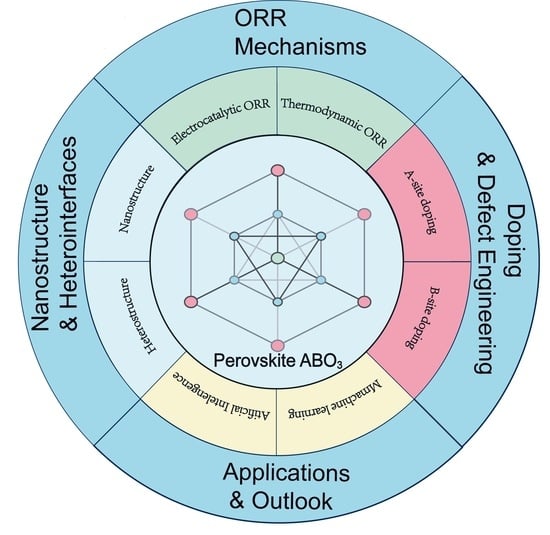
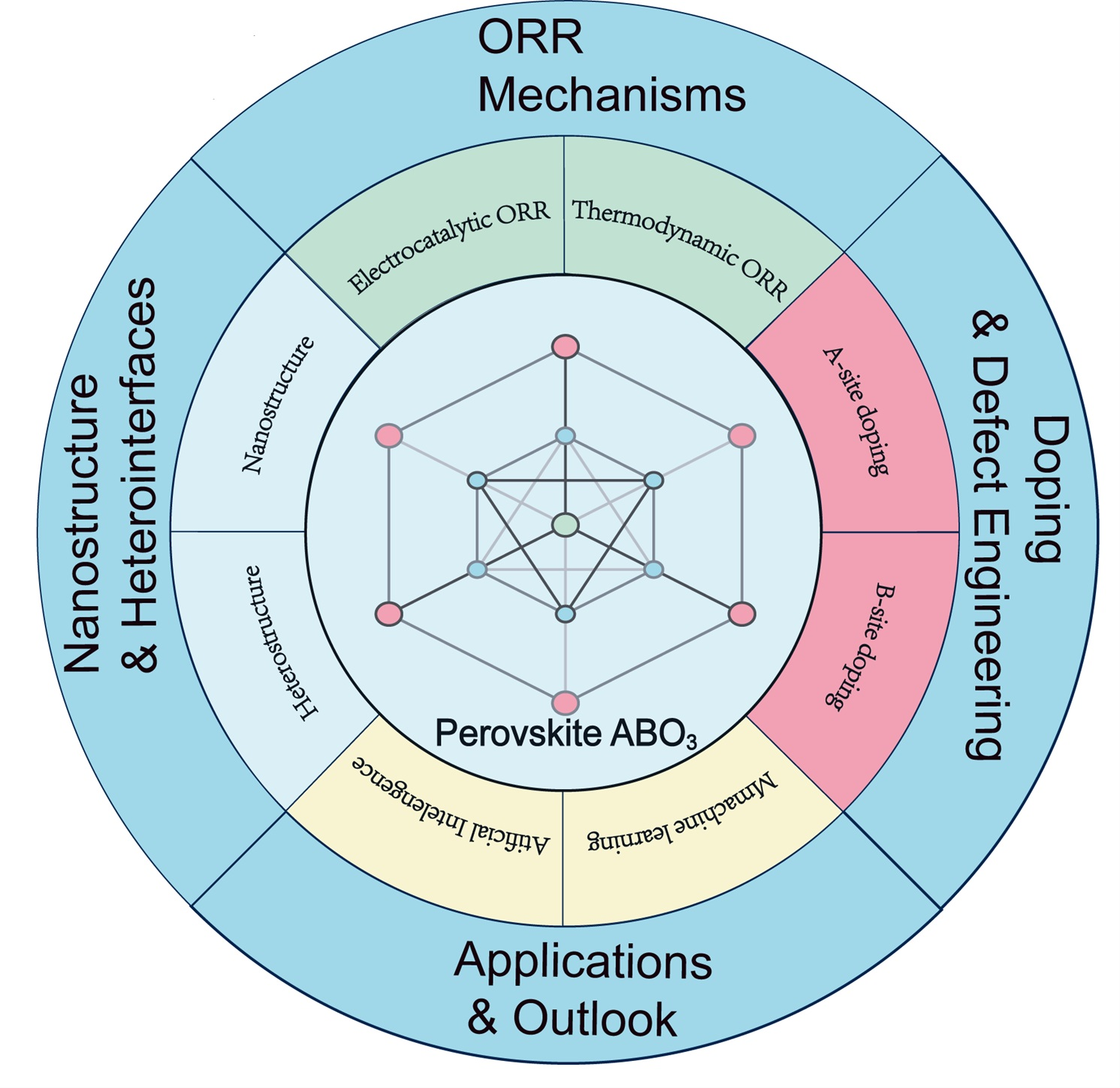
Graphical Abstract

1. Introduction

With the intensifying global energy shortage and escalating environmental degradation, the efficient utilization of renewable resources and the development of advanced energy technologies are crucial for sustainable economic development. Conventional energy-conversion processes based on the combustion of coal, oil, and natural gas are associated with severe environmental problems, including climate change, ozone depletion, acid rain, and significant loss of vegetation [1,2,3,4]. Driven by the urgent need for global decarbonization, sustainable energy-conversion and storage technologies, such as fuel cells and metal-air batteries, have emerged as promising alternatives due to their high theoretical efficiency and low carbon footprint [5,6]. Accordingly, electrochemical energy storage and conversion devices have been developed over the past few decades [7,8]. Among these, fuel cells and metal-air batteries are increasingly recognized as leading electrochemical energy conversion technologies owing to high thermodynamic efficiency, low environmental impact, and strong fuel flexibility [9,10].
The oxygen reduction reaction (ORR) is the key cathodic process because it directly determines the cathodic kinetics and overall cell performance [11,12]. As a result, the efficiency, power density, and long-term stability of fuel cells and metal-air batteries are highly dependent on the rate of ORR pathways [13,14]. However, ORR is intrinsically sluggish, largely because its kinetics are strongly governed by the surface electronic structure of the electrode and the associated ion-transport characteristics [15]. Therefore, the rational design and development of advanced cathode materials are crucial not only for accelerating ORR kinetics but also for alleviating the morphological and chemical instability of cathode materials, suppressing degradation, and ensuring long-term electrochemical durability [16,17,18]. In practice, the ORR activity is often limited by insufficient electronic/ionic conductivity, unfavorable adsorption of oxygenated intermediates, low active-site density, mass-transport resistance, and poor chemical or structural stability under operating conditions [19,20,21,22].
To enhance ORR kinetics through cost-effective catalyst design, recent research has increasingly focused on non-noble metal catalysts [23,24]. Among the available catalyst families, non-noble metal oxides have attracted particular attention due to earth abundance, compositional tunability, and structural robustness under operating conditions [24,25]. In particular, perovskite-type oxides, generally described by the formula ABO3, stand out as promising ORR catalysts because their flexible cation chemistry and oxygen-defect characteristics can provide tunable electronic structures and favorable oxygen-ion transport [15,26,27,28]. “Perovskite” originally referred to the natural mineral CaTiO3, discovered in 1839 by the German mineralogist Gustav Rose in the Ural region of Russia and named after the Russian mineralogist Lev A. Perovski [29]. In materials science, perovskites generally denote compounds with the crystal structure ABO3, in which oxygen ions form an octahedral framework, a transition-metal ion occupies the B site, and a large-radius alkali metal, alkaline-earth metal, or rare-earth metal ion occupies the A site [25]. Perovskite oxides have emerged as promising candidates for the ORR due to their intrinsically high catalytic activity and flexible, tailorable chemical compositions [30,31,32]. In addition, the A- and B-site cations can be precisely regulated through the selection and stoichiometric adjustment of metal precursors, making perovskites a versatile platform for developing a new generation of non-noble ORR catalysts [33,34].
Nevertheless, noble-metal catalysts, especially Pt and Pt–Co alloys, are still widely regarded as benchmark ORR catalysts. In acidic media, Pt-based catalysts efficiently promote the 4e− ORR pathway, exhibiting high onset potential (Eonset) and fast reaction kinetics, and thus dominate cathode catalysis in proton exchange membrane fuel cells [35]. However, their high cost, limited natural abundance, and susceptibility to dissolution and performance degradation during long-term operation severely hinder large-scale commercialization. Nevertheless, perovskite oxides are generally unstable in acidic media due to proton-induced dissolution of A-site cations and structural degradation of the ABO3 lattice, which limits their applicability in PEMFC environments. Other precious metals, such as Pd, have also been explored, but they generally do not match the overall catalytic performance of Pt in practical fuel-cell systems; for example, Pd shows substantially poorer hydrogen oxidation activity than Pt in both pure H2 and H2/CO environments [36]. These limitations have strongly motivated the development of non-noble metal catalysts, particularly perovskite oxides.
Beyond noble-metal catalysts, several classes of non-noble metal-based catalyst systems have been extensively investigated for the oxygen reduction reaction (ORR), including transition metal-nitrogen-carbon (M-N-C) catalysts, transition metal oxides (e.g., spinel Co3O4 and MnO2), as well as metal nitrides and sulfides. In addition to perovskite oxides, these materials offer reduced cost and improved resource availability, and some demonstrate promising activity in alkaline media. However, their performance is often limited by insufficient long-term stability, less tunable electronic structure, and relatively constrained catalytic descriptor optimization compared with structurally flexible oxide systems. SACs (e.g., Fe-N-C) generally show higher intrinsic ORR activity due to optimized single-site adsorption, whereas perovskites provide broader structural tunability rather than maximizing site-specific activity. To provide a meaningful evaluation of ORR performance, commercial Pt/C is introduced as the primary benchmark catalyst, with its half-wave potential (E1/2) serving as a reference standard for noble-metal-based ORR activity. In addition, Fe-N-C single-atom catalysts are included as representative non-precious metal benchmarks. Within this framework, the performance of perovskite oxides can be directly positioned relative to these established reference systems.
In this context, perovskite oxides (ABO3) emerge as a structurally and chemically versatile platform that enables systematic control over electronic structure, metal–oxygen covalency, and oxygen-vacancy chemistry, providing a unique pathway for rational ORR catalyst design. Although their apparent half-wave potentials are often lower than those of state-of-the-art SACs or noble-metal catalysts, their advantage lies in tunability, multi-site reactivity, and lattice oxygen participation, which are not accessible in conventional single-site systems. This perspective helps position perovskite oxides as a complementary catalyst class rather than a direct replacement for state-of-the-art noble-metal or single-atom catalysts.
This review first summarizes the elementary steps of low-temperature (defined as <100 °C in PEMFCs/AEMFCs) and high-temperature (SOFC, >500 °C) electrocatalytic ORR on perovskite oxides and then discusses how A-site/B-site doping, defect engineering, nanostructuring, and heterostructure construction regulate activity, selectivity, and durability. Emphasis is placed on the links among electronic structure, defect chemistry, interfacial processes, and device-relevant performance.

2. ORR Mechanism

2.1. Low-Temperature Electrocatalytic ORR

Initially, molecular oxygen ( O 2 ) is adsorbed onto the catalyst surface to form adsorbed oxygen species ( O 2 * ) in the ORR. The symbol “ * ” indicates that the species is adsorbed on the catalyst surface rather than freely existing in the solution or gas phase. Depending on the reaction medium, a four-electron or a two-electron route leads to different products. This step is followed by proton-coupled electron transfer (PCET), during which O 2 * reacts with protons and electrons to generate the critical O O H * intermediate. The electrolyte environment and intrinsic properties of the catalyst have a significant influence on product formation.
The reaction environment also plays a crucial role in governing the ORR mechanism, particularly the electrolyte pH, which significantly influences the reaction pathway and intermediate stabilization. In acidic media, ORR proceeds via a proton-coupled electron transfer (PCET) process, where protons directly participate in the formation and transformation of oxygenated intermediates. In contrast, in alkaline media, water serves as the primary proton donor, while OH− species contribute to charge compensation and intermediate stabilization, leading to a hydroxyl-mediated reaction environment. The pH dependence further affects the adsorption strength of oxygenated intermediates and the relative stability of OOH*, O*, and OH* species, thereby modulating reaction energetics and potentially altering the rate-determining step (RDS). In particular, alkaline conditions generally favor the formation of oxygen vacancies and enhance the applicability of perovskite oxides, which are prone to dissolution and structural degradation under strongly acidic environments. Therefore, electrolyte pH serves as a critical external parameter governing both ORR kinetics and catalyst stability.
To enable a rigorous and consistent evaluation of ORR activity, several key electrochemical parameters are employed in this review, each capturing a distinct aspect of catalytic performance. The half-wave potential is the most widely used descriptor of overall ORR activity, with a more positive value indicating a lower overpotential and higher intrinsic catalytic efficiency. The onset potential reflects the initial thermodynamic barrier for oxygen reduction, with more positive values indicating facilitated O2 activation and earlier reaction onset. The limiting current density (JL) corresponds to the diffusion-controlled regime and is primarily governed by mass transport; higher values indicate improved reactant transport and more effective utilization of the electrode surface.
From a kinetic perspective, the Tafel slope provides insight into intrinsic reaction kinetics and the possible rate-determining step (RDS). A lower Tafel slope generally indicates faster electron-transfer kinetics, reduced kinetic barriers, and more favorable adsorption/desorption behavior of oxygenated intermediates, whereas higher values suggest sluggish charge transfer and stronger kinetic limitations. Furthermore, variations in Tafel slope can be correlated with changes in the adsorption strength of key intermediates (e.g., OOH*, O*, OH*) and shifts in the reaction pathway. Collectively, these parameters establish a comprehensive framework for evaluating both thermodynamic driving forces and kinetic behavior of ORR catalysts across different material systems.
DFT calculations provide a quantitative framework for interpreting ORR pathways by evaluating the adsorption free energies of OOH*, O*, and OH*, the O-O bond cleavage barrier, and oxygen-vacancy formation energy. These descriptors help identify the rate-determining step and distinguish whether the reaction favors peroxide release through the 2e− pathway or complete oxygen reduction through the 4e− pathway. However, direct comparison of DFT energy maps across different perovskite systems remains challenging because surface termination, defect concentration, spin state, solvation treatment, and applied potential are often treated differently among studies.

2.1.1. Two-Electron Pathway

The two-electron ORR pathway has received increasing attention due to the production of H2O2. For clarity, this pathway can be described by several stepwise elementary reactions. In acidic media, O2 is first adsorbed on the catalyst surface to form O2* (Equation (1)). Then, O2* accepts one electron to generate the superoxide intermediate O2−*, as shown in Equation (2). After that, O2−* is protonated to form OOH* (Equation (3)). In the final step, OOH* further reacts with one proton and one electron to produce H2O2, while the active site is regenerated (Equation (4)). It should be noted that, although H2O2 is a desirable product in the 2e− ORR pathway, its oxidative character may also lead to potential catalyst degradation, which can influence long-term durability. Therefore, the overall two-electron ORR in acidic media can be expressed as Equation (5).
O 2 + ∗ ⇌ O 2 *
O 2 * + e − → O 2 − *
O 2 − ∗ + H + → O O H *
O O H * + H + + e − → H 2 O 2 + ∗
O 2 + 2 H + + 2 e − → H 2 O 2
In alkaline media, the reaction follows a similar stepwise route, but H2O serves as the proton donor. After adsorption of O2 to form O2* (Equation (6)), the adsorbed oxygen species accepts one electron to generate O2−* (Equation (7)). This intermediate then reacts with H2O to form OOH*, together with the formation of OH− (Equation (8)). A second electron-transfer step subsequently yields OOH− and simultaneously regenerates the active site (Equation (9)). Therefore, the overall two-electron ORR in alkaline media is described by Equation (10). Taken together, the two-electron pathway in both acidic and alkaline electrolytes proceeds through superoxide-related and hydroperoxyl-related intermediates, while the electrolyte environment determines whether the peroxide product is released as H2O2 or OOH−.
O 2 + ∗ ⇌ O 2 *
O 2 * + e − → O 2 − *
O 2 − * + H 2 O → O O H * + O H −
O O H * + e − → O O H − + ∗
O 2 + H 2 O + 2 e − → O O H − + O H −

2.1.2. Four-Electron Pathway

The four-electron ORR is the preferred pathway for efficient energy conversion because it directly reduces O2 to H2O. In acidic media, the reaction starts with the adsorption of O2 on the catalyst surface to form O2* (Equation (11)). The adsorbed O2* then undergoes the first PCET to form the key OOH* intermediate (Equation (12)). A subsequent PCET of OOH* is accompanied by O-O bond cleavage, producing adsorbed O* and one H2O molecule (Equation (13)). The resulting O* is subsequently reduced to OH* (Equation (14)), followed by a final PCET step to yield a second H2O molecule and regenerate the active site (Equation (15)). Accordingly, the overall four-electron ORR in acidic media can be expressed by Equation (16).
O 2 + ∗ ⇌ O 2 *
O 2 * + H + + e − → O O H *
O O H * + H + + e − → O * + H 2 O
O * + H + + e − → O H *
O H * + H + + e − → H 2 O + ∗
O 2 + 4 H + + 4 e − → 2 H 2 O
In alkaline media, the four-electron ORR follows a stepwise pathway analogous to that in acidic media, with H2O serving as the proton source. The reaction initiates with the adsorption of O2 on the catalyst surface, forming O2* (Equation (17)). The resulting O2* then undergoes the first PCET to form the key OOH* intermediate while generating OH− (Equation (18)). A subsequent electron-transfer step of OOH* is accompanied by O-O bond cleavage, producing adsorbed O* and another OH− (Equation (19)). The resulting O* is further reduced to OH* in the presence of H2O (Equation (20)), followed by a final electron-transfer step to release OH− and regenerate the active site (Equation (21)). Accordingly, the overall four-electron ORR in alkaline media can be expressed by Equation (22).
O 2 + ∗ ⇌ O 2 *
O 2 * + H 2 O + e − → O O H * + O H −
O O H * + e − → O * + O H −
O * + H 2 O + e − → O H * + O H −
O H * + e − → O H − + ∗
O 2 + 2 H 2 O + 4 e − → 4 O H −
From reaction products, the two-electron and four-electron ORR pathways generate different products. The two-electron route produces peroxide species, yielding H2O2 in acidic media and OOH− in alkaline media, which are valuable for decentralized and sustainable chemical synthesis. By contrast, the four-electron route enables complete oxygen reduction, generating H2O in acidic media or OH− in alkaline media, and is therefore generally preferred in energy-conversion devices such as fuel cells. In this sense, the competition between the two pathways reflects the balance between product selectivity and energy-conversion efficiency, highlighting the importance of catalyst and electrolyte design in regulating ORR product. The reaction medium also strongly affects pathway preference. Acidic media usually impose stricter stability requirements and thus favor noble-metal catalysts, especially Pt-based systems. The alkaline media permit the application of a wider range of catalysts, including non-noble metals and transition-metal oxides. Therefore, a clear understanding of ORR mechanisms, pathway selectivity, and electrolyte effects is essential for rational catalyst design and application-oriented performance optimization.

2.2. High-Temperature ORR in Mixed-Conducting Cathodes

2.2.1. Oxygen Adsorption

Thermocatalysis has attracted attention not only for its central role in solid oxide fuel cells and electrolysis cells, but also as a model reaction for understanding oxygen activation on oxide surfaces under gas–solid conditions. Moreover, this process is commonly described as a sequence of elementary steps involving O2 adsorption, surface charge transfer, and O=O bond dissociation, followed by oxygen incorporation into lattice vacancy sites and subsequent bulk transport within the oxide.
Oxygen adsorption initiates high-temperature ORR by converting gas-phase O2 into a surface precursor that can be further reduced and incorporated. This step is written as Equation (23).
O 2 ( g ) + ∗ ⇌ O 2 *
The “*” denotes an available surface site, and O2* is molecularly adsorbed oxygen. The adsorption strength controls O2* coverage and thus the maximum flux for subsequent steps. Weak adsorption yields insufficient surface coverage, whereas overly strong adsorption can over-stabilize O2* and block active sites. Therefore, the density and nature of adsorption sites (steps, defects, undercoordinated cations, vacancy-adjacent sites) critically influence ORR kinetics.

2.2.2. Surface Charge Transfer

After adsorption, O2* is activated by interfacial electron transfer to form reduced oxygen intermediates. This process is commonly represented as stepwise single-electron transfer: Equations (24) and (25).
O 2 * + e − ⇌ O 2 − *
O 2 − * + e − ⇌ O 2 2 − *
Electron uptake weakens the O-O bond, facilitating subsequent dissociation and vacancy incorporation. The ease of charge transfer depends on electron supply (electronic conductivity and charge-transfer kinetics) and near-surface electronic structure, including transition-metal redox flexibility, metal–oxygen covalency, and defect-related electronic states.

2.2.3. O-O Bond Dissociation

Activated oxygen can then dissociate to generate atomic oxygen intermediates that are more amenable to lattice incorporation. In an associative pathway, dissociation is often expressed as Equation (26).
O 2 2 − ∗ + ∗ ⇌ 2   O − *
O − * denotes reduced, adsorbed atomic oxygen. Alternatively, a dissociative limit may operate on defect-rich surfaces, described by Equations (27) and (28).
O 2 ( g ) + 2 ∗ ⇌ 2   O *
O * + e − ⇌ O − *
In practice, the dominant route is governed by temperature, pO2, surface termination, and defect density, which collectively tune adsorption and the O-O cleavage barrier.

2.2.4. Oxygen Incorporation into Lattice Vacancies

Crucially, the reactive atomic oxygen species (O−) must be incorporated into the oxide lattice by filling oxygen-vacancy sites, a step often referred to as surface exchange. This incorporation process can be described as Equation (29):
O − * + V O · · + e ’ → O O x + *
The V O · · is an oxygen vacancy, and OOx denotes lattice oxygen on a regular oxygen site. Physically, it converts an adsorbed oxygen intermediate into a lattice-bound oxide ion, simultaneously consuming a vacancy and regenerating a free surface site. Because it directly couples surface chemistry to bulk defect populations, this step is frequently rate-sensitive and strongly affected by vacancy availability, surface segregation, and the local redox capability of near-surface cations.

2.2.5. Bulk Transport Within the Oxide

Following incorporation, the transport of oxygen through the cathode/electrolyte framework occurs via vacancy-mediated diffusion, a process essential for sustaining continuous ORR. This bulk transport can be schematically represented as a site-exchange process between lattice oxygen and a neighboring vacancy, described as Equation (30):
O O x ( i ) + V O · · ( j ) ⇌ V O · · ( i ) + O O x ( j )
Here, “i” and “j” denote adjacent lattice sites. In mixed ionic–electronic conductors, such transport enables ORR to extend beyond the triple-phase boundary by allowing oxygen incorporated on gas-exposed surfaces to migrate internally toward the electrolyte interface. Consequently, high-temperature ORR kinetics are inherently governed by the coupling between surface exchange and bulk diffusion, commonly quantified by the surface exchange coefficient (k*) and the chemical diffusion coefficient (D*), respectively.

3. Strategies for Improving Perovskite ORR Catalysts

Perovskite oxides offer a highly tunable crystal framework, enabling optimization of oxygen electrocatalysis through synergistic A-/B-site cation modulation, defect engineering, morphology control, and heterostructure. These strategies collectively regulate the electronic structure, oxygen-vacancy chemistry, interfacial charge transfer, and reaction kinetics of perovskite oxides, thereby influencing their ORR activity, selectivity, and durability. In perovskite oxides with the general formula ABO3, the A-site and B-site cations play distinct roles in lattice stability, electronic structure, and catalytic performance [37,38,39]. Generally, A-site cations dictate lattice geometry and defect chemistry, whereas B-site cations control redox activity and intrinsic catalysis. Both sites, however, collectively shape the oxygen electrocatalytic properties of perovskite oxides [40,41,42].
Despite rapid progress in perovskite-based oxygen electrocatalysis, a systematic summary that integrates the major optimization strategies for perovskite ORR catalysts in composition, defects, and interface/structure engineering remains relatively limited in the literature. Accordingly, this review aims to provide an integrated perspective on how A-site doping, B-site doping, defect engineering, heterostructure construction, and graphene-based hybridization influence ORR activity in perovskite oxides. By organizing representative examples along these engineering dimensions, we highlight the underlying structure property relationships and offer practical guidelines for rational catalyst design.

3.1. Doping Strategies

3.1.1. A-Site Doping Strategy

A-site doping is a widely applied strategy for customizing the physicochemical properties of perovskite oxides. The A-site cations, typically alkaline or rare earth metal ions (e.g., La3+, Sr2+, Ba2+, Ca2+), are located at the corners of the cubic unit cell and are coordinated with twelve oxygen atoms [43,44,45,46,47]. The primary role is to stabilize the perovskite lattice, regulate the tolerance factor, and accommodate lattice distortions. Through aliovalent substitution, A-site cations can also effectively adjust the charge balance, oxygen-vacancy concentration, and lattice strain, thereby indirectly tuning ionic conductivity and catalytic behavior [48,49].
(i) 
Low-temperature electrocatalytic ORR
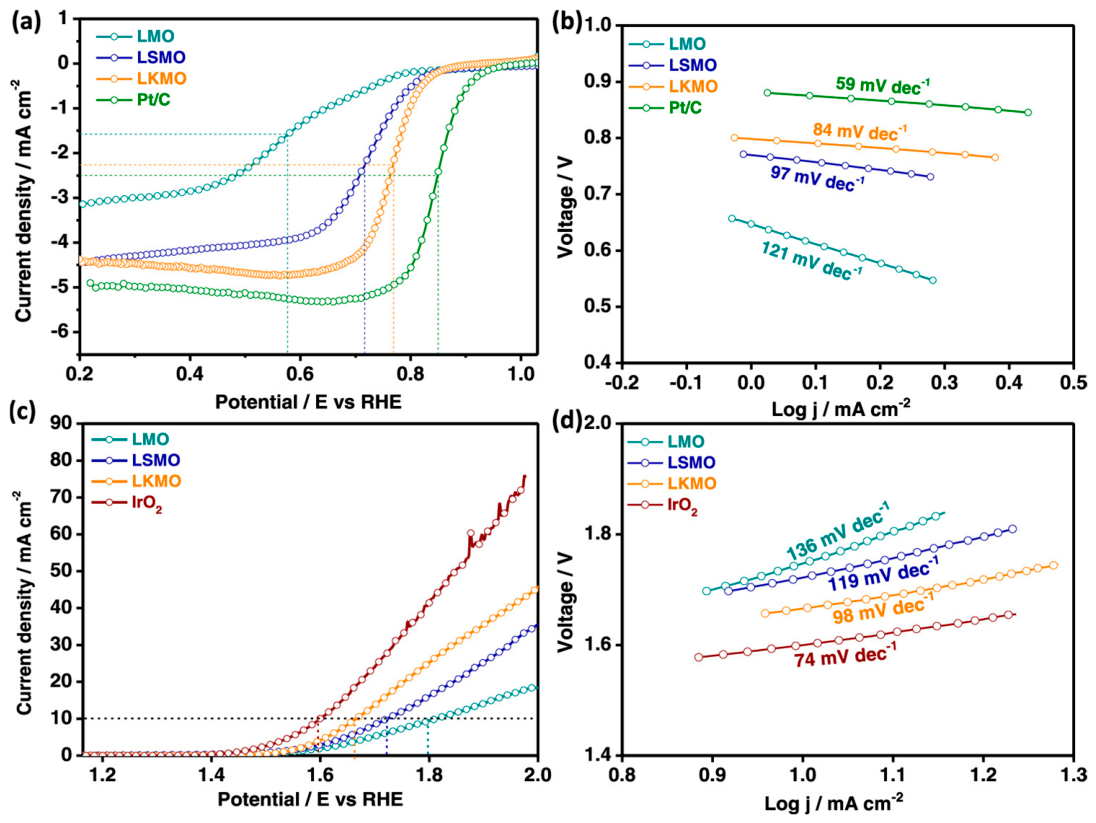
Recent studies have expanded A-site engineering beyond conventional divalent substitution, demonstrating its applicability across both Mn- and Co-based perovskites. Vishal Kotha and co-workers reported a monovalent A-site substitution strategy, demonstrated by synthesizing potassium-substituted LaMnO3 (LKMO) [50]. The bifunctional ORR/OER electrocatalytic performance of LMO, LSMO, and LKMO is compared in Figure 1. In O2-saturated 0.1 M KOH, LKMO delivered an onset potential of 0.86 V and a half-wave potential of 0.78 V vs. RHE at 1600 rpm. It exhibited superior ORR performance relative to LMO (0.75/0.58 V) and Sr-doped LSMO (0.83/0.72 V). This improvement was also reflected in a smaller Tafel slope of 84 mV dec−1, compared with 97 mV dec−1 for LSMO and 121 mV dec−1 for LMO. This decrease in Tafel slope indicates enhanced intrinsic ORR kinetics with more efficient charge-transfer processes. Compared with the higher Tafel slopes observed for undoped LMO (121 mV dec−1) and Sr-doped LSMO (97 mV dec−1), the K-substituted LKMO exhibits significantly improved kinetic behavior. In addition, this trend suggests a possible shift or facilitation of the rate-determining step (RDS), which is commonly associated with the formation of OOH* intermediates in the ORR pathway. The authors attributed the improved ORR activity to K+ substitution-induced structural/electronic modulation. They further suggested that monovalent A-site doping alleviates AO-terminated surface limitations with more Mn-O site exposure. Similar effects have also been explored in cobalt-based perovskites. Zhou et al. prepared a series of A-site Ba-substituted perovskites La1-xBaxCoO3 (x = 0–0.20) by self-propagating high-temperature synthesis and assessed ORR activity in alkaline media. The optimized La0.85Ba0.15CoO3 delivered an ORR onset potential (0.1 mA cm−2) of 0.829 V (vs. RHE) in 0.1 M KOH [51]. When used as the air cathode in a zinc-air battery, it achieved a peak power density of 116.2 mW cm−2 under a ~0.98 V charge–discharge voltage gap after 1200 cycles (>200 h), which was attributed to the increased specific surface area and higher oxygen-vacancy concentration induced by Ba substitution.
In manganite perovskites, Sr substitution generally enhances ORR activity in a strongly composition-dependent manner, with the best performance typically observed at intermediate doping levels. Nayak et al. reported that partial A-site substitution with Sr2+ can enhance the ORR activity of Sm1−xSrxMnO3 by modifying lattice defects and transition-metal electronic states [52]. In 0.1 M KOH, Sm0.8Sr0.2MnO3 delivered an onset potential of 0.88 V vs. RHE. At 1600 rpm, Sm0.8Sr0.2MnO3 delivered a kinetic current density of 0.79 mA cm−2 at 0.83 V vs. RHE and a Tafel slope of 103.26 mV dec−1. RRDE analysis further showed that the electron-transfer number and H2O2 yield are potential-dependent at 0.45 V vs. RHE; Sm0.8Sr0.2MnO3 exhibited n = 3.77 and a H2O2 yield of 11.4%. Doped Sr increased ORR activity mainly due to higher oxygen-vacancy concentration and stronger Mn-O covalency. Further Sr incorporation may cause lattice distortion and excessive defects, thereby weakening the promoting effect. Consistent trends were further observed in Pr-based perovskites. Nayak et al. identified Pr0.3Sr0.7MnO3 (PSM-0.7) as the most efficient composition within the Pr1−xSrxMnO3 series [53]. In O2-saturated 0.1 M KOH at 1600 rpm, PSM-0.7 delivered an onset potential of ca. 0.94 V and a half-wave potential of 0.77 V vs. RHE and a diffusion-limited current density of −6.95 mA cm−2. The corresponding Tafel slope was 174.34 mV dec−1, suggesting a distinct kinetic behavior despite the favorable onset potential, half-wave potential, and low peroxide yield. Koutecky–Levich analysis showed an electron-transfer number n = 3.91, and the peroxide yield was low (4.06% HO2−). The good linearity and near-parallel behavior of the K-L plots across potentials further support first-order kinetics with respect to dissolved O2 and well-defined reaction-diffusion control for PSM−0.7.
Furthermore, RRDE-based studies revealed that moderate A-site substitution promotes a near-four-electron pathway and improves durability by optimizing Mn-O interactions and defect chemistry. Kumar et al. evaluated the ORR activity of CaLaScRuO6+δ (CLSR) in 1 M KOH, which exhibited an onset potential of 0.87 V vs. RHE and a half-wave potential of 0.75 V vs. RHE. RDE measurements further showed a diffusion-limited current density of −3.4 mA cm−2 at 0.015 V (1000 rpm), higher than that of 20 wt% Pt/C [54]. RRDE analysis also revealed a potential-dependent peroxide pathway: the electron-transfer number increased to ~3.6 at more cathodic potentials. RRDE analysis revealed that the electron-transfer number increased to ~3.6 at more cathodic potentials, while the H2O2 yield decreased to ~11%. In addition, the linear Koutecky–Levich plots supported an n value close to 4 at 0.05 V vs. RHE, and the Tafel slope was 84 mV dec−1. These results suggest that CLSR can suppress peroxide release and promote a highly selective near-four-electron ORR pathway under cathodic conditions in alkaline media. A more composition-dependent example was subsequently provided by Wang et al., who showed that the beneficial effect of A-site substitution could be maximized at an optimal Sr content [55]. Wang et al. investigated the A-site Sr substitution La1-xSrxMnO3+δ (x = 0–0.4) in 0.1 M KOH by using an RRDE configuration. Within this series, La0.8Sr0.2MnO3+δ exhibited the best ORR performance, delivering the lowest overpotential (0.398 V at −2 mA cm−2), the most positive onset potential (1.135 V at −0.1 mA c−−2) and an estimated half-wave potential of 0.76 V vs. RHE, showing the best performance among Sr-substituted samples and a higher onset potential than Pt/C. The RRDE data further showed that pristine LaMnO3+δ produced >10% HO2− at 0.4 V and yielded the lowest electron-transfer number (n = 3.78). Notably, the HO2− yield and n values of La0.8Sr0.2MnO3+δ were very close to those of Pt/C, which suggests a strong preference for the desirable 4e− ORR pathway. Structurally, the enhanced activity was ascribed to the shortest Mn-O bond length in the series. This shortened Mn-O bond was associated with Sr-induced modulation of the Mn valence state and cation-vacancy concentration, leading to stronger Mn-O covalency and more favorable oxygen adsorption/activation. In terms of durability, La0.8Sr0.2MnO3+δ remained comparatively stable over 500 cyclic voltammetry (CV) cycles conducted within the reported potential window of approximately 0.33–1.23 V vs. RHE, with the overpotential at −2 mA cm−2 increasing by only 5.5%. This potential cycling test serves as an accelerated durability assessment, reflecting the resistance of the catalyst to activity loss under repeated electrochemical polarization. This work shows that moderate A-site Sr substitution optimizes the local electronic structure and Mn-O interaction at the B site, thereby enhancing both ORR activity and 4e− selectivity.
(ii) 
High-temperature ORR
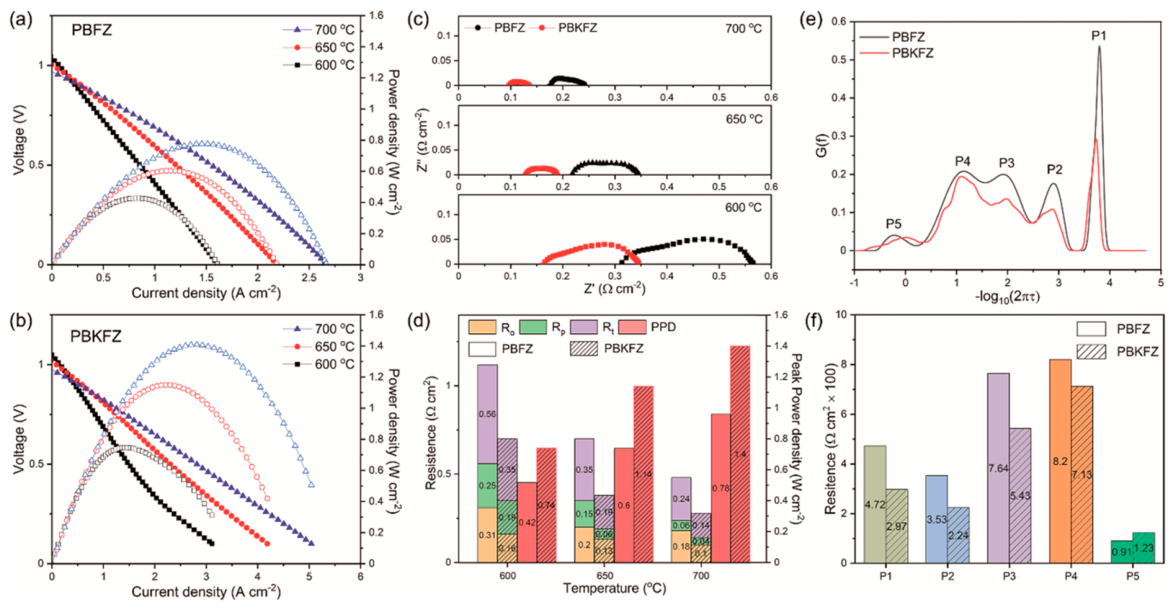
Beyond electrochemical ORR, A-site doping has also been extensively explored in thermochemical ORR, where it can tune oxygen-vacancy chemistry and oxygen reduction kinetics at elevated temperatures. Recent studies have shown that high-temperature ORR can be effectively promoted through cation doping, which optimizes defect chemistry, lowers cathodic resistance, and accelerates oxygen surface exchange and incorporation. Du et al. reported a Ca-doped Y1−xCaxBaCo2O5+δ cathode, with efficient performance at high temperature [56]. In their study, with increasing Ca content, the area-specific resistance (ASR) decreased significantly, reaching 0.068 Ω cm2 at 700 °C for Y0.8Ca0.2BaCo2O5+δ, while the optimized sample delivered 0.010 Ω cm2 at 850 °C. The reduced activation energy and the oxygen partial-pressure dependence (m ≈ 0.5) indicate that Ca doping accelerates high-temperature ORR kinetics mainly by facilitating molecular oxygen dissociation through enhanced O 2p-Co 3d hybridization. This example also highlights the importance of evaluating cathode performance under realistic SOFC-related variables, including temperature, oxygen partial pressure, and long-term phase stability. The pO2-dependent analysis links the improved ASR directly to the oxygen-dissociation step, while the reported high-temperature stability and electrolyte compatibility indicate that practical cathode evaluation should consider both ORR kinetics and operational durability. Moreover, Liu et al. investigated PrBaFe1.9Zn0.1O5+δ-based cathodes, with A-site K doping improving high-temperature ORR activity [57]. As shown in Figure 2, the optimized PrBa0.9K0.1Fe1.9Zn0.1O5+δ achieved peak power densities of 0.74, 1.14, and 1.40 W cm−2 at 600, 650, and 700 °C, respectively, together with reduced polarization resistances of 0.19, 0.06, and 0.04 Ω cm2. The distribution of relaxation times (DRT) profiles further show that K substitution reduces the relaxation resistance associated with surface oxygen exchange and interfacial charge transfer, supporting the improved ORR kinetics reflected by the lower Rp and higher power density.
In the work of Fu et al., Ca-doped Pr1−xCaxBaFe2O5+δ (PCBF, x = 0–0.3) nanofibers provided a representative example of defect-regulated high-temperature ORR enhancement [58]. The optimized PCBF03 sample showed a reduced Rp of 0.048 Ω cm2 at 750 °C, compared with 0.103 Ω cm2 for PCBF00, while single-cell peak power densities reached 407.89, 646.41, 889.99, and 1114.85 mW cm−2 at 600–750 °C. Importantly, DRT and pO2-dependent EIS analyses indicated that surface oxygen dissociation was the dominant rate-limiting step, and the improved performance was attributed to Ca-induced oxygen vacancies. In addition, the PCBF03 cell showed lower Rp values across the entire temperature range and excellent operational stability, with only 0.018% voltage decay after 100 h at 650 °C. Similarly, a comparable promotion effect was also observed in Ca-doped layered perovskite nanofibers. Khan et al. reported that the optimized CexSm0.5-xSr0.5CoO3±δ (x = 0.0025) cathode showed significantly improved high-temperature ORR activity, delivering 0.62, 0.90, and 1.20 W c−−2 at 973, 1023, and 1073 K, respectively, versus 0.36, 0.53, and 0.77 W cm−2 for Sm0.5Sr0.5CoO3±δ, with lower Rs/Rp values of 0.465/0.178, 0.331/0.108, and 0.253/0.073 Ω cm2 [59]. The cell also exhibited only 2.4% voltage decay after 50 h at 973 K, confirming that Ce co-doping effectively promotes cathodic ORR kinetics while maintaining acceptable stability.
High-entropy perovskites are promising cathodes for high-temperature ORR. Zhang et al. reported a high-entropy layered perovskite Pr0.4La0.4Ba0.4Sr0.4Ca0.4Fe2O5+δ (PLBSCF), derived from PrBaFe2O5+δ. Benefiting from increased oxygen-vacancy concentration and improved electronic conductivity, PLBSCF exhibited a low polarization resistance of 0.052 Ω cm2 and delivered a peak power density of 0.853 W cm−2 at 750 °C, while maintaining stable operation for 100 h [60]. DRT analysis further indicated that the accelerated charge transfer enhanced ORR activity and oxygen dissociation processes.

3.1.2. B-Site Doping Strategy

B-site doping offers greater flexibility in directly engineering the redox-active centers and adsorption energetics of oxygen intermediates, although sometimes at the expense of structural or thermal stability [24,61,62]. Typical B-site elements include 3d transition metals such as Fe, Co, Ni, Mn, and Cu, and occasionally 4d/5d metals (e.g., Mo or Ru), which are chosen for their variable oxidation states and ability to regulate the metal–oxygen interaction [28,63,64,65,66,67]. By selectively substituting or co-doping these B-site cations, the electronic structure, oxygen-vacancy population, and binding strengths of key ORR intermediates can be modulated, thereby directly impacting ORR kinetics and overall electrocatalytic performance [68,69].
(i) 
Low-temperature electrocatalytic ORR
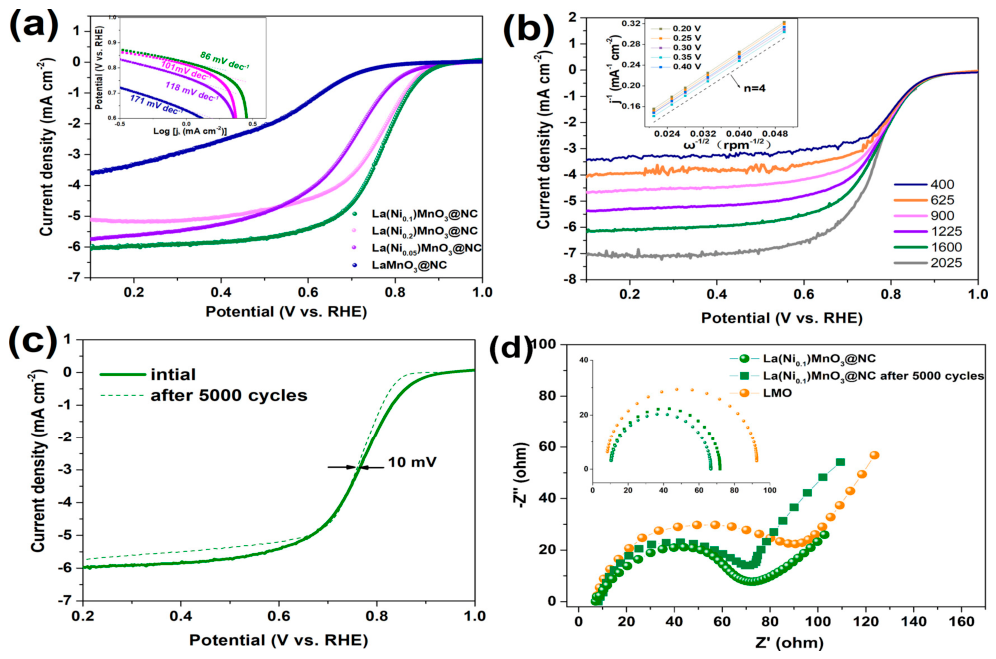
B-site doping is an effective strategy to enhance 4e− ORR activity by directly tuning the electronic structure and adsorption behavior of the catalytic centers. In a recent study, Shi et al. developed a B-site-regulated perovskite, La(Ni0.1)MnO3 decorated with N-doped carbon La(Ni0.1)MnO3@NC, to enhance electrocatalysis [70]. As shown in Figure 3, in O2-saturated 0.1 M KOH, La(Ni0.1)MnO3@NC delivered strong ORR activity with Eonset = 0.91 V, E1/2 = 0.77 V and a relatively small Tafel slope (86 mV dec-1). Koutecky–Levich analysis yielded an electron-transfer number n ≈ 4, indicating that ORR proceeds predominantly via the desirable 4e− pathway. Durability assessed by accelerated potential cycling within the reported potential range of 0.6–1.0 V vs. RHE at 100 mV s−1 in 0.1 M KOH showed only a minor E1/2 loss (~10 mV after 5000 cycles), and EIS revealed a reduced charge-transfer resistance versus pristine LaMnO3, consistent with faster interfacial kinetics.
In addition, B-site engineering was reported by Nandikes et al., who prepared LaFeB’O6 (B’ = Cr, Zn, Co) via a one-pot hydrothermal route and found that Cr substitution delivered the highest ORR enhancement in both 0.1 M KOH and 0.5 M H2SO4 [71]. The Cr-doped catalyst exhibited onset potentials of 0.80–0.81 V and half-wave potentials of 0.68 V (alkaline) and 0.63 V (acidic), comparable to 20 wt% Pt/C, together with an electron-transfer number n ≈ 3.6. This cross-pH activity suggests that suitable B-site substitution can simultaneously tune Fe-centered electronic structure and defect chemistry, highlighting its potential as a noble-metal-free ORR catalyst. However, further stability evaluation under acidic conditions is still needed to assess its practical applicability in acid-based fuel-cell environments. Furthermore, Parwaiz et al. investigated Ni substitution at the B-site of LaCo1-xNixO3 (x = 0–0.2) perovskites to address methanol crossover in direct methanol fuel-cell cathodes [72]. The optimized LaCo0.8Ni0.2O3 delivered onset potential (0.80 V) and half-wave potential (0.64 V) vs. RHE, respectively, in O2-saturated 1 M KOH at 1600 rpm. Koutecky–Levich analysis further gave an electron-transfer number of 3.24 and a kinetic current density of 2.69 mA cm−2 at 0.3 V, indicating a near four-electron ORR pathway. The authors further suggested that Ni substitution at the Co site effectively enhances both the ORR activity and methanol tolerance of LaCo1−xNixO3, with LaCo0.8Ni0.2O3 exhibiting the best overall performance and strong potential as a Pt-free cathode electrocatalyst for direct methanol fuel cells. Wang et al. found that LaCoO3 was the most active catalyst in the LaCoxFe1-xO3 series (x = 0, 0.3, 0.6, 1), showing the most positive onset and half-wave potentials (0.75 and 0.64 V vs. RHE), the lowest Tafel slope (59 mV de−−1), and the highest electron-transfer numbers (3.2 at 0.54 V and 3.7 at 0.34 V) [73]. With increasing Fe content, both the onset/half-wave potentials and n values decreased, reaching 0.73/0.58 V and 2.4–2.6 for LaFeO3, indicating weakened ORR activity and a shift toward the 2e− pathway.
Synergistic co-doping at both A- and B-sites can further integrate defect tuning with active-center modulation for metal-air batteries. Huang et al. synthesized La0.9Ce0.1Co0.1Mn0.9O3, where B-site Co substitution was introduced alongside A-site Ce doping [74]. This catalyst exhibited a more positive ORR onset potential (0.89 V), half-wave potential (0.71 V), and a higher limiting current density than undoped LaMnO3, increasing from about 5.6 to 7.1 mA cm−2. Koutecky–Levich analysis showed that the catalyst maintained an electron-transfer number close to 4 with a low peroxide yield (<0.3%). These results suggest that co-doping at both lattice sites can regulate surface electronic states and defect chemistry. Table 1 summarizes representative A-site, B-site, and dual-site doping strategies and their corresponding ORR performance.
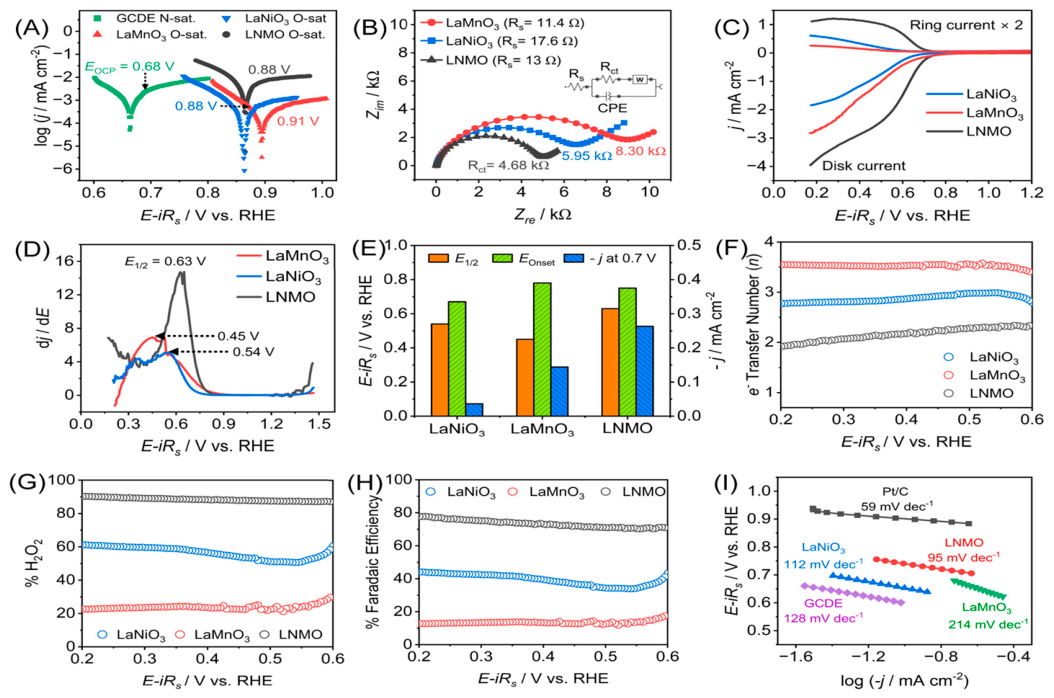
Compared with the 4e− ORR, the design principle of A- and B-site doping in the 2e− pathway is fundamentally different [76]. While 4e− ORR generally requires stronger oxygen adsorption and facilitated O-O bond cleavage to enable complete reduction, 2e− ORR instead demands moderate oxygen activation that stabilizes the *OOH intermediate while suppressing its further dissociation and reduction [77,78]. Accordingly, A-site doping primarily influences the oxide indirectly—through lattice distortion, charge compensation, and defect chemistry—whereas B-site doping more directly tailors the intrinsic electronic structure and adsorption behavior of the catalytic centers, thereby governing the selectivity between H2O2 production and deep reduction [79]. Hossain et al. reported that La2NiMnO6 (LNMO) exhibited superior 2e− ORR performance to LaNiO3 and LaMnO3. As shown in Figure 4, it delivered an onset potential of 0.63 V vs. RHE and the highest current density at 0.7 V [80]. LNMO showed an electron-transfer number (1.9–2.0), compared with LaMnO3 (2.1–2.3) and LaNiO3 (3.3–3.8), indicating the strongest preference for the 2e− ORR pathway, while the H2O2 selectivity reached ~80–90% with a Faradaic efficiency of ~70–80%. In addition, LNMO showed a lower Tafel slope of 95 mV dec−1, indicating faster ORR kinetics. In another study, Whittingham et al. reported that La1.2Sr0.8Ni1−yCoyO4 showed composition-dependent 2e− ORR activity, with the Ni-containing compositions favoring H2O2 formation [81]. The linear K-L plots were obtained at 0.50 and 0.56 V vs. RHE, and the kinetic Tafel slopes of the Ni-containing series remained at ~70–77 mV dec−1, whereas the Ni-free La1.2Sr0.8CoO4 exhibited a lower value of 60.3 mV dec−1. In addition, increasing c/a lowered the Tafel slope from ~76.5 to 70.7 mV dec−1 and changed the symmetry coefficient from ~0.78 to 0.85, confirming that B-site composition strongly regulates ORR kinetics and pathway selection. Recently, Cho et al. reported that B-site engineering in LaSrBO4 (B = Ni, Mn, Fe, Co) efficiently regulates 2e− ORR performance [82]. Among the series, LaSrNiO4 (LSN) showed the best activity and selectivity in O2-saturated 0.1 M KOH, delivering an onset potential of 0.673 V vs. RHE, a disk current density of −1.55 mA cm2 at 0.5 V, and a H2O2 selectivity of 87 ± 6%. The electron-transfer number was 2.0–2.3, indicating a dominant 2e− pathway, and the catalyst remained stable for 50 h. Mechanistic analysis indicated that the high performance of LSN originated primarily from the intrinsic electronic structure of the Ni B-site, rather than from oxygen-vacancy effects. Han et al. reported that molybdenum substitution in Pr2Ni1-xMoxO4+δ promoted selective hydrogen peroxide production [83]. Compared with pristine Pr2NiO4+δ, Pr2Ni0.8Mo0.2O4+δ showed a lower electron-transfer number of about 2.6 and a higher hydrogen peroxide selectivity of about 75–78%, although the Tafel slope increased from 67 to 95 mV dec−1, indicating reduced overall oxygen reduction activity.
(ii) 
High-temperature ORR
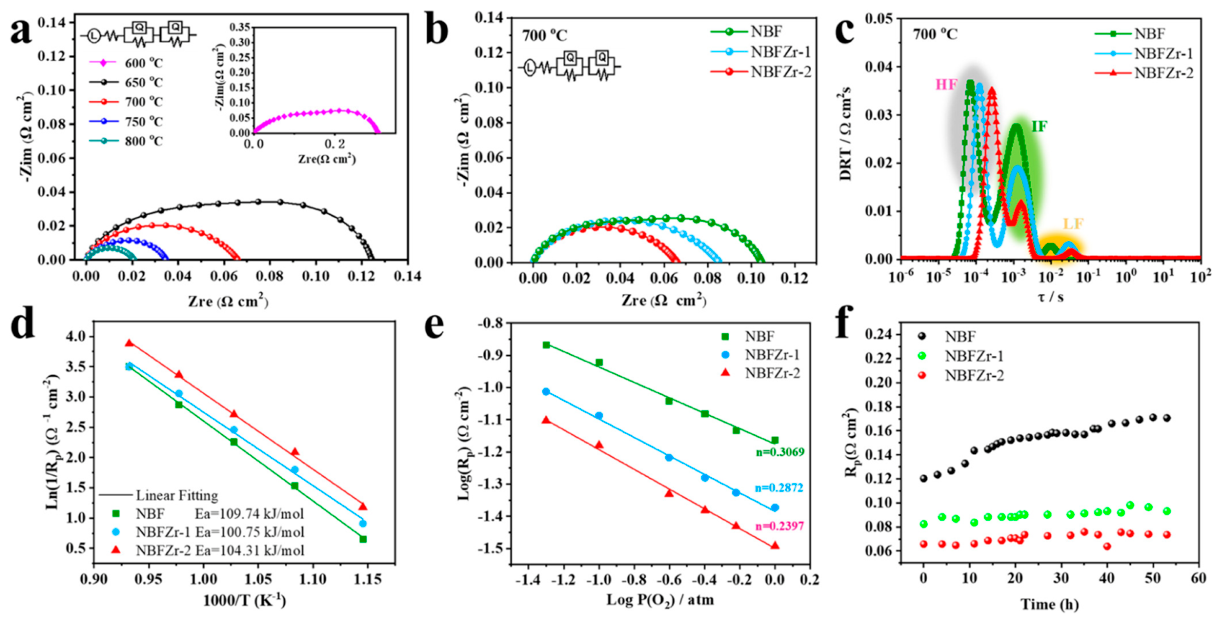
Extended to high-temperature ORR, where B-site doping likewise serves as a key handle for tuning oxygen adsorption, defect chemistry, and oxygen-transport kinetics [84,85,86]. For example, Sun et al. investigated B-site Zr substitution in the Fe-based double perovskite NdBaFe2O6-δ (NBF) to boost high-temperature ORR kinetics for SOFC cathodes [67]. Zr doping at the Fe site (e.g., NdBaFe1.9Zr0.1O6-δ, denoted as NBFZr-2 in their work) increased the Fe3+ fraction (from 59.02% to 62.36% by Fe 2p XPS) and promoted oxygen-vacancy formation, which was further supported by a stronger electron paramagnetic resonance (EPR) signal. Although Zr incorporation lowered electronic conductivity (222.59 to 113.03 S cm−1 at 500 °C), it substantially enhanced oxygen transport kinetics, yielding higher kchem (1.92 × 10⁻⁴ vs. 2.64 × 10⁻⁵ cm s−1 at 600 °C) and Dchem (3.94 × 10⁻⁵ vs. 2.88 × 10⁻⁶ cm2 s−1) than pristine NBF. Correspondingly, the polarization resistance of symmetric cells decreased from 0.104 to 0.066 Ω cm2 at 700 °C, and DRT analysis indicated reduced resistances associated with oxygen transport and surface exchange. Density functional theory (DFT) calculations further showed an upward shift in the O p-band center (−5.48 to -5.28 eV relative to EF) upon Zr substitution, consistent with a more labile oxygen sublattice and facilitated ORR. This DFT-derived O p-band shift provides a quantitative electronic-structure descriptor for the Zr-doping effect, indicating weakened lattice oxygen binding and a more labile oxygen sublattice that facilitates oxygen-vacancy migration and surface exchange. These XPS and EPR results provide direct spectroscopic evidence that Zr substitution modifies the Fe oxidation state and promotes oxygen-vacancy formation, thereby supporting enhanced oxygen transport and ORR kinetics. The corresponding electrochemical kinetic evidence is presented in Figure 5.
Similar multi-dopant strategies have been applied to cobaltite cathodes. Gu et al. developed a Ti4+/Ta5+ co-doped SrCo0.8Ti0.1Ta0.1O3-δ (SCTT) perovskite cathode, achieving high electrical conductivities of 65-142 S·cm−1 and appropriate oxygen-vacancy concentrations (approximately 0.23–0.27) across 400–650 °C, concomitant with robust bulk oxygen diffusion capability [87]. Ti4+ and Ta5+ were proposed to play complementary roles in the co-doped cobaltite cathode. Ti helps stabilize the Co-based perovskite lattice, while Ta promotes charge compensation and oxygen-vacancy regulation. This synergistic modulation of Co-O bond lengths and local coordination enhances electron mobility and oxygen-vacancy migration, thereby accelerating both surface oxygen exchange and bulk diffusion and reducing cathodic polarization losses. Beshiwork et al. prepared an equimolar Nb/Ta co-doped perovskite SrFe0.8Nb0.1Ta0.1O3-δ (SFNT) as a high-performance cathode for intermediate-temperature SOFCs [88]. The simultaneous introduction of Nb5+ and Ta5+ is necessary to generate local coordination asymmetry around Fe sites and construct a balanced oxygen-vacancy network, which cannot be fully achieved by single dopants alone. DFT calculations suggested that Ta5+/Nb5+ co-doping induces coordination asymmetry around surface Fe ions, forming Fe-O-Ta/Nb asymmetric bonds and a balanced oxygen-vacancy network, which was supported by ESR and XPS analyses. The combined ESR and XPS evidence supports the formation of an optimized oxygen-vacancy environment and modified Fe-centered electronic structure, thereby rationalizing the reduced polarization resistance and improved cathodic ORR activity. Consequently, SFNT exhibited a markedly reduced polarization resistance of 0.147 Ω·cm2 at 650 °C and a high peak power density of 1.3 W·cm−2 in IT-SOFC tests, consistent with facilitated oxygen adsorption/activation and enhanced oxide-ion transport.
High-valent dopants can also couple improved kinetics with enhanced durability in Fe-based cathodes. Li et al. reported that Mo-doped SrFeO3-δ (SrFe0.93Mo0.07O3-δ) exhibited a peak power density of 0.24–1.12 W cm−2 at 600–800 °C and maintained stable operation for 270 h at 700 °C [89]. The cell also showed no obvious performance degradation after 20 rapid thermal cycles over 500 h, confirming that Mo incorporation enhances both ORR activity and thermal-cycling durability. These results suggest that rational B-site selection can simultaneously tune defect chemistry and reinforce structural robustness.
In addition to improving kinetic descriptors, B-site substitution can reconcile thermal and interfacial constraints that often limit practical cathode deployment. Pan et al. reported that Fe substitution in La0.5Pr0.5BaCo2-xFexO5+δ(LPBCF) reduced the thermal expansion coefficient from 25.7 × 10⁻⁶ K−1 for LPBCF to lower values upon Fe incorporation, while improving thermochemical compatibility with GDC and, at low Fe contents (x ≤ 0.4), maintaining comparable electrical conductivity and reduced surface polarization resistance relative to undoped LPBCF [90]. Collectively, these high-temperature studies underscore that B-site doping is not only a route to accelerate ORR kinetics via electronic/defect regulation, but also a practical design tool to balance activity with stability under harsh SOFC operating conditions.

3.2. Defect Engineering

Electrocatalytic and high-temperature ORR proceed under distinct reaction environments and are evaluated by different performance metrics. In this context, defect engineering in perovskite oxides provides a central strategy for tuning catalytic activity and durability, although A-site and B-site doping are often treated as distinct approaches to the ORR and operate through defect modulation [91]. Aliovalent doping and compositional nonstoichiometry generate oxygen/cation vacancies and related defect complexes, thereby regulating oxygen adsorption, surface exchange, oxide-ion transport, B-O covalency, and intermediate binding [26,92,93,94,95]. Because these effects are inherently nonmonotonic, excessive defect concentrations may induce vacancy clustering, ordering, and charge localization, ultimately offsetting kinetic gains [96,97]. In addition, operando reconstruction and A-site cation redistribution can further destabilize the surface, and accelerate degradation [44,93,98]. Accordingly, the following sections discuss defect engineering separately for two regimes: electrocatalytic ORR, where activity is commonly reflected in polarization behavior and reaction selectivity, and high-temperature ORR, where defect effects are more directly manifested in oxygen surface exchange, transport, and cathode stability.

3.2.1. Low-Temperature Electrocatalytic ORR

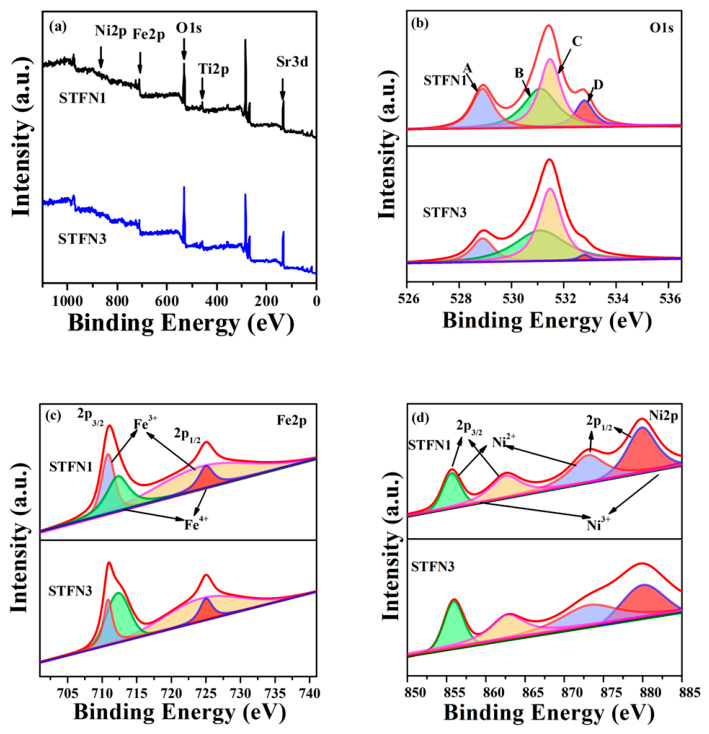
A-site deficiency offers a direct route to preset defect populations, but it also illustrates the existence of an optimal defect window. Xu et al. reported that A-site Sr deficiency in Sr1-xTi0.3Fe0.6Ni0.1O3−δ is an effective defect-engineering strategy for electrocatalytic ORR [99]. As shown in Figure 6, Sr0.9Ti0.3Fe0.6Ni0.1O3−δ showed enriched oxygen-vacancy-related surface oxygen species (42.91%) and increased Fe4+ content (40.08%). These XPS-derived results provide spectroscopic evidence that A-site deficiency regulates the surface oxygen environment and Fe oxidation state, thereby supporting the defect-mediated enhancement in ORR activity. They suggested that A-site deficiency and the resulting increase in oxygen-vacancy-related surface species led to a more positive onset potential (0.8934V vs. RHE), a lower Tafel slope (97 mV dec−1), a higher current density (8.6094 mA cm−2), and a dominant four-electron ORR pathway, with 92.4% current retention after 10,000 s. Yan et al. reported that introducing an A-site deficiency and Ir doping into La0.8Sr0.2MnO3-based perovskite generated an LSMI catalyst with enhanced oxygen-vacancy concentration, smaller particle size, and higher surface area [100]. As a result, LSMI exhibited improved ORR activity in 0.1 M KOH, delivering an onset potential of 0.91 V vs. RHE, 30 mV lower than Pt/C, together with a limiting current density of 4.1 mA cm−2. Koutecky–Levich analysis revealed an electron-transfer number of 3.9, consistent with a dominant four-electron ORR pathway. The enhanced activity was attributed to a synergistic combination of A-site deficiency, Ir-doping-induced oxygen vacancies, increased accessibility of active sites due to nanosized particles, and improved charge-transfer capability. In addition, the catalyst showed good durability, with only an 18 mV negative shift in half-wave potential after 5 h of operation.
To operationalize this concept, defect programming can be implemented through two complementary routes. One route stabilizes a defect-active surface using engineered interfaces or conformal coatings, thereby maintaining catalytically favorable defect configurations during operation [101,102]. The other route relies on electrochemically induced cation deficiency, which dynamically remodels the active interface and enriches surface defect motifs under working conditions [103,104].
Complementarily, in alkaline media, Li et al. reported an electrochemically induced A-site cation-leaching strategy for La0.6Ca0.4MnO3. The treatment increased the electrochemically active surface area and generated a defect-enriched surface, which markedly enhanced ORR activity, with a reported half-wave potential up to 0.877 V vs. RHE [104]. This case highlights in situ defect programming. By concentrating active defect motifs at the surface rather than simply increasing bulk defect density, controlled cation depletion provides a distinct pathway to achieving high activity under low-temperature operating conditions.

3.2.2. High-Temperature Thermocatalytic ORR

For high-temperature thermocatalytic ORR, defect engineering serves as a central strategy because it regulates the concentration and distribution of oxygen vacancies and cationic defects, thereby modulating oxygen activation, surface exchange, and lattice-oxygen transport. Along the stabilization route, Lynch et al. demonstrated that a dense La0.85Sr0.15MnO3±δ coating on La0.6Sr0.4Co0.2Fe0.8O3-δ improves both ORR activity and durability. The enhancement was attributed to strengthened surface oxygen adsorption/dissociation and an increased oxygen-vacancy population within the surface layer [101]. This structure exemplifies a practical stabilization strategy: interfacial design can preserve favorable defect configurations, even when bulk defect concentrations remain unchanged. Liu et al. demonstrated that varying the A-site Ba nonstoichiometry from deficient to excess simultaneously modulates lattice structure, oxygen-defect chemistry, and oxygen transport behavior [105]. Although Ba-deficient samples exhibited a higher Oads/Olat ratio and higher electronic conductivity, the Ba-excess composition Ba1.1CFZY delivered the best cathodic performance. At 700 °C, the peak power density increased from 452 to 1170 mW cm−2 as x increased from 0.9 to 1.1, while the polarization resistance decreased from 0.32 to 0.05 Ω cm2. In addition, the activation energy decreased from 134.7 to 117.2 kJ mol−1, and DRT analysis revealed faster oxygen adsorption/dissociation and oxygen-species diffusion for Ba1.1CFZY. These results indicate that A-site excess more effectively promotes the oxygen surface-exchange and transport processes governing high-temperature ORR, even though the highest electronic conductivity and adsorbed-oxygen ratio were not observed in the best-performing sample. Importantly, this case also highlights the need to evaluate cathodes under application-relevant operating variables. The BaxCFZY series showed good phase stability after treatment in 100% CO2 at 700 °C for 10 h, whereas boiling-H2O exposure induced BaCoO3−δ formation in Ba-excess samples, indicating that water-containing environments can still modify cathode phase chemistry. Together with the humidified H2 single-cell operation and post-test SEM/EDS analysis showing no obvious interfacial delamination or elemental segregation, these results suggest that CO2/H2O tolerance, humidified-fuel operation, and post-operation structural stability should be considered alongside intrinsic ORR activity. Lee et al. demonstrated that high-temperature ORR can be substantially promoted by interfacial defect engineering rather than bulk compositional modification alone [106]. A representative example of interfacial defect regulation was reported by introducing a 5–8 nm yttria-stabilized zirconia (YSZ) interlayer with tunable Y2O3 content between the YSZ scaffold and infiltrated LSM nanoparticles. The optimized 12 mol% Y2O3 layer reduced the polarization resistance from 0.35 to 0.034 Ω cm2 and the activation energy from 1.57 to 1.14 eV at 750 °C, while increasing the peak power density from 0.75 to 2.23 W cm−2. In parallel, compositional defect engineering by replacing Sr with Ca in (La,Sr)CoO3−δ thin films increased the fractional free volume from 16.186% to 18.630% and lowered the degradation rate at 650 °C over 90 h by about 1.8 and 3.5 times for partially and fully Ca-substituted compositions, respectively, although the initial ASR increased somewhat. Together, these results highlight that high-temperature defect engineering can simultaneously regulate ORR kinetics and interfacial stability.

3.3. Nanostructuring

Nanostructuring does not change the nominal composition of a perovskite, but reorganizes it into architectures with nanoscale features that reshape the local reaction environment. Because ORR is intrinsically surface-sensitive, reducing bulk oxides to smaller structural units generally increases the electrochemically accessible surface area, shortens the transport lengths for oxygen species, electrons and ions, and improves catalyst utilization under practical loadings. Beyond these geometric effects, nanoscale engineering can also modify near-surface strain, surface termination, and defect chemistry, including oxygen-vacancy populations, thereby altering oxygen adsorption/activation and interfacial charge-transfer kinetics. Nanostructuring should therefore not be regarded simply as a route to higher surface area. Instead, it acts as a coupled structural lever that can influence activity, durability, and, in some cases, pathway selectivity between the 4e− route preferred for energy-conversion devices and the 2e− route relevant to H2O2 electrosynthesis. Accordingly, nanostructured perovskites for ORR can be broadly discussed in terms of 0D nanoparticles, 1D nanoarchitectures, 2D nanosheets, and 3D porous or hierarchical frameworks, each offering distinct benefits and limitations for oxygen electrocatalysis.
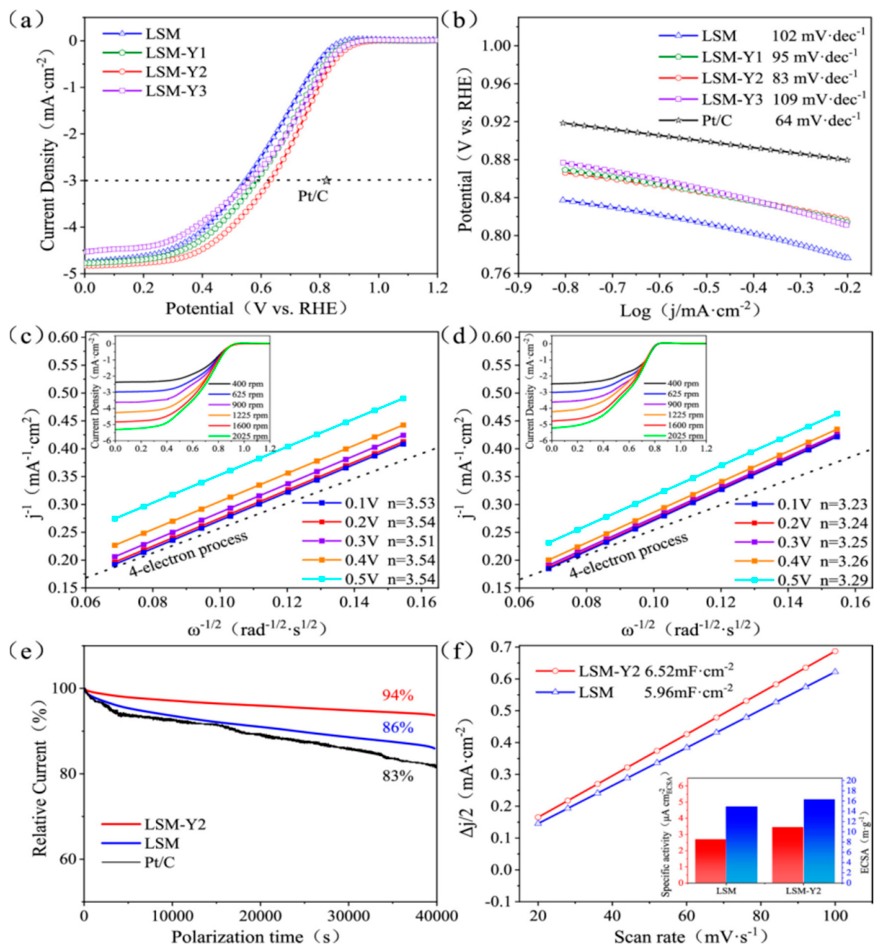
From a structural function perspective, 0D nanoarchitectures, such as nanoparticles and nanopolyhedra, enhance ORR mainly by increasing the density of exposed surface sites. This benefit, however, is often accompanied by a higher tendency toward aggregation and a stronger dependence on catalyst-layer formulation, so geometric gains should be distinguished from genuine kinetic improvement. Kim et al. synthesized LaMnO3+δ nanoparticles by laser ablation in solution and recovered the perovskite phase by annealing at 800 °C [107]. The annealed nanoparticles had an average particle size of 24.88 ± 4.71 nm and a specific surface area of 22.10 m2 g−1, and in O2-saturated 0.1 M KOH the catalyst exhibited an onset potential of 0.931 V, a half-wave potential of 0.846 V vs. RHE, an electron-transfer number of 4.02, and a Tafel slope of 64 mV dec−1. At 0.80 V vs. RHE, the mass and specific activities were 22.00 μA μgoxide−1 and 100 μA cm−2, respectively, while about 96% of the initial current was retained after 20,000 s at 0.70 V vs. RHE, indicating that restoration of perovskite crystallinity, together with nanosizing, improved both ORR activity and stability. Sun et al. demonstrated that in situ glucose regulation is an effective nanostructuring strategy for enhancing the ORR activity of La0.7Sr0.3MnO3 (LSM-Y2) perovskites [75]. The optimized LSM-Y2 catalyst exhibited a reduced particle size (~35 vs. ~40 nm), a higher BET surface area (19.43 vs. 12.56 m2 g−1), and larger mesopore volume/diameter, which increased the electrochemically accessible surface area and facilitated mass transport. As a result, LSM-Y2 showed improved ORR performance in 0.1 M KOH, delivering Eonset = 0.911 V, E1/2 = 0.631 V, a limiting current density of −4.79 mA cm−2, an electron-transfer number of 3.51–3.54, and 94% current retention after 40,000 s, highlighting the importance of nanostructure engineering in promoting active-site exposure and four-electron ORR kinetics. Figure 7 summarizes the representative electrochemical performance of glucose-regulated La0·7Sr0·3MnO3 perovskite catalysts toward the ORR.
1D nanoarchitectures, particularly nanofibers, can provide continuous transport pathways and improved percolation within the catalyst layer, improving faster ORR kinetics. Within this context, Bian et al. showed that electrospun LaNi0.85Mg0.15O3 nanofibers delivered a higher ORR half-wave potential of 0.69 V than undoped LaNiO3 (0.63 V), together with lower ORR/OER Tafel slopes of 105/95 mV dec−1 and an electron-transfer number of about 3.4 in O2-saturated 0.1 M KOH [108]. The improvement was associated with the porous nanofiber morphology and the increase in specific surface area from 11.935 to 21.192 m2 g−1. Following this, Gao et al. further demonstrated that the ORR benefit of a 1D fibrous scaffold can be further strengthened by concurrent surface-electronic regulation [109]. The authors reported that the electrospun La0.9Ag0.1Co0.7Mn0.3O3 nanofibers exhibited an average Co valence of 2.68, a surface adsorbed-oxygen-related species content of 39.68%, and more evident oxygen-vacancy features, delivering an onset potential of 0.80 V, a half-wave potential of 0.63 V vs. RHE, and a Tafel slope of 110.73 mV dec−1 in O2-saturated 0.1 M KOH. The relatively low H2O2 yield of 6.12–16.41% further supports that La0.9Ag0.1Co0.7Mn0.3O3 nanofibers mainly follow a near-four-electron ORR pathway. Taken together, these results indicate that the key value of 1D nanofiber engineering lies not only in increasing accessible surface area, but also in providing a structurally favorable platform for strengthening oxygen adsorption/activation and interfacial charge-transfer kinetics.
2D nanoarchitectures, particularly layered or lamellar perovskites, can enhance ORR by exposing extended active planes and shortening ion/electron transport pathways within the catalyst layer. Chen et al. showed that layer-stacked porous LaNi0.6Fe0.4O3-δ with a specific surface area of 27.46 m2 g−1 delivered an onset potential of 0.89 V, a half-wave potential of 0.74 V vs. RHE, a limiting current density of 5.18 mA cm−2, and a Tafel slope of 71.42 mV dec−1, together with an electron-transfer number of 3.93, a HO2− yield of only 3.27%, and merely 6.12% current decay after 7200 s [110]. These gains were attributed to its layer-stacked porous morphology, increased Oads/Olatt ratio, and reduced charge-transfer resistance, which collectively facilitated oxygen adsorption and interfacial charge transfer. Extending this concept from morphology-defined lamellae to crystallographically layered oxides, Choi et al. reported that four-layered Ruddlesden–Popper La5Ni4O13−δ exhibited an onset potential of 0.760 V, a half-wave potential of 0.664 V, a Tafel slope of 90 mV dec−1, and an electron-transfer number of 3.6, whereas Co substitution to form La5Ni3CoO13-δ further improved the ORR response to 0.774 V, 0.668 V, and 76 mV dec−1, respectively, consistent with increased Ni oxidation state and enriched oxidative oxygen species/oxygen-vacancy defects [111]. Taken together, these results indicate that the benefit of 2D perovskite engineering lies not only in increasing the density of exposed active surfaces, but also in furnishing a structurally ordered platform in which surface-electronic regulation can be more effectively translated into accelerated four-electron ORR kinetics.
Beyond low-dimensional motifs, 3D porous and hierarchical architectures combine large electrochemically accessible surface areas with open transport channels. In these structures, large pores facilitate oxygen delivery and electrolyte penetration, whereas smaller pores increase interfacial area and shorten diffusion lengths, thereby improving catalyst utilization at practical loadings. Their effectiveness is governed by pore connectivity and tortuosity, and excessive fine porosity can be counterproductive if it restricts oxygen access or promotes flooding. A representative example is provided by Lin et al., who synthesized three-dimensionally ordered macroporous LaMnO3 (3DOM-LM) with a specific surface area of 20.328 m2 g−1 and a pore volume of 0.126 cm3 g−1 [112]. In O2-saturated 0.1 M KOH at 1600 rpm, 3DOM-LM exhibited an onset potential of 0.827 V, a half-wave potential of 0.686 V, and a limiting current density of 5.90 mA cm−2, and followed a dominant 4e− pathway with negligible peroxide formation, while retaining about 80% of the relative current after 30,000 s. A complementary example was reported by Zhao et al., who prepared a hollow spherical LaNiO3 perovskite (LNO-H) by a hydrothermal method. In 1 M KOH, LNO-H exhibited an ORR half-wave potential of 0.80 V vs. RHE and a Tafel slope of 51 mV dec−1, outperforming the particle-shaped LaNiO3 counterpart (LNO-M) [113]. The improved activity was associated with the hollow spherical structure, the higher Ni3+/Ni2+ ratio (1.24 vs. 0.69), the larger active surface area and higher surface hydroxyl oxygen content. The low H2O2 yield of ~3.4% and electron-transfer number of 3.97 further indicate that hollow LaNiO3 predominantly follows a highly selective four-electron ORR pathway.
Overall, the value of nanostructuring lies not simply in increasing surface area, but in coupling improved active-site accessibility and transport efficiency with modified near-surface defect/strain states. Accordingly, the ORR enhancement of nanostructured perovskites should be assessed not only by apparent current output, but also by whether the architecture truly promotes kinetically favorable and structurally stable reaction environments under practical conditions. Representative nanostructured perovskite ORR catalysts and their electrochemical performance are summarized in Table 2.

3.4. Heterostructure and Composite Engineering

In addition to conventional catalyst design, the role of the support matrix has attracted increasing attention in ORR electrocatalysis. Carbon-based materials such as Vulcan carbon and carbon nanotubes (CNTs) are widely used as conductive supports due to their high electrical conductivity and structural stability. But they are generally considered electrochemically inert and primarily function as electron transport media and dispersion scaffolds. In contrast, oxide-based supports, particularly perovskite oxides, exhibit intrinsically different behavior owing to their redox-active nature. The presence of reversible oxygen-vacancy formation and tunable metal–oxygen covalency enables perovskite supports to actively participate in oxygen adsorption and intermediate stabilization processes. This fundamental distinction leads to different catalyst–support interaction mechanisms, where carbon-based supports mainly provide physical and electronic assistance, whereas perovskite-based supports can additionally contribute to the catalytic reaction through interfacial oxygen-exchange chemistry. Therefore, the nature of the support should be considered as an important design parameter for optimizing ORR performance.
Beyond nanostructuring, heterostructure and composite engineering provide a distinct strategy to overcome intrinsic limitations of perovskite catalysts, particularly insufficient electronic conductivity, limited interfacial charge transfer, and poor utilization of active phases, while introducing interfacial synergy that can enhance ORR kinetics and durability. Importantly, heterostructure and composite engineering play fundamentally different roles in low-temperature electrocatalytic and high-temperature thermocatalytic ORR. In low-temperature systems, the primary objective is to improve electronic percolation, interfacial charge transfer, and electrochemical utilization of active phases. By contrast, in high-temperature cathodes, the emphasis shifts toward accelerating oxygen surface exchange and incorporation, expanding effective transport pathways, and stabilizing defect-active interfaces under thermal and oxidizing conditions.

3.4.1. Low-Temperature Electrocatalytic ORR

Under low-temperature electrocatalytic conditions, the most extensively validated heterointerfaces are perovskite/carbon composites, whereas oxide–oxide heterojunctions are comparatively less represented. Perovskite carbon composites have been widely investigated as an effective route to improve the ORR performance of perovskite catalysts under low-temperature electrocatalytic conditions. In particular, graphene, carbon nanotubes, and conductive carbon black are frequently introduced to enhance electronic percolation, improve catalyst dispersion, and increase the electrochemically accessible fraction of perovskite active sites [114,115,116]. Carbon scaffolds can also help stabilize nanoscale perovskite domains by mitigating agglomeration, while intimate oxide–carbon contact may, in some systems, induce interfacial charge transfer and perturb near-surface electronic states.
However, the extent of these effects is strongly system-dependent. Consequently, the central design goal should be not merely to maximize carbon loading, but instead to establish stable, well-percolated, and electronically coupled oxide–carbon interfaces. A seminal mechanistic study by Poux et al. established that ORR in perovskite/carbon composites should be regarded as a coupled interfacial process rather than a simple sum of two independent catalytic contributions [117]. Using thin-film composite electrodes based on LaCoO3 or La0.8Sr0.2MnO3 with Sibunit-type pyrolytic carbon in 1 M NaOH, they showed that the composite electrodes approached an overall 4e− ORR pathway, whereas carbon alone mainly catalyzed the 2e− reduction in O2 to peroxide. Notably, the gain in E1/2 relative to pure carbon remained limited to 18 mV for LaCoO3 and 37 mV for La0.8Sr0.2MnO3, while the current densities at 0.9 V vs. RHE reached 3.3 and 8.6 A cm−2 oxide, respectively, indicating that carbon not only improves percolation and catalyst utilization but can also dominate the early ORR steps, with the oxide phase subsequently decomposing and further reducing peroxide species. This mechanistic picture was further refined by Mefford et al., who demonstrated on La1-xSrxCoO3-δ/carbon composites that carbon chemistry can affect ORR more strongly than oxide composition itself: replacing Vulcan carbon with N-doped mesoporous carbon produced an onset shift of about 100 mV and an activity increase of roughly fivefold, while the Tafel slope changed from ~59 mV dec−1 on VC to ~40 mV dec−1 at low overpotentials on NC [118]. Together, the two studies make clear that carbon in perovskite/carbon electrodes is not an inert conductive additive, but a mechanistically active partner governing peroxide generation, intermediate spillover, and the overall ORR kinetics.
Building on this mechanistic foundation, later studies increasingly focused on constructing stronger electronically coupled oxide–graphene interfaces. Ahmed et al. prepared rGO-encapsulated LaCoO3 nanoparticles and found that the hybrid increased the BET surface area from 8 to 104 m2 g−1, while reducing the ORR Tafel slope from 220 ± 5 to 105 ± 5 mV dec−1 and maintaining a 4e− pathway over 0.2–0.5 V in 1.0 M KOH [119]. A more pronounced interfacial enhancement was reported by Ge et al. for covalently coupled La(Co0.55Mn0.45)0.99O3-δ/NrGO, which delivered an onset potential of −0.025 V and a half-wave potential of 0.84 V vs. RHE, together with a diffusion-limiting current density of −6.64 mA cm−2 at −0.8 V, an electron-transfer number of 3.87 ± 0.02, and peroxide yields below 10% [120]. These results indicate a clear progression from conductivity-assisted nanoparticle utilization to stronger oxide–graphene coupling that not only accelerates charge transfer but also promotes near-four-electron ORR kinetics.
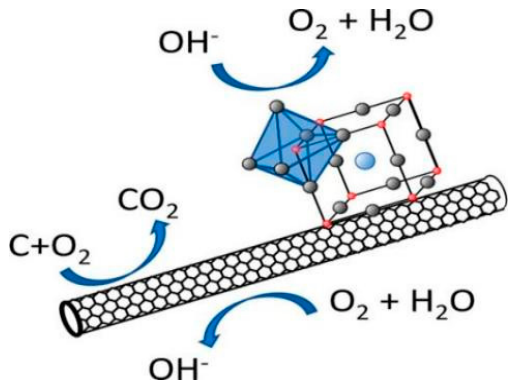
CNT-based interfaces provide a complementary route because their high aspect ratio offers continuous electron pathways and tighter oxide–carbon contact. Alexander et al. showed that, at a total loading of only 51.00 μg cm−2, LaNiO3 supported on N-CNTs required only 0.44–0.45 V overpotential to reach −3 mA cm−2, distinctly lower than CNT/LNO (0.58 V) and VC/LNO (0.59-0.61 V), while the ORR Tafel slopes remained within 60–85 mV dec−1 [121]. The N-CNT support, containing 5.6 ± 0.5% N, followed a pseudo-four-electron pathway, and the bifunctional window was compressed to 0.81 V, highlighting the decisive role of support-mediated pathway control and interfacial charge transfer. A related device-oriented example was provided by Zeng et al., who showed that strongly coupled La0.6Sr0.4TiO3-P@CNTs delivered a more positive onset potential (0.83 V) and half-wave potential (0.73 V) than La0.6Sr0.4TiO3 (0.78 and 0.68 V), together with n = 3.64, and further enabled a solid-state Zn-air battery with an open-circuit voltage of 1.469 V, a peak power density of 35 mW cm−2, and stable cycling over 186 cycles [122]. These results suggest that CNTs are especially effective when the oxide–carbon contact is sufficiently strong to combine rapid electron transport with structural durability and practical electrode integration. Figure 8 illustrates the structural design and proposed enhancement mechanism of the LaNiO3/N-CNT composite catalyst.
Among the graphene-based hybrids, Huang et al. further showed that defect-rich oxide–carbon coupling can simultaneously improve ORR kinetics, selectivity, and durability. Their LaFeO3-δ/NrGO-20 hybrid delivered EO = 0.91 V, E1/2 = 0.76 V, and a Tafel slope of 52.6 mV dec−1 in 0.1 M KOH, with n ≈ 3.6 at 0.60 V, HO2- yields below 5%, and only about 10% current decay after 40,000 s [123]. The enhancement was attributed to strong interfacial coupling between oxygen-deficient LaFeO3-δ nanoparticles and NrGO, which promoted FeO6 distortion, increased the surface oxygen-vacancy content, and facilitated oxygen adsorption together with interfacial electron transfer. Overall, these representative studies indicate that the most effective perovskite/carbon composites are not those with the highest carbon loading, but those in which carbon simultaneously serves as a conductive scaffold, a pathway-selective cocatalyst, and an electronically coupled interfacial partner capable of stabilizing defect-active oxide surfaces. Representative ORR performance metrics of low-temperature heterointerface/composite perovskite catalysts are summarized in Table 3.

3.4.2. High-Temperature Thermocatalytic ORR

For high-temperature thermocatalytic ORR, heterointerface engineering has progressively evolved from model surface heterostructures to coherent dual-phase composites and, ultimately, to fully integrated perovskite/Ruddlesden–Popper bulk heterojunctions. A mechanistic starting point was provided by Chen et al., who used PrO2, Pr0.2Ce0.8O2, and CeO2 coatings on La0.6Sr0.4Co0.2Fe0.8O3-δ(LSCF) thin films to decouple the role of top-layer oxygen-defect chemistry [124]. At 600 °C in air, thick PrO2/LSCF exhibited ORR kinetics nearly six times faster than bare LSCF, whereas CeO2/LSCF showed only limited initial activity enhancement but the best long-term stability, with the surface oxygen exchange coefficient (kq) of bare LSCF decreasing to less than one-sixth of its initial value after 60 h. These results established that a more reducible, vacancy-rich top layer can accelerate oxygen dissociation and surface exchange, while a less reducible coating is more effective in suppressing Sr segregation and stabilizing the interface. This case also highlights that CO2 and H2O in practical air atmospheres can accelerate Sr segregation and the formation of insulating SrCO3/Sr(OH)2 species, thereby blocking active sites and degrading long-term ORR kinetics. This surface-evolution behavior further underscores the need for operando or in situ characterization to track oxygen-defect redistribution, Sr segregation, carbonate/hydroxide formation, and interface reconstruction under working ORR conditions.
Building on this mechanistic foundation, Wang et al. translated defect-active surface modification from model films to porous practical cathodes by decorating A-site-deficient LSCF with PrO2-δ nanoparticles [125]. Representative high-temperature heterointerface cathodes and their electrochemical performance are summarized in Table 4. The resulting LSCF + PrO2-δ cathode delivered an ASR of 0.241 Ω cm2 at 600 °C and 0.052 Ω cm2 at 700 °C, both markedly lower than those of pristine LSCF (0.738 and 0.123 Ω cm2, respectively), while anode-supported cells achieved peak power densities of 516.7 mW cm−2 at 550 °C and 1457.8 mW cm−2 at 700 °C and maintained enhanced durability under 0.9 A cm−2 for about 100 h. The improvement was attributed to the oxygen-vacancy-rich PrO2-δ surface, the formation of an active LSCF/SrxCoyOz/PrO2-δ heterostructure, and the simultaneous mitigation of Sr-induced surface deactivation.
A similar principle of interfacial coupling, but implemented through coherent oxide−oxide integration, was demonstrated by Zhang et al. in PBC-GDC composites. The optimized PBC-10 wt% GDC cathode formed a coherent PBC/GDC interface, exhibited an ASR of 0.394 Ω cm2 at 600 °C and an Rp of 0.045 Ω cm2 at 750 °C, reached kchem = 1.11 × 10⁻³ cm s−1 at 850 °C, and delivered peak power densities of 235, 549, 938, and 1302 mW cm−2 at 550, 650, 750, and 850 °C, respectively [126]. DRT and pO2-dependent impedance analyses further indicated that charge transfer remained the rate-limiting step, whereas the cubic GDC phase served as an oxygen-transport guide between differently oriented PBC grains.
Pushing oxide-oxide heterointerfaces toward even lower operating temperatures, Liu et al. further showed that post-synthetic surface activation can rejuvenate composite cathodes for low-temperature PCFCs [127]. After H2SO4 etching, LaFe2O4-WO3 exhibited an ASR of only 0.18 Ω cm2 at 550 °C and, in full-cell tests, achieved a peak power density of 782 mW cm−2 at 550 °C, compared with 502 mW cm−2 for pristine LaFe2O4-WO3. EIS fitting at 550 °C gave R1 = 0.10 Ω cm2 and R2 = 0.195 Ω cm2, and the etched cathode remained chemically and mechanically stable under 0.15 A cm−2 at 550 °C. The enhancement was associated with acid-induced interfacial defects, increased oxygen-vacancy content, and improved electron/proton transport across the LaFe2O4-WO3 heterointerface.
Perovskite/Ruddlesden–Popper heterojunctions provide a more structurally integrated route for high-temperature ORR. Yu et al. reported that PSFC214-113 (PrSrFe0.5Co0.5O4-Pr0.4Sr0.6Fe0.5Co0.5O3) possessed the lowest transport activation energy (0.059 eV) and polarization-resistance activation energy (1.368 eV) among the tested phases, and electrolyte-supported cell delivered a peak power density of 0.73 W cm−2 while remaining stable under 0.75 A cm−2 [128]. In a related porous heterojunction design, Zheng et al. showed that NSC214/113 exhibited oxygen surface exchange kinetics 20 times faster than those of the corresponding single phases, electrical conductivities of 800–1000 S cm−1 over 500–800 °C, and an ASR of 0.065 Ω cm2 at 800 °C (equivalent to Rp ≈ 0.13 Ω cm2 for the symmetric cell), together with a peak power density of 1.10 W cm−2 at 800 °C and stable 100 h operation at 700 °C with ASR fluctuating only between 0.060 and 0.075 Ω cm2 [129]. These results show that once the heterointerface evolves from local surface decoration to a porous, percolated bulk junction, gains in oxygen exchange and transport can be translated more directly into device-level performance.
Finally, Lian et al. combined DFT calculations with cell tests to show that the ORR benefit of perovskite/Ruddlesden–Popper coupling can be further amplified when the RP phase is extended from single-layer to double-layer architecture [130]. At 500 °C, the predicted relative ORR kinetics of Nd0.5Sr0.5CoO3-δ (NSC113)/Nd0.8Sr1.2CoO4±δ (NSC214) reached 0.9 × 10²−6.9 × 10² times that of NSC113, whereas NSC113/double-layered Ruddlesden–Popper (Nd, Sr)3Co2O7 (NSC327) was predicted to be about three times faster than NSC113/NSC214. This trend was validated experimentally at 700 °C, where the peak power densities of NSC113/NSC214 and NSC113/NSC327 reached 1541 and 1898 mW cm−2, respectively, both exceeding those of single-phase NSC113 (1125 mW cm−2), NSC214 (919 mW cm−2), and NSC327 (1011 mW cm−2). Taken together, these studies indicate that the most effective high-temperature heterointerfaces are not simple phase mixtures, but interfaces that simultaneously accelerate oxygen adsorption and dissociation, create additional pathways for vacancies or interstitial oxygen, and preserve structural integrity under sustained thermal operation. The corresponding electrochemical performance of the single-phase and heterostructured NSC cathodes is summarized in Figure 9, while the atomic structures of the NSC phases and their derived heterointerfaces are illustrated in Figure 10.
Overall, heterostructure and composite engineering provide a versatile framework for simultaneously tuning activity, utilization, and durability in perovskite-based ORR catalysts. Under low-temperature electrocatalytic conditions, the most effective strategies are those that create stable and electronically coupled perovskite/carbon interfaces capable of improving active-site utilization without obscuring the distinction between genuine interfacial synergy and simple conductivity enhancement. Under high-temperature thermocatalytic conditions, the most reliable gains are obtained when the secondary phase is used to create stable, accessible, and well-percolated oxide heterointerfaces that accelerate oxygen exchange and transport while suppressing segregation and preserving interfacial integrity. Looking forward, stronger structure–function correlations are needed to connect polarization losses directly with interfacial connectivity, local chemistry, and defect populations under realistic thermal and redox cycling, thereby clarifying when “interfacial synergy” reflects a true change in ORR energetics rather than a redistribution of transport and contact resistances within the electrode architecture.

4. Outlook

This Outlook highlights the key scientific and technological gaps that must be addressed to translate perovskite ORR catalysts from structure-activity understanding toward reliable, application-relevant oxygen electrode systems.

4.1. Intrinsic Activity and Dynamic Surface States

A central challenge in perovskite ORR catalysis is that apparent performance improvements are often easier to observe than to attribute, because intrinsic activity is frequently entangled with conductivity, mass transport, and electrode architecture. Moreover, widely used descriptors, such as filling and oxygen-vacancy concentration, are typically treated as static parameters, whereas the real catalytic surface evolves continuously under operating conditions through reconstruction, defect redistribution, and electronic-state changes. Future catalyst design should therefore move beyond static structure–performance correlations and instead focus on stabilizing the catalytically relevant surface state while regulating the coupling among surface chemistry, oxygen transport, and reaction selectivity.
To resolve these dynamic active states, future studies should place greater emphasis on operando and in situ characterization. Operando X-ray absorption spectroscopy (XAS), ambient-pressure X-ray photoelectron spectroscopy (AP-XPS), in situ Raman spectroscopy, and operando X-ray diffraction (XRD) can help track transition-metal valence changes, oxygen-vacancy evolution, adsorbed oxygen intermediates, surface reconstruction, and phase evolution under working ORR conditions. Such information is particularly important for distinguishing the nominal perovskite structure from the true active surface state during reaction.

4.2. Data-Driven Catalysis and Machine Learning

For a long time, catalyst development in this field has largely relied on case-by-case comparison. A promising composition is synthesized, its activity is measured under a specific set of conditions, and the result is then compared with several previously reported materials. While such work remains valuable, this mode of research makes it difficult to extract transferable trends across studies. Data-driven catalysis becomes important precisely at this stage, as it allows experiments to move beyond isolated observations and become statistically analyzable evidence. Once composition, synthesis route, structure, defect features, testing protocol, and performance metrics are organized in a comparable way, experimental research is no longer the accumulation of individual observations. It becomes a process from which trends, boundaries, and design rules can be learned.
However, the present databases for perovskite ORR catalysis are still far from ideal. The available data volume remains limited, especially given the compositional and structural complexity of perovskite systems. In parallel, the sample space is incomplete which means most published results are concentrated on active or improved materials, whereas failed experiments, low-performing catalysts, unstable samples, and negative results are rarely reported in a usable form. Yet those “unsuccessful” data are equally important, because they define the ineffective region of materials space and help prevent biased learning. A further difficulty is that many reported datasets are not directly comparable, owing to incomplete or inconsistent metadata, including electrolyte composition, catalyst loading, rotation rate, iR correction, calcination conditions, electrode preparation, and durability protocol.
Recent experimentally validated studies have shown that artificial intelligence can move beyond virtual screening toward closed-loop catalyst discovery. For example, a machine-learning framework based on ionic Lewis acid strength was used to screen 6871 perovskite compositions for ceramic fuel-cell oxygen reduction electrodes, from which four oxides were synthesized and experimentally confirmed to exhibit improved ORR-related activity metrics. This example indicates that future AI-assisted perovskite ORR studies should combine descriptor-based screening with experimental synthesis, structural characterization, and standardized electrochemical validation.
These limitations also shape the current boundaries of machine learning in catalysis. Existing models in materials science, such as random forest (RF), XGBoost, crystal graph convolutional neural networks (CGCNN)/graph neural networks (GNNs), CNNs (e.g., ResNet), and Gaussian process-based Bayesian optimization, may provide useful methodological references for perovskite ORR research, although their applicability still depends strongly on data quality, sample coverage, and descriptor design. At present, machine learning for perovskite ORR still faces several practical bottlenecks. Some are that the database is not yet large enough, the sample coverage is not comprehensive enough, descriptor systems and model standards have not been unified, and computational resources remain insufficient for dealing with highly coupled and dynamically evolving chemical processes. More importantly, because catalytic reactions are dynamic and involve the coupled evolution of multiple parameters under operating conditions, it remains difficult to establish a reliable model that can adequately describe the correlations among these dynamic factors.
The future development of machine learning in this area should not rely on increasing algorithmic complexity only. A more important task is to establish suitable and chemically interpretable materials models for perovskite ORR systems, so that subsequent data accumulation can be organized around a meaningful framework. In other words, without benchmark model systems, reliable descriptors, and standardized reporting practices, continued data generation is unlikely to meaningfully advance machine learning in this field. Looking ahead, several directions deserve particular attention. High-quality curated datasets with complete metadata should first be established, together with the systematic inclusion of failed or low-performing cases that are equally informative for defining the boundaries of useful materials space. Future progress will require the development of physics-informed, mechanism-aware models that incorporate operando characterization and kinetic information into model training. It will also require iterative workflows in which prediction, synthesis, validation, and correction are continuously linked to refine both the dataset and the model. In this context, the value of machine learning lies not only in screening better catalysts, but more importantly in helping the field move toward catalyst discovery that is both statistically grounded and mechanistically interpretable.

4.3. AI Prediction: Toward Controlled and Reproducible ORR Research

While Section 4.2 focused on data-driven machine learning for property prediction, this section considers the broader role of artificial intelligence (AI) in improving experimental reproducibility and operational control. AI has already found broad applications in materials research, where it is being used for literature and data mining, property prediction and candidate screening, as well as synthesis monitoring and process optimization. In this sense, the value of AI lies not only in accelerating materials discovery, but also in the consistency and reproducibility of materials data collection, organization, and translation into experimentally actionable knowledge.
Beyond catalyst screening and performance prediction, a more important future role of AI may lie in improving the consistency of reaction conditions and catalyst structural states during operation. This is particularly relevant for perovskite ORR systems, where catalytic behavior is strongly influenced by dynamically evolving surface reconstruction, defect redistribution, and local electronic-state changes. By enabling real-time monitoring, feedback control, and experimental standardization, AI may help reduce variability in temperature, atmosphere, electrolyte composition, potential window, catalyst loading, and interfacial structural evolution. In this way, AI could improve data reproducibility and comparability at the source, thereby providing a more reliable basis for identifying structure–performance relationships and for training machine-learning models.

5. Conclusions

Perovskite oxides constitute a highly tunable platform for ORR catalysis, where composition, defects, nanostructure, and interfacial design collectively determine catalytic activity and selectivity. This summarized the ORR performance of perovskite-based materials optimized through doping, defect engineering, nanostructuring, and heterostructure construction. Further progress will depend not only on continued materials optimization but also on more rigorous mechanistic interpretation and more reliable structure–performance correlations. AI presents a promising avenue to accelerate catalyst design, data collection, and mechanistic analysis, although substantial efforts are still required to develop interpretable algorithms and standardized workflows. Notably, intrinsic activity is often conflated with conductivity and mass-transport effects, while dynamic surface reconstruction and defect redistribution under operating conditions remain frequently overlooked. Therefore, future progress will rely not only on continued materials innovation but also on establishing physics-informed, mechanism-aware models that integrate operando characterization and kinetic data, enabling statistically grounded and mechanistically interpretable catalyst discovery. Ultimately, the rational design of perovskite ORR catalysts requires moving beyond static structure–performance correlations toward stabilizing catalytically relevant surface states while dynamically regulating the coupling among surface chemistry, oxygen transport, and reaction selectivity.

Author Contributions

Conceptualization, J.W. and T.W.; writing—original draft preparation, J.W.; writing—review and editing, J.T. and T.W.; supervision, J.T. and T.W. All authors have read and agreed to the published version of the manuscript.

Funding

The work is supported by the Higher Education Scientific Research Project of Hebei Province (Grant No. CXZX2025054) for the project “Research on Collaborative Control Applications of Swarm Robotics”.

Data Availability Statement

No new data were created or analyzed in this study. Data sharing is not applicable to this article.

Acknowledgments

The authors gratefully acknowledge the support from the Higher Education Scientific Research Project of Hebei Province.

Conflicts of Interest

The authors declare no competing interests.

References

  1. Sharaf, O.Z.; Orhan, M.F. An overview of fuel cell technology: Fundamentals and applications. Renew. Sustain. Energy Rev. 2014, 32, 810–853. [Google Scholar] [CrossRef] [Scilit]
  2. Gaffney, J.S.; Marley, N.A. The impacts of combustion emissions on air quality and climate—From coal to biofuels and beyond. Atmos. Environ. 2009, 43, 23–36. [Google Scholar] [CrossRef] [Scilit]
  3. Perera, F. Pollution from Fossil-Fuel Combustion is the Leading Environmental Threat to Global Pediatric Health and Equity: Solutions Exist. Int. J. Env. Res. Public Health 2017, 15, 16. [Google Scholar] [CrossRef] [Scilit]
  4. Cowgill, U.M. Acid Precipitation: A Review. In Studies in Environmental Science; Veziroğlu, T.N., Ed.; Elsevier: Amsterdam, The Netherlands, 1984; Volume 25, pp. 233–259. [Google Scholar]
  5. Velraj, S.; Zhu, J.H. Cycle life limit of carbon-based electrodes for rechargeable metal–air battery application. J. Electroanal. Chem. 2015, 736, 76–82. [Google Scholar] [CrossRef] [Scilit]
  6. Sikstrom, D.; Thangadurai, V. A tutorial review on solid oxide fuel cells: Fundamentals, materials, and applications. Ionics 2026, 32, 5–30. [Google Scholar] [CrossRef] [Scilit]
  7. Ye, L.; Li, X. A dynamic stability design strategy for lithium metal solid state batteries. Nature 2021, 593, 218–222. [Google Scholar] [CrossRef] [Scilit]
  8. Singh, M.; Zappa, D.; Comini, E. Solid oxide fuel cell: Decade of progress, future perspectives and challenges. Int. J. Hydrogen Energy 2021, 46, 27643–27674. [Google Scholar] [CrossRef] [Scilit]
  9. Li, J.; Cheng, J.; Zhang, Y.; Chen, Z.; Nasr, M.; Farghali, M.; Rooney, D.W.; Yap, P.-S.; Osman, A.I. Advancements in Solid Oxide Fuel Cell Technology: Bridging Performance Gaps for Enhanced Environmental Sustainability. Adv. Energy Sustain. Res. 2024, 5, 2400132. [Google Scholar] [CrossRef] [Scilit]
  10. Sebbani, I.; Ettouhami, M.K.; Boulakhbar, M. Fuel cells: A technical, environmental, and economic outlook. Clean. Energy Syst. 2025, 10, 100168. [Google Scholar] [CrossRef] [Scilit]
  11. Chen, Y.; Ji, S.; Zhao, S.; Chen, W.; Dong, J.; Cheong, W.-C.; Shen, R.; Wen, X.; Zheng, L.; Rykov, A.I.; et al. Enhanced oxygen reduction with single-atomic-site iron catalysts for a zinc-air battery and hydrogen-air fuel cell. Nat. Commun. 2018, 9, 5422. [Google Scholar] [CrossRef] [Scilit]
  12. Nørskov, J.K.; Rossmeisl, J.; Logadottir, A.; Lindqvist, L.; Kitchin, J.R.; Bligaard, T.; Jónsson, H. Origin of the Overpotential for Oxygen Reduction at a Fuel-Cell Cathode. J. Phys. Chem. B 2004, 108, 17886–17892. [Google Scholar] [CrossRef] [Scilit] [PubMed]
  13. Jiang, K.; Back, S.; Akey, A.J.; Xia, C.; Hu, Y.; Liang, W.; Schaak, D.; Stavitski, E.; Nørskov, J.K.; Siahrostami, S.; et al. Highly selective oxygen reduction to hydrogen peroxide on transition metal single atom coordination. Nat. Commun. 2019, 10, 3997. [Google Scholar] [CrossRef] [Scilit]
  14. Koohfar, S.; Ghasemi, M.; Hafen, T.; Dimitrakopoulos, G.; Kim, D.; Pike, J.; Elangovan, S.; Gomez, E.D.; Yildiz, B. Improvement of oxygen reduction activity and stability on a perovskite oxide surface by electrochemical potential. Nat. Commun. 2023, 14, 7203. [Google Scholar] [CrossRef] [Scilit]
  15. Chen, D.; Chen, C.; Zhang, Z.; Baiyee, Z.M.; Ciucci, F.; Shao, Z. Compositional Engineering of Perovskite Oxides for Highly Efficient Oxygen Reduction Reactions. ACS Appl. Mater. Interfaces 2015, 7, 8562–8571. [Google Scholar] [CrossRef] [Scilit]
  16. Li, M.; Zhao, M.; Li, F.; Zhou, W.; Peterson, V.K.; Xu, X.; Shao, Z.; Gentle, I.; Zhu, Z. A niobium and tantalum co-doped perovskite cathode for solid oxide fuel cells operating below 500  °C. Nat. Commun. 2017, 8, 13990. [Google Scholar] [CrossRef] [Scilit]
  17. Ge, X.; Du, Y.; Li, B.; Hor, T.S.A.; Sindoro, M.; Zong, Y.; Zhang, H.; Liu, Z. Intrinsically Conductive Perovskite Oxides with Enhanced Stability and Electrocatalytic Activity for Oxygen Reduction Reactions. ACS Catal. 2016, 6, 7865–7871. [Google Scholar] [CrossRef] [Scilit]
  18. Pei, K.; Zhou, Y.; Xu, K.; Zhang, H.; Ding, Y.; Zhao, B.; Yuan, W.; Sasaki, K.; Choi, Y.; Chen, Y.; et al. Surface restructuring of a perovskite-type air electrode for reversible protonic ceramic electrochemical cells. Nat. Commun. 2022, 13, 2207. [Google Scholar] [CrossRef] [Scilit]
  19. Cao, Y.; Gadre, M.J.; Ngo, A.T.; Adler, S.B.; Morgan, D.D. Factors controlling surface oxygen exchange in oxides. Nat. Commun. 2019, 10, 1346. [Google Scholar] [CrossRef] [Scilit]
  20. Crumlin, E.J.; Mutoro, E.; Liu, Z.; Grass, M.E.; Biegalski, M.D.; Lee, Y.-L.; Morgan, D.; Christen, H.M.; Bluhm, H.; Shao-Horn, Y. Surface strontium enrichment on highly active perovskites for oxygen electrocatalysis in solid oxide fuel cells. Energy Environ. Sci. 2012, 5, 6081–6088. [Google Scholar] [CrossRef] [Scilit]
  21. Sahraie, N.R.; Kramm, U.I.; Steinberg, J.; Zhang, Y.; Thomas, A.; Reier, T.; Paraknowitsch, J.-P.; Strasser, P. Quantifying the density and utilization of active sites in non-precious metal oxygen electroreduction catalysts. Nat. Commun. 2015, 6, 8618. [Google Scholar] [CrossRef] [Scilit]
  22. Wan, X.; Liu, X.; Li, Y.; Yu, R.; Zheng, L.; Yan, W.; Wang, H.; Xu, M.; Shui, J. Fe–N–C electrocatalyst with dense active sites and efficient mass transport for high-performance proton exchange membrane fuel cells. Nat. Catal. 2019, 2, 259–268. [Google Scholar] [CrossRef] [Scilit]
  23. Hardin, W.G.; Slanac, D.A.; Wang, X.; Dai, S.; Johnston, K.P.; Stevenson, K.J. Highly Active, Nonprecious Metal Perovskite Electrocatalysts for Bifunctional Metal–Air Battery Electrodes. J. Phys. Chem. Lett. 2013, 4, 1254–1259. [Google Scholar] [CrossRef] [Scilit]
  24. Hwang, J.; Rao, R.R.; Giordano, L.; Katayama, Y.; Yu, Y.; Shao-Horn, Y. Perovskites in catalysis and electrocatalysis. Science 2017, 358, 751–756. [Google Scholar] [CrossRef] [Scilit]
  25. Peña, M.A.; Fierro, J.L.G. Chemical Structures and Performance of Perovskite Oxides. Chem. Rev. 2001, 101, 1981–2018. [Google Scholar] [CrossRef] [Scilit]
  26. Suntivich, J.; Gasteiger, H.A.; Yabuuchi, N.; Nakanishi, H.; Goodenough, J.B.; Shao-Horn, Y. Design principles for oxygen-reduction activity on perovskite oxide catalysts for fuel cells and metal–air batteries. Nat. Chem. 2011, 3, 546–550. [Google Scholar] [CrossRef] [Scilit]
  27. Adler, S.B.; Chen, X.Y.; Wilson, J.R. Mechanisms and rate laws for oxygen exchange on mixed-conducting oxide surfaces. J. Catal. 2007, 245, 91–109. [Google Scholar] [CrossRef] [Scilit]
  28. Wang, Y.; Cheng, H.-P. Oxygen Reduction Activity on Perovskite Oxide Surfaces: A Comparative First-Principles Study of LaMnO3, LaFeO3, and LaCrO3. J. Phys. Chem. C 2013, 117, 2106–2112. [Google Scholar] [CrossRef] [Scilit]
  29. Katz, E.A. Perovskite: Name Puzzle and German-Russian Odyssey of Discovery. Helv. Chim. Acta 2020, 103, e2000061. [Google Scholar] [CrossRef] [Scilit]
  30. Du, J.; Zhang, T.; Cheng, F.; Chu, W.; Wu, Z.; Chen, J. Nonstoichiometric Perovskite CaMnO3−δ for Oxygen Electrocatalysis with High Activity. Inorg. Chem. 2014, 53, 9106–9114. [Google Scholar] [CrossRef] [Scilit]
  31. Zhang, D.; Song, Y.; Du, Z.; Wang, L.; Li, Y.; Goodenough, J.B. Active LaNi1−xFexO3 bifunctional catalysts for air cathodes in alkaline media. J. Mater. Chem. A 2015, 3, 9421–9426. [Google Scholar] [CrossRef] [Scilit]
  32. Zhao, Y.; Liu, T.; Shi, Q.; Yang, Q.; Li, C.; Zhang, D.; Zhang, C. Perovskite oxides La0.4Sr0.6CoxMn1-xO3 (x = 0, 0.2, 0.4) as an effective electrocatalyst for lithium—Air batteries. Green Energy Environ. 2018, 3, 78–85. [Google Scholar] [CrossRef] [Scilit]
  33. Jeerh, G.; Zou, P.; Zhang, M.; Tao, S. Perovskite oxide LaCr0.25Fe0.25Co0.5O3-δ as an efficient non-noble cathode for direct ammonia fuel cells. Appl. Catal. B Environ. 2022, 319, 121919. [Google Scholar] [CrossRef] [Scilit]
  34. Flores-Lasluisa, J.X.; Huerta, F.; Cazorla-Amorós, D.; Morallón, E. LaNi1-xCoxO3 perovskites for application in electrochemical reactions involving molecular oxygen. Energy 2023, 273, 127256. [Google Scholar] [CrossRef] [Scilit]
  35. Li, H.; Zhao, H.; Tao, B.; Xu, G.; Gu, S.; Wang, G.; Chang, H. Pt-Based Oxygen Reduction Reaction Catalysts in Proton Exchange Membrane Fuel Cells: Controllable Preparation and Structural Design of Catalytic Layer. Nanomaterials 2022, 12, 4173. [Google Scholar] [CrossRef] [Scilit]
  36. Antolini, E. Palladium in fuel cell catalysis. Energy Environ. Sci. 2009, 2, 915–931. [Google Scholar] [CrossRef] [Scilit]
  37. Li, X.; Zhao, H.; Liang, J.; Luo, Y.; Chen, G.; Shi, X.; Lu, S.; Gao, S.; Hu, J.; Liu, Q.; et al. A-site perovskite oxides: An emerging functional material for electrocatalysis and photocatalysis. J. Mater. Chem. A 2021, 9, 6650–6670. [Google Scholar] [CrossRef] [Scilit]
  38. Oliveira, L.C.C.B.; Venâncio, R.; de Azevedo, P.V.F.; Anchieta, C.G.; Nepel, T.C.M.; Rodella, C.B.; Zanin, H.; Doubek, G. Reviewing perovskite oxide sites influence on electrocatalytic reactions for high energy density devices. J. Energy Chem. 2023, 81, 1–19. [Google Scholar] [CrossRef] [Scilit]
  39. Chen, Y.; Li, H.; Wang, J.; Du, Y.; Xi, S.; Sun, Y.; Sherburne, M.; Ager, J.W., 3rd; Fisher, A.C.; Xu, Z.J. Exceptionally active iridium evolved from a pseudo-cubic perovskite for oxygen evolution in acid. Nat. Commun. 2019, 10, 572. [Google Scholar] [CrossRef] [Scilit]
  40. Liu, Y.; Huang, H.; Xue, L.; Sun, J.; Wang, X.; Xiong, P.; Zhu, J. Recent advances in the heteroatom doping of perovskite oxides for efficient electrocatalytic reactions. Nanoscale 2021, 13, 19840–19856. [Google Scholar] [CrossRef] [Scilit]
  41. Lee, Y.-L.; Kleis, J.; Rossmeisl, J.; Shao-Horn, Y.; Morgan, D. Prediction of solid oxide fuel cell cathode activity with first-principles descriptors. Energy Environ. Sci. 2011, 4, 3966–3970. [Google Scholar] [CrossRef] [Scilit]
  42. Bockris, J.O.M.; Otagawa, T. The electrocatalysis of oxygen evolution on perovskites. J. Electrochem. Soc. 1984, 131, 290. [Google Scholar] [CrossRef] [Scilit]
  43. Kozuka, H.; Ohbayashi, K.; Koumoto, K. Electronic conduction in La-based perovskite-type oxides. Sci. Technol. Adv. Mater. 2015, 16, 026001. [Google Scholar] [CrossRef] [Scilit]
  44. Koo, B.; Kim, K.; Kim, J.K.; Kwon, H.; Han, J.W.; Jung, W. Sr Segregation in Perovskite Oxides: Why It Happens and How It Exists. Joule 2018, 2, 1476–1499. [Google Scholar] [CrossRef] [Scilit]
  45. Zhu, Y.; Liu, D.; Jing, H.; Zhang, F.; Zhang, X.; Hu, S.; Zhang, L.; Wang, J.; Zhang, L.; Zhang, W.; et al. Oxygen activation on Ba-containing perovskite materials. Sci. Adv. 2022, 8, eabn4072. [Google Scholar] [CrossRef] [Scilit]
  46. Hasan, Z.; Rahman, M.A.; Das, D.K.; Rouf, H.K. Influence of Ca doping in structural, electronic, optical and mechanical properties of Ba1−xCaxTiO3 perovskite from first-principles investigation. Sci. Rep. 2023, 13, 10487. [Google Scholar] [CrossRef] [Scilit]
  47. Yin, W.-J.; Weng, B.; Ge, J.; Sun, Q.; Li, Z.; Yan, Y. Oxide perovskites, double perovskites and derivatives for electrocatalysis, photocatalysis, and photovoltaics. Energy Environ. Sci. 2019, 12, 442–462. [Google Scholar] [CrossRef] [Scilit]
  48. Qian, J.; Wang, T.; Zhang, Z.; Liu, Y.; Li, J.; Gao, D. Engineered spin state in Ce doped LaCoO3 with enhanced electrocatalytic activity for rechargeable Zn-Air batteries. Nano Energy 2020, 74, 104948. [Google Scholar] [CrossRef] [Scilit]
  49. Guo, Y.; Tong, Y.; Chen, P.; Xu, K.; Zhao, J.; Lin, Y.; Chu, W.; Peng, Z.; Wu, C.; Xie, Y. Engineering the electronic state of a perovskite electrocatalyst for synergistically enhanced oxygen evolution reaction. Adv. Mater. 2015, 27, 5989–5994. [Google Scholar] [CrossRef] [Scilit]
  50. Kotha, V.; Karajagi, I.; Ghosh, P.C.; Panchakarla, L.S. Potassium-Substituted LaMnO3 as a Highly Active and Exceptionally Stable Electrocatalyst toward Bifunctional Oxygen Reduction and Oxygen Evolution Reactions. ACS Appl. Energy Mater. 2022, 5, 7297–7307. [Google Scholar] [CrossRef] [Scilit]
  51. Zhou, H.; Zhao, W.; Lu, Z.; He, S.; Yin, B.; Zheng, Y.; Ge, L.; Chen, H. Ba-doped LaCoO3 perovskite as novel bifunctional electrocatalyst for zinc–air batteries. Electrochimica Acta 2023, 462, 142757. [Google Scholar] [CrossRef] [Scilit]
  52. Nayak, B.B.; Hota, I.; Soren, S.; Parhi, P. Sm1-XSrxMnO3 (X = 0.1, 0.2, 0.3, and 0.4) perovskite (SSM) with a-site doping optimized as oxygen reduction reaction (ORR) electrocatalyst. Electrochimica Acta 2025, 515, 145609. [Google Scholar] [CrossRef] [Scilit]
  53. Nayak, B.B.; Soren, S.; Hota, I.; Debnath, A.K.; Muthe, K.P.; Parhi, P. Optimization of Praseodymium-Based Perovskites as Electrocatalysts for Oxygen Reduction Reaction. ACS Appl. Energy Mater. 2023, 6, 9951–9962. [Google Scholar] [CrossRef] [Scilit]
  54. Kumar, N.; Kumar, M.; Nagaiah, T.C.; Siruguri, V.; Rayaprol, S.; Yadav, A.K.; Jha, S.N.; Bhattacharyya, D.; Paul, A.K. Investigation of New B-Site-Disordered Perovskite Oxide CaLaScRuO6+δ: An Efficient Oxygen Bifunctional Electrocatalyst in a Highly Alkaline Medium. ACS Appl. Mater. Interfaces 2020, 12, 9190–9200. [Google Scholar] [CrossRef] [Scilit]
  55. Wang, W.; Liu, W.; Kamiko, M.; Yagi, S. Enhanced catalytic activity of perovskite La1−xSrxMnO3+δ for the oxygen reduction reaction. New J. Chem. 2022, 46, 13082–13088. [Google Scholar] [CrossRef] [Scilit]
  56. Du, Z.; Yan, C.; Zhao, H.; Zhang, Y.; Yang, C.; Yi, S.; Lu, Y.; Świerczek, K. Effective Ca-doping in Y1−xCaxBaCo2O5+δ cathode materials for intermediate temperature solid oxide fuel cells. J. Mater. Chem. A 2017, 5, 25641–25651. [Google Scholar] [CrossRef] [Scilit]
  57. Liu, B.; Li, Z.; Yang, X.; Yan, D.; Li, J.; Jia, L. Novel mixed H+/e−/O2− conducting cathode material PrBa0.9K0.1Fe1.9Zn0.1O5+δ for proton-conducting solid oxide fuel cells. J. Mater. Chem. A 2022, 10, 17425–17433. [Google Scholar] [CrossRef] [Scilit]
  58. Fu, X.; Meng, X.; Sun, C.; Wei, M.; Jiang, H.; Lü, S.; Gong, W. Advancing Solid Oxide Fuel Cell Performance: Enhanced Electrochemical Properties of Pr1–xCaxBaFe2O5+δ Nanofiber Cathodes via Ca Doping. ACS Appl. Mater. Interfaces 2024, 16, 36236–36246. [Google Scholar] [CrossRef] [Scilit]
  59. Khan, S.; Staykov, A.; Matsuda, J.; Kluczny, M.; Wu, K.-T.; Ninomiya, K.; Nishibori, M.; Song, J.T.; Watanabe, M.; Inada, M.; et al. Effects of Ce co-doping at the A site of Sm0.5−xSr0.5CoO3±δ for a high-performance air electrode for solid oxide reversible cells. J. Mater. Chem. A 2025, 13, 6620–6630. [Google Scholar] [CrossRef] [Scilit]
  60. Yu, J.; Luo, L.; Cheng, L.; Wang, L.; Xu, X.; Zhang, S.; Zeng, X. A-Site Engineering of the High-Entropy Perovskite Pr0.4La0.4Ba0.4Sr0.4Ca0.4Fe2O5+δ Cathode for Intermediate-Temperature SOFCs. ACS Appl. Mater. Interfaces 2024, 16, 36224–36235. [Google Scholar] [CrossRef] [Scilit]
  61. Hong, W.T.; Risch, M.; Stoerzinger, K.A.; Grimaud, A.; Suntivich, J.; Shao-Horn, Y. Toward the rational design of non-precious transition metal oxides for oxygen electrocatalysis. Energy Environ. Sci. 2015, 8, 1404–1427. [Google Scholar] [CrossRef] [Scilit]
  62. Chen, H.; Lim, C.; Zhou, M.; He, Z.; Sun, X.; Li, X.; Ye, Y.; Tan, T.; Zhang, H.; Yang, C.; et al. Activating Lattice Oxygen in Perovskite Oxide by B-Site Cation Doping for Modulated Stability and Activity at Elevated Temperatures. Adv. Sci. 2021, 8, e2102713. [Google Scholar] [CrossRef] [Scilit]
  63. Retuerto, M.; Calle-Vallejo, F.; Pascual, L.; Lumbeeck, G.; Fernandez-Diaz, M.T.; Croft, M.; Gopalakrishnan, J.; Peña, M.A.; Hadermann, J.; Greenblatt, M.; et al. La1.5Sr0.5NiMn0.5Ru0.5O6 Double Perovskite with Enhanced ORR/OER Bifunctional Catalytic Activity. ACS Appl. Mater. Interfaces 2019, 11, 21454–21464. [Google Scholar] [CrossRef] [Scilit]
  64. Muñoz-García, A.B.; Bugaris, D.E.; Pavone, M.; Hodges, J.P.; Huq, A.; Chen, F.; Zur Loye, H.-C.; Carter, E.A. Unveiling Structure–Property Relationships in Sr2Fe1.5Mo0.5O6−δ, an Electrode Material for Symmetric Solid Oxide Fuel Cells. J. Am. Chem. Soc. 2012, 134, 6826–6833. [Google Scholar] [CrossRef] [Scilit]
  65. Chen, S.; Zhang, H.; Yao, C.; Qu, T.; Wang, T.; Wang, H.; Liu, W.; Lang, X.; Cai, K. Tailored Double Perovskite with Boosted Oxygen Reduction Kinetics and CO2 Durability for Solid Oxide Fuel Cells. ACS Sustain. Chem. Eng. 2023, 11, 13198–13208. [Google Scholar] [CrossRef] [Scilit]
  66. Abe, Y.; Satoh, I.; Saito, T.; Kan, D.; Shimakawa, Y. Oxygen Reduction Reaction Catalytic Activities of Pure Ni-Based Perovskite-Related Structure Oxides. Chem. Mater. 2020, 32, 8694–8699. [Google Scholar] [CrossRef] [Scilit]
  67. Sun, C.; Kong, Y.; Niu, Y.; Yin, X.; Zhang, N. Probing Zr Substituting Effects on the Oxygen Reduction Reaction of Fe-Based Double Perovskite Cathodes for Solid Oxide Fuel Cells. ACS Appl. Energy Mater. 2022, 5, 4486–4495. [Google Scholar] [CrossRef] [Scilit]
  68. Lee, H.; Gwon, O.; Choi, K.; Zhang, L.; Zhou, J.; Park, J.; Yoo, J.-W.; Wang, J.-Q.; Lee, J.H.; Kim, G. Enhancing Bifunctional Electrocatalytic Activities via Metal d-Band Center Lift Induced by Oxygen Vacancy on the Subsurface of Perovskites. ACS Catal. 2020, 10, 4664–4670. [Google Scholar] [CrossRef] [Scilit]
  69. Zhao, J.W.; Li, Y.; Luan, D.; Lou, X.W.D. Structural evolution and catalytic mechanisms of perovskite oxides in electrocatalysis. Sci. Adv. 2024, 10, eadq4696. [Google Scholar] [CrossRef] [Scilit]
  70. Shi, W.; Dong, X.; Luo, Y.; Wang, R.; Wang, G.; Chen, J.; Liu, C.; Zhang, J. Regulation of the B Site at La(Ni0.1)MnO3 Perovskite Decorated with N-Doped Carbon for a Bifunctional Electrocatalyst in Zn–Air Batteries. Ind. Eng. Chem. Res. 2023, 62, 2687–2697. [Google Scholar] [CrossRef] [Scilit]
  71. Nandikes, G.; Pathak, P.; Singh, L. Exploring B-site Doping in LaFeO3 Perovskites for Superior ORR Performance in Acidic and Alkaline Conditions. ChemCatChem 2024, 16, e202400865. [Google Scholar] [CrossRef] [Scilit]
  72. Parwaiz, S.; Khan, F.; Jennings, J.R.; Harunsani, M.H.; Kim, Y.-M.; Khan, M.M. Effect of Ni-Doping in LaCo1–xNixO3 on Electrocatalytic Oxygen Reduction Reaction. ACS Omega 2025, 10, 52429–52441. [Google Scholar] [CrossRef] [Scilit] [PubMed]
  73. Wang, M.; Han, B.; Deng, J.; Jiang, Y.; Zhou, M.; Lucero, M.; Wang, Y.; Chen, Y.; Yang, Z.; N’Diaye, A.T.; et al. Influence of Fe Substitution into LaCoO3 Electrocatalysts on Oxygen-Reduction Activity. ACS Appl. Mater. Interfaces 2019, 11, 5682–5686. [Google Scholar] [CrossRef] [Scilit]
  74. Huang, J.; Gou, H.; Pan, J.; Liu, Y.; Nie, M.; Shang, B.; Yu, D.; Huang, G.; Zhang, D.; Pan, F. Ce, Co co-doped LaMnO3 perovskite activating oxygen reduction reaction in Zn-air and Mg-air batteries. J. Power Sources 2025, 659, 238328. [Google Scholar] [CrossRef] [Scilit]
  75. Sun, L.; Sun, T.; Li, X.; Wang, Y. La0.7Sr0.3MnO3 Perovskites for Oxygen Reduction in Zn-Air Batteries: Enhanced by In Situ Glucose Regulation. ACS Appl. Mater. Interfaces 2025, 17, 7716–7727. [Google Scholar] [CrossRef] [Scilit]
  76. Li, S.; Shi, L.; Guo, Y.; Wang, J.; Liu, D.; Zhao, S. Selective oxygen reduction reaction: Mechanism understanding, catalyst design and practical application. Chem. Sci. 2024, 15, 11188–11228. [Google Scholar] [CrossRef] [Scilit]
  77. Stoerzinger, K.A.; Lü, W.; Li, C.; Ariando; Venkatesan, T.; Shao-Horn, Y. Highly Active Epitaxial La(1–x)SrxMnO3 Surfaces for the Oxygen Reduction Reaction: Role of Charge Transfer. J. Phys. Chem. Lett. 2015, 6, 1435–1440. [Google Scholar] [CrossRef] [Scilit]
  78. Dey, S.; Saravanan, R.; Sethurajaperumal, A.; Bal, R.; Mather, G.C.; Ganesh, G.; Varrla, E.; Puranik, A.; Nowicki, K.; Mukhopadhyay, M.; et al. Bi-Functional Oxygen Electrocatalysts for Reversible Solid Oxide Cells: The Influence of A-Site Non-stoichiometry on the System (La or Ba)0.6–xSr0.4Co0.8Fe0.2O3−δ. ACS Appl. Energy Mater. 2025, 8, 7433–7449. [Google Scholar] [CrossRef] [Scilit]
  79. Jijil, C.P.; Bhange, S.N.; Kurungot, S.; Devi, R.N. Effect of B Site Coordination Environment in the ORR Activity in Disordered Brownmillerites Ba2In2–xCexO5+δ. ACS Appl. Mater. Interfaces 2015, 7, 3041–3049. [Google Scholar] [CrossRef] [Scilit]
  80. Hossain, M.I.; Monim, S.A.; Moushumy, Z.M.; Khansur, N.H.; Mahmud, I.; Rahaman, M.; Aldalbahi, A.; Firoz, S.H.; Hasnat, M.A. Synthesis of La2NiMnO6 Double Perovskite as a Highly Selective Electrocatalyst for Oxygen Reduction to Hydrogen Peroxide in Electrochemical Energy Conversion. ACS Appl. Energy Mater. 2025, 8, 949–963. [Google Scholar] [CrossRef] [Scilit]
  81. Whittingham, A.W.H.; Boke, M.; Smith, R.D.L. Tuning the Oxygen Reduction Reactivity of Layered Perovskites Using the Jahn–Teller Effect. ACS Appl. Mater. Interfaces 2024, 16, 66961–66970. [Google Scholar] [CrossRef] [Scilit]
  82. Cho, J.; Choi, J.-Y.; Jeong, E.; Yu, J.M.; Kim, Y.; Lee, H.; Lee, S.-G.; Lee, G.; Jang, J.-W.; Jo, W. B-Site Engineering in Ruddlesden–Popper Perovskites (A2BO4) for H2O2 Production with 4.85% of Solar-to-Chemical Efficiency. Nano Lett. 2026, 26, 4287–4295. [Google Scholar] [CrossRef] [Scilit]
  83. Han, N.; Feng, S.; Guo, W.; Mora, O.M.; Zhao, X.; Zhang, W.; Xie, S.; Zhou, Z.; Liu, Z.; Liu, Q.; et al. Rational design of Ruddlesden–Popper perovskite electrocatalyst for oxygen reduction to hydrogen peroxide. SusMat 2022, 2, 456–465. [Google Scholar] [CrossRef] [Scilit]
  84. Guo, Q.; Li, S.; An, S.; Sun, R.; Ren, M.; Gao, L.; Yan, Z.; Cao, H. Modification of B-site substituted by high-valence Nb in PrBa0.5Sr0.5Co1.5Fe0.5O5+δ as a highly active air electrode for solid oxide fuel cell. RSC Adv. 2025, 15, 9110–9118. [Google Scholar] [CrossRef] [Scilit]
  85. Yu, J.; Cheng, L.; Luo, L.; Wang, L.; Xu, X.; Liu, S.; Zeng, X. Surface modulated B-site doping of PrBa0.5Sr0.5Co2-xFexO5+δ as highly efficient cathode for intermediate-temperature solid oxide fuel cells. Solid State Ion. 2023, 402, 116380. [Google Scholar] [CrossRef] [Scilit]
  86. Meng, Y.; Sun, L.; Gao, J.; Tan, W.; Chen, C.; Yi, J.; Bouwmeester, H.J.M.; Sun, Z.; Brinkman, K.S. Insights into the CO2 Stability-Performance Trade-Off of Antimony-Doped SrFeO3−δ Perovskite Cathode for Solid Oxide Fuel Cells. ACS Appl. Mater. Interfaces 2019, 11, 11498–11506. [Google Scholar] [CrossRef] [Scilit]
  87. Gu, H.; Xu, M.; Song, Y.; Zhou, C.; Su, C.; Wang, W.; Ran, R.; Zhou, W.; Shao, Z. SrCo0.8Ti0.1Ta0.1O3-δ perovskite: A new highly active and durable cathode material for intermediate-temperature solid oxide fuel cells. Compos. Part B Eng. 2021, 213, 108726. [Google Scholar] [CrossRef] [Scilit]
  88. Admasu Beshiwork, B.; Wan, X.; Xu, M.; Guo, H.; Sirak Teketel, B.; Chen, Y.; Song Chen, J.; Li, T.; Traversa, E. A defective iron-based perovskite cathode for high-performance IT-SOFCs: Tailoring the oxygen vacancies using Nb/Ta co-doping. J. Energy Chem. 2024, 88, 306–316. [Google Scholar] [CrossRef] [Scilit]
  89. Li, Y.; Mushtaq, N.; Chen, Y.; Ye, W.; Zhuang, Z.; Singh, M.; Jing, Y.; Fan, L. Revisiting Mo-Doped SrFeO3-δ Perovskite: The Origination of Cathodic Activity and Longevity for Intermediate-Temperature Solid Oxide Fuel Cells. Adv. Funct. Mater. 2025, 35, 2411025. [Google Scholar] [CrossRef] [Scilit]
  90. Pan, J.; Chen, X.; Cai, D.; Wei, Z.; Gong, T.; Han, G.; Liu, Y.; Zhao, J.; Fujita, T. Iron-doped perovskite La0.5Pr0.5BaCo2-xFexO5+δ as a potential cathode material for SOFC. Ceram. Int. 2025, 51, 10703–10715. [Google Scholar] [CrossRef] [Scilit]
  91. Beall, C.E.; Fabbri, E.; Schmidt, T.J. Perovskite Oxide Based Electrodes for the Oxygen Reduction and Evolution Reactions: The Underlying Mechanism. ACS Catal. 2021, 11, 3094–3114. [Google Scholar] [CrossRef] [Scilit]
  92. Christy, M.; Choi, S.; Kwon, J.; Jeong, J.; Paik, U.; Song, T. The Perfect Imperfections of Perovskite Oxide Catalysts in the Aspect of Defect Equilibria. Small Sci. 2025, 5, 2400386. [Google Scholar] [CrossRef] [Scilit]
  93. Riva, M.; Kubicek, M.; Hao, X.; Franceschi, G.; Gerhold, S.; Schmid, M.; Hutter, H.; Fleig, J.; Franchini, C.; Yildiz, B.; et al. Influence of surface atomic structure demonstrated on oxygen incorporation mechanism at a model perovskite oxide. Nat. Commun. 2018, 9, 3710. [Google Scholar] [CrossRef] [Scilit]
  94. Ji, Q.; Bi, L.; Zhang, J.; Cao, H.; Zhao, X.S. The role of oxygen vacancies of ABO3 perovskite oxides in the oxygen reduction reaction. Energy Environ. Sci. 2020, 13, 1408–1428. [Google Scholar] [CrossRef] [Scilit]
  95. Chen, D.; Qiao, M.; Lu, Y.-R.; Hao, L.; Liu, D.; Dong, C.-L.; Li, Y.; Wang, S. Preferential Cation Vacancies in Perovskite Hydroxide for the Oxygen Evolution Reaction. Angew. Chem. Int. Ed. 2018, 57, 8691–8696. [Google Scholar] [CrossRef] [Scilit]
  96. Cuong, D.D.; Lee, B.; Choi, K.M.; Ahn, H.-S.; Han, S.; Lee, J. Oxygen Vacancy Clustering and Electron Localization in Oxygen-Deficient Study. Phys. Rev. Lett. 2007, 98, 115503. [Google Scholar] [CrossRef] [Scilit]
  97. Eom, K.; Choi, E.; Choi, M.; Han, S.; Zhou, H.; Lee, J. Oxygen Vacancy Linear Clustering in a Perovskite Oxide. J. Phys. Chem. Lett. 2017, 8, 3500–3505. [Google Scholar] [CrossRef] [Scilit]
  98. Chen, Y.; Jung, W.; Cai, Z.; Kim, J.J.; Tuller, H.L.; Yildiz, B. Impact of Sr segregation on the electronic structure and oxygen reduction activity of SrTi1−xFexO3 surfaces. Energy Environ. Sci. 2012, 5, 7979–7988. [Google Scholar] [CrossRef] [Scilit]
  99. Xu, N.; Zhang, J.; Su, S.; Feng, J.; Xu, Z. Preparation and bifunctional properties of the A-site-deficient SrTi(0.3)Fe(0.6)Ni(0.1)O(3-delta) perovskite. RSC Adv. 2022, 12, 33789–33800. [Google Scholar] [CrossRef] [Scilit]
  100. Yan, L.; Lin, Y.; Yu, X.; Xu, W.; Salas, T.; Smallidge, H.; Zhou, M.; Luo, H. La0.8Sr02.MnO3-Based Perovskite Nanoparticles with the A-Site Deficiency as High Performance Bifunctional Oxygen Catalyst in Alkaline Solution. ACS Appl. Mater. Interfaces 2017, 9, 23820–23827. [Google Scholar] [CrossRef] [Scilit]
  101. Lynch, M.E.; Yang, L.; Qin, W.; Choi, J.-J.; Liu, M.; Blinn, K.; Liu, M. Enhancement of La0.6Sr0.4Co0.2Fe0.8O3-δ durability and surface electrocatalytic activity by La0.85Sr0.15MnO3±δ investigated using a new test electrode platform. Energy Environ. Sci. 2011, 4, 2249–2258. [Google Scholar] [CrossRef] [Scilit]
  102. Ishfaq, H.A.; Khan, M.Z.; Shirke, Y.M.; Qamar, S.; Hussain, A.; Mehran, M.T.; Song, R.-H.; Saleem, M. A heuristic approach to boost the performance and Cr poisoning tolerance of solid oxide fuel cell cathode by robust multi-doped ceria coating. Appl. Catal. B Environ. 2023, 323, 122178. [Google Scholar] [CrossRef] [Scilit]
  103. Cao, X.; Chen, R.; Wang, Z.; Feng, H.; Zhang, Q.; Yan, N. In Situ Reactivating Perovskite Oxide Catalysts in Alkaline Water Electrolyzers: A Generalized Approach Based on Selective Cation Leaching. ACS Sustain. Chem. Eng. 2023, 11, 16693–16702. [Google Scholar] [CrossRef] [Scilit]
  104. Li, Q.; Zhang, D.; Wu, J.; Dai, S.; Liu, H.; Lu, M.; Cui, R.; Liang, W.; Wang, D.; Xi, P.; et al. Cation-Deficient Perovskites Greatly Enhance the Electrocatalytic Activity for Oxygen Reduction Reaction. Adv. Mater. 2024, 36, 2309266. [Google Scholar] [CrossRef] [Scilit]
  105. Wei, K.; Guo, Z.; Chen, F.; Liu, H.; Ling, Y. A-Site Nonstoichiometric BaxCo0.4Fe0.4Zr0.1Y0.1O3−δ Cathode for Protonic Ceramics Fuel Cells. ACS Appl. Mater. Interfaces 2023, 15, 49785–49793. [Google Scholar] [CrossRef] [Scilit]
  106. Kim, S.J.; Koo, J.Y.; Mun, T.; Choi, M.; Lee, W. Tailoring defect chemistry at interfaces for promoted oxygen reduction reaction kinetics. J. Mater. Chem. A 2020, 8, 23313–23322. [Google Scholar] [CrossRef] [Scilit]
  107. Kim, W.S.; Anoop, G.; Lee, H.J.; Lee, S.S.; Kwak, J.H.; Lee, H.J.; Jo, J.Y. Facile synthesis of perovskite LaMnO3+δ nanoparticles for the oxygen reduction reaction. J. Catal. 2016, 344, 578–582. [Google Scholar] [CrossRef] [Scilit]
  108. Bian, J.; Su, R.; Yao, Y.; Wang, J.; Zhou, J.; Li, F.; Wang, Z.L.; Sun, C. Mg Doped Perovskite LaNiO3 Nanofibers as an Efficient Bifunctional Catalyst for Rechargeable Zinc–Air Batteries. ACS Appl. Energy Mater. 2019, 2, 923–931. [Google Scholar] [CrossRef] [Scilit]
  109. Gao, Y.-X.; Wang, Y.; Liu, H.; Xu, H.-Y.; Liu, X.-P.; Hua, Y.-C.; Li, C.-P.; Bai, J. Ag-doped LaCo0.7Mn0.3O3 nanofibers toward enhanced bifunctional oxygen electrocatalysis for rechargeable Zn-air batteries. J. Alloys Compd. 2025, 1010, 178271. [Google Scholar] [CrossRef] [Scilit]
  110. Chen, Z.; Xie, Y.; Liu, J.; Zhong, X.; Xu, Z.; Wang, R. Fabrication of layered LaNi0.6Fe0.4O3-δ perovskite to enhance oxygen reduction catalytic performance. J. Alloys Compd. 2023, 957, 170320. [Google Scholar] [CrossRef] [Scilit]
  111. Choi, S.R.; Lee, J.-I.; Park, H.; Lee, S.W.; Kim, D.Y.; An, W.Y.; Kim, J.H.; Kim, J.; Cho, H.-S.; Park, J.-Y. Multiple perovskite layered lanthanum nickelate Ruddlesden-Popper systems as highly active bifunctional oxygen catalysts. Chem. Eng. J. 2021, 409, 128226. [Google Scholar] [CrossRef] [Scilit]
  112. Lin, H.; Liu, P.; Wang, S.; Zhang, Z.; Dai, Z.; Tan, S.; Chen, D. A highly efficient electrocatalyst for oxygen reduction reaction: Three-dimensionally ordered macroporous perovskite LaMnO3. J. Power Sources 2019, 412, 701–709. [Google Scholar] [CrossRef] [Scilit]
  113. Zhao, X.; Li, F.; Liang, S.; Liu, S.; Sun, M.; Cui, Y.; Chi, B. Hollow spherical LaNiO3 perovskite with superior multifunctional performances and durability for urea-assisted Zn-air batteries. Appl. Surf. Sci. 2023, 637, 157898. [Google Scholar] [CrossRef] [Scilit]
  114. Molina-García, M.A.; Rees, N.V. Dual-doped graphene/perovskite bifunctional catalysts and the oxygen reduction reaction. Electrochem. Commun. 2017, 84, 65–70. [Google Scholar] [CrossRef] [Scilit]
  115. Choi, C.H.; Park, S.H.; Woo, S.I. Binary and Ternary Doping of Nitrogen, Boron, and Phosphorus into Carbon for Enhancing Electrochemical Oxygen Reduction Activity. ACS Nano 2012, 6, 7084–7091. [Google Scholar] [CrossRef] [Scilit]
  116. Zhang, H.; Liu, X.; He, G.; Zhang, X.; Bao, S.; Hu, W. Bioinspired synthesis of nitrogen/sulfur co-doped graphene as an efficient electrocatalyst for oxygen reduction reaction. J. Power Sources 2015, 279, 252–258. [Google Scholar] [CrossRef] [Scilit]
  117. Poux, T.; Napolskiy, F.S.; Dintzer, T.; Kéranguéven, G.; Istomin, S.Y.; Tsirlina, G.A.; Antipov, E.V.; Savinova, E.R. Dual role of carbon in the catalytic layers of perovskite/carbon composites for the electrocatalytic oxygen reduction reaction. Catal. Today 2012, 189, 83–92. [Google Scholar] [CrossRef] [Scilit]
  118. Mefford, J.T.; Kurilovich, A.A.; Saunders, J.; Hardin, W.G.; Abakumov, A.M.; Forslund, R.P.; Bonnefont, A.; Dai, S.; Johnston, K.P.; Stevenson, K.J. Decoupling the roles of carbon and metal oxides on the electrocatalytic reduction of oxygen on La1−xSrxCoO3−δ perovskite composite electrodes. Phys. Chem. Chem. Phys. 2019, 21, 3327–3338. [Google Scholar] [CrossRef] [Scilit]
  119. Ahmed, J.; Ahamad, T.; Alhokbany, N.; Majeed Khan, M.A.; Arunachalam, P.; Amer, M.S.; Alotaibi, R.M.; Alshehri, S.M. Reduced graphene oxide encapsulated perovskite-type lanthanum cobalt oxide nanoparticles for efficient electrolysis of water to oxygen reactions (OER/ORR). J. Ind. Eng. Chem. 2023, 121, 100–106. [Google Scholar] [CrossRef] [Scilit]
  120. Ge, X.; Goh, F.W.T.; Li, B.; Hor, T.S.A.; Zhang, J.; Xiao, P.; Wang, X.; Zong, Y.; Liu, Z. Efficient and durable oxygen reduction and evolution of a hydrothermally synthesized La(Co0.55Mn0.45)0.99O3−δ nanorod/graphene hybrid in alkaline media. Nanoscale 2015, 7, 9046–9054. [Google Scholar] [CrossRef] [Scilit]
  121. Alexander, C.T.; Abakumov, A.M.; Forslund, R.P.; Johnston, K.P.; Stevenson, K.J. Role of the Carbon Support on the Oxygen Reduction and Evolution Activities in LaNiO3 Composite Electrodes in Alkaline Solution. ACS Appl. Energy Mater. 2018, 1, 1549–1558. [Google Scholar] [CrossRef] [Scilit]
  122. Zeng, K.; Li, C.; Lu, J.; Sun, J.; Pan, X.; Jin, C.; Wei, M.; Yang, R. A-Site Doped Perovskite Oxide Strongly Interface Coupling with Carbon Nanotubes as a Promising Bifunctional Electrocatalyst for Solid-State Zn–Air Batteries. Energy Fuels 2021, 35, 12700–12705. [Google Scholar] [CrossRef] [Scilit]
  123. Huang, L.; Gao, R.; Chen, Q.; Qiu, Y.; Zheng, L.; Hu, Z.; Liu, X. Synergy of Oxygen-Deficient LaFeO3−δ and N-Doped Reduced Graphene Oxide in Oxygen Reduction Reaction in Alkaline Solutions. ACS Appl. Energy Mater. 2021, 4, 8745–8754. [Google Scholar] [CrossRef] [Scilit]
  124. Chen, H.; Guo, Z.; Zhang, L.A.; Li, Y.; Li, F.; Zhang, Y.; Chen, Y.; Wang, X.; Yu, B.; Shi, J.-M.; et al. Improving the Electrocatalytic Activity and Durability of the La0.6Sr0.4Co0.2Fe0.8O3−δ Cathode by Surface Modification. ACS Appl. Mater. Interfaces 2018, 10, 39785–39793. [Google Scholar] [CrossRef] [Scilit]
  125. Wang, H.; Zhang, W.; Guan, K.; Wei, Z.; Meng, J.; Meng, J.; Liu, X. Enhancing Activity and Durability of A-Site-Deficient (La0.6Sr0.4)0.95Co0.2Fe0.8O3−δ Cathode by Surface Modification with PrO2−δ Nanoparticles. ACS Sustain. Chem. Eng. 2020, 8, 3367–3380. [Google Scholar] [CrossRef] [Scilit]
  126. Zhang, Y.; Shen, L.; Wang, Y.; Du, Z.; Zhang, B.; Ciucci, F.; Zhao, H. Enhanced oxygen reduction kinetics of IT-SOFC cathode with PrBaCo2O5+δ/Gd0.1Ce1.9O2−δ coherent interface. J. Mater. Chem. A 2022, 10, 3495–3505. [Google Scholar] [CrossRef] [Scilit]
  127. Liu, Q.; Mushtaq, N.; Almutairi, B.S.; Shah, M.A.K.Y.; Zhang, L.; Lu, Y. Developing High-Performance Low-Temperature Ceramic Fuel Cells Using an Acidic-Etched LaFe2O4–WO3 Heterostructure Composite Cathode. ACS Appl. Energy Mater. 2025, 8, 10939–10948. [Google Scholar] [CrossRef] [Scilit]
  128. Yu, X.; Sui, C.; Ren, R.; Qiao, J.; Sun, W.; Wang, Z.; Sun, K. Construction of Heterointerfaces with Enhanced Oxygen Reduction Kinetics for Intermediate-Temperature Solid Oxide Fuel Cells. ACS Appl. Energy Mater. 2020, 3, 447–455. [Google Scholar] [CrossRef] [Scilit]
  129. Zheng, Y.; Zhao, C.; Wu, T.; Li, Y.; Zhang, W.; Zhu, J.; Geng, G.; Chen, J.; Wang, J.; Yu, B.; et al. Enhanced oxygen reduction kinetics by a porous heterostructured cathode for intermediate temperature solid oxide fuel cells. Energy AI 2020, 2, 100027. [Google Scholar] [CrossRef] [Scilit]
  130. Lian, S.; He, L.; Li, C.; Ren, J.; Bi, L.; Chen, M.; Lin, Z. Uncovering the Enhancement Mechanism of the Oxygen Reduction Reaction on Perovskite/Ruddlesden–Popper Oxide Heterostructures (Nd,Sr)CoO3/(Nd,Sr)2CoO4 and (Nd,Sr)CoO3/(Nd,Sr)3Co2O7. J. Phys. Chem. Lett. 2023, 14, 2869–2877. [Google Scholar] [CrossRef] [Scilit]
Figure 1. Comparison of the bifunctional oxygen electrocatalytic performance of LMO, LSMO, and LKMO: (a) ORR polarization curves in O2-saturated 0.1 M KOH; (b) corresponding ORR Tafel plots; (c) OER polarization curves; and (d) corresponding OER Tafel plots. Reproduced from Ref. [50] with permission from the American Chemical Society. Copyright 2022 American Chemical Society.
Catalysts 16 00770 g001
Figure 2. Electrochemical performance of single cells with PBFZ and PBKFZ cathodes: (a) I-V-P curves of the cell with the PBFZ cathode; (b) I-V-P curves of the cell with the PBKFZ cathode; (c) impedance spectra at open-circuit voltage; (d) comparison of Ro, Rp, Rt, and peak power density (PPD); (e) DRT profiles at 600 °C; and (f) resistance contributions of the individual DRT peaks. Reproduced from Ref. [57] with permission from the Royal Society of Chemistry, 2022.
Catalysts 16 00770 g002
Figure 3. ORR performance of La(Ni0.1)MnO3@NC and related catalysts, including (a) ORR polarization curves recorded at 1600 rpm and corresponding Tafel plots, (b) rotation-rate-dependent LSV curves and Koutecky–Levich plots, (c) durability after 5000 cycles, and (d) Nyquist plots compared with LaMnO3. Reproduced from Ref. [70] with permission from the American Chemical Society. Copyright 2023 American Chemical Society.
Catalysts 16 00770 g003
Figure 4. Electrochemical evaluation of La2NiMnO6 (LNMO) and reference electrodes for the 2e− ORR toward H2O2 in alkaline media. (A) iR-corrected polarization profiles plotted as log (j) versus E-iRs (vs. RHE) under N2- and O2-saturated conditions. (B) Nyquist plots from electrochemical impedance spectroscopy (EIS) with the equivalent circuit (inset) and fitted charge-transfer resistance ( R c t ) . (C) Rotating ring-disk electrode (RRDE) disk and ring current responses (ring current scaled as indicated). (D) Derivative plots (dj/dE) highlighting characteristic ORR features. (E) Summary of key activity metrics (E1/2, Eonset, and -j at 0.7 V). (F) Electron-transfer number (n) as a function of potential. (G) H2O2 selectivity and (H) Faradaic efficiency versus potential derived from RRDE analysis. (I) Tafel plots comparing kinetic slopes among catalysts/electrodes. Reproduced from Ref. [80] with permission from the American Chemical Society. Copyright 2025 American Chemical Society.
Catalysts 16 00770 g004
Figure 5. Electrochemical-kinetic evidence for accelerated high-temperature ORR on Zr-substituted NBF cathodes. (a) EIS spectra of the NBFZr-2/SDC/NBFZr-2 symmetric cell measured in air at 600-800 °C. (b) Comparison of EIS spectra for NBF, NBFZr-1, and NBFZr-2 at 700 °C. (c) Distribution of relaxation time (DRT) analysis deconvoluting the impedance responses into high, intermediate, and low-frequency processes. (d) Arrhenius plots of polarization resistance (Rp) and the extracted activation energies. (e) Dependence of Rp on oxygen partial pressure (pO2) with fitted slopes (n), indicating changes in the rate-limiting steps. (f) Time-dependent Rp stability at 700 °C, demonstrating improved durability for the Zr-doped cathodes. Reproduced from Ref. [67] with permission from the American Chemical Society. Copyright 2022 American Chemical Society.
Catalysts 16 00770 g005
Figure 6. XPS analysis of stoichiometric and A-site-deficient Sr1-xTi0.3Fe0.6Ni0.1O3−δ perovskites. (a) Survey spectra of STFN1 and STFN3. (b) O 1s spectra showing an increased fraction of oxygen-vacancy-related surface oxygen species in the A-site-deficient sample. (c) Fe 2p spectra evidencing an increased Fe4+ contribution. (d) Ni 2p spectra showing the corresponding evolution of Ni valence states. Reproduced from Ref. [99] with permission from Creative Commons Attribution-NonCommercial 3.0 Unported License. Published by The Royal Society of Chemistry.
Catalysts 16 00770 g006
Figure 7. Electrochemical evaluation of glucose-regulated La0.7Sr0.3MnO3 perovskite catalysts toward the ORR in alkaline media. (a) ORR polarization curves of LSM, LSM-Y1, LSM-Y2, LSM-Y3, and Pt/C in O2-saturated 0.1 M KOH. (b) Corresponding Tafel plots. (c,d) Koutecky–Levich plots and calculated electron-transfer numbers for LSM-Y2 and pristine LSM, respectively. (e) Chronoamperometric stability curves of LSM, LSM-Y2, and Pt/C. (f) Double-layer capacitance (Cdl) analysis, with the inset showing the corresponding electrochemically active surface area and intrinsic activity. Reproduced from Ref. [75] with permission from the American Chemical Society. Copyright © 2025 American Chemical Society.
Catalysts 16 00770 g007
Figure 8. Graphical illustration of the LaNiO3/N-CNT composite catalyst, showing how the perovskite-carbon heterointerface enhances oxygen electrocatalysis through improved metal interactions and interfacial charge transfer. Reproduced from Ref. [121].
Catalysts 16 00770 g008
Figure 9. Electrochemical performance of single-phase and heterostructured cathodes based on NSC113, NSC214, NSC327, NSC113/NSC214, and NSC113/NSC327. (a–e) Current density-voltage and current density-power density curves of fuel cells employing NSC113, NSC214, NSC327, NSC113/NSC214, and NSC113/NSC327 cathodes, respectively, measured at 600, 650, and 700 °C. (f) Comparison of peak power densities at different temperatures. (g) Electrochemical impedance spectra of the corresponding cells measured at 700 °C. (h) Comparison of the total resistance (Rtotal), ohmic resistance (Ro), and polarization resistance (Rp), showing that the heterostructured cathodes markedly reduce Rp and thereby enhance high-temperature ORR performance. Reproduced from Ref. [130] with permission from the American Chemical Society. Copyright © 2023 American Chemical Society.
Catalysts 16 00770 g009
Figure 10. Schematic atomic structures of NSC113, NSC214, NSC327, and their derived heterointerfaces. (a–c) Crystal models of perovskite NSC113 and Ruddlesden–Popper NSC214/NSC327 phases. (d,e) Atomic models of the NSC113/NSC214 and NSC113/NSC327 heterostructures, illustrating the interfacial configuration used to reveal the role of perovskite/Ruddlesden–Popper coupling in promoting high-temperature ORR. Atoms in the light blue region were fixed during the calculations. Reproduced from Ref. [130] with permission from the American Chemical Society. Copyright © 2023 American Chemical Society.
Catalysts 16 00770 g010
Table 1. Representative A-site, B-site, and dual-site doping strategies for electrocatalytic 4e− ORR in perovskite oxides.
CatalystDoping Strategy
/Key Role
ElectrolyteOnset
Potential (V)
Half-Wave
Potential (V)
Reference
LKMOA-site K/defect modulation0.10 M KOH0.860.78[50]
La0.85Ba0.15CoO3A-site Ba/Co redox tuning0.10 M KOH0.83-[51]
Sm0.8Sr0.2MnO3A-site Sr/Mn valence0.10 M KOH0.870.71[52]
Pr0.3Sr0.7MnO3Sr-rich A-site/Mn-O covalency0.10 M KOH0.940.77[53]
CaLaScRuO6+δRu redox/oxygen adsorption1.00 M KOH0.870.75[54]
La0.8Sr0.2MnO3+δA-site Sr/defect chemistry0.10 M KOH1.140.76[55]
La(Ni0.1)MnO3@NCB-site Ni/charge transfer 0.10 M KOH0.910.77[70]
LaFeCrO6B-site Cr/oxygen binding0.10 M KOH0.810.68[71]
LaCo0.8Ni0.2O3B-site Ni/methanol tolerance0.10 M KOH0.800.64[72]
LaCoO3Parent cobaltite/benchmark0.10 M KOH0.750.64[73]
La0.9Ce0.1Co0.1Mn0.9O3A/B co-doping/defect balance-0.890.71[74]
Pt/CNoble-metal benchmark0.10 M KOH0.950.82[75]
Table 2. Representative nanostructured perovskite ORR catalysts.
DimensionNanostructure TypeCatalystElectrolyteCurrent MetricHalf-Wave
Potential
(vs. RHE)
0DNanoparticlesLaMnO3+δ0.10 M KOHjk not reported; jSA = 100 μA cmoxide−2 at 0.80 V vs. RHE~0.85 V
0DMesoporous nanoparticlesLa0.7Sr0.3MnO30.10 M KOHjk not reported; JL = −4.79 mA cm−2~0.63 V
1DNanofibersLaNi0.85Mg0.15O30.10 M KOHjk not explicitly reported~0.69 V
1DNanofibersLa0.9Ag0.1Co0.7Mn0.3O30.10 M KOHjk not reported; JL = 4.12 mA cm−2~0.63 V
2DLayered porous lamellaeLaNi0.6Fe0.4O3-δ0.10 M KOHjk not reported; JL = 5.18 mA cm−2~0.74 V
2DRuddlesden–Popper layered oxideLa5Ni4O13-δ0.10 M KOHjk not reported; jSA = 1.32 mA cm−2 BET at 0.70 V vs. RHE~0.66 V
3D3DOM macroporous frameworkLaMnO30.10 M KOHjk not explicitly reported; JL = 5.90 mA cm−2~0.69 V
3DHollow spheresLaNiO31.00 M KOHjk not reported; JL = 4.95 mA cm−2~0.80 V
Table 3. Comparison of ORR metrics for low-temperature heterointerface/composite perovskite catalysts.
Heterointerface CatalystElectrolyteHalf-Wave Potential (vs. RHE)Tafel SlopeReference
LaCoO3/Sibunit carbon1.00 M NaOH~0.77 V−[117]
La0.8Sr0.2MnO3/Sibunit carbon1.00 M NaOH~0.79 V−[117]
LSCO64/VC0.10 M KOH~0.72 V~59 mV dec−1[118]
LSCO46/NC0.10 M KOH~0.78 V~40 mV dec−1[118]
LaCoO3@rGO1.00 M KOH~0.73 V105 ± 5 mV dec−1[119]
La(Co0.55Mn0.45)0.99O3-δ/NrGO0.10 M KOH~0.78 V-[120]
LaNiO3/N-CNT0.10 M KOH−60–85 mV dec−1[121]
La0.6Sr0.4TiO3-P@CNTs0.10 M KOH0.73 V-[122]
LaFeO3-δ/NrGO-200.10 M KOH0.76 V52.6 mV dec−1[123]
Table 4. Representative high-temperature heterointerface cathodes for ORR.
Heterointerface
Cathode
ASR/Rp (=700 °C)PPD (=700 °C)StabilityReference
LSCF + PrO2-δ0.052 Ω cm21458 mW cm−2 0.093% h−1 degradation at 600 °C under 0.9 A cm−2 for ~100 h[125]
LSCF + PCO 0.040–0.050 Ω cm21214 mW cm−2 After ~110 h at 600 °C, ASR decreased by ~3.4%[125]
PBC-10 wt% GDC0.06–0.07 Ω cm2 ~850 mW cm−2Stable for >100 h at 800 °C under 0.6 A cm−2[126]
acidic-etched LaFe2O4-WO3−−Stable at 550 °C under 0.15 A cm−2 without obvious degradation[127]
PSFC214-1130.452 Ω cm2 ~580 mW cm−2Stable under 0.75 A cm−2; maintained structure after 80 h test[128]
NSC214/NSC1130.130 Ω cm2~800 mW cm−2 Stable for 100 h at 700 °C, with ASR fluctuating only between 0.060 and 0.075 Ω cm2[129]
NSC113/NSC214Rp lower than single phases 1541 mW cm−2−[130]
NSC113/NSC327Lowest Rp among tested NSC 1898 mW cm−2−[130]
Notes: Values at 700 °C were used preferentially for comparison. When a 700 °C value was not explicitly reported in the original article, an approximate value was estimated from the corresponding figure or interpolated from adjacent temperatures and is marked with “~”. For acidic-etched LaFe2O4-WO3, the reported electrochemical data were limited to 400–550 °C, so no 700 °C value is listed.
Disclaimer/Publisher’s Note: The statements, opinions and data contained in all publications are solely those of the individual author(s) and contributor(s) and not of MDPI and/or the editor(s). MDPI and/or the editor(s) disclaim responsibility for any injury to people or property resulting from any ideas, methods, instructions or products referred to in the content.