
Article

Electrocatalytic Performance of MOF-Derived Cu-Co Bimetallic Electrode for Nitrate Reduction
1
School of Chemistry and Chemical Engineering, Shanghai University of Engineering Science, Shanghai 201620, China
2
Shanxi Key Laboratory of Water Pollution Prevention and Utilization, Shanxi Academy of Eco-Environmental Planning and Technology, Taiyuan 030009, China
*
Authors to whom correspondence should be addressed.
Catalysts 2026, 16(7), 658; https://doi.org/10.3390/catal16070658
Submission received: 21 June 2026 / Revised: 14 July 2026 / Accepted: 18 July 2026 / Published: 21 July 2026
(This article belongs to the Special Issue 15th Anniversary of Catalysts: Feature Papers in Electrocatalysis)

Abstract

The massive anthropogenic discharge of nitrate into aquatic environments disrupts the nitrogen cycle, posing threats to both ecosystems and human health. Electrocatalytic nitrate reduction to ammonia (ENRA) enables both nitrate removal and the production of high value-added NH3. Developing highly efficient and stable electrode materials, along with overcoming the rate-limiting step of nitrite accumulation, is crucial for enhancing the catalytic reduction of nitrate. In this study, by employing Cu as the core metal, a MOF-derived Cu-Co bimetallic catalytic electrode was fabricated as the cathode for converting nitrate to ammonia, while simultaneously resolving the issue of nitrite accumulation. The preparation parameters of the catalytic electrode were optimized, and the effects of current, initial pH, metal loading sequence, and other factors on ENRA performance were investigated. Experimental results demonstrate that the MOF-derived Cu-Co catalytic electrode achieved NO3 removal and NH4+ generation efficiencies of 94.26% and 90.58%, respectively, under a current density of 20 mA cm−2 for 150 min, with a marked suppression of NO2 accumulation. This study provides experimental evidence and technical support for the Cu-catalyzed electroreduction of nitrate to ammonia.

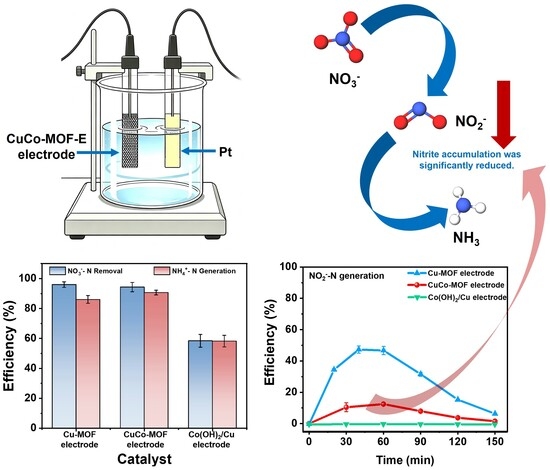
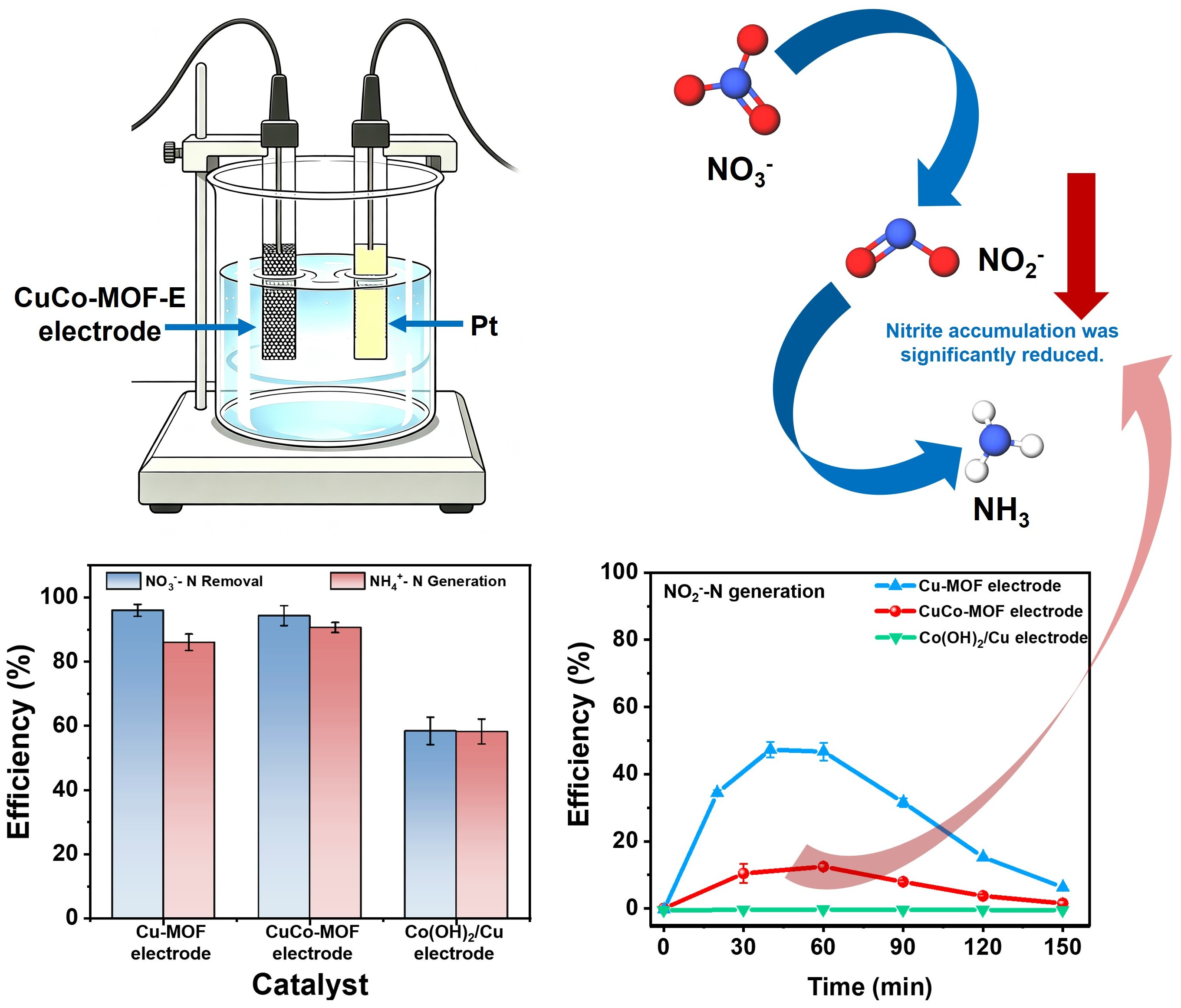
Graphical Abstract

1. Introduction

Nitrate is a ubiquitous inorganic contaminant in aquatic environments. It exhibits high water solubility and mobility, while being poorly immobilized in soil [1]. Excessive nitrate accumulation caused by anthropogenic emissions disrupts the nitrogen cycle, posing risks to both ecosystems and human health. Electrocatalytic reduction converts aqueous NO3 into N2 or NH4+ as final products via electron transfer in water. Notably, NH3/NH4+ serves as a critical chemical feedstock for fertilizer, pharmaceutical, and dye manufacturing, and it also plays a key role in energy storage and carbon-free energy transportation [2,3]. Therefore, electrocatalytic nitrate-to-ammonia conversion, featuring a simple process and low pollutant byproducts, offers a potential alternative route for both nitrate removal and ammonia synthesis.
Significant strides have been made in applying various electrocatalysts toward nitrate reduction [4,5,6]. The catalysts explored encompass single-metal, bimetallic, and metal-oxide types, commonly supported on nickel foam and nanocarbon [7,8,9]. Among these, transition metal catalysts, particularly those based on Cu, Fe, Co, Ni, and their alloys, have been extensively studied due to their availability and economic viability [10,11]. Various coordinating atoms around Cu atoms can effectively regulate the electronic polarity of the catalytic active center. In addition, Cu catalysts are low-cost, possess tunable electronic structures, and can effectively suppress the hydrogen evolution reaction while accelerating the formation of NO2 intermediates [1,12,13]. Based on these advantages, Cu catalysts are considered among the most promising catalysts for the electrocatalytic nitrate reduction to ammonia (ENRA). Cu single-atom, copper oxides, and Cu-based alloy catalysts have all been reported to be effective in nitrate reduction [14,15].
Transition metal Cu exhibits a strong affinity for nitrate and can effectively reduce nitrate to nitrite. However, this leads to the undesired accumulation of nitrite, which adversely affects the ammonia selectivity. Previous studies have shown [16] that the introduction of a second metal can effectively overcome the linear scaling relationship of single-type active sites, prevent strong adsorption from inhibiting product desorption, and avoid activity loss. The second type active site primarily serves to further reduce the nitrite generated at Cu sites into the final product ammonia. Co exhibits certain electrocatalytic activity, owing to its various oxidation states that offer abundant active centers and facilitate electron transfer during the reaction [17,18,19]. Despite exhibiting electrocatalytic activity for nitrate reduction and generating negligible byproducts during the reaction, Co suffers from relatively weak nitrate adsorption and activation [20]. Combining the advantages of Cu and Co in electrocatalytic nitrate reduction, free nitrate in solution is adsorbed and reduced to nitrite at Cu sites, while the nitrite is further reduced to ammonia at Co sites. The synergistic effect of the Cu-Co dual-active sites effectively reduces the accumulation of intermediate byproducts, enhancing the performance of ENRA [21,22].
In addition to the type of active sites in catalysts, the dispersion of active sites is also a critical factor affecting the performance of catalysts. Metal–organic frameworks (MOFs) have attracted considerable attention due to their ordered porous structures and easily tunable pore sizes. Catalysts derived from MOFs can retain the morphological characteristics of MOF precursors, thereby preserving a large surface area that favors active site exposure. Furthermore, MOF materials readily enable the highly dispersed doping of heteroatoms, which can regulate the local electronic structure and thereby further boost the catalytic activity [23,24,25]. To improve the atomic utilization efficiency of metal catalysts, atomically dispersed metals derived from MOFs have also been employed in nitrate reduction to ammonia [26,27].
In this work, a MOF-derived dual-active-site catalytic electrode (CuCo-MOF-E) was constructed via anodic oxidation and cathodic electrodeposition, which was then employed to investigate its nitrate reduction performance in aqueous solutions. The effects of different current densities, initial pH values, and electrode fabrication conditions on the nitrate reduction performance of the prepared catalytic electrodes were investigated. This work strengthens the experimental foundation for the design of highly efficient electrocatalytic electrodes for the conversion of nitrate to ammonia.

2. Results and Discussion

2.1. Electrocatalytic Reduction Performance

MOF-derived CuCo catalytic electrodes were prepared via anodic oxidation and cathodic reduction methods. The Co(OH)2/Cu electrode was obtained by electrodepositing Co onto a Cu mesh substrate. This electrode was then used as the anode to prepare a MOF-derived CuCo-MOF precursor via an anodic oxidation method [28]. Subsequently, the CuCo-MOF precursor was subjected to in situ electrochemical reconstruction [29] via a cathodic reduction process, forming the CuCo composite catalytic electrode, denoted as CuCo-MOF-E.
The SEM image of the CuCo-MOF-E electrode is shown in Figure 1a. The electrode surface exhibits a mesh-like structure with uniform Cu distribution. No obvious Co signal was detected by EDS scanning. The XRD patterns (Figure 1b) also indicate that the electrode presented a distinct Cu2O signal and a relatively weak CoO signal. This is attributed to the use of Cu mesh as the electrode substrate and the low Co loading, where the intense Cu signal overshadows the Co signal. Similarly, no obvious Co signals were observed for the precursor catalyst powders CuCo-MOF. Since the electrode underwent electrochemical reconstruction via cathodic reduction, the electrode surface exists as Cu2O/Cu, primarily in the form of low-valence Cu+. This serves as the catalytically active species for nitrate reduction, which is consistent with the XRD results. Further compositional analysis by ICP-MS was performed, and the results are shown in Table 1. The Co content in the CuCo-MOF-E electrode was quantitatively analyzed, confirming the successful fabrication of the CuCo-MOF-E bimetallic catalytic electrode. The low Co content (0.24%) may be attributed to the dissolution of Cu2+ from the Cu mesh during the anodic oxidation process for MOF precursor formation, which consequently limits the incorporation of Co.
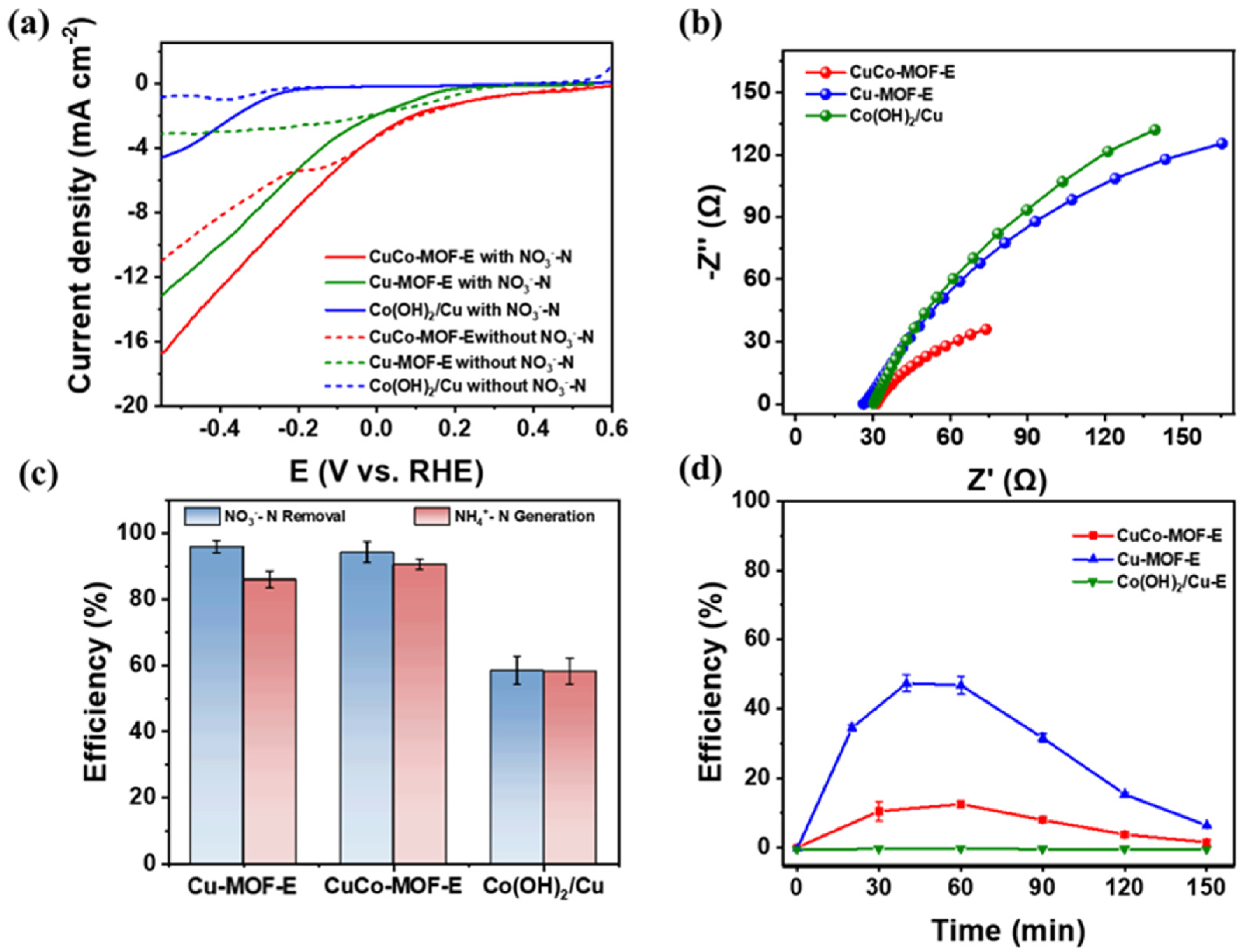
To comparatively investigate the respective effects of Cu and Co on the reduction performance of the catalytic electrodes, CuCo-MOF-E, Cu-MOF-E (without Co), and Co(OH)2/Cu (without Cu MOF structure) electrodes were prepared as working electrodes. Linear sweep voltammetry (LSV) was employed to investigate the nitrate reduction activity of the electrodes, as shown in Figure 2a. In a three-electrode system, the current densities of the LSV curves for Cu-MOF-E, Co(OH)2/Cu, and CuCo-MOF-E catalytic electrodes significantly increased in the presence of NO3, indicating that these catalytic electrodes exhibit good reduction activity toward nitrate. Analysis of the electrochemical impedance spectroscopy (EIS) (Figure 2b) reveals that the charge transfer resistance of CuCo-MOF-E is significantly lower than those of Co(OH)2/Cu and Cu-MOF-E. This suggests that CuCo-MOF-E has the fastest electron transfer efficiency in the nitrate reduction.
The NO3 removal efficiency (RE), NO2, and NH4+ generation efficiency (GE) of the three electrodes under 20 mA cm−2 for 150 min are illustrated in Figure 2c,d. Cu-MOF-E benefits from the favorable enrichment and activation of NO3 by its porous framework, resulting in a higher NO3 RE than that of CuCo-MOF-E. However, its NH4+ GE (85.90%) is lower than that of CuCo-MOF-E (90.58%), accompanied by relatively high NO2 residue (approximately 50%) during the reaction. This can be ascribed to the limitations of single-type active sites in Cu-MOF-E regarding the adsorption energy and hydrogenation kinetics toward NO2 intermediates, which cannot fully match the rapid preceding NO3 reduction step. In contrast, no NO2 accumulation was observed during the nitrate reduction process by using a Co(OH)2/Cu electrode, indicating that the electrodeposition of Co(OH)2/Cu on Cu mesh facilitates the conversion of NO2 to NH4+. Therefore, upon introducing Co to construct CuCo-MOF-E, the bimetallic synergistic effect significantly optimizes the electronic structure. The incorporation of Co not only enhances the electrode’s adsorption capability toward nitrogen-containing intermediates and suppresses the desorption of NO2, but also accelerates the subsequent hydrogenation step. Thus, while maintaining high NO3 RE, the NH4+ GE is also improved and the accumulation of intermediate NO2 is avoided. The nitrate reduction performance of the CuCo-MOF-E electrode prepared in this work, along with related materials reported in recent years, is presented in Table S1 in the Supplementary Materials.
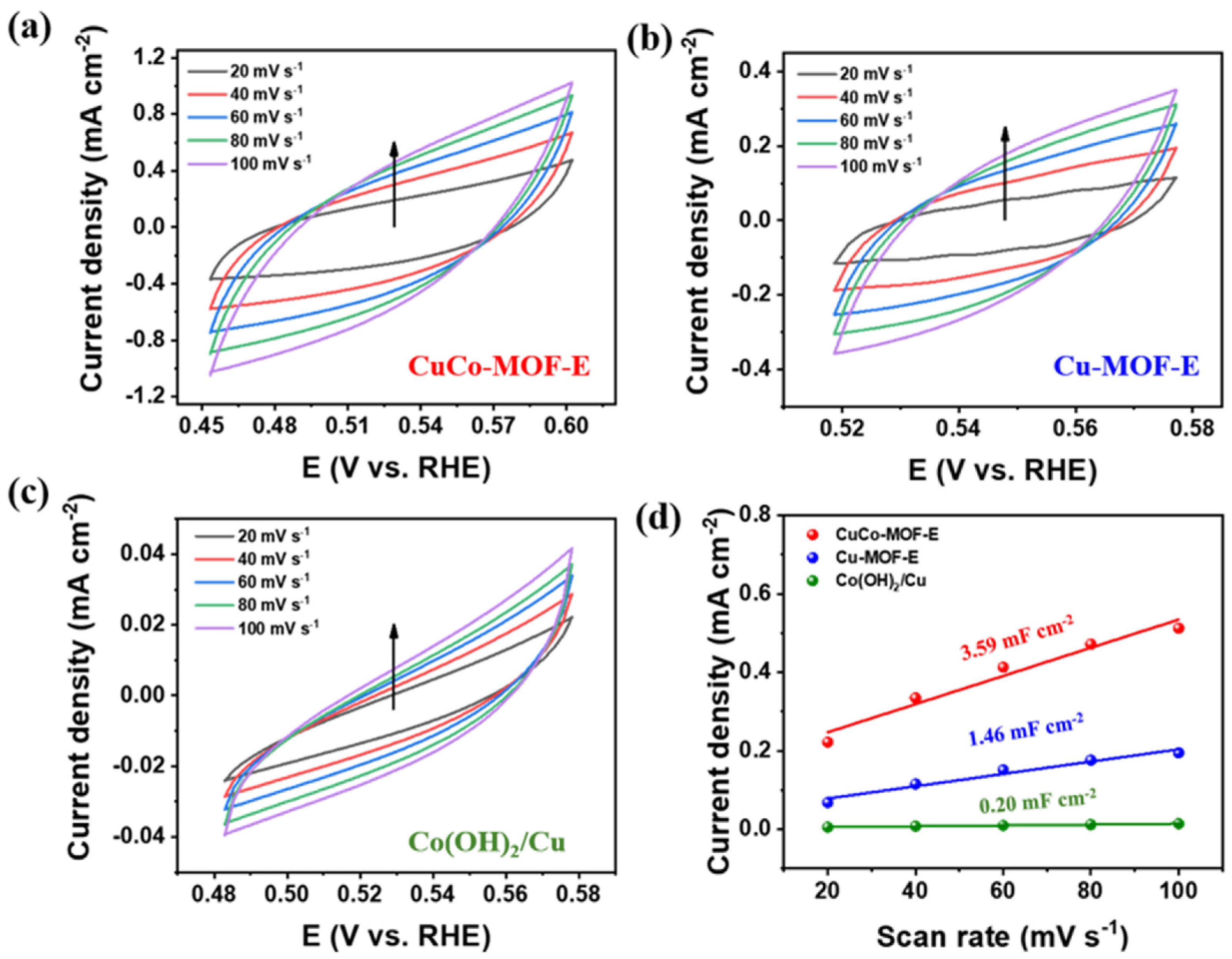
The double-layer capacitance (Cdl) can reflect the number of active sites on the electrode surface to a certain extent. Figure 3 shows the CV curves and double-layer capacitances of CuCo-MOF-E, Cu-MOF-E, and Co(OH)2/Cu catalytic electrodes obtained at scan rates of 20, 40, 60, 80, and 100 mV s−1 in the non-Faradaic region. The Cdl of CuCo-MOF-E (3.59 mF cm−2) is significantly larger than those of Cu-MOF-E (1.46 mF cm−2) and Co(OH)2/Cu (0.20 mF cm−2) (Figure 3d). A high electrochemically active surface area can increase the contact area between the catalyst and electrolyte, thereby enhancing the performance of electrocatalytic nitrate reduction.
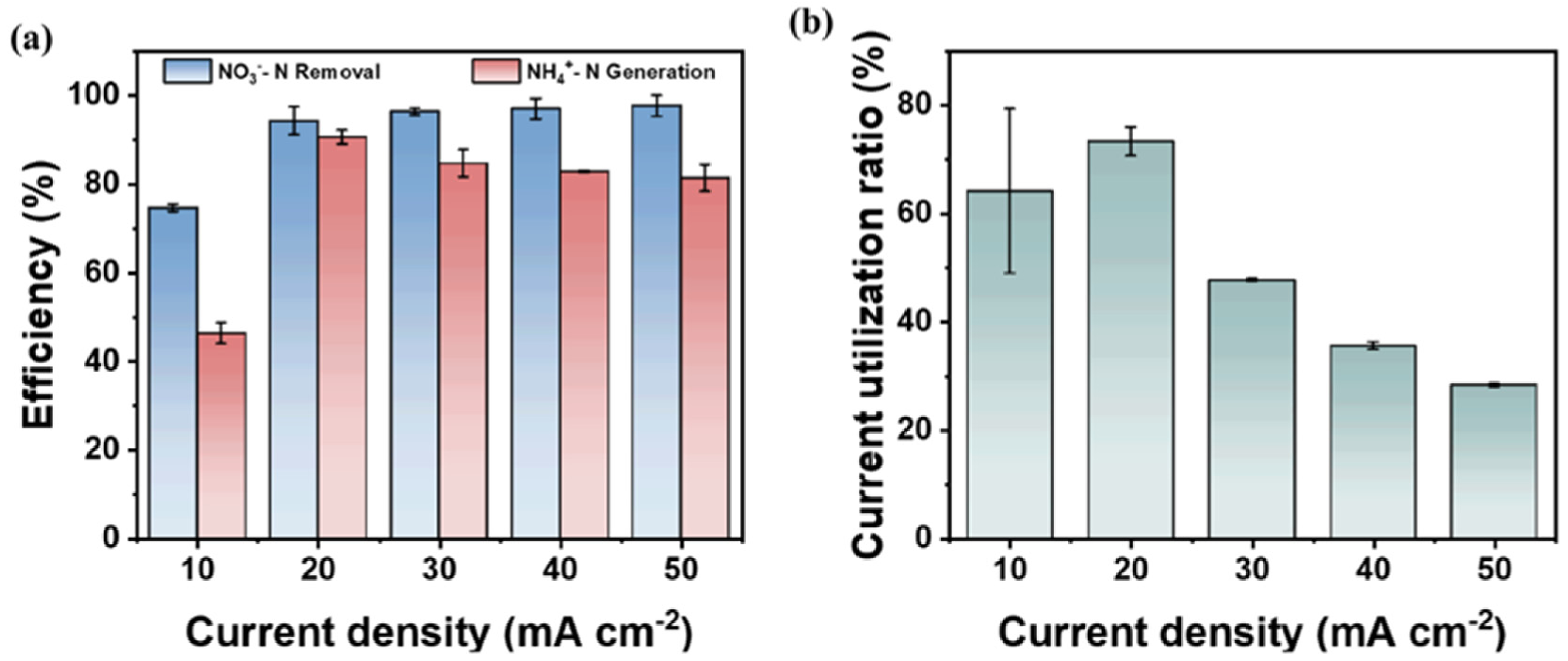
To investigate the effect of current density on electrocatalytic nitrate reduction, experiments were conducted at current densities of 10, 20, 30, 40, and 50 mA cm−2 with the electrode of CuCo-MOF-E, and the results obtained at a reaction time of 150 min are shown in Figure 4a. As the current density increased from 10 to 20 mA cm−2, the NO3 RE increased from 74.58% to 94.26%, and the NH4+ GE increased from 46.33% to 90.58%. As the current density further increased from 20 to 50 mA cm−2, the NO3 RE continued to rise, while the NH4+ GE gradually decreased to 81.36%. This is attributed to the occurrence of side reactions such as hydrogen evolution at excessively high current densities. As shown in Figure 4b, when the current density increased from 10 to 20 mA cm−2, the current utilization efficiency exhibited an upward trend. At 10 mA cm−2, the applied current was primarily consumed for the reduction of the catalyst precursor rather than the reduction of nitrate. When the current density increased from 20 to 50 mA cm−2, the current utilization efficiency decreased from 73.29% to 28.78%, following the same trend as the NH4+ GE. Considering the efficiency of nitrate conversion, ammonia generation, and current utilization, a current density of 20 mA cm−2 was selected.

2.2. Optimization of CuCo-MOF-E Preparation Parameters

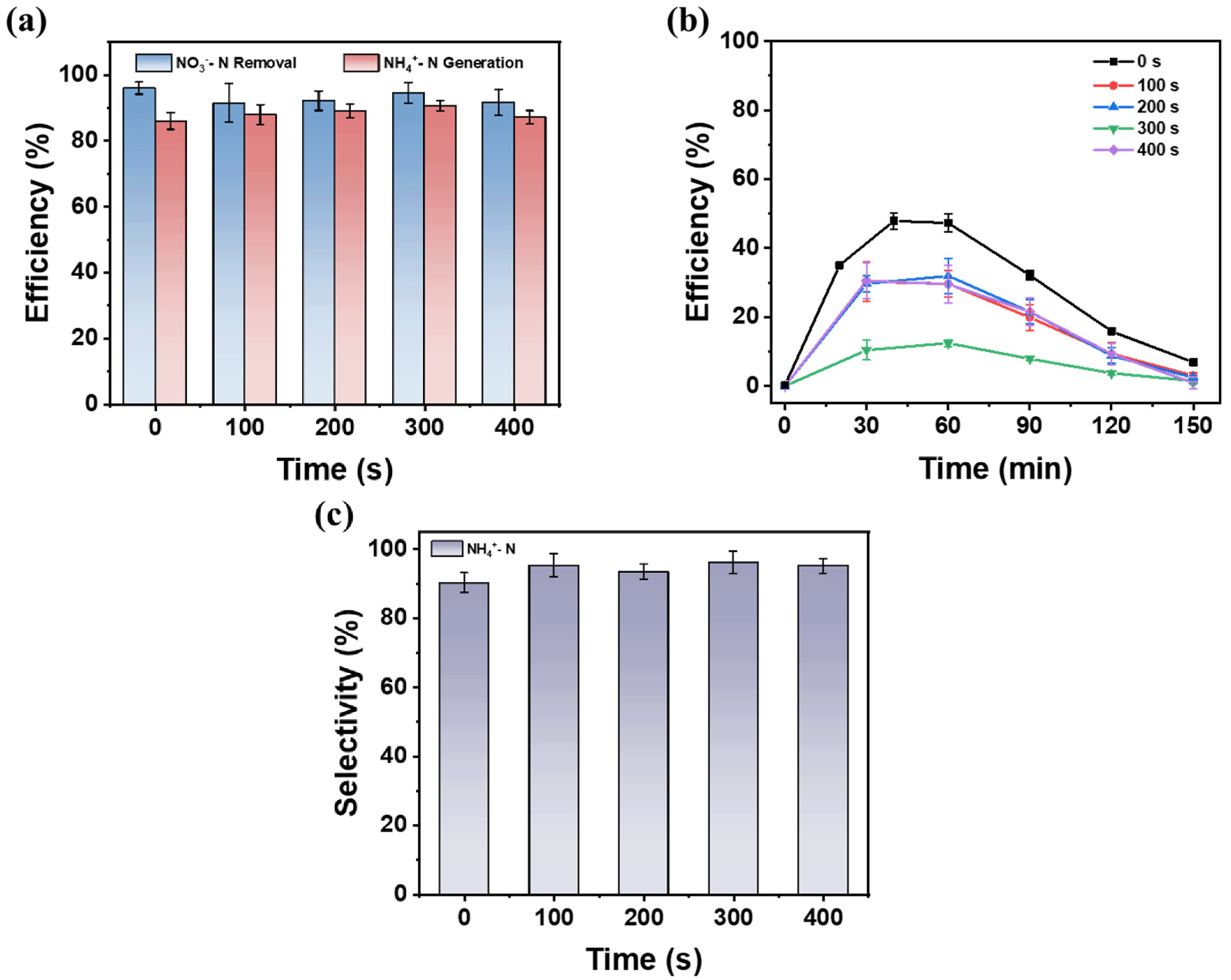
The content of the second active site Co on the CuCo-MOF-E electrode was optimized by controlling the electrodeposition time of Co(OH)2. Using 25 mL of 20 mM Co(NO3)2·6H2O as the electrolyte, with Cu mesh and Pt sheet as the cathode and anode, respectively, a constant current of 10 mA was applied for 100 s, 200 s, 300 s, and 400 s to obtain Co(OH)2/Cu electrodes with different deposition times. A constant current experiment at 20 mA cm−2 was then conducted in 25 mL of 100 mg L−1 NO3-N aqueous solution (containing 0.05 M Na2SO4) for a reaction time of 150 min.
Figure 5a shows the NO3 conversion efficiency and NH4+ generation efficiency for the electrodeposition time ranging from 0 to 400 s. As the electrodeposition time increased to 300 s, the NH4+ generation efficiency increased from 87.86% to 90.58%. When the deposition time was further increased to 400 s, both the NO3 conversion efficiency and NH4+ generation efficiency exhibited a downward trend. This may be attributed to excessive Co(OH)2 loading on the Cu mesh caused by prolonged electrodeposition time, leading to detachment issues during subsequent preparation processes. The variation trend of NO2 during the nitrate reduction is shown in Figure 5b. The NO2 accumulation for catalysts with electrodeposited Co(OH)2 was significantly lower than that for Cu-MOF-E. Among these, the catalyst prepared under a deposition time of 300 s showed the least NO2 accumulation, with a maximum NO2 generation efficiency of only 12.44% at 60 min. Additionally, the ammonia selectivity exhibited the same trend as the NH4+ generation efficiency (Figure 5c), reaching a maximum of 96.40% at a deposition time of 300 s. Therefore, the CuCo-MOF-E electrode with an electrodeposition time of 300 s demonstrated the best activity in this work, and 300 s Co(OH)2 deposition was adopted for subsequent experiments.
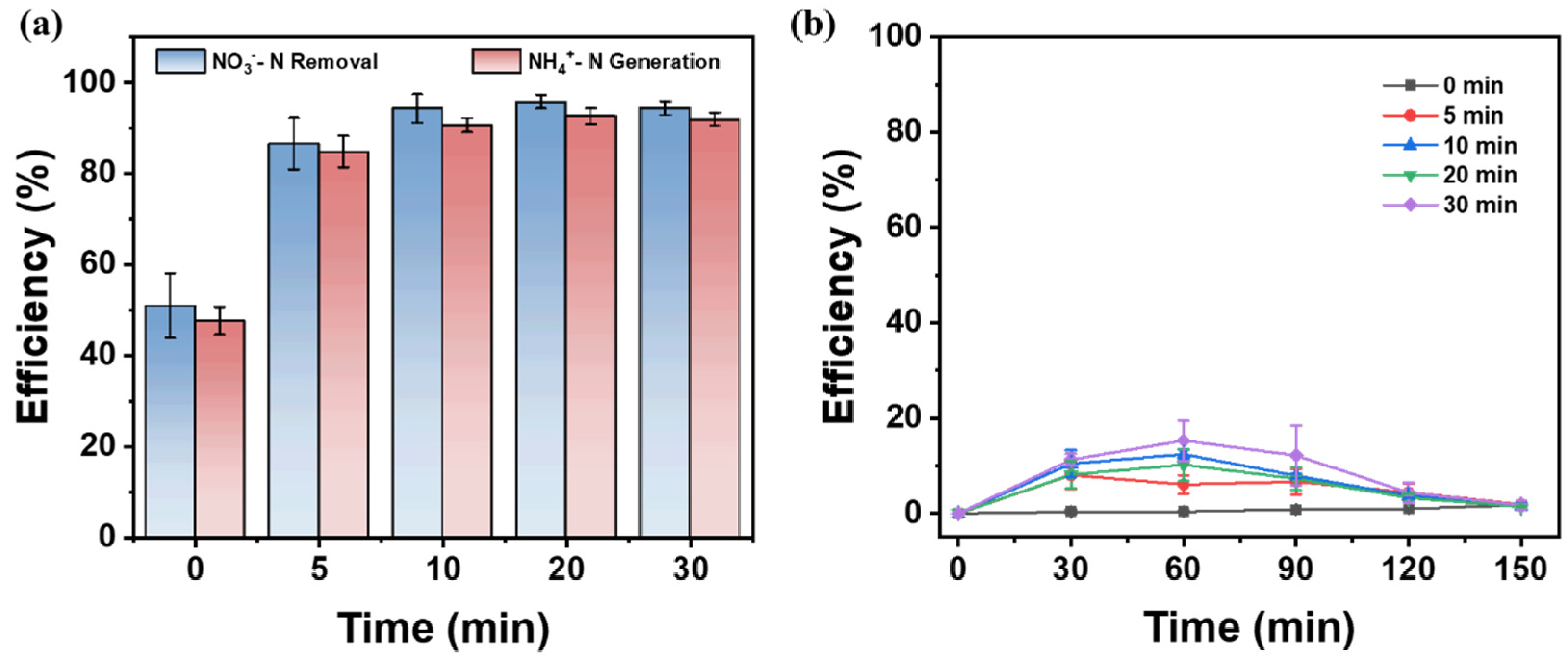
The reduction time of CuCo-MOF was further optimized, as shown in Figure 6a. When the reduction time of the precursor CuCo-MOF increased from 0 min to 10 min, the NO3 RE increased from 50.89% to 94.26%, and the NH4+ GE increased from 47.56% to 90.58%. Further extension of the reduction time resulted in essentially unchanged NO3 RE and NH4+ GE. This indicates that the catalytic electrode reached a stable state after 10 min of reduction, and further increasing the reduction time had little effect on its nitrate reduction performance. Figure 6b shows the variation of NO2 GE during the reaction for catalytic electrodes prepared with different reduction times. The maximum NO2 GE were all below 20.0%, demonstrating that the prepared catalytic electrodes effectively suppress the accumulation of intermediate byproducts.
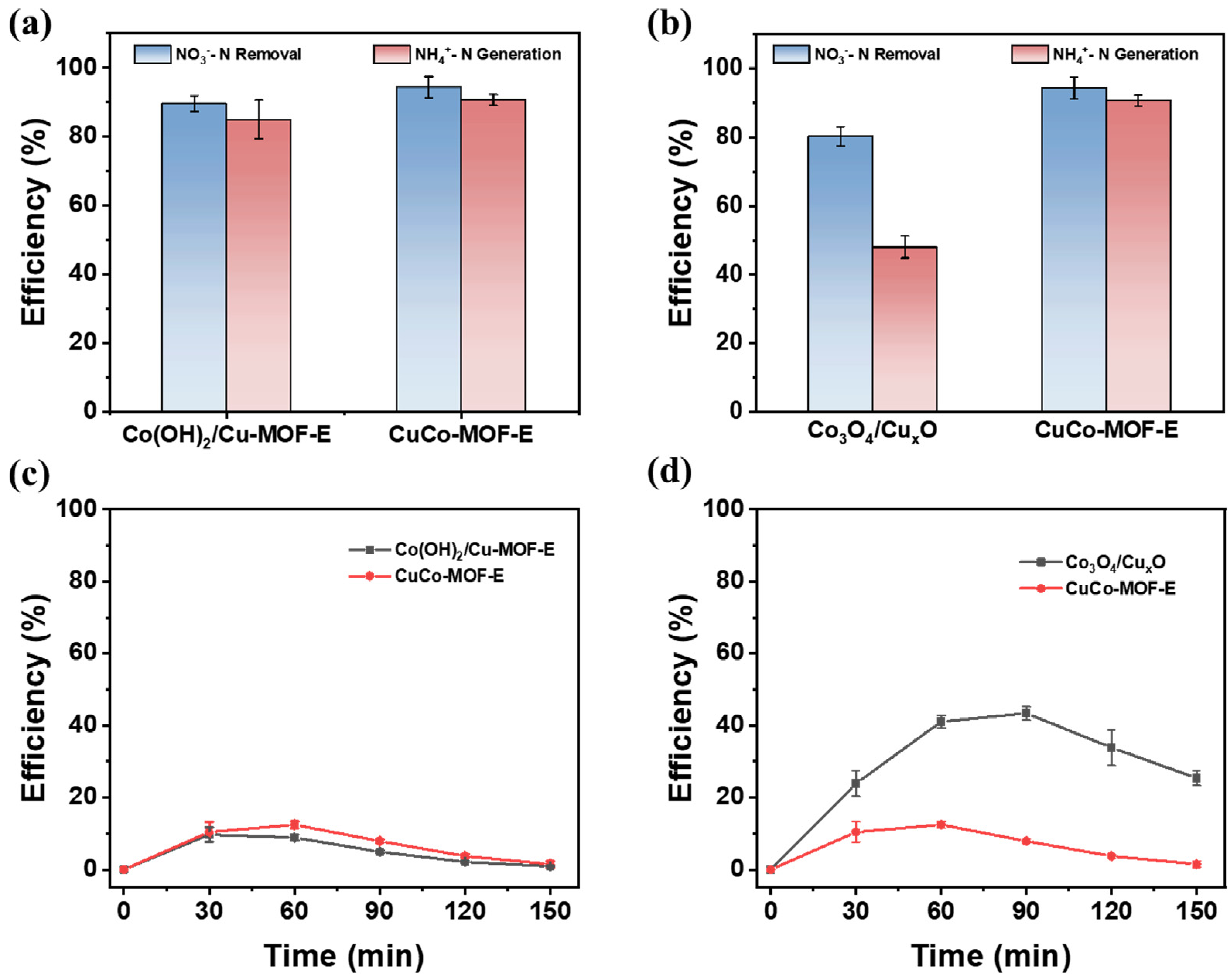
To investigate the effect of Cu-Co loading sequence on the catalytic reduction of nitrate, Cu-MOF precursors were first prepared, then Co(OH)2 was electrodeposited onto the Cu-MOF precursors, and finally, reduction was carried out for 10 min to obtain the Co(OH)2/Cu-MOF-E catalytic electrode. A constant current experiment at 20 mA cm−2 was conducted in 25 mL of 100 mg L−1 NO3-N aqueous solution (containing 0.05 M Na2SO4) for a reaction time of 150 min. The NO3 RE, NO2 GE, and NH4+ GE are shown in Figure 7a,c. The NO3 RE (89.48%) and NH4+ GE (84.94%) of Co(OH)2/Cu-MOF-E were both lower than those of CuCo-MOF-E. This may be attributed to the detachment of some Co(OH)2 caused by the shedding of organic matter from the electrode surface during the Co(OH)2/Cu-MOF reduction process. In addition, NO3 in solution tends to adsorb on copper sites and undergo subsequent conversion, while the surface Co(OH)2 layer partially hinders the mass transfer process of nitrate, thereby reducing its reduction efficiency. Furthermore, the trend of NO2 during the reaction process was similar to that of CuCo-MOF-E.
The effect of annealing the precursor on its catalytic activity was investigated. The CoCu-MOF was annealed in a tube furnace at 400 °C for 2 h with a heating rate of 5 °C min−1. The resulting catalyst was subsequently reduced for 10 min to obtain the Co3O4/CuxO catalytic electrode. The comparison between Co3O4/CuxO and the CuCo-MOF-E electrode is shown in Figure 7b,d. The NO3 RE and NH4+ GE of Co3O4/CuxO were significantly lower than those of CuCo-MOF-E, with the NH4+ GE decreasing by approximately 50.00%. This may be attributed to the detachment of Co3O4 from the catalytic electrode surface along with carbonized organic matter during the annealing process, leading to the accumulation of NO2 during the reaction and thereby reducing the NH4+ GE.

2.3. Electrochemical Stability

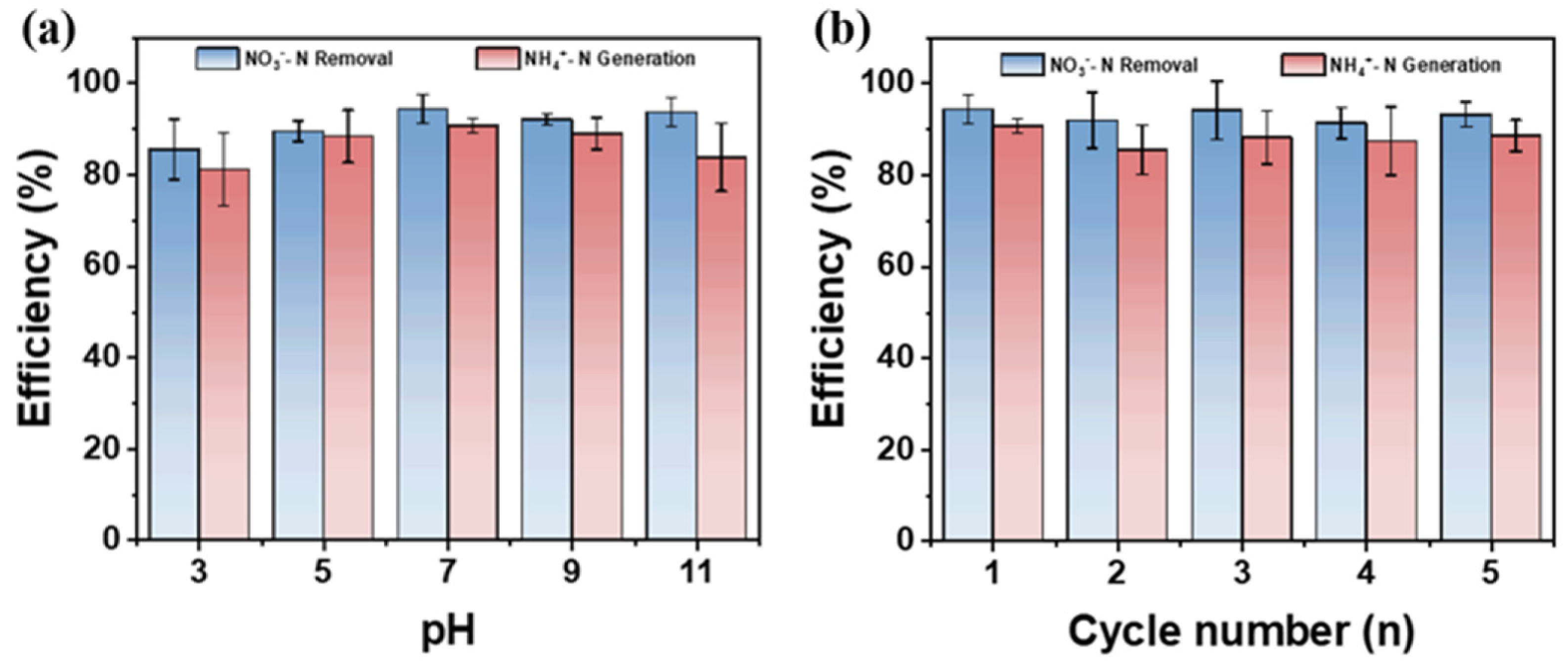
The effect of initial solution pH on ENRA was investigated, as shown in Figure 8a. When the initial pH increased from 3 to 7, the NO3 RE increased from 85.41% to 94.26%, and the NH4+ GE increased from 81.03% to 90.58%. When the pH further increased to 11, the NO3 RE remained almost unchanged while the NH4+ GE gradually decreased to 83.73%. Overall, the catalytic electrode exhibits optimal nitrate removal performance under neutral conditions. Both NO3 RE and NH4+ GE maintained high levels above 80%, indicating that the catalytic electrode can sustain high efficiency over a wide pH range.
The CuCo-MOF-E catalytic electrode was subjected to cycling tests for NO3 reduction at the optimal current density of 20 mA cm−2. Before each cycle, a sample was taken for testing; after 180 min of reaction, another sample was taken, and the electrolyte was replaced with fresh solution for the next cycle. The results are shown in Figure 8b. Within five consecutive cycles, the NO3 RE and NH4+ GE showed no significant decrease, demonstrating that the CuCo-MOF-E electrode has remarkable advantages in terms of both the stability and durability for ENRA.

3. Experimental Methods

3.1. CuCo-MOF-E Electrode Preparation

All chemical reagents used in this experiment were of analytical grade. The Cu mesh (100 mesh), serving as the substrate electrode material, was cut into 1 × 1 cm pieces and pretreated to remove surface oxides. It was ultrasonicated in acetone and 1 M H2SO4 for 10 min each, then ultrasonicated three times in deionized water and absolute ethanol to obtain clean Cu mesh.
The MOF-derived CuCo-MOF-E catalytic electrode was prepared via anodic oxidation and cathodic reduction methods [28]. First, in 25 mL of 20 mM Co(NO3)2·6H2O electrolyte, the pre-treated copper mesh was used as the cathode and Pt sheet as the anode. A constant current of 10 mA was applied for 5 min to obtain the Co(OH)2/Cu electrode. Then, the Co(OH)2/Cu electrode was used as the anode and copper mesh as the cathode. The electrolyte consisted of 12.5 mL ethanol, 12.5 mL water, 1 g hexadecyl trimethyl ammonium bromide (CTAB, the surfactant), 10 mg 1,4,8,11-tetraazacyclotetradecane (TCD, the ligand), and 5 mg tetramethyl ammonium bromide (TMAB, the template agent). At 70 °C, a voltage difference of 10 V was applied between the anode and cathode for 5 min to form the CuCo-MOF electrode on the anode. The electrode was then removed and rinsed with deionized water. Before testing, the CuCo-MOF was used as the working electrode and Pt sheet as the counter electrode, with 100 mg L−1 NO3-N and 0.05 M Na2SO4 as the electrolyte. The final CuCo-MOF-E electrode was obtained by reduction at a current density of 20 mA cm−2 for 600 s, followed by rinsing with deionized water.
The chemical structural information of the catalytic electrodes was analyzed by X-ray diffractometer (SmartLab 9, Rigaku, Tokyo, Japan) with the Cu target as the X-ray source, a scanning rate of 5° min−1, and a range of 5–90°. The morphological characteristics of the electrodes were analyzed by field emission scanning electron microscope (JSM-7800F Prime, JEOL, Tokyo, Japan) at an operating voltage of 5 kV.

3.2. Electrocatalytic Procedures

The electrocatalytic reduction reaction was performed with an Autolab electrochemical workstation (PGSTAT302N, Metrohm, Herisau, The Netherlands). The CuCo-MOF-E electrode was used as the cathode and Pt sheet as the anode. The cathode and anode were spaced 1 cm apart and immersed in 25 mL of 100 mg L−1 NO3-N electrolyte (containing 0.05 M Na2SO4). A constant current was applied for the reduction experiments. Each test was conducted three times at room temperature under identical conditions. The electrochemical performance tests, including linear sweep voltammetry (LSV), electrochemical impedance spectroscopy (EIS), and constant current tests (I-t), were all performed on the Autolab electrochemical workstation.
The concentrations of NO3, NO2, and NH4+ in the reactants and products were determined by UV–visible spectrophotometry (HJ/T 346-2007, GB 7493-87, HJ 536-2009), respectively (detailed information is provided in the Supplementary Materials). The conversion efficiency of N-containing species, and the product selectivity of ammonia were calculated to evaluate the catalytic electrode performance. The calculation methods for the main parameters are listed as follows:
R E NO 3 - N = C NO 3 - N 0 C NO 3 - N t C NO 3 - N 0 × 100%
G E NO 2 - N ,   NH 4 + - N = C N t C NO 3 - N 0 × 100%
S NH 4 + - N = C NH 4 + - N t C NO 3 - N 0 C NO 3 - N t × 100%
η = Q N - products t It / 1000 × 100%
Q N - products t = n × C N t × V × F M N × 100%
where RE(NO3-N) is the nitrate removal efficiency; GE(NO2-N, NH4+-N) is the generation efficiency of nitrite and ammonia, respectively; S(NH4+-N) is the ammonia selectivity; η is the current utilization efficiency; C(NO3-N)0 is the initial concentration of NO3N, mg L−1; C(N)t is the concentration of N-containing species (NO3, NO2, and NH4+) at time t, mg L−1. Q(N-products)t is the total amount of electricity required to convert NO3-N to N-containing products including NO2-N and NH4+-N at time t, C; It/1000 is the total amount of electricity provided during time t, C; I is the current, mA; t is the time, s; n is the number of electron transfers; F is the Faraday constant, 96,487 C mol−1; V is the volume of the solution, L; MN is the molar mass, 14,000 mg mol−1.

4. Conclusions

In this work, a CuCo-MOF-E catalytic electrode was constructed on a conductive Cu mesh substrate through anodic oxidation and cathodic electrodeposition strategies. The MOF structure in the precursor provided a high specific surface area and a three-dimensional hierarchical porous structure, with periodically arranged organic ligands uniformly dispersing Cu and Co active sites while maintaining close spatial proximity. Through ligand-bridged electronic coupling, the coupled tandem catalytic pairs formed by Cu sites and Co sites were strengthened. This dual-site synergistic mechanism resolved the selectivity issue arising from the mismatch between intermediate generation rates and hydrogenation rates on single Cu sites. Under reaction conditions of 20 mA cm−2 for 150 min, CuCo-MOF-E achieved a NO3 removal efficiency of 94.26% and an NH4+ generation efficiency of 90.58%, with NO2 accumulation effectively suppressed. This result not only reveals the unique advantages of MOF structure in bimetallic tandem catalysis, but also provides clear structure–function relationship insights for designing efficient electrocatalysts based on MOF platforms. The high activity and selectivity exhibited by this electrode at moderate current densities make it suitable for decentralized treatment of low-concentration nitrate wastewater and ammonia resource recovery. For this system, systematic investigation of the regulatory effects of MOF ligand types and defect engineering on the microenvironmental acidity/alkalinity and proton transfer rates remains to be addressed; overcoming these challenges will further advance this system toward better industrial applications.

Supplementary Materials

The following supporting information can be downloaded at: https://www.mdpi.com/article/10.3390/catal16070658/s1, Figure S1: Standard curve of different nitrogen-containing compounds; Figure S2: Elemental mapping results of CuCo-MOF-E; Table S1: Performance of electrocatalytic nitrate reduction to ammonia with Cu-Co or MOF catalysts in recent related research. References [29,30,31,32,33,34,35,36,37,38,39,40] are cited in the Supplementary Materials.

Author Contributions

F.S.: Conceptualization, methodology, formal analysis, and writing. H.X.: Investigation, data curation, and formal analysis. D.G.: Validation, formal analysis, and writing. J.W.: Supervision, project administration, and funding acquisition. All authors have read and agreed to the published version of the manuscript.

Funding

This work was financially supported by the National Natural Science Foundation of China (No. 22306118, 22076117), and the Open Fund of Shanxi Key Laboratory of Water Pollution Prevention and Utilization (SWRFZYLY202515).

Data Availability Statement

Data will be made available on request.

Conflicts of Interest

The authors declare no conflicts of interest.

References

  1. Garcia-Segura, S.; Lanzarini-Lopes, M.; Hristovski, K.; Westerhoff, P. Electrocatalytic reduction of nitrate: Fundamentals to full-scale water treatment applications. Appl. Catal. B Environ. 2018, 236, 546–568. [Google Scholar] [CrossRef] [Scilit]
  2. Chang, F.; Gao, W.B.; Guo, J.P.; Chen, P. Emerging materials and methods toward ammonia-based energy storage and conversion. Adv. Mater. 2021, 33, 2005721. [Google Scholar] [CrossRef] [Scilit]
  3. Smith, C.; Hill, A.K.; Torrente-Murciano, L. Current and future role of Haber-Bosch ammonia in a carbon-free energy landscape. Energy Environ. Sci. 2020, 13, 331–344. [Google Scholar] [CrossRef] [Scilit]
  4. Zhang, Z.J.; Liu, M.R.; Ge, B.C.; Yang, T.F.; Wang, S.T.; Liu, Y.; Gao, S.Y. In-situ reconstructed Cu/NiO nanosheets synergistically boosting nitrate electroreduction to ammonia. Chin. Chem. Lett. 2025, 36, 110657. [Google Scholar] [CrossRef] [Scilit]
  5. Zhang, X.; Wang, Y.T.; Liu, C.B.; Yu, Y.F.; Lu, S.Y.; Zhang, B. Recent advances in non-noble metal electrocatalysts for nitrate reduction. Chem. Eng. J. 2021, 403, 126269. [Google Scholar] [CrossRef] [Scilit]
  6. Jia, S.H.; Wu, L.M.; Tan, X.X.; Feng, J.Q.; Ma, X.D.; Zhang, L.B.; Song, X.N.; Xu, L.; Zhu, Q.G.; Kang, X.C.; et al. Synthesis of hydroxylamine via ketone-mediated nitrate electroreduction. J. Am. Chem. Soc. 2024, 146, 10934–10942. [Google Scholar] [CrossRef] [Scilit] [PubMed]
  7. Nazemi, M.; Panikkanvalappil, S.R.; El-Sayed, M.A. Enhancing the rate of electrochemical nitrogen reduction reaction for ammonia synthesis under ambient conditions using hollow gold nanocages. Nano Energy 2018, 49, 316–323. [Google Scholar] [CrossRef] [Scilit]
  8. Chen, Y.; Guo, R.J.; Peng, X.Y.; Wang, X.Q.; Liu, X.J.; Ren, J.Q.; He, J.; Zhuo, L.C.; Sun, J.Q.; Liu, Y.F.; et al. Highly productive electrosynthesis of ammonia by admolecule-targeting single Ag sites. ACS Nano 2020, 14, 6938–6946. [Google Scholar] [CrossRef] [Scilit] [PubMed]
  9. Guo, Y.; Zhang, R.; Zhang, S.C.; Zhao, Y.W.; Yang, Q.; Huang, Z.D.; Dong, B.B.; Zhi, C.Y. Pd doping-weakened intermediate adsorption to promote electrocatalytic nitrate reduction on TiO2 nanoarrays for ammonia production and energy supply with zinc-nitrate batteries. Energy Environ. Sci. 2021, 14, 3938–3944. [Google Scholar] [CrossRef] [Scilit]
  10. Zhao, J.; Liu, L.J.; Yang, Y.; Liu, D.; Peng, X.B.; Liang, S.J.; Jiang, L.L. Insights into electrocatalytic nitrate reduction to ammonia via Cu-based bimetallic catalysts. ACS Sustain. Chem. Eng. 2023, 11, 2468–2475. [Google Scholar] [CrossRef] [Scilit]
  11. Teng, M.J.; Ye, J.R.; Wan, C.; He, G.Y.; Chen, H.Q. Research progress on Cu-based catalysts for electrochemical nitrate reduction reaction to ammonia. Ind. Eng. Chem. Res. 2022, 61, 14731–14746. [Google Scholar] [CrossRef] [Scilit]
  12. Reyter, D.; Bélanger, D.; Roué, L. Nitrate removal by a paired electrolysis on copper and Ti/IrO2 coupled electrodes—Influence of the anode/cathode surface area ratio. Water Res. 2010, 44, 1918–1926. [Google Scholar] [CrossRef] [Scilit] [PubMed]
  13. Zhu, C.Q.; Wang, Q.N.; Wu, C. Rapid and scalable synthesis of bismuth dendrites on copper mesh as a high-performance cathode for electroreduction of CO2 to formate. J. CO2 Util. 2020, 36, 96–104. [Google Scholar] [CrossRef] [Scilit]
  14. Chen, H.H.; Zhang, C.Q.; Sheng, L.; Wang, M.M.; Fu, W.; Gao, S.; Zhang, Z.R.; Chen, S.Q.; Si, R.; Wang, L.Z.; et al. Copper single-atom catalyst as a high-performance electrocatalyst for nitrate-ammonium conversion. J. Hazard. Mater. 2022, 434, 128892. [Google Scholar] [CrossRef] [Scilit] [PubMed]
  15. Yang, X.H.; Wang, R.; Wang, S.; Song, C.; Lu, S.; Fang, L.; Yin, F.J.; Liu, H. Sequential active-site switches in integrated Cu/Fe-TiO2 for efficient electroreduction from nitrate into ammonia. Appl. Catal. B Environ. 2023, 325, 122360. [Google Scholar] [CrossRef] [Scilit]
  16. Wang, J.; Liu, C.; Feng, J.Y.; Cheng, D.; Zhang, C.Q.; Yao, Y.N.; Gu, Z.Y.; Hu, W.L.; Wan, J.J.; Yu, C.Z. MOFs derived Co/Cu bimetallic nanoparticles embedded in graphitized carbon nanocubes as efficient Fenton catalysts. J. Hazard. Mater. 2020, 394, 122567. [Google Scholar] [CrossRef] [Scilit] [PubMed]
  17. Wu, S.L.; Jiang, Y.Y.; Luo, W.J.; Xu, P.; Huang, L.L.; Du, Y.W.; Wang, H.; Zhou, X.M.; Ge, Y.J.; Qian, J.J.; et al. Ag-Co3O4-CoOOH-nanowires tandem catalyst for efficient electrocatalytic conversion of nitrate to ammonia at low overpotential via triple reactions. Adv. Sci. 2023, 10, 2303789. [Google Scholar] [CrossRef] [Scilit]
  18. Hong, Q.L.; Zhou, J.; Zhai, Q.G.; Jiang, Y.C.; Hu, M.C.; Xiao, X.; Li, S.N.; Chen, Y. Cobalt phosphide nanorings towards efficient electrocatalytic nitrate reduction to ammonia. Chem. Commun. 2021, 57, 11621–11624. [Google Scholar] [CrossRef] [Scilit]
  19. Yang, J.Y.; Zhang, W.D.; Zhao, H.; Zou, Y.Z.; Zhang, Z.Y.; Liu, J.Y.; Wang, J.; Gu, Z.G.; Yan, X.D. High-valent cobalt active sites derived from electrochemical activation of metal-organic frameworks for efficient nitrate reduction to ammonia. Appl. Catal. B Environ. 2024, 340, 123237. [Google Scholar] [CrossRef] [Scilit]
  20. Gao, J.N.; Jiang, B.; Ni, C.C.; Qi, Y.F.; Zhang, Y.Q.; Oturan, N.; Oturan, M.A. Non-precious Co3O4-TiO2/Ti cathode based electrocatalytic nitrate reduction: Preparation, performance and mechanism. Appl. Catal. B Environ. 2019, 254, 391–402. [Google Scholar] [CrossRef] [Scilit]
  21. Zhou, Q.; Zhang, L.W.; Wang, Z.L.; Wang, Q.T.; Zhu, C.Y. Ionomer-regulated Cu/Co tandem catalysis for efficient electrochemical nitrate-to-ammonia conversion. Catalysts 2025, 15, 1156. [Google Scholar] [CrossRef] [Scilit]
  22. Zhang, L.W.; Cao, J.S.; Liu, B.W.; Li, R.Z.; Deng, B.W.; Zhu, C.Y. Metal-dependent intermediate evolution in tandem Cu-M catalysts for electrocatalytic ammonia synthesis from nitrate. Catalysts 2026, 16, 402. [Google Scholar] [CrossRef] [Scilit]
  23. Guo, C.P.; Duan, F.H.; Zhang, S.; He, L.H.; Wang, M.H.; Chen, J.L.; Zhang, J.Q.; Jia, Q.J.; Zhang, Z.H.; Du, M. Heterostructured hybrids of metal-organic frameworks (MOFs) and covalent-organic frameworks (COFs). J. Mater. Chem. A 2022, 10, 475–507. [Google Scholar] [CrossRef] [Scilit]
  24. Sanati, S.; Morsali, A.; García, H. Metal-organic framework-based materials as key components in electrocatalytic oxidation and reduction reactions. J. Energy Chem. 2023, 87, 540–567. [Google Scholar] [CrossRef] [Scilit]
  25. Peng, Y.; Sanati, S.; Morsali, A.; Garcia, H. Metal-organic frameworks as electrocatalysts. Angew. Chem. Int. Ed. 2023, 62, e202214707. [Google Scholar] [CrossRef] [Scilit]
  26. Liu, H.F.; Qin, J.Z.; Mu, J.C.; Liu, B.J. In situ interface engineered Co/NC derived from ZIF-67 as an efficient electrocatalyst for nitrate reduction to ammonia. J. Colloid Interface Sci. 2023, 636, 134–140. [Google Scholar] [CrossRef] [Scilit] [PubMed]
  27. Liu, Y.; Deng, B.W.; Li, K.L.; Wang, H.; Sun, Y.J.; Dong, F. Metal-organic framework derived carbon-supported bimetallic copper-nickel alloy electrocatalysts for highly selective nitrate reduction to ammonia. J. Colloid Interface Sci. 2022, 614, 405–414. [Google Scholar] [CrossRef] [Scilit] [PubMed]
  28. Zhu, Q.G.; Yang, D.X.; Liu, H.Z.; Sun, X.F.; Chen, C.J.; Bi, J.H.; Liu, J.Y.; Wu, H.H.; Han, B.X. Hollow metal-organic-framework-mediated in situ architecture of copper dendrites for enhanced CO2 electroreduction. Angew. Chem. Int. Ed. 2020, 59, 8896–8901. [Google Scholar] [CrossRef] [Scilit]
  29. Xu, X.; Ge, Y.; Fu, C.; Wang, R.; Liu, C.; Yin, Z.; Zhou, Q.; Yang, W. Electrochemically reconstructed defect-rich Cu/Co nanoreactor for ultrafast ammonia electrosynthesis from low-concentration nitrate. J. Colloid Interface Sci. 2026, 706, 139749. [Google Scholar] [CrossRef] [Scilit] [PubMed]
  30. Sun, H.; Xia, Z.; Qi, Y.; Xu, Q.; Han, J.; Wu, J.; Qin, J.-S.; Rao, H. Tandem Cu-Co sites in MOF-818 for efficient ammonia electrosynthesis from nitrate in neutral media. ACS Catal. 2025, 15, 16581–16590. [Google Scholar] [CrossRef] [Scilit]
  31. Yan, A.; Feng, Y.; Zhang, X.; Sun, J.; Wei, J.; Shi, C.; Xia, L.; Wang, S.; Zhang, H.; Guo, Y. In situ reconstruction of bimetallic MOFs to form copper-cobalt relay catalysis for efficient nitrate reduction to ammonia. Small 2025, 21, e06256. [Google Scholar] [CrossRef] [Scilit] [PubMed]
  32. Wang, M.; Li, W.; Qiao, H.; Yu, Y.; Ning, F.; Liu, Y.; Qiao, J. Qc-5-CuxCoy MOFs for boosting electrochemical nitrate reduction to ammonia in neutral electrolyte. Process Saf. Environ. 2026, 215, 109110. [Google Scholar] [CrossRef] [Scilit]
  33. Xin, C.; Wei, Y.-P.; Bai, J.-Q.; Chen, J.; Sun, S.; Mao, C.-J. Synergistic integration of copper and cobalt-MOF for high-efficiency electrocatalytic nitrate reduction to ammonia. J. Environ. Chem. Eng. 2025, 13, 115182. [Google Scholar] [CrossRef] [Scilit]
  34. Zhou, X.; Xu, W.; Liang, Y.; Jiang, H.; Li, Z.; Wu, S.; Gao, Z.; Cui, Z.; Zhu, S. Dynamically restructuring nanoporous Cu–Co electrocatalyst for efficient nitrate electroreduction to ammonia. ACS Catal. 2024, 14, 12251–12259. [Google Scholar] [CrossRef] [Scilit]
  35. Fan, X.; Lai, C.; Qin, L.; Zhang, M.; Yan, H.; Liu, S.; Ma, D.; Liu, Q.; Tang, L. Oxygen vacancy-assisted CuCo tandem catalyst boosts efficient electrocatalytic neutral ultralow-concentration nitrate to ammonia. Chem. Eng. J. 2025, 522, 168046. [Google Scholar] [CrossRef] [Scilit]
  36. Su, X.; Li, M.; Wen, Y.; Sun, F.; Shan, B. Atomically paired Cu-Co dual sites for near-unity ammonia selectivity in nitrate electroreduction. J. Am. Chem. Soc. 2025, 147, 46471–46482. [Google Scholar] [CrossRef] [Scilit] [PubMed]
  37. Xu, J.; Wan, S.; Yao, P.; Yang, J.; Ma, J.; Zhang, H. Defect engineering of Cu metal-organic framework for boosting nitrate efficient electroreduction to ammonia. Appl. Mater. Today 2026, 48, 103015. [Google Scholar] [CrossRef] [Scilit]
  38. Lei, B.; Liu, X.; Li, B.; Lu, H.; He, X.-Y.; Wang, X.; Long, G.; Ma, J.-G.; Cheng, P. Controllable partial self-sacrifice of metal-organic frameworks for enhancing nitrate electroreduction to ammonia. Chem. Catal. 2025, 5, 101484. [Google Scholar] [CrossRef] [Scilit]
  39. Muthukumar, P.; Ullah, Z.; Zhang, X.; Ullah, H.; Liu, Y.; Li, L.; Tian, S.; Zhou, X.; Anthony, S.P.; Zuo, Y.; et al. Unlocking a water coordination environment in Co-based metal-organic frameworks for advanced nitrate-to-ammonia electroreduction. J. Am. Chem. Soc. 2025, 147, 29949–29960. [Google Scholar] [CrossRef] [Scilit] [PubMed]
  40. Mao, S.; Zhu, Y.; Dong, G.; Wang, T.; Pan, F.; Zhang, K.; Yu, S. Enhancing tandem electrochemical nitrate reduction to ammonia through Cu-MOF/Co-MOF@NF composite nanoflower. Langmuir 2025, 41, 28170–28179. [Google Scholar] [CrossRef] [Scilit] [PubMed]
Figure 1. (a) SEM images and elemental distribution characterization of CuCo-MOF-E, (b) XRD patterns of Cu-MOF, CuCo-MOF, and the CuCo-MOF-E electrode.
Catalysts 16 00658 g001
Figure 2. (a) LSV curves, (b) EIS diagram, (c) NO3-N removal efficiency and NH4+-N generation efficiency, and (d) NO2-N generation efficiency of CuCo-MOF-E, Cu-MOF-E, and Co(OH)2/Cu.
Catalysts 16 00658 g002
Figure 3. CV curves of (a) CuCo-MOF-E, (b) Cu-MOF-E, (c) Co (OH)2/Cu with different scanning rates, and (d) double-layer capacitance values of the electrodes. The arrows indicate the changing trend of the CV curves.
Catalysts 16 00658 g003
Figure 4. (a) NO3-N removal efficiency, NH4+-N generation efficiency and (b) current utilization efficiency at different current densities with the electrode of CuCo-MOF-E.
Catalysts 16 00658 g004
Figure 5. (a) NO3 removal efficiency NH4+ generation efficiency, (b) NO2 generation efficiency, and (c) NH4+ selectivity at different electrodeposition times of Co(OH)2.
Catalysts 16 00658 g005
Figure 6. (a) NO3-N removal efficiency, NH4+-N generation efficiency and (b) NO2-N generation efficiency with different reduction times of the precursor CuCo-MOF.
Catalysts 16 00658 g006
Figure 7. Effects of copper and cobalt loading sequences on (a) NO3-N removal efficiency, NH4+-N generation efficiency, and (c) NO2-N generation efficiency; effects of annealing on (b) NO3-N removal efficiency, NH4+-N generation efficiency, and (d) NO2-N generation efficiency.
Catalysts 16 00658 g007
Figure 8. Effects of (a) the initial solution pH and (b) the reuse of the catalytic electrode on the performance of nitrate reduction to ammonia.
Catalysts 16 00658 g008
Table 1. Concentration of Co in the CuCo-MOF-E catalytic electrode by ICP.
ElementConcentration (mg L−1)Content (%)
Co0.17 × 10−10.24
Disclaimer/Publisher’s Note: The statements, opinions and data contained in all publications are solely those of the individual author(s) and contributor(s) and not of MDPI and/or the editor(s). MDPI and/or the editor(s) disclaim responsibility for any injury to people or property resulting from any ideas, methods, instructions or products referred to in the content.