Article

Fe to Ni Electron Transfer Promotes Hydrodeoxygenation of Lipids over Fe-Ni-S Catalysts

Sinopec Research Institute of Petroleum Processing Co., Ltd., Beijing 100083, China
*
Authors to whom correspondence should be addressed.
Catalysts 2026, 16(7), 614; https://doi.org/10.3390/catal16070614 (registering DOI)
Submission received: 9 June 2026 / Revised: 2 July 2026 / Accepted: 4 July 2026 / Published: 5 July 2026
(This article belongs to the Section Catalytic Materials)

Abstract

The development of efficient, low-cost hydrodeoxygenation (HDO) catalysts is essential for converting renewable lipids into sustainable aviation fuels. Here, we report a series of sulfided bimetallic NiFe/γ-Al2O3 catalysts and systematically investigate the promotional role of Fe in the HDO of methyl decanoate, a model lipid compound. Using complementary characterization together with fixed-bed reactor kinetic measurements, we elucidate the influence of the Ni/Fe ratio on catalyst structure, sulfidation behavior, electronic properties, and reaction pathway. Fe incorporation promotes Ni sulfidation and induces electron transfer from Fe to Ni, as directly evidenced by a red shift in the CO stretching frequency (from 2094 cm−1 for Ni-only to 2090 cm−1 for NiFe), indicating increased electron density on Ni sites and enhanced π-backdonation. Among the catalysts tested, N5F5 (Ni/Fe mass ratio = 1:1) exhibits the highest Ni sulfidation degree, the highest turnover frequency (32.1 h−1), and the lowest apparent activation energy (Ea ≈ 92 kJ/mol). At 360 °C, it achieves 52.9% methyl decanoate conversion, far exceeding that of monometallic Ni and Fe catalysts. Product selectivity analysis reveals that sulfided Ni sites predominantly promote the decarboxylation/decarbonylation (DCOx) pathway, whereas Fe sites contribute only marginally to direct deoxygenation (DDO). This work provides the first direct spectroscopic evidence for Fe-to-Ni electron transfer in sulfided NiFe catalysts and establishes a clear structure-performance correlation, offering a rational design strategy for low-cost, high-performance HDO catalysts for lipid upgrading.

1. Introduction

The production of biofuels from renewable resources represents a widely recognized strategy to address global environmental and energy challenges [1,2]. Among various feedstocks, lipid-based raw materials can be selectively converted into high-value fuel products via the hydrodeoxygenation (HDO) reaction, which removes oxygen-containing functional groups [3,4,5,6,7].
The catalyst lies at the heart of efficient HDO reactions. Currently, sulfided catalysts based on WS2 or MoS2 as the active phase are most conventional. Nickel sulfide has emerged as a promising alternative to traditional WS2 or MoS2 catalysts [8]; however, its activity for the HDO of lipids remains relatively low [9]. Meanwhile, the rapid expansion of the lithium-ion battery industry in recent years has led to a continuous rise in nickel prices, imposing considerable cost pressure on refineries and catalyst suppliers [10]. Iron, a low-cost and earth-abundant Group VIII metal like nickel, has been investigated as an active phase in HDO reactions, including lignin deoxygenation [11] and phenol deoxygenation [12]. Furthermore, studies on combined iron-nickel catalysts have suggested synergistic effects in several catalytic systems [13,14,15,16], including the oxygen evolution reaction (OER), the hydrogen evolution reaction (HER) [17], CO2 hydrogenation [18], the Fenton reaction [19], Fischer-Tropsch synthesis [20], coal liquefaction [21], and hydrogenolysis reactions [8]. However, the mechanism by which Fe modulates the electronic properties of sulfided Ni active phase, and how this modulation influences the HDO reaction pathway, remains poorly understood.
To date, the application of sulfided Ni-Fe catalysts in the HDO of lipids has not been reported. Therefore, systematically investigating the promotional effect of the inexpensive metal Fe on sulfided Ni catalysts, including its influence on catalyst structure and HDO performance, is of great significance for developing low-cost, high-performance lipid conversion catalysts. In this study, a series of sulfided NiFe/γ-Al2O3 catalysts with varying Ni/Fe ratios were developed, with emphasis placed on the following three aspects: (1) systematically examining the impact of Fe incorporation on the physicochemical properties of the catalysts (e.g., dispersion and degree of sulfidation) using characterization techniques such as XRD, H2-TPR, TEM, XPS, and CO/IR; (2) comprehensively evaluating the HDO activity and product selectivity of the catalysts using methyl decanoate as a model compound.

2. Results and Discussion

2.1. Characterization of the Catalysts in the Oxide State

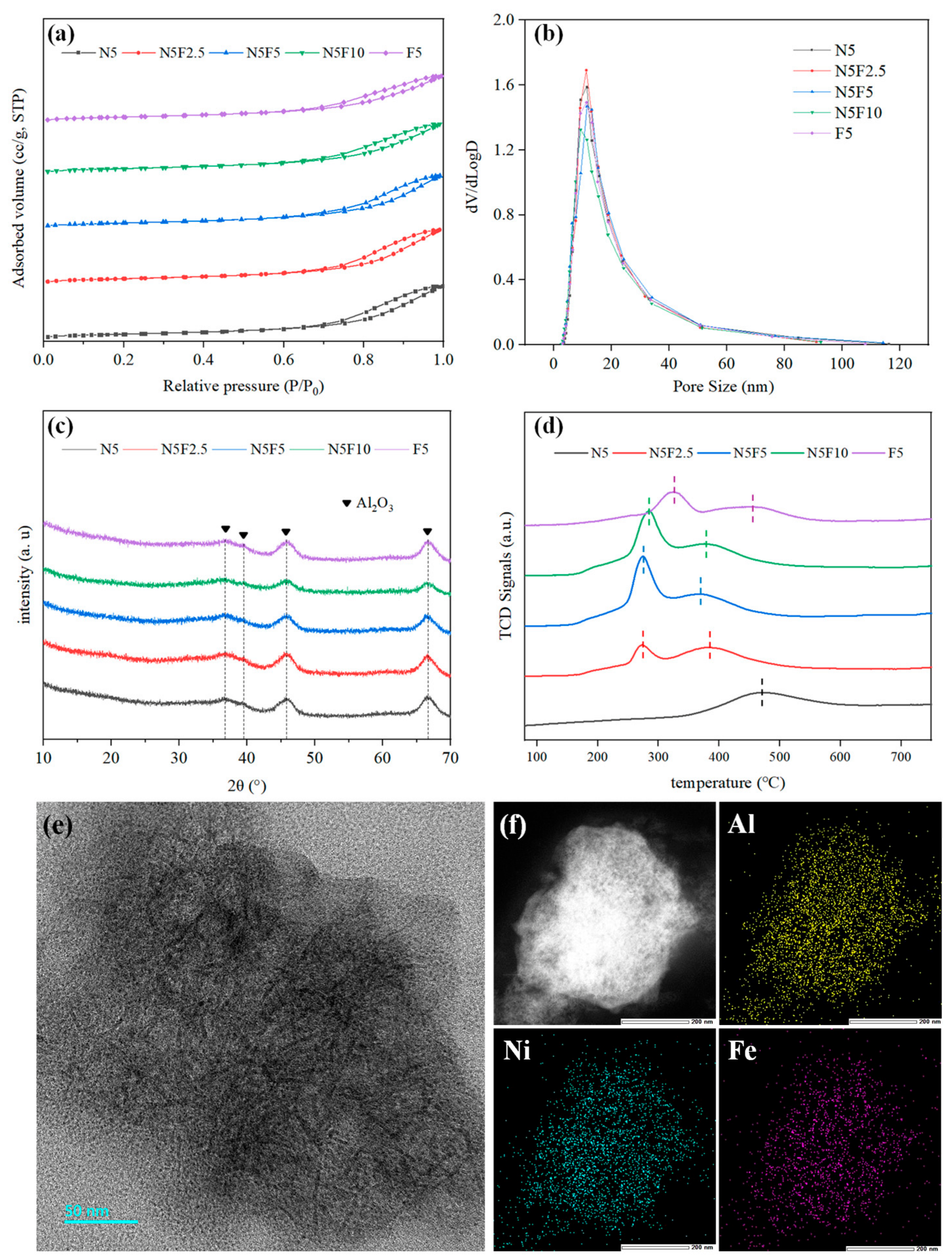
The textural properties of the catalysts were characterized by low-temperature N2 physisorption-desorption. As shown in Figure 1a, all catalysts exhibited Type IV adsorption isotherms with N2 hysteresis loops, indicating that all catalysts possessed similar mesoporous structures [10]. Pore size distributions (Figure 1b) of the catalysts were also comparable, with a most probable pore size of approximately 10.0 nm, which is favorable for the transport of reactant and product molecules within the catalyst. Given that the active metal loading does not exceed 15 wt%, variation in metal loading has little influence on the pore structure of the catalysts; thus, differences in catalytic activity observed for this series of catalysts are not attributable to textural structure effects. XRD patterns (Figure 1c) exhibit clear characteristic diffraction peaks of the γ-Al2O3 at 2θ = 67.1°, 45.8°, 39.3°, and 37.6°, corresponding to the (440), (400), (222), and (311) crystal planes, respectively [22]. Evidently, no additional signals attributable to the Ni and Fe oxides are detected for the series of catalysts, indicating high dispersion of the metal species. Raman spectra (Figure S1) show a distinct peak near 1000 cm−1 only for N5 catalyst, assigned to the second-order longitudinal optical (2LO) phonon mode of NiO [23], indicating the presence of NiO particles in the monometallic Ni catalyst. The disappearance of this characteristic NiO peak upon Fe introduction suggests that Fe alters the crystal structure of NiO (or it may be due to the dilution effect of nickel caused by the presence of iron).
H2-TPR profile (Figure 1d) of theN5 catalyst exhibits a single broad peak centered at ca. 480 °C, which is assigned to the reduction of highly dispersed NiO species interacting strongly with the support [24]. Reduction peaks in the lower temperature range of 300~450 °C are typically associated with weakly interacting or bulk-like NiO particles. The complete absence of peaks in this region (300~450 °C) indicates the lack of such weakly interacting or bulk NiO particles, which is consistent with the low Ni loading [25] and is further supported by the XRD results. The F5 catalyst shows two reduction peaks: a sharp peak at a lower temperature of ca. 320 °C attributed to the reduction of Fe2O3 to Fe3O4, and a higher-temperature peak at ca. 480 °C assigned to the further reduction to metallic Fe0 [26,27]. For the bimetallic catalysts, two reduction peaks were observed in each profile. The low-temperature peak (285~295 °C) corresponds to the reduction of Fe species, and its intensity increases with Fe loading. The high-temperature peak is attributed to the reduction of Ni species, whose intensity remained essentially constant, in line with the identical Ni loading among these catalysts. Compared with the N5 catalyst, the Ni reduction peak in the N5Fx series shifts markedly to lower temperatures, indicating that intimate Ni-Fe bimetallic oxide interactions weaken the Ni-support interaction, making the Ni species more readily reducible to Ni0. In particular, the lowest reduction temperature is observed for the N5F5 catalyst, suggesting that a specific Ni/Fe loading ratio maximizes bimetallic interaction.
The TEM image of the N5F5 catalyst is shown in Figure 1e. No distinct particles of nickel oxide or iron oxide are observed in the catalyst, indicating a high dispersion of metal species, which closely aligns with the XRD results. As shown in Figure 1f, the elemental mappings of the N5F5 catalyst further reveal that Ni and Fe are uniformly distributed on the support at the microscale.

2.2. Characterization of Sulfided Catalysts

TEM images (Figure S2) show that the nickel-derived sulfide species are observed as discrete nanoparticles uniformly dispersed, with no evidence of extended crystalline slabs. This morphological evidence suggests that sulfidation occurs predominantly on the surface rather than throughout the bulk. Additional evidence for surface-predominant sulfidation is provided by XPS analysis (vide infra): after sulfidation treatment, a substantial proportion of Ni species remains in the oxidized state, pointing to incomplete sulfidation of the near-surface region. Taken together, the absence of bulk-like sulfide lamellae and the presence of abundant oxidized Ni at the surface demonstrate a preferred sulfidation behavior that is primarily surface-limited process, resulting in high dispersion of the sulfide phase without extensive sulfidation into the bulk of the catalyst.
XPS was employed to analyze the surface chemical composition and electronic structure of the catalysts. The S 2p XPS spectra (Figure S3) over the different catalysts display a main peak at ~162.2 eV, which is a characteristic signal of S2− in metal sulfides, confirming the presence of small sulfide particles. A weak peak was also observed at approximately ~168.5 eV, which is assigned to sulfate species (SO42−). The relative content of sulfate species is lower than that of sulfide species, which may be due to partial oxidation caused by the inability to maintain an air-tight environment during analysis.
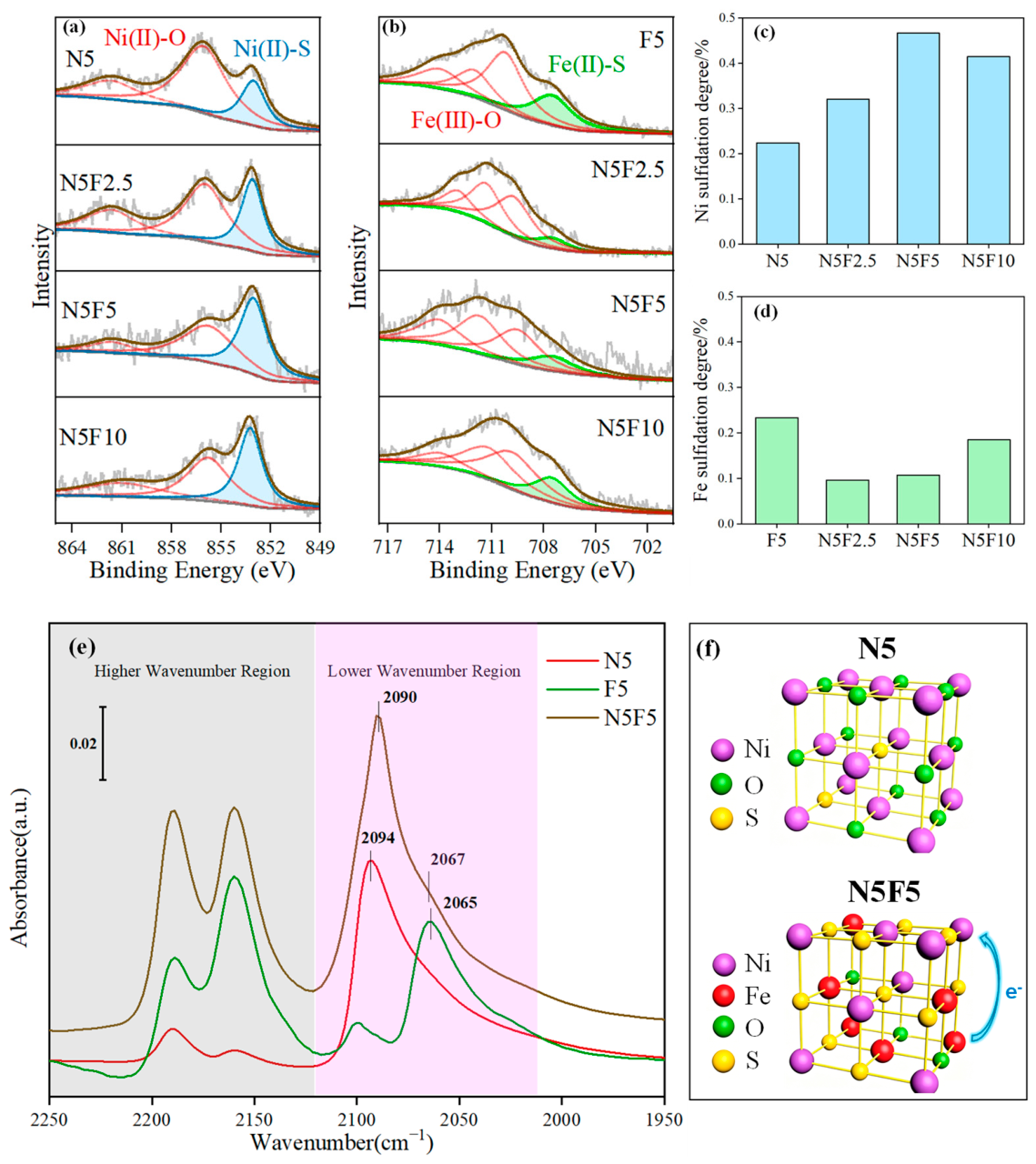
Furthermore, peak fitting of the Ni 2p and Fe 2p XPS spectra was performed to determine the sulfidation degree of the active metals. As shown in Figure 2a, the Ni 2p spectra show peaks at 853.0 and 856.0 eV, which are assigned to Ni(II)-S and Ni(II)-O, respectively. The sulfidation degree of Ni, defined as the ratio of the Ni-S species peak area to the total Ni peak area, is shown in Figure 2c. Compared to monometallic Ni (N5), Fe addition significantly enhances Ni sulfidation. With increasing Fe loading, the Ni sulfidation degree first increases and then decreases, reaching the maximum value at a Ni/Fe mass ratio of 1:1 (N5F5). For the Fe 2p3/2 peak (Figure 2b), the peak at 707.5 eV corresponds to Fe(II)-S, while peaks between 709 and 714 eV correspond to iron oxides [18], indicating that Fe is not fully sulfided and a substantial fraction of iron oxides remains. The sulfidation degree of Fe, defined as the ratio of the Fe-S species peak area to the Fe total peak area, is shown in Figure 2d. For the bimetallic catalysts, the Fe-S peak area increases correspondingly with Fe loading. The monometallic F5 catalyst exhibits a higher Fe sulfidation degree than the bimetallic catalysts. Collectively, these results indicate that Ni-Fe interactions modulate the sulfidation state of each component. The addition of Fe promotes the further sulfidation of Ni, which is otherwise difficult to sulfide, whereas the Ni inhibits the sulfidation of Fe. Among the bimetallic NiFe catalysts, the N5F5 catalyst displays the highest Ni sulfidation degree and, correspondingly, the amount of the active NiS phase is the highest.
Figure 2e presents the IR spectra of the sulfided N5, F5, and N5F5 catalysts under approximately 100 Pa CO, revealing the electronic properties of different metal sulfide sites. The spectra can be divided into two regions: a higher wavenumber region (>2120 cm−1) and a lower wavenumber region (<2120 cm−1). The bands in the higher wavenumber region are assigned to CO interacting with Al3+ Lewis acid sites and acidic OH groups on the Al2O3 support [28]. For the F5 catalyst, additional bands are attributed to CO interacting with incompletely sulfided FeOx species supported on Al2O3 [29], whereas the bands in the lower wavenumber region correspond to CO adsorbed on the sulfide phase.
The F5 catalyst exhibits a strong main absorption peak at 2065 cm−1, which is assigned to coordinatively unsaturated Fe2+ sites on the iron sulfide phase. The N5 catalyst displays a single CO absorption peak at 2094 cm−1, corresponding to coordinatively unsaturated Ni2+ sites on the nickel sulfide phase. The NiFe bimetallic catalyst exhibits a main peak at 2090 cm−1 and a weak shoulder peak at 2067 cm−1, indicating the formation of Ni-S phases and Fe-S phases. CO is a well-established probe molecule for characterizing metal sites. Upon adsorption, σ donation from CO to the metal increases the C-O stretching frequency, whereas π back-donation from the metal to CO decreases it. Compared with the peak at 2094 cm−1 for the N5 catalyst, the CO absorption peak of the Fe-promoted Ni sites in the N5F5 catalyst is red-shifted to 2090 cm−1, indicating a decrease in the C-O stretching frequency. This provides direct evidence for an increased electron density on the Ni sites and enhanced π back-donation to CO. Conversely, the CO absorption peak of Fe sites promoted by Ni is blue-shifted to 2067 cm−1. These observations reveal that in the Ni-Fe-S system, Fe acts as an electron donor, partially transferring electron density to Ni, making the Ni sites more electron-rich and Fe sites more electron-deficient. This is consistent with the lower electronegativity of Fe compared to Ni and explains the variations in the sulfidation degree observed by XPS, which are primarily attributed to the electron transfer between Fe and Ni, as shown in Figure 2f.

2.3. Evaluation of Hydrodeoxygenation Activity

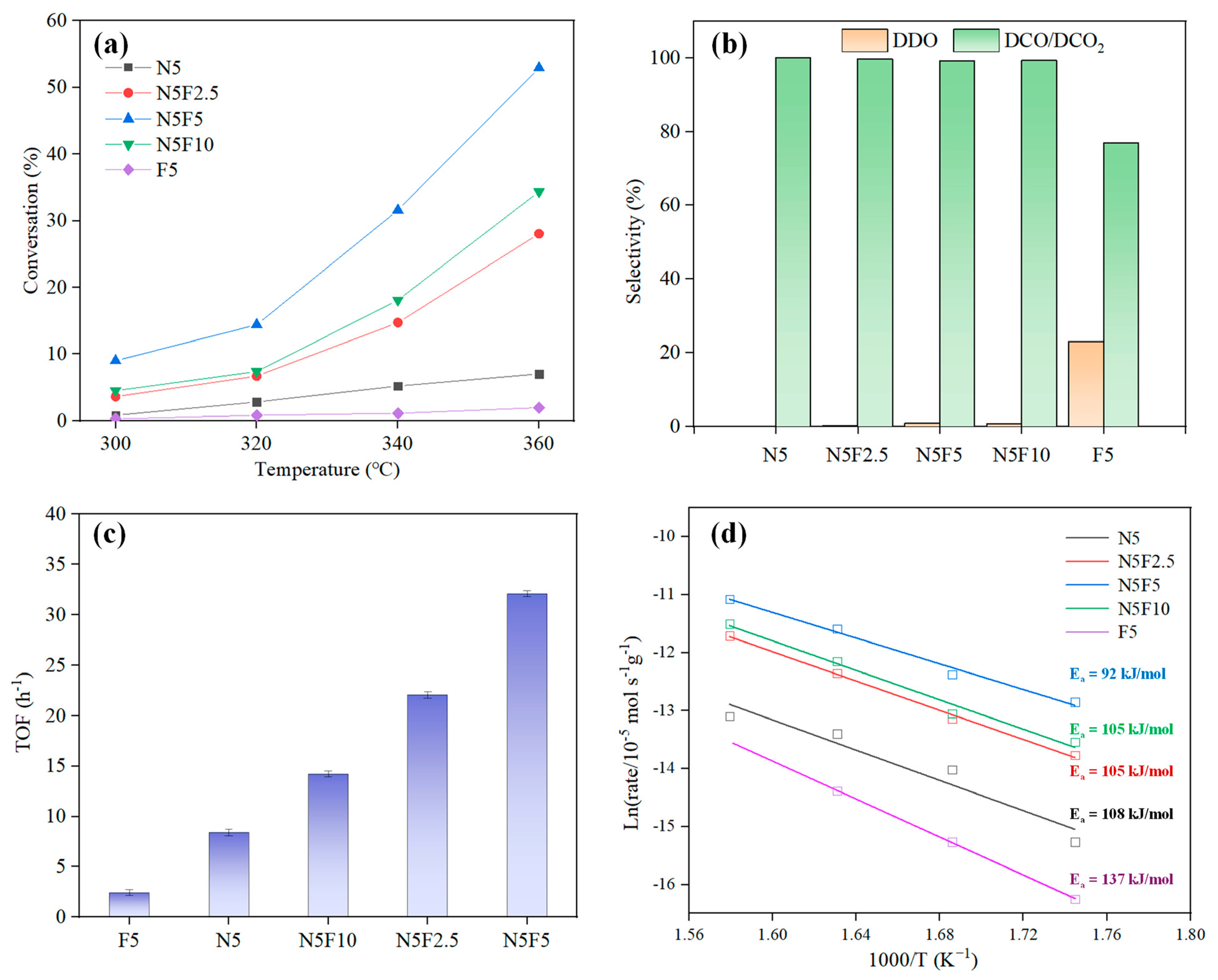
The catalytic performance of the different catalysts in the hydrodeoxygenation of methyl decanoate is presented in Figure 3. The conversion order at all tested temperatures (Figure 3a) is: N5F5 > N5F10 > N5F2.5 > N5 > F5. Bimetallic Ni-Fe catalysts exhibit higher activity than monometallic catalysts, and the activity trend correlates with the Ni sulfidation degree, indicating that the NiS phase is crucial for HDO activity. Among them, the N5F5 catalyst with a Ni/Fe molar ratio of 1:1 displays the highest reactant conversion, reaching 52.9% at 360 °C (versus 34.4% for N5F10, 28.0% for N5F2.5, 7.0% for N5, and 1.9% for F5). The low activity of the N5 catalyst is attributed to the deficiency of the active component NiS caused by incomplete sulfidation. The F5 catalyst exhibits the lowest activity. Although XPS results indicate that the proportion of FeS species is relatively the highest in this catalyst, the weak ability of FeS to activate H2 makes it difficult to generate reactive H species and activated reactant molecules, resulting in low HDO conversion. For all the catalysts, increasing the reaction temperature from 300 to 360 °C increases HDO conversion, consistent with kinetic expectations [5].
The hydrocarbon distribution in the liquid product reflects the deoxygenation pathway. Products with one fewer carbon atom than the original fatty acid chain (i.e., C9 hydrocarbons) originate from deoxygenation via decarboxylation and/or decarbonylation reactions (collectively referred to as the DCOx pathway), which produce CO and CO2 as by-products. In contrast, products with the same carbon chain length (C10 hydrocarbons) originate from direct deoxygenation (DDO), producing H2O. As shown in Figure 3b, a comparison of the product selectivity over all catalysts demonstrates that DDO selectivity is substantially lower than DCOx selectivity. Specifically, the Fe-free N5 catalyst exhibits almost 0% DDO selectivity, whereas the Ni-free F5 catalyst shows the relatively highest DDO selectivity (23.0%). This indicates that NiS species are crucial for promoting C-C bond cleavage.
According to TEM images, the active components are highly dispersed; therefore, the molar amount of active metals can be approximated as the number of active sites. The active site concentration is thus calculated and used to determine the turnover frequency (TOF). The results are shown in Figure 3c, and the TOF values follow the order: N5F5 > N5F2.5 > N5F10 > N5 > F5. The N5F5 catalyst displays the highest TOF of 32.1 h−1, indicating that at an appropriate Ni/Fe ratio, the intrinsic activity per active site is higher. It can also be observed that, in contrast to the trend of HDO conversion, the N5F2.5 catalyst exhibits a higher TOF than N5F10. This indicates that the introduction of even a small amount of Fe can promote the formation of nanoscale active NiS, thereby enhancing the per-site activity. However, the excessive introduction of low-activity Fe inhibits the formation of NiS and lowers the average site activity.
To further investigate the temperature dependence of the TOF, Arrhenius plots of the HDO reaction over the series of catalysts were constructed (Figure 3d). A good linear relationship (R2 ≈ 1) is observed between Ln(r) and 1000/T. The apparent activation energies (Ea) calculated from the slopes show that N5F5 has an Ea of approximately 92 kJ/mol, and the Ea values decrease in the order: F5 > N5 ≈ N5F2.5 ≈ N5F10 > N5F5. This indicates that an appropriate Ni/Fe ratio can significantly lower the activation energy.

3. Experimental

3.1. Catalyst Preparation and Chemical Reagents

Catalysts were prepared using nickel(II) nitrate and/or iron(III) nitrate as metal precursors. In a typical synthesis, citric acid was dissolved in deionized water, and the resulting solution was mixed with an aqueous solution containing nickel nitrate, iron nitrate, or a mixture of both. The mixed solution was then used to impregnate a γ-Al2O3 support (RS-3100, manufactured by Sinopec Catalyst Co., Ltd., Changling Branch, Yueyang, China) via the incipient wetness impregnation method. After impregnation, the sample was dried at 120 °C for 2 h and subsequently calcined at 400 °C for 2 h in air to obtain the oxidic catalyst precursor. For all samples, the molar ratio of citric acid to total metals (nickel and/or iron) was maintained at 1:1. The catalyst prepared with 10 g of Al2O3 support, 2.46 g of nickel nitrate, and 1.62 g of citric acid, corresponding to a nominal 5 wt% Ni loading, was designated as N5. The catalyst containing 5 wt% Fe, prepared using 10 g of Al2O3 support, 3.62 g of iron nitrate, and 1.72 g of citric acid, was designated as F5. For the bimetallic Ni-Fe catalysts, the Ni loading was fixed at 5 wt% (2.46 g nickel nitrate per 10 g Al2O3), and samples were prepared with Ni:Fe mass ratios of 2:1 (1.81 g iron nitrate, 2.48 g citric acid), 1:1 (3.62 g iron nitrate, 3.34 g citric acid), and 1:2 (7.24 g iron nitrate, 5.06 g citric acid). These bimetallic catalysts were designated as N5F2.5, N5F5, and N5F10, respectively.

3.2. Catalyst Characterization

The specific surface area and pore structure of the carrier and catalyst were measured using the Autosorb-6B N2 adsorption–desorption analyzer (Quantachrome, Boynton Beach, FL, USA). Samples were pretreated by vacuum degassing at 300 °C for 3 h to remove surface impurities. X-ray diffraction (XRD) patterns were collected on a PANalytical powder diffractometer (PANalytical, Almelo, the Netherlands) equipped with Cu Kα radiation (λ = 1.54178 Å, beam voltage of 40 kV, and dwell time of 500 s). H2-programmed temperature reduction (H2-TPR) was carried out on a chemisorption instrument equipped with an ASAP 2950 analyzer (Micromeritics, Norcross, GA, USA) using 10 vol% H2/Ar (50 mL/min). Approximately 20 mg of catalyst precursor was used, and the H2 consumption was recorded over the temperature range of interest. Transmission electron microscopy (TEM) images of the studied catalysts were obtained on a JEM-ARM200F transmission electron microscope (JEOL, Akishima, Tokyo, Japan) operated at 200 keV. Sample (1 mg) was thoroughly ground and dispersed in ethanol. It was then sonicated and added dropwise onto a copper grid. The catalyst precursors were reduced in a pretreatment chamber at 360 °C for 2 h in H2S. After cooling, the prepared catalysts were directly moved to analysis chamber without exposure to air. The X-ray photoelectron spectroscopy (XPS) signals were collected using a Thermo Fisher VG ESCALAB 250 instrument (Thermo Fisher Scientific, Waltham, MA, USA) with Al Kα radiation. Low-temperature (∼100 K) CO adsorption followed by IR spectroscopy was used to characterize the sulfided catalysts in situ. Spectra of the adsorbed CO were obtained by subtracting the spectra recorded after and before CO introduction. CO adsorption infrared spectra were recorded on a Nicolet iS50 FTIR spectrometer (Thermo Fisher Scientific, Waltham, MA, USA)equipped with an MCT detector, with 256 scans and a resolution of 4 cm−1. Spectra decomposition was performed using Peakfit V4.12 using “Autofit peak III-deconvolution” and considering Gaussian functions.

3.3. Activity Measurement

Prior to testing, the catalysts were presulfided at 360 °C and 4.0 MPa with hydrogen flow rate of 400 mL/min. The sulfiding agent employed was a cyclohexane solution containing 5 wt% CS2, which was fed into the system at 0.4 mL/min for 3 h. The resulting sulfided NiFeS/γ-Al2O3 catalysts were stored under an air-free environment prior to use.
The HDO performance of the catalysts was evaluated in a fixed-bed continuous-flow microreactor. The catalyst was crushed and sieved to 40–60 mesh. For each test, 1 g of the sieved catalyst was physically mixed with 16 g quartz sand in the same mesh size, and the mixture was loaded into the isothermal zone of the reactor tube. Prior to the reaction, in situ sulfidation was performed under the same conditions described above. Upon completion of sulfidation, the feed was switched to the reaction feedstock, which was a methyl decanoate solution containing 0.2 wt% CS2. The HDO reactions were conducted at temperatures ranging from 300 to 360 °C, at 4.0 MPa, with a hydrogen flow rate of 200 mL/min and a liquid feed rate of 0.3 mL/min. The system was allowed to stabilize under reaction conditions for 1 h before collecting liquid product samples for analysis. The composition of the liquid products was analyzed using an Agilent 7890 gas chromatograph (Agilent Technologies, Santa Clara, CA, USA). All catalytic runs were repeated at least three times under identical conditions, and the results are reported as average values. The relative standard deviations (RSD) were consistently below 2%, confirming excellent reproducibility.
Based on the results of chromatographic analysis, the deoxygenation rate, C (%), and the product selectivity, S (%), were calculated as follows:
C = ( 1 T h e   m o l a r   a m o u n t   o f   o x y g e n   i n   t h e   p o s t r e a c t i o n   p r o d u c t T h e   m o l a r   a m o u n t   o f   o x y g e n   i n   t h e   f e e d s t o c k ) × 100
s D D O = n C 10 n C 9 + n C 10 × 100
s D C O x = n C 9 n C 9 + n C 10 × 100
where n − Ci denotes a normal alkane or alkene with i carbon atoms.
The reaction rate, r (mol·s−1·g−1), the apparent activation energy, Ea (kJmol−1) and the turnover frequency (TOF) were calculated as follows:
r = F × C m
ln r = E a R T + ln A
T O F = M o l e s   o f   r e a c t a n t   c o n s u m e d   p e r   u n i t   t i m e   ( m o l / h ) M o l e s   o f   a c t i v e   s i t e s   i n   t h e   c a t a l y s t   ( m o l )
where F (mol·s−1) is the molar flow rate of methyl decanoate, C (%) is the deoxygenation degree of oxygenates, m (g) is the catalyst mass, R (kJmol−1·K−1) is the molar gas constant, T (K) is the absolute temperature, Ea (kJmol−1) is the Arrhenius activation energy, and A is the pre-exponential factor.

4. Conclusions

In summary, we have systematically investigated a series of sulfided NiFe/γ-Al2O3 catalysts with varying Ni/Fe ratios for the hydrodeoxygenation (HDO) of methyl decanoate, a model lipid compound. Our results demonstrate that Fe incorporation modulates the Ni-support interaction, promotes Ni sulfidation, and induces electron transfer from Fe to Ni, as directly evidenced by the red shift in the Ni-CO band and the concomitant blue shift in Fe-CO band, indicating increased electron density on Ni sites and decreased electron density on Fe site. The optimal catalyst, N5F5 (Ni/Fe mass ratio = 1:1), exhibits the highest Ni sulfidation degree, the highest turnover frequency, and the lowest apparent activation energy, achieving 52.9% conversion at 360 °C, which far surpasses monometallic Ni and Fe catalysts. Sulfided Ni sites predominantly promote the DCOx pathway, whereas Fe sites contribute little to direct DDO route. The promotional effect of Fe is therefore attributed to electronic donation to Ni, which enhances the intrinsic activity of NiS active sites, while excessive Fe dilutes these sites and suppresses NiS formation. Although existing studies have mentioned the Ni–Fe synergistic effect, direct evidence for the electronic modulation mechanism remains lacking [13,14]. The core novelty of this work lies in the use of CO probe infrared spectroscopy to observe, for the first time, a red shift in the Ni–CO band (from 2094 cm−1 to 2090 cm−1), thereby providing direct spectroscopic evidence for electron transfer from Fe to Ni, and establishing a clear structure–performance correlation. This offers a rational design strategy for low-cost, high-performance HDO catalysts for the sustainable production of aviation fuels from renewable lipids.

Supplementary Materials

The following supporting information can be downloaded at: https://www.mdpi.com/article/10.3390/catal16070614/s1, Table S1 Pore structure and metal loading of the oxidic catalysts; Figure S1. Raman spectra of the catalysts; Figure S2. TEM image of the sulfided catalyst; Figure S3. S 2p XPS of the sulfided catalysts; Figure S4. Deoxygenation rate as a function of temperatures of the sulfided catalysts.

Author Contributions

Writing—original draft, X.Z.; Validation, X.S.; Writing—Review & Editing, W.Z.; Conceptualization, H.N.; Supervision, D.L. All authors have read and agreed to the published version of the manuscript.

Funding

This research is funded by the National Natural Science Foundation of China (22402233).

Data Availability Statement

The raw data supporting the conclusions of this article will be made available by the authors on request.

Conflicts of Interest

Authors Xiao Zhang, Xiaoyi Sang, Weitao Zhao, Hong Nie and Dadong Li are employed by the company Sinopec Research Institute of Petroleum Processing Co., Ltd.

References

  1. Zhang, B.; Biswal, B.K.; Zhang, J.; Balasubramanian, R. Hydrothermal Treatment of Biomass Feedstocks for Sustainable Production of Chemicals, Fuels, and Materials: Progress and Perspectives. Chem. Rev. 2023, 123, 7193–7294. [Google Scholar] [CrossRef] [PubMed]
  2. Gonzalez-Garay, A.; Heuberger-Austin, C.; Fu, X.; Klokkenburg, M.; Zhang, D.; van der Made, A.; Shah, N. Unravelling the Potential of Sustainable Aviation Fuels to Decarbonise the Aviation Sector. Energy Environ. Sci. 2022, 15, 3291–3309. [Google Scholar] [CrossRef]
  3. Porsin, A.A.; Vlasova, E.N.; Bukhtiyarova, G.A.; Nuzhdin, A.L.; Bukhtiyarov, V.I. Sulfide Catalysts for Production of Motor Fuels from Fatty Acid Triglycerides. Russ. J. Appl. Chem. 2018, 91, 1905–1911. [Google Scholar] [CrossRef]
  4. Cheah, Y.W.; Salam, M.A.; Sebastian, J.; Ghosh, S.; Arora, P.; Öhrman, O.; Olsson, L.; Creaser, D. Upgrading of Triglycerides, Pyrolysis Oil, and Lignin over Metal Sulfide Catalysts: A Review on the Reaction Mechanism, Kinetics, and Catalyst Deactivation. J. Environ. Chem. Eng. 2023, 11, 109614. [Google Scholar] [CrossRef]
  5. Chen, S.; Leng, M.; Liao, Z.; Zeng, J.; Xie, H.; Zhou, G. Synergistic Effects of Surface Acidity and Alkalinity of Ni/γ-Al2O3 Catalysts in Fats and Oils Hydrodeoxygenation Product Distribution. Ind. Crops Prod. 2024, 211, 118227. [Google Scholar] [CrossRef]
  6. Chen, S.; Fan, C.; Liao, Z.; Zeng, J.; Xie, H.; Gong, H.; Zhou, G. Development of Ni-Based Catalyst for Lipids Hydrodeoxygenation to Prepare Sustainable and Renewable Biofuel. ACS Sustain. Chem. Eng. 2024, 12, 14571–14589. [Google Scholar] [CrossRef]
  7. Zhang, H.; Zhang, J.; Ma, Y.; Cai, Z.; Cao, Y.; Huang, K.; Jiang, L. A Mini Review on Catalytic Hydrodeoxygenation for Biofuels Production: Catalyst, Mechanism and Process. Appl. Catal. A 2025, 699, 120278. [Google Scholar] [CrossRef]
  8. Yang, T.; Liu, C.; Li, C.; Gan, L.; Deng, W.; Niu, Q. Promotion Effect with Dispersed Fe-Ni-S Catalyst to Facilitate Hydrogenolysis of Lignite and Heavy Residue. Fuel 2020, 259, 116303. [Google Scholar] [CrossRef]
  9. Phimsen, S.; Kiatkittipong, W.; Yamada, H.; Tagawa, T.; Kiatkittipong, K.; Laosiripojana, N.; Assabumrungrat, S. Nickel Sulfide, Nickel Phosphide and Nickel Carbide Catalysts for Bio-Hydrotreated Fuel Production. Energy Convers. Manag. 2017, 151, 324–333. [Google Scholar] [CrossRef]
  10. Pu, N.; Cai, X.; Yuan, H.; Hu, A.; Zheng, A.; Chen, W.; Wang, K.; Hu, D.; Nie, H. Decoration of Fe into the MoS2 Matrix for Residual Oil Hydrogenation under Severe Operating Conditions. Ind. Eng. Chem. Res. 2025, 64, 9580–9590. [Google Scholar] [CrossRef]
  11. Guo, H.; Chen, Z.; Yin, Q.; Sun, T.; Liu, Y.; Ren, G.; Li, C. Waste to Wealth: H2S-Free Fabrication of Fe-ZnS/NC by Industrial Lignin Self S-Doping for Efficient Lignin Aerobic Oxidation. Appl. Catal. B 2023, 339, 123129. [Google Scholar] [CrossRef]
  12. Zhu, H.; Wang, X.; Fan, J.-H.; Ma, J.; Liu, X.-M.; Xia, H.-Q.; Liu, Y.-T. A Theoretical Study on Hydrodeoxygenation of Phenol over MoS2 Supported Single-Atom Fe Catalyst. Mol. Catal. 2022, 530, 112650. [Google Scholar] [CrossRef]
  13. Arora, P.; Ojagh, H.; Woo, J.; Lind Grennfelt, E.; Olsson, L.; Creaser, D. Investigating the Effect of Fe as a Poison for Catalytic HDO over Sulfided NiMo Alumina Catalysts. Appl. Catal. B 2018, 227, 240–251. [Google Scholar] [CrossRef]
  14. Zhou, G.; Cheng, Z.; Lei, Q.; Ren, J.; Xie, H.; Chen, S.; Xu, B.; Zhang, X. Sulfur-Free Bimetallic Nix-Fey/γ-Al2O3 Catalysts for the Hydrodeoxygenation of Methyl Laurate to Biofuel. ChemistrySelect 2022, 7, e202200554. [Google Scholar] [CrossRef]
  15. Luo, H.; Ding, C.; Wang, Z.; Yan, R.; Deng, W.; Li, C. Alloy Effects of Oil-Soluble Bimetallic Fe-Ni-S Catalysts in the Coprocessing of Coal and Petroleum Residue. Fuel 2025, 398, 135498. [Google Scholar] [CrossRef]
  16. Naiara, T.; Mariana, C.F.; Thomas, Z.; Klaus, R.; Ricardo, S. NiFe Catalysts Supported on Nb2O5 for Enhanced Hydrodeoxygenation: A Study on Performance and Selectivity. Top. Catal. 2025, 68, 2521–2535. [Google Scholar] [CrossRef]
  17. Qiao, H.; Yong, J.; Dai, X.; Zhang, X.; Ma, Y.; Liu, M.; Luan, X.; Cai, J.; Yang, Y.; Zhao, H.; et al. Hollow FeNi-Based Hybrid Polyhedron Derived from Unique Sulfur-Modulating Coordinated Transition Bimetal Complexes for Efficient Oxygen Evolution Reactions. J. Mater. Chem. A 2017, 5, 21320–21327. [Google Scholar] [CrossRef]
  18. Mitchell, C.E.; Santos-Carballal, D.; Beale, A.M.; Jones, W.; Morgan, D.J.; Sankar, M.; de Leeuw, N.H. The Role of Surface Oxidation and Fe–Ni Synergy in Fe–Ni–S Catalysts for CO2 Hydrogenation. Faraday Discuss. 2021, 230, 30–51. [Google Scholar] [CrossRef] [PubMed]
  19. Liu, Y.; Zhang, G.; Fang, S.; Chong, S.; Zhu, J. Degradation of Aniline by Heterogeneous Fenton’s Reaction Using a Ni-Fe Oxalate Complex Catalyst. J. Environ. Manag. 2016, 182, 367–373. [Google Scholar] [CrossRef] [PubMed]
  20. Li, T.; Wang, H.; Yang, Y.; Xiang, H.; Li, Y. Study on an Iron–Nickel Bimetallic Fischer–Tropsch Synthesis Catalyst. Fuel Process. Technol. 2014, 118, 117–124. [Google Scholar] [CrossRef]
  21. Li, C.; Meng, H.; Yang, T.; Li, J.; Qin, Y.; Huang, Y.; Deng, W. Study on Catalytic Performance of Oil-Soluble Iron-Nickel Bimetallic Catalyst in Coal/Oil Co-Processing. Fuel 2018, 219, 30–36. [Google Scholar] [CrossRef]
  22. Prins, R. On the Structure of γ-Al2O3. J. Catal. 2020, 392, 336–346. [Google Scholar] [CrossRef]
  23. Dietz, R.E.; Parisot, G.I.; Meixner, A.E. Infrared Absorption and Raman Scattering by Two-Magnon Processes in NiO. J. Appl. Phys. 1971, 42, 1484. [Google Scholar] [CrossRef]
  24. Scheffer, B.; Molhoek, P.; Moulijn, J.A. Temperature-Programmed Reduction of NiOWO3/Al2O3 Hydrodesulphurization Catalysts. Appl. Catal. 1989, 46, 11–30. [Google Scholar] [CrossRef]
  25. Li, C.; Chen, Y.-W. Temperature-Programmed-Reduction Studies of Nickel Oxide/Alumina Catalysts: Effects of the Preparation Method. Thermochim. Acta 1995, 256, 457–465. [Google Scholar] [CrossRef]
  26. Yu, W.-Z.; Fu, X.-P.; Xu, K.; Ling, C.; Wang, W.-W.; Jia, C.-J. CO2 Methanation Catalyzed by a Fe-Co/Al2O3 Catalyst. J. Environ. Chem. Eng. 2021, 9, 105594. [Google Scholar] [CrossRef]
  27. Jozwiak, W.K.; Kaczmarek, E.; Maniecki, T.P.; Ignaczak, W.; Maniukiewicz, W. Reduction Behavior of Iron Oxides in Hydrogen and Carbon Monoxide Atmospheres. Appl. Catal. A 2007, 326, 17–27. [Google Scholar] [CrossRef]
  28. Zavala-Sanchez, L.A.; Portier, X.; Maugé, F.; Oliviero, L. Promoter Location on NiW/Al2O3 Sulfide Catalysts: Parallel Study by IR/CO Spectroscopy and High-Resolution STEM-HAADF Microscopy. ACS Catal. 2020, 10, 6568–6578. [Google Scholar] [CrossRef]
  29. Ji, W.; Chen, Y.; Shen, S.; Li, S.; Wang, H. FTIR Study of Adsorption of CO, NO and C2H4 and Reaction of CO + H2 on the Well-Dispersed FeOxγ-Al2O3 and FeOxTiO2(a) Catalysts. Appl. Surf. Sci. 1996, 99, 151–160. [Google Scholar] [CrossRef]
Figure 1. Characterization of the oxidic catalysts. (a) N2 adsorption–desorption isotherms, (b) pore size distribution plots, (c) XRD patterns, (d) H2-TPR profiles, (e) TEM image of N5F5 catalyst, (f) EDXS elemental mappings of N5F5 catalyst.
Catalysts 16 00614 g001
Figure 2. XPS characterization of the sulfided catalysts. (a) Ni 2p spectra of N5, N5F2.5, N5F5 and N5F10 catalysts, (b) Fe 2p spectra of F5, N5F2.5, N5F5 and N5F10 catalysts, (c) Ni sulfidation degree of the catalysts, (d) Fe sulfidation degree of the catalysts, (e) CO/IR characterization of the sulfided catalysts, (f) Structural model of metal components in N5 and N5F5 catalysts.
Catalysts 16 00614 g002
Figure 3. Evaluation of hydrodeoxygenation activity of the sulfided catalysts for methyl decanoate. (a) Deoxygenation rate as a function of temperature, (b) product selectivity at 360 °C, (c) TOF calculated based on active site concentration, (d) Arrhenius plot of reaction rate.
Catalysts 16 00614 g003
Disclaimer/Publisher’s Note: The statements, opinions and data contained in all publications are solely those of the individual author(s) and contributor(s) and not of MDPI and/or the editor(s). MDPI and/or the editor(s) disclaim responsibility for any injury to people or property resulting from any ideas, methods, instructions or products referred to in the content.