Article

Facile Synthesis of (NH4)2[Pd(C2O4)2]·2H2O and Its Application as a New Precursor in the Preparation of Pd-Based Catalysts for VOC Oxidation


1
Technology Center of Sino-Platinum Metals Chemical (Yunnan) Co., Ltd., Kunming 650500, China
2
Precious Metal Compound Laboratory, Yunnan Precious Metals Laboratory Co., Ltd., Kunming 650106, China
3
State Key Laboratory of Precious Metal Functional Materials, Kunming Institute of Precious Metals, Kunming 650106, China
*
Authors to whom correspondence should be addressed.
Catalysts 2026, 16(7), 603; https://doi.org/10.3390/catal16070603
Submission received: 8 June 2026 / Accepted: 19 June 2026 / Published: 30 June 2026

Abstract

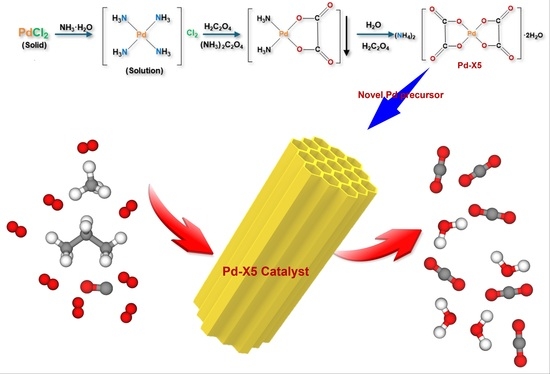
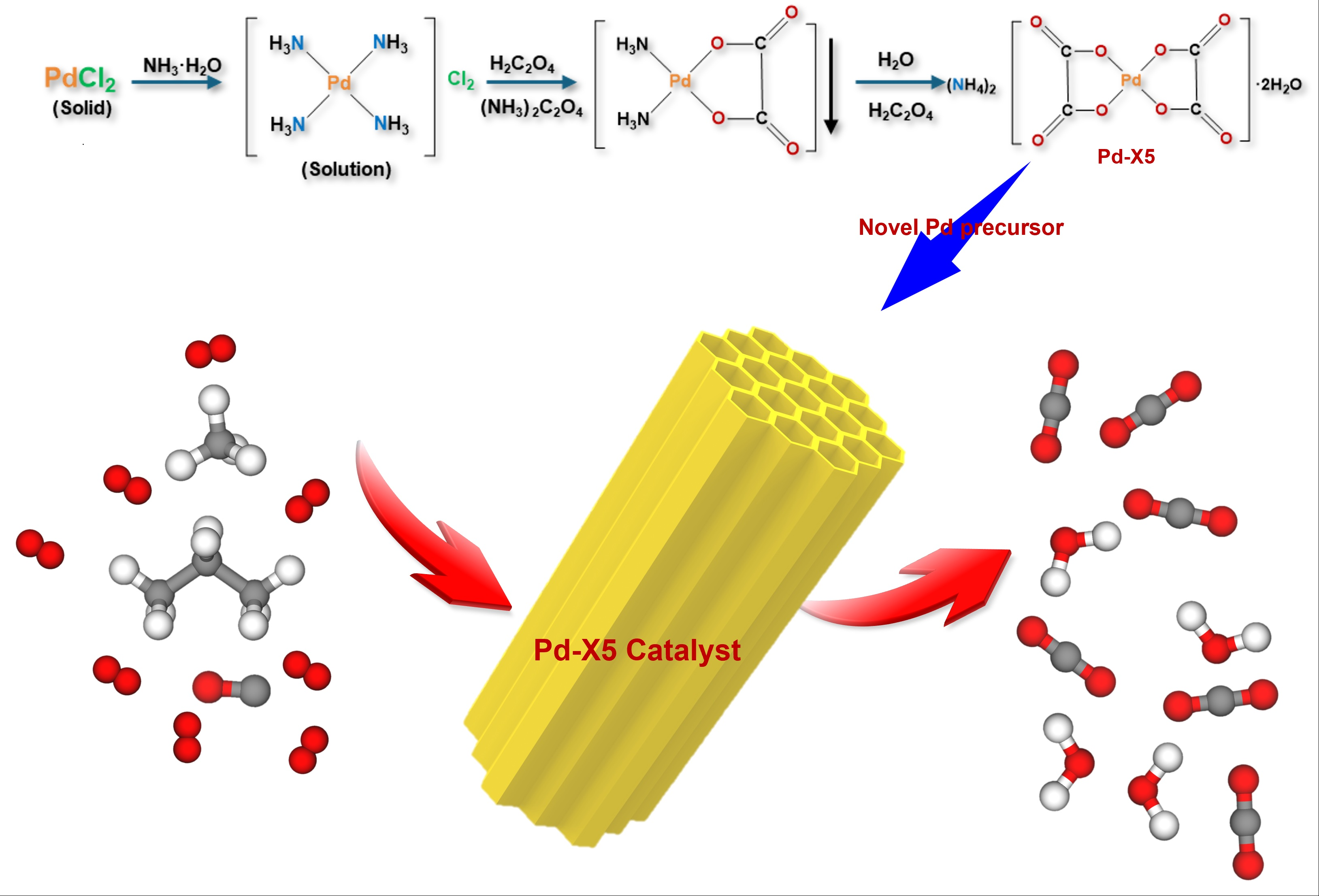
Developing a water-soluble and chlorine-free palladium compound to replace conventional PdCl2 or Pd(NO3)2 as the precursor for Pd-based catalysts remains both challenging and of considerable significance for highly efficient degradation of volatile organic compounds (VOCs). Herein, we report a facile synthetic route to such a Pd compound, (NH4)2[Pd(C2O4)2]·2H2O (denoted as Pd-X5), via a three-step reaction starting from PdCl2, under mild and readily controllable conditions, rendering the process amenable to industrial manufacture. The molecular structure of Pd-X5 was confirmed mainly by elemental analysis, FT-IR, and 13C NMR. The overall yield was greater than 95% and the content of residual chloride was reduced to below 100 ppm. Pd-X5 exhibited high water solubility of 350 g L−1. Subsequently, Pd-X5 was used as a catalytic precursor, and a Pd/Al2O3 catalyst was prepared by an impregnation technique and evaluated for its catalytic performance in the degradation of VOCs. Compared with Pd(NO3)2-derived Pd/Al2O3, the Pd-X5-based catalyst exhibited markedly enhanced activity for the oxidation of CH4 and C3H8 at different temperatures and under different contents of water vapor, indicating that Pd-X5 is superior to Pd(NO3)2 as a catalytic precursor and has potential application in the production of Pd-based catalysts.

Graphical Abstract

1. Introduction

Supported palladium catalysts are widely used in industrial processes, particularly for the oxidation of volatile organic compounds (VOCs) and automobile exhaust [1,2,3,4,5,6]. Wet impregnation is the most commonly employed preparation method, in which palladium salts serve as precursors for the active phase [7,8,9,10,11]. However, despite the availability of quite a number of commercial Pd compounds, only a few—most notably PdCl2 and Pd(NO3)2 in acidic media—are suitable for impregnation [12,13,14]. The physicochemical properties of the precursor strongly influence metal dispersion, chemical state, and, ultimately, catalytic performance, making the proper selection of a precursor critical [15,16]. Accordingly, Pd/Al2O3 oxidation catalysts for VOC oxidation are typically prepared using Pd(NO3)2 [17,18,19,20] since chloride ions, even at low contents, will compromise the oxidation activity of palladium [21,22]. Nevertheless, Pd(NO3)2 is unstable in water and must be kept and sold in 10% HNO3 solution, which can corrode the alumina support, disrupt surface modifications, and reduce Pd loading efficiency [23]. In addition, nitrate, mainly from HNO3, undergoes thermal decomposition during drying and thermal treatment procedures of the catalysts, releasing harmful NOx-containing gases [24]. Despite their importance, design and synthesis of new Pd catalytic precursors have received comparatively little attention in studies aimed at improving VOC oxidation performance.
(NH4)2[Pd(C2O4)2] is a water-soluble palladium compound that is inherently free of chloride and other alkali or heteroatom impurities (e.g., K, Na, Li, P, and S) known to adversely affect palladium dispersion, redox behavior, and catalytic activity [12,25]. Owing to these advantages, (NH4)2[Pd(C2O4)2] represents a promising precursor for the preparation of supported Pd catalysts, particularly for oxidation reactions sensitive to halide poisoning. However, previously reported synthetic routes for (NH4)2[Pd(C2O4)2] remain confined to laboratory-scale (gram-level) production and typically afford low yields (<75%). Moreover, the residual chloride content in the resulting products often exceeds 0.2 wt%, failing to satisfy the stringent chlorine-free requirements for industrial palladium catalyst manufacture [26]. Therefore, developing a facile synthesis of (NH4)2[Pd(C2O4)2] to increase yield, reduce residual chloride, and evaluate its performance as a catalytic precursor is of great importance for advancing Pd-based catalytic technologies.
Herein, a facile three-step synthesis of (NH4)2[Pd(C2O4)2]·2H2O (Pd-X5) from PdCl2 was developed under mild and controllable conditions, enabling industrial-scale production. Pd-X5 was confirmed by elemental analysis, FT-IR, and 13C NMR, affording a yield above 95% with residual chloride below 100 ppm. The compound exhibits high water solubility (350 g L−1), making it well suited to impregnation-based catalyst preparation. Using Pd-X5 as a precursor, Pd/Al2O3 catalysts were prepared and evaluated for VOC oxidation. Compared with Pd(NO3)2-derived Pd/Al2O3, the Pd-X5-based catalyst showed enhanced activity for CH4 and C3H8 oxidation across various temperatures and water vapor concentrations, demonstrating its superiority as a Pd precursor and its potential for industrial Pd-based oxidation catalysts.

2. Results and Discussion

Ammonium bis(oxalato)palladium(II) (Pd-X5) was synthesized via a three-step route, as illustrated in Scheme 1. Specifically, poorly water-soluble PdCl2 was first dissolved in aqueous ammonia to form a clear solution of [Pd(NH3)4]Cl2. Subsequently, controlled substitution of two coordinated NH3 ligands in the [Pd(NH3)4]2+ coordination sphere by one oxalate (C2O42−) anion, assisted by two protons provided by H2C2O4, led to the formation of cis-[Pd(NH3)2(C2O4)], a poorly water-soluble intermediate. Finally, cis-[Pd(NH3)2(C2O4)] was quantitatively dissolved in an aqueous H2C2O4 solution, yielding the target compound (NH4)2[Pd(C2O4)2]·2H2O with an overall yield of 95% based on PdCl2. The purity of the obtained (NH4)2[Pd(C2O4)2]·2H2O was determined to be 98.6%, and the residual chloride content was as low as 97 ppm, which can be attributed to trace chloride originating from the PdCl2 starting material.
The structure of (NH4)2[Pd(C2O4)2]·2H2O was characterized by elemental analysis, UV–vis spectroscopy, FT-IR spectroscopy, and NMR spectroscopy (Figures S1–S3). The elemental analysis results were in good agreement with the calculated values. In the UV–vis spectrum, the absorption maximum at 380 nm can be assigned to a d–d electronic transition within the ligand field of the [Pd(C2O4)2]2− complex (Figure S1). The characteristic vibrational bands of (NH4)2[Pd(C2O4)2]·2H2O were observed in the FT-IR spectrum, and coordination of the oxalate ligands to Pd(II) was evidenced by the Pd–O stretching vibration at 569 cm−1 (Figure S2). In the 13C NMR spectrum (DMSO-d6), the carbon atoms of the oxalate ligands resonate as a singlet at 167 ppm [27], while the solvent DMSO accounts for the multiple resonances observed between 38 and 42 ppm (Figure S3). Although 1H NMR spectroscopy could, in principle, provide evidence for the presence of NH4+ cations, the hydrogen atoms in NH4+ are highly exchangeable and readily undergo H/D exchange in D2O, making the characteristic triplet difficult to observe in the 1H NMR spectrum. Therefore, reliable 1H NMR characterization of Pd-X5 is challenging. Nevertheless, the presence of NH4+ cations in the complex was confirmed by the absorption band at 3246 cm−1 in the FT-IR spectrum, which is characteristic of the ν(N–H) vibration of NH4+ (Figure S2).
These chemical and spectroscopic data are fully consistent with the proposed structure of (NH4)2[Pd(C2O4)2]·2H2O (Figure S4). In this complex, the Pd(II) center is coordinated by two bidentate oxalate ligands to form the divalent anionic complex [Pd(C2O4)2]2−, with two ammonium cations located outside the coordination sphere.
As an ionic compound, (NH4)2[Pd(C2O4)2]·2H2O exhibits excellent water solubility (>350 g L−1), sufficiently high for the preparation of various supported palladium catalysts. In addition, the compound is stable in both air and aqueous solutions at room temperature. The thermal decomposition behavior of (NH4)2[Pd(C2O4)2]·2H2O was investigated by TG/DTA analysis (Figure 1, Figures S5 and S6). An initial weight loss of approximately 9% was observed between 50 and 115 °C, accompanied by an endothermic peak at around 100.2 °C, corresponding to the removal of two crystallization water molecules. Upon further heating, the complex underwent a two-step thermolysis process, occurring at 152–223 °C under an Ar atmosphere and at 156–178 °C under a simulated reaction (air) atmosphere. The total weight loss reached approximately 61%, consistent with complete decomposition of the complex, leaving metallic palladium as the final solid product, suggesting that (NH4)2[Pd(C2O4)2]·2H2O undergoes intramolecular self-redox at relatively low temperatures, thereby indicating a favorable profile as a catalytic precursor.
Pd/Al2O3, a Pd-based catalyst denoted as Pd-X5 catalyst, was prepared using an impregnation method with (NH4)2[Pd(C2O4)2]·2H2O as the Pd precursor. The detailed preparation procedure is shown in Figure S7. For comparison, a reference Pd/Al2O3, denoted as the Pd(NO3)2 catalyst, was also prepared by the same method using Pd(NO3)2 as the precursor. Photographs of the two Pd-based catalysts are given in Figure S8. It should be noted that Pd-X5 and Pd(NO3)2 were each formulated into a slurry together with Al2O3 powder and subsequently coated onto the ceramic substrate. This preparation route corresponds to that commonly used for commercial three-way oxidation catalysts [28]. The actual Pd loadings of the Pd-X5 and Pd(NO3)2 catalysts were determined by ICP–AES analysis to be 0.098 wt% and 0.101 wt%, respectively. Further physicochemical characterization was difficult to perform without compromising the overall structural integrity of the two catalysts. Therefore, detailed mechanistic and kinetic investigations are beyond the scope of the present study and will be pursued in future work. The present work focused on the synthesis of a novel, chlorine-free, water-soluble Pd precursor and its application in the preparation of high-performance Pd-based oxidation catalysts.
To examine the influence of Pd precursors on catalytic performance, catalysts derived from two different Pd precursors were evaluated under industrially relevant VOC oxidation conditions over a temperature range of 300–500 °C and under water vapor concentrations of 0–20%. Here, the “0–20 vol% water vapor concentration” refers to the volume percentage relative to the hydrocarbon (or CO) gas. The catalysts were first tested in the oxidation of CH4 and C3H8, two representative and particularly challenging components of VOCs [29,30,31,32], and subsequently in CO oxidation. The oxidation products of methane, propane, and CO were analyzed and confirmed to be exclusively CO2 and H2O, with no detectable organic byproducts observed, indicating complete oxidation under the investigated reaction conditions.
As shown in Table 1, CH4 conversion over both Pd-X5- and Pd(NO3)2-derived catalysts increased monotonically with increasing temperature but decreased with increasing water vapor content. Notably, the Pd-X5 catalyst consistently exhibited higher CH4 conversion than the Pd(NO3)2 catalyst across the entire temperature range. These results demonstrate that employing Pd-X5 as a precursor significantly enhances the catalytic performance of supported Pd catalysts for CH4 oxidation. Since water vapor is ubiquitous in VOC-containing gas streams, achieving high low-temperature activity and robust water tolerance remains a major challenge for VOC oxidation catalysts [33,34]. Therefore, the influence of water vapor concentration on the catalytic performance of the Pd-X5 catalyst was further investigated. Although CH4 conversion over Pd-X5 decreased with increasing water vapor concentration at 350 °C, it remained substantially higher than that of the Pd(NO3)2 catalyst under identical conditions. Even at a high water vapor concentration of 20 vol%, the Pd-X5 catalyst retained a CH4 conversion of 5.1%, whereas the Pd(NO3)2 catalyst exhibited nearly zero activity at only 5 vol% water. Across the investigated temperature range, CH4 conversion over Pd-X5 initially decreased slightly and then stabilized with increasing water vapor concentration, indicating good water tolerance. Moreover, the decline in CH4 conversion with increasing water vapor over Pd-X5 was significantly less pronounced than that observed for the Pd(NO3)2 catalyst. Collectively, these results demonstrate that the Pd-X5 catalyst maintains appreciable activity and superior water tolerance under humid reaction conditions.
As shown in Table 2, nearly complete C3H8 conversion was achieved over the Pd-X5 catalyst at a relatively low temperature of 350 °C under dry conditions (water vapor concentration = 0). Although both Pd-X5 and Pd(NO3)2 catalysts reached 100% C3H8 conversion at higher temperatures (450 and 500 °C), the Pd-X5 catalyst exhibited superior low-temperature activity. C3H8 conversion decreased with increasing water vapor concentration over both catalysts. Nevertheless, the Pd-X5 catalyst maintained a high C3H8 conversion of 70.7% at 350 °C even under 20 vol% water vapor, which was significantly higher than that of the Pd(NO3)2 catalyst (57.8%) under identical conditions.
For CO oxidation, the experimental results are summarized in Table 3. Both catalysts exhibited excellent activity, achieving nearly 100% conversion at 350 °C. The presence of water vapor had no apparent effect on catalytic activity within the investigated concentration range. Moreover, no significant difference in performance was observed between the Pd-X5 and Pd(NO3)2 catalysts.

3. Experimental Section

3.1. General

All commercially available reagents were of analytical grade and used without further purification. PdCl2 was purchased from Sino-Platinum Co., Ltd. (Kunming, Yunnan province, China). Elemental analyses (C, H, and N) were performed using a Carlo Erba analyzer Carlo Erba (Strumentazione, Milan, Italy), while palladium content was determined by conventional hydrogen reduction gravimetry. Ultraviolet–visible (UV–vis) spectra were collected on a Varian Cary-50 Bio spectrophotometer (Varian, Australia). Fourier Transform Infrared Spectroscopy (FT-IR) spectra were recorded in the 4000–400 cm−1 range using KBr pellets on a PerkinElmer 880 spectrometer (PerkinElmer, Waltham, MA, USA). 13C NMR spectra were obtained in dimethyl sulfoxide on Bruker AV400 and Avance III 500 MHz spectrometers (Bruker, Germany) to confirm the molecular structures of (NH4)2[Pd(C2O4)2]·2H2O. Thermal analyses (DTA/TG) were conducted using a Netzsch STA 449 F1 instrument (NETZSCH-Gerätebau GmbH, Selb, Germany). The actual Pd loadings of the Pd-X5 and Pd(NO3)2 catalysts were determined by inductively coupled plasma atomic emission spectroscopy (ICP–AES, Varian 710-ES). In addition, ion chromatography (IC, Thermo Fisher ICS-600 Thermo Fisher Scientific, Waltham, MA, USA) was employed to quantify chloride ions in the (NH4)2[Pd(C2O4)2]·2H2O precursor.

3.2. Synthesis of (NH4)2[Pd(C2O4)2]·2H2O

To a suspension of PdCl2 (100 g, 0.565 mol) in 220 mL of ultrapure water at 60 °C, 180 mL of aqueous ammonia was added slowly. The mixture was stirred at 60 °C for approximately 2 h, during which almost all PdCl2 dissolved, forming a yellowish solution. The solution was evaporated under reduced pressure to near dryness to remove excess ammonia and then redissolved in 500 mL of ultrapure water and filtered through a 0.2 μm membrane filter to afford a clear [Pd(NH3)4]Cl2 solution.
A mixed aqueous solution containing H2C2O4·2H2O (0.565 mol) and (NH4)2C2O4·H2O (0.565 mol) was added dropwise to the [Pd(NH3)4]Cl2 solution under continuous stirring at 60 °C. The reaction was maintained for 5 h, during which a yellowish precipitate of cis-[Pd(NH3)2(C2O4)] gradually formed. The product was collected by filtration, thoroughly washed with ultrapure water, and dried at 60 °C for 4 h. The isolated yield was 96%, and the Pd content was measured to be 46.2% (calculated: 46.6%).
Subsequently, cis-[Pd(NH3)2(C2O4)] (120 g, 0.525 mol) was added slowly to 350 mL of an aqueous solution containing H2C2O4·2H2O (66.2 g, 0.525 mol) at 50 °C under continuous stirring. After 1 h, the solid was almost completely dissolved, yielding a deep red solution. Trace insoluble residues were removed by filtration, and the resulting filtrate was freeze-dried to afford a yellowish-brown crystalline product ((NH4)2[Pd(C2O4)2]·2H2O, yield: 99% (184 g)).
Found % (calculated for (NH4)2[Pd(C2O4)2]·2H2O): C 13.4 (13.6), H 3.42 (3.39), N 7.84 (7.90), Pd 29.6 (30.0). UV–vis: λmax = 380 nm, ε = 1.11 × 10² L·mol−1·cm−1 (d-d electron transition). IR(cm−1, KBr): 3528, 3464 [vs, ν(O-H), H2O)], 3246 [w, ν(N-H), NH4+)], 1702 [vs,νas(COO)], 1410 [(s,νas(COO)], 1320, 1256 [vs, γ(COO) + δ(NH4+)], 903, 825 [γ(NH4+) + δ(COO)], 569 [m, ν(Pd-O)], 483 [m, v(five-membered chelating ring)]. 13C-NMR (DMSO, 400 MHz, ppm): 167 (COO).

3.3. Catalyst Preparation

Pd-based catalysts were prepared using an impregnation method; the preparative process is illustrated in Figure S7 [35]. Typically, 2 g of γ-Al2O3 powder, 0.5 g of mordenite powder, 1 g of La–Ce–Zr mixed oxide powder, and 0.0285 g of Pd-X5 were dispersed in 5 mL of ultrapure water to form a homogeneous slurry. A 2 mol L−1 Ba(OH)2 aqueous solution was then added dropwise to the slurry under continuous stirring until the pH reached 5. Subsequently, 5 g of ceramic support was impregnated with the prepared slurry at room temperature. The samples were dried at 100 °C for 1 h and then calcined at 400 °C for 3 h in static air to obtain the catalysts, denoted as Pd-X5 catalysts. For comparison, Pd(NO3)2-based catalysts were prepared using the same procedure, with Pd(NO3)2 employed as the Pd precursor instead of Pd-X5, denoted as Pd(NO3)2 catalysts.

3.4. Catalytic Tests

The catalytic activities of the Pd-X5 catalyst and Pd(NO3)2 catalyst for VOC oxidation were evaluated in a quartz tubular fixed-bed continuous-flow reactor (8 mm inner diameter, 50 mm length) using 8 g of catalyst per test. The reactions were carried out under different reaction atmospheres at a gas hourly space velocity (GHSV) of 20,000 mL·h−1.
Three representative reaction atmospheres were employed. The first reaction atmosphere consisted of 1000 ppm CH4, 5 vol% O2, a controlled concentration of water vapor, and N2 as the balance gas, corresponding to an n(CH4):n(O2) ratio of 1:50. The second atmosphere contained 1000 ppm C3H8, 5 vol% O2, a controlled concentration of water vapor, and N2 as the balance gas, with an n(C3H8):n(O2) ratio of 1:50. The third atmosphere comprised 4000 ppm CO, 5 vol% O2, a controlled concentration of water vapor, and N2 as the balance gas, corresponding to an n(CO):n(O2) ratio of 1:12.5. Gas flow rates in each stream were regulated using precalibrated mass flow controllers. The reaction temperature was monitored in real time by a thermocouple inserted directly into the fixed catalyst bed [36].
The reactor effluent was dried using magnesium chloride and subsequently analyzed online by an Agilent 7890A gas chromatograph (Agilent Technologies Inc., Waldbronn, Germany) equipped with two thermal conductivity detectors (TCDs) and a flame ionization detector (FID). The detector temperature was maintained at 393 K and H2 was used as the carrier gas. The catalytic conversions of CH4, C3H8, and CO were calculated according to Equation (1), as described below.
C o n v e r s i o n = [ X ] i n [ X ] o u t [ X ] i n
where [X]in and [X]out are the inlet and outlet concentrations of CH4, C3H8, and CO, respectively.

4. Conclusions

In summary, a facile synthetic method was developed for (NH4)2[Pd(C2O4)2]·2H2O (denoted as Pd-X5) starting from PdCl2, affording a high yield of 95% and reducing the residual chloride content to below 100 ppm. All synthetic steps proceeded under mild and readily controllable conditions, rendering the process suitable for industrial production. Pd-X5 undergoes intramolecular self-redox at relatively low temperatures (156–178 °C) in an air atmosphere, generating metallic palladium and benign gaseous products (NH3 and CO2). Compared with Pd(NO3)2-derived catalysts, the Pd-X5-based catalyst exhibited significantly enhanced activity and superior water resistance in CH4 and C3H8 oxidation. These results indicate that Pd-X5 is a more suitable catalytic precursor to produce high-performance Pd-based oxidation catalysts. Extensive physicochemical characterization for this industrial catalyst produced from Pd-X5 as a catalytic precursor was not feasible in the present study because it would have compromised its integrity. Nevertheless, our future work will focus on elucidating the structure–activity relationship, reaction mechanism, and kinetic behavior of the Pd-X5-derived catalyst to further reveal the reason for its superior catalytic performance.

Supplementary Materials

The following supporting information can be downloaded at https://www.mdpi.com/article/10.3390/catal16070603/s1, Figure S1. UV-Vis spectra of Pd-X5 in water (C=1.17 mmol/L). Figure S2. IR spectra of Pd-X5 (KBr pellet). Figure S3. 13C NMR spectra of Pd-X5 (in DMSO). Figure S4. Chemical structure of ammonium bis(oxalato)palladium(II), referred to as Pd-X5. Figure S5. DTA/TG curves of Pd-X5 in Ar atmosphere. Figure S6. DTA/TG curves of Pd-X5 in simulated atmosphere. Figure S7. Preparative process of the Pd-based catalyst for VOCs degradation. Figure S8. A picture of Pd-X5 catalyst and Pd(NO3)2 catalyst.

Author Contributions

Conceptualization, C.Y., W.L. and Y.D.; methodology, Y.F. and J.J.; software, Y.F. and A.G.; validation, G.L. and Q.C.; formal analysis, Y.F. and Y.D.; investigation, Y.F. and C.Y.; resources, Y.F., C.Y. and Y.D.; data curation, Y.F., A.G. and C.Y.; writing—original draft preparation, Y.F.; writing—review and editing, C.Y. and Y.D.; project administration, C.Y. and Y.D.; funding acquisition, C.Y. and Y.D. All authors have read and agreed to the published version of the manuscript.

Funding

This research was funded by the Central Guidance for Local Science and Technology Development Fund Project (202507AC040002), Key Research and Development Plan (YPML-202505050202), Technological Talent and Platform Plan (202605AK340002), and Sino-Platinum Metals Chemical (Yunnan) Co., Ltd. Self-Support Project (ZLXM20260015).

Data Availability Statement

The original contributions presented in this study are included in the article/Supplementary Materials. Further inquiries can be directed to the corresponding author(s).

Acknowledgments

This work was financially supported by the Central Guidance for Local Science and Technology Development Fund Project (202507AC040002), Key Research and Development Plan (YPML-202505050202), Technological Talent and Platform Plan (202605AK340002), and Sino-Platinum Metals Chemical (Yunnan) Co., Ltd. Self-Support Project (ZLXM20260015).

Conflicts of Interest

Authors Yangyang Feng/Chang Yao/Guihua Liu/Weiping Liu/Yunsheng Dai were employed by Sino-Platinum Metals Chemical (Yunnan) Co., Ltd. Authors Chang Yao/Yunsheng Dai were employed by Yunnan Precious Metals Laboratory Co., Ltd. The remaining authors declare that the research was conducted in the absence of any commercial or financial relationships that could be construed as a potential conflict of interest.

References

  1. Xu, T.; Shen, M.; Shen, G.; Li, X.; Jia, L.; Gao, F.; Li, W. On the deactivation and regeneration mechanisms of Pd/θ-Al2O3 catalysts for propane oxidation. J. Catal. 2025, 451, 116380. [Google Scholar] [CrossRef]
  2. Li, J.; Xu, Z.; Wang, T.; Xie, X.; Li, D.; Wang, J.; Huang, H.; Ao, Z. A versatile route to fabricate Metal/UiO-66 (Metal= Pt, Pd, Ru) with high activity and stability for the catalytic oxidation of various volatile organic compounds. Chem. Eng. J. 2022, 448, 136900. [Google Scholar] [CrossRef]
  3. Bi, F.; Feng, X.; Huang, J.; Wei, J.; Wang, H.; Du, Q.; Liu, N.; Xu, J.; Liu, B.; Huang, Y. Unveiling the influence mechanism of impurity gases on Cl-containing byproducts formation during VOC catalytic oxidation. Environ. Sci. Technol. 2025, 59, 15526–15537. [Google Scholar] [CrossRef] [PubMed]
  4. Li, Z.; Chen, Z.; Ye, C.; Gong, L.; Wang, H.; Zhou, J. Engineering of lattice defects in supported Cu-Mn-Ce composite oxide catalysts through ultra-low Pd doping and plasma treatment for catalytic oxidation of hexane. Environ. Res. 2025, 267, 120652. [Google Scholar] [PubMed]
  5. Lu, Z.; Guo, L.; Bi, F.; Ma, S.; Shen, Q.; Qiao, R.; Zhang, X. Insight into the degradation mechanism of mixed VOCs oxidation over Pd/UiO-66 (Ce) catalysts: Combination of operando spectroscopy and theoretical calculation. Sep. Purif. Technol. 2025, 354, 129443. [Google Scholar] [CrossRef]
  6. Li, K.-T.; Hsu, M.-H.; Wang, I. Palladium core–porous silica shell-nanoparticles for catalyzing the hydrogenation of 4-carboxybenzaldehyde. Catal. Commun. 2008, 9, 2257–2260. [Google Scholar] [CrossRef]
  7. Yao, C.; Li, W.; Cao, Y.; Ge, X.; Yang, Z.; Qian, G.; Zhou, X.; Duan, X. Mechanistic and kinetics insights into structure sensitivity of 2,6-Diamino-3,5-Dinitropiridine hydrogenation over Ni catalysts. J. Catal. 2023, 421, 162–171. [Google Scholar] [CrossRef]
  8. Song, R.; Yao, C.; Li, W.; An, N.; Shen, Y.; Fei, N.; Ge, X.; Cao, Y.; Duan, X.; Zhou, X. Kinetic insights into structure sensitivity of Ru catalyzed l-alanine hydrogenation to alaninol. React. Chem. Eng. 2025, 10, 135–145. [Google Scholar] [CrossRef]
  9. Chen, Y.; Ge, X.; Cao, Y.; Yao, C.; Zhang, J.; Qian, G.; Zhou, X.; Duan, X. Size Dependence of Pd-Catalyzed Hydrogenation of 2,6-Diamino-3,5-dinitropyridine. Ind. Eng. Chem. Res. 2022, 61, 6427–6435. [Google Scholar] [CrossRef]
  10. Zhu, X.; Feng, X.; Yao, C.; Sun, W.; Ma, J.; Zhong, F.; Zeng, J.; Ge, X.; Chen, W.; Qian, G.; et al. Glycol Production from Sorbitol Hydrogenolysis over Hydrothermally Stable Ni Catalysts and the Mechanistic Study. Ind. Eng. Chem. Res. 2024, 63, 8175–8186. [Google Scholar] [CrossRef]
  11. Yao, C.; Li, W.; Li, Y.; Cao, Y.; Zhang, J.; Qian, G.; Zhou, X.; Duan, X. Atomically dispersed Pt to boost adjacent frustrated Lewis pair for 2,6-diamino-3,5-dinitropyridine hydrogenation. AIChE J. 2023, 70, e18278. [Google Scholar] [CrossRef]
  12. Chen, A.; Ostrom, C. Palladium-based nanomaterials: Synthesis and electrochemical applications. Chem. Rev. 2015, 115, 11999–12044. [Google Scholar] [CrossRef] [PubMed]
  13. Liu, Z.; Wang, L.; Yan, H.; Ali, S.; Yang, C.; Wu, R.; Wang, J.; Wei, Y.; Sun, H.; Liang, C. Enhanced catalytic performance of palladium supported on graphitic carbon nitride for acetylene hydrochlorination. Mol. Catal. 2026, 590, 115642. [Google Scholar] [CrossRef]
  14. Pérez-Zurita, M.J.; Cifarelli, M.; Cubeiro, M.L.; Alvarez, J.; Goldwasser, M.; Pietri, E.; Garcia, L.; Aboukais, A.; Lamonier, J.-F. Palladium-based catalysts for the synthesis of alcohols. J. Mol. Catal. A Chem. 2003, 206, 339–351. [Google Scholar] [CrossRef]
  15. Xie, J.; Ng, K.; Dai, Y.; Jiang, J.; Yu, J.; Gao, A.; Wang, H.; Huang, X.; Liu, W.; Guo, S. A Novel Pd Precursor Loaded γ-Al2O3 with Excellent Adsorbent Performance for Ultra-Deep Adsorptive Desulfurization of Benzene. Adv. Funct. Mater. 2023, 33, 2213837. [Google Scholar] [CrossRef]
  16. Xie, J.; Feng, Y.; Wang, X.; Li, X.; Yu, J.; Gao, A.; Jiang, J.; Chang, Q.; Dai, Y.; Liu, W.; et al. Fully exposed platinum clusters for the efficient reverse water-gas shift reaction at low temperatures. Appl. Catal. B Environ. Energy 2025, 373, 125341. [Google Scholar] [CrossRef]
  17. Cordi, E.M.; Falconer, J.L. Oxidation of volatile organic compounds on Al2O3, Pd/Al2O3, and PdO/Al2O3Catalysts. J. Catal. 1996, 162, 104–117. [Google Scholar] [CrossRef]
  18. Wang, Y.; Liu, X.; Meng, L.; Liu, T.; Qi, Q.; Han, X.; Ma, J. Promotion of catalytic performance of Pd/Al2O3 for o-xylene oxidation by morphological control. Chem. Eng. J. 2023, 472, 145013. [Google Scholar] [CrossRef]
  19. Liu, T.; Yan, H.; Xu, J.; Xu, X.; Lv, Y.; Fang, X.; Wang, X. Promoting Pd/Al2O3 catalysts for toluene combustion by DBD plasma treating in different working gas atmospheres. Catal. Today 2023, 421, 114177. [Google Scholar]
  20. Huang, S.; Zhang, C.; He, H. Effect of pretreatment on Pd/Al2O3 catalyst for catalytic oxidation of o-xylene at low temperature. J. Environ. Sci. 2013, 25, 1206–1212. [Google Scholar] [CrossRef]
  21. Zhu, X.; Cheng, B.; Yu, J.; Ho, W. Halogen poisoning effect of Pt-TiO2 for formaldehyde catalytic oxidation performance at room temperature. Appl. Surf. Sci. 2016, 364, 808–814. [Google Scholar] [CrossRef]
  22. Jardim, E.O.; Rico-Frances, S.; Coloma, F.; Anderson, J.A.; Silvestre-Albero, J.; Sepúlveda-Escribano, A. Influence of the metal precursor on the catalytic behavior of Pt/Ceria catalysts in the preferential oxidation of CO in the presence of H2 (PROX). J. Colloid Interface Sci. 2015, 443, 45–55. [Google Scholar] [CrossRef] [PubMed]
  23. Yang, Y.; Miao, C.; Wang, R.; Zhang, R.; Li, X.; Wang, J.; Wang, X.; Yao, J. Advances in morphology-controlled alumina and its supported Pd catalysts: Synthesis and applications. Chem. Soc. Rev. 2024, 53, 5014–5053. [Google Scholar] [CrossRef] [PubMed]
  24. Jackson, J.G.; Fonseca, R.W.; Holcombe, J.A. Mass spectral studies of thermal decomposition of metal nitrates. Spectrochim. Acta Part B At. Spectrosc. 1995, 50, 1449–1457. [Google Scholar] [CrossRef]
  25. Li, D.; Ding, Q.; Hao, D.; Han, J.; Yang, G.; Pang, L.; Guo, Y.; Yu, J.; Li, T. Na Cocations and Hydrothermal Aging Cooperatively Boost the Regeneration of Phosphorus-Poisoned Pd/SSZ-13 for Passive NOx Adsorption. Environ. Sci. Technol. 2023, 57, 19956–19964. [Google Scholar] [CrossRef] [PubMed]
  26. Ye, Q.-S.; Pan, Z.-F.; Xie, M.-J.; Chen, J.-L.; Liu, W.-P.; Xia, W.-Z. Crystal structure of diammonium bis (oxalato) palladium (II) dihydrate,(NH4)2[Pd(C2O4)2] · 2H2O. Z. Für Krist. N. Cryst. Struct. 2010, 225, 423–424. [Google Scholar] [CrossRef]
  27. Pilgrim, C.D.; Mason, H.E.; Zavarin, M.; Casey, W.H. Rates of Ligand Exchange around the Bis-Oxalato Complex [NpO2 (C2O4)2]3− Measured by Using Multinuclear NMR Spectroscopy under Neutral to Semi-Alkaline Conditions. ChemPlusChem 2018, 83, 590–596. [Google Scholar] [PubMed]
  28. Santos, H.; Costa, M. Evaluation of the conversion efficiency of ceramic and metallic three way catalytic converters. Energy Convers. Manag. 2008, 49, 291–300. [Google Scholar] [CrossRef]
  29. Feng, Y.; Liu, Y.; Dai, H.; Deng, J. Review and Perspectives of Enhancement in the Catalytic Stability for the Complete Combustion of CO, CH4, and Volatile Organic Compounds. Energy Fuels 2023, 37, 3590–3604. [Google Scholar] [CrossRef]
  30. Koppmann, R.; Von Czapiewski, K.; Reid, J. A review of biomass burning emissions, part I: Gaseous emissions of carbon monoxide, methane, volatile organic compounds, and nitrogen containing compounds. Atmos. Chem. Phys. Discuss. 2005, 5, 10455–10516. [Google Scholar] [CrossRef]
  31. Fang, Y.; Li, H.; Zhang, Q.; Wang, C.; Xu, J.; Shen, H.; Yang, J.; Pan, C.; Zhu, Y.; Luo, Z.; et al. Oxygen Vacancy-Governed Opposite Catalytic Performance for C3H6 and C3H8 Combustion: The Effect of the Pt Electronic Structure and Chemisorbed Oxygen Species. Environ. Sci. Technol. 2022, 56, 3245–3257. [Google Scholar] [CrossRef] [PubMed]
  32. Xing, J.; Chen, J.; Xue, Q.; Ye, P.; Liu, H.; Wang, G.; Zhou, B.; Mi, J.; Li, J. Tandem Catalysis for Simultaneous Removal of NOx and C3H8 with Inhibition of N2O. Environ. Sci. Technol. 2024, 58, 15288–15297. [Google Scholar] [CrossRef] [PubMed]
  33. Xu, F.; Wang, J.; Zhao, Y.; Lin, H.; Chen, H.; Zhang, Y.; Wei, X.; Dai, H. Catalytic performance and mechanism of toluene oxidation in high humidity over the mesoporous titania-ceria-supported Pt or Pd catalysts. Appl. Catal. A Gen. 2025, 699, 120277. [Google Scholar]
  34. Huang, C.; Shan, W.; Lian, Z.; Zhang, Y.; He, H. Recent advances in three-way catalysts of natural gas vehicles. Catal. Sci. Technol. 2020, 10, 6407–6419. [Google Scholar] [CrossRef]
  35. Miaoxin, G.; Fengjun, W.; Chengxiong, W.; Aimin, Z.; Yunkun, Z.; Junchen, D. Effect of Calcination Atmospheres on Catalytic Performance of Pt/Al2O3 for Oxidation of CO and C3H6. RARE Met. Mater. Eng. 2021, 50, 3056–3061. [Google Scholar]
  36. Jiang, Z.; Li, Y.; Tang, Z.; Yuan, D.; Lin, F. Strong Metal-Support Interactions in Catalytic Oxidation of VOCs: Mechanistic Insights, Support Engineering Strategies, and Emerging Catalyst Design Paradigms. Environ. Sci. Technol. 2025, 59, 19644–19666. [Google Scholar] [CrossRef] [PubMed]
Scheme 1. Synthetic route of (NH4)2[Pd(C2O4)2] 2H2O.
Catalysts 16 00603 sch001
Figure 1. Temperature-dependent evolution of Pd species in Pd-X5 complex.
Catalysts 16 00603 g001
Table 1. CH4 conversion over Pd-X5-derived and Pd(NO3)2-derived catalysts.
Temperature (°C)Water Vapor Concentration (vol%)CH4 Conversion (%)
Pd-X5-Derived CatalystPd(NO3)2-Derived Catalyst
350025.21.8
510.80
107.30
155.60
205.10
400047.326
527.912.2
1022.710.2
1520.28.6
2018.67.8
450072.855.4
557.940
1051.634
1549.528.8
2049.325.6
50009177.4
585.369.2
1083.965.2
1583.661
2083.957.6
Table 2. C3H8 conversion over Pd-X5-derived and Pd(NO3)2-derived catalysts.
Temperature (°C)Water Vapor Concentration (vol%)C3H8 Conversion (%)
Pd-X5-Derived CatalystPd(NO3)2-Derived Catalyst
350098.581.7
589.559.2
1081.357.9
1575.357.9
2070.757.8
400010098.9
598.696.9
1097.396
159695.2
2094.994.4
450010099.86
510099.65
1010099.57
1510099.46
2010099.36
5000100100
5100100
10100100
15100100
20100100
Table 3. CO conversion over Pd-X5-derived and Pd(NO3)2-derived catalysts.
Temperature (°C)Water Vapor Concentration (vol%)CO Conversion (%)
Pd-X5-Derived CatalystPd(NO3)2-Derived Catalyst
3500100100
599.9100
1099.8100
1599.6100
2099.6100
4000100100
5100100
1099.9100
1599.9100
2099.8100
4500100100
5100100
1099.9100
1599.8100
2099.8100
500099.9100
5100100
10100100
15100100
20100100
Disclaimer/Publisher’s Note: The statements, opinions and data contained in all publications are solely those of the individual author(s) and contributor(s) and not of MDPI and/or the editor(s). MDPI and/or the editor(s) disclaim responsibility for any injury to people or property resulting from any ideas, methods, instructions or products referred to in the content.