


Abstract
Ammonia-selective catalytic oxidation (NH3-SCO) is an effective technology for eliminating NH3 slip; however, the development of catalysts that simultaneously exhibit excellent low-temperature (<350 °C) activity and high N2 selectivity remains a significant challenge. A novel structured monolithic mesh-type Fex-Mn2O3/γ-Al2O3/Al catalyst was developed. XPS, H2-TPR, and O2-TPD results demonstrate that Fe doping markedly increases the concentration of surface-adsorbed active oxygen species and enhances the redox capability. As a result, the optimally doped Fe6.61-Mn2O3/γ-Al2O3/Al catalyst achieved complete NH3 conversion at 210 °C with a 75% N2 selectivity, outperforming previously reported Mn-based catalysts. Density functional theory (DFT) calculations further confirm that Fe modification enhances O2 adsorption energy. In addition, the introduction of Fe significantly improves the catalyst’s resistance to SO2 and H2O. In situ FTIR results indicate that the NH3-SCO reaction over Fe-Mn2O3/γ-Al2O3/Al proceeds predominantly via an internal selective catalytic reduction (i-SCR) pathway.
1. Introduction
Atmospheric pollution and its health risks have long been a concern in environmental science and public health. Recently, ammonia (NH3) emissions, primarily from fertilizer use, industrial processes, and NH3-SCR NOx abatement [1,2], have garnered increased attention. NH3 exposure can irritate the respiratory system, skin, and eyes, and may impair tissue functions [3]. Therefore, effective control of NH3 emissions is crucial for improving air quality.
Among various NH3 removal methods developed previously, ammonia-selective catalytic oxidation (NH3-SCO) has attracted extensive attention in recent years because it can directly convert NH3 into environmentally benign N2 and H2O [4] and is regarded as the most promising technology for NH3 degradation. Noble metal catalysts such as Au and Pt exhibit the highest low-temperature activity in NH3-SCO [5], but their low N2 selectivity and high cost limit their large-scale application [6,7]. Therefore, great efforts have been devoted to exploring low-cost NH3-SCO catalysts, and manganese oxides have recently been considered promising NH3-SCO catalysts. Previous studies have shown that the crystal phase of MnOx is crucial for the catalyst’s selectivity. Qu et al. [8] synthesized MnO2 (UH), which achieved 100% NH3 conversion at 170 °C, but its N2 selectivity was only 49%. The Mn2O3 phase exhibits the highest N2 selectivity in the NH3-SCR reaction, but its low-temperature activity is relatively poor [9]. Therefore, achieving the coexistence of high conversion and high selectivity at low temperature (<350 °C [10]) remains a key challenge for Mn-based catalysts. In this context, doping modification has been recognized as an effective strategy for optimizing the catalytic performance of MnOx. Madhuri et al. [11] demonstrated that Fe2O3 doping of Mn2O3 significantly increased the surface-adsorbed oxygen concentration, enhancing catalytic activity without affecting benzonitrile selectivity. Similarly, Yu et al. [12] reported that the Mn1.82Fe0.18O3 catalyst, formed by Fe incorporation into Mn2O3, exhibited excellent performance in toluene oxidation, attributed to increased surface acid site density and higher active oxygen concentration due to Fe doping. These studies indicate that Fe modification of Mn2O3 improves its low-temperature oxidation performance. These findings provide new insights for enhancing NH3 conversion in Mn2O3 catalysts through Fe doping and achieving a balance between high activity and high N2 selectivity.
On the other hand, traditional granular or powder catalysts suffer from issues such as poor mechanical strength, high pressure drop, limited mass transfer, and particle loss [13,14], which restrict their long-term stable operation. While monolithic catalysts alleviate some of these problems, their washcoating method leads to weak interactions between the active components and the support, affecting the catalyst’s long-term stability and activity. To overcome these shortcomings, a mesh-structured γ-Al2O3/Al support, prepared by anodization, was proposed in our previous work and applied for the removal of pollutants such as O3, HCHO, and CO [15,16,17,18,19]. This support features excellent mechanical properties and a three-dimensional interconnected pore structure [20], effectively enhancing mass and heat transfer [21]. However, there are few reports on the application of these anodized, in situ-grown monolithic catalysts in NH3-SCO reactions.
In this study, a novel structured monolithic mesh Fex-Mn2O3/γ-Al2O3/Al catalyst was developed for low-temperature selective catalytic oxidation of NH3 (NH3-SCO). First, a series of characterizations were conducted to systematically reveal the effects of Fe doping on surface active adsorbed oxygen species and redox properties of the Mn2O3/γ-Al2O3/Al catalyst. Density functional theory (DFT) calculations were further performed to analyze the influence of Fe doping on the O2 adsorption energy on the catalyst surface. In addition, water and sulfur resistance evaluations were carried out to assess the role of Fe species in the reaction system. Finally, the evolution of key surface intermediates was tracked by in situ Fourier transform infrared spectroscopy (in situ FTIR), based on which a possible NH3-SCO reaction mechanism was proposed.
2. Results and Discussion
2.1. The Effect of Mn Crystal Phases on NH3-SCO Performance over a γ-Al2O3/Al Carrier
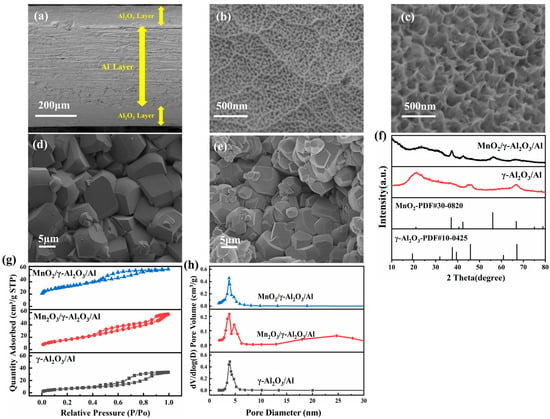
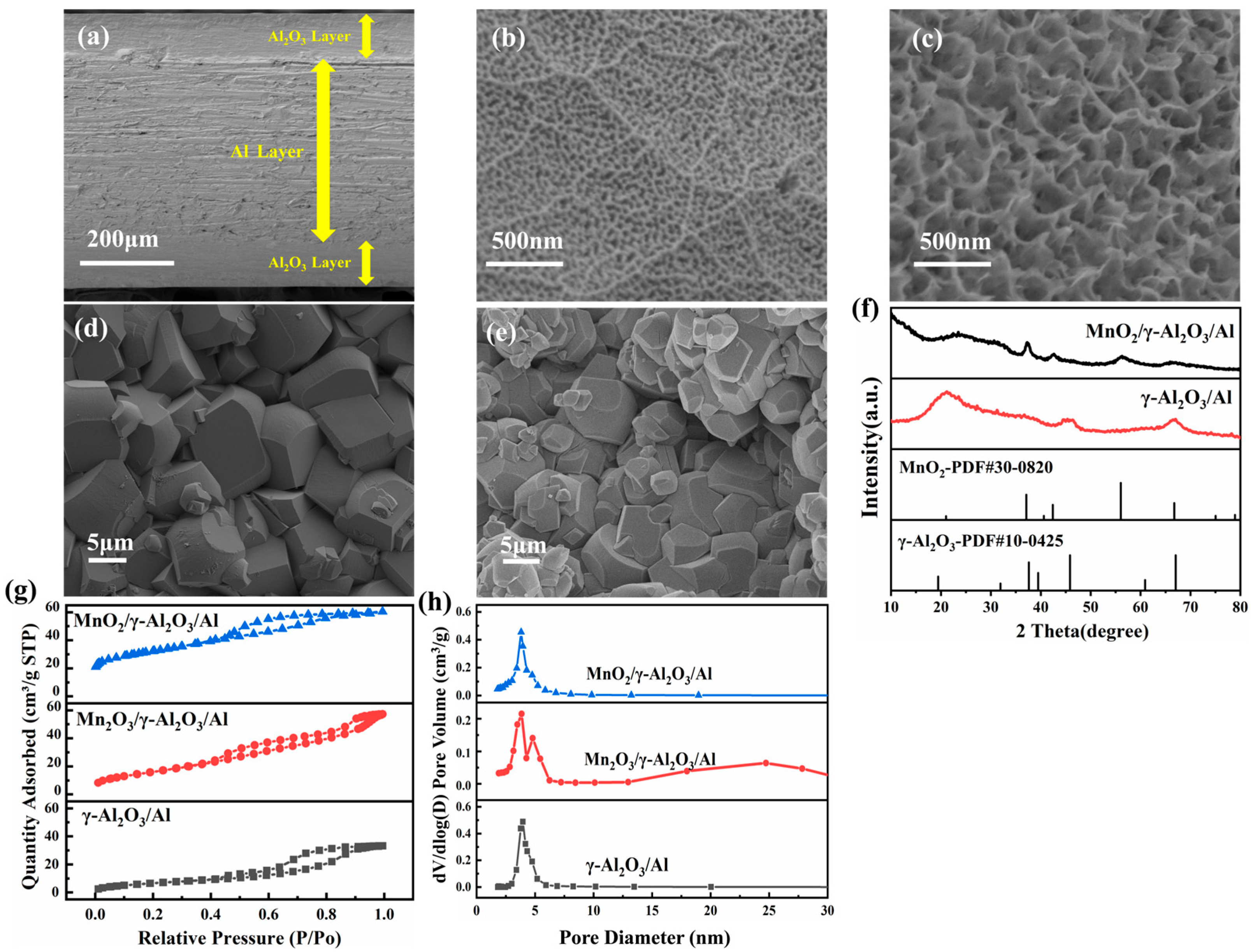
Figure 1a–c present the SEM images of the AAO/Al and γ-Al2O3/Al supports obtained after anodization and subsequent treatments of the Al substrate. As shown in Figure 1a, a typical “sandwich” structure is formed after anodization, where anodic alumina layers with a thickness of approximately 90 μm are in situ grown on both sides of the Al substrate. The in situ-grown Al2O3 layers are tightly bonded to the metallic Al substrate, which effectively suppresses the detachment of active coatings commonly observed in conventional washcoated supports under harsh conditions such as high temperature, high humidity, or high gas velocity, thereby enhancing the structural stability of the monolithic catalyst. As shown in Figure 1b, the AAO precursor exhibits a highly ordered and uniform nanochannel structure with a relatively narrow pore size distribution and a smooth surface. After thermal treatment, the AAO precursor is successfully transformed into γ-Al2O3/Al, accompanied by pronounced morphological changes (Figure 1c). Compared with the AAO precursor, γ-Al2O3/Al shows a much rougher surface, where the ordered nanochannels evolve into a honeycomb-like porous network with wrinkled and irregular pore walls [17]. Such a porous structure provides abundant anchoring sites for the deposition of active phases, thereby strengthening the interaction between the active species and the support.
Figure 1.
SEM images of cross-section of AAO/Al (a), AAO/Al (b), γ-Al2O3/Al (c), MnO2/γ-Al2O3/Al (d), Mn2O3/γ-Al2O3/Al (e); XRD patterns (f), N2 adsorption/desorption isotherms (g) and pore size distributions (h) of γ-Al2O3/Al, MnO2/γ-Al2O3/Al, and Mn2O3/γ-Al2O3/Al.
As shown in Figure 1d,e, Mn species supported on γ-Al2O3/Al lead to MnO2/γ-Al2O3/Al and Mn2O3/γ-Al2O3/Al catalysts exhibiting polyhedral morphologies. The XRD patterns (Figure 1f) confirm the successful formation of γ-Al2O3, MnO2/γ-Al2O3/Al. In addition, our previous study demonstrated that γ-Al2O3/Al possesses a high density of Lewis acid sites [22], which is favorable for the stable anchoring of Mn species as well as for NH3 adsorption.
As shown in Figure 1g, all samples exhibit typical type IV adsorption–desorption isotherms with distinct H3 hysteresis loops, indicating the predominance of mesoporous structures. The H3-type hysteresis loop is generally associated with slit-shaped pores formed by the aggregation of plate-like particles [23]. The corresponding pore size distribution (Figure 1h) reveals that the dominant pore sizes are centered at 3–4 nm. Combined with the honeycomb-like morphology observed by SEM, these results suggest that a mesoporous network structure is formed during the thermal transformation from AAO/Al to γ-Al2O3/Al through pore wall stacking and channel reconstruction. As a result, the specific surface area of γ-Al2O3/Al increases significantly from 11 to 102 m2·g−1, which contributes to improved dispersion of active species. After loading Mn species onto γ-Al2O3/Al, the specific surface area further increases from 89 to 140–145 m2·g−1 (Table 1), which is conducive to the exposure of active sites relevant to the NH3-SCO reaction.
Table 1.
Textural properties and Mn loading of AAO, γ-Al2O3/Al, MnO2/γ-Al2O3/Al, and Mn2O3/γ-Al2O3/Al.
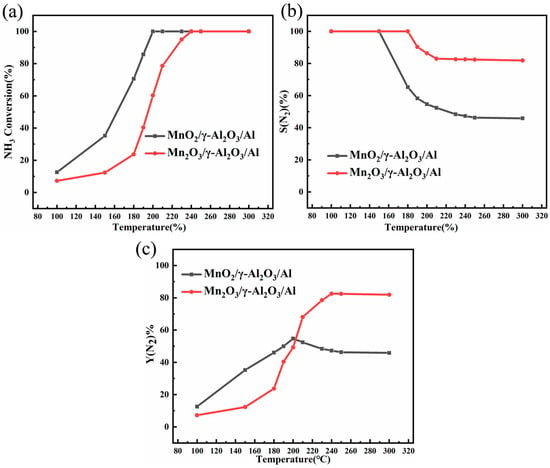
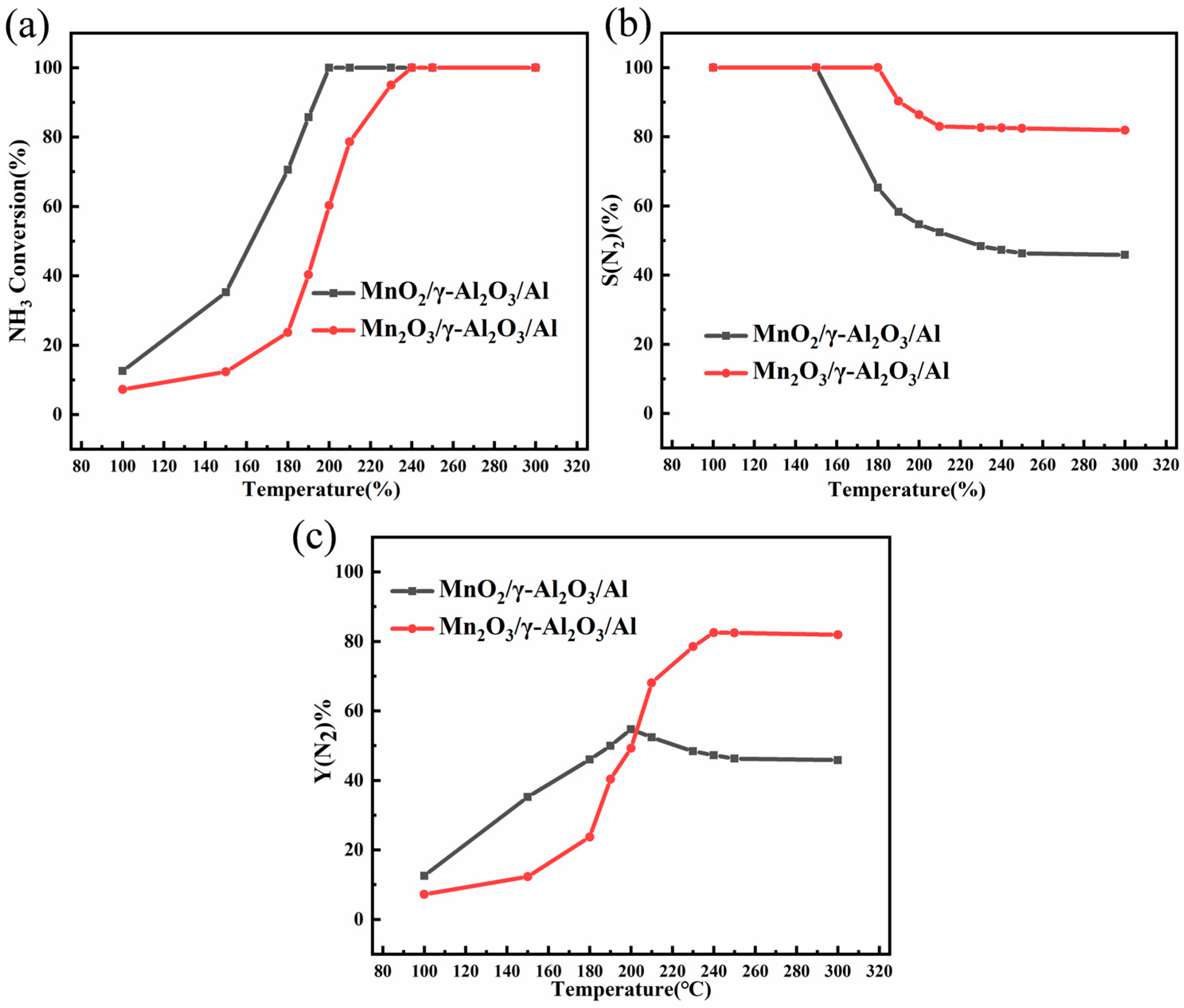
In this study, the novel mesh γ-Al2O3/Al support was employed in the development of the optimal crystalline phase and Fe-modified Mn-based catalysts for the NH3-SCO reaction. Figure 2 presents a comparison of the catalytic performance of MnO2/γ-Al2O3/Al and Mn2O3/γ-Al2O3/Al in this reaction. In the 100–240 °C range, a higher NH3 conversion rate was achieved by MnO2/γ-Al2O3/Al compared to Mn2O3/γ-Al2O3/Al, with a T100 (the temperature at which NH3 conversion reaches 100%) of 200 °C, which is 240 °C lower than that of Mn2O3/γ-Al2O3/Al (Figure 2a). However, much lower N2 selectivity was observed for MnO2/γ-Al2O3/Al, with a N2 selectivity of only 50% at T100, while over 80% was achieved by Mn2O3/γ-Al2O3/Al (Figure 2b). As shown in Figure 2c, although the NH3 conversion of Mn2O3/γ-Al2O3/Al was lower at low temperatures, a significantly higher N2 yield was obtained, demonstrating superior de-ammoniation performance.
Figure 2.
NH3 conversion (a), N2 selectivity (b), N2 yield of MnO2/γ-Al2O3/Al and Mn2O3/γ-Al2O3/Al catalysts (c) (reaction conditions: [NH3] = 3000 ppm; WHSV = 25,000 mL·gcat−1·h−1).
2.2. Effect of Fe Modification on NH3-SCO Activity over Fex-Mn2O3/γ-Al2O3/Al Catalysts
It has been reported that Fe incorporation into Mn2O3 catalysts modifies the surface electronic structure and redox properties in VOC catalytic oxidation systems. In particular, Fe doping has been shown to increase the proportion of surface-adsorbed oxygen species and enhance the density of acid sites [11,12], thereby facilitating oxidation reactions. Based on these considerations, Fe was introduced into the Mn2O3/γ-Al2O3/Al catalyst in this work, and its structural and physicochemical properties were first investigated before evaluating the NH3-SCO performance.
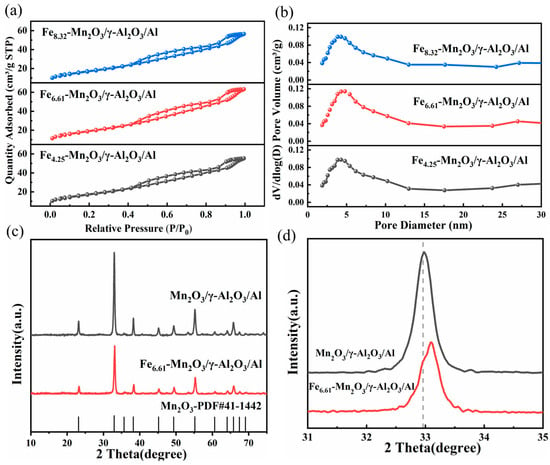
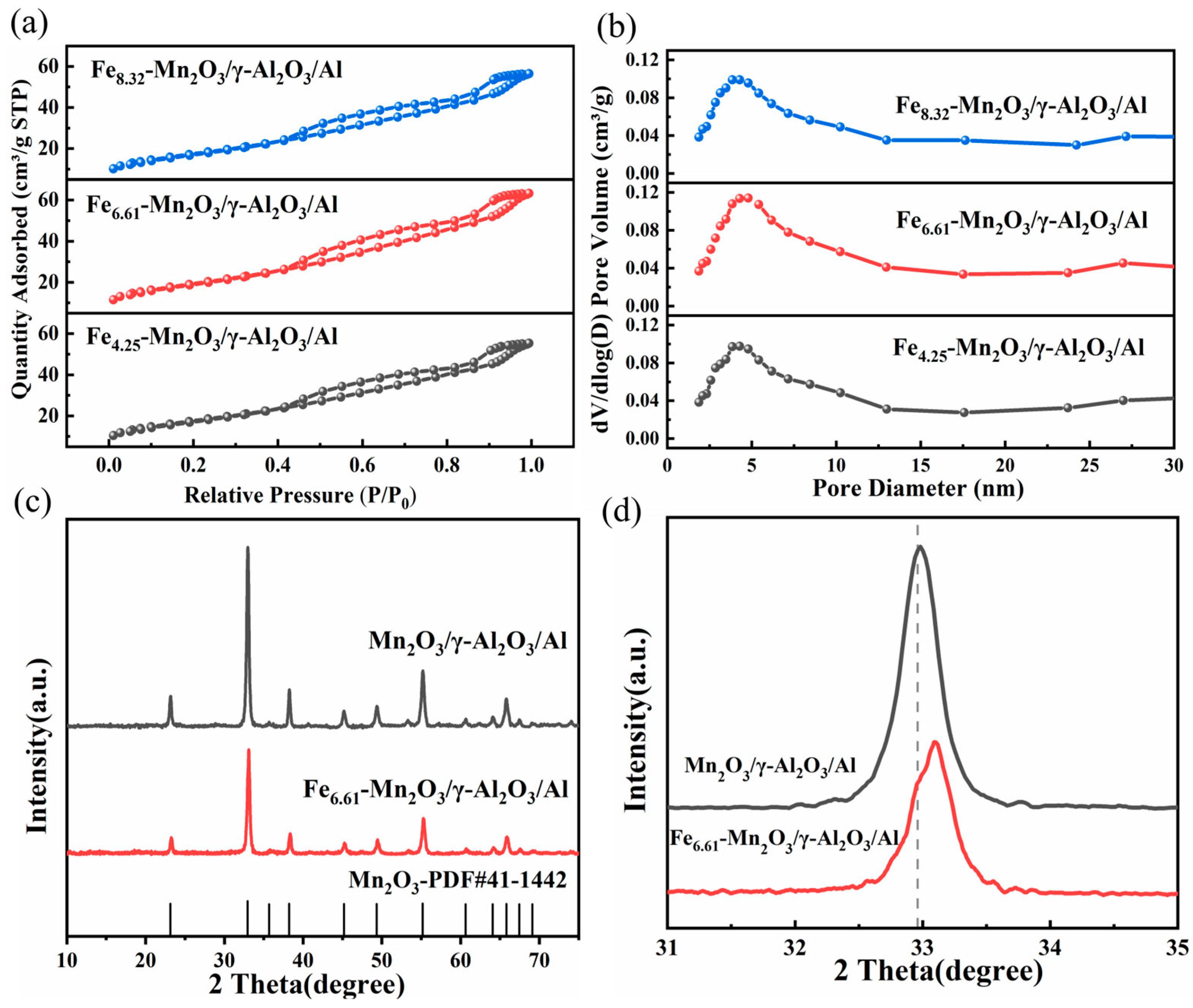
N2 adsorption–desorption experiments were conducted to investigate the textural properties of the catalysts. As shown in Figure 3a, all catalysts exhibited BET Type IV isotherms [24], with an H3-type hysteresis loop in the p/p0 = 0.4–1 range, indicating a predominant slit-like mesoporous structure. The pore size distribution (Figure 3b) reveals that the majority of the pores are concentrated in the 4–5 nm range. According to the data in Table 1 and Table 2, Fe doping leads to noticeable changes in the textural properties of the catalysts: the specific surface area of Fe6.61-Mn2O3/γ-Al2O3/Al increased from 140 m2/g to 175 m2/g, the pore volume rose from 0.16 cm3/g to 0.23 cm3/g, and the average pore size increased from 4.55 nm to 5.81 nm. Notably, when the Fe loading exceeded 8.32 wt%, both the specific surface area and pore volume slightly decreased, indicating the presence of an optimal doping amount, which is consistent with the observed catalytic activity.
Figure 3.
N2 adsorption–desorption isotherms (a) and pore size distribution curves (b) of Fex-Mn2O3/γ-Al2O3/Al (x = 4.25, 6.61 and 8.32) catalysts; XRD patterns of Mn2O3/γ-Al2O3/Al and Fe6.61-Mn2O3/γ-Al2O3/Al (c) (magnified XRD patterns of Mn2O3/γ-Al2O3/Al and Fe6.61-Mn2O3/γ-Al2O3/Al (d)).
Table 2.
Textural properties and Fe/Mn loadings of Fex-Mn2O3/γ-Al2O3/Al catalysts (x = 4.25, 6.61, and 8.32).
Figure 3c,d display the XRD patterns of the catalysts. Diffraction peaks corresponding to the (211), (222), (400), (332), (431), and (440) planes of cubic Mn2O3 are observed at 2θ = 23.131°, 32.951°, 38.234°, 45.178°, 49.347°, and 55.189°, respectively. No impurity peaks associated with Fe2O3 or spinel structures were observed, suggesting that Fe atoms substituted Mn atoms in the lattice through isomorphous substitution, successfully forming a single-phase Mn2O3 [25]. Additionally, the magnified XRD pattern (Figure 3d) reveals a noticeable shift of the (222) peak towards higher diffraction angles with Fe doping. According to the Bragg equation, the lattice constants (a) for Mn2O3 and Fe6.61-Mn2O3 are 9.401 Å and 9.380 Å, respectively, confirming a contraction of the unit cell. This is mainly attributed to the smaller ionic radius of Fe compared to Mn [26], indicating that Fe atoms are incorporated into the Mn2O3 lattice, forming a single-phase Fe-Mn mixed oxide.
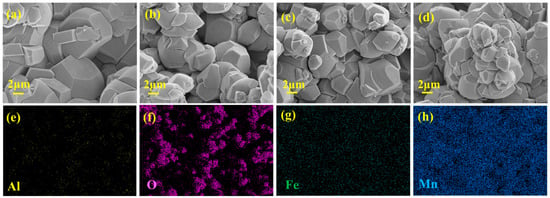
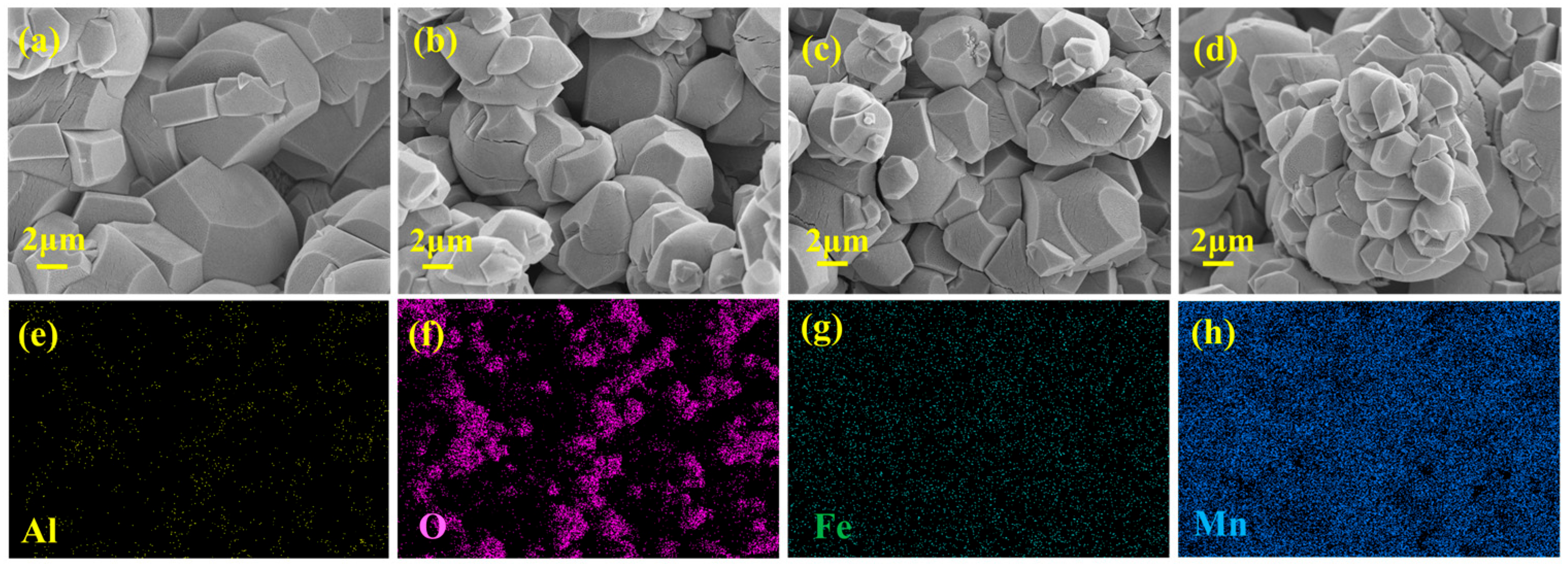
SEM images reveal that the Fe doping amount markedly affects the particle morphology and packing of Mn2O3. The undoped Mn2O3/γ-Al2O3/Al (Figure 4a) mainly consists of regular polyhedral particles with a broad size distribution of 5–8 μm. The particle surfaces are smooth, the crystal planes are well-defined, and the particles are densely packed, indicative of high crystallinity. Upon Fe introduction, Fe4.25-Mn2O3/γ-Al2O3/Al (Figure 4b) retains the polyhedral morphology, although the particle size slightly decreases, and surface features such as steps and edges emerge. The particles become more loosely packed. With a further increase in Fe doping to 6.61 wt% (Figure 4c), the particle size distribution becomes more uniform, grain size decreases further, and surface steps and crystal boundaries are more prominently exposed. This observation is consistent with the highest specific surface area observed for this sample. A larger specific surface area is beneficial for the adsorption of reactants. Wei et al. [27] analyzed unmodified 13X zeolite and Mn-Fe/13X catalysts using SEM and found that the formation of cubic structures and petal-like layered MnO2 on the surface contributed to an increased specific surface area, thereby enhancing ozone adsorption. Furthermore, no significant large-scale agglomeration is observed for the Fe6.61-Mn2O3/γ-Al2O3/Al catalyst, indicating good dispersion of the active species. It has been reported that good dispersion can enhance catalytic activity. For instance, Wen et al. [28] reported that the active components in Mn-Fe-Ce/Al2O3/CC catalysts exhibited better dispersion than those in Mn-Fe-Ce/CC samples, which was considered one of the main reasons for the improved catalytic activity. When the Fe content reaches 8.32 wt% (Figure 4d), partial particle agglomeration occurs, with small particles adhering to larger ones to form dense secondary stacking structures. Particle boundaries appear blurred, which may limit the full exposure of active surface sites. This observation is in agreement with the above discussion.
Figure 4.
SEM images of Fex-Mn2O3/γ-Al2O3/Al (x = 0, 4.25, 6.61 and 8.32) (a–d) and EDS mapping images of the Fe6.61-Mn2O3/γ-Al2O3/Al catalyst (e–h).
In addition, Figure 4e,f shows the EDS mapping images of the Fe6.61-Mn2O3/γ-Al2O3/Al catalyst. The atomic percentages of Al, O, Fe, and Mn on the catalyst surface are 0.30%, 39.12%, 0.45%, and 60.13%, respectively. These results indicate that manganese oxides dominate the catalyst surface. The Fe content is relatively low. This suggests that Fe species are mainly covered by Mn species. Therefore, Mn2O3 serves as the main active site of the catalyst, while Fe mainly acts as a promoter.
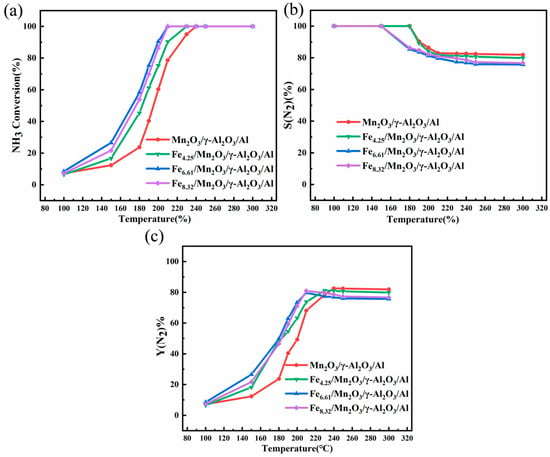
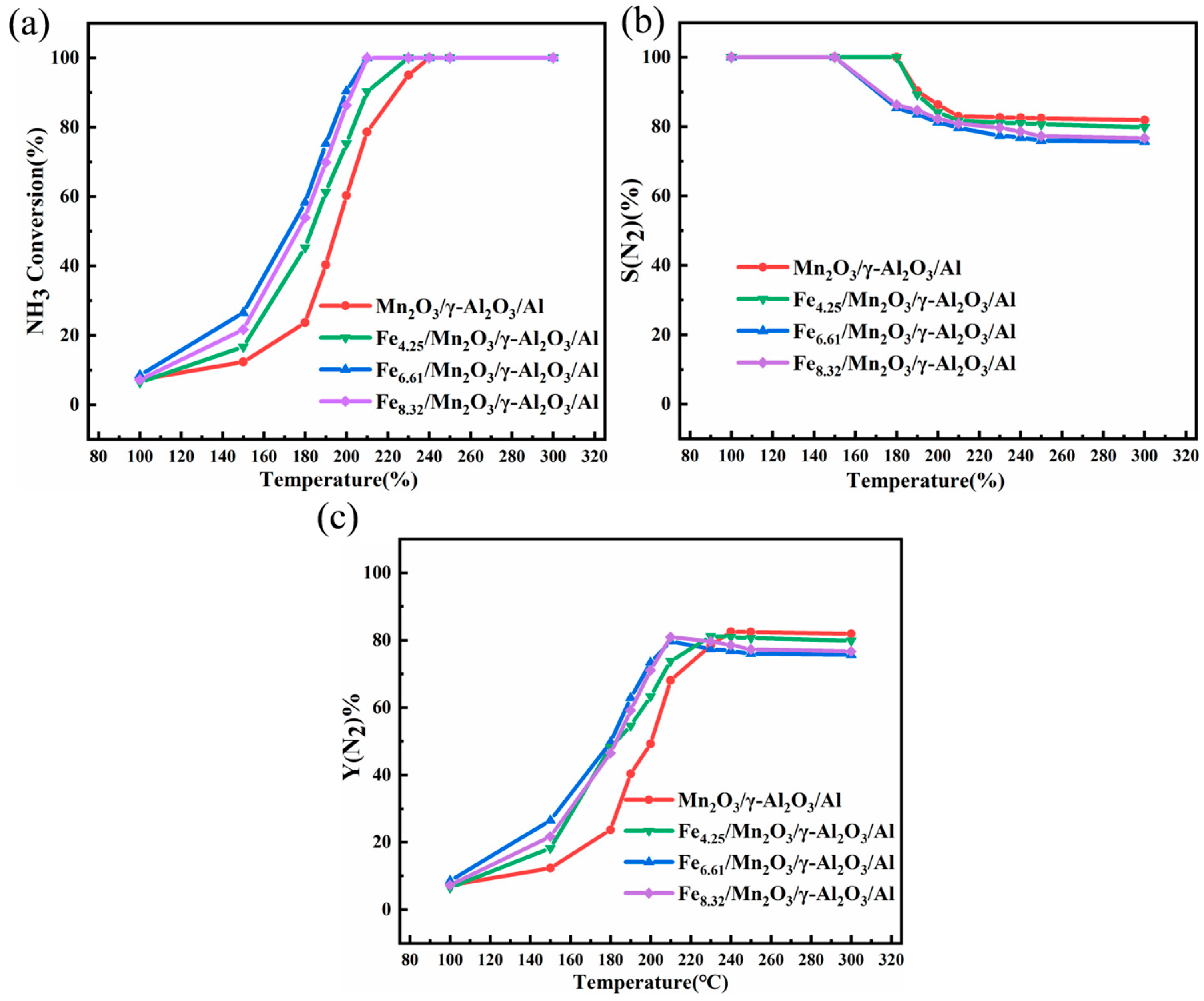
To clarify the influence of Fe doping on catalytic behavior, the NH3-SCO performance of the catalysts was further investigated. As shown in Figure 5a–c, the NH3 conversion, N2 selectivity, and N2 yield were systematically evaluated under varying temperature conditions. The results indicated that the introduction of different Fe loadings into Mn2O3/γ-Al2O3/Al significantly enhanced NH3 conversion in the 100–240 °C range. Among the catalysts, Fe6.61-Mn2O3/γ-Al2O3/Al exhibited the best performance, achieving complete NH3 conversion at 210 °C. Furthermore, Fe6.61-Mn2O3/γ-Al2O3/Al maintained N2 selectivity above 75% in the 200–300 °C range, indicating that Fe doping effectively improved NH3 conversion without adversely affecting product distribution. Considering both NH3 conversion and N2 selectivity, the Fe6.61-Mn2O3/γ-Al2O3/Al catalyst demonstrated superior overall NH3-SCO performance.
Figure 5.
NH3 conversion (a), N2 selectivity (b) and N2 yield (c) of Fex-Mn2O3/γ-Al2O3/Al (x = 0, 4.25, 6.61 and 8.32) catalysts (reaction conditions: [NH3] = 3000 ppm; WHSV = 25,000 mL·gcat−1·h−1).
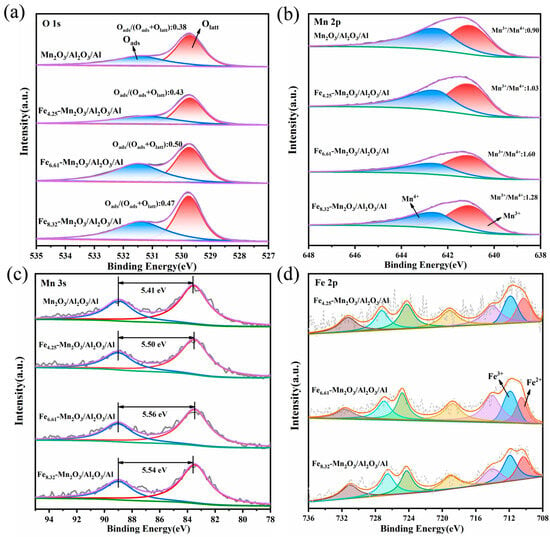
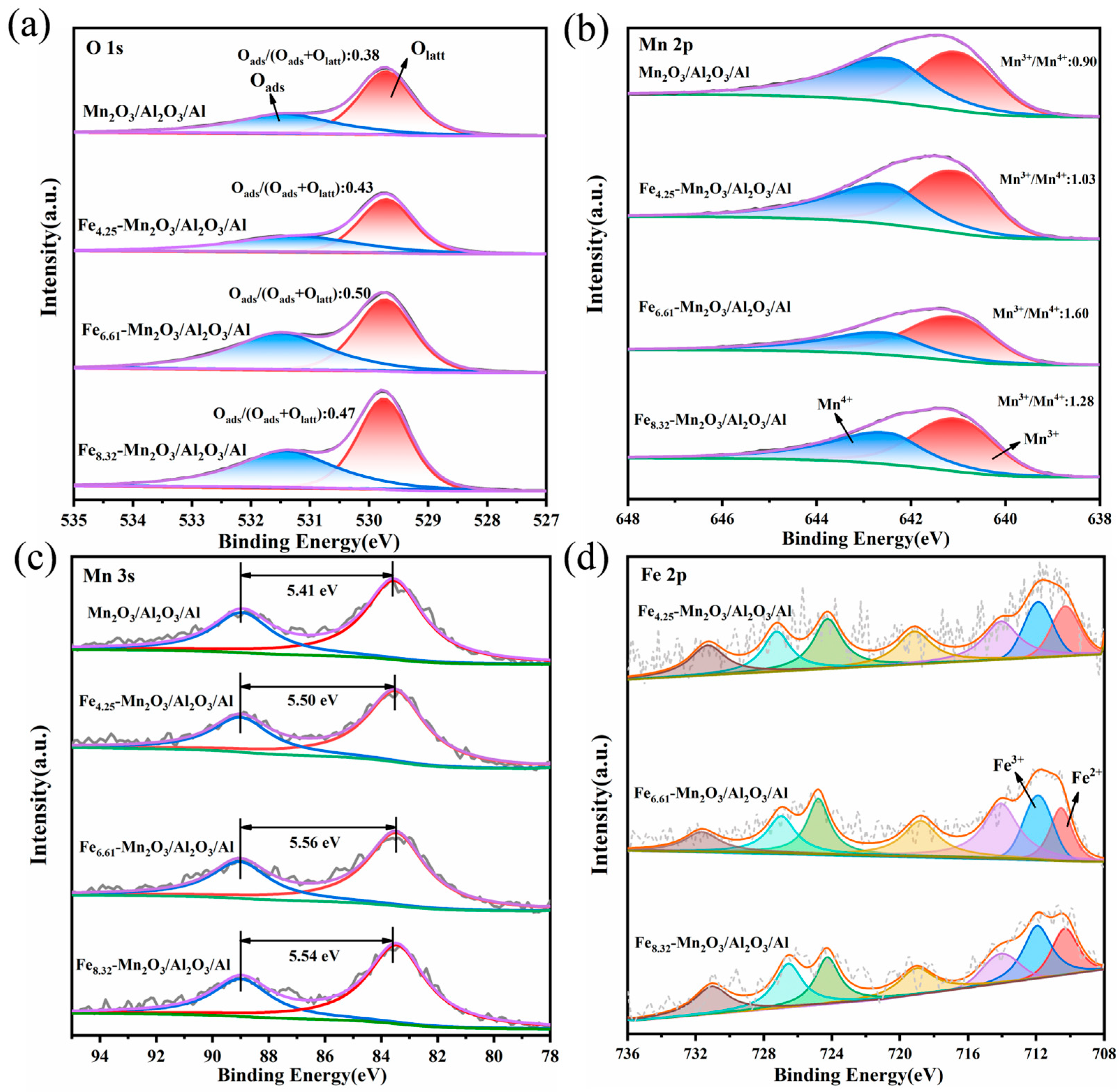
In addition, XPS was used to assess the surface valence states and chemical composition of the catalysts. The Mn 2p spectrum showed peaks at 641.0 eV and 642.5 eV, corresponding to Mn3+ and Mn4+ [29], with the catalyst predominantly existing as Mn2O3 and Mn3+ as the major valence state, consistent with XRD. A low AOS typically indicates a higher Mn3+ content [30,31]. The Jahn–Teller effect of Mn3+ ions [32] causes distortion of the Mn-O octahedra, activating lattice oxygen and generating reactive oxygen species (O−, O22−, or surface-adsorbed oxygen), thereby facilitating oxidation [12,33].
The O1s spectrum (Figure 6a) showed two peaks: Oads (531.2–531.5 eV) and Olatt (529.7–529.8 eV) [34]. Oads serves as an indicator of oxygen vacancy content and plays a more significant role in catalytic activity due to its higher mobility and oxidative potential [35]. The Oads/Olatt ratio follows the order: Fe6.61-Mn2O3/γ-Al2O3/Al > Fe8.32-Mn2O3/γ-Al2O3/Al > Fe4.25-Mn2O3/γ-Al2O3/Al > Mn2O3/γ-Al2O3/Al, indicating that Fe6.61-Mn2O3/γ-Al2O3/Al adsorbs and activates oxygen more efficiently [36]. The results agree with the SEM observations. The SEM images of Fe6.61-Mn2O3/γ-Al2O3/Al (Figure 4c) show a more uniform particle size distribution and smaller grains. Mn2O3 particles are well exposed on the surface, which facilitates the adsorption of active oxygen species.
Figure 6.
XPS results of Fex-Mn2O3/γ-Al2O3/Al (x = 0, 4.25, 6.61 and 8.32) catalysts: O 1s (a), Mn 2p (b), Mn 3s (c), and Fe 2p (d).
The Fe 2p spectrum of Fe6.61-Mn2O3/γ-Al2O3/Al (Figure 6d) displayed peaks at 724.8 eV and 710.5 eV, corresponding to Fe 2p1/2 and Fe 2p3/2, and satellite peaks at 718.8 eV and 731.6 eV confirmed Fe3+ presence [35,37]. Fitting of the Fe 2p3/2 main peak showed Fe2+ (710.5 eV) and Fe3+ (711.9 eV), indicating a mixed Fe3+/Fe2+ valence state on the surface [37]. The Fe3+/Fe2+ ratios for the Fex-Mn2O3/γ-Al2O3/Al samples were 1.11, 1.42, and 1.39 (Table 3). It was observed that a higher Fe3+/Fe2+ ratio was generally accompanied by improved NH3 catalytic activity. This enhancement may be attributed to increased surface Fe3+ species facilitating NH3 dehydrogenation [38,39] and thus boosting the NH3-SCO performance.
Table 3.
XPS fitting of the O 1s, Mn 2p, Mn 3s, and Fe 2p peaks.
Furthermore, although the Fe loading is relatively high (4.25–8.32 wt%), the Fe 2p signal intensity in the XPS spectra is much weaker than that of Mn. This observation suggests that Fe species are mainly located beneath the Mn layer rather than being enriched on the catalyst surface. Consequently, the catalyst surface is dominated by Mn species, which is consistent with the EDS results.
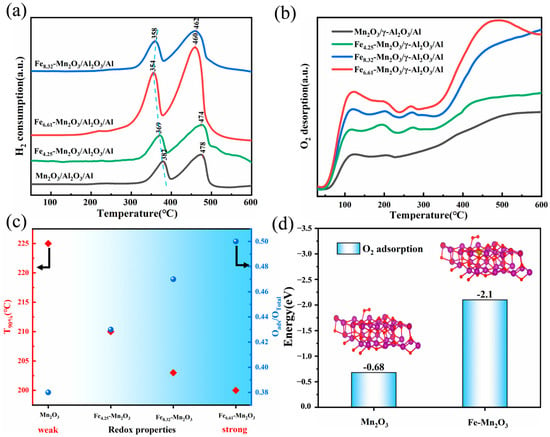
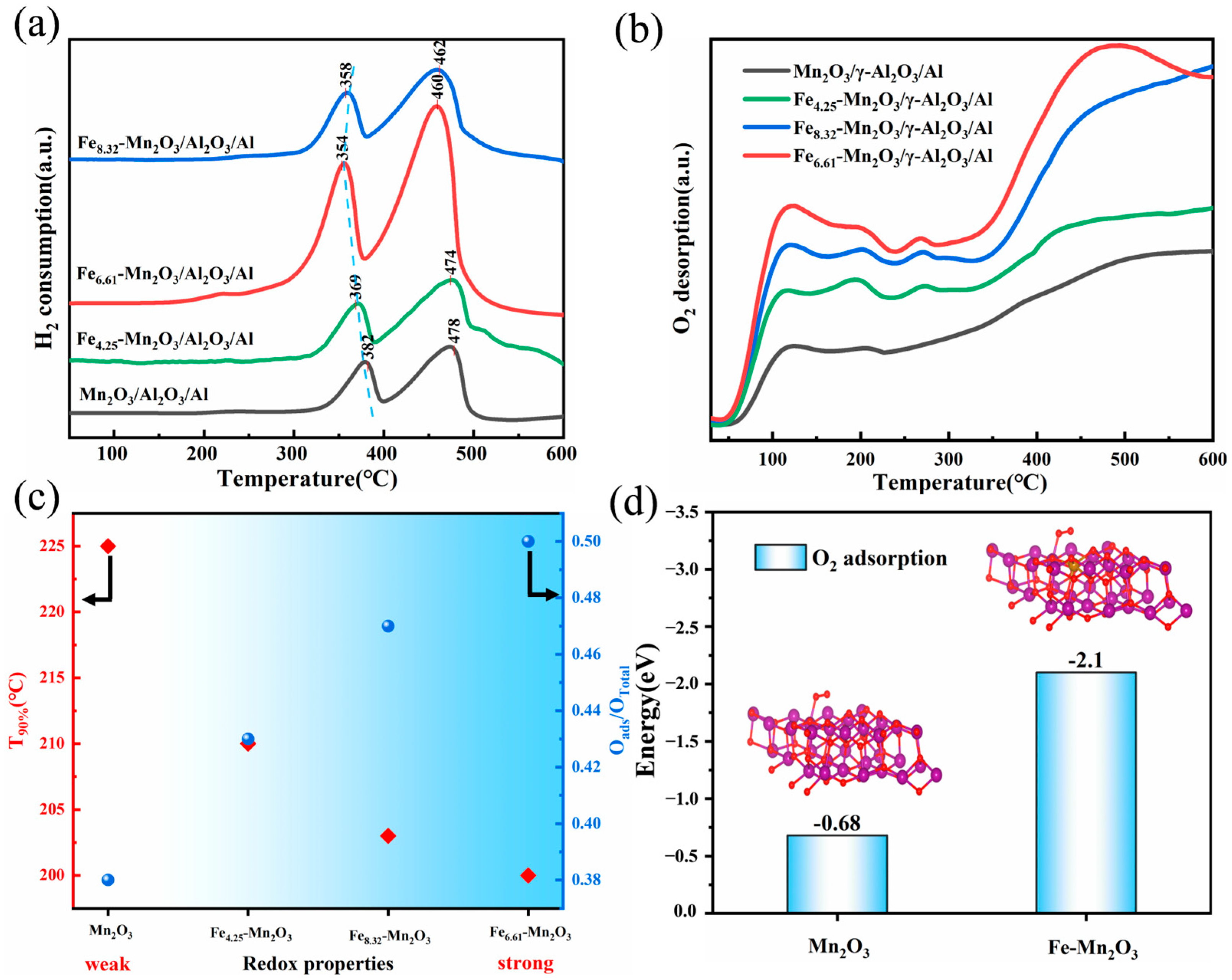
The redox properties of the catalysts were evaluated using H2-TPR, as shown in Figure 7a. Two reduction processes were observed for all catalysts: the transformation from Mn2O3 to Mn3O4 and from Mn3O4 to MnO [12]. Mn2O3/γ-Al2O3/Al showed peaks at 382 °C and 478 °C, Fe4.25-Mn2O3/γ-Al2O3/Al at 369 °C and 474 °C, Fe6.61-Mn2O3/γ-Al2O3/Al at 354 °C and 460 °C, and Fe8.32-Mn2O3/γ-Al2O3/Al at 358 °C and 462 °C. Compared to Mn2O3/γ-Al2O3/Al, Fe doping shifts both peaks to lower temperatures. As Fe loading increases, the reduction peak temperatures first decrease, then slightly increase. The reduction temperature correlates with catalytic performance: lower reduction temperatures typically result in higher activity [40]. The order of reduction temperatures is: Mn2O3/γ-Al2O3/Al > Fe4.25-Mn2O3/γ-Al2O3/Al > Fe8.32-Mn2O3/γ-Al2O3/Al > Fe6.61-Mn2O3/γ-Al2O3/Al, indicating that Fe6.61-Mn2O3/γ-Al2O3/Al has stronger reducibility at low temperatures. Additionally, Fe6.61-Mn2O3/γ-Al2O3/Al exhibits a larger reduction peak area, suggesting a higher concentration of active oxygen species [41].
Figure 7.
H2-TPR (a) and O2-TPD (b) profiles of Fex-Mn2O3/γ-Al2O3/Al (x = 0, 4.25, 6.61 and 8.32) catalysts. Results for the relationship between T90, redox properties and Oads/Ototal for different catalysts (c). Adsorption models and adsorption energy profiles of O2 on Mn2O3(222) and Fe-Mn2O3 sites (d).
O2-TPD was used to investigate the amount and binding strength of surface active oxygen species on the catalysts. It was known that oxygen species desorbed below 300 °C are typically associated with highly mobile surface-adsorbed oxygen [42,43], while peaks in the 300–600 °C range correspond to the release of lattice oxygen [43]. Since the NH3-SCO reaction occurs in the 100–300 °C range, the low-temperature desorption peaks reflect the catalyst’s oxygen supply capability under reaction conditions. As shown in Figure 7b, Fe6.61-Mn2O3/γ-Al2O3/Al shows the largest low-temperature peak area, indicating a higher proportion of weakly bound active oxygen. Fe doping enhances O2 activation and dissociation, leading to increased active oxygen species and better oxygen migration. Increasing Fe loading from 0 to 6.61 wt% significantly boosts desorbed oxygen species. However, at 8.32 wt%, excess Fe may form aggregates or compete with Mn-O-Mn bonds, reducing oxygen vacancy formation and slightly lowering desorbed oxygen species compared to Fe6.61-Mn2O3/γ-Al2O3/Al. This trend aligns with the Oads/Olatt ratio from XPS, where Fe6.61-Mn2O3/γ-Al2O3/Al shows the highest Oads ratio, confirming the O2-TPD results.
As shown in Figure 7c, the variation in Oads/Ototal closely correlates with the redox properties of the samples: catalysts with a higher proportion of surface-adsorbed oxygen exhibit stronger oxygen mobility and redox ability, as indicated by a lower T90 (the temperature at which NH3 conversion reaches 90%) and enhanced NH3-SCO activity.
To investigate the enhancement of oxygen activation in Mn2O3 by Fe doping in NH3-SCO, an analysis from an electronic structure perspective was performed. DFT calculations revealed that the O2 adsorption energy of Fe-Mn2O3 is −2.10 eV, whereas for undoped Mn2O3(222) it is only −0.68 eV (Figure 7d). The more negative adsorption energy suggests that the Fe-doped system forms stronger chemisorption with O2, thereby promoting oxygen activation and dissociation on the catalyst surface.
Therefore, it is reasonable to conclude that a higher proportion of surface-adsorbed oxygen species, in conjunction with its superior redox properties, plays a key role in endowing the Fe6.61-Mn2O3/γ-Al2O3/Al catalyst with excellent NH3-SCO activity.
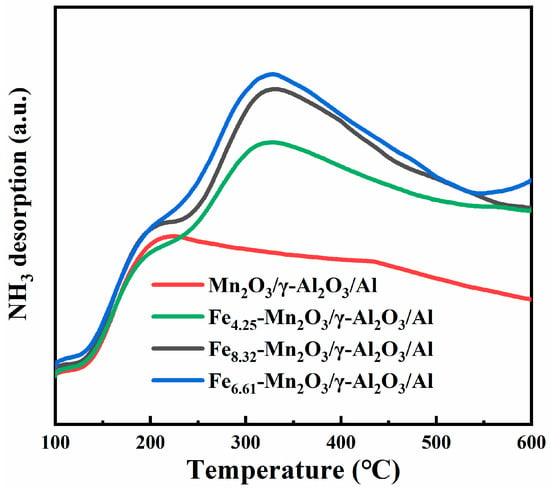
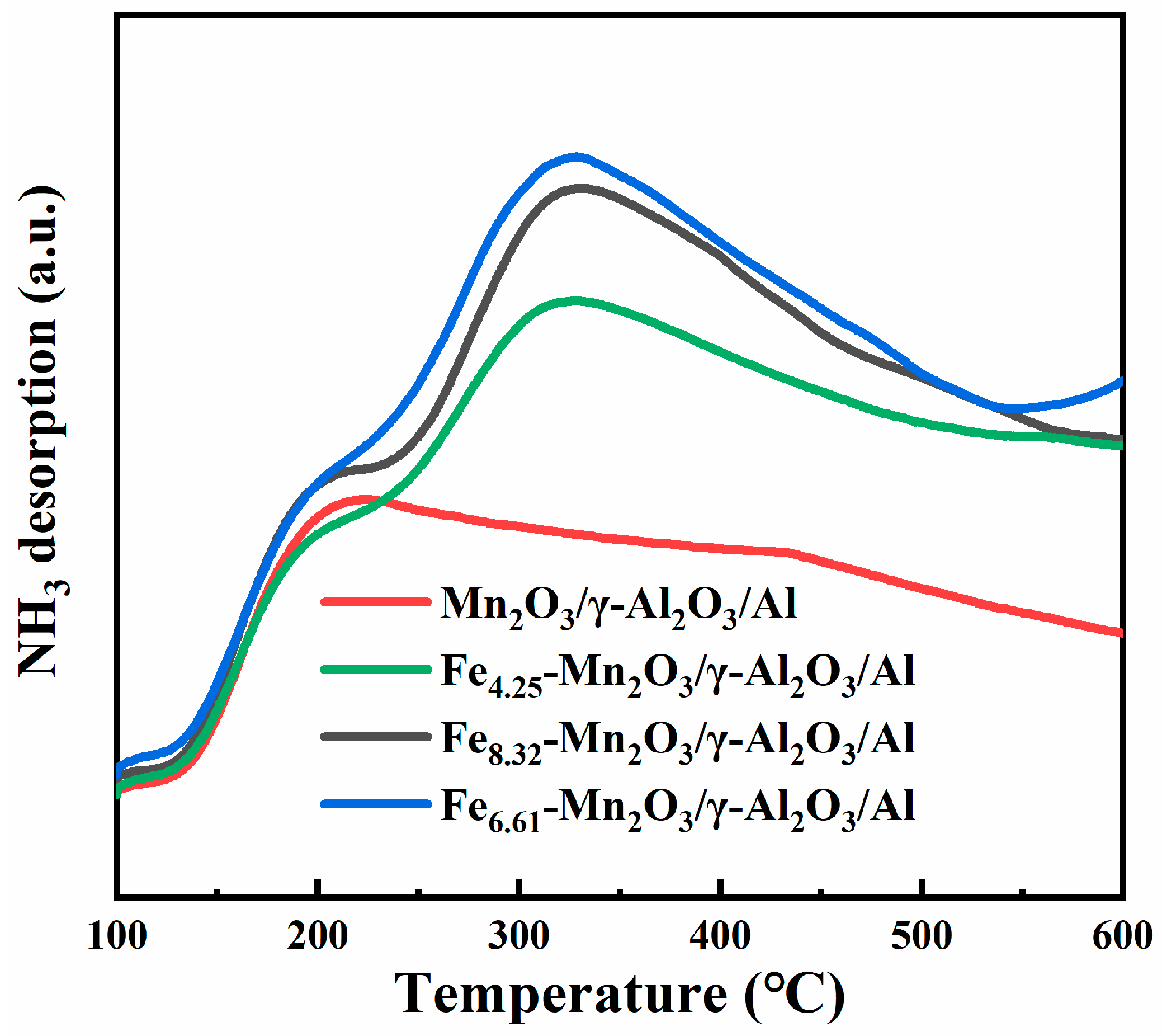
It is well established that surface acidity plays a crucial role in NH3 adsorption and activation during the NH3-SCO reaction. Therefore, NH3-TPD was conducted to investigate the acidic properties of the Fex-Mn2O3/γ-Al2O3/Al catalysts. As shown in Figure 8, Fe incorporation significantly altered the acidic structure. All Fe-doped samples exhibited NH3 desorption peaks around 200 °C, which are assigned to weak acid sites [44]. The undoped Mn2O3/γ-Al2O3/Al showed much weaker intensity in this region. In addition, Fe-doped catalysts displayed clear desorption peaks at approximately 350 °C, corresponding to medium-strength acid sites [45]. These peaks were absent in the undoped sample, indicating that Fe doping promotes the formation of medium-strength acid sites. As the Fe loading increased, the intensity of the medium-temperature peaks gradually increased. Among the samples, Fe6.61-Mn2O3/γ-Al2O3/Al exhibited the strongest medium-strength acidity, which may account for its superior NH3-SCO performance.
Figure 8.
NH3-TPD profiles of Fex-Mn2O3/γ-Al2O3/Al (x = 0, 4.25, 6.61 and 8.32) catalysts.
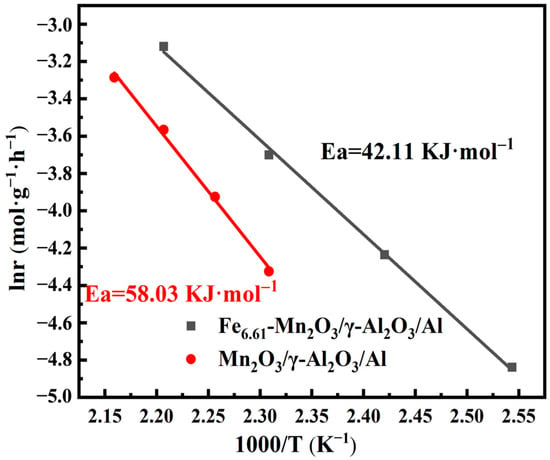
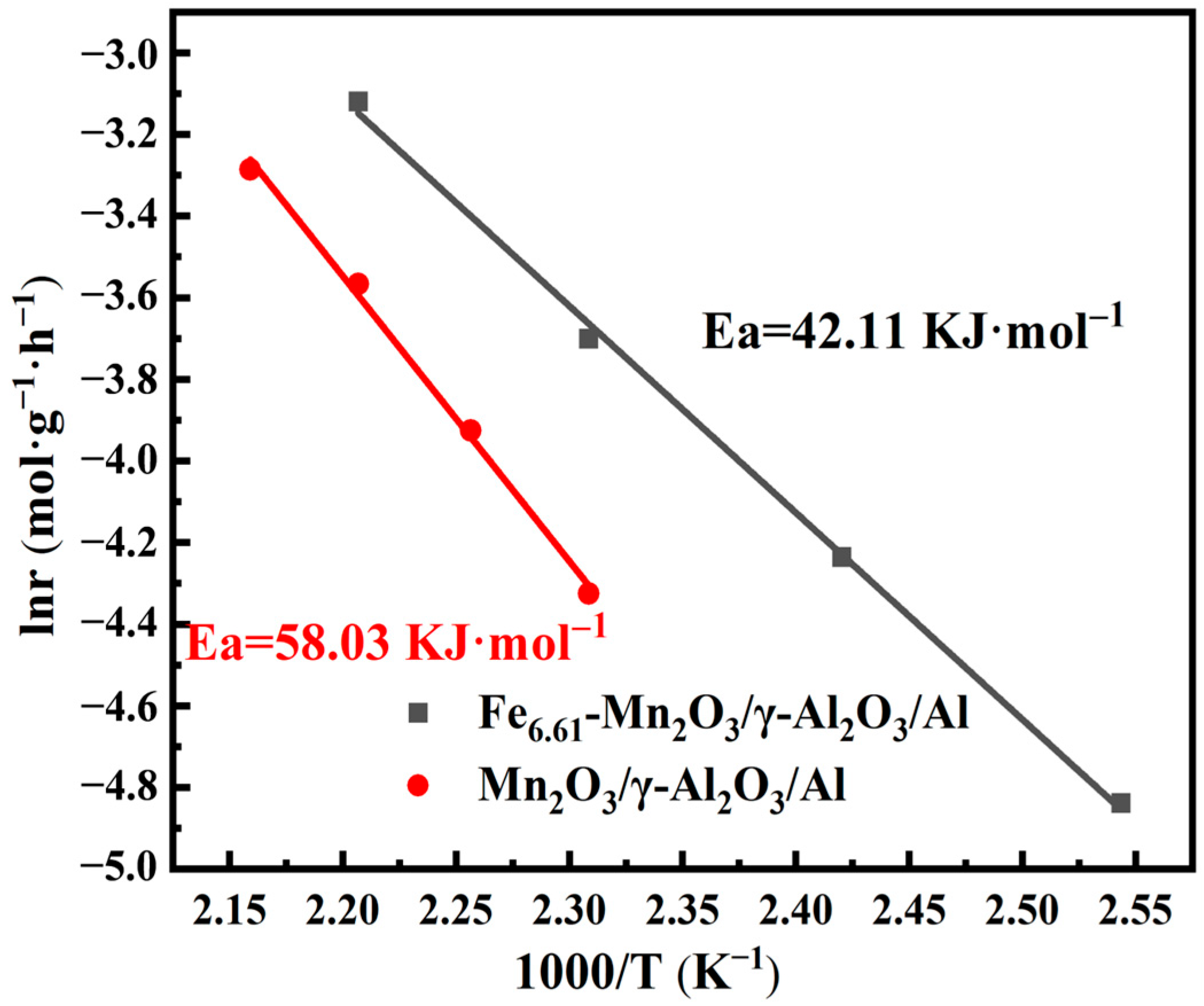
To further clarify the intrinsic effect of Fe doping on reaction kinetics, kinetic analysis was carried out over Mn2O3/γ-Al2O3/Al and Fe6.61-Mn2O3/γ-Al2O3/Al catalysts. To eliminate diffusion effects, 1 g of catalyst was mixed and diluted with 5 g of quartz sand of the same particle size, and the catalytic tests were conducted at a space velocity of 165,000 mL·gcat−1·h−1. Under these conditions, the NH3 conversion was maintained below 15%, satisfying the criteria for excluding internal and external diffusion limitations. The reaction rate (r) and apparent activation energy (Eₐ) were calculated according to Equations (1)–(3):
As shown in Figure 9, the apparent activation energy (Ea) for the Mn2O3/γ-Al2O3/Al catalyst was 58.03 kJ·mol−1, while for the Fe-modified Fe6.61-Mn2O3/γ-Al2O3/Al catalyst, Ea decreased to 42.11 kJ·mol−1. The lower activation energy accelerates the NH3 oxidation reaction at lower temperatures, further confirming that Fe modification enhances reaction efficiency by reducing the reaction energy barrier.
Figure 9.
Arrhenius linear regression curves of Mn2O3/γ-Al2O3/Al and Fe6.61-Mn2O3/γ-Al2O3/Al (reaction conditions: 1 g catalyst, weight hourly space velocity (WHSV) = 165,000 mL·gcat−1·h−1, 1000 ppm NH3 mixed in air).
2.3. Effect of Fe Modification on the H2O and SO2 Resistance Behavior of the Catalyst
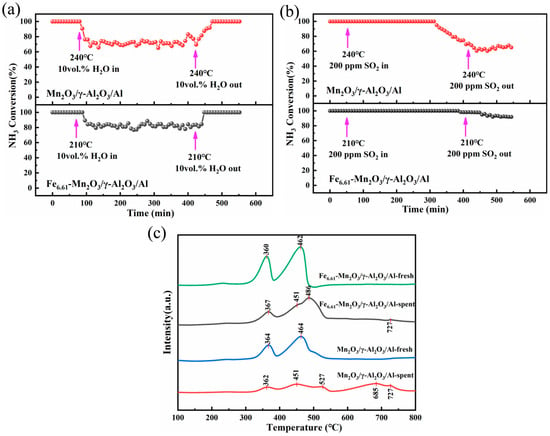
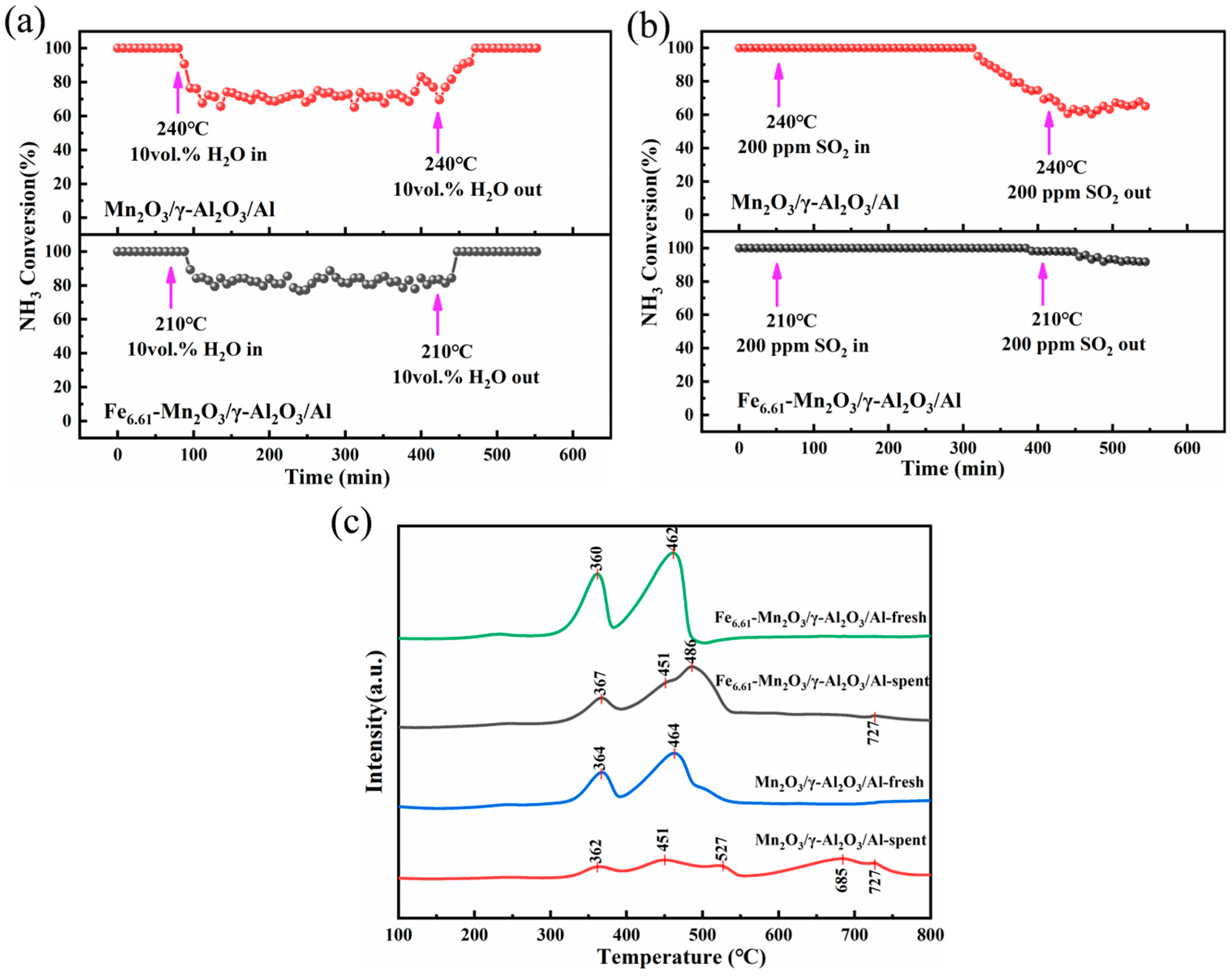
Industrial flue gas typically contains complex components, among which H2O and SO2 are two major impurities. Therefore, evaluating the tolerance of catalysts toward H2O and SO2 is essential. Firstly, the water resistance of Mn2O3/γ-Al2O3/Al and Fe6.61-Mn2O3/γ-Al2O3/Al was evaluated at their respective temperatures for complete NH3 conversion. As shown in Figure 10a, after introducing 10 vol.% H2O, the NH3 conversion gradually decreased and then stabilized. The steady-state conversion was 65% for Mn2O3/γ-Al2O3/Al and 80% for Fe6.61-Mn2O3/γ-Al2O3/Al. This decline is mainly attributed to the competitive adsorption of H2O and NH3 on active sites [46]. After H2O was removed from the feed, both catalysts recovered their activity. The NH3 conversion over Mn2O3/γ-Al2O3/Al returned to 100% within 40 min. In contrast, Fe6.61-Mn2O3/γ-Al2O3/Al recovered to full conversion within 20 min.
Figure 10.
H2O tolerance (a), SO2 tolerance (b), and H2-TPR profiles (c) (before and after sulfur resistance reaction) of Mn2O3/γ-Al2O3/Al and Fe6.61-Mn2O3/γ-Al2O3/Al (reaction conditions: 3000 ppm NH3; 200 ppm SO2 (when used), 10.0 vol.% H2O (when used), and WHSV = 25,000 mL·gcat−1·h−1).
Secondly, as shown in Figure 10b, the sulfur resistance of Mn2O3/γ-Al2O3/Al and Fe6.61-Mn2O3/γ-Al2O3/Al was evaluated at their respective temperatures for complete NH3 conversion. For Mn2O3/γ-Al2O3/Al, NH3-SCO activity was stable at 100% conversion with 200 ppm SO2, but after 260 min of SO2 exposure, deactivation occurred, and the conversion dropped to 67% after 360 min. No recovery was observed after SO2 removal, mainly due to sulfation of active sites and ammonium sulfate deposition [47]. In contrast, Fe6.61-Mn2O3/γ-Al2O3/Al showed enhanced SO2 tolerance, maintaining complete NH3 conversion for 320 min under 200 ppm SO2. After 360 min, the conversion remained above 98%. After SO2 removal, conversion decreased to 92% and stabilized. Figure 10c shows H2-TPR profiles of both catalysts before and after SO2 exposure. For Mn2O3/γ-Al2O3/Al, after the SO2 reaction, low-temperature reduction peaks (364 °C and 464 °C) decreased significantly, and new peaks appeared at 685 °C and 717 °C, indicating the formation of inert sulfate species [48], In contrast, Fe6.61-Mn2O3/γ-Al2O3/Al maintained the low-temperature reduction peak (367 °C), with weak high-temperature sulfate reduction peaks, demonstrating that Fe doping effectively suppresses sulfation poisoning.
2.4. Reaction Mechanism of NH3-SCO over Fe-Mn2O3
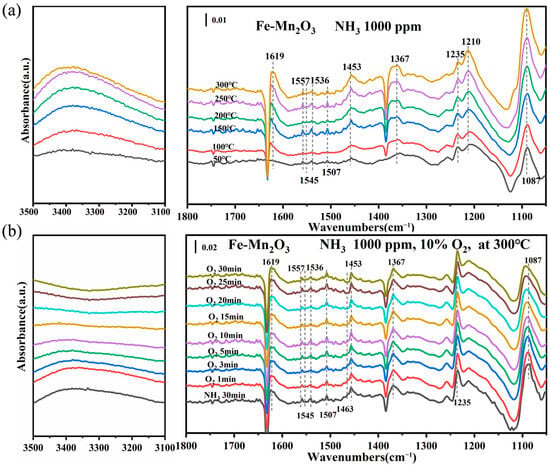
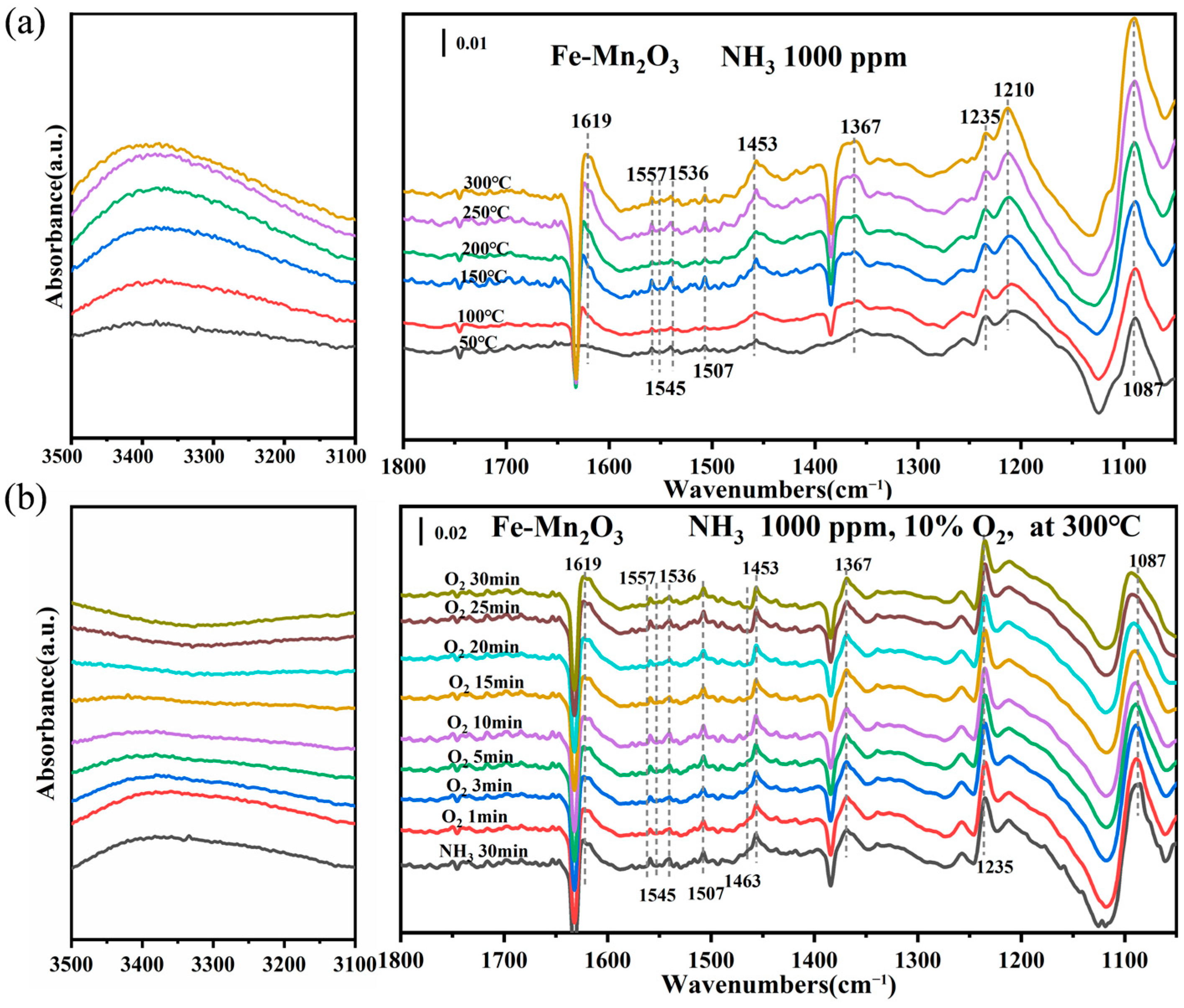
To reveal the reaction mechanism, in situ FTIR spectroscopy was systematically employed to observe NH3 adsorption behavior and the dynamic evolution of surface intermediates on Fe-Mn2O3 catalysts between 50 and 300 °C. As shown in Figure 11a, absorption peaks at 1087, 1162, 1210–1212, and 1235–1245 cm−1 correspond to NH3 adsorbed on Lewis acid sites (LA) [49,50,51], while the characteristic peaks at 1357 and 1367 cm−1 can be attributed to NH4+ on Brønsted acid (BA) sites [52]. As the temperature increases, the intensity of the NH3/NH4+-related peaks gradually strengthens, indicating that the Fe-Mn2O3 surface possesses both LA and BA sites and has good NH3 adsorption and activation abilities. Meanwhile, during the heating process, the formation of nitrate intermediates was clearly observed, including bridging nitrates (1619 cm−1), bidentate nitrates (1557, 1545 cm−1), and monodentate nitrates (1536, 1507, 1453 cm−1) [52,53,54]. It is widely accepted that nitrate species are key intermediates in the i-SCR pathway [55,56]. Therefore, the above results indicate that the NH3-SCO reaction on Fe-Mn2O3 mainly follows the i-SCR mechanism. Furthermore, the broad peak at 3200–3500 cm−1 can be assigned to N-H stretching vibrations (NH3, NH4+, -NH2, and -NH) [52,53], and its intensity significantly increases with temperature, suggesting that the adsorbed NH3 and NH4+ species are gradually converted to -NHx species and nitrate intermediates with the involvement of the catalyst’s lattice oxygen [55].
Figure 11.
In situ FTIR spectra of NH3 adsorption over Fe-Mn2O3 catalyst at different temperatures (a); in situ FTIR spectra of the reaction between O2 and pre-adsorbed NH3 over Fe-Mn2O3 catalyst at 300 °C (b).
To further elucidate the role of oxygen during the reaction, Fe-Mn2O3 was pre-adsorbed with NH3 for 30 min at 300 °C, followed by the introduction of 10 vol.% O2, and the evolution of surface species is shown in Figure 11b. It can be observed that the peak intensity of bridging nitrates (1619 cm−1) and bidentate and monodentate nitrates (1557–1507 cm−1) remained stable during the entire O2 introduction process, without significant accumulation. Meanwhile, the LA-NH3 (1235, 1086 cm−1), BA-NH4+ (1367 cm−1), monodentate nitrate (1453 cm−1), and N-H vibration peaks at 3100–3500 cm−1 gradually weakened with the introduction of O2. Notably, the characteristic peak of -NH species (1463 cm−1) [50], which appeared during NH3 pre-adsorption, also gradually diminished and eventually disappeared as the reaction progressed.
These results indicate that the -NHx species on the Fe-Mn2O3 surface continue to participate in the reaction and are gradually consumed in the O2 atmosphere. However, their consumption does not lead to significant accumulation of nitrate intermediates. This suggests that once nitrate species are formed, they can rapidly react with the adjacent -NHx species and be converted into N2, following the i-SCR reaction pathway (-NHx + NOx− → N2). This process forms a relatively balanced and mild redox cycle on Fe-Mn2O3, effectively preventing excessive accumulation of nitrate and high-valent nitrogen oxides, thus explaining its high N2 selectivity and suppression of N2O by-products.
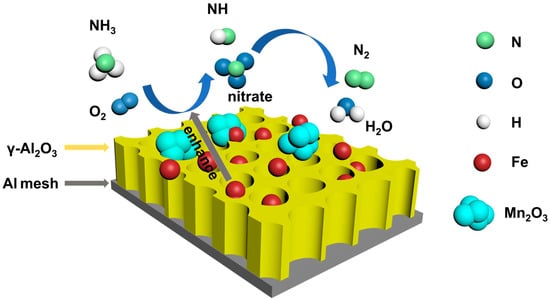
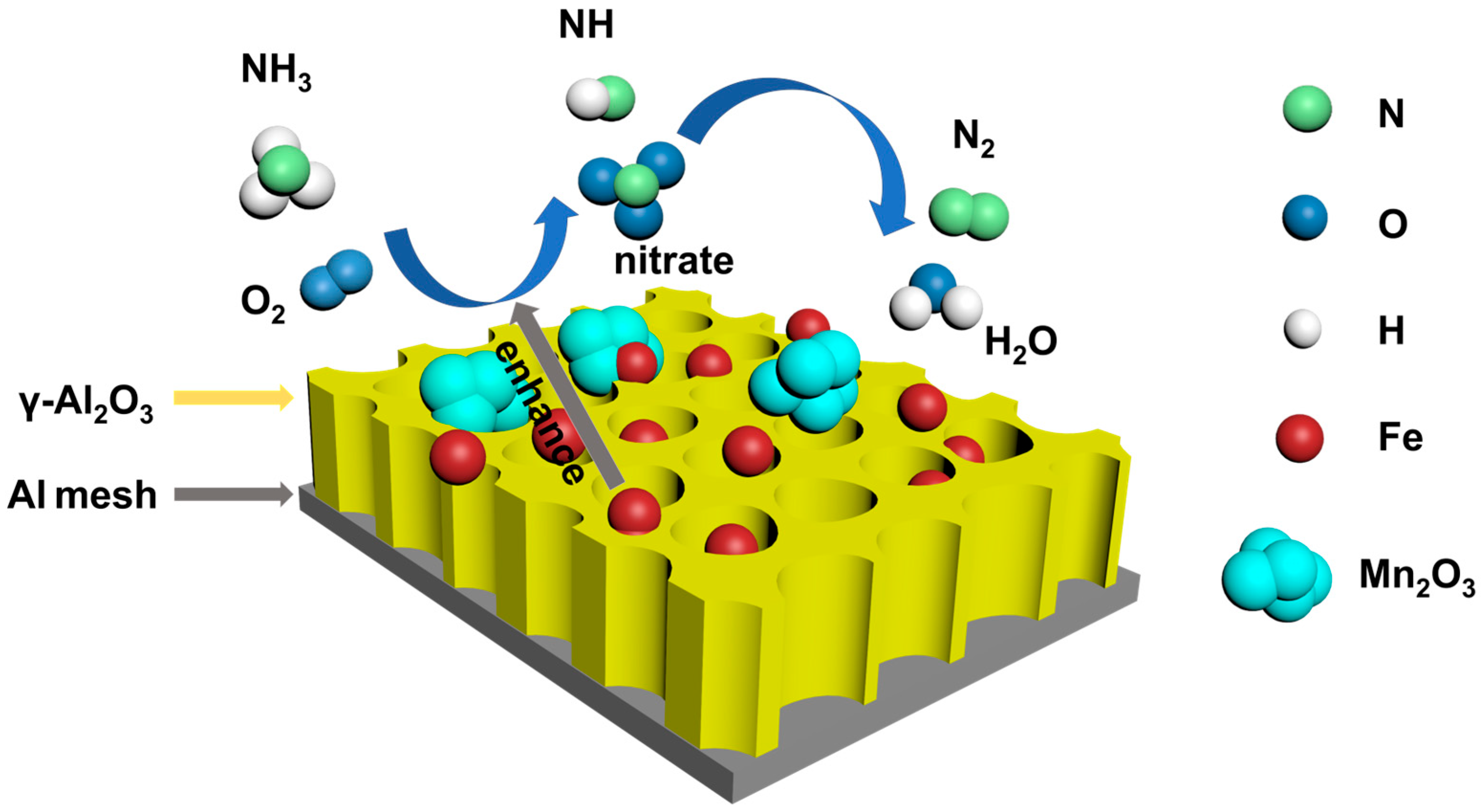
Based on the above in situ FTIR results, the following reaction pathway can be reasonably deduced for the NH3-SCO reaction on Mn-based catalysts (Figure 12): First, NH3 molecules are adsorbed on the Lewis acid and Brønsted acid sites as NH3 and NH4+, respectively. Then, with the participation of surface active oxygen species, the adsorbed NH3/NH4+ species are gradually dehydrogenated and oxidized to form -NH2 and -NH intermediates (Equations (4)–(6)). During this process, some -NH2 species are further oxidized by gaseous O2 or highly active surface oxygen species, generating surface NOx species (mainly in the form of NO2−/NO3−) (Equation (7)). The formed surface NOx species can couple with adjacent -NH species and be reduced through the i-SCR pathway, ultimately forming N2 (Equation (8)). However, when the supply of surface -NH species is insufficient or overly oxidized, some NOx species will not be fully reduced, and their reduction process will remain in the intermediate oxidation state, leading to the formation of N2O by-products through incomplete reduction (Equation (9)).
Figure 12.
Schematic diagram of the reaction mechanism for NH3-SCO over Fe-Mn2O3/γ-Al2O3/Al.
3. Experimental Section
3.1. Catalyst Preparation
Commercial aluminum mesh (1060-type) was used as the substrate. The aluminum mesh was first sequentially treated in 10 wt% NaOH and 10 wt% HNO3 solutions for several minutes to remove surface grease and impurities. After rinsing with deionized water and drying, the mesh was anodized in an oxalic acid electrolyte under a constant current density of 30 A·m−2 for 12 h, resulting in the formation of an ordered anodic aluminum oxide (AAO) film with vertically aligned pore channels. The obtained AAO was calcined at 350 °C for 1 h to remove residual oxalic acid, followed by hydration in deionized water at 80 °C for 1 h [19]. Subsequently, the sample was calcined at 500 °C for 4 h, yielding the mesh-structured γ-Al2O3/Al support.
Fe-modified γ-Al2O3/Al supports were prepared via an excess impregnation method. Briefly, γ-Al2O3/Al was immersed in an aqueous Fe(NO3)3·9H2O solution (0.05 mol·L−1) for 4–18 h. After impregnation, the samples were thoroughly washed with deionized water, dried under ambient conditions, and calcined at 500 °C for 4 h. The resulting samples were denoted as Fex/γ-Al2O3/Al, where x represents the Fe loading (wt%), with x = 4.25, 6.61, and 8.32. MnO2/γ-Al2O3/Al and Mn2O3/γ-Al2O3/Al catalysts were synthesized by a homogeneous precipitation method. Specifically, γ-Al2O3/Al was immersed in an aqueous solution containing manganese acetate ((CH3COO)2Mn·4H2O) and urea (CH4N2O) with a molar ratio of 1:10 and aged for 20 h. After washing with deionized water and drying under ambient conditions, the samples were calcined at 400 °C or 500 °C for 4 h to obtain MnO2/γ-Al2O3/Al and Mn2O3/γ-Al2O3/Al, respectively. The Fex-Mn2O3/γ-Al2O3/Al catalysts were prepared following the same procedure, except that the γ-Al2O3/Al support was replaced by the corresponding Fex/γ-Al2O3/Al.
3.2. Catalyst Characterization
The morphology of the samples was characterized by field-emission scanning electron microscopy (FESEM, TESCAN MIRA LMS, Brno, Czech Republic). The textural properties were determined by N2 adsorption–desorption at 77 K using a Micromeritics ASAP 2020-M analyzer (Norcross, GA, USA). Prior to the measurements, all samples were degassed at 350 °C for 12 h, and the specific surface area was calculated by the Brunauer–Emmett–Teller (BET) method. X-ray diffraction (XRD) patterns were recorded on a Bruker (Billerica, MA, USA) D8 Advance diffractometer with Cu Kα radiation, and the data were collected in the 2θ range of 10–80°. The surface chemical states of the elements were analyzed by X-ray photoelectron spectroscopy (XPS, Thermo Scientific K-Alpha, Waltham, MA, USA), and the binding energies were calibrated using the C 1s peak at 284.8 eV. The reducibility, oxygen mobility, and surface acidity of the catalysts were investigated by H2 temperature-programmed reduction (H2-TPR), O2 temperature-programmed desorption (O2-TPD), and NH3 temperature-programmed desorption (NH3-TPD), respectively, using an AutoChem (Singapore) 2720 chemisorption analyzer. For H2-TPR, approximately 100 mg of sample was pretreated in a He flow (20 mL·min−1) at 200 °C for 60 min and then cooled to 40 °C. The reduction was carried out from 40 to 600 °C at a heating rate of 10 °C min−1 under a 5 vol% H2/He flow (20 mL·min−1). For O2-TPD, about 100 mg of sample was pretreated at 80 °C in He (20 mL·min−1) for 60 min and cooled to 40 °C, followed by oxidation under 5 vol% O2/He (20 mL·min−1) for 30 min. After purging with He (30 mL·min−1) for 1 h, desorption was performed from 40 to 600 °C at a heating rate of 10 °C min−1. The NH3-TPD measurements were conducted following a similar procedure, except that NH3/Ar was used as the adsorbing gas. In situ Fourier transform infrared (FTIR) spectroscopy with modulation excitation spectroscopy (MES) was performed on a Bruker Tensor 27 spectrometer equipped with a mercury–cadmium–telluride (MCT) detector to identify reaction intermediates. The spectra were recorded at a resolution of 4 cm−1 with 32 scans.
3.3. Catalytic Activity Evaluation
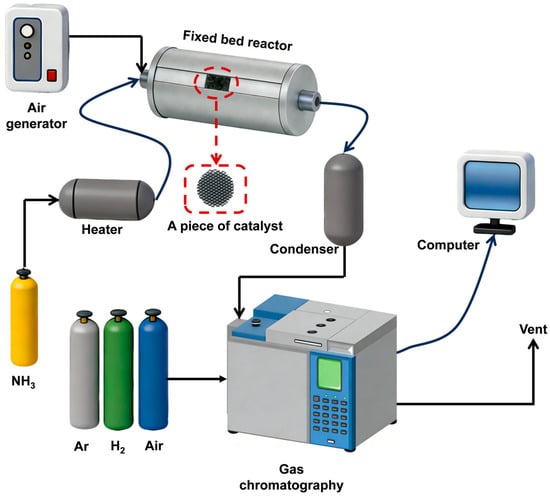
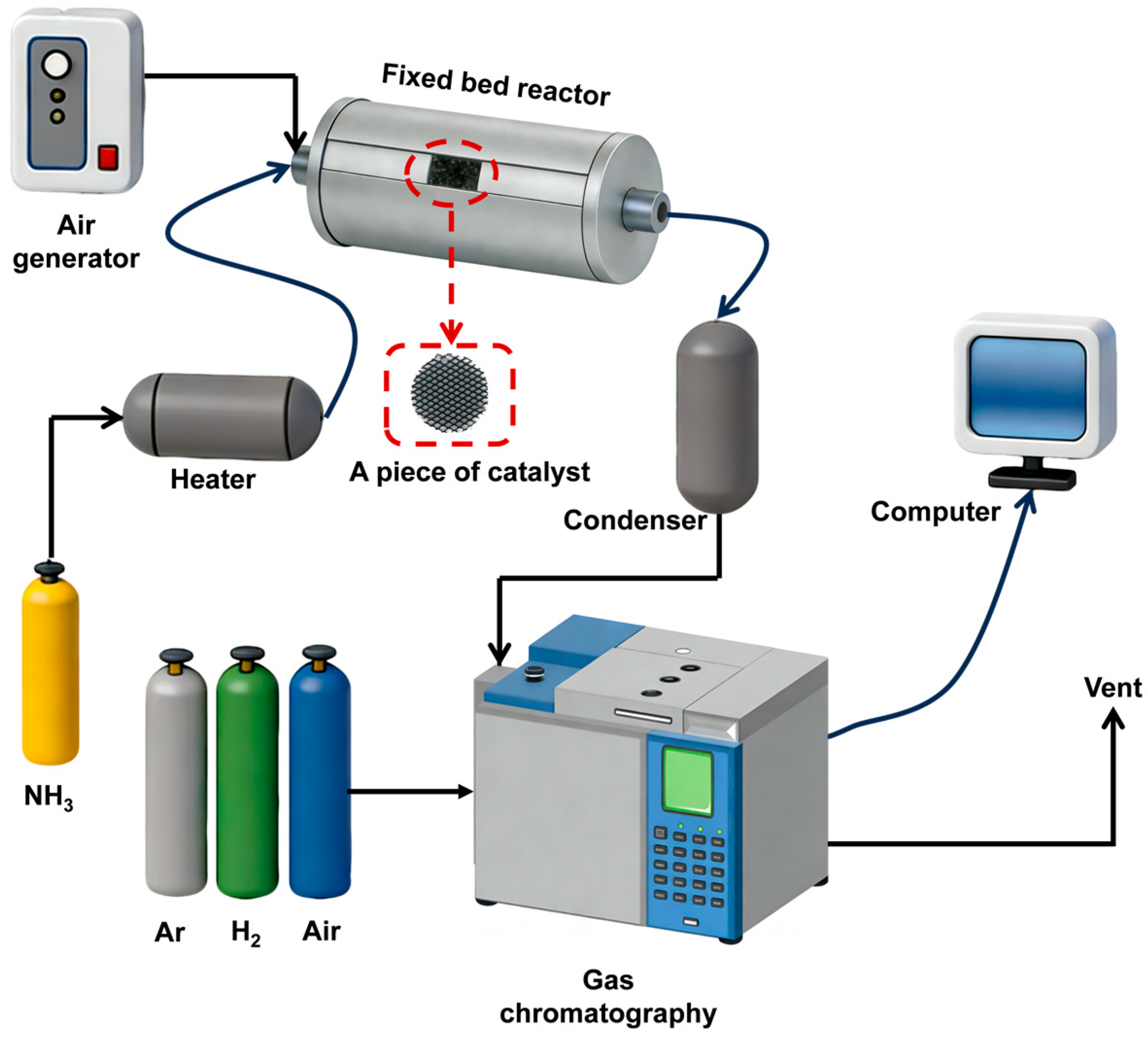
The NH3 selective catalytic oxidation (NH3-SCO) performance of the prepared monolithic catalysts (2.5 g) was evaluated in a continuous-flow fixed-bed reactor. As shown in Figure 13, the catalytic activity evaluation setup consisted of a continuous-flow fixed-bed reaction system. The concentrations of NH3 in the inlet stream and NH3, NO, NO2, and N2O in the outlet stream were analyzed by an online gas chromatograph (GC6600). The feed gas consisted of 3000 ppm NH3, air, with Ar as the balance gas. The total flow rate was maintained at 340 mL·min−1, corresponding to a weight hourly space velocity (WHSV) of approximately 25,000 mL·gcat−1·h−1. The NH3 conversion, N2 selectivity, and N2 yield were calculated according to the following equations:
Figure 13.
Schematic flowchart of experimental setup for NH3-SCO reaction.
3.4. DFT Method
First-principles calculations were performed using the Vienna Ab initio Simulation Package (VASP 6.3.2). The exchange–correlation interactions were described by the Perdew–Burke–Ernzerhof (PBE) functional within the generalized gradient approximation (GGA). The projector augmented-wave (PAW) method was employed with a plane-wave cutoff energy of 450 eV. All structures were fully optimized until the residual forces on each atom were less than 0.02 eV Å−1 and the total energy convergence criterion reached 1 × 10⁻⁵ eV. The Brillouin zone was sampled using a 1 × 1 × 1 Monkhorst-Pack k-point mesh for geometry optimizations. A vacuum layer of 15 Å was introduced to avoid interactions between periodic slabs. To properly describe the strong on-site Coulomb interactions of transition-metal 3d electrons, the DFT+U approach based on the Dudarev scheme was adopted, with effective U values of 3.9 eV for Mn and 4.0 eV for Fe.
The adsorption energy of O2 (Eads) can be defined as:
where Etotal denotes the total energy of the O2-adsorbed substrate, and Esubstrate and E(O-O) are the energies of the substrate and free O2, respectively.
Eads = Etotal − Esubstrate − E(O-O)
4. Conclusions
In this work, a novel structured monolithic Fe-Mn2O3/γ-Al2O3/Al catalyst was developed to achieve simultaneous high NH3 conversion and N2 selectivity at relatively low temperature. The results demonstrate that Fe doping increases the proportion of reactive surface oxygen species (Oads) and strengthens the redox properties of the catalyst, thereby facilitating oxygen activation and effectively improving the catalytic activity toward NH3 oxidation. DFT calculations further reveal that the introduction of Fe promotes O2 adsorption on the catalyst surface. Among the catalysts investigated, Fe6.61-Mn2O3/γ-Al2O3/Al achieves complete NH3 conversion at 210 °C with a high N2 selectivity of 75%. As shown in Table 4, this performance represents a more favorable balance between low-temperature activity and N2 selectivity compared with reported Mn-based catalysts. For example, SmMn2O5 reaches 100% NH3 conversion at 175 °C but exhibits low N2 selectivity (45%). MnMoOx shows relatively high N2 selectivity (80%) but requires a much higher temperature (340 °C) to achieve 90% NH3 conversion. In contrast, the present Fe-modified structured catalyst achieves full NH3 conversion at a relatively low temperature while maintaining improved N2 selectivity, demonstrating superior overall performance. In addition, the catalyst maintains 92% and 80% of its activity in the presence of 200 ppm SO2 and 10 vol.% H2O, respectively. In situ FTIR analysis suggests that the NH3-SCO reaction over Fe-Mn2O3/γ-Al2O3/Al predominantly proceeds via the internal selective catalytic reduction (i-SCR) pathway.
Table 4.
Comparison of Mn-based catalysts for NH3-SCO.
Author Contributions
Conceptualization, methodology, writing—original draft preparation, writing—review and editing, J.P.; software, J.P., Q.S., and W.Z.; supervision, project administration, funding acquisition, and review and editing, Q.Z. All authors have read and agreed to the published version of the manuscript.
Funding
This research received no external funding.
Data Availability Statement
The raw data supporting the conclusions of this article will be made available by the authors on request.
Conflicts of Interest
The authors declare no conflicts of interest.
References
- An, Q.; Xu, G.; Liu, J.; Wang, Y.; Yu, Y.; He, H. Designing a Bifunctional Pt/Cu-SSZ-13 Catalyst for Ammonia-Selective Catalytic Oxidation with Superior Selectivity. ACS Catal. 2023, 13, 6851–6861. [Google Scholar] [CrossRef] [Scilit]
- Wang, X.; Xu, Y.; Zhao, Z.; Liao, J.; Chen, C.; Li, Q. Recent progress of metal-exchanged zeolites for selective catalytic reduction of NOx with NH3 in diesel exhaust. Fuel 2021, 305, 121482. [Google Scholar] [CrossRef] [Scilit]
- Zhou, Y.; Jiao, Y.; Lang, J.; Chen, D.; Huang, C.; Wei, P.; Li, S.; Cheng, S. Improved estimation of air pollutant emissions from landing and take off cycles of civil aircraft in China. Environ. Pollut. 2019, 249, 463–471. [Google Scholar] [CrossRef] [Scilit]
- Wang, H.; Lin, M.; Murayama, T.; Feng, S.; Haruta, M.; Miura, H.; Shishido, T. Ag Size/Structure-Dependent Effect on Low-Temperature Selective Catalytic Oxidation of NH3 over Ag/MnO2. ACS Catal. 2021, 11, 8576–8584. [Google Scholar] [CrossRef] [Scilit]
- Lan, T.; Zhao, Y.; Deng, J.; Zhang, J.; Shi, L.; Zhang, D. Selective catalytic oxidation of NH3 over noble metal-based catalysts: State of the art and future prospects. Catal. Sci. Technol. 2020, 10, 5792–5810. [Google Scholar] [CrossRef] [Scilit]
- Liu, J.; Lin, Q.; Liu, S.; Xu, S.; Xu, H.; Chen, Y. Promotional effects of ascorbic acid on the low-temperature catalytic activity of selective catalytic oxidation of ammonia over Pt/SA: Effect of Pt0 content. New J. Chem. 2020, 44, 4108–4113. [Google Scholar] [CrossRef] [Scilit]
- Lan, T.; Gao, M.; Hasegawa, J.-y.; Shen, Y.; Qu, W.; Hu, Q.; Deng, J.; Cheng, D.; Zhang, D. Isolated Pt Atoms Embedded in CuO Nanocatalysts for Selective Oxidation of Ammonia. ACS Catal. 2023, 13, 14070–14079. [Google Scholar] [CrossRef] [Scilit]
- Qu, Z.; Fan, R.; Wang, Z.; Wang, H.; Miao, L. Selective catalytic oxidation of ammonia to nitrogen over MnO2 prepared by urea-assisted hydrothermal method. Appl. Surf. Sci. 2015, 351, 573–579. [Google Scholar] [CrossRef] [Scilit]
- Li, G.; Wang, B.; Ma, Z.; Wang, H.; Ma, J.; Zhao, C.; Zhou, J.; Lin, D.; He, F.; Han, Z.; et al. Aluminium-induced component engineering of mesoporous composite materials for low-temperature NH3-SCR. Commun. Chem. 2020, 3, 66. [Google Scholar] [CrossRef] [Scilit]
- Shu, K.; Guan, B.; Zhu, L.; Zhuang, Z.; Chen, J.; Ma, Z.; Hu, X.; Zhu, C.; Zhao, S.; Dang, H.; et al. A Comprehensive Review of Transition Metal Catalysts in Ammonia Catalytic Oxidation: Recent Advances and Future Perspectives. Energy Fuels 2025, 39, 15919–15960. [Google Scholar] [CrossRef] [Scilit]
- Madhuri, J.V.; Swamy, B.V.; Sudha, M.; Gajula, R.K.; Reddy, P.V.V.; Saha, A. Synergetic Effect of Fe Decorated Mn2O3 Support in Application of Aerobic Benzyl Alcohol Oxidation Reaction. Catal. Surv. Asia 2025, 29, 323–335. [Google Scholar] [CrossRef] [Scilit]
- Yu, Y.; Li, F.; Ge, S.; Yang, X.; Rezakazemi, M.; Zang, S.; Aminabhavi, T.M.; Xu, L. Enhanced combustion of toluene on bimetallic-organic frameworks Fe-doped Mn2O3 nanoparticles. Chem. Eng. J. 2024, 485, 149589. [Google Scholar] [CrossRef] [Scilit]
- Wu, D.; Song, L.; Zhang, B.; Li, Y. Effect of the mechanical failure of catalyst pellets on the pressure drop of a reactor. Chem. Eng. Sci. 2003, 58, 3995–4004. [Google Scholar] [CrossRef] [Scilit]
- Peng, W.; Yang, Q.; Huang, X.; Fang, Q.; Han, S.; He, J.; Gao, Z. Properties analysis of catalyst particles during stripper distributor fault in industrial fluid catalytic cracking unit. Fuel 2025, 381, 133279. [Google Scholar] [CrossRef] [Scilit]
- Fan, F.; Zhang, Q.; Xu, J.; Ye, Q.; Kameyama, H.; Zhu, Z. Catalytic behavior investigation of a novel anodized Al2O3/Al monolith in hydrolysis of dimethyl ether. Catal. Today 2013, 216, 194–199. [Google Scholar] [CrossRef] [Scilit]
- Xie, Z.; Ji, L.; Bian, H.; Zhang, Q. Generation of abundant oxygen vacancies in sandwich structured ε-MnO2/γ-Al2O3/Al by a facile modification strategy for enhanced catalytic decomposition of ozone in humid conditions. Chem. Eng. J. 2025, 509, 161202. [Google Scholar] [CrossRef] [Scilit]
- Cao, M.; Shu, Q.; Zhang, R.; Zhang, Q. Structured Mesh-Type Pt/Mn/γ-Al2O3/Al Catalyst Enhanced the CO Oxidation at Room Temperature by In Situ Generation of Hydroxyl: Behavior and Mechanism. Catalysts 2025, 15, 430. [Google Scholar] [CrossRef] [Scilit]
- Xie, Z.; Xia, Q.; Ji, L.; Shu, Q.; Zhang, Q.; Du, P. Ti-modification enhanced the activity of flexible mesh-type Mn/γ-Al2O3/Al catalyst for indoor HCHO removal under humid conditions. Appl. Catal. A Gen. 2022, 639, 118638. [Google Scholar] [CrossRef] [Scilit]
- Cao, Z.Y.; Bian, H.R.; Xie, Z.K.; Ji, L.; Zhang, Q. Research and improvement on the performance of Ti modified Mn based catalysts for removing ozone at room temperature. J. Guizhou Norm. Univ. (Nat. Sci.) 2024, 42, 75–83. [Google Scholar]
- Zhang, G.; Zhao, J.; Yang, T.; Zhang, Q.; Zhang, L. In-situ self-assembled Cu2O/ZnO core-shell catalysts synergistically enhance the durability of methanol steam reforming. Appl. Catal. A Gen. 2021, 616, 118072. [Google Scholar] [CrossRef] [Scilit]
- Xiang, Y.; Liu, H.; Zhang, Q. Numerical Study on Flow Channel Construction of Methanol Steam Reforming Reformer. Catalysts 2024, 14, 913. [Google Scholar] [CrossRef] [Scilit]
- Zhang, Q.; Sun, D.; Fan, F.; Zhang, Q.; Zhu, Z. A novel monolith catalyst of plate-type anodic alumina for the hydrolysis of dimethyl ether. Catal. Commun. 2013, 34, 64–68. [Google Scholar] [CrossRef] [Scilit]
- Xu, S.; Han, Z.; Wu, R.; Cheng, J.; Xu, G. Correlating micro/meso pore evolution and chemical structure variation in a mild thermal treatment of a subbituminite. RSC Adv. 2018, 8, 9754–9761. [Google Scholar] [CrossRef] [Scilit]
- Zhu, Y.; Li, D.; Ji, C.; Si, P.; Liu, X.; Zhang, Y.; Liu, F.; Hua, L.; Han, F. Non-Thermal Plasma Incorporated with Cu-Mn/γ-Al2O3 for Mixed Benzene Series VOCs’ Degradation. Catalysts 2023, 13, 695. [Google Scholar] [CrossRef] [Scilit]
- Kuwahara, Y.; Fujibayashi, A.; Uehara, H.; Mori, K.; Yamashita, H. Catalytic combustion of diesel soot over Fe and Ag-doped manganese oxides: Role of heteroatoms in the catalytic performances. Catal. Sci. Technol. 2018, 8, 1905–1914. [Google Scholar] [CrossRef] [Scilit]
- Kar, P.; Sardar, S.; Ghosh, S.; Parida, M.R.; Liu, B.; Mohammed, O.F.; Lemmens, P.; Pal, S.K. Nano surface engineering of Mn2O3 for potential light-harvesting application. J. Mater. Chem. C 2015, 3, 8200–8211. [Google Scholar] [CrossRef] [Scilit]
- Wei, J.; Zhang, Y.; Sha, H.; Li, Y. Factors influencing the ozone catalytic oxidation of dye wastewater by composite component-supported zeolite. Surf. Interfaces 2026, 87, 108937. [Google Scholar] [CrossRef] [Scilit]
- Han, W.; Yi, H.; Tang, X.; Zhao, S.; Gao, F.; Zhang, X.; Ma, C.; Song, L. Mn-Fe-Ce Coating onto Cordierite Monoliths as Structured Catalysts for NO Catalytic Oxidation. ChemistrySelect 2019, 4, 4664–4671. [Google Scholar] [CrossRef] [Scilit]
- Qiu, J.; Peng, Y.; Tang, M.; Lu, S.; Li, X.; Yan, J. Catalytic activity, selectivity, and stability of co-precipitation synthesized Mn-Ce mixed oxides for the oxidation of 1,2-dichlorobenzene. Environ. Sci. Pollut. Res. Int. 2021, 28, 65416–65427. [Google Scholar] [CrossRef] [Scilit] [PubMed]
- Zhou, Y.; Zhang, H.; Lu, J.; Ran, W.; Rong, S. Surface ammonification regulates oxygen vacancies and acidic sites in δ-MnO2 to enhance low-temperature selective catalytic oxidation activity of ammonia. J. Environ. Manag. 2025, 380, 124949. [Google Scholar] [CrossRef] [Scilit]
- Meng, S.; Wang, Y.; Wang, B.; Xuan, Y.; Liang, Y.; Zhu, X.; Yun, Y.; Wang, D.; Peng, Y. The strong Fe-Mn interaction over red mud accelerating the activation of key oxygen species for toluene oxidation. Chem. Eng. J. 2025, 509, 161265. [Google Scholar] [CrossRef] [Scilit]
- Hastuti, E.; Subhan, A.; Amonpattaratkit, P.; Zainuri, M.; Suasmoro, S. The effects of Fe-doping on MnO2: Phase transitions, defect structures and its influence on electrical properties. RSC Adv. 2021, 11, 7808–7823. [Google Scholar] [CrossRef] [Scilit]
- Yang, W.; Zhu, Y.; You, F.; Yan, L.; Ma, Y.; Lu, C.; Gao, P.; Hao, Q.; Li, W. Insights into the surface-defect dependence of molecular oxygen activation over birnessite-type MnO2. Appl. Catal. B Environ. 2018, 233, 184–193. [Google Scholar] [CrossRef] [Scilit]
- Nie, L.; Li, S.; Chai, S.; Han, N.; Chen, Y. Photothermal catalytic oxidation of toluene with enhanced efficiency over constructed CuMn2O4/Mn2O3 heterojunction catalyst. Appl. Surf. Sci. 2022, 605, 154567. [Google Scholar] [CrossRef] [Scilit]
- Yang, S.; Qi, Z.; Wen, Y.; Wang, X.; Zhang, S.; Li, W.; Li, S. Generation of abundant oxygen vacancies in Fe doped δ-MnO2 by a facile interfacial synthesis strategy for highly efficient catalysis of VOCs oxidation. Chem. Eng. J. 2023, 452, 139657. [Google Scholar] [CrossRef] [Scilit]
- Bi, F.; Zhang, Y.; Zhou, Z.; Liu, B.; Huang, Y.; Wang, L.; Qin, Y.; Zhang, X. Mn-MIL-100 non-thermally derived MnOx catalysts for toluene oxidation. Mater. Lett. 2024, 358, 135888. [Google Scholar] [CrossRef] [Scilit]
- Teng, Y.; Wang, X.D.; Liao, J.F.; Li, W.G.; Chen, H.Y.; Dong, Y.J.; Kuang, D.B. Atomically Thin Defect-Rich Fe–Mn–O Hybrid Nanosheets as High Efficient Electrocatalyst for Water Oxidation. Adv. Funct. Mater. 2018, 28, 1802463. [Google Scholar] [CrossRef] [Scilit]
- Ma, S.; Zhao, X.; Li, Y.; Zhang, T.; Yuan, F.; Niu, X.; Zhu, Y. Effect of W on the acidity and redox performance of the Cu0.02Fe0.2WaTiOx (a = 0.01, 0.02, 0.03) catalysts for NH3-SCR of NO. Appl. Catal. B Environ. 2019, 248, 226–238. [Google Scholar] [CrossRef] [Scilit]
- Wei, L.; Li, X.; Mu, J.; Wang, X.; Fan, S.; Yin, Z.; Tadé, M.O.; Liu, S. Rationally Tailored Redox Properties of a Mesoporous Mn–Fe Spinel Nanostructure for Boosting Low-Temperature Selective Catalytic Reduction of NOx with NH3. ACS Sustain. Chem. Eng. 2020, 8, 17727–17739. [Google Scholar] [CrossRef] [Scilit]
- Han, Z.; Du, Y.; Niu, Z.; Han, P.; Wang, G.; Wang, T.; Li, X.; Shu, J. Cu/Mn co-doped Co3O4 with enhanced oxygen activation for low-temperature CO oxidation. CrystEngComm 2025, 27, 6652–6659. [Google Scholar] [CrossRef] [Scilit]
- Wang, Y.; Hu, X.; Li, Y.; Liu, X.; Wang, S.; Wang, C.; Liu, Q.; Liu, B. Ce-doped La2−xCexCoMnO6: Promoting the Co/Mn valence cycle to enhance the catalytic oxidation performance of toluene. J. Alloys Compd. 2025, 1041, 183714. [Google Scholar] [CrossRef] [Scilit]
- Zhang, X.; Zhao, H.; Song, Z.; Liu, W.; Zhao, J.; Ma, Z.a.; Zhao, M.; Xing, Y. Insight into the effect of oxygen species and Mn chemical valence over MnO on the catalytic oxidation of toluene. Appl. Surf. Sci. 2019, 493, 9–17. [Google Scholar] [CrossRef] [Scilit]
- Liu, S.; Zhang, T.; Niu, X.; Zhu, Y. Tunable Mn-O strength in CuaMnOx (a = 0.06, 0.08, and 0.14): Enhancing toluene and acetone oxidation via simultaneous promotion of adsorbed oxygen content and lattice oxygen mobility. Sep. Purif. Technol. 2025, 379, 134870. [Google Scholar] [CrossRef] [Scilit]
- Chen, C.; Cao, Y.; Liu, S.; Jia, W. The effect of SO2 on NH3-SCO and SCR properties over Cu/SCR catalyst. Appl. Surf. Sci. 2020, 507, 145153. [Google Scholar] [CrossRef] [Scilit]
- Zhang, X.; Wang, H.; Jiang, X.; Sun, H.; Qu, Z. Study of synergistic effect between CuO and CeO2 over CuO@CeO2 core–shell nanocomposites for NH3-SCO. Catal. Sci. Technol. 2019, 9, 2968–2981. [Google Scholar] [CrossRef] [Scilit]
- Liu, J.; Zhu, Y.; Sun, Z.; Du, Y.; Xiong, Z.; Zhou, F.; Jin, J.; Yang, Q.; Lu, W. Promotional effect of H2O introduction on the NH3-SCR activity of the gas-phase sulfated CeO2 catalyst by organic CS2+COS: Influence of H2O concentration. J. Environ. Chem. Eng. 2023, 11, 111529. [Google Scholar] [CrossRef] [Scilit]
- Yu, Y.; Wei, D.; Tong, Z.; Wang, J.; Chen, J.; He, C. Rationally engineered ReOx-CuSO4/TiO2 catalyst with superior NH3-SCO efficiency and remarkably boosted SO2 tolerance: Synergy of acid sites and surface adsorbed oxygen. Chem. Eng. J. 2022, 442, 136356. [Google Scholar] [CrossRef] [Scilit]
- Fang, H.; Liang, W.; Ma, L.; Ma, C. Properties and characterization of red mud modified by hydrochloric, sulfuric, and nitric acid for the catalytic oxidation of toluene. J. Environ. Chem. Eng. 2023, 11, 110943. [Google Scholar] [CrossRef] [Scilit]
- Yang, Y.; Wang, M.; Tao, Z.; Liu, Q.; Fei, Z.; Chen, X.; Zhang, Z.; Tang, J.; Cui, M.; Qiao, X. Mesoporous Mn–Ti amorphous oxides: A robust low-temperature NH3-SCR catalyst. Catal. Sci. Technol. 2018, 8, 6396–6406. [Google Scholar] [CrossRef] [Scilit]
- Lin, M.; An, B.; Niimi, N.; Jikihara, Y.; Nakayama, T.; Honma, T.; Takei, T.; Shishido, T.; Ishida, T.; Haruta, M.; et al. Role of the Acid Site for Selective Catalytic Oxidation of NH3 over Au/Nb2O5. ACS Catal. 2019, 9, 1753–1756. [Google Scholar] [CrossRef] [Scilit]
- Wu, S.; Li, J.; Qiu, J.; Wang, C.; Wang, F.; Li, Z.; Ning, P.; Li, K. Regulating the valence and size of the active center of Co/Al2O3 catalyst improved the performance and selectivity of NH3-SCO. J. Environ. Sci. 2025, 150, 188–201. [Google Scholar] [CrossRef] [Scilit]
- Jabłońska, M.; Beale, A.M.; Nocuń, M.; Palkovits, R. Ag-Cu based catalysts for the selective ammonia oxidation into nitrogen and water vapour. Appl. Catal. B Environ. 2018, 232, 275–287. [Google Scholar] [CrossRef] [Scilit]
- Liu, J.; Li, X.; Zhao, Q.; Ke, J.; Xiao, H.; Lv, X.; Liu, S.; Tadé, M.; Wang, S. Mechanistic investigation of the enhanced NH3-SCR on cobalt-decorated Ce-Ti mixed oxide: In situ FTIR analysis for structure-activity correlation. Appl. Catal. B Environ. 2017, 200, 297–308. [Google Scholar] [CrossRef] [Scilit]
- Vélez, R.P.; Bentrup, U.; Grünert, W.; Brückner, A. The Role of NO2 in the Fast NH3-SCR of NOx: A Combined In Situ FTIR and EPR Spectroscopic Study. Top. Catal. 2017, 60, 1641–1652. [Google Scholar] [CrossRef] [Scilit]
- Liu, G.; Sun, H.; Wang, H.; Qu, Z. Rational tuning towards B-sites (B = Mn, Co, Al) on CoB2O4 binary oxide for efficient selective catalytic oxidation of ammonia. Chem. Eng. J. 2023, 453, 139941. [Google Scholar] [CrossRef] [Scilit]
- Chu, Q.; Wang, X.; Miao, B.; Liu, Y.; Li, Q. Selective catalytic oxidation of NH3 over Co3O4-Cu/KFI composite with superior low-temperature activity and N2 selectivity. J. Environ. Chem. Eng. 2025, 13, 116626. [Google Scholar] [CrossRef] [Scilit]
- Liu, W.; Long, Y.; Zhou, Y.; Liu, S.; Tong, X.; Yin, Y.; Li, X.; Hu, K.; Hu, J. Excellent low temperature NH3-SCR and NH3-SCO performance over Ag-Mn/Ce-Ti catalyst: Evaluation and characterization. Mol. Catal. 2022, 528, 112510. [Google Scholar] [CrossRef] [Scilit]
- Song, D.; Shao, X.; Yuan, M.; Wang, L.; Zhan, W.; Guo, Y.; Guo, Y.; Lu, G. Selective catalytic oxidation of ammonia over MnOx–TiO2 mixed oxides. RSC Adv. 2016, 6, 88117–88125. [Google Scholar] [CrossRef] [Scilit]
- Hu, L.; Zhao, Q.; Zhang, X.; Li, H.; Bian, C.; Zeng, Y. Regulating the redox sites of MMoOx (M = Mn, Fe, Cr) catalysts for highly efficient selective catalytic oxidation of NH3. Res. Chem. Intermed. 2025, 51, 4177–4190. [Google Scholar] [CrossRef] [Scilit]
- Ludvíková, J.; Jabłońska, M.; Jirátová, K.; Chmielarz, L.; Balabánová, J.; Kovanda, F.; Obalová, L. Co–Mn–Al mixed oxides as catalysts for ammonia oxidation to N2O. Res. Chem. Intermed. 2015, 42, 2669–2690. [Google Scholar] [CrossRef] [Scilit]
- Chen, Y.; Chen, X.; Ma, X.; Tang, Y.; Zhao, Y.; Zhang, A.; Wang, C.; Du, C.; Shan, B. Selective catalytic oxidation of ammonia over AMn2O5 (A = Sm,Y,Gd) and reaction selectivity promotion through Nb decoration. J. Catal. 2021, 402, 10–21. [Google Scholar] [CrossRef] [Scilit]

Disclaimer/Publisher’s Note: The statements, opinions and data contained in all publications are solely those of the individual author(s) and contributor(s) and not of MDPI and/or the editor(s). MDPI and/or the editor(s) disclaim responsibility for any injury to people or property resulting from any ideas, methods, instructions or products referred to in the content. |
© 2026 by the authors. Licensee MDPI, Basel, Switzerland. This article is an open access article distributed under the terms and conditions of the Creative Commons Attribution (CC BY) license.