Article

Transition Metal Single-Atom-Anchored PdN2 Monolayer for Superior Alkaline Hydrogen Oxidation Reactions


Shandong Key Laboratory of Intelligent Energy Materials, School of Materials Science and Engineering, China University of Petroleum (East China), Qingdao 266580, China
*
Author to whom correspondence should be addressed.
Catalysts 2026, 16(6), 561; https://doi.org/10.3390/catal16060561
Submission received: 25 April 2026 / Revised: 12 June 2026 / Accepted: 16 June 2026 / Published: 18 June 2026

Abstract

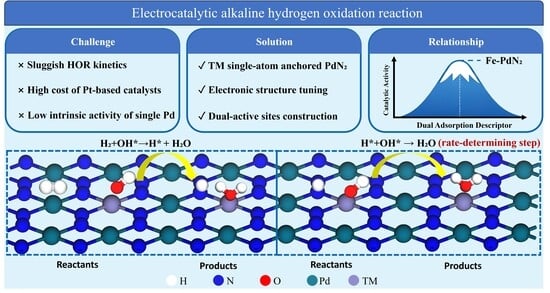
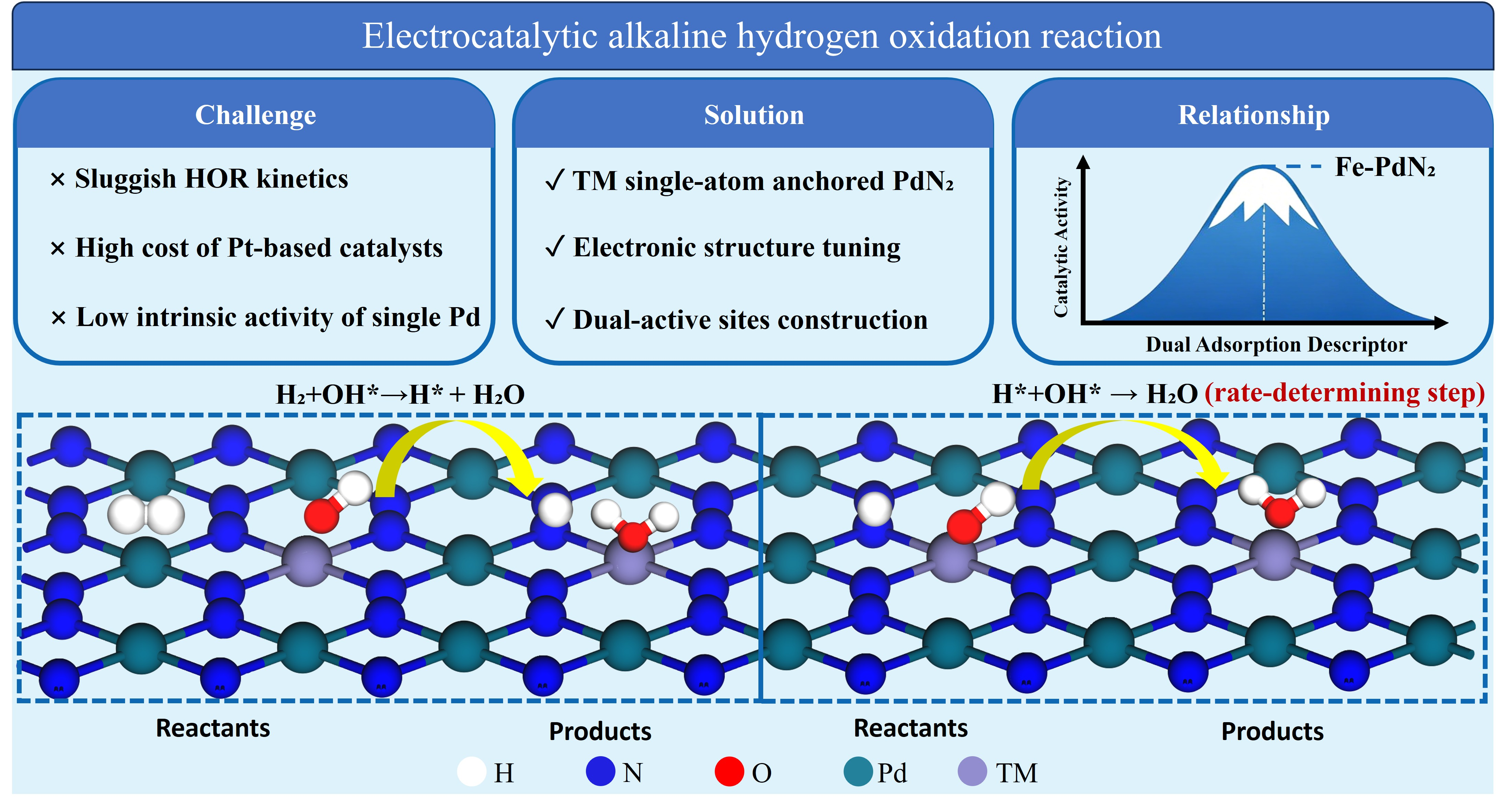
The sluggish kinetics of alkaline hydrogen oxidation reaction (HOR) and high cost of Pt–based catalysts have long hindered large–scale deployment of alkaline membrane fuel cells. Via first–principles calculations, we designed a series of 3d transition metal single atoms anchored on PdN2 monolayer (TM–PdN2, TM = Ti, V, Cr, Mn, Fe, Co, Ni, Cu, Zn) and evaluated their alkaline HOR performance. Ti-, Cr-, Fe-, Co-, Ni-modified systems exhibit excellent thermodynamic and electrochemical stability under operating conditions. Single-atom doping tunes the p-band center of N and d-band center of metal sites, enabling precise modulation of H and OH adsorption strengths. Mechanistic analysis reveals HOR follows H2 + 2OH* → H* + OH* + H2O → 2H2O, with the final step as rate-determining step. H adsorption contributes 3.45 times more to HOR activity than OH adsorption. Fe–PdN2 delivers the best performance, with an ultra–low barrier of 0.11 eV and a rate constant of 2.82 × 10¹⁰ s–1·site−1, values that significantly outperform those of Pt(111) (0.22 eV, 4.5 × 10⁹ s−1·site−1). This work provides theoretical guidance for rational design of high–performance alkaline HOR electrocatalysts.

Graphical Abstract

1. Introduction

The relentless overexploitation of fossil fuels and the escalating global environmental crisis have positioned hydrogen fuel cells as a highly efficient and clean energy conversion technology [1]. In alkaline membrane fuel cells (AEMFCs), the anodic hydrogen oxidation reaction (HOR) operates in conjunction with the cathodic oxygen reduction reaction (ORR) to convert chemical energy into electrical energy. Pt is universally recognized as the benchmark catalyst for the HOR; however, its relatively high cost and limited natural abundance present practical challenges for the large-scale commercialization of AEMFCs [2]. Compared with acidic electrolytes, alkaline media exhibit significantly milder corrosivity toward catalyst materials, thereby providing a favorable platform for the development of non-Pt catalysts. Nevertheless, the kinetics of the HOR in alkaline media are two to three orders of magnitude slower than those in acidic environments, a critical bottleneck that limits the overall performance of AEMFCs [3]. To date, a wealth of high-performance non-precious metal catalysts have been developed for the cathodic ORR (such as FePc–C60 [4], Co–S–N–C@MXene [5], and Fe2N/NPCF [6]), making the development of high active and stable catalysts for the anodic HOR a particularly urgent task.
Elucidating the intrinsic reaction mechanism of the HOR is a fundamental prerequisite for the rational design of high-efficiency electrocatalysts. In alkaline media, the HOR generally proceeds via either the Tafel–Volmer or Heyrovsky–Volmer pathway [7]:
i.  
H2 + 2* → 2H* (Tafel)
ii. 
H2 + OH + * → H* + H2O + e (Heyrovsky)
iii.
H* + OH → * + H2O + e (Volmer)
According to the hydrogen binding energy (HBE) theory, HBE serves as the sole activity descriptor for the HOR. This theory postulates that catalytic performance is exclusively governed by the adsorption strength of adsorbed hydrogen (H*), with hydroxyl species participating only as free solvated ions. However, this theory fails to adequately explain the experimental HOR activities observed for several catalytic systems, including Cu–NiW [8], O-Pt3In/Rgo [9], and CeO2@Pd [10]. To resolve this discrepancy, Marković and co-workers proposed the bifunctional mechanism [11,12]. This framework posits that adsorbed hydroxyl (OH*) also participates in the reaction, emphasizing that electrocatalysts must simultaneously optimize the adsorption free energies of both H* and OH* to achieve a delicate energetic balance. Consequently, this mechanistic framework provides a clear design guideline for boosting HOR catalytic performance through the rational construction of dual active sites.
As a promising alternative to Pt–based catalysts, Pd exhibits high electrocatalytic activity toward both the HOR and ORR, along with a lower cost and greater natural abundance than Pt. Nonetheless, the intrinsic HOR activity of monometallic Pd is approximately one-fifth that of benchmark Pt catalysts, rendering it unsuitable for direct practical application [13,14]. To address this limitation, researchers have developed a series of modification strategies, mainly including alloying (e.g., Ir/Co/Pt/Pd@MXene [15], PdPtRhIrCu high-entropy alloys [16,17], PtPdCu1/C [18], NiPd/G [19]) and heterostructure engineering (e.g., MoOx-Pd/Ce-M [20], Pd3Co/PCNT [21], FeCo0.68OOH-Pd0.026 [22]), to boost the alkaline HOR performance of Pd-based materials. While these strategies deliver enhanced activity, they frequently introduce complex compositional variations and geometrically inhomogeneous active sites, which complicate mechanistic understanding and large-scale, reproducible preparation [23]. In contrast, single-atom catalyst (SAC) technology enables atomically precise modulation of catalytic centers. This approach not only maximizes atomic utilization efficiency of metal species, but also induces charge redistribution via the strong metal–support interaction between isolated single atoms and the substrate. This in turn optimizes the electronic structure of active sites and creates well-defined, homogeneous active centers with high design flexibility [24]. Zhao’s group designed a series of transition-metal single-atom-anchored Mo2C MXene catalysts for alkaline HOR via first-principles calculations [25]. Their results demonstrate that the anchored isolated transition-metal single atoms form synergistic dual active sites with adjacent Mo atoms; this unique structure modulates the electronic structure of the MXene support, optimizes the adsorption strength of key H* and OH* intermediates, and lowers the energy barrier of the rate-determining step, ultimately leading to accelerated HOR kinetics. Moreover, Yang and co-workers fabricated a main-group Mg single-atom-doped Ru/C composite catalyst for alkaline HOR [26]. The doped Mg single atoms serve as Lewis acid sites that preferentially adsorb CO and OH* species, establishing a bifunctional synergy with the intrinsic Ru active sites. This enables the catalyst to retain highly efficient HOR kinetics even in CO-containing feedstocks, exhibiting exceptional impurity tolerance.
These successful examples highlight the power of SACs in precisely tailoring the electronic structure and adsorption properties of catalytic sites. However, the choice of the support material is equally critical, as it not only anchors the single atoms but also actively participates in the electronic modulation and provides a stable, conductive platform. In this context, two-dimensional materials, especially transition metal nitrides (TMNs), offer an ideal support matrix for SACs. TMNs possess rich coordination environments, metallic conductivity, excellent chemical durability, and tunable electronic structures, all of which enable them to synergistically complement the anchored single atoms [27,28,29,30]. Among such TMN systems, the PdN2 monolayer has been theoretically identified as a promising candidate for high-performance energy storage applications [31]. Nonetheless, its electrocatalytic utilization, especially in the field of the HOR, remains largely unexplored to date.
Here, we rationally integrate the SAC concept with the PdN2 monolayer to design the TM-PdN2 system. In this design, the PdN2 monolayer acts as the catalytic support. Its role is threefold: (i) providing inherent metallic conductivity to facilitate rapid electron transfer during the HOR; (ii) offering a well-defined, nitrogen-rich coordination environment that can stably anchor isolated single atoms; and (iii) exhibiting excellent chemical durability under electrochemical conditions. The anchored transition metal single atoms, on the other hand, serve as the primary active centers. Through strong electronic synergy with the PdN2 substrate, these single atoms create new, well-matched synergistic adsorption sites for the key H* and OH* intermediates involved in the alkaline HOR. Specifically, the PdN2 support modulates the electronic structure of the anchored single atoms via metal–support interaction, while the single atoms in turn fine-tune the local charge distribution on the PdN2 surface, jointly optimizing the binding energies of H* and OH* and lowering the reaction barriers. This clear division of labor, the PdN2 monolayer as a conductive and stable support and the anchored single atoms as tunable active centers, constitutes the structural and functional basis of our catalytic design.
On the basis of the above mechanistic insights and identified research gaps, we systematically constructed a suite of transition metal single-atom-anchored PdN2 monolayer catalysts (TM-PdN2, where TM = Ti, V, Cr, Mn, Fe, Co, Ni, Cu, and Zn) via density functional theory (DFT)-based first-principles calculations. We first assessed the thermodynamic and electrochemical stability of these catalytic systems to screen out structurally and electrochemically viable configurations. On this basis, we investigated the adsorption properties of the key intermediates involved in the alkaline HOR (including H, OH, H2, and H2O) and then elucidated the catalytic activity through free-energy barrier calculations and reaction kinetic analysis. Finally, we established the intrinsic correlation between the adsorption free energies of H* and OH* and the HOR catalytic performance. This work aims to provide robust theoretical guidance for the experimental synthesis of high-performance anode catalysts for the alkaline HOR.

2. Results and Discussion

2.1. Geometric and Electronic Structure of TM–PdN2

2.1.1. Geometric Structure of TM–PdN2

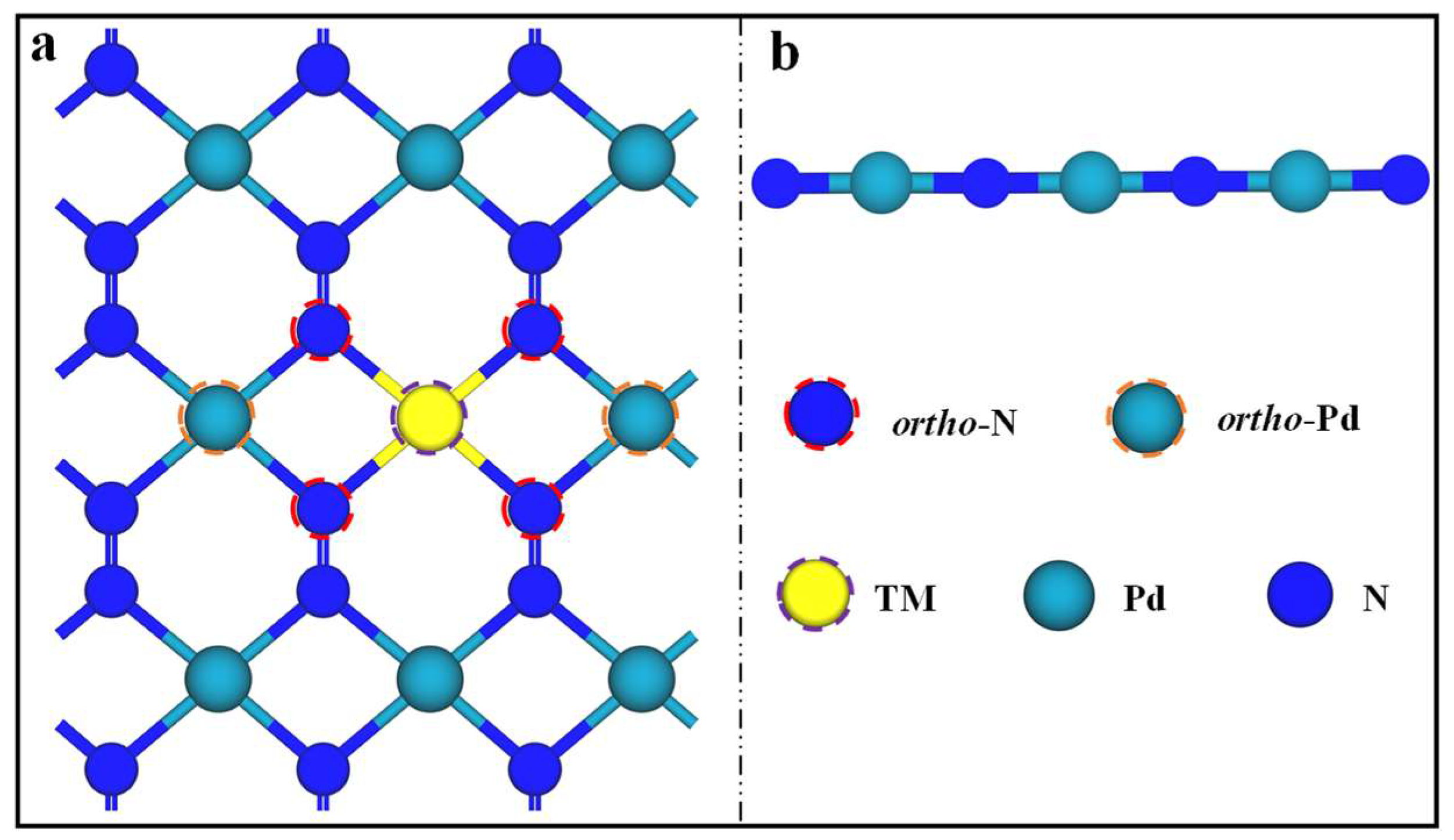
To explore the effect of single-atom anchoring on the PdN2 substrate, we first performed geometric optimization of pristine PdN2 and transition metal single-atom-anchored PdN2 (TM–PdN2, TM = Ti, V, Cr, Mn, Fe, Co, Ni, Cu, Zn). The relevant lattice parameters are shown in Table S1. Crystallographically, the pristine PdN2 molecular layer belongs to the orthorhombic crystal system with space group Pmmm and exhibits D2h (mmm) point group symmetry [32]. The optimized pristine PdN2 monolayer shows a typical two–dimensional grid structure, with Pd atoms located at the center of the rectangular plane formed by four N atoms, which is depicted in Figure 1. Two types of chemical bonds, N–N bond and Pd–N bond, coexist in the structure, with bond lengths of 1.187 Å and 2.048 Å, respectively. To evaluate its structural stability, we calculated the cohesive energy (Ecoh) of PdN2, which is 4.56 eV (Table 1) and close to the previous result (4.58 eV) [32], confirming the good thermodynamic stability of the PdN2 monolayer. The good agreement of our calculated bond lengths (1.187 Å for N–N and 2.048 Å for Pd–N) and cohesive energy (4.56 eV) with previously reported theoretical values (1.21 Å, 2.07 Å, and 4.58 eV, respectively) [32] validates the reliability of our computational methodology.
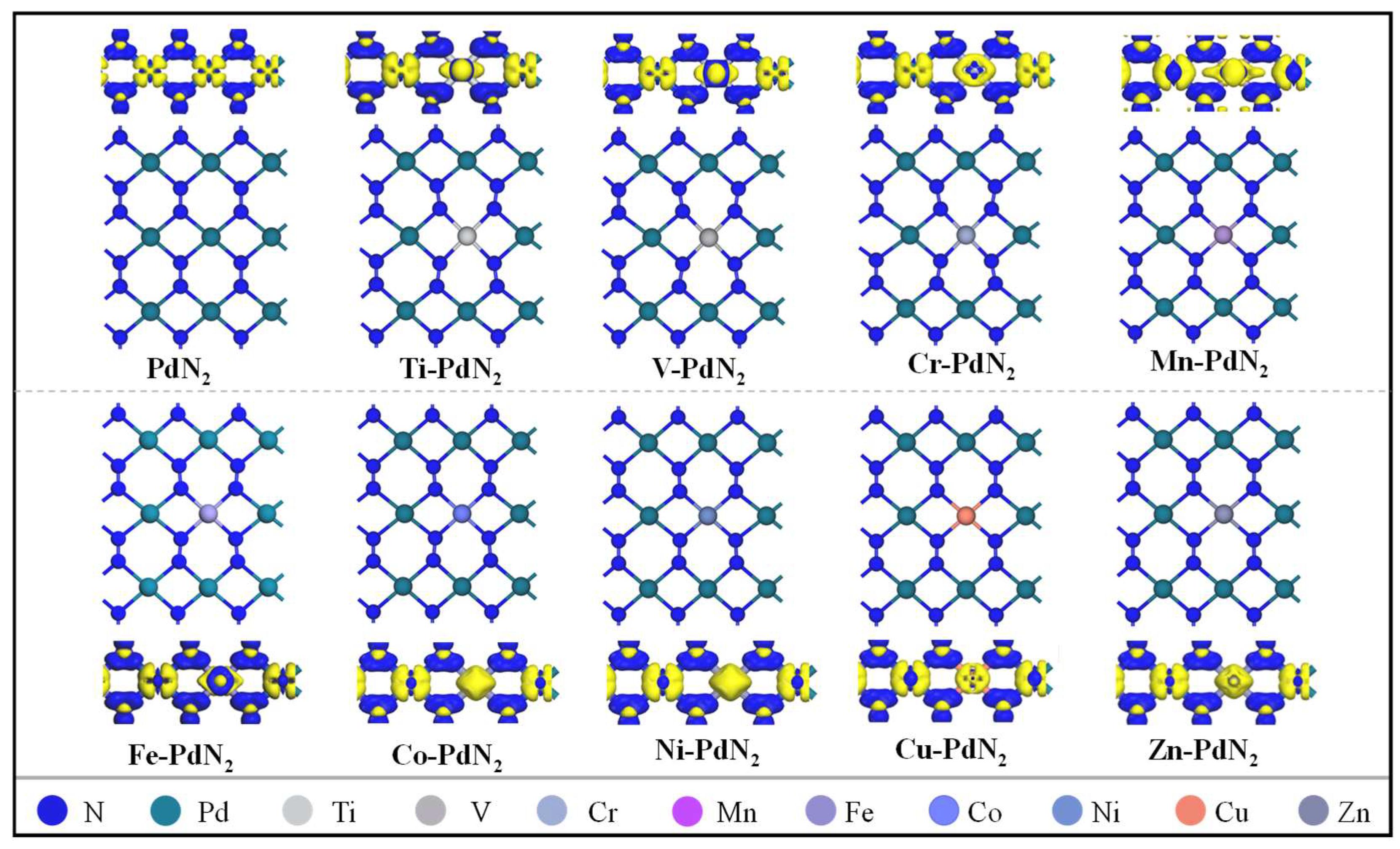
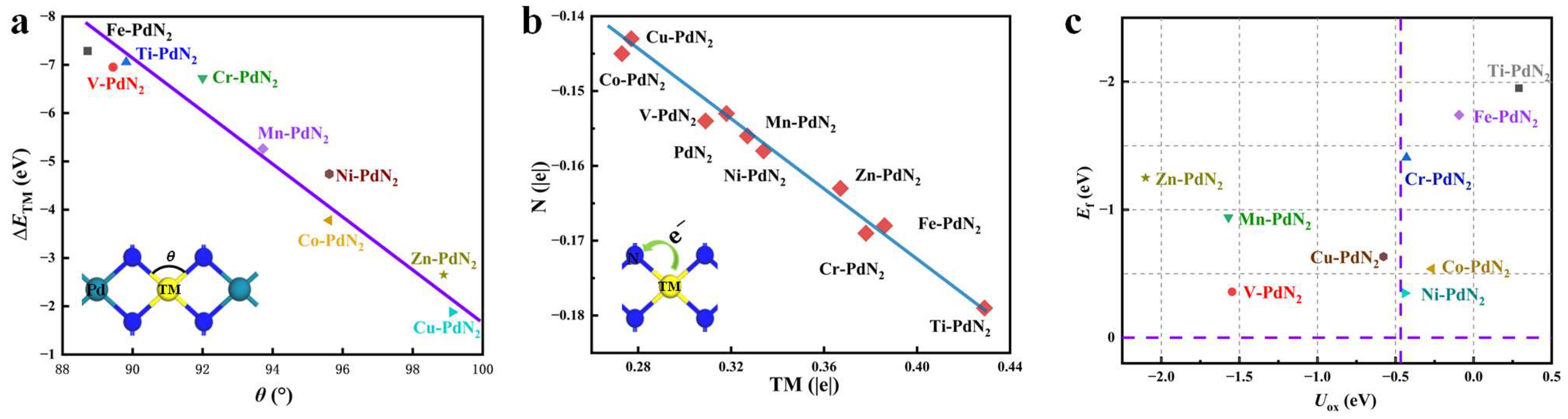
On this basis, we introduced a series of 3d transition metal (TM) atoms into the PdN2 lattice via a single-atom substitution strategy. The TM atom replaces the Pd site in the pristine lattice, is coordinated by four nearest–neighbor N atoms, and is stably anchored at the center of the planar rectangle formed by N atoms, as displayed in Figure 2. To quantify the binding strength between TM atoms and the substrate, we calculated the adsorption energy of each TM atom on PdN2. Table 1 shows that the adsorption energies of TM atoms on PdN2 range from −1.88 eV to −7.06 eV, which are significantly stronger than the adsorption energy of Pd in pristine PdN2 (−1.60 eV). In addition, the TM–N bond lengths are between 1.916 Å and 2.044 Å (Table 1). These results indicate that all TM atoms can form stable bonds with the substrate. Further analysis shows that the adsorption energy of TM atoms decreases linearly with the increase in the ∠N–TM–N bond angle, and the order of adsorption strength is: Fe–PdN2 > Ti–PdN2 > V–PdN2 > Cr–PdN2 > Mn–PdN2 > Ni–PdN2 > Co–PdN2 > Zn–PdN2 > Cu–PdN2, the results are shown in Figure 3a. Among them, Fe–PdN2 has the strongest adsorption energy, indicating its most stable structure.

2.1.2. Electronic Structure of TM–PdN2

To reveal the charge interaction between TM atoms and the PdN2 substrate, we performed deformation charge density analysis. As shown in Figure 2, the yellow and blue regions represent electron depletion and electron accumulation, respectively. In both pristine PdN2 and TM–PdN2 systems, Pd and TM atoms show electron depletion, while N atoms show electron accumulation, indicating electron transfer from metal atoms to N atoms. Notably, significant electron localization occurs between adjacent N–N atoms, while no obvious electron accumulation is found for Pd–N and TM–N bonds, suggesting that Pd–N and TM–N bonds are mainly ionic, and N–N bonds are covalent. The coexistence of ionic and covalent bonds may give the material excellent structural stability, similar to the reported RuN2 structure [33].
To further quantitatively analyze the charge transfer, we performed Hirshfeld charge population analysis. The results of Table 1 show that TM and Pd atoms are positively charged (0.260|e| to 0.429|e|), while N atoms are negatively charged (−1.79|e| to −0.143|e|). Interestingly, there is a good linear relationship between the positive charge of TM atoms and the negative charge of adjacent N atoms, as illustrated in Figure 3b: the more electrons the TM atom loses (higher positive charge), the more electrons are transferred to adjacent N atoms, leading to stronger negative charge of N atoms. Compared with pristine PdN2, the introduction of Ti, V, Cr, Mn, Fe, Ni, and Zn significantly increases the positive charge of the metal center, while Co and Cu lead to a slight decrease. This indicates that single-atom anchoring can effectively regulate the charge distribution of the coordination environment, and thus optimize the overall electronic structure of the catalyst.
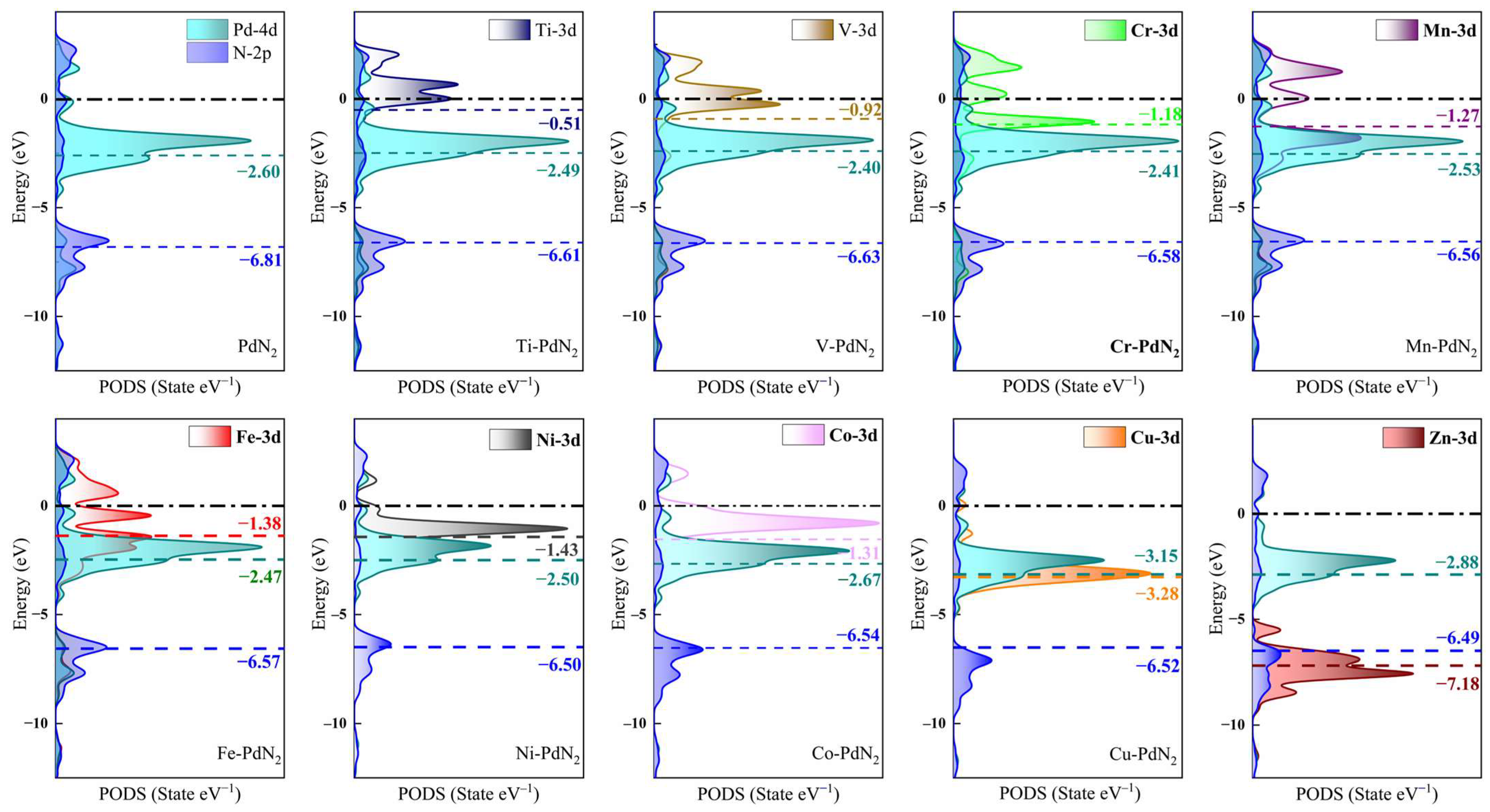
To deeply understand the electronic structure of TM–PdN2 systems, we calculated the projected density of states (PDOS). As shown in Figure 4, the Fermi level of pristine PdN2 is crossed by the Pd d orbitals, showing typical metallic properties, and the high carrier density near the Fermi level indicates its good intrinsic conductivity. After the introduction of TM atoms, the density of states of the system is further enhanced due to the additional contribution of the TM d orbitals to the electronic states near the Fermi level. Affected by the electronic interaction between TM atoms and adjacent N atoms, the d-band center of Pd atoms (εd(Pd)) adjacent to TM in TM–PdN2 shifts significantly away from the Fermi level, in the following order: Cu–PdN2 > Zn–PdN2 > Co–PdN2 > PdN2 > Mn–PdN2 > Ni–PdN2 > Ti–PdN2 > Fe–PdN2 > Cr–PdN2 > V–PdN2. Meanwhile, the d-band center of the TM atom itself (εd(TM)) shifts away from the Fermi level in the order: Ti–PdN2 > V–PdN2 > Cr–PdN2 > Mn–PdN2 > Co–PdN2 > Fe–PdN2 > Ni–PdN2 > Cu–PdN2 > Zn–PdN2. Notably, except for Cu and Zn, the d-band centers of all TM atoms are located above the d-band center of adjacent Pd atoms (εd(Pd)). In addition, compared with pristine PdN2, the p-band center of N atoms in all TM–PdN2 systems shifts upward (ranging from −6.39 to −6.65 eV). These results show that the anchoring of TM single atoms effectively regulates the electronic structure of the PdN2 substrate, which is expected to optimize the adsorption behavior of reaction intermediates, thus improving its electrocatalytic performance.

2.2. Thermodynamic Stability Evaluation

The practical applicability of catalysts is highly dependent on their structural stability. For this purpose, we first evaluated the structural stability of the pristine PdN2 substrate via cohesive energy calculations. As shown in Table 1, the pristine PdN2 monolayer has a 4.56 eV high cohesive energy from the coexisting ionic Pd–N and covalent N–N bonds, verifying its favorable thermodynamic stability.
For the TM atom anchored PdN2 systems (TM–PdN2), we evaluated their relative stability through formation energy (Ef), defined in Equation (1):
E f   =   E TM PdN 2   +   μ Pd bulk     E PdN 2 +   μ TM bulk
where E TM PdN 2 and E PdN 2 are the total energy of TM–PdN2 and pristine PdN2, respectively; μ Pd bulk and μ TM bulk are the chemical potential of Pd and TM atoms in their corresponding bulk phases, respectively. As shown in Table S2, all calculated formation energies are negative, spanning a range of −0.35 eV to −1.95 eV. Negative formation energies indicate that the introduction of TM atoms is energetically favorable and can further enhance the stability of the system. This stabilization effect mainly comes from the stronger ionic character of TM–N bonds compared with the original Pd–N bonds, which is conducive to the firm anchoring of metal atoms.
In a strong alkaline environment, the TM atoms anchored on the substrate may face the risk of oxidative dissolution. Therefore, we calculated the oxidation potential (Uox vs. SHE) of TM atoms in TM–PdN2 to evaluate their electrochemical stability, using Equation (2):
U ox   =   U ox o metal , bulk   E sub     E sub TM     μ TM bulk Ne
In Equation (2), U ox o metal , bulk is the standard oxidation potential of the corresponding bulk metal at pH = 13, and N is the number of electrons participating in the oxidation reaction [34,35]. Here, E sub and E sub TM are the total energy of pristine PdN2 and the TM-anchored PdN2 catalyst, respectively, and μ TM bulk is the chemical potential of the TM atom in its corresponding bulk phase. The equilibrium potential of the HOR at pH = 13 is −0.767 V vs. SHE. To avoid catalyst passivation, the oxidation overpotential is generally required to be less than 0.3 V, so the oxidation potential of the catalyst under this condition should be higher than −0.467 V. As shown in Table 2, the oxidation potentials of PdN2 catalysts anchored with Ti, V, Cr, Mn, Fe, Co, Ni, Cu, Zn atoms are 0.29 V, −1.55 V, −0.43 V, −1.57 V, −0.19 V, −0.27 V, −0.44 V, −0.58 V, −2.10 V, respectively. Among them, the oxidation potentials of Ti–PdN2, Cr–PdN2, Fe–PdN2, Co–PdN2 and Ni–PdN2 are all higher than the safety threshold of −0.467 V, indicating that these catalysts have good electrochemical stability in alkaline environment.
Combined thermodynamic and electrochemical stability analysis shows that Mn–PdN2, Cr–PdN2, Fe–PdN2, Co–PdN2 and, Ni–PdN2 all have excellent stability, as shown in Figure 3c. This result indicates that PdN2-based catalysts with both thermodynamic and electrochemical stability can be effectively constructed through a suitable single-atom anchoring strategy, which provides theoretical feasibility for their experimental preparation and application in alkaline HOR.
Although the orthorhombic PdN2 monolayer predicted in this work has not yet been experimentally realized, its synthesis can be envisaged following established protocols for two-dimensional transition metal nitrides [36,37,38]. Experimentally, a reverse-thermal-field chemical vapor deposition (CVD) method using metastable transition metal chlorides as transient templates has been developed, enabling the universal growth of fifteen types of non-layered 2D TMNs (e.g., VN, CrN, MnN, FeN, CoN, NiN) and their alloys at 600–800 °C [36]. Alternatively, a selective atomic substitution strategy that converts layered transition metal dichalcogenides (such as MoS2, WS22, and TiS2) into corresponding crystalline nitrides (Mo5N6, W5N6, TiN) has been realized under ammonia (derived from urea decomposition) at 750–800 °C [37]. Relevantly, palladium-based nitrides (PdNx and Pd2N) have been successfully synthesized via a hydrothermal approach using pre-formed Pd nanocrystals and urea as a mild nitrogen source (160–200 °C), where different phases (fcc PdNx at lower temperatures and tetragonal Pd2N at higher temperatures) can be selectively obtained by adjusting the urea dosage and reaction temperature [38]. Extending these strategies, we propose that the orthorhombic PdN2 monolayer could be selectively synthesized by finely tuning the nitridation temperature, reaction duration, and urea-to-Pd ratio, using either the hydrothermal method or the chloride-template CVD route with appropriate modifications. Such a synthesis would also allow in situ single-atom anchoring (e.g., V, Ti) by introducing the corresponding metal precursors during the nitridation step. This discussion provides a clear pathway for future experimental validation of our theoretical catalysts.

2.3. Adsorption Properties of Reaction Intermediates

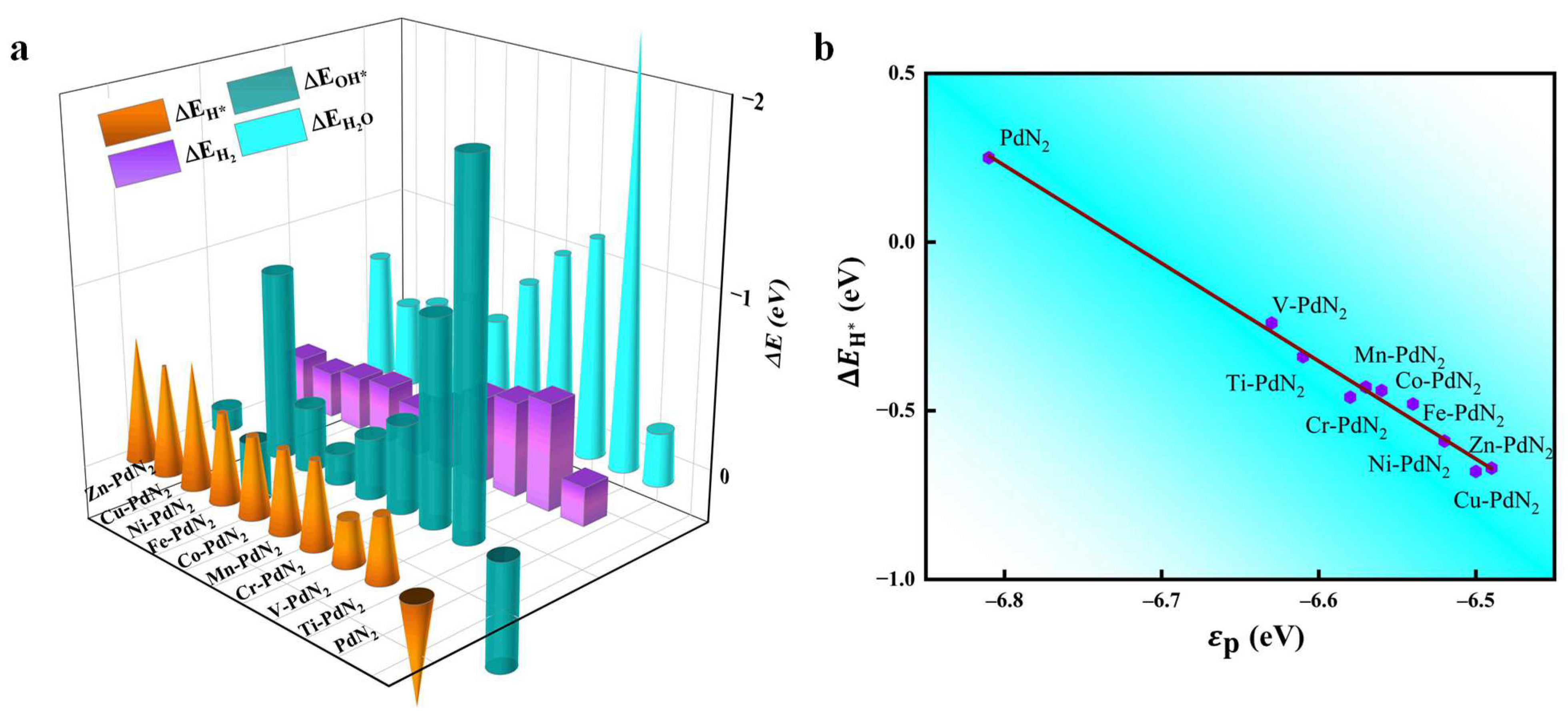
The alkaline HOR involves multiple surface–adsorbed species, mainly including H*, OH*, H2*, and H2O*. To gain in-depth insight into the intrinsic HOR mechanism, we systematically investigated all possible adsorption sites and stable adsorption configurations of the above four species on the surfaces of PdN2 and TM–PdN2 (Tables S3–S6). Meanwhile, as shown in Figure 5a, the adsorption energies of different adsorbates at their optimal sites on various catalysts were calculated.
Adsorption of H*: For PdN2 and TM-PdN2 systems, the adsorbed H* preferentially occupies the top site of N atoms adjacent to the lattice Pd or anchored TM atoms. As summarized in Table 2, the adsorption energy of H* on the N top site of pristine PdN2 is only −0.19 eV, indicating a weak adsorption interaction. This phenomenon can be attributed to the low p-band center of the N atoms (−6.81 eV, far below the Fermi level, see Figure 4), which leads to a weak orbital interaction between the N 2p orbitals and the H 1s orbital. After the introduction of TM atoms, the H* adsorption strength is significantly enhanced, with the adsorption energy ranging from −0.68 eV to −0.24 eV. As shown in Figure 4, PDOS analysis shows an overall upward shift in the N atom p-band center to −6.65 eV~−6.39 eV after TM doping, which strengthens H* adsorption. As shown in Figure 5b, further analysis confirms a strong linear correlation between the N atom p-band center and H* adsorption energy: the closer the p-band center is to the Fermi level, the more negative the H* adsorption energy (i.e., the stronger the H* adsorption). This trend originates from the orbital interaction between the N 2p orbitals and H 1s orbital: when the N p-band center is higher, more unoccupied antibonding states exist near the Fermi level, which stabilizes the N–H bonding states and thus enhances the adsorption strength.
Adsorption of OH*: As listed in Table 2, the most stable adsorption site for OH* on pristine PdN2 is the Pd top site, with an adsorption energy of −0.11 eV. In contrast, for all TM–PdN2 systems, OH* preferentially adsorbs on the top site of the anchored TM atom, with adsorption energies of −1.96 eV (Ti), −1.11 eV (V), −0.48 eV (Cr), −0.33 eV (Mn), −0.17 eV (Fe), −0.35 eV (Co), −1.02 eV (Ni), 0.35 eV (Cu), and −0.12 eV (Zn), respectively. All these values correspond to a stronger adsorption interaction than that on the pristine PdN2 substrate. This result indicates that the adsorption energy of OH* on TM–PdN2 can be effectively tuned in a wide range from −1.96 eV to 0.35 eV by incorporating different TM single atoms. This difference in OH* adsorption energy can be well explained by electronic structure analysis. For most TM-anchored systems, the d-band center of the TM atom is closer to the Fermi level than that of the lattice Pd atom, and thus the OH* adsorption capability increases with the upward shift in the TM d-band center. The cases of Cu and Zn are rather exceptional: although their d-band centers (−3.28 eV for Cu and −7.18 eV for Zn) are both lower than that of Pd, Hirshfeld charge population analysis (Table 1) reveals that the positive charges carried by Cu and Zn atoms are much higher than those of their adjacent Pd atoms. This makes OH* preferentially adsorb on the more positively charged Cu or Zn top sites, highlighting the critical role of electrostatic interaction in regulating the adsorption site selectivity of intermediates.
Adsorption of H2 and H2O: For H2 molecule adsorption (Table 2), H2 preferentially occupies the top site of Pd atoms in both PdN2 and TM–PdN2 systems, with adsorption energies ranging from −0.58 eV to −0.21 eV. Compared with the bond length of the free H2 molecule (0.748 Å), the bond length of adsorbed H2 is stretched to the range of 0.759 Å to 1.293 Å, indicating that the H2 molecule is effectively activated on the catalyst surface, which is favorable for its dissociation in subsequent reaction steps. For H2O molecule adsorption (Table 2), H2O is horizontally adsorbed on the top site of Pd or TM atoms via the O atom, with adsorption energies ranging from −2.31 eV to −0.29 eV on PdN2 and TM–PdN2.
Co–adsorption of HOR Intermediates: We have systematically investigated the single adsorption behaviors of H*, OH*, H2, and H2O on the surfaces of PdN2 and TM-PdN2, and clarified the optimal adsorption sites and intrinsic adsorption strength rules for each intermediate. However, the alkaline HOR occurs in an electrolyte environment rich in free OH ions, where various reaction intermediates at the catalytic interface do not exist in isolation but coexist, adsorb, and interact with each other. Combined with the bifunctional catalytic mechanism of alkaline HOR, an efficient catalytic system requires the simultaneous construction of well-matched H* and OH* adsorption sites, and the spatial arrangement and electronic interaction of these two intermediates directly determine the reaction pathway and kinetic efficiency. Therefore, we further investigated the co-adsorption configurations of OH with other species (H, H2, and H2O) on PdN2 and TM-PdN2 surfaces.
As summarized in Table S3, under the co-adsorption state, H* and OH* preferentially occupy the adjacent N top site and TM top site, respectively, forming spatially separated dual active sites. This configuration effectively avoids the competitive adsorption between H* and OH*, which is conducive to the subsequent recombination reaction. Compared with individual H* adsorption, the adsorption energy of co–adsorbed H* (ranging from −0.46 eV to −0.15 eV) is weakened by 0.09 eV to 0.25 eV, a change that facilitates the combination of OH* and H* during the HOR process.
For the co–adsorption of H2* and OH*, OH* preferentially occupies the TM top site, while H2 tends to adsorb at the adjacent Pd top site, as illustrated in Table S5. Compared with single H2 adsorption, the adsorption energy of co-adsorbed H2 is weakened to −0.32 eV, −0.29 eV, and −0.34 eV on Ti–PdN2, V–PdN2, and Cr–PdN2, respectively, while it is enhanced to the range of −0.61 eV to −0.35 eV on other TM–PdN2 systems.
As shown in Table S6, for the co-adsorption of H2O* and OH*, the two species are stably located at the adjacent Pd top site and TM top site, respectively. Owing to the hydrogen bonding interaction between OH* and H2O*, the presence of OH* universally enhances the adsorption strength of H2O on all catalyst substrates.
Taken together, the anchoring of TM atoms not only modulates the adsorption behavior of single intermediate species, but also alters the interaction between various intermediates via the co-adsorption effect, which will exert a critical influence on the overall reaction pathway and kinetics of the alkaline HOR.

2.4. HOR Electrocatalytic Performance

Under the operating conditions of alkaline fuel cells, a large number of free OH ions can be captured by the oxophilic metal sites in both PdN2 and TM–PdN2 catalysts to form adsorbed OH* intermediates, which then directly participate in the HOR process. Therefore, effective adsorption of OH is a prerequisite for HOR catalysts based on the bifunctional mechanism.
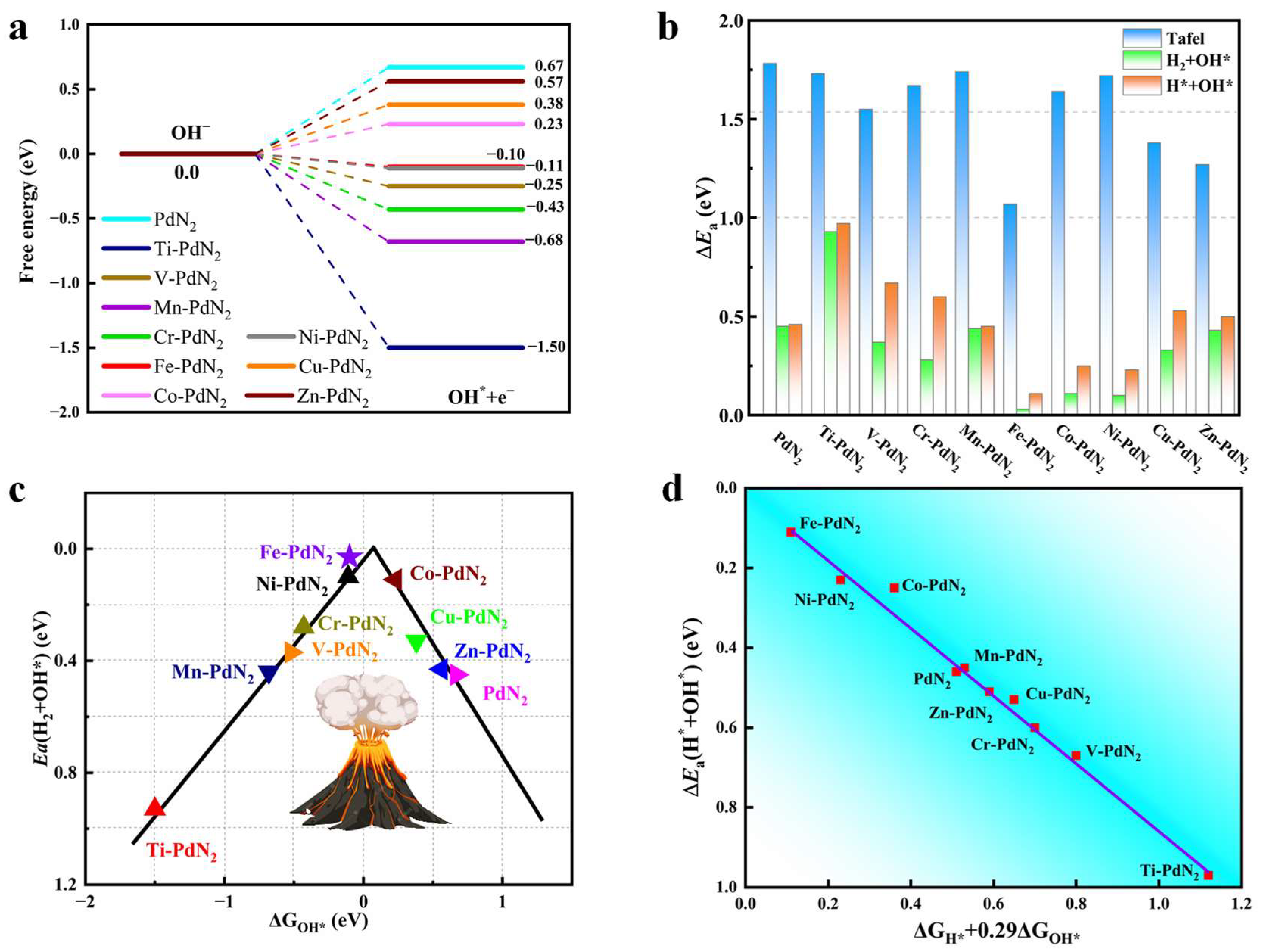
Adsorption Free Energy of OH Ions: Figure 6a shows the Gibbs free energy change for the adsorption of OH to form adsorbed OH* (OH → OH* + e). On the pristine PdN2 monolayer, the adsorption free energy of OH is positive (0.67 eV), indicating that the formation of adsorbed OH* is thermodynamically unfavorable. In contrast, for the PdN2 systems anchored with Ti, V, Cr, Mn, Fe, and Ni atoms, the adsorption free energies of OH on the TM top sites range from −1.50 eV to −0.10 eV, all of which are negative. This result demonstrates that these TM sites can spontaneously capture OH to form stable adsorbed OH* intermediates. For Co-, Cu-, and Zn-anchored PdN2 catalysts, although the adsorption free energies of OH are positive (0.23 eV, 0.38 eV, and 0.57 eV, respectively), the adsorption of OH on the TM top sites is still significantly stronger than that on the Pd sites.
H2 → 2H*. The H2 molecule is first physically adsorbed at the top site of Pd adjacent to the TM atom, and then dissociates into two H* intermediates adsorbed on the adjacent N top sites via the Tafel mechanism. As shown in Figure S1, the Tafel reaction is an endothermic process on the surface of both PdN2 and TM–PdN2 catalysts, with the Gibbs free energy change (ΔG) ranging from 1.07 eV to 1.78 eV. The corresponding reaction energy barriers follow the order: PdN2 (1.78 eV) > Mn–PdN2 (1.74 eV) > Ti–PdN2 (1.73 eV) > Ni–PdN2 (1.72 eV) > Cr–PdN2 (1.67 eV) > Co–PdN2 (1.64 eV) > V–PdN2 (1.55 eV) > Cu–PdN2 (1.38 eV) > Zn–PdN2 (1.27 eV) > Fe–PdN2 (1.07 eV). Although the introduction of TM atoms generally reduces the energy barrier of the Tafel reaction (most significantly for Fe–PdN2), the overall energy barriers are still relatively high (>1.0 eV), indicating that the Tafel reaction is not the dominant pathway.
H2 + OH* → H* + H2O. In the Heyrovsky-type H2 activation pathway, the physisorbed H2 on the Pd top site reacts with the pre-adsorbed OH* on the TM top site. Specifically, the OH* species attacks one H atom of the H2 molecule, generating one H2O molecule that desorbs from the TM site, while the remaining H atom binds to the adjacent N top site to form the active H* intermediate. As shown in Figure S1, the calculated Gibbs free energy changes reveal that this process is endothermic on pristine PdN2 and Ti-, Mn-, Zn-anchored PdN2 catalysts, with ΔG values of 0.45 eV, 0.93 eV, 0.44 eV, and 0.43 eV, respectively. Conversely, this process is exothermic on V–, Cr–, Fe–, Co–, Ni–, and Cu–anchored PdN2 catalysts, with ΔG values of −0.37 eV, −0.28 eV, −0.03 eV, −0.11 eV, −0.10 eV, and −0.33 eV, respectively. It is worth highlighting that the reaction energy barriers of this pathway on all catalysts (0.28 eV to 0.93 eV) are drastically lower than those of the corresponding Tafel reaction, confirming that the Heyrovsky–type reaction between H2 and adsorbed OH* is the thermodynamically and kinetically favorable route for H* generation.
H* + OH* → H2O. For the final recombination step, the H* on the N top site couples with the OH* adsorbed on the TM top site, yielding the second H2O molecule that readily desorbs from the catalyst surface. As shown in Figure S1, this reaction is endothermic on Ti–PdN2G = 0.97 eV), while it is exothermic on all other TM–PdN2 catalysts and pristine PdN2, with exothermic values ranging from −2.28 eV to −0.21 eV. The reaction energy barriers follow the descending order: Ti–PdN2 (0.97 eV) > V–PdN2 (0.67 eV) > Cr–PdN2 (0.60 eV) > Cu–PdN2 (0.53 eV) > Zn–PdN2 (0.50 eV) > PdN2 (0.46 eV) > Mn–PdN2 (0.45 eV) > Co–PdN2 (0.25 eV) > Ni–PdN2 (0.23 eV) > Fe–PdN2 (0.11 eV). Compared with pristine PdN2, the introduction of Ti, V, Cr, Cu, and Zn increases the energy barrier of this step, while the incorporation of Mn, Fe, Co, and Ni effectively lowers the barrier, with the most significant reduction observed for Fe–PdN2.
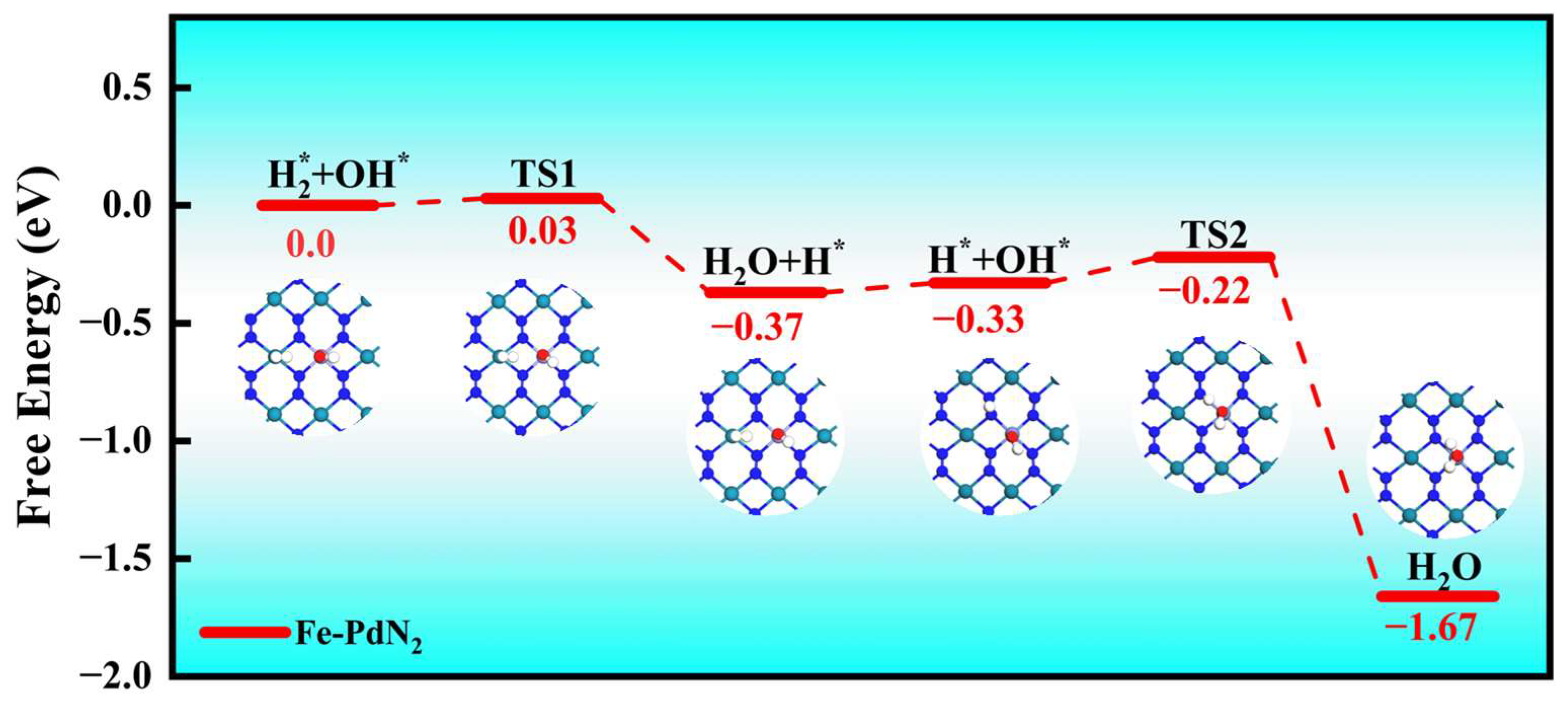
Taken together, as presented in Figure 6b, our mechanistic studies confirm that the alkaline HOR on both PdN2 and TM–PdN2 catalysts proceeds via a two-step sequence: H2 + 2OH* → H* + OH* + H2O → 2H2O. Among all elementary steps, the recombination of H* and OH* (H* + OH* → H2O) exhibits the highest energy barrier across all catalytic systems, and thus is identified as the rate-determining step (RDS) of the alkaline HOR. The RDS energy barriers of all catalysts follow the descending order of Ti–PdN2 (0.97 eV) > V–PdN2 (0.67 eV) > Cr–PdN2 (0.60 eV) > Cu–PdN2 (0.53 eV) > Zn–PdN2 (0.51 eV) > PdN2 (0.46 eV) > Mn–PdN2 (0.45 eV) > Co–PdN2 (0.25 eV) > Ni–PdN2 (0.23 eV) > Fe–PdN2 (0.11 eV), verifying that Fe–PdN2 exhibits the highest HOR catalytic activity. As shown in Table 3, the RDS rate constant (k) at 298 K was calculated for quantitative assessment of the intrinsic catalytic activity. The calculation results show that Fe–PdN2 achieves an ultra-high rate constant of 2.82 × 10¹⁰ s−1·site−1, which vastly outperforms all other investigated TM–PdN2 systems. More importantly, the RDS energy barrier (0.11 eV) and rate constant of Fe–PdN2 are superior to those of previously reported alkaline HOR catalysts, including the benchmark Pt(111) (0.22 eV, 4.5 × 10⁹ s−1·site−1) [39], Ni/WN (0.55 eV, 8.93 × 10³ s−1·site−1) [40], and Ni13/NG (0.68 eV, 5.80 × 10³ s−1·site−1) [41]. Therefore, the Fe single-atom functionalized PdN2 monolayer represents a highly promising anode catalyst for alkaline HOR, warranting further experimental validation.

2.5. Origin of HOR Catalytic Activity

In the alkaline HOR network, H* and OH* are key intermediates whose adsorption characteristics jointly determine the overall reaction rate. As the reaction occurs via the pathway of H2 + OH* → H* + H2O and H* + OH* → H2O, we systematically establish the intrinsic correlations between the elementary reaction barriers and the intermediate adsorption free energies, thus unraveling the origin of catalytic activity in TM-PdN2 catalysts.
For the H2 + OH* → H* + H2O step, only the pre-adsorbed OH* intermediate participates in the reaction process, thus its reaction energy barrier (ΔEa(H2 + OH*)) exhibits a strong correlation with the adsorption free energy of OH* (ΔGOH*). As depicted in Figure 6c, ΔEa(H2 + OH*) and ΔGOH* follow a classic volcano-type correlation consistent with the Sabatier principle in heterogeneous catalysis. The reaction energy barrier of this step approaches its minimum when ΔGOH* is close to 0.08 eV, corresponding to the optimal OH* adsorption strength for this elementary step. The left branch of the volcano curve corresponds to the systems with excessively strong OH* adsorption (e.g., Ti- and Mn-anchored PdN2 catalysts). The overly strong OH* binding affinity leads to the over-stabilization of OH* species on the TM active sites, which reduces the reactivity of adsorbed OH* toward H2 molecules and thus elevates the reaction energy barrier. In contrast, the systems located on the left branch but near the volcano apex (V–, Cr–, Fe–, and Ni–anchored PdN2 catalysts) exhibit moderate OH* adsorption strength. Among them, Fe–PdN2 has a ΔGOH* value of −0.10 eV, which is the closest to the theoretical optimal value, thus delivering the lowest reaction energy barrier (0.11 eV) for this step. The right branch of the volcano curve corresponds to the systems with excessively weak OH* adsorption, including the pristine PdN2 monolayer and Co-, Cu-, Zn-anchored PdN2 catalysts. The overly weak OH* binding strength means that OH* species cannot be stably immobilized on the catalyst surface, which is also unfavorable for the reaction between adsorbed OH* and H2 molecules. This volcano-type correlation demonstrates that ΔGOH* can serve as an effective activity descriptor for the H2 + OH* reaction step, where the optimal catalytic performance requires neither excessively strong nor overly weak OH* adsorption on the catalyst surface.
For the H* + OH* → H2O step, the reaction involves the coupling of two surface-adsorbed intermediates, and thus its reaction energy barrier (ΔEa(H* + OH*)) is synergistically modulated by the adsorption free energies of both H* (ΔGH*) and OH* (ΔGOH*). As illustrated in Figure 6d, via multiple linear regression analysis, we identify a robust linear correlation between ΔEa(H* + OH*) and the combined ΔGH* and ΔGOH* values, which is formulated in Equation (3):
Δ E a H *   +   O H *   =   0.867   ×   Δ G H *   +   0.29 Δ G O H *     0.011
This derived linear relationship carries well-defined physical implications: First, the contributions of the adsorption free energies of H* and OH* to the RDS energy barrier can be quantitatively described by the linear combination term (ΔGH* + 0.29ΔGOH*). Second, the scaling coefficient for ΔGH* is approximately 3.45 times that for ΔGOH* (0.29), which reveals that the adsorption strength of H* exerts a far more dominant influence on the RDS energy barrier than that of OH*. In other words, the rational optimization of H* adsorption is the primary prerequisite to achieve high HOR catalytic activity. Finally, the RDS energy barrier approaches its minimum value when ΔGH* + 0.29 and ΔGOH* = 0.01 eV, which corresponds to the theoretically optimal HOR catalytic activity. Combining this optimal linear combination criterion with the optimal ΔGOH* value (0.08 eV) for the H2 + OH* step, the optimal ΔGH* value is calculated to be 0.01 eV. Thus, the dual adsorption free energy criteria for an ideal alkaline HOR catalyst are defined: ΔGOH* ≈ 0.08 eV and ΔGH* ≈ 0.01 eV should be satisfied simultaneously.
As shown in Table 2, by comparing the adsorption free energies of all tested TM–PdN2 systems with the previously proposed dual optimal criteria, we find that Fe–PdN2 exhibits a ΔGOH* of −0.10 eV and a ΔGH* of 0.03 eV. Although these values deviate slightly from the theoretical optima, Fe–PdN2 is the system that most closely matches the dual optimal adsorption criteria among all investigated catalysts. As shown in Figure 7, the synergistic effect, combining nearly thermoneutral H adsorption (ΔGH* ≈ 0) with moderate OH* adsorption, endows Fe–PdN2 with the lowest reaction energy barriers for both the H2 + OH* activation step (0.03 eV) and the rate-determining H* + OH* recombination step (0.11 eV), thereby achieving superior alkaline HOR catalytic performance relative to all other investigated catalysts.

3. Experimental Approach and Computational Details

All density functional theory (DFT) calculations with spin polarization were performed using the DMol3 code embedded in the Materials Studio 2018 software package [42]. The exchange–correlation interactions were described using the Perdew–Burke–Ernzerhof (PBE) functional within the generalized gradient approximation (GGA) framework [43]. Grimme’s DFT–D3 dispersion correction scheme was employed to accurately capture the long-range van der Waals interactions [44]. The density functional semi-core pseudopotential (DSPP) was adopted to treat the ionic cores of the metal atoms, and the wave functions of valence electrons were expanded using the double numerical basis set supplemented with polarization functions (DNP) [45]. A real-space global orbital cutoff radius of 5.1 Å was set to strike an optimal balance between computational accuracy and efficiency. The energy convergence threshold for self–consistent field (SCF) iterations in electronic structure calculations was set to 1.0 × 10⁻⁶ atomic units (au). The Brillouin zone was sampled with a 4 × 4 × 1 k–point mesh generated via the Monkhorst–Pack scheme. For higher precision in electronic property calculations, the k–point mesh was further refined to a denser 8 × 8 × 1 grid. For geometry optimization, the convergence tolerances for total energy, maximum atomic force, and atomic displacement were set to 1.0 × 10⁻⁵ Ha, 2.0 × 10⁻³ Ha·Å−1, and 5.0 × 10⁻³ Å, respectively. Transition state (TS) searches were performed between the optimized initial state (IS) and final state (FS) using the combined linear synchronous transit (LST) and quadratic synchronous transit (QST) method. All located TS structures were validated via vibrational frequency calculations to confirm the presence of exactly one imaginary frequency along the reaction coordinate [46]. The conductor-like screening model (COSMO) was employed to mimic the implicit aqueous solvent environment under realistic alkaline electrolyte conditions, with a relative dielectric constant of 78.54 (corresponding to water at 298 K) adopted for the calculations [47].
The crystal structure of the PdN2 monolayer was initially constructed via the particle swarm optimization (PSO) algorithm, as implemented in the CALYPSO code [48,49], a widely adopted computational tool for the prediction and discovery of stable two-dimensional (2D) materials. The primitive unit cell of PdN2 comprises one Pd atom and two N atoms, all of which are coplanar within the monolayer plane. The optimized lattice parameters of the primitive unit cell are determined to be a = 3.146 Å and b = 3.875 Å (Table S1), which are in excellent agreement with the previously reported values (a = 3.15 Å, b = 3.88 Å) [32]. The PdN2 monolayer crystallizes in the orthorhombic system, with space group Pmmm and point group D2h (mmm) [32]. Subsequently, a 3 × 3 supercell was constructed by expanding the optimized PdN2 primitive cell along the in-plane x and y directions, and a 20 Å–thick vacuum layer was introduced along the out-of-plane z direction to eliminate spurious interactions between adjacent periodic slabs. Finally, as shown in Figure 1, the TM–PdN2 catalytic systems (where TM = Ti, V, Cr, Mn, Fe, Co, Ni, Cu, and Zn) were fabricated by removing one lattice Pd atom from the supercell and anchoring an isolated transition metal single atom at the resulting vacant Pd site.
The d-band center of the metal sites and the N 2p-band center extracted from the band structure were calculated according to Equation (4) and Equation (5), respectively:
ε d   =   + E ρ d E dE + ρ d E dE
and
ε p = + E ρ p E dE + ρ p E dE
In these equations, ρ d E and ρ p E denote the d-band projected density of states and p-band projected density of states at a given energy E, respectively.
The cohesive energy of the pristine PdN2 monolayer was calculated using Equation (6):
E coh   =   n Pd E Pd   +   n N E N     E PdN 2 N
where n Pd and n N denote the atomic number of Pd and N in the optimized PdN2 primitive unit cell, respectively. E PdN 2 and E N correspond to the single-point energy of an isolated free Pd atom and an isolated free N atom, respectively. E PdN 2 refers to the total energy of the geometrically optimized pristine PdN2 monolayer unit cell, while N represents the total number of atoms in the unit cell.
The adsorption energy of reaction intermediates on the TM–PdN2 catalysts was calculated using Equation (7):
E   =   E total     E surface     E adsorbate
where E is the adsorption energy of the adsorbate, E total is the total energy of the system after adsorbate adsorption, E surface is the energy of the clean substrate, and E adsorbate is the energy of the isolated gas-phase adsorbate. In this work, the energies of H and OH were calculated by the equations E H = 12 E H 2 and E OH = E H 2 O E H 2 , respectively.
The adsorption free energy was calculated via Equation (8):
G   =   E   + ZPE     T S
where ZPE and S denote the differences in zero-point energy and entropy before and after adsorption at 298 K, respectively [34]. Both the zero-point energy and entropy values were derived from vibrational frequency calculations based on fully optimized geometric structures, following the expressions: ZPE = hv 2 and S   =   R β hv e β hv 1 ln 1 e β hv . Here, h, ν, and R correspond to the Planck constant, vibrational frequency, and ideal gas constant, respectively. The term β is defined as β   =   1 k B T , where kB is the Boltzmann constant. The ZPE correction is critical for all energetic quantities in this work, as it directly affects adsorption energies, reaction barriers, and the determination of the rate-determining step (see Section 2.4).
The Gibbs free energy change ( Δ G r ) for each elementary step of the alkaline HOR was calculated with reference to the standard hydrogen electrode (SHE), using Equation (9):
Δ G r   =   Δ E r   +   Δ ZPE T Δ S   +   Δ G pH   +   Δ G U   +   Δ G field
where Δ E r denotes the electronic energy change in the corresponding HOR elementary reaction step; Δ G pH was calculated via the equation Δ G pH = kBT × ln10 × pH, with pH fixed at 13 corresponding to the 0.1 M aqueous KOH electrolyte employed in this work [50]; Δ G U accounts for the effect of the applied electrode bias on electron transfer processes during the reaction; Δ G field represents the local electric field effect on the reaction free energy, which is generally negligible owing to its extremely weak contribution under alkaline operating conditions [25].
Based on the transition state theory [39], the rate constant for each elementary step of the alkaline HOR was calculated using Equation (10):
k   =   k B T Q TS Q IS exp E a RT
In this equation, ℏ is the reduced Planck constant; R is the gas constant; E a is the energy barrier of the HOR elementary reaction; Q TS and Q IS are the partition functions of the initial state and transition state, respectively.

4. Conclusions

In this work, we systematically evaluated the alkaline HOR catalytic performance of nine 3d transition metal single-atom-anchored PdN2 monolayers (TM–PdN2) via first-principles calculations. The main findings are as follows.
All TM-PdN2 systems are thermodynamically stable. Ti-, Cr-, Fe-, Co-, and Ni-anchored systems exhibit excellent electrochemical stability under alkaline conditions and are experimentally feasible. Anchoring TM atoms modulates the p-band center of adjacent N atoms and the d-band center of metal sites, enabling continuous tuning of H* and OH* adsorption strengths. H* and OH* preferentially occupy the top sites of adjacent N atoms and TM atoms, respectively. This spatially separated configuration facilitates the reaction.
The HOR proceeds via H2 + 2OH* → H* + OH* + H2O → 2H2O, with H* + OH* recombination as the RDS. The activity of the H2 + OH* step is governed solely by ΔGOH* (volcano relationship), whereas that of the H* + OH* step is synergistically controlled by ΔGH* and ΔGOH*, with ΔG* having an influence weight 3.45 times that of ΔGOH*. The theoretically optimal adsorption conditions are ΔGOH* ≈ 0.08 eV and ΔGH* ≈ 0.01 eV. Fe-PdN2 shows ΔGOH* = −0.10 eV and ΔGH* = 0.03 eV, the closest to the optimal values among all studied systems, yielding the lowest RDS energy barrier (0.11 eV) and the highest reaction rate constant (2.82 × 10¹⁰ s−1·site−1 at 298 K), which is significantly better than reported Pt(111).
Collectively, Fe-PdN2 is a highly promising platinum-free anode catalyst for the alkaline HOR. This work provides a clear theoretical foundation for the rational design of high-performance non-Pt HOR electrocatalysts.

Supplementary Materials

The following supporting information can be downloaded at: https://www.mdpi.com/article/10.3390/catal16060561/s1, Table S1: Lattice constants a/b, bond lengths d (in Å), and cohesive energy Ecoh (in eV atom−1) of PdN2; Table S2: Formation energy Ef (in eV) and oxidation potential Uox (in V) for PdN2 and TM-PdN2; Table S3: Calculated configurations and adsorption energies ∆EH* (in eV) of H* with and without OH* on PdN2 and TM-PdN2; Table S4: Calculated configurations and adsorption energies ∆EOH* (in eV) of OH* and the distance between the adsorbed site and OH* d(OH*) (in Å) for PdN2 and TM-PdN2; Table S5: Calculated configurations and adsorption energies Δ E H 2 (in eV), and H−H distance d(H2) (in Å) of H2* with and without OH* on PdN2 and TM-PdN2; Table S6: Calculated configurations and adsorption energies Δ E H 2 O (in eV) of H2O* with and without OH* on PdN2 and TM-PdN2; Figure S1: Free energy diagrams of elementary reactions for the HOR on RuN2 and TM-PdN2. IS, TS, and FS are the initial state, transition state, and final state in the reactions, respectively.

Author Contributions

Y.Q.: investigation, formal analysis, and writing—original draft; H.Z.: investigation and validation; W.H.: data curation; W.A.: visualization; Y.W.: methodology; G.Y.: validation; J.X.: resources, and writing—review and editing; L.Z.: conceptualization, formal analysis, funding acquisition, supervision, project administration, and writing—review and editing. All authors have read and agreed to the published version of the manuscript.

Funding

This work was supported by the Shandong Provincial Natural Science Foundation (ZR2022MB094).

Data Availability Statement

The data that supports the findings of this study are available in the Supplementary Materials of this article.

Conflicts of Interest

The authors declare no conflicts of interest.

References

  1. Kundu, D.; Barathi, A.; Pooja, K.; Surya, M.; Jacob, S.; Koley, A.; Samanta, P.; Kumar, V.; Chintagunta, A.D.; Kumar, N.S.S.; et al. Green hydrogen pathways for a net–zero future: Technologies, circular economy integration, life–cycle performance and safety dimensions. RSC Adv. 2026, 16, 13471–13514. [Google Scholar] [CrossRef] [PubMed]
  2. Mohandoss, S.; Ingavale, S.; Swami, A.; Balasubramaniyan, N. Sustainable electroreduction of oxygen: Polyoxometalate–carbon composites as a noble metal–free catalyst. Energy Fuel 2025, 39, 12217–12225. [Google Scholar] [CrossRef]
  3. Tang, T.; Ding, L.; Yao, Z.; Pan, H.; Hu, J.; Wan, L. Synergistic electrocatalysts for alkaline hydrogen oxidation and evolution reactions. Adv. Funct. Mater. 2022, 32, 2107479. [Google Scholar]
  4. Yang, C.; Lu, Q.; Jia, X.; Ma, Y.; Song, X. Efficient non–precious metal catalysts based on FePc–C60 for direct lignin fuel cells. Electroanal. Chem. 2026, 1000, 119614. [Google Scholar] [CrossRef]
  5. Huang, W.; Zhang, J.; Deng, G.; Zhu, G.; Chen, Y.; Xu, C.; Cheng, J. MXene–supported Co–S–N–C catalysts with enhanced oxygen reduction reaction activity for anion exchange membrane fuel cells. ACS Appl. Energy Mater. 2025, 8, 2612–2619. [Google Scholar] [CrossRef]
  6. Lu, H.; Jiang, Y.; Xiao, G.; Hu, J.; Yang, L.; He, X.; Xiang, X.; Li, M.; Sun, W.; Lu, Z.; et al. Nitrogen–doped porous carbon fiber with enriched Fe2N sites: Synthesis and application as efficient electrocatalyst for oxygen reduction reaction in microbial fuel cells. J. Colloid Interface Sci. 2022, 616, 539–547. [Google Scholar] [CrossRef] [PubMed]
  7. Mu, X.; Liu, S.; Chen, L.; Mu, S. Alkaline hydrogen oxidation reaction catalysts: Insight into catalytic mechanisms, classification, activity regulation and challenges. Small Struct. 2023, 4, 2200281. [Google Scholar] [CrossRef]
  8. Liu, G.; Liu, Y.; Qiu, X.; Zhang, B.; Jang, J.; Cui, Y.; Xiao, F.; Zhao, Q.; Wang, W.; Kim, Y.; et al. Inert copper incorporation enables the high activity and durability of NiW electrocatalyst for alkaline hydrogen oxidation reaction. Adv. Energy Mater. 2025, 15, 2405127. [Google Scholar] [CrossRef]
  9. Wu, J.; Gao, X.; Liu, G.; Qiu, X.; Xia, Q.; Wang, X.; Zhu, W.; He, T.; Zhou, Y.; Feng, K.; et al. Immobilizing ordered oxophilic indium sites on platinum enabling efficient hydrogen oxidation in alkaline electrolyte. J. Am. Chem. Soc. 2024, 146, 20323–20332. [Google Scholar] [CrossRef] [PubMed]
  10. Wang, X.; Liu, X.; Fang, J.; Wang, H.; Liu, X.; Wang, H.; Chen, C.; Wang, Y.; Zhang, X.; Zhu, W.; et al. Tuning the apparent hydrogen binding energy to achieve high–performance Ni–based hydrogen oxidation reaction catalyst. Nat. Commun. 2024, 15, 1137. [Google Scholar] [CrossRef] [PubMed]
  11. Strmcnik, D.; Uchimura, M.; Wang, C.; Subbaraman, R.; Danilovic, N.; Van Der Vliet, D.; Paulikas, A.P.; Stamenkovic, V.R.; Markovic, N.M. Improving the hydrogen oxidation reaction rate by promotion of hydroxyl adsorption. Nat. Chem. 2013, 5, 300–306. [Google Scholar] [CrossRef] [PubMed]
  12. Subbaraman, R.; Tripkovic, D.; Strmcnik, D.; Chang, K.-C.; Uchimura, M.; Paulikas, A.P.; Stamenkovic, V.; Markovic, N.M. Enhancing hydrogen evolution activity in water splitting by tailoring Li+–Ni(OH)2–Pt interfaces. Science 2011, 334, 1256–1260. [Google Scholar] [CrossRef] [PubMed]
  13. Li, M.; Fu, Z.; Luo, Q.; Lu, B.; Zhang, L.; Liang, S.; Liu, T.; Wang, Y.; Mao, S. Decoupling electronic and geometric effects in Pd catalysts via thermal surface reconstruction for selective hydrogenation. Nat. Commun. 2026, 17, 2500. [Google Scholar] [CrossRef] [PubMed]
  14. Gemechu, D.N.; Haruna, A.B.; Mohammed, A.M.; Mekonnen, Y.S.; Ozoemena, K.I. Electrocatalytic properties and DFT studies of Pd–based catalysts supported on ceria/onion–like carbon for isopropanol oxidation in alkaline medium. J. Phys. Chem. C 2025, 129, 14214–14228. [Google Scholar] [CrossRef] [PubMed]
  15. Yang, Z.; Ran, G.; Song, H.; Chang, Y.; Wang, J.; Li, H. Synergistic Co Pd affection impart high overall water splitting efficiency to Pt/Ir–based electrocatalyst in acid. Chin. Chem. Lett. 2026, 37, 111370. [Google Scholar] [CrossRef]
  16. Zhang, Q.; Qiu, S.; Wang, L.; Lian, K.; Luo, J.; Liu, X. Multifunctional high-entropy alloys and oxides for self-oowered electrocatalytic nitrate reduction to ammonia. Chem. Eur. J. 2025, 31, e202500887. [Google Scholar] [CrossRef] [PubMed]
  17. Chen, Y.; Zheng, X.; Yang, Y.; Wang, P.; Sun, W. Palladium metallene-based electrocatalysts for energy conversion applications. Adv. Funct. Mater. 2024, 34, 2404408. [Google Scholar] [CrossRef]
  18. Pang, B.; Jia, C.; Wang, S.; Liu, T.; Ding, T.; Liu, X.; Liu, D.; Cao, L.; Zhu, M.; Liang, C.; et al. Self–optimized ligand effect of single–atom modifier in ternary Pt–based alloy for efficient hydrogen oxidation. Nano Lett. 2023, 23, 3826–3834. [Google Scholar] [CrossRef] [PubMed]
  19. Lee, J.G.; Oh, K.H.; Kang, S.W.; Yang, J.-I.; Seo, W.S.; Park, J.C. Efficient mechanochemical synthesis of high–performance NiPd alloy nanoparticle catalysts on graphene. Appl. Surf. Sci. 2025, 695, 162936. [Google Scholar] [CrossRef]
  20. Cui, Y.; Dong, X.; Jiang, Z.; Suo, Y.; Zhang, W.; Wang, Y. Study on the preparation and n –heptane isomerization performance of MoOx–Pd/Ce–MCM–48 catalyst. RSC Adv. 2024, 14, 4105–4115. [Google Scholar] [CrossRef] [PubMed]
  21. Chandran, P.; Ramaprabhu, S. Catalytic performance of non–platinum–based hybrid carbon hetero–structure for oxygen reduction and hydrogen oxidation reactions in proton exchange membrane fuel cell. Int. J. Hydrogen Energy 2018, 43, 18477–18487. [Google Scholar] [CrossRef]
  22. Yang, S.; Lu, L.; Zhan, P.; Si, Z.; Chen, L.; Zhuang, Y.; Qin, P. Amorphous hetero–structure iron/cobalt oxyhydroxide with atomic dispersed palladium for oxygen evolution reaction. Appl. Catal. B Environ. Energy 2024, 355, 124213. [Google Scholar] [CrossRef]
  23. Zhao, Y.; Wang, X.; Li, Z.; Zhao, P.; Tao, C.; Cheng, G.; Luo, W. Enhanced catalytic activity of Ru through n modification toward alkaline hydrogen electrocatalysis. Chin. Chem. Lett. 2022, 33, 1065–1069. [Google Scholar] [CrossRef]
  24. Yan, K.; Hong, Y.; Wang, Z.; Wang, D.; Liu, T.; Zhong, H.; Zhang, X. Surface modulated platinum electrocatalyst via single atom nickel promoter for durable non-aqueous hydrogen oxidation. Angew. Chem. Int. Ed. 2026, 138, e22380. [Google Scholar] [CrossRef]
  25. Zhao, L.; Wang, Y.; Ding, T.; Peng, Z.; Jiang, Z.; Zhang, J.; Wang, X.; Li, Y.; Zhao, G.; Ren, H.; et al. Transition metal single–atoms anchored on mo2c mxenes for enhanced hydrogen oxidation reaction: A density functional theory study. Phys. Chem. Chem. Phys. 2025, 27, 16518–16530. [Google Scholar] [CrossRef] [PubMed]
  26. Yang, Y.; Yang, J.; Jiang, P.; Wang, P.; Lin, X.; Fan, D.; Chen, S.; Shi, H.; Meng, P.; Wang, D.; et al. Main-group magnesium single-atom lewis acid sites: A co-tolerance booster for alkaline hydrogen oxidation reaction. Angew. Chem. Int. Ed. 2026, 65, e9761633. [Google Scholar] [CrossRef] [PubMed]
  27. Wu, J.; Ning, M.; Yu, H.; Jin, H.; Zheng, Y. MXene analogue: Metastable two–dimensional transition metal nitrides for electrocatalysis. Chem. Mater. 2025, 37, 4571–4584. [Google Scholar] [CrossRef]
  28. Kitchamsetti, N.; Sarker, U.; Kim, D. Transition metal nitrides: Multifunctional catalysts and energy materials with tailorable architectures. Small Sci. 2025, 5, 2500331. [Google Scholar] [CrossRef] [PubMed]
  29. Yang, Q.; Wang, Z.; Shi, F.; Li, D.; Peng, Y.; Liu, J. Synthesis and electrical properties of 2d cubic vanadium nitride. RSC Adv. 2025, 15, 23994–24001. [Google Scholar] [CrossRef] [PubMed]
  30. Zeng, R.; Yang, Y.; Feng, X.; Li, H.; Gibbs, L.M.; DiSalvo, F.J.; Abruña, H.D. Nonprecious transition metal nitrides as efficient oxygen reduction electrocatalysts for alkaline fuel cells. Sci. Adv. 2022, 8, eabj1584. [Google Scholar] [CrossRef] [PubMed]
  31. Gupta, S.D.; Gupta, S.K.; Jha, P.K. Pressure–induced vibrational and electronic properties of palladium per nitride. J. Phys. Conf. Ser. 2012, 377, 012078. [Google Scholar] [CrossRef]
  32. Jia, J.; Wei, S.; Cai, Q.; Zhao, J. Two–dimensional IrN2 monolayer: An efficient bifunctional electrocatalyst for oxygen reduction and oxygen evolution reactions. J. Colloid Interface Sci. 2021, 600, 711–718. [Google Scholar] [CrossRef] [PubMed]
  33. Jia, J.; Chen, Z.; Liu, Y.; Li, Y.; Zhao, J. RuN2 Monolayer: A highly efficient electrocatalyst for oxygen reduction reaction. ACS Appl. Mater. Interfaces 2020, 12, 54517–54523. [Google Scholar] [CrossRef] [PubMed]
  34. Zhang, X.; Xia, L.; Zhao, G.; Zhang, B.; Chen, Y.; Chen, J.; Gao, M.; Jiang, Y.; Liu, Y.; Pan, H.; et al. Fast and durable alkaline hydrogen oxidation reaction at the electron-deficient ruthenium–ruthenium oxide interface. Adv. Mater. 2023, 35, 2208821. [Google Scholar] [CrossRef] [PubMed]
  35. Jing, L.; Jie, G.; Yu, W.; Ren, H.; Cui, X.; Chen, X.; Jiang, L. A unique sandwich–structured ru–tio/tio2@nc as an efficient bi–functional catalyst for hydrogen oxidation and hydrogen evolution reactions. Chem. Eng. J. 2023, 472, 145009. [Google Scholar] [CrossRef]
  36. He, L.; Wang, J.; Cai, Z.; Liu, R.; Li, S.; Zhang, Y.; Zhang, Z.-Y.; Liu, J.; Liu, B. Growth of non-layered 2D transition metal nitrides enabled by transient chloride templates. Nat. Commun. 2026, 17, 1615. [Google Scholar] [CrossRef] [PubMed]
  37. Cao, J.; Li, T.; Gao, H.; Lin, Y.; Wang, X.; Wang, H.; Palacios, T.; Ling, X. Realization of 2D crystalline metal nitrides via selective atomic substitution. Sci. Adv. 2020, 6, eaax8784. [Google Scholar] [CrossRef] [PubMed]
  38. Guo, R.; Zhang, K.; Liu, Y.; He, Y.; Wu, C.; Jin, M. Hydrothermal synthesis of palladium nitrides as robust multifunctional electrocatalysts. J. Mater. Chem. A 2021, 9, 6196–6204. [Google Scholar] [CrossRef]
  39. Zhao, L.; Liu, H.; Liu, Y.; Han, X.; Xu, J.; Xing, W.; Guo, W. Mechanistic insights into the hydrogen oxidation reaction on PtNi alloys in alkaline media: A first–principles investigation. ACS Appl. Mater. Interfaces 2020, 12, 40248–40260. [Google Scholar] [CrossRef] [PubMed]
  40. Zhao, L.; Tong, Y.; Ding, Y.; Kong, W.; Wang, J.; Li, B.; Zhen, Y.; Xu, J.; Xing, W. Designing interface structures of nickel with transition metal nitrides for enhanced hydrogen electro–oxidation. Surf. Interfaces 2023, 37, 102659. [Google Scholar] [CrossRef]
  41. Zhao, L.; Liu, Y.; Han, X.; Ding, Y.; Kong, W.; Tong, Y.; Xu, J.; Xing, W. Theoretical study of the alkaline hydrogen oxidation reaction on ni–based nanocluster catalysts: Effects of graphene supports and dopants. Appl. Surf. Sci. 2021, 567, 150895. [Google Scholar] [CrossRef]
  42. Delley, B. From molecules to solids with the DMol3 approach. J. Chem. Phys. 2000, 113, 7756–7764. [Google Scholar] [CrossRef]
  43. Dubé, P.; Kiik, M.J.; Stoicheff, B.P. Spectroscopic study of vibrational relaxation and cooling of rare–gas excimers formed in a direct current discharge with supersonic expansion. J. Chem. Phys. 1995, 103, 7708–7721. [Google Scholar] [CrossRef]
  44. Grimme, S.; Antony, J.; Ehrlich, S.; Krieg, H. A consistent and accurate ab initio parametrization of density functional dispersion correction (DFT–D) for the 94 elements H–Pu. J. Chem. Phys. 2010, 132, 154104. [Google Scholar] [CrossRef] [PubMed]
  45. Rinne, K.F.; Schulz, J.C.F.; Netz, R.R. Impact of secondary structure and hydration water on the dielectric spectrum of poly–alanine and possible relation to the debate on slaved versus slaving water. J. Chem. Phys. 2015, 142, 215104. [Google Scholar] [CrossRef] [PubMed]
  46. Liu, X.; Xu, M.; Wan, L.; Zhu, H.; Yao, K.; Linguerri, R.; Chambaud, G.; Han, Y.; Meng, C. Superior catalytic performance of atomically dispersed palladium on graphene in CO oxidation. ACS Catal. 2020, 10, 3084–3093. [Google Scholar] [CrossRef]
  47. Dixon, D.A.; Dobbs, K.D.; Valentini, J.J. Amide–water and amide–amide hydrogen bond strengths. J. Phys. Chem. 1994, 98, 13435–13439. [Google Scholar] [CrossRef]
  48. Tang, C.; Kour, G.; Du, A. Recent progress on the prediction of two–dimensional materials using CALYPSO. Chin. Phys. B 2019, 28, 107306. [Google Scholar] [CrossRef]
  49. Zhao, K.; Li, X.; Wang, S.; Wang, Q. 2D planar penta–MN2 (M = Pd, Pt) sheets identified through structure search. Phys. Chem. Chem. Phys. 2019, 21, 246–251. [Google Scholar] [CrossRef] [PubMed]
  50. Yang, Z.; Wang, X.; Zhu, M.; Leng, X.; Chen, W.; Wang, W.; Xu, Q.; Yang, L.-M.; Wu, Y. Structural revolution of atomically dispersed mn sites dictates oxygen reduction performance. Nano Res. 2021, 14, 4512–4519. [Google Scholar] [CrossRef]
Figure 1. (a) Top view and (b) side view of the TM–PdN2 monolayer structure. TM denotes the doped 3d transition metal atom anchored on the PdN2 substrate.
Catalysts 16 00561 g001
Figure 2. Geometric structures and deformation charge density of PdN2 and TM–PdN2. Yellow and blue regions correspond to electron depletion and electron accumulation, respectively.
Catalysts 16 00561 g002
Figure 3. (a) Relationship between TM adsorption energy (ΔETM) and∠N–TM–N bond angle (θN–TM–N). The linear fitting equation: y = 0.549x − 56.541. (b) Hirshfeld charge relationship between TM atoms and adjacent N atoms. The linear fitting equation: y = −0.234x − 0.078. (c) Formation energy and oxidation potential of PdN2 and TM–PdN2. The horizontal dashed line indicates the formation energy reference (0 eV); the vertical dashed line indicates the oxidation potential reference (–0.467 V).
Catalysts 16 00561 g003
Figure 4. Projected density of states (PDOS) of PdN2 and TM–PdN2. Black dashed line: Fermi level; dark green dash–dotted line: Pd d-band; other colored dash–dotted lines: TM d-band center; dark blue dash–dotted line: N p-band center.
Catalysts 16 00561 g004
Figure 5. (a) Adsorption energies (ΔE) of H*, OH*, H2* and H2O* on PdN2 and TM–PdN2; (b) Correlation between H* adsorption energy (ΔEH*) and p-band center of N atoms for PdN2 and TM–PdN2. The linear fitting equation: y = −2.871x − 19.293.
Catalysts 16 00561 g005
Figure 6. (a) Free energy diagram of OH adsorption; (b) Reaction energy barriers (ΔEa) of Tafel, H2 + OH* and H + OH* steps; (c) Correlation between ΔEa(H2 + OH*) and OH* adsorption free energy (ΔGOH*). For the volcano plot, the fitting equations are y = −0.611x + 0.039 (left branch) and y = 0.804x − 0.065 (right branch). (d) Correlation between ΔEa(H* + OH*) and H*/OH* adsorption free energies (ΔGH* and ΔGOH*) for PdN2 and TM–PdN2. The linear fitting equation: y = 0.845x + 0.013.
Catalysts 16 00561 g006
Figure 7. Gibbs free energy diagram of the HOR via the H2 + OH* and H + OH* mechanism on Fe–PdN2. TS represents the transition state. Dark green, light purple, dark blue, red, and white spheres correspond to Pd, Fe, N, O, and H atoms, respectively.
Catalysts 16 00561 g007
Table 1. The calculated bond lengths (d, in Å), bond angles (θ, in °), cohesive energies (Ecoh, in eV), TM adsorption energies (ΔETM, in eV), and Hirshfeld charges (q, in |e|) in PdN2 and TM-PdN2.
CatalystsdTM-NdN-NθN-TM-NEcohΔETMqTMqortho-Pdqortho-N
PdN22.0481.18799.0364.56–1.600.3090.309–0.154
Ti-PdN22.0041.20989.817–7.060.4290.292–0.179
V-PdN21.9461.20989.441–6.950.3180.301–0.153
Cr-PdN21.9161.20492.001–6.720.3670.293–0.163
Mn-PdN21.9761.20693.723–5.260.3270.311–0.156
Fe-PdN21.9501.20388.717–7.290.3860.312–0.168
Co-PdN21.9251.19995.610–3.780.2730.260–0.145
Ni-PdN21.9611.19795.618–4.740.3340.276–0.158
Cu-PdN22.0271.19397.962–1.880.2770.269–0.143
Zn-PdN22.0441.20198.886–2.650.3780.291–0.169
Table 2. Adsorption energies (ΔE, in eV) of H*, OH*, H2* and H2O* on PdN2 and TM–PdN2.
CatalystsEH*EOH* E H 2 * E H 2 O *
PdN2–0.19–0.11–0.21–0.29
Ti-PdN2–0.34–1.96–0.58–2.31
V-PdN2–0.24–1.11–0.51–1.21
Cr-PdN2–0.46–0.48–0.46–1.06
Mn-PdN2–0.44–0.33–0.33–0.84
Fe-PdN2–0.43–0.17–0.26–0.57
Co-PdN2–0.48–0.35–0.31–0.63
Ni-PdN2–0.68–1.02–0.29–0.54
Cu-PdN2–0.590.35–0.25–0.47
Zn-PdN2–0.67–0.12–0.27–0.69
Table 3. Calculated rate constants (k, in 1 s−1 × site−1) of the RDS for the HOR on PdN2 and TM-PdN2.
CatalystskH*+OH*CatalystskH*+OH*
PdN25.33 × 106Fe-PdN22.82 × 1010
Ti-PdN25.37 × 101Co-RuN26.52 × 109
V-PdN21.35 × 103Ni-RuN26.81 × 109
Cr-PdN22.66 × 103Cu-RuN28.47 × 104
Mn-PdN27.96 × 106Zn-RuN26.75 × 104
Disclaimer/Publisher’s Note: The statements, opinions and data contained in all publications are solely those of the individual author(s) and contributor(s) and not of MDPI and/or the editor(s). MDPI and/or the editor(s) disclaim responsibility for any injury to people or property resulting from any ideas, methods, instructions or products referred to in the content.