Article

Chiral Phosphoric Acid-Catalyzed Hydrolysis of 4H-Oxazines for Diverse Syntheses

1
Shenzhen Grubbs Institute, Department of Chemistry, Southern University of Science and Technology, Shenzhen 518055, China
2
Department of Chemistry, Hong Kong Baptist University, Kowloon, Hong Kong, China
3
Advanced Institute for Ocean Research, Southern University of Science and Technology, Shenzhen 518055, China
*
Authors to whom correspondence should be addressed.
These authors contributed equally to this work.
Catalysts 2026, 16(6), 556; https://doi.org/10.3390/catal16060556
Submission received: 15 May 2026 / Revised: 29 May 2026 / Accepted: 11 June 2026 / Published: 16 June 2026
(This article belongs to the Special Issue Recent Developments in Asymmetric Organocatalysis)

Abstract

The use of water as a nucleophile in catalytic asymmetric reactions remains a significant challenge, primarily due to its intrinsically low nucleophilicity and small size, which make precise control over both reactivity and stereoselectivity particularly difficult. To address this issue, we developed a CPA-catalyzed asymmetric hydrolysis system, successfully achieving the efficient and highly stereoselective transformation of 4H-oxazines with water. Under this catalytic system, the initial formation of chiral α-bromo ketones is followed by their in situ conversion through reduction and intramolecular SN2 reactions, directly affording valuable chiral bromo alcohols and chiral oxazolone derivatives in high yields with excellent enantioselectivity.

1. Introduction

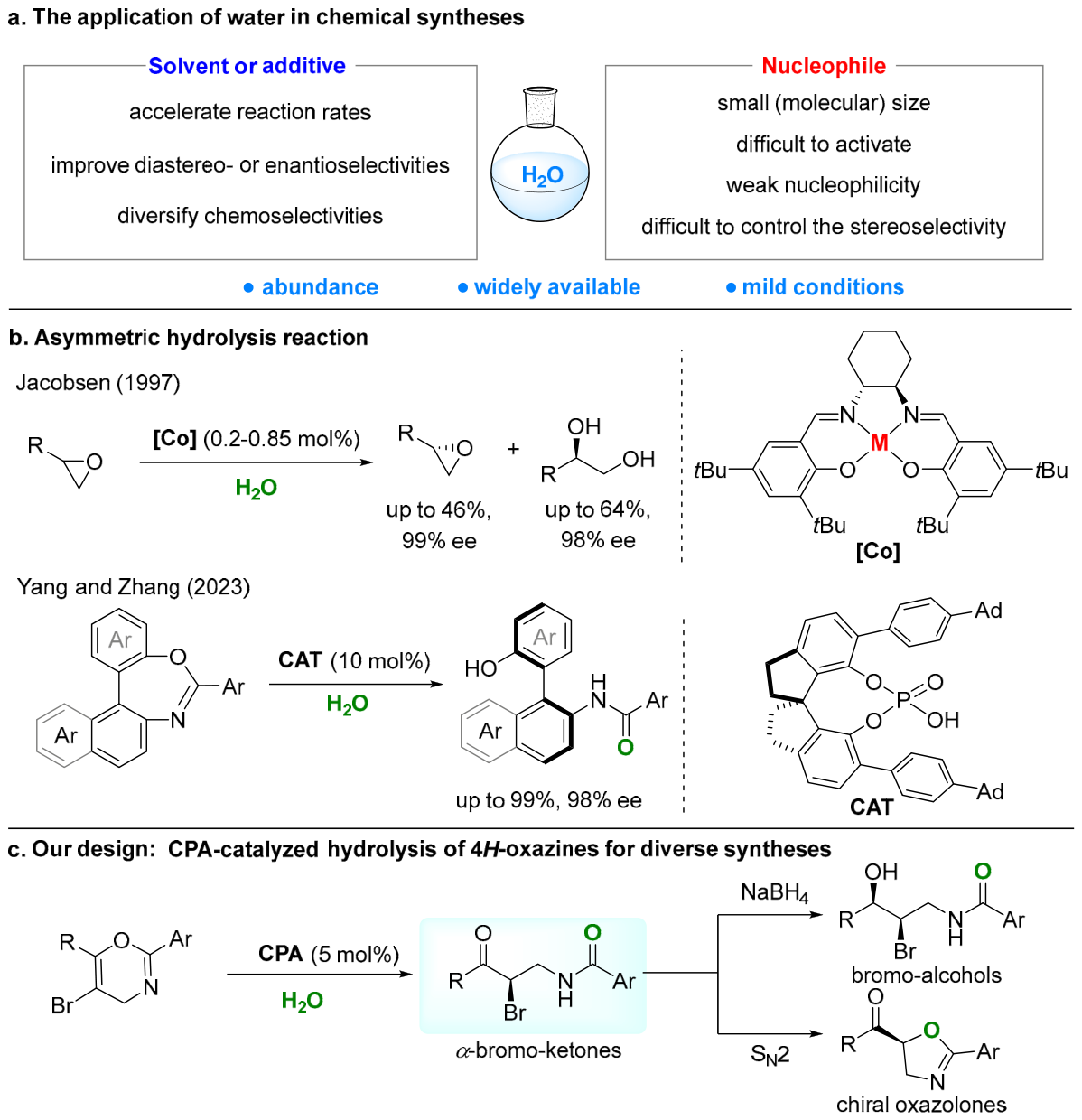
Water is an abundant, widely available, and mild natural resource, widely used in chemical synthesis and industrial production [1,2,3,4]. In chemical synthesis, water often participates as a reaction solvent or additive, demonstrating unique capabilities particularly in catalytic asymmetric synthesis [5,6,7,8]. It can accelerate reaction rates, initiate reactions, and enhance diastereoselectivity or enantioselectivity. Additionally, through hydrophobic effects, hydrogen bonding, and protonation, it effectively modulates chemoselectivity, diastereoselectivity, and enantioselectivity [9,10,11]. However, catalytic asymmetric reactions using water as a reactant remain a tremendous challenge for chemists. The underlying difficulty lies in the small size of the water molecule and its low nucleophilic reactivity toward organic compounds, which makes it hard to control the stereoselectivity of the reaction (Figure 1a). Current breakthroughs in this area have been primarily achieved in enzyme catalysis [12,13,14] and transition metal catalysis. Research in transition metal catalysis primarily encompasses allylic hydroxylation [15,16,17] and O-H insertion reactions [18,19,20], while direct asymmetric hydrolysis remains a less frequently reported area. This is noteworthy because asymmetric hydrolysis represents one of the most atom-economical reactions.
In 1997, Jacobsen reported an efficient asymmetric hydrolysis reaction of terminal epoxides catalyzed by chiral cobalt-based (salen) complexes. Through kinetic resolution, this reaction simultaneously affords valuable terminal epoxides and 1,2-diols in high yields and with high enantiomeric purity, effectively addressing the challenge of obtaining optically pure terminal epoxides via direct synthetic routes [21]. In 2015, Tang utilized the hydrated crystalline catalyst Cu(ClO4)2·6H2O to serve simultaneously as a Lewis acid and a controlled source of water. By regulating the slow release of water molecules, they effectively avoided catalyst poisoning and significantly suppressed side reactions. This enabled the first catalytic enantioselective ring-opening reaction of donor–acceptor cyclopropanes with water, successfully obtaining a series of γ-substituted GHB ester derivatives in high yields with excellent enantioselectivity [22]. Recently, Yang reported a CPA-catalyzed enantioselective addition of water to biaryl oxazolines. This advancement not only enriches the application of water as a nucleophile in asymmetric organocatalysis but also further demonstrates that under specific activation modes (such as acidic conditions), the water can be effectively modulated, thereby providing a foundation for our research design [23] (Figure 1b).
Figure 1. Application of water-involved catalytic asymmetric reaction for the synthesis of different types of chiral compounds [21,23].
Catalysts 16 00556 g001
Chiral α-halogenated ketones contain both carbonyl and halogen functional groups, enabling the construction of structurally complex chiral molecules through the rapid transformation of these two moieties, thus representing an important class of synthetic intermediates [24,25]. Currently, the asymmetric synthesis strategies for these compounds can be mainly categorized into three types: (1) asymmetric α-halogenation of aldehydes or ketones [26,27,28,29,30,31]; (2) asymmetric halofunctionalization and dihalogenation of α,β-unsaturated ketones [32,33,34]; and (3) asymmetric protonation of silyl enol ethers [35]. Among these, the first two types directly employ carbonyl compounds as substrates, while the third type uses carbonyl precursors. Overall, the substrate scope remains relatively limited. Therefore, exploring novel substrate classes and developing new asymmetric catalytic strategies for chiral α-halogenated ketones holds significant importance.
During our investigation of asymmetric alkyne dehalogenation [36], we serendipitously obtained 4H-oxazine derivatives from the reaction of N-benzoyl-protected propargylamines with NBS (N-bromosuccinimide). Inspired by Christmann’s oxygen-walking strategy [37], we hypothesized that, in the presence of a chiral phosphoric acid [38,39,40,41], the 4H-oxazine precursor would undergo hydrolysis by water to afford chiral α-bromo ketones. These products can then be further transformed into a diverse array of structurally distinct compounds via intramolecular SN2 reactions or reduction reactions (Figure 1c).

2. Results and Discussion

The core challenge of this study is enantioselectivity control in the asymmetric hydrolysis of 4H-oxazines. However, the chiral α-bromo ketone products proved unstable on silica gel, undergoing partial conversion to oxazolones via intramolecular cyclization. To avoid this decomposition, we decided to reduce them in situ to the more stable chiral bromo alcohols before systematically optimizing the reaction conditions.

2.1. Reaction Condition Optimization

According to the experimental design, we used S1 as the model substrate to preliminarily explore the enantioselectivity of the reaction. When the reaction was carried out in dichloromethane at room temperature, the chiral phosphoric acid derived from BINOL proved to be ineffective as a catalyst, leading to low conversion and poor enantiomeric excess (ee) of the product P1 (Table 1, entries 1–3). Subsequently, we evaluated the catalytic performance of CPA with different backbones. Encouragingly, the use of a Me-SPINOL-derived chiral phosphoric acid increased the product yield to over 91% (Table 1, entries 4–9). Introducing fused-ring structures into the Me-SPINOL backbone further reduced the reaction time (Table 1, entries 6–9), and the chiral phosphoric acid bearing a 1-pyrenyl substituent provided the best enantioselectivity (Table 1, entry 9). We next systematically screened the reaction conditions, including solvent, solvent volume, and catalyst loading (Table 1, entries 9–18). The optimal conditions were determined as follows: 5.0 equivalents of water, CH2Cl2 as the solvent, and 5.0 mol% of C9 as the catalyst. Under these conditions, the chiral bromo alcohol P1 was obtained in 91% isolated yield with 94% ee (Table 1, entry 19).

2.2. Substrate Scope

2.2.1. Synthesis of Chiral Bromo Alcohols

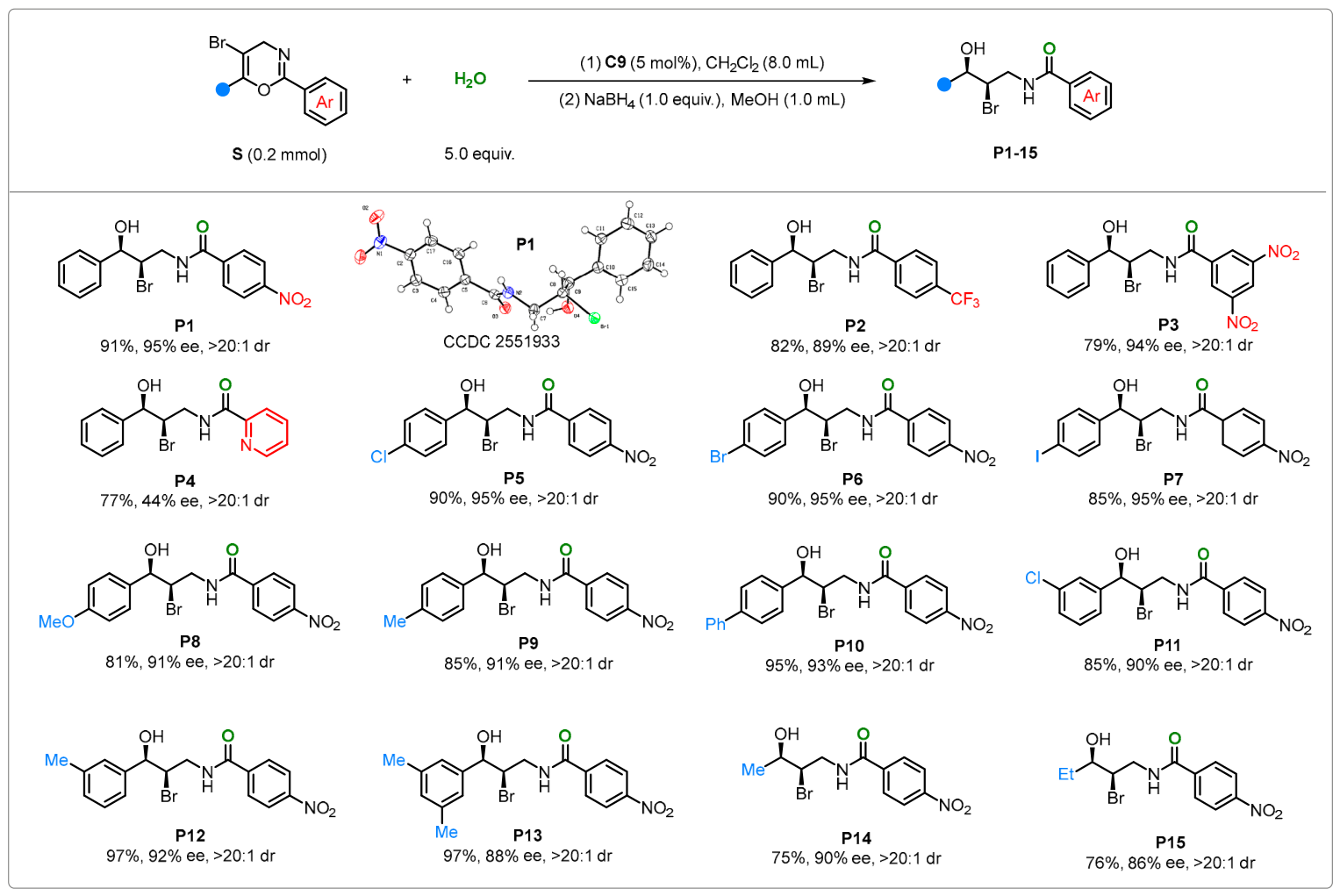
After establishing the optimal reaction conditions, we proceeded to evaluate the substrate scope of the CPA-catalyzed asymmetric hydrolysis reaction, as shown in Figure 2. A wide range of 4H-oxazine were compatible in this reaction, giving the chiral bromo alcohol products in high yield (up to 97%) and excellent enantioselectivities (up to 95% ee). We first examined the effect of different types of aryl amide protecting groups on the reaction. The results showed that protecting groups bearing electron-withdrawing substituents on the aromatic ring were well tolerated, smoothly affording the desired products (P1-3) were formed in good yields (79–91%) and good to excellent enantioselectivities (89–95% ee). The absolute configuration of P1 was confirmed by X-ray analysis. When the phenyl group was replaced with a heteroaryl group, such as pyridyl, product P4 was obtained in 77% yield but with only 44% ee. We then investigated the influence of the substituent on the other side. The results showed that when the para-position of the benzene ring bore electron-withdrawing groups such as halogens (P5–7) or electron-donating groups such as methoxy (P8), methyl (P9), phenyl (P10), the reaction proceeded smoothly, affording the corresponding products in 81–95% yields and with 91–95% ee. Furthermore, substituents at meta-positions (P11–13) with varying electronic properties on the benzene ring also exhibited good tolerance in this reaction, yielding the target products in high yields and with excellent enantioselectivities. Finally, replacing the phenyl group with alkyl groups delivered the desired products (P14–15) in good yields (75–76%) and with good to excellent enantioselectivities (86–90% ee). All isolated products (P1–15) above are single diastereomers (dr > 20:1).

2.2.2. Synthesis of Chiral Oxazolone

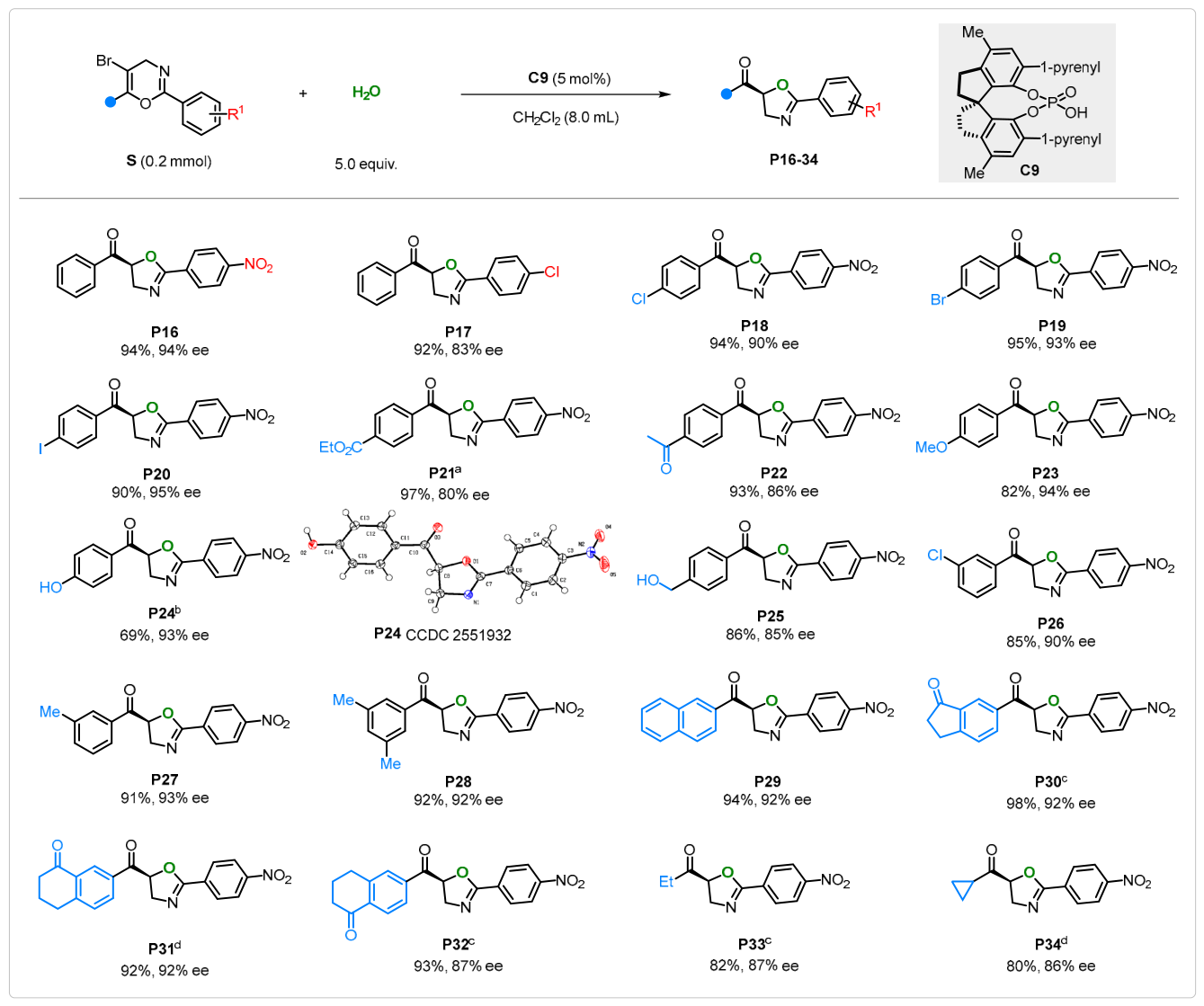
Given that the bromo ketones were unstable on silica gel during purification and tended to convert into oxazolones, these compounds are quite important as chiral ligands for many transformations [42,43]. With the aim of obtaining oxazolone compounds, we plan to optimize the quenching conditions. Theoretically, because the chirality of cyclized products derives from the asymmetric hydrolysis step, the optimal reaction conditions should align with those previously reported. Consistent with this expectation, we were delighted to find that using nearly the same asymmetric hydrolysis conditions, followed simply by silica gel column chromatography, led to complete conversion to the oxazolone product. Having established this, we proceeded to investigate the substrate scope of the transformation, as summarized in Figure 3. A wide range of 4H-oxazines proved to be compatible with this reaction, affording the corresponding chiral oxazolones in high yields (up to 98%) and with excellent enantioselectivities (up to 95% ee). Our investigation began with an evaluation of various R1 substituents. Electron-withdrawing groups at the para-position of the phenyl ring were well tolerated, delivering products (P16–17) in good yields (92–94%) and with good to excellent enantioselectivities (83–94% ee). Next, the substituent on the other side were examined. Substituents at the para-position, regardless of their electronic nature—whether electron-withdrawing, such as halogens (P18–20); ester (P21); and acetyl (P22), or electron-donating, such as methoxy (P23); phenolic hydroxy (P24); and hydroxymethyl (P25)—had no significant impact on the reaction, yielding the products in 69–97% yields and with 80–95% ee. The absolute configuration of P24 was unambiguously confirmed by X-ray crystallography. Furthermore, substituents with varied electronic properties at different positions on the ring were all amenable to this reaction, providing products (P26–28) in high yields with excellent enantioselectivities. Finally, the phenyl ring could be successfully replaced with other ring systems or alkyl groups. Replacing it with other aromatic rings gave products (P29–32) in excellent yields (92–98%) and with good to excellent enantioselectivities (87–92% ee). Alkyl-substituted substrates also performed well, affording P33 and P34 in good yields (82% and 80%) with good enantioselectivities (86% and 87% ee), respectively.

2.3. Mechanism

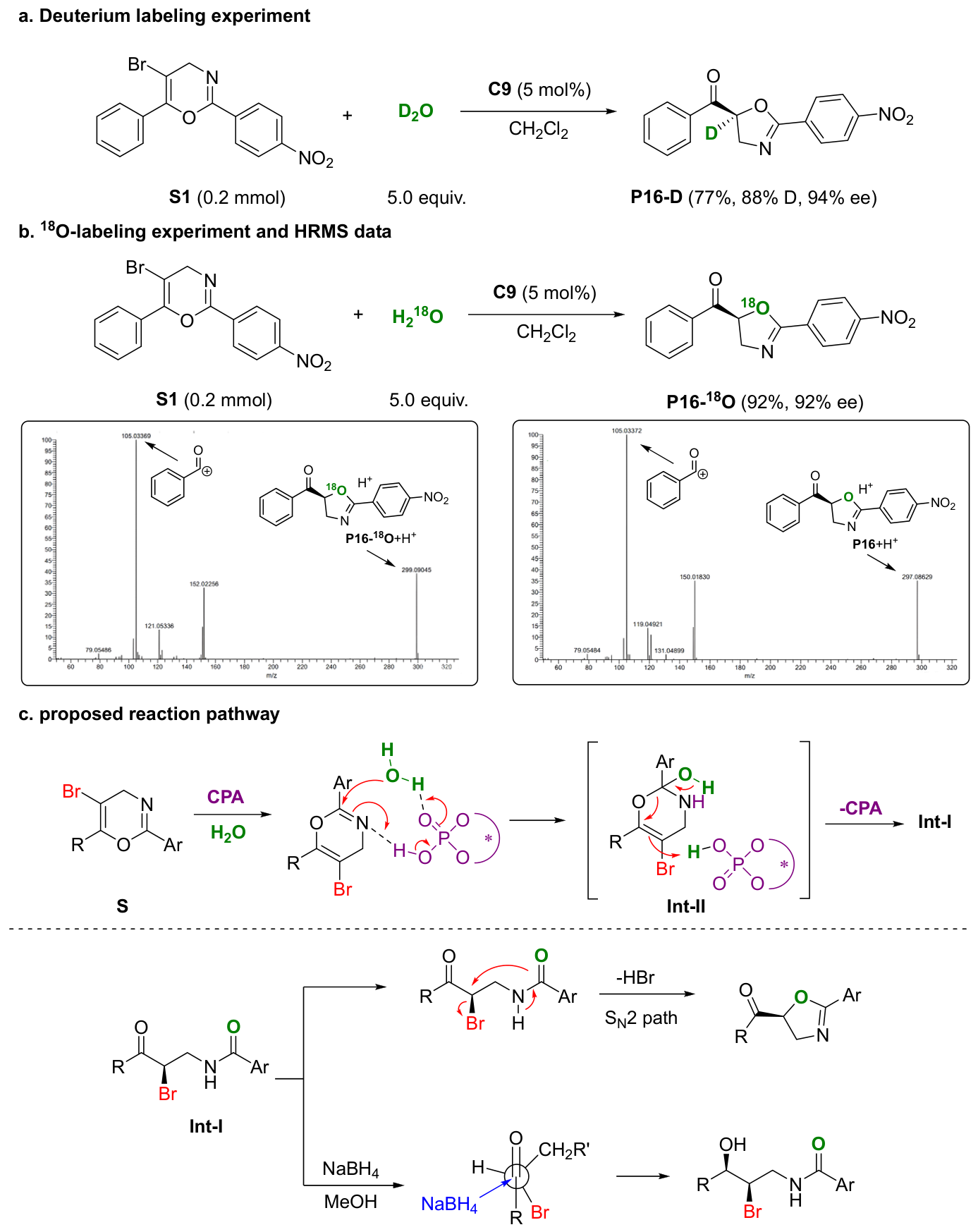
To elucidate the mechanism of the CPA-catalyzed asymmetric hydrolysis, we first performed in situ NMR analysis of the reaction mixture. The results showed that the product, prior to purification by silica gel chromatography, was the α-bromo ketone, providing strong evidence for the proposed reaction intermediate (see the Supporting Information for details). To further elucidate the reaction pathway, deuterium (D) and 18O labeling experiments were conducted. Under the standard reaction conditions, treatment of 4H-oxazine S1 with D2O furnished the deuterium-labeled product (P16-D) with 77% yield, 88% D (Figure 4a). The experiment showed that the H atom of P16 comes from water. Under the standard reaction conditions, treatment of 4H-oxazine S1 with H218O afforded the 18O-labeled product P16-18O with 92% yield. Comparison of the HRMS data for P16 and P16-18O showed identical mass for the benzoyl fragment ion, indicating that this moiety does not incorporate the 18O label. Instead, the 18O-labeled signal was detected exclusively in P16-18O, indicating that the oxygen atom originates specifically from the nucleophilic water (Figure 4b).
Based on the above experimental results and the X-ray crystal structure of the product, we proposed a plausible reaction mechanism (Figure 4c). Initially, under the hydrogen-bonding interaction with the CPA, S undergoes rapid reaction with water to form intermediate Int II. Subsequently, Int II abstracts a proton from the CPA, leading to ring-opening and the formation of chiral α-bromo ketone intermediate Int I. This key intermediate (Int I) then served as a common precursor for two different transformations: an intramolecular SN2 cyclization to afford chiral oxazolones, and a reduction reaction to afford chiral bromo alcohols. According to Cram’s rule, in the Newman projection of intermediate int-1, the carbonyl group is positioned between the less hindered hydrogen and methylene groups. Subsequent attack of sodium borohydride from the less hindered side results in excellent diastereoselectivity.

3. Materials and Methods

3.1. Reagents and Product Characterization

CPAs were obtained from Daicel (Shanghai, China). NBS was obtained from TCI (Shanghai, China). All other reagents were purchased from commercial suppliers Le Yan (Shanghai, China), Energy Chemical (Beijing, China), and used without further purification unless otherwise noted. Analytical thin layer chromatography (TLC) was performed on precoated silica gel 60 GF254 plates. Flash column chromatography was performed using Tsingdao silica gel (60, particle size 0.040–0.063 mm). Visualization on TLC was achieved by use of UV light (254 nm).

3.2. General Procedure

3.2.1. General Procedure for the Synthesis of Substrates

The N-benzamide-protected propargylamine derivative (5.0 mmol, 1.0 equiv.), NBS (1.2 equiv.), and acetonitrile (10 mL) were sequentially added to a reaction flask and reacted at room temperature for approximately 1 h. The reaction was monitored by TLC until complete conversion of the starting material was observed, at which point a large amount of white solid precipitated from the reaction mixture. The acetonitrile was removed by rotary evaporation under reduced pressure. The resulting residue was dissolved in dichloromethane, and a small amount of triethylamine was added to prevent decomposition of the product during the sample loading process. Silica gel was then added for sample loading, and the product was purified by column chromatography to yield the 4H-oxazine compound. The product was dried under vacuum, weighed, and the yield was calculated.

3.2.2. General Procedure for the Synthesis of Chiral Bromo Alcohols

Catalyst C9 (5.0 mol%), the 4H-oxazine compound (S, 0.2 mmol, 1.0 equiv.), dichloromethane (4.0 mL), and water (5.0 equiv.) were sequentially added to a 20 mL reaction flask. The mixture was stirred at room temperature for approximately 6 h, and the reaction was monitored by TLC until the 4H-oxazine compound was completely converted to the chiral α-bromo ketone intermediate. The reaction mixture was cooled to 0 °C, and methanol (1.0 mL) was added, followed by sodium borohydride (1.0 equiv.). After stirring for approximately 5 min, complete conversion of the chiral α-bromo ketone intermediate to the chiral bromo alcohol was observed. The reaction was quenched with water, and the mixture was extracted with dichloromethane (10 mL × 3). The combined organic layers were washed with water (20 mL), dried over anhydrous sodium sulfate, filtered, and concentrated under reduced pressure to afford the crude product. The crude product was purified by column chromatography.

3.2.3. General Procedure for the Synthesis of Chiral Oxazolone Products

The reaction mixture was prepared by sequentially adding catalyst C9 (5.0 mol%), the 4H-oxazine compound (S, 0.2 mmol, 1.0 equiv.), dichloromethane (4.0 mL), and water (5.0 equiv.) to a 20 mL reaction flask. The resulting mixture was stirred at room temperature for approximately 6 h, and the reaction progress was monitored by TLC until complete consumption of the 4H-oxazine. The reaction mixture was then concentrated, and the residue was purified by column chromatography on silica gel (purchased from Huanghai HSGF 254, Yantai Jiangyou Silica Gel Development Co., Ltd., Yantai, China). In some cases, the residue was kept on the column for a longer duration to ensure complete conversion to the final product.

3.3. Product Analysis

The products were analyzed by liquid-state NMR spectroscopy. 1H and 13C NMR spectra were recorded on Bruker 400 MHz or 600 MHz spectrometer (Bruker Corporation, Ettlingen, Germany) in CDCl3, CD2Cl2, Acetone-d6 or DMSO-d6 with tetramethylsilane (TMS) as internal standard. The chemical shifts are expressed in ppm and coupling constants are given in Hz. Data for 1H NMR are recorded as follows: chemical shift (δ, ppm), multiplicity (s = singlet; d = doublet; t = triplet; q = quartet; p = pentet; m = multiplet; brs = broad singlet), coupling constant (Hz), integration. Data for 13C NMR, 19F NMR and 31P NMR, are reported in terms of chemical shift (δ, ppm). The enantiomeric excess values were determined by chiral HPLC with an Agilent instrument and a Daicel CHIRALCEL and CHIRALPAK column. High resolution mass spectroscopy (HRMS) analyses were performed at a Q-Exactive (Thermo Fisher Scientific, Waltham, MA, USA).

4. Conclusions

In summary, we have developed a CPA-catalyzed asymmetric hydrolysis of 4H-oxazines, effectively addressing the challenge of using water as a nucleophile in asymmetric catalysis. This method provides efficient and highly stereoselective access to chiral α-bromo ketone intermediates, which serve as versatile platforms for downstream diversification. Through simple reduction or intramolecular SN2 cyclization, these intermediates can be readily converted into a broad range of valuable chiral bromo alcohols and chiral oxazolone derivatives in high yields with excellent enantioselectivities (up to 98% yield and 95% ee). Mechanistic studies, including in situ NMR and isotope-labeling experiments (D2O and H218O), confirmed the role of the α-bromo ketone as the key intermediate and established that the oxygen atom in the final products originates from water. The broad substrate scope and the synthetic utility of this protocol highlight its potential for the construction of enantioenriched building blocks.

Supplementary Materials

The following supporting information can be downloaded at: https://www.mdpi.com/article/10.3390/catal16060556/s1, Figure S1: synthesis of substrates; Figure S2: synthesis of chiral bromo alcohols; Figure S3: synthesis of chiral oxazolone; Figure S4: synthesis of α-bromo ketone intermediate; Figure S5: Deuteration experiment; Figure S6: Oxygen-18 labeling experiment and mass spectrometry results.

Author Contributions

B.T. and J.W. conceived of and directed the project. P.-Y.J., Z.G. and S.W. designed and performed the experiments. S.-H.X. and J.W. helped with the collection of some compounds and data analysis. B.T., J.W. and P.-Y.J. wrote the paper. All authors have read and agreed to the published version of the manuscript.

Funding

This paper was funded by the National Key R&D Program of China (2022YFA1503700), the National Natural Science Foundation of China (22425011, 22231004, 22271135, 22501129), the Research Grants Council of Hong Kong (SRFS2526-2S02), the Hong Kong Scholars Program (XJ2024-007), the Guangdong Basic and Applied Basic Research Foundation (2024B1515020055), the New Cornerstone Science Foundation through the Xplorer Prize, the Shenzhen Science and Technology Program (KQTD20210811090112004) and High level of special funds (G03050K003).

Data Availability Statement

The authors declare that the data supporting the findings of this study are available within the paper and its Supplementary Materials.

Acknowledgments

The authors appreciate the assistance of SUSTech Core Research Facilities.

Conflicts of Interest

The authors declare no competing interests.

Abbreviations

The following abbreviations are used in this manuscript:
CPAchiral phosphoric acid
NBSN-bromosuccinimide
GHBgamma hydroxybutyrate
BINOL1,1′-bi-2-naphthol
Me-SPINOL4,4′-dimethyl-1,1′-spirobiindane-7,7′-diol
DME1,2-dimethoxyethane
THFtetrahydrofuran

References

  1. Qin, Z.; Zhang, P.; Chang, B.; Bao, L.; Wang, Q.; Zhou, W.; Zeng, D.; Lu, X. Water-induced defect engineering in metal-organic frameworks toward enhanced gas-sensing performance. Sci. China Chem. 2026, 69, 197–205. [Google Scholar] [CrossRef]
  2. Tan, Y.; Pu, J.; Li, H.; Chao, D. Water molecular activity management towards stable Zn anodes. Sci. China Chem. 2024, 67, 4085–4097. [Google Scholar] [CrossRef]
  3. Wang, R.; Zhang, J.; Han, L.; Zhang, X. Enhanced acidity of fluorinated ethanol on water microdroplets accelerates CO2 capture. Chin. J. Chem. 2026, 44, 559–563. [Google Scholar] [CrossRef]
  4. Huang, M.; Zhou, Z.; Dong, X.; Li, Y.; Yang, Y.; Zhan, C.; Lu, J.; Wei, X.; Hong, Y.; Cheng, W.; et al. Synthesis of three-dimensional chiral covalent organic frameworks using surfactant as inducer in water. Chin. J. Chem. 2024, 42, 3093–3098. [Google Scholar] [CrossRef]
  5. Chanda, A.; Fokin, V.V. Organic synthesis “on water”. Chem. Rev. 2009, 109, 725–748. [Google Scholar] [CrossRef]
  6. Butler, R.N.; Coyne, A.G. Water: Nature’s reaction enforcer-comparative effects for organic synthesis “in-water” and “on-water”. Chem. Rev. 2010, 110, 6302–6337. [Google Scholar] [CrossRef]
  7. Mlynarski, J.; Baś, S. Catalytic asymmetric aldol reactions in aqueous media-a 5 year update. Chem. Soc. Rev. 2014, 43, 577–587. [Google Scholar] [CrossRef]
  8. Wang, P.; He, Z.-L.; Xia, Z.-F.; Wei, J.; Dong, X.-Q. Earth-abundant nickel-catalyzed asymmetric hydrogenation. Chin. J. Chem. 2024, 42, 3135–3156. [Google Scholar] [CrossRef]
  9. Wen, G.; Feng, X.; Lin, L. Water-enabling strategies for asymmetric catalysis. Org. Biomol. Chem. 2024, 22, 2510–2522. [Google Scholar] [CrossRef] [PubMed]
  10. Fang, S.; Gao, Z.; Shi, X.; Zhang, M.; Zhang, W.; Liu, Y. Upcycling of polyethylene terephthalate to 1,4-cyclohexanedimethanol in water. Sci. China Chem. 2025, 68, 2101–2109. [Google Scholar] [CrossRef]
  11. Yang, J.; Lei, Y.; Li, Y.; Duan, M.; Zhang, Y.; Yang, S.; Tian, G.; Zhao, Y.; Duan, R.; Li, J.; et al. Highly efficient photoelectrochemical azido-hydroxylation of alkenes by metal-free tandem addition of two radicals. Sci. China Chem. 2025, 68, 3770–3777. [Google Scholar]
  12. Lee, E.Y.; Shuler, M.L. Molecular engineering of epoxide hydrolase and its application to asymmetric and enantioconvergent hydrolysis. Biotechnol. Bioeng. 2007, 98, 318–327. [Google Scholar] [CrossRef]
  13. Bala, N.; Chimni, S.S. Recent developments in the asymmetric hydrolytic ring opening of epoxides catalysed by microbial epoxide hydrolase. Tetrahedron Asymmetry 2010, 21, 2879–2898. [Google Scholar] [CrossRef]
  14. Zhang, L.; Cao, Y.-G.; Fan, T.; Zhao, J.; Fu, Y.-H.; Xiao, Q.; Li, Z.-T.; Wang, Y.; Xiao, B.; Hou, J.-L. Artificial water channel promoting depolymerization of actin filaments to trigger cancer cell apoptosis. Chin. J. Chem. 2024, 42, 1335–1340. [Google Scholar] [CrossRef]
  15. Lüssem, B.J.; Gais, H.-J. Palladium-catalyzed deracemization of allylic carbonates in water with formation of allylic alcohols:  hydrogen garbonate ion as nucleophile in the palladium-catalyzed allylic substitution and kinetic resolution. J. Am. Chem. Soc. 2003, 125, 6066–6067. [Google Scholar]
  16. Kanbayashi, N.; Onitsuka, K. Ruthenium-catalyzed regio- and enantioselective allylic substitution with water: Direct synthesis of chiral allylic alcohols. Angew. Chem. Int. Ed. 2011, 50, 5197–5199. [Google Scholar]
  17. Gärtner, M.; Mader, S.; Seehafer, K.; Helmchen, G. Enantio- and regioselective iridium-catalyzed allylic hydroxylation. J. Am. Chem. Soc. 2011, 133, 2072–2075. [Google Scholar] [CrossRef] [PubMed]
  18. Maier, T.C.; Fu, G.C. Catalytic enantioselective O-H insertion reactions. J. Am. Chem. Soc. 2006, 128, 4594–4595. [Google Scholar] [PubMed]
  19. Zhu, S.-F.; Chen, C.; Cai, Y.; Zhou, Q.-L. Catalytic asymmetric reaction with water: Enantioselective synthesis of α-hydroxyesters by a copper–carbenoid O-H insertion reaction. Angew. Chem. Int. Ed. 2008, 47, 932–934. [Google Scholar]
  20. Zhu, S.-F.; Cai, Y.; Mao, H.-X.; Xie, J.-H.; Zhou, Q.-L. Enantioselective iron-catalysed O–H bond insertions. Nat. Chem. 2010, 2, 546–551. [Google Scholar]
  21. Tokunaga, M.; Larrow, J.F.; Kakiuchi, F.; Jacobsen, E.N. Asymmetric catalysis with water: Efficient kinetic resolution of terminal epoxides by means of catalytic hydrolysis. Science 1997, 277, 936–938. [Google Scholar] [CrossRef]
  22. Kang, Q.-K.; Wang, L.; Liu, Q.-J.; Li, J.-F.; Tang, Y. Asymmetric H2O-nucleophilic ring opening of D-A cyclopropanes: Catalyst serves as a source of water. J. Am. Chem. Soc. 2015, 137, 14594–14597. [Google Scholar]
  23. Wei, L.; Li, J.; Zhao, Y.; Zhou, Q.; Wei, Z.; Chen, Y.; Zhang, X.; Yang, X. Chiral phosphoric acid catalyzed asymmetric hydrolysis of biaryl oxazepines for the synthesis of axially chiral biaryl amino phenol derivatives. Angew. Chem. Int. Ed. 2023, 62, e202306864. [Google Scholar]
  24. Yu, Y.; Huang, Y.; Han, Y.; An, Y.; Zhong, Z.; Chen, Z.; Ma, X.; Song, Q. Alkynyl tetracoordinate borons enabled synthesis of α-bromo/chloro ketones via sequential 1,2-migration and oxidation. Chin. J. Chem. 2026, 44, 849–854. [Google Scholar] [CrossRef]
  25. Huang, H.; Gou, F.; Pu, Y.; Yuan, J.; Bai, M.; Zhu, J.; Li, S.; Feng, Z. Silyl radical-promoted defluorination of fluoroalkyl ketones to access fluorinated 1,3-dienes. Chin. J. Chem. 2025, 43, 2901–2908. [Google Scholar] [CrossRef]
  26. Hintermann, L.; Togni, A. Catalytic enantioselective fluorination of β-ketoesters. Angew. Chem. Int. Ed. 2000, 39, 4359–4362. [Google Scholar] [CrossRef]
  27. Smith, A.M.R.; Hii, K.K. Transition metal catalyzed enantioselective α-heterofunctionalization of carbonyl compounds. Chem. Rev. 2011, 111, 1637–1656. [Google Scholar] [CrossRef] [PubMed]
  28. Brochu, M.P.; Brown, S.P.; MacMillan, D.W.C. Direct and enantioselective organocatalytic α-chlorination of aldehydes. J. Am. Chem. Soc. 2004, 126, 4108–4109. [Google Scholar] [CrossRef]
  29. Marigo, M.; Bachmann, S.; Halland, N.; Braunton, A.; Jørgensen, K.A. Highly enantioselective direct organocatalytic α-chlorination of ketones. Angew. Chem. Int. Ed. 2004, 43, 5507–5510. [Google Scholar]
  30. Shibatomi, K.; Kitahara, K.; Sasaki, N.; Kawasaki, Y.; Fujisawa, I.; Iwasa, S. Enantioselective decarboxylative chlorination of β-ketocarboxylic acids. Nat. Commun. 2017, 8, 15600. [Google Scholar] [CrossRef]
  31. Li, Z.; Wang, B.; Zhang, C.; Lo, W.Y.; Yang, L.; Sun, J. Catalytic enantioselective nucleophilic α-chlorination of ketones with NaCl. J. Am. Chem. Soc. 2024, 146, 2779–2788. [Google Scholar] [CrossRef]
  32. Cai, Y.; Liu, X.; Hui, Y.; Jiang, J.; Wang, W.; Chen, W.; Lin, L.; Feng, X. Catalytic asymmetric bromoamination of chalcones: Highly efficient synthesis of chiral α-bromo-β-amino ketone derivatives. Angew. Chem. Int. Ed. 2010, 49, 6160–6164. [Google Scholar] [CrossRef]
  33. Zhou, P.; Lin, L.; Chen, L.; Zhong, X.; Liu, X.; Feng, X. Iron-catalyzed asymmetric haloazidation of α,β-unsaturated ketones: Construction of organic azides with two vicinal stereocenters. J. Am. Chem. Soc. 2017, 139, 13414–13419. [Google Scholar] [CrossRef] [PubMed]
  34. Banik, S.M.; Medley, J.W.; Jacobsen, E.N. Catalytic, diastereoselective 1,2-difluorination of alkenes. J. Am. Chem. Soc. 2016, 138, 5000–5003. [Google Scholar] [CrossRef]
  35. Liao, K.; Hu, X.-S.; Zhu, R.-Y.; Rao, R.-H.; Yu, J.-S.; Zhou, F.; Zhou, J. Catalytic enantioselective protonation of monofluorinated silyl enol ethers towards chiral α-fluoroketones. Chin. J. Chem. 2019, 37, 799–806. [Google Scholar] [CrossRef]
  36. Wu, S.; Xiang, S.-H.; Li, S.; Ding, W.-Y.; Zhang, L.; Jiang, P.-Y.; Zhou, Z.-A.; Tan, B. Urea group-directed organocatalytic asymmetric versatile dihalogenation of alkenes and alkynes. Nat. Catal. 2021, 4, 692–702. [Google Scholar] [CrossRef]
  37. Cao, Y.-M.; Lentz, D.; Christmann, M. Synthesis of enantioenriched bromohydrins via divergent reactions of racemic intermediates from anchimeric oxygen borrowing. J. Am. Chem. Soc. 2018, 140, 10677–10681. [Google Scholar] [CrossRef]
  38. Uraguchi, D.; Terada, M. Chiral brønsted acid-catalyzed direct mannich reactions via electrophilic activation. J. Am. Chem. Soc. 2004, 126, 5356–5357. [Google Scholar] [CrossRef]
  39. Akiyama, T.; Itoh, J.; Yokota, K.; Fuchibe, K. Enantioselective mannich-type reaction catalyzed by a chiral brønsted acid. Angew. Chem. Int. Ed. 2004, 43, 1566–1568. [Google Scholar] [CrossRef] [PubMed]
  40. Akiyama, T. Stronger brønsted acids. Chem. Rev. 2007, 107, 5744–5758. [Google Scholar] [CrossRef]
  41. Liu, Q.; Li, X.-D.; Cheng, L.; Liu, L. An unprecedented synthesis of axially chiral biaryls by rearrangement and aromatization of carbocations with central-to-axial conversion of chirality. Sci. China Chem. 2024, 67, 2998–3003. [Google Scholar] [CrossRef]
  42. Fisk, J.S.; Moseya, R.A.; Tepe, J.J. The diverse chemistry of oxazol-5-(4H)-ones. Chem. Soc. Rev. 2007, 36, 1432–1440. [Google Scholar] [CrossRef] [PubMed]
  43. Carvalho, M.H.R.; Vargas, G.F.; Ribeiro, J.P.R.S.; de Castro, P.P.; Amarante, G.W. Azlactone rings: Uniting tradition and innovation in synthesis. Org. Chem. Front. 2025, 12, 4352–4398. [Google Scholar] [CrossRef]
Figure 2. Substrate scope of the CPA-catalyzed asymmetric hydrolysis: synthesis of chiral bromo alcohols. Reaction conditions: S (0.2 mmol), C9 (5 mol%), and H2O (5.0 equiv.) in CH2Cl2 (8.0 mL) at room temperature. Isolated yields were provided and ee values were determined by chiral-phase HPLC analysis.
Catalysts 16 00556 g002
Figure 3. Substrate scope of the CPA-catalyzed asymmetric hydrolysis: synthesis of chiral oxazolone products. Reaction conditions: S (0.2 mmol), C9 (5 mol%), and H2O (5.0 equiv.) in CH2Cl2 (8.0 mL) at room temperature. Isolated yields were provided and ee values were determined by chiral-phase HPLC analysis. a S (0.1 mmol), C9 (10 mol%), CH2Cl2 (4.0 mL). b S (0.1 mmol), CH2Cl2/acetone = 10/1 (5.5 mL). c S (0.1 mmol), C9 (10 mol%). d S (0.1 mmol).
Catalysts 16 00556 g003
Figure 4. Mechanistic investigations and control experiment. “*” indicates that the phosphate backbone of the catalyst is axially chiral.
Catalysts 16 00556 g004
Table 1. Reaction condition optimization for enantioselective synthesis of chiral bromo alcohols a.
Catalysts 16 00556 i001
EntryCPASolventTime (h)Yield (%) bee (%) c
1C1CH2Cl22378−36
2C2CH2Cl22370−40
3C3CH2Cl22375−54
4C4CH2Cl2238888
5C5CH2Cl2238691
6C6CH2Cl258887
7C7CH2Cl259092
8C8CH2Cl238793
9C9CH2Cl239194
10C9EtOAc248979
11C9CHCl358993
12C9toluene125594
13C9THF128686
14C9CH3CN249515
15 dC9CH2Cl2249193
16 eC9CH2Cl239092
17 fC9CH2Cl259194
18 gC9CH2Cl2248990
19 hC9CH2Cl2593 (91)94
a Reaction conditions: S1 (0.1 mmol), CPA (10 mol%), and H2O (5.0 equiv.) in solvent (4.0 mL) at room temperature. b Yield was determined by 1H NMR spectra of the crude mixture using 1,2-dibromoethane as an internal standard. c ee values of P1 were determined by chiral-phase HPLC analysis. d CH2Cl2 (8.0 mL). e CH2Cl2 (2.0 mL). f CPA (5.0 mol%). g CPA (2.0 mol%). h Reaction conditions: S1 (0.2 mmol), CPA (5.0 mol%), and H2O (5.0 equiv.) in solvent (8.0 mL). Isolated yield in the parentheses.
Disclaimer/Publisher’s Note: The statements, opinions and data contained in all publications are solely those of the individual author(s) and contributor(s) and not of MDPI and/or the editor(s). MDPI and/or the editor(s) disclaim responsibility for any injury to people or property resulting from any ideas, methods, instructions or products referred to in the content.