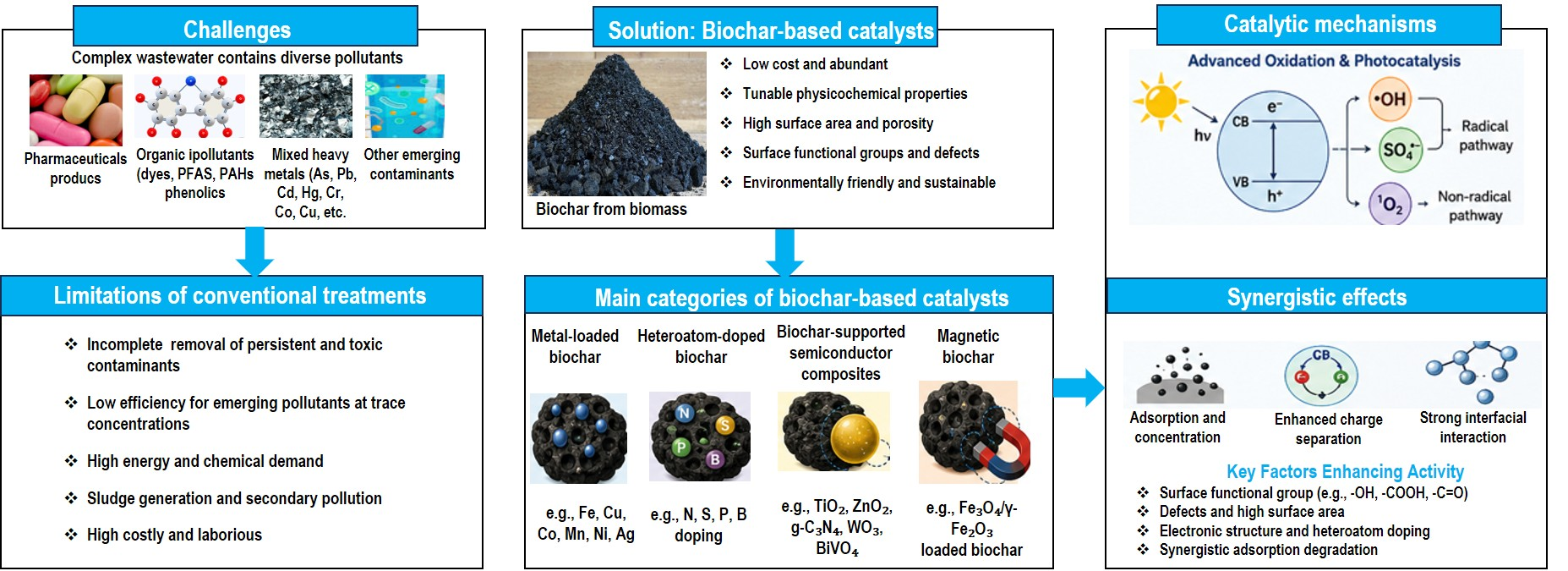
Biochar-Based Catalysts for Sustainable Wastewater Treatment: Advances, Mechanisms, and Future Perspectives
 ,
,  , , ,
, , ,  ,
,  and
and 
Abstract
1. Introduction
1.1. Advanced Catalytic Processes
1.2. Why Biochar?
1.2.1. Abundance, Low Cost, and Carbon Neutrality
1.2.2. Unique Physicochemical Properties
1.3. Research Gap
1.4. Objectives and Scope of the Review
2. Review Methodology
3. Biochar as a Catalytic Platform
3.1. Feedstocks and Production Methods
3.1.1. Biomass Feedstocks
3.1.2. Pyrolysis Conditions
3.2. Intrinsic Catalytic Activity
3.2.1. Electron Transfer Capability
3.2.2. Radical and Non-Radical Pathways
4. Engineering Biochar-Based Catalysts
4.1. Metal-Loaded Biochar Catalysts
4.2. Biochar-Supported Semiconductor Photocatalysts
4.2.1. Biochar–Semiconductor Composites (TiO2, ZnO, and g-C3N4)
4.2.2. Role of Biochar in Charge Separation
4.3. Heteroatom-Doped Biochar
4.4. Magnetic Biochar Composites
Recovery and Reuse Advantages
4.5. Hybrid and Multi-Component Systems
4.5.1. Synergistic Effects in Hybrid Systems
4.5.2. Coupled Catalytic Pathways
5. Mechanisms of Pollutant Degradation and Catalytic Activity
5.1. Radical Pathways
5.2. Non-Radical Pathways
5.2.1. Singlet Oxygen (1O2) Pathway
5.2.2. Electron Transfer Mechanisms
5.3. Role of Biochar Surface Chemistry
5.3.1. Defects and Active Sites
5.3.2. Structure–Activity Relationships
6. Applications in Wastewater Treatment
6.1. Organic Pollutants
6.1.1. Dyes
6.1.2. Pharmaceuticals
6.1.3. Pesticides
6.2. Emerging Contaminants (ECs)
6.3. Heavy Metals and Mixed Pollutants
6.4. Real Wastewater Systems
6.4.1. Industrial Effluents
6.4.2. Municipal Wastewater
6.4.3. Performance vs. Lab-Scale Systems
7. Performance Evaluation and Comparison
7.1. Key Performance Metrics
7.1.1. Removal Efficiency
7.1.2. Mineralization (TOC Reduction)
7.1.3. Reaction Kinetics
7.2. Comparison to Other Catalysts
7.2.1. Activated Carbon
7.2.2. Pure Semiconductor Photocatalysts
7.2.3. Metal-Based Catalysts
7.3. Stability and Reusability
7.3.1. Catalyst Deactivation
7.3.2. Leaching Issues
8. Sustainability and Environmental Considerations
8.1. Life Cycle Perspective
8.1.1. Feedstock Sustainability
8.1.2. Energy Consumption
8.2. Secondary Pollution Risks
8.3. Cost and Scalability
8.4. Comparative Critical Analysis
9. Challenges
10. Future Perspectives
10.1. Rational Catalyst Design
10.2. Integration with Treatment Systems
10.3. AI/Data-Driven Catalyst Optimization
10.4. From Lab to Field Applications
11. Conclusions
Author Contributions
Funding
Institutional Review Board Statement
Informed Consent Statement
Data Availability Statement
Acknowledgments
Conflicts of Interest
References
- Moon, S.R.; Rahman, M.M.; Rahman, A.; Khan, A.A.; Nazir, M.A.; Islam, M.A.; Abdulla-Al-Mamun, M. Water Resources and Environmental Sustainability: Current Challenges and Future Perspectives. Resources 2026, 15, 31. [Google Scholar] [CrossRef]
- Rahman, A. Integrated Approaches of Arsenic Remediation from Wastewater: A Comprehensive Review of Microbial, Bio-Based, and Advanced Technologies. Toxics 2025, 13, 768. [Google Scholar] [CrossRef]
- Rahman, A. Remediation of Heavy Metals (Arsenic, Cadmium, and Lead) from Wastewater Utilizing Cellulose from Pineapple Leaves. Processes 2026, 14, 159. [Google Scholar] [CrossRef]
- Rekik, H.; Arab, H.; Pichon, L.; El Khakani, M.A.; Drogui, P. Per-and Polyfluoroalkyl (PFAS) Eternal Pollutants: Sources, Environmental Impacts and Treatment Processes. Chemosphere 2024, 358, 142044. [Google Scholar] [CrossRef]
- Zhang, S.; Li, C.; Ke, C.; Liu, S.; Yao, Q.; Huang, W.; Dang, Z.; Guo, C. Extracellular Polymeric Substances Sustain Photoreduction of Cr(VI) by Shewanella Oneidensis-CdS Biohybrid System. Water Res. 2023, 243, 120339. [Google Scholar] [CrossRef]
- Mqambalala, A.; Maleke, M.; Osman, J.R.; Hernandez, J.C. Biodegradation of Emerging Contaminants Controlled by Biological and Chemical Factors. Microorganisms 2025, 13, 2354. [Google Scholar] [CrossRef]
- Rahman, A.; Yoshida, K.; Islam, M.M.; Kobayashi, G. Investigation of Efficient Adsorption of Toxic Heavy Metals (Chromium, Lead, Cadmium) from Aquatic Environment Using Orange Peel Cellulose as Adsorbent. Sustainability 2023, 15, 4470. [Google Scholar] [CrossRef]
- Rahman, A.; Haque, M.A.; Ghosh, S.; Shinu, P.; Attimarad, M.; Kobayashi, G. Modified Shrimp-Based Chitosan as an Emerging Adsorbent Removing Heavy Metals (Chromium, Nickel, Arsenic, and Cobalt) from Polluted Water. Sustainability 2023, 15, 2431. [Google Scholar] [CrossRef]
- Rahman, A. Promising and Environmentally Friendly Removal of Copper, Zinc, Cadmium, and Lead from Wastewater Using Modified Shrimp-Based Chitosan. Water 2024, 16, 184. [Google Scholar] [CrossRef]
- Mishra, R.K.; Mentha, S.S.; Misra, Y.; Dwivedi, N. Emerging Pollutants of Severe Environmental Concern in Water and Wastewater: A Comprehensive Review on Current Developments and Future Research. Water-Energy Nexus 2023, 6, 74–95. [Google Scholar] [CrossRef]
- Hussain, A.; Kumari, R.; Sachan, S.G.; Sachan, A. Biological Wastewater Treatment Technology: Advancement and Drawbacks. In Microbial Ecology of Wastewater Treatment Plants; Elsevier: Amsterdam, The Netherlands, 2021; pp. 175–192. [Google Scholar] [CrossRef]
- Khader, E.H.; Muslim, S.A.; Saady, N.M.C.; Ali, N.S.; Salih, I.K.; Mohammed, T.J.; Albayati, T.M.; Zendehboudi, S. Recent Advances in Photocatalytic Advanced Oxidation Processes for Organic Compound Degradation: A Review. Desalin. Water Treat. 2024, 318, 100384. [Google Scholar] [CrossRef]
- Leong, K.H.; Sim, L.C.; Dai, C.; Aziz, A.A.; Saravanan, P.; Ibrahim, S. Advancing Sustainable Water Treatment: The Role of Advanced Oxidation Processes in Emerging Contaminant Removal. In Advances in Treatment Methods Towards Emerging Contaminants Sources, Occurrences and Health Effects; Elsevier: Amsterdam, The Netherlands, 2026; pp. 259–274. [Google Scholar] [CrossRef]
- Kaswan, V.; Kaur, H. A Comparative Study of Advanced Oxidation Processes for Wastewater Treatment. Water Pr. Technol. 2023, 18, 1233–1254. [Google Scholar] [CrossRef]
- Satyam, S.; Patra, S. The Evolving Landscape of Advanced Oxidation Processes in Wastewater Treatment: Challenges and Recent Innovations. Processes 2025, 13, 987. [Google Scholar] [CrossRef]
- Kathi, S.; El Din Mahmoud, A. Trends in Effective Removal of Emerging Contaminants from Wastewater: A Comprehensive Review. Desalin. Water Treat. 2024, 317, 100258. [Google Scholar] [CrossRef]
- Bekele, T.; Alamnie, G. The Photocatalytic Degradation of Organic Pollutants-a Comprehensive Overview. Results Chem. 2025, 18, 102758. [Google Scholar] [CrossRef]
- Chen, K.; Dong, W.; Huang, Y.; Wang, F.; Zhou, J.L.; Li, W. Photocatalysis for Sustainable Energy and Environmental Protection in Construction: A Review on Surface Engineering and Emerging Synthesis. J. Environ. Chem. Eng. 2025, 13, 117529. [Google Scholar] [CrossRef]
- Trivedi, Y.; Sharma, M.; Mishra, R.K.; Sharma, A.; Joshi, J.; Gupta, A.B.; Achintya, B.; Shah, K.; Vuppaladadiyamd, A.K. Biochar Potential for Pollutant Removal during Wastewater Treatment: A Comprehensive Review of Separation Mechanisms, Technological Integration, and Process Analysis. Desalination 2025, 600, 118509. [Google Scholar] [CrossRef]
- Jagadeesh, N.; Sundaram, B. Adsorption of Pollutants from Wastewater by Biochar: A Review. J. Hazard. Mater. Adv. 2023, 9, 100226. [Google Scholar] [CrossRef]
- Afshar, M.; Mofatteh, S. Biochar for a Sustainable Future: Environmentally Friendly Production and Diverse Applications. Results Eng. 2024, 23, 102433. [Google Scholar] [CrossRef]
- Do Minh, T.; Song, J.; Deb, A.; Cha, L.; Srivastava, V.; Sillanpää, M. Biochar Based Catalysts for the Abatement of Emerging Pollutants: A Review. Chem. Eng. J. 2020, 394, 124856. [Google Scholar] [CrossRef]
- Tadesse, A.W.; Huang, M.; Zhou, T. Biochar for Wastewater Treatment: Preparation, Modification, Characterization, and Its Applications. Molecules 2025, 30, 4288. [Google Scholar] [CrossRef]
- Lee, S.C.; Kitamura, Y.; Chien, C.C.; Cheng, C.S.; Cheng, J.H.; Tsai, S.H.; Hsieh, C.C. Development of Meso- and Macro-Pore Carbonization Technology from Biochar in Treating the Stumps of Representative Trees in Taiwan. Sustainability 2022, 14, 14792. [Google Scholar] [CrossRef]
- Mondal, A.K.; Hinkley, C.; Krishnan, L.; Ravi, N.; Akter, F.; Ralph, P.; Kuzhiumparambil, U. Macroalgae-Based Biochar: Preparation and Characterization of Physicochemical Properties for Potential Applications. RSC Sustain. 2024, 2, 1828–1836. [Google Scholar] [CrossRef]
- Sarkar, D.; Panicker, T.F.; Kumar Mishra, R.; Srinivas Kini, M. A Comprehensive Review of Production and Characterization of Biochar for Removal of Organic Pollutants from Water and Wastewater. Water-Energy Nexus 2024, 7, 243–265. [Google Scholar] [CrossRef]
- Ghorbani, M.; Amirahmadi, E.; Cornelis, W.; Zoroufchi Benis, K. Understanding the Physicochemical Structure of Biochar Affected by Feedstock, Pyrolysis Conditions, and Post-Pyrolysis Modification Methods—A Meta-Analysis. J. Environ. Chem. Eng. 2024, 12, 114885. [Google Scholar] [CrossRef]
- Prabakar, P.; Mustafa Mert, K.; Muruganandam, L.; Sivagami, K. A Comprehensive Review on Biochar for Electrochemical Energy Storage Applications: An Emerging Sustainable Technology. Front. Energy Res. 2024, 12, 1448520. [Google Scholar] [CrossRef]
- Molnar Jazić, J.; Gross, A.; Glaser, B.; Agbaba, J.; Simetić, T.; Nikić, J.; Maletić, S. Boosting Advanced Oxidation Processes by Biochar-Based Catalysts to Mitigate Pesticides and Their Metabolites in Water Treatment: A Meta-Analysis. J. Environ. Chem. Eng. 2024, 12, 114260. [Google Scholar] [CrossRef]
- Qin, Z.; Yuan, Y.; Xu, M.; Wan, C.; Li, M.; Duan, Y.; Wu, C. The Multifunctional Applications and Mechanisms of Biochar in Wastewater Treatment: From Adsorption to Catalysis. J. Environ. Manag. 2026, 405, 129755. [Google Scholar] [CrossRef] [PubMed]
- Wang, Z.; Xiang, Q.; Zhang, D.; Xue, A.; Fang, Y.; Hu, S. Research Progress on Biochar-Based Photocatalytic Materials for Pollutant Treatment: Structural Regulation, Electronic Mechanisms, and Engineering Challenges. Ecotoxicol. Environ. Saf. 2026, 310, 119793. [Google Scholar] [CrossRef]
- Manickavasagam, G.; He, C.; Lin, K.Y.A.; Saaid, M.; Oh, W. Da Recent Advances in Catalyst Design, Performance, and Challenges of Metal-Heteroatom-Co-Doped Biochar as Peroxymonosulfate Activator for Environmental Remediation. Environ. Res. 2024, 252, 118919. [Google Scholar] [CrossRef]
- Sobczak, J.; Wysocka, I.; Murgrabia, S.; Rogala, A. A Review on Deactivation and Regeneration of Catalysts for Dimethyl Ether Synthesis. Energies 2022, 15, 5420. [Google Scholar] [CrossRef]
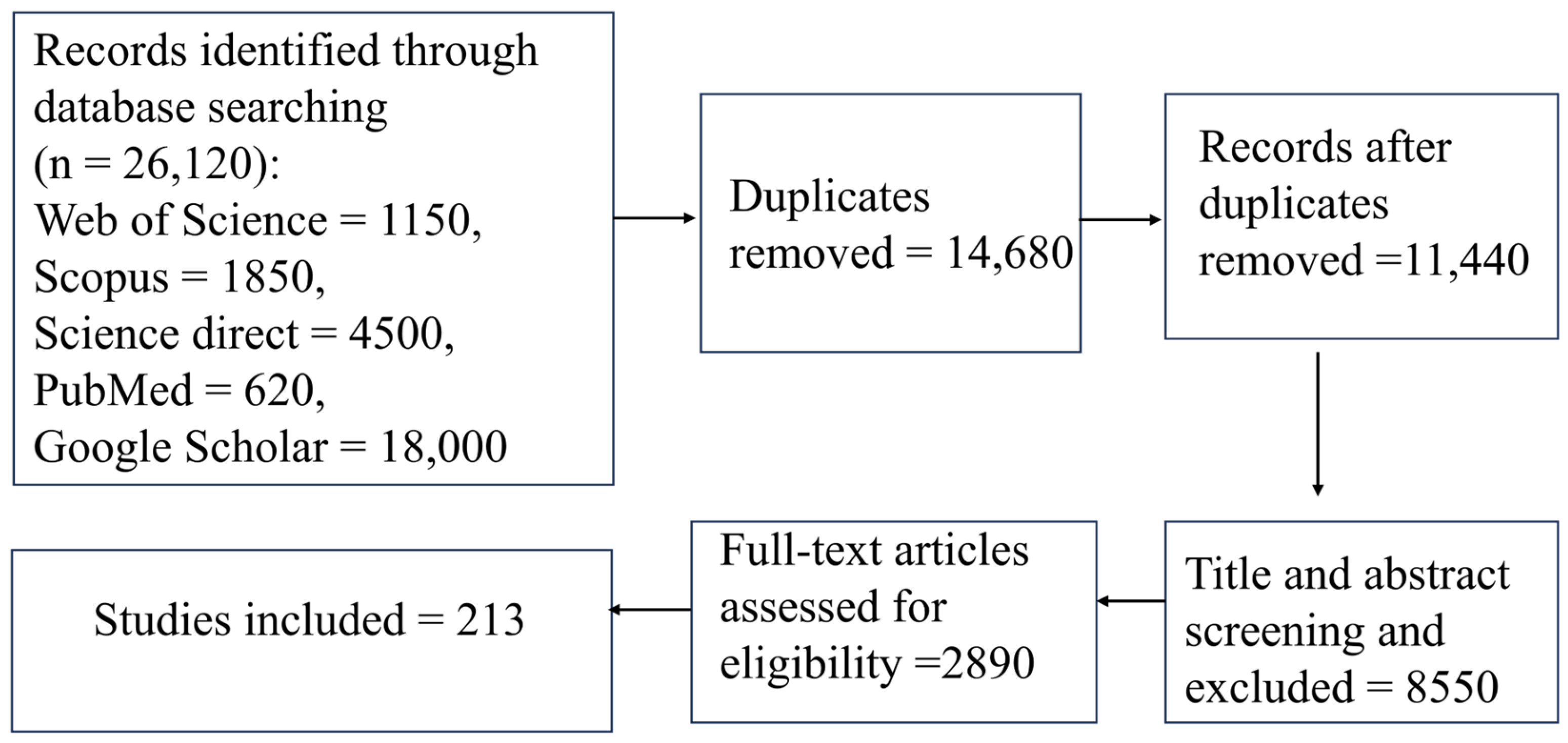
- Page, M.J.; McKenzie, J.E.; Bossuyt, P.M.; Boutron, I.; Hoffmann, T.C.; Mulrow, C.D.; Shamseer, L.; Tetzlaff, J.M.; Akl, E.A.; Brennan, S.E.; et al. The PRISMA 2020 Statement: An Updated Guideline for Reporting Systematic Reviews. Int. J. Surg. 2021, 88, 105906. [Google Scholar] [CrossRef] [PubMed]
- He, D.; Luo, Y.; Zhu, B. Feedstock and Pyrolysis Temperature Influence Biochar Properties and Its Interactions with Soil Substances: Insights from a DFT Calculation. Sci. Total Environ. 2024, 922, 171259. [Google Scholar] [CrossRef] [PubMed]
- Varkolu, M.; Gundekari, S.; Omvesh; Palla, V.C.S.; Kumar, P.; Bhattacharjee, S.; Vinodkumar, T. Recent Advances in Biochar Production, Characterization, and Environmental Applications. Catalysts 2025, 15, 243. [Google Scholar] [CrossRef]
- Amalina, F.; Razak, A.S.A.; Krishnan, S.; Sulaiman, H.; Zularisam, A.W.; Nasrullah, M. Biochar Production Techniques Utilizing Biomass Waste-Derived Materials and Environmental Applications—A Review. J. Hazard. Mater. Adv. 2022, 7, 100134. [Google Scholar] [CrossRef]
- Song, Q.; Wang, X.; Zhang, W.; Wang, X.; Qian, B.; Ye, Y. Comprehensive Insight into Co-Pyrolysis of Sewage Sludge and Tobacco Stalk: Effects of Mixing Ratio and Pyrolysis Conditions on Product Distribution and Characteristics. Environ. Res. 2023, 238, 117271. [Google Scholar] [CrossRef]
- Jamaluddin, N.S.; Hassan, H.; Ahmad, M.A.; Kasim, N.N.; Hameed, B.H.; Idris, S.S.; Zahidi, M.M. Synergistic Co-Pyrolysis of Spent Coffee Grounds and Polypropylene into Hydrocarbon-Rich Bio-Oil and Carbon-Rich Biochar. Next Energy 2026, 11, 100606. [Google Scholar] [CrossRef]
- Seah, C.C.; Tan, C.H.; Arifin, N.A.; Hafriz, R.S.R.M.; Salmiaton, A.; Nomanbhay, S.; Shamsuddin, A.H. Co-Pyrolysis of Biomass and Plastic: Circularity of Wastes and Comprehensive Review of Synergistic Mechanism. Results Eng. 2023, 17, 100989. [Google Scholar] [CrossRef]
- Ungureanu, N.; Vlăduț, N.V.; Biriș, S.Ș.; Gheorghiță, N.E.; Ionescu, M. Biomass Pyrolysis Pathways for Renewable Energy and Sustainable Resource Recovery: A Critical Review of Processes, Parameters, and Product Valorization. Sustainability 2025, 17, 7806. [Google Scholar] [CrossRef]
- Danesh, P.; Prussi, M.; Salimbeni, A.; Negro, V.; Chiaramonti, D. Review on Biochar Upgrading Methods for Its Application in Thermochemical Conversion Processes and Critical Materials Recovery. Sustainability 2025, 17, 10194. [Google Scholar] [CrossRef]
- Wang, L.; Ok, Y.S.; Tsang, D.C.W.; Alessi, D.S.; Rinklebe, J.; Wang, H.; Mašek, O.; Hou, R.; O’Connor, D.; Hou, D. New Trends in Biochar Pyrolysis and Modification Strategies: Feedstock, Pyrolysis Conditions, Sustainability Concerns and Implications for Soil Amendment. Soil Use Manag. 2020, 36, 358–386. [Google Scholar] [CrossRef]
- Luo, Q.; Deng, Y.; Li, Y.; He, Q.; Wu, H.; Fang, X. Effects of Pyrolysis Temperatures on the Structural Properties of Straw Biochar and Its Adsorption of Tris-(1-Chloro-2-Propyl) Phosphate. Sci. Rep. 2024, 14, 25711. [Google Scholar] [CrossRef]
- Wood, R.; Mašek, O.; Erastova, V. Developing a Molecular-Level Understanding of Biochar Materials Using Public Characterization Data. Cell Rep. Phys. Sci. 2024, 5, 102036. [Google Scholar] [CrossRef]
- Curcio, I.; Gigli, R.; Mormile, F.; Mormile, C. A Comprehensive Review on Biochar, with a Particular Focus on Nano Properties and Applications. Nano Trends 2025, 10, 100117. [Google Scholar] [CrossRef]
- Zhang, Y.; Xu, X.; Cao, L.; Ok, Y.S.; Cao, X. Characterization and Quantification of Electron Donating Capacity and Its Structure Dependence in Biochar Derived from Three Waste Biomasses. Chemosphere 2018, 211, 1073–1081. [Google Scholar] [CrossRef]
- Liu, X.; Chen, Z.; Lu, S.; Shi, X.; Qu, F.; Cheng, D.; Wei, W.; Shon, H.K.; Ni, B.J. Persistent Free Radicals on Biochar for Its Catalytic Capability: A Review. Water Res. 2024, 250, 120999. [Google Scholar] [CrossRef]
- Lourenco, M.A.O.; Zeng, J.; Jagdale, P.; Castellino, M.; Sacco, A.; Farkhondehfal, M.A.; Pirri, C.F. Biochar/Zinc Oxide Composites as Effective Catalysts for Electrochemical CO2 Reduction. ACS Sustain. Chem. Eng. 2021, 9, 5445–5453. [Google Scholar] [CrossRef]
- Hama Aziz, K.H.; Mustafa, F.S.; Karim, M.A.H.; Hama, S. Biochar-Based Catalysts: An Efficient and Sustainable Approach for Water Remediation from Organic Pollutants via Advanced Oxidation Processes. J. Environ. Manag. 2025, 390, 126245. [Google Scholar] [CrossRef]
- Zheng, X.; Niu, X.; Zhang, D.; Lv, M.; Ye, X.; Ma, J.; Lin, Z.; Fu, M. Metal-Based Catalysts for Persulfate and Peroxymonosulfate Activation in Heterogeneous Ways: A Review. Chem. Eng. J. 2022, 429, 132323. [Google Scholar] [CrossRef]
- Jellali, S.; Hadroug, S.; Al-Wardy, M.; Al-Nadabi, H.; Nassr, N.; Jeguirim, M. Recent Developments in Metallic-Nanoparticles-Loaded Biochars Synthesis and Use for Phosphorus Recovery from Aqueous Solutions. A Critical Review. J. Environ. Manag. 2023, 342, 118307. [Google Scholar] [CrossRef]
- Lu, J.; Lu, Q.; Di, L.; Zhou, Y.; Zhou, Y. Iron-Based Biochar as Efficient Persulfate Activation Catalyst for Emerging Pollutants Removal: A Review. Chin. Chem. Lett. 2023, 34, 108357. [Google Scholar] [CrossRef]
- Wang, J.; Cai, J.; Zhou, X.; Wang, S.; Luo, F.; Yang, L.; Yu, J.; Chi, R.; Chen, Z. Accelerating of Fe2+ Regeneration in Fenton Reaction by Biochar: Pivotal Roles of Carbon Defects as Electron Donor and Shuttle. Sep. Purif. Technol. 2025, 354, 128945. [Google Scholar] [CrossRef]
- Han, M.; Liu, Z.; Huang, S.; Zhang, H.; Yang, H.; Liu, Y.; Zhang, K.; Zeng, Y. Application of Biochar-Based Materials for Effective Pollutant Removal in Wastewater Treatment. Nanomaterials 2024, 14, 1933. [Google Scholar] [CrossRef]
- Zhang, Y.; Xu, M.; Liang, S.; Feng, Z.; Zhao, J. Mechanism of Persulfate Activation by Biochar for the Catalytic Degradation of Antibiotics: Synergistic Effects of Environmentally Persistent Free Radicals and the Defective Structure of Biochar. Sci. Total Environ. 2021, 794, 148707. [Google Scholar] [CrossRef]
- Yang, S.; Zhang, S.; Xu, Q.; Liu, J.; Zhong, C.; Xie, Z.; Zhao, Y. Efficient Activation of Persulfate by Nickel-Supported Cherry Core Biochar Composite for Removal of Bisphenol A. J. Environ. Manag. 2022, 324, 116305. [Google Scholar] [CrossRef]
- Ouyang, D.; Chen, Y.; Yan, J.; Qian, L.; Han, L.; Chen, M. Activation Mechanism of Peroxymonosulfate by Biochar for Catalytic Degradation of 1,4-Dioxane: Important Role of Biochar Defect Structures. Chem. Eng. J. 2019, 370, 614–624. [Google Scholar] [CrossRef]
- Kou, L.; Wang, J.; Zhao, L.; Jiang, K.; Xu, X. Coupling of KMnO4-Assisted Sludge Dewatering and Pyrolysis to Prepare Mn,Fe-Codoped Biochar Catalysts for Peroxymonosulfate-Induced Elimination of Phenolic Pollutants. Chem. Eng. J. 2021, 411, 128459. [Google Scholar] [CrossRef]
- Zou, J.; Yu, J.; Tang, L.; Ren, X.; Pang, Y.; Zhang, H.; Xie, Q.; Liu, Y.; Liu, H.; Luo, T. Analysis of Reaction Pathways and Catalytic Sites on Metal-Free Porous Biochar for Persulfate Activation Process. Chemosphere 2020, 261, 127747. [Google Scholar] [CrossRef]
- Xu, S.; Wen, L.; Yu, C.; Li, S.; Tang, J. Activation of Peroxymonosulfate by MnFe2O4@BC Composite for Bisphenol A Degradation: The Coexisting of Free-Radical and Non-Radical Pathways. Chem. Eng. J. 2022, 442, 136250. [Google Scholar] [CrossRef]
- Li, J.; Liu, Y.; Ren, X.; Dong, W.; Chen, H.; Cai, T.; Zeng, W.; Li, W.; Tang, L. Soybean Residue Based Biochar Prepared by Ball Milling Assisted Alkali Activation to Activate Peroxydisulfate for the Degradation of Tetracycline. J. Colloid Interface Sci. 2021, 599, 631–641. [Google Scholar] [CrossRef]
- Sun, Z.; Li, J.; Wang, X.; Zhang, Y.; Xia, S. MgFe2O4/MgO Modified Biochar with Oxygen Vacancy and Surface Hydroxyl Groups for Enhanced Peroxymonosulfate Activation to Remove Sulfamethoxazole through Singlet Oxygen-Dominated Nonradical Oxidation Process. Chem. Eng. J. 2023, 477, 146960. [Google Scholar] [CrossRef]
- Li, M.; Li, D.; Li, S.; Liu, J.; Deng, H.; Xia, D. Novel Sludge-Sugarcane Bagasse Mixed Biochar as an Efficient Activator for Peroxymonosulfate to Degrade Bisphenol AF. Chem. Eng. J. 2023, 462, 142114. [Google Scholar] [CrossRef]
- Liu, Z.; Shi, X.; Yan, Z.; Sun, Z. Activation of Peroxymonosulfate by Biochar In-Situ Enriched with Cobalt Tungstate and Cobalt: Insights into the Role of Rich Oxygen Vacancies and Catalytic Mechanism. Chem. Eng. J. 2023, 475, 146124. [Google Scholar] [CrossRef]
- Wang, J.; Shen, M.; Wang, H.; Du, Y.; Zhou, X.; Liao, Z.; Wang, H.; Chen, Z. Red Mud Modified Sludge Biochar for the Activation of Peroxymonosulfate: Singlet Oxygen Dominated Mechanism and Toxicity Prediction. Sci. Total Environ. 2020, 740, 140388. [Google Scholar] [CrossRef]
- Li, S.; Liu, Y.; Zheng, H.; Niu, J.; Leong, Y.K.; Lee, D.J.; Chang, J.S. Biochar Loaded with CoFe2O4 Enhances the Formation of High-Valent Fe(IV) and Co(IV) and Oxygen Vacancy in the Peracetic Acid Activation System for Enhanced Antibiotic Degradation. Bioresour. Technol. 2023, 387, 129536. [Google Scholar] [CrossRef]
- Hu, Y.; Chen, D.; Zhang, R.; Ding, Y.; Ren, Z.; Fu, M.; Cao, X.; Zeng, G. Singlet Oxygen-Dominated Activation of Peroxymonosulfate by Passion Fruit Shell Derived Biochar for Catalytic Degradation of Tetracycline through a Non-Radical Oxidation Pathway. J. Hazard. Mater. 2021, 419, 126495. [Google Scholar] [CrossRef]
- He, J.; Tang, J.; Zhang, Z.; Wang, L.; Liu, Q.; Liu, X. Magnetic Ball-Milled FeS@biochar as Persulfate Activator for Degradation of Tetracycline. Chem. Eng. J. 2021, 404, 126997. [Google Scholar] [CrossRef]
- Liu, X.; Zhou, J.; Liu, D. Plasma Regulates Active Sites on Biochar to Boost Peroxomonosulfate Activation for Phenol Degradation. J. Environ. Chem. Eng. 2022, 10, 107833. [Google Scholar] [CrossRef]
- Song, J.; Zhao, C.; Cao, X.Q.; Cheng, W. Enhanced Catalytic Degradation of Antibiotics by Peanut Shell-Derived Biochar-Co3O4 Activated Peroxymonosulfate: An Experimental and Mechanistic Study. Process Saf. Environ. Prot. 2023, 171, 423–436. [Google Scholar] [CrossRef]
- Huang, H.; Guo, T.; Wang, K.; Li, Y.; Zhang, G. Efficient Activation of Persulfate by a Magnetic Recyclable Rape Straw Biochar Catalyst for the Degradation of Tetracycline Hydrochloride in Water. Sci. Total Environ. 2021, 758, 143957. [Google Scholar] [CrossRef]
- Li, W.; Liu, B.; Wang, Z.; Wang, K.; Lan, Y.; Zhou, L. Efficient Activation of Peroxydisulfate (PDS) by Rice Straw Biochar Modified by Copper Oxide (RSBC-CuO) for the Degradation of Phenacetin (PNT). Chem. Eng. J. 2020, 395, 125094. [Google Scholar] [CrossRef]
- Ye, S.; Zeng, G.; Tan, X.; Wu, H.; Liang, J.; Song, B.; Tang, N.; Zhang, P.; Yang, Y.; Chen, Q.; et al. Nitrogen-Doped Biochar Fiber with Graphitization from Boehmeria Nivea for Promoted Peroxymonosulfate Activation and Non-Radical Degradation Pathways with Enhancing Electron Transfer. Appl. Catal. B Environ. 2020, 269, 118850. [Google Scholar] [CrossRef]
- Qin, Y.; Li, X.; Wang, L.; Luo, J.; Li, Y.; Yao, C.; Xiao, Z.; Zhai, S.; An, Q. Valuable Cobalt/Biochar with Enriched Surface Oxygen-Containing Groups Prepared from Bio-Waste Shrimp Shell for Efficient Peroxymonosulfate Activation. Sep. Purif. Technol. 2022, 281, 119901. [Google Scholar] [CrossRef]
- Zhong, J.; Feng, Y.; Yang, B.; Xiong, Q.; Ying, G.G. Accelerated Degradation of Sulfadiazine by Nitrogen-Doped Magnetic Biochar-Activated Persulfate: Role of Oxygen Vacancy. Sep. Purif. Technol. 2022, 289, 120735. [Google Scholar] [CrossRef]
- Luo, J.; Bo, S.; Qin, Y.; An, Q.; Xiao, Z.; Zhai, S. Transforming Goat Manure into Surface-Loaded Cobalt/Biochar as PMS Activator for Highly Efficient Ciprofloxacin Degradation. Chem. Eng. J. 2020, 395, 125063. [Google Scholar] [CrossRef]
- Liang, Y.; Tao, R.; Zhao, B.; Meng, Z.; Cheng, Y.; Yang, F.; Lei, H.; Kong, L. Roles of Iron and Manganese in Bimetallic Biochar Composites for Efficient Persulfate Activation and Atrazine Removal. Biochar 2024, 6, 41. [Google Scholar] [CrossRef]
- Shi, Q.; Yang, R.; Liu, M.; Feng, Y.; Li, Z.; Zhu, W. A Highly-Efficient Peroxymonosulfate Activator Using a Sewage Sludge Derived Biochar Supported Cobalt Oxide: Mechanism and Characteristics. Process Saf. Environ. Prot. 2024, 192, 1319–1329. [Google Scholar] [CrossRef]
- Xiong, Q.; Shi, Q.; Sanwal, P.; Sheng, X.; Li, G. Biochar-Supported Co(OH)2 Nanosheets Activated Persulfate: Enhanced Removal of Ciprofloxacin and Membrane Purification. Sustain. Mater. Technol. 2024, 42, e01189. [Google Scholar] [CrossRef]
- Wang, B.; Shu, D.; Zhang, X.; An, F.; Zhang, G. Degradation of Dye Wastewater by Peroxymonosulfate Activated with CuO-Modified Loofah Biochar. Pigment Resin Technol. 2025, 55, 154–163. [Google Scholar] [CrossRef]
- Acharya, R.; Parida, K. A Review on TiO2/g-C3N4 Visible-Light- Responsive Photocatalysts for Sustainable Energy Generation and Environmental Remediation. J. Environ. Chem. Eng. 2020, 8, 103896. [Google Scholar] [CrossRef]
- Urper, O.; Jothinarayanan, N.; Sæbø, M.; Joseph, S.; Wang, K. Photocatalytic and Antibacterial Characteristics of Biochar-Supported ZnO and TiO2 Nanocomposites. Clean. Waste Syst. 2026, 13, 100481. [Google Scholar] [CrossRef]
- Bineta, I.; Kirmani, O. A Review of G-C3N4-Based Photocatalysts for Antibiotic Elimination: Mechanistic Insights and Operational Parameters. Chin. J. Anal. Chem. 2026, 54, 100626. [Google Scholar] [CrossRef]
- Ma, R.; Sun, Y.; Zhang, H.; Zhu, J.; Tian, H.; Guo, X.; Wang, R.; Cui, X.; Hou, X.; An, S. Intense Interaction between Biochar/g-C3N4 Promotes the Photocatalytic Performance of Heterojunction Catalysts. RSC Adv. 2024, 14, 19707–19717. [Google Scholar] [CrossRef]
- Gholami, P.; Khataee, A.; Soltani, R.D.C.; Dinpazhoh, L.; Bhatnagar, A. Photocatalytic Degradation of Gemifloxacin Antibiotic Using Zn-Co-LDH@biochar Nanocomposite. J. Hazard. Mater. 2020, 382, 121070. [Google Scholar] [CrossRef]
- Feng, X.; Li, X.; Su, B.; Ma, J. Solid-Phase Fabrication of TiO2/Chitosan-Biochar Composites with Superior UV–Vis Light Driven Photocatalytic Degradation Performance. Colloids Surf. A Physicochem. Eng. Asp. 2022, 648, 129114. [Google Scholar] [CrossRef]
- Ye, S.; Yan, M.; Tan, X.; Liang, J.; Zeng, G.; Wu, H.; Song, B.; Zhou, C.; Yang, Y.; Wang, H. Facile Assembled Biochar-Based Nanocomposite with Improved Graphitization for Efficient Photocatalytic Activity Driven by Visible Light. Appl. Catal. B Environ. 2019, 250, 78–88. [Google Scholar] [CrossRef]
- Lu, L.; Shan, R.; Shi, Y.; Wang, S.; Yuan, H. A Novel TiO2/Biochar Composite Catalysts for Photocatalytic Degradation of Methyl Orange. Chemosphere 2019, 222, 391–398. [Google Scholar] [CrossRef]
- Yang, Q.; Li, X.; Tian, Q.; Pan, A.; Liu, X.; Yin, H.; Shi, Y.; Fang, G. Synergistic Effect of Adsorption and Photocatalysis of BiOBr/Lignin-Biochar Composites with Oxygen Vacancies under Visible Light Irradiation. J. Ind. Eng. Chem. 2023, 117, 117–129. [Google Scholar] [CrossRef]
- Xiong, Z.; Chen, H.; Lu, L.; Shan, R.; Zhang, Y.; Yuan, H.; Chen, Y. Nitrogen-Doped TiO2/Nitrogen-Containing Biochar Composite Catalyst as a Photocatalytic Material for the Decontamination of Aqueous Organic Pollutants. ACS Omega 2023, 8, 791–803. [Google Scholar] [CrossRef]
- Luo, Y.; Zheng, A.; Li, J.; Han, Y.; Xue, M.; Zhang, L.; Yin, Z.; Xie, C.; Chen, Z.; Ji, L.; et al. Integrated Adsorption and Photodegradation of Tetracycline by Bismuth Oxycarbonate/Biochar Nanocomposites. Chem. Eng. J. 2023, 457, 141228. [Google Scholar] [CrossRef]
- Xiao, Y.; Lyu, H.; Yang, C.; Zhao, B.; Wang, L.; Tang, J. Graphitic Carbon Nitride/Biochar Composite Synthesized by a Facile Ball-Milling Method for the Adsorption and Photocatalytic Degradation of Enrofloxacin. J. Environ. Sci. 2021, 103, 93–107. [Google Scholar] [CrossRef]
- Gadore, V.; Mishra, S.R.; Ahmaruzzaman, M. Bio-Inspired Sustainable Synthesis of Novel SnS2/Biochar Nanocomposite for Adsorption Coupled Photodegradation of Amoxicillin and Congo Red: Effects of Reaction Parameters, and Water Matrices. J. Environ. Manag. 2023, 334, 117496. [Google Scholar] [CrossRef]
- Xiao, L.; Zhang, S.; Chen, B.; Wu, P.; Feng, N.; Deng, F.; Wang, Z. Visible-Light Photocatalysis Degradation of Enrofloxacin by Crawfish Shell Biochar Combined with g-C3N4: Effects and Mechanisms. J. Environ. Chem. Eng. 2023, 11, 109693. [Google Scholar] [CrossRef]
- Tang, R.; Gong, D.; Deng, Y.; Xiong, S.; Zheng, J.; Li, L.; Zhou, Z.; Su, L.; Zhao, J. π-π Stacking Derived from Graphene-like Biochar/g-C3N4 with Tunable Band Structure for Photocatalytic Antibiotics Degradation via Peroxymonosulfate Activation. J. Hazard. Mater. 2022, 423, 126944. [Google Scholar] [CrossRef]
- He, L.; Lv, L.; Pillai, S.C.; Wang, H.; Xue, J.; Ma, Y.; Liu, Y.; Chen, Y.; Wu, L.; Zhang, Z.; et al. Efficient Degradation of Diclofenac Sodium by Periodate Activation Using Fe/Cu Bimetallic Modified Sewage Sludge Biochar/UV System. Sci. Total Environ. 2021, 783, 146974. [Google Scholar] [CrossRef]
- Xu, H.; Zhang, T.; Wang, D.; Cai, D.; Chen, S.; Wang, H.; Shu, S.; Zhu, Y. Degradation of Tetracycline Using Persulfate Activated by a Honeycomb Structured S-Doped g-C3N4/Biochar under Visible Light. Sep. Purif. Technol. 2022, 300, 121833. [Google Scholar] [CrossRef]
- Li, F.; Lin, M. Synthesis of Biochar-Supported K-Doped G-C3 N4 Photocatalyst for Enhancing the Polycyclic Aromatic Hydrocarbon Degradation Activity. Int. J. Environ. Res. Public Health 2020, 17, 2065. [Google Scholar] [CrossRef]
- Alharbi, F.F.; Hamdalla, T.A.; Al-Ghamdi, H.; Albarzan, B.; Darwish, A.A. Biochar-Modified TiO2 Composites: Enhanced Optical and Photocatalytic Properties for Sustainable Energy and Environmental Applications. Catalysts 2025, 15, 1065. [Google Scholar] [CrossRef]
- Lu, Y.; Zhuang, Z.; Li, L.; Chen, F.F.; Wei, P.; Yu, Y. Advancements and Challenges in G-C3N4/ZnIn2S4 Heterojunction Photocatalysts. J. Mater. Chem. A 2025, 13, 4718–4745. [Google Scholar] [CrossRef]
- Guo, X.; Zhou, T.; Wang, G.; Liu, K.; Zhang, Y.; Wang, C.; Wu, J.; Liu, B.; Gao, H.; Hu, X.; et al. Synergistic Enhancement of Biochar in TiO2/g-C3N4 Z-Scheme Heterojunction Photocatalysts: Mechanistic Insights into the Degradation Pathways of Sulfonamide Antibiotics. Biochar 2026, 8, 36. [Google Scholar] [CrossRef]
- El Gaini, L. Enhancing Solar-Driven Photocatalysis: Synergistic Integration of Biochar, Semiconductors, and Magnetic Materials for Degrading Organic Pollutants. Desalin. Water Treat. 2024, 320, 100798. [Google Scholar] [CrossRef]
- Tang, D.; Lu, L.; Luo, Z.; Yang, B.; Ke, J.; Lei, W.; Zhen, H.; Zhuang, Y.; Sun, J.; Chen, K.; et al. Heteroatom-Doped Hierarchically Porous Biochar for Supercapacitor Application and Phenol Pollutant Remediation. Nanomaterials 2022, 12, 2586. [Google Scholar] [CrossRef]
- El Ouadrhiri, F.; Althomali, R.H.; Adachi, A.; Abdu Musad Saleh, E.; Husain, K.; Lhassani, A.; Hassan, I.; Mostafa Moharam, M.; Kassem, A.F.; Chaouch, M.; et al. Nitrogen and Phosphorus Co-Doped Carbocatalyst for Efficient Organic Pollutant Removal through Persulfate-Based Advanced Oxidation Processes. J. Saudi Chem. Soc. 2023, 27, 101648. [Google Scholar] [CrossRef]
- Ruan, G.; Yang, Y.; Peng, X.; Wang, J.; Guo, Y.; Hu, W.; Lin, D. A Review of the Current Status of Nitrogen Self-Doped Biochar Applications. J. Environ. Chem. Eng. 2025, 13, 115291. [Google Scholar] [CrossRef]
- Gao, Y.; Gao, W.; Zhu, H.; Chen, H.; Yan, S.; Zhao, M.; Sun, H.; Zhang, J.; Zhang, S. A Review on N-Doped Biochar for Oxidative Degradation of Organic Contaminants in Wastewater by Persulfate Activation. Int. J. Environ. Res. Public Health 2022, 19, 14805. [Google Scholar] [CrossRef] [PubMed]
- Tan, X.; Wang, H.; Guo, X.; Ho, S.H. Effects of Nitrogen Doped-Biochar on Wastewater Remediation. Environ. Technol. Innov. 2023, 32, 103413. [Google Scholar] [CrossRef]
- Zhong, Q.; Lin, Q.; He, W.; Fu, H.; Huang, Z.; Wang, Y.; Wu, L. Study on the Nonradical Pathways of Nitrogen-Doped Biochar Activating Persulfate for Tetracycline Degradation. Sep. Purif. Technol. 2021, 276, 119354. [Google Scholar] [CrossRef]
- Wang, H.; Guo, W.; Liu, B.; Wu, Q.; Luo, H.; Zhao, Q.; Si, Q.; Sseguya, F.; Ren, N. Edge-Nitrogenated Biochar for Efficient Peroxydisulfate Activation: An Electron Transfer Mechanism. Water Res. 2019, 160, 405–414. [Google Scholar] [CrossRef] [PubMed]
- Han, R.; Fang, Y.; Sun, P.; Xie, K.; Zhai, Z.; Liu, H.; Liu, H. N-Doped Biochar as a New Metal-Free Activator of Peroxymonosulfate for Singlet Oxygen-Dominated Catalytic Degradation of Acid Orange 7. Nanomaterials 2021, 11, 2288. [Google Scholar] [CrossRef]
- Xie, Y.; Hu, W.; Wang, X.; Tong, W.; Li, P.; Zhou, H.; Wang, Y.; Zhang, Y. Molten Salt Induced Nitrogen-Doped Biochar Nanosheets as Highly Efficient Peroxymonosulfate Catalyst for Organic Pollutant Degradation. Environ. Pollut. 2020, 260, 114053. [Google Scholar] [CrossRef]
- Xu, L.; Wu, C.; Liu, P.; Bai, X.; Du, X.; Jin, P.; Yang, L.; Jin, X.; Shi, X.; Wang, Y. Peroxymonosulfate Activation by Nitrogen-Doped Biochar from Sawdust for the Efficient Degradation of Organic Pollutants. Chem. Eng. J. 2020, 387, 124065. [Google Scholar] [CrossRef]
- Pei, X.; Peng, X.; Jia, X.; Wong, P.K. N-Doped Biochar from Sewage Sludge for Catalytic Peroxydisulfate Activation toward Sulfadiazine: Efficiency, Mechanism, and Stability. J. Hazard. Mater. 2021, 419, 126446. [Google Scholar] [CrossRef]
- Feng, Z.; Zhou, B.; Yuan, R.; Li, H.; He, P.; Wang, F.; Chen, Z.; Chen, H. Biochar Derived from Different Crop Straws as Persulfate Activator for the Degradation of Sulfadiazine: Influence of Biomass Types and Systemic Cause Analysis. Chem. Eng. J. 2022, 440, 135669. [Google Scholar] [CrossRef]
- Hu, W.; Xie, Y.; Lu, S.; Li, P.; Xie, T.; Zhang, Y.; Wang, Y. One-Step Synthesis of Nitrogen-Doped Sludge Carbon as a Bifunctional Material for the Adsorption and Catalytic Oxidation of Organic Pollutants. Sci. Total Environ. 2019, 680, 51–60. [Google Scholar] [CrossRef]
- Zaeni, J.R.J.; Lim, J.W.; Wang, Z.; Ding, D.; Chua, Y.S.; Ng, S.L.; Oh, W. Da In Situ Nitrogen Functionalization of Biochar via One-Pot Synthesis for Catalytic Peroxymonosulfate Activation: Characteristics and Performance Studies. Sep. Purif. Technol. 2020, 241, 116702. [Google Scholar] [CrossRef]
- Qu, S.; Yuan, Y.; Yang, X.; Xu, H.; Mohamed, A.K.; Zhang, J.; Zhao, C.; Liu, L.; Wang, B.; Wang, X.; et al. Carbon Defects in Biochar Facilitated Nitrogen Doping: The Significant Role of Pyridinic Nitrogen in Peroxymonosulfate Activation and Ciprofloxacin Degradation. Chem. Eng. J. 2022, 441, 135864. [Google Scholar] [CrossRef]
- Huo, J.; Pang, X.; Wei, X.; Sun, X.; Liu, H.; Sheng, P.; Zhu, M.; Yang, X. Efficient Degradation of Printing and Dyeing Wastewater by Lotus Leaf-Based Nitrogen Self-Doped Mesoporous Biochar Activated Persulfate: Synergistic Mechanism of Adsorption and Catalysis. Catalysts 2022, 12, 1004. [Google Scholar] [CrossRef]
- Rahim, H.U.; Allevato, E.; Stazi, S.R. Sulfur-Functionalized Biochar: Synthesis, Characterization, and Utilization for Contaminated Soil and Water Remediation-a Review. J. Environ. Manag. 2024, 370, 122670. [Google Scholar] [CrossRef] [PubMed]
- Zhao, J.; Jiang, Y.; Chen, X.; Wang, C.; Nan, H. Unlocking the Potential of Element-Doped Biochar: From Tailored Synthesis to Multifunctional Applications in Environment and Energy. Biochar 2025, 7, 77. [Google Scholar] [CrossRef]
- Yin, R.; Guo, W.; Wang, H.; Du, J.; Wu, Q.; Chang, J.S.; Ren, N. Singlet Oxygen-Dominated Peroxydisulfate Activation by Sludge-Derived Biochar for Sulfamethoxazole Degradation through a Nonradical Oxidation Pathway: Performance and Mechanism. Chem. Eng. J. 2019, 357, 589–599. [Google Scholar] [CrossRef]
- Liu, C.; Chen, L.; Ding, D.; Cai, T. From Rice Straw to Magnetically Recoverable Nitrogen Doped Biochar: Efficient Activation of Peroxymonosulfate for the Degradation of Metolachlor. Appl. Catal. B Environ. 2019, 254, 312–320. [Google Scholar] [CrossRef]
- Fu, S.; Zhang, Y.; Xu, X.; Dai, X.; Zhu, L. Peroxymonosulfate Activation by Iron Self-Doped Sludge-Derived Biochar for Degradation of Perfluorooctanoic Acid: A Singlet Oxygen-Dominated Nonradical Pathway. Chem. Eng. J. 2022, 450, 137953. [Google Scholar] [CrossRef]
- Xi, M.; Cui, K.; Cui, M.; Ding, Y.; Guo, Z.; Chen, Y.; Li, C.; Li, X. Enhanced Norfloxacin Degradation by Iron and Nitrogen Co-Doped Biochar: Revealing the Radical and Nonradical Co-Dominant Mechanism of Persulfate Activation. Chem. Eng. J. 2021, 420, 129902. [Google Scholar] [CrossRef]
- Xing, B.; Dong, J.; Yang, G.; Jiang, N.; Liu, X.; Yuan, J. An Insight into N,S-Codoped Activated Carbon for the Catalytic Persulfate Oxidation of Organic Pollutions in Water: Effect of Surface Functionalization. Appl. Catal. A Gen. 2020, 602, 117714. [Google Scholar] [CrossRef]
- Xiao, K.; Liang, F.; Liang, J.; Xu, W.; Liu, Z.; Chen, B.; Jiang, X.; Wu, X.; Xu, J.; Beiyuan, J.; et al. Magnetic Bimetallic Fe, Ce-Embedded N-Enriched Porous Biochar for Peroxymonosulfate Activation in Metronidazole Degradation: Applications, Mechanism Insight and Toxicity Evaluation. Chem. Eng. J. 2022, 433, 134387. [Google Scholar] [CrossRef]
- Luo, J.; Yi, Y.; Ying, G.; Fang, Z.; Zhang, Y. Activation of Persulfate for Highly Efficient Degradation of Metronidazole Using Fe(II)-Rich Potassium Doped Magnetic Biochar. Sci. Total Environ. 2022, 819, 152089. [Google Scholar] [CrossRef]
- Zhang, Z.; Wang, Y.; Sun, K.; Shao, Y.; Zhang, L.; Zhang, S.; Zhang, X.; Liu, Q.; Chen, Z.; Hu, X. Steam Reforming of Acetic Acid over Ni–Ba/Al2O3 Catalysts: Impacts of Barium Addition on Coking Behaviors and Formation of Reaction Intermediates. J. Energy Chem. 2020, 43, 208–219. [Google Scholar] [CrossRef]
- Li, X.; Jia, Y.; Zhou, M.; Su, X.; Sun, J. High-Efficiency Degradation of Organic Pollutants with Fe, N Co-Doped Biochar Catalysts via Persulfate Activation. J. Hazard. Mater. 2020, 397, 122764. [Google Scholar] [CrossRef] [PubMed]
- Liu, T.; Wang, Q.; Li, C.; Cui, M.; Chen, Y.; Liu, R.; Cui, K.; Wu, K.; Nie, X.; Wang, S. Synthesizing and Characterizing Fe3O4 Embedded in N-Doped Carbon Nanotubes-Bridged Biochar as a Persulfate Activator for Sulfamethoxazole Degradation. J. Clean. Prod. 2022, 353, 131669. [Google Scholar] [CrossRef]
- Sun, W.; Pang, K.; Ye, F.; Pu, M.; Zhou, C.; Huang, H.; Zhang, Q.; Niu, J. Carbonization of Camphor Sulfonic Acid and Melamine to N,S-Co-Doped Carbon for Sulfamethoxazole Degradation via Persulfate Activation: Nonradical Dominant Pathway. Sep. Purif. Technol. 2021, 279, 119723. [Google Scholar] [CrossRef]
- Yu, J.; Tang, L.; Pang, Y.; Zeng, G.; Wang, J.; Deng, Y.; Liu, Y.; Feng, H.; Chen, S.; Ren, X. Magnetic Nitrogen-Doped Sludge-Derived Biochar Catalysts for Persulfate Activation: Internal Electron Transfer Mechanism. Chem. Eng. J. 2019, 364, 146–159. [Google Scholar] [CrossRef]
- Zhang, Y.; Xu, M.; He, R.; Zhao, J.; Kang, W.; Lv, J. Effect of Pyrolysis Temperature on the Activated Permonosulfate Degradation of Antibiotics in Nitrogen and Sulfur-Doping Biochar: Key Role of Environmentally Persistent Free Radicals. Chemosphere 2022, 294, 133737. [Google Scholar] [CrossRef] [PubMed]
- Zhong, Q.; Lin, Q.; Huang, R.; Fu, H.; Zhang, X.; Luo, H.; Xiao, R. Oxidative Degradation of Tetracycline Using Persulfate Activated by N and Cu Codoped Biochar. Chem. Eng. J. 2020, 380, 122608. [Google Scholar] [CrossRef]
- Kang, K.; Hu, Y.; Khan, I.; He, S.; Fetahi, P. Recent Advances in the Synthesis and Application of Magnetic Biochar for Wastewater Treatment. Bioresour. Technol. 2023, 390, 129786. [Google Scholar] [CrossRef] [PubMed]
- Zhang, F.; Li, Z.; Dou, X.; Liu, Z.; Xie, Y.; Liu, J.; Zhang, S. Pore-Engineered Magnetic Biochar: Optimizing Pyrolysis and Fe3O4 Loading for Targeted Chlorinated Aliphatic Hydrocarbon (CAH) Adsorption. Separations 2025, 12, 260. [Google Scholar] [CrossRef]
- Daffalla, S. Biomass-Derived Magnetic Fe3O4/Biochar Nanoparticles from Baobab Seeds for Sustainable Wastewater Dye Remediation. Int. J. Mol. Sci. 2025, 26, 8499. [Google Scholar] [CrossRef]
- Zhu, Q.; Zhang, K.; Xu, J.; Wei, X.; Shi, L.; Sumita; Li, C.; Lichtfouse, E. Performance and Mechanism of Fe3O4 Loaded Biochar Activating Persulfate to Degrade Acid Orange 7. Water 2023, 15, 1849. [Google Scholar] [CrossRef]
- Yang, Y.; Li, G.; Yue, X.; Zhang, K.; Zhang, Z.; Zheng, H.; Zhao, X.; Li, H.; Zhou, P.; Wu, F.; et al. Advances in Biochar Composites for Environmental Sustainability. Adv. Compos. Hybrid Mater. 2025, 8, 74. [Google Scholar] [CrossRef]
- Zeng, Z.; Umeh, A.; Iyengar, G.A.; Qi, F.; Naidu, R. A Critical Review of Different Types of Biochar-Based Catalysts and Mechanisms in Advanced Oxidation Processes for Organic Contaminants Removal. J. Environ. Chem. Eng. 2024, 12, 114262. [Google Scholar] [CrossRef]
- Pavel, M.; Anastasescu, C.; State, R.N.; Vasile, A.; Papa, F.; Balint, I. Photocatalytic Degradation of Organic and Inorganic Pollutants to Harmless End Products: Assessment of Practical Application Potential for Water and Air Cleaning. Catalysts 2023, 13, 380. [Google Scholar] [CrossRef]
- Wei, Y.; Song, P.; Wen, Y.; Liao, Q.; Du, X.; Chen, L.; Liang, J.; Long, G.; Shimaoka, T. In-Depth Analysis of the Roles and Mechanisms of Sulfate Radical and Hydroxyl Radical in the Degradation of Metal-Cyanide Complexes. Water Res. 2025, 268, 122656. [Google Scholar] [CrossRef]
- Kong, F.; Liu, J.; Xiang, Z.; Fan, W.; Liu, J.; Wang, J.; Wang, Y.; Wang, L.; Xi, B. Degradation of Water Pollutants by Biochar Combined with Advanced Oxidation: A Systematic Review. Water 2024, 16, 875. [Google Scholar] [CrossRef]
- Torboli, A.; Foladori, P.; Lu, M.; Gialanella, S.; Maines, L. Spent Coffee Ground Biochar for Phosphate Adsorption in Water: Influence of Pyrolysis Temperature and Iron-Coating Activation Method. Clean. Eng. Technol. 2024, 23, 100839. [Google Scholar] [CrossRef]
- Gabisa, E.W.; Ratanatamskul, C. Effects of Operating Conditions on Removal of Microplastics (PET, PP, PS) from Wastewater by Electrocoagulation Systems and Kinetics of Chromium Removal in the Presence of Microplastics. J. Water Process Eng. 2024, 61, 105313. [Google Scholar] [CrossRef]
- Yu, J.; Tang, L.; Pang, Y.; Liang, X.; Lu, Y.; Feng, H.; Wang, J.; Deng, L.; Zou, J.; Zhu, X.; et al. Non-Radical Oxidation in Environmental Catalysis: Recognition, Identification, and Perspectives. Chem. Eng. J. 2022, 433, 134385. [Google Scholar] [CrossRef]
- Zhang, R.; Zhang, Z.X.; Wang, F.; Chen, D. Singlet Oxygen-Dominated Non-Radical Oxidation in Biochar/Peroxymonosulfate System for Efficient Degradation of Tetracycline Hydrochloride: Surface Site and Catalytic Mechanism. J. Taiwan Inst. Chem. Eng. 2023, 145, 104815. [Google Scholar] [CrossRef]
- Niu, L.; Lei, Q.; Zhao, T.; Tang, Z.; Cai, Y.; Hou, D.; Zhang, S.; Fang, M.; Hou, G.; Zhao, X.; et al. In Situ N-Doping Engineered Biochar Catalysts for Oxidation Degradation of Sulfadiazine via Nonradical Pathways: Singlet Oxygen and Electron Transfer. Sci. Total Environ. 2024, 939, 173206. [Google Scholar] [CrossRef] [PubMed]
- Gao, Y.; Sun, Y.; Song, W.; Jia, Y.; Li, A.; Wang, S. Intrinsic Properties of Biochar for Electron Transfer. Chem. Eng. J. 2023, 475, 146356. [Google Scholar] [CrossRef]
- Zhang, C.; Wu, H.; Cheng, F.; Li, J. Nonradical Pathway Transition from Singlet Oxygen to Electron Transfer in Peroxydisulfate Activation via Regulation of Nitrogen Functional Groups of Biochar. J. Environ. Chem. Eng. 2025, 13, 119502. [Google Scholar] [CrossRef]
- Li, Y.; Li, W.; Ouyang, F.; Li, J.; Lu, G.; Zhou, Q.; Peng, D.; Xu, X. Straw-Derived Biochar-Supported Single-Atom Fe-N3O Catalysts Enable Mediated Electron Transfer for Nonradical PMS Activation and Selective Pollutant Degradation. Chem. Eng. J. 2026, 527, 172126. [Google Scholar] [CrossRef]
- Ali Alshehri, M.; Pugazhendhi, A. Biochar for Wastewater Treatment: Addressing Contaminants and Enhancing Sustainability: Challenges and Solutions. J. Hazard. Mater. Adv. 2024, 16, 100504. [Google Scholar] [CrossRef]
- Ling, C.; Huang, R.; Mao, W.; Wu, Z.; Wei, C.; Li, A.; Zhou, J. Activation of H2O2/PDS/PMS by Iron-Based Biochar Derived from Fenton Sludge for Oxidative Removal of 2,4-DCP and As(III). Water 2025, 17, 765. [Google Scholar] [CrossRef]
- Rahman, A.; Haque, M.A.; Rahman, M.M.; Shinu, P.; Rahman, M.M.; Khan, A.A.; Rushd, S. Comprehensive Review of Microbial, Plant, Biochar, Mineral, and Nanomaterial Solutions for Lead-Contaminated Wastewater. Toxics 2025, 13, 1082. [Google Scholar] [CrossRef]
- Jaswal, N.; Kumar, P. Engineered Biomass-Derived Biochar and Hybrid Nanocomposites: Emerging Strategies for Sustainable Wastewater Remediation. Next Res. 2026, 10, 101846. [Google Scholar] [CrossRef]
- Shooshtari Gugtapeh, H.; Aghaii, A.H.; Simchi, A. A Critical Review on the Role of Structural Defects in Electrochemical Nitrate Reduction Catalysts: From Mechanisms to Formation Strategies. J. Environ. Chem. Eng. 2025, 13, 120221. [Google Scholar] [CrossRef]
- Rodriguez, J.A.; Lustosa Filho, J.F.; Melo, L.C.A.; de Assis, I.R.; de Oliveira, T.S. Influence of Pyrolysis Temperature and Feedstock on the Properties of Biochars Produced from Agricultural and Industrial Wastes. J. Anal. Appl. Pyrolysis 2020, 149, 104839. [Google Scholar] [CrossRef]
- Kahkeci, J.; Gamal El-Din, M. Biochar-Supported Photocatalysts: Performance Optimization and Applications in Emerging Contaminant Removal from Wastewater. Chem. Eng. J. 2023, 476, 146530. [Google Scholar] [CrossRef]
- Zhao, Q.; Ni, X.; Wang, Z. Biochar Matrix Composites for Persulfate-Based Advanced Oxidation Process: Preparation, Performance and Activation Mechanism. J. Ind. Eng. Chem. 2025, 152, 1–17. [Google Scholar] [CrossRef]
- Rahman, A.; Rahman, M.M.; Elshimy, A.S. Pilot-Scale Remediation and Advanced Modeling of Congo Red Using a Novel Cross-Linked Sodium Alginate/NT-MCS Hybrid Biocomposite Embedding TiO2 Nanoparticles. Surf. Interfaces 2026, 86, 108777. [Google Scholar] [CrossRef]
- Subramaniam, M.N.; Wu, Z.; Goh, P.S.; Zhou, S. The State-of-the-Art Development of Biochar Based Photocatalyst for Removal of Various Organic Pollutants in Wastewater. J. Clean. Prod. 2023, 429, 139487. [Google Scholar] [CrossRef]
- Nand, S.; Singh, P.P.; Verma, S.; Mishra, S.; Patel, A.; Shukla, S.; Srivastava, P.K. Biochar for Mitigating Pharmaceutical Pollution in Wastewater: A Sustainable Solution. Sci. Total Environ. 2025, 966, 178743. [Google Scholar] [CrossRef]
- Prodhan, M.Y.; Rahman, M.B.; Rahman, A.; Akbor, M.A.; Ghosh, S.; Nahar, M.N.E.N.; Simo; Shamsuzzoha, M.; Cho, K.M.; Haque, M.A. Characterization of Growth-Promoting Activities of Consortia of Chlorpyrifos Mineralizing Endophytic Bacteria Naturally Harboring in Rice Plants—A Potential Bio-Stimulant to Develop a Safe and Sustainable Agriculture. Microorganisms 2023, 11, 1821. [Google Scholar] [CrossRef]
- Beljin, J.; Đukanović, N.; Anojčić, J.; Simetić, T.; Apostolović, T.; Mutić, S.; Maletić, S. Biochar in the Remediation of Organic Pollutants in Water: A Review of Polycyclic Aromatic Hydrocarbon and Pesticide Removal. Nanomaterials 2025, 15, 26. [Google Scholar] [CrossRef]
- Xue, H.; Deng, L.; Kang, D.; Zhao, Y.; Zhang, X.; Liu, Y.; Chen, H.; Ngo, H.H.; Guo, W. Advanced Biochar-Based Materials for Specific Antibiotics Removal from Hospital Wastewater via Adsorption and Oxidative Degradation. J. Environ. Chem. Eng. 2024, 12, 114275. [Google Scholar] [CrossRef]
- Wang, T.; Li, L.; Zhu, J.; Yang, Y.; Ding, Y.; Zhu, Z.; Zhang, E.; Huang, W. Bi-Doped HKUST-1 Encapsulated in Copper Alginate Matrix: A Novel Composite Adsorbent for Enhanced Removal of Chlortetracycline and Oxytetracycline from Aquatic Systems. Environ. Res. 2025, 285, 122628. [Google Scholar] [CrossRef]
- You, W.; Fan, G.; Zhou, J.; Lin, R.; Cao, X.; Song, Y.; Luo, J.; Zou, J.; Hong, Z.; Xu, K.Q.; et al. Activation of Peroxymonosulfate by P-Doped Cow Manure Biochar for Enhancing Degradation of 17β-Estradiol. Water 2024, 16, 1754. [Google Scholar] [CrossRef]
- Liang, D.; Li, C.; Chen, H.; Sørmo, E.; Cornelissen, G.; Gao, Y.; Reguyal, F.; Sarmah, A.; Ippolito, J.; Kammann, C.; et al. A Critical Review of Biochar for the Remediation of PFAS-Contaminated Soil and Water. Sci. Total Environ. 2024, 951, 174962. [Google Scholar] [CrossRef]
- Wei, Y.; Ma, J.; Liu, K.; Zhang, S.; Wang, J. Biochar-Based Remediation of Heavy Metal-Contaminated Soils: Mechanisms, Synergies, and Sustainable Prospects. Nanomaterials 2025, 15, 1487. [Google Scholar] [CrossRef]
- Khan, K.S.; Alam, T.; Waheed, A.; Azim, R.; Asghar, M.A.; Palta, J.A.; Li, L. Biochar for Soil and Wastewater Remediation: Heavy Metals, Organic–Inorganic Contaminants, and Circular Economy–Driven Sustainable Agriculture. Farming Syst. 2026, 100214. [Google Scholar] [CrossRef]
- Wang, N.; Wang, B.; Wang, H.; Wu, P.; Hassan, M.; Wang, S.; Zhang, X. Engineered Biochar for Simultaneous Removal of Heavy Metals and Organic Pollutants from Wastewater: Mechanisms, Efficiency, and Applications. Biochar X 2025, 1, e008. [Google Scholar] [CrossRef]
- Zhao, F.; Shan, R.; Li, S.; Yuan, H.; Chen, Y. Characterization and Co-Adsorption Mechanism of Magnetic Clay-Biochar Composite for De-Risking Cd(II) and Methyl Orange Contaminated Water. Int. J. Mol. Sci. 2023, 24, 5755. [Google Scholar] [CrossRef]
- Al-Tohamy, R.; Ali, S.S.; Li, F.; Okasha, K.M.; Mahmoud, Y.A.G.; Elsamahy, T.; Jiao, H.; Fu, Y.; Sun, J. A Critical Review on the Treatment of Dye-Containing Wastewater: Ecotoxicological and Health Concerns of Textile Dyes and Possible Remediation Approaches for Environmental Safety. Ecotoxicol. Environ. Saf. 2022, 231, 113160. [Google Scholar] [CrossRef]
- Matilainen, A.; Sillanpää, M. Removal of Natural Organic Matter from Drinking Water by Advanced Oxidation Processes. Chemosphere 2010, 80, 351–365. [Google Scholar] [CrossRef]
- Zhou, Y.; Guo, W.; Li, Y.; Gao, M.; Li, X.; Liu, W.; Chen, Z.; Zhang, X.; Zhou, Y.; Xing, M. Insights into Free Radical and Non-Radical Routes Regulation for Water Cleanup. Nat. Commun. 2025, 16, 7753. [Google Scholar] [CrossRef]
- Riquelme, C.; Gómez, G.; Vidal, G.; Neumann, P. Critical Analysis of the Performance of Pilot and Industrial Scale Technologies for Sewage Reuse. J. Environ. Chem. Eng. 2022, 10, 108198. [Google Scholar] [CrossRef]
- Zheng, T.H.; Zhang, Z.Z.; Liu, Y.; Zou, L.H. Recent Progress in Catalytically Driven Advanced Oxidation Processes for Wastewater Treatment. Catalysts 2025, 15, 761. [Google Scholar] [CrossRef]
- Feng, K.; Bai, R.; Li, Y. Comparison of the Removal Efficiency and Energy Consumption of Different Advanced Oxidation Processes on the Removal of Organic Matter in the Effluent from the Biological Treatment of Landfill Leachate. J. Water Process Eng. 2025, 78, 108696. [Google Scholar] [CrossRef]
- Sun, H.; Liang, Y. Biochar-Driven Synergistic Adsorption and Catalytic Degradation of Triazine Herbicides in Aquatic Systems: Mechanisms, Pathways, and Sustainable Water Remediation. Processes 2026, 14, 1270. [Google Scholar] [CrossRef]
- Shetty, A.; Goyal, A. Total Organic Carbon Analysis in Water—A Review of Current Methods. Mater. Today Proc. 2022, 65, 3881–3886. [Google Scholar] [CrossRef]
- Rytwo, G.; Zelkind, A.L. Evaluation of Kinetic Pseudo-Order in the Photocatalytic Degradation of Ofloxacin. Catalysts 2022, 12, 24. [Google Scholar] [CrossRef]
- Alves, A.T.; Lasmar, D.J.; de Andrade Miranda, I.P.; da Silva Chaar, J.; dos Santos Reis, J. The Potential of Activated Carbon in the Treatment of Water for Human Consumption, a Study of the State of the Art and Its Techniques Used for Its Development. Adv. Biosci. Biotechnol. 2021, 12, 143–153. [Google Scholar] [CrossRef]
- Barczak, B.; Januszewicz, K. Advancing Sustainable Wastewater Treatment with Biomass-Based Highly Porous Activated Carbon: Insights into Sorption Mechanisms and Efficiency. J. Environ. Chem. Eng. 2025, 13, 118041. [Google Scholar] [CrossRef]
- Chen, H.; Hu, Q.; Huang, H.; Chen, L.; Zhang, C.; Jin, Y.; Zhang, W. Adsorption and Removal of Emerging Pollutants from Water by Activated Carbon and Its Composites: Research Hotspots, Recent Advances, and Future Prospects. Water 2026, 18, 300. [Google Scholar] [CrossRef]
- Bhavani, P.; Hussain, M.; Park, Y.K. Recent Advancements on the Sustainable Biochar Based Semiconducting Materials for Photocatalytic Applications: A State of the Art Review. J. Clean. Prod. 2022, 330, 129899. [Google Scholar] [CrossRef]
- Yuan, J.; Wen, Y.; Dionysiou, D.D.; Sharma, V.K.; Ma, X. Biochar as a Novel Carbon-Negative Electron Source and Mediator: Electron Exchange Capacity (EEC) and Environmentally Persistent Free Radicals (EPFRs): A Review. Chem. Eng. J. 2022, 429, 132313. [Google Scholar] [CrossRef]
- Li, J.; Wang, T.; Hao, T.; Yao, X.; Xu, K.; Liu, J. Application of Biochar Catalysts in Tar Catalytic Reforming: A Review on Preparation, Modification, Deactivation, and Regeneration. Energy 2025, 317, 134734. [Google Scholar] [CrossRef]
- Liu, H.; Ye, C.; Ye, Z.; Zhu, Z.; Wang, Q.; Tang, Y.; Luo, G.; Guo, W.; Dong, C.; Li, G.; et al. Catalytic Cracking and Catalyst Deactivation/Regeneration Characteristics of Fe-Loaded Biochar Catalysts for Tar Model Compound. Fuel 2023, 334, 126810. [Google Scholar] [CrossRef]
- De Vylder, A.; Lauwaert, J.; Van Auwenis, S.; De Clercq, J.; Thybaut, J.W. Catalyst Stability Assessment in a Lab-Scale Liquid-Solid (LS)2 Plug-Flow Reactor. Catalysts 2019, 9, 755. [Google Scholar] [CrossRef]
- Abo El-Khair, M.A.; Yadav, K.K.; Aldosari, F.M.; Fallatah, A.M.; Alreshidi, M.A.; Hameed, T.A.; Ewies, E.F.; Morshedy, A.S. Activated Carbon and Biochar-Based Catalysts for Sustainable Biodiesel Production: A Comparative Insight into Transesterification Efficiency, Mechanism, and Design. Mater. Res. Bull. 2026, 201, 114119. [Google Scholar] [CrossRef]
- Li, J.; Li, X.; Huang, Y.; Zhang, D.; Lv, F.; Huang, P. Dynamic Leaching Behaviors of Heavy Metals from Recycled Coal Gangue Aggregate under Loading Conditions during Solid Backfill Mining. Environ. Pollut. 2024, 362, 125028. [Google Scholar] [CrossRef]
- Peng, B.; Li, T.; Guo, Y.; Wang, X.; Luo, Y.; Li, Z.; Nie, X.; Cao, W.; Liu, Y.; Liao, J. The Key Components of Biochar’s Environmental Behavior and Potential Ecological Risks: Biochar-Derived Dissolved Organic Matter. J. Water Process Eng. 2025, 72, 107499. [Google Scholar] [CrossRef]
- Kumar Mishra, R.; Jaya Prasanna Kumar, D.; Narula, A.; Minnat Chistie, S.; Ullhas Naik, S. Production and Beneficial Impact of Biochar for Environmental Application: A Review on Types of Feedstocks, Chemical Compositions, Operating Parameters, Techno-Economic Study, and Life Cycle Assessment. Fuel 2023, 343, 127968. [Google Scholar] [CrossRef]
- Owsianiak, M.; Lindhjem, H.; Cornelissen, G.; Hale, S.E.; Sørmo, E.; Sparrevik, M. Environmental and Economic Impacts of Biochar Production and Agricultural Use in Six Developing and Middle-Income Countries. Sci. Total Environ. 2021, 755, 142455. [Google Scholar] [CrossRef]
- Wang, F.; Xu, B.; Lang, L.; Quan, C.; Liu, H.; Li, W.; Yang, W.; Gao, N.; Yin, X. Energy Consumption and Environmental Impact Analysis of Biomass Graded Deconstruction Activation Catalytic Deoxygenation for Rich Single-Ring Aromatic Bio-Oil Preparation. Bioresour. Technol. 2025, 423, 132277. [Google Scholar] [CrossRef] [PubMed]
- Fu, Y.; Yi, Y.; Wang, Y.; Diao, Y.; Diao, Z.; Chen, Z. A Comprehensive Review of Modified Biochar-Based Advanced Oxidation Processes for Environmental Pollution Remediation: Efficiency, Mechanism, Toxicity Assessment. J. Environ. Manag. 2025, 387, 125872. [Google Scholar] [CrossRef]
- Wang, J.; Wang, S. Toxicity Changes of Wastewater during Various Advanced Oxidation Processes Treatment: An Overview. J. Clean. Prod. 2021, 315, 128202. [Google Scholar] [CrossRef]
- Friala, J.A.P.; Sigua, A.J.I.; Escalona, F.D.S.; Castro, A.P.C.; Uy, J.G.; San Juan, J.L. Optimization of Wastewater Treatment Plant Considering the Uncertainty of Treatment Process Effectiveness. Environ. Model. Softw. 2026, 202, 107008. [Google Scholar] [CrossRef]
- Zhang, W.; Zhang, Z.; Diao, Z. Remediation of Heavy Metals and Organic Pollutants in Soil by Biochar: A Comprehensive Review. C 2026, 12, 42. [Google Scholar] [CrossRef]
- Parsa, S.M.; Miraboutalebi, S.M.R.; Shoeibi, S.; Zhang, X.; Li, J.; Ngo, H.H.; Guo, W.; Ni, B.J. Advances on Multi-Heteroatom Doped Carbon Catalysts: Synthesis, Mechanistic Insight, Synergies, and Application in Microbial Electrochemical Energy, Fuel and Chemical Production. Carbon N. Y. 2026, 251, 121315. [Google Scholar] [CrossRef]
- Hamza, M.A.; Metha, G.F.; Shearer, C.J. Recent Advances and Future Directions of CdIn2S4-Based Photocatalysts: Properties, Synthesis, and Modifications for Energy and Environmental Applications. J. Mater. Chem. A 2025, 13, 21292–21351. [Google Scholar] [CrossRef]
- Ossai, I.C.; Hamid, F.S.; Redzwan, G.; Aboudi-Mana, S.C.; Hassan, A.; Emenike, C.U.; Okere, K.J.; Ntiamoah-Asare, D. Progress in Wastewater Treatment, Separation and Purification Technologies: Mechanisms, Benefits, Challenges, Efficiencies, and Sustainability Perspectives. J. Environ. Manag. 2026, 399, 128591. [Google Scholar] [CrossRef]
- Badawi, A.K.; Hassan, R.; Ismail, B. Biochar-Supported Photocatalysts for Microplastics Removal: Mechanisms, Material Design, and Pathways towards Real-World Applications. RSC Adv. 2026, 16, 17039–17062. [Google Scholar] [CrossRef] [PubMed]
- Baaloudj, O.; Chiron, S.; Zizzamia, A.R.; Trotta, V.; Buono, D.; Puglia, D.; Rallini, M.; Brienza, M. Efficient Biochar Regeneration for a Circular Economy: Removing Emerging Contaminants for Sustainable Water Treatment. Colloids Surf. A Physicochem. Eng. Asp. 2025, 705, 135730. [Google Scholar] [CrossRef]
- Ghorbani, M.; Konvalina, P.; Neugschwandtner, R.W.; Soja, G.; Bárta, J.; Chen, W.H.; Amirahmadi, E. How Do Different Feedstocks and Pyrolysis Conditions Effectively Change Biochar Modification Scenarios? A Critical Analysis of Engineered Biochars under H2O2 Oxidation. Energy Convers. Manag. 2024, 300, 117924. [Google Scholar] [CrossRef]
- Patel, R.; Varatharajan, P.; Zhang, Q.; Li, Z.; Gu, S. Catalysts in the Water-Gas Shift Reaction: A Comparative Review of Industrial and Academic Contributions. Carbon Capture Sci. Technol. 2025, 15, 100388. [Google Scholar] [CrossRef]
- Anekwe, I.M.S.; Isa, Y.M. Unlocking Catalytic Longevity: A Critical Review of Catalyst Deactivation Pathways and Regeneration Technologies. Energy Adv. 2025, 4, 1075–1113. [Google Scholar] [CrossRef]
- Hübner, U.; Spahr, S.; Lutze, H.; Wieland, A.; Rüting, S.; Gernjak, W.; Wenk, J. Advanced Oxidation Processes for Water and Wastewater Treatment—Guidance for Systematic Future Research. Heliyon 2024, 10, e30402. [Google Scholar] [CrossRef]
- Wang, X.; Wang, R.; Xu, Y.; Wei, G. Recent Advances in Biohybrid Membranes for Water Treatment: Preparation Strategies, Nano-Hybridization, Bioinspired Functionalization, Applications, and Sustainability Analysis. J. Mater. Chem. A 2025, 13, 26967–27000. [Google Scholar] [CrossRef]
- Amini-Seresht, N.; Moradkhan, M.; Sareshkeh, A.T.; Shiri, H.; Vatanpour, V.; Sheydaei, M. Hybrid of Photoelectrocatalysis and Membrane Processes as an Efficient Combination in Pollutant Removal from Wastewaters: A Review. Sep. Purif. Technol. 2025, 377, 134286. [Google Scholar] [CrossRef]
- Olawade, D.B.; Wada, O.Z.; Ige, A.O.; Egbewole, B.I.; Olojo, A.; Oladapo, B.I. Artificial Intelligence in Environmental Monitoring: Advancements, Challenges, and Future Directions. Hyg. Environ. Health Adv. 2024, 12, 100114. [Google Scholar] [CrossRef]
- Plakas, K.V.; Sarasidis, V.C.; Patsios, S.I.; Lambropoulou, D.A.; Karabelas, A.J. Novel Pilot Scale Continuous Photocatalytic Membrane Reactor for Removal of Organic Micropollutants from Water. Chem. Eng. J. 2016, 304, 335–343. [Google Scholar] [CrossRef]



| Biochar (BC)-Based Catalysts | Oxidant | Pollutant | Operational Conditions | Removal Efficiency (%) | Reference |
|---|---|---|---|---|---|
| Pine BC | PMS | Tetracycline | PMS dose = 3 mM; IC = 20 mg/L; CD = 3.0 g/L; pH = 7.0 | 90 | [56] |
| Ni-doped/Cherry core BC | PMS | Bisphenol-A | PMS dose = 1 g/L; IC = 20 mg/L; CD = 0.03 g/L; pH = 3.0 | 100 | [57] |
| Pine needle BC | PMS | 1,4-dioxane | PMS dose = 8 mM; IC = 20 μM; CD = 1 g/L; pH = 6.5 | 84.2 | [58] |
| Fe/Mn-doped/Sludge BC | PMS | Phenol | PMS dose = 4 mM; IC = 0.32 mM; CD = 0.5 g/L; pH = 9.0 | 100 | [59] |
| Corn cob BC | PDS | 2,4-dichlorophenol | PDS dose = 1 g/L; IC = 100 mg/L; CD = 0.2 g/L; pH = 6.0 | 86 | [60] |
| MnFe2O4/BC | PMS | Bisphenol-A | PMS dose = 0.2 g/L; IC = 20 mg/L; CD = 0.2 g/L; pH = 7.0 | 100 | [61] |
| Soybean residue BC | PDS | Tetracycline hydrochloride | PDS dose = 1 mM; IC = 50 mg/L; CD = 0.2 g/L; pH = 7.0 | 84.1 | [62] |
| MgFe2O4/MgO/BC | PMS | Sulfamethoxazole | PMS dose = 1 mM; IC = 20 mg/L; CD = 0.4 g/L; pH = 5.6 | 100 | [63] |
| Sludge-sugarcane bagasse BC | PMS | Bisphenol AF | PMS dose = 50 mg/L; IC = 20 mg/L; CD = 0.2 g/L; pH = 7.0 | 93.7 | [64] |
| CoWO4/Codoped/ BC | PMS | Chlortetracycline | PMS dose = 0.3 mM; IC = 20 mg/L; CD = 0.03 g/L; pH = 5.2 | 100 | [65] |
| Red mud BC | PMS | Sulfamethoxazole | PMS dose = 0.15 mM; IC = 0.02 mM; CD = 1.5 g/L; pH = 4.12 | 100 | [66] |
| CoFe2O4/BC | PAA | Tetracycline hydrochloride | PDS dose = 0.6 mM; IC = 10 mg/L; CD = 1 g/L; pH = 5.0 | 96 | [67] |
| Passion fruit shell BC | PMS | Tetracycline | PMS dose = 0.3 g/L; IC = 20 mg/L; CD = 0.4 g/L; pH = 5.4 | 90.9 | [68] |
| FeS/BC | PS | Tetracycline | PMS dose = 10 mM; IC = 200 mg/L; CD = 0.3 g/L; pH = 3.6 | 87.4 | [69] |
| Pine needles BC | PMS | Phenol | PMS dose = 3.0 mM; IC = 10 mg/L; CD = 0.2 g/L; pH = 5.2 | 100 | [70] |
| Co3O4/Peanut shell BC | PMS | Ofloxacin | PMS dose = 1 mM; IC = 20 mg/L; CD = 0.8 g/L; pH = 7.0 | 97.3 | [71] |
| Magnetic rape straw BC | PS | Tetracycline hydrochloride | PMS dose = 8 mM; IC = 20 mg/L; CD = 1 g/L; pH = 5.68 | 98 | [72] |
| CuO/Rice straw BC | PDS | Phenacetin | PDS dose = 50 mg/L; IC = 10 mg/L; CD = 0.3 g/L; pH = 4.26 | 100 | [73] |
| N-doped/Boehmeria nivea BC | PMS | Tetracycline | PMS dose = 1 mM; IC = 20 mg/L; CD = 0.1 g/L; pH = 7.0 | 96.5 | [74] |
| Co-doped shrimp shell BC | PMS | Ciprofloxacin | PMS dose = 0.4 g/L; IC = 30 mg/L; CD = 0.15 g/L; pH = 6.8 | 89.5 | [75] |
| N-doped/Magnetic BC | PMS | Sulfadiazine | PMS dose = 1 mM; IC = 10 mg/L; CD = 0.25 g/L; pH = 5.5 | 95.2 | [76] |
| Co-doped/Goat manure BC | PMS | Ciprofloxacin | PMS dose = 0.4 g/L; IC = 20 mg/L; CD = 0.1 g/L; pH = 6.3 | 96.5 | [77] |
| Biochar (BC)-Based Catalytic Systems | Pollutant | Operational Conditions | Removal Efficiency (%) | Reference |
|---|---|---|---|---|
| Zn-Co-LDH/BC + UV | Gemifloxacin Antibiotic | CD = 0.75 g/L; IC = 15 mg/L; power = 10 W; pH = 5.5; t = 130 min | 92.7 | [86] |
| TiO2/Chitosan BC + UV | Rhodamine B | CD = 0.5 g/L; IC = 80 mg/L; power = 500 W; t = 270 min | 100 | [87] |
| g-MoS2/Straw BC + visible light | Tetracycline hydrochloride | CD = 10 mg/L; IC = 20 mg/L; power = 300 W; pH = 5.0; t = 60 min | 90 | [88] |
| TiO2/Walnut shells BC + UV | Methyl orange | CD = 0.25 g/L; IC = 20 mg/L; power = 500 W; t = 150 min | 96.9 | [89] |
| BiOBr/Lignin-BC + visible light | Rhodamine B | CD = 0.2 g/L; IC = 30 mg/L; power = 300 W; t = 60 min | 99.2 | [90] |
| N-doped/TiO2/BC + UV | Methyl orange | CD = 0.25 g/L; IC = 20 mg/L; power = 500 W; t = 90 min | 97.6 | [91] |
| Bi2O2CO3/Rice husk BC + visible light | Tetracycline | IC = 70 mg/L; CD = 0.6 g/L; power = 300 W, pH = 6.37; t = 60 min | 84.7 | [92] |
| g-C3N4/BC + UV | Enrofloxacin | CD = 1 g/L; IC = 10 mg/L; power = 500 W; pH = 6.6, t = 12 h | 81.1 | [93] |
| SnS2/Tea leaves BC + LED light | Amoxicillin | CD = 0.2 g/L; IC = 20 mg/L; power = 23 W; pH = 5.0; t = 120 min | 93.7 | [94] |
| g-C3N4/Crawfish shell BC + visible light | Enrofloxacin | CD = 1 g/L; IC = 10 mg/L; power = 500 W; pH = 7, t = 8 h | 90 | [95] |
| g-C3N4/Graphene-like BC + PMS + visible light | Tetracycline | CD = 0.2 g/L; IC = 10 mg/L; PMS dose = 0.2 g/L.; pH = 5.45; t = 60 min | 90 | [96] |
| Fe/Cu/Sludge BC + PI + UV | Diclofenac sodium | CD = 0.1 g/L; IC = 20 mg/L; PI dose = 5 mM; power = 60 W; pH = 6.9; t = 60 min | 99.7 | [97] |
| S-doped/g- C3N4/BC + visible light | Tetracycline | CD = 1 g/L; IC = 10 mg/L; t = 60 min | 81.7 | [98] |
| K-doped/g- C3N4/BC + visible light | Naphthalene | CD = 0.5 g/L; IC = 20 mg/L; power = 200 W; t = 180 min | 82.2 | [99] |
| Biomass | Oxidant | Catalysts | Pollutant | Operational Conditions | Removal Efficiency (%) | Reference |
|---|---|---|---|---|---|---|
| Raw silk | PMS | PGBF-N-900 | Tetracycline | Catalyst = 0.1 g/L, T = 25 °C, pH = 7, PMS = 1 mM, TC = 20 mg/L | 96.5 | [74] |
| Straw | PDS | N-BC | Tetracycline | Catalyst = 200 mg/L, T = 25 °C, PDS = 2 mM, TC = 20 mg/L | 100 | [109] |
| Corncob | PDS | NBC3 | Sulfadiazine | Catalyst = 1.0 g/L, T = 25 °C, pH = 7, PDS = 1 mM, SD = 10 μM | 96.5 | [110] |
| Rice straw | PMS | NRSBC800 | Acid orange 7 | Catalyst = 100 mg/L, T = 25 °C, PMS = 2 mM, AO7 = 50 mg/L | 100 | [111] |
| Candida utilis | PMS | NCS-6 | Bisphenol A | Catalyst = 0.4 g/L, T = 25 °C, pH = 7, PMS = 0.4 g/L, TC = 20 mg/L | 100 | [112] |
| Sawdust | PMS | N-C-d-4–800 | Bisphenol A | Catalyst = 0.5 g/L, T = 25 °C, pH = 6.28, BPA = 10 mg/L, PMS = 2 mM | 100 | [113] |
| Sludge | PDS | NSBC-700 | Sulfadiazine | Catalyst = 1.0 g/L, pH = 3.1, PDS = 600 mg/L, SD = 20 mg/L | 97 | [114] |
| Sorghum stalk | PDS | SG650 | Sulfadiazine | Catalyst = 1.8 g/L, T = 25 °C, pH = 5.8, PDS = 9.1 mM, SD = 36.3 μM | 94.4 | [115] |
| Sludge | PMS | NC-700 | Methylene blue | Catalyst = 0.3 g/L, T = 25 °C, PMS = 0.4g/L, MB = 50 mg/L | 93.2 | [116] |
| Wood residue | PMS | NC800–20 | Acid orange 7 | Catalyst = 0.1 g/L, T = 25 °C, pH = 3–4, AO7 = 10 mg/L, AO7: PMS ratio = 1:50 | 100 | [117] |
| Pinewood | PMS | NKBC800 | Ciprofloxacin | Catalyst = 0.2 g/L, T = 25 °C, PMS = 3 mg/L, CIP = 50 mg/L | 87 | [118] |
| Lotus leaf | PDS | LLC800 | Acid orange 7 | Catalyst = 0.25 g/L, T = 25 °C, PH = 6.4 ± 0.1, PDS = 4 g/L, AO7 = 200 mg/L | 99.46 | [119] |
| Spirulina residue | PDS | SDBC900 | Sulfamethoxazole | Catalyst = 0.5 g/L, T = 25 °C, PDS = 6 mM, SMX = 20 mg/L | 100 | [112] |
| Biomass | Oxidant | Catalysts | Pollutant | Operational Conditions | Removal Efficiency (%) | Reference |
|---|---|---|---|---|---|---|
| Sludge | PDS | SDBC | Sulfamethoxazole | Catalyst = 2.0 g/L, T = 25 °C, pH = 5.0, SMX = 40 μM, PDS = 1.5 mM | 94.6 | [122] |
| Rice straw | PMS | MNBC800 | Metolachlor | Catalyst = 0.2g/L, MET = 10 mg/L, PMS = 0.5 mM | 100 | [123] |
| Sludge | PMS | ISBC | Perfluorooctanoic acid | Catalyst =1 g/L, T = 60 °C, pH = 6.4, PFOA = 2 mg/L, PMS = 10 mM | 99.9 | [124] |
| Maize straw | PDS | Fe@N co-doped biochar | Norfloxacin | Catalyst = 0.1 g/L, T = 25 °C, pH = 7.0, SMX = 0.08 mM, PMS = 10 mmol | 96.45 | [125] |
| Melamine | PDS | ACO850- 20N20S | Methyl orange | Catalyst = 0.8 g/L, T = 30 °C, pH = 5.0, MO = 200 mg/L, PDS = 1.2 g/L | 99 | [126] |
| Banyan | PMS | Fe-Ce@N-BC | Metronidazole | Catalyst = 0.75 g/L, T = 25 °C, pH = 5.74, MNZ = 0.01 g/L, PMS = 2 mM | 97.5 | [127] |
| Wood chip | PDS | KMBC | Metronidazole | Catalyst = 0.5 g/L, T = 25 °C, pH = 6.5, MNZ = 20 mg/L, PDS = 1 mM | 98.4 | [128] |
| Sawdust | PMS | Fe-N-C-BPA | Bisphenol A | Catalyst = 0.1 g/L, T = 25 °C, pH = 6.76, BPA = 0.01 g/L, PMS = 0.5 mM | 97 | [129] |
| Wheat straw | PDS | Fe-N-BC | Acid orange 7 | Catalyst = 0.2 g/L, pH = 3, PDS = 1 mM AO7 = 20 mg/L, | 100 | [130] |
| Rice husk | PMS | Fe3O4@NCNTs- BC800 | Sulfamethoxazole | Catalyst = 0.4 g/L, T = 25 °C, Ph = 7.0, SMX = 0.01 g/L, PMS = 0.6 mM | 98.2 | [131] |
| Camphor sulfonic | PDS | NSC-750 | Sulfamethoxazole | Catalyst = 0.2 g/L, pH = 5, SMX = 20 mg/L, PDS = 0.4 mM | 96 | [132] |
| Sludge | PDS | MS-800 | Tetracycline | Catalyst = 0.2 g/L, pH =2.17, TC = 100 mg/L, PDS = 4.2 mM | 82.24 | [133] |
| Maso bamboo | PMS | NSBC-500 | Antibiotic | Catalyst = 3 mg/L, antibiotic = 20 mg/L, PMS = 5 mM | 70.97 | [134] |
| Glucose | PDS | N-Cu-biochar | Tetracycline | Catalyst = 200 mg/L, pH = 5, TC = 20 mg/L, PDS = 2 mM | 100 | [135] |
| Catalyst Type | Key Advantages | Key Limitations | Cost Level | Stability | Scalability | Typical Applications | Reference |
|---|---|---|---|---|---|---|---|
| Biochar-based catalysts | Multifunctional (adsorption + catalysis), low-cost feedstock, tunable surface chemistry, sustainable | Variability in properties, possible leaching (if modified), lower consistency | Low–Medium | Moderate–High (depends on modification) | High (biomass abundant) | Organic pollutants, ECs, heavy metals | [11] |
| Activated carbon (AC) | High surface area, strong adsorption capacity, well-established technology | Limited catalytic activity, regeneration challenges, high energy production cost | Medium–High | High | High | Adsorption of organic pollutants, dyes | [191] |
| Pure semiconductors (TiO2, ZnO, g-C3N4) | Strong photocatalytic activity, high oxidative potential | Charge recombination, limited visible-light response, low adsorption capacity | Medium | Moderate | Moderate | Photocatalytic degradation of organics | [82] |
| Metal-based catalysts (Fe, Co, Mn, Cu) | High catalytic efficiency, fast reaction kinetics, strong oxidant activation | Metal leaching, toxicity concerns, cost (especially for Co), stability issues | Medium–High | Moderate | Moderate | AOPs (Fenton, persulfate activation) | [51] |
| Noble metal catalysts (Pt, Pd, Au) | High catalytic activity, high selectivity, significant electron transfer | Very high cost, scarcity, deactivation, poor scalability | Very High | High | Low | Advanced catalysis, niche applications | [159] |
| Metal oxides (Fe3O4, MnO2, etc.) | Good catalytic activity, relatively stable, magnetic recovery possible | Limited adsorption, aggregation issues, moderate efficiency alone | Medium | Moderate–High | Moderate | AOPs, adsorption–catalysis | [136] |
| Wastewater Type | Pollutants | Catalyst Used | Process | Performance | Key Challenges | Reference(s) |
|---|---|---|---|---|---|---|
| Textile wastewater | Dyes (methylene blue, azo dyes), COD | Fe–biochar | PMS activation | >90% dye removal, COD reduction ~70% | High salinity, radical scavenging | [174] |
| Pharmaceutical wastewater | Antibiotics (tetracycline, ciprofloxacin) | Co–biochar | PMS activation | ~95–100% removal | Complex matrix, toxicity of intermediates | [178] |
| Municipal wastewater (secondary effluent) | Pharmaceuticals, NOM | N-doped biochar | PDS activation | ~80–90% removal | NOM interference, low pollutant concentration | [20] |
| Industrial mixed effluent | Heavy metals + dyes | Fe3O4–biochar | Adsorption + AOP | >90% metal removal, dye degradation | Co-contaminant competition | [15,136] |
| Agricultural runoff | Pesticides (atrazine, glyphosate) | Mn–biochar | PDS activation | ~85–95% removal | Matrix complexity, seasonal variability | [195] |
| Landfill leachate | Refractory organics, COD | Biochar/TiO2 | Photocatalysis | COD reduction ~60–75% | High organic load, turbidity | [179] |
| Hospital wastewater | Antibiotics, pathogens | g-C3N4/biochar | Photocatalysis | ~85–95% removal | Biological interference, mixed pollutants | [166] |
Disclaimer/Publisher’s Note: The statements, opinions and data contained in all publications are solely those of the individual author(s) and contributor(s) and not of MDPI and/or the editor(s). MDPI and/or the editor(s) disclaim responsibility for any injury to people or property resulting from any ideas, methods, instructions or products referred to in the content. |
© 2026 by the authors. Licensee MDPI, Basel, Switzerland. This article is an open access article distributed under the terms and conditions of the Creative Commons Attribution (CC BY) license.
Share and Cite
Rahman, A.; Rahman, M.M.; Haque, M.A.; Shinu, P.; Rahman, M.M.; Khan, A.A.; Rushd, S. Biochar-Based Catalysts for Sustainable Wastewater Treatment: Advances, Mechanisms, and Future Perspectives. Catalysts 2026, 16, 538. https://doi.org/10.3390/catal16060538
Rahman A, Rahman MM, Haque MA, Shinu P, Rahman MM, Khan AA, Rushd S. Biochar-Based Catalysts for Sustainable Wastewater Treatment: Advances, Mechanisms, and Future Perspectives. Catalysts. 2026; 16(6):538. https://doi.org/10.3390/catal16060538
Chicago/Turabian StyleRahman, Aminur, Md Mahbubur Rahman, Md Azizul Haque, Pottathil Shinu, Muhammad Muhitur Rahman, Aftab Ahmad Khan, and Sayeed Rushd. 2026. "Biochar-Based Catalysts for Sustainable Wastewater Treatment: Advances, Mechanisms, and Future Perspectives" Catalysts 16, no. 6: 538. https://doi.org/10.3390/catal16060538
APA StyleRahman, A., Rahman, M. M., Haque, M. A., Shinu, P., Rahman, M. M., Khan, A. A., & Rushd, S. (2026). Biochar-Based Catalysts for Sustainable Wastewater Treatment: Advances, Mechanisms, and Future Perspectives. Catalysts, 16(6), 538. https://doi.org/10.3390/catal16060538