Review

Biochar-Based Catalysts for Sustainable Wastewater Treatment: Advances, Mechanisms, and Future Perspectives

1
Department of Biomedical Sciences, College of Clinical Pharmacy, King Faisal University, Al-Ahsa 31982, Saudi Arabia
2
Department of Mechanical Engineering, Khulna University of Engineering & Technology, Khulna 9203, Bangladesh
3
Department of Biochemistry and Molecular Biology, Hajee Mohammad Danesh Science & Technology University, Dinajpur 5200, Bangladesh
4
Department of Civil and Environmental Engineering, College of Engineering, King Faisal University, Al-Ahsa 31982, Saudi Arabia
5
Department of Chemical Engineering, College of Engineering, King Faisal University, Al-Ahsa 31982, Saudi Arabia
*
Author to whom correspondence should be addressed.
Catalysts 2026, 16(6), 538; https://doi.org/10.3390/catal16060538
Submission received: 15 May 2026 / Revised: 1 June 2026 / Accepted: 8 June 2026 / Published: 10 June 2026

Abstract

The emergence and the growing influence of contaminants in wastewater has driven the development of advanced and efficient treatment technologies. Catalysts based on biochar have become a promising material because of their cheapness, adjustable physicochemical characteristics, and environmental compatibility. This study comprehensively reviews recent developments in biochar-based catalytic processes to treat wastewater with an emphasis on AOPs and photocatalysis. The main categories of catalysts including metal-loaded biochar, heteroatom-doped biochar, biochar-supported semiconductor composites, and magnetic biochar are extensively discussed with regard to their synthesis, structure, and performance in the elimination of organic, emerging, and heavy metal contaminants. Emphasis is placed on catalytic reactions, radical (•OH, SO4) and non-radical (singlet oxygen and electron transfer) reactions, as well as the effect of functional groups on the surface, defects, and electronic features in the control of activity. Engineered biochar has a better performance in charge separation, reactive species generation, and synergistic interactions between adsorption and degradation. Nevertheless, there are issues such as heterogeneity in biochar properties, insufficient understanding of structure–activity interactions, catalyst stability, and the absence of studies of biochar under real wastewater conditions. The future perspectives focus on rational catalyst design, integration of processes, and scaling up to practical applications. Overall, biochar-based catalysts have emerged as a sustainable platform for advanced wastewater treatment, but additional studies are needed to enable their large-scale use.

Graphical Abstract

1. Introduction

The demand for clean water is increasing due to fast urbanization, industrialization, and population growth that generates wastewater significantly all over the world [1]. Wastewater has been identified as a complicated mixture of pollutants, both organic, inorganic, and biological, that can cause severe hazards to aquatic life and to human health. The constant release of untreated or insufficiently treated wastewater into natural water bodies has led to the degradation of water quality and poses a risk to the sustainability of water resources worldwide [2].
Much attention is being given to wastewater management nowadays due to the prevalence of emerging contaminants (ECs), which include pharmaceuticals, personal care products, endocrine-disrupting compounds, pesticides, and industrial additives. These pollutants are usually present in small amounts but are highly persistent, can potentially accumulate, and are toxic. Their constant discharge into water bodies and the inability to remove them during treatment have caused serious environmental and human health issues [3]. Specifically, the use of antibiotics and endocrine disrupters has been associated with the emergence of antimicrobial resistance and ecological imbalances. In addition to ECs, recalcitrant organic pollutants such as dyes, phenolic compounds, polycyclic aromatic hydrocarbons, and per- and polyfluoroalkyl substances (PFAS) are often found in wastewater. These compounds are highly chemically stable, with little biodegradability, and are thus difficult to eliminate through traditional treatment methods. PFAS, in particular, are known as “forever chemicals” because of their persistence and resistance to environmental degradation [4]. Likewise, industrial effluents often have complex combinations of pollutants that can make the process more complicated and may demand highly advanced remedial procedures.
The traditional wastewater treatment methods, such as primary (physical), secondary (biological), and tertiary (chemical) treatment, have been extensively used over decades. Biological treatment processes like activated sludge systems have been shown to be effective in the removal of biodegradable organic material and nutrients but have limited effectiveness in the removal of persistent and toxic contaminants. This weakness is due to the fact that microbial communities are not efficient in degrading complex or non-biodegradable substances [5]. In addition, most of the ECs are found at low concentrations and have physicochemical characteristics that do not facilitate their elimination by traditional biological and physicochemical processes [6]. Cellulose from agricultural agro-waste products, fruit peels, and shrimp shells possesses a strong affinity for pollutants due to the presence of different types of functional groups [7,8,9].
Recent research has shown that the traditional wastewater treatment plants (WWTPs) are not competent enough to eliminate a wide range of pollutants, such as emerging pollutants, heavy metals, and pathogens [10]. Consequently, pollutants may persist in treated effluents and flow into water bodies, causing long-term environmental pollution. Additionally, some treatment processes can move pollutants from one stage to another, e.g., water to sludge, without fully degrading or mineralizing them [11]. This poses further difficulties concerning the sludge handling and possible secondary pollution.

1.1. Advanced Catalytic Processes

The introduction of biochar into advanced catalytic processes is a promising route to address the shortcomings of traditional treatment technologies and enhance the removal of pollutants in wastewater systems. The modern catalytic treatment processes, especially advanced oxidation processes (AOPs) and photocatalysis, have become an immensely useful approach to the degradation of recalcitrant and emerging pollutants [12]. The distinguishing features of these processes include the production of highly reactive species, including hydroxyl radicals (•OH) and sulfate radicals (SO4), which have high oxidation potentials and react very quickly (h+ + H2O → •OH + H+). These radicals have the ability to degrade a broad spectrum of organic contaminants, such as pharmaceuticals, dyes, and industrial contaminants, to less toxic or completely mineralized compounds [13]. There are numerous AOPs, including Fenton and photo-Fenton reactions (Fe2+ + H2O2 → Fe3+ + •OH + OH), ozone, electrochemical oxidation, ultraviolet (UV)-based processes, and sonochemical processes. These approaches may be categorized into homogeneous and heterogeneous systems, based on the type of catalyst and reaction environment [14]. The success of AOPs is due to the possibility of almost complete mineralization of pollutants, transforming them into carbon dioxide, water, and inorganic ions under suitable conditions. The current literature has demonstrated that AOPs are especially effective in tertiary treatment applications where they can be used as polishing steps to eliminate contaminant remnants following biological treatment [15]. In addition, AOPs have the capability to increase biodegradation through converting complex pollutants to simple intermediates, which can be further broken down into simpler stages biologically. Despite their effectiveness, AOPs have various limitations that do not favor large-scale use. These are high power consumption, operating expenses, and sensitivity to water matrix constituents like natural organic matter and inorganic ions which may become radical scavengers and lower the efficiency of the process [16]. Moreover, partial oxidation can result in the production of potentially toxic byproducts, and optimization of the processes and their monitoring is required.
Photocatalysis, which is commonly regarded as a subgroup of AOP, has been of interest as a sustainable and energy-saving method of treating wastewater. This process is characterized by the activation of semiconductor materials (e.g., TiO2, ZnO, g-C3N4) by light irradiation (UV or visible) with the resultant electron–hole (e/h+) pairs (Semiconductor + hν → e + h+). These charge carriers then undergo redox reactions to form reactive species that can degrade pollutants [12]. The most important benefit of photocatalysis is that it can be used to capture solar energy, and therefore, it is an eco-friendly substitute for energy-consuming treatment systems. Photocatalytic systems have proven to be very effective in the degradation of a broad spectrum of contaminants, such as dyes, pharmaceuticals, heavy metals, and complex organic compounds [17]. Moreover, heterogeneous photocatalysis allows reuse and recovery of the catalyst, increasing the sustainability and economic viability of the process. Nevertheless, there are other weaknesses of photocatalytic processes, such as poor light absorption (especially in UV-active materials), rapid recombination of the photogenerated charge carriers, and challenges in catalyst separation in slurry systems [18]. These limitations have driven extensive research into catalyst modification strategies, including doping, heterojunction formation, and the incorporation of carbon-based materials to enhance performance and stability [12].
The principles of sustainability, including energy efficiency, resource use, and environmental compatibility, are increasingly leading to the development of advanced catalytic processes. The incorporation of inexpensive, renewable, and harmless materials into catalytic systems should be of primary concern in this regard. AOPs and photocatalysis have great potential to efficiently degrade pollutants, but their sustainability is limited by other issues like energy requirements, use of chemicals, and complexity of functioning [18]. As an example, the dependency on external oxidants (e.g., H2O2, ozone) and the artificial light sources might raise the economic and environmental costs. Hence, research has focused on developing solar-based systems, heterogeneous catalysts, and recyclable substances to increase the sustainability of the processes [12].
In this regard, carbon-based materials, especially biochar, have proven to be prospective platforms in enhancing the sustainability of catalytic processes. Their ability to improve electron transfer, active sites, and catalyst dispersion makes them well-suited for incorporation into AOPs and photocatalytic systems. In addition to enhancing catalytic activity, biochar uses lead to waste valorization and the principles of a circular economy, which are aligned with the overall objectives of sustainable wastewater treatment.

1.2. Why Biochar?

1.2.1. Abundance, Low Cost, and Carbon Neutrality

The most important advantage of biochar is its high abundance since it can be made using a large variety of biomass feedstocks, such as agricultural byproducts, forestry wastes, animal excrement, and sewage sludge. The utilization of such waste products not only decreases the disposal costs but also helps to recover the resources and valorize the waste, which is consistent with the principles of the circular economy [19]. Feedstock can be selected widely, so it can be produced with unique characteristics of biochar to meet various environmental needs. In addition to availability, biochar has been known to be a cost-effective substance, especially in comparison to traditional adsorbents and catalytic materials like activated carbon (AC) and metallic materials [19]. Its relatively easy production method, usually pyrolysis with moderate temperatures, also increases its economic viability in large-scale applications. This is particularly a cost advantage in developing regions, where cheap water treatment technologies are required [20].
Importantly, biochar offers many other advantages, including carbon neutrality and reduced climate change. Biochar, as a stable form of carbon, can retain carbon for longer periods, thereby minimizing greenhouse gas emissions and supporting climate change mitigation initiatives [21]. Its manufacture and use can, therefore, be incorporated in sustainable environmental management systems, which connect wastewater treatment with carbon sequestration and energy recovery. This has resulted in a growing interest in developing sustainable, cost-effective, and high-performance catalytic materials that may be able to increase treatment efficiency and reduce environmental impact. In this regard, carbon-based materials, especially biochar, have been identified as potential candidates because of their high availability, surface properties, which can be tuned, and possible use as catalysts [22]. The abundance of biochar, its low cost, carbon-neutral potential, and distinctive physicochemical properties have made it a highly attractive platform to apply in the environmental context.

1.2.2. Unique Physicochemical Properties

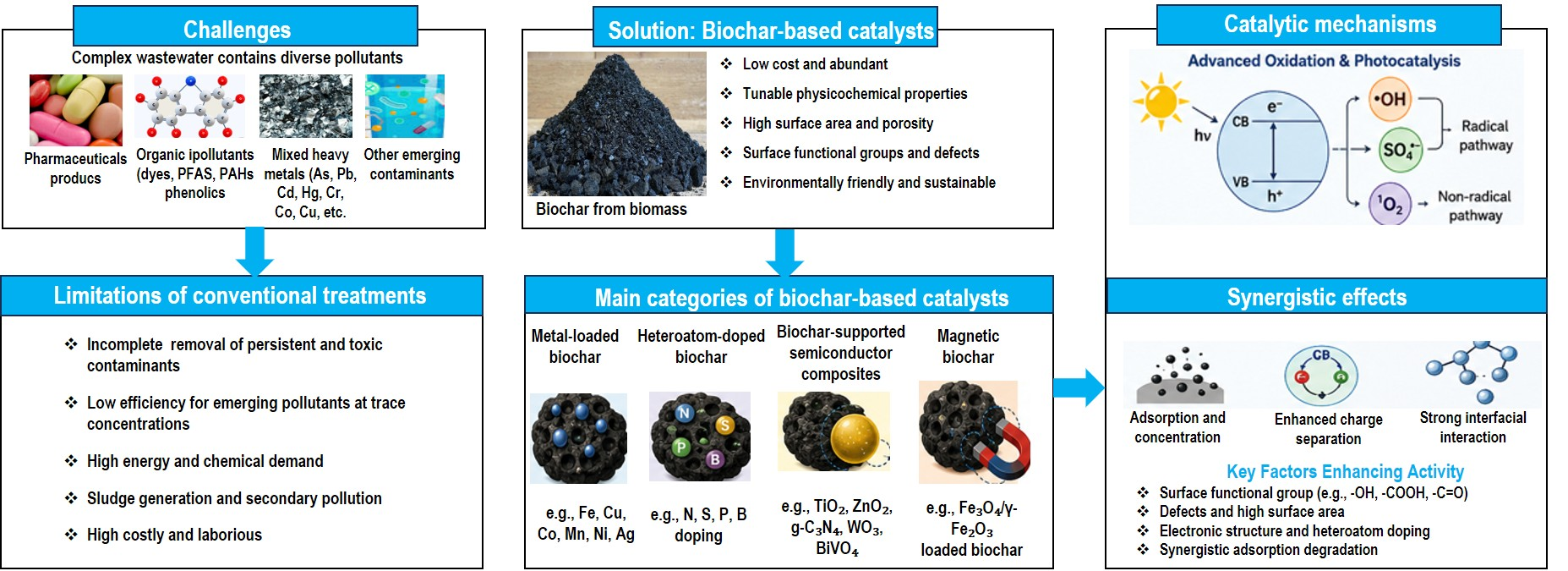
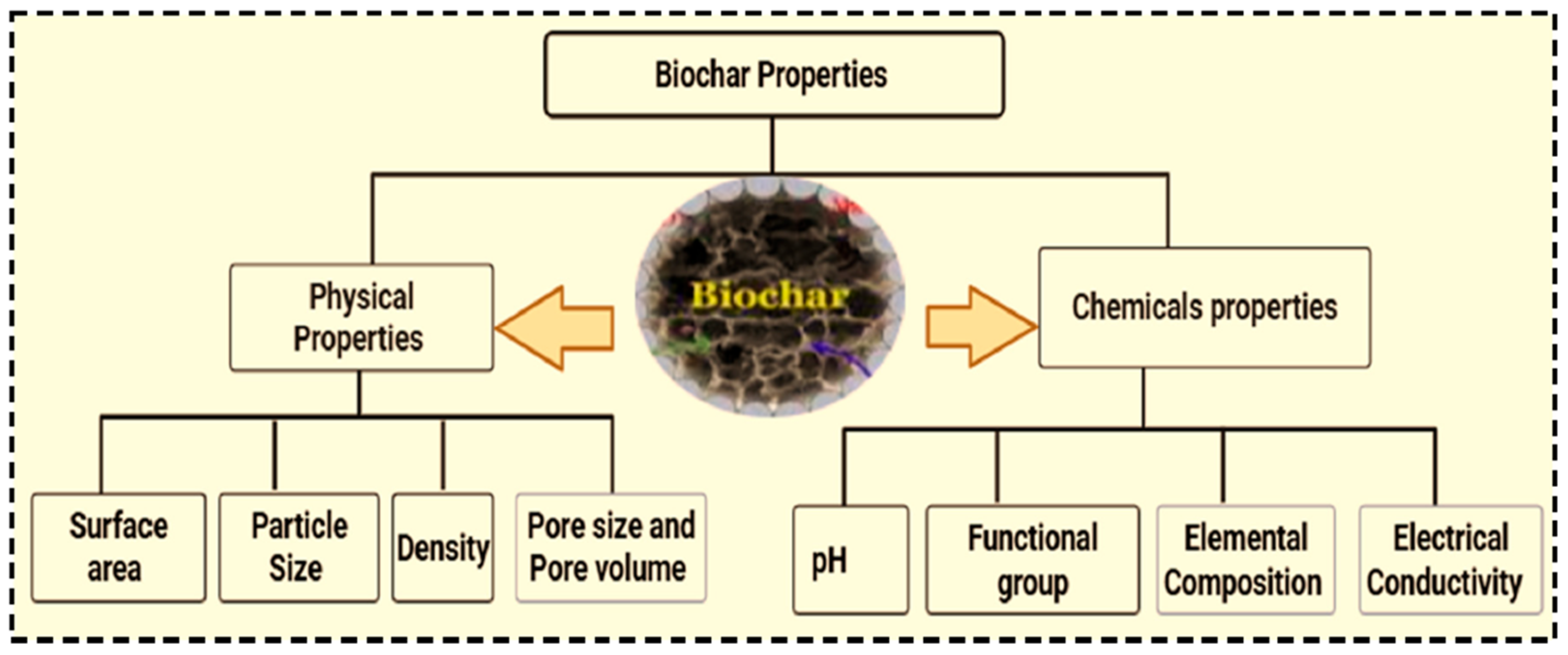
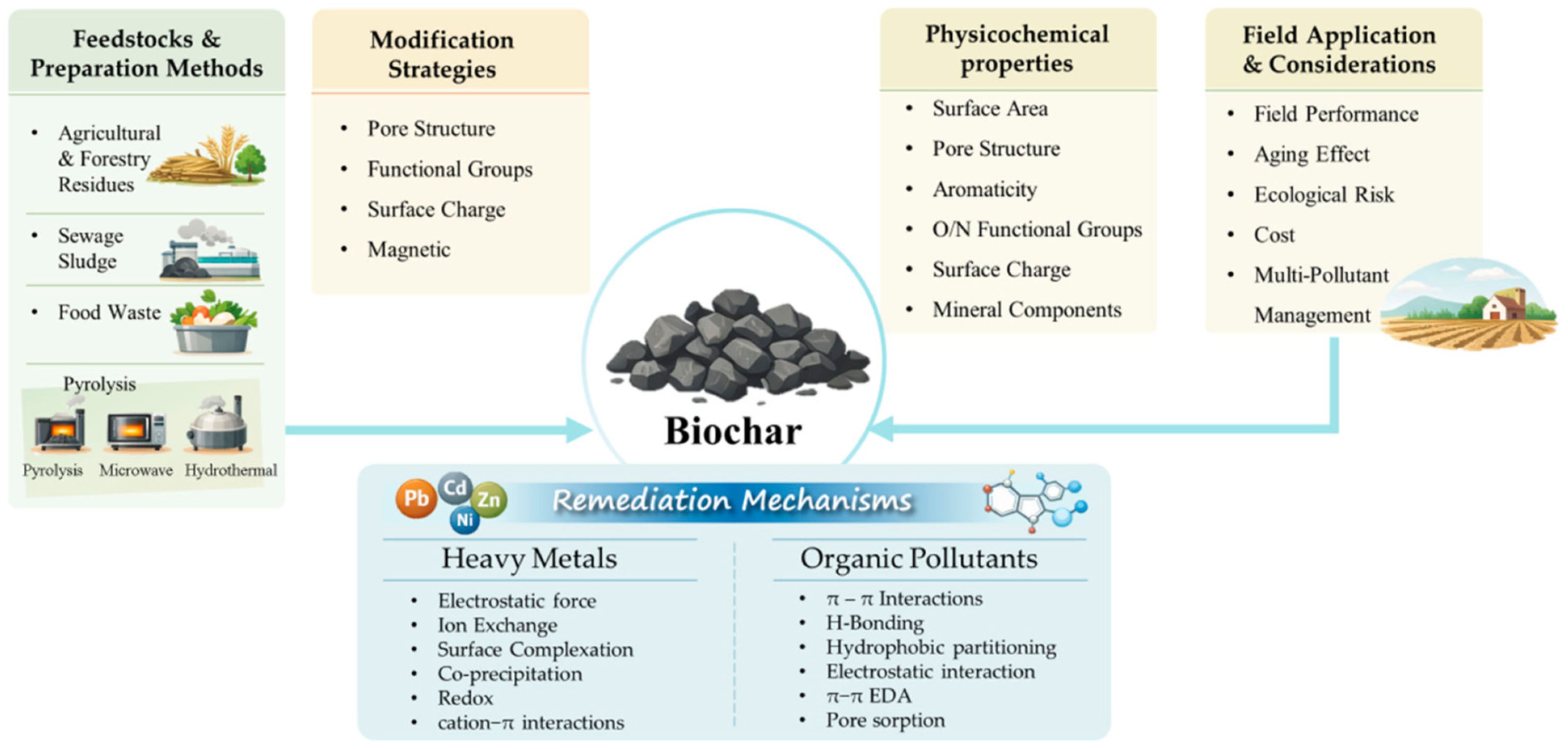
In addition to the sustainability benefits, biochar has various distinct physicochemical characteristics, which make it a strong catalyst. Its high specific surface area and well-developed porous structure are among the most remarkable properties, which offer numerous active sites for adsorption and catalytic reactions. The diffusion and contact of pollutants with active sites is promoted by the pore structure of biochar, i.e., micro-, meso-, and macropores, which increases the efficiency of treatments [23,24]. Therefore, the present study summarizes advances in the preparation and modification of biochar along with studies on pore structure, surface functional groups, surface charge, and magnetization modification techniques. Moreover, the effect of biochar modification on the adsorption mechanism of heavy metals and organic pollutants is summarized, and the field-scale application and economy of biochar are also discussed. The conceptual framework of this review is presented in Figure 1.
Surface functional groups like hydroxyl (–OH), carboxyl (–COOH) and carbonyl groups are also present in biochar and are important in pollutant adsorption, ion exchange, and catalytic reactions [25]. These functional groups are able to react with contaminants via electrostatic attraction, complexation, and redox reaction, helping in the elimination of both organic and inorganic pollutants [26]. First, they play a role in the adsorption of pollutants via hydrogen bonding, electrostatic attraction, complexation, and π-π interactions. Second, they can serve as active sites for metal ions, metal oxides, and semiconductor particles in designed biochar composites. Third, oxygen-containing groups affect electron-donating and electron-accepting behavior that is directly related to oxidants like persulfate (PDS) activation (S2O82− + e → SO4 + SO42−) and hydrogen peroxide. Nevertheless, the abundance and nature of such groups differ significantly with the severity of pyrolysis. Lower temperatures tend to conserve more oxygenated functionalities, whereas higher temperatures tend to weaken and decrease the abundance of such groups due to dehydration and decarboxylation reactions [27,28].
In addition, chemical activation or doping of the surface chemistry of biochar can be utilized further to facilitate the design of custom catalysts that have improved functionality. Biochar’s electron transfer properties and redox activity are other key features that are vital in catalytic uses, especially in state-of-the-art oxidation reactions. The presence of aromatic structures and defect sites in biochar enables electron movement and, therefore, enables redox reactions and the formation of reactive oxygen species (ROS) [29]. This characteristic is especially advantageous in catalytic reactions, where effective electron transfer is necessary to activate the oxidant.
Moreover, biochar is multifunctional, having adsorption, catalysis, and support functions within a single material. It may be used as a catalyst, a catalyst support, or synergistic component in hybrid systems, which increases the efficiency of the entire process [30]. An example of this is the fact that biochar can be used to better disperse metal nanoparticles, agglomerate less, and stabilize catalytic systems [31]. This multifunctionality sets biochar apart from most traditional materials and gives biochar its versatility in the treatment of wastewater. Recent developments have shown that composite biochar, such as heteroatom-doped and composite materials, can be used to provide a significant increase in catalytic performance. Such changes allow the generation of a better reactive species, greater adsorption capacity, and better structural stability and result in higher pollutant removal efficiencies [32]. Consequently, biochar-based materials are also being considered as the next generation of catalysts to develop a high-performance and sustainable wastewater treatment system.

1.3. Research Gap

Although there are many studies on biochar-based catalysts that have been performed to treat wastewater, there are still a number of key knowledge gaps that restrict their rational design and application on a large scale. One of the significant weaknesses is the unawareness of the coherent knowledge of catalytic mechanisms, including the interaction of radical and non-radical reactions and their reliance on biochar characteristics. Although many studies have found high pollutant removal efficiencies, the underlying mechanisms involved in the generation of reactive oxygen species, electron transfer, and catalytic activation are usually addressed separately but not in a coherent framework [32]. Such a knowledge gap limits the possibility of optimizing catalytic systems to certain applications.
Moreover, most of the research on biochar-based catalytic systems is carried out in controlled laboratory experiments, typically with model pollutants and simplified water matrices. This poses a gap between laboratory results and real-world applicability, where wastewater is composed of complicated combinations of pollutants, competing ions, and natural organic material. They have the potential to influence the performance, stability, and reusability of catalysts greatly but have not been studied extensively. Furthermore, the issues of catalyst deactivation, leaching, and long-term stability have not been properly considered in practice [33]. Studies have emphasized the necessity of scalable and application-oriented research, with large-scale field validation and techno-economic assessment still being lacking. Hence, to reduce the knowledge gap between the basic research and practical application, to bridge that gap, the intensive knowledge of the mechanisms, standardized assessment schemes, and construction of powerful and scalable catalytic systems need to be developed.

1.4. Objectives and Scope of the Review

With the fast growth of research in the field of biochar-based materials in wastewater treatment, there is a need to systematically integrate extensive knowledge to consolidate the existing knowledge and direct future investigations.
First, this review covers a wide range of biochar-based catalytic materials, including pure biochar, chemically and physically modified biochar, metal-loaded biochar, magnetic biochar composites, and biochar-supported semiconductor photocatalysts. Their multifunctional use in adsorption, catalysis, and hybrid processes has been widely studied, and the choice of feedstock, pyrolysis conditions, and post-treatment changes largely determine their performance. Moreover, the recent developments in composite biochar systems, including doped and composite materials, have been carefully reviewed to highlight their increased catalytic efficiency and tunable characteristics to remove specific pollutants.
Second, this review focuses on wastewater treatment applications, specifically on the elimination of organic pollutants, ECs, and heavy metals in municipal, industrial, and agricultural wastewater streams. The review addresses both individual-contaminant systems and complex wastewater matrices. Moreover, a focus is put on the practical treatment designs, such as AOPs, photocatalytic systems, and hybrid treatment designs, in order to have a complete view of the application scenarios.
The key objective of this review is to develop a systematic and mechanistic insight into biochar-based catalysts, including their design, performance, and applicability in sustainable wastewater treatment systems. In particular, the review focuses on the role of radical (e.g., hydroxyl and sulfate radicals) and non-radical mechanisms (e.g., singlet oxygen and electron transfer) in the degradation of pollutants and the impact of biochar defect structure and electronic characteristics on catalytic activity. Moreover, this review addresses the gap between basic research and applied practice by comprehensively evaluating the interrelations between structure and performance and determining the most important factors that control the catalytic efficiency, stability, and reusability.
Finally, this review provides the existing challenges and future developments of biochar-based catalytic systems, specifically on the aspects of scalability, environmental safety, and performance during actual wastewater conditions. Through the combination of the latest developments with systematic analysis, this work provides a comprehensive roadmap to the creation of next-generation sustainable catalytic materials for wastewater treatment.

2. Review Methodology

This review was performed in compliance with the PRISMA 2020 (Preferred Reporting Items in Systematic Reviews and Meta-Analyses) framework to provide transparency, reproducibility, and methodological rigor in identifying the relevant literature on biochar-based catalysts in the treatment of wastewater [34]. An extensive literature search was conducted among the leading scientific databases, such as the Web of Science Core Collection, Scopus, ScienceDirect, PubMed, and Google Scholar, covering the time frame of January 2016 to March 2026. The literature search was finalized on 15 March 2026. The search strategy was comprised of Boolean combinations of keywords including (“biochar” OR “engineered biochar” OR “biochar catalyst”) AND (“wastewater treatment” OR “water remediation”) AND (“advanced oxidation process” OR “AOP” OR “photocatalysis”) AND (“emerging contaminants” OR “organic pollutants” OR “heavy metals”) AND additional targeted searches (e.g., “metal-loaded biochar,” “heteroatom-doped biochar,” “magnetic biochar,” or “biochar photocatalyst composites”). Searches were performed primarily within titles, abstracts, and keywords. Manual screening of the reference lists of the selected studies was also done to identify more relevant publications. Particular emphasis was placed on original experimental studies and review articles reporting catalytic performance, reactive oxygen species generation, degradation pathways, catalyst stability, and structure–activity relationships.
Studies were included when they focused on biochar-based catalytic materials (pristine or engineered) applied to wastewater treatment, reported catalytic performance or mechanistic understanding, were published in peer-reviewed journals, and were written in English. Studies were excluded if they focused solely on adsorption without catalytic mechanisms, lacked relevance to biochar systems, or were non-peer-reviewed (e.g., conference abstracts, editorials).
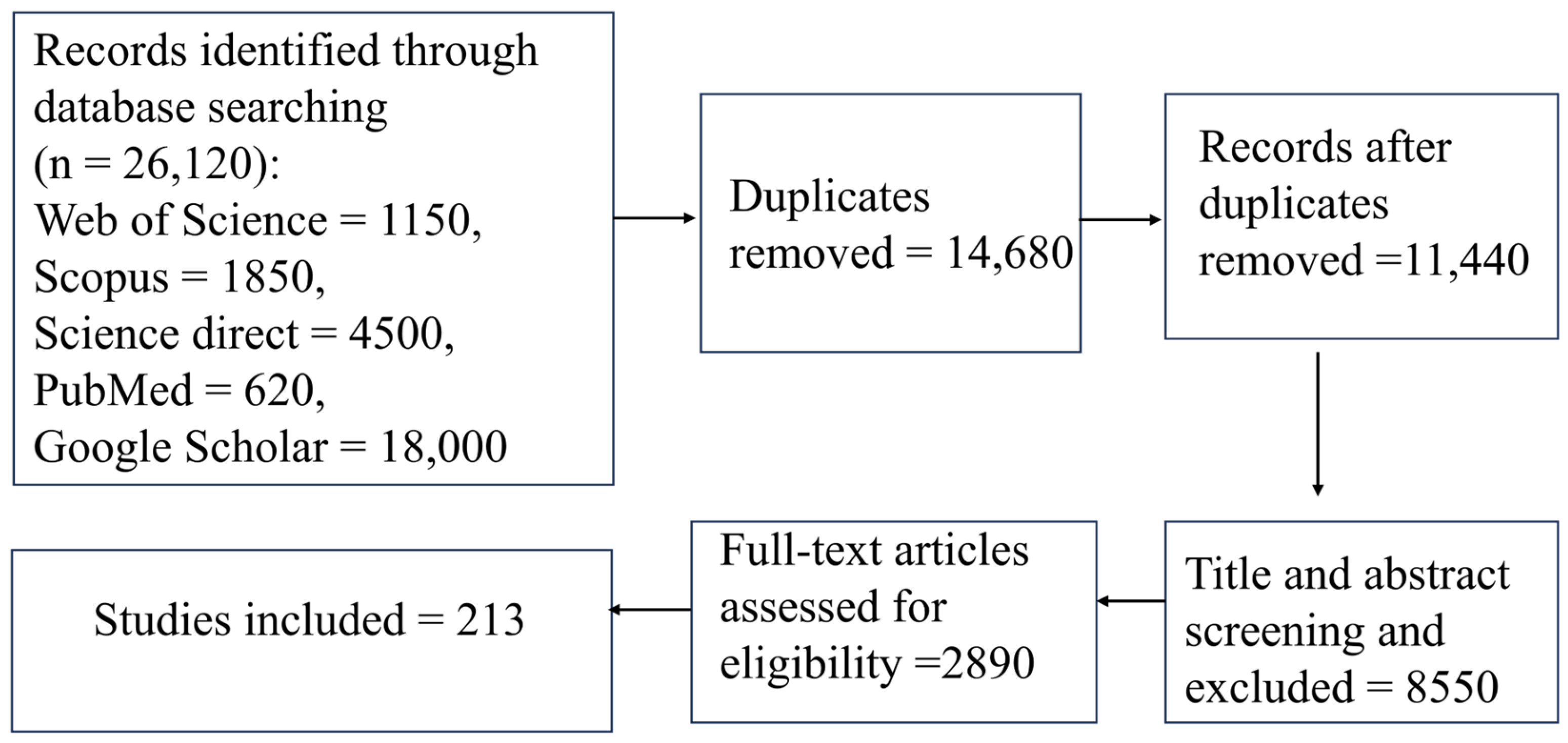
The PRISMA workflow of 4 steps was used to select the studies: (i) records of databases were identified; (ii) duplicate records were removed; (iii) records of the databases were selected based on the title and abstract; (iv) full-text assessment to select the studies was based on the predefined criteria, and records of the exclusions were documented to ensure traceability. Data were extracted on the final included studies focused on biochar feedstock, modification strategies (e.g., doping, metal loading, composite formation), target pollutants, treatment processes (e.g., AOPs, photocatalysis, hybrid), catalytic mechanisms (radical and non-radical pathways), performance metrics, and stability or reusability. To increase the strength of the review, high-quality, peer-reviewed studies with clear experimental design and reproducibility and findings were cross-validated across multiple sources wherever possible. The number of published articles related to this work is shown in Figure 2.
The initial search in the database gave around 1150 records in the Web of Science Core Collection, 1850 records in Scopus, 4500 records in ScienceDirect, 620 records from PubMed and more than 18,000 records from Google Scholar from January 2016 to March 2026. A total of 26,120 records were initially identified, of which 14,680 duplicates were removed. The remaining 11,440 records were then selected based on the titles and abstracts, and 8550 studies were excluded for being irrelevant to biochar-based catalytic wastewater treatment. After that, 2890 full-text articles were evaluated for eligibility, and 2678 were ruled out because of various factors, including lack of catalytic focus, lack of mechanistic information, or lack of methodological quality. Finally, a qualitative synthesis was conducted to analyze catalyst design, reaction mechanisms, structure–activity relationships, and wastewater treatment applications and included 213 studies.

3. Biochar as a Catalytic Platform

3.1. Feedstocks and Production Methods

The feedstock source and manufacturing conditions of biochar are the key factors that determine the performance of biochar as a catalytic material. They regulate the physicochemical properties, surface chemistry, and catalytic activity of biochar. Such factors are crucial in the design of biochar-based catalysts to be used in wastewater treatment [35].

3.1.1. Biomass Feedstocks

Biochar can be generated using a wide variety of biomass materials, mainly in the form of lignocellulosic biomass, agricultural residues, animal manure, and sewage sludge. Wood chips, crop straw, and husks are the most common examples of lignocellulosic materials that are used as feedstocks because of their high carbon content and clearly defined structure. These feedstocks usually produce biochar of high surface area and stability, thus being suitable to be used in adsorption and catalytic practices [36,37]. Agricultural residues such as rice husk, corn stover, and wheat straw are readily available at low cost and have huge potential as a source of biochar on a large scale. In a similar manner, biochar produced from animal manure and sewage sludge has been of interest, as it contains high levels of minerals that can improve catalytic activity due to the presence of naturally occurring metal species (e.g., Fe, Ca, Mg) [26]. Such mineral-rich biochar can be used in AOPs where metal components can serve as active catalytic sites. Recent studies have investigated the mixed use of co-pyrolyzed feedstocks, whereby various biomass types are mixed to obtain synergistic properties. This method allows control of the biochar properties, including pore structure and surface functionality, and elemental composition according to the particular requirements of the application [38,39,40].

3.1.2. Pyrolysis Conditions

The most common way to generate biochar is through the process of pyrolysis, which is a thermochemical transformation of biomass where the biomass is heated in a limited oxygen atmosphere, usually within the range of 300–900 °C [37,41]. The key parameters of pyrolysis such as temperature, heating rate, residence time, and type of reactor are critical in the yield and properties of the resulting biochar. Out of these parameters, the pyrolysis temperature stands as the most important parameter, which affects biochar properties. Pyrolysis at lower temperatures (300–500 °C) tends to result in biochar that contains more oxygen-containing functional groups and is more polar; thus, it increases adsorption capacity with polar pollutants. Conversely, pyrolysis at high temperatures (>500 °C) results in more carbonization, a larger surface area, more aromaticity, and better electrical conductivity, all of which are useful in catalytic applications [26].
Other important factors of the biochar properties are the heating rate and residence time. Low heating rates and long residence times in slow pyrolysis generally give rise to greater quantities of solid biochar that has well-developed pore structures. On the other hand, fast pyrolysis is more inclined towards the generation of bio-oil and gases, which leads to a decrease in biochar production but may have potentially different surface properties [42]. These parameters should be well managed in order to maximize the yield and functional performance.
Microwave-assisted pyrolysis, hydrothermal carbonization, and co-pyrolysis are emerging methods of pyrolysis to increase the efficiency of the process and customize the biochar to meet a specific application [43]. Such high-tech processes provide better control over energy consumption, reaction kinetics, and product properties and have led to the creation of modified biochar materials with better catalytic properties. The interplay between feedstock composition and pyrolysis conditions governs the structural and chemical properties of biochar, ultimately determining its effectiveness as a catalytic platform. Thus, these parameters should be systematically optimized to develop high-performance biochar-based catalysts for wastewater treatment in a sustainable manner.
The aromaticity and degree of graphitization of biochar, especially in advanced oxidation and photocatalytic processes, are sensitive. With higher pyrolysis temperatures, biochar tends to go through carbonization, resulting in a more condensed aromatic structure. This change increases the electrical conductivity and electron mobility, which are favorable to interfacial electron transfer, activation of oxidants, and inhibition of electron–hole recombination in composite photocatalysts. Moreover, aromatic domains prefer π-electron interactions with organic pollutants and are capable of non-radical oxidation reactions via mediated electron transfer [44,45]. The multifunctional use of biochar as an adsorbent, catalyst, and catalyst support is supported by its physicochemical characteristics. The accessibility and mass transfer are controlled by surface area and porosity. Functional groups control interfacial chemistry and active-site formation and conductivity [26,36,46].

3.2. Intrinsic Catalytic Activity

In addition to its structural and surface properties, biochar possesses significant intrinsic catalytic properties and can be used as an adsorbent or support, as well as an active catalyst in the treatment of wastewater. This intrinsic activity is mainly due to its ability to transfer electrons and its capacity to catalyze both radical and non-radical degradation pathways, which are the key to complex catalytic systems.

3.2.1. Electron Transfer Capability

A characteristic of biochar is that it can be an electron donor, acceptor, and mediator, often called its electron exchange capacity (EEC). This feature enables biochar to undergo redox reactions by transporting electrons among contaminants, oxidants, and active sites. The internal structure of biochar, such as aromatic domains, defect sites, heteroatoms, and persistent free radicals (PFRs), is the main factor that determines the electron transfer behavior of biochar [47]. The effect of this electron mediation is especially crucial in heterogeneous catalytic systems, where high catalytic activity requires high efficiency of charge transport. In addition, biochar possesses persistent free radicals on its surfaces, enabling continuous electron cycling when degrading the pollutants [48]. In engineered systems, biochar can serve to mediate electron transfer between metal species or semiconductor components to minimize the loss of recombination. The synergistic effect is particularly applicable to catalysts made of composites, where biochar increases the overall catalytic performance by increasing electron mobility and conductivity [49].

3.2.2. Radical and Non-Radical Pathways

There are a variety of oxidants activated by biochar-mediated catalytic systems and persist in both radical and non-radical pathways, offering highly flexible mechanisms of pollutant degradation. Biochar is used in radical pathways to form highly reactive species like the hydroxyl radical (•OH) and sulfate radical (SO4), which are able to oxidize a broad spectrum of organic contaminants. Radicals are usually generated by the activation of oxidants such as hydrogen peroxide, PDS, or peroxymonosulfate (PMS) (HSO5 + Fe2+ → SO4 + •OH + Fe3+), usually in the presence of biochar surface functional groups or metal species [48]. Conversely, non-radical pathways, such as singlet oxygen (1O2) production and direct electron transfer, have received growing interest because of their selectivity, stability, and insensitivity to water matrix effects. Biochar is important in enhancing these mechanisms by offering active sites and electron transfer mechanisms that avoid the generation of radicals. Recent studies have demonstrated that biochar materials, especially those with abundant defects, can selectively catalyze non-radical oxidation processes, resulting in high catalytic activity and less secondary pollution [50].

4. Engineering Biochar-Based Catalysts

4.1. Metal-Loaded Biochar Catalysts

Metal loading is one of the best modification strategies to improve the catalytic activity of biochar in the treatment of wastewater. Addition of transition metals to the biochar matrix enhances the concentration of redox-active sites, enhances electron transfer, and activates oxidants. Practically, biochar can serve as a support that disperses metal species and inhibits their agglomeration, as well as a co-catalytic carbon skeleton providing surface defects, functional groups, and conducting domains. The recent reviews provide consistent results that metal-loaded biochars are more active than pristine biochar since they combine the inherent reactivities of carbonaceous substances with the redox cycling of transition metals [51,52].
The most widely studied of these systems is Fe-loaded biochar since iron is the most abundant, is not very toxic, and is the most effective in PDS activation and in Fenton-like reactions with H2O2. The iron species on biochar can recycle Fe(II)/Fe(III), producing sulfate radicals and hydroxyl radicals, and the biochar surface promotes electron shuttling and Fe regeneration. The recent literature has demonstrated that biochar can enhance Fe2+ regenesis in H2O2-based systems via carbon defects and carboxyl groups, which overcomes the rate limitation of traditional Fenton chemistry [53,54]. Table 1 summarizes biochar’s application for degrading pollutants in Fenton-like systems [55].
Biochar catalysts made of Mn, Co, and Cu have also become the focus of growing interest. Multi-valent Mn species in Mn-loaded biochar enable the use of PDS via both radical and non-radical mechanisms. A recent Mn-doped biochar based on sludge resulted in complete conversion of phenol under optimum PDS activation conditions. Bimetallic Fe–Mn biochar is especially promising, as the exchange of the two valence states between Fe and Mn can enhance oxidant activation and increase degradation routes [78]. In comparison, Co-loaded biochar tends to be highly active in PMS activation, although the possibility of cobalt leaching and toxicity is a concern [79,80]. Cu-loaded biochar is also appealing, as the Cu(I)/Cu(II) cycling has the capability to operate over a fairly wide pH range, and Cu-based systems are less toxic than cobalt-based ones. Recent discoveries of cobalt- and copper-modified biochars used to activate PMS demonstrate that the materials can effectively degrade antibiotics and dye pollutants [81].

4.2. Biochar-Supported Semiconductor Photocatalysts

To address the inherent shortcomings of conventional photocatalysts, especially fast charge recombination, poor visible-light absorption, and low quantum efficiency, biochar-based semiconductor photocatalysts are a very promising category of materials that integrate adsorption, charge transport, and photocatalytic properties. Biochar can improve light absorption, which is crucial for addressing the inherent drawbacks of conventional semiconductors, thereby making wastewater treatment processes more efficient and sustainable. The most common semiconductors studied include TiO2, ZnO, and graphitic carbon nitride (g-C3N4), as they are the most stable and cost-effective and have catalytic properties [82]. Nonetheless, limited light absorption ranges tend to limit their individual performance and can be enhanced dramatically by their coupling with biochar-based materials.

4.2.1. Biochar–Semiconductor Composites (TiO2, ZnO, and g-C3N4)

Several different synthesis methods, including sol-gel, hydrothermal, and co-precipitation methods, are typically used to prepare biochar-supported semiconductor photocatalysts, producing hybrid materials with superior physicochemical and catalytic characteristics. In TiO2 biochar systems, biochar is used as a conductive carbon skeleton, which enhances the surface area, adsorption of pollutants, and catalytic reactions. Similarly, it has been shown that the synergistic adsorption and photocatalysis of TiO2 on biochar in experimental studies is much more effective in reaching degradation efficiencies than for pure TiO2 [82,83]. In recent years, g-C3N4-based composites have become a topic of great interest because of their visible-light sensitivity and the absence of metals. The photocatalytic activity of g-C3N4 in combination with biochar is greatly promoted because it increases electron transfer and increases light absorption in the visible spectrum [84]. It has been demonstrated that biochar/g-C3N4 composites can achieve much higher degradation rates of organic pollutants than pristine g-C3N4 [85]. Table 2 shows the application of biochar (BC)-based catalytic systems in pollutant remediation processes through photocatalytic processes. The targeted contaminants, operational conditions, reduction efficiencies, and the most important reactive radicals responsible for the degradation mechanisms are shown highlighted in the table with references. The comparison demonstrates that BC-based catalysts are effective for improving the photocatalytic performance for environmental cleanup applications [55].

4.2.2. Role of Biochar in Charge Separation

The capability of biochar to improve charge separation and prevent electron–hole recombination is considered one of the most crucial functions of biochar in semiconductor-based photocatalysis. The conductive structure and π-conjugated domains of biochar can enable the electron to function as an electron mediator or electron reservoir, whereby the photogenerated electrons on the semiconductor are trapped by biochar and then transferred to reactive species. The process greatly increases the lifetime of charge carriers and enhances the photocatalytic efficiency [100]. In more complex systems, like heterojunction photocatalysts (e.g., TiO2/g-C3N4), biochar is an important electron transfer bridge, balancing the movement of interfacial charges and the efficient separation of photogenerated carriers [101]. Based on density functional theory (DFT), analysis has verified that biochar is capable of storing and transporting electrons, and thus promoting overall catalytic activity [102].
In addition to charge separation, biochar also helps in improved absorption and use of light, especially within the visible domain. Further, the porous structure and black color of biochar enhance the light-harvesting capacity by raising photon scattering and extending light–matter interaction within the catalytic system. Consequently, biocarbon-composite photocatalysts show substantially better functionality in the condition of visible light and solar light [103].

4.3. Heteroatom-Doped Biochar

Heteroatom doping has emerged as a powerful method of designing biochar with high activity as a catalyst. The introduction of non-metallic components can be used to allow charge distribution without using potentially leachable metals [104]. During wastewater treatment, the most common dopants that have been investigated are nitrogen (N), sulfur (S) and phosphorus (P), either as an individual dopant or in co-doped form, because of their capacity to provide catalytically active sites and enhance the activation of oxidants. Recent reviews highlight that heteroatom doping could significantly enhance the environmental performance of biochar by enhancing conductivity, surface reactivity, and pollutant–catalyst interactions [55,105].
The most investigated of these materials is N-doped biochar. Nitrogen may be added as pyridinic N, pyrrolic N, graphitic N, and oxidized N and these formats have a significant impact on catalytic behavior. N doping increases the electron mobility and surface alkalinity and enhances adsorption and redox reactivity [106]. It also facilitates PDS activation and mediates electron transfer pathways, particularly in advanced oxidation systems to degrade refractory organic pollutants (ROS + organic pollutants → intermediates → CO2 + H2O + inorganic ions). Studies observe that N-doped biochar can be used as an active catalyst and electron mediator and support material, which explains its wide application in the remediation of wastewater [107,108]. Table 3 summarizes the previous work using N-doped biochar catalysts to activate PDS/PMS to degrade organic pollutants [107].
S-doped biochar is also significant since sulfur-containing groups like thiophene-S, sulfoxide, and sulfide functionalities have the potential to modify electron density and generate more redox-active centers. Catalytic oxidation of antibiotics and dyes can be enhanced by functionalizing sulfur, which also tends to increase affinity towards soft metal ions [120]. Simultaneously, P-doped biochar has been of interest due to the ability of phosphorus to induce structural distortion, add oxygen/phosphorus-based functional groups, and enhance surface acidity and coordination behavior. The incorporation of P can positively influence active-site chemistry and adsorption–catalysis interaction in catalytic wastewater treatment [121]. Table 4 shows emerging materials of modified nitrogen-doped biochar (NBC) materials as persulfate-based advanced oxidation process (PS-AOP) heterogeneous catalysts [107].

4.4. Magnetic Biochar Composites

Magnetic biochar composite is an important type of advanced material that is able to overcome one of the most significant shortcomings of traditional biochar systems: challenging separation and recovery in aqueous systems. These composites are prepared by incorporating magnetic nanoparticles, most often magnetite (Fe3O4), in the biochar matrix via co-precipitation, impregnation pyrolysis, or hydrothermal treatment. The resulting products incorporate the adsorption properties and surface functionality of biochar and the magnetic responsiveness of Fe3O4 such that they can be used effectively as catalysts in wastewater treatment [136]. Fe3O4 nanoparticles are structurally well-dispersed in the porous biochar structure, avoiding aggregation and facilitating access to reactive sites. A combination of Fe3O4 and biochar also enhances the stability of the magnetic phase, which inhibits the leaching of metals and maintains catalytic activity in repeated cycles [137].
The active sites of biochar are provided by the Fe3O4 nanoparticles, and synergistic effects are obtained by combination of these active sites to increase the catalytic activity. Fe3O4 provides redox active sites capable of engaging Fenton-like reactions and activating oxidants like PDS and hydrogen peroxide, and the biochar matrix promotes pollutant binding and electron transfer. The dual capability greatly enhances the degradation of organic contaminants, as well as heavy metals [136,138].

Recovery and Reuse Advantages

Easy recovery and reuse is one of the greatest benefits of magnetic biochar composites, as it is an important issue in the practice of wastewater treatment. A magnetic biochar can be easily and quickly harvested with an external magnetic field, unlike traditional powdered biochar, which needs filtration or centrifugation to separate. This characteristic helps to reduce the amount of waste, make the operations easier, and avoid secondary pollution related to the adsorbents left in treated water [136]. The magnetic separation property also allows the catalyst to be reused with high efficiency, and this increases economic viability and sustainability. It has been shown that Fe3O4-modified biochar is able to maintain a considerable amount of catalytic activity across several cycles, but certain deterioration can be observed because of surface contamination or active-site loss [139]. Moreover, chemical washing or thermal treatment is also a regeneration method that can further prolong the life of magnetic biochar catalysts.
Practically, high catalytic activity, ease of recovery, and reusability allow magnetic biochar to be of special interest in a large-scale wastewater treatment setup. Furthermore, the incorporation of magnetic properties with catalytic capabilities corresponds to the principles of sustainable process design when the recyclability of materials and the simplicity of operability are crucial aspects [139]. Fe3O4-based magnetic biochar materials are an important step forward in designing biochar-based catalysts, with higher catalytic performance and feasible recovery and reuse benefits. These characteristics make magnetic biochar a potential candidate for scalable and sustainable wastewater treatment technologies.

4.5. Hybrid and Multi-Component Systems

The concept of hybrid and multi-component biochar-based catalysts is a more advanced approach to address the drawbacks associated with a single-component system by incorporating several functional materials within a single structure. These systems are used in combination with biochar and metals, metal oxides, semiconductors, or other carbonaceous substances to greatly improve catalytic performance in wastewater treatment processes.

4.5.1. Synergistic Effects in Hybrid Systems

The main benefit of the hybrid biochar systems is that they can create synergistic effects between various parts so that the overall effect is greater than the sum of the parts. With such systems, biochar can be used as a conductive support and adsorption surface, and the materials that are incorporated act as active catalytic sites. This synergy enhances the efficiency of pollutant removal by increasing the adsorption, electron transfer, and oxidant activation processes [50]. Indicatively, in biochar–metal oxide composites, biochar helps to disperse nanoparticles and avoid aggregation and, therefore, make more active sites available. At the same time, the metal or semiconductor material catalyzes the reaction, whereas the biochar increases the interfacial interactions and mobility of electrons. This synergistic process leads to enhanced kinetics of degradation and expanded usability in different pollutant types. In addition, hybrid systems have the capability to incorporate various functionalities, such as adsorption, catalytic oxidation, and photocatalysis, into the same material. This multifunctionality is especially beneficial when complex wastewater matrices are treated, and a variety of contaminants must be eliminated through either combined or sequential processes. It has been demonstrated that hybrid biochar systems can be much more efficient, stable, and adaptable to changes in the environmental conditions compared to single-component catalysts [140].

4.5.2. Coupled Catalytic Pathways

The other significant characteristic of hybrid biochar-based catalysts is that they have coupled catalytic pathways in which two or more reaction pathways can be run in parallel to improve the degradation of pollutants. These routes can be comprised of adsorption–oxidation, photocatalysis–AOP synergies, or radical–non-radical pathways. Hybrid catalysts may be used in the presence of radical (•OH, SO4) and non-radical pathways (e.g., singlet oxygen and direct electron transfer), resulting in high degradation efficiency and selectivity. However, the coupled mechanisms also come with difficulties in gaining comprehensive insights into reaction pathways and catalyst design optimization [141].
In photocatalytic systems, hybridization may provide access to photo-assisted catalytic oxidation, in which light-generated charge carriers react with chemical oxidants to increase the rate of degradation of pollutants [12]. In the same manner, biochar-based hybrid materials have been effectively incorporated into electrochemical systems, in which adsorption and electro-oxidation reactions are complementary, to improve treatment efficacy. These two processes not only enhance the efficiency of degradation but also decrease the energy use and potential secondary pollution. These systems have a high efficiency, flexibility, and robustness to handle complex wastewater streams by enlisting the strengths of the synergistic effects and coupled catalytic pathways [142].

5. Mechanisms of Pollutant Degradation and Catalytic Activity

5.1. Radical Pathways

Radical pathways are also one of the most significant ways of pollutant degradation in biochar-based catalytic systems, especially in the cases of PDS- and H2O2-based AOPs. Hydroxyl radicals (•OH) and sulfate radicals (SO4) are the predominant radical species, which have high redox potentials and rapid reaction rates with a wide variety of organic pollutants [143]. Nevertheless, their formation is not solely controlled by the addition of the oxidant. It is highly regulated by the density of defects, the presence of persistent free radicals, and the metal functionalities on the biochar matrix. Recent reviews highlight that radical generation within biochar systems is essentially an interfacial reaction where oxygen-containing groups and loaded metal species collaborate to break peroxide or PDS bonds and begin chain oxidation reactions [22,144].
Mechanistically, the most common way of generating •OH is associated with Fenton-like activation of H2O2 or secondary reduction of sulfate radicals in aqueous solution. SO42− generation is most commonly linked with activation of PDS or PMS. Redox cycling of the metal-modified biochar increases the rate of oxidant consumption and maintains a radical flow [78]. Radical generation is also possible in metal-free biochar, using electron-rich aromatic domains, persistent free radicals, and edge defects, which contribute electrons to PDS. Notably, radical paths can be commonly preferred in systems that contain plenty of oxygenated groups and active sites. However, the identical radicals can be aggressively suppressed by natural organic matter, bicarbonate, chloride, and other elements found in actual wastewater [144].
Radical-accelerated degradation of biochar systems often follows pseudo-first-order mechanisms, although these simplistic models may hide the mechanistic complexity. The apparent rate constant is dependent on intrinsic oxidizing strength, adsorption enrichment, dosage of oxidant, radical scavenging, pH, and active-site regeneration rate. Recent kinetic studies demonstrate that the catalyst properties, including pyrolysis temperature, surface area, defect abundance, and heteroatom doping, can clearly modify the observed rate constant by changing the balance between radical generation and radical loss. Thus, reaction kinetics in biochar-based oxidation systems can be viewed as the overall result of mass transfer, interfacial electron transfer, and competitive quenching of the oxidant reactivity [145,146].

5.2. Non-Radical Pathways

Over the last few years, it has been shown that non-radical mechanisms complement many biochar-based catalytic systems, especially in realistic wastewater scenarios where radical scavenging is prominent. The non-radical processes are more selective, stable, and less sensitive to water matrix components, unlike the radical pathways, which require the presence of highly reactive and non-selective species, making them highly attractive for practical applications [147].

5.2.1. Singlet Oxygen (1O2) Pathway

Singlet oxygen (1O2) is also a non-radical species commonly found to be a major reactive species in biochar-based catalytic systems. Compared to •OH and SO4, 1O2 is less reactive but more selective, allowing specific organic pollutants to be degraded while avoiding unwanted side reactions. Emerging research shows that biochar can be used to generate 1O2 by the reaction of surface functional groups and defects with activated oxidants like PMS [148]. The mechanistic explanation of 1O2 formation is commonly linked to the electron-rich structures, heteroatom doping, and defect sites in biochar, which facilitates the energy transfer processes but not the direct cleavage of the bond. Experimental evidence indicates that, in most doped biochar systems, especially N-doped materials, 1O2 is the dominant reactive species, contributing significantly to pollutant degradation [149].

5.2.2. Electron Transfer Mechanisms

Direct electron transfer (ET), or a mediated electron transfer process, is the other important non-radical step in biochar-based catalysis. Here, biochar is an electron shuttle that transfers electrons between pollutants and oxidants without the formation of free radicals [150]. Contemporary research revealed that in highly graphitized or heteroatom-doped biochar systems, the electron transfer pathways can be dominant since the conductivity and electron mobility are improved due to the higher charge transport. Under these systems, the pollutants are oxidized directly at the surface of catalysts, leading to an enhanced selectivity and a reduced number of secondary toxic intermediates [151]. Moreover, new catalyst designs, including single-atom or doped biochar catalysts, have been shown to support mediated electron transfer (MET) pathways and thus allow continuous catalytic cycles with minimal reliance on radical generation [152].

5.3. Role of Biochar Surface Chemistry

The surface chemistry of biochar essentially controls its catalytic performance in the treatment of wastewater by determining the nature, density, and reactivity of the active sites. Biochar has a heterogeneous surface with functional groups and disordered carbon domains in contrast to the conventional catalysts, which have a well-defined crystalline structure. These properties regulate oxidant activation, electron transfer, and reactions of pollutants with catalysts, making surface chemistry a key determinant of mechanistic interpretation and catalyst design [153]. Surface functional groups, especially those that have oxygen, e.g., hydroxyl (–OH), carboxyl (–COOH), carbonyl, and ether functional groups, are dual-purpose in catalytic systems. First, they are active sites of adsorption, which allows them to have strong interactions with organic pollutants by hydrogen bonding, electrostatic attraction, and π–π interactions. These groups are directly involved in the process of activating oxidants, which involves the breaking of peroxide bonds (e.g., PMS, PDS, H2O2) and the generation of reactive species [154]. Moreover, the composition of functional groups can be modified and activated by chemical means, allowing a specific catalytic pathway to be improved. That is why biochar-based functional materials can be quite effective when compared to pure materials, since surface chemistry can be carefully adjusted to either radical or non-radical processes [155,156].

5.3.1. Defects and Active Sites

In addition to functional groups, structural defects and disordered carbon domains also play a crucial role in catalytic activity. These defects, including edge sites, vacancies, distortions caused by heteroatoms, etc., are the high-energy active sites facilitating electron transfer and oxidant activation [157]. Defect sites rich in electrons may drive non-radical reactions by direct electron transfer or singlet oxygen reaction, and defect-associated functional groups may drive radical formation. It means that catalytic behavior is not due to isolated characteristics, but it is formed in the synergistic interaction of defects and surface chemistry [151]. Notably, the pyrolysis temperature, feedstock composition, and doping strategies have a very strong effect on the density and type of defects in catalyst design [158]. In general, functional groups and defects are not independent factors, but rather interrelated components that jointly define the catalytic pathways and efficiency, which is a crucial basis of understanding and optimization of biochar-based catalytic systems [35,41].

5.3.2. Structure–Activity Relationships

The catalytic performance of biochar-based materials is strongly governed by their physicochemical characteristics and structure–activity relationships. Simultaneously, the high specific surface area and hierarchical pore structure provide increased pollutant diffusion and enhanced adsorption accessibility, and defect-rich carbon domains and oxygen vacancies support electron transfer and generation of reactive oxygen species. Increased graphitization degree generally enhances electrical conductivity and charge mobility, thereby improving photocatalytic charge separation and oxidant activation efficiency [74]. The surface functional groups such as hydroxyl, carboxyl, carbonyl, and nitrogen-containing groups, are important for regulating oxidant adsorption, metal coordination, and interfacial electron transfer processes. Moreover, heteroatom doping introduces local charges and changes the catalytic selectivity, which helps to improve the non-radical oxidation pathways and catalytic stability [134]. The rational design of biochar-based catalysts relies on establishing structure–activity relationships. The increased surface area may enhance the enrichment of the pollutants and exposure of active sites. However, it may not be advantageous when access to the pore is difficult or when the surface lacks electronically active sites [121]. In other words, there is a balance between mass transfer, interfacial reactivity, and electronic structure that is reflected in catalytic efficiency [159,160].
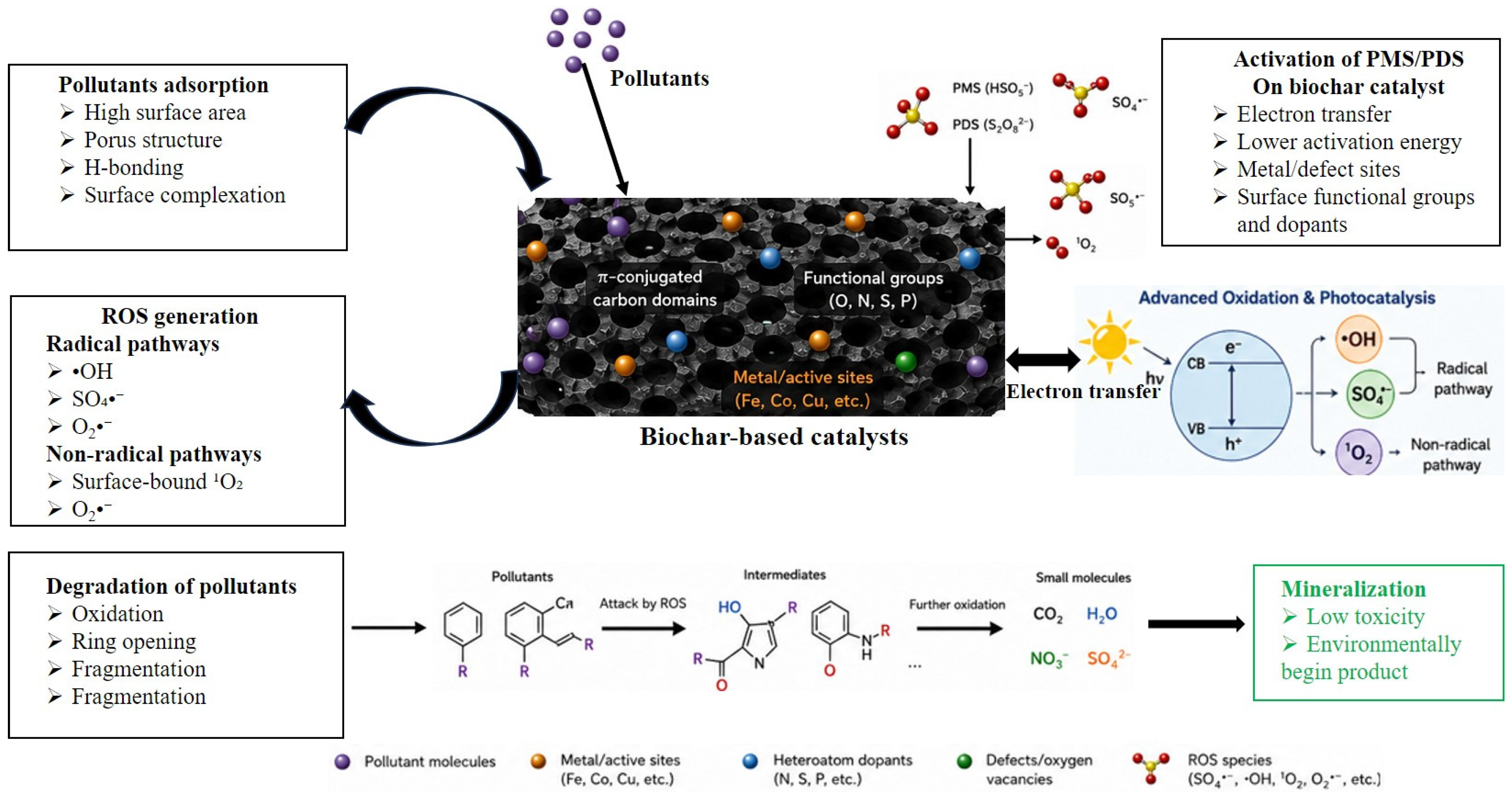
Doping also changes the catalytic activity by changing charge density, distribution of defects, and surface polarity. Dopants of nitrogen, sulfur, and phosphorus may form electron-rich or polarized sites of carbon, which trigger the activation of PDS, the direct transfer of electrons, and the generation of singlet oxygen. Notably, doping does not simply bring functionality, it re-creates the electronic landscape of the carbon substrate and it can cause the predominant process to be radical oxidation or some selective non-radical process. That is why the performance of doped biochar can be much better than undoped biochar even with an equivalent surface area [121,159]. The same principle can be applied to metal loading where catalytic activity not only relies on the identity of the metal, but also on its dispersion, oxidation state, and reaction with the biochar matrix. Recent studies on Fe–Mn bimetallic biochars indicate that the activity is controlled by the speciation of metals and intermetal exchange of valences, rather than the total metal content. Hence, the best catalysts are those where surface area and dopant chemistry are co-optimized to generate accessible, electronically active and mechanically robust catalytic sites [78,160]. Figure 3 illustrates the proposed mechanistic pathways involved in biochar-based catalytic systems for wastewater remediation. The schematic illustrates the synergistic action of pollutant adsorption, electron transfer, oxidant activation, generation of reactive oxygen species (ROS) and photocatalytic charge separation in the degradation of pollutants. The functional groups and heteroatom dopants and defect sites/metal active centers on biochar surfaces promote activation of PMS/PDS and improve both radical and non-radical oxidation pathways. Biochar also increases charge separation and electron mobility in photocatalytic systems, reducing electron–hole recombination and boosting the system’s efficiency. Finally, the ROS species formed help to oxidize, fragment, and mineralize pollutants to environmentally friendly products like CO2 and H2O.

6. Applications in Wastewater Treatment

6.1. Organic Pollutants

Biochar-based catalysts have shown great potential to eliminate organic pollutants, especially dyes, pharmaceuticals, and pesticides, one of the most common and difficult to eliminate contaminants in wastewater systems. Their success can be attributed to a synergistic complex of adsorption, catalytic oxidation, and electron transfer to allow not only concentration of the pollutant but also degradation in a single system [159].

6.1.1. Dyes

Synthetic dyes, commonly used in textile, printing, and leather production, have complicated aromatic structures and are highly chemically stable, which means that they cannot be easily treated through traditional methods [161]. Biochar catalysts were found to be very effective in the degradation of dyes like methylene blue, rhodamine B and methyl orange in the advanced oxidation and photocatalytic routes. The porous structure of biochar increases the dye adsorption capacity, whereas catalytic sites facilitate the oxidative degradation process through radical and non-radical processes [162].

6.1.2. Pharmaceuticals

Pharmaceutical substances are found in wastewater more often because of their widespread use and their incomplete elimination in standard treatment facilities. Such compounds are biologically active and persistent and can be hazardous, including causing the development of antimicrobial resistance and ecological disturbance. Catalytic systems involving biochar have been successfully used in the degradation of pharmaceuticals like tetracycline, ciprofloxacin and diclofenac [163].

6.1.3. Pesticides

Another significant group of organic pollutants is pesticides, such as herbicides and insecticides, as they are widely used in agriculture and are persistent in the environment [164]. Most pesticides are highly resistant to biodegradation and may build up in water bodies. Biochar-based catalysts have been shown to have a promising performance in degrading pesticides, including atrazine, chlorpyrifos, and glyphosate using radical and non-radical processes [165]. Overall, the use of biochar-based catalysts in the elimination of organic contaminants indicates their versatility and efficiency in various types of contaminants. Nevertheless, pollutant properties, water matrix composition, and catalyst design have a strong effect on performance, highlighting the significance of mechanism-driven optimization to guide practical applications [162].

6.2. Emerging Contaminants (ECs)

The use of biochar-based catalysts to remove ECs, especially antibiotics, hormones, and per- and polyfluoroalkyl substances (PFAS), is becoming an area of interest due to their persistent, bioactive nature and their lack of full removal by standard wastewater treatment. Mechanistically, they can be removed by oxidative degradation, adsorption enrichment, interfacial electron transfer, and compatibility of the surface properties of catalysts with the structure of pollutants. This is also vital in the case of ECs since their behavior is highly dependent on molecular functionality, aqueous matrix effects, and transformation pathways [166].
For antibiotics, biochar-based catalytic systems have been promising as they can be used to combine adsorption and oxidative degradation. This is beneficial in compounds having complex aromatic and heterocyclic structures, which include tetracyclines, fluoroquinolones, and sulfonamides [166]. The current literature suggests that biochar modified to have higher porosity, conductivity, and metal-assisted or doped active sites can significantly enhance the removal of antibiotics, especially in PDS, PMS, and Fenton-like systems [166,167].
For hormones and other endocrine-disrupting compounds, biochar catalysts are especially applicable since most of these pollutants can be active at extremely low levels and can form toxic transformation products when they are not fully degraded. Recent findings indicate that engineered biochar materials can be useful in the removal of compounds like 17β-estradiol and bisphenol A, particularly when their catalytic properties are improved by chemical modification or doping with heteroatoms. One such example is P-doped cow-manure biochar activating PMS to degrade 17β-estradiol, whereby enhanced catalytic activity was observed with increased surface area, defects, and phosphorus-containing groups [168].
For PFAS, the evidence is less available and is currently more limited towards sorption and immobilization rather than actual catalytic degradation. Recent reviews show that biochar has potential to be used as an efficient PFAS retention, particularly with the long-chain compounds, due to the effect of suitable pore size, hydrophobic interactions, and interfacial binding effects. However, short-chain PFAS are much more challenging to eliminate [169].

6.3. Heavy Metals and Mixed Pollutants

Biochar-based catalysts have demonstrated significant potential in the treatment of heavy metals and mixed-pollutant systems. Unlike most organic pollutants, heavy metals are not biodegradable nor can they be mineralized; thus, their removal requires immobilization, reduction, complexation, ion exchange, precipitation or coupled adsorption–catalysis. Recent reviews highlight that feedstock type, pore structure, surface functional groups, and modification strategy play a strong role in determining the performance of biochar towards heavy metals in multi-ion environments where competition of active sites is important [153,170,171].
In single heavy-metal systems, biochar and catalyst-supported biochar have been commonly reported to eliminate ions like Pb2+, Cd2+, Cr6+, Cu2+, Ni2+, and As species through a variety of concurrent mechanisms. The presence of oxygen-containing functional groups and mineral constituents on the biochar surface facilitates electrostatic attraction, cation exchange, inner-sphere complexation and surface precipitation. But mechanistically, removal efficiency cannot be simply considered as a factor of adsorption capacity. The oxidation state of the metal, pH of the solution, ionic strength, and coexisting ions will tend to dictate whether the predominating route is complexation, precipitation or selective binding. This is the reason why modified biochars often perform better than pristine materials, not necessarily due to their ability to adsorb better but because they form chemically differentiated active sites with increased affinity or redox specificity to their targets [171].
Mixed-pollutant systems are more difficult to treat due to the presence of dyes, antibiotics, phenolics, or other organic contaminants, alongside heavy metals. Removal behavior in such systems is regulated by competitive, bridging and synergistic interactions and not by isolated mechanisms as in single-solute experiments. A recent study indicates that the removal of heavy metals and organic pollutants can be achievable simultaneously through the action of tailored biochar [170]. This can be explained as electrostatic attraction, pore filling, complexation, competitive adsorption, and most notably by the bridging effect, whereby adsorbed metal ions or organic ligands serve as linkers to increase the formation of a ternary complex at the biochar surface [172]. Recent application-based research also demonstrates that functionalized and magnetic biochars are capable of simultaneous removal of heavy metals with dyes or mixed ionic contaminants and enhance recoverability and operational feasibility [173].

6.4. Real Wastewater Systems

Although biochar-based catalysts have been shown to be effective in the laboratory, their behavior in real wastewater systems can be more diverse and unpredictable as other species may compete with them under varying conditions and matrix effects. Thus, it is necessary to test these materials in real life to determine their feasibility and scalability.

6.4.1. Industrial Effluents

Industrial wastewater is rich in organic pollutants, heavy metals, dyes and toxic chemicals, mostly in complex blends. Conventional treatment methods are not sufficient to treat effluents in the textile, pharmaceutical, and chemical industries, whereas biochar-based catalysts have demonstrated promising results. The literature on textile wastewater reveals that biochar-based catalysts could be useful in degrading dyes and cutting chemical oxygen demand (COD) by adsorbing and oxidizing in a mixed adsorption–oxidation system [174]. Nevertheless, the presence of salts, surfactants, and co-contaminants may also have a strong impact on catalytic activity by occupying active sites. Analytically, the catalytic efficiency of industrial effluents does not just depend on the intrinsic catalyst activity but also on the interactions between the matrix, which may inhibit or facilitate degradation routes [159].

6.4.2. Municipal Wastewater

Municipal wastewater is another challenge. This is less contaminated but more complex with natural organic matter (NOM), nutrients, pharmaceuticals, and microbial constituents. Catalysts made of biochar have been considered in tertiary treatment processes of residual contaminants following biological treatment [141]. The presence of NOM has a two-fold aspect: it can compete with target pollutants at the adsorption sites and it may also be a radical scavenger [175]. Recent research indicates that non-radical pathways, including singlet oxygen generation and electron transfer, may be more prevalent in municipal wastewater because the mechanisms are less vulnerable to interference. It means that the design of catalysts used in municipal applications should focus on selectivity and stability but not the maximum radical production [176].

6.4.3. Performance vs. Lab-Scale Systems

There is a significant challenge regarding the correlation between laboratory-scale performance and real-world application. The majority of the laboratory research involves the use of model pollutants under controlled laboratory settings which tends to overestimate the catalytic efficiency [177]. Conversely, real wastewater systems add variables like pH changes, competing ions (e.g., Cl-HCO3-), turbidity, and complicated mixtures of pollutants, which can considerably slow degradation. Furthermore, the stability of the catalysts, their reusability, and possible leaching are even more important under real-life conditions. Fouling, passivation of surfaces, or structural degradation may occur during long-term operation and are not often represented in short-term laboratory experiments [178]. Overall, biochar-based catalysts have high potential in wastewater treatment, but to transfer the success of the laboratory studies to practice, it is important to learn more about the effects of the matrix, the long-term stability, and the system combination. These issues must be considered to come up with scalable and reliable wastewater management catalytic technologies that are sustainable.
Although promising catalytic efficiencies have been reported for many biochar-based systems, it is difficult to compare the results directly between different studies, as the conditions of the experiments and the types of oxidants, catalyst loadings, pollutant concentrations, water chemistry, and irradiation conditions are different. Many studies make only claims for pollutant removal efficiency without substantiation by mineralization analysis, identification of reactive species, or characterization of intermediate products. Furthermore, most existing studies are carried out in simplified laboratory matrices instead of real wastewater systems with the presence of competitor ions and natural organic matter [123]. These limitations show the strong need for standard testing procedures and more realistic tests in application conditions to be able to assess the performance and scalability of the catalysts in real applications.

7. Performance Evaluation and Comparison

7.1. Key Performance Metrics

The analysis of biochar-based catalytic systems in wastewater treatment demands a multi-dimensional assessment system because no single measure can be used to encompass the performance of catalysts. The important performance indicators are usually the removal efficiency, degree of mineralization and reaction kinetics, which represent various dimensions of the treatment efficacy [179].

7.1.1. Removal Efficiency

The most widely reported measure is removal efficiency, which is the percentage decrease in the desired concentration of a pollutant over time. Although it is a simple means of measuring the effectiveness of the treatment, it does not differentiate between adsorption, transformation, or absolute degradation. In biochar-based systems, a high removal efficiency can be indicative of the synergistic adsorption and catalysis processes, especially during the initial stages of treatment [180]. Analytically, removal efficiency must be viewed in conjunction with mechanistic data (e.g., radical quenching, identification of intermediates) to judge whether the disappearance of the pollutant is indicative of actual catalytic degradation or whether it is simply the transfer of the pollutant. Pollutant removal alone does not necessarily indicate catalytic degradation. Mineralization efficiency, ROS generation, intermediate identification, and catalytic cycling are necessary indicators of catalytic activity [91]. Heavy metal removal in some systems occurs primarily through adsorption, surface complexation, or reduction rather than catalytic oxidation.

7.1.2. Mineralization (TOC Reduction)

To overcome the shortcomings of removal efficiency, a more stringent catalytic performance indicator is mineralization, usually given as the reduction in total organic carbon (TOC). The TOC analysis measures how much organic pollutants have been transformed into inorganic final products like CO2 and H2O, thus giving clues on the degree of degradation [181]. A discrepancy is seen in most biochar–catalytic systems, between high removal and comparatively lower TOC reduction. This raises a major issue: the successful removal of pollutants does not always mean the absence of environmental hazards, as the intermediate products might be toxic or persistent [159]. Thus, TOC analysis plays a crucial role to analyze the sustainability of processes and impact on the environment, particularly in advanced oxidation systems where partial oxidation pathways are common.

7.1.3. Reaction Kinetics

Reaction kinetics give a quantitative understanding of the speed and the mechanism of degradation of the pollutant. Pseudo-first-order kinetic models are used to model degradation behavior in most studies and allow comparison of apparent rate constants in different catalytic systems [182]. Nevertheless, this simplistic model fails to reflect the complexity of biochar-based catalysis, where the kinetics is affected by various coupled mechanisms, such as adsorption, mass transfer, oxidant activation, and reactive species quenching. The concept of a high-performance system does not imply a system with the highest removal rates, but one with efficient, complete and stable degradation under realistic conditions [19].

7.2. Comparison to Other Catalysts

In order to systematically assesses the performance of biochar-based catalysts, the performance needs to be compared with that of conventional materials, such as activated carbon, pure semiconductor or metal-based photocatalysts. These comparisons provide an understanding of the distinct benefits and drawbacks of biochar systems regarding catalytic performance, cost, sustainability, and usefulness.

7.2.1. Activated Carbon

Activated carbon (AC) has been considered as a standard material in the treatment of water based on its large surface area, well-developed porosity, and high adsorption capacity [183]. Comparatively, biochar tends to have a lower surface area but provides more functionalities, specifically catalytic activity and redox reactivity, which are otherwise not found in conventional AC, unless chemically modified. Although AC is very useful in eliminating pollutants through adsorption, it does not necessarily degrade pollutants, thus creating secondary pollution problems with used adsorbents [136,184]. Conversely, biochar catalysts may also be used to obtain adsorption–degradation coupling where pollutants can be captured and converted. In addition, biochar manufacturing using waste biomass has cost and sustainability benefits over the energy-demanding AC manufacturing process [185].

7.2.2. Pure Semiconductor Photocatalysts

Semiconductor materials like TiO2, ZnO, and g-C3N4 are predominantly employed in the photocatalytic treatment of wastewater since they are capable of forming reactive species upon the irradiation of light. These materials have high oxidative potentials but are usually constrained by fast recombination of electrons and holes, minimal use of visible light and lower adsorption ability [17]. The limitation of semiconductor systems can be effectively overcome by biochar-enhanced semiconductor systems, which increase electron transfer and pollutant adsorption, resulting in enhanced photocatalytic efficiency. In this regard, biochar can serve as a conductive support and adsorption platform, thereby complementing overall performance. Nevertheless, under ideal conditions, even pure semiconductors can be made more intrinsically photocatalytic, especially in a controlled laboratory setting [186].

7.2.3. Metal-Based Catalysts

Catalysts made of metals, including Fe-, Mn-, Co-, and Cu-, are effective in the activation of oxidants, such as PDS and hydrogen peroxide, because of their redox cycling properties. Such catalysts are catalytically efficient and have fast reaction kinetics [78]. Nevertheless, they have various shortcomings such as the leaching of metals, possible toxicity, and expensive materials, especially of the noble metals. Biochar catalysts alleviate these concerns by the fact that they are used to support the dispersion of metal which lowers aggregation and stabilizes metal species. This increases catalytic efficiency and reduces leaching, as well as increasing reusability. Moreover, the biochar itself may be involved in electron transfer processes, which is another catalytic contribution of biochar [187]. Thus, they are useful in terms of multifunctionality and versatility, especially in complex wastewater systems where single-purpose materials tend to fail.

7.3. Stability and Reusability

The stability and reusability of biochar-based catalysts in the context of wastewater treatment is a key factor in their practical applicability, since it defines the long-term viability, the cost of operation, and environmental safety. Although high initial catalytic activity has been reported by many studies, the performance tends to decrease with repeated cycles because of catalyst deactivation and leaching, which are still significant obstacles to real-world application [188].

7.3.1. Catalyst Deactivation

Catalyst deactivation in biochar-based systems is a complex process that depends on surface fouling, active-site blockage, structural destruction, and surface chemistry changes. The build-up of reaction intermediates or byproducts on the biochar surface is one of the main causes, and it may block the active sites and reduce mass transfer. This occurs especially when complex wastewater matrices are involved in NOM, inorganic ions, and competing pollutants [189]. Moreover, the structural integrity of biochar can be changed due to long-term exposure to oxidative conditions, particularly during AOPs. The oxidation of carbon structures can decrease the electrical conductivity and disrupt the electron transfer processes and, thus, catalytic efficiency. Moreover, active catalytic sites may be lost due to changes in the oxidation states of metals or aggregation of nanoparticles in metal-loaded systems [188]. Mechanistically, deactivation is not necessarily simply a loss of activity but indicates a dynamic change in catalyst structure and surface chemistry, which can alter the reaction pathway with time. Thus, to assess catalyst stability, repeated-cycle tests are not sufficient; structural and chemical characterization is needed before and after use [190]. The key techniques used for biochar physicochemical characterizations and the corresponding properties they reveal are shown in Figure 4.

7.3.2. Leaching Issues

The other important issue in biochar-based catalytic systems is the leaching of the active components, especially in metal-loaded catalysts. During catalytic reactions, the transition metals can dissolve in the aqueous phase, particularly when under acidic or oxidative conditions, e.g., Fe, Mn, Co, and Cu. This leads to a decrease in catalytic activity and presents possible secondary contamination and toxicity risks [191]. To a certain extent, biochar supports can reduce leaching by increasing the dispersion of metals in addition to offering anchoring sites in terms of functional groups and defect structures. Nevertheless, the power of metal–support interactions can be widely different in accordance with the synthesis techniques and material structure. The metal species that are loosely bound are more susceptible to leaching, especially when reused in the reaction [192]. In addition to metals, organic components or fine particles of biochar can also be leached, adding to turbidity and possible environmental issues. This presents the necessity of a well-developed material design and post-treatment measures to provide structural integrity and reduce the release of secondary pollutants [193].

8. Sustainability and Environmental Considerations

8.1. Life Cycle Perspective

The overall analysis of biochar-based catalysts as wastewater treatment needs a life cycle approach as not only the catalytic performance but the whole production–application–disposal chain. The major factors are the sustainability of feedstock, energy usage, environmental consequences, and resource efficiency, which affect the viability of biochar-based technologies on the whole [194].

8.1.1. Feedstock Sustainability

The main benefit of biochar sustainability is that it is made out of renewable and waste biomass sources, including agricultural residues, forestry byproducts, animal manure, and sewage sludge. These feedstocks are used to help in waste valorization and the circular economy, which reduces the disposal of waste in landfills and enhances the recovery of resources. Furthermore, biochar obtained as biomass has the potential to be a carbon sink, capturing carbon in a form that is not easily released and helping to mitigate climate change [26]. The sustainability of feedstock is not universally guaranteed. The environmental advantages are dependent upon various aspects, including feedstock supply, transportation range, alternative applications (e.g., soil amendment or energy generation), and possible contamination (e.g., heavy metals in sludge-based biochar). Although sludge-derived biochar presents a valuable waste management option, it can also pose significant risks in the form of leftover contaminants [195]. Consequently, the choice of feedstock should take into account the availability of resources and their environmental friendliness, instead of assuming intrinsic sustainability. In terms of the life cycle, the feedstock type has a major impact on the material characteristics, as well as the environment impact and scalability of biochar manufacturing systems [194].

8.1.2. Energy Consumption

Another important parameter in determining the sustainability of biochar-based catalysts is the energy consumption. The common production method of biochar is pyrolysis which needs the input of thermal energy and may also lead to the production of greenhouse gasses depending on the energy source and efficiency of the process. Pyrolysis at high temperatures (which is frequently employed to improve catalytic properties, e.g., surface area, graphitization) is especially energy-consuming, casting doubt on the overall energy balance [196]. However, recent developments in process design have enhanced the energy efficiency of biochar production. The use of technologies like energy recovery using pyrolysis gases, using microwaves to facilitate pyrolysis, and combining it with renewable energy sources can greatly decrease net energy use and environmental impact [159].

8.2. Secondary Pollution Risks

Although biochar-based catalysts have great potential in the treatment of wastewater, their usage comes with concerns over secondary pollution risks, especially when it comes to the risk of metal leaching and the development of toxic byproducts. The factors play a vital role in evaluating the safety of the environment and the viability of large-scale implementation. Active metal species (e.g., Fe, Mn, Co, Cu) leaching in metal-modified biochar systems is among the most serious environmental issues. In catalytic reactions, particularly in acidic or oxidative conditions, metal ions can be lost to the aqueous phase, resulting in loss of catalytic activity and possible secondary contamination. The degree of leaching is determined by the method of metal loading, the strength of the bonding between the metals and biochar, the pH, and the type of oxidant [191].
Mechanistically, the loosely attached metals are more likely to leach than those attached firmly to the carbon structure or to functional groups. Even though biochar has the ability to stabilize metals by forming complexes and confinements, poor preparation or high metal content can lead to high levels of leaching during repeated cycles. Furthermore, leaching of metals creates an environmental hazard and makes the catalytic mechanisms difficult to interpret [79,166].
Although biochar-based systems can be effective in eradicating target pollutants, due to incomplete oxidation, there is a possibility of the formation of intermediate products that are more toxic or persistent than the parent compounds. It is especially applicable to complex organic pollutants, like pharmaceuticals, dyes, and pesticides, in which several reaction pathways may give rise a vast array of intermediates [197]. During advanced oxidation reactions, radical and non-radical reactions might produce various transformation products which can be highly toxic. As an example, the partial oxidation of aromatic compounds can produce quinones, aldehydes, or short-chain organic acids, some of which might be more toxic [198]. Thus, it is not quite accurate to judge the performance of catalysts to remove pollutants only on the basis of the effectiveness of the removal only without the toxicity of the byproducts. Recent investigation emphasizes the significance of toxicity tests, intermediate detection, and mineralization analysis (TOC) to make sure that the results of treatment processes are environmentally safe. Wastewater treatment must not only be effective, it must also be effective in terms of high removal rates and low environmental impact [199]. The integrated conceptual framework of biochar application for soil remediation is presented in Figure 5, showing the interaction of biomass feedstocks, biochar preparation methods, and biochar modification methods, which affect the physicochemical properties of biochar. The figure also illustrates the influence of these properties on different remediation mechanisms, such as adsorption, ion exchange, complexation, precipitation and microbial interactions, as well as factors that are important for large-scale and field applications.

8.3. Cost and Scalability

The broad application of biochar-based catalysts to treat wastewater requires not just their catalytic capacity, but also their cost-effectiveness and scalability. Although laboratory experiments focus on the optimization of performance, real-life application needs a reasonable equilibrium in terms of the cost of production, the performance of the materials, and their functionality.
The relatively low cost of production of biochar is one of its main strengths, especially when using relatively inexpensive but high-volume biomass like agricultural residues or waste sludge. Biochar is a cheaper alternative to using conventional materials, such as AC or noble metal catalysts, because it is processed less intensively, and the raw materials are less expensive. However, the relationship between cost and performance is not straightforward [153]. The more advanced modification strategies, like heteroatomic doping, loading with metals, or forming a composite, can substantially improve catalytic performance but tend to complicate and raise production cost. The addition of transition metals or the creation of hybrid photocatalysts could enhance the degradation performance [201]. However, these would require the use of other reagents, energy input, and processing. This could lead to the economic benefit of biochar being reduced in case performance benefits are realized at an unreasonable cost.

8.4. Comparative Critical Analysis

Different biochar modification strategies exhibit distinct catalytic advantages and operational limitations depending on the target wastewater matrix and oxidation process. Metal-loaded biochar catalysts are typically more efficient in oxidant activation due to the ability of transition metals to promote fast redox cycles and generation of ROS, while metal leaching and secondary contamination are significant issues for long-term applications [67]. Heteroatom-doped biochar, on the other hand, presents higher structural stability and lower toxicity risks and introduces modifications to the electronic density and defect distribution to create non-radical electron transfer pathways. The magnetic biochar composites also offer some practical benefits, such as catalyst recovery and reusability, but they can potentially also have a negative effect on the surface accessibility and pore structure if too many magnetic nanoparticles are added to the biochar. The semiconductor-coupled biochar systems show superior activity because of the photocatalytic activity and high absorption of visible light, but photocorrosion and less stability with complex wastewater might affect the long-term activity [202]. The variations suggest that there is no general best practice for modification and that the choice of catalysts should be based on the special features of the wastewater, operating conditions and sustainability requirements. Representative applications, their advantages, limitations, and cost level, and the stability of biochar-based catalytic systems for the removal of various wastewater contaminants are summarized in Table 5.
The scaling of biochar-based catalytic systems in the laboratory to industrial scale poses a number of technical and operational challenges. A significant problem is the transition between batch-scale experiments and continuous-flow systems, which are commonly used in wastewater treatment plants. In such systems, hydraulic retention time, catalyst stability, pressure drop, and limitations of mass transfer are of major concern [203]. The other factor that should be considered is the incorporation of biochar catalysts into the current treatment facilities. As an example, biochar may be applied in a fixed-bed reactor, fluidized beds or as a hybrid system in combination with a biological or membrane process. Nonetheless, the stability of catalysts, clogging prevention, and efficient recovery are still practical issues [204]. Also, industrial viability is based on long-term sustainability and regeneration. The catalysts should be able to work longer and regeneration processes should be easy, cost-efficient and without any environmental hazards. The high cost of biochar can be neutralized with high turnover rates unless a consistent regeneration approach is put in place [205]. In general, biochar-based catalysts can be scaled in terms of finding a trade-off between performance, cost, and operational practicality. Strong catalytic efficiency cannot be effective when production and implementation costs are prohibitive. Representative applications of biochar-based catalytic systems in real wastewater matrices, along with associated operational challenges and treatment efficiencies, are summarized in Table 6.

9. Challenges

Although biochar-based catalysts have advanced in wastewater treatment, there are still a few urgent challenges to be overcome in the practice of biochar-based catalysts. These are not independent problems but rather interrelated, which shows restrictions in mechanistic knowledge, material design and validation in the real world [153]. One of the main obstacles is that experimental conditions are not standardized and, therefore, comparing the results between the studies can be hard. The inconsistent performance metrics are usually caused by variations in the type of feedstock, pyrolysis conditions, dosage of catalyst, concentration of oxidants, and reaction environment [206]. As a result, the catalytic efficiencies reported are not necessarily directly comparable. To improve the field, it is important to establish standardized protocols to evaluate catalysts, such as regular reporting of kinetics, mineralization, and stability, among other things [159].
The other major gap is that there are limited studies that have taken place in actual wastewater conditions. Most of the studies are based on model pollutants in controlled laboratory systems that are not representative of the complexity of a real wastewater matrix. Natural organic matter, inorganic ions, and competing contaminants may cause considerable catalytic behavior changes due to their influence on adsorption, oxidant activation, and the availability of reactive species [159]. Consequently, catalysts previously tested in the laboratory can be less efficient or have different mechanisms under actual conditions [207].
The partial knowledge of the catalytic mechanisms is also a major limitation. Although both radical and non-radical pathways have been established, their relative contributions and interplay are still not fully resolved, especially in complex systems. Indirect evidence, including scavenger tests, is used in many studies, and it might not be able to give a clear insight into the mechanism. The reaction pathways and structure–mechanism relationships should be clarified with advanced characterization methods and in situ analyses to establish reliable ones [208].
Moreover, the stability of catalysts and long-term performance are also not discussed sufficiently in the previous studies. Problems like surface foaming, structural deterioration and loss of active sites can greatly decrease catalytic efficiency over time. Even though short-term recycling tests are widely documented, they are not a good indicator of long-term operation conditions. The risk of leaching and secondary pollution cannot be ignored, especially in the case of metal-loaded systems, which need to be designed more effectively and evaluated in terms of stability [191]. Lastly, the challenges of scale-up and industrial application are a significant obstacle to practice. Reactor design, energy use, catalyst regeneration, and their combination with the existing treatment systems are hardly ever discussed in detail [13,209]. The application of laboratory research to the real world will be restricted without these problems being resolved.

10. Future Perspectives

Further studies are needed on how to maximize the performance of biochar-based systems to reach the maximum performance relative to conventional catalysts without compromising on their sustainability benefits. The strategy to develop biochar-based catalysts in the treatment of wastewater needs to shift to a rational design and the integration of systems and application-focused research, rather than empirical development. The interdisciplinary development of the gap between material innovation and practical application is the way forward in the future.

10.1. Rational Catalyst Design

A key priority is the development of biologically advanced biochar catalysts in which structural and electronic characteristics are carefully adjusted to achieve optimum catalytic performance. The formation of defects in excess can lead to a loss of structural stability; this is why it is necessary to strictly regulate the type and distribution of defects.
Likewise, specific functionalization allows customization of surface chemistry to prefer a particular catalytic reaction. The adsorption behavior, electron density, and selectivity of reactions can be controlled by preferential introduction of oxygen- or heteroatom-containing groups. The future research needs to be aimed at finding a proper structure function correlation that would help to design catalysts that would work in a predictable and reproducible manner [121].

10.2. Integration with Treatment Systems

Biochar-based catalysts need to be incorporated in multi-stage and hybrid treatment systems to make them more practical. A potential solution is the integration of catalytic reactions with biological treatment, where biochar catalysts can be used to convert recalcitrant compounds to more biodegradable intermediates, enhancing the overall treatment performance. This integration has the capability to decrease energy usage and improve process sustainability. Moreover, hybrid treatment systems with a combination of adsorption, advanced oxidation, photocatalysis and membrane processes have great potential in managing complex wastewater matrices [210]. Biochar-based materials are particularly suitable for such systems due to their multifunctionality and adaptability. Nevertheless, system configuration and operational parameter optimization is still a key research challenge [211].

10.3. AI/Data-Driven Catalyst Optimization

A new and promising trend is the use of artificial intelligence (AI) and data-driven methods to catalyst design and optimization. Larger datasets can be analyzed by machine learning models to discover the relationships between synthesis parameters, material properties, and catalytic performance, which are related to each other to enable more efficient and rapid discovery of optimized materials. The AI-based solutions can also be used to optimize processes, conduct predictive modeling and forecast performance in different environmental conditions [212]. This is a relatively new method in the context of biochar catalysis and could greatly increase the speed of innovation and a decrease the cost of experiments. With the help of recent developments in AI and data-based modeling, new opportunities are emerging for rational biochar catalyst design. The physicochemical properties, pyrolysis conditions, dopant composition, surface area, pore characteristics, and catalytic performance can be used to train machine learning algorithms to optimize catalysts. These methods can speed up the screening of feedstocks, heteroatom dopants, and metal combinations and also decrease the experimental cost and time. Moreover, AI tools can be used to connect with density functional theory (DFT) calculations to help foresee active sites, electron transfer pathways, and structure–activity relationships in complex catalytic systems [139]. However, the existing applications remain limited due to lack of standardized datasets, reporting parameters, and limited transferability of models to different wastewater matrices.

10.4. From Lab to Field Applications

One of the most important processes to improve biochar-based catalytic technologies is the process of moving from laboratory research to pilot-scale and field work. Pilot-scale experiments are necessary to assess the performance of catalysts under realistic conditions such as variable loads of pollutants, complex water matrices, and long-term operation. Such experiments can offer useful information on the scalability, durability, and operational issues that cannot be simulated in the laboratory [213]. Moreover, regulatory aspects are also important in evaluating the implementation feasibility. Problems like metal leaching, byproduct toxicity, and disposal of materials should be environmentally friendly and safe. Hence, life cycle assessment, risk analysis, and compliance analysis should be included in future research to make sure that biochar-based catalytic systems are effective and environmentally friendly. Biochar-based catalysis needs to be developed with integrated, mechanism-based, and application-based approaches.

11. Conclusions

This review offers a complete and comprehensive overview of the current developments in biochar-based catalysts to treat wastewater in a sustainable way, including the complexity of its mechanism and its practical prospects. Biochar has grown to be more than an adsorbent; it is a multifunctional catalyst platform that has the ability to combine adsorption, redox, and catalytic oxidation in a single material system. Metal-loaded, heteroatoms, magnetic, and hybrid types of modified biochar have been shown to have improved contaminant removal capabilities across a broad range of contaminants, such as dyes, pharmaceuticals, pesticides, heavy metals, and emerging pollutants. Mechanistically, catalytic activity of biochar systems can be determined by the complex interaction of radical and non-radical pathways, electron transfer processes, and surface chemistry. Oxidant activation and pollutant degradation are based on the functions of functional groups, defect structures, and electronic properties. Notably, it has recently been shown that non-radical pathways, including singlet oxygen generation and mediated electron transfer, are predominant in practice and provide better selectivity and matrix interference resistance.
In spite of these developments, there are still a few challenges that restrict large-scale usage. The stability of catalysts, leaching of metals, incomplete mineralization, and risks of secondary pollution should be considered to guarantee the safety of the environment. Furthermore, differences between laboratory and real-world performance indicate the value of testing catalysts in complicated wastewater environments. Practically, biochar-based catalysts have great benefits in terms of cost-effectiveness, sustainability of resources and scalability, especially when produced using waste biomass.

Author Contributions

A.R.: Conceptualization, methodology, writing—original draft preparation, funding acquisition. M.M.R. (Muhammad Muhitur Rahman), A.A.K., P.S. and S.R.: software, validation, funding acquisition, review, and editing. M.M.R. (Md Mahbubur Rahman) and M.A.H., formal analysis, resources, data curation, review, and editing. All authors have read and agreed to the published version of the manuscript.

Funding

The authors gratefully acknowledge the financial support provided by the Deanship of Scientific Research, Vice Presidency for Graduate Studies and Scientific Research at King Faisal University, Saudi Arabia, under the Ambitious Researcher Track (Grant No. KFU262653).

Institutional Review Board Statement

Not applicable because this study does not involve humans or animals.

Informed Consent Statement

Not applicable as the study does not involve humans.

Data Availability Statement

All the data used in this study are presented within the article. Therefore, data sharing does not apply to this article.

Acknowledgments

Special thanks are due to the Deanship of Scientific Research and college of clinical pharmacy, King Faisal University, for the necessary support and encouragement. The authors used Mendeley (https://www.mendeley.com, accessed in April–May 2026) for reference management. In addition, the authors used Grammarly Premium (https://www.grammarly.com, accessed in April–May 2026) and QuillBot Premium (https://www.quillbot.com, accessed in April–May 2026) software to improve the English language quality of the manuscript.

Conflicts of Interest

The authors declare no conflicts of interest.

References

  1. Moon, S.R.; Rahman, M.M.; Rahman, A.; Khan, A.A.; Nazir, M.A.; Islam, M.A.; Abdulla-Al-Mamun, M. Water Resources and Environmental Sustainability: Current Challenges and Future Perspectives. Resources 2026, 15, 31. [Google Scholar] [CrossRef]
  2. Rahman, A. Integrated Approaches of Arsenic Remediation from Wastewater: A Comprehensive Review of Microbial, Bio-Based, and Advanced Technologies. Toxics 2025, 13, 768. [Google Scholar] [CrossRef]
  3. Rahman, A. Remediation of Heavy Metals (Arsenic, Cadmium, and Lead) from Wastewater Utilizing Cellulose from Pineapple Leaves. Processes 2026, 14, 159. [Google Scholar] [CrossRef]
  4. Rekik, H.; Arab, H.; Pichon, L.; El Khakani, M.A.; Drogui, P. Per-and Polyfluoroalkyl (PFAS) Eternal Pollutants: Sources, Environmental Impacts and Treatment Processes. Chemosphere 2024, 358, 142044. [Google Scholar] [CrossRef]
  5. Zhang, S.; Li, C.; Ke, C.; Liu, S.; Yao, Q.; Huang, W.; Dang, Z.; Guo, C. Extracellular Polymeric Substances Sustain Photoreduction of Cr(VI) by Shewanella Oneidensis-CdS Biohybrid System. Water Res. 2023, 243, 120339. [Google Scholar] [CrossRef]
  6. Mqambalala, A.; Maleke, M.; Osman, J.R.; Hernandez, J.C. Biodegradation of Emerging Contaminants Controlled by Biological and Chemical Factors. Microorganisms 2025, 13, 2354. [Google Scholar] [CrossRef]
  7. Rahman, A.; Yoshida, K.; Islam, M.M.; Kobayashi, G. Investigation of Efficient Adsorption of Toxic Heavy Metals (Chromium, Lead, Cadmium) from Aquatic Environment Using Orange Peel Cellulose as Adsorbent. Sustainability 2023, 15, 4470. [Google Scholar] [CrossRef]
  8. Rahman, A.; Haque, M.A.; Ghosh, S.; Shinu, P.; Attimarad, M.; Kobayashi, G. Modified Shrimp-Based Chitosan as an Emerging Adsorbent Removing Heavy Metals (Chromium, Nickel, Arsenic, and Cobalt) from Polluted Water. Sustainability 2023, 15, 2431. [Google Scholar] [CrossRef]
  9. Rahman, A. Promising and Environmentally Friendly Removal of Copper, Zinc, Cadmium, and Lead from Wastewater Using Modified Shrimp-Based Chitosan. Water 2024, 16, 184. [Google Scholar] [CrossRef]
  10. Mishra, R.K.; Mentha, S.S.; Misra, Y.; Dwivedi, N. Emerging Pollutants of Severe Environmental Concern in Water and Wastewater: A Comprehensive Review on Current Developments and Future Research. Water-Energy Nexus 2023, 6, 74–95. [Google Scholar] [CrossRef]
  11. Hussain, A.; Kumari, R.; Sachan, S.G.; Sachan, A. Biological Wastewater Treatment Technology: Advancement and Drawbacks. In Microbial Ecology of Wastewater Treatment Plants; Elsevier: Amsterdam, The Netherlands, 2021; pp. 175–192. [Google Scholar] [CrossRef]
  12. Khader, E.H.; Muslim, S.A.; Saady, N.M.C.; Ali, N.S.; Salih, I.K.; Mohammed, T.J.; Albayati, T.M.; Zendehboudi, S. Recent Advances in Photocatalytic Advanced Oxidation Processes for Organic Compound Degradation: A Review. Desalin. Water Treat. 2024, 318, 100384. [Google Scholar] [CrossRef]
  13. Leong, K.H.; Sim, L.C.; Dai, C.; Aziz, A.A.; Saravanan, P.; Ibrahim, S. Advancing Sustainable Water Treatment: The Role of Advanced Oxidation Processes in Emerging Contaminant Removal. In Advances in Treatment Methods Towards Emerging Contaminants Sources, Occurrences and Health Effects; Elsevier: Amsterdam, The Netherlands, 2026; pp. 259–274. [Google Scholar] [CrossRef]
  14. Kaswan, V.; Kaur, H. A Comparative Study of Advanced Oxidation Processes for Wastewater Treatment. Water Pr. Technol. 2023, 18, 1233–1254. [Google Scholar] [CrossRef]
  15. Satyam, S.; Patra, S. The Evolving Landscape of Advanced Oxidation Processes in Wastewater Treatment: Challenges and Recent Innovations. Processes 2025, 13, 987. [Google Scholar] [CrossRef]
  16. Kathi, S.; El Din Mahmoud, A. Trends in Effective Removal of Emerging Contaminants from Wastewater: A Comprehensive Review. Desalin. Water Treat. 2024, 317, 100258. [Google Scholar] [CrossRef]
  17. Bekele, T.; Alamnie, G. The Photocatalytic Degradation of Organic Pollutants-a Comprehensive Overview. Results Chem. 2025, 18, 102758. [Google Scholar] [CrossRef]
  18. Chen, K.; Dong, W.; Huang, Y.; Wang, F.; Zhou, J.L.; Li, W. Photocatalysis for Sustainable Energy and Environmental Protection in Construction: A Review on Surface Engineering and Emerging Synthesis. J. Environ. Chem. Eng. 2025, 13, 117529. [Google Scholar] [CrossRef]
  19. Trivedi, Y.; Sharma, M.; Mishra, R.K.; Sharma, A.; Joshi, J.; Gupta, A.B.; Achintya, B.; Shah, K.; Vuppaladadiyamd, A.K. Biochar Potential for Pollutant Removal during Wastewater Treatment: A Comprehensive Review of Separation Mechanisms, Technological Integration, and Process Analysis. Desalination 2025, 600, 118509. [Google Scholar] [CrossRef]
  20. Jagadeesh, N.; Sundaram, B. Adsorption of Pollutants from Wastewater by Biochar: A Review. J. Hazard. Mater. Adv. 2023, 9, 100226. [Google Scholar] [CrossRef]
  21. Afshar, M.; Mofatteh, S. Biochar for a Sustainable Future: Environmentally Friendly Production and Diverse Applications. Results Eng. 2024, 23, 102433. [Google Scholar] [CrossRef]
  22. Do Minh, T.; Song, J.; Deb, A.; Cha, L.; Srivastava, V.; Sillanpää, M. Biochar Based Catalysts for the Abatement of Emerging Pollutants: A Review. Chem. Eng. J. 2020, 394, 124856. [Google Scholar] [CrossRef]
  23. Tadesse, A.W.; Huang, M.; Zhou, T. Biochar for Wastewater Treatment: Preparation, Modification, Characterization, and Its Applications. Molecules 2025, 30, 4288. [Google Scholar] [CrossRef]
  24. Lee, S.C.; Kitamura, Y.; Chien, C.C.; Cheng, C.S.; Cheng, J.H.; Tsai, S.H.; Hsieh, C.C. Development of Meso- and Macro-Pore Carbonization Technology from Biochar in Treating the Stumps of Representative Trees in Taiwan. Sustainability 2022, 14, 14792. [Google Scholar] [CrossRef]
  25. Mondal, A.K.; Hinkley, C.; Krishnan, L.; Ravi, N.; Akter, F.; Ralph, P.; Kuzhiumparambil, U. Macroalgae-Based Biochar: Preparation and Characterization of Physicochemical Properties for Potential Applications. RSC Sustain. 2024, 2, 1828–1836. [Google Scholar] [CrossRef]
  26. Sarkar, D.; Panicker, T.F.; Kumar Mishra, R.; Srinivas Kini, M. A Comprehensive Review of Production and Characterization of Biochar for Removal of Organic Pollutants from Water and Wastewater. Water-Energy Nexus 2024, 7, 243–265. [Google Scholar] [CrossRef]
  27. Ghorbani, M.; Amirahmadi, E.; Cornelis, W.; Zoroufchi Benis, K. Understanding the Physicochemical Structure of Biochar Affected by Feedstock, Pyrolysis Conditions, and Post-Pyrolysis Modification Methods—A Meta-Analysis. J. Environ. Chem. Eng. 2024, 12, 114885. [Google Scholar] [CrossRef]
  28. Prabakar, P.; Mustafa Mert, K.; Muruganandam, L.; Sivagami, K. A Comprehensive Review on Biochar for Electrochemical Energy Storage Applications: An Emerging Sustainable Technology. Front. Energy Res. 2024, 12, 1448520. [Google Scholar] [CrossRef]
  29. Molnar Jazić, J.; Gross, A.; Glaser, B.; Agbaba, J.; Simetić, T.; Nikić, J.; Maletić, S. Boosting Advanced Oxidation Processes by Biochar-Based Catalysts to Mitigate Pesticides and Their Metabolites in Water Treatment: A Meta-Analysis. J. Environ. Chem. Eng. 2024, 12, 114260. [Google Scholar] [CrossRef]
  30. Qin, Z.; Yuan, Y.; Xu, M.; Wan, C.; Li, M.; Duan, Y.; Wu, C. The Multifunctional Applications and Mechanisms of Biochar in Wastewater Treatment: From Adsorption to Catalysis. J. Environ. Manag. 2026, 405, 129755. [Google Scholar] [CrossRef] [PubMed]
  31. Wang, Z.; Xiang, Q.; Zhang, D.; Xue, A.; Fang, Y.; Hu, S. Research Progress on Biochar-Based Photocatalytic Materials for Pollutant Treatment: Structural Regulation, Electronic Mechanisms, and Engineering Challenges. Ecotoxicol. Environ. Saf. 2026, 310, 119793. [Google Scholar] [CrossRef]
  32. Manickavasagam, G.; He, C.; Lin, K.Y.A.; Saaid, M.; Oh, W. Da Recent Advances in Catalyst Design, Performance, and Challenges of Metal-Heteroatom-Co-Doped Biochar as Peroxymonosulfate Activator for Environmental Remediation. Environ. Res. 2024, 252, 118919. [Google Scholar] [CrossRef]
  33. Sobczak, J.; Wysocka, I.; Murgrabia, S.; Rogala, A. A Review on Deactivation and Regeneration of Catalysts for Dimethyl Ether Synthesis. Energies 2022, 15, 5420. [Google Scholar] [CrossRef]
  34. Page, M.J.; McKenzie, J.E.; Bossuyt, P.M.; Boutron, I.; Hoffmann, T.C.; Mulrow, C.D.; Shamseer, L.; Tetzlaff, J.M.; Akl, E.A.; Brennan, S.E.; et al. The PRISMA 2020 Statement: An Updated Guideline for Reporting Systematic Reviews. Int. J. Surg. 2021, 88, 105906. [Google Scholar] [CrossRef] [PubMed]
  35. He, D.; Luo, Y.; Zhu, B. Feedstock and Pyrolysis Temperature Influence Biochar Properties and Its Interactions with Soil Substances: Insights from a DFT Calculation. Sci. Total Environ. 2024, 922, 171259. [Google Scholar] [CrossRef] [PubMed]
  36. Varkolu, M.; Gundekari, S.; Omvesh; Palla, V.C.S.; Kumar, P.; Bhattacharjee, S.; Vinodkumar, T. Recent Advances in Biochar Production, Characterization, and Environmental Applications. Catalysts 2025, 15, 243. [Google Scholar] [CrossRef]
  37. Amalina, F.; Razak, A.S.A.; Krishnan, S.; Sulaiman, H.; Zularisam, A.W.; Nasrullah, M. Biochar Production Techniques Utilizing Biomass Waste-Derived Materials and Environmental Applications—A Review. J. Hazard. Mater. Adv. 2022, 7, 100134. [Google Scholar] [CrossRef]
  38. Song, Q.; Wang, X.; Zhang, W.; Wang, X.; Qian, B.; Ye, Y. Comprehensive Insight into Co-Pyrolysis of Sewage Sludge and Tobacco Stalk: Effects of Mixing Ratio and Pyrolysis Conditions on Product Distribution and Characteristics. Environ. Res. 2023, 238, 117271. [Google Scholar] [CrossRef]
  39. Jamaluddin, N.S.; Hassan, H.; Ahmad, M.A.; Kasim, N.N.; Hameed, B.H.; Idris, S.S.; Zahidi, M.M. Synergistic Co-Pyrolysis of Spent Coffee Grounds and Polypropylene into Hydrocarbon-Rich Bio-Oil and Carbon-Rich Biochar. Next Energy 2026, 11, 100606. [Google Scholar] [CrossRef]
  40. Seah, C.C.; Tan, C.H.; Arifin, N.A.; Hafriz, R.S.R.M.; Salmiaton, A.; Nomanbhay, S.; Shamsuddin, A.H. Co-Pyrolysis of Biomass and Plastic: Circularity of Wastes and Comprehensive Review of Synergistic Mechanism. Results Eng. 2023, 17, 100989. [Google Scholar] [CrossRef]
  41. Ungureanu, N.; Vlăduț, N.V.; Biriș, S.Ș.; Gheorghiță, N.E.; Ionescu, M. Biomass Pyrolysis Pathways for Renewable Energy and Sustainable Resource Recovery: A Critical Review of Processes, Parameters, and Product Valorization. Sustainability 2025, 17, 7806. [Google Scholar] [CrossRef]
  42. Danesh, P.; Prussi, M.; Salimbeni, A.; Negro, V.; Chiaramonti, D. Review on Biochar Upgrading Methods for Its Application in Thermochemical Conversion Processes and Critical Materials Recovery. Sustainability 2025, 17, 10194. [Google Scholar] [CrossRef]
  43. Wang, L.; Ok, Y.S.; Tsang, D.C.W.; Alessi, D.S.; Rinklebe, J.; Wang, H.; Mašek, O.; Hou, R.; O’Connor, D.; Hou, D. New Trends in Biochar Pyrolysis and Modification Strategies: Feedstock, Pyrolysis Conditions, Sustainability Concerns and Implications for Soil Amendment. Soil Use Manag. 2020, 36, 358–386. [Google Scholar] [CrossRef]
  44. Luo, Q.; Deng, Y.; Li, Y.; He, Q.; Wu, H.; Fang, X. Effects of Pyrolysis Temperatures on the Structural Properties of Straw Biochar and Its Adsorption of Tris-(1-Chloro-2-Propyl) Phosphate. Sci. Rep. 2024, 14, 25711. [Google Scholar] [CrossRef]
  45. Wood, R.; Mašek, O.; Erastova, V. Developing a Molecular-Level Understanding of Biochar Materials Using Public Characterization Data. Cell Rep. Phys. Sci. 2024, 5, 102036. [Google Scholar] [CrossRef]
  46. Curcio, I.; Gigli, R.; Mormile, F.; Mormile, C. A Comprehensive Review on Biochar, with a Particular Focus on Nano Properties and Applications. Nano Trends 2025, 10, 100117. [Google Scholar] [CrossRef]
  47. Zhang, Y.; Xu, X.; Cao, L.; Ok, Y.S.; Cao, X. Characterization and Quantification of Electron Donating Capacity and Its Structure Dependence in Biochar Derived from Three Waste Biomasses. Chemosphere 2018, 211, 1073–1081. [Google Scholar] [CrossRef]
  48. Liu, X.; Chen, Z.; Lu, S.; Shi, X.; Qu, F.; Cheng, D.; Wei, W.; Shon, H.K.; Ni, B.J. Persistent Free Radicals on Biochar for Its Catalytic Capability: A Review. Water Res. 2024, 250, 120999. [Google Scholar] [CrossRef]
  49. Lourenco, M.A.O.; Zeng, J.; Jagdale, P.; Castellino, M.; Sacco, A.; Farkhondehfal, M.A.; Pirri, C.F. Biochar/Zinc Oxide Composites as Effective Catalysts for Electrochemical CO2 Reduction. ACS Sustain. Chem. Eng. 2021, 9, 5445–5453. [Google Scholar] [CrossRef]
  50. Hama Aziz, K.H.; Mustafa, F.S.; Karim, M.A.H.; Hama, S. Biochar-Based Catalysts: An Efficient and Sustainable Approach for Water Remediation from Organic Pollutants via Advanced Oxidation Processes. J. Environ. Manag. 2025, 390, 126245. [Google Scholar] [CrossRef]
  51. Zheng, X.; Niu, X.; Zhang, D.; Lv, M.; Ye, X.; Ma, J.; Lin, Z.; Fu, M. Metal-Based Catalysts for Persulfate and Peroxymonosulfate Activation in Heterogeneous Ways: A Review. Chem. Eng. J. 2022, 429, 132323. [Google Scholar] [CrossRef]
  52. Jellali, S.; Hadroug, S.; Al-Wardy, M.; Al-Nadabi, H.; Nassr, N.; Jeguirim, M. Recent Developments in Metallic-Nanoparticles-Loaded Biochars Synthesis and Use for Phosphorus Recovery from Aqueous Solutions. A Critical Review. J. Environ. Manag. 2023, 342, 118307. [Google Scholar] [CrossRef]
  53. Lu, J.; Lu, Q.; Di, L.; Zhou, Y.; Zhou, Y. Iron-Based Biochar as Efficient Persulfate Activation Catalyst for Emerging Pollutants Removal: A Review. Chin. Chem. Lett. 2023, 34, 108357. [Google Scholar] [CrossRef]
  54. Wang, J.; Cai, J.; Zhou, X.; Wang, S.; Luo, F.; Yang, L.; Yu, J.; Chi, R.; Chen, Z. Accelerating of Fe2+ Regeneration in Fenton Reaction by Biochar: Pivotal Roles of Carbon Defects as Electron Donor and Shuttle. Sep. Purif. Technol. 2025, 354, 128945. [Google Scholar] [CrossRef]
  55. Han, M.; Liu, Z.; Huang, S.; Zhang, H.; Yang, H.; Liu, Y.; Zhang, K.; Zeng, Y. Application of Biochar-Based Materials for Effective Pollutant Removal in Wastewater Treatment. Nanomaterials 2024, 14, 1933. [Google Scholar] [CrossRef]
  56. Zhang, Y.; Xu, M.; Liang, S.; Feng, Z.; Zhao, J. Mechanism of Persulfate Activation by Biochar for the Catalytic Degradation of Antibiotics: Synergistic Effects of Environmentally Persistent Free Radicals and the Defective Structure of Biochar. Sci. Total Environ. 2021, 794, 148707. [Google Scholar] [CrossRef]
  57. Yang, S.; Zhang, S.; Xu, Q.; Liu, J.; Zhong, C.; Xie, Z.; Zhao, Y. Efficient Activation of Persulfate by Nickel-Supported Cherry Core Biochar Composite for Removal of Bisphenol A. J. Environ. Manag. 2022, 324, 116305. [Google Scholar] [CrossRef]
  58. Ouyang, D.; Chen, Y.; Yan, J.; Qian, L.; Han, L.; Chen, M. Activation Mechanism of Peroxymonosulfate by Biochar for Catalytic Degradation of 1,4-Dioxane: Important Role of Biochar Defect Structures. Chem. Eng. J. 2019, 370, 614–624. [Google Scholar] [CrossRef]
  59. Kou, L.; Wang, J.; Zhao, L.; Jiang, K.; Xu, X. Coupling of KMnO4-Assisted Sludge Dewatering and Pyrolysis to Prepare Mn,Fe-Codoped Biochar Catalysts for Peroxymonosulfate-Induced Elimination of Phenolic Pollutants. Chem. Eng. J. 2021, 411, 128459. [Google Scholar] [CrossRef]
  60. Zou, J.; Yu, J.; Tang, L.; Ren, X.; Pang, Y.; Zhang, H.; Xie, Q.; Liu, Y.; Liu, H.; Luo, T. Analysis of Reaction Pathways and Catalytic Sites on Metal-Free Porous Biochar for Persulfate Activation Process. Chemosphere 2020, 261, 127747. [Google Scholar] [CrossRef]
  61. Xu, S.; Wen, L.; Yu, C.; Li, S.; Tang, J. Activation of Peroxymonosulfate by MnFe2O4@BC Composite for Bisphenol A Degradation: The Coexisting of Free-Radical and Non-Radical Pathways. Chem. Eng. J. 2022, 442, 136250. [Google Scholar] [CrossRef]
  62. Li, J.; Liu, Y.; Ren, X.; Dong, W.; Chen, H.; Cai, T.; Zeng, W.; Li, W.; Tang, L. Soybean Residue Based Biochar Prepared by Ball Milling Assisted Alkali Activation to Activate Peroxydisulfate for the Degradation of Tetracycline. J. Colloid Interface Sci. 2021, 599, 631–641. [Google Scholar] [CrossRef]
  63. Sun, Z.; Li, J.; Wang, X.; Zhang, Y.; Xia, S. MgFe2O4/MgO Modified Biochar with Oxygen Vacancy and Surface Hydroxyl Groups for Enhanced Peroxymonosulfate Activation to Remove Sulfamethoxazole through Singlet Oxygen-Dominated Nonradical Oxidation Process. Chem. Eng. J. 2023, 477, 146960. [Google Scholar] [CrossRef]
  64. Li, M.; Li, D.; Li, S.; Liu, J.; Deng, H.; Xia, D. Novel Sludge-Sugarcane Bagasse Mixed Biochar as an Efficient Activator for Peroxymonosulfate to Degrade Bisphenol AF. Chem. Eng. J. 2023, 462, 142114. [Google Scholar] [CrossRef]
  65. Liu, Z.; Shi, X.; Yan, Z.; Sun, Z. Activation of Peroxymonosulfate by Biochar In-Situ Enriched with Cobalt Tungstate and Cobalt: Insights into the Role of Rich Oxygen Vacancies and Catalytic Mechanism. Chem. Eng. J. 2023, 475, 146124. [Google Scholar] [CrossRef]
  66. Wang, J.; Shen, M.; Wang, H.; Du, Y.; Zhou, X.; Liao, Z.; Wang, H.; Chen, Z. Red Mud Modified Sludge Biochar for the Activation of Peroxymonosulfate: Singlet Oxygen Dominated Mechanism and Toxicity Prediction. Sci. Total Environ. 2020, 740, 140388. [Google Scholar] [CrossRef]
  67. Li, S.; Liu, Y.; Zheng, H.; Niu, J.; Leong, Y.K.; Lee, D.J.; Chang, J.S. Biochar Loaded with CoFe2O4 Enhances the Formation of High-Valent Fe(IV) and Co(IV) and Oxygen Vacancy in the Peracetic Acid Activation System for Enhanced Antibiotic Degradation. Bioresour. Technol. 2023, 387, 129536. [Google Scholar] [CrossRef]
  68. Hu, Y.; Chen, D.; Zhang, R.; Ding, Y.; Ren, Z.; Fu, M.; Cao, X.; Zeng, G. Singlet Oxygen-Dominated Activation of Peroxymonosulfate by Passion Fruit Shell Derived Biochar for Catalytic Degradation of Tetracycline through a Non-Radical Oxidation Pathway. J. Hazard. Mater. 2021, 419, 126495. [Google Scholar] [CrossRef]
  69. He, J.; Tang, J.; Zhang, Z.; Wang, L.; Liu, Q.; Liu, X. Magnetic Ball-Milled FeS@biochar as Persulfate Activator for Degradation of Tetracycline. Chem. Eng. J. 2021, 404, 126997. [Google Scholar] [CrossRef]
  70. Liu, X.; Zhou, J.; Liu, D. Plasma Regulates Active Sites on Biochar to Boost Peroxomonosulfate Activation for Phenol Degradation. J. Environ. Chem. Eng. 2022, 10, 107833. [Google Scholar] [CrossRef]
  71. Song, J.; Zhao, C.; Cao, X.Q.; Cheng, W. Enhanced Catalytic Degradation of Antibiotics by Peanut Shell-Derived Biochar-Co3O4 Activated Peroxymonosulfate: An Experimental and Mechanistic Study. Process Saf. Environ. Prot. 2023, 171, 423–436. [Google Scholar] [CrossRef]
  72. Huang, H.; Guo, T.; Wang, K.; Li, Y.; Zhang, G. Efficient Activation of Persulfate by a Magnetic Recyclable Rape Straw Biochar Catalyst for the Degradation of Tetracycline Hydrochloride in Water. Sci. Total Environ. 2021, 758, 143957. [Google Scholar] [CrossRef]
  73. Li, W.; Liu, B.; Wang, Z.; Wang, K.; Lan, Y.; Zhou, L. Efficient Activation of Peroxydisulfate (PDS) by Rice Straw Biochar Modified by Copper Oxide (RSBC-CuO) for the Degradation of Phenacetin (PNT). Chem. Eng. J. 2020, 395, 125094. [Google Scholar] [CrossRef]
  74. Ye, S.; Zeng, G.; Tan, X.; Wu, H.; Liang, J.; Song, B.; Tang, N.; Zhang, P.; Yang, Y.; Chen, Q.; et al. Nitrogen-Doped Biochar Fiber with Graphitization from Boehmeria Nivea for Promoted Peroxymonosulfate Activation and Non-Radical Degradation Pathways with Enhancing Electron Transfer. Appl. Catal. B Environ. 2020, 269, 118850. [Google Scholar] [CrossRef]
  75. Qin, Y.; Li, X.; Wang, L.; Luo, J.; Li, Y.; Yao, C.; Xiao, Z.; Zhai, S.; An, Q. Valuable Cobalt/Biochar with Enriched Surface Oxygen-Containing Groups Prepared from Bio-Waste Shrimp Shell for Efficient Peroxymonosulfate Activation. Sep. Purif. Technol. 2022, 281, 119901. [Google Scholar] [CrossRef]
  76. Zhong, J.; Feng, Y.; Yang, B.; Xiong, Q.; Ying, G.G. Accelerated Degradation of Sulfadiazine by Nitrogen-Doped Magnetic Biochar-Activated Persulfate: Role of Oxygen Vacancy. Sep. Purif. Technol. 2022, 289, 120735. [Google Scholar] [CrossRef]
  77. Luo, J.; Bo, S.; Qin, Y.; An, Q.; Xiao, Z.; Zhai, S. Transforming Goat Manure into Surface-Loaded Cobalt/Biochar as PMS Activator for Highly Efficient Ciprofloxacin Degradation. Chem. Eng. J. 2020, 395, 125063. [Google Scholar] [CrossRef]
  78. Liang, Y.; Tao, R.; Zhao, B.; Meng, Z.; Cheng, Y.; Yang, F.; Lei, H.; Kong, L. Roles of Iron and Manganese in Bimetallic Biochar Composites for Efficient Persulfate Activation and Atrazine Removal. Biochar 2024, 6, 41. [Google Scholar] [CrossRef]
  79. Shi, Q.; Yang, R.; Liu, M.; Feng, Y.; Li, Z.; Zhu, W. A Highly-Efficient Peroxymonosulfate Activator Using a Sewage Sludge Derived Biochar Supported Cobalt Oxide: Mechanism and Characteristics. Process Saf. Environ. Prot. 2024, 192, 1319–1329. [Google Scholar] [CrossRef]
  80. Xiong, Q.; Shi, Q.; Sanwal, P.; Sheng, X.; Li, G. Biochar-Supported Co(OH)2 Nanosheets Activated Persulfate: Enhanced Removal of Ciprofloxacin and Membrane Purification. Sustain. Mater. Technol. 2024, 42, e01189. [Google Scholar] [CrossRef]
  81. Wang, B.; Shu, D.; Zhang, X.; An, F.; Zhang, G. Degradation of Dye Wastewater by Peroxymonosulfate Activated with CuO-Modified Loofah Biochar. Pigment Resin Technol. 2025, 55, 154–163. [Google Scholar] [CrossRef]
  82. Acharya, R.; Parida, K. A Review on TiO2/g-C3N4 Visible-Light- Responsive Photocatalysts for Sustainable Energy Generation and Environmental Remediation. J. Environ. Chem. Eng. 2020, 8, 103896. [Google Scholar] [CrossRef]
  83. Urper, O.; Jothinarayanan, N.; Sæbø, M.; Joseph, S.; Wang, K. Photocatalytic and Antibacterial Characteristics of Biochar-Supported ZnO and TiO2 Nanocomposites. Clean. Waste Syst. 2026, 13, 100481. [Google Scholar] [CrossRef]
  84. Bineta, I.; Kirmani, O. A Review of G-C3N4-Based Photocatalysts for Antibiotic Elimination: Mechanistic Insights and Operational Parameters. Chin. J. Anal. Chem. 2026, 54, 100626. [Google Scholar] [CrossRef]
  85. Ma, R.; Sun, Y.; Zhang, H.; Zhu, J.; Tian, H.; Guo, X.; Wang, R.; Cui, X.; Hou, X.; An, S. Intense Interaction between Biochar/g-C3N4 Promotes the Photocatalytic Performance of Heterojunction Catalysts. RSC Adv. 2024, 14, 19707–19717. [Google Scholar] [CrossRef]
  86. Gholami, P.; Khataee, A.; Soltani, R.D.C.; Dinpazhoh, L.; Bhatnagar, A. Photocatalytic Degradation of Gemifloxacin Antibiotic Using Zn-Co-LDH@biochar Nanocomposite. J. Hazard. Mater. 2020, 382, 121070. [Google Scholar] [CrossRef]
  87. Feng, X.; Li, X.; Su, B.; Ma, J. Solid-Phase Fabrication of TiO2/Chitosan-Biochar Composites with Superior UV–Vis Light Driven Photocatalytic Degradation Performance. Colloids Surf. A Physicochem. Eng. Asp. 2022, 648, 129114. [Google Scholar] [CrossRef]
  88. Ye, S.; Yan, M.; Tan, X.; Liang, J.; Zeng, G.; Wu, H.; Song, B.; Zhou, C.; Yang, Y.; Wang, H. Facile Assembled Biochar-Based Nanocomposite with Improved Graphitization for Efficient Photocatalytic Activity Driven by Visible Light. Appl. Catal. B Environ. 2019, 250, 78–88. [Google Scholar] [CrossRef]
  89. Lu, L.; Shan, R.; Shi, Y.; Wang, S.; Yuan, H. A Novel TiO2/Biochar Composite Catalysts for Photocatalytic Degradation of Methyl Orange. Chemosphere 2019, 222, 391–398. [Google Scholar] [CrossRef]
  90. Yang, Q.; Li, X.; Tian, Q.; Pan, A.; Liu, X.; Yin, H.; Shi, Y.; Fang, G. Synergistic Effect of Adsorption and Photocatalysis of BiOBr/Lignin-Biochar Composites with Oxygen Vacancies under Visible Light Irradiation. J. Ind. Eng. Chem. 2023, 117, 117–129. [Google Scholar] [CrossRef]
  91. Xiong, Z.; Chen, H.; Lu, L.; Shan, R.; Zhang, Y.; Yuan, H.; Chen, Y. Nitrogen-Doped TiO2/Nitrogen-Containing Biochar Composite Catalyst as a Photocatalytic Material for the Decontamination of Aqueous Organic Pollutants. ACS Omega 2023, 8, 791–803. [Google Scholar] [CrossRef]
  92. Luo, Y.; Zheng, A.; Li, J.; Han, Y.; Xue, M.; Zhang, L.; Yin, Z.; Xie, C.; Chen, Z.; Ji, L.; et al. Integrated Adsorption and Photodegradation of Tetracycline by Bismuth Oxycarbonate/Biochar Nanocomposites. Chem. Eng. J. 2023, 457, 141228. [Google Scholar] [CrossRef]
  93. Xiao, Y.; Lyu, H.; Yang, C.; Zhao, B.; Wang, L.; Tang, J. Graphitic Carbon Nitride/Biochar Composite Synthesized by a Facile Ball-Milling Method for the Adsorption and Photocatalytic Degradation of Enrofloxacin. J. Environ. Sci. 2021, 103, 93–107. [Google Scholar] [CrossRef]
  94. Gadore, V.; Mishra, S.R.; Ahmaruzzaman, M. Bio-Inspired Sustainable Synthesis of Novel SnS2/Biochar Nanocomposite for Adsorption Coupled Photodegradation of Amoxicillin and Congo Red: Effects of Reaction Parameters, and Water Matrices. J. Environ. Manag. 2023, 334, 117496. [Google Scholar] [CrossRef]
  95. Xiao, L.; Zhang, S.; Chen, B.; Wu, P.; Feng, N.; Deng, F.; Wang, Z. Visible-Light Photocatalysis Degradation of Enrofloxacin by Crawfish Shell Biochar Combined with g-C3N4: Effects and Mechanisms. J. Environ. Chem. Eng. 2023, 11, 109693. [Google Scholar] [CrossRef]
  96. Tang, R.; Gong, D.; Deng, Y.; Xiong, S.; Zheng, J.; Li, L.; Zhou, Z.; Su, L.; Zhao, J. π-π Stacking Derived from Graphene-like Biochar/g-C3N4 with Tunable Band Structure for Photocatalytic Antibiotics Degradation via Peroxymonosulfate Activation. J. Hazard. Mater. 2022, 423, 126944. [Google Scholar] [CrossRef]
  97. He, L.; Lv, L.; Pillai, S.C.; Wang, H.; Xue, J.; Ma, Y.; Liu, Y.; Chen, Y.; Wu, L.; Zhang, Z.; et al. Efficient Degradation of Diclofenac Sodium by Periodate Activation Using Fe/Cu Bimetallic Modified Sewage Sludge Biochar/UV System. Sci. Total Environ. 2021, 783, 146974. [Google Scholar] [CrossRef]
  98. Xu, H.; Zhang, T.; Wang, D.; Cai, D.; Chen, S.; Wang, H.; Shu, S.; Zhu, Y. Degradation of Tetracycline Using Persulfate Activated by a Honeycomb Structured S-Doped g-C3N4/Biochar under Visible Light. Sep. Purif. Technol. 2022, 300, 121833. [Google Scholar] [CrossRef]
  99. Li, F.; Lin, M. Synthesis of Biochar-Supported K-Doped G-C3 N4 Photocatalyst for Enhancing the Polycyclic Aromatic Hydrocarbon Degradation Activity. Int. J. Environ. Res. Public Health 2020, 17, 2065. [Google Scholar] [CrossRef]
  100. Alharbi, F.F.; Hamdalla, T.A.; Al-Ghamdi, H.; Albarzan, B.; Darwish, A.A. Biochar-Modified TiO2 Composites: Enhanced Optical and Photocatalytic Properties for Sustainable Energy and Environmental Applications. Catalysts 2025, 15, 1065. [Google Scholar] [CrossRef]
  101. Lu, Y.; Zhuang, Z.; Li, L.; Chen, F.F.; Wei, P.; Yu, Y. Advancements and Challenges in G-C3N4/ZnIn2S4 Heterojunction Photocatalysts. J. Mater. Chem. A 2025, 13, 4718–4745. [Google Scholar] [CrossRef]
  102. Guo, X.; Zhou, T.; Wang, G.; Liu, K.; Zhang, Y.; Wang, C.; Wu, J.; Liu, B.; Gao, H.; Hu, X.; et al. Synergistic Enhancement of Biochar in TiO2/g-C3N4 Z-Scheme Heterojunction Photocatalysts: Mechanistic Insights into the Degradation Pathways of Sulfonamide Antibiotics. Biochar 2026, 8, 36. [Google Scholar] [CrossRef]
  103. El Gaini, L. Enhancing Solar-Driven Photocatalysis: Synergistic Integration of Biochar, Semiconductors, and Magnetic Materials for Degrading Organic Pollutants. Desalin. Water Treat. 2024, 320, 100798. [Google Scholar] [CrossRef]
  104. Tang, D.; Lu, L.; Luo, Z.; Yang, B.; Ke, J.; Lei, W.; Zhen, H.; Zhuang, Y.; Sun, J.; Chen, K.; et al. Heteroatom-Doped Hierarchically Porous Biochar for Supercapacitor Application and Phenol Pollutant Remediation. Nanomaterials 2022, 12, 2586. [Google Scholar] [CrossRef]
  105. El Ouadrhiri, F.; Althomali, R.H.; Adachi, A.; Abdu Musad Saleh, E.; Husain, K.; Lhassani, A.; Hassan, I.; Mostafa Moharam, M.; Kassem, A.F.; Chaouch, M.; et al. Nitrogen and Phosphorus Co-Doped Carbocatalyst for Efficient Organic Pollutant Removal through Persulfate-Based Advanced Oxidation Processes. J. Saudi Chem. Soc. 2023, 27, 101648. [Google Scholar] [CrossRef]
  106. Ruan, G.; Yang, Y.; Peng, X.; Wang, J.; Guo, Y.; Hu, W.; Lin, D. A Review of the Current Status of Nitrogen Self-Doped Biochar Applications. J. Environ. Chem. Eng. 2025, 13, 115291. [Google Scholar] [CrossRef]
  107. Gao, Y.; Gao, W.; Zhu, H.; Chen, H.; Yan, S.; Zhao, M.; Sun, H.; Zhang, J.; Zhang, S. A Review on N-Doped Biochar for Oxidative Degradation of Organic Contaminants in Wastewater by Persulfate Activation. Int. J. Environ. Res. Public Health 2022, 19, 14805. [Google Scholar] [CrossRef] [PubMed]
  108. Tan, X.; Wang, H.; Guo, X.; Ho, S.H. Effects of Nitrogen Doped-Biochar on Wastewater Remediation. Environ. Technol. Innov. 2023, 32, 103413. [Google Scholar] [CrossRef]
  109. Zhong, Q.; Lin, Q.; He, W.; Fu, H.; Huang, Z.; Wang, Y.; Wu, L. Study on the Nonradical Pathways of Nitrogen-Doped Biochar Activating Persulfate for Tetracycline Degradation. Sep. Purif. Technol. 2021, 276, 119354. [Google Scholar] [CrossRef]
  110. Wang, H.; Guo, W.; Liu, B.; Wu, Q.; Luo, H.; Zhao, Q.; Si, Q.; Sseguya, F.; Ren, N. Edge-Nitrogenated Biochar for Efficient Peroxydisulfate Activation: An Electron Transfer Mechanism. Water Res. 2019, 160, 405–414. [Google Scholar] [CrossRef] [PubMed]
  111. Han, R.; Fang, Y.; Sun, P.; Xie, K.; Zhai, Z.; Liu, H.; Liu, H. N-Doped Biochar as a New Metal-Free Activator of Peroxymonosulfate for Singlet Oxygen-Dominated Catalytic Degradation of Acid Orange 7. Nanomaterials 2021, 11, 2288. [Google Scholar] [CrossRef]
  112. Xie, Y.; Hu, W.; Wang, X.; Tong, W.; Li, P.; Zhou, H.; Wang, Y.; Zhang, Y. Molten Salt Induced Nitrogen-Doped Biochar Nanosheets as Highly Efficient Peroxymonosulfate Catalyst for Organic Pollutant Degradation. Environ. Pollut. 2020, 260, 114053. [Google Scholar] [CrossRef]
  113. Xu, L.; Wu, C.; Liu, P.; Bai, X.; Du, X.; Jin, P.; Yang, L.; Jin, X.; Shi, X.; Wang, Y. Peroxymonosulfate Activation by Nitrogen-Doped Biochar from Sawdust for the Efficient Degradation of Organic Pollutants. Chem. Eng. J. 2020, 387, 124065. [Google Scholar] [CrossRef]
  114. Pei, X.; Peng, X.; Jia, X.; Wong, P.K. N-Doped Biochar from Sewage Sludge for Catalytic Peroxydisulfate Activation toward Sulfadiazine: Efficiency, Mechanism, and Stability. J. Hazard. Mater. 2021, 419, 126446. [Google Scholar] [CrossRef]
  115. Feng, Z.; Zhou, B.; Yuan, R.; Li, H.; He, P.; Wang, F.; Chen, Z.; Chen, H. Biochar Derived from Different Crop Straws as Persulfate Activator for the Degradation of Sulfadiazine: Influence of Biomass Types and Systemic Cause Analysis. Chem. Eng. J. 2022, 440, 135669. [Google Scholar] [CrossRef]
  116. Hu, W.; Xie, Y.; Lu, S.; Li, P.; Xie, T.; Zhang, Y.; Wang, Y. One-Step Synthesis of Nitrogen-Doped Sludge Carbon as a Bifunctional Material for the Adsorption and Catalytic Oxidation of Organic Pollutants. Sci. Total Environ. 2019, 680, 51–60. [Google Scholar] [CrossRef]
  117. Zaeni, J.R.J.; Lim, J.W.; Wang, Z.; Ding, D.; Chua, Y.S.; Ng, S.L.; Oh, W. Da In Situ Nitrogen Functionalization of Biochar via One-Pot Synthesis for Catalytic Peroxymonosulfate Activation: Characteristics and Performance Studies. Sep. Purif. Technol. 2020, 241, 116702. [Google Scholar] [CrossRef]
  118. Qu, S.; Yuan, Y.; Yang, X.; Xu, H.; Mohamed, A.K.; Zhang, J.; Zhao, C.; Liu, L.; Wang, B.; Wang, X.; et al. Carbon Defects in Biochar Facilitated Nitrogen Doping: The Significant Role of Pyridinic Nitrogen in Peroxymonosulfate Activation and Ciprofloxacin Degradation. Chem. Eng. J. 2022, 441, 135864. [Google Scholar] [CrossRef]
  119. Huo, J.; Pang, X.; Wei, X.; Sun, X.; Liu, H.; Sheng, P.; Zhu, M.; Yang, X. Efficient Degradation of Printing and Dyeing Wastewater by Lotus Leaf-Based Nitrogen Self-Doped Mesoporous Biochar Activated Persulfate: Synergistic Mechanism of Adsorption and Catalysis. Catalysts 2022, 12, 1004. [Google Scholar] [CrossRef]
  120. Rahim, H.U.; Allevato, E.; Stazi, S.R. Sulfur-Functionalized Biochar: Synthesis, Characterization, and Utilization for Contaminated Soil and Water Remediation-a Review. J. Environ. Manag. 2024, 370, 122670. [Google Scholar] [CrossRef] [PubMed]
  121. Zhao, J.; Jiang, Y.; Chen, X.; Wang, C.; Nan, H. Unlocking the Potential of Element-Doped Biochar: From Tailored Synthesis to Multifunctional Applications in Environment and Energy. Biochar 2025, 7, 77. [Google Scholar] [CrossRef]
  122. Yin, R.; Guo, W.; Wang, H.; Du, J.; Wu, Q.; Chang, J.S.; Ren, N. Singlet Oxygen-Dominated Peroxydisulfate Activation by Sludge-Derived Biochar for Sulfamethoxazole Degradation through a Nonradical Oxidation Pathway: Performance and Mechanism. Chem. Eng. J. 2019, 357, 589–599. [Google Scholar] [CrossRef]
  123. Liu, C.; Chen, L.; Ding, D.; Cai, T. From Rice Straw to Magnetically Recoverable Nitrogen Doped Biochar: Efficient Activation of Peroxymonosulfate for the Degradation of Metolachlor. Appl. Catal. B Environ. 2019, 254, 312–320. [Google Scholar] [CrossRef]
  124. Fu, S.; Zhang, Y.; Xu, X.; Dai, X.; Zhu, L. Peroxymonosulfate Activation by Iron Self-Doped Sludge-Derived Biochar for Degradation of Perfluorooctanoic Acid: A Singlet Oxygen-Dominated Nonradical Pathway. Chem. Eng. J. 2022, 450, 137953. [Google Scholar] [CrossRef]
  125. Xi, M.; Cui, K.; Cui, M.; Ding, Y.; Guo, Z.; Chen, Y.; Li, C.; Li, X. Enhanced Norfloxacin Degradation by Iron and Nitrogen Co-Doped Biochar: Revealing the Radical and Nonradical Co-Dominant Mechanism of Persulfate Activation. Chem. Eng. J. 2021, 420, 129902. [Google Scholar] [CrossRef]
  126. Xing, B.; Dong, J.; Yang, G.; Jiang, N.; Liu, X.; Yuan, J. An Insight into N,S-Codoped Activated Carbon for the Catalytic Persulfate Oxidation of Organic Pollutions in Water: Effect of Surface Functionalization. Appl. Catal. A Gen. 2020, 602, 117714. [Google Scholar] [CrossRef]
  127. Xiao, K.; Liang, F.; Liang, J.; Xu, W.; Liu, Z.; Chen, B.; Jiang, X.; Wu, X.; Xu, J.; Beiyuan, J.; et al. Magnetic Bimetallic Fe, Ce-Embedded N-Enriched Porous Biochar for Peroxymonosulfate Activation in Metronidazole Degradation: Applications, Mechanism Insight and Toxicity Evaluation. Chem. Eng. J. 2022, 433, 134387. [Google Scholar] [CrossRef]
  128. Luo, J.; Yi, Y.; Ying, G.; Fang, Z.; Zhang, Y. Activation of Persulfate for Highly Efficient Degradation of Metronidazole Using Fe(II)-Rich Potassium Doped Magnetic Biochar. Sci. Total Environ. 2022, 819, 152089. [Google Scholar] [CrossRef]
  129. Zhang, Z.; Wang, Y.; Sun, K.; Shao, Y.; Zhang, L.; Zhang, S.; Zhang, X.; Liu, Q.; Chen, Z.; Hu, X. Steam Reforming of Acetic Acid over Ni–Ba/Al2O3 Catalysts: Impacts of Barium Addition on Coking Behaviors and Formation of Reaction Intermediates. J. Energy Chem. 2020, 43, 208–219. [Google Scholar] [CrossRef]
  130. Li, X.; Jia, Y.; Zhou, M.; Su, X.; Sun, J. High-Efficiency Degradation of Organic Pollutants with Fe, N Co-Doped Biochar Catalysts via Persulfate Activation. J. Hazard. Mater. 2020, 397, 122764. [Google Scholar] [CrossRef] [PubMed]
  131. Liu, T.; Wang, Q.; Li, C.; Cui, M.; Chen, Y.; Liu, R.; Cui, K.; Wu, K.; Nie, X.; Wang, S. Synthesizing and Characterizing Fe3O4 Embedded in N-Doped Carbon Nanotubes-Bridged Biochar as a Persulfate Activator for Sulfamethoxazole Degradation. J. Clean. Prod. 2022, 353, 131669. [Google Scholar] [CrossRef]
  132. Sun, W.; Pang, K.; Ye, F.; Pu, M.; Zhou, C.; Huang, H.; Zhang, Q.; Niu, J. Carbonization of Camphor Sulfonic Acid and Melamine to N,S-Co-Doped Carbon for Sulfamethoxazole Degradation via Persulfate Activation: Nonradical Dominant Pathway. Sep. Purif. Technol. 2021, 279, 119723. [Google Scholar] [CrossRef]
  133. Yu, J.; Tang, L.; Pang, Y.; Zeng, G.; Wang, J.; Deng, Y.; Liu, Y.; Feng, H.; Chen, S.; Ren, X. Magnetic Nitrogen-Doped Sludge-Derived Biochar Catalysts for Persulfate Activation: Internal Electron Transfer Mechanism. Chem. Eng. J. 2019, 364, 146–159. [Google Scholar] [CrossRef]
  134. Zhang, Y.; Xu, M.; He, R.; Zhao, J.; Kang, W.; Lv, J. Effect of Pyrolysis Temperature on the Activated Permonosulfate Degradation of Antibiotics in Nitrogen and Sulfur-Doping Biochar: Key Role of Environmentally Persistent Free Radicals. Chemosphere 2022, 294, 133737. [Google Scholar] [CrossRef] [PubMed]
  135. Zhong, Q.; Lin, Q.; Huang, R.; Fu, H.; Zhang, X.; Luo, H.; Xiao, R. Oxidative Degradation of Tetracycline Using Persulfate Activated by N and Cu Codoped Biochar. Chem. Eng. J. 2020, 380, 122608. [Google Scholar] [CrossRef]
  136. Kang, K.; Hu, Y.; Khan, I.; He, S.; Fetahi, P. Recent Advances in the Synthesis and Application of Magnetic Biochar for Wastewater Treatment. Bioresour. Technol. 2023, 390, 129786. [Google Scholar] [CrossRef] [PubMed]
  137. Zhang, F.; Li, Z.; Dou, X.; Liu, Z.; Xie, Y.; Liu, J.; Zhang, S. Pore-Engineered Magnetic Biochar: Optimizing Pyrolysis and Fe3O4 Loading for Targeted Chlorinated Aliphatic Hydrocarbon (CAH) Adsorption. Separations 2025, 12, 260. [Google Scholar] [CrossRef]
  138. Daffalla, S. Biomass-Derived Magnetic Fe3O4/Biochar Nanoparticles from Baobab Seeds for Sustainable Wastewater Dye Remediation. Int. J. Mol. Sci. 2025, 26, 8499. [Google Scholar] [CrossRef]
  139. Zhu, Q.; Zhang, K.; Xu, J.; Wei, X.; Shi, L.; Sumita; Li, C.; Lichtfouse, E. Performance and Mechanism of Fe3O4 Loaded Biochar Activating Persulfate to Degrade Acid Orange 7. Water 2023, 15, 1849. [Google Scholar] [CrossRef]
  140. Yang, Y.; Li, G.; Yue, X.; Zhang, K.; Zhang, Z.; Zheng, H.; Zhao, X.; Li, H.; Zhou, P.; Wu, F.; et al. Advances in Biochar Composites for Environmental Sustainability. Adv. Compos. Hybrid Mater. 2025, 8, 74. [Google Scholar] [CrossRef]
  141. Zeng, Z.; Umeh, A.; Iyengar, G.A.; Qi, F.; Naidu, R. A Critical Review of Different Types of Biochar-Based Catalysts and Mechanisms in Advanced Oxidation Processes for Organic Contaminants Removal. J. Environ. Chem. Eng. 2024, 12, 114262. [Google Scholar] [CrossRef]
  142. Pavel, M.; Anastasescu, C.; State, R.N.; Vasile, A.; Papa, F.; Balint, I. Photocatalytic Degradation of Organic and Inorganic Pollutants to Harmless End Products: Assessment of Practical Application Potential for Water and Air Cleaning. Catalysts 2023, 13, 380. [Google Scholar] [CrossRef]
  143. Wei, Y.; Song, P.; Wen, Y.; Liao, Q.; Du, X.; Chen, L.; Liang, J.; Long, G.; Shimaoka, T. In-Depth Analysis of the Roles and Mechanisms of Sulfate Radical and Hydroxyl Radical in the Degradation of Metal-Cyanide Complexes. Water Res. 2025, 268, 122656. [Google Scholar] [CrossRef]
  144. Kong, F.; Liu, J.; Xiang, Z.; Fan, W.; Liu, J.; Wang, J.; Wang, Y.; Wang, L.; Xi, B. Degradation of Water Pollutants by Biochar Combined with Advanced Oxidation: A Systematic Review. Water 2024, 16, 875. [Google Scholar] [CrossRef]
  145. Torboli, A.; Foladori, P.; Lu, M.; Gialanella, S.; Maines, L. Spent Coffee Ground Biochar for Phosphate Adsorption in Water: Influence of Pyrolysis Temperature and Iron-Coating Activation Method. Clean. Eng. Technol. 2024, 23, 100839. [Google Scholar] [CrossRef]
  146. Gabisa, E.W.; Ratanatamskul, C. Effects of Operating Conditions on Removal of Microplastics (PET, PP, PS) from Wastewater by Electrocoagulation Systems and Kinetics of Chromium Removal in the Presence of Microplastics. J. Water Process Eng. 2024, 61, 105313. [Google Scholar] [CrossRef]
  147. Yu, J.; Tang, L.; Pang, Y.; Liang, X.; Lu, Y.; Feng, H.; Wang, J.; Deng, L.; Zou, J.; Zhu, X.; et al. Non-Radical Oxidation in Environmental Catalysis: Recognition, Identification, and Perspectives. Chem. Eng. J. 2022, 433, 134385. [Google Scholar] [CrossRef]
  148. Zhang, R.; Zhang, Z.X.; Wang, F.; Chen, D. Singlet Oxygen-Dominated Non-Radical Oxidation in Biochar/Peroxymonosulfate System for Efficient Degradation of Tetracycline Hydrochloride: Surface Site and Catalytic Mechanism. J. Taiwan Inst. Chem. Eng. 2023, 145, 104815. [Google Scholar] [CrossRef]
  149. Niu, L.; Lei, Q.; Zhao, T.; Tang, Z.; Cai, Y.; Hou, D.; Zhang, S.; Fang, M.; Hou, G.; Zhao, X.; et al. In Situ N-Doping Engineered Biochar Catalysts for Oxidation Degradation of Sulfadiazine via Nonradical Pathways: Singlet Oxygen and Electron Transfer. Sci. Total Environ. 2024, 939, 173206. [Google Scholar] [CrossRef] [PubMed]
  150. Gao, Y.; Sun, Y.; Song, W.; Jia, Y.; Li, A.; Wang, S. Intrinsic Properties of Biochar for Electron Transfer. Chem. Eng. J. 2023, 475, 146356. [Google Scholar] [CrossRef]
  151. Zhang, C.; Wu, H.; Cheng, F.; Li, J. Nonradical Pathway Transition from Singlet Oxygen to Electron Transfer in Peroxydisulfate Activation via Regulation of Nitrogen Functional Groups of Biochar. J. Environ. Chem. Eng. 2025, 13, 119502. [Google Scholar] [CrossRef]
  152. Li, Y.; Li, W.; Ouyang, F.; Li, J.; Lu, G.; Zhou, Q.; Peng, D.; Xu, X. Straw-Derived Biochar-Supported Single-Atom Fe-N3O Catalysts Enable Mediated Electron Transfer for Nonradical PMS Activation and Selective Pollutant Degradation. Chem. Eng. J. 2026, 527, 172126. [Google Scholar] [CrossRef]
  153. Ali Alshehri, M.; Pugazhendhi, A. Biochar for Wastewater Treatment: Addressing Contaminants and Enhancing Sustainability: Challenges and Solutions. J. Hazard. Mater. Adv. 2024, 16, 100504. [Google Scholar] [CrossRef]
  154. Ling, C.; Huang, R.; Mao, W.; Wu, Z.; Wei, C.; Li, A.; Zhou, J. Activation of H2O2/PDS/PMS by Iron-Based Biochar Derived from Fenton Sludge for Oxidative Removal of 2,4-DCP and As(III). Water 2025, 17, 765. [Google Scholar] [CrossRef]
  155. Rahman, A.; Haque, M.A.; Rahman, M.M.; Shinu, P.; Rahman, M.M.; Khan, A.A.; Rushd, S. Comprehensive Review of Microbial, Plant, Biochar, Mineral, and Nanomaterial Solutions for Lead-Contaminated Wastewater. Toxics 2025, 13, 1082. [Google Scholar] [CrossRef]
  156. Jaswal, N.; Kumar, P. Engineered Biomass-Derived Biochar and Hybrid Nanocomposites: Emerging Strategies for Sustainable Wastewater Remediation. Next Res. 2026, 10, 101846. [Google Scholar] [CrossRef]
  157. Shooshtari Gugtapeh, H.; Aghaii, A.H.; Simchi, A. A Critical Review on the Role of Structural Defects in Electrochemical Nitrate Reduction Catalysts: From Mechanisms to Formation Strategies. J. Environ. Chem. Eng. 2025, 13, 120221. [Google Scholar] [CrossRef]
  158. Rodriguez, J.A.; Lustosa Filho, J.F.; Melo, L.C.A.; de Assis, I.R.; de Oliveira, T.S. Influence of Pyrolysis Temperature and Feedstock on the Properties of Biochars Produced from Agricultural and Industrial Wastes. J. Anal. Appl. Pyrolysis 2020, 149, 104839. [Google Scholar] [CrossRef]
  159. Kahkeci, J.; Gamal El-Din, M. Biochar-Supported Photocatalysts: Performance Optimization and Applications in Emerging Contaminant Removal from Wastewater. Chem. Eng. J. 2023, 476, 146530. [Google Scholar] [CrossRef]
  160. Zhao, Q.; Ni, X.; Wang, Z. Biochar Matrix Composites for Persulfate-Based Advanced Oxidation Process: Preparation, Performance and Activation Mechanism. J. Ind. Eng. Chem. 2025, 152, 1–17. [Google Scholar] [CrossRef]
  161. Rahman, A.; Rahman, M.M.; Elshimy, A.S. Pilot-Scale Remediation and Advanced Modeling of Congo Red Using a Novel Cross-Linked Sodium Alginate/NT-MCS Hybrid Biocomposite Embedding TiO2 Nanoparticles. Surf. Interfaces 2026, 86, 108777. [Google Scholar] [CrossRef]
  162. Subramaniam, M.N.; Wu, Z.; Goh, P.S.; Zhou, S. The State-of-the-Art Development of Biochar Based Photocatalyst for Removal of Various Organic Pollutants in Wastewater. J. Clean. Prod. 2023, 429, 139487. [Google Scholar] [CrossRef]
  163. Nand, S.; Singh, P.P.; Verma, S.; Mishra, S.; Patel, A.; Shukla, S.; Srivastava, P.K. Biochar for Mitigating Pharmaceutical Pollution in Wastewater: A Sustainable Solution. Sci. Total Environ. 2025, 966, 178743. [Google Scholar] [CrossRef]
  164. Prodhan, M.Y.; Rahman, M.B.; Rahman, A.; Akbor, M.A.; Ghosh, S.; Nahar, M.N.E.N.; Simo; Shamsuzzoha, M.; Cho, K.M.; Haque, M.A. Characterization of Growth-Promoting Activities of Consortia of Chlorpyrifos Mineralizing Endophytic Bacteria Naturally Harboring in Rice Plants—A Potential Bio-Stimulant to Develop a Safe and Sustainable Agriculture. Microorganisms 2023, 11, 1821. [Google Scholar] [CrossRef]
  165. Beljin, J.; Đukanović, N.; Anojčić, J.; Simetić, T.; Apostolović, T.; Mutić, S.; Maletić, S. Biochar in the Remediation of Organic Pollutants in Water: A Review of Polycyclic Aromatic Hydrocarbon and Pesticide Removal. Nanomaterials 2025, 15, 26. [Google Scholar] [CrossRef]
  166. Xue, H.; Deng, L.; Kang, D.; Zhao, Y.; Zhang, X.; Liu, Y.; Chen, H.; Ngo, H.H.; Guo, W. Advanced Biochar-Based Materials for Specific Antibiotics Removal from Hospital Wastewater via Adsorption and Oxidative Degradation. J. Environ. Chem. Eng. 2024, 12, 114275. [Google Scholar] [CrossRef]
  167. Wang, T.; Li, L.; Zhu, J.; Yang, Y.; Ding, Y.; Zhu, Z.; Zhang, E.; Huang, W. Bi-Doped HKUST-1 Encapsulated in Copper Alginate Matrix: A Novel Composite Adsorbent for Enhanced Removal of Chlortetracycline and Oxytetracycline from Aquatic Systems. Environ. Res. 2025, 285, 122628. [Google Scholar] [CrossRef]
  168. You, W.; Fan, G.; Zhou, J.; Lin, R.; Cao, X.; Song, Y.; Luo, J.; Zou, J.; Hong, Z.; Xu, K.Q.; et al. Activation of Peroxymonosulfate by P-Doped Cow Manure Biochar for Enhancing Degradation of 17β-Estradiol. Water 2024, 16, 1754. [Google Scholar] [CrossRef]
  169. Liang, D.; Li, C.; Chen, H.; Sørmo, E.; Cornelissen, G.; Gao, Y.; Reguyal, F.; Sarmah, A.; Ippolito, J.; Kammann, C.; et al. A Critical Review of Biochar for the Remediation of PFAS-Contaminated Soil and Water. Sci. Total Environ. 2024, 951, 174962. [Google Scholar] [CrossRef]
  170. Wei, Y.; Ma, J.; Liu, K.; Zhang, S.; Wang, J. Biochar-Based Remediation of Heavy Metal-Contaminated Soils: Mechanisms, Synergies, and Sustainable Prospects. Nanomaterials 2025, 15, 1487. [Google Scholar] [CrossRef]
  171. Khan, K.S.; Alam, T.; Waheed, A.; Azim, R.; Asghar, M.A.; Palta, J.A.; Li, L. Biochar for Soil and Wastewater Remediation: Heavy Metals, Organic–Inorganic Contaminants, and Circular Economy–Driven Sustainable Agriculture. Farming Syst. 2026, 100214. [Google Scholar] [CrossRef]
  172. Wang, N.; Wang, B.; Wang, H.; Wu, P.; Hassan, M.; Wang, S.; Zhang, X. Engineered Biochar for Simultaneous Removal of Heavy Metals and Organic Pollutants from Wastewater: Mechanisms, Efficiency, and Applications. Biochar X 2025, 1, e008. [Google Scholar] [CrossRef]
  173. Zhao, F.; Shan, R.; Li, S.; Yuan, H.; Chen, Y. Characterization and Co-Adsorption Mechanism of Magnetic Clay-Biochar Composite for De-Risking Cd(II) and Methyl Orange Contaminated Water. Int. J. Mol. Sci. 2023, 24, 5755. [Google Scholar] [CrossRef]
  174. Al-Tohamy, R.; Ali, S.S.; Li, F.; Okasha, K.M.; Mahmoud, Y.A.G.; Elsamahy, T.; Jiao, H.; Fu, Y.; Sun, J. A Critical Review on the Treatment of Dye-Containing Wastewater: Ecotoxicological and Health Concerns of Textile Dyes and Possible Remediation Approaches for Environmental Safety. Ecotoxicol. Environ. Saf. 2022, 231, 113160. [Google Scholar] [CrossRef]
  175. Matilainen, A.; Sillanpää, M. Removal of Natural Organic Matter from Drinking Water by Advanced Oxidation Processes. Chemosphere 2010, 80, 351–365. [Google Scholar] [CrossRef]
  176. Zhou, Y.; Guo, W.; Li, Y.; Gao, M.; Li, X.; Liu, W.; Chen, Z.; Zhang, X.; Zhou, Y.; Xing, M. Insights into Free Radical and Non-Radical Routes Regulation for Water Cleanup. Nat. Commun. 2025, 16, 7753. [Google Scholar] [CrossRef]
  177. Riquelme, C.; Gómez, G.; Vidal, G.; Neumann, P. Critical Analysis of the Performance of Pilot and Industrial Scale Technologies for Sewage Reuse. J. Environ. Chem. Eng. 2022, 10, 108198. [Google Scholar] [CrossRef]
  178. Zheng, T.H.; Zhang, Z.Z.; Liu, Y.; Zou, L.H. Recent Progress in Catalytically Driven Advanced Oxidation Processes for Wastewater Treatment. Catalysts 2025, 15, 761. [Google Scholar] [CrossRef]
  179. Feng, K.; Bai, R.; Li, Y. Comparison of the Removal Efficiency and Energy Consumption of Different Advanced Oxidation Processes on the Removal of Organic Matter in the Effluent from the Biological Treatment of Landfill Leachate. J. Water Process Eng. 2025, 78, 108696. [Google Scholar] [CrossRef]
  180. Sun, H.; Liang, Y. Biochar-Driven Synergistic Adsorption and Catalytic Degradation of Triazine Herbicides in Aquatic Systems: Mechanisms, Pathways, and Sustainable Water Remediation. Processes 2026, 14, 1270. [Google Scholar] [CrossRef]
  181. Shetty, A.; Goyal, A. Total Organic Carbon Analysis in Water—A Review of Current Methods. Mater. Today Proc. 2022, 65, 3881–3886. [Google Scholar] [CrossRef]
  182. Rytwo, G.; Zelkind, A.L. Evaluation of Kinetic Pseudo-Order in the Photocatalytic Degradation of Ofloxacin. Catalysts 2022, 12, 24. [Google Scholar] [CrossRef]
  183. Alves, A.T.; Lasmar, D.J.; de Andrade Miranda, I.P.; da Silva Chaar, J.; dos Santos Reis, J. The Potential of Activated Carbon in the Treatment of Water for Human Consumption, a Study of the State of the Art and Its Techniques Used for Its Development. Adv. Biosci. Biotechnol. 2021, 12, 143–153. [Google Scholar] [CrossRef]
  184. Barczak, B.; Januszewicz, K. Advancing Sustainable Wastewater Treatment with Biomass-Based Highly Porous Activated Carbon: Insights into Sorption Mechanisms and Efficiency. J. Environ. Chem. Eng. 2025, 13, 118041. [Google Scholar] [CrossRef]
  185. Chen, H.; Hu, Q.; Huang, H.; Chen, L.; Zhang, C.; Jin, Y.; Zhang, W. Adsorption and Removal of Emerging Pollutants from Water by Activated Carbon and Its Composites: Research Hotspots, Recent Advances, and Future Prospects. Water 2026, 18, 300. [Google Scholar] [CrossRef]
  186. Bhavani, P.; Hussain, M.; Park, Y.K. Recent Advancements on the Sustainable Biochar Based Semiconducting Materials for Photocatalytic Applications: A State of the Art Review. J. Clean. Prod. 2022, 330, 129899. [Google Scholar] [CrossRef]
  187. Yuan, J.; Wen, Y.; Dionysiou, D.D.; Sharma, V.K.; Ma, X. Biochar as a Novel Carbon-Negative Electron Source and Mediator: Electron Exchange Capacity (EEC) and Environmentally Persistent Free Radicals (EPFRs): A Review. Chem. Eng. J. 2022, 429, 132313. [Google Scholar] [CrossRef]
  188. Li, J.; Wang, T.; Hao, T.; Yao, X.; Xu, K.; Liu, J. Application of Biochar Catalysts in Tar Catalytic Reforming: A Review on Preparation, Modification, Deactivation, and Regeneration. Energy 2025, 317, 134734. [Google Scholar] [CrossRef]
  189. Liu, H.; Ye, C.; Ye, Z.; Zhu, Z.; Wang, Q.; Tang, Y.; Luo, G.; Guo, W.; Dong, C.; Li, G.; et al. Catalytic Cracking and Catalyst Deactivation/Regeneration Characteristics of Fe-Loaded Biochar Catalysts for Tar Model Compound. Fuel 2023, 334, 126810. [Google Scholar] [CrossRef]
  190. De Vylder, A.; Lauwaert, J.; Van Auwenis, S.; De Clercq, J.; Thybaut, J.W. Catalyst Stability Assessment in a Lab-Scale Liquid-Solid (LS)2 Plug-Flow Reactor. Catalysts 2019, 9, 755. [Google Scholar] [CrossRef]
  191. Abo El-Khair, M.A.; Yadav, K.K.; Aldosari, F.M.; Fallatah, A.M.; Alreshidi, M.A.; Hameed, T.A.; Ewies, E.F.; Morshedy, A.S. Activated Carbon and Biochar-Based Catalysts for Sustainable Biodiesel Production: A Comparative Insight into Transesterification Efficiency, Mechanism, and Design. Mater. Res. Bull. 2026, 201, 114119. [Google Scholar] [CrossRef]
  192. Li, J.; Li, X.; Huang, Y.; Zhang, D.; Lv, F.; Huang, P. Dynamic Leaching Behaviors of Heavy Metals from Recycled Coal Gangue Aggregate under Loading Conditions during Solid Backfill Mining. Environ. Pollut. 2024, 362, 125028. [Google Scholar] [CrossRef]
  193. Peng, B.; Li, T.; Guo, Y.; Wang, X.; Luo, Y.; Li, Z.; Nie, X.; Cao, W.; Liu, Y.; Liao, J. The Key Components of Biochar’s Environmental Behavior and Potential Ecological Risks: Biochar-Derived Dissolved Organic Matter. J. Water Process Eng. 2025, 72, 107499. [Google Scholar] [CrossRef]
  194. Kumar Mishra, R.; Jaya Prasanna Kumar, D.; Narula, A.; Minnat Chistie, S.; Ullhas Naik, S. Production and Beneficial Impact of Biochar for Environmental Application: A Review on Types of Feedstocks, Chemical Compositions, Operating Parameters, Techno-Economic Study, and Life Cycle Assessment. Fuel 2023, 343, 127968. [Google Scholar] [CrossRef]
  195. Owsianiak, M.; Lindhjem, H.; Cornelissen, G.; Hale, S.E.; Sørmo, E.; Sparrevik, M. Environmental and Economic Impacts of Biochar Production and Agricultural Use in Six Developing and Middle-Income Countries. Sci. Total Environ. 2021, 755, 142455. [Google Scholar] [CrossRef]
  196. Wang, F.; Xu, B.; Lang, L.; Quan, C.; Liu, H.; Li, W.; Yang, W.; Gao, N.; Yin, X. Energy Consumption and Environmental Impact Analysis of Biomass Graded Deconstruction Activation Catalytic Deoxygenation for Rich Single-Ring Aromatic Bio-Oil Preparation. Bioresour. Technol. 2025, 423, 132277. [Google Scholar] [CrossRef] [PubMed]
  197. Fu, Y.; Yi, Y.; Wang, Y.; Diao, Y.; Diao, Z.; Chen, Z. A Comprehensive Review of Modified Biochar-Based Advanced Oxidation Processes for Environmental Pollution Remediation: Efficiency, Mechanism, Toxicity Assessment. J. Environ. Manag. 2025, 387, 125872. [Google Scholar] [CrossRef]
  198. Wang, J.; Wang, S. Toxicity Changes of Wastewater during Various Advanced Oxidation Processes Treatment: An Overview. J. Clean. Prod. 2021, 315, 128202. [Google Scholar] [CrossRef]
  199. Friala, J.A.P.; Sigua, A.J.I.; Escalona, F.D.S.; Castro, A.P.C.; Uy, J.G.; San Juan, J.L. Optimization of Wastewater Treatment Plant Considering the Uncertainty of Treatment Process Effectiveness. Environ. Model. Softw. 2026, 202, 107008. [Google Scholar] [CrossRef]
  200. Zhang, W.; Zhang, Z.; Diao, Z. Remediation of Heavy Metals and Organic Pollutants in Soil by Biochar: A Comprehensive Review. C 2026, 12, 42. [Google Scholar] [CrossRef]
  201. Parsa, S.M.; Miraboutalebi, S.M.R.; Shoeibi, S.; Zhang, X.; Li, J.; Ngo, H.H.; Guo, W.; Ni, B.J. Advances on Multi-Heteroatom Doped Carbon Catalysts: Synthesis, Mechanistic Insight, Synergies, and Application in Microbial Electrochemical Energy, Fuel and Chemical Production. Carbon N. Y. 2026, 251, 121315. [Google Scholar] [CrossRef]
  202. Hamza, M.A.; Metha, G.F.; Shearer, C.J. Recent Advances and Future Directions of CdIn2S4-Based Photocatalysts: Properties, Synthesis, and Modifications for Energy and Environmental Applications. J. Mater. Chem. A 2025, 13, 21292–21351. [Google Scholar] [CrossRef]
  203. Ossai, I.C.; Hamid, F.S.; Redzwan, G.; Aboudi-Mana, S.C.; Hassan, A.; Emenike, C.U.; Okere, K.J.; Ntiamoah-Asare, D. Progress in Wastewater Treatment, Separation and Purification Technologies: Mechanisms, Benefits, Challenges, Efficiencies, and Sustainability Perspectives. J. Environ. Manag. 2026, 399, 128591. [Google Scholar] [CrossRef]
  204. Badawi, A.K.; Hassan, R.; Ismail, B. Biochar-Supported Photocatalysts for Microplastics Removal: Mechanisms, Material Design, and Pathways towards Real-World Applications. RSC Adv. 2026, 16, 17039–17062. [Google Scholar] [CrossRef] [PubMed]
  205. Baaloudj, O.; Chiron, S.; Zizzamia, A.R.; Trotta, V.; Buono, D.; Puglia, D.; Rallini, M.; Brienza, M. Efficient Biochar Regeneration for a Circular Economy: Removing Emerging Contaminants for Sustainable Water Treatment. Colloids Surf. A Physicochem. Eng. Asp. 2025, 705, 135730. [Google Scholar] [CrossRef]
  206. Ghorbani, M.; Konvalina, P.; Neugschwandtner, R.W.; Soja, G.; Bárta, J.; Chen, W.H.; Amirahmadi, E. How Do Different Feedstocks and Pyrolysis Conditions Effectively Change Biochar Modification Scenarios? A Critical Analysis of Engineered Biochars under H2O2 Oxidation. Energy Convers. Manag. 2024, 300, 117924. [Google Scholar] [CrossRef]
  207. Patel, R.; Varatharajan, P.; Zhang, Q.; Li, Z.; Gu, S. Catalysts in the Water-Gas Shift Reaction: A Comparative Review of Industrial and Academic Contributions. Carbon Capture Sci. Technol. 2025, 15, 100388. [Google Scholar] [CrossRef]
  208. Anekwe, I.M.S.; Isa, Y.M. Unlocking Catalytic Longevity: A Critical Review of Catalyst Deactivation Pathways and Regeneration Technologies. Energy Adv. 2025, 4, 1075–1113. [Google Scholar] [CrossRef]
  209. Hübner, U.; Spahr, S.; Lutze, H.; Wieland, A.; Rüting, S.; Gernjak, W.; Wenk, J. Advanced Oxidation Processes for Water and Wastewater Treatment—Guidance for Systematic Future Research. Heliyon 2024, 10, e30402. [Google Scholar] [CrossRef]
  210. Wang, X.; Wang, R.; Xu, Y.; Wei, G. Recent Advances in Biohybrid Membranes for Water Treatment: Preparation Strategies, Nano-Hybridization, Bioinspired Functionalization, Applications, and Sustainability Analysis. J. Mater. Chem. A 2025, 13, 26967–27000. [Google Scholar] [CrossRef]
  211. Amini-Seresht, N.; Moradkhan, M.; Sareshkeh, A.T.; Shiri, H.; Vatanpour, V.; Sheydaei, M. Hybrid of Photoelectrocatalysis and Membrane Processes as an Efficient Combination in Pollutant Removal from Wastewaters: A Review. Sep. Purif. Technol. 2025, 377, 134286. [Google Scholar] [CrossRef]
  212. Olawade, D.B.; Wada, O.Z.; Ige, A.O.; Egbewole, B.I.; Olojo, A.; Oladapo, B.I. Artificial Intelligence in Environmental Monitoring: Advancements, Challenges, and Future Directions. Hyg. Environ. Health Adv. 2024, 12, 100114. [Google Scholar] [CrossRef]
  213. Plakas, K.V.; Sarasidis, V.C.; Patsios, S.I.; Lambropoulou, D.A.; Karabelas, A.J. Novel Pilot Scale Continuous Photocatalytic Membrane Reactor for Removal of Organic Micropollutants from Water. Chem. Eng. J. 2016, 304, 335–343. [Google Scholar] [CrossRef]
Figure 1. Biochar physical and chemical properties. The figure was reproduced from Tadesse et al. [23].
Catalysts 16 00538 g001
Figure 2. PRISMA 2020 flow diagram illustrating the study selection process for this review.
Catalysts 16 00538 g002
Figure 3. Mechanistic pathways of biochar-based catalytic systems for wastewater remediation.
Catalysts 16 00538 g003
Figure 4. Characterizations of biochar. The figure was reproduced from Tadesse et al. [23].
Catalysts 16 00538 g004
Figure 5. Conceptual framework linking feedstocks and preparation methods, modification strategies, physicochemical properties, remediation mechanisms and field-scale application considerations of biochar for soil remediation. The figure was reproduced from Zhang et al. [200].
Catalysts 16 00538 g005
Table 1. Applications of biochar-based catalysts in Fenton-like processes for the removal of pollutants.
Biochar (BC)-Based CatalystsOxidantPollutantOperational
Conditions
Removal
Efficiency (%)
Reference
Pine BCPMSTetracyclinePMS dose = 3 mM; IC = 20 mg/L;
CD = 3.0 g/L; pH = 7.0
90[56]
Ni-doped/Cherry core BCPMSBisphenol-APMS dose = 1 g/L; IC = 20 mg/L;
CD = 0.03 g/L; pH = 3.0
100[57]
Pine needle BCPMS1,4-dioxanePMS dose = 8 mM;
IC = 20 μM; CD = 1 g/L; pH = 6.5
84.2[58]
Fe/Mn-doped/Sludge
BC
PMSPhenolPMS dose = 4 mM; IC = 0.32 mM;
CD = 0.5 g/L; pH = 9.0
100[59]
Corn cob BCPDS2,4-dichlorophenolPDS dose = 1 g/L; IC = 100 mg/L;
CD = 0.2 g/L; pH = 6.0
86[60]
MnFe2O4/BCPMSBisphenol-APMS dose = 0.2 g/L; IC = 20 mg/L;
CD = 0.2 g/L; pH = 7.0
100[61]
Soybean residue BCPDSTetracycline
hydrochloride
PDS dose = 1 mM; IC = 50 mg/L;
CD = 0.2 g/L; pH = 7.0
84.1[62]
MgFe2O4/MgO/BCPMSSulfamethoxazolePMS dose = 1 mM; IC = 20 mg/L;
CD = 0.4 g/L; pH = 5.6
100[63]
Sludge-sugarcane
bagasse BC
PMSBisphenol AFPMS dose = 50 mg/L; IC = 20 mg/L;
CD = 0.2 g/L; pH = 7.0
93.7[64]
CoWO4/Codoped/
BC
PMSChlortetracyclinePMS dose = 0.3 mM; IC = 20 mg/L;
CD = 0.03 g/L; pH = 5.2
100[65]
Red mud BCPMSSulfamethoxazolePMS dose = 0.15 mM;
IC = 0.02 mM; CD = 1.5 g/L;
pH = 4.12
100[66]
CoFe2O4/BCPAATetracycline
hydrochloride
PDS dose = 0.6 mM; IC = 10 mg/L;
CD = 1 g/L; pH = 5.0
96[67]
Passion fruit shell
BC
PMSTetracyclinePMS dose = 0.3 g/L; IC = 20 mg/L;
CD = 0.4 g/L; pH = 5.4
90.9[68]
FeS/BCPSTetracyclinePMS dose = 10 mM; IC = 200 mg/L;
CD = 0.3 g/L; pH = 3.6
87.4[69]
Pine needles BCPMSPhenolPMS dose = 3.0 mM; IC = 10 mg/L;
CD = 0.2 g/L; pH = 5.2
100[70]
Co3O4/Peanut shell
BC
PMSOfloxacinPMS dose = 1 mM; IC = 20 mg/L;
CD = 0.8 g/L; pH = 7.0
97.3[71]
Magnetic rape straw
BC
PSTetracycline
hydrochloride
PMS dose = 8 mM; IC = 20 mg/L;
CD = 1 g/L; pH = 5.68
98[72]
CuO/Rice straw BCPDSPhenacetinPDS dose = 50 mg/L; IC = 10 mg/L;
CD = 0.3 g/L; pH = 4.26
100[73]
N-doped/Boehmeria
nivea BC
PMSTetracyclinePMS dose = 1 mM; IC = 20 mg/L;
CD = 0.1 g/L; pH = 7.0
96.5[74]
Co-doped shrimp shell BCPMSCiprofloxacinPMS dose = 0.4 g/L; IC = 30 mg/L; CD = 0.15 g/L; pH = 6.889.5[75]
N-doped/Magnetic
BC
PMSSulfadiazinePMS dose = 1 mM; IC = 10 mg/L;
CD = 0.25 g/L; pH = 5.5
95.2[76]
Co-doped/Goat manure BCPMSCiprofloxacinPMS dose = 0.4 g/L; IC = 20 mg/L;
CD = 0.1 g/L; pH = 6.3
96.5[77]
IC, CD, PMS, PDS, and PS denote initial concentration, catalyst dosage, peroxymonosulfate, and peroxydisulfate, persulfate, respectively.
Table 2. Utilization of biochar-derived catalytic materials in photocatalytic degradation of environmental pollutants.
Biochar (BC)-Based
Catalytic Systems
PollutantOperational ConditionsRemoval
Efficiency (%)
Reference
Zn-Co-LDH/BC + UVGemifloxacin
Antibiotic
CD = 0.75 g/L; IC = 15 mg/L;
power = 10 W; pH = 5.5; t = 130 min
92.7[86]
TiO2/Chitosan BC + UVRhodamine BCD = 0.5 g/L; IC = 80 mg/L;
power = 500 W; t = 270 min
100[87]
g-MoS2/Straw BC +
visible light
Tetracycline
hydrochloride
CD = 10 mg/L; IC = 20 mg/L;
power = 300 W; pH = 5.0; t = 60 min
90[88]
TiO2/Walnut shells BC + UVMethyl orangeCD = 0.25 g/L; IC = 20 mg/L;
power = 500 W; t = 150 min
96.9[89]
BiOBr/Lignin-BC +
visible light
Rhodamine BCD = 0.2 g/L; IC = 30 mg/L;
power = 300 W; t = 60 min
99.2[90]
N-doped/TiO2/BC + UVMethyl orangeCD = 0.25 g/L; IC = 20 mg/L;
power = 500 W; t = 90 min
97.6[91]
Bi2O2CO3/Rice husk
BC + visible light
TetracyclineIC = 70 mg/L; CD = 0.6 g/L; power = 300 W, pH = 6.37; t = 60 min84.7[92]
g-C3N4/BC + UVEnrofloxacinCD = 1 g/L; IC = 10 mg/L;
power = 500 W; pH = 6.6, t = 12 h
81.1[93]
SnS2/Tea leaves
BC + LED light
AmoxicillinCD = 0.2 g/L; IC = 20 mg/L;
power = 23 W; pH = 5.0; t = 120 min
93.7[94]
g-C3N4/Crawfish shell BC + visible lightEnrofloxacinCD = 1 g/L; IC = 10 mg/L;
power = 500 W; pH = 7, t = 8 h
90[95]
g-C3N4/Graphene-like BC + PMS +
visible light
TetracyclineCD = 0.2 g/L; IC = 10 mg/L;
PMS dose = 0.2 g/L.; pH = 5.45;
t = 60 min
90[96]
Fe/Cu/Sludge BC + PI + UVDiclofenac sodiumCD = 0.1 g/L; IC = 20 mg/L;
PI dose = 5 mM; power = 60 W;
pH = 6.9; t = 60 min
99.7[97]
S-doped/g-
C3N4/BC + visible light
TetracyclineCD = 1 g/L; IC = 10 mg/L; t = 60 min 81.7[98]
K-doped/g-
C3N4/BC + visible light
NaphthaleneCD = 0.5 g/L; IC = 20 mg/L;
power = 200 W; t = 180 min
82.2[99]
IC, CD, and t denote initial concentration, catalyst dosage, and time, respectively. IC denotes initial concentration; CD denotes catalyst dosage.
Table 3. Summary of N-doped biochar catalysts for persulfate (PDS/PMS) activation in the degradation of organic pollutants, including biomass precursors, oxidants, catalyst types, reaction conditions, removal efficiencies, and corresponding references.
BiomassOxidantCatalystsPollutantOperational
Conditions
Removal
Efficiency (%)
Reference
Raw silkPMSPGBF-N-900TetracyclineCatalyst = 0.1 g/L,
T = 25 °C, pH = 7,
PMS = 1 mM,
TC = 20 mg/L
96.5[74]
StrawPDSN-BCTetracyclineCatalyst = 200 mg/L,
T = 25 °C, PDS = 2 mM,
TC = 20 mg/L
100[109]
CorncobPDSNBC3SulfadiazineCatalyst = 1.0 g/L,
T = 25 °C, pH = 7,
PDS = 1 mM,
SD = 10 μM
96.5[110]
Rice strawPMSNRSBC800 Acid orange 7Catalyst = 100 mg/L,
T = 25 °C,
PMS = 2 mM,
AO7 = 50 mg/L
100[111]
Candida utilis PMSNCS-6 Bisphenol ACatalyst = 0.4 g/L,
T = 25 °C, pH = 7,
PMS = 0.4 g/L,
TC = 20 mg/L
100[112]
Sawdust PMS N-C-d-4–800 Bisphenol ACatalyst = 0.5 g/L,
T = 25 °C, pH = 6.28,
BPA = 10 mg/L,
PMS = 2 mM
100[113]
Sludge PDS NSBC-700 SulfadiazineCatalyst = 1.0 g/L,
pH = 3.1,
PDS = 600 mg/L,
SD = 20 mg/L
97[114]
Sorghum stalk PDS SG650 SulfadiazineCatalyst = 1.8 g/L,
T = 25 °C, pH = 5.8,
PDS = 9.1 mM,
SD = 36.3 μM
94.4[115]
Sludge PMS NC-700 Methylene blueCatalyst = 0.3 g/L,
T = 25 °C,
PMS = 0.4g/L,
MB = 50 mg/L
93.2[116]
Wood residue PMS NC800–20 Acid orange 7Catalyst = 0.1 g/L,
T = 25 °C, pH = 3–4,
AO7 = 10 mg/L,
AO7: PMS ratio = 1:50
100[117]
Pinewood PMS NKBC800 CiprofloxacinCatalyst = 0.2 g/L,
T = 25 °C,
PMS = 3 mg/L,
CIP = 50 mg/L
87[118]
Lotus leaf PDS LLC800 Acid orange 7Catalyst = 0.25 g/L,
T = 25 °C, PH = 6.4 ± 0.1,
PDS = 4 g/L,
AO7 = 200 mg/L
99.46[119]
Spirulina
residue
PDS SDBC900 SulfamethoxazoleCatalyst = 0.5 g/L,
T = 25 °C,
PDS = 6 mM,
SMX = 20 mg/L
100[112]
AO7, TC, SD, SMX, BPA, MB, CIP, PMS, and PDS represent Acid Orange 7, Tetracycline, Sulfadiazine, Sulfamethoxazole, Bisphenol A, Methylene Blue, Ciprofloxacin, Peroxymonosulfate, and Peroxydisulfate (Persulfate), respectively.
Table 4. List of modified nitrogen-doped biochar materials as catalysts for persulfate-based advanced oxidation processes.
BiomassOxidantCatalystsPollutantOperational
Conditions
Removal
Efficiency (%)
Reference
SludgePDSSDBCSulfamethoxazole
Catalyst = 2.0 g/L,
T = 25 °C, pH = 5.0,
SMX = 40 μM,
PDS = 1.5 mM
94.6[122]
Rice strawPMSMNBC800MetolachlorCatalyst = 0.2g/L,
MET = 10 mg/L,
PMS = 0.5 mM
100[123]
SludgePMSISBCPerfluorooctanoic
acid
Catalyst =1 g/L,
T = 60 °C, pH = 6.4,
PFOA = 2 mg/L,
PMS = 10 mM
99.9[124]
Maize strawPDSFe@N
co-doped
biochar
NorfloxacinCatalyst = 0.1 g/L,
T = 25 °C, pH = 7.0,
SMX = 0.08 mM,
PMS = 10 mmol
96.45[125]
MelaminePDSACO850-
20N20S
Methyl orangeCatalyst = 0.8 g/L,
T = 30 °C, pH = 5.0,
MO = 200 mg/L,
PDS = 1.2 g/L
99[126]
BanyanPMSFe-Ce@N-BCMetronidazoleCatalyst = 0.75 g/L,
T = 25 °C, pH = 5.74,
MNZ = 0.01 g/L,
PMS = 2 mM
97.5[127]
Wood
chip
PDSKMBCMetronidazoleCatalyst = 0.5 g/L,
T = 25 °C, pH = 6.5,
MNZ = 20 mg/L,
PDS = 1 mM
98.4[128]
Sawdust PMSFe-N-C-BPABisphenol ACatalyst = 0.1 g/L,
T = 25 °C, pH = 6.76,
BPA = 0.01 g/L,
PMS = 0.5 mM
97[129]
Wheat
straw
PDSFe-N-BCAcid orange 7Catalyst = 0.2 g/L,
pH = 3, PDS = 1 mM
AO7 = 20 mg/L,
100[130]
Rice huskPMSFe3O4@NCNTs-
BC800
SulfamethoxazoleCatalyst = 0.4 g/L,
T = 25 °C, Ph = 7.0,
SMX = 0.01 g/L,
PMS = 0.6 mM
98.2[131]
Camphor
sulfonic
PDS NSC-750 SulfamethoxazoleCatalyst = 0.2 g/L,
pH = 5,
SMX = 20 mg/L,
PDS = 0.4 mM
96[132]
SludgePDSMS-800TetracyclineCatalyst = 0.2 g/L,
pH =2.17,
TC = 100 mg/L,
PDS = 4.2 mM
82.24[133]
Maso
bamboo
PMSNSBC-500AntibioticCatalyst = 3 mg/L,
antibiotic = 20 mg/L,
PMS = 5 mM
70.97[134]
GlucosePDSN-Cu-biocharTetracyclineCatalyst = 200
mg/L, pH = 5,
TC = 20 mg/L,
PDS = 2 mM
100[135]
MNZ, AO7, TC, SD, SMX, BPA, MO, PMS, and PDS represent Metronidazole, Acid Orange 7, Tetracycline, Sulfadiazine, Sulfamethoxazole, Bisphenol A, Methylene Orange, Peroxymonosulfate, and Peroxydisulfate (Persulfate), respectively.
Table 5. Comparative analysis of biochar-based catalysts and conventional catalysts in wastewater treatment, highlighting advantages, limitations, and practical applicability.
Catalyst TypeKey AdvantagesKey LimitationsCost LevelStabilityScalabilityTypical ApplicationsReference
Biochar-based catalystsMultifunctional (adsorption + catalysis), low-cost feedstock, tunable surface chemistry, sustainableVariability in properties, possible leaching (if modified), lower consistencyLow–MediumModerate–High (depends on modification)High (biomass abundant)Organic pollutants, ECs, heavy metals[11]
Activated carbon (AC)High surface area, strong adsorption capacity, well-established technologyLimited catalytic activity, regeneration challenges, high energy production costMedium–HighHighHighAdsorption of organic pollutants, dyes[191]
Pure semiconductors (TiO2, ZnO, g-C3N4)Strong photocatalytic activity, high oxidative potentialCharge recombination, limited visible-light response, low adsorption capacityMediumModerateModeratePhotocatalytic degradation of organics[82]
Metal-based catalysts (Fe, Co, Mn, Cu)High catalytic efficiency, fast reaction kinetics, strong oxidant activationMetal leaching, toxicity concerns, cost (especially for Co), stability issuesMedium–HighModerateModerateAOPs (Fenton, persulfate activation)[51]
Noble metal catalysts (Pt, Pd, Au)High catalytic activity, high selectivity, significant electron transferVery high cost, scarcity, deactivation, poor scalabilityVery HighHighLowAdvanced catalysis, niche applications[159]
Metal oxides (Fe3O4, MnO2, etc.)Good catalytic activity, relatively stable, magnetic recovery possibleLimited adsorption, aggregation issues, moderate efficiency aloneMediumModerate–HighModerateAOPs, adsorption–catalysis[136]
Table 6. Application of biochar-based catalysts in real wastewater systems, highlighting performance, challenges, and practical considerations under complex conditions.
Wastewater TypePollutantsCatalyst UsedProcessPerformanceKey ChallengesReference(s)
Textile wastewaterDyes (methylene blue, azo dyes), CODFe–biocharPMS activation>90% dye removal, COD reduction ~70%High salinity, radical scavenging[174]
Pharmaceutical wastewaterAntibiotics (tetracycline, ciprofloxacin)Co–biocharPMS activation~95–100% removalComplex matrix, toxicity of intermediates[178]
Municipal wastewater (secondary effluent)Pharmaceuticals, NOMN-doped biocharPDS activation~80–90% removalNOM interference, low pollutant concentration[20]
Industrial mixed effluentHeavy metals + dyesFe3O4–biocharAdsorption + AOP>90% metal removal, dye degradationCo-contaminant competition[15,136]
Agricultural runoffPesticides (atrazine, glyphosate)Mn–biocharPDS activation~85–95% removalMatrix complexity, seasonal variability[195]
Landfill leachateRefractory organics, CODBiochar/TiO2PhotocatalysisCOD reduction ~60–75%High organic load, turbidity[179]
Hospital wastewaterAntibiotics, pathogensg-C3N4/biocharPhotocatalysis~85–95% removalBiological interference, mixed pollutants[166]
Disclaimer/Publisher’s Note: The statements, opinions and data contained in all publications are solely those of the individual author(s) and contributor(s) and not of MDPI and/or the editor(s). MDPI and/or the editor(s) disclaim responsibility for any injury to people or property resulting from any ideas, methods, instructions or products referred to in the content.