Article

Ligand Engineering of Cu-Based Metal–Organic Framework for Enhanced Electrocatalytic Urea Synthesis from N2 and CO2

1
College of Chemical Engineering, Beijing University of Chemical Technology, Beijing 100029, China
2
State Key Laboratory of Chemical Resource Engineering, Beijing University of Chemical Technology, Beijing 100029, China
3
Quzhou Institute for Innovation in Resource Chemical Engineering, Quzhou 324000, China
*
Author to whom correspondence should be addressed.
Catalysts 2026, 16(6), 512; https://doi.org/10.3390/catal16060512
Submission received: 10 May 2026 / Revised: 25 May 2026 / Accepted: 29 May 2026 / Published: 1 June 2026
(This article belongs to the Special Issue Catalysts for CO2 Conversions)

Abstract

The electrocatalytic reduction in N2 and CO2 into urea under ambient conditions provides a promising strategy for sustainable nitrogen fixation and carbon utilization. However, the low activity and poor selectivity toward urea limit its practical application. Herein, a dual-ligand Cu-based metal–organic framework (Cu-BTC/NH2BDC) was constructed via ligand engineering strategy. The introduction of 2-NH2BDC modulated the electronic structure of Cu sites, generating electron-enriched Cu centers that facilitate CO2 activation, while the hydrogen bonding interaction between the amino and carboxyl groups promotes the activation of N2. As a result, the optimized Cu-BTC/NH2BDC catalyst achieved a urea yield of 6.59 mmol g−1 h−1 with a Faradaic efficiency of 22.85% at −0.2 V versus reversible hydrogen electrode (vs. RHE), outperforming single-ligand counterparts. In situ Raman spectroscopy measurement revealed enhanced the formation of *CO, *NN, and C-N intermediates, indicating improved C-N coupling efficiency. This work provides a feasible strategy for regulating active sites in MOF-based catalysts toward efficient urea electrosynthesis.

1. Introduction

Urea is not only an essential nitrogen fertilizer in modern agriculture but also has wide applications in the chemical and pharmaceutical industries [1,2,3,4]. Currently, industrial urea synthesis mainly relies on the Bosch–Meiser process: (1) N2 + H2 → NH3 (300–500 °C, 150–300 bar) and (2) NH3 + CO2 → CO(NH2)2 (180–200 °C, 130–200 bar). Both steps are carried out under high temperature and pressure, resulting in high energy consumption, accounting for approximately 2% of global energy usage, and accompanied by substantial CO2 emissions [5,6]. These issues further aggravate the greenhouse effect [7]. Therefore, developing sustainable strategies to convert CO2 and N2 into urea under ambient conditions using renewable energy (such as solar, electrical, and tidal energy) is considered a promising pathway that balances economic feasibility and environmental sustainability [8,9,10].
Wang et al., designed an oxygen-vacancy-rich PdCu alloy on TiO2 nanosheets (PdCu-TiO2), where oxygen vacancies enhance the adsorption of N2 and CO2, achieving a urea yield of 3.36 mmol g−1 h−1 with a Faradaic efficiency (FE) of 8.92% at −0.4 V versus reversible hydrogen electrode (vs. RHE) [11]. Zhang et al., synthesized a Mott–Schottky heterojunction catalyst (Bi-BiVO4), in which the heterointerface creates electrophilic and nucleophilic regions for selective adsorption of CO2 and N2, delivering a urea yield of 5.91 mmol g−1 h−1 and an FE of 12.55% [12]. Another study by Zhang et al., reported Ni3(BO3)2 nanocrystals with frustrated Lewis acid–base pairs, where Lewis acidic and basic sites facilitate the targeted capture of CO2 and N2, thereby improving urea production [13]. Chen et al., designed an In2S3@S-RGO composite catalyst for the electrocatalytic synthesis of urea from N2 and CO2, in which S-RGO serves as a conductive porous framework, facilitating electron transfer and reactant diffusion, while In2S3 enhances the adsorption and activation of N2 and CO2 [14]. Kaur et al., constructed a Bi@Cu electrode by the pulse electrodeposition of Bi onto a Cu foil. The synergistic interaction between Bi and Cu significantly enhances the catalytic performance, achieving a urea yield of 646 μg h−1 mgcat−1 and a Faradaic efficiency of 70.7% at −0.45 V vs. RHE [15]. In spite of such progress in the electrocatalytic synthesis of urea from N2 and CO2, the urea yield remains relatively low and selectivity is very poor, which limits their industrial application.
Copper-based metal–organic frameworks (Cu-MOFs) have attracted considerable attention for electrocatalytic urea synthesis. Gao et al. enhanced urea synthesis performance by tuning the spin state of Cu centers in MOFs [16]. Xiao et al., developed an amorphous CuFe-MOF with Cu2+ defects for urea synthesis from N2 and CO2; the presence of defects enhanced the adsorption of both reactants [17]. However, single-ligand Cu-MOFs usually have a relatively uniform coordination environment and a relatively single active site function, which weakens their ability to simultaneously activate multiple reactants [18,19,20]. In addition, the single-ligand system also has certain limitations in the regulation of electronic structure, which is not conducive to the activation of reactants and the C-N coupling process [21].
Regulating the electronic structure and coordination characteristics of Cu sites via ligand engineering is considered an effective strategy to enhance electrocatalytic performance [22,23]. Among various Cu-MOFs, Cu-BTC is a widely studied representative due to its relatively stable framework and tunable coordination structure; its functionalization or defect engineering can effectively enhance the adsorption and catalytic properties of the material [24,25,26]. Previous studies have demonstrated that functional groups such as amino (-NH2), hydroxyl (-OH), and halogen groups (-F, -Cl, -Br) can improve catalytic activity and selectivity through electronic modulation, charge transfer optimization, and mass transport regulation [27,28,29,30].
To overcome the limitations of the single-ligand system in the co-activation of multiple reactants and the regulation of electronic structure, the dual-ligand strategy provides a new design concept for optimizing the catalytic performance of Cu-MOFs. In this work, a dual-ligand Cu-BTC/NH2BDC catalyst was successfully synthesized by introducing the amino-functionalized ligand 2-NH2BDC into the Cu-BTC system. Compared to single-ligand materials, Cu-BTC/NH2BDC not only preserves the MOF framework but also enables further regulation of the electronic structure of Cu sites. The incorporation of 2-NH2BDC increases the electron density of Cu sites, forming electron-rich Cu centers that facilitate CO2 adsorption and activation, thereby promoting the formation of the key carbon intermediate *CO. Meanwhile, hydrogen-bonding interactions between amino groups and carboxyl groups favor the formation of *NN intermediates. As a result, the dual-ligand Cu-BTC/NH2BDC catalyst can synergistically promote the formation of *CO and *NN intermediates, thereby enhancing C-N coupling for urea synthesis. At an applied potential of −0.2 V vs. RHE, the urea yield reaches 6.59 mmol g−1 h−1 with an FE of 22.85%, which is significantly higher than those of single-ligand catalysts. In addition, Cu-BTC/NH2BDC exhibits good stability over five consecutive cycles and during 10 h of continuous electrolysis.

2. Results and Discussion

Cu-BTC, Cu-NH2BDC, and Cu-BTC/NH2BDC were synthesized via a precipitation method. The morphology of the catalysts was examined by scanning electron microscopy (SEM). As shown in Figure 1a, Cu-BTC exhibits well-defined polyhedral structures with relatively large particle sizes and smooth surfaces; Cu-NH2BDC presents a flower-like morphology assembled from stacked nanosheets, in which distinct layered structures can be clearly observed (Figure 1b). Upon introducing the second ligand 2-NH2BDC, the morphology of Cu-BTC/NH2BDC changes markedly (Figure 1c). Cu-BTC/NH2BDC transforms from well-defined polyhedral or layered structures into aggregates composed of smaller nanoparticles, and no characteristic morphology of single-ligand systems is preserved. This indicates that the dual ligands alters the nucleation and growth process of the Cu-BTC/NH2BDC. As a result, reduced particle size and a more disordered assembly are obtained. EDS elemental mapping reveals that Cu, C, N, and O elements are uniformly distributed throughout Cu-BTC/NH2BDC (Figure S1).
The pore-structure characteristics of the three catalysts were further investigated using BJH analysis, as shown in Table S1. Both Cu-BTC and Cu-NH2BDC exhibit pore diameters of approximately 3.4 nm, indicating the mesoporous nature of the two single-ligand samples. Notably, the dual-ligand Cu-BTC/NH2BDC exhibits pore-structure characteristics that differ markedly from those of its single-ligand counterparts. Cu-BTC/NH2BDC retains a pore volume of 0.296 cm3 g−1, while its pore diameter increases markedly to 118.545 nm, far exceeding the value of approximately 3.4 nm observed for the single-ligand samples. Combined with the SEM observations, the substantially enlarged pore diameter of Cu-BTC/NH2BDC is likely attributable to interparticle voids or open channels formed through the loose aggregation of small nanoparticles.
The crystal structure of the samples was analyzed by XRD. As shown in Figure 1d, Cu-BTC exhibits characteristic diffraction peaks at 6.84°, 9.58°, 11.74°, and 13.52°, which can be indexed to the (200), (220), (222), and (400) crystal planes, respectively. These diffraction peaks are consistent with the standard patterns reported in the literature, confirming the successful synthesis of Cu-BTC [31]. Cu-NH2BDC exhibits characteristic peaks at 11.24° and 26.62°, which can be indexed to the (110) and (131) crystal planes, respectively, in good agreement with those reported in the literature [32]; along with a low-angle peak at approximately 5.74°, which is generally associated with the basal reflection of layered stacking. For the dual-ligand Cu-BTC/NH2BDC, the XRD pattern retains characteristic features of both Cu-BTC and Cu-NH2BDC. For example, the diffraction peak at 11.74° is consistent with that of Cu-BTC, while peaks in the high-angle region are closer to those of Cu-NH2BDC. This coexistence of diffraction features, accompanied by changes in peak intensity, indicates that both ligands participate in coordination with Cu to form a new coordination structure, rather than a simple physical mixture. Meanwhile, the reduced intensity of some diffraction peaks suggests a partial decrease in long-range order upon introducing the second ligand.
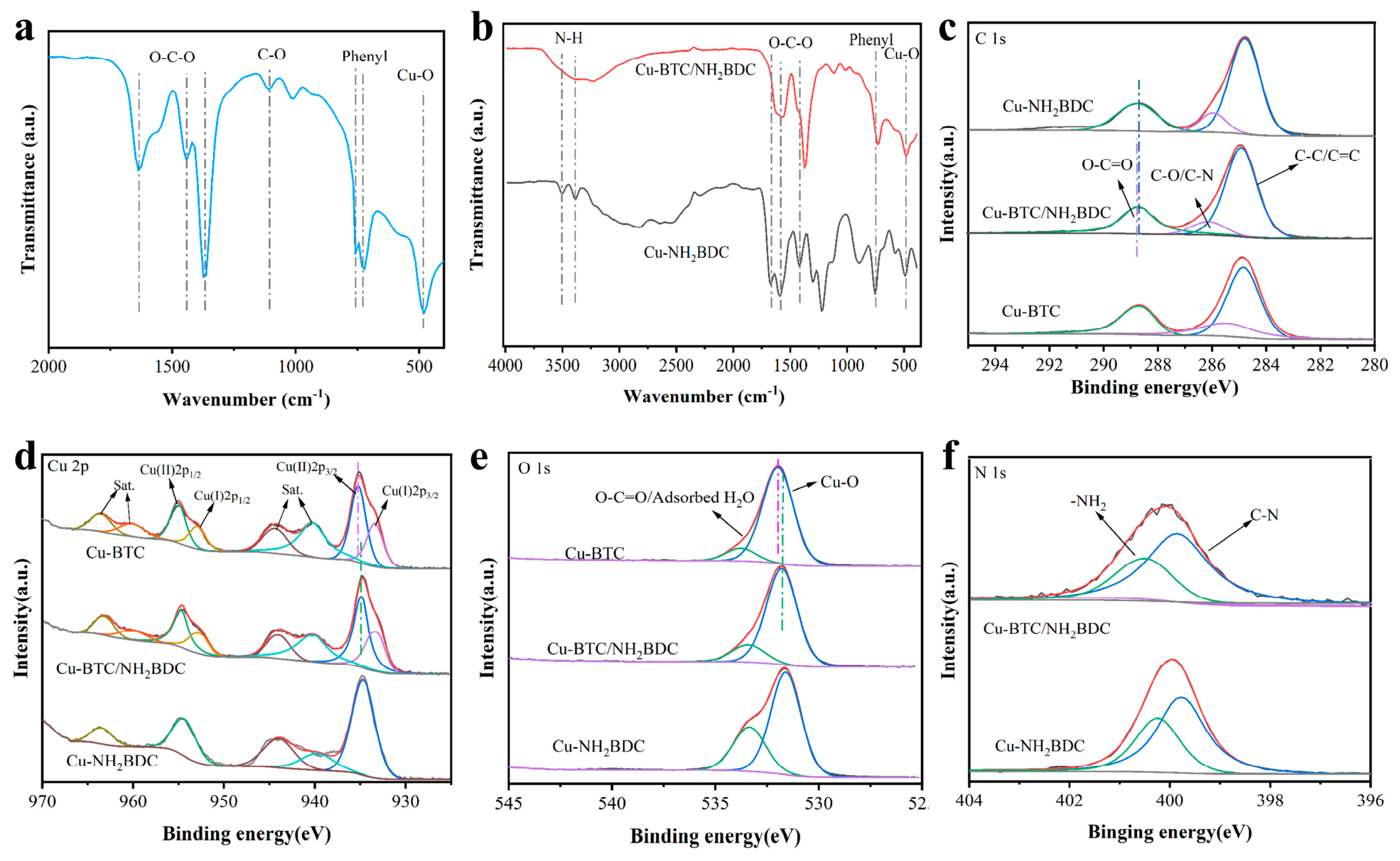
The FT-IR spectra of Cu-BTC, Cu-NH2BDC, and Cu-BTC/NH2BDC are shown in Figure 2a,b. Cu-BTC exhibits a characteristic Cu-O vibration at 478 cm−1 and O-C-O symmetric and asymmetric stretching vibrations at 1371, 1442, and 1637 cm−1 [33]. Cu-NH2BDC shows typical -NH2 stretching vibrations at 3385 and 3504 cm−1 (Figure 2b) [34]. In the dual-ligand Cu-BTC/NH2BDC, the -NH2 stretching bands become broadened and shift toward lower wavenumbers, while the O-C-O-related vibrations exhibit a redshift. This simultaneous redshift suggests the hydrogen bonding interaction between amino groups and carboxyl oxygen [35]. The hydrogen-bonding interaction is beneficial for the formation and subsequent conversion of key nitrogen-containing intermediates, such as *NN, during the N2 reduction process [36,37].
The XPS spectra of Cu-BTC, Cu-NH2BDC, and Cu-BTC/NH2BDC are presented in Figure 2. As shown in Figure 2c, the O-C=O peak in the C 1s spectrum of Cu-BTC/NH2BDC shows a slight positive shift compared to that of Cu-NH2BDC, indicating that the chemical environment of carboxyl carbon is altered, this change is generally associated with hydrogen-bonding interactions between amino and carboxyl groups. In the Cu 2p spectra (Figure 2d), the peaks located at 935.10 eV and 954.94 eV are assigned to the Cu(II) 2p3/2 and Cu(II) 2p1/2 orbitals of Cu-BTC, respectively [38,39]; the Cu(II) 2p3/2 and 2p1/2 peaks of Cu-BTC/NH2BDC are located at 934.94 eV and 954.78 eV, respectively, showing a negative shift of approximately 0.16 eV compared to Cu-BTC. This shift indicates an increased electron density at the Cu sites. Since the carbon atom in CO2 is an electron-deficient center, electron-rich Cu sites can interact with CO2, thereby facilitating its activation [40,41,42]. In the O 1s spectra (Figure 2e), the Cu-O peak shifts from 531.97 eV in Cu-BTC to 531.80 eV in Cu-BTC/NH2BDC, further confirming the change in the Cu-O coordination environment. In the N 1s spectra (Figure 2f), the -NH2 peak shifts toward higher binding energy by approximately 0.15 eV and becomes broadened, this change is generally associated with the interaction between amino and carboxyl groups, which induces electron redistribution and decreases the electron density around the nitrogen atoms [43]. The variations observed in the N 1s and C 1s spectra are consistent with the FT-IR results.
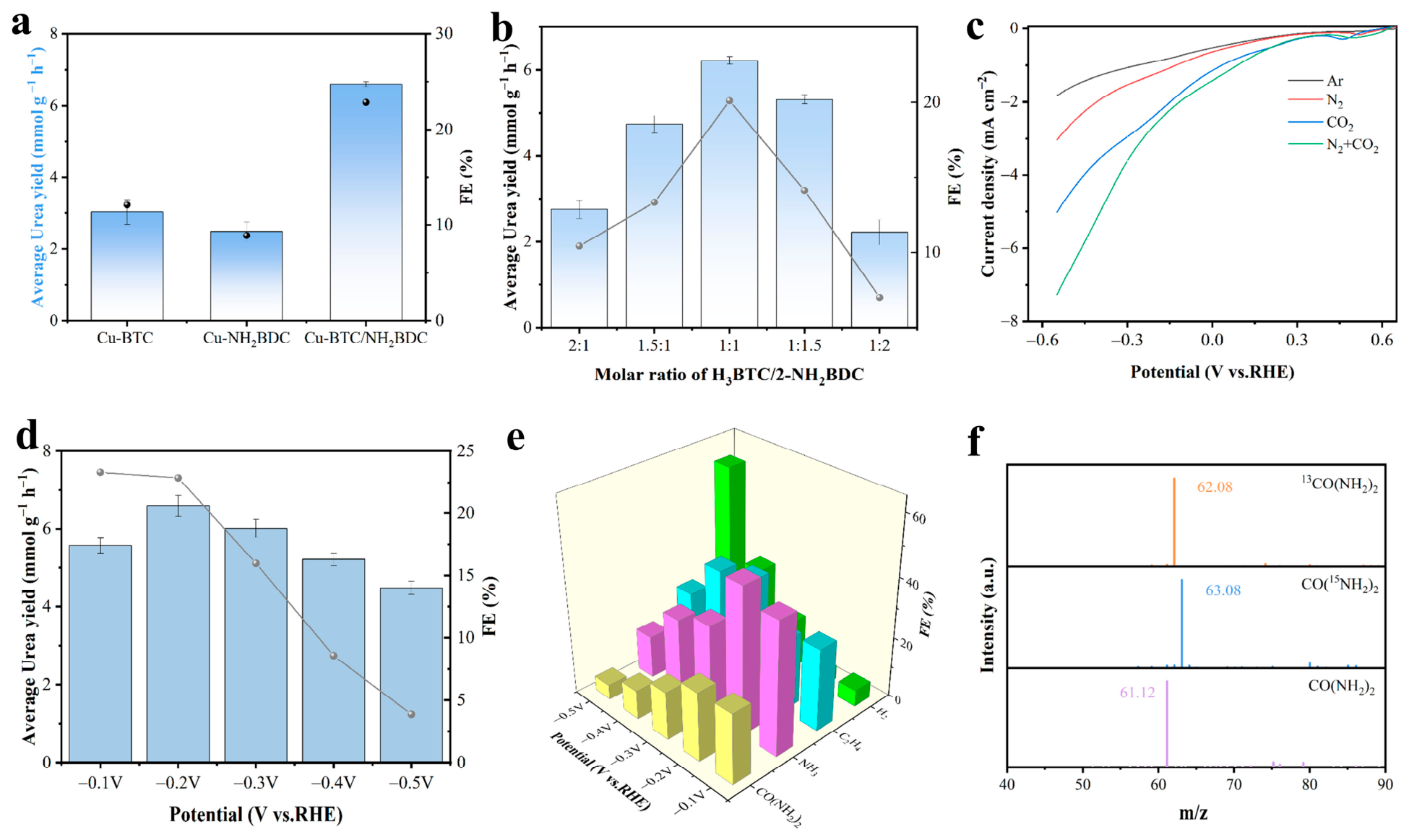
All electrochemical performance tests were conducted in an H-type electrolytic cell (Figure S2). The electrocatalytic performance of Cu-BTC, Cu-NH2BDC, and Cu-BTC/NH2BDC catalysts was evaluated in 0.5 M KHCO3 electrolyte. As shown in Figure 3a, at −0.2 V vs. RHE, Cu-BTC/NH2BDC delivers a urea yield of 6.59 mmol g−1 h−1 with a Faradaic efficiency of 22.85%, significantly outperforms the single-ligand catalysts Cu-BTC and Cu-NH2BDC. In addition, the effects of the molar ratio of H3BTC to 2-NH2BDC and solvent volume on urea yield, Faradaic efficiency and Linear sweep voltammetry (LSV) responses, are shown in Figure 3b and Figures S3 and S4.
LSV measurements were performed on Cu-BTC, Cu-NH2BDC, and Cu-BTC/NH2BDC catalyst electrodes in 0.5 M KHCO3 solution to evaluate their electrocatalytic reduction performance, as shown in Figure S5. Compared to Cu-BTC and Cu-NH2BDC, Cu-BTC/NH2BDC exhibits a higher current density under N2 or CO2 atmospheres, indicating a stronger electrochemical response toward N2 or CO2 reduction reaction. The LSV curves on the Cu-BTC/NH2BDC catalyst electrode recorded in 0.5 M KHCO3 electrolyte saturated with Ar, N2, CO2, and CO2/N2 are shown in Figure 3c. Compared to the Ar-saturated electrolyte, the current density increases under N2- or CO2-saturated conditions, indicating that the reduction in N2 or CO2 occurs on the Cu-BTC/NH2BDC electrode. More importantly, a further enhancement in current density is observed under CO2/N2 co-feeding conditions, suggesting that Cu-BTC/NH2BDC can effectively promote the co-reduction in CO2 and N2.
Figure 3d shows the urea yield and FE on the Cu-BTC/NH2BDC catalyst electrode at different applied potentials. As the applied potential increases, both the urea yield and FE first increase and then decrease, with the optimal urea synthesis performance achieved at −0.2 V vs. RHE. During the electrocatalytic urea synthesis process, urea and ammonia are detected in the electrolyte, while C2H4 and H2 are identified as gaseous products (Figure 3e). When the applied potential is higher than −0.2 V vs. RHE, side reactions such as the hydrogen evolution reaction are progressively enhanced, resulting in decreased urea selectivity.
Isotope labeling experiments were conducted to confirm that the produced urea originates from the co-reduction in CO2 and N2. As shown in Figure 3f, when isotopically labeled gases (13CO2 with N2, and 15N2 with CO2) were used as feed gases, distinct signals corresponding to 13CO(NH2)2 and CO(15NH2)2 were observed at m/z = 62.08 and 63.08, respectively. In contrast, when unlabeled CO2 and N2 were employed, a characteristic signal appeared only at m/z = 61.12. This result indicates that the carbon and nitrogen in urea originate from CO2 and N2, rather than from other pollution sources or the carbon source in the KHCO3 electrolyte. Figure S6a shows the urea yield of Cu-BTC/NH2BDC under different experimental conditions, including a bare carbon paper electrode and Ar-, CO2-, N2-, and CO2/N2-saturated electrolytes. A significant urea yield is observed only under the CO2/N2 co-saturated electrolyte, indicating that urea formation originates from the co-reduction in CO2 and N2.
The stability of Cu-BTC/NH2BDC was also evaluated. The urea yield and FE on Cu-BTC/NH2BDC remain nearly unchanged over five consecutive cycles (Figure S6b). During 10 h potentiostatic electrolysis at −0.2 V vs. RHE, the current density shows no obvious decay (Figure S6). The Cu-BTC/NH2BDC catalyst was characterized before and after the reaction. As shown in Figure S8, the XRD patterns and Cu 2p spectra remain essentially unchanged, indicating that no significant structural variation occurs during the electrochemical process, thus demonstrating good structural stability.
The electrochemically active surface area (ECSA) was evaluated by cyclic voltammetry (CV) measurements at different scan rates (20–100 mV s−1) in the non-Faradaic region. As shown in Figure S8, the double-layer capacitance (Cdl) of Cu-BTC/NH2BDC (0.44 mF cm−2) is lower than that of Cu-BTC (0.76 mF cm−2) and Cu-NH2BDC (0.74 mF cm−2), indicating a relatively lower number of electrochemically active sites. However, Cu-BTC/NH2BDC exhibits much higher urea synthesis performance than the single-ligand catalysts. Further normalization of the LSV curves by ECSA (Figure S10) shows that the current density of Cu-BTC/NH2BDC is higher than those of Cu-BTC and Cu-NH2BDC, indicating a higher intrinsic activity per active site. The EIS on Cu-BTC, Cu-NH2BDC, and Cu-BTC/NH2BDC are shown in Figure S11. Compared to Cu-BTC and Cu-NH2BDC, Cu-BTC/NH2BDC exhibits a smaller semicircle radius in the Nyquist plot, indicating a lower charge transfer resistance. The catalytic performance of the Cu-BTC/NH2BDC catalyst and other catalysts reported in the literature is compared in Table S2. It shows Cu-BTC/NH2BDC exhibits higher activity and selectivity under milder reaction conditions.
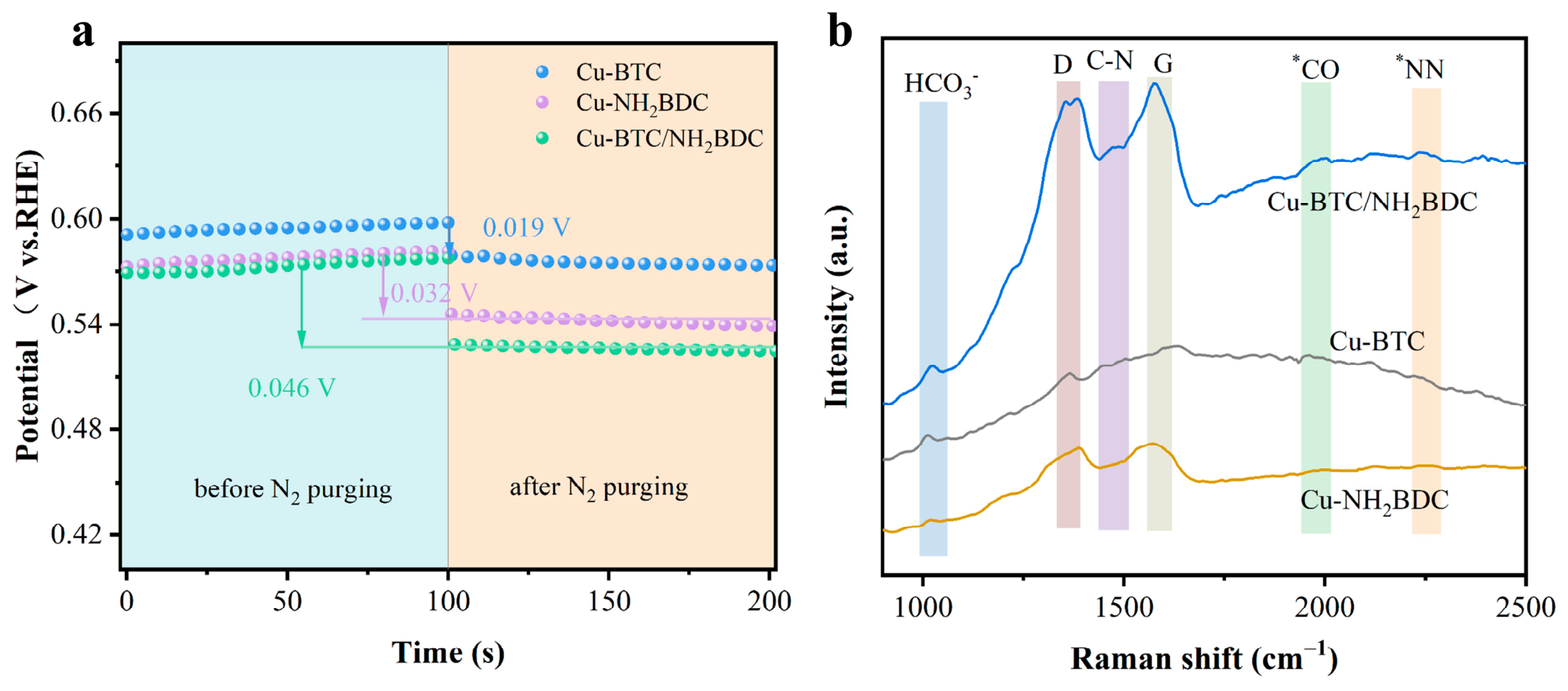
Open Circuit Potential (OCP) is closely related to the adsorbed species in the Helmholtz layer at the catalyst surface [44,45]. Therefore, the adsorption behavior of gas molecules on the catalyst can be indirectly evaluated by comparing the OCP before and after gas introduction. As shown in Figure 4a, a noticeable change in OCP is observed upon N2 purging for all catalysts. Among them, Cu-BTC/NH2BDC exhibits the largest potential shift, which is higher than those of Cu-BTC and Cu-NH2BDC, indicating a stronger adsorption capability toward N2.
In situ Raman spectroscopy was employed to monitor the evolution of surface intermediates during the electrocatalytic process. As shown in Figure 4b, at −0.2 V vs. RHE, Cu-BTC, Cu-NH2BDC, and Cu-BTC/NH2BDC exhibit distinct vibrational features. The characteristic peak at 1986 cm−1 is assigned to the *CO intermediate [46]. Compared to Cu-BTC and Cu-NH2BDC, Cu-BTC/NH2BDC displays a stronger *CO vibrational signal, indicating that its surface can more effectively promote the conversion of CO2 to the key intermediate *CO. A characteristic peak attributed to the *NN intermediate is observed at 2239 cm−1; this peak is more pronounced in Cu-BTC/NH2BDC, indicating enhanced adsorption and activation of N2 on its surface [47,48]. In addition, a vibrational band corresponding to the C-N intermediate is detected at 1474 cm−1, with a significantly higher intensity for Cu-BTC/NH2BDC than those of the single-ligand catalysts, indicating that C-N coupling is more favorable on its surface [11]. In the process of electrocatalytic co-reduction in N2 and CO2 for urea synthesis, the reaction begins with the adsorption and activation of both reactant molecules on the catalyst surface. Specifically, CO2 molecules are gradually reduced via proton-coupled electron transfer (PCET) processes to form the adsorbed *CO intermediate. Meanwhile, after N2 molecules are adsorbed onto the catalyst surface, the stable N≡N triple bond is activated by the catalyst to form an *NN intermediate; Subsequently, the activated *CO undergoes C-N coupling with *NN to generate a key C-N intermediate, which is widely reported in the literature as *NCON [11,12]. This *NCON intermediate then undergoes continuous hydrogenation via sequential proton-coupled electron transfer (PCET) steps on the catalyst surface, ultimately converting to urea molecules (CO(NH2)2) and desorbing from the catalyst surface [11,13]. The D band and G band appearing at 1360 cm−1 and 1580 cm−1, respectively, are attributed to the intrinsic carbon signals of the glassy carbon electrode [49]. The characteristic peak located at 1014 cm−1 is assigned to HCO3, which mainly originates from HCO3 species in the electrolyte [50]. Figure S12 shows the in situ Raman spectra of Cu-BTC/NH2BDC catalysts synthesized with different ligand molar ratios, as well as those recorded at different applied potentials. The results indicate that when the ligand molar ratio is 1:1 and the applied potential is −0.2 V vs. RHE, the C-N intermediate signal is the strongest, suggesting that this condition is more favorable for C-N coupling, which is consistent with its highest urea synthesis performance.

3. Materials and Methods

3.1. Materials

Copper nitrate trihydrate (Cu(NO3)2·3H2O, ≥99.5%, Aladdin, Shanghai, China), trimesic acid (H3BTC, ≥98%, Aladdin, Shanghai, China), 2-aminoterephthalic acid (2-NH2BDC, ≥98%, Aladdin, Shanghai, China), methanol (CH3OH, 99.7%, Fuyu Chemical, Tianjin, China), potassium bicarbonate (KHCO3, ≥99.5%, Aladdin, Shanghai, China), triethylamine (C6H15N, ≥99.5% Fuchen Chemical, Tianjin, China), diacetyl monoxime (C4H8N2O2, ≥99.5%, Aladdin, Shanghai, China), thiosemicarbazide (CH5N3S, ≥99.9%, 9DingChem, Shanghai, China), ferric chloride (FeCl3, 98%, Aladdin, Shanghai, China), phosphoric acid (H3PO4, ≥85%, Aladdin, Shanghai, China), and sulfuric acid (H2SO4, ≥98%, Tongguang Fine Chemical, Beijing, China) were used as received without further purification. Deionized water was used throughout all experiments.

3.2. Preparation of Cu-BTC, Cu-NH2BDC, and Cu-BTC/NH2BDC

Cu-BTC was synthesized by dissolving 0.983 g of Cu(NO3)2·3H2O and 0.35 g of H3BTC in 45 mL of CH3OH, followed by ultrasonic dispersion. The mixture was then vigorously stirred at room temperature for 5 h. After the reaction, the resulting suspension was collected by centrifugation, washed, and dried to obtain Cu-BTC. Cu-NH2BDC was prepared using the same procedure, except that H3BTC was replaced by 0.302 g of 2-NH2BDC.
For the preparation of the dual-ligand catalyst, 0.983 g of Cu(NO3)2·3H2O was used while the total molar amount of organic ligands keeps constant. H3BTC and 2-NH2BDC were mixed at a molar ratio of 1:1 and dissolved in 45 mL of CH3OH. Subsequently, 0.6 mL of triethylamine was added, followed by ultrasonic dispersion. The mixture was then vigorously stirred at room temperature for 5 h. After the reaction, the suspension was collected by centrifugation, washed, and dried to obtain Cu-BTC/NH2BDC. Triethylamine was introduced as a modulator to facilitate ligand deprotonation and promote the formation of the dual-ligand structure.

3.3. Characterization

X-ray diffraction (XRD) patterns were recorded on an Ultima IV X-ray diffractometer (Rigaku, Tokyo, Japan). X-ray photoelectron spectroscopy (XPS) was performed using a Nexsa G2 spectrometer(Thermo Fisher Scientific, East Grinstead, UK). The morphology and elemental distribution of the samples were analyzed by scanning electron microscopy (SEM, S4800, Hitachi, Tokyo, Japan) equipped with an energy-dispersive X-ray spectroscopy (EDS) system. Fourier transform infrared (FT-IR) spectra were obtained using an IRTracer-100 spectrometer (Shimadzu, Kyoto, Japan). In situ Raman spectra were collected on a LabRAM HR Evolution Raman spectrometer(Horiba, Palaiseau, France). The reduction products were analyzed by UV-vis spectrophotometer (HD-V50, HORDE ELECTRIC, Shenzhen, China) and gas chromatography–mass spectrometry (GC-MS, Trace 1300-ISQ, Thermo Fisher Scientific, Waltham, MA, USA).

3.4. Electrochemical Measurement

Electrochemical measurement methods are exhibited in the Supporting Information.

3.5. Identification and Quantification of Product and By-Products

This section is detailed in the Supporting Information.

4. Conclusions

The dual-ligand Cu-BTC/NH2BDC catalyst was successfully synthesized via a precipitation method at room temperature. The introduction of 2-NH2BDC modulates the electronic structure of Cu sites, generating electron-enriched Cu centers that facilitate CO2 activation. Meanwhile, the hydrogen bonding interaction between amino groups and carboxyl groups facilitates the formation and transformation of *NN intermediates, thus enhancing the C-N coupling. Cu-BTC/NH2BDC exhibits highest catalytic activity and selectivity. At −0.2 V vs. RHE, the urea yield reaches 6.59 mmol g−1 h−1 with a corresponding Faradaic efficiency of 22.85%, outperforming Cu-BTC and Cu-NH2BDC.

Supplementary Materials

The following supporting information can be downloaded at: https://www.mdpi.com/article/10.3390/catal16060512/s1, Figure S1: EDS elemental mapping of Cu-BTC/NH2BDC; Table S1. Extural parameters of Cu-BTC, Cu-NH2BDC, and Cu-BTC/NH2BDC derived from BJH analysis; Figure S2: The three-electrode system (H-type cell) for electrocatalytic urea synthesis; Figure S3: LSV curves on Cu-BTC/NH2BDC catalyst electrodes with different ligand molar ratios; Figure S4: (a) LSV curves and (b) urea yield and Faradaic efficiency on Cu-BTC/NH2BDC catalyst electrodes with different solvent volumes; Figure S5: LSV curves on Cu-BTC, Cu-NH2BDC, and Cu-BTC/NH2BDC catalyst electrodes in 0.5 M KHCO3 electrolyte under different gas atmospheres: (a) CO2 atmosphere; (b) N2 atmosphere; Figure S6: (a) Urea yield on the Cu-BTC/NH2BDC catalyst electrode in N2-, CO2-, and N2/CO2-saturated, as well as that of the bare carbon paper electrode without catalyst loading; (b) urea yield and Faradaic efficiency of Cu-BTC/NH2BDC during five consecutive electrolysis cycles electrolyte; Figure S7: Current–time (i–t) curve on the Cu-BTC/NH2BDC catalyst electrode during 10 h potentiostatic electrolysis at −0.2 V vs. RHE; Figure S8: (a) XRD patterns of Cu-BTC/NH2BDC before and after the electrocatalytic reaction; (b) Cu 2p XPS spectra of Cu-BTC/NH2BDC before and after the electrocatalytic reaction; Figure S9: CV curves on (a) Cu-BTC, (b) Cu-NH2BDC and (c) Cu-BTC/NH2BDC catalyst electrodes at different scan rates; (d) Cdl values of Cu-BTC, Cu-NH2BDC and Cu-BTC/NH2BDC catalyst electrodes; Figure S10: ECSA-normalized LSV curves on Cu-BTC, Cu-NH2BDC and Cu-BTC/NH2BDC catalyst electrodes; Figure S11: Electrochemical impedance spectroscopy on Cu-BTC, Cu-NH2BDC and Cu-BTC/NH2BDC; Table S2. Comparison of catalytic performance between Cu-BTC/NH2BDC and other catalysts reported in the literature; Figure S12: (a) in situ Raman spectra of Cu-BTC/NH2BDC prepared with different ligand molar ratios; (b) in situ Raman spectra of Cu-BTC/NH2BDC at different applied potentials [51,52].

Author Contributions

Writing—original draft, formal analysis, data curation, X.X. (Xinlu Xiong); Data curation, D.S.; Formal analysis, Q.R.; Investigation, X.X. (Xu Xiang); Writing—reviewed editing, resources, Validation, J.Y. All authors have read and agreed to the published version of the manuscript.

Funding

This work was supported by the National Natural Science Foundation of China (Grant No. 22478025, 21676010), Beijing Natural Science Foundation (Grant No. 2212015), and Innovation Fund of SINOPEC Catalyst Co. Ltd.-State Key Laboratory of Chemical Resource Engineering (Grant No. 36100000-22-ZC0607-0041).

Data Availability Statement

The data will be made available upon request.

Acknowledgments

We are deeply grateful for the generous financial support.

Conflicts of Interest

The authors declare that this study received funding from the innovation Fund of SINOPEC Catalyst Co. Ltd.-State Key Laboratory of Chemical Resource Engineering (Grant No. 36100000-22-ZC0607-0041). The funder was not involved in the study design, collection, analysis, interpretation of data, the writing of this article or the decision to submit it for publication.

References

  1. Pawar, N.D.; Singhal, K.; Bhushan, C.; Pregger, T.; Jochem, P. Decarbonization of Urea Production in India and Its Impact on Water Withdrawal and Costs: A Cost Optimization Approach. J. Clean. Prod. 2025, 486, 144433. [Google Scholar] [CrossRef]
  2. Jiang, M.; Zhu, M.; Wang, M.; He, Y.; Luo, X.; Wu, C.; Zhang, L.; Jin, Z. Review on Electrocatalytic Coreduction of Carbon Dioxide and Nitrogenous Species for Urea Synthesis. ACS Nano 2023, 17, 3209–3224. [Google Scholar] [CrossRef]
  3. Liu, Y.; Zhao, X.; Ye, L. A Novel Elastic Urea-Melamine-Formaldehyde Foam: Structure and Properties. Ind. Eng. Chem. Res. 2016, 55, 8743–8750. [Google Scholar] [CrossRef]
  4. Singh, R.K.; Rajavelu, K.; Montag, M.; Schechter, A. Advances in Catalytic Electrooxidation of Urea: A Review. Energy Technol. 2021, 9, 2100017. [Google Scholar] [CrossRef]
  5. Kyriakou, V.; Garagounis, I.; Vourros, A.; Vasileiou, E.; Stoukides, M. An Electrochemical Haber-Bosch Process. Joule 2020, 4, 142–158. [Google Scholar] [CrossRef]
  6. Guo, H.; Harrison, A.R.P.; Gao, M.; Zhang, X.; Chen, Q.; Cui, Z.; Nie, B. Chemical Looping Based Low-Pressure Ammonia Synthesis. Chem. Eng. J. 2024, 500, 157321. [Google Scholar] [CrossRef]
  7. Smith, C.; Hill, A.K.; Torrente-Murciano, L. Current and Future Role of Haber-Bosch Ammonia in a Carbon-Free Energy Landscape. Energy Environ. Sci. 2020, 13, 331–344. [Google Scholar] [CrossRef]
  8. Cui, Z.; Wang, H.; Li, C.; Peng, W.; Liu, J. Three Birds with One Stone: Electrocatalytic C-N Coupling for Carbon Neutrality, Nitrogen Resource Utilization, and Urea Synthesis. Renew. Sustain. Energy Rev. 2024, 205, 114822. [Google Scholar] [CrossRef]
  9. Wang, J.; Yao, Z.; Hao, L.; Sun, Z. Electrocatalytic Coupling of CO2 and N2 for Urea Synthesis. Curr. Opin. Green Sustain. Chem. 2022, 37, 100648. [Google Scholar] [CrossRef]
  10. Mei, Z.; Zhou, Y.; Lv, W.; Tong, S.; Yang, X.; Chen, L.; Zhang, N. Recent Progress in Electrocatalytic Urea Synthesis under Ambient Conditions. ACS Sustain. Chem. Eng. 2022, 10, 12477–12496. [Google Scholar] [CrossRef]
  11. Chen, C.; Zhu, X.; Wen, X.; Zhou, Y.; Zhou, L.; Li, H.; Tao, L.; Li, Q.; Du, S.; Liu, T.; et al. Coupling N2 and CO2 in H2O to Synthesize Urea under Ambient Conditions. Nat. Chem. 2020, 12, 717–724. [Google Scholar] [CrossRef]
  12. Yuan, M.; Chen, J.; Bai, Y.; Liu, Z.; Zhang, J.; Zhao, T.; Wang, Q.; Li, S.; He, H.; Zhang, G. Unveiling Electrochemical Urea Synthesis by Co-Activation of CO2 and N2 with Mott–Schottky Heterostructure Catalysts. Angew. Chem. Int. Ed. 2021, 60, 10910–10918. [Google Scholar] [CrossRef]
  13. Yuan, M.; Chen, J.; Xu, Y.; Liu, R.; Zhao, T.; Zhang, J.; Ren, Z.; Liu, Z.; Streb, C.; He, H.; et al. Highly Selective Electroreduction of N2 and CO2 to Urea over Artificial Frustrated Lewis Pairs. Energy Environ. Sci. 2021, 14, 6605–6615. [Google Scholar] [CrossRef]
  14. Chen, X.; Xing, P.; Wei, S.; Luo, H.; Dai, L.; Wang, Y. Electrochemical Co-Reduction of N2 and CO2 to Urea Using In2S3 Anchored on S-Doped Reduced Graphene Oxide. J. Electroanal. Chem. 2024, 969, 118516. [Google Scholar] [CrossRef]
  15. Kaur, S.; Garg, K.; Gupta, D.; Kafle, A.; Dharmender; Shukla, V.; Ahuja, R.; Nagaiah, T.C. Unleashing High Yield Urea Production by Pulse Electrodeposition of Bi/Cu via Co-Reduction of N2 and CO2. ACS Energy Lett. 2025, 10, 85–93. [Google Scholar] [CrossRef]
  16. Gao, Y.; Wang, J.; Yang, Y.; Wang, J.; Zhang, C.; Wang, X.; Yao, J. Engineering Spin States of Isolated Copper Species in a Metal-Organic Framework Improves Urea Electrosynthesis. Nano-Micro Lett. 2023, 15, 158. [Google Scholar] [CrossRef] [PubMed]
  17. Xiao, S.; Yuan, J.; Su, Y.; Ma, L.; Niu, H.; Song, D.; Xiong, X.; Ren, Q.; Xiang, X. Amorphous CuFe-Metal Organic Framework Catalyst for Electrocatalytic Urea Synthesis from N2 and CO2. Appl. Surf. Sci. 2026, 724, 165667. [Google Scholar] [CrossRef]
  18. Zhai, Z.; Yan, W.; Dong, L.; Deng, S.; Wilkinson, D.P.; Wang, X.; Zhang, L.; Zhang, J. Catalytically Active Sites of MOF-Derived Electrocatalysts: Synthesis, Characterization, Theoretical Calculations, and Functional Mechanisms. J. Mater. Chem. A 2021, 9, 20320–20344. [Google Scholar] [CrossRef]
  19. Zhao, W.; Li, G.; Tang, Z. Metal-Organic Frameworks as Emerging Platform for Supporting Isolated Single-Site Catalysts. Nano Today 2019, 27, 178–197. [Google Scholar] [CrossRef]
  20. Xu, C.; Fang, R.; Luque, R.; Chen, L.; Li, Y. Functional Metal–Organic Frameworks for Catalytic Applications. Coord. Chem. Rev. 2019, 388, 268–292. [Google Scholar] [CrossRef]
  21. Wu, X.; Zhang, H.; Zuo, S.; Dong, J.; Li, Y.; Zhang, J.; Han, Y. Engineering the Coordination Sphere of Isolated Active Sites to Explore the Intrinsic Activity in Single-Atom Catalysts. Nano-Micro Lett. 2021, 13, 136. [Google Scholar] [CrossRef]
  22. Chen, Y.; Li, J.; Jiang, G.; Xu, B.; Zhang, J.; Zhang, H.; Shu, S. Dual-Ligand Cu-Based MOFs for Electrocatalytic Reduction of NO3. J. Environ. Chem. Eng. 2023, 11, 110472. [Google Scholar] [CrossRef]
  23. Kazemi, A.; Karbalaee Hosseini, A.; Ashourzadeh Pordsari, M.; Tamtaji, M.; Keshavarz, S.; Manteghi, F.; Tadjarodi, A.; Ghaemi, A.; Rohani, S.; Goddard, W.A. Enhancing CO2 Selectivity in MOFs through a Dual-Ligand Strategy: Experimental and Theoretical Insights. J. CO2 Util. 2025, 93, 103035. [Google Scholar] [CrossRef]
  24. Xu, S.; Guo, X.; Qiao, Z.; Huang, H.; Zhong, C. Methyl-Shield Cu-BTC with High Water Stability through One-Step Synthesis and in Situ Functionalization. Ind. Eng. Chem. Res. 2020, 59, 12451–12457. [Google Scholar] [CrossRef]
  25. Abou-Elyazed, A.S.; Ftooh, A.I.; Sun, Y.; Ashry, A.G.; Shaban, A.K.F.; El-Nahas, A.M.; Yousif, A.M. Solvent-Free Synthesis of HKUST-1 with Abundant Defect Sites and Its Catalytic Performance in the Esterification Reaction of Oleic Acid. ACS Omega 2024, 9, 37662–37671. [Google Scholar] [CrossRef]
  26. Hashad, N.M.; Nassar, M.Y.; Jahin, H.S.; El-Nahas, A.M.; Adam, M.S.; Kamoun, E.A.; Alfurayj, I.; Ayoup, M.S.; El-Demerdash, S.H.; Abou-Elyazed, A.S. Urea-Functionalized HKUST-1 Metal-Organic Framework for High-Performance Lead Adsorption. RSC Adv. 2025, 15, 46523–46540. [Google Scholar] [CrossRef] [PubMed]
  27. Wang, J.; Wei, J.; An, C.; Tang, H.; Deng, Q.; Li, J. Electrocatalyst Design for the Conversion of Energy Molecules: Electronic State Modulation and Mass Transport Regulation. Chem. Commun. 2022, 58, 10907–10924. [Google Scholar] [CrossRef] [PubMed]
  28. Wang, M.; Cai, Z.; Zhang, B.; Yang, K.; Shou, T.; Bernards, M.T.; Xie, P.; He, Y.; Shi, Y. Electrochemical Reduction of CO2 on Copper-Based Electrocatalyst Supported on MWCNTs with Different Functional Groups. Energy Fuels 2022, 36, 5833–5842. [Google Scholar] [CrossRef]
  29. Li, H.; Xu, L.; Bo, S.; Wang, Y.; Xu, H.; Chen, C.; Miao, R.; Chen, D.; Zhang, K.; Liu, Q.; et al. Ligand Engineering towards Electrocatalytic Urea Synthesis on a Molecular Catalyst. Nat. Commun. 2024, 15, 8858. [Google Scholar] [CrossRef] [PubMed]
  30. Ran, J.; Wang, L.; Si, M.; Liang, X.; Gao, D. Tailoring Spin State of Perovskite Oxides by Fluorine Atom Doping for Efficient Oxygen Electrocatalysis. Small 2023, 19, 2206367. [Google Scholar] [CrossRef]
  31. Zhou, L.; Niu, Z.; Jin, X.; Tang, L.; Zhu, L. Effect of Lithium Doping on the Structures and CO2 Adsorption Properties of Metal-Organic Frameworks HKUST-1. ChemistrySelect 2018, 3, 12865–12870. [Google Scholar] [CrossRef]
  32. Valenzuela, I.E.; Muñoz-Acevedo, J.C.; Pabón, E.; Paim, A.P.S. Cu (II)-Based Metal-Organic Framework Functionalized with Graphene Oxide as a Sorbent for the Dispersive Micro-Solid-Phase Extraction of Losartan Potassium from Water. J. Porous Mater. 2024, 31, 1737–1752. [Google Scholar] [CrossRef]
  33. Wen, C.F.; Zhou, M.; Liu, P.F.; Liu, Y.; Wu, X.; Mao, F.; Dai, S.; Xu, B.; Wang, X.L.; Jiang, Z.; et al. Highly Ethylene-Selective Electrocatalytic CO2 Reduction Enabled by Isolated Cu-S Motifs in Metal–Organic Framework Based Precatalysts. Angew. Chem. Int. Ed. 2022, 61, e202111700. [Google Scholar] [CrossRef]
  34. Pamei, M.; Kumar, S.; Achumi, A.G.; Puzari, A. Supercapacitive Amino-Functionalized Cobalt and Copper Metal-Organic Frameworks with Varying Surface Morphologies for Energy Storage. J. Electroanal. Chem. 2022, 924, 116885. [Google Scholar] [CrossRef]
  35. Chiñas-Rojas, L.E.; Domínguez, J.E.; Herrera, L.Á.A.; González-Jiménez, F.E.; Colorado-Peralta, R.; Arenzano Altaif, J.A.; Rivera Villanueva, J.M. Exploring Synthesis Strategies and Interactions between MOFs and Drugs for Controlled Drug Loading and Release, Characterizing Interactions through Advanced Techniques. ChemMedChem 2024, 19, e202400144. [Google Scholar] [CrossRef]
  36. Wang, L.; Xia, Y.; Yu, J. Hydrogen-Bond Activation of N2 Molecules and Photocatalytic Nitrogen Fixation. Chem 2021, 7, 1983–1985. [Google Scholar] [CrossRef]
  37. Kumar Raju, R. Electrocatalytic Reduction of Nitrogen to Ammonia on Metal Nanoclusters: Insights and Trends from d- and p-Block Metals. Phys. Chem. Chem. Phys. 2025, 27, 7773–7796. [Google Scholar] [CrossRef]
  38. Tao, S.; Cao, Z.; Xiao, X.; Song, Z.; Xiong, D.; Tian, Y.; Deng, W.; Liu, Y.; Hou, H.; Zou, G.; et al. Tunable Platform Capacity of Metal-Organic Frameworks via High-Entropy Strategy for Ultra-Fast Sodium Storage. Nano-Micro Lett. 2025, 17, 201. [Google Scholar] [CrossRef] [PubMed]
  39. Saha, R.; Sharma, A.; Siddiqui, A.I.; Benmansour, S.; Ortega-Castro, J.; Frontera, A.; Mondal, B.; Soo Lah, M.; García, C.J.G. Simultaneous Electron and Proton Conduction in a Stable Metal Organic Material with Highly Selective Electrocatalytic Oxygen Reduction Reaction to Water. Chem. Sci. 2025, 16, 9501–9508. [Google Scholar] [CrossRef]
  40. Yang, H.; Chuai, H.; Meng, Q.; Wang, M.; Zhang, S.; Ma, X. Copper-Based Bimetallic Electrocatalysts for CO2 Reduction: From Mechanism Understandings to Product Regulations. Mater. Rep. Energy 2023, 3, 100174. [Google Scholar] [CrossRef]
  41. Millet, M.-M.; Algara-Siller, G.; Wrabetz, S.; Mazheika, A.; Girgsdies, F.; Teschner, D.; Seitz, F.; Tarasov, A.; Levchenko, S.V.; Schlögl, R.; et al. Ni Single Atom Catalysts for CO2 Activation. J. Am. Chem. Soc. 2019, 141, 2451–2461. [Google Scholar] [CrossRef]
  42. Xu, M.; Wang, M.; Wang, H.; Yuan, P.; Han, Q.; Zheng, G. Electrocatalytic and Photocatalytic C-N Coupling from Small Molecules. Adv. Mater. 2025, 1, e2507144. [Google Scholar] [CrossRef]
  43. Ahmed, I.; Hasan, Z.; Lee, G.; Lee, H.J.; Jhung, S.H. Contribution of Hydrogen Bonding to Liquid-Phase Adsorptive Removal of Hazardous Organics with Metal-Organic Framework-Based Materials. Chem. Eng. J. 2022, 430, 132596. [Google Scholar] [CrossRef]
  44. Liu, K.; Gao, X.; Liu, C.-X.; Shi, R.; Tse, E.C.M.; Liu, F.; Chen, Y. Energy-Saving Hydrogen Production by Seawater Splitting Coupled with PET Plastic Upcycling. Adv. Energy Mater. 2024, 14, 2304065. [Google Scholar] [CrossRef]
  45. Chen, J.; Jiang, M.; Zhang, F.; Wang, L.; Yang, J. Interstitial Boron Atoms in Pd Aerogel Selectively Switch the Pathway for Glycolic Acid Synthesis from Waste Plastics. Adv. Mater. 2024, 36, 2401867. [Google Scholar] [CrossRef] [PubMed]
  46. Zhang, J.; Gao, H.; Wang, Z.; Gao, H.; Che, L.; Xiao, K.; Dong, A. In Situ Raman Spectroscopy Reveals Structural Evolution and Key Intermediates on Cu-Based Catalysts for Electrochemical CO2 Reduction. Nanomaterials 2025, 15, 1517. [Google Scholar] [CrossRef] [PubMed]
  47. Jain, P.; Kumari, G.; Bhogra, M.; Yanda, P.; Joseph, B.; Waghmare, U.V.; Narayana, C. Raman Evidence of Multiple Adsorption Sites and Structural Transformation in ZIF-4. Inorg. Chem. 2023, 62, 7703–7715. [Google Scholar] [CrossRef]
  48. Yuan, J.; Zhu, K.; Song, D.; Su, Y.; Ma, L.; Wei, J.; Xiang, X. Polymetallic Oxide Catalysts for Electrocatalytic Synthesis of Urea from N2 and CO2 at Ultralow Applied Voltage. ACS Sustain. Chem. Eng. 2025, 13, 14782–14791. [Google Scholar] [CrossRef]
  49. Tafazoli, S.; Yusufoğlu, M.; Balkan, T.; Kaya, S. In-Situ Surface Enhanced Raman Spectroscopy Investigations on Surface Transformations of Oxide Derived Copper Electrodes during CO2RR. J. Catal. 2023, 423, 118–128. [Google Scholar] [CrossRef]
  50. Chernyshova, I.V.; Somasundaran, P.; Ponnurangam, S. On the Origin of the Elusive First Intermediate of CO2 Electroreduction. Proc. Natl. Acad. Sci. USA 2018, 115, E9261–E9270. [Google Scholar] [CrossRef]
  51. Yuan, M.; Chen, J.; Bai, Y.; Liu, Z.; Zhang, J.; Zhao, T.; Shi, Q.; Li, S.; Wang, X.; Zhang, G. Electrochemical C-N Coupling with Perovskite Hybrids toward Efficient Urea Synthesis. Chem. Sci. 2021, 12, 6048–6058. [Google Scholar] [CrossRef] [PubMed]
  52. Ma, L.; Yuan, J.; Liu, Z.; Luo, Y.; Su, Y.; Zhu, K.; Feng, Z.; Niu, H.; Xiao, S.; Wei, J.; et al. Mesoporous Electrocatalysts with P-n Heterojunctions for Efficient Electroreduction of CO2 and N2 to Urea. ACS Appl. Mater. Interfaces 2024, 16, 26015–26024. [Google Scholar] [CrossRef] [PubMed]
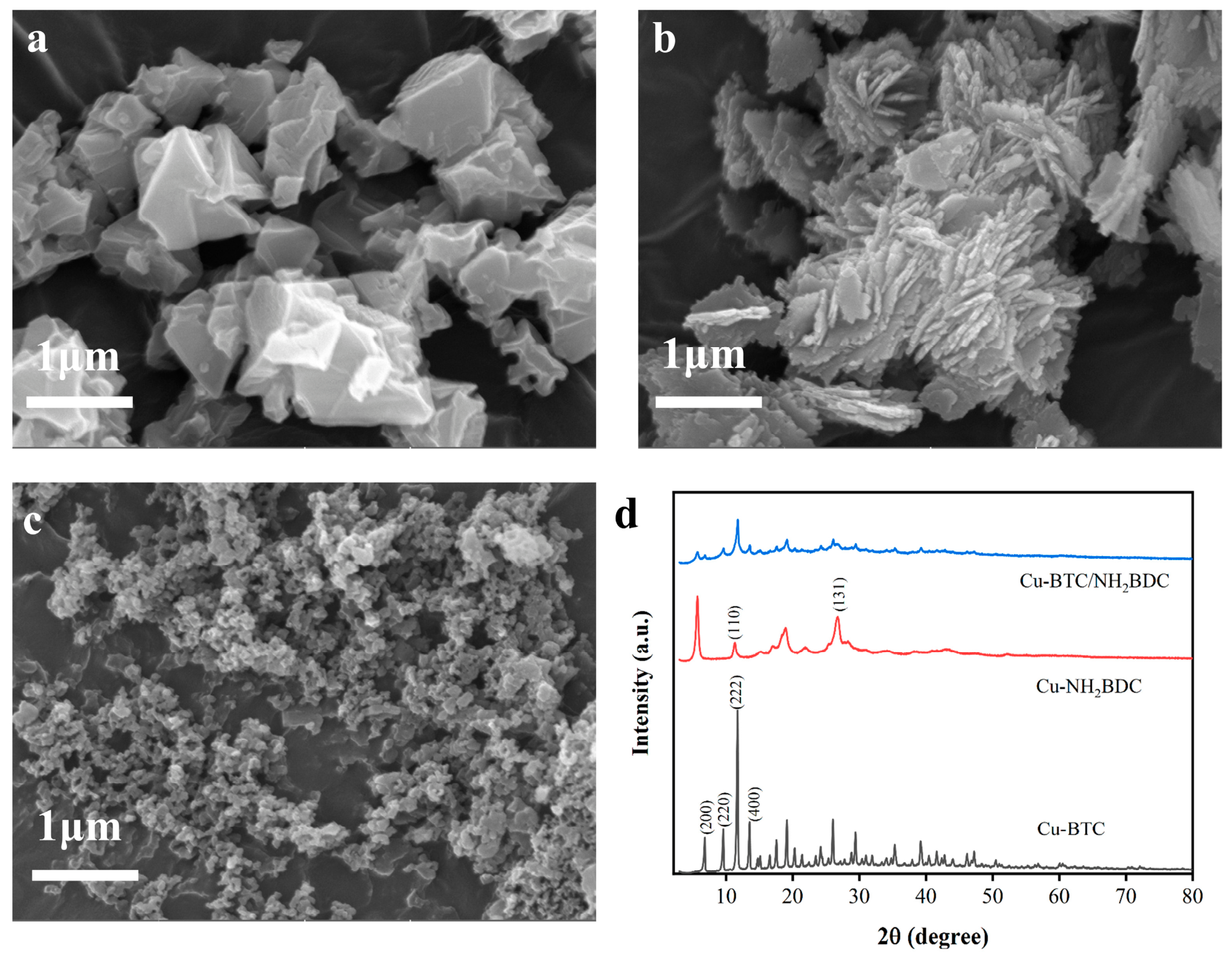
Figure 1. SEM images of (a) Cu-BTC, (b) Cu-NH2BDC and (c) Cu-BTC/NH2BDC; (d) XRD patterns of Cu-BTC, Cu-NH2BDC, and Cu-BTC/NH2BDC.
Catalysts 16 00512 g001
Figure 2. FT-IR spectra of (a) Cu-BTC, and (b) Cu-NH2BDCand Cu-BTC/NH2BDC; (c) C 1s XPS spectra, (d) Cu 2p XPS spectra, and (e) O 1s XPS spectra of Cu-BTC, Cu-NH2BDC, and Cu-BTC/NH2BDC; (f) N 1s XPS spectra of Cu-NH2BDC and Cu-BTC/NH2BDC.
Catalysts 16 00512 g002
Figure 3. (a) Urea yield and FE on Cu-BTC, Cu-NH2BDC, and Cu-BTC/NH2BDC; (b) LSV curves on Cu-BTC/NH2BDC at Ar, N2, CO2, and N2/CO2 atmospheres; (c) urea yield and FE on Cu-BTC/NH2BDC synthesized with different ligand ratios; (d) urea yield and Faradaic efficiency on Cu-BTC/NH2BDC at different applied potentials; (e) Faradaic efficiencies of different products at various potentials; (f) LC-MS spectra for urea produced using different isotopic reactants.
Catalysts 16 00512 g003
Figure 4. (a) OCP responses of Cu-BTC, Cu-NH2BDC, and Cu-BTC/NH2BDC catalyst in 0.5 M KHCO3 electrolyte before and after N2 purging; (b) In situ Raman spectra of Cu-BTC, Cu-NH2BDC and Cu-BTC/NH2BDC.
Catalysts 16 00512 g004
Disclaimer/Publisher’s Note: The statements, opinions and data contained in all publications are solely those of the individual author(s) and contributor(s) and not of MDPI and/or the editor(s). MDPI and/or the editor(s) disclaim responsibility for any injury to people or property resulting from any ideas, methods, instructions or products referred to in the content.