1. Introduction
The growing global energy demand, coupled with the unsustainable nature of fossil fuels, has intensified the need for renewable energy solutions [
1]. Hydrogen has emerged as a particularly promising alternative due to its high energy density and zero-emission characteristics upon combustion [
2]. However, as hydrogen does not exist abundantly in nature, developing efficient production technologies has become crucial [
3]. Among various approaches, water electrolysis stands out as an environmentally sustainable method for hydrogen generation [
4,
5]. Currently, platinum (Pt)-based catalysts dominate commercial hydrogen production despite their drawbacks of high cost and limited availability. These limitations have significantly constrained their widespread application in sustainable hydrogen production. Consequently, research efforts have increasingly focused on developing non-precious metal catalysts that maintain comparable catalytic activity while overcoming these economic and supply chain challenges.
Two-dimensional (2D) MOFs have emerged as a promising class of materials for electrocatalytic applications owing to their unique structural geometries and tunable physicochemical properties [
6,
7]. The incorporation of heteroatoms, particularly transition metal (TM) dopants, further enhances their catalytic potential by introducing unfilled
d orbitals capable of accommodating additional electrons [
8]. This electronic configuration enables TMs to adopt diverse coordination geometries, facilitating the formation of stable reaction intermediates that are crucial for catalytic processes [
9,
10]. More importantly, TM doping can effectively modulate the electronic structure and local chemical environment of MOF surfaces, thereby optimizing their catalytic performance.
Pioneering work by Zhang et al. [
11,
12] demonstrated the potential of 2D TM
3(C
6O
6)
2 MOFs for electrocatalytic applications through first-principles calculations. Their studies revealed exceptional charge transport properties in these materials, attributed to extensive π-electron conjugation and strong TM–organic linker interactions, making them highly effective for both oxygen reduction reaction (ORR) and CO
2 reduction reactions (CO
2RR) [
13]. In a complementary approach, Zhao et al. [
14] conducted hierarchical high-throughput screening of TM
3(HAB)
2 MOFs for nitrogen reduction reaction (NRR). Their investigation identified Nb
3(HAB)
2, Mo
3(HAB)
2, and particularly Tc
3(HAB)
2 as outstanding candidates, with the latter exhibiting remarkable catalytic efficiency through a distal pathway requiring an ultralow onset potential of just −0.63 V. Inspired by these remarkable advances, we are compelled to explore whether these MOF materials could serve as efficient electrocatalysts for the HER.
In this contribution, we systematically evaluate the HER performance of a fresh TM3(C6O6)2 (TM = Sc, Ti, V, Cr, Mn, Fe, Co, Ni and Cu) MOF material combining C6O6 moieties and metal atom through comprehensive density functional theory (DFT) calculations. Three key metrics of binding energy, formation energy and dissolution energy are employed to assess the atomic distribution, thermodynamic and electrochemical stability, respectively. For catalytic activity evaluation, we adopt the established hydrogen adsorption free energy (ΔGH) descriptor. Our screening successfully identifies three promising electrocatalysts with |ΔGH| ≤ 0.3 eV, including particularly outstanding candidates: V3(C6O6)2 (ΔGH = 0.18 eV), Cr3(C6O6)2 (ΔGH = 0.07 eV) and Co3(C6O6)2 (ΔGH = 0.29 eV). Remarkably, Cr3(C6O6)2 demonstrates HER performance metrics comparable to or exceeding the Pt benchmark. Based on these findings, we propose MOF-based electrodes as promising next-generation electrocatalysts for ambient-condition applications. This theoretical study aims to stimulate experimental investigations into MOF materials for sustainable energy conversion technologies.
2. Results and Discussion
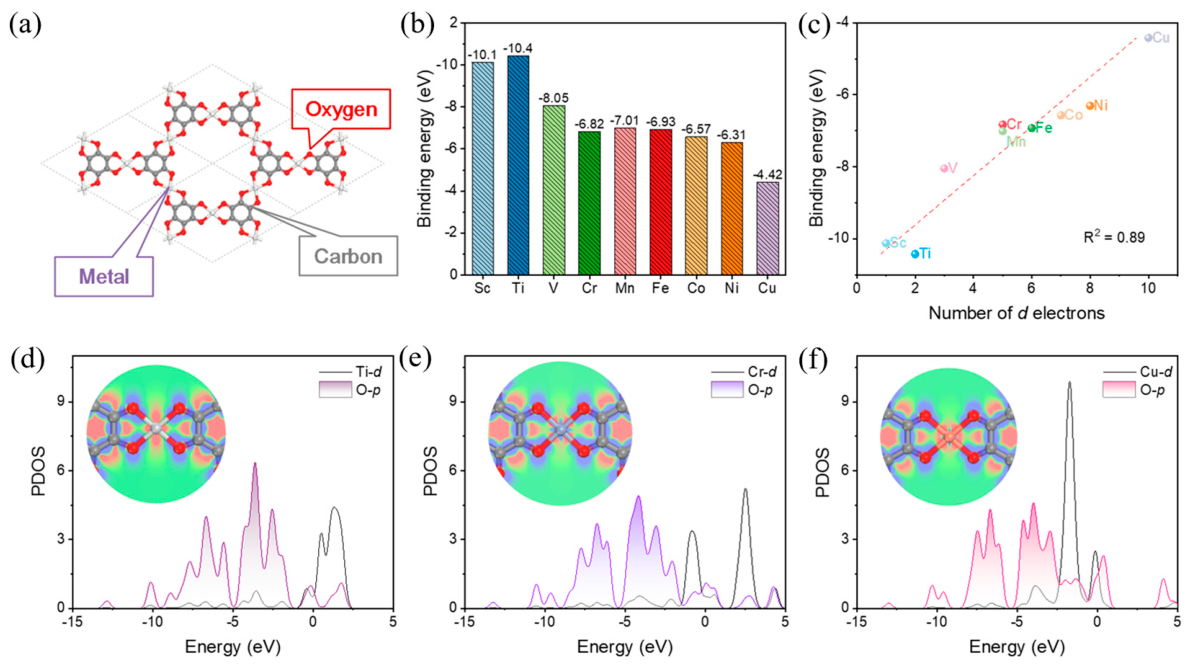
Figure 1a displays the atomic structures of the computational models (red, gray and white represent oxygen, carbon and 3
d transition metal (TM) atoms respectively). The whole MOF configuration is represented by a 2 × 2 supercell containing eight C
6O
6 species and one defective center part, which serve as anchoring sites for 3
d TM atoms. Depending on the 3
d TM variation difference, the doped configurations are labeled as TM
3(C
6O
6)
2. Upon relaxation of the doped MOF, the bond length of TM-O exhibits a maximum and minimum interatomic distance of 2.286 Å and 1.851 Å, respectively. Given that the atomic radii of the TMs range from 1.24 to 1.80 Å, the MOF provides ample space for TM dopant stabilization. Quantitatively, the thermodynamic feasibility of these TM
3(C
6O
6)
2 are initially assessed by calculating their binding energies
Eb, as illustrated in
Figure 1b. Notably, the calculated
Eb values are more negative than the zero bound (from −10.40 to −4.42 eV) and a more negative
Eb indicates stronger binding interactions between the TM dopant and the substrate, confirming the thermodynamic stability of the proposed atomic catalysts.
Meanwhile, we guess that the enhanced stability arises from inert
d-orbital hybridization induced by fully occupied electron configurations, as further supported by the strong linear correlation (R
2 = 0.89) shown in
Figure 1c. Correspondingly, increasing the number of
d electrons may progressively destabilize the TM
3(C
6O
6)
2 systems. To elucidate the TM center effect on binding energy variations,
Figure 1d–f present the partial density of states (PDOS) for representative TM dopants (Ti, Cr, and Cu). Compared with Cu
3(C
6O
6)
2, Ti
3(C
6O
6)
2 exhibits stronger
p-
d coupling, as evidenced by the left-shifted O-
p band away from the Fermi level. This electronic structure feature correlates with the enhanced Ti
3(C
6O
6)
2 interaction relative to Cu
3(C
6O
6)
2. Similarly, Cu
3(C
6O
6)
2 shows relatively weaker
p-
d hybridization compared to Ti
3(C
6O
6)
2, consistent with the lower
Eb values observed. More visually, the charge density difference slices clearly reveal the formation of TM-O bonds, where pronounced electron accumulation between the metal sites indicates covalent bonding. This observation aligns well with the PDOS analysis results.
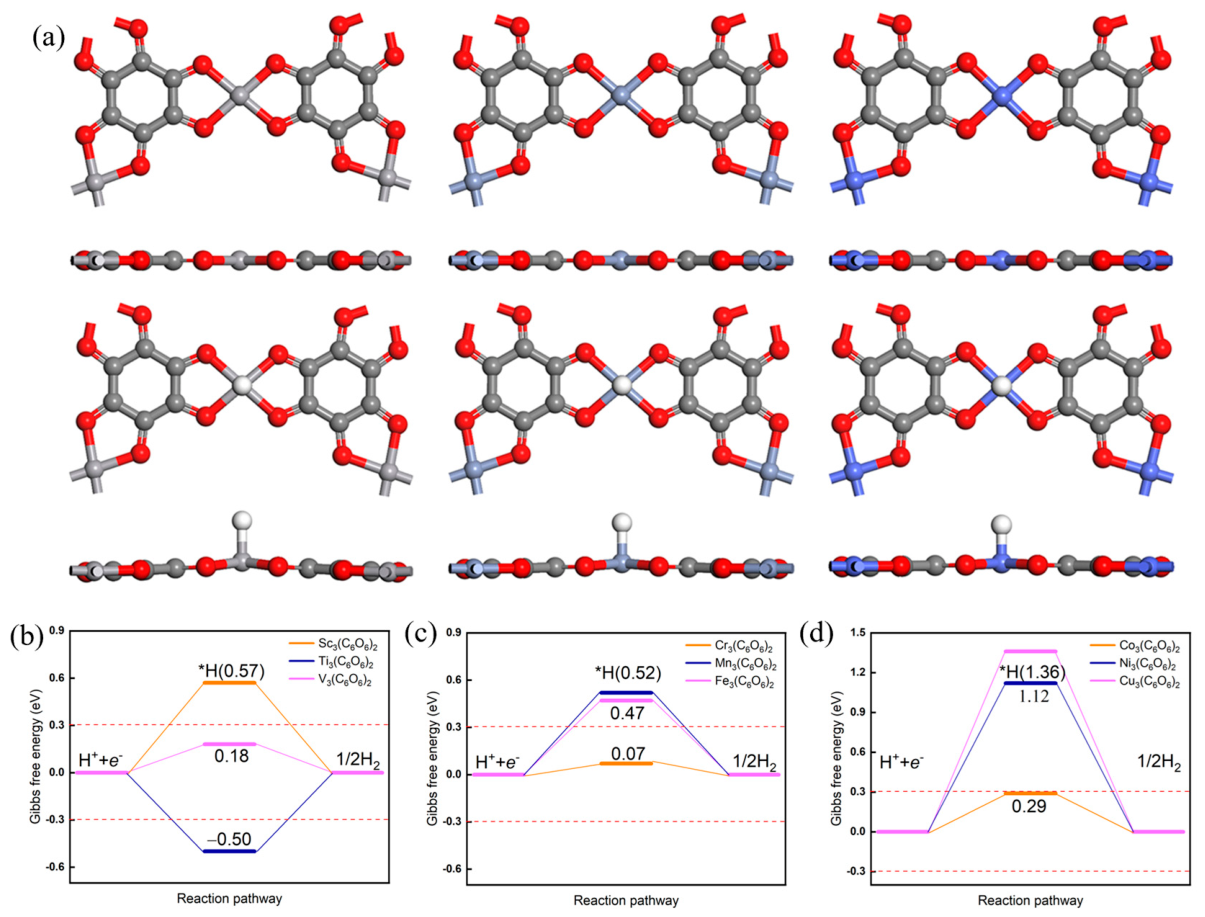
Having established material stability, we next investigated the catalytic properties by evaluating hydrogen adsorption at TM sites. The structures of V
3(C
6O
6)
2, Cr
3(C
6O
6)
2 and Co
3(C
6O
6)
2 with and without hydrogen adsorption are shown in
Figure 2a. As shown, the interaction between metal center and hydrogen adsorbate changes the flat structures wherein the metal centers are protruded. For example, the height changes Δ
ZTM of the metal centers are 0.304, 0.185 and 0.115 Å for V
3(C
6O
6)
2, Cr
3(C
6O
6)
2 and Co
3(C
6O
6)
2, respectively, being smaller than 0.446 Å for Cu
3(C
6O
6)
2. Subsequently, the hydrogen adsorption free energy (Δ
GH) served as our primary catalytic descriptor, where the thermo-neutral state (Δ
GH = 0 eV) represents optimal catalytic activity. Remarkably, positive Δ
GH values reflect weak proton–catalyst interactions, while strongly negative values indicate excessive hydrogen binding that may poison active sites. Prior research [
15,
16] has established that optimal HER activity typically occurs when materials exhibit |Δ
GH| ≤ 0.30 eV. For this purpose, frequency calculations yielded the Δ
GH and
Figure 2b–d presents the corresponding free energy diagrams across all nine candidate materials. Specifically, V
3(C
6O
6)
2, Cr
3(C
6O
6)
2 and Co
3(C
6O
6)
2 systems demonstrate particularly promising catalytic activity, as evidenced by its near-optimal Δ
GH = 0.18, 0.07 and 0.29 eV for different configurations, all falling within the ideal range for efficient hydrogen evolution.
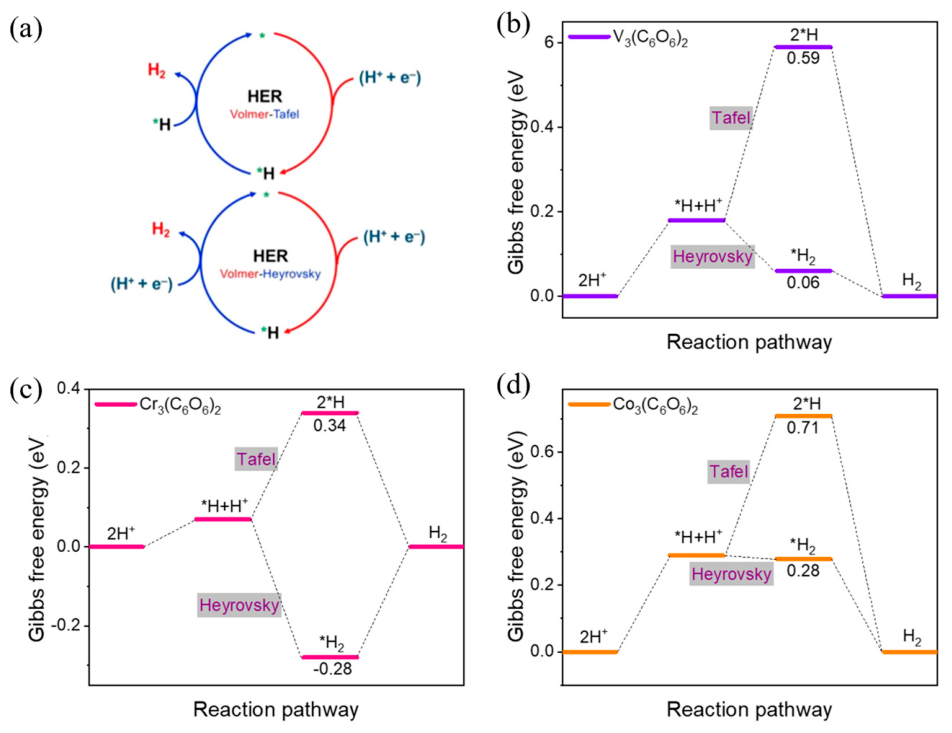
We subsequently investigate the HER mechanisms as displayed in
Figure 3a, which initiate through proton adsorption (Volmer step: H
+ + e
− → *H). The reaction then proceeds via two possible pathways: (1) electrochemical desorption (Heyrovsky step: *H + H
+ + e
− → H
2) or (2) chemical recombination (Tafel step: 2*H → H
2).
Figure 3b–d compare the free energy profiles of the Volmer–Heyrovsky and Volmer–Tafel pathways. Thermodynamic analysis reveals that the Volmer–Heyrovsky pathway dominates for these three systems: V
3(C
6O
6)
2 (Heyrovsky: −0.12 eV; Tafel: +0.41 eV), Cr
3(C
6O
6)
2 (Heyrovsky: −0.35 eV; Tafel: +0.27 eV) and Co
3(C
6O
6)
2 (Heyrovsky: −0.01 eV; Tafel: +0.42 eV). This is due to the fact that these Tafel processes are both endothermic with extra energy input, while Heyrovsky processes are energetically preferred. It should be noted that the H
2 desorption energies are much less than 0.75 eV, which can be easily overcome at room temperature. Therefore, the metal center would be recovered and remain active for the next cycle. In this regard, we can conclude that regardless of how the central element of TM
3(C
6O
6)
2 MOF is replaced, the reaction mechanism remains relatively independent, and no significant difference occurs.
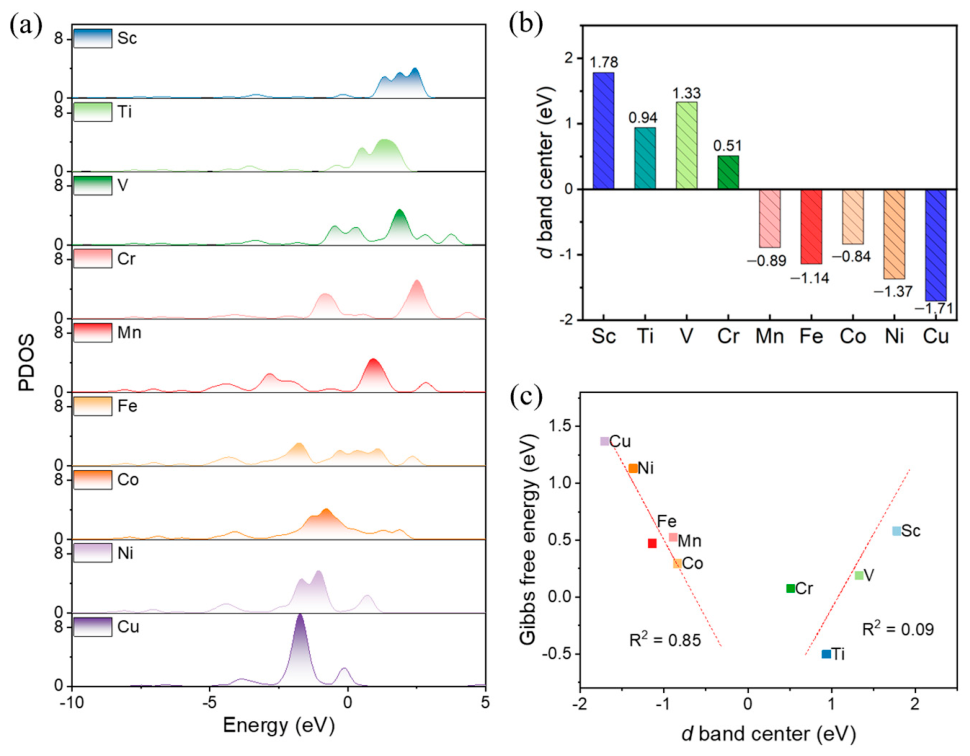
To elucidate the role of different TM active centers in hydrogen atom adsorption, we analyzed the PDOS of TM-
d orbital without H attaching for nine different systems in
Figure 4a. It can be found that with the gradual filling of metal
d-orbital electrons, the
d band position gradually moves away from the Fermi level, clearly demonstrating the finely tuned electronic structure of the TM atom active sites. To achieve the quantitative analysis, the corresponding
d band center positions (ε
d) are calculated for comparison as shown in
Figure 4b, consistent with the pattern we got from the PDOS analysis. In addition, we try to build the relationship between the Gibbs free energy of hydrogen adsorption and the corresponding ε
d values as illustrated in
Figure 4c. The data exhibits piecewise linear behavior with one well-defined and one poorly defined segment (R
2 = 0.85 for the left line; R
2 = 0.09 for the right line), indicating that the traditional
d band center theory is not sufficient to describe the variation of TM sites.
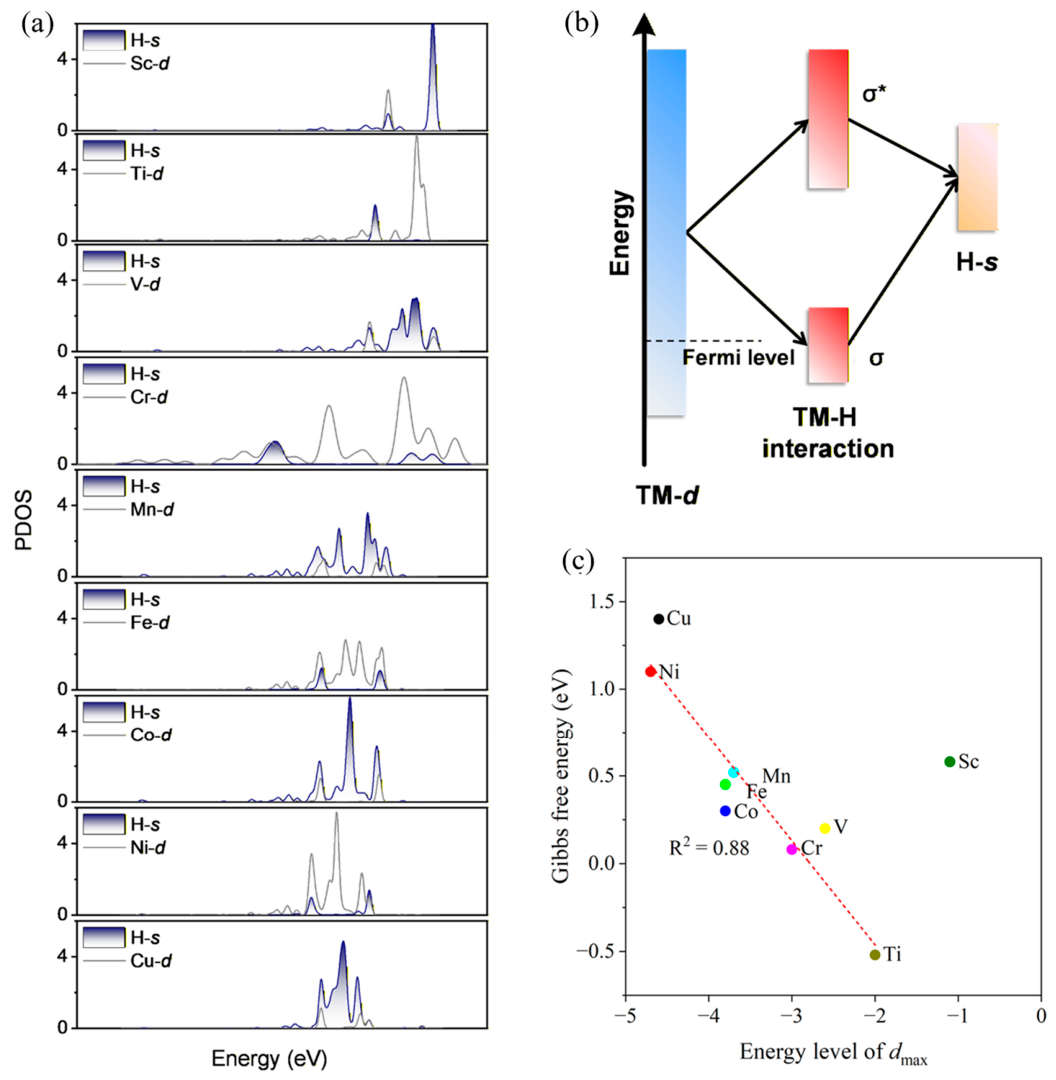
To further illustrate the electronic interactions between different TM centers and the adsorbed H atom,
Figure 5a displays the TM-
d orbital and H-
s orbital coupling diagram. The PDOS analysis reveals significant orbital modulation upon H adsorption, with notable adjustments in the TM-
d and H-
s orbital interactions. The emergence of an intense
s-
d hybridization peak below the Fermi level directly correlates with enhanced HER activity. Furthermore,
s-
d orbital overlap generates an antibonding σ* state that extends above the Fermi level, while simultaneously pushing the bonding σ state below Fermi level, creating an energetically favorable configuration for charge transfer.
Figure 5b displays the electronic interaction diagram, highlighting the key
s-
d orbital hybridization features. In general, the ε
d distribution of the metal active site critically influences adsorption behavior, thereby indirectly governing catalytic performance. However, as mentioned in
Figure 4, this model exhibits limited predictive capability for unknown catalytic properties, necessitating the development of an alternative approach. Building on our experience, the
s-
d hybridization peak corresponds to the fully occupied σ-orbital position. Specifically, stronger hydrogen adsorption affinity can induce an upward shift in the
s-
d hybridization peak energy. As illustrated in
Figure 5c, the higher
s-
d hybridization peak position corresponds to the stronger Gibbs free energy (Δ
GH) with the exception of the Sc
3(C
6O
6)
2 MOF. According to the figure, this implies that the
s-
d coupling should be neither too strong nor too weak, and that a moderate interaction results in optimized hydrogen-binding energetics.
To assess thermal stability, we further performed AIMD simulations of V
3(C
6O
6)
2, Cr
3(C
6O
6)
2 and Co
3(C
6O
6)
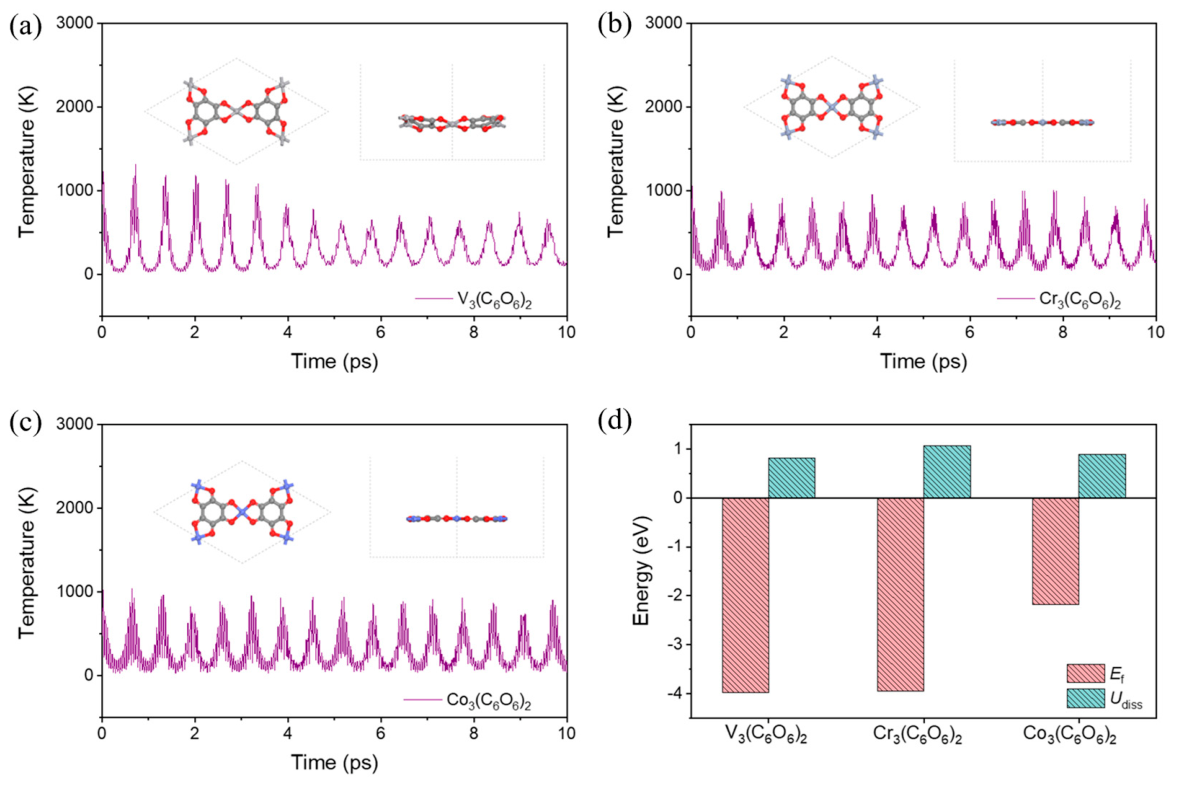
2 MOFs at a room temperature of 300 K. As demonstrated in
Figure 6a–c and snapshots in corresponding figures, these materials maintain their structural integrity throughout the simulation, confirming excellent thermal stability under ambient conditions. Apart from overall stability, we further considered the synthesis feasibility of different active centers by examining the parameters of
Ef and
Udiss in
Figure 6d. Therein, a more negative
Ef reflects stronger interactions between the TM dopant and its coordination environment, while a more positive
Udiss indicates greater synthetic feasibility under experimental conditions. In this regard, the three mentioned candidates exhibit outstanding activity, good stability, as well as favorable synthesizability. As is well known, the market prices of the pure metals follow a descending order of V (~1,550,000 CNY/ton) > Co (~430,000 CNY/ton) > Cr (~75,000 CNY/ton). Taking cost-effectiveness into consideration, Cr
3(C
6O
6)
2 emerges as the most promising candidate for hydrogen evolution electrocatalysis applications.
3. Computational Methods
Spin-polarized first-principles calculations were performed using density functional theory (DFT) [
17,
18] implemented in the DMol
3 code of Materials Studio 2020. The generalized gradient approximation (GGA) with Perdew, Burke, and Ernzerhof (PBE) was adopted as the exchange and correlation functional [
19]. To accurately describe dispersion force and treat core electrons, the Grimme correction (DFT-D2) and the semi-core pseudo-potential (DSPP) method were adopted, respectively [
20]. The convergence tolerances of energy, maximum force, and displacement for structural optimization were set to 1.0 × 10
−5 Ha, 2.0 × 10
−3 Ha/Å, and 5.0 × 10
−3 Å, respectively. The length of c axis was set to 20 Å as a vacuum layer to avoid the interactions between periodic units. The Brillouin zone was sampled using the Monkhorst–Pack k-point grids of 3 × 3 × 1 and 9 × 9 × 1 for relaxing structures and calculating electronic properties, respectively. Ab initio molecular dynamics (AIMD) simulations were performed in the canonical ensemble (NVT) to examine structural stability, and the Nosé–Hoover thermostat scheme was adopted to control the temperature [
21]. The simulation duration was set to a total time of 10 ps with a time step of 1 fs. A conductor-like screening model (COSMO) was utilized to simulate a solvent environment of H
2O for the system. COSMO is a continuum model in which the solute molecule forms a cavity within the dielectric continuum [
22].
The adsorption energy (
Eads) of the intermediates can be calculated by
where
Esystem,
Ecatalyst, and
Em represent the electronic energy of the system, catalyst, and intermediates, respectively.
In addition, the binding energy (
Eb), which measures the binding strength between the TM atom and the MOF substrate, is defined as
where
Epure is the electronic energy of the pure TM
3(C
6O
6)
2 monolayer without a TM atom, and
ETM atom is the total energy of an isolated TM atom.
To evaluate the experimental feasibility of atomic sites, the formation energy (
Ef) and dissolution potential (
Udiss) were examined by
where
ETM is the total energy of single TM atom in corresponding bulk, and
Udiss0 (metal, bulk) and n are the standard dissolution potential of bulk metal and the number of electrons involved in the dissolution [
23,
24], respectively.
The Gibbs free energy change (Δ
G) of the elementary steps was constructed based on the computational hydrogen electrode (CHE) model developed by Nørskov et al. [
25], where the chemical potential of the (H
+ +
e−) pair in solution was equal to half of the chemical potential of gas-phase H
2 and the reference potential was set to the reversible hydrogen electrode (RHE). The corresponding Δ
G can be determined by
where ∆
E is the electronic energy, ∆
ZPE indicates the change in zero point energy, and ∆
S represents the change in the entropy. Herein, the temperature
T is 298.15 K. To reveal the role of different TM centers, the
d band center (ɛ
d) of TM
3(C
6O
6)
2 can be calculated as follows:
where
is the density of states projected onto the
d orbital of the TM atoms, and ɛ is the energy width of the
d orbital.