Article

One-Pot Steam-Assisted Synthesis of BiOCl/TiO2/Zn-In-Modified Mg-Al LDHs Catalyst and Its Photocatalytic Degradation of Methylene Blue


School of Environmental and Chemical Engineering, Shanghai University, Shanghai 200444, China
*
Author to whom correspondence should be addressed.
Catalysts 2026, 16(6), 494; https://doi.org/10.3390/catal16060494
Submission received: 17 April 2026 / Revised: 9 May 2026 / Accepted: 21 May 2026 / Published: 26 May 2026

Abstract

A series of Mg-Al LDH-based photocatalysts were synthesized via a one-pot steam-assisted method, including pure Mg-Al LDH (MA), Zn-In ion-exchange-modified Mg-Al LDH (MAZ), BiOCl-loaded pristine Mg-Al LDH (MAB), and Zn-In-modified Mg-Al LDH co-loaded with TiO2 and BiOCl (MA/Zn-In/TiO2/BiOCl, MAZB). The one-pot synthesis facilitated the in situ intercalation and uniform loading of BiOCl/TiO2/Zn-In, while Zn2+/In3+ modified the MA layers via ion exchange, leading to an expansion of the interlayer spacing. The innovation of this work is reflected in two aspects: first, all raw materials are added via a one-pot strategy to achieve in situ preparation of modified hydrotalcite; second, this synthetic route features simple post-treatment without complicated washing, pressure filtration, and other tedious operations. The samples were characterized by X-ray diffraction (XRD), Fourier transform infrared (FTIR) spectroscopy, scanning electron microscopy (SEM), transmission electron microscopy (TEM), X-ray photoelectron spectroscopy (XPS), and N2 adsorption–desorption isotherms. The bismuth chloride oxide/TiO2/LDHs exhibited a layered structure, with the active components uniformly distributed between the layers and on the MA surface. Under simulated sunlight irradiation, MAZB achieved 97.5% degradation of 20 mg/L MB within 120 min, with an apparent rate constant of 0.0297 min−1, which is 7.2 times, 2.4 times, and 2.9 times that of MA, MAZ, and MAB, respectively. The degradation rate of MAZB still remained at 89.5% after five cycles, demonstrating excellent stability and reusability. Compared with traditional hydrothermal methods, this steam-assisted system features mild reaction conditions (180 °C, atmospheric pressure), sodium-free raw materials, no washing requirement, and zero waste discharge, showing prominent green advantages.

1. Introduction

Methyl blue (MB) is a basic dye commonly employed for cotton and silk, and its waste liquid can lead to environmental pollution resulting in mental confusion, excessive sweating, vomiting, nausea, respiratory difficulties, and methemoglobinemia [1]. In recent years, the industrial dyeing and printing sector has experienced rapid growth, leading to very high discharge of wastewater containing organic dyes such as methylene blue (MB). These dyes exhibit strong chemical stability and high toxicity, presenting a serious threat to both the ecological environment and human health [2]. Photocatalytic technology is one of the most promising methods for controlling water pollution, as it harnesses solar energy to facilitate the degradation of organic pollutants [3]. LDHs are cationic layers with the structural formula [ M 1 x 2 + M x 3 + ( O H ) 2 ] n +   ·   ( O H ) x / n   ·   m H 2 O , where An− refers to the interlayer anion, and M2+ and M3+ denote metal ions with +2 and +3 charges, respectively. The singular structure gives LDH attractive structural features, including broad selectivity of different metal cations, M2+/M3+ molar ratios, tunable interlayer spaces, excellent ion exchange capability, oxo-bridged linkages, and exfoliation from bulk LDH solids to functional ultrathin nanosheets [4].
MgAl-LDH is a typical layered anionic clay with a hexagonal or octahedral crystal structure, characterized by a high specific surface area, adjustable interlayer structure, and excellent adsorption performance, and is commonly employed as a carrier for photocatalytic materials [5]. However, pure MA exhibits a relatively wide bandgap, rendering it responsive solely to ultraviolet light, coupled with a high recombination rate of photogenerated carriers and relatively small inherent interlayer spacing. Conventional synthesis methods, such as high-temperature hydrothermal techniques, often lead to agglomeration of active components and hinder interlayer insertion, thereby significantly restricting its photocatalytic efficiency. Titanium dioxide (TiO2) is the most commonly utilized photocatalytic active component, owing to its favorable chemical stability, non-toxicity, and low cost. Nonetheless, its wide bandgap properties and susceptibility to agglomeration require further enhancement [6,7,8,9], a need shared by bismuth oxychloride (BiOCl), a narrow-bandgap semiconductor (3.1 eV) known for its distinctive layered structure and remarkable visible light response. Overcoming challenges such as achieving uniform loading on hydrotalcite surfaces and interlayer intercalation has been a persistent technical hurdle [10,11,12,13,14]. The ionic radii of Zn2+ and In3+, which are larger than those of Mg2+ and Al3+ in MA plates, can be adjusted via ion exchange to expand the interlayer spacing. Nevertheless, conventional approaches involving sequential modification and loading of active components may result in weak interfacial bonding.
The conventional method is to first synthesize hydrotalcite, followed by modification and intercalation with modifiers, resulting in agglomeration of active components [15,16,17,18]. Therefore, this study adopts a one-pot steam-assisted strategy to realize simultaneous synthesis of MA, Zn-In modification, and TiO2/BiOCl loading, not only simplifying the preparation process, but also promoting uniform dispersion of active components and strengthening interface combination. More importantly, the system is sodium-free, no washing is needed, and no wastewater is produced, making it green and efficient. The photocatalytic performance and stability for MB degradation are investigated, providing a new strategy for mild and green synthesis of high-efficiency clay-based photocatalysts [19]. The main novelties of this work are as follows: (1) a one-pot steam-assisted strategy is developed to achieve synchronous Mg-Al LDH synthesis, Zn-In modification, and TiO2/BiOCl loading under atmospheric pressure, avoiding high-pressure hydrothermal conditions; (2) the synthesis system is sodium-free and washing-free, eliminating Na2CO3 by-products and realizing zero-waste discharge; (3) Zn-In ion exchange efficiently expands the interlayer spacing of LDHs, while TiO2/BiOCl grown in situ forms a tight heterojunction to promote charge separation; (4) the as-prepared MAZB catalyst exhibits excellent photocatalytic activity and stability, providing a new green route for the preparation of layered double hydroxide-based photocatalysts.

2. Results and Discussion

2.1. One-Pot Steam-Assisted Synthesis Reaction Mechanism

The conventional hydrothermal synthesis method employs liquid water as the reaction medium and utilizes sodium-containing precursors, such as NaAlO2 and NaHCO3, to supply Al3+/Mg2+ ions. Layered plates are assembled under elevated temperature and pressure conditions (180 °C in a sealed high-pressure environment), and the fundamental reaction equation is as follows:
  4 MgO   +   2 NaAlO 2   +   NaHCO 3   +   7 H 2 O     Mg 4 Al 2 CO 3 ( OH ) 12   ·   3 H 2 O   +   3 Na 2 CO 3
This method imposes stringent reaction conditions, characterized by high temperature and pressure, which not only entail high energy consumption and demand meticulous equipment sealing but also promote excessive stacking of MA layers at a fixed spacing of 0.78 nm, hindering subsequent modification and active component loading. The utilization of sodium-containing raw materials inevitably yields a significant amount of Na2CO3 by-product, which is prone to crystallization and adhesion to the MA surface within the system, thus necessitating repetitive washing for removal and escalating post-treatment costs and complexities. Moreover, in a liquid water environment, ion diffusion rates vary unevenly, leading to high localized concentrations of Al3+ and Na2+, thereby compromising the uniformity of MA layer plate crystallization. In this study, sodium-containing raw materials are discarded in favor of directly utilizing MgCO3 and Al(OH)3 to supply CO32− and Al3+. Steam serves as the reaction medium, enabling the simultaneous execution of “sodium-free MA synthesis–Zn-In modification of layer plates–in situ loading of active components” in a single vessel. The corresponding reaction equation is presented below:
3 MgO   +   MgCO 3   +   2 Al ( OH ) 3   +   7 H 2 O     Mg 4 Al 2 CO 3 ( OH ) 12   ·   3 H 2 O
Based on the above MA substrate synthesis reaction, Zn-In modification and TiO2/BiOCl loading reactions occur simultaneously. The total reaction is as follows:
Mg 4 Al 2 CO 3 ( OH ) 12   ·   3 H 2 O   +   xZn Cl 2   +   yIn ( NO 3 ) 3   +   TBOT   +   Bi ( NO 3 ) 3   +   H 2 O           Mg 4 x Zn x Al 2 y In y CO 3 ( OH ) 12   ·   3 H 2 O / Ti O 2 / BiOCl   +   xMg Cl 2   +   y Al ( NO 3 ) 3
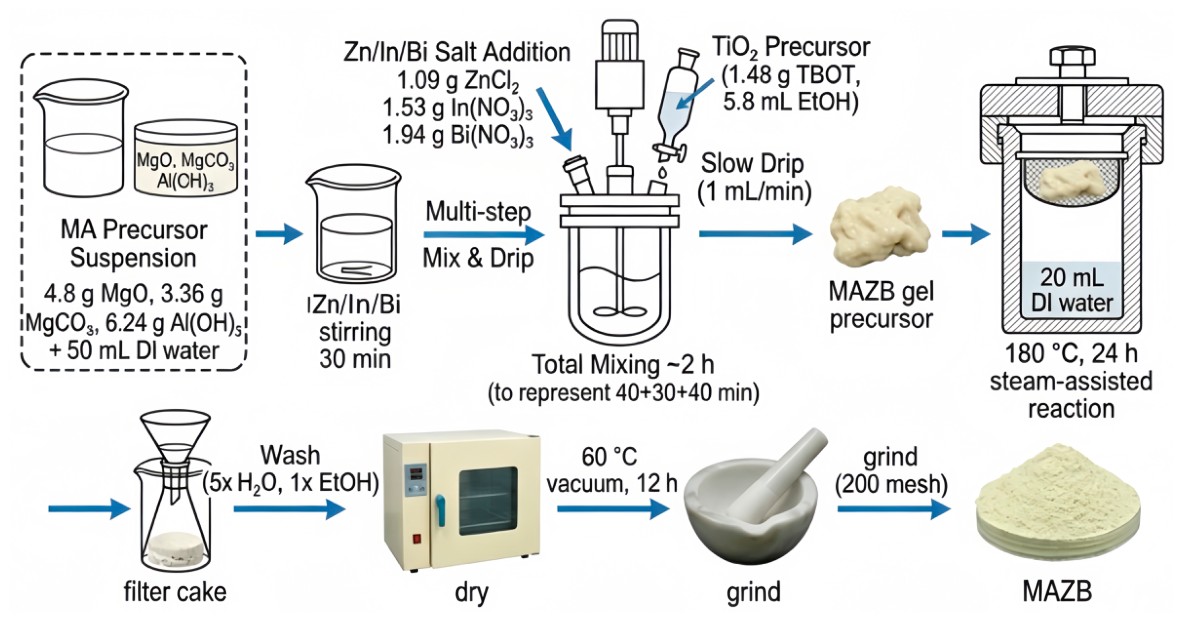
It should be emphasized that, although steam-assisted synthesis has been reported for certain clay materials (such as hectorite), this study is the first to extend this strategy to the preparation of Mg-Al LDH-based composite photocatalysts, achieving one-step completion of LDH formation, Zn-In layer modification, and in situ growth of TiO2/BiOCl. This method has two significant advantages for hydrotalcite systems: (1) in situ synthesis and modification, avoiding the interface defects and component agglomeration in traditional multi-step modification processes; (2) simplified post-treatment, as the sodium-free system eliminates the generation of Na2CO3 by-products, significantly reducing the difficulty of washing and purification. At the same time, the mild crystallization process mediated by steam avoids hard agglomeration, simplifying subsequent grinding and sieving processes. This provides a new technical path for the green and efficient preparation of hydrotalcite-based composite catalysts. Furthermore, steam serves as a mild medium, facilitating the reaction under normal pressure and moderate temperature conditions, and the high diffusibility of steam molecules promotes the uniform distribution of ions, including Mg2+, Al3+, Zn2+, and In3+, thereby preventing agglomeration due to localized concentration enrichment. Concurrently, this environment enhances the efficiency of ion exchange between Zn2+, In3+, and the MA layer plates of Mg2+ and Al3+, increasing the interlayer spacing to 0.85 nm. Additionally, the process achieves the simultaneous synthesis of MA and the loading of active components. Within the steam environment, TBOT undergoes in situ hydrolysis to yield the anatase phase of TiO2. Bi3+ and Cl, supplied by ZnCl2, generate BiOCl in situ, which uniformly adheres to both the interlayer and surface of the MA, thereby forming a robust heterojunction that addresses the interface defects associated with traditional stepwise processes. Moreover, the steam-mediated crystallization process is milder, resulting in loosely stacked MA layer plates. The incorporation of active component loading creates a porous structure, which enhances the specific surface area and synergistic efficiency of adsorption and photocatalysis. The one-pot steam-assisted synthesis strategy proposed in this study realizes the triple synergistic regulation of the interlayer structure of hydrotalcite through the mild reaction environment of the steam medium. Firstly, there is the interlayer spacing expansion mechanism: Zn2+ and In3+, which have larger ionic radii, partially replace Mg2+ and Al3+ in the Mg-Al LDH laminates via in situ ion exchange in the steam environment, which weakens the interlayer electrostatic interaction and expands the interlayer spacing of LDH from 0.78 nm to 0.85 nm, providing sufficient space for the intercalation of active components. Secondly, there is the in situ intercalation and growth mechanism of active components: anatase TiO2 and BiOCl, generated by in situ hydrolysis of TBOT and by Bi3+ and Cl, respectively, are uniformly anchored between the LDH interlayers and on the laminate surface, avoiding the agglomeration of active components. They act as “pillars” to further stabilize the expanded interlayer structure and prevent the re-stacking of LDH laminates. Finally, there is the interlayer charge transfer mechanism: the Zn-In-modified laminates and intercalated TiO2 and BiOCl form a tight interlayer heterojunction structure, which builds a directional charge transfer channel between the LDH interlayers, effectively inhibits the recombination of photogenerated electron–hole pairs, and lays a structural foundation for improving the subsequent photocatalytic reaction’s efficiency (Figure 1).

2.2. Characterization

2.2.1. X-Ray Diffraction (XRD)

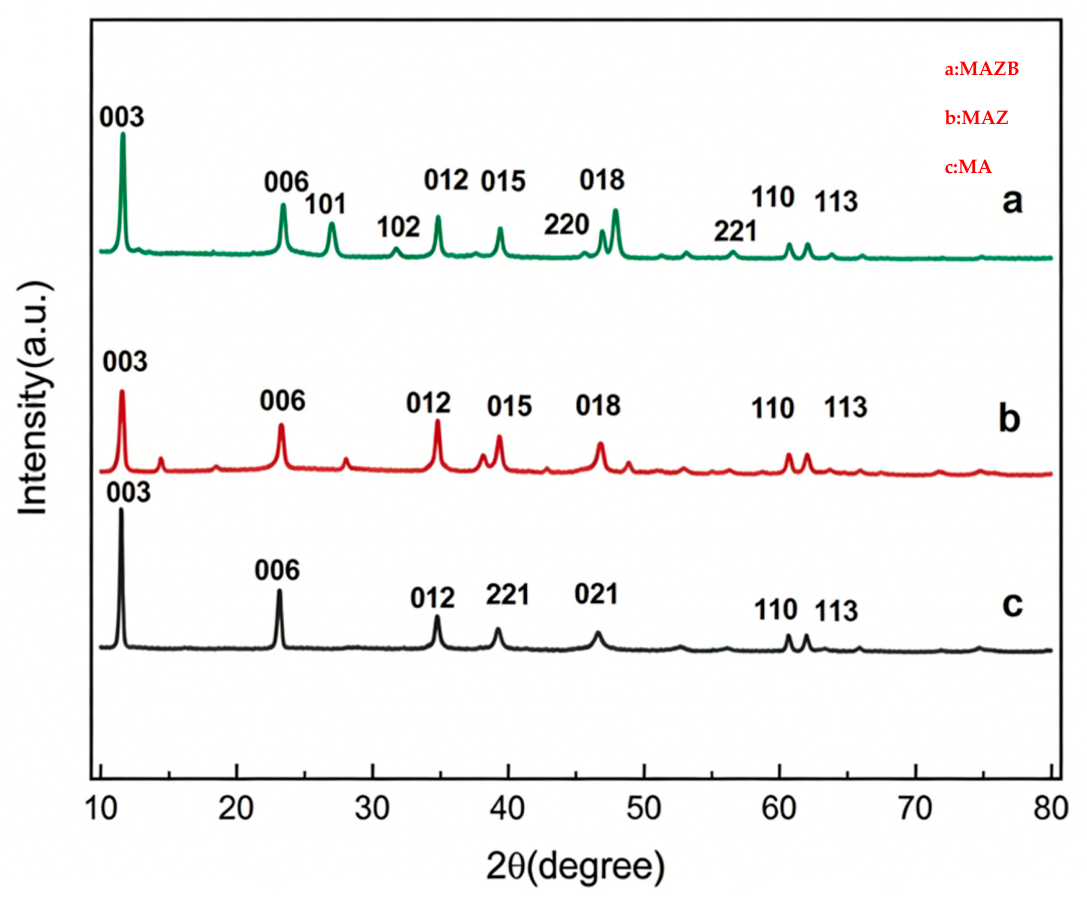
Figure 2 presents the X-ray diffraction (XRD) patterns of pure MA (Figure 2c), MAZ (Figure 2b), and MAZB (Figure 2a). In the case of pure MA (Figure 2c), characteristic diffraction peaks are observed at 2θ ≈ 11.5°, 23.1°, 34.5°, 47.8°, and 62.5°, corresponding to the (003), (006), (015), (018), and (110) crystal planes of the layered structure (JCPDS No. 35-0964), thereby confirming the successful synthesis of MA and the integrity of its layered structure. In contrast, the peak corresponding to the (003) crystal plane of MAZ (Figure 2b) shifts from 2θ ≈ 11.5° to 2θ ≈ 10.8°. Utilizing the Bragg equation (2dsinθ = nλ), the interlayer spacing is determined to have increased from 0.78 nm to 0.82 nm; this change confirms that Zn2+/In3+ ions have partially replaced Mg2+/Al3+ ions in the MA laminates through ion exchange, effectively increasing the interlayer spacing, which aligns with the Zn-In modification mechanism predicted in the article. Upon further loading TiO2 and BiOCl onto MAZB, the XRD pattern (Figure 2c) reveals that the characteristic diffraction peaks of MA remain unchanged. The peak of the (003) crystal plane shifts to 2θ ≈ 10.4°, expanding the interlayer spacing to 0.85 nm, which aligns with the anticipated synergistic effect of Zn-In modification and active component intercalation, suggesting enhanced ion diffusion and complete laminate modification in a steam-assisted environment. Additionally, the XRD analysis of MAZB exhibits distinct diffraction peaks corresponding to the anatase phase of TiO2 (JCPDS No. 21-1272) at 25.3°, 37.8°, 48.1°, 54.0°, and 62.8° for the (101), (004), (200), (105), and (204) crystal planes, respectively. Furthermore, characteristic diffraction peaks of BiOCl (JCPDS No. 06-0249) are observed at 25.9°, 32.5°, 46.2°, and 55.3°, corresponding to the (101), (110), (200), and (211) crystal planes. The presence of these distinctive peaks, without any discernible impurity peaks, indicates the successful crystallization of TiO2 and BiOCl on the MA substrate, supporting the in situ growth and interlayer mechanism proposed in the study. In comparison to MAZ (Figure 2b) and MA (Figure 2c), the (003) crystal plane peak shift observed in MAZB (Figure 2a) is notably more pronounced, the expansion of interlayer spacing is more evident, and the characteristic peaks of TiO2 and BiOCl exhibit greater sharpness, suggesting enhanced ion diffusion and improved crystallinity of the active component within the steam-assisted environment. These findings align perfectly with the predicted outcomes of the article, substantiating the benefits of the steam-assisted one-pot method regarding interlayer spacing regulation and active component loading.

2.2.2. Fourier Transform Infrared (FTIR) Spectroscopy

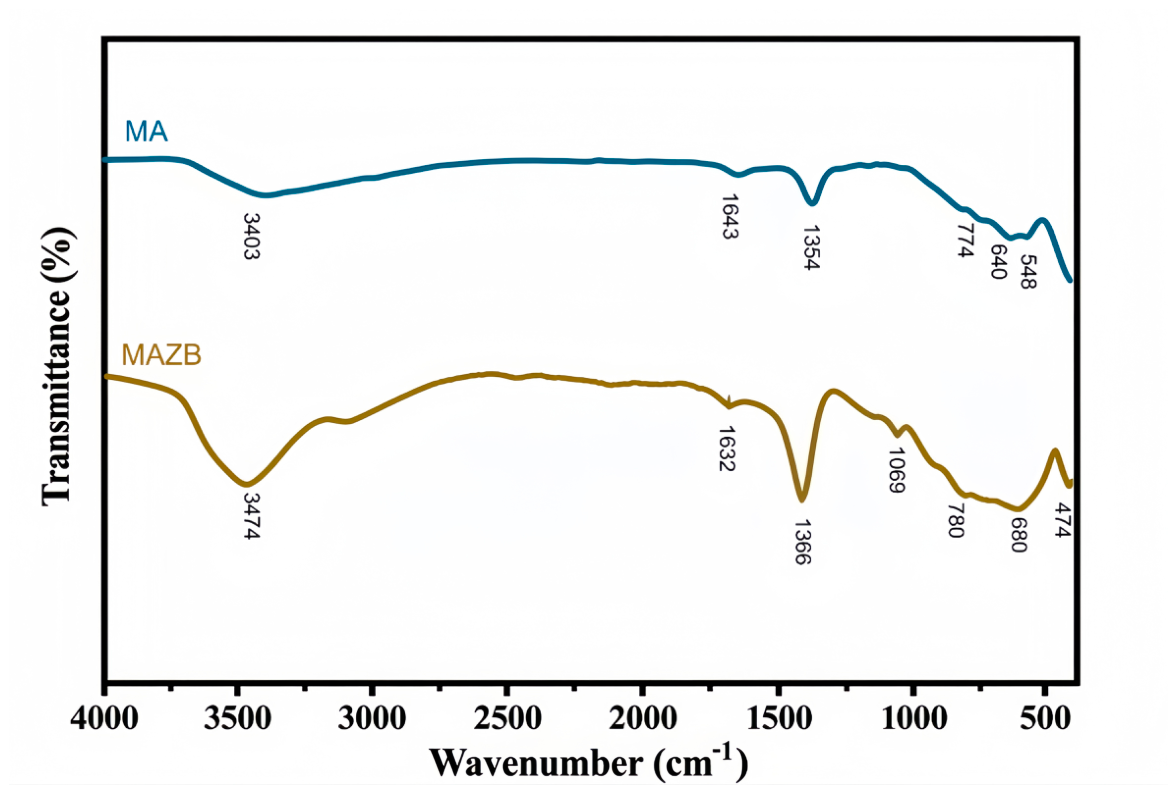
Figure 3 shows the FTIR spectra of the samples in the range of 4000~450 cm−1. It can be clearly observed that the broad and intense peak at 3474 cm−1 corresponds to the O-H stretching vibration of interlayer hydroxyl groups and adsorbed water molecules in Mg-Al LDHs, and its position is consistent with the characteristics of standard LDHs, confirming the intact retention of the layered framework structure after hydrothermal treatment. The weak peak at 1632 cm−1 originates from the H-O-H bending vibration of adsorbed water, matching the typical water signal in LDHs. The characteristic peak at 1366 cm−1 is assigned to the antisymmetric stretching vibration of interlayer CO32−, and its position exhibits a slight red shift compared with pure LDHs, reflecting a minor influence of Zn-In-modified layer intercalation on the interlayer environment without destroying the basic vibrational mode of carbonate ions. The peak at 1069 cm−1 clearly corresponds to the stretching vibration of Bi-O-Cl bonds in BiOCl, verifying the successful loading of the BiOCl active component. There is also a peak at 780 cm−1, corresponding to the stretching vibration of Al-O bonds; at 680 cm−1, related to the Ti-O stretching vibration of the supported TiO; and at 447 cm−1, which is the Ti-O-Ti stretching vibration of the supported TiO2.
FTIR data not only confirm the structural integrity of Mg-Al LDHs and the successful loading of TiO2 and BiOCl, but also reveal the weak interactions among various components through the position shifts of O-H peaks and Ti-O peaks.

2.2.3. Scanning Electron Microscopy (SEM)

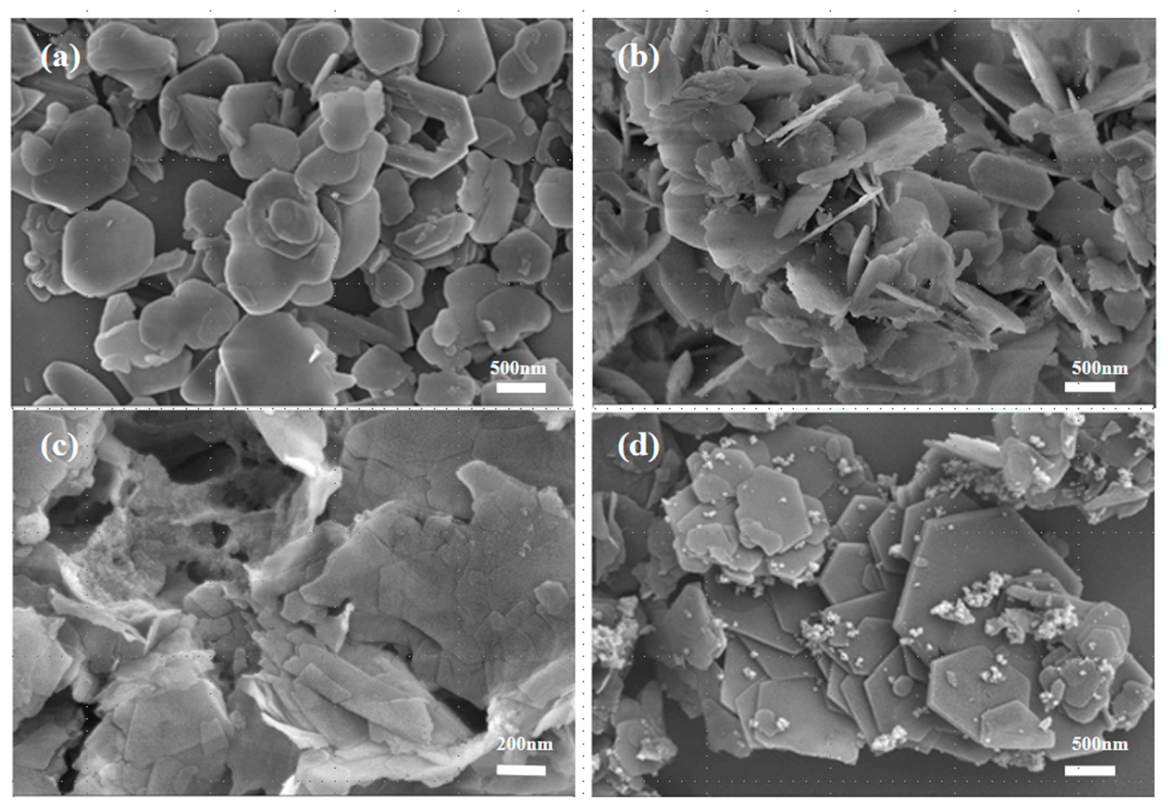
The SEM image of MA shows that it has a typical layered stacked structure, with a large particle size, relatively dense surface, and tight interlayer stacking, which is consistent with the layered structure characteristics of pure MA (Figure 4a). The SEM images of MAZB show (Figure 4d) that the layered structure of the modified material is still maintained, but the stacking is looser and the particle size distribution is more uniform, forming a disordered stacked lamellar structure, a change related to the expansion of the interlayer spacing and the uniform loading of the active components. High-contrast nanoparticles, corresponding to TiO2 and BiOCl, are uniformly distributed on the surface and interlayers of the MA sheets, which is a direct manifestation of the in situ growth and intercalation of active components assisted by steam, providing a guarantee for the rapid transfer of charges [20,21,22,23].
This morphological change is attributed to two factors: Firstly, the modification of Zn-In increases the interlayer spacing of MA, weakening the interlayer interaction force and causing loose stacking. Secondly, in a steam-assisted environment, TiO2 and BiOCl grow in situ between MA layers and on the surface, playing a “pillar support” role and further preventing excessive stacking of the laminates. The loose layered structure is conducive to increasing the specific surface area, exposing more active sites, and promoting the contact between pollutant molecules and those sites, thereby enhancing the photocatalytic efficiency [24].

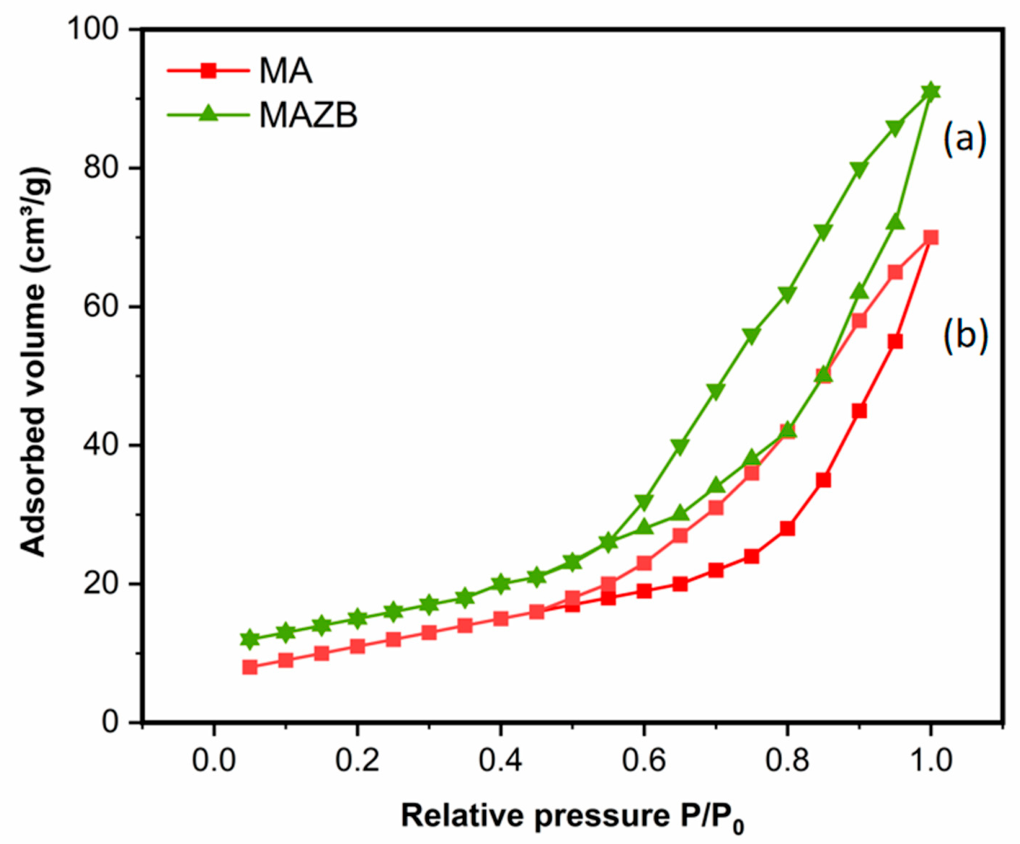
2.2.4. N2 Adsorption–Desorption Isotherms

Figure 5 shows the N2 adsorption–desorption isotherms of MA and MAZB. According to the IUPAC classification, the isotherms of both MA and MAZB are of type IV and are accompanied by H4-shaped hysteresis loops, indicating that they are mesoporous structures. As can be seen from Table 1, the specific surface area of MAZB (140 m2/g) is significantly higher than that of pure MA (48 m2/g), the average pore size increases from 0.16 nm to 0.29 nm, and the pore volume increases from 9.4 cm3/g to 12.9 cm3/g. A larger specific surface area and pore volume are conducive to higher adsorption performance because they can provide more active sites and improve the transport of reactants and products, thereby increasing the contact area between organic pollutants and catalysts, improving the photodegradation rate, and ultimately effectively enhancing the removal rate of pollutants [25,26]. Compared with the similar catalysts prepared by the traditional hydrothermal method, MAZB has a larger specific surface area and pore volume, and a more uniform distribution.
This is attributed to the more thorough Zn-In modification and intercalation of active components in the steam-assisted environment, avoiding the problem of active clogging of pore channels in the traditional method, which is conducive to the adsorption and diffusion of MB molecules, and, at the same time, increases the number of active sites.

2.2.5. X-Ray Photoelectron Spectroscopy (XPS) Analysis

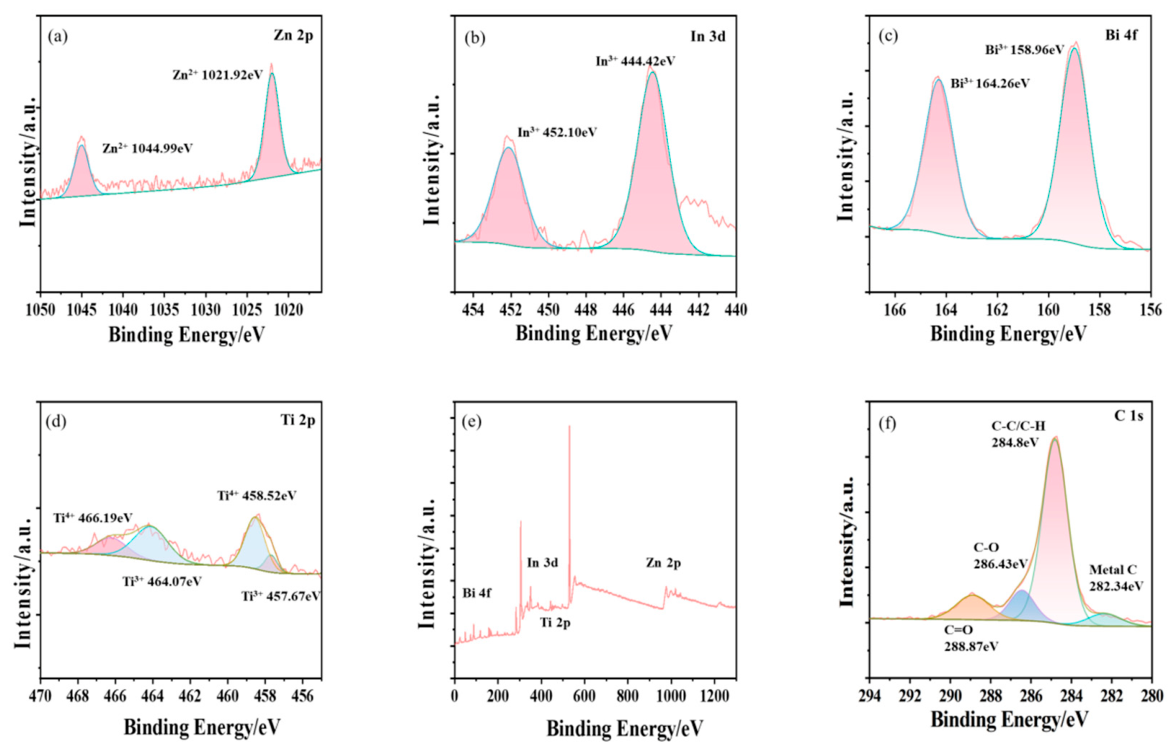
The elemental composition and chemical state of MAZB were analyzed using XPS, and the results are shown in Figure 6. In the sample’s full spectrum (survey), characteristic peaks such as Bi 4f, In 4d, Ti 2p, and Zn 2p can be observed, indicating that the Bi, In, Ti, and Zn elements introduced by the steam-assisted one-pot method were successfully loaded on the surface of the MA matrix. Moreover, no obvious impurity peaks were detected [27]. Two peaks of spin–orbit splitting appeared in the In 4d region, and the peak positions corresponded to In3+ and In 4d5/2, indicating that In mainly exists stably in the +4 oxidation state. The Zn 2p spectrum also showed normal Zn2+ double peaks (2p4/2 and 2p1/2), with good peak symmetry and a high fitting degree, indicating that Zn was mostly in the +2 oxidation state, and no obvious reduction or metal precipitation occurred. The 4f decomposition of Bi produced 4f7/2 and 4f5/2 peaks belonging to Bi4+, indicating that Bi exists in the +4 oxidation state, which also conforms to the fact that the Bi(NO4)4 precursor underwent hydrolysis/oxidation under steam heat treatment conditions to produce a stable Bi4+-O coordination environment. In addition to the characteristic signals of Ti4+ in the Ti 2p region, a certain proportion of Ti4+ can also be fitted, suggesting that the vapor-assisted hydrothermal environment and the interaction of the multi-metal coexistence interface induce partial reduction of the TiO2 surface and form oxygen vacancy/defect states [28]. This type of Ti4+–oxygen vacancy center typically serves as a shallow-level electron capture and migration channel: on the one hand, it enhances the visible light response and surface activation ability; on the other hand, it promotes the spatial separation of photogenerated carriers at the recombination interface, reducing the probability of bulk recombination. This is attributed to the process of Zn2+/In4+ pre-dispersion, which involves the slow addition of TBOT in situ to generate TiO2 precursor network bodies, followed by Bi4+ addition and crystallization at 180 °C in a steam atmosphere [29]. The layer-by-layer self-assembly process and steam directional crystallization are conducive to obtaining tight heterogeneous interface alignment and short-range carrier transport pathways [30]. Thus, XPS characterizes the coexistence of stably existing Bi4+, In4+, and Zn2+ and defective TiO2(Ti4+), providing evidence for the efficient photocatalytic behavior of materials at the surface electronic structure level.

2.3. Photocatalytic Degradation of MB

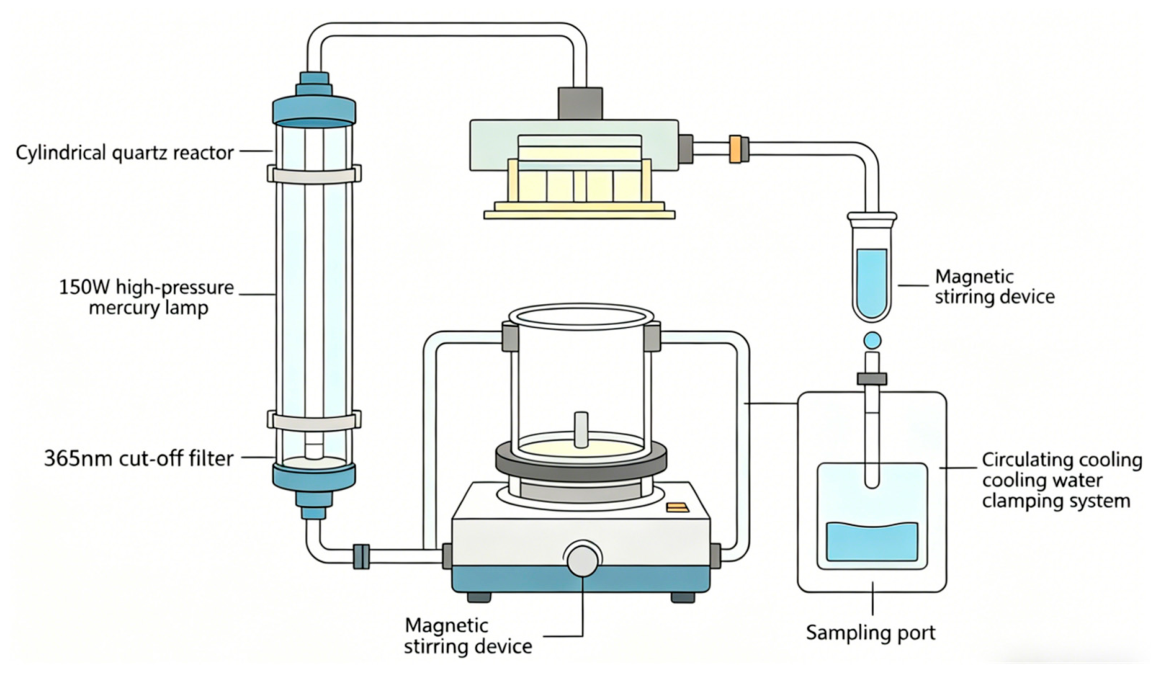
The photocatalytic performance of composite samples was studied in the degradation of MB with a 150 W high-pressure mercury lamp (Figure 7). At low concentration, the photocatalytic degradation process conforms to the first-order kinetic equation, which can be fitted by the Langmuir–Hinshelwood (L-H) model, as shown by Equation (1) [31,32,33,34]:
ln ( C t C 0 )   =   kt
where C0 is the adsorption and desorption equilibrium concentration of MB, Ct is the concentration of MB at time t, and k is the photocatalytic kinetic constant, which can be used to evaluate the photocatalytic performance: the higher the value, the higher the catalytic efficiency [35,36,37,38].
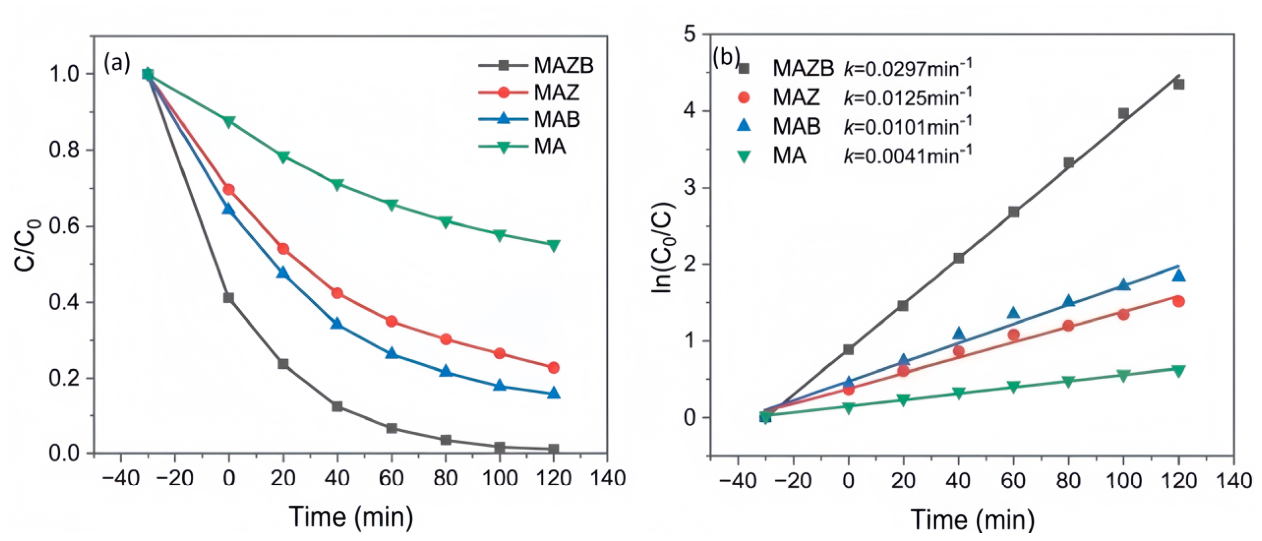
Figure 8 presents the degradation curves and kinetic fitting results for MAZB and control samples MA, MAZ, and MAB under simulated sunlight irradiation at a concentration of 20 mg/L MB. As illustrated, the degradation rate of pure MA is the slowest: after 120 min, the MB concentration remains approximately 55.0% of the initial value, reflecting a degradation rate of only 45.0%. This low value is primarily attributed to MA’s physical adsorption effect and relatively weak photocatalytic activity. In contrast, the degradation performance of MAZ and MAB shows improvement, with rates reaching 78.0 and 82.0%, respectively, at 120 min, which suggests that Zn-In modification and BiOCl loading can enhance photocatalytic activity, although the effect is constrained. Notably, MAZB exhibits the highest effective degradation, with the MB concentration dropping below 5.0% of the initial concentration at 80 min and a degradation rate of 97.5% at 120 min, significantly better than the other samples.
As for the photocatalytic kinetics, quasi-first-order kinetic equations were adopted to fit the degradation data. The kinetic constants (k) for the photodegradation of MB, derived from the first-order kinetic fitting curve (Figure 8b), are as follows from highest to lowest: 0.0297 min−1 for MAZB, 0.0125 min−1 for MAZ, 0.0101 min−1 for MAB, and only 0.0041 min−1 for pure MA. The rate constant for MAZB is 7.2, 2.4, and 2.9 times greater than that of pure MA, MAZ, and MAB, respectively, confirming that the ternary composite system synthesized via the steam-assisted one-pot method exhibits a significant synergistic catalytic effect. Its high efficiency can be attributed to the strong interface interaction among the Zn-In-modified layer, TiO2, and BiOCl, as well as the enhanced charge separation efficiency.

2.4. Stability of MAZB Catalyst

The stability and reusability of photocatalysts are the core evaluation indicators for their transition from the laboratory to practical industrial applications. In this study, we verified the durability of the steam-assisted synthesized MAZB composite photocatalyst in the degradation of methylene blue (MB) under simulated sunlight through continuous cycle experiments (Table 2).
After each photocatalytic reaction, the reaction suspension was centrifuged, separated, and washed three times with deionized water to remove the residual MB degradation products and by-products on the surface. Then, it was dried in a vacuum drying oven at 60 °C for 6 h and subsequently used again in the MB degradation experiment to evaluate the cycling stability of the catalyst.

3. Materials and Methods

3.1. Materials

Magnesium oxide (MgO, AR), magnesium carbonate (MgCO3, AR), tetrabutyl titanate (C16H46O4Ti, TBOT, ≥99%), and anhydrous ethanol (C2H6O, ≥99.8%) were purchased from Aladdin Biochemical Technology Co., Ltd., Shanghai, China. Zinc chloride (ZnCl2, AR), aluminum hydroxide (Al(OH)3, AR), indium nitrate (In(NO4)4·4.5H2O, AR), bismuth nitrate (Bi(NO4)4·5H2O, AR), and methylene blue (C16H18N4ClS, MB) were all obtained from Sinopharm Chemical Reagent Co., Ltd., Shanghai, China.

3.2. Synthesis of Photocatalysts

The MAZB composite photocatalyst was prepared by a steam-assisted one-pot method. Firstly, 4.8 g of MgO, 4.46 g of MgCO3, and 6.24 g of Al(OH)3 were added to a 100 mL beaker, followed by 50 mL of deionized water. The mixture was then magnetically stirred for 40 min to form a uniform suspension of the MA precursor. Then, 1.09 g ZnCl2 and 1.54 g In(NO4)4·4.5H2O were added to the above suspension, and the mixture was stirred continuously for 40 min to ensure that Zn2+/In3+ was fully dispersed.
Meanwhile, 1.48 g TBOT was dissolved in 5.8 mL absolute ethanol and stirred for 40 min to obtain a pale yellow TiO2 precursor solution, which was slowly added dropwise to the MA suspension (dropping rate: 1 mL/min) and stirred for 40 min; finally, 1.94 g Bi(NO3)3·5H2O was added and stirring was continued for 40 min to form a homogeneous mixed precursor solution. Subsequently, this solution was transferred to the top sieve of a high-pressure sterilizer with a polytetrafluoroethylene liner, and 20 mL deionized water was added to the bottom to generate steam; the high-pressure sterilizer was sealed and placed in a hot air oven at 180 °C for reaction for 24 h. After the reaction, the high-pressure sterilizer was naturally cooled to room temperature, the product was collected directly without washing and dried at 60 °C, and then ground and sieved to obtain MAZB.

3.3. Photocatalytic Degradation

The degradation of MB was carried out in a photocatalytic reactor, under a 150 W high-pressure mercury lamp, which was preheated for 40 min before the reaction to ensure stable light emission and kept about 40 cm away from the solution. Then, the photocatalytic effect of MAZB was studied.
First, 4 mg of MazB catalyst was dispersed in 100 mL of 10 ppm MB solution, and the mixture was magnetically stirred in the dark for 40 min to reach adsorption–desorption equilibrium. Subsequently, under UV light, 4 mL of the suspension was taken every 10 min and the photocatalyst was removed by filtration with a 0.45 µm membrane. The absorbance of the filtrate was measured at 664 nm using a WFZUV-2800H ultraviolet–visible spectrophotometer (Unico, Suite E, Dayton, NJ, USA) to evaluate the photocatalytic efficiency. The removal rate of MB is calculated by Equation (2):
R   =   C 0 C t C 0 × 100 %
where C0 is the adsorption and desorption equilibrium concentration of MB, and Ct is the concentration of MB at time t. After photocatalytic degradation, the MB adsorbed on the material was completely degraded under UV light irradiation. Then, the MB solution was separated from the photocatalytic material using a centrifuge and dried at 120 °C for 2 h for recovery.

3.4. Characterization

X-ray diffraction (XRD) patterns of the samples were recorded on an X’pert PRO Empyrean X-ray diffractometer (PANalytical, Almelo, The Netherlands) with Cu-Kα radiation (λ = 0.15418 nm) at 45 kV and 40 mA. The scanning rate was 5°/min, and the 2θ range was 10–80°. Fourier transform infrared (FTIR) spectra were obtained using a Nicolet iS5 FTIR spectrometer (Thermo Scientific, Waltham, MA, USA) in the range of 4000–400 cm−1. Scanning electron microscopy (SEM) images were captured by an S-4800 scanning electron microscope (Hitachi, Tokyo, Japan) at an accelerating voltage of 5 kV. N2 adsorption–desorption isotherms were measured on a Micromeritics ASAP 2460 analyzer (Norcross, GA, USA) at 77 K. The specific surface area (SBET) was calculated by the Brunauer–Emmett–Teller (BET) method, and the pore size and pore volume were determined by the Barrett–Joyner–Halenda (BJH) method. X-ray photoelectron spectroscopy (XPS) was conducted on a Thermo Scientific K-Alpha spectrometer (Thermo Fisher Scientific, Waltham, MA, USA) with Al-Kα X-ray radiation (12 kV).

4. Conclusions

A MA/Zn-In/TiO2/BiOCl (MAZB) composite photocatalyst was prepared by a steam-assisted one-pot method, and its structure, morphology, and light absorption performance, as well as the activity and stability of its photocatalytic degradation of MB, were studied.
The steam-assisted synthesis strategy achieved simultaneous MA synthesis, Zn-In modification, and TiO2/BiOCl loading. Zn2+/In3+ successfully replaced part of Mg2+/Al3+ on the MA laminate through ion exchange, increasing the interlayer spacing from 0.78 to 0.85 nm. TiO2 (anatase phase) and BiOCl were uniformly dispersed between the MA layers and on the surface, forming tight heterojunctions. The specific surface area of the composite material increased to 140 m2/g, the light response range was broadened, and the bandgap width was reduced.
Compared with the traditional hydrothermal method, steam-mediated uniform ion diffusion promotes the uniform dispersion and crystallization of active components, strengthens the interfacial binding between active components and MA, and enhances the charge transfer efficiency.
Under simulated sunlight irradiation, the degradation rate of MAZB at 20 mg/L MB for 120 min reached 97.5%, and the apparent rate constant was 0.042 min−1. After five cycles, the degradation rate remained at 89.5%, demonstrating excellent photocatalytic activity and stability.
The highly efficient photocatalytic performance of MAZB stems from the “adsorption–photocatalysis” synergistic effect: the high specific surface area of MA enables the enrichment of MB molecules; the Zn-In-modified layer builds a charge transport bridge; the heterojunction formed by TiO2 and BiOCl and the presence of Ti3+/oxygen vacancies promote the separation of photogenerated carriers; and the active species produced, such as ·O2, h+, and ·OH, jointly oxidize and degrade MB.
The steam-assisted synthesis method provides a new path for the green preparation of layered hydrotalcite-based composite photocatalysts. The sodium-free system avoids by-products, and no washing is needed, realizing zero waste discharge. The prepared MAZB composite photocatalyst has a good application prospect in the field of organic dye wastewater treatment.

Author Contributions

Conceptualization, Z.C. and J.C.; methodology, Z.C.; validation, Z.C.; formal analysis, Z.C.; investigation, Z.C.; data curation, Z.C.; writing—original draft preparation, Z.C.; writing—review and editing, J.C.; supervision, J.C.; funding acquisition, J.C. All authors have read and agreed to the published version of the manuscript.

Funding

This research was funded by Yantai Green Polymer Materials Co., Ltd., Yantai, China. Project name: Preparation of Hexagonal Plate-like Magnesium Hydroxide by Hydrothermal Method, grant number 21H01083.

Data Availability Statement

Data is unavailable due to privacy and ethical restrictions.

Acknowledgments

We would like to express our gratitude to Wang Xueting from the School of Environment and Chemical Engineering of Shanghai University for providing us with the experimental equipment and technical guidance.

Conflicts of Interest

The authors declare no conflicts of interest.

References

  1. Bouras, H.D.; Isik, Z.; Arikan, E.B.; Yeddou, A.R.; Bouras, N.; Chergui, A.; Favier, L.; Amrane, A.; Dizge, N. Biosorption characteristics of methylene blue dye by two fungal biomasses. Int. J. Environ. Stud. 2021, 78, 465–481. [Google Scholar] [CrossRef]
  2. Qu, J.; Fan, M. The current state of water quality and technology development for water pollution control in China. Crit. Rev. Environ. Sci. Technol. 2010, 40, 519–560. [Google Scholar] [CrossRef]
  3. Ijaz, M.; Zafar, M. Titanium dioxide nanostructures as efficient photocatalyst: Progress, challenges and perspective. Int. J. Energy Res. 2021, 45, 4569–4589. [Google Scholar] [CrossRef]
  4. Singh, S.; Pal, B. Ag2@WO4/MgAl Layered double hydroxide displayed superior adsorption and photocatalytic activity under visible light. Appl. Clay Sci. 2024, 250, 107281. [Google Scholar]
  5. Salehi, G.; Bagherzadeh, M.; Abazari, R.; Hajilo, M.; Taherinia, D. Visible light-driven photocatalytic degradation of methylene blue dye using a highly efficient Mg–Al LDH@g-C4N4@Ag4PO4 nanocomposite. ACS Omega 2024, 9, 4581–4594. [Google Scholar] [CrossRef]
  6. Ge, Y.; Luo, H.; Huang, J.; Zhang, Z. Visible-light-active TiO2 photocatalyst for efficient photodegradation of organic dyes. Opt. Mater. 2021, 115, 111058. [Google Scholar] [CrossRef]
  7. Auta, M.; Hameed, B.H. Acid modified local clay beads as effective low-cost adsorbent for dynamic adsorption of methylene blue. J. Ind. Eng. Chem. 2014, 19, 1154–1161. [Google Scholar] [CrossRef]
  8. Mishra, A.; Mehta, A.; Basu, S. Clay supported TiO2 nanoparticles for photocatalytic degradation of environmental pollutants: A review. J. Environ. Chem. Eng. 2018, 6, 6088–6107. [Google Scholar] [CrossRef]
  9. Fendi, K.; Bouzidi, N.; Boudraa, R.; Saidani, A.; Manseri, A.; Quesada, D.E.; Hai, T.N.; Bollinger, J.-C.; Salvestrini, S.; Kebir, M.; et al. Testing of kaolinite/TiO2 nanocomposites for methylene blue removal: Photodegradation and mechanism. Int. J. Chem. React. Eng. 2025, 22, 1494–1508. [Google Scholar] [CrossRef]
  10. Che, H.; Che, G.; Jiang, E.; Liu, C.; Dong, H.; Li, C. A novel Z-Scheme CdS/Bi4O4Cl heterostructure for photocatalytic degradation of antibiotics: Mineralization activity, degradation pathways and mechanism insight. J. Taiwan Inst. Chem. Eng. 2018, 91, 224–244. [Google Scholar] [CrossRef]
  11. Dong, S.; Feng, J.; Fan, M.; Pi, Y.; Hu, L.; Han, X.; Liu, M.; Sun, J.; Sun, J. Recent developments in heterogeneous photocatalytic water treatment using visible light-responsive photocatalysts: A review. RSC Adv. 2015, 5, 14610–14640. [Google Scholar] [CrossRef]
  12. Paredes, S.P.; Valenzuela, M.A.; Fetter, G.; Flores, S.O. TiO2/MgAl layered double hydroxides mechanical mixtures as efficient photocatalysts in phenol degradation. J. Phys. Chem. Solids 2011, 72, 914–919. [Google Scholar] [CrossRef]
  13. Chubar, N.; Gilmour, R.; Gerda, V.; Mičušík, M.; Omastova, M.; Heister, K.; Man, P.; Fraissard, J.; Zaitsev, V. Layered double hydroxides as the next generation inorganic anion exchangers: Synthetic methods versus applicability. Adv. Colloid Interface Sci. 2017, 245, 62–80. [Google Scholar] [CrossRef]
  14. Cao, J.; Luo, B.; Lin, H.; Chen, S. Photocatalytic activity of novel AgBr/WO4 composite photocatalyst under visible light irradiation for methyl orange degradation. J. Hazard. Mater. 2011, 190, 700–706. [Google Scholar] [CrossRef] [PubMed]
  15. Fan, G.; Li, F.; Evans, D.G.; Duan, X. Catalytic applications of layered double hydroxides: Recent advances and perspectives. Chem. Soc. Rev. 2014, 44, 7040–7066. [Google Scholar] [CrossRef]
  16. Chen, D.; Cheng, Y.; Zhou, N.; Chen, P.; Wang, Y.; Li, K.; Huo, S.; Cheng, P.; Peng, P.; Zhang, R.; et al. Photocatalytic degradation of organic pollutants using TiO2-based photocatalysts: A review. J. Clean. Prod. 2020, 268, 121725. [Google Scholar] [CrossRef]
  17. Huo, M.; Guo, H.; Jiang, Y.; Ju, H.; Xue, B.; Li, F. A facile method of preparing sandwich layered TiO2 in between montmorillonite sheets and its enhanced UV-light photocatalytic activity. J. Photochem. Photobiol. A Chem. 2018, 458, 121–129. [Google Scholar] [CrossRef]
  18. Djellabi, R.; Ghorab, M.F.; Cerrato, G.; Morandi, S.; Gatto, S.; Oldani, V.; Di Michele, A.; Bianchi, C. Photoactive TiO2–montmorillonite composite for degradation of organic dyes in water. J. Photochem. Photobiol. A Chem. 2014, 295, 57–64. [Google Scholar] [CrossRef]
  19. Chen, D.; Zhu, H.; Wang, X. A facile method to synthesize the photocatalytic TiO2/montmorillonite nanocomposites with enhanced photoactivity. Appl. Surf. Sci. 2014, 419, 158–166. [Google Scholar] [CrossRef]
  20. Lu, L.; Li, J.; Ng, D.H.; Yang, P.; Song, P.; Zuo, M. Synthesis of novel hierarchically porous Fe4O4@MgAl–LDH magnetic microspheres and its superb adsorption properties of dye from water. J. Ind. Eng. Chem. 2017, 46, 415–424. [Google Scholar] [CrossRef]
  21. Gombos, E.D.; Krakkó, D.; Záray, G.; Illés, Á.; Dóbé, S.; Szegedi, Á. Laponite immobilized TiO2 catalysts for photocatalytic degradation of phenols. J. Photochem. Photobiol. A Chem. 2020, 487, 112045. [Google Scholar] [CrossRef]
  22. Zhu, H.Y.; Li, J.-Y.; Zhao, J.-C.; Churchman, G. Photocatalysts prepared from layered clays and titanium hydrate for degradation of organic pollutants in water. Appl. Clay Sci. 2005, 28, 79–88. [Google Scholar] [CrossRef]
  23. Chen, D.; Du, G.; Zhu, Q.; Zhou, F. Synthesis and characterization of TiO2 pillared montmorillonites: Application for methylene blue degradation. J. Colloid Interface Sci. 2014, 409, 151–157. [Google Scholar] [CrossRef] [PubMed]
  24. Ruíz-Santoyo, V.; Marañon-Ruiz, V.F.; Romero-Toledo, R.; Vargas, O.A.G.; Pérez-Larios, A. Photocatalytic degradation of rhodamine B and methylene orange using TiO2-ZrO2 as nanocomposite. Catalysts 2021, 11, 1035. [Google Scholar] [CrossRef]
  25. Zhang, Y.; Xing, Z.; Liu, X.; Li, Z.; Wu, X.; Jiang, J.; Li, M.; Zhu, Q.; Zhou, W. Ti4+ self-doped blue TiO2(B) single-crystalline nanorods for efficient solar-driven photocatalytic performance. ACS Appl. Mater. Interfaces 2016, 8, 26851–26859. [Google Scholar] [CrossRef] [PubMed]
  26. Rajender, G.; Kumar, J.; Giri, P.K. Interfacial charge transfer in oxygen deficient TiO2-graphene quantum dot hybrid and its influence on the enhanced visible light photocatalysis. Appl. Catal. B Environ. 2018, 224, 960–972. [Google Scholar] [CrossRef]
  27. You, F.; Zhou, T.; Li, J.; Huang, S.; Chang, C.; Fan, X.; Zhang, H.; Ma, X.; Gao, D.; Qi, J.; et al. Rich oxygen vacancies in confined heterostructured TiO2@In2S3 hybrid for boosting solar-driven CO2 reduction. J. Colloid Interface Sci. 2024, 660, 77–86. [Google Scholar] [CrossRef]
  28. Shao, L.; Yao, Y.; Quan, S.; Wei, H.; Wang, R.; Guo, Z. One-pot in situ synthesized TiO2/layered double hydroxides (LDHs) composites toward environmental remediation. Mater. Lett. 2014, 114, 111–114. [Google Scholar] [CrossRef]
  29. Mourid, E.H.; El Mersly, L.; Benaziz, L.; El Mouchtari, E.M.; Rafqah, S.; Lakraimi, M. Development of a new recyclable nanocomoposite LDH-TiO2 for the degradation of antibiotic sulfamethoxazole under UVA radiation: An approach towards sunlight. J. Photochem. Photobiol. A Chem. 2020, 496, 112540. [Google Scholar] [CrossRef]
  30. Ibrahim, A.I.; Vohra, M.S. Novel TiO2@Mg/Fe-LDH for photocatalysis and adsorption of selenium species from wastewater: RSM & ANN/ML modeling. Next Mater. 2025, 8, 100766. [Google Scholar]
  31. Chen, J.; Zhang, Y.; Wang, J.; Wang, M.; Liu, J.; Wu, Y.; Zhao, Y.; Wang, R.; Yang, Y.; Liu, Y. Design of NiCo2S4@ZnAl-LDH/TiO2@MXene synthesis as promising cathode catalyst for enhancing electrochemical performance in microbial fuel cell. Int. J. Hydrogen Energy 2024, 55, 625–644. [Google Scholar] [CrossRef]
  32. Long, X.; Wang, Y.; Hu, J.; Wu, L.; Sun, C.; Jiao, F. Controllable one-step production of 2D MgAl-LDH for photocatalytic removal of tetracycline. Desalination Water Treat. 2024, 414, 140–141. [Google Scholar] [CrossRef]
  33. Li, X.; Xue, J.; Ma, S.; Xu, P.; Huang, C.; Wang, M. Synthesis of MgAl LDH/Acidified g-C4N4 heterojunction photocatalyst for improved tetracycline hydrochloride degradation activity. Nano 2019, 14, 1950066. [Google Scholar] [CrossRef]
  34. Malefane, M.E. Co4O4/Bi4O5I2/Bi5O7I C-scheme heterojunction for degradation of organic pollutants by light-emitting diode irradiation. ACS Omega 2020, 5, 26829–26844. [Google Scholar] [CrossRef] [PubMed]
  35. Zhu, Z.; Yang, R.; Zhu, C.; Hu, C.; Liu, B. Novel Cu-Fe/LDH@BiOI1.5 photocatalyst effectively degrades tetracycline under visible light irradiation. Adv. Powder Technol. 2021, 42, 2411–2421. [Google Scholar] [CrossRef]
  36. Belghiti, M.; El Mersly, L.; El Mouchtari, E.M.; Belkodia, K.; Edaala, M.A.; Briche, S.; Tahiri, A.A.; Rafqah, S. Development of a new composite LDH/TiO2-4D for degradation of sulfaguanidine under UV and visible light: Experimental design, kinetic and mechanisms. J. Environ. Chem. Eng. 2024, 11, 111048. [Google Scholar]
  37. Boumeriame, H.; Da Silva, E.S.; Cherevan, A.S.; Chafik, T.; Faria, J.L.; Eder, D. Layered double hydroxide (LDH)-based materials: A mini-review on strategies to improve the performance for photocatalytic water splitting. J. Energy Chem. 2022, 64, 406–441. [Google Scholar] [CrossRef]
  38. Cao, Y.; Zheng, D.; Dong, S.; Zhang, F.; Lin, J.; Wang, C.; Lin, C. A composite corrosion inhibitor of MgAl layered double hydroxides co-intercalated with hydroxide and organic anions for carbon steel in simulated carbonated concrete pore solutions. J. Electrochem. Soc. 2019, 166, C4106–C4114. [Google Scholar] [CrossRef]
Figure 1. Schematic graph of composite hydrotalcite catalyst.
Catalysts 16 00494 g001
Figure 2. XRD patterns of the as-prepared samples: (a) MAZB: Mg-Al hydrotalcite matrix modified with Zn-In species and loaded with TiO2 and BiOCl (MA/Zn-In/TiO2/BiOCl); (b) MAZ: Zn-In-modified Mg-Al hydrotalcite; (c) MA: pure Mg-Al hydrotalcite.
Catalysts 16 00494 g002
Figure 3. FTIR spectra for MA and MAZB.
Catalysts 16 00494 g003
Figure 4. Scanning electron microscopy (SEM) images: (a,c) MA; (b,d) MAZB.
Catalysts 16 00494 g004
Figure 5. N2 adsorption–desorption isotherms: (a) MAZB; (b) MA.
Catalysts 16 00494 g005
Figure 6. XPS spectra of MAZB: (a) Zn 2p, (b) In 4d, (c) Bi 4f, (d) Ti 2p, (e) measurement spectrum, (f) C 1 s.
Catalysts 16 00494 g006
Figure 7. Schematic diagram of the photocatalytic reaction device.
Catalysts 16 00494 g007
Figure 8. (a) Photocatalytic degradation of MB under UV light; (b) first-order kinetic fitting curve of photocatalytic MB degradation.
Catalysts 16 00494 g008
Table 1. BET results of MA and MAZB.
SampleSBET (m2/g)Pore Size (nm)Vtotal (cm3/g)
MA480.169.4
MAZB1400.2912.9
Table 2. Reusability of MAZB with respect to the DR of MB (%).
CirclesDR (%)
197.5
296.1
494.8
492.4
589.5
Disclaimer/Publisher’s Note: The statements, opinions and data contained in all publications are solely those of the individual author(s) and contributor(s) and not of MDPI and/or the editor(s). MDPI and/or the editor(s) disclaim responsibility for any injury to people or property resulting from any ideas, methods, instructions or products referred to in the content.