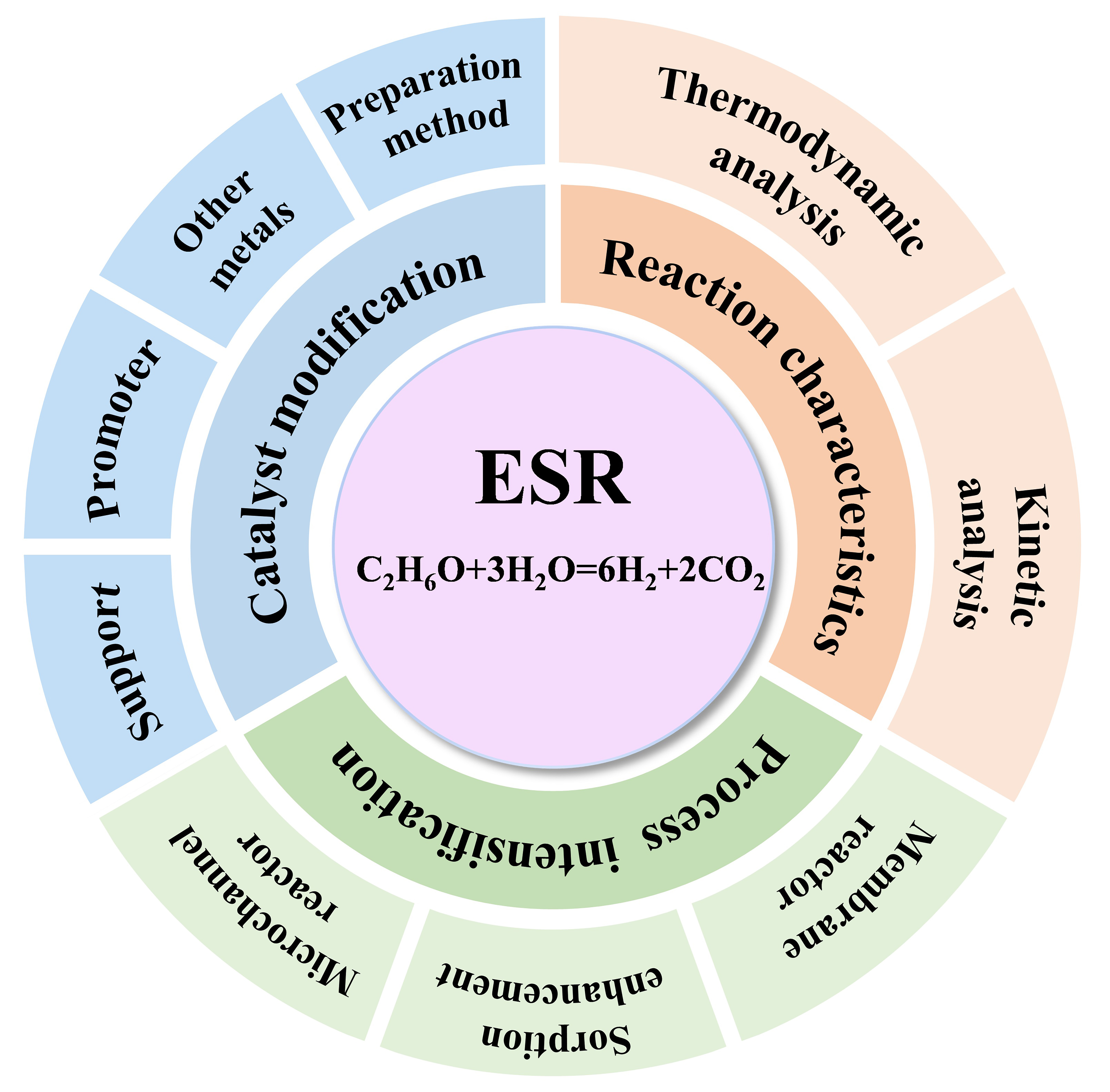



Recent Advances in Catalyst Design and Process Intensification for Ethanol Steam Reforming


Abstract
1. Introduction
2. Reaction Characteristics of Ethanol Steam Reforming
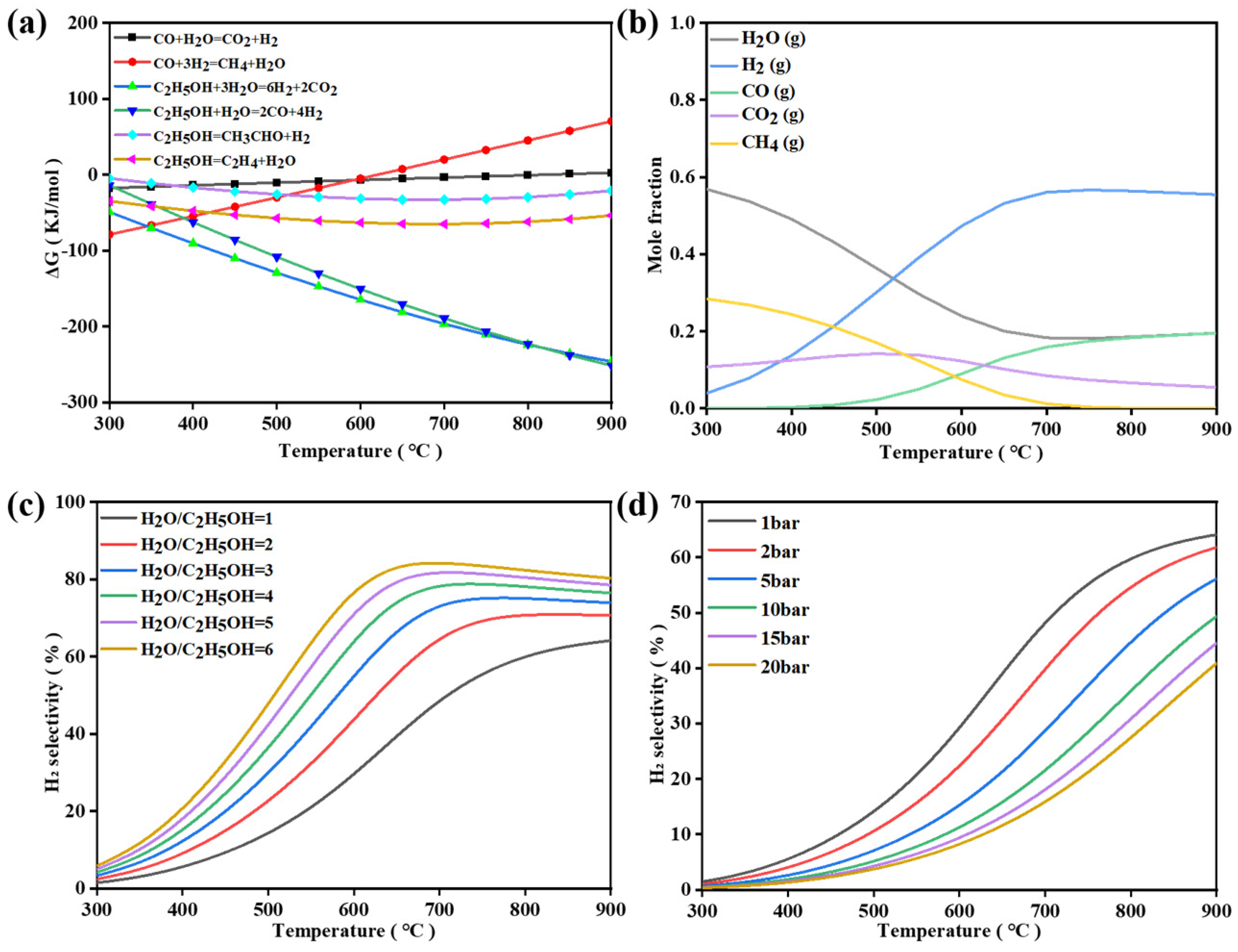
2.1. Thermodynamics Analysis
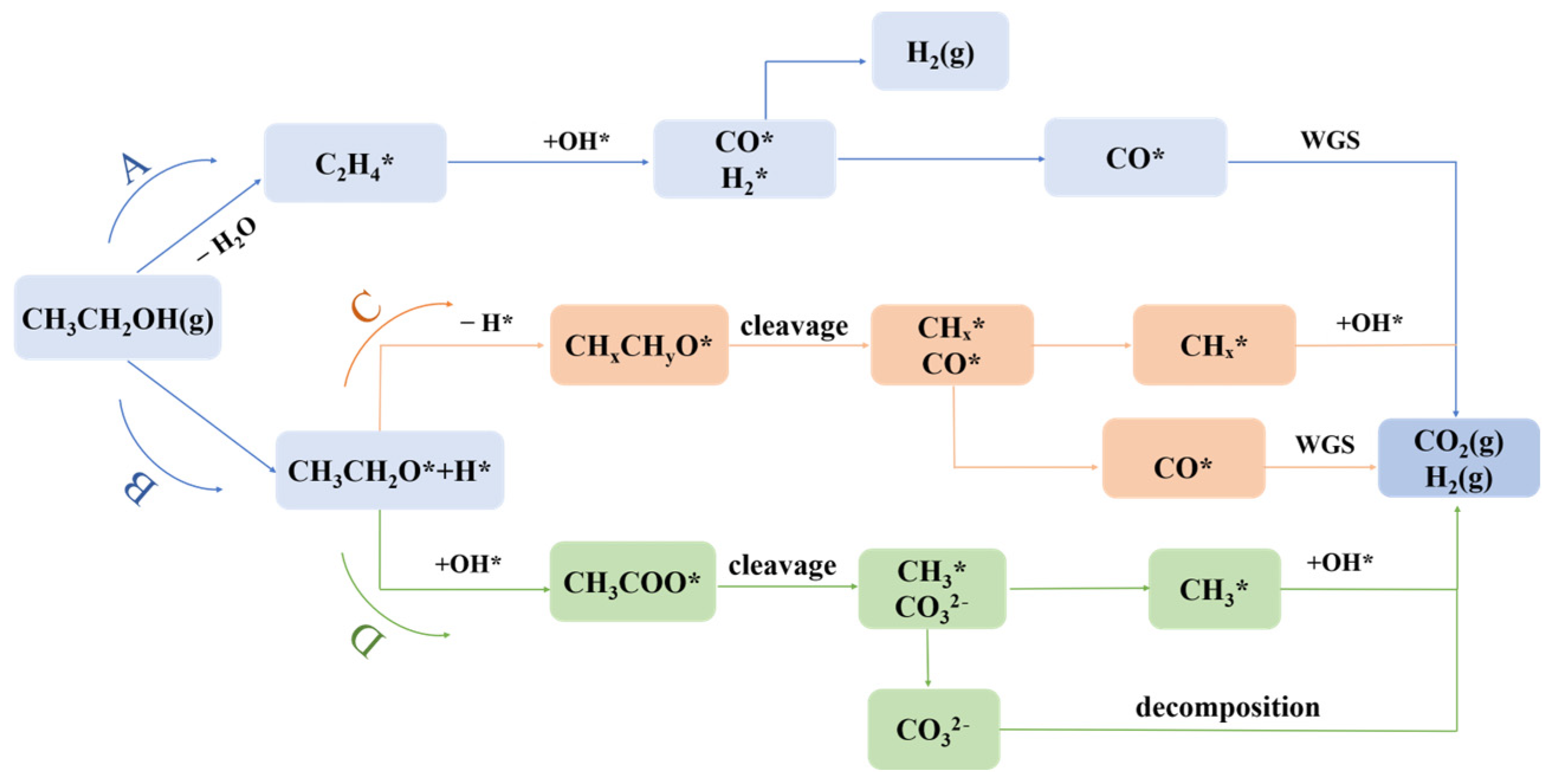
2.2. Reaction Pathway
2.2.1. Dehydrogenation Pathway
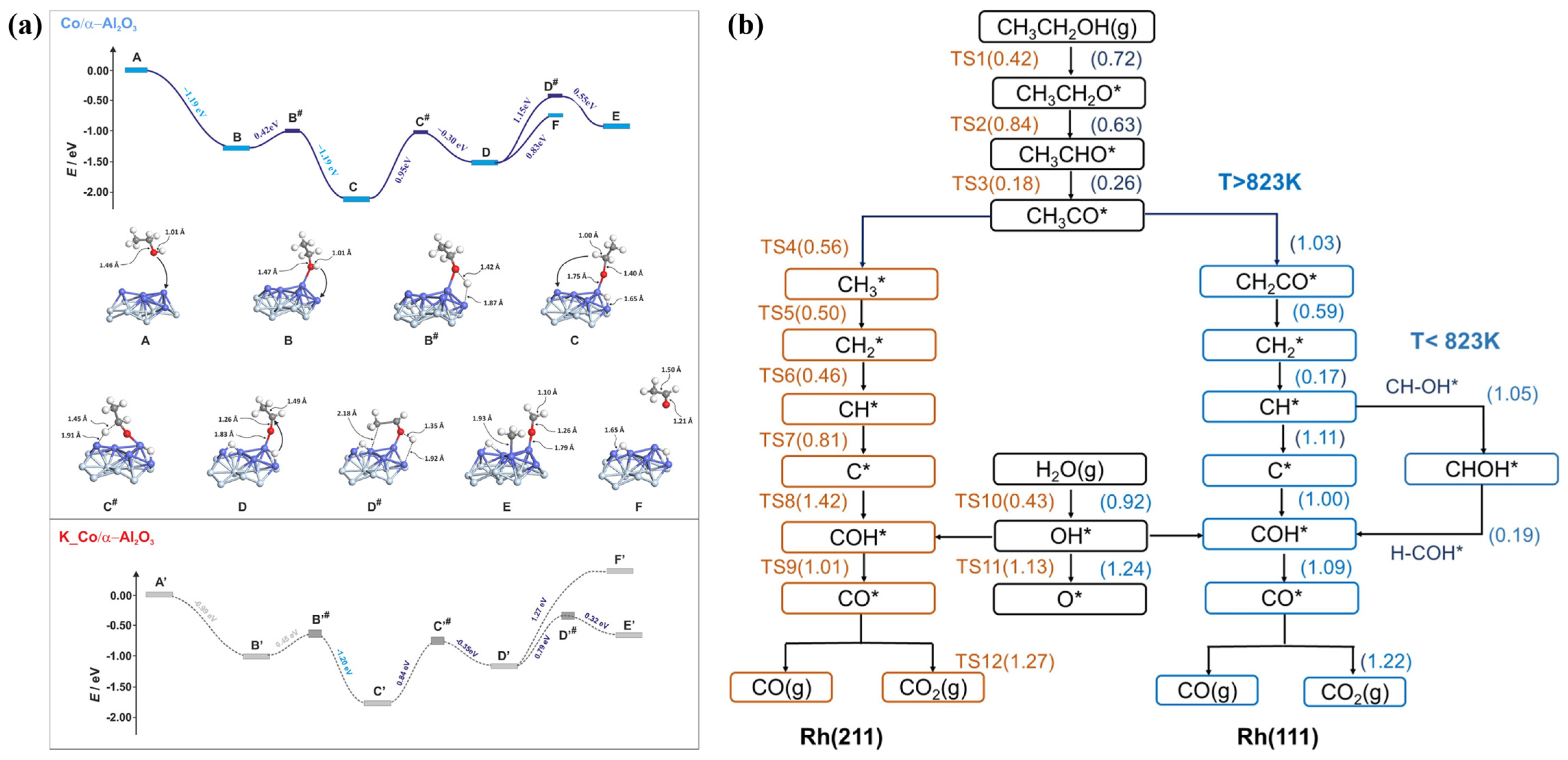
Stepwise Dehydrogenation Pathway
Acetate Pathway
2.2.2. Dehydration Pathway
3. Catalysts for Ethanol Steam Reforming
3.1. Ni-Based Catalysts
3.1.1. Incorporating Other Metals
3.1.2. Optimizing Catalyst Preparation Methods
3.1.3. Introducing Promoters
3.1.4. Modifying Supports
3.2. Co-Based Catalysts
3.2.1. Regulating Catalyst Synthesis Methods
3.2.2. Adding Promoters
3.2.3. Optimizing Supports
3.3. Noble Metal Catalysts
4. Process Intensification Technologies
4.1. Separation Intensification Technologies
4.1.1. Catalytic Membrane Reactor
4.1.2. Sorption-Enhanced Ethanol Steam Reforming
4.2. Microchannel Reactor
5. Summary and Outlook
Author Contributions
Funding
Data Availability Statement
Conflicts of Interest
References
- Ouyang, Z.; Jackson, R.B.; Saunois, M.; Canadell, J.G.; Zhao, Y.; Morfopoulos, C.; Krummel, P.B.; Patra, P.K.; Peters, G.P.; Dennison, F.; et al. The global hydrogen budget. Nature 2025, 648, 616–624. [Google Scholar] [CrossRef] [Scilit] [PubMed]
- Gunathilake, C.; Soliman, I.; Panthi, D.; Tandler, P.; Fatani, O.; Ghulamullah, N.A.; Marasinghe, D.; Farhath, M.; Madhujith, T.; Conrad, K.; et al. A comprehensive review on hydrogen production, storage, and applications. Chem. Soc. Rev. 2024, 53, 10900–10969. [Google Scholar] [CrossRef] [Scilit]
- Zhang, S.; Zhou, H.; Shao, Z.; Wei, B.; Hu, Z.; Liang, H.; Zhang, R.; Liu, X.; Luo, H.; Xia, L.; et al. Phase-interface-anchored cadmium single-atom catalysts for efficient methanol steam reforming. Nat. Commun. 2025, 16, 7739. [Google Scholar] [CrossRef] [Scilit]
- Hu, Y.; Shi, C.; Li, B.; Qiu, Q.; Song, J.; Wu, T.; Hu, L.; Lin, X. Detoxification of high solid-to-liquid ratio sugarcane bagasse hydrolysate using hydrophobic deep eutectic solvents for efficient cellulosic ethanol production. Chem. Eng. J. 2025, 514, 163306. [Google Scholar] [CrossRef] [Scilit]
- Wang, Y.; Xing, Y.; Yang, X.; Yu, Y.; Li, J.; Zhao, C.; Yuan, M.; Huang, W.; Yin, Y.; Liu, G.; et al. Knockout of ZmNST2 promotes bioethanol production from corn stover. Plant Biotechnol. J. 2024, 22, 3099–3101. [Google Scholar] [CrossRef] [Scilit]
- Flevaris, K.; Chatzidoukas, C. Optimal fed-batch bioreactor operating strategies for the microbial production of lignocellulosic bioethanol and exploration of their economic implications: A step forward towards sustainability and commercialization. J. Clean. Prod. 2021, 295, 126384. [Google Scholar] [CrossRef] [Scilit]
- Sun, Z.; Russell, C.K.; Whitty, K.J.; Eddings, E.G.; Dai, J.; Zhang, Y.; Fan, M.; Sun, Z. Chemical looping-based energy transformation via lattice oxygen modulated selective oxidation. Prog. Energy Combust. Sci. 2023, 96, 101045. [Google Scholar] [CrossRef] [Scilit]
- Zhu, S.; Ma, S.; Song, D.; He, S.; Wang, Y.; Lu, J.; Ai, T.; Luo, Y. Regulating and Stabilizing Strong Metal-Support Interactions on Ni/TiO2 by Crystal Phase for Ultra-Stable Ethanol Reforming. Adv. Energy Mater. 2024, 15, 2402295. [Google Scholar] [CrossRef] [Scilit]
- Xiong, Z.; Ban, X.; Yuan, W.; Zeng, M.; Deng, Y.; Guo, J.; Ma, Y.; Yang, J.; Zhao, L.; Chen, C.; et al. Vinyloxy radicals unveiled as critical intermediates in Ni/La2O3-catalyzed ethanol steam reforming for hydrogen production. Nat. Commun. 2025, 17, 474. [Google Scholar] [CrossRef] [Scilit]
- Gasparetto, H.; Salau, N.P.G. A review on ethanol steam reforming focusing on yttria-stabilized zirconia catalysts: A look into hydrogen production for fuel cells. Fuel 2024, 371, 132140. [Google Scholar] [CrossRef] [Scilit]
- Vogt, E.T.C.; Fu, D.; Weckhuysen, B.M. Carbon Deposit Analysis in Catalyst Deactivation, Regeneration, and Rejuvenation. Angew. Chem. Int. Ed. 2023, 62, e202300319. [Google Scholar] [CrossRef] [Scilit]
- Jaramillo-Baquero, M.; Dieuzeide, M.L.; Múnera, J.; Cornaglia, L. Highly dispersed and stable Ni catalysts for hydrogen production by steam reforming of ethanol. Chem. Eng. J. 2025, 523, 168482. [Google Scholar] [CrossRef] [Scilit]
- Greluk, M.; Gac, W.; Rotko, M.; Slowik, G.; Turczyniak-Surdacka, S. Co/CeO2 and Ni/CeO2 catalysts for ethanol steam reforming: Effect of the cobalt/nickel dispersion on catalysts properties. J. Catal. 2021, 393, 159–178. [Google Scholar] [CrossRef] [Scilit]
- Piazza, V.; Junior, R.B.S.; Luccisano, G.; Pietrogiacomi, D.; Groppi, G.; Gazzoli, D.; Beretta, A. H2 from biofuels and carriers: Gas-phase and surface ethanol conversion pathways on Rh/Al2O3 investigated by annular microreactor coupled with Raman and FTIR spectroscopy. J. Catal. 2022, 413, 184–200. [Google Scholar] [CrossRef] [Scilit]
- Shi, K.; Deng, Y.; An, X.; Wu, X.; Xie, X. Insight into CeO2 and Ni collaboration in ethanol steam reforming: Enhanced activity and stability of CeO2 modified Ni/MgAl2O4. Chem. Eng. Sci. 2023, 282, 119216. [Google Scholar] [CrossRef] [Scilit]
- Zhou, J.; Chen, Y.; Zhu, S.; Wang, Y.; Song, D.; He, S. Synergistic regulation of metal-support interaction and oxygen vacancy by electronic modulation in NiPr/Al2O3 catalysts for ethanol steam reforming. Chem. Eng. J. 2026, 530, 173623. [Google Scholar] [CrossRef] [Scilit]
- Anil, S.; Indraja, S.; Singh, R.; Appari, S.; Roy, B. A review on ethanol steam reforming for hydrogen production over Ni/Al2O3/and Ni/CeO2 based catalyst powders. Int. J. Hydrogen Energy 2022, 47, 8177–8213. [Google Scholar] [CrossRef] [Scilit]
- Ogo, S.; Sekine, Y. Recent progress in ethanol steam reforming using non-noble transition metal catalysts: A review. Fuel Process. Technol. 2020, 199, 106238. [Google Scholar] [CrossRef] [Scilit]
- Bepari, S.; Kuila, D. Steam reforming of methanol, ethanol and glycerol over nickel-based catalysts-A review. Int. J. Hydrogen Energy 2020, 45, 18090–18113. [Google Scholar] [CrossRef] [Scilit]
- Chen, W.-H.; Biswas, P.P.; Ubando, A.T.; Park, Y.-K.; Ashokkumar, V.; Chang, J.-S. Design of experiment for hydrogen production from ethanol reforming: A state-of-the-art review. Fuel 2023, 342, 127871. [Google Scholar] [CrossRef] [Scilit]
- Correa-Muriel, D.; Osorio-Vargas, P.; Rodríguez-Aguado, E.; Cecilia, J.A.; Rodríguez-Castellón, E.; Casella, M.L.; Lick, I.D. Highly stable Ni catalysts exsolved from LaNiBO3-based perovskites(B=Ti, Al and Fe) for H2 production by catalytic steam reforming ethanol:Effect of B site nature. Appl. Catal. A 2025, 706, 120495. [Google Scholar] [CrossRef] [Scilit]
- Bepari, S.; Sarkar, J.J.; Pradhan, N.C. Kinetics of ethanol steam reforming over Ni/Olivine catalyst. Int. J. Hydrogen Energy 2022, 47, 30843–30860. [Google Scholar] [CrossRef] [Scilit]
- Pashchenko, D. Thermochemical recuperation by ethanol steam reforming: Thermodynamic analysis and heat balance. Int. J. Hydrogen Energy 2019, 44, 30865–30875. [Google Scholar] [CrossRef] [Scilit]
- Shi, K.; An, X.; Wu, X.; Xie, X. Modification strategies for enhancing anti-coking of Ni-, Co-based catalysts during ethanol steam reforming: A review. Int. J. Hydrogen Energy 2022, 47, 39404–39428. [Google Scholar] [CrossRef] [Scilit]
- Xu, W.; Liu, Z.; Johnston-Peck, A.C.; Senanayake, S.D.; Zhou, G.; Stacchiola, D.; Stach, E.A.; Rodriguez, J.A. Steam Reforming of Ethanol on Ni/CeO2: Reaction Pathway and Interaction between Ni and the CeO2 Support. ACS Catal. 2013, 3, 975–984. [Google Scholar] [CrossRef] [Scilit]
- Cai, W.; Wang, F.; Daniel, C.; van Veen, A.C.; Schuurman, Y.; Descorme, C.; Provendier, H.; Shen, W.; Mirodatos, C. Oxidative steam reforming of ethanol over Ir/CeO2 catalysts: A structure sensitivity analysis. J. Catal. 2012, 286, 137–152. [Google Scholar] [CrossRef] [Scilit]
- Grzybek, G.; Wasilek, O.; Greluk, M.; Slowik, G.; Davo-Quinonero, A.; Bueno-Lopez, A.; Lozano-Castello, D.; Stelmachowski, P.; Zasada, F.; Piskorz, W.; et al. Unraveling the Role of Alkali on Cobalt Catalyst Performance in Ethanol Steam Reforming by Operando DRIFT Studies and DFT Modeling. ACS Appl. Mater. Interfaces 2025, 17, 7697–7706. [Google Scholar] [CrossRef] [Scilit]
- Wu, H.; Yang, B. Structure sensitivity of ethanol steam reforming over the Rh catalyst: Reaction kinetics and deactivation mechanisms. Appl. Surf. Sci. 2023, 614, 156116. [Google Scholar] [CrossRef] [Scilit]
- Ma, Y.; Hernández, L.; Guadarrama-Pérez, C.; Balbuena, P.B. Ethanol Reforming on Co(0001) Surfaces: A Density Functional Theory Study. J. Phys. Chem. A 2012, 116, 1409–1416. [Google Scholar] [CrossRef] [Scilit]
- Li, M.-R.; Song, Y.-Y.; Wang, G.-C. The Mechanism of Steam-Ethanol Reforming on Co13/CeO2−x: A DFT Study. ACS Catal. 2019, 9, 2355–2367. [Google Scholar] [CrossRef] [Scilit]
- Ogo, S.; Shimizu, T.; Nakazawa, Y.; Mukawa, K.; Mukai, D.; Sekine, Y. Steam reforming of ethanol over K promoted Co catalyst. Appl. Catal. A 2015, 495, 30–38. [Google Scholar] [CrossRef] [Scilit]
- Iglesias-Vázquez, S.; Valecillos, J.; Remiro, A.; Valle, B.; Bilbao, J.; Gayubo, A.G. Global Vision of the Reaction and Deactivation Routes in the Ethanol Steam Reforming on a Catalyst Derived from a Ni-Al Spinel. Energy Fuels 2024, 38, 7033–7048. [Google Scholar] [CrossRef] [Scilit]
- Choong, C.K.S.; Zhong, Z.; Huang, L.; Wang, Z.; Ang, T.P.; Borgna, A.; Lin, J.; Hong, L.; Chen, L. Effect of calcium addition on catalytic ethanol steam reforming of Ni/Al2O3: I. Catalytic stability, electronic properties and coking mechanism. Appl. Catal. A 2011, 407, 145–154. [Google Scholar] [CrossRef] [Scilit]
- Valecillos, J.; Iglesias-Vázquez, S.; Landa, L.; Remiro, A.; Bilbao, J.; Gayubo, A.G. Insights into the Reaction Routes for H2 Formation in the Ethanol Steam Reforming on a Catalyst Derived from NiAl2O4 Spinel. Energy Fuels 2021, 35, 17197–17211. [Google Scholar] [CrossRef] [Scilit]
- Aker, V.; Ayas, N. Boosting hydrogen production by ethanol steam reforming on cobalt-modified Ni-Al2O3 catalyst. Int. J. Hydrogen Energy 2023, 48, 22875–22888. [Google Scholar] [CrossRef] [Scilit]
- Shi, K.; Che, Y.; Deng, Y.; An, X.; Xie, X.; Wu, X. Insight into role of Co species on NiCo/CeMgAl for ethanol steam reforming: Enhanced activity and resistance to coke. Chem. Eng. J. 2024, 482, 148820. [Google Scholar] [CrossRef] [Scilit]
- Wu, Y.; Pei, C.; Tian, H.; Liu, T.; Zhang, X.; Chen, S.; Xiao, Q.; Wang, X.; Gong, J. Role of Fe Species of Ni-Based Catalysts for Efficient Low-Temperature Ethanol Steam Reforming. JACS Au 2021, 1, 1459–1470. [Google Scholar] [CrossRef] [Scilit] [PubMed]
- Meng, H.; Yang, Y.; Shen, T.; Liu, W.; Wang, L.; Yin, P.; Ren, Z.; Niu, Y.; Zhang, B.; Zheng, L.; et al. A strong bimetal-support interaction in ethanol steam reforming. Nat. Commun. 2023, 14, 3189. [Google Scholar] [CrossRef] [Scilit] [PubMed]
- Liao, M.; Qin, C.; Xu, L.; Guo, S.; Wang, C.; Li, Y.; Liu, W.; Song, Q.; Chen, Y.; Du, Y. Quinary metal oxide NiCoMnCeCaOx nanorod as a multifunctional catalyst towards hydrogen production from ethanol steam reforming: Synergistic effect of polymetallic component. Chem. Eng. J. 2024, 497, 154646. [Google Scholar] [CrossRef] [Scilit]
- Alipour, H.; Alavi, S.M.; Rezaei, M.; Akbari, E.; Varbar, M. The role of various preparation techniques and nickel loadings in ethanol steam reforming over mesoporous nanostructured Ni-Al2O3 catalysts. J. Energy Inst. 2024, 112, 101488. [Google Scholar] [CrossRef] [Scilit]
- Sosa, L.F.; Garcia, M.A.S.; Silva, A.C.A.; Archanjo, B.S.; Feil, A.F.; Eberhardt, D.; Figueroa, S.J.A.; Almeida, J.M.A.R.d.; Romano, P.N. Highly efficient low metal content Ni/CeO2 catalysts prepared by magnetron sputtering deposition for ethanol steam reforming reaction. Appl. Catal. B Environ. 2025, 365, 124940. [Google Scholar] [CrossRef] [Scilit]
- Bao, T.; Hu, T.; Guo, C.; Liu, W.; Qin, H.; Gao, P.; Xiao, H.; Guo, W. Multi-size distributed Ni catalyst embedded in SiCxOy film by inverse microemulsion-precipitation method for ethanol steam reforming. Int. J. Hydrogen Energy 2023, 48, 5810–5822. [Google Scholar] [CrossRef] [Scilit]
- Villagran-Olivares, A.C.; Gomez, M.F.; López, C.; Barroso, M.N.; Abello, M.C. Effect of EDTA in preparation of Ni catalysts toward a carbon-resistant ethanol reforming. Appl. Catal. B 2020, 264, 118510. [Google Scholar] [CrossRef] [Scilit]
- Chen, Y.; Zhu, S.; Zhou, J.; Wang, Y.; Zhang, Z.; Liu, N.; Meng, R.; He, S. Synthesis of a Ni/Al2O3 catalyst for hydrogen production via bioethanol steam reforming: Role of the preparation method. Int. J. Hydrogen Energy 2024, 96, 309–320. [Google Scholar] [CrossRef] [Scilit]
- Tian, H.; Pei, C.; Wu, Y.; Chen, S.; Zhao, Z.-J.; Gong, J. Tunable metal-oxide interaction with balanced Ni0/Ni2+ sites of Nix Mg1-xO for ethanol steam reforming. Appl. Catal. B 2021, 293, 120178. [Google Scholar] [CrossRef] [Scilit]
- Xiao, Z.; Wu, C.; Wang, L.; Xu, J.; Zheng, Q.; Pan, L.; Zou, J.; Zhang, X.; Li, G. Boosting hydrogen production from steam reforming of ethanol on nickel by lanthanum doped ceria. Appl. Catal. B 2021, 286, 119884. [Google Scholar] [CrossRef] [Scilit]
- Xiao, Z.; Li, Y.; Hou, F.; Wu, C.; Pan, L.; Zou, J.; Wang, L.; Zhang, X.; Liu, G.; Li, G. Engineering oxygen vacancies and nickel dispersion on CeO2 by Pr doping for highly stable ethanol steam reforming. Appl. Catal. B 2019, 258, 117940. [Google Scholar] [CrossRef] [Scilit]
- Shi, K.; An, X.; Du, Y.; Fan, Z.; Wu, X.; Xie, X. Improving the coking resistance of Ni/Al2O3 modified by promoter (Ce, Zr, or Mg) under ethanol steam reforming: Perspective from growth sites of coking. J. Energy Inst. 2022, 104, 35–45. [Google Scholar] [CrossRef] [Scilit]
- Niazi, Z.; Irankhah, A.; Wang, Y.; Arandiyan, H. Cu, Mg and Co effect on nickel-ceria supported catalysts for ethanol steam reforming reaction. Int. J. Hydrogen Energy 2020, 45, 21512–21522. [Google Scholar] [CrossRef] [Scilit]
- Wang, Y.; Sun, X.; Liang, D.; Li, C.; Xin, H.; Wang, J.; Chen, M. Ethanol steam reforming for hydrogen production over alkali metals modified kaolin-supported Ni catalysts. Int. J. Hydrogen Energy 2025, 129, 113–129. [Google Scholar] [CrossRef] [Scilit]
- Seriyala, A.K.; Chava, R.; Baffoe, J.; Pham, X.T.L.; Leclerc, C.; Appari, S.; Roy, B. Tin and lanthanum modified Ni/CeO2 catalyst systems for low temperature steam reforming of ethanol. Int. J. Hydrogen Energy 2024, 50, 239–260. [Google Scholar] [CrossRef] [Scilit]
- Kumar Seriyala, A.; Appari, S.; Roy, B. Steam reforming of ethanol for hydrogen production by low-temperature steam reforming using modified Ni-Sn/CeO2 catalyst. Mater. Today Proc. 2023, 76, 279–288. [Google Scholar] [CrossRef] [Scilit]
- Baig, A.; Dhanuskar, S.; Sonal. Coke-resistant lanthana promoted Ni/CeO2-ZrO2 catalysts for hydrogen generation via ethanol steam reforming. Gas Sci. Eng. 2025, 134, 205537. [Google Scholar] [CrossRef] [Scilit]
- Liu, H.; Li, H.; Li, S. Ni-hydrocalumite derived catalysts for ethanol steam reforming on hydrogen production. Int. J. Hydrogen Energy 2022, 47, 24610–24618. [Google Scholar] [CrossRef] [Scilit]
- Murthy, P.S.; Rombaut, I.R.K.; Ling, H.; Tao, Y.; Ye, M.; Chen, F.; Huang, J. Renewable Hydrogen Production with Steam Reforming of Ethanol Using Siliceous Mesocellular Foam-Supported Nickel Catalysts. Adv. Energy Sustain. Res. 2023, 4, 2300064. [Google Scholar] [CrossRef] [Scilit]
- Xue, Q.; Li, Z.; Yan, B.; Ullah, S.; Wang, Y.; Luo, G. Mesoporous silica encapsulated core-shell NiRh@NiO nanocatalyst for performance-enhanced ethanol steam reforming. J. Catal. 2024, 434, 115536. [Google Scholar] [CrossRef] [Scilit]
- An, X.; Feng, C.; Ren, J.; Shi, K.; Du, Y.; Xie, X.; Wu, X. Novel highly dispersed Ni-based oxides catalysts for ethanol steam reforming. J. Energy Inst. 2021, 99, 240–247. [Google Scholar] [CrossRef] [Scilit]
- Grzybek, G.; Wasilek, O.; Rudzinska, M.; Stelmachowski, P.; Legutko, P.; Greluk, M.; Slowik, G.; Rotko, M.; Kotarba, A. Developing alumina-based cobalt catalyst for efficient hydrogen production via the ethanol steam reforming process. Catal. Today 2024, 439, 114080. [Google Scholar] [CrossRef] [Scilit]
- Efimov, M.N.; Mironova, E.Y.; Vasilev, A.A.; Muratov, D.G.; Zhilyaeva, N.A.; Ozkan, S.Z.; Karpacheva, G.P. Comparison of bimetallic Co-Ru nanoparticles supported on highly porous activated carbonized polyacrylonitrile with monometallic ones in ethanol steam reforming. J. Environ. Chem. Eng. 2021, 9, 106429. [Google Scholar] [CrossRef] [Scilit]
- Escalante, Y.; Gomez, M.F.; Barroso, M.N. Study of the impregnation sequence of active phase and effect of cobalt content over Co-CeO2/MgAl2O4 catalysts in ethanol steam reforming. Int. J. Hydrogen Energy 2023, 48, 19862–19878. [Google Scholar] [CrossRef] [Scilit]
- Grzybek, G.; Greluk, M.; Indyka, P.; Góra-Marek, K.; Legutko, P.; Słowik, G.; Turczyniak-Surdacka, S.; Rotko, M.; Sojka, Z.; Kotarba, A. Cobalt catalyst for steam reforming of ethanol-Insights into the promotional role of potassium. Int. J. Hydrogen Energy 2020, 45, 22658–22673. [Google Scholar] [CrossRef] [Scilit]
- Grzybek, G.; Ciemierkiewicz, J.; Stelmachowski, P.; Legutko, P.; Adamski, A.; Greluk, M.; Slowik, G.; Kierys, A.; Kotarba, A. Robust ethanol steam reforming catalysts with strong cobalt-alumina support interaction. Fuel 2026, 407, 137241. [Google Scholar] [CrossRef] [Scilit]
- Greluk, M.; Rotko, M.; Turczyniak-Surdacka, S. Comparison of catalytic performance and coking resistant behaviors of cobalt- and nickel based catalyst with different Co/Ce and Ni/Ce molar ratio under SRE conditions. Appl. Catal. A 2020, 590, 117334. [Google Scholar] [CrossRef] [Scilit]
- Ranjekar, A.M.; Yadav, G.D. Steam reforming of ethanol for hydrogen production: Efficacy of ceria promoted Cu-Co on mesoporous cellular foam silica. Int. J. Hydrogen Energy 2023, 48, 31550–31570. [Google Scholar] [CrossRef] [Scilit]
- Grzybek, G.; Greluk, M.; Patulski, P.; Stelmachowski, P.; Tarach, K.; Slowik, G.; Rotko, M.; Valencia, S.; Rey, F.; Gora-Marek, K. Adjustment of the ZSM-5 zeolite support towards the efficient hydrogen production by ethanol steam reforming on cobalt catalysts. Chem. Eng. J. 2023, 467, 143239. [Google Scholar] [CrossRef] [Scilit]
- Da Costa-Serra, J.F.; Miralles-Martínez, A.; García-Muñoz, B.; Maestro-Cuadrado, S.; Chica, A. Ni and Co-based catalysts supported on ITQ-6 zeolite for hydrogen production by steam reforming of ethanol. Int. J. Hydrogen Energy 2023, 48, 26518–26525. [Google Scholar] [CrossRef] [Scilit]
- Lupa, J.; Greluk, M.; Rotko, M.; Slowik, G.; Sienkiewicz, A.; Kierys, A. Ethanol steam reforming for hydrogen production over cobalt catalyst supported on the cerium oxide prepared via the one-step hard template method. Chem. Eng. J. 2024, 499, 156101. [Google Scholar] [CrossRef] [Scilit]
- Li, R.; Liu, C.; Li, L.; Xu, J.; Ma, J.; Ni, J.; Yan, J.; Han, J.; Pan, Y.; Liu, Y.; et al. Regulating cobalt chemical state by CeO2 facets preferred exposure for improved ethanol steam reforming. Fuel 2023, 336, 126758. [Google Scholar] [CrossRef] [Scilit]
- Li, R.; Li, L.; Xu, J.; Liu, Y.; Lu, L. Electron density donation of concomitant peroxide anions in La0.25Ce0.75O1.88 boosting cobalt-catalyzed ethanol steam reforming for hydrogen production. Appl. Surf. Sci. 2023, 607, 155069. [Google Scholar] [CrossRef] [Scilit]
- Fornero, E.L.; Vecchietti, J.; Rodrigues, M.B.; Hernandez-Garcido, J.C.; Bonivardi, A.L. Cooperative role of cobalt and gallium under the ethanol steam reforming on Co/CeGaOx. Int. J. Hydrogen Energy 2022, 47, 18018–18031. [Google Scholar] [CrossRef] [Scilit]
- Li, L.; Li, R.; Xu, J.; Liu, Y.; Lu, L. Si4Al2O2N6 regulating chemical states of Co catalyst for improved hydrogen production from ethanol steam reforming. Int. J. Hydrogen Energy 2024, 57, 738–745. [Google Scholar] [CrossRef] [Scilit]
- Silva, F.A.e.; Marques, E.d.E.S.; Fonseca, F.C.; Gurlo, A.; Rodrigues, T.S. Noble Metal-Supported CeO2 Catalysts for Hydrogen Production via Ethanol Steam Reforming. ChemCatChem 2025, 17, e70002. [Google Scholar] [CrossRef] [Scilit]
- Bampos, G.; Karaiskos, S.; Ramantani, T.; Tsatsos, S.; Kyriakou, G. Steam reforming of butanol-ethanol mixture for H2 production over Ru catalysts. Appl. Catal. A 2023, 664, 119347. [Google Scholar] [CrossRef] [Scilit]
- Zhao, L.; Liu, D.; Wang, Y.; Zhang, M.; Wang, Q.; Xu, G.; He, H. Ceria-trapped single-atom rhodium catalysts for efficient ethanol steam reforming to hydrogen. Catal. Sci. Technol. 2025, 15, 3613–3625. [Google Scholar] [CrossRef] [Scilit]
- Martinelli, M.; Castro, J.D.; Alhraki, N.; Matamoros, M.E.; Kropf, A.J.; Cronauer, D.C.; Jacobs, G. Effect of sodium loading on Pt/ZrO2 during ethanol steam reforming. Appl. Catal. A 2021, 610, 117947. [Google Scholar] [CrossRef] [Scilit]
- Rajabi, Z.; Jones, L.; Martinelli, M.; Qian, D.; Cronauer, D.C.; Kropf, A.J.; Watson, C.D.; Jacobs, G. Influence of Cs Promoter on Ethanol Steam-Reforming Selectivity of Pt/m-ZrO2 Catalysts at Low Temperature. Catalysts 2021, 11, 1104. [Google Scholar] [CrossRef] [Scilit]
- Moraes, T.S.; Tinti, V.B.; de Florio, D.Z.; Ferlauto, A.S.; Piazzolla, F.; Miura, Y.; Dean, D.P.; Pham, H.N.; Miller, J.T.; Datye, A.K.; et al. Enhanced ethanol reforming with catalytic active ruthenium species derived from solid solution in lanthanum chromite. Catal. Sci. Technol. 2025, 15, 5907. [Google Scholar] [CrossRef] [Scilit]
- Lee, J.H.; Do, J.Y.; Park, N.-K.; Ryu, H.-J.; Seo, M.W.; Kang, M. Hydrogen production on Pd0.01Zn0.29Mg0.7Al2O4 spinel catalyst by low temperature ethanol steam reforming reaction. J. Energy Inst. 2019, 92, 1064–1076. [Google Scholar] [CrossRef] [Scilit]
- Dai, R.; Zheng, Z.; Sun, C.; Li, X.; Wang, S.; Wu, X.; An, X.; Xie, X. Pt nanoparticles encapsulated in a hollow zeolite microreactor as a highly active and stable catalyst for low-temperature ethanol steam reforming. Fuel 2018, 214, 88–97. [Google Scholar] [CrossRef] [Scilit]
- Choong, C.K.S.; Du, Y.; Poh, C.K.; Ong, S.W.D.; Chen, L.; Borgna, A. Structural understanding of IrFe catalyst for renewable hydrogen production from ethanol steam reforming. Appl. Catal. B Environ. 2024, 345, 123630. [Google Scholar] [CrossRef] [Scilit]
- Dai, R.; Zheng, Z.; Yan, W.; Lian, C.; Wu, X.; An, X.; Xie, X. Dragon fruit-like Pt-Cu@mSiO2 nanocomposite as an efficient catalyst for low-temperature ethanol steam reforming. Chem. Eng. J. 2020, 379, 122299. [Google Scholar] [CrossRef] [Scilit]
- Kourtelesis, M.; Moraes, T.S.; Mattos, L.V.; Niakolas, D.K.; Noronha, F.B.; Verykios, X. The effects of support morphology on the performance of Pt/CeO2 catalysts for the low temperature steam reforming of ethanol. Appl. Catal. B 2021, 284, 119757. [Google Scholar] [CrossRef] [Scilit]
- Chen, W.-H.; Li, S.-C.; Lim, S.; Chen, Z.-Y.; Juan, J.C. Reaction and hydrogen production phenomena of ethanol steam reforming in a catalytic membrane reactor. Energy 2021, 220, 119737. [Google Scholar] [CrossRef] [Scilit]
- Lu, Z.; Yuan, C.; Li, C.; Geng, G.; Song, J.; Yang, N.; Kawi, S.; Tan, X.; Sunarso, J.; Liu, S. H2 production from ethanol steam reforming using metallic nickel hollow fiber membrane reactor. Sep. Purif. Technol. 2025, 365, 132561. [Google Scholar] [CrossRef] [Scilit]
- Jia, H.; Xu, H.; Sheng, X.; Yang, X.; Shen, W.; Goldbach, A. High-temperature ethanol steam reforming in PdCu membrane reactor. J. Membr. Sci. 2020, 605, 118083. [Google Scholar] [CrossRef] [Scilit]
- Eremeev, N.; Krasnov, A.; Bespalko, Y.; Bobrova, L.; Smorygo, O.; Sadykov, V. An Experimental Performance Study of a Catalytic Membrane Reactor for Ethanol Steam Reforming over a Metal Honeycomb Catalyst. Membranes 2021, 11, 790. [Google Scholar] [CrossRef] [Scilit]
- Chen, W.-H.; Chou, W.-S.; Rajendran, S.; Hsu, S.-Y.; Ghorbani, M. Hydrogen production and geometry optimization of ethanol steam reforming combining water gas shift reaction in a crossflow membrane tube reactor. Int. J. Hydrogen Energy 2024, 51, 637–653. [Google Scholar] [CrossRef] [Scilit]
- Quan, C.; Feng, S.; Gao, S.; Zhang, M.; Wu, C.; Miskolczi, N. Sorption-enhanced ethanol steam reforming coupled with in-situ CO2 capture and conversion. J. Energy Inst. 2024, 117, 101808. [Google Scholar] [CrossRef] [Scilit]
- Wang, Y.; Zhou, H.; Yao, D.; Olguin, G.; Ding, H.; Qu, B.; Xie, W.; Fu, Z.; Guo, Y.; Wang, X.; et al. Ni-CaO-CaZrO3 bi-functional materials for high purity hydrogen production via sorption enhanced steam reforming of ethanol. J. Clean. Prod. 2024, 446, 141397. [Google Scholar] [CrossRef] [Scilit]
- Oliveira, C.C.; Hori, C.E. Hydrogen production from sorption enhanced steam reforming of ethanol using bifunctional Ni and Ca-based catalysts doped with Mg and Al. Int. J. Hydrogen Energy 2023, 48, 30263–30281. [Google Scholar] [CrossRef] [Scilit]
- Avendaño, R.; Fals, J.; Bocanegra, S.; Dieuzeide, M.L.; Amadeo, N. Sorption enhanced steam reforming of ethanol for hydrogen production, over Mg/Al hydrotalcites modified with K. Int. J. Hydrogen Energy 2023, 48, 20889–20900. [Google Scholar] [CrossRef] [Scilit]
- Xu, Y.; Lu, B.; Luo, C.; Chen, J.; Zhang, Z.; Zhang, L. Sorption enhanced steam reforming of ethanol over Ni-based catalyst coupling with high-performance CaO pellets. Chem. Eng. J. 2021, 406, 126903. [Google Scholar] [CrossRef] [Scilit]
- Rahman, M.A.; García-García, F.R.; Li, K. On-board H2 generation by a catalytic hollow fibre microreactor for portable device applications. Catal. Commun. 2011, 16, 128–132. [Google Scholar] [CrossRef] [Scilit]
- Cai, W.; Wang, F.; van Veen, A.; Descorme, C.; Schuurman, Y.; Shen, W.; Mirodatos, C. Hydrogen production from ethanol steam reforming in a micro-channel reactor. Int. J. Hydrogen Energy 2010, 35, 1152–1159. [Google Scholar] [CrossRef] [Scilit]
- Dehkordi, T.K.; Hormozi, F.; Jahangiri, M. Using conical reactor to improve efficiency of ethanol steam reforming. Int. J. Hydrogen Energy 2016, 41, 17084–17092. [Google Scholar] [CrossRef] [Scilit]






| No. | Reaction Name | Reaction | ΔHr 298 K KJ·mol−1 |
|---|---|---|---|
| 1 | Ethanol Steam Reforming | C2H5OH + 3H2O→6H2 + 2CO2 | +174 |
| 2 | Ethanol Partial Reforming | C2H5OH + H2O→2CO + 4H2 | +256 |
| 3 | Ethanol Dehydration | C2H5OH→C2H4 + H2O | +45 |
| 4 | Ethylene Steam Reforming | C2H4 + 4H2O→2CO2 + 6H2 | +127.7 |
| 5 | Ethanol Decomposition | C2H5OH→CO + CH4 + H2 | +49 |
| 6 | Ethanol Dehydrogenation | C2H5OH→CH3CHO + H2 | +111.5 |
| 7 | Acetaldehyde Condensation | 2CH3CHO→CH3COCH3 + CO + H2 | +4.1 |
| 8 | Methane Steam Reforming | CH4 + H2O→CO + 3H2 | +206 |
| 9 | Water–Gas Shift Reaction | CO + H2O→CO2 + H2 | −41 |
| 10 | CO Methanation | CO + 3H2→CH4 + H2O | −206 |
| 11 | Boudouard Reaction | 2CO→CO2 + C | −172.5 |
| 12 | Methane Decomposition | CH4→C + 2H2 | +74.6 |
| 13 | Ethylene Polymerization | nC2H4→C2n + 2nH2 | / |
| Catalyst | T °C | GHSV mL·gcat−1·h−1 | Ratio S/E | Con. % | Sel. H2 % | Ref. |
|---|---|---|---|---|---|---|
| 2Ni-Co/Al2O3 | 600 | 57,120 | 24 | 100 | 95.14 | [35] |
| 9Ni1Co/CeMgAl | 450 | 10,000 | 6 | ~100 | ~70 | [36] |
| Ni10Fe10/MgAl2O4 | 400 | 59,146 | 8 | ~100 | ~70 | [37] |
| 0.5RhNi/TiO2 | 400 | 16,700 | 6 | 99.7 | 61.7 | [38] |
| NiCoMnCeCaOx | 600 | 30,100 | 3 | 99.92 | [39] | |
| 12.5Ni/Al2O3 | 600 | 24,000 | 3 | 92 | 86 | [40] |
| Ni/CeO2-SP | 500 | 30,000 | 6 | 90 | 65 | [41] |
| Ni/SiCxOy | 500 | 8 | 100 | 74 | [42] | |
| NiEDTA(0.5)/MgAl2O4-CeO2 | 650 | 292,000 | 4.85 | ~90 | ~65 | [43] |
| NiEDTA(1)/MgAl2O4-CeO2 | 650 | 292,000 | 4.85 | ~100 | ~95 | [43] |
| Ni/Al2O3-OS | 400 | 35,960 | 8 | 100 | [44] | |
| Ni/Al2O3-IMP | 400 | 35,960 | 8 | 74 | [44] | |
| 5ss-10NiO | 400 | 33,940 | 6 | ~55 | [45] | |
| Ni-CeLa0.20 | 600 | 55,920 | 4 | ~95 | [46] | |
| Ni-CeTb0.20 | 600 | 55,920 | 4 | ~100 | [46] | |
| Ni-CeZr0.20 | 600 | 55,920 | 4 | ~95 | [46] | |
| 10Ni-CePr0.20 | 600 | 44,240 | 4 | 100 | [47] | |
| Ni/Mg-Al2O3 | 500 | 60,000 | 6 | ~100 | ~60 | [48] |
| 13Ni/CeO2 | 600 | 20,000 | 6 | ~89 | 71 | [49] |
| 13Ni-4Cu/CeO2 | 600 | 20,000 | 6 | 100 | 73 | [49] |
| 13Ni-4Mg/CeO2 | 600 | 20,000 | 6 | 96 | 74 | [49] |
| 13Ni-4Mo/CeO2 | 600 | 20,000 | 6 | 91 | 73 | [49] |
| Ni-K/KL | 600 | 19.96 h−1 | 6 | 97.5 | 76.3 | [50] |
| Ni0.56Sn0.57(5)/Ce0.67La0.33O2 | 400 | 7697 h−1 | 12 | 100 | 60 | [51] |
| NS5/CZ12 | 400 | 12,720 | 12 | 100 | 69 | [52] |
| 7.5Ni-7.5La/Ce-Zr | 600 | 2.48h−1 | 4.5 | 97 | 65 | [53] |
| 15Ni-HCa | 650 | 32,900 | 6 | 100 | 85 | [54] |
| 10 wt% Ni/MCF-S | 700 | 17,160 | 4 | 100 | 68 | [55] |
| NiRh@NiO@m-SiO2 | 550 | 21 h−1 | 4 | 100 | [56] | |
| NiCuMgAl | 350 | 49,100 | 3 | 99.43 | 61 | [57] |
| SiO2@NiCuMgAl | 600 | 49,100 | 3 | 100 | 75 | [57] |
| Catalyst | T °C | GHSV mL·gcat−1·h−1 | Ratio S/E | Con. % | Sel. H2 % | Ref. |
|---|---|---|---|---|---|---|
| Co(IWI)|Al2O3-S3 | 500 | 4 | ~47 | 50 | [58] | |
| Co(HT)|Al2O3-S3 | 500 | 4 | ~56 | 55 | [58] | |
| Co(SC)|Al2O3-S3 | 500 | 4 | ~61 | 60 | [58] | |
| IR-PAN-Co-Ru | 550 | 1341 | 3 | 98.7 | 94.8 | [59] |
| IR-PAN-Co | 550 | 1341 | 3 | 82.7 | 55.61 | [59] |
| IR-PAN-Ru | 550 | 1341 | 3 | 54.7 | 47.50 | [59] |
| 4CoCe/S | 650 | 4.9 | ~87 | [60] | ||
| 8CoCe/S | 650 | 4.9 | ~100 | [60] | ||
| K-Co2.6Zn0.4O4 | 540 | 4 | ~100 | 94 | [61] | |
| Co/b-Al2O3-I | 500 | 60,000 | 4 | ~90 | 88 | [62] |
| 1%K-Co/b-Al2O3-I | 500 | 60,000 | 4 | ~100 | 92 | [62] |
| Co/b-Al2O3-SC | 500 | 60,000 | 4 | 100 | 88 | [62] |
| Co-0.1Ce/CeO2 | 540 | 60,000 | 4 | 100 | 86 | [63] |
| 5%Ce-10%Cu-10%Co/MCF | 400 | 2700 | 6 | 95 | 92 | [64] |
| Co|Z(∞)-S | 500 | 52h−1 | 12 | 100 | 95 | [65] |
| Co/ITQ-6 | 500 | 4700h−1 | 13 | 90.5 | 41.3 | [66] |
| Co/CeO2-XAD | 420 | 60,000 | 12 | 100 | 73 | [67] |
| Co/CeO2-COM | 420 | 60,000 | 12 | 58 | 68 | [67] |
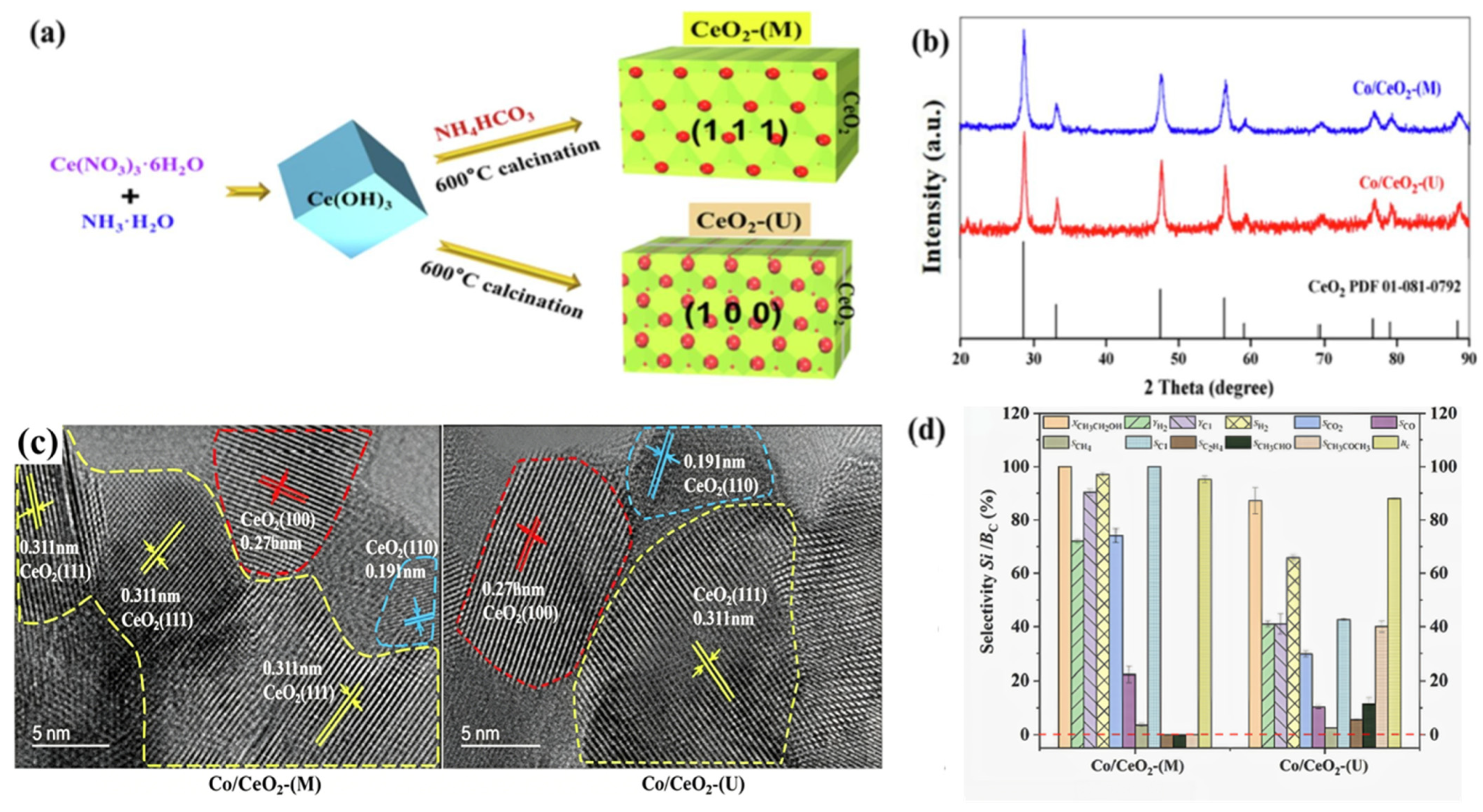
| Co/CeO2-(M) | 500 | 34,500 | 6 | 100 | 97 | [68] |
| Co/CeO2-(U) | 500 | 34,500 | 6 | 87.2 | 65.8 | [68] |
| Co/La0.25Ce0.75O1.88 | 500 | 44,400 | 6 | 100 | 94.3 | [69] |
| 1.0 wt% Co/CeO2 | 500 | 867 | 6 | 100 | 35 | [70] |
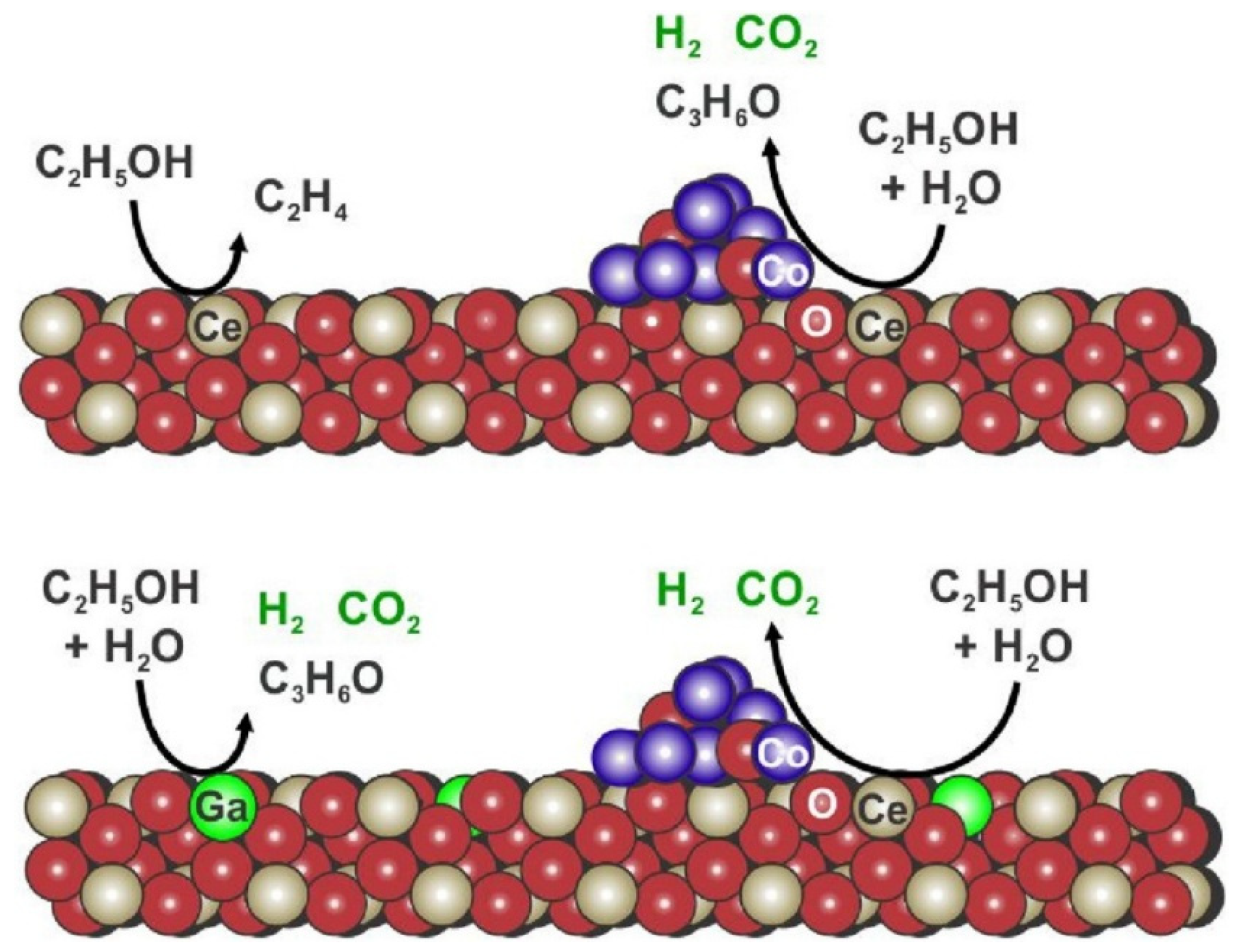
| 1.0 wt% Co/Ce90Ga10Ox | 500 | 867 | 6 | 100 | 50 | [70] |
| Co/Al2O3 | 500 | 44,400 | 6 | 81 | 83 | [71] |
| Co/Si3N4 | 500 | 44,400 | 6 | 74 | 86 | [71] |
| Co/Si4Al2O2N6 | 500 | 44,400 | 6 | 97 | 92 | [71] |
| Catalyst | T °C | GHSV mL·gcat−1·h−1 | Ratio S/E | Con. % | Sel. H2 % | Ref. |
|---|---|---|---|---|---|---|
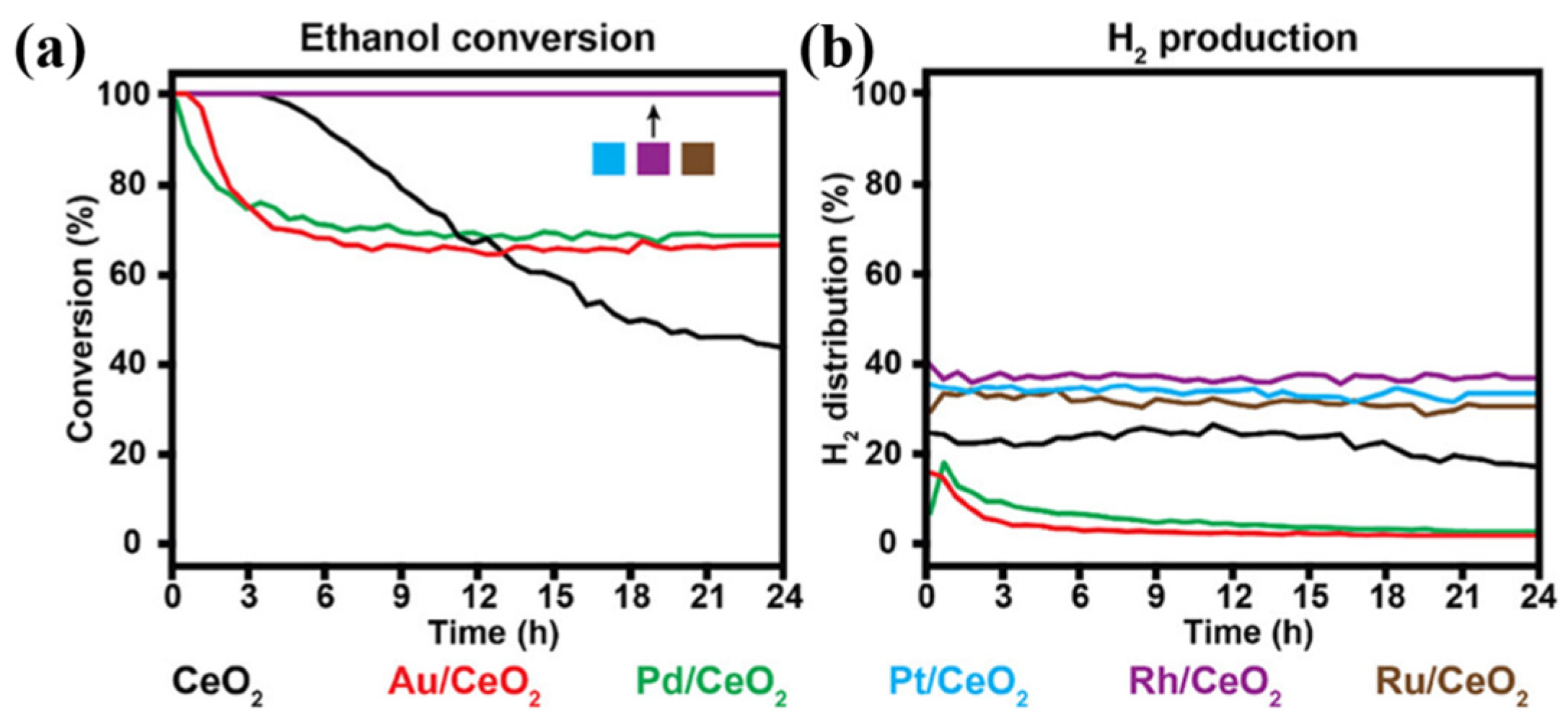
| Au/CeO2 | 550 | 33,120 | 3 | 65 | 3.1 | [72] |
| Pd/CeO2 | 550 | 33,120 | 3 | 68 | 4.8 | [72] |
| Pt/CeO2 | 550 | 33,120 | 3 | 100 | 34.6 | [72] |
| Rh/CeO2 | 550 | 33,120 | 3 | 100 | 37.8 | [72] |
| Ru/CeO2 | 550 | 33,120 | 3 | 100 | 31.2 | [72] |
| Ru/Al2O3 | 700 | 13,500 | 12 | 100 | ~95 | [73] |
| Ru/MgO-Al2O3 | 700 | 13,500 | 12 | 100 | ~97 | [73] |
| Pt/Al2O3 | 700 | 13,500 | 12 | 100 | ~82 | [73] |
| Rh/Al2O3 | 450 | 450,000 | 8 | 98 | 39.6 | [74] |
| Rh-Ce5/Al2O3 | 450 | 45,000 | 8 | 100 | 55.8 | [74] |
| 2%Pt/ZrO2 | 300 | 381,000 | 9 | 63.5 | 43 | [75] |
| 1.8%Na-2%Pt/ZrO2 | 300 | 381,000 | 9 | 51.3 | 60 | [75] |
| 2.9% Cs-2% Pt/ZrO2 | 300 | 190,560 | 8.77 | 73 | 88 | [76] |
| LaCr0.90Ru0.10O3 | 600 | 72,000 | 3 | 100 | ~65 | [77] |
| LaCr0.80Ru0.20O3 | 600 | 72,000 | 3 | 100 | ~70 | [77] |
| Pd0.01Zn0.29Mg0.7Al2O4 | 450 | 6000 | 3 | 100 | ~90 | [78] |
| Pt@HBZ | 350 | 7020 | 4 | 100 | 68 | [79] |
| Ir/Al2O3 | 400 | 88,000 | 9.6 | 62 | [80] | |
| IrFe/Al2O3 | 400 | 88,000 | 9.6 | 100 | [80] | |
| Pt-Cu@mSiO2 | 400 | 8900 | 4 | 99.99 | 70.88 | [81] |
| Pt/CeO2-NC | 300 | 39,720 | 3 | 80 | 30 | [82] |
| Pt/CeO2-NR | 300 | 39,720 | 3 | 70 | 28 | [82] |
| Pt/CeO2-FL | 300 | 39,720 | 3 | 65 | 25 | [82] |
Disclaimer/Publisher’s Note: The statements, opinions and data contained in all publications are solely those of the individual author(s) and contributor(s) and not of MDPI and/or the editor(s). MDPI and/or the editor(s) disclaim responsibility for any injury to people or property resulting from any ideas, methods, instructions or products referred to in the content. |
© 2026 by the authors. Licensee MDPI, Basel, Switzerland. This article is an open access article distributed under the terms and conditions of the Creative Commons Attribution (CC BY) license.
Share and Cite
Cao, R.; Zhang, H.; Cui, G. Recent Advances in Catalyst Design and Process Intensification for Ethanol Steam Reforming. Catalysts 2026, 16, 493. https://doi.org/10.3390/catal16060493
Cao R, Zhang H, Cui G. Recent Advances in Catalyst Design and Process Intensification for Ethanol Steam Reforming. Catalysts. 2026; 16(6):493. https://doi.org/10.3390/catal16060493
Chicago/Turabian StyleCao, Rui, Han Zhang, and Guoqing Cui. 2026. "Recent Advances in Catalyst Design and Process Intensification for Ethanol Steam Reforming" Catalysts 16, no. 6: 493. https://doi.org/10.3390/catal16060493
APA StyleCao, R., Zhang, H., & Cui, G. (2026). Recent Advances in Catalyst Design and Process Intensification for Ethanol Steam Reforming. Catalysts, 16(6), 493. https://doi.org/10.3390/catal16060493