Article

Synthesis of Interface-Doped Hierarchical Co-MH Z-Scheme Heterojunction for Enhanced Photocatalytic Antibacterial Performance


1
Fujian Provincial Key Laboratory of Advanced Materials Oriented Chemical Engineering, College of Chemistry and Materials Science, Fujian Normal University, Fuzhou 350117, China
2
Fujian Key Laboratory of Polymer Materials, College of Chemistry and Materials Science, Fujian Normal University, Fuzhou 350117, China
*
Author to whom correspondence should be addressed.
Catalysts 2026, 16(5), 481; https://doi.org/10.3390/catal16050481
Submission received: 8 May 2026 / Revised: 18 May 2026 / Accepted: 19 May 2026 / Published: 20 May 2026

Abstract

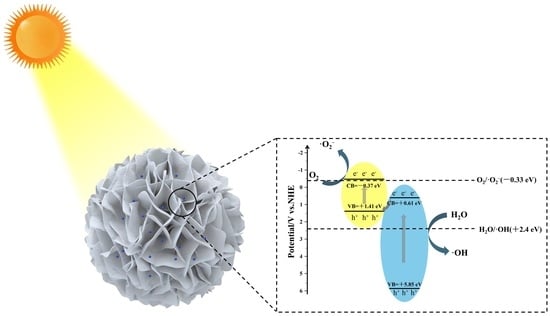
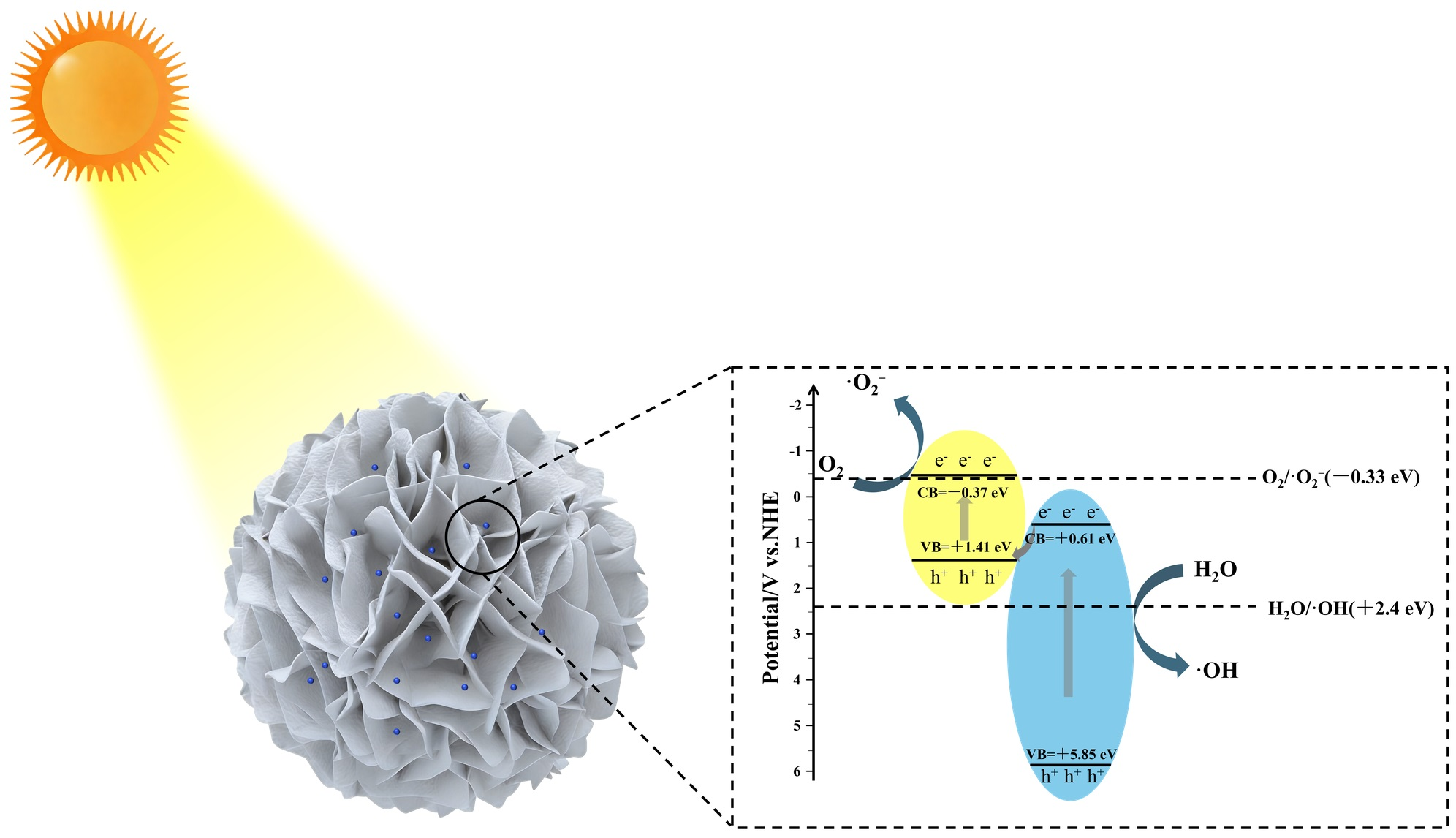
A Co interface-doped hierarchical magnesium hydroxide (Co-PMH) heterojunction is fabricated by incorporating Co2+ into the L-threonate-directed crystallization of Mg(OH)2 and its subsequent phosphorization. The interface-doped Co narrows the bandgap of magnesium hydroxide, resulting in enhanced visible light conversion and improved broad-spectrum antimicrobial activity. Under visible light irradiation for 30 min, the Co0.1-PMH demonstrates an antibacterial efficiency exceeding 97% against Staphylococcus aureus (S. aureus), Escherichia coli (E. coli), and methicillin-resistant S. aureus (MRSA). Mechanism analysis indicates that the stable doped Co-Mg heterojunction interface brings strong redox capabilities via a Z-scheme charge transfer pathway, driving the generation of ROS (primarily ·OH and ·O2) to eliminate bacteria adsorbed in situ. Even after three cycles, Co0.1-PMH maintains high bactericidal activity (>95%) and biocompatibility (>93% cell survival). This makes Co-PMH a promising candidate for antimicrobial infection control.

Graphical Abstract

1. Introduction

Bacterial infections are a major public health issue threatening human health [1]. Pathogenic bacteria such as Staphylococcus aureus and Escherichia coli can cause a variety of infectious diseases, including pneumonia and septicemia, with potentially fatal consequences in severe cases [2]. For a long time, antibiotics have been the primary means of treating bacterial infections and have been widely used in both clinical and agricultural fields [3,4]. However, the overuse of antibiotics remains a persistent problem, and this excessive use has led to the increasingly serious problem of bacterial resistance [5]. The emergence of multiple drug-resistant strains has rendered many medications ineffective, resulting in significant challenges to clinical treatment [6]. Therefore, there is an urgent need to develop new antimicrobial strategies independent of traditional antibiotics, to prevent the further spread of bacterial resistance [7].
For now, a variety of alternative antimicrobial technologies have been developed [8,9]. Silver nanomaterials demonstrate broad-spectrum antimicrobial activity by releasing silver ions that interfere with bacterial metabolism [10]. However, their potential biotoxicity and environmental accumulation limit their practical application [11]. Photothermal therapy utilizes nanomaterials to convert light energy into heat, killing bacteria through localized high temperatures [12]. However, the efficiency of photothermal conversion remains an unaddressed challenge [13]. Photodynamic therapy relies on photosensitizers to generate reactive species for bactericidal purposes, and is highly selective [14]. However, photosensitizers often suffer from insufficient stability in practical applications [15]. By contrast, semiconductor photocatalytic antibacterial technology has attracted widespread attention, due to its low energy consumption, mild reaction conditions, facile structural modification, and broad applicability [16]. Under illumination, semiconductor photocatalysts absorb photons to generate electron–hole pairs, and the photo-induced carriers react with the surrounding water molecules and dissolved oxygen, yielding reactive oxygen species (ROS), such as hydroxyl radicals (·OH) and superoxide anions (·O2) [17,18]. These ROS can penetrate the lipid bilayer of bacterial cell membranes, subsequently causing oxidation of biomacromolecules (such as proteins and DNA) within the cells and ultimately resulting in bacterial death [19]. By modifying the structure of semiconductor materials, visible light can be effectively employed to drive this process, thereby minimizing the development of drug resistance while maximizing side effect reduction [20,21].
Among the representative semiconductor photocatalytic antibacterial systems, TiO2 has been the most extensively studied due to its chemical stability and non-toxicity. However, its wide bandgap (3.2 eV) confines photoactivation to UV light, which constitutes only 5% of the solar spectrum, severely restricting practical outdoor applications [22]. BiVO4 exhibits a narrower bandgap (2.4 eV) that enables visible light response, yet its rapid recombination of photo-generated carriers and sluggish charge transport kinetics substantially impair its overall quantum efficiency [23]. g-C3N4 is a metal-free polymeric photocatalyst with intrinsic visible light absorption, but its limited surface active sites and easy aggregation in aqueous environments compromise long-term antibacterial performance [24,25]. In addition, concerns regarding the cytotoxicity or difficult recyclability of certain photocatalysts, such as ZnO and CdS-based systems, further constrain their safe biomedical application [26,27]. Therefore, there remains an urgent need for photocatalytic antibacterial materials that simultaneously satisfy visible light activity, efficient charge separation, low biotoxicity, and environmental compatibility.
Magnesium hydroxide [Mg(OH)2, MH] has emerged as a particularly attractive candidate to address these challenges, owing to its low cost, intrinsic non-toxicity, and excellent environmental compatibility [28,29]. The isoelectric point of MH is approximately pH 11 and typically carries a positive charge in bacterial habitats, enabling it to adsorb and partially pierce negatively charged bacteria [30]. Furthermore, nano-MH responds to ultraviolet light to generate photo-induced electron–hole pairs, thereby facilitating the production of ROS to eliminate bacteria without accumulating bacterial resistance [31]. However, the MH bandgap is relatively wide (approximately 5.1 eV), allowing only minimal conversion of ultraviolet light with wavelengths shorter than 240 nm [32,33]. Consequently, it cannot utilize the energy from visible light, which accounts for approximately 43% of the solar spectrum [34]. Meanwhile, its low conductivity and the recombination of photo-generated electron–hole pairs during their migration result in an insufficient number of effective carriers to participate in surface redox reactions, significantly limiting the production of ROS [35,36]. These limitations make it difficult for individual MH to achieve the photocatalytic antibacterial efficiency required for practical applications. Therefore, narrowing the bandgap and improving charge transport are viable approaches to enhancing the photocatalytic antibacterial activity of magnesium hydroxide.
A variety of modification strategies, including morphology control, element doping, surface modification, and the construction of heterostructures, can all regulate the band structure of materials [37,38]. In particular, the construction of heterojunctions is considered one of the most effective and practical approaches for improving photocatalytic performance [39]. By forming an intrinsic electric field at the interface between two semiconductors, heterojunctions drive photo-generated electrons and holes to migrate in opposite directions, achieving spatial separation [40]. This suppresses carrier recombination and extends carrier lifetime, thereby significantly increasing the number of carriers participating in surface reactions and the yield of ROS [41]. Previous work revealed that incorporation of MH into urchin-shaped cobalt phosphide (CoP) can form a localized Co-Mg heterojunction interface at the contact region, thereby exhibiting a potential photocatalytic antibacterial effect [42]. However, this requires a high proportion of CoP to obtain sufficient interfacial contact, and it rapidly reduces the positive charge of the material, thereby diminishing the adsorption and bactericidal capabilities. If cobalt can be incorporated into the MH crystal lattice, even a small amount of CoP can form a more effective and stable heterojunction interface with MH, thereby improving the MH band structure. As the radii for Co2+ and Mg2+ ions are quite similar (0.74 Å and 0.72 Å, respectively) [43], it is possible for Co2+ to participate in the MH crystallization and be uniformly doped, thereby enhancing interfacial conductivity and improving the interfacial band structure for photocatalytic antibacterial activity.
Herein, we attempted to incorporate Co2+ into the crystallization process during the L-threonate-directed growth of MH, and further phosphorized it to prepare a Co interface-doped hierarchical porous magnesium hydroxide (Co-PMH) photocatalytic heterojunction material. It is demonstrated that uniformly doped cobalt generates a compact and stable Co-Mg heterojunction interface, yielding enhanced visible light absorption and conversion capabilities. Under visible light irradiation, Co0.1-PMH exhibits highly efficient and broad-spectrum photocatalytic antibacterial activity towards Gram-positive bacterium Staphylococcus aureus (S. aureus), Gram-negative bacterium Escherichia coli (E. coli), and Methicillin-resistant Staphylococcus aureus (MRSA). Furthermore, Co0.1-PMH shows low cytotoxicity and stability during continuous sterilization, maintaining a bactericidal efficiency of over 95% even after three cycles. The antibacterial mechanism indicates that the visible light-induced photo-generated carriers primarily separate and transfer via the Z-scheme, significantly promoting the generation of ROS (particularly ·OH and ·O2), thereby killing bacteria adsorbed on the Co-PMH surface in situ. This work provides a theoretical and practical approach for the design and development of high-performance MH-based photocatalytic antibacterial materials.

2. Results and Discussion

2.1. Morphological and Structural Characterization of Co0.1-PMH

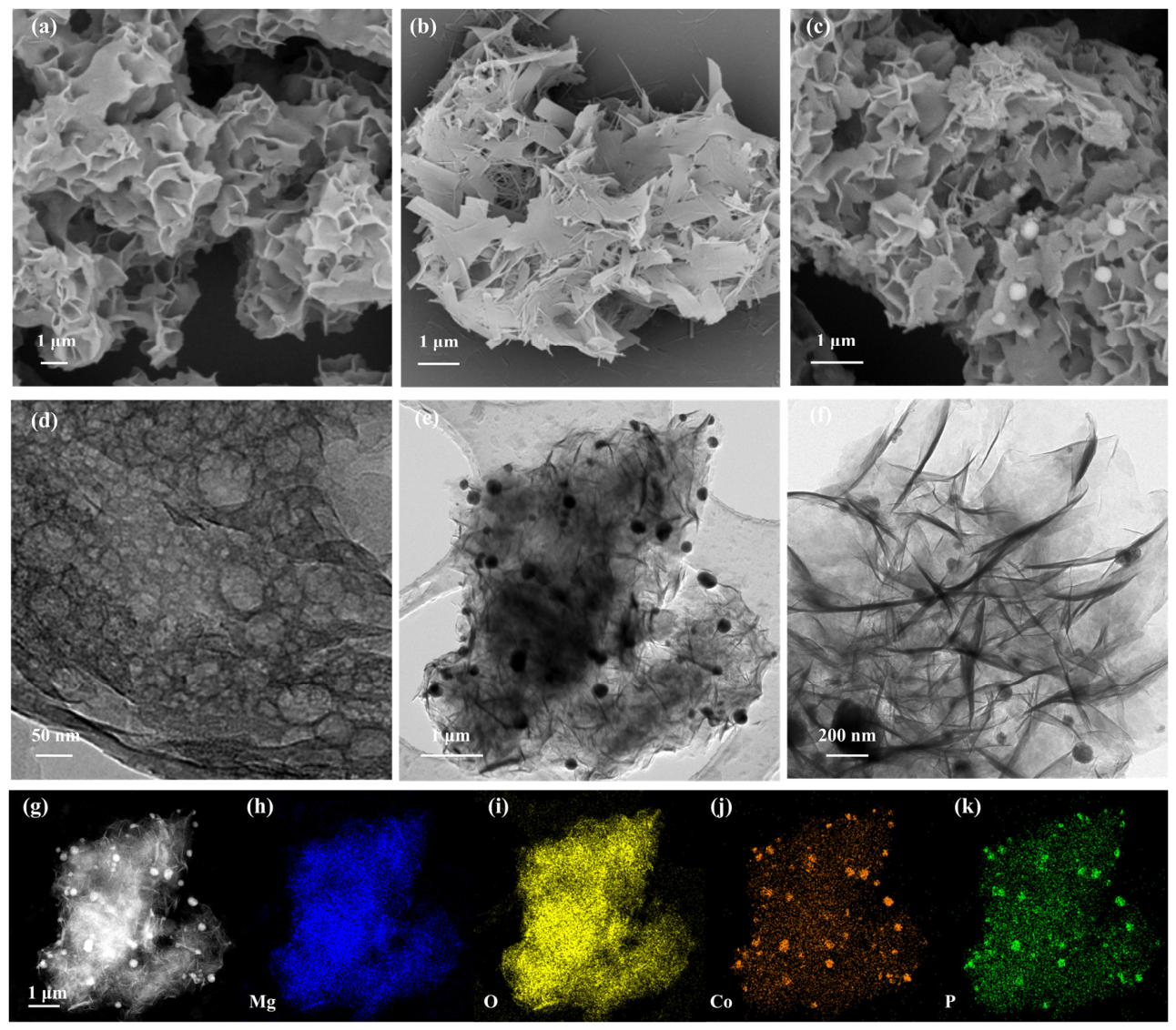
The morphology and composition of the PMH, Co0.1-LPMH, and Co0.1-PMH were explored using scanning electron microscopy (SEM) and transmission electron microscopy (TEM), as shown in Figure 1. The PMH presents a distinct hierarchical porous structure (Figure 1a,d), and this hierarchical structure collapses severely in Co0.1-LPMH with some needle-like morphology observed (Figure 1b), indicating that the later-added Co2+ grows independently and disrupts the original hierarchical structure of PMH. In contrast, Co0.1-PMH retains the original hierarchical porous structure of PMH (Figure 1c), with dispersed nanoparticles observed on the surface (Figure 1c,e). Elemental mapping images (Figure 1g–k) show that Mg and O, the main constituents of the PMH carrier, are distributed throughout the porous framework, while Co and P signals are highly dispersed over the Co0.1-PMH framework without obvious isolated aggregates. TEM imaging at the 200 nm scale (Figure 1f) further reveals the lamellar nanosheet structure and pore interfacial morphology, supporting the spatial association of Co/P-containing species with the porous PMH framework. This highly dispersed doping within the three-dimensional framework not only modulates the surface energy band but also reduces the migration resistance of photo-generated carriers, thereby enhancing light absorption, as well as charge separation and transport.
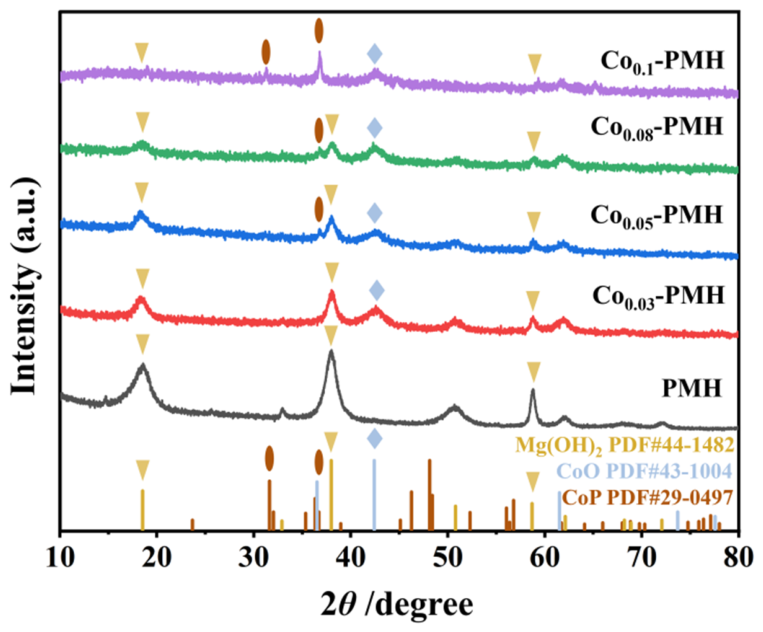
The XRD patterns of PMH and Cox-PMH at various cobalt doping levels are presented in Figure 2. The main diffraction peaks in the PMH and Cox-PMH are consistent with the hexagonal Mg(OH)2 phase (JCPDS No. 44-1482). As the Co content increases, these diffraction peaks gradually weaken, indicating that PMH has been doped with more Co2+, resulting in reduced crystallinity. And the characteristic peaks of CoP (JCPDS No. 29-0497) gradually appear at 31.6° and 36.8°, attributed to the phosphating process and the coordination reduction in Co2+. Meanwhile, a weak peak corresponding to the CoO (200) crystal plane appears at 42.4° in Cox-PMH, indicating that some of the internally doped Co2+ has not been phosphorized. Namely, incorporating Co2+ into the MH crystal growth process allows for the production of deeply doped Co/Mg materials.
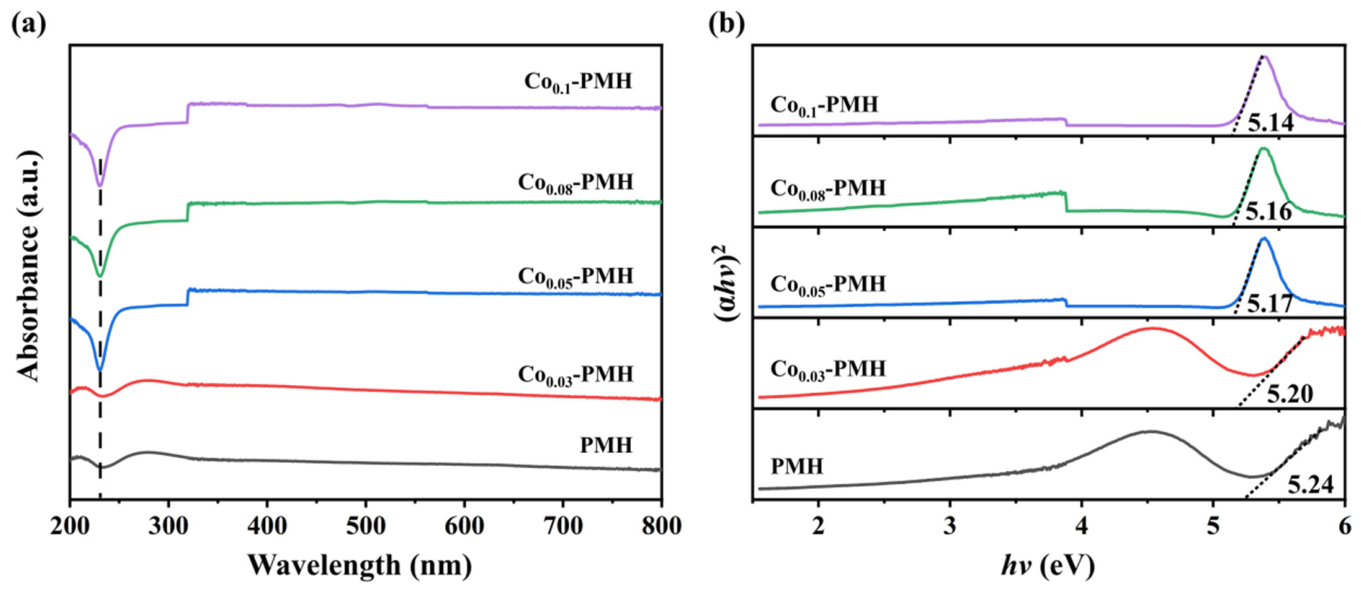
UV–vis DRS was employed to probe the influence of Co doping on the light absorption and band structure of Cox-PMH. As depicted in Figure 3a, PMH displays an intrinsic absorption edge at 230 nm, arising from an electronic transition associated with the Mg-O bond and a 3p→3s transition. At a Co doping level of 5 wt.%, a characteristic band emerges at 330 nm, which is attributed to the O→Co charge transfer transition, and is closely linked to the formation of a Mg-O-Co heterostructure [44]. For Co0.08-PMH and Co0.1-PMH, the same band appears with slightly increased intensity, and Co0.1-PMH exhibits a modestly extended absorption tail in the 400–600 nm range, associated with defects induced by surface oxygen vacancies [45,46].
To elucidate the regulation of the PMH band structure by cobalt doping and its effect on photocatalytic activity, the bandgap of Cox-PMH was quantitatively analyzed using a modified Kubelka–Munk function, as shown in Figure 3b. Clearly, the optical bandgap energy of pure PMH is 5.24 eV. The bandgap energy (Eg) narrows progressively from 5.20 to 5.14 eV with increasing Co content (3–10 wt.%), displaying a content-dependent linear redshift. This change in the band structure can be explained by a synergistic effect of Co doping. Firstly, the substitution of Mg2+ by Co2+ induces lattice distortion, thereby modifying the interaction potential and electronic structure of the host PMH lattice [47]. Secondly, Co doping may introduce oxygen vacancy-related defect states, which act to trap levels within the bandgap and influence the optical absorption behavior [48]. Thirdly, the hybridization between localized Co 3d states and O 2p-derived valence band states can generate intermediate electronic states and promote bandgap narrowing through p–d exchange interactions [49].
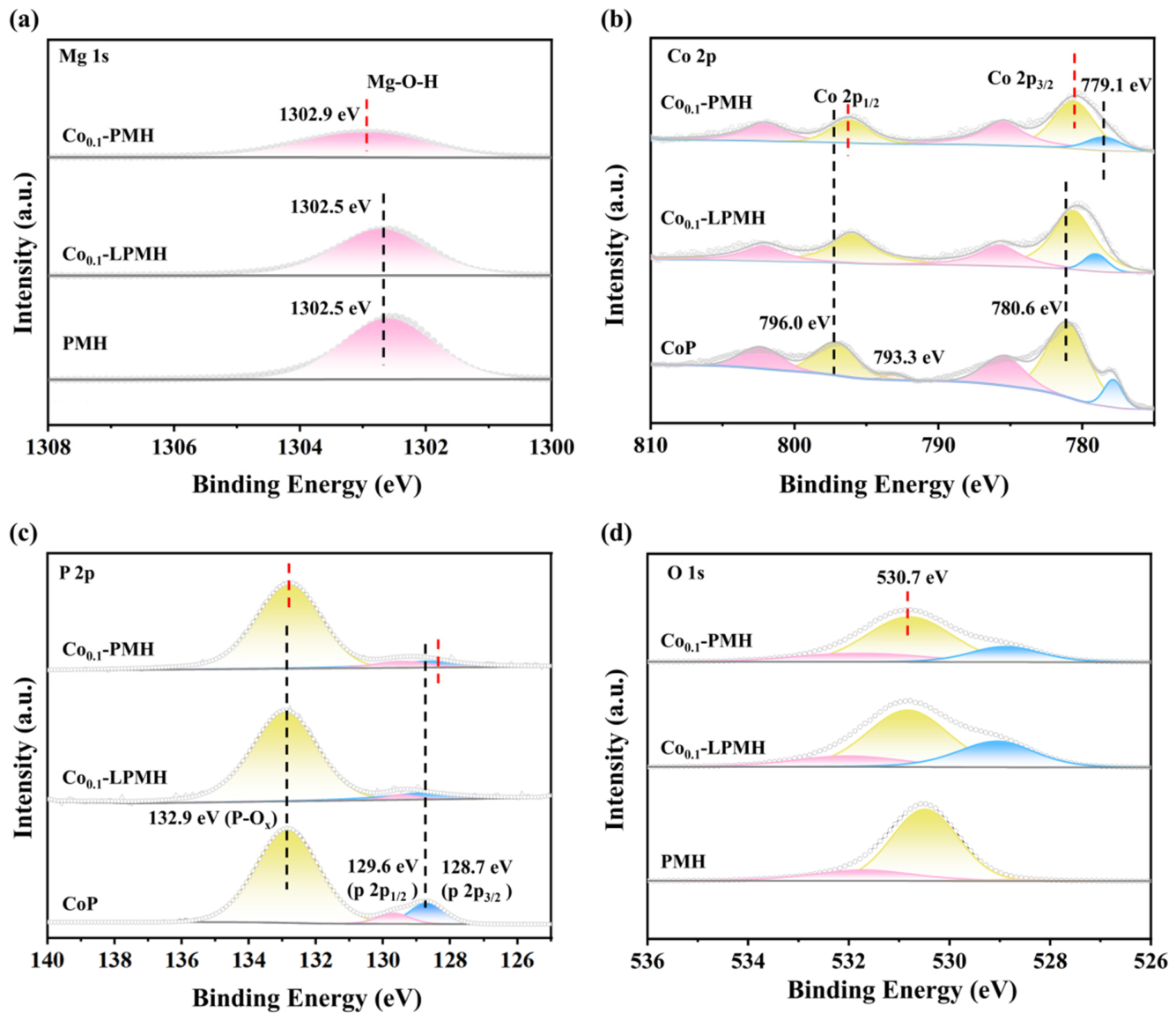
To reveal the evolution of the surface chemical states and the interfacial charge transfer properties of Co0.1-PMH, X-ray photoelectron spectroscopy (XPS) was conducted. As shown in the Mg 1s spectrum in Figure 4a, PMH and Co0.1-LPMH exhibit characteristic Mg-O-H peaks at 1302.5 eV, whereas this peak intensity is significantly reduced in Co0.1-PMH, and the binding energy shifts positively to 1302.9 eV. This is attributable to the doped Co inducing a reduction in the electron density of the Mg-O-H group, namely the transfer of electrons from Mg to Co. Figure 4b reveals the coexistence of multiple chemical states. The peaks at 780.6 eV and 796.0 eV are attributed to Co-O species [50]. The characteristic peak at 779.1 eV corresponds to the Co-P bond, and its intensity is weaker in Co0.1-PMH than in pure CoP, confirming that Co exists primarily in the form of a CoO/CoP mixed phase, consistent with the XRD results. Notably, compared with pure CoP, the Co 2p peaks in Co0.1-PMH shift negatively overall, further confirming the electron transfer from Mg to Co. Meanwhile, the characteristic peak at 793.3 eV observed in pure CoP disappears in Co0.1-PMH, indicating that the coupling between the PMH and Co significantly alters the local coordination environment of Co. Furthermore, the P 2p spectrum shown in Figure 4c reveals three characteristic peaks at 128.7 eV (P 2p3/2), 129.6 eV (P 2p1/2), and 132.9 eV (P-Ox). Compared with pure CoP, the binding energies of P species in Co0.1-PMH generally exhibit a negative shift, mirroring the shift trend of Co 2p. This indicates that P species participate in the charge redistribution process as electron acceptors [51]. In conjunction with the O 1s spectral analysis shown in Figure 4d, the relative intensity of the defect-related/non-stoichiometric oxygen component at approximately 530.7 eV is higher in Co0.1-PMH than in Co0.1-LPMH. This result suggests that Co-induced structural distortion may generate more oxygen defect-related surface sites in the PMH lattice. These defect-related sites can serve as electron-trapping centers, thereby suppressing electron–hole recombination and promoting charge–carrier separation [52].
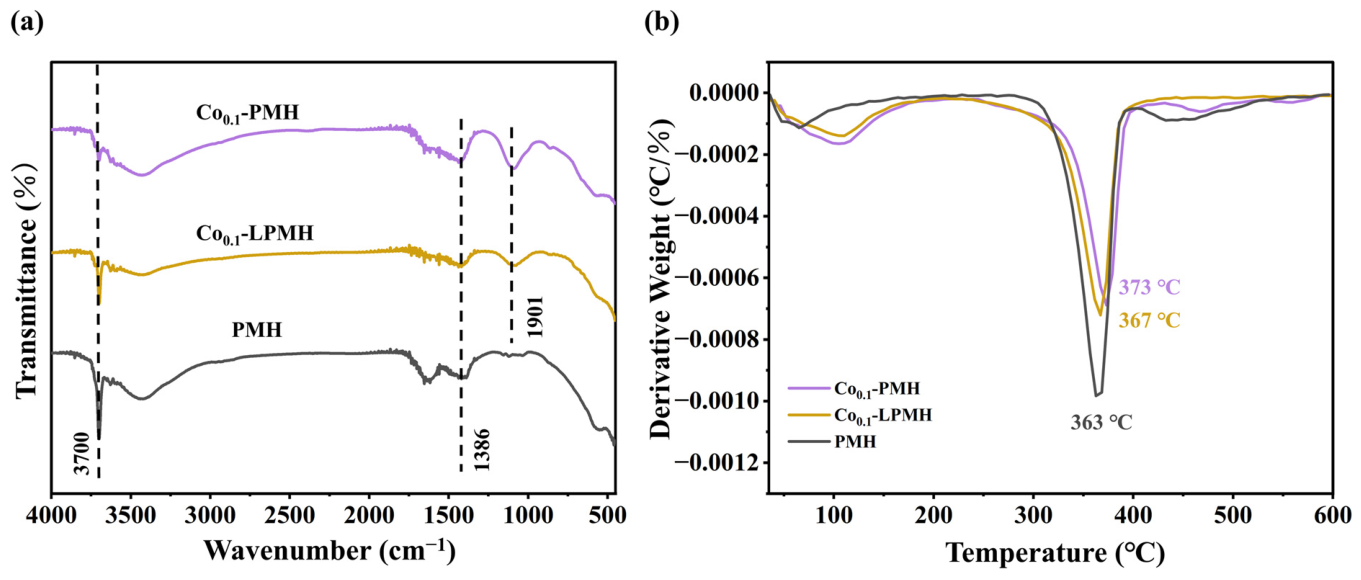
To further illuminate the influence of cobalt doping on composition and structure, FT-IR and DTG were employed, shown in Figure 5. The absorption band at approximately 3700 cm−1 is attributed to the O-H stretching vibration of Mg(OH)2 [53,54]. Notably, the O-H stretching band at approximately 3700 cm−1 becomes weaker in Co0.1-PMH, suggesting that Co incorporation modifies the local hydroxyl coordination environment of the PMH lattice [47]. The 1091 cm−1 absorption peaks in both Co0.1-LPMH and Co0.1-PMH correspond to the P=O group, and this peak is more pronounced in Co0.1-PMH, confirming that a higher proportion of CoP is anchored within the PMH [54]. In addition, DTG analysis suggest that the main weight loss peak of PMH occurs at 363 °C, corresponding to the decomposition of Mg(OH)2 into MgO and H2O. In contrast, the decomposition peak temperatures for Co0.1-LPMH and Co0.1-PMH shift to 367 °C and 373 °C, respectively. This increased thermal stability, especially for Co0.1-PMH, indicates that the incorporation of Co enhances the thermal stability of the material.
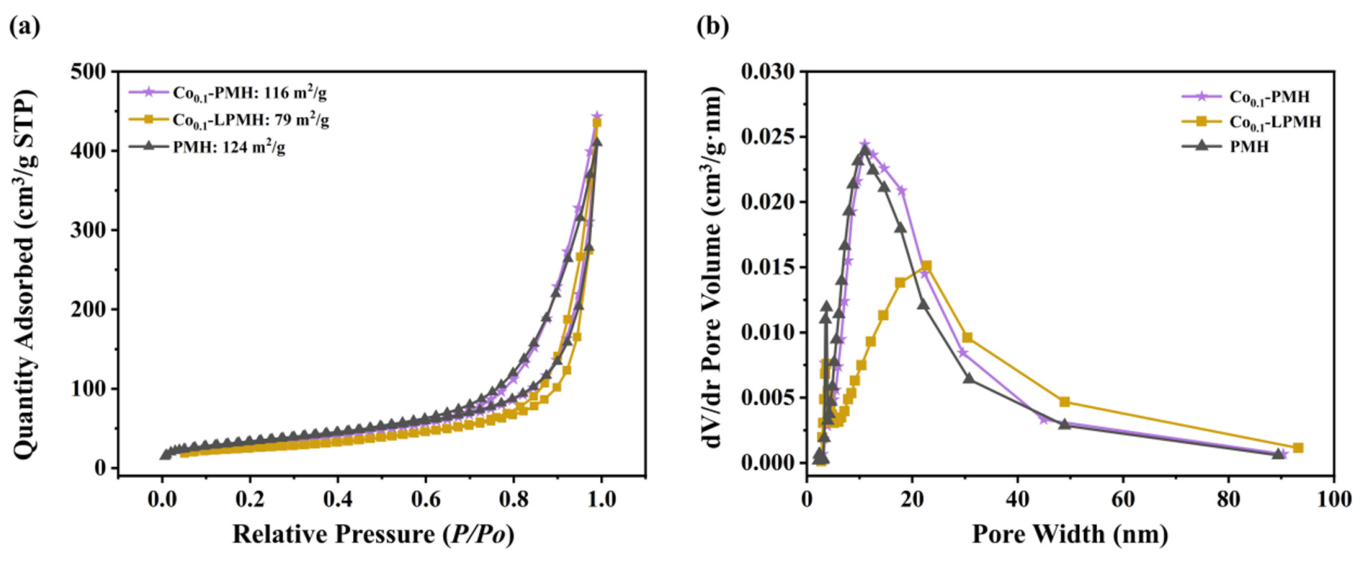
To evaluate the porous structure and surface areas, N2 adsorption–desorption analysis for the PMH, Co0.1-LPMH, and Co0.1-PMH were carried out, with the results shown in Figure 6. Evidently, all samples exhibit typical type IV isotherms accompanied by H3 hysteresis loops, indicating the widespread presence of a slit-like mesoporous structure formed by the stacking of flake-like particles. It is worth noting that the hysteresis loop widths of PMH and Co0.1-PMH are wider than those of Co0.1-LPMH, consistent with their more uniform pore size distribution. According to BET calculations, the specific surface areas of Co0.1-LPMH (79 m2/g) is lower than that of PMH (124 m2/g), owing to the collapse and blockage of its hierarchical structure. In contrast, this value of Co0.1-PMH (116 m2/g) decreases by only 8 m2/g compared to that of PMH (124 m2/g), suggesting that the incorporation of Co does not disrupt the porous hierarchical structure of the PMH matrix. This is consistent with the observations from SEM and TEM.

2.2. In Vitro Antibacterial Activity of Co0.1-PMH

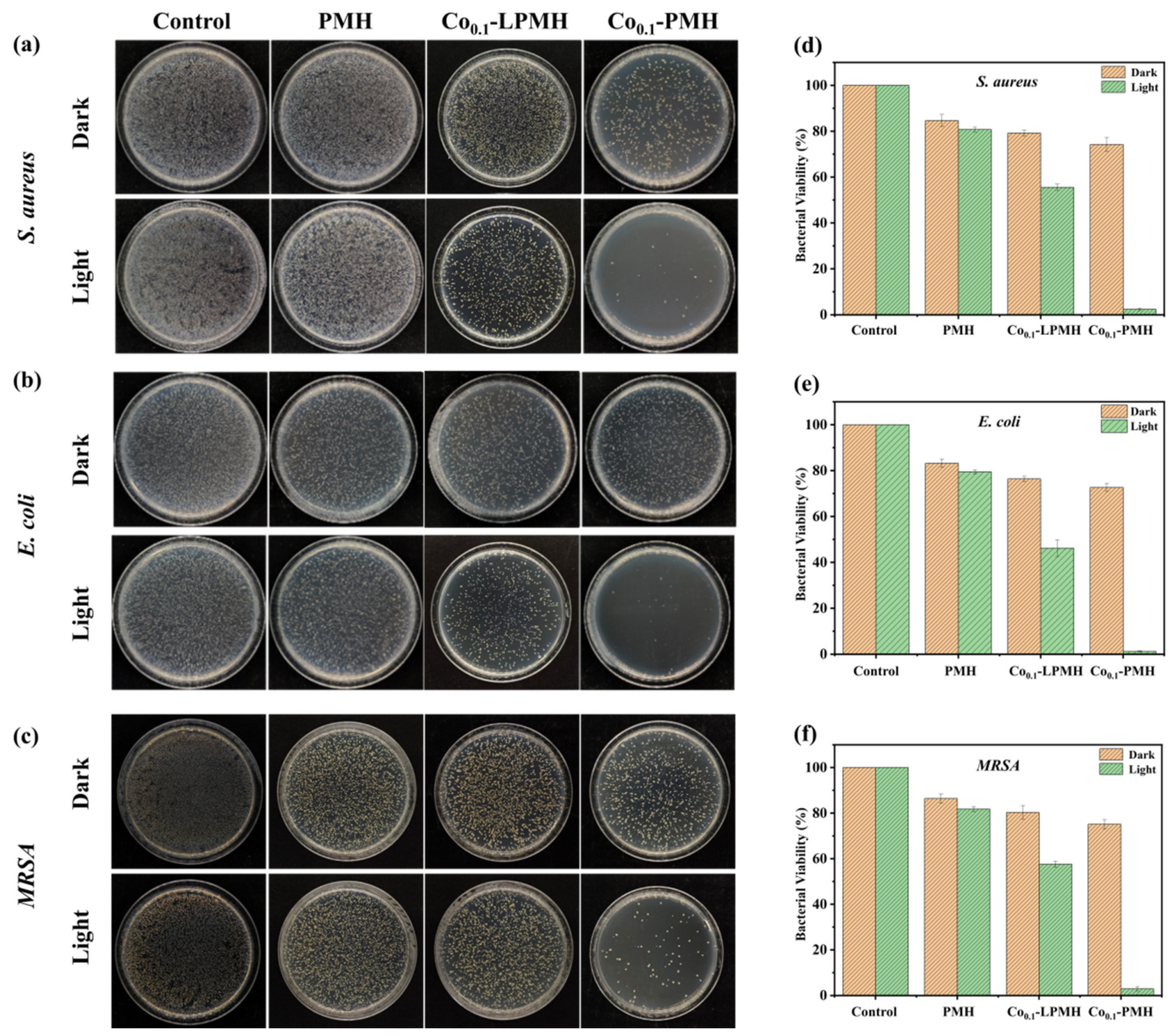
The in vitro antibacterial activity of the Co0.1-PMH was evaluated against Gram-positive bacterium S. aureus, Gram-negative bacterium E. coli, and MRSA. The results are shown in Figure 7. Apparently, the bactericidal effect is negligible in the absence of a photocatalyst, whether or not illumination is present (Figure 7a–c). This confirms that bacterial inactivation is attributable to the photocatalytic process rather than the illumination itself. Under dark conditions (photocatalyst present with bacteria but light shielded), all samples exhibit minimal bactericidal activity (<20% inactivation rate), which is attributed to the inherent alkalinity of Mg(OH)2 and the physical contact between the bacteria and the photocatalyst particles. The zeta potential result shown in Figure S2 confirms that Co0.1-PMH maintains a positively charged surface under the antibacterial testing conditions, which favors electrostatic attraction toward negatively charged bacterial cell membranes and promotes initial bacterial adsorption on the catalyst surface. Under visible light irradiation (λ > 400 nm, irradiance 100 mW/cm2), the bactericidal efficiency of PMH increases slightly, indicating that the wide bandgap of Mg(OH)2 limits the photocatalytic activity driven by visible light. And the increase in Co0.1-LPMH is also extremely limited, indicating that a significant amount of Co is not incorporated into the MH to form a heterojunction structure. The photocatalytic activity of CoO-PMH is also virtually negligible (Figure S1). In contrast, the Co0.1-PMH exhibits significantly enhanced photocatalytic bactericidal activity. After 30 min of exposure to visible light, the inactivation rates for S. aureus, E. coli, and MRSA reaches 97.7%, 98.8%, and 97.1%, respectively (Figure 7d–f). Compared with the Co0.1-LPMH, these values increase by 53.2%, 45.4%, and 52.6%. The superior performance indicates that the incorporated Co alters the bandgap of PMH, thereby improving the absorption and conversion capabilities of Co0.1-PMH for visible light.
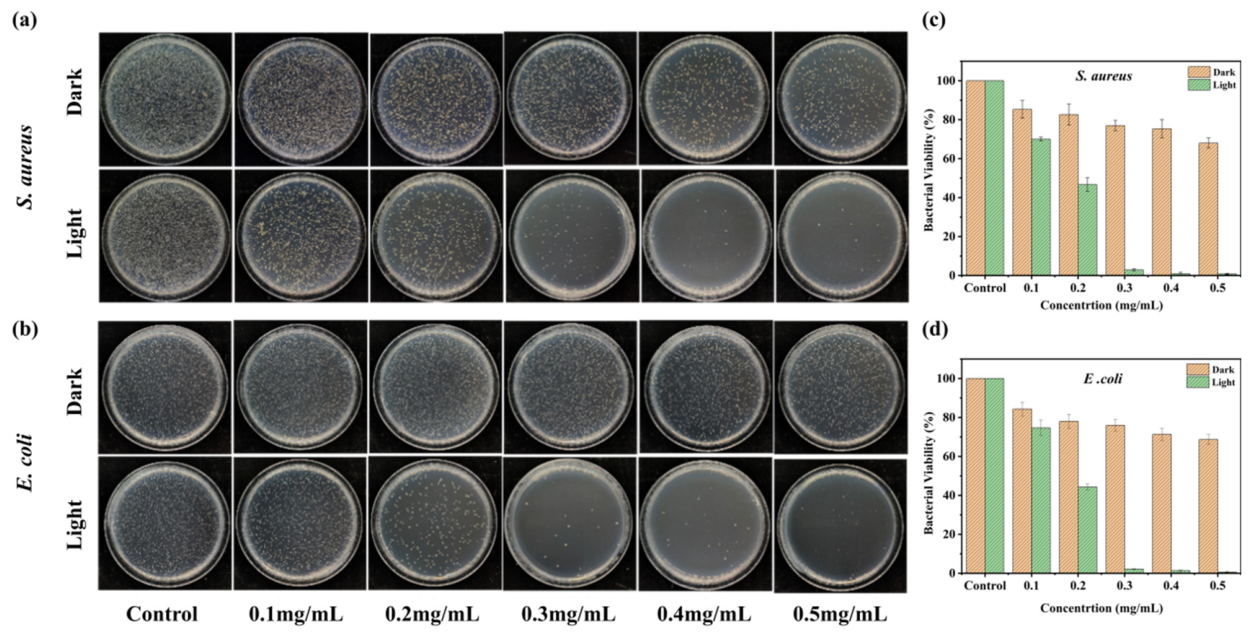
The effect of Co0.1-PMH concentration on antibacterial performance was also investigated (Figure 8). Under dark conditions, Co0.1-PMH at concentrations ranging from 0.1 to 0.5 mg/mL exhibits a sterilization rate of 18–23% against the two bacterial strains. This is attributed to the absence of ROS generated by photoexcitation, where sterilization depends solely on electrostatic adsorption. Moreover, under light conditions (30 min), a concentration of 0.3 mg/mL of Co0.1-PMH results in a bactericidal rate exceeding 97% for both strains, demonstrating excellent antimicrobial activity.
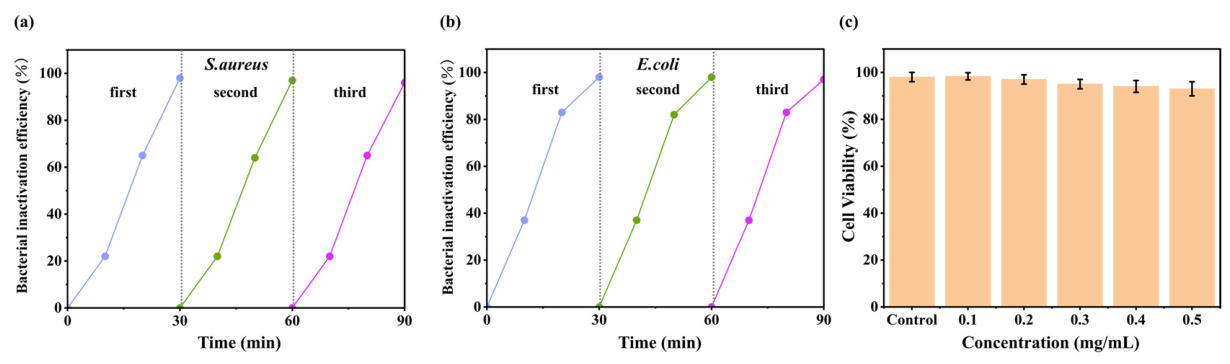
To explore reusability and stability, Co0.1-PMH was centrifuged and washed, and then the sterilization experiments were carried out repeatedly under the same conditions (Figure 9a,b). Even after three consecutive cycles, its bactericidal efficiency remained above 95%, suggesting excellent reusability and stability. The reason for this is its robust doped heterojunction structure, preventing Co from detaching or leaching out. Moreover, the CCK-8 assay was employed to evaluate the biocompatibility of Co0.1-PMH using mouse fibroblasts (L929 cells). As shown in Figure 9c, the survival rate of L929 cells remained above 93% after 24 h of incubation in Co0.1-PMH at a concentration as high as 0.5 mg/mL, indicating low cytotoxicity and superior biocompatibility, beneficial for practical applications such as wound healing and water purifications.
ICP-OES analysis was further performed to quantify Co leaching from Co0.1-PMH and Co0.1-LPMH after photocatalytic antibacterial cycling. The Co leaching ratio of Co0.1-PMH was only approximately 0.9%, much lower than that of Co0.1-LPMH (11.3%) (Table 1). This result confirms that the interface-doped Co species in Co0.1-PMH are more strongly immobilized within the PMH framework, whereas the surface-loaded Co species in Co0.1-LPMH are more susceptible to detachment/leaching. The lower Co leaching of Co0.1-PMH is consistent with its superior cycling stability and high antibacterial efficiency retention.
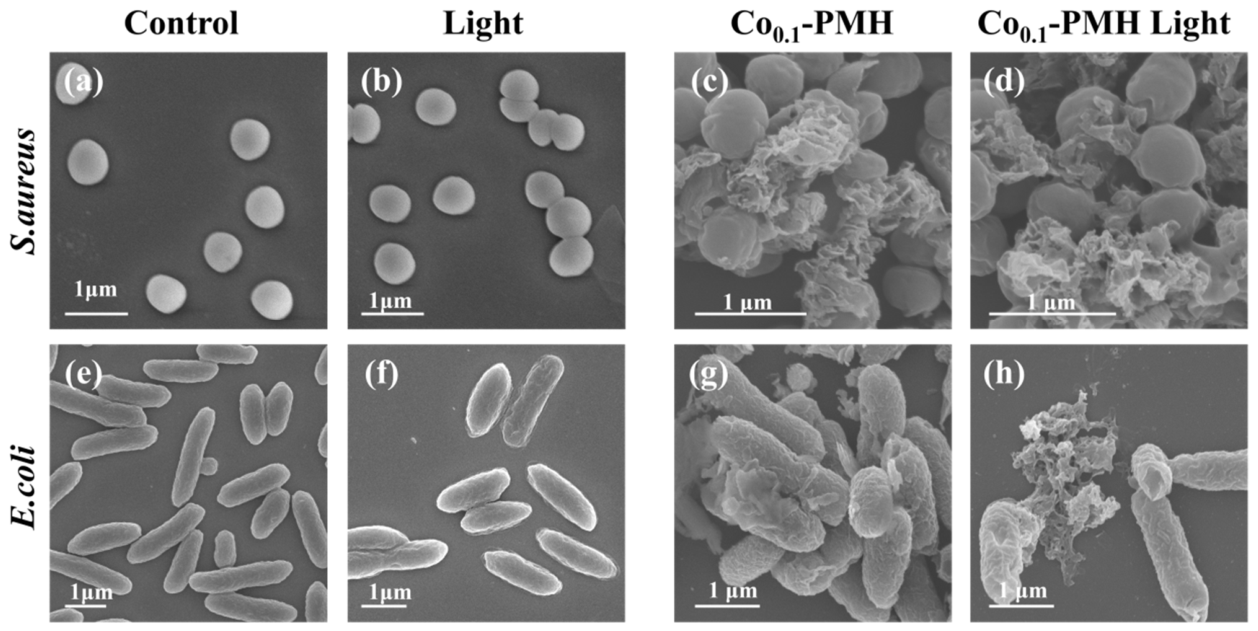
The morphological changes in bacteria following treatment with Co0.1-PMH were observed using SEM. As shown in Figure 10, both S. aureus and E. coli without exposure to Co-PMH present smooth surfaces, intact cell membranes, and regular shapes irrespective of light conditions. After Co0.1-PMH treatment in the dark, some bacteria adhere to the surface of the Co0.1-PMH particles via electrostatic attraction, as supported by the positive zeta potential of Co0.1-PMH shown in Figure S2. This electrostatic adsorption brings bacterial cells into close contact with the photocatalyst surface and serves as a prerequisite for the subsequent in situ killing mechanism. Upon visible light irradiation, the ROS generated on Co0.1-PMH can locally attack the adsorbed bacterial membranes before being quenched during diffusion, leading to severe membrane collapse, shrinkage, and cracking. These results indicate that the ROS generated during the Co0.1-PMH photocatalytic process preferentially attack and destroy the cell membranes of adsorbed bacteria in situ, thereby avoiding quenching during diffusion and achieving highly efficient sterilization.
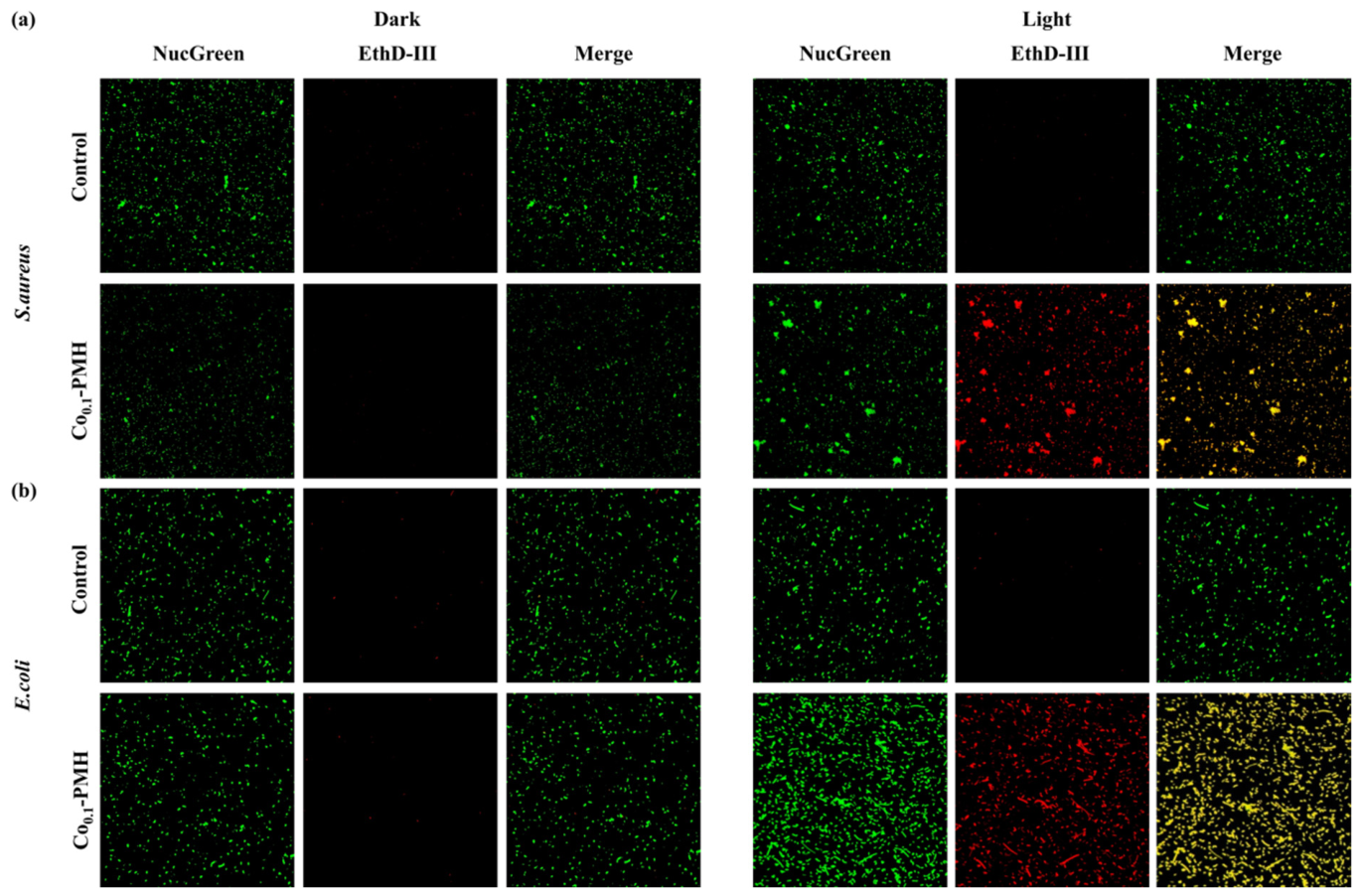
The destructive effect of Co0.1-PMH on bacterial cell walls/membranes was further validated by live/dead fluorescence staining. Both live and dead bacteria respond to the NucGreen signal, but only dead bacteria respond to the EthD-III signal [55]. As shown in Figure 11, the control groups (without Co0.1-PMH co-culture) exhibit only green fluorescence under both dark and illuminated conditions, indicating that the cell membranes are intact and the cells are viable. For samples treated with Co0.1-PMH in the dark, a pattern dominated by green fluorescence with occasional red spots is observed, suggesting adsorption-induced damage to the bacteria by Co0.1-PMH. In stark contrast, samples treated with Co0.1-PMH under visible light irradiation exhibit predominantly red fluorescence, confirming extensive disruption of the membrane structure and bacterial death. These fluorescence microscopy results are highly consistent with the quantitative bactericidal data (>97% bactericidal efficiency) and provide strong visual evidence for the membrane damage mechanism induced by ROS.

2.3. Antibacterial Mechanism for Co0.1-PMH

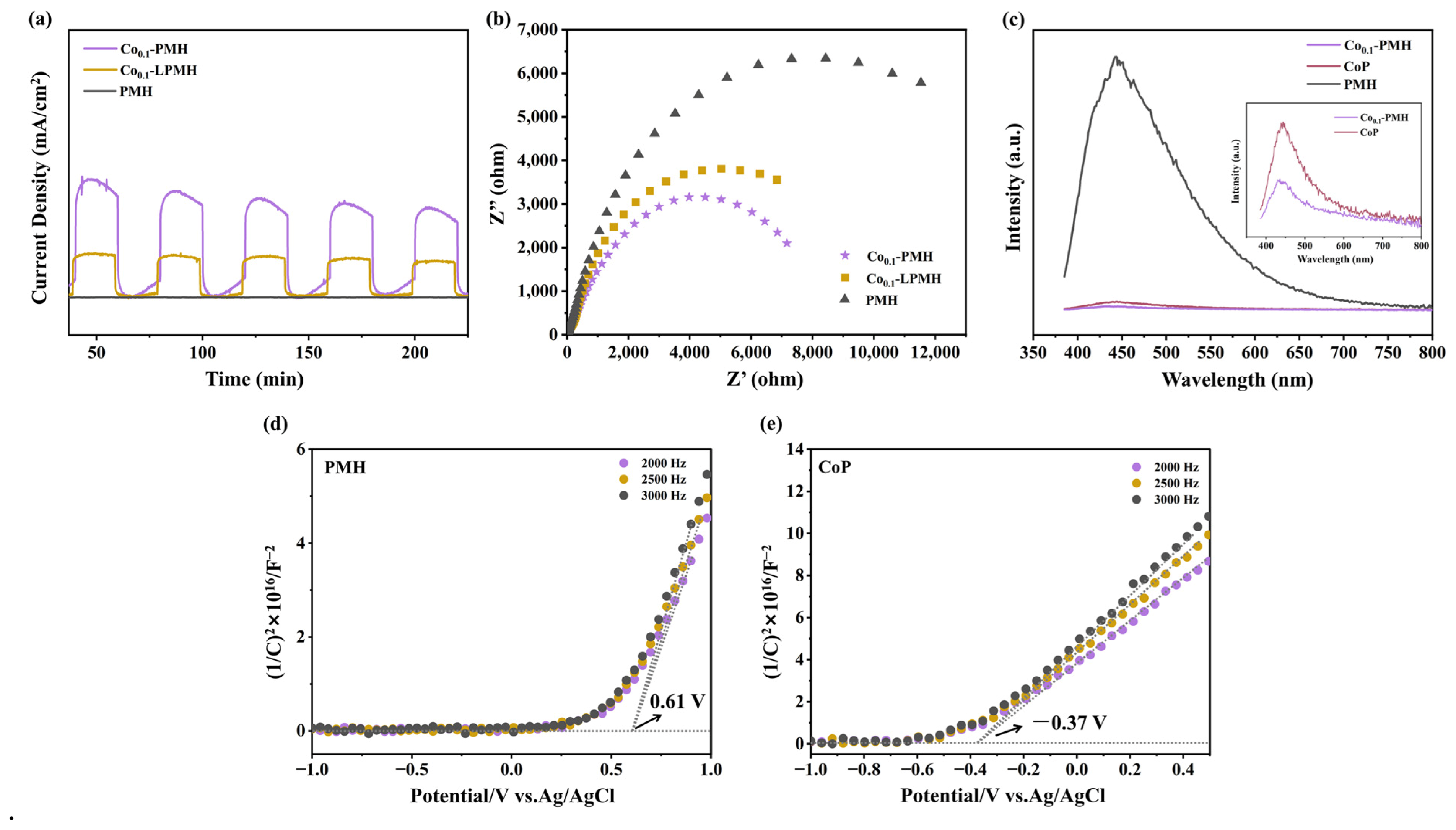
Photoelectrochemical measurements were performed to assess the charge separation efficiency of Co0.1-PMH. In Figure 12a, I–t curves reveal that the photocurrent density of Co0.1-PMH substantially exceeding that of either Co0.1-LPMH or PMH, indicating its superior capability to inhibit recombination of photo-generated carriers. Furthermore, EIS (Figure 12b) shows that Co0.1-PMH exhibits the smallest arc radius, suggesting more efficient photo-generated charge separation and a faster interfacial charge migration rate. These results demonstrate that Co0.1-PMH exhibits excellent photocatalytic performance.
Furthermore, PL spectroscopy was utilized to assess photocatalytic activity. As depicted in Figure 12c, PMH displays a prominent peak at 445 nm, reflecting rapid electron–hole recombination and low photocatalytic efficiency. In comparison, Co0.1-PMH yields a weaker PL emission, implying that suppressed recombination extends carrier lifetime. Mott–Schottky analysis (Figure 12d,e) was applied to determine the band structures of PMH and CoP. Both exhibit positive slopes, confirming their n-type nature [56]. The flat-band potentials versus Ag/AgCl are estimated to be 0.61 V for PMH and −0.37 V for CoP. The UV spectrum and bandgap of CoP are provided in Figure S3, with a bandgap of 1.78 eV. For n-type semiconductors, ECB is typically 0.1–0.3 V more negative than the flat-band potential depending on electron effective mass and carrier density. Thus, a shift of 0.2 V was adopted herein. Accordingly, the CB potentials versus Ag/AgCl are 0.41 V (PMH) and −0.57 V (CoP), which translate to 0.61 V and −0.37 V versus NHE (ENHE = EAg/AgCl + 0.197 V). Using the formula EVB = ECB + Eg [57], the VB potentials versus NHE are calculated as 5.85 V and 1.41 V for PMH and CoP, respectively.
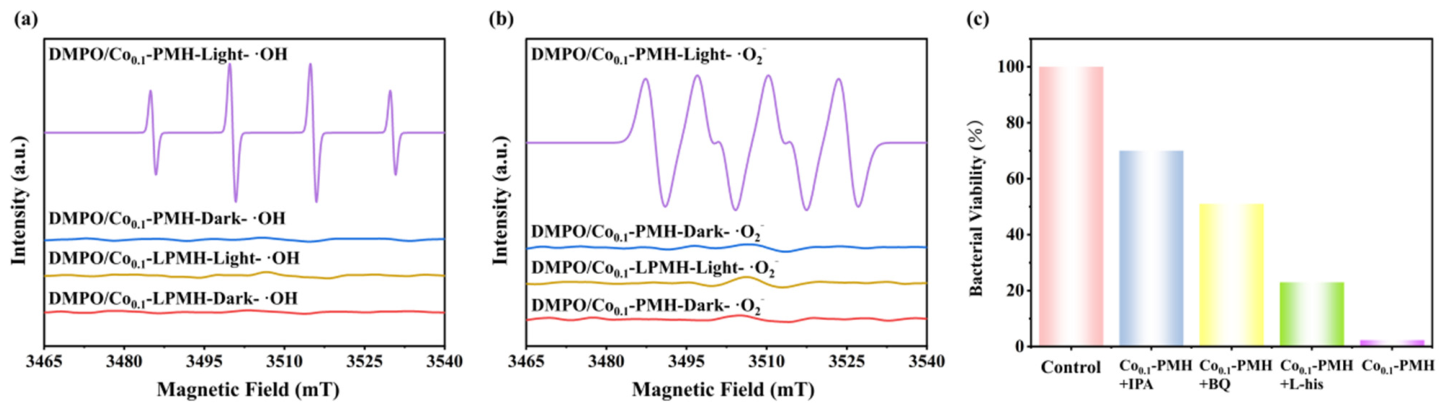
To elucidate the mechanism of photocatalytic free radical-mediated sterilization by Co0.1-PMH, in situ trapping analysis of light-induced ROS was performed using electron paramagnetic resonance (EPR) spectroscopy, and DMPO was used as a spin probe to capture the characteristic signals of ·OH and ·O2 radicals. As shown in Figure 13a, no distinct EPR signals were detected in the Co0.1-PMH system under dark conditions. However, after 5 min of visible light irradiation (λ > 400 nm, irradiance 100 mW/cm2), a typical four-line peak of the DMPO-·OH adduct is observed. The simultaneously detected DMPO-·O2 adduct [58,59,60] (Figure 13b) exhibits a characteristic six-line peak, confirming the synergistic generation of ·O2. In contrast, no distinct radical signals are detected in the Co0.1-LPMH system under the same conditions. These results indicate that the doped heterojunction structure of Co0.1-PMH is more conducive to the participation of photo-generated carriers in redox reactions, thereby promoting the generation of ROS. Furthermore, radical scavenging experiments provided additional corroboration (Figure 13c). IPA, BQ, and L-his serve as quenchers for ·OH, ·O2, and 1O2, respectively [61]. Bacterial survivability rises upon removal of the corresponding ROS. Notably, the addition of IPA and BQ cause pronounced increases in bacterial survivability, implying that ·OH and ·O2 are the dominant ROS in the Co0.1-PMH photocatalytic system.
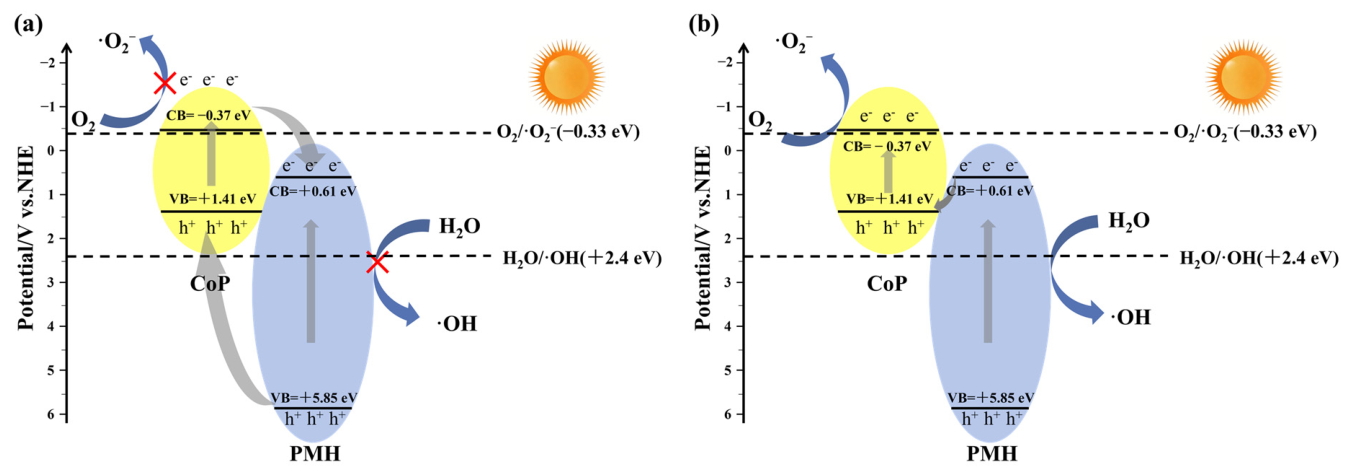
A proposed mechanism underlying the photocatalytic sterilization of Co0.1-PMH is illustrated in Figure 14. Upon visible light irradiation, electrons within both the PMH and CoP conduction bands (CB) undergo excitation, while holes are concurrently created in the valence bands (VB). As depicted in the conventional heterojunction model (type II) in Figure 14a, photo-generated electrons accumulated in the CoP CB migrate toward the PMH CB, whereas photo-generated holes in the PMH VB shift simultaneously to the CoP VB. Nevertheless, the ECB of PMH (+0.61 eV) is positioned more positively than the O2/·O2 reduction potential (−0.33 eV), which signifies that photo-generated electrons accumulated in the PMH CB are incapable of reducing ambient O2 to produce ·O2. Moreover, the EVB of CoP (+1.41 eV) lies substantially below the H2O/·OH oxidation level (+2.4 eV), suggesting that photo-generated holes within the CoP VB are unable to oxidize water molecules to form ·OH. Therefore, the type II pathway fails to yield ·O2 and ·OH, which directly contradicts the radical trapping experiments shown in Figure 13 (where high levels of both ·OH and ·O2 are detected). In contrast, the Z-scheme charge transfer pathway (Figure 14b) retains the strong redox potentials of the PMH valence band (+5.85 eV vs. NHE) and the CoP conduction band (−0.37 eV vs. NHE), which are thermodynamically capable of generating ·OH (via H2O/·OH at +2.4 eV) and ·O2 (via O2/·O2 at −0.33 eV), respectively. The experimental observation of abundant ·OH and ·O2 by EPR (Figure 13a,b) is therefore fully consistent with and strongly supports the Z-scheme mechanism. Thus, the Z-scheme provides a more compelling explanation for the remarkable antibacterial performance of the Co0.1-PMH heterojunction. The energy barrier for photo-generated electrons transferring from the PMH CB to the CoP VB (0.80 eV) is lower than that required for their movement from the CoP CB to the PMH CB (0.98 eV). As a result, photo-generated electrons in the PMH CB preferentially migrate toward the CoP VB, where they rapidly recombine with photo-generated holes originating from CoP. Meanwhile, the remaining photo-generated electrons and holes become concentrated in the CoP CB (−0.37 eV) and the PMH VB (+5.85 eV), respectively, thereby producing the broadest redox potential range. The ECB of CoP (−0.37 eV) now lies below the O2/·O2 potential (−0.33 eV), enabling the photo-generated electrons to reduce ambient O2 into ·O2. Furthermore, the EVB of PMH (+5.85 eV) significantly exceeds the H2O/·OH level (+2.4 eV), permitting the photo-generated holes to oxidize water molecules into ·OH. Overall, the enhanced redox capacity inherent to the Z-scheme offers a more compelling explanation for the remarkable antibacterial performance of the Co0.1-PMH heterojunction.

3. Materials and Methods

3.1. Reagents and Materials

Magnesium oxide (MgO), Co nitrate hexahydrate [Co(NO3)2·6H2O], L-threonic acid (C4H8O5), sodium hypophosphite (NaH2PO2), and eooanol (C2H5OH, 99.8%) were obtained from National Medicines Corporation Chemical Reagents Co., Ltd. (Shanghai, China). All chemicals were of analytical grade and used without further purification.

3.2. Synthesis of PMH

PMH was prepared via L-threonate-directed hydrothermal crystallization method [62]. Briefly, 1 g of MgO was dispersed in 40 mL of ultrapure water containing 0.3 g of L-threonic acid and stirred for 30 min. The suspension was transferred into a 100 mL Teflon-lined autoclave and heated at 120 °C for 6 h. After cooling to room temperature, the precipitate was collected by centrifugation, and then washed and dried to obtain white PMH powder.

3.3. Synthesis of Cox-PMH

Cox-PMH was prepared by incorporating Co2+ into the crystallization process during the growth of L-threonate-directed MH and subsequent phosphorization. Typically, Co(NO3)2·6H2O (0.15, 0.26, 0.4, and 0.5 g, corresponding to Co loadings of 3, 5, 8, and 10 wt.% relative to theoretical yield of PMH) was dissolved in 60 mL of ultrapure water. Then 0.69 g of MgO and 0.21 g of L-threonic acid were added and stirred for 2 h. The mixture was transferred to a 100 mL Teflon-lined autoclave and heated at 120 °C for 6 h. After cooling, the precipitate was collected by centrifugation, and then washed and dried. Subsequently, the precursor was calcined at 300 °C for 2.5 h under N2 atmosphere in a tube furnace with upstream NaH2PO2 (Co:P molar ratio = 1:10). The obtained Co-doped magnesium hydroxide products were denoted as Co0.03-PMH, Co0.05-PMH, Co0.08-PMH, and Co0.1-PMH.

3.4. Synthesis of Co0.1-LPMH

For comparison, the directly deposited Co-loaded magnesium hydroxide product was prepared by wet impregnation. In short, 1 g of pre-synthesized PMH and 0.5 g of Co(NO3)2·6H2O were dispersed in 60 mL of ultrapure water and stirred continuously for 2 h. The mixture was transferred to a 100 mL Teflon-lined autoclave and heated at 120 °C for 6 h. After the same centrifugation and phosphorization processes, the product was obtained and labeled Co0.1-LPMH.

3.5. Material Characterization

XRD patterns were acquired on a Panalytical X Pert PXRD system with Cu Kα radiation (λ = 1.54 Å). Morphologies were examined by SEM (JEOL JSM-7500F, JEOL Ltd., Akishima, Tokyo, Japan) and TEM (FEI Tecnai G2 F20, FEI Company, Hillsboro, OR, USA). Elemental distribution was mapped via EDXS. Surface functional groups and chemical composition were identified by FT-IR (Nicolet iS50, Thermo Fisher Scientific, Madison, WI, USA). Surface chemical states and elemental composition were further probed via XPS (Thermo Scientific K-Alpha, Thermo Fisher Scientific, East Grinstead, UK). Zeta potentials were determined using a NANOZSE analyzer. N2 adsorption–desorption isotherms were measured on a Micromeritics apparatus, and specific surface area with pore size distribution was derived via the BET method. Thermogravimetric analysis was performed on a Rigaku TG-DTA 8121 (Rigaku Corporation, Akishima, Tokyo, Japan) analyzer under Ar at 10 °C/min yielding TG-DTG curves. UV–vis DRS was collected on a Shimadzu UV-3600 (Shimadzu Corporation, Kyoto, Japan) spectrophotometer. PL emission spectra were obtained on an Edinburgh FLS1000 (Edinburgh Instruments Ltd., Livingston, UK) fluorescence spectrometer. Photoelectrochemical measurements (I–t curves, EIS, and Mott–Schottky plots) were carried out on a CHI660E workstation (CH Instruments, Inc., Austin, TX, USA). EPR spectra were recorded on a Bruker EMXplus-6/1 spectrometer (Bruker Corporation, Billerica, MA, USA) to track reactive oxygen species generation under visible light.

3.6. Photoelectrochemical Measurements

Photoelectrochemical tests were conducted on a CHI 660E workstation with a three-electrode configuration (Ag/AgCl reference, Pt counter, catalyst-loaded ITO working electrode) in 0.5 M Na2SO4. I–t curves, EIS, and Mott–Schottky plots were acquired under 300 W Xe lamp illumination. For electrode fabrication, 10 mg of sample was dispersed in 1 mL of water/ethanol containing 50 µL Nafion, sonicated for 30 min, and 100 µL of the suspension was drop cast onto ITO glass (2 cm × 2 cm), then dried at ambient temperature.

3.7. Photocatalytic Antibacterial Performance Evaluation

The antibacterial activity of materials against S. aureus, E. coli, and MRSA was assessed via the plate count method. Bacterial strains were inoculated in Luria–Bertani (LB) medium and incubated at 37 °C with shaking at 165 rpm for 12 h. The culture was diluted to OD670 = 0.03 with 0.90% NaCl, followed by the addition of Co0.1-PMH at 0.1–0.5 mg/mL. The suspensions were exposed to visible light (300 W Xe lamp, λ > 400 nm, 100 mW/cm2) for 60 min, with dark controls ran simultaneously. Post-treatment, the bacterial solutions were serially diluted and plated onto LB agar. Colonies were enumerated after incubation at 37 °C for 24 h. Recycling tests were carried out to assess material stability. All assays were done in triplicate. Antibacterial efficiency and bacterial viability were determined as follows:
Antibacterial   efficiency   %   =   N 0     N N 0   ×   100 %
Bacterial   viability   % = N N 0   ×   100 %
where N0 and N denote the colony counts prior to treatment and after specified exposure conditions, respectively.

3.8. Live/Dead Bacterial Fluorescence Staining

Live/dead bacterial staining was performed to assess membrane integrity. After photocatalytic treatment, bacterial suspensions (500 μL) were stained with NucGreen and EthD-III (1:2, v/v) in darkness for 15 min, washed with PBS, and resuspended in 100 μL PBS. The samples were mounted on glass slides and examined under an inverted fluorescence microscope (Leica DMI8, Leica Microsystems CMS GmbH, Wetzlar, Germany). Intact membranes in viable cells were indicated by green fluorescence, whereas compromised membranes in dead cells were denoted by red fluorescence.

3.9. Cytotoxicity Assessment

Mouse fibroblast L929 cells were used to assess the biocompatibility of Co0.1-PMH. Cells were maintained in DMEM with 10% fetal bovine serum and 1% penicillin–streptomycin at 37 °C, 5% CO2. L929 cells were seeded into 96-well plates at 3 × 10³ cells/well and adhered for 24 h. The medium was then replaced with DMEM containing Co0.1-PMH (0.1–0.5 mg/mL). After 24 h exposure, the medium was substituted with DMEM plus 10% CCK-8 solution. Following 2 h incubation, absorbance at 450 nm was read on a microplate reader (BioTek, Inc., Winooski, VT, USA). Untreated cells served as controls, and viability was determined as follows:
Cell   viability   %   =   OD sample   OD control OD control × 100 %

3.10. Capture of ROS

Reactive oxygen species (ROS) were identified via EPR spectroscopy with 5,5-dimethyl-1-pyrroline-N-oxide (DMPO) as the spin trap. For detection, 30 µL of Co0.1-PMH suspension (0.3 mg/mL) was blended with 30 µL DMPO solution (in deionized water for ·OH or methanol for ·O2). The mixture was loaded into a capillary tube, inserted into a quartz tube, and analyzed. For radical scavenging assays, benzoquinone (BQ), isopropanol (IPA), and L-histidine (L-his) were introduced into Co0.1-PMH/bacterial suspensions to quench ·O2, ·OH, and 1O2 respectively, under conditions identical to the antibacterial tests.

4. Conclusions

In conclusion, an interface-doped hierarchical Co-PMH photocatalytic heterojunction is achieved by incorporating Co2+ into the crystallization process during the growth of L-threonine-guided MH and subsequent phosphorization. The interface-doped Co reduces the bandgap energy of PMH, yielding enhanced visible light conversion. The Co0.1-PMH thus achieves strong redox capabilities via a Z-type charge transfer mechanism, driving ROS (mainly ·OH and ·O2) generation to yield highly effective broad-spectrum antimicrobial activity. Under visible light irradiation, the bactericidal rates of Co0.1-PMH against S. aureus (97.7%), E. coli (98.8%), and MRSA (97.1%) are 53.2%, 45.4%, and 52.6% higher than that of directly deposited Co0.1-LPMH, respectively. The Co0.1-PMH photocatalyst also demonstrates excellent cycling stability (efficiency remains above 95% after three cycles) and good biocompatibility (cell survival rate exceeds 93% at a concentration of 0.5 mg/mL). This work provides a rational design strategy for the development of high-performance Mg(OH)2-based photocatalytic heterojunction materials, and proposes a candidate approach for combating drug-resistant bacterial infections.

Supplementary Materials

The following supporting information can be downloaded at: https://www.mdpi.com/article/10.3390/catal16050481/s1, Figure S1: Bacterial colony formation of S. aureus and E. coli treated with CoO-PMH (concentration of 0.3 mg/mL); Figure S2. Zeta potential of Co0.1-PMH; Figure S3. UV-vis DRS spectrum (a) and Tauc plots (b) of CoP.

Author Contributions

Conceptualization, X.W.; methodology, J.G. and X.W.; investigation, J.G., W.C., J.L. and X.L.; data curation, J.G. and W.C.; writing—original draft preparation, J.G.; writing—review and editing, X.W.; visualization, J.G. and J.L.; supervision, X.W.; project administration, X.W.; funding acquisition, X.W. All authors have read and agreed to the published version of the manuscript.

Funding

This research was funded by the National Natural Science Foundation of China (Grant No. 21706033) and the Natural Science Foundation of Fujian Province of China (Grant No. 2021J01156).

Data Availability Statement

The data presented in this study are available on request from the corresponding author.

Conflicts of Interest

The authors declare no conflicts of interest.

References

  1. World Health Organization. WHO Bacterial Priority Pathogens List 2024: Bacterial Pathogens of Public Health Importance, to Guide Research, Development and Strategies to Prevent and Control Antimicrobial Resistance; World Health Organization: Geneva, Switzerland, 2024; Available online: https://iris.who.int/bitstream/handle/10665/376776/9789240093461 (accessed on 18 May 2026).
  2. GBD 2019 Antimicrobial Resistance Collaborators. Global mortality associated with 33 bacterial pathogens in 2019: A systematic analysis for the Global Burden of Disease Study 2019. Lancet 2022, 400, 2221–2248. [Google Scholar] [CrossRef]
  3. Van Boeckel, T.P.; Brower, C.; Gilbert, M.; Grenfell, B.T.; Levin, S.A.; Robinson, T.P.; Teillant, A.; Laxminarayan, R. Global Trends in Antimicrobial Use in Food Animals. Proc. Natl. Acad. Sci. USA 2015, 112, 5649–5654. [Google Scholar] [CrossRef]
  4. O’Neill, J. Antimicrobial Resistance: Tackling a Crisis for the Health and Wealth of Nations; Review on Antimicrobial Resistance: London, UK, 2014; Available online: https://amr-review.org/Publications.html (accessed on 18 May 2026).
  5. Llor, C.; Bjerrum, L. Antimicrobial resistance: Risk associated with antibiotic overuse and initiatives to reduce the problem. Ther. Adv. Drug Saf. 2014, 5, 229–241. [Google Scholar] [CrossRef] [PubMed]
  6. World Health Organization. Antimicrobial Resistance: Global Report on Surveillance; World Health Organization: Geneva, Switzerland, 2014; Available online: https://www.who.int/publications/i/item/9789241564748 (accessed on 18 May 2026).
  7. MacNair, C.R.; Rutherford, S.T.; Tan, M.W. Alternative Therapeutic Strategies to Treat Antibiotic-Resistant Pathogens. Nat. Rev. Microbiol. 2024, 22, 262–275. [Google Scholar] [CrossRef] [PubMed]
  8. Wang, L.; Hu, C.; Shao, L. The Antimicrobial Activity of Nanoparticles: Present Situation and Prospects for the Future. Int. J. Nanomed. 2017, 12, 1227–1249. [Google Scholar] [CrossRef]
  9. Pelgrift, R.Y.; Friedman, A.J. Nanotechnology as a Therapeutic Tool to Combat Microbial Resistance. Adv. Drug Deliv. Rev. 2013, 65, 1803–1815. [Google Scholar] [CrossRef]
  10. Prabhu, S.; Poulose, E.K. Silver Nanoparticles: Mechanism of Antimicrobial Action, Synthesis, Medical Applications, and Toxicity Effects. Int. Nano Lett. 2012, 2, 32. [Google Scholar] [CrossRef]
  11. Levard, C.; Hotze, E.M.; Lowry, G.V.; Brown, G.E., Jr. Environmental Transformations of Silver Nanoparticles: Impact on Stability and Toxicity. Environ. Sci. Technol. 2012, 46, 6900–6914. [Google Scholar] [CrossRef]
  12. Chen, Y.; Gao, Y.; Chen, Y.; Liu, L.; Mo, A.; Peng, Q. Nanomaterials-Based Photothermal Therapy and Its Potentials in Antibacterial Treatment. J. Control. Release 2020, 328, 251–262. [Google Scholar] [CrossRef]
  13. Dediu, V.; Ghitman, J.; Gradisteanu Pircalabioru, G.; Chan, K.H.; Iliescu, F.S.; Iliescu, C. Trends in Photothermal Nanostructures for Antimicrobial Applications. Int. J. Mol. Sci. 2023, 24, 9375. [Google Scholar] [CrossRef] [PubMed]
  14. Rajesh, S.; Koshi, E.; Philip, K.; Mohan, A. Antimicrobial Photodynamic Therapy: An Overview. J. Indian Soc. Periodontol. 2011, 15, 323–327. [Google Scholar] [CrossRef]
  15. Cieplik, F.; Deng, D.; Crielaard, W.; Buchalla, W.; Hellwig, E.; Al-Ahmad, A.; Maisch, T. Antimicrobial Photodynamic Therapy-What We Know and What We Don’t. Crit. Rev. Microbiol. 2018, 44, 571–589. [Google Scholar] [CrossRef] [PubMed]
  16. He, R.; Gu, Y.; Jia, J.; Yang, F.; Wu, P.; Feng, P.; Shuai, C. Semiconductor Photocatalytic Antibacterial Materials and Their Applications for Bone Infection Treatment. Nanoscale Horiz. 2025, 10, 681–698. [Google Scholar] [CrossRef]
  17. Nosaka, Y.; Nosaka, A.Y. Generation and Detection of Reactive Oxygen Species in Photocatalysis. Chem. Rev. 2017, 117, 11302–11336. [Google Scholar] [CrossRef]
  18. Alfei, S.; Schito, G.C.; Schito, A.M.; Zuccari, G. Reactive Oxygen Species (ROS)-Mediated Antibacterial Oxidative Therapies: Available Methods to Generate ROS and a Novel Option Proposal. Int. J. Mol. Sci. 2024, 25, 7182. [Google Scholar] [CrossRef] [PubMed]
  19. Imlay, J.A. The Molecular Mechanisms and Physiological Consequences of Oxidative Stress: Lessons from a Model Bacterium. Nat. Rev. Microbiol. 2013, 11, 443–454. [Google Scholar] [CrossRef] [PubMed]
  20. Kubacka, A.; Diez, M.S.; Rojo, D.; Bargiela, R.; Ciordia, S.; Zapico, I.; Albar, J.P.; Barbas, C.; Martins dos Santos, V.A.; Fernández-García, M.; et al. Understanding the Antimicrobial Mechanism of TiO2-Based Nanocomposite Films in a Pathogenic Bacterium. Sci. Rep. 2014, 4, 4134. [Google Scholar] [CrossRef]
  21. Foster, H.A.; Ditta, I.B.; Varghese, S.; Steele, A. Photocatalytic Disinfection Using Titanium Dioxide: Spectrum and Mechanism of Antimicrobial Activity. Appl. Microbiol. Biotechnol. 2011, 90, 1847–1868. [Google Scholar] [CrossRef]
  22. Fagan, R.; McCormack, D.E.; Pillai, S.C.; Dionysiou, D.D. A Review of Solar and Visible Light Active TiO2 Photocatalysis for Treating Bacteria, Cyanotoxins and Contaminants of Emerging Concern. Mater. Sci. Semicond. Process. 2016, 42, 2–14. [Google Scholar] [CrossRef]
  23. Malathi, A.; Madhavan, J.; Ashokkumar, M.; Arunachalam, P. A Review on BiVO4 Photocatalyst: Activity Enhancement Methods for Solar Photocatalytic Applications. Appl. Catal. A Gen. 2018, 555, 47–74. [Google Scholar] [CrossRef]
  24. Zhang, C.; Li, Y.; Shuai, D.; Shen, Y.; Xiong, W.; Wang, L. Graphitic Carbon Nitride (g-C3N4)-Based Photocatalysts for Water Disinfection and Microbial Control: A Review. Chemosphere 2019, 214, 462–479. [Google Scholar] [CrossRef]
  25. Li, Y.; Li, X.; Zhang, H.; Fan, J.; Xiang, Q. Design and Application of Active Sites in g-C3N4-Based Photocatalysts. J. Mater. Sci. Technol. 2020, 56, 69–88. [Google Scholar] [CrossRef]
  26. Sirelkhatim, A.; Mahmud, S.; Seeni, A.; Kaus, N.H.M.; Ann, L.C.; Bakhori, S.K.M.; Hasan, H.; Mohamad, D. Review on Zinc Oxide Nanoparticles: Antibacterial Activity and Toxicity Mechanism. Nano-Micro Lett. 2015, 7, 219–242. [Google Scholar] [CrossRef]
  27. Jie, L.; Gao, X.; Cao, X.; Wu, S.; Long, X.; Ma, Q.; Su, J. A Review of CdS Photocatalytic Nanomaterials: Morphology, Synthesis Methods, and Applications. Mater. Sci. Semicond. Process. 2024, 176, 108288. [Google Scholar] [CrossRef]
  28. Halbus, A.F.; Horozov, T.S.; Paunov, V.N. Controlling the Antimicrobial Action of Surface Modified Magnesium Hydroxide Nanoparticles. Biomimetics 2019, 4, 41. [Google Scholar] [CrossRef]
  29. Nakamura, Y.; Okita, K.; Kudo, D.; Phuong, D.N.D.; Iwamoto, Y.; Yoshioka, Y.; Ariyoshi, W.; Yamasaki, R. Magnesium Hydroxide Nanoparticles Kill Exponentially Growing and Persister Escherichia coli Cells by Causing Physical Damage. Nanomaterials 2021, 11, 1584. [Google Scholar] [CrossRef] [PubMed]
  30. Truskewycz, A.; Truong, V.K.; Ball, A.S.; Houshyar, S.; Nassar, N.; Yin, H.; Murdoch, B.J.; Cole, I. Fluorescent Magnesium Hydroxide Nanosheet Bandages with Tailored Properties for Biocompatible Antimicrobial Wound Dressings and pH Monitoring. ACS Appl. Mater. Interfaces 2021, 13, 27904–27919. [Google Scholar] [CrossRef] [PubMed]
  31. Wu, S.; Senevirathna, H.L.; Weerasinghe, P.V.T.; Wu, P. Engineering Electronic Structure and Band Alignment of 2D Mg(OH)2 via Anion Doping for Photocatalytic Applications. Materials 2021, 14, 2640. [Google Scholar] [CrossRef]
  32. Yadav, P.; Bhaduri, A. Graphene Oxide-Magnesium Hydroxide Nanocomposites for Highly Efficient Dye Degradation. Ionics 2023, 29, 529–540. [Google Scholar] [CrossRef]
  33. Ichimura, M. Impurity Doping in Mg(OH)2 for n-Type and p-Type Conductivity Control. Materials 2020, 13, 2972. [Google Scholar] [CrossRef]
  34. Gueymard, C.A.; Myers, D.; Emery, K. Proposed Reference Irradiance Spectra for Solar Energy Systems Testing. Sol. Energy 2002, 73, 443–467. [Google Scholar] [CrossRef]
  35. Xu, Q.; Zhang, L.; Yu, J.; Wageh, S.; Al-Ghamdi, A.A.; Jaroniec, M. Direct Z-Scheme Photocatalysts: Principles, Synthesis, and Applications. Mater. Today 2018, 21, 1042–1063. [Google Scholar] [CrossRef]
  36. Low, J.; Yu, J.; Jaroniec, M.; Wageh, S.; Al-Ghamdi, A.A. Heterojunction Photocatalysts. Adv. Mater. 2017, 29, 1601694. [Google Scholar] [CrossRef] [PubMed]
  37. Li, X.; Yu, J.; Wageh, S.; Al-Ghamdi, A.A.; Xie, J. Graphene in Photocatalysis: A Review. Small 2016, 12, 6640–6696. [Google Scholar] [CrossRef]
  38. Li, H.; Zhou, Y.; Tu, W.; Ye, J.; Zou, Z. State-of-the-Art Progress in Diverse Heterostructured Photocatalysts toward Promoting Photocatalytic Performance. Adv. Funct. Mater. 2015, 25, 998–1013. [Google Scholar] [CrossRef]
  39. Wang, H.; Zhang, L.; Chen, Z.; Hu, J.; Li, S.; Wang, Z.; Liu, J.; Wang, X. Semiconductor Heterojunction Photocatalysts: Design, Construction, and Photocatalytic Performances. Chem. Soc. Rev. 2014, 43, 5234–5244. [Google Scholar] [CrossRef]
  40. Xia, P.; Zhu, B.; Cheng, B.; Yu, J.; Xu, J. 2D/2D g-C3N4/MnO2 Nanocomposite as a Direct Z-Scheme Photocatalyst for Enhanced Photocatalytic Activity. ACS Sustain. Chem. Eng. 2018, 6, 965–973. [Google Scholar] [CrossRef]
  41. Bard, A.J. Photoelectrochemistry and Heterogeneous Photocatalysis at Semiconductors. J. Photochem. 1979, 10, 59–75. [Google Scholar] [CrossRef]
  42. Wang, X.; Jia, S.; Chen, W.; Gao, J.; Wang, Y.; Ye, J.; Zhu, H. Controllable Fabrication of Nanosheet-Inserted Urchin-Like MH@CoP Z-Scheme Heterojunction for Enhanced Physical and Photocatalytic Synergistic Antibacterial Performance. Appl. Surf. Sci. 2025, 702, 163283. [Google Scholar] [CrossRef]
  43. Shannon, R.D. Revised Effective Ionic Radii and Systematic Studies of Interatomic Distances in Halides and Chalcogenides. Acta Crystallogr. Sect. A 1976, 32, 751–767. [Google Scholar] [CrossRef]
  44. Cao, H.; Li, Y.; Hu, Q.; Wu, J.; Zhong, M.; Ji, L. A Strategy of Co Doping in MgO to Significantly Improve the Performance of Solar-Driven Thermocatalytic CO2 Reduction on Ru/Co-MgO. Chem. Eng. J. 2024, 481, 168551. [Google Scholar] [CrossRef]
  45. Sachs, M.; Park, J.-S.; Pastor, E.; Kafizas, A.; Wilson, A.A.; Francàs, L.; Gul, S.; Ling, M.; Blackman, C.; Yano, J.; et al. Effect of oxygen deficiency on the excited state kinetics of WO3 and implications for photocatalysis. Chem. Sci. 2019, 10, 5667–5677. [Google Scholar] [CrossRef]
  46. Jia, T.; Sun, C.; Shi, N.; Yu, D.; Long, F.; Hu, J.; Wang, J.; Dong, B.; Li, J.; Fu, F.; et al. Efficient oxygen vacancy defect engineering for enhancing visible-light photocatalytic performance over SnO2−x ultrafine nanocrystals. Nanomaterials 2022, 12, 3342. [Google Scholar] [CrossRef]
  47. Raza, S.M.; Ali, S.R.; Naeem, M.; Uddin, Z.; Qaseem, S.; Ali, S.I.; Shah, S.N. Tuning the Bandgap in Co-Doped Mg(OH)2 Nanoparticles. Int. J. Mod. Phys. B 2019, 33, 1950182. [Google Scholar] [CrossRef]
  48. Almontasser, A.; Parveen, A. Probing the Effect of Ni, Co and Fe Doping Concentrations on the Antibacterial Behaviors of MgO Nanoparticles. Sci. Rep. 2022, 12, 7922. [Google Scholar] [CrossRef]
  49. Obeid, M.M.; Edrees, S.J.; Shukur, M.M. Synthesis and Characterization of Pure and Cobalt Doped Magnesium Oxide Nanoparticles: Insight from Experimental and Theoretical Investigation. Superlattices Microstruct. 2018, 122, 124–139. [Google Scholar] [CrossRef]
  50. Lukashuk, L.; Yigit, N.; Rameshan, R.; Kolar, E.; Teschner, D.; Hävecker, M.; Knop-Gericke, A.; Schlögl, R.; Föttinger, K.; Rupprechter, G. Operando Insights into CO Oxidation on Cobalt Oxide Catalysts by NAP-XPS, FTIR, and XRD. ACS Catal. 2018, 8, 8630–8641. [Google Scholar] [CrossRef] [PubMed]
  51. Liu, B.; Zhong, B.; Li, F.; Liu, J.; Zhao, L.; Zhang, P.; Gao, L. Co2P/CoP Heterostructures with Significantly Enhanced Performance in Electrocatalytic Hydrogen Evolution Reaction: Synthesis and Electron Redistribution Mechanism. Nano Res. 2023, 16, 12830–12839. [Google Scholar] [CrossRef]
  52. He, W.; Wang, Y.; Fan, C.; Wang, Y.; Zhang, X.; Liu, J.; Li, R. Enhanced Charge Separation and Increased Oxygen Vacancies of h-BN/OV-BiOCl for Improved Visible-Light Photocatalytic Performance. RSC Adv. 2019, 9, 14286–14295. [Google Scholar] [CrossRef] [PubMed]
  53. Dawson, P.; Hadfield, C.D.; Wilkinson, G.R. The Polarized Infra-Red and Raman Spectra of Mg(OH)2 and Ca(OH)2. J. Phys. Chem. Solids 1973, 34, 1217–1225. [Google Scholar] [CrossRef]
  54. de Oliveira, E.F.; Hase, Y. Infrared Study and Isotopic Effect of Magnesium Hydroxide. Vib. Spectrosc. 2001, 25, 53–56. [Google Scholar] [CrossRef]
  55. Zeng, J.; Chen, D.; Lv, C.; Qin, K.; Zhou, Q.; Pu, N.; Song, S.; Wang, X. Antimicrobial and anti-biofilm activity of Polygonum chinense L. aqueous extract against Staphylococcus aureus. Sci. Rep. 2022, 12, 21988. [Google Scholar] [CrossRef] [PubMed]
  56. Gelderman, K.; Lee, L.; Donne, S.W. Flat-Band Potential of a Semiconductor: Using the Mott-Schottky Equation. J. Chem. Educ. 2007, 84, 685–688. [Google Scholar] [CrossRef]
  57. Wei, X.; Naraginti, S.; Yang, X.; Xu, X.; Li, J.; Zhu, M.; Chen, P.; Jiang, P. Simultaneous degradation of SMX for efficient nitrogen fixation to ammonia and hydrogen evolution using AgVO3@rGO-Ag3PO4 (110) heterojunction. Int. J. Hydrogen Energy 2024, 56, 629–641. [Google Scholar] [CrossRef]
  58. Dvoranová, D.; Barbieriková, Z.; Brezová, V. Radical Intermediates in Photoinduced Reactions on TiO2 (An EPR Spin Trapping Study). Molecules 2014, 19, 17279–17304. [Google Scholar] [CrossRef] [PubMed]
  59. Reszka, K.; Chignell, C.F. Spin-Trapping of the Superoxide Radical in aprotic Solvents. Free Radic. Res. Commun. 1991, 14, 97–106. [Google Scholar] [CrossRef]
  60. Villamena, F.A.; Merle, J.K.; Hadad, C.M.; Zweier, J.L. Superoxide Radical Anion Adduct of 5,5-Dimethyl-1-pyrroline N-oxide (DMPO). 2. The Thermodynamics of Decay and EPR Spectral Properties. J. Phys. Chem. A 2005, 109, 6089–6098. [Google Scholar] [CrossRef] [PubMed]
  61. Zhang, C.; Liu, L.; Pan, Y.; Qin, R.; Wang, W.; Zhou, M.; Zhang, Y. Detection Methodologies and Mechanisms of Reactive Oxygen Species Generated in Fenton/Fenton-Like Processes. Sep. Purif. Technol. 2025, 355, 129578. [Google Scholar] [CrossRef]
  62. Lei, Y.; Chen, W.; Lin, Q.; Lin, F.; Wang, X.; Zhu, H. Synthesis of Fe(III)-Doping Morchella-Like Porous Magnesium Hydroxide for the Enhanced Heterogeneous Fenton Degradation of Amphoteric Antibiotics and Anionic Dyes. Appl. Surf. Sci. 2022, 606, 154970. [Google Scholar] [CrossRef]
Figure 1. SEM images of PMH (a), Co0.1-LPMH (b), and Co0.1-PMH (c); TEM images of PMH (d) and Co0.1-PMH (eg); and the elemental analysis of Mg (h), O (i), Co (j), and P (k).
Catalysts 16 00481 g001
Figure 2. XRD Spectra of PMH and Cox-PMH.
Catalysts 16 00481 g002
Figure 3. UV–vis DRS spectrum of PMH and Cox-PMH (a); Tauc plots of PMH and Cox-PMH (b).
Catalysts 16 00481 g003
Figure 4. XPS core-level spectra for Mg 1s (a), Co 2p (b), P 2p (c), and O 1s (d).
Catalysts 16 00481 g004
Figure 5. FT-IR spectra for PMH, Co0.1-LPMH, and Co0.1-PMH (a); and DTG curves for PMH, Co0.1-LPMH, and Co0.1-PMH (b).
Catalysts 16 00481 g005
Figure 6. N2 adsorption/desorption isotherms (a) and pore size distribution curves (b) for MH, PMH, Co0.1-LPMH, and Co0.1-PMH.
Catalysts 16 00481 g006
Figure 7. In vitro sterilization. The bacterial viability after treatment of PMH, Co0.1-LPMH, and Co0.1-PMH (with a concentration of 0.3 mg/mL) against S. aureus (a,d), E. coli (b,e), and MRSA (c,f). “Dark plus control” refers to “bacteria alone in the dark”, and “Dark plus PMH, Co0.1-LPMH or Co0.1-PMH” indicates that the photocatalyst was present together with the bacteria but the system was completely shielded from visible light irradiation, allowing assessment of bacterial inactivation due to adsorption and alkalinity alone.
Catalysts 16 00481 g007
Figure 8. Viability of S. aureus (a,c) and E. coli (b,d) following treatment with Co0.1-PMH at different concentrations.
Catalysts 16 00481 g008
Figure 9. Reusability of Co0.1-PMH (0.3 mg/mL) in sterilizing S. aureus (a) and E. coli (b); and the viability of L929 cells after incubation (24 h) with various concentrations of Co0.1-PMH (c).
Catalysts 16 00481 g009
Figure 10. SEM images of S. aureus (ad) and E. coli (eh): (a,e) no irradiation, (b,f) Xe lamp irradiation only, (c,g) Co0.1-PMH treatment without irradiation, and (d,h) Co0.1-PMH treatment with Xe lamp irradiation.
Catalysts 16 00481 g010
Figure 11. Fluorescence images of live/dead S. aureus (a) and E. coli (b) after various treatments (Green and red fluorescence represent viable and membrane-damaged/dead bacteria, respectively; yellow signals in merged images arise from the overlap of green and red channels).
Catalysts 16 00481 g011
Figure 12. Transient photocurrent response of PMH, Co0.1-LPMH, and Co0.1-PMH (a); Nyquist impedance diagram of PMH, Co0.1-LPMH, and Co0.1-PMH (b); photoluminescence spectra of PMH, CoP, and Co0.1-PMH (c); and Mott–Schottky plots of PMH and CoP (d,e).
Catalysts 16 00481 g012
Figure 13. Photocatalytic radical trapping performance of Co0.1-LPMH and Co0.1-PMH: DMPO-·OH (a) and DMPO-·O2 (b); EPR spectra influence on different scavengers in photocatalytic sterilization over Co0.1-PMH (c).
Catalysts 16 00481 g013
Figure 14. Schematic illustration of the proposed mechanisms for carrier transport and photocatalytic reactions in Co0.1-PMH heterojunction: the type II pathway (a) and the Z-scheme (b).
Catalysts 16 00481 g014
Table 1. Comparison of Co leaching from Co0.1-PMH and Co0.1-LPMH after the initial use through ICP-OES.
CatalystCo Dissolution Rate (%)
Co0.1-PMH0.9%
Co0.1-LPMH11.3%
Disclaimer/Publisher’s Note: The statements, opinions and data contained in all publications are solely those of the individual author(s) and contributor(s) and not of MDPI and/or the editor(s). MDPI and/or the editor(s) disclaim responsibility for any injury to people or property resulting from any ideas, methods, instructions or products referred to in the content.