Article

Experimental Study on the Influence of Metal Oxide Catalyst Performance in Sulfur Compounds Removal from Natural Gas


1
Energy Institute of Louisiana, University of Louisiana at Lafayette, Lafayette, LA 70504, USA
2
Advanced Microscopy and Analytical Core, Louisiana State University, Baton Rouge, LA 70803, USA
*
Author to whom correspondence should be addressed.
Catalysts 2026, 16(5), 473; https://doi.org/10.3390/catal16050473
Submission received: 8 April 2026 / Revised: 13 May 2026 / Accepted: 15 May 2026 / Published: 19 May 2026

Abstract

The removal of sulfur compounds such as ethyl mercaptan from natural gas remains a critical challenge due to their detrimental effects on downstream processes, catalyst poisoning, and environmental emissions. In this study, a series of halloysite-supported transition metal oxide catalysts was synthesized and evaluated for the removal of sulfur compounds from natural gas at 25 °C, 200 psi, and 36 mL/min, using 0.5 g of the catalyst. The nanotubular structure and dual surface chemistry of halloysite promote enhanced metal dispersion and improved mass transfer. Single-metal (manganese, copper, zinc, and nickel) catalysts were developed and tested, after which a multi-metal oxide (base) catalyst comprising a composite of the single metals (Zn-Cu-Mn-Ni) was developed as a base catalyst to combine adsorption-active and redox-active functionalities, and its performance was further enhanced by the addition of palladium as promoter. A combination of analytical techniques, including X-ray diffraction (XRD), X-ray photoelectron spectroscopy (XPS), Fourier transform infra-red spectroscopy (FTIR), Brunauer–Emmett–Teller (BET) analysis, scanning electron microscopy (SEM) and energy-dispersive spectroscopy (EDS), provided evidence that highly dispersed metal oxide phases were formed and the halloysite structure was preserved. XPS data showed the presence of oxidation states of metals that were active (Zn2+, Cu2+, Ni2+, Mn3+/Mn4+ and Pd2+), an indication of a redox-active surface for sulfur interaction. Results from the breakthrough experiments showed that the base catalyst significantly improved sulfur removal compared to single-metal catalysts, while the Pd-promoted catalyst exhibited the highest performance, with a breakthrough time of 630 min. Palladium was incorporated at low loading as a promoter, enhancing adsorption performance while maintaining a favorable balance between efficiency and material cost. This enhancement is attributed to synergistic interactions between adsorption-active sites and redox-active species, as well as improved electron transfer facilitated by palladium. The results demonstrate that rational design of multi-metal oxide catalysts supported on naturally occurring halloysite provides an effective and scalable approach for sulfur removal from natural gas, with strong potential for industrial applications.

Graphical Abstract

1. Introduction

Removal of sulfur-containing compounds from natural gas is important to allow efficient processes, to be environmentally compliant, and to protect downstream catalytic systems. Hydrogen sulfide, carbonyl sulfide and mercaptans can all poison catalysis, corrode equipment and produce sulfur oxides (SOx) upon burning. This results in several severe environmental and operational problems. Ethyl mercaptan (CH3CH2SH), among the sulfur compounds listed above, is especially difficult to remove by conventional treatment techniques because of its relatively high chemical stability and its strong affinity for surface-active sites through the sulfur atom. Among organo-sulfur compounds, CH3CH2SH was selected as the model sulfur compound in this study. Traditional desulfurization techniques that include amine washing, hydrodesulfurization and adsorption on activated carbon all exhibit a need for large amounts of energy, low selectivity and decreased performance at lower temperatures [1,2].
The necessity for better organo-sulfur removal efficiency is very significant in natural gas processing since sulfur-containing compounds have to be reduced to trace levels so as to avoid catalyst deactivation, corrosion, sulfur oxide emissions, and lower-than-specification gas quality in downstream application processes. Hydrogen sulfide has been able to be easily removed from gases using typical gas sweetening procedures, while the removal of organo-sulfur compounds such as mercaptan typically requires either more aggressive treatment conditions or use of a gas-treating additive with an enhanced ability to remove sulfur [3,4]. These requirements create a significant practical need for both adsorbers and catalysts that may provide longer breakthrough time, larger sulfur capacities, and greater operating stability than existing sulfur removal systems, operating under milder conditions. Recent research has demonstrated that each of these four factors significantly impacts sulfur removal properties. Unfortunately, many sulfur removal adsorbents and catalysts that have been described in the literature reports lack adequate sulfur capacity, sufficient active site utilization, and/or longer operational lifetimes when used to treat refractory organo-sulfur species such as ethyl mercaptan at relatively low temperatures [5,6,7,8,9,10,11,12,13].
Despite numerous studies on supported catalytic systems and transition metal oxides for desulfurization, several limitations remain. Existing materials often lack the ability to simultaneously integrate adsorption, redox activity, and electronic promotion within a single system. In addition, many reported catalysts show limited effectiveness for the removal of refractory organo-sulfur compounds such as ethyl mercaptan under mild operating conditions. Furthermore, most studies provide qualitative assessments of sulfur removal performance, with limited quantitative data linking catalyst composition, structure, and adsorption efficiency. As a result, there is a need for improved catalyst systems that can deliver higher sulfur removal capacity, enhanced stability, and better performance under practical operating conditions [3,6,7,14,15].
Halloysite’s nanotube-structured aluminosilicate clay has many properties that are beneficial when used as a support material for catalysts. These include high surface area, structural durability, and the presence of surface hydroxyl groups to anchor metal species. Additionally, halloysite has a two-surface chemistry which consists of a siloxane surface on the exterior and alumina surfaces on the interior. The surface of the inner pore, which consists of alumina functional groups, has a higher positive charge as well as greater interaction with other polar and negatively charged metal precursors compared to the siloxane surface located on the outside. The differences in chemical properties allow for more specific binding of metal species inside the pores as well as dispersing them around the exterior surface. These interactions help reduce agglomeration by promoting more even distribution of catalytically active phases throughout the material. The interaction between the metals and support materials is significantly increased by this type of chemistry. Halloysite has been recognized as an attractive and economical alternative to traditional supports such as alumina and activated carbon [16,17,18,19,20].
Although multi-metal oxide systems have shown promise, there is a lack of systematic investigation into halloysite-supported catalysts and the effect of noble metal promotion on their performance. Few studies have directly compared single metal and synergistic multi-metal systems for ethyl mercaptan removal under mild conditions or examined how structural features such as dispersion and oxidation state influence adsorption behavior. Therefore, this study aims to develop a rationally designed halloysite-supported metal oxides catalyst system incorporating adsorption-active, redox-active, and structurally stabilizing components. The selection of metals is based on their complementary functions [4,6,7,21,22]. Therefore, this work focuses primarily on the fundamental development and initial evaluation of halloysite-supported mixed metal oxide catalytic materials rather than full industrial process optimization or long-term lifecycle assessment.
In this study, a series of halloysite-supported transition metal oxide catalysts was developed for the removal of sulfur compounds such as ethyl mercaptan from natural gas. A multi-metal (Zn-Cu-Mn-Ni) oxide system was selected as a base catalyst to integrate adsorption-active and redox-active functionalities, while palladium was introduced as a promoter to enhance electron transfer and catalytic activity. The catalysts were synthesized using a controlled impregnation–reflux method and characterized using XRD, XPS, FTIR, BET, SEM, and EDS to establish structure–property relationships. Their performance was evaluated through breakthrough experiments to determine sulfur removal efficiency. This work provides a systematic understanding of the role of transition metal oxides synergy and electronic interactions in sulfur adsorption and offers a rational design strategy for developing high-performance catalysts for natural gas purification. The selection of metal components and their respective roles in the catalyst system are discussed in detail below.

Metals Selection

Transition metal oxides (TMOs) are very commonly employed as catalysts in heterogeneous catalysis for a number of reasons; they can be made chemically stable, their electronic configurations can be modified, and they can undergo reversible oxidation–reduction cycles. The performance of TMOs as catalysts depends on the metal’s oxidation state, electronic configuration, and defect chemistry. These factors control charge transfer across the oxide surface and its interaction with sulfur-containing species. Adsorption of sulfur species onto TMO surfaces generally occurs through Lewis acid–base interactions with transition metal cations. Once adsorbed, sulfur species may be activated through electron transfer processes. Catalysts that possess multiple oxidation states, such as Mn3+/Mn4+, exhibit enhanced catalytic activity due to their ability to facilitate electron transfer and stabilize reaction intermediates. The combination of acid–base surface properties and redox capability enables TMOs to both adsorb and transform sulfur compounds through mechanisms involving lattice oxygen or surface hydroxyl groups. In the Mars-van Krevelen (MvK) mechanism, sulfur-containing species such as ethyl mercaptan adsorb onto active metal sites and react with lattice oxygen from the metal oxide to form oxidized sulfur species. This process leads to a temporary reduction in the metal oxide surface and the formation of oxygen vacancies. The catalyst is subsequently regenerated through reoxidation by gas-phase oxygen or residual oxidizing species, restoring the lattice oxygen and maintaining catalytic activity. This continuous cycle of reduction and reoxidation highlights the importance of oxygen mobility and redox-active sites in sustaining sulfur removal performance [14,23,24,25,26,27,28,29,30,31,32].
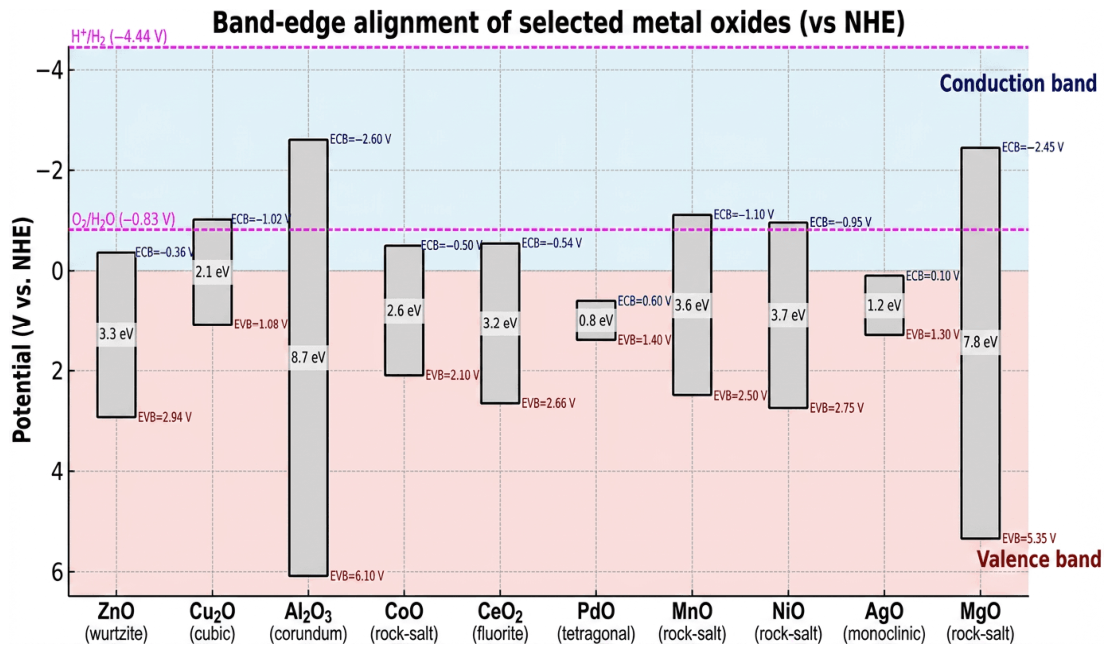
Oxygen vacancies and defect chemistry have an important part to play in improving the catalytic performance of supported catalysts by allowing stronger adsorption of sulfur, increasing the mobility of oxygen and also enabling continued redox cycles. The catalytic activity is affected by the interaction between metals and their support, and is influenced by improved metal dispersion, prevention of sintering or creation of interfacial sites that are highly reactive. A high surface area support, such as halloysite, will create a favorable environment for the stabilization of metal species at the interface and enhance catalytic activity through electronic effects. The activity of transition metal oxide will be determined by a number of factors, including but not limited to: the degree of porosity in the material, the surface area of the material, thermal stability of the material, attrition (the mechanical loss or breakdown) of the material, and the electronic band structure. In addition, metal oxides that have a narrow bandgap will show increased reactivity towards sulfur-containing species (e.g., ethyl mercaptan). A narrower bandgap (e.g., CuO, MnOx) provides for better electron transfer and thus stronger bonding between the sulfur species and the oxide due to less stable valence bands. Conversely, materials with a large bandgap (e.g., Al2O3) are generally used in a structural role and contribute little electronically to sulfur adsorption. Figure 1 displays the relative position of the band edges and bandgap energy levels for several metal oxides referenced against the NHE (normal hydrogen electrode), providing some insight into their electronic characteristics. Figure 1 also supports the concept of utilizing multi-metal systems, where individual metals can provide complementary functionality, to enhance both sulfur adsorption and overall catalyst performance [8,9,10,14,15,24,25,26,27,28,29,30,31,32].
In this research study, a multi-metal oxide system with the elements of Zn-Cu-Mn-Ni is used as a representative system of how adsorption, redox, and structural capabilities can be combined into one catalyst. The strong adsorption of sulfur species occurs at the sites provided by CuO and NiO, while MnOx provides redox properties and increased oxygen mobility; the addition of ZnO aids in structural stability and dispersion. When combined, each metal’s properties create a synergistic effect where both adsorption and catalytic conversion occur simultaneously, thereby improving the ability to remove sulfur compared to using individual metals [8,9,10,14,15].
The incorporation of noble metals like palladium has been widely reported to enhance catalytic performance in transition metal oxide systems through improved electronic interactions, promotion of redox activity, and increased utilization of active sites [1]. Palladium acts as a promoter by facilitating electron transfer between metal oxide components, lowering activation barriers for redox reactions, and increasing overall surface reactivity. In multi-metal systems, Pd can interact with MnOx and Cu/Ni sites, enhancing both sulfur adsorption and activation through improved charge-transfer processes [8,9,10,14,24,32]. In this research, palladium is introduced at low loading to promote electronic interactions and improve adsorption efficiency. It is hypothesized that Pd-metal interactions enhance surface reactivity and increase the availability of active sites for sulfur adsorption. Additionally, the nanotubular structure and dual surface chemistry of halloysite are expected to facilitate uniform metal dispersion and accessibility, further improving adsorption performance.

2. Results and Discussion

Trends in observed performance were found to be in agreement with previously studied systems based on metal oxides and provide further evidence of the importance of retaining metals throughout catalyst preparation. The use of a filtration method during the removal of solvents has led to confirmation via EDS analysis that metal loadings are less than the target metal loading. Metal loss due to filtration as a method of preparing catalysts is well-documented in the literature; such losses lead to non-uniform deposition of metal species and consequently reduced availability of active sites. These losses may also be significant when using multi-metal catalysts since achieving an appropriate balance of individual metals is necessary to achieve the desired synergistic effects [10,22,27].
The findings show that a decrease in metal due to loss through the filtration process can result in an overall reduction in the quantity of available active sites for sulfur adsorption, as demonstrated via EDS analysis, indicating less than optimal target metal loadings. As such, the loss of metal will likely negatively affect catalyst function because it decreases the total capacity for adsorption. In addition to demonstrating that catalytic efficiency is not merely based upon the amount of metal present within the system, although samples prepared utilizing the exact same preparation technique, the catalysts containing palladium exhibited far greater breakthrough time and sulfur uptake capacities than those lacking palladium. Therefore, these data suggest that the presence of palladium increases the effectiveness of pre-existing active sites rather than simply adding metal. Palladium is known to facilitate electron transfer and promote redox interactions between metal oxide components, particularly with Mn3+/Mn4+ redox couples and Cu/Ni adsorption sites. This electronic promotion improves the reactivity and sulfur-binding strength of the catalyst surface, resulting in more efficient utilization of available active sites. Therefore, while metal loss during synthesis likely reduces the total number of active sites, the introduction of Pd compensates for this limitation by increasing the intrinsic activity of the catalyst, leading to superior overall performance [8,24,26,33]. While the catalysts demonstrated strong initial adsorption performance, detailed investigation of spent catalyst structure and sulfur-induced surface transformations was beyond the scope of the present study and will be addressed in future work through post-reaction characterization and regeneration analysis.

2.1. The Analysis of Surface Morphology of the Prepared Catalyst

2.1.1. Analysis of the BET Data

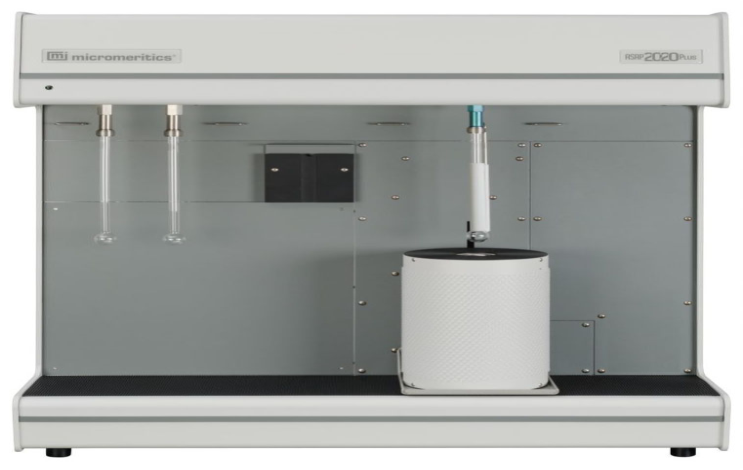
Nitrogen adsorption–desorption isotherms and corresponding pore size distribution of pristine halloysite and synthesized catalysts, obtained using a Micromeritics ASAP 2020 surface area and porosity analyzer (Micromeritics Instrument Corporation, Norcross, GA, USA) shown in Figure 2, demonstrate variations in surface area, pore volume, and mesoporous structure after metal incorporation. These include BET surface area, pore volume and average pore diameter as shown in Table 1. The BET surface area was found to be 51.180 m2/g, pore volume was 0.217 cm3/g, and average pore diameter was 163.980 Å for the pristine halloysite support. It is known that halloysite has a nanotube-type structure and thus has both an open lumen and external surface. As such, it provides readily available sites for metal-oxide deposition during catalyst synthesis [17,34,35].
After incorporation of the mixed metal oxide (Zn-Cu-Mn-Ni) into the halloysite support, the BET surface area decreased to 21.783 m2/g, and the pore volume decreased to 0.096 cm3/g. This decrease in surface area is consistent with the successful deposition of metal oxides both internally and externally on the halloysite nanotubes. This interpretation is further supported by XRD analysis, which confirms the presence of metal oxide phases, and EDS results, which verify the incorporation and distribution of the metal components on the catalyst surface. Although a direct proportional relationship between surface area reduction and metal loading is not expected due to factors such as dispersion, pore blockage, and particle aggregation, the combined BET, XRD, and EDS results provide consistent evidence of effective metal deposition and structural modification of the catalyst. A decrease in surface area after metal loading is common because metal oxide species occupy some of the pores and block other adsorption sites [36,37]. However, the mean pore diameter of the base catalyst did not show much change (172.030 Å) as it appears that although there were some small pores filled, the larger mesoporous channels were still accessible.
It is also interesting to note that different textural properties were observed among the single-metal oxides. Both manganese and copper catalysts exhibited very low BET surface areas (10.833 m2/g and 9.651 m2/g, respectively) and larger pore diameters (278.592 Å and 267.470 Å) than expected. These behaviors suggest that particle agglomeration and pore network restructuring occurred as a result of metal oxide deposition onto clay-based supports, leading to pore coalescence or collapse [21]. Zinc and nickel catalysts, however, displayed intermediate BET surface areas (38.769 m2/g and 40.218 m2/g) and relatively high pore volumes (0.213 cm3/g and 0.201 cm3/g), which indicates a more even distribution of metal oxides and less pore occlusion than the other two metals.
The addition of Palladium into the base catalyst (Base + Pd) caused a minor drop in BET surface area to 20.566 m2/g, while also causing an increase in pore volume to 0.149 cm3/g as well as increasing the size of the pore diameters to 246.514 Å. This is indicative of some level of modification within the pore structure. It is most likely that the increased pore volume and diameters result from both metal dispersion and particle agglomeration, and not from a breakdown in the structure of the support. Low loadings of Pd could provide a means for better distributing metal oxides and lessening pore blockages, thus allowing for greater access to internal pores. Additionally, finely dispersed Pd-containing species would be able to alter how particles pack together and produce new void areas, contributing to the development of a larger mesoporous network. There were no clear indications of leachate production or structural damage seen through either XRD or SEM analysis. Thus, it appears the changes noted above are largely due to redistribution and structural re-arrangements of the active phases [10,38].
All catalysts retained pore diameters greater than 50 Å after metal loading. Large mesopores are beneficial in gas-phase applications since they allow for rapid diffusion of reactants to the active site, minimizing internal mass transfer limitations [39]. In terms of sulfur removal from natural gas streams, the preserved meso-porosity will aid in the transport of sulfur compounds (e.g., C2H5SH) to active sites, allowing for higher adsorption and catalytic interactions.
Although we do not show full nitrogen adsorption–desorption isotherm plots, the textural parameters listed in Table 1 support that these samples represent a class of mesoporous materials. We associate the material’s pore size distributions and adsorption behaviors with Type IV isotherms showing H3-type hysteresis loops as defined by the International Union for Pure and Applied Chemistry (IUPAC), which represent typical mesoporous structures with slit-shaped pores. Pore uniformities are qualitative and based on average pore diameter and pore volume data [35].
In summary, the BET results demonstrate that while metal incorporation does increase the surface density and reduce the number of available surface area sites, the fundamental mesoporous structure of halloysite remains intact. Achieving this equilibrium of metal loading and pore access is important for providing a means for diffusion of reactant molecules through the porous structure. These differences likely contribute to the higher sulfur adsorption capacities and longer breakthrough times observed, especially for the Base + Pd catalyst. While trends between textural properties and sulfur adsorption performance are observed, these relationships are interpreted qualitatively due to the limited dataset and the influence of multiple interacting factors such as metal composition, dispersion, and redox behavior.

2.1.2. XRD Analysis and Catalytic Implications of the Catalysts

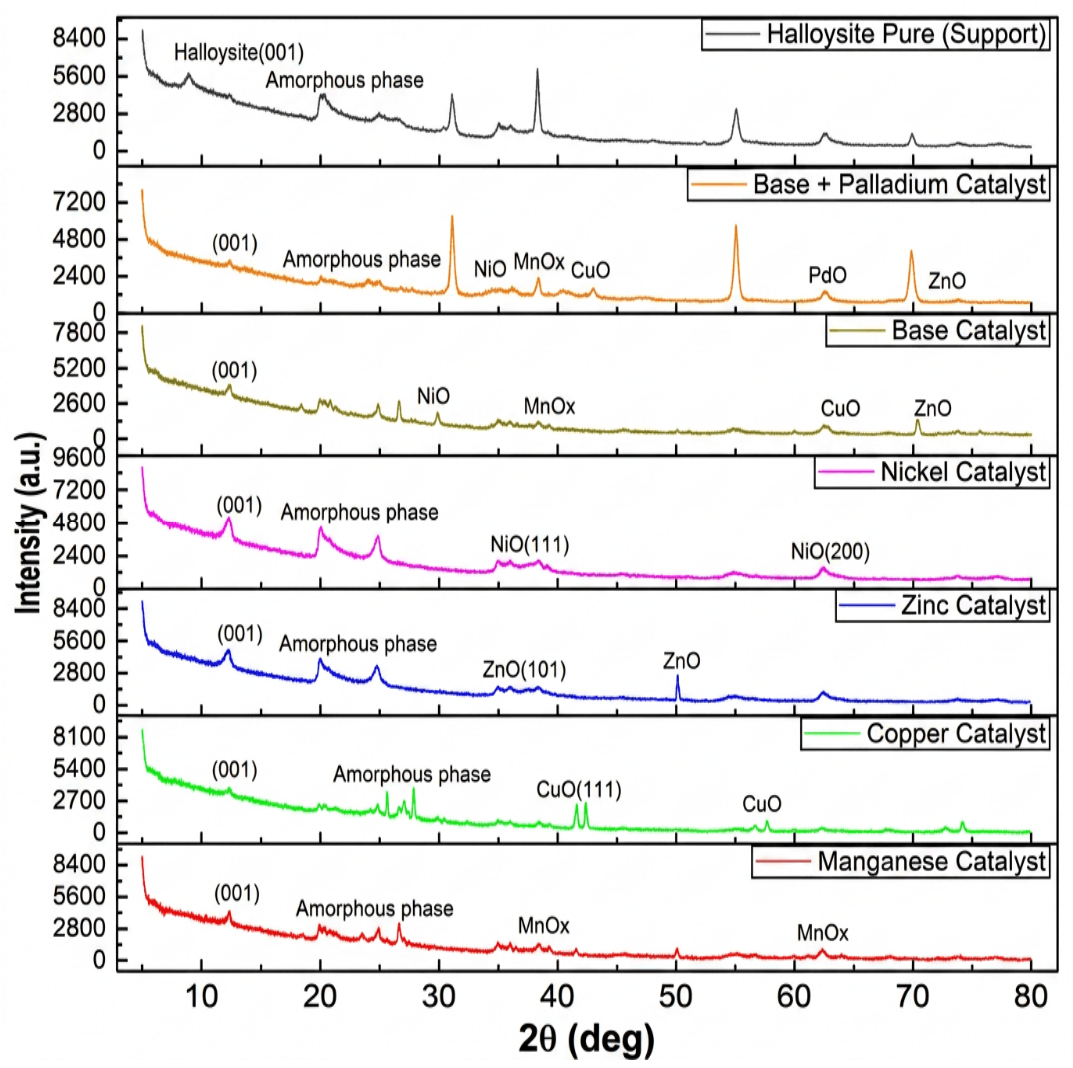
Figure 3 shows XRD patterns of pristine halloysite and synthesized catalysts, showing phase identification, crystallinity, and dispersion of metal oxide species. X-ray diffraction (XRD) pattern reveals a dominant reflection at around 2θ = 12°, for the untreated halloysite (support). This corresponds to the (001) plane of hydrated halloysite nanotubes and agrees with the expected pattern for halloysite (ICDD PDF #29-1487) based on the literature data [17,19]. In addition to the (001) reflection, there are two additional weaker reflections at around 2θ = 20° and 24°, as well as a broad hump centered between 18 and 25. The amorphous aluminosilicate component, typically associated with structural disorder and defects within naturally occurring halloysite, is responsible for the additional reflections.
Following the incorporation of mixed metal oxides (Zn-Cu-Mn-Ni), the (001) reflection is still visible, albeit at reduced intensity. This verifies that the basic framework of the tubular halloysite remains intact after synthesis. Reduced intensity is due to metal oxide species deposited on the external surface of the nanotube, as well as within the lumen of the nanotube. Deposition leads to partial coverage of the surface and reduced diffraction intensity due to partial surface coverage [39]. There were no significant changes in peak position, indicating that no substantial structural collapse or phase transformation of the halloysite framework has occurred. No measurable shift in the (001) reflection was observed, indicating that the basal spacing of halloysite remained unchanged after metal incorporation. This suggests that the metal oxide species are primarily deposited on the external surface and within the lumen of the nanotubes rather than being intercalated into the aluminosilicate layers.
Multiple oxide phases distributed throughout the 2θ range of approximately 25–80° are evident in the XRD patterns of metal-loaded catalysts. Several of the observed peaks are broad and overlap one another, indicative of metal oxides existing in a highly dispersed or nano-crystalline state as opposed to being developed into bulk crystals. A similar level of dispersion is common for supported transition metal oxides and provides increased availability of active sites [10].
Detailed phase identification confirmed the existence of several crystalline and amorphous oxide phases. For the nickel catalyst, reflections at around 2θ = 37° and 63° correspond to the (111) and (220) planes of cubic NiO (ICDD PDF #47-1049). Reflections at around 43° and 75° are likely due to higher-order planes such as (200) and (311). Moderate broadening of the peaks suggests that NiO exists as small nanocrystals with partial dispersion [40,41].
For the zinc catalyst, a strong and sharp peak at around 2θ = 36° is identified as the (101) plane of hexagonal wurtzite ZnO (ICDD PDF #36-1451). Peaks at around 31.7°, 34.4°, 47.5°, 56.6°, and 62.8° are due to the (100), (002), (102), (110), and (103) planes of ZnO, respectively. Due to their relatively high intensities and sharpness, it appears that ZnO is formed into defined crystalline domains relative to the other oxides in the system [15].
Reflections at around 2θ = 35–40° and 60° correspond to (-111)–(111) and (-113) monoclinic CuO (ICDD PDF #45-0937) for the copper catalyst. Features near 48–54° are likely due to CuO planes such as (-202) and (020). The relatively low intensity of the peaks suggests that CuO has a moderate level of crystallinity and some degree of aggregation of CuO domains [9].
Weak, poorly resolved peaks throughout the diffraction range of the manganese catalyst suggest the presence of amorphous or poorly crystalline MnOx phases. Reflections observed in the ranges of 2θ = 36–38°, 42–45°, and 60–65° are indicative of mixed MnOx phases (e.g., Mn2O3, Mn3O4). The absence of sharp, well-defined peaks indicates that MnOx primarily exists as disordered nanostructures, which is typical of manganese oxides with multiple oxidation states and flexible crystal structures. In addition to structural disorder, this behavior may also be attributed to relatively low surface concentration and high dispersion of Mn species, as supported by EDS compositional analysis. Lower metal loading and high dispersion reduce diffraction intensity, causing the phases to appear less crystalline in XRD patterns, which is commonly observed in supported transition metal oxide systems [10,14,42].
The palladium catalyst has weak reflections at around 2θ = 33–34°, 41–42°, and 55° corresponding to the (101), (110), and (112) planes of tetragonal PdO (ICDD PDF #41-1107). The relatively low intensity and broad nature of the peaks can be attributed to PdO, possibly as nanoclusters or ultra-fine particles on the support surface. This level of dispersion is consistent with reported results for supported palladium catalysts and is desirable for enhancing catalytic activity [8].
Overlapping reflections from the individual oxide phases are observed in the multi-metal base catalyst (Zn-Cu-Mn-Ni); however, the intensity of all the reflections is significantly lower, and the peaks are much broader. This indicates the formation of a highly dispersed multi-phase system with strong interfacial interactions between the different metal oxides. The simultaneous existence of these phases indicates the formation of a nanocomposite structure instead of separate oxide domains.
Based on peak broadening (Scherrer estimation), crystallite sizes are inferred that ZnO and CuO have relatively narrower peaks, which implies that they have relatively larger crystallite sizes (15–30 nm). NiO has a moderately broadened peak, indicating smaller crystallite sizes (10–20 nm). MnOx and PdO have a large amount of peak broadening, indicating very small crystallite sizes (<10 nm) or amorphous character. These differences show the varying levels of dispersion of the metal oxides.
The structural properties of the catalysts derived from XRD have important implications for their catalytic behavior. The ZnO component is involved in the removal of sulfur through the thermodynamically favorable bonding that exists between ZnO and various forms of sulfur (as well as other sulfur compounds), allowing for an enhanced rate of conversion or “sulfidation”. The dispersed NiO and CuO components create surface reaction sites on the catalyst surface where sulfur-containing molecules may adsorb and react on the catalyst surface. The high degree of dispersion and nanocrystallinity exhibited by the MnOx components contribute to both redox activity and increased mobility of oxygen at the surface; this will be critical for the oxidation of sulfur species. Lastly, the addition of PdO likely assists in improving catalytic activity via electronic interactions between the metal oxides present and/or improvement in the activation of sulfur species [42].
Generally, the XRD analysis demonstrates that the catalysts consist of a stable halloysite support, along with a complex mixture of cubic NiO, hexagonal ZnO, monoclinic CuO, poorly crystalline or amorphous MnOx, and highly dispersed PdO phases. The coexistence of crystalline and amorphous phases, along with strong metal–support and metal–metal interactions, creates a hierarchical catalytic structure that is well-suited for adsorption-based processes such as sulfur compound removal.

2.1.3. FTIR Analysis of the Catalysts

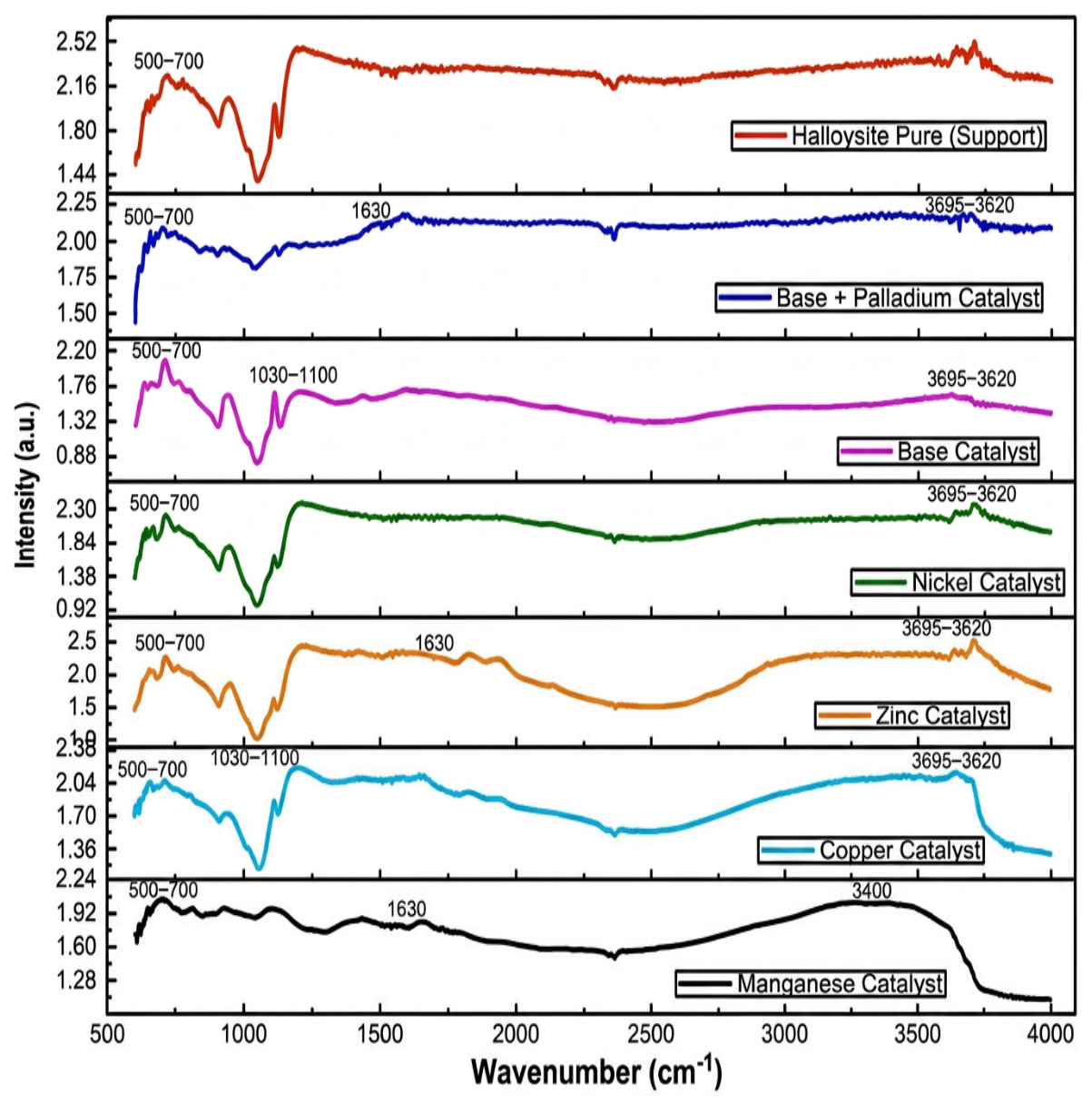
FTIR spectra of pristine halloysite and synthesized catalysts, illustrating surface functional groups and metal-support interactions, are shown in Figure 4. The FTIR spectra provide an understanding of the halloysite support structure and the effects of metal oxide on the support structure. An examination of the FTIR spectra over the full spectral range (500–4000 cm−1) reveals multiple vibrational bands that are superimposed and describe the surface chemistry of the catalysts as summarized in Table 2.
In the higher wavenumber region (3700–3600 cm−1), there is evidence of sharp bands in all samples; the bands are due to inner surface hydroxyl (Al-OH) located between the octahedral and tetrahedral layers of halloysite [16,17,18]. For the pristine support, the bands show clear definition, indicating an ordered arrangement of the hydroxyl groups. For the metal-containing samples, particularly those containing NiO, ZnO, and PdO, the bands have broadened and decreased in intensity. The effect of the metal species interacting with the surface hydroxyl groups results in the alteration of hydrogen bonding environments and not in the elimination of the hydroxyl groups.
A broader adsorption band from 3400 to 3200 cm−1 exists for the MnOx-containing catalyst sample. This band is due to hydrogen-bonded hydroxyl groups and physically adsorbed water. The increased absorbance of this band for the MnOx samples is consistent with their known hydrophilic and redox properties, which enhance the ability of the surface to hold onto water and promote surface hydroxylation [14]. This band is less intense for the pristine support, indicating that the metal incorporation enhances the surface polarity.
The band at approximately 1630 cm−1 is assigned to the bending vibration of adsorbed molecular water (H-O-H). The varying intensities of this band among the different samples suggest more than just physical adsorption. The increased intensity of this band in the Pd and Zn modified catalysts indicates that the surface metal sites can strongly interact with water molecules and potentially affect the adsorption behavior during catalysis [19]. The reduced intensity of this band in some samples suggests either dehydration of the surface or limited surface accessibility.
Weak spectral features found throughout the 1400–1500 cm−1 area can likely be attributed to residual precursor-derived species (surface groupings), possibly those related to acetate or nitrate, since these materials have been utilized for the preparation of catalysts; carbonates may also be present due to reaction of CO2 in the atmosphere with basic surface sites as a result of exposure to the atmosphere prior to analysis. Therefore, these features are assigned qualitatively to residual surface groups and adsorbed carbonate-like species rather than to intrinsic catalyst framework vibrations [10].
The region between 1200 and 900 cm−1 contains a broad and strong band ranging from 1030 to 1100 cm−1 due to Si-O-Si stretching vibrations within the tetrahedral silica framework of halloysite [43]. This band is preserved in all samples, demonstrating that the fundamental aluminosilicate structure of the halloysite remains intact even after metal incorporation. Additionally, slight broadening and decreasing intensity of the band can be observed, especially in the base and copper catalysts, suggesting that metal oxide species interact with the silica surface of the halloysite and/or partially cover it. Overlapping contributions from Si-O-Al linkages and possible distortions of the silica lattice due to metal deposition are also suggested by the presence of additional shoulders and minor peaks in this region.
Several bands exist in the intermediate region (900–700 cm−1) that correspond to out-of-plane bending vibrations of Al-OH groups and Si-O-Al linkages. Bands in this region are indicative of changes in the local coordination environment around aluminum sites resulting from interaction with transition metal species [40].
The low-wavenumber region (700–500 cm−1) is highlighted in all spectra and is critical for identifying metal oxide formation. In the pristine halloysite, this region consists of Si-O and Al-O bending modes. However, for the catalyst samples, additional bands corresponding to M-O (metal oxides) vibrations are observed. Specifically, the nickel-containing catalyst has bands that are consistent with Ni-O bonding. The copper-containing catalyst has bands that are consistent with Cu-O vibrations. Similarly, the zinc-containing catalyst has bands consistent with Zn-O vibrations. The manganese-containing catalyst exhibits broader features that are characteristic of Mn-O vibrations. Due to the amorphous nature of MnOx, the Mn-O vibrations are generally less resolved than the other metal oxides [10,14]. The broad and overlapping nature of the bands in this region indicates that the metal oxides are highly dispersed and do not form large crystalline domains.
It is worth noting that the palladium-containing catalyst has poorly resolved Pd-O bands in its FTIR spectra. The high dispersion of palladium species within the material, combined with possible overlapping vibrational modes from the support or the other metal oxides, may account for the lack of discrete Pd-O spectral signatures in the FTIR spectra. In addition, Pd-O vibrations are typically weak in infrared spectroscopy. However, variations observed in several regions of the spectrum indicate that palladium is indeed incorporated and interacts with the support [8].
All samples display the lack of sharp or prominent peaks that would indicate the formation of secondary phases or bulk crystalline impurities. Rather, the spectral changes indicate strong metal–support interactions, surface modification, and the creation of dispersed active sites.
In summary, the FTIR analysis demonstrates that the halloysite framework remains intact as a result of incorporating metal; however, the surface of the halloysite has undergone significant changes. The combined evidence of preserved Si-O-Si networks altered hydroxyl environments, and the appearance of metal–oxygen vibrational features demonstrates the successful preparation of supported metal oxide catalysts. The surface characteristics of the catalysts should significantly impact adsorption-driven processes such as those involving sulfur-containing compounds, where both hydroxyl groups and metal–oxygen active sites participate in binding and activation mechanisms [44].

2.1.4. EDS Analysis of the Catalysts

Table 3 shows EDS of pristine halloysite and synthesized catalysts, confirming elemental composition and incorporation of metal species. They give qualitative and semi-quantitative evidence for elemental composition and the incorporation of metal species with activity. The EDS was used to determine the elemental composition of the pristine halloysite support and the synthesized catalysts. The results are presented in terms of both weight and atomic percentages, providing semi-quantitative information on the near-surface elemental distribution. The halloysite support is primarily composed of Al, Si, and O, with atomic percentages of 22.38% Al, 21.48% Si, and 56.14% O, confirming the characteristic aluminosilicate composition of halloysite nanotubes [16,17,19]. Halloysite surfaces have changed through the addition of metals. Changes in surface atom percentage, specifically decreased Al and Si, for many samples as opposed to the pristine sample, indicate that some portion of the halloysite surface is covered by the metal oxides added. This confirms successful loading of active metals onto the halloysite surface. Although EDS does not provide spatial resolution, these compositional changes, together with BET and SEM observations, suggest that metal species are distributed both on the external surface and within the lumen of the halloysite nanotubes.
For the single-metal catalysts, the presence of Mn, Cu, Zn, and Ni confirms successful incorporation of the respective metal oxides. There was a total of 0.57% manganese within the Mn sample. However, there was a much larger amount (4.57%) of copper present in the Cu sample, which suggests localized enrichment of Cu or possibly some degree of aggregation of Cu species. Atomic percentages of 0.52 percent and 1.07 percent for the Zn and Ni samples suggest differences in how each metal interacts with its corresponding support during synthesis and how well it retains itself. This is consistent with previously documented behavior of transition metal oxides, where both dispersion and aggregation are heavily influenced by synthesis conditions and metal chemistry [9,14,15].
For the base multi-metal catalyst (Zn-Cu-Mn-Ni), all four active metals were detected with atomic percentages of 0.92% Mn, 1.20% Cu, 0.81% Zn, and 0.76% Ni. The simultaneous presence of these metals confirms successful formation of a multi-metal surface composition. The relatively balanced distribution of Mn, Cu, Zn, and Ni suggests the formation of a multi-functional active phase, where adsorption-active metals (Cu, Ni) coexist with redox-active Mn species and structurally stabilizing Zn. Such near-surface composition is important for synergistic interactions because catalytic performance depends on the proximity and interaction of different active sites rather than individual metal loading alone [8,9,10,14].
The variation in metal composition as determined through atomic analysis suggests that a portion of the metal was lost prior to or during the synthesis process (1.5 g of each metal(s) and 3 g of support were used in each catalyst preparation). Metal precursor loss may occur as part of the filtration step. Loss may have occurred because of loosely bound metal precursors being washed out. In addition, the lower percent atomic values for certain metals relative to their intended loadings support this interpretation. The observed variation in metal composition may also be influenced by the nature of the precursor salts used during synthesis. In this work, nitrate and acetate metal salts were employed, and their differing solubilities in ethanol can affect metal retention during the filtration step. More soluble precursor species are more likely to remain in the liquid phase and be partially removed during filtration, which may contribute to the lower measured concentrations of certain metals (e.g., Ni) compared to others. The percentage composition data obtained using EDS provides only approximate quantitative measures of the elemental composition of the material within a limited depth (the near-surface region) and will depend upon both the degree of metal dispersion and the average size of metal particles, along with the ability of the metal to access the surface. While it appears that some amount of metal has been lost during synthesis, catalyst activity depends not solely on the overall amount of metal present but also on how effectively the remaining metal is distributed throughout the solid and interaction with other elements [10].
In the Pd-promoted catalyst, EDS confirmed the presence of Pd together with Zn, Cu, Mn, and Ni. The Base + Pd catalyst exhibited atomic percentages of 1.67% Mn, 2.35% Cu, 1.79% Zn, 1.47% Ni, and 1.97% Pd. Compared with the base catalyst, the higher atomic percentages of the active metals indicate greater surface exposure and/or improved retention of metal species. The coexistence of Pd with transition metal oxides supports the formation of a complex multi-component surface, which is consistent with the enhanced catalytic performance observed for the Pd-promoted catalyst. Such improvements are often associated with interactions between noble metals and transition metal oxides [8,10]. The presence of sodium (Na) in the Mn, Cu, and Ni catalysts is attributed to the use of NaOH during synthesis to adjust pH and facilitate the formation of metal hydroxide intermediates. Residual Na may remain due to incomplete removal during solvent (ethanol) filtration. The presence of residual Na may also influence catalyst performance, as alkali metals are known to modify surface basicity, which can enhance adsorption of sulfur species; however, excessive Na may also partially block active sites or alter metal–support interactions [10]. Carbon was not detected in the pristine halloysite support but was observed in the metal-loaded catalysts. The carbon signal is attributed to residual organic species, likely originating from the ethanol solvent used during synthesis, as well as possible surface contamination during sample preparation.
The EDS results confirm the successful incorporation of metal species and provide a comparison between pristine support and modified catalysts. The atomic % are particularly important for evaluating relative surface composition and metal ratios, which are critical for understanding synergistic interactions in multi-metal catalysts. These findings complement the XPS results and support the proposed structure performance relationships.

2.1.5. SEM Analysis of the Catalysts

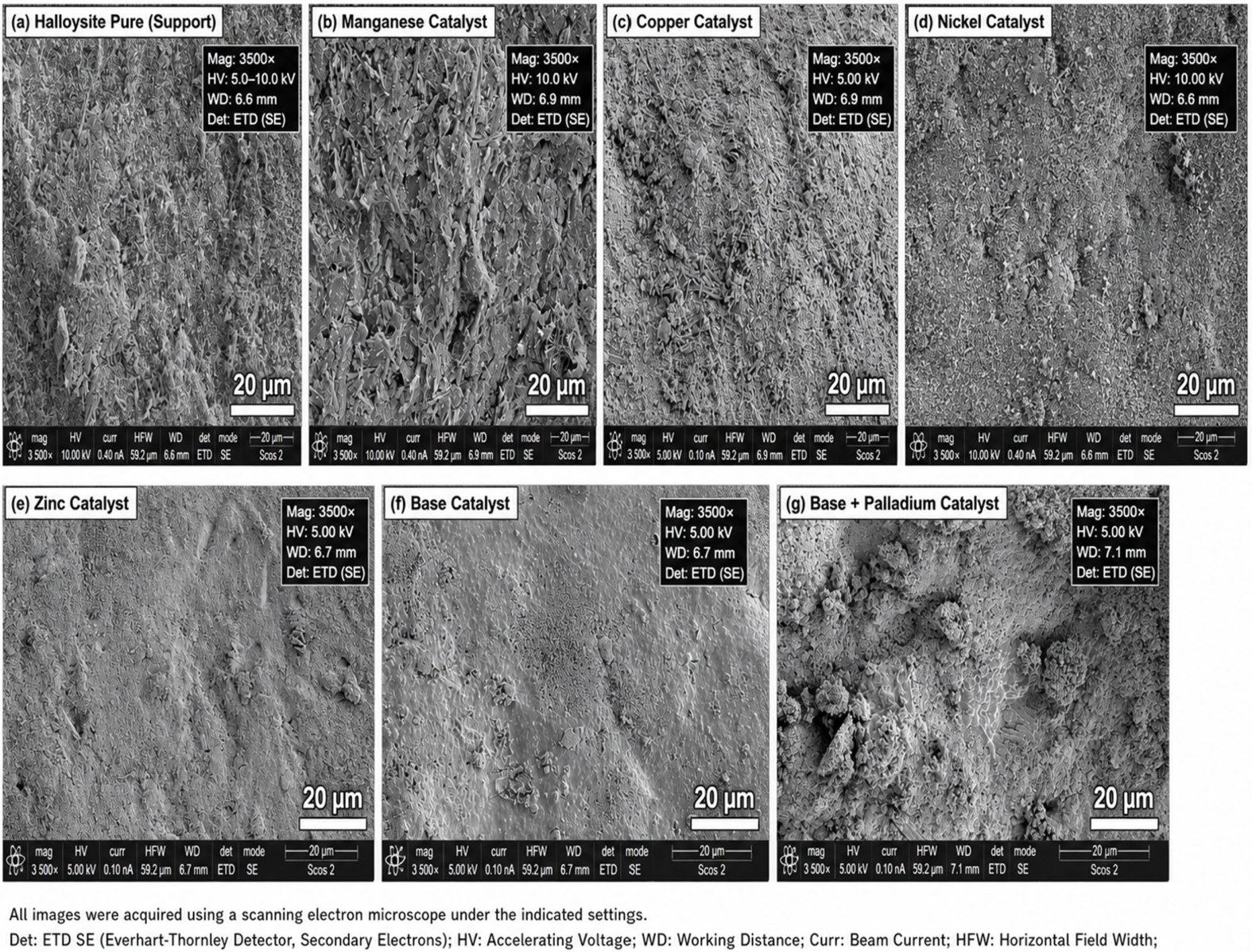
SEM images of pristine halloysite and synthesized catalysts, showing surface morphology, particle structure, and dispersion of metal oxides, as shown in Figure 5. The morphological observations are supported by quantitative EDS and BET data, summarized in Table 1 and Table 3, which confirm variations in metal distribution and textural properties across the catalysts. The weight percentages (wt.%) of each impregnated metal are summarized in Table 3, providing quantitative evidence of metal loading and enabling comparison with the intended composition. The halloysite support exhibited a typical nanotubular and plate-like morphology with loosely packed aggregates. The halloysite particles appeared irregular and porous with visible interparticle voids and a relatively rough surface texture. The appearance of this morphology is consistent with naturally occurring halloysites, which consist of rolled aluminosilicate layers that form nanotubes and fragmented sheets [16,17,18]. These structural features provide a high surface area and many access points for metal deposition onto the support. While SEM provides information on surface morphology, it does not allow direct observation of metal depositions within the nanotube lumen; however, combined BET and XRD results suggest that metal species are likely distributed both on the external surface and within the internal cavity of the halloysite nanotubes. Significant differences in surface morphology were observed in the SEM images of the synthesized catalysts when compared to the pristine halloysite support.
The manganese catalyst showed a surface morphology that is more fragmented and irregular than that of the pristine halloysite. Increased roughness and the presence of fine particulate clusters are also present on the surface. These features indicate that MnOx species are deposited as a highly dispersed and possibly amorphous phase on the halloysite support. The lack of large agglomerates indicates a good dispersion and a strong interaction between MnOx and the halloysite surface.
The copper catalyst exhibited a more heterogeneous morphology with localized areas of particle clustering and slightly denser domains than those observed for the manganese catalyst. The clusters formed from the copper oxide are indicative of partial aggregation of CuO species. The relative strength of the diffraction peaks observed in the XRD and the intensity of the Cu signals indicate that the CuO species have a greater tendency to aggregate than the MnOx species. The formation of these domains indicates that while copper is successfully incorporated into the support, it has a tendency to nucleate and grow on specific regions of the support, resulting in non-uniform distribution.
The zinc catalyst exhibited a smooth and relatively uniform surface. The lack of large agglomerates and the relatively even surface texture suggest that the ZnO species are well dispersed across the halloysite surface. The ZnO species may be forming thin coatings or finely distributed nanoparticles. A uniform dispersion of ZnO species will increase the accessibility of active sites and indicate a favorable interaction between the ZnO species and the aluminosilicate framework of the halloysite support [15].
The nickel catalyst exhibited a compact and dense surface morphology with few visible pores and a flattened surface structure. This morphology suggests that the NiO species are occupying the pore spaces and blocking accessible channels within the halloysite structure. This behavior can result in a reduced effective surface area and a limited number of available active sites. The results indicate that the nickel-containing system (Ni catalyst) has lower catalytic activity than the other systems.
The surface morphology of the base catalyst (Zn-Cu-Mn-Ni) exhibited a moderate level of roughness but was more uniform than the surface morphologies of the individual metal catalysts. The absence of large, distinct agglomerates of each metal oxide suggests that the various metal oxides are co-dispersed across the halloysite support and have formed a composite interface. The mixed surface morphology indicates the formation of a synergistic structure in which multiple metal oxides interact at the nanoscale. The interfacial contact and potential charge transfer between the different metal oxides are enhanced by this synergy [10].
Significant morphological transformations were observed in the SEM image of the palladium catalyst. The surface exhibited the presence of well-defined granular and clustered features that are distributed across the support. The clusters are relatively small and uniformly distributed. These observations indicate that the Pd species act as nucleation centers that promote the formation of finely dispersed multi-metal domains. The increased surface roughness and particle connectivity indicate an enhancement of the metal–support and metal–metal interactions. Enhanced structural features such as this are known to improve catalytic performance by increasing the density of active sites and facilitating electron transfer processes [8].
Across all catalyst samples, the underlying halloysite structure remained recognizable. Therefore, the halloysite support maintained its structural integrity following metal incorporation. However, the extent of surface coverage and modification varied based on the type of metal incorporated into the catalyst. The interface between the halloysite support and the metal oxides that are deposited onto the support is the most important factor in determining the overall catalyst performance. The ability of the metal oxides to strongly interact with the halloysite support and to remain stably dispersed without aggregating during operation is critical in maintaining long-term stability and preventing sintering.
The SEM results clearly show that the halloysite support provided a useful and stable framework for the synthesis of the catalysts. Different metals exhibited varying levels of dispersion from highly dispersed (Zn, Mn) to partially aggregated (Cu). Multi-metal systems promoted a more uniform and integrated surface structure, and palladium incorporation resulted in enhanced surface roughness and the formation of finely distributed active domains. The increased surface roughness observed for the Pd-containing catalyst enhances the availability of exposed active sites and defect sites, which can facilitate stronger adsorption of sulfur-containing molecules such as mercaptans through improved surface interaction and accessibility. The relationships between the surface morphology of the catalysts and their catalytic performance and adsorption properties demonstrate the importance of controlling the surface structure and metal dispersion when designing efficient sulfur removal catalysts.

2.1.6. XPS Analysis of the Catalysts

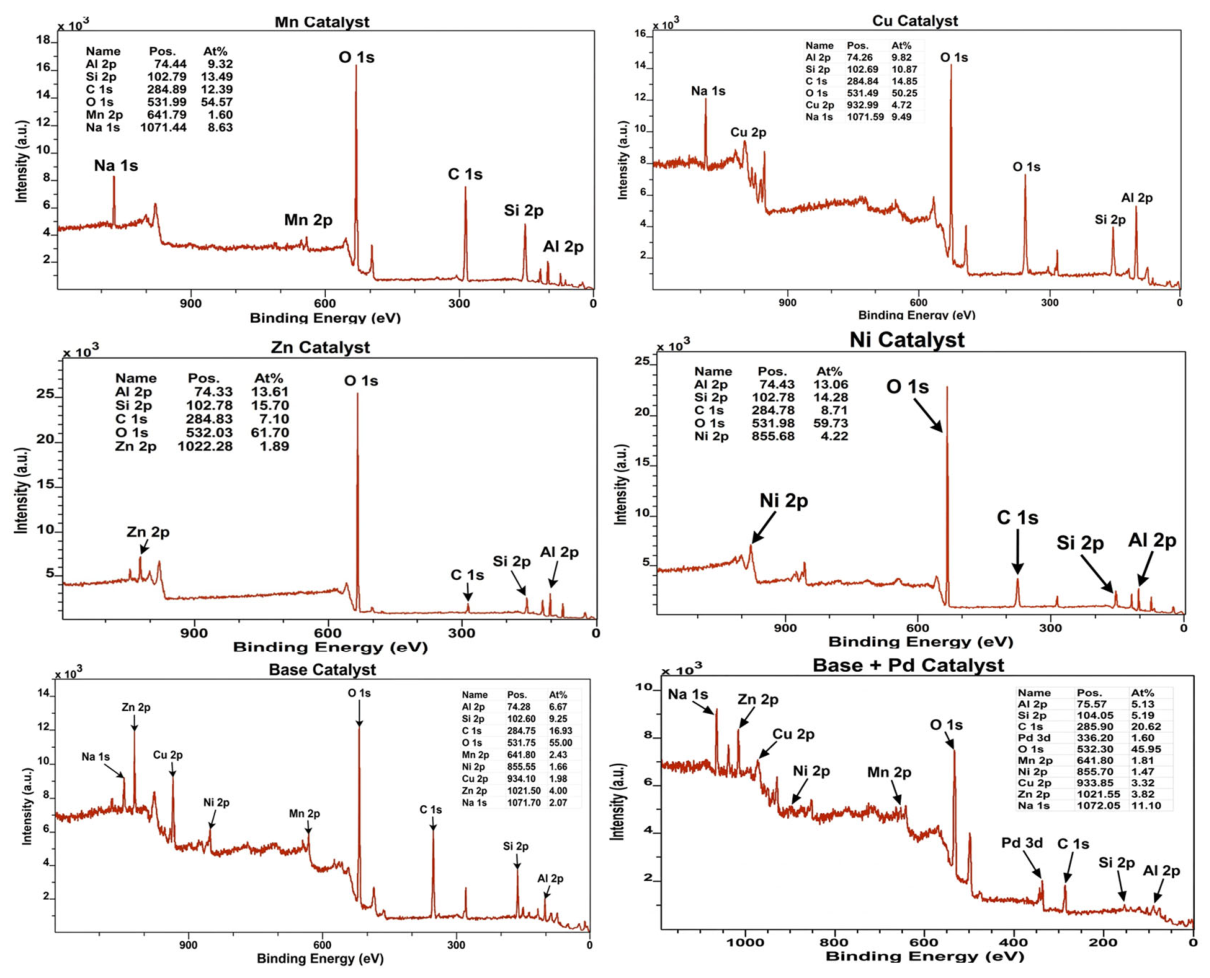
Figure 6 presents the XPS spectra of the synthesized catalysts, providing insight into the surface composition and chemical states of the active species. All catalysts exhibit the characteristic elements of the halloysite support, namely Si, O and Al, together with the respective transition metals, confirming successful deposition of metal oxide phases onto the halloysite surface. The Si 2p peaks located at approximately 102–104 eV and Al 2p peaks at approximately 74–76 eV are assigned to Si-O-Si/Si-O-Al and Al-O bonding environments, respectively. These values confirm that the aluminosilicate framework of halloysite remains structurally intact after metal loading, in agreement with XRD and FTIR analyses [17,19].
A dominant O 1s peak is observed in all catalysts at approximately 531–532 eV, corresponding to a combination of lattice oxygen (O2−) and surface oxygen species such as hydroxyl groups or adsorbed oxygen. Although quantitative separation of lattice and adsorbed oxygen species requires high-resolution peak deconvolution, the broad nature and relative intensity of the O 1s signal in the multi-metal catalysts suggest an increased contribution of surface-active oxygen species. These species are widely reported to enhance oxygen mobility and catalytic oxidation processes, which are critical for sulfur compound transformation [8,9,10,45]. The enhanced oxygen reactivity is consistent with the improved catalytic performance observed for the base and Pd-promoted systems.
A clear Na 1s peak was observed for some catalysts with a binding energy of approximately 1071–1072 eV. The fact that sodium appears to be present on the surface is especially relevant as XPS is a highly sensitive technique for determining surface composition. The presence of sodium in this experiment demonstrates that sodium exists primarily at the surface rather than being evenly dispersed throughout the material. In addition, the XPS data support the presence of sodium within some catalyst determined via EDS, although XPS provides specific information about surface concentrations. Sodium could potentially impact catalysis through changes in the surface’s basicity. Additionally, an optimal amount of sodium can improve the adsorption of acidic sulfur-containing molecules such as mercaptans onto the catalyst. However, excessive amounts of sodium can potentially hinder catalytic activity by blocking metal oxide reaction sites and reducing overall catalytic performance [10,22].
The Mn 2p peak for the manganese-based catalyst peaks approximately at 641.8 eV, a common range where MnOx-based materials show a mix of Mn3+/Mn4+ oxidation states. The absence of evidence in the spectrum of a satellite feature typically seen near 647 eV for Mn2+ shows that most of the Mn is likely to be in the form of Mn3+/Mn4+. A mixed valence state is commonly found to enhance redox cycling, oxygen mobility and electron transfer needed for sulfur adsorption and oxidation reactions. Therefore, it is appropriate to describe manganese as Mn3+/Mn4+ across all catalysts and not include reference to Mn2+ [9,14,45].
The 2p peaks for the copper catalyst in the Cu 2p region occur at about 933–934 eV, which is consistent with Cu2+ in a CuO-like environment. The Cu 2p peak is shifted upward by a small amount compared to the base catalyst (934.1 eV) due to the increased interaction of the Cu species with the multi-metal oxide matrix that surrounds it. After adding Pd, the Cu 2p peak is shifted slightly down (933.8 eV), which indicates there was electronic redistribution and charge transfer between the Pd and Cu species. These types of shifts have been widely reported as indicative of cooperative interactions and modification of the electronic structure in multi-component catalytic systems [8,11].
In the Zn catalyst, Zn is confirmed by its binding energy of 1022 eV as Zn2+ in ZnO. However, little to no changes were seen in the Zn binding energy after Pd was added to both the base and promoted catalysts. This indicates that Zn has a structural function in stabilizing the dispersion of metals and does not participate in redox reactions. A similar trend is seen with the nickel (Ni) catalyst, which also showed a peak at 855–856 eV, corresponding to Ni2+ in NiO. There was some shift in Ni binding energy after Pd was added; however, this was much less than what was seen with Cu.
In the base catalyst, the presence of Zn2+, Cu2+, Ni2+, and Mn3+/Mn4+ is confirmed by the XPS results. When comparing to the single-metal catalysts, the spectra indicate that there is a stronger interaction between metal oxides and higher dispersion due to broadened and less distinct peaks. These findings correlate well with the SEM images and the XRD peak broadening. Due to its multi-metal composition, this system allows for cooperative interactions. The Cu2+ and Ni2+ metals serve primarily as active sites (adsorbers) for the reaction of sulfur-containing molecules. On the other hand, the redox activity and the oxygen mobility are provided by the Mn3+/Mn4+ ions.
In addition to the Base + Pd catalyst exhibiting the expected peaks for Pd 3d at approximately 336–338 eV as Pd2+ in a PdO-like state, there is an indication that the Pd has been oxidized and exists as a highly dispersed form. Since the only peaks observed are from Pd2+, it can be concluded that the Pd has remained in this form throughout its use on the catalyst. Additionally, since no peaks were observed for metallic Pd, there is strong evidence that palladium has remained oxidized and will continue to remain in this state. Furthermore, the very weak XRD peaks also support these conclusions.
The XPS data confirm that the catalytic materials have surface-exposed oxidation products of metals having defined chemical states; these include surface accessible Cu2+, Ni2+, Mn3+/Mn4+, Zn2+, and Pd2+, which provide a highly interactive environment. The presence of multiple metal ions allows for strong interactions between adsorption and redox processes, providing a basis for a synergistic effect in the catalysis. The XPS results are consistent with the BET, SEM, EDS and XRD results, all of which suggest that the catalytic properties likely depend on metal dispersion, surface composition and electronic coupling. Therefore, the XPS results support the proposed mechanism for adsorption–redox desulfurization of natural gas.

2.2. Catalyst Adsorption Performance in Removing Sulfur Compounds from Natural Gas

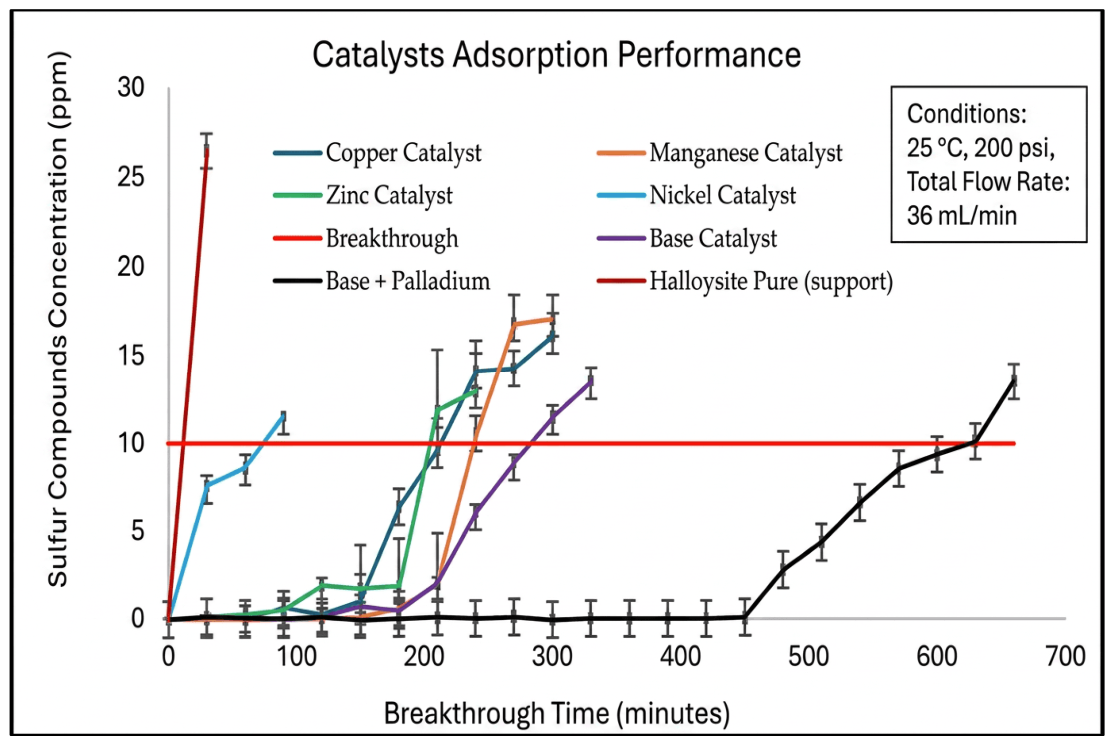
The adsorption performance of the synthesized catalysts towards sulfur compounds (see Figure 7) shows a dependency on the type of active metal oxide used and how they interact with the halloysite support. The breakthrough curves show sulfur concentration at the reactor outlet as a function of time for pristine halloysite and synthesized catalysts under identical operating conditions (25 °C, 200 psi, 36 mL/min, 200 ppm ethyl mercaptan). The time until breakthrough was established based on sulfur concentration, which is 10 ppm and therefore serves as an indicator of the effectiveness of each catalyst. Halloysite itself has no adsorptive capacity for sulfur, since the sulfur concentration rises rapidly at 30 min breakthrough. Therefore, halloysite cannot be considered as a catalyst but merely acts as a structural component [19]. It should be noted, however, that the diffusional properties of halloysite may be influenced by its tubular nanostructure. In addition to influencing the dispersion of the deposited metal oxides, the pore size and outer surface structure of the halloysite could positively affect the accessibility of the adsorption site. As stated before, the present study indicates that primarily the outer surface of the halloysite is involved in the deposition process, as shown in the results obtained from SEM and EDS.
Among the single metal-based catalysts, nickel (Ni) exhibited an early breakthrough (90 min), suggesting that it has a relatively low ability to absorb sulfur. The reasons for this may be due to a lack of dispersion of NiO, as evidenced by both XRD and SEM data, as well as pore blockages indicated by BET analysis. While Ni2+ sites may be able to react with sulfur species, the effectiveness of those reactions likely depends greatly upon how easily accessible they are and how much of the surface area is exposed, which was also limited in this particular case [9,45]. Copper showed better performance compared to Ni, showing a breakthrough at approximately 210 min. This can be attributed to Cu’s high affinity for forming bonds with sulfur-containing compounds. In addition, the mechanism involves the chemical absorption of sulfur onto the Cu2+ through the formation of a S-Cu covalent bond. XRD and SEM analyses indicate that some aggregation occurred among the individual CuO particles, reducing the amount of available active sites, thus limiting the potential performance of the catalyst. Zinc performed similarly to Cu in terms of breakthrough time, showing similar times (205 min). Similar to Cu, ZnO provides structural support to stabilize other components, but unlike Cu, it does not provide strong adsorption interactions or redox activity, because Zn2+ has a very stable electronic structure [15]. The manganese catalyst shows further improvement (240 min), which is attributed to the presence of mixed Mn3+/Mn4+ oxidation states that enable redox cycling and oxygen mobility. These features facilitate not only adsorption but also partial oxidation of sulfur species, enhancing overall removal efficiency. The amorphous or poorly crystalline nature of MnOx, observed in XRD, increases defect density and oxygen vacancies, which serve as active sites for sulfur activation [9,14,45].
The base (Zn-Cu-Mn-Ni) sample exhibits a vital enhancement (300 min), highlighting the importance of synergistic interactions among multiple metal oxides. In this system, sulfur removal proceeds through a combined adsorption–redox mechanism. Sulfur compounds such as CH3CH2SH are initially adsorbed on Cu2+ and Ni2+ sites via chemisorption, potentially involving dissociative adsorption of the S-H bond. Subsequently, Mn3+/Mn4+ redox couples facilitate electron transfer and activate lattice oxygen, enabling oxidation of adsorbed sulfur species into more stable forms such as sulfides or partially oxidized sulfur intermediates. Although direct post-reaction characterization (XPS or XRD of spent catalysts) was not performed in this study, the literature reports indicate that such systems commonly form surface metal–sulfur species (M-S) or oxidized sulfur species (SOx) during desulfurization processes [8,10]. FTIR and XPS data in this work further support the presence of reactive oxygen species and metal–oxygen bonding, which are vital for these transformations. The most significant improvement is observed for the Base + Pd catalyst (630 min), more than doubling the performance of the base catalyst. This advancement likely arises from the formation of an efficient redox–electronic network involving Pd2+ and Mn3+/Mn4+. Pd facilitates charge transfer and lowers activation barriers for sulfur bond cleavage, promoting faster electron exchange between adsorbed sulfur species and the catalyst surface. Additionally, Pd enhances the activation of surface oxygen species, increasing the rate of oxidative transformation of sulfur compounds. The observed shifts in binding energy from XPS also support electronic interaction between Pd and transition metal oxides, confirming the presence of synergistic effects. Thus, sulfur removal on the Base + Pd catalyst involves a combination of strong chemisorption (Cu2+/Ni2+/Pd2+ sites) and redox-assisted transformation (Mn3+/Mn4+ and reactive oxygen species), resulting in significantly improved breakthrough performance [8,11].
The influence of synthesis methodology is also evident in the performance trends. Solvent was removed from the metal/ethanol mixture through filtration. EDS showed that the filtration process resulted in losing some of the metal, therefore lowering the amount of metal loading compared to what was intended (1.5 g metal and 3 g halloysite support). This methodological limitation results in reduced active site density and contributes to the earlier breakthrough observed in some catalysts. This methodological limitation results in reduced active site density and contributes to the earlier breakthrough observed in some catalysts. Despite this, the remaining metals are sufficiently dispersed to maintain catalytic functionality, particularly in the multi-metal and Pd-promoted systems. In addition to those mentioned above, XPS, which analyzes surfaces, and EDS, which analyzes bulk materials, have identified differences in the surface versus the bulk material of some samples. The data indicate that some metal(s) as well as Na species from NaOH are selectively found at the surface of some samples. The selective placement of materials or chemical species at the surface is especially important for catalytic reaction systems because both adsorption and redox reactions occur within an interfacial region. Overall, the performance trend follows:
Base + Pd > Base > Mn > Zn > Cu > Ni > Halloysite
This pattern also suggests that catalysis efficiency is dependent on metal distribution as well as surface composition, oxidation status and electronic interactions. The adsorption activity has been the focus of this research. The high redox capability of these materials, in addition to their stable structure, indicates great potential for regenerating all these catalysts, which would indicate good long-term operational stability.

2.3. Performance Summary

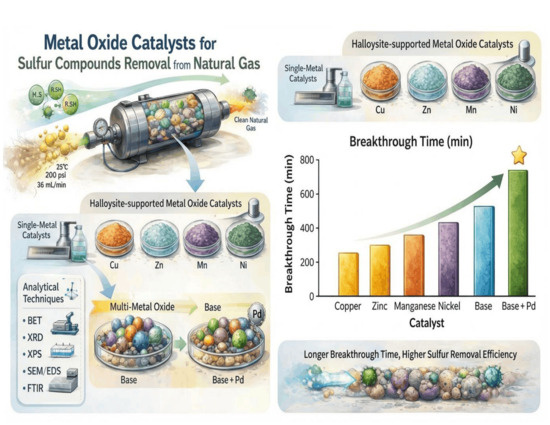
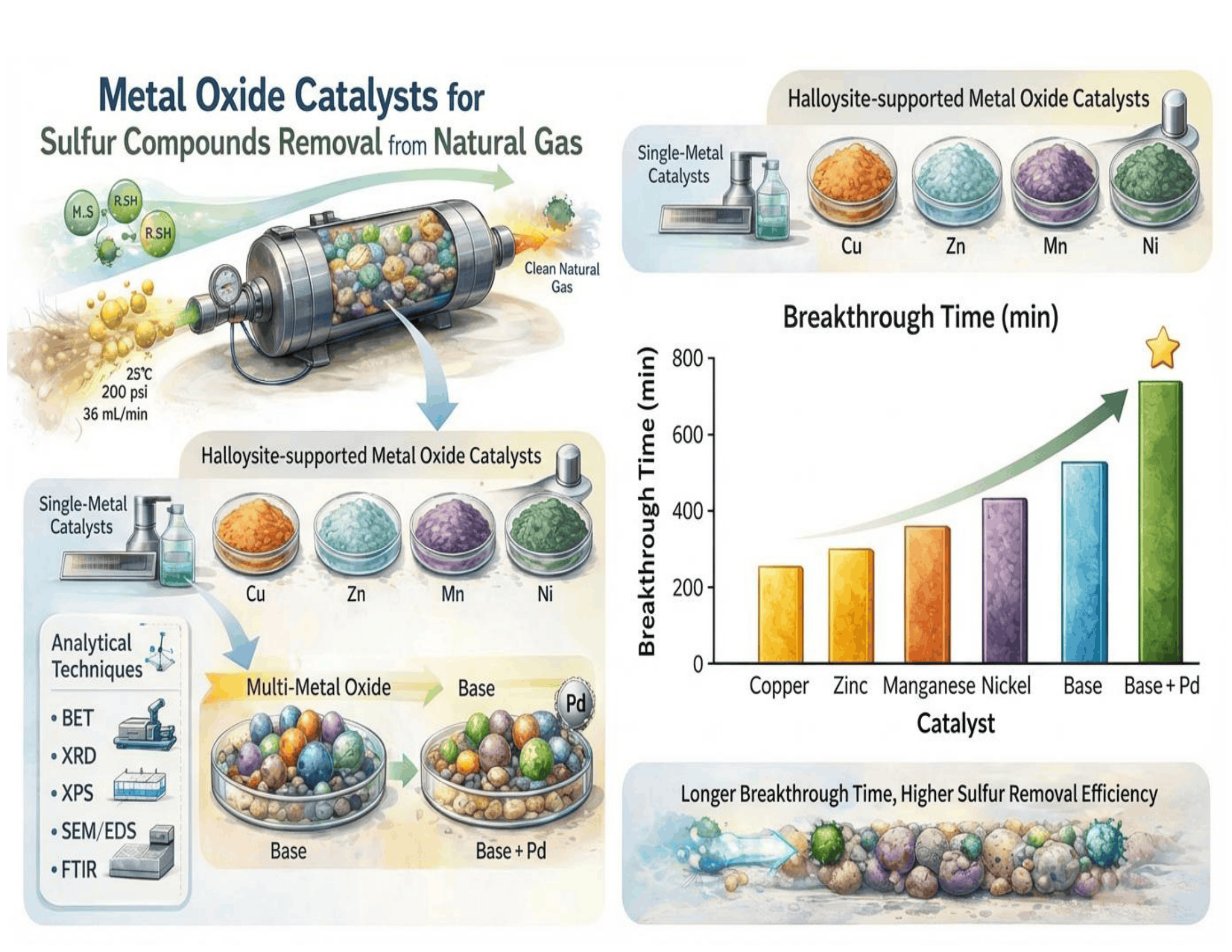
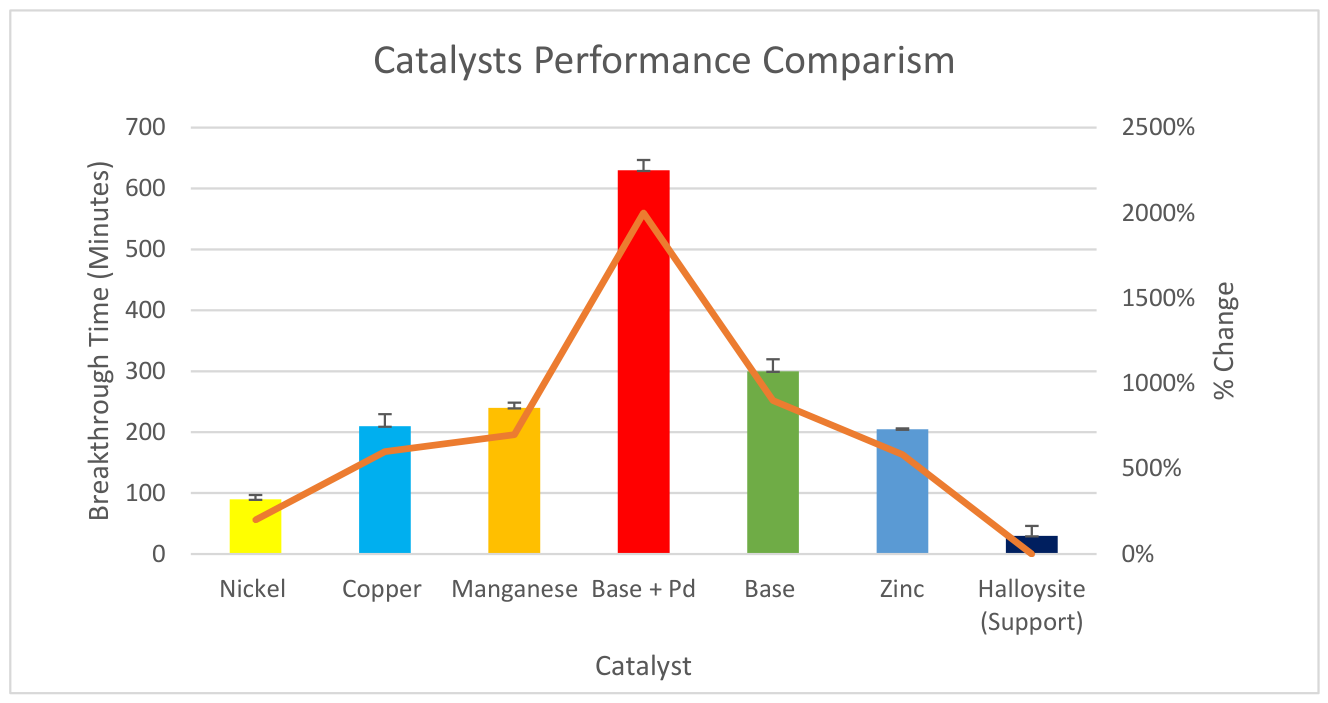
The adsorption performance of the synthesized catalysts for sulfur compound (e.g., ethyl mercaptan) removal is summarized in Table 4 and illustrated in Figure 8, where breakthrough time and sulfur adsorption capacity are compared under identical operating conditions (25 °C, 200 psi, 36 mL/min). The percentage improvement was calculated relative to the halloysite support, based on breakthrough time. The halloysite support exhibits negligible adsorption capacity, with a breakthrough at 30 min, which yields sulfur capacity of 1.10 mg S/g, confirming that it primarily serves as structural support rather than an active adsorbent [1].
The most effective single-metal catalyst for the removal of sulfur compounds was the manganese catalyst. This catalyst had a sulfur breakthrough time of 240 min and a sulfur capacity of 8.76 mg S/g. These values were higher than the other three tested single-metal catalysts, potentially because of the two redox states present on the surface of the catalyst, Mn3+/Mn4+, allowing for better oxygen mobility and assisting in oxidation adsorption pathways [5]. The copper catalyst performed second best (breakthrough at 210 min, and a sulfur capacity of 7.67 mg S/g). This performance corresponds well with the high chemisorptive affinity of Cu2+ sites toward sulfur-containing molecules [6,7]. Zinc exhibited similar performance to copper (breakthrough at 205 min, and sulfur capacity of 7.48 mg S/g), likely due to its structural stabilization capabilities along with moderate adsorption capability. Nickel exhibited the poorest performance among the four catalysts tested (breakthrough at 90 min, and sulfur capacity of 3.29 mg S/g). This poor performance can be attributed to lower dispersion and accessibility of the nickel Sites (Ni2+) as shown through BET, SEM, and XRD analysis [3].
A great improvement in catalytic activity has been seen with the multi-metal base catalyst (Zn-Cu-Mn-Ni). The catalyst shows a breakthrough time of 300 min and sulfur capacity of 10.95 mg S/g. These results show that it is very important to have synergies between different metal oxides for high performance. Possibly Cu2+ and Ni2+ act as adsorption sites, Mn3+/Mn4+ provides redox properties via oxygen transfer, and Zn2+ acts both as a dispersion agent and as a structure stabilizer. These synergistic effects are supported by characterization results, including broadened XRD peaks indicating high dispersion, SEM observations of increased surface roughness, and XPS confirmation of multiple accessible oxidation states. The most pronounced enhancement is achieved with the Base + Pd sample, which exhibits a breakthrough time of 630 min and sulfur capacity of 23.00 mg S/g, the highest sulfur adsorption performance among the six catalysts. This vital adsorption enhancement shows that the improvement is primarily associated with enhanced sulfur adsorption capacity rather than solely kinetic effects. The superior performance of the Base + Pd sample is attributed to highly dispersed Pd2+ species, as confirmed by XPS, which modify the electronic structure of the catalyst. Pd facilitates dissociative chemisorption of sulfur-containing molecules and enhances charge transfer between metal oxide components, where Pd activates sulfur species and transfers reactive intermediates to adjacent Cu, Ni, and Mn oxide sites, hence improving both adsorption strength and redox cycling efficacy [1,46]. This is also backed by XPS binding energy shifts and XRD/SEM evidence of improved dispersion, confirming enhanced exposure of active sites in the Pd-promoted catalyst. From a mechanistic standpoint, sulfur adsorption occurs through a combined mechanism involving chemisorption–redox pathways. Chemisorbed (adsorbed) sulfur-containing molecules onto Cu2+ and Ni2+ sites are activated and partially oxidized through reaction with the Mn3+/Mn4+ redox couple and reactive oxygen species. The presence of Pd reduces the activation energy required to break sulfur bonds as well as facilitates the flow of electrons across the catalyst surface. Although post-reaction sulfur species (e.g., sulfides or sulfates) were not directly characterized, the observed performance trends are consistent with mechanisms reported for transition metal oxide-based desulfurization systems [3,5,46]. The importance of these observed performance patterns is especially evident in the mild process conditions used in this research. Most refractory sulfur species like mercaptans and thiophenes require either a higher temperature than those used here or an oxidizing environment for removal [1,46]. Under ambient temperature high-pressure reaction conditions, however, each of the synthesized catalyst architectures showed considerable sulfur retention, demonstrating the potential that exists when using halloysite as a support for multi-metal oxides. The tubular morphology and dual surface chemistry of halloysite contribute to improved metal dispersion and accessibility, although some diffusion limitations within the lumen may exist.
It is also important to consider the influence of synthesis methodology on catalytic performance. The use of filtration during solvent removal may result in partial loss of dissolved metal precursors, as supported by EDS analysis showing lower than expected metal loadings. This reduction in metal content decreases the density of active sites and contributes to earlier breakthrough times in some catalysts. Despite this limitation, the retained metal species remain sufficiently dispersed to maintain catalytic functionality, particularly in the multi-metal and Pd-promoted systems.
Overall, there exists an evident correlation between breakthrough time and sulfur adsorption capacity on all catalysts. Therefore, the overall performance of the system appears to depend on sulfur adsorption capacity as opposed to limiting rates of reaction. As expected, those catalysts exhibiting increased metal loadings, more uniform dispersions, and optimal oxidized states demonstrated increased sulfur uptakes and longer breakthrough times. Additionally, the use of standard deviations from duplicate runs of the same experiment in Figure 8 clearly illustrates the replicability and reliability of the adsorption data measured. In addition to these results suggesting a possible regenerable capability of the catalysts via application of an oxidative treatment due to their structural stability during prolonged periods of operation, the ability to rationally design multi-metal oxide catalysts containing redox-active and adsorption-active components could provide a practical solution toward achieving efficient sulfur removal from natural gas at mild temperatures.

3. Materials and Methods

3.1. Materials

The chemicals used in the experiments include zinc acetate dihydrate (97%), nickel (II) tetrahydrate (99%), copper (II) nitrate trihydrate (99%), manganese acetate tetrahydrate (98%) and palladium acetate (98%). Additional reagents, including sodium hydroxide (NaOH) and 200-proof ethanol, were used as received without further purification. All chemicals were purchased from Fisher Scientific (Fisher Scientific, Waltham, MA, USA) except the halloysite pure (support), which was purchased from Coastal Chemicals in Louisiana, USA. Nitrogen gas (99.99% purity) was used for purging and leak testing, while the adsorption feed gas consisted of methane (99.98% purity) containing 200 ppm ethyl mercaptan.
The use of halloysite as a catalyst support is based on the unique naturally occurring aluminosilicate nanotubular structure that provides both an external siloxane surface (Si-O-Si) and an internal aluminol lumen (Al-OH). As a result of this dual surface chemistry, it is possible to selectively interact with the different metal oxide precursors used to create the active phase of the catalyst. Thus, by providing the appropriate conditions, the dispersion of the active phase in the support will be maximized, while at the same time minimizing the degree of leaching. Additionally, halloysite has a higher specific surface area than many conventional supports; halloysite has been shown to have inherent mesoporous characteristics, and the mechanical and thermal stabilities are also significantly better than those of other conventional supports. Therefore, halloysite is an ideal material for adsorption-driven catalytic applications. Halloysite, in comparison to other commonly used supports such as γ-Al2O3 or SiO2, provides an enhanced opportunity for mass transport and an increase in the number of available active sites due to its hollow tubular structure. The natural abundance of halloysite, the lower costs associated with the production of halloysite-based materials, and the minimal requirements necessary for the treatment of halloysite provide significant advantages over conventional supports in terms of scalability and suitability for industrial applications. Consequently, the unique combination of physical and chemical properties exhibited by halloysite makes it a logical choice for the design of highly efficient metal-oxide catalysts for the removal of sulfur-containing compounds from natural gas [16,17,18,19,34,40].

3.2. Catalyst Preparation

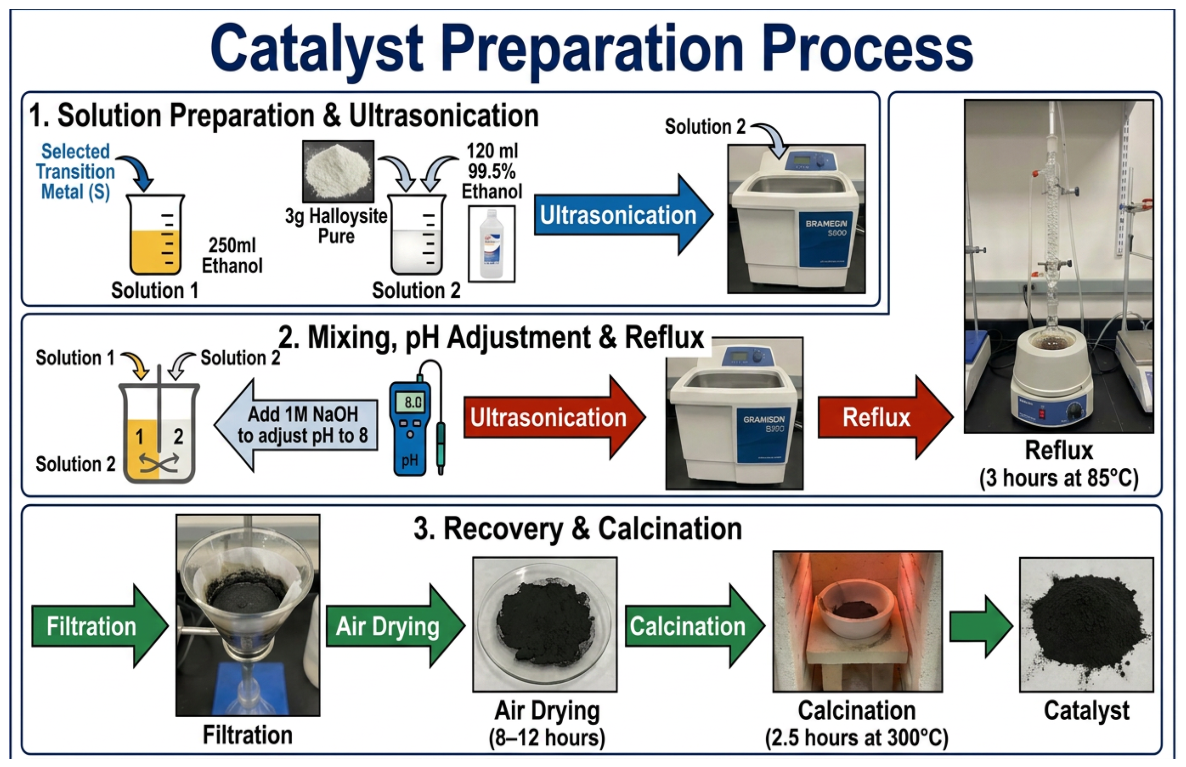
All chemicals were of reagent-grade quality and used without further purification. The catalysts prepared in this study, as shown in Figure 9, were made through the wet impregnation–reflux technique. This process is intended to provide an even distribution of metal oxides over the halloysite surface and, at the same time, retain the physical properties of the halloysite. Prior to synthesis, raw halloysite was first crushed and sifted with a 40-mesh sieve to create particles that averaged about 0.4 mm in diameter; no additional chemical washing or pre-calcination pretreatment was performed on the halloysite. Halloysite weighing a total of 3 g was then mixed in 120 mL of 99.5% ethanol to make a homogeneous solution (solution 2), followed by ultrasonication (Branson Ultrasonics, model: 5200, Danbury, CT, USA). Sonication is widely reported to improve dispersion of metal precursors on porous supports by reducing particle agglomeration, enhancing interfacial contact, and promoting more uniform deposition of active species [47,48].
A separate precursor solution for transition metals was prepared by dissolving 1.5 g selected metal salt(s) in 240 mL of 99.5% ethanol. To create Solution 1, the appropriate individual metal salt(s) (Zn, Cu, Mn, Ni, and Pd, depending on the catalyst formulation) for the particular catalyst formulation were added to make Solution 1. The amount of metal salt added to Solution 1, as shown in Figure 9, was determined from the desired metal loading and weight percent metal content (1.5 g for each metal). Since ethanol can effectively dissolve metal precursors without excessive pre-hydrolysis, uncontrolled precipitation of the metal precursors and allows for control over the rate of metal deposition onto the alumina support, ethanol was chosen as the solvent [10].
The Zn-Cu-Mn-Ni multi-metal oxide system was selected as the base catalyst because the individual metal oxides provide complementary catalytic functionalities relevant to sulfur adsorption and redox activity. CuO and NiO provide adsorption-active sites for sulfur-containing molecules, MnOx contributes oxygen mobility and redox flexibility through mixed Mn3+/Mn4+ oxidation states, while ZnO improves structural stabilization and dispersion of active phases. Palladium was incorporated as a promoter because noble metals are widely reported to enhance sulfur activation, electron transfer, and redox cycling in transition metal oxide systems [10,21,22,38].
Once Solution 1 had been formed, it was slowly added to Solution 2 while continuing to stir and adjust the pH of the combined solution to approximately 8 with 1 M NaOH. A control experiment without NaOH during synthesis was performed, and the resulting material exhibited adsorption performance comparable to the pristine halloysite support, indicating the importance of NaOH in forming active catalyst phases. Detailed investigation of the role of the added base is beyond the scope of this work and will be presented in a separate study. By maintaining an alkaline environment, conditions are created that allow for the precipitation of metal hydroxide intermediate compounds. These metal hydroxide intermediate compounds are transformed into metal oxide materials upon calcination. The addition of NaOH as a precipitation agent has long been recognized as effective in promoting the immobilization of metal species onto aluminosilicate support via electrostatic forces and by providing sites for nucleation of metal species at surface hydroxyl groups [10]. Following the preparation of the combined solution, it was ultrasonically dispersed to facilitate the uniform distribution of metal species throughout the internal pore volume of the halloysite clay mineral.
The suspension was then refluxed at 85 °C for 3 h to enable deposition and reaction of the metal species with the support. Refluxing facilitates the diffusion of metal ions into the halloysite lumen and aids in creating a strong metal–support bond; these bonds are essential to the stability of the catalyst [40]. After reflux, the resulting solids were removed from the liquid phase via filtration. The solids were dried under air for 8–12 h and then calcined at 300 °C for 2.5 h. Calcination was carried out in a programmable furnace (purchased from Fisher Scientific, model: 550-14, Waltham, MA, USA) under controlled heating conditions, where the temperature profile and residence time were digitally monitored and recorded throughout the process. The calcination process converts the metal hydroxide species that have been deposited on the support into their respective metal oxides. Additionally, the calcination process stabilizes the structural framework of the catalyst. The calcination process is conducted at a relatively low temperature as it enables the production of the necessary metal oxides and minimizes the sintering of the metal particles, thereby maintaining the surface area of the support [8].

3.3. Catalyst Testing Process

The catalytic activity test, as shown in Figure 10, was carried out in a stainless-steel tube packed-bed reactor with dimensions of 310 mm (length) and an inner diameter of 6.35 mm. In each experimental run, 0.5 g of catalyst was loaded into the central section of the reactor and held in place using glass wool within the reactor. Therefore, the full reactor length does not represent the effective packed catalyst bed length. Before testing, the reactor was pressurized with nitrogen at 60 psi at 36 mL/min and leak-tested using Snoop™ leak detector solution (Swagelok Company, Solon, OH, USA), followed by a 30 min pressure-hold test to confirm system integrity. Negligible pressure drop was observed before switching to the sulfur-containing feed gas. This enabled leak testing of all connections, from the gas tank to the downstream mass flow controller. Once the system was found to be leak-free, to start the sulfur compound removal process, the feed was changed from N2 (99.99%) to a gas mixture with 200 ppm ethyl mercaptan in methane. The feed gas consisted of 200 ppm ethyl mercaptan balanced in high-purity methane (≥99.98%). The gas combination was introduced axially into the packed bed reactor at 25 °C, 200 psi and 36 mL/min. The operating conditions (200 psi and 36 mL/min) were selected based on previous studies, where these parameters provided stable flow conditions and optimal adsorption performance for similar catalyst systems [46]. The use of near-ambient temperature (25 °C) was chosen to reflect energy-efficient and economically favorable operating conditions for practical applications [4,46]. Temperature during adsorption testing was continuously monitored and controlled using a K-type thermocouple connected to a digital temperature controller to ensure stable operating conditions throughout the experiments. The nominal gas hourly space velocity (GHSV) was approximately 220 h−1, calculated based on the total reactor internal volume and the inlet volumetric flow rate. Once the flow was stabilized at the set pressure, the GC-MS (GC(model:6890N)-MS (model:2614A)), Agilent Technologies, Santa Clara, CA, USA) procedure began immediately. Breakthrough data was collected once a breakthrough (10 ppm) was attained. Breakthrough was defined at an outlet concentration of 10 ppm total sulfur, expressed on a sulfur-equivalent basis from ethyl mercaptan. This threshold corresponds to approximately 5% of the inlet concentration (200 ppm) and was selected as a conservative limit relative to typical natural gas pipeline specifications (16–20 ppm total sulfur), while remaining within the reliable detection range of the GC-MS and consistent with values reported in desulfurization studies [49,50,51,52,53]. This definition ensures that the reported breakthrough times are directly relevant to industrial sulfur limits. The sulfur adsorption capacity (q) at breakthrough was calculated using Equation (1).
q = Q M 0 t ( C i C f ) d t
where Q   is the volumetric flow rate (m3/min), M   is the mass of catalyst (g), C i   and C f   are the inlet and outlet sulfur concentrations (mg/m3), and t   is the breakthrough time (minutes).
The volumetric flow rate was converted from mL/min to m3/min, and the inlet concentration of CH3CH2SH (ppm) was converted to mass concentration (mg/m3) using the ideal gas relationship. This approach ensures consistent units and allows for accurate calculation of sulfur capacity in mg S/g catalyst.

4. Conclusions

  • The study demonstrated that metal (transition metal) oxide on halloysite (support) catalysts significantly enhances sulfur uptake compared to pristine halloysite support, confirming that halloysite primarily functions as a structurally stable support and dispersion medium, while the deposited metal oxides provide the dominant adsorption-active and redox-active sites needed for desulfurization. However, the mesoporous tubular structure of the support contributes to physical adsorption and facilitates diffusion and accessibility of sulfur-containing molecules to the active metal oxide phases.
  • The Mn catalyst exhibited the best performance among the single-metal catalysts. Under the applied operating conditions (36 mL/min, 200 psi, 25 °C, and 200 ppm ethyl mercaptan in methane), a breakthrough time of approximately 240 min and sulfur adsorption capacity of 8.76 mg S/g were achieved. This improved performance is likely attributed to the mixed Mn3+/Mn4+ redox states and oxygen mobility of MnOx. In contrast, NiO exhibited the lowest performance (90 min, 3.29 mg S/g), indicating that redox flexibility, oxygen mobility, and metal dispersion play a more critical role in sulfur removal.
  • The multi-metal base catalyst (Zn-Cu-Mn-Ni) showed improved performance (300 min, 10.95 mg S/g) compared to single-metal systems, confirming that synergistic interactions between adsorption-active (CuO, NiO) and redox-active (MnOx) components enhance sulfur uptake and delay breakthrough. The improved performance was further supported by XRD, SEM, BET, and XPS analyses, which indicated improved dispersion, multiple accessible oxidation states, and stronger metal–support interactions within the multi-metal oxide system.
  • The incorporation of palladium resulted in the highest catalytic performance (630 min, 23 mg S/g). The presence of Pd2+ species, as observed from XPS analysis, suggests that Pd likely modifies the electronic environment of the multi-metal oxide system and enhances electron transfer between the metal oxide components. The observed enhancement is consistent with a spillover-assisted chemisorption–redox mechanism, in which sulfur-containing molecules initially adsorb onto Cu2+ and Ni2+ sites, followed by activation and partial oxidation through Mn3+/Mn4+ redox couples and Pd-assisted electron transfer pathways [1,50]. Although post-reaction sulfur species were not directly characterized, the desulfurization process is believed to involve reactive chemisorption and oxidation-assisted adsorption rather than purely physical adsorption.
  • The results further revealed that metal precursor loss during filtration-based synthesis reduced active site density, contributing to underperformance in the catalysts; thus, metal retention, dispersion, oxidation and electronic structure are identified as key factors governing sulfur adsorption and catalyst effectiveness. While the synthesis route produced highly functional catalysts, alternative preparation methods may further improve metal retention and catalyst adsorption efficiency.
  • Catalysts containing metal oxides with relatively smaller bandgaps exhibited improved sulfur adsorption performance. Although direct bandgap measurements were not performed in the present study, the literature reports suggest that enhanced charge-transfer capability and surface electron mobility in certain transition metal oxides may contribute to stronger sulfur–surface interactions and improved adsorption behavior [4]. In the present system, the sulfur removal mechanism is proposed to involve a combined physical adsorption, reactive chemisorption, and oxidation-assisted pathway, where the halloysite support contributes to diffusion and physisorption, while the transition metal oxides facilitate sulfur activation and redox transformation.
  • When compared with previously reported sulfur removal materials, the halloysite-supported mixed metal oxide catalysts developed in this study demonstrate competitive and practically relevant organo-sulfur adsorption performance under mild operating conditions [1,3,4,50]. The combination of structural simplicity, low-cost support material, and enhanced sulfur removal capability suggests strong potential for application in natural gas purification systems.
  • Although the present study demonstrates promising initial performance for ethyl mercaptan removal using halloysite-supported mixed metal oxide catalysts, the work should be regarded as a fundamental proof-of-concept study focused on catalyst synthesis, characterization, and initial adsorption behavior under controlled conditions rather than fully optimized industrial technology. Additional investigations are still required to fully evaluate catalyst durability, regeneration behavior, sulfur poisoning resistance, metal retention, and long-term operational stability. In the present work, post-reaction and post-regeneration characterization were not performed; therefore, the possible formation of stable metal sulfide or sulfate species cannot be ruled out. Future studies will therefore focus on multi-cycle adsorption–regeneration testing, post-reaction SEM/XPS/XRD characterization to verify preservation of the halloysite nanotubular structure, evaluation of sulfur-induced surface transformations, and assessment of catalyst stability under extended operating conditions. Advanced analyses such as XPS S 2p, XRD, EDS, and ICP-OES will provide deeper insight into sulfur adsorption mechanisms, metal oxidation state evolution, possible sulfide formation pathways, and catalyst deactivation behavior. Nevertheless, the present findings establish a strong scientific foundation for the future development and optimization of halloysite-supported mixed metal oxide materials for organo-sulfur removal from natural gas.
Future Work: A control experiment without NaOH confirmed its critical role in catalyst formation and preparation method, while detailed studies on base effects, catalyst stability, spent catalyst analysis, and comparison with commercial materials are the focus of ongoing and complementary work.

Supplementary Materials

The following supporting information can be downloaded at: https://www.mdpi.com/article/10.3390/catal16050473/s1, Manganese Catalyst BJH Curves, Copper Catalyst BJH Curves, Zinc Catalyst BJH Curves, Nickel Catalyst BJH Curves, Base Catalyst BJH Curves, and Base + Pd Catalyst BJH Curves can be found in the Supplementary File.

Author Contributions

Conceptualization, R.H. and M.Z.; methodology, R.H., M.Z. and S.A.; formal analysis, R.H., S.A. and W.H.; data curation, S.A., D.C. and W.H.; writing—original draft preparation, S.A.; writing—review and editing, R.H., M.Z., S.A., D.F., T.K., A.G. and E.R.; project administration, R.H., M.Z. and W.H.; funding acquisition, R.H. and M.Z. All authors have read and agreed to the published version of the manuscript.

Funding

This research was supported by the Guangdong Basic and Applied Basic Research Foundation (no. 2021A1515012342) U.S.–Israel Fossil Energy Center (FEC19) administered by the BIRD Foundation and funded by the Israeli Energy Ministry and the U.S. Department of Energy.

Data Availability Statement

All data have been provided in the manuscript/Supplementary Materials.

Acknowledgments

The authors acknowledge the financial support of the U.S.–Israel Fossil Energy Center (FEC19) administered by the BIRD Foundation and funded by the Israeli Energy Ministry and the U.S. Department of Energy for this work.

Conflicts of Interest

All Authors declare that there is no conflict of interest regarding the manuscript.

References

  1. Song, C.; Ma, X. New design approaches ultra-clean diesel fuels by deep desulfurization and deep dearomatization. Appl. Catal. B Environ. 2003, 41, 207–238. [Google Scholar] [CrossRef]
  2. Speight, J.G. An Introduction to Petroleum Technology, Economics, and Politics; John Wiley & Sons: Hoboken, NJ, USA, 2011. [Google Scholar]
  3. Anglerot, D.; Coq, B.; Trens, P. Methyl mercaptan and carbonyl sulfide traces removal through adsorption and catalysis on zeolites and layered double hydroxides. Appl. Catal. A Gen. 2011, 397, 218–224. [Google Scholar]
  4. Castro, P.S.; Zuniga, G.M.; Holmes, W.; Buchireddy, P.R.; Gang, D.D.; Revellame, E.; Zappi, M.; Hernandez, R. Review of the adsorbents/catalysts for the removal of sulfur compounds from natural gas. Gas Sci. Eng. 2023, 115, 205004. [Google Scholar] [CrossRef]
  5. Jie, H.E.; Zhao, J.B.; Lan, Y.X. Adsorption and photocatalytic oxidation of dimethyl sulfide and ethyl mercaptan over layered K1-2xMnxTiNbO5 and K1-2xNixTiNbO5. J. Fuel Chem. Technol. 2009, 37, 485–488. [Google Scholar]
  6. Zhu, J.; Hu, L.; Wang, J.; He, J. Adsorption behavior and mechanism of ethyl mercaptan in natural gas on Cu-modified hexaniobate nanotubes. Appl. Surf. Sci. 2024, 648, 159050. [Google Scholar] [CrossRef]
  7. Zhou, H.; Su, W.; Xing, Y.; Wang, J.; Zhang, W.; Jia, H.; Yue, T. Progress of catalytic oxidation of VOCs by manganese-based catalysts. Fuel 2024, 366, 131305. [Google Scholar] [CrossRef]
  8. Trovarelli, A.; Fornasiero, P. Catalysis by Ceria and Related Materials; Imperial College: London, UK, 2013; pp. 1–888. [Google Scholar]
  9. Biesinger, M.C. Advanced analysis of copper X-ray photoelectron spectra. Surf. Interface Anal. 2017, 49, 1325–1334. [Google Scholar] [CrossRef]
  10. Busca, G. Heterogeneous Catalytic Materials; Elsevier: Amsterdam, The Netherlands, 2014; pp. 297–343. [Google Scholar]
  11. Trovarelli, A.; Llorca, J. Ceria catalysts at nanoscale: How do crystal shapes shape catalysis? ACS Catal. 2017, 7, 4716–4735. [Google Scholar] [CrossRef]
  12. Mars, P.; Van Krevelen, D.W. Oxidations carried out by means of vanadium oxide catalysts. Chem. Eng. Sci. 1954, 3, 41–59. [Google Scholar] [CrossRef]
  13. Campbell, C.T. The energetics of supported metal nanoparticles: Relationships to sintering rates and catalytic activity. Acc. Chem. Res. 2013, 46, 1712–1719. [Google Scholar] [CrossRef]
  14. Post, J.E. Manganese oxide minerals: Crystal structures and economic and environmental significance. Proc. Natl. Acad. Sci. USA 1999, 96, 3447–3454. [Google Scholar] [CrossRef]
  15. Özgür, Ü.; Alivov, Y.I.; Liu, C.; Teke, A.; Reshchikov, M.A.; Doğan, S.; Avrutin, V.C.S.J.; Cho, S.J.; Morkoç, A.H. A comprehensive review of ZnO materials and devices. J. Appl. Phys. 2005, 98, 041301. [Google Scholar] [CrossRef]
  16. Ahmad, Y.H.; Mohamed, A.T.; Al-Qaradawi, S.Y. Exploring halloysite nanotubes as catalyst support for methane combustion: Influence of support pretreatment. Appl. Clay Sci. 2021, 201, 105956. [Google Scholar] [CrossRef]
  17. Joussein, E.; Petit, S.; Churchman, J.; Theng, B.; Righi, D.; Delvaux, B.J.C.M. Halloysite clay minerals-a review. Clay Miner. 2005, 40, 383–426. [Google Scholar] [CrossRef]
  18. Yuan, P.; Tan, D.; Annabi-Bergaya, F. Properties and applications of halloysite nanotubes: Recent research advances and future prospects. Appl. Clay Sci. 2015, 112, 75–93. [Google Scholar] [CrossRef]
  19. Churchman, G.J.; Pasbakhsh, P.; Lowe, D.J.; Theng, B.K.G. Unique but diverse: Some observations on the formation, structure and morphology of halloysite. Clay Miner. 2016, 51, 395–416. [Google Scholar] [CrossRef]
  20. Massaro, M.; Colletti, C.G.; Lazzara, G.; Milioto, S.; Noto, R.; Riela, S. Halloysite nanotubes as support for metal-based catalysts. J. Mater. Chem. A 2017, 5, 13276–13293. [Google Scholar] [CrossRef]
  21. Wachs, I.E. Recent conceptual advances in the catalysis science of mixed metal oxide catalytic materials. Catal. Today 2005, 100, 79–94. [Google Scholar] [CrossRef]
  22. Regalbuto, J. (Ed.) Catalyst Preparation: Science and Engineering; CRC Press: Boca Raton, FL, USA, 2016. [Google Scholar]
  23. Guo, L.; Bi, F.; Liu, N.; Zhang, X. Degradation of volatile organic pollutants over manganese-based catalysts by defect engineering: A review. Sep. Purif. Technol. 2025, 362, 131934. [Google Scholar] [CrossRef]
  24. Campbell, C.T. Electronic perturbations. Nat. Chem. 2012, 4, 597–598. [Google Scholar] [CrossRef]
  25. Campbell, C.T.; Peden, C.H. Oxygen vacancies and catalysis on ceria surfaces. Science 2005, 309, 713–714. [Google Scholar] [CrossRef]
  26. Bai, A.; Zhang, F.; Zhang, B.; Wang, H.; Li, M.; Zhao, Y.; Zeng, Z.; Tu, W.; House, S.D.; Liu, W.; et al. Structural chemistry of oxides: Oxygen vacancy dynamics. J. Energy Chem. 2025, 114, 32–51. [Google Scholar] [CrossRef]
  27. Zhang, Z.; Yates, J.T., Jr. Band bending in semiconductors: Chemical and physical consequences at surfaces and interfaces. Chem. Rev. 2012, 112, 5520–5551. [Google Scholar] [CrossRef]
  28. Ping, Y.; Sundararaman, R.; Goddard, W.A., III. Solvation effects on the band edge positions of photocatalysts from first principles. Phys. Chem. Chem. Phys. 2015, 17, 30499–30509. [Google Scholar] [CrossRef]
  29. Henrich, V.E.; Cox, P.A. The Surface Science of Metal Oxides; Cambridge University Press: Cambridge, UK, 1994. [Google Scholar]
  30. Chen, S.; Wang, L.W. Thermodynamic oxidation and reduction potentials of photocatalytic semiconductors in aqueous solution. Chem. Mater. 2012, 24, 3659–3666. [Google Scholar] [CrossRef]
  31. Abdullah, E.A. Band edge positions as a key parameter to a systematic design of heterogeneous photocatalyst. Eur. J. Chem. 2019, 10, 82–94. [Google Scholar] [CrossRef]
  32. Ruiz Puigdollers, A.; Schlexer, P.; Tosoni, S.; Pacchioni, G. Increasing oxide reducibility: The role of metal/oxide interfaces in the formation of oxygen vacancies. Acs Catal. 2017, 7, 6493–6513. [Google Scholar] [CrossRef]
  33. Regalbuto, J.R. A scientific method to prepare supported metal catalysts. In Surface and Nanomolecular Catalysis; CRC Press: Boca Raton, FL, USA, 2006; pp. 175–208. [Google Scholar]
  34. Lvov, Y.; Abdullayev, E. Functional polymer-clay nanotube composites with sustained release of chemical agents. Prog. Polym. Sci. 2013, 38, 1690–1719. [Google Scholar] [CrossRef]
  35. Thommes, M.; Kaneko, K.; Neimark, A.V.; Olivier, J.P.; Rodriguez-Reinoso, F.; Rouquerol, J.; Sing, K.S. Physisorption of gases, with special reference to the evaluation of surface area and pore size distribution (IUPAC Technical Report). Pure Appl. Chem. 2015, 87, 1051–1069. [Google Scholar] [CrossRef]
  36. Sing, K.S. Reporting physisorption data for gas/solid systems with special reference to the determination of surface area and porosity (Recommendations 1984). Pure Appl. Chem. 1985, 57, 603–619. [Google Scholar] [CrossRef]
  37. Grosvenor, A.P.; Kobe, B.A.; McIntyre, N.S. Studies of the oxidation of iron by water vapour using X-ray photoelectron spectroscopy and QUASES™. Surf. Sci. 2004, 572, 217–227. [Google Scholar] [CrossRef]
  38. Bond, G.C.; Louis, C.; Thompson, D. Catalysis by Gold; World Scientific: Singapore, 2006; Volume 6. [Google Scholar]
  39. Rouquerol, J.; Rouquerol, F.; Llewellyn, P.; Maurin, G.; Sing, K. Adsorption by Powders and Porous Solids: Principles, Methodology and Applications; Academic Press: Cambridge, MA, USA, 2013. [Google Scholar]
  40. Du, M.; Guo, B.; Jia, D. Newly emerging applications of halloysite nanotubes: A review. Polym. Int. 2010, 59, 574–582. [Google Scholar] [CrossRef]
  41. Villarroel-Rocha, J.; Gil, A. Modeling the temperature-programmed reduction of metal oxide catalysts by considering the particle-size distribution effect. Chem. Eng. J. 2024, 487, 150722. [Google Scholar] [CrossRef]
  42. Zhuang, G.; Chen, Y.; Zhuang, Z.; Yu, Y.; Yu, J. Oxygen vacancies in metal oxides: Recent progress towards advanced catalyst design. Sci. China Mater. 2020, 63, 2089–2118. [Google Scholar] [CrossRef]
  43. Twigg, M.V. Catalyst Handbook; Routledge: London, UK, 2018. [Google Scholar]
  44. Madejová, J. FTIR techniques in clay mineral studies. Vib. Spectrosc. 2003, 31, 1–10. [Google Scholar] [CrossRef]
  45. Biesinger, M.C.; Payne, B.P.; Grosvenor, A.P.; Lau, L.W.; Gerson, A.R.; Smart, R.S.C. Resolving surface chemical states in XPS analysis of first row transition metals, oxides and hydroxides: Cr, Mn, Fe, Co and Ni. Appl. Surf. Sci. 2011, 257, 2717–2730. [Google Scholar] [CrossRef]
  46. Martinez-Zuniga, G.; Antwi, S.; Percival, S.C.; Olatunji, O.; Maksym, C.; Holmes, W.E.; Prashanth, B.; Gang, D.; Emmanuel, R.; Zappi, M.E.; et al. Correction: Martinez-Zuniga et al. Methyl Mercaptan Removal from Methane Using Metal-Oxides and Aluminosilicate Materials. Catalysts 2025, 15, 619. [Google Scholar] [CrossRef]
  47. Suslick, K.S. Sonochemistry. Science 1990, 247, 1439–1445. [Google Scholar] [CrossRef] [PubMed]
  48. Suslick, K.S.; Price, G.J. Applications of ultrasound to materials chemistry. Annu. Rev. Mater. Sci. 1999, 29, 295–326. [Google Scholar] [CrossRef]
  49. Winston, D.; Ariaratnam, S.T. Navigating Federal and State HDD Guidelines for Interstate Natural Gas Pipeline Crossings. J. Pipeline Syst. Eng. Pract. 2022, 13, 04022008. [Google Scholar] [CrossRef]
  50. Li, X.; Shen, L.; Luo, Q.; Zhou, L.; Yang, F.; He, Z.; Yang, W. Standard methods and related techniques for on-line detection of the total sulfur content in natural gas. Nat. Gas Ind. B 2018, 5, 99–104. [Google Scholar] [CrossRef]
  51. Chu, H.; Wu, L.W. The catalytic incineration of ethyl mercaptan over a MnO/Fe2O3 catalyst. J. Environ. Sci. Health Part A 1998, 33, 1119–1148. [Google Scholar] [CrossRef]
  52. Sehon, A.H.; Darwent, B.d.B. The thermal decomposition of mercaptans. J. Am. Chem. Soc. 1954, 76, 4806–4810. [Google Scholar] [CrossRef]
  53. Bartholomew, C.H.; Farrauto, R.J. Fundamentals of Industrial Catalytic Processes, 2nd ed.; Wiley: Hoboken, NJ, USA, 2011. [Google Scholar]
Figure 1. Metal oxides bandgap [27,28,29,30,31].
Catalysts 16 00473 g001
Figure 2. Micromeritics ASAP 2020.
Catalysts 16 00473 g002
Figure 3. XRD spectra of the catalysts.
Catalysts 16 00473 g003
Figure 4. FTIR spectrum of the catalysts.
Catalysts 16 00473 g004
Figure 5. SEM of the catalysts.
Catalysts 16 00473 g005
Figure 6. XPS of the catalysts.
Catalysts 16 00473 g006
Figure 7. Catalyst adsorption performance.
Catalysts 16 00473 g007
Figure 8. Performance summary.
Catalysts 16 00473 g008
Figure 9. Catalyst preparation process.
Catalysts 16 00473 g009
Figure 10. The experimental (catalyst testing) set-up.
Catalysts 16 00473 g010
Table 1. Surface area, pore volume and pore size of the prepared modified catalyst.
CatalystSurface Area (m2/g)Pore Volume (cm3/g)Pore Size (Å)
Halloysite (support)51.1800.217163.980
Manganese10.8330.091278.592
Copper9.6510.076267.470
Zinc38.7690.213187.902
Nickel40.2180.201165.525
Base21.7830.096172.030
Base + Pd20.5660.149246.514
Table 2. Summary of FTIR band assignments for catalysts.
Wavenumber (cm−1)AssignmentDescription
3690–3620O-H stretchingInner surface hydroxyl groups (halloysite)
3400O-H stretchingInner surface hydroxyl groups (halloysite)
1630H-O-H bendingWater bending vibration
1100–1000Si-O stretchingSiloxane framework vibration
910Al-OH bendingInner hydroxyl groups
790–750Si-OQuartz/silica-related vibrations
1400–1500CO32−/residual groupsCarbonate species and possible acetate/nitrate-derived surface groups
2300–2350CO2 (adsorbed)Adsorbed CO2 and possible residual carbonaceous species
Table 3. Chemical composition of the 6 catalysts obtained by EDS analysis.
ElementHalloysiteMn CatalystCu CatalystZn CatalystNi CatalystBase CatalystBase + Pd
Weight %Atomic %Weight %Atomic %Weight %Atomic %Weight %Atomic %Weight %Atomic %Weight %Atomic %Weight %Atomic %
Al18.622.389.966.277.475.0129.0520.6214.99.8513.429.534.032.99
Si17.5921.4814.688.878.195.2814.7310.0514.839.4115.6710.694.152.97
Mn--1.840.57------2.640.924.581.67
Cu----16.054.57----3.971.27.432.35
Zn------1.770.52--2.780.815.821.79
Ni--------3.531.072.330.764.311.47
Pd------------10.471.97
C--21.2830.124.8837.479.114.5214.3321.2813.0420.8225.3742.37
O63.8156.1448.3651.3339.3344.4745.3554.2952.458.3846.1555.2733.8442.43
Na -- 3.882.864.083.21- - 0.010.01- - - -
Table 4. The performance summary of all the experimental runs.
CatalystTesting ConditionsBreakthroughImprovementSulphur Capacity (q)Surface Area
cm3/g
Flowrate (mL/min)Pressure (psi)Temp (°C)(mins)(%)mg S/g
Manganese3620025240700%8.7610.833
Copper3620025210600%7.679.651
Zinc3620025205583%7.4838.769
Nickel362002590200%3.2940.218
Base3620025300900%10.9521.783
Base + Pd36200256302000%23.0020.566
Halloysite3620025300%1.1051.180
Disclaimer/Publisher’s Note: The statements, opinions and data contained in all publications are solely those of the individual author(s) and contributor(s) and not of MDPI and/or the editor(s). MDPI and/or the editor(s) disclaim responsibility for any injury to people or property resulting from any ideas, methods, instructions or products referred to in the content.