Article

Ab Initio Investigation of the M Segregation on PdM (M = Co, Ru, Pt) Alloys with Chemisorbed Atomic Oxygen


Key Laboratory of Advanced Functional Materials, School of Science, Kaili University, Kaili 556011, China
*
Author to whom correspondence should be addressed.
Catalysts 2026, 16(5), 469; https://doi.org/10.3390/catal16050469
Submission received: 12 April 2026 / Revised: 13 May 2026 / Accepted: 15 May 2026 / Published: 18 May 2026

Abstract

Surface segregation in metal alloys critically determines their electrocatalytic performance, yet how chemisorbed oxygen alters segregation behavior under reaction conditions remains poorly understood. Using density functional theory, we quantify the segregation energies on the (111) surface of PdM (M = Co, Ru, Pt) alloys with chemisorbed atomic oxygen. In vacuum, all three alloying elements exhibit positive segregation energies (0.28 eV for Co, 0.40 eV for Ru, and 0.04 eV for Pt) on the topmost layer, indicating that surface segregation is energetically unfavorable. Upon oxygen adsorption, however, this trend reverses for Co and Ru: their segregation energies shift by −0.18 eV and −0.33 eV, respectively, driving these atoms strongly toward the surface. In contrast, Pt shows only a marginal shift of 0.03 eV, retaining its preference for the bulk. Further analysis of oxygen adsorption and the associated electronic structure reveals that the strength of surface–adsorbate binding governs these segregation trends under reactive conditions. The present work offers a theoretical foundation for the rational design of Pd-based alloy catalysts for applications such as the hydrogen evolution reaction.

1. Introduction

Bimetallic alloys exhibit significant adaptability to various catalytic environments, rendering them highly valuable for diverse chemical processes [1,2]. This adaptability has established them as a major focus in catalytic research and development. The electronic and reactive properties of these alloys are strongly influenced by their surface atomic arrangement and elemental distribution, which frequently deviate from bulk properties owing to thermally driven surface segregation [3,4]. Under reactive gas exposure, selective adsorption of specific molecules can either enhance or reverse inherent segregation tendencies, thereby dynamically modifying surface chemistry through adsorbate interactions [5,6,7,8]. Numerous studies have demonstrated that adsorbate-induced surface segregation critically determines catalytic performance. For instance, Mashkovsky et al. [9] reported that CO-induced Pd surface segregation in Pd-Ag catalysts improves their efficiency in acetylene-selective hydrogenation. Similarly, Lee et al. [10] found that CO adsorption on Pt3Au surfaces promotes Pt surface segregation, markedly enhancing oxygen reduction reaction activity compared to commercial Pt catalysts. Conversely, the results of the investigation by Wang et al. [11] suggested that oxygen adsorption on the Ni-Mo electrode surface induces Mo segregation, thereby decreasing the hydrogen evolution reaction rate. Therefore, understanding surface segregation induced by adsorbate is crucial for regulating the performance of bimetallic catalysts.
Pd-based bimetallic alloys are widely employed in various catalytic processes, including oxygen reduction reaction [12], water–gas shift reaction [13], selective catalytic reduction of NOx [14], methanol synthesis [15], partial oxidation of methanol [16], and methanol steam reforming [17]. In particular, for the hydrogen evolution reaction, alloying Pd with transition metals such as Pt, Co, and Ru has been demonstrated to enhance catalytic performance compared to pure Pd [18,19,20,21,22,23,24]. This improvement is primarily attributed to electronic (ligand) and geometric (strain) effects, which synergistically optimize the hydrogen adsorption free energy at Pd active sites, bringing it closer to the thermally neutral value [25,26,27]. Surface segregation of Pd plays a critical role in this enhancement because it promotes the formation of a Pd-rich surface layer that serves as the main reactive interface, while transition metal atoms situated subsurface modulate the electronic structure of surface Pd via electronic penetration and strain effects, further optimizing the hydrogen adsorption free energy and boosting hydrogen evolution activity [20,28,29]. Notably, although numerous theoretical studies predict that Pd segregates to the surface in Pd-Pt, Pd-Co, and Pd-Ru alloys under vacuum conditions [30,31,32], corresponding experimental results often indicate that forming a Pd-segregated surface is challenging [20,24]. Based on our previous experimental studies [11], in realistic catalytic systems such as the hydrogen evolution reaction, the reaction environment may contain oxygen atoms. When oxygen atoms adsorb onto the alloy surface, they can modify the segregation behavior of palladium and dynamically rearrange the surface composition of the alloy. This process greatly diminishes the catalytic performance of Pd-based alloys for the hydrogen evolution reaction. Clearly, detailed computational studies are essential to interpret and predict experimental results.
In this work, we employed ab initio calculations to investigate segregation on the (111) surface of PdM (M = Co, Ru, Pt) alloys with chemisorbed atomic oxygen. Our results demonstrate that the presence of oxygen can markedly alter the segregation tendencies of the alloying elements. For the PdPt(111) system, Pt atoms exhibit a preference for the bulk phase when oxygen is present, a behavior consistent with their segregation trend under vacuum conditions. In contrast, Co and Ru atoms show a strong driving force to segregate to the surface when oxygen is adsorbed. Further examination of the oxygen adsorption behavior and the associated electronic structure reveals that the strength of surface–adsorbate binding is the key factor governing these segregation trends under reactive conditions. The remainder of this paper proceeds in the following manner. The computational details are introduced in Section 2. The calculated results and discussion are presented in Section 3. The paper concludes with a summary in Section 4.

2. Computational Details

The spin-polarized density functional theory calculations in this work were performed within the generalized gradient approximation (GGA) using the Perdew–Burke–Ernzerhof (PBE) exchange-correlation functional [33]. All computations were carried out with the Vienna Ab initio Simulation Package (VASP) [34,35,36]. The projector augmented wave (PAW) method [37,38] was employed to describe the interaction between the valence electrons and the ionic cores, with the valence wave functions expanded in a plane-wave basis set up to a kinetic energy cutoff of 400 eV. For Brillouin zone integration, a (3 × 3 × 1) Monkhorst-Pack k-point mesh [39] was used for geometry optimizations and total energy calculations. The electronic self-consistency convergence criterion was set to 10−5 eV.
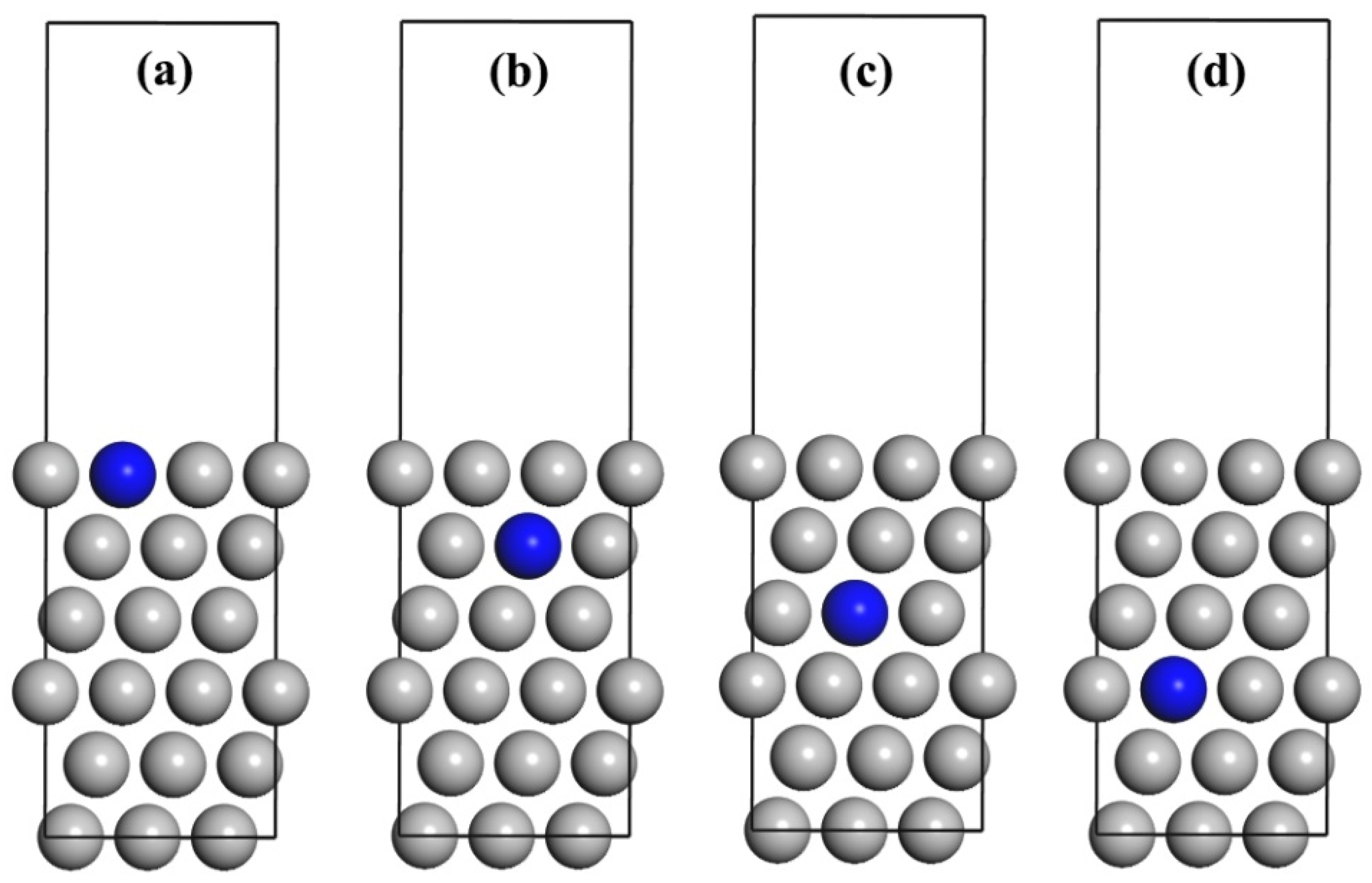
The (111) surface was selected to model both pure Pd and PdM alloy systems, as it is the most prevalent facet for these structures [40]. For the pure Pd model, the DFT-computed lattice constant was determined to be 3.94 Å, a value that aligns well with previous reports [41,42]. The pure Pd system was represented by a six-atomic-layer slab configured as a 3 × 3 supercell, separated by a 15 Å vacuum layer. We constructed PdM alloy models by substituting a Pd atom in the pure Pd(111) slab with an M atom. The M atom plays a role as a prober to determine whether it prefers to stay on the surface or in the bulk, and the substitution site was systematically varied from the first to the fourth atomic layer, as illustrated in Figure 1. To accurately mimic the bulk environment, the bottom two layers of the slab were held fixed at their calculated bulk positions, while the top four layers and the adsorbate were fully relaxed during geometry optimization. Since O2 is known to undergo dissociative adsorption on Pd(111) surfaces [43], our investigations utilized atomic oxygen adsorbate. The electric dipole moment was omitted from the calculations.
We calculated the oxygen adsorption energy ( E a d s ) on the Pd(111) and PdM(111) surfaces using Equation (1):
E a d s = E s l a b + O E s l a b 1 / 2 E O 2 ,
where E s l a b is the adsorption energy per oxygen atom with respect to the gas-phase O2 molecule, following the standard approach [41,42]. E s l a b and E O 2 are the total energies of the bare surface alloy and a gas-phase O2 molecule, respectively, while E s l a b + O is the total energy of the system with the adsorbate. A negative value for E a d s indicates a thermodynamically favorable adsorption process.
Surface segregation, which describes the enrichment of an alloy’s surface by one of its constituent elements, is a critical phenomenon in catalyst design. To analyze the segregation trends of M atoms in a Pd matrix, the segregation energy is defined as the energy difference between a configuration where the M atom resides in the surface layer and a configuration where it resides in the bulk, i.e., the thermodynamic driving force for segregation. A negative value indicates a preference for the surface. Therefore, this energy is calculated using the following equation:
E s e g r = E P d M M , x l a y e r E P d M M , 4 t h l a y e r
In this equation, E P d M M , x l a y e r corresponds to the total energy of the PdM alloy system when the M atom occupies a site within the top x Pd layers (x = 1, 2, or 3), as depicted in Figure 1. Conversely, E P d M M , 4 t h l a y e r denotes the total energy for a configuration in which the M atom resides in the 4th Pd layer, representing a bulk-like environment. For systems with an adsorbed oxygen atom, the segregation energy ( E s e g r ) was determined based on the most energetically favorable location of the M atom within the Pd slab.

3. Results and Discussion

3.1. Adsorption Behavior

To characterize the surface interactions of oxygen, we calculated oxygen adsorption energies for Pd(111) and PdM(111) surfaces with the M atom in various locations. The results, summarized in Table 1, show that the fcc site is the most stable adsorption configuration on Pd(111) surface, consistent with previous computational studies [41,42]. In contrast, oxygen adsorption on PdM(111) surfaces is more complex. When the M atom resides in the topmost layer, the preferred adsorption site for atomic oxygen is the fcc site adjacent to the M atom. The corresponding adsorption energies are −1.83 eV for PdCo(111), −2.09 eV for PdRu(111), −1.44 eV for PdPt(111), and −1.37 eV for the Pd(111). These higher energy magnitudes indicate stronger oxygen binding on the alloy surfaces than on the Pd surface. However, this stabilizing effect diminishes when Co, Ru, or Pt is in the second layer, where the corresponding adsorption energies decrease to −1.29, −1.30, and −1.41 eV, respectively. This indicates a destabilization of the alloy structure. We attribute this phenomenon to a dominant ligand effect; a second-layer M atom modifies the electronic structure of surface metal atoms, shifting the d-band center and thereby weakening the adsorption strength. This illustrates a recognized strategy in binary catalytic systems, where subsurface composition is modulated to tune oxygen binding energy and optimize activity. Further deepening the M atom to the third or fourth layer causes the adsorption energies to converge to values nearly identical to that of Pd(111), implying that these layers can be regarded as part of the bulk phase. This conclusion is supported by the structural data in Table 1; for PdRu(111), which exhibits the strongest oxygen-surface interaction, the shortest O-substrate distance increases from 1.83 Å to 1.99 Å, which is equivalent to the O-Pd distance on the pure surface when Ru is in the deeper layers. A similar trend in bond lengths is observed for the other two Pd-based alloy systems, confirming that an alloy atom situated as deep as the third layer has a negligible influence on oxygen adsorption.

3.2. Segregation Behavior

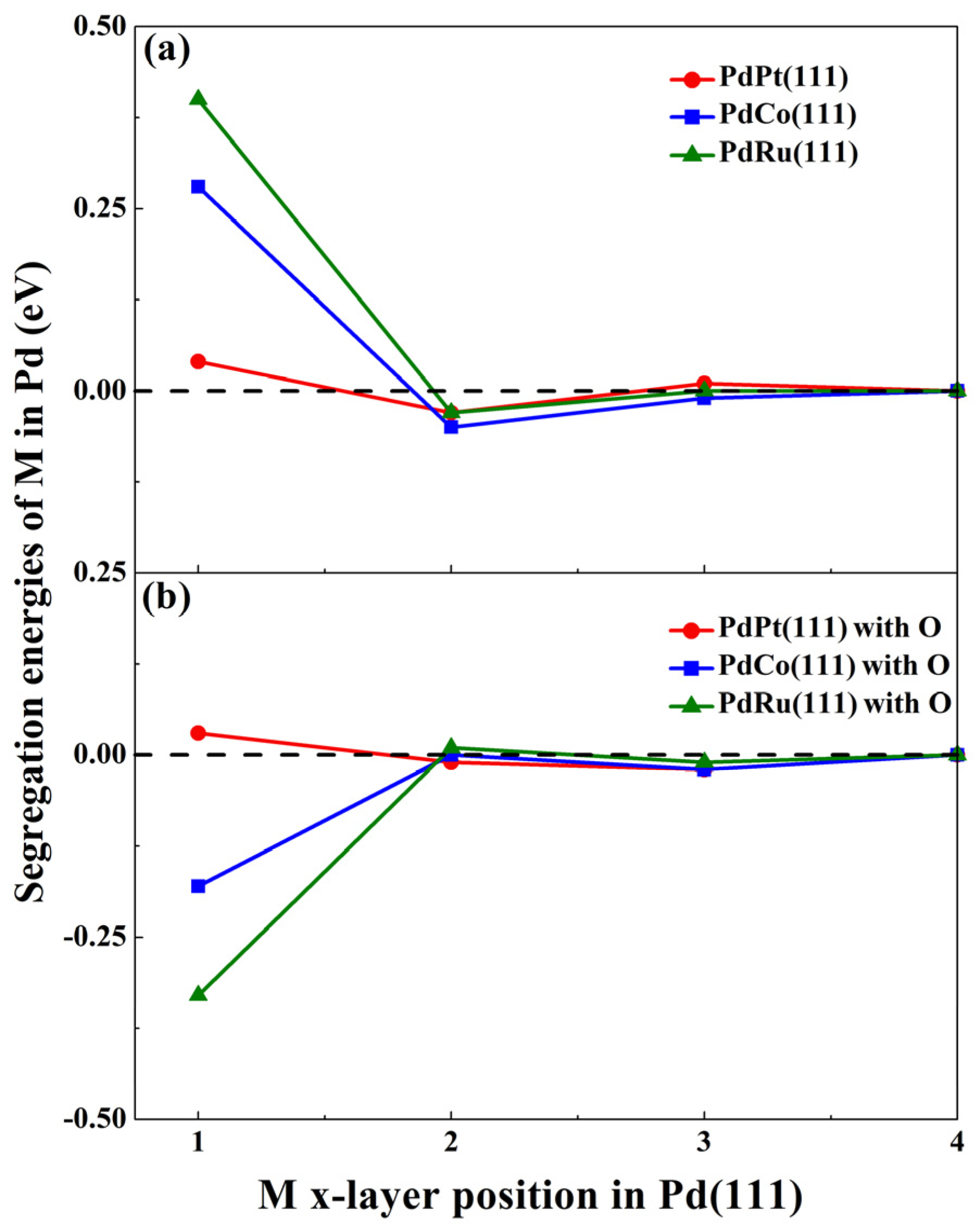
The segregation energies of M atoms (M = Co, Ru, Pt) in PdM(111) alloys were computed to determine their site preferences, both with and without adsorbed atomic oxygen (Figure 2). Without oxygen adsorption (Figure 2a), the positive segregation energies in the topmost layer (0.28 eV for Co, 0.4 eV for Ru, and 0.04 eV for Pt) indicate that surface segregation is energetically unfavorable for all three elements, a finding consistent with previous theoretical work [30,31,32]. The segregation behavior in a vacuum is primarily governed by two key factors: surface energy and atomic size [44,45]. Elements with lower surface energy tend to segregate to the surface, as occupying a surface site allows them to replace higher-energy atoms, thereby reducing the total energy of the system. The second factor is the atomic radius mismatch. Atoms that are significantly larger than the matrix atoms induce compressive strain when located in the bulk lattice. Segregation to the more open surface region enables the release of this strain energy. Consequently, solute atoms that possess both lower surface energy and a larger atomic radius than the host atoms exhibit a stronger tendency to segregate to the surface [7,8]. In the case of Co and Ru, their higher surface energies (2.55 eV/atom for Co, 3.05 eV/atom for Ru, vs. 2.05 eV/atom for Pd [46]) and smaller atomic radii (2.23 Å for Co, 2.34 Å for Ru, vs. 2.37 Å for Pd [47]) rationally explain their resistance to surface segregation. For Pt, while its atomic radius is slightly larger than that of Pd (2.39 Å vs. 2.37 Å [47]), its significantly higher surface energy (2.475 eV/atom vs. 2.05 eV/atom for Pd [46]) becomes the dominant factor, likewise suppressing surface segregation.
In contrast to the topmost layer, the segregation energies for all three elements in the second layer are negative, revealing a thermodynamic preference for this subsurface site. Consequently, the segregation energy exhibits an oscillatory behavior with depth, alternating in sign between the first and second layers. This oscillatory phenomenon is frequently observed in alloy systems [48,49,50,51], and for transition metals like Co, Ru, and Pt, the second layer is often the preferred site. We have previously rationalized this [4,52] based on two key reasons: (1) the solute atom minimizes its own high surface energy by residing just below the surface, and (2) the system could effectively release the strain energy from the atomic radius mismatch when the solute is in the second layer rather than in deeper layers or the bulk. Further supporting this model, the segregation energy approaches zero when the solute atoms are in the third layer, suggesting that this layer’s properties are already bulk-like, similar to the fourth layer. A comparable oscillatory pattern is maintained under oxygen adsorption.
When atomic oxygen is adsorbed (Figure 2b), the segregation energies for Co and Ru in the topmost layer become negative, with values of −0.18 eV and −0.33 eV, respectively. This suggests that under adsorption conditions, both Co and Ru atoms exhibit a strong tendency to segregate toward the surface. Moreover, this finding suggests that the segregation of Ru and Co observed on the Pd-based electrode during the experiment was driven by oxygen adsorption. In contrast, the segregation energy for Pt remains positive (0.03 eV), indicating its continued resistance to surface segregation. This positive value explains why Pt segregation is rarely observed in Pd-based electrodes. Therefore, the order of oxygen’s influence on promoting M segregation is Ru > Co > Pt. Our initial hypothesis was that oxygen adsorption would modulate the segregation energy of M in Pd(111). In line with this hypothesis and the well-established mechanism [8,53], we find that under oxygen adsorption conditions, the M segregation behavior follows distinct trends. For Co and Ru, the stronger binding of atomic oxygen to the alloy surface (compared to Pd(111)) overcomes the opposing effects of their smaller atomic size and higher surface energy, thereby driving them toward the surface. In contrast, for Pt, the weaker oxygen binding relative to Pd leaves its segregation tendency unaffected, which is consistent with expectations.

3.3. Electronic Structure Analysis

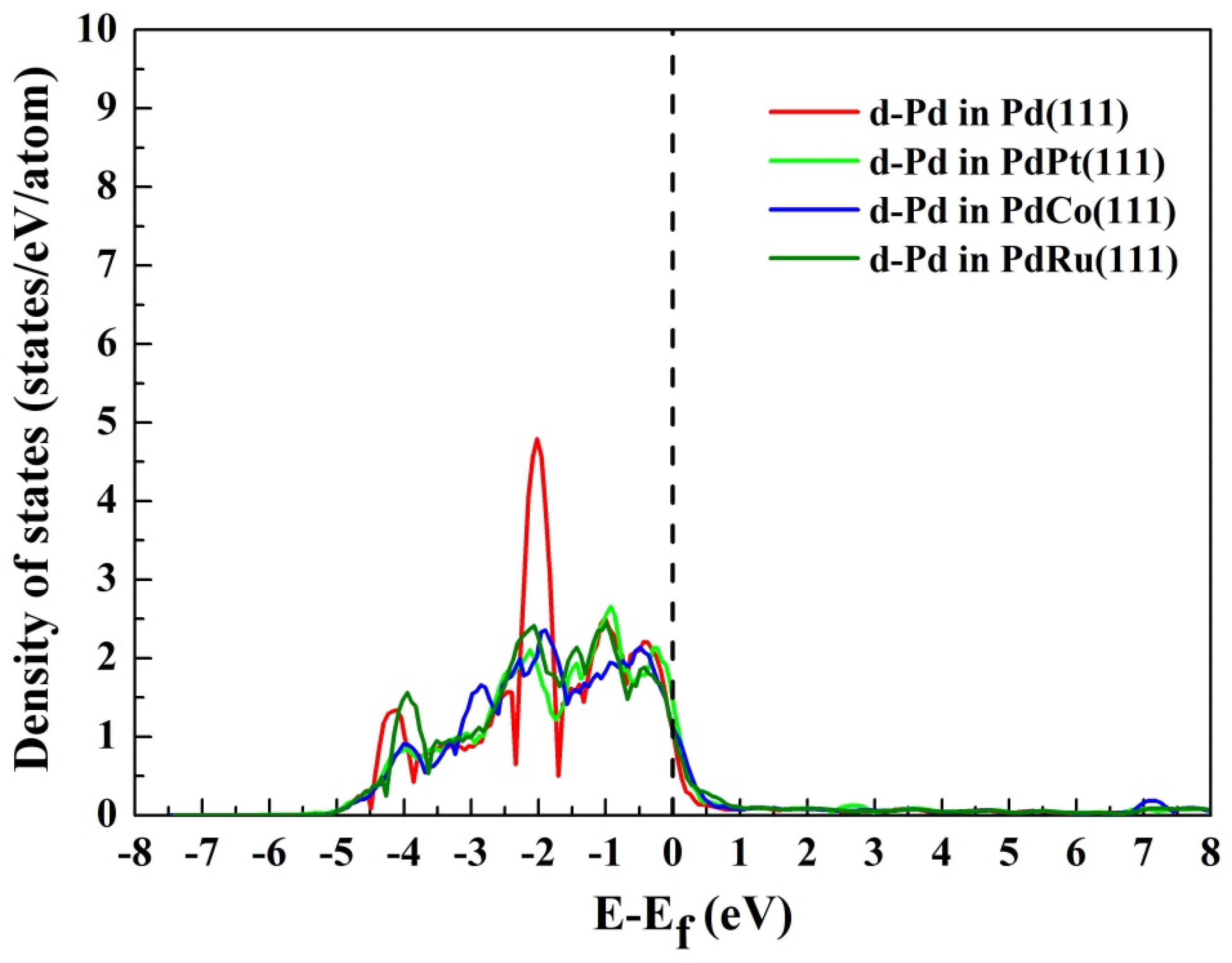
The density of states (DOS) is a key physical quantity that offers fundamental insights into the bonding characteristics of materials. In the context of surface catalysis, the d-electron DOS provides a critical reference for understanding molecular adsorption behaviors on alloys. To probe the localized effects of alloying on the electronic structure, we calculated the d-band DOS for Pd atoms in the topmost layer of the clean alloy surface and compared it with that of pure Pd. As shown in Figure 3, the d-band DOS for a Pd atom neighboring an M impurity atom shifts upward toward higher energies, approaching the Fermi level compared to pure Pd. This shift in the DOS profile is directly reflected in the d-band center, which moves from −1.34 eV in pure Pd to −1.27 eV in PdRu and to −1.23 eV in PdCo and PdPt. According to the d-band center model [54,55], these positive shifts correlate strongly with enhanced oxygen adsorption strengths, a key factor that can promote elemental segregation on the alloy surface.
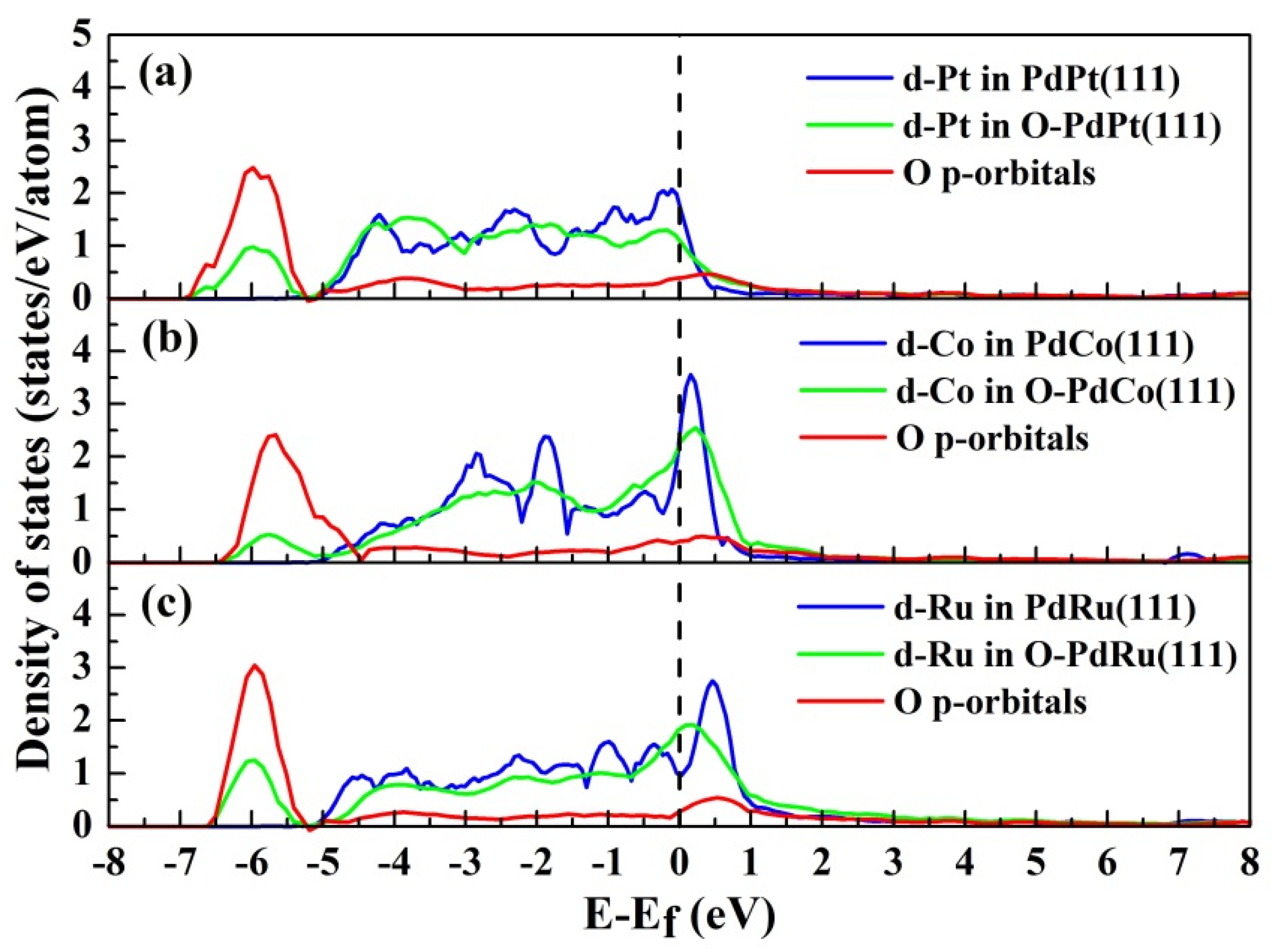
Figure 4 presents the d-band DOS for Pt, Co, and Ru atoms located in the top-most layer of alloy surfaces before and after oxygen adsorption. From Figure 4, we can observe that oxygen interaction drastically modifies the d-band DOS of Pt, Co, and Ru atoms on the alloy surfaces compared to the clean surface. These modifications are characterized by three key features. Firstly, the d-band DOS is significantly widened upon oxygen adsorption. This broadening is understood through the adsorbate-induced increase in the surface atoms’ coordination number, an effect that widens the DOS distribution [56]. Secondly, the broadening is accompanied by a shift of some d-states to lower energies. This downshift lowers the total system energy, thereby enhancing its stability. Thirdly, a direct comparison between systems reveals a stark contrast. For the O–PdRu system, the anti-bonding states above the Fermi level are largely unoccupied, and the overlap between d-states of Ru and p-states of O is the greatest. This facilitates the strongest covalent bonding and hybridization. Conversely, for the O–PdPt system, the corresponding anti-bonding states are only partially unoccupied, and the d-states of Pt and p-states of O exhibit the smallest overlap, resulting in the weakest covalent interaction. These observations are consistent with our computational findings.

4. Conclusions

We employed ab initio calculations to investigate segregation on the (111) surface of PdM (M = Co, Ru, Pt) alloys under the influence of adsorbed atomic oxygen. Our results demonstrate that the presence of oxygen can markedly alter the segregation tendencies of the alloying elements. For the PdPt(111) system, Pt atoms exhibit a preference for the bulk in the presence of oxygen, a behavior consistent with their segregation trend under vacuum conditions. In contrast, Co and Ru atoms show a strong driving force to segregate to the surface upon oxygen adsorption. A comparison of oxygen adsorption behavior on PdM(111) indicates that the strength of oxygen’s influence on promoting M segregation follows the order Ru > Co > Pt. An electronic structure analysis for the clean PdM(111) surface shows that the d-band DOS for a Pd atom neighboring an M impurity atom shifts upward toward higher energies, approaching the Fermi level compared to pure Pd. These positive shifts correlate strongly with enhanced oxygen adsorption strengths, a key factor that can promote elemental segregation on the alloy surface. Notably, in the presence of the adsorbate, the d-band DOS broadens and shifts to lower energies, potentially lowering the system’s total energy and enhancing stability. These insights offer a theoretical foundation for the rational design of Pd-based alloy catalysts for applications such as the hydrogen evolution reaction.

Author Contributions

Conceptualization, Y.L.; methodology, Y.Y.; software, R.Z.; validation, Q.H.; formal analysis, Y.Y.; investigation, Y.Y.; resources, Y.L.; data curation, Y.W.; writing—original draft preparation, Y.Y.; writing—review and editing, Y.L.; visualization, Y.Y.; supervision, Y.L.; project administration, Y.W.; funding acquisition, Y.L. All authors have read and agreed to the published version of the manuscript.

Funding

This research was funded by the Foundation Research Project of Kaili University, grant number 2025YB037, and Guizhou Provincial Basic Research Program (Natural Science) of Youth Guidance (Qian Ke He Jichu-[2024]Qingnian 024). The APC was funded by the Foundation Research Project of Kaili University.

Data Availability Statement

The authors confirm that the data supporting the findings of this study are available within the article.

Acknowledgments

The authors would like to acknowledge the support of the Foundation Research Project of Kaili University (2025YB037) and Guizhou Provincial Basic Research Program (Natural Science) of Youth Guidance (Qian Ke He Jichu-[2024]Qingnian 024).

Conflicts of Interest

The authors declare no conflicts of interest.

References

  1. Jin, Y.; Deng, N.; Li, Y.; Wang, H.; Zhang, M.; Kang, W.; Cheng, B. Advanced preparation and application of bimetallic materials in lithium-sulfur batteries: A review. J. Energy Chem. 2024, 88, 469–512. [Google Scholar] [CrossRef]
  2. Wu, Y.-Y.; Tian, X.; Jiang, Y.; Ma, H.-Y.; Wang, W.; Zhang, W.-S.; San Martin, J.; Yan, Y.; Qin, D.-D.; Han, D.-X. Advances in bimetallic materials and bimetallic oxide nanozymes: Synthesis, classification, catalytic mechanism and application in analytical chemistry. TrAC Trends Anal. Chem. 2024, 176, 117757. [Google Scholar] [CrossRef]
  3. Yu, Y.; Hu, Q.; Xiao, W.; Wang, J.; Wang, L. Design of highly efficient Ni-based water-electrolysis catalysts by a third transition metal addition into Ni3Mo. Intermetallics 2018, 94, 99–105. [Google Scholar] [CrossRef]
  4. Yu, Y.; Xiao, W.; Wang, J.; Wang, L. Understanding the surface segregation behavior of transition metals on Ni (111): A first-principles study. Phys. Chem. Chem. Phys. 2016, 18, 26616–26622. [Google Scholar] [CrossRef]
  5. Pia, G.; Sogne, E.; Falqui, A.; Delogu, F. Ag surface segregation in nanoporous Au catalysts during CO oxidation. Sci. Rep. 2018, 8, 15208. [Google Scholar] [CrossRef] [PubMed]
  6. Bishop, A.R.; Girolami, G.S.; Nuzzo, R.G. Surface-mediated segregation and transport processes in mixed hydrocarbon multilayer assemblies. J. Phys. Chem. B 2000, 104, 747–753. [Google Scholar] [CrossRef]
  7. Yu, Y.; Liu, Z.; Huang, W.; Zhou, S.; Hu, Z.; Wang, L. Density functional theory study of Ni segregation in CuNi (111) alloy with chemisorbed CO, O, or H. J. Phys. Chem. Solids 2022, 171, 111021. [Google Scholar] [CrossRef]
  8. Yu, Y.; Huang, W.; Liu, Z.; Hu, Z.; Wang, L. First-principles study of surface segregation in bimetallic Cu3M (1 1 1)(M= Au, Ag, and Zn) alloys in presence of adsorbed CO. Comput. Mater. Sci. 2022, 212, 111550. [Google Scholar] [CrossRef]
  9. Mashkovsky, I.; Bukhtiyarov, A.; Markov, P.; Bragina, G.; Baeva, G.; Smirnova, N.; Panafidin, M.; Chetyrin, I.; Gerasimov, E.Y.; Zubavichus, Y. Catalytic performance of a single atom Pd1Ag10/Al2O3 catalyst for the selective hydrogenation of acetylene: The role of CO-induced segregation. Appl. Surf. Sci. 2025, 681, 161516. [Google Scholar] [CrossRef]
  10. Lee, K.-S.; Park, H.-Y.; Ham, H.C.; Yoo, S.J.; Kim, H.J.; Cho, E.; Manthiram, A.; Jang, J.H. Reversible surface segregation of Pt in a Pt3Au/C catalyst and its effect on the oxygen reduction reaction. J. Phys. Chem. C 2013, 117, 9164–9170. [Google Scholar] [CrossRef]
  11. Wang, J.W.; Wang, Y.F.; Zhang, J.G.; Yu, Y.L.; Zhou, G.G. Optimization of electrocatalytic properties of NiMoCo foam electrode for water electrolysis by post-treatment processing. Rare Met. 2015, 34, 802–807. [Google Scholar] [CrossRef]
  12. Liu, Y.; Xu, C. Nanoporous PdTi alloys as non-platinum oxygen-reduction reaction electrocatalysts with enhanced activity and durability. ChemSusChem 2013, 6, 78–84. [Google Scholar] [CrossRef]
  13. Bollmann, L.; Ratts, J.L.; Joshi, A.M.; Williams, W.D.; Pazmino, J.; Joshi, Y.V.; Miller, J.T.; Kropf, A.J.; Delgass, W.N.; Ribeiro, F.H. Effect of Zn addition on the water–gas shift reaction over supported palladium catalysts. J. Catal. 2008, 257, 43–54. [Google Scholar] [CrossRef]
  14. Duan, K.; Liu, Z.; Li, J.; Yuan, L.; Hu, H.; Woo, S.I. Novel Pd–Au/TiO2 catalyst for the selective catalytic reduction of NOx by H2. Catal. Commun. 2014, 57, 19–22. [Google Scholar] [CrossRef]
  15. Iwasa, N.; Suzuki, H.; Terashita, M.; Arai, M.; Takezawa, N. Methanol synthesis from CO2 under atmospheric pressure over supported Pd catalysts. Catal. Lett. 2004, 96, 75–78. [Google Scholar] [CrossRef]
  16. Hohn, K.L.; Lin, Y.C. Catalytic partial oxidation of methanol and ethanol for hydrogen generation. ChemSusChem 2009, 2, 927–940. [Google Scholar] [CrossRef]
  17. Xu, X.; Shuai, K.; Xu, B. Review on copper and palladium based catalysts for methanol steam reforming to produce hydrogen. Catalysts 2017, 7, 183. [Google Scholar] [CrossRef]
  18. Kaya, D.; Isik, H.H.; Isik, I.B.; Sigircik, G.; Tuken, T.; Karadag, F.; Ekicibil, A. Electrocatalytic hydrogen evolution on metallic and bimetallic Pd–Co alloy nanoparticles. Int. J. Hydrogen Energy 2023, 48, 14633–14641. [Google Scholar] [CrossRef]
  19. Thirugalathi Anbalagan, R.; Thirugnanasambandan, S.; Saminathan, D.; Peri, R.; Muthuraaman, B.; Vengidusamy, N.; Arumainathan, S. Carbonaceous nanocomposites decorated with Pd-Co alloy as catalyst for hydrogen evolution reaction. Ionics 2024, 30, 445–455. [Google Scholar] [CrossRef]
  20. Li, T.; Wang, R.; Yang, M.; Zhao, S.; Li, Z.; Miao, J.; Gao, Z.-D.; Gao, Y.; Song, Y.-Y. Tuning the surface segregation composition of a PdCo alloy by the atmosphere for increasing electrocatalytic activity. Sustain. Energy Fuels 2020, 4, 380–386. [Google Scholar] [CrossRef]
  21. Wang, Y.; Zhang, L.; Hu, C.; Yu, S.; Yang, P.; Cheng, D.; Zhao, Z.-J.; Gong, J. Fabrication of bilayer Pd-Pt nanocages with sub-nanometer thin shells for enhanced hydrogen evolution reaction. Nano Res. 2019, 12, 2268–2274. [Google Scholar] [CrossRef]
  22. Lv, H.; Chen, X.; Xu, D.; Hu, Y.; Zheng, H.; Suib, S.L.; Liu, B. Ultrathin PdPt bimetallic nanowires with enhanced electrocatalytic performance for hydrogen evolution reaction. Appl. Catal. B 2018, 238, 525–532. [Google Scholar] [CrossRef]
  23. Tian, J.; Wu, W.; Tang, Z.; Wu, Y.; Burns, R.; Tichnell, B.; Liu, Z.; Chen, S. Oxygen reduction reaction and hydrogen evolution reaction catalyzed by Pd–Ru nanoparticles encapsulated in porous carbon nanosheets. Catalysts 2018, 8, 329. [Google Scholar] [CrossRef]
  24. Qin, X.; Zhang, L.; Xu, G.-L.; Zhu, S.; Wang, Q.; Gu, M.; Zhang, X.; Sun, C.; Balbuena, P.B.; Amine, K. The role of Ru in improving the activity of Pd toward hydrogen evolution and oxidation reactions in alkaline solutions. ACS Catal. 2019, 9, 9614–9621. [Google Scholar] [CrossRef]
  25. Adit Maark, T.; Peterson, A.A. Understanding strain and ligand effects in hydrogen evolution over Pd (111) surfaces. J. Phys. Chem. C 2014, 118, 4275–4281. [Google Scholar] [CrossRef]
  26. Xia, Z.; Guo, S. Strain engineering of metal-based nanomaterials for energy electrocatalysis. Chem. Soc. Rev. 2019, 48, 3265–3278. [Google Scholar] [CrossRef]
  27. Yan, K.; Maark, T.A.; Khorshidi, A.; Sethuraman, V.A.; Peterson, A.A.; Guduru, P.R. The influence of elastic strain on catalytic activity in the hydrogen evolution reaction. Angew. Chem. Int. Ed. 2016, 55, 6175–6181. [Google Scholar] [CrossRef] [PubMed]
  28. Ding, L.; Qian, X.; Li, A.; Zhao, Y.; Li, Z.; He, X. PdNi alloys with surface segregation of Pd@ hydrophilic N, O doped carbons toward hydrogen production with high current densities. Appl. Surf. Sci. 2024, 643, 158652. [Google Scholar] [CrossRef]
  29. Hu, Z.; Li, H.; Zhao, W.; Zhou, W.; Hu, S. Microstructure determination of PdRu immiscible alloys based on electron-pair distribution function and local elemental segregation. Cell Rep. Phys. Sci. 2023, 4, 101713. [Google Scholar] [CrossRef]
  30. Ruban, A.; Skriver, H. Calculated surface segregation in transition metal alloys. Comput. Mater. Sci. 1999, 15, 119–143. [Google Scholar] [CrossRef]
  31. Ruban, A.V.; Skriver, H.L.; Norskov, J.K. Surface segregation energies in transition-metal alloys. Phys. Rev. B 1999, 59, 15990–16000. [Google Scholar] [CrossRef]
  32. Lovvik, O. Surface segregation in palladium based alloys from density-functional calculations. Surf. Sci. 2005, 583, 100–106. [Google Scholar] [CrossRef]
  33. Perdew, J.P.; Burke, K.; Ernzerhof, M. Generalized Gradient Approximation Made Simple. Phys. Rev. Lett. 1996, 77, 3865–3868. [Google Scholar] [CrossRef]
  34. Kresse, G.; Furthmüller, J. Efficiency of ab-initio total energy calculations for metals and semiconductors using a plane-wave basis set. Comput. Mater. Sci. 1996, 6, 15–50. [Google Scholar] [CrossRef]
  35. Kresse, G.; Furthmüller, J. Efficient iterative schemes for ab initio total-energy calculations using a plane-wave basis set. Phys. Rev. B Condens. Matter 1996, 54, 11169–11186. [Google Scholar] [CrossRef]
  36. Kresse, G.; Hafner, J. Ab initio molecular-dynamics simulation of the liquid-metal-amorphous-semiconductor transition in germanium. Phys. Rev. B 1993, 49, 14251–14269. [Google Scholar] [CrossRef] [PubMed]
  37. Blöchl, P.E. Projector augmented-wave method. Phys. Rev. B Condens. Matter 1994, 50, 2665–2668. [Google Scholar] [CrossRef]
  38. Kresse, G.; Joubert, D. From ultrasoft pseudopotentials to the projector augmented-wave method. Phys. Rev. B 1999, 59, 1758–1775. [Google Scholar] [CrossRef]
  39. Monkhorst, H.J.; Hendrik, J.; James, D. Special points for Brillouin-zone integrations. Phys. Rev. B 1976, 13, 5188–5192. [Google Scholar] [CrossRef]
  40. Bukas, V.J.; Reuter, K. A comparative study of atomic oxygen adsorption at Pd surfaces from Density Functional Theory. Surf. Sci. 2017, 658, 38–45. [Google Scholar] [CrossRef]
  41. Sankarasubramanian, S.; Singh, N.; Mizuno, F.; Prakash, J. Ab initio investigation of the oxygen reduction reaction activity on noble metal (Pt, Au, Pd), Pt3M (M= Fe, Co, Ni, Cu) and Pd3M (M= Fe, Co, Ni, Cu) alloy surfaces, for LiO2 cells. J. Power Sources 2016, 319, 202–209. [Google Scholar] [CrossRef]
  42. Wen, Y.; Yu, Y.; Gu, H.; Shi, Y.; Zhao, G.; Li, Y.; Huang, Q. Ab Initio Study of Ti Segregation on the Pd–Ti Alloy Surface in the Presence of Adsorbed Atomic Oxygen. Catalysts 2025, 15, 661. [Google Scholar] [CrossRef]
  43. Yu, Y.; Gu, H.; Wu, G.; Liu, X. Density functional theory study of dissociative adsorption of O2 on Pd-skin Pd3Cu (1 1 1) surface. Comput. Mater. Sci. 2024, 237, 112876. [Google Scholar] [CrossRef]
  44. Wang, G.; Hove, M.A.V.; Ross, P.N.; Baskes, M.I. Quantitative prediction of surface segregation in bimetallic Pt–M alloy nanoparticles (M=Ni,Re,Mo). Prog. Surf. Sci. 2005, 79, 28–45. [Google Scholar] [CrossRef]
  45. Zhang, Y.; Duan, Z.; Xiao, C.; Wang, G. Density functional theory calculation of platinum surface segregation energy in Pt3Ni (111) surface doped with a third transition metal. Surf. Sci. 2011, 605, 1577–1582. [Google Scholar] [CrossRef]
  46. DeBoer, F.R.; Boom, R.; Miedema, A.R. Cohesion in Metals, 2nd ed.; North-Holland Physics Publishing: Amsterdam, The Netherlands, 1989; pp. 657–660. [Google Scholar]
  47. Allinger, N.L.; Zhou, X.; Bergsma, J. Molecular mechanics parameters. J. Mol. Struct. THEOCHEM 1994, 312, 69–83. [Google Scholar] [CrossRef]
  48. Florencio, J.; Ren, D.M.; Tsong, T.T. Absolute composition depth-profiles in surface segregation of Pt-Rh alloys. Surf. Sci. 1996, 345, 29–33. [Google Scholar] [CrossRef]
  49. Helfensteyn, S.; Luyten, J.; Feyaerts, L.; Creemers, C. Modelling surface phenomena in Pd-Ni alloys. Appl. Surf. Sci. 2003, 75, 844–849. [Google Scholar] [CrossRef]
  50. Kuntze, J.; Speller, S.; Heiland, W.; Deurinck, P.; Creemers, C.; Atrei, A.; Bardi, U. Surface structure and segregation profile of the alloy Au3Pd(110): Experiment and theory. Phys. Rev. B 1999, 60, 9010–9018. [Google Scholar] [CrossRef]
  51. Ren, D.M.; Qin, J.H.; Wang, J.B.; Tsong, T.T. Oscillatory compositional depth profiles in surface segregation of a Pt-Rh alloy. Phys. Rev. B Condens. Matter 1993, 47, 3944–3946. [Google Scholar] [CrossRef] [PubMed]
  52. Yu, Y.; Xiao, W.; Wang, J.; Wang, L. First-Principles Study of Mo Segregation in MoNi(111): Effects of Chemisorbed Atomic Oxygen. Materials 2016, 9, 5. [Google Scholar] [CrossRef] [PubMed]
  53. Ma, Y.; Balbuena, P.B. Surface segregation in bimetallic Pt3M (M = Fe, Co, Ni) alloys with adsorbed oxygen. Surf. Sci. 2009, 603, 349–353. [Google Scholar] [CrossRef]
  54. Hammer, B.; Norskov, J.K. Why gold is the noblest of all the metals. Nature 1995, 376, 238–240. [Google Scholar] [CrossRef]
  55. Hammer, B.; Nørskov, J.K. Electronic factors determining the reactivity of metal surfaces. Surf. Sci. 1995, 343, 211–220. [Google Scholar] [CrossRef]
  56. Wang, L.G.; Tsymbal, E.Y.; Jaswal, S.S. Structural and magnetic properties of clean and methylthiolate-adsorbed Co(0001) surfaces: A first-principles study. J. Magn. Magn. Mater. 2005, 286, 119–123. [Google Scholar] [CrossRef]
Figure 1. The PdM(111) alloy slab model, which was constructed by substituting a single Pd atom with an M atom in either the first (a), second (b), third (c), or fourth (d) layer. Pd and M atoms are denoted by gray and blue spheres, respectively.
Catalysts 16 00469 g001
Figure 2. Evolution of the segregation energies (eV) of M from the Pd ‘bulk’ (4th layer) to upper surface layers without (a) and with (b) oxygen adsorption.
Catalysts 16 00469 g002
Figure 3. Calculated density of states (DOS) for Pd atoms in the topmost layer on the surfaces of the clean alloy and pure Pd.
Catalysts 16 00469 g003
Figure 4. The d-band DOS for (a) Pt, (b) Co, and (c) Ru atoms located in the alloy surfaces before and after oxygen adsorption.
Catalysts 16 00469 g004
Table 1. Calculated oxygen adsorption energies (Eads, eV) for Pd and PdM(111) surfaces. The parameter d(M–O) (Å) specifies the shortest measured distance from the oxygen atom to the nearest surface metal atom.
PdPdCoPdRuPdPt
Eadsd(M–O)Eadsd(M–O)Eadsd(M–O)Eadsd(M–O)
Pd−1.371.99
PdM(M,1st-layer) −1.831.78−2.091.83−1.441.97
PdM(M,2nd-layer) −1.292.00−1.302.00−1.411.99
PdM(M,3rd-layer) −1.381.99−1.411.99−1.381.99
PdM(M,4th-layer) −1.371.99−1.381.99−1.341.99
Disclaimer/Publisher’s Note: The statements, opinions and data contained in all publications are solely those of the individual author(s) and contributor(s) and not of MDPI and/or the editor(s). MDPI and/or the editor(s) disclaim responsibility for any injury to people or property resulting from any ideas, methods, instructions or products referred to in the content.