Metal-Doped TiO2 Optical Fiber Textiles for Concurrent Removal of Airborne Bacteria and Volatile Organic Compounds

 ,
,  , , , , ,
  and
and 
Abstract
1. Introduction
2. Results and Discussion
2.1. Photocatalytic Study
2.1.1. Biological Treatment
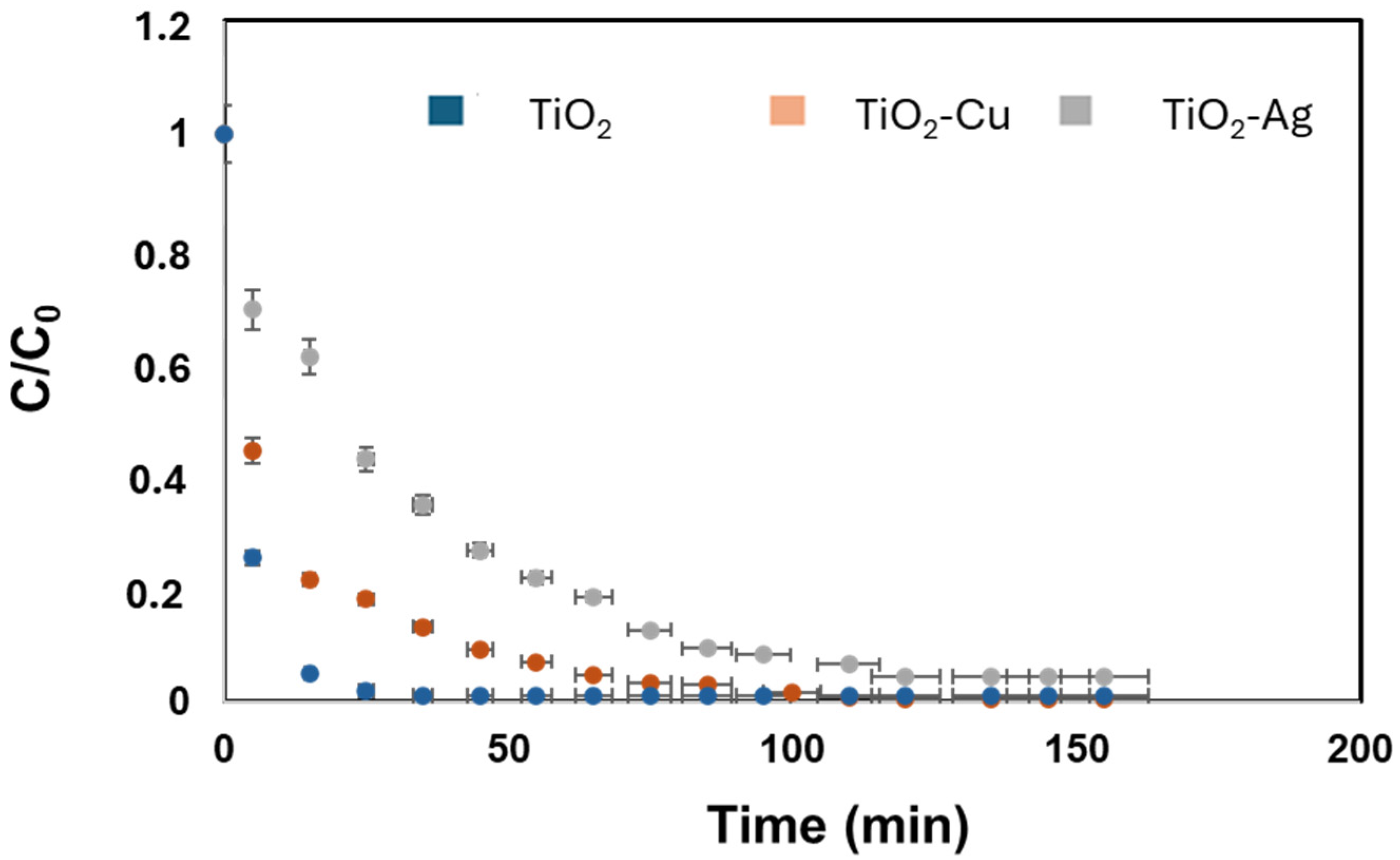
2.1.2. Oxidation of Organic Molecules
2.2. Effect of Operating Parameters on Chemical Treatment
2.3. Combination Treatment
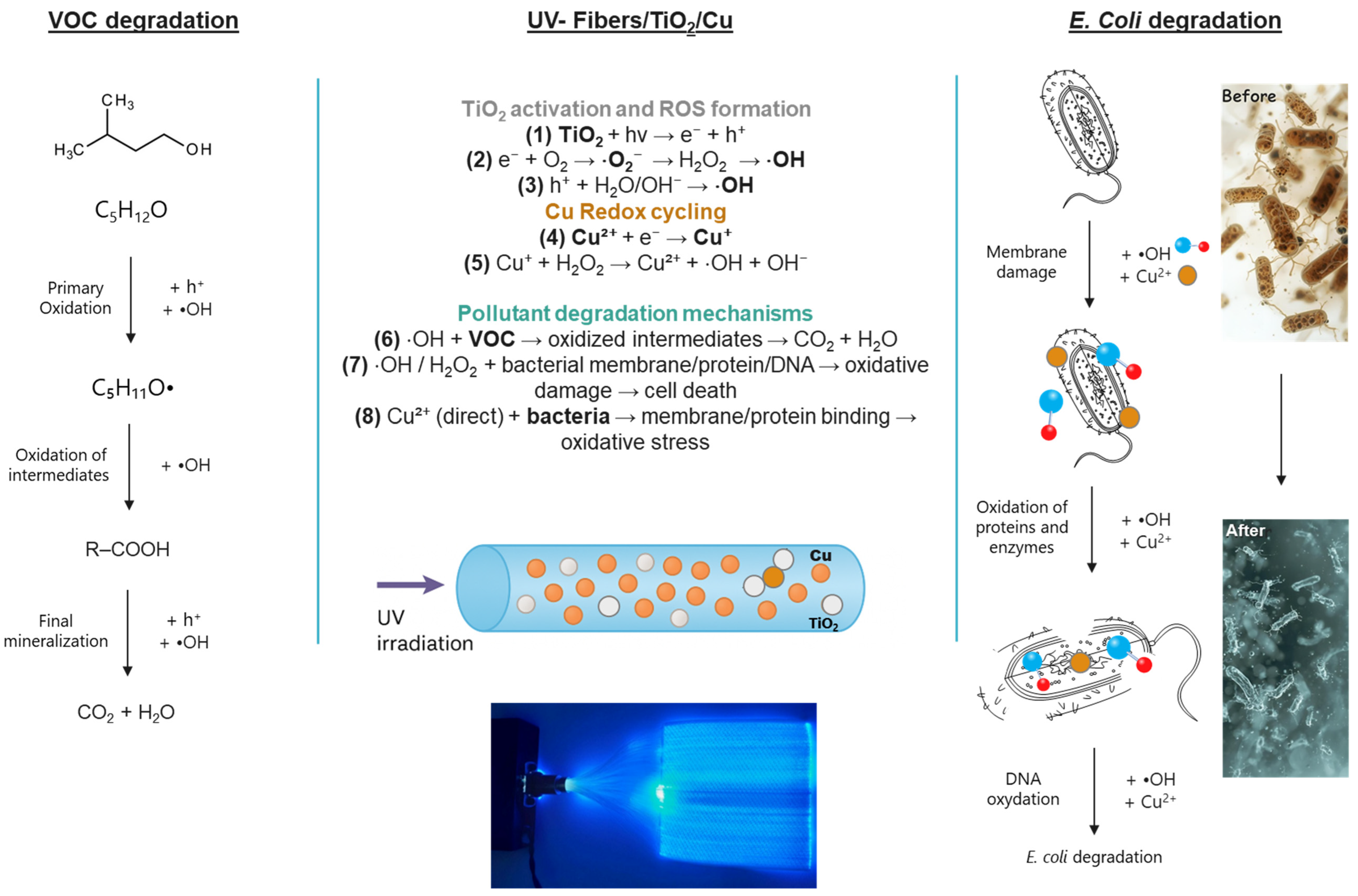
2.4. Mechanisms of Photocatalytic Activity
3. Materials and Methods
3.1. Target Pollutants
3.2. Photocatalytic Supports and Irradiation Modes
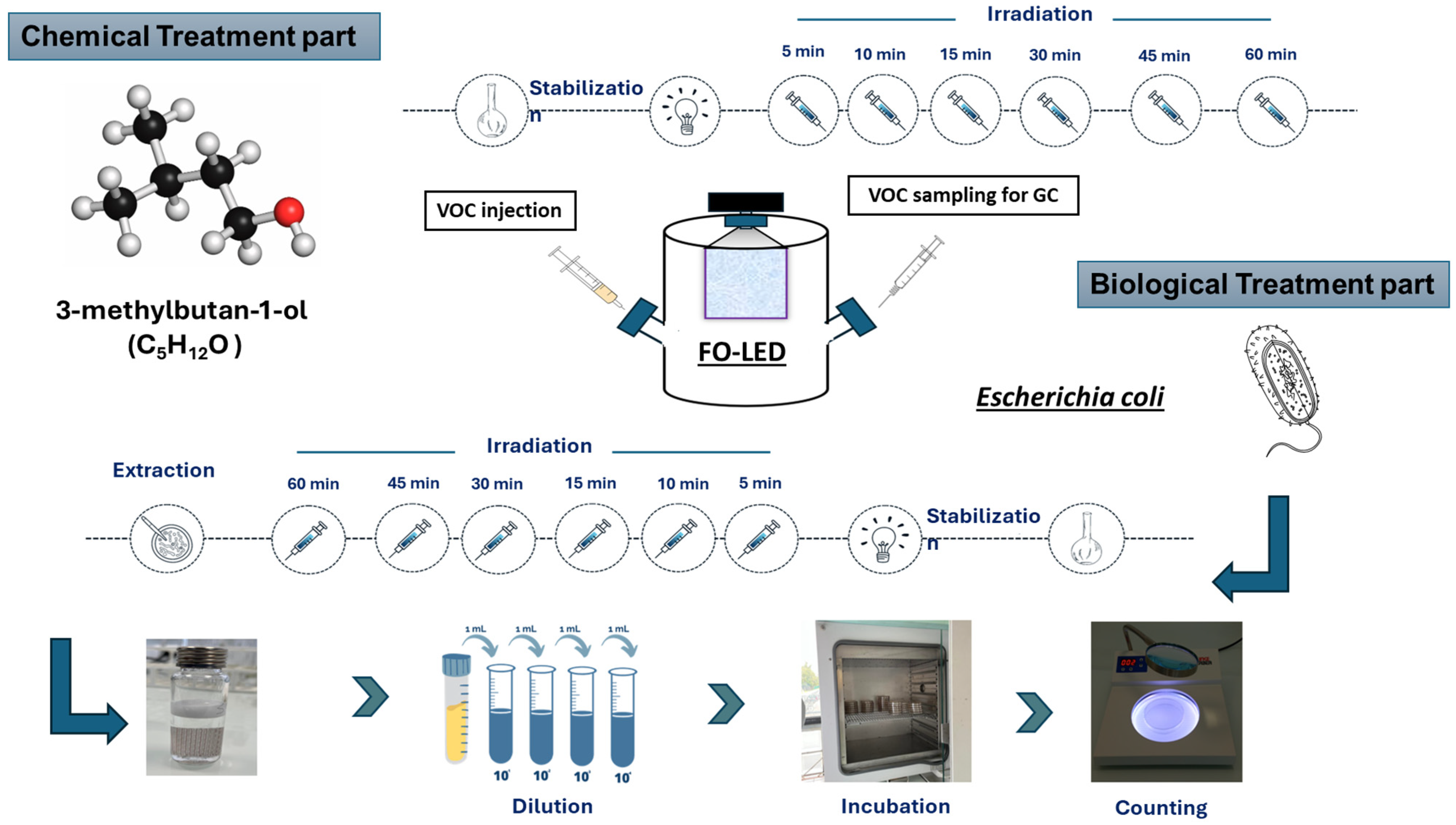
3.3. Experimental Setup and Analytical Methods
3.3.1. Experimental Setup
3.3.2. Analytical Methods
- (a)
- Biological treatment part
- (b)
- Chemical treatment
4. Conclusions
Supplementary Materials
Author Contributions
Funding
Data Availability Statement
Conflicts of Interest
References
- Nie, Y.; Li, D.; Peng, Y.; Wang, S.; Hu, S.; Liu, M.; Ding, J.; Zhou, W. Metal organic framework coated MnO2 nanosheets delivering doxorubicin and self-activated DNAzyme for chemo-gene combinatorial treatment of cancer. Int. J. Pharm. 2020, 585, 119513. [Google Scholar] [CrossRef]
- Lu, J.Y.; Bu, Z.Q.; Lei, Y.Q.; Wang, D.; He, B.; Wang, J.; Huang, W.T. Facile microwave-assisted synthesis of Sb2O3-CuO nanocomposites for catalytic degradation of p-nitrophenol. J. Mol. Liq. 2024, 409, 125503. [Google Scholar] [CrossRef]
- Zhou, Q.; Liu, Z.; Wang, X.; Li, Y.; Qin, X.; Guo, L.; Zhou, L.; Xu, W. Co3S4-pyrolysis lotus fiber flexible textile as a hybrid electrocatalyst for overall water splitting. J. Energy Chem. 2024, 89, 336–344. [Google Scholar] [CrossRef]
- Bouazizi, A.; Obrová, K.; Vaňková, E.; Machková, A.; Khun, J.; Hadravová, R.; Hodek, J.; Ulrychová, L.; Trabelsi, A.; Weber, J.; et al. 3D-printed devices for optimized generation of cold atmospheric plasma to improve decontamination of surfaces from respiratory pathogens. Int. J. Bioprinting 2024, 10, 3679. [Google Scholar] [CrossRef]
- Zhao, M.; Huang, J.; Yang, H.; Yang, R.; Guo, S.; Liu, Z.; Xie, Q.; Li, M.; Fan, Z.; Xiao, P.; et al. Engineered aggregation-induced emission luminogens-based framework with CO-releasing property for accelerating diabetic wound healing. Chem. Eng. J. 2025, 524, 168981. [Google Scholar] [CrossRef]
- Daub, N.A.; Aziz, F.; Aziz, M.; Jaafar, J.; Salleh, W.N.W.; Yusof, N.; Ismail, A.F. A Mini Review on Parameters Affecting the Semiconducting Oxide Photocatalytic Microbial Disinfection. Water Air Soil Pollut. 2020, 231, 461. [Google Scholar] [CrossRef]
- He, J.; Kumar, A.; Khan, M.; Lo, I.M.C. Critical Review of Photocatalytic Disinfection of Bacteria: From Noble Metals- and Carbon Nanomaterials-TiO2 Composites to Challenges of Water Characteristics and Strategic Solutions. Sci. Total Environ. 2021, 758, 143953. [Google Scholar] [CrossRef]
- Alotaibi, A.M.; Williamson, B.A.D.; Sathasivam, S.; Kafizas, A.; Alqahtani, M.; Sotelo-Vazquez, C.; Buckeridge, J.; Wu, J.; Nair, S.P.; Scanlon, D.O.; et al. Enhanced Photocatalytic and Antibacterial Ability of Cu-Doped Anatase TiO2 Thin Films: Theory and Experiment. ACS Appl. Mater. Interfaces 2020, 12, 15348–15361. [Google Scholar] [CrossRef]
- Chakhtouna, H.; Benzeid, H.; Zari, N.; el kacem Qaiss, A.; Bouhfid, R. Recent Progress on Ag/TiO2 Photocatalysts: Photocatalytic and Bactericidal Behaviors. Environ. Sci. Pollut. Res. 2021, 28, 44638–44666. [Google Scholar] [CrossRef]
- Hajjaji, M.A.; Missaoui, K.; Trabelsi, K.; Bouzaza, A.; Hajjaji, A.; Bessais, B.; Assadi, A.A. Platinum Nanoparticles Decorated TiO2 Nanotubes for VOCs and Bacteria Removal in Simulated Real Condition: Effect of the Deposition Method on the Photocatalytic Degradation Process Efficiency. J. Photochem. Photobiol. A Chem. 2025, 458, 115975. [Google Scholar] [CrossRef]
- Abou Saoud, W.; Kane, A.; Le Cann, P.; Gerard, A.; Lamaa, L.; Peruchon, L.; Brochier, C.; Bouzaza, A.; Wolbert, D.; Assadi, A.A. Innovative Photocatalytic Reactor for the Degradation of VOCs and Microorganism under Simulated Indoor Air Conditions: Cu-Ag/TiO2-Based Optical Fibers at a Pilot Scale. Chem. Eng. J. 2021, 411, 128622. [Google Scholar] [CrossRef]
- Qiu, H.; Fang, S.; Huang, G.; Bi, J. A Novel Application of In2S3 for Visible-Light-Driven Photocatalytic Inactivation of Bacteria: Kinetics, Stability, Toxicity and Mechanism. Environ. Res. 2020, 190, 110018. [Google Scholar] [CrossRef]
- Unnikrishnan, B.; Gultom, I.S.; Tseng, Y.T.; Chang, H.T.; Huang, C.C. Controlling Morphology Evolution of Titanium Oxide–Gold Nanourchin for Photocatalytic Degradation of Dyes and Photoinactivation of Bacteria in the Infected Wound. J. Colloid Interface Sci. 2021, 598, 260–273. [Google Scholar] [CrossRef]
- Levchuk, I.; Kralova, M.; Rueda-Márquez, J.J.; Moreno-Andrés, J.; Gutiérrez-Alfaro, S.; Dzik, P.; Parola, S.; Sillanpää, M.; Vahala, R.; Manzano, M.A. Antimicrobial Activity of Printed Composite TiO2/SiO2 and TiO2/SiO2/Au Thin Films under UVA-LED and Natural Solar Radiation. Appl. Catal. B 2018, 239, 609–618. [Google Scholar] [CrossRef]
- Zhang, J.; Suo, X.; Zhang, J.; Han, B.; Li, P.; Xue, Y.; Shi, H. One-Pot Synthesis of Au/TiO2 Heteronanostructure Composites with SPR Effect and Its Antibacterial Activity. Mater. Lett. 2016, 162, 235–237. [Google Scholar] [CrossRef]
- Xu, W.; Qi, M.; Li, X.; Liu, X.; Wang, L.; Yu, W.; Liu, M.; A, L.; Zhou, Y.; Song, Y. TiO2 Nanotubes Modified with Au Nanoparticles for Visible-Light Enhanced Antibacterial and Anti-Inflammatory Capabilities. J. Electroanal. Chem. 2019, 842, 66–73. [Google Scholar] [CrossRef]
- Murcia, J.J.; Ávila-Martínez, E.G.; Rojas, H.; Navío, J.A.; Hidalgo, M.C. Study of the E. Coli Elimination from Urban Wastewater over Photocatalysts Based on Metallized TiO2. Appl. Catal. B 2017, 200, 469–476. [Google Scholar] [CrossRef]
- Stoyanova, D.; Ivanova, I.; Angelov, O.; Vladkova, T. Antibacterial Activity of Thin Films TiO2 Doped with Ag and Cu on Gracilicutes and Firmicutes Bacteria. Biodiscovery 2017, 20, e21596. [Google Scholar] [CrossRef]
- Li, Y.; Ding, H.; Mao, K.; Wang, D.; Wang, Q.; Zhang, W. Bactericidal Activity of Ag Nanoparticles Decorated TiO2 Microspheres and Effects of Water Composition and Extracellular Polymeric Substances. Clean–Soil Air Water 2015, 43, 512–520. [Google Scholar] [CrossRef]
- Angelov, O.; Stoyanova, D.; Ivanova, I. Antimicrobial Effect of TiO2 Doped with Ag and Cu on Escherichia Coli and Pseudomonas Putida. J. Phys. Conf. Ser. 2016, 764, 012014. [Google Scholar] [CrossRef]
- Yadav, H.M.; Otari, S.V.; Koli, V.B.; Mali, S.S.; Hong, C.K.; Pawar, S.H.; Delekar, S.D. Preparation and Characterization of Copper-Doped Anatase TiO2 Nanoparticles with Visible Light Photocatalytic Antibacterial Activity. J. Photochem. Photobiol. A Chem. 2014, 280, 32–38. [Google Scholar] [CrossRef]
- Pino-Sandoval, D.; Villanueva-Rodríguez, M.; Cantú-Cárdenas, M.E.; Hernández-Ramírez, A. Performance of Ag-Cu/TiO2 Photocatalyst Prepared by Sol-Gel Method on the Inactivation of Escherichia Coli and Salmonella Typhimurium. J. Environ. Chem. Eng. 2020, 8, 104539. [Google Scholar] [CrossRef]
- Yang, M.; Hood, Z.D.; Yang, X.; Chi, M.; Xia, Y. Facile Synthesis of Ag@Au Core-Sheath Nanowires with Greatly Improved Stability against Oxidation. Chem. Commun. 2017, 53, 1965–1968. [Google Scholar] [CrossRef]
- Sassi, S.; Trabelsi, K.; El Jery, A.; Abidi, M.; Hajjaji, A.; Khezami, L.; Karrech, A.; Gaidi, M.; Soucase, B.M.; Bessais, B. Synergistic Effect of CuxOy-NPs/TiO2-NTs Heterostructure on the Photodegradation of Amido Black Staining. Optik 2023, 272, 170234. [Google Scholar] [CrossRef]
- Zhu, P.; Qin, Y.C.; Cai, X.H.; Wang, W.M.; Zhou, Y.; Zhou, L.L.; Liu, P.H.; Peng, L.; Wang, W.L.; Wu, Q.Y. Understanding Oxidation State of Cu-Based Catalysts for Electrocatalytic CO2 Reduction. J. Mater. Sci. Technol. 2025, 218, 1–24. [Google Scholar] [CrossRef]
- Duan, Y.; Zhang, M.; Wang, L.; Wang, F.; Yang, L.; Li, X.; Wang, C. Plasmonic Ag-TiO2−x Nanocomposites for the Photocatalytic Removal of NO under Visible Light with High Selectivity: The Role of Oxygen Vacancies. Appl. Catal. B 2017, 204, 67–77. [Google Scholar] [CrossRef]
- Ren, Z.; Niu, S.; Lv, A.; Liu, X.; Mu, W.; Liu, T.; Wang, Q. Bioinspired Photothermal Superhydrophobic Metamaterial with Structured Micro-Nano Crystal Arrays for Anti-/De-Icing. Adv. Mater. 2025, 38, e16655. [Google Scholar] [CrossRef]
- Zadi, T.; Azizi, M.; Nasrallah, N.; Bouzaza, A.; Maachi, R.; Wolbert, D.; Rtimi, S.; Assadi, A.A. Indoor Air Treatment of Refrigerated Food Chambers with Synergetic Association between Cold Plasma and Photocatalysis: Process Performance and Photocatalytic Poisoning. Chem. Eng. J. 2020, 382, 122951. [Google Scholar] [CrossRef]
- Touazi, A.A.; Abidi, M.; Belkessa, N.; Hajjaji, M.A.; Elfalleh, W.; Assadi, A.A. Removal of a Mixture of Pollutants in Air Using a Pilot-Scale Planar Reactor: Competition Effect on Mineralization. Catalysts 2025, 15, 595. [Google Scholar] [CrossRef]
- Su, J.; Yang, Q.; Zhang, N.; Zhou, S.; Li, R.; Hou, S.; Ge, X.; Zhou, T.; Zhang, H.; Dai, Z.; et al. Synergistic Effects of Thermally Induced Gradient Wettability and Pore Structure in Thermoresponsive Polymer-Functionalized Polyester Knitted Fabrics for Adaptive Thermal and Moisture Regulation. ACS Appl. Mater. Interfaces 2025, 17, 64992–65005. [Google Scholar] [CrossRef]
- Serhane, Y.; Belkessa, N.; Bouzaza, A.; Wolbert, D.; Assadi, A.A. Continuous Air Purification by Front Flow Photocatalytic Reactor: Modelling of the Influence of Mass Transfer Step under Simulated Real Conditions. Chemosphere 2022, 295, 133809. [Google Scholar] [CrossRef]
- Hajjaji, M.A.; Bouzaza, A.; Assadi, A.A.; Hajjaji, A. Unlocking an Efficient Synergistic Plasma-Photocatalyst-Light-Emitting Diode for the Elimination of Simulated Contaminated Air from the Agri-Food Industries. J. Environ. Chem. Eng. 2025, 13, 120048. [Google Scholar] [CrossRef]
- Karoui, S.; Assadi, A.A.; Meslem, A.; Abdelkrim, B. Simultaneous Removal of Microorganisms and Ethyl Acetate from Fruit Storage Indoor Air Using a Low-Cost Photoreactor Based on Luminous Textiles. Food Biosci. 2024, 61, 104771. [Google Scholar] [CrossRef]
- Zhang, L.; Zhang, H. Ti-based metallic glass composites containing β-Ti dendrites. Prog. Mater. Sci. 2025, 152, 101472. [Google Scholar] [CrossRef]
- Dvoranová, D.; Koci, K.; Lajaunie, L.; Edelmannova, M.F.; Seabra, M.P.; Brezová, V.; Arenal, R.; Labrincha, J.A.; Tobaldi, D.M. TiO2 Surface Hybridisation with Ag and CuO for Solar-Assisted Environmental Remediation and Sustainable Energy Applications. ChemPhotoChem 2025, 9, e202400254. [Google Scholar] [CrossRef]
- Singh, J.; Juneja, S.; Soni, R.K.; Bhattacharya, J. Sunlight Mediated Enhanced Photocatalytic Activity of TiO2 Nanoparticles Functionalized CuO-Cu2O Nanorods for Removal of Methylene Blue and Oxytetracycline Hydrochloride. J. Colloid Interface Sci. 2021, 590, 60–71. [Google Scholar] [CrossRef] [PubMed]
- Abidi, M.; Hajjaji, A.; Bouzaza, A.; Trablesi, K.; Makhlouf, H.; Rtimi, S.; Assadi, A.A.; Bessais, B. Simultaneous Removal of Bacteria and Volatile Organic Compounds on Cu2O-NPs Decorated TiO2 Nanotubes: Competition Effect and Kinetic Studies. J. Photochem. Photobiol. A Chem. 2020, 400, 112722. [Google Scholar] [CrossRef]
- Vu, N.N.; Van Tran, B.; Ladhari, S.; Saidi, A.; Assadi, A.A.; Nguyen-Tri, P. Phase Transformation-Induced Intimate Ag Deposition in Ag-TiO2 Hybrids for Enhanced Photocatalytic Antibacterial Performance. Chem. Eng. J. 2025, 524, 169720. [Google Scholar] [CrossRef]
- Hu, Y.; Hao, P.; Du, B.; Gao, Y.; Yang, W.; Han, M.; Hao, Z.; Duan, H.; Ding, X.; Luo, S. Continuous and freeform manufacturing of hybrid laser-induced graphene and polyimide woven fabrics for enabling smart-textile garments with multifunctional wearable applications. Chem. Eng. J. 2025, 521, 166142. [Google Scholar] [CrossRef]
- Almansba, A.; Kane, A.; Nasrallah, N.; Maachi, R.; Lamaa, L.; Peruchon, L.; Brochier, C.; Béchohra, I.; Amrane, A.; Assadi, A.A. Innovative Photocatalytic Luminous Textiles Optimized towards Water Treatment: Performance Evaluation of Photoreactors. Chem. Eng. J. 2021, 416, 129195. [Google Scholar] [CrossRef]
- Serhane, Y.; Bouzaza, A.; Wolbert, D.; Assadi, A.A. New UV-LED Frontal Flow Photocatalytic Reactor for VOCs Treatment: Compactness, Intensification and Optimization Studies. Chem. Eng. J. 2023, 451, 138784. [Google Scholar] [CrossRef]





| Type of Catalyst | Mass/Loading | Irradiation Conditions | Target Microorganisms | Main Outcome (Abatement) | Ref. |
|---|---|---|---|---|---|
| Platinum nanoparticles on TiO2 nanotubes (Pt-NPs/TiO2-NTs) | Total deposit (TiO2 + Pt) fixed at 0.4 mg·cm−2 | Pt photodeposition using a UVC lamp (254 nm), followed by degradation tests under continuous visible light (400–700 nm) | Escherichia coli, 2 × 10⁴ CFU·mL−1 | 100% inactivation of E. coli after 180 min of irradiation; electrodeposition for 120 s (0.91 wt.% Pt) outperforms 3 h photodeposition (5.78 wt.% Pt) due to finer, more homogeneously dispersed Pt nanoparticles | [10] |
| Cu–Ag/TiO2 on optical fibers | Catalyst loading maintained at 1 mg·cm−2 of TiO2 | In situ UVA LED (365 nm) irradiation on optical fibers; light intensity set at 1.5 W·m−2 | Escherichia coli, 3 × 10³ CFU·mL−1 | E. coli inactivation of 0.25 and 0.37 log CFU for TiO2-Ag and TiO2-Cu, respectively, under the tested conditions | [11] |
| Indium sulfide (In2S3) | Catalyst dose set at 1.0 g·L−1 (optimal) | Visible-light-driven photocatalysis under fluorescent tubes (5.2 mW·cm−2), xenon lamp (192 mW·cm−2), and blue LED (100 mW·cm−2) | Escherichia coli K-12, 2 × 10⁷ CFU·mL−1 | Complete inactivation after 5 h under fluorescent tubes; inactivation time reduced to 2.5 h under xenon lamp and 10 h under blue LED | [12] |
| TiOₓ–Au nanocomposites (TiOₓ–Au NCs) | Low TiOₓ–Au NCs loading (catalyst concentration 0.5 mg·mL−1) | Simulated solar irradiation using a xenon arc lamp, 230 W·m−2 | Escherichia coli and methicillin-resistant Staphylococcus aureus (MRSA); fungus Candida albicans | TiOₓ–Au NCs (50:1) with light exposure yield a marked reduction (>80%) in bacterial counts and significant antifungal activity | [13] |
| TiO2/SiO2/Au thin film | Mass indirectly controlled by the number of printed layers; the kinetic constant kmax increases with layer number | Fixed irradiance of 22 mW·cm−2 (UVA-LED) or natural sunlight; only a short UVC pretreatment (1.2 mW·cm−2) after synthesis to remove organic residues | Escherichia coli (102 CFU·mL−1); total coliforms (102–103 CFU·mL−1) | With 8 cm2 of thin film and 7.5 mm water height, complete E. coli disinfection is achieved after 30 min and total coliform removal after 45 min | [14] |
| Au/TiO2 | Different Au loadings tested: 0.5, 1, 3, and 5 mol% Au relative to Ti | Antibacterial tests under continuous visible light (400–700 nm) | Escherichia coli, 107 CFU·mL−1 | 1 mol% Au/TiO2 shows the best antibacterial performance: survival after 5 h drops to 32.4%, compared to 90.9% in the control without catalyst | [15] |
| Au-decorated TiO2 nanotubes (Au/TiO2 NTs) | Au mass increases with the number of photo-induced deposition cycles (1, 2, or 3) | Constant LED irradiation (420–480 nm, 12 000 nW·m−2) | Porphyromonas gingivalis, 105 CFU·mL−1; Fusobacterium nucleatum, 105 CFU·mL−1 | Maximum antibacterial efficacy obtained for the TNT–Au sample (≈5.5 wt.% Au), with 97.34% inactivation of P. gingivalis and 92.13% of F. nucleatum | [16] |
| Pt/TiO2 | Photocatalyst concentration fixed at 1 g·L−1; Pt content varied from 0.5 to 2 wt.% | Irradiation under a sun-like spectrum, 120 W·m−2 | Escherichia coli, 2.9 × 10³ CFU·mL−1 | Using 2 wt.% Pt–TiO2 and 120 W·m−2 irradiance results in complete removal of coliforms and full E. coli disinfection within 3 h | [17] |
| Media | TiO2 | TiO2-Cu | TiO2-Ag |
|---|---|---|---|
| k (min−1) | 0.029 | 0.046 | 0.032 |
| R2 (%) | 96 | 98 | 92 |
| Media | TiO2 | TiO2-Cu | TiO2-Ag |
|---|---|---|---|
| k (min−1) | 0.3 | 0.046 | 0.027 |
| R2 (%) | 99 | 98 | 98 |
| Competition Effect | k (min−1) | α | R2 (%) |
|---|---|---|---|
| Bacteria on VOC degradation | 0.058 | −0.26 | 98 |
| VOC on bacteria inactivation | 0.024 | 0.48 | 95 |
Disclaimer/Publisher’s Note: The statements, opinions and data contained in all publications are solely those of the individual author(s) and contributor(s) and not of MDPI and/or the editor(s). MDPI and/or the editor(s) disclaim responsibility for any injury to people or property resulting from any ideas, methods, instructions or products referred to in the content. |
© 2026 by the authors. Licensee MDPI, Basel, Switzerland. This article is an open access article distributed under the terms and conditions of the Creative Commons Attribution (CC BY) license.
Share and Cite
Assadi, A.A.; Serhane, Y.; Rahman, M.H.; Hajjaji, M.A.; Bouzaza, A.; Tahraoui, H.; Zhang, J.; Amrane, A. Metal-Doped TiO2 Optical Fiber Textiles for Concurrent Removal of Airborne Bacteria and Volatile Organic Compounds. Catalysts 2026, 16, 465. https://doi.org/10.3390/catal16050465
Assadi AA, Serhane Y, Rahman MH, Hajjaji MA, Bouzaza A, Tahraoui H, Zhang J, Amrane A. Metal-Doped TiO2 Optical Fiber Textiles for Concurrent Removal of Airborne Bacteria and Volatile Organic Compounds. Catalysts. 2026; 16(5):465. https://doi.org/10.3390/catal16050465
Chicago/Turabian StyleAssadi, Amine Aymen, Youcef Serhane, Mohammod Hafizur Rahman, Mohamed Aziz Hajjaji, Abdelkrim Bouzaza, Hichem Tahraoui, Jie Zhang, and Abdeltif Amrane. 2026. "Metal-Doped TiO2 Optical Fiber Textiles for Concurrent Removal of Airborne Bacteria and Volatile Organic Compounds" Catalysts 16, no. 5: 465. https://doi.org/10.3390/catal16050465
APA StyleAssadi, A. A., Serhane, Y., Rahman, M. H., Hajjaji, M. A., Bouzaza, A., Tahraoui, H., Zhang, J., & Amrane, A. (2026). Metal-Doped TiO2 Optical Fiber Textiles for Concurrent Removal of Airborne Bacteria and Volatile Organic Compounds. Catalysts, 16(5), 465. https://doi.org/10.3390/catal16050465